MBRN3000 - Router NETGEAR - Free user manual and instructions
Find the device manual for free MBRN3000 NETGEAR in PDF.


User questions about MBRN3000 NETGEAR
0 question about this device. Answer the ones you know or ask your own.
Ask a new question about this device
Download the instructions for your Router in PDF format for free! Find your manual MBRN3000 - NETGEAR and take your electronic device back in hand. On this page are published all the documents necessary for the use of your device. MBRN3000 by NETGEAR.
USER MANUAL MBRN3000 NETGEAR
June 2010 202-10578-01 v1.0

natural_image
Illustration of a wireless router with ports and indicator lights (no text or symbols)© 2010 NETGEAR, Inc.© 2010 by NETGEAR, Inc. All rights reserved.
No part of this publication may be reproduced, transmitted, transcribed, stored in a retrieval system, or translated into any language in any form or by any means without the written permission of NETGEAR, Inc.
Part Number 202-10578-01 v1.0
Technical Support
When you register your product at http://www.netgear.com/register, NETGEAR can provide you with faster expert technical support and timely notices of product and software upgrades.
NETGEAR, Inc.
350 East Plumeria Drive
San Jose, CA 95134 USA
E-mail: support@netgear.com
Website: http://www.netgear.com
Phone: 1-888-NETGEAR, for US & Canada only. For other countries, see your Support information card.
Trademarks
NETGEAR, the NETGEAR logo, ProSafe, Smart Wizard, and Auto Uplink are trademarks or registered trademarks of NETGEAR, Inc. Microsoft, Windows, Windows NT, and Vista are registered trademarks of Microsoft Corporation. Other brand and product names are registered trademarks or trademarks of their respective holders.
Statement of Conditions
To improve internal design, operational function, and/or reliability, NETGEAR reserves the right to make changes to the products described in this document without notice. NETGEAR does not assume any liability that may occur due to the use or application of the product(s) or circuit layout(s) described herein.
Revision History
| Publication Part Number Version | Publish Date | |
| 202-10578-01 v1.0 June 2010 | ||
Table of Contents
Chapter 1 Connecting to the Internet
Hardware Features 6
Router Front Panel 6
Router Back Panel....8
Router Label 8
Using the Router Stand 9
Logging In to Your Router 9
Accessing the Setup Wizard After Installation....11
Manually Configuring Your Internet Settings 11
Chapter 2 Wireless Network Configuration
Planning Your Wireless Network 13
Wireless Placement and Range Guidelines 14
Wireless Security Options 14
Manually Configuring Your Wireless Settings 15
Wireless Guest Networks 17
Configuring WEP 18
Configuring WPA, WPA2, or WPA + WPA2 19
Using Push 'N' Connect (WPS) to Configure Your Wireless Network . . . 19
WPS Button 20
WPS PIN Entry 21
Adding Wireless Computers that Do Not Support WPS ..... 22
Chapter 3 Protecting Your Network
Protecting Access to Your Mobile Broadband Wireless-N Router.....23
Changing the Built-In Password 23
Changing the Administrator Login Time-out 24
Blocking Sites and Keywords 24
Blocking Services 26
Scheduling....27
Setting Your Time Zone....27
Scheduling Firewall Services....28
Live Parental Controls 28
Chapter 4 Managing Your Network
Backing Up, Restoring, or Erasing Your Settings .... 30
Backing Up the Configuration to a File 30
Restoring the Configuration from a File 31
Erasing the Configuration . . . . . . . . . . . . . . . . . . . . . . . . . . . . . . . . . . . . . . . . . . . . . . . . . . . . . . . . . 31
Upgrading the Router Firmware 31
Router Status ....33
Showing Statistics....35
Connection Status ....36
Viewing Attached Devices 37
Viewing, Selecting, and Saving Logged Information .....37
Examples of Log Messages ....38
Enabling Security Event E-mail Notification 39
Running Diagnostic Utilities and Rebooting the Router . . . . . . . . . . . . . . . . . . . 40
Enabling Remote Management 41
Configuring Remote Management 42
Chapter 5 Advanced
Advanced Wireless Settings....43
Wireless Station Access Control. 44
Restricting Access by MAC Address 45
Port Forwarding and Port Triggering 46
Port Forwarding 46
Port Triggering 47
WAN Setup....47
Setting Up a Default DMZ Server 48
LAN IP Settings 49
DHCP Settings ....50
Reserved IP Addresses 51
Dynamic DNS 52
Configuring Dynamic DNS .52
Using Static Routes 53
Static Route Example 53
Universal Plug and Play (UPnP)....54
Traffic Meter 55
Chapter 6 Troubleshooting
Basic Functioning .....57
Troubleshooting Access to the Router Main Menu....58
Troubleshooting the ISP Connection .....59
Connecting to the Internet 59
Troubleshooting Internet Browsing 60
Troubleshooting a TCP/IP Network Using the Ping Utility .....60
Testing the LAN Path to Your Router . . . . . . . . . . . . . . . . . . . . . . . . . . . . . . . . . . . . . . . . . . . . . . . . . . . . . . . . . 60
Testing the Path from Your Computer to a Remote Device . . . . . . . . . . . . . . . . . . . . . . . . . . . . . . . . . . . . . . . . . . . . . . . . . . . . . . . . . . . .
Restoring the Default Configuration and Password . . . . . . . . . . . . . . . . . . . . . . . . . . . . . . . . . . . . . . . . . . . . . . . . . . . . . . . . 62
Problems with Date and Time....62
Appendix A Factory Default Settings and Technical Specifications
Factory Default Settings....63
Technical Specifications....65
Appendix B
Related
Documents
Appendix C Notification of Compliance
Index
Connecting to the Internet
1
This chapter describes how to configure your NETGEAR Mobile Broadband Wireless-N Router MBRN3000 Internet connection. For help with installation, see the Mobile Broadband Wireless-N Router MBRN3000 Installation Guide.
Hardware Features
Router Front Panel
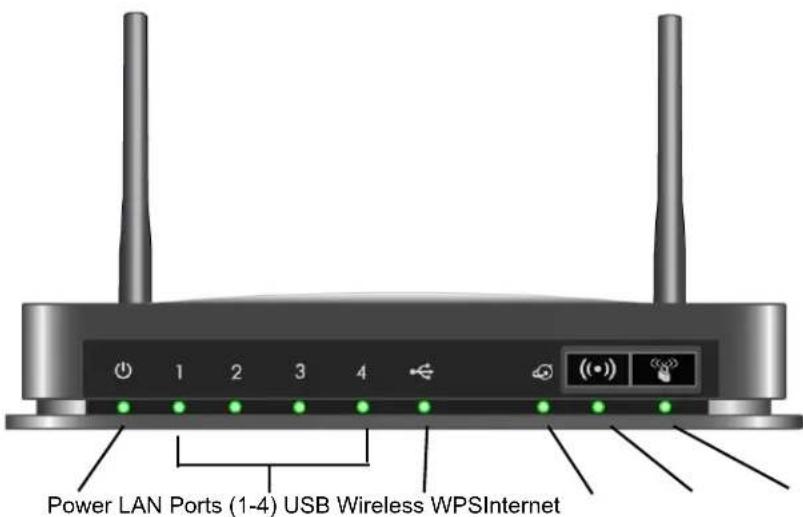
The router front panel shown below contains status LEDs.
text_image
Power LAN Ports (1-4) USB Wireless WPSInternetFigure 1 Front panel
You can use the LEDs to verify status and connections. The following table lists and describes each LED and button on the front panel of the router.
Table 1. LED and Front Panel Button Descriptions
| LED LED | Activity Description | |
 Power Power | Solid green Solid green. Power is supplied to the router. | |
| Solid Red POST (Power-On Self-Test) failure or device malfunction | ||
| Off Power is not supplied to the router | ||
| Restore Factory Settings button | Press button for 6 seconds. Power LED lights briefly. When released, the LED blinks red three times and then turns green as the gateway resets to the factory defaults. | |
 LAN(Ethernet) LAN(Ethernet) | Solid green The Local port has detected an Ethernet link with a device. | |
| Blinking green Data is being transmitted or received. | ||
| Off No link is detected on this port. | ||
 USB USB | Off | No USB device is connected.An error has occurred with the device. |
| Solid blue USB device is ready to use. | ||
| Blinking blue Data is being transmitted or received. | ||
 Internet Internet | Solid green There is an Internet session. | |
| Solid red No Internet connection. | ||
| Blinking green Data is being transmitted over the USB port. | ||
| Blinking green and red Traffic meter limit has been reached. | ||
| Off No Internet connection detected or device in bridged mode. | ||
 Wireless Wireless | Solid green Indicates that the Wireless port is initialized. | |
| Blinking green Data is being transmitted or received over the wireless link. | ||
| Off The Wireless Access Point is turned off. | ||
 WPS WPS | Solid green WPS wireless security is being enabled. | |
| Blinking green The device is in the 2-minute interval to synchronize security. | ||
| Off WPS is not being set or enabled. | ||
| Button | Description | |
 Wireless Wireless | Turn the wireless radio in the router on and off. The wireless radio is on by default. The LED located below this button indicates if the wireless radio is on or off. | |
 WPS WPS | Press this button to open a 2-minute window for the router to connect with other WPS-enabled devices. For more information, about using the WPS method to implement security, see “Using Push 'N' Connect (WPS) to Configure Your Wireless Network” on page 19. | |
Router Back Panel
The back panel of the router contains port connections.

text_image
USB port for Ethernet LAN ports USB docking cable Power On/Off button Power adapter inputFigure 2 Back panel
Router Label
The label on the bottom of the router shows the router's MAC address, serial number, security PIN, and factory default login information.

text_image
USB 4 3 2 1 Ethernet LAN: GREEN = 100 Mbps. BLINK = ACTIVITY LAN USB Power — 0 1 2 3 4 Internet WIFI WPS NETGEAR® 3G/UMTS Mobile Broadband Wireless-N Router MBRN3000 Restore Factory DEFAULT ACCESS http://www.ropterfoam.net user name: odemt password: password ReadyShare Access on Windows Shift -> RUN -> \readyshare (type \readyshare) Designed by NETGEAR in California SECURITY PIN SERIAL MAC Mode in China US LISTED T.E. 8217778 SER. PCC ID: PY309200112Figure 3 Bottom label
Using the Router Stand
You can use the stand to position your router upright.
- Insert the tabs of the stand into the slots on the bottom of your router.
- Place your router near an AC power outlet in a location where you can connect cables as needed for your home network.

natural_image
3D diagram of a mechanical housing component with mounting holes and a base plate, showing a downward arrow indicating assembly (no text or symbols present)Logging In to Your Router
When you first connect to your router during installation, a Setup Wizard appears. For help using the Setup Wizard to configure your Internet and wireless network, see the Mobile Broadband Wireless-N Router MBRN3000 Installation Guide
After the initial configuration, you can use your Web browser to log into the router to view or change its settings. Links to Knowledge Base and documentation are also available on the router main menu.
Note: Your computer must be configured for DHCP. For help with configuring DHCP, see the documentation that came with your computer or see the link to the online document in
When you have logged in, if you do not click Logout, the router waits 5 minutes after no activity before it automatically logs you out.
To log in to the router:
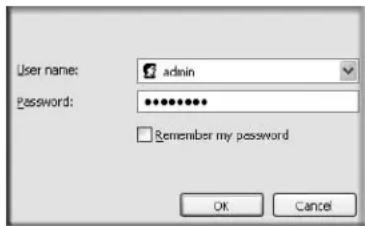
- Type http://www.routerlogin.net in the address field of your browser, and then press Enter. A login window displays:
text_image
User name: admin Password: ******** Remember my password OK Cancel- Enter admin for the user name and your password (or the default, password). For information about how to change the password, see "Changing the Built-In Password" on page 23.
Note: If you changed your password and do not remember what it is, you can restore the router to its factory settings. See "Factory Default Settings" in Appendix A.
- If the router has not been configured, the Smart Wizard screen displays. After the router has been configured, the Firmware Upgrade assistant will appear.
- Checking for Firmware Updates screen. After initial setup, this screen displays unless you have cleared the Check for Updated Firmware Upon Log-in checkbox.

text_image
Firmware Upgrade Assistant The router is checking the NETGEAR server to see if updated firmware available for your router. This could take up to 90 seconds, please wait... ✓ Check for Updated Firmware Upon Log-In Cancel- Router Status screen. The Router Status screen displays if the router's Internet connection has not been set up yet. See "Router Status" on page 33.
- You can use different methods to configure your router.
- Select Setup Wizard from the router menu to set up your Internet connection and wireless network configuration. See "Accessing the Setup Wizard After Installation" on page 11.
- You can manually configure the router settings. See "Manually Configuring Your Internet Settings" on page 11.
Accessing the Setup Wizard After Installation
- Log in to the router as described in "Logging In to Your Router" on page 9.
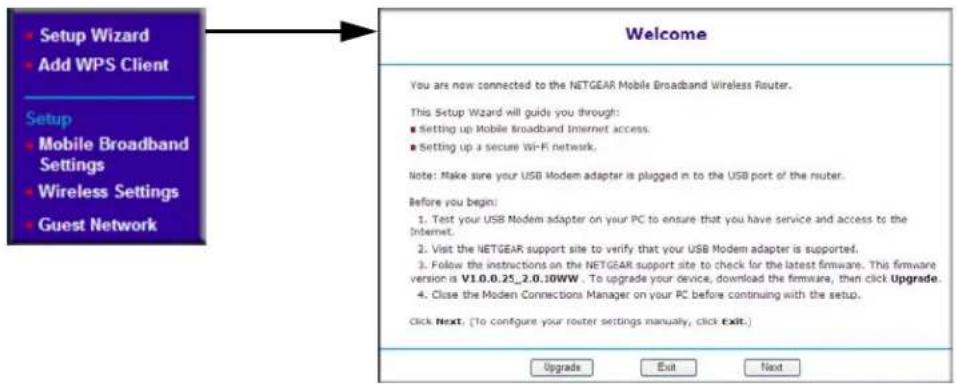
- Select Setup Wizard:
text_image
Setup Wizard Add WPS Client Setup Mobile Broadband Settings Wireless Settings Guest Network Welcome You are now connected to the NETGEAR Mobile Broadband Wireless Router. This Setup Wizard will guide you through: Setting up Mobile broadband Internet access. Setting up a secure Wi-Fi network. Note: Make sure your USB Modem adapter is plugged in to the USB port of the router. Before you begin: 1. Test your USB Modem adapter on your PC to ensure that you have service and access to the Internet. 2. Visit the NETGEAR support site to verify that your USB Modem adapter is supported. 3. Follow the instructions on the NETGEAR support site to check for the latest firmware. This firmware version is V1.0.0.25_2.0.10WW. To upgrade your device, download the firmware, then click Upgrade. 4. Close the Modem Connections Manager on your PC before continuing with the setup. Click Next. (To configure your router settings manually, click Exit.) Upgrade Exit Next3. Click Next.
The Setup Wizard prompts you to set up your Internet connection and wireless network as described in the Mobile Broadband Wireless-N Router MBRN3000 Installation Guide.
Manually Configuring Your Internet Settings
In order to connect to the network, and active broadband service account is required. Please contact your ISP for user name, password and the network name.
To manually configure your Internet settings:
- Log in to the router as described in "Logging In to Your Router" on page 9.
- Select Mobile Broadband Settings.
- Adjust the settings as needed based on your Internet connection. The fields in this screen are described in Table 2. Depending on your region and ISP, some fields might not be available.
-
The following buttons are available:
-
Connect: Manually connect to the network.
- Disconnect: Disconnect from the current network.
• Apply: Apply the changes that you made. - Cancel: Discard changes.
• Refresh: Update the connection status.

text_image
Mobile Broadband Settings User Name Password USB Wireless Broadband modem settings Country USA Internet Service Provider Access Number *99***1# APN isp.cingular PDP Type IP Connect automatically at startup Reconnect automatically When connection is last Roaming automatically Connection Status Connected Connect Disconnect Apply Cancel RefreshTable 2. Broadband Settings fields
| Fields and Checkboxes Description | |
| Username Internet account login username | name |
| Password Internet account password | for authentication |
| PIN code Pin code of the SIM card, where applicable | |
| Network name/APN ISP network name | |
| PDP type Type of packet data protocol | |
| Connect automatically at startup If this | checkbox is selected, the modem automatically connects to the network when powered up. This should be selected after login information is provided. |
| Reconnect automatically when connection is lost | If this check box is selected, the modem will attempt to reconnect to the network when the connection is lost. Under normal situation, this setting should be selected. |
| Roaming automatically If this checkbox | is selected, the unit can roam to any available operator in range and may incur roaming charges. Check with your operator before enabling this feature. |
| Connection status Current WAN port | status |
For a wireless connection, the SSID, also called the wireless network name, and the wireless security setting must be the same for the router and wireless computers or wireless adapters. NETGEAR strongly recommends that you use wireless security.
Note: Computers can connect wirelessly at a range of several hundred feet. If you do not use wireless security, this can allow others outside of your immediate area to access your network.
Planning Your Wireless Network
For compliance and compatibility between similar products in your area, the operating channel and region must be set correctly.
To configure the wireless network, you can either specify the wireless settings, or you can use Wi-Fi Protected Setup (WPS) to automatically set the SSID and implement WPA/WPA2 security.
• To manually configure the wireless settings, you must know the following:
- SSID. The default SSID for the router is NETGEAR-3G.
- The wireless mode (80.211n, 802.11g, or 802.11b) that each wireless adapter supports.
- Wireless security option. To successfully implement wireless security, check each wireless adapter to determine which wireless security option it supports.
See "Manually Configuring Your Wireless Settings" on page 15.
- Push 'N' Connect (WPS) implements WPA/WPA2 wireless security on the router and your wireless computer or device at the same time. The wireless computer or device must be compatible with WPS.
See "Using Push 'N' Connect (WPS) to Configure Your Wireless Network" on page 19.
Wireless Placement and Range Guidelines
The range of your wireless connection can vary significantly based on the physical placement of the router. The latency, data throughput performance, and notebook power consumption of wireless adapters also vary depending on your configuration choices.
For best results, place your router according to the following guidelines:
• Near the center of the area in which your PCs will operate.
- In an elevated location such as a high shelf where the wirelessly connected PCs have line-of-sight access (even if through walls).
- Away from sources of interference, such as PCs, microwave ovens, and 2.4 GHz cordless phones.
• Away from large metal surfaces.
- Put the antenna in a vertical position to provide the best side-to-side coverage. Put the antenna in a horizontal position to provide the best up-and-down coverage.
- If using multiple access points, it is better if adjacent access points use different radio frequency channels to reduce interference. The recommended channel spacing between adjacent access points is 5 channels (for example, use Channels 1 and 6, or 6 and 11).
The time it takes to establish a wireless connection can vary depending on both your security settings and placement. WEP connections can take slightly longer to establish. Also, WEP encryption can consume more battery power on a notebook computer.
Wireless Security Options
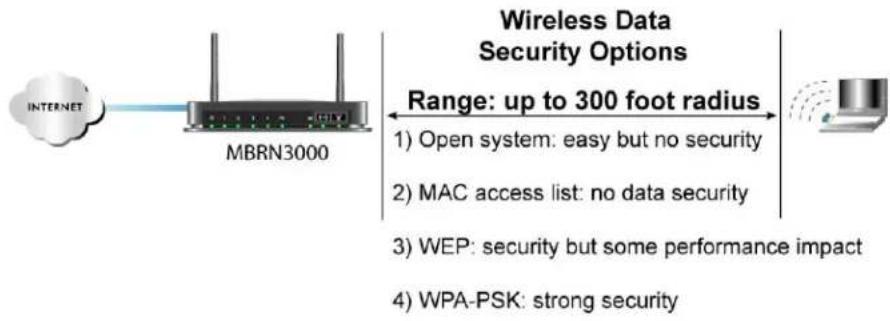
Indoors, computers can connect over 802.11g wireless networks at a maximum range of up to 300 feet. Such distances can allow for others outside your immediate area to access your network.
Unlike wired network data, your wireless data transmissions can extend beyond your walls and can be received by anyone with a compatible adapter. For this reason, use the security features of your wireless equipment. The Mobile Broadband Wireless-N Router provides highly effective security features which are covered in detail in this chapter. Deploy the security features appropriate to your needs.
There are several ways you can enhance the security of your wireless network:
flowchart
graph LR
    A["INTERNET"] --> B["MBRN3000"]
    B --> C["Wireless Data Security Options"]
    C --> D["Range: up to 300 foot radius"]
    D --> E["1) Open system: easy but no security"]
    D --> F["2) MAC access list: no data security"]
    D --> G["3) WEP: security but some performance impact"]
    D --> H["4) WPA-PSK: strong security"]
Figure 4 Wireless Security
- Restrict Access Based on MAC Address. You can allow only trusted PCs to connect so that unknown PCs cannot wirelessly connect to the router. Restricting access by MAC address adds an obstacle against unwanted access to your network, but the data broadcast over the wireless link is fully exposed.
- Turn Off the Broadcast of the Wireless Network Name SSID. If you disable broadcast of the SSID, only devices that have the correct SSID can connect. This nullifies wireless network ‘discovery’ feature of some products, such as Windows XP, but the data is still exposed.
- WEP. Wired Equivalent Privacy (WEP) data encryption provides data security. WEP Shared Key authentication and WEP data encryption block all but the most determined eavesdropper. This data encryption mode has been superseded by WPA-PSK and WPA2-PSK.
- WPA-802.1x, WPA2-802.1x. Wi-Fi Protected Access (WPA) with user authentication implemented using IEE 802.1x and RADIUS servers.
- WPA-PSK (TKIP), WPA2-PSK (AES). Wi-Fi Protected Access (WPA) using a pre-shared key to perform authentication and generate the initial data encryption keys. The very strong authentication along with dynamic per frame re-keying of WPA makes it virtually impossible to compromise.
For more information about wireless technology, see the link to the online document in "Wireless Communications:" in Appendix B.
Manually Configuring Your Wireless Settings
Note: If you use a wireless computer to change the wireless network name (SSID) or wireless security, you will be disconnected when you click Apply. To avoid this problem, connect your computer to the router with an Ethernet cable while you are making changes.
To view or manually configure the wireless settings:
- Log in to the router as described in "Logging In to Your Router" on page 9.
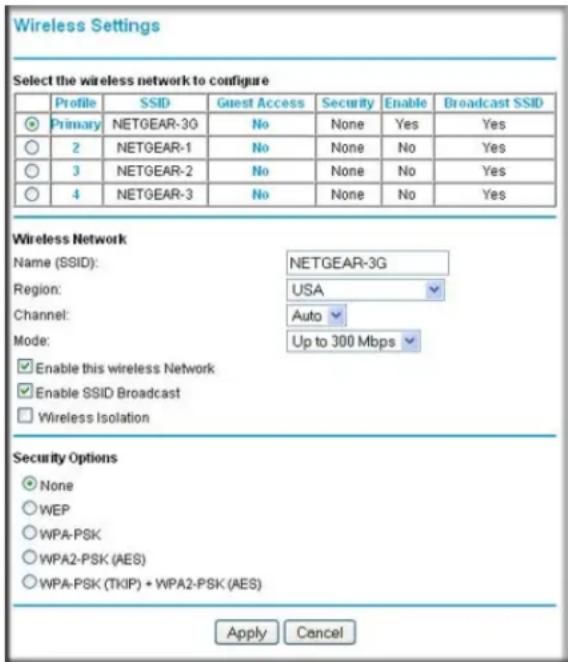
- Select Wireless Settings from the main menu.
The settings for this screen are explained in Table 3.
- Select the region in which the router will operate.
- For initial configuration and test, leave the other settings unchanged.
- To save your changes, click Apply.
- Configure and test your computers for wireless connectivity.
Set up your wireless computers with the same SSID and wireless security settings as your router. Check that they have a wireless link and are able to obtain an IP address by DHCP from the router. If there is interference, adjust the channel.
text_image
Wireless Settings Select the wireless network to configure Profile SSID Guest Access Security Enable Broadcast SSID Primary NETGEAR-3G No None Yes Yes 2 NETGEAR-1 No None No Yes 3 NETGEAR-2 No None No Yes 4 NETGEAR-3 No None No Yes Wireless Network Name (SSID): NETGEAR-3G Region: USA Channel: Auto Mode: Up to 300 Mbps Enable this wireless Network Enable SSID Broadcast Wireless Isolation Security Options None WEP WPA-PSK WPA2-PSK (AES) WPA-PSK (TKIP) + WPA2-PSK (AES) Apply CancelTable 3. Wireless Settings
| Settings Description | ||
| Wireless Network | The green radio button shows which network you have selected, the Primary network, or one of three guest networks that you can set up. For help with guest networks, see “The settings that you configured in Step 2 are broadcast to the WPS devices so that they can connect to the router.” on page 22. | |
| Name (SSID) The SS | D is also known as the wireless network name. Enter a 32-character (maximum) name in this field. This field is case-sensitive.When there is more than one wireless network, SSIDs provide a means for separating the traffic. To join a network, a wireless computer or device must use the SSID. | |
| Region The location w | here the Router is used. | |
| Channel The wireless | channel used by the gateway. The default is Auto.Do not change the channel unless you experience interference (shown by lost connections or slow data transfers). If this happens, you might need to try different channels to see which works best. | |
| Mode The default is up | to 145 Mbps. | |
| Security Options | None You can use this | setting to establish wireless connectivity before implementing wireless security. NETGEAR strongly recommends that you implement wireless security. |
| WEP Use encryption keys and data encryption for data security. You can select 64-bit or 128-bit encryption. See Configuring WEP. | ||
| WPA-PSK (TKIP) Allow only computers configured with WPA to connect to the router. See Configuring WPA, WPA2, or WPA + WPA2. | ||
| Security Options (continued) | WPA2-PSK (AES) Allow only computers configured with WPA2 to connect to the router. See Configuring WPA, WPA2, or WPA + WPA2. | |
| WPA-PSK (TKIP) + WPA2-PSK (AES) | Allow computers configured with either WPA-PSK or WPA2-PSK security to connect to the router. See Configuring WPA, WPA2, or WPA + WPA2. | |
Wireless Guest Networks
A wireless guest network allows you to provide guests access to your wireless network without prior authorization of each individual guest. You can configure wireless guest networks and specify the security options for each wireless guest network.
To configure a wireless guest network:
- In the main menu, under Setup, select Wireless Settings:
| Select the wireless network to configure | ||||||
| Profile | SSID | Guest Access | Security | Enable | Broadcast SSID | |
| ○ | Primary | NETGEAR-3G | No | None | Yes | Yes |
| ○ | 2 | NETGEAR-1 | No | None | No | Yes |
| ○ | 3 | NETGEAR-2 | No | None | No | Yes |
| ○ | 4 | NETGEAR-3 | No | None | No | Yes |
-
Select the radio button for the network profile that you want to set up.
-
You can specify the SSID, Security, and whether the SSID broadcast is enabled.
-
NETGEAR recommends that you change the SSID to a different name. Note that the SSID is case-sensitive. For example, GuestNetwork is not the same as Guestnetwork.
-
Wireless security is disabled by default. NETGEAR strongly recommends that you implement wireless security for the guest network.
-
To configure wireless security for the guest network, enter the security options.
- When you have finished making changes, click Apply.
Configuring WEP
Note: If you use a wireless computer to configure wireless security settings, you will be disconnected when you click Apply. Reconfigure your wireless computer to match the new settings, or access the router from a wired computer to make further changes.
To configure WEP data encryption:
- Log in to the router as described in "Logging In to Your Router" on page 9.
-
From the main menu, select Wireless Settings to display the Wireless Settings screen.
-
In the Security Options section, select the WEP (Wired Equivalent Privacy) radio button:
-
Select the Authentication Type: Automatic, Open System, or Shared Key. The default is Open System.
Note: The authentication is separate from the data encryption. You can select authentication that requires a shared key, but still leaves data transmissions unencrypted. Security is stronger if you use both the Shared Key and WEP encryption settings.

text_image
Security Options None WEP WPA-PSK [TKIP] WPA2-PSK (AES) WPA2-PSK (TKIP) + WPA2-PSK (AES) Security Encryption (WEP) Authentication Type: Automatic Encryption Strength: 64-bit Security Encryption (WEP) Key Passphrase: Generate Key 1: Key 2: Key 3: Key 4:- Select the Encryption Strength setting:
- WEP (Wired Equivalent Privacy) 64-bit encryption. Enter 10 hexadecimal digits (any combination of 0–9, a–f, or A–F).
- WEP (Wired Equivalent Privacy) 128-bit encryption. Enter 26 hexadecimal digits (any combination of 0–9, a–f, or A–F).
- WEP (Wired Equivalent Privacy) 64-bit encryption. Enter 10 hexadecimal digits (any combination of 0–9, a–f, or A–F). - WEP (Wired Equivalent Privacy) 128-bit encryption. Enter 26 hexadecimal digits (any combination of 0–9, a–f, or A–F).
- Enter the encryption keys. You can manually or automatically program the four data encryption keys. These values must be identical on all computers and Access Points in your network:
- Passphrase. To use a passphrase to generate the keys, enter a passphrase, and click Generate. This automatically creates the keys. Wireless stations must use the passphrase or keys to access the router.
Note: Not all wireless adapters support passphrase key generation.
• Key 1-Key4. These values are not case-sensitive. You can manually enter the four data encryption keys. These values must be identical on all computers and access
points in your network. Enter 10 hexadecimal digits (any combination of 0–9, a–f, or A–F).
- Select which of the four keys will be the default.
Data transmissions are always encrypted using the default key. The other keys can be used only to decrypt received data. The four entries are disabled if WPA-PSK or WPA authentication is selected.
- Click Apply to save your settings.
Configuring WPA, WPA2, or WPA + WPA2
Both WPA and WPA2 provide strong data security. WPA with TKIP is a software implementation that can be used on Windows systems with Service Pack 2 or later; WPA2 with AES is a hardware implementation; see your device documentation before implementing it. Consult the product documentation for your wireless adapter for instructions for configuring WPA settings.
Note: If you use a wireless computer to configure wireless security settings, you will be disconnected when you click Apply. If this happens, reconfigure your wireless computer to match the new settings, or access the router from a wired computer to make further changes.
To configure WPA or WPA2 in the router:
-
Log in to the router as described in "Logging In to Your Router" on page 9.
-
Select Wireless Settings from the main menu.
-
On the Wireless Setting screen, select the radio button for the WPA or WPA2 option of your choice.
-
For WPA-PSK or WPA2-PSK, enter the passphrase.
-
To save your settings, click Apply.
Using Push 'N' Connect (WPS) to Configure Your Wireless Network
To use Push 'N' Connect, your wireless computers or devices must support Wi-Fi Protected Setup (WPS). Compatible equipment usually has the WPS symbol on it. WPS can configure the network name (SSID) and set up WPA/WPA2 wireless security for the router and the wireless computer or device at the same time.
Some considerations regarding WPS are:
- NETGEAR's Push 'N' Connect feature is based on the WPS standard. All other Wi-Fi-certified and WPS-capable products should be compatible with NETGEAR products that implement Push 'N' Connect.
- If your wireless network will include a combination of WPS capable devices and non-WPS capable devices, NETGEAR suggests that you set up your wireless network and security settings manually first, and use WPS only for adding WPS capable devices.
WPS Button
Any wireless computer or wireless adapter that will connect to the router wirelessly is a client. The client must support a WPS button, and must have a WPS configuration utility, such as the NETGEAR Smart Wizard or Atheros Jumpstart.
To use the router WPS button to add a WPS client:
- Log in to the router as described in "Logging In to Your Router" on page 9.
- On the router main menu, select Add a WPS Client, and then click Next.
By default, the Push Button (recommended) radio button is selected.

text_image
Add WPS Client Select a setup method: ● Push Button (recommended) You can either press the Push Button physically on the router or press the Button below (so! Push Button) ○ PIN Number WPS button- Either click the onscreen button or press the WPS button on the front of the router.
The router tries to communicate with the client (the computer that wants to join the network) for 2 minutes.
- Go to the client wireless computer, and run a WPS configuration utility. Follow the utility's instructions to click a WPS button.
- Go back to the router screen to check for a message.
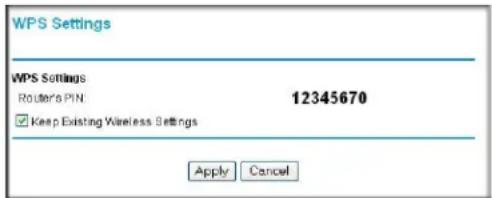
The router WPS screen displays a message confirming that the client was added to the wireless network. The router generates an SSID, and implements WPA/WPA2 wireless security. The router will keep these wireless settings unless you change them, or you clear the Keep Existing Wireless Settings check box in the WPS Settings screen.
text_image
WPS Settings WPS Settings Router's PIN 12345670 ✓ Keep Existing Wireless Settings Apply Cancel- Note the new SSID and WPA/WPA2 password for the wireless network. You can view these settings in the Wireless Settings screen. See "Manually Configuring Your Wireless Settings" on page 15.
To access the Internet from any computer connected to your router, launch a browser such as Microsoft Internet Explorer or Mozilla Firefox. You should see the router's Internet LED blink, indicating communication to the ISP.
Note: If no WPS-capable client devices are located during the 2-minute time frame, the SSID does not chnage, and no security is set up.
WPS PIN Entry
Any wireless computer or device that will connect to the router wirelessly is a client. The client must support a WPS PIN, and must have a WPS configuration utility, such as the NETGEAR Smart Wizard or Atheros Jumpstart.
The first time you add a WPS client, make sure that the Keep Existing Wireless Settings checkbox on the WPS Settings screen is cleared. This is the default setting for the router, and allows it to generate the SSID and WPA/WPA2 security settings when it implements WPS. After WPS is implemented, the router automatically selects this checkbox so that your SSID and wireless security settings stay the same if other WPS devices are added later.
To use a PIN to add a WPS client:
- Log in to the router as described in "Logging In to Your Router" on page 9.
- On the router main menu, select Add a WPS Client (computers that will connect wirelessly to the router are clients), and then click Next. The Add WPS Client screen displays:
- Select the PIN Number radio button.
- Go to the client wireless computer. Run a WPS configuration utility. Follow the utility's instructions to generate a PIN. Take note of the client PIN.
-
From the router Add WPS Client screen, enter the client PIN number, and then click Next.
-
The router tries to communicate with the client for 4 minutes. If no WPS clients connect during this time, the router wireless settings do not change.
-
The router WPS screen confirms that the client was added to the wireless network. The router generates an SSID, and implements WPA/WPA2 wireless security.
-
Note the new SSID and WPA/WPA2 password for the wireless network. You can view these settings in the Wireless Settings screen. See "Manually Configuring Your Wireless Settings" on page 15
To access the Internet from any computer connected to your router, launch an Internet browser such as Mozilla Firefox. You should see the router's Internet LED blink

text_image
Add WPS Client Select a setup method: ○ Push Button (recommended) ● PIN Number If your Adapter supports WPS, please click on "Generate a client Security Pin to input on the API Route/Goaway" and put the generated client PIN number here. Enter Clients PIN NextAdding Wireless Computers that Do Not Support WPS
If you set up your network with WPS, and now you want to add a computer that does not support WPS, you must manually configure that computer. To view the wireless settings for the router, see "Manually Configuring Your Wireless Settings" on page 15.
Because WPA randomly creates the SSID and WPA/WPA2 keys, they might be difficult to type or remember (that is one reason why the network is so secure). You can change the wireless settings so that they are easier for you to remember. If you do that, then you will need to set up the WPS-compatible computers again.
Changing Wireless Settings for the Network:
Note: Making these changes will cause all wireless computers to be disconnected from network. You will then have to set them up with the new wireless settings.
- Use an Ethernet cable to connect a computer to the router. That way you will not get disconnected when you change the wireless settings.
- Log in to the router and select Wireless Settings (see "Manually Configuring Your Wireless Settings" on page 15).
- Make the following changes:
• Change the Wireless Network Name (SSID) to a meaningful name.
- On the WPA/PSK + WPA2/PSK screen, select a passphrase.
- Make sure that the Keep Wireless Settings checkbox is selected in the WPS Settings screen so that your new settings will not be erased if you use WPS.
- Click Apply so that your changes take effect. Write down your settings.
All existing wireless clients are disassociated and disconnected from the router.
- For the non-WPS devices that you want to connect, open the networking utility and follow the utility's instructions to enter the security settings that you selected in Step 2 (the SSID, WPA/PSK + WPA2/PSK security method, and passphrase).
- For the WPS devices that you want to connect, follow the procedure "WPS Button" on page 20 or "WPS PIN Entry" on page 21.
The settings that you configured in Step 2 are broadcast to the WPS devices so that they can connect to the router.
This chapter describes how to use the basic firewall features of the router to protect your network.
Note: For information about the advanced content filtering features port forwarding and port triggering, see "Port Forwarding and Port Triggering" on page 46.
Protecting Access to Your Mobile Broadband Wireless-N Router
For security reasons, the router has its own user name and password. Also, after a period of inactivity, the login automatically disconnects. The user name and password are not the same as a user name or password you might use to log in to your Internet connection.
NETGEAR recommends that you change this password to a more secure password. The ideal password should contain no dictionary words from any language, and should be a mixture of both upper and lower case letters, numbers, and symbols. Your password can be up to 30 characters.
Changing the Built-In Password
- To log in to the router, type http://www.routerlogin.net in the address field of your Internet browser. Enter admin for the user name and your password (or the default, password).
Note: If you changed the password and do not remember what it is, you can reset the router to its factory default settings. See "Restoring the
- From the main menu, under the Maintenance heading, select Set Password:

text_image
Set Password Old Password New Password Repeat New Password Administrator login times out after idle for 5 minutes. Apply Cancel- To change the password, first enter the old password, and then enter the new password twice.
- Click Apply to save your changes.
Note: After changing the password, you must log in again to continue the configuration. If you have backed up the router settings previously, you should do a new backup so that the saved settings file includes the new password.
Changing the Administrator Login Time-out
For security, the administrator login to the router configuration times out after a period of inactivity. To change the login time-out period:
- In the Set Password screen, type a number in the Administrator login times out field. The suggested default value is 5 minutes.
- Click Apply to save your changes, or click Cancel to keep the current period.
Blocking Sites and Keywords
The router provides a variety of options for blocking Internet-based content and communications services. With its content filtering feature, the router prevents objectionable content from reaching your PCs. You can control access to Internet content by screening for keywords within Web addresses. Content filtering options include:
• Keyword blocking of HTTP traffic.
- Outbound service blocking. Limits access from your LAN to Internet locations or services that you specify as off-limits.
- Denial of service (DoS) protection. Detects and thwarts denial of service (DoS) attacks such as Ping of Death, SYN flood, LAND attack, and IP spoofing.
- Blocking unwanted traffic from the Internet to your LAN.
The router allows you to restrict access to Internet content based on Web addresses and Web address keywords.
- Log in to the router as described in "Logging In to Your Router" on page 9.
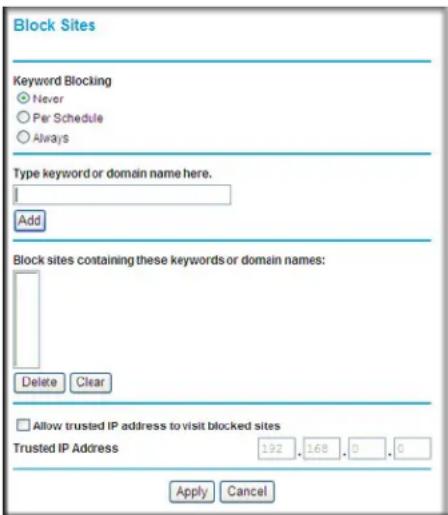
- On the main menu, select Block Sites to display the Block Sites screen:
text_image
Block Sites Keyword Blocking Never Per Schedule Always Type keyword or domain name here. Add Block sites containing these keywords or domain names: Delete Clear Allow trusted IP address to visit blocked sites Trusted IP Address 192 . 168 . 0 . 0 Apply Cancel-
To enable keyword blocking, select one of the following:
-
Per Schedule. Turn on keyword blocking according to the settings on the Schedule screen.
-
Always. Turn on keyword blocking all the time, independent of the setting in the Schedule screen.
-
Enter a keyword or domain in the Keyword field, click Add Keyword, and then click Apply. Some examples of keyword applications are shown in the following chart.
| Keyword Result | |
| XXX Block the URL http://www.badstuf.com/xxx.html. | |
| .com Only websites with other domain suffixes (such as .edu or .gov) can be viewed. | |
| .(a period) Block all Internet browsing access. | |
Up to 32 entries are supported in the Keyword list.
Note: If you block sites, you can set up the router to log attempts to access them. See "Viewing, Selecting, and Saving Logged Information" on page 37.
- To delete a keyword or domain, select it from the list, click Delete Keyword, and then click Apply.
- To specify a trusted user, enter that computer's IP address in the Trusted IP Address field, and then click Apply.
You can specify one trusted user, which is a computer that will be exempt from blocking and logging. Since the trusted user will be identified by an IP address, you should configure that computer with a fixed IP address.
- Click Apply to save your settings.
Blocking Services
- Log in to the router as described in "Logging In to Your Router" on page 9.
- In the main menu, under Content Filtering, select Block Services to display this screen:

text_image
Block Services Services Blocking ● Never ○ Per Schedule ○ Always Service TableService Type Port IP
Add Edit Delete Apply CancelFigure 3-1
-
Select one of the following:
-
Per Schedule. Turn on keyword blocking according to the settings in the Schedule screen.
• Always. Turn on keyword blocking all the time, independent of the Schedule screen. -
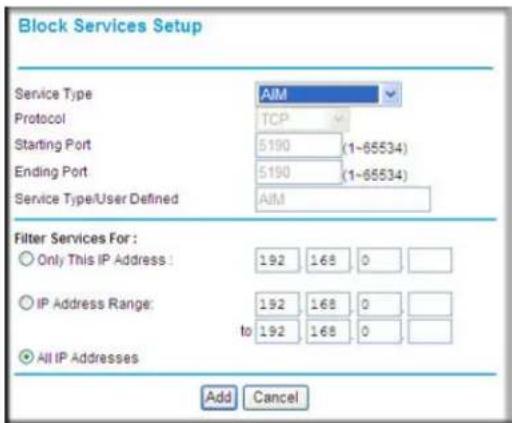
Click Add and the following screen displays:
text_image
Block Services Setup Service Type AIM Protocol TCP Starting Port 5190 (1-65534) Ending Port 5190 (1-65534) Service Type/User Defined AIM Filter Services For: ○ Only This IP Address : 192 168 0 ○ IP Address Range: 192 168 0 to 192 168 0 ● All IP Addresses Add Cancel-
Either select a service from the Service Type drop-down list, or use the Service/Type User Defined field to create a custom service.
-
Click Add to create the service, and it will be listed in the Service Table on the Block Services screen.
-
Click Apply to save your settings.
Scheduling
The router uses network time protocol (NTP) to obtain the current time and date from one of several network time servers on the Internet.
Setting Your Time Zone
To localize the time for your log entries, you must specify your time zone:
-
Log in to the router as described in "Logging In to Your Router" on page 9.
-
On the main menu below Content Filtering, select Schedule:

text_image
Schedule Days to Block: Every Day Sunday Monday Tuesday Wednesday Thursday Friday Saturday Time of day to block(use 24-hour clock) All Day Start Blocking Hour 0 Minute End Blocking Hour 0 Minute Time Zone (GMT-09.00) Pacific Time (US & Canada; Tijuana Automatically: adjust for daylight savings time Current Time: Wednesday, 01 Jan 2003 09:00:24 Apply Cancel- Select your time zone. This setting will be used for the blocking schedule according to your local time zone and for time-stamping log entries.
If your time zone is currently in daylight savings time, select the Automatically adjust for daylight savings time check box.
- Click Apply to save your settings.
Scheduling Firewall Services
If you enabled services blocking in the Block Services screen or port forwarding in the Ports screen, you can set up a schedule for when blocking occurs or when access is not restricted.
-
Log in to the router as described in "Logging In to Your Router" on page 9.
-
On the main menu, select the Schedule. The Schedule screen appears.
-
To block Internet services based on a schedule, select Every Day or select one or more days. If you want to limit access completely for the selected days, select All Day. Otherwise, to limit access during certain times for the selected days, fill in the Start Blocking and End Blocking fields.
-
Enter the values in 24-hour time format. For example, 10:30 a.m. would be 10 hours and 30 minutes, and 10:30 p.m. would be 22 hours and 30 minutes. If you set the start time after the end time, the schedule will be effective through midnight the next day.
-
Click Apply to save your changes.
Live Parental Controls
NETGEAR Live Parental Controls, powered by OpenDNS, is a router-based Web filtering solution available on NETGEAR Wireless-N router and gateway products. Designed to
protect you from identity theft and scams, Live Parental Control blocks up to 50 categories of Internet content.
Live Parental Controls is an excellent solution for keeping your family safe online, but like all Web filtering tools, it isn't perfect. NETGEAR reminds you there's no substitute for keeping the family computer in a common area and in plain sight where you can monitor the websites your kids are visiting, and taking caution when visiting Web sites requesting personal or financial information.
To download Live Parental Controls, click the Live Parental Controls link on the router menu to go to the website: http://www.netgear.com/lpc.
Web-based GUI
Live Parental Controls is the first to allow parents or network administrators to manage settings while away from home or office. This is particularly convenient when access “exceptions” need to be made. And since settings are stored on the web, using a browser interface to manage them is not difficult at all.
Total home protection
Live Parental Controls protects all Internet-connected devices thru the router. It not only protects computers, but also set-top boxes, iPhones, iPods, and gaming consoles that are attached to your network. You no longer need to worry about phones and gaming consoles not being protected when kids use them in their own rooms. Even guest computers accessing the Internet through your network are protected.
Flexible settings
You may have your own computer or you may be sharing a computer with other members in the family. Default and per-user settings allow customizable configurations for different computing arrangement and personalize the settings for each person. Per-time setting allows Internet access during scheduled time slots, to help manage work/play balance.
Minimal software installation
Installation requires a one-time installation of the Management Utility. Once Live Parental Controls is set up, the software runs in the background and does not interfere with normal Internet usage.
This chapter describes how to perform network management tasks with your Mobile Broadband Wireless-N Router.
Backing Up, Restoring, or Erasing Your Settings
The configuration settings of the router are stored in a configuration file in the router. This file can be backed up to your computer, restored, or reverted to factory default settings. The procedures below explain how to do these tasks.
Backing Up the Configuration to a File
- Log in to the router. Type http://www.routerlogin.net in the address field of your Internet browser. Enter admin for the user name and your password (or the default, password).
- Under the Maintenance heading on the main menu, select Backup Settings to display the Backup Settings screen:

text_image
Backup Settings Save a copy of current settings Save Restore saved settings from a file Browse... Restore Revert to factory default settings Erase- Click Save to save a copy of the current settings.
- Store the .cfg file on a computer on your network.
Restoring the Configuration from a File
To restore the configuration:
- Log in to the router. Type http://www.routerlogin.net in the address field of your Internet browser. Enter admin for the user name and your password (or the default, password).
- Under the Maintenance heading on the main menu, select Backup Settings.
- Enter the full path to the file on your network, or click Browse to locate the file.
- When you have located the .cfg file, click Restore to upload the file to the router.
- The router reboots.
Erasing the Configuration
You can use the Erase feature to erase its configuration settings and restore the router to the factory default settings.
To erase the configuration:
- Under the Maintenance heading on the main menu select, Backup Settings.
- Click Erase.
- The router reboots.
After an erase, the router password is password, the LAN IP address is 192.168.0.1, and the router DHCP client is enabled.
Note: To restore the factory default configuration settings when you do not know the login password or IP address, press the Restore Factory Settings button on the bottom of the router for 6 seconds.
Upgrading the Router Firmware
The router firmware is stored in flash memory, and can be upgraded as new firmware is released by NETGEAR. Upgrade files can be downloaded from the NETGEAR website. If the upgrade file is compressed (a .zip file), you must first extract the binary (.bin or .img) file before uploading it to the router.
NETGEAR recommends that you back up your configuration before doing a firmware upgrade. After the upgrade is complete, you might need to restore your configuration settings.
- Download and unzip the new firmware file from NETGEAR.
The Web browser used to upload new firmware into the router must support HTTP uploads. NETGEAR recommends using Microsoft Internet Explorer 5.0 or newer, or Mozilla Firefox 2.0 or newer.
- Log in to the router. Type http://www.routerlogin.net in the address field of your Internet browser. Enter admin for the user name and your password (or the default, password).
- From the main menu, under the Maintenance heading, select Router Upgrade to display this screen:

text_image
Router Upgrade Check for new version from the Internet. Check for new version upon login Locate and select the upgrade file on your hard disk... Browse... Upload Cancel- Click Browse to locate the binary (.bin or .img) upgrade file.
- Click Upload.

WARNING!
When uploading firmware to the router, do not interrupt the Web browser by closing the window, clicking a link, or loading a new page. If the browser is interrupted, it might corrupt the firmware, causing router to be unworkable and inaccessible. When the upload is complete, your router will automatically restart. The upgrade process typically takes about 1 minute. In some cases, you might need to clear the configuration and reconfigure the router after upgrading.
Router Status
From the main menu, below the Maintenance heading, select Router Status to view this screen.
You can use this screen to view the status of the router, to show statistics, or to view the connection status.
- For information about the fields on this screen, see Table 4.
• See "Showing Statistics" on page 35 for information about statistics. - For information about the Internet connection, see "Connection Status" on page 36
| Router Status | |
| Account Name | MBRN3000 |
| Firmware Version | V1.0.0.25_2.0.10WW |
| HSDPA | |
| Modem Identity | AirCard 881U |
| F1_0_0_11AP | |
| Modem SW version | C:\W\S/F\W\F1_0_0_11AP\MSM7200R3/SRCIAMSS2007/11/21:20:49:15 |
| Modem driver version | V1.7 |
| IMSI | 310410109312150 |
| IMEI | 356895010097789 |
| Operator | AT&TP |
| Network mode | EDGE |
| WAN Port | |
| Connection Status | Connected |
| IP Address | 156.129.238.116 |
| Protocol | PPP |
| IP Subnet Mask | 255.255.255.255 |
| Domain Name Server | 209.183.54.151209.183.54.151 |
| LAN Port | |
| IMAC Address | 00:26:F2.5F:90:6E |
| IP Address | 192.168.0.1 |
| DHCP | CN |
| IP Subnet Mask | 255.255.255.0 |
| Wireless Port | |
| Name (SSID) | NETGEAR-3G |
| Region | United States |
| Channel | Auto (1) |
| Wireless AP | On |
| Broadcast Name | On |
Table 4. Router Status Fields
| Field Description | ||
| Firmware Version This field displays the router firmware version. | ||
| HSDPA(High-Speed Downlink Packet Access) | Modem Identity Shows the modem in use. | |
| Modem sw version The software version of the modem. | ||
| Modem driver version | The driver version of the modem. | |
| IMSI International Mobile Subscriber Identity. SIM card identity. | ||
| IMEI International Mobile Equipment Identity.Unique identity of the modem. | ||
| Operator | The ISP for the broadband wireless network. | |
| Network mode | The mode of the current network the modem is connected to.This is dependent on coverage and distance from the cell site. | |
| Field | Description | |
| WAN Port Connection | Status The status of the Internet connection. | |
| IP Address The IP address used by the modem. If no address is shown, the router cannot connect to the Internet. | ||
| Protocol The protocol for the Internet connection, which is PPP (Point-to-Point). | ||
| IP Subnet Mask The IP subnet mask used by the router's USB port. | ||
| Gateway IP Address The IP address used by the router. | ||
| Domain Name Server | The DNS server IP addresses used by the router. These addresses are usually obtained dynamically from the ISP. | |
| LAN Port MAC Address | The Ethernet MAC address used by the router's LAN port. | |
| IP Address The LAN port IP address. The default is 192.168.0.1. | ||
| DHCP | • Off: The router will not assign IP addresses to PCs on the LAN.• On: The router assigns IP addresses to PCs on the LAN. | |
| IP Subnet Mask The LAN port IP subnet mask. The default is 255.255.255.0. | ||
| Wireless Port(See “Manually Configuring Your Wireless Settings”on page 15. | Name (SSID) The service set ID, also known as the wireless network name. | |
| Region The country where the unit is set up for use. | ||
| Channel | The current channel, which determines the operating frequency. | |
| Wireless AP | Indicates if the access point feature is disabled or not. If not enabled, the Wireless LED on the front panel will be off. | |
| Broadcast Name | Indicates if the router is configured to broadcast its SSID. | |
Showing Statistics
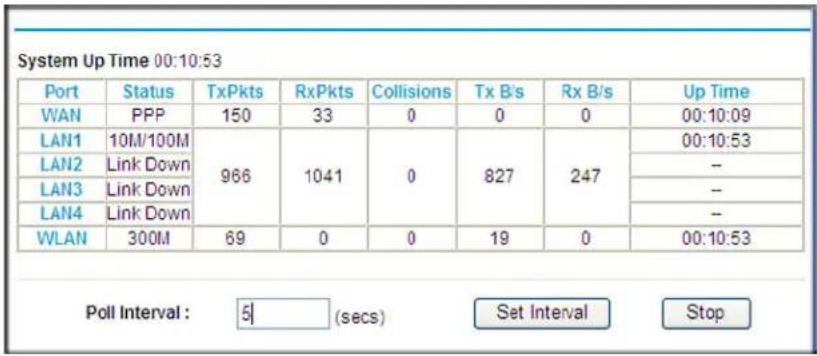
Click the Show Statistics button on the Router Status screen to display router usage statistics:
text_image
System Up Time 00:10:53 Port Status TxPkts RxPkts Collisions Tx B/s Rx B/s Up Time WAN PPP 150 33 0 0 0 00:10:09 LAN1 10M/100M 966 1041 0 827 247 00:10:53 LAN2 Link Down LAN3 Link Down LAN4 Link Down WLAN 300M 69 0 0 19 0 00:10:53 Poll Interval : 5/(secs) Set Interval StopThis following table explains the statistic fields.
Table 5. Router Statistics Fields
| Field Description | |
| Status The link status | Note that LAN2, LAN3, and LAN4 are guest networks. |
| TxPkts The number of | packets transmitted on this port since reset or manual clear. |
| RxPkts The number of | packets received on this port since reset or manual clear. |
| Collisions The number | of collisions on this port since reset or manual clear. |
| Tx B/s The average e | gress line utilization for this port. |
| Rx B/s The average | ingress line utilization for this port. |
| Up Time The time ela | sed since the last power cycle or reset. |
Connection Status
Click the Connection Status button on the Router Status screen:

text_image
HSDPA Status Connection Status Connected Received Signal Quality(dim) -81 Bytes Transmitted 1472 Bytes Received 1186 Tx B/s 48 Rx B/s 0 System Uptime 00:01:31 Connection Duration 00:00:18 Available Networks AT&T,AT&T,T-Mobile Poll Interval: 5 (sec) Sat Interval Stop Close WindowThis screen shows the following statistics:
Table 6. Connection Status Fields for HSDPA Status
| Field Description | |
| Connection Status The status of the Internet connection.• Scanning. The modem is scanning for broadband wireless networks in your area.• Connected. The router is connected to the Internet.• No USB Device Attached. The router does not detect a USB modem connected to its USB port. Either the modem is disconnected, or it is not correctly seated. To correct the problem remove the modem and reinsert it into the port. | |
| Received Signal Quality (in dbm) Modem radio reception. A small, negative number indicates good signal quality. | |
| Bytes Transmitted The number of bytes transmitted in the most recent connection session. | |
| Bytes Received The number of bytes received in the most recent connection session. | |
| Tx B/s The transmission rate. | |
| Rx B/s The receiving rate. | |
| System Uptime Time elapsed since the last reboot. | |
| Connection Duration The time elapsed since the most recent connection to the Internet. | |
| Available Networks The broadband wireless networks available in your area. | |
Viewing Attached Devices
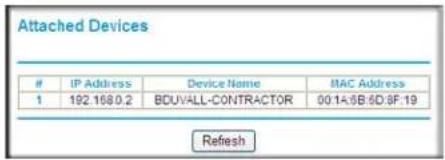
The Attached Devices screen shows all IP devices that the router discovered on the local network. From the main menu, under the Maintenance heading, select Attached Devices:
text_image
Attached DevicesIP Address Device Name MAC Address
1 192.168.0.2 BDUVALL-CONTRACTOR 0014:5B:5D:8F:19 RefreshFor each device, the table shows the IP address, device name if available, and the Ethernet MAC address. If the router is rebooted, this data is lost until the router rediscovers the devices. To force the router to look for attached devices, click the Refresh button.
Viewing, Selecting, and Saving Logged Information
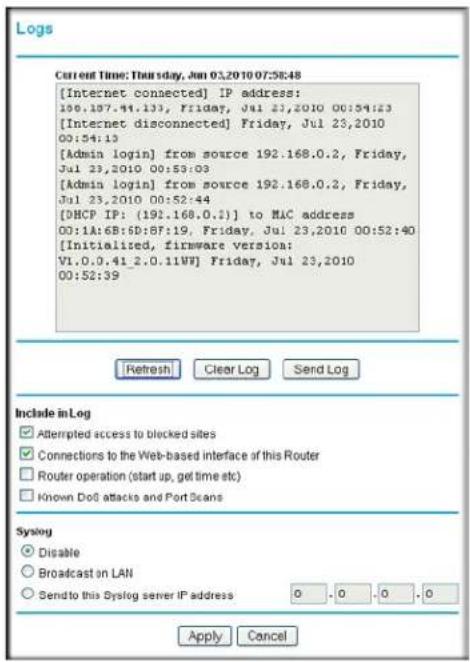
The router logs security-related events such as denied incoming service requests, hacker probes, and administrator logins. If you enabled content filtering in the Block Sites screen, the Logs screen can show you when someone on your network tries to access a blocked site.
On the router menu, below the Content Filtering heading, select Logs to display this screen:
text_image
Logs Current Time: Thursday, Jun 03,2010 07:58:48 [Internet connected] IP address: 196.187.44.133, Friday, Jul 23,2010 00:54:23 [Internet disconnected] Friday, Jul 23,2010 00:54:13 [Admin login] from source 192.168.0.2, Friday, Jul 23,2010 00:53:03 [Admin login] from source 192.168.0.2, Friday, Jul 23,2010 00:52:44 [DHCP IP: (192.168.0.2)] to MAC address 00:1A:6B:6D:8F:19, Friday, Jul 23,2010 00:52:40 [Initialised, firmware version: V1.0.0.41_2.0.11W] Friday, Jul 23,2010 00:52:39 Refresh Clear Log Send Log Include in Log Attempted access to blocked sites Connections to the Web-based interface of this Router Router operation (start up, get time etc) Known Do# attacks and Port Scans Syslog Disable Broadcast on LAN Send to this Syslog server IP address 0 0 0 0 Apply CancelNote: You can enable e-mail notification to receive these logs in an e-mail message. See "Enabling Security Event E-mail Notification" on page 39.
Log entries and action buttons are described in the following table.
Table 7. Security Log Entry and Button Descriptions
| Field or button Description | |
| Current time The date and time the log entry was recorded. | |
| Description or action The type of event and what action was taken if any. | |
| Source IP The IP address of the initiating device for this log entry. | |
| Source port and interface The service port number of the initiating device, and whether it originated from the LAN or WAN. | |
| Destination The name or IP address of the destination device or website. | |
| Destination port and interface The service port number of the destination device, and whether it is on the LAN or WAN. | |
| Refresh button Refresh the log screen. | |
| Clear Log button Clear the log entries. | |
| Send Log button Email the log immediately. | |
| Apply button | Apply the current settings. |
| Cancel button | Clear the current settings. |
Selecting Which Information to Log
Besides the standard information listed previously, you can choose to log additional information. Those optional selections are as follows:
• Attempted access to blocked site
- Connections to the router menu
- Router operation (start up, get time, and so on)
• Known DoS attacks and port scans
Saving Log Files on a Server
You can choose to write the logs to a computer running a syslog program. To activate this feature, select to the Broadcast on LAN radio button or enter the IP address of the server where the syslog file will be written.
Examples of Log Messages
Following are examples of log messages. In all cases, the log entry shows the timestamp as: Day, Year-Month-Date Hour:Minute:Second.
Activation and Administration
Tue, 2002-05-21 18:48:39 - NETGEAR activated
[This entry indicates a power-up or reboot with initial time entry.]
Tue, 2002-05-21 18:55:00 - Administrator login successful - IP:192.168.0.2
Thu, 2002-05-21 18:56:58 - Administrator logout - IP:192.168.0.2
[This entry shows an administrator logging in and out from IP address 192.168.0.2.]
Tue, 2002-05-21 19:00:06 - Login screen timed out - IP:192.168.0.2
[This entry shows a time-out of the administrator login.]
Wed, 2002-05-22 22:00:19 - Log emailed
[This entry shows when the log was e-mailed.]
Dropped Packets
Wed, 2002-05-22 07:15:15 - TCP packet dropped - Source:64.12.47.28,4787,WAN - Destination:134.177.0.11,21,LAN - [Inbound Default rule match]
Sun, 2002-05-22 12:50:33 - UDP packet dropped - Source:64.12.47.28,10714,WAN - Destination:134.177.0.11,6970,LAN - [Inbound Default rule match]
Sun, 2002-05-22 21:02:53 - ICMP packet dropped - Source:64.12.47.28,0,WAN - Destination:134.177.0.11,0,LAN - [Inbound Default rule match]
These entries show an inbound FTP (port 21) packet, User Datagram Protocol (UDP) packet (port 6970), and Internet Control Message Protocol (ICMP) packet (port 0) being dropped as a result of the default inbound rule, which states that all inbound packets are denied.
Enabling Security Event E-mail Notification
To set up the router so that you can receive logs and alerts by e-mail, select Email from the router menu to display the following screen:

text_image
E-mail Turn E-mail Notification On Send alerts and logs through e-mail Your Outgoing Mail Server: Send to This E-mail Address My mail server requires authentication User Name Password Send Alert Immediately When someone attempts to visit a blocked site Send logs according to this schedule None Day Time a.m. p.m. Apply CancelTo receive alerts and logs by e-mail:
- Select the Turn E-mail Notification On check box.
-
Fill in the fields to send alerts and logs through email.
-
Your Outgoing Mail Server. Enter the name or IP address of the outgoing SMTP mail server of your ISP (such as mail.myISP.com).
- Send to This E-mail Address. Enter the e-mail address where you want to send the alerts and logs. Use a full e-mail address, such as ChrisXY@myISP.com.
- My mail server requires authentication. Select this check box if you need to log in to your SMTP server to send E-mail. If you select this feature, you must enter the user name and password for the mail server.
Tip: If you cannot remember this information, check the settings in your email program.
-
Specify when you want the alerts and logs to be sent:
-
Send alert immediately. Select the corresponding check box if you would like immediate notification of a significant security event, such as a known attack, port scan, or attempted access to a blocked site.
- Send logs according to this schedule. Specifies how often to send the logs: Hourly, Daily, Weekly, or When Full.
- Day for sending log. Specifies which day of the week to send the log. Relevant when the log is sent weekly.
- Time for sending log. Specifies the time of day to send the log. Relevant when the log is sent daily or weekly.
If the Weekly, Daily, or Hourly option is selected and the log fills up before the specified period, the log is automatically e-mailed to the specified e-mail address. After the log is sent, it is cleared from the router's memory. If the router cannot e-mail the log file, the log buffer might fill up. In this case, the router overwrites the log and discards its contents.
- Click Apply so that your changes take effect.
Running Diagnostic Utilities and Rebooting the Router
The router has a diagnostics feature. You can use the Diagnostics screen to perform the following functions from the router:
- Ping an IP address to test connectivity to see if you can reach a remote host. If Ping VPN is enabled, the ping packet always goes through the VPN if the VPN tunnel is enabled and working.
- Perform a DNS lookup to test if an Internet name resolves to an IP address to verify that the DNS server configuration is working.
• Display the routing table to identify what other routers the router is communicating with.
- Reboot the router to enable new network configurations to take effect or to clear problems with the router's network connection.
From the main menu, under the Maintenance heading, select Diagnostics:

text_image
Diagnostics Ping an IP address IP Address: Ping Perform a DNS Lookup InternetName: Lookup IP Address: DNS Server: 209.183.54.151 209.183.54.151 Display the Routing Table Display Reboot the Router Reboot Save diagnostics information Save Scan available command port Scan• Ping: Ping an IP address.
- Lookup: A DNS (Domain Name Server) converts the Internet name such as www.netgear.com to an IP address. If you need the IP address of a server on the Internet, you can do a DNS lookup to find the IP address.
- Display: View the internal routing table. Typically, this information is used only by Technical Support.
• Reboot: Shut down and restart the router.
Note: If you reboot the router you will lose your connection. To access the router you will need to log in again after it has finished rebooting.
• Save: Save diagnostic information.
- Scan:
Enabling Remote Management
Using the Remote Management screen, you can allow a user or users on the Internet to configure, upgrade, and check the status of your router.
Tip: Be sure to change the router default password to a very secure password. The ideal password should contain no dictionary words from any language, and should be a mixture of letters (both upper-case and lower-case), numbers, and symbols. Your password can be up to 30 characters.
Configuring Remote Management
- Log in to the router. Type http://www.routerlogin.net in the address field of your Internet browser. Enter admin for the user name and your password (or the default, password).
- Under the Advanced heading, select Remote Management:
- Select the Turn Remote Management On checkbox.
- Specify which external addresses will be allowed to access the router's remote management.
For security, restrict access to as few external IP addresses as practical:
- To allow access from any IP address on the Internet, select Everyone.
• To allow access from a range of IP addresses on the Internet, select IP address range.
Enter a beginning and ending IP address to define the allowed range.
- To allow access from a single IP address on the Internet, select Only This Computer. Enter the IP address that will be allowed access.

text_image
Remote Management Turn Remote Management On Remote Management Address: http://160.128.147.123.8080 Allow Remote Access By: Only This Computer: IP Address Range : From To: Everyone Port Number: 8080 Apply Cancel- Specify the port number that will be used for accessing the router menu.
Access normally uses the standard HTTP service port 80. For greater security, you can enter a different port number. Choose a number between 1024 and 65535, but do not use the number of any common service port. The default is 8080, which is a common alternate for HTTP.
- Click Apply to have your changes take effect.
When accessing your router from the Internet, type your router WAN IP address in your Internet browser address or location field, followed by a colon (:) and the custom port number. For example, if your external address is 134.177.0.123 and you use port number 8080, enter:
http://134.177.0.123:8080
Note: In this case, you must include http:// in the address.
This chapter describes how to configure the advanced features of your Mobile Broadband Wireless-N Router.
Advanced Wireless Settings
From the main menu, select Advanced Wireless Settings to display the following screen:

text_image
Advanced Wireless Settings Advanced Wireless Settings Enable Wireless Router Radio Fragmentation Length (256-2346): 2346 CTS/RTS Threshold (1-2347): 2347 Preamble Mode Long Preamble WPS Settings Router's PIN: 93770958 Disable Router's PIN Keep Existing Wireless Settings Wireless Card Access List Set Up Access List Apply CancelTable 8. Advanced Wireless Settings
| Field Description | |
| Enable Wireless Router Radio Selected by default, this setting enables the wireless radio, which allows the router to work as a wireless access point.Turning off the wireless radio can be helpful for configuration, network tuning, or troubleshooting. | |
| Fragmentation Length, CTS/RTS Threshold, and Preamble Mode | These should be left at their default settings. |
| Router PIN The PIN number used for | Push 'N' Connect. |
| Disable Router PIN By default, this check box is cleared. This allows the WPS clients to discover the router's PIN. | |
| Keep Wireless Settings By default, this check box is cleared. This allows the router to automatically generate the SSID and WPA/WPA2 security settings when it implements WPS. After WPS is implemented, the router automatically selects the Keep Existing Wireless Settings check box so that your SSID and wireless security settings remain the same if other WPS-enabled devices are added later. | |
| Turn Access Control On Access control is disabled by default so that any computer configured with the correct SSID can connect. See Restricting Access by MAC Address. | |
Wireless Station Access Control
By default, any wireless PC that is configured with the correct SSID and wireless security settings is allowed access to your wireless network. You can use Wireless Access Point settings in the Wireless Setting screen to further restrict wireless access to your network:
• Turning off wireless connectivity completely.
You can completely turn off the wireless portion of the router. For example, if you use your notebook computer to wirelessly connect to your router, and you take a business trip, you can turn off the wireless portion of the router while you are traveling. Other members of your household who use computers connected to the router via Ethernet cables can still use the router. To do this, clear the Enable Wireless Access Point check box on the Wireless Settings screen, and then click Apply.
• Hiding your wireless network name (SSID).
By default, the router is set to broadcast its wireless network name (SSID). You can restrict wireless access to your network by not broadcasting the wireless network name (SSID). To do this, clear the Allow Broadcast of Name (SSID) check box on the Wireless Settings screen, and then click Apply. Wireless devices will not "see" your router. You must configure your wireless devices to match the wireless network name (SSID) of the router.
Note: The SSID of any wireless access adapters must match the SSID you configure in the router. If they do not match, you will not get a wireless connection to the router.
Restricting Access by MAC Address
For increased security, you can restrict access to the wireless network to allow only specific PCs based on their MAC addresses. You can restrict access to only trusted PCs so that unknown PCs cannot wirelessly connect to the Mobile Broadband Wireless-N Router. MAC address filtering adds an obstacle against unwanted access to your network, but the data broadcast over the wireless link is fully exposed.
To restrict access based on MAC addresses:
Note: If you configure the router from a wireless computer, add your computer's MAC address to the access list. Otherwise you will lose your wireless connection when you click Apply. You must then access the router from a wired computer, or from a wireless computer that is on the access control list, to make any further changes.
- From the main menu, below the Advanced heading, select Wireless Settings. Click Setup Access List to display the Wireless Station Access List screen.

- Adjust the list as needed for your network. You can add devices to the Trusted Wireless Stations list. Click Add to display the following screen:

text_image
Wireless Card Access List Available Wireless Cards Device Name MAC Address Wireless Card Entry Device Name: MAC Address: Add Cancel Refresh-
You can add devices to the list using either of the following methods:
-
If the computer is in the Available Wireless Cards table, select its radio button to capture its MAC address.
- Use the Wireless Card Entry fields to enter the MAC address of the device to be added. The MAC address can usually be found on the bottom of the wireless device.
-
If no device name appears when you enter the MAC address, you can type a descriptive name for the computer that you are adding.
-
Click Apply to save these settings. Now, only devices on this list will be allowed to wirelessly connect to the router.
Port Forwarding and Port Triggering
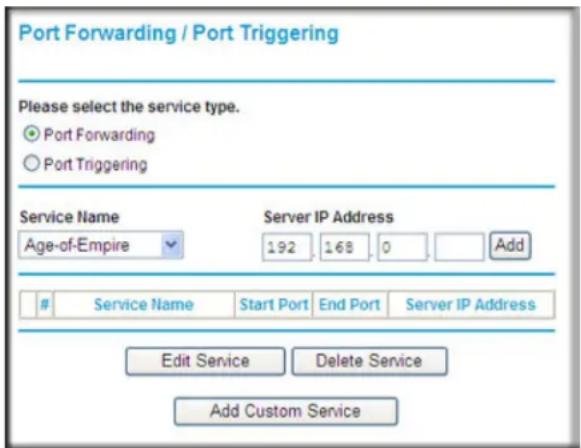
Port forwarding and port triggering are advanced features that affect the behavior of the firewall in your router. In the Port Forwarding / Port Triggering screen, you can make local computers or servers available to the Internet for different services (for example, FTP or HTTP), to play Internet games (like Quake III), or to use Internet applications (like CU-SeeMe)
- Port forwarding is designed for FTP, Web server, or other server-based services. Once port forwarding is set up, requests from the Internet are forwarded to the proper server.
- Port triggering monitors outbound traffic. When the router detects traffic on the specified outbound port, it remembers the IP address of the computer that sent the data and triggers the incoming port. Incoming traffic on the triggered port is then forwarded to the triggering computer. Port triggering allows requests from the Internet only after a designated port is triggered. Port triggering applies to chat and Internet games.
Port Forwarding
To set up port forwarding:
- From the main menu, under the Advanced Heading, select Port Forwarding/Port Triggering. The following screen displays:
text_image
Port Forwarding / Port Triggering Please select the service type. ● Port Forwarding ○ Port Triggering Service Name Age-of-Empire Server IP Address 192 168 0 AddService Name Start Port End Port Server IP Address
Edit Service Delete Service Add Custom ServiceBy default, the Port Forwarding radio button is selected.
-
You can select a service or create a custom service.
-
Select a service from the Service Name drop-down list and specify the computer's IP address
- If you want to add a service that is not in the list, click the Add Custom Service button. Fill in the fields in the Add Custom Service screen.
The service appears in the list.
Port Triggering
To set up port triggering:
- From the main menu, under the Advanced Heading, select Port Forwarding/Port Triggering.
- Select the Port Triggering radio button to display the following screen:

text_image
Port Forwarding / Port Triggering Please select the service type. ○ Port Forwarding ○ Port Triggering Service Name Age-of-Empire Server IP Address 192 168 0 AddService Name Start Port End Port Server IP Address
Edit Service Delete Service Add Custom Service- Click Add Service and fill in the fields in the Add Service screen.
The service appears in the list. For more detailed information, see the Port Forwarding/Port Triggering help.
WAN Setup
To change broadband Internet connection settings, use the Broadband Settings screen, as described in "Manually Configuring Your Internet Settings" on page 11.
To view or change the WAN Setup:
- From the main menu, select WAN Setup to display the WAN Setup screen:
- Make the changes that you want, and then click Apply to save the settings.
The WAN Setup fields are described in the following table.

text_image
WAN Setup Disable Port Scan and DoS Protection Default DMZ Server 192 . 168 . 0 . 0 Respond to Ping on Internet Port MTU Size(in bytes) 1500 NAT Filtering ✓ Secured ○ Open Disable SIP ALG Apply CancelTable 9. WAN Setup Settings
| Setting Description | |
| Disable SPI Firewall This check box is | usually clear so that the firewall protects your LAN against port scans and denial of service (DOS) attacks. This check box should be selected only in special circumstances. |
| Default DMZ Server This feature is so | sometimes helpful when you are using some online games and videoconferencing. Be careful when using this feature because it makes the firewall security less effective. See “Setting Up a Default DMZ Server” on page 48. |
| Respond to Ping on Internet If you want the router to respond to a ping from the Internet, select this check box. This should be used only as a diagnostic tool, since it allows your router to be discovered. Do not select this check box unless you have a specific reason to do so. | |
| MTU Size Maximum Transmit Unit (MTU) value. For most Ethernet networks this is 1500 bytes, or 1492 bytes for PPPoE connections, or 1436 bytes for PPTP connections. | |
| NAT Filtering This is set to Secured to provide a secure firewall to protect computers on the LAN from attacks from the Internet. The Open setting is less secure. | |
| Disable SIP Alg Some VoIP applications do not work well with SIP ALG. Selecting this check box might help your VoIP devices create or accept a call through the router. | |
Setting Up a Default DMZ Server

WARNING!
For security reasons, you should avoid using the default DMZ server feature. When a computer is designated as the default DMZ server, it loses much of the protection of the firewall, and is exposed to many exploits from the Internet. If compromised, the computer can be used to attack your network.
The default DMZ server feature is helpful when you are using some online games and videoconferencing applications that are incompatible with NAT. The router is programmed to recognize some of these applications and to work properly with them, but there are other applications that may not function well. In some cases, one local computer can run the application properly if that computer's IP address is entered as the default DMZ server.
Incoming traffic from the Internet is normally discarded by the router unless the traffic is a response to one of your local computers or a service that you have configured in the Ports screen. Instead of discarding this traffic, you can have it forwarded to one computer on your network. This computer is called the default DMZ server.
To assign a computer or server to be a default DMZ server:
- Go to the WAN Setup screen as described in the previous section.
- Select the Default DMZ Server check box.
- Type the IP address for that server.
- Click Apply to save your changes.
LAN IP Settings
The LAN IP Setup screen allows configuration of LAN IP services such as DHCP and RIP. These features can be found under the Advanced heading in the router main menu.
The router is shipped preconfigured to use private IP addresses on the LAN side, and to act as a DHCP server. The router default LAN IP configuration is:
• LAN IP addresses: 192.168.0.1
- Subnet mask: 255.255.255.0
These addresses are part of the Internet Engineering Task Force (IETF)-designated private address range for use in private networks, and should be suitable in most applications. If your network has a requirement to use a different IP addressing scheme, you can make those changes in this screen.
To view or change the LAN IP Setup:
Tip: If you change the LAN IP address of the router while connected through the browser, you will be disconnected and so will others connected to the router. To connect to the router, you must open a new connection to the new IP address and log in again. Others using the router must restart their computers to connect to the router again.
- Select LAN IP to display the LAN Setup screen:
- Change the settings. For more information, see Table 10, "DHCP Settings" on page 50 or "Reserved IP Addresses" on page 51.
- Click Apply to save the changes.
The LAN TCP/IP Setup parameters are explained in the following table.
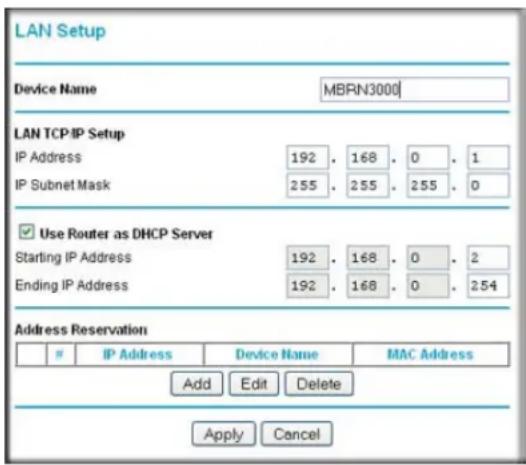
text_image
LAN Setup Device Name MBRN3000 LAN TCP/IP Setup IP Address 192 . 168 . 0 . 1 IP Subnet Mask 255 . 255 . 255 . 0 ✓ Use Router as DHCP Server Starting IP Address 192 . 168 . 0 . 2 Ending IP Address 192 . 168 . 0 . 254 Address ReservationIP Address Device Name MAC Address
Add Edit Delete Apply CancelTable 10. LAN IP Setup
| Settings Description | ||
| Device Name | ||
| LAN TCP/IP Setup | IP Address The LAN IP address of the router. | |
| IP Subnet Mask The LAN subnet mask of the router. Combined with the IP address, the IP Subnet Mask allows a device to know which other addresses are local to it, and which must be reached through a gateway or router. | ||
| DHCP Server For more information, see “DHCP Settings” on page 50. | Use Router as a DHCP Server | This check box is usually selected so that the router functions as a Dynamic Host Configuration Protocol (DHCP) server. See “DHCP Settings” on page 50. |
| Starting IP Address Specify the start of the range for the pool of IP addresses in the same subnet as the router. | ||
| Ending IP Address | Specify the end of the range for the pool of IP addresses in the same subnet as the router. | |
| Address Reservation For more information, see “DHCP Settings” on page 50. | When you specify a reserved IP address for a computer on the LAN, that computer receives the same IP address each time it access the router’s DHCP server. Assign reserved IP addresses to servers that require permanent IP settings. | |
DHCP Settings
By default, the router functions as a Dynamic Host Configuration Protocol (DHCP) server, allowing it to assign IP, DNS server, and default gateway addresses to all computers connected to the router's LAN. The assigned default gateway address is the LAN address of the router. IP addresses is assigned to the attached PCs from a pool of addresses specified in this screen. Each pool address is tested before it is assigned to avoid duplicate addresses on the LAN.
For most applications, the default DHCP and TCP/IP settings of the router are satisfactory. See the online document listed in "Internet Networking and TCP/IP Addressing:" in Appendix B for an explanation of DHCP and information about how to assign IP addresses for your network.
Use Router as DHCP Server
If another device on your network will be the DHCP server, or if you will manually configure the network settings of all of your computers, clear the Use Router as DHCP Server check box on the LAN IP Setup screen. Otherwise, leave it selected.
Specify the pool of IP addresses to be assigned by filling in the Starting IP Address and Ending IP Address fields. These addresses should be part of the same IP address subnet as the router's LAN IP address. Using the default addressing scheme, you should define a range between 192.168.0.2 and 192.168.0.254, although you might want to save part of the range for devices with fixed addresses.
The router delivers the following parameters to any LAN device that requests DHCP:
• An IP address from the range you have defined.
- Subnet mask.
- Gateway IP Address is the router's LAN IP address.
- Primary DNS server, if you entered a primary DNS address in the Basic Settings screen; otherwise, the router's LAN IP address.
- Secondary DNS server, if you entered a secondary DNS address in the Basic Settings screen.
- WINS Server (Windows Internet Naming Service Server), determines the IP address associated with a particular Windows computer. A WINS server records and reports a list of names and IP address of Windows PCs on its local network. If you connect to a remote network that contains a WINS server, enter the server's IP address here. This allows your PCs to browse the network using the Network Neighborhood feature of Windows.
Reserved IP Addresses
When you specify a reserved IP address for a computer on the LAN, that computer always receives the same IP address each time it access the router's DHCP server. Reserved IP addresses should be assigned to servers that require permanent IP settings.
To reserve an IP address:
- Click the Add button.
- In the IP Address field, type the IP address to assign to the computer or server. Choose an IP address from the router's LAN subnet, such as 192.168.0.x.
- Type the MAC address of the computer or server.
Tip: If the computer is on your network, it is listed on the same page for your convenience. Clicking the radio button for each entry in the attached device list fills in the fields automatically with the computer's MAC address and name.
- Click Apply to enter the reserved address into the table.
Note: The reserved address will not be assigned until the next time the computer contacts the router's DHCP server. Reboot the computer or access its IP configuration and force a DHCP release and renew.
To edit or delete a reserved address entry:
- Click the button next to the reserved address you want to edit or delete.
- Click Edit or Delete.
Dynamic DNS
If your network has a permanently assigned IP address, you can register a domain name and have that name linked with your IP address by public Domain Name Servers (DNS).
However, if your Internet account uses a dynamically assigned IP address, you will not know in advance what your IP address will be, and the address can change frequently. In this case, you can use a commercial Dynamic DNS service to register your domain to their IP address, and forward traffic directed at your domain to your frequently changing IP address.
The router contains a client that can connect to a Dynamic DNS service provider. To use this feature, you must select a service provider and obtain an account with them. After you have configured your account information in the router, whenever your ISP-assigned IP address changes, your router will automatically contact your Dynamic DNS service provider, log in to your account, and register your new IP address.
Configuring Dynamic DNS

WARNING!
If your ISP assigns a private WAN IP address such as 192.168.x.x or 10.x.x.x, the Dynamic DNS service will not work because private addresses will not be routed on the Internet.
- From the main menu, select Dynamic DNS to display the Dynamic DNS screen:

text_image
Dynamic DNS □ Use a Dynamic DNS Service Service Provider www.DynDNS.org Host Name User Name Password □ Use Wildcards Apply Cancel Show Status- Access the website of one of the Dynamic DNS service providers whose names appear in the Service Provider drop-down list, and register for an account.
For example, for dyndns.org, go to www.dyndns.org.
- Select the Use a Dynamic DNS Service check box.
- Select the name of your dynamic DNS service provider.
- Fill in the Host Name, User Name, and Password fields.
The dynamic DNS service provider may call the host name a domain name. If your URL is myName.dyndns.org, then your host name is myName. The password can be a key for your dynamic DNS account.
- If your dynamic DNS provider allows the use of wildcards in resolving your URL, you can select the Use wildcards check box to activate this feature.
For example, the wildcard feature will cause *.yourhost.dyndns.org to be aliased to the same IP address as yourhost.dyndns.org.
- Click Apply to save your configuration.
Using Static Routes
Static routes provide additional routing information to your router. Under normal circumstances, the router has adequate routing information after it has been configured for Internet access, and you do not need to configure additional static routes. You must configure static routes only for unusual cases such as multiple routers or multiple IP subnets located on your network.
Static Route Example
As an example of when a static route is needed, consider the following case:
- Your primary Internet access is through a cable modem to an ISP.
- You have an ISDN router on your home network for connecting to the company where you are employed. This router's address on your LAN is 192.168.0.100.
- Your company's network is 134.177.0.0.
When you first configured your router, two implicit static routes were created. A default route was created with your ISP as the router, and a second static route was created to your local network for all 192.168.0.x addresses. With this configuration, if you attempt to access a device on the 134.177.0.0 network, your router forwards your request to the ISP. The ISP forwards your request to the company where you are employed, and the request is likely to be denied by the company's firewall.
In this case you must define a static route, telling your router that 134.177.0.0 should be accessed through the ISDN router at 192.168.0.100.
In this example:
- The Destination IP Address and IP Subnet Mask fields specify that this static route applies to all 134.177.x.x addresses.
- The Gateway IP Address fields specify that all traffic for these addresses should be forwarded to the ISDN router at 192.168.0.100.
- In the Metric field, a value of 1 will work since the ISDN router is on the LAN. This represents the number of routers between your network and the destination. This is a direct connection, so it is set to 1.
- Private is selected only as a precautionary security measure in case RIP is activated.
To configure static routes:
- From the main menu, under the Advanced heading, select Static Routes to view the Static Routes screen:
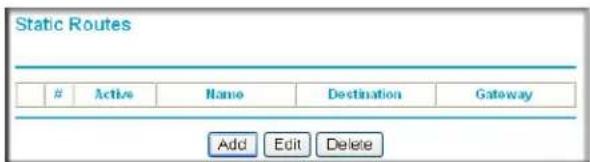
text_image
Static RoutesActive Name Destination Gateway
Add Edit Delete- Click Add or Edit to display the following screen:
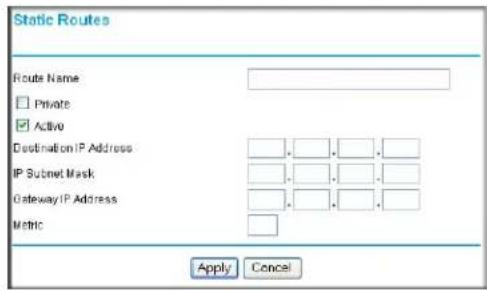
text_image
Static Routes Route Name Private Active Destination IP Address IP Subnet Mask Gateway IP Address Metric Apply Cancel- Fill in or change the fields:
• Route Name. The route name is for identification purposes only.
- Private. Select this check box if you want to limit access to the LAN only. The static route will not be reported in RIP.
• Active. Select this check box to make this route effective.
- Destination IP Address, and IP Subnet Mask. If the destination is a single host, type a subnet value of 255.255.255.255.
• Gateway IP Address. This must be a router on the same LAN segment as the router.
- Metric. Type a number between 2 and 15. This represents the number of routers between your network and the destination. Usually, a setting of 2 or 3 works, but if this is a direct connection, set it to 2.
- Click Apply to either save your changes. If you added a static route, it is added to the Static Routes screen.
Universal Plug and Play (UPnP)
Universal Plug and Play (UPnP) helps devices, such as Internet appliances and computers, access the network and connect to other devices as needed. UPnP devices can automatically discover the services from other registered UPnP devices on the network.
- Select UPnP on the main menu to display the UPnP screen:
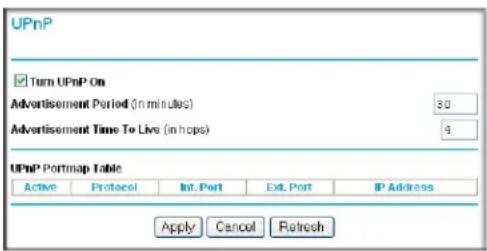
text_image
UPnP ✓ Turn UPnP On Advertisement Period (in minutes) 30 Advertisement Time To Live (in hops) 4 UPnP Portmap Table Active Protocol Int. Port Ext. Port IP Address Apply Cancel Refresh-
Fill in the settings on the UPnP screen:
-
Turn UPnP On. UPnP can be enabled or disabled for automatic device configuration. The default setting for UPnP is enabled. If disabled, the router will not allow any device to automatically control the resources, such as port forwarding (mapping), of the router.
- Advertisement Period. The advertisement period is how often the router advertises (broadcasts) its UPnP information. This value can range from 1 to 1440 minutes. The default period is for 30 minutes. Shorter durations ensure that control points have current device status at the expense of additional network traffic. Longer durations might compromise the freshness of the device status but can significantly reduce network traffic.
- Advertisement Time To Live. The time to live for the advertisement is measured in hops (steps) for each UPnP packet sent. A hop is the number of steps allowed to propagate for each UPnP advertisement before it disappears. The number of hops can range from 1 to 255. The default value for the advertisement time to live is 4 hops, which should be fine for most home networks. If you notice that some devices are not being updated or reached correctly, then it might be necessary to increase this value a little.
-
UPnP Portmap Table. The UPnP Portmap Table displays the IP address of each UPnP device that is currently accessing the router and which ports (internal and external) that device has opened.
-
To save, cancel your changes, or refresh the table:
-
Click Apply to save the new settings to the router.
- Click Cancel to disregard any unsaved changes.
- Click Refresh to update the portmap table and to show the active ports that are currently opened by UPnP devices.
Traffic Meter
Traffic Metering allows you to monitor the volume of Internet traffic passing through your router's Internet port. With the Traffic Meter utility, you can set limits for traffic volume, set a monthly limit, and get a live update of traffic usage.
To monitor traffic on your router:
- Under the Advanced heading on the router menu, select Traffic Meter.
- To enable the Traffic Meter, select the Enable Traffic Meter check box.
-
If you would like to record and restrict the volume of Internet traffic, select the Traffic volume control by radio button. You can select one of the following options for controlling the traffic volume:
-
No Limit. No restriction is applied when the traffic limit is reached.
- Download only. The restriction is applied to incoming traffic only.
-
Both Directions. The restriction is applied to both incoming and outgoing traffic.
-
You can limit the amount of data traffic allowed per month:
-
By specifying how many Mbytes per month are allowed.
-
By specifying how many hours of traffic are allowed.
-
Set the Traffic Counter to begin at a specific time and date.
- Set up Traffic Control to issue a warning message before the month limit of Mbytes or hours is reached. You can select one of the following to occur when the limit is attained:
• The Internet LED flashes green or amber.
• The Internet connection is disconnected and disabled.
-
Set up Internet Traffic Statistics to monitor the data traffic.
-
Click the Traffic Status button if you want a live update on Internet traffic status on your router.
- Click Apply to save your settings.
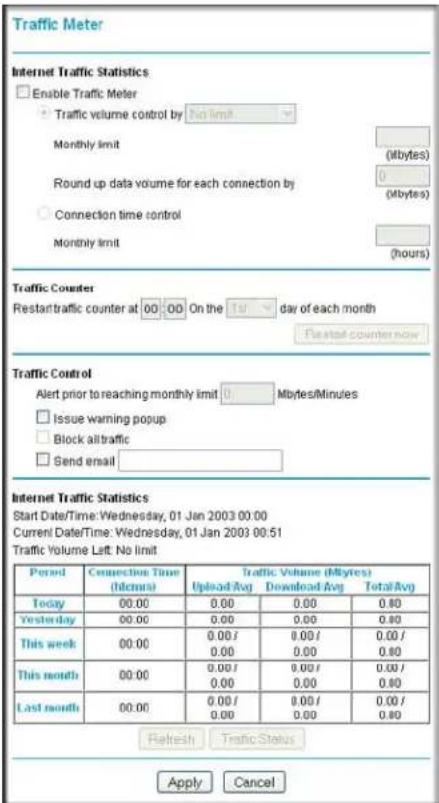
text_image
Traffic Meter Internet Traffic Statistics Enable Traffic Meter Traffic volume control by No limit Monthly limit (Mbytes) Round up data volume for each connection by (Mbytes) Connection time control Monthly limit (hours) Traffic Counter Restart traffic counter at 00:00 On the day of each month Restart counter now Traffic Control Alert prior to reaching monthly limit 0 Mbytes/Minutes Issue warning popup Block alltraffic Send email Internet Traffic Statistics Start Date/Time: Wednesday, 01 Jan 2003 00:00 Current Date/Time: Wednesday, 01 Jan 2003 00:51 Traffic Volume Left: No limit Period Connection Time (hh:mm) Traffic Volume (Mbytes) Upload Avg Download Avg Total Avg Today 00:00 0.00 0.00 0.80 Yesterday 00:00 0.00 0.00 0.80 This week 00:00 0.00/ 0.00/ 0.00/ 0.80 This month 00:00 0.00/ 0.00/ 0.00/ 0.80 Last month 00:00 0.00/ 0.00/ 0.00/ 0.80 Refresh Traffic Status Apply CancelThis chapter gives information about troubleshooting your Mobile Broadband Wireless-N Router. After each problem description, instructions are provided to help you diagnose and solve the problem. For the common problems listed, go to the section indicated.
• Is the router on?
• Have I connected the router correctly?
Go to "Basic Functioning" on page 57.
- I can't access the router's configuration with my browser.
Go to "Troubleshooting Access to the Router Main Menu" on page 58.
- I've configured the router but I can't access the Internet.
Go to "Troubleshooting the ISP Connection" on page 59.
• I want to clear the configuration and start over again.
Go to "Restoring the Default Configuration and Password" on page 62.
Basic Functioning
After you turn on power to the router, the following sequence of events should occur:
- When power is first applied, verify that the Power ⏻ LED is on.
- After approximately 10 seconds, verify that:
a. The Power LED is still solid green. A red light indicates the unit has failed its power-on self-test (POST).
b. The Ethernet LAN port LEDs are lit for any local ports that are connected.
If a LAN port's LED is lit, a link has been established to the connected device. If a LAN port is connected to a 100 Mbps device, verify that the port's LED is green. If the port is 10 Mbps, the LED is amber.
c. The USB and Internet LEDs are lit.
If any of these conditions does not occur, refer to the following table.
Table 11. Troubleshooting with the LEDs
| LED Action | |
| Power LED is off. | Make sure that the power cord is properly connected to your router and that the power supply adapter is properly connected to a functioning power outlet.Check that you are using the power adapter supplied by NETGEAR for this product.If the error persists, you have a hardware problem and should contact technical support. |
| Power LED is red There is a fault within the router. Try to clear the fault as follows:Cycle the power to see if the router recovers.Clear the router's configuration to factory defaults. This sets the router's IP address to 192.168.0.1. This procedure is explained in "Restoring the Default Configuration and Password" on page 62.If the error persists, you might have a hardware problem and should contact technical support. | |
| Internet LED is red. The router cannot connect to the Internet.Make sure the USB LED is lit, indicating that the wireless modem is securely connected to the router.Your wireless modem must be activated and there must be coverage in your area. To test coverage, connect your modem to your PC, and try to connect to the Internet directly from your computer.Check the NETGEAR website to ensure that your wireless modem is supported.Close the 3G Connection manager if it is running on your PC. | |
| LAN LEDs are off. If these LEDs do not light when the Ethernet connection is made, check the following:Make sure that the Ethernet cable connections are secure at the router and at the hub or workstation.Make sure that power is turned on to the connected hub or workstation. | |
| Internet LED is blinking red and green | The traffic meter feature is enabled and the limit set has been reached. |
Troubleshooting Access to the Router Main Menu
If you are unable to access the router main menu from a computer on your local network, check the following:
- If you are using an Ethernet-connected computer, check the Ethernet connection between the computer and the router as described in the previous section.
- Make sure your computer's IP address is on the same subnet as the router. If you are using the recommended addressing scheme, your computer's address should be in the range of 192.168.0.2 to 192.168.0.254. See the online document listed in "Internet Networking and TCP/IP Addressing:" in Appendix B to find your computer's IP address.
Note: If your computer's IP address is shown as 169.254.x.x:
Recent versions of Windows and MacOS generate and assign an IP address if the computer cannot reach a DHCP server. These auto-generated addresses are in the range of 169.254.x.x. If your IP address is in this range, check the connection from the computer to the router, and reboot your computer.
- If your router's IP address was changed and you do not know the current IP address, clear the router's configuration to factory defaults. This will set the router's IP address to 192.168.0.1. This procedure is explained in "Restoring the Default Configuration and Password" on page 62.
- Make sure that your browser has Java, JavaScript, or ActiveX enabled. If you are using Internet Explorer, click Refresh to be sure that the Java applet is loaded.
• Try quitting the browser and launching it again. - Make sure you are using the correct login information. The factory default login name is admin, and the password is password. Make sure that Caps Lock is off when entering this information.
If the router does not save changes you have made in the Web configuration interface, check the following:
- When entering configuration settings, be sure to click the Apply button before moving to another screen or tab, or your changes are lost.
- Click the Refresh or Reload button in the Web browser. The changes might have occurred, but the Web browser might be caching the old configuration.
Troubleshooting the ISP Connection
Connecting to the Internet
If you are unable to connect to internet, check the following:
- The Internet account is active
- Wireless broadband coverage is available where the unit is located. Test by connecting USB modem to the laptop directly.
- Access the router main menu to verify configurations in broadband settings is correct. check with ISP if unsure.
- Check the SIM PIN code, if used.
Troubleshooting Internet Browsing
If your router can obtain an IP address but your computer is unable to load any Web pages from the Internet:
• The Traffic meter is enabled and the limit might have been reached.
By configuring the traffic meter to not block, you can resume Internet access. If you have an usage limit, your ISP may charge you for the overage.
- Your computer might not recognize any DNS server addresses.
A DNS server is a host on the Internet that translates Internet names (such as www addresses) to numeric IP addresses. Typically your ISP provides the addresses of one or two DNS servers for your use. If you entered a DNS address during the router's configuration, reboot your computer and verify the DNS address as described in "Internet Networking and TCP/IP Addressing:" in Appendix B. Alternatively, you can configure your computer manually with DNS addresses, as explained in your operating system documentation.
- Your computer might not have the router configured as its TCP/IP router.
If your computer obtains its information from the router by DHCP, reboot the computer, and verify the router address as described in the link to the online document "Internet Networking and TCP/IP Addressing:" in Appendix B.
Troubleshooting a TCP/IP Network Using the Ping Utility
Most TCP/IP terminal devices and routers contain a ping utility that sends an echo request packet to the designated device. The device then responds with an echo reply.
Troubleshooting a TCP/IP network is made very easy by using the ping utility in your computer.
Testing the LAN Path to Your Router
You can ping the router from your PC to verify that the LAN path to your router is set up correctly.
To ping the router from a PC running Windows 95 or later:
-
From the Windows toolbar, click the Start button, and select Run.
-
In the field provided, type ping followed by the IP address of the router, as in this example: ping 192.168.0.1
-
Click OK.
You should see a message like this one:
Pinging
If the path is working, you see this message:
Reply from < IP address>: bytes=32 time=NN ms TTL=xxx
If the path is not working, you see this message:
Request timed out
If the path is not working correctly, you could have one of the following problems:
- Wrong physical connections
- Make sure that the LAN port LED is on. If the LED is off, follow the instructions in Table 11 on page 58.
- Check that the corresponding Link LEDs are on for your network interface card and for the hub ports (if any) that are connected to your workstation and router.
- Wrong network configuration
- Verify that the Ethernet card driver software and TCP/IP software are both installed and configured on your PC or workstation.
- Verify that the IP address for your router and your workstation are correct and that the addresses are on the same subnet.
Testing the Path from Your Computer to a Remote Device
After verifying that the LAN path works correctly, test the path from your PC to a remote device.
-
From the Windows toolbar, click the Start button, and select Run.
-
In the Windows Run window, type:
PING -n 10 IP address
where IP address is the IP address of a remote device such as your ISP's DNS server.
If the path is functioning correctly, replies as in the previous section are displayed. If you do not receive replies:
- Check that your PC has the IP address of your router listed as the default router. If the IP configuration of your PC is assigned by DHCP, this information is not visible in your PC's Network Control Panel. Verify that the IP address of the router is listed as the default router as described in the online document listed in "Internet Networking and TCP/IP Addressing: " in Appendix B.
- Make sure that the network address of your PC (the portion of the IP address specified by the netmask) is different from the network address of the remote device.
- Check that your cable or DSL modem is connected and functioning.
- If your ISP assigned a host name to your PC, enter that host name as the account name in the Basic Settings screen.
- Your ISP could be rejecting the Ethernet MAC addresses of all but one of your PCs. Many broadband ISPs restrict access by allowing only traffic from the MAC address of your
broadband modem, but some ISPs additionally restrict access to the MAC address of a single PC connected to that modem. If this is the case, you must configure your router to clone or spoof the MAC address from the authorized PC. See the Mobile Broadband Wireless-N Router MBRN3000 Installation Guide.
Restoring the Default Configuration and Password
This section explains how to restore the factory default configuration settings, changing the router's admin password to password and the IP address to 192.168.0.1. You can erase the current configuration and restore factory defaults in two ways:
- Use the Erase feature (see "Backing Up, Restoring, or Erasing Your Settings" on page 30).
- Press the Restore Factory Settings on the bottom of the router for 6 seconds. Use this method for cases when the administration password or IP address is not known.
The factory default settings are shown in "Factory Default Settings" in Appendix A.
Problems with Date and Time
The E-mail screen in the Content Filtering section displays the current date and time of day. The Mobile Broadband Wireless-N Router uses the Network Time Protocol (NTP) to obtain the current time from one of several network time servers on the Internet. Each entry in the log is stamped with the date and time of day. Problems with the date and time function can include the following:
- Date shown is January 1, 2000. Cause: The router has not yet successfully reached a network time server. Check that your Internet access settings are configured correctly. If you have just completed configuring the router, wait at least 5 minutes, and check the date and time again.
- Time is off by one hour. Cause: The router does not automatically sense daylight savings time. On the E-mail screen, select or clear the Adjust for Daylight Savings Time check box.
Factory Default Settings and Technical Specifications

Factory Default Settings
You can use the Restore Factory Settings button located on the bottom of your router to reset all settings to their factory defaults. This is called a hard reset. To perform a hard reset, push and hold the Restore Factory Settings button for 6 seconds. Your router will return to the factory configuration settings that are shown in the following table.
| Feature Default Behavior | ||
| Router login | User login URL http://www.routerlogin.net or http://www.routerlogin.com | |
| User name (case sensitive) admin | ||
| Login password (case sensitive) password | ||
| Internet Connection | WAN MAC address Use default address | |
| WAN MTU size 1500 | ||
| Port speed AutoSense | ||
| Local network (LAN) | LAN IP 192.168.0.1 | |
| Subnet mask | 255.255.255.0 | |
| RIP direction | None | |
| RIP version | Disabled | |
| RIP authentication | None | |
| DHCP server | Enabled | |
| DHCP starting IP address | 192.168.0.2 | |
| DHCP ending IP address | 192.168.0.254 | |
| DMZ | Disabled | |
| Time zone | PST for North America, GMT for other locations | |
| Daylight saving time adjustment | Disabled | |
| Feature (Continued) | Default Behavior (Continued) | |
| Firewall Inbound communication from the Internet | Disabled (except traffic on port 80, the http port) | |
| Outbound communication to the Internet) | ||
| Source MAC filtering Disabled | ||
| Wireless Wireless communication Enabled | ||
| SSID name NETGEAR | ||
| Security Disabled | ||
| Broadcast SSID Enabled | ||
| Transmission speed Auto | ||
| Country/Region United States (in North America; otherwise, varies by region) | ||
| RF channel Auto | ||
| Operating mode Up to 145 Mbps | ||
| Data rate | ||
| Output power | ||
| Access point Enabled | ||
| Authentication type Open system | ||
| Wireless card access list | ||
1 Maximum Wireless signal rate derived from IEEE Standard 802.11 specifications. Actual throughput will vary. Network conditions and environmental factors, including volume of network traffic, building materials and construction, and network overhead, lower actual data throughput rate.
Technical Specifications
| Technical Specifications | |
| Network Protocol and Standards Compatibility | TCP/IP, DHCP |
| Power adapter | North America: 120V AC, 60 Hz, inputUnited Kingdom, Australia: 240V AC, 50 Hz, inputEurope: 230V AC, 50 Hz, inputJapan: 100V AC, 50/60 Hz, inputAll regions (output): 12 V DC @ 1.0A output |
| Physical specifications | Dimensions: 6.8" x 5.03" x 1.28" (173 mm x 128 mm x 33 mm)Weight: 0.65 lbs. without the stand (0.29 kg) |
| Environmental Specifications | Operating temperature: 0° to 40°C (32° to 104°F)Operating humidity: 90% maximum relative humidity, noncondensing |
| Electromagnetic Emissions FCC Part 15 Class B; VCCI Class B; EN 55 022 (CISPR 22), Class B | |
| Interface Specifications | LAN: 10BASE-T or 100BASE-Tx, RJ-45WAN: USB |
This appendix provides links to reference documents you can use to gain a more complete understanding of the technologies used in your NETGEAR product.
| Document | Link |
| Windows XP and Vista Wireless Configuration Utilities Application Note | http://documentation.netgear.com/reference/enu/winzerocfg/index.htm |
| Internet Networking and TCP/IP Addressing: | http://documentation.netgear.com/reference/enu/tcpip/index.htm |
| Wireless Communications: http://documentation.netgear.com/reference/enu/wireless/index.htm | |
| Preparing a Computer for Network Access: | http://documentation.netgear.com/reference/enu/wsdhcp/index.htm |
| Virtual Private Networking (VPN): | http://documentation.netgear.com/reference/enu/vpn/index.htm |
| Glossary: http://documentation.netgear.com/reference/enu/glossary/index.htm | |
Regulatory Compliance Information
Note: This section includes user requirements for operating this product in accordance with National laws for usage of radio spectrum and operation of radio devices. Failure of the end-user to comply with the applicable requirements may result in unlawful operation and adverse action against the end-user by the applicable National regulatory authority.
This product's firmware limits operation to only the channels allowed in a particular Region or Country. Therefore, all options described in this user's guide may not be available in your version of the product.
Europe – EU Declaration of Conformity

Marking by the above symbol indicates compliance with the Essential Requirements of the R&TTE Directive of the European Union (1999/5/EC). This equipment meets the following conformance standards:
EN300 328 (2.4Ghz), EN301 489-17, EN301 893 (5Ghz), EN60950-1
For complete DoC please visit the NETGEAR EU Declarations of Conformity website at:
http://kb.netgear.com/app/answers/detail/a_id/11621/
EDOC in Languages of the European Community
| Cesky [Czech] NETGEAR | Inc. tímto prohlašuje, že tento Radiolan je ve shode se základními požadavky a dalšími príslušnými ustanoveními smernice 1999/5/ES. |
| Dansk [Danish] Undertegnede | NETGEAR Inc. erklærer herved, at følgende udstyr Radiolan overholder de væsentlige krav og øvrige relevante krav i direktiv 1999/5/EF. |
| Deutsch [German] Hiermit | erklärt NETGEAR Inc., dass sich das Gerät Radiolan in Übereinstimmung mit den grundlegenden Anforderungen und den übrigen einschlägigen Bestimmungen der Richtlinie 1999/5/EG befindet. |
| Eesti [Estonian] Käesolevaga | ka kinnitab NETGEAR Inc. seadme Radiolan vastavust direktiivi 1999/5/EÜ põhinõuetele ja nimetatud direktiivist tulenevatele teistele asjakohastele sätetele. |
| English | Hereby, NETGEAR Inc., declares that this Radiolan is in compliance with the essential requirements and other relevant provisions of Directive 1999/5/EC. |
| Español [Spanish] Por medio de la presente NETGEAR Inc. declara que el Radiolan cumple con los requisitos esenciales y cualesquiera otras disposiciones aplicables o exigibles de la Directiva 1999/5/CE. | |
| Ελληνική [Greek] | ME THN ΠΑΡΟΥΣΑ NETGEAR Inc. ΔΗΛΩΝΕΙ OTI Radiolan ΣΥΜΜΟΡΦΩΝΕΤΑΙ ΠΡΟΣ ΤΙΣ ΟΥΣΙΩΔΕΙΣ ΑΠΑΙΤΗΣΕΙΣ ΚΑΙ ΤΙΣ ΛΟΙΠΕΣ ΣΧΕΤΙΚΕΣ ΔΙΑΤΑΞΕΙΣ ΤΗΣ ΟΔΗΓΙΑΣ 1999/5/EK. |
| Français [French] | Par la présente NETGEAR Inc. déclare que l'appareil Radiolan est conforme aux exigences essentielles et aux autres dispositions pertinentes de la directive 1999/5/CE. |
| Italiano [Italian] Con la presente NETGEAR Inc. dichiara che questo Radiolan è conforme ai requisiti essenziali ed alle altre disposizioni pertinenti stabilite dalla direttiva 1999/5/CE. | |
| Latviski [Latvian] | Ar šo NETGEAR Inc. deklarē, ka Radiolan atbilst Direktīvas 1999/5/EK būtiskajām prasībām un citiem ar to saistītajiem noteikumiem. |
| Lietuvių [Lithuanian] | Šiuo NETGEAR Inc. deklaruoja, kad šis Radiolan atitinka esminius reikalavimus ir kitas 1999/5/EB Direktyvos nuostatas. |
| Nederlands [Dutch] | Hierbij verklaart NETGEAR Inc. dat het toestel Radiolan in overeenstemming is met de essentiële eisen en de andere relevante bepalingen van richtlijn 1999/5/EG. |
| Malti [Maltese] Hawnhekk, | NETGEAR Inc., jiddikjara li dan Radiolan jikkonforma mal-htigijiet essenzjali u ma provvedimenti ohrajn relevanti li hemm fid-Dirrettiva 1999/5/EC. |
| Magyar [Hungarian] | Alulírott, NETGEAR Inc. nyilatkozom, hogy a Radiolan megfelel a vonatkozó alapvető követelményeknek és az 1999/5/EC irányelv egyéb előírásainak. |
| Polski [Polish] | Niniejszym NETGEAR Inc. oświadcza, že Radiolan jest zgodny z zasadniczymi wymogami oraz pozostałymi stosownymi postanowieniami Dyrektywy 1999/5/EC. |
| Português [Portuguese] NETGEAR Inc. declara que este Radiolan está conforme com os requisitos essenciais e outras disposições da Directiva 1999/5/CE. |
| Slovensko [Slovenian] NETGEAR Inc. izjavlja, da je ta Radiolan v skladu z bistvenimi zahtevami in ostalimi relevantnimi določili direktive 1999/5/ES. |
| Slovensky [Slovak] NETGEAR Inc. týmto vyhlasuje, že Radiolan spíňa základné požiadavky a všetky príslušné ustanovenia Smernice 1999/5/ES. |
| Suomi [Finnish] NETGEAR Inc. vakuuttaa täten että Radiolan tyyppinen laite on direktiivin 1999/5/EY oleellisten vaatimusten ja sitä koskevien direktiivin muiden ehtojen mukainen. |
| Svenska [Swedish] Härmed intygar NETGEAR Inc. att denna Radiolan står I överensstämmelse med de väsentliga egenskapskrav och övriga relevanta bestämmelser som framgår av direktiv 1999/5/EG. |
| Íslenska [Icelandic] Hér með lýsir NETGEAR Inc. yfir því að Radiolan er í samræmi við grunnkröfur og aðrar kröfur, sem gerðar eru í tilskipun 1999/5/EC. |
| Norsk [Norwegian] NETGEAR Inc. erklærer herved at utstyret Radiolan er i samsvar med de grunnleggende krav og øvrige relevante krav i direktiv 1999/5/EF. |
This device is a 2.4 GHz wideband transmission system (transceiver), intended for use in all EU member states and EFTA countries, except in France and Italy where restrictive use applies.
In Italy the end-user should apply for a license at the national spectrum authorities in order to obtain authorization to use the device for setting up outdoor radio links and/or for supplying public access to telecommunications and/or network services.
This device may not be used for setting up outdoor radio links in France and in some areas the RF output power may be limited to 10 mW EIRP in the frequency range of 2454 – 2483.5 MHz. For detailed information the end-user should contact the national spectrum authority in France.
FCC Requirements for Operation in the United States
FCC Information to User
This product does not contain any user serviceable components and is to be used with approved antennas only. Any product changes or modifications will invalidate all applicable regulatory certifications and approvals
FCC Guidelines for Human Exposure
This equipment complies with FCC radiation exposure limits set forth for an uncontrolled environment. This equipment should be installed and operated with minimum distance of 20 cm between the radiator and your body. This transmitter must not be co-located or operating in conjunction with any other antenna or transmitter.
FCC Declaration of Conformity
We, NETGEAR, Inc., 350 East Plumeria Drive, Santa Clara, CA 95134, declare under our sole responsibility that the model MBRN3000 complies with Part 15 Subpart B of FCC CFR47 Rules. Operation is subject to the following two conditions:
• This device may not cause harmful interference, and
- This device must accept any interference received, including interference that may cause undesired operation.
FCC Radio Frequency Interference Warnings & Instructions
This equipment has been tested and found to comply with the limits for a Class B digital device, pursuant to Part 15 of the FCC Rules. These limits are designed to provide reasonable protection against harmful interference in a residential installation. This equipment uses and can radiate radio frequency energy and, if not installed and used in accordance with the instructions, may cause harmful interference to radio communications. However, there is no guarantee that interference will not occur in a particular installation. If this equipment does cause harmful interference to radio or television reception, which can be determined by turning the equipment off and on, the user is encouraged to try to correct the interference by one or more of the following methods:
• Reorient or relocate the receiving antenna.
- Increase the separation between the equipment and the receiver.
- Connect the equipment into an electrical outlet on a circuit different from that which the radio receiver is connected.
- Consult the dealer or an experienced radio/TV technician for help.
FCC Caution
- Any changes or modifications not expressly approved by the party responsible for compliance could void the user's authority to operate this equipment.
- This device complies with Part 15 of the FCC Rules. Operation is subject to the following two conditions: (1) This device may not cause harmful interference, and (2) this device must accept any interference received, including interference that may cause undesired operation.
- For product available in the USA market, only channel 1\~11 can be operated. Selection of other channels is not possible.
- This device and its antenna(s) must not be co-located or operation in conjunction with any other antenna or transmitter.
Canadian Department of Communications Radio Interference Regulations
This digital apparatus (NETGEAR Mobile Broadband Wireless-N Router MBRN3000) does not exceed the Class B limits for radio-noise emissions from digital apparatus as set out in the Radio Interference Regulations of the Canadian Department of Communications.
Voluntary Control Council for Interference (VCCI) Statement
This equipment is in the Class B category (information equipment to be used in a residential area or an adjacent area thereto) and conforms to the standards set by the Voluntary Control Council for Interference by Data Processing Equipment and Electronic Office Machines aimed at preventing radio interference in such residential areas.
When used near a radio or TV receiver, it may become the cause of radio interference. Read instructions for correct handling.
Index
A
access 3-23
restricting by MAC address 2-15, 5-45
router password 3-23
access control 5-44
B
backup configuration 4-30
blocking
keywords 3-24
services 3-26
sites 3-24
broadband settings 1-11, 1-12
C
configuration
backup 4-30
erasing 4-31
D
date and time, troubleshooting 6-62
daylight savings time 3-28, 6-62
Denial of Service (DoS) protection 3-24
DHCP 5-50
DMZ server 5-48
default 5-48
Dynamic DNS 5-52
F
factory settings, restoring 4-31
filtering 3-28
Firmware Upgrade Assistant 1-10
FLASH memory 4-31
|
Internet configuration 1-11
Internet connection 1-6
auto-detecting connection type 1-11
Mobile Broadband Settings screen 1-11
status 1-12
Internet Traffic Statistics 5-56
IP addresses, auto-generated 6-59
K
keywords, blocking 3-24
L
LEDs 1-7
Live Parental Controls 3-28
logging in 1-9
logging out 1-9
logs, sending 4-39
M
MAC address 6-61
location of 1-8, 5-45
restricting access by 2-15, 5-45
metric (static route) 5-54
Mobile Broadband Settings screen 1-11
N
Network Time Protocol 6-62
NTP 6-62
0
OpenDNS 3-28
P
parental controls 3-28
password
changing 3-23
restoring 6-62
Push 'N' Connect 2-19
R
reserved IP adresses 5-51
restore factory settings 4-31
Restore Factory Settings button 1-8
roaming 1-12
router back panel 1-8
router front panel 1-6
LEDs 1-7
Wireless button 1-7
WPS button 1-7
router label 1-8
router stand 1-9
WPA and WPA2, configuring 2-19
WPS 2-19
WPS button 1-7
S
serial number, location of 1-8
Setup Wizard 1-11
SMTP 4-40
SSID 2-15
Syslog 4-38
T
TCP/IP network troubleshooting 6-60
time of day 6-62
time zone 3-28
timeout, administrator login 3-24
time-stamping 3-28
Traffic Control 5-56
Traffic Counter 5-56
traffic metering 5-55
Traffic Status 5-56
troubleshooting 6-57
Trusted Host 3-26
U
updating firmware 1-10
W
websites, blocking 3-24
WEP 2-15
WEP, configuring 2-18
WINS 5-51
wireless
guest network 2-17
range and interference 2-14
viewing or changing settings 2-15
Wireless button 1-7
wireless network, planning 2-13
wireless security 2-14
wireless station access control 5-44