Professional Classic 10-0021-LP - Barbecue EVO - Free user manual and instructions
Find the device manual for free Professional Classic 10-0021-LP EVO in PDF.


User questions about Professional Classic 10-0021-LP EVO
0 question about this device. Answer the ones you know or ask your own.
Ask a new question about this device
Download the instructions for your Barbecue in PDF format for free! Find your manual Professional Classic 10-0021-LP - EVO and take your electronic device back in hand. On this page are published all the documents necessary for the use of your device. Professional Classic 10-0021-LP by EVO.
USER MANUAL Professional Classic 10-0021-LP EVO
the natural way to cook
Installation Instructions and Owner's Manual
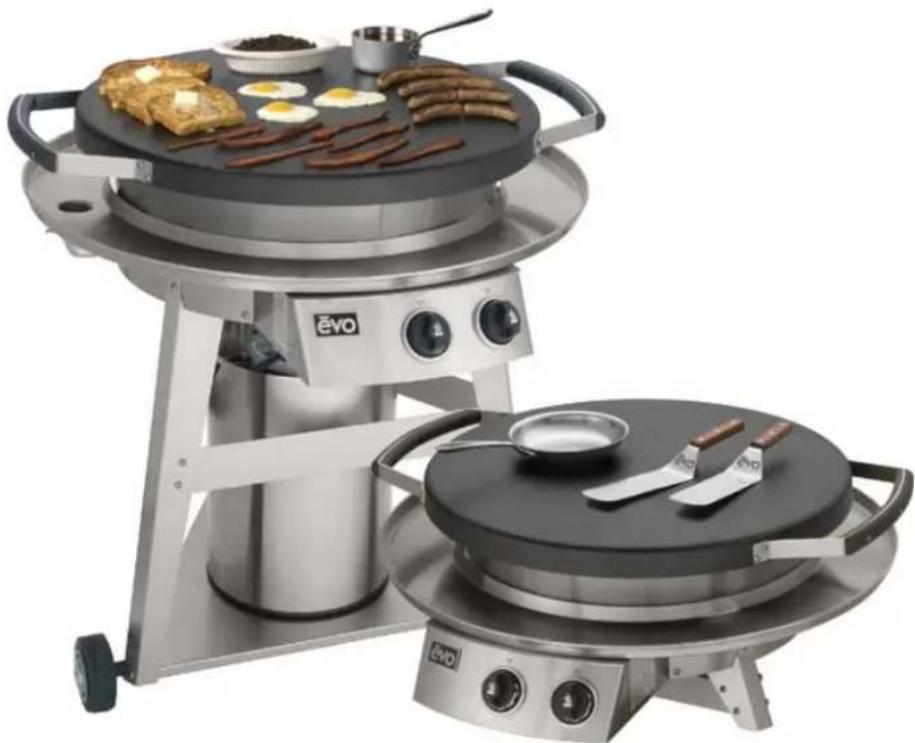
natural_image
Exterior view of a modern electric cooktop with two large grates and food items on top (no signage or text visible)RESIDENTIAL
For Outdoor Use Only

Certification: ANSI Z21.58-1995/CGA 1.6-M95
Part #: Residential models: 10-0002-NG, 10-0002-LP, 10-0021-NG, 10-0021-LP
Report# 141-S-01-5
Copyright ©2013

Some parts may contain sharp edges as especially noted in this manual. Wear protective gloves as necessary.
Warnings
FOR YOUR SAFETY
- Do not store or use gasoline or other f1 ammable vapors and liquids in the vicinity of this or any other appliance.
- An LP Tank not connected for use shall not be stored in the vicinity of this or any other appliance.
FOR YOUR SAFETY
If You Smell Gas:
- Shut off gas to appliance.
- Extinguish any open 1 ame.
- Remove grill cooking surface.
- If odor continues, immediately call your gas supplier or your fire department.

WARNING
It is the responsibility of the assembler/owner to assemble, install and maintain gas grill. Do not let children operate or play near your grill. Failure to follow these instructions could result in serious personal injury and/or property damage.

WARNING
This symbol identifies the most important safety messaging in this manual. When you see this symbol, be alert to the possibility of serious bodily injury if the instructions are not followed. Be sure to read and carefully follow all of the messages.

WARNING
Grill is for outdoor use only. Grill should be operated in a well-ventilated space. Never operate in an enclosed space, garage or building. Your grill is not intended to be installed in or on recreational vehicles and/or boats. Do not install or use grill within 36" of combustible materials from back and sides of grill. Grill shall not be located under unprotected overhead (enclosed carport, garage, porch, patio) made of combustible construction.
Lifetime Limited Warranty
Evo, Incorporated warrants to the original residential consumer-purchaser that the Evo grill shall be free from rust-through on all metal surfaces and shall be free from defects in materials and workmanship under normal and reasonable use from the original date of purchase. Evo promises to replace, at its determination, any product or component that is defective and covered under this warranty for as long as you, the registered original consumer-purchaser, owns the grill. This is your sole and exclusive remedy. This warranty is for the benefit of the original consumer-purchaser and is non-transferable. This warranty is subject to the limitations, exclusions and other provisions listed below.
Limitations Involving Materials and Components:
Warranty does not apply to normal wear and tear, which are expected over the course of ownership. The materials and components listed below are covered according to the following schedule from the original date of purchase:
- One Year – electrical and electronic components [including, but not limited to, electronic displays, overlay and membrane switches, temperature sensors (RTD and K-Value Thermal Couple), hot surface igniters, computers, transformers, heater elements, relays, igniters, ignition controllers, wiring, switches, encoders, outlets and plugs
- One Year – gas components [including, but not limited to, gas regulator, gas hoses, manifold assemblies]
- One Year – accessories and repair parts
The Warranty Registration Card (or online warranty registration form available at www.evoamerica.com/content/residential-warranty-registration) must be completed and returned/submitted to Evo, Incorporated within 30 days from the date of purchase. The original purchase invoice or payment record must be retained and produced upon request if claims are made under this warranty. To receive a replacement Warranty Registration Card, write or call the address listed at the bottom of this page. Warranties are void if the original serial numbers have been removed, altered, or cannot be readily determined.
THIS WARRANTY APPLIES ONLY TO PRODUCTS PURCHASED AND LOCATED WITHIN THE UNITED STATES OR CANADA.
WHAT IS NOT COVERED BY THIS WARRANTY
- Conditions and damages resulting from any of the following:
a. Improper or inadequate installation, delivery, use, storage or maintenance
b. Any repair not authorized in writing by Evo, Inc., any modifications, misapplications, or unreasonable use
c. Improper setting of any control
d. Harsh environmental conditions, including, but not limited to, continual seawater spray, high pressure water, and direct contact with corrosive chemicals and materials
e. Excessive or inadequate electrical, or gas supply
f. Accidents, natural disasters, acts of God
g. Conditions covered by the purchaser's insurance
h. Cleaning supplies and filters
- Products purchased or utilized for commercial use without the express authorization of Evo, Incorporated for such use
- Labor not pre-authorized by Evo, Incorporated, and labor not performed by an authorized Evo service agency or representative
-
Pre-authorized warranty labor performed outside of normal business hours, and at overtime and premium rates
-
The cost of service or a service call to:
a. Identify or correct installation errors
b. Transport the product or component for service to/from the manufacturer or service center
c. Instruct the user of the proper use of the product
-
The cost for any inconvenience, personal injury or property damage due to failure of the product, and cost of damage arising out of the transportation of the product which is covered under different terms with the carrier
-
Natural variations in color and finishes that are inherent to the material and unavoidable (and therefore not defects) ALL IMPLIED WARRANTIES, INCLUDING THE IMPLIED WARRANTIES OF MERCHANTABILITY, SUITABILITY, QUALITY AND/OR FITNESS FOR A PARTICULAR PURPOSE, ARE LIMITED IN DURATION TO THE EXPRESS WARRANTY PERIODS SPECIFIED ABOVE FOR THE PARTS DESCRIBED THEREIN. EVO, INCORPORATED MAKES NO OTHER WARRANTY AND WILL NOT BE LIABLE FOR ANY DIRECT OR INDIRECT, CONSEQUENTIAL OR INCIDENTAL DAMAGES. Some states do not allow limitations on how long an implied warranty lasts, so the above limitation may not apply to you. Neither Evo manufacturer representatives and dealers, nor the retail establishment selling this product has any authority to make any warranties or to promise remedies in addition to or inconsistent with those stated above. The maximum liability to Evo, Incorporated in any event, shall not exceed the purchase price of the product paid by the original consumer-purchaser. Some states do not allow the exclusion or limitation of incidental or consequential damages, so the above limitations or exclusions may not apply to you. This warranty gives you specific legal rights, and you may also have other rights which vary from state to state.
Table Of Contents Assembl
Warnings 2
Limited Warranty 3
Table Of Contents / Assembly Note ----4
Introduction 5
Safety Reminders ----6
Consumer Service 6
Know Your Grill From Front To Back ----7
Front of Grill 7
Top of Grill 8
Back of Grill 9
Parts List 10
Assembling The Grill 11
Legs to Lower Rack 11
Wheels to Lower Rack 11
Leg Supports To Leg Frame 12
Removable Leg Support 12
Leg Assembly To Burner Unit 13
Drip Pan To Burner Unit 14
Cooking Surface To Burner Unit 14
Rear Handle To Burner Unit 15
Hood Handle & Hood Support ----15
Tank Shield 15
Installing LP Tank To Grill 16
Removing Leg Support 16
Connecting LP Regulator To Tank ----17
Removal & Storage of LP Tank ----17
Installing Natural Gas Connection To Grill ----19
Specifications Natural Gas Piping ----18
Installing Natural Gas Hose 19
Checking For Gas Leaks 20
Abnormal Gas Operation / Venturi Tubes ----21
Grill Maintenance, Cooking Techniques----22
Note
Your Evo Flattop Grill is shipped either partially assembled or fully assembled.
If you have purchased a partially assembled unit, then you will need to follow the instructions outlined in the table of contents starting from the beginning.
If you have purchased an fully assembled unit, then you can skip pages 10, 11, 12, 13 and 15, and move immediately to installing your cooking surface (page 14) and the connection of your LP (propane) or natural gas connection (pages 16-21).
Notes
To Installer or Person Assembling Grill:
Leave these instructions with consumer.
To Consumer:
Keep these instructions for future reference.
Complete Now For Future Reference
Serial # ____
Date of Purchase ____
Place of Purchase ____
Safety Reminders
SAFETY PRECAUTIONS
- Installation of grill must conform with local codes, or in absence of local codes, with National Fuel Gas Code, NFPA 54 / ANSI Z223.1-latest edition. Handling of LP tanks must conform to NFPA / ANSI 58-latest edition.
- Do not install or use grill within 36" of combustible materials from back and sides of grill. Grill shall not be located under unprotected overhead (enclosed carport, garage, porch, patio) made of combustible construction.

WARNING
Carefully follow instruction in assembly manual and this booklet for proper assembly and gas leak testing of your grill. Do not use grill until leak checked. If leak is detected at anytime, it must be stopped and corrected before using grill further.
- Grill must not have any obstructions in the venturi-orifice air inlet area.
- Visually inspect hose before each use of grill. If there is excessive abrasion or wear, or if the hose is cut, it must be replaced prior to grill operation.
- Only use valve/hose/regulator that was supplied by Evo with the purchase of your grill.
- Follow lighting and control instructions as described in the Use & Care section of this manual.
- VERY IMPORTANT: Never attempt to place any other cooking utensils (skillets, pots, pans) directly on the burners. Only the Evo cooking grill surface is to be placed over the burners. Only use grill with the supplied grill cooking surface. Buildup of non-ignited gas under other utensils is very dangerous.

WARNING
Do not attempt to put other cooking utensils (skillets, pots, pans) directly on the burners. When grill is not in use, turn off both control knobs and turn tank off.
- Grill cooking area should be kept clear and free from combustible materials, gasoline and other fl ammable vapors and liquids. Do not obstruct fl ow of combustion and ventilation air. Keep ventilation openings of LP gas tank enclosure free and clear from debris. Visually check burner fl ames on regular basis.
- Grill is for outdoor use only. Grill should be operated in a well-ventilated space. Never operate in enclosed space, garage or building. Your grill is not intended to be installed in or on recreational vehicles and/or boats.
- Valve/hose/regulator supplied with grill must be used. Replacement valve/hose/regulator must be those supplied by Evo.
- Carefully follow instructions in assembly manual for attaching regulator to LP tank.
- Purging: Do not release liquid propane (LP) fuel into atmosphere. This is a dangerous practice. If it is necessary to remove fuel from LP gas tank, please call local fire department for assistance.
Consumer Service
- If you have questions or comments concerning the care and use of your grill, or if you need warranty parts, call 1-866-626-1802 or send a fax to 503-213-5869. To order non-warranty replacement parts or accessories, call 1-800-626-1802 or send a fax to 503-213-5869.
Please know your Grill Serial Number and Date of Purchase before calling.
Before Beginning Assembly
Read all assembly instructions. The installation diagrams are for reference only; they do not contain all information needed to correctly assemble your grill.
Metal edges can be sharp. Use caution during assembly and use. Wear protective gloves as necessary.
Lay cardboard on the ground when unpacking.
Assemble grill parts on the cardboard to avoid scratching surfaces.
- Necessary tools: Your grill is supplied with a socket and "L" handle, and one 7/16" open-end box wrench. Other tools you will need to supply are a Phillips screwdriver, a hammer and a small wooden block.
You may fill an LP gas tank purchased from a local supplier prior to assembly. The tank must also have the Safety Cap installed (see diagram) on the tank valve when not in use. Also see your Use & Care Manual.

Safety Cap Installed
If your grill is to be used with a Natural Gas Connection, you must use the Natural Gas Hose Assembly supplied with your Evo grill, or an Evo approved Natural Gas Hose Assembly as shown and described in this manual.
Know Your Grill From Front To Back
Front of Grill
text_image
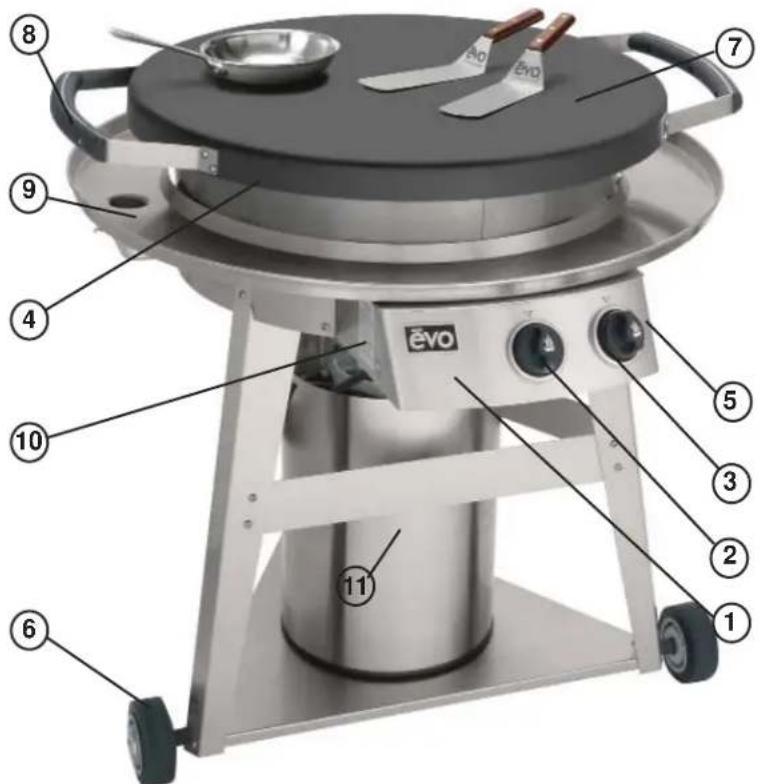
8 7 9 4 10 5 3 2 11 61 - Control panel with inner and outer burner control knobs and electronic ignition. Right side of panel contains serial number, certification number and safety instructions. Left-side of panel contains lighting and safety instructions.
2 - Inner burner control knob for controlled temperature across the center portion of grill cooking surface. Inner burner controls cooking area to an 14" radius from center.
3 - Outer burner control knob for controlled temperature across the outer portion of cooking surface. Outer burner controls cooking area 19" radius from center to outer edge.
4 - Three triangular flame viewing portals located in the burner skirt and above each leg position.
5 - Serial number and safety information sticker.
6 - Solid rubber wheels mounted on stainless steel axel and nylon bearings provide durable transport for your grill.
7 - Grill surface is solid plate steel 3/16" thick, 30" in diameter with approx. 650sq. inches of cooking surface.
8 - Handles for removing your grill surface for burner inspection, transportation, or long-term storage.
9 - Drip pan constructed of easy to clean stainless steel for containing food particles.
10 - Burner lighting and ignition instruction sticker located on left side of control panel.
11 - Propane (LP) tank and optional tank shield. Natural gas versions are supplied with quick-disconnect natural gas hose.
Know Your Grill From Front To Back
Top of Grill
text_image
14 13 12 evo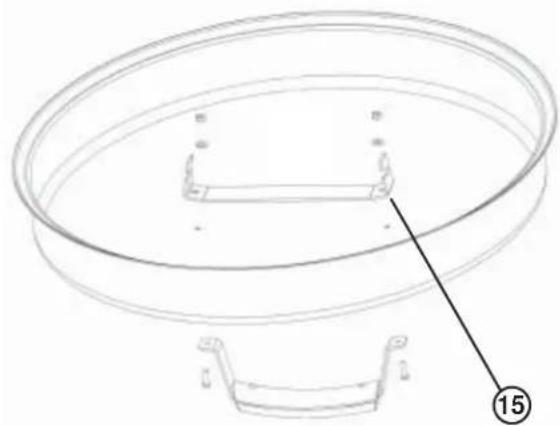
natural_image
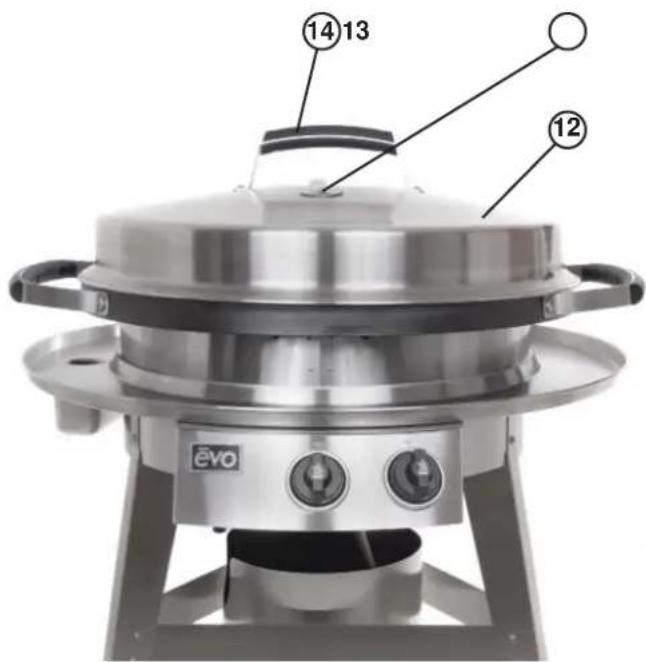
Technical line drawing of a circular mechanical component with two mounting brackets and a labeled part (15), no text or symbols present.12 - Hood constructed of easy to clean stainless steel for converting your grill into a patio oven, for roasting, smoking, steaming or warming. The hood also protects your cooking surface when not in use.
13 - Vent for exhausting steam or vapors.
14- Handle for moving your hood onto the cooking surface, and for moving your hood to the resting position.
15 - Hood Hook support for resting hood on backside of drip pan.
Know Your Grill From Front To Back
Back of Grill
text_image
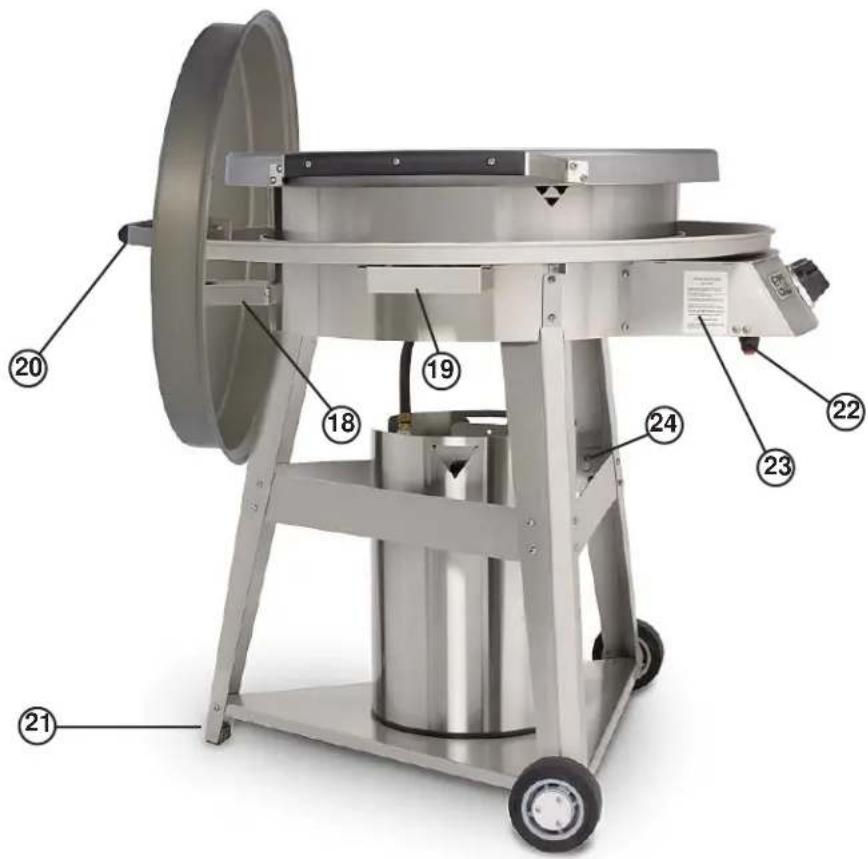
Labeled diagram of a mechanical device with numbered parts for identification18 - Rear handle for lifting and pushing your grill into position.
19 - Stainless steel waste tray mounted to slide rails under drip pan provides overflow waste removal from drip pan and convenient clean out.
20 - Grill shown with hood resting from drip pan. When hood is not in use, it is recommended to support it from drip pan at the rear location. For complete access to cook surface, remove hood from grill and store separately.
21 - Rear leg rubber foot provides support for positioning grill on deck or patio surfaces.
22 - Electronic ignition is battery operated. The ignitor uses one AAA-type battery (installed in ignitor).
23 - Burner lighting and ignition instruction sticker located on left side of control panel.
24 - Removable leg support on right side to access LP tank for refi lling. No tools are required to remove leg support. To remove, slide upward and push outward over fasteners.

WARNING
Replacement of right leg support is necessary after installing LP tank to provide structural stability to the grill.
Parts List
Qty Grill Assembly Components
| 1 | Right Front Leg |
| 1 | Left Front Leg |
| 1 | Rear Leg |
| 2 | Leg Supports (LP Only) |
| 1 | Removable Leg Support (LP Only) |
| 3 | Leg Supports (Natural Gas Only) |
| 1 | Lower Rack |
| 1 | Drip Pan |
| 1 | Waste Tray |
| 1 | Regulator / Hose Assembly (LP Only) |
| 1 | Natural Gas Quick-Disconnect Hose (Natural Gas Only) |
Parts Box
| 1 | Fastener Package |
| 1 | Right Wheel Spacer |
| 1 | Left Wheel Spacer |
| 2 | Wheel |
| 2 | Spanner Bushing |
| 2 | Wheel Hub Plate |
| 1 | Hood Handle |
| 1 | Hood Support |
| 1 | Rear Grill Handle |
| 2 | Hose Clamp and Fasteners(Natural Gas Only) |
| 1 | Electronic Ignitor Battery (AA or AAA) |
Tools Included
| 1 Socket and “L” Handle | |
| 1 7/16" Open-End Box Wrench | |
| Tools | Required |
| 1 Phillips Screwdriver | |
| 1 Hammer | |
| 1 Small Block of Wood (Approx. 2" x 4") | |
| Literature | Bag |
| 1 Install Instructions & Owners Manual | |
| 1 Use & Care Manual | |
You may have extra hardware after completing assembly of your grill. This is normal, as in some cases we have included extra hardware to ensure you have enough.
Fastener Package Listed in Order of Assembly Group
Qty Key Legs to Lower Rack
| 6 | 10 | 1/4" - 20 x 1/2" Phillips Screw - Stainless Steel |
| 6 | 11 | 1/4" - 20 Nyloc Nut - Stainless Steel |
Wheels to Lower Rack
| 2 | 20 | 3/8" x 7/8" - Flat Washer - Stainless Steel |
| 2 | 21 | 3/8" Nyloc Hex Nut - Stainless Steel |
| 6 | 22 | 8 x 3/8" Phillips Screw - Stainless Steel |
Leg Supports to Leg Frame
| 8 30 | 1/4" - 20 x 1/2" Phillips Screw - Stainless Steel. |
| Note: On LP models, 8 screws connect two leg supports.The third removable key-way leg support uses pre-installedhardware. | |
| 12 | 30 1/4" - 20 x 1/2" Phillips Screw - Stainless Steel.Note: On Natural Gas models, 12 screws are required forconnecting all three leg supports to leg frame. Removableleg support not used on Natural Gas models. |
| 8 31 | 1/4" - 20 Nyloc Nut - Stainless Steel.Note: On LP models, 8 nyloc nuts are required for connecting all two leg supports to leg frame. The third (right-mostfrom front of grill) is a removable (keyed) support. |
| 12 | 31 1/4" - 20 Nyloc Hex Nut - Stainless Steel.Note: On Natural Gas models, 12 nyloc nuts are requiredfor connecting all three leg supports to leg frame. |
Leg Frame Assembly to Burner Unit
| 6 | 40 | 1/4" - 20 x 1/2" Phillips Screw - Stainless Steel |
| 6 | 41 | 1/4" - 20 Nyloc Hex Nut - Stainless Steel |
Drip Pan to Burner Unit
| 3 | 50 | 1/4" - 20 x 1/2" Phillips Screw - Stainless Steel |
| 3 | 51 | 1/4" - 20 Nyloc Hex Nut - Stainless Steel |
Rear Handle to Burner Unit
| 2 | 60 | 1/4" - 20 x 1/2" Phillips Screw - Stainless Steel |
| 2 | 61 | 1/4" - 20 Nyloc Hex Nut - Stainless Steel |
Hood Handle and Hood Support
| 2 | 70 | 1/4" - 20 x 5/8" Phillips Screw - Stainless Steel |
| 2 | 71 | 1/4" Lock Washer |
| 2 | 72 | 1/4" - 20 Hex Nut |
Natural Gas Hose to Rear Leg ( Natural Gas Only )
| 2 | 100 | 5/8" Stainless Steel Hose ClampsScrew / Nut Combination Included |
Assembling The Grill
Legs to Lower Rack
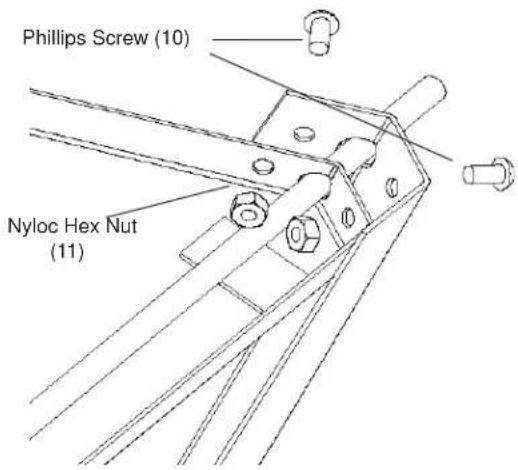
- Position bottom of right leg with label marked RIGHT to lower rack and slide over axle.
- Visually align screw holes and place phillips screw (10) into first mounting hole.
- Secure to lower rack by first installing Nyloc Hex Nut (11).
Securely tighten screws by holding screwdriver steady against screw head and using wrench to tighten nyloc hex nut. - Repeat for second mounting hole.
- Repeat for left leg which is marked with label LEFT.
- Position bottom of rear leg label marked REAR to lower rack.
- Visually align screw holes and place phillips screw (10) in mounting hole.
- Secure by installing Nyloc Hex Nut (11).
- Repeat for second mounting hole.

Some parts may contain sharp edges. Wear protective gloves as necessary.
text_image
Phillips Screw (10) Nyloc Hex Nut (11)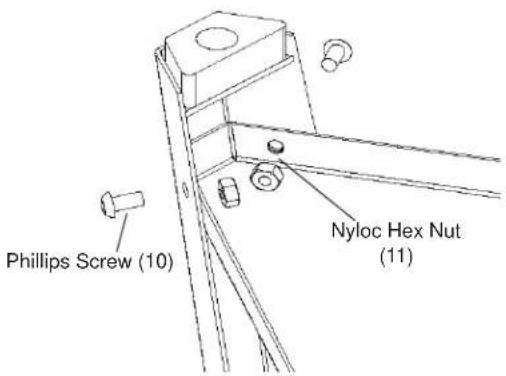
text_image
Phillips Screw (10) Nyloc Hex Nut (11)Wheels to Lower Rack
- Slide left wheel spacer marked LEFT (on flat-side of spacer) over left axle and position cutout to match angle of leg.
- Slide white nylon spanner bushing over axle and against wheel spacer.
- Slide wheel over spanner with three hub plate screw holes facing outward.
- Install washer (20) and nyloc hex nut (21). Tighten nut using socket and L wrench provided in tool kit.
- Place hub plate over outside of wheel and align with mounting holes in wheel.
- Install three stainless screws (22) through hub plate and into wheel.
- Repeat for right wheel installation using spacer marked RIGHT.

text_image
Left Wheel Spacer (marked on fl at end) Wheel Spanner (slide over axel) Wheel Nyloc Nut (21) (nylon faces outward) Screws (22) 3x Flat Washer (20) Hub Plate (polished side faces outward) Left FrontAssembling The Grill
Leg Supports To Leg Frame
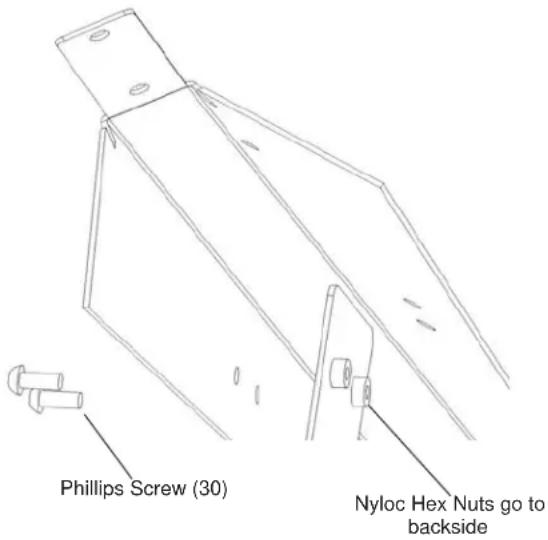
Propane (LP) models have two leg supports (left-side and front) that are installed using philips screws and nyloc hex nuts. The third leg support (right-side) is a removable with keyway cutouts that install over pre-installed fasteners (see Removable Leg Support below).
Natural Gas models have three leg supports (left-side, right-side, and front) that are installed using philips screws and nyloc hex nuts.
- Position leg support to inside of leg with removable installation label on leg support facing outward. Be sure angle at each end of leg support matches inside angle of leg.
- Visually align screw holes and place phillips screw (30) into fi rst mounting hole with nyloc hex nut securing leg support from behind.
- Tighten phillips screw to nyloc hex nut and ensure leg support is engaged and leg support is secured against inside of leg.
- Repeat for all mounting holes of each leg support.
Removable Leg Support
Propane (LP) Models Only
- On LP models, two leg supports are installed to the leg frame using 8 phillips screws and nyloc hex nuts. The third leg support, located on the right-side of the grill, is provided with keyway cutouts which allow easy removal for exchanging the LP tank.
- The fasteners necessary to engage the removable leg support are pre-installed at the factory and require no adjustment. These fasteners are tensioned with a spring that secures the leg support to the right-front and rear leg.
- Position removable leg support on inside of leg with the polished factory finish facing outward. Be sure angle at each end of leg support matches inside angle of leg.
- Visually align keyway holes and leg support over fasteners.
- Pull inward at each end of the leg support, and then push downward to engage the keyway fasteners.
- To remove the leg support, reverse the installation process.

Some parts may contain sharp edges. Wear protective gloves as necessary.
text_image
Phillips Screw (30) Nyloc Hex Nuts go to backside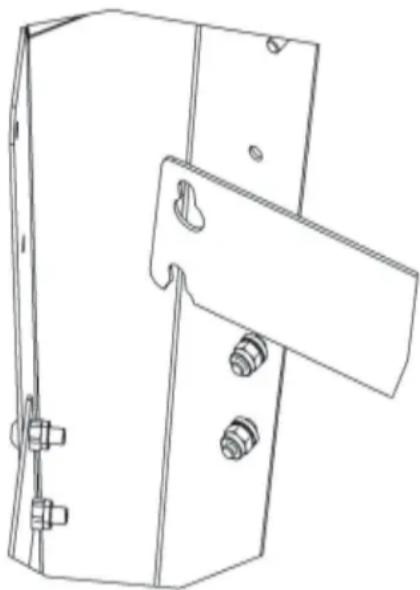
natural_image
Technical line drawing of a mechanical bracket with bolts and a handle (no text or symbols)Assembling Your Evo Grill
Leg Assembly To Burner Unit
- Stand completed leg assembly in an upright position with the control panel facing forward.
- Place burner unit over leg assembly with control panel centered between front legs with right and left wheels on each side.
- Gently lower skirt onto leg assembly making sure the upper tab of each leg rests outside the burner unit skirt.
- Allow the skirt to gently slide into the vertically angled mounting channels of each leg.
- Make sure the mounting hole on the skirt is positioned inside the tab of each leg.
It will be necessary to engage burner unit skirt to leg assembly by using a hammer against a small block of wood and lightly tapping the skirt into the channel of each leg tab.
The leg tab will slide over the exposed rivet head located below the first mounting hole of each leg.
When the leg tab is properly installed, the rivet head will be under the tab and no longer in view.
- Position the burner unit skirt so the mounting hole in each leg tab is visually aligned outside the mounting hole of the skirt.

Some parts may contain sharp edges. Wear protective gloves as necessary.

text_image
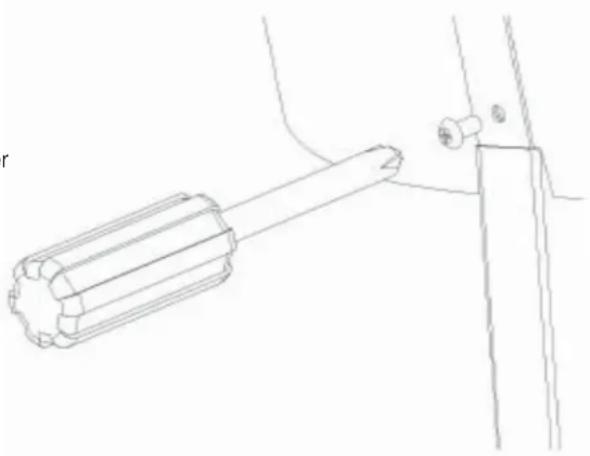
Burner Unit Skirt goes to inside of Leg Tab on all three legs Skirt slides into leg chan- nel on all three legs- Assemble leg to the burner unit using philips screw (40), and nyloc hex nut (41).
- Use 7/16" open-end wrench and phillips screwdriver tools to fasten the legs to burner unit.
Securely tighten screws by holding screwdriver steady against the screw head while using the wrench to tighten nut.
- Repeat for each leg mounting location.
natural_image
Technical line drawing of a mechanical assembly with a cylindrical component and mounting bracket (no text or symbols)Assembling Your Evo Grill
Drip Pan To Burner Unit
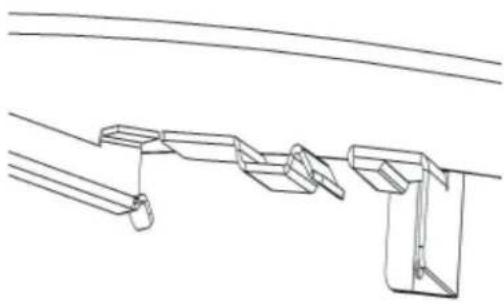
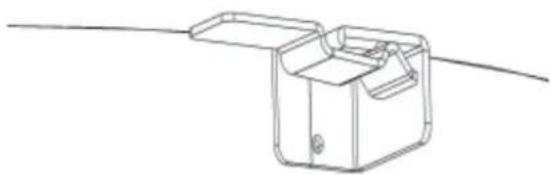
- Lower drip pan over burner skirt with the round clean-out hole of drip pan positioned on the left side of the control panel. The three detent clips and waste container rails must be facing downward.
- Rest the drip pan on the three support brackets which are riveted to the burner skirt
- Position the three detent clips just before each support bracket.
- Grasp the drip pan with both hands across the diameter and firmly rotate the pan to engage each detent clip onto each of the three support brackets.
- To remove drip pan, reverse the process of installation by firmly rotating the drip pan counter clockwise.
NOTE:
Because drip pan detent clips are made of a stainless steel spring material, they are rigid when new and it may be necessary to lightly pry each detent clip from its mounting position in order to remove the drip pan. Over time, as the clips are engaged and disengaged, they will become easier to remove and install with a rm rotation of the drip pan.
Always make sure waste tray is located on left side of grill to allow drip pan detent clips to properly engage the support brackets.

Some parts may contain sharp edges. Wear protective gloves as necessary.
natural_image
Pure technical line drawing of mechanical components without any text, numbers, or symbols

natural_image
Line drawing of a mechanical device with a handle and internal components (no text or symbols)Cooking Surface To Burner Unit
- Install cooking surface to burner unit by centering locating tab over burner skirt.
- Tab Step must be positioned to outside of burner skirt to allow cooking surface to be centered.
Gently move cooking surface right to left and front to back to locate tabs to skirt.

WARNING
Never attempt to install cooking surface when burners are ignited. Failure to follow these instructions could result in serious personal injury and property damage.

text_image
Tab Step 1 is to outside of Burner Skirt Locating Tab Tab Step evoAssembling Your Grill
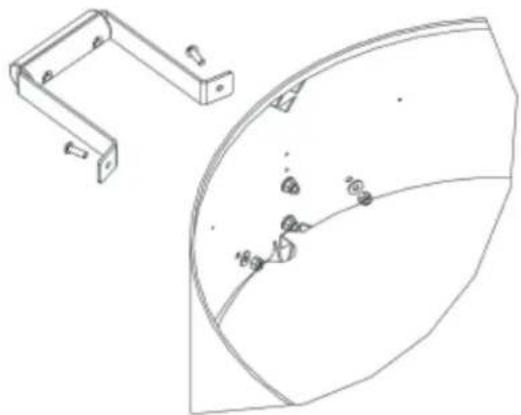
Rear Handle To Burner Unit
- Install Rear Handle to rear of burner unit using two each of phillips screw (60), and nyloc hex nut (61).

Some parts may contain sharp edges. Wear protective gloves as necessary.
natural_image
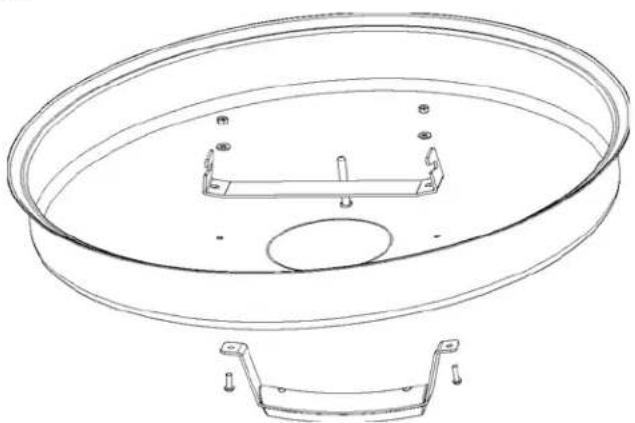
Technical line drawing of a mechanical component with mounting brackets and internal features (no text or symbols)Hood Handle & Hood Support
- Install handle to outside of hood by locating phillips screws (70) through the handle and into the hood.
- From inside hood, simultaneously install the hood support with phillips screw.
- Secure each philips screw (70) with two each lock washer (71) and hex nut (72).
natural_image
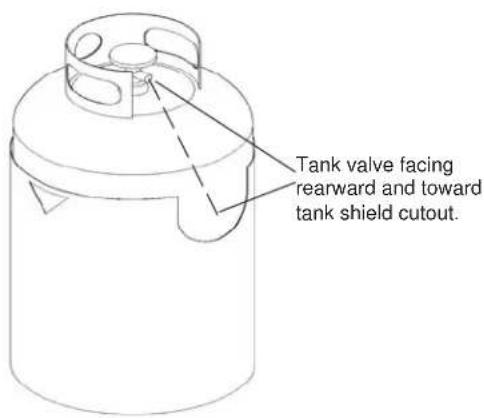
Technical line drawing of a circular mechanical component with mounting brackets and central hub (no text or symbols)Tank Sheild
Propane (LP) Models Only Use Standard 20lb LP Tank
- Lift tank shield over LP tank and position with shield cut-out facing the tank valve. When LP tank and tank shield are loaded into grill, the valve should be facing toward the rear leg and inline with the tank shield cutout.
text_image
Tank valve facing rearward and toward tank shield cutout.Installing LP Tank To Grill
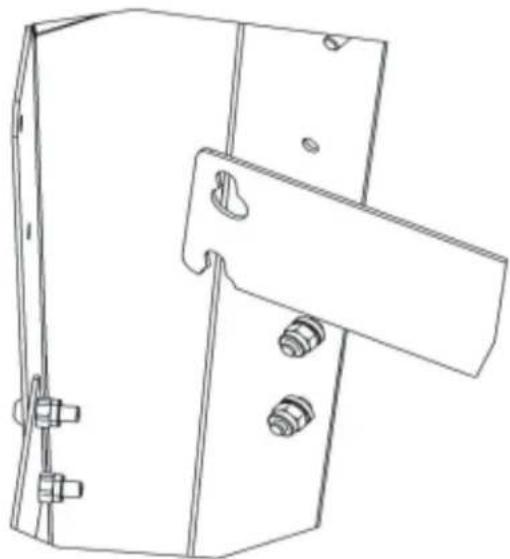
Removing Leg Support
Propane (LP) Models Only
- From right side of grill, grasp removable leg support at each end and lift upward. Once the leg support is disengaged from the keyway fasteners, lift leg support outward.
The keyway fasteners are tensioned with a spring that secures the removable leg support to the right and rear legs.
- Tilt removable leg support to one side and remove from leg frame.
- Reverse the removal process to install the keyway leg support for exchanging LP tanks.
natural_image
Technical line drawing of a mechanical bracket with bolts and mounting holes (no text or symbols)Installing Tank To Lower Rack
Propane (LP) Models Only Use Standard 20lb LP Tank
- Position tank on ground next to grill with the tank valve outlet facing toward the rear of grill. Lift tank shield over LP tank and position with tank shield cut-out facing the tank valve.
- Grasp handle of LP tank while simultaneously the lifting the tank shield with the tank so the tank rests onto the lower rack and inside the tank ring.
- Make sure tank valve opening is facing toward the rear of grill and opposite the front control panel.
- Position LP tank to tank ring on triangular lower rack and make sure bottom foot on LP tank fit is securely to tank ring on your grill.

text_image
Tank Ring Lower RackConnecting Regulator To Tank Valve
Refer to the diagram at the right and complete the following steps:
- Be sure both grill burner valves are in the Off position.
- Make sure the gas tank valve handwheel is in the closed position. Turn clockwise (left to right) to a full stop.
- Remove the protective cap from the gas tank valve.
- Hold regulator in one hand and position the plastic coupling nut on the tank valve outlet threads using care to engage the center of the coupling nut to the center of the tank valve outlet. When completing this procedure, take care to not cross-thread the connection.
- Turn the coupling nut clockwise (left to right) and tighten to a full stop.
In the connection process, the regulator will seal on the back-check feature in the tank valve resulting in a slight resistance. The connection requires about one-half to three-quarters additional turn to complete the connection. Tighten by hand only - do not use tools. If you cannot make the connection, disconnect the regulator and repeat steps 4 and 5.

text_image
Handwheel Coupling Nut Valve Outlet Cap & Strap RegulatorRemoval & Storage Of LP Gas Tank
Never store LP gas tank indoors. When grill is stored indoors, shut tank valve off and disconnect tank from grill and remove to an outdoor location. Tank must be stored outdoors in well-ventilated area, away from and out of the reach of children.
- Remove right-side leg support to gain access to LP tank. For instructions on removing leg support, refer to page 10.
- Loosen coupling nut located on regulator and tank valve by turning counterclockwise using hands only - do not use tools. Next loosen thumb screws securing tank to lower rack and remove tank. Install safety cap over tank valve coupling.
- Reinstall leg support.

text_image
Lower Rack Remove Tank By Tilting and Lifting Outward From Right Side
WARNING
NEVER store tank in enclosed area. Safety relief valve on tank could activate releasing gas and causing a fire. All spare tanks must have safety caps installed in tank outlet. Spare tanks should never be stored near the grill.
General Specifications For Piping
Note: Contact your local city inspection department for building codes regarding the installation of Natural Gas connection and outdoor gas appliances. In the absence of Local Codes, you must conform to the latest edition of ANSI Z223.1.
WE RECOMMEND NATURAL GAS PIPING INSTALLATION BE DONE BY A PROFESSIONAL.
- This grill is designed to operate at 7 inches water column pressure (.2526 psi).
- A manual shut-off valve must be installed outdoors, immediately ahead of the quick disconnect.
- An additional manual shut-off valve indoors should be installed in the branch fuel line in an accessible location near the supply line.
- The quick disconnect connects to a 3/8 inch NPT three from the gas source. The quick disconnect fitting is a hand-operated device that automatically shuts off the flow of gas from the source when the grill is disconnected.
- The quick disconnect fitting can be installed horizontally, or pointing downward. Installing the fitting with the open end pointing upward can result in collecting water and debris.
- The dust covers ( supplied plastic plugs ) help keep the open ends of the quick disconnect fi tting clean while disconnected.
- Pipe compound should be used which is resistant to the action of natural gas when connections are first made.
- The outdoor connector must be firmly attached to rigid, permanent foundation.
Test All Pipe Fitting Connections
All connections and joints must be thoroughly tested for leaks in accordance with Local Codes and all listed procedures in the latest edition of ANSI Z223.1
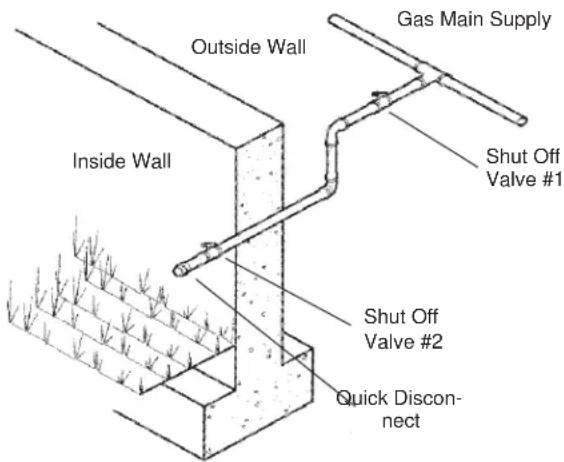
text_image
Gas Main Supply Outside Wall Inside Wall Shut Off Valve #1 Shut Off Valve #2 Quick DisconnectGas Line Piping
- If the length of the line required does not exceed 50 feet, use 5/8 inch O.D. tube. One size larger should be used for lengths greater than 50 feet.
- Gas piping may be copper tubing, type K or L polyethylene plastic tube, with minimum wall thickness of .062 inch, or standard weight (schedule 40) steel or wrought iron.
- Copper tubing must be tin-lined if the gas contains more than 0.3 grams of hydrogen sulfide per 100 cubic feet of gas.
- Plastic tubing is suitable only for outdoor underground use.
- Gas piping in contact with earth, or any other material which my corrode the piping, must be protected against corrosion in an approved manner.
- Underground piping must have a minimum of 18 inches ground cover.

DANGER
Do not use an open flame to check for gas leaks. Be sure there are no sparks or open flames in the area while you check for gas leaks. Flames and sparks will result in a fire or explosion which can cause serious bodily injury or death, and damage to property.

WARNING
Do not route the natural gas hose under a deck or patio.
The hose must be visible.
Installing Natural Gas Hose
Your natural gas grill is shipped with the natural gas quick-disconnect hose preinstalled to the control manifold. To complete assembly, the hose must be routed under the heat shield and through the rear leg.

DANGER
Natural gas hose must be routed under heat shield. Failure to locate natural gas hose under heat shield will result in a fire or explosion which can cause serious bodily injury or death, and damage to property.

text_image
Hose routed under heat shield.Refer to the diagram at the right and complete the following steps:
- Remove the natural gas hose from its shipping bag and route hose under the heat shield.
Remove protective cap from the quick-disconnect hose end, and route hose through hole in rear leg.
Reinstall protective cap onto quick-disconnect hose end.
-
Position hose clamp (100) as shown in illustration at two locations on rear leg.
-
Make sure hose runs evenly from the control panel, under heat shield, and outward through rear leg.
-
Using two hose clamps as shown in illustration, secure using fasteners provided with clamps; screw (101), lock-washer (102), and hex nut (103).
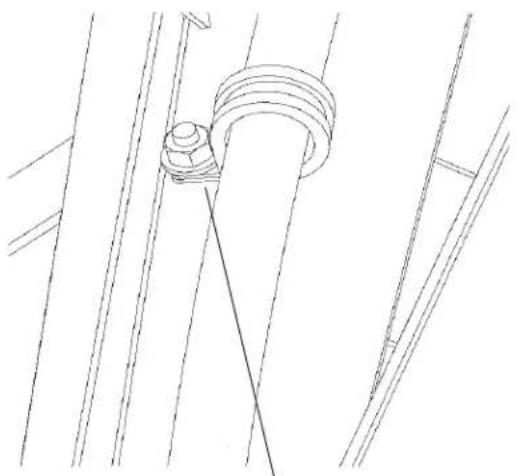
natural_image
Technical line drawing of a mechanical assembly with no visible text or symbolsUse Philips Screw (101).
Lockwasher (102),
& Hex Nut (103)
provided with clamp
Checking For Gas Leaks

DANGER
Do not use an open ame to check for gas leaks. Be sure that are no sparks or open ames in the area while you check for gas leaks. Flames and sparks will result in a re or explosion which can cause serious bodily injury or death and damage to property.

WARNING
You should check for gas leaks every time you disconnect and reconnect a gas fitting.
Note: All factory-made connections have been thoroughly checked for gas leaks. The burners and ignition system has been ame tested. As a safety precaution, we recommend you recheck all itings for leaks before using your Evo grill. Shipping and handling may loosen or damage a gas tting.

WARNING
Perform leak checks even if your grill was dealer or store assembled.
TO PERFORM A LEAK CHECK YOU WILL NEED A SOLUTION OF SOAP AND WATER AND A BRUSH OR RAG TO WET ALL GAS CONNECTIONS.
- Slide back the collar of the quick disconnect. Push the male fi tting of the hose into the quick disconnect and maintain pressure while releasing the collar.
- If fitting does not engage and lock, repeat procedure. Gas will not flow unless the quick disconnect is properly engaged.
- Turn on gas supply and check for leaks by wetting the connections with the soap and water solution and watching for bubbles. If bubbles appear, or if a bubble grows, there is a leak.
Note: Since some leak test solutions, including soap and water, may be slightly corrosive, all connections should be rinsed with water after checking for leaks.

text_image
Gas Coupling Disconnected Gas Coupling ConnectedCHECK THE FOLLOWING CONNECTIONS:
1. HOSE TO MANIFOLD CONNECTION
WARNING: If there is a leak where the hose connects to the manifold then retighten the fi tting with a wrench and recheck for leaks with soap and water. If leak continues after retightening the fi tting, tun off gas. DO NOT OPERATE GRILL. Contact your local dealer or Evo Customer Service using the contact information provided with your manual.

WARNING
Do not ignite burners when leak testing.
- VALVES TO MANIFOLD CONNECTIONS.
- HOSE TO QUICK DISCONNECT CONNECTION.
Recognizing Abnormal Gas Operation
Abnormal Gas Operation

text_image
Right Flame Yellow Tip Light Blue Light Blue Wrong Flame Excessive Yellow Tipping Dark BlueDark BlueAny of the following are considered to be abnormal operation and may require servicing:
- Excessive yellow tipping of the burner \\ ame (See diagram above).
- Sooting up of cooking utensils.
- Burners not igniting properly.
- Burners failing to remain alight.
• Gas valves, which are difficult to turn.
In case the appliance fails to operate correctly, contact the authorized service provider in your area.
Checking Venturi Tubes
A clogged venturi tube due to insects and insect nests in the venturi tube may cause improper burner performance and difficulty lighting your grill.
To check your venturi tubes:
- Remove the cooking surface and drip pan to access the valve cover located just above the center control knob.
- Remove the cover and inspect the venturi for insects and or insect nests.
- Compressed air is the best method for removing these obstructions.
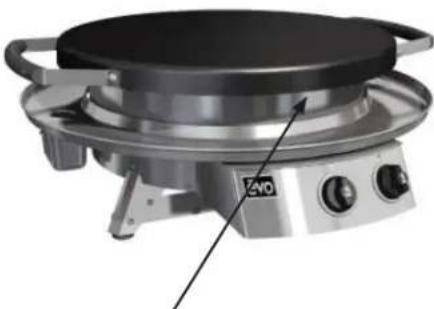
natural_image
Exterior view of a portable electric stove with control panel and rotary fan (no visible text or symbols)Remove cooking surface and drip pan to access valve cover located just above center control knob.
Grill Maintenance, Cooking Techniques, and Recipies
Grill Maintenance
Regular cleaning and care for your Evo flat-top cooking surface will keep your grill looking and functioning it's best.
The cook surface is coated with a nickel finish that will not melt, stick to food, burn, crack, chip off or absorb odors. It is designed to be 'seasoned' with a fine layer of vegetable or cooking oil on its surface. This oil further helps to prevent sticking and makes cooking easier.
Caring for Evo's cook surface is much like maintaining cast iron cookware. When the surface requires cleaning, there are a few basic cleaning techniques to use. For quick and routine cleaning between preparations, a metal spatula works for removing the majority of surface debris. For tougher areas or where sugars glaze the cook surface, pour a small amount of warm water on the soiled surface while the grill is warm and scrape the debris away with the spatula. It is also possible to use a wire brush to remove sugars or other debris that glaze the cook surface. Heat the cook-surface to a high temperature and allow the sticky debris to become brittle. Once the debris is brittle, use the wire brush to brush it away. After brushing you will want to oil the cook-surface again before cooking. For griddle cooking you will want the cook-surface to be completely free of any debris that might otherwise discolor or impart unwanted flavors.
For griddle cooking you should condition the cook surface with the grill cleaning kit supplied with your Evo grill. The grill cleaning kit contains a professional 3M brand grill screen handle, grill screens, and grill polishing pad. Use the polishing pad after the grill screen to achieve an ultra clean, smooth cooking surface for the most delicate foods and applications.
To use a grill screen: Place one gray polishing pad between the grill handle base and one grill screen, so the grill screen makes direct contact with the cooking surface. Pour a small amount of vegetable oil on the cook surface and scrub the surface in a circular motion. The gray polishing pad allows excess oil to be absorbed and also helps prevent the screen from getting clogged with debris. When finished scrubbing, wipe the surface down with a paper towel or cotton terrycloth.
The drip pan located just below the cook surface is designed to catch food debris and drippings from the cook surface. We recommend cleaning the drip pan after your grill has cooled to prevent the possibility of touching hot adjunct surfaces. The drip pan is easy to wipe out with soap and water using a kitchen sponge. For added convenience, a removable stainless waste try is mounted under the left hand side of the drip pan and can be easily washed by hand or in a dishwasher. Be sure to empty the waste tray after every use.
All of the stainless steel components on your grill can be easily polished using a stainless steel cleaner/polish. The product we recommend is called “Sheila Shine” and is a commercial product normally available from industrial restaurant supply houses. Sheila Shine can be purchased from the Evo web site along with replacement grill polishing pads. The Evo web site address is: http://www.evoamerica.com.com
Cooking Techniques
Stove Top Cooking and Heat Zones
You can use Evo's cook surface similar to the burners on your kitchen stove top. Adjust Evo's burners to control the temperatures of the cook surface "heat zones." Evo's circular grill top is divided into two distinct zones. The center control panel knob controls the "inner heat zone," which is also the inner circle of the cook surface. The outer control panel knob controls the "outer heat zone," which is the outer circle of the cook surface. Because the cook surface is made of heavy steel, it takes 5-8 minutes from a cold start to completely heat the surface. With a pre-heated cook surface, if you adjust one of the burners, you will have to wait momentarily before the heat zone adjusts to temperature. However, if the heat zones are set to different temperatures you can move a pot or pan from one zone to the other and instantly change the cooking temperature beneath your cookware.
Oiling the Cook Surface
A hand pump spray bottle or a squirt bottle filled with cooking oil is perfect for applying an even, thin coat of oil on the cook surface. Another way to oil the cook surface is with an inexpensive terrycloth cotton towel that has been doused with cooking oil. When the cook surface is hot, hold the oiled towel with a pair of tongs to prevent being burned. Having cooking oil readily available allows you to oil the grill easily and quickly at any time.
Cooking Meats
Meats are perfect to sear, roast or braise on the grill. Searing and Roasting techniques are described in more detail below. Braising requires a tightly covered pot or pan placed on the grill surface. Braise as you would for a stove-top braising recipe, adjusting the burners to control the cook surface temperature. Meats can also be sliced and put on skewers, added to a stir-fry or used in hot sandwiches. Veal and Pork are often made into cutlets or scallopini. Create small slices that have been lightly flattened with a meat mallet, seasoned and then dusted with flour. Scallopini and cutlets are usually seared in butter until golden brown and served with a sauce or lemon juice and fresh parsley.
Cooking Poultry
Boneless cuts that have been flattened to an even thickness with a meat mallet cook more evenly and more quickly. Poultry that has been prepared in this way can then be marinated, breaded or rubbed with spices before searing on the grill. Poultry can also be roasted, braised, sautéed, fried or poached on the Evo grill. Roast as you would in your kitchen oven placing the roast in a roasting pan with a rack and using the hood to contain the heat from the grill. To sauté, slice the meat into thin strips and sauté, turning with a spatula directly on the cook surface. Use pots and pans for stove-top cooking techniques. Fill a pot with oil for frying or with stock for poaching. Use a tightly covered pot or pan to braise. Small game birds such as quail are small enough that they can be sear cooked all the way through without having to use the hood to create an oven. In the case of duck breast, it is best to sear the skin side of the duck breast first and to continue cooking until the skin becomes crispy and much of the fat has been rendered away. This way the duck meat won't get over cooked before the skin is crispy.
Cooking Fish
Lean fish such as Flounder, Sole, Sea Bass, Cod, Monk Fish and Red Snapper are usually purchased in the form of fillets. Fillets of fish are ideal to cook on the Evo grill because they are flat and will cook quickly and efficiently. Because lean fish tends to flake apart easily, using Evo's flat top grill makes handling and cooking fish much easier than open-flame grills. For additional flavor and texture, you can also lightly dust the seasoned fillets with flour or use a breading mixture before searing. Fatty Fish such as Swordfish, Tuna, Sturgeon, Striped Bass, and Salmon are usually purchased in steaks or fillets. Marinate them, rub them with spices, or simply season with salt and pepper. Sear the fish on a lightly oiled hot cook surface till golden brown and cooked to your desired doneness.
Searing
Sear cooking is the most common cooking technique used on the Evo flat top grill. Searing is done by placing food directly onto the hot cook surface and allowing that food item to develop a flavorful "seared" or browned exterior. Searing imparts flavor to food and also helps seal in natural juices. Searing can be done with vegetables, meats, fish, poultry, etc. One nice feature of the Evo grill is its convex cooking surface. The convex shape allows fats to flow away from your food and into a drip pan. This minimizes flavors from mixing on the cook surface and also helps cut down on fat in your food. Once the food is seared on one side, flip to sear the other side and allow it to finish cooking. Some foods take longer to cook and will require that you reduce the cook surface temperature to finish cooking without over cooking the exterior. With foods that take longer to cook you can also adjust one of the two heat zones to a lower temperature and move food to the lower temperature zone after it has been seared over the high temperature zone. The lower temperature will allow the food to continue cooking while retaining a perfectly browned exterior. For non-stick cooking it is essential that the cook surface be hot and lightly oiled before searing, and that you allow the food to sear before you attempt to move it with your spatula or tongs. Overall, cooking on Evo's flat-top cook surface does not involve the same charring of food that is typically done with an open-flame grill. Cooking with the Evo grill involves a controlled "sear" that develops perfectly browned foods.
Using Marinades and Spice Rubs
When using spice rubs and marinades it is important to be aware of the sugar content in the recipes. If a marinade is high in sugar you will find that when placed on a hot cook surface, the sugars will “caramelize” on the cook surface: similar to what will happen to a pan on your stove top. Caramelized sugars are sticky and will eventually burn off, however to ensure easy cleanup, it’s encouraged that you use oil based marinades that are low in sugars. Your cook surface will be easier to clean and you will achieve a better quality sear on your meats, poultry, fish and vegetables.
Stir-Fry
Stir-Fry is best done with very high heat and very quickly, so it's important to keep the food moving throughout the cooking process. Use two spatulas to stir-fry food on the hot cook surface. The two spatula method allows you to scoop the food from both sides at the same time and toss it together. Meats are usually cooked separately from the vegetables and then combined. This allows the meats to brown more efficiently before mixing with the vegetables.
Toasting
Toast bread, croutons, bagels etc. Simply place the item to be toasted directly on the heated grill surface until it is browned. Flip the item over to toast the other side. If you are making breakfast, you can toast bread, bagels or English muffins while directly alongside preparing eggs, bacon, hash browns, and pancakes. No pots or pans are required, and you can cook everything at the same time. You can also toast nuts, seeds, dried peppers and spices on Evo's cook-surface.
Smoking
By placing wood chips such as alder, mesquite or apple wood directly on Evo's hot cook surface and covering the surface with Evo's hood, you can quickly convert your Evo grill into a smoker. Depending on the size of the wood chips, you may want to use the method of placing the chips into a metal container such as folded aluminum foil. At a minimum, make sure the heat zone that comes in contact with the wood chips is hot enough to get the chips smoking. A higher temperature setting produces more smoke and will consume the wood chips more quickly. Once the chips begin to smoke, place the food directly on the cook surface, or for indirect heat, you can use a wire rack to locate foods above the cook surface. Using a wire rack keeps food slightly off the surface allowing smoke and air to circulate. When placing Evo's hood over the food and wood chips you create "hot smoke," since the food is being cooked and smoked simultaneously. Placing the chips onto one heat zone and the food onto the other heat zone allows you to control the smoke and cooking temperature independently. Items that take longer to cook, such as pork ribs, require you add more chips as the old chips burn out. When smoking ribs or other fatty foods, you may want to fashion an aluminum foil pan underneath to speed up the cleaning process. You may also like to try using cedar planks on the cook surface which provides an excellent rich smoke for smoking fish such as salmon.
Steaming
The process of steaming on the Evo grill involves applying water directly to the hot cook surface while you are cooking and containing the water as it turns to steam. You can use Evo's hood if you intend to steam everything on the cook surface, or to set up individual steam areas we recommend using a pot cover. As an example, you may want to individually steam vegetables, while simultaneously searing salmon.
Roasting and Baking
You can roast meats and vegetables under Evo's hood. Use the front panel control knobs to control roasting temperature. Meats are usually seared on all sides before roasting. Searing creates a nice presentation and adds flavor. When roasting, place the seared meats, fish, poultry or vegetables either on a baking rack placed on the cook surface or directly on the cook surface. We recommend a stainless steel baking rack designed for cooling cookies and cakes. Baking racks are relatively inexpensive and can be found in the cookware department of most supermarkets or kitchen supply stores. A baking rack is useful because it keeps the bottom-side of foods above the cook surface and allows uniform cooking. Placing food directly on the cook-surface works best for smaller cuts of meat or foods that are only roasted for a few minutes.
Making Flatbreads, Crepes and Tortillas
Flatbreads, crepes and tortillas are easy to make and are a great accompaniment to many foods. The cook surface is ideal for these items because it provides even heat over the entire surface.
Enjoy your Evo!
Cheers!