Rack EP2C612D16SM - Server ASROCK - Free user manual and instructions
Find the device manual for free Rack EP2C612D16SM ASROCK in PDF.


User questions about Rack EP2C612D16SM ASROCK
0 question about this device. Answer the ones you know or ask your own.
Ask a new question about this device
Download the instructions for your Server in PDF format for free! Find your manual Rack EP2C612D16SM - ASROCK and take your electronic device back in hand. On this page are published all the documents necessary for the use of your device. Rack EP2C612D16SM by ASROCK.
USER MANUAL Rack EP2C612D16SM ASROCK
Less Heat, Less Power Consumption
STABLE
Robust Design, Quality Parts
Stable and
Reliable Solution
Server/Workstation
Motherboard
EP2C612D16SM-2T
EP2C612D16SM
User Manual
English

Industry Standard, Flexible Architecture
Version 1.1
Published May 2017
Copyright©2017 ASRock Rack Inc. All rights reserved.
Copyright Notice:
No part of this documentation may be reproduced, transcribed, transmitted, or translated in any language, in any form or by any means, except duplication of documentation by the purchaser for backup purpose, without written consent of ASRock Rack Inc.
Products and corporate names appearing in this documentation may or may not be registered trademarks or copyrights of their respective companies, and are used only for identification or explanation and to the owners' benefit, without intent to infringe.
Disclaimer:
Specifications and information contained in this documentation are furnished for informational use only and subject to change without notice, and should not be constructed as a commitment by ASRock Rack. ASRock Rack assumes no responsibility for any errors or omissions that may appear in this documentation.
With respect to the contents of this documentation, ASRock Rack does not provide warranty of any kind, either expressed or implied, including but not limited to the implied warranties or conditions of merchantability or fitness for a particular purpose.
In no event shall ASRock Rack, its directors, officers, employees, or agents be liable for any indirect, special, incidental, or consequential damages (including damages for loss of profits, loss of business, loss of data, interruption of business and the like), even if ASRock Rack has been advised of the possibility of such damages arising from any defect or error in the documentation or product.

This device complies with Part 15 of the FCC Rules. Operation is subject to the following two conditions:
(1) this device may not cause harmful interference, and
(2) this device must accept any interference received, including interference that may cause undesired operation.
CALIFORNIA, USA ONLY
The Lithium battery adopted on this motherboard contains Perchlorate, a toxic substance controlled in Perchlorate Best Management Practices (BMP) regulations passed by the California Legislature. When you discard the Lithium battery in California, USA, please follow the related regulations in advance.
"Perchlorate Material-special handling may apply, see www.dtsc.ca.gov/hazardouswaste/perchlorate"
ASRock Rack's Website: www.ASRockRack.com
Contact Information
If you need to contact ASRock Rack or want to know more about ASRock Rack, you're welcome to visit ASRock Rack's website at www.ASRockRack.com; or you may contact your dealer for further information.
ASRock Rack Incorporation
6F., No.37, Sec. 2, Jhongyang S. Rd., Beitou District,
Taipei City 112, Taiwan (R.O.C.)
Contents
Chapter 1 Introduction 1
1.1 Package Contents 1
1.2 Specifications 2
1.3 Unique Features 6
1.4 Motherboard Layout 7
1.5 Onboard LED Indicators 11
1.6 I/O Panel 13
1.7 Block Diagram 15
Chapter 2 Installation 16
2.1 Screw Holes 16
2.2 Pre-installation Precautions 16
2.3 Installing the CPU 17
2.4 Installing the CPU Fan and Heatsink 20
2.5 Installation of Memory Modules (DIMM) 21
2.6 Expansion Slots (PCI and PCI Express Slots) 24
2.7 Jumper Setup 25
2.8 Onboard Headers and Connectors 27
2.9 Dr. Debug 33
2.10 Driver Installation Guide 34
2.11 Dual LAN and Teaming Operation Guide 35
Chapter 3 UEFI Setup Utility 36
3.1 Introduction 36
3.1.1 UEFI Menu Bar 36
3.1.2 Navigation Keys 37
3.2 Main Screen 38
3.3 Advanced Screen 39
3.3.1 ACPI Configuration 40
3.3.2 Configure Super IO Settings 41
3.3.3 Serial Port Console Redirection 42
3.3.4 CSM Configuration 45
3.3.5 Trusted Computing 47
3.3.6 USB Configuration 49
3.3.7 System Configuration 50
3.3.8 Hard Disk S.M.A.R.T Settings 52
3.3.9 H/W Monitor 53
3.3.10 Instant Flash 55
3.4 IntelRCSetup 56
3.4.1 Processor Configuration 57
3.4.2 CPU Power Management Configuration 59
3.4.3 QPI Configuration 61
3.4.4 Memory Configuration 62
3.4.5 IIO Configuration 64
3.4.6 PCH Configuration 65
3.4.7 Server ME Configuration 68
3.5 Server Mgmt 69
3.5.1 System Event Log 70
3.5.2 BMC Network Configuration 71
3.6 Security 73
3.7 Boot Screen 74
3.8 Event Logs 76
3.9 Exit Screen 78
Chapter 4 Software Support 79
4.1 Install Operating System 79
4.2 Support CD Information 79
4.2.1 Running The Support CD 79
4.2.2 Drivers Menu 79
4.2.3 Utilities Menu 79
4.2.4 Contact Information 79
Chapter 5 Troubleshooting 80
5.1 Troubleshooting Procedures 80
5.2 Technical Support Procedures 82
5.3 Returning Merchandise for Service 82
Chapter 6 Net Framework Installation Guide 83
6.1 Installing .Net Framework 3.5.1 (For Server 2008 R2) 83
Appendix Mezzanine Card Support List 86
Chapter 1 Introduction
Thank you for purchasing ASRock Rack EP2C612D16SM / EP2C612D16SM-2T motherboard, a reliable motherboard produced under ASRock Rack's consistently stringent quality control. It delivers excellent performance with robust design conforming to ASRock Rack's commitment to quality and endurance.
In this manual, chapter 1 and 2 contains introduction of the motherboard and step-by-step guide to the hardware installation. Chapter 3 and 4 contains the configuration guide to BIOS setup and information of the Support CD.

Because the motherboard specifications and the BIOS software might be updated, the content of this manual will be subject to change without notice. In case any modifications of this manual occur, the updated version will be available on ASRock Rack website without further notice. You may find the latest memory and CPU support lists on ASRock Rack website as well. ASRock Rack's Website: www.ASRockRack.com
If you require technical support related to this motherboard, please visit our website for specific information about the model you are using. http://www.asrockrack.com/support/
1.1 Package Contents
- ASRock Rack EP2C612D16SM / EP2C612D16SM-2T Motherboard (SSI EEB Form Factor: 12.0-in x 13.0-in, 30.5 cm x 33.0 cm)
- Support CD
- User Manual
• 4 x SATA3 Cables (50cm)
• 2 x MiniSAS Cables (6G) (60cm) - 1 x I/O Shield

If any items are missing or appear damaged, contact your authorized dealer.
1.2 Specifications
| EP2C612D16SM / EP2C612D16SM-2T | |
| MB Physical Status | |
| Form Factor SSI EEB | |
| Dimension 12" x 13" (30.5 cm x 33.0 cm) | |
| Processor System | |
| CPU Intel® Xeon* | processor E5-2600 v3/v4* series*Only E5-2600 V4 CPUs support DDR4 2400. |
| Socket Dual Socket LGA 2011 R3 | |
| Chipset Intel® C612 | |
| System Memory | |
| Capacity 16 DIMM slots | |
| Type - Quad Channel memory technology- Supports DDR4 2400*/2133/1866/1600 RDIMM and LRDIMM*Only E5-2600 V4 CPUs support DDR4 2400. | |
| Voltage 1.2V | |
| DIMM Sizes RDIMM: 32GB, 16GB, 8GB, 4GBLRDIMM: 64GB, 32GB | |
| Expansion Slot | |
| Slot 1 x8 (CPU1) | |
| Slot 2 x8 (CPU1) | |
| Slot 3 x8 (CPU2) | |
| Slot 4 x8 (CPU2) | |
| Slot 5 x8 (CPU2) | |
| Slot 6 x8 (CPU1) | |
| Storage | |
| SATA | Intel® C612 : 6 x SATA3 6.0Gb/s; 4 x sSATA3 6.0Gb/s; support RAID 0, 1, 5, 10 |
| Controller | |
| Ethernet | |
| Interface EP2C612D16SM:1000 /100 /10 Mbps by Intel i350EP2C612D16SM-2T:10G by Intel X540 | |
LAN EP2C612D16SM:
| 2 x RJ45 GLAN by Intel® i3501 x RJ45 Dedicated IPMI LAN port- Supports Wake-On-LAN- Supports Energy Efficient Ethernet 802.3az- Supports Dual LAN with Teaming function- Supports PXE- LAN1 supports NCSIEP2C612D16SM-2T:2 x RJ45 10GLAN by Intel® X5401 x RJ45 Dedicated IPMI LAN port- Supports Wake-On-LAN- Supports Energy Efficient Ethernet 802.3az- Supports Dual LAN with Teaming function- Supports PXE- LAN1 supports NCSI | |
| Management | |
| BMC Controller ASPEED AST2400 | |
| IPMI Dedicated GLAN | - 1 x Realtek RTL8211E for dedicated management GLAN |
| Features - Watch Dog- NMI | |
| Graphics | |
| Controller ASPEED AST2400 | |
| VRAM DDR3 16MB | |
| Rear Panel I/O | |
| VGA Port 1 x D-Sub | |
| USB 3.0 Port 2 | |
| USB 2.0 Port 2 | |
| LAN Port 2 + 1 (IPMI) LAN port (RJ45)LAN Ports with LED (ACT/LINK LED and SPEED LED) | |
| Serial Port 1 (COM1) | |
| UID Button/LED | 1 |
| Internal Connector | |
| Auxiliary Panel Header | 1 (includes chassis intrusion, location button & LED, front LAN LED) |
| TPM Header 1 | |
| IPMB Header 1 | |
| Buzzer 1 | |
| Fan Header 2x CPU Fan (4-pin), 6x system Fan (4-pin) | |
| ATX Power 1 (24-pin) + 2 (8-pin) | |
| USB 3.0 Header 1 | (support 2 USB 3.0) |
| USB 2.0 Header 1 | (support 2 USB 2.0) |
| Type A USB 3.0 Port | 1 |
| Mezzanine slot 1 | (x8 to support storage mezzanine card) |
| System BIOS | |
| BIOS Type 128Mb | AMI UEFI Legal BIOS |
| BIOS Features - Plug and Play (PnP)- ACPI 2.0 Compliance Wake Up Events-SMBIOS 2.8 Support- ASRock Rack Instant Flash | |
| Hardware Monitor | |
| Temperature - CPU | Temperature Sensing- System Temperature Sensing- MB Temperature Sensing- Card-side Temperature Sensing |
| Fan - CPU/Rear/Front Fan Tachometer- CPU Quiet Fan (Allow CPU Fan Speed Auto-Adjust by CPU Temperature)- CPU/Rear/Front Fan Multi-Speed Control | |
| Voltage Voltage Monitoring: CPU1/2, VCCM_AB/CD/EF/GH, +1.50_PCH, 3V/5V/ 12V, +1.05V_PCH, +BAT, 3VSB, 5VSB | |
| Support OS | |
| OS Microsoft* Windows* | |
| - Server 2008 R2 SP1 (64 bit)- Server 2012 (64 bit)- Server 2012 R2 (64 bit)Linux*- RedHat Enterprise Linux Server 6.5 (32 / 64 bit)- CentOS 5.10 / 6.5 (32 / 64 bit)- SUSE Enterprise Linux Server 11 SP3 (32 / 64 bit)- FreeBSD 9.2 (32 / 64 bit)- Fedora core 19 (64 bit)- Ubuntu 12.04.2 (64 bit) / 12.10 (64 bit)Virtual- VMWare® ESXi 5.5* Please refer to our website for the latest OS support list. | |
| Environment | |
| Temperature Operation temperature: 10°C ~ 35°C / Non operation temperature: -40°C ~ 70°C | |

This motherboard supports Wake from on Board LAN. To use this function, please make sure that the "Wake on Magic Packet from power off state" is enabled in Device Manager >Intel® Ethernet Connection >Power Management. And the "PCI Devices Power On" is enabled in UEFI SETUP UTILITY >Advanced >ACPI Configuration. After that, onboard LAN1&2 can wake up S5 under OS.

If you install Intel® LAN utility or Marvell SATA utility, this motherboard may fail Windows® Hardware Quality Lab (WHQL) certification tests. If you install the drivers only, it will pass the WHQL tests.
1.3 Unique Features
ASRock Rack Instant Flash is a BIOS flash utility embedded in Flash ROM. This convenient BIOS update tool allows you to update system BIOS without entering operating systems first like MS-DOS or Windows. With this utility, you can press the
1.4 Motherboard Layout
EP2C612D16SM

text_image
33.0cm (13.0 in) VGA1 COM1 USB 2.0 T: USB2 B: USB1 IPMI LAN LAN1 LAN2 CPU2 MEZZ1 DDR4_A1 (64 bit, 288-pin module, Blue) DDR4_A2 (64 bit, 288-pin module, White) DDR4_B1 (64 bit, 288-pin module, Blue) DDR4_B2 (64 bit, 288-pin module, White) CPU1 ASRock —Rack— EP2C612D16SM BAT1 Dr. Debug Intel I350 PCIE6 (Blue) PCIE5 (White) PCIE4 (White) RoHS PCIE3 (White) 53 PCIE2 (Blue) PCIE1 (Blue) Intel C612 52 51 BMC ROM USB3_5 USB ROM 33.0cm (13.0 in) ATXPWR1 ATX172 PDR1 PMT_PAN2 PMT_PAN1 PAMER_BH_011 PAMER_BH_012 PAMER_CZG_013 30.5cm (12.0 in) 27 26 25 24 23 22 21 20 19 18 17 16 15 14 13 12 11 10 38 37 36 35 34 33 32 31 30 29 28 42 41 40 39 38 37 36 35 34 33 32 31 30 29 28EP2C612D16SM-2T
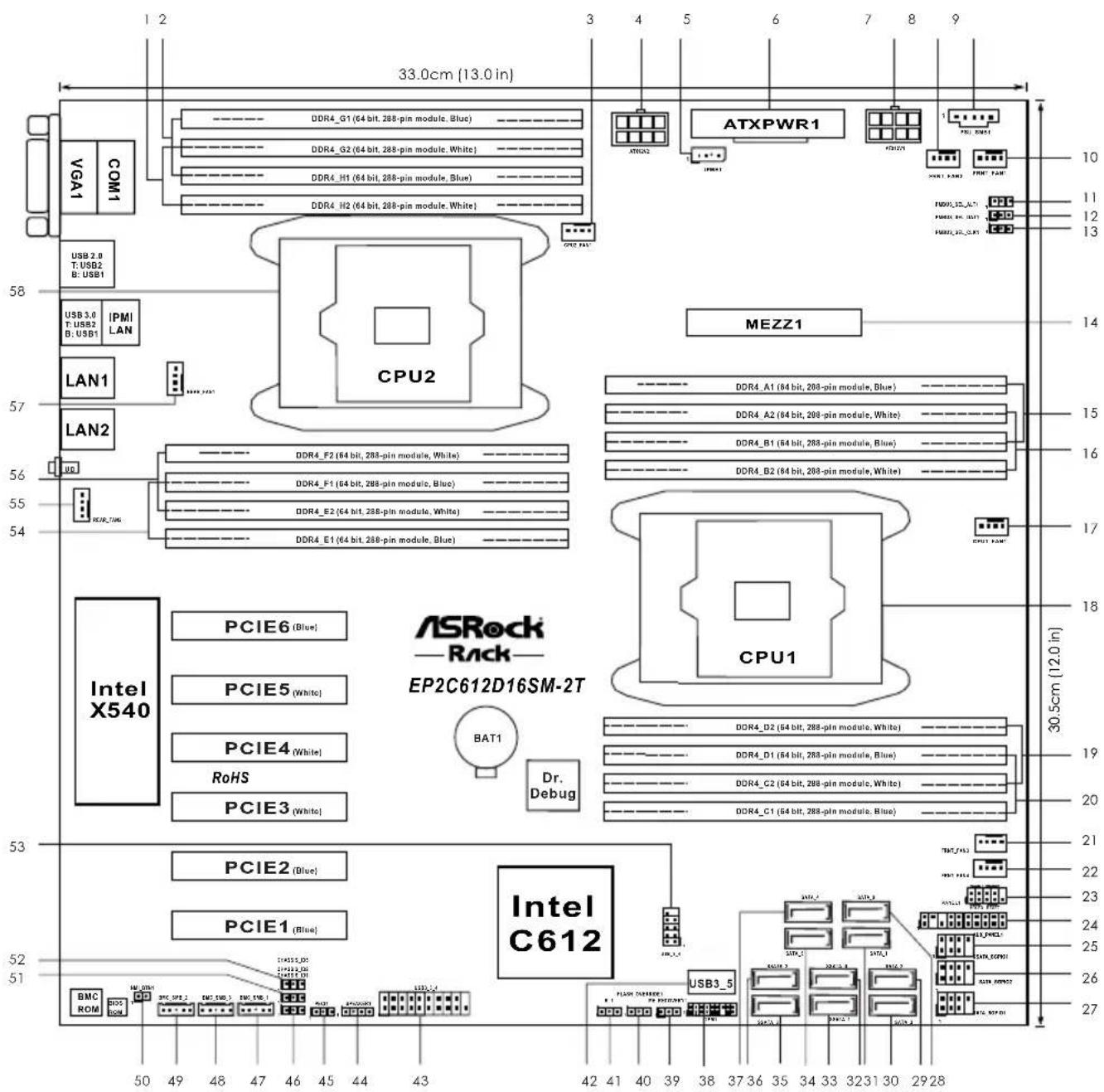
text_image
33.0cm (13.0 in) VGA1 COM1 USB 2.0 T:USB2 B:USB1 IPMI LAN LAN1 58 57 56 55 54 MEZZ1 CPU2 Mezz1 ASRock Rack EP2C612D16SM-2T CPU1 PCIE6 (Blue) PCIE5 (White) PCIE4 (White) RoHS PCIE3 (White) BAT1 Dr. Debug Intel X540 53 52 51 PCIE2 (Blue) PCIE1 (Blue) Intel C612 BMC ROM USB3_5 FLUSH CURRENT: USB3_5 ATXPWR1 ATX002 IPWR1 DDR4_A1 (64 bit, 288-pin module, Blue) DDR4_A2 (64 bit, 288-pin module, White) DDR4_B1 (64 bit, 288-pin module, Blue) DDR4_B2 (64 bit, 288-pin module, White) DDR4_C2 (64 bit, 288-pin module, White) DDR4_C1 (64 bit, 288-pin module, Blue) 30.5cm (12.0 in) 10 11 12 13 14 15 16 17 18 19 20 21 22 23 24 25 26 27No. Description
1 2 x 288-pin DDR4 DIMM Slots (DDR4_H2, DDR4_G2, White)
2 2 x 288-pin DDR4 DIMM Slots (DDR4_H1, DDR4_G1, Blue)
3 CPU 2 Fan Connector (CPU2_FAN1)
4 ATX 12V Power Connector (ATX12V2)
5 Intelligent Platform Management Bus header (IPMB1)
6 ATX Power Connector (ATXPWR1)
7 ATX 12V Power Connector (ATX12V1)
8 Front Fan Connector (FRNT_FAN2)
9 PSU SMBus (PSU_SMB1)
10 Front Fan Connector (FRNT_FAN1)
11 PMBUS Mode Jumper (PMBUS_SEL_ALT1)
12 PMBUS Mode Jumper (PMBUS_SEL_DAT1)
13 PMBUS Mode Jumper (PMBUS_SEL_CLK1)
14 Mezzanine Card Slot (MEZZ1) (for RAID card)
15 2 x 288-pin DDR4 DIMM Slots (DDR4_A1, DDR4_B1, White)
16 2 x 288-pin DDR4 DIMM Slots (DDR4_A2, DDR4_B2, Blue)
17 CPU 1 Fan Connector (CPU1_FAN1)
18 LGA 2011 R3 CPU Socket 1 (CPU1)
19 2 x 288-pin DDR4 DIMM Slots (DDR4_C2, DDR4_D2, White)
20 2 x 288-pin DDR4 DIMM Slots (DDR4_C1, DDR4_D1, Blue)
21 Front Fan Connector (FRNT_FAN3)
22 Front Fan Connector (FRNT_FAN4)
23 System Panel Header (PANEL1)
24 Auxiliary Panel Header (AUX_PANEL1)
25 SSATA SGPIO Connector (SSATA_SGPIO1)
26 SATA SGPIO Connector (SATA_SGPIO2)
27 SATA SGPIO Connector (SATA_SGPIO1)
28 SATA3 Connector (SATA_0)
29 SATA3 Connector (SATA_2)
30 SATA3 Connector (SATA_3)
31 SATA3 Connector (SATA_1)
32 SSATA3 Connector (SSATA_0)
33 SSATA3 Connector (SSATA_1)
No. Description
| 34 SATA3 Connector (SATA_5) |
| 35 SSATA3 Connector (SSATA_3) |
| 36 SSATA3 Connector (SSATA_2) |
| 37 SATA3 Connector (SATA_4) |
| 38 TPM Header (TPM1) |
| 39 ME Recovery Jumper (ME_RECOVERY1) |
| 40 Flash Override Jumper (FLASH_OVERRIDE1) |
| 41 Thermal Sensor Header (TR1) |
| 42 Vertical Type A USB 3.0 (USB3_5) |
| 43 USB 3.0 Header (USB3_3_4) |
| 44 Speaker Header (SPEAKER1) |
| 45 CPU PECI Mode Jumper (PECI1) |
| 46 Chassis ID3 Jumper (CHASSIS_ID3) |
| 47 BMC SMBus Header (BMC_SMB_1) |
| 48 BMC SMBus Header (BMC_SMB_3) |
| 49 BMC SMBus Header (BMC_SMB_2) |
| 50 Non Maskable Interrupt Button (NMI_BTN1) |
| 51 Chassis ID2 Jumper (CHASSIS_ID2) |
| 52 Chassis ID1 Jumper (CHASSIS_ID1) |
| 53 USB 2.0 Header (USB_3_4) |
| 54 2 x 288-pin DDR4 DIMM Slots (DDR4_E1, DDR4_F1, Blue) |
| 55 Rear Fan Connector (REAR_FAN2) |
| 56 2 x 288-pin DDR4 DIMM Slots (DDR4_E2, DDR4_F2, White) |
| 57 Rear Fan Connector (REAR_FAN1) |
| 58 LGA 2011 R3 CPU Socket 2 (CPU2) |
*For DIMM installation and configuration instructions, please see p.21 (Installation of Memory Modules (DIMM)) for more details.
1.5 Onboard LED Indicators
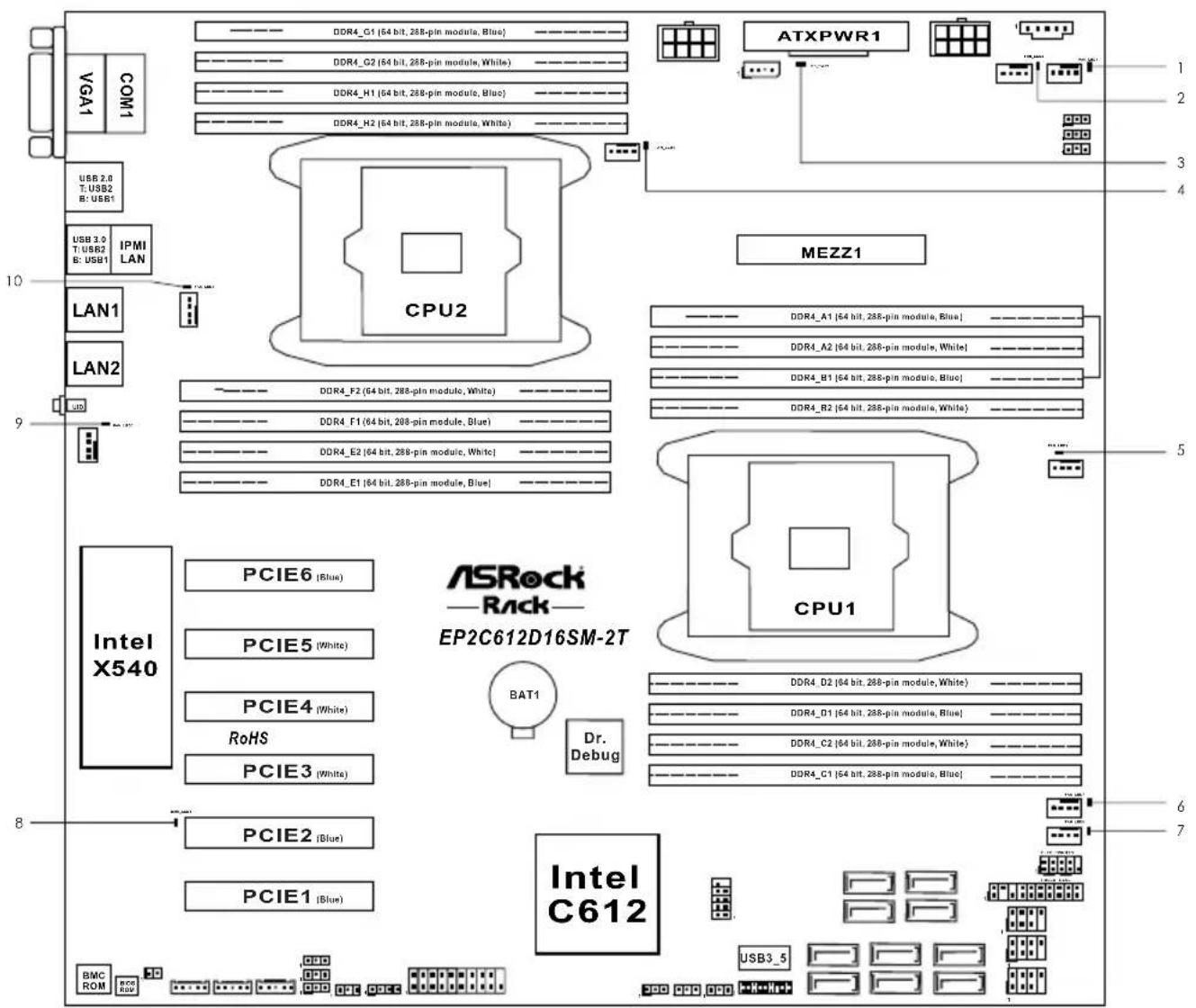
text_image
VGA1 COM1 USB 3.0 T: USB2 B: USB1 USB 3.0 T: USB2 B: USB1 IPMI LAN LAN1 LAN2 9 CPU2 MEZZ1 DDR4_A1 [64 bit, 288-pin module, Blue] DDR4_A2 [64 bit, 288-pin module, White] DDR4_B1 [64 bit, 288-pin module, Blue] DDR4_B2 [64 bit, 288-pin module, White] DDR4_F2 (64 bit, 288-pin module, White) DDR4_F1 (64 bit, 288-pin module, Blue) DDR4_E2 (64 bit, 288-pin module, White) DDR4_E1 (64 bit, 288-pin module, Blue) CPU1 ASRock —Rack— EP2C612D16SM-2T BAT1 Dr. Debug Intel X540 PCIE6 (Blue) PCIE5 (White) PCIE4 (White) RoHS PCIE3 (White) PCIE2 (Blue) PCIE1 (Blue) Intel C612 BMC ROM BCG ROV USB3_5 ATXPWR1 1 2 3 4 5 6 7No. Status Description
1 Amber Front_FAN1 failed
2 Amber Front_FAN2 failed
3 Green STB PWR ready
4 Amber CPU2_FAN1 failed
5 Amber CPU1_FAN1 failed
6 Amber Front_FAN3 failed
7 Amber Front_FAN4 failed
8 Green BMC heartbeat LED
9 Amber Rear_FAN2 failed
10 Amber Rear_FAN1 failed
1.6 I/O Panel

text_image
Diagram showing eight labeled electronic device ports with corresponding labels 1 through 8, including VGA, Ethernet, and USB interface.EP2C612D16SM
No. Description No. Description
1 VGA Port (VGA1) 5 LAN RJ-45 Port (IPMI_LAN)*
2 Serial Port (COM1) 6 LAN RJ-45 Port (LAN1)**
3 USB 2.0 Ports (USB_1_2) 7 LAN RJ-45 Port (LAN2)**
4 USB 3.0 Ports (USB3_1_2) 8 UID Switch (UID)
Note: LAN1 supports NCSI.
EP2C612D16SM-2T
No. Description No. Description
1 VGA Port (VGA1) 5 LAN RJ-45 Port (IPMI_LAN)*
2 Serial Port (COM1) 6 10G LAN RJ-45 Port (LAN1)**
3 USB 2.0 Ports (USB_1_2) 7 10G LAN RJ-45 Port (LAN2)**
4 USB 3.0 Ports (USB3_1_2) 8 UID Switch (UID)
Note:
- LAN1 supports NCSI.
- System air-flow is required for cooling the onboard Intel Ethernet Controller X540 heat sink.
LAN Port LED Indications
*There are two LED next to the LAN port. Please refer to the table below for the LAN port
LED indications.

text_image
ACT/LINK LED SPEED LED LAN PortDedicated IPMI LAN Port LED Indications
| Activity / Link LED Speed LED | |||
| Status Description Status Description | |||
| Off No Link Off 10M bps connection or no | link | ||
| Blinking Yellow | Data Activity | Yellow | 100M bps connection |
| On | Link | Green | 1Gbps connection |
**There are two LEDs on each LAN port. Please refer to the table below for the LAN port LED indications.

text_image
SPEED LED ACT/LINK LED LAN PortLAN Port (LAN1, LAN2) LED Indications
1G For EP2C612D16SM
| Speed LED | Activity / Link LED | ||
| Status | Description | Status | Description |
| Off | 10Mbps connection or no link | Off | No Link |
| Yellow | 100Mbps connection | Blinking Green | Data Activity |
| Green | 1Gbps connection | On | Link |
10G For EP2C612D16SM-2T
| Speed LED | Activity / Link LED | ||
| Status | Description | Status | Description |
| Off | 100Mbps connection or no link | Off | No Link |
| Yellow | 1Gbps connection | Blinking Green | Data Activity |
| Green | 10Gbps connection | On | Link |
1.7 Block Diagram
EP2C612D16SM / EP2C612D16SM-2T
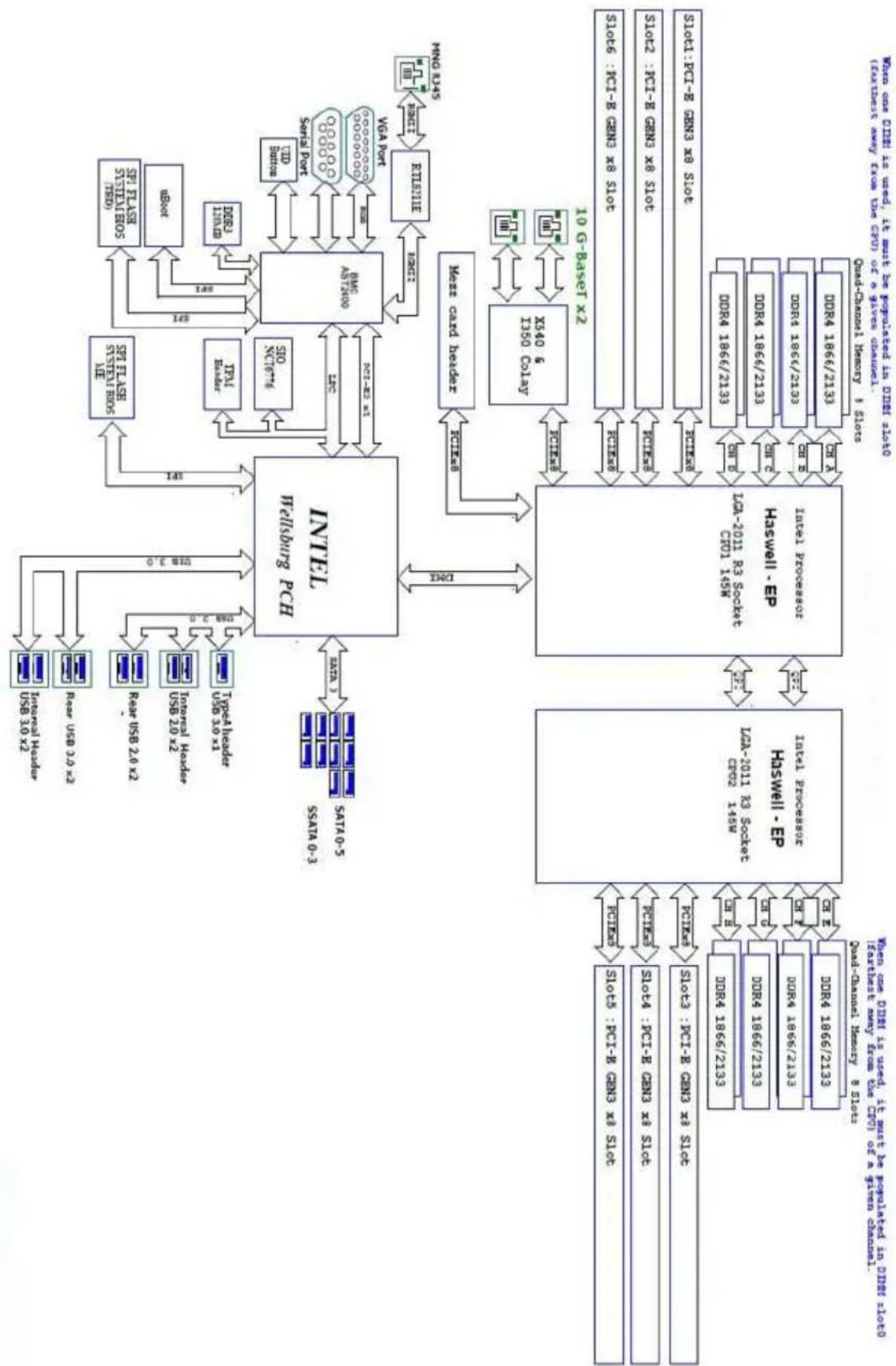
flowchart
graph TD
    A["INTEL"] -->|Data 1| B["Wellsbury PCH"]
    A -->|Data 2| C["BIAC"]
    A -->|Data 3| D["ISA"]
    A -->|Data 4| E["ICG"]
    A -->|Data 5| F["ICG"]
    A -->|Data 6| G["ICG"]
    A -->|Data 7| H["ICG"]
    A -->|Data 8| I["ICG"]
    A -->|Data 9| J["ICG"]
    A -->|Data 10| K["ICG"]
    A -->|Data 11| L["ICG"]
    A -->|Data 12| M["ICG"]
    A -->|Data 13| N["ICG"]
    A -->|Data 14| O["ICG"]
    A -->|Data 15| P["ICG"]
    A -->|Data 16| Q["ICG"]
    A -->|Data 17| R["ICG"]
    A -->|Data 18| S["ICG"]
    A -->|Data 19| T["ICG"]
    A -->|Data 20| U["ICG"]
    A -->|Data 21| V["ICG"]
    A -->|Data 22| W["ICG"]
    A -->|Data 23| X["ICG"]
    A -->|Data 24| Y["ICG"]
    A -->|Data 25| Z["ICG"]
    A -->|Data 26| AA["ICG"]
    A -->|Data 27| AB["ICG"]
    A -->|Data 28| AC["ICG"]
    A -->|Data 29| AD["ICG"]
    A -->|Data 30| AE["ICG"]
    A -->|Data 31| AF["ICG"]
    A -->|Data 32| AG["ICG"]
    A -->|Data 33| AH["ICG"]
    A -->|Data 34| AI["ICG"]
    A -->|Data 35| AJ["ICG"]
    A -->|Data 36| AK["ICG"]
    A -->|Data 37| AL["ICG"]
    A -->|Data 38| AM["ICG"]
    A -->|Data 39| AN["ICG"]
    A -->|Data 40| AO["ICG"]
    A -->|Data 41| AP["ICG"]
    A -->|Data 42| AQ["ICG"]
    A -->|Data 43| AR["ICG"]
    A -->|Data 44| AS["ICG"]
    A -->|Data 45| AT["ICG"]
    A -->|Data 46| AU["ICG"]
    A -->|Data 47| AV["ICG"]
    A -->|Data 48| AW["ICG"]
    A -->|Data 49| AX["ICG"]
    A -->|Data 50| AY["ICG"]
    A -->|Data 51| AZ["ICG"]
    A -->|Data 52| BA["ICG"]
    A -->|Data 53| BB["ICG"]
    A -->|Data 54| BC["ICG"]
    A -->|Data 55| BD["ICG"]
    A -->|Data 56| BE["ICG"]
    A -->|Data 57| BF["ICG"]
    A -->|Data 58| BG["ICG"]
    A -->|Data 59| BH["ICG"]
    A -->|Data 60| BI["ICG"]
    A -->|Data 61| BJ["ICG"]
    A -->|Data 62| BK["ICG"]
    A -->|Data 63| BL["ICG"]
    A -->|Data 64| BM["ICG"]
    A -->|Data 65| BN["ICG"]
    A -->|Data 66| BO["ICG"]
    A -->|Data 67| BP["ICG"]
    A -->|Data 68| BQ["ICG"]
    A -->|Data 69| BR["ICG"]
    A -->|Data 70| BS["ICG"]
    A -->|Data 71| BT["ICG"]
    A -->|Data 72| BU["ICG"]
    A -->|Data 73| BV["ICG"]
    A -->|Data 74| BW["ICG"]
    A -->|Data 75| BX["ICG"]
    A -->|Data 76| BY["ICG"]
    A -->|Data 77| BZ["ICG"]
    A -->|Data 78| CA["ICG"]
    A -->|Data 79| CB["ICG"]
    A -->|Data 80| CC["ICG"]
Chapter 2 Installation
This is a SSI EEB form factor (12" x 13", 30.5 cm x 33.0 cm) motherboard. Before you install the motherboard, study the configuration of your chassis to ensure that the motherboard fits into it.
EP2C612 Series are dual socket motherboards that support Intel ^ Xeon ^ E5-2600 v3 Series Processors. Please install a primary processor (BootStrap Processor) into “CPU1” socket and then install a non-Primary Processor (Application Processors) into “CPU2” socket. *For a single CPU, please install it into “CPU1” socket (framed by a square).

Make sure to unplug the power cord before installing or removing the motherboard. Failure to do so may cause physical injuries to you and damages to motherboard components.
2.1 Screw Holes
Place screws into the holes indicated by circles to secure the motherboard to the chassis.

Do not over-tighten the screws! Doing so may damage the motherboard.
2.2 Pre-installation Precautions
Take note of the following precautions before you install motherboard components or change any motherboard settings.
- Unplug the power cord from the wall socket before touching any components.
- To avoid damaging the motherboard's components due to static electricity, NEVER place your motherboard directly on the carpet or the like. Also remember to use a grounded wrist strap or touch a safety grounded object before you handle the components.
- Hold components by the edges and do not touch the ICs.
- Whenever you uninstall any component, place it on a grounded anti-static pad or in the bag that comes with the component.
- When placing screws into the screw holes to secure the motherboard to the chassis, please do not over-tighten the screws! Doing so may damage the motherboard.

Before you install or remove any component, ensure that the power is switched off or the power cord is detached from the power supply. Failure to do so may cause severe damage to the motherboard, peripherals, and/or components.
2.3 Installing the CPU

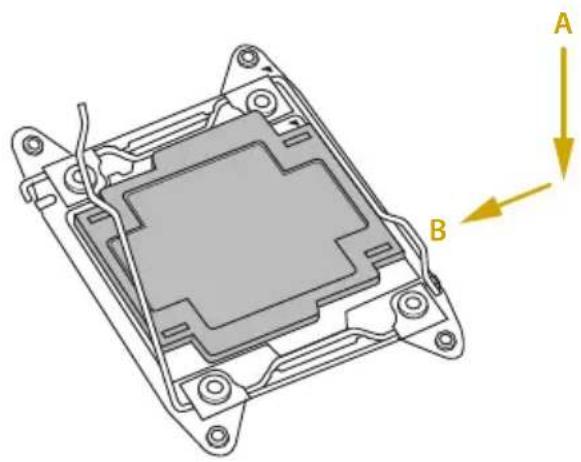
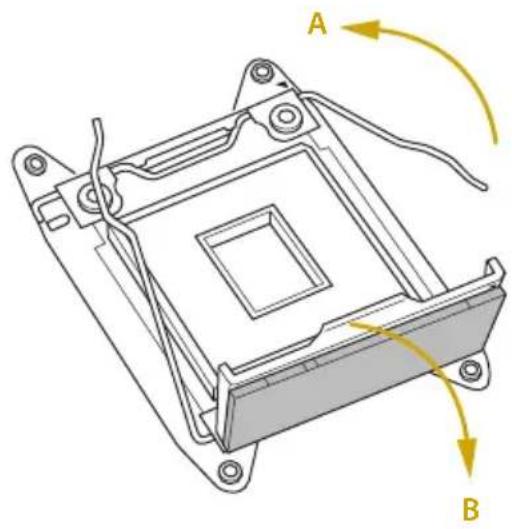
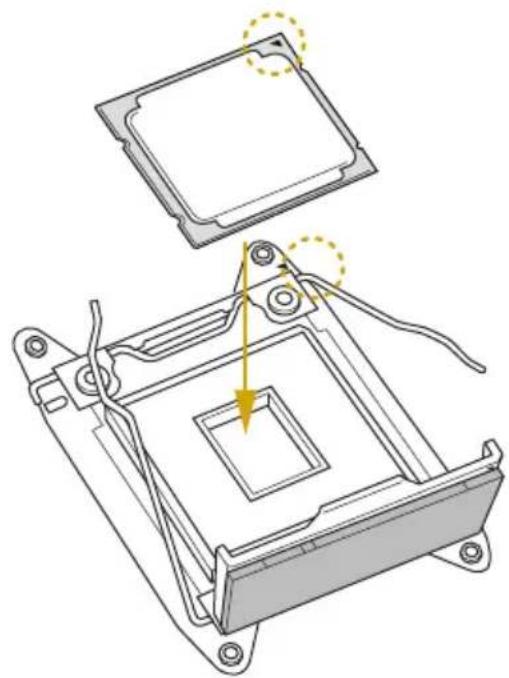
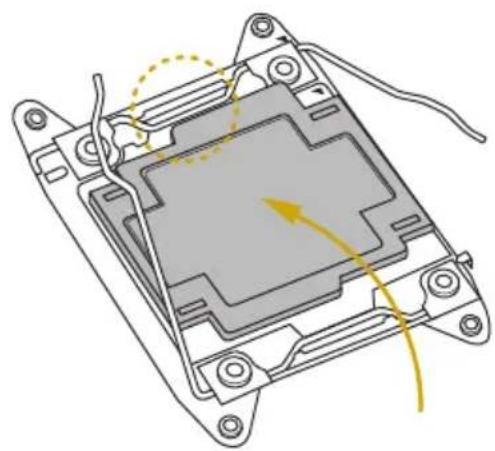
- Before you insert the 2011-3-Pin CPU into the socket, please check if the PnP cap is on the socket, if the CPU surface is unclean, or if there are any bent pins in the socket. Do not force to insert the CPU into the socket if above situation is found. Otherwise, the CPU will be seriously damaged.
- Unplug all power cables before installing the CPU.
CAUTION:
Please note that C612 platform is only compatible with the LGA 2011-3 socket, which is incompatible with the LGA 2011 socket
Socket Type: Narrow ILM Socket
1
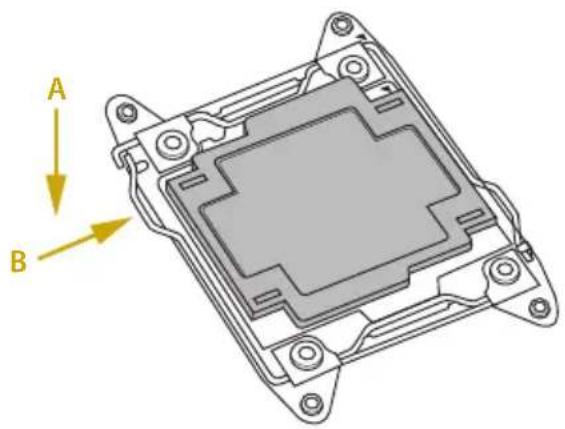
natural_image
3D diagram of a mechanical component with labeled arrows A and B indicating directional movement (no text or symbols beyond labels)2
natural_image
Technical line drawing of a mechanical component with labeled parts A and B (no text or symbols beyond labels)3
natural_image
Technical line drawing of a mechanical component with labeled parts A and B, showing internal structure and motion arrows (no text or symbols beyond labels)4
natural_image
Technical diagram of a computer processor with an open slot and internal circuit board (no text or symbols)5
natural_image
Technical line drawing of a mechanical component with highlighted internal structure and yellow motion arrows (no text or symbols)6
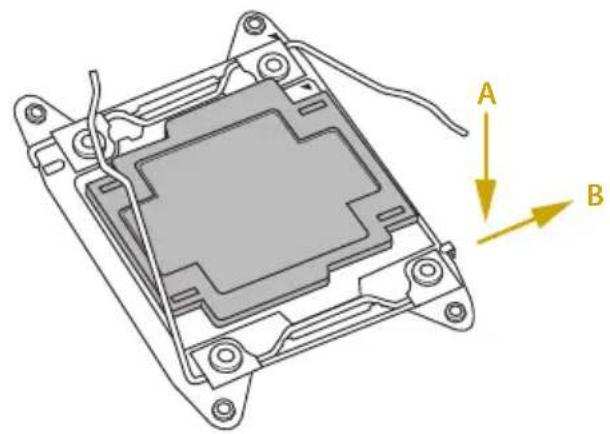
natural_image
Technical line drawing of a mechanical component with labeled points A and B, showing internal structure and wiring (no text or symbols beyond labels)7
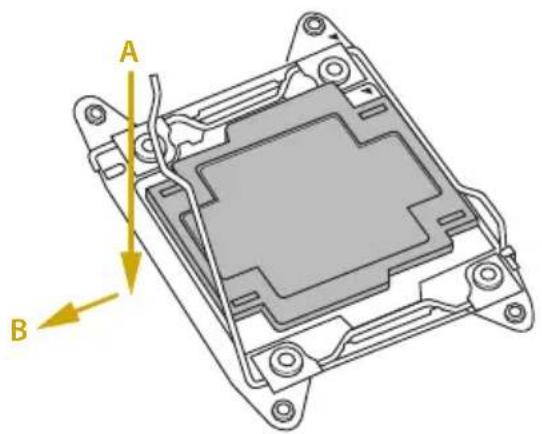
natural_image
Technical diagram of a mechanical component with labeled parts A and B, showing internal structure and mounting holes (no text or symbols beyond labels)8

natural_image
Technical illustration of a mechanical component with an arrow indicating rotation or assembly (no text or symbols present)
The cover must be placed if returning the motherboard for after service.
2.4 Installing the CPU Fan and Heatsink

Before you installed the heatsink, you need to spray thermal interface material between the CPU and the heatsink to improve heat dissipation.

natural_image
Technical line drawing of a mechanical assembly with a pipette inserted into a housing (no text or symbols)
text_image
CPU fan for narrow ILM socket *Support an active or passive heatsink2.5 Installation of Memory Modules (DIMM)
This motherboard provides sixteen 288-pin DDR4 (Double Data Rate 4) DIMM slots in two groups, and supports Dual Channel Memory Technology.
Capacity CPU1 CPU2
| 256GB / | DDR4_A1, B1, C1, D1 (Blue) DDR4_E1, F1, G1, H1 (Blue) |
| 512GB | DDR4_A2, B2, C2, D2 (White) DDR4_E2, F2, G2, H2 (White) |

text_image
DDR4_A1 DDR4_A2 DDR4_B1 DDR4_B2 CPU1 DDR4_D2 DDR4_D1 DDR4_C2 DDR4_C1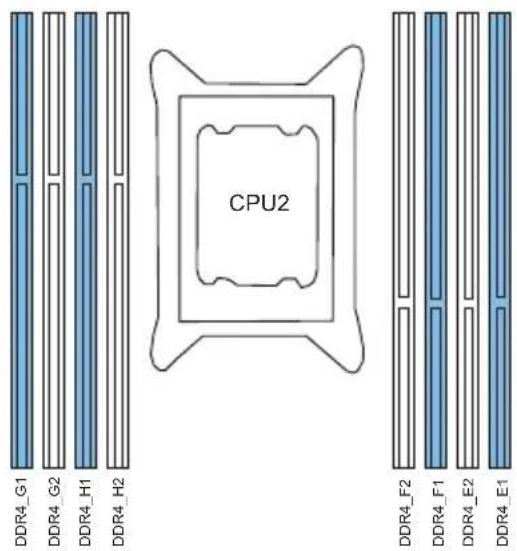
text_image
DDR4_G1 DDR4_G2 DDR4_H1 DDR4_H2 CPU2 DDR4_F2 DDR4_F1 DDR4_E2 DDR4_E1
- It is not allowed to install a DDR, DDR2 or DDR3 memory module into a DDR4 slot; otherwise, this motherboard and DIMM may be damaged.
- For dual channel configuration, you always need to install identical (the same brand, speed, size and chip-type) DDR4 DIMM pairs.
- It is unable to activate Dual Channel Memory Technology with only one or three memory module installed.
- Some DDR4 1GB double-sided DIMMs with 16 chips may not work on this motherboard. It is not recommended to install them on this motherboard.
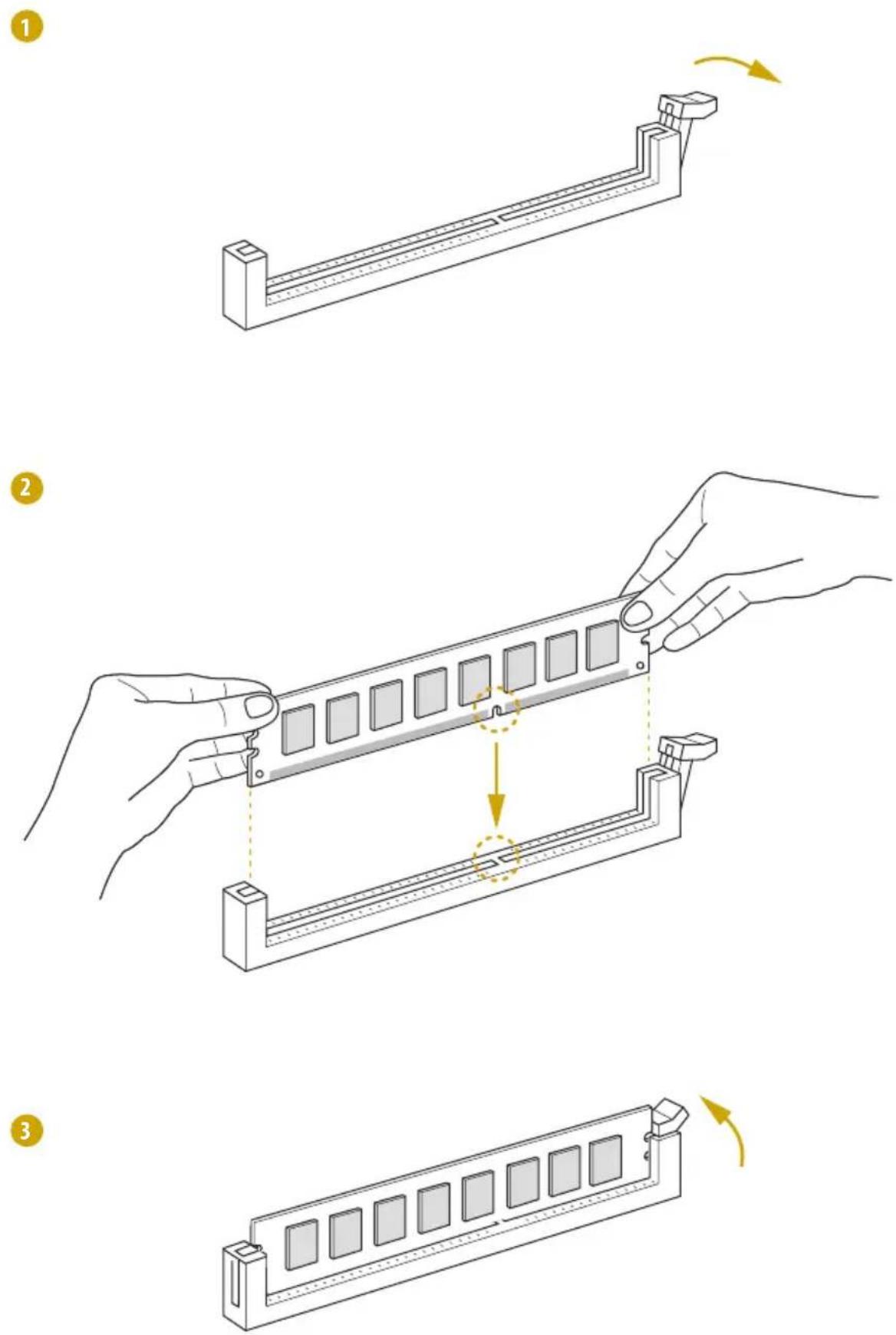

The DIMM only fits in one correct orientation. It will cause permanent damage to the motherboard and the DIMM if you force the DIMM into the slot at incorrect orientation.
A single memory module should be installed in the BLUE socket.
If you install only one CPU (CPU1) on the motherboard, make sure to install DIMMs into DDR4_A, DDR4_B, DDR4_C, or DDR4_D slot(s).
1 CPU Configuration
| CPU1 | ||||||||
| A1 | A2 | B1 | B2 | C1 | C2 | D1 | D2 | |
| 1 DIMM | # | |||||||
| 2 DIMMS | # | # | ||||||
| 4 DIMMS | # # # # | |||||||
| 8 DIMMS | # # # # # # # # | |||||||
2 CPU Configuration
| CPU1 | ||||||||
| A1 | A2 | B1 | B2 | C1 | C2 | D1 | D2 | |
| 1 DIMM | # | |||||||
| 2 DIMMS | # | # | ||||||
| 4 DIMMS | # # # # | |||||||
| 8 DIMMS | # # # # | |||||||
| 12 DIMMS | # # # # # # # # | |||||||
| 16 DIMMS | # # # # # # # # # | |||||||
| CPU2 | ||||||||
| E1 | E2 | F1 | F2 | G1 | G2 | H1 | H2 | |
| 1 DIMM | ||||||||
| 2 DIMMS | ||||||||
| 4 DIMMS | ||||||||
| 8 DIMMS | # # # # | |||||||
| 12 DIMMS | # # # # | |||||||
| 16 DIMMS | # # # # # # # # # | |||||||
2.6 Expansion Slots (PCI and PCI Express Slots)
There are 6 PCI Express slots on this motherboard.
PCIE slot:
PCIE1, PCIE2 and PCIE6 (PCIE 3.0 x8 slot, from CPU 1) is used for PCI Express x8 lane width cards.
PCIE3, PCIE4 and PCIE5 (PCIE 3.0 x8 slot, from CPU 2) is used for PCI Express x8 lane width cards.
| Slot Generation Mechanical Electrical Source |
| PCIE 6 3.0 x8 x8 CPU 1 |
| PCIE 5 3.0 x8 x8 CPU 2 |
| PCIE 4 3.0 x8 x8 CPU 2 |
| PCIE 3 3.0 x8 x8 CPU 2 |
| PCIE 2 3.0 x8 x8 CPU 1 |
| PCIE 1 3.0 x8 x8 CPU 1 |
2.7 Jumper Setup
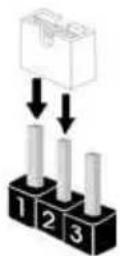
The illustration shows how jumpers are setup. When the jumper cap is placed on the pins, the jumper is "Short". If no jumper cap is placed on the pins, the jumper is "Open". The illustration shows a 3-pin jumper whose pin1 and pin2 are "Short" when a jumper cap is placed on these 2 pins.

Short

Open
ME Recovery Jumper (3-pin ME_RECOVERY1) (No. 39)

Normal Mode (Default)
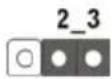
ME Recovery Mode
CPU PECI Mode Jumper (3-pin PECI1) (No. 45)

CPU PECI connect to PCH

CPU PECI connect to BMC (Default)
Override Mode Jumper (3-pin FLASH_ OVERRIDE1) (No. 40)
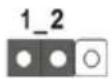
Descriptor Security Over- ride

No Override (Default)
PMBUS Mode Jumper (3-pin PMBUS_SEL_ALT1) (No. 11)

PMBus connected to BMC (Default)
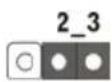
PMBus connected to PCH
(3-pin PMBUS_SEL_DAT1) (No. 12) (3-pin PMBUS_SEL_CLK1) (No. 13)
Chassis ID1 Jumper
(3-pin CHASSIS_ID1)
(No. 52)
Chassis ID2 Jumper
(3-pin CHASSIS_ID2)
(No. 51)
Chassis ID3 Jumper
(3-pin CHASSIS_ID3)
(No. 46)

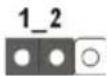

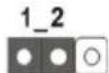
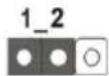
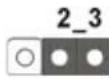
Board Level SKU (Default) Reserved for system level
use
Chassis ID1 Jumper
(3-pin CHASSIS_ID1)
(No. 52)
Chassis ID2 Jumper
(3-pin CHASSIS_ID2)
(No. 51)
Chassis ID3 Jumper
(3-pin CHASSIS_ID3)
(No. 46)


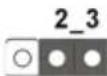
Reserved for system level
use
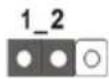


Reserved for system level
use
Chassis ID1 Jumper
(3-pin CHASSIS_ID1)
(No. 52)
Chassis ID2 Jumper
(3-pin CHASSIS_ID2)
(No. 51)
Chassis ID3 Jumper
(3-pin CHASSIS_ID3)
(No. 46)

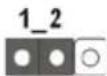
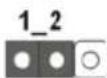
Reserved for system level
use
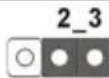
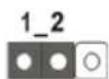
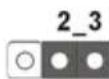
Reserved for system level
use
2.8 Onboard Headers and Connectors

Onboard headers and connectors are NOT jumpers. Do NOT place jumper caps over these headers and connectors. Placing jumper caps over the headers and connectors will cause permanent damage to the motherboard.
System Panel Header (9-pin PANEL1) (No. 23)

text_image
PLED+ PLED- PWRBTN# GND 1 GND RESET# GND HDLED- HDLED+Connect the power switch, reset switch and system status indicator on the chassis to this header according to the pin assignments. Particularly note the positive and negative pins before connecting the cables.

PWRBTN (Power Switch):
Connect to the power switch on the chassis front panel. You may configure the way to turn off your system using the power switch.
RESET (Reset Switch):
Connect to the reset switch on the chassis front panel. Press the reset switch to restart the computer if the computer freezes and fails to perform a normal restart.
PLED (System Power LED):
Connect to the power status indicator on the chassis front panel. The LED is on when the system is operating. The LED is off when the system is in S4 sleep state or powered off (S5).
HDLED (Hard Drive Activity LED):
Connect to the hard drive activity LED on the chassis front panel. The LED is on when the hard drive is reading or writing data.
The front panel design may differ by chassis. A front panel module mainly consists of power switch, reset switch, power LED, hard drive activity LED, speaker and etc. When connecting your chassis front panel module to this header, make sure the wire assignments and the pin assignments are matched correctly.
Auxiliary Panel Header (18-pin AUX PANEL_1) (No. 24)

flowchart
graph TD
    subgraph A
        A1["SMB_A Alert"] --> A2["SMB_CLK"]
        A2 --> A3["GND"]
        A3 --> A4["SMB_DATA"]
        A4 --> A5["+3VSB"]
    end
    subgraph B
        B1["LAN1_LINK"] --> B2["LED_PWR"]
        B2 --> B3["LED_PWR"]
        B3 --> B4["LAN2_LINK"]
    end
    A1 --> C["CASEOPEN"]
    A1 --> GND
    A2 --> C
    A2 --> GND
    A3 --> C
    A3 --> GND
    A4 --> C
    A4 --> GND
    A5 --> C
    A5 --> GND
    A6["LOCATORLED1+"] --> C
    A6 --> GND
    A7["LOCATORBLT#"] --> C
    A7 --> GND
    A8["System Fault LED-"] --> C
    A8 --> GND
    A9["System Fault LED+"] --> C
    A9 --> GND
    A10["+5VSB"] --> C
This header supports multiple functions on the front panel, including the front panel SMB, internet status indicator and chassis intrusion pin.

A. Front panel SMBus connecting pin (6-1 pin FPSMB)
This header allows you to connect SMBus (System Management Bus) equipment. It can be used for communication between peripheral equipment in the system, which has slower transmission rates, and power management equipment.
B. Internet status indicator (2-pin LAN1_LED, LAN2_LED)
These two 2-pin headers allow you to use the Gigabit internet indicator cable to connect to the LAN status indicator. When this indicator flickers, it means that the internet is properly connected.
C. Chassis intrusion pin (2-pin CHASSIS)
This header is provided for host computer chassis with chassis intrusion detection designs. In addition, it must also work with external detection equipment, such as a chassis intrusion detection sensor or a microswitch. When this function is activated, if any chassis component movement occurs, the sensor will immediately detect it and send a signal to this header, and the system will then record this chassis intrusion event. The default setting is set to the CASEOPEN and GND pin; this function is off.
D. Locator LED (4-pin LOCATOR)
This header is for the locator switch and LED on the front panel.
E. System Fault LED (2-pin LOCATOR)
This header is for the Fault LED on the system.
Serial ATA3 Connectors
(SATA_0)
(No. 28)
(SATA_1)
(No. 31)
(SATA_2)
(No. 29)
(SATA_3)
(No. 30)
(SATA_4)
(No. 37)
(SATA_5)
(No. 34)
(SSATA_0)
(No. 32)
(SSATA_1)
(No. 33)
(SSATA_2)
(No. 36)
(SSATA_3)
(No. 35)
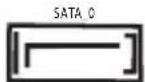

SATA_1
SATA_2
SATA 3
SATA 4


SATA 5
55ATA_0

SSATA_1
SSATA_2


SSATA 3
These ten SATA3 connectors support SATA data cables for internal storage devices with up to 6.0 Gb/s data transfer rate.
USB 3.0 Connector
(USB3_5)
(No. 42)

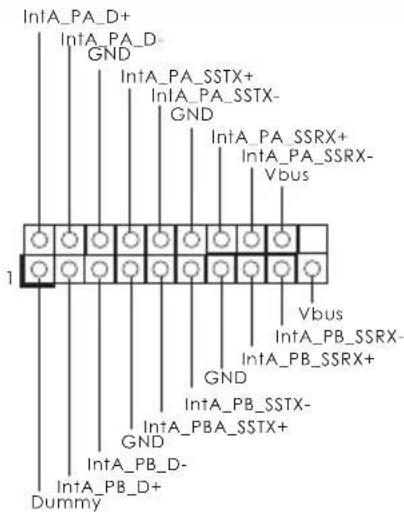
USB 3.0 Header
(19-pin USB3_2_3)
(No. 43)
text_image
IntA_PA_D+ IntA_PA_D- GND IntA_PA_SSTX+ IntA_PA_SSTX- GND IntA_PA_SSRX+ IntA_PA_SSRX- Vbus Vbus IntA_PB_SSRX- GND IntA_PB_SSRX+ IntA_PB_SSTX- GND IntA_PB_D- IntA_PB_D+ DummyBesides two default USB 3.0 ports on the I/O panel, there is one USB 3.0 header on this motherboard. This USB 3.0 header can support two USB 3.0 ports.
| USB 2.0 Header(9-pin USB_3_4)(No. 53) |  | ^ D Besides two USB 2.0 ports on the I/O panel, there is one header on this motherboard. Each USB 2.0 header can support two ports. |
| Chassis Speaker Header(4-pin SPEAKER1)(No. 44) |  | Please connect the chassis speaker to this header. |
| CPU Fan Connectors(4-pin CPU1_FAN1)(No. 17)(4-pin CPU2_FAN1)(No. 3) |  | This motherboard provides two 4-Pin CPU fan (Quiet Fan) connectors. If you plan to connect a 3-Pin CPU fan, please connect it to Pin 1-3.*For more details, please refer to the Cooler QVL list on the ASRock Rack website. |
| Front and Rear FanConnectors(4-pin FRNT_FAN1)(No. 10)(4-pin FRNT_FAN2)(No. 8)(4-pin FRNT_FAN3)(No. 21)(4-pin FRNT_FAN4)(No. 22) | 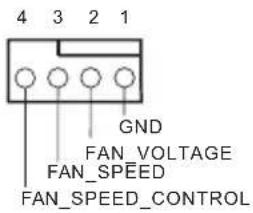 | Please connect fan cables to the fan connectors and match the black wire to the ground pin. All fans support Fan Control. |
| (4-pin REAR_FAN1)(No. 57)(4-pin REAR_FAN2)(No. 55) |  | |
| ATX Power Connector(24-pin ATXPWR1)(No. 6) | 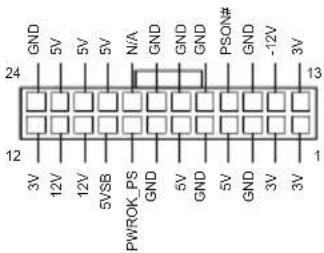 | This motherboard provides a 24-pin ATX power connector. To use a 20-pin ATX power supply, please plug it along Pin 1 and Pin 13. |
ATX 12V Power
Connectors
(8-pin ATX12V1)
(No. 7)
(8-pin ATX12V2)
(No. 4)
text_image
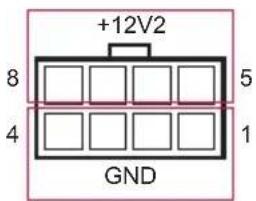
+12V2 8 5 4 1 GNDThis motherboard provides two 8-pin ATX 12V power connectors.
TPM Header
(17-pin TPM1)
(No. 38)
text_image
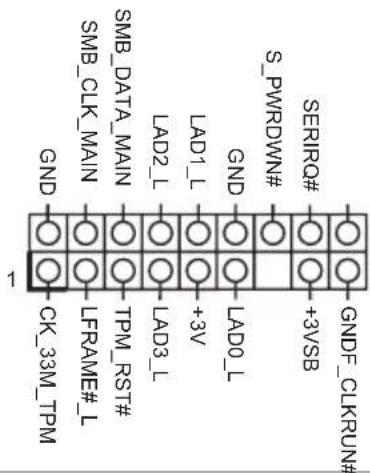
SERIRQ# S_PWRDWN# GND +3VSB GND_F_CLKRUN# GND LAD2_L LAD1_L LAD0_L +3V LAD3_L TPM_RST# LFRAME#_L CK_33M_TPM SMB_DATA_MAIN SMB_CLK_MAIN 1This connector supports Trusted Platform Module (TPM) system, which can securely store keys, digital certificates, passwords, and data. A TPM system also helps enhance network security, protects digital identities, and ensures platform integrity.
Serial General Purpose
Input/Output Headers
(7-pin SATA_SGPIO1)
(No. 25)
(7-pin SATA_SGPIO2)
(No. 26)
(7-pin SSATA_SGPIO1)
(No. 27)
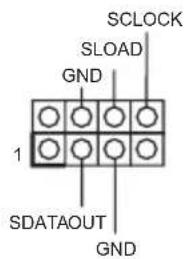
text_image
SCLOCK SLOAD GND 1 SDATAOUT GNDThis header supports Seria1 Link interface for onboard SATA connections.
PSU SMBus
(PSU_SMB1)
(No. 9)

PSU SMBus monitors the status of the power supply, fan and system temperature.
Non Maskable Interrupt
Button Header
(NMI_BTN1)
(No. 50)

Please connect a NMI device to this header.
Intelligent Platform Management Bus header (4-pin IPMB1) (No. 5)

text_image
IPMB_SDA IPMB_SCL GND No ConnectThis 4-pin connector is used to provide a cabled base-board or front panel connection for value added features and 3rd-party add-in cards, such as Emergency Management cards, that provide management features using the IPMB.
Baseboard Management Controller SMBus Header (5-pin BMC_SMB_1) (No. 47) 5-pin BMC_SMB_2) (No. 49) 5-pin BMC_SMB_3) (No. 48)
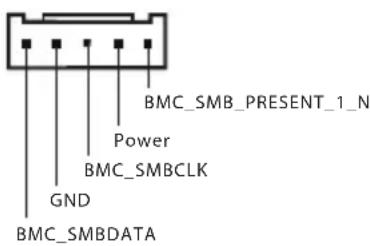
text_image
BMC_SMB_PRESENT_1_N Power BMC_SMBCLK GND BMC_SMBDATAThese headers are used for the SM BUS devices.
Thermal Sensor Header (3-pin TR1) (No. 41)

Please connect the thermal sensor cable to either pin 1-2 or pin 2-3 and the other end to the device which you wish to monitor its temperature.
2.9 Dr. Debug
Dr. Debug is used to provide code information, which makes troubleshooting even easier. Please see the diagrams below for reading the Dr. Debug codes.
Code Description
| 00 Please check if the CPU is installed correctly and then clear CMOS. | |
| 0d | Problem related to memory, VGA card or other devices. Please clear CMOS, re-install the memory and VGA card, and remove other USB, PCI devices. |
| 01 - 54 (except 0d), 5A-60 | Problem related to memory. Please re-install the CPU and memory then clear CMOS. If the problem still exists, please install only one memory module or try using other memory modules. |
| 55 | The Memory could not be detected. Please re-install the memory and CPU. If the problem still exists, please install only one memory module or try using other memory modules. |
| 61 - 91 Chipset initialization error. Please press reset or clear CMOS. | |
| 92 - 99 | Problem related to PCI-E devices. Please re-install PCI-E devices or try installing them in other slots. If the problem still exists, please remove all PCI-E devices or try using another VGA card. |
| A0 - A7 | Problem related to IDE or SATA devices. Please re-install IDE and SATA devices. If the problem still exists, please clear CMOS and try removing all SATA devices. |
| b0 | Problem related to memory. Please re-install the CPU and memory. If the problem still exists, please install only one memory module or try using other memory modules. |
| b4 Problem related to USB devices. Please try removing all USB devices. | |
| b7 | Problem related to memory. Please re-install the CPU and memory then clear CMOS. If the problem still exists, please install only one memory module or try using other memory modules. |
| d6 | The VGA could not be recognized. Please clear CMOS and try re-installing the VGA card. If the problem still exists, please try installing the VGA card in other slots or use other VGA cards. |
| d7 | The Keyboard and mouse could not be recognized. Please try re-installing the keyboard and mouse. |
| d8 Invalid Password. | |
| FF Please check if the CPU is installed correctly and then clear CMOS. | |
2.10 Driver Installation Guide
To install the drivers to your system, please insert the support CD to your optical drive first. Then, the drivers compatible to your system can be auto-detected and listed on the support CD driver page. Please follow the order from top to bottom to install those required drivers. Therefore, the drivers you install can work properly.
2.11 Dual LAN and Teaming Operation Guide
Dual LAN with Teaming enabled on this motherboard allows two single connections to act as one single connection for twice the transmission bandwidth, making data transmission more effective and improving the quality of transmission of distant images. Fault tolerance on the dual LAN network prevents network downtime by transferring the workload from a failed port to a working port.

The speed of transmission is subject to the actual network environment or status even with Teaming enabled.
Before setting up Teaming, please make sure whether your Switch (or Router) supports Teaming (IEEE 802.3ad Link Aggregation). You can specify a preferred adapter in Intel PROSet. Under normal conditions, the Primary adapter handles all non-TCP/IP traffic. The Secondary adapter will receive fallback traffic if the primary fails. If the Preferred Primary adapter fails, but is later restored to an active status, control is automatically switched back to the Preferred Primary adapter.
Step 1
From Device Manager, open the properties of a team.
Step 2
Click the Settings tab.
Step 3
Click the Modify Team button.
Step 4
Select the adapter you want to be the primary adapter and click the Set Primary button.
If you do not specify a preferred primary adapter, the software will choose an adapter of the highest capability (model and speed) to act as the default primary. If a failover occurs, another adapter becomes the primary. The adapter will, however, rejoin the team as a non-primary.
Chapter 3 UEFI Setup Utility
3.1 Introduction
This section explains how to use the UEFI SETUP UTILITY to configure your system. The UEFI chip on the motherboard stores the UEFI SETUP UTILITY. You may run the UEFI SETUP UTILITY when you start up the computer. Please press during the Power-On-Self-Test (POST) to enter the UEFI SETUP UTILITY; otherwise, POST will continue with its test routines.
If you wish to enter the UEFI SETUP UTILITY after POST, restart the system by pressing

Because the UEFI software is constantly being updated, the following UEFI setup screens and descriptions are for reference purpose only, and they may not exactly match what you see on your screen.
3.1.1 UEFI Menu Bar
The top of the screen has a menu bar with the following selections:
Item Description
| Main To set up the system time/date information | |
| Advanced To set up the advanced UEFI features | |
| IntelRCSetup For Intel CPU and chipset settings | |
| Server Mgmt To manage the server | |
| Security To set up the security features | |
| Boot | To set up the default system device to locate and load the Operating System |
| Event Logs For event log configuration | |
| Exit To exit the current screen or the UEFI SETUP UTILITY | |
Use <←> key or <→> key to choose among the selections on the menu bar, and then press
3.1.2 Navigation Keys
Please check the following table for the function description of each navigation key.
Navigation Key(s) Function Description
← / Moves cursor left or right to select Screens
↑ / Moves cursor up or down to select items
+ / - To change option for the selected items
3.2 Main Screen
Once you enter the UEFI SETUP UTILITY, the Main screen will appear and display the system overview. The Main screen provides system overview information and allows you to set the system time and date.
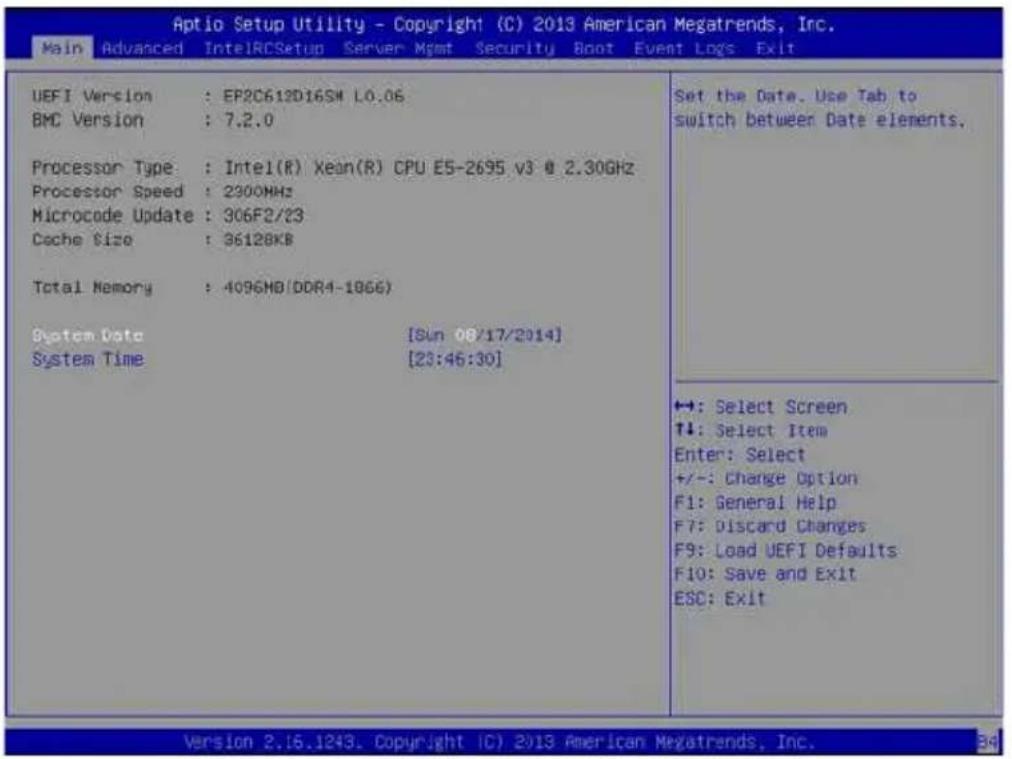
text_image
Aptio Setup Utility - Copyright (C) 2013 American Megatrends, Inc. Main Advanced IntelRCSetup Server Mgmt Security Boot Event Logs Exit UEFI Version : EP2C612D16SM L0.06 BMC Version : 7.2.0 Processor Type : Intel(R) Xean(R) CPU E5-2695 v3 @ 2.30GHz Processor Speed : 2900MHz Microcode Update : 306F2/23 Cache Size : 36128KB Total Memory : 4096MB(DDR4-1866) System Date [Sun 08/17/2014] System Time [23:46:30] Set the Date. Use Tab to switch between Date elements. ↔: Select Screen ↑↓: Select Item Enter: Select +/-: Change Option F1: General Help F7: Discard Changes F9: Load UEFI Defaults F10: Save and Exit ESC: Exit Version 2.15.1243. Copyright (C) 2013 American Megatrends, Inc.3.3 Advanced Screen
In this section, you may set the configurations for the following items: ACPI Configuration, Configure Super IO Settings, Serial Port Console Redirection, CSM Configuration, Trusted Computing, USB Configuration, System Configuration, Hard Disk S.M.A.R.T Settings, H/W Monitor and Instant Flash.

text_image
Aptio Setup Utility - Copyright (C) 2016 American Megatrends, Inc. Main Advanced IntelRCSetup Server Rgmt Security Boot Event Logs Exit ACPI Configuration Configure Super 1D Settings Serial Port Console Redirection CSM parameters Trusted Computing USB Configuration System Configuration Hard Disk S.M.A.R.T Settings 3rd Storage Configuration H/W Monitor MHEA Configuration UEFI Update Utility Instant Flash Configure ACPI Settings +:-; Select Screen 14: Select Item Enter: Select +/-: Change Option F1: General Help F7: Discard Changes F9: Load UEFI Defaults F10: Save and Exit ESC: Exit Version 2.17.1249. Copyright (C) 2016 American Megatrends, Inc.
Setting wrong values in this section may cause the system to malfunction.
3.3.1 ACPI Configuration

text_image
Aptio Setup Utility - Copyright (C) 2013 American Megatrends, Inc. Advanced PCIE Devices Power On [Disabled] Ring-In Power On [Disabled] RTC Alarm Power On [By DS] Allow the system to be waked up by a PCI device and enable wake on LAN. +: Select Screen +: Select Item Enter: Select +/-: Change Option F1: General Help F7: Discard Changes F9: Load UEFI Defaults F10: Save and Exit ESC: Exit Version 2.16.1243, Copyright (C) 2013 American Mzgatrends, Inc.PCIE Devices Power On
Use this item to enable or disable PCIE devices to turn on the system from the power-soft-off mode.
Ring-In Power On
Use this item to enable or disable Ring-In signals to turn on the system from the power-soft-off mode.
RTC Alarm Power On
Use this item to enable or disable RTC (Real Time Clock) to power on the system.
3.3.2 Configure Super IO Settings
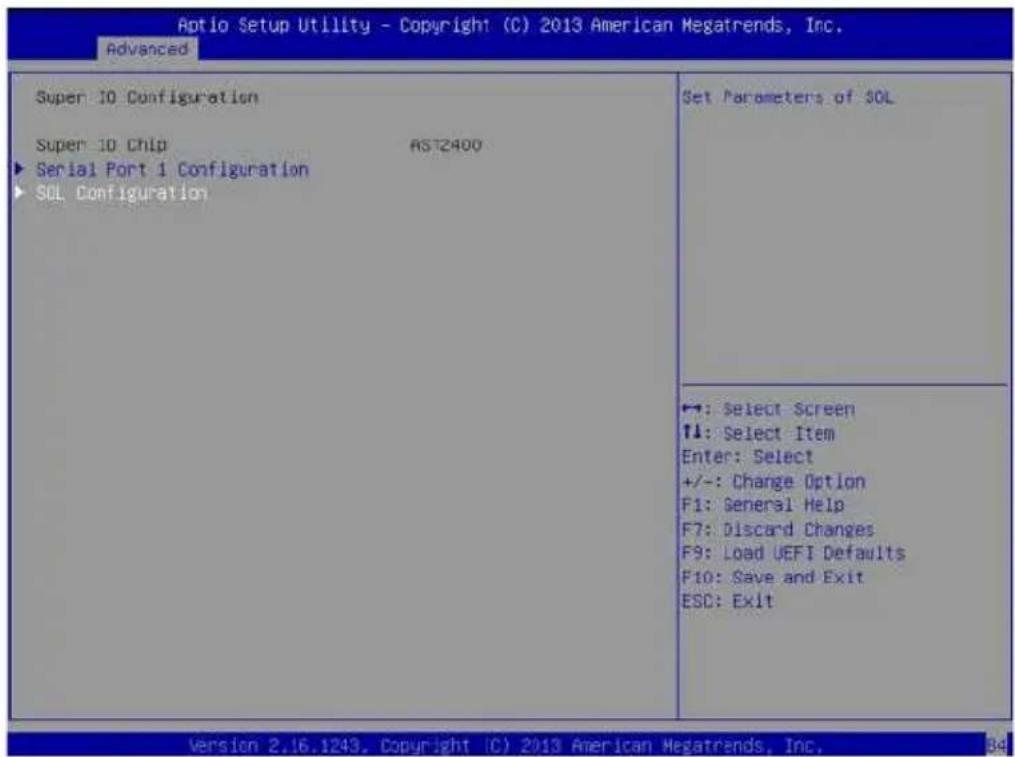
text_image
Aptio Setup Utility - Copyright (C) 2013 American Megatrends, Inc. Advanced Super 10 Configuration Super 10 Chip AST2400 ▶ Serial Port 1 Configuration ▶ SQL Configuration Set Parameters of SQL ▶1: Select Screen ▶1: Select Item Enter: Select +/-: Change Option F1: General Help F7: Discard Changes F9: Load UEFI Defaults F10: Save and Exit ESC: Exit Version 2.16.1243. Copyright (C) 2013 American Megatrends, Inc.Serial Port 1 Configuration
Use this item to configure the onboard serial port 1.
Select and enter the "Serial Port 1 Configuration" and you will see the followings:
Serial Port
Use this item to enable or disable the onboard serial port.
Serial Port Address
Use this item to select an optimal setting for Super IO device.
SOL Configuration
Use this item to set parameters of SOL.
Select and enter the ""SOL Configuration" and you will see the followings:
SOL Port
Use this item to enable or disable the SOL port.
SOL Port Address
Use this item to select an optimal setting for Super IO device.
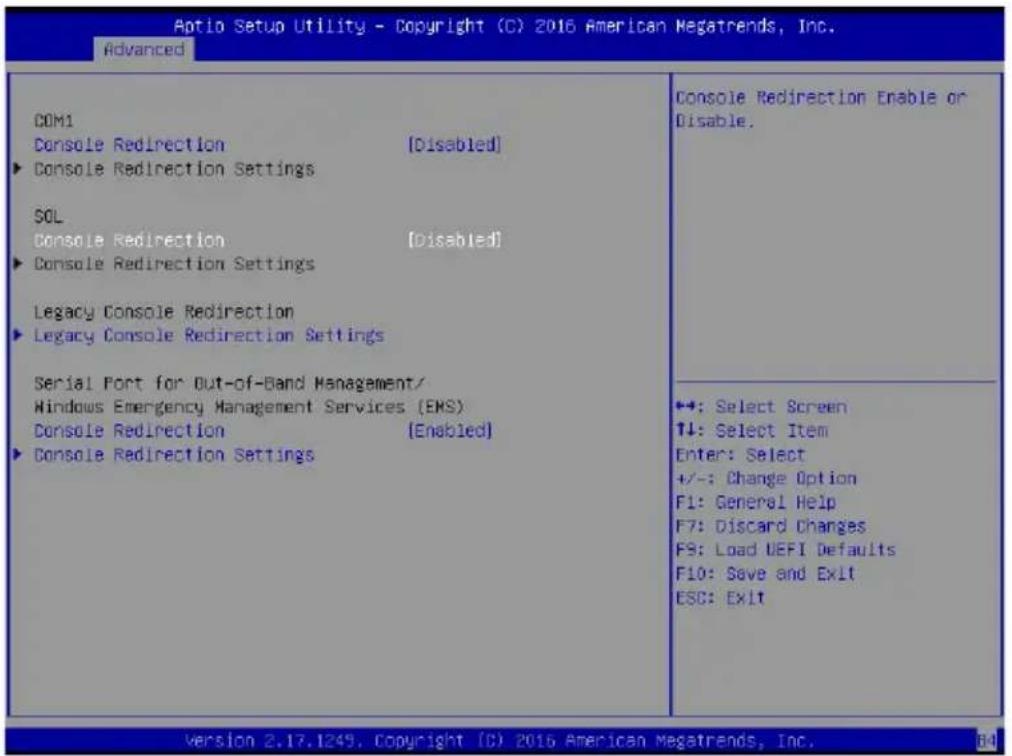
3.3.3 Serial Port Console Redirection
text_image
Aptio Setup Utility - Copyright (C) 2016 American Megatrends, Inc. Advanced COM1 Console Redirection [Disabled] ► Console Redirection Settings SOL Console Redirection [Disabled] ► Console Redirection Settings Legacy Console Redirection ► Legacy Console Redirection Settings Serial Port for Out-of-Band Management/ Windows Emergency Management Services (EMS) Console Redirection [Enabled] ► Console Redirection Settings Console Redirection Enable or Disable. ++: Select Screen ↑↓: Select Item Enter: Select +/-: Change Option F1: General Help F7: Discard Changes F9: Load UEFI Defaults F10: Save and Exit ESC: Exit Version 2.17.1249. Copyright (C) 2016 American Megatrends, Inc.COM1 / SOL
Console Redirection
Use this option to enable or disable Console Redirection. If this item is set to Enabled, you can select a COM Port to be used for Console Redirection.
Console Redirection Settings
Use this option to configure Console Redirection Settings, and specify how your computer and the host computer to which you are connected exchange information.
Terminal Type
Use this item to select the preferred terminal emulation type for out-of-band management. It is recommended to select [VT-UTF8].
| Option Description | |
| VT100 ASCII character set | |
| VT100+ Extended VT100 that supports color and function keys | |
| VT-UTF8 UTF8 encoding is used to map Unicode chars onto 1 or more bytes | |
| ANSI Extended ASCII character set |
Bits Per Second
Use this item to select the serial port transmission speed. The speed used in the host computer and the client computer must be the same. Long or noisy lines may require lower transmission speed. The options include [9600] , [19200] , [57600] and [115200] .
Data Bits
Use this item to set the data transmission size. The options include [7] and [8] (Bits).
Parity
Use this item to select the parity bit. The options include [None], [Even], [Odd], [Mark] and [Space].
Stop Bits
The item indicates the end of a serial data packet. The standard setting is [1] Stop Bit. Select [2] Stop Bits for slower devices.
Flow Control
Use this item to set the flow control to prevent data loss from buffer over low. When sending data, if the receiving buffers are full, a "stop" signal can be sent to stop the data flow. Once the buffers are empty, a "start" signal can be sent to restart the flow. Hardware flow uses two wires to send start/stop signals. The options include [None] and [Hardware RTS/CTS].
VT-UTF8 Combo Key Support
Use this item to enable or disable the VT-UTF8 Combo Key Support for ANSI/VT100 terminals.
Recorder Mode
Use this item to enable or disable Recorder Mode to capture terminal data and send it as text messages.
Resolution 100x31
Use this item to enable or disable extended terminal resolution support.
Legacy OS Redirection Resolution
Use this item to select the number of rows and columns used in legacy OS redirection.
Putty Keypad
Use this item to select Function Key and Keypad on Putty.
Redirection After BIOS POST
If the [LoadBooster] is selected, legacy console redirection is disabled before booting to legacy OS. If [Always Enabled] is selected, legacy console redirection is enabled for legacy OS. The default value is [Always Enabled].
Legacy Console Redirection Settings
Legacy Serial Redirection Port
Select a COM port to display redirection of Legacy OS and Legacy OPROM Messages.
Serial Port for Out-of-Band Management/Windows Emergency Management Services (EMS)
Console Redirection
Use this option to enable or disable Console Redirection. If this item is set to Enabled, you can select a COM Port to be used for Console Redirection.
Console Redirection Settings
Use this option to configure Console Redirection Settings, and specify how your computer and the host computer to which you are connected exchange information.
Terminal Type
Use this item to select the preferred terminal emulation type for out-of-band management. It is recommended to select [VT-UTF8].
| Option Description | |
| VT100 ASCII character set | |
| VT100+ Extended VT100 that supports color and function keys | |
| VT-U TF8 UTF8 encoding is used to map Unicode chars onto 1 or more bytes | |
| ANSI Extended ASCII character set |
Bits Per Second
Use this item to select the serial port transmission speed. The speed used in the host computer and the client computer must be the same. Long or noisy lines may require lower transmission speed. The options include [9600] , [19200] , [57600] and [115200] .
Flow Control
Use this item to set the f low control to prevent data loss from buffer overf low. When sending data, if the receiving buffers are full, a "stop" signal can be sent to stop the data flow. Once the buffers are empty, a "start" signal can be sent to restart the flow. Hardware flow uses two wires to send start/stop signals. The options include [None], [Hardware RTS/CTS], and [Software Xon/Xoff].
Data Bits
Use this item to set the data transmission size. The standard setting is [8] (Bits).
Parity
Use this item to select the parity bit. The standard setting is [None].
Stop Bits
The item indicates the end of a serial data packet. The standard setting is [1] Stop Bit.
3.3.4 CSM Configuration

text_image
Aptio Setup Utility - Copyright (C) 2016 American Megatrends, Inc. Advanced Boot option filter [UEFI and Legacy] Launch Storage OpROM policy [Legacy only] PCIE1 Slot OpROM [Legacy] PCIE2 Slot OpROM [Legacy] PCIE3 Slot OpROM [Legacy] PCIE4 Slot OpROM [Legacy] PCIE5 Slot OpROM [Legacy] PCIE6 Slot OpROM [Legacy] Mezzanize Card OpROM [Legacy] This option controls Legacy/UEFI ROMs priority ←: Select Screen ↑↓: Select Item Enter: Select +/-: Change Option F1: General Help F7: Discard Changes F9: Load UEFI Defaults F10: Save and Exit ESC: Exit Version 2.17.1249. Copyright (C) 2016 American Megatrends, Inc.Boot Option Filter
This option controls Legacy/UEFI ROMs priority.
Launch Storage OpROM Policy
Select UEFI only to run those that support UEFI option ROM only. Select Legacy only to run those that support legacy option ROM only. Select Do not launch to not execute both legacy and UEFI option ROM.
PCIE1 Slot OpROM
Use this item to select PCIE1 Storage and Network Option ROM policy. (This item can't select Video Option ROM policy.)
PCIE2 Slot OpROM
Use this item to select PCIE2 Storage and Network Option ROM policy. (This item can't select Video Option ROM policy.)
PCIE3 Slot OpROM
Use this item to select PCIE3 Storage and Network Option ROM policy. (This item can't select Video Option ROM policy.)
PCIE4 Slot OpROM
Use this item to select PCIE4 Storage and Network Option ROM policy. (This item can't select Video Option ROM policy.)
PCIE5 Slot OpROM
Use this item to select PCIE5 Storage and Network Option ROM policy. (This item can't select Video Option ROM policy.)
PCIE6 Slot OpROM
Use this item to select PCIE6 Storage and Network Option ROM policy. (This item can't select Video Option ROM policy.)
Mezzanine Card OpROM
Use this item to select Mezzanine Card Storage and Network Option ROM policy. (This item can't select Video Option ROM policy.)
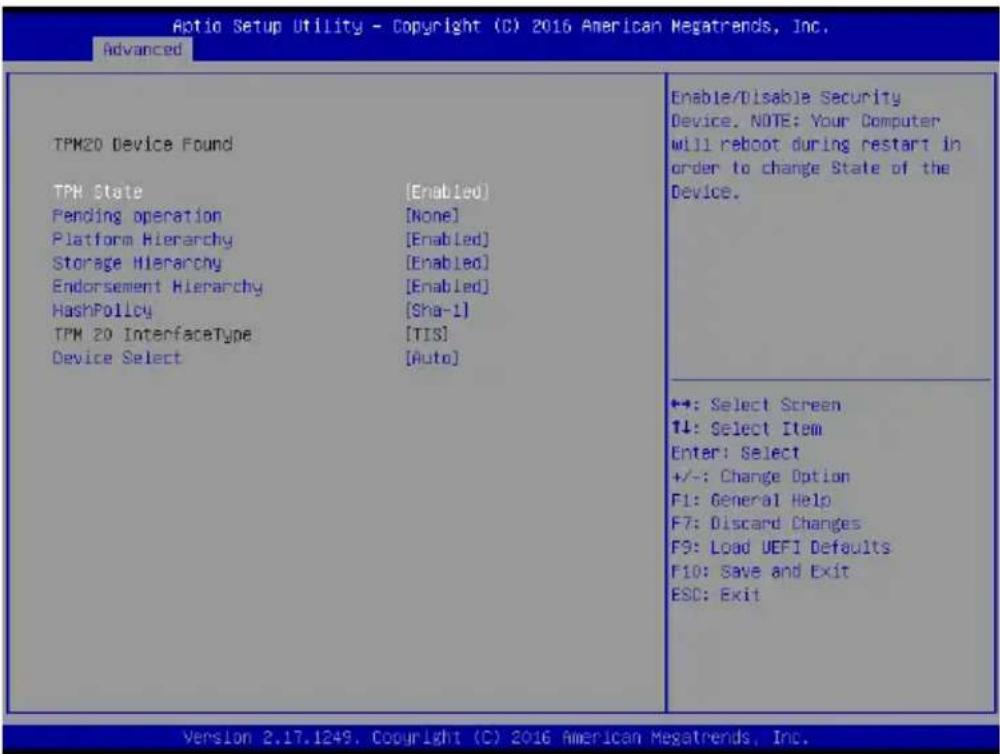
3.3.5 Trusted Computing
text_image
Aptio Setup Utility - Copyright (C) 2016 American Megatrends, Inc. Advanced TPM20 Device Found TPM State [Enabled] Pending operation [None] Platform Hierarchy [Enabled] Storage Hierarchy [Enabled] Endorsement Hierarchy [Enabled] HashPolicy [Sha-1] TPM 20 InterfaceType [TIS] Device Select [Auto] Enable/Disable Security Device. NOTE: Your Computer will reboot during restart in order to change State of the Device. +:-: Select Screen +:-: Select Item Enter: Select +/-: Change Option F1: General Help F7: Discard Changes F9: Load UEFI Defaults F10: Save and Exit ESC: Exit Version 2.17.1249. Copyright (C) 2016 American Megatrends, Inc.NOTE: Options vary depending on the version of your connected TPM module. Here is an example of TPM2.0.
TPM State
Use this item to enable or disable Security Device.
NOTE: Your computer will reboot during restart in order to change State of the Device.
Pending Operation
Schedule an Operation for the Security Device.
NOTE: Your computer will reboot during restart in order to change State of the Device.
Platform Hierarchy
Use this item to enable or disable Platform Hierarchy.
Storage Hierarchy
Use this item to enable or disable Storage Hierarchy.
Endorsement Hierarchy
Use this item to enable or disable Endorsement Hierarchy.
Hash Policy
Select the Hash policy to use. SHA-2 is most secure but might not be supported by all Operating Systems.
Device Select
TPM 1.2 will restrict support to TPM 1.2 devices; TPM 2.0 will restrict support to TPM 2.0 devices; Auto will support both with the default set to TPM 2.0 devices. If TPM 2.0 devices are not found, TPM 1.2 devices will be enumerated.
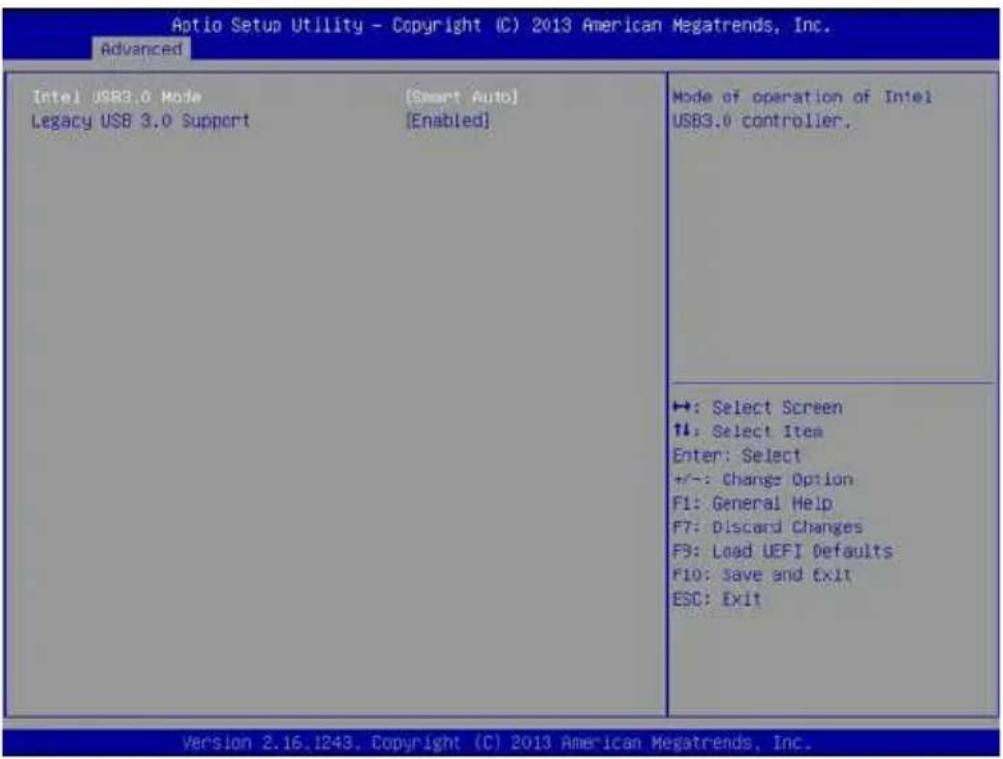
3.3.6 USB Configuration
text_image
Aptio Setup Utility - Copyright (C) 2013 American Megatrends, Inc. Advanced Intel USB3.0 Mode [Smart Auto] Legacy USB 3.0 Support [Enabled] Mode of operation of Intel USB3.0 controller. +: Select Screen +: Select Item Enter: Select +/-: Change Option F1: General Help F7: Discard Changes F3: Load UEFI Defaults F10: Save and Exit ESC: Exit Version 2.16.1243. Copyright (C) 2013 American Megatrends, Inc.Intel USB3.0 Mode
Use this item to select the mode of operation of Intel USB 3.0 controller. Configuration options: [Enabled], [Disabled], [Auto] and [Smart Auto]. If [Auto] is selected, all USB ports work as USB3.0 after boot to OS. If [Smart Auto] is selected, all USB ports work as USB3.0 after boot to OS and work as USB2.0 in deep sleep stages.
Legacy USB 3.0 Support
Use this option to enable or disable legacy support for USB devices. The default value is [Enabled].
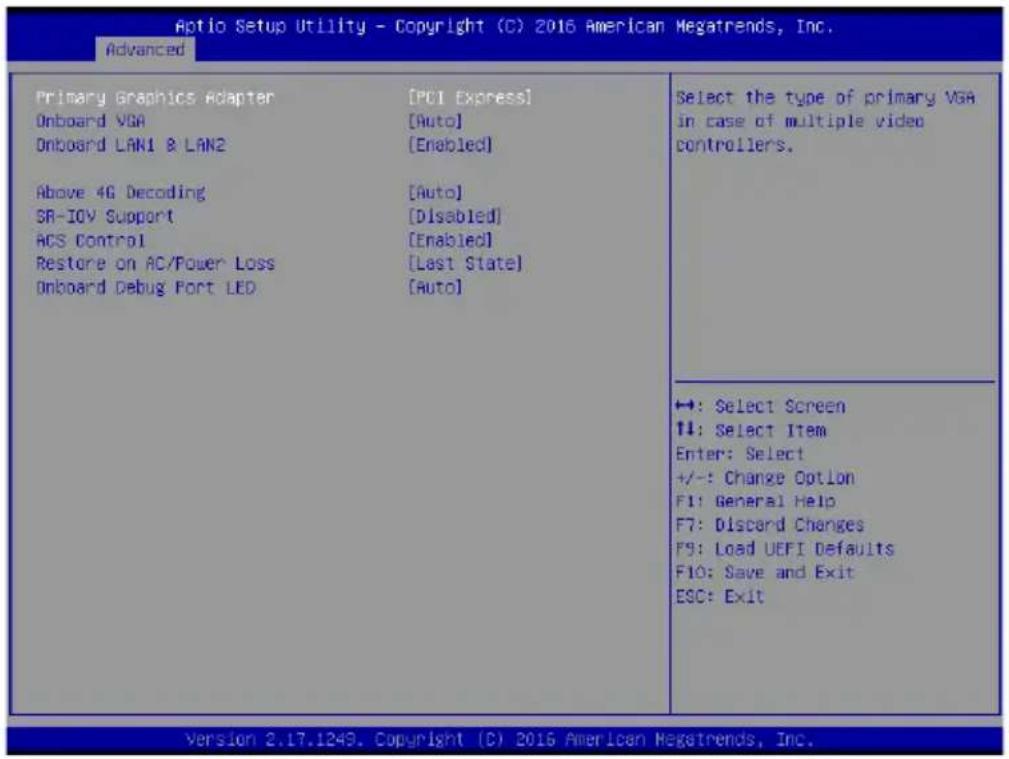
3.3.7 System Configuration
text_image
Aptio Setup Utility - Copyright (C) 2016 American Megatrends, Inc. Advanced Primary Graphics Adapter [PCI Express] Onboard VGA [Auto] Onboard LAN1 & LAN2 [Enabled] Above 4G Decoding [Auto] SR-IOV Support [Disabled] ACS Control [Enabled] Restore on AC/Power Loss [Last State] Onboard Debug Port LED [Auto] Select the type of primary VGA in case of multiple video controllers. ↔: Select Screen ↑↓: Select Item Enter: Select +/-: Change Option F1: General Help F7: Discard Changes F9: Load UEFI Defaults F10: Save and Exit ESC: Exit Version 2.17.1243. Copyright (C) 2016 American Megatrends, Inc.Primary Graphics Adapter
Use this item to select the type and primary VGA in case of multiple video contorllers.
Onboard VGA
Use this to enable or disable the Onboard VGA function. The default value is [Auto].
Onboard LAN1 & LAN2
This allows you to enable or disable both the Onboard LAN 1 & LAN 2 features.
Above 4G Decoding
Enable or disable 64bit capable Devices to be decoded in Above 4G Address Space (only if the system supports 64 bit PCI decoding).
SR-IOV Support
If system has SR-IOV capable PCIe Devices, this option Enables or Disables Single Root IO Virtualization Support.
ACS Control
Enable: Programs ACS only to Chipset PCIe Root Ports Bridges
Disable: Programs ACS to all PCIe bridges
Restore on AC/Power Loss
This allows you to set the power state after an unexpected AC/power loss. If [Power Off] is selected, the AC/power remains off when the power recovers. If [Power On] is selected, the AC/power resumes and the system starts to boot up when the power recovers. If [Last State] is selected, it will recover to the state before AC/power loss.
Onboard Debug Port LED
Use this item to turn On/Off Onboard Debug Port LED.
3.3.8 Hard Disk S.M.A.R.T Settings

text_image
Aptio Setup Utility - Copyright (C) 2013 American Megatrends, Inc. Advanced Hard Disk S.M.A.R.T Settings Hard Disk S.M.A.R.T [Disabled] S.M.A.R.T stands for Self-Monitoring, Analysis, and Reporting Technology. It is a monitoring system for computer hard disk drives to detect and report on various indicators of reliability. +: Select Screen +: Select Item Enter: Select +/-: Change Option F1: General Help F7: Discard Changes F9: Load UEFI Defaults F10: Save and Exit ESC: Exit Version 2.16.1243. Copyright (C) 2013 American Megatrends, Inc.Hard Disk S.M.A.R.T.
Use this item to enable or disable the S.M.A.R.T. (Self-Monitoring, Analysis, and Reporting Technology) feature. Configuration options: [Disabled] and [Enabled].
3.3.9 H/W Monitor
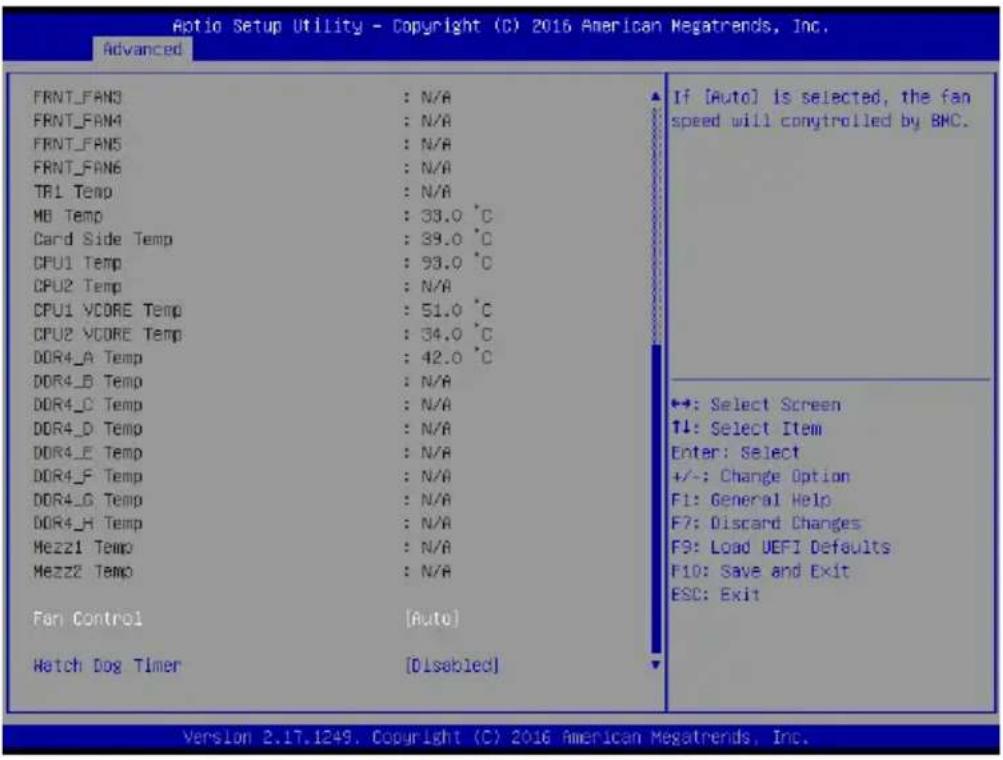
In this section, it allows you to monitor the status of the hardware on your system, including the parameters of the CPU temperature, motherboard temperature, CPU fan speed, chassis fan speed, and the critical voltage.
text_image
Optio Setup Utility - Copyright (C) 2016 American Megatrends, Inc. Advanced FRNT_FAN3 : N/A FRNT_FAN4 : N/A FRNT_FAN5 : N/A FRNT_FAN6 : N/A TR1_Temp : N/A MB_Temp : 33.0 °C Card Side_Temp : 39.0 °C CPU1_Temp : 93.0 °C CPU2_Temp : N/A CPU1_YCORE_Temp : 51.0 °C CPU2_YCORE_Temp : 34.0 °C DDR4_A_Temp : 42.0 °C DDR4_B_Temp : N/A DDR4_C_Temp : N/A DDR4_D_Temp : N/A DDR4_E_Temp : N/A DDR4_F_Temp : N/A DDR4_G_Temp : N/A DDR4_H_Temp : N/A Mezz1_Temp : N/A Mezz2_Temp : N/A Fan_Control [Auto] Hatch Dog Timer [Disabled] If [Auto] is selected, the fan speed will concontrolled by BMC. +: Select Screen ↑↓: Select Item Enter: Select +/-: Change Option F1: General Help F7: Discard Changes F9: Load UEFI Defaults F10: Save and Exit ESC: Exit Version 2.17.1249. Copyright (C) 2016 American Megatrends, Inc.Fan Control
If [Auto] is selected, the fan speed will controlled by BMC.
If [Manual] is selected, configure the items below.
CPU1\_FAN1
This allows you to set the CPU1 fan1's speed. The default value is [Smart Fan].
CPU2\_FAN1
This allows you to set the CPU2 fan1's speed. The default value is [Smart Fan].
REAR\_FAN 1
This allows you to set the rear fan 1's speed. The default value is [Smart Fan].
REAR\_FAN 2
This allows you to set the rear fan 2's speed. The default value is [Smart Fan].
FRNT\_FAN 1
This allows you to set the front fan 1's speed. The default value is [Smart Fan].
FRNT\_FAN 2
This allows you to set the front fan 2's speed. The default value is [Smart Fan].
FRNT\_FAN 3
This allows you to set the front fan 3's speed. The default value is [Smart Fan].
FRNT\_FAN 4
This allows you to set the front fan 4's speed. The default value is [Smart Fan].
Smart Fan Control
This allows you to set the Smart fan's level speed.
Smart Fan Duty Control
Smart Fan Duty x (x means 1 to 11 stage)
This allows you to set duty cycle for each stage.
Smart Fan Temp Control
Smart Fan Temp x (x means 1 to 11 stage)
This allows you to set temperature for each stage.
Watch Dog Timer
This allows you to enable or disable the Watch Dog Timer. The default value is [Disabled].
3.3.10 Instant Flash
Instant Flash is a UEFI flash utility embedded in Flash ROM. This convenient UEFI update tool allows you to update system UEFI without entering operating systems first like MS-DOS or Windows ^® . Just save the new UEFI file to your USB flash drive, floppy disk or hard drive and launch this tool, then you can update your UEFI only in a few clicks without preparing an additional floppy diskette or other complicated flash utility. Please be noted that the USB flash drive or hard drive must use FAT32/16/12 file system. If you execute Instant Flash utility, the utility will show the UEFI files and their respective information. Select the proper UEFI file to update your UEFI, and reboot your system after the UEFI update process is completed.
3.4 IntelRCSetup
In this section, you may set the configurations for the following items: Processor Configuration, CPU Power Management Configuration, QPI Configuration, Memory Configuration, IIO Configuration, PCH Configuration and Server ME Configuration.

text_image
Optio Setup Utility - Copyright (C) 2016 American Megatrends, Inc. Main Advanced IntelRCSetup Server Mgmt Security Boot Event Logs Exit RG Revision 03.00.00 ► Processor Configuration ► CPU Power Management Configuration ► QPI Configuration ► Memory Configuration ► IID Configuration ► PCH Configuration ► Server ME Configuration Setup Warning: Setting Items on this Screen to Incorrect values may cause system to malfunction! Displays and provides option to change the Processor Settings +: Select Screen +: Select Item Enter: Select +/-: Change Option F1: General Help F7: Discard Changes F9: Load UEFI Defaults F10: Save and Exit ESC: Exit Version 2.17.1249, Copyright (C) 2016 American Megatrends, Inc.3.4.1 Processor Configuration

text_image
Aptio Setup Utility - Copyright (C) 2016 American Megatrends, Inc. Intel IRC Setup Processor Configuration Processor Socket Socket 1 Socket 2 Processor ID 000406F1* | N/A Processor Frequency 2.100GHz | N/A Processor Max Ratio 21 | 00 Processor Min Ratio 12 | 00 Microcode Revision 0B000014 | N/A L1 Cache RAM 1152KB | N/A L2 Cache RAM 4608KB | N/A L3 Cache RAM 46080KB | N/A Processor 1 Version Intel(R) Xeon(R) CPU ES -2695 V4 @ 2.10GHz Processor 2 Version Not Present. Per-Socket Configuration Intel Hyper Threading Technology [Enable] VT-d [Enable] No-Execute Memory Protection [Enable] Enable Intel TXT Support [Disable] Intel Virtualization Technology [Enable] Enable SMX [Disable] PPIN Control [Unlock/Enable] Hardware Prefetcher [Enable] Change Per-Socket Settings +: Select Screen ↑↓: Select Item Enter: Select +/-: Change Option F1: General Help F7: Discard Changes F9: Load UEFI Defaults F10: Save and Exit ESC: Exit Version 2.17.1249. Copyright (C) 2016 American Megatrends, Inc.Per-Socket Configuration
Change Per-Socket Settings.
CPU Socket 1 Configuration
Active Processor Cores
Enter the number of cores to be enabled. 0 means all cores.
CPU Socket 2 Configuration
Active Processor Cores
Enter the number of cores to be enabled. 0 means all cores.
Intel Hyper Threading Technology
Intel Hyper Threading Technology allows multiple threads to run on each core, so that the overall performance on threaded software is improved.
VT-d
Intel Virtualization Technology for Directed I/O helps your virtual machine monitor better utilize hardware by improving application compatibility and reliability, and providing additional levels of manageability, security, isolation, and I/O performance.
No-Execute Memory Protection
Processors with No-Execution Memory Protection Technology may prevent certain classes of malicious buffer overflow attacks.
Enable Intel TXT Support
Enable Intel Trusted Execution Technology configuration. Please disable "EX DFX Features" when TXT is enabled.
Intel Virtualization Technology
Intel Virtualization Technology allows a platform to run multiple operating systems and applications in independent partitions, so that one computer system can function as multiple virtual systems.
Enable SMX
Use this item to enable Safer Mode Extensions.
PPIN Control
Use this item to unlock and Enable/Disable PPIN Control.
Hardware Prefetcher
Automatically prefetch data and code for the processor. Enable for better performance.
Adjacent Cache Prefetch
Automatically prefetch the subsequent cache line while retrieving the currently requested cache line. Enable for better performance.
DCU Streamer Prefetcher
DCU streamer prefetcher is an L1 data cache prefetcher (MSR 1A4h [2]).
DCU IP Prefetcher
DCU IP prefetcher is an L1 data cache prefetcher (MSR 1A4h [3]).
3.4.2 CPU Power Management Configuration

text_image
Aptio Setup Utility - Copyright (C) 2016 American Megatrends, Inc. IntelRCSetup CPU Power Management Configuration Intel SpeedStep Technology [Enable] Intel Turbo Boost Technology [Enable] Package C State Support [OS(Retention) state] CPU C3 State Support [Disable] CPU C5 State Support [Enable] CPU Thermal Throttling [Enabled] ▶ CPU HWPM State Control Intel SpeedStep technology allows processors to switch between multiple frequencies and voltage points for better power saving and heat dissipation. ↔: Select Screen ↑↓: Select Item Enter: Select +/-: Change Option F1: General Help F7: Discard Changes F9: Load UEFI Defaults F10: Save and Exit ESC: Exit Version 2.17.1249. Copyright (C) 2016 American Megatrends, Inc.Intel SpeedStep Technology
Intel SpeedStep technology is Intel's new power saving technology. Processors can switch between multiple frequencies and voltage points to enable power saving. The default value is [Enabled]. Configuration options: [Enabled] and [Disabled]. If you install Windows® Vista™ / 7 / 8 and want to enable this function, please set this item to [Enabled]. This item will be hidden if the current CPU does not support Intel(R) SpeedStep technology.

Please note that enabling this function may reduce CPU voltage and lead to system stability or compatibility issues with some power supplies. Please set this item to [Disabled] if above issues occur.
Intel Turbo Boost Technology
Use this item to enable or disable Intel Turbo Boost Technology. Turbo Boost allows processor cores to run faster than marked frequency in specific conditions. The default value is [Enabled].
Package C State Support
Enable CPU, PCIe, Memory, Graphics C State Support for power saving.
CPU C3 State Support
Enable C3 sleep state for lower power consumption.
CPU C6 State Support
Enable C6 deep sleep state for lower power consumption.
CPU Thermal Throttling
Enable CPU internal thermal control mechanisms to keep the CPU from overheating.
CPU HWPM State Control
CPU HWPM State Control controls configuration sub menu, includes Native and 00B nd etc.
Enable CPU HWPM
Enable CPU HWPM for CPU for better Energy performance.
Enable CPU Autonomous Cstate
Enable CPU Autonomous Cstate which is CPU converts HALT instruction to MWAIT.
3.4.3 QPI Configuration
text_image
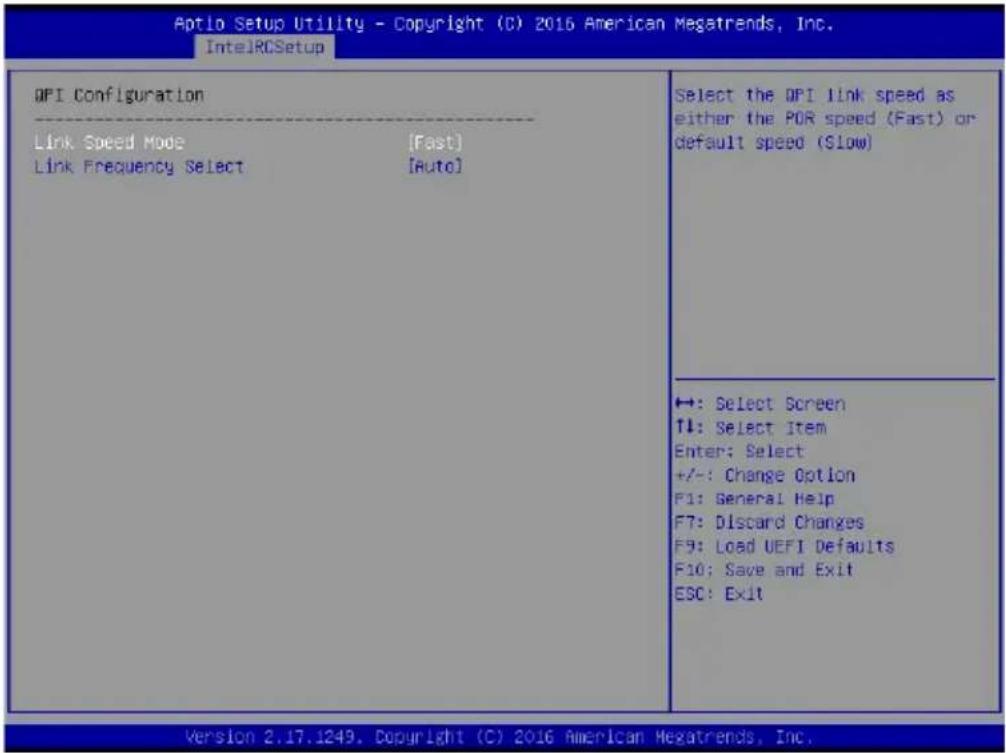
Aptio Setup Utility - Copyright (C) 2016 American Megatrends, Inc. IntelRCSetup QPI Configuration Link Speed Mode [Fast] Link Frequency Select [Auto] Select the QPI Link speed as either the POR speed (Fast) or default speed (Slow) ←: Select Screen ↑↓: Select Item Enter: Select +/-: Change Option F1: General Help F7: Discard Changes F9: Load UEFI Defaults F10: Save and Exit ESC: Exit Version 2.17.1249, Copyright (C) 2016 American Megatrends, Inc.Link Speed Mode
Select the QPI link speed as either the POR speed (Fast) or default speed (Slow).
Link Frequency Select
Allows for selecting the QPI Link Frequency.
3.4.4 Memory Configuration
text_image
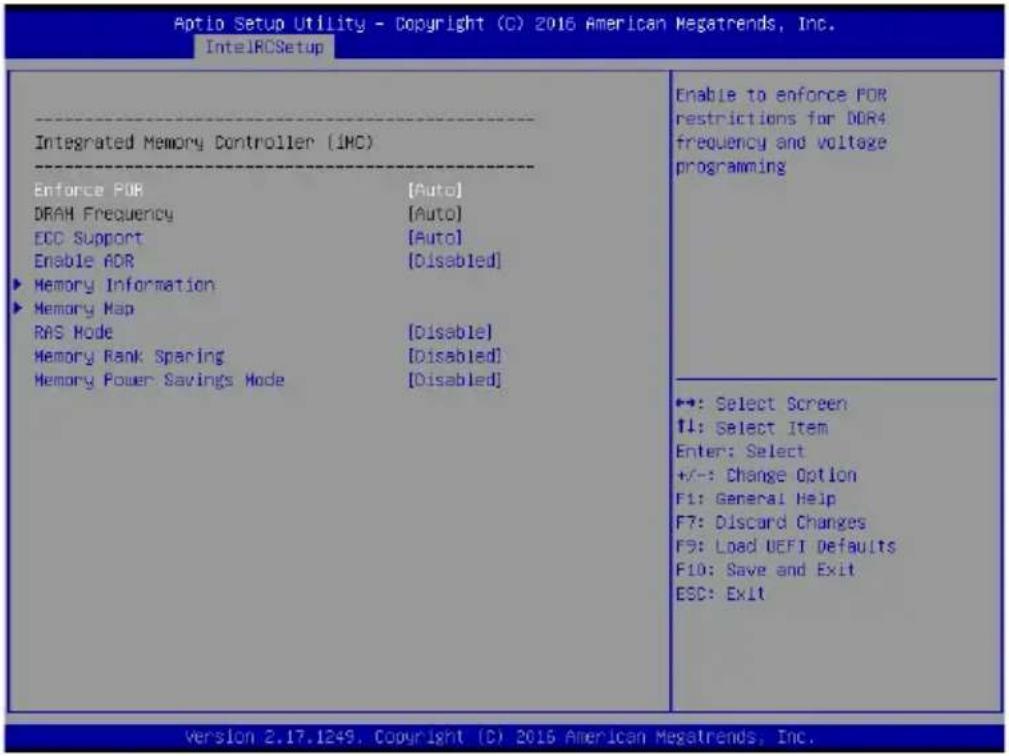
Aptio Setup Utility - Copyright (C) 2016 American Megatrends, Inc. Intel IRC Setup Integrated Memory Controller (IHC) Enforce PDR [Auto] DRAH Frequency [Auto] ECO Support [Auto] Enable ADR [Disabled] ▶ Memory Information ▶ Memory Map RAS Mode [Disable] Memory Rank Sparing [Disabled] Memory Power Savings Mode [Disabled] Enable to enforce FOR restrictions for DDR4 frequency and voltage programming ↔: Select Screen ↑↓: Select Item Enter: Select +/-: Change Option F1: General Help F7: Discard Changes F9: Load UEFI Defaults F10: Save and Exit ESC: Exit Version 2.17.1249. Copyright (C) 2016 American Megatrends, Inc.Enforce POR
Enable to enforce POR restrictions for DDR4 frequency and voltage programming.
DRAM Frequency
If [Auto] is selected, the motherboard will detect the memory module(s) inserted and assign the appropriate frequency automatically.
ECC Support
Use this item to enable or disable DDR ECC Support.
Enable ADR
Use this item to enable the ADR.
Memory Information
Displays memory topology with DIMM population information.
Memory Map
Set memory mapping settings.
Channel Interleaving
Select to configure Channel Interleaving settings.
Rank Interleaving
Select to configure Rank Interleaving settings.
RAS Mode
Enable or disable RAS modes. Enabling Sparing and Mirroring is not supported. If enabled, Sparing will be selected.
Memory Rank Sparing
Enable or disable Memory Rank Sparing.
Memory Power Savings Mode
Use this item to configure CKE and related Memory Power Savings Features.
3.4.5 IIO Configuration

text_image
Aptio Setup Utility - Copyright (C) 2016 American Megatrends, Inc. IntelRCSetup IIO Configuration PCIE1 Link Speed [Auto] PCIE2 Link Speed [Auto] PCIE3 Link Speed [Auto] PCIE4 Link Speed [Auto] PCIE5 Link Speed [Auto] PCIE6 Link Speed [Auto] Mezzanize Card Speed [Auto] PCI Express Global Options PCI-E ASPH (Global) [L1 Only] ++: Select Screen ↑↓: Select Item Enter: Select +/-: Change Option F1: General Help F7: Discard Changes F9: Load UEFI Defaults F10: Save and Exit ESC: Exit Version 2.17.1249. Copyright (C) 2016 American Megatrends, Inc.PCIE 1 Link Speed
This allows you to select PCIE 1 Link Speed. The default value is [Auto].
PCIE 2 Link Speed
This allows you to select PCIE 2 Link Speed. The default value is [Auto].
PCIE 3 Link Speed
This allows you to select PCIE 3 Link Speed. The default value is [Auto].
PCIE 4 Link Speed
This allows you to select PCIE 4 Link Speed. The default value is [Auto].
PCIE 5 Link Speed
This allows you to select PCIE 5 Link Speed. The default value is [Auto].
PCIE 6 Link Speed
This allows you to select PCIE 6 Link Speed. The default value is [Auto].
Mezzanine Card Speed
This allows you to select Mezzanine Card Speed. The default value is [Auto].
PCI-E ASPM Support
This option enables or disables the ASPM support for all downstream devices.
3.4.6 PCH Configuration
text_image
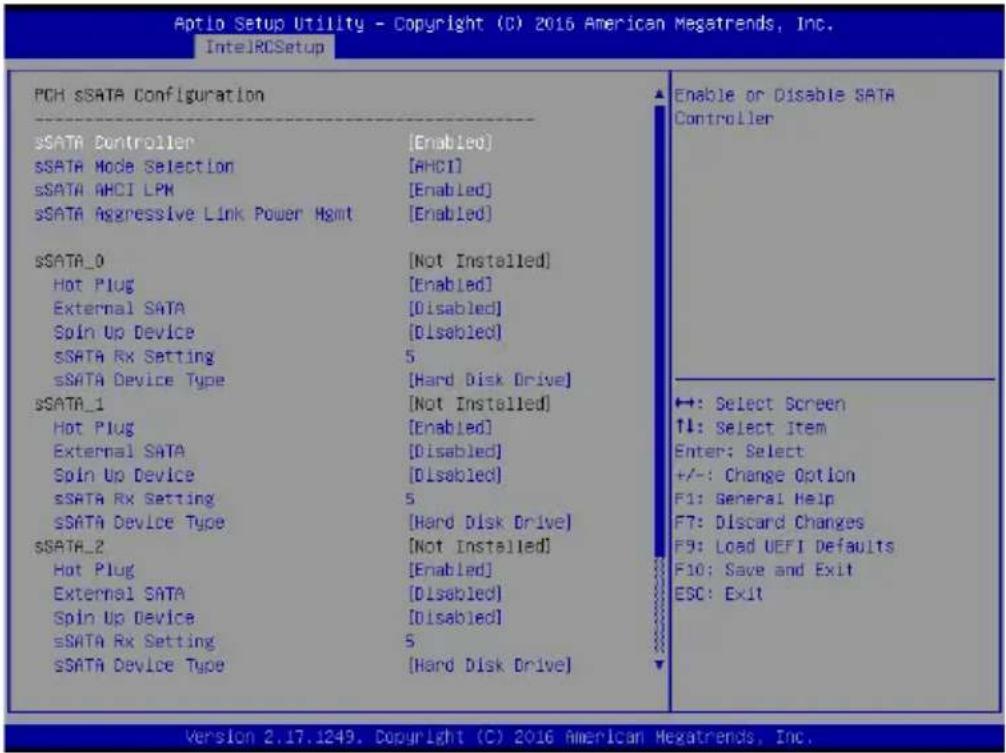
Aptio Setup Utility - Copyright (C) 2016 American Megatrends, Inc. IntelRCSetup PCH SSATA Configuration SSATA Controller [Enabled] SSATA Mode Selection [AHCI] SSATA AHCI LPM [Enabled] SSATA Aggressive Link Power Hgmt [Enabled] SSATA_0 [Not Installed] Hot Plug [Enabled] External SATA [Disabled] Spin Up Device [Disabled] SSATA Rx Setting 5 SSATA Device Type [Hard Disk Drive] SSATA_1 [Not Installed] Hot Plug [Enabled] External SATA [Disabled] Spin Up Device [Disabled] SSATA Rx Setting 5 SSATA Device Type [Hard Disk Drive] SSATA_2 [Not Installed] Hot Plug [Enabled] External SATA [Disabled] Spin Up Device [Disabled] SSATA Rx Setting 5 SSATA Device Type [Hard Disk Drive] Enable or Disable SATA Controller +: Select Screen ↑↓: Select Item Enter: Select +/-: Change Option F1: General Help F7: Discard Changes F9: Load UEFI Defaults F10: Save and Exit ESC: Exit Version 2.17.1249. Copyright (C) 2016 American Megatrends, Inc.PCH sSATA Configuration
sSATA devices and settings
sSATA Controller
Use this item to enable or disable SATA Controller.
sSATA Mode Selection
Identify the SATA port is connected to Solid State Drive or Hard Disk Drive. Press
sSATA AHCI LPM
Use this item to enable or disable Link Power Management.
sSATA Aggressive Link Power Mgmt
Use this item to enable or disable SALP.
sSATA Port 0 / 1 / 2 / 3
Hot Plug
Designates this port as Hot Pluggable.
External SATA
External SATA configuration.
Spin Up Device
If enabled for any of ports, Staggered Spin Up will be performed and only the drives which have this option enabled will spin up at boot. Otherwise all drives spin up at boot.
sSATA Rx Setting
Adjust sSATA DTLE DATA Values (0-15).
sSATA Device Type
Identify the SATA port connected to Solid State Drive or Hard Disk Drive.
PCH SATA Configuration
SATA devices and settings
SATA Controller
Use this item to enable or disable SATA Controller.
SATA Mode Selection
Identify the SATA port is connected to Solid State Drive or Hard Disk Drive. Press
SATA AHCI LPM
Use this item to enable or disable Link Power Management.
Support Aggressive Link Power Mgmt
Use this item to enable or disable SALP.
SATA Port 0 / 1 / 2 / 3 / 4 / 5
Hot Plug
Designates this port as Hot Pluggable.
External SATA
External SATA configuration.
Spin Up Device
If enabled for any of ports, Staggered Spin Up will be performed and only the drives which have this option enabled will spin up at boot. Otherwise all drives spin up at boot.
SATA Rx Setting
Adjust SATA DTLE DATA Values (0-15).
SATA Device Type
Identify the SATA port connected to Solid State Drive or Hard Disk Drive.
3.4.7 Server ME Configuration

text_image
Optio Setup Utility - Copyright (C) 2016 American Megatrends, Inc. IntelRCSetup General ME Configuration Operational Firmware Version 8.1.3.21 HE Firmware Type SPS Current State Operational Spread Spectrum [Disable] Select spread spectrum mode. ◆: Select Screen ↑: Select Item Enter: Select +/-: Change Option F1: General Help F7: Discard Changes F9: Load UEFI Defaults F10: Save and Exit ESC: Exit Version 2.17.1249. Copyright (C) 2016 American Megatrends, Inc.Spread Spectrum
Use this item to select spread spectrum mode.
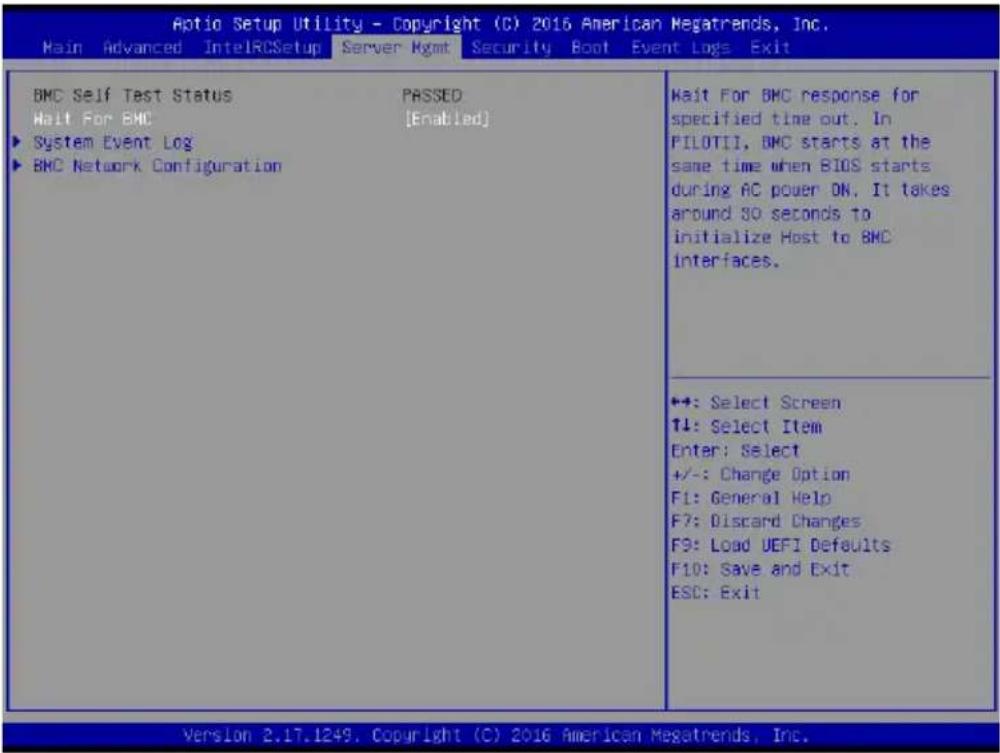
3.5 Server Mgmt
text_image
Aptio Setup Utility - Copyright (C) 2016 American Megatrends, Inc. Main Advanced IntelRCSetup Server Mgmt Security Boot Event Logs Exit BMC Self Test Status PASSED Wait For BMC [Enabled] ► System Event Log ► BMC Network Configuration Wait For BMC response for specified time out. In PILOTII, BMC starts at the same time when BIOS starts during AC power DN. It takes around 30 seconds to initialize Host to BMC interfaces. ◆: Select Screen 14: Select Item Enter: Select +/-: Change Option F1: General Help F7: Discard Changes F9: Load UEFI Defaults F10: Save and Exit ESC: Exit Version 2.17.1249. Copyright (C) 2016 American Megatrends, Inc.Wait For BMC
Wait For BMC response for specified time out. In PILOTII, BMC starts at the same time when BIOS starts during AC power ON. It takes around 30 seconds to initialize Host to BMC interfaces.
3.5.1 System Event Log

text_image
Aptio Setup Utility - Copyright (C) 2016 American Megatrends, Inc. Server Mgmt Enabling/Disabling Options SEL Components [Disabled] Erasing Settings Erase SEL [No] When SEL is Full [Do Nothing] Custom EFI Logging Options Log EFI Status Codes [Both] NOTE: All values changed here do not take effect until computer is restarted. Change this to enable or disable all features of System Event Logging during boot. +:-: Select Screen +:-: Select Item Enter: Select +/-: Change Option F1: General Help F7: Discard Changes F9: Load UEFI Defaults F10: Save and Exit ESC: Exit ++: Select Screen +1: Select Item Enter: Select +/-: Change Option F1: General Help F7: Discard Changes F9: Load UEFI Defaults F10: Save and Exit ESC: Exit Version 2.17.1249. Copyright (C) 2016 American Megatrends, Inc.SEL Components
Change this to enable ro disable all features of System Event Logging during boot.
Erase SEL
Use this to choose options for earsing SEL.
When SEL is Full
Use this to choose options for reactions to a full SEL.
Log EFI Status Codes
Use this item to disable the logging of EFI Status Codes or log only error code or only progress or both.
3.5.2 BMC Network Configuration
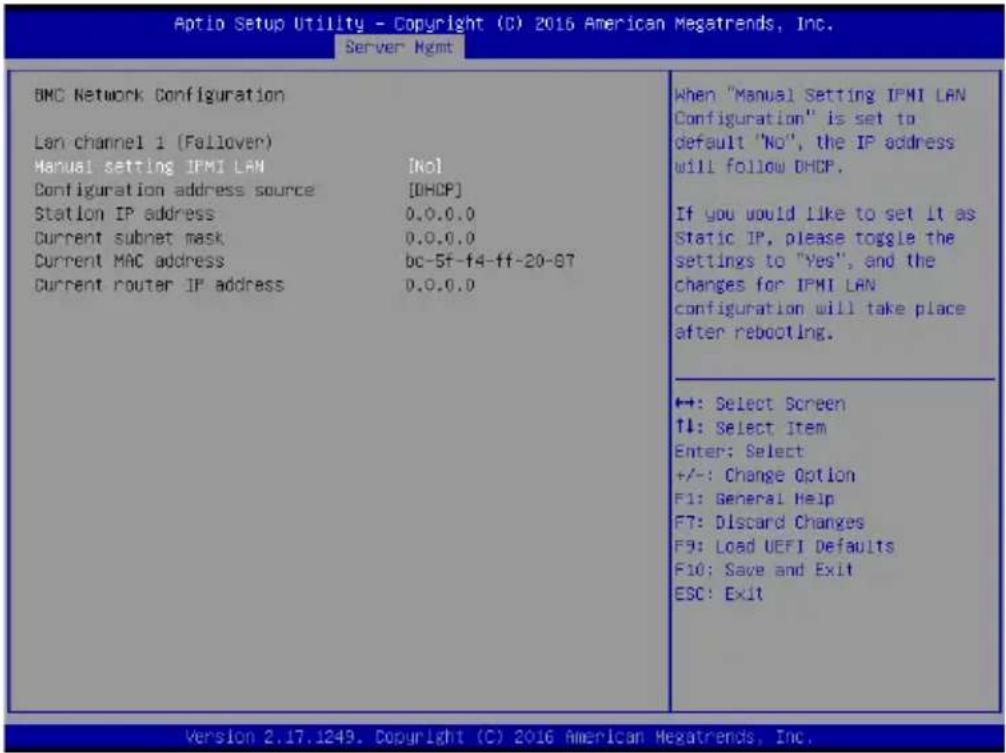
text_image
Aptio Setup Utility - Copyright (C) 2016 American Megatrends, Inc. Server: Ngmt BMC Network Configuration Lan channel 1 (Follower) Manual setting IPMI LAN [No] Configuration address source [DHCP] Station IP address 0.0.0.0 Current subnet mask 0.0.0.0 Current MAC address bc-5f-f4-ff-20-87 Current router IP address 0.0.0.0 When "Manual Setting IPMI LAN Configuration" is set to default "No", the IP address will follow DHCP. If you would like to set it as Static IP, please toggle the settings to "Yes", and the changes for IPMI LAN configuration will take place after rebooting. +: Select Screen +: Select Item Enter: Select +/-: Change Option F1: General Help F7: Discard Changes F9: Load UEFI Defaults F10: Save and Exit ESC: Exit Version 2.17.1249. Copyright (C) 2016 American Megatrends, Inc.Lan Channel 1 (Failover)
Manual setting IPMI LAN
If [No] is selected, the IP address is assigned by DHCP. If you prefer using a static IP address, toggle to [Yes], and the changes take effect after the system reboots. The default value is [No].
Configuration Address Source
Select to configure BMC network parameters statically or dynamically(by BIOS or BMC). Configuration options: [Static] and [DHCP].
Static: Manually enter the IP Address, Subnet Mask and Gateway Address in the BIOS for BMC LAN channel configuration.
DHCP: IP address, Subnet Mask and Gateway Address are automatically assigned by the network's DHCP server.

When [DHCP] or [Static] is selected, do NOT modify the BMC network settings on the IPMI web page.

The default login information for the IPMI web interface is:
Username: admin
Password: admin

text_image
E-Back Rack American Registered Username: admin Password: ****. Test Password: Login Language: EngenFor more instructions on how to set up remote control environment and use the IPMI management platform, please refer to the IPMI Configuration User Guide or go to the Support website at: http://www.asrockrack.com/support/ipmi.asp
BMC Mac Backup Tool
Use this to restore BMC Mac from the backup.
3.6 Security
In this section, you may set or change the supervisor/user password for the system. For the user password, you may also clear it.

text_image
Aptio Setup Utility - Copyright (C) 2013 American Megatrends, Inc. Main Advanced IntelRCSetup Server Mgmt Security Boot Event Logs Exit Supervisor Password Not Installed User Password Not Installed Supervisor Password User Password Set or change the password for the administrator account. Only the administrator has authority to change the settings in the UEFI Setup Utility. Leave it blank and press enter to remove the password. +: Select Screen +: Select Item Enter: Select +/-: Change Option F1: General Help F7: Discard Changes F9: Load UEFI Defaults F10: Save and Exit ESC: Exit- Version 2.16.1243. Copyright (C) 2013 American Megatrends, Inc.Supervisor Password
Set or change the password for the administrator account. Only the administrator has authority to change the settings in the UEFI Setup Utility. Leave it blank and press enter to remove the password.
User Password
Set or change the password for the user account. Users are unable to change the settings in the UEFI Setup Utility. Leave it blank and press enter to remove the password.
3.7 Boot Screen
In this section, it will display the available devices on your system for you to configure the boot settings and the boot priority.

text_image
Aptio Setup Utility - Copyright (C) 2013 American Megatrends, Inc. Main Advanced IntelRCSetup Server Meat Security Boot Event Loss Exit Boot Option Priorities Boot Option #1 [UEFI: Built-in EFI ...] Boot From Onboard LAN [Disabled] Setup Prompt Timeout 1 Bootup Num-Lock [On] Boot Beep [Disabled] Full Screen Logo [Enabled] AddOn ROM Display [Enabled] Sets the system boot order ←→: Select Screen ↑↓: Select Item Enter: Select +/-: Change Option F1: General Help F7: Discard Changes F9: Load UEFI Defaults F10: Save and Exit ESC: Exit Version 2.16.1243, Copyright (C) 2013 American Megatrends, Inc.Boot Option #1
Use this item to set the system boot order.
Boot From Onboard LAN
Use this item to enable or disable the Boot From Onboard LAN feature.
Setup Prompt Timeout
This shows the number of seconds to wait for setup activation key. 65535(0XFFFF) means indefinite waiting.
Bootup Num-Lock
If this item is set to [On], it will automatically activate the Numeric Lock function after boot-up.
Boot Beep
Select whether the Boot Beep should be turned on or off when the system boots up. Please note that a buzzer is needed.
Full Screen Logo
Use this item to enable or disable OEM Logo. The default value is [Enabled].
AddOn ROM Display
Use this option to adjust AddOn ROM Display. If you enable the option “Full Screen Logo” but you want to see the AddOn ROM information when the system boots, please select [Enabled]. Configuration options: [Enabled] and [Disabled]. The default value is [Enabled].
3.8 Event Logs

text_image
Aptio Setup Utility - Copyright (C) 2013 American Megatrends, Inc. Main Advanced IntelRCSetup Server Mgmt Security Boot Event Logs Exit Change Subios Event Log Settings View Subios Event Log PressChange Smbios Event Log Settings
This allows you to configure the Smbios Event Log Settings.
When entering the item, you will see the followings:
Smbios Event Log
Use this item to enable or disable all features of the SMBIOS Event Logging during system boot.
Erase Event Log
The options include [No], [Yes, Next reset] and [Yes, Every reset]. If Yes is selected, all logged events will be erased.
When Log is Full
Use this item to choose options for reactions to a full Smbios Event Log. The options include [Do Nothing] and [Erase Immediately].
MECI (Multiple Event Count Increment)
Use this item to enter the increment value for the multiple event counter. The valid range is from 1 to 255.
METW (Multiple Event Time Window)
Use this item to specify the number of minutes which must pass between duplicate log entries which utilize a multiple-event counter. The value ranges from 0 to 99 minutes.
View Smbios Event Log
Press

All values changed here do not take effect until computer is restarted.
3.9 Exit Screen

text_image
Optio Setup Utility - Copyright (C) 2016 American Megatrends, Inc. Main Advanced IntelRCSetup Server Ngmt Security Boot Event Logs Exit Save Changes and Exit Discard Changes and Exit Discard Changes Load UEFI Defaults Boot Override USB: KingstonDataTraveler 2.0PMAP UEFI: KingstonDataTraveler 2.0PMAP, Partition 1 UEFI: Built-in EFI Shell Exit system setup after saving the changes. F10 key can be used for this operation. +:-: Select Screen ↑↓: Select Item Enter: Select +/-: Change Option F1: General Help F7: Discard Changes F9: Load UEFI Defaults F10: Save and Exit ESC: Exit Version 2.17.1249. Copyright (C) 2016 American Megatrends, Inc.Save Changes and Exit
When you select this option, the following message “Save configuration changes and exit setup?” will pop-out. Press
Discard Changes and Exit
When you select this option, the following message “Discard changes and exit setup?” will pop-out. Press
Discard Changes
When you select this option, the following message “Discard changes?” will pop-out. Press
Load UEFI Defaults
Load UEFI default values for all the setup questions. F9 key can be used for this operation.
Boot Override
These items displays the available devices. Select an item to start booting from the selected device.
Chapter 4 Software Support
4.1 Install Operating System
This motherboard supports various Microsoft® Windows® Server 2008 R2 SP1 / 2012 / 2012 R2 / Linux compliant. Because motherboard settings and hardware options vary, use the setup procedures in this chapter for general reference only. Refer to your OS documentation for more information.
*Please download the Intel ^ SATA Floppy Image driver from the ASRock Rack's website (www.asrockrack.com) to your USB drive or simply install the SATA driver from the Support CD while installing OS in SATA RAID mode.
4.2 Support CD Information
The Support CD that came with the motherboard contains necessary drivers and useful utilities that enhance the motherboard's features.
4.2.1 Running The Support CD
To begin using the support CD, insert the CD into your CD-ROM drive. The CD automatically displays the Main Menu if “AUTORUN” is enabled in your computer. If the Main Menu does not appear automatically, locate and double click on the file “ASRSetup.exe” from the root folder in the Support CD to display the menu.
4.2.2 Drivers Menu
The Drivers Menu shows the available device's drivers if the system detects installed devices. Please install the necessary drivers to activate the devices.
4.2.3 Utilities Menu
The Utilities Menu shows the application softwares that the motherboard supports. Click on a specific item then follow the installation wizard to install it.
4.2.4 Contact Information
If you need to contact ASRock Rack or want to know more about ASRock Rack, welcome to visit ASRock Rack's website at http://www.ASRockRack.com; or you may contact your dealer for further information.
Chapter 5 Troubleshooting
5.1 Troubleshooting Procedures
Follow the procedures below to troubleshoot your system.

Always unplug the power cord before adding, removing or changing any hardware components. Failure to do so may cause physical injuries to you and damages to motherboard components.
- Disconnect the power cable and check whether the PWR LED is off.
- Unplug all cables, connectors and remove all add-on cards from the motherboard. Make sure that the jumpers are set to default settings.
- Confirm that there are no short circuits between the motherboard and the chassis.
- Install a CPU and fan on the motherboard, then connect the chassis speaker and power LED.
If there is no power...
- Confirm that there are no short circuits between the motherboard and the chassis.
- Make sure that the jumpers are set to default settings.
- Check the settings of the 115V/230V switch on the power supply.
- Verify if the battery on the motherboard provides \~3VDC. Install a new battery if it does not.
If there is no video...
- Try replugging the monitor cables and power cord.
- Check for memory errors.
If there are memory errors...
- Verify that the DIMM modules are properly seated in the slots.
- Use recommended DDR4 2133 R-DIMMs.
- If you have installed more than one DIMM modules, they should be identical with the same brand, speed, size and chip-type.
- Try inserting different DIMM modules into different slots to identify faulty ones.
- Check the settings of the 115V/230V switch on the power supply.
Unable to save system setup configurations...
- Verify if the battery on the motherboard provides \~3VDC. Install a new battery if it does not.
- Confirm whether your power supply provides adequate and stable power.
Other problems...
- Try searching keywords related to your problem on ASRock Rack's FAQ page: http://www.asrockrack.com/support
5.2 Technical Support Procedures
If you have tried the troubleshooting procedures mentioned above and the problems are still unsolved, please contact ASRock Rack's technical support with the following information:
- Your contact information
- Model name, BIOS version and problem type.
- System configuration.
- Problem description.
You may contact ASRock Rack's technical support at:
http://www.asrockrack.com/support/tsd.asp
5.3 Returning Merchandise for Service
For warranty service, the receipt or a copy of your invoice marked with the date of purchase is required. By calling your vendor or going to our RMA website (http://event.asrockrack.com/tsd.asp) you may obtain a Returned Merchandise Authorization (RMA) number.
The RMA number should be displayed on the outside of the shipping carton which is mailed prepaid or hand-carried when you return the motherboard to the manufacturer. Shipping and handling charges will be applied for all orders that must be mailed when service is complete.
This warranty does not cover damages incurred in shipping or from failure due to alteration, misuse, abuse or improper maintenance of products.
Contact your distributor first for any product related problems during the warranty period.
Chapter 6 Net Framework Installation Guide
To let Intel RSTe works properly, it is required to install Net Framework. Please follow the steps below to enable “.Net Framework” feature on Microsoft Windows Server 2008 R2.
6.1 Installing .Net Framework 3.5.1 (For Server 2008 R2)
- Double-click the Server Manager icon in the Windows system tray.
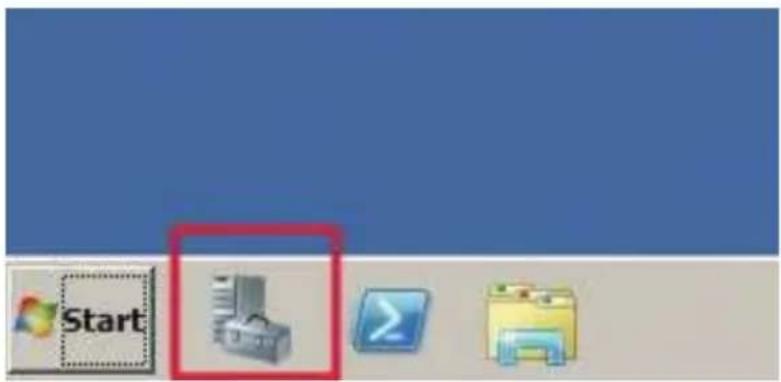
text_image
Start- Click Add Features in the right hand pane.
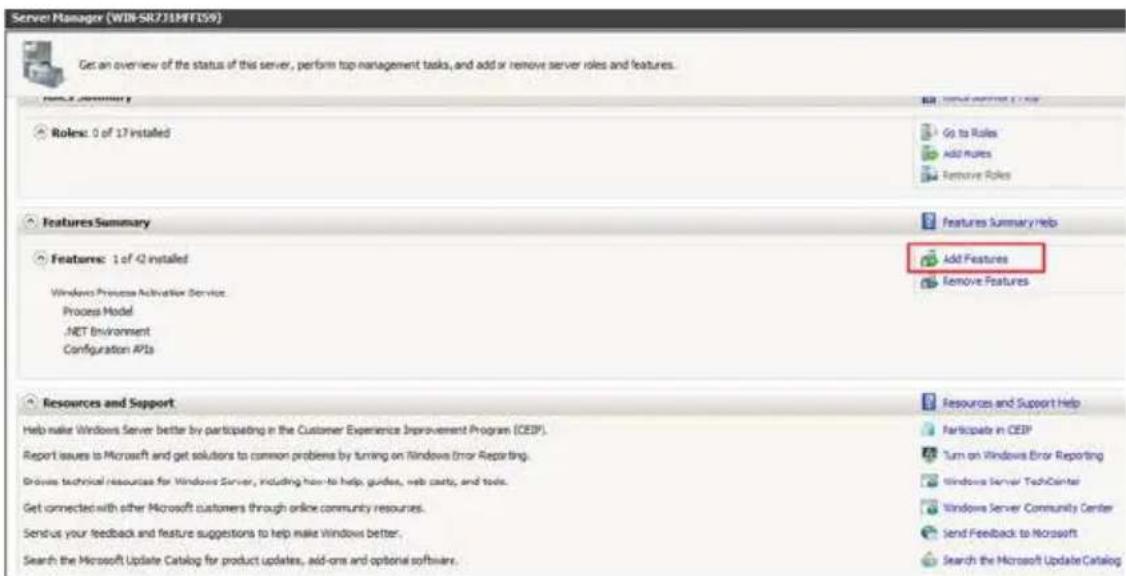
text_image
Server Manager (WITI-SR731MT159) Get an overview of the status of this server, perform top management tasks, and add or remove server roles and features. Role: 0 of 17 installed Go to Roles Add Rules Remove Rules Features Summary Features: 1 of 2 installed Add Features Remove Features Resources and Support Help make Windows Server better by participating in the Customer Experience Improvement Program (CEIP). Report issues to Microsoft and get solutions to common problems by turning on Windows Error Reporting. Browse technical resources for Windows Server, including how to help, guides, web cards, and tools. Get connected with other Microsoft customers through online community resources. Send us your feedback and feature suggestions to help make Windows better. Search the Microsoft Update Catalog for product updates, add-ons and optional software. Resources and Support Help Participate in CEIP Turn on Windows Error Reporting Windows Server TechCenter Windows Server Community Center Send Feedback to Microsoft Search the Microsoft Update Catalog- Check the box next to .Net Framework 3.5.1 and then click Next.

text_image
Add Features Wizard Select Features Features Confirmation Progress Results Select one or more features to install on this server. Features: .NET Framework 3.5.1 Features .NET Framework 3.5.1 WCF Activation Background Intelligent Transfer Service (BITS) BitLocker Drive Encryption BranchCache Connection Manager Administration Kit Desktop Experience DirectAccess Management Console Falover Clustering Group Policy Management Ink and Handwriting Services Internet Printing Client Internet Storage Name Server LPR Port Monitor Message Queuing Multipath I/O Network Load Balancing Peer Name Resolution Protocol Quality Windows Audio Video Experience More about features- Click Next to continue.

text_image
Add Features Wizard Web Server (IIS) Features Web Server (IIS) Role Services Confirmation Progress Results Introduction to Web Server (IIS) Web servers are computers that have specific software that allows them to accept requests from client computers and return responses to those requests. Web servers let you share information over the Internet, or through intranets and extranets. The Web Server role includes Internet Information Services (IIS) 7.0, a unified Web platform that integrates IIS 7.0, ASP.NET, and Windows Communication Foundation. IIS 7.0 also features enhanced security, simplified diagnostics, and delegated administration. Things to Note • Using Windows System Resource Manager (WSRM) can help ensure equitable servicing of Web server traffic, especially when there are multiple roles on this computer. • The default installation for the Web Server (IIS) role includes the installation of role services that enable you to serve static content, make minor customizations (such as default documents and HTTP errors), monitor and log server activity, and configure static content compression. Additional Information Overview of Web Server (IIS) Overview of Available Role Services in IIS 7.0 IIS Checklist Common Administrative Tasks in IIS Overview of WSRM < Previous Next > Install Cancel5. Click Install to start installing .Net Framework 3.5.1.

text_image
Add Features Wizard Confirm Installation Selections Features Confirmation Progress Results To install the following roles, role services, or features, click Install. 1 informational message below This server might need to be restarted after the installation completes. .NET Framework 3.5.1 Features .NET Framework 3.5.1 Print, e-mail, or save this information < Previous Next > Install Cancel6. After the installation completes, click Close.
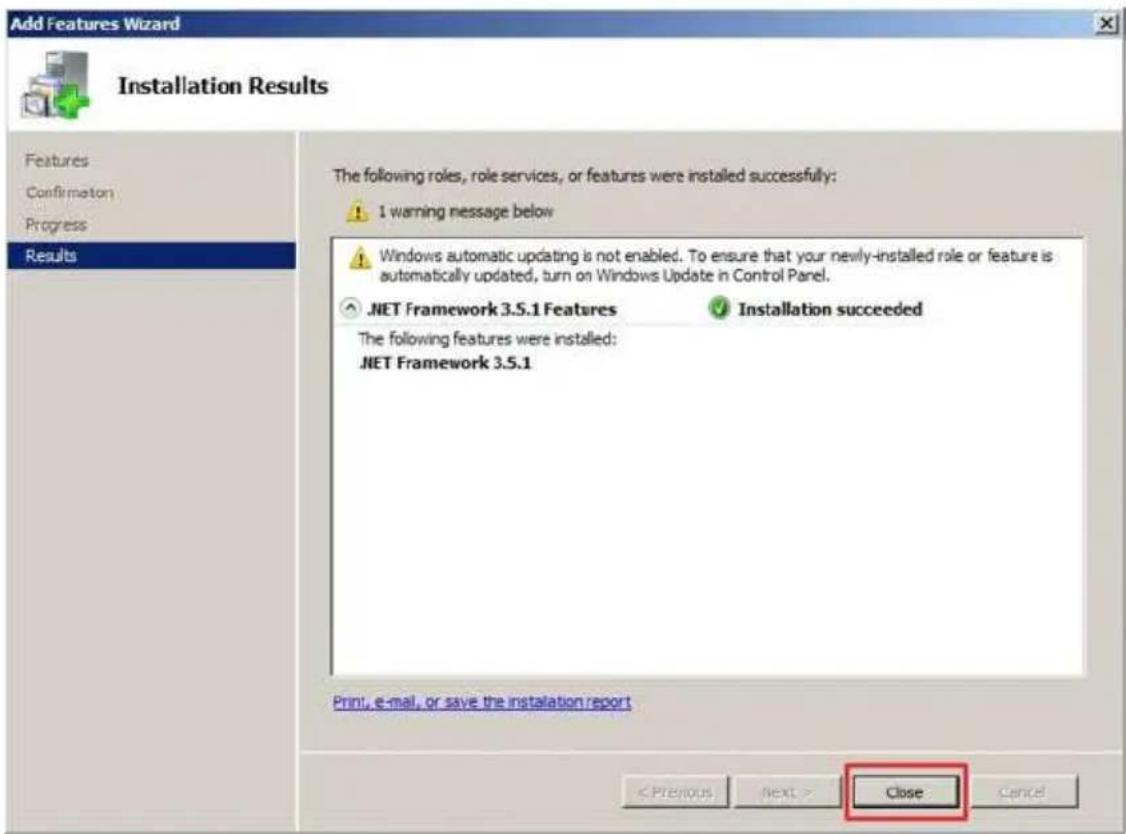
text_image
Add Features Wizard Installation Results Features Confirmation Progress Results The following roles, role services, or features were installed successfully: ! I warning message below ! Windows automatic updating is not enabled. To ensure that your newly-installed role or feature is automatically updated, turn on Windows Update in Control Panel. ● .NET Framework 3.5.1 Features ✓ Installation succeeded The following features were installed: .NET Framework 3.5.1 Print, e-mail, or save the installation reportAppendix Mezzanine Card Support List
This motherboard supports the following ASRock Rack mezzanine cards.
Mezz Card Type Mezz Slot Type Model
Storage Card Mezz Type A M3008
Storage Card Mezz Type A M3108
*Please refer to our website for the latest support list.
*Due to mechanical limits, use one type of the mezzanine card at a time.