AT91SAM9G46 - Electronic component Microchip - Free user manual and instructions
Find the device manual for free AT91SAM9G46 Microchip in PDF.


User questions about AT91SAM9G46 Microchip
0 question about this device. Answer the ones you know or ask your own.
Ask a new question about this device
Download the instructions for your Electronic component in PDF format for free! Find your manual AT91SAM9G46 - Microchip and take your electronic device back in hand. On this page are published all the documents necessary for the use of your device. AT91SAM9G46 by Microchip.
USER MANUAL AT91SAM9G46 Microchip
1.1 Scope 1-1
1.2 Applicable Documents 1-2
Section 2
Kit Contents 2-1
2.1 Deliverables 2-1
2.2 Evaluation Board Specifications.... 2-2
2.3 Electrostatic Warning 2-2
Section 3
Power up....3-1
3.1 Power Up the Board.... 3-1
3.2 Battery 3-1
3.3 DevStart 3-1
3.4 Recovery Procedure 3-2
3.5 Sample Code and Technical Support 3-2
Section 4
Board Description 4-1
4.1 Equipment on the Board 4-1
4.1.1 Interfaces 4-1
4.1.2 Board Interface Connection 4-2
4.1.3 Push Button Switches.... 4-2
4.1.4 Display LCD and LEDs 4-3
4.2 Hardware Layout and Configuration 4-3
4.2.1 Processor.... 4-3
4.2.2 Clock Circuitry 4-4
4.2.3 Reset Circuitry 4-4
4.2.4 Memory 4-4
4.2.5 Power Supplies 4-7
4.2.6 Debug Interface 4-10
4.2.7 Audio Stereo Interface 4-15
4.2.8 TV-Out Extension 4-17
4.2.9 Software Controlled LEDs 4-18
4.2.10 Serial Peripheral Interface Controller (SPI) 4-19
4.2.11 Two Wire Interface (TWI) 4-19
4.2.12 SD/MMC Interface 4-19
4.2.13 TFT LCD with Touch Panel 4-20
4.2.14 Push Buttons 4-22
4.2.15 Expansion Slot.... 4-22
Section 5
Configuration 5-1
5.1 JTAG/ICE Configuration.... 5-1
5.2 ETHERNET Configuration 5-1
5.3 Jumpers Configuration 5-2
5.4 Miscellaneous Configuration Items 5-3
5.5 PIO Configuration.... 5-3
5.5.1 Peripheral Signals Multiplexing on I/O Lines 5-3
5.5.2 Multiplexing on PIO Controller A (PIOA) 5-3
5.5.3 Multiplexing on PIO Controller B (PIOB).... 5-5
5.5.4 Multiplexing on PIO Controller C (PIOC) 5-6
5.5.5 Multiplexing on PIO Controller D (PIOD) 5-7
5.5.6 Multiplexing on PIO Controller E (PIOE).... 5-8
Section 6
Connectors 6-1
6.1 Power Supply 6-1
6.2 RS232 Connector with RTS/CTS Handshake Support 6-1
6.3 DBGU 6-2
6.4 Ethernet....6-3
6.5 USB Host 6-3
6.6 USB Host/Device 6-4
6.7 JTAG Debugging Connector 6-4
6.8 SD/MMC-MCI0....6-6
6.9 SD/MMC-MCI1 6-7
6.10 AC97 6-8
6.11 Image Sensor - ISI 6-9
6.12 Video....6-10
6.13 Display Devices.... 6-10
6.13.1 TFT LCD 6-10
6.14 LCD Extension 6-11
Section 7
Schematics 7-1
7.1 Schematics.... 7-1
Section 8
Revision History......8-1
8.1 Revision History 8-1
1.1 Scope
This User Guide introduces the AT91SAM9M10(G45) Evaluation Kit and describes its development and debugging capabilities.
Figure 1-1. Board Photo

natural_image
Green printed circuit board with various electronic components and a central display (no readable text or symbols)The Atmel® SAM9M10-G45-EK is a fully-featured evaluation platform for the Atmel AT91SAM9M10 or AT91SAM9G45 microcontroller. The kit is equipped with an AT91SAM9M10 chip, which is a superset of the AT91SAM9G45, and therefore allows evaluating that reference as well. The evaluation kit allows users to extensively evaluate, prototype and create application-specific designs.
The SAM9M10-G45-EK includes many hardware peripherals such as:
■ Two high speed USB hosts and one high speed device port
■ An Ethernet 10/100 interface
■ Two high speed multimedia card interfaces
Introduction
■ An LCD TFT display (480*272 RGB) with resistive touch panel
■ A composite video output
■ A camera interface
■ Several communication peripherals such as:
– Universal Synchronous/Asynchronous Receiver Transmitter (USART)
- Two-Wire Interface (TWI)
The external memory block is made of 3 memory types:
DDR2-SDRAM
■ NAND Flash
■ NOR Flash (not populated by default)
1.2 Applicable Documents
Table 1-1. Applicable Documents
| Reference Title Comments | ||
| Atmel Literature n° 6438 SAM9G45 | Preliminary | This document describes the SAM9G45, which is part of the Atmel's Smart ARM® Microcontrollers.It is available fromhttp://www.atmel.com/dyn/resources/prod_documents/doc6438.pdf |
| Atmel Literature n° 6355 SAM9M10 | Preliminary | This document describes the SAM9M10, which is part of the Atmel's Smart ARM® Microcontrollershttp://www.atmel.com/dyn/resources/prod_documents/doc6355.pdf |
2.1 Deliverables
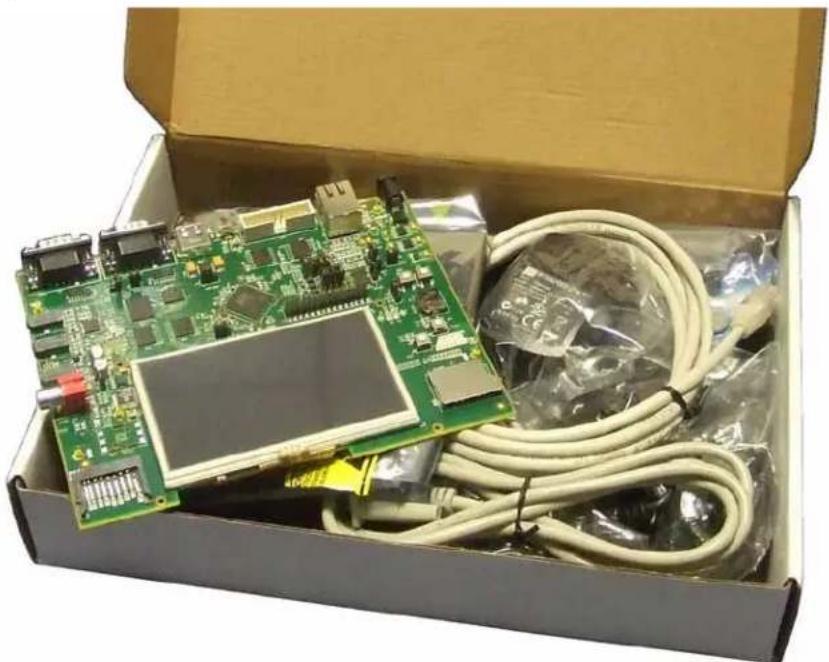
The Atmel SAM9M10-G45-EK toolkit includes:
■ Board
- The SAM9M10-G45-EK board
■ Power supply
- Universal input AC/DC power supply with US, Europe and UK plug adapters
- One 3V Lithium Battery type CR1225
■ Cables
- One micro A/B-type USB cable
- One serial RS232 cable
- One RJ45 crossed cable
■ A Welcome Letter
Figure 2-1. Unpacked SAM9M10-G45-EK
natural_image
Open cardboard box containing a green printed circuit board, coiled with white cables and connectors, no visible text or symbols.Unpack and inspect this kit carefully. Contact your local Atmel distributor, should you have issues concerning the contents of the kit.
2.2 Evaluation Board Specifications
Table 2-1. SAM9M10-G45-EK Specifications
| Characteristics Specifications | |
| Clock speed 400 MHz PCK, 133 MHz MCK | |
| Ports Ethernet, USB, RS232, DBGU, JTAG | |
| Board supply voltage 5 VDC from connector | |
| Temperature- operating- storage | -10^ to +50^ C -40^ to +85^ C |
| Relative humidity 0 to 90% (non condensing) | |
| Dimensions 180 mm x 140 mm | |
| RoHS status Compliant | |
2.3 Electrostatic Warning
The SAM9M10-G45-EK evaluation board is shipped in a protective anti-static package. The board must not be subjected to high electrostatic potentials. We strongly recommend using a grounding strap or similar ESD protective device when handling the board in hostile ESD environments (offices with synthetic carpet, for example...). Avoid touching the component pins or any other metallic element on the board.
3.1 Power Up the Board
Unpack the board taking care to avoid electrostatic discharge. Unpack the power supply, select the right power plug adapter corresponding to that of your country, and insert it in the power supply.
Connect the power supply DC connector to the board and plug the power supply to an AC power plug.
The board LCD should light up and display a welcome page. Then, click or touch icons displayed on the screen and enjoy the demo.
3.2 Battery
The SAM9M10-G45-EK ships with a 3V coin battery.
This battery is not required for the board to start up.
The coin battery is provided for user convenience in case the user would like to exercise the date and time backup function of the SAM9M10 series devices when the board is switched off.
3.3 DevStart
The on-board NAND Flash contains a "SAM9M10-G45-EK DevStart".
It is stored in the "SAM9M10-G45-EK DevStart" folder on the USB Flash disk available when the SAM9M10-G45-EK is connected to a host computer.
Click the file "welcome.html" in this folder to launch SAM9M10-G45-EK DevStart.
SAM9M10-G45-EK DevStart guides you through installation processes of IARTM EWARM, Keil MDK and GNU toolkits. Then, it gives you step-by-step instructions on how to rebuild a single example project and how to program it into the SAM9M10-G45-EK. Optionally, if you have a SAM-ICETM, instructions are also given about how to debug the code.
We recommend that you backup the “SAM9M10-G45-EK DevStart” folder on your computer before launching it.
3.4 Recovery Procedure
The DevStart ends by giving step-by-step instructions on how to recover the SAM9M10-G45-EK to the state as it was when shipped by Atmel.
Follow the instructions if you deleted the contents of the NAND Flash and want to recover from this situation.
3.5 Sample Code and Technical Support
After boot up, you can run some sample code or your own application on the development kit. You can download sample code and get Technical support from http://www.atmel.com/dyn/products/tech_support.asp?Faq=y&family_id=689%20.
4.1 Equipment on the Board
Figure 4-1. Board Architecture

flowchart
graph TD
    A["Main Memory"] --> B["External Memory"]
    B --> C["External Cards"]
    C --> D["Multimedia Cards Interface"]
    D --> E["LCD TFT 480*272"]
    E --> F["Touch Screen"]
    F --> G["Composite video"]
    G --> H["AC97"]
    H --> I["PWM"]
    I --> J["PIO"]
    J --> K["USB"]
    K --> L["DEBUG"]
    L --> M["JTAG/ICE#GU"]

    subgraph AT91SAM9M10
        N["System Controller"] --> O["Image Sensor Interface"]
        O --> P["TWI"]
        P --> Q["ETHERNET 10/100 MAC"]
        Q --> R["USART"]
        R --> S["USB"]
        S --> T["DEBUG"]
    end

    subgraph Media Cards
        U["DDR2 SDRAM"] --> V["EBIO"]
        W["DDR2 SDRAM"] --> X["NCS1"]
        Y["NAND FLASH"] --> Z["NCS3"]
        AA["NCS0"] --> AB["NPC50"]
        AC["Data Flash"] --> AD["MCI1"]
        AE["8 bits interface SD/MMC"] --> AF["MCI0"]
        AG["4 bits interface SD/MMC"] --> AH["MCIO"]
        AI["CD"] --> AJ["MCIO"]
    end

    subgraph Audio
        AK["Micro"] & AL["Line In"] & AM["Line Out"] & AN["Codec"] & AO["Joystick & P.B"] & AP["LED"] & AQ["PWM"] & AR["PWM"]
    end

    subgraph User I/O
        AS["User I/O"] --> AT["User I/O"]
    end
| VCC 5V | ISI | Ethernet RMII/MII | RS232 | USB HubHigh / Full | USBHub / Device | DBGU | JTAG/ICE | PIO |
4.1.1 Interfaces
The board is equipped with an AT91SAM9M10-CU embedded microprocessor (324-ball TFBGA package) together with the following interfaces or peripherals:
■ DDR2/LPDDR memory interface is connected to 128 MB DDR2-SDRAM memory
■ External Bus Interface (EBI) is connected to three kinds of memory devices (DDR2-SDRAM, NAND Flash and NOR Flash (not populated))
Board Description
■ One TWI serial memory
■ One USB Host/Device multiplexed port interface
■ One USB Host port interface
■ One RS232 serial communication port
■ One DBGU serial communication port
■ One JTAG/ICE debug interface
■ One Ethernet 100-base TX with three status LEDs
■ One AC97 Audio CODEC with headphone line out, line in and mono/stereo microphone inputs
■ One TV interface (composite video output)
■ One 4.3" TFT LCD Module with touch screen and back light
■ One ISI connector (camera interface)
■ One power red LED and two general-purpose green LEDs
■ Two user input push buttons
■ One joystick with 4-direction control and selector
■ One wakeup input push button
■ One reset input push button
■ One SD/SDIO/MMC plus card slot (4/8 bit interface)
■ One SD/SDIO/MMC card slot (4-bit interface)
■ One Lithium Coin Cell Battery Retainer for 12 mm cell size (memory backup usage)
4.1.2 Board Interface Connection
■ Ethernet using RJ45 connector (J15)
■ USB Host, support USB host using a type A connector (J12)
■ USB Host/Device, support USB host/device using a type micro AB connector (J14)
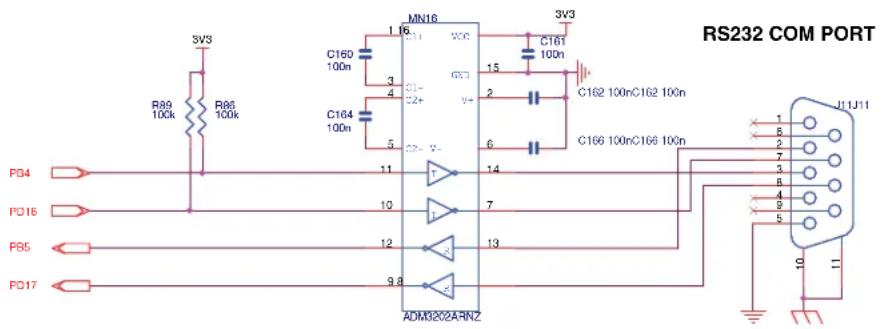
■ UART1 (RX, TX, RTS, CTS) connected to a 9-way male D-type RS232 connector (J11)
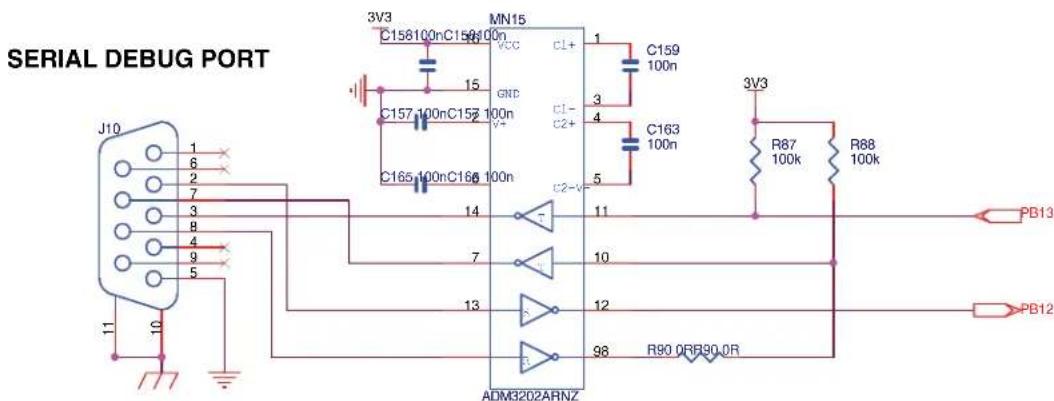
■ DBGU (RX and TX only) connected to a 9-way male D-type RS232 connector (J10)
■ JTAG, 20 pin IDC connector (J13)
■ SD/MMCplus connector (J5)
■ SD/MMC connector (J6)
■ Headphone (J7), line-in (J8) and microphone headset (J9)
■ Speaker output (JP15)
■ Image sensor connector (J17)
■ TFT LCD display, with TouchScreen and backligh (J24)
■ Test points; various test points are located throughout the board
■ Main power supply (J2)
4.1.3 Push Button Switches
■ Reset, board reset (BP1)
■ Wake up, push button to bring processor out of low power mode (BP2)
■ Right and left click, user push button switches (BP4 and BP5)
■ Joystick (BP3)
4.1.4 Display LCD and LEDs
■ Display, 480xRGBx272 pixels LCD module display connected to the PIO port E (LCD1)
■ One surface-mounted power red LED, user interface (D3)
■ Two surface-mounted green LEDs, user interface (D1 and D2)
■ Three surface-mounted LEDs indicate Ethernet status (D4, D5, D6)
Figure 4-2. Board Layout Commented

text_image
DBGU RS232 JTAG ETHERNET HOST USB HOST DEVICE USB POWER LINE INPUT MICROPHONE INPUT HEADPHONES HEADER VIDEO OUTPUT USER JOYSTICK SD/MMC 0 SLOT LCD DISPLAY AREA LCD EXTENSION CONNECTORS ISI/CAMERA CONNECTOR WAKE-UP BUTTON RESET BUTTON BACKUP BATTERY «RIGHT» USER BUTTON «LEFT» USER BUTTON SD/MMC 1 SLOTThe major components of the SAM9M10-G45-EK board are shown in Figure 4-1.
4.2 Hardware Layout and Configuration
4.2.1 Processor
The board features the Atmel SAM9M10-CU 324-ball TFBGA package. This chip runs at a nominal frequency of 400 MHz for the core and 133 MHz for the system bus.
For more information, refer to the latest SAM9M10 datasheet available from http://www.atmel.com/
Board Description
4.2.2 Clock Circuitry
The SAM9M10-G45-EK includes six clock sources:
■ Two are alternatives for the SAM9M10 main clock,
■ One crystal and one crystal oscillator are used for the Ethernet MII/RMII chip,
■ One crystal is used for the AC97 codec chip,
■ One crystal or one crystal oscillator is used for the TV encoder.
Table 4-1. Main Components Associated with the Clock Systems
| Quantity Description Component assignment | ||
| 1 Crystal | for Internal Clock, 12 MHz Y1 | |
| 1 Crystal | for RTC Clock, 32.768 kHz Y2 | |
| 1 Oscillator for Ethernet Clock RMII, 50 MHz Y4 | ||
| 1 Crystal | for Ethernet Clock MII, 25 MHz (not populated) Y5 | |
| 1 Crystal | for AC97 Codec Clock, 24.576 MHz | Y3 |
| 1 | Crystal for TV Encoder Clock, 13 MHz, or Oscillator for TV Encoder, 13 MHz (not populated) | Y7Y6 |
4.2.3 Reset Circuitry
The reset sources are:
■ Power on reset
■ Push button reset
■ JTAG reset from an in-circuit emulator interface.
4.2.4 Memory
4.2.4.1 External Memories
The SAM9M10 features a DDR2/LPDDR memory interface and an External Bus Interface (EBI) to permit interfacing to a wide range of external memories and to almost any kind of parallel peripheral.
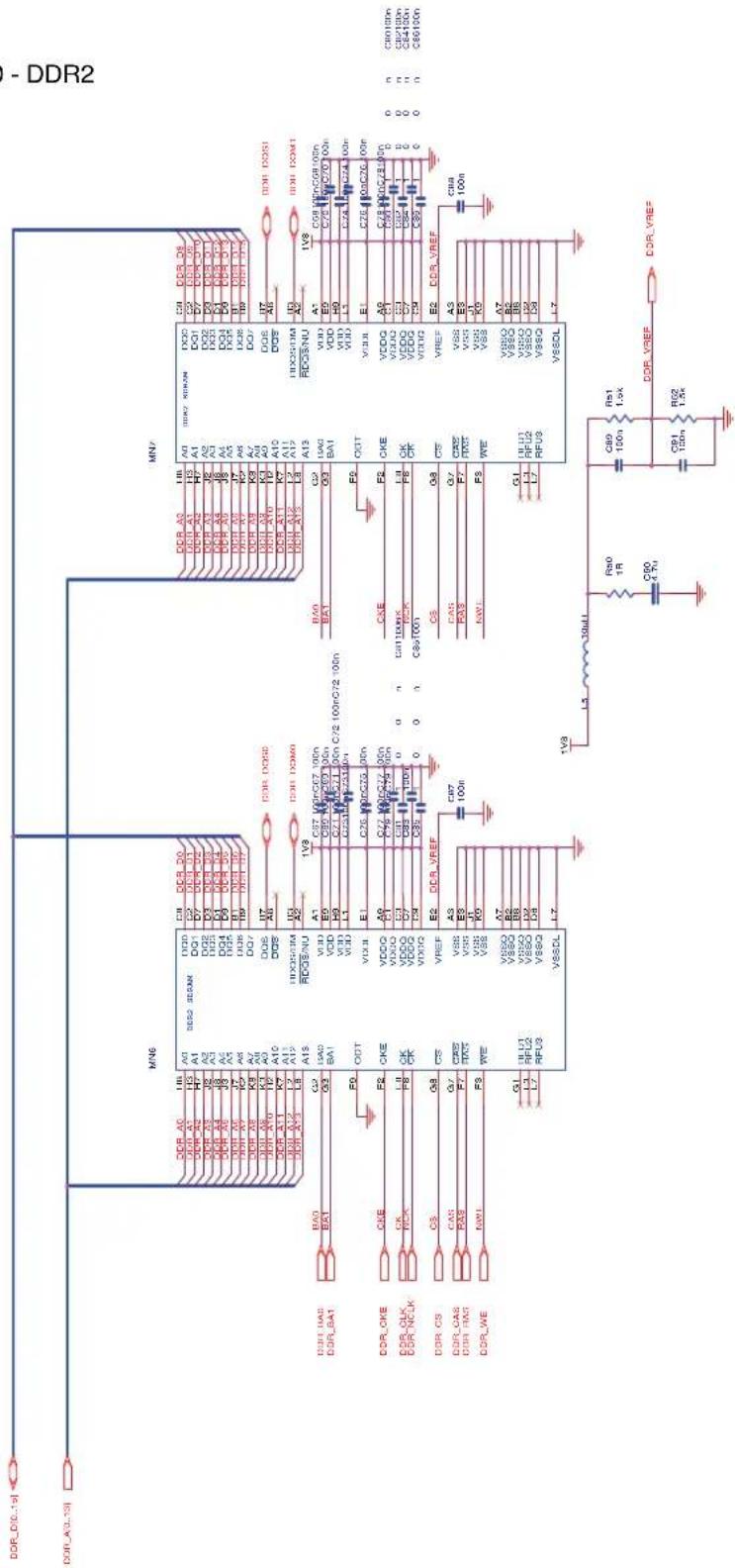
The SAM9M10-G45-EK board is equipped with DDR2/LPDDR devices featuring 128 MB of DDR2-SDRAM memory (16Meg*8*4).
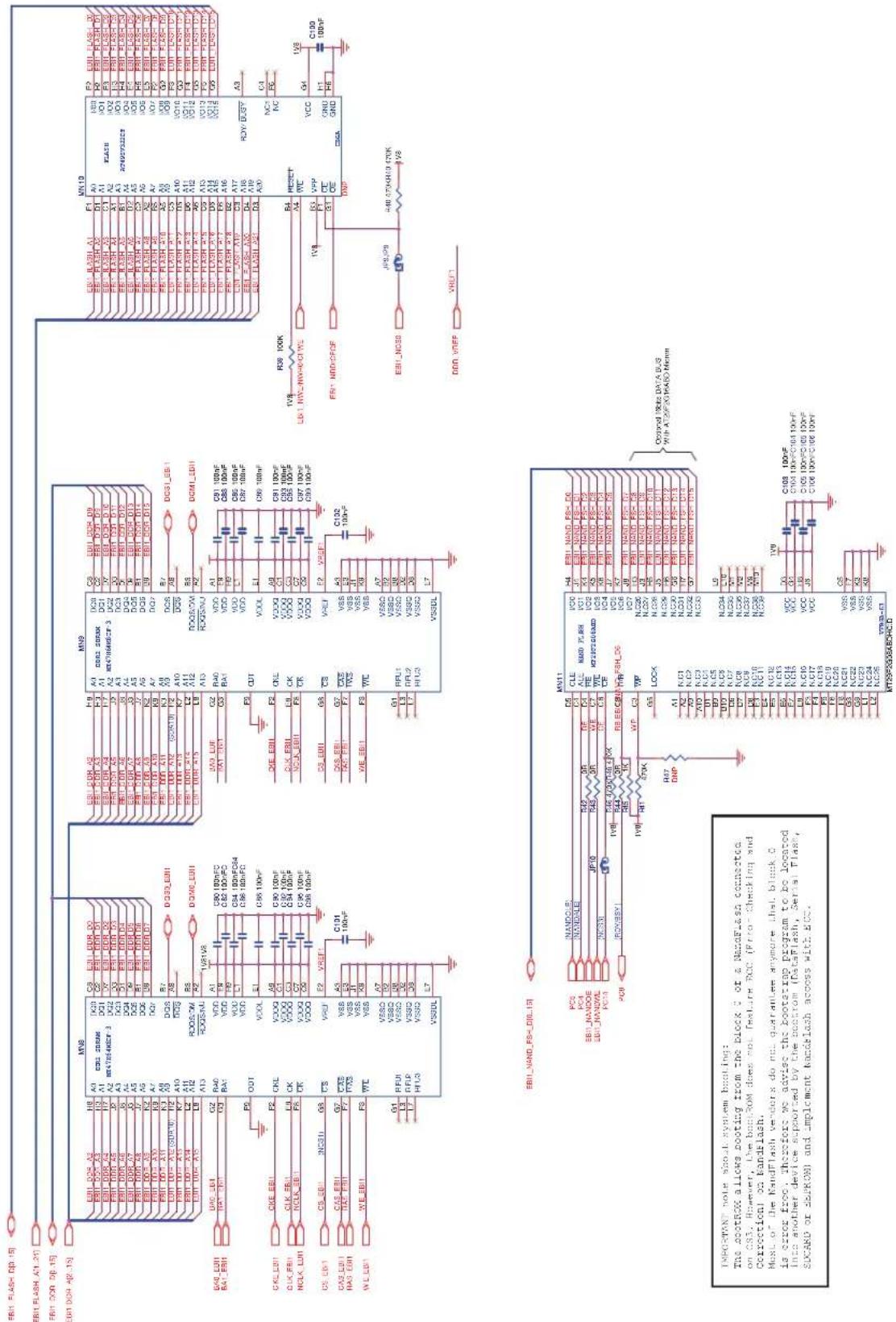
The External Bus Interface (EBI) is connected to three kinds of memory devices:
■ One Parallel Flash (not populated by default)
■ Two DDR2-SDRAM
■ One NAND Flash (2Gb, 8 bit bus)
The chip selects NCS0, NCS1 and NCS3 are used for NOR Flash, DDR2-SDRAM and NAND Flash memories, respectively. Furthermore, a dedicated jumper can disconnect each of the two NCS0 and NCS3 signals, making them available for other functions.
Figure 4-3. EBI0 - DDR2
Board Description
text_image
DDR2 DDR_C00_159 DDR_A0_158 DDR_A0_157 DDR_A0_156 DDR_A0_155 DDR_A0_154 DDR_A0_153 DDR_A0_152 DDR_A0_151 DDR_A0_150 DDR_A0_149 DDR_A0_148 DDR_A0_147 DDR_A0_146 DDR_A0_145 DDR_A0_144 DDR_A0_143 DDR_A0_142 DDR_A0_141 DDR_A0_140 DDR_A0_139 DDR_A0_138 DDR_A0_137 DDR_A0_136 DDR_A0_135 DDR_A0_134 DDR_A0_133 DDR_A0_132 DDR_A0_131 DDR_A0_130 DDR_A0_129 DDR_A0_128 DDR_A0_127 DDR_A0_126 DDR_A0_125 DDR_A0_124 DDR_A0_123 DDR_A0_122 DDR_A0_121 DDR_A0_120 DDR_A0_119 DDR_A0_118 DDR_A0_117 DDR_A0_116 DDR_A0_115 DDR_A0_114 DDR_A0_113 DDR_A0_112 DDR_A0_111 DDR_A0_110 DDR_A0_109 DDR_A0_108 DDR_A0_107 DDR_A0_106 DDR_A0_105 DDR_A0_104 DDR_A0_103 DDR_A0_102 DDR_A0_101 DDR_A0_100 DDR_A0_99 DDR_A0_98 DDR_A0_97 DDR_A0_96 DDR_A0_95 DDR_A0_94 DDR_A0_93 DDR_A0_92 DDR_A0_91 DDR_A0_90 DDR_A0_89 DDR_A0_88 DDR_A0_87 DDR_A0_86 DDR_A0_85 DDR_A0_84 DDR_A0_83 DDR_A0_82 DDR_A0_81 DDR_A0_80 DDR_A0_79 DDR_A0_78 DDR_A0_77 DDR_A0_76 DDR_A0_75 DDR_A0_74 DDR_A0_73 DDR_A0_72 DDR_A0_71 DDR_A0_70 DDR_A0_69 DDR_A0_68 DDR_A0_67 DDR_A0_66 DDR_A0_65 DDR_A0_64 DDR_A0_63 DDR_A0_62 DDR_A0_61 DDR_A0_60 DDR_A0_59 DDR_A0_58 DDR_A0_57 DDR_A0_56 DDR_A0_55 DDR_A0_54 DDR_A0_53 DDR_A0_52 DDR_A0_51 DDR_A0_50 DDR_A0_49 DDR_A0_48 DDR_A0_47 DDR_A0_46 DDR_A0_45 DDR_A0_44 DDR_A0_43 DDR_A0_42 DDR_A0_41 DDR_A0_40 DDR_A0_39 DDR_A0_38 DDR_A0_37 DDR_A0_36 DDR_A0_35 DDR_A0_34 DDR_A0_33 DDR_A0_32 DDR_A0_31 DDR_A0_30 DDR_A0_29 DDR_A0_28 DDR_A0_27 DDR_A0_26 DDR_A0_25 DDR_A0_24 DDR_A0_23 DDR_A0_22 DDR_A0_21 DDR_A0_20 DDR_A0_19 DDR_A0_18 DDR_A0_17 DDR_A0_16 DDR_A0_15 DDR_A0_14 DDR_A0_13 DDR_A0_12 DDR_A0_11 DDR_A0_10 DDR_A0_9 DDR_A0_8 DDR_A0_7 DDR_A0_6 DDR_A0_5 DDR_A0_4 DDR_A0_3 DDR_A0_2Board Description
Figure 4-4. EBI1 - DDR2 + Flash
text_image
EBI FLASH-01.15 EBI FLASH_A1.20 EBI SON 58.15 EBI DOR A2.15 MNS EBI EDR D0 EBI EDR D1 EBI EDR D2 EBI EDR D3 EBI EDR D4 EBI EDR D5 EBI EDR D6 EBI EDR D7 EBI EDR D8 EBI EDR D9 EBI EDR D10 EBI EDR D11 EBI EDR D12 EBI EDR D13 EBI EDR D14 EBI EDR D15 EBI EDR D16 EBI EDR D17 EBI EDR D18 EBI EDR D19 EBI EDR D20 EBI EDR D21 EBI EDR D22 EBI EDR D23 EBI EDR D24 EBI EDR D25 EBI EDR D26 EBI EDR D27 EBI EDR D28 EBI EDR D29 EBI EDR D30 EBI EDR D31 EBI EDR D32 EBI EDR D33 EBI EDR D34 EBI EDR D35 EBI EDR D36 EBI EDR D37 EBI EDR D38 EBI EDR D39 EBI EDR D40 EBI EDR D41 EBI EDR D42 EBI EDR D43 EBI EDR D44 EBI EDR D45 EBI EDR D46 EBI EDR D47 EBI EDR D48 EBI EDR D49 EBI EDR D50 EBI EDR D51 EBI EDR D52 EBI EDR D53 EBI EDR D54 EBI EDR D55 EBI EDR D56 EBI EDR D57 EBI EDR D58 EBI EDR D59 EBI EDR D60 EBI EDR D61 EBI EDR D62 EBI EDR D63 EBI EDR D64 EBI EDR D65 EBI EDR D66 EBI EDR D67 EBI EDR D68 EBI EDR D69 EBI EDR D70 EBI EDR D71 EBI EDR D72 EBI EDR D73 EBI EDR D74 EBI EDR D75 EBI EDR D76 EBI EDR D77 EBI EDR D78 EBI EDR D79 EBI EDR D80 EBI EDR D81 EBI EDR D82 EBI EDR D83 EBI EDR D84 EBI EDR D85 EBI EDR D86 EBI EDR D87 EBI EDR D88 EBI EDR D89 EBI EDR D90 EBI EDR D91 EBI EDR D92 EBI EDR D93 EBI EDR D94 EBI EDR D95 EBI EDR D96 EBI EDR D97 EBI EDR D98 EBI EDR D99 EBI EDR D100 MNS0000000000000000000000000000000000000000000000000000000000000000000000000000000000000000000000000000 MNS MNS MNS MNS MNS MNS MNS MNS MNS MNS MNS MNS MNS MNS MNS MNS MNS MNS MNS MNS MNS MNS MNS MNS MNS MNS MNS MNS MNS MNS MNS MNS MNS MNS] MNS MNS MNS MNS MNS MNS MNS MNS MNS MNS MNS MNS MNS MNS MNS MNS MNS MNS MNS MNS MNS MNS MNS MNS MNS MNS MNS MNS MNS MNS MNS MNS MNS m NSD/SSD/SSD/SSD/SSD/SSD/SSD/SSD/SSD/SSD/SSD/SSD/SSD/SSD/SSD/SSD/SSD/SSD/SSD/SSD/SSD/SSD/SSD/SSD/SSD/SSD/SSD/SSD/SSD/SSD/SSD/SSD/SSD/SSD/SSd/SSd/SSd/SSd/SSd/SSd/SSd/SSd/SSd/SSd/SSd/SSd/SSd/SSd/SSd/SSd/SSd/SSd/SSd/SSd/SSd/SSd/SSd/SSd/SSd/SSd/SSd/SSd/SSd/SSd/SSd/SSd/SSd/SSd/ EBI NAND PS=LDL.151 EBI NAND PS=LDL.151 EBI NAND PS=LDL.151 EBI NAND PS=LDL.151 EBI NAND PS=LDL.151 EBI NAND PS=LDL.151 EBI NAND PS=LDL.151 EBI NAND PS=LDL.151 EBI NAND PS=LDL 151 EBI NAND PS=LDL 151 EBI NAND PS=LDL 151 EBI NAND PS=LDL 151 EBI NAND PS=LDL 151 EBI NAND PS=LDL 151 EBI NAND PS=LDL 151 EBI NAND PS=LDL 151 EBI NAND BS=DDL.151 EBI NAND BS=DDL.151 EBI NAND BS=DDL.151 EBI NAND BS=DDL.151 EBI NAND BS=DDL.151 EBI NAND BS=DDL.151 EBI NAND BS=DDL.151 EBI NAND BS=DDL.151 EBI NAND PS=DDL.151 EBI NAND PS=DDL.151 EBI NAND PS=DDL.151 EBI NAND PS=DDL.151 EBI NAND PS=DDL.151 EBI NAND PS=DDL.151 EBI NAND PS=DDL.151 EBI NAND PS=DDL.151 EEB I AND SND SND SND SND SND SND SND SND SND SND SND SND SND SND SND SND SND SND SND SND SND SND SND SND SND SND SND SND SND SND SND SND SND SND SND SND SND SND SND SND SND SND SND SND SND SND SND SND SND SND SUND SUND SUND SUND SUND SUND SUND SUND SUND SUND SUND SUND SUND SUND SUND SUND SUND SUND SUND SUND SUND SUND SUND SUND SUND SUND SUND SUND SUND SUND SUND SUND SUND SUND SUND SUND SUND SUND SUND SUND SUND SUND SUND SUND SUND SUND SUND SUND SUND SUND SUNS BCD LSP LSP LSP LSP LSP LSP LSP LSP LSP LSP LSP LSP LSP LSP LSP LSP LSP LSP LSP LSP LSP LSP LSP LSP LSP LSP LSP LSP LSP LSP LSP LSP LSP LSP LSP LSP LSP LSP LSP LSP LSP LSP LSP LSP LSP LSP LSP LSP LSP LSP LFP LFP LFP LFP LFP LFP LFP LFP LFP LFP LFP LFP LFP LFP LFP LFP LFP LFP LFP LFP LFP LFP LFP LFP LFP LFP LFP LFP LFP LFP LFP LFP LFP LFP LFP LFP LFP LFP LFP LFP LFP LFP LFP LFP LFP LFP LFP LFP LFP LFP LFF PCC PCC PCC PCC PCC PCC PCC PCC PCC PCC PCC PCC PCC PCC PCC PCC PCC PCC PCC PCC PCC PCC PCC PCC PCC PCC PCC PCC PCC PCC PCC PCC PCC PCC PCC PCC PCC PCC PCC PCC PCC PCC PCC PCC PCC PCC PCC PCC PCC PCC PSC PSC PSC PSC PSC PSC PSC PSC PSC PSC PSC PSC PSC PSC PSC PSC PSC PSC PSC PSC PSC PSC PSC PSC PSC PSC PSC PSC PSC PSC PSC PSC PSC PSC PSC PSC PSC PSC PSC PSC PSC PSC PSC PSC PSC PSC PSC PSC PSC PSC PFC PFC PFC PFC PFC PFC PFC PFC PFC PFC PFC PFC PFC PFC PFC PFC PFC PFC PFC PFC PFC PFC PFC PFC PFC PFC PFC PFC PFC PFC PFC PFC PFC PFC PFCPFCPFCPFCPFCPFCPFCPFCPFCPFCPFCPFCPFCPFCPFCPFCPFCPFCPFCPFCPFCPFCPFCPFCPFCPFCPFCPFCPFCPFCPFCPFCPFCPFCPFCPFCPFCPFCPFCPFCPFCPFCPFCPFCPFCPFCPFCPFCPFCPFCPFCFPCFPCFPCFPCFPCFPCFPCFPCFPCFPCFPCFPCFPCFPCFPCFPCFPCFPCFPCFPCFPCFPCFPCFPCFPCFPCFPCFPCFPCFPCFPCFPCFPCFPCFPCFPCFPCFPCFPCFPCFPCFPCFPCFPCFPCFPCFPCFPCFPCFPCFPLCFLCFLCFLCFLCFLCFLCFLCFLCFLCFLCFLCFLCFLCFLCFLCFLCFLCFLCFLCFLCFLCFLCFLCFLCFLCFLCFLCFLCFLCFLCFLCFLCFLCFLCFLCFLCFLCFLCFLCFLCFLCFLCFLCFLCFLCFLCFLCFLCFLCFLCCLMLMLMLMLMLMLMLMLMLMLMLMLMLMLMLMLMLMLMLMLMLMLMLMLMLMLMLMLMLMLMLMLMLMLMLMLMLMLMLMLMLMLMLMLMLMLMLMLMLMLMLMLMLMLMLMLMLMLMLMLMLMLMLMLMLMLMLMLMLMLMLMLMLMLMLMLMLMLMLMLMLMLMLMLMLMLMLMLMLMLMLMLMLMLMLMLMLMLMLMLLLAALALALALALALALALALALALALALALALALALALALALALALALALALALALALALALALALALALALALALALALALALALALALALALALALALALALALALALALALALALALALALALALALALALALALALALALALALALALALALALALALALALALALALALALALALALALALALALALALALALALAL ALA ALA ALA ALA ALA ALA ALA ALA ALA ALA ALA ALA ALA ALA ALA ALA ALA ALA ALA ALA ALA ALA ALA ALA ALA ALA ALA ALA ALA ALA ALA ALA ALA ALA ALA ALA ALA ALA ALA ALA ALA ALA ALA ALA ALA ALA ALA ALA ALA ALA ALa ALa ALa ALa ALa ALa ALa ALa ALa ALa ALa ALa ALa ALa ALa ALa ALa ALa ALa ALa ALa ALa ALa ALa ALa ALa ALa ALa ALa ALa ALa ALa ALa ALa ALa ALa ALa ALa ALa ALa ALa ALa ALa ALa ALa ALa ALa ALa ALa ALa ALb A B C C C C C C C C C C C C C C C C C C C C C C C C C C C C C C C C C C C C C C C C C C C C C C C C C C C C C C C C C C C C C C C C C C C C C C C C C C C C C C C C C C C C C C C C C C C C C C C C C C C C/C4.2.5 Power Supplies
The SAM9M10 Board contains four regulated power supplies:
■ 3.3 VDC Supply
■ 1.8 VDC Supply
■ 1.0 VDC Core Supply
■ 1.0 VDC Core UTMI Supply, PLL
The outputs of these regulated power supplies ^1 are distributed as necessary to each part of the circuit board.
■ The 3.3 VDC Supply is generated by an adjustable LDO. It accepts VIN 5 VCC power and outputs a regulated +3.3 V to most other circuits on the board.
■ The 1.8 VDC Supply (VDDIOM0, VDDIOM1) is generated by an adjustable LDO. It is powered by VIN 5 VCC power and outputs a regulated +1.8V.
■ The 1.0 VDC Core Supply (VDDCORE) is generated by an adjustable LDO. It is powered by the output of the 3.3 VDC Supply.
■ The 1.0 VDC Core Supply (VDDUTMIC, VDDPLLUTMI and VDDPLLA) is generated by an adjustable LDO RT9186A series. It is powered by the output of the 3.3 VDC Supply.
Note: 1. Corresponding test points (TP1 to TP4, GND) are used with jumpers (JP1.1 to JP7) to permit probing of these voltages.
Board Description
Figure 4-5. Power Supply

text_image
3V3 MNS RT3186A VIN VIN PGOOD EN OUT VOUT ADJ GND R14 12k C19 10n C21 10u R19 47k C22 1u R15 1R C2 4.7u L1 10uH L2 10uH L3 10uH L4 10uH C20 4.7u C29 100n C30 100n JP1,JP1 JP2,JP2 JP3,JP3 JP4,JP4 JP5,JP5 JP6,JP6 JP7,JP7 JP8,JP8 JP9,JP9 JP10,JP10 JP11,JP11 JP12,JP12 JP13,JP13 JP14,JP14 JP15,JP15 JP16,JP16 JP17,JP17 JP18,JP18 JP19,JP19 JP20,JP20 JP21,JP21 JP22,JP22 JP23,JP23 JP24,JP24 JP25,JP25 JP26,JP26 JP27,JP27 JP28,JP28 JP29,JP29 JP30,JP30 JP31,JP31 JP32,JP32 JP33,JP33 JP34,JP34 JP35,JP35 JP36,JP36 JP37,JP37 JP38,JP38 JP39,JP39 JP40,JP40 JP41,JP41 JP42,JP42 JP43,JP43 JP44,JP44 JP45,JP45 JP46,JP46 JP47,JP47 JP48,JP48 JP49,JP49 JP50,JP50 JP51,JP51 JP52,JP52 JP53,JP53 JP54,JP54 JP55,JP55 JP56,JP56 JP57,JP57 JP58,JP58 JP59,JP59 JP60,JP60 JP61,JP61 JP62,JP62 JP63,JP63 JP64,JP64 JP65,JP65 JP66,JP66 JP67,JP67 JP68,JP68 JP69,JP69 JP70,JP70 JDDUTMII VDDANA VDDOSC VDDIOP0 VDDIOP1 VDDIOP2 VDDISI J-1-1J-1-1 2 VDDUTMII R1 1R C1 100n R2 10u H C3 10u H C4 10u H C5 10u H C6 10u H C7 10u H C8 10u H C9 10u H C10 10u H C11 10u H C12 10u H C13 10u H C14 10u H C15 2.2u C16 2.2u C17 2.2u C18 2.2u C19 2.2u C20 2.2u C21 2.2u C22 2.2u C23 2.2u C24 2.2u C25 2.2u C26 2.2u C27 2.2u C28 2.2u C29 2.2u C30 2.2u C31 2.2u C32 2.2u C33 2.2u C34 34 VDDUTMIC VDDUPTMCC VDDUPTMCC VDDUPTMCC VDDUPTMCC VDDUPTMCC VDDUPTMCC VDDUPTMCC VDDUPTMCC VDDUPTMCC VDDUPTMCC VDDUPTMCC VDDUPTMCC VDDUPTMCC VDDUPTMCC VDDUPTMCC VDDUPTMCC VDDUPTMCC VDDUPLTMI VDDUPLTMI VDDUPLTMI VDDUPLTMI VDDUPLTMI VDDUPLTMI VDDUPLTMI VDDUPLTMI VDDUPLTMI VDDUPLTMI VDDUPLTMI VDDUPLTMI VDDUPLTMI VDDUPLTMI VDDUPLTMI VDDUPLTMI VDDUPLTMA VDDUCORE VDDUCORE VDDUCORE VDDUCORE VDDUCORE VDDUCORE VDDUCORE VDDUCORE VDDUCORE VDDUCORE VDDUCORE VDDUCORE VDDUCORE VDDUCORE VDDUCORE VDDUCORE VDDUCORE VDDUCORE VDDUCORE VDDUCORE VDDUCORE VDDUCORE VDDUCORE VDDUCORE VDDUCORE VDDUCURE VDDUCURE VDDUCURE VDDUCURE VDDUCURE VDDUCURE VDDUCURE VDDUCURE VDDUCURE VDDUCURE VDDUCURE VDDUCURE VDDUCURE VDDUCURE VDDUCURE VDDUCURE VDDUCURE VDDUCURE VDDUCURE VDDUCURE VDDUCURE VDDUCURE VDDUCURE VDDUCURE VDDUCURE VDDUCOURVDDUCOURVDDUCOURVDDUCOURVDDUCOURVDDUCOURVDDUCOURVDDUCOURVDDUCOURVDDUCOURVDDUCOURVDDUCOURVDDUCOURVDDUCOURVDDUCOURVDDUCOURVDDUCOURVDDUCOURVDDUCOURVDDUCOURVDDUCOURVDDUCOURVDDUCOURVDDUCOURVDDUCOURVDDUCOURVR D U T M I N O A B D E F G H I K L M N A N O P Q R S T U U W X Y ZFigure 4-6. Management Power Block

text_image
REGULATED 5V ONLY J2 DC POWER JACK C4 33u CR1 5V 5V R3 100k MN2 RT9016A PGOOD GND EN ADJ VIN VDD NC C10 1u 8 7 6 5 3V3 C9 10u C11 1u C310n0010n R1 47xR1 47x 3V3 R7 15k C11 1u C12 10u 5V R9 100k PWR_EN Q1 SIT563EDH JP4 SIP2 1 3 C17 2 15p R16 10k R17 10k SHDN MN4 RT9016A PGOOD GND EN ADJ VIN VDD NC 8 7 6 5 5V R11 100k MN4 RT9016A PGOOD GND EN ADJ VIN VDD NC 8 7 6 5 5V C23 10u C24 1u C26 1u C27 10u C16 10xC16 10n R15 15xFU15 15x R18 12k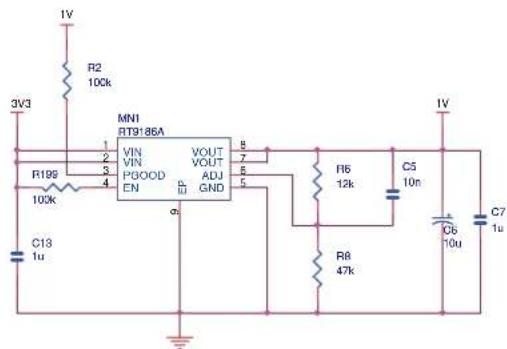
text_image
3V3 R2 10Ck MNI RT9186A VIN VIN PGOOD EN VOUT VOUT ADU GND 1 2 3 4 5 6 7 8 9 10 11 12 13 14 15 16 17 18 19 20 21 22 23 24 25 26 27 28 29 30 31 32 33 34 35 36 37 38 39 40 41 42 43 44 45 46 47 48 49 50 51 52 53 54 55 56 57 58 59 60 61 62 63 64 65 66 67 68 69 70 71 72 73 74 75 76 77 78 79 80 81 82 83 84 85 86 87 88 89 90 91 92 93 94 95 96 97 98 99 100 101 102 103 104 105 106 107 108 109 110 111 112 113 114 115 116 117 118 119 120 121 122 123 124 125 126 127 128 129 130 131 132 133 134 135 136 137 138 139 140 141 142 143 144 145 146 147 148 149 150 151 152 153 154 155 156 157 158 159 160 161 162 163 164 165 166 167 168 169 170 171 172 173 174 175 176 177 178 179 180Board Description
4.2.6 Debug Interface
4.2.6.1 JTAG/ICE
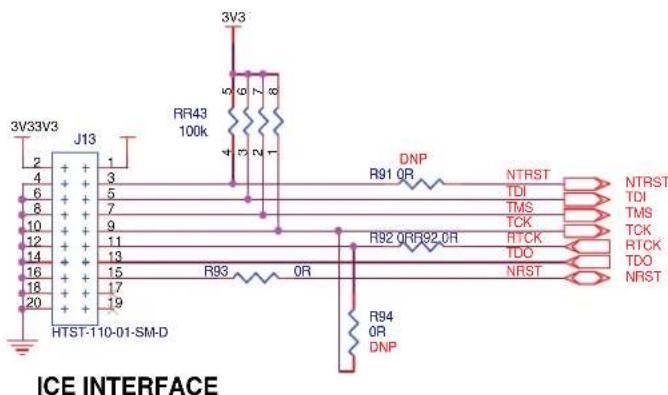
Software debug is accessed by a standard 20-pin JTAG connection. This allows connection to a standard USB-to-JTAG in-circuit emulator.
Figure 4-7. JTAG Interface
text_image
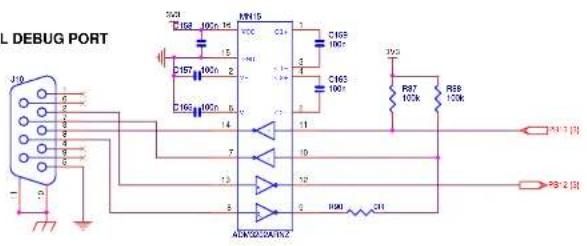
ICE INTERFACE 3V33V3 J13 RR43 100k 3V3 5 6 7 8 4 3 2 1 R91 OR DNP NTRST TDI TMS TCK RTCK TDO NRST NTRST TDI TMS TCK RTCK TDO NRST HTST-110-01-SM-D R92 ORB92 OR R93 OR R94 OR DNPThis UART is connected to the DB-9 male socket through an RS-232 Transceiver (TXD and RXD only).
Figure 4-8. DBGU Com Port
text_image
SERIAL DEBUG PORT J10 1 8 2 7 3 8 4 9 5 11 10 MN15 C156100nC158100n VCC CL+ 1 C159 100n GND 3 C157 100nC157 100n V+ 4 C163 100n C2-V- 5 3V3 R67 100k R88 100k PB13 PB12 ADM3202ARNZ 98 R90 ORB90 OR4.2.6.3 User Serial Com Port
The USART1 is used as a user serial communication port. This USART1 is buffered with an RS-232 Transceiver (TXD, RXD and handshake CTS/RTS control) and connected to the DB-9 male socket. Software must assign the appropriate PIO pins (PB5 = RXD1, PB4 = TXD1, PD16 = RTS1, PD17 = CTS1) to enable the UART1 function.
Figure 4-9. User Serial Com Port
text_image
RS232 COM PORT 3V3 R89 100k R86 100k MN16 1 16 100 C160 100n 3 4 C164 100n 5 C2+ 6 7 8 9 10 11 12 13 14 15 16 3V3 C161 100n C162 100nC162 100n C166 100nC166 100n P84 PD16 P85 PD17 ADM3202A-RIN2 J11J11 1 8 2 7 3 8 4 9 5 10 11Refer to the SAM9M10 datasheet for more information about the SAM9M10 USARTs.
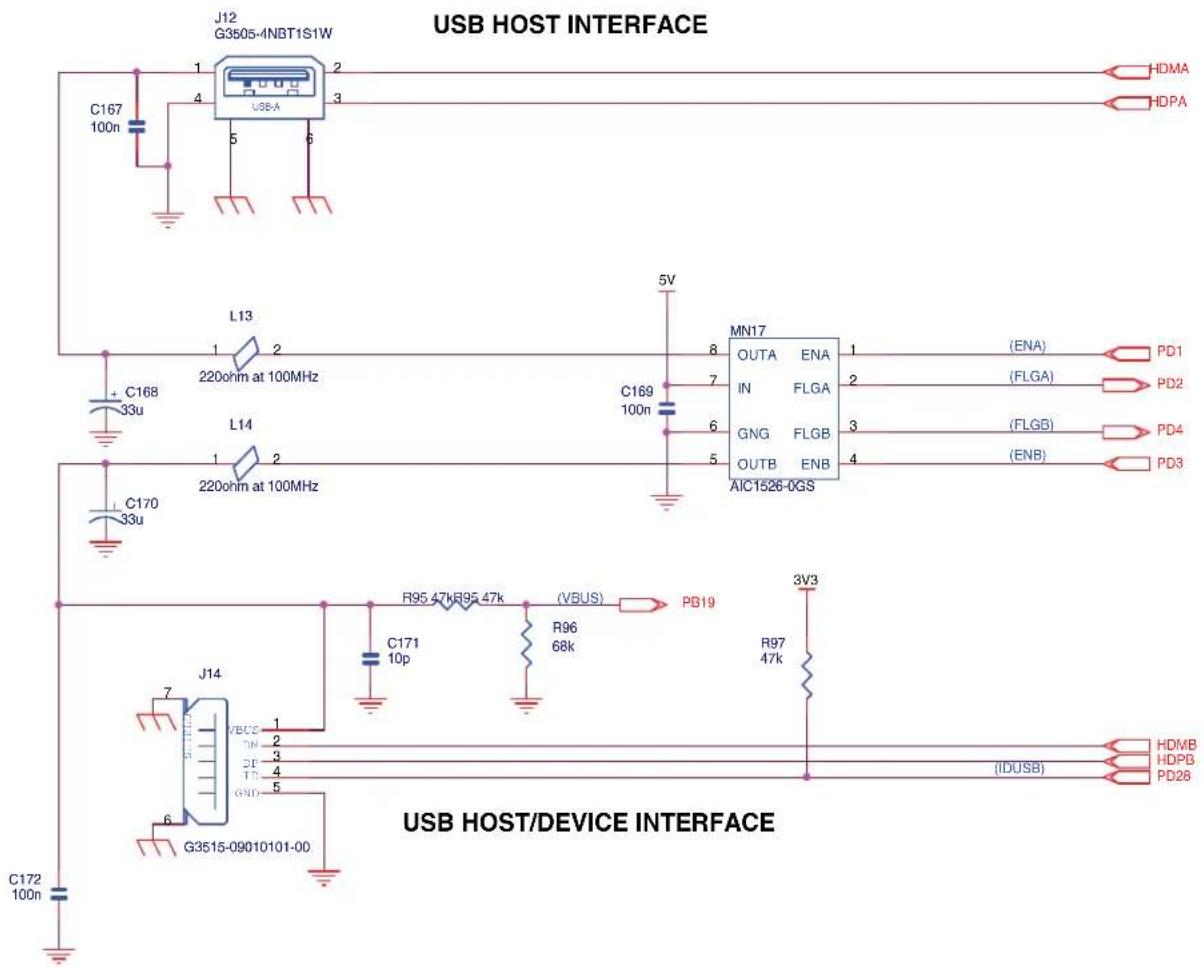
4.2.6.4 USB Port
The SAM9M10-G45-EK features USB communication ports:
■ Two Host Ports: Full speed OHCI and High speed EHCI
■ One Device Port: High speed.
USB Host Port0 is directly connected to the first UTMI transceiver. The second Host Port (Port1) is multiplexed with the USB Device High speed and connected to the second UTMI port.
■ One USB high/full speed type standard A connector
■ One USB interface Host/Device Micro AB connector
Refer to the SAM9M10 datasheet for detailed programming information.
Board Description
Figure 4-10. USB Port
text_image
USB HOST INTERFACE J12 G3505-4NBT1S1W 1 2 3 HDMA C167 100n 4 5 6 USB-A L13 1 2 220ohm at 100MHz C168 33u L14 1 2 220ohm at 100MHz C170 33u 5V MN17 OUTA ENA IN FLGA GNG FLGB OUTB ENB AIC1526-0GS (ENA) PD1 (FLGA) PD2 (FLGB) PD4 (ENB) PD3 USB HOST/DEVICE INTERFACE J14 7 R95 47kR95 47k (VBUS) PB19 C171 10p R96 68k R97 47k 3V3 G3515-09010101-00 (IDUSB) HDMB HDPB PD28 C172 100n4.2.6.5 Ethernet 10/100 (EMAC) Port
The port is compatible with IEEE® Standard 802.3.
The SAM9M10-G45-EK is equipped with a Davicom DM9161AEP 10/100 Mbps Fast Ethernet Physical Layer TX/FX Single Chip Transceiver. It contains the entire physical layer functions of 100BASE-TX as defined by IEEE 802.3u, including the Physical Coding Sublayer (PCS), Physical Medium attachment (PMA), Twisted Pair Physical Medium Dependent Sublayer (TP-PMD), 10BASE-TX Encoder/Decoder (ENC/DEC), and Twisted Pair Media Access Unit (TPMAU).
The Ethernet interface integrates an RJ45 connector with an embedded transformer, and three status LEDs.
The Ethernet interface provides two selectable modes, MII or RMII (Reduced MII), for 100Base-TX or 10Base-TX. The MII and RMII interfaces are capable of both 10Mb/s and 100Mb/s data rates as described in the IEEE 802.3u standard. The signals used by MII and RMII interfaces are described in the table below.
Table 4-2. Pin Mapping for Normal MII and Reduced MII
| Pin Name Normal | MII Mode Reduced MII Mode | |||
| SAM9M10 DM9161 SAM9M10 DM9161 | ||||
| ETX0-ETX1 ETX[0:1] transmit data TXD [0:1] ETX[0:1] TXD [0:1] | ||||
| ETX2-ETX3 ETX[2:3] transmit data TXD [2:3] NC NC | ||||
| ETXEN ETXEN: transmit enable TXEN ETXEN: transmit enable TXEN | ||||
| ETXER ETXER: transmit error TXER/TXD[4] NC NC | ||||
| ETXCK/REFCK | ETXCK: transmit clock | TXCLK | REFCK: reference clock | REF_CLK |
| ERX0-ERX1 | ERX[0:1]: receive data | RXD [0:1] | ERX[0:1]: receive data | RXD [0:1] |
| ERX2-ERX3 | ERX[2:3]: receive data RXD [2:3] | NC NC | ||
| ERXER | ERXER: receive error | RXER/RXD[4]/RPTR/NODE | ERXER: receive error | RPTR/NODE |
| ERXDV | ERXDV: receive valid data | RXDV | ECRSDV: carrier sense / data valid | CRS DV |
| ERXCK | ERXCK: receive clock | RXCLK | NC NC | |
| ECOL | ECOL: collision detect | COL | NC NC | |
| ECRS | ECRS: carrier sense / data valid | CRS (PHYAD[2:4] | NC NC | |
| EMDC | EMDC: management data clock | MDC | EMDC: management data clock | MDC |
| EMDIO | EMDIO: management data input / output | MDIO | EMDIO: management data input / output | MDIO |
| NRST | NRST: microcontroller reset | RESET# XT1(25 MHz) | NRST: microcontroller reset | RESET# XT1(REF_CLK 50MHz) |
Figure 4-11. Ethernet Port

text_image
RJ45 ETHERNET CONNECTOR RJ45 ETHERNET CONNECTOR C76 100n GND_ETH R102 48.9k C77 100n AVODT C78 100n GRAD_LTH1 AVODT C181 10V GRAD_ETH FERR7 10k 3V3 FULL DUPLEX R118 470Ω R119 470Ω R121 470Ω R122 10V R123 10V R124 10V R125 10V R126 10V R127 10V R128 10V R129 10V R130 10V R131 10V R132 10V R133 10V R134 10V R135 10V R136 10V R137 10V R138 10V R139 10V R140 10V R141 10V R142 10V R143 10V R144 10V R145 10V R146 10V R147 10V L3/3 C/R7 H/22/RR/22/DS GND_ETH TXD3 TXD2 TXD1 TXD0 TX EN TXCLM-DCATE RXDPRHYAD RXDPHYAD RXDPHYAD RXDPHYAD RXDPRHYAD RXDPRHYAD RXDPRHYAD RXDPRHYAD RXDPRHYAD RXDPRHYAD RXDPRHYAD RXDPRHYAD RXDPRHYAD RXDPRHYAD RXDPRHYAD RXDPRHYAD RXDPRHYAD RXDPRHYAD RXDPRHYAD RXDPRHYAD RXDPRHYAD RXDPRHYAD RXDPRHYAD RXDPRHYAD RXDPPXRXDXRXDXRXDXRXDXRXDXRXDXRXDXRXDXRXDXRXDXRXDXRXDXRXDXRXDXRXDXRXDXRXDXRXDXRXDXRXDXRXDXRXDXRXDXRXDXRXDXRXDXRXDXRXDXRXDXRXDXRXDXRXDXRXDXRXDXRXDXRXDXRXDXRXDXRXDXRXDXRXDXRXDXRXDXRXDXRXDXRXDXRXDXRXDXRXDXRXDXRXDVXIXIXIXIXIXIXIXIXIXIXIXIXIXIXIXIXIXIXIXIXIXIXIXIXIXIXIXIXIXIXIXIXIXIXIXIXIXIXIXIXIXIXIXIXIXIXIXIXIXIXIXIXIXIXIXIXIXIXIXIXIXIXIXIXIXIXIXIXIXIXIXIXIXIXIXIXIXIXIXIXIXIXIXIXIXIXIXIXIXIXIXIXIXIXIXIXIXIXIXIXIIAXIAXIAXIAXIAXIAXIAXIAXIAXIAXIAXIAXIAXIAXIAXIAXIAXIAXIAXIAXIAXIAXIAXIAXIAXIAXIAXIAXIAXIAXIAXIAXIAXIAXIAXIAXIAXIAXIAXIAXIAXIAXIAXIAXIAXIAXIAXIAXIAXIAXIAXIAAXIAAXIAAXIAAXIAAXIAAXIAAXIAAXIAAXIAAXIAAXIAAXIAAXIAAXIAAXIAAXIAAXIAAXIAAXIAAXIAAXIAAXIAAXIAAXIAAXIAAXIAAXIAAXIAAXIAAXIAAXIAAXIAAXIAAXIAAXIAAXIAAXIAAXIAAXIAAXIAAXIAAXIAAXIAAXIAAXIAAXIAAXIAAXIAAXIAAXAUXAUXAUXAUXAUXAUXAUXAUXAUXAUXAUXAUXAUXAUXAUXAUXAUXAUXAUXAUXAUXAUXAUXAUXAUXAUXAUXAUXAUXAUXAUXAUXAUXAUXAUXAUXAUXAUXAUXAUXAUXAUXAUXAUXAUXAUXAUXAUXAUXAUXAUST TXCLKXCKXCKXCKXCKXCKXCKXCKXCKXCKXCKXCKXCKXCKXCKXCKXCKXCKXCKXCKXCKXCKXCKXCKXCKXCKXCKXCKXCKXCKXCKXCKXCKXCKXCKXCKXCKXCKXCKXCKXCKXCKXCKXCKXCKXCKXCKXCKXCKXCKXCKXSCCKXSCCKXSCCKXSCCKXSCCKXSCCKXSCCKXSCCKXSCCKXSCCKXSCCKXSCCKXSCCKXSCCKXSCCKXSCCKXSCCKXSCCKXSCCKXSCCKXSCCKXSCCKXSCCKXSCCKXSCCKXSCCKXSCCKXSCCKXSCCKXSCCKXSCCKXSCCKXSCCKXSCKCCCCCCCCCCCCCCCCCCCCCCCCCCCCCCCCCCCCCCCCCCCCCCCCCCCCCCCCCCCCCCCCCCCCCCCCCCCCCCCCCCCCCCCCCCCCCCCCCCCCCCCCCCCCCCCCCCCCCCCCCCCCCCCCCCCCCCCCCCCCCCCCCCCCCCCCCCCCCCCCCCCCCCCCCCCCCCCCCCCCCCCCFor more information about the Ethernet controller device, refer to the Davicom DM9161 controller manufacturer's datasheet.
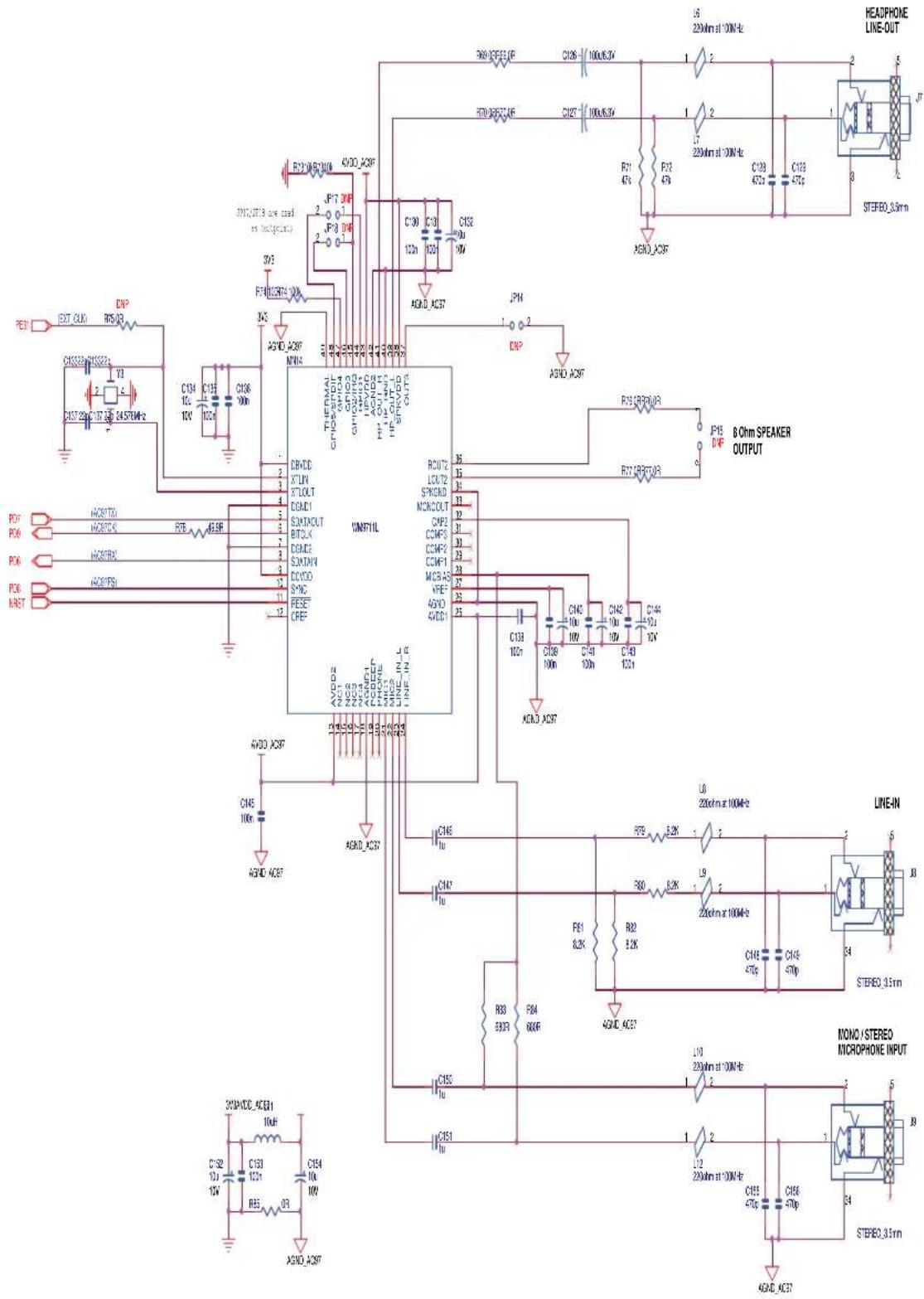
4.2.7 Audio Stereo Interface
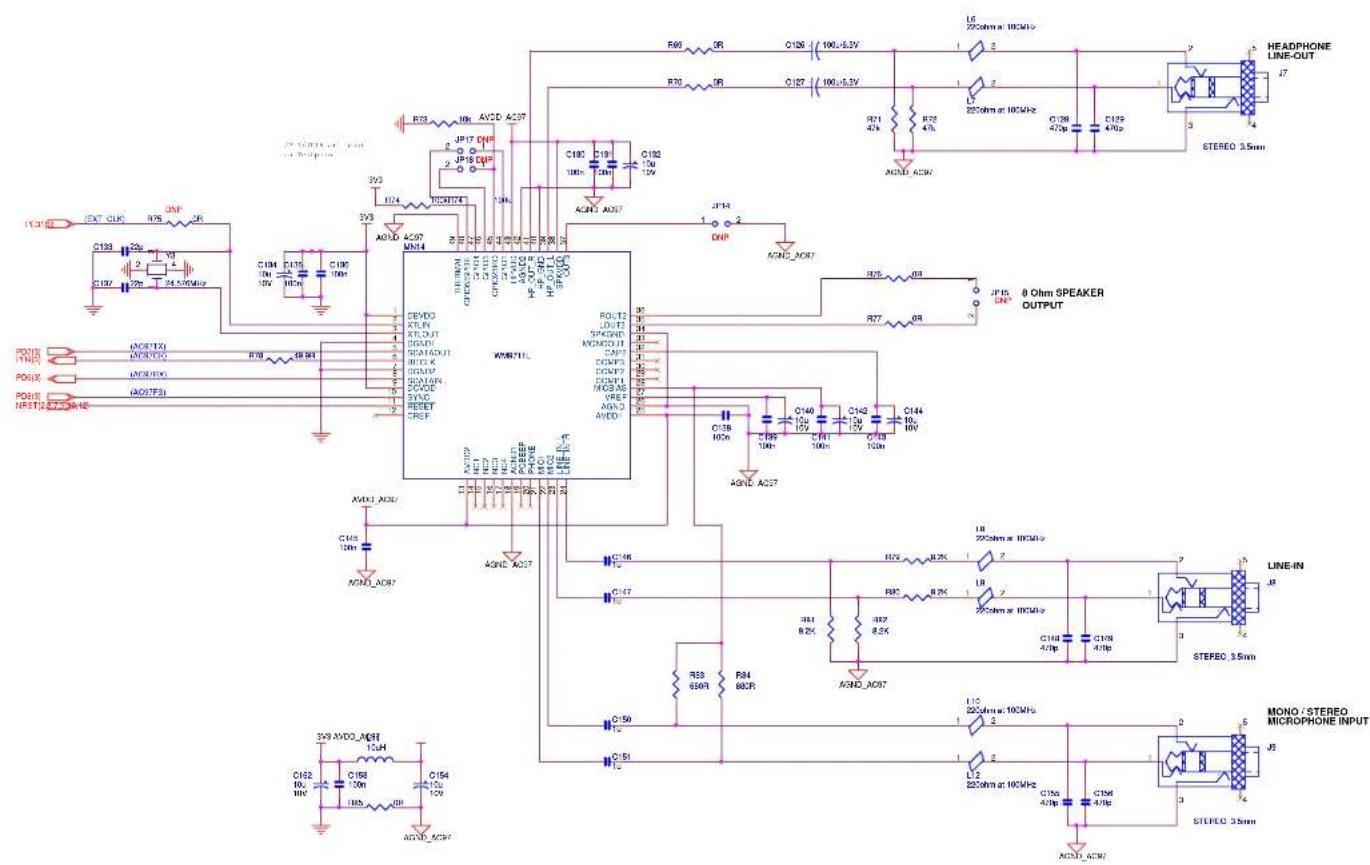
The SAM9M10-G45-EK includes a WM9711L AC97 CODEC for digital sound input and output. This interface includes audio jacks for MIC input (J9), line audio input (J8), headphone line output (J7) and a 2-point speaker output connector (JP15).
It is compliant with AC97 Component Specification V2.2.
Figure 4-12. Audio Stereo Interface
text_image
HEADPHONE LINE-OUT 15 220lm at 100kHz C126 - 100kV R70 A357.14F C127 - 100kV R71 47k C128 47k C129 47k C130 47k A5ND_AC3F JPN DNP A5ND_AC3F P13 CRRUUR P14 DIP B Ohm SPEAKER OUTPUT 1MVF1L C133 10Ω C134 1Ω C135 1Ω C136 10Ω C137 2Ω C138 10Ω C139 10Ω C140 10Ω C141 10Ω C142 10Ω C143 10Ω C144 10Ω C145 10Ω C146 10Ω C147 10Ω C148 10Ω C149 10Ω C150 10Ω C151 10Ω C152 10Ω C153 10Ω C154 10Ω C155 10Ω C156 10Ω C157 2Ω C158 2Ω C159 2Ω C160 2Ω C161 2Ω C162 2Ω C163 2Ω C164 2Ω C165 2Ω C166 2Ω C167 2Ω C168 2Ω C169 2Ω C170 A357 A3ND_AC3F A3ND_AC3F A3ND_AC3F A3ND_AC3F A3ND_AC3F A3ND_AC3F A3ND_AC3F A3ND_AC3F A3ND_AC3F A3ND_AC3F A3ND_AC3F A3ND_AC3F A3ND_AC3F A3ND_AC3F A3ND_AC3F AVDD_AC3F AVDD_AC3F AVDD_AC3F AVDD_AC3F AVDD_AC3F AVDD_AC3F AVDD_AC3F AVDD_AC3F AVDD_AC3F AVDD_AC3F AVDD_AC3F AVDD_AC3F AVDD_AC3F AVDD_AC3F AVDD_AC3F AVDD_AC3F AVDD_AC3FFor more information about the AC97 codec device, refer to the Wolfson WM9711L controller manufacturer's datasheet.
4.2.8 TV-Out Extension
The Chronel™ CH7024 chip provides an interface between the SAM9M10 LCD Controller and a TV set by converting LCD signals to TV signals.
The CH7024 is a TV encoder device which encodes the video signals and generates synchronization signals for NTSC and PAL standards. Supported TV output formats are NTSC-M, NTSC-J, NTSC-433, PAL-B/D/G/A/I, PAL-M, PAL-N and PAL-60. The CH7024 provides video output support for CVBS or S-video.
Figure 4-13. TV-Out Extension Port

text_image
Circuit schematic diagram with component labels, pin connections, and electronic components like ICs like MN20, CH7024B, and resistors.Board Description
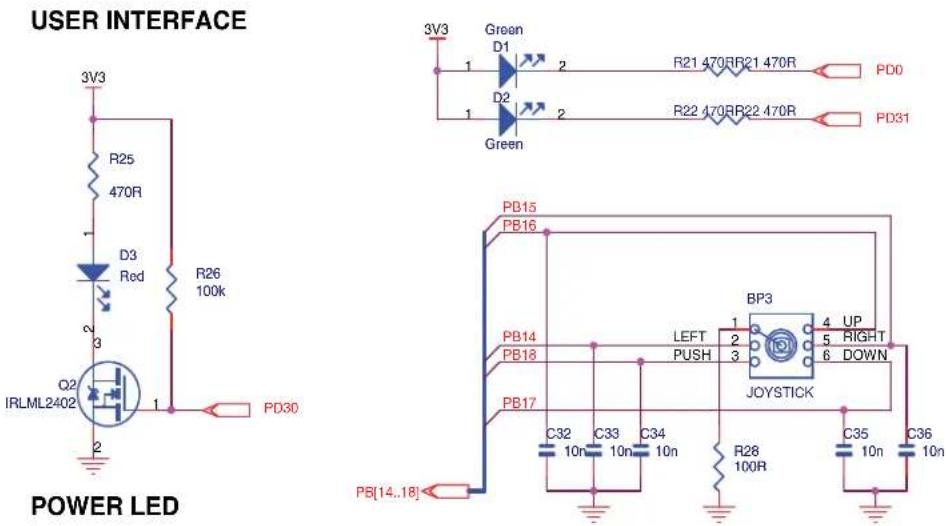
4.2.9 Software Controlled LEDs
Three users LED are provided for general use. The LEDs are connected to PIO port lines, allowing their control through either GPIO or PWM control.
■ LEDs D1 to D3 are software controlled by PIO pins.
■ LEDs D4 to D6 indicate Ethernet traffic and link status. These are automatically managed by on-chip microcontroller hardware. See Section 7.1 "Schematics".
Table 4-3. Discrete LEDs
| LED Description Comment | |
| D1 Green | LED User software controlled |
| D2 Green | LED User software controlled |
| D3 Red | LED User software controlled |
| D4 Yellow | LED Indicates transmission or reception via Ethernet |
| D5 Green | LED Indicates speed 100 |
| D6 Green | LED Is lit when a good link test has been detected |
Figure 4-14. Software Controlled LEDs
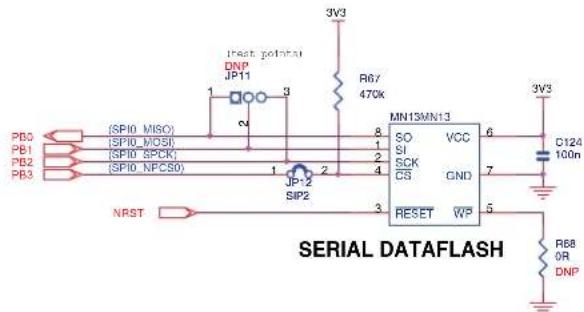
4.2.10 Serial Peripheral Interface Controller (SPI)
The SAM9M10 provides two high-speed Serial Peripheral Interface (SPI) controllers. One port is used to interface with the on-board serial DataFlash ^® .
Figure 4-15. SPI
text_image
PB0 (SP10 MISO) PB1 (SP10 MOSI) PB2 (SP10 SPCK) PB3 (SP10 NPC50) NRST IP-2 SIP2 3V3 DNP JP11 3 6 8 2 4 3 RESET WP MN13MN13 SO VCC SI SCK CND CS 3V3 C124 100n R67 47CK 3V3 R68 OR DNP SERIAL DATAFLASH4.2.11 Two Wire Interface (TWI)
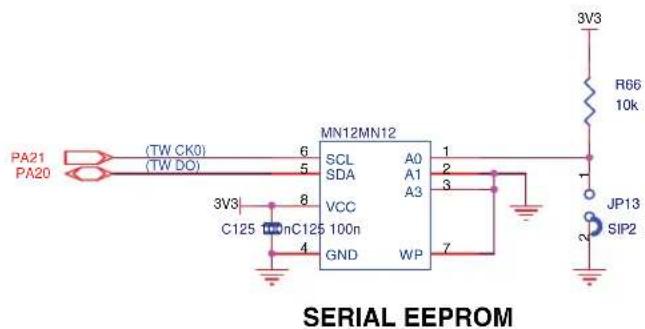
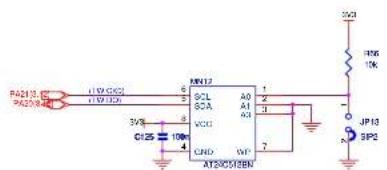
The SAM9M10 has a full speed (400 kHz) master/slave I2C Serial Controller. The controller is fully compatible with the industry standard I2C and SMBus Interfaces. This port is used to interface with the onboard Serial EEPROM, ISI and TV encoder interface.
Figure 4-16. TWI
text_image
PA21 PA20 (TW CK0) (TW DO) 6 5 MN12MN12 SCL SDA A0 A1 A3 1 2 3 4 VCC C125 100nC125 100n GND WP 7 3V3 R66 10k JP13 SIP2 SERIAL EEPROM4.2.12 SD/MMC Interface
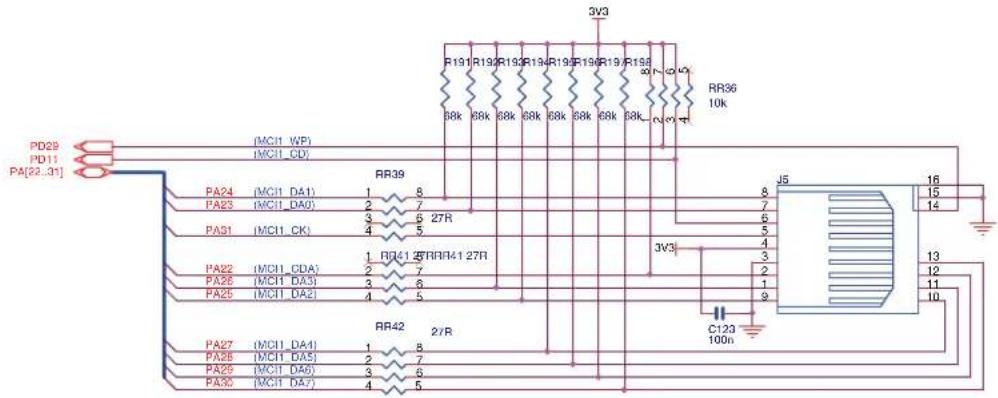
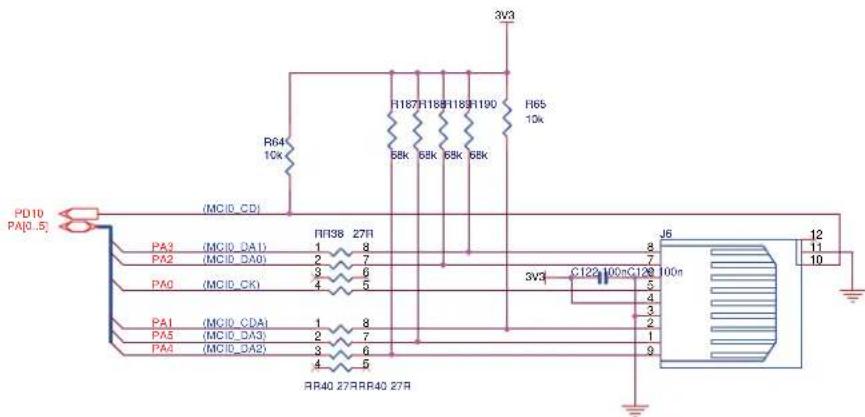
The SAM9M10-G45-EK has two high-speed 8-bit multimedia interfaces MMC/MMCPlus v4.1. The first interface is used as an 8-bit interface (MCI1), connected to a CE-ATA connector footprint and an 8-bit SD/MMC card slot. The second interface is used as a 4-bit interface (MCI0), connected to a 4-bit SD/MMC card slot.
The users must provide their own compatible cards for use with these connectors.
Please note that the power is connected to VCC, which is 3.3 volts.
Board Description
Figure 4-17. SD/MMC0
text_image
PD29 PD11 PA[22..31] (MCI1_WP) (MCI1_CD) PA24 (MCI1_DA1) 1 8 PA23 (MCI1_DA0) 2 7 PA31 (MCI1_CK) 3 6 27R PA22 (MCI1_CDA) 1 RR41 5RRR41 27R PA25 (MCI1_DA3) 2 7 PA25 (MCI1_DA2) 3 6 PA27 (MCI1_DA4) 1 8 PA28 (MCI1_DA5) 2 7 PA29 (MCI1_DA6) 3 6 PA30 (MCI1_DA7) 4 5 RR39 RR42 27R 3V3 RR36 RR36 10k J5 8 7 6 5 4 3 2 1 9 C123 100n 16 15 14 13 12 11 10SD/MMCPlus CARD INTERFACE - MCI1
Figure 4-18. SD/MMC1
text_image
PD10 PA[0..5] (RCIO_CD) PA3 (MCIO_DA1) 1 8 PA2 (MCIO_DA0) 2 7 PA0 (MCIO_CK) 3 6 PA1 (MCIO_CDA) 4 5 PA5 (MCIO_DA3) 1 8 PA4 (MCIO_DA2) 2 7 RF38 27R 58K 58K 58K 58K H167 H188 H189 H190 3V3 H65 10k J6 C122 100nC122 100n 3V3 RR40 27RR40 27R J6 12 11 10SD/MMC CARD INTERFACE - MCI0
4.2.13 TFT LCD with Touch Panel
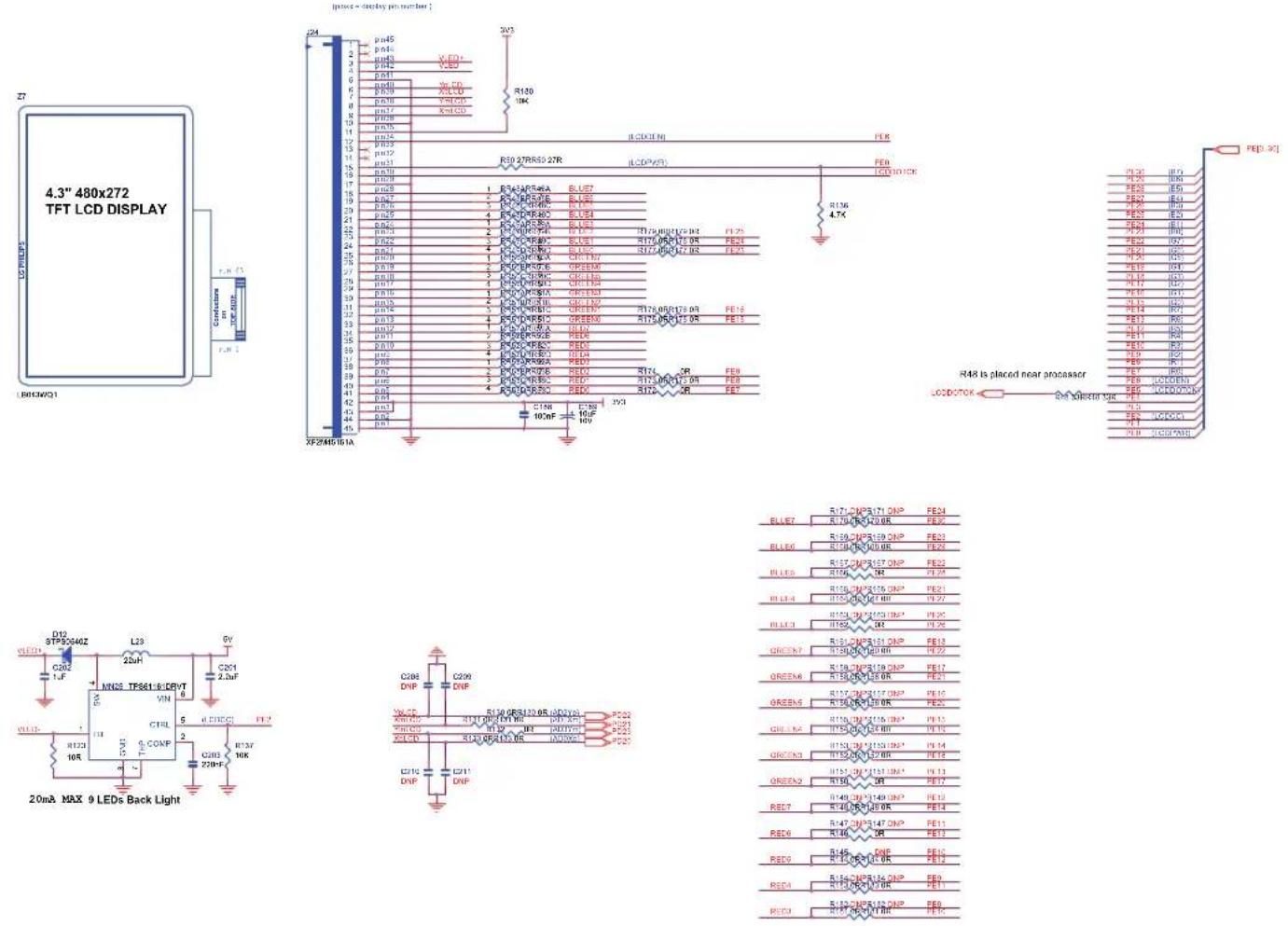
The SAM9M10 features an LCD controller. A 4.3" 480x272 Portrait Mode LCD provides the SAM9M10-G45-EK with a low power LCD display, back light unit and a touch panel, similar to that used on commercial PDAs.
The TFT LCD component is a truly model number TFT1N4633.
Graphics and text can be displayed on the dot matrix panel with up to 16 million colors by supplying 24-bit data signals (8bitxRGB by default) or 16-bit data signals (5+6+5bitxRGB in option). This allows the user to develop graphical user interfaces for a wide variety of end applications.
Warning: never connect/disconnect the LCD display from the board while the power supply is on. Doing so may damage both units and is not covered by warranty.
The back light voltage is generated from a CP2122ST boost converter. It is powered directly by the VIN 5 VCC power (the control for the back light voltages is separated from the main board voltages due to the specific voltage requirements of the LCD panel).
Figure 4-19. TFT LCD
| R17 | CNP517 | ONP | PE24 | |
| BLUE7 | R170 | CNP517 | ONP | PE25 |
| R169 | CNP516 | ONP | PE23 | |
| BLUE6 | R158 | CNP516 | ONP | PE25 |
| R157 | CNP517 | ONP | PE23 | |
| BLUE5 | R156 | OR | OR | PE24 |
| R156 | CNP516 | ONP | PE21 | |
| BLUE4 | R155 | OR | OR | PE22 |
| R153 | OR | OR | PE25 | |
| BLUE3 | R152 | OR | OR | PE26 |
| R152 | OR | OR | PE26 | |
| GREEN7 | R151 | CNP516 | ONP | PE13 |
| R150 | OR | OR | PE22 | |
| R150 | CNP516 | ONP | PE17 | |
| GREEN6 | R148 | OR | OR | PE21 |
| R148 | OR | OR | PE21 | |
| GREEN5 | R157 | CNP517 | ONP | PE10 |
| R156 | OR | OR | PE25 | |
| R155 | OR | OR | PE15 | |
| GREEN4 | R155 | OR | OR | PE15 |
| R153 | OR | OR | PE14 | |
| GREEN3 | R152 | OR | OR | PE18 |
| R152 | OR | OR | PE17 | |
| GREEN2 | R151 | OR | OR | PE17 |
| R150 | OR | OR | PE17 | |
| RED7 | R149 | OR | OR | PE13 |
| R148 | OR | OR | PE14 | |
| RED6 | R147 | CNP517 | ONP | PE11 |
| R146 | OR | OR | PE13 | |
| RED5 | R145 | OR | OR | PE10 |
| R144 | OR | OR | PE12 | |
| RED4 | R143 | OR | OR | PE9 |
| R143 | OR | OR | PE11 | |
| RED3 | R142 | OR | OR | PE9 |
| R141 | OR | OR | PE10 |
Board Description
4.2.14 Push Buttons
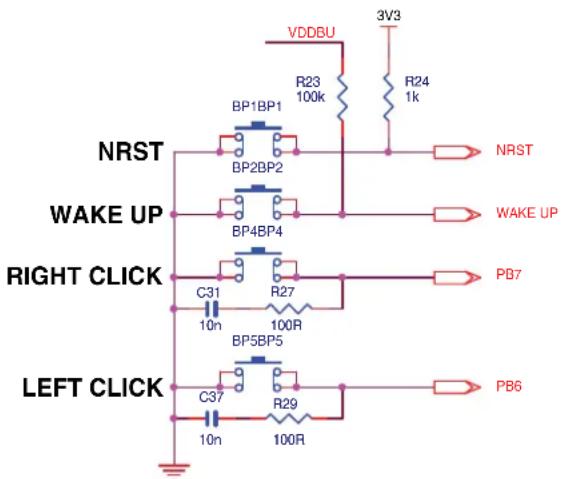
The SAM9M10-G45-EK is equipped with two system push buttons, two user push buttons and one joystick. The push buttons consist of momentary push button switches mounted directly to the board. When any switch is depressed, a low (zero) appears at the associated input pin.
■ System push buttons:
- Reset, perform system reset
– Wakeup, perform system wake up
■ User push button:
- Right click
- Left click
■ Joystick:
- One touch, 5-way switching,
– Normally open momentary contacts, - Push down to select in any position.
Figure 4-20. Push Buttons
text_image
VDDBU 3V3 R23 100k R24 1k BP1BP1 BP2BP2 NRST WAKE UP BP4BP4 WAKE UP RIGHT CLICK C31 10n R27 100R PB7 LEFT CLICK C37 10n R29 100R PB64.2.15 Expansion Slot
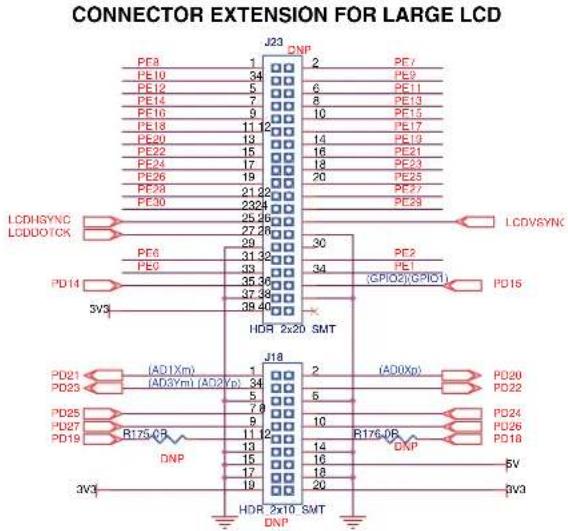
■ GPIO1 & GPIO2, LCD signals (PIO E) are routed to the connectors extension J23
■ All I/Os of the SAM9M10 Image Sensor Interface are routed to connectors J17
■ Touch screen signals and analog I/O are connected to J18
This allows the developer to extend the features of the board by adding external hardware components or boards.
Figure 4-21. Expansion Slot
text_image
CONNECTOR EXTENSION FOR LARGE LCD J23 DNP PE3 1 PE10 34 PE12 5 PE14 7 PE16 9 PE18 11 PE20 13 PE22 15 PE24 17 PE26 19 PE28 21 PE30 23 LCDHSYNC LCDDDOTCK PD14 3V3 J18 A01Xm A03Ym (A02Yp) R175-CP DNP 3V3 HOR 2x20 SMT DNP SMT HD R 2x10 DNP PE7 PE9 PE11 PE13 PE15 PE17 PE19 PE21 PE23 PE25 PE27 PE29 PE2 (GPIO2) (GPIO1) PD16 PD20 PD22 PD24 PD26 PD18 5V pv3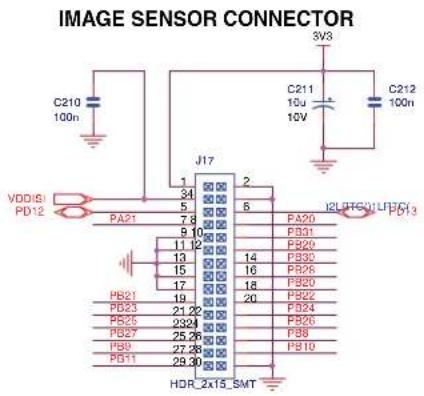
text_image
IMAGE SENSOR CONNECTOR VDD/S PD12 PA21 J17 34 5 7.8 5 10 11 13 15 17 19 21.20 23.24 25.26 27.28 29.30 HOR 2x15 SMT 3V3 C210 100n C211 10u 10V C212 100n 12LTCU1LPD13 FA20 PB31 PB29 PB30 PB26 PB20 PB22 PB24 PB26 PB8 PB105.1 JTAG/ICE Configuration
Table 5-1. JTAG/ICE Configuration
| Designation | Default Setting Feature | |
| R91 Not populated Disables the ICE NTRST input | ||
| R92 Soldered Enables the ICE RTCK return. R94 must be opened | ||
| R93 Soldered Enables the ICE NRST input | ||
| R94 Not populated Disables TCK <-> RTCK local loop | ||
5.2 ETHERNET Configuration
RMII is the factory default mode.
To evaluate the MII mode, the user has to unsolder R99 and solder R100, R103 to R105, R108 to R110, R112, R114, C174, C175, Y5.
5.3 Jumpers Configuration
Two types of jumpers are used on the SAM9M10-G45-EK board:
■ 2-pin jumpers with two possible settings:
– Fitted: the circuit is closed
- Not fitted: the circuit is open
■ 3-pin jumpers with two possible positions, for which settings are presented in the following tables.
Table 5-2. Jumpers Configuration
| Designation | Default Setting Feature | ||||
| J1 (combined jumper array) | Closed | J1-1 | 1-2 | ||
| Closed | J1-2 | 3-4 | |||
| Closed | J1-3 | 5-6 | |||
| Closed J1-4 | 7-8 VDDPLLUTMI 1V | ||||
| JP1 1-2 JP1 | 1-2 VDDIOP0 3V3 | ||||
| 2-3 External power to VDDIOP0 3V3 nominal | |||||
| JP2 1-2 JP2 | 1-2 VDDIOP1 3V3 | ||||
| 2-3 External power to VDDIOP1 3V3 nominal | |||||
| JP3 1-2 JP3 | 1-2 VDDIOP2 3V3 | ||||
| 2-3 External power to VDDIOP2 3V3 nominal | |||||
| JP4 Opened | Forces power on.To use the software shutdown control, JP4 must be opened.3V battery backup must be present and JP7 jumper set in position 1-2 | ||||
| JP5 1-2 JP5 | 1-2 VDDIOM0 | 1V8 | |||
| 2-3 External power to VDDIOM0 | 1V8 nominal | ||||
| JP6 1-2 JP6 | 1-2 VDDIOM1 | 1V8 | |||
| 2-3 External power to VDDIOM1 | 1V8 nominal | ||||
| JP7 1-2 JP7 | 1-2 VDDBU | Lithium 3V Battery | |||
| 2-3 VDDBU | 3.3V from regulator | ||||
| JP8 Opened | BMS Enables Boot on the internal ROM; closed selects the boot from the external device connected to NCS0 | ||||
| JP9 | Closed | Enables chip select access, Boot on the NCS0 (MN10 Flash) | |||
| JP10 | Closed | Enables chip select access, Boot on the NCS3 (MN11 NAND Flash) | |||
| JP11 | Test point | JP11.1: SO | JP11.2: SI | JP11.3: SCK | |
| JP12 | Closed | Enables chip select access, Boot on the SPIO_NPCS0 (Serial DataFlash MN13) | |||
| JP13 | Opened | Set address A0 low (MN12 Serial EEPROM), enable Boot access. | |||
| JP14 | JP14.1 = Line_Out | JP14.3 = AGND | |||
| JP15 | Used to connect a Loudspeaker | ||||
| JP16 | Closed | DISMDIX (MN18) | |||
| JP17-JP18 | Test points | Give access to the four GPIOs of WM9711L | |||
5.4 Miscellaneous Configuration Items
N.P = not populated
P = populated
Table 5-3. Miscellaneous Configuration
| Designation | Default Setting Feature | |
| R34 N.P JTAGSEL | ||
| R35 P Connect TSADVREF to VDDANA (may be used for specific filtering) | ||
| R36 P Connect GNDANA to GND (may be used for specific filtering) | ||
| R38 P Force TST pin to GND (chip is set in non-test mode = normal operation mode) | ||
| R63 N.P | Write protect NAND Flash (mount a 0-ohm resistor to write-protect the NAND Flash device) | |
| R68 N.P | Write protect serial DataFlash (mount a 0-ohm resistor to write-protect the serial Flash device) | |
| R75 N.P External clock Audio AC97 (mount a 0-ohm resistor to connect it) | ||
| R91,R92 R93,R94 | ICE interface reset and clocking schemes (see Section 5.1 "JTAG/ICE Configuration") | |
| R100, R103 to R105, R108 to R110, R112, R114, C174, C175, Y5 | Ethernet interface, MII mode (see Section 5.2 "ETHERNET Configuration") | |
| Y6, R184, R186 | N.P External 13 MHz oscillator (option) for the on-board video composite encoder | |
| TP1 GND | Test point | |
| TP2 GND | Test point | |
| TP3 GND | Test point | |
| TP4 GND | Test point | |
5.5 PIO Configuration
5.5.1 Peripheral Signals Multiplexing on I/O Lines
The AT91SAM9M10 product features 5 PIO controllers, PIOA, PIOB, PIOC, PIOD and PIOE, which multiplex the I/O lines of the peripheral set. Each PIO Controller controls up to 32 lines. Each line can be assigned to one of two peripheral functions, A or B. The multiplexing tables in the following paragraphs define how the I/O lines of peripherals A and B are multiplexed on the PIO Controllers.
5.5.2 Multiplexing on PIO Controller A (PIOA)
"R.Select" = connection selectable via an on-board resistor (default not populated)
Table 5-4. PIO Multiplexing Port A
| I/O Peripheral A Peripheral B Function and Comments Power | ||||||
| PA0 MCI0_CK TCLK3 M | MCI0 Clock VDDIOP0 | |||||
| PA1 MCI0_CDA TIOA3 | MMCI0 Command VDDIOP0 | |||||
| PA2 MCI0_DA0 TIOB3 | MMCI0 Data0 VDDIOP0 | |||||
| PA3 MCI0_DA1 TCKL4 | MMCI0 Data1 VDDIOP0 | |||||
| PA4 MCI0_DA2 | TIOA4 MMCI0 Data2 VDDIOP0 | |||||
| PA5 MCI0_DA3 TIOB4 | MMCI0 Data3 VDDIOP0 | |||||
| PA6 | MCI0_DA4 | ETX2 | Ethernet MII | VDDIOP0 | ||
| PA7 | MCI0_DA5 | ETX3 | Ethernet MII | VDDIOP0 | ||
| PA8 | MCI0_DA6 | ERX2 | Ethernet MII | VDDIOP0 | ||
| PA9 | MCI0_DA7 | ERX3 | Ethernet MII | VDDIOP0 | ||
| PA10 | ETX0 | Ethernet RMII Transmit data 0 | VDDIOP0 | |||
| PA11 | ETX1 | Ethernet RMII Transmit data 1 | VDDIOP0 | |||
| PA12 | ERX0 | Ethernet RMII Receive data 0 | VDDIOP0 | |||
| PA13 | ERX1 | Ethernet RMII Receive data 1 | VDDIOP0 | |||
| PA14 | ETXEN | Ethernet RMII Transmit enable | VDDIOP0 | |||
| PA15 | ERXDV | Ethernet RMII Receive data valid | VDDIOP0 | |||
| PA16 | ERXER | Ethernet RMII Receive Error | VDDIOP0 | |||
| PA17 | ETXCK | Ethernet RMII Transmit Clock | VDDIOP0 | |||
| PA18 | EMDC | Ethernet RMII Manag.Data Clock | VDDIOP0 | |||
| PA19 | EMDIO | Ethernet RMII Manag.Data In/Out | VDDIOP0 | |||
| PA20 | TWD0 | Two Wire Interface Data | VDDIOP0 | |||
| PA21 | TWCK0 | Two Wire Interface Clock | VDDIOP0 | |||
| PA22 | MCI1_CDA SCK3 | MMCI1 Command VDDIOP0 | ||||
| PA23 | MCI1_DA0 | RTS3 | MMCI1 Data0 | VDDIOP0 | ||
| PA24 | MCI1_DA1 | CTS3 | MMCI1 Data1 | VDDIOP0 | ||
| PA25 | MCI1_DA2 PWM3 | MMCI1 Data2 VDDIOP0 | ||||
| PA26 | MCI1_DA3 | TIOB2 MMCI1 Data3 VDDIOP0 | ||||
| PA27 | MCI1_DA4 | ETXER | R.Select | MMCI1 Data4 | Ethernet MII | VDDIOP0 |
| PA28 | MCI1_DA5 | ERXCK | R.Select | MMCI1 Data5 | Ethernet MII | VDDIOP0 |
| PA29 | MCI1_DA6 | ECRS | R.Select | MMCI1 Data6 | Ethernet MII | VDDIOP0 |
| PA30 | MCI1_DA7 | ECOL | R.Select | MMCI1 Data7 | Ethernet MII | VDDIOP0 |
| PA31 | MCI1_CK | PCK0 | MMCI1_clock | VDDIOP0 | ||
5.5.3 Multiplexing on PIO Controller B (PIOB)
Table 5-5. PIO Multiplexing Port B
| I/O Peripheral A Peripheral B Function and Comments Power | |||||
| PB0 | SPI0_MISO | SPI | Slave | ||
| PB1 SPI0_MOSI SPI Slave In Serial Data Flash VDDIOP0 | |||||
| PB2 SPI0_SPCK SPI Serial Clock Serial DataFlash VDDIOP0 | |||||
| PB3 SPI0_NPCS0 | SPI Chip Select Serial DataFlash VDDIOP0 | ||||
| PB4 | TXD1 | USART1 | Transmit | ||
| PB5 RXD1 | USART1 Receive Data | VDDIOP0 | |||
| PB6 | TXD2 | User Push Button Right click | VDDIOP0 | ||
| PB7 | RXD2 | User Push Button Left click | VDDIOP0 | ||
| PB8 | TXD3 | ISI_D8 | Image Sensor Data 8 | VDDIOP2 | |
| PB9 | RXD3 | ISI_D9 | Image Sensor Data 9 | VDDIOP2 | |
| PB10 | TWD1 | ISI_D10 | Image Sensor Data 10 | VDDIOP2 | |
| PB11 | TWCK1 | ISI_D11 | Image Sensor Data 11 | VDDIOP2 | |
| PB12 | DRXD | DBGU Receive Data | VDDIOP0 | ||
| PB13 | DTXD | DBGU Transmit Data | VDDIOP0 | ||
| PB14 | SPI1_MISO | Joystick Left | VDDIOP0 | ||
| PB15 | SPI1_MOSI | CTS0 | Joystick Right | VDDIOP0 | |
| PB16 | SPI1_SPCK | SCK0 | Joystick Up | VDDIOP0 | |
| PB17 | SPI1_NPCS0 | RTS0 | Joystick Down | VDDIOP0 | |
| PB18 | RXD0 | SPI0_NPCS1 | Joystick Push | VDDIOP0 | |
| PB19 | TXD0 | SPI0_NPCS2 | UsbVbus | VDDIOP0 | |
| PB20 | ISI_D0 | Image Sensor Data 0 | VDDIOP2 | ||
| PB21 | ISI_D1 | Image Sensor Data 1 | VDDIOP2 | ||
| PB22 | ISI_D2 | Image Sensor Data 2 | VDDIOP2 | ||
| PB23 | ISI_D3 | Image Sensor Data 3 | VDDIOP2 | ||
| PB24 | ISI_D4 | Image Sensor Data 4 | VDDIOP2 | ||
| PB25 | ISI_D5 | Image Sensor Data 5 | VDDIOP2 | ||
| PB26 | ISI_D6 | Image Sensor Data 6 | VDDIOP2 | ||
| PB27 | ISI_D7 | Image Sensor Data 7 | VDDIOP2 | ||
| PB28 | ISI_PCK | Image Sensor Data Clock | VDDIOP2 | ||
| PB29 | ISI_VSYNC | Image Sensor Vertical Synchro | VDDIOP2 | ||
| PB30 | ISI_HSYNC | Image Sensor Horizontal Synchro | VDDIOP2 | ||
| PB31 | ISI_MCK | PCK1 | Image Sensor Reference Clock | VDDIOP2 | |
5.5.4 Multiplexing on PIO Controller C (PIOC)
Table 5-6. PIO Multiplexing Port C
| I/O Peripheral A Peripheral B Function and Comments Power | |||||
| PC0 | DQM2 | ||||
| PC1 | DQM3 | ||||
| PC2 A19 Add19 NAND Flash VDDIOM1 | |||||
| PC3 A20 Add20 NAND Flash VDDIOM1 | |||||
| PC4 | A21/NA | NDALE | ALE NAND Flash VDI | ||
| PC5 A22/NANDCLE | CLE NAND Flash VDDIOM1 | ||||
| PC6 | A23 | ||||
| PC7 | A24 | ||||
| PC8 | CFCE1 | Ready/Busy NAND Flash | VDDIOM1 | ||
| PC9 | CFCE2 RTS2 | ||||
| PC10 | NCS4/CFCS0 TCLK2 | ||||
| PC11 | NCS5/CFCS1 CTS2 | ||||
| PC12 | A25/CFRNW | ||||
| PC13 | NCS2 | ||||
| PC14 | NCS3/NANDCS | Chip select NAND Flash | VDDIOM1 | ||
| PC15 | NWAIT | ||||
| PC16 | D16 | ||||
| PC17 | D17 | ||||
| PC18 | D18 | ||||
| PC19 | D19 | ||||
| PC20 | D20 | ||||
| PC21 | D21 | ||||
| PC22 | D22 | ||||
| PC23 | D23 | ||||
| PC24 | D24 | ||||
| PC25 | D25 | ||||
| PC26 | D26 | ||||
| PC27 | D27 | ||||
| PC28 | D28 | ||||
| PC29 D29 | VDDIOM1 | ||||
| PC30 D30 | VDDIOM1 | ||||
| PC31 D31 | VDDIOM1 | ||||
5.5.5 Multiplexing on PIO Controller D (PIOD)
Table 5-7. PIO Multiplexing Port D
| I/O Peripheral A Peripheral B Function and Comments Power | |||||
| PD0 | TK0 | PWM3 | Command | LED2 VDDIOP0 | |
| PD1 TF0 | Output ENA USB Host VDDIOP0 | ||||
| PD2 TD0 | Input FLGA USB Host | VDDIOP0 | |||
| PD3 | RD0 | Output | ENB USB Host | VDDIOP0 | |
| PD4 | RK0 | Input FLGB USB Host | VDDIOP0 | ||
| PD5 | RF0 | Int. Ethernet 10/100 MDINTR | VDDIOP0 | ||
| PD6 | AC97RX | AC97 Receive Signal | VDDIOP0 | ||
| PD7 | AC97TX | TIOA5 | AC97 Transmit Signal | VDDIOP0 | |
| PD8 | AC97FS | TIOB5 | AC97 Frame Sync Signal | VDDIOP0 | |
| PD9 | AC97CK | TCLK5 | AC97 Clock Signal | VDDIOP0 | |
| PD10 | TD1 | Card Detect MMCI0 MCI0_CD | VDDIOP0 | ||
| PD11 | RD1 | Card Detect MMCI1 MCI1_CD | VDDIOP0 | ||
| PD12 | TK1 | PCK0 | CTRL1 Image Sensor Interface | VDDIOP0 | |
| PD13 | RK1 | CTRL2 Image Sensor Interface | VDDIOP0 | ||
| PD14 | TF1 | GPIO1 Large LCD (connector) | VDDIOP0 | ||
| PD15 | RF1 | GPIO2 Large LCD (connector) | VDDIOP0 | ||
| PD16 | RTS1 | USART1 Request to Send | VDDIOP0 | ||
| PD17 | CTS1 | USART1 Clear To Send | VDDIOP0 | ||
| PD18 | SPI1_NPCS2 | IRQ | VDDIOP0 | ||
| PD19 | SPI1_NPCS3 | FIQ | VDDIOP0 | ||
| PD20 | TIOA0 | TSAD0 | Touch screen X_Right | VDDANA | |
| PD21 | TIOA1 | TSAD1 | Touch screen X_Left | VDDANA | |
| PD22 | TIOA2 | TSAD2 | Touch screen Y_Up | VDDANA | |
| PD23 | TCLK0 | TSAD3 | Touch screen Y_Down | VDDANA | |
| PD24 | SPI0_NPCS1 | PWM0 | GPAD4 | General purpose A/D4 | VDDANA |
| PD25 | SPI0_NPCS2 | PWM1 | GPAD5 | General purpose A/D5 | VDDANA |
| PD26 | PCK0 | PWM2 | GPAD6 | General purpose A/D6 | VDDIOP0 |
| PD27 | PCK1 | SPI0_NPCS3 | GPAD7 | General purpose A/D7 | VDDIOP0 |
| PD28 | TSADTRG | SPI1_NPCS1 | USB Plug-ID IDUSB | VDDIOP0 | |
| PD29 | TCLK1 | SCK1 | MCI1_WP | VDDIOP0 | |
| PD30 | TIOB0 | SCK2 | Command Power Led | VDDIOP0 | |
| PD31 | TIOB1 | PWM1 | Command LED1 VDDIOP0 | ||
5.5.6 Multiplexing on PIO Controller E (PIOE)
Table 5-8. PIO Multiplexing Port E
| I/O Peripheral A Peripheral B Function and Comments Power | |||||
| PE0 LCD PWR PCK0 LCD Panel Pow.Enab.Ctrl VDDIOP1 | |||||
| PE1 LCDMOD LCD Modulation Signal VDDIOP1 | |||||
| PE2 LCDCC LCD Contrast Control VDDIOP1 | |||||
| PE3 LCDVSYNC LCD Vertical Synch. | VDDIOP1 | ||||
| PE4 | LCDHSYNC | LCD Horizontal Synch. | VDDIOP1 | ||
| PE5 | LCDDOTCK | LCD Dot Clock | VDDIOP1 | ||
| PE6 LCDDEN | LCD Data Enable | VDDIOP1 | |||
| PE7 LCDD0 | LCDD2 | LCD-Red0 | VDDIOP1 | ||
| PE8 LCDD1 | LCDD3 | LCD-Red1 | VDDIOP1 | ||
| PE9 LCDD2 | LCDD4 | LCD-Red2 | VDDIOP1 | ||
| PE10 | LCDD3 | LCDD5 | LCD-Red3 | VDDIOP1 | |
| PE11 | LCDD4 | LCDD6 | LCD-Red4 | VDDIOP1 | |
| PE12 | LCDD5 | LCDD7 | LCD-Red5 | VDDIOP1 | |
| PE13 | LCDD6 | LCDD10 | LCD-Red6 | VDDIOP1 | |
| PE14 | LCDD7 | LCDD11 | LCD-Red7 | VDDIOP1 | |
| PE15 | LCDD8 | LCDD12 | LCD-Green0 | VDDIOP1 | |
| PE16 | LCDD9 | LCDD13 | LCD-Green1 | VDDIOP1 | |
| PE17 | LCDD10 | LCDD14 | LCD-Green2 | VDDIOP1 | |
| PE18 | LCDD11 | LCDD15 | LCD-Green3 | VDDIOP1 | |
| PE19 | LCDD12 | LCDD18 | LCD-Green4 | VDDIOP1 | |
| PE20 | LCDD13 | LCDD19 | LCD-Green5 | VDDIOP1 | |
| PE21 | LCDD14 | LCDD20 | LCD-Green6 | VDDIOP1 | |
| PE22 | LCDD15 | LCDD21 | LCD-Green7 | VDDIOP1 | |
| PE23 | LCDD16 | LCDD22 | LCD-Blue0 | VDDIOP1 | |
| PE24 | LCDD17 | LCDD23 | LCD-Blue1 | VDDIOP1 | |
| PE25 | LCDD18 | LCD-Blue2 | VDDIOP1 | ||
| PE26 | LCDD19 | LCD-Blue3 | VDDIOP1 | ||
| PE27 | LCDD20 | LCD-Blue4 | VDDIOP1 | ||
| PE28 | LCDD21 | LCD-Blue5 | VDDIOP1 | ||
| PE29 | LCDD22 | LCD-Blue6 | VDDIOP1 | ||
| PE30 | LCDD23 | LCD-Blue7 | VDDIOP1 | ||
| PE31 | PWM2 | PCK1 | AC97 External Clock | VDDIOP1 | |
6.1 Power Supply
The SAM9M10-G45-EK evaluation board can be powered from a DC 5V power supply via the external power supply jack (J2) shown in Figure 6-1. The positive pole must be on J2 center pin.
Figure 6-1. Power Supply Connector J2

Table 6-1. Power Supply Connector J2 Signal Description
| Pin Mnemonic Signal description | ||
| 1 Center | +5 VCC | |
| 2 | Gnd | |
6.2 RS232 Connector with RTS/CTS Handshake Support
Connector J11 is the COM1 connector.
Figure 6-2. RS232 COM1 Connector J11
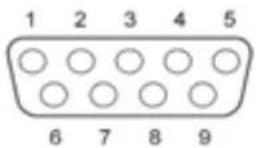
Table 6-2. Serial COM1 Connector J11 Signal Descriptions
| Pin Mnemonic Signal description | ||
| 1, 4, 6, 9 NC | NO CONNECTION | |
| 2 TXD TRANSMITTED DATA RS232 serial data output signal | ||
| 3 RXD RECEIVED DATA RS232 serial data input signal | ||
| 5 GND GROUND | ||
| 7 RTS READY TO SEND Active-positive | RS232 input signal | |
| 8 CTS CLEAR TO SEND Active-positive | RS232 output signal | |
6.3 DBGU
Connector J10 is the DBGU connector.
Figure 6-3. RS232 DBGU Connector J10
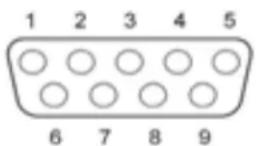
Table 6-3. RS232 DBGU Connector J10 Signal Descriptions
| Pin Mnemonic | Signal description | |
| 1, 4, 6, 7, 8, 9 | NC | NO CONNECTION |
| 2 | TXD TRANSMITTED DATA | RS232 serial data output signal |
| 3 | RXD RECEIVED DATA | RS232 serial data input signal |
| 5 | GND | GROUND |
6.4 Ethernet
Connector J15 is the RJ-45 Ethernet Connector.
Figure 6-4. Ethernet RJ45 Connector J15
12345678

natural_image
Simple gray electrical connector icon with four slots (no text or symbols)Table 6-4. Ethernet RJ45 Connector J15 Signal Descriptions
| Pin Mnemonic Pin Mnemonic | |||
| 1 TxData+ DIFFERENTIAL OUTPUT PLUS 2 Txdata- | DIFFERENTIAL OUTPUT MINUS | ||
| 3 RxData+ DIFFERENTIAL INPUT PLUS 4 Shield | |||
| 5 Shield 6 RxData- DIFFERENTIAL INPUT MINUS | |||
| 7 | S h i e l d | 8 | S h i e l d |
6.5 USB Host
Connector J12 is the USB Host connector.
Figure 6-5. USB Host type A connector J12
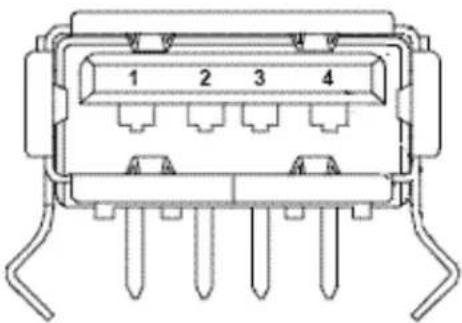
text_image
1 2 3 4Table 6-5. USB Host Type A Connector J12 Signal Descriptions
| Pin | Mnemonic | Signal description |
| 1 | Vbus | 5v power |
| 2 | DM | Data minus |
| 3 | DP | Data plus |
| 4 | Gnd | Ground |
| 5 | Shield | Shield |
6.6 USB Host/Device
Connector J14 is the USB Host/Device connector.
Figure 6-6. USB Host/Device Micro AB connector J14
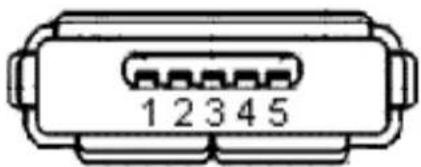
text_image
1 2 3 4 5Table 6-6. USB Host/Device MicroAB Connector J14 Signal Descriptions
| Pin Mne | monic Signal description | ||
| 1 Vbus | 5v power | ||
| 2 | DM | Data | mir |
| 3 DP D | data plus | ||
| 4 ID On the Go Identification | |||
| 5 Gnd Ground | |||
6.7 JTAG Debugging Connector
Connector J13 is the JTAG/ICE connector.
A SAM-ICE connector is a 20-way Insulation Displacement Connector (IDC) keyed box header (2.54 mm male) that mates with IDC sockets mounted on a ribbon cable.
Figure 6-7. JTAG/ICE Connector J13

| Pin Mnemonic Description | ||
| 1 VTref. 3.3V power | This is the target reference voltage. It is used to check if the target has power, to create the logic-level reference for the input comparators, and to control the output logic levels to the target. It is normally fed from VDD on the target board and must not have a series resistor. | |
| 2 Vsupply. 3.3V power | This pin is not connected in SAM-ICE. It is reserved for compatibility with other equipment. Connect to VDD or leave open in target system. | |
| 3 | nTRST TARGET RESET - Active-low output signal that resets the target | JTAG Reset. Output from SAM-ICE to the Reset signal on the target JTAG port. Typically connected to nTRST on the target CPU. This pin is normally pulled HIGH on the target to avoid unintentional resets when there is no connection. |
| 4 GND | Common ground | |
| 5 | TDI TEST DATA INPUT - Serial data output line, sampled on the rising edge of the TCK signal. | JTAG data input of target CPU. It is recommended that this pin is pulled to a defined state on the target board. Typically connected to TDI on target CPU. |
| 6 GND | Common ground | |
| 7 TMS | TEST MODE SELECT | JTAG mode set input of target CPU. This pin should be pulled up on the target. Typically connected to TMS on target CPU. Output signal that sequences the target's JTAG state machine, sampled on the rising edge of the TCK signal. |
| 8 | GND | Common |
| 9 | TCK TEST CLOCK - Output timing signal, for synchronizing test logic and control register access. | JTAG clock signal to target CPU. It is recommended that this pin is pulled to a defined state on the target board. Typically connected to TCK on target CPU. |
| 10 GND | Common ground | |
| 11 | RTCK - Input Return test clock signal from the target. | Some targets must synchronize the JTAG inputs to internal clocks. To assist in meeting this requirement, a returned and retimed TCK can be used to dynamically control the TCK rate. SAM-ICE supports adaptive clocking which waits for TCK changes to be echoed correctly before making further changes. Connect to RTCK if available, otherwise to GND |
| 12 GND | Common ground | |
| 13 | TDO JTAG TEST DATA OUTPUT - Serial data input from the target. | JTAG data output from target CPU. Typically connected to TDO on target CPU. |
| 14 GND | Common ground | |
| 15 nSR | ST RESET Active-low reset signal. Target CPU reset signal | |
| 16 GND | Common ground | |
| 17 RFU | This pin is not connected in SAM-ICE. | |
| 18 GND | Common ground | |
| 19 RFU | This pin is not connected in SAM-ICE | |
| 20 GND | Common ground | |
6.8 SD/MMC-MCI0
Connector J6 is the SD/MMC connector.
Figure 6-8. SD/MMC0 Connector J6
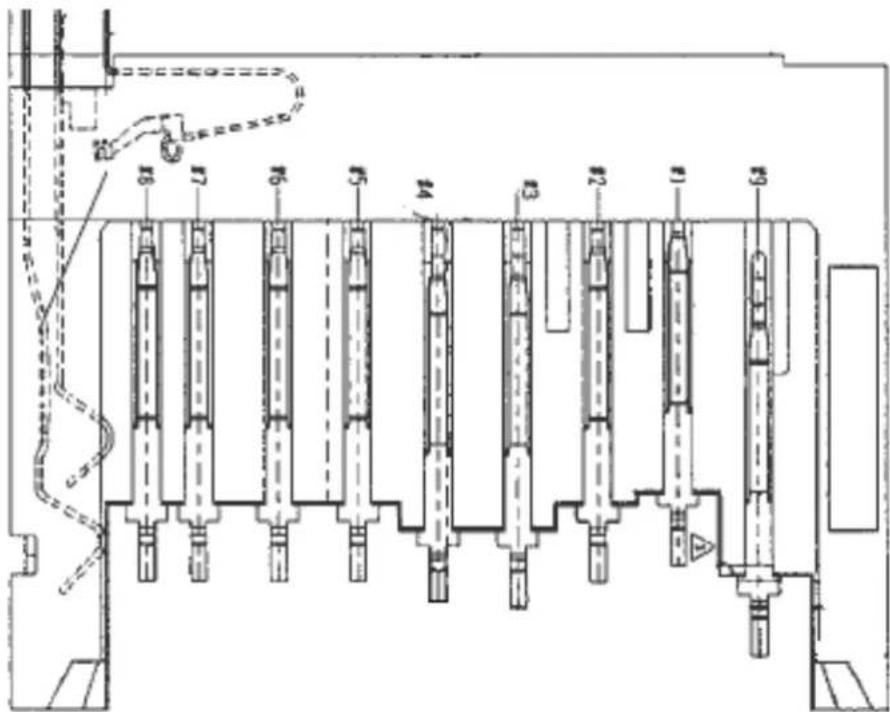
text_image
Technical schematic diagram of a mechanical assembly with numbered components and dashed lines indicating connections or paths.Table 6-8. SD/MMC0 Connector J6 Signal Descriptions
| Pin Mnemonic Pin Mnemonic | |||
| 1 | R S | V | / D |
| 3 GND | 4 VCC | ||
| 5 | C | L | K |
| 7DAT08 | DAT1 | ||
| 9 | DAT2 | 10 Card Detect | |
| 11 | GND | 12 | |
A T 3 2 C D G N D
6.9 SD/MMC-MCI1
Connector J5 is the SD/MMC connector.
Figure 6-9. SD/MMC1 Connector J5

text_image
SD-WP #8 A#7 #13 CD #12 A#5 #9 A#1 #10 A#2 #11 A#3 A#4 A = (MMCplus&MMCmobile & RS-MMC & MMC & SD)Table 6-9. SD/MMC1 Connector J5 Signal Descriptions
| Pin Mnemonic Pin Mnemonic | |||
| 1 | R S | V | / D |
| 3 GND 4 VCC | |||
| 5 | C | L | K |
| 7 | D | AT0 | 8 |
| 9 | DAT2 | 10 | DAT3 |
| 11 | DAT4 | 12 | DAT5 |
| 13 | DAT6 | 14 | DAT7 |
A T 3 2 C M
AT1
6.10 AC97
■ Connector J7 is the Headphone connector.
■ Connector J8 is the Line In connector.
■ Connector J9 is the Microphone Input.
■ Connector JP15 is the Speaker Output connector
Figure 6-10. Audio Connector J7, J8, J9
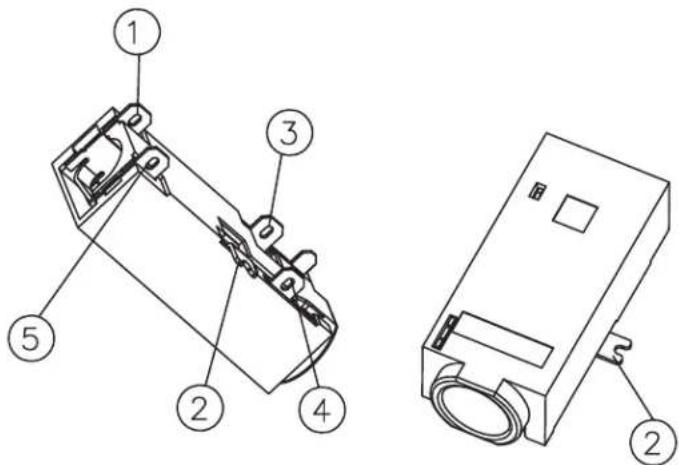
text_image
Technical diagram showing exploded and assembled views of a device with numbered componentsTable 6-10. J7, J8, J9 Signal Description
| Pin Mnemonic | |
| 1 | S |
| 2 | S |
| 3 | Gnd |
i g n a l i g n a l
Table 6-11. Speaker JP15 Signal Descriptions
| Pin Mnemonic | |
| 1 Speaker bridge output A | |
| 2 Speaker bridge output B |
6.11 Image Sensor - ISI
Connector J17 is the ISI connector.
Figure 6-11. ISI Connector J17
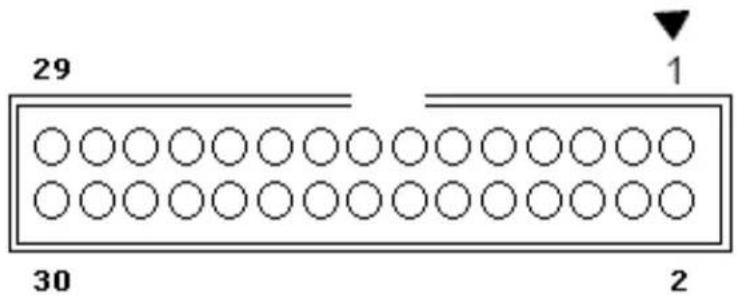
text_image
29 1 30 2Table 6-12. ISI Connector J17 Signal Descriptions
| Pin Mnemonic Pin Mnemonic | |||
| 1 VCC | 3v3 2 Gnd | ||
| 3 VCC | 3v3 4 Gnd | ||
| 5 | C | t | r l |
| 7 | S | C | L 8 |
| 9 | G | n | d 1 |
| 11 | Gnd | 12 | ISI_VSYNC |
| 13 | Gnd | 14 | ISI_HSYNC |
| 15 | Gnd | 16 | ISI_PCK |
| 17 | Gnd | 18 | ISI_Data0 |
| 19 | ISI_Data1 | 20 | ISI_Data2 |
| 21 | ISI_Data3 | 22 | ISI_Data4 |
| 23 | ISI_Data5 | 24 | ISI_Data6 |
| 25 | ISI_Data7 | 26 | ISI_Data8 |
| 27 | ISI_Data9 | 28 | ISI_Data10 |
| 29 | ISI_Data11 | 30 | Gnd |
| 1 | 6 | C | t | r |
| S | D | A | ||
| 0 | I | S | I | _ |
6.12 Video
Connector J20 is the Video connector
Figure 6-12. Video Connector J20

Table 6-13. Video Connector J20 Signal Description
| Pin Mnemonic Signal description | |
| 1 Center | Composite video signal output |
6.13 Display Devices
6.13.1 TFT LCD
Connector J24 is the TFT-LCD connector.
Figure 6-13. TFT LCD Connector J24
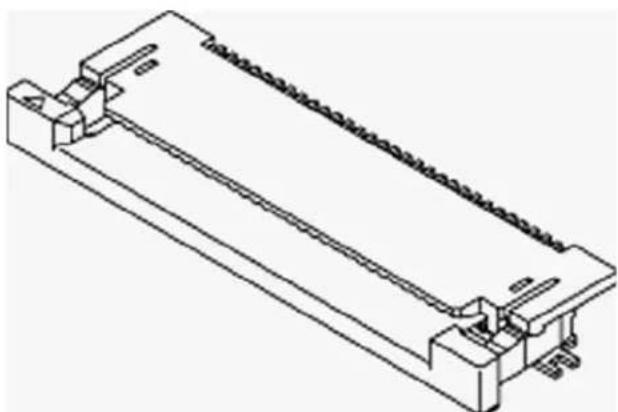
natural_image
Technical line drawing of a mechanical component with no visible text or symbolsTable 6-14. TFT LCD Connector J24 Signal Descriptions
| Pin Mnemonic Pin Mnemonic | |||
| 1 VLED- | 2 VLED+ | ||
| 3 GND 4 | VDD 3V3 | ||
| 5 | R0 | 6 | R1 |
| 7 | R2 | 8 | R3 |
| 9 | R4 | 10 | R5 |
Table 6-14. TFT LCD Connector J24 Signal Descriptions
| Pin | Mnemonic | Pin | Mnemonic |
| 11 R6 12 | R7 | ||
| 13 G0 14 | G1 | ||
| 15 G2 16 | G3 | ||
| 17 G4 18 | G5 | ||
| 19 G6 20 | G7 | ||
| 21 B0 14 | B1 | ||
| 23 B2 16 | B3 | ||
| 25 B4 18 | B5 | ||
| 27 B6 20 | B7 | ||
| 29 GND 30 | DCLK | ||
| 31 DISPON 32 | HSYNC | ||
| 33 VSYNC 34 | LCDEN | ||
| 35 NO CONNECT 36 | GND | ||
| 37 X2 38 | Y1 | ||
| 39 X1 40 | Y2 |
6.14 LCD Extension
Connectors J23 and J18 are for an optional LCD extension (not populated).
Table 6-15. Connector J23 Signal Description for an LCD Extension
| Pin | Mnemonic | Pin | Mnemonic | ||
| 1 | PE8 | RED Data Signal | 2 | PE7 | RED Data Signal (LSB) |
| 3 | PE10 | RED Data Signal | 4 | PE9 | RED Data Signal |
| 5 | PE12 | RED Data Signal | 6 | PE11 | RED Data Signal |
| 7 | PE14 | RED Data Signal (MSB) | 8 | PE13 | RED Data Signal |
| 9 | PE16 | GREEN Data Signal | 10 | PE15 | GREEN Data Signal (LSB |
| 11 | PE18 | GREEN Data Signal | 12 | PE17 | GREEN Data Signal |
| 13 | PE20 | GREEN Data Signal | 14 | PE19 | GREEN Data Signal |
| 15 | PE22 | GREEN Data Signal (MSB) | 16 | PE21 | GREEN Data Signal |
| 17 | PE24 | BLUE Data Signal | 18 | PE23 | BLUE Data Signal (LSB) |
| 19 | PE26 | BLUE Data Signal | 20 | PE25 | BLUE Data Signal |
| 21 | PE28 | BLUE Data Signal | 22 | PE27 | BLUE Data Signal |
| 23 | PE30 | BLUE Data Signal (MSB) | 24 | PE29 | BLUE Data Signal |
| 25 | PE4 | LCDHSYNC | 26 | PE3 | LCDVSYNC |
| 27 | PE5 | LCDDOTCK | 28 | GND | (0V) |
| 29 | GND | (0V) | 30 | NC |
Table 6-15. Connector J23 Signal Description for an LCD Extension
| Pin | Mnemonic | Pin | Mnemonic | ||
| 31 PE6 | LCDDEN 32 | PE2 LCDCC | |||
| 33 PE0 | DISPON 34 | PE1 LCDMOD | |||
| 35 PD14 | GPIO1 36 | PD15 GPIO2 | |||
| 37 GND | (0V) 38 GND | (0V) | |||
| 39 | VCC | +3V3 power source | 40 | NC |
Table 6-16. Connector J18 Signal Description for an LCD Extension
| Pin | Mnemonic | Pin | Mnemonic | ||
| 1 | XM | AD1XM | 2 | XP | AD0XP |
| 3 | YM | AD3YM | 4 | YP | AD2YP |
| 5 | GND | (0V) | 6 | GND | (0V) |
| 7 | PD25 | PD25 | 8 PD24 | PD24 | |
| 9 | PD27 | PD27 | 10 | PD26 | PD26 |
| 11 PD19 | PD19 | 12 | PD18 | PD18 | |
| 13 | GND | (0V) | 14 GND | (0V) | |
| 15 | GND | (0V) | 16 | +5V | |
| 17 | GND | (0V) | 18 GND | (0V) | |
| 19 | VCC | +3V3 power source | 20 | VCC | +3V3 power source |
7.1 Schematics
This section contains the following schematics:
■ Top Level view, block architecture of the design
■ Power Supply
■ SAM Processor
■ Bus impedance adaptor
■ Main memory
■ EBI memory
■ MCI & TWI
■ Audio AC97
■ Serial interfaces
- Ethernet
LCD
■ Video interfaces and LCD extension

flowchart
graph TD
    subgraph Power Supply
        A["5V POWER SUPPLY"] -->|PI0| B["ATMEL ARM9 Processor SAM9M10 (LFBGA324)"]
    end

    subgraph I/O Interface
        C["RS232 DBGU COM1"] -->|PIO| B
        D["USB HOST"] -->|PIO| B
        E["14 HOST DEVICE"] -->|PIO| B
        F["ICE INTERFACE"] -->|PIO| B
        G["10-100 FAST ETHERNET"] -->|PIO| B
    end

    subgraph Card Reader
        H["CARD READER"] --> I["AUDIO"]
        I --> J["MICOUT IN"]
        J --> K["Sheet 8"]
        L["RAMS 256MB"] --> M["Sheet 7"]
    end

    A -->|3V3 1VB 1V| B
    B -->|EBI0 DDR2 INTERFACE| M
    B -->|EBI1 DATA INTERFACE| N["RES.ARRAYS EBIO_EBI1 ADAPTER"]
    B -->|EBI1 ADDRESS INTERFACE| N
    B -->|EBI1 BUS INTERFACE| N
    N --> O["ESBIO DDR2 INTERFACE"]
    N --> P["ESBIO NANDFLASH INTERFACE"]
    N --> Q["ESB1 DDR2 INTERFACE"]
    N --> R["ESB1 FLASH INTERFACE"]
    N --> S["ESB1 DDR2 INTERFACE"]
    N --> T["ESBIO DDR2 128MB"]
    N --> U["ESBIO FLASH"]
    N --> V["ESBIO CARD READER"]
    N --> W["ESBIO CARD READER"]
    N --> X["ESBIO CARD READER"]
    N --> Y["ESBIO CARD READER"]
    N --> Z["ESBIO CARD READER"]
    N --> AA["ESBIO CARD READER"]
    N --> AB["ESBIO CARD READER"]
    N --> AC["ESBIO CARD READER"]
    N --> AD["ESBIO CARD READER"]
    N --> AE["ESBIO CARD READER"]
    N --> AF["ESBIO CARD READER"]
    N --> AG["ESBIO CARD READER"]
    N --> AH["ESBIO CARD READER"]
    N --> AI["ESBIO CARD READER"]
    N --> AJ["ESBIO CARD READER"]
    N --> AK["ESBIO CARD READER"]
    N --> AL["ESBIO CARD READER"]
    N --> AM["ESBIO CARD READER"]
    N --> AN["ESBIO CARD READER"]
    N --> AO["ESBIO CARD READER"]
    N --> AP["ESBIO CARD READER"]
    N --> AQ["ESBIO CARD READER"]
    N --> AR["ESBIO CARD READER"]
    N --> AS["ESBIO CARD READER"]
    N --> AT["ESBIO CARD READER"]
    N --> AU["ESBIO CARD READER"]
    N --> AV["ESBIO CARD READER"]
    N --> AW["ESBIO CARD READER"]
    N --> AX["ESBIO CARD READER"]
    N --> AY["ESBIO CARD READER"]
    N --> AZ["ESBIO CARD READER"]
    N --> BA["ESBIO CARD READER"]
    N --> BB["ESBIO CARD READER"]
    N --> BC["ESBIO CARD READER"]
    N --> BD["ESBIO CARD READER"]
    N --> BE["ESBIO CARD READER"]
    N --> BF["ESBIO CARD READER"]
    N --> BG["ESBIO CARD READER"]
    N --> BH["ESBIO CARD READER"]
    N --> BI["ESBIO CARD READER"]
    N --> BJ["ESBIO CARD READER"]
    N --> BK["ESBIO CARD READER"]
    N --> BL["ESBIO CARD READER"]
    N --> BM["ESBIO CARD READER"]
    N --> BN["ESBIO CARD READER"]
    N --> BO["ESBIO CARD READER"]
    N --> BP["ESBIO CARD READER"]
    N --> BQ["ESBIO CARD READER"]
    N --> BR["ESBIO CARD READER"]
    N --> BS["ESBIO CARD READER"]
    N --> BT["ESBIO CARD READER"]
    N --> BU["ESBIO CARD READER"]
    N --> BV["ESBIO CARD READER"]
    N --> BW["ESBIO CARD READER"]
text_image
E80_CNE5 E80_CL93 E80_NCK16 E80_BACK E80_BACK E80_WST3 E80_CS16 E80_RACK E80_DACK E80_DACK E80_DACK E80_COS14 R40 27F R42 27F R44 27F 1 R110 5 1 RSMA 3 3 R110 5 2 RSMA 7 3 R210 5 1 RSMA 3 1 RSMA 7 R46 27F R48 27F DOR_CKE [I] DOR_CUL [I] DOR_CLUX [I] DOR_BAG [I] DOR_BAY [I] DOR_WE [I] DOR_OB [I] DOR_AIB [I] DOR_CAS [I] DOR_DOK [I] DOR_DOU [I] DOR_DOU [I]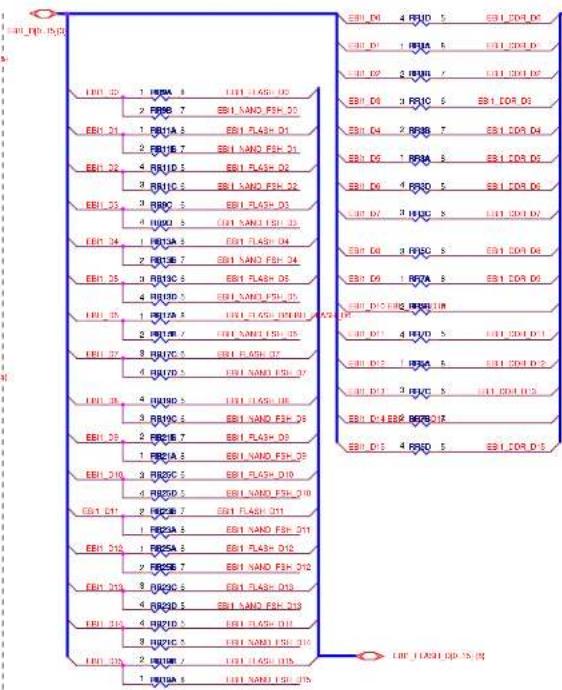
text_image
EBI 20 1 EBITA 8 EBI FLASH-03 2 EBIT 7 EBI NAND FSH-03 EBI 21 1 EBITA 8 EBI FLASH-01 2 EBIT 7 EBI NAND FSH-01 4 EBITD 5 EBI FLASH-02 3 EBITC 5 EBI NAND FSH-02 4 EBIT 5 EBI FLASH-03 EBI 23 1 EBITA 8 EBI FLASH-04 2 EBIT 7 EBI NAND FSH-04 3 EBITC 5 EBI FLASH-05 4 EBITD 5 EBI NAND FSH-05 EBI 25 1 EBITA 8 EBI FLASH-06 2 EBIT 7 EBI NAND FSH-06 3 EBITC 5 EBI FLASH-07 4 EBITD 5 EBI NAND FSH-07 EBI 26 4 EBITD 5 EBI FLASH-08 3 EBITC 5 EBI NAND FSH-09 4 EBITD 7 EBI FLASH-09 EBI 28 1 EBITA 8 EBI NAND FSH-09 2 EBITC 5 EBI FLASH-010 3 EBITD 5 EBI NAND FSH-010 EBI 210 1 EBITA 8 EBI NAND FSH-011 2 EBITC 5 EBI FLASH-012 3 EBITC 5 EBI NAND FSH-013 4 EBITD 5 EBI NAND FSH-013 EBI 212 1 EBITA 8 EBI NAND FSH-014 2 EBITC 5 EBI NAND FSH-015 3 EBITD 5 EBI NAND FSH-016 4 EBITD 5 EBI NAND FSH-017 EBI 218 1 EBITA 8 EBI NAND FSH-018 2 EBITC 5 EBI NAND FSH-019 3 EBITD 5 EBI NAND FSH-020 4 EBITD 5 EBI NAND FSH-021 EBI 224 1 EBITA 8 EBI NAND FSH-022 2 EBITC 5 EBI NAND FSH-023 3 EBITD 5 EBI NAND FSH-024 4 EBITD 5 EBI NAND FSH-025 EBI 230 1 EBITA 8 EBI NAND FSH-026 2 EBITC 5 EBI NAND FSH-027 3 EBITD 5 EBI NAND FSH-028 4 EBITD 5 EBI NAND FSH-029 EBI 236 1 EBITA 8 EBI NAND FSH-030 2 EBITC 5 EBI NAND FSH-031 3 EBITD 5 EBI NAND FSH-032 4 EBITD 5 EBI NAND FSH-033 EBI 242 1 EBITA 8 EBI NAND FSH-034 2 EBITC 5 EBI NAND FSH-035 3 EBITD 5 EBI NAND FSH-036 4 EBITD 5 EBI NAND FSH-037 EBI 248 1 EBITA 8 EBI NAND FSH-038 2 EBITC 5 EBI NAND FSH-039 3 EBITD 5 EBI NAND FSH-040 4 EBITD 5 EBI NAND FSH-041 EBI 254 1 EBITA 8 EBI NAND FSH-042 2 EBITC 5 EBI NAND FSH-043 3 EBITD 5 EBI NAND FSH-044 4 EBITD 5 EBI NAND FSH-045 EBI 260 1 EBITA 8 EBI NAND FSH-046 2 EBITC 5 EBI NAND FSH-047 3 EBITD 5 EBI NAND FSH-048 4 EBITD 5 EBI NAND FSH-049 EBI 266 1 EBITA 8 EBI NAND FSH-050 2 EBITC 5 EBI NAND FSH-051 3 EBITD 5 EBI NAND FSH-052 4 EBITD 5 EBI NAND FSH-053 EBI 272 1 EBITA 8 EBI NAND FSH-054 2 EBITC 5 EBI NAND FSH-055 3 EBITD 5 EBI NAND FSH-056 4 EBITD 5 EBI NAND FSH-057 EBI 278 1 EBITA 8 EBI NAND FSH-058 2 EBITC 5 EBI NAND FSH-059 3 EBITD 5 EBI NAND FSH-060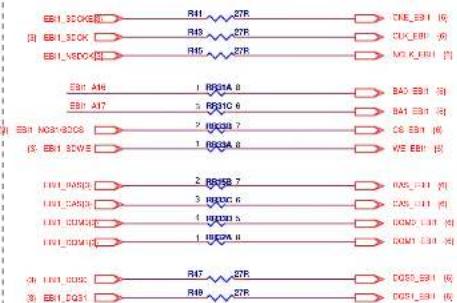
text_image
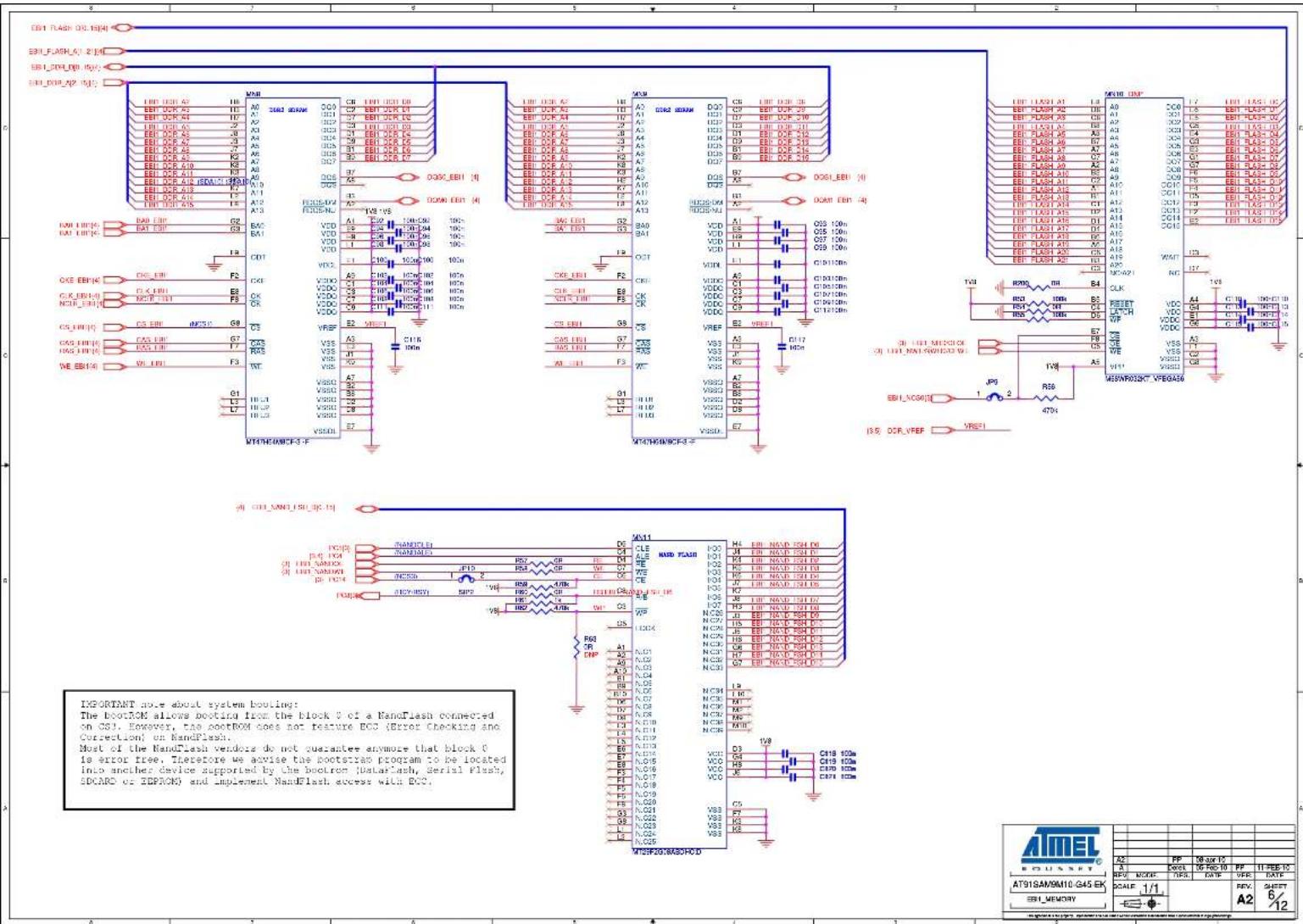
EB1 SCORE EB1 SCORE EB1_SOC4 EB1_A16 EB1_A17 EB1_NOB-8005 EB1_SCVE EB1_NOB3 EB1_CARES EB1_COM4 EB1_DQS1 EB1_DQS2 CB_EBI CB_EBI CB_EBI CB_EBI CB_EBI CB_EBI CB_EBI CB_EBI CB_EBI CB_EBI CB_EBI CB_EBI CB_EBI CB_EBI CB_EBI CB_EBI CB_EBI CB_EBI CB_EBI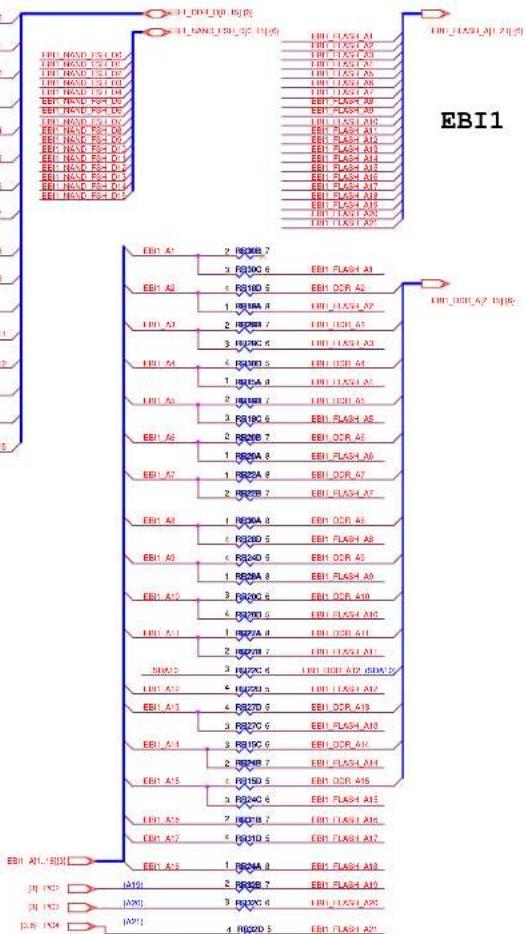
| A2 | PP | 19 apr 15 | ||
| A1 | 16 Fec 10 | 11 PEB-100 | ||
| REV. | DATE | VER. | ||
| SCALE | 1/1 | REV. | SHEET | |
| E=1 | A2 | 5/12 |
text_image
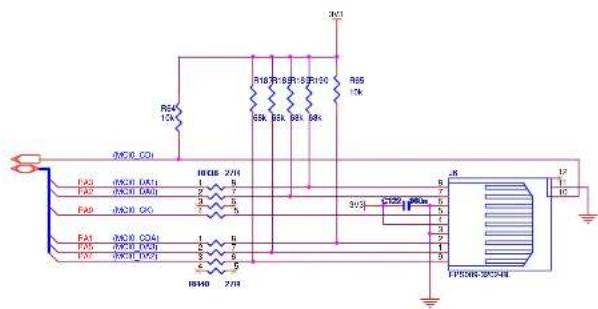
R64 12k R18 R19 R15 R100 R65 12k DC1 DC20 CO1 F43 DC20 DAT1 F42 DC20 DAT2 F40 DC20 G0 FA1 DC20 CO4 F45 DC20 DAT5 F43 DC20 DAT3 R105 2/11 1 8 2 7 3 6 4 5 5 4 6 3 7 2 8 1 9 0 10 0 11 0 12 0 13 0 14 0 15 0 16 0 17 0 3V C129 80mA FP58K SP24HSD/MMC CARD INTERFACE - MCI0
text_image
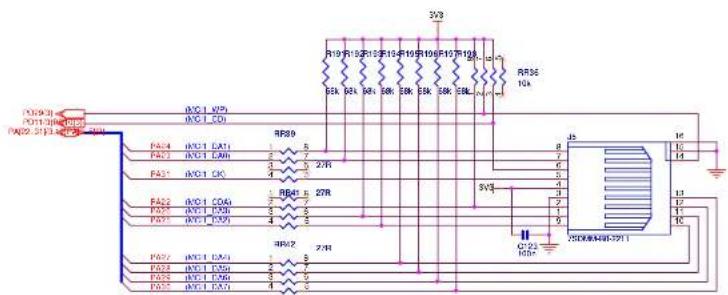
R19 R10 R15 R10 R10 R10 R10 6K 6K M4 6K EBK EBK EBK EBK RP30 RP31 RP32 RP33 RP34 RP35 RP36 RP37 RP38 RP39 RP40 RP41 RP42 RP43 RP44 RP45 RP46 RP47 RP48 RP49 RP50 RP51 RP52 RP53 RP54 RP55 RP56 RP57 RP58 RP59 RP60 RP61 RP62 RP63 RP64 RP65 RP66 RP67 RP68 RP69 RP70 RP71 RP72 RP73 RP74 RP75 RP76 RP77 RP78 RP79 RP80 2VR 2VR 2VR 2VR 3V/2 3V/2 3V/2 3V/2 3V/2 3V/2 3V/2 3V/2 3V/2 3V/2 3V/2 3V/2 3V/2 3V/2 3V/2 3V/2 3V/2 3V/2 3V/2 3V/2 3V/10kΩSD/MMCPlus CARD INTERFACE - MCI1
text_image
R4213 PA259 110V CCK2 110V 10A 3V8 C125 10A 6 6 6CL SCA VCC CND AT280518N A0 A1 A2 1 2 3 4 5 6 7 8 9 10 11 12 13 JP13 SP2 30Ω 45Ω 10K 1kΩSERIAL EEPROM

text_image
2nd pin 1 TNP JP1 30Ω 857 470A NFE3 SC Si SCK GSM VOC GSM PDS 1 2 3 4 5 6 7 8 9 10 11 12 13 14 15 16 17 18 19 20 21 22 23 24 25 26 27 28 29 30 31 32 33 34 35 36 37 38 39 40 41 42 43 44 45 46 47 48 49 50 51 52 53 54 55 56 57 58 59 60 61 62 63 64 65 66 67 68 69 70 71 72 73 74 75 76 77 78 79 80 81 82 83 84 85 86 87 88 89 90 91 92 93 94 95 96 97 98 99 100| A2 | PP | 10-axr 12 | |||
| A | 16-Fec 10 | 11-FEB-100x | |||
| RPU/AMMHF | NFR. | DATE | VFR. | ||
| AT91SAM9M10 G45 EK | SCALE 1/1 | REV. | SHEET | ||
| MOB & TWI | A2 | 7/12 | |||
text_image
HEADPHONE LINE-OUT 17 STEREO 3.5mm R70 OR C187 100/-6.3V 1 2 2 2 16 220cm at 100kHz R71 4K R72 4K C198 47p C199 49p JP17 DHP JP18 DHP C182 100m C183 10V ACND AC07 JP14 DHP AGND_AC07 R75 DR C185 100m C186 10V C187 100/-6.3V R76 DR C188 100m C189 10V C190 10V C191 10V C192 10V C193 10V C194 10V C195 10V C196 10V C197 10V C198 10V C199 10V C200 10V C201 10V C202 10V C203 10V C204 10V C205 10V C206 10V C207 10V C208 10V C209 10V C210 10V C211 10V C212 10V C213 10V C214 10V C215 10V C216 10V C217 10V C218 10V C219 10V C220 10V C221 10V C222 10V C223 10V C224 10V C225 10V C226 10V C227 AONDA NCFF/NCFF/NCFF/NCFF/NCFF/NCFF/NCFF/NCFF/NCFF/NCFF/NCFF/NCFF/NCFF/NCFF/NCFF/NCFF/NCFF/NCFF/NCFF/NCFF/NCFF/NCFF/NCFF/NCFF/NCFF/NCFF/NCFF/NCFF/NCFF/NCFF/NCFF/NCFF/NCFF/NCFF/NCF/NCFF/NCFF/NCFF/NCFF/NCFF/NCFF/NCFF/NCFF/NCFF/NCFF/NCFF/NCFF/NCFF/NCFF/NCFF/NCFF/NCFF/NCFF/NCFF/NCFF/NCFF/NCFF/NCFF/NCFF/NCFF/NCFF/NCFF/NCFF/NCFF/NCFF/NCFF/NCFF/NCFF/ WNRNTL: VINCE, OUT, CLK, OUT, CLK, OUT, CLK, OUT, CLK, OUT, CLK, OUT, CLK, OUT, CLK, OUT, CLK, OUT, CLK, OUT, CLK, OUT, CLK, OUT, CLK, OUT, CLK, OUT, CLK, OUT, CLK, OUT, CLK, OUT, CLK, OUT, CLK, OUT, CLK, OUT, CLK, OUT, CLK, OUT, CLK, OUT, CLK, OUT, CLK, OUT, CLK, OUT, NLN, INN, INN, INN, INN, INN, INN, INN, INN, INN, INN, INN, INN, INN, INN, INN, INN, INN, INN, INN, INN, INN, INN, INN, INN, INN, INN, INN, INN, INN, INN, INN, INN, INN, INnS/NIN/SIN/SIN/SIN/SIN/SIN/SIN/SIN/SIN/SIN/SIN/SIN/SIN/SIN/SIN/SIN/SIN/SIN/SIN/SIN/SIN/SIN/SIN/SIN/SIN/SIN/SIN/SIN/SIN/SIN/SIN/SIN/SIN/SIN/SIN/SIN/SIN/SIN/SIN/SIN/SIN/SIN/SIN/SIN/SIN/SIN/SIN/SIN/SIN/SIN/SIN / NCNN / NCNN / NCNN / NCNN / NCNN / NCNN / NCNN / NCNN / NCNN / NCNN / NCNN / NCNN / NCNN / NCNN / NCNN / NCNN / NCNN / NCNN / NCNN / NCNN / NCNN / NCNN / NCNN / NCNN / NCNN / NCNN / NCNN / NCNN / NCNN / NCNN / NCNN / NCNN / NCNN / NCNN| 10-APR-10P/20 | ||||
| A | 03-FEB-15 | 11-FEB-16 | ||
| REV. | DAMOND.F. | DES. | DATE | VER. |
| SCALE 1/1 | REV. SHEET A2 8/12 | |||
SERIAL DEBUG PORT
text_image
L DEBUG PORT U10 C165 100V 14 C157 100V 2 C165 100V 5 ACM/SDUA/V12 RBN15 RCC C2+ C168 100V C165 100V 390 R87 100K R88 100K P8-1 [S] P8-2 [S]
text_image
RS232 COM PORT R59 100k R85 100k C160 100k C164 100k ANH-5 1 2 3 4 5 6 7 8 9 VCC 10 11 12 13 14 C161 100n C162 100n C166 100n J11 J12 J13 J14 J15 J16 J17 J18 J19 J20 J21 J22 J23 J24 J25 J26 J27 J28 J29 J30 J31 J32 J33 J34 J35 J36 J37 J38 J39 J40 J41 J42 J43 J44 J45 J46 J47 J48 J49 J50 J51 J52 J53 J54 J55 J56 J57 J58 J59 J60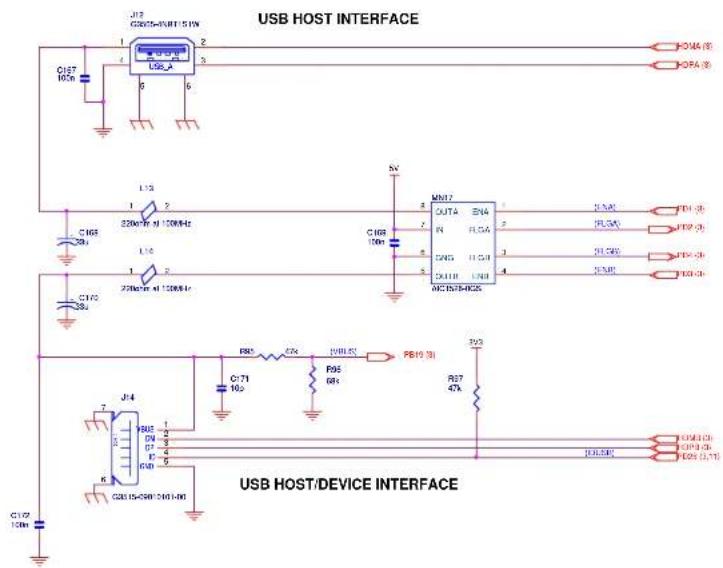
text_image
USB HOST INTERFACE USB HOST/DEVICE INTERFACE J17 G3055-PU811 51W C167 10Ω C166 2Ω C170 3Ω J4 G315-PSB 1201-08 J13 2 3 4 5 6 7 8 9 10 11 12 13 14 15 16 17 18 19 20 21 22 23 24 25 26 27 28 29 30 31 32 33 34 35 36 37 38 39 40 41 42 43 44 45 46 47 48 49 50 51 52 53 54 55 56 57 58 59 60 61 62 63 64 65 66 67 68 69 70 71 72 73 74 75 76 77 78 79 80 81 82 83 84 85 86 87 88 89 90 91 92 93 94 95 96 97 98 99 100
text_image
ICE INTERFACE P343 10C R93 DNP R91 0A F7*83T M1851-2A 13.0Ω F45-2A 14.0Ω ICR-2A H10F-2A 12.0Ω M25* 6.7E+10 Ω P82 B61 F80 B61 P84 B62 P83| 10-APR-10P/20 | ||||
| A | 02-Feb-10 | |||
| REV. | DRAWN/E | DES. | DATE | VER. |
| SCALE: 1/1 | REV. SHEET A2 9/12 | |||

text_image
RJ45 ETHERNET CONNECTOR RJ45 ETHERNET CONNECTOR RJ45 ETHERNET CONNECTOR RJ45 ETHERNET CONNECTOR RJ45 ETHERNET CONNECTOR RJ45 ETHERNET CONNECTOR RJ45 ETHERNET CONNECTOR RJ45 ETHERNET CONNECTOR RJ45 ETHERNET CONNECTOR RJ45 ETHERNET CONNECTOR RJ45 ETHERNET CONNECTOR| 10-APR-10P/20 | ||||
| A | 02-FEB-15 | 11-FEB-16 | ||
| AT918SAM9M10-C45-EK | REV. | DAMND.F. | DES. | DATE: |
| SCALE | 1/1 | REV. | ||
| PMI MII ETHERNET | A2 10/12 | |||

| A2 | PP | 19-04-15 | ||
| A1 | 16-FBC-10 | 11-FEB-10 | ||
| REV. | DATE | VER. | ||
| SCALE 1/1 | REV. | SHEET 11/12 | ||
| E=Φ | A2 | |||
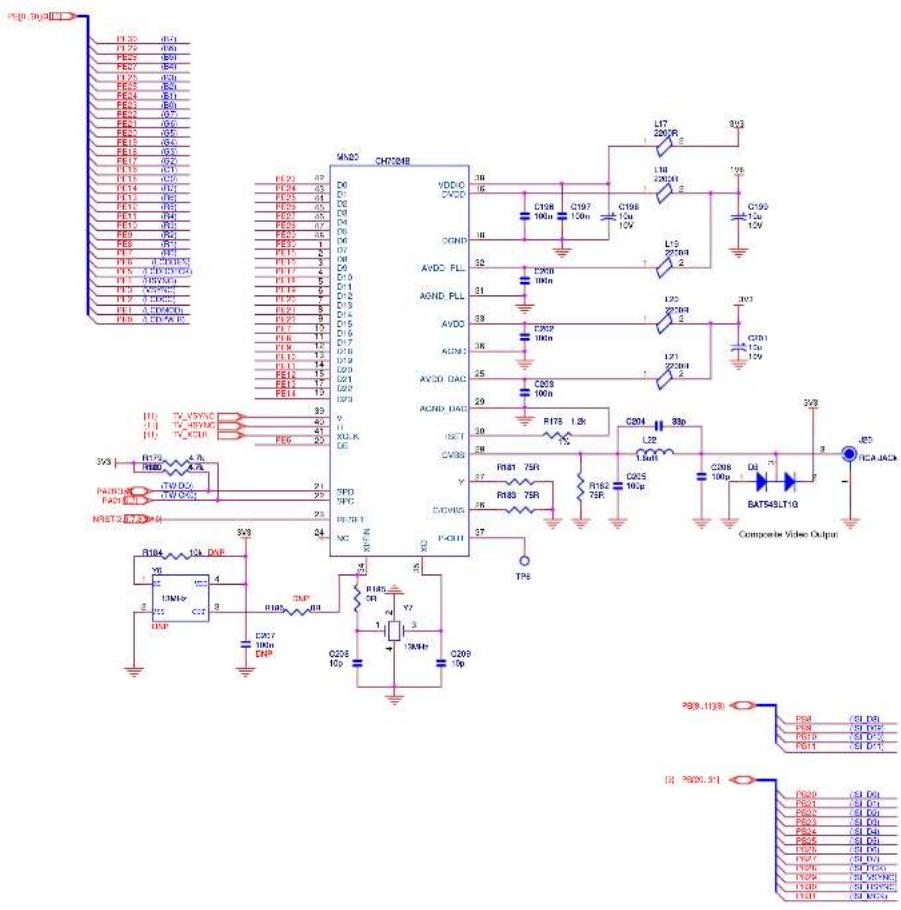
| Document Comments | Change Request Ref. | |
| 6495B | Main edits:- Most Figures updated- Hyperlinks to PDFs updated- 'Serial Synchronous Controller (SSC)' removed- 'JTAG' added- 'RJ45 crossed cable' added- Dimensions updated- Most configuration tables (with LEDs, pins and connectors) updated- 'LG/Philips' reference removed | 6990 |
| New Figure 4-4," EBI1 - DDR2 + Flash" and new Schematics in Section 7.1 "Schematics" | 7169 | |
| 6495A First issue. | ||
Headquarters International
| Atmel Corporation2325 Orchard ParkwaySan Jose, CA 95131USATel: 1(408) 441-0311Fax: 1(408) 487-2600 | Atmel AsiaUnit 1-5 & 16, 19/FBEA Tower, Millennium City 5418 Kwun Tong RoadKwun Tong, KowloonHong KongTel: (852) 2245-6100Fax: (852) 2722-1369 | Atmel EuropeLe Krebs8, Rue Jean-Pierre TimbaudBP 30978054 Saint-Quentin-en-Yvelines CedexFranceTel: (33) 1-30-60-70-00Fax: (33) 1-30-60-71-11 | Atmel Japan9F, Tonetsu Shinkawa Bldg.1-24-8 ShinkawaChuo-ku, Tokyo 104-0033JapanTel: (81) 3-3523-3551Fax: (81) 3-3523-7581 |
Product Contact
| Web Sitewww.atmel.com | Technical SupportAT91SAM SupportAtmel technical support | Sales Contactwww.atmel.com/contacts |
Literature Requests
www.atmel.com/literature
Disclaimer: The information in this document is provided in connection with Atmel products. No license, express or implied, by estoppel or otherwise, to any intellectual property right is granted by this document or in connection with the sale of Atmel products. EXCEPT AS SET FORTH IN ATMEL'S TERMS AND CONDITIONS OF SALE LOCATED ON ATMEL'S WEB SITE, ATMEL ASSUMES NO LIABILITY WHATSOEVER AND DISCLAIMS ANY EXPRESS, IMPLIED OR STATUTORY WARRANTY RELATING TO ITS PRODUCTS INCLUDING, BUT NOT LIMITED TO, THE IMPLIED WARRANTY OF MERCHANTABILITY, FITNESS FOR A PARTICULAR PURPOSE, OR NON-INFRINGEMENT. IN NO EVENT SHALL ATMEL BE LIABLE FOR ANY DIRECT, INDIRECT, CONSEQUENTIAL, PUNITIVE, SPECIAL OR INCIDENTAL DAMAGES (INCLUDING, WITHOUT LIMITATION, DAMAGES FOR LOSS OF PROFITS, BUSINESS INTERRUPTION, OR LOSS OF INFORMATION) ARISING OUT OF THE USE OR INABILITY TO USE THIS DOCUMENT, EVEN IF ATMEL HAS BEEN ADVISED OF THE POSSIBILITY OF SUCH DAMAGES. Atmel makes no representations or warranties with respect to the accuracy or completeness of the contents of this document and reserves the right to make changes to specifications and product descriptions at any time without notice. Atmel does not make any commitment to update the information contained herein. Unless specifically provided otherwise, Atmel products are not suitable for, and shall not be used in, automotive applications. Atmel's products are not intended, authorized, or warranted for use as components in applications intended to support or sustain life.
© 2010 Atmel Corporation. All rights reserved. Atmel ^® , Atmel logo and combinations thereof, DataFlash ^® , and others are registered trademarks, SAM-ICE ^™ and others are trademarks of Atmel Corporation or its subsidiaries. Other terms and product names may be trademarks of others.