
60-151C - Vacuum Cleaner RIKON - Free user manual and instructions
Find the device manual for free 60-151C RIKON in PDF.


| Product Type | Dust Collector (Vacuum Cleaner) |
| Model | 60-151C |
| Motor Power | 1-1/2 HP, TEFC, 3450 RPM |
| Voltage / Amperage | 115V / 11.5A or 230V / 5.7A, 60Hz |
| Airflow (CFM) | 1100 CFM |
| Static Pressure | 8 in. water column |
| Filtration Rating | 2 microns (canister filter) |
| Impeller Diameter / Material | 11.5" / Steel |
| Sound Rating | <89 dB at 3 feet |
| Dust Ports | 1 x 6", 2 x 4" (via Y-inlet) |
| Bag Capacity | 5.3 cu. ft. (collection bag) |
| Bag Dimensions | 20" diameter x 33" length |
| Overall Dimensions (LxWxH) | 37" x 22" x 76.5" (940 x 560 x 1945 mm) |
| Net Weight | 114 lbs (51.9 kg) |
| Motor Type | Sealed, lubricated ball bearings (maintenance-free) |
| Canister Cleaning | Interior rotating cleaning flap |
| Included Accessories | Base plate, casters (4), supports (3), 5" hose, Y-inlet, collection bag, filter bag fixing ring, strap clamps, hardware pack |
| Grounding Requirement | 3-prong plug, must be grounded |
| Warranty | 5-year limited (residential use) |
| Certifications | Meets California Proposition 65 requirements |
Frequently Asked Questions - 60-151C RIKON
User questions about 60-151C RIKON
0 question about this device. Answer the ones you know or ask your own.
Ask a new question about this device
Download the instructions for your Vacuum Cleaner in PDF format for free! Find your manual 60-151C - RIKON and take your electronic device back in hand. On this page are published all the documents necessary for the use of your device. 60-151C by RIKON.
USER MANUAL 60-151C RIKON
1.5 HP Dust Collector


Operator's Manual
Record the serial number and date of purchase in your manual for future reference.
Serial Number: ____ Date of purchase: ____
For technical support or parts questions, email techsupport@rikontools.com or call toll free at (877)884-5167
TABLE OF CONTENTS
| Specifications | 2 |
| Safety Warnings | 3-6, 13 |
| Electrical Requirements | 5 |
| Dust Collector Safety | 6, 14 |
| Contents of Package | 7-8 |
| Assembly | 9-13 |
| Operation | 14 |
| Dust Hazards and Safety | 6, 13 |
| Parts Diagram | 15 |
| Parts List | 16 |
| Trouble Shooting | 17 |
| Wiring Diagram | 18 |
| Maintenance | 19 |
| Warranty | 19 |
SPECIFICATIONS 60-151C
| Motor | 1-1/2 HP, TEFC |
| Motor Speed (no load) | 3450 RPM |
| Volts | 115 / 230 V |
| Amps, Hertz | 11.5 / 5.7 A, 60 Hz |
| Dust Collection Velocity CFM | 1100 |
| Static Pressure (water column) | 8 in. w.c. |
| Blower Impeller Diameter | 11.5" |
| Blower Impeller Material | Steel |
| Sound Rating @ 3 Feet | <89 dB |
| Canister Filtration | 2 Microns |
| Bag Diameter | 20" |
| Bag Capacity | 5.3 Cu. Ft. |
| Bag Length | 33" |
| Dust Ports / Hose Connections | 1 @ 6", 2 @ 4" |
| Overall Size (LxWxH) | 37" x 22" x 76-1/2" (940 x 560 x 1945 mm) |
| Net Weight | 114lbs. (51.9kg) |
NOTE: The specifications, photographs, drawings and information in this manual represent the current model when the manual was prepared. Changes and improvements may be made at any time, with no obligation on the part of Rikon Power Tools, Inc. to modify previously delivered units. Reasonable care has been taken to ensure that the information in this manual is correct, to provide you with the guidelines for the proper safety, assembly and operation of this machine.
SAFETY INSTRUCTIONS
IMPORTANT! Safety is the single most important consideration in the operation of this equipment. The following instructions must be followed at all times. Failure to follow all instructions listed below may result in electric shock, fire, and/or serious personal injury.
There are certain applications for which this tool was designed. We strongly recommend that this tool not be modified and/or used for any other application other than that for which it was designed. If you have any questions about its application, do not use the tool until you have contacted us and we have advised you.
SAFETY SYMBOLS

SAFETY ALERT SYMBOL: Indicates DANGER, WARNING, or CAUTION. This symbol may be used in conjunction with other symbols or pictographs.

DANGER
Indicates an imminently hazardous situation, which, if not avoided, could result in death or serious injury.

Indicates a WARNING injury.
potentially hazardous situation, which, if not avoided, could result in death or serious

CAUTION indicates a moderate i
potentially hazardous situation, which, if not avoided, could result in minor or injury.
NOTICE: Shown without Safety Alert Symbol indicates a situation that may result in property damage.
GENERAL SAFETY
KNOW YOUR POWER TOOL. Read the owner's manual carefully. Learn the tool's applications, work capabilities, and its specific potential hazards.
BEFORE USING YOUR MACHINE
To avoid serious injury and damage to the tool, read and follow all of the Safety and Operating Instructions before operating the machine.
- ⚠️ WARNING Some dust created by using power tools contains chemicals known to the State of California to cause cancer, birth defects, or other reproductive harm. Some examples of these chemicals are:
- Lead from lead-based paints.
- Crystalline silica from bricks, cement, and other
- masonry products.
-
Arsenic and chromium from chemically treated lumber. Your risk from these exposures varies, depending on how often you do this type of work. To reduce your exposure to these chemicals: work in a well ventilated area and work with approved safety equipment, such as those dust masks that are specially designed to filter out microscopic particles.
-
READ the entire Owner's Manual. LEARN how to use the tool for its intended applications.
-
GROUND ALL TOOLS. If the tool is supplied with a 3-prong plug, it must be plugged into a 3-contact electrical receptacle. The 3rd prong is used to ground the tool and provide protection against accidental electric shock. DO NOT remove the 3rd prong. See Grounding Instructions on the following pages.
-
AVOID A DANGEROUS WORKING ENVIRONMENT. DO NOT use electrical tools in a damp environment or expose them to rain.
-
DO NOT use electrical tools in the presence of flammable liquids or gasses.
-
ALWAYS keep the work area clean, well lit, and organized. DO NOT work in an environment with floor surfaces that are slippery from debris, grease, and wax.
-
KEEP VISITORS AND CHILDREN AWAY. DO NOT permit people to be in the immediate work area, especially when the electrical tool is operating.
-
DO NOT FORCE THE TOOL to perform an operation for which it was not designed. It will do a safer and higher quality job by only performing operations for which the tool was intended.
-
WEAR PROPER CLOTHING. DO NOT wear loose clothing, gloves, neckties, or jewelry. These items can get caught in the machine during operations and pull the operator into the moving parts. The user must wear a protective cover on their hair, if the hair is long, to prevent it from contacting any moving parts.
-
CHILDPROOF THE WORKSHOP AREA by removing switch keys, unplugging tools from the electrical receptacles, and using padlocks.
-
ALWAYS UNPLUG THE TOOL FROM THE ELECTRICAL RECEPTACLE when making adjustments, changing parts or performing any maintenance.
SAFETY INSTRUCTIONS
-
KEEP PROTECTIVE GUARDS IN PLACE AND IN WORKING ORDER.
-
AVOID ACCIDENTAL STARTING. Make sure that the power switch is in the "OFF" position before plugging in the power cord to the electrical receptacle.
-
REMOVE ALL MAINTENANCE TOOLS from the immediate area prior to turning "ON" the machine.
-
USE ONLY RECOMMENDED ACCESSORIES. Use of incorrect or improper accessories could cause serious injury to the operator and cause damage to the tool. If in doubt, check the instruction manual that comes with that particular accessory.
-
NEVER LEAVE A RUNNING TOOL UNATTENDED. Turn the power switch to the "OFF" position. DO NOT leave the tool until it has come to a complete stop.
-
DO NOT STAND ON A TOOL. Serious injury could result if the tool tips over, or you accidentally contact the tool.
-
DO NOT store anything above or near the tool where anyone might try to stand on the tool to reach it.
-
MAINTAIN YOUR BALANCE. DO NOT extend yourself over the tool. Wear oil resistant rubber soled shoes. Keep floor clear of debris, grease, and wax.
-
MAINTAIN TOOLS WITH CARE. Always keep tools clean and in good working order. Keep all blades and tool bits sharp, dress grinding wheels and change other abrasive accessories when worn.
-
EACH AND EVERY TIME, CHECK FOR DAMAGED PARTS PRIOR TO USING THE TOOL. Carefully check all guards to see that they operate properly, are not damaged, and perform their intended functions. Check for alignment, binding or breaking of moving parts. A guard or other part that is damaged should be immediately repaired or replaced.
-
DO NOT OPERATE TOOL WHILE TIRED, OR UNDER THE INFLUENCE OF DRUGS, MEDICATION OR ALCOHOL.
-
SECURE ALL WORK. Use clamps or jigs to secure the work piece. This is safer than attempting to hold the work piece with your hands.
-
STAY ALERT, WATCH WHAT YOU ARE DOING, AND USE COMMON SENSE WHEN OPERATING A POWER TOOL.
A moment of inattention while operating power tools may result in serious personal injury.
-
ALWAYS WEAR A DUST MASK TO PREVENT INHALING DANGEROUS DUST OR AIRBORNE PARTICLES, including wood dust, crystalline silica dust and asbestos dust. Direct particles away from face and body. Always operate tool in well ventilated area and provide for proper dust removal. Use dust collection system wherever possible. Exposure to the dust may cause serious and permanent respiratory or other injury, including silicosis (a serious lung disease), cancer, and death. Avoid breathing the dust, and avoid prolonged contact with dust. Allowing dust to get into your mouth or eyes, or lay on your skin may promote absorption of harmful material. Always use properly fitting NIOSH/OSHA approved respiratory protection appropriate for the dust exposure, and wash exposed areas with soap and water.
-
USE A PROPER EXTENSION CORD IN GOOD CONDITION. When using an extension cord, be sure to use one heavy enough to carry the current your product will draw. The table on the following page shows the correct size to use depending on cord length and nameplate amperage rating. If in doubt, use the next heavier gauge. The smaller the gauge number, the larger diameter of the extension cord. If in doubt of the proper size of an extension cord, use a shorter and thicker cord. An undersized cord will cause a drop in line voltage resulting in a loss of power and overheating.
USE ONLY A 3-WIRE EXTENSION CORD THAT HAS A 3-PRONG GROUNDING PLUG AND A 3-POLE RECEPTACLE THAT ACCEPTS THE TOOL'S PLUG.
- ADDITIONAL INFORMATION regarding the safe and proper operation of this product is available from:
• Power Tool Institute 1300 Summer Avenue Cleveland, OH 44115-2851 www.powertoolinstitute.org
• National Safety Council 1121 Spring Lake Drive Itasca, IL 60143-3201 www.nsc.org
• American National Standards Institute 25 West 43rd Street, 4th Floor New York, NY 10036 www.ansi.org
• ANSI 01.1 Safety Requirements for Woodworking Machines and the U.S. Department of Labor regulations www.osha.gov
- SAVE THESE INSTRUCTIONS. Refer to them frequently and use them to instruct others.
SAFETY INSTRUCTIONS
ELECTRICAL SAFETY
WARNING: THIS TOOL MUST BE GROUNDED WHILE IN USE TO PROTECT THE OPERATOR FROM ELECTRIC SHOCK.
IN THE EVENT OF A MALFUNCTION OR BREAKDOWN, grounding provides the path of least resistance for electric current and reduces the risk of electric shock. This tool is equipped with an electric cord that has an equipment grounding conductor and requires a grounding plug (not included). The plug MUST be plugged into a matching electrical receptacle that is properly installed and grounded in accordance with ALL local codes and ordinances.
DO NOT MODIFY ANY PLUG. If it will not fit the electrical receptacle, have the proper electrical receptacle installed by a qualified electrician.
IMPROPER ELECTRICAL CONNECTION of the equipment grounding conductor can result in risk of electric shock. The conductor with the green insulation (with or without yellow stripes) is the equipment grounding conductor. DO NOT connect the equipment grounding conductor to a live terminal if repair or replacement of the electric cord or plug is necessary.
CHECK with a qualified electrician or service personnel if you do not completely understand the grounding instructions, or if you are not sure the tool is properly grounded when installing or replacing a plug.
USE ONLY A 3-WIRE EXTENSION CORD THAT HAS THE PROPER TYPE OF A 3-PRONG GROUNDING PLUG THAT MATCHES THE MACHINE'S 3-PRONG PLUG AND ALSO THE 3-POLE RECEPTACLE THAT ACCEPTS THE TOOL'S PLUG. FIG. A. *
REPLACE A DAMAGED OR WORN CORD IMMEDIATELY.
This tool is intended for use on a circuit that has a 120 volt electrical receptacle. FIGURE B shows the type of the 220v, 3-wire electrical plug and electrical receptacle that has a grounding conductor that is required if the motor wiring is changed. See page 18.
EXTENSION CORDS
WARNING: THE USE OF AN EXTENSION CORD WITH THIS MACHINE IS NOT RECOMMENDED. For best power and safety, plug the machine directly into a dedicated, grounded electrical outlet that is within the supplied cord length of the machine.
If an extension cord needs to be used, it should only be for a limited operation of the machine. The extension cord should be as short as possible in length, and have a minimum gauge size of 14AWG.
WARNING: Check extension cords before each use. If damaged, replace immediately. Never use a tool with a damaged cord, as touching the damaged area could cause electrical shock, resulting in serious injury.
Use a proper extension cord. Only use cords listed by Underwriters Laboratories (UL). Other extension cords can cause a drop in line voltage, resulting in a loss of power and overheating of tool. When operating a power tool outdoors, use an outdoor extension cord marked "W-A" or "W". These cords are rated for outdoor use and reduce the risk of electric shock.
MINIMUM RECOMMENDED GAUGE FOR EXTENSION CORDS (AWG)
| 120 VOLT OPERATION ONLY | ||||
| 25' LONG | 50' LONG | 100' LONG | 150' LONG | |
| 0 to 6 Amps | 18 AWG | 16 AWG | 16 AWG | 14 AWG |
| 6 to 10 Amps | 18 AWG | 16 AWG | 14 AWG | 12 AWG |
| 10 to 12 Amps | 16 AWG | 16 AWG | 14 AWG | 12 AWG |
A WARNING Keep the extension cord clear of
the working area. Position the cord so that it will not get caught on lumber, tools or other obstructions while you are working with your power tool.
* Canadian electrical codes require extension cords to be certified SJT type or better.
** The use of an adapter in Canada is not acceptable.
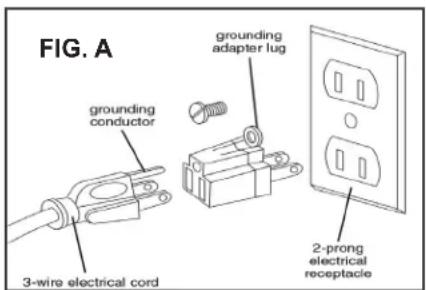
FIG. B
Sample of 220 volt plug required for this machine.

NEMA 6-15P
Consult a qualified electrician if the distance of the machine from the electrical panel is greater than 30 feet.

SAFETY INSTRUCTIONS
SPECIFIC SAFETY INSTRUCTIONS FOR DUST COLLECTORS
This machine is intended for the collection of chips, shavings and dust from the surfacing, cutting and sanding of natural wood, plywood, plastics and other man-made wood based composites. It is for collecting DRY materials only. Any other use not as specified, including modification of the machine or use of parts not tested and approved by the equipment manufacturer, can cause unforeseen damage and invalidate the warranty.
ATTENTION: Use of this dust collector still presents risks that cannot be eliminated by the manufacturer. Therefore, the user must be aware that wood working machines are dangerous if not used with care and all safety precautions are adhered to.
- Do not operate this machine until you have read all of the following instructions.
- Do not attempt to operate this machine until it is completely assembled.
- Do not turn ON this machine if any pieces are missing or damaged.
- If you are not familiar with the operation of the machine, obtain assistance from a qualified person.
- It is highly recommended that this machine be placed on a level surface.
- This machine must be properly grounded.
- Always wear approved protective eye wear and hearing protection when operating this machine.
- Always make sure the power switch is in the OFF position prior to plugging in the machine.
- Always make sure the power switch is in the OFF position and the machine is unplugged when doing any cleaning, assembly, setup operation, or when not in use.
- DO NOT use the dust collector for collecting liquids, substances impregnated with liquids, metals, gasoline or potentially flammable or combustible substances.
- DO NOT use the dust collector to dissipate fumes or smoke. NEVER pick up any material that is burning or smoking, such as cigarettes, matches or hot ashes.
- DO NOT use the dust collector without a filter bag and collector bag securely in place.
- DO NOT use the dust collector with unused intake ports uncapped. Always cover exposed intake ports.
- Always wear a dust mask when cleaning or working near a dust collector.
- Make sure all machine parts, hose connections and bags are securely tightened before operating the machine. Periodically check bags and hoses for rips or tears. If present, repair or replace immediately.
- The use of any accessories or attachments not recommended may cause injury to you and damage your machine.
- Never reach inside of a running machine. Always keep your hands, body parts and clothing clear of openings and moving parts such as impellers, fans and hose intake openings.
- Do not clear any hose blockage while the machine is running. Stop the machine, unplug it from the power source, and then remove the blockage in the hose.
- Keep these instructions for future reference.
This owner's manual is not a teaching aid and is intended to show assembly, adjustments, and general use.

CALIFORNIA PROPOSITION 65 WARNING: Some dust created by power sanding, sawing, grinding, drilling, and other construction activities contains chemicals known to the State of California to cause cancer and birth defects or other reproductive harm. Your risk from exposure to these chemicals varies, depending on how often you do this type of work. To reduce your exposure, work in a well-ventilated area and with approved safety equipment, such as dust masks that are specially designed to filter out microscopic particles.
For more detailed information about California Proposition 65 log onto rikontools.com.
CONTENTS OF PACKAGE 1
When unpacking, check to make sure the following parts are included. If any parts are missing or broken, please call RIKON Power Tools (877-884-5167) as soon as possible for replacements.

natural_image
Blue metal frame components including a flat plate, three curved cutouts, and three elongated metal strips (no text or symbols visible)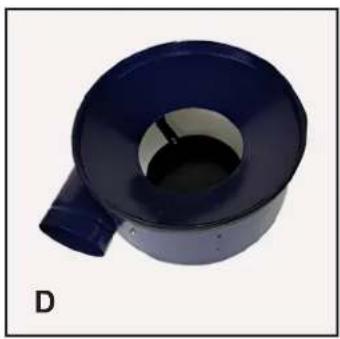
natural_image
Blue cylindrical mechanical component with a side protrusion, labeled 'D' in the corner (no other text or symbols)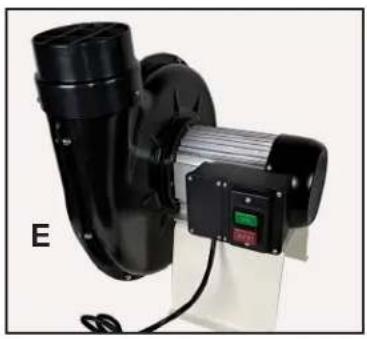
natural_image
Industrial machine with black housing and control panel (no visible text or symbols)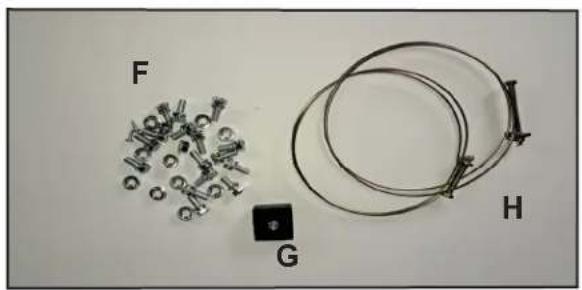
natural_image
Collection of mechanical components including screws, bolts, and coiled wires (no text or symbols visible)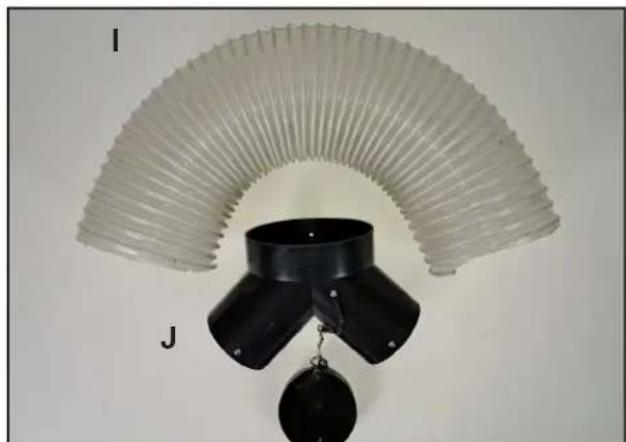
natural_image
Black mechanical component with a curved white fan-like structure and a hanging weight (no text or symbols visible)A Base Plate
B Casters with Hardware (4)
C Collector Supports (3)
D Collector
E Motor & Fan Housing
F Hardware Pack
G Rubber Motor Support
H Strap Clamps (2)
I 5" Hose
J 'Y' Inlet
K Collector Bag band clamp (not shown)
L Plastic Collection Bag (not shown)
Model 60-151C 1.5HP Dust Collector with Canister is shipped in two boxes.
Unpacking and Clean-up
- Carefully remove all contents from the shipping cartons. Compare the contents with the list of contents to make sure that all of the items are accounted for, before discarding any packing material. Place parts on a protected surface for easy identification and assembly. If any parts are missing or broken, please call RIKON Customer Service (877-884-5167) as soon as possible for replacements. DO NOT turn your machine ON if any of these items are missing. You may cause injury to yourself or damage to the machine.
- Report any shipping damage to your local distributor. Take photographs for any possible insurance claims.
- Clean any rust protected surfaces with ordinary house hold type grease or spot remover. Do not use; gasoline, paint thinner, mineral spirits, etc. These may damage painted surfaces.
- Set packing material and shipping carton aside. Do not discard until the machine has been set up and is running properly.
CONTENTS OF PACKAGE 2
When unpacking, check to make sure the following parts are included. If any parts are missing or broken, please call RIKON Power Tools (877-884-5167) as soon as possible for replacements.

natural_image
Exterior view of a mechanical component with labeled parts (A, B, C, D, E) and a meshed airfoil on a base (no text or symbols beyond labels)FIG. 1
A Canister
Tools Required for Assembly:
B Cannister Band Clamp
13mm wrench
C Hardware Pack
17mm wrench
D Interior Cleaning Flap
2 Phillips Screwdriver
E Cleaning Flap Handle
Model 60-151C 1.5HP Dust Collector with Canister is shipped in two boxes.
Unpacking and Clean-up
- Carefully remove all contents from the shipping cartons. Compare the contents with the list of contents to make sure that all of the items are accounted for, before discarding any packing material. Place parts on a protected surface for easy identification and assembly. If any parts are missing or broken, please call RIKON Customer Service (877-884-5167) as soon as possible for replacements. DO NOT turn your machine ON if any of these items are missing. You may cause injury to yourself or damage to the machine.
- Report any shipping damage to your local distributor. Take photographs for any possible insurance claims.
- Clean any rust protected surfaces with ordinary house hold type grease or spot remover. Do not use; gasoline, paint thinner, mineral spirits, etc. These may damage painted surfaces.
- Set packing material and shipping carton aside. Do not discard until the machine has been set up and is running properly.
CANISTER ASSEMBLY
INSTALL THE INTERIOR CANISTER FLAP
- Insert the Interior Cleaning Flap, Part E FIG.1, with the larger and longer threaded end first, down into the center of the Canister.
- Place a 15mm flat washer onto the lower, shorter threaded end of the Cleaning Flap. Push the Cleaning Flap up to allow enough room to put the bottom of the Cleaning Flap into the hole in the cross piece.
- Place a 15mm flat washer and M8 locking hex nut on the threaded end of the Cleaning Flap and tighten. Do not over tighten and the Cleaning Flap needs to be able to rotate.
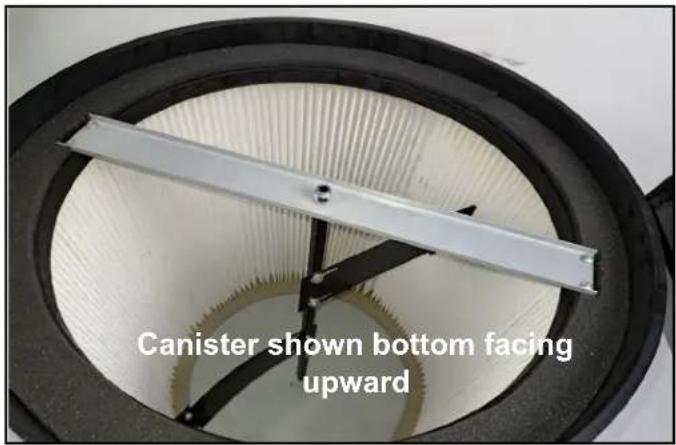
FIG. 2
INSTALL THE CLEANING FLAP HANDLE
- Turn the canister upright to attach the Cleaning Flap Handle.
- Thread the thin M10 hex nut onto the upper threaded end of the Cleaning Flap.
CAUTION: Do not over tighten because the Cleaning Flap needs to be able to rotate. - Place Cleaning Flap Handle on top of the thin nut.
- Place a 20mm flat washer, lock washer and M10 hex nut on the end of the Cleaning Flap and tighten. FIG. 3.
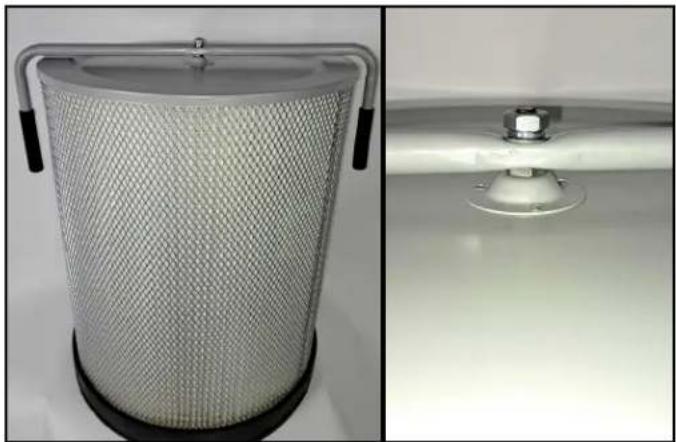
natural_image
Two views of a metallic cylindrical filter or filter device: one with mesh texture and black handles, the other with a small spherical component (no text or symbols visible)FIG. 3
ADJUSTING FLAPS
There are two adjustable flaps that you rotate inside of the canister to loosen dust from the pleated filter. These flaps are adjusted at the factory and should not need to be adjusted.
- If adjustment is needed, loosen the two M6 hex bolts and lock nuts that attach the plastic flappers to the center rod. Move the flap so that 1/8" of the flap is inside of the pleat. Tighten the two bolts and repeat on the second flap. FIG.4
CAUTION: Extending the flap too far into the pleat can damage the filter material and cause the filter to leak.
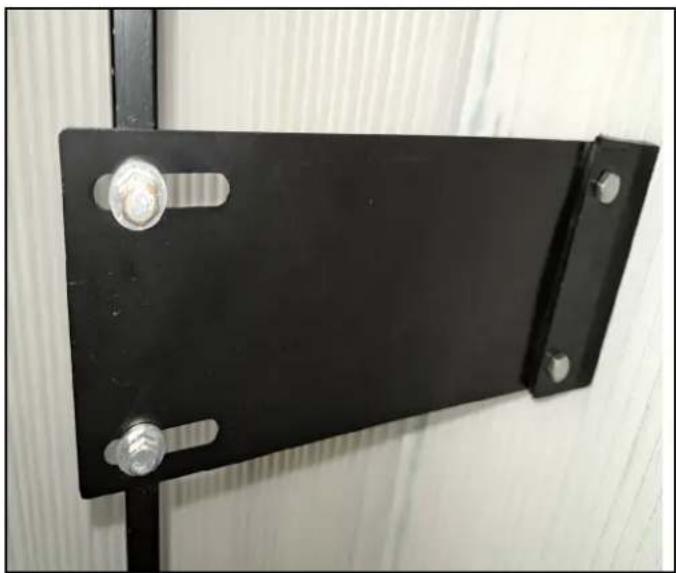
natural_image
Black metal bracket with two screws and a circular knob, mounted on a white wall (no text or symbols visible)FIG. 4
ASSEMBLY
INSTALL THE CASTERS ON THE BASE PLATE
Locate the four swivel casters, eight 12MM flat washers, and four 10MM hex cap nuts from the hardware pack. NOTE: Some of these fasteners may be already mounted on the caster stems.
- Insert the stud through one of the four holes in the corner bracket underneath the base plate.
- Place a flat washer and hex cap nut onto the threaded stud of the caster and tighten. FIG. 5.
- Repeat steps 1 and 2 for the remaining three swivel caster assemblies.
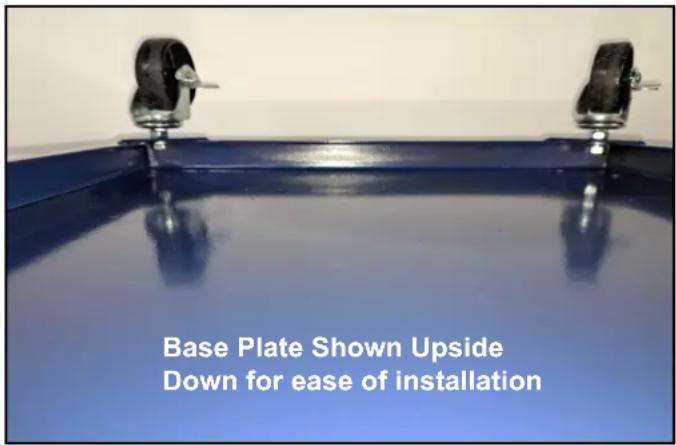
FIG. 5
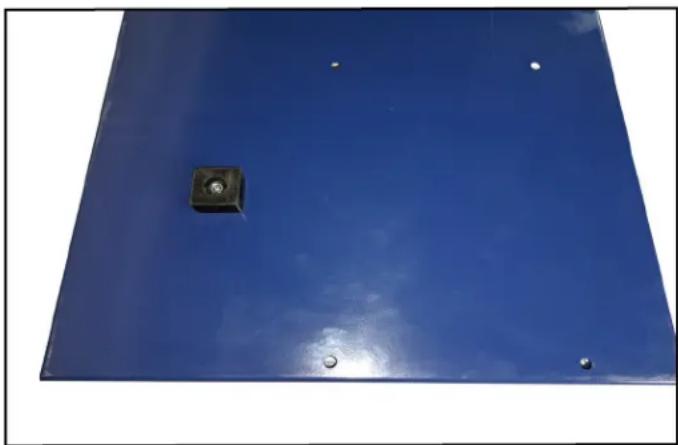
ATTACH THE FAN HOUSING RUBBER FOOT TO BASE PLATE
Locate the Rubber Foot, M4 bolt, Washer and Nut from the Parts Kit.
- Push the M4 bolt through the Rubber Foot and mounting hole in the Base Plate which is to the left of the 4 motor mount holes. FIG. 6.
- Place a washer and nut over the hex bolt and tighten to secure the rubber foot in place.
natural_image
Blue metal panel with four small circular holes and a central square marker, against a clear sky (no text or symbols)FIG. 6
MOUNT MOTOR & FAN ASSEMBLY TO THE BASE
Locate the motor & fan housing, four M8X20MM hex bolts, four M8 hex nuts, and four 8MM washers.
- Place the Motor and Fan Assembly Base (A) onto the Base Plate (B). Align the four holes in the Motor Base with the holes in Base Plate.
- Install a 20MM hex bolt with washer through the holes on the Assembly Base and secure it in place with a hex nut. Do not fully tighten. FIG. 7.
- Repeat step 2 for the remaining three mounting positions. Fully tighten all of the bolts at this time.

natural_image
Close-up of a white plate with two screws and a wrench, labeled A and B (no text or symbols on the objects themselves)FIG. 7
ASSEMBLY
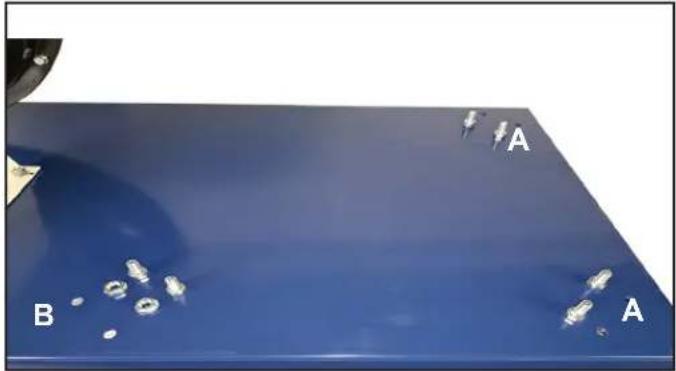
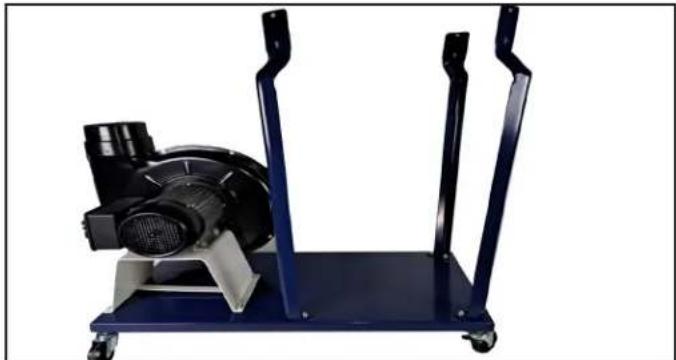
INSTALL THE COLLECTOR SUPPORTS
Locate the three collector supports, six M8X20MM hex bolts and two 8MM washers. The two mounting positions in the corners of the Base Plate (A) are threaded and do not require nuts. The third mounting location (B) does not have threads and requires hex nuts FIG. 8
- Position two of the collector support uprights over the two threaded holes (A) located in the corners of the base. FIG. 8. Insert hex bolts and washers through the collector supports into the threaded holes in the base (A) and tighten.
- NOTE: The support's bent sides must be facing inwards. See FIG. 9
- Position the third collector support upright of the non-threaded mounting holes (B) FIG.8. Insert hex bolts and washers through the collector support into the hole in the base and thread the M8 nuts on from under base and tighten.
INSTALL THE COLLECTOR
Locate the collector barrel, Six M8X15MM hex bolts, six 8MM washers, and six M8 hex nuts.
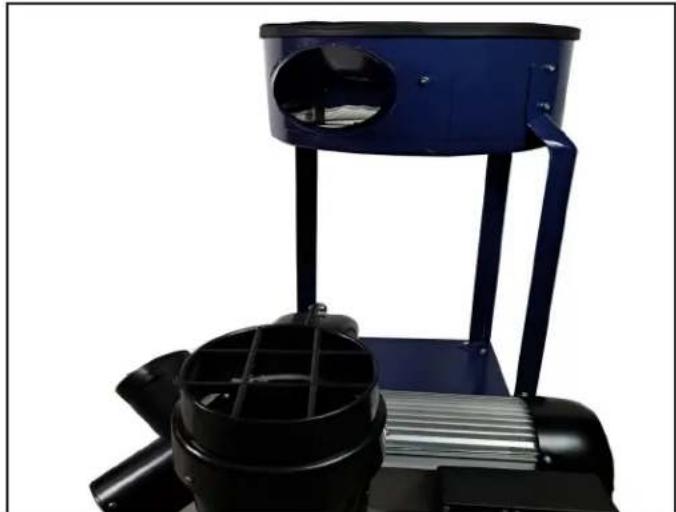
- With assistance, hold the collector in position and align the mounting holes with the 3 supports. Position the collector so that the 5" hose inlet is facing the fan housing. FIG.10.
- Insert the hex bolts and washers through the outside of the collector supports and collector. From the inside of the collector thread the M8 nuts onto the M8 hex bolts. Do not fully tighten the bolts at this time.
- Once all supports are in place, tighten all bolts. FIG. 11.
natural_image
Blue surface with scattered white circular marks labeled A and B, no readable text or symbols beyond labelsFIG. 8
natural_image
Blue industrial machine with black pump and support frame (no visible text or symbols)FIG. 9
natural_image
Close-up of a black industrial exhaust griddler with a circular vent and mesh fan (no text or symbols visible)FIG. 10

natural_image
Close-up of a hand holding a wrench on a blue car wheel (no text or symbols visible)FIG. 11
ASSEMBLY
INSTALL THE 5" HOSE
Locate the 5" hose and two hose clamps.
- Slip a hose clamp (A) over both ends of the hose.
- Place one end of the hose over the 5" outlet on the fan housing and the other end on the collector. FIG. 12.
- Tighten the hose clamps with a Phillips screwdriver.

FIG. 12
INSTALL THE CANISTER ON THE COLLECTOR
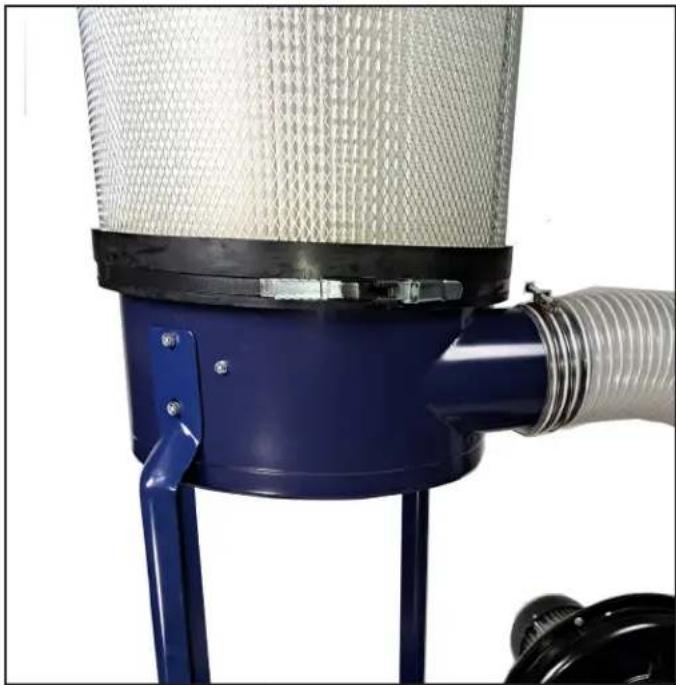
- Apply Adhesive Sealing Strip (B) FIG. 12 around the top of the collection housing.
- Place the Canister on over the top rim of the collector housing, making sure not to disturb the foam seals.
- Install the Strap Clamp around the base of the canister and lock it in place. FIG.13
natural_image
Close-up of a blue industrial dust collector with mesh filter and coiled hose (no visible text or symbols)FIG. 13
ASSEMBLY
- Place the filter Bag Fixing Ring over the top of the Collection Bag. Fold the Collection Bag over the Fixing Ring by approximately 3 inches. FIG. 14
- Insert the Fixing Ring with Bag at an angle all the way into the collector drum. FIG. 15
- Once the Fixing Ring is completely inside of the collector drum, pull down on the ring so that it snaps into the groove at the bade of the collector drum.
- Make sure that the fixing ring is fully seated in the grove at the bottom of the collector drum and the folded over portion of the bag hangs down close to 3 inches before turning the machine on.

natural_image
Close-up of hands holding a transparent plastic bag over a circular object (no text or symbols visible)FIG. 14

natural_image
Person handling a plastic bag wrapped in white material inside a blue industrial machine (no visible text or symbols)FIG. 15
MOUNTING THE 'Y' INLET
- Slide the 'Y' inlet over the large 6" opening on the fan housing, so that the mounting holes align.
- Secure the 'Y' inlet in place with the supplied Phillips head screws and washers. FIG. 16.
- The 'Y' Inlet has two 4" hose connections for use with two woodworking machines. A plastic cap is included (shown in FIG. 14 on the left) to plug one of the 4" inlets if only one machine hose is hooked up for dust collection. This allows the machines full suction power to be channeled to the open inlet.

natural_image
Close-up of a black industrial exhaust pump mounted on a blue platform, with plastic bag partially visible (no text or symbols)FIG. 16
OPERATION
INSTALL THE DUST HOSE
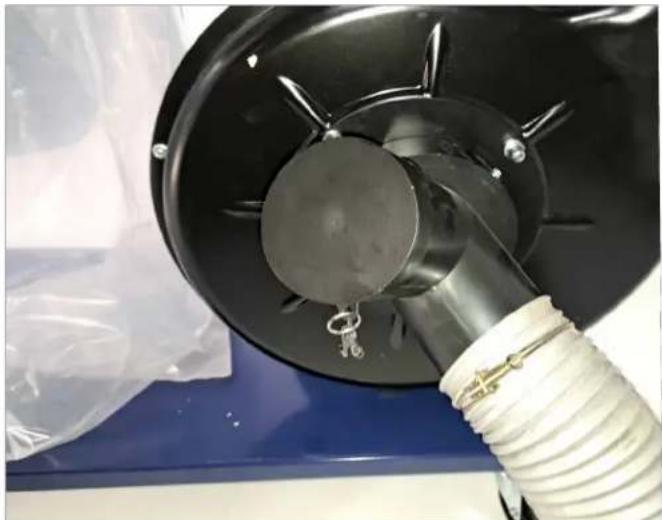
For using either 6" or 4" hoses, installing them onto the dust collector fitting(s) and your woodworking machine(s) is the same process. 4" hose shown in the following example. Fig. 17.
- Slip a hose clamp over both ends of the hose.
- Place one end of the hose over one of the 'Y' inlets two 4" inlets and tighten the hose clamp with a screwdriver or wrench.
- The other end of the hose can be installed directly onto the dust port of your woodworking machines (planer, jointer, bandsaw, etc.) Tighten the hose in place with the hose clamp.
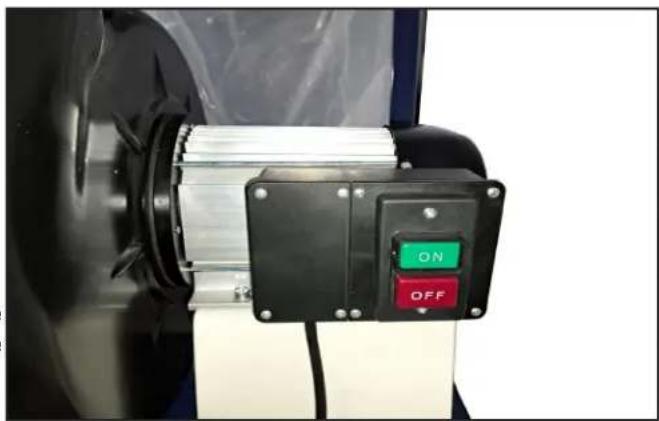
ON/OFF LOCKING SAFETY SWITCH
CAUTION: Make sure that the On/Off switch is in the "Off" position before plugging the dust collector into a power source. FIG.18
EMPTYING & CLEANING THE DUST COLLECTOR
CAUTION: Make sure that the dust collector is unplugged before cleaning or servicing.
Always wear a dust mask or respirator while emptying the collector bags or cleaning the canister. Please refer to the California Proposition 65 warning on page 6 of this manual regarding hazards from exposure to wood dust. For more detailed information visit www.rikontools.com or www.oehha.ca.gov.
natural_image
Close-up of a black industrial fan or pump component with a white hose inserted, no visible text or symbols.FIG. 17
natural_image
Close-up of a mechanical electric motor with a green ON/OFF button and black housing (no visible text or symbols)FIG. 18
- Rotate Cleaning Flap Handle (FIG.3 pg.9) 2 to 3 revolutions prior to each use of the Dust Collector.
- Lower Plastic Bag should be emptied prior to reaching 3/4 full to prevent excess dust from clogging the canister. See instruction to attach Lower Plastic bag on previous page.
- Inspect hose and 'Y' inlet regularly for blockages that can reduce the machines performance.
DUST HAZARDS AND SAFETY
GROUNDING THE DUCT WORK
Dust particles moving through flexible or rigid plastic duct work can cause static electricity build-up. The duct work must be properly grounded to ensure that static discharge does not ignite fine dust particles causing an explosion or fire.
To properly ground plastic duct work, simply run a small gauge bare copper wire through the ducting and have it emerge from the hose at the dust collector and at each dust producing machine. The bare copper wire should be bonded to the metal shell of each machine by means of a metal screw. The screw must be threaded into the metal shell to ensure a good connection.
The grounding of metal duct work is similar, the only difference is that there is no need to run the bare copper wire inside the ducting. It can be wrapped along the out side of the ducting and should be bonded to each machine as
PARTS DIAGRAM
60-151C
DUST
COLLECTOR
NOTE: Please reference the Key Number when calling for Replacement Parts.
For Parts under Warranty, the Serial Number of your machine is required.
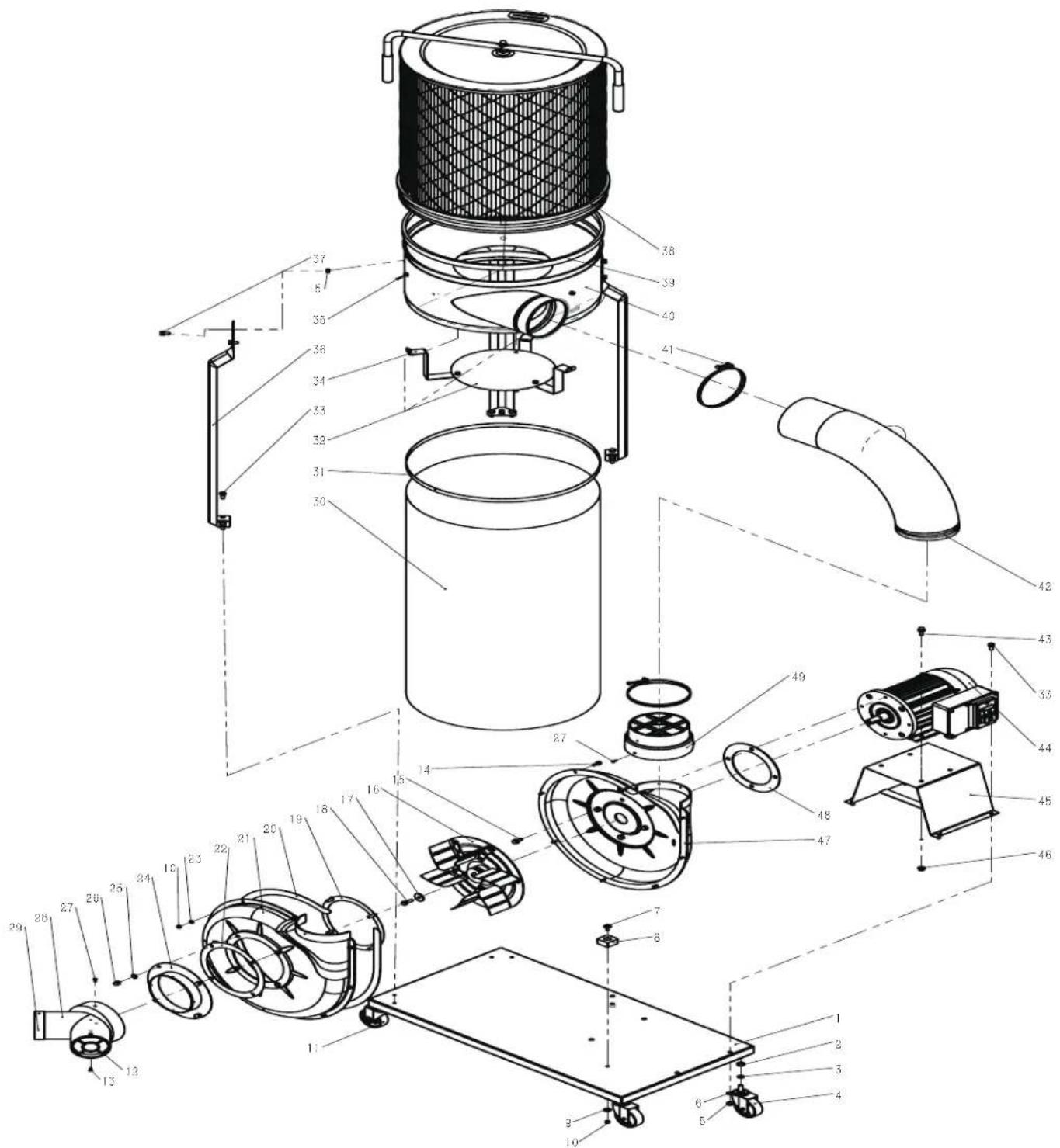
60-151C Dust Collector with Cannister
| KEY NO. | DESCRIPTION | QUANTITY | PART QUANTITY NO. | KEY NO. | DESCRIPTION | PART NO. | |
| 1 | Base | 1 | P60-151C-1 | 25 | Spring washer 8 | 4 | P60-151C-25 |
| 2 | Type I hex nut M10 | 4 | P60-151C-2 | 26 | Hex cap nut M8 | 4 | P60-151C-26 |
| 3 | Spring washer 10 | 4 | P60-151C-3 | 27 | Phillips screw | 6 | P60-151C-27 |
| 4 | Caster | 2 | P60-151C-4 | 28 | Inlet | 1 | P60-151C-28 |
| 5 | Type I hex nut M8 | 12 | P60-151C-5 | 29 | Inlet cap | 1 | P60-151C-29 |
| 6 | Flat washer 8 | 6 | P60-151C-6 | 30 | Plastic Dust bag | 1 | 60-902 |
| 7 | Hex-head bolt M6 x20 | 1 | P60-151C-7 | 31 | Filter bag fixing ring | 1 | P60-151C-31 |
| 8 | Rubber foot | 1 | P60-151C-8 | 32 | Dustfall plate | 1 | P60-151C-32 |
| 9 | Big flat washer 6 | 1 | P60-151C-9 | 33 | Hex-head bolt M8x20 | 1 | P60-151C-33 |
| 10 | Type I hex nut M6 | 15 | P60-151C-10 | 34 | Dustfall plate hook | 10 | P60-151C-34 |
| 11 | Caster with brakes | 2 | P60-151C-11 | 35 | Hex-head bolt M6x12 | 6 | P60-151C-35 |
| 12 | Inlet protection insert | 2 | P60-151C-12 | 36 | Bracket leg | 3 | P60-151C-36 |
| 13 | Phillips screw ST4.2 x 10 | 4 | P60-151C-13 | 37 | Hex-head bolt M8x18 | 6 | P60-151C-37 |
| 14 | Hex-head bolt ST6 x 20 | 8 | P60-151C-14 | 38 | Filter Canister | 1 | 60-905 |
| 15 | Hex-head bolt M8x20 | 4 | P60-151C-15 | 39 | Adhesive sealing strip | 1 | P60-151C-39 |
| 16 | Impeller | 1 | P60-151C-16 | 40 | Dust discharge bucket | 1 | P60-151C-40 |
| 17 | Impeller flat washer | 1 | P60-151C-17 | 41 | Clip | 2 | P60-151C-41 |
| 18 | Hex-head bolt M8x25 | 1 | P60-151C-18 | 42 | Pipe | 1 | P60-151C-42 |
| 19 | Inlet mounting ring | 1 | P60-151C-19 | 43 | Hex-head bolt M8x25 | 4 | P60-151C-43 |
| 20 | Housing Sealing strip | 1 | P60-151C-20 | 44 | Motor | 1 | P60-151C-44 |
| 21 | Inlet housing | 1 | P60-151C-21 | 45 | Motor base assembly | 1 | P60-151C-45 |
| 22 | Inlet sealing strip | 1 | P60-151C-22 | 46 | Hex nut M8 | 4 | P60-151C-46 |
| 23 | Flat washer 8 | 8 | P60-151C-23 | 47 | Motor housing | 1 | P60-151C-47 |
| 24 | 5" Inlet | 1 | P60-151C-24 | 48 | Motor gasket | 1 | P60-151C-48 |
| 49 | Outlet protective net | 1 | P60-151C-49 |
TROUBLESHOOTING
| PROBLEM POSSIBLE CAUSE | ||
| Motor does not start | 1. Machine not plugged in.2. Power switch in 'OFF' position.3. Power switch or cord is faulty.4. Fuse or circuit breaker are open.5. Low line voltage.6. Defective motor capacitor.7. Motor does not work. | 1. Plug cord into electrical outlet.2. Lift switch to 'ON' position.3. Replace switch or cord.4. Correct overloaded electrical circuit.5. Correct low line voltage condition.6. Replace motor capacitor.7. Repair or replace the motor. |
| Motor runs hot | 1. Restricted air flow due to dirty canister or blockage in the hoses.2. Motor overloaded.3. Extension cord is used.4. Machine used for extended time.5. Poor air flow in work area. | 1. Clean canister and hoses for maximum air flow through the system.2. Reduce load on the motor.3. Do not use an extension cord. Plug the collector directly into an outlet.4. Reduce run time of machine.5. Reposition machine for better air flow. |
| Motor stalls or does not have full power | 1. Incorrect line voltage.2. Motor capacitor has failed.3. Extension cord is being used.4. Impeller is clogged with debris. | 1. Have qualified electrician check circuit for proper line voltage.2. Replace motor capacitor.3. Do not use an extension cord. Plug the collector directly into an outlet.4. Clean debris from blocked impeller. |
| Reduction of dust collection suction power | 1. Malfunction of the canister cleaning system.2. Plugged hose lines.3. Dust collection bag full.4. Canister pleated material is wet.5. Canister is dirty or permeability of the canister has increased. | 1. Check all system components.2. Check and clean inlets and hoses for obstructions.3. Empty collection bag and check all connections for leakage.4. Control intake of moisture.Dry wet canister for re-use.5. Clean or replace canister. |
| Loud or unusual noises from motor or fan | 1. Motor, fan housing, base or parts of the frame are loose.2. Impeller fan is rubbing the housing.3. Motor bearings are loud.4. Impeller fan is loose, unbalanced, or damaged. | 1. Inspect and tighten all parts or replace as needed.2. Check position of the fan and adjust or replace any loose/damaged parts.3. Replace worn bearings.4. Secure fan on motor shaft, and replace if any damage is found. |
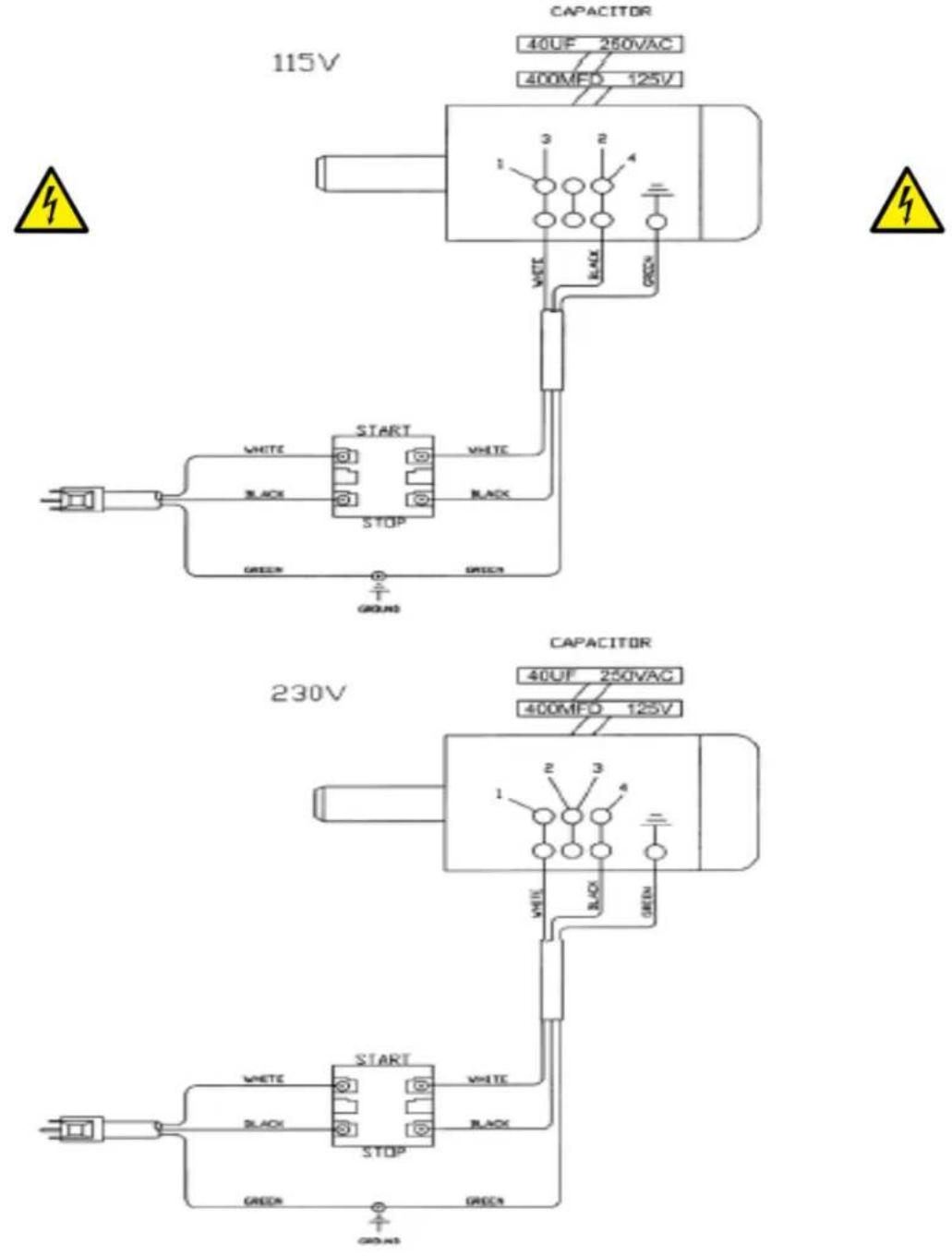
WIRING DIAGRAM

WARNING:
This machine must be grounded. Replacement of the power supply cable should only be done by a qualified electrician. See page 5 for additional electrical information.
Wiring Diagram - 60-151C Dust Collector
MAINTENANCE
WARNING:
Turn the power switch "OFF" and disconnect the plug from the outlet prior to adjusting or maintaining the machine. DO NOT attempt to repair or maintain the electrical components of the motor. Contact a qualified service technician for this type of maintenance.
-
Before each use:
-
Check the power cord and plug for any wear or damage.
- Check for any loose screws or hardware.
-
Check the area to make sure it is clear of any misplaced tools, lumber, cleaning supplies, etc. that could hamper the safe operation of the machines being used.
-
To avoid a build-up of wood dust, regularly clean all parts of your machines using a soft cloth, brush or compressed air. A general cleaning should be done after every use to avoid future problems and ensure the machines are in ready condition for the next time that they are used.
WARNING: If blowing sawdust, wear proper eye protection to prevent debris from blowing into eyes.
- Check the duct work and hoses to make sure that there are no loose connections. Making sure that they are in proper operating condition will ensure that the dust collection will be the best possible.
- Clean the upper filtering bag, or canister, on a regular basis to prevent the build-up of dust for better dust collection and air filtration. Check for abrasion, tears or damage.
WARNING: Always wear a dust mask or respirator while emptying the collector bags or cleaning the dust collector.
Please refer to the California Proposition 65 warning on page 6 of this manual regarding hazards from exposure to wood dust. For more detailed information visit www.rikontools.com or www.oehha.ca.gov.
- The motor does not need any maintenance as it is equipped with sealed, lubricated ball bearings.
WARRANTY
RIKON
POWER TOOLS®
5-Year Limited Warranty
RIKON Power Tools Inc. ("Seller") warrants to only the original retail consumer/purchaser of our products that each product be free from defects in materials and workmanship for a period of five (5) years from the date the product was purchased at retail. This warranty may not be transferred.
This warranty does not apply to defects due directly or indirectly to misuse, abuse, negligence, accidents, repairs, alterations, lack of maintenance or normal wear and tear. Under no circumstances will Seller be liable for incidental or consequential damages resulting from defective products. All other warranties, expressed or implied, whether of merchantability, fitness for purpose, or otherwise are expressly disclaimed by Seller. This five-year warranty does not cover products used for commercial, industrial or educational purposes. The warranty term for these claims will be limited to a two-year period.
This limited warranty does not apply to accessory items such as blades, drill bits, sanding discs, grinding wheels, belts, guide bearings and other related items.
Seller shall in no event be liable for death, injuries to persons or property, or for incidental, contingent, special, or consequential damages arising from the use of our products.
To take advantage of this warranty, proof of purchase documentation must be provided which has the date of purchase and an explanation of the complaint.
The Seller reserves the right to effect at any time, without prior notice, those alterations to parts, fittings, and accessory equipment which they may deem necessary for any reason whatsoever.
To register your machine online, visit RIKON at www.rikontools.com/warranty
To take advantage of this warranty, or if you have any questions, please contact us at 877-884-5167 or email warranty@rikontools.com

For more information:
25 Commerce Way
North Andover, MA 01845
877-884-5167 / 978-528-5380
techsupport@rikontools.com
- HP Dust Collector
- Operator's Manual
- SAFETY INSTRUCTIONS
- SAFETY SYMBOLS
- DANGER
- Indicates a WARNING injury.
- CAUTION indicates a moderate i
- GENERAL SAFETY
- BEFORE USING YOUR MACHINE
- ELECTRICAL SAFETY
- REPLACE A DAMAGED OR WORN CORD IMMEDIATELY.
- EXTENSION CORDS
- SPECIFIC SAFETY INSTRUCTIONS FOR DUST COLLECTORS
- This owner's manual is not a teaching aid and is intended to show assembly, adjustments, and general use.
- CONTENTS OF PACKAGE 1
- Unpacking and Clean-up
- CONTENTS OF PACKAGE 2
- Phillips Screwdriver
- CANISTER ASSEMBLY
- INSTALL THE INTERIOR CANISTER FLAP
- INSTALL THE CLEANING FLAP HANDLE
- ADJUSTING FLAPS
- ASSEMBLY
- INSTALL THE CASTERS ON THE BASE PLATE
- ATTACH THE FAN HOUSING RUBBER FOOT TO BASE PLATE
- MOUNT MOTOR & FAN ASSEMBLY TO THE BASE
- INSTALL THE COLLECTOR SUPPORTS
- INSTALL THE COLLECTOR
- INSTALL THE 5" HOSE
- INSTALL THE CANISTER ON THE COLLECTOR
- MOUNTING THE 'Y' INLET
- OPERATION
- INSTALL THE DUST HOSE
- ON/OFF LOCKING SAFETY SWITCH
- EMPTYING & CLEANING THE DUST COLLECTOR
- DUST HAZARDS AND SAFETY
- GROUNDING THE DUCT WORK
- PARTS DIAGRAM
- TROUBLESHOOTING
- WIRING DIAGRAM
- WARNING:
- MAINTENANCE
- WARRANTY
- RIKON
- POWER TOOLS®
- 5-Year Limited Warranty
Brand : RIKON
Model : 60-151C
Category : Vacuum Cleaner