010-LED - Measurement PCE Instruments - Free user manual and instructions
Find the device manual for free 010-LED PCE Instruments in PDF.


User questions about 010-LED PCE Instruments
0 question about this device. Answer the ones you know or ask your own.
Ask a new question about this device
Download the instructions for your Measurement in PDF format for free! Find your manual 010-LED - PCE Instruments and take your electronic device back in hand. On this page are published all the documents necessary for the use of your device. 010-LED by PCE Instruments.
USER MANUAL 010-LED PCE Instruments
text_image
QR code image containing encoded data, no visible human-readable textUser manuals in various languages (français, italiano, español, português, nederlands, türk, polski, русский, 中文) can be found by using our product search on: www.pce-instruments.com
Last change: 16 July 2020
v1.0
Contents
1 Safety notes....1
2 Operation....2
3 Technical specifications .... 2
4 Delivery contents .... 3
5 Calibration .... 3
6 Important notes:....3
7 Contact....3
8 Disposal 3
1 Safety notes
Please read this manual carefully and completely before you use the device for the first time. The device may only be used by qualified personnel and repaired by PCE Instruments personnel.
Damage or injuries caused by non-observance of the manual are excluded from our liability and not covered by our warranty.
- The device must only be used as described in this instruction manual. If used otherwise, this can cause dangerous situations for the user and damage to the meter.
- The instrument may only be used if the environmental conditions (temperature, relative humidity, ...) are within the ranges stated in the technical specifications. Do not expose the device to extreme temperatures, direct sunlight, extreme humidity or moisture.
- Do not expose the device to shocks or strong vibrations.
- The case should only be opened by qualified PCE Instruments personnel.
- Never use the instrument when your hands are wet.
- You must not make any technical changes to the device.
- The appliance should only be cleaned with a damp cloth. Use only pH-neutral cleaner, no abrasives or solvents.
- The device must only be used with accessories from PCE Instruments or equivalent.
- Before each use, inspect the case for visible damage. If any damage is visible, do not use the device.
- Do not use the instrument in explosive atmospheres.
- The measurement range as stated in the specifications must not be exceeded under any circumstances.
- Non-observance of the safety notes can cause damage to the device and injuries to the user.
We do not assume liability for printing errors or any other mistakes in this manual.
We expressly point to our general guarantee terms which can be found in our general terms of business.
If you have any questions please contact PCE Instruments. The contact details can be found at the end of this manual.
2 Operation
At the beginning of the measuring process, the prism cover and prism must be carefully cleaned and then dried. Now place 1-2 drops of the sample on the prism. When the prism cover is closed, the sample is distributed evenly between the cover and prism. To place the sample on the prism, you can use the pipette. Please ensure that no air bubbles are formed - this would impair the measurement result. By moving the prism cover slightly, the sample liquid can be distributed evenly. Switch on the LED illumination on the prism cover and look through the eyepiece. By turning the eyepiece, you can adjust the sharpness of the displayed scale. The value can be read from the line between the light/dark boundary. To prevent deposits from forming on the prism and its cover, the instrument should be carefully cleaned and dried after each measurement. Clean the refractometer with a soft cloth. Never clean the instrument with running water as this could enter the LED illumination in the prism cover and lead to its destruction.
The refractometers work according to the principle of light refraction. With these instruments you can easily and accurately determine the concentration of e. g. starch, glues, adhesives, etc., the mixing ratio of liquid media and the sugar content of milk, juice, wine, etc. Therefore, the instruments can be used in many industries as a quick measuring instrument in production and laboratory. Several models, all with automatic temperature compensation (ATC), are available.
3 Technical specifications
| Model | PCE-010 LED | PCE-032-LED | PCE-OE LED |
| Measurement range | 0 ... 10 % Brix | 0 ... 32 % Brix | 0 ... 140 °Oe32 % sucrose (Brix) |
| Resolution | 0.1 % Brix | 0.2 % Brix | 2 °Oe0.2 % sucrose (Brix) |
| Accuracy | ±0.1 % | ±0.2 % | ±2 °Oe±0.2 % sucrose (Brix) |
| ATC | Yes | Yes | Yes |
| Dimensions | 200 x 35 mm | 180 x 35 mm | 180 x 35 mm |
| Weight | 140 g | 140 g | 130 g |
| Scope of application | Fruit, juice, oils, cutting oils, lubricants | Emulsions, cooling lubricants, glues, starches | Wines |
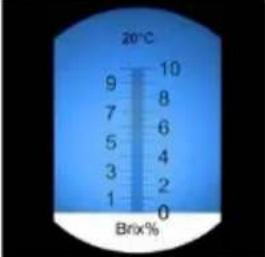 | 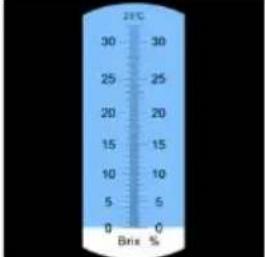 | 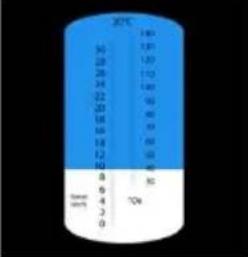 |
4 Delivery contents
refractometer, pipette, adjusting screwdriver, cleaning cloth, user manual, carrying case
5 Calibration
The instrument must also be carefully cleaned and dried before calibration. Now apply 1-2 drops of distilled water to the prism. If the light/dark line is not at 0 % (waterline), this can be adjusted using the calibration screw on the top of the instrument, behind the prism cover. The screwdriver included in the delivery is used for this purpose.
6 Important notes:
- The prism cover and the prism should be kept clean; dirt impairs the measuring accuracy.
- Avoid scratches on the prism and the hinged cover; these also have a negative effect on the measurement.
- Do not use harsh, aggressive cleaning agents but only a damp cloth. Then dry the device well. Never clean the unit under water as this could enter the instrument.
- Avoid shocks and impacts as this can destroy the optics.
- Store the instrument in a dry place.
7 Contact
If you have any questions, suggestions or technical problems, please do not hesitate to contact us. You will find the relevant contact information at the end of this user manual.
8 Disposal
For the disposal of batteries in the EU, the 2006/66/EC directive of the European Parliament applies. Due to the contained pollutants, batteries must not be disposed of as household waste. They must be given to collection points designed for that purpose.
In order to comply with the EU directive 2012/19/EU we take our devices back. We either re-use them or give them to a recycling company which disposes of the devices in line with law.
For countries outside the EU, batteries and devices should be disposed of in accordance with your local waste regulations.
If you have any questions, please contact PCE Instruments.

text_image
Pb www.pce-instruments.com
PCE Instruments contact information
Germany France Spain
PCE Deutschland GmbH PCE Instruments France EURL PCE Ibérica S.L.
Im Langel 4 23, rue de Strasbourg Calle Mayor, 53
D-59872 Meschede 67250 Soultz-Sous-Forets 02500 Tobarra (Albacete)
Unit 11 Southpoint Business Park
Ensign Way, Southampton
Hampshire
United Kingdom, SO31 4RF
Tel: +44 (0) 2380 98703 0
Fax: +44 (0) 2380 98703 9
info@pce-instruments.co.uk
www.pce-instruments.com/english
Italy
PCE Italia s.r.l.
Via Pesciatina 878 / B-Interno 6
55010 Loc. Gragnano Pehlivan Sok. No.6/C
Capannori (Lucca)
Italia
www.pce-instruments.com/turkish
The Netherlands
PCE Brookhuis B.V.
Institutenweg 15
7521 PH Enschede
Nederland
Telefoon: +31 (0)53 737 01 92
info@pcebenelux.nl
www.pce-instruments.com/dutch
China
PCE (Beijing) Technology Co., Limited
1519 Room, 6 Building
Zhong Ang Times Plaza
No. 9 Mentougou Road, Tou Gou District
102300 Beijing, China
Tel: +86 (10) 8893 9660
info@pce-instruments.cn
www.pce-instruments.cn
Hong Kong
PCE Instruments HK Ltd.
Unit J, 21/F., COS Centre
56 Tsun Yip Street
Kwun Tong
Kowloon, Hong Kong
Tel: +852-301-84912
jyi@pce-instruments.com
www.pce-instruments.cn
United States of America
PCE Americas Inc.
711 Commerce Way suite 8
Jupiter / Palm Beach
33458 FL
USA
Tel: +1 (561) 320-9162
Fax: +1 (561) 320-9176
info@pce-americas.com
www.pce-instruments.com/us