PE-604 - Speaker TOA - Free user manual and instructions
Find the device manual for free PE-604 TOA in PDF.


User questions about PE-604 TOA
0 question about this device. Answer the ones you know or ask your own.
Ask a new question about this device
Download the instructions for your Speaker in PDF format for free! Find your manual PE-604 - TOA and take your electronic device back in hand. On this page are published all the documents necessary for the use of your device. PE-604 by TOA.
USER MANUAL PE-604 TOA
Thank you for purchasing TOA's Pendant Speakers.
Please carefully follow the instructions in this manual to ensure long, trouble-free use of your equipment.
1. SAFETY PRECAUTIONS
- Before installation or use, be sure to carefully read all the instructions in this section for correct and safe operation.
- Be sure to follow all the precautionary instructions in this section, which contain important warnings and/or cautions regarding safety.
• After reading, keep this manual handy for future reference.

WARNING
Indicates a potentially hazardous situation which, if mishandled, could result in death or serious personal injury.
- Install the unit only in a location that can structurally support the weight of the unit and the mounting bracket. Doing otherwise may result in the unit falling down and causing personal injury and/or property damage.
- Do not use other methods than specified to mount the bracket. Extreme force is applied to the unit and the unit could fall off, possibly resulting in personal injuries.
- Tighten all screws securely. If any is loosely fixed, this may cause the unit to fall, resulting in personal injury.

CAUTION
Indicates a potentially hazardous situation which, if mishandled, could result in moderate or minor personal injury, and/or property damage.
- To avoid electric shocks, be sure to switch off the amplifier's power when connecting speakers.
- Do not operate the unit for an extended period of time with the sound distorting. This is an indication of a malfunction, which in turn can cause heat to generate and result in a fire.
- Do not hang down from the unit as this may cause it to fall down or drop, resulting in personal injury and/or property damage.
2. GENERAL DESCRIPTION
The PE-304 pendant speakers are designed for ceiling suspension installations.
Considered in architectural design, they can blend in with lighting equipment.
A directly-attached 5 m (16.4 ft) speaker cord allows the speaker to be suspended from the high ceiling.
The PE-304 is driven on both high-impedance (100 V and 70 V) and low-impedance (8 Ω) lines.
The input power (impedance) can be easily changed at the upper side of the speaker.
The speakers are easy to repaint so as to meet a wide range of design needs.
3. SPECIFICATIONS
| Model No. | PE-304 | ||
| Enclosure | Bass-reflex type | ||
| Rated Input | 30 W (100 V, 70 V line, 8 Ω) | ||
| Rated Impedance | Low | 8 Ω | |
| 100 V line | 330 Ω (30 W), 500 Ω (20 W), 670 Ω (15 W), 1 kΩ (10 W), 2 kΩ (5 W) | ||
| 70 V line | 170 Ω (30 W), 250 Ω (20 W), 330 Ω (15 W), 500 Ω (10 W), 1 kΩ (5 W) | ||
| Sensitivity(500 – 5,000 Hz, pink noise) | 91 dB (1 W, 1 m) | ||
| Frequency Response | 70 – 20,000 Hz (at 20 dB below peak) | ||
| Speaker Component | 12 cm (5") cone type + balanced dome-tweeter | ||
| Speaker Cord | 2-core cabtyre cord 5 m (16.4 ft) | ||
| Application Cable | 600 V vinyl-insulated cable (IV wire or HIV wire)Solid wire: ø0.8 – ø1.6 mm (equivalent to AWG 20 – 14)7-core twisted wire: 0.75 – 1.25 mm2 (equivalent to AWG 18 – 16) | ||
| Connection | Push-in connector (bridging terminal of 2 branch type) | ||
| Finish | Enclosure: HIPS resin, off white (RAL 9010 or equivalent color)Grille: Surface-treated steel plate net, off white (RAL 9010 or equivalent color), paint | ||
| Dimensions (unit only) | ø186 x 251 (h) mm (ø7.32" x 9.88") | ||
| Weight (unit only) | 2.1 kg (4.63 b) | ||
| Accessories | Ceiling bracket ..... 1, Mounting hanger ..... 1, Ceiling cover ..... 1, Tapping screw 4 x 16 ..... 4 | ||
Note: The design and specifications are subject to change without notice for improvement.
4. WIRING DIAGRAMS
4.1. PE-64

text_image
Rotary switch OFF o OFF o OFF o HOT 10 kΩ 3.3 kΩ 1.7 kΩ COM Matching transformer 8 Ω + 0 - (Factory-preset wiring) COM4.2. PE-304

text_image
Rotary switch 1 8 Ω HOT COM 2 kΩ 1 kΩ 670 Ω 500 Ω 330 Ω COM Matching transformer 16 Ω 0 8 Ω 0 Rotary switch 2 8 Ω OFF OFF 70 V OFF 100 V Network 8 Ω + - SP1 + - SP2 - (Factory-preset wiring)5. INPUT POWER (IMPEDANCE) CHANGE
Important
Be sure to follow the instructions below. Failure to do so may cause damage to the speaker.
- Switch off the amplifier's power when changing the input power.
- Never make 8 Ω connection in a 100 V or 70 V line system, as excessive input power is applied to the speaker, possibly resulting in damage. (PE-304)
5.1. PE-64
The input power (impedance) is factory-preset to 6 W (1.7 kΩ) for 100 V line and 3 W (1.7 kΩ) for 70 V line.
When changing this setting, use a standard screwdriver to rotate the rotary switch on the upper side of the speaker to the desired position
| Impedance | 1.7 kΩ | 3.3 kΩ | 10 kΩ |
| 100 V line | 6 W | 3 W | 1 W |
| 70 V line | 3 W | 1.5 W | 0.5 W |
5.2. PE-304
The input power (impedance) is factory-preset to 30 W (330 Ω) for 100 V line.
When changing this setting, use a standard screwdriver to rotate the rotary switches on the upper side of the speaker to the desired position.
| Input power 3 | 0 W 20 | W 15 W | 10 W 5 W | ||
| 100 V line | 330 Ω | 500 Ω | 670 Ω | 1 kΩ | 2 kΩ |
| 70 V line | 170 Ω | 250 Ω | 330 Ω | 500 Ω | 1 kΩ |

text_image
70V LINE 0.5W 1.5W 3W OFF 6W 3W 1W 100V INFNote
Shown above is an example when the input power is set to 3 W on 100 V line and 1.5 W on 70 V line.

text_image
OFF OFF 70V OFF 100V 8Ω LINE VOL INPUT 30W 20W 15W 10W 5WNote
Shown above is an example when the input power is set to 20 W on 100 V line.
(1) When operating at high impedance (100 V and 70 V lines);
Set the rotary switch of "LINE VOL." to "100 V" or "70 V" and that of "INPUT" to the input power to be used.
(2) When operating at low impedance;
Set both rotary switches of "LINE VOL" and "INPUT" to 8 Ω.
6. INSTALLATION
Step 1. Secure the ceiling bracket to the ceiling with 4 screws.
Pull both the lead-in and lead-out cables through the cable hole in the bracket.
Lead-in and lead-out cables

text_image
Ceiling Ta No IfCeiling bracket (accessory)
Tapping screw 4 x 16 (accessory)
Note
If these screws are not appropriate for the ceiling material, separately prepare the proper screws.
Step 2. Pass the speaker cord through the supplied ceiling cover, and cut the cord to the desired length.
Note: Strip the end of speaker cord as illustrated.
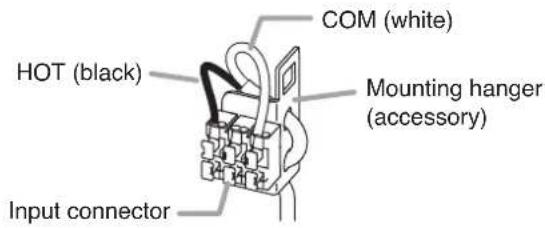
Step 3. Run the speaker's cable through the cable holes in the mounting hanger, then connect it to the input connector.
text_image
HOT (black) COM (white) Mounting hanger (accessory) Input connectorStep 4. Put the mounting hanger onto the ceiling bracket's hook.

text_image
Speaker cord 5 m (16.4 ft) Ceiling cover (accessory) 9 mm (0.35") Cover-retaining nut TightensLoosens
text_image
Ceiling bracket (accessory) Ceiling Mounting hanger (accessory) Lead-in and lead-out cablesStep 5. Connect both the lead-in and lead-out cables to the input connector.
[Applicable cable]
- Solid wire: 0.8 - 1.6 mm (equivalent to AWG 20 - 14)
- Stranded wire (7-core): 0.75 – 1.25 mm ^2 (equivalent to AWG 18 – 16)

text_image
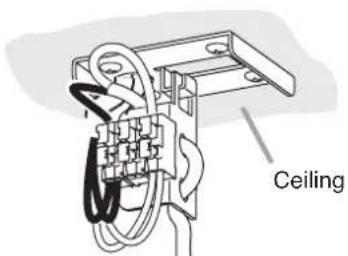
From the amplifier Ceiling Input connector To the next speaker 9 mm (0.35")Step 6. Push the ceiling cover, slipped over the cord in Step 2, onto the ceiling surface, then tighten the cover-retaining nut using a 17 mm (0.67") hex wrench.
In the case of exposed wiring, notch the cable entry tab on the rim of the cover, then make connections.
text_image
Ceiling
natural_image
Simple line drawing of a hanging lamp with a conical base and handle (no text or symbols)
text_image
In the case of exposed wiring Installation view Notch this thin tab. (another tab is on the opposite side.) Ceiling cover Ceiling cover Cover-retaining nut TightensLoosens7. REPAINTING THE SPEAKER
Follow the procedure below when repainting the speaker cover and mesh net.
Note: Never touch the inner speaker diaphragm during work.
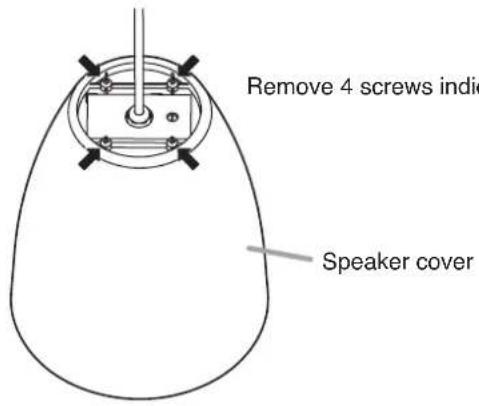
Step 1. Remove 4 screws on the upper side of the speaker cover to detach the cover.
text_image
Remove 4 screws indie Speaker coverStep 2. Remove 3 screws that fix the mesh net, then raise the turndown tabs of the mesh net to detach.

text_image
net, mesh Remove 3 screws indicated by arrows. Mesh net Raise the turndown tab.Step 3. Clean the speaker cover and mesh net.
Wipe with a soft cloth damped in a detergent.
Note
Do not use thinner or other volatile liquids to clean them as doing so may cause deformation.
Step 4. Use spray paint to apply uniform and thin coat of paint.
Notes
- Avoid painting with a roller or brush, as the mesh net could become clogged with paint.
- Use appropriate paints for the speaker cover and mesh net materials.
- Speaker cover: Rolled steel plate (acrylic paint)
- Mesh net: Fire-resistant HIPS resin
Step 5. After the paint has dried, apply another light coat.
Repeating Step 4, apply 2 or more light coats of paint. Application of one thick coat of paint all at once may cause drips or unevenness to show up in the painted finish, or clog the mesh holes.
Step 6. After the paint has dried, replace the speaker cover and mesh net.