
FGC-A204BNF - Microwave Oven Infiniton - Free user manual and instructions
Find the device manual for free FGC-A204BNF Infiniton in PDF.


| Product Type | Freestanding Refrigerator with Freezer |
| Model | FGC-A204BNF / FGC-340C20BEM / FGC-340C20XEN |
| Total Net Capacity | 340 L |
| Fridge Compartment Capacity | 248 L |
| Freezer Compartment Capacity | 92 L |
| Freezer Star Rating | 4 Star (-18°C) |
| Freezing Capacity | 5 kg/24h |
| Dimensions (W x D x H) | 590 x 595 x 2020 mm |
| Net Weight | 62 kg |
| Gross Weight | 68 kg |
| Power Supply | 220-240 V ~ 50 Hz |
| Rated Current | 1.5 A |
| Annual Energy Consumption | 303 kWh/year |
| Energy Efficiency Class | F/E |
| Climate Class | N/ST (16°C to 38°C) |
| Noise Level | 42 dB |
| Refrigerant | R600a (Isobutane, flammable) |
| Defrosting | Automatic |
| Reversible Door | Yes |
| Number of Glass Shelves (Fridge) | 3 |
| Vegetable Crisper | 1 (transparent plastic) |
| Freezer Drawers | 3 (transparent plastic) |
| LED Lighting | Yes (top) |
| Egg Tray | 1 |
| Ice Box | 1 |
| Inverter Compressor | Yes |
Frequently Asked Questions - FGC-A204BNF Infiniton
User questions about FGC-A204BNF Infiniton
0 question about this device. Answer the ones you know or ask your own.
Ask a new question about this device
Download the instructions for your Microwave Oven in PDF format for free! Find your manual FGC-A204BNF - Infiniton and take your electronic device back in hand. On this page are published all the documents necessary for the use of your device. FGC-A204BNF by Infiniton.
USER MANUAL FGC-A204BNF Infiniton
natural_image
Interior view of a kitchen with two large refrigerator units, one white and one metallic, placed on tiled flooring (no text or symbols visible)FGC-340C20BEM
FGC-A204BNF
FGC-340C20XEN
FGC-A204INF
natural_image
Two stick figures pulling a large gray diamond shape (no text or symbols)- Ubicación
natural_image
Two gray rectangular panels with checkmark and cross symbols, no text or labels present- Instalación
natural_image
Symbol of a trash bin crossed with a diagonal line and a horizontal bar below (no text or labels)
natural_image
Simple line drawing of a rectangular object with two small square markers and a small labeled object on top (no text or symbols)1

natural_image
Simple line drawing of a rectangular object with labeled dimensions (no text or symbols)2
natural_image
Diagram of a refrigerator with open door and side compartments, showing an upward arrow (no text or symbols)3
natural_image
Illustration of a refrigerator with doors and control panel (no text or symbols)4
natural_image
Diagram showing a vehicle enclosed in a rectangular frame with a curved dashed line and 190° angle indicator (no text or symbols)5

natural_image
Diagram showing two identical electronic components with a right-pointing arrow indicating transformation (no text or symbols)6

7

natural_image
Front view of a white industrial cabinet with three compartments and control panel (no visible text or symbols)8

natural_image
Hand-drawn sketch of an open refrigerator with shelves (no text or symbols)9

natural_image
Simple line drawing of a hand holding a rectangular object (no text or symbols)10
INFINITON
Refrigerator

natural_image
Line drawing of a kitchen interior with two large refrigerator units, one white and one metallic, placed in a clean room with microwave and oven (no text or symbols)FGC-340C20BEMFGC-340C20XEN
ean: 8445639004036 ean: 8445639004043
Before using your new Infiniton product, please read this user manual carefully to learn how to safely and efficiently use the features offered by this device.
Index
English
Before use 20
Tips for special needs 21
Safety information 22
Before use 26
How to use 27
Food storage instructions 29
Cleaning and maintenance 32
Troubleshooting 33
Reverse door 34
Installation & location
1. Ventilation conditions
The location you select for the installation of the appliance should be well ventilated. Do not locate the appliance near a heat source such as cookers, boilers, and avoid direct sunlight, thus ensuring the cooling effect and saving on energy consumption. Do not place it in a damp place, thus preventing it from rusting. The result of dividing the total space of the room in which the The result of dividing the total space of the room in which the appliance is installed by the amount of refrigerant charge of the appliance should not be less than 8gr/m^3 .
Note: The amount of refrigerant required for the appliance is given on the nameplate, which is attached to the inside or outside of the product.
2. Recommended space needed for heat dissipation
When the appliance is operating, heat is emitted all around the appliance. Therefore, there must be at least 30 mm of free space at the top, more than 100 mm on both sides and more than 50 mm at the back of the appliance.
Front view
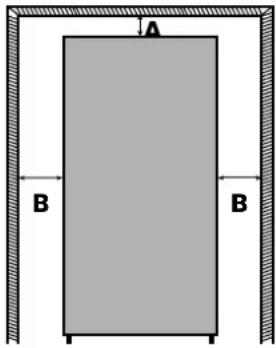
Top view Required space in mm
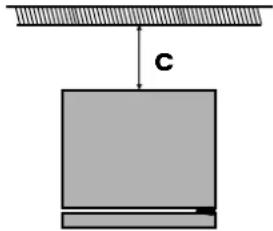
A: 30mm
B: 50mm
C: 100mm

ATTENTION! Unobstructed ventilation must be maintained around the appliance or in a built-in structure.

ATTENTION! If there are vibrations due to the appliance being in contact with the wall, move the appliance away from the wall. The installation may cause interference to surrounding telephones, radios, televisions, so try to keep the appliance as far away as possible in such a case.
3. Ground level
Place the appliance on a firm, flat floor to keep it stable, otherwise it will cause vibration and noise. When the appliance is placed on materials such as carpets, mats, PVC... The legs of the appliance should be placed on solid plates.
Recommendations for use
1. Resting time
Once the appliance is properly installed and cleaned, do not switch it on immediately. It can be switched on after more than 1 hour of rest to ensure normal operation.
2. Testing and cleaning
Confirm that all fittings inside the unit are correctly installed and wipe the interior with a soft cloth.
3. Switching on
Connect the plug to the power socket to switch on the compressor. After 1 hour, open the freezer door (if available), if the temperature inside the freezer compartment drops considerably, it indicates that the refrigeration system is working normally.
4. Food storage
Once the appliance is turned on, the internal temperature will be automatically controlled according to the user's temperature setting. Once it has cooled down completely, place the food, which usually needs 2 to 3 hours to cool down completely. In summer, when the temperature is high, it takes more than 4 hours for the food to cool down completely (try to open the appliance door as little as possible, to avoid the inside temperature to rise considerably).
Moving the appliance
- Transport
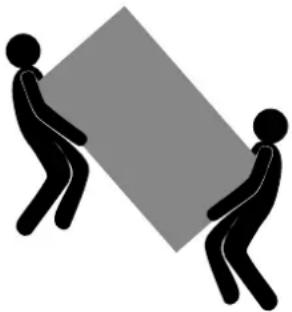
Do not carry the appliance horizontally or upside down. Do not carry the appliance while holding the door or handle.
The appliance must be transported by lifting the bottom of the appliance.
IMPORTANT: The installation of this unit requires the intervention of several people.
natural_image
Two stylized human figures pulling a gray diamond shape (no text or symbols)- Location
Do not place your appliance near a heat source, e.g. cooker, boiler or radiator. Avoid direct sunlight.
- Leveling
Be sure to level your appliance using the front leveling feet.
If it is not level, the sealing performance of the appliance door gasket will be affected, or it may even cause your appliance to malfunction.
After placing the appliance in position, wait 4 hours before using it, to allow the refrigerant to settle.
- Installation
Do not cover or block vents.
If you are going to be away from home for a long period of time:

natural_image
Two gray rectangular panels with checkmark and cross symbols, no text or labels present- If the appliance will not be used for several months, turn it off first and then unplug the appliance from the electrical outlet.
- Remove all food.
- Clean and dry the interior thoroughly. To prevent mould and mildew growth and unpleasant odours, leave the door ajar: lock it or remove it if necessary.
- Keep the clean appliance in a dry, ventilated place away from heat sources and do not place heavy objects on top of it.
LED light replacement
This appliance is composed of light emitting diodes (LED). This type of diode cannot be replaced by the user. Normally, the service life of these LEDs is sufficient for no replacement to be necessary. However, if despite all the care taken during the manufacture of your appliance, the LED diodes are defective, please contact your after-sales service for any intervention.

For your safety and to ensure correct use, before installing and using the device for the first time, please read this user manual carefully, including its tips and warnings. To avoid unnecessary errors and accidents, it is important to ensure that all persons using the device are thoroughly familiar with its operation and safety features. Keep these instructions and ensure that they remain with the device if it is moved or sold, so that all those who use it throughout its lifetime are adequately informed about the use and safety of the device.
For the safety of life and property, observe the precautions in these user instructions, as the manufacturer is not liable for damage caused by omission.
Safety of children and vulnerable people
- This appliance can be used by children aged from 8 years and above and persons with reduced physical, sensory or mental capabilities or lack of experience and knowledge if they have been given supervision or instruction concerning use of the appliance in a safe way and understand the hazards involved.
• Children up to 8 years of age can charge and discharge this appliance. - Children should be supervised to ensure that they do not play with the appliance.
- Cleaning and user maintenance shall not be made by children unless they are 8 years of age or older and supervised.
- Keep all containers away from children. There is a risk of suffocation.
- If you are discarding the appliance, pull the plug out of the socket, cut the power cord (as close to the appliance as possible) and remove the door to prevent children from getting an electric shock if it falls or closes.
- If this appliance with magnetic door seals replaces an older appliance that has a spring-loaded latch on the door or lid, make sure that the spring-loaded latch cannot be used before discarding the old appliance. This will prevent it from becoming a death trap for a child.
General safety
WARNING! Keep ventilation openings, in the appliance cabinet or built-in structure, free of obstructions.
WARNING! Do not use mechanical devices or other means to accelerate the defrosting process other than those recommended by the manufacturer.
WARNING! Do not damage the refrigerant circuit.
WARNING! Do not use other electrical appliances (such as ice cream makers) inside refrigeration appliances unless they are approved for this purpose by the manufacturer.
WARNING! Do not touch the bulb if it has been on for a long period of time as it may be very hot.
WARNING! When positioning the appliance, make sure that the power cord is not trapped or damaged.
WARNING! Do not locate multiple portable power outlets or portable power suppliers on the back of the appliance.
Do not store explosive substances such as aerosol cans with a flammable content.
- The refrigerant isobutane (R-600a) is contained within the refrigerant circuit of the appliance, a natural gas with a high level of environmental compatibility, which is nevertheless flammable.
- During transport and installation of the unit, ensure that none of the components of the refrigerant circuit are damaged.
- Drain open flames and sources of ignition.
- Ventilate the room in which the appliance is located thoroughly.
- It is dangerous to alter the specifications or modify this product in any way. Any damage to the cable may cause a short circuit, fire or electric shock.
- This appliance is intended for use in household and similar applications, such as
- Staff kitchen areas in shops, offices and other working environments;
- Hotels, motels and other residential type environments;
- Non-commercial and similar applications.
WARNING! Any electrical components (plug, power cord, compressor, etc.) must be replaced by a certified service agent or qualified service personnel.
WARNING! LThe bulb supplied with this appliance is a "special purpose lamp bulb" which
can only be used with the appliance supplied. This "special purpose lamp" cannot be used for domestic lighting.
The power cord must not be extended. Make sure that the power plug is not crushed or damaged on the back of the appliance. A crushed or damaged power plug may overheat and cause a fire.
Make sure that it can be connected to the power socket of the appliance properly.
Do not pull on the mains cable.
If the power socket is loose, do not push the power plug. There is a risk of electric shock or fire. Do not operate the appliance without the lamp.
This appliance is heavy. Care should be taken when moving it. Do not remove or touch items in the freezer compartment if your hands are wet or damp, as this may cause skin abrasions or freezer burns.
Avoid prolonged exposure of the appliance to direct sunlight.
Daily use
- Do not heat the plastic parts of the appliance.
- Do not place food products directly against the rear wall.
- Frozen food must not be refrozen once it has thawed.
- Store prepackaged frozen food in accordance with the frozen food manufacturer's instructions.
- Appliance manufacturers' storage recommendations should be strictly followed. Refer to the relevant instructions.
- Do not place carbonated soft drinks in the freezer compartment as it creates pressure in the container, which may cause it to burst and damage the appliance.
- Ice lollies may cause freezer burn if consumed directly from the appliance.
- To avoid contamination of food, follow the instructions described in this manual.
- Opening the door for prolonged periods may cause a significant temperature rise in the appliance compartments.
• Regularly clean surfaces that may come into contact with food and accessible drainage systems.
- Clean the water tanks if they have not been used for 48 h; Flush the water system connected to a water supply if no water has been drawn for 5 days.
• Before servicing, switch off the appliance and disconnect the mains plug from the mains socket.
- Do not clean the appliance with metal or sharp objects. Do not use sharp objects to remove any ice frost that may appear on the appliance. Use a plastic scraper.
- Regularly check the drain in the refrigerator for defrosted water.
- If necessary, clean the drain. If the drain is blocked, water will accumulate at the bottom of the appliance.
Installation
Important! For electrical connection, carefully follow the instructions given in the following chapters of this manual.
Unpack the appliance and check it for damage.
- Do not connect the appliance if it is damaged. Report any damage immediately to the place of purchase. In this case, keep the packaging carefully.
- It is advisable to wait at least four hours before switching on the unit to allow the oil to return to the compressor.
- There should be adequate air circulation around the appliance, as this prevents the appliance from overheating. To achieve sufficient ventilation, follow the installation instructions.
- Whenever possible, the back of the product should be against a wall to prevent access to hot components (compressor, condenser) and to avoid possible burns.
- The appliance must not be located near radiators or cookers.
- Make sure that the power plug is accessible after installation of the appliance.
Service
- Any electrical work required to service the appliance must be carried out by a qualified electrician or competent person.
- This product must be serviced by an authorised Service Centre, and only original spare parts must be used.
Energy Saving
- Do not put hot food in the appliance;
-
Do not pack food together as this prevents air circulation;
-
Make sure that food does not touch the back of the compartment(s);
- If there is a power failure, do not open the door(s);
- Do not open the door(s) frequently;
- Do not keep the door(s) open for a long time;
- Do not set the thermostat to very high temperatures;
- Some accessories, such as drawers, can be removed for larger storage volume and lower energy consumption; Do not use the thermostat in very high temperatures; Do not place the thermostat in very high temperatures.
This appliance does not contain gases that could damage the ozone layer, neither in its refrigerant circuit nor in the insulation materials. The appliance must not be disposed of with municipal waste and rubbish. The insulation foam contains flammable gases. The appliance must be disposed of in accordance with the regulations of the appliance to be obtained from the local authorities. Avoid damaging the cooling unit, especially the heat exchanger. The materials used in this appliance marked with the symbol 📁 are recyclable.

natural_image
Symbol of a trash bin crossed with two crossed lines and a solid rectangle below (no text or labels)This symbol on the product or on its packaging indicates that this product must not be treated as household waste. Instead, it must be taken to the appropriate collection point for the recycling of electrical and electronic equipment.
By ensuring this product is disposed of correctly, you will help prevent potential negative consequences for the environment and human health, which could otherwise be caused by inappropriate waste handling of this product.
For more detailed information about recycling of this product, please contact your local authorities, your household waste disposal service or the shop where you purchased the product.
Packing materials
Materials with the symbol 🎨 are recyclable. Dispose of the packaging in a suitable collection container for recycling.
Disposal of the appliance
- Disconnect the plug from the socket.
- Cut the power cord and discard it.
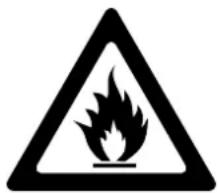

Warning! During use, service and disposal of the appliance, pay attention to this symbol, which is located on the back of the appliance (rear panel or compressor).
This symbol will be yellow or orange in colour. It is a fire hazard warning sign. There are flammable materials in the refrigerant and compressor piping. Keep away from the source of fire during use, service and disposal..
WARNING! This appliance must be grounded for safety. The power cord of this appliance is equipped with a three-prong plug which fits into a standard three-prong outlet to minimize the possibility of electric shock. Do not, under any circumstances, cut or remove the third grounding prong from the supplied power cord.
This refrigerator appliance requires a standard 220-240V, 50/60 Hz three-prong grounded outlet.
This appliance is not designed for use with a power inverter.
The cord must be secured behind the appliance and must not be left exposed or dangling, This will prevent accidents and/or injury.
Never unplug the appliance by pulling on the power cord. Always grasp the plug firmly and pull it out. Do not use an extension cord with this appliance. If the power cord is too short, have a qualified electrician or serviceman install an outlet near the appliance. appliance. Use of an extension cord may adversely affect the performance of the unit.
Climate Range
Information about the climate range of the appliance is detailed on the rating plate, which is attached to the inside or outside of the appliance.
It indicates at which ambient temperature the appliance appliance is optimal.
| Climate range | Suitable ambient temperature |
| SN | From +10°C to +32°C |
| N | From +16°C to +32°C |
| ST | From +16°C to +38°C |
| T | From +16°C to +43°C |
Note: The limit values of the ambient temperature range for the climatic classes for which the appliance is designed and the internal temperatures of the appliance may be affected by factors such as the location of the appliance, the ambient temperature and the frequency of door opening. When operating in an environment other than the specified climate class (i.e., beyond the rated ambient temperature range), the appliance may not operate properly.
Note: Information on the climate range of the appliance is detailed on the rating plate, which is attached to the inside or outside of the appliance. The information about the climate range of the appliance is detailed on the rating plate, which is attached to the inside or outside of the appliance.
Freon Free
The Freon-free refrigerant (R600a) and the foamed insulation material (cyclopentane) used in the appliance are environmentally friendly. R600a is flammable and is sealed in a refrigeration system. In the event of a refrigerant leakage due to a damaged refrigerant circuit, be sure to keep the appliance away from heat sources and open windows to ventilate as quickly as possible.
Locks
If this product is equipped with a padlock, keep the key out of the reach of children. As a safety precaution, break old padlocks or latches when discarding.
Product description
Due to technological innovations, the product description in this manual may not completely match your appliance. More detailed information corresponds to the final product.

| 1 LED light |
| 2 Temperature regulator |
| 3 Glass shelves |
| 4 Vegetable drawer |
| 5 Freezer drawers |
| 6 Refrigerator door |
| 7 Door balconies |
| 8 Refrigerator door lock |
| 9 Freezer door lock |
| 10 Freezer door |
Note: Your model may look different from this and other images in this manual depending on the characteristics of your model.
Note: To get the most out of the product, place all shelves and drawers in the original position as shown in the image above.

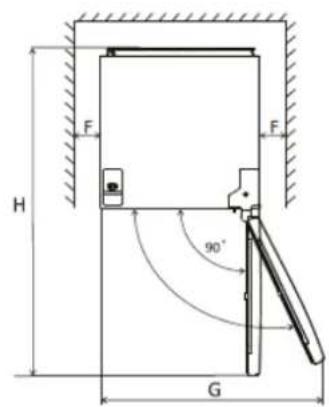
| A | 590 |
| B | 595 |
| C | 2020 |
| D | min 50 |
| E | min 50 |
| F | min 50 |
| G | 100 |
| H | 130 |
How to use
Before use
Preparation for use
- Standby time
Once the refrigerator is properly installed and cleaned, do not turn it on immediately. Be sure to turn on the refrigerator after more than 1 hour of inactivity to ensure normal operation.
- Cleaning
Check the accessories inside the refrigerator and wipe the inside with a soft cloth.
- Switch on
Plug the power plug into the power socket to switch on the compressor. After 1 hour, open the refrigerator door, if the temperature inside the refrigerator compartment drops noticeably, it means that the cooling system is working normally.
4. Food Storage
After the refrigerator has operated for a period of time, the internal temperature of the refrigerator will be automatically controlled according to the user's temperature setting. Once the refrigerator has cooled down completely, place the food, which normally needs 2 to 3 hours to cool down completely. In summer, when the temperature is high, it takes more than 4 hours for the food to cool down completely (try to open the refrigerator door as little as possible before the internal temperature drops).
Temperature setting
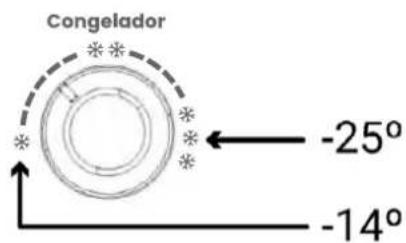
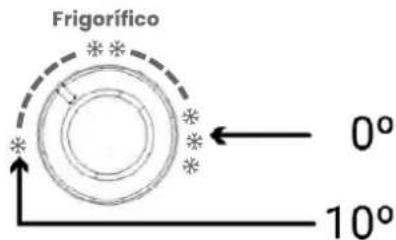
Your refrigerator has a control to regulate the temperature. This control is located on the top of the refrigerator. It allows you to adjust the temperature of the refrigerator and freezer.
Freezer temperature regulator
Setting from -14^ to -25^
Refrigerator temperature regulator
Setting from 0°C to 10°C
The first time you operate the refrigerator, set the thermostat to “**” and let it run without food for 4 hours before storing to allow it to cool sufficiently.
The temperature control ranges from “*” the warmest position to “***” the coldest. Set the temperature control to the position that best suits your needs.
The thermostat on this appliance has 3 settings. The temperature inside the appliance is maintained while the appliance is in operation and in normal use. The temperature inside the unit can be influenced by many factors: ambient temperature, exposure to the sun, number of door openings, amount of food stored.... Slight temperature variations are perfectly normal.
It is advisable to follow the settings below to ensure good food preservation and the lowest energy consumption:
| Temperature setting | ||
| Temperature Ambient | Freezer | Fridge |
| Winter |  |  |
| Normal (20°C - 32°C) | 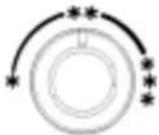 |  |
| Summer (over 35°C) | 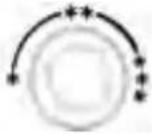 |  |
If the unit is unplugged, loses power or shuts off, you must wait 3 to 5 minutes before restarting the unit. If you attempt to restart before this time, the appliance will not start.

Cautions for use
- The appliance may not operate steadily (there is a possibility that it may defrost or the temperature may rise too high inside) if it is placed for a prolonged period of time below the cold limit of the climatic range for which the appliance is designed.
• Information on the climate range can be found on the rating plate. - The internal temperature may be affected by factors such as the location of the appliance, ambient temperature, how often the door is opened, etc. The setting of any temperature control device may have to be varied to take these factors into account.
• Effervescent beverages should not be stored in the freezer compartment (if present).
Some products such as ice cream should not be consumed too cold, as they may cause burns from direct cold contact.
Location of food storage
Due to the circulation of cold air inside the appliance, the temperature of each area is different, so different types of food should be placed in different areas.
The refrigerator compartment is suitable for storage of food that does not need to be frozen, cooked food, beverages, eggs, some condiments that need to be kept cold, etc. The vegetable drawer (if available) is suitable for the storage of vegetables, fruits, etc. The freezer compartment is suitable for the storage of ice cream, frozen food and food that will be kept for a long time.
Use of the refrigerator compartment
- Refrigerator door shelves and balconies (if fitted): To remove a glass shelf, lift it slightly, slide it towards you and remove it from its position. To remove a door shelf, lift it slightly and remove it from its place. Avoid food coming into contact with the rear wall. When removing or placing shelves or racks, please hold them firmly and handle them with care to avoid damage.
- Vegetable box (if available): Pull out the vegetable drawer to access the food. If you are going to clean the cover of the vegetable drawer, be sure to put it back in place so that the internal temperature of the drawer is not affected, thus preventing the food inside from deteriorating.
- Vegetable drawer humidity regulator (if fitted): The humidity regulator is used to conserve the humidity inside the vegetable crisper, thus keeping the vegetables and fruits stored inside fresh. When the regulator is set to the right side, with more exposed holes, the internal humidity is kept at a low value. When the regulator is set to the left side, with fewer exposed holes, the internal humidity level of the drawer is high.
High level of humidity Low level of humidity


Storage of fruit and vegetables
In the case of appliances with a cold compartment, a statement should be made to the effect that some types of fresh fruit and vegetables are sensitive to cold and are therefore not suitable for storage in this type of compartment.
Use of the FRIDGE compartment (if available)
This is the ideal place to store meat, sausage, fish, dairy products, eggs and cooked dishes, as well as bread, pastries and bakery products.
Storing food in the refrigerator compartment
- Preferably store food that is fresh and in perfect condition. In this way, they will retain their quality and freshness for longer.
- In the case of pre-cooked products or packaged foods, pay special attention to the best-before or use-by dates indicated by the manufacturer.
- It is also advisable to wrap or cover food well before placing it in the refrigerator so that it retains its aroma, colour and flavour. This also prevents flavour transfer from one food to another or discolouration of plastic parts in the refrigerator compartment.
- Allow hot food or beverages to cool to room temperature before placing them in the refrigerator compartment.
Note: Do not obstruct or block the air outlet openings with foodstuffs to allow free circulation of air. Food placed in the vicinity of the air outlet openings may freeze as a result of the cold air coming out of the air outlet openings.
WARNING! Depending on the air circulation inside the refrigerator compartment, different cooling zones are created in the refrigerator compartment:
- The coldest areas are located in front of the air outlet openings. Store the most delicate foods (fish, sausages, meat) in the coldest zones.
- The least cold zone is located in the upper part of the back door. It is advisable to store cured cheese and butter, for example, in this zone. In this way the aged cheese can release its aroma and the butter will be easier to spread on bread.
Use of the FREEZER (if available)
The freezer compartment is suitable for storing deep-frozen products, preparing and storing ice cubes and freezing fresh food.
Note: Always make sure that the freezer door is closed and sealed completely. If it is not properly closed, food may thaw. Heavy frost build-up occurs in the freezer compartment.
Maximum freezing capacity
The indications regarding the freezing capacity in 24 hours are given on the rating plate of the appliance. The maximum freezing capacity in 24 hours is given on the rating plate of the appliance.
Pay special attention:
- When shopping, remember that it is best to buy frozen food at the last minute. Try to transport them directly home wrapped in an insulated bag. Once at home, you should immediately place them in the freezer compartment.
- Try to place large quantities of food in the top drawer, as they freeze more quickly.
- Arrange the food with sufficient space between them to ensure proper air circulation.
- Frozen products must not come into contact with fresh food.
Freeze fresh food
If you decide to freeze food yourself, use only fresh food in perfect condition. Rinse vegetables before freezing so that their flavour, aroma and colour do not deteriorate, thus preserving their nutritional value. Aubergines, courgettes and asparagus do not need to be rinsed. More details on this method can be found in any cookery book or manual that deals with aspects of freezing food.
Foods suitable for freezing:
Bread and pastries, fish and seafood, meat, vegetables, fruit, herbs, shelled eggs, dairy products such as cheese, butter and cottage cheese, cooked dishes and leftovers, e.g. soups, soups, stews, soups and gravies. such as soups, stews, cooked meat or fish, potato dishes, gratins and sweet dishes, gratins and sweet dishes.
Foods that should not be frozen:
Vegetables that are normally eaten raw, e.g. lettuce or radishes, eggs in their shells, grapes, whole apples, pears, peaches, hard-boiled eggs, yoghurt, sour milk, fresh sour cream, crème fraîche and mayonnaise.
Food packaging
Pack the food hermetically so that it does not dehydrate or lose its flavour.
- Place the food in the packaging provided for this purpose.
- Remove any air that may be present in the packaging.
- Close it hermetically.
- Mark containers, indicating contents and date of freezing.
Appropriate materials for the packaging of foodstuffs:
Plastic foil, polystyrene bags and sheets, aluminium foil, boxes and specific packaging for freezing food. These products can be found in specialised shops.
Unsuitable materials for food packaging:
Wrapping paper, parchment paper, cellophane, rubbish bags, used shopping bags.
Materials suitable for closing the packaging:
Rubber bands, plastic clips, twine, special adhesive tape for freezing. Polystyrene plastic bags or sheets can be heat-sealed with a plastic sealer.
Freezing timetable
The shelf life varies depending on the type of food frozen at a standard temperature of -18^ :
- Fish, sausage, cooked dishes, bread and pastries – up to 6 months
- Cheese, poultry and meat - up to 8 months
- Fruit and vegetables - up to 12 months
WARNING! Before cleaning, unplug the power plug first; Do not connect or disconnect the power plug with wet hands, as there is a risk of electric shock and injury. Do not spill water directly on the appliance, thus avoiding rust, electricity leakage and accidents.
Internal and external cleaning
Food residues in the interior can cause a bad smell, so it should be cleaned regularly. Infiniton brand suggests that you clean the interior at least once a month.
Remove all interior elements (shelves, drawers, etc.) and clean with a soft towel or sponge dampened with warm water. Wipe off dust accumulated on the surface of the appliance frequently.
After using detergent, be sure to rinse it with clean water and then wipe it dry with a cloth.
WARNING! Do not use bristle brushes, wire brushes, detergent, soap powder, alkaline detergent, benzene, gasoline, acid, hot water and other corrosive or soluble elements to clean the surface of the appliance, door gasket, plastic decorative parts, etc. to avoid damage. Carefully dry the door seal, clean the groove with a wooden stick wrapped with cotton thread.
What to do if there is a failure in the power supply or cooling system?
- Try to open the appliance door as little as possible, so that food can be stored safely and freshly for hours even in summer.
- If you receive the power cut warning in advance:
- Set the thermostat to the highest setting one hour in advance, so that the food is completely frozen (Do not store new food during this time!). Restore the temperature to the original setting when the power supply comes back on.
- You can also make ice in an airtight container and put it inside the appliance to extend the storage time of fresh food.
Safety checks after maintenance
- Is the power cord broken or damaged?
- Is the plug firmly inserted into the socket?
• Is the socket overheating abnormally?
Note: Electric shock and fire may occur if the power cord and plug are damaged or stained with dust. If there is any abnormality, unplug the power cord and contact the supplier.
Whenever there is a problem with the appliance, check if you can solve it by following the tables below. If the problem persists, contact customer service.
| DESCRIPTION POSSIBLE CAUSE SOLUTION | ||
| No refrigeration at all at all | ·Is the plug disconnected? ·Are the switches and fuses broken? ·Is there no electricity or has the power supply been cut off?" | ·Re-plug. ·Open the door and check if the light is on. |
| Abnormal noise. | ·Is the appliance stable? ·Does the appliance reach up to the wall? | ·Adjust the adjustable feet. ·Remove it from the wall |
| Poor cooling efficiency. | ·Do you put out hot food or too much food? ·Do you open the door frequently? ·Do you put the bag of food on the door seal? ·Does it get direct sunlight or is it near an oven or cooker? ·Is it well ventilated? ·Is the temperature too high? | ·Put food in the freezer when hot food cools down. ·Check and close the door. ·Remove the refrigerator from the heat source. ·Keep the distance between food to ensure good ventilation. ·Set the right temperature. |
| Bad smells inside. | ·Has any food spoiled? ·Do you need to clean the fridge? ·Do you wrap food with strong smells? | ·Throw away spoiled food. ·Clean the fridge. ·Pack strong-flavoured foods. |
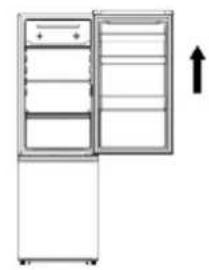
- Remove the upper right hinge cover and the hinge gap cover. Disconnect the switch (electrical connection) from the upper right hinge cover.
- Remove the upper right hinge
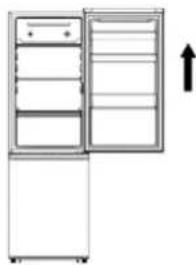
- Lift the refrigerator door upward by holding it halfway up until it disengages from the product body.
- Remove the middle hinge by unscrewing the screws. Once unscrewed, remove the intermediate hinge and lift the freezer door up until it disengages from the lower hinge.
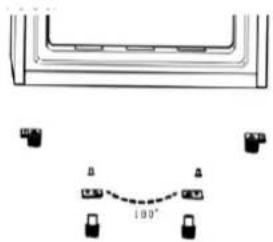
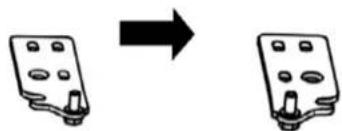
- Remove the bottom hinge, rotate it 180^ and replace it on the other side, together with the adjustable feet.
- Slide the lower hinge shaft from the right hinge hole to the left.
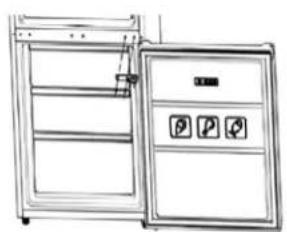
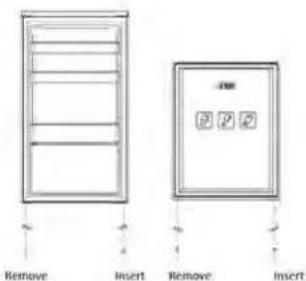
- Remove the right pin and locking device from the bottom of the refrigerator and freezer door. Then screw the left pin and locking device (found in the plastic bag with the instruction manual) into the left side of the refrigerator and freezer door (if the door is closed).
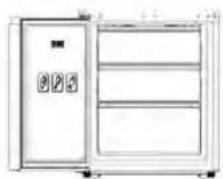
- Mount the freezer door on the bottom hinge in the correct position. Once the door is mounted, attach the hinge and intermediate hinge shaft to the freezer door and product body with a screwdriver.
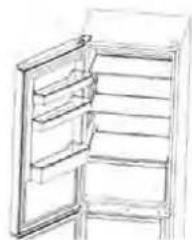
- Hook the refrigerator door with the intermediate hinge shaft and assemble the upper hinge to the refrigerator door and attach it to the product body with a screwdriver.
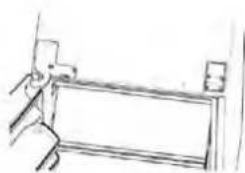
- Attach the door switch to the upper hinge cover. Attach the left hinge cover and secure it with the screws. Attach the hinge hole plug and secure it with the screws.

natural_image
Simple line drawing of a rectangular box with two small items on top, no text or symbols present1

natural_image
Simple line drawing of a rectangular box with corner markers (no text or symbols)2

natural_image
Diagram of an open refrigerator with shelves and a door, showing no text or symbols3

natural_image
Line drawing of a refrigerator with front panel and side panel, showing basic electrical symbols (no text or labels)4

natural_image
Technical diagram showing a U-shaped structure with four small car icons and a curved dashed line labeled 100° (no text or symbols beyond basic geometry)5
natural_image
Diagram showing two identical electronic components with pins, one increasing and the other decreasing (no text or symbols)6

7
natural_image
Simple line drawing of an open industrial cabinet or enclosure with no text or symbols8
natural_image
Hand-drawn sketch of an open refrigerator with shelves (no text or symbols)9
natural_image
Simple line drawing of a hand holding a rectangular object (no text or symbols)10
INFINITON
Refrigerador Combi

natural_image
Line drawing of a kitchen interior with two large refrigerator units, one white and one metallic, placed near a microwave oven (no text or symbols)FGC-340C20BEMFGC-340C20XEN
ean: 8445639004036 ean: 8445639004043
natural_image
Two stick figures pulling a gray diamond shape (no text or symbols)- Localização
natural_image
Two gray rectangular panels with checkmark and cross symbols, no text or labels present- Instalação
natural_image
Symbol of a trash bin crossed with a diagonal line and a horizontal bar below (no text or labels)
| 1 Luz LED |
| 2 Regulador de temperatura |
| 3 Prateleiras de vidro |
| 4 Gaveta de legumes |
| 5 Gavetas do congelador |
| 6 Porta do frigorífico |
| 7 Varandas da porta |
| 8 Fechadura da porta do frigorífico |
| 9 Fechadura da porta do congelador |
| 10 Porta do congelador |
natural_image
Simple line drawing of a rectangular box with a small inset image on top (no text or symbols)1

natural_image
Simple line drawing of a rectangular box with labeled corner points (no text or symbols beyond basic geometry)2
natural_image
Diagram of a refrigerator with open doors and a black upward arrow indicating rotation (no text or symbols)3

natural_image
Line drawing of a refrigerator with doors and control panel (no text or symbols)4

5

natural_image
Two identical electronic component diagrams showing a transformation from a rectangular to a pin-like structure (no text or symbols)6
7

8

natural_image
Hand-drawn sketch of an open refrigerator with shelves (no text or symbols)9

natural_image
Simple line drawing of a hand holding a rectangular object (no text or symbols)10
PRODUCT FICHE
| 1. Model Name | FGC-340C20BEM / FGC-340C20XEN |
| 2. Product Capacity | |
| Total Capacity | 340 |
| Net capacity | 340 |
| Fridge compartment | 248 |
| Freezer compartment | 92 |
| 3. General Features | |
| Control system | Electronic+Display |
| Defrosting | Automatic |
| Reversible door | Yes |
| Voltage / Frequency | 220~240 / 50Hz |
| Climate class | N/ST |
| Energy Efficiency | F/E |
| Annual Energy Consumption(kWh/year) | 303 |
| Energy Consumption (kWh/24 h) | 0.83 |
| Rated Current (A) | 1,5 |
| Max Noise Level(dB) | 42 |
| Refrigerant/Charge | R600a |
| Certifications | CE |
| 4. Fridge Compartment | |
| Shelf (material/no.) | Glass /3 |
| Door Balcony (material/no./color) | PS / 3 / transparent |
| Vegetable Crisper Cover | Glass/1 |
| Vegetable Crisper (material/no./Color) | Plastic/1/Transparent |
| Inner Light (material//power) | LED/TOP |
| Eggs Tray(s) | 1 |
| Inside Colour | White |
| 5. Freezer Compartment | |
| Freezing Compartment Star | 4 Star: -18°C |
| Freezing capacity (kg/24h) | 5 |
| Max Storage Time(h) | 24 |
| Drawers | Plastic/3/Transparent |
| Shelf (material/no.) | / |
| Door Balcony (material/no./Color) | / |
| Inner Light (material//power) | yes |
| Ice box | 1 |
| 6. Packing dimensions & loadability | |
| Product(W*D*H)(mm) | 590*595*2020 |
| Packaging(W*D*H)(mm) | 625*640*2100 |
| Weight(Net/Gross kg) | 62/68 |
| Loading (40hq/20ft) | 57 |
| Stack Height | 1 |
| 7. optional | |
| Inverter compressor | yes |
INFINITON
Soporte y contacto

¿Necesitas ayuda?
natural_image
Silhouette of a person wearing a headset with a wrench icon (no text or symbols)
INFINITON
TÉRMINOS Y REGISTRO DE GARANTÍA



- - Ubicación
- - Instalación
- INFINITON
- Index
- Installation & location
- Ventilation conditions
- Recommended space needed for heat dissipation
- Ground level
- Recommendations for use
- Resting time
- Testing and cleaning
- Switching on
- Food storage
- Moving the appliance
- - Transport
- - Location
- - Leveling
- - Installation
- LED light replacement
- Safety of children and vulnerable people
- General safety
- Daily use
- Installation
- Service
- Energy Saving
- Packing materials
- Disposal of the appliance
- Climate Range
- Freon Free
- Locks
- Product description
- How to use
- Before use
- Temperature setting
- Cautions for use
- Location of food storage
- Use of the refrigerator compartment
- High level of humidity Low level of humidity
- Storage of fruit and vegetables
- Use of the FRIDGE compartment (if available)
- Storing food in the refrigerator compartment
- WARNING! Depending on the air circulation inside the refrigerator compartment, different cooling zones are created in the refrigerator compartment:
- Use of the FREEZER (if available)
- Maximum freezing capacity
- Pay special attention:
- Freeze fresh food
- Foods suitable for freezing:
- Foods that should not be frozen:
- Food packaging
- Appropriate materials for the packaging of foodstuffs:
- Unsuitable materials for food packaging:
- Materials suitable for closing the packaging:
- Freezing timetable
- Internal and external cleaning
- What to do if there is a failure in the power supply or cooling system?
- Safety checks after maintenance
- Soporte y contacto
- ¿Necesitas ayuda?
- TÉRMINOS Y REGISTRO DE GARANTÍA
Brand : Infiniton
Model : FGC-A204BNF
Category : Microwave Oven