SC184B - Vacuum Cleaner Sauber - Free user manual and instructions
Find the device manual for free SC184B Sauber in PDF.


| Product Type | Canister Vacuum Cleaner |
| Model | SC184B |
| Brand | Sauber |
| Motor Power | 2000 W |
| Suction Power | 350 AW |
| Dust Capacity | 3.5 L |
| Filtration System | HEPA 13 washable filter |
| Cord Length | 6 m |
| Operating Radius | 9 m |
| Noise Level | 78 dB(A) |
| Weight | 5.2 kg |
| Dimensions (W x D x H) | 300 x 400 x 250 mm |
| Power Cord Type | Retractable |
| Accessories Included | Floor nozzle, crevice tool, upholstery brush, dusting brush |
| Bagless | Yes |
| Variable Power Control | Yes, on handle |
| Maintenance | Wash filter every 3 months; empty dust bin after each use |
| Safety Features | Thermal cut-off, overload protection |
| Energy Class | A++ |
Frequently Asked Questions - SC184B Sauber
User questions about SC184B Sauber
0 question about this device. Answer the ones you know or ask your own.
Ask a new question about this device
Download the instructions for your Vacuum Cleaner in PDF format for free! Find your manual SC184B - Sauber and take your electronic device back in hand. On this page are published all the documents necessary for the use of your device. SC184B by Sauber.
USER MANUAL SC184B Sauber
natural_image
Line drawing of a double refrigerator with top panel and front panel (no text or symbols)- WARNING: When positioning the appliance, ensure the supply cord is not trapped or damaged.
- WARNING: Do not locate multiple portable socket-outlets or portable power supplies at the rear of the appliance
Children aged from 3 to 8 years are allowed to load and unload refrigerating appliances.
To avoid contamination of food, please respect the following instructions:
- Opening the door for long periods can cause a significant increase of the temperature in the compartments of the appliance.
–Clean regularly surfaces that can come in contact with food and accessible drainage systems.
- Clean water tanks if they have not been used for 48 h; flush the water system connected to a water supply if water has not been drawn for 5 days.
- Store raw meat and fish in suitable containers in the refrigerator, so that it is not in contact with or drip onto other food.
- Two-star frozen-food compartments are suitable for storing pre-frozen food, storing or making ice-cream and making ice cubes.
- One-, two- and three-star compartments are not suitable for the freezing of fresh food.
- If the refrigerating appliance is left empty for long periods, switch off, defrost, clean, dry, and leave the door open to prevent mould developing within the appliance.
natural_image
Line drawing of a double refrigerator with top panel and front panel (no text or symbols)USER INSTRUCTIONS MANUAL
Model No.: SC-184B SC-184I
sauber
WARNING!
It is hazardous for anyone other than authorized service personnel to carry out servicing or repairs which involves the removal of covers. To avoid the risk of an electric shock do not attempt to repair this appliance yourself.
↓

WARNING!
Risk of fire / flammable materials.

SAFETY TIPS
Do not use electrical appliances such as a hair dryer or heater to defrost your Freezer.
Containers with flammable gases or liquids can leak at low temperatures.
Do not store any containers with flammable materials, such as spray cans, fire extinguisher refill cartridges etc. in the Freezer.
Do not place carbonated or fizzy drinks in the Freezer compartment. Ice lollies can cause "Frost/Freeze burns". If consumed straight from the Freezer.
Do not remove items from the Freezer compartment if your hands are damp/wet, as this could cause skin abrasions or "Frost/Freezer burns". Bottles and cans must not be placed in the Freezer compartment as they can burst when the contents freeze.
Manufacturer's recommended storage times should be adhered to. Refer to relevant instructions.
Do not allow children to tamper with the controls or play with the Freezer. The Freezer is heavy. Care should be taken when moving it. It is dangerous to alter the specification or attempt to modify this product in any way.
Do not store inflammable gases or liquids inside your Freezer.
If the power cable is damaged, it must be replaced by the manufacturer, its service agent or similarly qualified persons in order to avoid a hazard.
This appliance can be used by children aged from 8 years and above and persons with reduced physical, sensory or mental capabilities or lack of experience and knowledge if they have been given supervision or instruction concerning use of the appliance in a safe way and understand the hazards involved. Children shall not play with the appliance. Cleaning and user maintenance shall not be made by children without supervision. Children aged from 3 to 8 years are allowed to load and unload refrigerating appliances.
This appliance is intended to be used in household indoor applications only.
Keep ventilation openings, in the appliance enclosure or in the built-in structure, clear of obstruction.
Do not use mechanical devices or other means to accelerate the defrosting process, other than those recommended by the manufacturer.
Do not damage the refrigerant circuit.
Do not use electrical appliances inside the food storage compartments of the appliance, unless they are of type recommended by the manufacturer.
Do not store explosive substances such as aerosol cans with a flammable propellant in this appliance.
Refrigerating appliances - in particular a refrigerator-freezer Type I - might not operate consistently (possibility of defrosting of contents or temperature becoming too warm in the frozen food compartment) when sited for an extended period of time below the cold end of the range of temperatures for which the refrigerating appliance is designed.
The refrigerant used in your appliance and insulation materials requires special disposal procedures.
When positioning the appliance, ensure the supply cord is not trapped or damaged. Do not locate multiple portable socket-outlets or portable power supplies at the rear of the appliance.
To avoid contamination of food, please respect the following instructions::
- Opening the door for long periods can cause a significant increase of the temperature in the compartments of the appliance.
- Clean regularly surfaces that can come in contact with food and accessible drainage systems.
- Clean water tanks if they have not been used for 48 h; flush the water system connected to a water supply if water has not been drawn for 5 days.
- Store raw meat and fish in suitable containers in the refrigerator, so that it is not in contact with or drip onto other food.
- If the refrigerating appliance is left empty for long periods, switch off, defrost, clean, dry, and leave the door open to prevent mould developing within the appliance.
CLIMATE CLASS SN-T
The information about the climate range of the appliance is provided on the rated plate. It indicates at which ambient temperature (that is, room temperature, in which the appliance is working) the operation of the appliance is optimal (proper)..
| Climate range | For ambient temperature... |
| SN | Min. +10°C / Max. +32°C |
| N | Min. +16°C / Max. +32°C |
| ST | Min. +16°C / Max. +38°C |
| T | Min. +16°C / Max. +43°C |
Always keep this device within the above ambient temperatura ranges (10°C - 43°C).
Internal temperatures could be affected by such factors as the location of the refrigerating appliance, ambient temperature and the frequency of door opening.
Adapt the refrigerator temperature setting according to the ambient temperature.
ELECTRICAL CONNECTION
WARNING
Improper use of the grounded plug can result in the risk of electrical shock. If the power cord is damaged, have it replaced by an authorized service center.
This refrigerator should be properly grounded for your safety. The power cord of this refrigerator is equipped with a three-prong plug which mates with standard three prong wall outlets to minimize the possibility of electrical shock.
Do not, under any circumstances, cut or remove the third ground prong from the power cord supplied.
This refrigerator requires a standard 220 -240V A.C. \~/50Hz electrical outlet with three-prong ground.
This refrigerator is not designed to be used with an inverter.
The cord should be secured behind the refrigerator and not left exposed or dangling to prevent accidental injury.
A Never unplug the refrigerator by pulling the power cord. Always grip the plug firmly and pull straight out from the receptacle.
Do not use an extension cord with this appliance. If the power cord is too short, have a qualified electrician or service technician install an outlet near the appliance. Use of an extension cord can negatively affect the performance of the unit.
INSTALLATION
PLACEMENT
When selecting a position for your Fridge/Freezer you should make sure the floor is flat and firm, and the room is well ventilated. Avoid locating your Fridge/Freezer near a heat source, eg. cooker, boiler or radiator. Also avoid direct sunlight in out-buildings or sun lounges. If you are placing your Fridge/Freezer in an out-building such as a garage or annex ensure that the Fridge/Freezer is placed above the damp course, otherwise condensation will occur on the Fridge/Freezer cabinet. Never place the Fridge/Freezer in a wall recess or into fitted cabinets or furniture. When your Fridge/Freezer is working, the grille at the back may become hot and the sides warm. Therefore, the back part of the refrigerator / freezer must be installed at least 30mm of free space. Both sides should be left more than 300mm. Do not drape the Fridge/Freezer with any covering.
DIMENSIONS (mm.)
| W | D | H | A B | C (°) | E | F |
| 595 | 600 | 1850 | 900 1176 | 125 | 30 | 300 |
Fig. 1

Fig. 2

LEVELING
If the Fridge/Freezer is not level, the door and magnetic seal alignment will be affected and may cause you Fridge/Freezer to work incorrectly. Once the Fridge/Freezer is placed in its final location, adjust the leveling feet at the front by turning them.
BEFORE THE FIRST USAGE
Please read these instructions and the Safety guidelines carefully before using your new Fridge/Freezer. This appliance is for indoor, domestic use only..
Cleaning
The product has been cleaned at the factory, but it is best to wipe the inside of the Fridge/Freezer with a weak solution of bicarbonate of soda. Then rinse with warm water using a damp sponge or cloth. Wash the baskets and shelves in warm soapy water and dry completely before replacing in the Fridge/Freezer. The external parts of the Fridge/Freezer can be cleaned with wax polish.
Before plugging in
Check that you have a socket which is compatible with the plug supplied with the Fridge/Freezer.
The coolant fluid needs time to settle. If the appliance is switched off at any time, wait 30 minutes before switching back on to allow the coolant fluid to settle.
Before filling your refrigerator
Before storing foods in your Fridge/Freezer, turn the Fridge/Freezer on and wait for 24 hours, to make sure it is working properly and to allow the Fridge/Freezer to drop to the correct temperature..
OVERVIEW

| No Description |
| 1 Glass shelf |
| 2 X-Cool Drawer |
| 3 Vegetable crisper drawer cover |
| 4 Vegetable crisper drawer |
| 5 Freezer top drawer |
| 6 Freezer bottom drawer |
| 7 Rack 1 |
| 8 Rack 2 |
| 9 Rack 3 |
| 10 Rack 4 |
| 11 Freezer glass shelf |
| 12 Freezer glass shelf |
USAGE INSTRUCTIONS
Using your refrigerator for the first time
- Plug in the appliance. The compressor will start to work.
- Open the door 30 minutes later, if the temperature in the refrigerator decreased obviously, it shows that the refrigeration system works well.
- When the refrigerator operates for a period of time, the temperature controller will automatically set the temperature within limits set by the user. You can regulate the air flow inside the refrigerator compartment using the control behind the X-Cool crisper drawer.
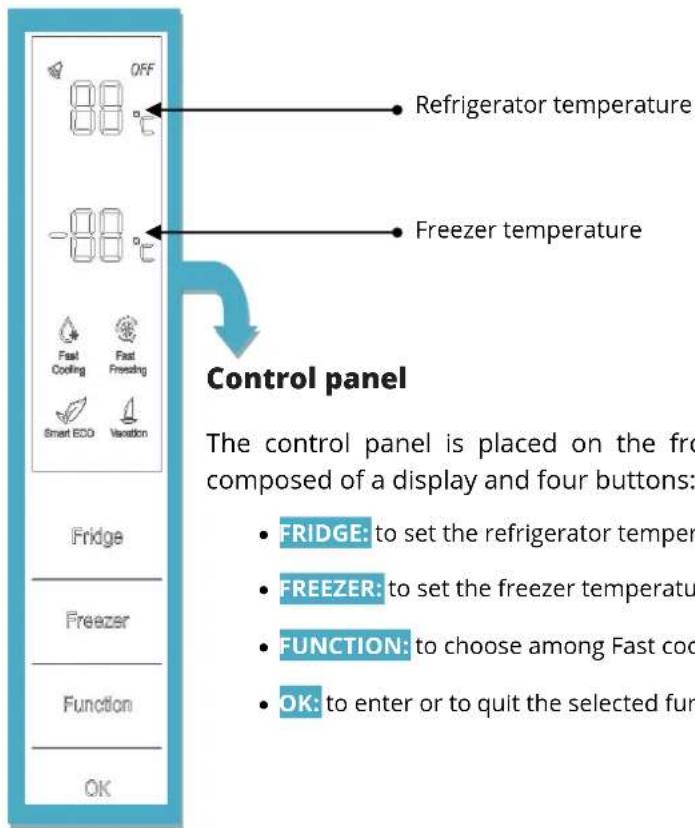
Control panel
The control panel is placed on the front door of the refrigerator compartment. It is composed of a display and four buttons:
• FRIDGE: to set the refrigerator temperature
• FREEZER: to set the freezer temperature
- FUNCTION: to choose among Fast cooling, Fast freezing, SmartECO or Vacation functions
- OK: to enter or to quit the selected function
NOTE: When the appliance is connected to power for the first time, the display will light up for 2 seconds before going normal and then the appliance will run in "Smart ECO" mode.
Display ON/OFF
When the refrigerator door is closed and there is no button operation in 3 minutes, the display light goes off. When the display light is off, open the refrigerator door or click any button to light it up.
Available functions
Temperature setting
- Click the FRIDGE or FREEZER button and when it flickers in the symbol, temperatures can be set; each time when the button is clicked, the temperature changes accordingly (the display shows the temperature accordingly).
Refrigerator: 2^ > 3^ > 4^ > 5^ > 6^ > 7^ > 8^ > OFF > 2^
Freezer: -24^ > -23^ > -22^ > -21^ > -20^ > -19^ > -18^ > -17^ > -16^ > -24^
NOTE: Temperature cannot be set under "Fast cooling", "Fast freezing", "Smart ECO" and "Vacation" modes.
- If there is no button operation in 5 seconds, the icon stops flickering and the set temperature comes into effect.
Smart ECO Function
This function automatically sets the inner temperature ( 4^ C refrigerator and -18^ C freezer) for optimal performance with minimum energy consumption. The temperature values cannot be set in this mode. You can check the set temperature values by pressing FRIDGE or FREEZER buttons at any time.
- To activate this mode: Press FUNCTION button repeatedly until the function related icon flickers. Then press OK button to confirm this mode selection.
- To deactivate this mode: Press FUNCTION button repeatedly until the function related icon flickers. Then press OK button to turn this mode off (the icon light goes out). The temperature setting of each compartment goes then back to its previous values.
NOTA: Smart ECO mode is not compatible with "Fast Cooling", "Fast Freezing" or "Vacation" modes. If you activate any of these, "Smart ECO" will stop.
Fast Cooling Function
In "Fast Cooling" mode the refrigeration compartment temperature is set to 2^ and it cannot be changed while this function is active. It is convenient to use "Fast Cooling" if the compartment door has been opened for a long time, or, in case a big amount of food has been stored at the same time, or, also, when the refrigerator temperature alarm goes off. This might be a very useful feature in some circumstances, but you are advised to reduce the usage of "Fast Cooling" as much as possible, as it increases significantly the appliance energy consumption.
- To activate this mode: Press FUNCTION button repeatedly until the function related icon flickers. Then press OK button to confirm this mode selection.
- To deactivate this mode: Press FUNCTION button repeatedly until the function related icon flickers. Then press OK button to turn this mode off (the icon light goes out). The temperature setting of each compartment goes then back to its previous values.
NOTE: "Fast Cooling" mode is not compatible with "Smart ECO"" or "Vacation" modes. If you activate any of these, "Fast Cooling" will stop
Fast Freezing Function
In "Fast Freezing" mode the freezer compartment temperature is set to -24^ and it cannot be changed while this function is active. It is convenient to use "Fast Freezing" if the compartment door has been opened for a long time, or, in case a big amount of food has been stored at the same time, or, also, when the freezer temperature alarm goes off. This might be a very useful feature in some circumstances, but you are advised to reduce the usage of "Fast Freezing" as much as possible, as it increases significantly the appliance energy consumption.
- To activate this mode: Press FUNCTION button repeatedly until the function related icon flickers. Then press OK button to confirm this mode selection.
- To deactivate this mode: Press FUNCTION button repeatedly until the function related icon flickers. Then press OK button to turn this mode off (the icon light goes out). The temperature setting of each compartment goes then back to its previous values.
This feature is limited to 26h continuous working time. Afterwards it turns automatically off.
NOTE: "Fast Freezing" mode is not compatible with "Smart ECO" mode. If you activate it, "Fast Cooling" will stop.
Vacation Mode
In "Vacation" mode the refrigeration compartment temperature is set to 14^ and it cannot be changed while this function is active. It is convenient to use "Vacation" function if plan to be absent for a long period such as holidays.
- To activate this mode: Press FUNCTION button repeatedly until the function related icon flickers. Then press OK button to confirm this mode selection.
- To deactivate this mode: Press FUNCTION button repeatedly until the function related icon flickers. Then press OK button to turn this mode off (the icon light goes out). The temperature setting of each compartment goes then back to its previous values.
NOTE: "Fast Cooling" mode is not compatible with "Smart ECO"" or "Vacation" modes. If you activate any of these, "Fast Cooling" will stop.
Self-winding operations
Power off memory
With this feature, the refrigerator can automatically recover the settings in case of a blackout. When the unit is back on, the refrigerator will run with the same settings before the blackout.
Start delay
To prevent harm to the refrigerator in case of sudden power cut and power on, the unit does not start immediately if the power off time is less than 5 minutes.
Freezer over-temperature alarm (only when powering on)
If the freezer temperature is over -10^ when connected to the mains, the freezer temperature digits on the control panel flicker to prevent the user.
Press any button, it shows the freezer temperature at that moment, press any button again or wait for 5 seconds. Flickering stops and the control panel shows the set temperature (still to be reached).
Refrigerator door opening alarm
When the refrigerator is open for over 3 minutes, the buzzer goes off. Close the door or press any button to stop the alarm, but for the latter, the alarm will go off again after 3 minutes if you do not close the door first.
When the display shows "E0", "E1", "E2" or other abnormal symbols, it means that a sensor fault has been detected and the refrigerator needs to be repaired. In this case please contact a qualified technician for assistance. During the official warranty period you should contact a Schneider approved technical service (see www.schneiderespana.es).
Usage advice
Do not exceed the storage time(s) recommended by the food manufacturers for any kind of food. Always check the food packaging before buying it.
Foodstuff storage
• Only store food in the refrigerator after its temperature decreases to room temperature.
- You can use the door racks for eggs, butter, milk, bottled drinks, etc. For better performance leave some free space between the food containers so the air can easily flow all throughout the compartment.
- Always arrange food for storage in a neat way, in particular, it is important to avoid cross-contamination, for example, by wrapping with clean plastic film or fresh keeping paper the food to be stored, and distribute it in different layers to avoid contamination, liquids leakage over other food, and smell mixture.
- Fruits and vegetables should be put into the vegetables crisper or the X-Cool crisper drawer (0-4 °C) to prevent excessive evaporation of water and freshness loss. Use the "Humidity Control" of this drawer to regulate the humidity degree inside, being "High" position the highest humidity degree and "Low" the lowest.
- Let hot food to cool down to the room temperature before storing it, otherwise consumption of electricity will increase and it may also lead to frost forming inside.
- Some types of fresh vegetables and fruits are very sensitive to cold, and therefore they are not suitable for storage in the refrigerator compartment.
Preserving food
- Cooked meat should always be stored on a shelf above raw meat to avoid bacterial transfer. Keep raw meat on a plate large enough to collect juices and cover it with cling film or foil.
- Allow cold air to circulate around the refrigerator, ensuring all parts of the fridge are kept dry and cool.
- To prevent transfer of flavors and drying out, food should be separately packed or covered. Fruit and vegetables do not need to be wrapped.
- Allow pre-cooked food to cool down before placing in the Fridge. This will help to stop the internal temperature from rising.
- To prevent cold air leakage, try to limit the number of times you open the door. When returning from shopping, sort foods to be kept in your Fridge before opening the door. Only open the door to put food in or to take it out.
Power supply or refrigeration system failure
In case of a long interruption of the power supply or failure in the refrigeration system:
-
Avoid opening the refrigerator door as much as possible so that even in hot days the food can be safely and freshly kept for hours.
-
If you have a power outage notice in advance:
• One hour before the blackout run "Fast Freezing" and "Fast Cooling" modes.
- Do not store new food from that moment.
- When the electricity supply is restored wait for one more hour and then you can set again "Smart ECO" mode or your preferred settings.
- You can also make some ice, with a watertight container, and put it in the upper part of the freezer, which will help to keep its temperature longer.
Before freezing
• Let cooked food to cool down completely before storing it in the freezer.
• Chill food in the fridge compartment before freezing when possible.
- Consider the food amounts you will intend to cook each time before freezing it.
- Don't freeze food in metal containers as you may want to microwave it straight from the freezer.
- Use special freezer bags available from supermarkets, freezer film, polythene bags, plastic containers, aluminum foil for acidic foods (such as citrus fruits). Do not use thin cling film or glass. Do not use used food containers (unless cleaned thoroughly first).
- Exclude as much air from the container as possible before storing it. You can use a special vacuum pump which sucks excessive air out of the packaging.
- Leave a small amount of "air space" when freezing liquids, to allow for expansion.
- You can use the space in the freezer more efficiently if you freeze liquids (or solids with liquids, such as stew) in square blocks. This is known as "performing". Pour the liquid into a polythene
bag inside a square sided container. Freeze it like this, then remove it from the container and seal the bag.
Buying frozen food
- When you are buying frozen food, look at the Storage Guidelines on the packaging. You will be able to store each item of frozen food for the period shown against the star rating of the freezer (****). This is usually the period stated as "Best, Before", printed on the packaging.
- Check the temperature of the frozen food cabinet in the shop where you buy your frozen foods.
• Make sure the frozen food packaging is in perfect conditions.
• Always buy frozen products last on your visit to the supermarket. - Try to keep frozen food together whilst shopping, and on your journey home as this will help to keep the food cooler.
- Don't buy frozen food unless you can freeze it straight away. Special insulated bags can be bought from most supermarkets and hardware shops. These keep frozen food cold for longer.
- For some foods, thawing before cooking is unnecessary. Vegetables and pasta can be added directly to boiling water or steam cooked. Frozen sauces and soups can be put into a saucepan and heated gently until thawed.
- Use quality food and handle it as little as possible. Freeze food in small quantities, it freezes faster, takes less time to thaw and enables you to eat it in the quantity you need.
- First, estimate the amount of food you will be freezing. If you are freezing large amounts of fresh food, remember to turn the control dial to the low temperature range. This will lower the temperature in the freezer, freezing your food quicker and helping to keep the goodness in. However you should do this sparingly to conserve energy.
In case of a long absence
- If you plan to be away home for a few weeks activate "Vacation" mode.
-
If you are not going to use the refrigerator for moths:
-
Unplug the unit from the mains.
- Take all food off.
- Clean and dry the interior throughout.
- To prevent odour and mould growth, leave the door opened slightly, blocking it if necessary, or even have the door removed.
- Keep the cleaned fridge in a dry, well ventilated place, away from any heat source
- Do not place heavy objects on top of the fridge
- The unit should not be accessible to child's play.
Energy saving
- Install the refrigerator in the coolest part of the room, away from direct sunlight and from heat sources. Do not place the refrigerator next to heat-producing appliances such as a range hood, oven or dishwasher.
- The refrigerator door should remain open only as long as necessary; do not place hot/warm food inside the refrigerator (let it cool down to room temperature first).
- Organize the refrigerator to reduce door openings. Remove as many items as needed at one time and close the door as soon as possible.
- The refrigerator door should be properly closed to avoid increased energy consumption, and the formation of excess ice and / or condensation inside.
- Constantly circulating cold air keeps the temperature homogenous inside the refrigerator. For this reason, it is important to properly distribute the food, to facilitate the flow of air.
-
Cover foods and wipe containers dry before placing them in the refrigerator. This cuts down on moisture build-up inside the unit.
-
Do not overcrowd the refrigerator or block cold air vents. Doing so causes the refrigerator to run longer and use more energy. Shelves should not be lined with aluminum foil, wax paper or paper toweling. Liners interfere with cold air circulation, making the refrigerator less efficient, which could cause food spoilage.
- Food to be frozen should not be stored in the freezer in contact with already frozen food. Do not store large amounts of fresh food in the freezer at once as it will reduce the inner temperature and will put the already frozen food preservation in risk.
- During your absences, remember that prolonged power outages may occur while you are out.
- Always keep the shelf life recommended by the food manufacturers for any kind of food and particularly for commercially quick-frozen food.
- Take all necessary precautions to prevent an undue rise in the temperature of the frozen food while defrosting the refrigerating appliance, such as wrapping the frozen food in several layers of newspaper.
- Please note that a rise in temperature of the frozen food during manual defrosting, maintenance or cleaning could shorten its shelf life.
- In the event of an extended outage or failure of the refrigerating system check for any impact in the frozen food state. If you observe any melting, remove the affected products from the freezer. Never freeze again melted food.
- It is better to wrap the frozen food in several layers on the glass shelves.
MAINTENANCE & CLEANING
No-Frost
This appliance has a full No-Frost system which automatically prevents frost formation both in the refrigeration compartment and in the freezing compartments. Therefore there is no need to manually defrost the unit. To ensure the correct frost prevention make sure that the air flow inside the compartments is not help up by any means.
Cleaning
Inside cleaning
Clean the Fridge/Freezer internally with a weak solution of bicarbonate of soda. Then rinse with warm water using a damp sponge or cloth and wipe dry. Wash the baskets in warm soapy water and ensure they are completely dry before replacing them in the Fridge/Freezer.
Outside cleaning
Use standard non-abrasive detergent diluted in warm water to clean the Fridge/Freezer exterior.
The grille of the condenser at the back of the appliance and the adjacent components can be vacuumed using a soft brush accessory. Do not use harsh cleaners, scouring pads or solvents to clean any part of the refrigerator.
Lamp Replacement
The LED lights used in this appliance perform low energy consumption and a long working life. If you need to replace them, please contact Schneider after-sales service for help.
Troubleshooting
If you notice any of the following symptoms, please follow these troubleshooting tips before calling the technical services. This may save you time and money:
| Symptom | Possible reasons | Proposed actions |
| No refrigeration | Is the power plug off?Are any breakers or fuses broken?No electricity or line trip? | Re-plug the appliance.If the refrigerator lamps do not light either, it is likely to be an electricity supply failure. |
| Abnormal noise | Is the refrigerator stable?Does the refrigerator reach the wall? | Adjust the refrigerator's front feet to level it.Pull it off the wall. |
| Poor refrigeration | Have you stored hot food, or too much food?Do you open the door frequently?Is there any item blocking the seal of the door?Direct sunlight or near a furnace or stove?Is it well-ventilated?Temperature setting in too high? | Store the food only when it becomes cool.Open the door as few times as possible.Remove any item blocking the seal of the door.Keep the refrigerator away from any heat source.Ensure good ventilation around the refrigerator.Check the temperature settings. |
| Peculiar smell | Is there any spoiled food?Do you need to clean the refrigerator?Did you store strong flavoured food? | Throw away any spoiled food.Clean the refrigerator throughout.Pack strong flavoured food in a sealed container. |
Note: If you followed above advice and you could not solve the situation, do not try to proceed with any repairs by your own means. Do not disassemble the unit in any case. Repairs carried out by inexperienced persons may cause injuries and/or serious malfunctioning. In this case please contact directly with your Schneider official local technical services office. You can find their contact details at www.schneiderespana.es.
Disposal
Old appliances still have some residual value. An environmentally friendly method of disposal will ensure that valuable raw materials can be recovered and used again.
The refrigerant used in your appliance and insulation materials requires special disposal procedures. Ensure that none of the pipes on the back of the appliance are damaged prior to disposal.
Up to date information concerning options for disposing of your old appliance and packaging from the new one can be obtained from your local council office.
| CORRECT DISPOSAL OF THIS UNIT | |
 | This marking indicates that this product should not be disposed with other household wastes throughout the EU. To prevent possible harm to the environment or human health from uncontrolled waste disposal, recycle it responsibly to promote the sustainable reuse of material resources. To return your used device, please use the return and collection systems or contact the retailer where the product was purchased. They can take this product for environmental safe recycling. |


- USER INSTRUCTIONS MANUAL
- WARNING!
- SAFETY TIPS
- CLIMATE CLASS SN-T
- ELECTRICAL CONNECTION
- WARNING
- INSTALLATION
- PLACEMENT
- LEVELING
- BEFORE THE FIRST USAGE
- Cleaning
- Before plugging in
- Before filling your refrigerator
- OVERVIEW
- USAGE INSTRUCTIONS
- Using your refrigerator for the first time
- Control panel
- Display ON/OFF
- Available functions
- Temperature setting
- Smart ECO Function
- Fast Cooling Function
- Fast Freezing Function
- Vacation Mode
- Self-winding operations
- Power off memory
- Start delay
- Freezer over-temperature alarm (only when powering on)
- Refrigerator door opening alarm
- Usage advice
- Foodstuff storage
- Preserving food
- Power supply or refrigeration system failure
- Before freezing
- Buying frozen food
- In case of a long absence
- Energy saving
- MAINTENANCE & CLEANING
- No-Frost
- Lamp Replacement
- Troubleshooting
- Disposal
Brand : Sauber
Model : SC184B
Category : Vacuum Cleaner