
Easyone 2 - Electric razor Orava - Free user manual and instructions
Find the device manual for free Easyone 2 Orava in PDF.


| Product Type | Electric Hair Clipper / Trimmer |
| Brand | Orava |
| Model | Easyone 2 |
| Power Source | Built-in rechargeable lithium battery (500 mAh); USB charging via optional AC adapter (5V/1A, not included) or PC USB port |
| Charging Time | Approximately 2 hours for full charge |
| Operating Time | Up to 1 hour on a full charge |
| Dimensions (W x H x D) | 2.8 x 12.9 x 2.8 cm |
| Weight | 90 g (without attachment) |
| Water Protection | IPX5 (splash proof from any direction) |
| Noise Level | 71 dB(A) |
| Protection Class | II (double insulation) |
| Cutting Length Adjustment | 1–10 mm via adjustable trimming comb (included) |
| Usage | Cordless use; can be used while charging |
| Intended Use | Cutting/trimming clean, dry human hair; also suitable for beards |
| Key Features | On/Off button, power/charge LED indicator, USB charging, included accessories: trimming comb, brush, USB cable, silicone oil |
| Cleaning | Brush cleaning of cutting system; rinse attachment under warm water only; wipe body with damp cloth. Do not immerse. |
| Maintenance | Oil blades with supplied silicone oil once a month after rinsing |
| Battery Type | Built-in lithium battery (500 mAh); non-removable by user; disposal requires authorized service |
| Safety Certifications | CE marking, meets EU directives |
| Warranty | Manufacturer's warranty applies; consult manual for details |
| Spare Parts / Repairability | Only original accessories and spare parts approved by manufacturer; repairs by authorized service center only |
| Included Accessories | Trimming comb, brush, USB cable, silicone oil |
| Optional Accessories | AC adapter (5V/1A, not included) |
| Environmental Compliance | WEEE directive; do not dispose as household waste |
Frequently Asked Questions - Easyone 2 Orava
User questions about Easyone 2 Orava
0 question about this device. Answer the ones you know or ask your own.
Ask a new question about this device
Download the instructions for your Electric razor in PDF format for free! Find your manual Easyone 2 - Orava and take your electronic device back in hand. On this page are published all the documents necessary for the use of your device. Easyone 2 by Orava.
USER MANUAL Easyone 2 Orava
natural_image
Black and white photo of a Erava brand hairbrush with toothbrush and trigger mechanism (no text or symbols visible)CE
Easyone 2
Intended use of the device
The device is intended exclusively for cutting / trimming loose, clean and dry hair of persons, to the extent specified by technical
and operating parameters and functions, safety and user instructions, and external influences of the operating environment. The device can also be used to trim longer beards and chin on the face. When using the device for this purpose, be careful when moving the cutting blades or the comb attachments near the skin of the face.
The device is powered by a built-in rechargeable battery or replaceable batteries (depending on the model) and is intended for use either without the AC/DC adapter cable connected or with the AC/DC adapter cable connected.
ORAVA electrical appliances are manufactured according to the state of the art and recognized safety rules. Nevertheless, improper use may result in injury or endangerment to the life of the user or a third party or to a third party. damage to equipment and other property.
1. GENERAL SAFETY INSTRUCTIONS AND WARNINGS
- This document contains important safety instructions and warnings for safe, correct and economical operation of the electrical equipment. Its compliance helps the user avoid risks, increase reliability and product life.
- In this document, the general term product is used in text parts such as: electrical equipment - any device used for the production, conversion, transmission, distribution or use of electricity.
-
From the point of view of the purpose of using electricity, the concept of electrical equipment in the strict sense of the word will include the following categories:
-
household electric devices,
- information and communication equipment,
- consumer electronics,
- lighting equipment,
- electrical and electronic tools,
- toys and equipment for sporting and recreational purposes,
- medical devices (aids),
- monitoring and control devices,
- vending machines.
1.1 General safety instructions
- Before operating the unit, we recommend that you carefully read the instruction manual and operate the equipment in accordance with the instructions!
- The safety instructions and warnings in this manual do not cover all the possible conditions and situations that may arise when using the device. The user must understand that a factor that cannot be incorporated into any of the products is personal responsibility and caution. These factors must therefore be ensured by users serving this device.
- Failure to follow the safety instructions and warnings is forbidden by the manufacturer for any damage to health or property!
- Keep the instruction manual as close to the device as possible throughout its service life. Always keep the instruction manual together with the device for future use and use by new users.
- Use the device only for the intended purpose and in the manner specified by the manufacturer.
- The device is intended for home and similar indoor use without special focus.
-
This device is intended, in addition to domestic use, for the following uses:
-
in shops, offices and other similar work environments;
- in economic buildings;
- in hotels, motels and other residential environments;
-
in bed and breakfast establishments.
-
It is not a professional device for commercial use.
- Do not change the technical parameters and features of the device by unauthorized modification or modification of any part of the device.
- The manufacturer is not responsible for damages caused during transportation, misuse, damage or destruction of the equipment due to adverse weather conditions.
1.2 Safety of the operating environment
- Do not use the device in an industrial environment or outside environment!
-
Do not expose the device to:
-
sources of excessive heat or open flame,
- dripping or splashing water,
- vibration and excessive mechanical stress,
- insects, animals and plants,
-
aggressive and chemical substances.
-
The operating environment of the device must always be in accordance with the basic characteristics set out.
-
Features of the operating environment:
-
Ambient temperature: +5 ÷ +40 °C
- Humidity: 5 ÷ 85%
- Altitude: ≤ 2 000 m
- Occurrence of water: intermittent condensation of water or occurrence of water vapor
- Occurrence of foreign bodies: quantity and type of dust are insignificant
-
Protection degree: min. IP20 (device protected from touching dangerous parts by hand and non-waterproof)
-
This degree of protection is not indicated on the product and on the technical parameters in the operating instructions.
- If the protection class of the product is different from IPX0, this information is then displayed on the label of the device or in the technical data of the operating instructions.
- Other characteristics of the domestic operating environment (mechanical stress - strain and vibrations, occurrence of plant, animals, weather effects ...) are negligible in terms of effect on the correct and safe use of electrical equipment.
1.3 Electrical safety
- Before connecting the device to the power supply for the first time, make sure that the voltage on the device label corresponds to that of the household electrical socked.
- The electric device is designed to power from 1/N/PE \~ 230 V 50 Hz.
- The electrical safety of the device is guaranteed only if it is properly connected to the mains.
- Electrical protection class I equipment is equipped with a protection against electric shock by means of protective earthing of inanimate parts, which can become dangerous when the device is malfunctioning. Always connect such devices to properly installed mains sockets that are equipped with earthing conductors and have a properly grounded earthing conductor.
All electrical equipment is equipped with a three-wire power supply.
- Class II electrical equipment is protected against electric shock by double insulation or by enhanced insulation of hazardous live electrical parts. Device of protection class II it must not be equipped with means to connect protective earthing.
All electrical equipment is equipped with two-wire power supply.
- Class III electrical equipment is a device that is powered by a small safe voltage source (battery or accumulator) and does not present any danger to the user from electrical shock.
- In order to provide increased safety against the risk of electric shock due to the use of electrical devices by laypersons, it is recommended to install the power supply circuit for sockets with a rated current not exceeding 20 A RCD with a rated operating current not exceeding 30 mA.
To ensure the safety and correctness of the electrical installation, consult with a qualified electrician.
- Only use a power cord with a plug (mains lead) supplied with the device and compatible with a wall socket. Using another cable may result in fire or electric shock.
- Always connect an electrical device to an easily accessible mains socket. In the event of an operating fault, the device must be switched off as soon as possible and disconnected from mains supply.
- The power cord and mains plug must always be easily accessible for safe disconnection of the electrical device from the power supply.
- Do not pull off the power cord by pulling the cable. Disconnect the power cord by pulling the plug behind the power cord plug.
- If you use an extension cord, make sure that the total rated power of all devices connected to the extension cord does not exceed the max. current load on the extension cable.
- If you need to use an extension cord or power supply block, make sure that the extension cord or power pack is plugged into a power socket, and not to another extension cord or power supply. The extension power cord or power supply block must be designed for grounded electrical plugs and connected to a properly grounded electrical socket.
- The power plug of the device must be compatible with the mains socket. Never use any adapters or modify the socket in any other way. Do not use inappropriate or damaged sockets!
- To avoid electrical shock, plug the power cables into properly grounded electrical sockets. If the device is equipped with a 3-pole plug, do not use adapters that do not have a grounding element or remove the grounding element from the plug or adapter.
- Do not bend, crush or otherwise expose the power cord of the device to mechanical stress or external heat sources. Damage to the power cord may result in electric shock.
- When the power cord is damaged, disconnect the device from the mains and do not use it again.
- If the power cord is damaged, it must be replaced by the manufacturer, its service department or a similarly qualified person to avoid the risk of electric shock.
- Regularly check and maintain the electrical device as well as the power cord and power socket. Disconnect the power plug regularly and clean it if necessary. Pollution by dust or other substances may cause disruption of the insulating state and consequently fire.
- Do not expose the device to water or moisture. The ingress of water into the device increases the risk of electric shock.
If the power cord is wet or the water has penetrated the water, disconnect it immediately from the mains. If the device is plugged into a mains socket and if possible, turn off the power circuit before attempting unplug the power. If you are pulling wet wires from a live power source, be very careful.
- If the electrical equipment is installed (connecting) the protective covers are dismantled, the electrical parts must not be accessible to the user when the installation is finished.
1.4 Safety of persons
- This device is intended for use and operation by persons without electrotechnical qualification - lay people, according to the instructions specified by the manufacturer.
- Device operation includes activities such as switching on and off, user manipulation and setting of operating parameters, visual or auditory inspection of the equipment, and user cleaning and maintenance.
- This device can be used by children under the age of 8 and persons with reduced physical, sensory or mental capabilities or lack of experience or knowledge when supervised or instructed to use the device safely and understand the dangers involved.
• Children may not play with the device.
- Cleaning and maintenance for users may not be performed by children unattended.
- Always keep the device out of reach of children during use and operation. Be sure to download the device even for a freely accessible power cord.
- Always be careful when operating the electric device! Do not use an electric device if you are overly tired, under the influence of medication or narcotic drugs that reduce attention and focus.
- Inattention during operation may result in serious injury.
1.5 Cleaning, maintenance and repairs
- Observe the normal user cleaning and maintenance of the device in the recommended way. Do not use solvents or harsh cleaners for cleaning. Pollution and visible stains from finger contact, respectively. The hands can be cleaned using detergent detergents specially designed to clean household devices.
- If you do not use the device, clean it or disconnect the device from the power supply when the device is faulty.
- Electrical devices that are cleaned after use and are not intended to be completely or partly immersed in water or other liquid, protect against the effects of dripping and / or splashing water and before immersion.
- Electric household devices, like all other technical devices, are subject to the surrounding environment and natural wear. Since the legal framework of regular maintenance is not laid down for lay-in electrical household devices, the manufacturer recommends that the user have the device checked and cleaned at least once a year by a specialist workshop.
- By doing so, it is possible to achieve safety, operational reliability and increased service life.
-
Do not disassemble the electric device! The device works with a dangerous voltage. For this reason, always switch off the device and disconnect it from the mains supply during user maintenance. In the event of a fault, please have the repair serviced by an authorized service center.
• Before calling a service: -
Verify that you are unable to remedy the malfunction yourself according to the procedure described in the chapter „Remedy of operating faults“.
-
Turn the device off and on to make sure the fault reappears.
-
If the malfunction of the device still persists after these operations, call the nearest specialist service center.
-
Never repair the electric device yourself!
- Unauthorized, unqualified and improper use of an electric device may result in electric shock or other serious injury.
- Only carry out the warranty or post-warranty repair of an electrical device to an authorized qualified person (*).
(*) Competent qualified expert: the sales department of the manufacturer or importer or the person qualified and authorized to carry out this type of activity with the ability to avoid all risks.
2. Special safety instructions. Read carefully!
- Electrical device is designed and manufactured in such a way as to allow safe operation and use by unauthorized personnel. Despite all the precautions taken by the manufacturer for safe use, operation and use, there are certain residual risks and potential hazards associated with them.
- The following symbols and their meanings have been used on the device and in the accompanying documentation to indicate potential hazards:

This symbol alerts users that the device is operating with hazardous electrical voltages. Do not remove protective covers on the device.
Failure to follow the safety instructions while using and operating the device may result in:
Risk of electric shock! Risk of serious injury or death!

This symbol alerts users that if the safety instructions for using and operating the device are not followed, there is a risk of:
Risk of serious injury or death! Risk of equipment damage or other property damage!
IPX5
This means that the product is made with a splash guard (water from a 6.3 mm nozzle directs the device from all angles, at a flow rate of 12.5 liters per minute and a pressure of 30 kN / m ^2 for 3 minutes from a distance of 3 meters).

This symbol indicates that the product is made with double insulation between hazardous live parts (parts with dangerous voltage from the mains) and parts that are accessible in normal use.
Transportation/Transfer
- During transport and use e.g. Take care when moving the truck to avoid toppling and damaging the device. Do not carry the device until the mains is disconnected.
Do not carry the device by the power cord.
Risk of serious injury or death!
Risk of equipment damage!
Unpacking/Packaging
- Unpack the device and accessories before use and dispose of all parts of the packaging material, etiquettes and tags. Keep packaging materials in a safe place or keep them out of reach of children and incapacitated persons.
Risk of serious injury!
Risk of suffocation!
Inspection/Commissioning
- We recommend performing initial and subsequent regular inspections of the device. Use the device only with accessories and spare parts supplied and approved by the manufacturer.
- Never use the device if it is incomplete, damaged or parts or accessories have been damaged during use (e.g. due to a fall).
Risk of electric shock!
Risk of serious injury!
- Inspect and assemble the unit before commissioning, following the instructions in “Before Use”.
- Never clean the device (body with electrical parts) and the power cord with plug in a way that could cause liquid to flow into the device.
Clean these parts only with a damp cloth and wipe them dry or allow to dry.
- Only clean the unit when it is turned off and unplugged. Keep the device clean and dry.
Warning!
- If the device is suitable for cleaning under running water, this must be explicitly stated in the operating instructions under „Cleaning and maintenance“.
- If the device has been stored at lower temperatures, first acclimatize it (about 12 and 1 hour) before using it again to remove any moisture inside the enclosure, stiffening moving parts, and maintain the mechanical strength of the plastic parts.
Operation / Supervision
Warning!
- This product may only be used with original and undamaged parts and accessories. Be very careful when using the device without the comb attachment attached. The cutting blades are sharp and can cause serious injury.
- The device is designed to cut / trim loose, clean and dry hair.
- Do not use the device to cut / trim people's hair to trim hair or animal hair.
There is a risk of transmission of parasites from animals to persons!
- Take special care regarding the possible transmission of parasites between people and keep the device clean and hygienic. Always clean the device thoroughly after each use.
- Always make sure that the person using the device will always sit on a suitable and solid chair and that the work area is well lit.
Risk of serious injury! - The device is designed for use without an AC power cord connected.
- Depending on the model, the device may be powered by a rechargeable built-in rechargeable battery (rechargeable using the AC / DC charging adapter) or removable batteries.
Safety instructions for the power supply
- Charging the built-in rechargeable battery is only allowed using the original charger (AC / DC charging adapter) supplied by the manufacturer or a manufacturer-approved charger.
- In case of visible damage to the charger cable or the charger itself, replace it immediately with an undamaged original or new charger.
- Only use and store the built-in battery charger in a dry place at an ambient temperature of +5 ÷ +40 °C.
- Do not grasp or connect the charger cable plug and the cord to the wall socket if your hands are wet or the plug and charger cable or the device itself are wet. Always wipe the hands, power cord, and device thoroughly with a dry cloth.
Risk of electric shock!
- Never insert any conductive objects (e.g. screwdriver, etc.) into the connector (jack connector on the device) to connect the charger.
Risk of electric short circuit!
Risk of explosion!
- Before connecting the battery charger of the unit to the mains, check that the main switch of the unit is set to "0" "OFF".
Do not use the device if the power switch does not work.
Caution!
- Never open or disassemble the battery! Damage may result in electrical short-circuiting and release of harmful substances. In case of contact, seek medical advice.
- Do not expose the battery to fire or expose it to direct sunlight or excessive heat.
Risk of accumulators!
Risk of fire!
- If the battery is damaged, have it replaced by a specialist garage.
- Dispose of batteries according to the applicable regulations and regulations for the disposal of electronic devices.
Power the device using a rechargeable battery
- The unit is supplied with a built-in battery that is not fully charged.
- For maximum capacity and longest battery life, it is necessary to fully discharge the battery and then charge it to its maximum level (charging takes approximately 8 hours before first use). This procedure must be repeated for at least 3 cycles each time the built-in battery is completely discharged.
• To charge the battery, follow these steps: - Before charging the built-in battery, turn the unit off with the main switch.
- The built-in rechargeable battery is powered by the charging stand, which is part of the supplied accessories.
- Insert the connector of the AC / DC adapter cable into the connector of the charging stand.
- Insert the plug (AC) of the charger cable into the 230 V AC mains socket.
- When the power supply is connected, the charging / operating indicator light - red.
- When charging is complete, if the battery is fully charged, the charge / operation indicator light - green - lights up.
- Disconnect the plug (AC) of the charger cable from the wall socket. Disconnect the jack from the charging stand.
- The device's power source (built-in battery) is ready and the device can be used.
- During use, the built-in battery gradually discharges. For continued use, recharge the battery as instructed
Warning
- You can use the unit while charging the built-in battery. In this case, connect the jack connector of the charger directly to the connector on the device and plug the (AC) plug into a wall socket.
Power the device with removable batteries
- Safety instructions for the power supply - batteries.
- Always store batteries out of the reach of children. Seek medical attention immediately if the batteries are swallowed by children.
- Wipe the batteries with a dry cloth before inserting them.
This ensures better electrical contact. - Use only the battery type specified by the manufacturer. Do not use new batteries with old ones. This may damage the device.
- Insert the batteries to match the “+” and “-” symbols on the batteries and on the inside of the battery compartment cover.
-
Do not handle batteries with metal tools (eg tweezers, etc.).
-
Conductive contact of both battery terminals can cause a short circuit.
- It is recommended that you remove the batteries from the device when not in use. This protects the device from damage from leaking batteries.
- Store used batteries carefully to prevent children from swallowing them.
- Dispose of batteries according to the applicable regulations and regulations for the disposal of electronic devices.
Warning!
- Batteries may explode if mistreated.
- Do not charge, disassemble, or dispose of in fire.
- In case of contact, seek medical advice.
• Always keep the unit under supervision during use and operation! - This unit is not intended to be operated by a programmer, external timer or remote control, as there is a risk of fire if it is covered or incorrectly positioned.
- The power socket and power cord must remain easily accessible to safely unplug the device.
Warning!
- The device and the power cord must not be left unattended when connected to the mains!
- Never leave the device unattended and freely accessible and do not leave it with an unplugged power cord.
Risk of electric shock!
Risk of serious injury!
- Do not place the device:
- on the edges of tables or furniture parts,
- on unstable or uneven surfaces,
- on contaminated surfaces,
- near containers containing water and other liquids.
- Do not expose the device to:
- direct sunlight, sources producing excessive heat,
- vibration and mechanical stresses,
- polluting chemicals,
- water and excessive moisture,
- insect,
- aggressive environmental impacts.
Risk of serious injury!
There is a risk of damage to the device or other property damage!
- Only assemble and disassemble parts and accessories and clean the unit when the unit is disconnected from the mains.
-
Do not use or place the device in a place where children can reach freely.
-
Do not allow children to play with the device.
- Mechanical damage (rupture or breakage of parts and covers) of the device can cause serious injury. Do not use damaged device and accessories.
Risk of serious injury!
There is a risk of damage to the device or other property damage!
- Do not use or place the device near containers containing water. Should the device fall into the water, take it to a specialist garage to check that it is safe and working properly. Risk of electric shock!
Risk of electric short circuit!
- Do not insert or allow foreign bodies to enter the openings of the device's casing.
- Do not block the air vents of the covers. Air ventilation ensures correct operation, reliable and safe operation of the device.
- Never overload the device beyond the limits specified in the technical data!
- Observe the operating mode of the device (operation / operation time and pause) according to the operating and use instructions. Clean the device regularly - free from debris and dirt. Contamination of the device can result in reduced operating parameters and possible consequential damage.
- After cleaning the device several times, especially the shearing blades, treat the blades with a few drops of silicone oil (provided with the device). Regular maintenance will result in better operating results and reliability within the service life.
- If you notice any abnormal effects (sounds, odors, smoke, etc.) while using the unit, turn off the unit immediately and unplug it from the wall socket. Have the device checked by a specialist garage.
- If any safety part (mechanical, electrical) is part of the device, never put it out of operation! Do not use the device if the safety part / component is damaged or malfunctioning!
Never underestimate possible dangers and be careful!!!
Operation
Description of parts
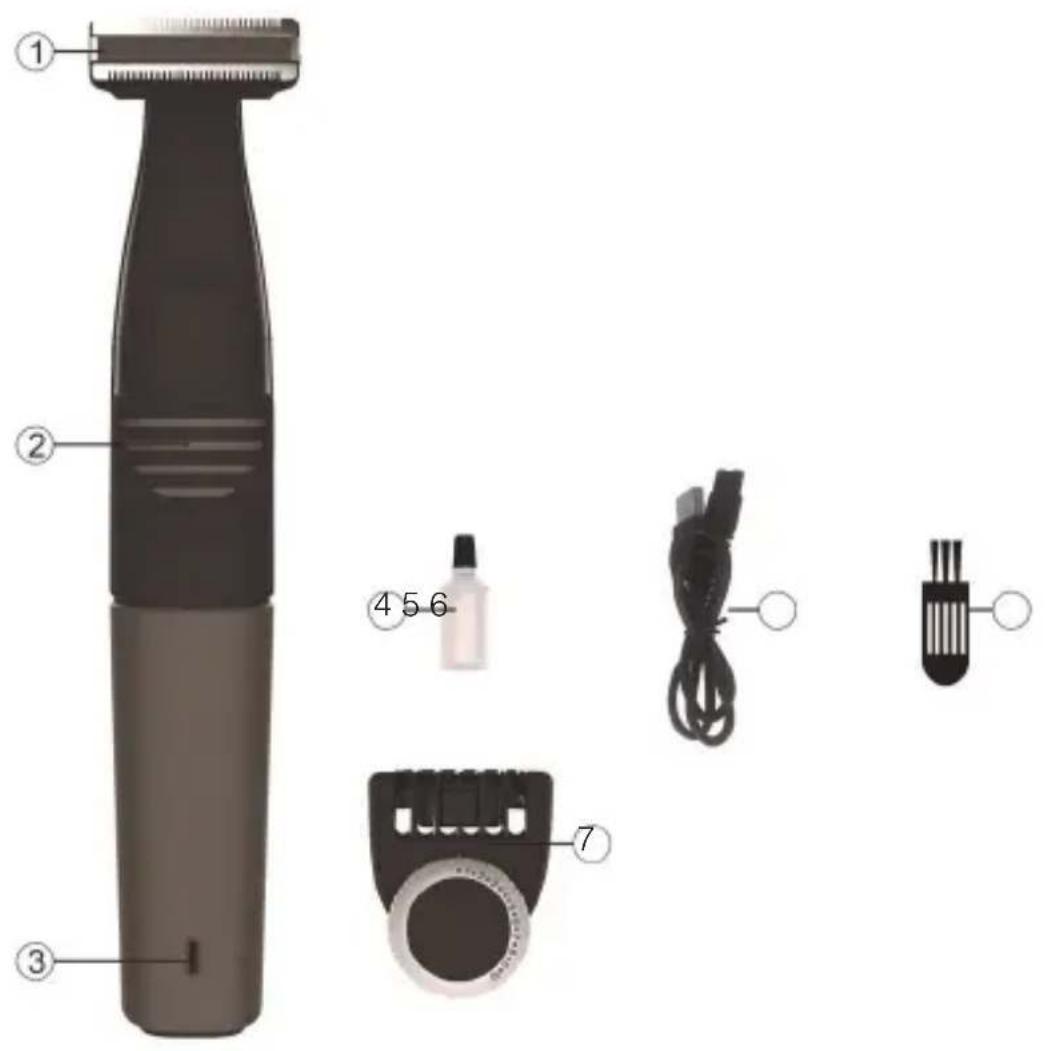
- hair clipper
- ON/OFF button
- power/charge LED indicator
- oil
- USB cable
- brush
- trimming comb for precise trimming (adjustable length)
Preparation
Charging
The battery must be fully charged before using the device.
1 Connect the USB connector of the supplied USB cable to a suitable AC adapter (5V DC, 1A) or to a USB connector on the PC, and connect the other connector to the connector on the device.
2 Plug the AC adapter into a 230 V \~ 50 Hz power socket or turn on the PC when charging from a PC.
3 The charging LED turns red and charging starts.
The charging end is not signaled as the device is equipped with a battery overload protection system. The first maximum charge takes about 2 hours. With a fully charged battery (approx. 2 hours charging before first use), the device can operate for approx
1 hour.
For optimum battery condition, use the device for the first three cycles until the battery is fully discharged, then fully charge it.
Warning!
You can use your device while it is charging.
Before use
- Make sure the device is clean and functional.
- Attach the desired attachment to the device, if using the trimming comb (7), adjust the desired cutting length.
Only attach and store the attachment when the device is switched off! This may result in injury or damage to the device. - Put a towel around the neck of the person you are going to cut to prevent hair from falling on the garment.
- The person whose hair is to be cut should sit on a chair so that you have good access to all hair on the head.
- When cutting, hold the comb and the device loosely for smooth and even cutting.
- Cut only natural human hair. Cut hair must be clean and dry.
- Cut only smaller amounts of hair. If you try to cut a large volume of hair at once, the cut will not be effective.
Cutting hair
1 Place the trimming comb (7) on the device head and adjust the cutting length by turning the adjuster knob.
Available lengths are from 1 to 10 mm.
Before cutting, the position of the attachment must be fixed in the set cutting length.
2 Turn the device on with the On/Off button (2) and cut the hair. Follow the cutting procedure.
Cutting procedure:
Cut short hair lengths in succession until you cut the length evenly according to the setting.
- Use a trimming comb (7).
- Do not force the device while cutting.
- Start cutting with the comb attachment.
- Hold the trimmer lightly with the attachment on the head of the device facing up.
Proceed slowly as shown in fig. 1 from bottom to top.
- Repeat the procedure at the back of the head from bottom to top (fig. 2).
• After trimming the hair, change the length setting, and cut it repeatedly from bottom to top.
- This method is certainly better than starting to cut with a shorter cutting length set.
- The cutting procedure on the sides of the head is the same as on the back of the head - from bottom to top (fig. 3).
- On the top of the head, proceed from front to back using a larger cut length and later a shorter cut length on the trimming comb. The teeth of the trimming comb are facing upwards (fig. 4).
Line alignment
- You do not need a trimming comb to align hair lines.
- Remove the trimming comb from the device.
- Align the hair at the ear to the desired line (fig. 5).
• Make sure the cutting blade is flush with the hairline.
• To align the hair on the back of the neck, turn the device down and align regularly towards the ear (fig. 6). - Similarly, trim the hair on the back of your neck. Move from top to bottom with the device facing down.

(fig. 7)
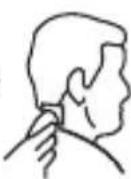


Short cut
- You start cutting from the bottom of the head upwards again. Slowly proceed to the top of the head (fig. 7).
- On the top of the head, proceed from front to back (fig. 8).
- For accurate cutting (shaping the hair) use a comb to comb into the hair and cut the hair on the comb with the device (fig. 9).
Nape treatment
If you want to do your nape treatment, you must use a hand mirror.
- Use the device without the attachment to adjust the neck.
- Use your forefinger to cover the hair you do not want to cut on the neck, turn on the device with the On/Off button (2), gently push the device to the neck and slowly slide it up to the index finger.
After use
After use, clean the device and the attachment using the brush supplied (6).
Cleaning and oiling
- The device has been carefully inspected, oiled and pre-shipped and packaged.
Note
Clean the device and accessories regularly to ensure maximum performance and long life.
Cleaning accessories with water
Remove the used extension.
Rinse the adapter ONLY under warm running water. DO NOT use hot water as this may damage the attachment.
Cleaning accessories with a brush
After removing the attachment, thoroughly clean and deflate the hair and hair fragments from the cutting system, the attachment and the top of the handle.
Oil cutting shears and warnings
- After rinsing the accessories under water (above), the shear blades are required to be lubricated once a month.
If the blade is not evenly oiled, drip 1 to 2 drops of the supplied silicone oil (4) on it. Use only the supplied silicone or sewing device oil. Wipe off excess oil. - Use only silicone oils as the cutting blade speed will not evaporate or slow down.
- Do not use hair oil, grease, or any other oil mixed with kerosene or solvent, as it will evaporate or evaporate. dried.
Warnings!
Never clean the AC adapter or the body of the device in water or any other liquid!
Clean the unit, base, and AC adapter with a dry cloth slightly moistened with water. Do not use any abrasive cleaners or solvents such as alcohol, benzine, or thinner for cleaning.
Removing the battery
The device is powered by a built-in accumulator. The battery must be removed before disposing of the device.
Contact your dealer or an authorized service center. Never replace the battery with a standard battery!
The battery must be completely discharged before removing the battery.
Pay attention to sharp edges of the battery.
1 Remove the back panel of the device using a screwdriver
2 Remove the rechargeable battery.
General safety precautions for batteries
- Keep batteries away from children.
If swallowed, consult a doctor immediately. - Wipe the batteries with a dry cloth before inserting them. This ensures good contact.
- Check the correct polarity when inserting the battery.
- Do not put batteries in contact with metal objects. There may be a short circuit.
Warning!
The battery may explode if mistreated. Do not disassemble or throw batteries into a fire.
Dispose of them in accordance with applicable local regulations and standards.
Technical specifications
Power supply: built-in lithium battery, 500 mAh
AC adapter (not supplied): input: 230 V \~ 50 Hz output: 5 V / 1 A
Protection class: II (protection against electric shock is ensured by double insulation)
Water protection: IPX5
Charging time: 2 hours
Working time: 1 hour
Dimensions (W x H x D): 2.8 x 12.9 x 2.8 cm
Weight: 90 g (without attachment)
Noise level: 71 dB (A)
The declared noise emission value of this appliance is 71 dB (A), which represents the sound power level A relative to the reference sound power of 1 pW.
Supplied accessories: brush, trimming comb, USB cable, oil
Subject to change without notice!
Producer:
ORAVA retail 1, a.s.
Seberíniho 2
821 03 Bratislava
Slovenská republika
Importer:
ORAVA retail 1, a.s.
Seberíniho 2
821 03 Bratislava
Slovenská republika
ORAVA distribution CZ, s.r.o.
Ostravská 494
739 25 Sviadnov
Česká republika

natural_image
Symbol of a trash bin crossed with a diagonal line, no text or numbers presentDISPOSAL OF USED ELECTRICAL AND ELECTRONIC EQUIPMENT
The symbol on the product or on its packaging indicates that this product does not belong to household waste. It is necessary to take it to a collection point for electrical recycling and electronic equipment.
By ensuring proper disposal of this product, you will help prevent negative consequences to the environment and human health that would otherwise be caused by inappropriate disposal of this product. For more detailed information about recycling of this product, please contact your local authority, your household waste disposal service or the shop where you purchased the product.
This product meets all the essential requirements of the EU directives that apply to it.
- Intended use of the device
- GENERAL SAFETY INSTRUCTIONS AND WARNINGS
- General safety instructions
- Safety of the operating environment
- Electrical safety
- Safety of persons
- Cleaning, maintenance and repairs
- Special safety instructions. Read carefully!
- IPX5
- Transportation/Transfer
- Unpacking/Packaging
- Inspection/Commissioning
- Warning!
- Operation / Supervision
- Safety instructions for the power supply
- Caution!
- Power the device using a rechargeable battery
- Warning
- Power the device with removable batteries
- Operation
- Description of parts
- Preparation
- Charging
- Before use
- Cutting hair
- Cutting procedure:
- Line alignment
- Short cut
- Nape treatment
- After use
- Cleaning and oiling
- Note
- Cleaning accessories with water
- Cleaning accessories with a brush
- Oil cutting shears and warnings
- Warnings!
- Removing the battery
- General safety precautions for batteries
- Technical specifications
- Producer:
- Importer:
- DISPOSAL OF USED ELECTRICAL AND ELECTRONIC EQUIPMENT
Brand : Orava
Model : Easyone 2
Category : Electric razor