UE55ES7507U - TV SAMSUNG - Free user manual and instructions
Find the device manual for free UE55ES7507U SAMSUNG in PDF.


User questions about UE55ES7507U SAMSUNG
0 question about this device. Answer the ones you know or ask your own.
Ask a new question about this device
Download the instructions for your TV in PDF format for free! Find your manual UE55ES7507U - SAMSUNG and take your electronic device back in hand. On this page are published all the documents necessary for the use of your device. UE55ES7507U by SAMSUNG.
USER MANUAL UE55ES7507U SAMSUNG
Thank you for purchasing this Samsung product.
To receive more complete service, please register your product at
www.samsung.com/register
Model____ Serial No.____
Contents
Channel Menu
- Connecting the TV 1
• Using the INFO button (Now & Next guide) 20
• Managing Channels and Channel Functions 22
• Memorizing Channels 66
• Other Features 80
Basic Feature
• Changing the Preset Picture Mode 96
• Adjusting Picture Settings 99
• Changing the Picture Size 105
• Changing the Picture Options 116
• Using the TV with Your PC 134
• Changing the Preset Sound Mode 138
• Adjusting Sound Settings 140
Preference Features
• Connecting to the Network 156
- Setting up a Wired Network 167
• Setting up the Wireless Network 180
• Managing the Network Devices 206
- Setting the Time 218
- Blocking Programmes 231
• Economical Solutions 236
• Picture In Picture (PIP) 240
• Using the TV with a Keyboard and a Mouse 245
• Other Features 253
• Support Menu 276
Advanced Features
• Using the 3D function 301
- Smart Hub 319
• Customizing the Home Screen 343
• Using Samsung Apps 375
- Search 385
- Your Video 393
- Family Story 410
- Fitness 465
- Kids 477
• Web Browser 493
- Skype 522
• SMART Interaction 525
• Specification for SMART Interaction 566
• AllShare Play 577
• Using the AllShare Play 602
• My list (In AllShare Play) 606
• Videos (In AllShare Play) 619
• Photos (In AllShare Play) 638
• Music (In AllShare Play) 655
• Recorded TV (In AllShare Play) 669
- Timeshift 684
• Using the DLNA Function 694
• Using the MHL function 705
• Anynet+ (HDMI-CEC) 711
Other Information
- Troubleshooting 728
• Picture Quality (Troubleshooting) 732
• Sound Quality (Troubleshooting) 740
• No Picture, No Video (Troubleshooting) 744 - RF (Cable / Aerial) Connection
(Troubleshooting) 748
• PC Connection (Troubleshooting) 750
• Network Connection (Troubleshooting) 751
• Recording / Timeshift (Troubleshooting) 752
• Others (Troubleshooting) 761
• Anynet+ (HDMI-CEC) (Troubleshooting) 775
• AllShare Play (Troubleshooting) 783
• Smart Hub (Troubleshooting) 784
• Web Browser (Troubleshooting) 786
• Using the Smart Touch Control 794
• Supported Subtitle and AllShare Play file formats 822
• Data Service 831
• HbbTV 839
• Connecting to a TV Viewing Card slot 843
- Teletext Feature 849
• Anti-theft Kensington Lock 856
• Licence 861
Connecting the TV
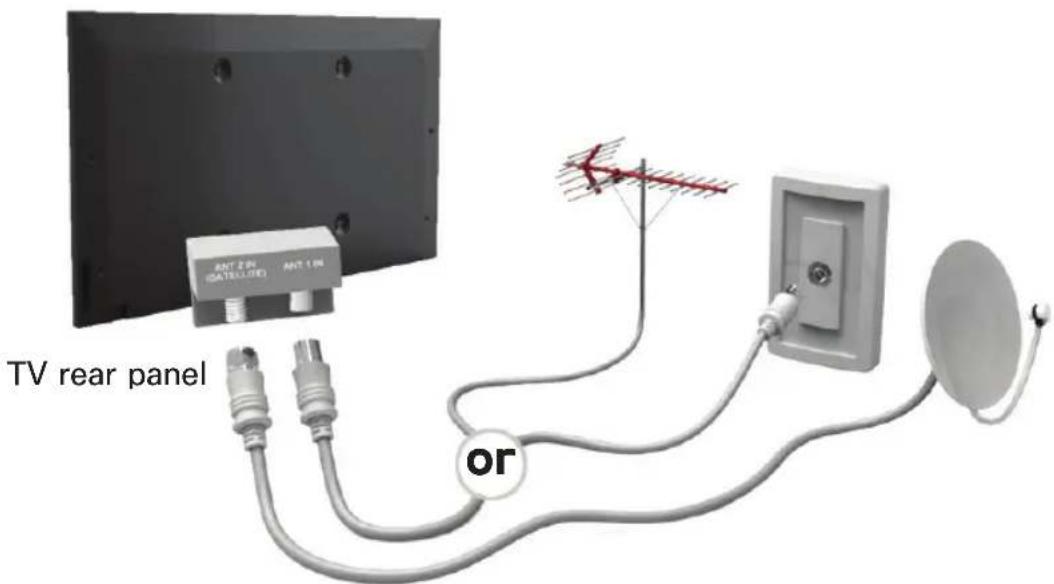
Connecting to an Aerial and / or Satellite
text_image
TV rear panel ANT 2 IN (GATELLINO) ANT 1 IN orThe displayed image may differ depending on the model.
Connecting to an AV Device
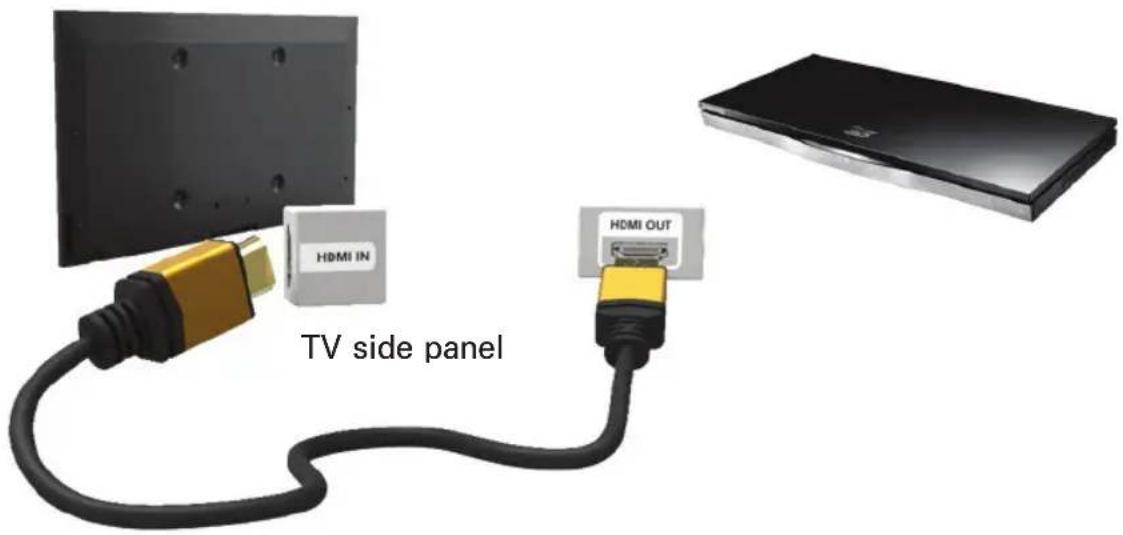
Using a HDMI (up to 1080p)
text_image
HDMI IN TV side panel HDMI OUTThe displayed image may differ depending on the model.
Using an HDMI cable (up to 1080p)
HDMI IN 1(DVI), HDMI IN 2(ARC), HDMI IN 3(MHL)
- For better picture and audio quality,
connect to a digital device using an HDMI cable.
- An HDMI cable supports digital video and audio signals, and does not require an audio cable.
- To connect the TV to a digital device that does not support HDMI output, use an HDMI/DVI and audio cables.
- The picture may not display normally (if at all) or the audio may not work if an external device that uses an older
version of HDMI mode is connected to the TV. If such a problem occurs, ask the manufacturer of the external device about the HDMI version and, if out of date, request an upgrade.
- Be sure to use an HDMI cable with a thickness of 14 mm or less.
- Be sure to purchase a certified HDMI cable. Otherwise, the picture may not display or a connection error may occur.
- A basic high-speed HDMI cable or one with Ethernet is recommended. This product does not support the Ethernet function via HDMI.
- This product supports the 3D and ARC (Audio Return Channel) functions via an HDMI cable. Note that the ARC function is supported by the HDMI IN 2(ARC) port only.
- If 3D Auto View is set to On, some functions such as SMART HUB may
be disabled. In this case, set 3D Auto View or 3D Mode to Off.
- The ARC function allows digital audio to output via the HDMI IN 2(ARC) port. It can be enabled only when the TV is connected with an audio receiver that supports the ARC function.
- This product supports the Mobile High-Definition Link (MHL) function via an HDMI-MHL cable. Note that the MHL function is supported by the HDMI IN
3(MHL) port only.
- The MHL function allows to display mobile device's screen via the HDMI IN 3(MHL) port. It can be enabled only when the TV is connected with a mobile device that supports the MHL function. For more detailed information, see "Using the MHL function" in e-Manual.
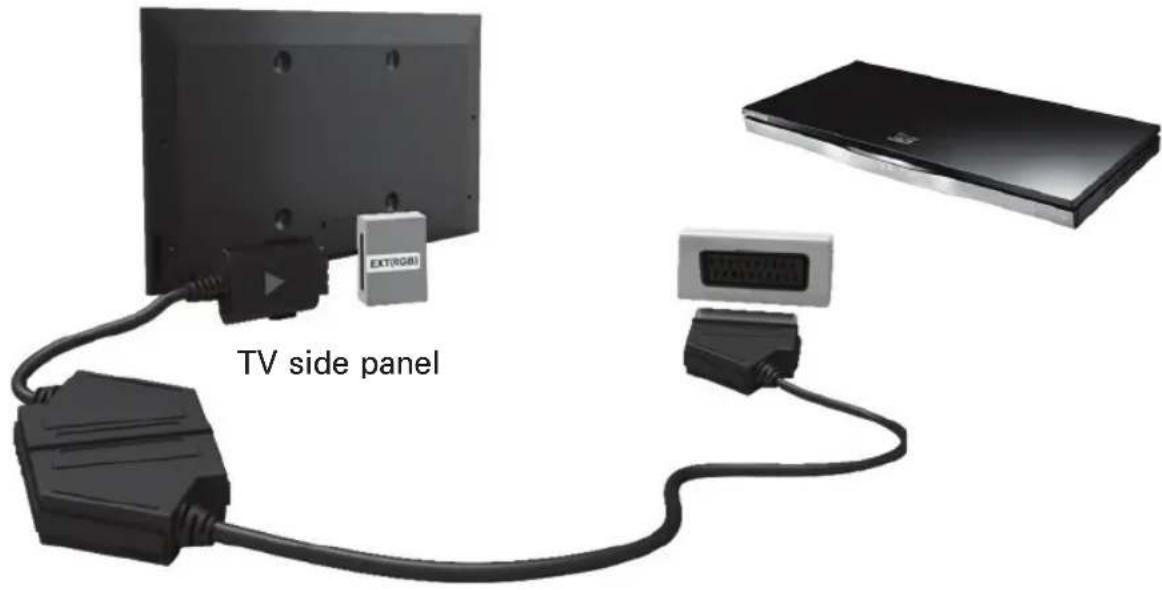
Using a Scart Cable
text_image
TV side panel EXT(RGB)The displayed image may differ depending on the model.
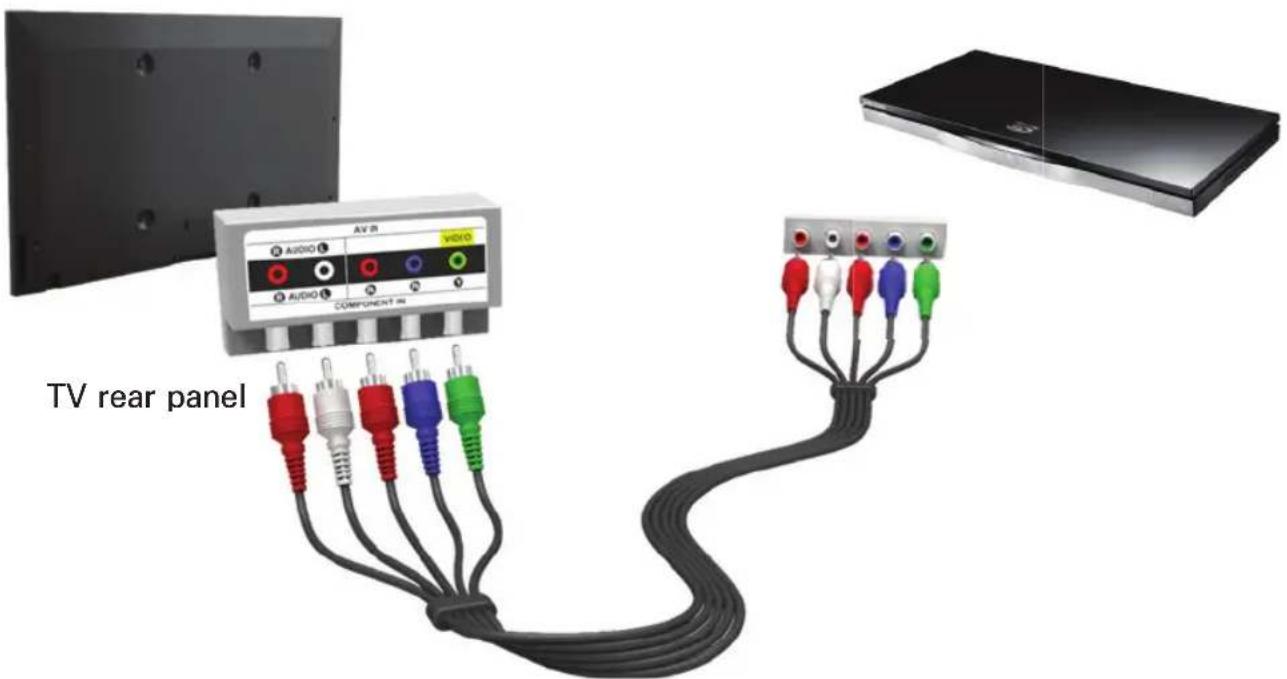
Using a Component (up to 1080i)
text_image
TV rear panel AV 23 AUDIO VIDEO AUDIO COMPONENT 24 TV rear panelThe displayed image may differ depending on the model.
Using a Component (up to 1080i) or an Audio/Video (480i only) and a Scart Cable
InExt. mode, DTV Out supports
MPEG SD Video and Audio only.
When connecting to AV IN, connect the AV connector (yellow) to the TV jack (Green).
To obtain the better picture quality, the Component connection or Scart connection are recommended over the A/V connection.
Connecting to an Audio device
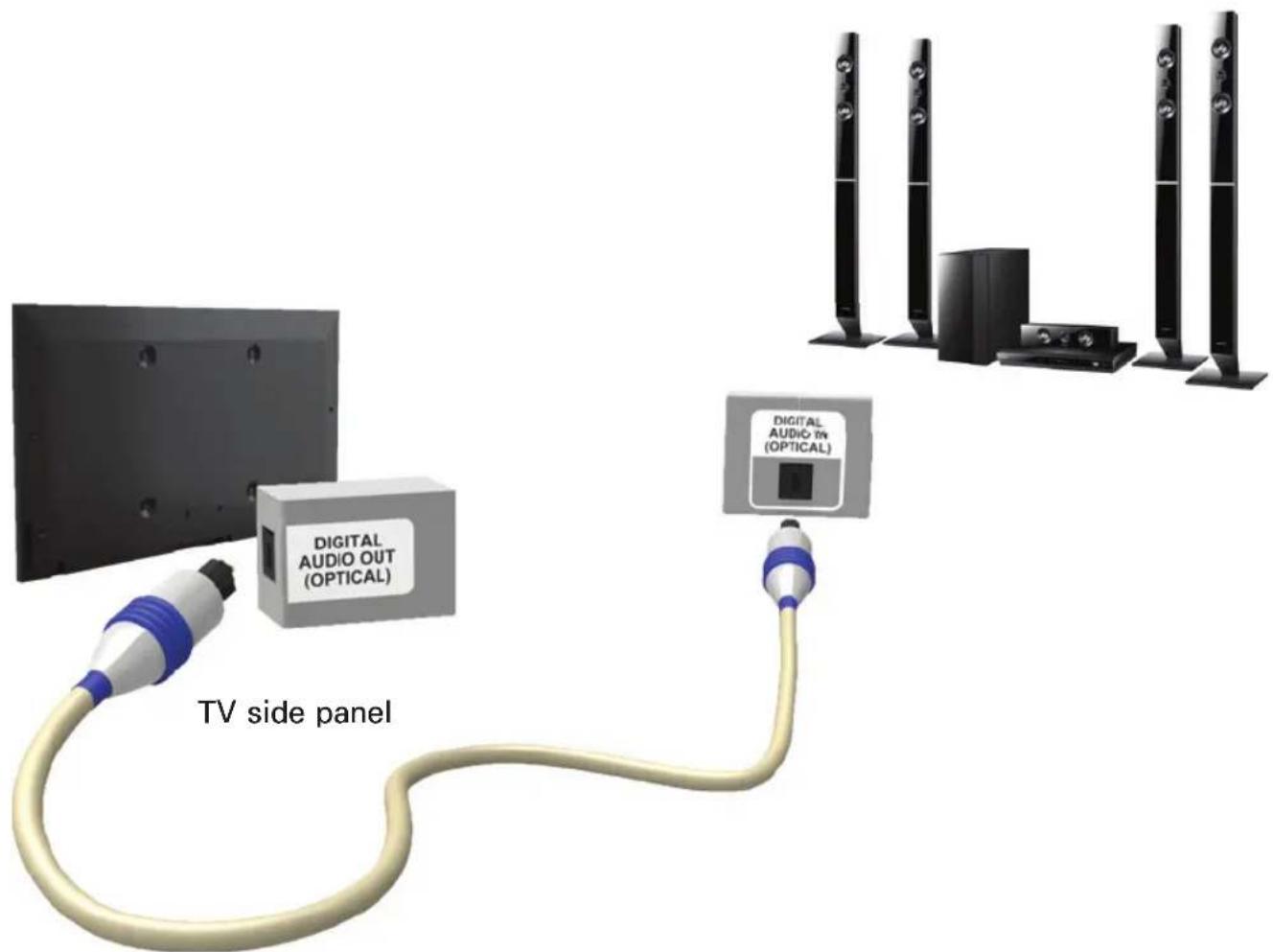
Using an Optical (Digital) Connection
text_image
DIGITAL AUDIO OUT (OPTICAL) TV side panel DIGITAL AUDIO OUT (OPTICAL)The displayed image may differ depending on the model.
DIGITAL AUDIO OUT (OPTICAL)
- When you connect a Digital Audio System to the DIGITAL AUDIO OUT (OPTICAL) jack, decrease the volume of both the TV and the system.
- Use the System speakers for audio.
- 5.1 CH (channel) audio is available when the TV is connected to an external device supporting 5.1 CH.
- When the receiver (home theatre) is set to on, you can hear sound output from
the TV’s optical jack. When the TV is receiving a DTV signal, the TV will send 5.1 CH sound to the home theatre receiver. When the source is a digital component such as a DVD / Blu-ray player / cable box / STB (Set-Top-Box) satellite receiver and is connected to the TV via HDMI, only 2 CH audio will be heard from the home theatre receiver. If you want to hear 5.1 CH audio, connect the digital audio out jack from your
DVD / Blu-ray player / cable box / STB satellite receiver directly to an amplifier or home theatre.
Headphones


text_image
TV rear panelThe displayed image may differ depending on the model.
You can connect your headphones to the headphones output on your set.
While the headphones are connected, the sound from the built-in speakers will be disabled.
- Sound function may be restricted when connecting headphones to the TV.
- Headphone volume and TV volume are adjusted separately.
- The headphones jack supports only
the 3 conductor tip-ring-sleeve (TRS) type.
Connecting to a PC
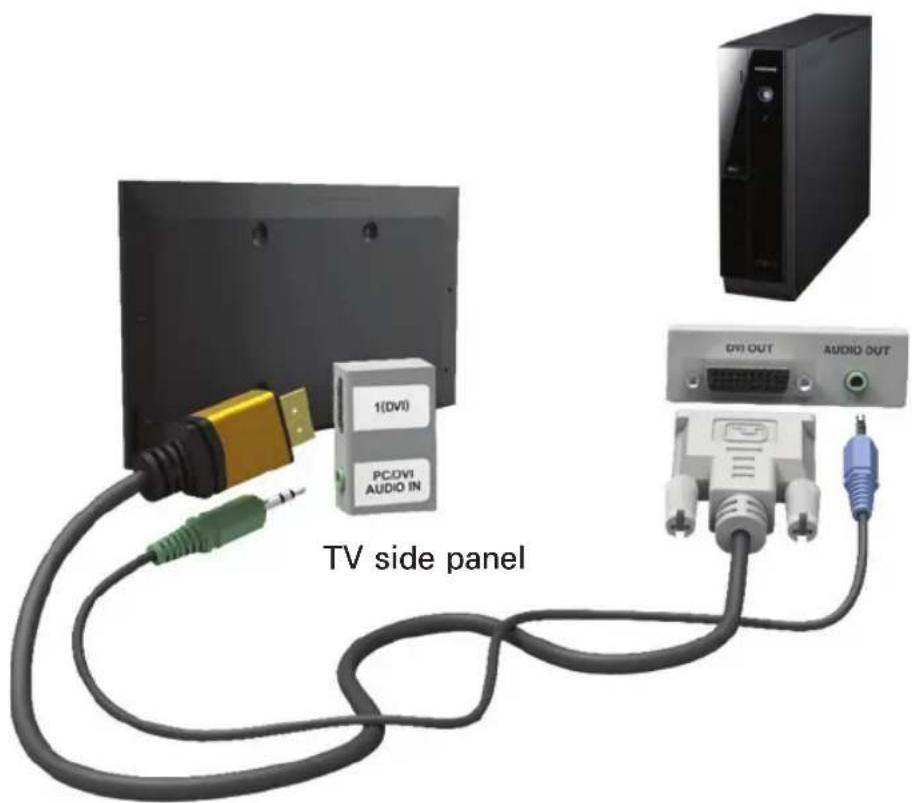
Using an HDMI cable or an HDMI to DVI cable
text_image
1(DVI) PC/DVI AUDIO IN TV side panel DVI OUT AUDIO OUTThe displayed image may differ depending on the model.
Connecting through the HDMI cable may not be supported depending on the PC.
Optimal resolution is 1920 X 1080 @ 60 Hz.
For HDMI/DVI cable connection, you must use the HDMI IN 1(DVI) jack.
- The interlace mode is not supported.
- The set might operate abnormally if a non-standard video format is
selected.
- Separate and Composite modes are supported. SOG (Sync On Green) is not supported.
- PC (D-Sub) input is not supported.
Using the INFO button (Now & Next guide)
The display identifies the current channel and the status of certain audio-video settings.
The Now & Next guide shows daily TV programme information for each channel according to the broadcasting time.
- Scroll ◀, ▶ to view information for a desired programme while watching the current channel.
- Scroll ▲, ▼ to view information for other channels. If you want to move to the currently selected channel, select using your remote.
Managing Channels and Channel Functions
Press the 📋 button to select the menu you want to use. Each screen will be displayed.
Guide
Guide
The EPG (Electronic Programme Guide) information is provided by broadcasters. Using programme schedules provided by broadcasters, you can specify
programmes you want to watch in advance so that the channel automatically changes to the selected programme channel at the specified time. Programme entries may appear blank or out of date depending on a channel status.
Using Channel View
• A (Sche. Mgr): Displays the Schedule Manager.
- B (-24 Hours): Viewing the list of programmes to be broadcasted before 24 hours.
• (+24 Hours): Viewing the list of programmes to be broadcasted after 24 hours. - D (Ch. Mode): Select the type of channels you want to display on the Channel View window.
-
i Information: Displays details of the selected programme.
-
Page: Move to next or previous page.
- Watch / Schedule: When selecting the current programme, you can watch the selected programme. / When selecting the future programme, you can reserve to watch the selected programme.
Channel
Channel
Using this function, you can delete
channels from the different Category channel lists on the Channel screen, set favourite channels, view and access recently viewed and most viewed channels, and edit the channel names of analogue channels.
The available items may differ depending on the selected aerial source.
Category Options (on the left side of the
Channel screen)
• All
Shows all channels.
• TV
Shows TV channels.
- Radio
Shows radio channels.
- Data/Other
Shows data channels and other channels.
- Analogue
Shows analogue channels.
• Favourites 1 - Favourites 5
Lets you arrange and display favourite channels in up to five groups. Each group is independent of the other groups and can contain the same channels as other groups, different channels, or a combination of both.
The TV displays favourites only if you have added favourites using Edit Favourites in the Tools menu.
If the highlight located in the Favourites 1 - Favourites 5 category, you can change the name of category by selecting B using your remote.
- Recently Viewed
Shows the most recently viewed channels. - Most Viewed
Shows the most frequently viewed channels.
Using the coloured and function buttons with Channel
• Air / Cable / Satellite
Select the desired aerial source.
The option may differ depending on country.
- B Delete
Deletes the selected channel(s) from a category list.
- i Information
Displays details of the selected channel.
• ↗ Page
Scrolls the channel list to the next or previous page.
These correspond to the CH buttons on the remote.
- Select / Deselect
Selects or deselects a channel.
- Tools
Displays the option menu.
- Return
Return to the previous menu.
Using the Tools menu with the Channel
- Edit Favourites
Lets you assign channels you watch frequently to a favourites group and remove channels from a favourites group. You access Edit Favourites on the Tools menu.
-
Select Edit Favourites. The Edit Favourites screen appears.
-
Select A using your remote. The selected channel will be added to the favourite group.
Also, you can select a channel in the Edit Favourites screen.
You can add a favourite channel to any one of the groups. To change favourites group, selectD using your remote. Each time you select D, a favourites group will be changed.
-
When done, select OK on the right side. The channel is made a favourite and is assigned to the favourites group you selected.
-
Edit completed. appears on the screen. Select OK.
On the Channel screen, the TV displays the “★” symbol next to the channel, indicating it is a favourite.
- Lock / Unlock
Lock a channel so that the channel cannot be selected and viewed.
This function is available only when the Channel Lock is set to On.
- Rename channels
(Appears only if you have selected an analogue channel.)
Lets you assign a name of up to five characters to an analogue channel. For example, Food, Golf, etc. This makes it easier to find and select the channel.
- Edit Channel Number
Edit the channel number by select the numbers.
This function may not be supported depending on the region.
- Sorting (digital channels only)
Change the list ordered by name or number.
- Channel Info
Displays information of channel signal. The item may differ depending on
channel.
- Search (when the Aerial was set to Satellite)
Channel scan is started.
- Delete
Delete a channel to display the channels you want.
- Select All / Deselect All
Select all channels in the list. / Deselect all channels you selected.
To delete a channel from a Category list on the Channel screen, follow these steps:
- If you want to delete a channel, select a category of the channel.
- Select a channel in the category list. A √ mark appears to the left of the channel.
You can select more than one channel.
If you re-select a channel you
selected, the √ mark disappears.
-
Open the Tools menu using your remote.
-
Select Delete. The message Delete the selected channels? appears. Select OK.
You can delete the selected channel immediately by selecting B using your remote.
When you delete a channel in the Recently Viewed or Most Viewed
category, the channel will disappear from that category list. But, the channel is not deleted.
To set channels as favourites, follow these steps:
- Select the All category.
- Select a channel in the category. A
√ mark appears to the left of the channel.
You can select more than one
channel.
If you re-select a channel you selected, the √ mark disappears.
-
Open the Tools menu using your remote.
-
Select the Edit Favourites. The Edit Favourites screen appears.
-
Select A using your remote. The selected channel will be moved to the favourite group.
Also, you can select a channel in
the Edit Favourites screen.
You can add a favourite channel to any one of the groups. To change favourites group, selectD using your remote. Each time you select D, a favourites group will be changed.
- When done, select OK. The channel is made as a favourite and is assigned to the favourite group you selected.

The TV displays the

symbol
next to the channel, indicating it is a favourite.
Using the coloured and function buttons with Edit Favourites
- When the highlight located in the All, you can use these options:
- A Add
Add selected channels to the favourites group.
- D Change Fav.
Change the favourites group. Each time you select D using your remote, the favourites group changes.
- 0\~9 Go To
You can enter a channel number immediately using your remote.
- Return
Return to the previous menu.
- When you highlight a favourite channel in a favourites group on the
Edit Favourites screen, you can use these options:
- A Delete
Delete the selected channel.
- B Change order
Change the favourite group list order.
- © Copy
Copy a selected channel to other favourites groups.
- D Change Fav.
Change the favourites group.
Each time you select D using your remote, the favourites group changes.
- Done
Finish the Change order function.
- 0\~9 Go To
You can enter a channel number immediately using your remote.
- Return
Return to the previous menu.
To remove a channel from a favourites group, follow these steps:
- Select the favourite's group category.
- Select a channel in the selected favourites group. A √ mark appears to the left of the channel.
You can select more than one channel.
If you re-select a selected channel, the √ mark disappears.
- Open the Tools menu using your remote.
- Select the Delete. The message Do you want to delete the selected item(s)? appears.
- Select OK. The message Deleted the selected item(s). appears.
Display Icons Used in the Channel screens
A: An analogue channel.
√: A channel selected.
★: A favourite channel.
: A locked channel.
Schedule Manager
→ Schedule Manager
Using this function, you can set the TV to display a desired channel automatically on a day and at a time of your choice.
You must set the current time first using the Time → Clock function
in the System menu to use this function.
To use Schedule Viewing, follow these steps:
- On the Schedule Manager screen, select A using your remote.
- A pop up screen will appear. Select Schedule Viewing.
- Set Aerial, Channel, Repeat, and Start Time.
- Aerial
Select the desired aerial source.
- Channel
Select Channel to view the channel numbers. Select the desired channel.
You can only select memorised channels.
- Repeat
Select Once, Manual, Sat\~Sun, Mon\~Fri or Everyday. If you select Manual, you can set the day you
want.
The √ mark indicates a day you've selected.
Date: You can set a desired date.
The Date is available only when you select Once in Repeat.
- Start Time
You can set the start time you want.
- When done, select OK, The selected channel is scheduled for viewing.
On the Schedule Manager screen,
you can view a list of Schedule Viewing.

If you select Information
function using your remote after highlighting an item, the Information screen appears. On the Information screen, you can change or cancel the Schedule Viewing.
Cancel schedule: Cancel the Schedule Viewing.
Edit Schedule: Change the Schedule Viewing.
Return: Return to the previous screen.
To delete an item in a list of scheduled, follow these steps:
-
On the Schedule Manager screen, highlight an item you want to delete.
-
Open the Tools menu using your remote.
-
Select the Cancel schedule. The Cancel selected list(s)? message appears.
-
Select Yes. The selected schedule is cancelled.
To use Schedule Recording, follow these steps (Digital channels only):
Allows you to make a reservation to record a programme scheduled for broadcast.
Set the current time first to use this function.
- Select Schedule Manager. The
Schedule Manager screen will be displayed. - Select A using your remote. A pop
up screen will appear. - Select the Schedule Recording.
We recommend using a USB HDD with at least 5,400 rpm, but a USB HDD of RAID type is not
supported.
More than 3TB USB HDD is not supported.
A USB storage device cannot record until it completes the Device Performance Test.
USB memory stick is not compatible.
- Set the Aerial, Channel, Repeat, Date, Start / End Time.
If you want to play a recorded
programme, refer to Recorded TV in the e-Manual.
Channel List
Using this function, you can view the channel list, programme information, and favourite channels, select channels to watch, and use Schedule Viewing on digital channels.
- Press the CH LIST button for Standard
Remote Control or select CH List for
Smart Touch Control. The Channel List screen is displayed immediately.
- Change a channel or channel list mode.
Using the coloured and function buttons with the Channel List
If you select Info using your remote, the TV displays details of the selected programme.
• A Aerial
Select the desired aerial source.
The option may differ depending on country.
- Programme View / Channel View For digital channels, switches the display between Programme View and Channel View.
When you select a digital channel in Channel List, select c once to display a list of programmes on that channel.
Select again to re-display the Channel
View.
- Ch. Mode / Channel
Move to the type of channels you want to display on the Channel List screen. / On the Programme View screen, displays the programmes for the next or previous channel.
• Watch / Information
Watches the channel you select. / Displays details of the selected channel.
• ↗ Page
Scrolls the Channel List to the next or previous page.
Using the Schedule Viewing in Channel List (Digital channels only)
You can use Schedule Viewing in Channel List to schedule a digital channel programme for viewing.
The TV will turn on and display the digital channel programme when the
programme begins.
-
Select CH LIST function using your remote. The Channel List screen appears.
-
Select a desired digital channel.
-
Select ⓒ using your remote. The TV displays the programme list of the selected channel.
-
Select a desired programme in the programme view, and then select Information using your remote.
-
On the Information screen, select Schedule Viewing. The selected programme is scheduled.
If you want to cancel the Schedule Viewing, follow Steps 1 through 4, and then select Cancel schedule.
Channel Status Display Icons
A: An analogue channel.
: A reserved programme.
: A reserved recording programme.
: A locked channel.
Memorizing Channels
Aerial
Menu → Channel → Aerial
Before your television can begin memorizing the available channels, you must specify the type of signal source that is connected to the TV.
The option may differ depending on country.
Country
Menu → Channel → Country
Select your country so that the TV can correctly auto-tune the broadcasting channels.
The PIN input screen appears. Enter your 4 digit PIN number.
- Digital Channel: Change the country for digital channels.
- Analogue Channel: Change the country for analogue channels.
Auto Tuning
Menu → Channel → Auto Tuning
Scans for a channel automatically and stores in the TV.
Automatically allocated programme numbers may not correspond to actual or desired programme numbers. If a channel is locked using the Channel Lock function, the PIN input window appears.
- Auto Tuning: Scans for channels automatically and stores them in the TV’s memory.
- Cable Search Option (Depending on the country)
When the Aerial was set to Cable. Sets additional search options such as the frequency and symbol rate for a cable network search.
When Aerial Source is set to Air or Cable
- Digital & Analogue / Digital / Analogue: Select the channel source to memorise. When selecting Cable Digital & Analogue or Digital: Provide a value to scan for cable channels.
- Operator Selection (Depending on the country): Selects a provider of cable services.
- Search Mode: If you selected the Cable, the Search Mode screen appears. Scans for all channels with active
broadcast stations and stores them in the TV.
If you select Quick, you can set up the Network, Network ID, Frequency, Modulation, and Symbol Rate manually by the remote control.
Network: Selects the Network ID setting mode among Auto or Manual.
Network ID: When Network is Manual, you can set up Network ID.
Frequency: Displays the frequency for
the channel. (Differs in each country) Modulation: Displays available modulation values.
Symbol Rate: Displays available symbol rates.
When Aerial Source is set to Satellite
(Depending on the country)
- Channel Type: Select the Channel Type to memorise.
- Satellite: Selects the satellite to scan.
The option may differ depending on country.
- Scan Mode: Selects the scanning mode of the selected satellite.
- Re-initialise: Selects the scanning mode of the selected satellite.
- Search Mode: Sets search mode using up/down functions.
Manual Tuning
Menu → Channel → Manual Tuning
Scans for a channel manually and stores in the TV.
If a channel is locked using the Channel Lock function, the PIN input window appears.
This function may not be supported depending on the region.
When Aerial Source is set to Air or Cable
- Digital Channel Tuning: Scans for a digital channel.
1. Select the New.
When selecting Aerial → Air: Channel, Frequency, Bandwidth
When selecting Aerial Cable: Frequency, Modulation, Symbol Rate
- Select the Search. When scanning has finished, a channel is updated in the channel list.
- Analogue Channel Tuning: Scans for a analogue channel.
- Select the New.
- Set the Programme, Colour System, Sound System, Channel and Search.
- Select the Store. When scanning has finished, a channel is updated in the channel list.
Channel mode
- P (programme mode): When tuning is complete, the broadcasting stations in your area have been assigned to
position numbers from P0 to P99.
You can select a channel by entering the position number in this mode.
- C (aerial channel mode) / S (cable channel mode): These two modes allow you to select a channel by entering the assigned number for each aerial broadcasting station or cable channel.
When Aerial Source is set to Satellite
• Transponder: Selects the transponder.
- Scan Mode: Selects either free or all channels to store.
• Network Search: Enable / Disable
network search.
- Signal Quality: Display the current status of broadcasting signal.
Information on a satellite and its transponder is subject to change depending on the broadcasting conditions.
When setting is completed, move to Search. Channel scan is started.
Other Features
Guide Type
Menu → Channel → Guide Type
(Depending on the country)
You can select a different type of Guide.
- Samsung: Uses the guide programme by provided Samsung.
- Rovi On Screen: Uses the guide programme provided by Rovi
International Solutions.
ROVI EPG initial setting time can take a while depending on the region or broadcast environment.
Genre Selection for U.K
Menu → Channel → Genre Selection
Genre Selection is available when Aerial is set to Freesat.
- Genre Selection: Turn the channel-genre selection feature on or off
when using the guide.
Transfer Channel List
Menu → Channel → Transfer Channel List
Imports or exports the channel map.
You should connect USB storage to use this function.
The PIN input screen appears. Enter the PIN using your remote.
- Import from USB: Import channel list from USB.
- Export to USB: Export channel list to USB. This function is available when USB is connected.
Fine Tune
Menu → Channel → Fine Tune
(Analogue channels only)
If the reception is clear, you do not have to fine tune the channel, as this is done automatically during the search and store operation. If the signal is
weak or distorted, fine tune the channel manually. Scroll to the left or right until the image is clear.
Settings are applied to the channel you're currently watching.
Fine tuned channels that have been saved are marked with an asterisk “*” on the right-hand side of the channel number in the channel banner.
To reset the fine-tuning, select the Reset.
Crosstalk noise reduction
Menu → Channel → Crosstalk noise reduction
(Analogue channels only)
This function reduces diagonal noise in the picture caused by signal crosstalk (interference). If your TV picture displays diagonal noise or distortion when you watch, turn on this function. (Depending on the country)
Satellite System
Satellite System is available when Aerial is set to Satellite. Before running Auto Store, set Satellite System. Then channel scan is run normally.
The PIN input screen appears. Enter your 4 digit PIN number.
- Satellite Selection: You can choose the satellites for this TV.
• LNB Power: Enables or disables the
power supply for the LNB.
- LNB Settings: Configures the outdoor equipment.
Satellite: Selects the satellite for receiving digital broadcasts.
Transponder: Selects a transponder from the list or adds a new transponder.
DiSEqC Mode: Selects DiSEqC mode for the selected LNB.
Lower LNB Oscillators: Sets the LNB oscillators to a lower frequency.
Upper LNB Oscillators: Sets the LNB oscillators to a higher frequency.
Tone 22 kHz: Selects the Tone 22 kHz depending on the LNB type. For a universal LNB it should be Auto.
Signal Quality: Display the current status of broadcasting signal.
- SatCR/Unicable Settings: Configure single cable installation.
This function may not support depending on the region.
- SatCR/Unicable: Enables or disable single cable installation support.
- Slot Number: Select the SatCR user slot number for this receiver.
- Slot Frequency: Enter the appropriate frequency to receive the signal from SatCR.
- Detect Slot Frequency: Auto-detect the signal frequency for the selected slot number.
- Verify Slot Frequency: Verify that the
frequency entered corresponds to the selected slot.
- Positioner Settings: Configures the aerial positioner.
Positioner: Enables or disables the positioned control.
Positioner Type: Sets the positioned type between DiSEqC 1.2 and USALS (Universal Satellite Automatic Location System).
User Mode: Sets the position of satellite aerial according to each satellite.
If you store the current position of satellite aerial according to a certain satellite, when the signal of that satellite is needed, the satellite aerial
can be moved to pre-populated position.
- Satellite: Selects the satellite to set the position for.
- Transponder: Selects a transponder from the list for signal reception.
- Moving Mode: Selects the movement mode between discrete and continuous movement.
- Step Size: Adjusts the step size degrees for the aerial rotation. Step
Size is available when Moving Mode is set to Step.
- Go To Stored Position: Rotates the aerial to the stored satellite position.
- Aerial Position: Adjusts and stores the aerial position for the selected satellite.
- Store Current Position: Stores current position as the selected positioner limit.
- Signal Quality: Display the current
status of broadcasting signal.
Installer Mode: Sets limits to the scope of movement of satellite aerial or reset the position. Generally, installation guide uses this function.
- Limit Position: Selects the direction of the positioner Limit.
- Aerial Position: Adjusts and stores the aerial position for the selected satellite.
- Store Current Position: Stores the
current position as the selected positioner Limit.
- Go To Zero: Moves the aerial to the reference position.
- Reset Positioner Limit: Allows the aerial to rotate over the full arc.
- Reset All Settings: All satellite settings will be reset to the initial values.
Changing the Preset Picture Mode
Picture Mode
Menu → Picture → Picture Mode
Picture modes apply preset adjustments to the picture.
When your TV is connected to a PC via an HDMI to DVI cable, you can only select Entertain and Standard.
- Dynamic
Suitable for a bright room.
- Standard
Suitable for a normal environment.
• Natural for LED TV / Relax for PDP TV
Suitable for reducing eye strain.
- Movie
Suitable for watching movies in a dark room.
- Entertain
Suitable for watching movies and games.
Only available when the TV is
connected to a PC via an HDMI cable.
Adjusting Picture Settings
Backlight for LED TV / Cell Light for PDP TV
Menu → Picture → Backlight / Cell Light
Adjusts the brightness of the screen by adjusting the brightness of the individual pixels.
Contrast
Menu → Picture → Contrast
Increases or decreases the contrast
between dark and light areas of the picture.
Brightness
Menu → Picture → Brightness
Adjusts the brightness of the screen. Not as effective as Backlight / Cell Light.
The energy consumed during use can be significantly reduced if the brightness level of the picture
is lowered, which will reduce the overall running cost.
Sharpness
Menu → Picture → Sharpness
Sharpens or dulls the edges of objects.
Colour
Menu → Picture → Colour
Adjusts the colour saturation. The higher the Colour setting, the more
intense the colour. Low settings remove colour and the picture becomes black, white, and gray.
Tint (G/R)
Menu → Picture → Tint (G/R)
Adjusts the amount of green and red in the picture. As you increase the amount of green, the amount of red decreases and vice versa.
To adjust picture quality, follow these steps:
-
Select an option you want to adjust.
When you select an option, a slider screen appears. -
Adjust the option value using your remote.
When you change an option value, the change will affect the OSD menu also.
When connecting a PC using an HDMI-DVI cable, Colour and Tint (G/
R) are not available.
You can adjust and store settings for each external device connected to the TV.
Lowering picture brightness reduces power consumption.
Changing the Picture Size
Screen Adjustment
Menu → Picture → Screen Adjustment
Using this function, you can select various picture size and aspect ratio options.
- Picture Size
If you have a cable box or satellite receiver, it may have its own set of screen sizes as well. However, we
highly recommend you use your TV's 16:9 mode most of the time.
If you have set Double (☐, ☐) mode in PIP (Picture-in-Picture), you cannot adjust the Picture Size.
Auto Wide: Automatically adjusts the picture size to the 16:9 aspect ratios.
16:9: Adjusts the picture size to 16:9 for DVDs or wide broadcasting.
Wide Zoom: Magnifies the picture size more than 4:3.
Zoom: Magnifies the 16:9 wide pictures vertically to fit the screen size.
4:3: The default setting for a movie or normal broadcasting.
Do not watch in 4:3 format for a long time. Traces of borders displayed on the left, right and centre of the screen may cause image retention (screen burn) which is not covered by the warranty.
Screen Fit: Displays the full image
without any cut-off when HDMI (720p / 1080i / 1080p) or Component (1080i / 1080p) signals are inputted.
Smart View 1: Reduces the 16:9 picture by 50% for LED TV
Smart View 2: Reduces the 16:9 picture by 25% for LED TV
Smart View 1 is enabled only in HDMI mode.
Smart View 2 is enabled only in HDMI or DTV mode.
The picture size can vary when you play content from Videos in AllShare Play depending on the input resolution.
- Zoom/position
Adjusts the picture zoom and position. Zoom is only available if Picture Size is set to Zoom. Position is only available if Picture Size is set to Wide Zoom, Zoom, or Screen Fit.
To use the Zoom function after selecting Zoom, follow these steps:
- Select Zoom.
- On the Zoom/position screen, select Zoom, and then zoom in or zoom out using your remote.
- When done, select Zoom again, and then select Close.
- To reset the picture, press Reset.
To use the Position function after
selecting Wide Zoom, Zoom or Screen Fit, follow these steps:
- Select the Position.
- On the Position screen, select Position, and then move the picture to position you want using your remote.
- When done, select Position again, and then select Close.
- To reset the picture position, select Reset.
Picture Size available by Input Source:
- ATV, EXT, AV: Auto Wide, 16:9, Wide Zoom, Zoom, 4:3
- DTV (576i/p, 720p): Auto Wide, 16:9, Wide Zoom, Zoom, 4:3, Smart View 2 for LED TV
- DTV (1080i, 1080p): Auto Wide, 16:9, Wide Zoom, Zoom, 4:3, Screen Fit, Smart View 2 for LED TV
- Component (480i/p, 576i/p, 720p):
16:9, Wide Zoom, Zoom, 4:3
- Component (1080i, 1080p): 16:9, Wide Zoom, Zoom, 4:3, Screen Fit
- HDMI (480i/p, 576i/p): 16:9, Wide Zoom, Zoom, 4:3, Smart View 1, Smart View 2 for LED TV
- HDMI (720p, 1080i, 1080p): 16:9, Wide Zoom, Zoom, 4:3, Screen Fit, Smart View 1, Smart View 2 for LED
TV
Depending on the input source, the
picture size options may vary.
The available items may differ depending on the selected mode.
HD (High Definition): 16:9 - 1080i/1080p (1920x1080), 720p (1280x720)
You can adjust and store settings for each external device you have connected to an input on the TV. Select the Source, and then adjust the settings.
• 4:3 Screen Size
Available only when picture size is set to Auto Wide. You can determine the desired picture size at the 4:3 WSS (Wide Screen Service) size or the original size. Each European country requires different picture size.
Not available in Component or HDMI mode.
Changing the Picture Options
Advanced Settings
Menu → Picture → Advanced Settings
Using this function, you can configure advanced picture settings to create your preferred picture.
Advanced Settings is available only when the Picture Mode is set to Standard or Movie mode.
When connecting a PC using an
HDMI-DVI cable, you can only make changes to White Balance and Gamma.
• Dynamic Contrast
Adjusts the screen contrast.
- Black Tone
Darker settings make blacks look darker.
- Flesh Tone
Adjusts the amount of red in skin tones.
- RGB Only Mode
Displays the Red, Green and Blue colours so you can make fine adjustments to hue and saturation.
- Colour Space
Adjusts the range and variety of colours (the colour space) available to create images.
To adjust Colour, Red, Green, Blue and Reset, set the Colour Space to Custom.
- White Balance
Adjusts the colour temperature of the picture so that white objects look white (instead of, for example, slightly pink or slightly yellow) and the overall colour of the picture looks natural.
R-Offset / G-Offset / B-Offset:
Adjusts each colour's (red, green, blue) darkness.
R-Gain / G-Gain / B-Gain: Adjusts each colour's (red, green, blue) brightness.
Reset: Resets the White Balance to its default settings.
• 10p White Balance
Lets you control the white balance by adjusting the red, green, and blue brightness in 10 point intervals.
Available when the Picture Mode is set to Movie. Available for all video source.
Some external devices may not support this function.
Interval: Select the interval to adjust.
Red: Adjusts the red level.
Green: Adjusts the green level.
Blue: Adjusts the blue level.
Reset: Resets the 10p White Balance to its default settings.
- Gamma
Adjusts the primary colour intensity.
- Expert Pattern
Use the Expert Pattern function to calibrate the picture. If the OSD menu
disappears or a menu other than the Picture menu is opened, the TV saves the calibration and the Expert Pattern screen disappears.
Off: Turns the Expert Pattern function of f.
Pattern1: This test screen demonstrates the effect of your display settings on shades of grey and black.
Pattern2: This test screen demonstrates the effect of your display settings on
colours.
After selecting Pattern1 or Pattern2, you can adjust any of the advanced settings for the desired effect.
While the Expert Pattern is running, the TV does not output sound.
Only enabled in DTV, Component, and HDMI modes.
- xvYCC
Setting xvYCC on increases picture detail and enlarges the colour space
when you are watching movies input from an external device (e.g. BD/DVD player) connected to the TV's HDMI or Component IN jacks.
Available only when you set the Picture Mode to Movie and the external input to HDMI or Component.
Some external devices may not support this function.
- Motion Lighting
Adjust brightness levels according to on-screen picture motion to reduce power consumption.
Only available in Standard mode.
This feature is not supported in 3D mode.
When you change the Backlight for LED TV / Cell Light for PDP TV, Contrast or Brightness, the TV sets Motion Lighting to Off.
- Black enhancer for LED TV
Adjust black colour depth to enhance picture perspective.
Picture Options
Menu → Picture → Picture Options
Using this function, you can configure additional picture settings to suit your preference.
When connecting a PC using an HDMI-DVI cable, you can only make changes to Colour Tone.
- Colour Tone
Select the colour temperature.
Warm1 or Warm2 will be deactivated when the Picture Mode is set to Dynamic.
You can adjust and store settings for each external device connected to an input on the TV. Select Source and then adjust the settings.
• Digital Noise Filter
If the broadcast signal received by your
TV is weak, you can activate the Digital Noise Filter feature to reduce any static and ghosting that may appear on the screen.
Auto Visualisation: When changing analogue channels, displays signal strength.
When the signal is weak, try all the options until the TV displays the best picture.
Only available for analogue channels.
When the bar is green, you are receiving the best possible signal.
- MPEG Noise Filter
Reduces MPEG noise to provide improved picture quality.
• HDMI Black Level
Lets you adjust the screen depth by selecting a black level.
Available only in HDMI mode.
- Film Mode
Sets the TV so that it senses and then
processes film signals from all sources automatically and adjusts the picture for optimum quality.
Available in TV, AV, Component (480i / 1080i) and HDMI (1080i).
• Motion Plus for LED TV
Removes drag from fast scenes with a lot of movement to provide a clearer picture.
The Info screen on your TV displays the resolution and frequency of the
incoming signal (60Hz), but not the frequency the TV is generating for the image it is displaying by using Motion Plus function.
If noise occurs on the screen, please set Motion Plus to Off. If Motion Plus is set to Custom, you can control Blur Reduction and Judder Reduction manually and use Reset to reset both to their default settings.
If Motion Plus is set to Demo, you
can compare the difference between a picture with of on and off.
Blur Reduction: Adjusts the blur reduction level from video sources.
Judder Reduction: Adjusts the judder reduction level from video sources when playing films.
Reset: Reset the custom settings to the factory defaults.
• LED Motion Plus for LED TV
Removes drag from fast scenes with
a lot of movement to provide a clear picture.
Reset Picture
Menu → Picture → Reset Picture
Resets your current picture mode to its default settings.
Using the TV with Your PC
Using Your TV as a Computer (PC) Display
Entering the Video Settings (Based on Windows 7)
For your TV to work properly as a computer display, you must enter the correct video settings. after you have connected the TV to your PC.

Depending on your version of
Windows and your video card, the procedure on your PC will probably differ slightly from the procedure presented here.
However, the same basic information will apply in most cases. (If not, contact your computer manufacturer or Samsung Dealer.)
- Click “Control Panel” on the Windows start menu.
- Click “Appearance and Themes”
in the “Control Panel” window. A display dialog box appears.
-
Click "Display". Another display dialog box appears.
-
Click the “Settings” tab on the display dialog box.
- On the Settings tab, set the correct resolution (screen size). The optimal resolution for this TV is 1920 x 1080.
- If a vertical-frequency option
exists on your display settings dialog box, select “60” or “60 Hz”. Otherwise, just click “OK” and exit the dialog box.
Changing the Preset Sound Mode
Sound Mode
Menu → Sound → Sound Mode
Sound modes apply preset adjustments to the sound.
If Speaker Select is set to External Speaker, Sound Mode is disabled.
- Standard
Selects the normal sound mode. - Music
Emphasizes music over voices.
- Movie
Provides the best sound for movies.
- Clear Voice
Emphasizes voices over other sounds.
- Amplify
Increase the intensity of high-frequency sound to allow a better listening experience for the hearing impaired.
Adjusting Sound Settings
Sound Effect
Menu → Sound → Sound Effect
If Speaker Select is set to External
Speaker, Sound Effect is disabled.
Available only when the Sound Mode
is set to Standard.
- Virtual Surround
This function provides a virtual 5.1 channel surround sound experience
through a pair of speakers using HRTF (Head Related Transfer Function) technology.
- Dialog Clarity
This function allows you to increase the intensity of voices over background music or sound effects so that dialog can be heard more clearly.
- Equaliser
The Equaliser displays a series of sliders. Use the arrow buttons to select
a slider, and then change the slider's value. To Reset the Equaliser, select Reset. A pop-up appears asking if you want to reset. Select Yes. To exit, select Close.
Balance L / R: Adjusts the balance between the left and right speaker.
100Hz / 300Hz / 1kHz / 3kHz / 10kHz (Bandwidth Adjustment): Adjusts the volume level of specific bandwidth frequencies.
Reset: Resets the equalizer to its default settings.
3D Audio
Menu → Sound → 3D Audio
3D audio technology provides the immersive sound corresponding to the pop-up effect of 3D video by using audio depth control in perspective.
Available only when watching 3D images.
Broadcast Audio Options
Menu → Sound → Broadcast Audio Options
- Audio Language
(Digital channels only)
Change the default value for audio languages.
The available language may differ depending on the broadcast.
- Audio Format
(Digital channels only)
When sound is emitted from both the main speaker and the audio receiver, a sound echo may occur due to the decoding speed difference between the main speaker and the audio receiver. In this case, use the TV Speaker function.
Audio Format option may differ depending on the broadcast. 5.1ch Dolby digital sound is only available when connecting an external speaker through an optical cable.
• Audio Description
(Not available in all locations) (Digital channels only)
This function handles the Audio Stream for the AD (Audio Description) which is sent along with the Main audio from the broadcaster.
Audio Description (Off / On): Turn the audio description function on or of f.
Volume: Adjust the audio description
volume.
Additional Settings
• DTV Audio Level
(Digital channels only)
This function allows you to reduce the disparity of a voice signal (which is one of the signals received during a digital TV broadcast) to a desired level.
According to the type of broadcast signal, MPEG / HE-AAC can be
adjusted between -10dB and 0dB.
To increase or decrease the volume, adjust between the range 0 and -10 respectively.
- SPDIF Output
SPDIF (Sony Philips Digital InterFace) is used to provide digital sound, reducing interference going to speakers and various digital devices such as a DVD player.
Audio Format: You can select the
Digital Audio output (SPDIF) format.
The available Digital Audio output (SPDIF) format may differ depending on the input source
Audio Delay: Correct audio-video sync problems, when watching TV or video, and when listening to digital audio output using an external device such as an AV receiver (0ms\~250ms).
• Dolby Digital Comp
This function minimizes signal disparity
between a dolby digital signal and a voice signal (i.e. MPEG Audio, HE-AAC, ATV Sound).
Select Line to obtain dynamic sound, and RF to reduce the difference between loud and soft sounds at night time.
Line: Set the output level for signals greater or less than -31dB (reference) to either -20dB or -31dB.
RF: Set the output level for signals
greater or less than -20dB (reference) to either -10dB or -20dB.
Speaker Settings
Menu → Sound → Speaker Settings
- Speaker Select
If you are listening to the sound track of a broadcast or movie through an external receiver, you may hear a sound echo caused by the difference in decoding speed between the TV's
speakers and the speakers attached to your audio receiver. If this occurs, set the TV to External Speaker.

When Speaker Select is set to
External Speaker, the TV's speakers are turned off. You will hear sound through the external speakers only.
When the Speaker Select is set to TV Speaker, both the TV's speakers and the external speakers are on. You will hear sound through both.
When the Speaker Select is set to External Speaker, the volume buttons and mute functions will not operate and the sound settings will be limited.
If there is no video signal, both the TV's speakers and the external speakers will be mute.
- Auto Volume
Normal: Automatically equalizes the volume level when switching to another
channel.
Night: Automatically equalizes and decrease the volume level on each channel, so each channel is quieter.
Night is useful at night, when you may want to keep the volume low.
To use the volume control of a connected source device, set Auto Volume to Off. If Auto Volume is set to Normal or Night, adjusting the volume control of a connected
source device may have to effect.
Reset Sound
Menu → Sound → Reset Sound
Reset all sound settings to the factory defaults.
Connecting to the Network
The Wired Network Connection
There are three ways to attach your TV to your LAN using cable:
For illustrations of the three kinds of wired network connections, see your paper user's manual.
- You can attach your TV to your LAN by connecting the LAN port on the back of your TV to an external
modem using a LAN cable.
- You can attach your TV to your LAN by connecting the LAN port on the back of your TV to a router which is connected to an external modem. Use LAN cable for the connection.
- You may be able to attach your TV to your LAN by connecting the LAN port on the back of your TV directly to a network wall outlet using a LAN cable. Note that the wall outlet
is attached to a modem or router elsewhere in your house.
If your network requires a Dynamic IP address, you should use an ADSL modem or router that supports the Dynamic Host Configuration Protocol (DHCP). Modems and routers that support DHCP automatically provide the IP address, subnet mask, gateway, and DNS values your TV needs to access the Internet so you
do not have to enter them manually. Most home networks use a Dynamic IP address.
Some networks require a Static IP address. If your network requires a Static IP address, you must enter the IP address, subnet mask, gateway, and DNS values manually when you set up the network connection. To get the IP address, subnet mask, gateway, and DNS values contact
your Internet Service Provider (ISP). If you have a Windows computer, you can also get these values through your computer.
You can use ADSL modems that support DHCP if your network requires a Static IP address. ADSL modems that support DHCP also let you use Static IP addresses.
The Wireless Network Connection
For an illustration of the wireless network connection, see your paper user's manual.
You can connect your TV to your LAN through a standard wireless router or modem.
This TV supports the IEEE 802.11a/b/g and n communication protocols.
Samsung recommends using IEEE 802.11n. When you play video over a network connection, the video may not
play smoothly.
To use a wireless network, your TV must be connected to a wireless router or modem. If the wireless router or modem supports DHCP, your TV can use a DHCP or static IP address to connect to the wireless network.
Select a channel on the wireless router or modem that is not currently being used. If the channel set for the
wireless router or modem is currently being used by another device nearby, this will result in interference and communication failure.
Your TV supports only the following wireless network security protocols:
- Authentication Mode: WEP, WPAPSK, WPA2PSK
- Encryption Type: WEP, TKIP, AES
If you select the Pure High-throughput (Greenfield) 802.11n
mode and the Encryption type is set to WEP, TKIP or TKIP AES (WPS2Mixed) on your AP (access point) or wireless router, Samsung TVs will not support a connection in compliance with new Wi-Fi certification specifications.
If your wireless router or modem supports WPS (Wi-Fi Protected Setup), you can connect to the network via PBC (Push Button
Configuration) or a PIN (Personal Identification Number). WPS will automatically configure the SSID and WPA key in either mode.
If your router, modem, or device is not certified, it may not connect to the TV.
Connection Methods: You can set up the wireless network connection in four ways:
- Using Auto Setup (with the Auto
Network Search function)
- Using Manual Setup
- Using WPS(PBC)
- Using Plug & Access
Setting up a Wired Network
Network Settings
Menu → Network → Network Settings
Set up the wired or wireless network connection so you can use various Internet services such as Smart Hub, AllShare Play and perform software upgrades.
Automatic Wired Network Setup
You can configure your TV's wired network connection automatically when connecting your TV to a network that supports DHCP.
If you have connected a LAN cable, the wired network set up screen appears automatically.
To set up your TV's wired network connection automatically, follow these steps:
- Go to the Network Settings screen. (Menu → Network → Network Settings)
- Select Start. The network test screen appears and verifies the network connection.
- When the connection has been verified, the "You are connected to the Internet. If you have any problems using online services, please contact your Internet service
provider." message appears. Select OK.
If the connection process fails, check the LAN port connection.
If the automatic process cannot find the network connection values or if you want to set the connection manually, go to the next section, "Manual Network Setup."
Manual Wired Network Setup
You can configure your TV's wired network connection manually when connecting your TV to a network that requires a Static IP address.
Getting the Network Connection Values To view the Network connection values on Winows XP computers, follow these steps:
-
Right click the Network icon on the bottom right of the screen.
-
In the pop-up menu that appears, click Status.
- On the dialog that appears, click the Support tab.
- On the Support Tab, click the Details button. The Network connection values are displayed.
To set up your TV's wired network connection manually, follow these steps:
- Go to the Network Settings screen. (Menu → Network → Network Settings)
- Select Start. The network connection screen appears and the verification process starts.
- Select Stop. The verification process stops. Select IP Settings on network connection screen. The IP Settings screen appears.
- Select the IP Mode, and then set the
IP Mode to Manual.
- Go to the IP Address entry field, and then select the IP Address using the remote.
- Enter the first portion of the IP Address (for example, 105) into the first entry field using your remote. When done, go to the next field.
-
Enter the next portion of the IP Address. When done, go to the next field.
-
Repeat the entry process for each field in the IP Address.
If you make a mistake when entering a number, re-enter the number to correct it.
-
When done, go to the Subnet Mask fields.
-
Repeat the same entry process for Subnet Mask, Gateway, and DNS Server.
-
When done, select OK. The network
test screen appears and the verification process starts. When the connection has been verified, the "You are connected to the Internet. If you have any problems using online services, please contact your Internet service provider." message appears. Select OK.
Network Status
You can check the current network and
Internet status.
If the wired network connection failed...
- No network cable found.
Check if your network cable is plugged in. If it is connected, make sure that the router is turned on. If it is on, try turning if off and on again.
• IP auto setting failed.
Try the following to set your IP address automatically or set your IP address
manually by selecting IP Settings.
1) Ensure that DHCP server is enabled on the router.
2) Unplug and re-plug-in the router.
3) Contact your Internet Service Provider for more information.
- Unable to connect to the network.
Try the following: check if your IP address is set correctly in IP Settings. Contact your Internet Service Provider for more information.
- Connected to your local network, but cannot connect to the Internet.
Check the DNS settings in IP Settings or contact your Internet Service Provider to access the Internet.
- Network setup complete, but cannot connect to the Internet.
Contact your Internet Service Provider to access the Internet.
Setting up the Wireless Network
Network Settings
Menu → Network → Network Settings
Set up the wired or wireless network connection so you can use various Internet services such as Smart Hub, AllShare Play and perform software upgrades.
Automatic Wireless Network Setup
Most wireless networks have an optional security system that requires devices that access the network to transmit an encrypted security code called an Access or Security Key. The Security Key is based on a Pass Phrase, typically a word or a series of letters and numbers of a specified length you were asked to enter when you set up security for your wireless network.
If you use this method of setting up
the network connection, and have a Security Key for your wireless network, you will have to enter the Pass Phrase during the automatic or manual setup process.
Depending on your router or modem, you may be able to use a WPS PIN instead.
To set up your TV's wireless network connection automatically, follow these
steps:
- Go to the Network Settings screen. (Menu → Network → Network Settings)
- Select Start. The network function searches for available wireless networks. When done, it displays a list of the available networks.
- In the list of networks, select a network you want to connect to, and then select Next.
If the wireless router is set to Hidden (Invisible), you have to select Add Network and enter the correct Network Name (SSID) and Security Key to establish the connection.
-
If the Enter security key screen appears, go to step 5. If you selected a wireless router that does not have security, go to step 7.
-
If the router has security, enter the
Security Key (Security key or PIN).
When you enter the Security Key (Security key or PIN).
You should be able to find the Pass Phrase on one of the set up screens you used to set up your router or modem.
-
When done, select Next. The network connection screen appears and the verification process starts.
-
When the connection has been
verified, the “You are connected to the Internet. If you have any problems using online services, please contact your Internet service provider.” message appears.
If the network does not accept the Security Key or PIN, select Retry or select IP Settings to enter the settings manually.
If you want to set up the connection manually, select IP Settings. Then, go
to the next section, “Manual Network Setup”.
Manual Wireless Network Setup
You can configure your TV's wireless network connection manually when connecting your TV to a network that requires a Static IP address or if the automatic connection process has failed.
Getting the Network Connection Values
To view the Network connection values on most Windows computers, follow these steps:
- Right click the Network icon on the bottom right of the screen.
- In the pop-up menu that appears, click Status.
- On the dialog that appears, click the Support tab.
- On the Support Tab, click the Details
button. The Network connection values are displayed.
To set up your TV's wireless network connection manually, follow these steps:
-
Go to the Network Settings screen. (Menu → Network → Network Settings)
-
Select Start. The network function searches for available wireless
networks. When done, it displays a list of the available networks.
- In the list of networks, select a network you want to connect to, and then select Next.
If the wireless router is set to Hidden (Invisible), you have to select Add Network and enter the correct Network Name (SSID) and Security Key to establish the connection.
-
If the Enter security key screen appears, go to step 5. If you selected a wireless router that does not have security, go to step 7.
-
Enter the Security Key (Security key or PIN).
Enter the security key, using a keyboard screen.
You should be able to find the Pass Phrase on one of the set up screens you used to set up your
router or modem.
- When done, select Next. The network connection screen appears and the verification process starts.
- Select Stop. The verification process stops. Select IP Settings on the network connection screen. The IP Settings screen appears.
- Select IP Mode, and then set the IP Mode to Manual.
- Go to the IP Address entry field, and
then select the IP Address using the remote.
-
Enter the first portion of the IP Address (for example, 105) into the first entry field using your remote. When done, go to the next field.
-
Enter the next portion of the IP Address. When done, go to the next field.
-
Repeat the entry process for each field in the IP Address.
If you make a mistake when entering a number, re-enter the number to correct it.
- When done, go to the Subnet Mask fields.
- Repeat the same entry process for Subnet Mask, Gateway, and DNS Server.
- When done, select OK. The network connection screen appears and the verification process starts. When the
connection has been verified, the "You are connected to the Internet. If you have any problems using online services, please contact your Internet service provider." message appears.
WPS(PBC) Network Setup
If your router has a WPS(PBC) button, you can configure your TV's wireless network connection using the WPS(PBC) button quickly and easily.
To set up your TV's wireless network connection using WPS(PBC), follow these steps:
- Go to Network Settings screen.
(Menu → Network → Network Settings). -
Select Start. The Network function searches for available wireless networks. When done, it displays a list of the available networks.
-
Select the WPS(PBC).
-
Press the WPS(PBC) button on your router within 2 minutes. Your TV automatically acquires all the network setting values it needs and connects to your network.
-
The network connection screen appears, and network setup is done.
Plug & Access Network Setup
The Plug & Access function lets you
easily connect your Samsung TV to your Samsung wireless router(sold separately) by using a USB memory stick to transfer the setup information from the router to the TV. If your non-Samsung wireless router does not support Plug & Access, you must connect using one of the other methods.
You can check for equipment that supports Plug & Access on www.
samsung.com.
To set up your TV's wireless network connection using Plug & Access, follow these steps:
- Turn on the Samsung wireless router and your TV.
-
Insert a USB memory stick into the USB port in your Samsung wireless router. Check the router's LED's to make sure it is on (Blinking → on).
-
Take the USB memory stick out of the router, and then insert it into a USB port on your Samsung TV. The memory stick downloads the connection information.
-
Wait until the connection is automatically established.
If Plug & Access does not connect your TV to your wireless router, a popup screen appears on the screen notifying you of the failure.
If you want to try using Plug & Access again, disconnect the USB memory stick, reset the router, and then try again from Step 1. You can also choose one of the other connection setup methods.
- The network connection screen appears, and the network setup is done.
If the wireless router's settings change or you install a new wireless
router, you must perform the Plug & Access procedure again, beginning from Step 1.
Network Status
You can check the current network and Internet status.
If the wireless network connection failed...
- Wireless network connection failed. No wireless router selected. Go to
Network Settings to select your router.
- Unable to connect to wireless router.
Try the following: check if the router is turned on, and if it is, try turning it off and on again. Check if you need to enter a security key to use the router.
• IP auto setting failed.
Try the following to set your IP address automatically or set your IP address manually by selecting 'IP Settings'.
1) Ensure that DHCP server is enabled
on the router.
2) Unplug and re-plug-in the router.
3) Contact your Internet Service Provider for more information.
- Unable to connect to the network.
Try the following: check if your IP address is set correctly in IP Settings. Contact your Internet Service Provider for more information.
- Connected to your local network, but cannot connect to the Internet.
Check the DNS settings in IP Settings, or contact your Internet Service Provider to access the Internet.
- Network setup complete, but cannot connect to the Internet.
Contact your Internet Service Provider to access the Internet.
Managing the Network Devices
Wi-Fi Direct
Menu → Network → Wi-Fi Direct
Set to connect the TV to wireless mobile devices. Using this function, you can connect wireless mobile devices to your TV directly without a router.
To use this function, your mobile device should be supported by the Wi-Fi Direct.
To connect your mobile device with your TV using Wi-Fi Direct, follow these steps:
-
Go to the Wi-Fi Direct screen (Network → Wi-Fi Direct). The TV starts to search devices, and then displays the devices on the Wi-Fi Direct screen.
-
Turn on the Wi-Fi Direct function on your device. Select the desired Wi-Fi
device.
- For PBC: Press the WPS(PBC) button on your Wi-Fi device within 2 minutes. The Connecting popup appears, followed by the Connected pop-up. When it closes, you should see the device listed on the Wi-Fi Direct screen as connected.
- PIN: Input the displayed PIN on your device.
If you want to disconnect the device, select the connected Wi-Fi device, and then select Disconnect. The Connecting popup appears, followed by the Connected pop-up. When it closes, you should see the device listed on the Wi-Fi Direct screen as connected.
The TV and BD products perform the role of the Group Owner. If a TV or BD is connected via Wi-Fi Direct, the
connected device is represented as a Group Owner in the Wi-Fi Direct list. However, even in this case, the TV cannot connect to another TV or BD through Wi-Fi Direct.
Soft AP
Menu → Network → Soft AP
Using this function, you can connect the TV to your mobile devices if your mobile device does not support Wi-Fi
Direct.
The Soft AP screen lets you set the options for connecting Wi-Fi devices.
- Soft AP
Turns Soft AP on or off. When Soft AP is set to On, your mobile devices can find the TV's network name in their Wi-Fi connection list.
- Security Key
Enter a Security Key at least 8 characters long using the remote
control. Select Done when finished.
- If the security key is not at least 8 characters long, Done is not available.
- To connect a mobile device to the TV, you must input the security key into the device.
- If network does not operate correctly, check the security key again. An incorrect security key may cause a malfunction.
Using Wi-Fi Direct or Soft AP, you can share data through AllShare Play.
(For only some of the mobile device models among the mobile device models supporting Wi-Fi Direct or Soft AP.)
| Wi-Fi Direct Soft AP | ||
| Number of Wi-Fi devices that can be connected | Up to 5 Up to 5 | |
| Data sharing Supported through AllShare (only for supported mobile device models.) | Only through AllShare | |
Menu → Network → AllShare Settings
AllShare Play lets you play Videos, Photos, or Music located on your PC or your DLNA compatible device on the TV using a network connection. It also lets you control the TV through these devices.
The AllShare Settings screen lists your network connected AllShare devices and their IP addresses. Through this screen, you can allow a device to
access the TV, deny access, or delete the device from the AllShare list.
The AllShare Settings screen only displays devices if you have established networked connections to AllShare devices. Otherwise, it will be empty.
To use the AllShare network function, you must install the AllShare network software on your PC. For details on set up options, refer to "Using the AllShare Play Functions".
Device Name
Menu → Network → Device Name
Enter a name for this TV. This name will be shown on network remote controls and devices using AllShare Play.
A keyboard appears on the screen. Key in a name for your TV manually using your remote control. For example, if you want to change the name to Samsung TV, select each
character using your remote. When done, select Done.
Setting the Time
Time
Menu → System → Time
The current time will appear every time you select Information using your remote.
- Clock
Set the clock to use the various timer features of the TV.
If you disconnect the power cord,
you have to set the clock again.
Clock Mode: Set the current time manually or automatically.
- Auto: The TV sets the current time automatically using the time from a digital channel.
You must have the cable or an aerial connected to the TV to set the time automatically.
Depending on the broadcast station and signal, the auto time
set up may not be correct. In this case, set the time manually.
- Manual: Set the current time manually.
Clock Set: Set the Date and Time manually. You can set the current date and time using your remote.
Available only when the Clock Mode is set to Manual.
Time Zone: Select your time zone.
This function is only available when
the Clock Mode is set to Auto.
GMT: Selects your time zone.
When Country is set to Others, you can use this function.
DST: Switches the DST (Daylight Saving Time) function on or off.
This function is only available when the Clock Mode is set to Auto.
- Sleep Timer
Automatically shuts off the TV after a preset period of time. (30, 60, 90, 120,
150, or 180 minutes).
Select a period of time using your remote. To cancel the Sleep Timer, select Off.
- On Timer
Set On Timer so that your TV turns on automatically at a time and on a day of your choosing. You can set up three separate On Timer configurations. (On Timer 1, On Timer 2, On Timer 3) and select the source of the content the TV
plays when it turns on: an air or cable channel, a USB device, or a set-top box connected to one of the TV's inputs (HDMI1, AV, etc.).
You must set the clock before you can use the On Timer function.
Setup: Select Off, Once, Everyday, Mon\~Fri, Mon\~Sat, Sat\~Sun or Manual. If you select Manual, you can choose the days you want On Timer to turn on your TV.

The √ mark indicates days you've selected.
Time: Set the time that the TV turns on automatically.
Volume: Set the desired volume level. Change the volume level using your remote.
Source: To select what will be turned on when the timer setting is activated. You can set the TV to turn on a specific channel or play back contents such as
video, photo or audio files located in an external device connected to the TV.
The USB device must be connected to your TV before you can select USB.
Aerial (when the Source is set to TV): Select ATV or DTV.
Channel (when the Source is set to TV): Select the desired channel.
Music / Photo (when the Source is set to USB): Select a folder in the USB
device containing music or photo files you want played when the TV turns on automatically.
If there is no music file on the USB device or you don’t select a folder containing a music file, the Timer function does not operate correctly.
If there is only one photo file in the USB, the slide show will not play.
If a folder name is too long, the folder cannot be selected.
Each USB you use is assigned its own folder. When using more than one of the same types of USB, make sure the folders assigned to each USB have different names.
We recommend that you use a USB memory stick and a multi card reader when using the On Timer. The On Timer function may not work with USB devices that have a built-in battery, MP3 players, or PMPs made
by some manufacturers because the TV can take too long to recognize these devices.
If you set the On Timer to play a file saved on a USB HDD, it may take up to 40 seconds or more to play the file after the TV is turned on.
- Off Timer
Set Off Timer so that your TV turns off automatically at a time and on a day of your choosing. You can set up three
separate Off Timer configurations. (Off Timer 1, Off Timer 2, Off Timer 3)
You must set the clock before you can use the Off Timer.
Setup: Select Off, Once, Everyday, Mon\~Fri, Mon\~Sat, Sat\~Sun or Manual. If you select Manual, you can choose the days you want Off Timer to turn off your TV.
The √ mark indicates days you’ve selected.
Time: Set the time that the TV turns off automatically.
Blocking Programmes
Security
Menu → System → Security
Using this function, you can configure programme related security options.
Every time you access the Security functions, the PIN screen will appear and you must enter that PIN. The PIN screen closes and the Security menu appears.
- Channel Lock
Lock channels in Channel menu, to prevent unauthorized users, such as children, from watching unsuitable programme.
Available only when the Source is set to TV.
• Programme Rating Lock
(Depending on the country)
When turned on, the Programme
Rating Lock feature can automatically
block programmes that you deem inappropriate for your children.
You must enter a PIN (personal identification number) before you can set or change any of the Programme Rating Lock restrictions.
The items of Programme Rating Lock differs depending on the country.
• Adult genre enabling for U.K
You can adjust the Adult genre enabling.
The Adult genre enabling is available for Freesat aerial only.
- Change PIN
The Change PIN screen will appear. Choose any 4 digits for your PIN and enter them in the Enter New PIN. Re-enter the same 4 digits in the Confirm New PIN. When the Confirm screen disappears, select Close. The TV has memorised your new PIN.
How to watch a restricted programme or movie
If the TV is tuned to a restricted programme or movie, the Programme Rating Lock will block it.
The screen will go blank and the pop-up message appears. Enter the PIN to unblock the programme or movie using your remote.
Economical Solutions
Eco Solution
Menu → System → Eco Solution
- Energy Saving
Lets you adjusts the brightness of the TV in order to reduce power consumption. If you select Picture Off, the screen is turned off, but the sound remains on. Press any button except the volume button to turn on the
screen.
- Eco Sensor
To enhance your power savings, the picture settings will automatically adapt to the light in the room.
If you adjust Backlight for LED TV / Cell Light for PDP TV in the Picture menu, the Eco Sensor is set to Off automatically.
Min. Backlight for LED TV / Min Cell
Light for PDP TV: When the Eco Sensor
is set to On, you can manually adjust the minimum screen brightness.
If the Eco Sensor is set to On, the display brightness may change (become slightly darker or brighter) depending on the surrounding light intensity. You can control the screen's minimum brightness with the Min. Backlight for LED TV / Min Cell Light for PDP TV function.
- No Signal Power Off
To avoid unnecessary energy consumption, you can set how long you want the TV to remain on if it’s not receiving a signal.
- Auto Power Off
The TV will automatically turn off if you don't press a button on your remote or TV controller within 4 hours to prevent overheating.
Picture In Picture (PIP)
PIP
Menu → System → PIP
You can watch a programme whose signal has passed through the TV's tuner and watch video from one external video source simultaneously. For example, if you have a cable box connected to the Cable In jack, you can use PIP to watch programmes from the
cable box and a movie from a Blu-ray player attached to the HDMI In jack.
While Smart Hub or Programme Rating Lock is on, you cannot use the PIP.
• PIP
Activate or deactivate the PIP function.
- Channel
Select the channel for the sub-picture screen.
- Size
Select a size for the sub-picture screen.
- Position
Select a position for the sub-picture screen.
In Double (☐, ☐) mode, you cannot select Position.
- Sound Select
You can choose to listen to the sound from the main picture or the sub picture.
If you turn the TV off while watching
in the PIP mode, the PIP function is reset to Off. When you turn your TV on, you must turn PIP on again to watch in the PIP mode.
You may notice that the picture in the PIP screen becomes slightly unnatural when you use the main screen to view a game or karaoke.
PIP does not work when the 3D function is active.
PIP Settings: The picture from the
external video source will be in the main screen and the picture from the TV's tuner will be in the PIP sub-picture screen.
- Main picture: Component, HDMI
- Sub picture: TV
Using the TV with a Keyboard and a Mouse
Device Manager
Menu → System → Device Manager
Using this function, you can set up a keyboard or mouse to use with the TV. You can view your device lists and adjust keyboard or mouse settings in this menu.
Depending on the model of the USB HID keyboard and mouse may not be
compatible with your TV.
- Keyboard settings
Lets you use a USB or Bluetooth keyboard with your TV. If you want to use a USB keyboard, connect it to the USB port. If you want to use a Bluetooth keyboard, connect it using the Bluetooth function.
Available only when the QWERTY keypad screen appears in the Web Browser.
Select keyboard
Select which keyboard to use from your keyboard list. You can only use one keyboard at a time, even if several are connected.
Add Bluetooth Keyboard
You can add a Bluetooth keyboard.
Keyboard Options
Sets the default options for the keyboard language and type.
- Keyboard Language: Set a language
for your keyboard.
- Keyboard type: Set what a type of keyboard you're using to enter text.
- Switch Input Language: Select a key sequence to change switching input language.
- Mouse settings
Lets you use a USB or Bluetooth mouse with your TV. If you want to use a USB mouse, connect it to the USB port. If you want to use a Bluetooth mouse,
connect it using the Bluetooth function. You can use a mouse in the TV's menu in the same way you use a mouse on your PC.
Select mouse
Select which mouse to use from your mouse list. You can only use one mouse at a time, even if several are connected.
Add Bluetooth mouse
You can add a Bluetooth mouse.
Mouse Options
Sets the default options for the mouse buttons.
- Primary Button: Select the main button you want to use to click and select on screen.
- Pointer Size: Set the size of the on- screen mouse pointer.
- Pointer Speed: Select the speed of the mouse pointer.
Using the TV's menu with a mouse
- Connect a USB or Bluetooth mouse on your TV.
- Click a primary button you selected. The Go To pop-up appears.
- Select Smart Hub or Menu in Go To.
- Use the mouse the same way you would use a mouse on your computer. For example, to open Channel on the Smart Hub screen, click the Channel icon.
To exit an entry field that does not close, click Return.
To exit a menu or Smart Hub screen, click ➤ Return.
To hide the mouse pointer, move it slightly off the bottom of the screen.
Other Features
Language
Menu → System → Language
- Menu Language
Set the menu language.
- Teletext Language
Set a desired language for teletext.
English is the default in cases where the selected language is unavailable in the broadcast.
• Preferred Language
Select a language, which will be the default language when a channel is selected.
Subtitle
(On-Screen Text Messages)
Menu → System → Subtitle
Use this menu to set the Subtitle mode.
- Subtitle
Switches subtitles on or off.
- Subtitle Mode
Sets the subtitle mode.
- Subtitle Language
Sets the subtitle language.
If the programme you are watching does not support the Hearing Impaired function, Normal automatically activates even if the Hearing Impaired mode is selected.
English is the default in cases where the selected language is unavailable
in the broadcast.
Digital Text for U.K
If the programme broadcasts with digital text, this feature is enabled.
MHEG (Multimedia and Hypermedia Information Coding Experts Group):
An International standard for data encoding systems used in multimedia and hypermedia. This is at a higher level than the MPEG system which includes
data-linking hypermedia such as still images, character service, animation, graphic and video files as well as multimedia data. MHEG is user runtime interaction technology and is being applied to various fields including VOD (Video-On-Demand), ITV (Interactive TV), EC (Electronic Commerce), tele-education, tele-conferencing, digital libraries and network games.
Screen Burn Protection for PDP TV
To reduce the possibility of screen burn, this unit is equipped with Pixel Shift screen burn prevention technology. Pixel Shift moves the picture slightly on the screen.
The Pixel Shift Time setting allows you to programme the time between movements of the picture in minutes.
Your TV also has the following
additional screen burn protection functions:
- Pixel Shift
- Auto Protection Time
- Scrolling
- Side Grey
- Pixel Shift
Using this function, you can set the TV to move pixels minutely on the PDP screen in a horizontal or vertical direction to minimize after images on
the screen.
Available Pixel Shift settings and optimum settings:
Horizontal
- Available Settings: 0 - 4 (pixels)
- Optimum settings for TV/AV/
Component/HDMI: 4
Vertical
- Available Settings: 0 - 4 (pixels)
- Optimum settings for TV/AV/
Component/HDMI: 4
Time (minute)
- Available Settings: 1 - 4 min
- Optimum settings for TV/AV/
Component/HDMI: 4 min
The Pixel Shift value may differ depending on the monitor size (inches) and mode.
This function is not available in the Screen Fit mode.
• Auto Protection Time
If the screen displays a still image for a certain period of time you define, the TV activates the screen saver to prevent the formation of burnt in ghost images on the screen.
- Scrolling
This function removes after-images on the screen by illuminating all the pixels on the screen according to a pattern.
Use this function when there are after images or symbols on the screen,
especially when you displayed a still image on the screen for a long time.
The after-image removal function has to be executed for a long time (approximately 1 hour) to effectively remove after-images on the screen. If the after-image is not removed after you apply the function, repeat the function.
Press any button to cancel this feature.
- Side Grey
When you watch TV with the screen ratio set to 4:3, using the Side Grey function can prevent damage to the edges of the screen by adjusting the white balance on the extreme left and right sides.
Auto Protection Time for LED TV
If the screen displays a still image for a certain period of time you define, the
TV activates the screen saver to prevent the formation of burnt in ghost images on the screen.
General
Menu → System → General
- Game Mode
When you have connected a game console such as a PlayStation™ or Xbox™ to the TV, you can enjoy a more realistic gaming experience if you
set the Game Mode on.
Precautions and limitations for Game Mode
- Before disconnecting a game console and connecting another external device, set Game Mode to Off.
- If you display the TV menu in Game Mode, the screen shakes slightly.
Game Mode is not available when the input source is set to TV.
Set Game Mode to On only after connecting a game console. If you turn Game Mode on before you have attached the game console, you may notice reduced picture quality.
If Game Mode is set to On, Picture Mode is set to Standard and Sound Mode is set to Movie automatically.
- BD Wise
Provides the optimal picture quality for Samsung DVD, Blu-ray, and Home
Theatre products which support BD Wise. When the BD Wise is set to On, the picture mode is automatically changed to the optimal resolution.
Available when you connect Samsung products that support BD Wise through an HDMI cable to the TV.
- Menu Transparency Adjust transparency of menu box.
- Sound Feedback
Your TV gives sound feedback when you use TV. Sound Feedback is enabled by default. Turn off Sound Feedback or adjust its volume.
- Panel Lock
Lock or unlock all the keys on the TV Controller at once. When Panel Lock is on, the TV Controller does not operate.
- Boot Logo
Displays the Samsung logo when the TV is turned on.
• Light Effect for LED TV
You can turn the LED on/off on the front of TV. Turn it off to save power or if the LED is too bright for you.
Set the Light Effect to Off to reduce the power consumption.
The colour of light may vary depending on the model.
- Anti Flicker
Remove flickering by adjusting camera power-line frequency.
Anynet+ (HDMI-CEC)
Menu → System → Anynet+ (HDMI-CEC)
Allows you to control all connected Samsung devices that support anynet+ with your Samsung TV's remote.
For details on set up options, refer to the “Anynet+ (HDMI-CEC)” instructions.
DivX® Video On Demand
Menu → System → DivX® Video On Demand
Shows the registration code authorized for the TV. If you connect to the DivX web site and register with 10-digit registration code, you can download the VOD activation file. Once you play it using Media Play, the registration is completed.
For more information on DivX(R) VOD, visit http://vod.divx.com.
Common Interface
Menu → System → Common Interface
- CI Menu: This enables the user to select from the CAM-provided menu. Select the CI Menu based on the menu PC Card.
- Application Info: View information on the CAM inserted into the CI slot and on the “CI or CI+ CARD” which is inserted into the CAM. You can install
the CAM anytime whether the TV is on or off.
- Purchase a CI CAM module at your nearest dealer or by phone.
- Firmly insert the “CI or CI+ CARD” into the CAM in the direction of the arrow.
-
Insert the CAM with the “CI or CI+ CARD” into the common interface slot, in the direction of the arrow so that it aligns parallel with the slot.
-
Check if you can see a picture on a scrambled signal channel.
Support Menu
e-Manual
Menu → Support → e-Manual
The e-Manual is built into your TV.
Open the e-Manual to learn how to use your TV are many features.
For the detailed information about the e-Manual Screen, refer to “How to view the e-Manual” in the User’s Manual.
Self Diagnosis
Menu → Support → Self Diagnosis
- Picture Test
Use to check for picture problems.
Picture Test displays a high definition picture that you can examine for flaws or faults.
Yes: Select Yes if the test picture
does not appear or there is noise or
distortion in the test picture. There
may be a problem with the TV. Contact Samsung's Call Centre for assistance.
No: Select No if the test picture displays properly. There may be a problem with your external equipment. Please check your connections. If the problem persists, refer to the external device's user manual.
- Sound Test
Use the built-in melody to check for sound problems.
If you hear no sound from the TV's speakers, before performing the sound test, make sure Speaker Select is set to TV Speaker in the Sound menu, and then try the speakers again.
You will hear the melody during the test even if you have set Speaker Select to External Speaker or have muted the sound.
Yes: Select Yes if you can hear sound
from only one speaker or from neither speaker during the sound test. There may be a problem with the TV. Contact Samsung's Call Centre for assistance.
No: Select No if you can hear sound from the speakers. There may be a problem with your external equipment. Please check your connections. If the problem persists, refer to the external device's user manual.
• Signal Information
(Digital channels only)
The reception quality of over-the-air HD channels is either perfect or the channels are unavailable. Signal Information displays HD channel signal strength so you can adjust your aerial to increase signal strength and receive HD channels.
- Reset
Reset all setting to factory defaults except for your network settings.
To reset your TV to its default settings, follow these steps:
- Go to the Reset menu. (Support → Self Diagnosis → Reset)
- The PIN input screen appears. Enter the four digit security PIN using your remote.
-
When done, the PIN screen disappear. The message "All the settings will return to factory defaults." appears.
-
Select Yes. All settings are reset. The TV will turn off and on again automatically. The Setup screen appears. For more information about Setup, see the paper user manual.
- Troubleshooting
If your TV seems to be having a problem, access the troubleshooting guide for a solution.
Menu → Support → Software Update
The Software Update menu lets you upgrade your TV's software to the latest version.
Current Version: This is the software version already installed in the TV.
Upgrading to the Latest Version you can upgrade in five ways:
- By USB
-
Online
-
By Channel
- Alternative Software
- Standby Mode Upgrade
The five methods are explained in the following pages.
Be careful not to turn off the power until the upgrade is complete. The TV will turn off and on automatically after completing the software upgrade. When you upgrade software, all video and audio
settings you have made will return to their default settings. We advise you to write down your settings so that you can easily reset them after the upgrade.
- By USB
To upgrade the By USB, follow these steps:
- Visit www.samsung.com.
- Download the latest USB software
upgrade exe archive to your computer.
- Extracts the exe archive to your computer. You should have a single folder with the same name as the exe file.
- Copy the folder to a USB flash drive.
- Turn on the TV, and then insert the USB flash drive into the USB port of the TV.
- In the TV's menu, go to Support →
Software Update.
7. Select the By USB.
Please be careful not to remove the USB drive until the upgrade is complete.
- Online
The Online function lets you download the upgrade software directly from the Internet into your TV and then upgrade the software in one operation. To use Online, you must have configured your
TV to connect to your network and the TV must be connected to the Internet. See the "Setting up the Network" instructions.
To upgrade using the Online, follow these steps:
-
Select the Online. The Connecting to Server message appears.
-
If there is a download available, the Download popup appears with
a progress bar and the download starts.
- When the download is complete, the Upgrade Query screen appears with three choices: Upgrade Now, Upgrade Later, or Don't Upgrade.
- If you select Upgrade Now, the TV upgrades the software, turns off, and then turns on automatically.
- If you do not make a selection in one minute or select Upgrade
Later, the TV stores the new upgrade software. You can upgrade the software later using the Alternative Software function.
- If you select Don't Upgrade, the TV cancels the upgrade.
- By Channel
Upgrade the software using the broadcasting signal.
If the function is selected during the software transmission period,
software will be automatically searched and downloaded.
The time required to download the software is determined by the signal status.
• Alternative Software
The Alternative Software option lets you upgrade using a file the TV downloaded earlier, but you decided not to install immediately, or a file downloaded by the TV in Standby
Mode (See Standby Mode Upgrade in the next section).
To upgrade using Alternative Software, follow these steps:
-
If upgrade software has been
downloaded, you will see the
software version number to the right
of Alternative Software. -
Select Alternative Software.
-
The TV displays a message asking if
you want to upgrade. Select Yes. The TV begins the upgrade.
- When the upgrade is complete, the TV turns off automatically, and then turns on.
- Standby Mode Upgrade
You can set the Standby Mode Upgrade function so that the TV downloads new upgrade software when it is in Standby mode.
In Standby mode, the TV is off, but
its Internet connection is active. This allows the TV to download upgrade software automatically, when you are not using it. Because the TV is turned on internally, the screen may glow slightly. This phenomenon may continue for more than 1 hour until the software download is complete.
To set Standby Mode Upgrade, follow these steps:
- Select the Standby Mode Upgrade.
- Select Off, 1 hour later, 2 hours later, 0:00, 2:00, 12:00 or 14:00.
- Off: If you select Off, the TV will notify you with a pop up message when new upgrade software is available.
- 1 hour later, 2 hours later, 0:00, 2:00, 12:00 or 14:00: The TV will automatically download new upgrade software when it is in
Standby mode with the power off.
To use the Standby Mode Upgrade function, your TV must be connected to the Internet.
Contact Samsung
Menu → Support → Contact Samsung
View this information when your TV does not work properly or when you want to upgrade the software. You can find information regarding our call
centres and how to download products and software.
Remote Management
Menu → Support → Remote Management
The Call Centre will access your Remote Management lets our Call Centre access and control your Samsung Product remotely to troubleshoot a problem.
Use Remote Management only when you have a problem, and contact our
Call Centre first, before you activate Remote Management.
You can find the current number of our Call Centre on the Support page at www.samsung.com under Contact support.
Smart Hub
Menu → Support → Smart Hub
Smart Hub lets you connect to the Internet and enjoy a variety of Internet
and multimedia contents. For more information on how to use the Smart Hub, see “Smart Hub” in the e-Manual.
Using the 3D function
3D
Menu → Picture → 3D
This exciting new feature enables you to view 3D content. To fully enjoy this feature, you must need a pair of Samsung 3D Active Glasses to view 3D video.
IMPORTANT HEALTH AND SAFETY
INFORMATION FOR 3D PICTURES.
Read and understand the following safety information before using the TV's 3D function.

Warning
- Some viewers may experience discomfort while viewing 3D TV such as dizziness, nausea and headaches. If you experience any such symptom, stop viewing 3D TV; remove the 3D Active Glasses and rest.
- Watching 3D images for an extended
period of time may cause eye strain. If you feel eye strain, stop viewing 3D TV; remove your 3D Active Glasses and rest.
- A responsible adult should frequently check on children who are using the 3D function. If there are any reports of tired eyes, headaches, dizziness, or nausea, have the child stop viewing 3D TV and rest.
- Do not use the 3D Active Glasses
for other purposes (such as general eyeglasses, sunglasses, protective goggles, etc.)
Do not use the 3D function or 3D Active Glasses while walking or moving around. If you use the 3D function or 3D Active Glasses while walking or moving around you can injure yourself by running into objects, tripping, or falling.
- 3D Mode
Select the 3D input format.
If you want to experience the 3D effect fully, put the 3D Active Glasses on first, and then select the 3D Mode from the list below that provides the best 3D viewing experience.
Off: Turns the 3D function off.
2D→3D: Changes a 2D image to 3D.
: Displays two images next to each other.
: Displays one image above another.

for LED TV: Displays the images for the left and right eye alternately in rows.

for LED TV: Displays the images for the left and right eye alternately in columns.

for LED TV: Displays the images for the left and right eye alternately in pixels.

for LED TV: Displays the images for the left and right eye alternately in
frames.
The 3D Mode may differ depending on the input signal.
Some file formats may not support
• 3D Effect for LED TV
Adjust 3D effects like perspective and depth for your preferred 3D viewing experience.
- Auto: Automatically adjust the perspective and depth settings in
accordance with the 3D input source.
- Manual: Manually adjust the perspective and depth settings.
• 3D Perspective
Adjusts the overall 3D perspective of on-screen image.
- Depth
Adjusts the overall depth.
• L/R Change
Swaps the left and right pictures.
• 3D Auto View for LED TV
If you set the 3D Auto View to On, TV will switches the TV to 3D automatically. If you set the 3D Auto View to Message Notice, a message screen appears when the TV receives a 3D signal. Then you can view a 3D image by selecting 3D using your remote.
Available when the resolution is 720p, 1080i and 1080p in DTV and HDMI mode.
When you run some applications (such as Smart Hub, etc.), TV will not switch to 3D. To switch to 3D, you must exit the application first.
• 3D Optimisation for LED TV
Automatically adjusts the picture overall to provide an optimal 3D effect.
Support resolution (16:9 only)
HDMI
| 3D Format Resolution Frequency (Hz) | ||
| 1280 x 720p 50 / 59.94 / 60 Hz | ||
| 1920 x 1080i 50 / 59.94 / 60 Hz | ||
| 1920 x 1080p 23.98 / 24 / 25 / 29.97 / 30 / 50 / 59.94 / 60 Hz | ||
| Frame Packing | 1280 x 720p 50 / 59.94 / 60 Hz | |
| 1920 x 1080i 50 / 59.94 / 60 Hz | ||
| 1920 x 1080p 23.98 / 24 / 25 / 29.97 / 30 Hz | ||
Component
| Resolution Frequency (Hz) | |
| 1280 x 720p 50 / 59.94 / | 60 Hz |
| 1920 x 1080i 50 / 59.94 / | 60 Hz |
| 1920 x 1080p 23.98 / 24 / | 25 / 29.97 / 30 / 50 / 59.94 / 60 Hz |
DTV
| Resolution Frequency (Hz) | |
| 1280 x 720p 50 / 59.94 / | 60 Hz |
| 1920 x 1080i 50 / 59.94 / | 60 Hz |
| 1920 x 1080P 25 Hz | |
Videos / Photos (In AllShare Play)
Refer to "Supported Subtitle and AllShare Play file formats" in the Other Information section.
Resolution supported for HDMI PC mode
for LED TV
The optimal resolution for 3D in the
HDMI PC mode is 1920 x 1080.
If the input resolution is not 1920 x 1080, the TV may not display images properly in 3D display or full screen mode.
How to watch the 3D images
Some 3D modes may not be available depending on the format of the image source.
To watch in 3D, you must wear 3D
Active Glasses and turn the glasses on by pressing the power button.
- Go to the 3D screen. (Picture → 3D)
- Select the 3D Mode, The 3D Mode screen appears.
- Select the 3D Mode option for the image you want to view. The screen goes blank for a moment, and then reappears in the 3D mode you selected.
Read These Notes Before Using the 3D Function...
- The 3D Mode is set to Off automatically when you access Smart Hub or e-Manual functions.
- The 3D Mode is set to its memorised configuration value automatically when you change the input source.
- Some Picture functions are disabled in 3D mode.
-
PIP is not supported in 3D mode.
-
3D Active Glasses from Samsung’s previous IR type 3D products and 3D glass from other manufacturers are not supported.
- When the TV is initially powered on, it may take some time until the 3D display is optimized.
- The 3D Active Glasses may not work properly if there is any other 3D product or electronic devices turned on near the glasses or TV. If there
is a problem, keep other electronic device as far away as possible from the 3D Active Glasses.
- Be sure to stay within the viewing angle and optimum TV viewing distance when watching 3D pictures. Otherwise, you may not be able to see 3D effects properly.
- The ideal 3D viewing distance is three times or more the height of the screen. For example, if your screen
is two feet high, you should sit at least six feet from the screen. We recommend sitting so that your eyes are level with the screen.
Smart Hub
Menu → Support → Smart Hub
Using Smart Hub, you can stream movies, videos, and music from the Internet, access various for pay or free-of-charge applications and view them on your TV.
Application content includes news, sports, weather forecasts, stock market quotes, maps, photos, and games.
You can also start this function by
pressing the ⏻ button on the remote control.
Notice
Samsung Electronics takes no legal responsibility for any interruption of the Smart Hub service caused by the service provider for any reason.
- Application services may be provided in English only and the contents available may vary, depending on
your area.
- For more information about a Smart Hub service, visit the web site of the applicable service provider.
- The Smart Hub service downloads and processes data via the Internet so that you can enjoy the Internet contents on your TV screen. If the Internet connection is unstable, the service may be delayed or interrupted. Furthermore, the
player may turn off automatically in response to conditions on the Internet. If this occurs, check the Internet connection and try again.
- The services provided are subject to change by the Smart Hub service provider without notice.
- The Smart Hub service contents may differ depending on the player’s firmware version.
- If the TV displays these icons at the
bottom left of the screen, you can use corresponding functions:
Voice Control (System → Voice and motion control → Voice Control)
: Motion control (System → Voice and motion control → Motion control)
: An USB or Bluetooth Mouse (the device must connected to the TV). (System → Device Manager → Mouse settings)
To start Smart Hub for the first time, follow these steps:
-
Press the 📄 button.
-
The Smart Hub screen appears. In a few cases, the Country screen appears immediately after.
-
If the Country screen has appeared, select your country using your remote.

Some applications are available
only in certain countries.
- The General Disclaimer screen appears. Select Agree.
Screens can take a few seconds to appear.
- The Samsung Service Privacy policy screen appears. Select Agree.
The Update Pop-up appears. Select OK.
- The Service Update screen appears and installs a number of services and
applications. When done, it closes. The Smart Hub screen displays the downloaded applications and services. This may take some time.
Smart Hub may close momentarily during the installation process.
A number of screens may appear after installation. You can close them or let them close on their own.
- To start an application, select an
application using your remote.
Using the Keypads and Keyboards
A number of Smart Hub applications display a numeric keypad or a QWERTY keyboard so you can enter account names, passwords, and other data. In most applications, you can toggle between the numeric keypad and the QWERTY keyboard by selecting the B button.
Using the Numeric Keypad
When the keypad is displayed, you can use your remote to enter letters in lower or upper case, numbers, punctuation, and symbols.
There are two ways to enter characters, in the ABC mode and in the XT9 mode.
Method 1: Using the keypad of ABC type.
- For example, suppose that you want to input “105Chang”.
- Select TTX/MIX 3 times using your remote to change the input mode from lower case to numbers.
- Select 1, 0 and 5 in numerical order.
- Select TTX/MIX 3 times using your remote to change the input mode from numbers to upper case.
-
Select 2 three times using your remote to input C.
-
Input the rest of “Chang” using your remote in the same way. When done, select OK.
Method 2: Using the Keypad of XT9 type.
To change to XT9 mode, follow these steps:
A. With the Numerical keypad displayed, open the Tools menu using your remote.
B. On the Tools menu, select XT9 text input.
C. Select On, and then select OK.
- For example, suppose that you want to input “105Chang”
- Select TTX/MIX 3 times using your remote to change the input mode from lower case to numbers.
- Select 1, 0 and 5 in numerical order.
- Select TTX/MIX 3 times using your remote to change the input mode
from numbers to capitalized case.
- Select in sequence: 2, 4, 2, 6, 4. A thin window appears at the top of the screen displaying a list of words you can enter.
Using the QWERTY Keypad
You can use this Screen Keypad in a several Smart Hub applications in same way as a keyboard.
Using the coloured and function buttons with the QWERTY Keypad
- A Delete All
Delete all inputted character.
• B Numeric / QWERTY
Toggles the keypad mode between Numeric keypad mode and QWERTY mode.
When the keypad is set to QWERTY mode, you can input characters using a USB or
Bluetooth keyboard connected on the TV.
• c Space
You can enter a space character.
- Settings
Displays the options menu.
Input Language: Select an input language.
XT9 text input: Turns the XT9 word function on or off. Available in both Numeric Keypad and QWERTY mode
when you use the remote or a mouse to select and enter characters.
- Enter
Enter the selected character.
- Return
Return to the previous menu.
• Prev Page
Display the previous set of symbols/icons.
Available only when the keypad screen is in symbol/icon mode (F).
- Next Page
Display the next set of symbols/icons.
Available only when the keypad screen is in symbol/icon mode (F).
Creating an Account
To establish your own, exclusive configuration of Smart Hub, create your own Samsung Account.
You must use an e-mail address as
an ID.
You can register up to 10 User Accounts.
You do not need an account to use Smart Hub.
To create an account, follow these steps:
- On the Smart Hub screen, select using your remote. The Login screen appears.
When using the Smart Touch Control, press the RETURN button to close the button screen and use the button.
- Select Create Account using your remote. The Create Account screen appears.
- Select Samsung Account. An entry screen and keypad appear.
-
Use the keypad to enter your e-mail address. This will serve as your ID.
-
When done, select OK. The Login screen reappears.
-
Select Password. The Password screen and a keypad appear.
-
Use the keypad to enter a password. The password can be any combination of letters, numbers, and symbols.

Select A using your remote to display or hide the password as you enter it.
- When done, select OK.
- Select Confirm Password. The Password screen and a keypad reappear.
- Repeat Steps 7 and 8.
- When done, select Create Account. The Confirmation window appears.
- Select OK. The Continue to register service ID window appears.
- Select OK.
If you don't have existing provider
accounts or do not want to register existing accounts at this time, select Cancel. You can also let the window close on its own in about a minute.
- The Link to other accounts window appears.
If you have existing accounts with any of the listed providers, you can associate the provider account and the provider account password with your Samsung
Account account. Registration makes it easier to access the provider's web site. For registration instructions, go to Step 2 in Account Manager under Settings in the “Configuring Smart Hub with Settings” section of this manual.
Customizing the Home Screen
- A Login / Logout
To log in to your Samsung Account, follow these steps:
-
With the Smart Hub main screen displayed on your TV, select using your remote. The Login screen appears.
-
Select the ▼ next to the Samsung Account entry filed. A drop down list
appears.
If you want to input your Samsung Account name manually, select the Samsung Account entry field. A keypad screen appears. Input your Samsung Account manually. When done, go to Step 4.
If you use the Face recognition function to have the TV memorize your face, you can log in to your Samsung account using the
Face Recognition Mode without inputting your account name.
For more detailed information about Face recognition, see the "SMART Interaction" section in the e-Manual.
-
Select your ID from the list that appears. The Login screen re-appears.
-
Select Password. The Password window and a keypad appear.
-
Enter your password using your remote. When done, select OK.
If you want Smart Hub to enter your password automatically, select Remember my password. after you have entered your password. A mark appears. Smart Hub will now enter your password automatically when you select or enter your ID.
If you want to log in to Smart Hub automatically when Smart Hub
function starts, select Sign me in automatically. A √ mark appears.
When you forgot password, you can reset your Samsung account password. Select B using your remote. A pop-up message appears, and the select OK. The guide to resetting your password will be sent to your e-mail.
• B Wallpaper
You can change the background image
on the Smart Hub home screen.
• Account Manager
Lets you register your service provider accounts, delete or deactivate your Samsung Account, and register or reset face recognition. For more information about Account Manager, see "Configuring Smart Hub with Settings" in this section.
Available only when you have logged in to Smart Hub.
Using the Tools menu with Smart Hub

Depending on the icons and folders displayed on the Smart Hub screen, some of the functions listed below may not appear.
- Login / Logout
Log in or log out of your Samsung Account.
- Wallpaper
You can change the background image
on the Smart Hub home screen.
- Move
The Move function lets you change the screen position of an application or a folder.
To use the Move function, follow these steps:
-
Select an application icon or a folder, and then open the Tools menu using your remote.
-
Select the Move. A position change screen appears.
-
Move the icon using your remote. When the icon is in the position of your choice, select the icon. The application icon moves to its new location.
- Move to Folder
The Move to Folder function lets you move an application to a folder.
To use the Move to Folder function, follow these steps:
- Select an application, and then open the Tools menu using your remote.
- Select the Move to Folder. The Move to Folder window opens.
- Select a folder using your remote. A move finished message appears. Select OK. The message window closes. The application has been moved to the folder.
If you select an application in a folder, you can use the Move to Folder to move the application to the Smart Hub screen.
To access an application in a Folder
- On the Smart Hub screen, select a folder. The folder opens.
- Select an application you want to execute. The application service starts.
- Delete
The Delete function lets you delete applications from Smart Hub.
To use the Delete function, follow these steps:
- Select an application, and then open the Tools menu using your remote.
-
Select the Delete. The message Do you want to delete the selected item(s)? appears.
-
Select OK. The application is deleted.
- New Folder
The New Folder function lets you create and name new folders. You can move applications into the folders you have created.
To use the New Folder function, follow these steps:
-
Open the Tools menu using your remote.
-
Select the New Folder. The New Folder pop-up and a keyboard screen appear.
-
Using the keyboard and your remote, enter a name for the folder.
-
When done, select OK. The New Folder screen closes and the New Folder appears on the Smart Hub screen.
- Rename Folder
The Rename Folder function lets you
rename folders.
To use the Rename Folder function, follow these steps:
- Select a folder, and then open the Tools menu using your remote.
- Select the Rename Folder. The Rename Folder window and a keyboard screen appear.
- Enter a new name using your remote.
- When done, select OK. The Rename
Folder window closes and the new name appears below the folder.
- Lock
The Lock function lets you lock some applications in Smart Hub so they cannot be opened without entering the password.
Depending on the application, this function may not be supported.
To use the Lock function, follow these
steps:
- Select an application, and then open the Tools menu using your remote.
- Select Lock. The Security window appears.
- Enter your password.
- A confirmation message screen appears. Select OK. The message screen closes and a lock symbol appears to left of the application.
- Unlock
Depending on the application, this function may not be supported.
To use the Unlock function, follow these steps:
- Select a locked application, and then open the Tools menu using your remote.
- Select Unlock. The Security window appears.
-
Enter your password.
-
A confirmation message screen appears. Select OK. The message screen closes and the lock symbol to left of the application disappears.
• Information
You can view the detailed information about the selected application.
Depending on the application, you can also lock or unlock the application on the Detailed Information screen.
Configuring Smart Hub with Settings
The Settings menu gives you access to Account Manager, Service Manager, Reset and About Smart Hub functions.
To use these three functions, you must be logged into your Samsung Smart Hub account.
To access the Settings menu, and then select a menu item, follow these steps:
- Open the Tools menu using your remote.
- Select Settings. The Settings window appears.
- Select a menu item using your remote.
• Account Manager
The Account Manager menu contains functions that let you register your service provider accounts, and delete or deactivate your Samsung Account.
Link to other accounts: If you have existing accounts with any of the providers listed by the Link to other accounts function, you can associate the provider account and the provider account password with your Samsung Account. If you associate the account, you will be able to log onto the account through Smart Hub easily, without entering your account name or password.

Before register your site account, corresponding application should be installed in the Smart Hub.
To use the Link to other accounts function, follow these steps:
-
In the Account Manager menu, select the Link to other accounts. The Link to other accounts window appears.
-
Select an application you want to associate with your Samsung
account.
-
In the pop-up that appears, select Register.
-
In the Link to other accounts entry screen, enter your site ID and password using your remote. When done, select OK.
This is the ID and password you normally use to access your account on this application.
- If you have entered the ID and
password correctly, the Registered successfully. message appears.
-
If want to add another service application, and then repeat Steps 2 through 4 to associate another service application.
-
When done, select OK.
Remove from TV account list: Cancels all the currently registered Service Accounts that appear on the Link to
other accounts screen.
Deactivate account: Deactivates your Samsung Account and deletes it and all your account settings entirely from the Smart Hub.
Face recognition: Registers your face in your Samsung account. For more information about Face registration, see "Face recognition" in the SMART Interaction section.
Remove recognised face: Delete your
face registration from your Samsung account.
• Service Manager
Auto Ticker: You can set Auto Ticker to come on when the TV powers.
The Ticker application provides useful News, Weather, and Stock Market information. Before you can set the Auto Ticker on, you must download the Ticker application into
Smart Hub.
Depending on your country, the Ticker application may have a different service or not be supported.
Push Notification Settings: When on, Push Notification that displays a notification message when an event takes place in an application installed on Smart Hub. The TV will display the notification message and allow you to view details of the event even while
you are viewing TV.
- Reset
The Reset function initializes all downloaded applications, erases all user accounts and settings from the TV, and resets all Smart Hub settings to the factory default settings. It then restarts Smart Hub as if it were starting for the first time.
Your account, however, remains on the Smart Hub server. To log into your
account, enter your ID and password on the Login screen.
To use the Reset function, follow these steps:
- In the Settings menu, select Reset. The Reset screen appears.
- Enter the security PIN using your remote.
- After a few moments, Smart Hub automatically resets. The screen may
go black, and then Smart Hub re-appears. In a few moments, it starts the re-initialization procedure.
- To complete the re-initialization, go to Step 2 in "To start Smart Hub for the first time, follow these steps:" section of this manual.
- About Smart Hub
The About Smart Hub menu contains functions that display information about Smart Hub.
More: Lists information about Smart Hub version, Memory Usage, and the Unique ID.
Terms of Service Agreement: Display the Terms of Service Agreement.
Using Samsung Apps
Samsung Apps

→ Samsung Apps
Samsung Apps is a store from which you can download applications to use on Samsung TV/AV equipment.
You can enjoy a variety of contents such as videos, music, photos, games, useful information etc. using the downloaded applications.
New applications are added regularly.
Using the coloured and function buttons with Samsung Apps
- A Login / Logout
Log in to or log out of your Samsung Account.
• B Filter by Price
To toggle the view between All, Paid and Free.
• c Sort
To sort the applications by Recommended, Name, Date or Downloaded.
You can sort all categories except Most Popular.
• D View Mode
Each time you select D using your remote, the View Mode toggles between basic mode and thumbnail mode.
• Previous
Move to previous page.
• Next
Move to next page.
- Tools
Displays the option menu.
- Return
Moves to previous menu.
Using Samsung Apps by category
The following categories are available:
- Most Popular
Displays the most popular applications for users.
- Video
Includes apps that provide video media such as movies, TV shows and short length videos.
- Game
Includes various game apps such as sudoku and chess.
- Sports
Includes apps that provide sports
content such as game results, images and short length video.
- Lifestyle
Includes apps that provide lifestyle media services such as music, personal photo management tools, and social networking such as Facebook and Twitter.
• Information
Includes apps that provide information content such as news, financial
information, stock quotes, weather, etc.
- Education
Includes apps that provide education content such as story books, dictionary, VOD (Video on Demand) for kids etc.
- My Apps
My Apps provides information about your available App cash coupon and information about the apps you have already purchased or installed on your TV.
You can purchase App cash that you can use to buy applications through tv.samsungapps.com.
Downloaded apps displays the list of free apps that are installed on the TV.
- Help
If you have questions about Samsung Apps, check this section first.
To search for an application in Samsung
Apps, follow these steps:
- On the Samsung Apps screen, select Search Samsung Apps. The Search window and keyboard appears.
- Enter a keyword you want to search using your remote.
- When done, select OK at the bottom of the keyboard.
- Wait until the search result screen displays. After Samsung Apps displays the results, you can select
an application you want in the search result screen.
You can find a keyword in the search history If you have searched using that keyword before.
If you have a keyboard and/or a mouse connected to your TV, you can use the mouse to select the Search Samsung Apps field and the keyboard to type in the keyword.
Search
→ Search
(May not be available, depending on your country.)
Easily search for and access content from diverse sources (e.g. applications, Your Video, AllShare Play)
-
On the Smart Hub, select Search at the top of the screen or press the Search button on your remote.
-
If you want to input a search term
directly, select Enter search keyword. entry field. A keypad screen appears. Enter the search term using your remote.
If you want to search by category, select a category below the field using your remote.
Using the Search function by category
- Your Video
Personalize your movie-watching with
a customized video on demand (VOD) recommendation service.
- Most searched
You can search by selecting a key word in the key word list. The key word list displays words you frequently use for searches.
- Top application
You can search applications and services in the application list. The application list displays apps that users
download frequently.
- Search history
You can find the keyword in the search history list if you searched a keyword before.
Using the colored and function buttons with the Search
B Refresh
Refresh the Search function.
- Tools
You can set general parameters for the Search function or delete the search history.
- Return
Return to the previous menu.
Using the Tools menu with Search
- General Settings
Keyword recommendation: Turns the Keyword Recommendation function on or off.
Search area: Sets a search scope. The default is allowed all application.
To customize a search area follow these steps:
- On the Search screen, open the Tools menu using your remote.
- Select General Settings.
- Select an application in the Search area. A √ mark disappears from the check box.
When you remove the √ mark, you remove that application from the search scope. Only checked applications are included.
- When done, select RETURND.
- Search history
Lets you delete previously used keywords from the the search history list. Also, If you select Delete All, you can delete all your search history.
To delete a search history keyword, follow these steps:
- On the Search screen, open the Tools menu using your remote.
- Select Search history.
- Select a keyword in the Keyword list.
- Press ➕ on the standard remote or tap the touch pad on the Smart Touch Control. The keyword disappears from the list.
Your Video
→ Your Video
(May not be available, depending on your country.)
Using this service from Smart Hub, you can get video recommendation, search for movies from multiple providers, and stream or purchase movies. To stream or purchase movies, you must have the vendors app installed in Smart Hub.
Depending on the vendor, you may also
- On the Smart Hub screen, select Your Video.
- If this is the first time you have accessed Your Video, the Privacy Notice appears. Read the notice, and then select Agree.
- When the Your Video screen appears, it displays a list of recommended
movies with Recommended at the top of the screen highlighted. Move the highlight from the top of the screen down to the first movie, and then scroll the movies to the right to view all the movies in the list.
- To see additional lists of movies, move the highlight back to the top of the screen. You can select - in addition to Recommended - New releases, Top 20 films, Top 20 TV
shows, and From friends.
-
To select a movie, highlight it, and then press the ➕ button on the standard remote or press the touch pad on the Smart Touch Control.
The movie's Data screen appears.
On this screen you can view Basic Information, Director/Cast, Photos, Awards, and Related movies. -
To watch the movie, select Watch. A list of online vendors that have the
movie available for rent or purchase appears. Renting usually means you can stream the movie for a certain number of hours or days.
To go to a vendor's web site, you must have that vendor's app installed in Smart Hub. To install apps, access Samsung Apps on the main Smart Hub screen.
- You can search for a particular movie. To search, select with your
remote. The Search Entry screen and a keyboard appear.
- Enter the name of the movie into the Search field. As you enter characters, the Search function will display suggestions below. You can either continue entering characters, or, if your movie appears, move the highlight down and select it. The movie's Data screen appears (See Steps 5 and 6).
If you are entering using a keyboard, you can either press Enter or you can move the highlight down using the down arrow key.
Using the Function and Colored Buttons on the Search Tab
- A Login / Logout
To login to your Smart Hub account or log out.
• c Search
To search for movies or videos (Steps 7 and 8).
• My Page
Displays your My Video Bookmarks, Likes/shares (if you have a Facebook or Twitter account registered in Smart Hub), and lets you establish certain Preferences.
- Return
Return to the previous menu.
Using Function and Colored Buttons on a Movie's Data Page
- A Login / Logout
To log in to your Smart Hub account or log out.
• B Bookmark / Unbookmark
To bookmark a movie or video or to remove the bookmark. When you bookmark, Bookmark appears on the left side of the screen. Bookmarked
movies or videos are listed on My Page.
• c Search
To search for movies or videos (Steps 7 and 8).
• D Home
To go to the My Video Home screen.
- My Page
Displays your My Video Bookmarks, Likes/shares (if you have a Facebook or Twitter account registered in
Smart Hub), and lets you establish certain Preferences.
- Return
Return to the previous page or menu.
Using the Your Video Genre Tab
When you start Your Video, the Your Video screen displays the Search tab. You can also display the Genres tab which sorts movies and videos by genre.
- On the Your Video Search tab, move the highlight to the bottom of the screen, and then select Genres. The Genres tab appears.
- On the Genres tab, select either Movies or TV show on the left side of the screen
- On the right side of the screen, select the genre (Action/adventur, Animated, etc.). Your Video displays the Genre Movie or TV Show List
screen with the movies or TV shows in the genre you selected.
- Highlight a movie or TV show and then select it. The Data screen for that movie or TV show appears.
Using the Function and Colored Buttons on a Genre Movie or TV Show List Screen
- A Login / Logout
To log in to your Smart Hub account
or log out.
B Genres
To re-display the Genres tab.
• c Search
To search for movies or videos.
• D Sort
To sort movies or videos by Ratings, Year, or Title.
• My Page
Displays your My Video Bookmarks, Likes/shares (if you have a Facebook
or Twitter account registered in Smart Hub), and lets you establish certain Preferences.
- Return
Return to the previous page or menu.
Using My Page
My Page displays your My Video Bookmarks, Likes/shares (if you have a Facebook or Twitter account registered in Smart Hub), and lets you establish
certain Preferences. When the 📄 My Page icon is displayed at the bottom of a screen, select or press Tools.
My Page appears displaying your bookmarked movies and videos. Select a bookmarked movie or video, access your Likes/shares, or view or change your Preferences.
Using the Function and Colored Buttons on the My Video Screen
- A Login / Logout
To log in to your Smart Hub account or log out.
• c Search
To search for movies or videos.
• D Home
To go to the My Video Home screen.
- Return
Return to the previous page or menu.
Family Story

→ Family Story
Family Story feature allows you to share photos, messages, and events with your family.
- Create Group
If you are starting Family Story for the first time, you can create a family group and invite members to join.
- Invite Members
After creating a group, you can invite
the family members who you want to share your family's photos and events with to join.
- Join Group
If you were invited to join a family group by a family member, you can select Join Group to enjoy Family Story services.

You must be logged into your Smart Hub account to create a family group, access your group, or use Family Story.
To create a family group, follow these steps:
- On the Smart Hub screen, select Family Story. The Family Story screen appears.
- Select Create Group. The Create and Invite pop-up appears.
- Select OK. The Family Story agreement appears. Read the agreement, and then select I agree.
You must agree with the terms prior to using Family Story.
- Enter a Group Name, Your Name and Your Phone Number without dashes using your remote.
If you want to add a group image, select an image box. (An external device containing photos must be connected to your TV via USB.)
* Fields marked with an asterisk are required.
- When done, select Done. The group creation is completed.
If you want to invite members to your group, select Invite Members. If you want to go your Family Story, select Go to Family Story. If you selected Invite Members, go to Step 4 in the procedure below.
To invite members to your Family Story, group follow these steps:
- From the starting menu in Family Story, open the Tools menu using your remote, and then select Group Members. The Group Members screen appears.
- Select Invite Members. The Invite pop-up appears.
- Select OK. The Invite Members screen appears.
-
Select Select to enter message.. The Message screen appears.
-
Enter message using your remote. When finished, select OK on the bottom of the keyboard, and then, select Done.
- Select Phone number or Samsung account ID. The keypad screen re-appears.
- Enter the prospective member's phone number or Samsung account ID using your remote. When finished, select OK on the bottom of the
keyboard, and then, select Done.
If you want to add more prospective members, select Add Member, and repeat Steps 4 through 7.
-
When finished adding members, select Done. The Member Invitation Completed screen appears.
-
If invited by phone number, 4-digit invite code will be generated and the code needs to be shared with
the member. If invited by Samsung Account, the member will be notified about the invitation via e-mail. Select OK to finish.
To join a group using the received invite code, follow these steps:
- Start Family Story and accept the terms.
- You will see a pop-up message asking about invitation type. If
you were invited by phone number, please select Invite Code. If you were invited by Samsung account, please select Samsung Account.
-
If joining by Samsung Account, a list of invitations from your family groups will be displayed. Select Accept to join. You can select Deny if you don't want to join the inviting group.
-
If joining by Invite Code, first enter
your phone number using your remote. When done, select Done.
Then you will see a list of invitations from your family groups. Select
Accept to join. You can select Deny if you don't want to join the inviting
group. Enter the 4-digit invite code shared by your family member, and then select Deny to finish.
- Select OK. Joining your family group has been completed.
Creating an Album
You can upload pictures from a USB device and create a picture album which other group members can view and add to.
To create a picture album, follow these steps:
- Attach a USB device containing the pictures you want to upload to the
picture album to your TV.
- Log into your Smart Hub account, and then start Family Story.
- Highlight and select the "create album" display on the left side of the Family Story screen or select B Create using your remote. The Create screen appears.
-
Highlight and select Add on the Album tab. The File Browser screen appears.
-
Highlight and select the USB device. The device opens, displaying either folders or picture files.
-
If picture files are displayed, highlight and select each file you want to upload. A check appears on each file.
-
If folders are displayed, highlight and select the folder that contains the pictures you want to upload. Then, select each file you want to upload.
A check appears on each file.
Your can highlight and select the Select All button on the right side if you want to select all displayed pictures.
- When finished, highlight and select the OK button on the right side. The Create screen re-appears displaying some or all the photos you want to upload.
To delete a photo from the
upload queue, select Tools.
In the Tools menu, select Delete
Photos. Either highlight and select
individual photors or select Delete
All. When done, select the Delete
button on the bottom of the page.
A pop-up appears asking whether
you want to delete the photos.
Select Yes.
- Highlight and select the Done button on the bottom of the screen. The
photos are uploaded, and then the Story of the Day screen appears, displaying the photos.
- Select Return. The Cover Story (Main Family Story) screen appears displaying the photos.
The Cover Story screen runs a continuous slide show of photos you uploaded. It also displays some of the photos on a "shelf"below the slide show area.
Deleting a Picture
To delete a picture, follow these steps:
-
On the Cover Story screen, highlight and select the strip of photos on the bottom left. The Story of the Day screen appears.
-
Highlight and select the photo you want to delete.
-
Select ↗ Tools.
-
In the Tools menu, select Delete. A message appears asking if you want to delete the photo.
-
Select OK. The picture is deleted.
Editing a Picture
The Edit function lets you add a memo to a picture or add the picture to an event.
To edit a picture, follow these steps:
- On the Cover Story screen, highlight and select the strip of photos on the bottom left. The Story of the Day screen appears.
- Highlight and select the photo you want to edit.
- Select ↗ Tools.
- In the Tools menu, select Edit. The Edit screen appears.
- To add a memo, highlight and select the "enter Memo" field. The Enter
Memo screen and keyboard appear.
- To add the picture to an event, highlight and select Find event.
The Events list screen appears. Use the left and right arrow buttons to change the month. Use the up and down arrow buttons to select an event. Press ← when done.
- After you have added a memo or added the photo to an event, highlight and select Done on the
bottom of the screen.
Creating a Memo
You can create a memo that all group members can see.
To create a memo, follow these steps:
- Log into your Smart Hub account, and then start Family Story.
- Highlight and select the "create memo" display on the right side of
the Family Story screen or select B Create using your remote. The Create screen appears.
-
On the Memo tab, highlight and select the "enter Memo" area. The Enter memo screen and keyboard appear.
-
Use your remote to highlight and select letters. If you have a USB or Bluetooth keyboard attached to the TV, use the Keyboard to type in
letters.
- When done, select OK on the on screen keyboard, press 📄 on the standard remote, or press the touch pad on the Touch Control. If you are using a physical keyboard, press the Enter key on the key board. The Create screen re-appears displaying the memo.
To edit the memo, highlight and select the "enter Memo" area
again. The Enter memo screen and key board re-appear.
-
Highlight and select the Done button on the bottom of the screen. The Story of the Day screen appears displaying the memo.
-
Select ➕ Return to go back to the main Family Story screen.
Deleting a Memo
To delete a memo, follow these steps:
- On the Cover Story screen, highlight and select the memos on the right side of the screen. The Story of the Day screen appears.
- Highlight and select the memo you want to delete.
- Select ↗ Tools.
-
In the Tools menu, select Delete. A message appears asking if you want to delete the memo.
-
Select OK. The memo is deleted.
Editing a Memo
To edit a memo, follow these steps:
-
On the Cover Story screen, highlight and select the memos on the right side of the screen. The Story of the Day screen appears.
-
Highlight and select the memo you want to edit.
-
Select ↗ Tools.
-
In the Tools menu, select Edit. The Edit screen appears.
-
Highlight and select the Edit field. The Memo screen and keyboard appears. Edit the memo, and then press ↩ when done.
-
The Edit screen re-appears. Highlight and select Done on the bottom of the screen.
Creating an Event
You can create a record of an event, such as a birthday party or a wedding, with pictures, that all group members can see. You can also create a record for a future event.
To create an event, follow these steps:
-
Attach a USB device containing the pictures of the event that you want to upload to your Family Story.
-
Log into your Smart Hub account, and then start Family Story.
- Highlight and select the "create event" display on the right side of the Family Story screen or select B Create using your remote. The Create screen appears.
- On the Event tab, highlight and select the Event title field. The Event title screen and keyboard appear.
- Use your remote to highlight and
select letters. If you have a USB or Bluetooth keyboard attached to the TV, use the keyboard to type in letters.
-
When done, select OK on the on screen keyboard, press 📄 on the standard remote, or press the touch pad on the Touch Control. If you are using a physical keyboard, press ENTER on the keyboard.
-
Highlight and select Done on the
Event title screen with your remote. The Event Tab reappears.
-
User your remote to highlight and select the "enter description field. The Enter Description screen and keyboard appear.
-
Enter a description of the event the same way you entered the Event title in Step 5. When done, close the Enter Description screen the same way you closed the Event title screen
in Steps 6 and 7.
-
Highlight and select the From field. The Time Settings screen appears. Use the up and down arrow buttons on your remote to change the values in each field. Use the left and right arrow buttons to move from field to field. Press ← when done.
-
Highlight and select the To field. The Time Settings screen appears. Set the To time the same way you
set the From time in Step 10.
- To define the Event Type, highlight and select the Change button. The Event Type list appears.
- Use the up and down arrow buttons on your remote to select an event type. When done, press ← or press the touch pad on the Touch Control. The Event Tab re-appears.
- To add photos, highlight and select the Add button. The File Browser
appears.
-
Highlight and select the USB device. The device opens, displaying either folders or picture files.
-
If picture files are displayed, highlight and select each file you want to upload. A check appears on each file.
-
If folders are displayed, highlight and select the folder that contains the pictures you want to upload. Then,
select each file you want to upload. A check appears on each file.
Your can highlight and select the Select All button on the right side if you want to select all displayed pictures.
- When finished, highlight and select the OK button on the right side. The Event Tab re-appears displaying some or all the photos you want to upload.
To delete a photo from the upload queue, select Tools. In the Tools menu, select Delete Photos. Either highlight and select individual photors or select Delete All. When done, select the Delete button on the bottom of the page. A pop-up appears asking whether you want to delete the photos. Select Yes.
- When done entering all information
and selecting all photos, highlight and select the Done button at the bottom of the Event Tab. Family Story uploads the photos you selected and then displays the Story of the Day screen.
- Select ➤ Return to go back to the main Family Story screen.
Deleting an Event
To delete an event, follow these steps:
- On the Cover Story screen, highlight and select the events on the bottom right side of the screen. The Story of the Day screen appears.
- Highlight and select the event you want to delete.
- Select ↗ Tools.
-
In the Tools menu, select Delete. A message appears asking if you want to delete the event.
-
Select OK. The memo is deleted.
Editing an Event
To edit an event, follow these steps:
-
On the Cover Story screen, highlight and select the events on the bottom right side of the screen. The Story of the Day screen appears.
-
Highlight and select the event you want to edit.
-
Select ↗ Tools.
- In the Tools menu, select Edit. The Edit screen appears.
- Edit the elements in the event in the same fashion you first entered them.
- To remove a photo, highlight the photo, and then Select Tools.
- In the Tools menu, select Disconnect photos.
-
Highlight and select individual photos or highlight and select Select All.
-
Highlight and select Delete. A message appears asking if you want to delet the photos. Select Yes.
-
When finished editing, highlight and select Done at the bottom of the page.
Functions on the Cover Story (Main) Screen
On the Cover Story screen, you can launch a slide show, display individual pictures, view memos, and view events.
Launching a Slide Show
-
On the Cover Story screen, highlight and select the large Slide Show area. This is the portion of the screen that displays constantly changing pictures. The slide show starts. The slide show controls are displayed momentarily, then disappear.
-
To stop or start the slide show and to re-display the controls, press
on your remote.
- To view individual pictures, stop the slide show, and then press the left or right arrow button on your remote.
- To change the speed of the slide show, select the ◀ or ▶ button.
- To end the slide show, select Return.
Viewing Individual Pictures
- On the Cover Story screen, highlight
and select the strip of photos on the bottom right. The Story of the Day screen appears displaying the individual photos.
- Highlight and select a photo. The individual photo is displayed.
- To add a comment about the photo, highlight and select the Add Comment button or select B Add Comment. The Comment screen and keyboard appear.
- To watch a slide show that includes the picture, highlight and select the picture. The slide show begins.
- To watch a slide show together with another member of your group, select ① Watch together now. This function lets you and another member of your group watch the same slide show on your own TVs, even if you are thousands of miles apart.
Viewing Individual Memos
-
On the Cover Story screen, highlight and select the memos displayed on the right side. The Story of the Day screen appears displaying the individual memos.
-
Highlight and select a memo. The individual memo is displayed.
- To add a comment about the memo, highlight and select the Add Comment button or select B Add
Comment. The Comment screen and keyboard appear.
Viewing Individual Events
-
On the Cover Story screen, highlight and select the events displayed on the right side. The Story of the Day screen appears displaying the individual events.
-
Highlight and select an event. The individual event is displayed.
- To add a comment about the event, highlight and select the Add Comment button or select B Add Comment. The Comment screen and keyboard appear.
- To watch a slide show of the pictures saved in the event, highlight and select the pictures at the bottom left of the screen. The slide show begins.
The Tools Menu Functions
The Tools Menu appears on most of the Family Story screens. This section provides a run down of all the Tools Menu functions by screen.
Tools Menu Functions on the Cover Story Screen
Group Members: Lists the current group members and the current prospective members with invitations.
My groups: Lists the groups you are a
member of. Also lets you access your groups.
Settings: Lets you edit your profile information and set whether your group will allow new content, new members, new invitations, and issue event reminders.
Logout: Logs you out of Family Story and your Smart Hub account. Returns you to the Smart Hub screen.
Create: Takes you to the Create screen
where you can create a photo album, memo, or event record.
Updates: Lets you know if there is an update for the Family Story application, and lets you download and install it.
Tools Menu Functions on the Story of the Day Screen
Filter: Lets you select what to view on the Story of the Day screen by category: All, Album, Memo, Event.
View by Member: Lets you view entries (Albums, Memos, Events) by member.
The rest of the functions - Group Members, My groups, Settings, Logout, and Updates - are the same functions as the Cover Story screen functions.
Other Functions on the Story of the Day Screen
The Story of the Day screen also has a date filter function on the bottom of
the screen.
Date created / Date Uploaded. You can sort the items on the Story of the Day screen by Date created or Date Uploaded by highlighting and then selecting the Date created / Date Uploaded slider button.
You can also quickly move to the month certain items occurred or were uploaded by selecting a highlighted number on the monthly number bar.
You can also select a year, and then a month. When you select a month, Family Story displays the items that were uploaded or occurred in that month.
Fitness
→ Fitness
The Fitness application provided by Smart Hub lets you track and manage a fitness and exercise programme you create.
To use Fitness, you should be logged in the Smart Hub.
Read these notes before exercising...
Please warm-up or stretch before
exercising.
Stop exercising immediately if you feel pain, or dizzy, exhausted, or short of breath.
Create your profile
When you start Fitness for the first time, you should create your own profile. On the Fitness screen, select Create your profile. A pop-up message appears. Select Create your profile. The
Personal Trainer/Create Profile screen appears.
- To go to next step, press the right arrow button on your standard remote or sweep a finger to the right on the Smart Touch Control. The Name pop-up appears.
- Select First Name. The Username screen and keyboard appear. Enter your name. When done, Select OK.
- Select Last Name. The Username
screen and keyboard re- appear. Enter your last name. When done, Select OK.
-
Press the right arrow button on your standard remote or sweep a finger to the right on the Smart Touch Control. The Gender pop-up appears.
-
Highlight and select your gender. When you select our gender, you will see a black dot appear in your selection.
-
Press the right arrow button on your standard remote or sweep a finger to the right on the Smart Touch Control until the Date pop-up appears.
- Enter your birthdate using your remote. It will be used to personalize some parameters for you.
-
Press the right arrow button on your standard remote or sweep a finger to the right on the Smart Touch Control. The Units pop-up appears.
-
Select your preferred units. The selected units will be applied throughout the Fitness app. Move to the right again. The Height pop-up appears.
-
Enter your height. This will be used to calculate your body mass index (BMI). Move to the right again. The Weight pop-up appears.
-
Enter your weight. This will be used to calculate your body mass index
(BMI). Move to the right again. The application calculates your BMI.
- The creation of your profile is finished. The TV displays your profile information and BMI. To start the Fitness app, select Enjoy Fitness.
Using Fitness with categories
- Exercise
Provides information on your exercise goal, current status and recommended
contents.
- Progress
Provide information on your basic body profile, exercise progress, achievement of your goals, etc.
- Edit
Edit lets you change or adjust your fitness goals.
Selecting Exercise Programs
Fitness displays a number of exercise
videos and programs you can use to help you reach your fitness goals. Each of these videos and programs must be downloaded from Samsung Apps. Videos labeled VOD (Video on Demand) are part of a group of free exercise videos. We suggest you download those first.
To download a VOD programme or video, follow these steps;
-
On the Fitness screen, highlight and select a program. A message appears asking you if you want to go to Samsung apps.
-
Select Yes. The Samsung Apps screen appears.
This may take a few minutes.
- If this is the first time you have download a VOD programme or video, you will be directed to download the VOD video app that
lets you download and play all the VOD exercise videos.
-
Follow the directions on the screen to download the VOD video app.
-
After the video app has been downloaded, press RETURND several times to go back to the Fitness screen.
-
You can now select and play any of the VOD videos.
As you play these videos, Fitness
notes the video you are using and calculates the number of calories you have burned, base on the video.
Kids
→ Kids
The Smart Hubs Kids app provides a quick app launcher and a recommended list of kids and education-related applications and contents your kids can start easily and quickly. It also provides management tools that let you control what your kids can view in the app and how long they can watch.
Using Kids with categories
- Playground
Displays recommended contents and applications. When you select an application or content, the TV executes the application or contents immediately.
You can add up to 40 items to the recommended list. See "My choice" in this section.
You can edit the contents list. For more detailed information, refer to
"My choice" in this section.
Most of the content must be downloaded from Samsung apps. To download, follow the directions on the screen. When the download is complete, press RETURN ^ND repeatedly until the Kids app reappears. Start the contents or app by highlighting and then selecting it.
- Sticker Book
Displays the Sticker Books with the
stickers your kids received. Also, it can be share with your Family Story.
Your kids can receive the sticker through these methods:
- By User (parent): You can present a sticker using the Present Stickers function in the Parents menu.
- Automatically: Kids presents a sticker while the child is watching content.
Creating a Sticker Book
- If you want to create a new Sticker Book, select Sticker Book on the top of the screen, and then Create a New Sticker Book at the bottom of the screen. The Create a New Sticker Book screen appears.
- Enter the Sticker Book's name using your remote. When done, select Next.
- Select a colour for the Sticker Book.
When done, select Next.
-
Check the created sticker book. If you want to change a name, select Edit. If you want to change a colour, select Back.
-
When done, select Done. A new Sticker Book is created.
You can create a new sticker book. Maximum number of books is 10.
You can check arrived stickers by highlighting and selecting Get New
Stickers. Only ten new sticker types are displayed in New Sticker at one time.
- Browse all
Displays the kids or education-related applications list and all contents list.
When you select an application or contents, if the application or contents has not been installed on the TV, the TV displays the corresponding download screen from
the Samsung Apps screen.
To use Browse all, follow these steps:
-
On the Browse all screen, select a character. The contents for that character appears on the right.
-
Select the kind of contents you want.
Videos: Displays the video contents of the corresponding character.
Games: Displays the game contents of the corresponding character.
Stories: Displays the e-book contents of the corresponding character.
- The detailed information screen for the selected contents appears. You can play the contents, share the contents with your Family Story, add the contents to My choice, and give the contents a rating.
If you were purchased already, you can play the contents. If you are not purchased, you can download
the contents in the Samsung Apps.
- Parents
Lets you edit the Playground, give stickers to your kids, check a usage time, and set the watching limit alarm. My choice
You can add or delete contents in the Playground. The Playground displays the added contents only.
To add or delete contents in the
Playground, follow these steps:
- On the Parents screen, select My choice. The My choice screen appears.
My choice contains content you added through the Browse all screen.
- Select contents you want to add or delete in the list. A pop-up message appears.
-
Select Yes.
-
The selected contents is added or deleted.
Present Stickers
When your kids do a good job today, you can present a sticker to them.
To present a sticker to your kids, follow these steps:
- On the Parents screen, select Present Stickers. The Present Stickers screen
appears.
-
Select a sticker you want to present.
A pop-up message appears. -
Select Yes.
-
Select a sticker book you want to put the sticker into, and then select Present.
If you want to check a sticker book, select Check Now. You can check the stickers in the selected sticker book.
- The sticker is placed in the sticker book you selected.
History
Lets you check how long your kids have used the app through a graph.
Also, lets yo check how long your kids have used each video or content item.
Change a date or content title using your remote.
Set Alarm
Lets you set how long your kids can watch. When the time is up, the alarm window appears.
To set the time your kids can watch, follow these steps:
- On the Parents screen, select Set Alarm. The Set Alarm screen appears.
- Select Timer.
- Select amount of time. The alarm is
set.
Web Browser

→ Web Browser
(May not be available, depending on your country.)
Using this function provided by the Smart Hub, you can surf the Internet on your TV.
- On the Smart Hub screen, select Web Browser. The Web Browser screen appears.
- Surf the Internet in the same way as
on a PC.
Using the coloured and function buttons with the Web Browser
• B Control Panel
Shows or hides the control panel at the top of the screen.
- Link Browsing / Pointer Browsing
You can change the cursor to Link Browsing mode or Pointer Browsing mode. In Pointer Browsing mode, you
use a pointer to select items on the screen in the same way you use a pointer on a computer. In Link Browsing mode, you move a blue rectangle from link to link on the screen by pressing the directional keys on your remote. Pointer Browsing is best if you have a mouse attached to the TV. Link Browsing only works if you are browsing using your remote.

When you select Pointer Browsing,
you cannot use the remote to select items in the Tools Menu.
In Pointer Browsing Mode, you can use the arrow keys on your remote to move the pointer.
• D PIP
Turns PIP on or off. With PIP on, you can watch TV while using the Web Browser.
- Tools
Displays the Tools menu.
Control Panel: Shows or hides the control panel in the top of the screen.
Link Browsing / Pointer Browsing: You can change the cursor to Link Browsing or Pointer Browsing.
PIP: Turns PIP on or off.
PIP Settings: Lets you select where the PIP window is displayed on the screen and which sound source the TV plays, sound from the main screen (the browser) or sound from the sub screen
(the PIP window).
Add to Bookmark: Add the current page to your Bookmarks.
Enable Grabbing / Disable Grabbing:
You can move a current web page in the direction you choose. To move a web page, select a page, and then move it in the direction you wish using your remote.
Available only when the cursor is set to Pointer Mode.
- Scroll up/down You can scroll the page up or down.
- Return Close the Web Browser.
Using the Control Panel with Web Browser
The Web Browser has a series of icons across the top of the screen which provide a number of useful functions.
With these icons, you can easily use the Web Browser. The icons are
described below, starting with the icon on the far left of the screen.
- Back
Moves to the previous web page.
If there is no previous web page, this icon will not work.
- Forward
Moves to the next web page.
If there is no next web page, this icon will not work.
- Refresh / Stop
Refreshes the current page or stops the current connection from loading.
- Home Page
Goes to the URL you specified as you're the home page.
- Zoom
You can select a zoom level of 50%, 75%, 100%, 125%, 150%, 200%, 300% and Fit to screen.
- Bookmarks
Displays the Bookmarks screen. You
can bookmark the current page or select a favourite page to visit from the bookmark list. You can also sort by Date, Name, or Times Visited. To sort, select the Sort. When you select Enter URL, you can enter in a new URL address directly using your remote or mouse and bookmark it.
When you highlight a bookmark, the Option button appear on the right. In the Option pop-up, you can edit the
selected page or delete the selected page from bookmark list.
Using the Tools menu with Bookmark
- Delete All
Delete all bookmark lists. - Add to Bookmark
Bookmarks the current page. - Import bookmarks
You can import a bookmark file saved on another device such as a
PC.
- Export bookmarks
You can export a bookmark file from your TV to another device connected to your TV.
- History
Displays the History screen. You can select a web page to visit in the History list. You can also sort by Date, Name, or Times Visited. To sort, select Sort. When you select Enter URL, you can
enter in a new URL address directly using your remote or mouse. When you highlight a page, the Option button appear on the right. In the Option pop-up, you can delete the selected page from the history list or add the selected page to bookmark.
If you want to delete all entries in the history lists, open the Tools menu and then select Delete All.
- URL Field
Shows the URL of the current page. If you select the URL field, the URL pop-up appears. Using your remote, you can enter a new URL directly.
- Windows List
Displays list or images of open windows (the Windows List). You can open new window from list (using Open new window), select and access a window in the list, select and close a window in the list, or close all windows. When
you select Enter URL, you can enter a new URL address directly using your remote or mouse. By clicking the Text/Image button in the upper right of the screen, you can toggle the Windows list between text descriptions of open windows and images of the open windows.
Using the Tools menu with Windows List
- Open new window
Open a new web browser window. The new web browser page automatically displays the home page.
- Close all windows
Close all the currently opened windows listed in Windows List.
After closing all windows, the TV opens a new web browser window automatically. The new web browser
window automatically displays the home page.
- Search
Lets you search the web. When you access the Search entry field, the Search screen appears.
To search the web by word input, follow these steps:
-
On the Search screen, select the search engine.
-
Select Enter search keyword.. The keyboard screen appears.
- Enter the word you want to use as the keyword using your mouse or remote. The TV searches using the keyword and search engine you selected.
- Share
Share the current web page with your Family Story.
- Options
You can configure the Web Browser settings.
Configuring the Web Browser Using Options
Move the cursor to the top of the screen, and then select the Options icon.
- Reading Tools
Provides an easy-to-read page by enlarging the main text. Reading Tools is not available for all pages.
- Approved Sites
Allows to restrict your children's access to inappropriate web pages.
Therefore, this function allows access of only the registered web sites.
Every time you access the Approved Sites, the PIN screen appears and you should enter the PIN.
Approved Sites feature: Turns the
Approved Sites function on or off.
Reset password for Approved Sites.:
Change the Approved Sites password.
Add current site: Lets you add the currently displayed web site to the Approved Sites list.
Manage Approved Sites: Lets you key in URLs to add to the Approved Sites List and delete sites from the Approved Sites list.

If you turn Approved Sites on and
have not added any sites to the
Approved Sites list, you will not be
able to access any Internet sites.
- Private browsing on / Private browsing off
Enable or disable the Privacy mode.
When the Privacy mode is enabled, the browser does not retain the URLs of sites you visit. If you want to enable Privacy mode, select Yes.
If the Privacy mode function is running, the “Stop” icon appears in front of the URL at the top of the screen. To disable
Privacy mode, select it again when Privacy mode is enabled.
- PIP Settings
Lets you configure the PIP function.
PIP Position: Select a position for the PIP sub-picture.
Sound: Select the audio source you will hear - Main or Sub - when PIP is on.
• Web Browser Settings
You can configure Web Browser options.
Set as homepage: You can set the home page.
- Most visited: Set the most frequently visited URL as the home page.
- Current Page: Sets the current page as the home page.
- Bookmarks: Sets the bookmarks URL as the home page.
- Enter URL: Lets you key in the URL of the page you want for your home page. The keyboard works like a cell
phone texting keyboard.
Pop-up block settings: Turns the Pop- up Block on or off.
Ad Block Settings: You can determine whether to block advertisements and select the URLs for which advertisements are blocked.
- Ad Blocker: Turns the Ad Blocker on or off.
- Block current page: Adds the current page to the blocked list.
- Manage blocked sites: You can add a website for which advertisements will be blocked by directly keying in the URL, or you can delete a website from the list.
General: You can delete your personal information.
- Delete history: Deletes the website history.
- Delete browsing data: Deletes Internet access information such as
cookies.
- Reset Settings: Reset all web browser settings to the factory defaults.
- Hide Menu: Turns the control panel auto-hide on or off. If you select on, the control panel on the top will be hidden and only appear when you move the pointer to the top of the screen.
Encoding: You can set the Encoding
setting for web pages to Automatic or Manual.
- Auto select: Turns automatic Encoding for web pages on or off. The browser selects the appropriate encoding format automatically.
- Settings: Select an encoding format from a list of encoding formats manually. The format is applied to all pages.
Pointer: You can set the speed of the
cursor when the cursor is set to Pointer Mode.
- Pointer Speed: Select a pointer speed.
Browser Information: Displays the version and copyright information for the Web Browser.
Skype
Skype
Skype created a little piece of software that makes communicating with people around the world easy and fun.
With Skype you can say hello or share a laugh with anyone, anywhere. And if both of you are on Skype, it’s free. Communicate with people around the world!
For more information, download the
Skype user's manual from "www.samsung.com."
[Legal Statement]
Due to the various capabilities of products featuring the Samsung Smart Hub - Content Service, as well as limitations in the available content, certain features, applications, and services may not be available on all devices or in all territories.
Some features on Smart Hub may also require additional peripheral devices or membership fees that are sold separately. Please visit
http://www.samsung.com for more information on specific device information and content availability.
The services and availability of content through Smart Hub are subject to change from time to time without prior notice.
SMART Interaction
Using SMART Interaction, you can access and control menu options and functions using speech (letters or words) or gestures, quickly and easily.
INFORMATION BOOKLET DISCLAIMER
- Facial Recognition Log-in In order for Face recognition to function, a thumbnail image of your face will be stored in your TV for
logging-in purposes.
Logging into the Smart Hub using Face recognition dose not provide as high a level of security as logging in with an ID and password.
• TV Camera Usage
Before using the TV Camera, you should be aware that under some circumstances and under certain legal conditions your use misuse of the TV Camera can result in legal liability for
you. By using the TV Camera, you agree that you will not use the camera (i) in locations where cameras are generally prohibited (such as bathrooms, locker rooms or changing rooms), (ii) in any manner that will result in an invasion of a person's privacy or (iii) in violation of any applicable laws, regulations or statutes.
When you use a TV camera, you should check whether a tape attached or not
in rear of the TV camera, and then you can use a TV camera after adjust a camera angle. When you don't want to use a TV camera, we recommend to use after a camera lens fixes to upwards. In this case, Face recognition and Motion control are not available.
Voice Control
Menu → System → Voice and motion control → Voice Control
Enable or disable the voice recognition function. Lets you access and control menu options and functions by speaking letters or words.
For accurated voice recognition, refer to the Standard Voice Command list at the Samsung web site (www.samsung.com → support → Manuals & Downloads).
Voice Control function can be affected recognition by unclear
pronunciation, voice level, or surrounding noise.
To use Voice Control, you must pronounce words and phrases clearly and correctly in the language you selected in Language.
Ambient noise may cause Voice Control to malfunction. (Appropriate surrounding noise: Below 40dB)
Your TV can "hear" your voice commands in two ways:
- Using the TV's microphone. (Distant Recognition)
We are recommended using Voice Control function within about 4M with your TV. You can check the usable distance by using Voice Control Environment Test (System → Voice and motion control → Voice Control → Voice Control Environment Test).
- Using the VOICE↓ button on
your Smart Touch Control. (Close Proximity Recognition)
When you use the TV's microphone, it may not be recognized clearly by ambient noise. In this case, try use the VOICE button on Smart Touch Control. The TV will recognize a voice command more clearly.
The VOICE↓ button on your remote is always activated. If you want to use TV's microphone, turn on the
Voice Control (System → Voice and motion control → Voice Control).
When executes a function through the Voice Control, the corresponding function may not be supported the Voice Control. In this case, we recommend the Motion control. If you want to use motion, spread your hand in the direction of the camera, and shake it three or four times from a side to side.
- Voice Control
Turns on or off the Voice Control function.
The VOICE↓ button on your remote is always activated.
- Language
Select the recognition language you want to use.
When you select UK English/Norsk, you can search for a word or phrase in Norwegian.
- Trigger words
You can select the Trigger words that start the Voice Control function. Alternatively you can turn on your TV using the Trigger words if Voice Control function is set to On.
- If the Trigger words is set to Hi TV, say Hi TV Power On.
- If the Trigger words is set to Smart TV, say Smart TV Power On.
“Power On Voice” may not be
enabled if the TV is in one of the following conditions in Standby mode:
- When PVR (Personal Video Recorder) is in progress.
- When the Software Upgrade is in process with the option of “By Channel”.
- When the channel scan is in progress at the broadcasting station.
- Voice command bar size Change the Voice command bar size mode between Minimum and Full.
- Voice Sensitivity Set the sensitivity of Voice recognition. Howling: Set echo level.
Recognition responsiveness: Set the responsiveness level of Voice recognition.
• Voice Control Environment Test You can test the amount of ambient
noise level detected by the TV microphone.
- Noise Test: This test checks the amount of ambient noise detected by the TV microphone. Too much ambient noise will prevent Voice Command from functioning. To run, select Next using your remote. The test start and takes a few seconds. Please keep as quiet as possible during the test.
- Mic & Speaker Test: This test determines if the sound from the TV speaker picked up by the TV microphone will disrupt Voice Command. To run, select Start using your remote. The test start and takes about a few seconds. Please keep as quiet as possible during the test.
Available only when Speaker Select is set to TV Speaker.
- Voice Control Test: This test checks
the volume level and clarity of your voice for use with Voice Control.
Select Start using your remote. After the test starts, say the test words listed in the instructions as loudly and clearly as you can.
If the test is not successful, select Retest, and then say the words loudly and clearly again.
To use the Voice Control Function, follow
these steps:
If Voice Control function is set to On, the TV may be turned on automatically by effect of the ambient environment.
- Say the Trigger words that you selected into the microphone embedded in the TV or press the VOICE button on your Smart Touch Control remote. The TV displays the Voice command bar size.
When you use Voice Control,
the TV's volume is set to 5 automatically.
- Say a word or phrase you wish from the Voice command bar size.
☐ Pronounce the word or phrase clearly and correctly in the language you selected in Language.
- Wait until recognition is complete and then say the next command in the same fashion.
To exit the Voice Control mode, say the Trigger words or "Cancel" using the TV's microphone or using the VOICE button on your remote again.
Using the Voice Text Input Mode
- Say "Search All" while in the Voice Control mode.
When you use a QWERTY keypad screen, you can use the Voice
Text Input Mode. Say the Trigger words that you selected into the microphone embedded in the TV or press the VOICE ↓ button on your Smart Touch Control.
-
Say the word or phrase you wish to search for.
-
The TV executes the spoken function.
Voice Control performance levels will vary based on the language spoken.
Motion control
Menu → System → Voice and motion control → Motion control
Enable or disable Motion control function. Lets you control your TV to move the TV cursor through the Motion control function.
Motion control function can be affected recognition by motion posture, or ambient brightness conditions.
Some applications may not support Motion control.
You may experience physical fatigue when you use the Motion control for a long time.
To use the Motion control, please avoid direct sunlight.
We are recommended using Motion control function within about 1.5M \~ 4M with your TV. TV Camera's recognition range may differ
depending on the angle of camera or other conditions. You can check the recognition ragne of TV camera by using Motion control environment test (System → Voice and motion control → Motion control → Motion control environment test).
- Motion control
Turns on or off Motion control function.
- Motion guide bar size
Change the Motion guide bar size
mode between Minimum or Full.
- Motion control environment test
You can test brightness of room, camera angle.
- Brightness Test: This test checks to see if your room is bright enough for Motion control to work properly. Select Start using your remote. The test start. The test should take about a few seconds. (Appropriate ambient brightness: 50 - 500 Lux)
Do not illuminating a sunlight or lights directly into the camera lens.
Make sure that the camera lens is cloaked by an object.
- Camera Angle Test: On the Camera Angle Test screen, select Start using your remote. A rectangle appears on the screen. Move yourself into the rectangle by adjusting the camera or moving yourself in front of the camera. If you are not within the
rectangle position, the test may not work properly. When done, spread your hand in the direction of the camera, and shake it three or four times from a side to side.
To use the Motion control, follow these steps:
- To use Motion control function, spread your hand in the direction of the camera, and shake it three or four
times from a side to side. The TV starts the Motion control function, and then displays the Motion guide bar size at the bottom of the screen.
- Try to control the TV using your hands. For the use able gestures, see below.
Note that the Motion control function closes if your hands go out of the camera range.
While using Motion control, if you
use the other device (i.e. remote control, keyboard, etc.) to control the TV, Motion control closes.
Controlling the TV with your hands using the gesture action
- Access the Motion Gesture Control function
- Action: Spreads your hand in the direction of the camera, and shake it three or four times from a side to
side.
- Pointing Navigation
Moves the cursor to position you want.
- Action: Spreads your hand and move it to position you want.
Run
Selects an item or executes a command that is indicated by the cursor or is highlighted.
- Action: Clench your fists.
When you are viewing a page, you
can use the Run action to move the page in the direction you want. To move a page, clench your fist, keep it clenched, and then move it in the direction you want the page to move. Note that not all pages can be moved.

Back
Return to the previous menu.
- Action: Spreads your hand and rotate it to the counter clockwise.
• Channel / Volume Control
Changes the channel or adjusts the volume.
If you use the Motion control function while watching channel, the channel / volume control screen appears.
- Action: Use the Pointing Navigation to move the cursor to the channel or volume controller, and then uses the Run to adjust the channel or volume.
If you use the Run once, it means to press the button on your remote. If you keep the Run action, it means to press and hold button on your remote.
- Scroll
Scroll the page to direction you want. For example, suppose that you want to scroll to down.
- Move the cursor to the bottom of the screen (page scroll zone) using the
Pointing Navigation gesture.
- Move the cursor to the centre of the screen using the Pointing Navigation action.
- The page will move 1 page.

Some application may not be supported this function.
Face recognition
→ Tools → Settings → Account Manager → Face recognition
Enable or disable face recognition function. Face recognition lets you register your face with your Samsung Account. Also, you can log in to the Samsung Account using the Face recognition function without inputting your account ID or password.

You can register your face with only one account.
To register your face with your Samsung
Account, follow these steps:
To use this function, you should log in the Smart Hub. If you don't have a Samsung Account, you must create a Samsung Account. To create your Samsung Account, refer to “Creating an Account” in Smart Hub.
- On the Smart Hub screen, press the Tools menu using your remote and then select Settings.
- Select Account Manager. The
Account Manager screen appears.
-
Select Face recognition. The Face recognition screen appears.
-
Move your face into a square in the centre of the screen, and wait until the square is changed a colour from red to green.
When the TV fails face recognition, select Retry, and then try again.
- When done, the Face recognition in your Samsung Account is completed.
Continue to register service window appears.
To close the window, select OK. You can register services later using the Link to other accounts in the Smart Hub (Tools → Settings → Account Manager → Link to other accounts).
To log in to your Samsung Account using Face recognition, follow these steps:
If you use Face recognition to log into the Smart Hub, it may be less secure than logging in with a password.
-
With the Smart Hub screen displayed, select A using your remote. The Samsung Account screen appears.
-
Select Face Recognition Mode. The Face recognition screen appears.
To return to the Samsung Account screen, select Password mode.
- The TV starts Face recognition.
Face the front of the TV screen. The TV will recognize your face automatically.
A Green square means a registered face. A red-square means an unregistered face.
If the TV fails to recognize your face, try again.
- The TV logs you into your Samsung account automatically.
If the TV recognizes two or more,
the Samsung account list appears. Select your account to log in.
If your face is unregistered, you can register your face in your Samsung account. Follow steps 4 through 5 in the “To register your face to your Samsung account, follow these steps:” procedure above.
If you have no account, you can create one, you can create
an account. For more detailed information, refer to “Creating an Account” in Smart Hub section.
Specification for SMART Interaction
Voice Control
Wake On Voice
| Environmental and Evaluation Criteria | Condition Evaluation Item | Management Specifications |
| Surrounding Noise ~ 40dB Distance 1M – 4M | ||
| Required Voice Level 60 dB or higher Angle ±30° | ||
| TV Volume(Step) Step 0 | ||
| Supported Languages 15 languages | Supported languages may differ depending on the model or Voice Control setting. | |
Magic Word
| Environmental and Evaluation Criteria | Condition Evaluation Item | Management Specifications |
| Surrounding Noise ~ 40dB Distance 1M – 4M | ||
| Required Voice Level 60 dB or higher Angle ±30° | ||
| TV Volume(Step) Step 10 | ||
| Supported Languages 15 languages | Supported languages may differ depending on the model or Voice Control setting. | |
Embedded Voice Recognition
| Environmental and Evaluation Criteria | Condition Evaluation Item | Management Specifications |
| Surrounding Noise ~ 40dB Distance 1M – 4M | ||
| Required Voice Level 60 dB or higher Angle ±30° | ||
| TV Volume(Step) Step 5 | ||
| Supported Languages 15 languages | Supported languages may differ depending on the model or Voice Control setting. | |

To view all commands list of desired language, refer to the Guide at the Samsung web site (www.samsung.com → Support → Manuals & Downloads).
Motion control
Conditions for Recognition
| Environmental and Evaluation Criteria | Condition Evaluation Item | Management Specifications |
| Operating Speed Slow / Fast Distance 1.5M – 4M | ||
| Environment [Illumination] | 50Lux – 500Lux Horizontal Angle ± 15^ | |
| Background Recognition | White or Grey Vertical Angle ± 10^ | |
Face recognition
Conditions for Recognition
| Environmental and Evaluation Criteria | Condition Evaluation Item | Management Specifications | |
| Skin Color | White, Yellow, Black, Indian, Hispanic | Distance 1.5M – 4M | |
| Environment [Illumination] | 50Lux – 500Lux Horizontal Angle ±15° | ||
| Background Recognition | White or Grey Vertical Angle ±10° | ||
| Response Time | 2 sec (for 1 person) – 8 sec (for 5 persons) | ||
Smart Touch Control
Touch
| Environmental and Evaluation Criteria | Condition Evaluation Item | Management Specifications | |
| Response Time | Within 300 msec. (Connected State) | Distance 30cm | |
| Within 1.5 sec. (Disconnected State) | 4M | ||
| Vertical Angle 0° – 20° | |||
| Horizontal Angle 0° – 85° | |||
| Surrounding Noise 45 – 50dB | Voice Recognition Distance | 10cm – 30cm | |
| Remote Control Operating Distance | 30cm – 4M | ||
| Required Voice Level 60 dB or higher | |||
| TV Volume (Step) Step 50 | |||
| Supported Languages 15 languages | |||
| Response Time ~ 5 sec | |||
Hot Keys
| Environmental and Evaluation Criteria | Condition Evaluation Item | Management Specifications | |
| Connected State | Distance | 30cm | |
| Disconnected State (IR) | 4M | ||
| Vertical Angle 0° – 20° | |||
| Horizontal Angle 0° – 85° | |||
| Distance 30cm | Distance | 30cm | |
| Angle 0° 4M | |||
| Environment | The operation should not be effected. | Angle | 0° |
| Response Time 1min. 45° | |||
TV Controller
Usability
| Environmental and Evaluation Criteria | Condition Evaluation Item | Management Specifications |
| Temperature/Humidity | 0°C – 50°C50% – 75% |
TV Camera
Internal
| Environmental and Evaluation Criteria | Condition Evaluation Item | Management Specifications | |
| Surrounding Noise ~ 40dB | Distance (AF Operation) | 1M | |
| Environment [Illumination] | 30Lux – 500Lux 4M | ||
| Temperature/Humidity | 0°C – 50°C50% – 75% | Angle (AF Operation) | 45°(Horizontal) |
| 20°(Vertical) | |||
External
| Environmental and Evaluation Criteria | Condition Evaluation Item | Management Specifications | |
| Surrounding Noise – 40dB | Distance (AF Operation) | 1M | |
| Environment [Illumination] | 30Lux – 500Lux 4M | ||
| Temperature/Humidity | 0°C – 50°C50% – 75% | Angle (AF Operation) | 45°(Horizontal) |
| 20°(Vertical) | |||
AllShare Play

→ AllShare Play
Enjoy photos, music and/or movie files saved on a USB Mass Storage Class (MSC) device and/or your PC.
To view content on a USB device, you must plug the device into a USB port on the TV.
If you want to use a USB HDD, we recommend using a USB HDD that has a power adapter.
To play content located on your PC or on a DLNA compatible cell phone, you must connect your PC and the TV to your network and download and install the AllShare network software on your PC. In addition, to play content located on a DLNA compatible device, you must have a wireless network.
Connecting a USB Device
- Turn on your TV.
- Connect a USB device containing photo, music and/or movie files to the USB port on the TV.
- When a USB device is connected to the TV, the New device connected, window appears. Select a category you want to play among Videos, Photos and Music.
The TV may display the files on the USB device automatically if it is the
only device connected.
Disconnecting a USB Device
Method 1: Using the SOURCE button.
-
Press the SOURCE → button for
Standard Remote Control or select a Source for Smart Touch Control. -
Select a desired USB device, and then press the TOOLS button for
Standard Remote Control or for Smart
Touch Control button. The Tools menu appears.
- Select Safely Remove USB Device, and then wait until the selected USB device is disconnected. You can remove a USB device from the TV.
Method 2: Using the AllShare Play home screen.
- Go to AllShare Play home screen. (
→ AllShare Play)
-
Select any category except My list,
and then press the ← button for
Standard Remote Control or press the
Touch Pad for Smart Touch Control. -
Select a desired USB device, and
then press the TOOLS ➕ button for
Standard Remote Control or for Smart
Touch Control button. The Tools menu
appears. -
Select Safely Remove USB Device,
and then wait until the selected USB device is disconnected. You can remove a USB device from the TV.
To remove a USB device from the TV, we recommend use Safely Remove USB Device function.
Read this information before using AllShare Play with a USB device.
Restriction and Caution
Before connecting your device to the TV, please back up your files to prevent them from damage or loss of data. SAMSUNG is not responsible for any data file damage or data loss.
- Connect a USB HDD to the dedicated USB (HDD 5V 1A) port.
- Do not disconnect a USB device while it is being read by the TV.
- If you connect a USB device with a
USB extension cable, the TV may not recognize the USB device or read the files on the device.
- If a USB device you connect to the TV is not recognized, the files on the device are corrupted, or a file in the list is not played, connect the USB device to a PC, format the device, re-copy the files to the device, and then try playing again.
- If a file you deleted from the PC is
still found when you run Smart Hub, use the “Empty the Recycle Bin” function on the PC to permanently delete the file.
- If your PC cannot construct a functional database of saved files on a USB device because there is no free space on the USB device, you may not be able to view any new files you have added, even though you have saved these files to the
USB device.
Supported Devices
- Certain types of USB Digital camera and audio devices may not be compatible with this TV.
- AllShare Play supports only USB Mass Storage Class (MSC) devices. MSC is a Mass Storage Class Bulk-Only Transport device. Examples of MSC include Thumb drives, Flash
Card Readers and USB HDD (USB HUB are not supported). Devices should be connected directly to the TV's USB port.
- More than 3TB USB HDD is not supported.
- If more than 2 PTP (Picture Transfer Protocol) devices are connected, you can only use one at a time.
- If more than two MSC devices are connected, some of the devices may
not be recognized.
- A USB device that requires high power (more than 500mA or 5V) may not be supported.
- If the TV has no input during the time set in Auto Protection Time, the Screensaver will run.
- The power-saving mode of some external hard disk drives may be released automatically when you connect them to the TV.
File system and formats
- The USB function might not work properly with unlicensed multimedia files.
- MTP (Media Transfer Protocol) is not supported.
- The file system supports FAT16, FAT32 and NTFS.
- AllShare Play supports only the Sequential jpeg format. It does not
support the Progressive jpeg format.
- The higher the resolution of the image, the longer it takes to display on the screen.
- The maximum supported JPEG resolution is 15360 X 8640 pixels.
- If a file is corrupted or the TV does not support the file type, the Not Supported File Format. message appears.
- If the files are sorted by Folder view,
the TV can display the names of up to 1000 files in each folder.
- If the number of files and folders saved on a USB storage device is over approximately 8000, some files and folders may not appear and some folders may not be unopenable.
- The TV cannot play MP3 files with DRM that have been downloaded from a for pay site. Digital Rights Management (DRM) is a technology
that supports the creation, distribution, and management of digital content in an integrated and comprehensive way, including protecting the rights and interests of content providers, preventing illegal copying of contents, and managing billings and settlements.
- Even if a file you want to play is encoded in a supported format, an error message may appear due to a
sub container or profile problem.
Connecting to a PC through a network You can play pictures, music, and videos located on your PC through a network connection using AllShare Play.
For more information on how to configure your TV and connect it to your network, refer to “Setting up the Network” in this manual.
To view content located on your PC, you must have connected your TV and your PC to your LAN and downloaded and installed AllShare Play PC Software on your PC.
We recommend you locate both your TV and PC in the same network subnet. IP addresses have four parts, separated by periods (111.222.333.444). If your TV and PC are in the same subnet, the first 3
parts of the TV IP address and the PC IP address (111.222.333) will be the same and only the last part (the host address) will be different.
The following AllShare Play functions are not supported when you are playing media from a PC connected through a network:
The Background Music and Background Music Setting functions.
Sorting files by preference in the
Photos, Music, and Videos folders.
- The (REW) or (FF) function while a movie is playing.
DivX DRM is not supported.
Set your PC firewall programme so that AllShare Play PC Software is a permitted programme.
Depending on the Internet server, when you use AllShare Play through a network connection:
- The sorting method may vary.
- The Scene Search function may not be supported.
- The Resume function, which resumes playing of a video, may not be supported.
- The Resume function does not support multiple users. (It memorizes only the point where the most recent user stopped playing a video.)
- The search function may not
work depending on the content information.
You may experience file stuttering while playing a video in AllShare Play through a network connection.
You can play the content in the Web storage on TV. Follow the instructions below:
- Enter the AllShare Play service on TV → Select a content type of Music, Photo, and Video → Select
SugarSync → Select a file to play.
- Visit www.sugarsync.com and you can upload PC contents to the Web stroage (SugarSync). However, you can use the TV to play the content in the PC only where the uploading path is Web Archive - AllShare Play - Music / Photos / Videos
- You can also use the TV to play the content in a AllShare Play - enabled mobile device where the uploading
path is specified as above.
- When you visit the www.allshareplay.com website, you will see how you can upload the content on your PC to the Web storage (SugarSync).
Using the AllShare Play
AllShare Play enables you to enjoy the following services. You need to log in to your Samsung account to use web storage or social services.
AllShare Play can play various contents in three ways:
- Using USB Device: You can play videos, photos, or music from a connected USB device.
- Using DLNA or Web storage: You can
play various contents from devices connected to your home network or web storage.
- Using Social Services: You can play some content from social services such as Family Story, Facebook or Picasa.
Before using Facebook or Picasa, it should be installed in the Smart Hub.
To use SugarSync, Facebook, or Picasa, you should log in
to corresponding application.
Alternatively, you can register your application account in to your
Samsung account. To register your application account, refer to
"Configuring the Smart Hub with Settings" in the Smart Hub section.

To use Family Story, you should log in to your Samsung account. Before using Family Story, you should join a group at least one more.

You can transfer a desired content toother device connected to the TV.
| Contents Type Supported transfer device | |
| USB DLNA, SugarSync, Family Story, Picasa, Facebook | |
| Camera DLNA | |
| DLNA USB | |
| SugarSync USB | |
| Family Story USB | |
| Picasa USB | |
| Facebook USB | |
| Mobile device USB | |
My list (In AllShare Play)
AllShare Play → My list
Using this function, you can access content easily and quickly.
- Recently played
Displays a list of recently played video, photo or music files. If you have a file you want to play again, use this list.
When you play a file from the Recently played list, and the USB device is not connected or the file
is not found, the "Unable to find the file." message appears.
The Recently played list can have up to 48 files. The files are arranged so that the most currently played files are at the top of the list.
Recently played files located on a mobile phone may not play.
• What's new
Displays newly saved videos, photo, or music files on a connected USB
device or your PC. If you have a newly updated file you want to play, use this category.
- Playlist
Displays the Playlist files saved on the USB device or your PC. If you want to play a playlist, select the playlist. The selected playlist plays immediately.
You can create up to 12 playlists.
You can add up to 100 files to a single playlist.
You can only add one type of content to a single playlist. For example, you can only add music files to a playlist that includes music files.
Creating a Playlist
- On the AllShare Play main screen, select Videos, Photos, or Music on the left side of the screen.
- On the right side of the screen,
highlight and select the device that has the files you want in the playlist. AllShare Play displays the folders and/or files on the device.
- If AllShare Play is displaying folders, highlight and select the folder that contains the files you want. If it is only displaying files, go to Step 4.
- Hihighlight a file, and then open the Tools menu using your remote,
-
Highlight and select Add to Playlist.
-
Highlight and select a file you want to add. The √ mark appears in the check box.
-
Repeat Step 6 to select additional files.
To select all the files in the list, select Select All. To cancel a selection, select the file again.
-
When done, select Add. The Add to Playlist screen appears.
-
Select Create new. The Create a new
playlist. screen appears.
-
Enter playlist name using your remote or accept the default name.
-
When finished, Select Done. The new playlist is created. The Added pop-up appears.
-
Select Play to play now or OK to play later.
To add files a playlist, follow these steps:
- On the AllShare Play main screen, select Videos, Photos, or Music on the left side of the screen.
You must select the kind of content that is already in the playlist. For example, if you want to add files to a music playlist, you must select Music.
- On the right side of the screen, highlight and select the device that has the files you want in the playlist.
AllShare Play displays the folders and/or files on the device.
- If AllShare Play is displaying folders, highlight and select the folder that contains the files you want. If it is only displaying files, go to Step 4.
- Hihighlight a file, and then open the Tools menu using your remote,
- Highlight and select Add to Playlist.
- Highlight and select a file you want to add. The √ mark appears in the
check box.
- Repeat Step 6 to select additional files.
To select all the files in the list, select Select All. To cancel a selection, select the file again.
-
When done, select Add. The Add to Playlist screen appears.
-
Highlight and select the playlist you want to add the files to. The Added pop-up appears.
-
Select Play to play now or OK to play later.
To delete one or more files in the Playlist, follow these steps:
- On the AllShare Play main screen, select My list.
- In the Playlist area at the bottom of the screen, highlight the playlist you want to edit.
- Open the Tools menu using your
remote, and then select Edit playlist. The Edit playlist screen appears.
-
Select a file you want to delete. The
√ mark appears in the check box. -
Repeat Step 5 to select additional files.
To select all the files in the list, select Select All. To cancel a selection, select the file again.
-
When done, select Remove. A pop-up message appears.
-
Select Yes. The selected file(s) has been removed from the playlist.
Videos (In AllShare Play)
→ AllShare Play → Videos
You can play video files saved on USB device and/or your PC.
For more information about the subtitle formats and codec formats, refer to "Supported Subtitle and AllShare Play file formats" in the Other Information section.
Playing a Video
- On the AllShare Play screen, select Videos.
- Highlight and select the device you want to play.
- If AllShare Play displays folders, highlight and select the folder that contains the file you want, then go to Step 4. If AllShare Play displays files only, go directly to Step 4.
- Highlight and select the desired video on the file list screen.
If you stop the video while it is playing, you can play the video later from the point where you stopped it.
The file name appears on the top of the screen with the video's playing time.
If video time information is unknown, the playing time and progress bar are not displayed.
Video playback control buttons
• ◀◀, ▶▶
Each time you select ◀ or ▶ using your remote, the playback speed change as follows. (◀ 1 / ◀ 2 / ◀ 3 / ▶ 1 / ▶ 2 / ▶ 3)
• ◀, ▶ Standard remote control / Slide a
finger to the left or right Smart Touch Control
Jump to backward or forward from current position.
• II
Pause the scene.
- For Slow Motion: In pause mode, select ▶. Each time you select ▶ using your remote, the playback speed is reduced in this order ▶ 1/8 / ▶1/4 / ▶1/2. The playback speed is displayed in the upper left corner.
- For Step Mode: In pause mode, select " . Each time you select "
using your remote, a new frame will be appear.
To return to normal speed playback, select ▶ using your remote.
The product does not play sound in Step mode or Slow Motion.
Slow Motion and Step Mode operate only in the forward direction.
Using the Tools menu with Videos
- On the file list screen, you can use the following these options:
- View
Lets you sort the file list by one of four sort criteria.
- Play selection
Lets you select one or more files to play immediately.
- Send
Lets you send your video files to
your Web storage or other devices.
If you want to use this function, you must log in to Smart Hub.
- Login / Logout
You can login to or logout of your Samsung Account.
- Add to Playlist
Lets you create playlists. When you create playlists, you can play a series of videos that you want to watch easily and quickly.
- Go to playlist
Moves to the Playlist screen.
- Information
Displays detailed information about the selected file.
- During playback, you can use the following options on the Tools menu:
- Go to Videos List
Stops the video and takes you to the file list screen.
- Play from the beginning
You can restart a video file from the beginning.
- Scene Search
You can use the Scene Search function during playback to view or start a movie from the scene of your choice.
If the index information in the file damaged or the file does not support indexing, you will not be able to use the Scene Search
function.
- Title Search
You can search the video using the left and right arrow keys or input a playing time directly using your remote.
- Time Search
Search the video or input the play time directly using your remote.
- Repeat Mode
You can play a single movie file or
all the files on the play list screen repeatedly.
- Picture Size
You can adjust the picture size to your preference.
- Picture Mode
Lets you change the Picture Mode.
- Sound Mode
You can change the Sound Mode.
- Audio Language
You can listen to the video in one of
supported languages. The function is enabled only when you play stream-type files which support multiple audio formats.
- Subtitle
Lets you view with language subtitles. You can select a specific language if the subtitle file contains multiple languages.
- Subtitle Settings
Displays the Subtitle Settings. You
can select subtitle options such as colour and transparency.
- Information
Displays detailed information about the selected file.
The functions available on the Tools menu at one time depend on the characteristics of the video you are playing. All functions are not necessarily available for all videos.
Viewing the file lists
When you use the AllShare Play function with your Web storage rather than a USB device, View is not supported.
-
To sort files in the file lists, select using your remote. The View screen appears.
-
Select sort criteria.
- Folder view
Displays the folders on the device
in alphabetical order. To view the file names and thumbnails, select a folder.
• Title
Sorts and displays the files by title in Symbol / Number / Alphabet / Special order.
- Latest Date
Sorts and displays files by the latest create date.
- Earliest Date
Sorts and displays files by the earliest create date.
Send your video files
Lets you send your video files to your Web storage or other devices.
To use Send, you must be logged in to Smart Hub.
-
To send video files in the file list, open the Tools menu using your remote, and then select Send.
-
Select a video file you want to send. The √ mark appears in the check box.
-
Repeat Step 2 to select additional files.
To select all the files in the list, select Select All. To cancel a selection, select the file again.
-
When done, select Send. The Send screen appears.
-
Choose the destination device to
send, and then select Send.
- From these steps, please follow the instructions on the screen.
Photos (In AllShare Play)
→ AllShare Play → Photos
Viewing a Photo (or slide show)
For more information about the subtitle formats and codec formats, refer to "Supported Subtitle and AllShare Play file formats" in the Other Information section.
-
On the AllShare Play screen, select Photos.
-
On the right side of the screen, select the device that has the photos you want to view.
-
If AllShare Play displays folders, select the folder that contains the photos you want, then go to Step
-
If AllShare Play displays photo thumnails, go directly to Step 4.
-
To start a slide show, select▶ using your remote.
To view another photo manually,
press the ◀ or ▶ button. Standard remote control / To change a photo manually, slide a finger to left or right on the Touch Pad. Smart Touch Control
During the slide show, all files in the file list are displayed in order, starting from the file you selected.
When viewing a photo file or slide show, you can add background music if you have music files on
same device.
If you select the wrong background music, you cannot change the music until the BGM (Background music) has finished loading.
Photo playback control buttons
• ◀◀ / ▶▶
The slide show speed change as follow (Slow, Normal, Fast). The
speed is displayed in the upper right of the screen.
- Standard remote control / Slide finger to left or right Smart Touch Control
Go to the previous or next photo.
• ■ Return to the file list screen.
• ▶ Start the slide show.
• II
Pause the slide show.
Using the Tools menu with Photos
- To use the Tools menu with photos, you must first highlight a photo file on the file list screen. After you have highlighted a photo on the file list screen, you can use the following options in the Tools menu:
- View
Lets you sort the file list by one of
four sort criteria.
- Play selection
Lets you select one or more files to play immediately.
- Send
Lets you send your music files to your Web storage or other devices.
To use Send, you must be logged in to Smart Hub.
- Login / Logout
You can login to or logout of your
Smart Hub account.
- Add to Playlist
Lets you create playlists. When you create playlists, you can play a series of photos easily and quickly.
- Go to playlist
Moves to the Playlist screen.
- Information
Displays detailed information about the selected file.
- When playing a photo file, you can use
the following options:
- Go to Photos List
Moves to the file list screen.
- Start Slide Show / Stop Slide Show
Alternatively, select▶ to start a slide show or 11 to stop a slide show using your remote.
- Slide Show Speed
You can select the slide show speed during the slide show. Alternatively, select ◀ or ▶ using your remote.
- Slide Show Effect
You can set various slide show effects.
- Background Music On / Background Music Off
You can turn on or turn off background music.
- Background Music Setting
You can set and select background music when watching a photo file or slide show.
- Picture Mode
You can change the Picture Mode.
- Sound Mode
You can change the Sound Mode.
Available only when Background Music is set to on.
- Zoom
You can zoom into images in full screen mode.
- Rotate
You can rotate images.
- Information
Displays detailed information about the selected file.
Using the View function with Photo Files
When you use the AllShare Play function with your Web storage rather than a USB device, View is not supported.
- To sort files in the file lists, select using your remote. The View screen
appears.
2. Select sort criteria.
- Folder view
Displays the folders on the device in alphabetical order. To view the file names and thumbnails, select a folder.
- Title
Sorts and displays the files by title in Symbol / Number / Alphabet / Special order.
- Latest Date
Sorts and displays files by the latest create date.
- Earliest Date
Sorts and displays files by the earliest create date.
• Monthly
Sorts and shows photo files by month.
Send your photos
Lets you send your photos with your Family Story account or to other devices
To use Send, you must be logged in to Smart Hub.
- For example, suppose that you want to send with your Family Story.
-
To send photo files in the file list, highlight a file, open the Tools menu using your remote, and then select Send.
-
Select a photo file you want to send. A √ mark appears in the check box on the left.
-
Repeat Step 3 to select additional tracks.
To select all the files in the list, select Select All. To cancel a selection, select the file again.
-
When done, select Send. The Send screen appears.
-
Choose the destination device to
send to.
-
Choose the family group to share with. A pop-up window appears.
-
Enter a message to send to the family group you selected.
In the QWERTY keyboard screen is displayed, you can use a keyboard connected to the TV to enter the message.
- When done, select Send.
Music (In AllShare Play)
→ AllShare Play → Music
Playing Music
For more information about the subtitle formats and codec formats, refer to "Supported Subtitle and AllShare Play file formats" in the Other Information section.
-
On the AllShare Play screen, press the arrow button to select Music.
-
Select the device that contains the files you want to play.
-
If AllShare Play displays folders, highlight and select the folder that contains the music files you want, then go to Step 4. If AllShare displays only files, go directly to Step 4.
-
Select the desired music file in the file list or select ▶ using your remote.
To move to a previous page, select
using your remote. To move to the next page, select using your remote.
When the music is playing, you can fast forward or fast rewind the music file by selecting ◀ or ▶ using your remote.
If the sound is abnormal when you play MP3 files, adjust the Equaliser in the Sound menu. (An over modulated MP3 file may cause a
sound problem.)
Music playback control buttons
During playback, you can use additional functions at the bottom right of the screen.
- Play / Pause
You can start or pause a music file. Alternatively, you can select ▶ or □ using your remote.
- Repeat Mode
You can play one or all the music files shown in the file list repeatedly.
- Shuffle Mode
You can play the music files sequentially or randomly.
- Sound Mode
You can change the Sound Mode.
Using the Tools menu with Music
- To use the Tools menu with Music, you must first highlight a music file
on the file list screen. After you have highlighted a music file on the file list screen, you can use the following options in the Tools menu:
- View
You can sort the file list by one of four sort criteria.
- Play selection
Lets you select one or more files to play immediately.
- Send
Lets you send your music files with your Family Story account or to other device.
To use Send, you must be logged in to Smart Hub.
- Login / Logout
You can login to or logout of your Samsung Account.
- Add to Playlist
Lets you create playlists. When you create playlists, you can play a group
of music files easily and quickly.
- Go to playlist
Moves to the Playlist screen.
- Encoding
You can select an encoding format from the encoding format list.
- Information
Displays detailed information about the selected file.
Using Play selection with music files
-
Highlight a music file in the file list.
-
Open the Tools menu using your remote, and then select Play selection.
-
Select the track you want to add. A √ mark appears in the check box on the left.
-
Repeat Step 3 to select additional tracks.
To select all the files in the list, select Select All. To cancel a
selection, select the file again.
- Select Play. The selected music files play.
Using View with Music files
When you use the AllShare Play function with Family Story, Facebook or Picasa rather than a USB device, View is not supported.
- To sort files in the file lists, select using your remote. The View screen
appears.
- Select sort criteria you want.
- Folder view
Displays the folders on the device in alphabetical order. To view the file names and thumbnails, select a folder.
- Title
Sorts and displays the files by title in Symbol / Number / Alphabet / Special order.
- Artist
Sorts the music files by artist in alphabetical order.
- Album
Sorts the music files by album in alphabetical order.
- Genre
Sorts the music files by the genre.
Send your music files
Lets you send your music files to your
Web storage or other devices.
To use the Send Function, you must be logged in to Smart Hub.
- To send music files in the file list, open the Tools menu using your remote, and then select Send.
- Select a music file you want to send. The √ mark appears in the check box.
- Repeat Step 2 to select additional tracks.
To select all the files in the list, select Select All. To cancel a selection, select the file again.
- When done, select Send. The Send screen appears.
- Choose the destination device to send, and then select Send.
- From these steps, please follow the instructions on the screen.
Recorded TV (In AllShare Play)
→ AllShare Play → Recorded TV
(Depending on the country)
To use the recording or Timeshift function, the connected USB device must be available for recording. Device format is recommended to use USB HDD.
During the Device formatting, do not disconnect the device while formatting is in progress. If you
format the device, all files will be deleted.
Before formatting your device to the TV, please back up your files to prevent them from damage or loss of data. SAMSUNG is not responsible for any data file damage or data loss.
To record a current broadcasting programme
Allows you to record a programme
currently being broadcasted.
Set the current time first to use this function.
- When you record a broadcast programme, select ● using your remote. A pop up window will appear.
We recommend using a USB HDD with at least 5,400 rpm, but a USB HDD of RAID type is not supported.
A USB storage device cannot record until it completes the Device Performance Test.
The file systems of the PVR output (Personal Video Recorder) and the Camera app are different. Therefore, you cannot save both output types on the same USB device. To make a recording using the PVR and the Camara app, you have to save the recordings using
different USB ports.
- Select Length to set up the recording time, and then select OK.
Playing Recorded TV Programme
- On the AllShare Play screen, select Recorded TV.
- Highlight and select the device you want to play.
- Select the desired recorded TV file in the file list.
To move a previous page, select using your remote. To move a next page, select.
- Select ▶.
- The selected file is displayed on the top with its playing time.
Playback control button with Recorded TV
• ◀◀, ▶▶
Each time you select ◀ or ▶ using your remote, the playback speed change as
follows. (◀ 1 / ◀ 2 / ◀ 3 / ◀ 4 / ◀ 5 /
- Standard remote control / Slide a finger to the left or right Smart Touch Control
Jump to backward or forward from current position.
- " button
Pause the scene.
- For Slow Motion: In pause mode,
select ▶ using your remote. Each time select ▶ using your remote, the playback speed is reduced in this order ▶1/8 / ▶1/4 / ▶1/2. The playback speed is displayed in the upper left corner.
- For Step Mode: In pause mode, select " using your remote. Each time the " function is selected, a new frame will be appear.

To return to normal speed
playback, select ▶ using your remote.
The product does not play sound in Step mode or Slow Motion.
Slow Motion and Step Mode operate only in the forward direction.
Using the Tools menu with Recorded TV
- On the file list screen, you can use the following these options:
- Play Current Group
Will play the contents of the selected groups.
- View
Lets you sort the file list by one of four sort criteria.
- Play selection
Lets you select one or more files to play immediately.
- Delete
Deletes the file from the list.
- Add to Playlist
Lets you create playlists. When you create playlists, you can play a series of videos that you want to watch easily and quickly.
- Go to playlist
Moves to the Playlist screen.
- Lock/Unlock
To enable or disable the lock.
- Device Management
On the device can scan and format.
- The following functions are available only in selected content item.
- Rename
Change the name of the content.
- Information
Displays detailed information about the selected file.
- During playback, you can use the following options on the Tools menu:
- Go to Recorded List
Stops the video and takes you to the
file list screen.
- Play from the beginning
You can restart a video file from the beginning.
- Title Search
You can search the video using the left and right arrow keys or input a playing time directly using your remote.
- Time Search
Search the video or input the play
time directly using your remote.
- Repeat Mode
You can play a single movie file or all the files on the play list screen repeatedly.
- Picture Size
Lets you adjust the picture size to your preference.
- Picture Mode
You can change the Picture Mode.
- Sound Mode
You can change the Sound Mode.
- Information
Displays detailed information about the selected file.
Timeshift
(Depending on the country)
Using the Timeshift function
If you missed a live broadcast, you can see from the recorded broadcast using this feature.
-
When you watch a broadcast programme, select ▶ using your remote to start the Timeshift function.
-
If you want to stop the Timeshift function, select ■ using your remote.
The Timeshift mode operates for a maximum of 90 minutes.
The Timeshift function is not supported for analogue channels.
The Timeshift functions are disabled for channels locked with Channel Lock.
Before using the Timeshift and a record
function...
Recorded videos are DRM (digital rights management) protected and cannot be played on a PC or other TVs. Note that files saved on the TV cannot be used after the main board is changed.
NOTE
- We recommend using a USB HDD with at least 5,400 rpm, but a USB HDD of RAID type is not supported.
- The availability of both recording and the Timeshift function may differ depending on picture quality and the free space on the hard disk drive.
- USB memory stick is not compatible.
- When the Timeshift is used to the gunwales, the pause may be cancelled.
- When recording is performed by both the PVR (Personal Video Recorder) function and a device that supports the HDMI-CEC feature, recording by the
PVR function takes precedence.
- If the USB device has failed the Device Performance Test, the USB device must go through the Device Format and Device Performance Test again before you record with the Guide or Channel.
- The Timeshift functions can only be used with a USB storage device that completed the Device Performance Test.
- If you attempt the recording or
Timeshift function with a device that did not have the Device Performance Test, the function will not start.
- If any function that turns off the TV (Sleep Timer, Off Timer, etc.) is set for a time that conflicts with recording, the TV will be turned off once the recording is complete.
- For the Timeshift operation, the USB device requires 1.5GB of free space.
- The Schedule Recording function
requires 100MB of free space on the USB device.
- If the free space of the USB device decreases to less than 50MB while a Schedule Recording is operating, the Schedule Recording function is automatically terminated.
- When both the Schedule Recording and Timeshift functions are running, and the free space on the USB device decreases to less than 500MB, only
the Schedule Recording function is automatically terminated.
- The Timeshift function continues even after changing the digital channel and users can watch past programs using the saved Timeshift data.
- If the TV enters a state where the Timeshift function is not supported (application execution, input signal switching, analogue channel change, etc.), the Timeshift data are not
saved.
- If the TV enters a state where the Timeshift function is not supported (application execution, input signal switching, analogue channel change, etc.) while the Timeshift function is running, it is automatically terminated without an additional message being displayed.
- If a user tunes to a digital channel, the suspended Timeshift function resumes
automatically.
Using the DLNA Function
AllShare Play
You can play media contents including videos, photos, and music saved on your mobile phones or the other devices (such as your PC) by controlling them on the TV via the network.
For more information, visit “www.samsung.com” or contact the Samsung call centre. Mobile devices may need additional software
installation. For details, refer to each device's user's guide.
If your Samsung TV connects to a non-Samsung DLNA server, a compatibility issue may occur during video playback.
By connecting your Samsung TV to a network via AllShare Play, you can use Samsung's original functions as follows:
- Playback of various video formats
(DivX, MP4, 3GP, AVI, ASF, MKV, etc.)
- Video thumbnail feature
- Bookmark function (to resume video playback)
- Auto-chaptering (scene navigation)
- Digital content management
-
Compatibility with various subtitle formats (SRT, SMI, SUB, TXT, TTXT)
-
Search with file names
- And many others
To use the original DLNA functions of Samsung fully, it is recommended that you use the AllShare Play software provided in your TV.
AllShare Settings
Menu → Network → AllShare Settings
Shows a list of mobile phones or connected devices which have been set
up to use AllShare Settings with this TV.
The AllShare Settings function is available in all devices which support DLNA DMC.
- Allowed / Denied: Allows / Blocks the devices.
- Delete: Deletes the devices from the list.
This function only deletes the name of the device from the list. If the
deleted device is turned on or tries to connect to the TV, it may appear on the list again.
To play the media contents of the devices connected to DLNA function, follow these steps:
-
On the AllShare Play screen, select the kind of content you want to play: Videos, Photos, Music.
-
On the right side of the screen,
select DLNA. The TV displays the list of devices connected using the DLNA function.
- Select a device. AllShare Play displays the accessible files or folders on the device.
- Select a file in the file list. The selected file will play.
Playing media contents saved on DLNA devices
-
Connect the mobile phone or other devices which support AllShare Play function.
-
Play media contents on the device. A popup screen appears on the bottom of your TV.
-
Select Allow to accept the connected device. The media contents of the device can now play on your TV.
You can find the allowed devices on AllShare Settings.
An alarm window appears informing you that media contents (videos, photos, music) sent from a mobile phone will be displayed on your TV. The contents are played automatically 3 seconds after the alarm window appears.
- If you close the alarm window using your remote when the alarm window appears, the media contents are not played.
The first time a device accesses your TV through the media function, a warning pop up window appears. Select Allow. This permits the phone to access the TV freely and use the Media function to play content.
To turn off media contents transmissions from a mobile phone, set the device to Denied in the AllShare Settings.
Contents may not play on your TV
depending on their resolution and format.
Some buttons may not work depending on the type of media content.
Using the mobile device, you can control the media play. For details, refer to each device's user's guide.
Using the MHL function
You can enjoy videos, photos and music files on your TV when you connect it to a mobile device that supports Mobile High-Definition Link (MHL) function.
To use the MHL function, you need an MHL-certified mobile device. You can check if your mobile device is MHL certified on the device manufacturer's website. To find a list
of MHL-certified devices, visit the official MHL website (http://www.mhlconsortium.org)
To use the MHL function, follow these steps:
- With an MHL-dedicated cable, connect the USB port of the mobile device and the HDMI IN 3(MHL) port of the TV.

You can also connect the HDTV
adapter.
-
Select Source using your remote.
The Source screen appears. -
Select HDMI3.
-
Play the file.
To use the MHL function, you must upgrade the software to the latest version.
When you use an MHL cable, only the HDMI IN 3(MHL) port of the TV supports the MHL function.
This product is officially MHL-certified. If you encounter any problem when using the MHL function, please contact the manufacturer of the mobile device.
Some mobile devices (products) may not support the function depending on the performance or the function of the device.
Since the TV screen is wider than the mobile device screen, the visual
quality may seem degraded.
When you use an MHL-dedicated cable, you can charge the connected mobile device even if the TV is in standby state.
The TV remote control supports the following buttons:
for Standard Remote Control
▲ / ▼ / ◀ / ▶ (Menu navigation)
◀ (REW), ▶ (FF), □ (select)
▶ (play), " (pause), ■ (stop)

(Move to previous menu)
for Smart Touch Control
Menu navigation: Slide your finger in the Touch Pad from from one side to the other.
Press the button in the top centre of Touch Pad. The TV displays these control functions:
- ◀ (REW), ▶ (FF), ☐ (select), ▶ (play),
■ (pause), ■ (stop), → □ (Move to previous menu)
Anynet+ (HDMI-CEC)
Menu → System → Anynet+ (HDMI-CEC)
Anynet+ is a function that enables you to control all connected Samsung devices that support Anynet+ with your Samsung TV's remote. The Anynet+ system can be used only with Samsung devices that have the Anynet+ feature.
To be sure your Samsung device has this feature, check if there is an Anynet+ logo on it.
You can only control Anynet+ devices using the TV's remote control, not the buttons on the TV.
The TV remote control may not work under certain conditions. If this occurs, reselect the Anynet+ device.
The Anynet+ functions do not operate with other manufacturers' products.
For instructions explaining how to connect Anynet+ external devices,
refer to the device's user manual.
You must connect an Anynet+ device using an HDMI cable. Some HDMI cables may not support Anynet+ functions.
Anynet+ works when the AV device supporting Anynet+ is in the standby or on status.
Anynet+ supports up to 12 AV devices in total. Note that you can connect up to 3 devices of the same
type.
However, you can connect only one Anynet+ Home Theatre. To connect an Anynet+ Home Theatre, connect the Home Theatre to the TV using an HDMI cable then:
- To hear sound from the Home Theatre's front, left and right speakers and the subwoofer only, connect a digital optical cable between the DIGITAL AUDIO OUT
(OPTICAL) port on your TV and the Digital Audio Input on the Home Theatre.
- To hear 5.1 channel audio, connect HDMI cables to your Anynet+ DVD player, satellite box, etc. Then, connect the DIGITAL AUDIO OUT (OPTICAL) port on your DVD player, Satellite Box, etc. (i.e. Anynet+ Device 1 or 2) directly to the Home Theatre, not the TV.
Anynet+ (HDMI-CEC) Menu
The Anynet+ menu changes depending on the type and status of the Anynet+ devices connected to the TV.
• View TV
Change from Anynet+ mode to TV broadcast mode.
- Device List
Shows the Anynet+ device list.
- (device_name) Menu
Shows the menu of the connected device. E.g. if a DVD player is connected, the disc menu of the DVD player will appear.
- (device_name) Tools
Shows the Tools menu of the connected device. E.g. if a DVD player is connected, the Tools menu of the DVD player will appear.
Depending on the device, this menu may not be available.
- (device_name) Title Menu
Shows the title menu of the disc in the connected device. E.g. If a DVD player is connected, the title menu of the movie in the DVD player will appear.
Depending on the device, this menu may not be available.
- Receiver
Sound is played through the receiver.
Setting up Anynet+ (HDMI-CEC)
• Anynet+ (HDMI-CEC)
To use the Anynet+ Function, Anynet+ (HDMI-CEC) must be set to On.
When the Anynet+ (HDMI-CEC) function is disabled, all the Anynet+ related operations are deactivated
- Auto Turn Off
Set an Anynet+ Device to turn off automatically when the TV is turned of f.
If Auto Turn Off is set to Yes, running external devices will turn off at the same time as the TV powers of f.
☐ May not be enabled depending on the device.
- Receiver
You can listen to sound through a receiver (i.e. Home Theatre) instead of the TV Speaker.
Switching between Anynet+ Devices
-
Open the Tools menu using your remote, and then select Anynet+ (HDMI-CEC).
-
Select Device List. The Device List screen appears.
If you cannot find a device you want, select Refresh to refresh the list.
- Select a device, and then wait until the switch to the selected device is
completed.
The Device List menu appears only when you set Anynet+ (HDMI-CEC) to On in the System menu.
Switching to the selected device may take up to 2 minutes. You cannot cancel the switching operation while switching is in progress.
If you have selected an Anynet+
device using the Source function, you cannot use the Anynet+ function. Make sure to switch to an Anynet+ device using the Device List function.
Listening through a Receiver
You can listen to sound through a receiver (i.e. Home Theatre) instead of the TV Speaker. To listen to sound through a receiver, go to Receiver
screen (System → Anynet+ (HDMI-CEC) → Receiver). Then select Receiver and set to On.
If your receiver supports audio only, it may not appear in the device list.
The receiver will work when you have properly connected the optical in jack of the receiver to the DIGITAL AUDIO OUT (OPTICAL) port of the TV.
When the receiver (i.e. Home Theatre) is set to on, you can hear sound output from the TV's Optical jack. When the TV is displaying a DTV (air) signal, the TV will send out 5.1 channel sound to the receiver. When the source is a digital component such as a DVD player and it is connected to the TV via HDMI, you will hear only 2 channel sounds from the
receiver.
Using the ARC function
You can listen to sound from the TV through a receiver connected using an HDMI cable without connecting a separate optical cable. To listen to sound through a receiver using the ARC function, go to Receiver screen (System → Anynet+ (HDMI-CEC) → Receiver). Then select Receiver and set to On.
To use the ARC function, a receiver which supports the HDMI-CEC and ARC features must be connected to the HDMI IN 2 (ARC) port.
To disable the ARC function, set the Receiver to Off. Even if the TV transmits the ARC signal continuously, the receiver will be blocked from receiving the signal.
Troubleshooting
Menu → Support → Self Diagnosis → Troubleshooting
To view a list of all troubleshooting items, go to e-Manual home screen (Menu → Support → e-Manual → Other Information) or press the SUPPORT button, and then search a desired item by selecting a chapter.
When you use a SMART Interaction function, check whether the
corresponding menu turned on. (Menu → System → Voice and motion control)

Voice Control function can be affected recognition by unclear pronunciation, voice level, or surrounding noise. For accurate voice recognition, refer to the Standard Voice Command list at the Samsung web site (www.samsung.com).

Voice Control performance may vary
depending on the language.
Motion control function can be affected recognition by brightness of room and brightness of recognized face. Alternatively, recognition rate of Motion control may differ depending on the TV camera's angle or the operating speed. Therefore, we recommend to adjust a ambient brightness and TV camera's angle before using Motion control.

If you have other questions, call Samsung customer Service or visit "www.samsung.com".
Picture Quality (Troubleshooting)
First of all, please perform the Picture Test and confirm that your TV is properly displaying test image.
(Go to Menu → Support → Self Diagnosis → Picture Test)
If the test image is properly displayed, the poor picture may caused by the source or signal.
The TV image does not look as good as it
did in the store.
- If you have an analogue cable / set top box, upgrade to a digital set top box. Use HDMI or Component cables to deliver HD (high definition) picture quality.
- Cable / Satellite subscribers: Try HD stations from the channel line up.
- Aerial connection: Try HD stations after performing Auto programme.
Many HD channels are up scaled
from SD(Standard Definition) contents.
- Adjust the Cable/Set top box video output resolution to 1080i or 720p.
Make sure you are watching the TV at the minimum recommended distance based on the size and definition of the signal.
The picture is distorted: macro block error, small block, dots, pixelization
- Compression of video contents may cause picture distortion especially in fast moving pictures such as sports and action movies.
- Low signal level or bad quality can cause picture distortion. This is not a TV issue.
- Mobile phones used close to the TV (cca up to 1m) may cause noise in picture on analogue and digital TV.
Colour is wrong or missing.
If you're using a component connection, make sure the component cables are connected to the correct jacks. Incorrect or loose connections may cause colour problems or a blank screen.
There is poor colour or brightness.
- Adjust the Picture options in the TV menu (go to Picture / Colour /
Brightness / Sharpness)
- Adjust Energy Saving option in the
TV menu (go to Menu → System →
Eco Solution → Energy Saving) - Try resetting the picture to view the
default picture settings (go to Menu
→ Picture → Reset Picture)
There is a dotted line on the edge of the screen.
- If the picture size is set to Screen
Fit, change it to 16:9.
- Change cable / satellite box resolution.
The picture is black and white.
- If you are using an AV composite input, connect the video cable (yellow) to the Green jack of component input 1 on the TV.
When changing channels, the picture
freezes or is distorted or delayed.
- If your TV connected with a cable / set-top box, reconnect the AC cord and wait until the cable / set-top box reboots.
- Set the output resolution of the cable box to 1080i or 720p.
Sound Quality (Troubleshooting)
First of all, please perform the Sound Test to confirm that your TV audio is properly operating. (Go to Menu → Support → Self Diagnosis → Sound Test)
If the audio is OK, the sound problem may caused by the source or signal.
There is no sound or the sound is too low at maximum volume.
- Please check the volume the of external device connected to your TV.
The picture is good but there is no sound.
- Set the Speaker Select option to TV Speaker in the sound menu.
- If you are using an external device, make sure the audio cables are connected to the correct audio input jacks on the TV.
If you are using an external device, check the device's audio output option (ex. you may need to change your cable box's audio option to HDMI when you have a HDMI connected to your TV).
- If you are using a DVI to HDMI cable, a separate audio cable is required.
- If your TV has a headphone jack, make sure there is nothing plugged into it.
The speakers are making an inappropriate noise.
- Check the cable connections. Make sure a video cable is not connected to an audio input.
- For aerial or cable connections, check the signal strength. Low signal level may cause sound distortion.
No Picture, No Video (Troubleshooting)
The TV won't turn on.
- Make sure the AC power cord is securely plugged in to the wall outlet and the TV.
- Make sure the wall outlet is working.
The TV turns off automatically.
- Ensure the Sleep Timer is set to Off in the Setup menu.
- If your PC is connected to the TV, check your PC power settings.
- Make sure the AC power cord is plugged in securely to the wall outlet and the TV.
- When watching TV from an aerial or cable connection, the TV will turn off after 10\~15 minutes if there is no signal.
There is no picture/Video.
- Check cable connections (remove and reconnect all cables connected to the TV and external devices).
- Set your external devices’ (Cable / Set top Box, DVD, Blu-ray etc) video outputs to match the connections to the TV input. For example, if an external device’s output is HDMI, it should be connected to an HDMI input on the TV.
- Make sure your connected devices
are powered on.
- Be sure to select the TV’s correct source by select Source using your remote.
This file may not be playable properly.
- This may appear because of high bit rate of content. Content generally will play but could experience some playability issue.
RF (Cable / Aerial) Connection (Troubleshooting)
The TV is not receiving all channels.
- Make sure the Aerial cable is connected securely.
- Please try Setup to add available channels to the channel list. Go to Menu → System → Setup and wait for all available channels to be stored.
- Verify the Aerial is positioned correctly.
The picture is distorted: macro block error, small block, dots, pixelization.
- Compression of video contents may cause picture distortion, especially with fast moving pictures such as sports and action movies.
- A low signal can cause picture distortion. This is not a TV issue.
PC Connection (Troubleshooting)
A “Mode Not Supported” message appears.
- Set your PC’s output resolution so it matches the resolutions supported by the TV.
The video is OK but there is no audio.
- If you are using an HDMI connection, check the audio output setting on your PC.
Network Connection (Troubleshooting)
The wireless network connection failed.
- Make sure the Network Connection is set to Wireless.
- Make sure the TV is connected to a wireless IP sharer (router).
Recording / Timeshift (Troubleshooting)
The USB device is not recognized or a Device Format, Checking Device or Device Performance Test fails.
- See the manual for the USB device to check that the USB device supports recording.
- If the USB device has a lock, ensure it is off.
- Check that the USB device can be
formatted when connected to the PC. Connect the USB to the TV and format it. (Formatting may fail intermittently.)
- If a Device Performance Test or formatting failed, it means that there is a problem with the USB hardware or the performance of the USB hardware is too low.
A message prompts me to format a USB
device that has been working well.
- If the USB device has a lock, ensure it is off.
- Recover the USB device using the recovery function in Checking Device.
The recording function does not work.
- Check that a USB device is connected.
- Check that the channel is a
recordable digital channel.
- If the signal is weak or does not exist, the recording function will automatically be closed.
- The TV will not record if the USB device has no free memory space. Check that this is not the case.
Timeshift Mode does not work.
- Check that a USB device is connected.
- Radio channels and analogue broadcasts are not supported.
- Data broadcast channels are not supported.
- If the signal is weak or does not exist, the Timeshift Mode function will automatically be closed.
- Timeshift Mode cannot be performed if the USB device has no free memory space. Check that this is not the case.
- USB memory stick is not supported. Please use the USB HDD type.
A message indicates a performance test failure, and the recording and Timeshift Mode functions do not work.
- These problems may occur if you use a low-performance USB device that does not support recording. We recommend using a USB HDD with at least 5 400 rpm, but a USB HDD
of RAID type is not supported.
A scheduled recording has failed.
- A scheduled recording is disabled for certain operations (formatting, performance test, error checking, deleting) that access the file system of a USB device.
-
If there is no USB device connected, the TV will not record even if the scheduled time is reached.
-
The TV will not record if the USB device has no free memory space. Check that this is not the case.
- If you record a channel locked with Programme Rating Lock, the PIN input window will appear when you try to play back the recording.
Several recording devices are connected but the TV stopped recording.
- If multiple recording devices are
connected and the device set as Default Recording Device has no free memory space, the recording function will be closed. Attempt recording again. The device with the most free memory space will automatically be set as Default Recording Device and the TV will start recording.
Others (Troubleshooting)
The picture won't display in full screen.
- HD channels will have black bars on either side of the screen when displaying up scaled SD (4:3) contents.
- Black bars on the top and bottom will appear during movies that have aspect ratios different from your TV.
- Adjust the picture size options on
your external device or TV to full screen.
The cable/set top box remote control doesn't turn the TV on or off, or adjust the volume.
- Programme the Cable/Set top box remote control to operate the TV. Refer to the Cable/Set user manual for the SAMSUNG TV code.
A “Mode Not Supported” message appears.
- Check the supported resolution of the TV, and adjust the external device’s output resolution accordingly.
There is a plastic smell from the TV.
- This smell is normal and will dissipate over time.
The TV Signal Information is unavailable in the Self Diagnosis menu.
- This function is only available with digital channels from an Aerial / RF / Coax connection.
The TV is tilted to the side.
- Remove the base stand from the TV and reassemble it.
There are difficulties assembling the stand base.
Make sure the TV is placed on a
flat surface. It is necessary to use magnetized screw driver if you cannot remove the screws from the TV.
The channel menu is greyed out.
(Unavailable)
- The Channel menu is only available when the TV source is selected.
Your settings are lost after 30 minutes or
every time the TV is turned off.
- If the TV is in the Store Demo mode, it will reset audio and picture settings every 30 minutes. Change the settings from Store Demo mode to Home Use mode in the Setup procedure. Select TV in the Source using your remote, and go to Menu → System → Setup.
It is possible to disable the Store Demo via Tools as well. (Tools →
Store demo off)
You have intermittent loss of audio or video.
- Check the cable connections and reconnect them.
- Loss of audio or video can be caused by using overly rigid or thick cables. Make sure the cables are flexible enough for long term use. If mounting the TV to the wall, we
recommend using cables with 90 degree connectors.
You see small particles when you look closely at the edge of the frame of the TV.
- This is part of the product’s design and is not a defect.
The PIP menu is not available.
- PIP functionality is only available when you are using a HDMI or
components source.
The message “Scramble signal” or “Weak Signal/No Signal” appears.
- If you are using a CAM CARD (CI / CI+), check that it is installed into the common interface slot.
- If there is still a problem, pull the CAM CARD out of the TV and insert it into the slot again.
You turned the TV off 45 minutes ago, and it turned on again.
It is normal. The TV operates the OTA (Over The Aerial) function itself to upgrade firmware downloaded whilst your watching TV.
There are recurrent picture/ sound issues.
- Check and change the signal/source.
A reaction may occur between the rubber
cushion pads on the base stand and the top finish of some furniture.
- To prevent this, use felt pads on any surface of the TV that comes in direct contact with furniture.
You can keep your TV as optimum condition to upgrade the latest firmware on web site (samsung.com → Support → Downloads) by USB.
POP (TV's internal banner ad) appears on the screen.
Select Home Use under Setup mode. For details, refer to the Setup Feature.
Plasma TV is making humming noise.
for PDP TV Plasma TVs typically make a soft humming sound. This is normal. It’s caused by the electrical charges that are used to create the images on the screen.
If the humming sound is loud, you may have set the brightness on the TV too high. Try setting the brightness lower.
You can also have loud humming if the back of your Plasma TV is too close to a wall or other hard surface. Also, try rerouting your connection cables.
An improperly installed wall mount can also create excessive noise.
Image Retention (Burn In) Issue.
for PDP TV To minimize the possibility of screen burn, this unit is equipped with Pixel Shift screen burn reduction technology. Pixel Shift lets you set the picture so it moves slightly up and down (Vertical Line) and side to side (Horizontal Dot). The regular, slight movement of the picture reduces screen burn in.
Anynet+ (HDMI-CEC) (Troubleshooting)
Anynet+ does not work.
Check if the device is an Anynet+ device. The Anynet+ system supports Anynet+ devices only.
You can connect only one receiver (home theatre).
Check if the Anynet+ device power cord is properly connected.
Check the Anynet+ device's Video/
Audio/HDMI cable connections.
Check whether Anynet+ (HDMI-CEC) is set to On in the Anynet+ setup menu.
Check whether the TV remote control is in TV mode.
Check whether the remote control is Anynet+ compatible.
Anynet+ doesn’t work in certain situations. (Searching channels, operating Smart Hub or Setup, etc.)
If you have removed and then
reconnected the HDMI cable, please make sure to search devices again or turn your TV off and on again.
I want to start Anynet+.
Check if the Anynet+ device is properly connected to the TV and check if the Anynet+ (HDMI-CEC) is set to On.
(Menu → System → Anynet+ (HDMI-CEC))
Press the Tools menu to display the
Anynet+ menu and select a menu you want.
I want to exit Anynet+.
Select View TV in the Anynet+ menu.
Go to Source screen using your remote and select a non- Anynet+ device.
The message Connecting to Anynet+ device ... appears on the screen.
You cannot use the remote control
when you are configuring Anynet+ or switching to a view mode.
Use the remote control after the TV has completed Anynet+ configuration or has finished switching to Anynet+.
The Anynet+ device does not play.
You cannot use the play function when Setup is in progress.
The connected device is not displayed.
Check whether or not the device supports Anynet+ functions.
Check whether or not the HDMI cable is properly connected.
Check whether Anynet+ (HDMI-CEC) is set to On. (Menu → System → Anynet+ (HDMI-CEC))
Search Anynet+ devices again.
Anynet+ requires an HDMI connection. Make sure the device is connected to your TV with an HDMI cable.
Some HDMI cables may not support Anynet+ functions.
If the connection is terminated because there has been a power failure or the HDMI cable has been disconnected, please repeat the device scan.
The TV sound is not output through the receiver.
Connect the optical cable between TV and the receiver.
The ARC function enables digital output of sound using the HDMI IN 2(ARC) port and can only be operated when the TV is connected to an audio receiver that supports the ARC function.
AllShare Play (Troubleshooting)
This file may not be playable properly.
This may appear because of high bit rate of content. Content generally will play but could experience some playability issue.
Smart Hub (Troubleshooting)
Some application contents only appear in English. How can I change the language?
The Application content language may be different from the application user interface language.
The ability to change the language depends on the service provider.
Some application services do not work.
Check with the service provider.
Refer to the help website for application service provider information.
When a network error occurs, I can only use the setting menu.
If network connection doesn't work, your service might be limited, as all functions except the setting menu are needed to connect to the internet.
Web Browser (Troubleshooting)
- To open Web Browser, select Web Browser. The Web Browser may be displayed differently with PC.
- The Web Browser is not compatible with a Java application.
- When attempted to download a file, but the file could not be saved and an error message appeared.
- Access may be blocked to some websites or to web browsers
operated by certain businesses.
- Playback of Flash video may be restricted.
- E-commerce, for purchasing products online, is not supported.
- Scrolling a web page that allows only part (and not the whole) of the page to be scrolled may cause corrupted characters.
- ActiveX is not supported.
- Some options cannot be accessed in
Tab mode. (To access such options, switch to Pointer mode.)
-
Some text may appear corrupted because the number of supported fonts is limited.
-
The response to a command on the remote or the screen display may be delayed temporarily if a web page is currently loading.
-
The loading of a web page may delay or stop with some operating
systems.
- Copy and Paste are not supported.
- When writing emails or posting messages, some functions (Such as changing the size or colours.) may not be supported.
- The number of bookmarks and logs that can be saved is limited.
- The maximum number of windows that can open at the same time may vary depending on the browsing
condition or TV model.
- The web browsing speed depends on the network conditions.
- PIP will automatically be deactivated if a video is played in the browser. Videos may not commence playback after PIP interruption and a possible refresh for the page may be required.
- The Web Browser can play MP3 audio files only.
- The function for importing or
exporting bookmarks is compatible with bookmark files in a particular file format only. (Compatible format: Netscape-bookmark-file-1)
-
When you import or export the bookmark, the folder tree is not included.
-
If you import the bookmark file to a Computer from a TV, the bookmark file will be saved in “Samsung Smart TV Bookmark” folder.
-
If the time is not set in the menu (Menu → System → Time → Clock), the history information may not be saved.
-
Visited web site history is saved in chronological order and it will be removed from the list according to oldest page accessed.
-
Some video or audio content may not play during Flash playback depending on the video/audio codec
supported.
- A sudden change in the picture brightness inside the video window may affect the brightness of the surrounding stationary picture. for
PDP TV
- Video Content that requires Flash Player 10.2 or higher is not supported.
Using the Smart Touch Control
Smart Touch Control at a Glance

text_image
TV STB BD RETURN VOCE NUMBER SAMSUNG• Turns the TV on and off.
• + / -: Adjusts the Volume.
- ^ / ∨: Changes channels.
- RETURNS: Returns to the previous menu.
- VOICE: Lets you access the Voice Control function. When you press and hold the button, the TV displays the command list. You can speak using the microphone embedded in your remote.
For more detailed information about the Voice Control function, see the "Recognition" in the e-manual or see
user manual.
To exit the Voice Control function, release the button that is held down.
- NUMBER::: Displays the Number button screen. You can select a number using the Touch Pad.
- Brings up the Smart Hub applications. See e-Manual chapter Advanced Features → Smart Hub.
If the user doesn't press any button during 30 seconds, the Smart Touch
Control will be set to Sleep mode automatically. To wake up the Smart Touch Control, press the Touch Pad.
Initial Pairing
When you turn the TV on for the first time, you should connect your Smart Touch Control with your TV.
- Turn the TV on by pressing the ⏻ button on your remote.
- The TV will connect your Smart
Touch Control automatically. Wait until the connection is completed.

If you want to perform the pairing process again, press the PAIRING button in the centre of back cover. The Smart Touch Control will be initialized.
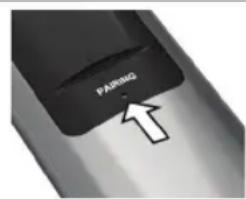
text_image
FAIRINGSmart Touch Control PAIRING button.
Calibrating the Touch Pad
To calibrate the touch pad on the Smart
Touch Control, follow these steps:
-
Press the NUMBER : button for 3 seconds. The calibration starts.
-
When done, all the LEDs on the top of the Smart Touch Control blink twice simultaneously.
While calibrating, don't touch the touch pad.
If the touch pad looses accuracy, re-calibrate the touch pad by repeating Steps 1 and 2.
Using the Touch Pad
- Move the Highlight

natural_image
Illustration of two fingers with directional arrows and color-coded buttons (no text or symbols)Slide your finger from one side to the opposite direction.
To move the Highlight continuously, slide your finger from one side to the opposite direction, and then hold
your finger on the corresponding direction's edge.
- Select an item

natural_image
White hand icon with radiating lines on black background, no text or symbols presentPress the Touch Pad.
- Open the History screen.

text_image
Hand-drawn icon of a finger with a lock and control buttons, including a playhead symbol and directional arrows.Press the ⬇ button in the left centre of
Touch Pad. Displays a list of recently
used functions. You can select a function again using the Touch Pad easily and quickly.
- Open the Tools menu.
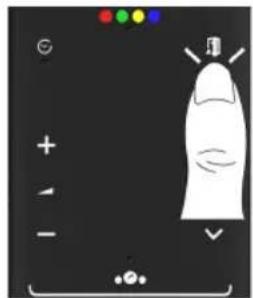
natural_image
Illustration of a stylized rocket with colored lights and control buttons (no text or symbols)Press the ➕ button in the right centre of Touch Pad. Quickly select frequently used functions.
- Open the colours and playcontrol functions screen.

natural_image
Illustration of a stylized hand with fingers, no text or symbols presentPressthe ●●●● button in the top centre of Touch Pad. The TV displays colour and playing control functions:


- Open the shortcut functions screen.
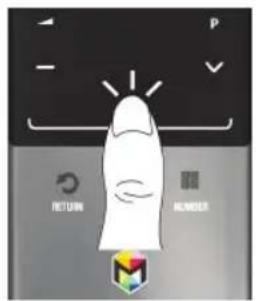
text_image
RETURN NUMBERPressthe 🔍 button in the bottom
centre of Touch Pad. Quickly select frequently used functions:

text_image
Grid of software icons including TV, DVD, and 3D/4D views with Chinese labelsfor Italy TV
To Enter a channel number through Smart Touch Control
- During watching broadcast, press the
NUMBER:: button on your remote.
The TV displays number button
screen.
- Enter a channel number you want using your remote.
When you enter a channel number, the TV displays an Auto Complete list to start with a corresponding channel number.
If you change a channel by entering the channel number, the corresponding channel number is memorised in the list automatically.
You can change a channel using a memorised channel list easily and quickly.
Using the Smart Touch Control with IR Blaster

natural_image
Simple 3D illustration of a truncated cone (truncated cone) with no text or symbols on the bodyWhen you connect IR Blaster with your TV, you can control connected external devices with your TV using the Smart
Touch Control.
IR Blaster Pairing
- After inserting the batteries, turn on the IR Blaster. Follow diagram in battery compartment.
- Move the IR Blaster to the direction of your TV's IR receiver, and then press the PAIRING button on the bottom of the IR Blaster.
- The TV will connect your IR
Blaster and Smart Touch Control automatically.
If the connection process failed, try again from Step 2.
Setting up Universal Remote Control
Lets you control a Set-Top Box (STB) or a BD player or both connected to the TV using your Smart Touch Control.
After you connect the device to the TV, the Smart Touch Control can control
the navigation, number, and other keys needed to operate and control the device.
To connect the external device with your Smart Touch Control, follow these steps:
- When you connect IR Blaster for the first time, a pop-up appears. Select Yes to set IR Blaster and Smart Touch Control, and then press the
touch pad.
-
To reset IR Blaster and Smart Touch Control, press the 🔍 button on Smart Touch Control, and then select Universal remote setup.
-
Select Set up a device to control, and then press the touch pad.
- Select an external device from the connected devices, and then press the touch pad.
- Select the port used to connect the
external device, and then press the touch pad.
Make sure that the selected device is on. If it is turned off, turn the power on and press Refresh.
- Select Search brands, and then press the Touch Pad. A keyboard and an entry field appear. Enter the first few letters of the brand name of your device using the Smart Touch Control, and then select Done at the
bottom of the keyboard. In the list that appears below the entry field, select the brand name of your device, and then press the touch pad.
If you want to search the brand of STB (Set-Top box), you can search the STB by using the brand name or a cable provider.
- Select Search model, and then press the touch pad. A keyboard and an entry field appear. Enter the first few
letters and numbers of the model name of your device using the Smart Touch Control, and then select Done at the bottom of the keyboard. In the list that appears below the entry field, select the model name of your device, and then press the touch pad.
If the search for model name does not work properly, search with a part of the model name or use the Search for recommended model
code.
-
Select Download, and then press the touch pad. Download the configuration data for the IR Blaster in the same way.
-
When all the settings are complete, select the Done button and press the touch pad.
When you use the BD home theater by using Universal Remote, some buttons may not be supported. In
this case, we recommend to use Anynet+ (HDMI-CEC) function.
Using the Search for Recommended Model Code
-
In the Search for model name step in the integrated remote control setup, select the Recommended and press the touch pad.
-
Select Download to download the recommended model code.
-
Point the Smart Touch Control forward to the TV's IR sensor and press the touch pad to test if the device works.
-
If the downloaded recommended model code does not work, repeat the steps from step 3.
LED Indicator Status
- Watch TV (TV + STB)
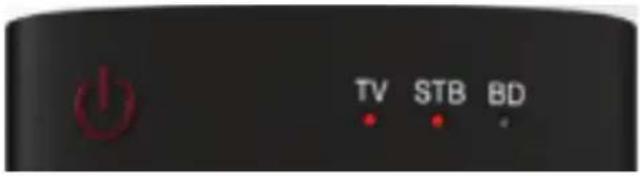
text_image
TV STB BDYou can control the TV and Set-top box using universal remote for viewing the Set-top box. (e.g. Volume button: Adjust the TV volume. / Channel button: Change the STB channels.)
- Watch Movie (TV + BD Player)
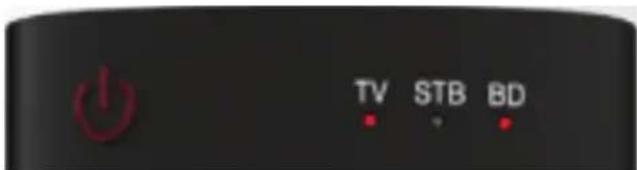
text_image
TV STB BDYou can control the TV and BD player using universal remote for viewing the BD player. (e.g. Volume button: Adjust
the TV volume. / TOOLS button: Open the BD players option menu.)
• TV
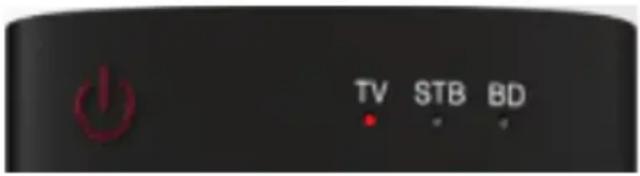
text_image
TV STB BDYou can only control the TV using universal remote.
• STB
text_image
TV STB BDYou can only control the Set-top box using universal remote.
• BD
text_image
TV STB BDYou can only control the BD player using universal remote.
List of key applied
| WATCH TV WATCH MOVIE STB only BD only | |||||
| Hard Key | Power TV | TV TV TV | |||
| Vol + TV | TV STB BD | ||||
| Vol - TV | TV STB BD | ||||
| CH + STB | BD STB BD(Chapter+) | ||||
| CH - STB | BD STB BD(Chapter-) | ||||
| Hot Key Top | TV TV TV TV | ||||
| Hot key bottom | TV TV TV TV | ||||
| Return | highlight dependent | highlight dependent | highlight dependent | highlight dependent | |
| Tools | STB BD | STB BD | |||
| History | TV TV TV TV | ||||
| Smart Hub | TV TV TV TV | ||||
| Voice Input | TV TV TV TV | ||||
| Click(Enter) | STB BD | STB BD | |||
| Touch Pad | highlight dependent | highlight dependent | highlight dependent | highlight dependent | |
| TV OSD Key | 1~0 STB | BD STB BD | |||
| ◀▶▲▼ | highlight dependent | highlight dependent | highlight dependent | highlight dependent | |
| TTX/MIX STB | N/A STB N/A | ||||
| PRE CH/ ENTER | STB BD | STB BD | |||
| 10 N/A | BD N/A BD | ||||
| Power STB | BD STB BD | ||||
| info STB | BD STB BD | ||||
| Menu STB | TV STB BD | ||||
| Guide N/A | N/A STB N/A | ||||
| Search TV | TV TV TV | ||||
| Social TV | TV TV TV | ||||
| 3D TV | TV TV TV | ||||
| Web Browser | TV TV TV TV | ||||
| E-Manual TV | TV N/A TV | ||||
| Repeat N/A | N/A | N/A | BD | ||
| II▶■|<|content_end|> | |||||
Supported Subtitle and AllShare Play file formats
Subtitle
External
- MPEG-4 timed text (.ttxt)
- SAMI (.smi)
- SubRip (.srt)
- SubViewer (.sub)
-
Micro DVD (.sub or .txt)
-
SubStation Alpha (.ssa)
- Advanced SubStation Alpha (.ass)
- Powerdivx (.psb)
Internal
- Xsub
Container: AVI
- SubStation Alpha
Container: MKV
- Advanced SubStation Alpha
Container: MKV
- SubRip
Container: MKV
- MPEG-4 timed text
Container: MP4
Supported image resolutions
| File Extension Type Resolution | ||
| *.jpg JPG 15360 x 8640 | ||
| *.png PNG 1920 x 1080 | ||
| *.bmp BMP 1920 x 1080 | ||
| *.mpo MPO 15360 x 8640 |
Supported music file formats
| File Extension Type Codec Comments | |||
| *.mp3 MP3 MPEG1 Audio Layer 3 | |||
| *.m4a*.mpa*.aac*.3ga | MPEG4 AAC | ||
| *.flac FLAC FLAC | The Seek (jump) function is not supported.Supports up to 2 channel | ||
| *.ogg OGG Vorbis Supports up to 2 channel | |||
| *.wma WMA WMA | WMA 10 Pro supports up to 5.1 channel. WMA lossless audio is not supported. | ||
Video Codec
| File Extension | Container Video Codec Resolution | Frame rate (fps) | Bit rate (Mbps) | Audio Codec | ||
| *.avi*.mkv*.asf*.wmv*.mp4*.mov*.3gp*.vro*.mpg*.mpeg*.ts*.tp*.trp*.m2ts*.mts*.divx | AVI MKV ASF MP4 3GP VRO VOB PS TS | DIVX 3.11/4.x/5.x/6.1 | 1920 x 1080 | 6 - 30 | 30 | AC3 LPCM ADMPCM(IMA, MS) AAC HE-AAC WMA DD+ MPEG(MP3) DTS Core DRA |
| MPEG4 SP/ASP | ||||||
| H.264 BP/MP/HP | ||||||
| Motion JPEG | ||||||
| Window Media Video v9 | ||||||
| MPEG2 | ||||||
| MPEG1 | ||||||
| VP6 640 x 480 4 | ||||||
| SVAF | 30 1920 x 40 1080 | 30 | ||||
| MVC 24 / 25 / | ||||||
| *.webm WebM VP8 6 - 30 8 Vorbis | ||||||
Other Restriction
Video content will not play, or not
play correctly, if there is an error in the content or the container.
Sound or video may not work if the contents have a standard bit rate/frame rate above the compatible Frame/sec listed in the table above.
If the Index Table is in error, the Seek (Jump) function is not supported.
When you play video over a network connection, the video may not be played smoothly.
The menu may take longer to appear if the video's bit rate exceeds 10Mbps.
Some USB/digital camera devices may not be compatible with the player.
Video decoder
• Supports up to H.264, Level 4.1
• H.264 FMO / ASO / RS, VC1 SP / MP / AP L4 and AVCHD are not supported.
- For all Video codecs except MVC, VP8, VP6:
- Below 1280 x 720: 60 frame max
- Above 1280 x 720: 30 frame max
- GMC 2 over is not supported.
- Supports only SVAF Top/Bottom and Side by Side.
• Supports only BD MVC Spec.
Audio decoder
• WMA 10 Pro supports up to 5.1 channel.
WMA lossless audio is not supported.
• RealAudio 10 lossless is not supported.
• QCELP, AMR NB/WB are not supported.
- If Vorbis is only in Webm container, supports up to 2 channel.
Data Service
Allows the user to use information (text, still images, graphics, documents, software, etc.) transmitted via broadcast media.
Auto Run Data Service (On / Off) for Italy
Sets whether or not to automatically run data service. Auto Run Data Service automatically runs data service without user intervention.
If any other secondary function is under way, Auto Run Data Service may not work.
Using Data Service
If the channel you are currently watching provides data service, you can enjoy a variety of data services by select A using your remote.
Provided Data Service information may vary depending on broadcast.
While using data service, changing the channel using the numeric functions may not be possible depending on the service.
- Select A using your remote. Select a desired service.
If Auto Run Data Service is On, the data service will automatically run with loading banner. In this case, the A function does not work.
-
Select A using your remote. The data service screen will be displayed.
-
Move to a desired option by your remote control on the data service screen and then select OK. The selected service will be started.
If a Colour button of a certain function appears on the screen, you can use the offered function by select corresponding button.
- If you select EXIT, data service will
be closed.
Main Data Service buttons and their functions
• A (Data Service)
Displays the Data Service list and immediately starts Data Service.
- BACK
Returns to the previous screen.
- Colour Button
Perform functions corresponding to
each Colour button image displayed on the screen during Data Service.
Operations may differ depending on the service provider.
- Symbol
Text can be inputted using the numbers and letters printed on and above the numeric keys on the remote control. If you input the numeric keys on the remote control one by one into the blank where the cursor is located on
the text input screen, the corresponding lettering, numbers or special characters will be displayed. e.g., if you press the number 3 key in rapid succession, then the assigned letters (D, E, and F) and the number 3 will alternately appear in order of input.
- TEXT
Switches to teletext mode or Returns to the previous screen.
Operations may differ depending on
the service provider.
• ▲ / ▼ / ◀ / ▶
Moves the Data Service menu up, down, left and right.
• OK
Runs a selected item.
- EXIT
Stops a running Data Service.
HbbTV
(Depending on the country)
You will be able to access services from entertainment providers, online providers and CE manufactures through the HbbTV.
In some countries, HbbTV is a data service.
This service may be supported in other countries.
Some broadcasting may not support
the HbbTV.
- HbbTV is turned off by default. To use HbbTV, go to System → Data Service and set it Enable.

Depending on the country.
-
HbbTV is not available when Timeshift is running or when a recorded video is being played back.
-
An application on HbbTV may malfunction temporarily depending on the circumstances of the
broadcast station or application provider.
-
An application is only available for use on HbbTV when the TV network is connected to an external network. The application may malfunction depending on the network conditions.
-
If the current channel is compatible with both the HbbTV and non-HbbTV textinput modes, activate TTX by
select TTX key twice.
- When the screen indicates (with the A, etc.) that HbbTV is being accessed.
- Select TTX using your remote, once to enter the HbbTV text-input mode.
- Select TTX using your remote, twice to enter the non-HbbTV text-input mode.
Connecting to a TV Viewing Card slot
To connect the CI CARD Adapter, follow these steps:
We recommend attaching the adapter before installing.
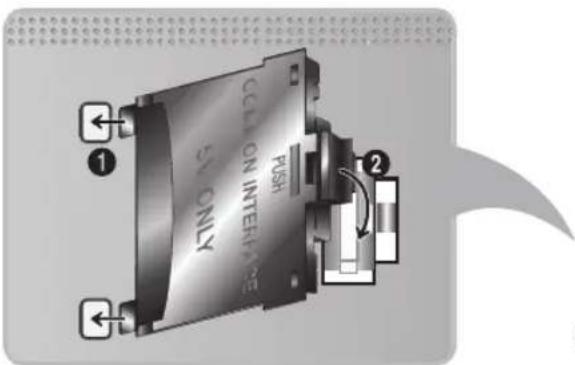
text_image
CCLON INTERFACE SL ONLY PUSH ① ②- Insert the CI CARD Adapter into the two holes on the product 1.
Please find two holes on the rear of the TV. Two holes are beside the COMMON INTERFACE port.
-
Connect the CI CARD Adapter into the COMMON INTERFACE port on the product 2.
-
Insert the "CI or CI+ CARD"
Warning
We recommend that you insert the CI card before you mount the TV on a
wall. It may be difficult to insert after the mounting. Insert the card after attaching the CI-Module on TV. It is difficult to attach the module if you insert the card before attaching.
Using the “CI or CI+ CARD”
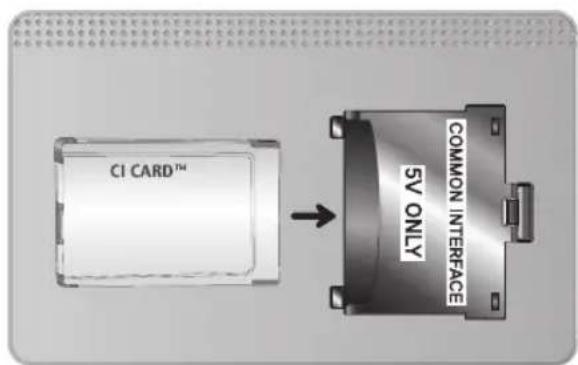
text_image
CI CARD™ COMMON INTERFACE SV ONLYTo watch paid channels, the “CI or CI+ CARD” must be inserted.
- If you don’t insert the “CI or CI+ CARD”, some channels will display the message “Scrambled Signal”.
- The pairing information containing a
telephone number, the “CI or CI+ CARD” ID the Host ID and other information will be displayed in about 2\~3 minutes. If an error message is displayed, please contact your service provider.
- When the configuration of channel information has finished, the message "Updating Completed" is displayed, indicating the channel list is updated.
- You must obtain a “CI or CI+ CARD” from a local cable service provider.
- When removing the “CI or CI+ CARD”, carefully pull it out with your hands since dropping the “CI or CI+ CARD” may cause damage to it.
- Insert the “CI or CI+ CARD” in the direction marked on the card.
- The location of the COMMON INTERFACE slot may be different depending on the model.
Teletext Feature
(Depending on the country)
The index page of the Teletext service gives you information on how to use the Service. For Teletext information to be displayed correctly, channel reception must be stable. Otherwise, information may be missing or some pages may not be displayed.

You can change Teletext pages by select numeric using your remote
control.
Teletext on / mix / off: Activates the Teletext mode for the current channel. Press the button twice to overlap the Teletext mode with the current broadcasting screen. Press it one more time to exit teletext.
Store: Stores the Teletext pages.
Size: Displays the teletext on the upper half of the screen in double-size. To move the text to the lower half of
the screen, press it again. For normal display, press it once again.
Hold: Holds the display at the current page, in the case that there are several secondary pages that follow automatically. To undo, press it again.
Colour buttons (red, green, yellow, blue): If the FASTEXT system is used by the broadcasting company, the different topics on a Teletext page are colour-coded and can be selected by coloured
buttons. Press the colour corresponding to the topic of your choice. A new colour coded page is displayed. Items can be selected in the same way. To display the previous or next page, select corresponding coloured button.
Mode: Selects the Teletext mode (LIST / FLOF). If pressed during LIST mode, switches the mode to List save mode. In List save mode, you can save a Teletext page into a list using the
(store) button.
Sub-page: Displays the available sub-page.
Page up: Displays the next Teletext page.
Page down: Displays the previous Teletext page.
≡i Index: Displays the index (contents) page at any time while you are viewing Teletext.
☐ Reveal: Displays the hidden text
(answers to quiz games, for example). To display the normal screen, press it again.
☒ Cancel: Shrinks the Teletext display to overlap with the current broadcast.
Typical Teletext page
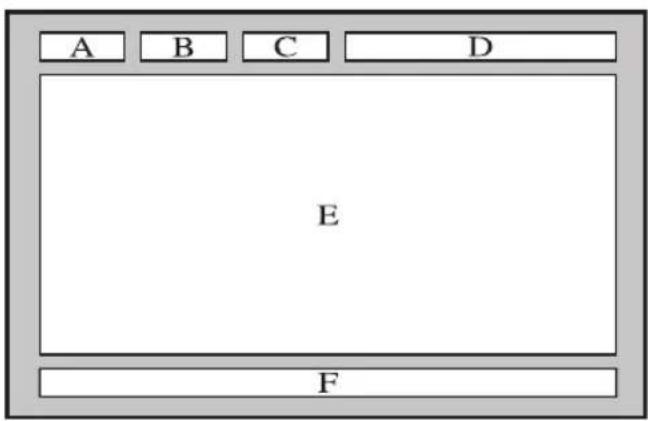
text_image
A B C D E FPart Contents
A Selected page number.
B Broadcasting channel identity.
C Current page number or search indications.
D Date and time.
E Text.
F Status information. FASTEXT information.
Anti-theft Kensington Lock

flowchart
graph TD
    A["TV Rear"] --> B["Lock Icon"]
    B --> C["Optional Device"]
    style A fill:#f9f,stroke:#333
    style C fill:#bbf,stroke:#333
A Kensington Lock is a device you can use to physically fix your TV in place when using it in a public place.
You wrap the Kensington Lock's cable
around a large, immobile object and then attach the lock to the Kensington slot on the back of the TV.
The appearance and locking method may differ from the illustration below depending on the manufacturer.
Refer to the manual provided with the Kensington Lock for additional information on proper use. The Kensington Lock is not supplied by Samsung.
Please find a “💡” icon on the rear of the TV. The Kensington slot is beside the “💡” icon.
To lock the product, follow these steps:
-
Wrap the Kensington Lock cable around a large, stationary object such as desk or chair.
-
Slide the end of the cable with the lock attached through the looped end of the Kensington Lock cable.
-
Insert the locking device into the Kensington slot on the product.
-
Lock the lock.
These are general instructions. For exact instructions, see the User manual supplied with the locking device.
The locking device has to be purchased separately.
The location of the Kensington slot may be different depending on the
TV model.
Licence
DOLBY.
DIGITAL PLUS
PULSE
Manufactured under licence from Dolby Laboratories. Dolby and the double-D symbol are trademarks of Dolby Laboratories.

dts®
Premium Audio
Manufactured under licence from DTS Licensing Limited. DTS, the Symbol, and DTS and the Symbol together are registered trademarks of DTS, Inc. © 2011 DTS, Inc. All Rights Reserved.
HDMI
The terms HDMI and HDMI High-Definition Multimedia Interface, and the HDMI Logo are trademarks or registered trademarks of HDMI Licensing LLC in the United States and other countries.
MHL


DivX Certified® to play DivX® video up to HD 1080p, including premium content.
DivX®, DivX Certified® and associated logos are trademarks of DivX, Inc. and are used under licence.
ABOUT DIVX VIDEO: DivX® is a digital video format created by DivX, Inc. This is an official DivX Certified® device that plays DivX video. Visit www.divx.com for more information and software tools to convert your files into DivX video.
ABOUT DIVX VIDEO-ON-DEMAND: This DivX Certified® device must be registered in order to play purchased DivX Video-on-Demand (VOD) movies. To obtain your registration code, locate the DivX VOD section in your device setup menu. Go to vod.divx.com for more information on how to complete your registration.

text_image
rovi guideTrademark: Rovi and Rovi Guide are trademarks of Rovi Corporation and/or its subsidiaries.
Licence: The Rovi Guide system is manufactured under licence from Rovi Corporation and/or its subsidiaries.
Patent: The Rovi Guide system is protected by patents and patent applications filed in the US, Europe, and other countries including one or more of the United States patents 6,396,546; 5,940,073; 6,239,794 issued to Rovi Corporation and/or its subsidiaries.
Disclaimer: Rovi Corporation and/or its subsidiaries and related affiliates are not in any way liable for the accuracy or availability of the programme schedule information or other data in the Rovi Guide system and cannot guarantee service availability in your area. In no event shall Rovi Corporation and/or its related affiliates be liable for any damages in connection with the accuracy or availability of the programme schedule information or other data in the Rovi Guide system.
Open Source Licence Notice
In the case of using open source software, Open Source Licences are available on the product menu.
Open Source Licence Notice is written only English.