SuperServer 2028U-TRTP+ - Server Supermicro - Free user manual and instructions
Find the device manual for free SuperServer 2028U-TRTP+ Supermicro in PDF.


User questions about SuperServer 2028U-TRTP+ Supermicro
0 question about this device. Answer the ones you know or ask your own.
Ask a new question about this device
Download the instructions for your Server in PDF format for free! Find your manual SuperServer 2028U-TRTP+ - Supermicro and take your electronic device back in hand. On this page are published all the documents necessary for the use of your device. SuperServer 2028U-TRTP+ by Supermicro.
USER MANUAL SuperServer 2028U-TRTP+ Supermicro
natural_image
Front view of a rack-mounted server rack with multiple drive bays and indicator lights (no visible text or labels)USER'S MANUAL
Revision 1.0f
The information in this User's Manual has been carefully reviewed and is believed to be accurate. The vendor assumes no responsibility for any inaccuracies that may be contained in this document, makes no commitment to update or to keep current the information in this manual, or to notify any person or organization of the updates. Please Note: For the most up-to-date version of this manual, please see our web site at www.supermicro.com.
Super Micro Computer, Inc. ("Supermicro") reserves the right to make changes to the product described in this manual at any time and without notice. This product, including software and documentation, is the property of Supermicro and/or its licensors, and is supplied only under a license. Any use or reproduction of this product is not allowed, except as expressly permitted by the terms of said license.
IN NO EVENT WILL SUPERMICRO BE LIABLE FOR DIRECT, INDIRECT, SPECIAL, INCIDENTAL, SPECULATIVE OR CONSEQUENTIAL DAMAGES ARISING FROM THE USE OR INABILITY TO USE THIS PRODUCT OR DOCUMENTATION, EVEN IF ADVISED OF THE POSSIBILITY OF SUCH DAMAGES. IN PARTICULAR, SUPERMICRO SHALL NOT HAVE LIABILITY FOR ANY HARDWARE, SOFTWARE, OR DATA STORED OR USED WITH THE PRODUCT, INCLUDING THE COSTS OF REPAIRING, REPLACING, INTEGRATING, INSTALLING OR RECOVERING SUCH HARDWARE, SOFTWARE, OR DATA.
Any disputes arising between manufacturer and customer shall be governed by the laws of Santa Clara County in the State of California, USA. The State of California, County of Santa Clara shall be the exclusive venue for the resolution of any such disputes. Super Micro's total liability for all claims will not exceed the price paid for the hardware product.
FCC Statement: This equipment has been tested and found to comply with the limits for a Class A or Class B digital device pursuant to Part 15 of the FCC Rules. These limits are designed to provide reasonable protection against harmful interference when the equipment is operated in industrial environment for Class A device or in residential environment for Class B device. This equipment generates, uses, and can radiate radio frequency energy and, if not installed and used in accordance with the manufacturer's instruction manual, may cause harmful interference with radio communications. Operation of this equipment in a residential area is likely to cause harmful interference, in which case you will be required to correct the interference at your own expense.
California Best Management Practices Regulations for Perchlorate Materials: This Perchlorate warning applies only to products containing CR (Manganese Dioxide) Lithium coin cells. "Perchlorate Material-special handling may apply. See www.dtsc.ca.gov/hazardouswaste/perchlorate"

WARNING: This product can expose you to chemicals including lead, known to the State of California to cause cancer and birth defects or other reproductive harm. For more information, go to www.P65Warnings.ca.gov.
Manual Revision 1.0f
Release Date: May 20, 2021
Unless you request and receive written permission from Super Micro Computer, Inc., you may not copy any part of this document.
Information in this document is subject to change without notice. Other products and companies referred to herein are trademarks or registered trademarks of their respective companies or mark holders.
Copyright © 2021 by Super Micro Computer, Inc.
All rights reserved.
Printed in the United States of America
Preface
About this Manual
This manual is written for professional system integrators and PC technicians. It provides information for the installation and use of the SuperServer 2028U-T Series. Installation and maintenance should be performed by experienced technicians only.
Please refer to the server specifications page on our Web site for updates on supported memory, processors and operating systems (www.supermicro.com).
Notes
For your system to work properly, please follow the links below to download all necessary drivers/utilities and the user's manual for your server.
• Supermicro product manuals: https://www.supermicro.com/support/manuals/
• Product drivers and utilities: https://www.supermicro.com/wdl
- Product safety info: https://super-dev/about/policies/safety_information.cfm
If you have any questions, please contact our support team at: support@supermicro.com
This manual may be periodically updated without notice. Please check the Supermicro Web site for possible updates to the manual revision level.
Secure Data Deletion
A secure data deletion tool designed to fully erase all data from storage devices can be found on our website: https://www.supermicro.com/about/policies/disclaimer.cfm?url=/wftp/utility/Lot9_Secure_Data_Deletion_Utility/
Warnings
Special attention should be given to the following symbols used in this manual.

Warning! Indicates important information given to prevent equipment/property damage or personal injury.

Warning! Indicates high voltage may be encountered when performing a procedure.
Contents
Chapter 1 Introduction....1-1
1-1 Overview 1-1
1-2 Serverboard Features 1-2
Processors 1-2
Memory 1-2
Onboard Serial ATA 1-2
Rear I/O Ports 1-2
Graphics Controller 1-2
1-3 Server Chassis Features 1-3
System Power 1-3
Hard Drives 1-3
PCI Expansion Slots 1-3
Front Control Panel.... 1-3
Cooling System....1-4
NVMe 1-4
1-4 Contacting Supermicro.... 1-5
Chapter 2 Server Installation
2-1 Unpacking the System 2-1
2-2 Preparing for Setup....2-1
Choosing a Setup Location....2-1
2-3 Warnings and Precautions 2-2
Rack Precautions 2-2
Server Precautions....2-2
Rack Mounting Considerations 2-3
Ambient Operating Temperature 2-3
Reduced Airflow 2-3
Mechanical Loading 2-3
Circuit Overloading....2-3
Reliable Ground 2-3
2-4 Installing the System into a Rack 2-4
Identifying the Sections of the Rack Rails 2-4
Releasing the Inner Rail 2-5
Installing the Inner Rails on the Chassis 2-6
Installing the Outer Rails onto the Rack 2-7
Sliding the Chassis onto the Rack Rails....2-8
Chapter 3 System Interface....3-1
3-1 Overview 3-1
3-2 Control Panel Buttons 3-2
3-3 Control Panel LEDs 3-2
Overheating....3-3
3-4 Drive Carrier LEDs.... 3-4
3-5 Power Supply LEDs 3-4
Chapter 4 Standardized Warning Statements for AC Systems
About Standardized Warning Statements.... 4-1
Warning Definition 4-1
Installation Instructions....4-4
Circuit Breaker 4-5
Power Disconnection Warning 4-6
Equipment Installation....4-8
Restricted Area....4-9
Battery Handling....4-10
Redundant Power Supplies (if applicable to your system)....4-12
Backplane Voltage (if applicable to your system)....4-13
Comply with Local and National Electrical Codes 4-14
Product Disposal 4-15
Hot Swap Fan Warning (if applicable to your system) 4-16
Power Cable and AC Adapter 4-18
Chapter 5 Advanced Serverboard Setup
5-1 Handling the Serverboard....5-1
Precautions 5-1
Unpacking 5-1
5-2 Installing the Processor and Heatsink 5-2
Installing an LGA 2011 Processor....5-2
Installing a CPU Heatsink 5-5
Removing the Heatsink 5-6
5-3 Connecting Cables....5-7
Connecting Data Cables 5-7
Connecting Power Cables 5-7
Connecting the Control Panel....5-7
5-4 I/O Ports 5-8
LAN Ports 5-8
5-5 Installing Memory 5-9
Memory Support....5-10
Processor and Memory Module Population Configuration 5-10
Populating DDR4 Memory Modules....5-10
5-6 Serverboard Details ....5-11
Serverboard Quick Reference....5-12
5-7 Connector Definitions.... 5-14
Power Connectors 5-14
Control Panel Connector....5-14
Other Connectors....5-17
5-8 Jumper Settings 5-20
5-9 Onboard Indicators....5-22
5-10 SATA Ports 5-23
5-11 Installing Software....5-24
SuperDoctor® 5 5-25
5-12 Onboard Battery 5-26
Chapter 6 Advanced Chassis Setup....6-1
6-1 Static-Sensitive Devices....6-1
Precautions 6-1
6-2 Control Panel 6-2
6-3 Removing the Chassis Cover 6-3
6-4 Hard Drive Installation....6-4
6-5 Adding PCI Expansion Cards 6-8
6-6 System Fans....6-11
Replacing a System Fan....6-11
Air Shroud 6-12
6-7 Power Supply 6-13
Replacing a Power Supply Module....6-13
Chapter 7 BIOS
7-1 Introduction....7-1
Starting BIOS Setup Utility....7-1
How To Change the Configuration Data....7-1
Starting the Setup Utility 7-2
7-2 Main Setup....7-2
7-3 Advanced Setup Configurations....7-4
7-4 Event Logs 7-25
7-5 IPMI....7-27
7-6 Security 7-29
7-7 Boot....7-30
7-8 Save & Exit 7-31
Appendix A BIOS Error Beep Codes ...... A-1
Appendix B System Specifications....B-1
Chapter 1
Introduction
1-1 Overview
The SuperServer 2028U-T Series is a high-end server comprised of two main subsystems: the SC219UAC(4)-R1K02 2U server chassis and the X10DRU-i+ dual processor motherboard. Refer to the Supermicro web site for information on operating systems that have been certified for use with the system (www.supermicro.com).
| 2028U-T Series Models | ||||
| System LAN P | Ports NVMe Ultra | Riser Card | Backplane | |
| 2028U-TR4+ Four | GbE no AOC-2UR68 | i4G BPN | SAS3-216A | |
| 2028U-TRT+ Two | 10GBase-T no AOC | -2UR68-i2XT | BPN-SAS3-216A | |
| 2028U-TR4T+ Four | 10GBase-T no AOC | -2UR6-i4XT | BPN-SAS3-216A | |
| 2028U-TRTP+ Two | 10G SFP+ no AOC | -2UR68-2XS | BPN-SAS3-216A | |
| 2028U-TNRT+ | Two 10GBase-T | 4 port | AOC-2UR8N4-i2XT | BPN-SAS3-216A-N4 |
| 2028U-TNR4T+ Four | 10GBase-T 4 port | AOC-2URN4-i4XT | BPN-SAS3-216A-N4 | |
In addition to the above components, the server includes:
• Four 8-cm system cooling fans (FAN-0118L4)
• Air shroud MCP-310-82908-0B
- Two passive CPU heatsinks (SNK-P0058PSU)
• Twenty-four hard drive carriers (MCP-220-00047-0B)
- Riser Cards:
One RSC-R1UW-E8R-O-P
One RSC-R2UW-4E8-O-P
• One rackmount rail kit (MCP-290-00053-0N)
Note: For your system to work properly, please follow the links below to download all necessary drivers/utilities and the user's manual for your server.
• Supermicro product manuals: http://www.supermicro.com/support/manuals/
• Product drivers and utilities: https://www.supermicro.com/wdl
- Product safety info:
http://www.supermicro.com/about/policies/safety_information.cfm
For support, email support@supermicro.com.
1-2 Motherboard Features
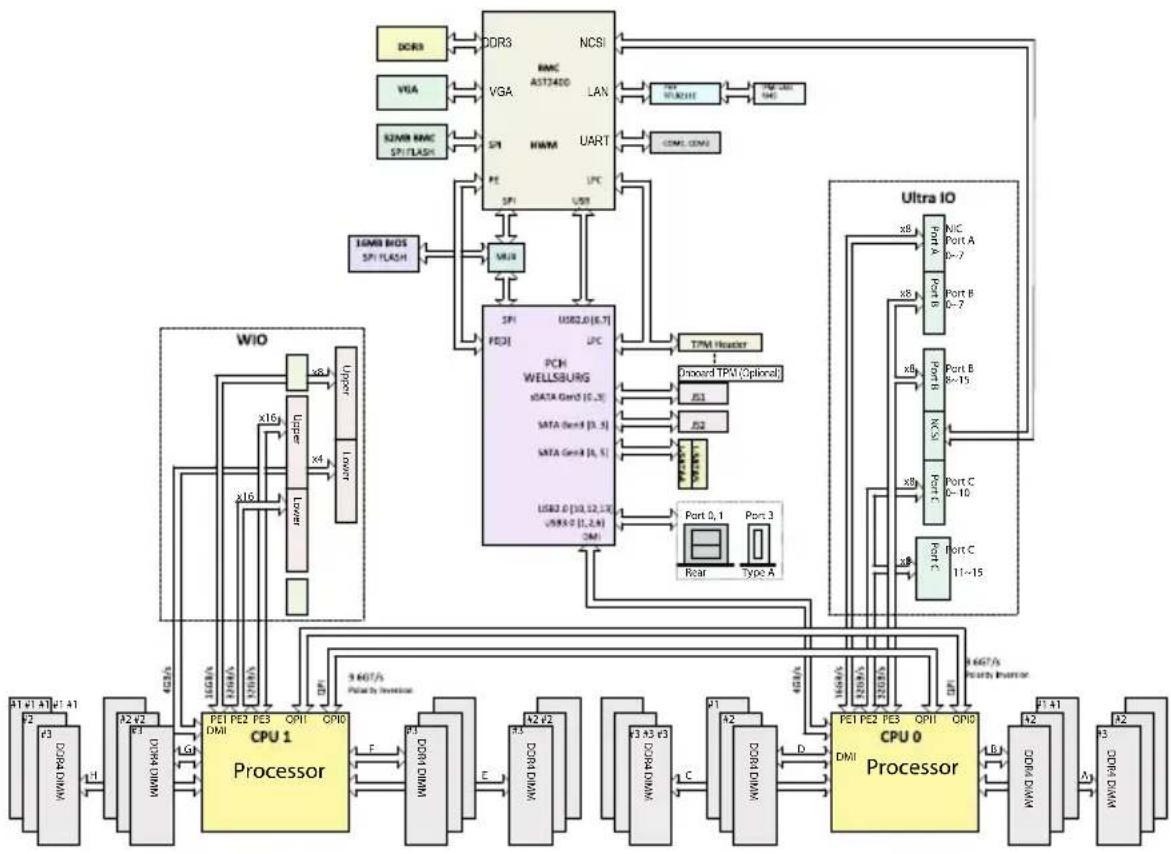
At the heart of the SuperServer 2028U-T Series lies the X10DRU-i+, a dual processor motherboard based on the Intel PCH C612 chipset. Below are the main features of the motherboard. (See Figure 1-1 for a block diagram of the chipset.)
Processors
The motherboard supports single or dual Intel E5-2600 v3/v4 Series processors in LGA2011 sockets (Socket R3). Refer to the Supermicro web site for a complete listing of supported processors (www.supermicro.com).
Memory
The motherboard has 24 memory sockets that can support up to 3 TB of LRDIMM (Load-Reduced DIMMs) DDR4-2400/2133/1866/1600/1333 memory or 768 GB of ECC registered DDR4-1600/1333/1066/800 non-volatile RDIMM (Registered DIMMs). Please refer to Chapter 5 for installing memory.
Onboard Serial ATA
A SATA controller is integrated into the chipset to provide a ten-port SATA subsystem. Six of the ports are supported by the Intel PCH and four of the ports are supported by the Intel SCU. The SATA 3.0 ports are connected to the backplane by default. RAID 0, 1, 5 and 10 are supported by Intel RSTe Software RAID.
Rear I/O Ports
The rear I/O ports include one COM port, a VGA (monitor) port, two USB 3.0 ports and a dedicated IPMI LAN port. In addition, there are several possible networking configurations depending on the pre-installed Ultra riser card. See the table in Section 1-1.
Graphics Controller
The motherboard features an integrated ASpeed 2400 BMC graphics chip.
1-3 Server Chassis Features
The 2028U-T Series is built upon the SC219UAC-R1K02 chassis or the SC219UAC4-R1K02 for NVMe models. Details and related procedures can be found in Chapter 6. The following is a general outline of the main features of the chassis.
System Power
The chassis features a redundant 1 KW power supply consisting of two hot-plug power modules. They have 80 Plus certification at Titanium Level (96%) high-efficiency. The system will continue to operate if one module fails or is replaced.
Hard Drives
The chassis supports up to twenty-four 2.5" hot-swap hard drives. A standard 2028U-T Series server supports ten SATA drives, or for NVMe models, eight SATA drives and up to four NVMe drives. Expansion cards are required add more drives up to 24.
PCI Expansion Slots
All 2028U-T Series models include two WIO riser cards that support PCI-Express 3.0 expansion cards—four full size x8 cards and one low profile x8 card. In addition, each system comes with an Ultra riser card to provide added features including additional PCI expansion slots. The total number of expansion cards depends on the model in the 2028U-T Series. See section 6-5 for details.
Front Control Panel
The chassis front control panel provides system monitoring and power control. Status LEDs indicate system power, HDD activity, network activity, UID, and overheat and fan failure.
Cooling System
The chassis has an innovative cooling design that features four 8-cm high-performance fans. Fan speed can be determined by system temperature via IPMI. Each power supply module also includes a cooling fan.
NVMe
(2028U-TNRT+ and -TNR4T+ models only) The NVM Express ports provide high-speed, low-latency connections directly from the CPU to NVMe Solid State drives (SSDs). This greatly increases SSD throughput and significantly reduces storage device latency by simplifying driver and software requirements resulting from the direct PCI-E interface between the CPU and the NVMe SSD drives.
flowchart
graph TD
    subgraph WIO
        A["DDR3"] --> B["NCSI"]
        C["VGA"] --> D["VGA"]
        E["S2MB RMC SPI/FLASH"] --> F["SPI"]
        G["10MB BIOS SPI FLASH"] --> H["SPI"]
        I["Upper"] --> J["Lower"]
        K["Upper"] --> L["Lower"]
        M["Upper"] --> N["Lower"]
        O["SPI"] --> P["USB2.0(6.7)"]
        Q["FE3"] --> R["PCH WELLSBURG"]
        S["x8"] --> T["DATA Geno (5, 2)"]
        U["x4"] --> V["SATA Geno (3, 3)"]
        W["x16"] --> X["USB2.0(10,12,13)"]
        Y["x16"] --> Z["USB2.0(1,2,4)"]
        AA["x16"] --> AB["USB2.0(10,12,13)"]
        AC["x16"] --> AD["USB2.0(1,2,4)"]
        AE["x16"] --> AF["USB2.0(10,12,13)"]
        AG["x16"] --> AH["USB2.0(1,2,4)"]
        AI["CPU 1 Processor"] --> AJ["DDR1 DIMA"]
        AK["DOR1 DIMA"] --> AL["DOR1 DIMA"]
        AM["DOR1 DIMA"] --> AN["DOR1 DIMA"]
        AO["DOR1 DIMA"] --> AP["DOR1 DIMA"]
        AQ["DOR1 DIMA"] --> AR["DOR1 DIMA"]
        AS["DOR1 DIMA"] --> AT["DOR1 DIMA"]
        AU["DOR1 DIMA"] --> AV["DOR1 DIMA"]
        AW["DOR1 DIMA"] --> AX["DOR1 DIMA"]
        AY["DOR3 DIMA"] --> AZ["DOR3 DIMA"]
    end

    subgraph Ultra IO
        BA["Port A"] --> BB["Port B"]
        BC["Port B 0-7"] --> BD["Port B 8-15"]
        BE["Port C 0-10"] --> BF["Port C 11-15"]
        BG["Port C 11-15"] --> BH["Port C 11-15"]
    end

    subgraph CPU 0 Processor
        BI["CPU 0 Processor"] --> BJ["DDR1 DIMA"]
        BK["DOR1 DIMA"] --> BL["DOR1 DIMA"]
        BM["DOR1 DIMA"] --> BN["DOR1 DIMA"]
        BO["DOR1 DIMA"] --> BP["DOR1 DIMA"]
        BQ["DOR1 DIMA"] --> BR["DOR1 DIMA"]
        BS["DOR1 DIMA"] --> BT["DOR1 DIMA"]
        BU["DOR1 DIMA"] --> BV["DOR1 DIMA"]
        BW["DOR1 DIMA"] --> BX["DOR1 DIMA"]
        BY["DOR1 DIMA"] --> BZ["DOR1 DIMA"]
        CA["DOR1 DIMA"] --> CB["DOR1 DIMA"]
        CC["DOR1 DIMA"] --> CD["DOR1 DIMA"]
        CE["DOR1 DIMA"] --> CF["DOR1 DIMA"]
        BGD["DOR1 DIMA"] --> DH["DOR1 DIMA"]
        BIQ["DOR3 DIMA"] --> BRQ["DOR3 DIMA"]
        BQD["DOR3 DIMA"] --> BCQ["DOR3 DIMA"]
        BQDQ["DOR3 DIMA"] --> BQDQ
    end

    subgraph Power Inversion
        BQD["A 9.6G7/s Power by Inversion"]
        BQDQ["A 9.6G7/s Power by Inversion"]
    end

    subgraph Control
        BQD2["A 9.6G7/s Power by Inversion"]
        BQD3["A 9.6G7/s Power by Inversion"]
    end

    subgraph Control
        BQD4["A 9.6G7/s Power by Inversion"]
        BQD5["A 9.6G7/s Power by Inversion"]
    end

    subgraph Power
        BQD6["A 9.6G7/s Power by Inversion"]
        BQD7["A 9.6G7/s Power by Inversion"]
    end

    subgraph Control
        BQD8["A 9.6G7/s Power by Inversion"]
        BQD9["A 9.6G7/s Power by Inversion"]
    end

    subgraph Control
        BQD10["A 9.6G7/s Power by Inversion"]
        BQD11["A 9.6G7/s Power by Inversion"]
    end

    subgraph Power
        BQD12["A 9.6G7/s Power by Inversion"]
        BQD13["A 9.6G7/s Power by Inversion"]
    end

    subgraph Control
        BQD14["A 9.6G7/s Power by Inversion"]
        BQD15["A 9.6G7/s Power by Inversion"]
    end

    subgraph Control
        BQD16["A 9.6G7/s Power by Inversion"]
        BQD17["A 9.6G7/s Power by Inversion"]
    end

    subgraph Power
        BQD18["A 9.6G7/s Power by Inversion"]
        BQD19["A 9.6G7/s Power by Inversion"]
    end

    subgraph Control
        BQD20["A 9.6G7/s Power by Inversion"]
        BQD21["A 9.6G7/s Power by Inversion"]
    end

    subgraph Control
        BQD22["A 9.6G7/s Power by Inversion"]
        BQD23["A 9.6G7/s Power by Inversion"]
    end

    subgraph Power
        BQD24["A 9.6G7/s Power by Inversion"]
        BQD25["A 9.6G7/s Power by Inversion"]
    end

    subgraph Control
        BQD26["A 9.6G7/s Power by Inversion"]
        BQD27["A 9.6G7/s Power by Inversion"]
    end

    subgraph Control
        BQD28["A 9.6G7/s Power by Inversion"]
        BQD29["A 9.6G7/s Power by Inversion"]
    end

    subgraph Control
        BQD30["A 9.6G7/s Power by Inversion"]
        BQD31["A 9.6G7/s Power by Inversion"]
    end

    subgraph Control
        BQD32["A 9.6G7/s Power by Inversion"]
        BQD33["A 9.6G7/s Power by Inversion"]
    end

    subgraph Control
        BQD34["A 9.6G7/s Power by Inversion"]
        BQD35["A 9.6G7/s Power by Inversion"]
    end

    subgraph Control
        BQD36["A 9.6G7/s Power by Inversion"]
        BQD37["A 9.6G7/s Power by Inversion"]
    end

    subgraph Control
        BQD38["A 9.6G7/s Power by Inversion"]
        BQD39["A 9.6G7/s Power by Inversion"]
    end

    subgraph Control
        BQD40["A 9.6G7/s Power by Inversion"]
        BQD41["A 9.6G7/s Power by Inversion"]
    end

    subgraph Control
        BQD42["A 9.6G7/s Power by Inversion"]
        BQD43["A 9.6G7/s Power by Inversion"]
    end

    subgraph Control
        BQD44["A 9.6G7/s Power by Inversion"]
        BQD45["A 9.6G7/s Power by Inversion"]
    end

    subgraph Control
        BQD46["A 9.6G7/s Power by Inversion"]
        BQD47["A 9.6G7/s Power by Inversion"]
    end

    subgraph Control
        BQD48["A 9.6G7/s Power by Inversion"]
        BQD49["A 9.6G7/s Power by Inversion"]
    end

    subgraph Control
        BQD50["A 9.6G7/s Power by Inversion"]
        BQD51["A 9.6G7/s Power by Inversion"]
    end

    subgraph Control
        BQD52["A 9.6G7/s Power by Inversion"]
        BQD53["A 9.6G7/s Power by Inversion"]
    end

    subgraph Control
        BQD54["A 9.6G7/s Power by Inversion"]
        BQD55["A 9.6G7/s Power by Inversion"]
    end

    subgraph Control
        BQD56["A 9.6G7/s Power by Inversion"]
        BQD57["A 9.6G7/s Power by Inversion"]
    end

    subgraph Control
        BQD58["A 9.6G7/s Power by Inversion"]
        BQD59["A 9.6G7/s Power by Inversion"]
    end

    subgraph Control
        BQD60["A 9.6G7/s Power by Inversion"]
        BQD61["A 9.6G7/s Power by Inversion"]
    end

    subgraph Control
        BQD62["A 9.6G7/s Power by Inversion"]
        BQD63["A 9.6G7/s Power by Inversion"]
    end

    subgraph Control
        BQD64["A 9.6G7/s Power by Inversion"]
        BQD65["A 9.6G7/s Power by Inversion"]
    end

    subgraph Control
        BQD66["A 9.6G7/s Power by Inversion"]
        BQD67["A 9.6G7/s Power by Inversion"]

    end
Figure 1-1. Intel PCH C612 Chipset: System Block Diagram
Note: This is a general block diagram. Please see Chapter 5 for details.
1-4 Contacting Supermicro
Headquarters
Address: Super Micro Computer, Inc.
980 Rock Ave.
San Jose, CA 95131 U.S.A.
Tel: +1 (408) 503-8000
Fax: +1 (408) 503-8008
Email: marketing@supermicro.com (General Information)
support@supermicro.com (Technical Support)
Web Site: www.supermicro.com
Europe
Address: Super Micro Computer B.V.
's-Hertogenbosch, The Netherlands
Tel: +31 (0) 73-6400390
Fax: +31 (0) 73-6416525
Email: sales@supermicro.nl (General Information)
support@supermicro.nl (Technical Support)
rma@supermicro.nl (Customer Support)
Web Site: www.supermicro.nl
Asia-Pacific
Address: Super Micro Computer, Inc.
3F, No. 150, Jian 1st Rd.
Zhonghe Dist., New Taipei City 235
Taiwan (R.O.C)
Tel: +886-(2) 8226-3990
Fax: +886-(2) 8226-3992
Email: support@supermicro.com.tw
Web Site: www.supermicro.com.tw
Notes
Chapter 2
Server Installation
This chapter provides instructions for preparing and mounting your chassis in a rack.
2-1 Unpacking the System
You should inspect the box the chassis was shipped in and note if it was damaged in any way. If the chassis itself shows damage, file a damage claim with the carrier who delivered it.
2-2 Preparing for Setup
Decide on a suitable location for the rack unit that will hold your chassis. It should be a clean, dust-free area that is well ventilated. Avoid areas where heat, electrical noise and electromagnetic fields are generated. A nearby grounded power outlet. is required
The box your chassis was shipped in should include two sets of rail assemblies, two rail mounting brackets and the mounting screws to mount the system into the rack. Please read this chapter in its entirety before beginning the installation procedure.
Choosing a Setup Location
- Leave at least 25 inches clearance in front of the rack to open the front door completely.
- Leave approximately 30 inches of clearance in the back of the rack to allow for sufficient airflow and access for servicing.
- It should be a restricted access location, such as a dedicated equipment room or a service closet.
2-3 Warnings and Precautions
Rack Precautions
- Ensure that the leveling jacks on the bottom of the rack are fully extended to the floor with the full weight of the rack resting on them.
- In single rack installation, stabilizers should be attached to the rack. In multiple rack installations, the racks should be coupled together.
- Always make sure the rack is stable before extending a component from the rack.
- You should extend only one component at a time - extending two or more simultaneously may cause the rack to become unstable.
Server Precautions
- Review the electrical and general safety precautions in Chapter 4.
- Determine the placement of each component in the rack before you install the rails.
- Install the heaviest server components on the bottom of the rack first, and then work up.
- Use a regulating uninterruptible power supply (UPS) to protect the server from power surges, voltage spikes and to keep your system operating in case of a power failure.
- Allow the hot plug SAS drives and power supply modules to cool before touching them.
- Always keep the rack's front door and all panels and components on the servers closed when not servicing to maintain proper cooling.
Rack Mounting Considerations
Ambient Operating Temperature
If installed in a closed or multi-unit rack assembly, the ambient operating temperature of the rack environment may be greater than the ambient temperature of the room. Therefore, consideration should be given to installing the equipment in an environment compatible with the manufacturer's maximum rated ambient temperature (Tmra).
Reduced Airflow
Equipment should be mounted into a rack so that the amount of airflow required for safe operation is not compromised.
Mechanical Loading
Equipment should be mounted into a rack so that a hazardous condition does not arise due to uneven mechanical loading.
Circuit Overloading
Consideration should be given to the connection of the equipment to the power supply circuitry and the effect that any possible overloading of circuits might have on overcurrent protection and power supply wiring. Appropriate consideration of equipment nameplate ratings should be used when addressing this concern.
Reliable Ground
A reliable ground must be maintained at all times. To ensure this, the rack itself should be grounded. Particular attention should be given to power supply connections other than the direct connections to the branch circuit (i.e. the use of power strips, etc.).

Warning! To prevent bodily injury when mounting or servicing this unit in a rack, you must take special precautions to ensure that the system remains stable. The following guidelines are provided to ensure your safety:
- This unit should be mounted at the bottom of the rack if it is the only unit in the rack.
- When mounting this unit in a partially filled rack, load the rack from the bottom to the top with the heaviest component at the bottom of the rack.
- If the rack is provided with stabilizing devices, install the stabilizers before mounting or servicing the unit in the rack.
- Slide rail mounted equipment is not to be used as a shelf or a work space.
2-4 Installing the System into a Rack
This section provides information on installing the server into a rack unit with the rack rails provided. There are a variety of rack units on the market, so the assembly procedure may differ slightly. Refer to the installation instructions that came with your rack. Note: This rail will fit a rack between 26.8" and 36.4" deep.
Identifying the Sections of the Rack Rails
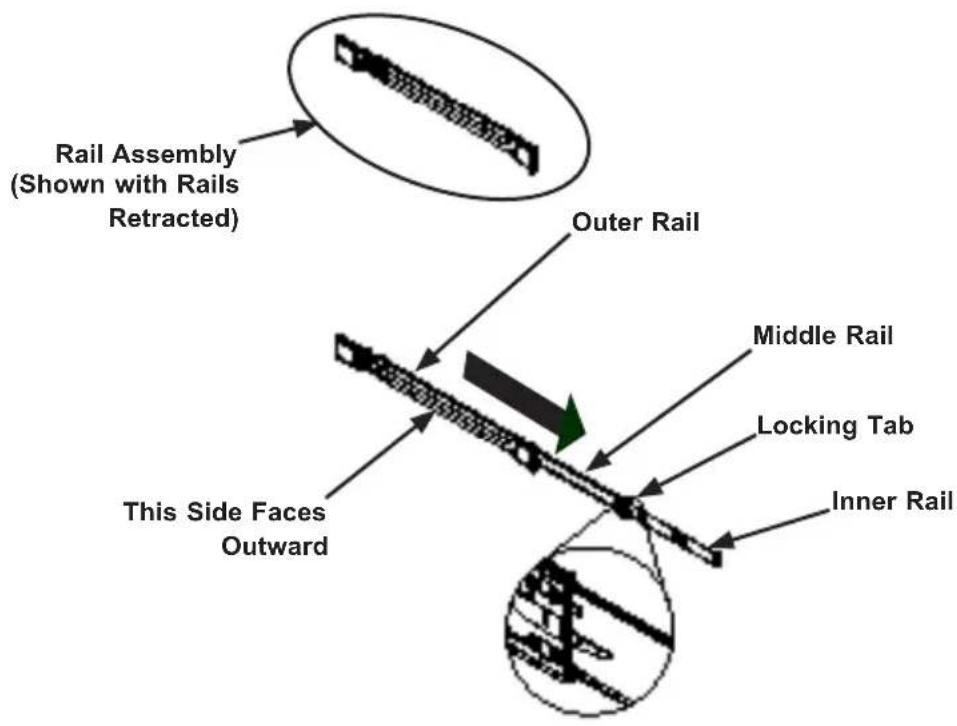
The chassis package includes two rail assemblies. Each assembly consists of three sections: An inner rail that secures directly to the chassis, an outer rail that secures to the rack, and a middle rail which extends from the outer rail. These assemblies are specifically designed for the left and right side of the chassis.
text_image
Rail Assembly (Shown with Rails Retracted) Outer Rail Middle Rail Locking Tab Inner Rail This Side Faces OutwardFigure 6-1. Identifying the Outer Rail, Middle Rail (Left Rail Assembly Shown)
Rail
Releasing the Inner Rail
Each inner rail has a locking latch. This latch prevents the server from coming completely out of the rack when when the chassis is pulled out for servicing.
To mount the rail onto the chassis, first release the inner rail from the outer rails.
Releasing Inner Rail from the Outer Rails
- Pull the inner rail out of the outer rail until it is fully extended as illustrated below.
- Press the locking tab down to release the inner rail.
- Pull the inner rail all the way out.
- Repeat for the other outer rail.

flowchart
graph TD
    A["Step 1"] --> B["Intermediate State"]
    B --> C["Step 2"]
    C --> D["Final State"]
    style A fill:#f9f,stroke:#333
    style B fill:#ccf,stroke:#333
    style C fill:#cfc,stroke:#333
    style D fill:#fcc,stroke:#333
Figure 6-2. Extending and Releasing the Inner Rail
Installing the Inner Rails on the Chassis
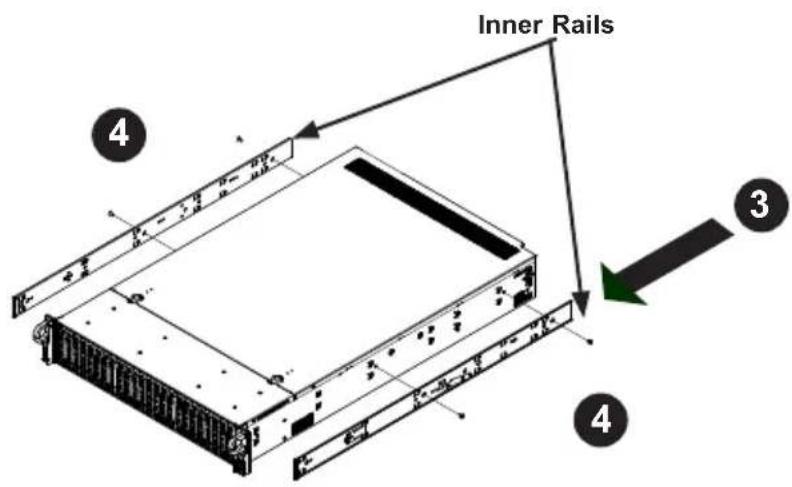
Installing the Inner Rails
- Identify the left and right inner rails. They are labeled.
- Place the inner rail firmly against the side of the chassis, aligning the hooks on the side of the chassis with the holes in the inner rail.
- Slide the inner rail forward toward the front of the chassis until the quick release bracket snaps into place, securing the rail to the chassis.
- Optionally, you can further secure the inner rail to the chassis with a screw.
- Repeat for the other inner rail.
text_image
Inner Rails 4 3 4Figure 6-3. Installing the Inner Rails

natural_image
Isometric line drawing of a server rack unit with mounting holes and drive bays (no text or symbols)Figure 6-4. Inner Rails Installed on the Chassis
Installing the Outer Rails onto the Rack
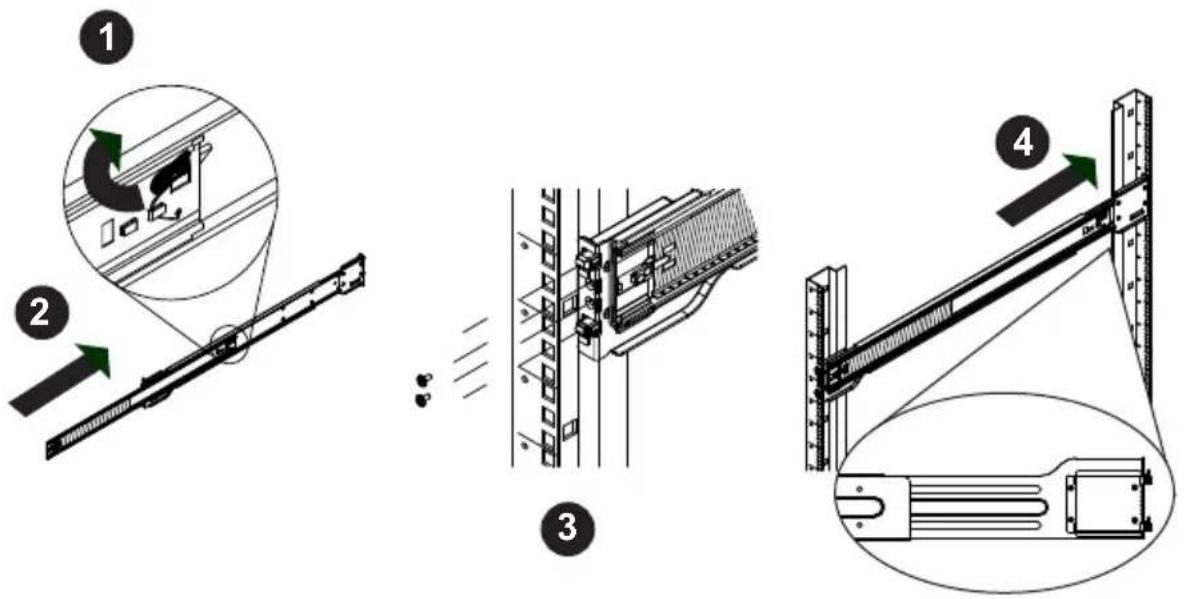
Installing the Outer Rails
- Press upward on the locking tab at the rear end of the middle rail.
- Push the middle rail back into the outer rail.
- Hang the hooks on the front of the outer rail onto the square holes on the front of the rack. If desired, use screws to secure the outer rails to the rack.
- Pull out the rear of the outer rail, adjusting the length until it just fits within the posts of the rack.
- Hang the hooks of the rear section of the outer rail onto the square holes on the rear of the rack. Take care that the proper holes are used so the rails are level. If desired, use screws to secure the rear of the outer rail to the rear of the rack.
- Repeat for the other outer rail.
text_image
Technical diagram illustrating four stages of a mechanical assembly or mounting process, labeled 1 to 4 with Chinese annotations.Figure 6-5. Extending and Mounting the Outer Rails

Stability hazard. The rack stabilizing mechanism must be in place, or the rack must be bolted to the floor before you slide the unit out for servicing. Failure to stabilize the rack can cause the rack to tip over.
Do not use a two post "telco" type rack.
Sliding the Chassis onto the Rack Rails

Warning: Mounting the system into the rack requires at least two people to support the chassis during installation. Please follow safety recommendations printed on the rails.
Installing the Chassis into a Rack
- Extend the outer rails as illustrated above.
- Align the inner rails of the chassis with the outer rails on the rack.
-
Slide the inner rails into the outer rails, keeping the pressure even on both sides. When the chassis has been pushed completely into the rack, it should click into the locked position.
-
Optional screws may be used to hold the front of the chassis to the rack.
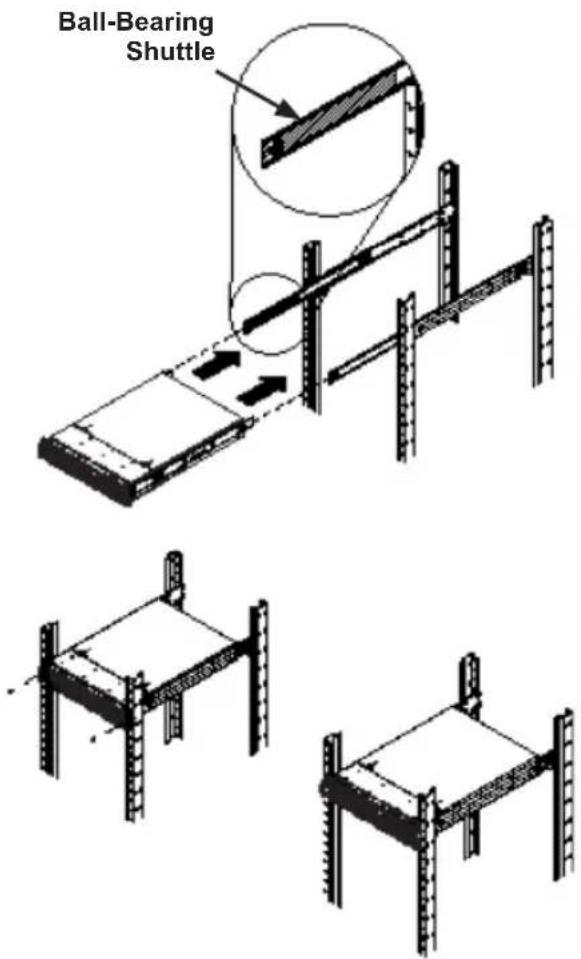
text_image
Ball-Bearing ShuttleFigure 6-6. Installing into a Rack
Note: The figure above is for illustrative purposes only. Always install servers to the bottom of the rack first.

Caution: Do not pick up the server with the front handles. They are designed to pull the system from a rack only.
Chapter 3
System Interface
3-1 Overview
The chassis includes:
- Control panels on the front that include power buttons and status monitoring lights
• Status lights on externally accessible hard drives
• Status lights for the power supply
The control panel is located on the front, outside edge of the chassis.

text_image
RESETFigure 4-1. Control Panel
3-2 Control Panel Buttons
The chassis includes two push-buttons that control power to the system.

Reset: The reset button is used to reboot the system.
Power: The main power switch is used to apply or remove power from the power supply to the server. Turning off system power with this button removes the main power but maintains standby power. To perform many maintenance tasks, you must unplug system before servicing.
3-3 Control Panel LEDs
There are six LEDs that provide status information about the system.

Information LED: Alerts operator of several states, as noted in the table below.
| Information LED | |
| Status Description | |
| Continuously on and red | An overheat condition has occurred. (This may be caused by cable congestion.) |
| Blinking red (1Hz) Fan failure, | check for an inoperative fan. |
| Blinking red (0.25Hz) Power failure, | check for a non-operational power supply. |
| Solid blue | UID has been activated locally to locate the server in a rack environment. |
| Blinking blue | UID has been activated using IPMI to locate the server in a rack environment. |

NIC2: Indicates network activity on GLAN2 when flashing.

NIC1: Indicates network activity on GLAN1 when flashing.
HDD: Indicates IDE channel activity on the hard drive when flashing.

Power: Indicates power is being supplied to the system power supply units. This LED should normally be illuminated when the system is operating.

Power Fail: Indicates a power supply module has failed.
Overheating
There are several possible responses if the system overheats.
Overheat Temperature Setting
Some backplanes allow the overheat temperature to be set at 45, 50, or 55 degrees by changing a jumper setting. For more information, consult the backplane user manual on the Supermicro website.
Responses
If the server overheats
- Use the LEDs to determine the nature of the overheating condition.
-
Confirm that the chassis covers are installed properly.
-
Check the routing of the cables and make sure all fans are present and operating normally.
-
Verify that the heatsinks are installed properly.
3-4 Drive Carrier LEDs
The chassis includes externally accessible SAS/SATA/NVMe drives. Each drive carrier displays two status LEDs on the front of the carrier.
| LED Color Blinking Pattern Behavior for Device | |||
| Activity LED | Blue Solid On SAS/NVMe drive installed | ||
| Blue Blinking I/O activity | |||
| Status LED | Red Solid On Failed drive for SAS/SATA/NVMe with RSTe support | ||
| Red Blinking at 1 Hz Rebuild drive for SAS/SATA/NVMe with RSTe support | |||
| Red Blinking with two blinks and one stop at 1 Hz | Hot spare for SAS/SATA/NVMe with RSTe support | ||
| Red On for five seconds, then off | Power on for SAS/SATA/NVMe with RSTe support | ||
| Red Blinking at 4 Hz Identify drive for SAS/SATA/NVMe with RSTe support | |||
| Green Solid On Safe to remove NVMe device | |||
| Amber Blinking at 1 Hz Attention state—do not remove NVMe device | |||
3-5 Power Supply LEDs
On the rear of the power supply module, an LED displays the status.
- Solid Green: When illuminated, indicates that the power supply is on.
- Blinking Green: When blinking, indicates that the power supply is plugged in and turned off by the system.
- Blinking Amber: When blinking, indicates that the power supply has a warning condition and continues to operate.
- Solid Amber: When illuminated, indicates that the power supply is plugged in and in an abnormal state. The server system might need service. Please contact Supermicro technical support.
Chapter 4
Standardized Warning Statements for AC Systems
About Standardized Warning Statements
The following statements are industry standard warnings, provided to warn the user of situations which have the potential for bodily injury. Should you have questions or experience difficulty, contact Supermicro's Technical Support department for assistance. Only certified technicians should attempt to install or configure components.
Read this chapter in its entirety before installing or configuring components in the Supermicro chassis. Some warnings may not apply for your system.
These warnings may also be found on our web site at www.supermicro.com/about/policies/safety_information.cfm.
Warning Definition

Warning!
This warning symbol means danger. You are in a situation that could cause bodily injury. Before you work on any equipment, be aware of the hazards involved with electrical circuitry and be familiar with standard practices for preventing accidents.
警告の定義
この警告サインは危険を意味します。
Installation Instructions

Warning!
Read the installation instructions before connecting the system to the power source.
設置手順書
This product relies on the building's installation for short-circuit (overcurrent) protection. Ensure that the protective device is rated not greater than: 250 V, 20 A.
サーキット・ブレーカー
Power Disconnection Warning

Warning!
The system must be disconnected from all sources of power and the power cord removed from the power supply module(s) before accessing the chassis interior to install or remove system components.

text_image
CAUTION: This unit has redundant power sources. Please disconnect all the power cords before servicing.電源切断の警告
Equipment Installation

Warning!
Only trained and qualified personnel should be allowed to install, replace, or service this equipment.
機器の設置
This unit is intended for installation in restricted access areas. A restricted access area can be accessed only through the use of a special tool, lock and key, or other means of security. (This warning does not apply to workstations).
アクセス制限区域
There is the danger of explosion if the battery is replaced incorrectly. Replace the battery only with the same or equivalent type recommended by the manufacturer.
Dispose of used batteries according to the manufacturer's instructions
電池の取り扱い
Redundant Power Supplies (if applicable to your system)

Warning!
This unit might have more than one power supply connection. All connections must be removed to de-energize the unit.
冗長電源装置
Backplane Voltage (if applicable to your system)

Warning!
Hazardous voltage or energy is present on the backplane when the system is operating. Use caution when servicing.
バックプレーンの電圧
Comply with Local and National Electrical Codes

Warning!
Installation of the equipment must comply with local and national electrical codes.
地方および国の電気規格に準拠
Ultimate disposal of this product should be handled according to all national laws and regulations.
製品の廃棄
text_image
WARNING Hazardous moving parts. Keep away from moving fan blades.The fans might still be turning when you remove the fan assembly from the chassis. Keep fingers, screwdrivers, and other objects away from the openings in the fan assembly's housing.
ファン・ホットスワップの警告
Power Cable and AC Adapter

Warning!
When installing the product, use the provided or designated connection cables, power cables and AC adaptors. Using any other cables and adaptors could cause a malfunction or a fire. Electrical Appliance and Material Safety Law prohibits the use of UL or CSA-certified cables (that have UL/CSA shown on the code) for any other electrical devices than products designated by Supermicro only.
電源コードとACアダプター
This chapter covers the steps required to install processors and heatsinks to the X10DRU-i+ serverboard, connect the data and power cables and install add-on cards. All serverboard jumpers and connections are described and a layout and quick reference chart are included in this chapter. Remember to close the chassis completely when you have finished working on the serverboard to protect and cool the system sufficiently.
5-1 Handling the Serverboard
Static electrical discharge can damage electronic components. To prevent damage to printed circuit boards, it is important to handle them very carefully (see Chapter 4). Also note that the size and weight of the serverboard can cause it to bend if handled improperly, which may result in damage. To prevent the serverboard from bending, keep one hand under the center of the board to support it when handling.
The following measures are generally sufficient to protect your equipment from static discharge.
Precautions
- Use a grounded wrist strap designed to prevent static discharge.
- Touch a grounded metal object before removing any board from its antistatic bag.
- Handle a board by its edges only; do not touch its components, peripheral chips, memory modules or gold contacts.
- When handling chips or modules, avoid touching their pins.
- Put the serverboard, add-on cards and peripherals back into their antistatic bags when not in use.
Unpacking
The serverboard is shipped in antistatic packaging to avoid static damage. When unpacking the board, make sure the person handling it is static protected.
5-2 Installing the Processor and Heatsink
Notes:
• Always remove the power cord before adding, removing or changing a CPU.
- When receiving a serverboard without a processor pre-installed, make sure that the plastic CPU socket cap is in place and none of the socket pins are bent; otherwise, contact your retailer immediately.
- If you buy a CPU separately, use only an Intel-certified, multi-directional heatsink.
- Avoid placing direct pressure to the top of the processor package.
• Install the processor into the CPU socket before installing the heatsink.
• Refer to the Supermicro web site for updates on CPU support.
Installing an LGA 2011 Processor
Installing a CPU
- There are two levers on the LGA 2011 socket. First press and release the load lever labeled "Open 1st".

text_image
Close In OPEN 1stRelease the lever labeled "Open 1st"
- Press the second load lever labeled "Close 1st" to release the load plate from its locked position.
Release the lever labeled "Close 1st"

text_image
Open 1st Closed 1st- With the second lever fully retracted, gently push down on the "Open 1st" lever to loosen the load plate. Lift the load plate with your fingers to open it completely.
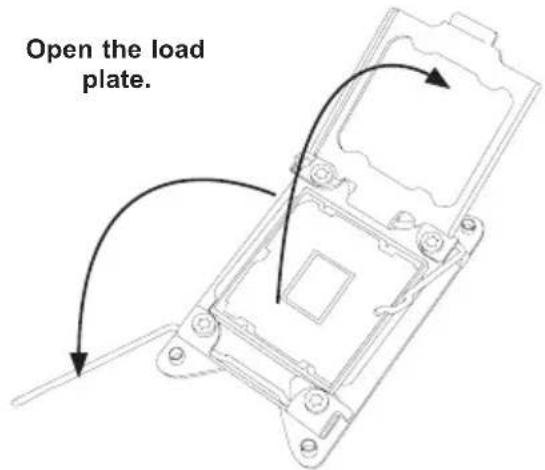
text_image
Open the load plate.-
Pop the plastic cap marked "Warning" out of the load plate.
-
Holding the CPU carefully above the socket, orient the CPU so that all keys and edges will fit the socket.
-
Carefully lower the CPU straight down into the socket. Do not move the CPU horizontally, and do not rub the pins of the socket. This may damage the CPU or the socket.
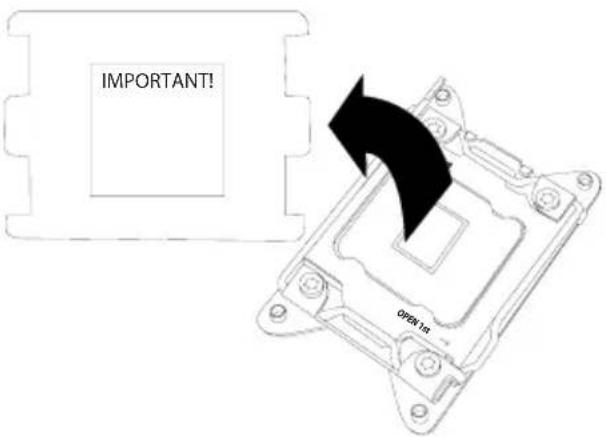
text_image
IMPORTANT! OPR1a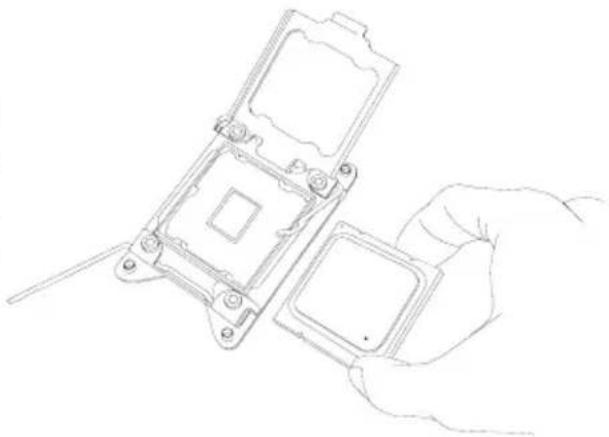
natural_image
Line drawing of a hand holding a small electronic device with a grid and ports (no text or symbols)Caution: You can only install the CPU into the socket in one direction. Make sure that the CPU is properly inserted into the socket before closing the load plate. If it does not close properly, do not force it as it may damage your CPU. Instead, open the load plate again and double-check that the CPU is aligned properly.
- With the "Close 1st" lever fully retracted, gently close the load plate.
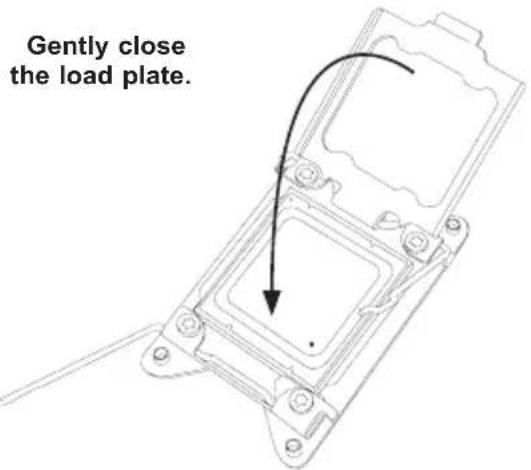
text_image
Gently close the load plate.- Make sure the locking mechanism on the "Close 1st" lever catches the lip of the load plate. Close and lock the "Close 1st" lever.

text_image
Push down and lock the lever labeled "Close 1st". GUSB 1st OPEN 1st of and ofEngage the lip of the load plate and locking portion of the lever."
- Close and lock the "Open 1st" lever.
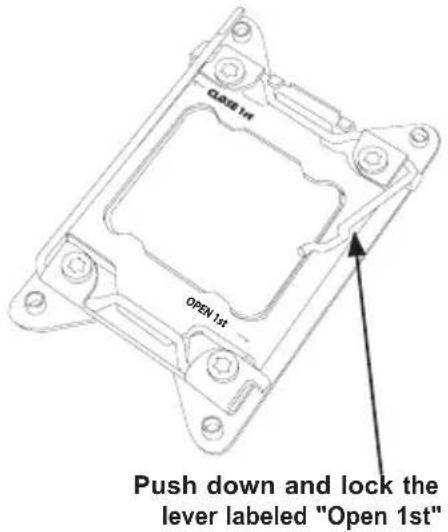
text_image
Q481n OPEN1n Push down and lock the lever labeled "Open 1st"Installing a CPU Heatsink
natural_image
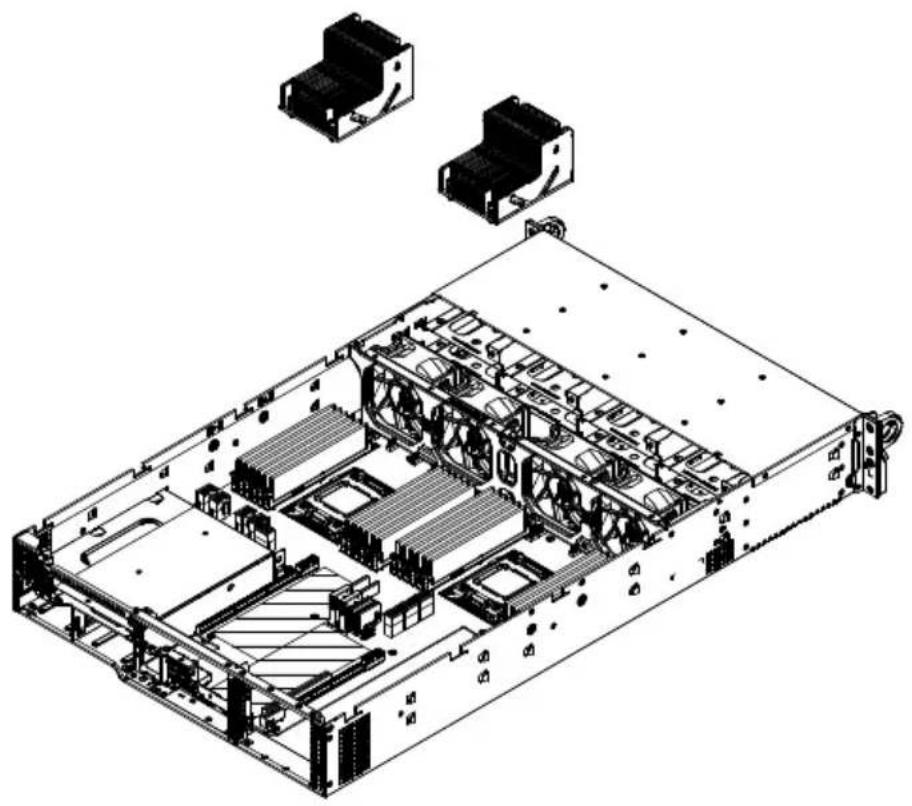
Technical line drawing of an internal server rack with multiple drive units (no text or labels)Figure 5-1. Heatsinks
Installing a Heatsink
- Place the heatsink on top of the CPU so that the four mounting holes are aligned with those on the retention mechanism.
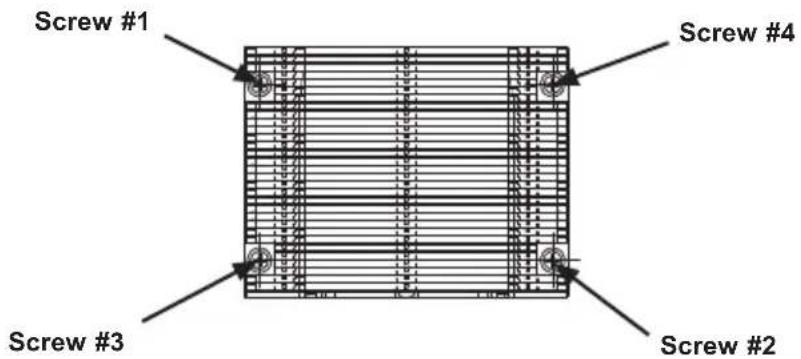
- Screw in two diagonal screws (#1 and #2) until just snug—do not over-tighten and damage the CPU. Screw in the remaining screws.
- Finish the installation by fully tightening all four screws.
text_image
Screw #1 Screw #4 Screw #3 Screw #2Figure 5-2. Heatsink Screw Order
Removing the Heatsink
Caution: We do not recommend removing the CPU or the heatsink. If you do need to remove the heatsink, please follow the instructions below to prevent damage to the CPU or the CPU socket.
- Unplug the power cord from the power supply.
- Unscrew and remove the heatsink screws in the opposite sequence shown in the picture above.
- Hold the heatsink and gently wriggle it to loosen it from the CPU. (Do not use excessive force!)
- Once the heatsink is loosened, remove it from the CPU.
- Clean the surface of the CPU and the heatsink to get rid of the old thermal grease. Reapply the proper amount of thermal grease before re-installing the heatsink.
5-3 Connecting Cables
Now that the processors are installed, the next step is to connect the cables to the serverboard. These include the data (ribbon) cables for the peripherals and control panel and the power cables.
Connecting Data Cables
The cables used to transfer data from the peripheral devices have been carefully routed in preconfigured systems to prevent them from blocking the flow of cooling air that moves through the system from front to back. If you need to disconnect any of these cables, you should take care to reroute them as they were originally after reconnecting them and be aware of the pin 1 locations. If you are configuring the system, keep the airflow in mind when routing the cables.
Connecting Power Cables
The X10DRU-i+ has a 4-pin primary power supply connector designated JPW1 for connection to the power supply. Connect the appropriate connector from the power supply to JPW1 to supply power to the serverboard. See the Connector Definitions section in this chapter for power connector pin definitions.
Connecting the Control Panel
JF1 contains header pins for the front control panel connectors. All JF1 wires have been bundled into single keyed ribbon cable to simplify their connection. The red wire in the ribbon cable plugs into pin 1 of JF1. Connect the other end of the cable to the Control Panel printed circuit board, located just behind the system status LEDs in the chassis.
See the Connector Definitions section in this chapter for details and pin descriptions of JF1.
5-4 I/O Ports
Serverboard I/O Ports

text_image
Diagram showing six labeled electronic device ports: two network switches, a router, an ADS, a color pin, and a 2.5V I/O port.Figure 5-2. Rear Panel I/O Ports
| 1. Back Panel USB 3.0 Port 0 |
| 2. Back Panel USB 3.0 Port 1 |
| 3. BMC dedicated LAN |
| 4. COM Port 1 (Turquoise) |
| 5. UID Button/UID LED (LED1) |
| 6. Back Panel VGA (Blue) |
LAN Ports
The serverboard does not provide LAN ports directly. The server includes two or four LAN ports, depending on the server model, using a pre-installed Ultra riser card (expansion card). See Section 1-1 for details.
5-5 Installing Memory
For best performance, install memory modules of the same type and same speed in the slots as indicated in the tables on the following page.
Note: Check the Supermicro web site for recommended memory modules.
CAUTION
Exercise extreme care when installing or removing DIMM modules to prevent any possible damage.
Installing DIMMs
- Insert the desired number of DIMMs into the memory slots, starting with slot P1-DIMMA1.
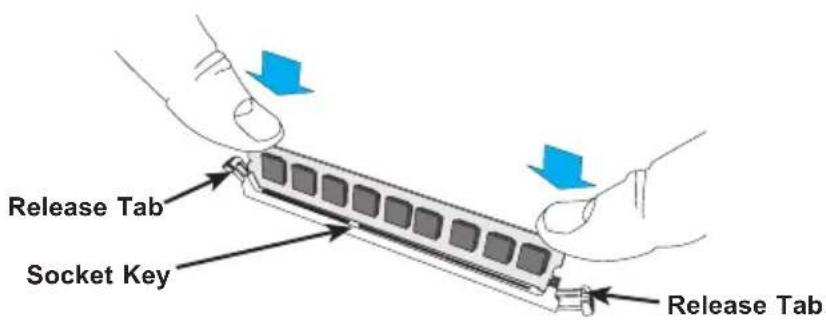
- Push the release tabs outwards on both ends of the DIMM slot to unlock it.
- Insert each DIMM vertically into its slot. Pay attention to the notch along the bottom of the module to prevent inserting the DIMM module incorrectly..
- Use two thumbs together to press on both ends of the module straight down into the slot until the module snaps into place.
text_image
Release Tab Socket Key Release TabFigure 5-3. Installing DIMM into Slot
Memory Support
The server features 24 DIMM slots that can support up to 3 TB of Load Reduction (LRDIMM) or up to 1.5 TB of Registered (RDIMM)/Non-volatile (NV-DIMM) ECC DDR4-2400/2133/1866/1600/1333 SDRAM or LRDIMM type memory. For the latest memory updates, refer to the Supermicro website at www.supermicro.com/products/motherboard.
Processor and Memory Module Population Configuration
For memory to work properly, follow the tables below for memory installation.
| Processors and their Corresponding Memory Modules | ||||||||||||
| CPU# Corresponding DIMM Modules | ||||||||||||
| (CPU 1) P1-DIMM | A1 B | C1 D | A2 B | C2 D | D2 A3 | B3 C3 | D3 | |||||
| (CPU 2) P2-DIMM | E1 F | G1 H | E2 F | G2 H | E3 E3 | F3 G3 | H3 | |||||
Caution: For the memory to work properly, please install DIMMs of the same type and speed. Mixing of DIMMs of different types or speeds is not allowed.
Populating DDR4 Memory Modules
| Populating RDIMM/LRDIMM DDR4 Memory Modules | |||||||||
| Type | Ranks Per DIMM and Data Width | DIMM Capacity (GB) | Speed (MT/s); Voltage (V); Slots per Channel (SPC) and DIMMs per Channel (DPC) | ||||||
| 3 Slots per Channel | |||||||||
| 1 DPC 2 DPC 3 DPC | |||||||||
| E5-2600 V3 E5-2600 V4 E5-2600 V3 E5-2600 V4 | E5-2600 V4 | ||||||||
| 4 Gb | 8 Gb | 1.2 V | 1.2 V | 1.2 V | 1.2 V | 1.2 V | 1.2 V | ||
| RDIMM | SRx4 | 8 GB | 16 GB | 2133 | 2400 | 1866 | 2133 | 1600 | 1600 |
| RDIMM | SRx8 | 4 GB | 8 GB | 2133 | 2400 | 1866 | 2133 | 1600 | 1600 |
| RDIMM | DRx8 | 8 GB | 16 GB | 2133 | 2400 | 1866 | 2133 | 1600 | 1600 |
| RDIMM | DRx4 | 16 GB | 32 GB | 2133 | 2400 | 1866 | 2133 | 1600 | 1600 |
| LRDIMM | QRx4 | 32 GB | 64 GB | 2133 | 2400 | 2133 | 2400 | 1600 | 1866 |
| LRDIMM 3DS | 8Rx4 64 | GB | 128 GB | 2133 | 2400 | 2133 | 2400 | 1600 | 1866 |
5-6 Serverboard Details
text_image
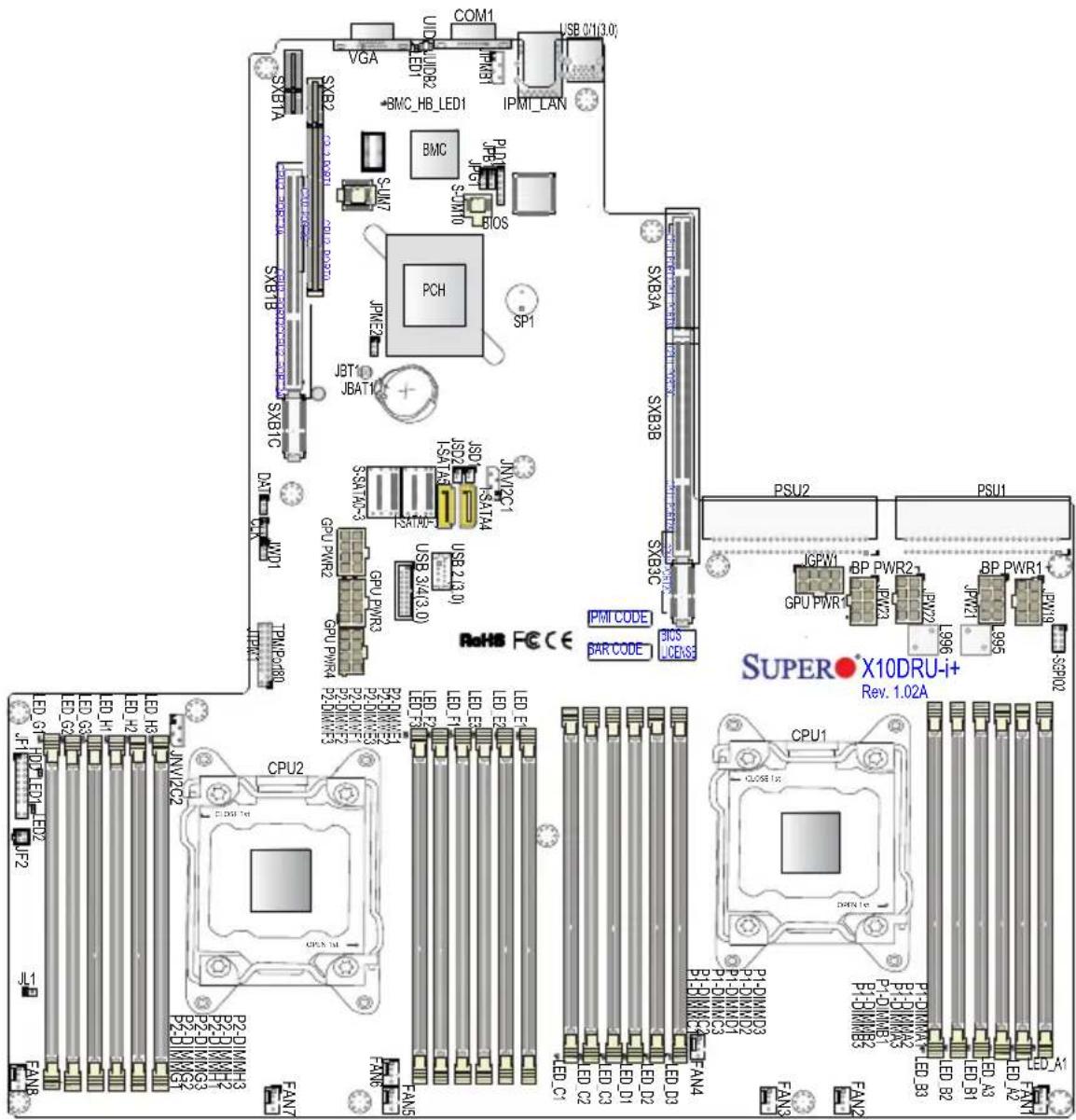
COM1 USB 0/1/3.01 VGA LED1 IUPB1 USB 0/1/3.01 SXB2 BMC_HB_LED1 IPMI_LAN SUNT7 SOMT0 BIOS PCH SP1 JPN2 JBT1 JBAT1 SXB3A SXB3B JSD JSAT4A JSAT4A JSAT4A JSAT4A JSAT4A JSAT4A JSAT4A JSAT4A JSAT4A JSAT4A JSAT4A JSAT4A JSAT4A JSAT4A JSAT4A JSAT4A JSAT4A JSAT4A JSAT4A JSAT4A JSAT4a JSAT4a JSAT4a JSAT4a JSAT4a JSAT4a JSAT4a JSAT4a JSAT4a JSAT4a JSAT4a JSAT4a JSAT4a JSAT4a JSAT4a JSAT4a JSAT4a JSAT4a JSAT4a JSAT4a JSAT4e JSAT4e JSAT4e JSAT4e JSAT4e JSAT4e JSAT4e JSAT4e JSAT4e JSAT4e JSAT4e JSAT4e JSAT4e JSAT4e JSAT4e JSAT4e JSAT4e JSAT4e JSAT4e JPN2C1 JNVI2C1 JNVI2C1 JNVI2C1 JNVI2C1 JNVI2C1 JNVI2C1 JNVI2C1 JNVI2C1 JNVI2C1 JNVI2C1 JNVI2C1 JNVI2C1 JNVI2C1 JNVI2C1 JNVI2c180 JNVI2c180 JNVI2c180 JNVI2c180 JNVI2c180 JNVI2c180 JNVI2c180 JNVI2c180 JNVI2c180 JNVI2c180 JNVI2c180 JNVI2c180Figure 5-4. SUPER X10DRU-i+ Layout
Notes
- "■" indicates the location of "Pin 1".
- Jumpers/LEDs not indicated are for testing purposes only. Also, components that are not documented in this manual are reserved for internal use only.
Serverboard Quick Reference
Jumper Description Default Setting
| JBT1 Clear Onboard CMOS Battery See Section 5-8 | ||
| JPB1 BMC Enable Pins 1-2 (Enabled) | ||
| JPG1 VGA Enable Pins 1-2 (Enabled) | ||
| JPME2 | ME Manufacturing Mode Select | Pins 1-2 (Normal) |
| JPP0/JTAG SCAN CPU1 JTAG Scan Enable | Pins 1-4 (Includes CPU2, 2-3: isolates CPU1) | |
| JPP1/JTAG SCAN CPU2 JTAG Scan Enable | Pins 1-4 (Includes CPU1, 2-3: isolates CPU2) | |
| JWD1 Watch Dog Timer Enable Pins 1-2 (Reset) | ||
Connectors Description
| BP PWR1/2 Backplane power connectors | |
| COM1 COM Port1 | |
| Fan1-8 | CPU/System Fan Headers |
| GPU PWR1-PWR4 | 8-pin Power Connectors (1-4) for GPUs |
| JF1 | Front Control Panel Header |
| JF2 | 4-pin Power Connector for LAN 3/4 LED |
| JL1 | Chassis Intrusion Header |
| JIPMB1 | 4-pin External BMC I2C Header (for an IPMI card) |
| JSD1/JSD2 | SATA DOM (Device on Module) Power Connectors |
| JTPM1 | TPM (Trusted Platform Module)/Port 80 Header |
| IPMI_LAN | Dedicated IPMI LAN Support (by the ASpeed controller) |
| PSU1/PSU2 | Power Supply Unit 1/Unit 2 Headers |
| I-SATA0~3, 4, 5 | SATA 3.0 Ports (Intel PCH) |
| S-SATA 0~3 | SATA 3.0 Ports (Intel SCU) |
| SXB1A/1B/1C | Proprietary PCI-E Slot used for WIO-Left Devices (supported by CPU2) |
| SXB2 | Proprietary PCI-E 3.0x8 Slot for WIO-Right Devices or Add-on Cards (supported by CPU2) |
| SXB3A/3B/3C | Proprietary PCI-E Slot for Ultra Riser Devices (supported by CPU1) |
| I-SGPIO2 | Serial Link General Purpose I/O (SGPIO) header (for S-SATA ports) |
| USB 0/1 (3.0) | Rear USB 3.0 Ports |
| USB 2 (3.0) | Type A USB 3.0 Header |
| USB 3/4 (3.0) | Front Accessible USB 3.0 Headers |
| VGA | VGA Port |
LED Description (State) Status
| BMC_HB_LED1 | BMC Heartbeat LED (Green: Blinking) BMC Normal | |
| LED1 Rear UID LED (Blue: On) Unit Identified | ||
| HDD_LED1 HDD Heartbeat LED (Blinking) HDD Normal | ||
| LED2 Onboard PWR LED (On) System Power On | ||
| LED_A1-A3 | Memory Fault Detect LED for DIMM slots A1-A3: (Red: On) | Memory Error(s) |
| LED_B1-B3 | Memory Fault Detect LED for DIMM slots B1-B3: (Red: On) | Memory Error(s) |
| LED_C1-C3 | Memory Fault Detect LED for DIMM slots C1-C3: (Red: On) | Memory Error(s) |
| LED_D1-D3 | Memory Fault Detect LED for DIMM slots D1-D3: (Red: On) | Memory Error(s) |
| LED_F1-F3 | Memory Fault Detect LED for DIMM slots F1-F3: (Red: On) | Memory Error(s) |
| LED_G1-G3 | Memory Fault Detect LED for DIMM slots G1-G3: (Red: On) | Memory Error(s) |
| LED_H1-H3 | Memory Fault Detect LED for DIMM slots H1-H3: (Red: On) | Memory Error(s) |
5-7 Connector Definitions
Power Connectors
The X10DRU-i+ serverboard supports the following power configurations:
- Two proprietary main power supply units (PSU1: for CPU1 platform support, PSU2: for CPU2 platform support)
- Two backplane power-connector units (each unit comprised of two 8-pin power connectors) for backplane device use (BP PWR1: CPU1 platform support, BP PWR2: for CPU2 platform support)
- Four 8-pin power-connectors (GPU PWR1-4) used for GPU devices
• One 4-pin power connector (JF2) used for LAN 3/4 LED
Caution: To provide adequate power to your system and to avoid damaging the power supply or the serverboard, be sure to connect all power connectors mentioned above to the power supply when using the devices mentioned. Failure in doing so may void the manufacturer warranty on your power supply and serverboard.
| 8-pin GPU PWR Pin Definitions | |
| Pins | Definition |
| 1 through 3 Ground | |
| 4 through 8 +12V | |
Control Panel Connector
The connector for the control panel on the front of the chassis is JF1.

Figure 5-5. Front Control Panel Header Pins (JF1)
NMI Button
The non-maskable interrupt button header is located on pins 19 and 20 of JF1. Refer to the table on the right for pin definitions.
Power LED
The Power LED connection is located on pins 15 and 16 of JF1. Refer to the table on the right for pin definitions.
HDD LED/UID Switch
The HDD LED/UID switch connections are located on pins 13/14 of JF1. Attach an LED cable to display HDD activity. Attach a cable to pin 13 to use UID button. See the table on the right for pin definitions.
NIC1/NIC2 LED
The NIC (Network Interface Controller) LED connections for GLAN port 1 are located on pins 11 and 12 of JF1, and the LED connection for GLAN Port 2 are on pins 9 and 10. Attach the NIC LED cables here to display network activity. Refer to the table on the right for pin definitions.
Note: The NIC LED connections for 10G_LAN Ports 3/4 is located on LED1.
| NMI ButtonPin Definitions (JF1) | |
| Pin# | Definition |
| 19 Control | |
| 20 Ground | |
| Power LEDPin Definitions (JF1) | |
| Pin# | Definition |
| 15 3.3V | |
| 16 PWR LED | |
| HDD/UID SwitchPin Definitions (JF1) | |
| Pin# | Definition |
| 13 UID | Switch |
| 14 HDD | Active |
| GLAN 1/2 LEDPin Definitions (JF1) | |
| Pin# | Definition |
| 9 NIC | 2 Activity LED |
| 10 NIC | 2 Link LED |
| 11 NIC | 1 Activity LED |
| 12 NIC | 1 Link LED |
Overheat (OH)/Fan Fail/PWR Fail/UID LED
Connect an LED cable to pins 7 and 8 of Front Control Panel to use the Overheat/Fan Fail/Power Fail and UID LED connections. The Red LED on pin 8 provides warnings of overheat, fan failure or power failure. The Blue LED on pin 7 works as the front panel UID LED indicator. Refer to the table on the right for pin definitions.
Power Fail LED
The Power Fail LED connection is located on pins 5 and 6 of JF1. Refer to the table on the right for pin definitions.
Reset Button
The Reset Button connection is located on pins 3 and 4 of JF1. Attach it to the hardware reset switch on the computer case. Refer to the table on the right for pin definitions.
Power Button
The Power Button connection is located on pins 1 and 2 of JF1. Momentarily contacting both pins will power on/off the system. This button can also be configured to function as a suspend button (see the Power Button Mode setting in BIOS). To turn off the power when set to suspend mode, depress the button for at least 4 seconds. Refer to the table on the right for pin definitions.
| OH/Fan Fail/ PWR Fail/Blue_UID LED Pin Definitions (JF1) | |
| Pin# | Definition |
| 7 | Blue_UID LED |
| 8 | OH/Fan Fail/Power Fail |
| OH/Fan Fail/PWR FailLED Status (Red LED) | |
| State | Definition |
| Off Normal | |
| On Overheat | |
| Flashing Fan Fail | |
| PWR Fail LEDPin Definitions (JF1) | |
| Pin# | Definition |
| 5 3.3V | |
| 6 PWR Supply Fail | |
| Reset ButtonPin Definitions (JF1) | |
| Pin# | Definition |
| 3 Reset | |
| 4 Ground | |
| Power ButtonPin Definitions (JF1) | |
| Pin# | Definition |
| 1 Signal | |
| 2 Ground | |
Other Connectors
Fan Headers
The serverboard has eight system/CPU fan headers (Fan 1\~Fan 8). All are 4-pin fans headers, which are backward compatible with traditional 3-pin fans. Fan speed control is available for 4-pin fans only. The fan speeds are controlled by IPMI. See the table on the right for pin definitions.
Chassis Intrusion
A Chassis Intrusion header is located at JL1. Attach an appropriate cable from the chassis to inform you of a chassis intrusion when the chassis is opened.
Internal Speaker
The Internal Speaker, located at SP1, can be used to provide audible indications for various beep codes. See the table on the right for pin definitions.
| Fan HeaderPin Definitions | |
| Pin# | Definition |
| 1 Ground | |
| 2 +12V | |
| 3 Tachometer | |
| 4 Pulse Width Modulation(PWM) | |
| Chassis Intrusion Pin Definitions | |
| Pin# | Definition |
| 1 | Intrusion Input |
| 2 | Ground |
| Internal SpeakerPin Definition | ||
| Pin# | Definitions | |
| Pin 1 Pos. (+) Beep | In | |
| Pin 2 Neg. (-) Alarm | Speaker | |
TPM Header/Port 80
A Trusted Platform Module/Port 80 header is located at JTPM1 to provide TPM support and Port 80 connection. Use this header to enhance system performance and data security. See the table on the right for pin definitions.
| TPM/Port 80 HeaderPin Definitions | ||
| Pin # | Definition Pin # | Definition |
| 1 LCLK 2 GND | ||
| 3 LFRAME# 4 < (KEY)> | ||
| 5 LRESET# 6 +5V (X) | ||
| 7 LAD 3 8 LAD 2 | ||
| 9 +3.3V 10 LAD1 | ||
| 11 LAD0 12 GND | ||
| 13 SMB_CLK4 14 SMB_DAT4 | ||
| 15 +3V_DUAL 16 SERIRQ | ||
| 17 GND | 18 | CLKRUN# (X) |
| 19 LPCPD# | 20 | LDRQ# (X) |
I-SGPIO2 Header
A Serial-Link General Purpose Input/Output header (I-SGPIO2) supports onboard I-SATA 4/5. See the table on the right for pin definitions.
| I-SGPIOPin Definitions | |||
| Pin# | Definition | Pin | Definition |
| 1 NC | 2 NC | ||
| 3 Ground | 4 Data | ||
| 5 Load | 6 Ground | ||
| 7 Clock | 8 N | ||
NC = No Connection
DOM Power Connectors
Two power connectors for SATA DOM (Disk On Module) devices are located at JSD1 and JSD2. These connectors are used with Supermciro SuperDOMs to provide backward-compatible power support to non-Supermicro SATADOMs that require external power supply.
| DOM PWRPin Definitions | |
| Pin# | Definition |
| 1 +5V | |
| 2 Ground | |
| 3 Ground | |
Unit Identifier Buttons/UID LED Indicators
A rear unit identifier button (JUIDB2) is located next to the COM port. The connection for the front UID button is located on pin 13 of JF1. The rear UID LED (LED1) is located next to the rear UID button, and the front UID LED connection is located on pin 7 of JF1. When you press the rear UID button, both front and rear UID LED indicators will be turned on. Press the UID button again to turn off the LEDs. The UID indicators provide easy identification of a system unit that may be in need of service.
Note: UID can also be triggered via IPMI. For more information on IPMI, please refer to the IPMI User's Guide posted on our website.
| UID Button | |
| Pin# | Definition |
| 1 Ground | |
| 2 Ground | |
| 3 Button In | |
| 4 Button In | |
| UID LEDStatus | |
| Color/State Status | |
| Blue: On Unit Identified |
Universal Serial Bus (USB)
Two USB 3.0 ports (USB 0/1) are located on the rear I/O panel. A Type A USB connector (USB 2), and a USB header with two USB connections (USB 3/4) provide onboard three USB 3.0 connections for front access (cables not included). See the tables below for pin definitions.
| USB 3.0 Port (USB0/1, 2) Pin Definitions | |||
| Pin# | Definition | Pin# | Definition |
| 1 +5V | 5 +5V | ||
| 2 USB_PN1 | 6 USB_PN0 | ||
| 3 USB_PP1 | 7 USB_PP0 | ||
| 4 Ground | 8 Ground | ||
| USB 3.0 Header (USB 3/4)Pin Definitions | |||
| Pin# | Description Pin# | Description | |
| 1 | USB3.0_Front_VCC | ||
| 2 | USB3_RE_RXN6 19 | USB3.0_Front_VCC | |
| 3 | USB3_RE_RXP6 18 | USB3_RE_RXN5 | |
| 4 | Ground 17 | USB3_RE_RXP5 | |
| 5 | USB3_RE_TXN6 16 | Ground | |
| 6 | USB3_RE_TXP6 15 | USB3_RE_TXN5 | |
| 7 | Ground 14 | USB3_RE_TXP5 | |
| 8 | USB2_N8 | 13 | Ground |
| 9 | USB2_P8 | 12 | USB2_N9 |
| 10 | Ground 11 | USB2_P9 | |
5-8 Jumper Settings
Explanation of Jumpers
To modify the operation of the serverboard, jumpers can be used to choose between optional settings. Jumpers create shorts between two pins to change the function of the connector. Pin 1 is identified with a square solder pad on the printed circuit board. See the diagram at right for an example of jumping pins 1 and 2. Refer to the serverboard layout page for jumper locations.
Note: On two-pin jumpers, "Closed" means the jumper is on and "Open" means the jumper is off the pins.
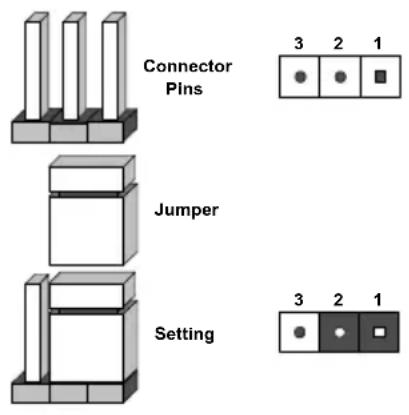
CMOS Clear
JBT1 is used to clear CMOS and will also clear any passwords. Instead of pins, this jumper consists of contact pads to prevent accidentally clearing the contents of CMOS.
To clear CMOS
- First power down the system and unplug the power cord(s).
- With the power disconnected, short the CMOS pads with a metal object such as a small screwdriver.
- Remove the screwdriver (or shorting device).
- Reconnect the power cord(s) and power on the system.
Note: Do not use the PW_ON connector to clear CMOS.
VGA Enable/Disable
JPG1 allows you to enable or disable the onboard VGA port. The default position is on pins 1 and 2 to enable VGA. See the table on the right for jumper settings. The default setting is enabled.
| VGA Enable/Disable Jumper Settings | |
| Jumper Setting | Definition |
| Pins 1-2 Enabled | |
| Pins 2-3 Disabled | |
Watch Dog Enable/Disable
JWD1 controls the Watch Dog function. Watch Dog is a system monitor that can reboot the system when a software application “hangs”. Pins 1-2 will cause WD to reset the system if an application hangs. Pins 2-3 will generate a non-maskable interrupt signal for the application that has hung. See the table on the right for jumper settings. Watch Dog must also be enabled in BIOS.
| Watch DogJumper Settings | |
| Jumper Setting | Definition |
| Pins 1-2 Reset | |
| Pins 2-3 NMI | |
| Open Disabled | |
BMC Enable
Jumper JPB1 allows you to enable the embedded onboard BMC (Baseboard Management) controller to provide IPMI 2.0 support on the serverboard. See the table on the right for jumper settings.
| BMC EnableJumper Settings | |
| Jumper Setting | Definition |
| Pins 1-2 BMC Enable | |
| Pins 2-3 Normal | |
ME Manufacturing Mode Select
Close pin 2 and pin 3 of jumper JPME2 to bypass SPI flash security and force the system to operate in the Manufacturer (ME) mode, allowing the user to flash the system firmware from a host server for system setting modifications. See the table on the right for jumper settings.
| ME Mode SelectJumper Settings | |
| Jumper Setting | Definition |
| Pins 1-2 Normal | |
| Pins 2-3 Manufacture Mode | |
5-9 Onboard Indicators
IPMI Dedicated LAN LEDs
A dedicated IPMI LAN port is located on the rear I/O panel. The amber LED on the right indicates activity, while the LED on the left indicates the speed of the connection. See the tables at right for more information.
| IPMI LAN Activity IndicatorLED Settings | ||
| Color | Status | Definition |
| Amber Flashing Active | ||
| IPMI LAN Speed LED | |
| LED Color | Definition |
| Off 10 Mbps, or No Connection | |
| Green 100 Mbps | |
| Amber 1 | Gbps |
HDD Heartbeat LED
An HDD heartbeat LED is located next to the JF1 header. When this green LED is blinking, HDD devices are functioning normally. See the table at right for more information.
| HDD Heartbeat LED States | |
| Color/State | Definition |
| Green: Blinking | HDD: Normal |
Onboard Power LED
An Onboard Power LED is located at LE2 on the serverboard. When this LED is on, the system is on. Be sure to turn off the system and unplug the power cord before removing or installing components. See the tables at right for more information.
| Onboard PWR LED IndicatorLED States | |
| LED Color | Definition |
| Off System | Off (PWR cable not connected) |
| Green System On | |
| Green:FlashingQuickly | ACPI S1 State |
BMC Heartbeat LED
A BMC Heartbeat LED is located at BMC_HB_LED1. When this LED is blinking, BMC is functioning normally.
| BMC HeartbeatLEDStatus | |
| Color/State | Definition |
| Green:Blinking | BMC: Normal |
5-10 SATA Ports
Ten SATA 3.0 ports are located on the serverboard. Six ports (I-SATA 0\~3, 4, 5) are supported by the Intel PCH C612. I-SATA 4 and I-SATA 5 also support self-powered Supermcro SuperDOM (Device-on-Module) devices or any 3rd-party SATA DOM devices that use external power via JSD1 and JSD2. The other four SATA ports (S-SATA 0\~3) are supported by the Intel SCU.
5.11 Microsoft Windows OS Installation
If you will be using RAID, you must configure RAID settings before installing the Windows OS and the RAID driver. Refer to the RAID Configuration User Guides posted on our website at www.supermicro.com/support/manuals.
Installing the OS
- Create a method to access the MS Windows installation ISO file. That might be a DVD, perhaps using an external USB/SATA DVD drive, or a USB flash drive, or the IPMI KVM console.
- Retrieve the proper RST/RSTe driver. Go to the Supermicro web page for your motherboard and click on "Download the Latest Drivers and Utilities", select the proper driver, and copy it to a USB flash drive.
- Boot from a bootable device with Windows OS installation. You can see a bootable device list by pressing F11 during the system startup.

text_image
Please select boot device: ATEN Virtual CDROM YSOJ → IPMI virtual drive (Legacy) ASUS SDRW-08D2S-U F601 → USB DVD device (Legacy) USB FLASH DRIVE PMAP → USB flash drive with OS installation (Legacy) IBA 40-10G Slot 1900 v1060 → PXE boot (Legacy) UEFI: ATEN Virtual CDROM YSOJ → IPMI virtual drive (UEFI) UEFI: ASUS SDRW-08D2S-U F601 → USB DVD device (UEFI) UEFI: Built-in EFI Shell Enter Setup ↑ and ↓ to move selection ENTER to select boot device ESC to boot using defaultsFigure 5-5. Select Boot Device
- During Windows Setup, continue to the dialog where you select the drives on which to install Windows. If the disk you want to use is not listed, click on "Load driver" link at the bottom left corner.

text_image
Where do you want to install Windows? Name Total size Free space Type Refresh Delete Format New Load driver Extend We couldn't find any drives. To get a storage driver, click Load driver. NextFigure 5-6. Load Driver Link
To load the driver, browse the USB flash drive for the proper driver files.
- For RAID, choose the SATA/sSATA RAID driver indicated then choose the storage drive on which you want to install it.
-
For non-RAID, choose the SATA/sSATA AHCI driver indicated then choose the storage drive on which you want to install it.
-
Once all devices are specified, continue with the installation.
- After the Windows OS installation has completed, the system will automatically reboot multiple times.
5-12 Installing Software
The Supermicro website contains drivers and utilities for your system at https://www.supermicro.com/wdl/driver. Some of these must be installed, such as the chipset driver.
After accessing the website, go into the CDR_Images (in the parent directory of the above link) and locate the ISO file for your motherboard. Download this file to a USB flash drive or a DVD. (You may also use a utility to extract the ISO file if preferred.)
Another option is to go to the Supermicro website at http://www.supermicro.com/products/. Find the product page for your motherboard, and "Download the Latest Drivers and Utilities".
Insert the flash drive or disk and the screenshot shown below should appear.
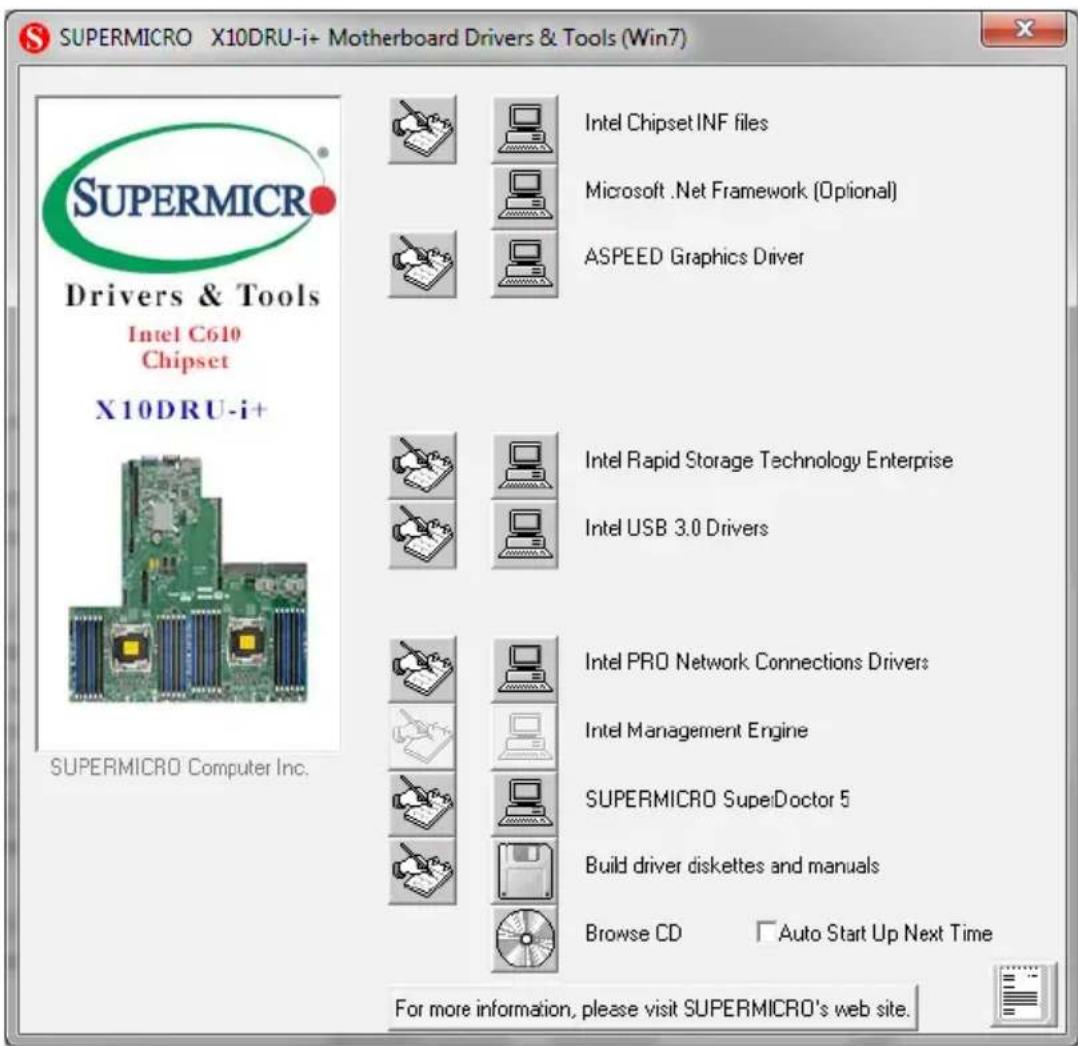
text_image
SUPERMICRO X10DRU-i+ Motherboard Drivers & Tools (Win7) SupersMCRC Drivers & Tools Intel C610 Chipset X10DRU-i+ SUPERMICRO Computer Inc. Intel Chipset INF files Microsoft .Net Framework (Optional) ASPEED Graphics Driver Intel Rapid Storage Technology Enterprise Intel USB 3.0 Drivers Intel PRO Network Connections Drivers Intel Management Engine SUPERMICRO SuperDoctor 5 Build driver diskettes and manuals Browse CD Auto Start Up Next Time For more information, please visit SUPERMICRO's web site.Figure 5-7. Driver Installation Display Screen
Note: Click the icons showing a hand writing on paper to view the readme files for each item. Click the computer icons to the right of these items to install each item (from top to the bottom) one at a time. After installing each item, you must re-boot the system before moving on to the next item on the list. The bottom icon with a CD on it allows you to view the entire contents.
SuperDoctor® 5
The Supermicro SuperDoctor 5 is a program that functions in a command-line or web-based interface for Windows and Linux operating systems. The program monitors such system health information as CPU temperature, system voltages, system power consumption, fan speed, and provides alerts via email or Simple Network Management Protocol (SNMP).
SuperDoctor 5 comes in local and remote management versions and can be used with Nagios to maximize your system monitoring needs. With SuperDoctor 5 Management Server (SSM Server), you can remotely control power on/off and reset chassis intrusion for multiple systems with SuperDoctor 5 or IPMI. SuperDoctor 5 Management Server monitors HTTP, FTP, and SMTP services to optimize the efficiency of your operation.
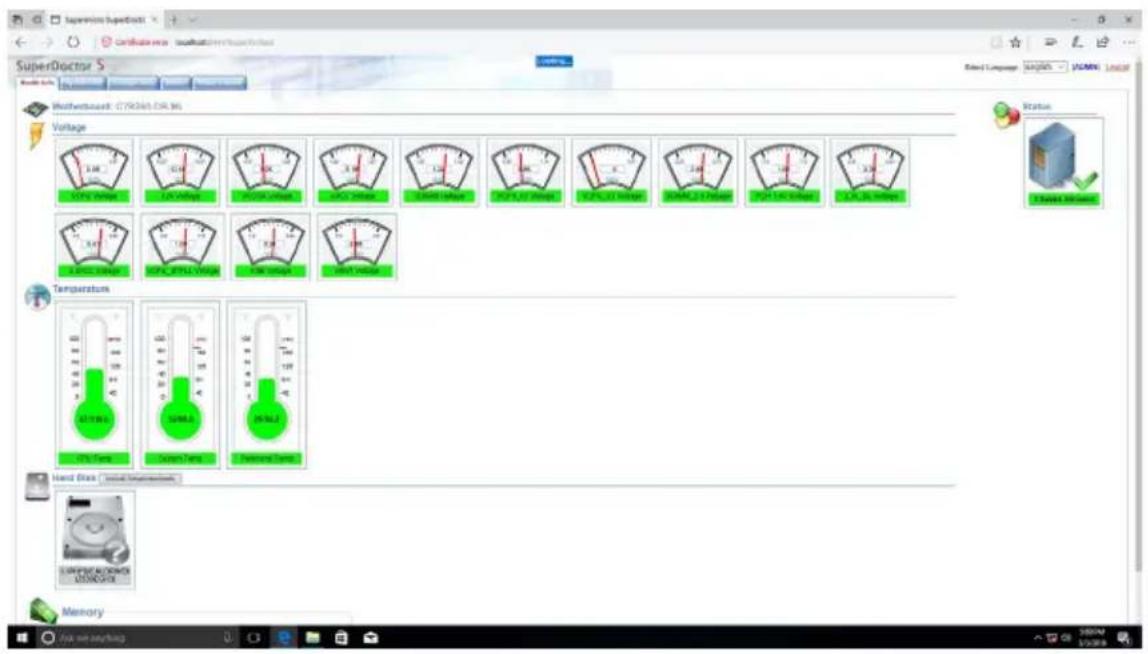
text_image
SuperDoctor Model Tools Wolfswedsatz: 0793601204.86 Voltage Temperature Hand Glue (Initial Temperature) Memory Rated Language: SAGNOS - VLANM LINE Status Current SettingsFigure 5-8. SuperDoctor 5 Interface Display Screen (Health Information)
Note: The SuperDoctor 5 program and User's Manual can be downloaded from the Supermicro web site at http://www.supermicro.com/products/nfo/sms_sd5.cfm.
5.13 IPMI
The motherboard provides remote access, monitoring and management through the baseboard management controller (BMC) and other management controllers distributed among different system modules. There are several BIOS settings that are related to BMC. For general documentation and information on BMC, visit our website at:
www.supermicro.com/en/solutions/management-software/bmc-resources
BMC ADMIN User Password
For security, each system is assigned a unique default BMC password for the ADMIN user. This can be found on a sticker on the chassis and a sticker on the motherboard. The sticker also displays the BMC MAC address.
Note: Only later models include this sticker and pull-out tray.

text_image
BMC AC1F6BC PWD SUOKJFigure 5-9. BMC Password Label
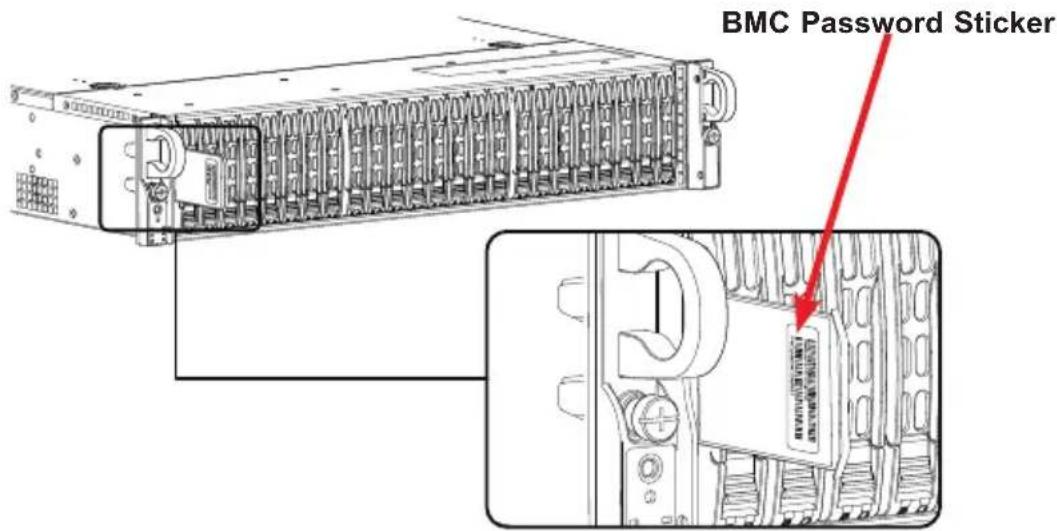
text_image
BMC Password StickerFigure 5-10. Location of the BMC Password Label
(On later models only.)
5-14 Onboard Battery
Please handle used batteries carefully. Do not damage the battery in any way; a damaged battery may release hazardous materials into the environment. Do not discard a used battery in the garbage or a public landfill. Please comply with the regulations set up by your local hazardous waste management agency to dispose of your used battery properly.
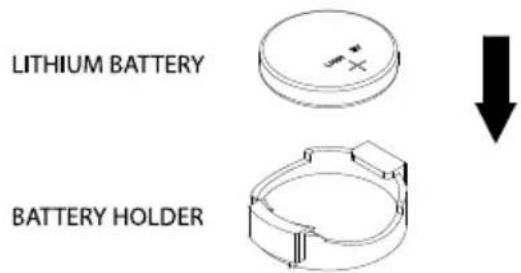
text_image
LITHIUM BATTERY BATTERY HOLDERFigure 5-11. Installing the Onboard Battery
Notes
Chapter 6
Advanced Chassis Setup
This chapter covers the steps required to install components and perform maintenance on the chassis. For component installation, follow the steps in the order given to eliminate the most common problems encountered. If some steps are unnecessary, skip ahead to the next step.
Tools Required: The only tool you will need to install components and perform maintenance is a Philips screwdriver.
6-1 Static-Sensitive Devices
Electrostatic Discharge (ESD) can damage electronic components. To prevent damage to any printed circuit boards (PCBs), it is important to handle them very carefully. The following measures are generally sufficient to protect your equipment from ESD damage.
Precautions
- Use a grounded wrist strap designed to prevent static discharge.
- Touch a grounded metal object before removing any board from its antistatic bag.
- Handle a board by its edges only; do not touch its components, peripheral chips, memory modules or gold contacts.
- When handling chips or modules, avoid touching their pins.
- Put the serverboard, add-on cards and peripherals back into their antistatic bags when not in use.
- For grounding purposes, make sure your computer chassis provides excellent conductivity between the power supply, the case, the mounting fasteners and the serverboard.

text_image
Control Panel Hard Drive Bays (24)PCI Expansion Slots (with riser cards)

text_image
PWS1 PWS2 Power Supplies LAN Ports (2 or 4, depending on server model) I/O PortsFigure 6-1. Chassis Front and Rear Views
6-2 Control Panel
The control panel (located on the front of the chassis) must be connected to the JF1 connector on the serverboard to provide you with system status indicators. These wires have been bundled together as a ribbon cable to simplify the connection. Connect the cable from JF1 on the serverboard to the appropriate header on the Control Panel printed circuit board. Make sure the red wire plugs into pin 1 on both connectors. Pull all excess cabling out of the airflow path.
The control panel LEDs inform you of system status. See "Chapter 3: System Interface" for details. Details on the JF1 header can be found in "Chapter 5: Advanced Serverboard Setup."
6-3 Removing the Chassis Cover
- If rack mounted, pull the system straight out until it locks with a click.
- Remove the two screws on each side of the cover, which secure the cover to the chassis.
- Press both release tabs at the same time to unlock the cover, and slide the cover to the rear.
- Lift the cover off the chassis.
To remove the system from the rack completely, press the locking tabs in the chassis rails (push the right-side tab down and the left-side tab up) to continue to pull the system out past the locked position.
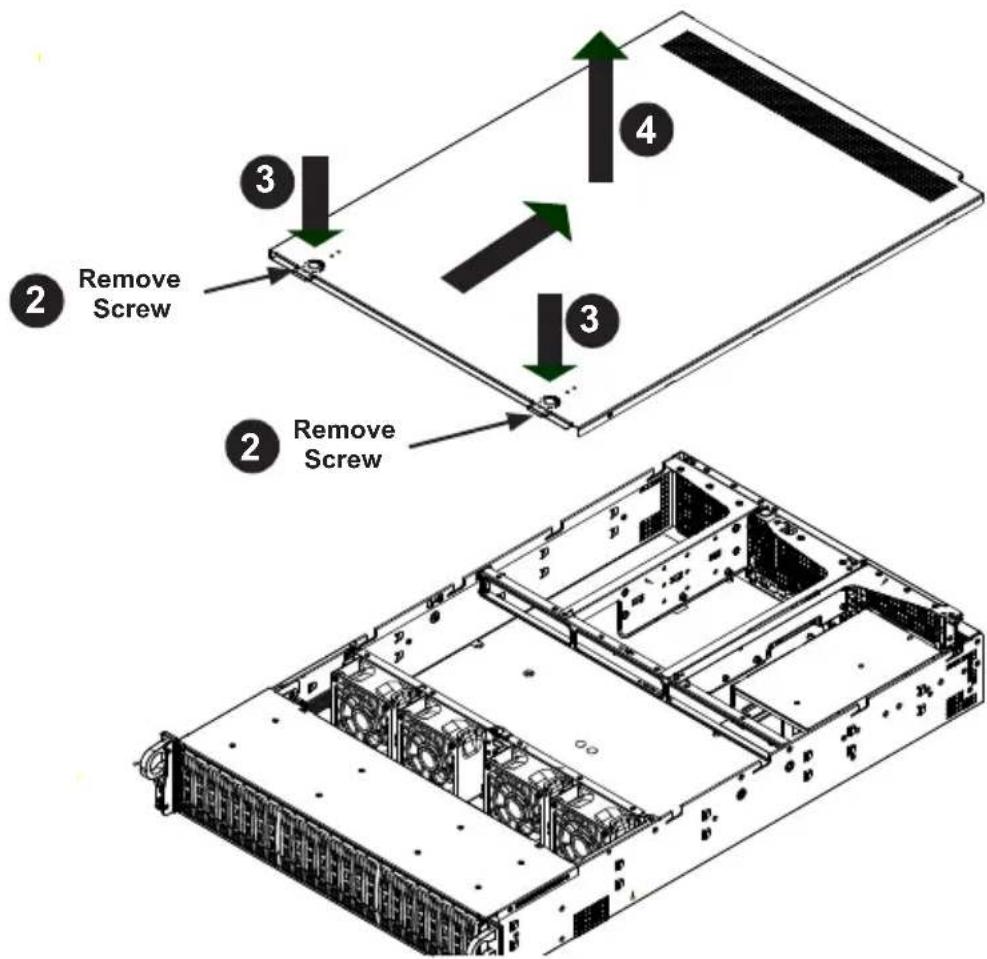
text_image
2 Remove Screw 3 4 3 2 Remove ScrewFigure 6-2. Accessing the Inside of the System
6-4 Hard Drive Installation
The SC219U chassis has twenty-four hot-swappable 2.5" drive bays. The hard drives are mounted in drive carriers to simplify their installation and removal from the chassis. System power may remain on when removing carriers with drives installed. These carriers also help promote proper airflow for the drive bays. For this reason, even empty carriers without drives installed must remain in the chassis.
Drive configuration: For non-NVMe models, HDD0-HDD09 are connected to 10 SATA ports onboard (2 SATADOM ports used). HDD10-23 are not connected.
For NVMe models (2028U-TNRT+ and -TNR4T+), HDD0-HDD07 are connected to 8 SATA ports onboard (2 SATADOM ports not used). HDD10-19 are not connected. HDD20-23 are connected to 4 NVMe ports from the Ultra riser card.
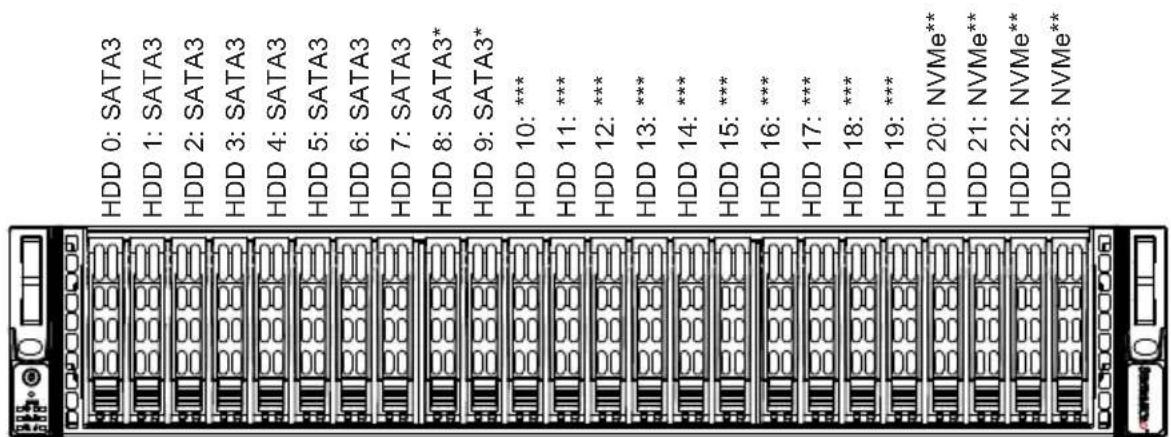
text_image
HDD 0: SATA3 HDD 1: SATA3 HDD 2: SATA3 HDD 3: SATA3 HDD 4: SATA3 HDD 5: SATA3 HDD 6: SATA3 HDD 7: SATA3 HDD 8: SATA3* HDD 9: SATA3* HDD 10: *** HDD 11: *** HDD 12: *** HDD 13: *** HDD 14: *** HDD 15: *** HDD 16: *** HDD 17: *** HDD 18: *** HDD 19: *** HDD 20: NVMe** HDD 21: NVMe** HDD 22: NVMe** HDD 23: NVMe***** No connection (expansion card required)
** Available only with 2028U-TNRT+ and -TNR4T+
* No connection on 2028U-TNRT+ and -TNR4T+
Figure 6-3. Drive Bay Configuration
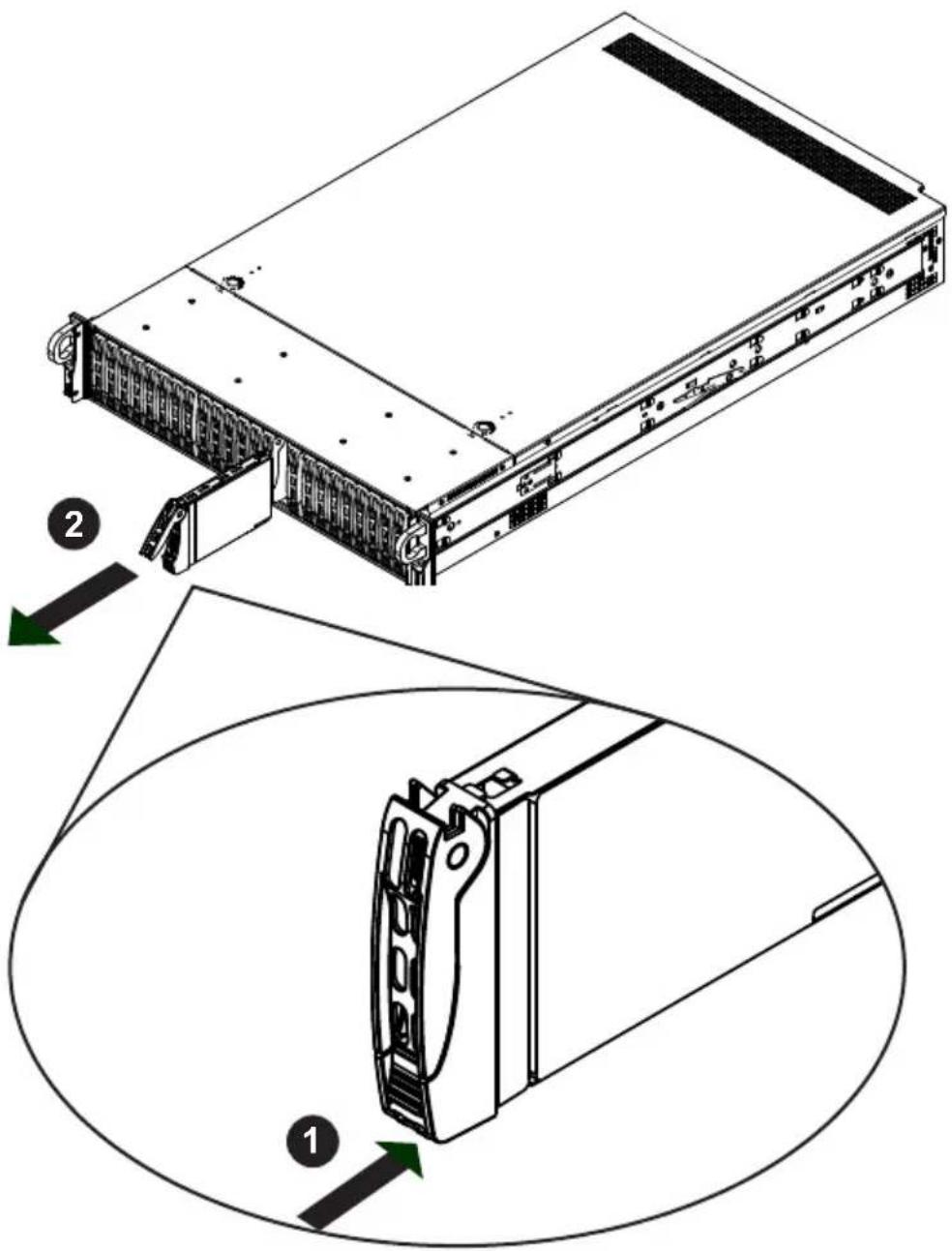
text_image
Technical diagram of a server rack with labeled components and directional arrows indicating assembly steps.Figure 6-4. Removing a Drive from the Server
Removing Hard Drive Carrier from the Chassis
- Press the release button on the drive carrier. This extends the drive carrier handle.
- Use the handle to pull the drive out of the chassis.
- Remove the dummy drive from the carrier (Figure 6-5).

text_image
Dummy Drive Drive CarrierFigure 6-5. Removing a Dummy Drive from Carrier
Caution: Except for short periods of time while swapping hard drives, do not operate the server without the carriers in the drive bays.
Note: Enterprise level hard disk drives are recommended for use in Supermicro chassis and servers. For information on recommended HDDs, visit the Supermicro Web site at http://www.supermicro.com/products/nfo/files/storage/SAS-CompList.pdf
Installing a Drive into the Carrier
- Install a new drive into the carrier with the printed circuit board side facing down so that the mounting holes in the drive align with those in the carrier.

natural_image
Technical line drawing of a device chassis with a rectangular box and internal components (no text or symbols)Figure 6-6. Installing a Drive into the Carrier
- Secure the hard drive into the carrier with the screws.
- Use the open handle to replace the drive carrier into the chassis.
- Gently close the drive carrier handle to secure the drive and carrier into the chassis drive bay.
6-5 Adding PCI Expansion Cards
Riser cards on chassis brackets allow you to add PCI expansion cards. The total number of expansion cards depends on the model in the 2028U-T Series. All expansion cards are PCI-Express 3.0. For all models:
• RSC-R2UW-4E8 supports four standard size PCI-E x8 expansion cards (5-8).
• RSC-R1UW-E8R supports one low profile x8 expansion card (4)
Additional PCI capability depends on which Ultra riser card is installed in your model (see the table below).
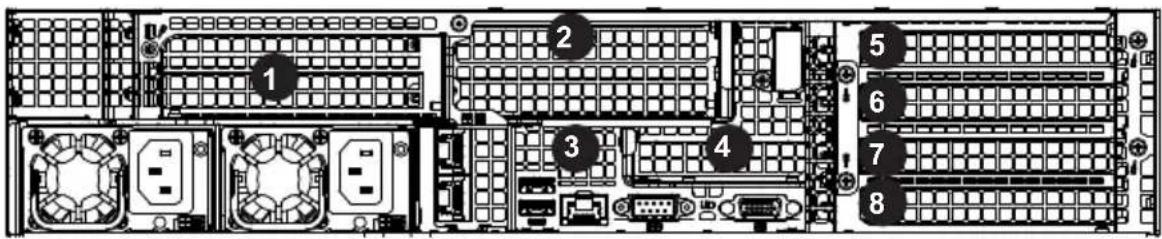
text_image
Technical diagram of a server rack with numbered components for identificationFigure 6-7. PCI Expansion Card Chassis Slots
| Expansion Card Configurations | |||
| Slot M | Mechanical Electrical In Models | ||
| 1 | Double Width, full height, full length | x16 (CPU1) | All but TNRT+, TNR4T+ |
| 2 | Double Width, full height, full length | x8 (CPU1) | All but TR4T+, TNR4T+ |
| 3 Internal | Low Profile, Half Length x8 (CPU1) All models | ||
| 4 | Low Profile, Half Length | x8 (CPU2) | TR4+, TRT+, TRTP+ |
| 5 Full Height, full length x8 (CPU2) All models | |||
| 6 Full Height, full length x8 (CPU2) All models | |||
| 7 Full Height, full length x8 (CPU2) All models | |||
| 8 Full Height, full length x8 (CPU2) All models | |||
Full height = 4.2", Low profile = 2.5"
Full length = 10.5", Half length = 6.6"
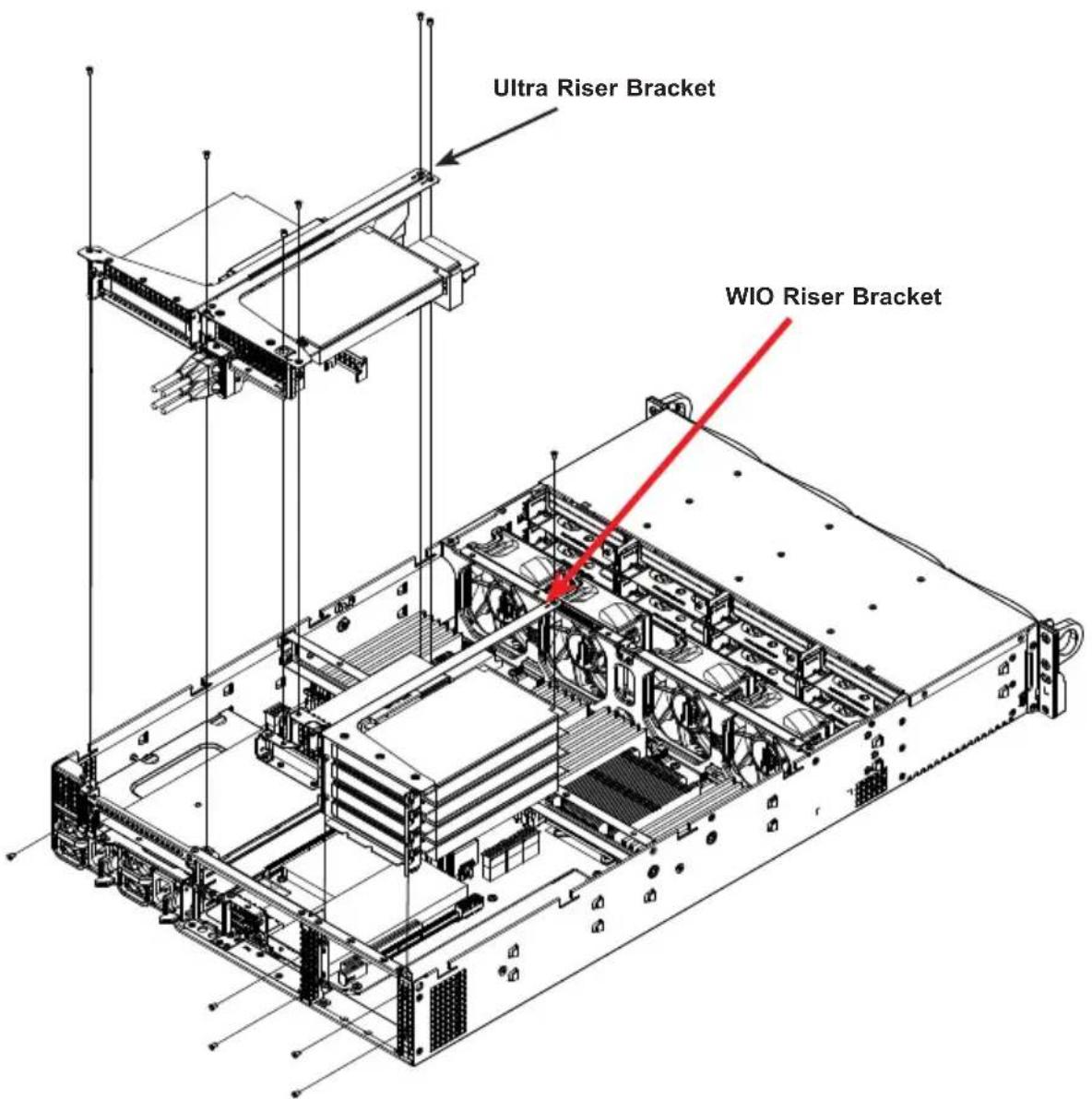
text_image
Ultra Riser Bracket WIO Riser BracketFigure 6-8. Expansion and Riser Cards—Rear View
Installing PCI Expansion Cards
- Power down the system and remove the top chassis cover.
- Remove the Ultra riser bracket, then remove the WIO bracket as pictured in Figures 6-8 and 6-9. Note the screwdriver icons imprinted in the chassis. They indicate which screws must be removed to remove the brackets.
- Insert the expansion card(s) into the riser card slot(s).
- Replace the riser card into the serverboard expansion slot while aligning the bracket into the chassis. Replace the securing screws.
- Replace the chassis cover.
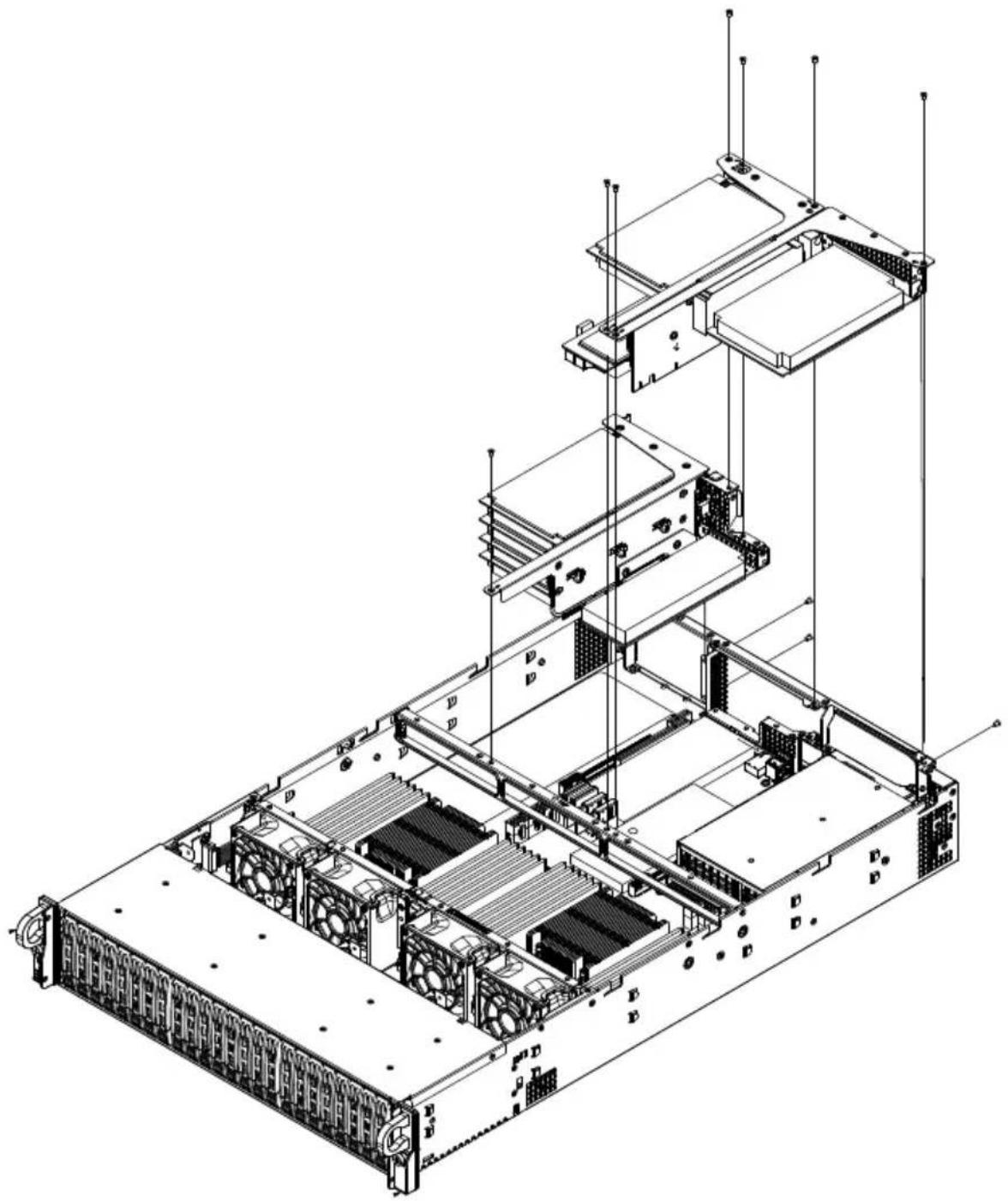
natural_image
Technical line drawing of a server rack with multiple drive bays and ventilation fans (no text or labels)Figure 6-9. Expansion and Riser Cards—Front View
6-6 System Fans
The chassis contains four 8-cm high-performance fans.
Replacing a System Fan
Fan speed is controlled by system temperature via IPMI. If a fan fails, the remaining fan will ramp up to full speed and the overheat/fan fail LED on the control panel will turn on. Replace any failed fan at your earliest convenience with the same type and model (the system can continue to run with a failed fan).
Remove the top chassis cover while the system is still running to determine which of the fans has failed. Then power down the system before replacing a fan. Removing the power cord(s) is also recommended as a safety precaution.
Replacing System Fans
- After determining which fan has failed, turn off the system power.
- Unplug the fan wiring from the serverboard and remove the failed fan.
- Press the fan release tab to lift the failed fan from the chassis and pull it completely from the chassis.
- Place the new fan into the vacant space in the housing while making sure the arrows on the top of the fan (indicating air direction) point in the same direction as the arrows on the other fans.
- Power up the system and check that the fan is working properly before replacing the chassis cover.
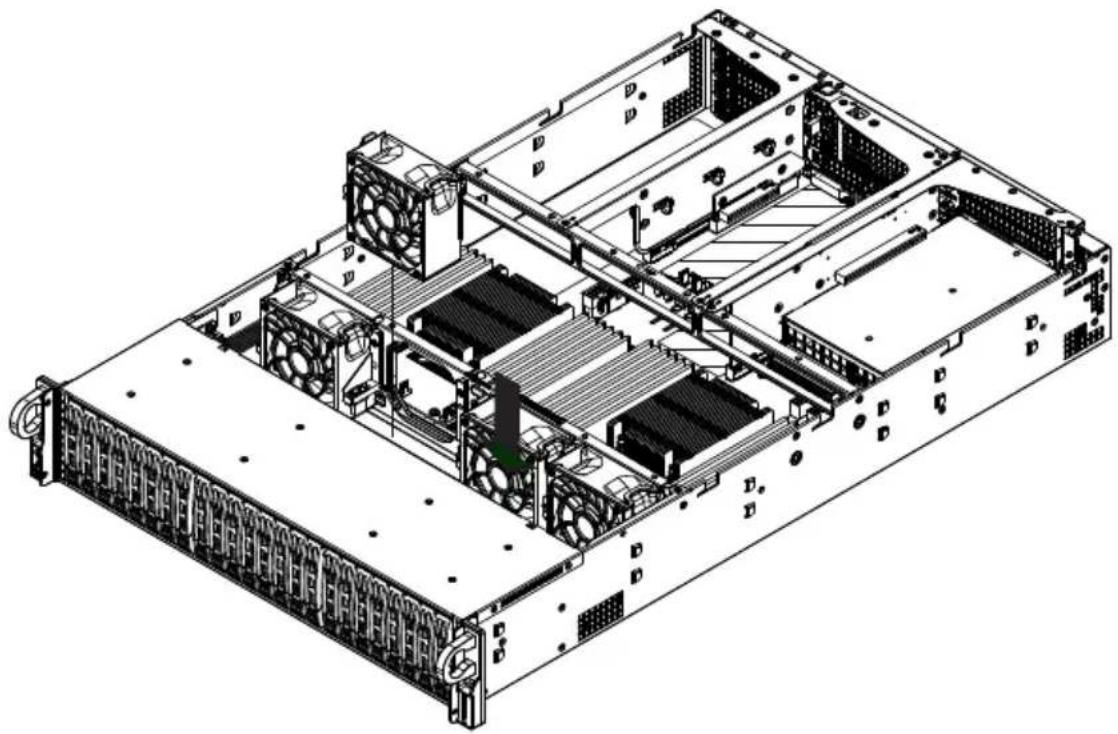
natural_image
Technical line drawing of a server rack with multiple drive bays and ventilation fans (no text or labels)Figure 6-10. System Fans
Air Shroud
Cooling is also improved by installing the standard air shroud. Insert it over the CPUs.
6-7 Power Supply
The 2028U-T Series has a 1000 watt redundant hot-plug power supply consisting of two power modules. Each power supply module has an auto-switching capability, which enables it to automatically sense and operate at a 100V - 240V input voltage.
Replacing a Power Supply Module
If either of the two power supply modules fail, the other module will take the full load and allow the system to continue operation without interruption. The Power Fail LED will illuminate and remain on until the failed unit has been replaced. Replacement units can be ordered directly from Supermicro. The power supply units have a hot-plug capability, meaning you can replace the failed unit without powering down the system.
Replacing the Power Supply
- First unplug the AC power cord from the failed power supply module.
- Depress the release tab on the power supply module as illustrated.
- Use the handle to pull the module straight out of the chassis.
- Replace the failed hot-swap unit with another identical power supply unit.
- Push the new power supply unit into the power bay until it clicks.
- Plug the AC power cord back into the unit and power up the server.
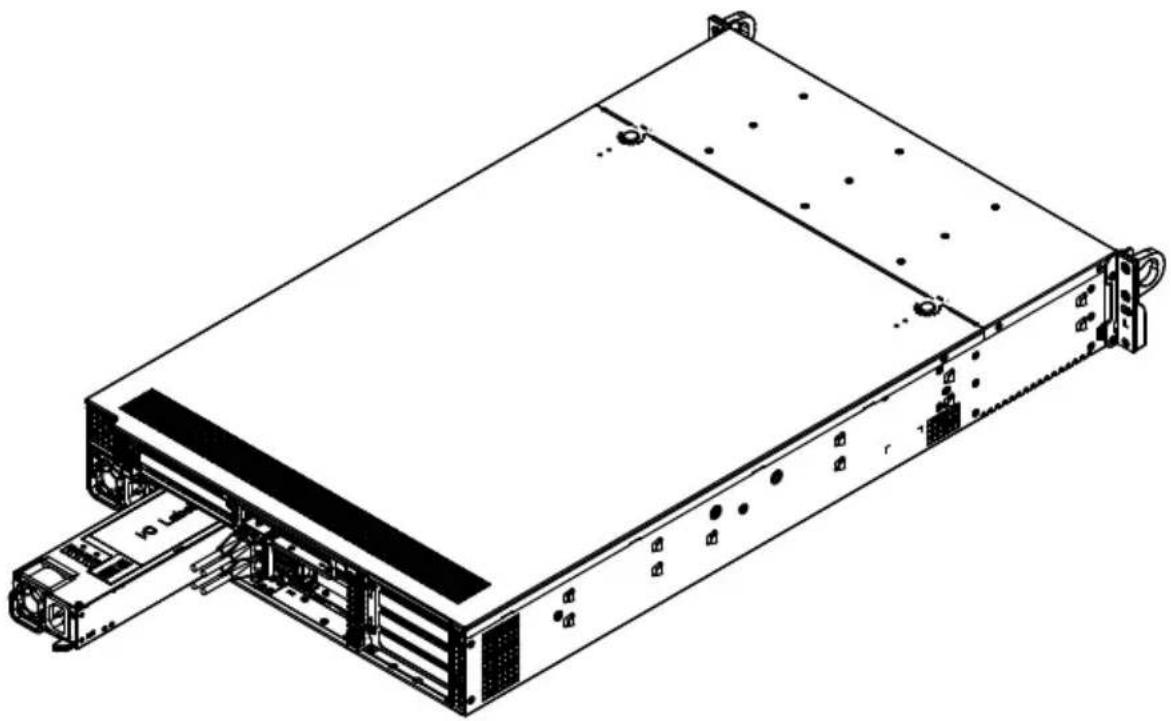
natural_image
Technical line drawing of a server rack unit with drive bays and ports (no text or symbols)Figure 6-11. Removing/Replacing the Power Supply
Chapter 7
BIOS
7-1 Introduction
This chapter describes the AMI BIOS setup utility for the X10DRU-i+. It also provides the instructions on how to navigate the AMI BIOS setup utility screens. The AMI ROM BIOS is stored in a Flash EEPROM and can be easily updated.
Starting BIOS Setup Utility
To enter the AMI BIOS setup utility screens, press the key while the system is booting up.
Note: In most cases, the key is used to invoke the AMI BIOS setup screen. There are a few cases when other keys are used, such as
Each main BIOS menu option is described in this manual. The Main BIOS setup menu screen has two main frames. The left frame displays all the options that can be configured. Grayed-out options cannot be configured. Options in blue can be configured by the user. The right frame displays the key legend. Above the key legend is an area reserved for informational text. When an option is selected in the left frame, it is highlighted in white. Often informational text will accompany it.
Note: The AMI BIOS has default informational messages built in. The manufacturer retains the option to include, omit, or change any of these informational messages.
The AMI BIOS setup utility uses a key-based navigation system called "hot keys." Most of the AMI BIOS setup utility "hot keys" can be used at any time during setup navigation. These keys include
Note 1: Options printed in Bold are default settings.
Note 2:
How To Change the Configuration Data
The configuration data that determines the system parameters may be changed by entering the AMI BIOS setup utility. This setup utility can be accessed by pressing
Note: For AMI UEFI BIOS Recovery, please refer to the UEFI BIOS Recovery User Guide posted @ http://www.supermicro.com/support/manuals/.
Starting the Setup Utility
Normally, the only visible Power-On Self-Test (POST) routine is the memory test. As the memory is being tested, press the
Caution: Do not upgrade the BIOS unless your system has a BIOS-related issue. Flashing the wrong BIOS can cause irreparable damage to the system. In no event shall the manufacturer be liable for direct, indirect, special, incidental, or consequential damage arising from a BIOS update. If you have to update the BIOS, do not shut down or reset the system while the BIOS is being updated to avoid possible boot failure.
7-2 Main Setup
When you first enter the AMI BIOS setup utility, you will enter the Main setup screen. You can always return to the Main setup screen by selecting the Main tab on the top of the screen. The Main BIOS Setup screen is shown below.

text_image
Aptio Setup Utility - Copyright (C) 2014 American Megatrends, Inc. Main Advanced Event Logs IPMI Security Boot Save & Exit System Date [Wed 09/10/2014] System Time [17:15:21] Supermicro X100RU-1+ BIOS Version 1.0 Build Date 08/11/2014 Memory Information Total Memory 16384 MB Memory Speed 2133 MT/s Set the Time. Use Tab to switch between Time elements. ++: Select Screen T↓: Select Item Enter: Select +/-: Change Opt. F1: General Help F2: Previous Values F3: Optimized Defaults F4: Save & Exit ESC: Exit Version 2.17.1245. Copyright (C) 2014 American Megatrends, Inc.The AMI BIOS Main menu displays the following information:
System Date
Use this item to change the system date. Press the
System Time
Use this item to change the system time. Press the
Supermicro X10DRU-i+
BIOS Version
This item displays the version of the BIOS ROM used in this system.
Build Date
This item displays the date that the BIOS setup utility was built.
Memory Information
Total Memory
This item displays the amount of memory that is available in the system.
Memory Speed
This item displays the memory speed.
7-3 Advanced Setup Configurations
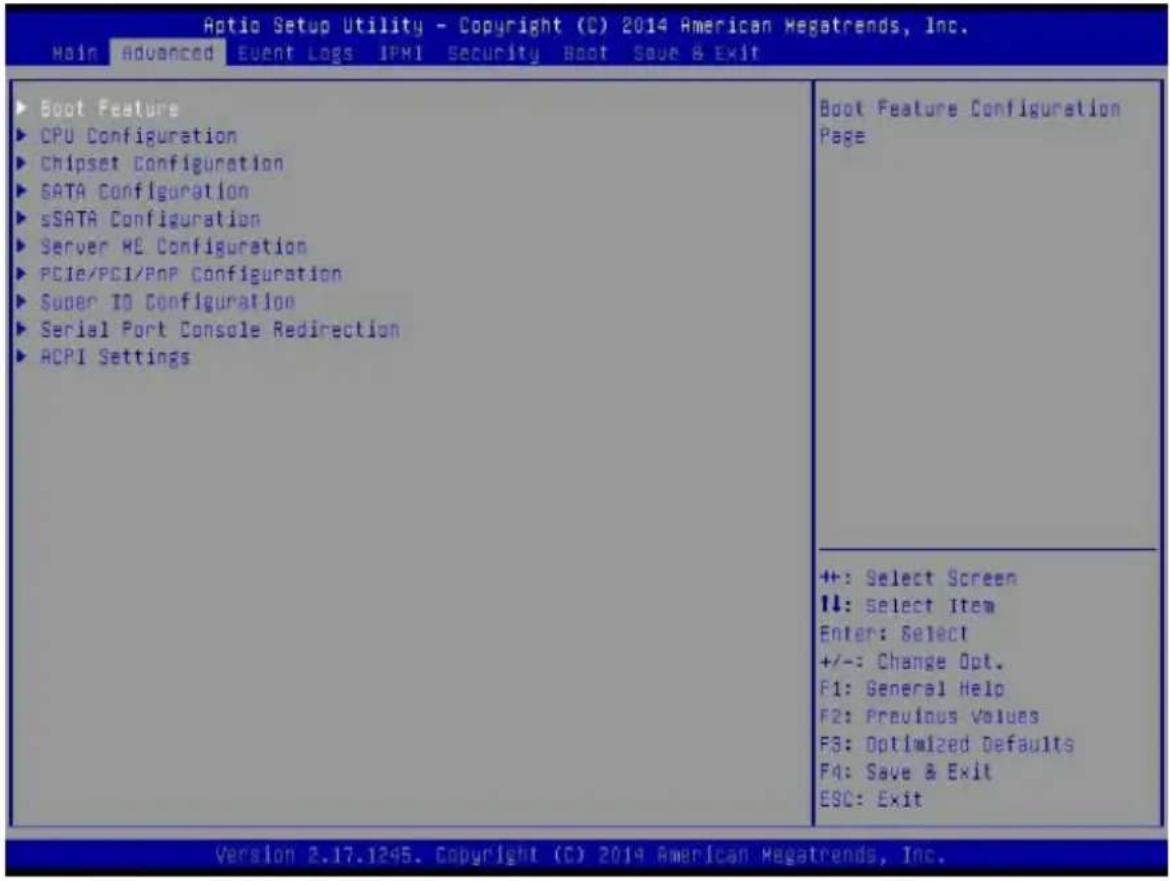
text_image
Optio Setup Utility - Copyright (C) 2014 American Megatrends, Inc. Main Advanced Event Logs IPVI Security Boot Save & Exit Boot Feature CPU Configuration Chipset Configuration SATA Configuration sSATA Configuration Server ME Configuration PCIe/PCI/PnP Configuration Super IO Configuration Serial Port Console Redirection ACPI Settings Boot Feature Configuration Page +: Select Screen !!: Select Item Enter: Select +/-: Change Opt. F1: General Help F2: Previous Values F3: Optimized Defaults F4: Save & Exit ESC: Exit Version 2.17.1245. Copyright (C) 2014 American Megatrends, Inc.Select the Advanced tab to access the following submenu items.
▶Boot Features
Boot Feature
Quiet Boot
Use this item to select bootup screen display between POST messages and the OEM logo. Select Disabled to display the POST messages. Select Enabled to display the OEM logo instead of the normal POST messages. The options are Enabled and Disabled.
AddOn ROM Display Mode
Use this item to set the display mode for the Option ROM. Select Keep Current to use the current AddOn ROM Display setting. Select Force BIOS to use the Option ROM display set by the system BIOS. The options are Force BIOS and Keep Current.
Bootup Num-Lock
Use this item to set the power-on state for the Numlock key. The options are Off and On.
Wait For 'F1' If Error
Select Enabled to force the system to wait until the 'F1' key is pressed when an error occurs. The options are Disabled and Enabled.
Interrupt 19 Capture
Interrupt 19 is the software interrupt that handles the boot disk function. When this item is set to Immediate, the BIOS ROM of the host adaptors will immediately capture Interrupt 19 at bootup and allow the drives that are attached to these host adaptors to function as bootable disks. If this item is set to Postponed, the BIOS ROM of the host adaptors will only capture Interrupt 19 during bootup from a legacy device. The options are Immediate and Postponed.
Re-try Boot
Select Legacy Boot for the BIOS to continuously attempt to boot from the legacy boot drive. Select EFI Boot for the BIOS to continuously attempt to boot from the EFI boot drive. The options are Disabled, Legacy Boot, and EFI Boot.
Power Configuration
Watch Dog Function
If enabled, the Watch Dog timer will allow the system to automatically reboot when a non-recoverable error that lasts for more than five minutes occurs. The options are Enabled and Disabled.
Power Button Function
If this feature is set to Instant Off, the system will power off immediately as soon as the user presses the power button. If this feature is set to 4 Seconds Override, the system will power off when the user presses the power button for 4 seconds or longer. The options are Instant Off and 4 Seconds Override.
Restore on AC Power Loss
Use this item to set the power state after a power outage. Select Stay Off for the system power to remain off after a power outage. Select Power On to turn on the system power after a power outage. Select Last State to allow the system to resume its last power state before a power outage. The options are Power On, Stay Off, and Last State.
▶CPU Configuration
This screen displays CPU information as detected by the BIOS. It also allows the user to configure CPU settings.
CPU information: Processor Socket, Processor ID, Processor Frequency, Processor Maximum Ratio, Processor Minimum Ratio, Microcode Revision, L1 Cache RAM, L2 Cache RAM, L3 Cache RAM, Processor 1 Version, and Processor 2 Version.
Clock Spread Spectrum
Select Enable to allow the BIOS to monitor and attempt to reduce the level of Electromagnetic Interference caused by the components whenever needed. The options are Disable and Enable.
Hyper-Threading [All]
Select Enable to support Intel's Hyper-threading Technology to enhance CPU performance. The options are Enable and Disable.
Cores Enabled
Select the number of cores to enable. To enable all, enter 0 (zero). Maximum is twelve cores.
Execute-Disable Bit (Available if supported by the OS & the CPU)
Select Enable to support Intel® Execute Disable Bit Technology, which will allow the processor to designate areas in the system memory where an application code can be executed and where it cannot, thus preventing a worm or a virus from flooding illegal codes to overwhelm the processor or damage the system during an attack. This feature is used in conjunction with the items: "Clear MCA," "VMX," "Enable SMX," and "Lock Chipset" for Virtualization media support. The default setting is Enable. (Refer to Intel and Microsoft websites for more information.)
PPIN Control
When the Protected Processor Inventory Number (PPIN) is enabled, the processor will return a 64-bit ID number by way of the PPIN MSR. The options are Disable and Enable.
Hardware Prefetch (Available when supported by the CPU)
If this item is set to Enable, the hardware will prefetch streams of data and instructions from the main memory to the L2 cache to improve CPU performance. The options are Disable and Enable.
Adjacent Cache Prefetch (Available when supported by the CPU)
Select Enable for the CPU to prefetch both cache lines for 128 bytes as comprised. Select Disable for the CPU to prefetch both cache lines for 64 bytes. The options are Disable and Enable.
Note: Please reboot the system for changes on this setting to take effect. Please refer to Intel's web site for detailed information.
DCU (Data Cache Unit) Streamer Prefetcher (Available when supported by the CPU)
If this item is set to Enable, the DCU Streamer Prefetcher will prefetch data streams from the cache memory to the DCU (Data Cache Unit) to speed up data accessing and processing for CPU performance enhancement. The options are Disable and Enable.
DCU IP Prefetcher
If this feature is set to Enable, the IP prefetcher in the DCU (Data Cache Unit) will prefetch IP addresses to improve network connectivity and system performance. The options are Enable and Disable.
Direct Cache Access (DCA)
Select Enable to use Intel DCA (Direct Cache Access) Technology to improve the efficiency of data transferring and accessing. The options are Enable and Disable.
X2APIC
This setting allows you to enable or disable the Extended xAPIC mode that supports more than 256 interrupts over the local APIC.
AES-NI (New Encryption Standard-New Instructions)
Select Enable to use the Intel Advanced Encryption Standard (AES) New Instructions (NI) to ensure data security. The options are Enable and Disable.
Intel Virtualization Technology
When enabled, a VMM can utilize the additional hardware capabilities provided by Vanderpool Technology.
▶ Advanced Power Management Configuration
Power Technology
This setting allows you to customize power management. The options are Disabled, Energy Efficient, and Custom. Select Energy Efficient to support power-saving mode, which might have an impact on system performance. Select Custom to customize system power settings. Select Disabled to disable power-saving settings.
If the option is set to Custom, the following items will display:
▶ CPU P State Control
EIST (P-states)
EIST (Enhanced Intel SpeedStep Technology) allows the system to automatically adjust processor voltage and core frequency to reduce power consumption and heat dissipation. The options are Disable and Enable.
Turbo Mode
Select Enabled to use the Turbo Mode to boost system performance. The options are Enable and Disable.
P-state Coordination
This feature is used to change the P-state (Power-Performance State) coordination type. P-state is also known as "SpeedStep" for Intel processors. Select HW_ALL to change the P-state coordination type for hardware components only. Select SW_ALL to change the P-state coordination type for all software installed in the system. Select SW_ANY to change the P-state coordination type for a software program in the system. The options are HW_All, SW_ALL, and SW_ANY.
▶ CPU C State Control (Available when Power Technology is set to Custom)
Package C State limit
Use this item to set the limit on the C-State package register. The options are C0/1 state, C2 state, C6 (non-Retention) state, and C6 (Retention) state.
CPU C3 Report
Select Enable to allow the BIOS to report the CPU C3 State (ACPI C2) to the operating system. During the CPU C3 State, the CPU clock generator is turned off. The options are Enable and Disable.
CPU C6 Report (Available when Power Technology is set to Custom)
Select Enable to allow the BIOS to report the CPU C6 state (ACPI C3) to the operating system. During the CPU C6 state, power to all cache is turned off. The options are Enable and Disable.
Enhanced Halt State (C1E)
Select Enabled to use the "Enhanced Halt State" feature, which will significantly reduce CPU power consumption by reducing the CPU's clock cycle and voltage during a "Halt State." The options are Disable and Enable.
▶ CPU T State Control
ACPI (Advanced Configuration Power Interface) T-States
Select Enable to support CPU throttling provided by the operating system to reduce power consumption. The options are Enable and Disable.
▶Chipset Configuration
Caution: Setting wrong values may cause the system to malfunction.
▶ North Bridge
This section configures the North Bridge settings.
▶IIO Configuration
(Integrated IO)
EV DFX (Device Function On-Hide) Features
When this feature is set to Enable, the EV_DFX Lock Bits that are located on a processor will always remain clear during electric tuning. The options are Disable and Enable.
▶IIO1 Configuration
IOU2 (IIO1 PCIe Port 1)
The options are: x4x4 sets Function 1/0 visible, x8 sets function 1 visible, or Auto.
IIO1 Port 1A Link Speed
Select the target link speed. The options are: Gen 1--2.5GT/s, Gen 2--5GT/s, or Gen 3--8GT/s.
IOU0 (IIO1 PCIe Port 2)
Sets the functions that are visible.
IIO1 Port 2A Link Speed
Select the target link speed. The options are 2.5, 5, or 8GT/s.
AOC-2UR6-i4XT SLOT3 Link Speed
Select the target link speed. The options are 2.5, 5, or 8GT/s.
IOU1 (IIO1 PCIe Port 3)
Sets the functions that are visible.
AOC-2UR6-i4XT SLOT2 Link Speed
Select the target link speed. The options are 2.5, 5, or 8GT/s.
▶ IIO2 Configuration
IOU2 (IIO2 PCIe Port 1)
The options are: x4x4 sets Function 1/0 visible, x8 sets function 1 visible, or Auto.
IOU0 (IIO2 PCIe Port 2)
Sets the functions that are visible.
RSC-R2UW-4E8 SLOT1 Link Speed
Select the target link speed. The options are: Gen 1--2.5GT/s, Gen 2--5GT/s, or Gen 3--8GT/s.
RSC-R2UW-4E8 SLOT2 Link Speed
Select the target link speed. The options are 2.5, 5, or 8GT/s.
IOU1 (IIO2 PCIe Port 3)
Sets the functions that are visible.
RSC-R2UW-4E8 SLOT3 Link Speed
Select the target link speed. The options are 2.5, 5, or 8GT/s.
RSC-R2UW-4E8 SLOT4 Link Speed
Select the target link speed. The options are 2.5, 5, or 8GT/s.
▶ IOAT Configuration
Enable IOAT
Enables or disables Intel I/O Acceleration Technology.
No Snoop
Snooping ensures cache coherency in each DMA engine. Choices are Enable or Disable.
Relaxed Ordering
Enables or disables relaxed ordering for each transaction to main memory in each DMA engine.
▶Intel VT for Directed I/O (VT-d)
Intel VT for Directed I/O
Enable or Disable Intel Virtualization Technology for Directed I/O. This reports the I/O device assignment to VMM through DMAR ACPI tables.
Interrupt Remapping
Interrupt remapping allows VMM to route device interrupts to the VM that controls the device.
▶QPI Configuration ▶QPI General Configuration
(Quick Path Interconnect)
QPI Status
This screen displays the Number of CPUs, Number of IIO, LInk Speed, Current QPI Link Frequency, QPI Global MMIO Low Base/Limit, QPI Global MMIO High Base/Limit, and QPI PCI-E Configuration Base/Siz (Size).
Link Frequency Select
Use this feature to select the desired frequency for QPI Link connections. The options are 6.4GB/s, 8.0GB/s, 9.6GB/s, Auto, and Auto Limited.
Link L0p Enable
Select Enable for Link L0p support. The options are Enable and Disable.
Link L1 Enable
Select Enable for Link L1 support. The options are Enable and Disable.
COD Enable
This setting allows you to cluster on Die mode, which targets NUMA workloads where sharing across Caching Agents is less important than latency. The options are Enable and Disable.
Early Snoop
Early Snoop mode is best for workloads with high cache to cache transfers or for workloads that are not fully NUMA optimized. It requires memory population on all channels. The options are Enable, Disable, and Auto.
Isoc Mode
Isochronous mode can reduce or increase the credits available for memory traffic. Workstation and HEDT require Isoc enabled for caution and media performance. The options are Enable and Disable.
▶ Memory Configuration
This section displays the following Integrated Memory Controller (IMC) information.
Enforce POR
Enforces POR restrictions for DDR4 frequency and voltage programming. The options are Enable and Disable.
Memory Frequency
Allows you to set the maximum memory frequency below the enforced POR. The options are frequencies from 1333 to 2400 or Auto.
Data Scrambling
Data scrambling improves detection of DDR address line errors and reduces the probability of occurrence. The options are Disabled, Enabled and Auto.
DRAM RAPL Baseline
You can control the DRAM power by limiting memory bandwidth. The options are DRAM RAPL Mode 0, DRAM RAPL Mode 1, and Disable.
Set Throttling Mode
You can utilize the thermal sensors on the DIMMs to derive DRAM temperature estimation for throttling. The options are CLTT and Disable.
Socket Interleave Below 4GB
When enabled, this setting splits the 1-4GB address space between two sockets so that both get a chunk of local memory below 4GB. The options are Enable and Disable.
A7 Mode
A7 (Addressing) mode is recommended for most platform topologies as it is expected to yield slightly higher memory bandwidth. The options are Enable and Disable.
DIMM Information
Select this screen to view specification for your DIMMs
▶ Memory RAS Configuration
Memory RAS Configuration Setup
RAS Mode
Select the mode for memory initialization. For Mirror, writes are sent to both channels for redundancy. For Lockstep, adjacent channels must be populated identically. Or this function may be Disabled.
Memory Rank Sparing
Memory rank sparing enhances system performance. The options are Disable and Enable.
Patrol Scrub
This feature proactively searches the system memory repairing correctable errors. The options are Disable and Enable.
Patrol Scrub Interval
Select the number of hours (1-24) required to complete a full scrub. A value of zero designate Auto.
Demand Scrub
Demand Scrubbing allows the CPU to correct memory errors found on a memory module. When the CPU or I/O issues a demand-read command, and the read data from memory turns out to be a correctable error, the error is corrected and sent to the requestor (the original source). Memory is updated as well. Select Enable to use Demand Scrubbing for ECC memory correction. The options are Enable and Disable.
Device Tagging
Select Enable to support device tagging of a memory device that generates stuck-bit or hard errors The options are Disable and Enable.
▶ South Bridge
This section configures the South Bridge settings. The initial screen displays USB information including the USB Module version and the USB devices.
Legacy USB Support
Available when USB Function is not Disabled. Select Enabled to support legacy USB devices. Select Auto to disable legacy support if USB devices are not present. Select Disabled to have USB devices available for EFI (Extensive Firmware Interface) applications only. The settings are Disabled, Enabled and Auto.
XHCI Hand-Off
This feature is a work-around solution for operating systems that do not support XHCI (Extensible Host Controller Interface) hand-off. The XHCI ownership change should be claimed by the XHCI driver. The settings are Enabled and Disabled.
EHCI Hand-Off
This item is for operating systems that do not support Enhanced Host Controller Interface (EHCI) hand-off. When this item is enabled, EHCI ownership change will be claimed by the EHCI driver. The settings are Enabled and Disabled.
Port 60/64 Emulation
This feature allows I/O port 60h/64h emulation. It should be Enabled for operating systems that are not USB aware to provide a complete USB keyboard support. The settings are Enabled and Disabled.
USB 3.0 Support
For USB 3.0 support. The options are:
• Disabled: Force to EHCl mode only
• Auto: Recommended when XHCI Pre-Boot Driver is set to Disabled
- Enabled or Smart Auto: Recommended when XHCI Pre-Boot Driver is set to Enabled.
EHCI1
Controls the USB 2.0 EHCI functions. On EHCI controller must be Enabled.
EHCI2
Controls the USB 2.0 EHCl functions. On EHCl controller must be Enabled.
XHCI Pre-Boot Driver
Enable this feature to load the Intel XHCI pre-boot driver. The settings are Enabled and Disabled.
▶SATA Configuration
When this submenu is selected, the BIOS automatically detects the presence of the SATA devices that are supported by the Intel PCH chip and displays the following items:
SATA Controller
This item enables or disables the onboard SATA controller supported by the Intel PCH chip. The options are Enabled and Disabled.
Configure SATA as
Select the SATA configuration. The options are IDE, AHCI, and RAID. The items below differ depending on this choice.
If SATA is configured as IDE:
The SATA ports are listed. For each, you can identify whether the port is connected to a hard drive or a solid state drive.
If SATA is configured as AHCI, the following items are displayed:
The SATA ports are listed.
Support Aggressive Link Power Management
When this item is set to Enabled, the SATA AHCI controller manages the power usage of the SATA link. The controller will put the link in a low power mode during extended periods of I/O inactivity, and will return the link to an active state when I/O activity resumes. The options are Enabled and Disabled.
SATA Port 0\~ Port 5
This item displays the information detected on the installed SATA drive on the particular SATA port, including the model number of the drive, capacity, and the Software Preserve Support.
Port 0 \~ Port 5 Spin Up Device
Only devices for which this is Enabled will spin up at boot. The options are Enabled and Disabled. If no devices are Enabled, all will spin up at boot.
Port 0 \~ Port 5 SATA Device Type
For each port, you can identify whether it is connected to a hard drive or a solid state drive.
If SATA is configured as RAID, the following items are displayed:
The SATA ports are listed.
Support Aggressive Link Power Management
When this item is set to Enabled, the SATA AHCI controller manages the power usage of the SATA link. The controller will put the link in a low power mode during extended periods of I/O inactivity, and will return the link to an active state when I/O activity resumes. The options are Enabled and Disabled.
SATA RAID Option ROM/UEFI Driver
Select which SATA RAID firmware type to load. The options are Disabled, EFI, and Legacy.
SATA/sSATA RAID Boot Select
Select the boot capability for SATA or SATA RAID controllers. This is shared and presented in the SATA Configuration page and the sSATA Configuration page. The options are SATA Controller, sSATA Controller and Both. (Note: The Both option cannot support Windows Server 2012 r2 installation.)
SATA Port 0\~ Port 5
This item displays the information detected on the installed SATA drive on the particular SATA port, including the model number of the drive, capacity, and the Software Preserve Support.
Port 0 \~ Port 5 Spin Up Device
Only devices for which this is Enabled will spin up at boot. The options are Enabled and Disabled. If no devices are Enabled, all will spin up at boot.
Port 0 \~ Port 5 SATA Device Type
For each port, you can identify whether it is connected to a hard drive or a solid state drive.
▶ sSATA Configuration
When this submenu is selected, the BIOS automatically detects the presence of the sSATA devices that are supported by the Intel PCH chip and displays the following items:
SATA Controller
This item enables or disables the onboard SATA controller supported by the Intel PCH chip. The options are Enabled and Disabled.
Configure sSATA as
Select the sSATA configuration. The options are IDE, AHCI, and RAID. The items below differ depending on this choice.
If sSATA is configured as IDE:
The sSATA ports are listed. For each, you can identify whether the port is connected to a hard drive or a solid state drive.
If sSATA is configured as AHCI:
The sSATA ports are listed.
Support Aggressive Link Power Management
When this item is set to Enabled, the sSATA AHCI controller manages the power usage of the sSATA link. The controller will put the link in a low power mode during extended periods of I/O inactivity, and will return the link to an active state when I/O activity resumes. The options are Enabled and Disabled.
sSATA Port 0\~ Port 5
This item displays the information detected on the installed SATA drive on the particular SATA port, including the model number of the drive, capacity, and the Software Preserve Support.
Port 0 \~ Port 5 Spin Up Device
Only devices for which this is Enabled will spin up at boot. The options are Enabled and Disabled. If no devices are Enabled, all will spin up at boot.
Port 0 \~ Port 5 SATA Device Type
For each port, you can identify whether it is connected to a hard drive or a solid state drive.
If sSATA is configured as RAID:
The sSATA ports are listed.
Support Aggressive Link Power Management
When this item is set to Enabled, the sSATA AHCI controller manages the power usage of the sSATA link. The controller will put the link in a low power mode during extended periods of I/O inactivity, and will return the link to an active state when I/O activity resumes. The options are Enabled and Disabled.
sSATA RAID Option ROM/UEFI Driver
Select which SATA RAID firmware type to load. The options are Disabled, EFI, and Legacy.
SATA/sSATA RAID Boot Select
Select the boot capability for SATA or SATA RAID controllers. This is shared and presented in the SATA Configuration page and the sSATA Configuration page. The options are SATA Controller, sSATA Controller and Both. (Note: The Both option cannot support Windows Server 2012 r2 installation.)
sSATA Port 0\~ Port 3
This item displays the information detected on the installed SATA drive on the particular SATA port, including the model number of the drive, capacity, and the Software Preserve Support.
sSATA Port 0 \~ Port 3 Spin Up Device
Only devices for which this is Enabled will spin up at boot. The options are Enabled and Disabled. If no devices are Enabled, all will spin up at boot.
Port 0 \~ Port 3 sSATA Device Type
For each port, you can identify whether it is connected to a hard drive or a solid state drive.
▶Server ME Configuration
This screen displays the Management Engine configuration information, including Operational Firmware Version, Recovery Firmware Version, ME Firmware Features, ME Firmware Status #1, ME Firmware Status #2, Current State, Error Code.
No settings are configurable.
▶PCIe/PCI/PnP Configuration
PCI PERR/SERR Support
Choose whether to allow a PCI/PCI-E device to generate a PCI/PCI-E Parity-Error (PERR) number or a System-Error (SERR) number for a PCI Bus Signal Error Event. The options are Enabled and Disabled.
Above 4G Decoding (Available if the system supports 64-bit PCI decoding)
Choose to allow decoding a PCI device that supports 64-bit in the space above 4G Address. The options are Enabled and Disabled.
SR-IOV Support
If the system has PCI-E devices that supports Single Root IO Virtualization (SR-IOV), choose to Enable or Disable it.
Maximum Payload
Select Auto to allow the system BIOS to automatically set the maximum payload value for a PCI-E device to enhance system performance. The options are Auto, 128 Bytes, 256 Bytes.
Maximum Read Request
Select Auto to allow the system BIOS to automatically set the maximum Read Request size for a PCI-E device to enhance system performance. The options are Auto, 128 Bytes, 256 Bytes, 512 Bytes, 1024 Bytes, 2048 Bytes, and 4096 Bytes.
ASPM Support
This feature allows the user to set the Active State Power Management (ASPM) level for a PCI-E device. Select Auto to allow the system BIOS to automatically set the ASPM level for the system. Select Disabled to disable ASPM support. The options are Disabled and Auto.
Warning: Enabling ASPM support may cause some PCI-E devices to fail!
MMIOHBase
Set the MMIO base address above 4G decoding. The options are 56T(Bytes), 48T, 24T, 512G, or 256G.
MMIO High Size
Set the MMIO size above 4G decoding. The options are 256G(Bytes), 128G, 512G, 1024G.
AOC-2UR6-i4XT SLOT3 PCI-E X8 OPROM
AOC-2UR6-i4XT SLOT2 PCI-E X16 OPROM
RSC-R2UW-4E8 SLOT(1-4) PCI-E X8 OPROM
RSC-R1UW-E87 SLOT1 PCI-E X8 OPROM
For PCI add-on cards and riser cards, select the type of firmware to load for add-on cards in this slot. The options are EFI, Legacy, and Disabled.
Onboard LAN Option ROM Type
Select which type of firmware to load for onboard LANs Option ROM for system boot. The options are EFI and Legacy.
Onboard LAN1 Option ROM
Select which firmware function to load for the onboard LAN1. Choose iSCSI to use the iSCSI Option ROM to boot the computer using an iSCSI network device.
Select PXE (Preboot Execution Environment) to use a PXE Option ROM to boot the computer using a PXE network device. The options for Onboard LAN 1 are PXE, iSCSI, FCoE, and Disabled.
Onboard LAN(2-4) Option ROM
(Available only if you choose PXE or Disable for LAN1) Choose whether to allow PXE firmware for LAN2, LAN3, and LAN4. Options are PXE and Disable.
Onboard Video Option ROM
This feature controls how the system executes UEFI (Unified Extensible Firmware Interface), and legacy Option ROM. Select Legacy only to boot the system using a legacy video device. The options are Disabled, Legacy, and EFI.
VGA Priority
This feature allows the user to select the graphics adapter to be used as the primary boot device. The options are Onboard, and Offboard.
Network Stack
When this feature is set to Enabled, both PXE (Preboot Execution Environment) and UEFI (Unified Extensible Firmware Interface) will be enabled for network stack support. The options are Enabled and Disabled.
▶Super IO Configuration
Super IO Chip
This item displays the Super IO chip used in the motherboard.
▶ Serial Port 1 (or 2) Configuration
Serial Port
Select Enabled to enable a serial port specified by the user. The options are Enabled and Disabled.
Change Port Settings
This option specifies the base I/O port address and the Interrupt Request address of Serial Port 1 (COM). Select Disabled to prevent the serial port from accessing any system resources. When this option is set to Disabled, the serial port becomes unavailable. The options are Auto, IO=3F8h; IRQ=4; IO=3F8h; IRQ=3, 4, 5, 6, 7, 10, 11, 12; IO=2F8h; IRQ=3, 4, 5, 6, 7, 10, 11, 12; IO=3E8h; IRQ=3, 4, 5, 6, 7, 10, 11, 12; IO=2E8h; IRQ=IRQ=3, 4, 5, 6, 7, 10, 11, 12.
▶Serial Port Console Redirection
Configure settings for serial ports.
COM 1 Console Redirection
Allows you to Enable or Disable console redirection. If you Enable, you can configure the Console Redirection Settings menu.
SOL/COM2 Console Redirection
Allows you to Enable or Disable console redirection. If you Enable, you can configure the Console Redirection Settings menu.
▶Console Redirection Settings
This feature allows the user to specify how the host computer will exchange data with the client computer, which is the remote computer used by the user.
Terminal Type
This feature allows the user to select the target terminal emulation type for Console Redirection. Select VT100 to use the ASCII Character set. Select VT100+ to add color and function key support. Select ANSI to use the Extended ASCII Character Set. Select VT-UTF8 to use UTF8 encoding to map Unicode characters into one or more bytes. The options are ANSI, VT100, VT100+, and VT-UTF8.
Bits Per second
Use this feature to set the transmission speed for a serial port used in Console Redirection. Make sure that the same speed is used in the host computer and the client computer. A lower transmission speed may be required for long and busy lines. The options are 9600, 19200, 38400, 57600 and 115200 (bits per second).
Data Bits
Use this feature to set the data transmission size for Console Redirection. The options are 7 Bits and 8 Bits.
Parity
A parity bit can be sent along with regular data bits to detect data transmission errors. Select Even if the parity bit is set to 0, and the number of 1's in data bits is even. Select Odd if the parity bit is set to 0, and the number of 1's in data bits is odd. Select None if you do not want to send a parity bit with your data bits in transmission. Select Mark to add a mark as a parity bit to be sent along with
the data bits. Select Space to add a Space as a parity bit to be sent with your data bits. The options are None, Even, Odd, Mark and Space.
Stop Bits
A stop bit indicates the end of a serial data packet. Select 1 Stop Bit for standard serial data communication. Select 2 Stop Bits if slower devices are used. The options are 1 and 2.
Flow Control
This feature allows the user to set the flow control for Console Redirection to prevent data loss caused by buffer overflow. Send a "Stop" signal to stop sending data when the receiving buffer is full. Send a "Start" signal to start sending data when the receiving buffer is empty. The options are None and Hardware RTS/CTS.
VT-UTF8 Combo Key Support
Select Enabled to enable VT-UTF8 Combination Key support for ANSI/VT100 terminals. The options are Enabled and Disabled.
Recorder Mode
Select Enabled to capture the data displayed on a terminal and send it as text messages to a remote server. The options are Disabled and Enabled.
Resolution 100x31
Select Enabled for extended-terminal resolution support. The options are Disabled and Enabled.
Legacy OS Redirection Resolution
Use this feature to select the number of rows and columns used in Console Redirection for legacy OS support. The options are 80x24 and 80x25.
Putty KeyPad
This feature selects Function Keys and KeyPad settings for Putty, which is a terminal emulator designed for the Windows OS. The options are VT100, LINUX, XTERMR6, SCO, ESCN, and VT400.
Redirection After BIOS Post
Use this feature to enable or disable legacy console redirection after BIOS POST. When set to Bootloader, legacy console redirection is disabled before booting the OS. When set to Always Enable, legacy console redirection remains enabled when booting the OS. The options are Always Enable and Bootloader.
▶Legacy Console Redirection Settings
Legacy Console Redirection Port
Choose a COM port to display redirection of legacy OS and legacy OPROM messages. The options are COM1 or SOL/COM2.
Serial Port for Out-of-Band Management/Windows Emergency Management Services (EMS)
EMS Console Redirection
Select Enabled to use a COM Port selected by the user for Console Redirection. The options are Enabled and Disabled.
▶ Console Redirection Settings (for EMS)
The submenu allows the user to configure Console Redirection settings to support Out-of-Band Serial Port management. The settings specify how the host computer will exchange data with the remote computer (used by the user). Both computers should have the same or compatible settings.
Out-of-Band Management Port
The setting selects a serial port used by the Microsoft Windows Emergency Management Services (EMS) to communicate with a remote server. The options are COM1 Console Redirection and COM2/SOL Console Redirection.
Terminal Type
This setting allows the user to select the target terminal emulation type for Console Redirection. Select VT100 to use the ASCII character set. Select VT100+ to add color and function key support. Select ANSI to use the extended ASCII character set. Select VT-UTF8 to use UTF8 encoding to map Unicode characters into one or more bytes. The options are ANSI, VT100, VT100+, and VT-UTF8.
Bits Per Second
This item sets the transmission speed for a serial port used in Console Redirection. Make sure that the same speed is used in the host computer and the client computer. A lower transmission speed may be required for long and busy lines. The options are 9600, 19200, 57600, and 115200 (bits per second).
Flow Control
This item allows the user to set the flow control for Console Redirection to prevent data loss caused by buffer overflow. Send a "Stop" signal to stop sending
data when the receiving buffer is full. Send a "Start" signal to start sending data when the receiving buffer is empty. The options are None, Hardware RTS/CTS, and Software Xon/Xoff.
Data Bits, Parity, Stop Bits
The setting for each of these features is displayed.
▶ ACPI Settings
Use this feature to configure Advanced Configuration and Power Interface (ACPI) power management settings for your system.
WHEA Support
This item enables Windows Hardware Error Architecture to help determine the root cause of hardware errors. The options are Enabled and Disabled.
High Precision Event Timer
This setting allows you to activate the High Precision Event Timer that produces periodic interrupts at a much higher frequency than a real-time clock does in synchronizing multimedia streams, providing smooth playback, reducing the dependency on other timestamp calculation devices, such as an x86 RDTSC Instruction embedded in the CPU. The High Precision Event Timer is used to replace the 8254 Programmable Interval Timer. The options are Enabled and Disabled.
NUMA (NON-Uniform Memory Access)
This feature enables the Non-Uniform Memory Access ACPI support. The options are Enabled and Disabled.
PCI AER Support
This setting allows the ACPI OS to natively manage PCI Advanced Error Reporting. Options are Disabled and Enabled.
7-4 Event Logs

text_image
Aptio Setup Utility - Copyright (C) 2014 American Megatrends, Inc. Main Advanced Event Logs JPMI Security Boot Save & Exit Change SMBIOS Event Log Settings View SMBIOS Event Log PressSelect the Event Logs tab to access the following submenu items.
▶Change SMBIOS Event Log Settings
Note that any changes made here do not take effect until a reboot.
Enabling/Disabling Options
SMBIOS Event Log
Change this item to enable or disable all features of the SMBIOS Event Logging during boot. The options are Enabled and Disabled.
Runtime Error Logging Support
Change this item to enable or disable runtime error logging. The options are Enabled and Disabled.
Memory Corrected Error Enabling
This item allows you to enable the runtime event for memory correctable errors. The options are Enabled and Disabled.
Memory Correction Error Threshold
Change this item to define the system's memory correction error threshold. Directly enter a numeric value between 1 and 32767. The default value is 10.
Turn off Memory Error LED
This item allows you to turn off the Memory Error alert LED. the options are "Do Nothing" (that is, leave the LED on) or "Yes, Next reset" (that is, turn off the LED upon the next reboot).
PCI-Ex Error Enable
This item allows you to enable runtime event for PCI-Express error logging. The options are Yes or No.
Erasing Settings
Erase Event Log
This option erases all SMBIOIS logged events. The options are No, "Yes, Next reset," and "Yes, Every reset."
When Log is Full
Choose an action in the event that SMBIOS Event Log is full. The options are Do Nothing and Erase Immediately.
SMBIOS Event Log Standard Settings
Log System Boot Event
Choose whether to log system boot events. The options are Disabled and Enabled.
MECI
The Multiple Event Count Increment (MECI) counter counts the number of occurrences a duplicate event must happen before the MECI counter is incremented. This is a numeric value ranging from 1 to 255. The default value is 1.
METW
The Multiple Event Time Window (METW) defines number of minutes that must pass between duplicate log events before MECI is incremented. This is in minutes, from 0 to 99. The default value is 60.
▶View SMBIOS Event Log
This item allows the user to view the event in the SMBIOS event log. Select this item and press
Date/Time/Error Code/Severity
7-5 IPMI
| Aptio Setup Utility - Copyright (C) 2014 American Megatrends, Inc. Main Advanced Event Logs IPMI Security Boot Save & Exit | |
| BMC Firmware Revision 1.59 IPMI STATUS Working | Press <Enter> to change the SEL event log configuration. |
| System Event Log BMC Network Configuration | |
| +: Select Screen ↑↓: Select Item Enter: Select +/-: Change Opt. F1: General Help F2: Previous Values F3: Optimized Defaults F4: Save & Exit ESC: Exit | |
| Version 2.17.1245, Copyright (C) 2014 American Megatrends, Inc. | |
Select the IPMI (Intelligent Platform Management Interface) tab to access information and settings. The screen displays the BMC firmware revision number and the IPMI status.
▶System Event Log
Enabling/Disabling Options
SEL Components
Select Enabled for all system event logging at bootup. The options are Enabled and Disabled.
Erasing Settings
Erase SEL
Select 'Yes, On next reset' to erase all system event logs upon next system reboot. Select 'Yes, On every reset' to erase all system event logs upon each system reboot. Select No to keep all system event logs after each system reboot. The options are No, "Yes, On next reset," and "Yes, On every reset."
When SEL is Full
This feature allows the user to decide what the BIOS should do when the system event log is full. Select "Erase Immediately" to erase all events in the log when the system event log is full. The options are Do Nothing and Erase Immediately.
▶BMC Network Configuration
IPMI LAN Selection: This item displays the available IPMI LAN modes.
IPMI Network Link Status: This item displays the IPMI Network Link status.
Update IPMI LAN Configuration
This item allows the user to set whether the BIOS should configure the IPMI settings at next system boot. The options are No and Yes. If the option is set to Yes, the user is allowed to configure the following IPMI settings at next system boot:
Configuration Address Source
This item allows the user to select the source of the IP address for IPMI. The options are Static and DHCP.
If the Address Source is set to DHCP, the following information is displayed and not configurable. If the Address Source is set to Static, the Station IP Address, Subnet Mask, and IP Gateway IP Address can be configured. You must gather these parameters from your network administrator and enter them manually.
Station IP Address: In dotted quad form, for example 192.168.10.253
Subnet Mask: In dotted quad form, for example 255.255.0.0
Station MAC Address: Six two digit hexadecimal pairs, for example 1a.34.5e.b8.65.37.
Gateway IP Address: In dotted quad form, for example 192.168.0.1
7-6 Security

text_image
Aptio Setup Utility - Copyright (C) 2014 American Megatrends, Inc. Main Advanced Event Logs IPHI Security Boot Save & Exit Password Description If ONLY the Administrator's password is set, then this only limits access to Setup and is only asked for when entering Setup. If ONLY the User's password is set, then this is a power on password and must be entered to boot or enter Setup. In Setup the User will have Administrator rights. The password length must be in the following range: Minimum length 3 Maximum length 20 Password Check [Setup] Administrator Password Setup: Check password while invoking setup. Always: Check password while invoking setup as well as on each boot. +: Select Screen !!: Select Item Enter: Select +/-: Change Opt. F1: General Help F2: Previous Values F3: Optimized Defaults F4: Save & Exit ESC: Exit ++: Select Screen ++: Select Item Enter: Select +/-: Change Opt. F1: General Help F2: Previous Values F3: Optimized Defaults F4: Save & Exit ESC: Exit Version 2.17.1295. Copyright (C) 2014 American Megatrends, Inc.This menu allows the user to configure the following security settings for the system.
Password Check
This item allows you to decide when the system should check for a password. The options are Setup and Always.
Select Setup for the system to prompt for a password before the user enters the BIOS Setup utility. Select Always for the system to prompt for a password upon each system boot and before the user enters the Setup utility.
Administrator Password
Use this feature to set the Administrator Password which is required to enter the BIOS setup utility. The length of the password should be from 3 characters to 20 characters long.
7-7 Boot
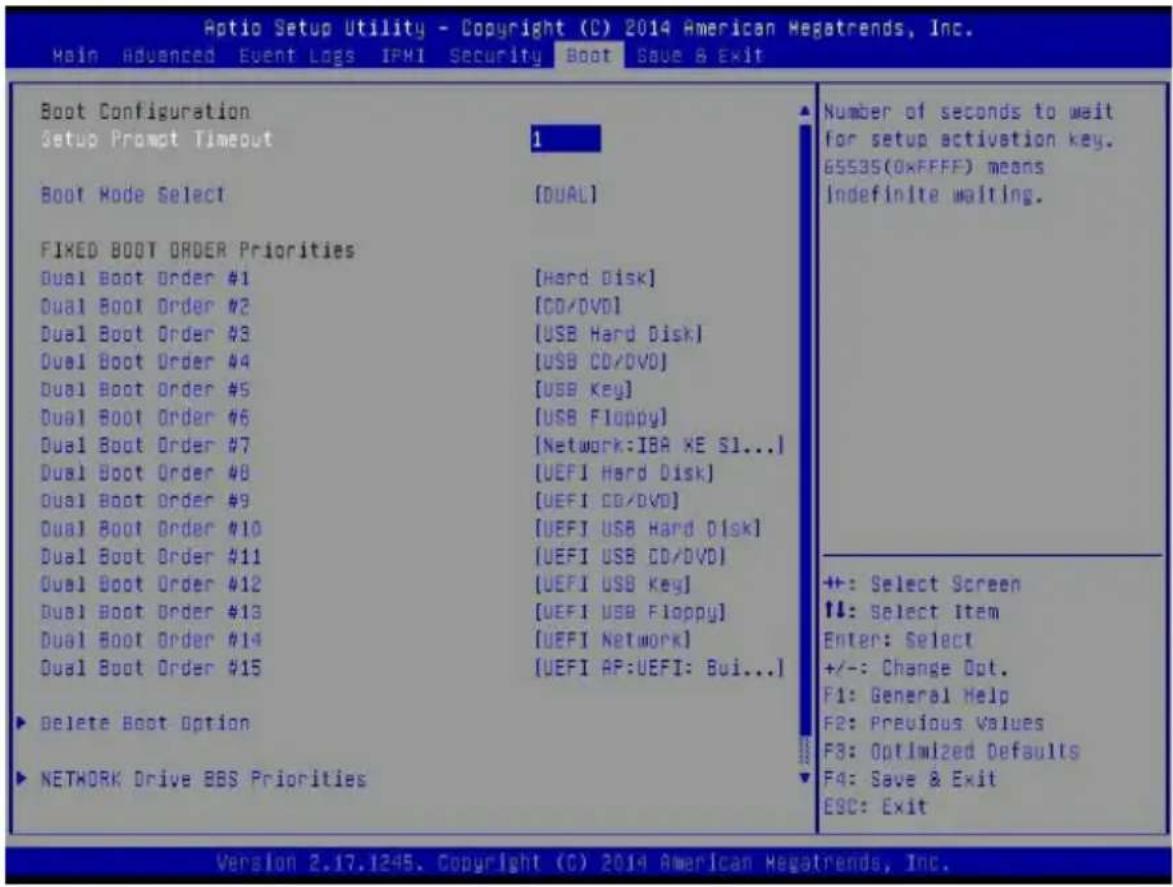
text_image
Optio Setup Utility - Copyright (C) 2014 American Megatrends, Inc. Main Advanced Event Logs IPMI Security Boot Save & Exit Boot Configuration Setup Prompt Timeout 1 Boot Mode Select [DUAL] FIXED BOOT ORDER Priorities Dual Boot Order #1 [Hard Disk] Dual Boot Order #2 [CD/DVD] Dual Boot Order #3 [USB Hard Disk] Dual Boot Order #4 [USB CD/DVD] Dual Boot Order #5 [USB Key] Dual Boot Order #6 [USB Floppy] Dual Boot Order #7 [Network: IBA KE SI...] Dual Boot Order #8 [UEFI Hard Disk] Dual Boot Order #9 [UEFI CD/DVD] Dual Boot Order #10 [UEFI USB Hard Disk] Dual Boot Order #11 [UEFI USB CD/DVD] Dual Boot Order #12 [UEFI USB Key] Dual Boot Order #13 [UEFI USB Floppy] Dual Boot Order #14 [UEFI Network] Dual Boot Order #15 [UEFI AP:UEFI: Bui...] ► Delete Boot Option ► NETWORK Drive BBS Priorities Number of seconds to wait for setup activation key. 65535(0xFFFF) means Indefinite waiting. +: Select Screen ++: Select Item Enter: Select +/-: Change Opt. F1: General Help F2: Previous Values F3: Optimized Defaults F4: Save & Exit E9C: Exit Version 2.17.1245. Copyright (C) 2014 American Megatrends, Inc.This submenu allows the user to configure the following boot settings for the system.
Setup Prompt Timeout
Set the number of seconds to wait for the setup activation key. Enter 65535 (0xFFFF) to wait indefinitely.
Boot Mode Select
Select which boot device type to list below. The options are Legacy, UEFI, and Dual.
Fixed Boot Order Priorities
This option prioritizes the order of devices from which the system will boot. Select each entry in the list to choose a boot device.
- For Dual, devices are listed in boot order #1 through #15.
- For Legacy, devices are listed in boot order #1 through #7.
• For UEFI, devices are listed in boot order #1 through #8.
▶ Delete Boot Option
Use this item to select a boot device to delete from the boot priority list.
Delete Boot Option
Select a boot device to delete.
▶ Network Drive BBS Priorities (Available when a device is installed in this drive)
This submenu sets the boot priority sequence from available network drives.
▶UEFI Application Boot Priorities
This submenu sets the boot priority sequence from available UEFI applications. (Not available when Legacy is selected.)
7-8 Save & Exit
| Discard Changes and Exit Save Changes and Reset Save Options Save Changes Discard Changes Restore Optimized Defaults Save as User Defaults Restore User Defaults Boot Override UEFI: Built-in EFI Shell UEFI: Built-in EFI Shell UEFI: Built-in EFI Shell IBA XE Slot 0100 v2304 | Exit system setup without saving any changes. |
| +#: Select Screen ↑↓: Select Item Enter: Select +/-: Change Opt. F1: General Help F2: Previous Values F3: Optimized Defaults F4: Save & Exit ESC: Exit |
Use this page to configure the Save & Exit settings for setup.
Discard Changes and Exit
Select this option to quit the BIOS setup without making any changes to the system configuration. Select Discard Changes and Exit, and press
Save Changes and Reset
When completing the system configuration changes, select this option to save the changes and reboot the computer so that the new system configuration settings can take effect.
Save Options
Save Changes
Select this option and press
Discard Changes
Select this option and press
Restore Optimized Defaults
Select this option to load the optimized default settings. When the dialog box appears, asking you if you want to load optimized defaults, select Yes to load the optimized default settings, or select No to keep the defaults previously saved as the user defaults.
Save as User Defaults
Select this option to save the current settings as the user's defaults. When the dialog box appears, asking you if you want to save values as user's defaults, select Yes to save the current values as user's default settings, or select No to keep the defaults previously saved as the user's defaults.
Select this option to load the user's defaults previously saved in the system. When the dialog box appears, asking you if you want to restore user's defaults, select Yes to restore the user's defaults previously saved in the system, or select No to keep the changes you've made so far.
Boot Override
This option allows you to override the Boot Option Priorities setting in the Boot menu, and instead immediately boot the system with one of the listed devices. This is a one-time override. Select and confirm.
Appendix A
BIOS Error Beep Codes
A.1 BIOS Error Beep (POST) Codes
During the POST (Power-On Self-Test) routines, which are performed each time the system is powered on, errors may occur.
Non-fatal errors are those which, in most cases, allow the system to continue the boot-up process. The error messages normally appear on the screen.
Fatal errors are those which will not allow the system to continue the boot-up procedure. If a fatal error occurs, you should consult with your system manufacturer for possible repairs.
These fatal errors are usually communicated through a series of audible beeps. The table below lists some common errors and their corresponding beep codes encountered by users.
| BIOS Error Beep (POST) Codes | ||
| Beep Code Error | Message Description | |
| 1 short Refresh Circuits have been reset (Ready to power up) | ||
| 5 short, 1 long Memory error No memory detected in system | ||
| 5 long, 2 short | Display memory read/write error | Video adapter missing or with faulty memory |
| 1 long continuous System OH System overheat condition | ||
A.2 Additional BIOS POST Codes
The AMI BIOS supplies additional checkpoint codes, which are documented online at http://www.supermicro.com/support/manuals/ ("AMI BIOS POST Codes User's Guide").
When BIOS performs the Power On Self Test, it writes checkpoint codes to I/O port 0080h. If the computer cannot complete the boot process, a diagnostic card can be attached to the computer to read I/O port 0080h (Supermicro p/n AOC-LPC80-20).
For information on AMI updates, please refer to http://www.ami.com/products/.
Notes
Appendix B
UEFI BIOS Recovery Instructions
Warning: Do not upgrade the BIOS unless your system has a BIOS-related issue. Flashing the wrong BIOS can cause irreparable damage to the system. In no event shall Supermicro be liable for direct, indirect, special, incidental, or consequential damages arising from a BIOS update. If you need to update the BIOS, do not shut down or reset the system while the BIOS is updating to avoid possible boot failure.
B-1 An Overview to the UEFI BIOS
The Unified Extensible Firmware Interface (UEFI) provides a software-based interface between the operating system and the platform firmware in the pre-boot environment. The UEFI specification supports an architecture-independent mechanism for add-on card initialization to allow the UEFI OS loader, which is stored in the add-on card, to boot the system. The UEFI offers a clean, hands-off control to a computer system at bootup.
B-2 How to Recover the UEFI BIOS Image (-the Main BIOS Block)
A UEFI BIOS flash chip consists of a recovery BIOS block and a main BIOS block (a main BIOS image). The boot block contains critical BIOS codes, including memory detection and recovery codes for the user to flash a new BIOS image if the original main BIOS image is corrupted. When the system power is on, the boot block codes execute first. Once it is completed, the main BIOS code will continue with system initialization and bootup.
Note: Follow the BIOS recovery instructions below for BIOS recovery when the main BIOS boot crashes. However, when the BIOS boot block crashes, you will need to follow the procedures below for BIOS recovery.
B-3 To Recover the Main BIOS Block Using a USB-Attached Device
This feature allows the user to recover a BIOS image using a USB-attached device without additional utilities used. A USB flash device such as a USB Flash Drive, or a USB CD/DVD ROM/RW device can be used for this purpose. However, a USB Hard Disk drive cannot be used for BIOS recovery at this time.
The file system supported by UEFI is FAT (including FAT12, FAT16, and FAT32) installed on a bootable or non-bootable USB-attached device. However, the BIOS might need several minutes to locate the SUPER.ROM file if the media size becomes too large because it contains too many folders and files.
To perform UEFI BIOS recovery using a USB-attached device, follow the instructions below.
- Using a different machine, copy the "Super.ROM" binary image file into the disc Root "\" Directory of a USB device or a writeable CD/DVD.
Note: If you cannot locate the "Super.ROM" file in your driver disk, visit our website at www.supermicro.com to download the BIOS image into a USB flash device and rename it "Super.ROM" for BIOS recovery use. - Insert the USB device that contains the new BIOS image ("Super.ROM") into your USB drive and power on the system
- While powering on the system, please keep pressing
and simultaneously on your keyboard until the following screen (or a screen similar to the one below) displays.
Caution: Please stop pressing the

text_image
SAMS S S S S0000 SAMS SAMS S S S S0001 P S S S2004 SAMS S S0005 S S S S S S S S S S S S S S S S S S S S S S S S S S S S S S S S S S S S S S S S S S S S S S S S S S S C SAMS S S S T0000 S S S A S S E R E F G H I J K L S S P T0000 E M0001 A P P E F G H I I S S D E D E D E D E D E D E D E D E D E D SAMS OSS OSS OSS OSS OSS OSS OSS OSS OSS OSS OSS OSS BMC IP:18.132.161.13 FEI--System Enter Recovery Mode.. 47Note: On the other hand, if the following screen displays, please load the "Super. ROM" file to the root folder and connect this folder to the system. (You can do so by inserting a USB device that contains the new "Super.ROM" image to your machine for BIOS recovery.)

text_image
DMC IP: 10.132.161.13 PEI--Could Not Find Recovery Image... 87- After locating the new BIOS binary image, the system will enter the BIOS Recovery menu as shown below.
Note: At this point, you may decide if you want to start with BIOS recovery. If you decide to proceed with BIOS recovery, follow the procedures below.
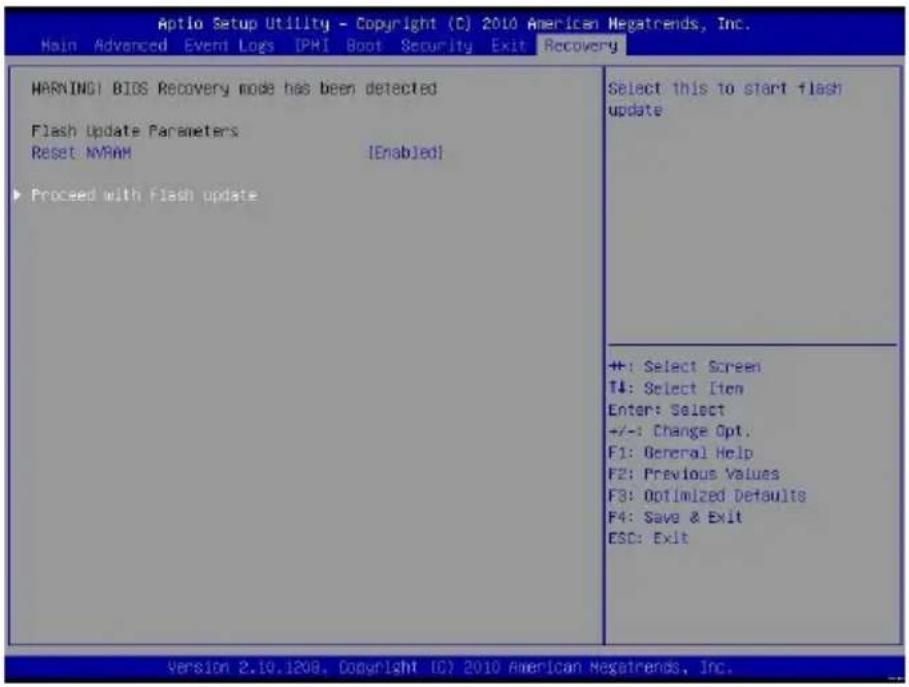
text_image
Aptio Setup Utility - Copyright (C) 2010 American Negatrends, Inc. Main Advanced Event Logs IPHI Boot Security Exit Recovery WARNING! BIOS Recovery mode has been detected Flash Update Parameters Reset: NYRAH [Enabled] Proceed with Flash update Select this to start flash update +: Select Screen T4: Select Item Enter: Select +/-: Change Opt. F1: General Help F2: Previous Values F3: Optimized Defaults F4: Save & Exit ESC: Exit Version 2.10.1209, Copyright (C) 2010 American Negatrends, Inc.- When the screen as shown above displays, using the arrow key, select the item "Proceed with flash update" and press the
key. You will see the progress of BIOS recovery as shown in the screen below.
Note: Do not interrupt the process of BIOS flashing until it is completed.
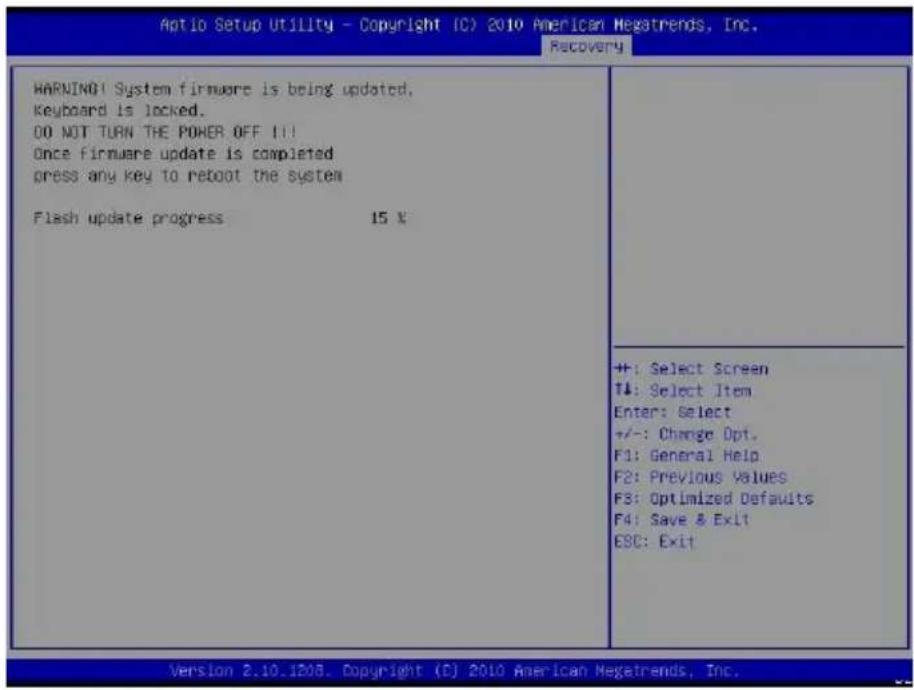
text_image
Aptio Setup Utility - Copyright (C) 2010 American Megatrends, Inc. Recovery WARNING! System firmware is being updated. Keyboard is locked. DO NOT TURN THE POWER OFF !!! Once firmware update is completed press any key to reboot the system Flash update progress 15 % ++: Select Screen T4: Select Item Enter: Select +/-: Change Opt. F1: General Help F2: Previous Values F3: Optimized Defaults F4: Save & Exit ESC: Exit Version 2.10.1208. Copyright (C) 2010 American Megatrends, Inc.- After the process of BIOS recovery is completed, press any key to reboot the system.

text_image
Aptio Setup Utility - Copyright (C) 2010 American Megatrends, Inc. Recovery WARNING! System firmware is being updated. Keyboard is locked. DO NOT TURN THE POWER OFF I! Once firmware update is completed press any key to reboot the system Flash update progress completed. ++: Select Screen T4: Select Item Enter: Select +/-: Change Opt. F1: General Help F2: Previous Values F3: Optimized Defaults F4: Save & Exit ESC: Exit. Version 2.10.1208. Copyright (C) 2010 American Megatrends, Inc.- Using a different system, extract the BIOS package into a bootable USB flash drive.
- When a DOS prompt appears, enter FLASH.BAT BIOSname.### at the prompt.
Note: Do not interrupt this process until BIOS flashing is completed.
- After seeing the message that BIOS update is completed, unplug the AC power cable from the power supply to clear the CMOS, and then plug the AC power cable in the power supply again to power on the system.
- Press
continuously to enter the BIOS Setup utility. - Press
to load default settings. - After loading default settings, press
to save the settings and exit the BIOS Setup utility.
Appendix C
System Specifications
Processors
Single or dual Intel E5-2600 v3/v4 Series processors in LGA2011 sockets
Note: Please refer to our web site for a complete listing of supported processors.
Chipset
Intel PCH C612 chipset
BIOS
16 MB AMI SPI Flash EEPROM
Memory Capacity
Twenty-four DIMM sockets supporting up to 3 TB of LRDIMM (Load-Reduced DIMMs) DDR4-2400/2133/1866/1600 or 768 GB of ECC registered DDR4 non-volatile RDIMM (Registered DIMMs)
Note: See the memory section in Chapter 5 for details.
SATA Controller
Ten SATA 3.0 ports; six ports supported by the Intel PCH and four ports supported by the Intel SCU (RAID 0, 1, 5 and 10 are supported by Intel RSTe Software RAID)
Drive Bays
Twenty-four hot-swap drive bays to house 2.5" hard drives
Expansion Slots
Four PCI-E 3.0 x8 cards (with riser card RSC-R2UW-4E8), one low-profile PCI-E 3.0 x8 (w/ RSC-R1UW-E8R); also, depending on your Ultra riser card, one PCI-E 3.0 x16 card and one PCI-E 3.0 x8 card
Serverboard
X10DRU-i+ (Proprietary form factor)
Dimensions: 17 x 16.8 in (431.8 x 426.7 mm)
Chassis
SC219UAC(4)-R1K02 (2U rackmount)
Dimensions: (WxHxD) 17.2 x 3.5 x 27.76 in. (437 x 89 x 705 mm)
Weight
Gross Weight: 55 lbs. (25 kg.)
System Cooling
Four 8-cm high-performance fans
System Input Requirements
AC Input Voltage: 100 - 240V AC auto-range
Rated Input Current: 13 - 4A max
Rated Input Frequency: 50 to 60 Hz
Power Supply
Rated Output Power: 920W (Part# PWS-920P-1R)
Rated Output Voltages: +12V (75A), +5Vsb (4A)
Operating Environment
Operating Temperature: 10°C to 35°C (50°F to 95°F)
Expanded Operating Temperature: 5°C to 40°C (41°F to 104°F) ^1,2
Non-Operating Temperature: -40°C to 70°C (-40°F to 158°F)
Operating Relative Humidity: 8% to 90% (non-condensing)
Non-Operating Relative Humidity: 5% to 95% (non-condensing)
Note 1: When operating in the expanded temperature range, system performance is equivalent to the normal operating temperature range.
Note 2: When operating in the expanded temperature range, select a CPU for which the TDP is between 85 W to 145 W. Do not use frequency optimized SKUs, E5-2667 v3, E5-2643 v3, E5-2637 v3, and E5-2623 v3.
Regulatory Compliance
Electromagnetic Emissions: FCC Class A, EN 55032 Class A, EN 61000-3-2/3-3, CISPR 32 Class A
Electromagnetic Immunity: EN 55024/CISPR 24, (EN 61000-4-2, EN 61000-4-3, EN 61000-4-4, EN 61000-4-5, EN 61000-4-6, EN 61000-4-8, EN 61000-4-11)
Other: VCCI-CISPR 32 and AS/NZS CISPR 32
Environmental: Directive 2011/65/EU and DELEGATED DIRECTIVE (EU) 2015/863 and Directive 2012/19/EU
Safety: CSA/EN/IEC/UL 60950-1 Compliant, UL or CSA Listed (USA and Canada), CE Marking (Europe)
Perchlorate Warning
California Best Management Practices Regulations for Perchlorate Materials: This Perchlorate warning applies only to products containing CR (Manganese Dioxide) Lithium coin cells. "Perchlorate Material-special handling may apply. See www.dtsc.ca.gov/hazardouswaste/perchlorate"
(continued from front)
The products sold by Supermicro are not intended for and will not be used in life support systems, medical equipment, nuclear facilities or systems, aircraft, aircraft devices, aircraft/emergency communication devices or other critical systems whose failure to perform be reasonably expected to result in significant injury or loss of life or catastrophic property damage. Accordingly, Supermicro disclaims any and all liability, and should buyer use or sell such products for use in such ultra-hazardous applications, it does so entirely at its own risk. Furthermore, buyer agrees to fully indemnify, defend and hold Supermicro harmless for and against any and all claims, demands, actions, litigation, and proceedings of any kind arising out of or related to such ultra-hazardous use or sale.