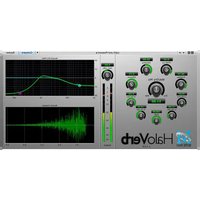
HaloVerb - Audio software Metric Halo - Free user manual and instructions
Find the device manual for free HaloVerb Metric Halo in PDF.


| Product Type | Algorithmic reverb plugin for digital audio workstations |
| Supported Host Platforms | Pro Tools (Mac/Windows), Native (AU, VST2, VST3, AAX) on Mac and Windows |
| Operating System Requirements | Mac: macOS 10.9 or newer (Intel or Apple Silicon); Windows: Windows 10 or newer |
| Format Support | AU, VST2, VST3, AAX (64-bit only) |
| License System | PACE iLok (computer authorization, iLok Cloud, 2nd/3rd gen USB key) |
| Reverb Parameters | Predelay (0-170 ms), RT60 (0.1-7 seconds), Damping, Diffusion, Width (stereo only), Wet/Dry, Output Gain (±20 dB) |
| Pre-Filters | Low and High shelving filters with adjustable cutoff frequency and gain |
| Graphical Displays | Pre-filter graph, Reverb Impulse Display, Energy Time Curve |
| Metering | Peak, Peak Hold, RMS, VU levels (SpectraFoo technology) |
| Preset Management | Preset step-through, audition on select, save/load/rename/delete presets, categories, import/export |
| Snapshot Registers | A/B registers for storing and comparing two parameter snapshots |
| Snapshot Blend | Morph between A and B snapshot parameters (MIDI-mappable) |
| Undo/Redo | Multi-step undo/redo within the plugin |
| Compare Function | Compare current settings to last loaded preset |
| Soft Bypass | Bypass processing while maintaining delay compensation and metering |
| Tooltip Help | Toggle tooltips or hold ? key while hovering |
| UI Customization | Adjustable size (80% to 200%), color scheme, knob type, bevels, grid visibility |
| Clip Indicators | Output and processing stage clip lights, resettable by clicking |
| Key Commands | Fine control (Cmd/Ctrl-drag), reset to default (Option/Alt-click or double-click), numeric entry shortcuts (k, m) |
| Installation Type | Unified installer for all Metric Halo Production Bundle plugins |
Frequently Asked Questions - HaloVerb Metric Halo
User questions about HaloVerb Metric Halo
0 question about this device. Answer the ones you know or ask your own.
Ask a new question about this device
Download the instructions for your Audio software in PDF format for free! Find your manual HaloVerb - Metric Halo and take your electronic device back in hand. On this page are published all the documents necessary for the use of your device. HaloVerb by Metric Halo.
USER MANUAL HaloVerb Metric Halo
natural_image
Abstract logo design featuring a stylized letter M with coiled ribbon elements (no text or symbols)METRIC HALO

HaloVerb User's Guide
HaloVerb Users Guide
Metric Halo
Revision: 4.0.2
Publication date April 22, 2024
Copyright © 2024 Metric Halo. MH Production Bundle, MH ChannelStrip, MH Character, MH Dirty Delay, MH HaloVerb, MH Multiband Dynamics, MH Multiband Expander, MH Precision DeEsser, MH Sonic EQ, MH SuperGate and MH TransientControl are our trademarks. All other trademarks are the property of their respective owners.
Table of Contents
- Introduction ...... 5
- System Requirements 6
- Installation 7
Mac 7
Windows 15
Update Notification (all platforms) 21
- Plug-In Header Bars 22
Plug-In Header: Top Row 23
Metric Halo Header Icon 23
Plug-in Snapshot Registers: A/B 29
Snapshot Blend 30
Plug-in Undo/Redo 31
Help Button 31
Graph Visible Selector 31
UI Size Selector 31
Compare Button 32
Soft Bypass 32
Plug-In Header: Preset Row 33
Plug-in Hamburger menu 33
Preset Step-Through Buttons 34
Preset Name/selector menu: 34
- Operation 35
Control Knob 35
Output Level Meter 36
Low and High Frequency Pre-filter 37
Reverb Impulse Display 37
- Processing 38
A Detailed Description 38
Prefilter 38
Reverb 39
Predelay 39
RT60 39
Damping 40
Diffusion 40
Width 40
Wet/Dry Control 41
Output Gain 41
A. Key Commands 42
B. Service and Support 43
List of Figures
1.1. HaloVerb's User Interface 5
3.1. MH Production Bundle Installer 15
3.2. Welcome Dialog 15
3.3. License Agreement 16
3.4.Custom Setup 17
3.5. Ready to Install 18
3.6. Final installer verification and permission to execute 19
3.7. Installation in Progress 20
3.8. Installation Complete 21
3.9. Plug-in Update Alert 21
4.1. MH Plug-in header (default setting: eq and dynamics graph display closed) 22
4.2. Preferences tab (example shown is SuperGate with sidechain filter graph closed) 23
4.3. Plug-in control pane tabs 23
4.4. standard plug-in UI Preferences 24
4.5. About tab (ChannelStrip shown) 26
4.6. Current Release Notes example 27
4.7. Update tab with new version release notes header(text from update release notes omitted from above for brevity) 28
4.8. Plug-in Header: Snapshot Registers: A/B 29
4.9. Plug-in Header: Snapshot Blend 30
4.10. Plug-in Header: Undo/Redo 31
4.11.Help Button 31
4.12. Graphs Closed 31
4.13. Graphs Open 31
4.14. UI Size Selector 31
4.15. Compare Button (inactive) 32
4.16. Compare Button (active) 32
4.17. Soft Bypass Button (not bypassed - plug-in is processing) 32
4.18. Soft Bypass Button (bypassed - plug-in is not processing) 32
4.19.MIOConsole3d ChannelStrip header 32
4.20. Preset Step-Through Buttons 34
4.21. Plug-in Header: Preset selector menu (ChannelStrip shown) 34
4.22. Preset selector menu: Audition on select 34
5.1. Swept Knob 35
5.2. Spread Knob 35
5.3. Plus/Minus Knob 35
5.4.HaloVerb Output Level Meters 36
5.5. Low and High Frequency Pre-filter 37
5.6. Reverb Impulse Display 37
5.7. Energy Time Curve 37
6.1. Signal Flow 38
6.2. Pre-filters at 34 Hz and 9kHz (controls shown graphically overlaid for clarity) 38
6.3. Predelay of 0 ms 39
6.4. Predelay of 45 ms 39
6.5.RT60 of .1 Seconds 39
6.6.RT60 of 7 Seconds 39
6.7. Damping of 0% 40
6.8. Damping of 100% 40
6.9. Diffusion of 0% 40
6.10. Diffusion of 75% 40
1. Introduction
HaloVerb is a plug-in for digital audio workstations which provides a flexible algorithm-based reverb to add depth and ambience to your recordings.
Features include:
• Comprehensive controls
• Graphic display of the Low and High Frequency Pre-Filters
• Graphic display of the Reverb Impulse

HaloVerb's User Interface
2. System Requirements
Hosts:
- Pro Tools™ (Mac): Pro Tools 11 or higher running on a Macintosh computer. The v4 software currently supports Native AAX operation only.
- Pro Tools™ (Windows): Pro Tools 10 or higher running on a Windows computer. The v4 software currently supports Native AAX operation only.
- Native (Mac): Any Intel or Apple Silicon-native Mac DAW (64-bit) that supports AU, VST2, VST3 or AAX plug-ins.
- Native (Windows): Any Intel Windows (64-bit) DAW that supports VST2, VST3 or AAX plug-ins.
Please Note: All v4 plug-ins are 64-bit (as were v3). If you have a need to work with an old 32-bit host, please contact MH Support and ask for the 32-bit Production Bundle v2 installer.
Operating System:
• Mac: Any Apple Silicon (ARM) or Intel-based Mac running Mac OS X 10.9 or newer
- Windows: Any Intel-based Windows PC running Windows 10 or newer.
Licensing:
- A PACE iLok.com account. You can authorize your v4 license to your computer, iLok Cloud or any 2nd or 3rd generation iLok USB key.
The first generation blue-green iLok USB keys are no longer supported by PACE for new product authorizations.
Please note that prior v2 and v3 licenses are separate and remain valid: you do not have to trade in your old iLok license. Production Bundle v3 and earlier plug-ins will continue to serve on older systems in addition to the v4 installations on newer platforms, with full preset compatibility between v3 and v4.
- One license authorizes the software on any platform.
- The most recent iLok License Manager installer can be found here: iLok License Manager application and driver installers.
Older operating systems may require a specific version of the iLok driver, which can be found here: Legacy iLok application and driver installers.
3. Installation
For both Mac and Windows, there is a single standard installer for the Production Bundle that allows you to decide which plug-ins to install to your computer, depending on what individual plug-in licenses you own and what formats you use.
IMPORTANT: Please make sure you have your license installed and available before you first launch your host after running the installer. Otherwise, you will receive a message on launch that the software is not licensed, asking you to "Buy" or "Quit". There are some hosts that will not rescan for your plug-ins on the next launch after the license is installed, and some hosts do not provide a user menu preference to rescan.
Mac
Please note— The following graphics show installation on a macOS 12 system; the process may be slightly different in other versions of the OS, but the basic concepts are the same. Small details such as file sizes shown may vary with subsequent releases.
- Double-click the "MH Production Bundle.pkg" application

natural_image
Illustration of an open cardboard box with a yellow shipping container (no text or symbols)MHProductionBundleInstaller_v4.0.2.157.pkg
- The first window requests permission for the installer program to scan for the presence of earlier versions of Metric Halo plug-ins. Clicking "Cancel" will quit the installer. Click "Allow" to proceed:

Click "Allow" to proceed...
- The installer dialog will appear, detailing the plug-in formats and system requirements to be installed:

Click "Continue"...
- Now you will see the Metric Halo License Agreement:

After you have read it, click "Continue"...
- Next, click "Agree" to accept the License Agreement:

- The Choose Plug-in Types selector window defaults to no plug-ins selected, so that you may choose just the plug-in formats you wish to install. Checking All Plug-In Types will install Audio Unit, VST2, VST3 and AAX plug-ins to their respective folders in the root Library directory:
• AU to /Library/Audio/Plug-Ins/Components
• VST 2 to /Library/Audio/Plug-Ins/VST
• VST 3 to /Library/Audio/Plug-Ins/VST3
- AAX to /Library/Application Support/Avid/Audio/Plug-Ins
Selecting any one or more specific plug-in types will install or upgrade only those formats, leaving older plug-ins in unselected format types untouched.
Your plug-in format selection will be saved as a preference and pre-set automatically for future Metric Halo family plug-in installations on this computer. Of course you may change your selections at that time.
Choose Plug-in Types to Install
Introduction
License
Plug-in Types
Destination Select
Installation Type
- Installation
Summary

METRIC HALO
The plug-ins are available for AAX (Pro Tools), AU (Audio Units), VST 2, and VST 3. Please select the plugin types you wish to install below:
All Plug-In types
AAX
AU
VST 3
VST 2
Go Back
Continue
- Important note for Pro Tools users
Version 4 of the AAX plugins will install alongside v3, so both will remain available in your system. There are two reasons for this:
- The v4 plug-ins are currently Native only and do not provide DSP executables for HDX/Carbon DSP chips.
- At the request of many Pro Tools users, we have made changes to the AAX v4 plug-ins to provide finer and more consistent behavior of EQ parameters when controlled by EuCon control surfaces and Pro Tools automation.
In some specific workflow cases, these changes have the potential to affect automation playback of older sessions, so the safe route would be to keep older automated sessions running on v3, and using v4 for new sessions.
For specifics on these changes, please see the latest release notes within the v4 plug-in UI by clicking on the Metric Halo logo in the upper left corner of the plug-in window.
Existing sessions will recall with the v3 instances for both Native/DSP, and you can continue to add new instances of the v3 plugins (for example, if you want to be able to use DSP versions for tracking).
You can add v4 instances as you wish to take advantage of the new features and new plug-ins.
You can switch v3 instances to v4, and your settings will be preserved.
If you load sessions with v3 instances, but only have v4 installed, Pro Tools will automatically migrate the instances to v4 Native with the parameter settings intact.
- "Select a Destination" lets you install the plugs for all users (if you are logged in as an admin), only your user, or to another volume entirely.

We recommend that you use the standard installation location unless you have a specific reason not to.
- The "Custom Install" selector window defaults to no plug-ins selected, so that you may choose exactly the plug-ins you wish to install.
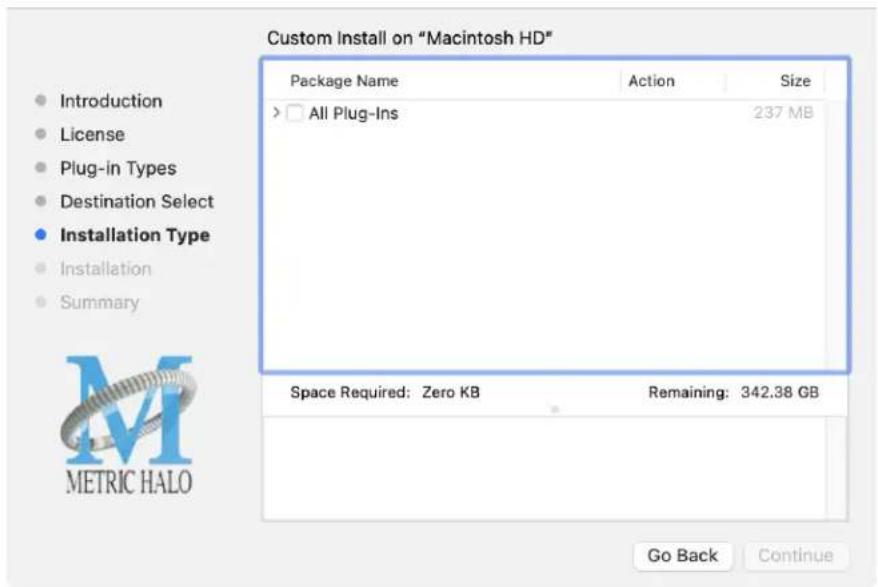
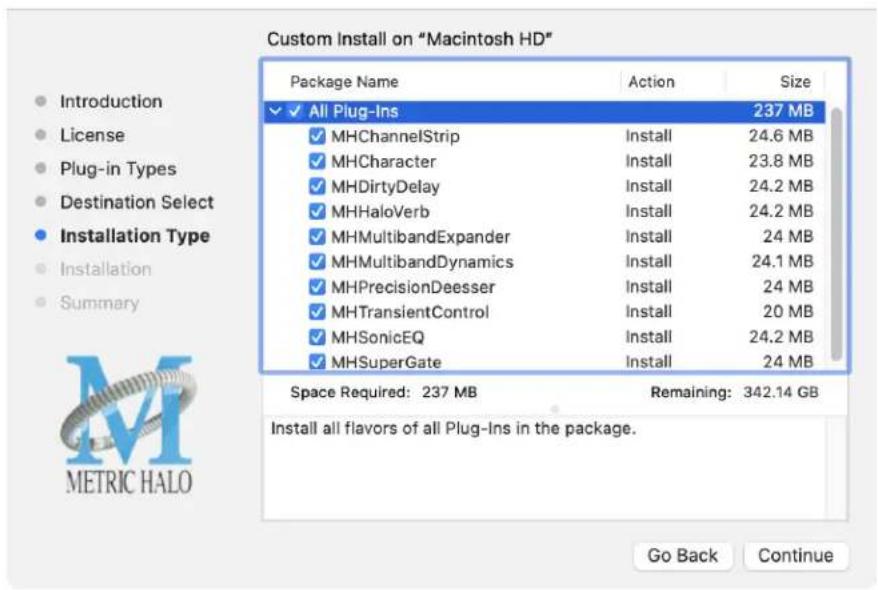
Clicking the disclosure triangle opens the selection list of the individual plug-ins. Make your selections and click "Continue" to proceed.
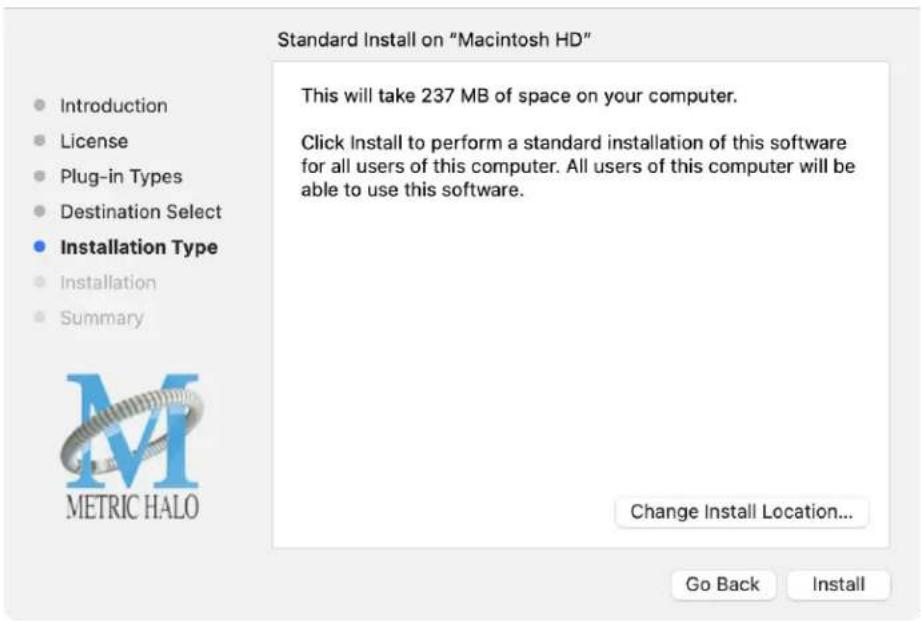
- The final confirmation window displays the total size of the selected installation. Hit "Install" to proceed.
- If present, Touch ID/Face ID will execute the installation once it recognizes your biometrics:

Otherwise, enter your login password as usual and click "Install Software".
- Once the installer has finished, you'll see this dialog:

If you do not see the "Installation Successful" message, contact MH Support.
- The final step is to go to https://www.ilok.com/ and ensure you are up to date with the latest version of the iLok License Manager. Use the iLok License Manager to install the software license to your iLok key or directly to your computer.
That's it! Enjoy using Metric Halo plug-ins!
Windows
Please note – The following graphics show installation on an Windows 10 system; the process may be slightly different in other versions of the OS, but the basic concepts are the same. Small details such as file sizes shown may vary with subsequent releases.
- Double-click the "MHProductionBundleInstaller_v4.x.x.xxx" application
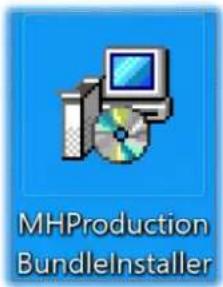
MH Production Bundle Installer
• The installer dialog will appear:

Welcome Dialog
Click "Next" to proceed.
- Read the Metric Halo License Agreement:

License Agreement
After you have read it, click next to "I accept the terms of the License Agreement" and click "Next".
- Custom Setup Options

Custom Setup
The Windows installer Custom Setup page allows you to refine the features to be installed and their location.
By default, the full bundle with VST2, VST3 and AAX will be selected for installation to the C:\Program Files\ folder. Click Browse to change the installation target folder.
We recommend that you use the file path that will allow your host software to recognize the plugins. See your host software documentation.
When you have made your selections, click "Next" to continue.
- The next page is a confirmation to continue, offering a last chance to go back and review your selections from the previous window:

Ready to Install
Click "Back" to return to the Setup page, "Cancel" to cancel the installation, or click "Next" to continue.
- A final dialog before executing the installation process is a security confirmation, providing a verification of the location of the installer executable and information regarding the publisher of the installer package and its contents:

Final installer verification and permission to execute
Clicking "Show Details" and digging through the ensuing submenus will reveal signing credentials and other data for confirming the legitimacy of the installer executable.
Click "Yes" to proceed with the installation.
- The Setup Wizard will install and register the files:
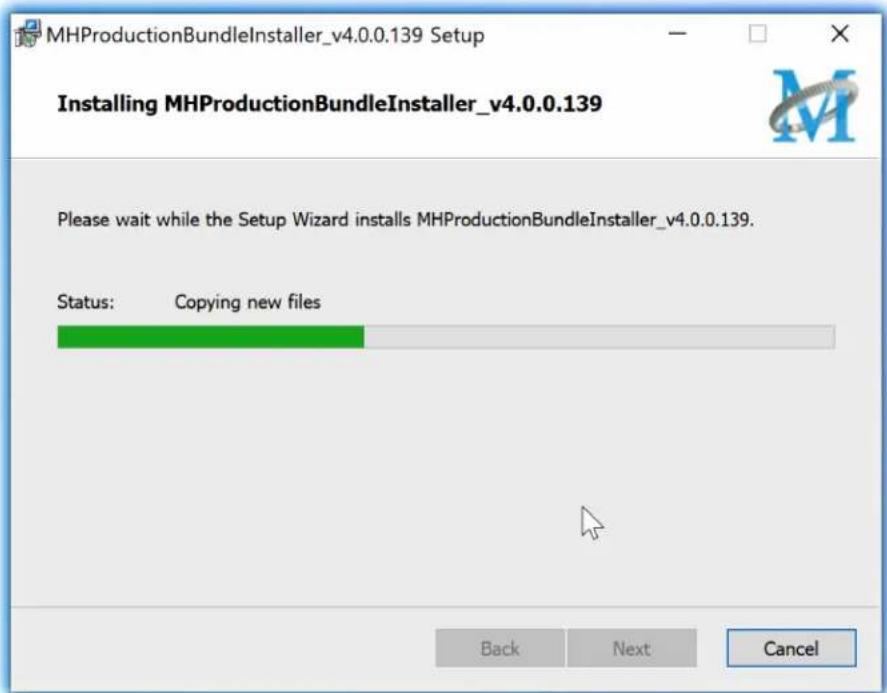
Installation in Progress
- Once the installer has finished, you will see this dialog:

Installation Complete
If you do not see this installation "Completed" dialog, contact MH Support.
- The final step is to go to https://www.ilok.com/ and ensure you are up to date with the latest version of the iLok License Manager. Use the iLok License Manager to install the software license to your iLok key or directly to your computer.
That's it! Enjoy using the Metric Halo Production Bundle!
Update Notification (all platforms)
All Metric Halo Production Bundle plug-ins will automatically check for newer version availability (if your computer is connected to the internet).

natural_image
Abstract logo design featuring stylized letter 'M' with a red circular element (no text or symbols)Plug-in Update Alert
If a new version is found, the Metric Halo icon in the plug-in header bar will sport a lovely red dot. Click on the dotted icon and check the Update Notification tab for release notes and download instructions.
4. Plug-In Header Bars
All Metric Halo family plug-ins display the MH control bar directly above the processor control UI. This control bar is very helpful for organizing your MH presets, as it allows you to organize and access all your presets across all supported plug-in formats on Mac, Windows and our hardware DSP via MIOConsole3d.
It is especially useful in that, regardless of platform, it provides a straightforward, powerful and consistent processing workflow wherever you might be working.
With the constant evolution of computer capabilities opening the door to new production techniques and music delivery formats, the differences between DAW software workflows have become ever more diverse. Many of the major DAWs provide their own plug-in headers within every plug-in instance window, providing their own feature set catering specifically to their internal workflow.
Conversely, other equally popular DAWs provide no added feature support for plug-ins (such as plug-in parameter Undo/Redo), opting instead to insert plugs as a straight processing block.
The MH family plug-in header bar bridges that gap by offering the most asked for plug-in functions in a simple GUI, making all of our plug-ins functions and their presets available to every user on every platform.
The plug-in header bar has two rows of controls, with the Metric Halo logo icon at the top row left.
The top row handles plug-in operations, including update notification and download, access to MH online resources, GUI preferences, tooltip help, A/B parameter snapshots, snapshot Blend, plug-in Undo/Redo, Compare and soft Bypass.

MH Plug-in header (default setting: eq and dynamics graph display closed)
The lower row (with the 'hamburger' menu icon at the left) is all about preset management.
The menu includes organizational and preset import/export features for sharing saved preset files with the outside world, and restoring presets from early days MIO and MH plug-in versions.
Plug-In Header: Top Row

Metric Halo Header Icon
Clicking the MH icon expands the entire plug-in window to the right and opens a multi-function control sidebar with the Preferences tab in focus:

Preferences tab (example shown is SuperGate with sidechain filter graph closed)
This sidebar has context-sensitive tabs across the top for GUI Preferences (shown above), About, and Current Release Notes.

Plug-in control pane tabs
When updates are available for download from Metric Halo, the MH icon will sport a blatant red dot (shown in the header map at the top of this page) and an Update tab is added to the sidebar. These tabs are dynamic by design, and additional tabs may appear as new content becomes available.
To close the sidebar, click the MH icon again, or the "X" at the right edge of the tab bar.
Preferences tab

standard plug-in UI Preferences
The Preferences tab provides controls to modify the color scheme of text and graphical elements.
Initially added in response to requests from users with various visual impairments, in practice the ability to match the color of the plug-in to the mixer strip where it resides makes for a nice improvement in workflow.
Shown above are the basic parameter controls used by the majority of Production Bundle plug-ins.
More complex processors, such as ChannelStrip with multiband EQ and dynamics graph grids, will have additional preferences to further customize those UI elements. Processors with simpler graphics will have fewer UI preference controls.
UI parameter changes are live, so you can see changes to the plug-in graphics as you make them. This includes colors, gradients, graphic element show/hide, knob types and bevels.
Clicking color selection swatches opens the standard OS color pickers window with the eyedropper tool for sampling any color visible on your display.
UI Preferences functions are listed on the next page.
Note: The color scheme you set will be saved to the computer and automatically applied to the next instance of that plug-in type of whatever native format, even on another DAW.
You can always revert to the factory default settings by clicking the Reset Prefs to Factory Default button at the bottom of the Preferences pane.
Complete Plug-in Preferences List
The following is a list of all the preferences available across all of the plug-ins. They don't all apply to every plug-in, but you can refer here to find the documentation for the prefs that that are displayed in the actual plug-in.
- UI Preferences
- Parameter Text Color: sets the text color of all click-to-enter numeric readouts.
- Background Mode: selects the background type and texture.
Brushed background modes place an uncolored textured metal graphic behind the control elements. Color and Gradient controls will not affect the Light and Dark Brushed backgrounds.
- Light Brushed: a light brushed metallic facing with mild gradient lighting (the "vintage" Production Bundle faceplate).
- Dark Brushed: a dark neutral brushed metal facing with a stronger gradient and lighting effect
- Flat Color: select the background color with the Background Base Color picker.
- Gradient Color: select the background color with the Background Base Color picker and adjust Top Gradient Brightness and Bottom Gradient Brightness to taste
-
Grad w/Hits: same as Gradient Color with two mild rack light sources from above and one centered below
-
Background Base Color: when in color background modes, sets the background color
- Top Gradient Brightness: when in gradient background modes, sets the top gradient brightness
- Bottom Gradient Brightness: when in gradient background modes, sets the bottom gradient brightness
- Show Bevels: show/hide shaded edge and processor section separator bevels
- Knob Type: select from six "physical" knob types, or no knob at all
- Show Knob Rings: show/hide the colored rings surrounding parameter knobs
- Rings Width: widen/narrow the colored rings surrounding parameter knobs
- Show Band Swatches: show/hide the color swatches above each EQ band enable switch (used to set the color of each EQ band)
- Swatch Alpha: opacity control for the band color swatch buttons (does not affect Band Color selection)
- Show Graph Grids: show/hide the numeric grids in dynamics and EQ graph displays
- Graph Grid Color: set the color of the numeric grids in dynamics and EQ graph displays
- Graphs Background Color: set the background color of the dynamics and EQ graph displays
- Fill EQ Curves: shades the area of deviation of each eq band from 0dB reference (makes it easier to see the effect of each filter band amongst multiple active filters)
• EQ Colors
- Overall EQ Curve Color: sets the color of the aggregate EQ energy curve (the total sum effect of all active bands)
- Band 1 Color: sets the color of filter band 1 UI elements
- Band 2 Color: sets the color of filter band 2
- Band 3 Color: sets the color of filter band 3
- Band 4 Color: sets the color of filter band 4
- Band 5 Color: sets the color of filter band 5
- Band 6 Color: sets the color of filter band 6
- Sidechain EQ Colors
- Gate EQ Color: sets the color of Gate Sidechain filter band
- Comp EQ Color: sets the color of Comp Sidechain filter band
About tab
![Preferences About METRIC HALO ChannelStrip v.4.0.0.137 Metric Halo Website Metric Halo Tech Support Metric Halo FAQs ChannelStrip Product Page ChannelStrip Users Guide [PDF] Reveal Plug In File... Copyright © 2001-2024, Metric Halo. All rights reserved. Built: Feb 27 2024](/content/2026/06/1224954/images/98f26490d26a337a189b6e5af40158696ca69915fe2a2a7c1b12fd02e54dce74.jpg)
About tab (ChannelStrip shown)
The About tab reveals the current plug-in version information and provides convenient web links to product info, support pages and the current manual on the Metric Halo main website.
Clicking the “...Users Guide [PDF]” link will open and display the plug-in manual version in your default web browser.
Reveal Plug-In File... will open the folder containing the current plug-in file, with the plug-in file itself selected. Very handy for troubleshooting on the fly.
Current Release Notes

Current Release Notes example
Current Release Notes lists a synopsis of major changes (a snippet of which is shown above), with feature and bugfix revisions for the most recent software releases listed below.
Please note that on Windows, the release notes will not be displayed in the pane, and a link to the release notes will be displayed instead. You can click the link to view the release notes using your current default web browser.
Update notification tab
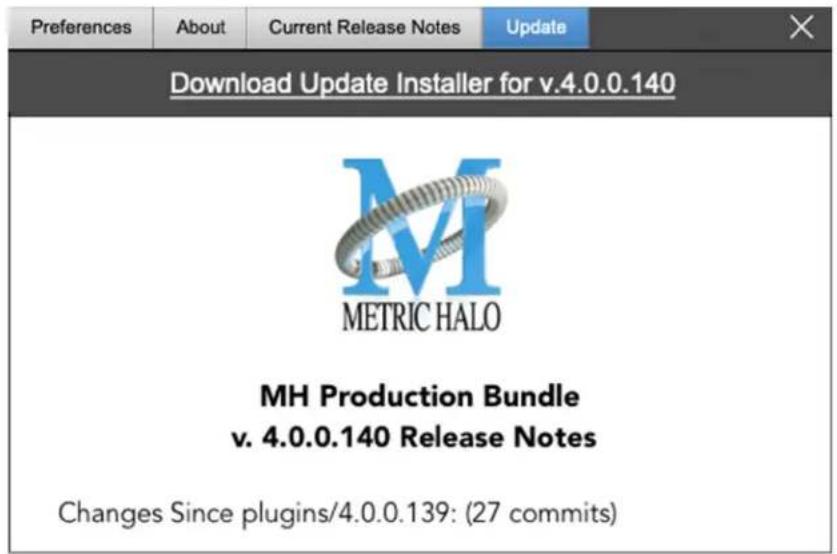
Update tab with new version release notes header (text from update release notes omitted from above for brevity)
The Update tab will contain a link to download the new installer package in the header at the top of the pane.
Below the download link header, you will see new version information with a synopsis of the of major changes included in the update, and bugfix revisions for the most recent software releases listed further below. As with the Current Release Notes tab, Windows users will see a link to view the release notes using your current default web browser.
Click the Installer link to download, unzip and run the installer manually, preferably when your audio software is inactive so it can properly scan the new versions at launch.
Plug-in Snapshot Registers: A/B

Plug-in Header: Snapshot Registers: A/B
The A and B buttons control the A and B state registers. The A/B registers are used to store modified parameter snapshots in addition to the original saved preset called up by Compare.
The Blend function can be used to smoothly morph between the parameters set in the A and B registers, and Blend is a mappable parameter so it can be operated with external MIDI control. Details of the A/B Snapshot Blend feature follow on the next page.
For each of the A and B buttons the visual display tells you the state of the register:
• Light Grey means the register is empty
• Dark Grey means it has settings, but is unselected
- Blue means it has settings and is selected
You can perform the following actions:
- Clicking on an empty register takes a snapshot of the current settings and saves them to the register.
- Clicking on an unselected filled register copies the register parameters to the current active plugin settings.
- Clicking on a selected register toggles to the other register; this lets you toggle between the register settings without having to move the mouse
- Changing settings when a register is selected will update the settings in the register to reflect the change.
Snapshot Blend
The Blend button allows you to interpolate (or morph) between the parameter snapshots stored in the A and B registers. It becomes active when both A and B have a parameter set stored.
Blend is a MIDI-mappable parameter so it can be operated in realtime with external MIDI control and/or automated in the DAW. This allows you to automate a transition from the A → B register, the B → A register or any setting between the two.

Plug-in Header: Snapshot Blend
The Blend button's visual display tells you the state of the register:
• Light Grey means it is empty
- Dark Grey means it has settings, but is unselected
- Blue means it has settings and is selected
Click on Blend to popup the blend control. Slide all the way to the left to apply the settings in the A register. Slide all the way to the right to apply the settings in the B register. Intermediate settings for blend will give you intermediate settings for any parameter that is different in register A and B. The blend control does not change the state of Bypass.
Note that the Blend is not a parallel processing mode where two instances of the processor are running the A and B settings and the output is a parallel blend of the two settings. Rather, Blend interpolates the parameter settings of the two registers to one instance of the processor. You can see the parameter controls move between A and B settings as you slide the Blend control.
The A/B and Blend settings are stored and recalled as part of the plug-in state, but are not saved as individual presets in the preset bar.
While you can use the blend with arbitrary A and B settings we find it works best when you craft the settings in the two registers in such a way as they are related to each other. Specifically, if an indexed (stepped) parameter is different between the two settings, the interpolated value will snap to one of the indexes between the two settings, which can be jarring.
It is best if the parameters that you blend are smooth parameters (e.g. gains, frequencies) and make sure the indexed parameters (enables, modes, band types) are set the same for both registers.
The easiest way to do this is to load the same setting into both registers and then tweak the settings of one of the registers.
This works especially well if you make one of the registers be the basic settings with all the gains or thresholds flattened out so that you can smoothly interpolate between a setting and effectively bypassed - we have found that this allows you to zero in a perfect configuration between too much and too little.
Plug-in Undo/Redo
All the plug-ins provide support for undo/redo from the plug-in header bar.

Plug-in Header: Undo/Redo
The left and right curved arrows represent Undo (Left) and Redo (Right). These arrows are grey when there is nothing to Undo or Redo.
The arrows are white when it is possible to Undo (Left) or Redo (Right). Clicking the left arrow when it is white will undo the last action you made in the plug-in. When you undo something that change is placed on the redo stack, and the Redo button will turn white.
Clicking the Redo button (when it is white) will restore the state that the last Undo changed.
If the Redo button is white and you make a change in the plug-in, the Redo button will go grey as the redo buffer will be cleared.
Help Button

Help Button
This button toggles the tooltip display. When enabled, tooltips will be shown when the mouse hovers over a control. When the tooltip display is disabled, you may still see tooltips by holding down the ? key and hovering over a control.
Graph Visible Selector

Graphs Closed

Graphs Open
This button toggles visibility of various response graphs. This button allows you to maximize screen real-estate while still providing details on the processing when they are needed. Not all MH family plug-ins will have this button, and on some plug-ins the button will have three panes. Clicking the button will step through the available views, with hidden panes shown darker in the button graphic.
UI Size Selector
140%
UI Size Selector
This pull-down menu lets you set the plug-in UI size to taste.
The last selected setting for a plug-in processor will be applied to the next new instance you create of that same plug-in. For example, if you open an instance of ChannelStrip and set it to 80%, the next instance of ChannelStrip you create will also open at 80%.
Compare Button
Compare
Compare Button (inactive)
Compare
Compare Button (active)
To use the compare button, a preset must first be loaded. The compare button will be lit up when the current settings differ from the selected preset. If you click this button while it is lit, the preset settings will be restored, but you can still return to the changes you made by clicking on the button again. It is important to note that any changes you make to activate the compare light are always for comparison to the last loaded preset.
Soft Bypass
Bypass
Soft Bypass Button (not bypassed - plug-in is processing)
Bypass
Soft Bypass Button (bypassed - plug-in is not processing)
When glowing yellow, this button will maintain the time delay through the channel and will continue to show metering, but will cleanly disable the processing.
For MH 3d hardware users: A note regarding plug-in Sidechains
In host-based DAWs, the mechanism for routing signals to plug-in sidechain inputs is handled within the DAW itself in a separate routing UI from the plug-in.
In MIOConsole3d, plug-ins which support external sidechain inputs are assigned from within the plug-in UI (as shown below).

MIOConsole3d ChannelStrip header
In MIOConsole3d, sidechain inputs may be routed from any input or bus available in the system, except for the Main bus. These routes are naturally going to be different from what would be assigned in a DAW session.
For this reason, external sidechain assignments are the one parameter which can not translate between a host-based DAW preset and the same preset opened within MIOConsole3d.
Plug-In Header: Preset Row

"Hamburger" menu: Preset operations
Plug-in Hamburger menu
The preset and parameter functions within the hamburger menu break down as follows:

- Save Parameters saves the current plug-in parameters to the current preset.
- Save Parameters As... opens a dialog box where you can name and choose a category to save your current plug-in settings.
- Rename Current Preset... lets you rename the current preset.
- Delete Current Preset... deletes the current preset.
- Create New Category... lets you create a new preset category for the current plug-in type.
- Delete Current Category... deletes the current preset category.
- Copy Parameters copies the current parameter set so you can paste them to another instance of the same type plug-in.
- Paste Parameters pastes the copied parameters. Note that pasting a parameter set over an existing named preset will change the preset name field to: [No Preset].
- Factory Default loads the factory default settings for this plug-in.
- Reveal In Finder opens the folder in which the current preset is saved.
Preset Step-Through Buttons
Preset Step-Through Buttons
These buttons step through Factory and User Presets in succession, as they are listed in the Preset Selector window. The left arrow chooses the previous preset. The right arrow chooses the next preset.
Preset Name/selector menu:

Plug-in Header: Preset selector menu (ChannelStrip shown)
The Preset selector will open to show all the available preset categories, and the presets within those categories.

Preset selector menu: Audition on select
With "Audition on select" enabled at the bottom of the window, selecting a preset will temporarily load those parameters so you can hear the effect on the audio you are playing, without actually committing to the preset.
Click Cancel to revert to your previous settings and close the selector window.
Hit Apply to commit the new preset parameters and close the preset selector window.
5. Operation
The HaloVerb user interface uses a few different control elements to control all of the processing. These elements are:
Control Knob
Control Knobs are used to control the value of various continuous parameters of a process. There are three styles of encoders:

Swept Knob
The rings around these encoders sweep from a minimum to maximum value, from left to right. The exception is the Cutoff controls, which sweep from right to left.
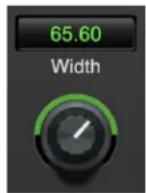
Spread Knob
The ring around this encoder starts at 12 o'clock and spreads to both sides equally as the Stereo Width is increased.

Plus/Minus Knob
The rings around these encoders start at 12 o'clock and sweep to either side. These knobs are used for Wet/Dry and Gain controls.
You can change the value of each knob in a number of different ways. Click and drag the knob to change the value continuously. Dragging up or to the right will increase the value, while dragging down or to the left will decrease the value. If you hold down the Mac Ⓧ (Command) key or Windows Control key when you click, you will be able to adjust the value with finer precision. If you hold the Mac ⌐ (Option) key or Windows Alt key when you click, the knob will reset to its default value. You may also double-click a knob to reset it.
Click on the number (readout) of the knob to display a text entry field that allows you to type in a number directly. The pop-up will remain active until you dismiss it by clicking somewhere else or hitting the return, enter, tab, Mac ⌘. (Command + .), Windows Alt key or ESC keys. Hit return or enter to confirm the value and dismiss the pop-up. Hit the tab key to confirm the value and display an entry field for the next control. ⬇-tab (Shift + tab) will display the entry field for the previous control). Hit the Mac ⌘. (Command + .), Windows Control. (Control + .) or ESC (Escape) to dismiss the pop-up and cancel the change.
When you enter a number into the pop-up entry, you can use a couple of abbreviations: "k" multiplies the number by 1000 and "m" divides the number by 1000. So if you want to enter 16,500 Hz you can just type 16.5k.
Output Level Meter

HaloVerb Output Level Meters
For the main output stage of HaloVerb we have provided meters driven with SpectraFoo™ metering technology. These meters show digital Peak, Peak Hold, RMS level and VU level.
Both the Peak and RMS level are represented with fast PPM ballistics.
The instantaneous Peak level is represented by the floating colored pip. Peak Hold is 2 seconds, indicated as a red floating marker pip.
The RMS level is the solid colored bar which transitions from green at "safe" high-headroom levels to yellow at -18dBFS, then to orange and finally red approaching -6dBFS.
The VU meter is the white floating marker pip showing IEEE standard 300 ms RMS average level.
When HaloVerb is on a mono insert there will be a single meter.
The output section clip lights activate if there is an over in the output stage or in any of the processing section input stages. It is reset by clicking on the meter.
A Note About Clipping Indicators:
The clip lights do not mean that the plug-in is clipping; it means that the audio level in the DSP is currently over 0 dBFS. If you do not lower the signal level you run a chance of actually clipping the input of another processor or D/A convertor.
Low and High Frequency Pre-filter

line
| x | y | | ---- | ----- | | 10 | 24 | | 100 | 12 | | 1k | 0 | | 10k | 0 |Low and High Frequency Pre-filter
The pre-filter graph is a visual representation of the filter shape as set by the Cutoff Hz and Cutoff dB controls for the Low and High filters. As these controls are changed, the dots show the knee frequencies and levels. You may also click and drag the dots to change the filter placements.
Reverb Impulse Display

line
| Time | Reverb Energy Time | |------|---------------------| | 0.00 | 0.0 | | 0.01 | 0.1 | | 0.02 | 0.2 | | 0.03 | 0.3 | | 0.04 | 0.4 | | 0.05 | 0.5 |Reverb Impulse Display
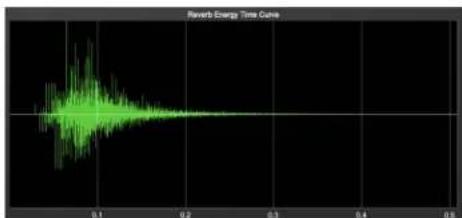
The reverb impulse display gives you a visual indication of what the reverb parameters are doing. The horizontal axis represents time (up to .5 seconds) and the vertical axis represents unscaled level. Clicking on the display will toggle between the Reverb Impulse Display and Energy Time Curve.

line
| x | y | | ---- | ----- | | 0.00 | 0.00 | | 0.01 | 0.10 | | 0.02 | 0.15 | | 0.03 | 0.20 | | 0.04 | 0.25 | | 0.05 | 0.30 | | 0.06 | 0.35 | | 0.07 | 0.40 | | 0.08 | 0.45 | | 0.09 | 0.50 | | 0.10 | 0.55 | | 0.11 | 0.60 | | 0.12 | 0.65 | | 0.13 | 0.70 | | 0.14 | 0.75 | | 0.15 | 0.80 | | 0.16 | 0.85 | | 0.17 | 0.90 | | 0.18 | 0.95 | | 0.19 | 1.00 | | 0.20 | 1.05 | | 0.21 | 1.10 | | 0.22 | 1.15 | | 0.23 | 1.20 | | 0.24 | 1.25 | | 0.25 | 1.30 | | 0.26 | 1.35 | | 0.27 | 1.40 | | 0.28 | 1.45 | | 0.29 | 1.50 | | 0.30 | 1.55 | | 0.31 | 1.60 | | 0.32 | 1.65 | | 0.33 | 1.70 | | 0.34 | 1.75 | | 0.35 | 1.80 | | 0.36 | 1.85 | | 0.37 | 1.90 | | 0.38 | 1.95 | | 0.39 | 2.00 | | 0.40 | 2.05 | | 0.41 | 2.10 | | 0.42 | 2.15 | | 0.43 | 2.20 | | 0.44 | 2.25 | | 0.45 | 2.30 | | 0.46 | 2.35 | | 0.47 | 2.40 | | 0.48 | 2.45 | | 0.49 | 2.50 | | 0.50 | 2.55 |Energy Time Curve
6. Processing
A Detailed Description
In this chapter we'll discuss how the controls work.

flowchart
graph LR
    A["Input"] --> B["ReverbPre-filter"]
    B --> C["Wet/Dry Control"]
    C --> D["Output Gain"]
    D --> E["Output"]
    A --> F["Feedback Loop"]
Signal Flow
The block diagram above illustrates the overall structure of the processing system provided by HaloVerb. The diagram does not indicate the metering blocks.
Now lets examine the various processing blocks indicated in the diagram.
Prefilter
These controls set the frequency and level of the shelving pre-filters. Using these controls allows you to tailor how much low and high frequency material is removed before the signal enters the reverb process.

line
| Frequency (Hz) | Value | | -------------- | ----- | | Lo Filt | 34.00 | | Hi Filt | 9.00 |Pre-filters at 34 Hz and 9kHz (controls shown graphically overlaid for clarity)
Reverb
Let's take a look at what HaloVerbs parameters do, using the Reverb Impulse display. All controls will be at the factory default except the control being discussed, so that you can see how that control changes the reverb characteristics.
Please note that some combinations of settings will look similar in the impulse display, but will sound very different.
Predelay
The Predelay control sets the time in milliseconds before the first reflection of the reverb is heard, up to a maximum of 170 ms. When looking at the Reverb impulse, the predelay is seen as the time between the left side of the window and the beginning of the impulse:

line
| Time | Value | |------|-------| | 0.1 | High | | 0.2 | Medium| | 0.3 | Low | | 0.4 | Medium| | 0.5 | Low |Predelay of 0 ms

line
| Time | Value | |------|-------| | 0.1 | 0.0 | | 0.2 | 0.1 | | 0.3 | 0.2 | | 0.4 | 0.3 | | 0.5 | 0.4 |Predelay of 45 ms
RT60
The RT60 control sets the overall reverb time in seconds; RT60 is a standard measurement of how long it takes the acoustic energy in a room to fall below 60 dB. When looking at the Reverb impulse, changes in the RT60 will be seen as a "thickening" of the reverb tail:
line
| x | y | | ---- | ----- | | 0.1 | 0.0 | | 0.2 | 0.0 | | 0.3 | 0.0 | | 0.4 | 0.0 | | 0.5 | 0.0 |RT60 of .1 Seconds

line
| x | y | | ---- | ----- | | 0.1 | 0.0 | | 0.2 | 0.0 | | 0.3 | 0.0 | | 0.4 | 0.0 | | 0.5 | 0.0 |RT60 of 7 Seconds
Damping
The Damping control sets how much of the reverb signal is removed before being fed back into itself as a percentage. Low damping settings can lead to a ringing, metallic sound.

line
| Time | Energy | |------|--------| | 0.1 | Low | | 0.2 | Medium | | 0.3 | High | | 0.4 | Medium | | 0.5 | Low |Damping of 0%

line
| Time | Revers Energy Time Curve | |------|--------------------------| | 0.1 | High peak | | 0.2 | Medium peak | | 0.3 | Low | | 0.4 | Very low | | 0.5 | Very low |Damping of 100%
Diffusion
The Diffusion control determines how dense the reverb is. A low diffusion setting emphasizes individual echos, while a higher diffusion "pushes" the echos together and thickens the reverb. Some higher settings will cause the reflections to decreased due to phase cancellation.

line
| x | y | | ---- | ----- | | 0.1 | 0.5 | | 0.2 | 0.3 | | 0.3 | 0.2 | | 0.4 | 0.1 | | 0.5 | 0.05 |Diffusion of 0%

line
| x | y | | ---- | ----- | | 0.1 | 0.0 | | 0.2 | 0.0 | | 0.3 | 0.0 | | 0.4 | 0.0 | | 0.5 | 0.0 |Diffusion of 75%
Width
The Width control is only available when using HaloVerb as a stereo plug-in. Width allows you to vary the "spread" of the reverb from mono (panned to the center of the image) to full stereo.
Wet/Dry Control
The Wet/Dry control sets the mix between the reverb (wet) and original (dry) signals as a percentage. Setting this control to 0 (full dry) lets no reverberated sound through. Setting this control to 100 (full wet) lets only reverb pass; you would want to use this setting when inserting HaloVerb on an aux bus. If you are inserting HaloVerb directly on an input or bus, use this control to balance the original audio and reverb.
Output Gain
The Gain control allows you to vary the final output level of HaloVerb by ±20dB
A. Key Commands
There are several key commands used as modifiers combined with mouse actions:
| Command Mac Key Sequence Windows Key Sequence | |
| Show tooltips Hold ? down Hold ? down |
Table A.1. Tooltip Control
| Command Mac Key Sequence Windows Key Sequence | ||
| Fine control ⌘ (Command)-click and drag Control-click and drag | ||
| Reset to default value | (Option)-click or double-click | Alt-click or double-click |
Table A.2. Control Knob Modifiers
| Command Mac Key Sequence Windows Key Sequence | ||
| Confirm & dismiss numeric pop-up | return, enter return, enter | |
| Confirm & move to next entry tab | tab | |
| Confirm & move to previous entry | -tab (Shift + tab) | -tab (Shift + tab) |
| Dismiss numeric pop-up & cancel change | ※ . (Command + .), ESC Control. (Control + .), ESC | |
Table A.3. Numeric Field Modifiers
| Command Mac Key Sequence Windows Key Sequence | |
| Reset Clip √ (Option)-click the meter Alt-click the meter |
Table A.4. Meters
| Command Mac Key Sequence Windows Key Sequence | ||
| Toggle band enable | ⌘ (Command)-click or double-click frequency dot | Control-click or double-click frequency dot |
| Adjust bandwidth (click then drag) | ↖ (Option)-click frequency dot | Alt-click frequency dot |
| Change filter type | ⌘↖ (Command + Option)-click frequency dot | Control+Alt-click frequency dot |
| Access EQ TF settings | (Control) or right-click graph | Right-click graph |
Table A.5. EQ Transfer Functions
| Command Mac Key Sequence Windows Key Sequence | ||
| Popup Parameter Menu | ^⌘ (Control + Option + Command)-click | Alt + Control+Windows-click |
| Show Automation Breakpoint | ^⌘ (Control + Command)-click | Control + Windows-click |
| Set Parameter to Default Value | (Option)-click or double-click | Alt-click or double-click |
| Set Parameter to Minimum Value | ^ (Control + Option)-click | Control + Alt-click |
Table A.6. Pro Tools Key Commands
B. Service and Support
Metric Halo takes great pride in the reputation for customer service and support that we have built. If you have any problems, questions, or suggestions please get in touch with us at:
- https://mhsecure.com/support
• support@mhsecure.com
• (727) 725-9555
Please keep us informed about your successes and projects. We love to hear from you!
- HaloVerb User's Guide
- HaloVerb Users Guide
- Table of Contents
- List of Figures
- Introduction
- System Requirements
- Hosts:
- Operating System:
- Licensing:
- Installation
- Mac
- Choose Plug-in Types to Install
- - Important note for Pro Tools users
- Windows
- Installation Complete
- Update Notification (all platforms)
- Plug-In Header Bars
- Metric Halo Header Icon
- Preferences tab
- Complete Plug-in Preferences List
- - UI Preferences
- • EQ Colors
- - Sidechain EQ Colors
- About tab
- Current Release Notes
- Update notification tab
- Plug-in Snapshot Registers: A/B
- Snapshot Blend
- Plug-in Undo/Redo
- Help Button
- Graph Visible Selector
- UI Size Selector
- Compare Button
- Soft Bypass
- For MH 3d hardware users: A note regarding plug-in Sidechains
- MIOConsole3d ChannelStrip header
- Plug-In Header: Preset Row
- Plug-in Hamburger menu
- Preset Step-Through Buttons
- Preset Name/selector menu:
- Operation
- Control Knob
- Output Level Meter
- A Note About Clipping Indicators:
- Low and High Frequency Pre-filter
- Reverb Impulse Display
- Processing
- A Detailed Description
- Prefilter
- Reverb
- Predelay
- RT60
- Damping
- Diffusion
- Width
- Wet/Dry Control
- Output Gain
- Key Commands
- Service and Support
Brand : Metric Halo
Model : HaloVerb
Category : Audio software