LM-K5536A - Hi-Fi System LG - Free user manual and instructions
Find the device manual for free LM-K5536A LG in PDF.


User questions about LM-K5536A LG
0 question about this device. Answer the ones you know or ask your own.
Ask a new question about this device
Download the instructions for your Hi-Fi System in PDF format for free! Find your manual LM-K5536A - LG and take your electronic device back in hand. On this page are published all the documents necessary for the use of your device. LM-K5536A by LG.
USER MANUAL LM-K5536A LG
LM-K6530A, LMS-K5536V, LMS-K5536C, LMS-K5536T

MPEG
КАРАЮКЕ

DIGITAL


SURROUND

COMPATIBLE

PICTURE CD
COMPATIBLE

Windows
Media™

CD-R/RW

COMPATIBLE

VIDEO CD

VIDEO™

DIGITAL VIDEO

DIGITAL AUDIO
Please read this manual carefully before operating your set. Retain it for future reference.
Designs and specifications are subject to change without notice for improvement.
Safety Precautions

CAUTION
RISK OF ELECTRIC SHOCK DO NOT OPEN

WARNING: TO REDUCE THE RISK OF ELECTRIC SHOCK
DO NOT REMOVE COVER (OR BACK) NO USER-SERVICEABLE PARTS INSIDE REFER SERVICING TO QUALIFIED SERVICE PERSONNEL.

This lightning flash with arrowhead symbol within an equilateral triangle is intended to alert the user to the presence of uninsulated dangerous voltage within the product's enclosure that may be of sufficient magnitude to constitute a risk of electric shock to persons.

The exclamation point within an equilateral triangle is intended to alert the user to the presence of important operating and maintenance (servicing) instructions in the literature accompanying the appliance.
WARNING: TO REDUCE THE RISK OF FIRE OR ELECTRIC SHOCK, DO NOT EXPOSE THIS PRODUCT TO RAIN OR MOISTURE.
CLASS 1 LASER PRODUCT KLASSE 1 LASER PRODUKT LUOKAN 1 LASER LAITE KLASS 1 LASER APPARAT CLASSE 1 PRODUCT LASER
CAUTION:
This Digital Video Disc Player employs a Laser System.
To ensure proper use of this product, please read this owner's manual carefully and retain for future reference, should the unit require maintenance, contact an authorized service location-see service procedure.
Use of controls, adjustments or the performance of procedures other than those specified herein may result in hazardous radiation exposure.
To prevent direct exposure to laser beam, do not try to open the enclosure. Visible laser radiation when open. DO NOT STARE INTO BEAM.
CAUTION: The apparatus shall not be exposed to water, dripping or splashing and that no objects filled with liquids, such as vases, shall be placed on the apparatus.

Notes on copyrights:
It is forbidden by law to copy, broadcast, show, broadcast via cable, play in public, or rent copyright material without permission.
This product is equipped with copy protection measures developed by Macrovision. Copy protection signals are recorded on some discs. When recording these discs on a VCR, picture noise will appear during playback.
This product incorporates copyright protection technology that is protected by certain U.S. patent claims and other intellectual property rights owned by Macrovision Corporation and other rights owners. Use of this copyright protection technology must be authorized by Macrovision Corporation, and is intended for home and other limited viewing uses only unless otherwise authorized by Macrovision Corporation. Reverse engineering or disassembly is prohibited.
SERIAL NUMBER: The serial number is found on the back of this unit. This number is unique to this unit and not available to others. You should record requested information here and retain this guide as a permanent record of your purchase.
Model No.
Serial No.
Table of Contents
Introduction
Safety Precautions....2
Table of Contents....3
Before Use 4-5
Playable Discs....4
Precautions 5
Notes on Discs 5
About Symbols 5
Front Panel and Rear Panel....6
Remote Control 7
Display Window 8
Preparation
Connections 9-12
Connecting to External Equipment or Antenna .....9
Connecting to a TV 10
Connecting to Optional Equipment 11
Connecting to the Wireless microphone antenna ..... 11
Setting the Wireless microphone Channel ..... 11
Speaker System Connection 12
Before Operation....13-20
Audio Adjustment....13
- Speaker Positioning.... 13
• Volume Adjustment ..... 13
• Sound Quality Adjustment....13
• MUTE 13
• SURROUND 13
• XDSS (Extreme Dynamic Sound System) ..... 13
• DEMO Mode 13
• SPECTRUM Effect 13
- Mini Glossary for Audio Stream & Surround Mode. 14
• Sound Mode 14
- Setting the Clock....15
- Sleep Timer Function 15
• Using Microphone 15
- Timer Function 16
General Explanation 17
On-Screen Display....17
Initial Settings 18-22
- General Operation....18
- LANGUAGE 18
• DISPLAY....19
• AUDIO 20-21
- OTHERS....21
- LOCK (Parental Control) 22
Operation
Operation with RADIO 23
Presetting the radio stations....23
Listening to the radio 23
Operation with TAPE 24
Basic Playback 24
To Stop Play 24
Tape Counter Reset 24
To Play Rewind or Fast Forward....24
Dubbing....24
Recording 24
Basic Setting 24
Recording from Radio, CD or Auxiliary source ..... 24
CD to Tape Synchronized Recording 24
Operation with DVD and Video CD 25-27
Playing a DVD and Video CD....25
General Features 25-26
- Moving to another TITLE....25
- Moving to another CHAPTER/TRACK ..... 25
- Search 25
- Still Picture and Frame-by-Frame Playback ..... 26
- Slow Motion 26
- Repeat 26
- Repeat A-B 26
• Time Search 26
- Last Scene Memory 26
Special DVD Features 27
• Title Menu....27
• Disc Menu. 27
- Camera Angle....27
- Changing the Audio Language. 27
- Changing the Audio Channel....27
- Subtitle 27
Operation with Audio CD and MP3/WMA Disc .....28-29
Playing an Audio CD and MP3/WMA Disc ..... 28
- Pause 29
- Moving to another Track 29
- Repeat Track/ All/ Off. 29
- Search 29
Operation with JPEG Disc 30
Viewing a JPEG disc 30
- Slide Show 30
- Moving to another File. 30
- Still Picture 30
Programmed Playback 31
- Repeat Programmed Tracks....31
- Erasing a Track from Program List....31
- Erasing the Complete Program List .... 31
Operation with DivX Disc 32
Operation with KARAOKE 33-36
Karaoke Basic Playback....33
Karaoke Advanced Playback....33-34
Karaoke MENU Playback 34-36
- SETUP 34
• MUSIC LIST 35
• RANDOM 36
- CHALLENGE 36
Reference
Troubleshooting....37
Language Code List....38
Country Code List 39
Specifications
About the symbols for instructions
⚠️ Indicates hazards likely to cause harm to the unit itself or other material damage.
Indicates special operating features of this unit.
Indicates tips and hints for making the task easier.
Before Use
playable Discs
 | DVD(8 cm / 12 cm disc) |
 | Video CD (VCD)(8 cm / 12 cm disc) |
 | Audio CD(8 cm / 12 cm disc) |
In addition, this unit can play a DVD±R, DVD±RW, Kodak PICTURE CD, SVCD, and CD-R or CD-RW that contains audio titles, MP3, WMA, JPEG or DivX files.

Notes
- Depending on the conditions of the recording equipment or the CD-R/RW (or DVD±R/RW) disc itself, some CD-R/RW (or DVD±R/RW) discs cannot be played on the unit.
- Do not attach any seal or label to either side (the labeled side or the recorded side) of a disc.
- Do not use irregularly shaped CDs (e.g., heart-shaped or octagonal). It may result in malfunctions.

Notes on DVDs and Video CDs
Some playback operations of DVDs and Video CDs may be intentionally fixed by software manufacturers. As this unit plays DVDs and Video CDs according to disc content designed by the software manufacturer, some playback features of the unit may not be available or other functions may be added.
Refer also to the instructions supplied with the DVDs and Video CDs. Some DVDs made for business purposes may not be played on the unit.
Regional code of the DVD player and DVDs
This DVD player is designed and manufactured for play-back of region "5" encoded DVD software. The region code on the labels of some DVD discs indicates which type of player can play those discs. This unit can play only DVD discs labeled "5" or "ALL". If you try to play any other discs, the message "Check Regional Code" will appear on the TV screen. Some DVD discs may not have a region code label even though their playback is prohibited by area limits.

ote on DTS-encoded CDs
When playing DTS-encoded CDs, excessive audio level may be heard from the analog stereo output. To avoid possible damage to the audio system, turn down the volume before playing back such discs, adjust the volume gradually, and keep the volume level low. To enjoy DTS Digital Surround™ playback, an external 5.1 channel DTS Digital Surround™ decoder system must be connected to the digital output of the unit.
Disc-related terms
Title (DVD only)
The main film content or accompanying feature content or additional feature content, or music album. Each title is assigned a title reference number enabling you to locate it easily.
Chapter (DVD only)
Sections of a picture or a musical piece that are smaller than titles. A title is composed of one or several chapters. Each chapter is assigned a chapter number, enabling you to locate the chapter you want. Depending on the disc, chapters may not be recorded.
Track (Video CD and audio CD only)
Sections of a picture or a musical piece on a video CD or an audio CD. Each track is assigned a track number, enabling you to locate the track you want.
Scene
On a video CD with PBC (Playback control) functions, moving pictures and still pictures are divided into sections called "Scenes". Each scene is displayed in the menu screen and assigned a scene number, enabling you to locate the scene you want.
A scene is composed of one or several tracks.
Types of video CDs
There are two types of video CDs:
Video CDs equipped with PBC (Version 2.0)
PBC (Playback control) functions allow you to interact with the system via menus, search functions, or other typical computer-like operations. Moreover, still pictures of high resolution can be played if they are included in the disc.
Video CDs not equipped with PBC (Version 1.1)
Operated in the same way as audio CDs, these discs allow playback of video pictures as well as sound, but they are not equipped with PBC.
Before Use (Cont'd)
Precautions
Handling the unit
When shipping the unit
The original shipping carton and packing materials come in handy. For maximum protection, re-pack the unit as it was originally packed at the factory.
When setting up the unit
The picture and sound of a nearby TV, VCR, or radio may be distorted during playback. In this case, position the unit away from the TV, VCR, or radio, or turn off the unit after removing the disc.
To keep the exterior surfaces clean
Do not use volatile liquids, such as insecticide spray, near the unit. Do not leave rubber or plastic products in contact with the unit for a long period of time. They will leave marks on the surface.
Cleaning the unit
To clean the cabinet
Use a soft, dry cloth. If the surfaces are extremely dirty, use a soft cloth lightly moistened with a mild detergent solution. Do not use strong solvents such as alcohol, benzine, or thinner, as these might damage the surface of the unit.
To obtain a clear picture
The DVD player is a high-tech, precision device. If the optical pick-up lens and disc drive parts are dirty or worn, the picture quality will be poor. Regular inspection and maintenance are recommended after every 1,000 hours of use. (This depends on the operating environment.) For details, please contact your nearest dealer.
Notes on Discs
Handling discs
Do not touch the playback side of the disc. Hold the disc by the edges so that fingerprints will not get on the surface. Do not stick paper or tape on the disc.
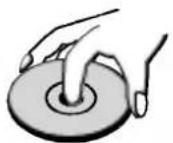

Storing discs
After playing, store the disc in its case. Do not expose the disc to direct sunlight or sources of heat, or leave it in a parked car exposed to direct sunlight, as there may be a considerable temperature increase inside the car.
Cleaning discs
Fingerprints and dust on the disc can cause poor picture quality and sound distortion. Before playing, clean the disc with a clean cloth. Wipe the disc from the center out.

text_image
Diagram showing two hand-drawn scenarios: one with a circle and the other with an 'X' symbol, illustrating a comparison or equivalence process.Do not use strong solvents such as alcohol, benzine, thinner, commercially available cleaners, or anti-static spray intended for older vinyl records.
About Symbols
About the 🔊 symbol display
" 🔊 " may appear on the TV screen during operation. This icon means the function explained in this owner's manual is not available on that specific DVD video disc.
About the disc symbols for instructions
A section whose title has one of the following symbol is applicable only to the disc represented by the symbol.
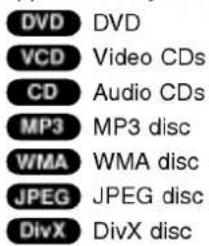
text_image
DVD DVD VCD Video CDs CD Audio CDs MP3 MP3 disc WMA WMA disc JPEG JPEG disc DivX DivX discFront Panel and Rear Panel

text_image
1 2 3 4 5 6 7 8 9 10 11 12 13 14 15 16 17 18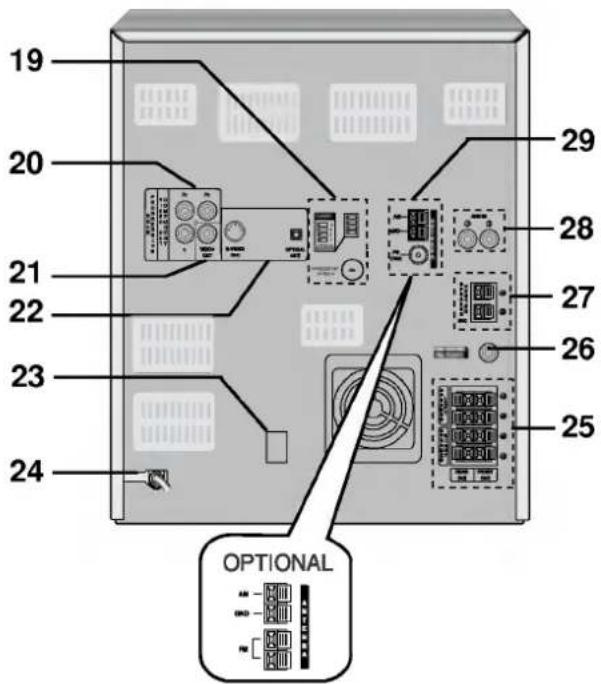
text_image
19 20 21 22 23 24 25 26 27 28 29 OPTIONAL- NUMERIC buttons (0\~9)
- POWER (STANDBY/ON) button
- DISC DIRECT PLAY buttons (DISC1, DISC2, DISC3)
- • DISC SKIP button (DISC SKIP)
• EQUALIZER (EQ) button - FUNCTION SELECT buttons (TUNER, TAPE, KARAOKE/DVD, AUX)
- MULTI JOG DIAL/ SKIP - (b)/SKIP + (#)
- HEADPHONE SOCKET (Ω PHONES) -∅6.3mm
-
▲ PUSH EJECT position (TAPE 1)
-
• REWIND/ FAST FORWARD (◀◀/▶▶) buttons
• CD SEARCH (◀◀/▶▶) buttons
• TUNING DOWN/UP buttons TEMPO -/+ buttons
- PRESET DOWN/UP buttons ( ◀/▶ )
- REVERSE PLAY ( ◀ : optional)/ PLAY ( ▶ ) button
- STOP (■STOP)/ RESET button
Remote Control Operation Range
Point the remote control at the remote sensor and press the buttons.
- Distance: About 23 ft (7 m) from the front of the remote sensor
-
Angle: About 30^ in each direction of the front of the remote sensor
-
POWER button
- NUMERIC buttons (0-9)
- FUNCTION SELECT buttons (TUNER, TAPE, KARAOKE/DVD, AUX)
- TAPE 1/2 SELECT buttons
- XDSS button
- TAPE FUNCTION buttons
- REWIND/ FAST FORWARD PLAY (◀◀/▶▶)
- PLAY (▶)
- REVERSE PLAY (◄: optional)
- STOP (■)
-
RECORD/ RECORD PAUSE (●/II)
-
SPECTRUM button
-
ARROW buttons (For use in highlighting a selection on a GUI menu screen, TITLE and MENU screen.)
-
SELECT/ENTER button
-
REPEAT A-B/ CLEAR buttons
-
ECHO/ SURROUND (SURR.)/ SHADOW/ PBC buttons
-
REV./FWD (◀◀/▶▶)/ TEMPO(-/+) buttons
-
• TITLE button (Use the TITLE button to display the title screen included on DVD video discs.) • SUBTITLE/ ANGLE buttons
-
VOLUME -/+ buttons
-
• DISPLAY/ RETURN/ SET UP buttons
- MENU button (Use the MENU button to display the menu screen included on DVD video discs.)
-
EQUALIZER (EQ)/ SOUND, FEMALE (☐)/ AUDIO, MALE (☐) buttons
-
DVD/CD CONTROL buttons
-
PLAY/SELECT (▶), PAUSE(Ⅱ)/ STEP, STOP (■)
- SKIP/PREV. (◀◀), SKIP/NEXT (▶◀)
- KEY CONTROL (b/#), PROGRAM
- REPEAT, DISC SKIP (D.SKIP)
SKIP ◀◀/▶▶ : Press and hold button for about two seconds for search function.
-
SLEEP button
-
PRESET (▲/▼) buttons
-
MUTE button
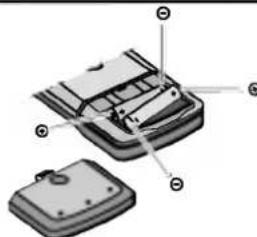
Remote control battery installation
natural_image
Exploded view diagram of a device showing internal components and part (no text or labels)Detach the battery cover on the rear of the remote control, and insert two R03 (size AAA) batteries with + and - aligned correctly.

Do not mix old and new batteries. Never mix different types of batteries (standard, alkaline, etc.).
Display Window

text_image
1 MP3 ⑪ ⑤ DVD CD Ⅱ VCD 1 2 3 4 5 6 7 8 9 10 11 12 13 14 15 OVER TITLE REC OHP/TRK 1 ALL MONO MEMO DOWN/MUX A-B LS RS HI - SPEED DUBBING CD SYNCHRO PCM IPROG. SLEEP X055 (b) (#) PBC 1/L 2/R ECHO 6 8 7 4 5- • DISC indicator
• DISC NUMBER indicator
- PLAY/ PAUSE indicator
-
• TITLE indicator
-
TIMER indicator
• CHAPTER/TRACK indicator - REPEAT indicator
• FM STEREO RECEIVING indicator - MONO indicator
• MEMORY (MEMO) indicator -
DOWNMIX indicator
-
• LEFT FRONT SPEAKER indicator (L)
• RIGHT FRONT SPEAKER indicator (R)
• RIGHT SURROUND SPEAKER indicator (RS)
• LEFT SURROUND SPEAKER indicator (LS)
• SUB WOOFER indicator (SUB)
• CENTER SPEAKER indicator (C)
• SURROUND MODE indicator (S)
- • DTS/ ANGLE/ REPEAT A-B indicator
• DOLBY DIGITAL/ DOLBY PROLOGIC II indicator
• SURROUND indicator (SURR.)
-
• PROGRAM/ SLEEP/ XDSS indicator
-
KEY CONTROL (b/#)/ MUTE/ PBC indicator
-
ECHO indicator
• MIC indicator : OPTIONAL -
LEVEL indicator
-
• TAPE 1/2 SELECT indicator
-
PLAY MODE indicator
• DUBBING indicator
• CD SYNCHRO RECORDING indicator -
PCM indicator
-
• CD MUSIC CALENDAR indicator
• CD MUSIC CALENDAR OVER indicator
Connections
Connecting to External Equipment or Antenna
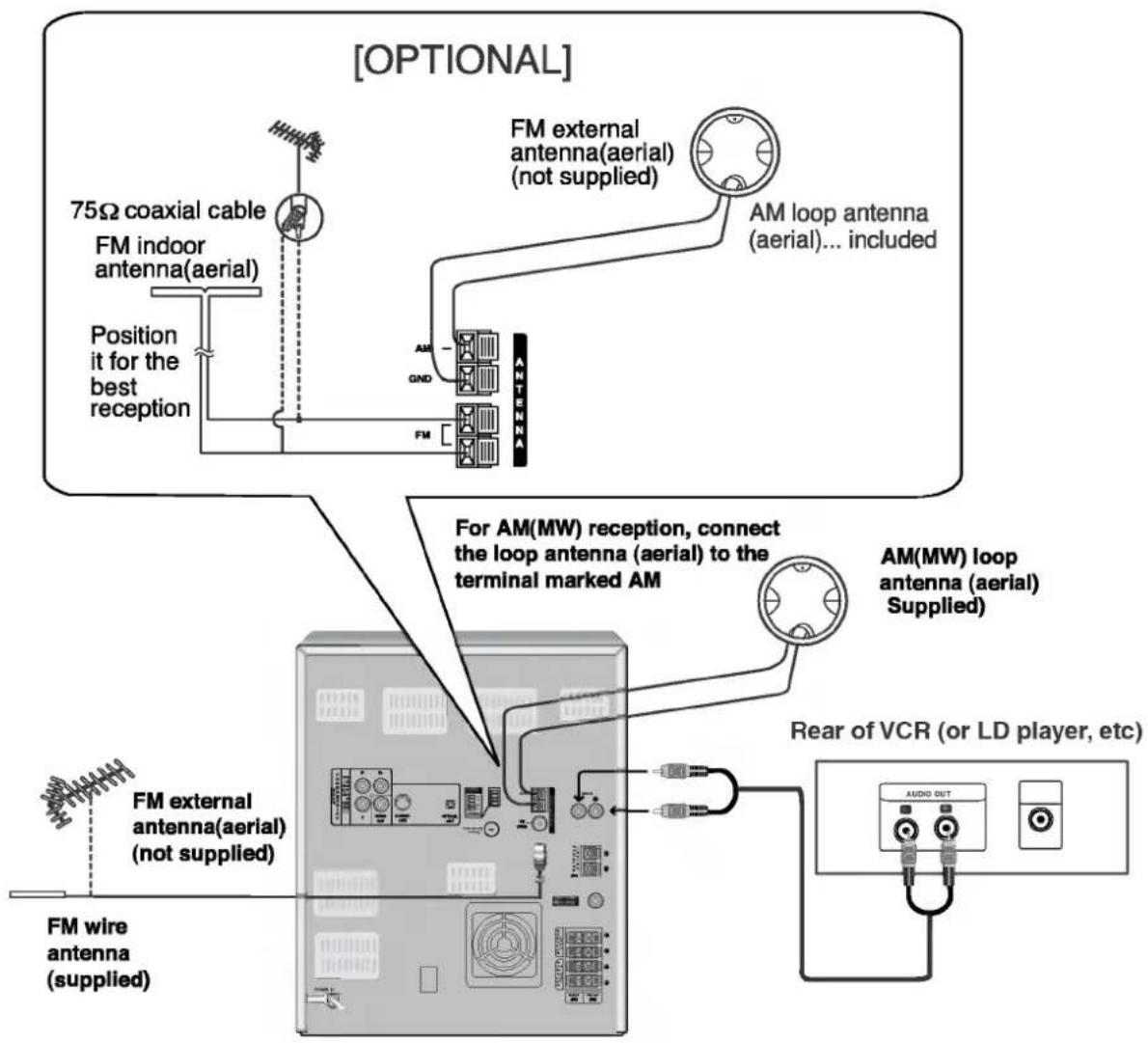
- Connect the AUX IN (L/R) jacks on the unit to the AUDIO OUT (L/R) jacks on the VCR, LD player, etc using the audio cables.

otes
- To prevent noise pickup, keep the AM loop antenna away from the unit and other component.
- Be sure to fully extend the FM wire antenna.
- After connecting the FM wire antenna, keep it as horizontal as possible.
- Connect the supplied FM/AM antennas for listening to the radio.
- Connect the AM loop antenna to the AM antenna connector.
- Connect the FM wire antenna to the FM antenna connector.


Press AUX to select input to these jacks.
"AUX" appears on the display window.
flowchart
graph TD
    A["FM wire antenna (supplied)"] --> B["FM external antenna(aerial) (not supplied)"]
    B --> C["FM indoor antenna(aerial)"]
    C --> D["75Ω coaxial cable"]
    D --> E["Position it for the best reception"]
    E --> F["FM external antenna(aerial) (not supplied)"]
    F --> G["AM(MW) loop antenna (aerial) Supplied"]
    G --> H["Rear of VCR (or LD player, etc)"]
    H --> I["AM(MW) loop antenna (aerial) ... included"]
    I --> J["FM external antenna(aerial) (not supplied)"]
    J --> K["FM indoor antenna(aerial)"]
    K --> L["75Ω coaxial cable"]
    style A fill:#f9f,stroke:#333
    style B fill:#ccf,stroke:#333
    style C fill:#cfc,stroke:#333
    style D fill:#fcc,stroke:#333
    style E fill:#cff,stroke:#333
    style F fill:#ffc,stroke:#333
    style G fill:#cfc,stroke:#333
    style H fill:#fcc,stroke:#333
    style I fill:#ffc,stroke:#333
    style J fill:#fcc,stroke:#333
    style K fill:#ffc,stroke:#333
    style L fill:#fcc,stroke:#333
Connections
Connecting to a TV

flowchart
graph TD
    A["TV/MONITOR"] --> B["S-VIDEO Cable (Supplied)"]
    B --> C["VIDEO OUT"]
    B --> D["VIDEO INPUT"]
    B --> E["S-VIDEO Cable (Not supplied)"]
    E --> F["COMPONENT VIDEO/PROGRAMM/SCAN INPUT"]
    E --> G["S-VIDEO INPUT"]
    E --> H["VIDEO INPUT"]
    style A fill:#f9f,stroke:#333
    style B fill:#ccf,stroke:#333
    style C fill:#cfc,stroke:#333
    style D fill:#fcc,stroke:#333
    style E fill:#cff,stroke:#333
    style F fill:#ffc,stroke:#333
    style G fill:#ffc,stroke:#333
    style H fill:#ffc,stroke:#333
    note1["If the TV has an S-VIDEO input, connect the unit with S-VIDEO cable. When using an S-video cable, do not connect the yellow video cable."] --> note1
    note2["OPTIONAL"] --> note1
    note3["(C)"] --> note1
    note4["(S)"] --> note2
    note5["(V)"] --> note3
- Make one of the following connections, depending on the capabilities of your existing equipment.

Tips
- Depending on your TV and other equipment you wish to connect, there are various ways you could connect the player. Use one of the connections described below.
- Please refer to the manuals of your TV, VCR, Stereo System or other devices as necessary to make the best connections.

Caution
- Make sure unit is connected directly to the TV. Select the correct AV input on your TV.
- Do not connect your unit to TV via your VCR. The picture image could be distorted by the copy protection system.
Video connection
Connect the VIDEO OUT jack on the unit to the VIDEO IN jack on the TV using the video cable supplied (V).
S-Video connection
Connect the S-VIDEO OUT jack on the unit to the S-VIDEO IN jack on the TV using the optional S-Video cable (S).

ote
The signal of S-VIDEO OUT jack will output only when the function mode is selected to CD/DVD.
Component Video (ColorStream®) connection (Best)
Connect the COMPONENT VIDEO OUT/PROGRESSIVE SCAN jacks on the unit to the corresponding in jacks on the TV using the Y Pb Pr cable (C).
Progressive Scan (ColorStream® pro) connection
Connect the COMPONENT VIDEO OUT/ PROGRESSIVE SCAN jacks on the unit to the corresponding in jacks on the TV using an optional Y Pb Pr cable (C).
- If your television is a high-definition or "digital ready" television, you may take advantage of the DVD Player's progressive scan output for the highest video resolution possible.
- If your TV does not accept the Progressive Scan format, the picture will appear scrambled if you try Progressive Scan on the DVD Player.

otes
- When you connect the DVD Karaoke to your TV, be sure to turn off the power and unplug both units from the wall outlet before making any connections.
- Set the Progressive to "On" on the setup menu for progressive signal, see page 19.
- Set the Progressive to "Off" by removing any disc from the unit and close the disc tray. See that "no disc" is displayed on the display window. Then press STOP and hold it for five seconds before releasing it.
- Progressive scan does not work with the analog video connections (yellow VIDEO OUT jack) or S-VIDEO connection.
Connections
Connecting to Optional Equipment

text_image
Amplifier (Receiver) OPTICAL AUDIO IN OPTIONAL[Connecting to an amplifier equipped with two channel digital stereo (PCM) or to an Audio/Video receiver equipped with a multi-channel decoder (Dolby Digital™, MPEG 2 or DTS)]
Connect the OPTICAL OUT jack on the unit to the OPTICAL IN jack on your amplifier. Use an optional audio cable.

Caution:
Due to the DTS Licensing agreement, the digital output will be in DTS digital out when DTS audio stream is selected.
The sound is muted during playback on an audio CD recorded in dts.

Notes
- If the audio format of the digital output does not match the capabilities of your unit, the DVD Karaoke will produce a strong, distorted sound or no sound at all.
- Six Channel Digital Surround Sound via digital connection can only be obtained if your unit is equipped with a Digital Multi-channel decoder.
- To see the audio format of the current unit in the On-Screen Display, press AUDIO.
Connecting to the Wireless microphone
antenna
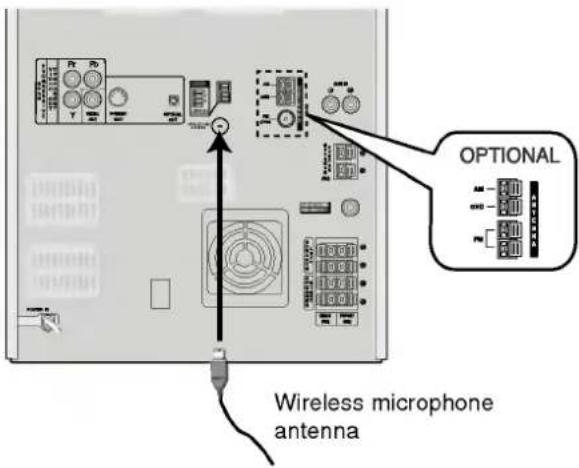
When you use the wireless microphone, connect the supplied wireless microphone antenna to the wireless microphone antenna jack of the unit.
text_image
OPTIONAL Wireless microphone antennaSetting the Wireless microphone Channel
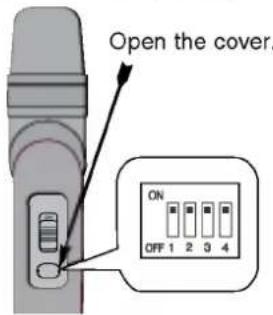
- If there is a similar wireless microphone product nearby, interference may occur. In this case, change the channel switch to other channel, and turn off the power, then turn on again.
By using the Channel Switch, set the same channel.
[Wireless microphone]
text_image
Open the cover. ON OFF 1 2 3 4[Rear panel of the unit]

text_image
CHANNEL 4 3 2 1 OFF→ON- You can set the channel change with 10 types.
Speaker System Connection
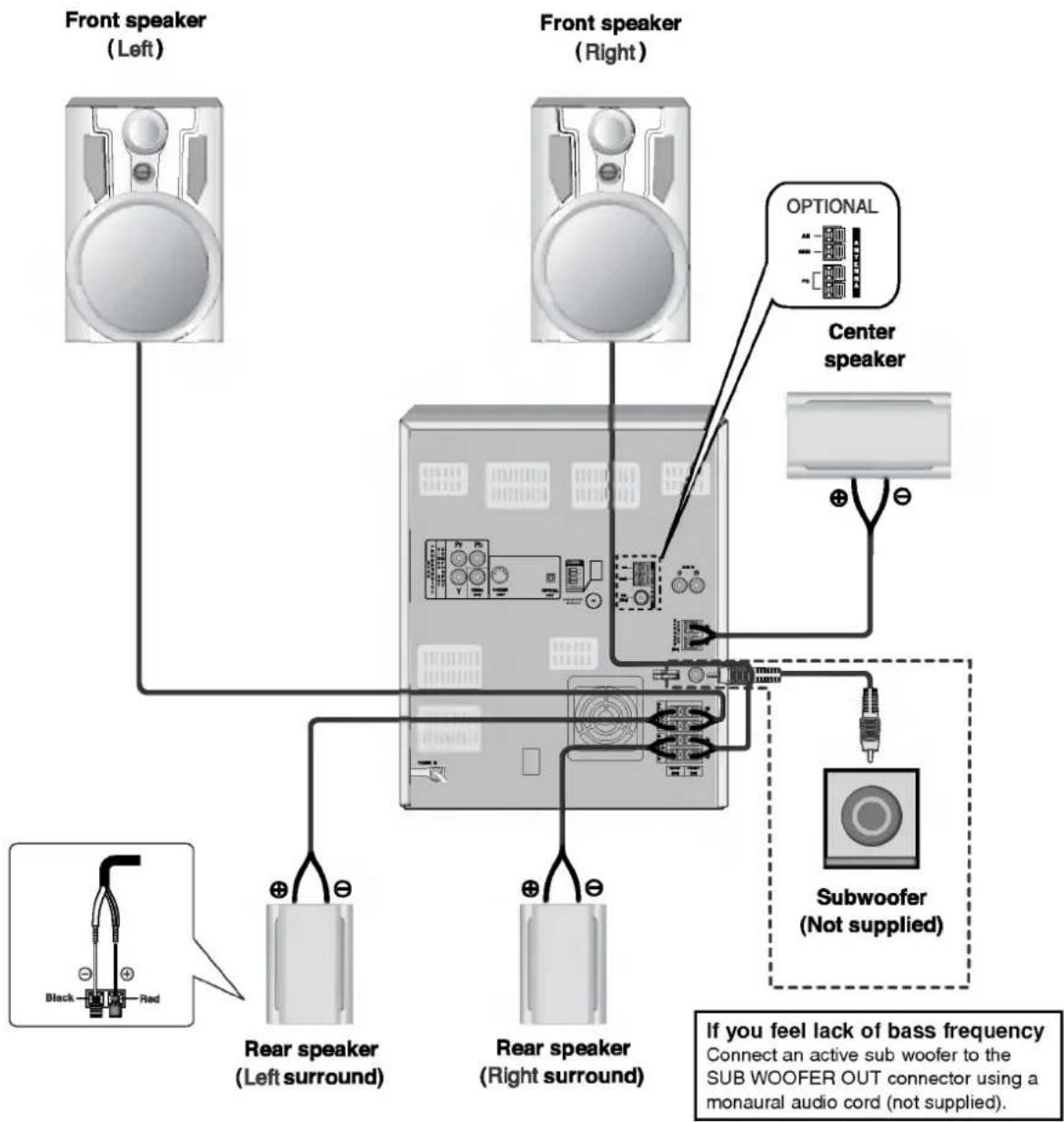
Connect the speakers using the supplied speaker cords by matching the colors of the terminals and those of the cords. To obtain the best possible surround sound, adjust the speaker parameters (distance, level, etc.).
flowchart
graph TD
    A["Front speaker (Left)"] --> B["Central Server"]
    C["Front speaker (Right)"] --> B
    D["Center Speaker"] --> B
    E["Subwoofer (Not supplied)"] --> B
    F["Rear speaker (Left surround)"] --> B
    G["Rear speaker (Right surround)"] --> B
    H["Black Red"] --> I["Ground"]
    J["Optional"] --> K["Center Speaker"]
    L["If you feel lack of bass frequency"] --> M["Connect an active sub woofer to the SUB WOOFER OUT connector using a monaural audio cord (not supplied)."]

otes
- Be sure to match the speaker cord to the appropriate terminal on the components: + to + and - to -. If the cords are reversed, the sound will be distorted and will lack base.
- If you use front speakers with low maximum input rating, adjust the volume carefully to avoid excessive output on the speakers.
Before Operation
Audio Adjustment
Speaker Positioning
In the case of normal position use the 6 speakers (2 front speakers, center speaker, 2 rear speakers and subwoofer).
If you want to play the excellent bass sound or Dolby Digital surround, you should connect a subwoofer.
- Front speakers
According to your listening position set up the speakers for equal distance. And by hearing position set up the interval between speakers to 45 degree.
- Center speaker
It is ideal that the center speakers and front speakers are same height. But normally place it above or below the television.
- Rear speakers
Place left and right behind the listening area.
These speakers recreate sound motion and atmosphere required for surround playback. For best results, do not install the rear speakers too far behind the listening position and install them at or above the level of the listener's ears. It is also effective to direct the rear speakers towards a wall or ceiling to further disperse the sound.
In the case of a smaller room size, if the audience is near to the rear wall set the rear speakers opposite each other, and set the rear speakers above 60-90cm than the listener's ears.
- Subwoofer
This can be placed in any front position.
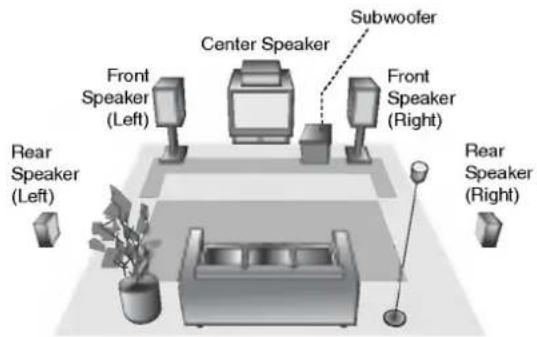
text_image
Subwoofer Center Speaker Front Speaker (Left) Front Speaker (Right) Rear Speaker (Left) Rear Speaker (Right)Speaker Positioning Example
Volume Adjustment
- Turn VOLUME knob clockwise to increase the sound level, or counterclockwise to decrease it.
- Press VOLUME + to increase the sound level, or use VOLUME - to decrease it on the remote control.
Sound Quality Adjustment
• To activate stereo sound
You can choose between 4 fixed sound impressions.
Select a desired sound mode using the EQUALIZER (EQ).
FLAT : Linear frequency response
ROCK : More bass, more treble
POP : Less bass, less treble
CLASSIC : For orchestral music

ote
This function is only available to the "BYPASS" sound mode.
- Headphone Jack
Connect a stereo headphone plug ( 6.3mm) into the headphone jack.
The speakers are automatically disconnected when you plug in the headphones (not supplied).
MUTE
Press MUTE to turn off the sound, press again to restore. You can mute your unit in order, for example, to answer the telephone, "x" indicator flashes in the display window.
SURROUND
To activate surround mode
You can choose one between 2 fixed sound impressions. Press SURROUND (SURR.) button.
This function is only available to the "BYPASS" sound mode.
XDSS (Extreme Dynamic Sound System)
Press XDSS to reinforce treble and bass.
- The "XDSS ON" indicator lights up.
To cancel it press XDSS again.
- The "XDSS OFF" indicator lights up.

ote
This function is only available to the "BYPASS" sound mode.
DEMO Mode
With the unit plugged in but turned off, press the DEMO for a continuous visual display of units features. Press it again to return to a display of the current time.
SPECTRUM Effect
Whenever you press the SPECTRUM button on the remote control, you can enjoy the spectrum change with 8 types in the display.
Before Operation
Mini Glossary for Audio Stream & Surround mode
dts
Allows you to enjoy 5.1(or 6) discrete channels of high quality digital audio from DTS program sources such as discs, DVD and compact discs, etc.bearing the trademark. DTS Digital Surround delivers up to 6 channels of transparent audio(which means identical to the original masters) and results in exceptional clarity throughout a true 360 degree sound field. "DTS" and "DTS Digital Surround" are registered trademarks of Digital Theater Systems, Inc.
□□ DIGITAL
The Dolby Digital surround format lets you enjoy up to 5.1 channels of digital surround sound from a Dolby Digital program source. If you play DVDs with "OK" mark, you can enjoy even better sound quality, greater spatial accuracy, and improved dynamic range.
□□PRO LOGIC II
Dolby Pro Logic II creates five full-bandwidth output channels from two-channel sources. This is done using an advanced, high-purity matrix surround decoder that extracts the spatial properties of the original recording without adding any new sounds or tonal colorations.
MOVIE mode:
The Movie mode is for use with stereo television shows and all programs encoded in Dolby Surround. The result is enhanced soundfield directionality that approaches the quality of discrete 5.1-channel sound.
BYPASS
Outputs the sound from the front left and right speakers and subwoofer.
Sound Mode DVD VCD2.0 VCD1.1 CD
You can enjoy surround sound simply by selecting one of the pre-programmed sound fields according to the program you want to listen to.
When DVD is inserted
You can change the Digital Audio Output mode by pressing the AUDIO button on the remote control during playback. Although the DVD contents differ from disc to disc, the following explains the basic operation when this feature is used.
a) After you select 2 channel (For example or ) by pressing AUDIO button, press SOUND button repaetedly.

b) After you select 5.1 channel (For example □ or □) by pressing AUDIO button, press SOUND button. - "■" indicator will be displayed on the TV screen. - "BYPASS" indicator will be only displayed on the display window.
When Video CD is inserted
Each time you press SOUND button, the sound mode of Video CD is changed on the display window as the following order.
BYPASS → STUDIO → CLUB → HALL → THEATER 1 → CHURCH → PL II MOVIE → BYPASS...
Note
After you select the "Bypass" of sound mode by pressing SOUND button, press AUDIO button. The Left, Right and Stereo of audio channel will be displayed on the TV screen.
When CD is inserted
Each time you press SOUND button, the sound mode of Audio CD is changed on the display window as the following order.
BYPASS → STUDIO → CLUB → HALL → THEATER 1 → CHURCH → PL II MOVIE → BYPASS...
For your reference
- The unit memorizes the last mode settings for each source individually.
- You can identify the encoding format of program software by looking at its packaging.
- Dolby Digital discs are labelled with the logo.
- Dolby Surround encoded programs are labelled with the ☐DOLBY logo.
- DTS Digital Surround discs are marked with DTS.
Note
When you play sound tracks with 96kHz sampling frequency, the output signals will be converted to 48kHz (sampling frequency).
Before Operation
Setting the Clock
1 Press CLOCK. (If the clock requires setting, press and hold CLOCK for more than 2 seconds.) - The hours display begins to blink.
2 Select either the 12 hour cycle or the 24 hour cycle by turning MULTI JOG DIAL.

(12HR)
or

(24HR)
3 Press SET to confirm the selected hour cycle.
4 Use MULTI JOG DIAL to set the current hour.
5 Press SET.
6 Use MULTI JOG DIAL to set current minutes.
7 Press SET and the correct time is shown on the display.
8 Press CLOCK at any time to show the time on the display, for about 5 seconds.
Sleep Timer Function
When the sleep timer is set, the unit automatically turns off after the specified time has elapsed.
1 To specify the time delay before the power is turned off, press SLEEP.
In the display window you can see SLEEP 90 for about 5 seconds. This means that the system turns off automatically after 90 minutes. Each time the button is pressed the time interval before it turns off is reduced by 10 minutes. i.e. 80...70... etc. Select the desired time to turn off.
2 To check the remaining time until the power is turned off.
While the sleep function is active press SLEEP briefly. The time remaining until the unit turns off is displayed for about 5 seconds.
Note
If you press SLEEP while the sleep time is displayed, the SLEEP time is reset.
To cancel Sleep Timer setting
If you wish to stop the function, press the SLEEP button repeatedly until "SLEEP 10" appears, and then press SLEEP once again after "SLEEP 10" shows on the display.
Using Microphone
You can sing to a music source by connecting a microphone to the unit.
1 Connect your microphone to the MIC socket. " ", will be shown in the display window.
2 Play a music you want.
3 Sing along with the accompaniment. Adjust the microphone volume by turning MIC VOLUME KNOB.
For your reference
You can record during using microphone. Refer to the "Recording" explanation section.
Notes
- When not using the microphone, set the MIC volume knob to minimum or turn off the MIC and remove the microphone from the MIC socket.
- If the microphone is set too near the speaker, a howling sound may be produced. In this case, move the microphone away from the speaker or decrease the sound level by using the MIC volume control.
- If sound through the microphone is extremely loud, it may be distorted. In this case, turn the MIC volume control toward minimum.
Using the wireless microphone
Before you use the wireless microphone, detach the cover on the rear of the wireless microphone and insert three R06 (size AA) batteries with + and - aligned correctly.
1 Connect the supplied wireless microphone antenna. (Page 11)
Turn the wireless microphone on.

text_image
ON OFF3 Set the wireless microphone channel. (Page 11)
To Adjust ECHO Volume
You can give an echo effect to the sound from the microphones.
Press the ECHO repeatedly.
ECHO-OFF→ECHO-1→ECHO-2→ECHO-3

Before Operation
Timer Function
With the TIMER function you can have the radio reception and recording, CD or tape playing turned on and off at the time desired.
1 Press CLOCK to check the current time.
For your reference
If you don't set clock, timer function doesn't work.
2 Press Ⓗ TIMER to enter the timer setting mode. TUNER-CD-TAPE flash in the display window in turn.
For your reference
If you want to correct the previous memorized TIMER setting, press and hold the Ⓗ TIMER button more than 2 seconds.
- The previous memorized timer setting for On Time and "○" indicators appear in the display.
3 Press SET when the desired function flashes.
4 1. a. When you select TUNER function, 'PLAY' and 'REC' indicator flash in the display window alternately for about 3 seconds.
'PLAY' indicator : TUNER play only
'REC' indicator : TUNER play and recording
b. Select the previous memorized preset number with MULTI JOG DIAL on the front panel and press SET.
'ON TIME' indicator appears for about 0.5 seconds in the display window and then disappears.
- When you select CD or TAPE function, 'ON TIME' indicator appears for about 0.5 seconds in the display window and then disappears.
5 Set the turn on hour turning MULTI JOG DIAL.
6 Press SET to confirm the turn on hour time.
7 Set the turn on minutes time turning MULTI JOG DIAL.
8 Press SET to confirm the turn on minutes time.
'OFF TIME' indicator appears for about 0.5 seconds in the display window and then disappears.
9 Set the turn off hour time turning MULTI JOG DIAL.
10 Press SET.
11 Set the turn off minutes turning MULTI JOG DIAL.
12 Press SET.
13 Adjust the volume level turning MULTI JOG DIAL.
14 Press SET. "⑨" appear
15 Turn the system off. The selected timer functions are automatically switched on and off at the preset times.
To cancel or check the timer
Each time the Ⓑ TIMER button is pressed you can select the timer set or cancel. You can also check the timer setting status.
To activate or check the timer, press the Ⓑ TIMER button repeatedly so that “○” appears in the display window.
To cancel the TIMER, press the Ⓗ TIMER button repeatedly so that "○" disappears from the display window.
Before Operation
Caution:
Before using the remote control, press the KARAOKE/DVD button to select the device to be operated.
General Explanation
This manual gives basic instructions for operating the DVD Karaoke. Some DVDs require specific operation or allow only limited operation during playback. When this occurs, the symbol 🖼 appears on the TV screen, indicating that the operation is not permitted by the DVD Karaoke or is not available on the disc.
On-Screen Display
General playback status can be displayed on the TV screen. Some items can be changed on the menu.
On-screen display operation

Press DISPLAY during playback.

Press ▲▼ to select an item.
The selected item will be highlighted.
3 Press ◀ or ▶ to change the setting of an item. The number buttons can be also be used for setting numbers (e.g., title number). For some functions, press SELECT/ENTER to execute the setting.
Temporary Feedback Field Icons
Repeat title
Repeat sequence

Resume play from this point

Action prohibited or not available

Notes
- Some discs may not provide all of the features on the on-screen display example shown below.
- If no button is pressed for 10 seconds, the on-screen display disappears.
Example: On-Screen Display during playing DVD
| Items | Function / Action using ▲ / ▼ to select item | Selection Method | |
| Title Number | 1/3▶ | Shows the current title number and total number of titles / skips to the desired title number. | ◀ / ▶, Numbers, or SELECT/ENTER |
| Chapter Number | 1/12▶ | Shows the current chapter number and total number of chapters / skips to the desired chapter number. | ◀ / ▶, Numbers, or SELECT/ENTER |
| Time search | 0:20:09 | Shows the elapsed playing time / searches by elapsed time. | Numbers, SELECT/ENTER |
| Audio language and Digital Audio Output mode | 1 ENG DOD 5.1 CH | Shows the current audio soundtrack language, encoding method, and channel number / changes the setting. | ◀ / ▶ or AUDIO |
| Subtitle language | 1 ENG▶ | Shows the current subtitle language / changes the setting. | ◀ / ▶ or SUBTITLE |
| Angle | 1/3▶ | Shows the current angle number and total number of angles / changes the angle. | ◀ / ▶ or ANGLE |
| Sound | Bypass▶ | Shows the current sound mode / changes the setting. | ◀ / ▶ or SOUND |
Example: On-Screen Display during playing VCD
| Items | Function / Action using ▲ / ▼ to select item | Selection Method | |
| Track Number | 1/3 | Shows the current track number, total number of tracks and PBC On mode / skips to the desired track number. | ◀ / ▶, Numbers, or SELECT/ENTER |
| Time | 0:20:09 | Shows the elapsed playing time (display only). | - |
| Audio Channel | Stereo | Shows the audio channel / changes the audio channel. | ◀ / ▶ or AUDIO |
| Sound | Bypass | Shows the current sound mode / changes the setting. | ◀ / ▶ or SOUND |
Before Operation
Initial Settings
By using the Setup menu, you can make various adjustments to items such as picture and sound. You can also set a language for the subtitles and the Setup menu, among other things. For details on each Setup menu item, see pages 18 to 22.
To display and exit the Menu:
Press SETUP to display the menu. A second press of SETUP will take you back to initial screen.
To go to the next level:
Press ▶ on the remote control.
To go back to the previous level:
Press ◀ on the remote control.
General Operation
1 Press SETUP. The setup menu appears.
2 Use ▲ / ▼ to select the desired option then press ▶ to move to the second level. The screen will be shown the current setting for the selected item, as well as alternate setting(s).
3 Use ▲ / ▼ to select the second desired option then press ▶ to move to the third level.
4 Use ▲ / ▼ to select the desired setting then press SELECT/ENTER to confirm your selection. Some items require additional steps.
5 Press SETUP or PLAY to exit the setup menu.
LANGUAGE
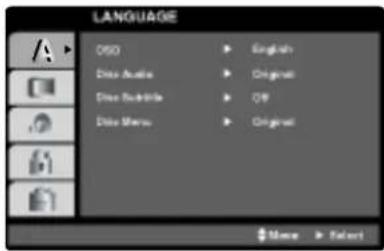
text_image
LANGUAGE O50 Chinese Chinese Language Chinese Language Chinese Language English Original Off Original Chinese Language Chinese Language Chinese Language Chinese Language Chinese Language Chinese Language Chinese Language Chinese Language Chinese Language Chinese Language Chinese Language Chinese Language Chinese Language Chinese Language Chinese Language Chinese Language Chinese Language Chinese Language Chinese Language Chinese Language Chinese Language Chinese Language Chinese Language Chinese Language Chinese Language Chinese Language Chinese Language Chinese Language Chinese Language Chinese Language Chinese Language Chinese Language Chinese Language Chinese LanguageOSD
Select a language for the Setup menu and on-screen display.
Disc Audio / Subtitle / Menu DVD
Select the language you prefer for the audio track (disc audio), subtitles, and the disc menu.
Original: Refers to the original language in which the disc was recorded.
Other: To select another language, press number buttons to enter the corresponding 4-digit number according to the language code list on page 38. If you enter the wrong language code, press CLEAR on the remote control.
Before Operation
DISPLAY
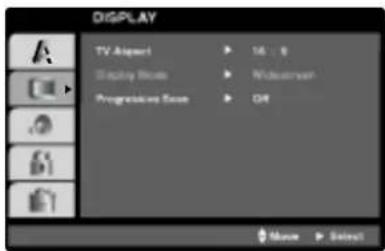
text_image
DISPLAY TV Angle: 16.0 Display Screen: Wideband Progressive Screen: Off Move SelectTV Aspect DVD
4:3: Select when a standard 4:3 TV is connected. 16:9: Select when a 16:9 wide TV is connected.
Display Mode DVD
Display Mode setting works only when the TV Aspect mode is set to "4:3".
Letterbox: Displays a wide picture with bands on the upper and lower portions of the screen.
Panscan: Automatically displays the wide picture on the entire screen and cuts off the portions that do not fit.
Progressive Scan DVD
Progressive Scan Video provides the highest quality pictures with less flickering.
If you are using the Component Video jacks for connection to a TV or monitor that is compatible with a progressive scan signal, set Progressive Scan to On.
To Turn ON progressive scan:
Connect component out of the DVD to the input of your monitor/television, set your television or monitor to Component Input.
- Select "Progressive Scan" on the DISPLAY menu then press ▶.
- Select "On" using the ▲ / ▼ buttons.
- Press SELECT/ENTER to confirm your selection. The confirm menu will appear.

text_image
DISPLAY 1x Appoint Dissoci Image Progressive Brain OK Cancel- When the confirm menu appears on your screen Cancel is highlighted as default. Use the ◀/▶ buttons to highlight Enter.
- Pressing ENTER will set the player to Progressive scan mode.
Caution
Once the setting for progressive scan output is entered, an image will only be visible on a progressive scan compatible TV or monitor. If you set Progressive Scan to On in error, you must reset the unit.
1) Remove any disc from the unit and close the disc tray. See that "NO DISC" is displayed on the display window
2) Press STOP (■) and hold it for five seconds before releasing it. The video output will be restored to the standard setting, and a picture will once again be visible on a conventional analog TV or monitor.
Before Operation
AUDIO
Each DVD disc has a variety of audio output options. Set the player's AUDIO options according to the type of audio system you use.

text_image
AUDIO CutUp Digital ▶ Bruttledown OTS ▶ Bruttledown MPED ▶ PCM Radio-Prog ▶ Oil kHz S.1 Speaker Setup ▶ Select DRC ▶ On Visual ▶ On Move ▶ SelectDolby Digital / DTS / MPEG DVD
Bitstream: Select "Bitstream" if you connect the DVD Player's DIGITAL OUT jack to an amplifier or other equipment with a Dolby Digital, DTS or MPEG decoder.
PCM : Select when connected to a two-channel digital stereo amplifier. DVDs encoded in Dolby Digital or MPEG will be automatically downmixed to two-channel PCM audio.
Sample Freq. (Frequency) DVD
If your receiver or amplifier is NOT capable of handling 96 kHz signals, select 48 kHz. When this choice is made, this unit automatically converts any 96 kHz signals to 48 kHz so your system can decode them.
If your receiver or amplifier is capable of handling 96 kHz signals, select 96 kHz. When this choice is made, this unit passes each type of signal through without any further processing.
Check the documentation for your amplifier to verify its capabilities.
5.1 Speaker Setup DVD
Select speaker settings, including volume balance and distance, or test the speaker settings.
Speaker settings are only active on the Analog Multi-Channel Output.
Speaker Setup
Make the following settings for the built-in 5.1 channel surround decoder.
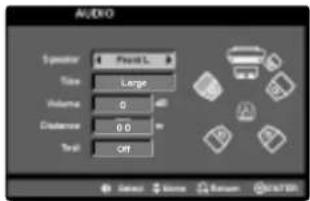
text_image
AUDIO Speed: 0.0 MHz/L Size: Large Volume: 0 dB Distortion: 0.0 m Tool: Opt OK Save Return Cancel- Press SETUP. The setup menu appears.
- Use ▲ / ▼ to select the AUDIO option then press ▶ to move to the second level.
- Use ▲ / ▼ to select the Speaker Setup option then press ▶ to move to the third level. "Select" is highlighted.
- Press SELECT/ENTER and 5.1 Speaker Setup menu appears.
- Use ◀ / ▶ to select the desired speaker.
- Adjust options using ▲ / ▼ / ◀ / ▶ buttons.
- Press SELECT/ENTER to confirm your selection. Returns to the previous menu.
Speaker selection
Select a speaker that you want to adjust. [Front speaker (Front L), Center Speaker, Front speaker (Front R), (Center), Rear speaker (Rear R), Rear speaker (Rear L) or Subwoofer (Woofer)]
Size
Press ◀/▶ to set a mode. (Large, Small or None)
- The size of the Front L/R speaker can be selected to "Large" or "Small".
- The size of the Subwoofer can be selected to "Large" or "None".
- Since the size of the Center and Rear L/R speaker are fixed to "Small", you can not change settings.
- If you have connected the system to a speaker with low frequency of 100Hz or below, select to "Large" the size of the Front L/R speaker. The size of the Subwoofer is selected to "None" automatically.
- If you have connected the system to a speaker without low frequency of 100Hz or below, select to "Small" the size of the Front L/R speaker. The size of the Subwoofer is selected to "Large" automatically. But if you haven't connected to subwoofer, always select to "Large" the size of Front L/R Speaker.
Before Operation
Volume
Press ◀/▶ to adjust the output level of the selected speaker. (-5dB \~ 5dB)
Distance
If you have connected speakers to your DVD Player, setting the Distance lets the speakers know how far the sound has to travel to reach your set listening point. This allows the sound from each speaker to reach the listener at the same time.
Press ◀ / ▶ to adjust the Distance of the selected speaker.
Test
Select "All" to test the signals of each speaker.
Adjust the volume to match the volume of test signals memorized in the system.
(When the size of the Front L/R speaker is selected to "Large", the subwoofer (Woofer) is not available.)
Front L → Center → Front R → Rear R → Rear L → Woofer
You can adjust the volume during operating the test tone, first use ▲ / ▼ to select Volume or Speaker option then use ◀ / ▶ buttons to select volume or speaker, so that all speaker's volume is same from the listener's position.
OTHERS

text_image
OTHERS PNC On Draft (R) Registration SelectPBC VCD
Set Playback Control (PBC) to On or Off.
On: Video CDs with PBC are played according to the PBC.
Off:Video CDs with PBC are played the same way as Audio CDs.
DivX DivX
You can check the DivX registration ID your unit.
Before Operation
LOCK (Parental Control)

text_image
LOCK Fating Password Country Code Gridlock NCAA ND None SelectRating DVD
Some movies contain scenes that may not be suitable for children to view. Many of these discs contain parental control information that applies to the complete disc or to certain scenes on the disc. Movies and scenes are rated from 1 to 8, depending on the country. Some discs offer more suitable scenes as an alternative.
The parental control feature allows you to block access to scenes below the rating you input, thereby preventing your children from being able to view material you believe is unsuitable.
1 Select "Rating" on the LOCK menu then press ▶.
2 To access the Rating, Password and Country Code features, you must input the 4-digit security code you created.
If you have not yet entered a security code you are prompted to do so.
Input a 4-digit code and press SELECT/ENTER. Enter it again and press SELECT/ENTER to verify. If you make a mistake before pressing SELECT/ENTER, press CLEAR.
3 Select a rating from 1 to 8 using the ▲ / ▼ buttons.
Rating 1-8: Rating one (1) has the most restrictions and rating eight (8) is the least restrictive.
Unlock
If you select unlock, parental control is not active and the disc plays in full.
Note
If you set a rating for the player, all disc scenes with the same rating or lower are played. Higher rated scenes are not played unless an alternate scene is available on the disc. The alternative must have the same rating or a lower one. If no suitable alternative is found, playback stops. You must enter the 4-digit password or change the rating level in order to play the disc.
4 Press SELECT/ENTER to confirm your rating selection, then press SETUP to exit the menu.
Password (Security Code)
You can enter or change password.
1 Select Password on the LOCK menu then press ▶.
2 Follow step 2 as shown left (Rating). "Change" or "New" is highlighted.
3 Enter the new 4-digit code, then press SELECT/ENTER. Input it again to verify.
4 Press SETUP to exit the menu.
If you forget your Security Code
If you forget your security code you can clear it using the following steps:
1 Input the 6-digit number "210499" on the setup menu and the security code is cleared.
2 Enter a new code as described above.
Note
When "INPUT MASKWD ■ ■ ■ ■ ■" appears on the TV screen, press STOP (■) and then press SETUP to move to the setup menu.
Country Code DVD
Enter the code of the country/area whose standards were used to rate the DVD video disc, based on the list in the reference chapter.
1 Select "Country Code" on the LOCK menu then press ▶.
2 Follow step 2 as shown left (Rating).
3 Select the first character using ▲ / ▼ buttons.
4 Shift the cursor using ▶ button and select the second character using ▲ / ▼ buttons.
5 Press SELECT/ENTER to confirm your country code selection.
Operation with RADIO
Presetting the radio stations
You can preset 50 stations for FM and AM.
Before tuning, make sure that you have turned the volume down to the minimum level.
1 Press TUNER to show either FM or AM in the display window. Every time you press this button, AM and FM changes alternately.
2 Press TUNING DOWN/UP on the front panel until the frequency indication starts to change, then release.
Notes
• Automatic Tuning
Press the TUNING DOWN/UP.
- Scanning stops when the unit tunes in a station.
- Manual Tuning
Use the MULTI JOG DIAL.
3 Press PROG./MEMO on the front panel. A preset number will flash in the display window.
4 Press PRESET DOWN/UP (or PRESET ▲/▼ on the remote control) to select the preset number you want.
5 Press PROG./MEMO again. The station is stored.
6 Repeat steps 2 to 5 to store other stations.
To clear all memorized stations
Press and hold PROG./MEMO on the front panel for about two seconds, "MEM RESET" appears in the display window and then press RESET on the front panel, the stations are cleared.
For your reference
If all stations have already been entered, "FULL" message will appear in the display window for a moment and then a preset number will flash.
To change the preset number, follow the steps 4-5.
To recall preset numbers
Press and hold PRESET DOWN/UP (or PRESET ▲/▼ on the remote control) until the desired preset number appears or press the button repeatedly.
Listening to the radio
1 Press TUNER to select either AM or FM in the display window. The last received station is tuned in.
2 Press PRESET DOWN/UP (or PRESET ▲/▼ on the remote control) repeatedly to select the preset station you want.
Each time you press this button, the unit tunes in the next preset station.
3 Adjust the volume by rotating VOLUME knob (or pressing VOLUME -/+ on the remote control) repeatedly.
To listen to non-preset radio stations
- For manual tuning, see "Manual Tuning".
- For automatic tuning, see "Automatic Tuning".
To turn the radio off
Press POWER to turn off the unit or to select another function mode (TAPE, KARAOKE/DVD or AUX).
For your reference
• If a FM program is noisy
Press MODE/RIF repeatedly so that "||||" disappears in the display window. There will be no stereo effect, but the reception will improve. Press MODE/RIF again to restore the stereo effect.
• To improve reception
Reposition the supplied antennas.
Notes
- Use MODE/RIF (Radio Interference Filter) function to switch to Mono reception if stereo reception is distorted by noise.
- While recording weak AM broadcasts, if noises occurs, press MODE/RIF once.
Operation with TAPE
Basic Playback
1 Press TAPE (or TAPE-1/2) to select tape function. ("NO TAPE" appears in the display window.)
2 Open cassette TAPE 1 (or 2) by pushing to the ▲PUSH EJECT position.
3 Insert one or two cassettes with the tape side to the bottom and then close the TAPE 1 (and/or 2) door.
4 Press ▶ (or ◀ : OPTIONAL) on the front panel or ▶ (or ◀: OPTIONAL) on the remote control.
AUTO STOP DECK (TAPE 1/2)
After auto stop deck plays front side of cassette, the unit stops automatically.
AUTO REVERSE DECK (TAPE 2) : OPTIONAL
You can select direction of the cassette you want by pressing PLAY MODE.
| Pressing | Display | Function |
| Once |  | After the cassette of TAPE 1 or 2 plays front or reverse (backward play) side, stops automatically. |
| Twice |  | After the cassette of TAPE 1 or 2 plays front and reverse side, stops automatically. |
| Three times |  | After the cassette of TAPE 1 or 2 plays six times repeatedly front and reverse side, stops automatically. |
To Stop Play
Press STOP(■)/RESET on the front panel or TAPE STOP(■) on the remote control during playback.
Tape Counter Reset
Press COUNT.RESET during playback.
Playing time appears "TAP -1 (or 2) 0000" in display window.
To Play Rewind or Fast Forward
After press ◀◀/▶▶ on the front panel or on the remote control during playback, press ▶ (or ◀:optional) at the tape position you want.
Dubbing
This function shows how to record from tape to tape.
Press TAPE or TAPE-1/2.
• Cassette TAPE 1- Insert the playback tape to dub.
• Cassette TAPE 2- Insert a blank tape to copy on.
Press NOR-DUBB./HI-DUBB..
• NOR-DUBB. - Normal speed copying
• HI-DUBB. - Double speed copying
To stop recording, press STOP (■).
Recording
Basic Setting
1 Press CD or TUNER to select source.
2 Open the cassette deck TAPE 2 and insert a blank cassette into the cassette compartment. Set the recording direction : OPTIONAL
Press PLAY MODE repeatedly to set the recording direction.
Recording from Radio, CD or Auxiliary source
1 Press ●/II on the front panel.
"REC" flashes and holds the cassette in pause mode.
2 Press ▶ (or ◀ : OPTIONAL) on the front panel or ▶ (or ◀: OPTIONAL) on the remote control.
The recording is begun.
To pause the recording
Press ●/II.
To Stop the recording
Press STOP(■).
CD to Tape Synchronized Recording
The CD synchro recording function dubs a complete CD and programmed titles automatically into a cassette.
1 Press CD SYNC. in stop mode.
"REC" flashes and "CD SYNCHRO" displays in the display window.
2 The synchronized recording is started automatically after about 7 seconds.
Notes
- If you wish to record from the desired track, select the desired track with MULTI JOG DIAL before commencing CD synchro recording.
- A function change is not possible during recording.
Operation with DVD and Video CD
Playing a DVD and Video CD
Playback Setup
- Turn on the TV and select the video input source connected to the unit.
- Audio system: Turn on the audio system and select the input source connected to the unit.
1 Press CD OPEN/CLOSE button to open the disc tray.
2 Load your chosen disc in the tray, with the playback side facing down.

Number 1 disc
Number 2 disc
- Playing one or two discs
Place discs on trays 1 and 2. - Playing three discs
After placing two discs, press the DISC SKIP button to rotate the trays. Place the next disc on tray 3.
3 Press CD OPEN/CLOSE button to close the tray. Playback starts automatically. If playback does not start, press PLAY.
In some cases, the disc menu might appear instead.
DVD
Use the ◀▶▲▼ buttons to select the title/chapter you want to view, then press SELECT/ENTER to start. Press TITLE or MENU to return to the menu screen.
VCD
Use the number buttons to select the track you want to view and press RETURN to return to the menu screen. Menu settings and operating procedures may differ. Follow the instructions on the each menu screen. You also may set PBC to Off (See "PBC" on page 21).
Notes
- If parental control is set and the disc is not within the rating settings you must input the password. (See "Lock Menu" on page 22.)
– DVDs may have a region code. Your player will not play discs that have a region code different from your player. The region code for this player is 5 (five).
General Features

-
Unless stated otherwise, all operations described use the remote control. Some features may also be available on the Setup menu.
Moving to another TITLE DVD
When a disc has more than one title, you can move to another title. Press DISPLAY while playback is stopped then the appropriate number (0-9) or use ◀/▶ to move to another title.
You can play any title by inputting its number while play-back is stopped.
Moving to another CHAPTER/TRACK
DVD VCD
When a title on a disc has more than one chapter or a disc has more than one track, you can move to another chapter/track as follows:
- Press ◀◀◀ or ▶▶◀ briefly during playback to select the next chapter/track or to return to the beginning of the current chapter/track.
- Press ◀◀ twice briefly to step back to the previous chapter/track.
- To go directly to any chapter during DVD playback, press DISPLAY and press ▲ / ▼ to select the chapter/track icon. Then, input the chapter/track number or use ◀ / ▶.
Search DVD VCD
1 Press ◀◀ or ▶▶ during playback.
The player will now go into SEARCH mode.
2 Press ◀◀ or ▶▶ repeatedly to select the required speed.
DVD: X2, X4, X8, X16, X100
Video CD; X2, X4, X8, X16
3 To exit SEARCH mode, press PLAY.
Operation with DVD and Video CD
General Features (continued)
Still Picture and Frame-by-frame playback
DVD VCD
1 Press PAUSE/STEP on the remote control during playback.
The player will now go into PAUSE mode.
2 You can advance the picture frame-by-frame by pressing PAUSE/STEP repeatedly on the remote control.
3 To exit still motion mode, press PLAY.
Slow Motion DVD VCD
1 Press PAUSE/STEP on the remote control during playback.
The player will enter SLOW mode.
2 Use the REV./FWD (◀◀/▶▶) to select the required speed: ◀ 1/2, ◀ 1/4, ◀ 1/8 or ◀ 1/16 [(backward) - DVD only] or ▶ 1/2, ▶ 1/4, ▶ 1/8 or ▶ 1/16 (forward).
3 To return to normal PLAY, press PLAY.

ote
Slow motion playback in reverse is not applicable for Video CD.
Repeat DVD VCD
You can play a title/chapter/all/track on a disc.
Press REPEAT during playback to select a desired repeat mode.
DVD Video Discs - Repeat Chapter/Title/Off
• Chapter: repeats the current chapter.
• Title: repeats the current title.
- Off: does not play repeatedly.
Video CDs - Repeat Track/All/Off
- Track : repeats the current track
- All : repeats all the tracks on a disc.
- Off: does not play repeatedly.

ote
- On a Video CD with PBC, you must set PBC to Off on the setup menu to use the repeat function (See "PBC" on page 21).
Repeat A-B DVD VCD
To repeat a sequence in a title:
1 Press A-B at your chosen starting point. "A - " appears briefly on the TV screen.
2 Press A-B again at your chosen end point.
"A - B" appears briefly on the TV screen, and the repeat sequence begins.
3 To cancel the sequence, press A-B.
Time Search DVD VCD
The Time Search function allows you to start playing at any chosen time on the disc.
1 Press DISPLAY during playback. The on-screen display appears on the screen.
The Time Search box shows the elapsed playing time of the current disc.
2 Within 10 seconds, press ▲▼ to select the Time Search icon in the on-screen display.
The “-:-:-:-” appears in the Time Search box.
3 Within 10 seconds, use the number buttons to enter the required start time. Enter hours, minutes, and seconds from left to right in the box.
If you enter the wrong numbers, press CLEAR to remove the numbers you entered. Then enter the correct numbers.
4 Within 10 seconds, press SELECT/ENTER to confirm the start time.
Playback starts from the selected time on the disc. If you enter an invalid time, playback will continue from the current point.
Last Scene Memory DVD
This player memorizes last scene from the last disc that is viewed. The last scene remains in memory even if you remove the disc from the player or switch off the player. If you load a disc that has the scene memorized, the scene is automatically recalled.

ote
This player does not memorize the scene of a disc if you switch off the player before commencing to play the disc.
Operation with DVD and Video CD
Special DVD Features DVD
Checking the contents of DVD Video discs: Menus
DVDs may offer menus that allow you to access special features. To use the disc menu, press MENU. Then, press the appropriate number button to select an option. Or, use the ◀/▶/▲▼ buttons to highlight your selection, then press SELECT/ENTER.
Title Menu DVD
1 Press TITLE.
If the current title has a menu, the menu will appear on the screen. Otherwise, the disc menu may appear.
2 The menu can list camera angles, spoken language and subtitle options, and chapters for the title.
3 To remove the title menu, press TITLE again.
Disc Menu DVD
Press MENU.
The disc menu is displayed.
Camera Angle DVD
If the disc contains scenes recorded at different camera angles, you can change to a different camera angle during playback.
- Press ANGLE repeatedly during playback to select a desired angle.
The number of the current angle appears on the display.
Changing the Audio Language DVD
Press AUDIO repeatedly during playback to hear a different audio language or audio track.
Changing the Audio Channel VCD
Press AUDIO repeatedly during playback to hear a different audio channel (STER., LEFT or RIGHT).
Subtitle DVD
Press SUBTITLE repeatedly during playback to see the different subtitle languages.
Note
If 🖼️ appears, the feature is not available on the disc.
Operation with Audio CD and MP3/WMA Disc
Playing an Audio CD and MP3/WMA
Disc CD MP3 WMA
The DVD Karaoke can play MP3/WMA formatted recordings on CD-ROM, CD-R, or CD-RW discs.
Audio CD
Once you insert an audio CD a menu appears on the TV screen. Press ▲ / ▼ to select a track then press PLAY or SELECT/ENTER and playback starts.
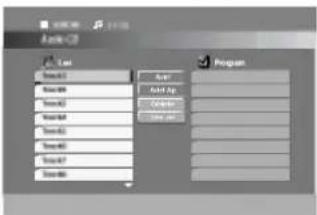
text_image
Add Add Up Add Up Add Up Add Up Add Up Add Up Add Up Add Up Add Up Add Up Add Up Add Up Add Up Add Up Add Up Add Up Add Up Add Up Add Up Add Up Add Up Add Up Add Up Add Up Add Up Add Up Add Up Add Up Add Up Add Up Add Up Add Up Add Up Add UpMP3 / WMA
- Press ▲ / ▼ to select a folder, and press SELECT/ENTER to see the folder contents.
- Press ▲ / ▼ to select a track then press PLAY or SELECT/ENTER. Playback starts.

text_image
Project Add Program Model Folder 1 Add Model Folder 2 Add Model Folder 3 Add Model Folder 4 Add Model Folder 5 Add Model Folder 6 Add Model Folder 7 Add Model Folder 8
otes
- If you are in a file list on the MP3/WMA menu and want to return to the Folder list, use the ▲ / ▼ to highlight 📁 and press SELECT/ENTER.
- Press and hold ▼ / ▲ to go to the next / previous page.
- On a CD with MP3/WMA file and JPEG file, you can switch MP3/WMA and JPEG menu. Press TITLE and MP3/WMA or JPEG word on top of the menu is highlighted. Then, use ◀ / ▶ to select MP3/WMA or JPEG then press SELECT/ENTER.
MP3 / WMA disc compatibility with this player is limited as follows:
- Sampling frequency: within 8 - 48 kHz (MP3), within 22 - 48kHz (WMA)
- Bit rate: within 32 - 320kbps (MP3), 40 - 192kbps (WMA)
- The player cannot read an MP3/WMA file that has a file extension other than ".mp3" / ".wma".
• CD-R physical format should be ISO 9660 - If you record MP3 / WMA files using software that cannot create a file system (eg. Direct-CD) it is impossible to playback MP3 / WMA files. We recommend that you use Easy-CD Creator, which creates an ISO 9660 file system.
- File names should have a maximum of 8 letters and must incorporate an .mp3 or .wma extension.
- They should not contain special letters such as / ? * : "< > I etc.
- The total number of files on the disc should be less than 999.
This DVD player requires discs and recordings to meet certain technical standards in order to achieve optimal playback quality. Pre-recorded DVDs are automatically set to these standards. There are many different types of recordable disc formats (including CD-R containing MP3 or WMA files) and these require certain pre-existing conditions (see above) to ensure compatible playback.
Customers should note that permission is required in order to download MP3 / WMA files and music from the Internet. Our company has no right to grant such permission. Permission should always be sought from the copyright owner.
Operation with Audio CD and MP3/WMA Disc
Pause CD MP3 WMA
1 Press PAUSE/STEP during playback.
2 To return to playback, press PLAY or press PAUSE/STEP again.
Moving to another Track CD MP3 WMA
- Press PREV./NEXT ◀◀◀ or ▶▶◀ briefly during playback to go to the next track or to return to the beginning of the current track.
- Press PREV./NEXT ◀◀ twice briefly to step back to the previous track.
- In case of audio CD, to go directly to any track, enter the track number using the numbered buttons (0-9) during playback.
Repeat Track/All/Off CD MP3 WMA
You can play a title/chapter/all/track on a disc.
1 Press REPEAT when playing a disc. The repeat icon appears.
2 Press REPEAT to select a desired repeat mode.
- Track: repeats the current track
- All: repeats all the tracks on a disc.
- Off(No display): does not play repeatedly.
Search CD MP3 WMA
1 Press ◀◀ or ▶▶ during playback.
The player will now go into SEARCH mode.
2 To exit SEARCH mode, press PLAY.
Operation with JPEG Disc
Viewing a JPEG disc
JPEG
This unit can play discs with JPEG files and Kodak picture CD. Before playing JPEG recordings, read the notes on JPEG Recordings on right.

Insert a disc and close the tray.
The JPEG menu appears on the TV screen.

Press ▲ / ▼ to select a folder, and press SELECT/ENTER. A list of files in the folder appears.

Tip
If you are in a file list and want to return to the Folder list, use the ▲▼ buttons on the remote to highlight "■- " and press SELECT/ENTER to return to the previous menu screen.

If you want to view a particular file, press ▲ / ▼ to highlight a file and press SELECT/ENTER or PLAY.
Slide Show starts from the selected file if Speed option is not Off.
While viewing a file, you can press STOP(■) to move to the previous menu (JPEG menu).

Tip
- Press MENU to move to the next page.
- There are four Slide Speed options: >>> (Fast), >> (Normal), > (Slow) and off.
Use ▲▼◀▶ to highlight the Speed. Then, use ◀/▶ to select the option you want to use then press SELECT/ENTER.
- If you set Speed option to Off, Slide Show is not active.
Slide Show
Use ▲▼◀▶ to highlight the Slide Show then press SELECT/ENTER.
Moving to another File
Press PREV./NEXT ◀◀ or ▶▶ once during viewing a picture to advance to the next file or to the previous file.
Still Picture
1 Press PAUSE/STEP during slide show. The player will now go into PAUSE mod
2 To return to the slide show, press PLAY or press PAUSE/STEP again.
JPEG disc compatibility with this player is limited as follows:
- Depending upon the size and number of JPEG files, it could take a long time for the DVD player to read the disc's contents. If you don't see an on-screen display after several minutes, some of the files may be too large — reduce the resolution of the JPEG files to less than 3760 x 3840 pixels and burn another disc.
- The total number of files and folders on the disc should be less than 999.
- Some discs may be incompatible due to a different recording format or the condition of disc.
- Ensure that all the selected files have the ".jpg" extensions when copying into the CD layout.
- If the files have ".jpe" or ".jpeg" extensions, please rename them as ".jpg" file.
- File names without ".jpg" extension will not be able to be read by this DVD player. Even though the files are shown as JPEG image files in Windows Explorer.
Programmed Playback CD MP3 WMA
The Program function enables you to store your favorite tracks from any disc in the player memory. A program can contain 99 tracks (Audio CD) or 300 tracks (MP3/WMA).
1 Insert a disc.
Audio CD and MP3/WMA Discs: Audio CD or MP3/WMA menu appears as below.
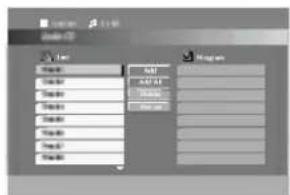
text_image
文件(F) 编辑(E) 视图(V) 新建(N) 删除(D) 合并(A) 重命名(M) 粘贴(P) 复制(C) 粘贴(P)... 剪切(T) 复制(R) 粘贴(P)... 复制(S) 粘贴(P)... 粘贴(P)... 粘贴(P)... 粘贴(P)... 粘贴(P)... 粘贴(P)... 粘贴(P)... 粘贴(P)... 粘贴(P)... 粘贴(P)... 粘贴(P)... 粘贴(P)... 粘贴(P)... 粘贴(P)... 粘贴(P)... 粘贴(P)... 粘贴(P)... 粘贴(P)... 粘贴(P)... 粘贴(P)... 粘贴(P)... 新建(N) 删除(D) 合并(A) 重命名(M) 粘贴(P) 合并(C) 重命名(S) 粘贴(P) 合并(S) 粘贴(P) 粘贴(P) 粘贴(P) 粘贴(P) 粘贴(P) 粘贴(P) 粘贴(P) 粘贴(P) 粘贴(P) 粘贴(P) 粘贴(P) 粘贴(P) 粘贴(P) 粘贴(P) 粘贴(P) 粘贴(P) 粘贴(P) 粘贴(P) 粘贴(P) 粘贴(P) 粘贴(P) 粘贴(P) 粘贴(P) 粘贴(P) 粘贴(P) 粘贴(P)Audio CD Menu

text_image
MINT 100% List A: 100% B: 100% C: 100% D: 100% E: 100% F: 100% G: 100% H: 100% I: 100% ExportMP3/WMA Menu
2 Select a track on the List.
3 Press PROGRAM. Or, select "Add" icon then SELECT/ENTER to place the selected track on the Program list. Repeat to place additional tracks on the list.
Note
You can add all tracks in the disc. Select "Add All" icon then press SELECT/ENTER.
4 Select the track you want to start playing on the Program list. Press and hold ▲ / ▼ to move to the next / previous page.
5 Press PLAY or SELECT/ENTER to start. Playback begins in the order in which you programmed the tracks and "PROG." appears on the display window. Playback stops after all of the tracks on the Program list have played once.
Repeat Programmed Tracks
You can play a title/chapter/all/track on a disc.
1 Press REPEAT when playing a disc. The repeat icon appears.
2 Press REPEAT to select a desired repeat mode.
- Track: repeats the current track
- All: repeats all the tracks on a disc.
- Off(No display): does not play repeatedly.
Erasing a Track from Program List
1 Use ▲▼◀▶ to select the track that you wish to erase from the Program list.
2 Press CLEAR. Or, select "Delete" icon then Press SELECT/ENTER to place the selected track on the Program list. Repeat to erase additional tracks on the list.
Erasing the Complete Program List
Select "Del all", then press SELECT/ENTER. The complete Program for the disc is erased.
Note
The programs are also cleared when the disc is removed.
To resume normal playback from programmed playback Select a track on the List then press SELECT/ENTER. "PROG." disappears from the display window.
Operation with DivX Disc
The unit can play the MPEG4 encoded files (.avi, mpg, .mpeg, .divx etc) and subtitle files (.srt, .smi).
1 Insert the MPEG4 encoded disc and close the tray.
The DivX menu appears on the TV screen.

text_image
My Computer My Computer 1 My Computer 2 My Computer 3 My Computer 4 My Computer 5 My Computer 6 My Computer 7 My Computer 82 Press ▲ / ▼ to select a folder, and press SELECT/ENTER to see the folder contents.
3 Press ▲ / ▼ to select a track then press PLAY or SELECT/ENTER.
Playback starts.
Pause DivX
- Press PAUSE/STEP during playback.
- To return to playback, press PLAY.
Repeat Track/All/Off DivX
You can play a title/chapter/all/track on a disc.
1 Press REPEAT when playing a disc. The repeat icon appears.
2 Press REPEAT to select a desired repeat mode.
- Track: repeats the current track
- All: repeats all the tracks on a disc.
- Off (No display): does not play repeatedly.
Subtitle DivX
Press SUBTITLE repeatedly during playback to see the different subtitle language.
Search DivX
1 Press REV.◀◀ or FWD▶▶ during playback.
2 Press REV.◀◀ or FWD▶▶ repeatedly to select the required speed.
3 To exit SEARCH mode, press PLAY.
Operation with KARAOKE
You can play KARAOKE(singing along) with CD by connecting a microphone to the unit.
You can enjoy KARAOKE with a stereo-recorded disc, even if it is a non-karaoke disc, by reducing the singer's voice.
Karaoke Basic Playback
1 Check if the system is connected. (Refer to the page 9-12.)
2 Turn on the powers of TV (or Amplifier) and DVD Karaoke and enter to the video mode on TV.
3 Press CD OPEN/CLOSE to open the disc tray and load supplied karaoke disc in the tray with the label facing up.
4 Press CD OPEN/CLOSE to close the tray.
5 Press KARAOKE/DVD to enter to the karaoke mode.
[TV Screen]
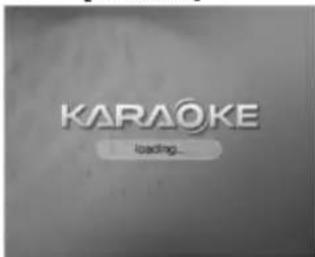
text_image
KARAOKE loading_6 Turn on the powers of the wireless microphone or connect the microphone to the MIC 1 or MIC 2 jack.
7 Select the melody number you want by pressing NUMERIC buttons.
If you cancel the selected melody number, press the CLEAR.
Press PLAY.
The selected melody number is played.
Sing in tone with microphone.
After melody ends, it is stopped automatically and score appears.
Karaoke Advanced Playback
Return Function
This is a function that returns to the preceding MENU.
Press the RETURN.

。
If there is no preceding menu (in case of the first menu), this function may not be executed.
To Adjust MIC Volume
Turn the MIC VOLUME CONTROL on the front panel clockwise to increase the volume, or counterclockwise to decrease it.
To Adjust ECHO Volume
You can give an echo effect to the sound from the microphones.
Press the ECHO repeatedly.
$$ E C H O O F F \rightarrow E C H O - 1 \rightarrow E C H O - 2 \rightarrow E C H O 3 $$

Key Control
You can change the key to suit your vocal range. You can adjust the key to 13 steps (6steps higher, 6steps lower and the original key).
- The setting appears on the screen.
Press KEY CONTROL (b/#) repeatedly on the remote control or turn KEY CONTROL (b/#) on the front panel to find the key that suits your vocal range.
- To flatten the key one by one, press the KEY CONTROL (b) repeatedly during playback.
- To sharp the key one by one, press the KEY CONTROL (#) repeatedly during playback.
- To return to the original key, press the KEY CONTROL (b/#) repeatedly to appear the original key.
Operation with KARAOKE
Reserving the Songs
When you want to make a reservation of next melody, you can enjoy the most 8 melodies reservation Without waiting.
1 Press the NUMERIC buttons to reserve melody number you want in the karaoke disc play mode.
Melody number appears on the TV screen.
Press PROGRAM.
The melody number is made a reservation.
Repeat steps 1-2.
You can reserve 8 songs.
T ip
After the one song finishes its playback, the next song will be playback automatically.
To cancel the reserved song
Each time you press CLEAR, the reserved song will be cancelled one by one.
To cancel or change the wrong reserved song
Press the PROGRAM to move to the desired position, then press the CLEAR to cancel the reserved song.
Male/Female Function
If you want to sing a song of MAN's or WOMEN's key, press MALE(♂)/FEMALE(♂) button repeatedly to change MAN's or WOMEN's key.
Tempo Change
You can use this function when you want to play fast or slow.
- Press TEMPO + repeatedly during singing to play faster.
- Press TEMPO - repeatedly during singing slower.
Screen Change Function VCD DVD
This function is used when you want to change the current screen during playing karaoke disc.
Press the DISC SELECT (DISC 1, DISC 2, DISC 3) or D.SKIP button during playing karaoke disc.
It is played a screen existing another disc.
Shadow Function
If Video CD caption and the song's subtitle are mixed up, the song's subtitle may be invisible. In this case, to highlight the song's subtitle, press SHADOW.
- It will be highlighted by background shadow image.
Karaoke MENU Playback
Preparation
Press MENU on the karaoke mode.
The main MENU appears on the screen.
Main MENU (On the TV screen)
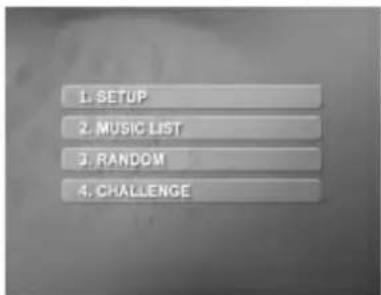
text_image
1. SETUP 2. MUSIC LIST 3. RANDOM 4. CHALLENGESETUP
1 Select SET UP by pressing ▲▼ on the main menu.
2 Use ◀▶ to select the desired option, and press SELECT/ENTER.
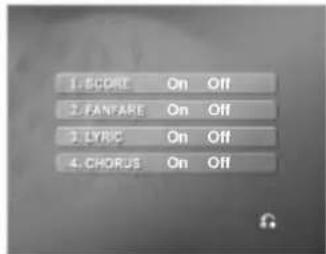
text_image
1. SCORE On Off 2. FANFARE On Off 3. LYRIC On Off 4. CHORUS On OffSCORE On/Off
On: When singing by selection of melody, song score comes out after one piece of song is ended.
To cancel it, select the Off
FANFARE On/Off
On: In condition of POWER ON, scoring fanfare operates. The fanfare sound comes out after singing finished.
To cancel it, select the Off
LYRIC On/Off
On: When singing by selection of melody, song lyric appears on the TV screen.
To cancel it, select the Off.
CHORUS On/Off
On: When singing by selection of melody, song chorus is heard a sound.
To cancel it, select the Off.
Note
To move to the main menu, press MENU or RETURN.
Operation with KARAOKE
MUSIC LIST
LOCAL SONG and POP SONG
1 Select POP SONG by pressing the ▲▼ on the main menu. The LOCAL SONG and POP SONG menu will be shown on the TV screen.

text_image
1. LOCAL SONG 2. POP SONG2 Select LOCAL SONG or POP SONG by pressing the ▲▼, and press SELECT/ ENTER. SONG LIST and SINGER LIST menu will be shown on the TV screen.

text_image
1. SONG LIST 2. SINGER LISTSONG LIST
1 Select SONG LIST and select the initial of the song title you want by pressing the ▲▼, then press SELECT/ ENTER.
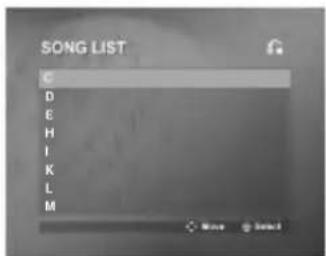
text_image
SONG LIST C D E H I K L M Move Send2 Select the song title you want by pressing the ▲▼, and press SELECT/ ENTER.

text_image
SONG LIST No Title Singer KENT CRAZY WORLD SOUND SET OK SelectSINGER LIST
1 Select SINGER LIST and select the initial of the singer you want by pressing the ▲▼ in the SONG LIST and SINGER LIST menu, and press SELECT/ENTER.
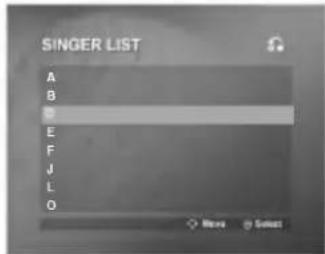
text_image
SINGER LIST A B E F J L O ■ New ■ Select2 Select the singer you want by pressing the ▲▼, and press SELECT/ ENTER.
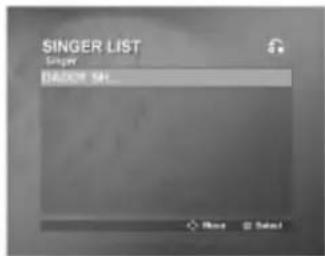
text_image
SINGER LIST Singer DADEE SH... Save Select3 Select the song title of the singer you want by pressing the ▲▼, and press SELECT/ ENTER.

text_image
SINGER LIST No 100 Singer S100 100.00 S100.00 S100.00 S100.00 S100.00 S100.00 S100.00 S100.00 S100.00 S100.00 S100.00 S100.00 S100.00 S100, SelectNote
To move the previous mode, select the 📄 by pressing the ▲▼, then press SELECT/ ENTER.
Operation with KARAOKE
RANDOM
1 Select RANDOM by pressing ▲▼ on the main menu.
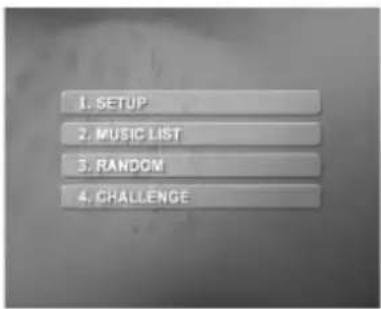
text_image
1. SETUP 2. MUSIC LIST 3. RANDOM 4. CHALLENGE2 Press SELECT/ENTER to begin ramdomly.
CHALLENGE
It has a function which enjoy a song game dividing by two teams of red team & blue team.
1 Select CHALLENGE by pressing ▲▼ on the main menu. It appears as below.

text_image
SET NUMBER TO WIN 1 2 3 4 5 6 7 8 9 CHALLENGE SCORE 60 70 80 90 START2 Select "SET NUMBER TO WIN" by pressing ▲▼, and select one of NUMERIC buttons 1\~9 by pressing ◀▶ to select winner's number, then press SELECT/ ENTER.
3 Select "CHALLENGE SCORE" by pressing ▲▼, and select one of 60,70,80 or 90 by pressing ◀ to select success score, then press SELECT/ENTER.
4 Select "START" by pressing ▲▼, then press SELECT/ ENTER.
It appears as below.
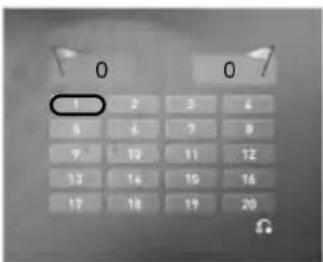
text_image
0 1 2 3 4 5 4 7 8 7 12 11 12 12 14 15 16 17 18 19 205 Select number you want by pressing ▲▼ and press SELECT/ ENTER.
Sing along with the accompaniment.
6 Repeat step 4\~5.
Change the team of red team or blue team alternately.
7 When reaching the targeted winning number, the "CONGRATULATION!" will be shown on the TV screen. It appears as below.
text_image
CONGRATULATION!8 Whether you keep going the song game or not, select "YES" or "NO" by pressing ▲▼ as below.
text_image
ONE MORE CHALLENGE ? 1. YES 2. NOTroubleshooting
Check the following guide for the possible cause of a problem before contacting service.
| Symptom | Cause | Correction |
| No power. | The power cord is disconnected. | Plug the power cord into the wall outlet securely. |
| The power is on, but the unit does not work. | No disc is inserted. | Insert a disc. (Check that the DVD or, audio CD indicator in the DVD display is lit.) |
| No picture. | The TV is not set to receive DVD signal output. | Select the appropriate video input mode on the TV so the picture from the unit appears on the TV screen. |
| The video cable is not connected securely. | Connect the video cable into the jacks securely. | |
| The connected TV power is turned off. | Turn on the TV. | |
| There is no sound or only a very low-level sound is heard. | The equipment connected with the audio cable is not set to receive DVD signal output. | Select the correct input mode of the audio so you can listen to the sound from the unit. |
| The audio cables are not connected securely. | Connect the audio cable into the jacks securely. | |
| The power of the equipment connected with the audio cable is turned off. | Turn on the equipment connected with the audio cable. | |
| The audio connecting cord is damaged. | Replace it with new one. | |
| The playback picture is poor. | The disc is dirty. | Clean the disc. |
| The unit does not start playback. | No disc is inserted. | Insert a disc. (Check that the DVD, or audio CD indicator in the DVD display is lit.) |
| An unplayable disc is inserted. | Insert a playable disc. (Check the disc type, color system and Regional code.) | |
| The disc is placed upside down. | Place the disc with the playback side down. | |
| The disc is not placed within the guide. | Place the disc on the disc tray correctly inside the guide. | |
| The disc is dirty. | Clean the disc. | |
| A menu is on the TV screen. | Press the SET-UP button to turn off the menu screen. | |
| The Rating level is set. | Cancel the Rating function or change the rating level. | |
| Severe hum or noise is heard. | The plugs and jacks are dirty. | Wipe them with a cloth slightly moistened with alcohol. |
| The disc is dirty. | Clean the disc. | |
| The speakers and components are connected poorly. | Connect the speakers and components securely. | |
| The unit is located with too close to the TV. | Move your TV away from the audio components. | |
| Radio stations cannot be tuned in. | The antenna is positioned or connected poorly. | Connect the antenna securely. |
| Adjust the antennas and connect an external antenna if necessary. | ||
| The signal strength of the stations is too weak (when tuning in with automatic tuning). | Tune in the station manually. | |
| No stations have been preset or preset stations have been cleared (when tuning by scanning preset stations). | Preset the stations. | |
| The remote control does not work properly. | The remote control is not pointed at the remote sensor of the unit. | Point the remote control at the remote sensor of the unit. |
| The remote control is too far from the unit. | Operate the remote control within about 23 ft (7 m). | |
| There is an obstacle in the path of the remote control and the unit. | Remove the obstacle. | |
| The batteries in the remote control are exhausted. | Replace the batteries with new ones. | |
| The sound mode or Pro Logic II mode cannot be changed. | The system cannot change while playing a MP3 or WMA disc. | Insert such a CD disc. |
Language Code List
Enter the appropriate code number for the initial settings "Disc Audio", "Disc Subtitle" and/or "Disc Menu" (See page 18).
| Code | Language | Code | Language | Code | Language | Code | Language |
| 6566 | Abkhazian | 7074 | Fiji | 7678 | Lingala | 8373 | Singhalese |
| 6565 | Afar | 7073 | Finnish | 7684 | Lithuanian | 8375 | Slovak |
| 6570 | Afrikaans | 7082 | French | 7775 | Macedonian | 8376 | Slovenian |
| 8381 | Albanian | 7089 | Frisian | 7771 | Malagasy | 8379 | Somali |
| 6577 | Ameharic | 7176 | Galician | 7783 | Malay | 6983 | Spanish |
| 6582 | Arabic | 7565 | Georgian | 7776 | Malayalam | 8385 | Sudanese |
| 7289 | Armenian | 6869 | German | 7784 | Maltese | 8387 | Swahili |
| 6583 | Assamese | 6976 | Greek | 7773 | Maori | 8386 | Swedish |
| 6588 | Aymara | 7576 | Greenlandic | 7782 | Marathi | 8476 | Tagalog |
| 6590 | Azerbaijani | 7178 | Guarani | 7779 | Moldavian | 8471 | Tajik |
| 6665 | Bashkir | 7185 | Gujarati | 7778 | Mongolian | 8465 | Tamil |
| 6985 | Basque | 7265 | Hausa | 7865 | Nauru | 8484 | Tatar |
| 6678 | Bengali; Bangla | 7387 | Hebrew | 7869 | Nepali | 8469 | Telugu |
| 6890 | Bhutani | 7273 | Hindi | 7879 | Norwegian | 8472 | Thai |
| 6672 | Bihari | 7285 | Hungarian | 7982 | Oriya | 6679 | Tibetan |
| 6682 | Breton | 7383 | Icelandic | 8065 | Panjabi | 8473 | Tigrinya |
| 6671 | Bulgarian | 7378 | Indonesian | 8083 | Pashto, Pushto | 8479 | Tonga |
| 7789 | Burmese | 7365 | Interlingua | 7065 | Persian | 8482 | Turkish |
| 6669 | Byelorussian | 7165 | Irish | 8076 | Polish | 8475 | Turkmen |
| 7577 | Cambodian | 7384 | Italian | 8084 | Portuguese | 8487 | Twi |
| 6765 | Catalan | 7465 | Japanese | 8185 | Quechua | 8575 | Ukrainian |
| 9072 | Chinese | 7487 | Javanese | 8277 | Rhaeto-Romance | 8582 | Urdu |
| 6779 | Corsican | 7578 | Kannada | 8279 | Rumanian | 8590 | Uzbek |
| 7282 | Croatian | 7583 | Kashmiri | 8285 | Russian | 8673 | Vietnamese |
| 6783 | Czech | 7575 | Kazakh | 8377 | Samoan | 8679 | Volapük |
| 6865 | Danish | 7589 | Kirghiz | 8365 | Sanskrit | 6789 | Welsh |
| 7876 | Dutch | 7579 | Korean | 7168 | Scots Gaelic | 8779 | Wolof |
| 6978 | English | 7585 | Kurdish | 8382 | Serbian | 8872 | Xhosa |
| 6979 | Esperanto | 7679 | Laothian | 8372 | Serbo-Croatian | 7473 | Yiddish |
| 6984 | Estonian | 7665 | Latin | 8378 | Shona | 8979 | Yoruba |
| 7079 | Faroese | 7686 | Latvian, Lettish | 8368 | Sindhi | 9085 | Zulu |
Country Code List
Enter the appropriate code number for the initial setting "Country Code" (See page 22).
| Code | Country | Code | Country | Code | Country | Code | Country |
| AD | Andorra | ER | Eritrea | LC | Saint Lucia | SC | Seychelles |
| AE | United Arab Emirates | ES | Spain | LI | Liechtenstein | SD | Sudan |
| AF | Afghanistan | ET | Ethiopia | LK | Sri Lanka | SE | Sweden |
| AG | Antigua and Barbuda | FI | Finland | LR | Liberia | SG | Singapore |
| AI | Anguilla | FJ | Fiji | LS | Lesotho | SH | Saint Helena |
| AL | Albania | FK | Falkland Islands | LT | Lithuania | SI | Slovenia |
| AM | Armenia | FM | Micronesia | LU | Luxembourg | SJ | Svalbard and Jan Mayen Islands |
| AN | Netherlands Antilles | FO | Faroe Islands | LV | Latvia | ||
| AO | Angola | FR | France | LY | Libya | SK | Slovak Republic |
| AQ | Antarctica | FX | France (European Territory) | MA | Morocco | SL | Sierra Leone |
| AR | Argentina | MC | Monaco | SM | San Marino | ||
| AS | American Samoa | GA | Gabon | MD | Moldavia | SN | Senegal |
| AT | Austria | GB | Great Britain | MG | Madagascar | SO | Somalia |
| AU | Australia | GD | Grenada | MH | Marshall Islands | SR | Suriname |
| AW | Aruba | GE | Georgia | MK | Macedonia | ST | Saint Tome and Principe |
| AZ | Azerbaidjan | GF | French Guyana | ML | Mali | SU | Former USSR |
| BA | Bosnia-Herzegovina | GH | Ghana | MM | Myanmar | SV | El Salvador |
| BB | Barbados | GI | Gibraltar | MN | Mongolia | SY | Syria |
| BD | Bangladesh | GL | Greenland | MO | Macau | SZ | Swaziland |
| BE | Belgium | GM | Gambia | MP | Northern Mariana Islands | TC | Turks and Caicos Islands |
| BF | Burkina Faso | GN | Guinea | MQ | Martinique (French) | TD | Chad |
| BG | Bulgaria | GP | Guadeloupe (French) | MR | Mauritania | TF | French Southern Territories |
| BH | Bahrain | GQ | Equatorial Guinea | MS | Montserrat | ||
| BI | Burundi | GR | Greece | MT | Malta | TG | Togo |
| BJ | Benin | GS | S. Georgia & S. Sandwich Isls. | MU | Mauritius | TH | Thailand |
| BM | Bermuda | MV | Maldives | TJ | Tadjikistan | ||
| BN | Brunei Darussalam | GT | Guatemala | MW | Malawi | TK | Tokelau |
| BO | Bolivia | GU | Guam (USA) | MX | Mexico | TM | Turkmenistan |
| BR | Brazil | GW | Guinea Bissau | MY | Malaysia | TN | Tunisia |
| BS | Bahamas | GY | Guyana | MZ | Mozambique | TO | Tonga |
| BT | Bhutan | HK | Hong Kong | NA | Namibia | TP | East Timor |
| BV | Bouvet Island | HM | Heard and McDonald Islands | NC | New Caledonia (French) | TR | Turkey |
| BW | Botswana | NE | Niger | TT | Trinidad and Tobago | ||
| BY | Belarus | HN | Honduras | NF | Norfolk Island | TV | Tuvalu |
| BZ | Belize | HR | Croatia | NG | Nigeria | TW | Taiwan |
| CA | Canada | HT | Haiti | NI | Nicaragua | TZ | Tanzania |
| CC | Cocos (Keeling) Islands | HU | Hungary | NL | Netherlands | UA | Ukraine |
| CF | Central African Republic | ID | Indonesia | NO | Norway | UG | Uganda |
| CG | Congo | IE | Ireland | NP | Nepal | UK | United Kingdom |
| CH | Switzerland | IL | Israel | NR | Nauru | UM | USA Minor Outlying Islands |
| CI | Ivory Coast | IN | India | NU | Niue | ||
| CK | Cook Islands | IO | British Indian Ocean Territory | NZ | New Zealand | US | United States |
| CL | Chile | OM | Oman | UY | Uruguay | ||
| CM | Cameroon | IQ | Iraq | PA | Panama | UZ | Uzbekistan |
| CN | China | IR | Iran | PE | Peru | VA | Vatican City State |
| CO | Colombia | IS | Iceland | PF | Polynesia (French) | VC | Saint Vincent & Grenadines |
| CR | Costa Rica | IT | Italy | PG | Papua New Guinea | ||
| CS | Former Czechoslovakia | JM | Jamaica | PH | Philippines | VE | Venezuela |
| CU | Cuba | JO | Jordan | PK | Pakistan | VG | Virgin Islands (British) |
| CV | Cape Verde | JP | Japan | PL | Poland | VI | Virgin Islands (USA) |
| CX | Christmas Island | KE | Kenya | PM | Saint Pierre and Miquelon | VN | Vietnam |
| CY | Cyprus | KG | Kyrgyzstan | PN | Pitcairn Island | VU | Vanuatu |
| CZ | Czech Republic | KH | Cambodia6 | PR | Puerto Rico | WF | Wallis and Futuna Islands |
| DE | Germany | KI | Kiribati | PT | Portugal | WS | Samoa |
| DJ | Djibouti | KM | Comoros | PW | Palau | YE | Yemen |
| DK | Denmark | KN | Saint Kitts & Nevis Anguilla | PY | Paraguay | YT | Mayotte |
| DM | Dominica | KP | North Korea | QA | Qatar | YU | Yugoslavia |
| DO | Dominican Republic | KR | South Korea | RE | Reunion (French) | ZA | South Africa |
| DZ | Algeria | KW | Kuwait | RO | Romania | ZM | Zambia |
| EC | Ecuador | KY | Cayman Islands | RU | Russian Federation | ZR | Zaire |
| EE | Estonia | KZ | Kazakhstan | RW | Rwanda | ZW | Zimbabwe |
| EG | Egypt | LA | Laos | SA | Saudi Arabia | ||
| EH | Western Sahara | LB | Lebanon | SB | Solomon Islands |
Specifications
| [General] | Power supply | Refer to the back panel. | |||
| Power consumption | 230W | ||||
| Mass | 11.2kg | ||||
| External dimensions (W x H x D) | 273 x 327 x 354 mm | ||||
| [CD/VCD/DVD] | Laser | Semiconductor laser, wavelength 650 nm | |||
| Frequency response (audio) | 40 - 18000 Hz | ||||
| Signal-to-noise ratio (audio) | More than 70 dB (1 kHz) | ||||
| Signal-to-noise ratio (video) | More than 60 dB (1 kHz) | ||||
| Dynamic range (audio) | More than 70 dB | ||||
| Harmonic distortion (audio) | 0.2 % (1 kHz) | ||||
| [Video] | Video output | 1.0 V (p-p), 75 Ω, negative sync., RCA jack | |||
| S-video output | (Y) 1.0 V (p-p), 75 Ω,(C) 0.3 V (p-p), 75 Ω | ||||
| [Tuner] | FM | Tuning Range | 87.5 -108.0 MHz or 65 -74 MHz, 87.5 -108.0 MHz | ||
| Intermediate Frequency | 10.7 MHz | ||||
| Signal to Noise Ratio (Mono/Stereo) | 60/55 dB | ||||
| Frequency Response | 60 - 10000 Hz | ||||
| AM(MW) | Tuning Range | 522 - 1611 kHz or 530 - 1610 kHz or 530 - 1720 kHz | |||
| Intermediate Frequency | 450 kHz | ||||
| Signal to Noise Ratio | 35 dB | ||||
| Frequency Response | 100 - 1800 Hz | ||||
| [Amplifier] | Output Power | Front: 50W + 50W (6Ω / ch THD 10 %)Center: 50W (6 Ω / ch THD10%)Rear: 50W + 50W (6 Ω / ch THD 10 %) | |||
| T.H.D | 0.2% | ||||
| Frequency Response | 42 - 25000 Hz | ||||
| Signal-to-noise ratio | 80 dB | ||||
| TAPE | Tape Speed | 3 KHz ± 50Hz | |||
| Wow Flutter | 0.25% (MTT -111, JIS-WTD) | ||||
| F.F/REW. Time | 120 sec (C-60) | ||||
| Frequency Response | 125 - 8000Hz | ||||
| Signal to Noise Ratio | 43dB (P/B)/ 43dB (R/B) | ||||
| Channel Separation | 45dB (P/B)/ 42dB (R/P) | ||||
| Erase Ratio | 52dB (MTT-5511) | ||||
| [Speakers] | Speaker Model | LMS-K5536V | LMS-K5536C | LMS-K5536T | |
| Type | 3 Way 3 Speaker | 2 Way 2 Speaker | 2 Way 2 Speaker | ||
| Impedance | 6 Ω | 6 Ω | 6 Ω | ||
| Frequency Response | 60 - 20000 Hz | 120 - 20000 Hz | 120 - 20000 Hz | ||
| Sound Pressure Level | 86 dB/W (1m) | 84 dB/W (1m) | 84 dB/W (1m) | ||
| Rated Input Power | 55 W | 40 W | 40 W | ||
| Max. Input Power | 110 W | 80 W | 80 W | ||
| Net Dimensions (W x H x D) | 230 x 326 x 296 mm | 200X108X110mm | 108 x 150 x 110mm | ||
| Net Weight | 5.0 kg | .85kg | 0.80 kg | ||