SY55858U - Electronic component Microchip - Free user manual and instructions
Find the device manual for free SY55858U Microchip in PDF.


User questions about SY55858U Microchip
0 question about this device. Answer the ones you know or ask your own.
Ask a new question about this device
Download the instructions for your Electronic component in PDF format for free! Find your manual SY55858U - Microchip and take your electronic device back in hand. On this page are published all the documents necessary for the use of your device. SY55858U by Microchip.
USER MANUAL SY55858U Microchip
■ Guaranteed AC parameters over temperature:
- f_MAX > 3.0GHz (3Gbps)
• t_r/t_f < 120ps
- Within-device skew < 25ps
■ Non-blocking "switch architecture"
■ Configurable as dual 2:1 mux, dual 1:2 fanout buffer, 1:4 fanout buffer, quad buffer, or dual 2 x 2 switch
■ 50Ω compatible outputs
■ Unique input termination and V_T pin for DC-coupled and AC-coupled input signals—CML or PECL
■ Fully differential inputs/outputs
■ TTL/CMOS compatible control logic
■ Wide supply voltage range: 2.3V to 3.6V
■ Wide operating temperature range: -40^ to +85^
■ Available in 32-pin EPAD-TQFP package

SuperLite™
DESCRIPTION
The SY55858U is a low-voltage, high-speed dual 2 x 2 crosspoint switch with a flexible input that accepts CML or PECL, and a 50Ω compatible differential CML (current-mode logic) output. The non-blocking design allows any input to connect to any output. Varying the state of the select inputs allows SY55858U to be used in backup, fault tolerant, protection and backplane distribution applications.
The signal inputs (DA 0-1 and DB 0-1 ) have a unique internal termination design that allows access to the termination network through V _T pins. This feature allows the device to easily interface to other logic standards such as AC-coupled or DC-coupled PECL/LVPECL signals. For applications that require a single-channel 2 x 2 crosspoint, consider the SY55854.
APPLICATIONS
■ SONET/SDH optical transport
■ Backplane redundancy
■ Add-drop Multiplexers
PACKAGE/ORDERING INFORMATION
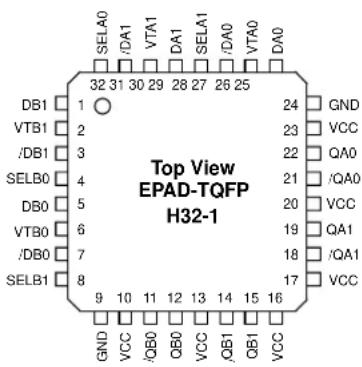
text_image
Top View EPAD-TQFP H32-132-Pin EPAD-TQFP (H321)
Ordering Information ^(1)
| Part Number Type Range | Package Marking | Operating Package Finish | Package Lead | |
| SY55858UHI H32-1 | Industrial SY5 | 55858UHI Sn-Pb | ||
| SY55858UHITR(2) | H32-1 | Industrial SY55 | 858UHI Sn-Pb | |
| SY55858UHG(3) | H32-1 | Industrial SY55 | 858UHG with Pb-FreePb-Free bar-line indicator | NiPdAu |
| SY55858UHGTR(2, 3) | H32-1 | Industrial SY55 | 858UHG with Pb-FreePb-Free bar-line indicator | NiPdAu |
Notes:
1. Contact factory for die availability. Dice are guaranteed at T_A=25^ , DC Electricals only.
2. Tape and Reel.
3. Pb-Free package recommended for new designs.
TRUTH TABLES
| SELA0 | SELA1 | QA0 | QA1 | Function |
| 0 | 0 | DA0 | DA0 | Fanout Buffer or Redundant Distribution |
| 0 | 1 | DA0 | DA1 | Dual Buffer or Crosspoint |
| 1 | 0 | DA1 | DA0 | Dual Buffer or Crosspoint |
| 1 | 1 | DA1 | DA1 | Fanout Buffer or Redundant Distribution |
Table 1. Input to Output Connectivity Crosspoint A
| SELB0 | SELB1 | QB0 | QB1 | Function |
| 0 | 0 | DB0 | DB0 | Fanout Buffer or Redundant Distribution |
| 0 | 1 | DB0 | DB1 | Dual Buffer or Crosspoint |
| 1 | 0 | DB1 | DB0 | Dual Buffer or Crosspoint |
| 1 | 1 | DB1 | DB1 | Fanout Buffer or Redundant Distribution |
Table 2. Input to Output Connectivity Crosspoint B
PIN DESCRIPTION
| Pin Number Pin Name Pin Function | ||
| 1 DB1 Channel B1 positive signal input. | ||
| 2 VTB1 Channel B1 termination center-tap. | For CML inputs, leave this pin floating.Otherwise, see Figures 5a–5d in “Input Interface Application” section. | |
| 3 /DB1 Channel B1 negative signal input. | ||
| 4 SELB0 Channel B0 output select. TTL/CMOS input. | ||
| 5 DB0 Channel B0 positive signal input. | ||
| 6 VTB0 Channel B0 termination center-tap. | For CML inputs, leave this pin floating.Otherwise, see Figures 5a–5d in “Input Interface Application” section. | |
| 7 /DB0 Channel B0 negative signal input. | ||
| 8 SELB1 Channel B1 output select. TTL/CMOS input. | ||
| 9, 24 GND Supply Ground. | ||
| 10, 13, 16, 17, 20, 23 VCC Positive supply normally bypass each pin with 0.1 × F//0.01 × F low ESR capacitors. | connect to 2.5V, 3.3V, or 5V nominal supply, and 0.1 × F//0.01 × F low ESR capacitors. | |
| 11 /QB0 Channel B0 negative signal output. | 50 CML. | |
| 12 QB0 Channel B0 positive signal output. | 50 CML. | |
| 14 /QB1 Channel B1 negative signal output. | 50 CML. | |
| 15 QB1 Channel B1 positive signal output. | 50 CML. | |
| 18 /QA1 Channel A1 negative signal output. | 50 CML. | |
| 19 QA1 Channel A1 positive signal output. | 50 CML. | |
| 21 /QA0 Channel A0 negative signal output. | 50 CML. | |
| 22 QA0 Channel A0 positive signal output. | 50 CML. | |
| 25 DA0 Channel A0 positive signal input. | ||
| 26 VTA0 Channel A0 termination center-tap. | For CML inputs, leave this pin floating.Otherwise, see Figures 5a–5d in “Input Interface Application” section. | |
| 27 /DA0 Channel A0 negative signal input. | ||
| 28 | SELA1 Channel A1 output select. TTL/CMOS input. | |
| 29 DA1 Channel A1 positive signal input. | ||
| 30 VTA1 Channel A1 termination center-tap. | For CML inputs, leave this pin floating.Otherwise, see Figures 5a–5d in “Input Interface Application” section. | |
| 31 /DA1 Channel A1 negative signal input. | ||
| 32 | SELA0 Channel A1 output select. TTL/CMOS input. | |
FUNCTIONAL BLOCK DIAGRAM
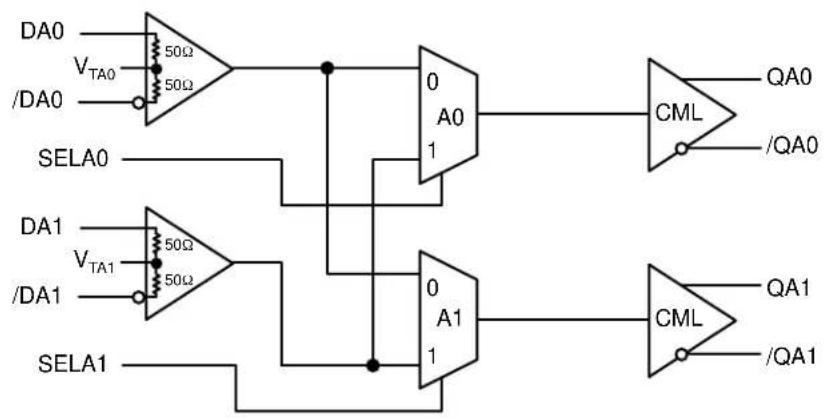
flowchart
graph TD
    DA0["DA0"] --> A0["50Ω"]
    VTA0["VTA0"] --> A0
    /DA0["/DA0"] --> A0
    SELA0["SELA0"] --> A0
    DA1["DA1"] --> A1["50Ω"]
    VTA1["VTA1"] --> A1
    /DA1["/DA1"] --> A1
    SELA1["SELA1"] --> A1
    A0 --> 0A0["0A0\n1"]
    0A0 --> CML1["CML"]
    0A1 --> 0A1a["0A1\n1"]
    0A1a --> CML2["CML"]
    CML1 --> QA0["QA0"]
    CML2 --> QA1["QA1"]
    style 0A0 fill:#f9f,stroke:#333
    style 0A1a fill:#ccf,stroke:#333
    style 0A1b fill:#cfc,stroke:#333
    style 0A1c fill:#fcc,stroke:#333
    style 0A1d fill:#ffc,stroke:#333
    style 0A1e fill:#cfc,stroke:#333
    style 0A1f fill:#fcc,stroke:#333
    style 0A1g fill:#ffc,stroke:#333
    style 0A2a fill:#cfc,stroke:#333
    style 0A2b fill:#fcc,stroke:#333
    style 0A2c fill:#ffc,stroke:#333
    style 0A2d fill:#cfc,stroke:#333
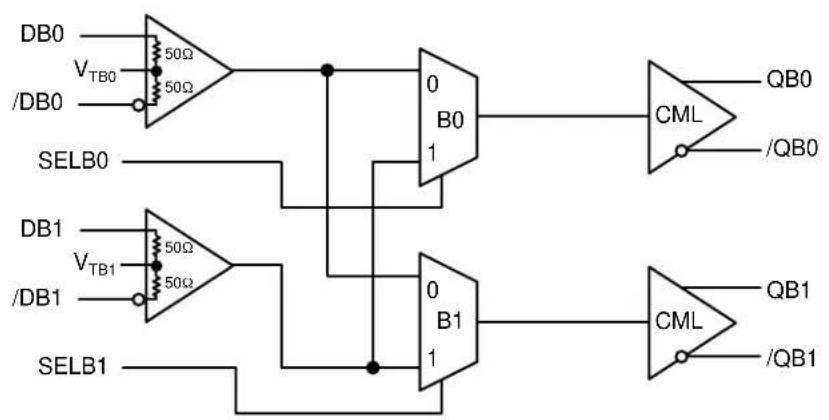
flowchart
graph TD
    A["DB0"] --> B["50Ω"]
    C["V_TB0"] --> B
    D["/DB0"] --> B
    E["SELB0"] --> F["0"]
    G["DB1"] --> H["50Ω"]
    I["V_TB1"] --> H
    J["/DB1"] --> H
    K["SELB1"] --> L["0"]
    M["0"] --> N["B0"]
    O["1"] --> P["B1"]
    Q["CML"] --> R["QB0"]
    S["CML"] --> T["QB1"]
    U["CML"] --> V["QB1"]
    style A fill:#f9f,stroke:#333
    style C fill:#f9f,stroke:#333
    style D fill:#f9f,stroke:#333
    style E fill:#f9f,stroke:#333
    style G fill:#f9f,stroke:#333
    style I fill:#f9f,stroke:#333
    style K fill:#f9f,stroke:#333
    style M fill:#f9f,stroke:#333
    style U fill:#f9f,stroke:#333
    style N fill:#ccf,stroke:#333
    style P fill:#ccf,stroke:#333
    style Q fill:#ccf,stroke:#333
    style S fill:#ccf,stroke:#333
    style U fill:#ccf,stroke:#333
INPUT AND OUTPUT STAGE

text_image
VCC D0 50Ω 1.2mA VT+ 50Ω /D0 1.2mA SY55858UFigure 1. Input Stage
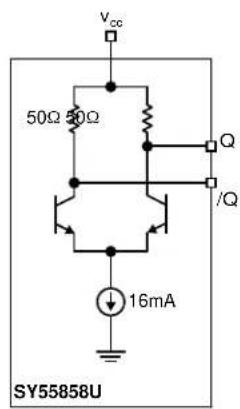
text_image
Vcc 50Ω 50Ω Q /Q 16mA SY55858UFigure 2. Output Stage
Note 1. See "Input Interface Applications" section for proper input connection.
ABSOLUTE MAXIMUM RATINGS ^(1)
| Symbol | Rating | Value | Unit |
| V_CC | Power Supply Voltage | -0.5 to +6.0 | V |
| V_IN | Input Voltage | -0.5 to V_CC +0.5 V | |
| V_OUT | CML Output Voltage | V_CC -1.0 to V_CC +0.5 | V |
| T_A | Operating Temperature Range | -40 to +85 | °C |
| T_LEAD | Lead Temperature (soldering, 20sec.) | 260 | °C |
| T_store | Storage Temperature Range | -65 to +150 | °C |
| _JA | Package Thermal Resistance(Junction-to-Ambient)–Still-Air (multi-layer PCB)–500Ifpm (multi-layer PCB) | 2820 | °C/W°C/W |
| _JC | Package Thermal Resistance(Junction-to-Case) | 4 | °C/W |
Note 1. Permanent device damage may occur if absolute maximum ratings are exceeded. This is a stress rating only and functional operation is not implied at conditions other than those detailed in the operational sections of this data sheet. Exposure to absolute maximum rating conditions for extended periods may affect device reliability.
DC ELECTRICAL CHARACTERISTICS
| Symbol | Parameter Min. Typ. Max. Unit Condition | |||||
| V_CC | Power Supply Voltage 2.3 — 3.6 V | |||||
| I_CC | Power Supply Current — 150 190 mA No load, over temp. | |||||
TTL CONTROL ELECTRICAL CHARACTERISTICS
V_CC = 2.3V to 3.6V ; GND = 0V; T_A = -40^ C to +85^ C^(2)
| Symbol | Parameter Min. Typ. Max. Unit Condition | |||||
| V_IH | Input HIGH Voltage 2.0 — | — | V | |||
| V_IL | Input LOW Voltage | — | — | 0.8 | V | |
| I_IH | Input HIGH Current | — | — | +20 | A | V_IN = 2.7V, V_CC = Max. V_IN = V_CC, V_CC = Max. |
| — | — | +100 | A | |||
| I_IL | Input LOW Current | -300 | — | — | A | V_IN = 0.5V, V_CC = Max. |
Note 2. Specifications are guaranteed after thermal equilibrium has been established.
CML DC ELECTRICAL CHARACTERISTICS
V_CC=2.3V to 3.6V; GND = 0V; T_A=-40^ to +85^^(3)
| Symbol | Parameter | Min. | Typ. | Max. | Unit | Condition |
| V_ID | Differential Input Voltage | 100 | — | — | mV | |
| R_IN | Differential Input Resistance D-to-/D | 90 | 100 | 110 | Ω | |
| V_IH | Input HIGH Voltage | 1.6 | — | V_CC | V | |
| V_IL | Input LOW Voltage | 1.5 | — | V_CC-0.1 | V | |
| V_OH | Output HIGH Voltage | V_CC-0.040 | V_CC-0.010 | V_CC | V | No Load |
| V_OL | Output LOW Voltage V | _CC-1.00 | V_CC-0.800 | V_CC-0.650 | V | No Load |
| V_OUT(SWING) | Output Voltage Swing(4) | 0.650— | 0.8000.400 | 1.00— | V | No Load50Ω Environment |
| R_OUT | Output Source Impedance | 40 | 50 | 60 | Ω |
Note 3. Device is guaranteed to meet the DC specifications, shown in the table above, after thermal equilibrium has been established. The device is tested in a socket such that traverse airflow ≥ 500lfpm is maintained.
Note 4. V_OUT(SWING) is defined as the swing on one output of a differential pair, that is |V_OH - V_OL| on one pin. The swing for common mode immunity purposes is 2 · V_OUT(SWING) . Actual voltage levels and differential swing will depend on customer termination scheme. Typically, a 400mV swing is available in the 50Ω environment. Refer to the "CML Output Termination Application" section, Figures 3 and 4, for more details.
AC ELECTRICAL CHARACTERISTICS
V_CC=2.3V to 3.6V; GND = 0V; T_A=-40^ to +85^^(5)
| Symbol | Parameter Min. Typ. Max. Unit | Condition | ||||
| f_MAX | Maximum FrequencyNRZ Data Rate 3 | .0 — | — | Gbps | ||
| Clock Frequency^(6) | 3.0 — | — | GHz | |||
| t_PLH t_PHL | Differential Propagation Delay D-to-Q | 220 350 450 ps | ||||
| t_SWITCH | Select-to-Valid Output^(7) | — 0.50 1.0 ns | ||||
| t_SKEW | Within-Device Skew^(8) | — | 12 | 25 | ps | |
| Within-Device Skew^(9) | — | 25 | 50 | ps | ||
| Part-to-Part Skew (Diff.) | — | 100 | — | |||
| R_J | Random Jitter | — | 2 | 5 | ps_RMS | |
| D_J | Deterministic Jitter | — | 5 | 20 | ps_PP | |
| t_r, t_f | CML Output Rise/Fall Times (20% to 80%) | — | 80 | 120 | ps |
Note 5. Tested using environment of Figure 3, 50 equivalent load. AC parameters are guaranteed by design and characterization.
Note 6. f_MAX clock is defined as the maximum toggle rate the device can operate while still achieving a 250mV minimum CML output swing, 50Ω equivalent load.
Note 7. Input TTL/CMOS edge rate of <1.5ns.
Note 8. Worst-case difference between QA0 and QA1 from either DA0 or DA1 (or between QB0 and QB1 from either DB0 or DB1 respectively), when both outputs come from the same input.
Note 9. Worst-case difference between QA and QB outputs, when DA or DB inputs are shorted.
CML OUTPUT TERMINATION APPLICATION
All CML inputs accept a CML output from any other member of this family. All CML outputs are source terminated
50Ω differential drivers as shown in Figure 3.
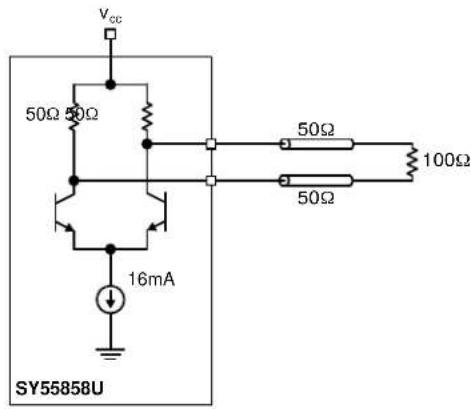
text_image
Vcc 50Ω 50Ω 16mA SY55858U 50Ω 100Ω 50ΩFigure 3. 50Ω Output Termination

line
| Signal Type | Value | |-------------|-----------| | QOUT | + | | /QOUT | - | | 400mV (Single-Ended) | 400mV (Single-Ended) | | QOUT | - | | /QOUT | - | | 800mV (QOUT —/QOUT Differential) | 800mV (Differential) |Figure 4. Output Levels
INPUT INTERFACE APPLICATIONS

text_image
VCC CML D /D NC □ VT SY55858 VCCFigure 5a. CML-to-CML (DC-Coupled) Input Interface

text_image
Vcc CML D /D SY55858 VT Vcc - 1.3VFigure 5b. CML-to-CML (AC-Coupled) Input Interface

text_image
VCC PECL D /D SY55858 VT VCC - 2.0VFigure 5c. PECL-to-CML (DC-Coupled) Input Interface

text_image
Vcc PECL 220Ω220Ω D /D SY55858 VT Vcc - 1.3V VccFigure 5d. PECL-to-CML (AC-Coupled) Input Interface
32 -PIN EPAD-TQFP (DIE UP) (H32-1)
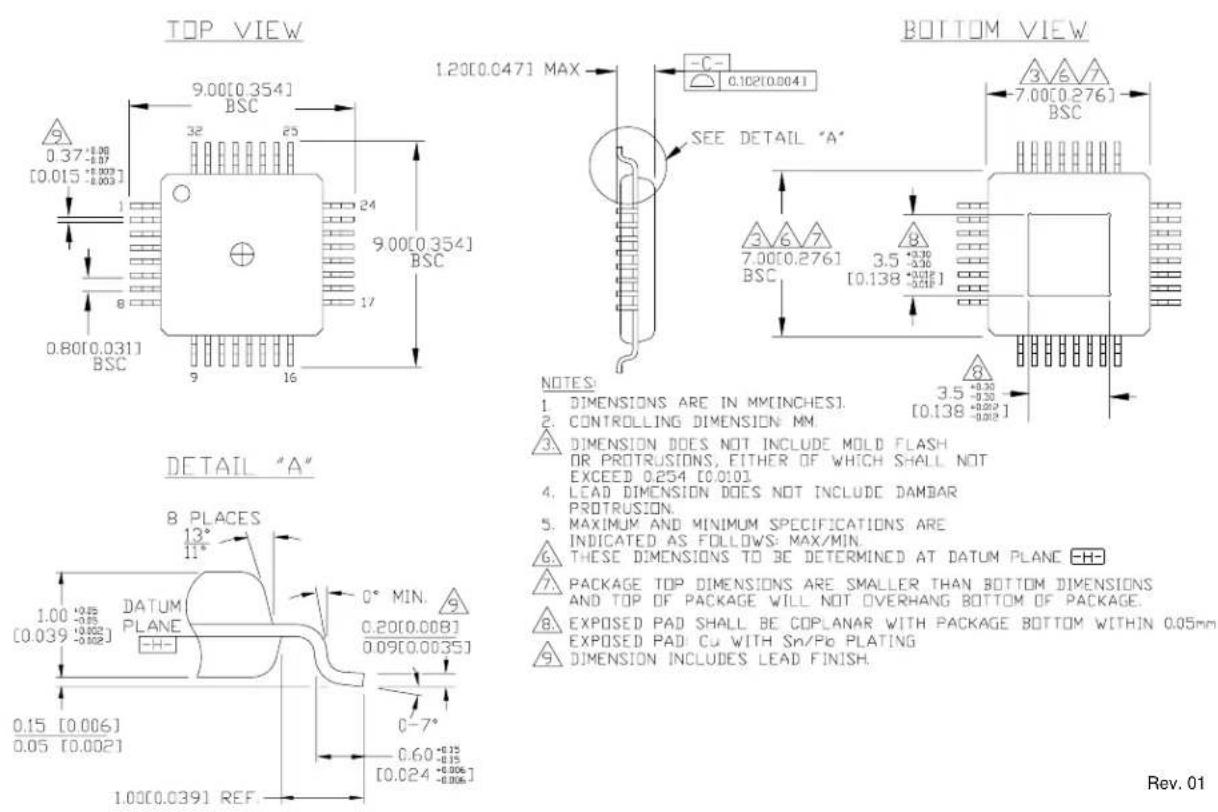
- DIMENSION DOES NOT INCLUDE MOLD FLASH OR PROTRUSIONS, EITHER OF WHICH SHALL NOT EXCEED 0.254 [0.010]
- LEAD DIMENSION DOES NOT INCLUDE DAMBAR PROTRUSION.
- MAXIMUM AND MINIMUM SPECIFICATIONS ARE INDICATED AS FOLLOWS: MAX/MIN.
G. THESE DIMENSIONS TO BE DETERMINED AT DATUM PLANE -H- - PACKAGE TOP DIMENSIONS ARE SMALLER THAN BOTTOM DIMENSIONS AND TOP OF PACKAGE WILL NOT OVERHANG BOTTOM OF PACKAGE.
- EXPOSED PAD SHALL BE COPLANAR WITH PACKAGE BOTTOM WITHIN 0.05mm
EXPOSED PAD Cu WITH Sn/Pb PLATING
9 DIMENSION INCLUDES LEAD FINISH.
Rev. 01
MICREL, INC. 2180 FORTUNE DRIVE SAN JOSE, CA 95131 USA
TEL + 1 (408) 944-0800 FAX + 1 (408) 474-1000 WEB http://www.micrel.com
The information furnished by Micrel in this datasheet is believed to be accurate and reliable. However, no responsibility is assumed by Micrel for its use. Micrel reserves the right to change circuitry and specifications at any time without notification to the customer.
Micrel Products are not designed or authorized for use as components in life support appliances, devices or systems where malfunction of a product can reasonably be expected to result in personal injury. Life support devices or systems are devices or systems that (a) are intended for surgical implant into the body or (b) support or sustain life, and whose failure to perform can be reasonably expected to result in a significant injury to the user. A Purchaser's use or sale of Micrel Products for use in life support appliances, devices or systems is at Purchaser's own risk and Purchaser agrees to fully indemnify
Micrel for any damages resulting from such use or sale.
© 2005 Micrel, Incorporated.