DHR70B-BRASS - Weather Station Ambient Weather - Free user manual and instructions
Find the device manual for free DHR70B-BRASS Ambient Weather in PDF.


User questions about DHR70B-BRASS Ambient Weather
0 question about this device. Answer the ones you know or ask your own.
Ask a new question about this device
Download the instructions for your Weather Station in PDF format for free! Find your manual DHR70B-BRASS - Ambient Weather and take your electronic device back in hand. On this page are published all the documents necessary for the use of your device. DHR70B-BRASS by Ambient Weather.
USER MANUAL DHR70B-BRASS Ambient Weather
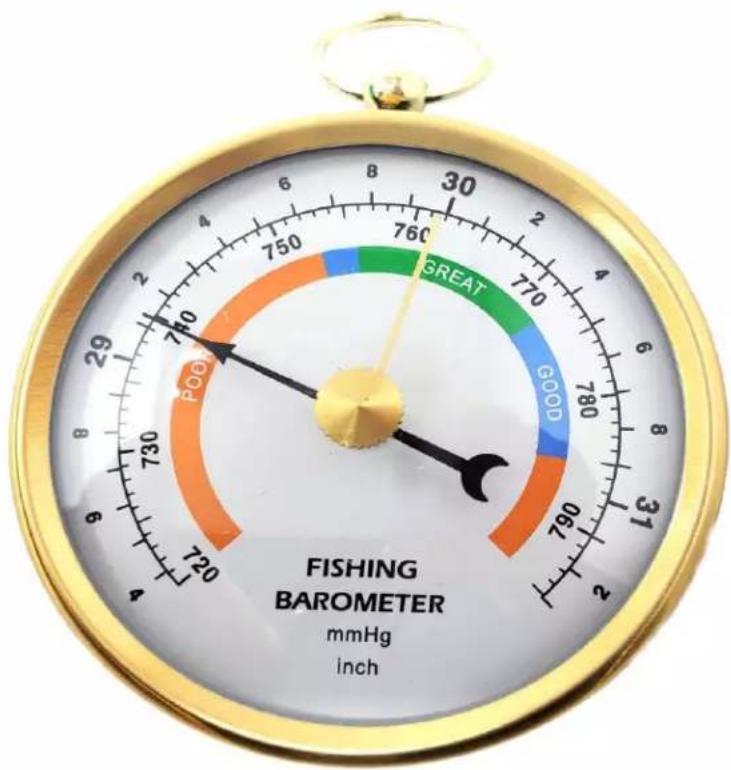
Ambient Weather DHR70B-BRASS Handheld Fishing Barometer User Manual

ambient weather
Table of Contents
- Introduction......2
- Preparation....2
- Care and Cleaning....2
- Aneroid Barometer....2
4.1 How the aneroid barometer works 2
4.2 Reading the barometer....2
4.3 Absolute vs. Relative Pressure 3
4.4 Barometer Calibration....3 - Installation....4
- Measurement Specifications .... 4
- Warranty Information....4
text_image
FISHING BAROMETER mmHg inch1. Introduction
Thank you for your purchase of the Ambient Weather DHR70B-BRASS Handheld Fishing Barometer. The following is a guide for preparation, care and operation of your barometer.
2. Preparation
Your weather instrument may include a protective pad to prevent damage to the barometer glass case during shipment. Remove this protective pad and circular instruction sheet.
Your barometer must be calibrated to the local relative pressure before use. Please reference Section 4.4.
3. Care and Cleaning
Avoid use of harsh household cleaners and coarse paper towels, which can scratch the bezel or lens. Fingerprints and dirt may be removed the lenses and bezels with a soft cloth lightly dampened with a mixture of water and mild dishwashing liquid. Be sure to dry the lens and bezel with a soft cloth after cleaning.
4. Aneroid Barometer
4.1 How the aneroid barometer works
An aneroid barometer uses a small, flexible metal box called an aneroid cell. This aneroid capsule (cell) is made from an alloy of beryllium and copper. The evacuated capsule (or usually more capsules) is prevented from collapsing by a strong spring. Small changes in external air pressure cause the cell to expand or contract. This expansion and contraction drives mechanical levers such that the tiny movements of the capsule are amplified and displayed on the face of the aneroid barometer. Many models include a manually set needle which is used to mark the current measurement so a change can be seen. It was invented by Blaise Pascal.
4.2 Reading the barometer
It is highly advisable to lightly tap the glass near the center brass knob with your fingers before taking a barometer reading. The light tap will overcome any friction that may affect accurate hand readings, especially during periods of slow atmospheric changes. The Coast Guard has informed us that tapping the barometer is even required on the most expensive aneroid barometers, because the mechanism is made deliberately “stiff”.
The ability if the barometer to indicate changes in barometric pressure makes it a useful instrument in weather forecasting.
The weather forecast or pressure tendency is based on the rate of change of barometric pressure. In general, when the pressure increases, the weather improves (sunny to partly cloudy) and when the pressure decreases, the weather degrades (cloudy to rain).
The weather forecast is an estimation or generalization of weather changes in the next 24 to 48 hours, and varies from location to location. The tendency is simply a tool for projecting weather conditions and is never to be relied upon as an accurate method to predict the weather.
The barometer includes a manually set needle, which is used to mark the current measurement so a change can be seen. Barometric readings should be taken daily. Remember that the rate of change of barometric pressure is important in determining weather changes. You may want to take multiple readings each day during periods of unstable weather conditions.
The following basic rule of thumb will hold true in using the barometer to predict weather conditions.
• A fast rise in barometric pressure means goo weather of short duration.
• A rapid drop in barometric pressure means disturbances nearby, showers of short duration.
- Regular elevation in barometric pressure usually will indicate a clear, dry weather conditions (cold and dry in the winter).
• A slow but continuous drop in barometric pressure will indicate persistent, bad weather.
- Slow drops of 2-3 tenths mbar per 24 hours a depression of some distance away.
- Drops of 1-2 tenths mbar per hour means disturbances nearby of short duration.
- Steep drops of 6-10 tenths mbar within 4-5 hours period indicates coming rain and/or storm with strong winds.
4.3 Absolute vs. Relative Pressure
To compare pressure conditions from one location to another, meteorologists correct pressure to sea-level conditions. Because the air pressure decreases as you rise in altitude, the sea-level corrected pressure (the pressure your location would be at if located at sea-level) is generally higher than your measured pressure.
Thus, your absolute pressure (measured at your location) may read 28.62 inHg (969 mb) at an altitude of 1000 feet (305 m), but the relative pressure (sea-level) is 30.00 inHg (1016 mb).
The standard sea-level pressure is 29.92 in Hg (1013 mb). This is the average sea-level pressure around the world. Relative pressure measurements greater than 29.92 in Hg (1013 mb) are considered high pressure and relative pressure measurements less than 29.92 in Hg are considered low pressure.
To determine the relative pressure for your location, locate an official reporting station near you (the internet is the best source for real time barometer conditions, such as Weather.com or Wunderground.com), and set your weather station to match the official reporting station.
4.4 Barometer Calibration
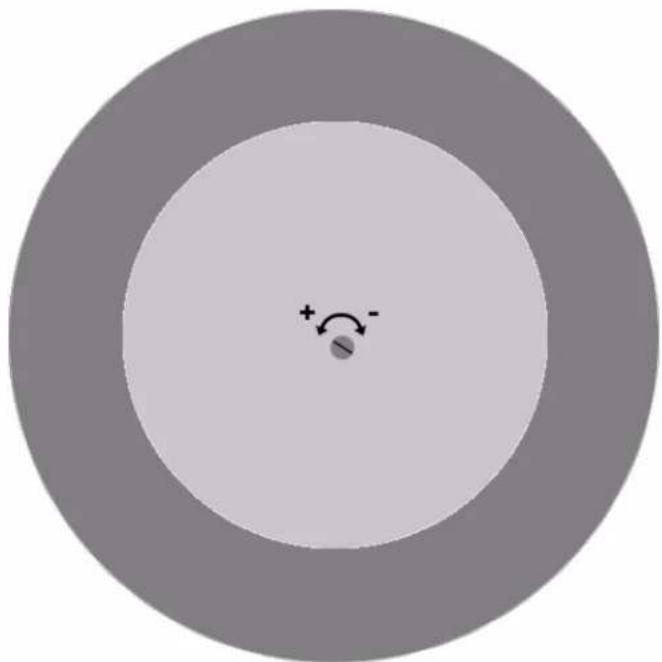
Reference Figure 1 to calibrate the barometer (your barometer calibration screw location may vary).
Your barometer will operate from -100 to 3,000 feet with reliable accuracy. Aneroid barometers have a small screw on the back for sea-level calibration. With a flat blade screwdriver, turn this screw in either direction slightly while looking at the indicator needle. It should move in one direction or the other. Tap the barometer to see where the needle settles. Continue this procedure until the proper pressure reading is obtained. Do not turn the screw counter-clockwise (to the left) too far, since the screw can fall out. After the initial calibration, no further adjustment will be required unless the barometer is moved to a new geographic location.
natural_image
Circular diagram with concentric rings and a central dot, no text or symbols present
Figure 1
5. Installation
To install the barometer, hang the barometer on a wall with the suspension eye or suspension ring built into the barometer. Only install indoors, in a clean area.
6. Measurement Specifications
The following table provides specifications for the measured parameters.
| Measurement | Range | Accuracy | Resolution |
| Barometric Pressure | 720 mmHg to 800mmHg (about -100 to 3,000') | 795 – 772.5: ± 7.5mmHg772.5 – 742.5: ± 3.75mmHg742.5 – 720: ± 7.5mmHg | 1 mmHg |
7. Warranty Information
Ambient, LLC provides a 1-year limited warranty on this product against manufacturing defects in materials and workmanship.
This limited warranty begins on the original date of purchase, is valid only on products purchased and only to the original purchaser of this product. To receive warranty service, the purchaser must contact Ambient, LLC for problem determination and service procedures.
Warranty service can only be performed by a Ambient, LLC. The original dated bill of sale must be presented upon request as proof of purchase to Ambient, LLC.
Your Ambient, LLC warranty covers all defects in material and workmanship with the following specified exceptions: (1) damage caused by accident, unreasonable use or neglect (lack of reasonable
and necessary maintenance); (2) damage resulting from failure to follow instructions contained in your owner's manual; (3) damage resulting from the performance of repairs or alterations by someone other than an authorized Ambient, LLC authorized service center; (4) units used for other than home use (5) applications and uses that this product was not intended, such as outdoor use.
This warranty covers only actual defects within the product itself, and does not cover the cost of installation or removal from a fixed installation, normal set-up or adjustments, claims based on misrepresentation by the seller or performance variations resulting from installation-related circumstances.