J1028 - Washing machine SAMSUNG - Free user manual and instructions
Find the device manual for free J1028 SAMSUNG in PDF.


User questions about J1028 SAMSUNG
0 question about this device. Answer the ones you know or ask your own.
Ask a new question about this device
Download the instructions for your Washing machine in PDF format for free! Find your manual J1028 - SAMSUNG and take your electronic device back in hand. On this page are published all the documents necessary for the use of your device. J1028 by SAMSUNG.
USER MANUAL J1028 SAMSUNG
Washing Machine user manual
imagine the possibilities
Thank you for purchasing this Samsung product. To receive more complete service, please register your product at
www.samsung.com/register
SAMSUNG
features of your new samsung washing machine
Your new washing machine will change the way you feel about doing laundry. From its super-size capacity to its energy efficiency, the Samsung washing machine has all the features to turn a mundane chore into a pleasure.
- Baby Care System
Your Samsung washing machine includes wash programs that adds protection to the clothing of children with sensitive skin.
These programs reduce skin irritation in children by minimizing detergent residue. In addition, these programs classify laundry into various types and the wash is performed according to the laundry characteristics so that children feel refreshingly clean whenever they put on their clothes.
- Child Lock
The Child Lock function ensures that curious little hands are kept out of your washing machine.
This safety feature stops your children from playing with the operation of the washing machine, and alerts you when it is activated.
- Delay End
Delay a cycle for up to 19 hours in one-hour increments and increase the convenience of using your washing machine especially when you have to go out.
- Quick Wash
No time to lose! Less than 15 minutes wash will give you time to run out before it's too late. Our 15 minute Quick Wash program can be the solution to your busy life. Now you can wash your favourite clothes in only 15 minutes!
- Delicates Program
Special care can be determined by the appropriate temperature, the gentle wash action and the appropriate amount of water.
- Wool Certified
The machine has been tested and passed the required Woolmark Company specification for machine washable wool products.
Fabrics should be washed according to the instructions on the garment label as specified by Woolmark and Samsung.
- Ceramic Heater for Durability & Energy Saving (selected models)
Our truly innovative Ceramic Heater is twice as durable as regular heaters.
That saves you money on repairs. Plus, it eliminates the scale of hard water and save energy.
- Wide door
Extra wide door aperture for convenient viewing! Easily add and remove laundry, especially for large sized laundry items such as bedding, towels etc.
This manual contains important information on the installation, use, and care of your new Samsung washing machine. Refer to it for descriptions of the control panel, instructions on how to use the washing machine, and tips for making the most of its state-of-the-art features and functions. The “Troubleshooting and information codes” section on page 33 tells you what to do if something goes wrong with your new washing machine.
safety information
Congratulations on your new Samsung ActivFresh™ washer. This manual contains important information on the installation, use and care of your appliance. Please take time to read this manual to take full advantage of your washer's many benefits and features.
WHAT YOU NEED TO KNOW ABOUT SAFETY INSTRUCTIONS
Please read this manual thoroughly to ensure that you know how to safely and efficiently operate the extensive features and functions of your new appliance and retain it at a safe place near the appliance for your future reference. Use this appliance only for its intended purpose as described in this instruction manual.
Warnings and Important Safety Instructions in this manual do not cover all possible conditions and situations that may occur. It is your responsibility to use common sense, caution, and care when installing, maintaining, and operating your washer.
Because these following operating instructions cover various models, the characteristics of your washer may differ slightly from those described in this manual and not all warning signs may be applicable. If you have any questions or concerns, contact your nearest service center or find help and information online at www.samsung.com.
IMPORTANT SAFETY SYMBOLS AND PRECAUTIONS
What the icons and signs in this user manual mean:
| [DA3H3]WA | Hazards or unsafe practices that may result in severe personal injury, death and/or property damage. |
 | Hazards or unsafe practices that may result in personal injury and/or property damage. |
 | To reduce the risk of fire, explosion, electric shock, or personal injury when using your washer, follow these basic safety precautions: |
 | Do NOT attempt. |
 | Do NOT disassemble. |
 | Do NOT touch. |
 | Follow directions explicitly. |
 | Unplug the power plug from the wall socket. |
 | Make sure the machine is grounded to prevent electric shock. |
 | Call the service centre for help. |
 | Note |
These warning signs are here to prevent injury to you and others.
Please follow them explicitly.
After reading this section, keep it in a safe place for future reference.

Read all instructions before using the appliance.
As with any equipment using electricity and moving parts, potential hazards exist. To safely operate this appliance, become familiar with its operation and exercise care when using it.
4\_ safety information
Do not let children (or pets) play on or in your washing machine. The washing machine door does not open easily from the inside, and children may be seriously injured if trapped inside.

This appliance is not intended for use by persons (including children) with reduced physical, sensory or mental capabilities, or lack of experience and knowledge, unless they have been given supervision or instruction concerning use of the appliance by a person responsible for their safety.
Children should be supervised to ensure that they do not play with the appliance.
If the plug (power supply cord) is damaged, it must be replaced by the manufacturer or its service agent or a similarly qualified person in order to avoid a hazard.
This appliance should be positioned to be accessible to the power plug, the water supply tabs and the drain pipes.
For washing machines with ventilation openings in the base, ensure that the opening is not obstructed by carpet or any other obstacles.
Use the new hose-sets and old hose-sets should not be reused.
safety information

SEVERE WARNING SIGNS FOR INSTALLATION

The installation of this appliance must be performed by a qualified technician or service company.
- Failure to do so may result in electric shock, fire, an explosion, problems with the product, or injury.
The appliance is heavy, take care upon lifting it
Plug the power cord into an AC 220V/50Hz/15A wall socket or higher and use the socket for this appliance only. In addition, do not use an extension cord.
- Sharing a wall socket with other appliances using a power strip or extending the power cord may result in electric shock or fire.
- Ensure that the power voltage, frequency and current are the same as those of the product specifications. Failure to do so may result in electric shock or fire. Failure Plug the power plug into the wall socket firmly.
Remove all foreign substances such as dust or water from the power plug terminals and contact points using a dry cloth on a regular basis.
- Unplug the power plug and clean it with a dry cloth.
- Failure to do so may result in electric shock or fire.
Plug the power plug into the wall socket in the right direction so that the cord runs towards the floor.
- If you plug the power plug into the socket in the opposite direction, the electric wires within the cable may be damaged and this may result in electric shock or fire.
Keep all packaging materials well out of the reach of children, as packaging materials can be dangerous to children.
- If a child places a bag over its head, it may result in suffocation.
When the appliance or power plug or power cord is damaged, contact your nearest service centre.

This appliance must be properly grounded.
Do not ground the appliance to a gas pipe, plastic water pipe, or telephone line.
- This may result in electric shock, fire, an explosion, or problems with the product
- Never plug the power cord into a socket that is not grounded correctly and make sure that it is in accordance with local and national codes.

Do not install this appliance near a heater, inflammable material.
Do not install this appliance in a humid, oily or dusty location, in a location exposed to direct sunlight and water (rain drops).
Do not install this appliance in a location of low temperature.
- Frost may cause tubes to burst
Do not install this appliance in a location where gas may leak.
- This may result in electric shock or fire.
Do not use an electric transformer.
- It may result in electric shock or fire.
Do not use a damaged power plug, damaged power cord or loose wall socket.
- This may result in electric shock or fire.
Do not pull or excessively bend the power cord.
Do not twist or tie the power cord.
6\_ safety information

Do not hook the power cord over a metal object, place a heavy object on the power cord, insert the power cord between objects, or push the power cord into the space behind the appliance.
- This may result in electric shock or fire.
Do not pull the power cord, when unplugging the power plug.
- Unplug the power plug by holding the plug.
- Failure to do so may result in electric shock or fire.
Do not lay the power cord and tubes where you may fall over them.

CAUTION SIGNS FOR INSTALLATION

This appliance should be positioned in such a way that it is accessible to the power plug.
- Failure to do so may result in electric shock or fire due to electric leakage.
Install your appliance on a level and hard floor that can support its weight.
- Failure to do so may result in abnormal vibrations, moves, noise, or problems with the product.

SEVERE WARNING SIGNS FOR USING

If the appliance is flooded, cut the water supply and power immediately and contact your nearest service centre.
- Do not tough the power plug with wet hands
- Failure to do so may cause electric shock
If the appliance generates a strange noise, a burning smell or smoke, unplug the power plug immediately and contact your nearest service centre.
- Failure to do so may result in electric shock or fire.
In the event of a gas leak (such as propane gas, LP gas, etc.), ventilate immediately without touching the power plug. Do not touch the appliance or power cord.
- Do not use a ventilating fan.
- A spark may result in an explosion or fire.
Do not let children play in or on the washer. In addition, when disposing of the appliance, remove the washer door lever.
- If trapped inside, the child may become trapped and suffocate to death.
Make sure to remove the packaging (sponge, styrofoam) attached to the bottom of the washer before using it.


safety information

Do not wash items contaminated with gasoline, kerosene, benzene, paint thinner, alcohol or other flammable or explosive substances.
- This may result in electric shock, fire or an explosion.
Do not open the washer door by force while it is operating (high-temperature washing/drying/spinning).
- Water flowing out of the washer may result in burns or cause the floor to be slippery.
This may result in injury.
- Opening the door by force may result in damage to the product or injury.
Do not insert your hand under the washer.
- This may result in injury.
Do not touch the power plug with wet hands.
- This may result in electric shock.
Do not turn the appliance off by unplugging the power plug while an operation is in progress.
- Plugging the power plug into the wall socket again may cause a spark and result in electric shock or fire.
Do not let children or infirm persons use this washer unsupervised. Do not let children climb in the appliance
- Failure to do so may result in electric shock, burns or injury.
Do not insert your hand or a metal object under the washer while it is operating.
- This may result in injury.
Do not unplug the appliance by pulling at the power cord, always grip plug firmly and pull straight out from the outlet.
- Damage to the cord may cause short-circuit, fire and/or electric shock

Do not attempt to repair, disassemble, or modify the appliance yourself.
- Do not use any fuse(such as cooper, steel wire, etc.) other than the standard fuse.
- When repairing or reinstalling the appliance is required, contact your nearest service centre.
- Failure to do so may result in electric shock, fire, problems with the product, or injury.

If any foreign substance such as water has entered the appliance, unplug the power plug and contact your nearest service centre.
- Failure to do so may result in electric shock or fire.
When the water supply hose comes loose from the faucet and floods the appliance, unplug the power plug.
- Failure to do so may result in electric shock or fire.
Unplug the power plug when the appliance is not being used for long periods of time or during a thunder/lightning storm.
- Failure to do so may result in electric shock or fire.
8\_ safety information

When the washer is contaminated by a foreign substance such as detergent, dirt, food waste, etc., unplug the power plug and clean the washer using a damp and soft cloth.
- Failure to do so may result in discoloration, deformation, damage or rust.
The front glass may be broken by a strong impact. Take care when using the washer.
- When the glass is broken, it may result in injury.
After a water supply failure or when reconnecting the water supply hose, open the faucet slowly.
Open the faucet slowly after a long period of non-use.
- The air pressure in the water supply hose or the water pipe may result in damage to a part or in water leakage.
If a drain error occurs during an operation, check if there is a draining problem.
- If the washer is used when it is flooded because of a draining problem, it may result in electric shock or fire due to electric leakage.
Insert the laundry into the washer completely so that laundry does not get caught in the door.
- If laundry gets caught in the door, it may result in damage to the laundry or the washer, or result in water leakage.
Ensure that the faucet is turned off when the washer is not being used.
- Ensure that the screw on the water supply hose connector is properly tightened.
- Failure to do so may result in property damage or injury.
Check if the rubber seal is not contaminated by foreign substances (waste, thread, etc).
- If the door is not closed completely, it may result in water leakage.
Open the faucet and check if the water supply hose connector is firmly tightened and that there is no water leaking before using the product.
- If the screws or the water supply hose connector are loose, it may result in water leakage.
To reduce the risk of fire or explosion:
- Under certain conditions, hydrogen gas may be produced in a hot water system such as your hot water heater that has not been used for two weeks or more. HYDROGEN GAS IS EXPLOSIVE. If your hot water system has not been used for two weeks or more, turn on all hot water taps in your home, and let the water flow for several minutes before using your washing machine. This will release any hydrogen gas build-up. Since hydrogen gas is flammable, do not smoke or light an open flame during this time. Ventilate immediately without touching the power plug if there is a gas leak.
safety information

Do not stand on top of the appliance or place objects (such as laundry, lighted candles, lighted cigarettes, dishes, chemicals, metal objects, etc.) on the appliance.
- This may result in electric shock, fire, problems with the product, or injury.
Do not spray volatile material such as insecticide onto the surface of the appliance.
- As well as being harmful to humans, it may also result in electric shock, fire or problems with the product.
Do not place an object that generates a electromagnetic field near the washer.
- This may result in injury due to a malfunction.
Since the water drained during a high-temperature wash or drying cycle is hot, do not touch the water.
- This may result in burns or injury.
Do not wash, spin or dry water-proof seats, mats or clothing (*) unless your appliance has a special program for washing these items.
- Do not wash thick, hard mats even if the washer mark is on the care label.
- This may result in injury or damage to the washer, walls, floor or clothing due to abnormal vibrations.
* Woollen bedding, rain covers, fishing vests, ski pants, sleeping bags, diaper covers, sweat suits, and bicycle, motor cycle, car covers, etc.
Do not operate the washer when the detergent box is removed.
- This may result in electric shock or injury due to water leakage.
Do not touch the inside of the tub during or just after drying as it is hot.
- This may result in burns.
Do not insert your hand into the detergent box after opening it.
- This may result in injury as your hand may be caught by the detergent input device. Do not place any objects (such as shoes, food waste, animals) other than laundry into the washer.
- This may result in damage to the washer, or injury and death in the case of pets due to the abnormal vibrations.
Do not press the buttons using sharp objects such as pins, knives, fingernails, etc.
- This may result in electric shock or injury.
Do not wash laundry contaminated by oils, creams or lotions usually found in skincare shops or massage clinics.
- This may result in the rubber seal becoming deformed and water leakage.
Do not leave metal objects such as a safety pin or hair pin, or bleach in the tub for long periods of time.
- This may cause the tub to rust.
- If rust starts appearing on the surface of the tub, apply a cleansing agent (neutral) to the surface and use a sponge to clean it. Never use a metal brush.
Do not use dry cleaning detergent directly and do not wash, rinse, or spin laundry contaminated by dry cleaning detergent.
- This may result in spontaneous combustion or ignition due to the heat of the oxidation of the oil.
Do not use hot water from water cooling/heating devices.
- This may result in problems with the washer.
10\_ safety information
Do not use natural hand-washing soap for the washer.
- If it hardens and accumulates inside the washer, it may result in problems with the product, discoloration, rust or bad odors.
Do not wash large laundry items such as bedding in the washing net.
- Place socks and brassieres into the washing net and wash them with the other laundry.
- Failure to do so may result in injury due to abnormal vibrations.
Do not use hardened detergent.
- If it accumulates inside the washer, it may result in water leakage.
For washing machines with ventilation openings in the base, ensure that the opening is not obstructed by carpet or any other obstacles.
Make sure that the pockets of all clothing to be washed are empty.
- Hard, sharp objects, such as coins, safety pins, nails, screws, or stones can cause extensive damage to the appliance.
Do not wash clothing with large buckles, buttons, or other heavy metal.

SEVERE WARNING SIGNS FOR CLEANING

Do not clean the appliance by spraying water directly onto it.
Do not use benzene, thinner or alcohol to clean the appliance.
- This may result in discoloration, deformation, damage, electric shock or fire.
Before cleaning or performing maintenance, unplug the appliance from the wall socket.
- Failure to do so may result in electric shock or fire.
contents
SETTING UP YOUR WASHING MACHINE
13
WASHING A LOAD OF LAUNDRY
21

CLEANING AND MAINTAINING YOUR WASHING MACHINE
29
TROUBLESHOOTING AND INFORMATION CODES
33
CYCLE CHART
35
APPENDIX
36
13 Checking the parts
14 Meeting installation requirements
14 Electrical supply and grounding
14 Water Supply
15 Drain
15 Flooring
15 Surrounding temperature
15 Above or closet installation
15 Installing your washing machine
21 Washing for the first time
21 Basic instructions
22 Using the control panel
24 Child ook
24 Sound off
24 Delay end
25 Washing Clothes Using Fuzzy Logic
26 Washing clothes manually
26 Laundry guidelines
28 Detergent and additives information
28 Which detergent to use
28 Detergent drawer
29 Draining the washing machine in an emergency
30 Cleaning the detergent drawer and drawer recess
31 Cleaning the debris filter
31 Cleaning the exterior
32 Cleaning the water hose mesh filter
32 Repairing a frozen washing machine
32 Storing your washing machine
33 Check these points if your washing machine...
34 Information codes
35 Cycle chart
36 Fabric care chart
36 Protecting the environment
36 Declaration of conformity
12_ contents


setting up your washing machine
Be sure to have your installer follow these instructions closely so that your new washing machine works properly and so that you're not at risk of injury when doing laundry.
CHECKING THE PARTS
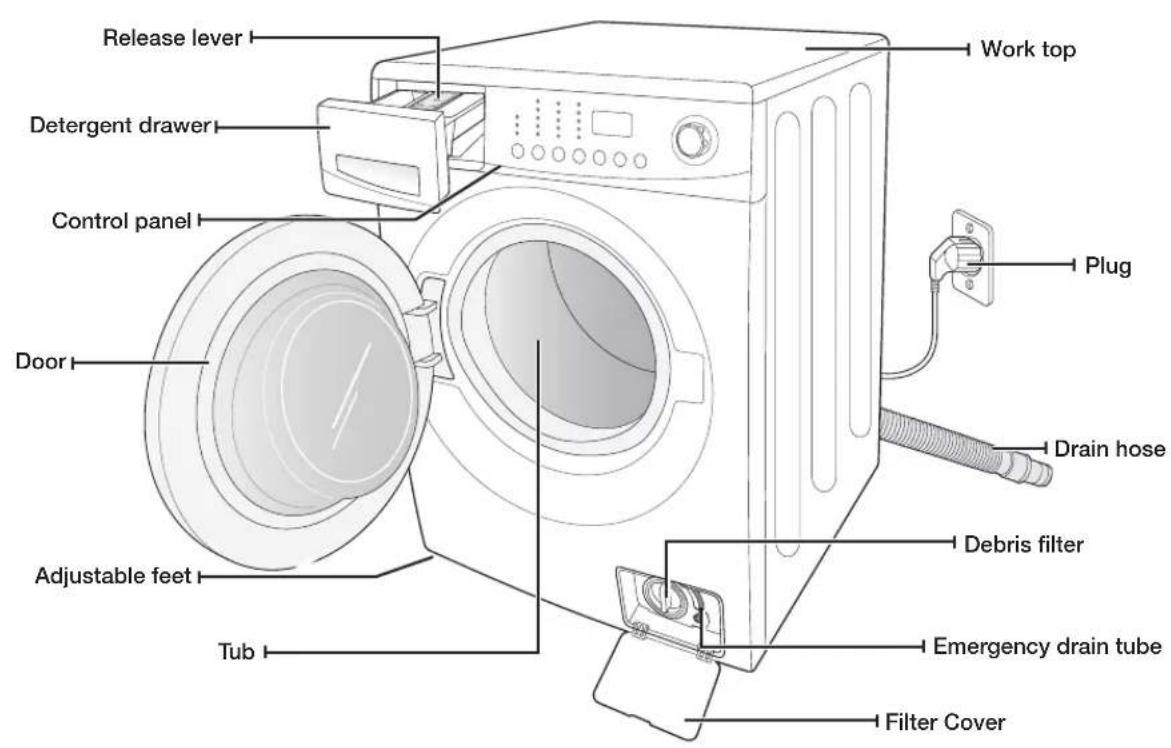
Carefully unpack your washing machine, and make sure you've received all of the parts shown below. If your washing machine was damaged during shipping, or if you do not have all of the parts, contact Samsung Customer Service or your Samsung dealer.
text_image
Release lever Detergent drawer Control panel Door Adjustable feet Tub Work top Plug Drain hose Debris filter Emergency drain tube Filter Cover
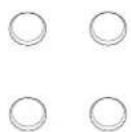
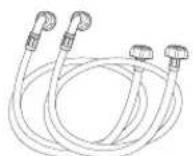

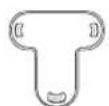
Spanner Bolt hole covers Water supply hose Hose guide Cap fixer
setting up your new washing machine _13
setting up your washing machine
MEETING INSTALLATION REQUIREMENTS
Electrical supply and grounding
To prevent unnecessary risk of fire, electrical shock, or personal injury, all wiring and grounding must be done in accordance with the National Electrical Code ANSI/FNPA, No. 70 Latest Revision and local codes and ordinances. It is the personal responsibility of the appliance owner to provide adequate electrical service for this appliance.

Never use an extension cord.
WARNING Use only the power cord that comes with your washing machine.
When preparing for installation, ensure that your power supply offers:
- 220V\~240V 50Hz 15 AMP fuse or circuit breaker
- Individual branch circuit serving only your washing machine
Your washing machine must be grounded. If your washing machine malfunctions or breaks down, grounding will reduce the risk of electric shock by providing a path of least resistance for the electric current.
Your washing machine comes with a power cord having a three-prong grounding plug for use in a properly installed and grounded outlet.

Never connect the ground wire to plastic plumbing lines, gas lines, or hot water pipes.
Improperly connecting the equipment-grounding conductor can result electrical shock. Check with a qualified electrician or serviceman if you are unsure if the washing machine is properly grounded. Do not modify the plug provided with the washing machine. If it does not fit the outlet, have a proper outlet installed by a qualified electrician.
Water Supply
Your washing machine will fill properly when your water pressure is 50 kPa \~ 800 kPa. Water pressure less than 50 kPa may cause water valve failure, not allowing the water valve to shut off completely. Or, it may take the washing machine longer to fill than what the controls allow, resulting in your washing machine turning off. (A fill-time limit, designed to prevent overflows/flooding if an internal hose becomes loose, is built into the controls.)
The water taps must be within 4 feet (122cm) of the back of your washing machine for the provided inlet hoses provided to reach your washing machine.

Most plumbing supply stores sell inlet hoses of various lengths up to 10 feet (305cm) long.
You can reduce the risk of leaks and water damage by:
- Making water taps easily accessible.
- Turning off taps when the washing machine is not in use.
• Periodically checking for leaks at water inlet hose fittings.

Before using your washing machine for the first time, check all connections at the water valve and taps for leaks.
14\_ setting up your new washing machine
Drain
Samsung recommends a standpipe height of 18 in (46 cm). The drain hose must be routed through the drain hose clip to the standpipe. The standpipe must be large enough to accept the outside diameter of the drain hose. The drain hose is attached at the factory.
Flooring
For best performance, your washing machine must be installed on a solidly constructed floor. Wood floors may need to be reinforced to minimize vibration and/or unbalanced loads. Carpeting and soft tile surfaces are contributing factors to vibrations and the tendency for your washing machine to move slightly during the spin cycle.
Never install your washing machine on a platform or poorly supported structure.
Surrounding temperature
Do not install your washing machine in areas where water may freeze, since your washing machine always retains some water in its water valve, pump, and hose areas. Frozen water in the lines can cause damage to belts, the pump, and other components.
Alcove or closet installation
To operate safely and properly, your new washing machine requires minimum clearances of:
Sides - 25 mm Rear - 51 mm
Top - 25 mm Front - 465 mm
If both the washing machine and a dryer are installed together, the front of the alcove or closet must have at least 465 mm unobstructed air opening. Your washing machine alone does not require a specific air opening.
INSTALLING YOUR WASHING MACHINE
STEP 1
Selecting a location
Before you install the washing machine, make sure the location:
- Has a hard, level surface without carpeting or flooring that may obstruct ventilation
• Is away from direct sunlight - Has adequate ventilation
- Will not be freezing (below 32 °F or 0 °C)
• Is away from heat sources such as oil or gas - Has enough space so that the washing machine doesn't stand on its power cord
setting up your washing machine
STEP 2
Removing the shipping bolts
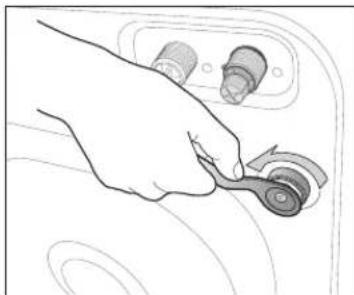
Before installing the washing machine, you must remove the five shipping bolts from the back of the unit.
- Loosen all the bolts with the supplied wrench.
natural_image
Hand holding a small mechanical component, possibly a valve or knob, inside a control panel (no text or symbols visible)- Hold the bolt with the spanner and pull it through the wide section of the hole. Repeat for each bolt.

natural_image
Hand inserting a plug into a button on a vehicle door (no text or symbols visible)- Fill the holes with the supplied plastic covers.

natural_image
Hand inserting a coin into a device panel with an arrow indicating the insertion (no text or symbols present)- Store the shipping bolts away safely in case you have to move the washing machine in the future.

Packaging materials can be dangerous to children; keep all packaging material (plastic bags, polystyrene, etc.) well out of the reach of children.

Insert the cap fixer, (one of the accessories in the vinyl pack), into the hole from which you removed the power cord at the back of the product.

text_image
Diagram showing a device with wiring and a magnified view of the cable installation detail16_ setting up your new washing machine
STEP 3 Adjusting the levelling feet

When installing your washing machine, ensure that the power plug, the water supply and the drain are easily accessible.
-
Slide the washing machine into position.
-
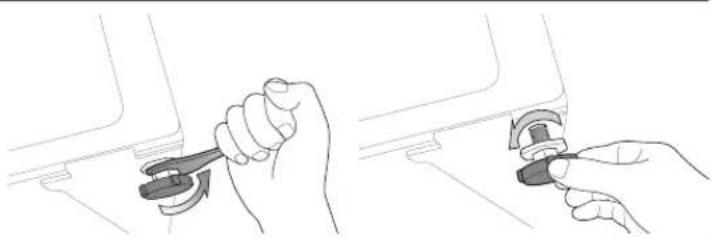
Level your washing machine by turning the leveling feet in and out as necessary by hand.
natural_image
Line drawing showing two hands using a tool to adjust or install a component, no text or symbols present- When your washing machine is level, tighten the nuts using the wrench supplied with your washing machine.

natural_image
Line drawing of a hand using a tool to adjust or install a component (no text or symbols present)STEP 4 Connecting the water and drain
Connecting the water supply hose
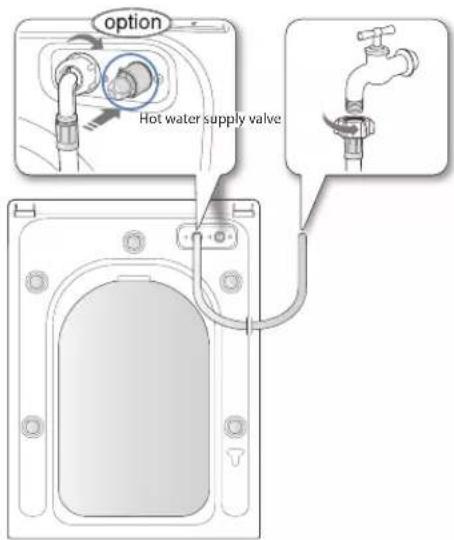
- Take the L-shaped arm fitting for the cold water supply hose and connect it to the cold water supply intake on the back of the machine. Tighten by hand.

The water supply hose must be connected to the washing machine at one end and to the water tap at the other. Do not stretch the water supply hose. If the hose is too short, replace the hose with a longer, high pressure hose.
- Connect the other end of the cold water supply hose to your sink's cold water tap and tighten it by hand. If necessary, you can reposition the water supply hose at the washing machine end by loosening the fitting, rotating the hose, and retightening the fitting.
text_image
option Hot water supply valveFor selected models with an additional hot water intake:
- Take the red L-shaped arm fitting for the hot water supply hose and connect it to the hot water supply intake on the back of the machine. Tighten by hand.
- Connect the other end of the hot water supply hose to your sink's hot water tap and tighten it by hand.
- Use a Y-piece if you only want to use cold water.
setting up your new washing machine _17


setting up your washing machine
Connecting the water supply hose (selected models)
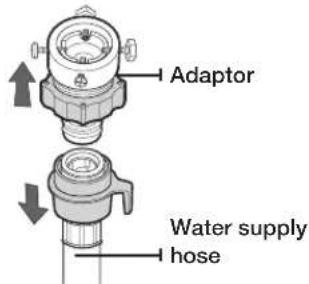
- Remove the adaptor from the water supply hose.
text_image
Adaptor Water supply hose- First, using a '+' type screwdriver, loosen the four screws on the adaptor. Next, take the adaptor and turn part (2) following the arrow until there is a 5 mm gap.

- Connect the adaptor to the water tap by tightening the screws firmly while lifting the adaptor upwards. Turn part (2) following the arrow and connect (1) and (2).

text_image
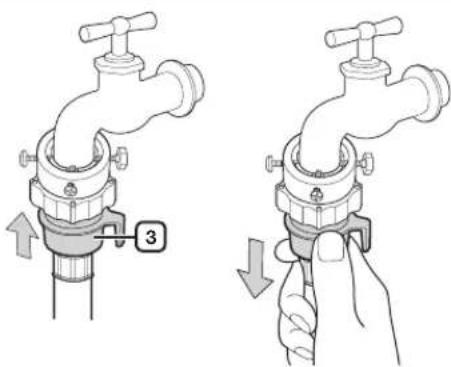
Water tap 1 2- Connect the water supply hose to the adaptor. When you release part (3), the hose automatically connects to the adaptor making a 'click' sound.

After you have connected the water supply hose to the adaptor, ensure that it is connected correctly by pulling the water supply hose downwards.
text_image
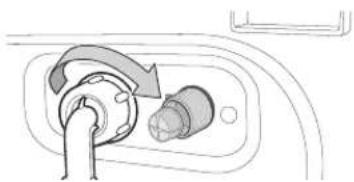
Diagram showing two-step installation of a faucet with labeled parts and directional arrows indicating movement.- Connect the other end of the water supply hose to the inlet water valve at the rear of the washing machine. Screw the hose clockwise all the way in.
natural_image
Diagram of a mechanical component with a knob and lever mechanism (no text or symbols)18_ setting up your new washing machine
- Turn on the water supply and ensure that no water leaks from the water valve, tap or adaptor. If there is a water leaks, repeat the previous steps.

Do not use your washing machine if there is a water leak. This may cause electric shock or injury.

natural_image
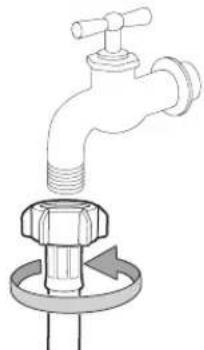
Illustration of two different faucet fittings with black X marks indicating no text or symbols (no text or labels present)- If the water tap has a screw type tap, connect the water supply hose to the tap as shown.
natural_image
Diagram of a faucet with a valve and central hub, showing fluid flow direction (no text or labels)Use the most conventional type of tap for the water supply. In case the tap is square or too big, remove the spacing ring before inserting the tap into the adaptor.
setting up your washing machine
Connecting the drain hose
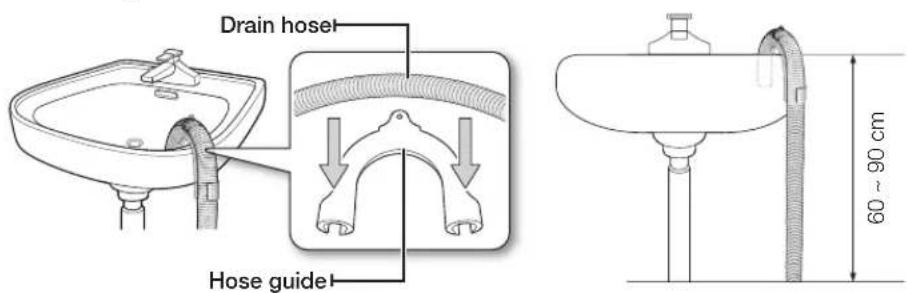
The end of the drain hose can be positioned in three ways:
- Over the edge of a wash basin: The drain hose must be placed at a height of between 60 and 90 cm. To keep the drain hose spout bent, use the supplied plastic hose guide. Secure the guide to the wall with a hook or to the tap with a piece of string to prevent the drain hose from moving.
text_image
Drain hose Hose guide 60 ~ 90 cm-
In a sink drain pipe branch: The drain pipe branch must be above the sink siphon so that the end of the hose is at least 60 cm above the ground.
-
In a drain pipe: We recommend using a 65 cm high vertical pipe; it must be no shorter than 60 cm and no longer than 90 cm.
STEP 5
Powering your washing machine
Plug the power cord into a wall sockets, a 230 volt 50 Hz approved electrical outlet protected by a 15-amp fuse or comparable circuit breaker. (For more information on electrical and grounding requirements, see page 14.)
20_ setting up your new washing machine
washing a load of laundry
With your new Samsung washing machine, the hardest part of doing laundry will be deciding which load to wash first.
WASHING FOR THE FIRST TIME

Before washing laundry for the first time, you must run a complete empty cycle (i.e. no laundry).
- Pour a little detergent to the detergent compartment ① in the detergent drawer.
- Turn on the water supply to the washing machine.
- Turn the Fuzzy Control Dial to Cotton.
- Press the Start/Pause button.
This will remove any water that might be left over in the machine from the manufacturer's test run.


text_image
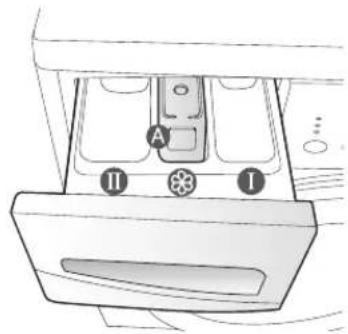
A II ICompartment ① Detergent for prewash, or starch.
Compartment Ⓗ Detergent for the main wash, water softener, pre-soaking agent, bleach and stain removal product.
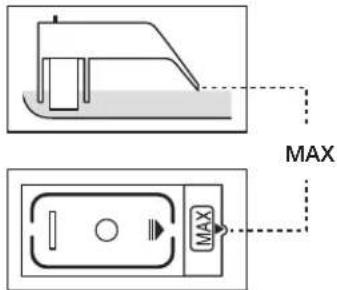
Compartment Ⓧ Additives, e.g. fabric softener or former (fill no higher than lower edge (MAX) of "A")
BASIC INSTRUCTIONS
- Load your laundry into the washing machine.

Do not overload the washing machine. To determine the load capacity for each type of laundry, refer to the chart on page 27.

• Make sure that laundry is not caught in the door, as this may cause a water leak.
- Washing detergent may remain in the front rubber part of the washer after a wash cycle. Remove any remaining detergent, as they may cause a water leak.
- Do not wash water-proofed items.
- Close the door until it latches.
- Add detergent and additives to the dispenser drawer.
- Turn the Fuzzy Control dial to select the appropriate program and options for the load. The Wash Indicator light will illuminate and the estimated cycle time will appear in the display.
- Press the Start/Pause button.
washing a load of laundry
USING THE CONTROL PANEL

text_image
95°C 60 4 3 2 1 Half Load 40 Pre Wash 30 Intensive Cold 1000 800 600 400 min. Daily Wash Heavy Soil Baby Care Mixed Load Drain Spin Rinse+Spin 2 3 4 5 6 7 8 1 9 10 Cotton Synthetics Sport Wear Delicate Wool Silk & Lace Quick 15'| 1 DIGITAL GRAPHIC DISPLAY | Displays the remaining wash cycle time, all cycle information, and error messages. | |
| 2 WASH OPTION SELECTION BUTTON | Press this button repeatedly to cycle through the wash options:Intensive → Pre-Wash → Half Load → Intensive + Pre Wash →Intensive + Half Load → Pre Wash + Half Load → Intensive + Pre Wash + Half Load → offIntensive: Press this button when the laundry is heavily soiled and needs to be washed intensively. The cycle time is increased for each cycle.Intensive is only available with: Cotton, Synthetics, Sport wear, Daily wash, Heavy Soil, Baby Care, Mixed Load.Pre Wash: Press this button to select Pre Wash.Half Load: Press this button to select Half Load. Half Load is only available with: Cotton. | |
| 3 TEMPERATURE SELECTION BUTTON | Press this button repeatedly to cycle through the available water temperature options:(Cold, 30°C, 40°C, 60°C and 95°C). | |
| 4 RINSE SELECTION BUTTON | Press the rinse button to add rinse cycles. Maximum number of rinse cycles is five. | |
| 5 SPIN SELECTION BUTTON | Press the button repeatedly to cycle through the available speeds for the spin cycle. | |
| J1025 | All Lamps Turn Off, 400, 600, 800, 1000 rpm | |
| B1225/B1225S | All Lamps Turn Off, 400, 600, 800, 1200 rpm | |
| “No spin - The laundry remains in the drum and no spin cycle is performed after the final drain.“Rinse Hold (All Lamps Turn Off)” -The laundry remains soaking in the final rinse water. Before the laundry can be unloaded, either a Drain or Spin cycle must be performed. | ||
| 6 EASY IRON SELECTION BUTTON | Press the button to reduce the wrinkles after spinning. | |
22\_ washing a load of laundry
| 7 DELAY END ⏻ SELECTION BUTTON | Press this button repeatedly to cycle through the available Delay End options (from 3 hours to 19 hours in one hour increments).The hour displayed indicates the time when the wash cycle will be finished. |
| 8 SOUND OFF SELECTION BUTTON | The sound can be turned off for all courses. When this function is selected, the sound is turned off for all cycles.When the Sound off function is activated, the lamp on the Sound Off button and the control panel are illuminated.When the Sound off function is deactivated, a buzzer will go off, and the lamp on the button and the control panel is turned off. |
| 9 FUZZY CONTROL DIAL | Turn the dial to select one of the 14 available wash programs.Turn the dial to “off” to turn the washing machine off.For detailed information, refer to “Washing Clothes Using Fuzzy Logic” (see page 25).Cotton- For averagely or lightly soiled cotton, bed linen, table linen, underwear, towels, shirts, etc.Synthetics- For averagely or lightly soiled blouses, shirts, etc., made of polyester (diolen, trevira), polyamide (perlon, nylon) or other similar blends.Sports Wear- Use for water-proofed or proofed garments to keep their good looks and fresh feel.Delicate- For sheer fabrics, brassieres, lingerie, dresses, shirts and blouses. For best results, use liquid detergent.Wool- Only for machine-washable wool. A load should be less than 2.0 kg.The wool course washes the laundry using gentle cradling actions. During the wash, the gentle cradling and soaking actions are continued to protect the wool fibers from shrinkage / distortion and for a super gentle clean. This stop operation is not a problem.Neutral detergent is recommended for wool course, for improved washing results and for improved care of the wool fibers.The wool wash cycle of this machine has been approved by Woolmark for the washing of machine-washable Woolmark products provided that the products are washed according to the instructions on the garment label and those issued by the manufacturer of this washing machine, M0910 for J***** series, M0910 for B***** series (Certificate Number issued by IWS NOM INEE Co., Ltd.)Silk&Lace- Silks and other handwashable fabrics with no wool content, e.g. satin, lace and silk.Quick 15’- For lightly soiled garments that you require quickly.Daily Wash- Use for everyday items such as underwear and shirts.Heavy Soil- Stained or heavy soiled cottons,bed linen, table linen, underwear, towels, shirts, jeans, etc.Baby Care- High temperature wash and extra rinses ensure that no washing powder remains to mark your thin clothes.Mixed Load- A mix of lightly soiled cottons and synthetic fabrics.Drain- Just drain the water from washing machine without spinning.Spin- Performs an additional spin cycle to remove more water.Rinse + Spin- Use for a load that needs rinsing only or to add rinse-added fabric softener to a load. |
| 10 START/PAUSE ⚠I SELECTION BUTTON | Press to pause and restart programs.Press the Start/Pause button before adding the laundry. This can only be selected within 5 minutes of the start.If the washing machine power is left on for longer than 10 minutes without any buttons being touched, the power automatically turns off. |
washing a load of laundry
Child lock
The Child Lock function allows you to lock the buttons so that the wash cycle you've chosen can't be changed.
Activating/Deactivating
If you want to activate or deactivate the Child Lock function, press the Rinse and Spin buttons at the same time for 2-3 seconds. The "Child Lock 😊will be lit when this feature is activated.

When the Child Lock function is activated, no button works including the power button. The Child Lock function remains on even after the power is turned on and off or after the disconnecting and reconnecting the power cord.

text_image
104 60 40 30 20 10 1200 1000 500 400 30 20 10 80 50 40 30 20 10 80 50 40 30 20 10 80 50 40 30 20 10 80 50 40 30 20 10 80 50 40 30 20 10 80 50 40 30 20 1 Vash Option Tampa. Rinse. Spin Easy Iron. Delay End. Sound I. 2-3 SEC.Sound off
The Sound Off function can be selected during all courses. When this function is selected, sound is turned off for all courses. Even if the power is turned on and off repeatedly, the setting is retained.
Activating/Deactivating
If you want to activate or deactivate the Sound Off function, press the "Sound Off" button. The lamp on the "Sound Off" button and the control panel will be lit when this feature is activated.
Delay end
You can set the washing machine to finish your wash automatically at a later time, choosing a delay of between 3 to 19 hours (in 1 hour increments). The hour displayed indicates the time at which the wash will be finished.
- Manually or automatically set your washing machine according to the type of laundry you are washing.
- Press the Delay End button repeatedly until the delay time is set.
- Press the Start/Pause button. The "Delay End ⏻" indicator will be lit, and the clock will begin counting down until it reaches the set time.
- To cancel Delay Start, press the Delay button repeatedly until Delay Start light is turned off, or turn the washing machine off. (you can also turn the washing machine off to cancel Delay Start.)
24\_ washing a load of laundry
Washing Clothes Using Fuzzy Logic
Your new washing machine makes washing clothes easy, using Samsung's "Fuzzy Logic" automatic control system. When you select a wash program, the machine will set the correct temperature, washing time, and washing speed.
- Turn on your sink's water tap.
- Open the door.
- Load the articles one at a time loosely into the drum, without overfilling it.
- Close the door.
- Add detergent, softener, and pre-wash detergent (if necessary) into the appropriate compartments.

To use prewash detergent, select Pre Wash option by pressing Wash Option button. Pre-wash is only available when selecting the Cotton, Synthetics, Sport Wear, Daily Wash, Heavy Soil, Baby Care, Mixed Load cycles. It is only necessary if your clothing is heavily soiled.
- Turn the Fuzzy Control dial to select the appropriate program for the type of clothes Cotton, Synthetic, Sport Wear, Delicate, Wool, Silk & Lace, Quick 15', Rinse+Spin, Spin, Drain, Mixed Load, Baby Care, Heavy Soil, Daily Wash. The relevant indicators will illuminate on the control panel.
- At this time, you can control the wash temperature, the amount of rinses, the spinning speed, and the delay time by pressing the appropriate option button.
- Press the Start/Pause button on the Fuzzy Control dial and the wash cycle will begin. The process indicator will light up and the remaining time for the cycle will appear in the display.
Pause Option
Within 5 minutes of starting a wash, it is possible to add/remove laundry items.
- Press the Start/Pause button to unlock the door.

The door cannot be opened when the water is too HOT or the water level is too HIGH.
- After closing the door, press the Start/Pause button to restart the wash.
When the cycle is finished:
After the total cycle has finished, the display will show “End” for 5 minutes, and then the power turns off automatically.
- Open the door.
- Remove laundry.
washing a load of laundry
Washing clothes manually
You can wash clothes manually without using the Fuzzy Logic feature.
- Turn the water supply on.
- Turn the Fuzzy Control dial to Cotton.
- Open the door.
-
Load the articles loosely into the drum one at a time, without overfilling it.
-
Close the door.
-
Add detergent and, if necessary, softener or prewash detergent, into the appropriate compartments.
-
Press the Temp. button to select the temperature. (Cold, 30 °C, 40 °C, 60 °C, 95 °C)
-
Press the rinse button to select the required number of rinse cycles. Maximum number of rinse cycles is five. The wash duration is increased accordingly.
-
Press the Spin button to select the spin speed. The rinse hold function allows you to remove items that are still wet from the washing machine. (☒ No Spin, (All Lamps Turn Off): Rinse Hold)
-
Press the Delay End button repeatedly to cycle through the available Delay End options (from 3 hour to 19 hours in one hour increments). The hour displayed indicates the time at which the wash will be finished.
-
Press the Start/Pause button and the machine will begin the cycle.
LAUNDRY GUIDELINES
Follow these simple guidelines for the cleanest laundry and the most efficient wash.

Always check the Care label on clothing before washing.
Sort and wash your laundry according to the following criteria:
- Care Label: Sort laundry into cottons, mixed fibres, synthetics, silks, wools and rayons.
- Colour: Divide whites and colours. Wash new colour items separately.
- Size: Placing items of different sizes in the same load will improve the wash action.
- Sensitivity: Wash delicate items separately, using the Delicate wash cycle for pure, new woollen items, curtains and silk articles. Check the labels on the items you are washing or refer to the fabric care chart in the appendix.
Emptying pockets
Before each wash, empty all the pockets of your laundry. Small, irregularly shaped hard objects, such as coins, knives, pins, and paperclips could damage your washing machine. Do not wash clothing with large buckles, buttons, or other heavy metal objects.
Metal on clothing may damage your clothing as well as the tub. Turn clothing with buttons and embroidered clothes inside out before washing them. If zips of pants and jackets are open while washing, the spin basket may be damaged. Zips should be closed and fixed with a string before washing.
Clothing with long strings may become entangled with other clothes damaging them. Be sure to fix the strings before starting the wash.
Prewashing cotton
Your new washing machine, combined with modern detergents, will give perfect washing results, thus saving energy, time, water and detergent. However, if your cotton is particularly dirty, prewash with a protein-based detergent.
26\_ washing a load of laundry

Determining the load capacity
Do not overload the washing machine or your laundry may not wash properly. Use the chart below to determine the load capacity for the type of laundry you are washing.
| Fabric Type Load Capacity | ||
| Model | J1025 B1225/B1225S | |
| Cotton- average/lightly soiled- heavily soiled | 7.0 kg 6.0 kg | |
| Synthetics 2.5 kg 2.5 kg | ||
| Delicate 2.0 kg 2.0 kg | ||
| Wool | 2.0 kg 2.0 kg | |

- When the laundry is unbalanced ("UE" lights up on the display), redistribute the load. If the laundry is unbalanced, the spin efficiency may be degraded.
- When washing Bedding or Duvets, the wash time may be lengthened or the spin efficiency may be degraded.
- For Bedding or Duvets, the recommended load capacity is 1.8(kg) or less.

Make sure to insert brassieres (water washable) into a laundry net (to be purchased additionally).
- The metal parts of the brassieres may break through the material and damage the laundry. Therefore make sure to place them inside a fine laundry net.
- Small, light clothing such as socks, gloves, stockings and handkerchiefs may become caught around the door. Place them inside a fine laundry net.

Do not wash the laundry net by itself without other laundry. This may cause abnormal vibrations that could move the washing machine and cause an accident resulting in injury.

natural_image
Illustration of a bra, one being lifted by a hand (no text or symbols)washing a load of laundry
DETERGENT AND ADDITIVES INFORMATION
Which detergent to use
The type of detergent you should use is based on the type of fabric (cotton, synthetics, items, Hand Wash For Wool), colour, wash temperature, and degree of soiling. Always use "low suds" laundry detergent, which is designed for automatic washing machines.
Follow the detergent manufacturer's recommendations based on the weight of the laundry, the degree of soiling, and the hardness of the water in your area. If you do not know how hard your water is, enquire at your local water authority.

Do not use detergent that has hardened or solidified as the detergent may remain in the rinse cycle. It may cause your washing machine to not rinse properly or result in the overflow becoming blocked.

Please note the following when using the Wool course.
- Use a neutral liquid detergent for wool only.
- When using a powder detergent, it may remain on the laundry and cause damage to the material (wool).
Detergent drawer
Your washing machine has separate compartments for dispensing detergent and fabric softener. Add all laundry additives to the correct compartment before starting your washing machine.

Do NOT open the detergent drawer when your washing machine is running.
- Pull out the detergent drawer on the left side of the control panel.
- Add the recommended amount of laundry detergent directly into the detergent compartment ☐ before starting your washing machine.
- Add the recommended amount of fabric softener into the softener compartment ⚙ required.

Do NOT add any powder/liquid detergent to the softener compartment (3)
text_image
A II I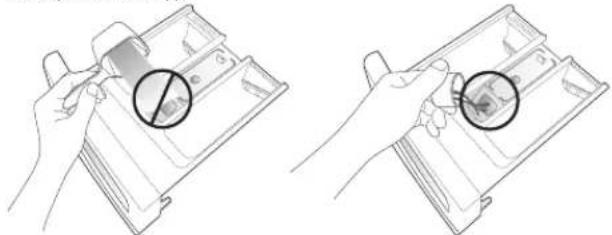
natural_image
Two-step illustration showing hands holding a device with a circular mark indicating no change, no text or symbols present.- When using the Prewash option, add the recommended amount of laundry detergent into the prewash compartment ①

When washing large items do NOT use the following detergent types.
- Tablet and capsule type detergents
• Detergents using a ball and net

Concentrated or thick fabric softener and conditioner must be diluted with a little water before being poured into the dispenser (prevents the overflow from becoming blocked.)
text_image
MAX MAX
Be careful that the fabric softener does not overflow, when you close the detergent drawer after adding fabric softener into the rinse detergent compartment.
28\_ washing a load of laundry
cleaning and maintaining your washing machine
Keeping your washing machine clean improves its performance, wards off unnecessary repairs, and lengthens its life.
DRAINING THE WASHING MACHINE IN AN EMERGENCY
- Unplug the washing machine from the power supply.
- Open the filter cover using a coin or a key.
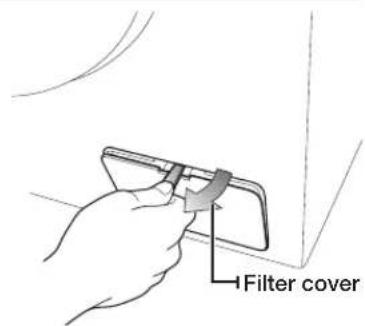
text_image
Filter cover- Pull forward the emergency drain tube to separate it from the guide hook.
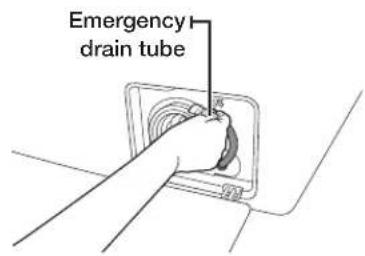
text_image
Emergency drain tube- Take off the emergency drain cap closing the emergency drain tube.
- Allow all the water to flow into a bowl.
Remain water maybe more than you expected. Prepare larger bowl.
-
Re-attach the cap to the emergency drain tube and then fix the emergency drain tube to the guide hook.
-
Replace the filter-cover.
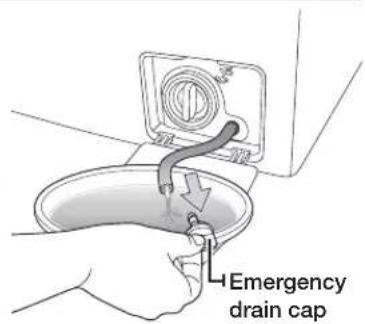
text_image
Emergency drain cap
cleaning and maintaining your washing machine
CLEANING THE DETERGENT DRAWER AND DRAWER RECESS
- Press the release lever on the inside of the detergent drawer and pull the drawer out.
- Remove the liquid detergent divider from the detergent drawer

text_image
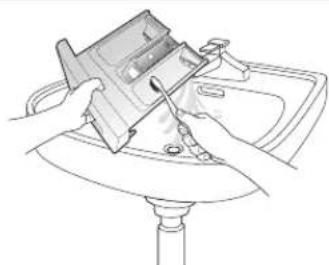
Release lever Liquid detergent divider- Wash all parts under running water.
natural_image
Line drawing of hands using a tool to clean or repair a small object on a sink (no text or symbols)- Clean the drawer recess with an old toothbrush.
- Replace the liquid detergent divider by pushing it firmly into the drawer.
- Push the drawer back into place.
- To remove any remaining detergent, perform a rinse cycle without any laundry in the drum.

natural_image
Line drawing of a hand inserting a button into a microwave oven (no text or symbols)30_ cleaning and maintaining your washing machine
CLEANING THE DEBRIS FILTER
We recommend cleaning the debris filter 5 or 6 times a year, or when the error message of "5E" is displayed. (Refer to "Draining the washing machine in an emergency" in the previous page.)

Before cleaning the debris filter, make sure to unplug the power cord.
- Remove the remaining water first (refer to "Draining the washing machine in an emergency" on page 29.)
If you separate the filter without draining the remaining water, the remaining water may trickle out. - Open the filter cover by using a key or coin.
- Unscrew the emergency drain cap by turning it to the left and drain off all the water.
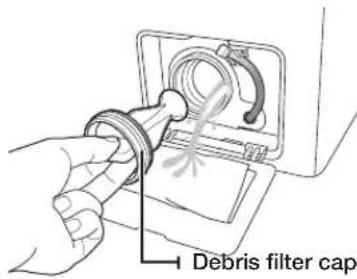
- Unscrew the debris filter cap.
- Wash any dirt or other material from the debris filter. Make sure the drain pump propeller behind the debris filter is not blocked.
- Replace the debris filter cap.
- Replace the filter cover.

Do not open the debris filter cap while the machine is running or hot water may flow out.
text_image
Debris filter cap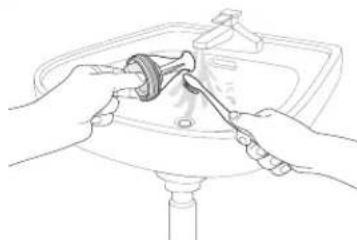
natural_image
Line drawing of hands using a tool to adjust or install a component on a sink (no text or symbols present)
- Make sure to replace the filter cap after the filter cleaning. If the filter is out of the machine, your washing machine may malfunction or leak water.
- The filter should be fully assembled after the filter cleaning.
CLEANING THE EXTERIOR
- Wipe the washing machine surfaces, including the control panel, with a soft cloth using a nonabrasive household detergent.
- Use a soft cloth to dry the surfaces.
- Do not pour water onto the washing machine.
cleaning and maintaining your washing machine
CLEANING THE WATER HOSE MESH FILTER
You should clean the water hose mesh filter at least once a year, or when the error message of "4E" is displayed:
- Turn off the water supply to the washing machine.
- Unscrew the hose from the back of the washing machine. To prevent water from gushing out due to the air pressure in the hose, cover the hose with a cloth.
- Gently pull out the mesh filter from the end of the hose using a pair of pliers and rinse it under water until clean. Also clean inside and outside the threaded connector.
- Push the filter back into place.
- Screw the hose back onto the washing machine.
- Make sure the connections are watertight and turn on the tap.

natural_image
Illustration showing two-step installation of a cable connector with arrows indicating direction (no text or symbols)REPAIRING A FROZEN WASHING MACHINE
If the temperature drops below freezing and your washing machine is frozen:
- Unplug the washing machine.
- Pour warm water over the tap to loosen the water supply hose.
- Remove the water supply hose and soak it in warm water.
- Pour warm water into the washing machine drum and let it sit for 10 minutes.
- Reconnect the water supply hose to the water tap and check if the water supply and drain are operating normal.
STORING YOUR WASHING MACHINE
If you need to store your washing machine for an extended time, it's better to drain and disconnect it. Washing machines can be damaged if water is left in the hoses and internal components before storage.
-
Select the Quick 15' cycle and add bleach to the bleach compartment. Run your washing machine through Fuzzy Control dial without a load.
-
Turn the water taps off and disconnect the inlet hoses.
-
Unplug your washing machine from the electrical outlet, and leave your washing machine door open to allow air to circulate inside the tumbler.
If your washing machine has been stored in below-freezing temperatures, allow time for any leftover water in your washing machine to thaw out before using it.
32_ cleaning and maintaining your washing machine
troubleshooting and information codes
CHECK THESE POINTS IF YOUR WASHING MACHINE...
| PROBLEM SOLUTION | |
| Will not start • Make sure your washing machine is plugged in.Make sure the door is firmly closed.Make sure the water source tap(s) are turned on.Make sure to press the Start/Pause button. | |
| Has no water or not enough water | Turn the water tap on fully.Make sure the water source hose is not frozen.Straighten the water intake hoses.Clean the filter on the water intake hose. |
| Has detergent remains in the detergent drawer after the wash cycle is complete | Make sure your washing machine is running with sufficient water pressure.Make sure the detergent is added to the center of the detergent drawer. |
| Vibrates or is too noisy | Make sure your washing machine is on a level surface. If the surface is not level, adjust the washing machine feet to level the appliance.Make sure that the shipping bolts are removed.Make sure your washing machine is not touching any other object.Make sure the laundry load is balanced. |
| The washing machine does not drain and/or spin | Straighten the drain hose. Eliminate kinked hoses.Make sure the debris filter is not clogged. |
| Door is locked shut or will not open. | Make sure all the water in your drum is drained out.Make sure the door lock light is off. Door lock light will off after drained. |
If the problem persists, contact your local Samsung Customer Service.
troubleshooting and information codes
INFORMATION CODES
When your washing machine malfunctions, you may see an information code on the display. If that happens, check this table and try the suggested solution before calling Customer Service.
| CODE SYMBOL SOLUTION | |
| dE | Close the door. |
| 4E | Make sure the source water tap is turned on.Check the water pressure. |
| 5E | Clean the debris filter.Make sure the drainage hose is installed correctly. |
| UE | The laundry load is unbalanced. Redistribute the load. If only one item of clothing needs washing, such as a bathrobe or pair of jeans, the final spin result might be unsatisfactory and an “UE” error message will be shown in the display window. |
| cE/3E | Call the after-sales service. |
| Sd/Sud | This occurs when too much foaming is detected. It is also displayed while foaming is removed. When the removal is finished, the normal cycle proceeds.(This is one of the normal operations. It is an error for preventing non-sensing faults.) |
| Uc | If the voltage of the supplied power is instable, the washing machine will be paused to protect its electric devices.If the correct voltage is supplied, the cycle will resume automatically. |
For any codes not listed above, or if the suggested solution doesn't fix the problem, call your Samsung Service Centre or local Samsung dealer.
34_ troubleshooting and information codes
cycle chart
CYCLE CHART
(● user option)
| PROGRAM | Max load (kg) DETERGENT | Easy Iron | Max Temp (°C) | ||||
| J1025 | B1225 B1225S | Pre-wash | wash Softener | ||||
| Cotton 7.0 6.0 | ● | yes | ● | ● | 95 | ||
| Synthetics 3.0 3.0 | ● | yes | ● | - | 60 | ||
| Sport Wear | 2.0 2.0 | ● | yes | ● | - | 60 | |
| Delicate 2.0 2.0 - yes | ● | - | 40 | ||||
| Wool | 2.0 2.0 - yes | ● | - | 40 | |||
| Silk & Lace 1.5 1.5 - yes | ● | - | 30 | ||||
| Quick 15' 3.0 3.0 - yes | ● | ● | 60 | ||||
| Daily Wash | 3.0 3.0 | ● | yes | ● | ● | 60 | |
| Heavy Soil 2.5 2.5 | ● | yes | ● | - | 60 | ||
| Baby Care | 3.0 3.0 | ● | yes | ● | ● | 95 | |
| Mixed Load 2.5 2.5 | ● | yes | ● | - | 60 | ||
| PROGRAM | Spin Speed(MAX) rpm | Delay end | Cycle time (min) | |
| J1025 | B1225 B1225S | |||
| Cotton 1000 | 1200 | ● | 90 | |
| Synthetics | 800 | 800 | ● | 70 |
| Sport Wear | 800 | 800 | ● | 59 |
| Delicate 800 | 800 | ● | 53 | |
| Wool | 800 | 800 | ● | 35 |
| Silk & Lace | 400 | 400 | ● | 35 |
| Quick 15' | 1000 | 1200 | ● | 15 |
| Daily Wash | 800 | 800 | ● | 58 |
| Heavy Soil | 1000 | 1200 | ● | 112 |
| Baby Care | 1000 | 1200 | ● | 121 |
| Mixed Load | 800 | 800 | ● | 76 |
-
A cycle with a prewash takes approx. 15 minutes longer.
-
The cycle duration data has been measured under the conditions specified in Standard IEC 60456 / EN 60456.
-
Cotton 60°C + intensive are programs according to EN60456.
-
Course time in individual homes may differ from the values given in the table due to variations in the pressure and temperature of the water supply, the load and the type of laundry.
-
When the Intensive Wash function is selected, the cycle time is increased for each cycle.
cycle chart _35


appendix
FABRIC CARE CHART
The following symbols provide garment care directions. The care labels include four symbols in this order: washing, bleaching, drying and ironing, and dry cleaning when necessary. The use of symbols ensures consistency among garment manufacturers of domestic and imported items. Follow the care label directions to maximize garment life and reduce laundering problems.
[XCI ] ] | Resistant material Can be ironed at 100 °C max | ||
 | Delicate fabric Do not iron | ||
[95] | Item may be washed at 95 °C | A | Can be dry cleaned using any solvent |
| [HBKA] | Item may be washed at 60 °C | P | Dry clean with perchloride, lighter fuel, pure alcohol or R113 only |
 | Item may be washed at 40 °C | F | Dry clean with aviation fuel, pure alcohol or R113 only |
 | Item may be washed at 30 °C Do not dry clean | ||
 | Item may be hand washed Dry flat | - | |
| Dry clean only Can be hung to dry | III | ||
 | Can be bleached in cold water Dry on clothes hanger | ||
 | Do not bleach Tumble dry, normal heat | ||
| Can be ironed at 200 °C max Tumble dry, reduced heat | |||
 | Can be ironed at 150 °C max Do not tumble dry |
PROTECTING THE ENVIRONMENT
- This appliance is manufactured from recyclable materials. If you decide to dispose of this appliance, please observe local waste disposal regulations. Cut off the power cord so that the appliance cannot be connected to a power source. Remove the door so that animals and small children cannot get trapped inside the appliance.
- Do not exceed the detergent quantities recommended in the detergent manu-facturers' instructions.
- Use stain removal products and bleaches before the wash cycle only when strictly necessary.
- Save water and electricity by only washing full loads (the exact amount depends upon the program used).
DECLARATION OF CONFORMITY
This appliance complies with European safety standards, EC directive 93/68 and EN Standard 60335.
36_ appendix
appendix
SPECIFICATIONS
| TYPE FRONT LOADING | ING WASHER | |||||||
| DIMENSION | J1025 B1225 B1225S | |||||||
| W598mm X D563mm X H846mm | W598mm X D563mm X H846mm | W598mm X D563mm X H846mm | ||||||
| WATER PRESSURE | 50 kPa ~ 800 kPa | |||||||
| WATER VCLUME | 77l 60l 60l | |||||||
| NET WEIGHT | J1025 B1225 B1225S | |||||||
| 61 kg 61 kg 61 kg | ||||||||
| WASH AND SPIN CAPACITY | 7.0 kg 6.0 kg 6.0 kg | |||||||
| POWER CONSUMPTION | MODEL J1025 B1225 B1225S | |||||||
| WASHING | 220 V 150 W 220 V 150 W 220 V 150 W | |||||||
| 240 V 150 W 240 V 150 W 240 V 150 W | ||||||||
| WASH AND HEATING | 220 V 2000 W 220 V 2000 W 220 V 2000 W | |||||||
| 240 V 2400 W 240 V 2400 W 240 V 2400 W | ||||||||
| SPIN | MODEL J1025 B1225 B1225S | |||||||
| 230V 500 W 530 W 530 W | ||||||||
| PUMPING | 34 W | |||||||
| PACKAGE WEIGHT | MODEL J1025 B1225 B1225S | |||||||
| PAPER | 3.0 kg 3.0 kg 3.0 kg | |||||||
| PLASTIC | 1.0 kg 1.0 kg 1.0 kg | |||||||
| SPIN REVOLUTIONS | MODEL J1025 B1225 B1225S | |||||||
| rpm | 1000 | 1200 | 1200 | |||||
The appearance and specifications of the product are subject to change without prior notice for purposes of product enhancement.
appendix _37
memo


memo


SAMSUNG
Contact SAMSUNG WORLD WIDE
If you have any questions or comments relating to Samsung products, please contact the SAMSUNG customer care center.
Code No. DC68-02925B-01_EN
J1025
B1225
B1225S
ماشین لباسشویی
( youth 12) Child lock
natural_image
Hand holding a rotary knob on a device panel (no text or symbols visible)
natural_image
Hand inserting a screw into a circular button on a device panel (no text or symbols visible)natural_image
Hand inserting a knob into a device panel with an arrow indicating the pointer (no text or symbols present)text_image
Diagram illustrating a medical procedure with labeled components and two magnified views showing connected devices.natural_image
Line drawing showing hands using a tool to adjust or install a component, no text or symbols presentnatural_image
Line drawing of a hand using a tool to adjust or install a component (no text or symbols present)text_image
Diagram showing two hand positions of a faucet with valve symbols and directional arrows indicating movement or adjustment.natural_image
Diagram of a car door handle with a valve and scroll wheel (no text or symbols)natural_image
Two identical illustrations of a faucet with a valve, each marked with a black X symbol (no text or labels present)natural_image
Diagram of a faucet with a valve and central hub, showing fluid flow direction (no text or labels)natural_image
Illustration of a bra, shown in a top-down view of a woven basket with an open lid (no text or symbols)text_image
Diagram of a device interior with labeled ports A, II, and I, showing internal components and directional arrows.
natural_image
Two line drawings showing hands holding a tray with a circular mark and a magnified inset of the tray (no text or symbols)natural_image
Line drawing of hands using a tool to clean or repair a small appliance on a sink (no text or symbols)natural_image
Line drawing of a hand inserting a brush into a microwave oven (no text or symbols)natural_image
Line drawing of hands using a tool to clean or wash a basin (no text or symbols)natural_image
Diagram of a cable connector with directional arrows indicating connection (no text or symbols)