CTR464NB01 - Stove SAMSUNG - Free user manual and instructions
Find the device manual for free CTR464NB01 SAMSUNG in PDF.


User questions about CTR464NB01 SAMSUNG
0 question about this device. Answer the ones you know or ask your own.
Ask a new question about this device
Download the instructions for your Stove in PDF format for free! Find your manual CTR464NB01 - SAMSUNG and take your electronic device back in hand. On this page are published all the documents necessary for the use of your device. CTR464NB01 by SAMSUNG.
USER MANUAL CTR464NB01 SAMSUNG
The following symbols are used in this User Manual: 3
Model name & serial number 3
Safety instructions 3
Disposing of the packaging material 6
Proper disposal of your old appliance 6
Installing the hob 7
Safety instructions for the installer 7
Connecting to the outlet 7
Connecting to the mains power supply 7
Installing into the countertop 8
Parts and features 9
Cooking zones 9
Components 9
Control panel 10
The key features of your appliance 10
Safety shutoff 11
Residual heat indicator 11
Hob use 12
Initial cleaning 12
Using suitable cookware 12
Using the touch control sensors 12
Switching the appliance on 13
Temperature control 13
Switching the appliance off 13
Switching a cooking zone off 13
Using the child safety lock 14
Locking and unlocking the control panel 14
2 English
Cleaning and care 15
Hoh 15
Stubborn Soiling 16
Problem dirt 16
Hob Frame 17
To avoid damaging your appliance 17
Warranty and service 17
FAQs and troubleshooting 17
Service 18
Technical data 19
Technical data 19
Cooking zones 19
Using this manual
Please take the time to read this owner's manual, paying particular attention to the safety information contained in the following section, before using your appliance. Keep this manual for future reference.
If transferring ownership of the appliance, please remember to pass the manual on to the new owner.
The following symbols are used in this User Manual:
WARNING
Hazards or unsafe practices that may result in severe personal injury or death.
CAUTION
Hazards or unsafe practices that may result in minor personal injury or property damage.
CAUTION
To reduce the risk of fire, explosion, electric shock, or personal injury when using your hob, follow these basic safety precaution.
NOTE
Useful tips, recommendations, or information that helps users manipulate the product.
Model name & serial number
Both the model name and the serial number are labeled underneath the cooktop base.
For later use, write down the information or attach the additional product label (located on the top of the product) onto the current page.
Model Name
Serial Number
Safety instructions
The safety aspects of this appliance comply with all accepted technical and safety standards. However, as manufacturers we also believe it is our responsibility to familiarize you with the following safety instructions.
WARNING
This appliance is not intended for use by persons (including children) with reduced physical, sensory or mental capabilities, or lack of experience and knowledge, unless they have been given supervision or instruction concerning use of the appliance by a person responsible for their safety.
Children should be supervised to ensure that they do not play with the appliance.
If the supply cord is damaged, it must be replaced by the manufacturer, its service agent or similarly qualified persons in order to avoid a hazard.
Appliance should allow the disconnection of the appliance from the supply after installation. The disconnection may be achieved by having the plug accessible or by incorporating a switch in the fixed wiring in accordance with the wiring rules.
WARNING: If the surface is cracked, switch off the appliance to avoid the possibility of electric shock.
During use the appliance becomes hot. Care should be taken to avoid touching heating elements inside the hob.
Safety instructions
WARNING: Accessible parts may become hot during use. Young children should be kept away.
A steam cleaner is not to be used to clean the product.
Metallic objects such as knives, forks, spoons and lids should not be placed on the hob surface since they can get hot.
After use, switch off the hob element by its control and do not rely on the pan detector.
Do not use harsh abrasive cleaners or sharp metal scrapers to clean the hob glass since they can scratch the surface, which may result in shattering of the glass.
Appliance is not intended to be operated by means of an external timer or separate remote-control system.
WARNING: The appliance and its accessible parts become hot during use. Care should be taken to avoid touching heating elements inside the hob. Children less than 8 years of age shall be kept away unless continuously supervised.
This appliance can be used by children aged from 8 years and above and persons with reduced physical, sensory or mental capabilities or lack of experience and knowledge if they have been given supervision or instruction concerning use of the appliance in a safe way and understand the hazards involved. Children shall not play with the appliance. Cleaning and user maintenance shall not be made by children without supervision.
WARNING: Unattended cooking on a hob with fat or oil can be dangerous and may result in fire.
NEVER try to extinguish a fire with water, but switch off the appliance and then cover flame e.g. with a lid or a fire blanket.
WARNING: Danger of fire: do not store items on the cooking surfaces.
WARNING: Use only hob guards designed by the manufacturer of the cooking appliance. The use of inappropriate guards can cause accidents.
The temperature of accessible surfaces may be high when the appliance is operating.
Keep the appliance and its cord out of reach of children less than 8 years.
CAUTION
Be sure the appliance is properly installed and grounded by a qualified technician.
The appliance should be serviced only by qualified service personnel. Repairs carried out by unqualified individuals may cause injury or serious malfunction. If your appliance is in need of repair, contact your local service centre. Failure to follow these instructions may result in damage and void the warranty. Flush - mounted appliances may be operated only after they have been installed in cabinets and workplaces that conform to the relevant standards. This ensures sufficient protection against contact for electrical units as required by the essential safety standards.
If your appliance malfunctions or if fractures, cracks or splits appear:
- switch off all cooking zones;
- disconnect the hob from the mains supply; and
- contact your local service centre.
If the cooktop cracks, turn the appliance off to avoid the possibility of electric shock. Do not use your hob until the glass surface has been replaced.
Do not use the hob to heat aluminium foil, products wrapped in aluminium foil or frozen foods packaged in aluminium cookware.
Liquid between the bottom of the pan and the hob can produce steam pressure. Which may cause the pan to jump.
Always ensure that the hotplate and the base of the pan are kept dry.
The cooking zones will become hot when you cook.
Always keep small children away from the appliance.
Keep all packaging materials well out of the reach of children, as packaging materials can be dangerous to children.
This appliance is to be used only for normal cooking and frying in the home. It is not designed for commercial or industrial use. Never use the hob for heating the room.
Take care when plugging electrical appliances into mains sockets near the hob. Mains leads must not come into contact with the cooktop.
Overheated fat and oil can catch fire quickly. Never leave surface units unattended when preparing foods in fat or oil, for example, when cooking chips.
Turn the cooking zones off after use.
Safety instructions
Always keep the control panels clean and dry.
Never place combustible items on the hob, it may cause fire.
There is the risk of burns from the appliance if used carelessly.
Cables from electrical appliances must not touch the hot surface of the hob or hot cookware.
Do not use the hob to dry clothes.
Users with Pacemakers and Active Heart Implants must keep their upper body at a minimum distance of 30 cm from induction cooking zones when turned on. If in doubt, you should consult the manufacturer of your device or your doctor. (Induction hob model only)
Do not attempt to repair, disassemble, or modify the appliance yourself.
Always turn the appliance off before cleaning.
Clean the hob in accordance with the cleaning and care instructions contained in this manual.
Disposing of the packaging material

WARNING
All materials used to package the appliance are fully recyclable. Sheet and hard foam parts are appropriately marked. Please dispose of packaging materials and old appliances with due regard to safety and the environment.
Proper disposal of your old appliance

WARNING
Before disposing of your old appliance, make it inoperable so that it cannot be a source of danger. To do this, have a qualified technician disconnect the appliance from the mains supply and remove the mains lead.
The appliance may not be disposed of in the household rubbish.
Information about collection dates and public refuse disposal sites is available from your local refuse department or council.
Installing the hob
WARNING
Be sure the new appliance is installed and grounded only by qualified personnel. Please observe this instruction. The warranty will not cover any damage that may occur as a result of improper installation.
Technical data is provided at the end of this manual.
Safety instructions for the installer
- With respect to fire protection, this appliance corresponds to EN 60 335 2 6. This type of appliance may be installed with a high cupboard or wall on one side.
- Drawers may not be fitted underneath the hob.
• The installation must guarantee shock protection. - The kitchen unit in which the appliance is fitted must satisfy the stability requirements of DIN 68930.
- For protection against moisture, all cut surfaces are to be sealed with a suitable sealant.
- On tiled work surfaces, the joints in the area where the hob sits must be completely filled with grout.
- On natural, artificial stone, or ceramic tops, the snap action springs must be bonded in place with a suitable artificial resin or mixed adhesive.
- Ensure that the seal is correctly seated against the work surface without any gaps. Additional silicon sealant must not be applied; this would make removal more difficult when servicing.
• The hob must be pressed out from below when removed.
Connecting to the outlet
Before connecting, check that the nominal voltage of the appliance, that is, the voltage stated on the rating plate, corresponds to the available supply voltage. The rating plate is located on the lower casing of the hob.
The heating element voltage is AC230 V\~. This appliance is equipped with a cord that includes a grounding wire and a grounding plug. The plug must be plugged into an outlet that is properly installed and grounded.
Once the hob is connected to the mains supply, check that all cooking zones are ready for use by briefly switching each on in turn at the maximum setting. When the hob is powered on for the first time, all displays light and the child safety lock is activated.
Connecting to the mains power supply
Before connecting, check that the nominal voltage of the appliance, that is, the voltage stated on the rating plate, corresponds to the available supply voltage. The rating plate is located on the lower casing of the hob.
Shut off power to circuit before connecting wires to circuit.
The heating element voltage is AC230 V-. The appliance also works perfectly on older networks with AC220 V-.
The hob is to be connected to the mains using a device that allows the appliance to be disconnected from the mains at all poles with a contact opening width of at least 3 mm, e.g. automatic line protecting cut - out, earth leakage trips or fuse.
A type H05SS - F (180°C) cable or one of a higher grade must be used as the mains connecting cable.
| Rated current of appliance (A) Nominal cross-sectional area (mm 4) | |
| 1N- | >25 and ≤32>4 and <6 |
| 2N- | >10 and ≤16>1.5 and <2.5 |
The connection must be carried out as shown in the diagram. The connecting links should be fitted according to the appropriate connection diagram.
The earth lead is connected to terminal. The earth lead must be longer than leads carrying electric current.
The cable connections must be made in accordance with regulations and the terminal screws tightened securely.
The connecting cable is to be secured with the mains cable cleat and the covering closed by pressing firmly (locking into place). Before switching on for the first time, any protective foil or stickers must be removed from the ceramic glass surface.
Installing the hob
CAUTION
Once the hob is connected to the mains supply, check that all cooking zones are ready for use by briefly switching each on in turn at the maximum setting. When the hob is powered on for the first time, all displays light and the child safety lock is activated.
NOTE
when the hob is powered on for the first time, all displays light and the child safety lock is activated.
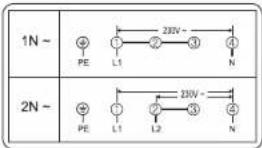
text_image
1N ~ PE L1 230V - ④ ① ② ③ ④ N 2N ~ PE L1 L2 230V - ④ ① ② ③ ④ NL: Brown
N: Blue
BE: Cre
WARNING
Pay attention (conformity) to phase and neutral allocation of house connection and appliance (connection schemes); otherwise, components can be damaged. Warranty does not cover damage resulting from improper installation.
Installing into the countertop
NOTE
- Make a note of the serial number on the appliance rating plate prior to installation. This number will be required in the case of requests for service and is no longer accessible after installation, as it is on the original rating plate on the underside of the appliance.
- Pay special attention to the minimum space and clearance requirements.
- Secure the brackets at both sides with the provided screws before mounting the hob onto the brackets.
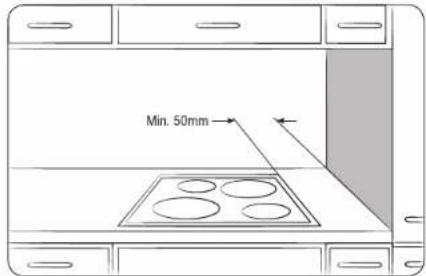
text_image
Min. 50mm
text_image
Ø6 x4 90° 560° R3 min. 20 490° 600 508 English

Parts and features

text_image
90° x4 Ø2 100 100 490°Cooking zones
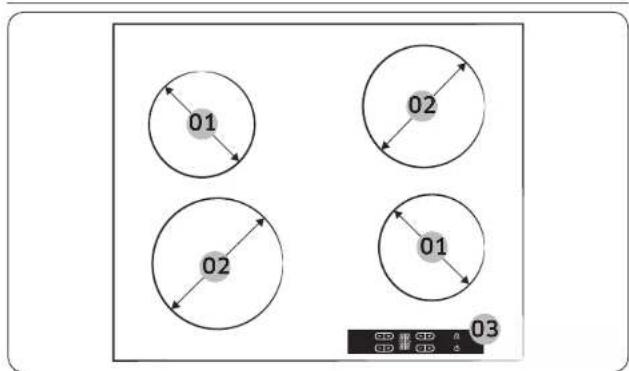
text_image
01 02 02 01 03| 01 single cooking zone 1200 W (148 mm) |
| 02 single cooking zone 1800W (183 mm) |
| 03 control panel |
Components

Installation Brackets Screws

Parts and features
Control panel
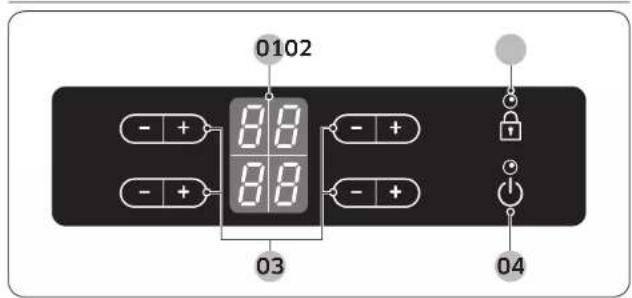
text_image
0102 - + 88 - + - + 88 - + 03 04| 01 Indicators for heat settings and residual heat |
| 02 Lock control sensor |
| 03 Heat setting selectors |
| 04 On/Off control sensor |
01 Indicators for heat settings and residual heat
02 Lock control sensor
03 Heat setting selectors
04 On/Off control sensor
The key features of your appliance
- Control and function indicators: Digital displays and indicator lights provide information about settings and activated functions, as well as the presence of residual heat in the various cooking zones.
- Safety shutoff: A safety shutoff ensures that all cooking zones switch off automatically after a period of time if the setting has not been changed.
- Residual heat indicator: An icon for residual heat appears in the display if the cooking zone is so hot that there is a risk of burning.
- Ceramic glass cooking surface: The appliance has a ceramic glass cooking surface and four rapid - response cooking zones. The hob's powerful radiant heater elements significantly shorten the amount of time required for the zones to heat up.
- Touch control sensors: Your appliance is operated using touch control sensors.
- Easy cleaning: The advantage of the ceramic glass cooking surface and the control sensors is their accessibility for cleaning. The smooth, flat surface is easy to clean.
- On / Off sensor: The "On / Off" control sensor provides the appliance with a separate mains switch. Touching this sensor switches the power supply on or off completely.
Digital displays
The four display fields are assigned to the four cooking zones.
They show the following information:
• the appliance has been switched on,
- to selected heat settings.
- H residual heat.
• the child lock is activated; and
- Error message, the sensor has been touched for longer than 10 seconds.
- Error message, when the Hob is overheated because of abnormal operation.
10 English

Safety shutoff
If one of the cooking zones is not switched off or the heat setting is not adjusted after an extended period of time, that particular cooking zone will automatically switch itself off.
Any residual warmth will be indicated with H (for "hot") in the digital displays corresponding to the particular cooking zones.
The cooking zones switch themselves off at the following times.
| Cooking setting Switch off | |
| 1-2 After 6 hours | |
| 3-4 After 5 hours | |
| 5-6 After 3 hours | |
| 7-9 After 1 hours |
NOTE
- If the Hob is overheated because of abnormal operation, 0 will be displayed. And the Hob will be switched off.
- Should one or more of the cooking zones switch off before the indicated time has elapsed, see the section FAQs and troubleshooting on page 17.
Other reasons why a cooking zone will switch itself off
- All cooking zones will immediately switch themselves off if liquid boils over and lands on the control panel.
- The automatic shutoff will also be activated if you place a damp cloth on the control panel. In both of these instances, the appliance will need to be switched on again using the main power sensor after the liquid or the cloth has been removed ⏻
Residual heat indicator
When an individual cooking zone or the hob is turned off, the presence of residual heat is shown with an B (for "hot") in the digital display of the appropriate cooking zones. Even after the cooking zone has been switched off, the residual heat indicator goes out only after the cooking zone has cooled. You can use the residual heat for thawing or keeping food warm.
CAUTION
- As long as the residual heat indicator is illuminated, there is a risk of burns.
- If the power supply is interrupted, the B symbol will go out and information about residual heat will no longer be available. However, it may still be possible to burn yourself. This can be avoided by always taking care when near the hob.
Hob use
Initial cleaning
Wipe the ceramic glass surface with a damp cloth and ceramic cooktop glass cleaner.
WARNING
Do not use caustic or abrasive cleaners. The surface could be damaged.
Using suitable cookware
Better pans produce better results.
- You can recognise good pans by their bases. The base should be as thick and flat as possible.
- When buying new pans, pay particular attention to the diameter of the base. Manufacturers often give only the diameter of the upper rim.
- Pots with aluminium or copper bases can cause metallic discolouration on the ceramic glass surface. The discolouration is very difficult or impossible to remove.
- Do not use pans made of cast iron or which have damaged bases with rough edges or burrs. Permanent scratching can occur if these pan are slid across the surface.
- When cold, pan bases are normally bowed slightly inwards (concave). They should never be bowed outwards (convex).
- If you wish to use a special type of pan, for example, a pressure cooker, a simmering pan, or a wok, please observe the manufacturer's instructions.
Energy saving tips
NOTE
You can save valuable energy by observing the following points.

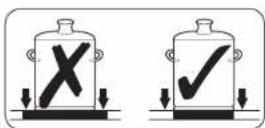
• Always position pots and pans before switching on the cooking zone.
- Dirty cooking zones and pan bases increase power consumption.
- When possible, position the lids firmly on the pots and pans to cover completely.
- Switch the cooking zones off before the end of the cooking time to use the residual heat for keeping foods warm or for thawing.
- The base of the pan should be the same size as the cooking zone.
• Using a pressure cooker reduces cooking times by up to 50%
Using the touch control sensors
To operate the touch control sensors, touch the desired panel with the tip of your pointed finger until the relevant displays illuminate or go out, or until the desired function is activated.
Ensure that you are touching only one sensor panel when operating the appliance. If your finger is too flat on the panel, an adjacent sensor may be actuated as well.
Switching the appliance on

- Touch the "Lock 🔒" sensor for approximately 3 seconds.

- The appliance is switched on using the "On / Off" control sensor. Touch the "On / Off" sensor.
• The digital displays will show


NOTE
After the "On / Off" sensor has been actuated to switch on your appliance, a heat setting must be selected within approximately 10 seconds. Otherwise, the appliance will switch itself off for safety reasons.
Temperature control

For setting and adjusting the power level (☐ to ☐) for cooking, touch the corresponding cooking zone's ☐ Keys. The first time ☐ is pressed, the heat level is set to ☐.
The first time is pressed, the heat level is set to 5.
Use the ☐key to increase the heat setting and the ☐key to decrease.
Switching the appliance off
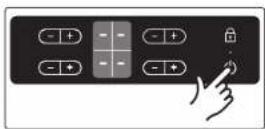
To completely switch off the appliance, use the "On / Off" control sensor. Touch the "On / Off" sensor.

NOTE
- After switching off a single cooking zone or the entire cooking surface, the presence of residual heat will be indicated in the digital displays of the corresponding cooking zones in the form of an H (for "hot").
- If the heat setting is at and 9 you want to turn the □burner off, the sensor can be touched one additional time, and the heat setting will go to zero.
- For faster adjustment, keep your finger on the or sensor until the required value is obtained.
- If more than one sensor is pressed for longer than 10 seconds, will show in the heat setting display. To reset, touch the "On / Off" sensor.
Switching a cooking zone off

To switch off a cooking zone, return the setting to ☐ by using the control panel's heat setting and touch sensors ☐ or ☐

Hob use
Using the child safety lock
You can use the child safety lock to safeguard against unintentionally turning on a cooking zone and activating the cooking surface. The lock control sensor can be used only when the power is on.
Switching the child safety lock on

- Touch the control sensor for approximately 3 seconds. An acoustic signal will sound as confirmation.
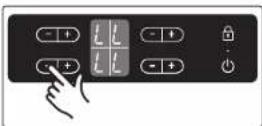
- Touch any heat setting control sensor. ☐ will appear in the displays, indicating the child safety lock has been activated.
Switching the child safety lock off
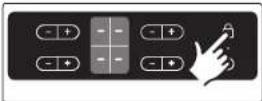
Touch the control sensor for approximately 3 seconds. An acoustic signal will sound as confirmation.

NOTE
After switching off the appliance, child safety lock will be activated automatically within some minutes for safety reasons.
14 English

Locking and unlocking the control panel
At any stage during the cooking process, the control panel, with the exception of the "On / Off" control sensor, can be locked in order to prevent the settings from being changed unintentionally, for example, by wiping over the panel with a cloth.
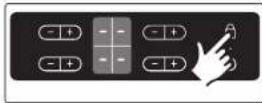
- Touch the lock control sensor for approximately 3 seconds. The indicator light in the lock control sensor will illuminate. The control sensors are now locked. - To unlock the control sensor, touch the lock control sensor again for approximately 3 seconds. The indicator light in the lock control sensor will extinguish.

Suggested settings for cooking specific foods
The figures in the table below are guidelines. The heat settings required for various cooking methods depend on a number of variables, including the quality of the cookware being used and the type and amount of food being cooked.
| Switch setting | Cooking method Examples for Use | |
| 9 | Warming Sautéing Frying | Warming large amounts of liquid, boiling noodles, searing meat, (browning goulash,braising meat) |
| 8 | Intensive Frying | Steak, sirloin, hash browns, sausages, pancakes / griddle cakes |
| 7 | ||
| 6 Frying | Schnitzel / chops, liver, fish, rissoles, fried eggs | |
| 5 | Boiling | Cooking up to 1.5 l liquid, potatoes, vegetables |
| 4 | ||
| 3 Steaming Stewing Boiling | Steaming and stewing of small amounts of vegetables, boiling rice and milk dishes | |
| 2 | ||
| 1 Melting | Melting butter, dissolving gelatine, melting chocolate | |

NOTE
- The heat settings indicated in the table above are provided only as guidelines for your reference.
- You will need to adjust the heat settings according to specific cookware and foods.
Cleaning and care
Hob

WARNING
Cleaning agents must not come into contact with a heated ceramic glass surface. All cleaning agents must be removed with adequate amounts of clean water after cleaning because they can have a caustic effect when the surface becomes hot. Do not use any aggressively

NOTE
Clean the ceramic glass surface after each use when it is still warm to the touch. This will prevent spillage from becoming burnt onto the surface. Remove scales, watermarks, fat drippings and metallic discolouration with the use of a commercially available ceramic glass or stainless steel cleaner.
Light soiling
- Wipe the ceramic glass surface with a damp cloth.
- Rub dry with a clean cloth. Remnants of cleaning agent must not be left on the surface.
- Thoroughly clean the entire ceramic glass cooking surface once a week with a commercially available ceramic glass or stainless steel cleaner.
- Wipe the ceramic glass surface using adequate amounts of clean water and rub dry with a clean lint - free cloth.
English 15

Cleaning and care
Stubborn Soiling

natural_image
Illustration of a hand using a power tool to cut a cable or wire (no text or symbols visible)- To remove food that has boiled over and stubborn splashes, use a glass scraper.
- Place the glass scraper at an angle to the ceramic glass surface.
- Remove soiling by scraping with the blade.
NOTE
Glass scrapers and ceramic glass cleaners are available from specialty retailers.
Problem dirt

natural_image
Simple line drawing of a curved surface with scattered gray shapes, no text or symbols present.- Remove burnt-on sugar, melted plastic, aluminium foil or other materials with a glass scraper immediately and while still hot.
WARNING
There is a risk of burning yourself when the glass scraper is used on a hot cooking zone. 2. Clean the hob as normal when it has cooled down.
NOTE
If the cooking zone on which something has melted has been allowed to cool, warm it up again for cleaning.
Scratches or dark blemishes on the ceramic glass surface, caused, for example, by a pan with sharp edges, cannot be removed. However, they do not impair the function of the hob.
16 English

Hob Frame
WARNING
Do not use vinegar, lemon juice or scale remover on the hob frame; otherwise dull blemishes will appear.
-
Wipe the frame with a damp cloth.
-
Moisten dried debris with a wet cloth. Wipe and rub dry
To avoid damaging your appliance
- Do not use the cooktop as a work surface or for storage.
- Do not operate a cooking zone if there is no pan on the cooktop or if the pan is empty.
- Ceramic glass is very tough and resistant to temperature shock, but it is not unbreakable. It can be damaged by a particularly sharp or hard object dropping onto the cooktop.
- Do not use pans made of cast iron or which have damaged bases with rough edges or burrs. Scratching may occur if these pans are slid across the surface.
- Do not place pans on the hob frame. Scratching and damage to the finish may occur.
- Avoid spilling acidic liquids, for example, vinegar, lemon juice and descaling agents, onto the hob frame, since such liquids can cause dull spots.
- If sugar or a preparation containing sugar comes into contact with a hot cooking zone and melts, it should be cleaned off immediately with a kitchen scraper while it is still hot. If allowed to cool, it may damage the surface when removed.
- Keep all items and materials that could melt, for example, plastics, aluminium foil and oven foils, away from the ceramic glass surface. If something of this nature melts onto the cooktop, it must be removed immediately with a scraper.
Warranty and service
FAQs and troubleshooting
A fault may result from a minor error that you can correct yourself with the help of the following instructions. Do not attempt any further repairs if the following instructions do not help in each specific case.
WARNING
Repairs to the appliance are to be performed only by a qualified service technician. Improperly effected repairs may result in considerable risk to the user. If your appliance needs repair, please contact your customer service centre.
What should I do if the cooking zones are not functioning?
Check for the following possibilities:
- The fuse in the house wiring (fuse box) is intact. If the fuses trip a number of times, call an authorised electrician.
• The appliance is properly switched on. - The control indicators in the control panel are illuminated.
• The cooking zone is switched on.
• The cooking zones are set at the desired heat settings.
What should I do if the cooking zones will not switch on?
Check for the following possibilities:
- A period of more than 10 seconds has elapsed between when the On / Off button was actuated and the desired cooking zone switches on (see the section Switching the appliance on on page 13).
- The control panel is partially covered by a damp cloth or liquid.
What should I do if the display except for H the residual warmth indicator suddenly disappears?
This could be a result of one of two possibilities:
• The On / Off sensor was accidentally actuated.
- The control panel is partially covered by a damp cloth or liquid.
Warranty and service
What should I do if, after the cooking zones have been switched off, residual warmth is not indicated in the display?
Check for the following possibility:
- The cooking zone was only briefly used and therefore did not become hot enough. If the cooking zone is hot, please call the customer service centre.
What should I do if the cooking zone will not switch on or off?
This could be due to one of the following possibilities:
- The control panel is partially covered by a damp cloth or liquid.
• The child safety lock is on.
What should I do if the 5 E isplay Is illuminated?
Check for the following:
- The control panel is partially covered by a damp cloth or liquid. To reset, press the "On / Off" control sensor.
What does it mean when the burner does not glow red?
- The selected temperature of the cooking zone is maintained by a sensor that cycles the zone on and off, so the surface cooking area will not always glow red. If you select a low heat setting, the heat will cycle on and off more frequently than at higher settings. The heat also cycles on and off at the highest setting.
If you request a service call because of an error made in operating the appliance, the visit from the customer service technician may incur a charge even during the warranty period.
Service
Before calling for assistance or service, please check the section FAQs and troubleshooting on page 17.
If you still need help, follow the instructions below.
Is it a technical fault?
If so, please contact your customer service centre.
Always prepare in advance for the discussion. This will ease the process of diagnosing the problem and also make it easier to decide if a customer service visit is necessary.
Please take note of the following information.
• What form does the problem take?
• Under what circumstances does the problem occur?
When calling, please know the model and serial number of your appliance. This information is provided on the rating plate as follows:
- Model description
• S / N code (15 digits)
When do you incur costs even during the warranty period?
- If you could have remedied the problem yourself by applying one of the solutions provided in the section FAQs and troubleshooting on page 17.
- If the customer service technician has to make several service calls because he was not provided with all of the relevant information before his visit and as a result, for example, has to make additional trips for parts. Preparing for your phone call as described above will save you the cost of these trips.
18 English
Technical data
Technical data
| Appliance dimensions | Width 575 mm | |
| Depth 505 mm | ||
| Height 55 mm | ||
| Worktop cut - out dimensions | Width 560 mm | |
| Depth 490 mm | ||
| Corner radius 3 mm | ||
| Connection voltage 230 V | -50 Hz | |
| Maximum connected load power 6.0 kW | ||
| Weight | Net 7.5 kg | |
| Cross 10.0 kg | ||
Cooking zones
| Position Diameter Power | ||
| Front left 183 mm 1800 W | ||
| Rear left 148 mm 1200 W | ||
| Rear right | 183 mm 1800 W | |
| Front right | 148 mm 1200 W | |
English 19
SAMSUNG
QUESTIONS OR COMMENTS?
| COUNTRY CALL | OR VISIT US ONLINE AT | |
| EGYPT | 08000-726786416580 | www.samsung.com/eg/support |
| IRAN 021-82 | 55 [CE] www.samsung.com/iran/support | |
| Israel '6963 | www.samsung.com/ill/support/ | |
| SAUDI ARABIA | (+966) 8002474357(800 2477 HELP) | www.samsung.com/sa/homewww.samsung.com/sa_en |
| PAKISTAN 0800 | Samsung (72678) www.samsung.com/pk/support | |
| U.A.E 800-SAMSUNG (800-726 7864) | www.samsung.com/ae/support (English)www.samsung.com/ee_ar/support (Arabic) | |
| OMAN 800-SAM CS (800-72627) | ||
| KUWAIT 183 CALL (183 2255) | ||
| BAHRAIN 8000-CSAM (8000-4726) | ||
| QATAR 800-CALL (800-2255) | ||
| TURKEY 444 77 11 | www.samsung.com/tr/support | |
| JORDAN | 0800-2227306 5777444 | www.samsung.com/levant/support |
| SYRIA | 962 5777444 | |
| Lebanon | 981 1484 9991299 | |
| Iraq | 80010080 | |
| ALGERIA | 3004 | www.samsung.com/n_afr.ce/support |
| TUNISIA | 80 1000 12 | |
| MOROCO | 080 100 22 55 | |
| COUNTRY CALL OR VISIT US ONLINE AT | ||
| SOUTH AFRICA | 0960 SAMSUNG (726 7864) | www.samsung.com/support |
| ZAMBIA 0211 | 350 370 | |
| MAURITIUS | 800 2550 | |
| ANGOLA | 917 267 864 | |
| MOZAMBIQUE | 847267864 | |
| NIGERIA | 0900-726-7864 | www.samsung.com/africa.cn/support |
| Ghana | 0800-100-077 | |
| Cote D'Avonre | 8000-00-77 | www.samsung.com/africa.fr/support |
| SENECAL | 800-00-0077 | |
| CAMEROON | 67095 0077 | |
| KENYA | 0800 545 545 | www.samsung.com/support |
| UGANDA | 0800 300 300 | |
| TANZANIA | 0800 780 089 | |
| RWANDA | 9999 | |
| BURUNDI | 200 | |
| DRC 499999 | ||
| SUDAN | 1969 | |
DG68-00963A-00

