
DM-3551 - Photocopier SHARP - Free user manual and instructions
Find the device manual for free DM-3551 SHARP in PDF.



| Product type | Black and white multifunction copier |
| Brand | SHARP |
| Model | DM-3551 |
| Maximum paper size | A3 |
| Copy speed | 35 pages per minute |
| Copy resolution | 600 x 600 dpi |
| Standard paper input | 2 x 500 sheets + 100-sheet bypass tray |
| Duplex printing | Automatic |
| Color scanning | Yes, 600 x 600 dpi resolution |
| Print speed | 35 ppm (black and white) |
| Print resolution | 1200 x 600 dpi |
| Touch screen | 7-inch color |
| Connectivity | Ethernet, USB, Wi-Fi (optional) |
| Dimensions (W x D x H) | 620 x 690 x 920 mm |
| Weight | 70 kg |
| Power supply | 220-240 V, 50/60 Hz, 10 A |
| Maximum power consumption | 1.5 kW |
| Standby power consumption | 20 W |
| Maintenance | Cleaning of glass, toner and drum replacement |
| Security | Secure boot, password protection, CE compliance |
| Available spare parts | Drum, toner, staplers, maintenance kit |
| Repairability | SHARP technical support, repair by certified technician |
Frequently Asked Questions - DM-3551 SHARP
User questions about DM-3551 SHARP
0 question about this device. Answer the ones you know or ask your own.
Ask a new question about this device
Download the instructions for your Photocopier in PDF format for free! Find your manual DM-3551 - SHARP and take your electronic device back in hand. On this page are published all the documents necessary for the use of your device. DM-3551 by SHARP.
USER MANUAL DM-3551 SHARP
Operation Manual (for copier)
Be sure to become thoroughly familiar with this manual to gain the maximum benefit from the product.
Before installing this product, be sure to read the installation requirements and cautions sections of the "Operation manual for printer operation and general information".
Be sure to keep all operation manuals handy for reference including this manual, the "Operation manual for printer operation and general information" and operation manuals for any optional equipment which has been installed.
INTRODUCTION
This manual describes only copier features. For operation procedures relating to both the basic printer and copier features, refer to the “Operation manual (for printer operation and general information)”. General information required for loading paper, adding toner, misfeed removal, and operation of peripheral devices are described in that manual.
Separate manuals are provided for the operation of network scanning and facsimile functions. Refer to the “Operation manual (for scanner)” and “Operation manual (for facsimile)” for these descriptions.
CONTENTS
Page
INTRODUCTION 1
CONTENTS 2
PART NAMES AND FUNCTIONS (B/W scanner module/DSPF) .... 3
● Exterior 3
● Operation Panel 4
● Touch Panel (basic screen of copy mode) 5
AUTOMATIC DOCUMENT FEEDER 6
- Acceptable originals 6
SETTING ORIGINALS....7
NORMAL COPYING 9
● Copying from the automatic document feeder ..... 9
● Automatic two-sided copying from the automatic document feeder 11
● Copying from the document glass 12
● Automatic two-sided copying from the document glass ..... 14
EXPOSURE ADJUSTMENTS 15
REDUCTION/ENLARGEMENT/ZOOM 16
● Automatic selection (auto image) 16
● Manual selection 17
SPECIAL PAPERS 18
SPECIAL MODES 19
● Common operation procedure for using the special functions . . 19
● Margin shift 20
● Erase 21
- Dual page copy 22
● Pamphlet copy.... 23
● Job build 24
● Multi shot 25
JOB PROGRAM MEMORY 26
● Storing a job program 26
● Recalling a job program 27
- Deleting a stored job program 27
INTERRUPTING A PRINT OR COPY RUN 28
MISFEED REMOVAL.... 29
- Misfeed in the scanner module 29
TROUBLESHOOTING 30
SPECIFICATIONS 31
● Copy 31
- Scanner module 31
KEY OPERATOR PROGRAMS 32
● Key operator program list 32
● Using the key operator programs ..... 32
- Setting programs 33
PART NAMES AND FUNCTIONS (B/W scanner module/DSPF)
Exterior
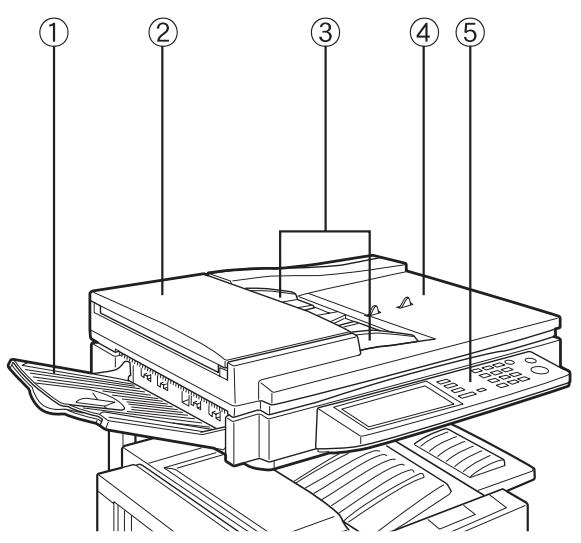
① DSPF exit area
Scanned originals are deposited here.
② Document feeding area cover (page 29)
Open to remove misfed originals in this area.
③ Original guides (page 7)
Adjust to the size of the originals.
④ Document feeder tray (page 7)
Set the originals here for automatic feeding.
⑤ Operation panel (next page)
Use for operation of copier, network scanner, and facsimile features and for printer configuration operations.
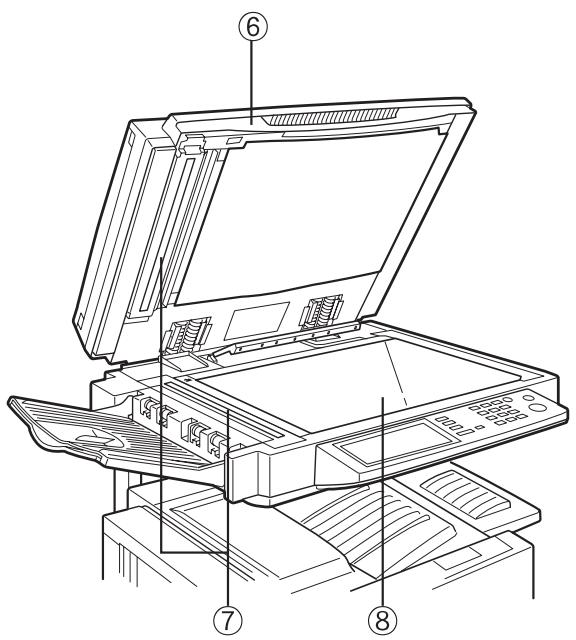
⑥ Document cover
⑦ Document scanning windows
Sheet type originals are scanned here.
⑧ Document glass
All originals which cannot be copied from the document feeder tray must be copied here.
Operation Panel
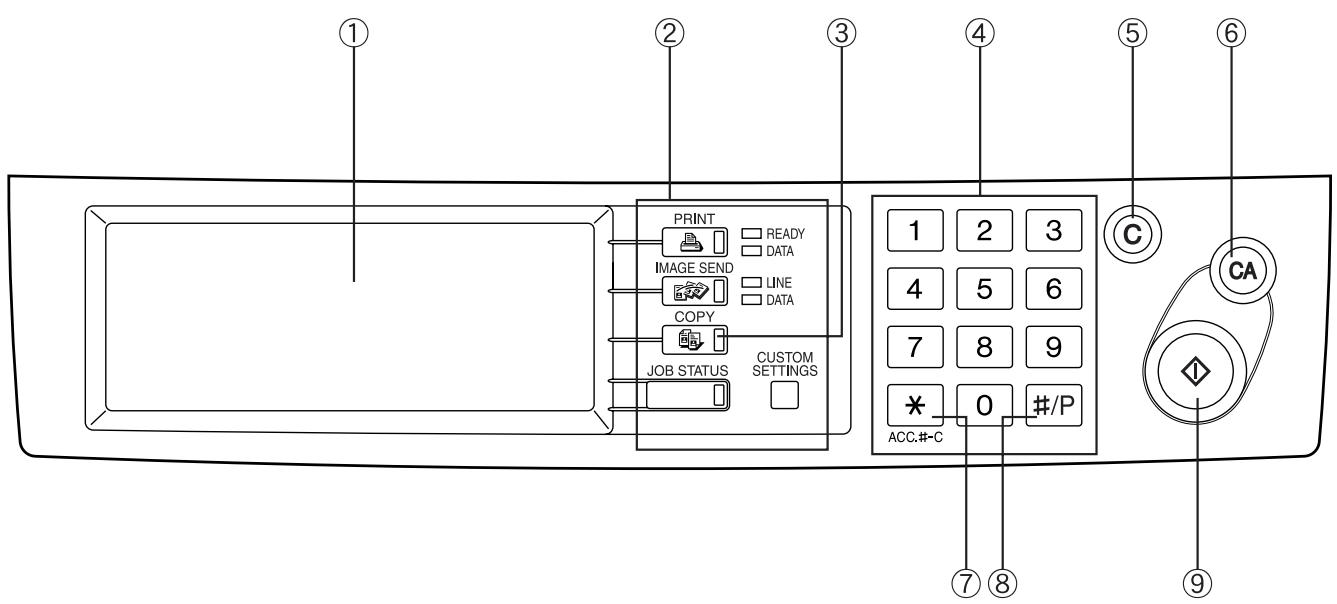
① Touch panel (next page)
The machine status, messages and touch keys are displayed on the panel. When the machine is in the standby state, the display will change if the [PRINT] key, [IMAGE SEND] key or [COPY] key is pressed to show the current status of these modes.
② Mode select keys
Use to select the basic modes of the product.
③ [COPY] key
Press to select the copy mode and display the basic screen of the copy mode. (next page)
Even when the machine is busy in another mode, the basic copy mode screen will appear when the [COPY] key is pressed. If this key is pressed and held while the basic screen of the copy mode is displayed, the total output count and the quantity of toner remaining (percentage) will be displayed.
④ Numeric keys
Use to select the number of copies and to make numerical entries for setting operations.
⑤ [C] key (clear key)
Press to clear a copy quantity entry. If this key is pressed while the automatic document feeder is being used, any originals in progress will be automatically output.
⑥ [CA] key (clear all key)
Press to clear all selected settings and return the machine to the initial settings for the currently selected mode. Before starting a copy operation, press the [CA] key first.
⑦ [ACC.#-C] key
If the auditing mode has been set, press this key to close an open account after finishing a copy, facsimile scanning or network scanning job. For setting of the auditing mode, see page 7 of the Key Operator's Guide.
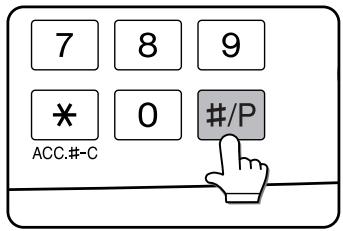
⑧ [#/P] key (page 26)
Press to select the job memory mode.
⑨ [START] key (page 10)
When the indicator is lit, copying, facsimile scanning and network scanning jobs can be started. Press to start copying.
Touch Panel (basic screen of copy mode)
When the copy mode key is pressed, this display screen will appear showing the basic copy mode selections. (For the display screens for other modes, see the respective operation manuals for those modes.)
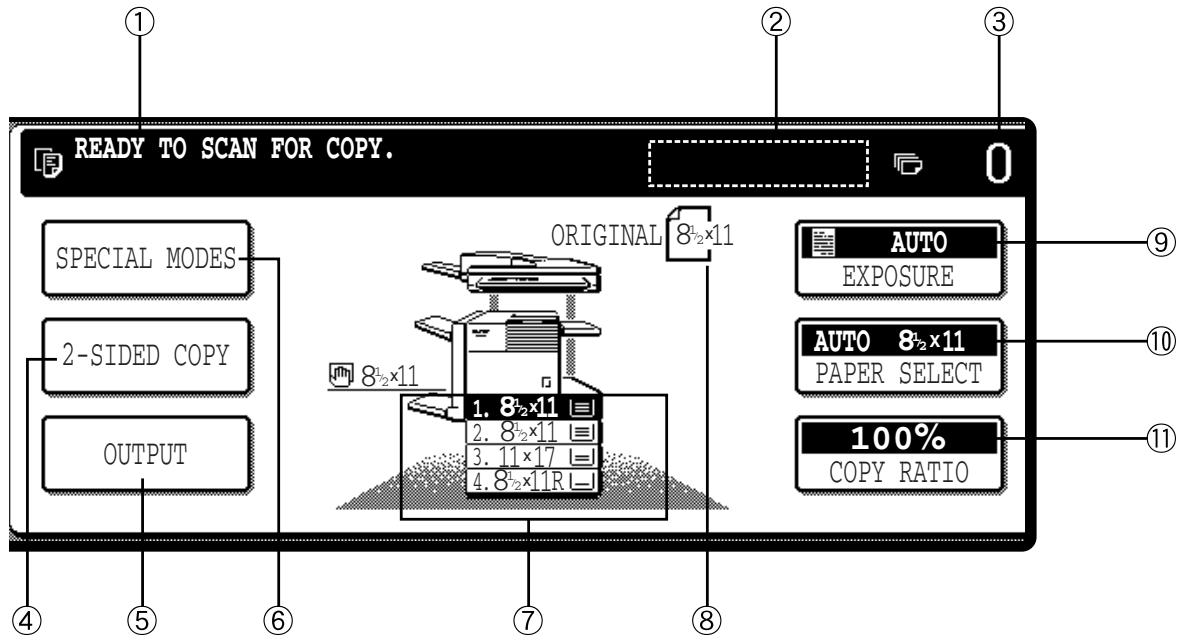
① Message display
Basic status messages are displayed here.
② [INTERRUPT] key display area
When interrupt copy is available, the [INTERRUPT] key will be displayed here. When an interrupt copy job is being run, a [CANCEL] key will be displayed here to be used for canceling the interrupt copy job.
③ Copy quantity display
Displays the selected number of copies before the [START] key is pressed or the number of completed copies after the [START] key is pressed. A single copy can be made when "0" is displayed.
④ [2-SIDED COPY] key (page 9)
Touch to display the duplex copy mode setting screen. A highlighted selection on the screen will indicate the currently selected mode. The setting screen can be closed by touching the [OK] key on the setting screen whether or not a selection change was made.
⑤ [OUTPUT] key (page 10)
Touch to display the output mode setting screen. A highlighted selection on the screen will indicate the currently selected mode. The setting screen can be closed by touching the [OK] key on the setting screen whether or not a selection change was made.
⑥ [SPECIAL MODES] key
Touch to display the special modes selection screen. The functions that can be selected by touching this key are described on page 19.
⑦ Paper size display
The display shows the location of the paper trays, the size of the paper in the trays and the approximate amount of paper loaded in each tray. The approximate amount of paper in a tray is indicated by ≡.
For changing the paper size in a tray refer to page 1-16 of the “Operation manual (for printer operation and general information)”.
⑧ Original size display
The original paper size will be displayed when originals are placed on the document glass or in the document feeder.
⑨ Exposure display and [EXPOSURE] key (page 15)
A touch of the [EXPOSURE] key will open the exposure selection window. A highlighted key on the exposure window indicates which exposure mode (AUTO, TEXT, TEXT/PHOTO or PHOTO) is currently selected. When an exposure mode other than AUTO is selected, an exposure level scale will also appear in the window.
⑩ Paper select display and [PAPER SELECT] key (page 9)
Displays the selected paper size. When the auto paper select mode has been selected, "AUTO" will be displayed.
A touch of the [PAPER SELECT] key will open the paper selection window. When a selection is made, the selection window will close. To close the window without making a selection touch the key again
⑪ Copy ratio display and [COPY RATIO] key (page 17)
Displays the selected copy ratio.
Touch to display the reduction and enlargement copy ratio selection screen.
AUTOMATIC DOCUMENT FEEDER
Originals set in the automatic document feeder will be automatically fed and copied sequentially.
The automatic document feeder will simultaneously scan both sides of originals when two-sided to one-sided or two-sided to two-sided copying is being done.
Acceptable originals
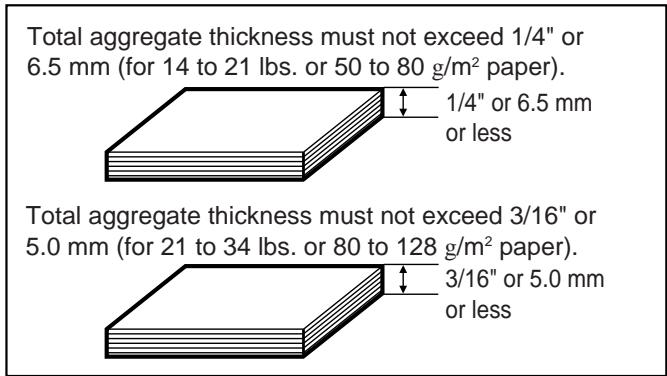
A stack of up to 50 original sheets (30 original sheets*1 for 8-1/2" x 14" (B4) or larger) of the same size paper can be set in the document feeder tray provided the stack height is within the limit shown below.
A stack of up to 30 mixed size originals can be set if the width of the originals is the same and the stack height is within the limit shown below. In this case, however, stapling and duplex will not function and some special functions may not give the expected result.
*1 For paper heavier than 28 lbs. (105 g/m²), only a stack of up to 15 sheets can be set. Setting 16 or more sheets may cause incorrect scanning of original and scanned image may become expanded compared with original itself.
■ Size and weight of acceptable originals
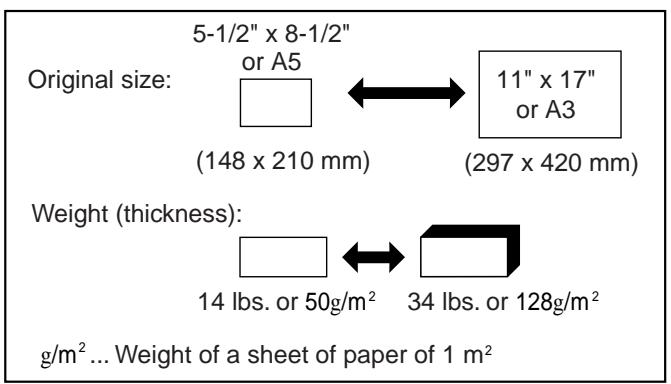
■ Total amount of originals that can be set in the document feeder tray
Notes on use of the automatic document feeder
- Use originals within the specified size and weight ranges. Use of originals out of the specified range may cause an original misfeed.
- Before loading originals into the document feeder tray, be sure to remove any staples or paper clips.
- If originals have damp spots from correction fluid, ink or glue from pasteups, be sure they are dried before they are fed. If not, the interior of the document feeder or the document glass may be soiled.
- To prevent incorrect original size detection, original misfeeds or smudges on copies, use the following as a guide for feeding originals.
Transparency film, tracing paper, carbon paper, thermal paper or originals printed with thermal transfer ink ribbon should not be fed through the document feeder. Originals to be fed through the feeder should not be damaged, crumpled or folded or have loosely pasted paper on them or cutouts in them. Originals with multiple punched holes other than two-hole or three-hole punched paper may not feed correctly.
- When using originals with two or three holes, place them so that the punched edge is at a position other than the feed slot.
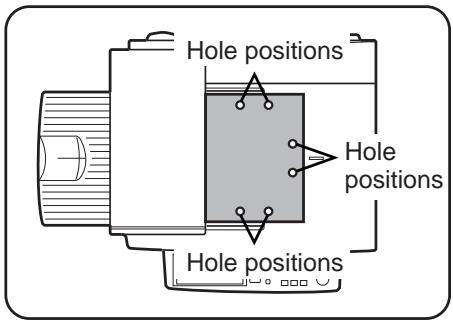
SETTING ORIGINALS
■ When using the automatic document feeder
1 Ensure that there is no original on the document glass.
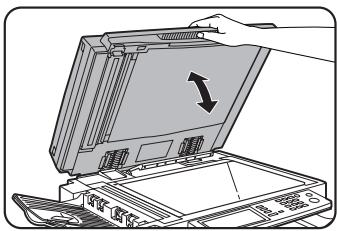
2 Adjust the original guides to the size of the originals.
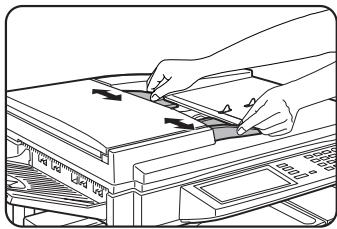
3 Place the originals face down in the document feeder tray.
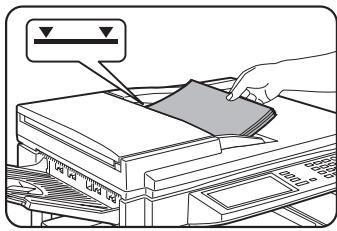
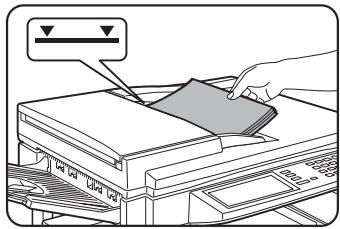
Set the originals all the way into the feed slot. Do not exceed the maximum height line marked on the original guide.
■ When using the document glass
Open the document cover, place an original face down on the document glass, and then gently close the document cover.
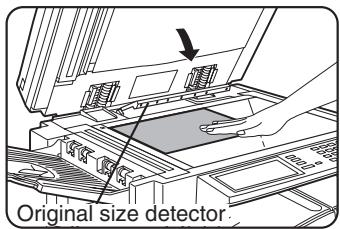
NOTE
Do not place any objects under the original size detector, because they may damage it or the original size may not be detected properly.
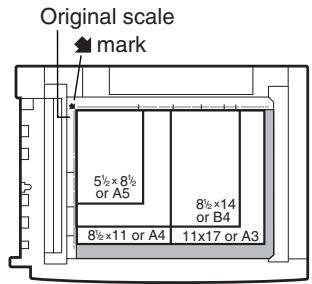
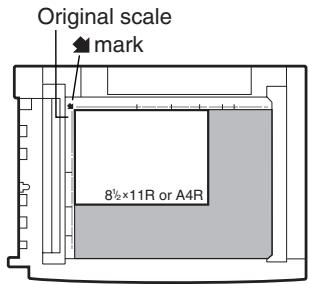
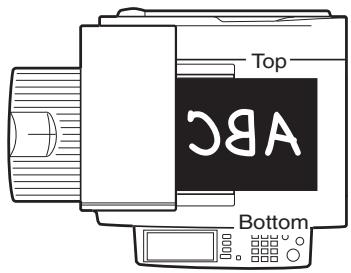
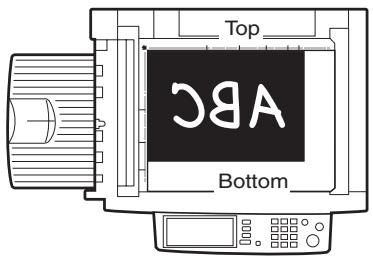
- Set an original by aligning its corner with the tip of the scale (▲) mark at the left rear corner of the glass as shown in the illustrations.
■ Standard original setting orientation
Descriptions of functions that follow in this manual assume that originals are oriented as shown.
Document feeder tray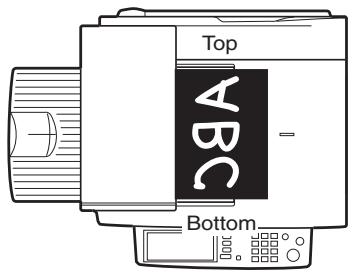
Document glass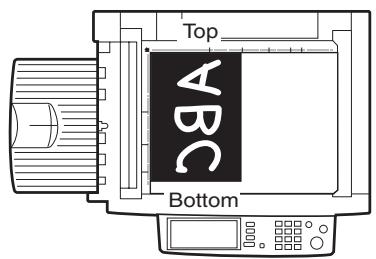
Place originals in the document feeder tray or on the document glass so that the top of the original is positioned to the rear side of the machine. If not, staples will be incorrectly positioned and some special features may not give the expected result.
■ Automatic copy image rotation - rotation copying
If the orientation of the originals and copy paper are different, the original image will be automatically rotated 90° and copied. (When an image is rotated, a message will be displayed.) When enlargement of originals larger than 8-1/2" x 11" or A4 is selected, rotation cannot be done.
[Example] Orientation of original Face down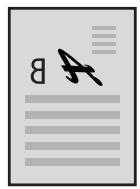
Orientation of paper

Copy after rotation Face down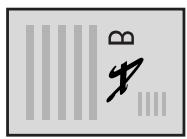
This function operates in the auto paper select or auto image mode. (Rotation copying can be disabled with a key operator program. See page 33.)
NORMAL COPYING
This section describes the normal copying procedure.
Copying from the automatic document feeder
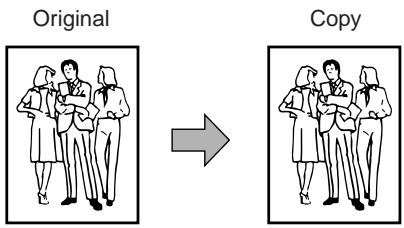
1-sided copies of 1-sided originals
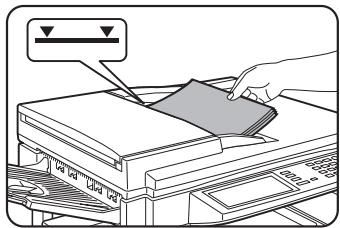
1. Place the originals in the document feeder tray. (page 7)
2. Ensure that the 1-sided to 1-sided copy mode is selected.
The one-sided to one-sided mode is selected when no icon for a two-sided mode appears in the dashed area on the display. If the 1-sided to 1-sided copy mode is already selected, steps 3 to 5 are not needed.
3. Touch the [2-SIDED COPY] key.
![graph TD A["2-SIDED COPY"] --> B["OUTPUT"]](/content/2024/12/122344/images/0ba48575c0119cc73a534faa397fae9d28d228b887860870d5dc7a244e6aa8f3.jpg)
4. Touch the [1-sided to 1-sided copy] key.
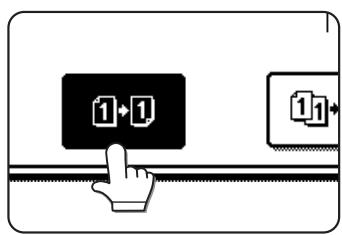
The [1-sided to 1-sided] key will be highlighted.
5. Touch the [OK] key.
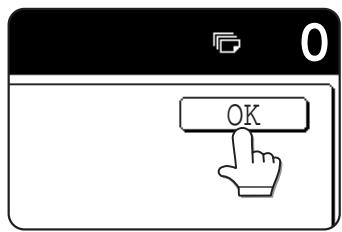
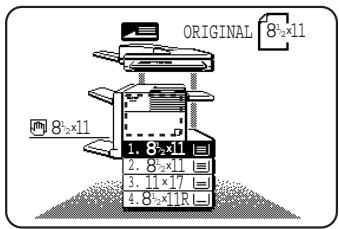
6. Ensure that paper of the same size as the originals is automatically selected. (*Note)
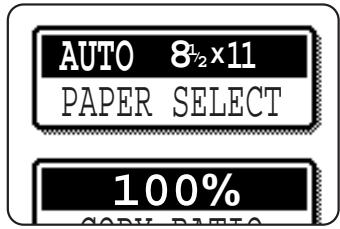
The selected tray will be highlighted or the message "LOAD xxxxxx PAPER." will appear. If the message appears, load paper in a paper tray or the bypass tray with paper of the required size. Even if the message above is displayed, copying can be performed onto the currently selected paper.
(*Note) The following requirements must be satisfied.
- Originals of a standard size (11" x 17", 8-1/2" x 14", 8-1/2" x 11", 8-1/2" x 11"R, 5-1/2" x 8-1/2", A3, B4, A4, A4R or A5) are set and the auto paper select function is enabled.
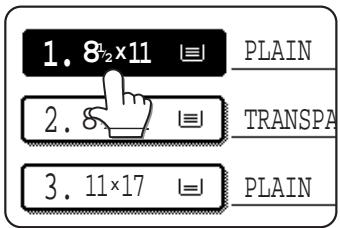
If originals of a size other than the sizes above are to be copied, manually select the desired paper size.
7 Select the desired output mode (see below).
![graph TD A["2-SIDED COPY"] --> B["OUTPUT"]](/content/2024/12/122344/images/2b93ce43e1609759462587775d8c847601db383b522d1dd33d6c0892ba8485bb.jpg)
The sort mode is the default mode. To select the group mode, touch the [OUTPUT] key, then touch the [GROUP] key on the output setting screen, and then touch the [OK] key on the setting screen.
8 Use the numeric keys to set the desired number of copies.
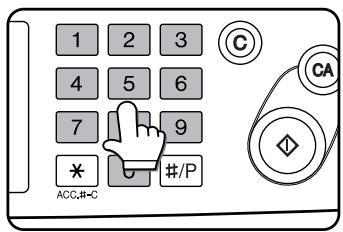
Up to 999 can be set. Use the [C] (clear) key to cancel an entry if a mistake has been made.
9 Press the [START] key.
If the [C] key is pressed while originals are being scanned, scanning will stop. If copying had already started, copying and scanning will stop after the original in progress is output to the original exit area. In these cases the copy quantity will be reset to "0". If scanning has been completed but copying is still in progress, copying will continue.
NOTE
The 1-sided to 1-sided copying mode is set as the default in the initial settings. This setting can be changed by a key operator program (initial status setting).
Output modes (sort mode and group mode)
[Example] Five sets of copies from three originals
- Sort copy
Originals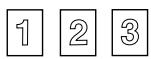

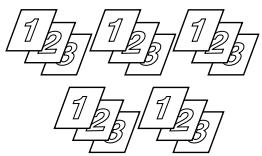
Five sets of copies
● Group copy
Originals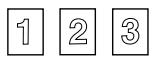

Five copies of each original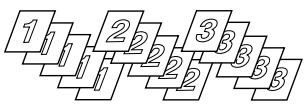
When originals are placed in the document feeder tray, a sort icon will appear on the touch panel and the sort copy mode will be automatically selected. In this case, copies will be delivered as shown in the upper illustration to the left. For output in the group mode as shown in the lower left illustration, the group mode must be selected on the output setting screen.
Automatic two-sided copying from the automatic document feeder
A duplex module must be installed for automatic 1-sided to 2-sided or 2-sided to 2-sided copying. A duplex module is not needed for 2-sided to 1-sided copying.
![graph TD A["Original"] --> B["Copy"] B --> C["Final Text Document"] style A fill:#f9f,stroke:#333 style B fill:#bbf,stroke:#333 style C fill:#dfd,stroke:#333](/content/2024/12/122344/images/863dcf13d20f7914f12d074400f6debf7a29247a28fe245aae373b2c1b267d25.jpg)
1 Place the originals in the document feeder tray. (page 7)
2 Touch the [2-SIDED COPY] key.
![graph TD A["2-SIDED COPY"] --> B["OUTPUT"]](/content/2024/12/122344/images/b6c73355e28b09ec68f166a8f235826e85b3e10e9f482867df1e58f6a6de1ff5.jpg)
3 Select the desired duplex copy mode.
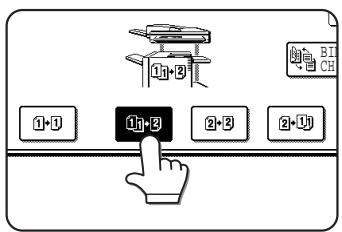
The illustration to the left shows the screen displayed when a duplex module is installed.
The image to be copied onto the second side of 2-sided copies can be inverted so that the resultant 2-sided copies are in the correct orientation for binding at the top. For top binding, touch the [BINDING CHANGE] key on the 2-sided copy selection screen.
- Automatic two-sided copying from one-sided originals
- Automatic two-sided copying from two-sided originals
- Automatic one-sided copying from two-sided originals
4 Touch the [OK] key.
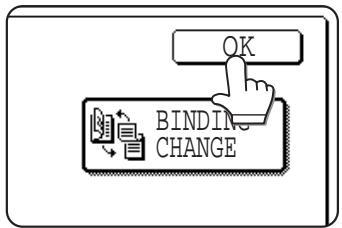
Follow step 6 on page 9 to step 9 on page 10.
Copying from the document glass
When copying originals which cannot be fed from the automatic document feeder such as thick originals, open the document cover and copy the originals from the document glass.
■ 1-sided copies of 1-sided originals
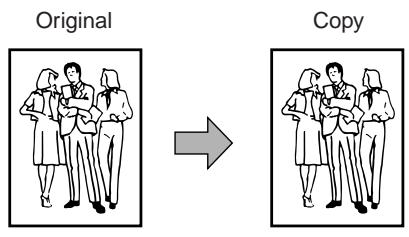
1 Set an original on the document glass. (page 7)
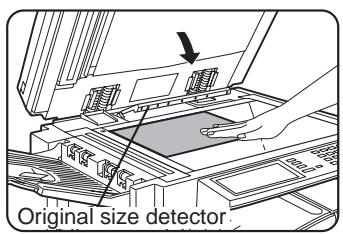
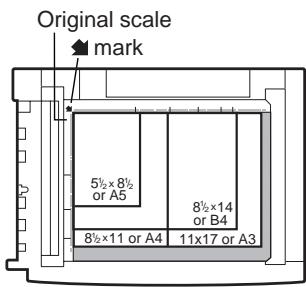
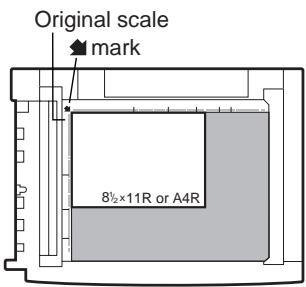
- Set an original by aligning its corner with the tip of the scale (▲) mark at the left rear corner of the glass as shown in the illustrations.
2 Ensure that the 1-sided to 1-sided copy mode is selected.
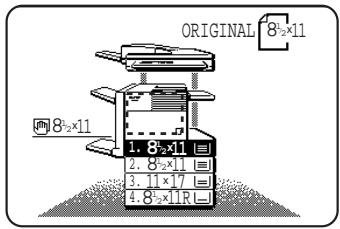
The one-sided to one-sided mode is selected when no icon for a two-sided mode appears in the dashed area on the display. If the 1-sided to 1-sided copy mode is already selected, steps 3 to 5 are not needed.
3 Ensure that paper of the same size as the original is automatically selected. (*Note)
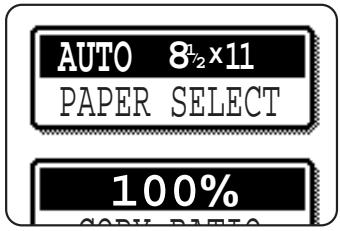
The selected tray will be highlighted or the message "LOAD xxxxxx PAPER." will appear. If the message appears, load paper in a paper tray or the bypass tray with paper of the required size. Even if the message above is displayed, copying can be performed onto the currently selected paper.
Note: The following conditions must be satisfied.
Originals of a standard size (11" x 17", 8-1/2" x 14", 8-1/2" x 11", 8-1/2" x 11"R, 5-1/2" x 8-1/2", A3, B4, A4, A4R or A5) are set and the auto paper select function is enabled.
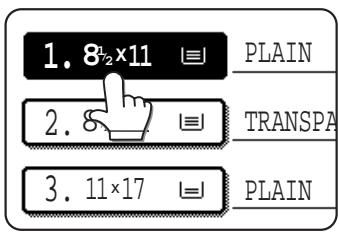
If originals of a size other than the sizes above are to be copied, manually select the desired paper size.
4. Select the desired output mode (see below).
![graph TD A["2-SIDED COPY"] --> B["OUTPUT"]](/content/2024/12/122344/images/f1d3da673e1fe3db52037356e2f10d6e321b23132a990d72e6165782b96b0620.jpg)
When a document is detected on the document glass, the group mode will be automatically selected. To select sort copy, touch the [OUTPUT] key, then touch the [SORT] key on the displayed screen, and then touch the [OK] key.
NOTE
If you touch the [SORT] or [GROUP] key, its corresponding icon will appear on the touch panel. To change the selection, touch the icon to return the display to the output setting screen.
5. Use the numeric keys to set the desired number of copies.
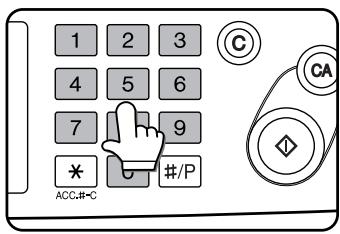
Up to 999 can be set.
Use the [C] (clear) key to cancel an entry if a mistake has been made.
6. Press the [START] key.
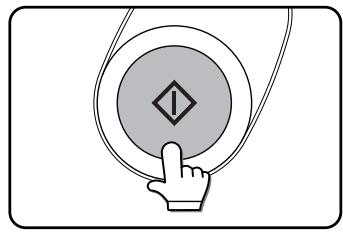
Replace the original with the next original and press the [START] key. Repeat this operation until all originals have been scanned.
If sort was selected in step 4, go to the next step.
7. Touch the [READ-END] key.
![PLACE NEXT ORIGINAL. PRESS [START]. WHEN FINISHED, PRESS [READ-END]. READ-END](/content/2024/12/122344/images/0aef8f3b75d719b79fe65668f47603de66f6f6d5161f20118214e0420c269483.jpg)
Output mode (sort copy and group copy)
[Example] Five sets of copies from three originals
- Sort copy
Originals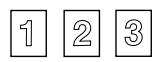

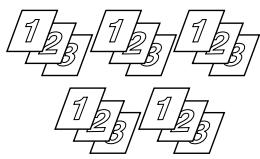
Five sets of copies
- Group copy
Originals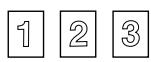
Five copies of each original
When originals are placed in the document feeder tray, a sort icon will appear on the touch panel and the sort copy mode will be automatically selected. In this case, copies will be delivered as shown in the upper illustration to the left. For output in the group mode as shown in the lower left illustration, the group mode must be selected on the output setting screen.
Automatic two-sided copying from the document glass
A duplex module must be installed for automatic 1-sided to 2-sided or 2-sided to 2-sided copying. A duplex module is not needed for 2-sided to 1-sided copying.
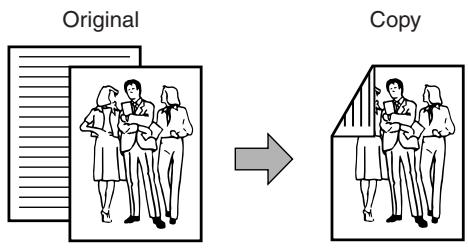
1 Place an original on the document glass. (page 7) 2 Touch the [2-SIDED COPY] key.
![graph TD A["2-SIDED COPY"] --> B["OUTPUT"]](/content/2024/12/122344/images/01ddf8b7a1665726273e6a0d489c48f48fbd9f969eefccaaa731ad78dfcc0635.jpg)
4 Touch the [OK] key.
Follow step 3 on page 12 to step 7 on page 13.
3 Touch the [1-sided to 2-sided copy] key.
The image to be copied onto the second side of 2-sided copies can be inverted so that the resultant 2-sided copies are in the correct orientation for binding at the top. For top binding, touch the [BINDING CHANGE] key on the 2-sided copy selection screen.
EXPOSURE ADJUSTMENTS
Select the exposure mode to be consistent with the type of originals to be copied. The selections are AUTO, TEXT, TEXT/PHOTO and PHOTO.
■ Automatic exposure adjustment
The automatic exposure mode is the default initial setting for this machine. In this mode, the characteristics of an original being copied are “read” by the exposure system, and exposure adjustments are made automatically. To select an exposure mode more suitable for originals to be copied or to adjust the exposure manually, follow the procedure below.
■ Exposure mode selection and manual exposure adjustment
1 Touch the [EXPOSURE] key.
2 Select [TEXT], [TEXT/PHOTO] or [PHOTO] based on the original to be copied.
NOTE
Exposure mode selection
TEXT: This mode is useful for producing dark text copies with minimum background.
TEXT/PHOTO: This provides the best balance for copying an original which contains both text and photos. This mode is also useful for copying printed photographs.
PHOTO: This mode provides the best copies of photographs with fine details.
3 Adjust the exposure level.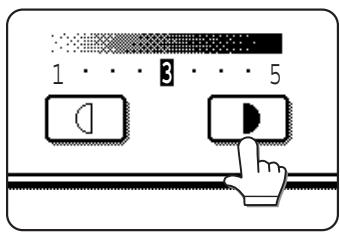
Touch the ▶ key to make darker copies. Touch the ◀ key to make lighter copies.
NOTE
Exposure levels in the text mode
1 to 2: Dark originals such as newspaper. 3: Normal density originals. 4 to 5: Originals written with pencils or light color characters.
After adjusting the exposure, follow any of the copying procedures.
To return to the automatic exposure mode, touch the [EXPOSURE] key and select [AUTO]. The automatic exposure level can be adjusted using a key operator program. (page 33)
REDUCTION/ENLARGEMENT/ZOOM
Reduction and enlargement ratios can be selected either automatically or manually as described in this section.
● Automatic selection will enlarge or reduce images based upon the original size and copy paper size to give the best possible fit of the image to the copy paper. - Manual selections can be made in the range of 25% to 400%. There are three preset reduction ratios (25%, 64% and 77%) and three preset enlargement ratios (121%, 129% and 400%) available for the inch system. There are four preset reduction ratios (25%, 70%, 81%, 86%) and four preset enlargement ratios (115%, 122%, 141%, 400%) available for the AB system.
Automatic selection (auto image)
The reduction or enlargement ratio will be selected automatically based on the original size and the selected paper size.
1 Place the original in the document feeder tray or on the document glass. (page 7)
The detected original size will be displayed.
Automatic selection can be used only for 11" x 17", 8-1/2" x 14", 8-1/2" x 11", 8-1/2" x 11"R, 5-1/2" x 8-1/2" size originals and copy paper in the inch system and A3, B4, A4, A4R or A5 in the AB system.
2 Touch the [PAPER SELECT] key and then select the desired paper size.
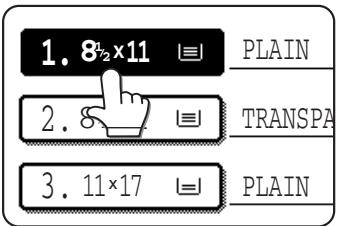
When the desired paper size key is touched, the paper size will be highlighted and the paper size setting window will be closed.
If paper of the desired size is not loaded in any tray, load paper of the required size in a paper tray and enter the paper size.
3 Touch the [AUTO IMAGE] key.
![graph TD A["AUTO IMAGE"] --> B["PAPER SELE"] A --> C["COPY RATIO"]](/content/2024/12/122344/images/b277a096a0495cf9e4aae2833343e4c711af2992f18781c4a918e03c5837b35c.jpg)
The [AUTO IMAGE] key will be highlighted and the best reduction or enlargement ratio for the original size and the selected paper size will be selected and displayed in the copy ratio display.
NOTE
If the message "ROTATE ORIGINAL FROM ☐ TO ☐" is displayed, change the orientation of the original as indicated in the message. When the message above is displayed, copying can be done without changing the orientation, but the image will not fit the paper correctly.
4 Make all other desired settings such as exposure or the number of copies, and press the [START] key.
When copying from the document glass in the sort mode, touch the [READ-END] key after all originals have been scanned. (step 7 on page 13)
To cancel the auto image mode, touch the [AUTO IMAGE] key again to clear the highlighted display.
Manual selection
1 Place the original in the document feeder tray or on the document glass. (page 7)
NOTE
When the document feeder is being used, the available copy ratio range is 25% to 200%.
2 Touch the [COPY RATIO] key.

The preset copy ratio keys for reduction and enlargement, the keys for [ZOOM] and the [100%] key will be displayed.
3 Select the desired copy ratio by touching a fixed copy ratio key for reduction or enlargement and touch the [OK] key. Use the 📊 and 🔍 keys to make fine adjustments as needed.
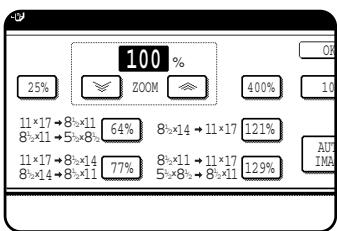
If the message “IMAGE IS LARGER THAN THE COPY PAPER.” appears, image loss will occur. In this case either continue with image loss or change the copy paper size or copy ratio.
4 Ensure that the desired paper size has been automatically selected based on the selected copy ratio or select another size as needed.
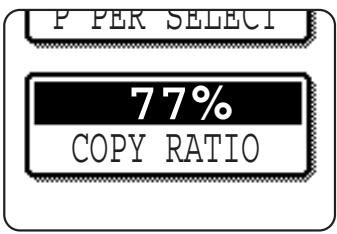
If another size paper is selected, the auto paper select display will be cleared.
5 Make all other desired settings such as exposure or the number of copies and press the [START] key.
When copying from the document glass in the sort mode, touch the [READ-END] key after all originals have been scanned. (step 7 on page 13)
SPECIAL PAPERS
If a bypass tray and a duplex module, a duplex module/bypass tray or a multi purpose drawer 1 is installed, special papers can be fed. These include transparency film, postcards, labels, envelopes 2 , and plain paper.
*1 The upper tray of a stand/3 x 500 sheet paper drawer or a stand/MPD & 2000 sheet paper drawer is equivalent to the multi purpose drawer. *2 Envelopes can be set in the multi purpose drawer and in the upper tray of a stand/paper drawer.
1 Place the original in the document feeder tray or on the document glass. (page 7)
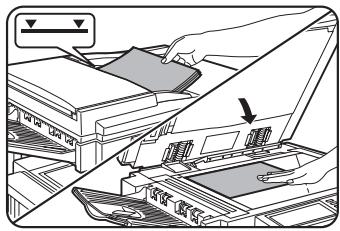
2 Load the special paper in the bypass tray or in the multi purpose drawer.
For the paper loading instructions see “Loading paper in the bypass tray” (page 5-3) of the “Operation manual (for printer operation and general information)” or “Loading paper in the multi purpose drawer” (page 1-21) of the “Operation manual (for printer operation and general information)”.
3 Touch the [PAPER SELECT] key and then select the bypass tray or the multi purpose drawer.
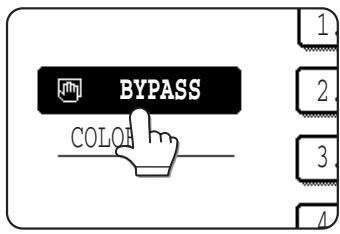
4 Make all other desired settings such as exposure or the number of copies, and press the [START] key.
When copying from the document glass in the sort mode, touch the [READ-END] key after all originals have been scanned. (step 7 on page 13)
SPECIAL MODE
When the [SPECIAL MODES] key on the basic screen of the copy mode is touched, the special modes screen containing six special function touch keys will appear. These functions are shown below.
![graph TD A["SPECIAL MODES"] --> B["MARGIN SHIFT"] A --> C["ERASE"] A --> D["DUAL PAGE COPY"] A --> E["PAMPHLET COPY"] A --> F["JOB BUILD"] A --> G["MULTI SHOT"] H["OK"] --> I](/content/2024/12/122344/images/b485607f5bcb0306e06e28ddbd463258195b72dc6171d94d87c3ed53b23e087f.jpg)
① Margin shift: page 20 ② Erase: page 21 ③ Dual page copy: page 22 ④ Pamphlet copy: page 23 ⑤ Job build: page 24
⑥ Multi shot: page 25 When using the multi shot function, set the original, select the desired paper, and select one-sided or two-sided copying before selecting the multi shot function on the special modes screen. ⑦ [OK] key on the special modes screen Touch the [OK] key, to return to the basic screen of the copy mode.
Common operation procedure for using the special functions
1 Touch the [SPECIAL MODES] key.
![graph TD A["SPECIAL MODES"] --> B["2-SIDED COPY"]](/content/2024/12/122344/images/5832bb279ceca74251128c590e9172064f0bbf084b0a66f32ffc9916377c3797.jpg)
2 Touch the key for the desired special mode.
![graph TD A["MARGIN SHIFT"] --> B["PAMPHLET COPY"]](/content/2024/12/122344/images/39745c5e25c7f37b306ccfb6db9fe87971e46fa2d5f43adab0c8cb5fef99e169.jpg)
Example: To set the margin shift function:
Setting procedures for modes requiring setting screens start on the next page. The dual page copy and job build functions do not require setting screens.
Margin shift
The margin shift function will automatically shift the text or image on the copy paper approximately 1/2" (10 mm) in its initial setting.
One-sided copying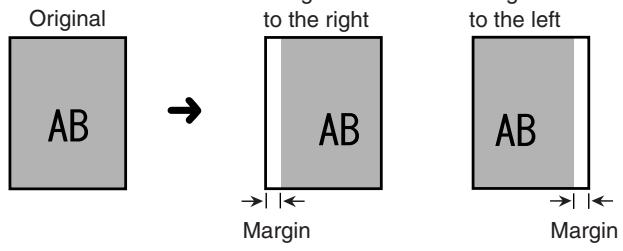
Two-sided copying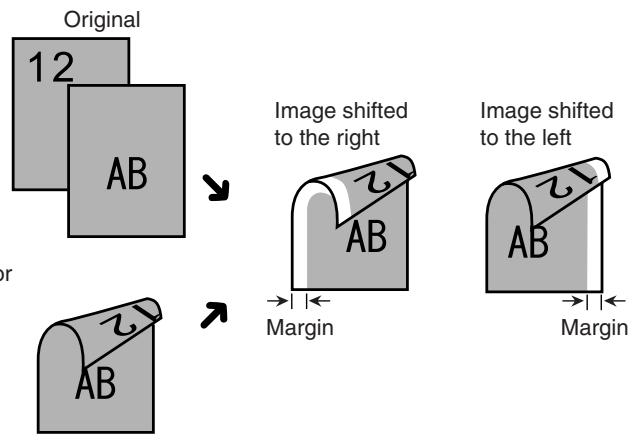
- The shift direction can be selected from right or left shift as shown in the illustration.
1 Touch the [MARGIN SHIFT] key on the SPECIAL MODES screen.
![graph TD A["MARGIN SHIFT"] --> B["PAMPHLET COPY"]](/content/2024/12/122344/images/69fd8b22a09247ddcab351f8ddde5f5e9afeacb2a1a524f728c550651ee7f4d5.jpg)
The margin shift setting screen will appear.
2 Select the shift direction.
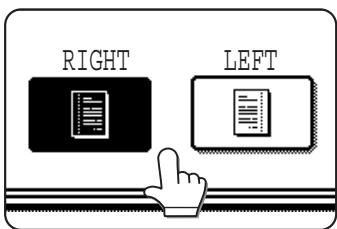
Touch a shift direction key to select right or left. The selected key will be highlighted.
3 Set the shift amount as needed and touch the [OK] key.
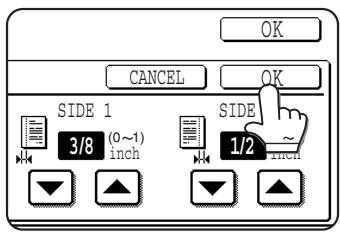
Use the ▼ key and the ▲ keys to set the shift amount. The shift amount can be set from 0" to 1" in 1/8" increments (0 mm to 20 mm in 1 mm increments for the AB system). If a duplex module is not installed, the shift amount setting for the reverse side is not displayed.
4 Touch the [OK] key on the special modes screen. After adjusting the exposure, follow any of the copying procedures.
To cancel the margin shift function, touch the [CANCEL] key on the margin shift setting screen.
Erase
The erase function is used to erase the shadow lines on copies produced when copying thick originals or books. The erase modes that can be selected are shown below. The erase width is approximately 1/2" (10 mm) in its initial setting.
![graph TD A["Original"] --> B["Copy"] subgraph Original A1["A"] end subgraph Copy A2["A"] end subgraph Copy A3["A B"] A4["B"] end subgraph Copy A5["A B"] A6["B"] end](/content/2024/12/122344/images/5a84e610343bcfeac0bc7ca2882deda745aedec5381ffcecbc5408bedb37862b.jpg)
Edge erase
Eliminates shadow lines around the edges of copies caused when thick paper or a book is used as an original.
Center erase
Eliminates shadow lines produced by the bindings of bound documents.
Edge + center erase
Eliminates shadow lines around the edges of copies and eliminates the shadow at the center of copies.
1 Touch the [ERASE] key on the SPECIAL MODES screen.
![graph TD A["ERASE"] --> B["JOB BUILD"] B --> C["Next Step Icon"]](/content/2024/12/122344/images/0e95e1ee025a81bb0ec5380bf2024de81b468ad490db85e2682496c114cc3c53.jpg)
The erase setting screen will appear.
2 Select the desired erase mode.
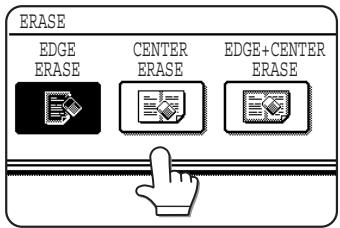
Select one of the three erase modes. The selected key will be highlighted.
3 Adjust the amount of erase and touch the [OK] key.
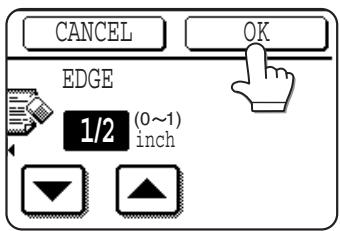
Use the ▼ and ▲ keys to adjust the erase width and then touch the [OK] key.
4 Touch the [OK] key on the special modes screen. After adjusting the exposure, follow any of the copying procedures.
To cancel the erase function, touch the [CANCEL] key on the erase setting screen.
Dual page copy
The dual page copy function produces separate copies of two documents placed side by side on the document glass. It is especially useful when copying books and other bound documents.
[Example] Copying right and left pages of a book
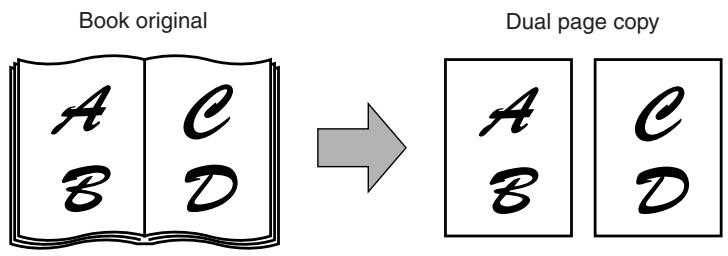
- The dual page copy function can be used with reduction copying but cannot be used with enlargement copying.
- The dual page copy function can be done only from the document glass. The automatic document feeder cannot be used with this function.
- Only 8-1/2" x 11" or A4 paper can be used.
When copying book originals: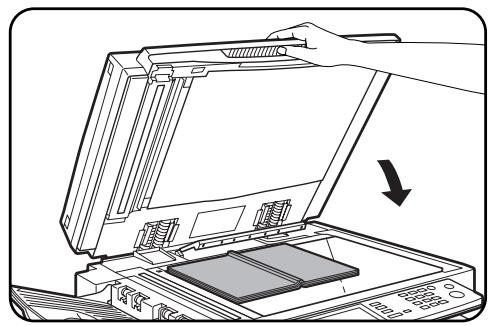
When copying a thick book, press down lightly on the document cover.
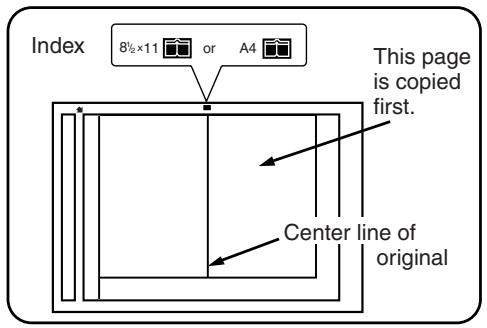
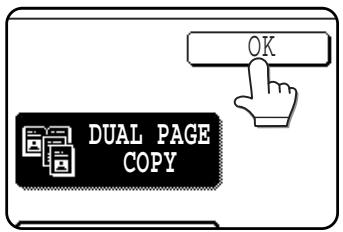
1 Touch the [DUAL PAGE COPY] key on the SPECIAL MODES screen.
![graph TD A["DUAL PAGE COPY"] --> B["MULTI SHOT"]](/content/2024/12/122344/images/6adaef65803be24242e70f96050cb0a6eec7804614c8cf66f97fa13ec3b98904.jpg)
The [DUAL PAGE COPY] key will be highlighted.
2 Touch the [OK] key on the special modes screen.
3 Place the originals on the document glass.
4 Ensure that 8-1/2" x 11" or A4 size paper is selected.
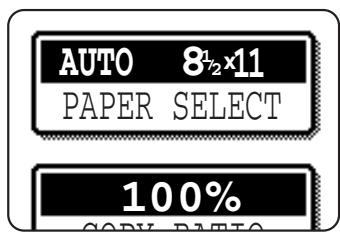
If 8-1/2" x 11" or A4 size paper is not selected, touch the [PAPER SELECT] key to select 8-1/2" x 11" or A4 size paper.
After adjusting the exposure, follow any of the copying procedures. When copying onto two sides of paper, follow steps 2 to 4 on page 14 and then follow steps 4 to 7 on page 13.
When copying onto one side of paper, follow steps 4 to 7 on page 13.
To cancel the dual page copy function, touch the [DUAL PAGE COPY] key on the special modes screen (step 1). (The highlighted display will be canceled.)
NOTE
To erase shadows caused by document binding, use the edge erase function (page 21).
Pamphlet copy
The pamphlet copy function is used to arrange copies in proper order for eventual center-stapling and folding into a booklet. Two original pages are copied onto each side of copy paper. Four pages are, therefore, copied onto one sheet.
[Example] Copying eight originals in the pamphlet copy mode
![graph TD A["Originals (one-sided)"] --> B["Left binding\nFor left to right turning"] B --> C["Finished copies are folded in two."] D["Originals (two-sided)"] --> E["Right binding\nFor right to left turning"] E --> F["First page"]](/content/2024/12/122344/images/93507b85e5f32f21b1f476ab8374e0bc31912a59fd7d8a7f5d0307a94bfe5ce4.jpg)
1 Touch the [PAMPHLET COPY] key on the SPECIAL MODES screen.
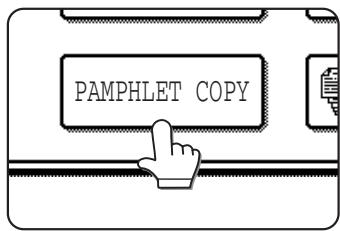
The pamphlet copy setting screen will appear.
2 Designate the type of originals to be copied: 1-sided or 2-sided.
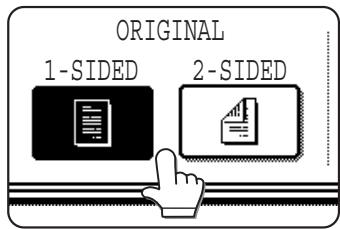
3 Select the binding position (left binding or right binding) and touch the [OK] key.
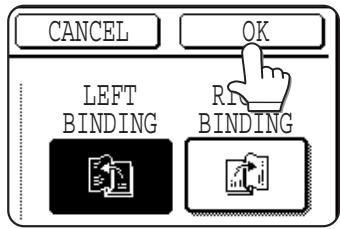
4 Touch the [OK] key on the special modes screen. 5 Copy from the first page to the last page from either the document feeder or the document glass.
- Scan the originals from the first page to the last page. The order of copying will be automatically adjusted by the machine.
- Either left binding (right to left turning) or right binding (left to right turning) can be selected.
- Four originals will be copied onto one sheet. Blank pages may be automatically produced at the end depending on the number of the originals.
- When using this function, a duplex module must be installed.
- If a saddle stitch finisher is installed, copies can be stapled in two positions along the center of copies and folded at the center.
6 Ensure that the desired paper size has been automatically selected based on the original size.
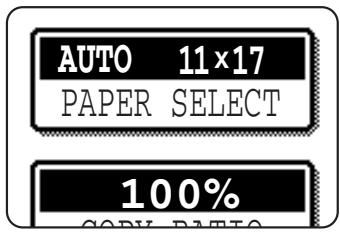
To select another size paper, select the desired size and touch the [AUTO IMAGE] key. The appropriate copy ratio will be selected automatically based on the original size and the paper size. (See steps 2 and 3 on page 16.)
7 Make all other desired settings such as exposure or the number of copies, and press the [START] key. 8 [When using the automatic document feeder:]
Copying will start after all originals have been scanned. (The next step is not needed.)
[When using the document glass:]
Replace the original with the next original and press the [START] key. Repeat this operation until all originals have been scanned.
9 Touch the [READ-END] key. (only if the document glass is used)
![PLACE NEXT ORIGINAL. PRESS [START]. WHEN FINISHED, PRESS [READ-END]. READ-END](/content/2024/12/122344/images/392c0cebe8161c4930b539c749895d43afb848d8e866b63e495c67d32b966f68.jpg)
When the pamphlet copy function is set, the two-sided copying mode will be automatically selected and cannot be changed.
To cancel the pamphlet copy function, touch the [CANCEL] key on the pamphlet copy setting screen.
Job build
The number of originals that can be copied into a set of copies in a single run is limited by the capacity of the memory available for scanned originals. Normally the number of originals is further limited by the number of originals that can be set into the document feeder tray.
The job build function allows scanning and copying of up to 100 originals. For scanning more than 50 originals, the originals must be separated into sections not exceeding 50 originals, scanned in sections and stored in memory. After all sections are in memory, they can be copied as a continuous set.
*1 The number of originals that can be copied into a set of copies in a single run is limited by the capacity of the memory available for scanned originals. *2 Up to 50 sheets (30 sheets for 8-1/2" x 14" or larger) can be set into the document feeder tray at one time.
[Example] Copying 100 pages of 8-1/2" x 11" or A4 originals
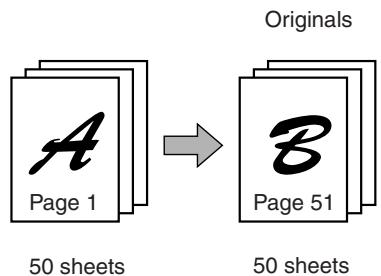
* Divide the originals in sections of 50 sheets and scan the originals starting from the first page of section A and then scan section B. Be sure to keep the correct page order when setting section B.
1 Touch the [JOB BUILD] key on the SPECIAL MODES screen.
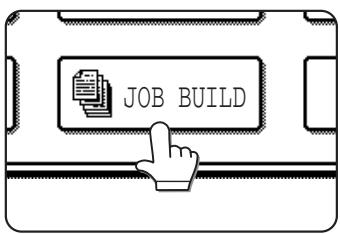
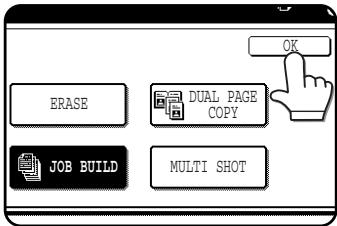
The [JOB BUILD] key will be highlighted.
2 Touch the [OK] key on the special modes screen while JOB BUILD is highlighted.
3 Place the first section originals in the document feeder tray. (page 7)
4 Make all other desired settings such as the number of copies, and press the [START] key.
Scanning of originals will start. After scanning of the first section of originals ("A in the example above) is completed, remove the scanned originals, place the next section of originals (section B in the example) and press the [START] key. Repeat this operation until all blocks of originals have been scanned.
5 Touch the [READ-END] key after the last section of originals has been scanned.
![PLACE NEXT ORIGINAL. PRESS [START]. WHEN FINISHED, PRESS [READ-END]. READ-END](/content/2024/12/122344/images/cc08dec4f6d63b77c0fe60c2d303af6e1530c7039e9628863532a3d4d35b11f3.jpg)
To cancel the job build function, touch the [JOB BUILD] key on the special modes screen as in step 1. The highlighted display will be canceled.
Multi shot
The multi shot function is used to copy up to four originals, collectively in a specified order, per sheet of copy paper in any one of four layout patterns.
[Example] Copying seven originals using the 4 in 1 MULTI SHOT selection in a layout pattern starting from the upper left to lower right.
![graph TD A["One-sided copies from one-sided originals"] --> B["1"] A --> C["2"] A --> D["3"] A --> E["4"] A --> F["5"] A --> G["6"] A --> H["7"] I["One-sided copies from two-sided originals"] --> J["10"] I --> K["30"] I --> L["50"] I --> M["70"] N["Copies"] --> O["1 2 3 4"] N --> P["5 6 7"]](/content/2024/12/122344/images/5376b3c061d07122271681cb4940a6668926dc53337f1b65b055cdc49e8d23d8.jpg)
- When using the multi shot function, place the originals, select the desired paper size, and select the copying mode (page 9) before selecting the multi shot function on the special modes screen.
- When using the multi shot function, the appropriate copy ratio will be automatically set based on the original size, paper size, and the number of originals to be copied onto one sheet. The minimum reduction ratio is 25%. Depending on the original size, paper size, and the number of originals to be copied onto one sheet, the appropriate copy ratio may be smaller than 25%. In this case, portions of original images may not be copied.
1 Touch the [MULTI SHOT] key on the SPECIAL MODES screen.
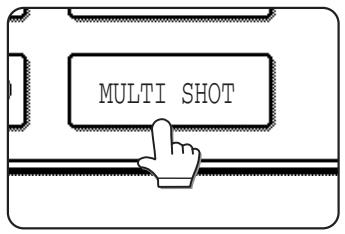
The multi shot setting screen will appear.
2 Select the number of originals to be copied onto one sheet of copy paper on the multi shot selection screen.
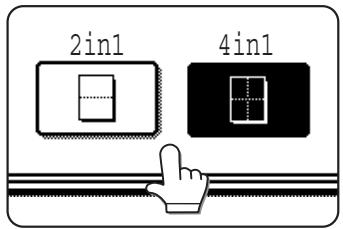
The orientation of copy paper and the image of the originals may be rotated as needed.
3 Select the layout.
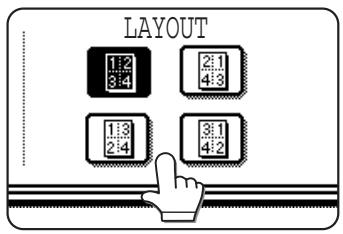
Select the order in which the originals will be arranged on the copy.
4 [When using the automatic document feeder:] Copying will start after all originals have been scanned. (The next step is not needed.)
[When using the document glass:]
Replace the original with the next original and press the [START] key. Repeat this operation until all originals have been scanned.
If scanning is being done from the document glass, touch the [READ-END] key after the last original has been scanned to start copying.
![PLACE NEXT ORIGINAL. PRESS [START]. WHEN FINISHED, PRESS [READ-END]. READ-END](/content/2024/12/122344/images/c8d6e51dc646aa404ad100ed38952c65672e58d6fe2a42d53e1173caf2cd375e.jpg)
To cancel the multi shot function, touch the [CANCEL] key on the multi shot setting screen.
JOB PROGRAM MEMORY
Frequently used job programs can be stored in each of ten storage registers. This is convenient for quick job recall without losing time manually reprogramming each aspect of a job.
- Selection for functions stored as part of a job program, will not be recalled as part of the program if the function has been disabled or changed by a key operator program.
- To exit the job memory mode, press the [CA] (clear all) key on the operation panel or touch the [EXIT] key on the touch panel.
Storing a job program
1 Press the [#/P] key on the operation panel to display the [STORE/DELETE] selection screen.
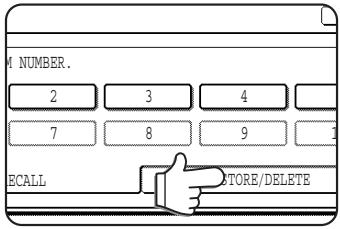
2 Touch the [STORE/DELETE] key to obtain the storage register screen.
3 Touch a number key from 1 to 10 on the storage register screen.
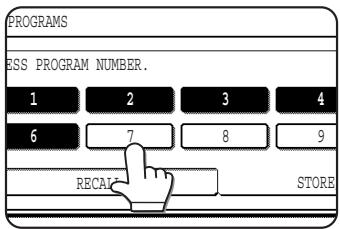
Highlighted storage register numbers are registers which already have programs stored. If a highlighted number is selected, a screen will appear with selections for deleting the selected program, storing (replacing the selected program with a new one) or canceling to go back to the STORE/DELETE screen to select a different storage register.
4 Make all copier selections to be stored.
![TO STORE, MAKE SELECTIONS AND PRESS [OK]. TO DELETE, PRESS [CANCEL]. SPECIAL MODES 2-SIDED COPY OUTPUT](/content/2024/12/122344/images/47e1145be49467735501eb0a6740c2a8f5d292c2ed210b742e82638f268a08eb.jpg)
The number of copies cannot be stored.
5 Touch the [OK] key.
![PRESS [OK]. CANCEL OK 11 1. 8×11 2. 8×11 3. 11×9 4. 8×11R EXPO AUTO 8×11 PAPER SELECT 100% COPY RATIO](/content/2024/12/122344/images/808c3803fd7b095b107caf68fcb91c00cb06070f048fcfa3f8496c29774823e7.jpg)
The selected settings will be stored under the register number selected in step 3.
Recalling a job program
1 Press the [#/P] key.
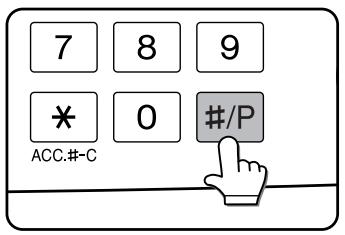
2 Touch the desired storage register number key to recall the job from memory.
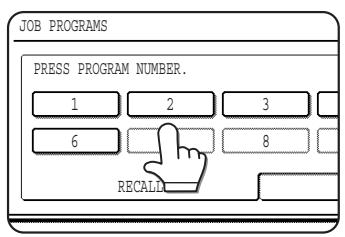
When a number key is touched, the selection screen will be closed and the stored job program will be recalled. A number for which no job program has been stored cannot be selected.
3 Set the number of copies as needed and press the [START] key.
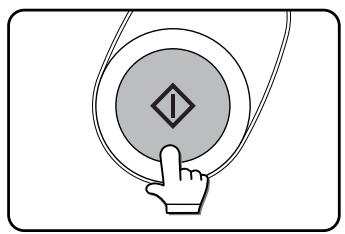
Copying will start with the settings of the recalled job program.
Deleting a stored job program
1 Follow steps 1 and 2 in "Storing a job program" on the previous page. 2 Select a storage register number of the program to be deleted.
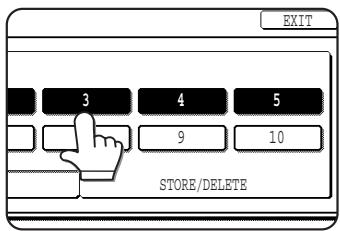
If a number key for which no job program has been stored is selected, the screen will change to the screen of step 4 on the previous page (for storing a program). The message "TO STORE, SELECT AND PRESS [OK]. TO DELETE, PRESS [CANCEL]." will appear. When [CANCEL] is pressed, the screen will return to the selection screen shown to the left.
3 Touch the [DELETE] key.
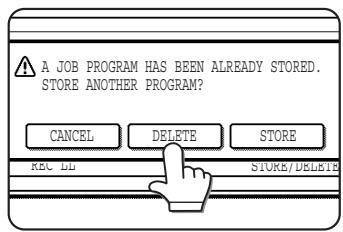
When the [DELETE] key is touched, the screen in step 2 will return and the program will be deleted. If the [CANCEL] key is touched, the screen in step 2 will return but the program will not be deleted. If no other programs are to be deleted, touch the [EXIT] key on the screen displayed in step 2 to exit the job program mode.
INTERRUPTING A PRINT OR COPY RUN
INTERRUPT can be used to temporarily stop a long print or copy job so that another copy job can be run. Only copy jobs can be run during interrupt.
1 Place the original in the document feeder tray or on the document glass. (page 7)
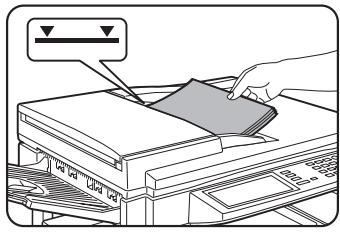
2 Touch the [INTERRUPT] key.
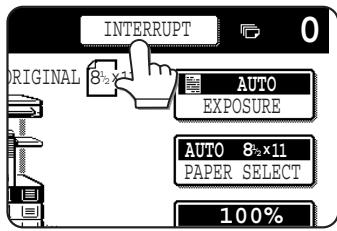
When it is possible to interrupt a print or copy job in progress, the [INTERRUPT] key will appear as shown in the illustration.
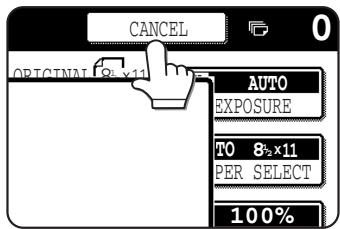
When the [INTERRUPT] key is touched in step 2, the [INTERRUPT] touch key will be replaced by the [CANCEL] key as shown in the illustration. To cancel interrupt copying at any time, touch the [CANCEL] key.
3 Make all other desired settings such as exposure, paper size and number of copies and then press the [START] key.
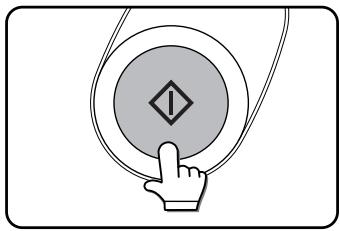
When step 3 is completed, a copy job icon will appear at the top of the job icon queue at the left side of the screen and interrupt copying will start. After the interrupt job is completed, the interrupted job will automatically resume.
MISFEED REMOVAL
Misfeed in scanner module
When an original has misfed in the scanner module, remove the misfed original following the procedure below.
NOTES
- For misfeed removal in the main unit and other peripheral devices, see the “Operation manual (for printer operation and general information)”.
- If you press the [INFORMATION] key, detailed information for misfeed removal will be displayed on the touch panel.
1 Open the document feeding area cover and remove any misfed originals.
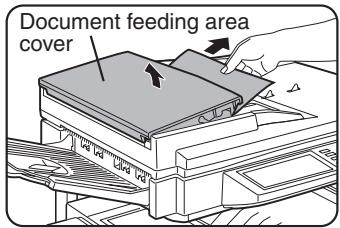
A message may appear indicating the number of originals which must be returned to the document feeder tray. Return the originals to the document feeder tray and press the [START] key.
2 Close the document feeding area cover.
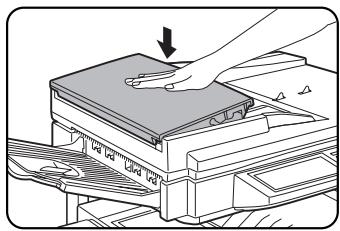
Close the cover securely so that cover clicks into place.
3 Open the document cover and turn the green rotating knob in the direction of the arrow to remove any misfed originals.
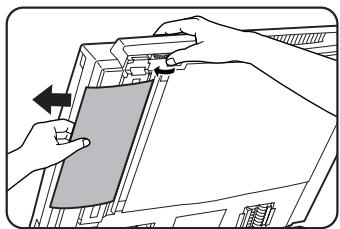
4 Close the document cover.
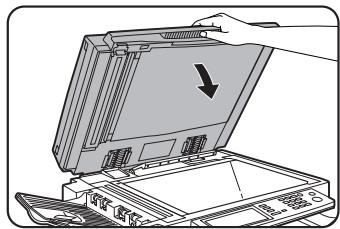
TROUBLESHOOTING
Whenever the machine stops or operation is not possible, check the operation panel display for messages. In most cases, these messages will give sufficient information to return the machine to an operating condition. In cases where this information is not enough, check the list below for more information. This section describes problems concerning copier features. For troubleshooting specific problems related to printer, facsimile, or network scanner features, see the separate manuals provided for them. For problems related to other peripheral devices, see chapter 5 of the “Operation manual (for printer operation and general information)”.
| Problem | Check | Solution or cause |
| Machine does not operate. | ● Is the START key indicator off? | If the indicator is not on, the machine may be warming up. Warm-up should be completed in approximately 80 seconds. |
| Copies are too dark or too light. | ● Is the original image too dark or too light? | Adjust the exposure in the manual mode. (See page 15.) |
| ● Is the exposure mode set to AUTO? | The exposure level in the AUTO mode can be adjusted using a key operator program. Contact your key operator. (See page 33.) | |
| ● Is the exposure mode set to PHOTO? | Cancel the PHOTO exposure mode. (See page 15.) | |
| Smudges appear on copies. | ● Document glass or document transport area dirty? | Clean regularly. (See page 4-12 of the “Operation manual (for printer operation and general information)”.) |
| ● Black stripes on copies when the document feeder is used? | Clean the original scanning window. (See page 4-12 of the “Operation manual (for printer operation and general information)”.) | |
| ● Original smudged or blotchy? | Use a clean original. | |
| Image cannot be rotated. | ● Is the auto paper select or auto image function set? | Rotation copy functions only if the machine is either in the auto paper select mode or in the auto image mode. (See pages 8 and 16.) |
| Part of original image is not copied. | ● Is the original positioned correctly? | Set the original properly. (page 7) |
| ● Is the copy ratio proper for the original and paper sizes? | Use the auto image function to select the appropriate copy ratio based on the original and copy sizes. (See page 16.) | |
| Blank copies | ● Is the original placed face down? | Place the original face down in the document feeder tray or on the document glass. (See page 7.) |
| Order of copies incorrect | ● Is the order of originals correct? | When using the document glass, set the originals from the first page one sheet at a time.When using the automatic document feeder, set the originals with the first page down. |
| Job cancellation needed | ● Is a message requesting cancelation of job displayed? | Press the [CA] (clear all) key to cancel the current job. |
| Scanning of originals is incomplete. | ● Is a message indicating memory is full displayed? | If the data amount exceeds the limit when using the pamphlet copy or multi shot copy which requires scanning of all originals, scanning will be canceled and copying will not be performed. If you install a hard disk drive, the storage capacity will increase. |
SPECIFICATIONS
Copier
| Resolution | Scan: 600 dpi or 300 dpi, output: 600 dpi |
| Gradation | Scan: 256 levels, output: 2 levels |
| Originals | Sheets, bound documentsMaximum size: 11" x 17" or A3 |
| Copy sizes | Max. 11" x 17" or A3, min. 5-1/2" x 8-1/2" or A5Image loss: Max 21/64" or 8 mm (leading edge and trailing edge in total), max. 21/64" or 8 mm (along all other edges in total) |
| Warm-up time | Approx. 80 seconds |
| First-copy time* | 35 copy/min. type: 5.3 seconds45 copy/min. type: 4.6 seconds* Paper is fed from paper tray 1, quick scan from document glass (page 33) is set,the original scanning resolution on the document glass is set to 600 x 300 dpiand no optional hard disk drive is installed. |
| Copy ratio | Variable: 25 to 400% in 1% increments, total 376 stepsFixed presets: 25%, 64%, 77%, 100%, 121%, 129%, and 400% for inch system,25%, 70%, 81%, 86%, 100%, 115%, 122%, 141%, and 400% for AB system |
| Continuous copy | 999 copies; subtractive counter |
| Copying speed | 35 copy/min. type |
| 11" x 17" or A3 | 17 copies/min. |
| 8-1/2" x 14" or B4 | 20 copies/min. |
| 8-1/2" x 11" or A4 | 35 copies/min. |
| 8-1/2" x 11"R or A4R | 25 copies/min. |
| Copying speed | 45 copy/min. type |
| 11" x 17" or A3 | 20 copies/min. |
| 8-1/2" x 14" or B4 | 22 copies/min. |
| 8-1/2" x 11" or A4 | 45 copies/min. |
| 8-1/2" x 11"R or A4R | 30 copies/min |
Scanner module
| Name | B/W scanner module/DSPF |
| Type | Two-side simultaneous scanning system from the document feeder.One-sided scanning from the document glass |
| Original feed system | Automatic continuous feeding |
| Original exit system | Face down output |
| Original transport system | DSPF: sheet through type (reference position: center), document glass: reference position is left rear |
| Original setting direction | Face down |
| Original sizes | 5-1/2" x 8-1/2" to 11" x 17" or A5 to A3 |
| Original weight | 14 to 34 lbs. or 50 to 128 g/m2 |
| Capacity | Up to 50 sheets (30 sheets*1 for 8-1/2" x 14" or B4 or larger originals) provided the total aggregate thickness does not exceed 1/4" or 6.5 mm (14 to 20 lbs. or 50 to 80 g/m2) or 3/16" or 5 mm (21 to 34 lbs. or 80 to 128 g/m2) |
| Power supply | Drawn from the main unit |
| Dimensions | 31-13/16" (W) x 24-3/8" (D) x 7-3/32" (H) or 808 mm (W) x 619 mm (D) x 180 mm (H) |
| Weight | Approx. 43 lbs. or 19.5 kg |
*1 For paper heavier than 28 lbs. (105 g/m²), only a stack of up to 15 sheets can be set. If 16 or more sheets are set, image can not be scanned properly and scanned image can be expanded compared with original itself.
KEY OPERATOR PROGRAMS
This section describes all key operator programs relating only to the copier and facsimile functions. For the key operator programs which relate to copier, printer and facsimile functions, see the separate Key Operator's Guide.
Key operator program list
| Program name | Page |
| Copy function settings | |
| Initial status settings | 33 |
| Exposure adjustment | 33 |
| Rotation copy setting | 33 |
| Auto paper selection setting | 33 |
| 600dpi x 600dpi scanning mode | 33 |
| Quick scan from document glass | 33 |
| Device control | |
| Original size detector setting | 34 |
| Disabling of document feeder | 34 |
Using the key operator programs
To use of the key operator programs, follow the procedures described in the Key Operator's Guide on page 6. Also read "Supplementary explanation of key operation for key operator programs" on page 6.
Setting programs
This section describes the setting of programs common to copier, facsimile and network scanning features. For programs dedicated to facsimile, network scanning and programs common to both the copier and printer features, see their respective manuals.
Copy function settings
The following programs can be set in "Copy function settings".
- Initial status settings
- Exposure adjustment
- Rotation copy setting ● Auto paper selection setting
- 600dpi x 600dpi scanning mode
- Quick scan from document glass
Initial status settings
The copier settings will be reset when the main switch is turned off, when the [CA] key is pressed or when the auto clear interval has elapsed. Use this program to establish new initial settings or to return the initial settings to the factory default settings. Paper tray, exposure mode, copy ratio, duplex mode, and output mode default settings can be made.
NOTE
If a duplex mode other than 1-sided to 1-sided is set as the default and either the duplex or scanner mode is disabled*, the default will change to the 1-sided to 1-sided mode.
* Disable duplex unit (page 10 of the Key Operator's Guide) * Disabling of document feeder (page 34)
Exposure adjustment
Use this program to lighten or darken copies in the automatic exposure mode. The factory setting is “5”. “1” indicates lighter density and “9” indicates darker density on the touch panel.
Rotation copy setting
If this program is set, the image of originals will rotate when the orientation of the originals does not match that of the copy paper.
(Rotation copy will function only if the auto paper select or auto image mode has been selected.)
NOTE
For copying from 5-1/2 x 8-1/2 or A5 size originals onto 5-1/2 x 8-1/2R or A5R paper, this program must be set.
Auto paper selection setting
Use this program to set the paper type* for the auto paper select mode to “Plain paper” or “Plain paper and recycle paper”.
* Paper type specified in Tray setting of the custom setting function (page 1-20 of “Operation manual (for printer operation and general information)”)
600dpi x 600dpi scanning mode
Use this program to change the original scanning resolution of the automatic document feeder from 600 x 300 dpi to 600 x 600 dpi.
If this mode is set, the copy quality for fine characters and fine lines will be improved but the original scanning speed will be slower.
NOTE
If the original scanning speed is more important than higher resolution, do not set this program.
Quick scan from document glass
Use this program to change the original scanning resolution on the document glass from 600 x 600dpi to 600 x 300 dpi.
If you set this program, the first copy time will be shorter but the copy image will become a little more coarse.
NOTE
If the copy image quality is more important than first copy time, do not set this program.
Device control
Original size detection and disabling of the document feeder can be set.
Original size detector setting
This program is used to select the group of original sizes to be detected. Original size detection from the document glass can be disabled using the program CANCEL DETECTION AT DOCUMENT GLASS.
| Group | Detectable original sizes | ||
| Document feeder tray (for automatic document feeding) | |||
| Document glass | |||
| 1 | INCH - 1 | 11 x 17, 8-1/2 x 14,8-1/2 x 11, 8-1/2 x 11R,5-1/2 x 8-1/2 | A4 |
| 2 | INCH - 2 | 11 x 17, 8-1/2 x 13,8-1/2 x 11,8-1/2 x 11R,5-1/2 x 8-1/2 | A4 |
| 3 | AB - 1 | A3, A4, A4R, A5,B4, B5, B5R | 8-1/2 x 11,216 x 330 |
| 4 | AB - 2 | A3, A4, A4R, A5,B5, B5R, 216 x 330 | 8-1/2 x 11,B4 |
If CANCEL DETECTION AT DOCUMENT GLASS is set, originals will be regarded as EXTRA for all copier functions and no original size will be displayed.
Disabling of document feeder
This program is used to prevent use of the automatic document feeder when the scanner module malfunctions. In this case scanning can still be done off the document glass.
SHARP®
SHARP ELECTRONICS CORPORATION
Sharp Plaza, Mahwah, New Jersey 07430-2135.
SHARP CORPORATION
Operation Manual (for network scanner)
Be sure to become thoroughly familiar with this manual to gain the maximum benefit from the product.
Before installing this product, be sure to read the installation requirements and cautions sections of the "Operation manual for printer operation and general information".
Be sure to keep all operation manuals handy for reference, including this manual, the "Operation manual for printer operation and general information," and operation manuals for any optional equipment that has been installed.
INTRODUCTION
The optional Network Scanner Expansion Kit (AR-NS2) enables the machine to be used as a network scanner. Page 2 of the manual that accompanies the Network Scanner Expansion Kit (AR-NS2) contains an overview of the network scanner functions, general considerations, and an explanation of image sending methods. Please read the manual that accompanies the AR-NS2 before you read this manual. Both manuals explain only the network scanner functions of the product. For information on loading paper, replacing toner cartridges, clearing paper misfeeds, handling peripheral units, and other printer-related information, please refer to your "Operation manual (for printer operation and general information)".
Additional manuals have been provided for copy and facsimile features. Please refer to these as necessary.
To enable the network scanner function of this machine, a product key (password) must be entered using a key operator program. This is only required once. Use the "Product Key Entry for Network Scanner Expansion Kit" program to enter the product key. If you do not know your product key, please ask your dealer. (For information on using key operator programs, refer to "Operation manual (for printer operation and general information)".)
NOTES
- Before using the network scanner feature, several settings must be established from the Web page. These settings are explained from page 2 on. The settings must be established by the network administrator. Such settings must be effected by the system administrator who has the special network related backgrounds.
- This manual assumes that several options have been installed.
TABLE OF CONTENTS
Page
INTRODUCTION ...... 1
SETTINGS AND PROGRAMMING REQUIRED
FOR THE NETWORK SCANNER FEATURE ...... 2
●ABOUT THE WEB PAGE 2 - SETTING PASSWORDS ...... 2 ●BASIC SETTINGS FOR NETWORK SCANNING ..... 3 - SETTING UP DESTINATION INFORMATION .... 4 ●STORING SENDER INFORMATION...... 5 ●STORING A CUSTOM DIRECTORY .... 5
CONDITION SETTING SCREEN
OF SCANNER MODE 6
SENDING AN IMAGE 8
● BASIC TRANSMISSION METHOD ...... 8 ● TRANSMISSION METHODS
FOR SCAN TO E-MAIL (MANUAL
ENTRY, BROADCAST TRANSMISSION) ...... 10
● SCANNING AND TRANSMITTING
A TWO-SIDED ORIGINAL 11
SCANNING SETTINGS
(ORIGINAL SIZE, RESOLUTION, EXPOSURE
AND FILE FORMAT) 12
● MANUALLY SETTING THE SCANNING SIZE ... 12 - SELECTING THE RESOLUTION .... 13 - SELECTING THE EXPOSURE .... 14 - SELECTING THE FILE FORMAT .... 15
Page
PRIORITY TRANSMISSION OF A STORED JOB .... 16
CANCELING AN E-MAIL/FTP TRANSMISSION .... 16
STORING, EDITING, AND CLEARING
● STORING ONE-TOUCH KEYS (only addresses for Scan to E-mail and Internet-Fax) 17 ● EDITING AND DELETING ONE-TOUCH KEYS ..... 19 ● PROGRAMMING A GROUP KEY 20 ● EDITING AND DELETING GROUP KEYS ..... 21 ● STORING SENDER INFORMATION...... 22 ● EDITING AND DELETING SENDER INFORMATION...... 22 ● STORING A GROUP INDEX...... 23 ● PRINTING PROGRAMMED INFORMATION ... 23
TROUBLESHOOTING 24
● IF YOUR E-MAIL IS RETURNED 24 ● IF A TRANSMISSION ERROR OCCURS ..... 24
KEY OPERATOR PROGRAMS 25
● KEY OPERATOR PROGRAM LIST 25 ● USING THE KEY OPERATOR PROGRAMS .... 25 - SETTING PROGRAMS ...... 26 ● PRINTING OUT SETTINGS.... 27
SPECIFICATIONS 28
SETTINGS AND PROGRAMMING REQUIRED FOR THE NETWORK SCANNER FEATURE
To use the Network Scanner feature, settings for the E-mail server, DNS server, and destination addresses must be established. To establish the settings, use a computer that is connected to the same network as the machine to access the machine's Web page. The Web page can be displayed with your Web browser (Internet Explorer 4.0 or later, or Netscape Navigator 4.0 or later). To access the Web page, refer to page 2-6 of "Operation manual (for printer operation and general information)".
ABOUT THE WEB PAGE
When you access the Web page in the machine, the following page will appear in your browser.
A menu frame appears on the left side of the page. When you click an item in the menu, a screen appears in the right frame that allows you to establish settings for that item.
For overviews of each of the menu items, refer to pages 2-7 to 2-8 of "Operation manual (for printer operation and general information)".
For detailed explanations of the procedures for establishing settings, click "Help" in the menu frame.
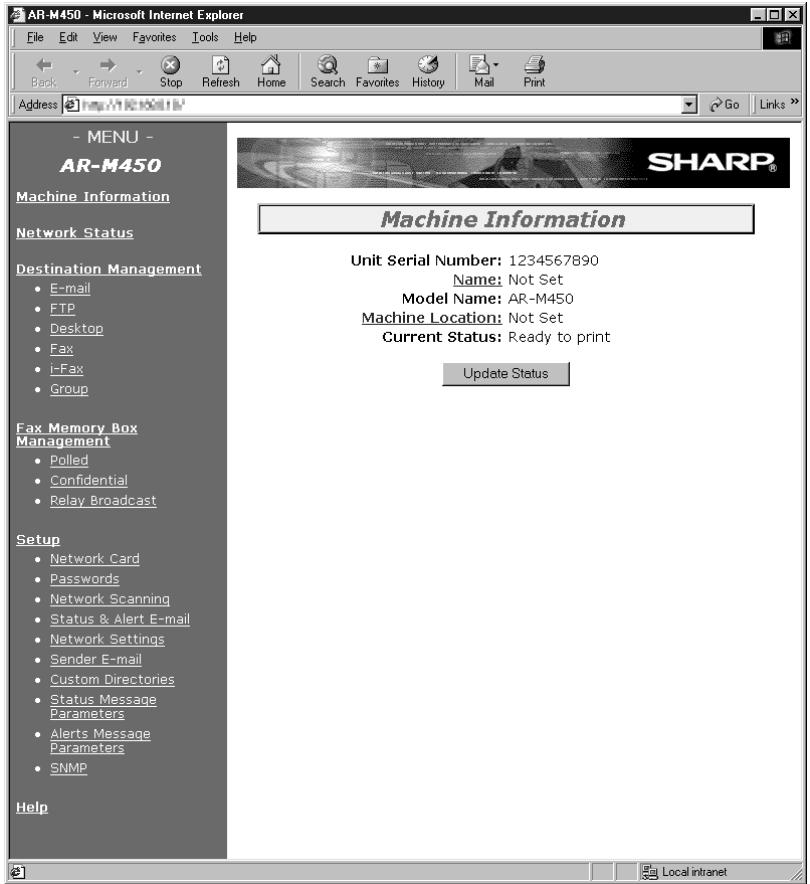
Web Page
SETTING PASSWORDS
Passwords can be set to restrict Web page access and protect settings.
Note that it is not necessary to set passwords; the network scanner functionality can also be used without passwords. A password can be set for the administrator and passwords can be set for each user. If you use a user password to access the Web page, you will be able to establish, edit, and delete destinations in the Scanner Destination Management menu; however, you will not be able to establish settings in the Setup menu.
The passwords for "User" and "admin" are both initially set to "Sharp". If you wish to change the passwords when first establishing the settings, enter "Sharp" in "Old Admin Password" before you establish the settings. A password must consist of alphanumeric characters and be no more than seven characters long. Passwords are case sensitive. After entering a password, click "Submit" to set it. After setting the password, turn the machine power off and then back on. When a password is set, you will be prompted for the password when you attempt to access a Web page with protected settings. For the "User name", enter "user" if you are accessing the page as a user, or "admin" if you are accessing the page as an administrator. For detailed information on setting passwords, refer to "Help".
BASIC SETTINGS FOR NETWORK SCANNING
Click "Network Scanning" in the menu frame, and then establish the required settings. These settings should only be established by the network administrator. After entering the settings, be sure to click "Submit" to store them. For detailed information on setting procedures, refer to "Help".
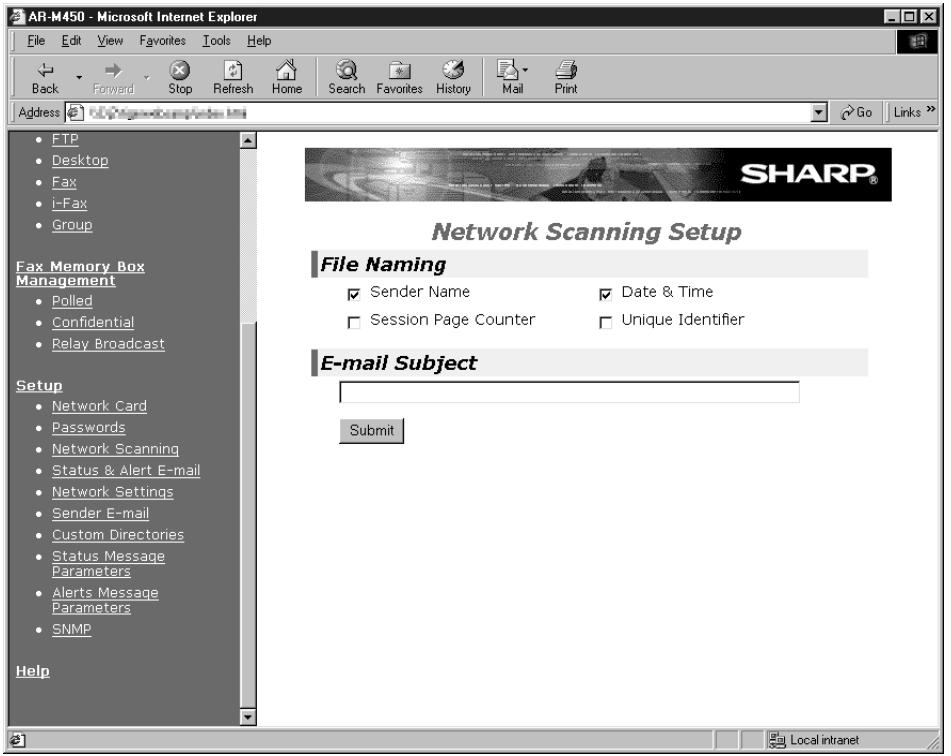
Network Scanning Setting screen
■ Select the method for assigning a file name to a scanned image
Select the method for assigning a file name to a scanned image. In "File Naming", click the items that you wish to use in the file name. "Sender Name" and "Date & Time" are initially selected. If you are going to send images to the same recipient more than once, we recommend that you also select "Session Page Counter" or "Unique Identifier" to prevent sending multiple files with the same name, which would result in each successive file overwriting the previous file.
■ Selecting an e-mail subject (only used for Scan to E-mail)
Enter a subject when using Scan to E-mail. Only one subject can be entered. If nothing is entered, "Scanned image from " will appear.
*The name that appears in is the name stored in "Name" in the screen that appears when you click "Status & Alert E-mail" in the menu frame. If a name has not been stored, the product name will appear.
■ E-mail Server and DNS Server Settings
E-mail sent by Scan to E-mail or Scan to FTP (Hyperlink) uses SMTP. To use either of these transmission methods, you must first click "Network Settings" in the Web page menu, click "E-mail" in the screen that appears, and then enter the required information in the settings under "E-mail Setup".
If you entered a host name in "Primary E-mail Server" or "Secondary E-mail Server" under "E-mail Setup", you will need to click "DNS" and then enter the settings for the DNS server under "DNS Setup".
If you entered a host name in "Hostname or IP Address" when storing a destination for Scan to FTP (Scan to FTP (Hyperlink)) or Scan to Desktop, you will also need to enter the settings for the DNS server under "DNS Setup".
SETTING UP DESTINATION INFORMATION
To store the name and address of a destination in an auto dial key, click "Destination Management" or one of the transmission methods in the Web page menu frame. "Destination Management" can also be used to edit or clear stored destinations.
A total of 500 destinations can be stored, including E-mail, FTP, Desktop, Internet-Fax, and Group destinations. Among these, a combined total of 100 Scan to FTP and Desktop destinations can be stored.
The stored destinations appear as one-touch keys in the touch panel of the machine when you send an image, allowing you to select the destination.
For detailed information on setting up, editing, and deleting destinations, refer to "Help".
■ Storing destinations for Scan to E-mail and Internet-Fax
Scan to E-mail and Internet-Fax destinations can also be stored, edited, and cleared from the touch panel of the machine. (Pages 17 - 19)
To perform Scan to E-mail, the e-mail server settings must first be established. (Refer to page 3.)
■ Storing destinations for Scan to FTP
If you select the "Enable Hyperlink to FTP server to be e-mailed" checkbox, you can send an e-mail message to a "Sender" selected from "E-mail Destination" (stored in "Sender E-mail" in the Web page menu (page 5)), to notify that person of the location of the scanned image data and its file format. (Scan to FTP (Hyperlink))
The e-mail includes a link to the location of the scanned image data, and if the FTP server does not require a user name or password (anonymous server), the recipient can display the image by simply clicking on the address.
If you entered a host name in "Hostname or IP Address", you will need to enter the DNS server or WINS server settings. Click "Network Settings" and enter the settings under "DNS Setup". To perform Scan to FTP (Hyperlink), you must also click "E-mail" and then enter the settings under "E-mail Setup" for the e-mail server. (Refer to page 3.)
■ Storing destinations for Scan to Desktop
Scan to Desktop can only be used if Network Scanner Tool is installed in your computer (Network Scanner Tool is included on the CD-ROM that accompanies the AR-NS2 Network Scanner Expansion Kit).
You can store a Scan to Desktop destination in the Web page, or in Network Scanner Tool. We recommend that you normally use Network Scanner Tool, which automatically establishes settings. The Web page is primarily used when the same settings are to be established in multiple laser printers, or when the network administrator performs maintenance. If the information set here differs from the information set in the host computer, transmission and reception will not take place normally. For details, refer to "User's Guide"* for Network Scanner Tool in the CD-ROM that accompanies the Network Scanner Expansion Kit (AR-NS2).
If you entered a host name in "Hostname or IP Address", you will need to enter the DNS server or WINS server settings. (Refer to page 3.)
*To view "User's Guide", Adobe Acrobat Reader 4.05 or later is necessary. If this is not installed on your computer, you can install it from the CD-ROM that accompanies the Network Scanner Expansion Kit (AR-NS2). For details, refer to the operation manual for the Network Scanner Expansion Kit (AR-NS2).
■ Storing Groups
If you are using Scan to E-mail or Internet-Fax, a scanned image can be sent to multiple destinations in a single operation. To use this function, you must first store the destinations in a group. Click "Group" and then select the Scan to E-mail or Internet Fax destinations that you wish to store in the group. Up to 300 destinations can be stored in one group. Only destinations for E-mail or Internet-Fax can be stored in a group. Note that multiple destinations cannot be entered manually when sending an image.
■ Items common to all transmission methods when storing destinations
• Full Name, Display Name
Only alphabetical characters and symbols can be used to enter names in "Full Name" and "Display Name". For the maximum number of characters that can be entered, click "Help" in the menu frame. "Display Name" is the one-touch key name that is displayed in the touch panel of the machine. If a display name is not stored, the first 18 characters of the name stored in "Full Name" are automatically used as the display name.
- Initial, Custom Directory
Stored destinations are arranged on "indexes" when displayed in the touch panel of the machine. There are two types of indexes: the ABC index and group indexes. The ABC index arranges destinations based on the letter entered in "Initial", which is normally the first letter of the name entered in "Full Name". If a destination is frequently used, it is convenient to select the "Frequently Used" checkbox to include the destination in the alphabetical "FREQUENT USE" index. Group indexes ("Custom Directories") allow you to create and name indexes (see the following page) of destinations for specific purposes.
- File Format
When you store a destination, you can also select the compression mode and the format of the image file that is created when you scan an original for transmission. You can select TIFF-F, TIFF, or PDF for the file type, and MH (G3), MMR (G4), or "Uncompressed" for the compression mode. An initial setting has been made for the file type and compression mode, so you only need to make a selection if the initial settings are not satisfactory. For an explanation of the initial settings of each of the transmission methods, click "Help" in the menu frame.
NOTE
Internet-Fax only has one file format, TIFF-F, and thus there is no selection. MH (G3) or MMR (G4) can be selected for the compression mode.
STORING SENDER INFORMATION
To store the sender information (Sender Name, E-mail Address) that is displayed when the recipient receives your e-mail, click "Sender E-mail" in the menu frame and then click "Add". Information for up to 20 different senders can be stored. Select a sender from the stored senders using the touch panel of the machine when you send an image (page 8). The selected sender appears in the sender column of the recipient's e-mail software program.
NOTE
If you do not select a sender when sending an image, the default sender information stored with the key operator program is automatically sent. (Page 27)
STORING A CUSTOM DIRECTORY
Auto dial keys (one-touch keys and group keys) are normally stored in the ABC index. However, you can also use the group indexes (custom directory) to group destinations for more convenient use. Six indexes are available, and a name up to 6 characters long can be assigned to each index.
Click "Custom Directories" in the menu frame of the Web page, and then enter the desired name in the screen that appears. "User-*" is initially entered for the name of each index. Clear this and then enter the new name.
The procedure for storing auto dial numbers in a group index is explained on page 4, and the procedure for switching between the ABC index and the group indexes is explained on page 7.
NOTE
You can also store indexes in the Custom Directory from the touch panel of the machine.
CONDITION SETTING SCREEN OF SCANNER MODE
The condition setting screen of scanner mode is displayed by pressing the IMAGE SEND key (refer to page 4 of "Operation manual (for copier)") while the print mode, copy mode, or job status screen appears in the touch panel. In the explanations that follow, it is assumed that the initial screen that appears after pressing the IMAGE SEND key is the condition setting screen (shown below). If you have set the display to show the address directory (following page) when the IMAGE SEND key is pressed, touch the CONDITION SETTINGS key in the address directory to display the condition setting screen.
The key operator program can be used to set the display to show either the condition setting screen (shown below) or the address directory screen (following page) when the IMAGE SEND key is pressed (refer to page 26).
NOTE
For information on the parts of the unit and the operation panel that are used for network scanning, refer to pages 3-4 of "Operation manual (for copier)". For parts that are used for both network scanning and printing, refer to chapter 1 of "Operation manual (for printer operation and general information)".
■ Condition setting screen
The display is initially set (factory setting) to show the following condition setting screen as the initial screen.
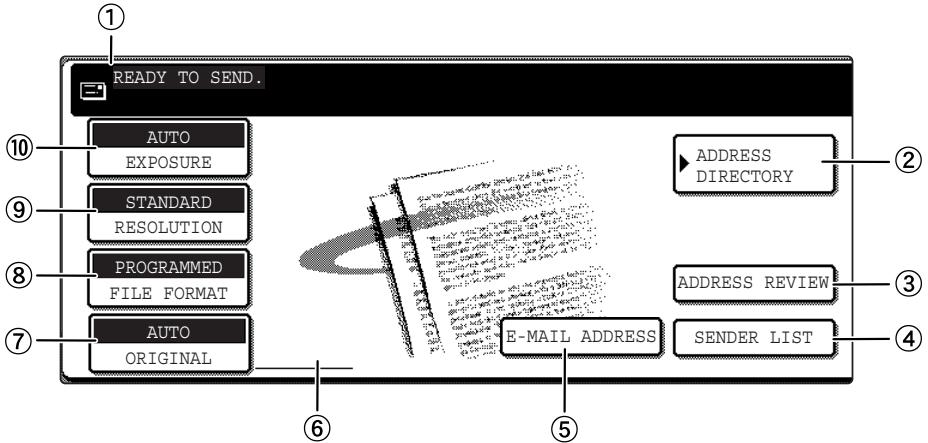
① Message display
Messages appear here to indicate the current status of the machine. When the machine is ready to send, an icon 📄 appears to the left.
② ADDRESS DIRECTORY key (page 9)
This displays the Address Directory screen (next page). Touch this key when you want to use an autodial number (one-touch dialing or group dialing).
③ ADDRESS REVIEW key (page 10)
When performing Scan to E-mail or Internet-Fax broadcast transmission, touch this key to check your selected destinations. Your selected destinations will appear as a list, and the list can be edited.
④ SENDER LIST key (page 8)
Touch this key to select the sender when sending an image.
⑤ E-MAIL ADDRESS key (page 10)
When performing Scan to E-mail, touch this key if you wish to enter the e-mail address of the recipient manually instead of using an auto dial key.
⑥ Two-sided scanning icon display (page 11)
Icons appear here when you touch the ORIGINAL key and select two-sided scanning. The icons can be touched to open function selection screens.
⑦ ORIGINAL key (pages 11-12)
Touch this key when you wish to manually set the size of the original to be scanned or scan both sides of the original.
⑧ FILE FORMAT key (page 15)
Touch this key to set the file format of scan images that you transmit. The selected file format setting will be highlighted above the key. The initial factory setting is PROGRAMMED.
⑨ RESOLUTION key (page 13)
Touch this key to change the resolution setting for the original to be scanned. The selected resolution setting will be highlighted above the key. The initial factory setting is STANDARD.
⑩ EXPOSURE key* (page 14)
Touch this key to change the exposure setting for the original to be scanned. The selected exposure setting will be highlighted above the key. The initial factory setting is AUTO.
■ Address directory screen (alphabetically ordered)
If you have set the initial screen to the address directory screen using the key operator program, the initial screen will appear as follows.
Destinations stored using the Web page are grouped in indexes (⑤) according to the letter entered in "Initial" for each destination, and the name entered in "Display Name" is displayed in the one-touch key (①).
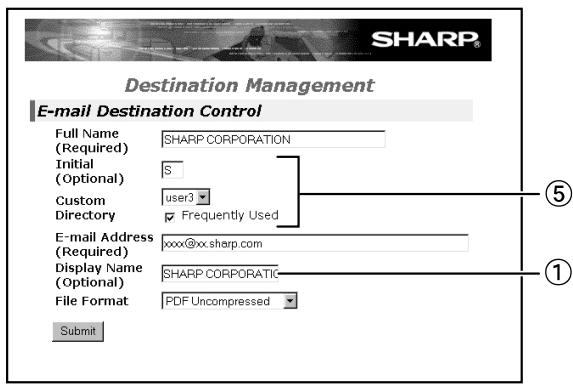
E-mail Destination Management page
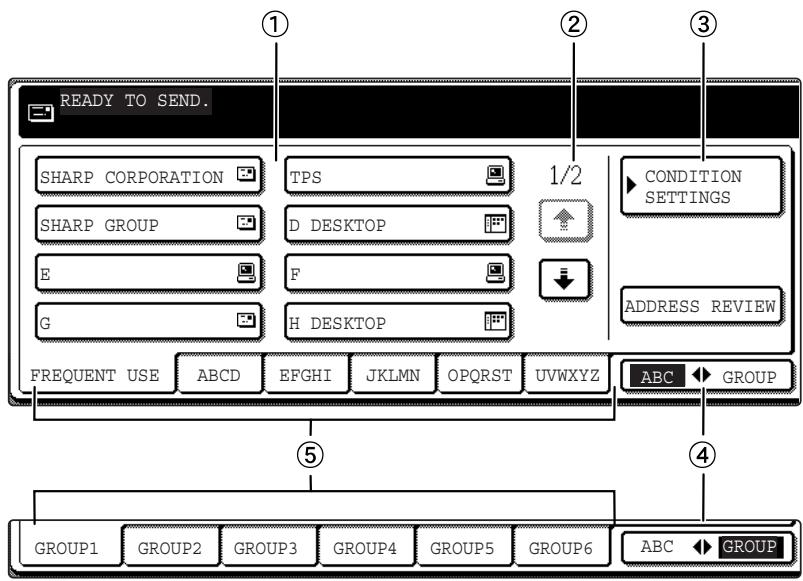
① One-touch key display
This shows the one-touch keys that have been stored on the selected "index card". The key type is indicated by the icon at the right.
:Scan to E-mail, Internet-Fax : Scan to FTP : Scan to Desktop
The display is initially set to show 8 keys. This can be changed to 6 or 12 using the key operator program. (Refer to page 26.)
② Display switching keys
In cases where the one-touch keys cannot all be displayed on one screen, this shows how many screens are left. Touch the "♠" "↓" keys to move through the screens.
③ CONDITION SETTINGS key
This displays the condition setting screen (previous page), which is used to set various conditions.
④ ABC ◆ GROUP key
Touch this key to switch between the alphabetical index and the group index.
⑤ Index keys
One-touch key destinations are stored on each of these index cards (alphabetical index or group index). Touch an index key to display the card.
Group indexes make it possible to store one-touch keys by group with an assigned name for easy reference. This is done with the custom settings (refer to page 5). Frequently used one-touch key destinations can be stored on the FREQUENT USE card for convenient access.
NOTE
The screen showed above is the alphabetical address directory. If desired, the initial screen can be set to the group address directory (refer to page 26).
SENDING AN IMAGE
BASIC TRANSMISSION METHOD
1 Make sure the machine is in scanner mode.
![graph TD A["IMAGE SEND"] --> B["COPY"] B --> C["JOB STATUS"] style A fill:#f9f,stroke:#333 style B fill:#ccf,stroke:#333 style C fill:#cfc,stroke:#333 subgraph Legend D["LINE"] & E["DATA"] end style D fill:#fff,stroke:#000 style E fill:#fff,stroke:#000](/content/2024/12/122344/images/a6f42e5bdffa36f74a4218b68303f45849d7e59622738dae99592a205f986351.jpg)
When the IMAGE SEND key light is on, the machine is in scanner mode. If the light is not on, press the IMAGE SEND key.
2 Load the original.
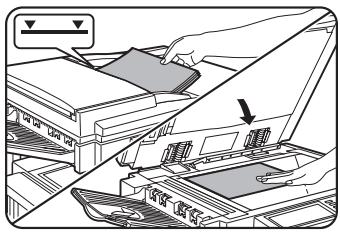
For detailed information on loading an original, refer to pages 7 and 8 of "Operation manual (for copier)".
NOTE
You cannot load documents in both the auto document feeder and on the document glass and send them in a single transmission. If documents are loaded in both the auto document feeder and on the document glass, only the document in the auto document feeder will be scanned and transmitted.
3 Check the original size.
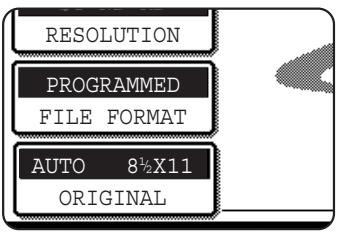
The original size is automatically detected. If you loaded a non-standard size document or wish to change the scanning size, touch the ORIGINAL key and set the document size. (Refer to page 12.)
NOTE
To scan a two-sided original, refer to page 11.
4 If needed, adjust the resolution setting. (Refer to page 13.)
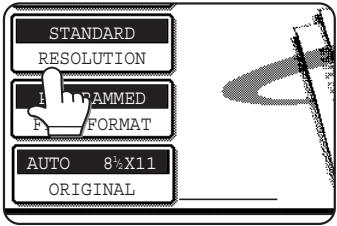
The initial factory setting is STANDARD.
5 If needed, adjust the exposure setting. (Refer to page 14.)
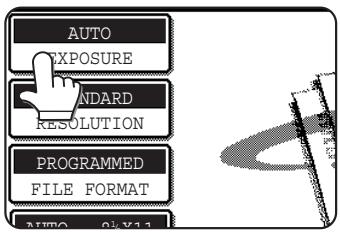
The initial factory setting is AUTO.
6 If needed, select the file format. (Refer to page 15.)
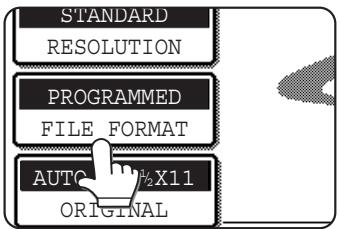
The initial factory setting is PROGRAMMED.
7 Touch the SENDER LIST key.
![graph TD A["DIRECTORY"] --> B["ADDRESS REVIEW"] B --> C["MAIL ADDR"] C --> D["SENDER LIST"]](/content/2024/12/122344/images/4b6318ac8f6a0eb317df5184652d2a8453d7a7f1dd293d4efffd1fdd3a706e2f.jpg)
This step is not necessary for Scan to FTP or Scan to Desktop. Go directly to step 10 (next page).
NOTES
- You can omit selection of a sender (go directly to step 10). In this case, the default sender information stored with the key operator program is automatically transmitted. (Page 27)
- Up to 20 senders can be stored using the Web page. (Page 5)
8 Touch a key to select a sender.
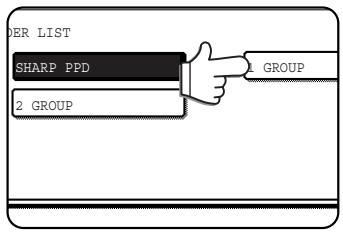
The touched key is highlighted. If you made a mistake, touch the correct key. The highlighting will move to the new key. The selected sender will be the sender of the e-mail.
9 Touch the OK key.
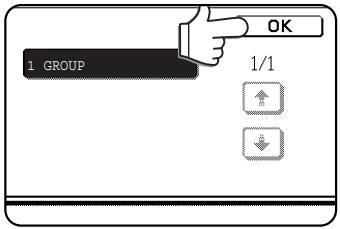
10 Touch the ADDRESS DIRECTORY key.
The address directory screen appears.
11 Touch the one-touch key for the desired destination.
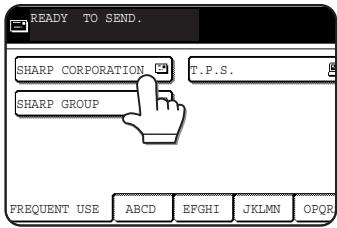
Refer to page 7 for information on using the address directory screen. The key you touched is highlighted. If you touch the wrong key, touch the key again to cancel the selection. The key display will return to normal.
NOTES
- Refer to pages 4 and 5 for information on programming one-touch key destinations.
- When pressing a one-touch key, corresponding information from the email destination screen is shown in the message display. Up to 28 characters can be displayed in the message screen, regardless of the number of characters that have been entered.
- You can also manually enter the address of a Scan to E-mail destination, or select multiple destinations for a broadcast transmission. (Next page)
Using the auto document feeder
12Press the START key.
Scanning begins and the transmission job is stored. (The job is transmitted after previously stored transmission jobs have been completed.)
If scanning is completed normally, the machine makes a beep sound to inform you that the transmission job is stored and JOB STORED appears in the message display.
Using the document glass
12Press the START key.
The original is scanned and the READ-END key appears.
13 If you have another page to scan, change pages and then press the START key.
Repeat this sequence until all pages have been scanned. You can change the resolution and exposure settings as needed for each page (refer to pages 13 and 14). If no action is taken for one minute, scanning automatically ends and the transmission job is stored.
14 After the final page is scanned, touch the READ-END key.
![L. (Pg.No. 3) SS [READ-END]. READ-END](/content/2024/12/122344/images/71c5b3e139bfe02e5782e30d2267e72bef320790a34d4da0f69cc80e1ee431b3.jpg)
The machine makes a beep sound to inform you that the transmission job is stored and JOB STORED appears in the message display. (The destination is automatically called and the document transmitted after previously stored jobs are completed.)
Open the document glass cover and remove the document.
NOTES
- Canceling transmission
To cancel transmission while SCANNING ORIGINAL... appears in the display or before the READ-END key is pressed, press the C key or the CA key. To cancel a transmission job that is already stored, press the JOB STATUS key and cancel the job as explained on page 16.
- Important points when using Scan to E-mail
Be very careful not to send image data files that are too large. Your mail server's system administrator may have placed a limit on the amount of data that can be sent in one e-mail transmission. If this limit is exceeded, the e-mail will not be delivered to the recipient. Even if there is no limit and your e-mail is successfully delivered, a large data file may take a long time to be received and place a heavy burden on the recipient's network, depending on the recipient's network (Internet) connection environment. If large image data files are repeatedly sent, the resulting burden on the network may slow down the speed of other, unrelated data transmissions and in some cases, may even cause the mail server or network to go down. In cases where you need to send multiple documents, try such measures as lowering the resolution or image quality mode. - If the power is turned off or a power failure occurs while a document is being scanned in the auto document feeder, the machine will stop and a document misfeed will occur. After power is restored, remove the document as explained on page 29 of "Operation manual (for copier)".
TRANSMISSION METHODS FOR SCAN TO E-MAIL (MANUAL ENTRY, BROADCAST TRANSMISSION)
It is possible to manually enter the address of a Scan to E-mail destination, or select multiple destinations for a broadcast transmission. (These procedures are not possible when performing an Internet-Fax transmission. First use the procedure in "Basic transmission method" on pages 8 to 9.)
1 Perform steps 1 through 9 of "Basic transmission method" (pages 8 to 9). 2 Touch the E-MAIL ADDRESS key.
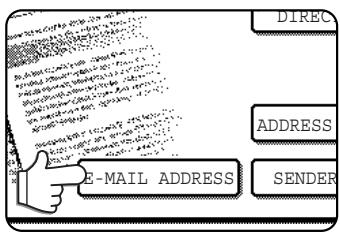
3 Enter the e-mail address.
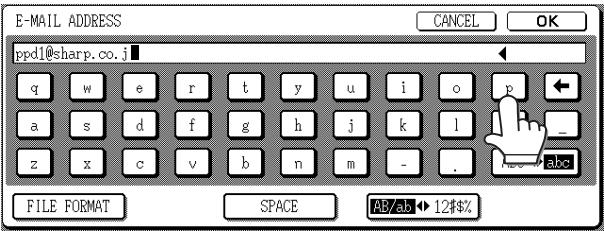
If you make a mistake, press the ← key to move the cursor (■) back to the mistake and then enter the correct character.
4 Touch the FILE FORMAT key.
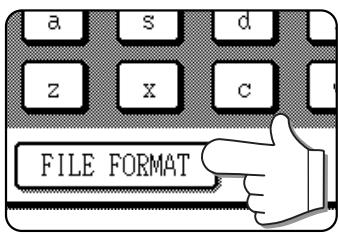
The file format is initially set to "File type: PDF, Compression mode: MMR (G4)". If you do not need to change the file format, go directly to step 6.
NOTE
The initial file format setting can be changed with the key operator program. (Page 27)
5 Select the file type and the compression mode.
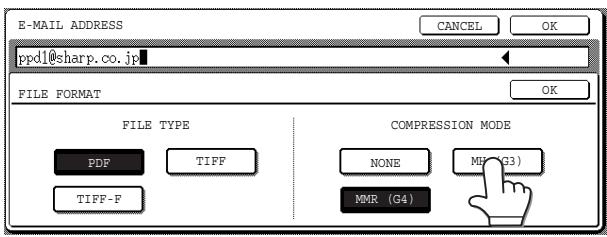
6 Touch the outer OK key.
You will return to the initial screen.
If you are not performing a broadcast transmission, go directly to step 9.
7 If you wish to enter another e-mail address, repeat steps 2 through 6.
NOTES
- If the key operator program has been set so that the NEXT ADDRESS key must always be pressed (page 26) and you wish to enter another address, press the NEXT ADDRESS key an
- If you frequently use broadcasting to send documents to the same group of destinations, it is convenient to program those destinations into a group key. (Page 4)
8 Touch the ADDRESS REVIEW key and check the destinations.
When the ADDRESS REVIEW key is pressed, only the entered destinations are displayed. If you need to clear a destination, press its key. Press the OK key to return to the initial screen.
9 Continue from step 12 of "Basic transmission method" (pages 8 to 9).
NOTES
- To cancel a broadcast transmission when selecting destinations, press the CA key.
- When you perform a broadcast transmission, the compression mode set with the key operator program is used as the file compression mode for all destinations. This is initially set to "MH (G3)". If desired, you can change the setting to "MMR (G4)". (Page 27)
SCANNING AND TRANSMITTING A TWO-SIDED ORIGINAL
A two-sided original can be automatically scanned and transmitted using the auto document feeder. Follow the steps below.
1 Make sure the machine is in scanner mode and then load the document in the auto document feeder. 2 Touch the ORIGINAL key.
When you touch the ORIGINAL key, check the original size displayed in the key.
3 Touch the 2-SIDED BOOKLET key or the 2-SIDED TABLET key as appropriate for the original you loaded.
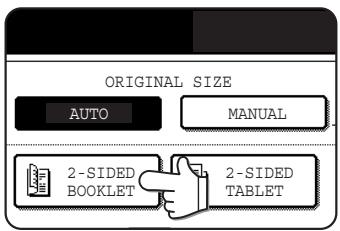
If necessary, touch the MANUAL key and set the original size. (Page 12)
4 Touch the OK key.
You will return to the initial screen.
A two-sided original icon appears next to the ORIGINAL key. (Example: The icon that appears when the 2-SIDED BOOKLET key is touched.)
5 Continue from step 4 of "Basic transmission method" (pages 8 to 9).
NOTES
• Booklets and tablets Two-sided originals that are bound at the side are booklets, and two-sided originals that are bound at the top are tablets. - Two-sided scanning turns off after the document is stored in memory. Pressing the CA key will also cancel two-sided scanning.
Booklet
Tablet
SCANNING SETTINGS (ORIGINAL SIZE, RESOLUTION, EXPOSURE, AND FILE FORMAT)
When sending an image, you can adjust the original size, resolution, exposure, and file format settings as needed.
MANUALLY SETTING THE SCANNING SIZE
If you load an original that is not a standard size (such as an AB size), or if you wish to change the scanning size, touch the ORIGINAL key and set the original size manually. Perform the following steps after loading the document in the automatic document feeder or on the document glass.
NOTE
Standard sizes that can be detected are as follows:
5-1/2"x8-1/2", 8-1/2"x11", 8-1/2"x11"R, 8-1/2"x14", 11"x17". If a non-standard size original is loaded (including special sizes), the closest standard size may be displayed, or the original size may not appear at all.
1 Touch the ORIGINAL key.
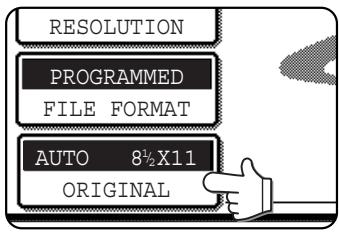
2 Touch the MANUAL key.
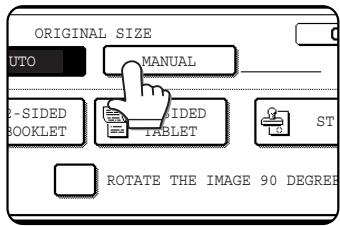
The sizes that can be selected are displayed.
NOTE
If you wish to rotate the original 90° when creating an image file, click the "Load the original so that the image is oriented horizontally" checkbox (a checkmark should appear in the box).
3 Touch the desired original size key.
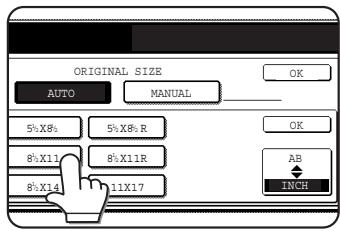
AUTO is no longer highlighted. MANUAL and the original size key you touched are highlighted.
If you wish to select an AB size, touch the AB♦INCH key and then touch the desired original size key.
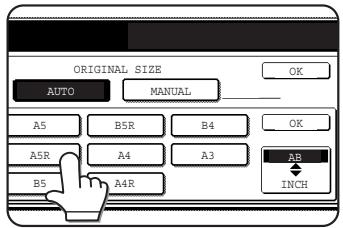
AB is highlighted and AB size keys are displayed. To return to the inch palette, touch the AB♦INCH key once again.
4 Touch the outer OK key.
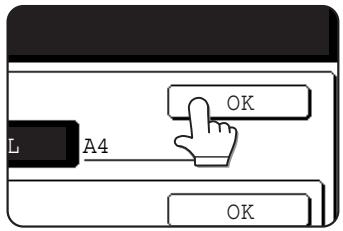
You will return to the initial screen. (Pressing the inner OK key in the step above returns you to step 2.)
5 The selected size appears in the top half of the ORIGINAL key.
![graph TD A["RESOLUTION"] --> B["PROGRAMMED"] B --> C["FILE FORMAT"] C --> D["A4"] D --> E["ORIGINAL"]](/content/2024/12/122344/images/83259e44a3aa54cb9003009acfef39a85926165ed1beb9b51b5f961047124ea6.jpg)
NOTE
You can return to automatic detection by pressing the CA key.
SELECTING THE RESOLUTION
After loading the original, you can adjust the resolution as needed for the type of original and the size of the letters on it. After loading the original in scanner mode, adjust the settings as explained below. The initial resolution setting is STANDARD.
■ Change the resolution.
1 Touch the RESOLUTION key.
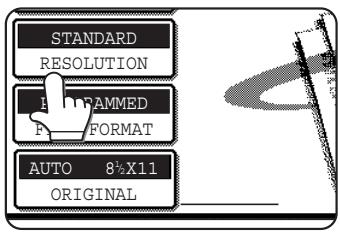
2 Touch the desired resolution key.
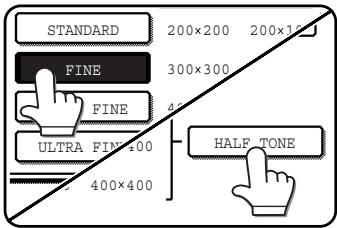
The selected key is highlighted. If you selected FINE, SUPER FINE, or ULTRA FINE, you can also touch the HALF TONE key to select halftone.
3 Touch the OK key.
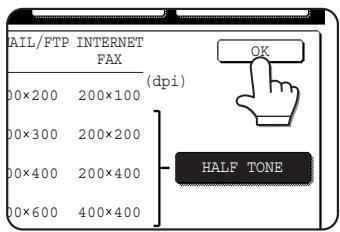
You will return to the initial screen.
NOTES
- The initial factory resolution setting is Standard. If desired, you can change the initial setting to a different setting using the key operator program. (Refer to page 26.)
- When using the automatic document feeder, the resolution setting cannot be changed once scanning has begun.
■ Resolution settings
| Standard | Touch this key if your original consists of normal-sized characters (like those in this manual). |
| Fine | Touch this key if your original has small characters or diagrams. The original will be scanned at twice the resolution of the Standard setting. |
| Super fine | Touch this key if your original has intricate pictures or diagrams. A higher-quality image will be produced than with the Fine setting. |
| Ultra fine | Touch this key if your original has intricate pictures or diagrams. This setting gives the best image quality. However, transmission will take longer than with the other settings. |
| Half tone | Touch this key if your original is a photo-graph or has gradations of color (such as a color original). This setting will produce a clearer image than Fine, Super fine, or Ultra fine used alone. Half tone cannot be selected if Standard has been selected. |
SELECTING THE EXPOSURE
After loading the original, you can adjust the contrast as needed for the darkness and type of the original. After loading the original in scanner mode, adjust the settings as explained below. The initial exposure setting is AUTO.
■ Change the exposure.
1 Touch the EXPOSURE key.
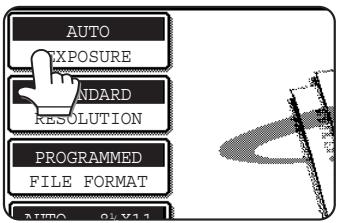
If the Fax Expansion Kit (AR-FX5) has been installed, the SPECIAL MODES key will appear in place of the EXPOSURE key. In this case, press the SPECIAL MODES key and then press the EXPOSURE key.
2 Touch the desired exposure key.
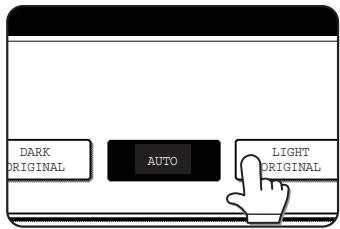
The selected key is highlighted.
3 Touch the OK key.
You will return to the initial screen.
NOTE
When using the document glass to scan pages of an original, the exposure setting can be changed each time you change pages. When using the automatic document feeder, the exposure setting cannot be changed once scanning has begun.
■ Exposure settings
| Dark Original | Select this setting if your original consists mostly of dark characters. |
| Auto | This setting automatically adjusts the exposure for light and dark parts of the original. |
| Light Original | Select this setting if your original consists mostly of faint characters. |
SELECTING THE FILE FORMAT
When you send an image to one or more recipients using Scan to E-mail or Scan to FTP, the FILE FORMAT key enables you to temporarily override the individual file format settings (FILE TYPE / COMPRESSION MODE) stored for each recipient and send the image to all of the recipients using a single file format setting.
"PROGRAMMED" is initially selected, which means that the file format settings stored for each recipient are used.
1 Touch the FILE FORMAT key.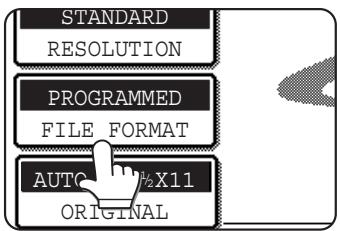
2 Select the file type and the compression mode.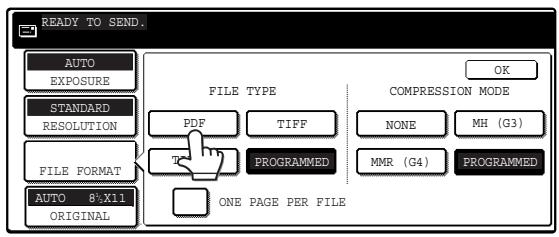
NOTE
When the "ONE PAGE PER FILE" checkbox is not selected, all scanned pages are combined into a single file. When the checkbox is selected, one file is created per page.
3 Touch the OK key.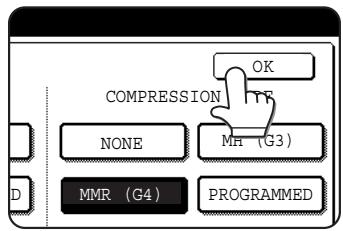
You will return to the initial screen.
NOTES
- The initial file format setting can be changed with the key operator program. (Page 27)
- Even if you change the settings in the FILE FORMAT setting screen, you can return to the settings stored for each recipient by selecting "PROGRAMMED" once again. The PROGRAMMED key returns both the file type and compression mode to the stored file format settings regardless of which key is touched. You cannot return only the file type, or only the compression mode, to the stored setting.
- When you perform a broadcast transmission, the compression mode selected in the key operator program has precedence over the others.
PRIORITY TRANSMISSION OF A STORED JOB
If you have an urgent transmission job and multiple transmission jobs have already been stored, you can give priority to the urgent job so that it will be transmitted immediately after the job currently being executed. This is done from the job status screen. For details on using the job status screen, refer to page 1-14 of "Operation manual (for printer operation and general information)".
1 Press the JOB STATUS key.
2 Touch the E-MAIL/FTP key.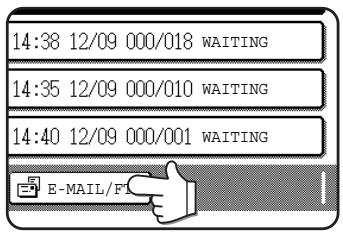
3 Touch the job key of the transmission job to which you wish to give priority.
The touched key is highlighted.
4 Touch the PRIORITY key.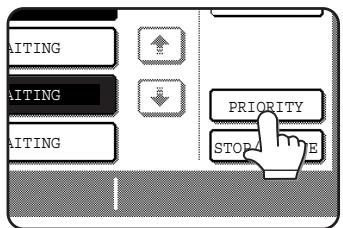
The selected job moves up to the next position after the job currently being executed.
When the current job is completed, execution begins of the job selected in step 3.
NOTE
If the job currently being executed is a broadcast transmission, the priority job will be executed after the call to the current destination is completed. When the priority job is completed, the remaining broadcast destinations are called. However, if the priority job is also a broadcast transmission, the job is begun after the current broadcast job is completed.
CANCELING AN E-MAIL/FTP TRANSMISSION
You can cancel a transmission job that is in progress or that has been stored. Cancellation is done from the e-mail/FTP job status screen.
1 Press the JOB STATUS key.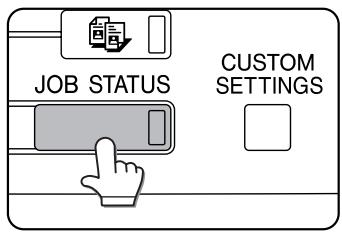
2 Touch the E-MAIL/FTP key.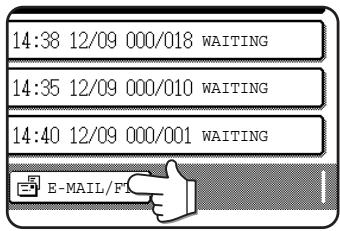
3 Touch the job key of the transmission job you wish to cancel.
The touched key is highlighted.
4 Touch the STOP/DELETE key.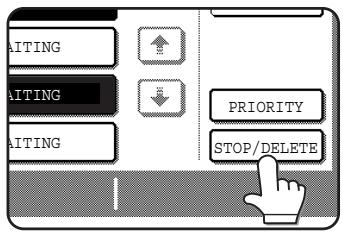
A message appears to confirm the cancellation. Touch the YES key to delete the selected job key and cancel the transmission.
NOTE
If you do not wish to cancel the transmission, touch the NO key.
STORING, EDITING, AND CLEARING FROM THE TOUCH PANEL
One-touch and group keys for Scan to E-mail and Internet-Fax, group indexes, and senders can also be stored, edited and cleared from the touch panel of the machine.
STORING ONE-TOUCH KEYS (only addresses for Scan to E-mail and Internet-Fax)
The touch panel of the machine can also be used to store destinations for Scan to E-mail and Internet-Fax. (Scan to FTP destinations must be stored using the Web page, and Scan to Desktop destinations must be stored using Network Scanner Tool (page 4).)
1 Press the CUSTOM SETTINGS key.
2 Touch the ADDRESS CONTROL key.![graph TD A["ADDRESS CONTROL"] --> B["KEY OPERATOR PRO"]](/content/2024/12/122344/images/18e261c4b5f9959137db917bcb83114bddb8432107794a089763f0107f2c2480.jpg)
3 Touch the DIRECT ADDRESS key.![graph TD A["DIRECT ADDRESS"] --> B["CUSTOM INDEX"] B --> C["Arrow pointing down"]](/content/2024/12/122344/images/f6c38d516682722f1bd6cb8c00a58dfbd3ce04914169baff55a80fdaebda277e.jpg)
4 Touch the INDIVIDUAL key.![graph TD A["INDIVIDUAL"] --> B["STORE"] C["GROUP"] --> B["STORE"]](/content/2024/12/122344/images/0db0b893be9ccde0011a2d06625f094d0285728445712daabdac2f40bb9d8cf4.jpg)
5 Click the checkbox of the transmission method to be used so that a checkmark appears. (Example: Scan to E-mail)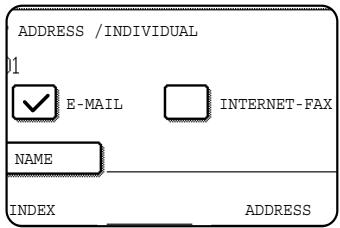
6 Touch the NAME key.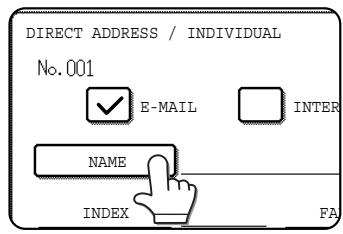
The "No." that automatically appears is the lowest number from 001 to 500 that has not yet been programmed. When NAME is touched, the letter-entry screen appears. Enter up to 36 characters for the name.
NOTE
If you are going to use the Web page to edit or delete the stored name at a later time, do not use the characters ", <, or >. These characters cannot be displayed in the Web page.
7 Touch the INITIAL key.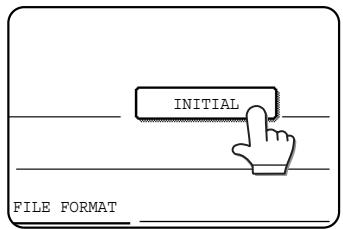
8 Touch a letter key.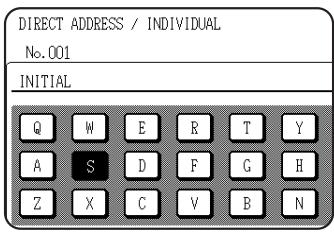
The first letter (initial) of the name entered in step 6 is initially selected and is highlighted. If you wish to change the letter, touch a different letter key.
NOTE
The initial you enter here determines the position of the one-touch key in the ABC index. For information on the ABC index, refer to page 7.
9 Touch the OK key.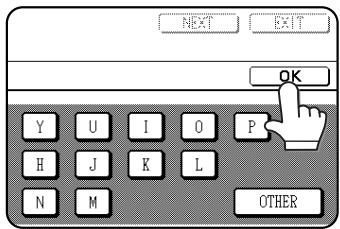
10 Touch the INDEX key.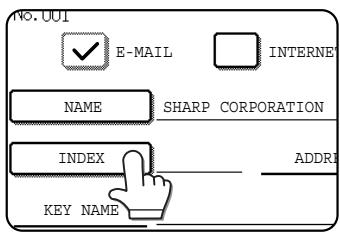
11 Touch an index key.![DIRECT ADDRESS / INDIVIDUAL No.001 INDEX OK SELECT THE CUSTOM INDEX WHERE YOU REGISTER THIS ADDRESS. USER 1 USER 2 USER 3 USER 4 USER 5 USER 6 DO YOU REGISTER THIS ADDRESS AT THE [FREQUENT USE], TOO? YES NO](/content/2024/12/122344/images/a789dabb2c3ef71bed260125e12fbbef545f0725e70b74e0aea0f86c66cb2ae9.jpg)
Select one of the upper row of keys (USER 1 through USER 6) to determine the location of the one-touch key when the GROUP index is displayed instead of the ABC index (refer to page 7). The lower keys are for selecting whether to include the one-touch key in the FREQUENT USE index. If you touch the wrong key, simply touch the correct key.
12 Touch the OK key.
13 Touch the ADDRESS key.
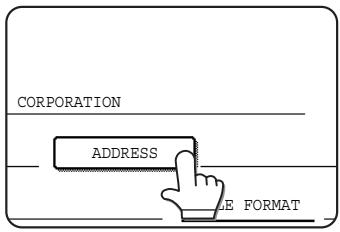
The E-mail address entry screen appears.
14 Enter the e-mail address of the destination.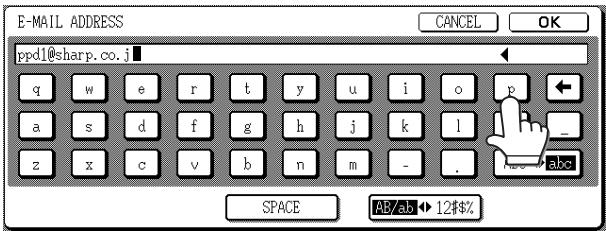
Up to 64 characters can be entered.
If you make a mistake, touch the ← key to move the cursor (■) back one space and then enter the correct character.
15 Touch the OK key.
You will return to the one-touch key programming screen. REGISTRATION IS COMPLETED will appear highlighted to the right of "No.".
NOTE
The "ADDRESS" line only shows 32 digits, regardless of how many digits were actually programmed.
16 Check the key name.
The characters appearing next to the NAME key will be displayed in the key. Only the first 18 characters of the name entered in step 6 will be displayed.
If you need to change the name that will be displayed in the key, touch the KEY NAME key.
If you do not wish to change the name, this step is not necessary.
17 Check the file format and the compression mode.
For a Scan to E-mail destination
Initial settings are File type: PDF, Compression mode: MMR (G4). If you need to change these settings, touch the FILE FORMAT key. File type selections are PDF, TIFF, and TIFF-F; and compression mode selections are NONE, MH (G3), MMR (G4).
If you do not need to change the settings, this step is not necessary.
When you have completed the settings, press the OK key.
For an Internet-Fax destination
The initial setting is Compression mode: MH (G3). If you need to change the setting, press the COMPRESSION key. Selections are MH (G3) and MMR (G4).
If you do not need to change the settings, this step is not necessary.
When you have completed the settings, press the OK key.
NOTE
The file format for Internet-Fax is automatically set to TIFF-F.
18 When you have finished programming the one-touch key, touch the EXIT key. If you wish to program another one-touch key, touch the NEXT key.
Pressing the EXIT key returns you to the screen of step 4 on the previous page.
EDITING AND DELETING ONE-TOUCH KEYS
If you wish to delete a one-touch key or change the E-mail address, name, or other information programmed in a one-touch key, perform the following procedure.
1 Press the CUSTOM SETTINGS key, touch the ADDRESS CONTROL key, and then touch the DIRECT ADDRESS key (refer to steps 1 to 3 on page 17). 2 Touch the AMEND/DELETE key.
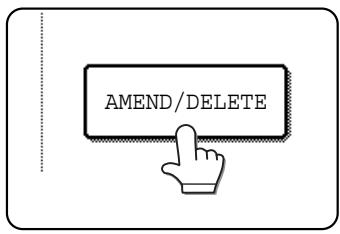
3 Touch the one-touch key you wish to edit or delete.
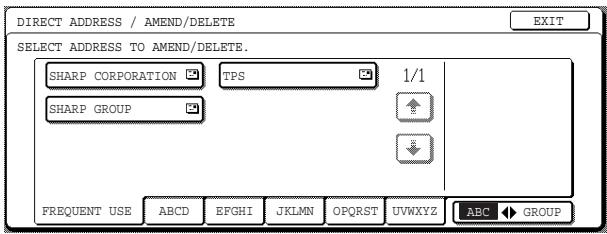
● To edit a one-touch key, follow steps 4 and 5. ● To delete a one-touch key, follow steps 6 and 7. - When you have finished editing or deleting, touch the EXIT key.
4 Touch the key corresponding to the information you wish to change (change the information in the same way as you stored the information on pages 17 to 18).
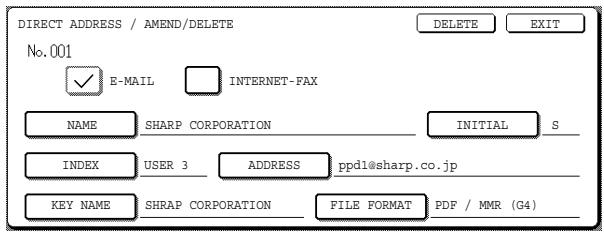
5 Make sure that your changes are correct, and then touch the EXIT key.
![graph TD A["DELETE"] --> B["EXIT"] C["INITIAL"] --> D["S"]](/content/2024/12/122344/images/b73977fd561e3d00c21494e306366992b258e53b5110f1546d4ac2287ee61d48.jpg)
If you wish to change another one-touch key, repeat steps 3 through 5.
6 Touch the DELETE key.
![graph TD A["DELETE"] --> B["EXIT"] C["INITIAL"] --> D["S"]](/content/2024/12/122344/images/aada6e19b0e25c4b28d0ee717e69cddd15b0da2988529eac86e0006c65065253.jpg)
7 Touch the YES key.
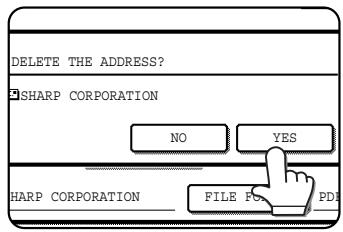
If you wish to delete another one-touch key, repeat steps 3, 6, and 7.
NOTES
- If you cannot edit or delete a one-touch key
If you attempt to edit or delete a one-touch key in the following situations, a warning message will appear and editing/deletion will not be possible.
● The one-touch key you wish to edit or delete is currently being used for transmission or is used in a currently stored transmission job. ● The one-touch key is included in a group key.
If the key is being used for a current transmission or currently stored transmission, cancel the transmission or wait until it is completed and then change or delete the key. If the key is included in one of the above groups, delete the key from the group and then change or delete the key.
- Destinations for Scan to FTP and Scan to Desktop that are stored in one-touch keys cannot be edited or cleared from the touch panel of the machine. Use the Web page to edit or clear these destinations. (Page 2)
PROGRAMMING A GROUP KEY
Scan to E-mail and Internet-Fax destinations that have been stored in one-touch keys can be stored in group keys. Up to 300 destinations can be stored in a group key.
To program a group key from the Web page, refer to page 4.
NOTE
Only one-touch key destinations can be stored in a group key. If you wish to store a destination that is not programmed in a one-touch key, first program the destination in a one-touch key and then store it in the group key.
1 Press the CUSTOM SETTINGS key, touch the ADDRESS CONTROL key, and then touch the DIRECT ADDRESS key (refer to steps 1 to 3 on page 17). 2 Touch the GROUP key.
![graph TD A["INDIVIDUAL"] --> B["STORE"] C["GROUP"] --> B](/content/2024/12/122344/images/1ba5f887c14dea0612f171e4c7b55d19d4ce0033928a6cca6fafd7bdf02af699.jpg)
3 Follow steps 6 through 12 of "Storing one-touch keys" (pages 17 to 18) to enter a GROUP NAME, INITIAL, and INDEX. 4 Touch the ADDRESS key.
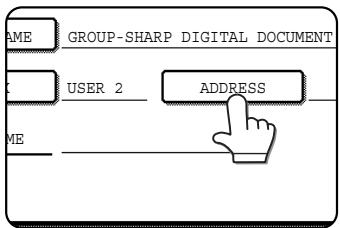
5 Touch index keys and the ↑ ↓ keys as needed, and then touch one-touch keys of the destinations that you wish to store in the group.
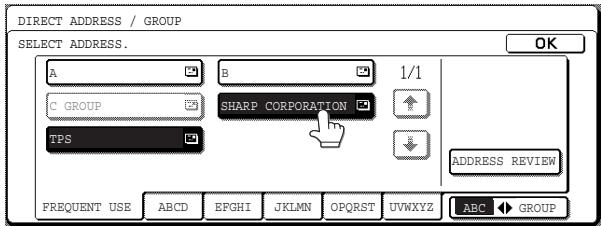
One-touch keys that have been touched are highlighted. If you touch the wrong key, simply touch it again to cancel the highlighting and remove the destination from the group.
NOTE
One group key cannot be stored in another group key. Group keys appear grayed out and cannot be touched.
6 To check the destinations that you have stored in the group, touch the ADDRESS REVIEW key.
A list of your selected destinations is displayed. You can delete a displayed destination by touching it. When a message appears asking if you want to delete the destination, touch the YES key.
7 Touch the outer OK key.
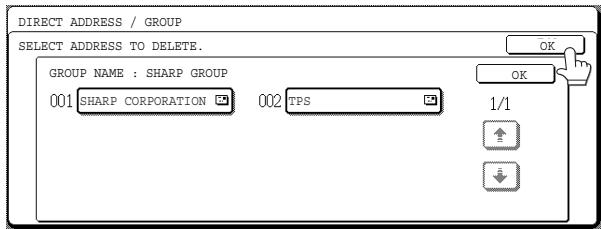
The number of destinations in the group appears to the right of the ADDRESS key.
8 Check the name of the key (refer to step 16 on page 18).
The characters appearing next to the KEY NAME key will be displayed in the group key. To change these characters, touch the KEY NAME key. This step is not necessary if you do not wish to change the characters.
9 Touch the EXIT key when you have finished programming the group key.
If you wish to program another group key, touch the NEXT key.
When you touch the EXIT key, you will return to the screen of step 2.
EDITING AND DELETING GROUP KEYS
If you need to delete group key or change its name or one of its stored destinations, perform the following procedure.
1 Press the CUSTOM SETTINGS key, touch the ADDRESS CONTROL key, and then touch the DIRECT ADDRESS key (refer to steps 1 to 3 on page 17). 2 Touch the AMEND/DELETE key.
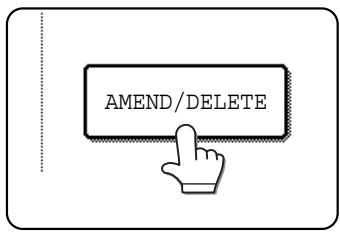
3 Touch the group key you wish to edit or delete.
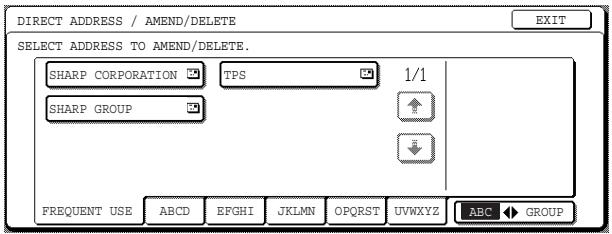
● To edit a group key, follow steps 4 and 5. ● To delete a group key, follow steps 6 and 7. - When you have finished editing or deleting, touch the EXIT key.
4 Touch the key of the item you wish to change (to edit the item, follow the same steps as for one-touch keys on page 17).
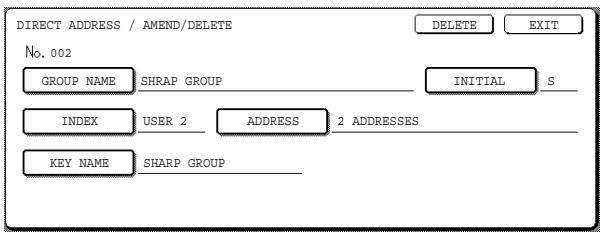
To edit a destination stored in a group key, touch the ADDRESS key. The following screen appears.
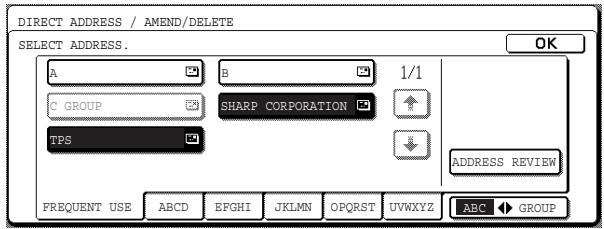
The one-touch keys stored in the group are highlighted. To add another one-touch key to the group, touch the key to highlight it.
To delete a one-touch key from the group, touch the key so that it is no longer highlighted.
5 Make sure the edited information is correct, and then touch the EXIT key.
![graph TD A["DELETE"] --> B["EXIT"] C["INITIAL"] --> D["S"] E["BS"] --> A E --> C E --> D](/content/2024/12/122344/images/5cdd6d22dda53eb1350df84e560e76eba767a5ee50520c38f33624f0995521fe.jpg)
If you wish to change another group key, repeat steps 3 through 5.
6 Touch the DELETE key.
![graph TD A["DELETE"] --> B["INITIAL"] C["EXIT"] --> B B --> D["S"]](/content/2024/12/122344/images/153d05380abb86be27de64b36861ed311f017ec704b56b74542b3fda27f2e73a.jpg)
7 Touch the YES key.
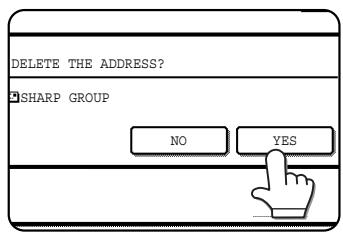
If you wish to delete another group key, repeat steps 3, 6, and 7.
NOTE
If you cannot edit or delete a group key
If you attempt to edit or delete a group key in the following situations, a warning message will appear and editing/deletion will not be possible.
● The one-touch key you wish to change or delete is currently being used for transmission or is used in a currently stored transmission job.
If the key is being used for a current transmission or currently stored transmission, cancel the transmission or wait until it is completed and then edit or delete the key.
STORING SENDER INFORMATION
Use this procedure to store the sender information (sender name and e-mail address) that is displayed when the recipient receives your e-mail. Information for up to 20 different senders can be stored. Select a sender from the stored senders using the touch panel of the digital copying machine when you send an image (page 8). The selected sender appears in the sender column of the recipient's e-mail software program. If you prefer to store sender information from the Web page, refer to page 5.
1 Press the CUSTOM SETTINGS key, and then touch the ADDRESS CONTROL key (refer to steps 1 and 2 on page 17). 2 Touch the E-MAIL SENDER key.
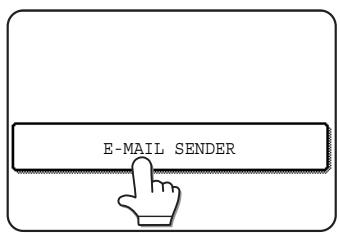
3 Touch the STORE key.
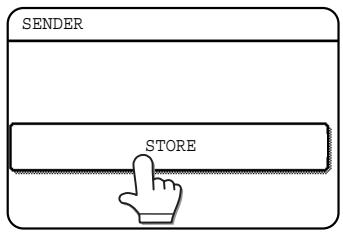
4 Touch the SENDER NAME key.
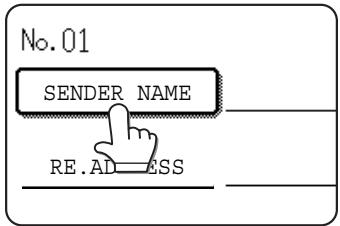
The "No." that automatically appears is the lowest number from 01 to 20 that has not yet been programmed. When SENDER NAME is touched, the letter-entry screen appears. Enter up to 20 characters for the name.
5 Touch the RE.ADDRESS key.
![graph TD A["SENDER NAME"] --> B["1 GROUP"] C["RE.ADDRESS"] --> D["..."]](/content/2024/12/122344/images/942508aa03302e72fd31ed543ca598259a53d29eec3d60ab6ff71d71f0d99eed.jpg)
The display changes to the address entry screen when you touch the RE.ADDRESS key. Up to 64 characters can be entered for the sender's e-mail address. When finished, press the OK key to return to the original screen.
6 If you have finished storing senders, touch the EXIT key. If you wish to store another sender, touch the NEXT key.
EDITING AND DELETING SENDER INFORMATION
Use this procedure when you need to edit sender information or clear a sender.
1 Perform steps 1 and 2 of "STORING SENDER INFORMATION". 2 Touch the AMEND/DELETE key.
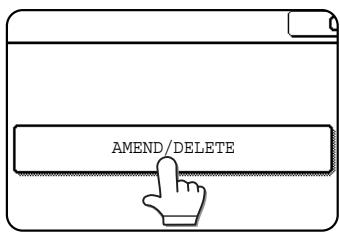
The stored senders appear.
3 Touch the one-touch key of the sender that you wish to edit or clear.
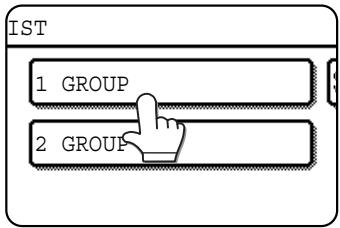
The edit/clear screen of the touched sender appears.
4 Edit or clear the sender.
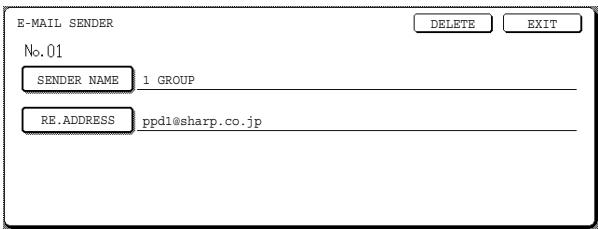
Edit sender information in the same way that you stored it. When finished, touch the EXIT key to return to the screen of step 3.
To clear the sender, touch the DELETE key. A message appears asking you to confirm your selection. Touch the YES key to clear the sender and return to the screen of step 3.
STORING A GROUP INDEX
You can assign any name up to 6 characters long to each of the USER indexes (USER 1 to USER 6).
To perform this procedure from the Web page, refer to page 5.
1 Press the CUSTOM SETTINGS key, and then touch the ADDRESS CONTROL key (refer to steps 1 and 2 on page 17). 2 Touch the CUSTOM INDEX key.
![graph TD A[" "] --> B[" DIRECT ADDRESS"] B --> C[" CUSTOM INDEX"] C --> D[" "] style A fill:#f9f,stroke:#333 style B fill:#ccf,stroke:#333 style C fill:#cfc,stroke:#333 style D fill:#fcc,stroke:#333](/content/2024/12/122344/images/6ec13af51ad64a40dcb14e56508d7edb94800cbd74dfeb769f6e3165eae36043.jpg)
3 Touch an index key (USER 1 to USER 6).
You can enter a name for the selected index.
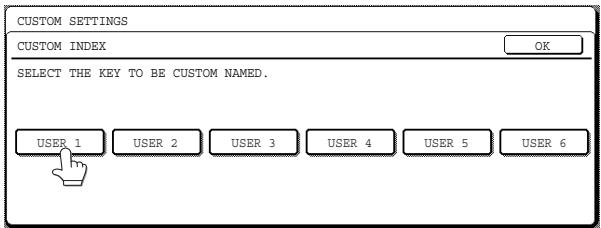
When touched, the letter entry screen appears.
4 Enter a maximum of 6 characters for the index name.
Use the left arrow key to clear the displayed name and then enter the desired name.
When finished, touch the OK key. The new name appears in the screen of step 3.
5 If you wish to program another index name, repeat steps 3 and 4.
When finished, touch the OK key.
To change a user index name, re-enter the name as explained in step 4.
PRINTING PROGRAMMED INFORMATION
You can print out lists of the one-touch keys and group keys that have been stored in the machine.
1 Press the CUSTOM SETTINGS key.
2 Touch the LIST PRINT key.
3 Touch the SENDING ADDRESS LIST key.
4 Touch the key of the list you wish to print.
![graph TD A["INDIVIDUAL LIST"] --> B["GROUP LIST"]](/content/2024/12/122344/images/8c6b3879fbb14c69ecf6b2104de120f397ab15fd691df7d5f92b18e148b5750a.jpg)
PROCESSING PRINT DATA appears in the message display and printing begins.
To cancel printing, touch the CANCEL key.
NOTES
- The list is printed before other print jobs waiting to be printed.
- If you attempt to print a list when no data exists, a warning message will appear.
TROUBLESHOOTING
IF YOUR E-MAIL IS RETURNED
If a Scan to E-mail or Internet-Fax is not successfully transmitted, an e-mail informing you of this fact is sent to the sender selected at the time of transmission. If this happens, read the e-mail and determine the cause of the error, and then repeat the transmission.
IF A TRANSMISSION ERROR OCCURS
If a transmission error occurs when you send a scanned image, a message informing you of the error and an error code will appear in the touch panel on the machine.
■ Error Code Table
| Error Code | Description of the Error |
| CE-01 | The optional network interface card (Print Server Card) is not installed or is out of order. |
| CE-02 | Cannot find the specified mail server or FTP server. |
| CE-03 | The server was down during the scanning of the original. |
| CE-04 | An invalid account name or password for the FTP server has been entered. |
| CE-05 | An invalid directory of the FTP server has been entered. |
| CE-00 | An error other than the above has occurred. |
KEY OPERATOR PROGRAMS
This section explains the key operator programs that are related to the network scanner feature of the machine. For key operator programs that are related to the printer and copy functions of the machine, refer to KEY OPERATOR'S GUIDE and "Operation manual (for copier)".
NOTE
You may not be able to use all of the programs in the key operator program list. Programs that you can use will depend on what peripheral devices are installed on the machine.
KEY OPERATOR PROGRAM LIST
| Program name | Page |
| Image send settings | |
| Operation settings | |
| Default display setting | 26 |
| The number of direct address keys displayed setting | 26 |
| Must input next address key at broadcast setting | 26 |
| Initial resolution setting | 26 |
| Scan to E-mail initial status settings | |
| Default sender set | 27 |
| Initial file format setting | 27 |
| Compression mode at broadcasting | 27 |
USING THE KEY OPERATOR PROGRAMS
To use a key operator program, follow the procedure on page 6 of KEY OPERATOR'S GUIDE. (Please carefully read "Supplementary explanation of key operation for key operator programs (when using the operation panel with touch panel)" on the same page.) For explanations of each setting, refer to the following pages.
SETTING PROGRAMS
The setting programs for the network scanner feature of the machine are explained here. Explanations of the setting programs used for the copy feature, setting programs used for the facsimile feature, and setting programs that are related to the printer feature can be found in the copy, facsimile, and printer manuals.
Operation settings
The following operation settings are available:
●Default display setting ●The number of direct address keys displayed setting ●Must input next address key at broadcast setting ●Initial resolution setting
Default display setting
You can select the initial display that appears when you press the IMAGE SEND key to change to scanner mode or when you press the CA key in scanner mode. Normally the initial display is set to the condition setting screen (page 6).
The following three selections are available:
- Condition setting screen
- Address directory (ABC)
- Address directory (Group)
When an address directory (ABC or Group) is selected, the selected index of that address directory (page 7) is set as the initial screen.
The number of direct address keys displayed setting
The number of one-touch keys displayed in each address directory screen can be changed from 8 (the normal setting) to 6 or 12.
Touch 6, 8, or 12 to select the desired number.
NOTE
For the key name that appears in each one-touch key, a maximum of 18 characters can appear when the number of one-touch keys displayed is set to 6 or 8. A maximum of 10 characters can appear when the number of one-touch keys displayed is set to 12.
Must input next address key at broadcast setting
You can select whether the NEXT ADDRESS key must be pressed before entering the next destination when performing a broadcast transmission (only for Scan to E-mail). Usually this is set so that the NEXT ADDRESS key can be omitted.
Example: Normal setting (factory setting)![graph TD A["XXXX NEXT ADDRESS"] --> B["Manual ↑"] B --> C["Can be omitted"] D["One-touch"] --> E["Next ADDRESS"] E --> F["Can be omitted"] G["One-touch"] --> H["Next ADDRESS"] H --> I["Can be omitted"]](/content/2024/12/122344/images/d2db41d3c3d7acd276b7ed6c8e91cbce70f6937793652dd3271db8ac56af126f.jpg)
![graph TD A["XXXX"] --> B["NEXT ADDRESS"] B --> C["Manual"] C --> D["Cannot be omitted."] style A fill:#f9f,stroke:#333 style B fill:#ccf,stroke:#333 style C fill:#cfc,stroke:#333 style D fill:#fcc,stroke:#333](/content/2024/12/122344/images/71962fc693b5a0d693da9c465a35599749607311688b6636092194dac8f5ae5f.jpg)
If the box is checked, it will no longer be possible to omit the NEXT ADDRESS key as shown in the above example. Even if the next destination to be entered is a one-touch key, the NEXT ADDRESS key must be touched before the one-touch key can be entered.
If you attempt to enter a subsequent destination without touching the NEXT ADDRESS key, the destination will not be entered.
Initial resolution setting
This setting is used to change the default resolution setting for scanner mode from STANDARD to FINE, SUPER FINE, or ULTRA FINE. HALF TONE can also be selected for the latter three resolution settings. STANDARD is normally selected for the initial resolution setting. If you wish to select HALF TONE for the selected resolution setting, touch the HALF TONE key to highlight it.
NOTES
- HALF TONE cannot be selected for STANDARD resolution.
- For more information on each of the resolution settings, refer to page 13.
Scan to E-mail initial status settings
The Scan to E-mail initial status settings let you adjust certain default settings for Scan to E-mail.
The Scan to E-mail initial status settings are as follows:
● Default sender set ● Initial file format setting ● Compression mode at broadcasting
Default sender set
If you do not select a sender when performing a Scan to E-mail operation, the sender information stored with this setting is automatically used. You can check the stored sender information by printing the SENDER list.
1 Touch the SENDER NAME key and then enter the sender name.
The sender name entry screen appears.
Up to 20 characters can be entered.
2 Touch the OK key. 3 Touch the RE.ADDRESS key and then enter the return address.
Up to 64 characters can be entered.
4 Touch the OK key.
The entered return address appears. Check the address to make sure it is correct.
Initial file format setting
You can change the default file format (file type, compression mode, and file creation method) used when the e-mail address is entered manually for a Scan to E-mail transmission.
Normally the file type is set to PDF and the compression mode is set to MMR (G4).
Compression mode at broadcasting
This setting selects the compression mode for broadcasting using Scan to E-mail. The compression mode set here is used for all destinations regardless of their individual compression mode settings.
The usual setting is MH (G3).
PRINTING OUT SETTINGS
Settings established with the key operator programs can be verified by printing them out.
1 Press the CUSTOM SETTINGS key.
2 Touch the KEY OPERATOR PROGRAMS key.
![graph TD A["DISPLAY CONTRAST"] --> B["ADDRESS CONTROL"] C["LIST PRICE"] --> B D["KEY OPERATOR PROGRAMS"] --> B](/content/2024/12/122344/images/cfac1bb3bb1f2b47ea61f6de73b4c17b308d312ad2193d9e887278b301527e36.jpg)
3 Touch the LIST PRINT key.
![graph TD A["ON"] --> B["DEVICE CONTROL"] C["END"] --> D["LIST PRINT"]](/content/2024/12/122344/images/9c99a6047e3e05fb728c630a43d76f7c56606cb0e8f7591c37c93fd0555172fa.jpg)
4 Touch the ALL KEY OPERATOR PROGRAMS LIST key.
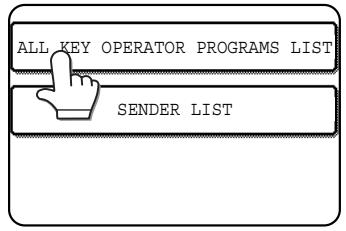
PROCESSING PRINT DATA appears in the message screen and printing begins. To cancel printing, touch the CANCEL key.
NOTES
- The list is printed before other jobs waiting to be printed.
- In the screen of Step 4, you can touch the SENDER LIST key to print the Sender List. This list lets you check the stored senders.
SPECIFICATIONS
For information on power requirements, power consumption, dimensions, weight, and other specifications that are common to all features of the machine, refer to page 6-2 of "Operation manual (for printer operation and general information)".
| Maximum original size | 11"x17" |
| Two-sided originals | Possible |
| Optical resolution | 600dpi |
| Output modes | 1bit/pixel |
| Halftone processing | Error dispersion (200/300/400/600dpi) |
| File\ format*1 | File type: PDF/TIFF/TIFF-FCompression mode: NONE/MH (G3)/MMR (G4) |
| Scan destinations | Scan to FTPScan to DesktopScan to E-mail, Internet-Fax |
| Management system | Uses built-in Web server |
| Web browser | Internet Explorer 4.0 or later, Netscape Navigator 4.0 or later |
| Network protocol | TCP/IP, UDP/IP |
| LAN connectivity | 10Base-T/100Base-TX |
| Supported mail system | Mail servers supporting SMTP |
| Number of destinations | 500 maximum*2 |
| Number of senders | 20 maximum |
Output resolution
| Destination typeResolution | E-mail/FTP | Broadcast transmission(E-mail/Internet-Fax) | Broadcast transmission(Fax/E-mail/Internet-Fax) |
| STANDARD | 200x200dpi | 200x100dpi | 203.2x97.8dpi(8x3.85line/mm) |
| FINE | 300x300dpi | 200x200dpi | 203.2x195.6dpi(8x7.7line/mm) |
| SUPER FINE | 400x400dpi | 200x400dpi | 203.2x391dpi(8x15.4line/mm) |
| ULTRA FINE | 600x600dpi | 400x400dpi | 406.4x391dpi(16x15.4line/mm) |
*1 The file format for Internet-Fax is automatically set to TIFF-F. Compression mode selections are MH (G3) and MMR (G4).
*2 A total of 500 destinations can be stored, including E-mail, FTP, Desktop, Internet-Fax, and Group destinations. Among these, a combined total of 100 Scan to FTP and Desktop destinations can be stored.
Some discrepancies may exist in the illustrations and content due to improvements to the machine.
SHARP CORPORATION
Operation Manual (for facsimile)
Be sure to become thoroughly familiar with this manual to gain the maximum benefit from the product.
Before installing this product, be sure to read the installation requirements and cautions sections of the "Operation manual for printer operation and general information".
Be sure to keep all operation manuals handy for reference including this manual, the "Operation manual for printer operation and general information" and operation manuals for any optional equipment which has been installed.
■ CAUTION:
To reduce the risk of fire, use only UL-Listed No. 26 AWG or larger telecommunication line cord.
■ WARNING:
FCC Regulations state that any unauthorized changes or modifications to this equipment not expressly approved by the manufacturer could void the user's authority to operate this equipment.
■ FAX interface cable and Line cable:
These special accessories must be used with the device.
NOTE:
This equipment has been tested and found to comply with the limits for a Class A digital device, pursuant to part 15 of the FCC Rules.
These limits are designed to provide reasonable protection against harmful interference when the equipment is operated in a commercial environment.
This equipment generates, uses, and can radiate radio frequency energy and, if not installed and used in accordance with the instruction manual, may cause harmful interference to radio communications.
Operation of this equipment in a residential area is likely to cause harmful interference in which case the user will be required to correct the interference at his own expense.
INTRODUCTION
Thank you for purchasing this product. This manual only explains the facsimile functions of the product. For information on loading paper, replacing toner cartridges, clearing paper jams, handling peripheral units, and other printer-related information, please refer to your "Operation manual (for printer operation and general information)".
Additional manuals have been provided for copy and network scanner features. Please refer to these as necessary.
This manual assumes that several options have been installed.
TO USE THIS PRODUCT CORRECTLY AS A FACSIMILE
Several points must be kept in mind when using this product as a facsimile.
Please note the following:
■ Settings and programming
Information about settings and programming that are required before the fax functionality can be used is located in "Points to Check and Programming after Installation" on page 1-2 of this manual. Please read this section and perform the required settings and programming.
Lithium battery
A lithium battery inside the unit keeps settings and programmed information in memory.
- When the battery dies, settings and programmed information will be lost. Be sure to keep a written record of the settings and programmed information. (Refer to page 6-14.)
- The life of the lithium battery is approximately 5 years if the main switch and fax power switch are kept continually off.
- When the battery dies, please consult your dealer or your nearest Sharp customer assistance center. When the lithium battery dies, a message will appear in the display and the unit will no longer function.
■ Other information
- If a thunderstorm occurs, we recommend that you unplug the power cord from the power outlet. Information will be retained in memory even if the power cord is unplugged.
- Keep the fax power switch turned on. (Page 0-7 of "Operation manual (for printer operation and general information)".)
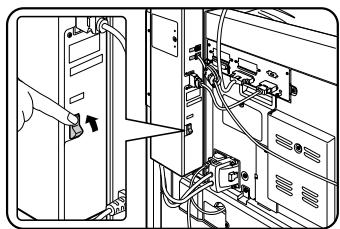
Fax functions cannot be used when the power is turned off.
TABLE OF CONTENTS
Page
INTRODUCTION 0-1
TO USE THIS PRODUCT CORRECTLY
AS A FACSIMILE 0-1
FCC NOTICE TO USERS 0-4
ABOUT THE TELEPHONE CONSUMER
PROTECTION ACT OF 1991 0-5
IMPORTANT SAFETY INFORMATION....0-5
NOTICE FOR USERS IN CANADA
(AVIS POUR NOS UTILISATEURS AU CANADA) ...... 0-6
CHAPTER 1 BEFORE USING THE FAX FEATURE
POINTS TO CHECK
AND PROGRAMMING AFTER INSTALLATION ..... 1-2
●FAX MODE (CONDITION SETTING SCREEN) ... 1-4
ORIGINALS 1-6
●ORIGINALS THAT CAN BE FAXED ..... 1-6
LOADING A DOCUMENT 1-7
●USING THE AUTO DOCUMENT FEEDER ..... 1-7
●USING THE DOCUMENT GLASS ...... 1-7
CHECKING THE SIZE OF A LOADED ORIGINAL ..... 1-8
●MANUALLY SETTING THE SCANNING SIZE .... 1-8
SELECTING RESOLUTION
AND EXPOSURE SETTINGS 1-9
- SELECTING THE RESOLUTION .... 1-9
- SELECTING THE EXPOSURE .... 1-10
CONVENIENT DIALING METHODS ...... 1-11
CHAPTER 2 BASIC OPERATIONS
SENDING A FAX....2-2
●BASIC PROCEDURE FOR SENDING FAXES .....2-2
●TRANSMISSION BY AUTO-DIALING ...... 2-5
●TRANSMITTING A TWO-SIDED DOCUMENT ..... 2-5
PRIORITY TRANSMISSION OF A STORED JOB ....2-6
CANCELING A FAX TRANSMISSION 2-6
RECEIVING FAXES 2-7
●RECEIVING A FAX....2-7
CHAPTER 3 USING CONVENIENT FUNCTIONS 1 ADVANCED TRANSMISSION METHODS
Page
SENDING THE SAME DOCUMENT
TO MULTIPLE DESTINATIONS IN A SINGLE OPERATION
(BROADCAST TRANSMISSION) 3-2
●USING BROADCAST TRANSMISSION ...... 3-3
AUTOMATIC TRANSMISSION AT A SPECIFIED TIME
(TIMER TRANSMISSION) 3-4
- SETTING UP A TIMER TRANSMISSION ...... 3-4
TRANSMISSION AND RECEPTION USING
THE POLLING FUNCTION 3-5
●USING THE POLLING FUNCTION ...... 3-6
●USING POLLING MEMORY ......3-7
OWN NUMBER SENDING 3-9
FAXING A DIVIDED ORIGINAL
(DUAL PAGE SCAN) 3-10
PROGRAMMING FREQUENTLY USED OPERATIONS .... 3-11
●USING A PROGRAM 3-11
TRANSFERRING RECEIVED FAXES
TO ANOTHER MACHINE
WHEN PRINTING IS NOT POSSIBLE ....3-12
●USING THE TRANSFER FUNCTION ...... 3-12
CHAPTER 4 USING CONVENIENT FUNCTIONS 2 TRANSMISSION USING F-CODES
TRANSMISSION BETWEEN MACHINES
SUPPORTING F-CODES 4-2
●MEMORY BOXES AND
SUB-ADDRESSES/PASSCODES
REQUIRED FOR F-CODE TRANSMISSION ... 4-2
●ENTERING A SUB-ADDRESS AND PASSCODE
FOR A MEMORY BOX IN THE OTHER MACHINE .....4-3
F-CODE POLLING MEMORY 4-4
●USING F-CODE POLLING MEMORY......4-4
●PROCEDURE FOR F-CODE POLLING .....4-5
Page
F-CODE CONFIDENTIAL TRANSMISSION .....4-6 ●F-CODE CONFIDENTIAL TRANSMISSION ....4-6 ●PRINTING A DOCUMENT RECEIVED TO AN F-CODE CONFIDENTIAL MEMORY BOX 4-7 F-CODE RELAY BROADCAST TRANSMISSION ..... 4-8 ●USING THE F-CODE RELAY BROADCAST FUNCTION (your machine is the relay machine)......4-9 ●USING THE F-CODE RELAY REQUEST FUNCTION (your machine requests a relay broadcast) .....4-9
CHAPTER 5
USING CONVENIENT FUNCTIONS 3 CONVENIENT METHODS OF USE
STAMPING SCANNED ORIGINALS
(VERIFICATION STAMP FUNCTION) 5-2
● TURNING ON THE VERIFICATION STAMP FUNCTION ....5-2
CONNECTING AN EXTENSION PHONE ....5-3
● CONNECTING AN EXTENSION PHONE .....5-3 ● SENDING A FAX AFTER TALKING ON THE PHONE (MANUAL TRANSMISSION) ......5-3 ● USING AN EXTENSION PHONE TO RECEIVE A FAX 5-4 ● RECEIVING A FAX AFTER TALKING (MANUAL RECEPTION) 5-5
CHAPTER 6
PROGRAMMING
PROGRAMMING 6-2
STORING, EDITING, AND DELETING
AUTO DIAL KEYS AND PROGRAMS 6-2
● STORING ONE-TOUCH DIAL KEYS ...... 6-3 ● EDITING AND DELETING ONE-TOUCH KEYS ..... 6-5 ● PROGRAMMING A GROUP KEY 6-6 ● EDITING AND DELETING GROUP KEYS .....6-7 ● STORING A PROGRAM 6-8 ● EDITING AND DELETING PROGRAMS ......6-8
Page
STORING A GROUP INDEX 6-9
PROGRAMMING, EDITING, AND DELETING
F-CODE MEMORY BOXES 6-10
● PROGRAMMING AN F-CODE MEMORY BOX .....6-10 - SETTING FOR F-CODE POLLING MEMORY BOXES (NUMBER OF TRANSMISSIONS) ......6-11 - SETTING FOR F-CODE CONFIDENTIAL TRANSMISSION MEMORY BOXES (PRINT PIN.) 6-12 - SETTING FOR F-CODE RELAY BROADCAST MEMORY BOXES (END RECEIVING MACHINES) .... 6-13 ● EDITING AND DELETING A MEMORY BOX ..... 6-13
PRINTING PROGRAMMED INFORMATION .....6-14
ENTERING CHARACTERS....6-15
CHAPTER 7
TROUBLESHOOTING
WHEN A TRANSACTION REPORT IS PRINTED ..... 7-2
VIEWING THE COMMUNICATION
ACTIVITY REPORT 7-3
WHEN AN ALARM SOUNDS
AND A WARNING MESSAGE IS DISPLAYED .....7-3
PROBLEMS AND SOLUTIONS....7-4
CHAPTER 8
KEY OPERATOR PROGRAMS
KEY OPERATOR PROGRAMS 8-2
● KEY OPERATOR PROGRAM LIST......8-2 ● USING THE KEY OPERATOR PROGRAMS ... 8-2 - SETTING PROGRAMS 8-3 ● PRINTING OUT SETTINGS....8-10
CHAPTER 9
APPENDIX
SPECIFICATIONS....9-2
FCC NOTICE TO USERS
This equipment complies with FCC Part 68 rules.
On this equipment is a label that contains, among other information, the FCC Registration number and Ringer Equivalence Number (REN) for this equipment.
If requested, this information must be provided to the telephone company.
An FCC compliant telephone cord and modular plug is provided with this equipment.
This equipment is designed to be connected to the telephone network or premises wiring using a compatible modular jack which is Part 68 compliant.
This equipment connects to the telephone network through a standard USOC RJ-11C network interface jack.
The REN is used to determine the quantity of devices which may be connected to your telephone line.
Multiple devices on one line may result in the devices not ringing in response to an incoming call.
In most, but not all areas, the sum of the RENs of all devices should not exceed five (5.0).
To be certain of the number of devices that may be connected to your line, as determined by the total RENs, contact your local telephone company.
If this equipment causes harm to the telephone network, your telephone company may disconnect your service temporarily.
If possible, they will notify you in advance.
If advance notice is not practical, you will be notified as soon as possible.
You will also be advised of your right to file a complaint with the FCC.
Your telephone company may make changes in its facilities, equipment, operations, or procedures that could affect the operation of your equipment.
If this happens, the telephone company will provide advance notice in order for you to make necessary modifications to maintain uninterrupted service.
If the equipment is causing harm to the telephone network, your telephone company may ask you to disconnect the equipment until the problem is resolved.
If you have any questions or problems which cannot be solved by reading this manual, please contact
Sharp Electronics Corporation
P.O. Box 650
Mahwah, NJ 07430-2135
Telephone: 1-800-BE-SHARP
This equipment may not be used on coin service provided by the telephone company.
Connection to party lines service is subject to state tariffs.
Contact your state's public utility commission, public service commission or corporation commission for more information.
When programming emergency numbers and/or making test calls to emergency numbers:
- Remain on the line and briefly explain to the dispatcher the reason for the call.
- Perform such activities in the off-peak hours, such as early morning or late evening.
ABOUT THE TELEPHONE CONSUMER PROTECTION ACT OF 1991
The Telephone Consumer Protection Act of 1991 makes it unlawful for any person to use a computer or other electric device to send any message via a telephone facsimile machine unless such message clearly contains in a margin at the top or bottom of each transmitted page or on the first page of the transmission the following information:
1) The date and time of transmission. 2) Identification of either the business, business entity or individual sending the message. 3) Telephone number of either the sending machine, business, business entity or individual.
In order to program this information into your facsimile machine, please refer to the appropriate instructions in the operation manual.
IMPORTANT SAFETY INFORMATION
- If any of your telephone equipment is not operating properly, you should immediately remove it from your telephone line, as it may cause harm to the telephone network.
- The AC power outlet shall be installed near the equipment and shall be easily accessible.
- Never install telephone wiring during a lightning storm.
- Never install telephone jacks in wet locations unless the jack is specifically designed for wet locations.
- Never touch uninsulated telephone wires or terminals unless the telephone line has been disconnected at the network interface.
- Use caution when installing or modifying telephone lines.
- Avoid using a telephone (other than a cordless type) during an electrical storm. There may be a remote risk of electric shock from lightning.
- Do not use a telephone to report a gas leak in the vicinity of the leak.
- Do not install or use the machine near water, or when you are wet. Take care not to spill any liquids on the machine.
NOTICE FOR USERS IN CANADA
NOTICE: The Industry Canada label identifies certified equipment. This certification means that the equipment meets telecommunications network protective, operational and safety requirements as prescribed in the appropriate Terminal Equipment Technical Requirements document(s). The Department does not guarantee the equipment will operate to the user's satisfaction.
Before installing this equipment, users should ensure that it is permissible to be connected to the facilities of the local telecommunications company. The equipment must also be installed using an acceptable method of connection. The customer should be aware that compliance with the above conditions may not prevent degradation of service in some situations.
Repairs to certified equipment should be coordinated by a representative designated by the supplier. Any repairs or alterations made by the user to this equipment, or equipment malfunctions, may give the telecommunications company cause to request the user to disconnect the equipment.
Users should ensure for their own protection that the electrical ground connections of the power utility, telephone lines and internal metallic water pipe system, if present, are connected together. This precaution may be particularly important in rural areas.
Caution: Users should not attempt to make such connections themselves, but should contact the appropriate electric inspection authority, or electrician, as appropriate.
NOTICE: The Ringer Equivalence Number (REN) assigned to each terminal device provides an indication of the maximum number of terminals allowed to be connected to a telephone interface. The termination on an interface may consist of any combination of devices subject only to the requirement that the sum of the Ringer Equivalence Numbers of all the devices does not exceed 5.
The REN of this equipment is indicated on the label of the equipment.
NOTICE FOR USERS IN CANADA
Sharp Electronics of Canada Ltd.
335 Britannia Road East,
Mississauga, Ontario, L4Z 1W9
CHAPTER 1
BEFORE USING THE FAX FEATURE
This chapter contains basic information about using the fax features of this product. Please read this chapter before using the fax features.
POINTS TO CHECK AND PROGRAMMING AFTER INSTALLATION ..... 1-2
USING THE DOCUMENT GLASS 1-7
CHECKING THE SIZE OF A LOADED ORIGINAL 1-8
MANUALLY SETTING THE SCANNING SIZE 1-8
SELECTING RESOLUTION AND EXPOSURE SETTINGS 1-9
SELECTING THE RESOLUTION ...... 1-9
SELECTING THE EXPOSURE 1-10
CONVENIENT DIALING METHODS 1-11
POINTS TO CHECK AND PROGRAMMING AFTER INSTALLATION
After installing the unit and before using it as a fax machine, check the following points and program the required information.
■ Make sure the fax power switch is turned on
In addition to the main power switch, the rear of the unit also has a power switch for fax functionality. If this power switch is not turned on, you will not be able to use the unit as a fax machine. Please keep the fax power switch turned on at all times.
■ Make sure the correct date and time have been set
Make sure the correct date and time have been programmed in the unit (refer to page 3-15 of "Operation manual (for printer operation and general information)"). If the date and time are wrong, please correct them.
It is important to set the correct date and time because they are used for such features as Timer Transmission (page 3-4).
■ Program the sender's name and sender's number
Refer to page 8-4 to program the name and fax number of the user of this product using the key operator program. The programmed name and number are printed at the top of each transmitted fax page. The sender's number is also used as an identification number when you use the Polling function to request transmission from another fax machine (refer to page 3-6).
NOTE
You can check your programmed name and number by printing out the Sender List. (Refer to page 8-10.)
Operation panel keys used for fax and keys displayed on the touch panel are explained here.
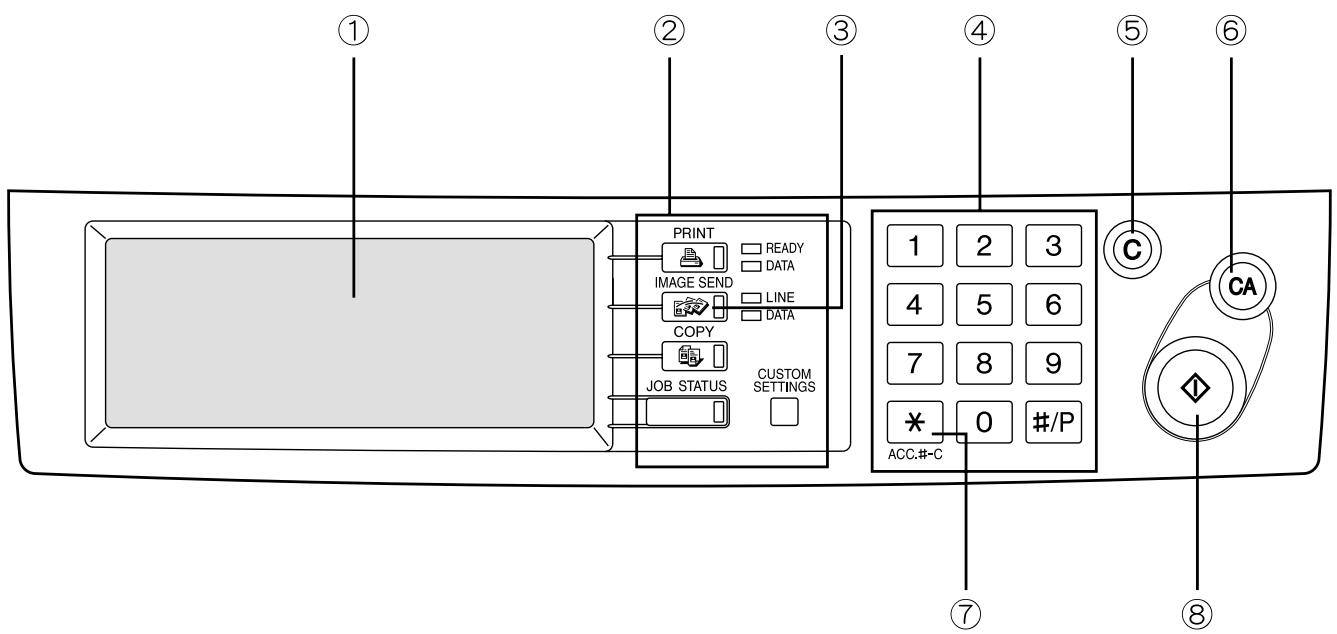
① Touch panel (following page)
The machine status, messages and touch keys are displayed on the panel. The display will change to show the status of print, copy, network scanner or fax according to which of those modes is selected.
② Mode select keys (page 2-2)
Use to select the basic modes of the product.
③ IMAGE SEND key
Press to select fax mode and display the basic screen of fax mode.
④ Numeric keys
Use to enter fax numbers, sub-addresses, passcodes, and numerical settings.
⑤ C key (clear key)
Use to clear a mistake when entering fax numbers, sub-addresses, passcodes, and numerical settings.
One digit is cleared each time you press the key.
When an original is being scanned, this key can also be used to cancel scanning.
⑥ CA key
Use to cancel a transmission or programming operation. When the key is pressed, the operation is canceled and you return to the initial screen (next page).
When sending a fax, this key is also used to cancel an image setting, paper size setting, or special function.
⑦ * key (page 5-5)
This is used to produce tone signals when you are on a pulse dial line.
⑧ Start key (page 2-3)
Press to begin scanning an original for fax transmission.
NOTE
For information on the parts of the unit that are used for faxing, refer to page 3 of "Operation manual (for copier)". For parts that are used for both faxing and printing, refer to page 1-4 of "Operation manual (for printer operation and general information)".
FAX MODE (CONDITION SETTING SCREEN)
The condition setting screen of fax mode is displayed by pressing the IMAGE SEND key while the print mode, copy mode, or job status screen appears in the touch panel. In the explanations that follow, it is assumed that the initial screen that appears after pressing the IMAGE SEND key is the condition setting screen (shown below). If you have set the display to show the address directory (following page) when the IMAGE SEND key is pressed, touch the CONDITION SETTINGS key in the address directory to display the condition setting screen.
The key operator program can be used to set the display to show either the condition setting screen (shown below) or the address directory screen (following page) when the IMAGE SEND key is pressed (refer to page 8-3).
■ Condition setting screen
The display is initially set (factory setting) to show the following condition setting screen as the initial screen.
![graph TD A["1 READY TO SEND."] --> B["2 SPEAKER"] B --> C["3 REDIAL"] C --> D["4"] D --> E["5 ADDRESS DIRECTORY"] E --> F["6 SUB ADDRESS"] F --> G["7 ADDRESS REVIEW"] G --> H["8 AUTO ORIGINAL"] H --> I["9 STANDARD RESOLUTION"] I --> J["10 SPECIAL MODES"] J --> K["11"] K --> L["12"] style A fill:#f9f…](/content/2024/12/122344/images/2bdd0ec3310c9ef0920ecca9538a8b97d09223d7c665d49be1d2c7fa3cb53bea.jpg)
① Message display
Messages appear here to indicate the current status of the machine. When the machine is ready to send, an icon 🔔 appears to the left.
② Memory and reception mode display
This shows the amount of fax memory that is free and the currently selected reception mode.
③ SPEAKER key (page 1-11)
This key is used for dialing with the speaker. During dialing it changes into the PAUSE key, and after pressing the SUB ADDRESS key it changes into the SPACE key.
④ REDIAL key (page 1-11)
Touch this key to redial the most recently dialed number. After dialing, this key changes into the NEXT ADDRESS key.
⑤ ADDRESS DIRECTORY key (page 2-5)
This displays the Address Directory screen (next page). Touch this key when you want to use an autodial number (one-touch dialing or group dialing).
⑥ SUB ADDRESS key (page 4-3)
Touch this key to enter a sub-address or passcode.
⑦ ADDRESS REVIEW key
When performing a broadcast transmission, touch this key to check your selected destinations. Your selected destinations will appear as a list, and the list can be edited.
⑧ Two-sided scanning and verification stamp icon display (pages 2-5 and 5-2)
Icons appear here when you touch the ORIGINAL key and select two-sided scanning and/or the verification stamp function (when the optional verification stamp unit is installed). The icons can be touched to open function selection screens.
⑨ ORIGINAL key (page 1-8)
Touch this key when you wish to manually set the size of the original to be scanned, scan both sides of the original, or use the verification stamp option.
⑩ RESOLUTION key (page 1-9)
Touch this key to change the resolution setting for the original to be scanned. The selected resolution setting will be highlighted above the key. The initial factory setting is STANDARD.
⑪ SPECIAL MODES key
Touch this key to select one of the following special functions:
- Timer transmission (page 3-4) • Polling (page 3-6)
- Dual page scan (page 3-10) • Exposure (page 1-10)
- Program (page 3-11) • Memory box (page 3-7)
⑫ Special function icon display (page 1-15 of "Operation manual (for printer operation and general information)")
When a special function such as polling or dual page scan is selected, a special function icon appears here.
■ Address directory screen (alphabetically ordered)
If you have set the initial screen to the address directory screen using the key operator program, the initial screen will appear as follows.
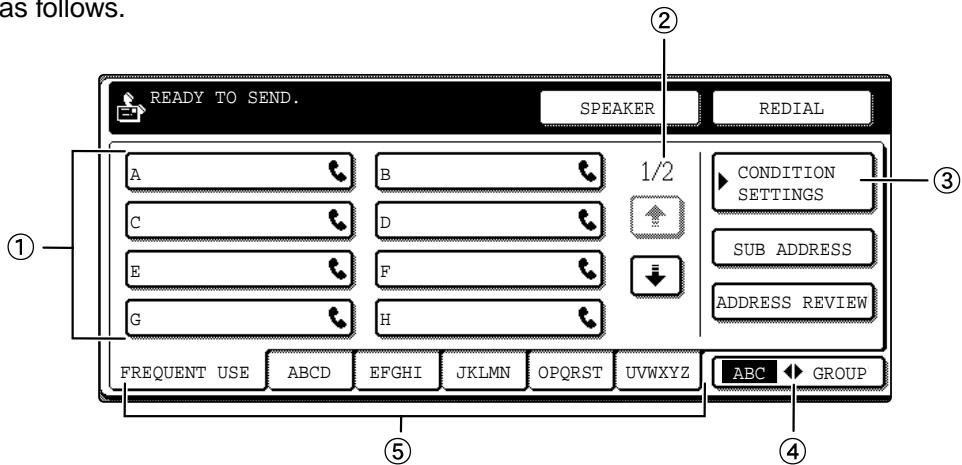
① One-touch key display
This shows the one-touch keys that have been stored on the selected "index card". The key type is indicated by the icon at the right. One-touch keys in which a fax number is stored are indicated by a "🔍" icon. The display is initially set to show 8 keys. This can be changed to 6 or 12 using the key operator program. (Refer to page 8-3.)
② Display switching keys
In cases where the one-touch keys cannot all be displayed on one screen, this shows how many screens are left. Touch the "♠" "↓" keys to move through the screens.
③ CONDITION SETTINGS key
This displays the condition setting screen (previous page), which is used to set various conditions.
④ ABC ◆ GROUP key
Touch this key to switch between the alphabetical index and the group index.
⑤ Index keys
One-touch key destinations are stored on each of these index cards (alphabetical index or group index). Touch an index key to display the card.
Group indexes make it possible to store one-touch keys by group with an assigned name for easy reference. This is done with the custom settings (refer to pages 6-3 and 6-9). Frequently used one-touch key destinations can be stored on the FREQUENT USE card for convenient access.
NOTES
- The screen shown above is the alphabetical address directory. If desired, the initial screen can be set to the group address directory (refer to page 8-3).
- If the Network Scanner option has been installed, one-touch keys in which a destination other than a fax number is stored are indicated by the following icons:
: Scan to E-mail destination : Scan to FTP destination : Scan to Desktop destination
ORIGINALS
ORIGINALS THAT CAN BE FAXED
Original sizes
| Minimum original size | Maximum original size | |
| Using the auto document feeder | 8-1/2" (width)x5-1/2" (length)5-1/2" (width)x8-1/2" (length) | 11" (width)x31-1/2"* (length)*Long documents can be loaded |
| Using the document glass | 11" (width)x17" (length) |
NOTE
Originals that are not a standard size (5-1/2"x8-1/2", 8-1/2"x11", 8-1/2"x11"R, 8-1/2"x14", 11"x17") can also be faxed.
Scanning area of original
Note that the edges of an original cannot be scanned.
Area that cannot be scanned: 0.2" or less at top edge
and 0.2" or less at bottom edge
: Near edge + far edge = 0.2" or less
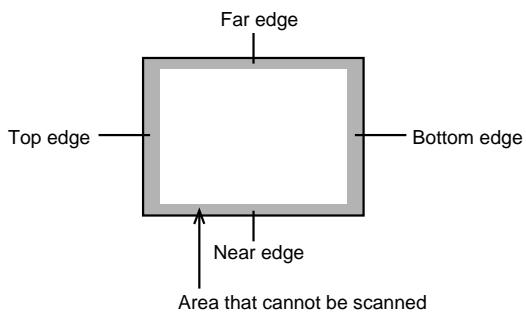
Automatic reduction of faxed document
If the size (width) of the faxed document is greater than the receiving machine's paper size, the size will be automatically reduced.
| Faxed document width | Receiving machine's paper width | Reduced size | Ratio |
| 11"x17" | 8-1/2"x14" | 8-1/2"x14" | 1:0.64 (Area ratio) |
| 11"x17" | 8-1/2"x11" | 8-1/2"x11"R | 1:0.5 (Area ratio) |
| 8-1/2"x14" | 8-1/2"x11" | 8-1/2"x11"R | 1:0.78 (Area ratio) |
A document can also be faxed without reducing its size. In this case, the left and right edges will not be transmitted. (Refer to page 8-6.)
LOADING A DOCUMENT
A document can be loaded in the auto document feeder or on the document glass. Multiple-page documents and long documents can be loaded in the auto document feeder. Single-sheet documents and bound documents that cannot be loaded in the auto document feeder can be loaded on the document glass.
USING THE AUTO DOCUMENT FEEDER
1 Lift the document glass cover and make sure a document is not placed on the document glass. Gently close the cover.
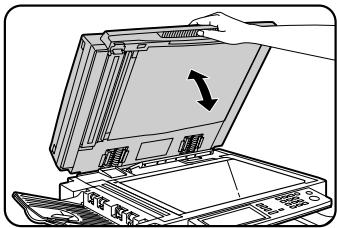
2 Adjust the document guides on the auto document feeder to the width of the document.
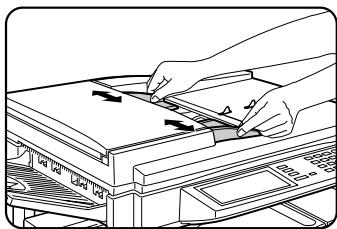
3 Align the edges of the document pages and then insert the stack in the document feeder so that the first page is face down.
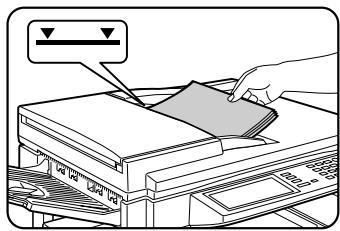
Insert the stack into the auto document feeder until it stops. The stack should not be higher than the indicator line (maximum 50 pages, or 30 pages for 8-1/2"x14" or larger documents).
USING THE DOCUMENT GLASS
1 Open the document glass cover, and place the document face down on the document glass. Gently close the cover.
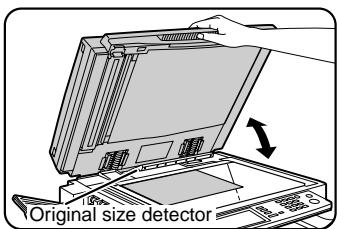
NOTE
Do not place any objects under the original size detector plate. Closing the document glass cover with an object underneath may damage the original size detector plate and prevent correct detection of the document size.
Regardless of the size of the original, place the original in the far left corner of the document glass. (Align the upper left-hand corner of the original with the tip of the mark.)
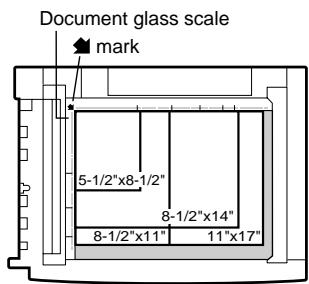
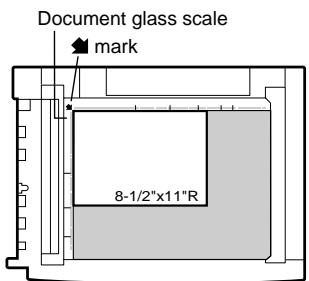
CHECKING THE SIZE OF A LOADED ORIGINAL
If the loaded original is a standard size*, the size will be detected (automatic original detection) and displayed in the ORIGINAL key. Make sure that the size has been correctly detected. If you have loaded a non-standard size original or wish to change the scanning size, you can follow the steps below to manually set the original scanning size.
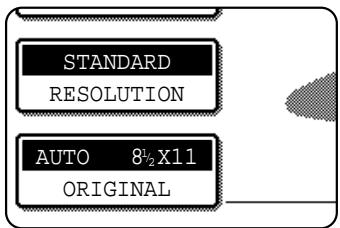
NOTE
*Standard sizes that can be detected are as follows:
5-1/2"x8-1/2", 8-1/2"x11", 8-1/2"x11"R, 8-1/2"x14", 11"x17". If a non-standard size original is loaded (including special sizes), the closest standard size may be displayed, or the original size may not appear at all.
MANUALLY SETTING THE SCANNING SIZE
If you load an original that is not a standard size (such as an AB size), or if the size is not detected correctly, you must touch the ORIGINAL key and set the original size manually. Perform the following steps after loading the document in the automatic document feeder or on the document glass.
1 Touch the ORIGINAL key.
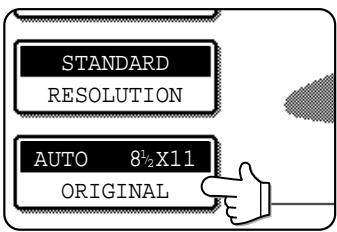
2 Touch the MANUAL key.
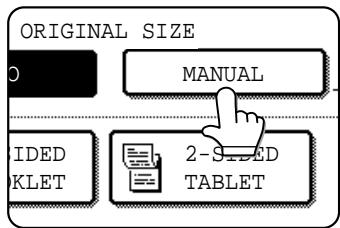
The sizes that can be selected are displayed.
3 Touch the desired original size key.
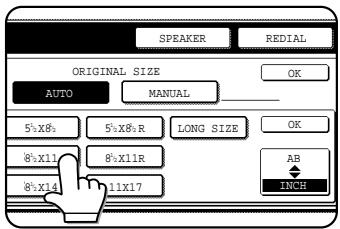
AUTO is no longer highlighted. MANUAL and the original size key you touched are highlighted.
If you wish to select an AB size, touch the AB♦INCH key and then touch the desired original size key.
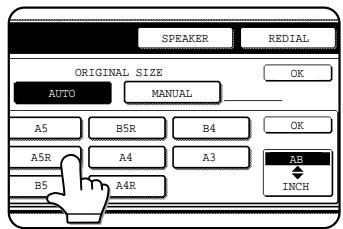
AB is highlighted and AB size keys are displayed. To return to the inch palette, touch the AB♦INCH key once again.
4 Touch the outer OK key.
You will return to the initial screen. (Pressing the inner OK key in the step above returns you to step 2.)
5 The selected size appears in the top half of the ORIGINAL key.
![graph TD A["STANDARD RESOLUTION"] --> B["A4 ORIGINAL"]](/content/2024/12/122344/images/759f24de1c87ee9019e9d4bdc0f21b3d2f934e2cff9b502b6f11fd46ff3c1149.jpg)
NOTE
You can return to automatic detection by pressing the CA key.
■ If you loaded a long original
If you loaded a long (up to 31.5") original in the auto document feeder, touch the LONG SIZE key in step 3 above.
NOTE
When a long original is loaded, you cannot use the automatic two-sided scanning function.
SELECTING RESOLUTION AND EXPOSURE SETTINGS
After loading an original, you can adjust the resolution and exposure settings to match the condition of the original-for example, if it has small or faint characters, or if it is a photo. After loading the original in fax mode, adjust the settings as explained below.
SELECTING THE RESOLUTION
The initial resolution setting is STANDARD. To change the setting, follow these steps:
■ Change the resolution.
1 Touch the RESOLUTION key.
2 Touch the desired resolution key.
![graph TD A["STANDARD"] --> B["FINE"] B --> C["SUPER FINE"] C --> D["ULTRA FINE"] D --> E["HALF TONE"]](/content/2024/12/122344/images/b999a909caafc0e602362aceb12ad2d1d4d0e24daf0f13aadf8251b8b5bbfe9d.jpg)
The selected key is highlighted. If you selected FINE, SUPER FINE, or ULTRA FINE, you can also touch the HALF TONE key to select halftone.
3 Touch the OK key.
You will return to the initial screen.
NOTES
- The initial factory resolution setting is Standard. If desired, you can change the initial setting to a different setting using the key operator program. (Refer to page 8-3.)
- When using the automatic document feeder, the resolution setting cannot be changed once scanning has begun.
- Even if you send a document using Fine, Super fine, or Ultra fine resolution, some receiving fax machines may not be able to print the document at the same resolution.
■ Resolution settings
| Standard | Touch this key if your original consists of normal-sized characters (like those in this manual). |
| Fine | Touch this key if your original has small characters or diagrams. The original will be scanned at twice the resolution of the Standard setting. |
| Super fine | Touch this key if your original has intricate pictures or diagrams. A higher-quality image will be produced than with the Fine setting. |
| Ultra fine | Touch this key if your original has intricate pictures or diagrams. This setting gives the best image quality. However, transmission will take longer than with the other settings. |
| Half tone | Touch this key if your original is a photo-graph or has gradations of color (such as a color original). This setting will produce a clearer image than Fine, Super fine, or Ultra fine used alone. Half tone cannot be selected if Standard has been selected. |
SELECTING THE EXPOSURE
The initial exposure setting is AUTO. To change the setting, follow these steps:
■ Change the exposure.
1 Touch the SPECIAL MODES key.
![graph TD A["SPECIAL MODES"] --> B["STANDARD RESOLUTION"]](/content/2024/12/122344/images/cbc9462cfe7f338e2f883b2197668a9439e70e41b6945f3f898b5aee814c3678.jpg)
2 Touch the EXPOSURE key.
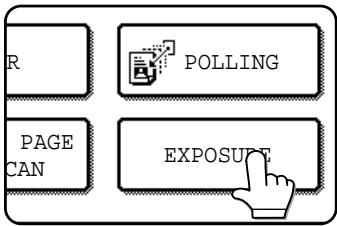
3 Touch the desired exposure key.
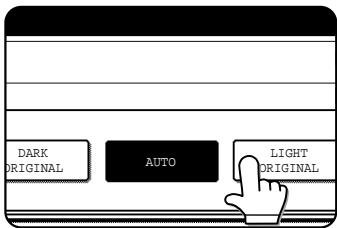
The selected key is highlighted.
4 Touch the outer OK key.
You will return to the initial screen.
NOTE
When using the document glass to scan pages of an original, the exposure setting can be changed each time you change pages. When using the automatic document feeder, the exposure setting cannot be changed once scanning has begun.
■ Exposure settings
| Dark Original | Select this setting if your original consists mostly of dark characters. |
| Auto | This setting automatically adjusts the exposure for light and dark parts of the original. |
| Light Original | Select this setting if your original consists mostly of faint characters. |
CONVENIENT DIALING METHODS
This product includes an auto-dialing feature to make dialing easier. By programming frequently dialed numbers, you can call and send documents to these locations by means of a simple dialing operation (refer to page 2-5). There are two types of auto-dialing: one-touch dialing and group dialing. To program auto-dial numbers, refer to pages 6-3, 6-6.
● One-touch dialing
Simply press a one-touch key and then press the Start key to dial the programmed location. A name of up to 36 characters can be programmed for the location (a maximum of 18 characters are displayed). When using F-code transmission, a sub-address and passcode can also be programmed (refer to page 4-2).
● Group dialing
Multiple one-touch dial locations can be programmed into a single one-touch key. This is convenient for successively sending a document to multiple locations.
- Full fax numbers entered with the numeric keys cannot be stored in a group dial key. First program the number in a one-touch key and then store it in a group dial key.
- Redialing
The machine keeps the last fax or voice number dialed with the numeric keys in memory. You can redial the last number dialed by simply pressing the REDIAL key.
- If numeric keys were pressed during a phone conversation, the REDIAL key may not dial the correct number.
● On-hook dialing
This feature allows you to dial without lifting an extension phone connected to the machine. Press the SPEAKER key, listen for the dial tone through the speaker, and then dial.
- To speak with another person, you must lift the extension phone connected to the machine when they answer.
- Faxes must be sent manually when using on-hook dialing. (Refer to page 5-3.)
- On-hook dialing is not possible using a one-touch key that includes a sub-address and passcode, or a group dial key.
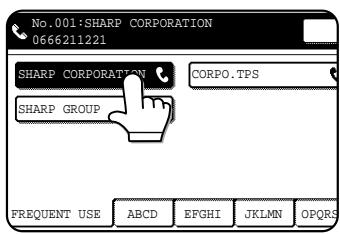
Touch the ADDRESS DIRECTORY key in the initial screen to display the above screen.
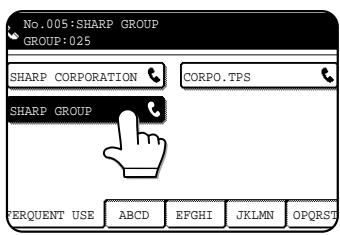
Touch the ADDRESS DIRECTORY key in the initial screen to display the above screen.
NOTES
- A total of 500 one-touch dial and group dial keys can be programmed. (Refer to page 6-2.)
- Programmed one-touch keys and group dial keys are stored on "index cards". A key can be accessed by touching its card. (Refer to page 1-5.)
- To prevent calling or sending a fax to a wrong number, look carefully at the touch panel and make sure you program the correct number when programming an auto-dial number. You can also check programmed numbers by printing out an address list or group list after programming (refer to page 6-14).
CHAPTER 2
BASIC OPERATIONS
This chapter explains basic operations such as sending faxes.
Page
SENDING A FAX 2-2
● BASIC PROCEDURE FOR SENDING FAXES 2-2 ● TRANSMISSION BY AUTO-DIALING 2-5 ● TRANSMITTING A TWO-SIDED DOCUMENT 2-5
PRIORITY TRANSMISSION OF A STORED JOB 2-6
CANCELING A FAX TRANSMISSION 2-6
RECEIVING FAXES 2-7
● RECEIVING A FAX 2-7
SENDING A FAX
BASIC PROCEDURE FOR SENDING FAXES
1 Make sure the machine is in fax mode.
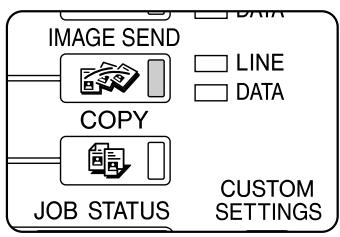
When the IMAGE SEND key light is on, the machine is in fax mode. If the light is not on, press the IMAGE SEND key.
2 Load the original.
Refer to the following pages:
• Using the auto document feeder: Page 1-7 • Using the document glass: Page 1-7
If you are using the document glass to send multiple pages, load the first page first.
NOTE
You cannot load documents in both the auto document feeder and on the document glass and send them in a single fax transmission. If documents are loaded in both the auto document feeder and on the document glass, only the document in the auto document feeder will be scanned and transmitted.
3 Check the original size.
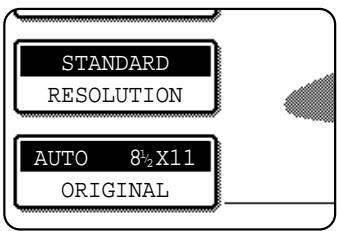
If you loaded a non-standard size document or the document size was not correctly detected, touch the ORIGINAL key and set the document size. (Refer to page 1-8.)
4 If needed, adjust the resolution setting. (Refer to page 1-9.)
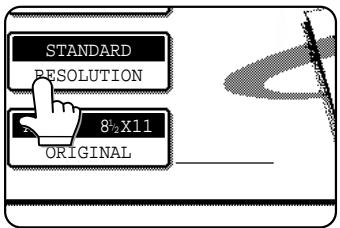
5 If needed, adjust the exposure setting. (Refer to page 1-10.)
![graph TD A["SPECIAL MODES"] --> B["STANDARD"] B --> C["RESOLUTION"] C --> D["PAGE SCAN"] D --> E["POLLING"] E --> F["EXPOSURE"] style A fill:#f9f,stroke:#333 style B fill:#ccf,stroke:#333 style C fill:#cfc,stroke:#333 style D fill:#fcc,stroke:#333 style E fill:#cff,stroke:#333 style F fill:#ffc,stro…](/content/2024/12/122344/images/f18145b959efd48e798ea31cb1a23a228ba6c8e5c1920fd34b141acffc5a2e2c.jpg)
6 Dial the fax number.
The number that you entered appears in the message display. If it is not correct, press the C key and re-enter the number. You can also use the REDIAL key (page 1-11) or an autodial number (2-5).
Entering a pause.
If you need to insert a pause between digits to access an outside line or dial an international number, touch the PAUSE key in the upper right-hand corner of the screen.
Each time you touch the PAUSE key, a hyphen ("-") appears and a 2-second pause* is inserted.
After entering a number, you can also touch the PAUSE key to enter a hyphen, and then enter another number using the numeric keys or a one-touch key. This connects the numbers together (Chain dialing).
* The duration of each pause can be changed with the key operator program. (Refer to page 8-4.)
Using the auto document feeder
7 Press the START key.
Scanning begins.
If a job is not in progress and the telephone line is not being used, the destination is called after the first page is scanned. Transmission takes place as the document pages are being scanned.
(This is called "Quick on-line" - refer to the following page.) If there is a previously stored job or a job is in progress, or if the line is being used, all pages of the document are scanned into memory and stored as a transmission job. (This is called memory transmission: the destination is automatically called and the document transmitted after previously stored jobs are completed.)
If scanning is completed normally, the machine makes a beep sound to inform you that the transmission job is stored and JOB STORED appears in the message display.
Using the document glass
7 Press the START key.
The original is scanned and the READ-END key appears.
8 If you have another page to scan, change pages and then press the START key.
Repeat this sequence until all pages have been scanned. You can change the resolution and exposure settings as needed for each page (refer to pages 1-9 and 1-10). If no action is taken for one minute, scanning automatically ends and the transmission job is stored.
9 After the final page is scanned, touch the READ-END key.
![L. (Pg.No. 3) SS [READ-END]. READ-END](/content/2024/12/122344/images/fba13e7f5f700055d1968e4b87eba600b8d82cfe2d57fd6758b4f79339110da6.jpg)
The machine makes a beep sound to inform you that the transmission job is stored and JOB STORED appears in the message display. (The destination is automatically called and the document transmitted after previously stored jobs are completed.)
Open the document glass cover and remove the document.
NOTES
- Canceling transmission
To cancel transmission while SCANNING ORIGINAL... appears in the display or before the READ-END key is pressed, press the C key or the CA key. To cancel a transmission job that is already stored, press the JOB STATUS key and cancel the job as explained on page 2-6. - If the machine makes two beeps during or at the end of transmission and an error message appears in the message display, refer to page 7-3 to fix the problem. - If the power is turned off or a power failure occurs while a document is being scanned in the auto document feeder, the machine will stop and a document jam will occur. After power is restored, remove the document as explained on page 29 of "Operation manual (for copier)".
■ Quick On-line
When you use the auto document feeder to send a multi-page document and there are no previously stored jobs waiting or in progress (and the line is not being used), the machine dials the destination after the first page is scanned and begins transmitting scanned pages while the remaining pages are being scanned. This transmission method is called Quick On-line. The messages SCANNING ORIGINAL and SENDING both appear until scanning of the final page is completed.
If the receiving party is busy, the transmission will switch to a memory transmission. (Refer to the following section, "Storing transmission jobs (memory transmission)".)
NOTES
- The machine is initially set (factory setting) to perform Quick On-line transmission. If desired, you can turn off this function with the key operator program (refer to page 8-7).
- When a document is transmitted using the following methods, the job will be stored in memory (Quick On-line transmission will not be performed):
- Sending from the document glass • Broadcast transmission (page 3-2) • Timer transmission (page 3-4) • F-code transmission (Chapter 4)
■ Storing transmission jobs (memory transmission)
When a document is sent from the document glass, or when the telephone line is in use, the document is scanned into memory and then automatically transmitted after previously stored transmission jobs are completed. This means that transmission jobs can be stored in memory by performing a transmission operation while the machine is occupied with another transmission/reception operation. This is called memory transmission, and up to 50 jobs can be stored in memory at once, including the job currently being executed. After transmission, the scanned document data is cleared from memory.
NOTES
- You can check transmission jobs stored in memory in the job status screen. (Refer to page 1-14 of "Operation manual (for printer operation and general information)".)
- If the memory becomes full while a document is being scanned, a message will appear in the display. You can cancel the transmission by touching the CANCEL key, or send only the pages already scanned by touching the SEND key. The page that was being scanned when the memory became full will be cleared from memory. If the memory becomes full while scanning the first page of a document, the transmission job is automatically canceled.
- The number of jobs that can be stored will depend on the number of pages in each job and the transmission conditions. The number of storable jobs will increase if the optional expansion memory (8 MB) is installed.
■ If the receiving party is busy
If the receiving party is busy, the transmission is temporarily canceled and then automatically re-attempted after a brief interval (two attempts are made at an interval of 3 minutes * ). If you do not want the machine to re-attempt the transmission, cancel the job in the job status screen. (Refer to page 2-6.)
*This setting can be changed with the key operator program (page 8-7).
■ If a transmission error occurs
The machine is initially set to not re-attempt transmission if transmission does not end normally due to a line error or other reason, or if the other machine does not begin reception within 45 seconds after the connection is established. If desired, you can use the key operator program to set the machine to automatically re-attempt transmissions when a transmission error occurs (page 8-7). The machine also supports error correction mode (ECM), and is initially set to automatically resend any parts of a document that were distorted due to noise on the line or other reasons (page 8-5).
■ Image rotation
The machine is initially set to rotate a vertically-placed document 90° so that it is oriented horizontally before transmission (8-1/2"x11" originals are rotated to 8-1/2"x11"R and 5-1/2"x8-1/2"R originals are rotated to 5-1/2"x8-1/2"). 8-1/2"x11"R originals and 5-1/2"x8-1/2" originals are not rotated. If desired, you can turn this function off with the key operator program as explained on page 8-6.
NOTE
When using the document glass, be sure to orient 5-1/2"x8-1/2" originals vertically. If oriented horizontally (5-1/2"x8-1/2" orientation), the original size will be detected as 8-1/2"x11", and you will need to touch the ORIGINAL key and set the original size to 5-1/2"x8-1/2" R (by touching the 5-1/2"x8-1/2" R key). (Refer to page 1-8.)
TRANSMISSION BY AUTO-DIALING
To send a document by auto-dialing (one-touch dialing or group dialing) instead of entering a full fax number with the numeric keys, follow the steps below. To use an auto-dial destination, you must first program the full fax number and name of the destination. Refer to page 1-11 for information on auto-dialing and pages 6-3, 6-6 for information on programming auto-dial destinations.
1 Perform steps 1 through 5 of "Basic Procedure for Sending Faxes" (page 2-2). 2 Touch the ADDRESS DIRECTORY key.
![graph TD A["AKER"] --> B["ADDRESS DIRECTORY"] C["REDIAL"] --> B D["SUB ADDRESS"] --> B E["0:100% OPTION"] --> B](/content/2024/12/122344/images/23368b148b6f8b55db84bea1cbceeaa33c2344ce5c05e4a3d4afc9f19a147966.jpg)
The address directory screen appears.
3 Touch the one-touch key for the desired destination.
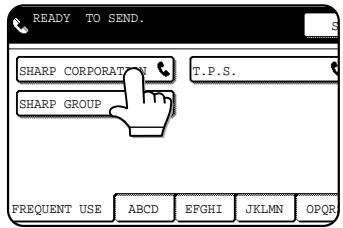
Refer to page 1-5 for information on using the address directory screen. The key you touched is highlighted. If you touch the wrong key, touch the key again to cancel the selection. The key display will return to normal.
4 Continue from step 7 of "Basic Procedure for Sending Faxes" (page 2-3).
TRANSMITTING A TWO-SIDED DOCUMENT
A two-sided document can be automatically transmitted using the auto document feeder. Follow the steps below to automatically send a two-sided document.
1. Make sure the machine is in fax mode and then load the document in the auto document feeder (page 1-7). 2. Touch the ORIGINAL key.
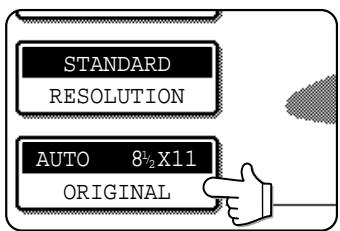
When you touch the ORIGINAL key, check the original size displayed in the key.
3. Touch the 2-SIDED BOOKLET key or the 2-SIDED TABLET key as appropriate for the original you loaded.
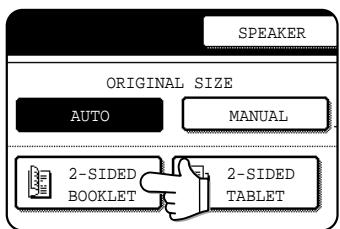
If necessary, touch the MANUAL key and set the original size. (Page 1-8)
4. Touch the OK key.
You will return to the initial screen.
A two-sided original icon appears next to the ORIGINAL key. (Example: The icon that appears when the 2-SIDED BOOKLET key is touched.)
5. Continue from step 4 of "Basic Procedure for Sending Faxes" (pages 2-2 to 2-3).
NOTES
- Booklets and tablets: Two-sided originals that are bound at the side are booklets, and two-sided originals that are bound at the top are tablets.
- Two-sided scanning turns off after the document is stored in memory. Pressing the CA key will also cancel two-sided scanning.

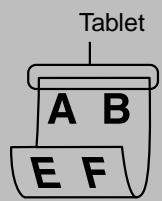
PRIORITY TRANSMISSION OF A STORED JOB
If you have an urgent transmission job and multiple transmission jobs have already been stored, you can give priority to the urgent job so that it will be transmitted immediately after the job currently being executed. This is done from the job status screen. For details on using the job status screen, refer to page 1-14 of "Operation manual (for printer operation and general information)".
1. Press the JOB STATUS key.
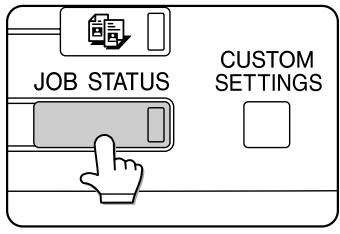
2. Touch the FAX JOB key.
![graph TD A["WAITING"] --> B["DETAIL"] C["WAITING"] --> D["PRIORITY"] E["WAITING"] --> F["STOP/DELETE"] G["FAX JOB"] --> H["Next Step"]](/content/2024/12/122344/images/9637a1f2b5cc073d2ae477cb4a6c68686e01fdbf573575463c2573dc38a12543.jpg)
3 Touch the job key of the transmission job to which you wish to give priority.
The touched key is highlighted.
4 Touch the PRIORITY key.
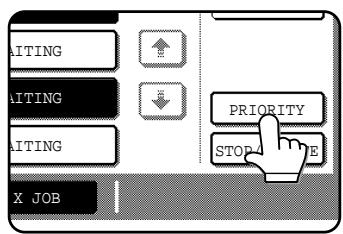
The selected job moves up to the next position after the job currently being executed.
When the current job is completed, execution begins of the job selected in step 3.
NOTES
If the job currently being executed is a broadcast transmission (page 3-2) or a serial polling operation (3-5), the priority job will be executed after the call to the current destination is completed. When the priority job is completed, the remaining broadcast or polling destinations are called. However, if the priority job is also a broadcast transmission or serial polling operation, the job is begun after the current broadcast or serial polling job is completed.
CANCELING A FAX TRANSMISSION
You can cancel a transmission job that is in progress or has been stored. Cancellation is done from the fax job status screen. (Printing of a received fax cannot be canceled.)
1 Press the JOB STATUS key.
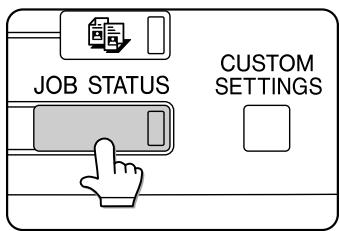
2 Touch the FAX JOB key.
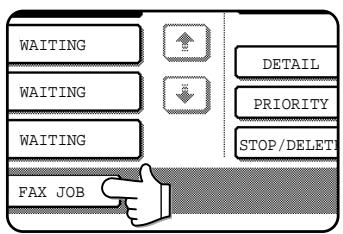
3 Touch the job key of the transmission job you wish to cancel.
The touched key is highlighted.
4 Touch the STOP/DELETE key.
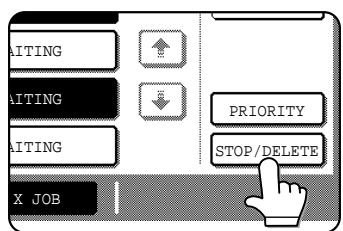
A message appears to confirm the cancellation. Touch the YES key to delete the selected job key and cancel the transmission.
NOTES
- If you do not wish to cancel the transmission, touch the NO key.
- You can verify a canceled transmission job in the transaction report. (Refer to page 7-2.)
"CANCEL" will appear in the Type/Note column.
RECEIVING FAXES
When another fax machine sends a fax to your machine, your machine will ring*, automatically receive the fax, and begin printing (automatic reception).
NOTES
- You can store a transmission job while fax reception is in progress (refer to page 2-4).
- If an extension phone is connected to the machine, you can answer using the extension phone and then begin fax reception (manual reception). This allows you to use the line for both voice calls and faxes. (Refer to page 5-5.)
- To receive faxes, sufficient paper must be loaded in the paper tray. Refer to pages 1-16 to 1-24 of "Operation manual (for printer operation and general information)" to load appropriate paper. Incoming faxes will be automatically adjusted to the orientation of the printing paper, so there is no need to load both horizontally and vertically oriented paper. However, if you receive a fax that is smaller than 8-1/2"x11" size, the paper size used to print the fax will depend on how the original was oriented (vertically or horizontally) in the sending fax machine.
RECEIVING A FAX
1 The machine will ring* and reception will automatically begin.
NOTES
- If the fax is being sent manually and you have connected an extension phone to the machine, you can lift the phone before reception begins to talk with the other person.
*Number of rings
The machine has been set to ring twice before beginning automatic reception. You can use the key operator program to change the number of rings to any number from 0 to 15. (Refer to page 8-8.) If the number of rings is set to 0, the machine will receive faxes without ringing.
2 Reception ends.
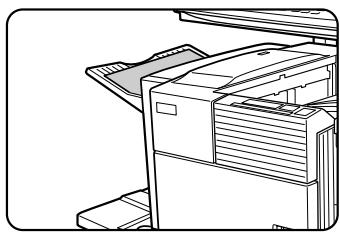
When reception ends, the machine makes a "beep" sound.
The output tray for the printed fax varies depending on the output unit installed on the machine.
NOTES
- If the machine has multiple output trays, the key operator program can be used to change the output tray for fax reception (page 8-8).
- If desired, you can set the machine to output a blank sheet of paper after printing the last page of each received fax job. This will help you distinguish where one reception ends and another begins.
■ If received data cannot be printed
If the machine runs out of paper or toner, or a paper jam occurs, print and copy jobs that are in progress will be held in memory until printing becomes possible. The jobs are automatically printed when printing capability is restored. When received data is held in memory, the DATA light next to the IMAGE SEND key blinks.
You can also use the transfer function to have another fax machine print the received data (refer to page 3-12).
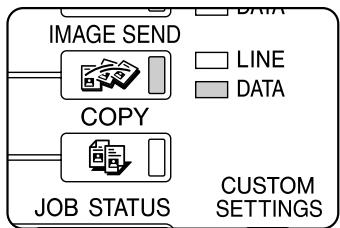
NOTE
If the machine makes a double beep sound during reception or at the end of reception and an error message appears in the display, clear the error as explained on page 7-3.
CHAPTER 3
USING CONVENIENT FUNCTIONS 1 ADVANCED TRANSMISSION METHODS
This chapter explains fax features for special situations and purposes. Please read those sections that are of interest to you.
SENDING THE SAME DOCUMENT
TO MULTIPLE DESTINATIONS IN A SINGLE OPERATION
(BROADCAST TRANSMISSION) 3-2
USING BROADCAST TRANSMISSION 3-3
AUTOMATIC TRANSMISSION AT A SPECIFIED TIME
(TIMER TRANSMISSION) 3-4
SETTING UP A TIMER TRANSMISSION .... 3-4
TRANSMISSION AND RECEPTION USING THE POLLING FUNCTION .... 3-5
USING THE POLLING FUNCTION 3-6
USING POLLING MEMORY 3-7
OWN NUMBER SENDING 3-9
FAXING A DIVIDED ORIGINAL (DUAL PAGE SCAN) 3-10
PROGRAMMING FREQUENTLY USED OPERATIONS.... 3-11
USING A PROGRAM.... 3-11
TRANSFERRING RECEIVED FAXES
TO ANOTHER MACHINE WHEN PRINTING IS NOT POSSIBLE ...... 3-12
●USING THE TRANSFER FUNCTION 3-12
SENDING THE SAME DOCUMENT TO MULTIPLE DESTINATIONS IN A SINGLE OPERATION (BROADCAST TRANSMISSION)
This feature is used to send a document to multiple destinations in a single operation. The document to be transmitted is scanned into memory and then successively transmitted to the selected destinations. This feature is convenient for such purposes as distributing a report to company branches in different locations. Up to 300 destinations can be selected. When transmission to all destinations has been completed, the document is automatically cleared from memory.
NOTES
- If you frequently use broadcasting to send documents to the same group of destinations, it is convenient to program those destinations into a group key. A group key is a one-touch key in which multiple destinations are programmed. The procedure for programming group keys is explained on page 6-6.
- When using a group key to send a fax, the destinations programmed in the group key are counted as broadcasting destinations. For example, if five destinations are programmed in a group key and the key is touched for a broadcast transmission, the broadcast transmission will have five destinations.
![graph TD A["Sender"] --> B["Successively enter destination numbers"] B --> C["The document is scanned into memory"] C --> D["Reception"] D --> E["Destination A (recipient)"] C --> F["Reception"] F --> G["Destination B (recipient)"] C --> H["Reception"] H --> I["Destination C (recipient)"] style A fi…](/content/2024/12/122344/images/67fa8472c6d0f3678d3e85b04955c2ed1994cb29a4dc4cec7346db908201baf7.jpg)
USING BROADCAST TRANSMISSION
1 Follow steps 1 through 5 in "Basic Procedure for Sending Faxes". (Refer to page 2-2.) 2 Dial the fax number of the first destination or touch an auto-dial key (one-touch key or group key). (Refer to page 2-5.)
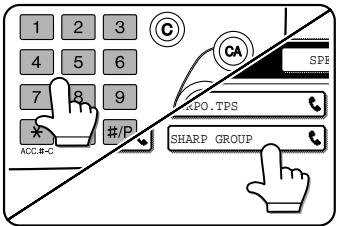
An auto-dial key is highlighted when touched.
3 Touch the NEXT ADDRESS key and then dial the fax number of the next destination or touch an auto-dial key.
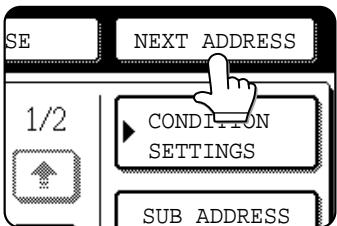
Repeat this step for each of the remaining destinations.
NOTES
- If you enter an incorrect number
If you make a mistake while entering a number, press the C key and then re-enter the correct digit(s).
If you have already completed entry of a fax number, you can delete the number using steps 4 and 5.
- If you select an incorrect auto-dial key, simply touch the incorrect key one more time to cancel the selection.
- The NEXT ADDRESS key only needs to be pressed when successively dialing fax numbers with the numeric keys.
Example:
![graph TD A["XXXX"] --> B["NEXT ADDRESS"] B --> C["Dial"] B --> D["Cannot be omitted."] style A fill:#f9f,stroke:#333 style B fill:#ccf,stroke:#333 style C fill:#cfc,stroke:#333 style D fill:#fcc,stroke:#333](/content/2024/12/122344/images/de879fb6ef5738acf813c5c88457745bb68ab5d448548b81ac50fab057b61a8e.jpg)
![graph TD A["XXXX Dial"] --> B["NEXT ADDRESS"] B --> C["One-touch"] C --> D["NEXT ADDRESS"] D --> E["One-touch"] F["Can be omitted"] --> B G["Can be omitted"] --> D](/content/2024/12/122344/images/b859b82a7f6fbf2432f38da9b1e36e33a1d2369056e94a29f3548d6ec8566626.jpg)
If desired, you can use the key operator program to set the machine so that the NEXT ADDRESS key must always be pressed (refer to page 8-3).
4 Touch the ADDRESS REVIEW key to display the list of destinations.
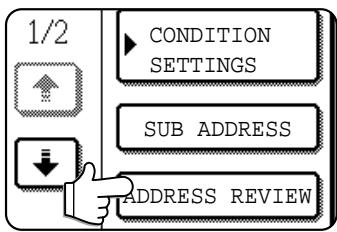
When the ADDRESS REVIEW key is pressed, only the entered and selected destinations are displayed.
5 Check the destinations.
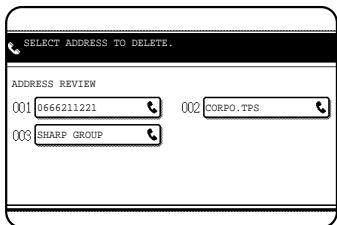
When you have finished checking the destinations, touch the OK key to return to the screen of step 4.
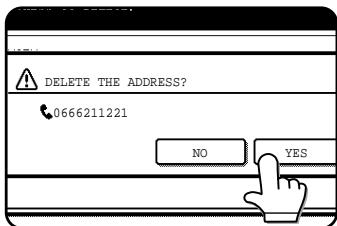
If you wish to delete a destination, touch the displayed one-touch key. A message will appear to confirm the deletion. Touch YES and the destination will be deleted from the destination list. Touching NO will close the message box.
6 Continue from step 7 of the basic procedure for sending faxes (page 2-3).
NOTE
To cancel a broadcast transmission
To cancel a broadcast transmission when selecting destinations, press the CA key.
AUTOMATIC TRANSMISSION AT A SPECIFIED TIME (TIMER TRANSMISSION)
This feature enables you to set up a transmission or polling operation to be performed automatically at a specified time up to a week in advance. This allows you to take advantage of off-peak phone rates without having to be there when the transmission is performed. A combined total of 50 timer transmission and memory transmission jobs can be stored.
NOTES
- After a timer transmission is performed, the information (image, destination, etc.) is automatically cleared from memory.
- To perform a timer transmission, the document must be scanned into memory. It is not possible to leave the document in the auto document feeder or on the document glass and have it scanned at the specified time of transmission.
- To set the date and time in the machine, refer to page 3-15 of "Operation manual (for printer operation and general information)".
- Only one polling timer operation can be set up at a time. If you wish to set up multiple timer polling operations, combine the machines to be polled into a serial polling operation with a timer setting. (Refer to the next page.)
SETTING UP A TIMER TRANSMISSION
1 In fax mode, touch the SPECIAL MODES key.
2 Touch the TIMER key.
The timer transmission screen appears.
3 Select the day of the week. (Touch the ▼ key or the ▲ key until the desired day is selected.)
The initial setting is "---" (no selection). If you select this setting, the transmission will be performed as soon as the specified time arrives.
4 Select the time. (Touch the ▼ key or the ▲ key until the desired time appears.)
Select the time in 24-hour format.
Example:
11:00 P.M. → 23:00
If you continue touching the
▼ ▲ keys, the numbers will change quickly.
5 Touch the outer OK key.
You will return to the screen in step 1. A timer icon will appear to the right of the SPECIAL MODES key.
To cancel the timer transmission, touch the CANCEL key.
6 Perform the desired transmission operation.
The steps that follow will depend on the type of transmission. The following operations can be performed in a timer transmission:
• Normal transmission (page 2-2) • Broadcast transmission (page 3-2) • Polling (next page) • Serial polling (next page) • F-code polling (page 4-5) • F-code confidential transmission (page 4-6)
• F-code relay request transmission (page 4-8)
NOTES
- Other operations can be performed after a timer transmission is set up. If another operation is in progress when the specified time arrives, the timer transmission will begin when the job in progress is completed.
- If a timer transmission job is given priority in the fax job status screen (page 2-6), the time setting will be canceled and the job performed as soon as the current job is completed.
TRANSMISSION AND RECEPTION USING THE POLLING FUNCTION
This function can only be used if the other machine is a Super G3 or G3 machine and supports the polling function. The polling function allows your machine to call a fax machine that has document data set and initiate reception of the document. You can also perform the reverse operation: scan a document into the memory of your machine so that another machine can call your machine and initiate reception of the document.
This function whereby your machine calls the sending machine and asks the sending machine to begin transmission of a loaded document is called the polling function. Scanning a document into memory and automatically sending it when the receiving machine calls and "polls" your machine is called memory polling.
NOTE
For information on polling and polling memory using F-codes, refer to page 4-4. This section only explains normal polling and normal polling memory.
Polling
This function allows your machine to call a sending machine and initiate reception of a document loaded in that machine. A timer setting can also be established to have the operation take place at night or another specified time (refer to the previous page).
![graph TD A["Your machine"] --> B["① Polling (ask other machine to send document)"] A --> C["② Permits polling"] A --> D["③ Document data previously scanned into memory"] A --> E["④ Document data is automatically sent to your machine"] F["The other machine"] --> B F --> C F --> D F --> E](/content/2024/12/122344/images/2e82ddc7da6db870de952a00c94850508a4ca044955f88347a1a8d4d69f08707.jpg)
Group keys and the broadcast transmission function (page 3-2) can be used to successively poll multiple fax machines in a single operation (serial polling). Up to 300 machines can be polled. In this case, the sequence of operations in the above diagram is successively repeated for each sending machine selected.
NOTE
The receiving machine bears the expense (phone charges) of polling transmission.
■ Polling memory
This feature allows your machine to automatically send a document previously scanned into memory when another machine calls and polls your machine.
![graph TD A["Your machine"] --> B["① Polling (request transmission)"] A --> C["② Permits polling"] A --> D["③ Document data previously scanned into memory"] A --> E["④ Document data is automatically sent to other machine"] F["The other machine"] --> G["Image 1"] F --> H["Image 2"] F --> I["Image 3"]](/content/2024/12/122344/images/e6a0c350f3f7203492b65c9886407fa0302fcf0ccc0915a482ad76ae566b33d8.jpg)
USING THE POLLING FUNCTION
A document should not be loaded in the machine when the following operation is performed. When used in conjunction with the timer transmission function, only one polling job can be stored.
NOTE
If the other machine has a polling security function (refer to page 3-8), use the key operator program to program your own fax number (refer to page 8-4), and ask the operator of the other machine to appropriately program your fax number in that machine.
1 Touch the SPECIAL MODES key in fax mode, and then touch the POLLING key.
![graph TD A["SPECIAL MODES"] --> B["STANDARD"] B --> C["RESOLUTION"] C --> D["EX"] D --> E["POLLING"] E --> F["EX"] F --> G["EX"] G --> H["EX"] H --> I["EX"] I --> J["EX"] J --> K["EX"]](/content/2024/12/122344/images/cb21457b9183ea75083e1f4bd3aefaadfa8f8721ccf22d570f75e2e383e4d0b2.jpg)
The POLLING key is highlighted and the polling icon appears.
To cancel polling, touch the POLLING key once again to cancel the selection.
2 Touch the OK key.
You will return to the initial screen.
3 Dial the number of the other fax machine or touch an auto-dial key (one-touch or group key) (refer to page 2-5).
If you are performing serial polling, touch the NEXT ADDRESS key and repeat this step. (Page 3-3)
NOTE
When performing serial polling, an auto-dial key that includes a sub-address or passcode (page 4-2) cannot be selected.
4 When you have finished entering the destination(s), press the START key.
JOB STORED appears in the screen.
Your machine prints the document after receiving it from the sending machine.
NOTE
• To cancel the operation
Press the JOB STATUS key and then cancel the operation as explained on page 2-6.
Manual polling
A document should not be loaded in the machine when the following operation is performed. Manual polling is begun on the signal of the other party.
1 Touch the SPEAKER key in fax mode, and dial the number of the other machine.
A one-touch key or the REDIAL key can also be used.
If you have connected an extension phone to the machine, you can lift the extension phone and then dial.
2 Touch the SPECIAL MODES key.
3 When you hear the fax tone from the other machine, press the POLLING key.
![graph TD A["POLLING"] --> B["EXPOSURE"] C["ER"] --> A D["L PAGE SCAN"] --> A](/content/2024/12/122344/images/110ac2e413fd2a2f35a990a642055d57c5052be345f2afb1be47a2b8231ef1b1.jpg)
POLLING appears in the display.
4 Polling reception begins.
If you lifted an extension phone to dial, replace the extension phone. Your machine prints the document after receiving it from the sending machine.
NOTE
Serial polling cannot be performed manually. When polling reception ends, repeat steps 1 through 4.
USING POLLING MEMORY
This function sends a document previously scanned into memory to a receiving machine when the receiving machine calls and polls your machine. This machine has "memory boxes", which are memory used for such functions as the normal polling memory function, F-code polling memory, F-code confidential transmission, and F-code relay transmission (refer to page 4-2). The polling memory function explained here uses a memory box called the "PUBLIC BOX". (If desired, you can restrict polling to fax machines whose fax number you have programmed in your machine (refer to page 8-9)).
NOTE
When using the polling memory function, do not set the reception mode to MANUAL. (Page 5-4)
■ Scanning a document into memory (Public Box) for polling memory
This procedure is for scanning a document into the Public Box. If other document data has already been stored in the Public Box, the new document will be added after that data. If the previously stored data is no longer needed, delete that data (refer to the following page) before scanning in new document data.
1 In fax mode, load the document in the auto document feeder or on the document glass (page 1-7). 2 Touch the SPECIAL MODES key and then the MEMORY BOX key.
![graph TD A["SPECIAL MODES"] --> B["STANDARD"] B --> C["RESOLUTION"] C --> D["PROGRAM"] D --> E["MEMORY BOX"]](/content/2024/12/122344/images/6e2bc219182d4445feee8957ab558e7c2ef9a3a98e38a0f15c68c89d007b1f69.jpg)
To cancel the operation, touch the CA key.
3 Touch the DATA STORE key.
![graph TD A["DATA STORE"] --> B["POLLIN"] A --> C["PRINT"]](/content/2024/12/122344/images/5ec810e5f1562523056e9ebbb83c67a6ada0ac13b1bd3a45a6f0b2a6a1e6291b.jpg)
4 Touch the PUBLIC BOX key.
This specifies that the document will be scanned into the Public Box.
5 Set the original size, resolution, exposure and other scanning conditions as needed. 6 Press the Start key.
The document is scanned. If other document data has previously been stored, the new data will be added on after the old data.
If you used the document glass and have another page to scan, change the pages and then press the Start key again. Repeat this procedure until all pages have been scanned, and then press the READ-END key that appears in the message screen. When the document data has been stored in the Public Box, JOB STORED appears on the screen, after which you will return to the initial screen.
NOTE
To cancel scanning
To cancel scanning of a document while scanning is in progress, press the C key.
NOTE
The machine has been initially set to automatically clear document data from the Public Box after polling takes place and the data is sent to the polling machine. You can use the key operator program to change this setting so that the data is not automatically cleared and polling can take place repeatedly (refer to page 8-9).
■ Printing document data in the Public Box
When document data is stored in the Public Box, an 📄 icon will appear to the right of the PUBLIC BOX key. To check the stored data, you can print it out.
1 Touch the SPECIAL MODES key in fax mode and then touch the MEMORY BOX key.
![graph TD A["SPECIAL MODES"] --> B["STANDARD RESOLUTION"] B --> C["PROGRAM"] C --> D["MEMORY BOX"]](/content/2024/12/122344/images/d7744334237eacf108f0d2712634c54d5c3eb8cbd81e59b8be6453b6f54bb48c.jpg)
2 Touch the PRINT DATA key.
![graph TD A["PRINT DATA"] --> B["POLLING MEMORY"] style A fill:#f9f,stroke:#333 style B fill:#ccf,stroke:#333](/content/2024/12/122344/images/30a274ed822e6e336ba8b647fe6dc7d475b82de90193af4b6a39550fb31c7af9.jpg)
3 Touch the PUBLIC BOX key.
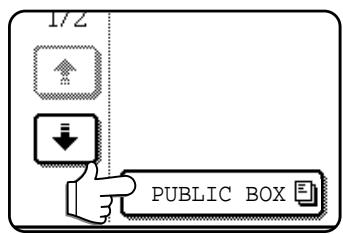
Touching the CANCEL key will return you to the screen of step 2.
4 Press the START key.
The message screen appears and the Public Box data is stored as a print job. To cancel printing, touch the CANCEL key.
■ Deleting document data from the Public Box
This procedure is used to delete document data from the Public Box when it is no longer needed.
1 Touch the SPECIAL MODES key in fax mode and then touch the MEMORY BOX key.
![graph TD A["SPECIAL MODES"] --> B["STANDARD RESOLUTION"] B --> C["PROGRAM"] C --> D["MEMORY BOX"]](/content/2024/12/122344/images/703641bd5cca6f6dff1fd1f0815b6307feec01cfb35472abdcb6ec18109a2439.jpg)
2 Touch the DELETE DATA key.
![graph TD A["MEMORY"] --> B["DATA"] B --> C["DELETE DATA"]](/content/2024/12/122344/images/5bfa654407a1894dbca71d777619b74e0dfa90c6a3e3b0e781cc7162579b17c4.jpg)
3 Touch the PUBLIC BOX key.
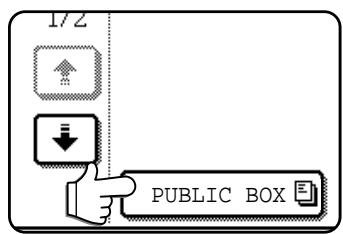
The message screen appears.
4 Touch the YES key.
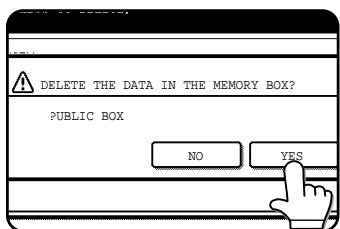
All data in the Public Box is deleted and you return to the screen of step 2. If you touch the NO key, you will return to the screen of step 2 without deleting the data.
■ Restricting polling access (polling security)
If you wish to prevent unauthorized fax machines from polling your machine, turn on the polling security function. When this function is turned on, polling permission will only be granted if the fax number of the polling machine (as programmed in that machine) matches one of the fax numbers you have programmed in your machine as passcode numbers. Up to 10 fax numbers can be programmed as passcode numbers.
To turn on the polling security function and program passcode numbers, use the key operator program as explained on page 8-9.
NOTES
- If you do not use the polling security function, the document will be sent to any fax machine that polls you.
- When using the polling security function, even if you have programmed the fax number of another machine in your machine, polling will not be possible if the operator of the other machine has not programmed the same fax number in that machine.
OWN NUMBER SENDING
This function prints the date, time, your programmed name, your programmed fax number, and the transmitted page number at the top center of each page that you fax. All pages that you fax include this information. (Page 8-7)
Example of fax page printed out by the receiving machine
| MAY-11-2001-FRI 03:00 PM | SHARP PLANNING DIV. | FAX No. 0666211221 | P. 001/001 |
| ↑(1) | ↑(2) | ↑(3) | ↑(4) |
(1) Date and time: programmed in the custom settings (page 3-15 of "Operation manual (for printer operation and general information)"). (2) Own name: programmed with the key operator program (page 8-4). (3) Own fax number: programmed with the key operator program (page 8-4). (4) Transmitted page number: 3-digit number appearing in the format, "page number/total pages" (only the page number appears if you use manual transmission or Quick On-Line transmission). If desired, you can use the key operator program to omit the page number (refer to page 8-6).
■ Position of sender's information
The key operator program can be used to select whether the sender's information is added outside the original data or inside the data (page 8-7). The initial factory setting is outside the data.
Direction of transmission
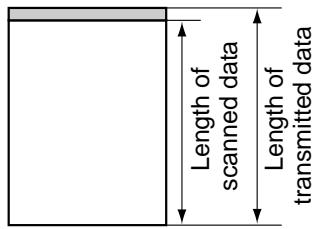
None of the transmitted image is cut off; however, the transmitted data is longer than the scanned data, and thus when both the sender and the receiver use the same size of paper, the printed fax may either be reduced or split up and printed on two pages.
Direction of transmission
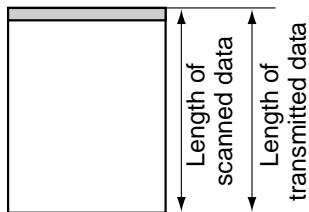
Inside scanned data
The top edge of the scanned data will be cut off by the sender's information; however, when both the sender and the receiver use the same size of paper, the printed fax will neither be reduced nor split up and printed on two pages.
FAXING A DIVIDED ORIGINAL (DUAL PAGE SCAN)
When an open book is scanned and faxed, you can use this function to divide the two open pages of the book into two separate fax pages.
This function can only be used when the original is scanned using the document glass.
![Your machine / The other machine / Book or sheet original / When page division is set, the original is divided into two pages when scanned into memory / Transmission to other machine / Printed out as two separate pages / [Example] Scanned original size: 11"x17" → Transmitted document: Two 8 1/2"x11"…](/content/2024/12/122344/images/bd0b0d2ce0eaa240a60eb6561d262a6b1e4515c354b8edf2d94f200e6c0460a2.jpg)
■ Selecting Dual Page Scan
Follow the steps below and then send the fax.
1 Touch the SPECIAL MODES key in fax mode and then touch DUAL PAGE SCAN.
![graph TD A["SPECIAL MODES"] --> B["STANDARD RESOLUTION"] B --> C["POLLING"] C --> D["DUAL PAGE SCAN"] D --> E["POSURE"]](/content/2024/12/122344/images/e23f10c4e01c26588c75d45319372895a8754a6d86f192310a18d06e68fe8390.jpg)
2 Touch the OK key.
You will return to the initial screen.
3 Place the original on the document glass (page 1-7), and perform the transmission operation.
If you have more originals to scan after pressing the Start key and scanning the first original, change originals and repeat scanning until all originals have been scanned. When finished, press the READ-END key that appears in the message display. (Page 2-3)
NOTES
- When you set Dual Page Scan, the original size is fixed at 11"x17". Automatic original size detection will not function.
When the original on the document glass is scanned, it will be divided at the book mark on the document glass scale, with one page on the left side of the book mark and one page on the right side.
- To cancel Dual Page Scan...
Press the CA key.
PROGRAMMING FREQUENTLY USED OPERATIONS
This function allows you to store the steps of an operation, including the destination and scanning settings, into a program. When you want to send a document to that destination, you can simply call up the program and the steps will be performed automatically. This function is convenient when you frequently send documents, such as a daily report, to the same destination. Up to eight programs can be stored.
NOTES
- A program differs from a timer transmission (page 3-4) in that it is not cleared from memory after transmission takes place. A program thus allows you to repeatedly perform the same type of transmission. Note, however, that programs do not allow you to establish a timer setting for transmission.
- With the exception of polling, reception operations cannot be stored in a program.
Programs can be stored using the custom settings, and a name up to 18 characters long can be assigned.
For information on storing, editing, and deleting programs, refer to page 6-8.
The following settings can be stored in a program:
- Destination fax number
- Polling
- Dual Page Scan
- Resolution and exposure
Auto-dial keys (one-touch or group keys) are used to store the destination fax number. A full number cannot be entered using the numeric keys. When storing a broadcast transmission or serial polling operation in a program, up to 300 destination fax numbers can be stored.
USING A PROGRAM
1 In fax mode, load the document (page 1-7).
Do not load a document if you are performing a polling operation.
If you are going to use Dual Page Scan (previous page), place the document on the document glass.
2 Touch the SPECIAL MODES key and then the PROGRAM key.
![graph TD A["SPECIAL MODES"] --> B["STANDARD RESOLUTION"] B --> C["EXPOSURE"] C --> D["PROGRAM"]](/content/2024/12/122344/images/80e3c58b1a61ad03bc047724eb4470481656ad319c3163ab77f3eb9a4b45c5f9.jpg)
The program selection screen appears.
3 Touch the program key you wish to execute. Make sure the key is highlighted and then touch the OK key.
The program key you touched is selected and you return to the screen of step 2.
The PROGRAM key is highlighted.
4 Touch the OK key.
You will return to the initial screen.
5 If needed, set the original size and other settings, and then press the Start key.
Transmission takes place according to the program.
NOTE
Select settings that cannot be stored in a program in step 5. These include original size, two-sided scanning, verification stamp function (if the optional verification stamp unit is installed), and a timer setting.
TRANSFERRING RECEIVED FAXES TO ANOTHER MACHINE WHEN PRINTING IS NOT POSSIBLE
When printing is not possible because of a paper, toner, or other problem, you can transfer received faxes to another fax machine if that machine has been appropriately programmed in your machine. This function can be conveniently used in an office or other workplace where there is another fax machine connected to a different phone line. When a fax has been received to memory, the DATA light to the right of the IMAGE SEND key blinks.
![graph TD A["Printing not possible because of paper or toner problem"] --> B["Fax transmission to your machine"] C[""Transfer" instruction using custom settings"] --> D["Automatic dialing and transmission to programmed transfer destination"] E["Printing"] --> F["Other machine"]](/content/2024/12/122344/images/7d5eba42ba35dd69336e79a33937cea5524c3724f037450e2d31d191f2507350.jpg)
NOTES
- When the transfer instruction is issued, all data that has been received in memory to that point is transferred. The page that was being printed when the problem occurred and all following pages will be transferred.
- Data cannot be selected for transfer. Data received to a confidential memory box (page 4-6) cannot be transferred.
- The result of transfer is indicated on an activity report (page 7-3).
USING THE TRANSFER FUNCTION
■ Program the fax number of the transfer destination
Use the key operator program to program the number of the transfer destination (page 8-8). Only one fax number can be programmed. The transfer function cannot be used unless a number is programmed.
■ Transferring received data
1 Press the CUSTOM SETTINGS key.
2 Touch the FAX DATA FORWARD key.
![graph TD A["INT"] --> B["CLOCK"] C["MODE"] --> D["FAX DATA FORWARD"] E[" "] --> D](/content/2024/12/122344/images/d048de71bd11ac7e6d0a4e87aa439c91d565b8ee98459aab2f9b6680e130d479.jpg)
If there is no data to transfer or a transfer number has not been programmed (page 8-8), a message will appear and transfer will not be possible.
3 Touch the YES key.
The machine automatically dials the transfer destination programmed with the key operator program and begins transfer.
If you do not wish to transfer the data, touch the NO key.
NOTES
- To cancel transfer
Press the JOB STATUS key, and then cancel the transfer in the same way as a transmission (refer to page 2-6).
The data that was going to be transferred will return to print standby status in your machine.
- If the transfer is not possible because the line is busy or a transmission error occurs, the data returns to print standby status in your machine.
CHAPTER 4
USING CONVENIENT FUNCTIONS 2 TRANSMISSION USING F-CODES
This chapter explains F-code transmission, which gives you a convenient means of performing advanced operations such as relay broadcast transmission and confidential transmission. Normally these functions require that the other fax machine be a similar Sharp machine; however, F-code transmission enables these functions to be performed with any other machine that supports F-code transmission. Please read those sections which are of interest to you.
Page
TRANSMISSION BETWEEN MACHINES SUPPORTING F-CODES .... 4-2
●MEMORY BOXES AND SUB-ADDRESSES/PASSCODES REQUIRED FOR F-CODE TRANSMISSION.... 4-2
●ENTERING A SUB-ADDRESS AND PASSCODE FOR A MEMORY BOX IN THE OTHER MACHINE .... 4-3
●CREATING A MEMORY BOX FOR F-CODE TRANSMISSION ..... 4-3
F-CODE POLLING MEMORY 4-4
●USING F-CODE POLLING MEMORY 4-4
●PROCEDURE FOR F-CODE POLLING 4-5
F-CODE CONFIDENTIAL TRANSMISSION 4-6
●F-CODE CONFIDENTIAL TRANSMISSION 4-6
●PRINTING A DOCUMENT RECEIVED TO AN F-CODE CONFIDENTIAL MEMORY BOX 4-7
F-CODE RELAY BROADCAST TRANSMISSION 4-8
●USING THE F-CODE RELAY BROADCAST FUNCTION (your machine is the relay machine) 4-9
●USING THE F-CODE RELAY REQUEST FUNCTION (your machine requests a relay broadcast) 4-9
TRANSMISSION BETWEEN MACHINES SUPPORTING F-CODES
This machine supports the "F-code" standard as established by the ITU-T*.
The F-code standard makes it possible to perform special operations such as relay broadcast and confidential transmission, which previously could only be performed with another similar Sharp machine, with any other machine that also supports F-codes.
Before using any of the functions explained in this chapter, verify that the other fax machine supports F-codes and the function that you wish to use (the other machine may use a different name for the function).
*The ITU-T is a United Nations organization that establishes communications standards. It is a department of the International Telecommunication Union (ITU), which coordinates global telecommunications networks and services.
MEMORY BOXES AND SUB-ADDRESSES/PASSCODES REQUIRED FOR F-CODE TRANSMISSION
Fax machines that support F-code transmission enable the creation of a "memory box" in the unit's memory. The memory box is used to store documents received from another fax machine or documents to be sent when another machine polls that machine. Up to 100 memory boxes can be created for a variety of purposes, and a name can be assigned to each box. A "sub-address" that indicates the box's location in memory must be programmed, and if desired, a passcode can also be programmed to control access to the box.
![graph TD A["MEMORY"] --> B["7732123"] B --> C["Product Planning Dept. 1115"] B --> D["7732123"] D --> E["7732123"] E --> F["Sub-address (location in memory)"] E --> G["Box name (used to manage boxes in your machine)"] E --> H["Passcode (key)"] A --> I["0001 SHARP 3321"] A --> J["11245 Document Group…](/content/2024/12/122344/images/31dba3c207d840abeb9d17f89a5b6434756060c0de0f958c1cf69bf10979ba65.jpg)
*The Public Box is used for normal serial polling (page 3-5).
When communication occurs involving a memory box, the communication will only take place if the sub-address and passcode that the other machine sends match the sub-address and passcode programmed in your machine for that box. Therefore, to allow communication, you must inform the other party of the sub-address and passcode of the memory box. Likewise, to send a document to a memory box in another machine or use polling to retrieve a document from that memory box, you must know the sub-address and passcode of that memory box.
Memory boxes are managed in this machine not only by sub-addresses and passcodes (which are number sequences), but also by names. For example, for the memory box with the sub-address, "7732123", and the passcode, "1115", you could assign the name "Product Planning". Assigning names makes it easier to manage memory boxes. (Note that you do not need to inform the other party of a memory box name; the other party only needs to know the sub-address and passcode.)
This machine uses the term "sub-address" for the location of the memory box and the term "passcode" for the password that allows communication; however, other fax machines of other manufacturers may use different terms. When asking the other party for a sub-address and passcode, you may find it useful to refer to the 3-character alphabetical terminology used by the ITU-T.
| This machine | ITU-T | ||
| F-code polling memory box | F-code Confidential box | F-code Relay Broadcast Function | |
| Sub-address | SEP | SUB | SUB |
| Passcode | PWD | SID | SID |
ENTERING A SUB-ADDRESS AND PASSCODE FOR A MEMORY BOX IN THE OTHER MACHINE
When transmitting to a memory box in another fax machine, the sub-address and passcode must be entered after the other machine's fax number. Enter the other machine's fax number as explained for a normal transmission (page 2-2) or for a polling operation (page 3-6), and then enter the sub-address and passcode as follows:
1 Dial the fax number of the other machine, or touch a one-touch key.
If the sub-address and passcode have been programmed into the one-touch key, the following steps are not needed.
3 Use the numeric keys to enter the sub-address of the other machine's memory box (max. 20 digits)
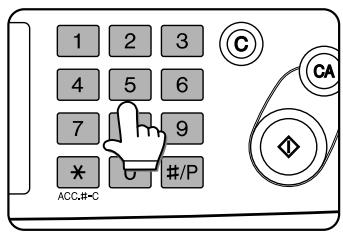
If you make a mistake, press the C key and re-enter the correct digit(s).
2 Touch the SUB ADDRESS key.
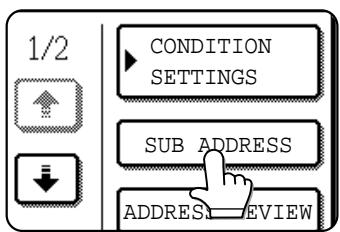
A slash "/" appears at the end of the fax number. If you make a mistake, press the C key to clear the mistake.
4 Touch the SUB ADDRESS key once again. A slash "/" appears at the end of the sub-address.
5 Use the numeric keys to enter the passcode of the other machine's memory box (max. 20 digits). If a passcode has not been established for the other box, this step is not necessary.
NOTES
- You can program a sub-address and passcode into a one-touch dial key along with the fax number (refer to page 6-3).
- Manual transmission (on-hook dialing or lifting an extension phone connected to the machine) using a sub-address and passcode is not possible.
CREATING A MEMORY BOX FOR F-CODE TRANSMISSION
F-code operations using memory boxes include F-code polling memory (following page), F-code confidential transmission (page 4-6), and F-code relay broadcast (page 4-8). Memory boxes must be created to perform any of these operations.
A memory box can be created using the custom settings. The method of setting up the box varies depending on the operation. Up to 100 boxes can be created. Note that two boxes cannot use the same sub-address, and a passcode can be omitted.
Refer to page 6-10 for the procedures for creating, editing, and deleting memory boxes.
A maximum of 20 digits are permitted for sub-addresses and passcodes. Be sure to inform the other party of the sub-address and passcode.
NOTES
- If you attempt to create a box when 100 boxes have already been created, a message will appear and you will not be able to create the box. First delete an unneeded box (page 6-13), and then create the new box.
- Spaces cannot be used when programming a sub-address or passcode. The characters "#" and "*" cannot be used in a sub-address, but they can be used in a passcode.
F-CODE POLLING MEMORY
F-code polling memory allows one fax machine to call another fax machine and activate reception of a document that has been scanned into the other machine's F-code polling memory box. Calling another machine and activating reception is called F-code polling, and scanning a document into a memory box for another machine to retrieve by polling is called F-code polling memory. This function is approximately the same as normal polling explained on page 3-5; however, it uses an F-code polling memory box and is always protected by means of the sub-address and passcode.
How F-code polling memory works
![graph TD A["1) F-code polling (transmission request)\nSub-address and passcode are transmitted to your machine"] --> B["2) Check sub-address and passcode\nMatch\nDo not match"] B --> C["3) Polling memory box opens"] C --> D["4) Automatic transmission of document data to other machine"] D --> E["The…](/content/2024/12/122344/images/767ca7105a576d413f66dc9c22e9c64ee14a074321c0e1d98a97a1d12c0dd591.jpg)
F-code polling is when your machine calls another machine and retrieves a document that was scanned into the polling memory box of that machine (the reverse of the above diagram).
NOTES
- To perform polling or polling memory without using an F-code, refer to page 3-5.
- To create an F-code memory box for polling memory, refer to page 6-10.
- Unlike normal polling, the other machine's fax number is not programmed as a passcode for F-code polling memory. The sub-address and passcode of the polling memory box are always used for polling security.
- The receiving machine bears the expense (phone charges) of the transmission.
USING F-CODE POLLING MEMORY
In order for another machine to retrieve a document from your machine, you must first scan the document into the F-code polling memory box.
You can check scanned document data by printing it out (refer to the following page).
NOTE
When using F-code polling memory, do not set the reception mode to manual reception.
Scanning a document into an F-code polling memory box
The procedure for scanning a document into an F-code polling memory box created with the custom settings (page 6-10) is almost the same as the procedure for scanning a document into the Public Box for normal polling memory. Instead of touching the PUBLIC BOX key in Step 4 on page 3-7, touch the key of the memory box into which you wish to scan the document. If document data has already been stored in that box, the new document data will be added on to the existing data.
If you no longer need the existing data, delete it as explained on the following page.
When you touch the memory box into which you wish to scan the document, the key is highlighted and selected as the scanning destination.
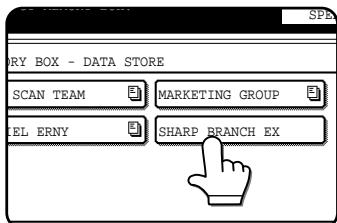
NOTE
When creating the memory box, you can select whether to have the scanned document data automatically cleared after polling, or left in the box to allow repeated polling.
- Checking and clearing document data in a memory box
The procedure for checking document data in an F-code polling memory box by printing it and the procedure for clearing data from a box are almost the same as the procedures for printing and clearing document data from the Public Box. Instead of touching the PUBLIC BOX key in Step 3 on page 3-8, touch the memory box key of the data you wish to print or clear.
If a document icon (☐) appears to the right of a memory box key, document data has been stored in that box and you can print it out.
Note that you cannot check or clear the contents of a memory box while it is being used for transmission.
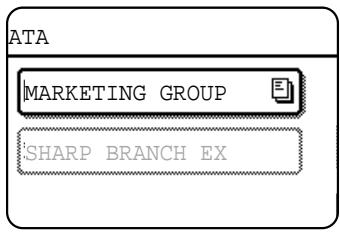
PROCEDURE FOR F-CODE POLLING
Make sure that a document has not been loaded in the auto document feeder or on the document glass, and then follow the steps below.
NOTES
- You must know the sub-address (SEP) and passcode (PWD) of the other machine's F-code polling memory box.
- Serial polling (selecting multiple fax machines to be polled using a group key or by touching the NEXT ADDRESS key) is not possible with F-code polling.
1 In fax mode, touch the SPECIAL MODES key and then the POLLING key.
![graph TD A["SPECIAL MODES"] --> B["STANDARD RESOLUTION"] B --> C["POLLING"] C --> D["EXPOS"] D --> E["ADUAL PAGE SCAN"]](/content/2024/12/122344/images/afc6702feb339757b1497623bf024fa6bf2dcf1c059014cf51eeb2a3b3235c03.jpg)
The POLLING key is highlighted and the polling icon is displayed.
To cancel the polling selection, press the POLLING key once again so that it is no longer highlighted.
3 Enter the fax number, sub-address, and passcode of the other fax machine.
Refer to steps 2 through 5 on page 4-3 for the procedure for entering sub-addresses and passcodes.
2 Touch the OK key.
You will return to the initial screen.
4 Press the Start key.
JOB STORED appears on the screen.
After communicating with the other machine, your machine prints the received document data.
NOTES
• To cancel the operation, press the JOB STATUS key and then cancel the operation as explained on page 2-6. - Only one polling operation with a timer setting (page 3-4) can be stored.
F-CODE CONFIDENTIAL TRANSMISSION
This function is used to send confidential documents. The sub-address and passcode programmed for a memory box restricts access to the box, and received data can only be printed by someone who knows the print PIN (Personal Identification Number).
This function is convenient when sending important documents that you only want a specific person to see, or when multiple departments share a single fax machine.
![graph TD A["Document data, together with a sub-address and passcode, are sent to your machine."] --> B["Check sub-address and passcode"] B --> C["Match Do not match"] C --> D["Data is read into the confidential memory box (reception is permitted)"] E["When data is printed"] --> F["Enter print PIN. (…](/content/2024/12/122344/images/37e4f5a381298905bf00ff9ba6070c915be837768fb88bf4eddad5de491d9009.jpg)
As the above diagram shows, receiving document data to the machine's F-code confidential memory box is called F-code confidential reception, and sending document data to another machine's F-code confidential memory box is called F-code confidential transmission.
NOTES
- This machine does not support Sharp's previous confidential transmission function, which uses the programmed sender's fax number and ID code.
- Refer to pages 6-10 through 6-13 for the procedures for creating, editing, and deleting F-code confidential memory boxes.
- Take care not to forget the print PIN programmed in the F-code confidential memory box. If you forget the passcode, consult your dealer.
F-CODE CONFIDENTIAL TRANSMISSION
F-code confidential transmission is performed in the same way as a normal transmission (refer to chapter 2); however, you must enter the sub-address (SUB) and passcode (SID) after the fax number of the other machine. (Omit the passcode if the other machine does not use a passcode.)
For the procedure for entering sub-addresses and passcodes, refer to page 4-3.
F-code confidential reception is performed in the same way as normal reception (refer to chapter 2); however, you must inform the other party of the sub-address (SUB) and passcode (SID) of your confidential memory box. (Omit the passcode if a passcode is not programmed in the box.)
NOTE
An F-code confidential transmission can be used in combination with the broadcast transmission function (page 3-2) or timer transmission function (page 3-4), and can be stored in a program (page 6-8).
PRINTING A DOCUMENT RECEIVED TO AN F-CODE CONFIDENTIAL MEMORY BOX
When a document is received to an F-code confidential memory box, a Transaction Report will print to inform you. The document can be printed by entering the print PIN (0000 to 9999) that was programmed when the memory box was created. Printing of the confidential document will take priority over any other jobs waiting to be printed.
NOTES
- You can use the key operator program to disable printing of the Transaction Report that is printed after a confidential document is received (page 8-5).
- Document data received to an F-code confidential memory box is automatically cleared after printing.
- Multiple faxes can be received to an F-code confidential memory box.
1 In fax mode, touch the SPECIAL MODES key and then touch the MEMORY BOX key.
![graph TD A["SPECIAL MODES"] --> B["STANDARD RESOLUTION"] B --> C["PROGRAM"] C --> D["MEMORY BOX"]](/content/2024/12/122344/images/56671ad505ae116d60f1610c7b24883a23ddde8ee11b4772758e1a11706253d7.jpg)
The memory box menu appears.
To cancel the operation, press the CANCEL key.
2 Touch the PRINT DATA key.
![graph TD A["DATA"] --> B["CONFIDENTIAL RECEPTION"] B --> C["PRINT DATA"] C --> D["Hand cursor pointing to the button"]](/content/2024/12/122344/images/b76561594580e4f416fe653d30db275a0ec8ad0fbbcfd980cb33d7117344636f.jpg)
3 Touch the memory box key that has the document data you wish to print.
A ☐ mark appears to the right of memory boxes that have received document data.
A memory box cannot be selected while it is being used for transmission.
4 Press the numeric keys to enter the 4-digit print PIN.
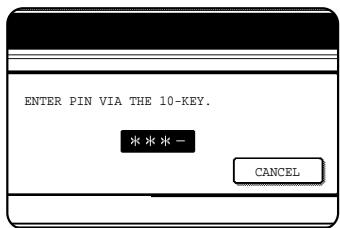
As each digit is entered, "-" changes to "*".
If the print PIN you entered is correct, the message PRESS [START] TO PRINT DATA appears.
If the passcode is not correct, the message PIN IS NOT VERIFIED appears and you return to the entry screen. To return to the screen of step 3, touch the CANCEL key.
5 Press the Start key.
Printing begins. If another print job is already in progress, the confidential data is printed after that job is completed.
NOTE
If received data remains in an F-code confidential memory box, the memory box cannot be deleted.
F-CODE RELAY BROADCAST TRANSMISSION
The F-code relay broadcast transmission function makes it possible to program the fax numbers of end receiving machines in an F-code relay memory box. Your machine thereby becomes a relay machine. When your machine receives a document from another F-code machine, your machine relays (transmits) that document to each of the end receiving machines. The relay machine and the originating machine that requests the relay transmission must both support F-codes; however, the end receiving machines programmed in the F-code relay broadcast memory box do not need to support F-codes.
![graph TD A["Relay request machine (sends document)"] --> B["Sub-address"] B --> C["Passcode"] C --> D["Relay machine (your machine)"] D --> E["Check sub-address and passcode"] E --> F["Match"] F --> G["Does not match"] G --> H["Document data is read into relay broadcast memory box (reception is perm…](/content/2024/12/122344/images/f8f87f221342ff4ec35a3854142d252f90baaaf1b41facb06c9cbf22f8ae086c.jpg)
The machine that originally sends the document is called the relay request machine, and the machine that has a memory box containing the end receiving machines and which relays the received document to those machines is called the relay machine.
The relay machine also prints the document sent by the relay request machine.
For example, corporate headquarters in Seattle wants to send the same document to branch offices in San Francisco, Oakland, Berkeley, and San Jose. If the San Francisco office creates a relay broadcast memory box and programs the Oakland, Berkeley, and San Jose offices as end receiving destinations, the overall phone charges will be lower than if the Seattle office uses the normal broadcast transmission function (page 3-2). This function can also be combined with a timer setting (page 3-4) to take advantage of off-peak rates, allowing a further reduction in phone charges.
Transmission by the relay machine is called "F-code relay broadcast transmission", and transmission from the relay request machine to the relay machine is called "relay request transmission".
NOTES
- This machine does not support Sharp's previous relay broadcast function, which uses the programmed sender's number and relay ID code.
- To create an F-code relay broadcast memory box and program, edit, and delete end receiving machines, refer to pages 6-10 to 6-13. When creating a box, a passcode (SID) can be omitted.
- The relay request machine only bears the expense of sending the document to the relay machine. The relay machine bears the expense of sending the document to each of the end receiving machines.
USING THE F-CODE RELAY BROADCAST FUNCTION
(your machine is the relay machine)
When a document is received from a relay request machine, the F-code relay broadcast function transmits the document to the end receiving machines using a memory box only if the sub-address and passcode sent by the relay request machine are correct.
Refer to pages 6-10 through 6-13 for the procedures for creating, editing, and deleting memory boxes.
Up to 30 end receiving machines (30 one-touch keys or group keys) can be programmed in the F-code relay broadcast memory box.
A document received from a relay request machine is initially stored in the memory box of your machine. Your machine (the relay machine) also prints the document, thus the document is first stored as a print job and then as transmission jobs to each of the programmed end receiving machines. The document data is automatically cleared after transmission to all end receiving machines is completed.
NOTE
End receiving machines are programmed using auto-dial keys (one-touch keys or group keys). If you need to program an end receiving machine that has not been programmed in a one-touch key, program the number in a one-touch key first and then create the memory box.
USING THE F-CODE RELAY REQUEST FUNCTION
(your machine requests a relay broadcast)
First ask the operator of the other F-code machine to create an F-code relay broadcast memory box and program the end receiving machines in that box. Ask the operator of the other machine for the sub-address (SUB) and passcode (SID) of the memory box.
When you send the document to the relay machine, enter the sub-address and passcode after the fax number. The document will be stored in the memory box of the relay machine, and then transmitted from the relay machine to each of the programmed end receiving machines. A passcode (SID) need not be entered when dialing if a passcode was not programmed for the memory box.
Aside from the method of dialing the relay machine, the transmission procedure is the same as for a normal transmission (refer to chapter 2).
Refer to page 4-3 for the procedure for entering a sub-address and passcode after the fax number of the other machine.
CHAPTER 5
USING CONVENIENT FUNCTIONS 3 CONVENIENT METHODS OF USE
This chapter explains convenient features that can be used when sending a document, as well as features that expand the range of use of the fax machine such as connecting an extension phone.
Page
STAMPING SCANNED ORIGINALS (VERIFICATION STAMP FUNCTION) ..... 5-2 ●TURNING ON THE VERIFICATION STAMP FUNCTION 5-2 CONNECTING AN EXTENSION PHONE 5-3 ●CONNECTING AN EXTENSION PHONE 5-3 ●SENDING A FAX AFTER TALKING ON THE PHONE (MANUAL TRANSMISSION) 5-3 ●USING AN EXTENSION PHONE TO RECEIVE A FAX....5-4 ●RECEIVING A FAX AFTER TALKING (MANUAL RECEPTION) .... 5-5
STAMPING SCANNED ORIGINALS (VERIFICATION STAMP FUNCTION)
If the optional verification stamp unit has been installed on the scanner unit, you can have a pink fluorescent "○" mark stamped on the edge of each original that is scanned using the auto document feeder.
This feature does not operate for originals scanned on the document glass.
NOTE
When both sides of an original are scanned, only the front side of the original is stamped.
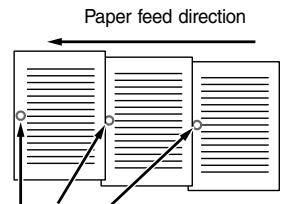
A pink fluorescent "○" mark is stamped on scanned originals.
TURNING ON THE VERIFICATION STAMP FUNCTION
If the optional verification stamp unit has been installed, follow the steps below to turn on the verification stamp function.
1 In fax mode, load the original and set any needed scanning conditions such as the original size, resolution, and exposure.
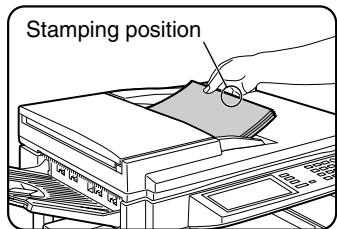
2 Touch the ORIGINAL key.
3 Touch the STAMP key.
![graph TD A["L"] --> B["OK"] C["EDT"] --> D["STAMP"] style A fill:#f9f,stroke:#333 style C fill:#f9f,stroke:#333 style D fill:#ccf,stroke:#333](/content/2024/12/122344/images/7ddb73527ef5f5d015593ad2493ece6954978e386b48ea236e07c98741729350.jpg)
The STAMP key is only displayed if the verification stamp unit has been installed.
When touched, the key is highlighted.
4 Touch the OK key.
![graph TD A["Hand"] --> B["OK"] C["L"] --> D["______"] E["EDT"] --> F["STAMP"]](/content/2024/12/122344/images/b2cbb157d488462facc11043a4dbb3309840d4324362059ae8fd44378da628e9.jpg)
You will return to the initial screen.
5 Make sure that the verification stamp icon appears to the right of the ORIGINAL key.
When this icon appears, the edge of each original will be stamped as it is scanned. If you have selected two-sided scanning, the verification stamp icon will appear to the right of the two-sided scanning icon.
6 Begin scanning.
The verification stamp function automatically turns off when all originals have been scanned.
Note that the function will also automatically turn off if you take no action for one minute after turning on the function.
NOTES
- If an error occurs during scanning, scanning is canceled and the original is ejected. In this case, the original may be stamped without having been scanned.
- You can use the key operator program to permanently turn on the verification stamp function. (Refer to page 8-3.)
■ Replacing the verification stamp cartridge
The optional verification stamp unit contains a consumable verification stamp cartridge (ink cartridge). This cartridge (AR-SV1) must be replaced when the mark stamped on each original becomes faint. Follow the steps below to replace the cartridge.
1 Remove the stamp cover, and then grasp the finger hold on the ink cartridge and pull the cartridge out of the unit. 2 Insert the new cartridge into the unit. Replace the stamp cover.
CONNECTING AN EXTENSION PHONE
You can connect a telephone to the machine and use it as an extension phone to place and receive calls like any normal phone. You can also activate fax reception from the phone (remote operation).
NOTES
- If you connect a combination telephone/answering machine to the machine, you will not be able to use the answering machine function.
- You can place calls from the phone even during a power failure.
CONNECTING AN EXTENSION PHONE
1 Insert the end of the extension phone cord into the extension phone jack on the rear of the machine.
Make sure you hear a "click" sound indicating that the cord is securely connected.
SENDING A FAX AFTER TALKING ON THE PHONE (MANUAL TRANSMISSION)
If the other fax machine is set to manual reception, you can talk to the other party and then send a fax without breaking the connection. This procedure is called manual transmission.
NOTE
Automatic redialing (page 2-4) will not take place if the line is busy.
1 In fax mode, load the document and set any needed scanning conditions such as the original size, resolution, and exposure.
NOTE
If you have loaded the original on the document glass, you can only send one page by manual transmission.
2 Lift the extension phone.
Or, you can press the SPEAKER key (page 1-11).
3 Dial the number of the other party or touch a one-touch key.
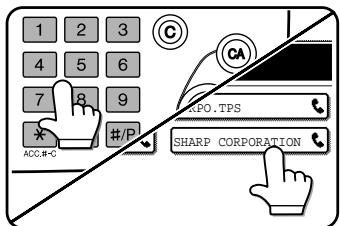
You can also dial using the keypad on the extension phone.
You cannot use a group key or a one-touch key that includes a sub-address and passcode.
4 Speak to the other party when they answer. If you used the SPEAKER key to dial, lift the extension phone to talk. 5 After the other party switches to fax reception, press your Start key.
Transmission begins.
6 Replace the extension phone.
USING AN EXTENSION PHONE TO RECEIVE A FAX
The machine normally receives faxes automatically after ringing (page 2-7); however, when an extension phone is connected, you can set the reception mode to MANUAL. This will allow you to talk to the other party first and then receive a fax.
This is convenient when you only have one telephone line and receive more voice calls than faxes. You must answer all calls on the extension phone, and activate fax reception after you verify that a call is a fax transmission.
NOTES
- The reception mode is initially set to AUTO. If you have not connected an extension phone, keep the reception mode set to AUTO.
- If you hear beeps during reception or at the end of reception and an error message appears in the display, refer to page 7-3.
■ Changing the reception mode to MANUAL.
1 Press the CUSTOM SETTINGS key.
3 Touch the MANUAL RECEPTION key.
The MANUAL RECEPTION key is highlighted.
2 Touch the RECEIVE MODE key.
![graph TD A["LIST PRINT"] --> B["RECEIVE MODE"] B --> C["Hand Clicking Button"]](/content/2024/12/122344/images/2a851717ff8ae61a0550ab3d75eff743197c1f016c4fb0f6d851d278211c602a.jpg)
4 Touch the OK key.
The reception mode is set to MANUAL.
NOTE
To return the reception mode to AUTO, touch the AUTO RECEPTION key in step 3 above.
RECEIVING A FAX AFTER TALKING (MANUAL RECEPTION)
When an extension phone is connected to the machine and you have set the reception mode to MANUAL, you can talk to a person sending a fax manually and then begin fax reception without breaking the connection.
■ Activating fax reception from an extension phone (remote reception)
After speaking on the extension phone, you can activate fax reception from the extension phone. This is called "remote reception". After speaking, or when you hear a fax tone through the extension phone, perform the following procedure with the extension phone still lifted.
NOTE
The following procedure is not possible if you are on a pulse dial line and your extension phone cannot produce tone signals. To find out whether your extension phone can produce tone signals, refer to the manual for your extension phone.
1 If you are on a pulse dial line, set your phone to issue tone signals.
Refer to your phone's manual to set the phone to issue tone signals.
If your phone is already set to issue tone signals, proceed to the next step.
2 Press the "5" key on the extension phone's keypad, and then press the "*" key twice.
Fax reception is activated.
3 Replace the extension phone.
NOTE
The one-digit number that is used to activate fax reception from an extension phone (initially set to "5") is called the "remote reception number". You can change this number to any number from 0 to 9 with the key operator program. (Refer to page 8-5.)
■ When the machine is in Fax mode
A fax can be received manually even when transmission is in progress.
NOTE
If you are using a line divider to connect an extension phone to the machine, the following method cannot be used for fax reception. In this case, use remote reception (see above) to receive faxes.
1 When the machine rings, lift the extension phone and speak.
If you hear a fax tone through the extension phone, do not speak and proceed to the next step.
2 With the extension phone still lifted, touch the FAX RECEIVE key.
Reception begins when the other party begins transmission.
3 Replace the extension phone.
The received fax will be printed after previously stored jobs have been printed. When printing is completed, you will hear a "beep" sound.
NOTE
You can also talk on the extension phone and manually receive a fax while the machine is copying.
If the machine rings during copying, lift the extension phone and speak. To receive a fax, press the IMAGE SEND key with the extension phone still lifted. When you hear a fax tone through the extension phone, touch the FAX RECEIVE key.
CHAPTER 6
PROGRAMMING
This chapter explains the procedures for programming and the information programmed in auto dial keys (one-touch and group keys), programs, user indexes, and memory boxes.
Page
PROGRAMMING 6-2
STORING, EDITING, AND DELETING AUTO DIAL KEYS AND PROGRAMS ...... 6-2
● STORING ONE-TOUCH DIAL KEYS 6-3 ● EDITING AND DELETING ONE-TOUCH KEYS 6-5 ● PROGRAMMING A GROUP KEY 6-6 ● EDITING AND DELETING GROUP KEYS 6-7 ● STORING A PROGRAM 6-8 ● EDITING AND DELETING PROGRAMS 6-8
STORING A GROUP INDEX 6-9
PROGRAMMING, EDITING, AND DELETING F-CODE MEMORY BOXES ..... 6-10
● PROGRAMMING AN F-CODE MEMORY BOX 6-10 - SETTING FOR F-CODE POLLING MEMORY BOXES (NUMBER OF TRANSMISSIONS)....6-11 - SETTING FOR F-CODE CONFIDENTIAL TRANSMISSION MEMORY BOXES (PRINT PIN.) 6-12 - SETTING FOR F-CODE RELAY BROADCAST MEMORY BOXES (END RECEIVING MACHINES)....6-13 ● EDITING AND DELETING A MEMORY BOX 6-13
PRINTING PROGRAMMED INFORMATION 6-14
ENTERING CHARACTERS 6-15
PROGRAMMING
There are two methods for storing and editing auto dial numbers (one-touch keys and group keys), user indexes, and memory boxes: using the touch panel of the machine, and using a Web browser (Netscape Navigator, Internet Explorer, etc.) on your computer to access the Web page in the machine. This chapter only explains the procedures for storing, editing, and clearing using the touch panel of the machine. For the procedure for accessing the Web page and items that can be stored, edited and cleared in the Web page, refer to pages 2-6 through 2-8 of "Operation manual (for printer operation and general information)".
STORING, EDITING, AND DELETING AUTO DIAL KEYS AND PROGRAMS
This section explains the procedures for storing, editing, and deleting auto-dial keys (one-touch keys and group keys) and programs, which simplify the transmission procedure. (The procedure for using one-touch keys and group keys is explained on page 2-5 and the procedure for using programs is explained on page 3-11.)
A combined total of 500 one-touch keys and group keys can be stored, and eight programs can be stored. If you attempt to store more than this, a warning message will appear. In this case, delete any auto-dial keys or programs that are no longer needed (refer to pages 6-5, 6-7 and 6-8), and then store the new auto-dial key or program.
NOTE
To cancel a storing, editing, or deleting operation, press the CA key. Pressing the CA key takes you out of CUSTOM SETTINGS mode.
To store, edit, or delete an auto-dial key (one-touch key or group key) or program, first follow steps 1 through 4 below.
1 Press the CUSTOM SETTINGS key.
2 Touch the ADDRESS CONTROL key.![graph TD A["ADDRESS CONTROL"] --> B["KEY OPERATOR PROC"]](/content/2024/12/122344/images/c4da28b6f4bbb80ad47479a1cb8253be3cf6021e6290cb65af25b6e693790272.jpg)
3 Touch the DIRECT ADDRESS / PROGRAM key.![graph TD A[" "] --> B[" DIRECT ADDRESS / PROGRAM "] C[" "] --> D[" CUSTOM INDEX "]](/content/2024/12/122344/images/394f9638526572b2a416957c55184b387f6f59a972bf0b413a994162090374aa.jpg)
The DIRECT ADDRESS / PROGRAM menu appears.
4 Touch the desired key and perform the programming operation.
Refer to the pages indicated below for the operation you wish to perform.![graph TD A["INDIVIDUAL"] --> B["STORE"] C["GROUP"] --> B D["PROGRAM"] --> B E["AMEND/DELETE"] --> B F["INDIVIDUAL key\nStore a one-touch dial key (following page)"] --> B G["PROGRAM key\nStore a program key (page 6-8)"] --> B](/content/2024/12/122344/images/f2261773d431d74c19b2b941cb9c1d8dbce93dac0c7e3e47391b59d2dcfb0369.jpg)
GROUP key
Store a group key (page 6-6)
AMEND/DELETE key
- One-touch key (page 6-5)
- Group key (page 6-7)
- Program (page 6-8)
STORING ONE-TOUCH DIAL KEYS
Follow the steps below to store a one-touch key after you have completed steps 1 through 4 on page 6-2.
1. Make sure the FAX key is checked and then touch the NAME key.
The "No." that automatically appears is the lowest number from 001 to 500 that has not yet been programmed. When NAME is touched, the letter-entry screen appears. Enter up to 36 characters for the name.
Refer to page 6-15 for the procedure for entering letters.
2. Touch the INITIAL key.
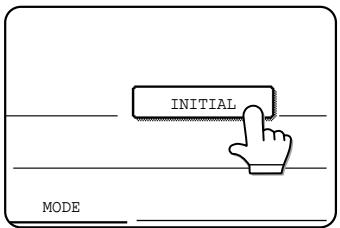
3. Touch a letter key.
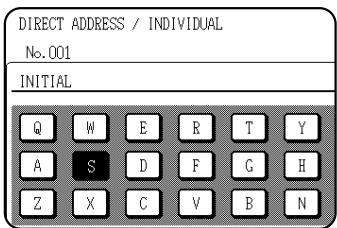
The first letter (initial) of the name entered in step 1 is initially selected and is highlighted. If you wish to change the letter, touch a different letter key.
NOTE
The initial you enter here determines the position of the one-touch key in the ABC index. For information on the ABC index, refer to page 1-5.
4. Touch the OK key.
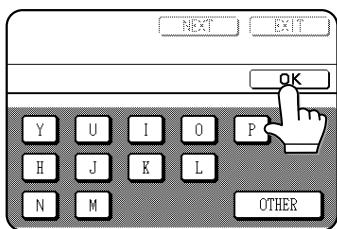
5. Touch the INDEX key.
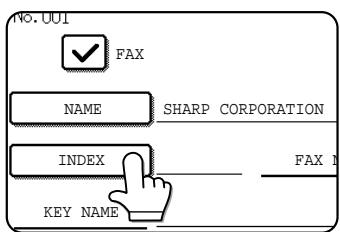
6. Touch an index key.
![DIRECT ADDRESS / INDIVIDUAL No.001 INDEX OK SELECT THE CUSTOM INDEX WHERE YOU REGISTER THIS ADDRESS. USER 1 USER 2 USER 3 USER 4 USER 5 USER 6 DO YOU REGISTER THIS ADDRESS AT THE [FREQUENT USE], TOO? YES NO](/content/2024/12/122344/images/438929d56553995c3d9a4e16b2799f4741542da5c8468bb7194b928350d7e732.jpg)
Select one of the upper row of keys (USER 1 through USER 6) to determine the location of the one-touch key when the GROUP index is displayed instead of the ABC index (refer to page 1-5). The lower keys are for selecting whether to include the one-touch key in the FREQUENT USE index.
If you touch the wrong key, simply touch the correct key.
7 Touch the OK key.
8 Touch the FAX No. key.
The fax number entry screen appears.
9 Use the numeric keys to enter the fax number.
![DIRECT ADDRESS / INDIVIDUAL No. 001 NEXT EXIT FAX No. CANCEL OK ENTER THE FAX No. VIA THE 10-KEY PAD, THEN PRESS [OK]. 0666211221 PAUSE SUB ADDRESS](/content/2024/12/122344/images/27d57ae0f6000caa417b9034ce9696fc3386cdb0a4ef5cbc4a8bc8cacad551ab.jpg)
To insert a pause between digits of the number, touch the PAUSE key. The pause appears as a hyphen "-". Refer to page 8-4 to set the duration of the pause.
If you make a mistake, press the C key to clear one digit at a time, and then enter the correct digit(s).
If you are not going to enter a sub-address and password after the fax number, proceed to step 12.
NOTE
A maximum of 64 digits can be entered, including the fax number, sub-address, passcode, any pauses (hyphens), and slashes "/" (to separate the sub-address and passcode).
10 If you need to enter a sub-address, touch the SUB ADDRESS key and then enter the sub-address with the numeric keys.
![IEN PRESS [OK]. PAUSE SUB ADDRESS](/content/2024/12/122344/images/c1adecd3b807af5857d7c159e25d61214bbb1aec2e4d90cee281215365741020.jpg)
When you touch the SUB ADDRESS key, a slash is entered after the fax number. Continue by entering the sub-address (max. 20 digits).
If you do not wish to enter a passcode, proceed to step 12.
11 If you wish to enter a passcode, touch the SUB ADDRESS key once again and enter the passcode with the numeric keys.
When you touch the SUB ADDRESS key, a slash is entered after the sub-address. Continue by entering the passcode (max. 20 digits).
12 Touch the OK key.
- You will return to the one-touch key programming screen. REGISTRATION IS COMPLETED will appear highlighted to the right of "No.".
NOTE
The "FAX No." line only shows 32 digits, regardless of how many digits actually programmed.
13 Check the key name.
The characters appearing next to the NAME key will be displayed in the key. Only the first 18 characters of the name entered in step 1 will be displayed.
If you need to change the name that will be displayed in the key, touch the KEY NAME key.
If you do not wish to change the name, this step is not necessary.
Refer to page 6-15 for the procedure for entering characters.
14 Check the transmission settings
The initial transmission settings are "TRANSMISSION SPEED: 33.6 kbps" and "INTERNATIONAL CORRESPONDENCE MODE: NONE". To change either of the settings, touch the MODE key.
If you do not wish to change the settings, this step is not necessary.
After touching the MODE key, you can change either of the two settings. When finished, touch the OK key.
Transmission speed
Speed selections are 33.6 kbps, 14.4 kbps, 9.6 kbps, and 4.8 kbps. The higher the number, the faster the transmission speed.
NOTE
Set the transmission speed only when you know what speed is most suitable, such as when you are sending a fax to a foreign country and telephone line conditions are bad. If you do not know the line condition, do not change this setting.
International correspondence mode
Selections are NONE, MODE 1, MODE 2, and MODE 3.
NOTE
- When sending a fax to a foreign country, telephone line conditions can sometimes distort the fax or interrupt the transmission. Selecting the right international correspondence mode can help alleviate these problems.
- If errors frequently occur when sending a fax to a foreign country, try each of modes 1 to 3 and select the mode that enables the best transmission.
15 When you have finished programming the one-touch key, touch the EXIT key. If you wish to program another one-touch key, touch the NEXT key.
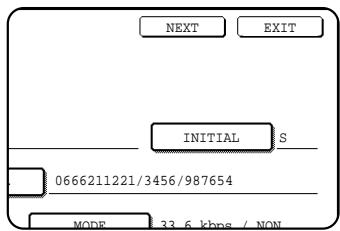
Pressing the EXIT key returns you to the screen of step 4 on page 6-2.
EDITING AND DELETING ONE-TOUCH KEYS
If you wish to delete a one-touch key or change the fax number, name, or other information programmed in a one-touch key, follow steps 1 through 3 on page 6-2 and then perform the following procedure.
1 Touch the AMEND/DELETE key.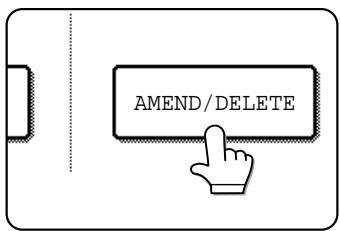
2 Touch the one-touch key you wish to edit or delete.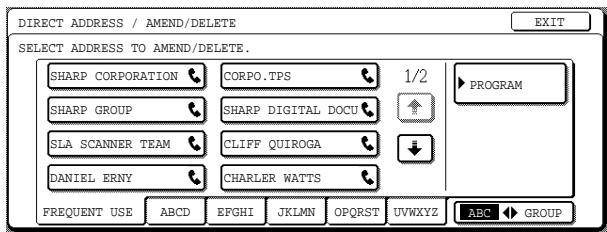
● To edit a one-touch key, follow steps 3 and 4. ● To delete a one-touch key, follow steps 5 and 6. - When you have finished editing or deleting, touch the EXIT key.
3 Touch the key corresponding to the information you wish to change (change the information in the same way as you stored the information on page 6-3).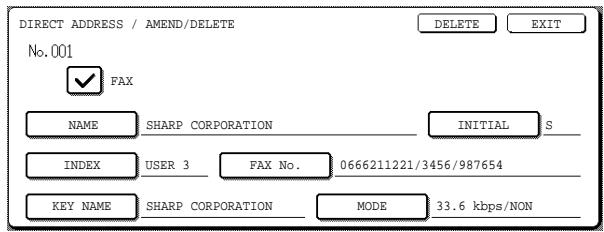
4 Make sure that your changes are correct, and then touch the EXIT key.![graph TD A["DELETE"] --> B["EXIT"] C["INITIAL"] --> D["S"]](/content/2024/12/122344/images/942c4d1350fcb4a96e30838323e8a0f697b8efdc16453b950ece24e2c68fc60d.jpg)
If you wish to change another one-touch key, repeat steps 2 through 4.
5 Touch the DELETE key.![graph TD A["DELETE"] --> B["EXIT"] C["INITIAL"] --> D["S"]](/content/2024/12/122344/images/43fda66812495548ab2960b9733083643f6fc870bda34a00d20796b5fdac711a.jpg)
6 Touch the YES key.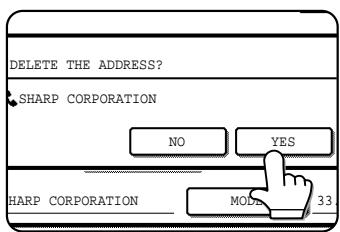
If you wish to delete another one-touch key, repeat steps 2, 5, and 6.
NOTE
If you cannot edit or delete a one-touch key
If you attempt to edit or delete a one-touch key in the following situations, a warning message will appear and editing/deletion will not be possible.
●The one-touch key you wish to edit or delete is currently being used for transmission or is used in a currently stored transmission job (including a timer transmission). ●The one-touch key is included in a group key. ●The one-touch key is included in a group of end receiving machines for an F-code relay broadcast operation. ●The one-touch key is included in a program.
If the key is being used for a current transmission or currently stored transmission, cancel the transmission or wait until it is completed and then change or delete the key. If the key is included in one of the above groups, delete the key from the group and then change or delete the key.
PROGRAMMING A GROUP KEY
Up to 300 destinations can be stored in a group key. To program a group key, follow steps 1 through 4 on page 6-2 and then perform the following procedure.
NOTE
Only one-touch key destinations can be stored in a group key. If you wish to store a destination that is not programmed in a one-touch key, first program the destination in a one-touch key and then store it in the group key.
1 Follow steps 1 through 7 of "Storing one-touch dial keys" (page 6-3) to enter a GROUP NAME, INITIAL, and INDEX. 2 Touch the ADDRESS key.
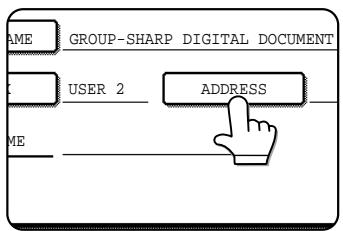
3 Touch index keys and the ↑ ↓ keys as needed, and then touch one-touch keys of the destinations that you wish to store in the group.
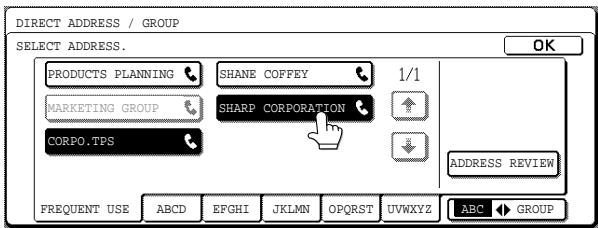
One-touch keys that have been touched are highlighted. If you touch the wrong key, simply touch it again to cancel the highlighting and remove the destination from the group.
NOTE
One group key cannot be stored in another group key. Group keys appear grayed out and cannot be touched.
4 To check the destinations that you have stored in the group, touch the ADDRESS REVIEW key.
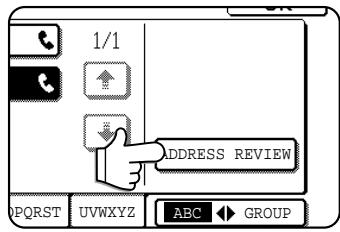
A list of your selected destinations is displayed. You can delete a displayed destination by touching it. When a message appears asking if you want to delete the destination, touch the YES key.
5 Touch the outer OK key.
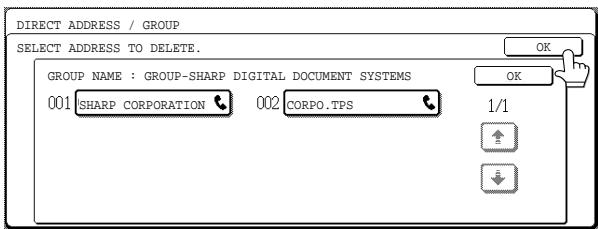
The number of destinations in the group appears to the right of the ADDRESS key.
6 Check the name of the key (refer to step 13 on page 6-4).
The characters appearing next to the KEY NAME key will be displayed in the group key. To change these characters, touch the KEY NAME key. This step is not necessary if you do not wish to change the characters. The procedure for entering characters is explained on page 6-15.
7 Touch the EXIT key when you have finished programming the group key.
If you wish to program another group key, touch the NEXT key.
When you touch the EXIT key, you will return to the screen of step 4 on page 6-2.
EDITING AND DELETING GROUP KEYS
If you need to delete a group key or change its name or one of its stored destinations in a group key, first follow steps 1 through 3 on page 6-2, and then perform the following procedure.
1 Touch the AMEND/DELETE key.
2 Touch the group key you wish to edit or delete.
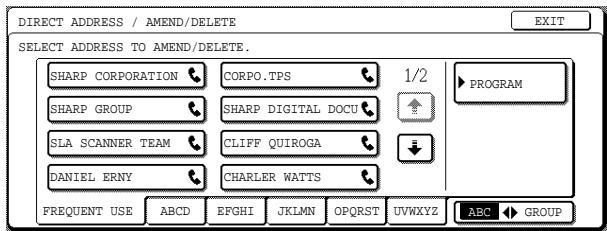
● To edit a group key, follow steps 3 and 4. ● To delete a group key, follow steps 5 and 6. - When you have finished editing or deleting, touch the EXIT key.
3 Touch the key of the item you wish to change (to edit the item, follow the same steps as for one-touch keys on page 6-3).
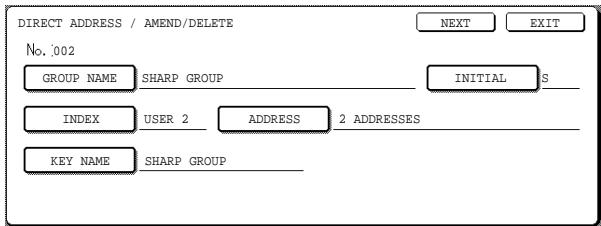
To edit a destination stored in a group key, touch the ADDRESS key. The following screen appears.
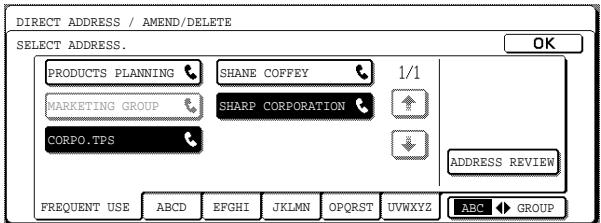
The one-touch keys stored in the group are highlighted. To add another one-touch key to the group, touch the key to highlight it.
To delete a one-touch key from the group, touch the key so that it is no longer highlighted.
4 Make sure the edited information is correct, and then touch the EXIT key.
![graph TD A["DELETE"] --> B["EXIT"] C["INITIAL"] --> D["S"]](/content/2024/12/122344/images/1384a7550ea7ecc4bd9a330f52e94b94ee6beb93973597837d73572cee610d99.jpg)
If you wish to change another group key, repeat steps 2 through 4.
5 Touch the DELETE key.
![graph TD A["DELETE"] --> B["INITIAL"] C["EXIT"] --> B["INITIAL"] B --> D["S"]](/content/2024/12/122344/images/dbb656dc14419d4732206cf7a7ef86986239cd5d446aaaee38946f780e4918b5.jpg)
6 Touch the YES key.
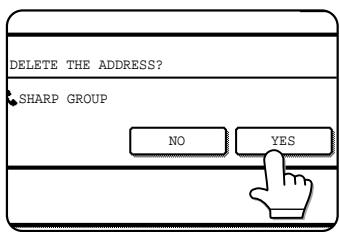
If you wish to delete another group key, repeat steps 2, 5, and 6.
NOTE
If you cannot edit or delete a group key
If you attempt to edit or delete a group key in the following situations, a warning message will appear and editing/deletion will not be possible.
● The one-touch key you wish to change or delete is currently being used for transmission or is used in a currently stored transmission job (including a timer transmission). ● The group key is included in the end receiving machines for an F-code relay broadcast operation. ● The group key is included in a program.
If the key is being used for a current transmission or currently stored transmission, cancel the transmission or wait until it is completed and then edit or delete the key. If the key is included in a program or in the end receiving machines for an F-code relay broadcast operation, delete the key from the program or operation and then edit or delete the key.
STORING A PROGRAM
You can store a destination fax number, polling or dual page scan selections, and resolution and exposure settings in a program. This enables you to call up the program and perform the transmission by means of a simplified operation. To store a program, first follow steps 1 through 4 on page 6-2 and then perform the following operation.
NOTE
A timer setting (page 3-4) cannot be included in a program.
1 Touch the PROGRAM NAME key.
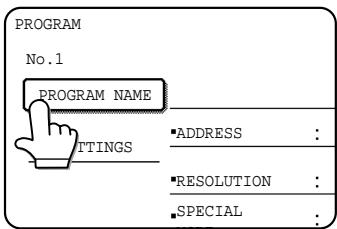
The "No." that automatically appears is the lowest number from 1 to 8 that has not yet been programmed. When the PROGRAM NAME key is touched, the letter-entry screen appears. Enter up to 18 characters for the name.
Refer to page 6-15 for the procedure for entering letters.
2 Touch the SETTINGS key.
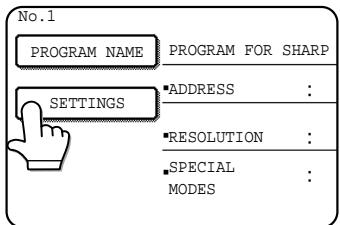
3 Touch the keys for the settings you wish to store.
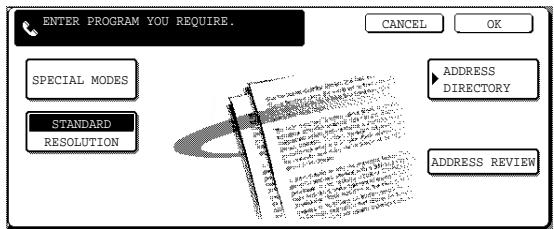
For the detailed procedures for each of the settings, refer to the explanations of those features on the following pages. Special mode: • Polling (page 3-6)
- Dual page scanning (page 3-10) • Exposure (page 1-10) Resolution (page 1-9) Address Directory (page 3-3)
NOTE
You can store up to 300 destinations in a program; however, you cannot directly enter fax numbers with the numeric keys. A destination must be programmed in an auto dial key (one-touch key or group key) before it can be stored in a program.
4 Touch the OK key.
5 Your settings are displayed. Make sure they are correct.
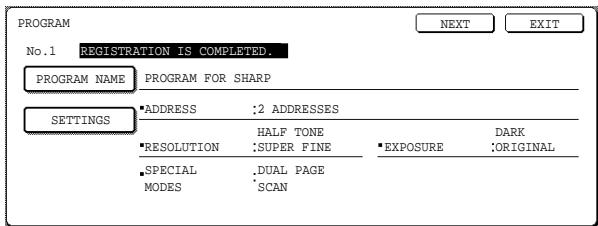
6 When you are finished, touch the EXIT key. If you wish to store another program, touch the NEXT key.
Touching the EXIT key returns you to the screen of step 4 on page 6-2.
EDITING AND DELETING PROGRAMS
If you need to edit or delete a previously stored program, perform steps 1 through 4 on page 6-2, touch the AMEND/DELETE key, and then perform the following steps:
1 Touch the PROGRAM key.
2 Touch the program you wish to edit or delete.
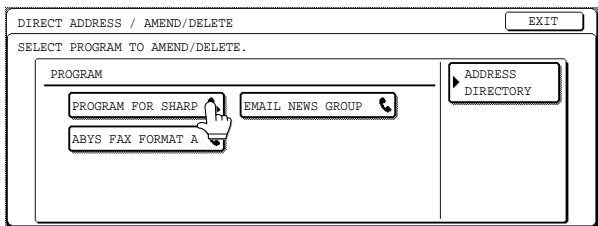
When you touch the program name, the edit/delete screen for the selected program appears.
Touching the ADDRESS DIRECTORY key returns you to the screen of step 1.
3 To edit the program, follow the same procedure as for storing the program.
To delete the program, touch the DELETE key and then touch the YES key in the confirmation screen that appears.
STORING A GROUP INDEX
Auto dial keys (one-touch keys and group keys) are normally stored in the ABC index. To make auto dial keys more convenient to use, you can store a group of auto dial keys in a group index and assign a name to that index. When you switch to the group indexes, USER 1, USER 2, USER 3, USER 4, USER 5, and USER 6 appear. You can assign any name up to 6 characters long to each of the USER indexes.
The procedure for storing auto dial numbers in a group index is explained on page 6-3, and the procedure for switching between the ABC index and the group indexes is explained on page 1-5.
1 Press the CUSTOM SETTINGS key, and then touch the ADDRESS CONTROL key (refer to steps 1 and 2 on page 6-2). 2 Touch the CUSTOM INDEX key.
![graph TD A["DIRECT ADDRESS / PROGRAM"] --> B["CUSTOM INDEX"] B --> C["Hand Clicker"]](/content/2024/12/122344/images/6d9b2e5db08644e4d4e6d23796593808e3521e1bc141cbbe017dcd20893a5a92.jpg)
3 Touch an index key (USER 1 to USER 6). You can enter a name for the selected index.
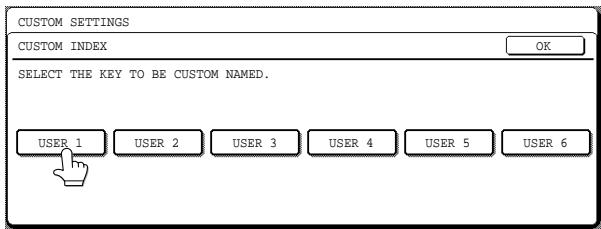
When touched, the letter entry screen appears.
4 Enter a maximum of 6 characters for the index name.
Use the → key to clear the displayed name and then enter the desired name. Refer to page 6-15 for the procedure for entering characters.
When finished, touch the OK key. The new name appears in the screen of step 3.
5 If you wish to program another index name, repeat steps 3 and 4.
When finished, touch the OK key.
To change a user index name, re-enter the name as explained in step 4.
PROGRAMMING, EDITING, AND DELETING F-CODE MEMORY BOXES
The procedure for programming a memory box for F-code transmission is explained here. There are three types of F-code memory boxes: F-code polling memory (page 4-4), F-code confidential transmission (page 4-6), and F-code relay broadcast (page 4-8). Memory boxes are programmed, edited, and deleted as follows.
PROGRAMMING AN F-CODE MEMORY BOX
A box name, sub-address/passcode, and function must be programmed in a memory box.
NOTES
- When programming a new memory box, a sub-address that is being used for another box cannot be used. The passcode, however, can be the same as a passcode used in another box. • A passcode can be omitted.
- Up to 100 F-code memory boxes can be programmed. If 100 F-code memory boxes have already been programmed, a warning message will appear and you will not be able to program a new box. First delete an unneeded F-code memory box (page 6-13) and then program the new box.
1 Press the CUSTOM SETTINGS key and then touch the ADDRESS CONTROL key (refer to steps 1 and 2 on page 6-2). 2 Touch the F-CODE MEMORY BOX key.
3 Touch one of the memory box keys (POLLING MEMORY, CONFIDENTIAL, or RELAY BROADCAST) on the top line (STORE).
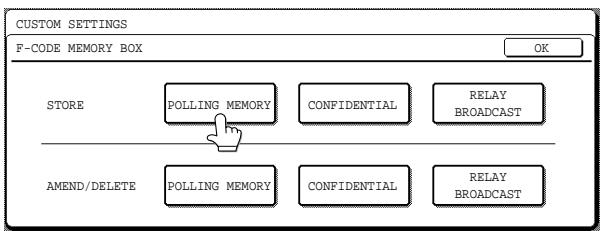
(POLLING MEMORY is touched in the example here.) The F-code memory box programming screen appears.
4 Touch the BOX NAME key.
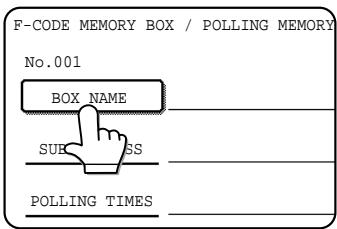
The "No." that automatically appears is the lowest number from 001 to 100 that has not yet been programmed. When the BOX NAME key is touched, the letter-entry screen appears. Enter up to 18 characters for the name.
Refer to page 6-15 for the procedure for entering letters.
5 Touch the SUB ADDRESS key.
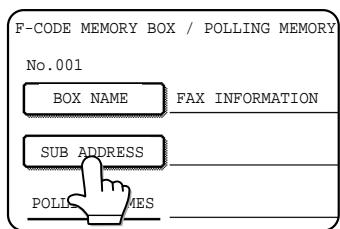
The sub-address/passcode entry screen appears.
6 Use the numeric keys (0 through 9) to enter a sub-address (max. 20 digits).
![F-CODE MEMORY BOX / POLLING MEMORY No.001 SUB ADDRESS / PASS CODE CANCEL OK ENTER THE SUB ADDRESS / PASS CODE VIA THE 10-KEY PAD, THEN PRESS [OK]. 214341434 PASS CODE](/content/2024/12/122344/images/28e9a010a36b43f331c1b80b66cd92ef4aef0d9d4e2824ff043cae0b7a9954f3.jpg)
The characters "*" and "#" cannot be used in a sub-address.
If you enter an incorrect digit, press the C key and re-enter the correct digit.
If you do not wish to enter a passcode, proceed to step 9.
7 To set a passcode, touch the PASS CODE key.
![CANCEL OK THE 10-KEY PAD, THEN PRESS [OK]. PASS CODE](/content/2024/12/122344/images/2b137f5ddeec7125822a86f18814695f18c7226ff2356442e041c3db438dd298.jpg)
A slash (/) appears after the sub-address.
If you make a mistake, press the C key to clear the mistake.
8 Use the numeric keys to enter a passcode (max. 20 digits).
![F-CODE MEMORY BOX / POLLING MEMORY No.001 NEXT EXIT SUB ADDRESS / PASS CODE CANCEL OK ENTER THE SUB ADDRESS / PASS CODE VIA THE 10-KEY PAD, THEN PRESS [OK]. 214341434/351212 PASS CODE](/content/2024/12/122344/images/89a064ce798be1281893e320b43ddab19e0f5221b203e1c23bb7daa30d674669.jpg)
In addition to numbers, the characters "*" and "#" can be used in a passcode.
If you make a mistake, press the C key to clear the mistake.
9 Touch the OK key.
![CANCEL OK 10-KEY PAD, THEN PRESS [OK]. PASS CODE](/content/2024/12/122344/images/8bbbc7d4f96b33338016bb400f826744cacb0c0ec4ec2593a3faa85d1b440db3.jpg)
You will return to the memory box programming screen. The entered sub-address and passcode are displayed. REGISTRATION IS COMPLETED appears to the right of the box number.
Continue programming the settings that are particular to each type of memory box. Refer to the following pages:
● F-code polling memory (this page) ● F-code confidential transmission (next page) ● F-code relay broadcast transmission (page 6-13)
SETTING FOR F-CODE POLLING MEMORY BOXES (NUMBER OF TRANSMISSIONS)
You can select whether to have document data that was scanned into an F-code polling memory box automatically cleared after one transmission, or to leave the document data in the box and allow an unlimited number of transmissions when polled. (The initial setting is "ONCE". Change the setting as needed.)
1 Touch the POLLING TIMES key.
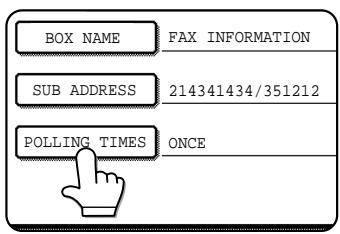
2 Touch the key for the desired number of transmissions.
If you wish to leave the document data in the box, touch the UNLIMITED key to highlight it.
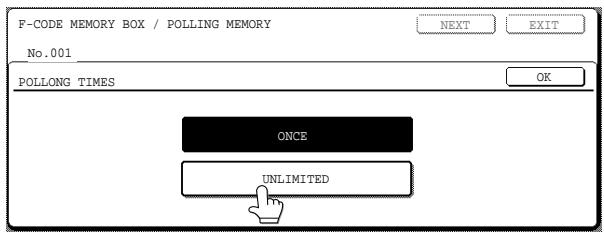
3 Touch the OK key.
You will return to the programming screen for the F-code polling memory box. The selected number of transmissions appears.
SETTING FOR F-CODE CONFIDENTIAL TRANSMISSION MEMORY BOXES (PRINT PIN.)
Program the print PIN. (Personal Identification Number) that is used to print a document that has been received to an F-code confidential memory box. For information on using a print PIN., refer to page 4-7.
NOTES
- Program a 4-digit number for the print PIN.. The characters "*" and "#" cannot be used.
- The print PIN. can be omitted. • Take care not to forget the print PIN. you have programmed. If you forget the passcode, consult your Sharp dealer.
1 Touch the PRINT PIN key.
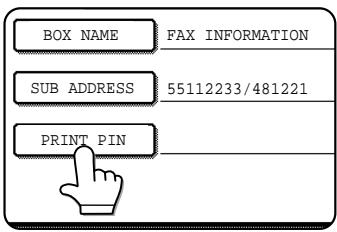
2 Use the numeric keys to enter a 4-digit number.
![F-CODE MEMORY BOX / CONFIDENTIAL No.003 NEXT EXIT PRINT PIN CANCEL OK ENTER THE PRINT PIN VIA THE 10-KEY PAD, THEN PRESS [OK]. 3456](/content/2024/12/122344/images/08171ba01432c96a9a404370ca7f80130e6195d70373879c9184c0a27bffcfa5.jpg)
If you make a mistake, press the C key. All digits will be cleared, so you will need to re-enter the number from the first digit.
To cancel entry of the print PIN., touch the CANCEL key. You will return to the screen of step 1 without programming a print PIN..
3 Touch the OK key.
You will return to the programming screen for the F-code confidential transmission memory box. The print PIN. you entered is displayed.
SETTING FOR F-CODE RELAY BROADCAST MEMORY BOXES (END RECEIVING MACHINES)
Program the end receiving machines to which document data received in the F-code relay broadcast memory box will be transmitted when your machine is a relay machine.
NOTES
- Up to 30 end receiving machines (30 one-touch keys or group keys) can be programmed. If you attempt to program more than this number, a message will appear and programming will not be possible.
- Only destinations that have been programmed in auto dial keys (one-touch keys or group keys) can be selected. If you need to include a destination that has not been programmed in an auto dial key, first program it in a one-touch key (page 6-3) and then program the destination as an end receiving machine.
1 Touch the RECIPIENT key.
The address selection screen appears.
2 Touch the one-touch keys you wish to include as end receiving machines, touching indexes and the ↑ ↓ keys as needed.
The selected one-touch keys are highlighted and programmed as end receiving machines. If you touch an incorrect key, touch the key again to remove the highlighting and delete the destination.
3 To check the destinations that have been selected as end receiving machines, touch the ADDRESS REVIEW key.
The destinations selected as end receiving machines are displayed.
You can delete a destination by touching it. When the confirmation message appears, touch the YES key to delete the destination.
4 Touch the outer OK key.
You will return to the programming screen for the F-code relay broadcast memory box. The number of selected end receiving machines appears.
EDITING AND DELETING A MEMORY BOX
1 Press the CUSTOM SETTINGS key and then touch the ADDRESS CONTROL key (refer to steps 1 and 2 on page 6-2). 2 Touch the F-CODE MEMORY BOX key. 3 Touch a memory box key (POLLING MEMORY, CONFIDENTIAL, or RELAY BROADCAST) on the bottom line (AMEND/DELETE). 4 Touch the memory box key that you wish to edit or delete.
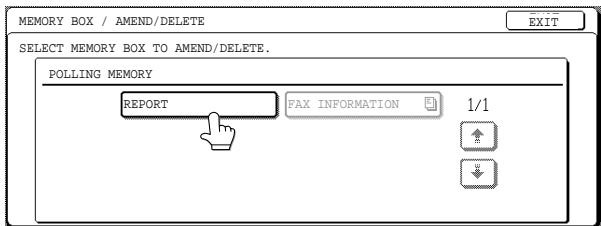
The memory box edit/delete screen appears.
A "☐" mark indicates that data has been stored.
A memory box cannot be edited or deleted when data is stored in the box.
5 Touch the keys as needed to edit or delete the information.
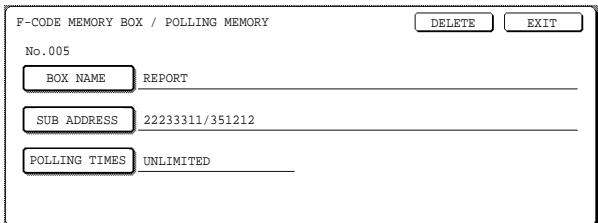
- Edit a memory box in the same way as you programmed it.
- To delete a memory box, touch the DELETE key at the upper right of the screen (a message will appear asking you to confirm the deletion). ● The print PIN must be entered to edit or delete a confidential memory box. ● A memory box cannot be edited or cleared while it is being used for transmission.
PRINTING PROGRAMMED INFORMATION
You can print out lists of the one-touch keys, group keys, programs, and memory boxes that have been stored in the machine.
1 Press the CUSTOM SETTINGS key.
2 Touch the LIST PRINT key.
3 Touch the SENDING ADDRESS LIST key.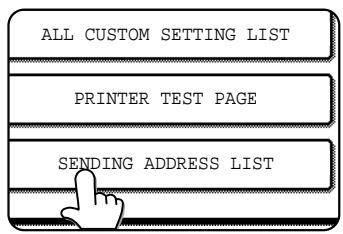
4 Touch the key of the list you wish to print.![graph TD A["GS"] --> B["SS LIST"] B --> C["INDIVIDUAL LIST"] C --> D["MEMORY BOX LIST"] D --> E["GROUP LIST"] E --> F["PROGRAM LIST"]](/content/2024/12/122344/images/8d57c8448ab2810585e86edadfa1e184ae1ee7b08c4d3d79fe3abe05cd7640ea.jpg)
PROCESSING PRINT DATA appears in the message display and printing begins.
To cancel printing, touch the CANCEL key.
NOTES
- The list is printed before other print jobs are printed.
- If you attempt to print a list when no data exists, a warning message will appear.
ENTERING CHARACTERS
To enter or edit characters in setting screens such as auto dial key programming screens, follow the steps below. Characters that can be entered are alphabetical characters, special characters, numbers, and symbols.
■ Entering alphabetical characters
(Example: Sharp äÄ)
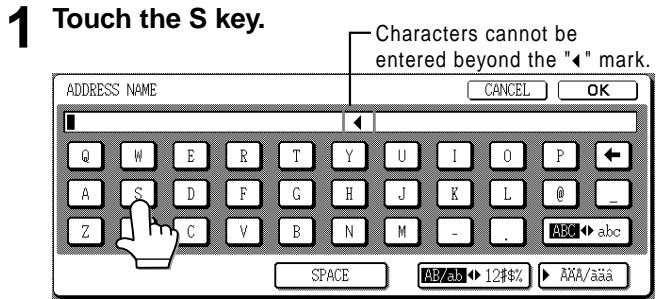
To switch between upper case and lower case, touch the ABC ◀ abc key. When ABC is highlighted, upper case letters are entered.
2 Touch the ABC ◆ abc key.
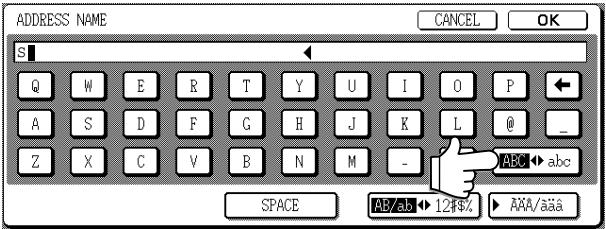
3 Touch the "h" key, "a" key, "r" key, and "p" key.
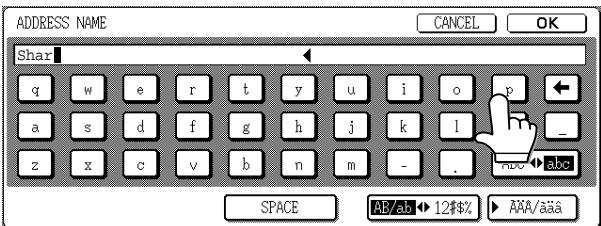
If you make a mistake, touch the → key to move the cursor (■) back one space and then enter the correct character. You can also press the AB/ab ▶ 12#\$% key during entry to enter a number or symbol.
4 Touch the SPACE key.
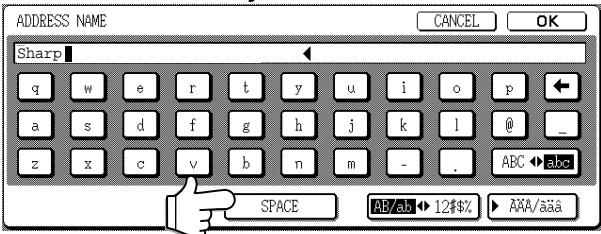
The cursor (■) moves forward and a space is entered.
5 Touch the ▶ ÃÄÂ/ãäâ key.
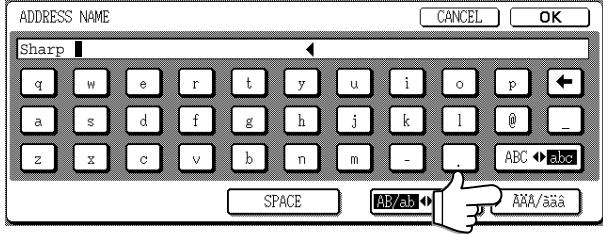
6 Touch the "ä" key.
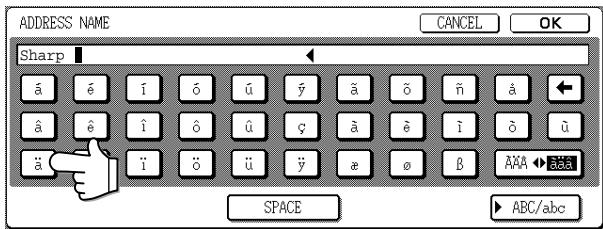
To switch between upper case and lower case, touch the à ◀ ã key. When ã is highlighted, lower case letters are entered.
7 Touch the ÄÄÄ◄► ääå key.
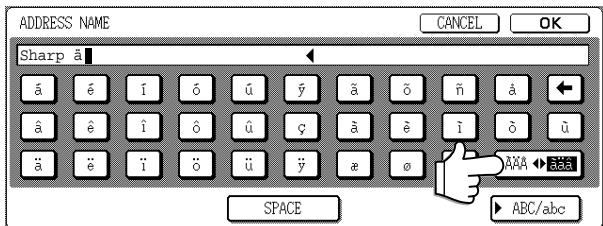
8 Touch the "Ä" key.
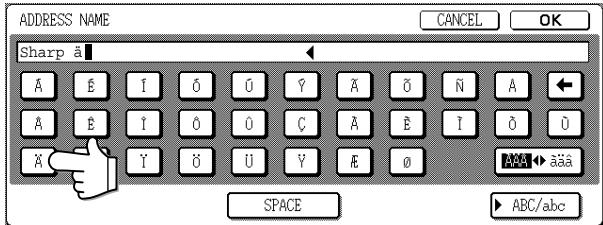
You can press the ABC/abc key during entry to return to alphabetical character entry. You can also enter numbers and symbols.
9 When finished, touch the OK key.
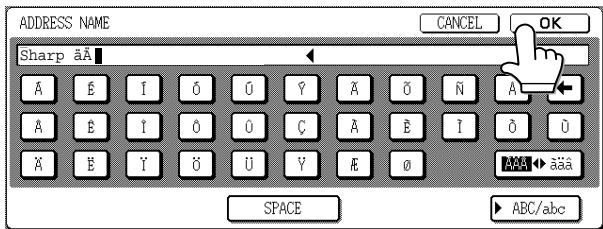
You will exit the character entry screen and return to the programming screen. If you touch the CANCEL key, you will return to the programming screen without storing the entered characters.
■ Entering numbers and symbols
1 Touch the AB/ab ◆ 12#\$% key.
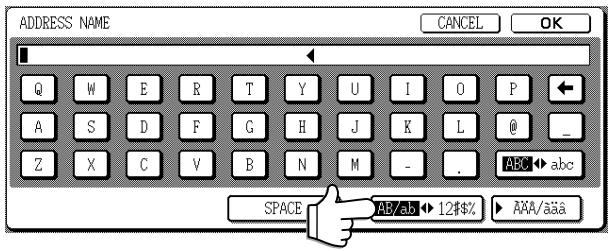
When the characters "12#\$%" are highlighted, number/symbol entry mode is selected.
2 Enter the desired number or symbol.
Numbers and symbols that can be entered are as follows:
Screen 1/2
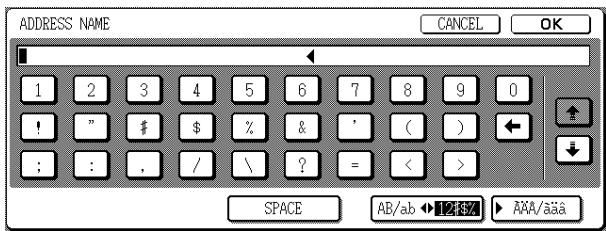
Screen 2/2
![ADDRESS NAME CANCEL OK ~ + * [ ] { } ^ ↓ SPACE AB/ab ▶ 12.49% AAA/aaa](/content/2024/12/122344/images/9eaadf584e315611c3712b5517e30d43c0164ba8f5d1e9b41df463df88a5548b.jpg)
* Change screens by touching the ↑ key or ↓ key displayed in the screen. If you make a mistake, touch the ← key to move the cursor (■) back one space and then enter the correct character.
You can continue touching keys to enter characters. You can also touch another character type selection key (▶A /ā key or AB/ab ◀ 12#\$% key) to enter characters other than numbers and symbols.
3 When you have finished entering characters, touch the OK key.
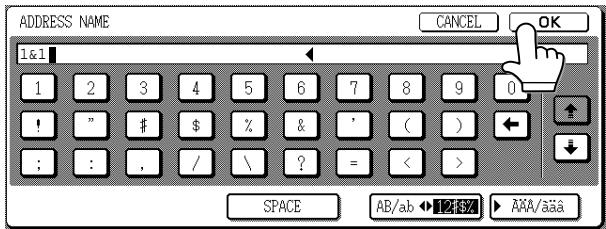
You will exit the character entry screen and return to the programming screen. If you touch the CANCEL key, you will return to the programming screen without storing the entered characters.
NOTE
If you are going to use the Web page to edit or delete the stored name at a later time, do not use the characters ", <, or >. These characters cannot be displayed in the Web page.
CHAPTER 7
TROUBLESHOOTING
This chapter contains information to help you make efficient use of the fax features of the machine, including solutions to common problems.
Page
WHEN A TRANSACTION REPORT IS PRINTED 7-2
VIEWING THE COMMUNICATION ACTIVITY REPORT .... 7-3
WHEN AN ALARM SOUNDS AND A WARNING MESSAGE IS
DISPLAYED 7-3
PROBLEMS AND SOLUTIONS 7-4
WHEN A TRANSACTION REPORT IS PRINTED
The machine has been set to automatically print a Transaction Report when a transmission is not successful or when the Broadcast transmission function is used. The Transaction Report informs you of the result of the operation. When the machine prints a Transaction Report, be sure to check the contents.
The initial settings (factory settings) for printing Transaction Reports are indicated by shading ▪ below. You can use the key operator program to change the settings (page 8-5).
- Single sending: Print out all report / Print out error report only / No printed report
- Receiving: Print out all report / Print out error report only / No printed report
- Broadcasting: Print out all report / Print out error report only / No printed report
- Confidential reception: Print out notice page / Not print out notice page
The Transaction Report shows the date of transmission, the time transmission began, the other party's name, the duration of the operation, the number of pages, and the result.
NOTES
- The list count appears in the "#" column of the Transaction Report and a serial number appears in the FILE column. (These numbers are not related to the transaction.)
- When a transmission error occurs, a portion of the original document is printed along with the Transaction Report. You can set the machine to not print the original using the key operator program (page 8-5).
■ Information appearing in the TYPE/NOTE column
Information such as the type of transmission and type of error appears in the TYPE/NOTE column of the Transaction Report. The following notes may appear.
| Note | Explanation |
| OK | The transaction was completed normally. |
| G3 | Communication took place in G3 mode. |
| ECM | Communication took place in G3 ECM mode. |
| SG3 | Communication took place in Super G3 mode. |
| FW. | The received data was forwarded. |
| NO RESPONSE | No response from the receiving party. |
| BUSY | Transmission was not possible because the other party was already using the line. |
| CANCEL | A transmission was canceled while in progress, or a stored transmission job was canceled. |
| P. FAIL | A power failure occurred during the transaction. |
| MEMORY OVER | The memory became full during quick on-line transmission. |
| MEM. FULL | The memory became full during reception. |
| LENGTH OVER | The transmitted document was over 59" long and therefore could not be received. |
| ORIGINAL ERROR | Manual transmission was not successful because a jam occurred. |
| PASS# NG | The connection was broken because the polling passcode was not correct. |
| NO RX POLL | The machine that was polled does not have a polling function. |
| RX POLL FAIL | The other machine refused the polling operation, or your machine broke the connection when polled because no data was in memory. |
| NO F-CODE POLL | The other machine refused an F-code polling operation, or your machine broke the connection when polled because no data was in its F-code memory polling box. |
| RX POLL# NG | Your machine broke the connection because the other machine specified an F-code polling sub-address that does not exist in your machine. |
| F PASS# NG | Your machine broke the connection because the other machine sent an incorrect passcode for F-code polling. |
| BOX NO. NG | Your machine broke the connection because the specified sub-address for an F-code memory box does not exist. |
| F POLL PASS# NG | Your machine broke the connection because an incorrect passcode was sent for an F-code transmission. |
| RX NO F-CODE POLL | F-code polling was attempted, however, the other machine did not have an F-code polling memory box. |
| NO F FUNC | F-code transmission was attempted, however, the other machine does not support F-code communication. |
| NO F-CODE | An F-code transmission was refused by the other machine because of an incorrect sub-address or other reason. |
| M. BOX: [xxxxx]······ | Data was received to a confidential or relay broadcast memory box, or data was sent from a memory polling box.The name of the memory box appears in [xxxxx], and the type of F-code operation (relay request reception, polling memory transmission, or confidential reception) appears in······. |
| FAIL xx(xxxx) | The communication handshake signals or image signals were distorted due to line conditions or other reasons, and communication was not successful.First two digits of communication error number: Error code from 00 to 31 appears.Last four digits of communication error number: Codes for use by service technicians. |
VIEWING THE COMMUNICATION ACTIVITY REPORT
Your machine keeps a record of the most recent 50 transactions (both transmissions and receptions) that were performed. The record includes the date of the transaction, the other party's name, the duration, and result. You can have the report automatically printed when the number of transactions exceeds 50, or at a specified time. This allows you to check the machine's activity at regular intervals.
The machine is initially set (factory setting) to not print the report. To have the report printed, change the setting with the key operator program (page 8-5).
NOTES
- After printing, the data is cleared from memory, so the report cannot be printed a second time.
- Refer to the table in "When a Transaction Report is printed" on the previous page for the notes that appear in the TYPE/NOTE column.
WHEN AN ALARM SOUNDS AND A WARNING MESSAGE IS DISPLAYED
Alarms and display messages alert you to the condition of the machine during operation. If one of the following messages appears, respond as indicated in the table.
| Message screen (Alarm) | Meaning of message | Action | Page |
| OPEN TRAY x AND ADD xxxxxxxx PAPER. | Printing cannot take place because the machine is out of suitable paper. | Add the indicated paper. | Printer manual, 1-16 |
| CHANGE THE TONER CARTRIDGE. | The machine is out of toner and the received document cannot be printed. | Replace the toner cartridge. | Printer manual, 1-25 |
| PLEASE RETURN xx ORIGINALS TO THE DOCUMENT TRAY, THEN PRESS [START]. | The original jammed in the scanner unit while being scanned. | Reload the indicated original. | 1-7 |
| THE MEMORY BECOMES FULL. SEND SCANNED DATA? OR CANCEL THE JOB? | The memory became full while the original was being scanned. | Send only the pages that were already scanned, or cancel the entire transmission. | 2-4 |
| THE LINE WAS BUSY. FAX TRANSMISSION WAS SUSPENDED. | The other party's line is busy. | Try the transmission again. | 2-4 |
| POLLING IS NOT POSSIBLE WITH THE AVAILABLE MEMORY. | Polling is not possible because there is not enough space in memory. | Try polling again after currently stored jobs are completed. | - |
| POLLING IS AVAILABLE ONLY FOR FAX. | The party you attempted to poll was not a fax machine. | Check to make sure the number you are dialing is a fax number. | 1-5 |
| THE FOLLOW DATA COULD NOT BE SENT. PLEASE GIVE THIS TRANSACTION REPORT TO SENDER. | The transmission did not end normally due to a communication error and a Transaction Report was printed. | Check the contents of the Transaction Report and then try the transmission again. | 7-2 |
| TRANSMISSION ERROR OCCURRED AT SOME RECEIVERS. PLEASE GIVE THIS TRANSACTION REPORT TO SENDER. | The transmission did not end normally due to a communication error and a Transaction Report was printed. | Check the contents of the Transaction Report and then try the transmission again. | 7-2 |
| MANUAL RECEIVE IS DISABLED DUE TO OUT OF MEMORY. | Manual reception was not possible because there was not enough free space in memory. | Try manual reception again after currently stored jobs have been completed. | - |
| CLOSE THE xxxx COVER. | The indicated cover is open. | Close the indicated cover. | - |
| CLOSE THE DOCUMENT FEEDER. | |||
| CLOSE THE LOWER RIGHT SIDE COVER. | |||
| CALL FOR SERVICE. CODE:xx-xx FAX FUNCTION TROUBLE. | The self-diagnosis function has activated and automatically stopped operation. An error code appears in xx-xx. | Turn off the power and then turn it back on. If the same message still appears, contact your dealer. | 7-3 and 7-4 |
* Printer manual: "Operation manual (for printer operation and general information)"
PROBLEMS AND SOLUTIONS
If the fax features do not operate normally, please check the following.
| Problem | Check | Solution | Page | |
| The machine does not operate. | Is the fax power switch turned on? | Turn on the fax power switch. | 0-1 | |
| Dialing is not possible. | Is the correct dial mode set for your line? | Check your line and set the correct dial mode. | 8-4 | |
| Is the telephone line properly connected? | Check the connections. | Printer manual,0-7 | ||
| Is the main switch turned on? | Turn the main switch on. | Printer manual,1-4 | ||
| Is the machine in fax mode? | Press the IMAGE SEND key to set the machine to fax mode. | 1-3, 2-2 | ||
| Transmission is not possible. | Does the receiving fax machine have paper? | Check with the operator of the receiving machine. | - | |
| Does the receiving machine support G3 transmission? | ||||
| Are the sub-address and passcode correct? | ||||
| Is the receiving machine ready to receive? | ||||
| Is the original within the range of transmittable documents? | Check the transmittable sizes. | 1-8 | ||
| The transmitted image prints out blank at the receiving side. | Was the original placed so that the correct side is scanned? | Make sure the original is placed so that the correct side is scanned. | 1-7 | |
| If the receiving machine is using thermal paper, was the thermal paper loaded with the wrong side out? | Check with the operator of the other machine. | - | ||
| The transmitted image is distorted. | Were line conditions poor due to thunder or another reason? | Try the transmission again. | - | |
| Were the resolution and exposure settings suitable? | Check the resolution and exposure settings. | 1-9 and 1-10 | ||
| Transmission does not take place at the specified time. | Is the machine's clock set to the correct time? | Set the clock to the correct time. | Printer manual, 3-15 | |
| Printing does not take place after reception. | Does a message appear in the display instructing you to add toner or paper? (Printing is not possible.) | Restore printing capability as instructed by the display message. Printing will begin. | 7-3 | |
| A received image prints out blank. | Was the wrong side of the original scanned in the transmitting machine? | Check with the operator of the transmitting machine. | - | |
| The received image is faint. | Is the original faint? | Ask the other party to re-send the document using a suitable exposure setting. | - | |
| The received image is distorted. | Were line conditions poor due to thunder or another reason? | Ask the other party to send the document again. | - | |
| White or black lines appear in the transmitted image. | Is the document glass or the scanner in the scanning unit dirty? | Clean the document glass or the scanner in the scanning unit. | Printer manual, 4-12 | |
| Telephone | A dial tone is not heard through the speaker. | Is the volume set to "low"? | Set the speaker volume to "medium" or "high". | 8-5 |
| A ringing sound is not made. | Has the ringer volume been turned off? | Set the ringer volume to "low", "medium", or "high". | 8-5 | |
* Printer manual: "Operation manual (for printer operation and general information)"
CHAPTER 8
KEY OPERATOR PROGRAMS
This chapter explains the key operator programs used by key operators. Key operators should read this chapter well to ensure correct use of the programs.
Page
KEY OPERATOR PROGRAMS 8-2
● KEY OPERATOR PROGRAM LIST 8-2 ● USING THE KEY OPERATOR PROGRAMS 8-2 - SETTING PROGRAMS 8-3 ● PRINTING OUT SETTINGS 8-10
KEY OPERATOR PROGRAMS
This section explains the key operator programs for the fax features of the machine. For key operator programs that are related to the printer and copy functions of the machine, refer to the KEY OPERATOR'S GUIDE and "Operation manual (for copier)".
NOTES
- You may not be able to use all of the programs in the key operator program list. Programs that you can use will depend on what peripheral devices are installed on the machine.
- Settings established with the key operator programs can be verified by printing them out (page 8-10).
KEY OPERATOR PROGRAM LIST
| Program name | Page |
| Image send settings | |
| Operation settings | |
| Default display setting | 8-3 |
| The number of direct address keys displayed setting | 8-3 |
| Must input next address key at broadcast setting | 8-3 |
| Initial resolution setting | 8-3 |
| Default verification stamp | 8-3 |
| Fax default settings | |
| Own number and name set | 8-4 |
| Dial mode setting | 8-4 |
| Auto wake up print | 8-4 |
| Pause time setting | 8-4 |
| Speaker volume setting | 8-4 |
| Original print on send error report | 8-5 |
| Remote reception number setting | 8-5 |
| Transaction report print select setting | 8-5 |
| Activity report print select setting | 8-5 |
| ECM | 8-5 |
| Distinctive ring detection | 8-5 |
Fax send settings
| Auto reduction sending setting | 8-6 |
| Rotation sending setting | 8-6 |
| Printing page number at receiver | 8-6 |
| Call timer at memory sending | 8-7 |
| Date/own number print position setting | 8-7 |
| Recall in case of line busy | 8-7 |
| Recall in case of communication error | 8-7 |
| Times of recall setting in case of line busy | 8-7 |
| Interval of recall setting | 8-7 |
| Quick on line sending | 8-7 |
Fax receive settings
| Auto receive reduce setting | 8-8 |
| Number of calls in auto reception | 8-8 |
| Duplex reception setting | 8-8 |
| Print style setting | 8-8 |
| Set the telephone number for data forwarding | 8-8 |
| Fax separator page | 8-8 |
| Output tray setting | 8-8 |
Fax polling security
| Polling security setting | 8-9 |
| Passcode number setting | 8-9 |
| Set number of times public box may be polled | 8-9 |
USING THE KEY OPERATOR PROGRAMS
To use a key operator program, follow the procedure on page 6 of KEY OPERATOR'S GUIDE. (Please carefully read "Supplementary explanation of key operation for key operator programs" on the same page.) For explanations of each setting, refer to the following pages.
SETTING PROGRAMS
The setting programs for the fax feature of the machine are explained here. Explanations of the setting programs used for the copy feature, setting programs used for the network scanner feature, and setting programs that are related to the printer feature can be found in the copy, network scanner, and printer manuals.
Operation settings
The following operation settings are available:
●Default display setting ●The number of direct address keys displayed setting ●Must input next address key at broadcast setting ●Initial resolution setting ●Default verification stamp
Default display setting
You can select the initial display that appears when you press the IMAGE SEND key to change to fax mode or when you press the CA key in fax mode. Normally the initial display is set to the condition setting screen (page 1-4).
The following three selections are available:
- Condition setting screen
- Address directory (ABC)
- Address directory (Group)
When an address directory (ABC or Group) is selected, the selected index of that address directory (page 1-5) is set as the initial screen.
The number of direct address keys displayed setting
The number of one-touch keys displayed in each address directory screen can be changed from 8 (the normal setting) to 6 or 12.
Touch 6, 8, or 12 to select the desired number.
NOTE
For the key name that appears in each one-touch key, a maximum of 18 characters can appear when the number of one-touch keys displayed is set to 6 or 8. A maximum of 10 characters can appear when the number of one-touch keys displayed is set to 12.
Must input next address key at broadcast setting
You can select whether the NEXT ADDRESS key must be pressed before entering the next destination when performing a broadcast transmission (page 3-2). Normally the machine is set so that touching the NEXT ADDRESS key can be omitted except when the numeric keys are used to enter one full fax number after another full fax number.
Example: Normal setting (factory setting)![graph TD A["XXXX\nDial"] --> B["NEXT ADDRESS"] B --> C["One-touch"] C --> D["NEXT ADDRESS"] D --> E["One-touch"] F["Can be omitted"] --> G["Can be omitted"]](/content/2024/12/122344/images/b663c3aaf3277de615c1d6fd15de90dbd3f4290a7ae75df18ad2e034bb1b04d9.jpg)
![graph TD A["XXXX Dial"] --> B["NEXT ADDRESS"] B --> C["XXXX Dial"] B --> D["Cannot be omitted."]](/content/2024/12/122344/images/7e82605f8531e369c4130b5c8b91e23fd963385e2c3632cb7daaae027c5e5f95.jpg)
If the box is checked, it will no longer be possible to omit the NEXT ADDRESS key as shown in the above example. Even if the next destination to be entered is a one-touch key, the NEXT ADDRESS key must be touched before the one-touch key can be entered.
If you attempt to enter a subsequent destination without touching the NEXT ADDRESS key, the destination will not be entered.
Initial resolution setting
This setting is used to change the default resolution setting for fax mode from STANDARD to FINE, SUPER FINE, or ULTRA FINE. HALF TONE can also be selected for the latter three resolution settings. STANDARD is normally selected for the initial resolution setting. If you wish to select HALF TONE for the selected resolution setting, touch the HALF TONE key to highlight it.
NOTES
- HALF TONE cannot be selected for STANDARD resolution.
- For more information on each of the resolution settings, refer to page 1-9.
Default verification stamp
(Can only be selected if the optional verification stamp unit is installed.)
Select this setting if you wish to always have a verification mark stamped on originals that are scanned using the scanner unit. Normally this setting is not selected.
To select this setting, check the box.
Fax default settings
The default fax settings can be changed as necessary to meet your faxing needs.
The default fax settings are as follows:
● Own number and name set ● Dial mode setting ● Auto wake up print ● Pause time setting ● Speaker volume setting ● Original print on send error report ● Remote reception number setting (only when extension phone is connected) ● Transaction report print select setting ● Activity report print select setting ● ECM (This setting is only effective if the other machine is a G3 machine that supports ECM) ● Distinctive ring detection
Own number and name set
Use this setting to enter the fax number of the machine and the name of the user. The entered name and number are printed at the top of each fax page you send. The number is also used as a passcode when performing polling reception (page 3-5).
You can check your entries by printing out the Sender List. Refer to page 8-10.
1 Touch the NAME key and enter the name.
The name entry screen appears.
Up to 20 characters can be entered for the name. Refer to page 6-15 for the procedure for entering characters.
2 Touch the FAX No. key and enter the fax number.
Enter up to 20 digits for the number using the numeric keys.
To enter a "+", press the "*" key.
To enter a space, press the SPACE key.
If you make a mistake, press the C key and re-enter the correct digit.
3 Touch the OK key.
You will return to the OWN NUMBER AND NAME SET screen.
The number you entered appears. Make sure it is correct.
Dial mode setting
(Setting your line type)
Select the appropriate setting for your line type. "Tone" is normally selected.
It is also possible to have the machine automatically select the line type. Make sure that the telephone line is connected to the machine, and then press the AUTO SELECT key at the lower right. The machine will automatically select "Tone" for a tone dial line, or "Pulse" for a pulse dial line.
Auto wake up print
Use this setting to select how the machine responds if a fax is received when the main switch is turned off (the fax switch is turned on).
Auto wake up print is normally turned on, which means that the machine automatically activates and prints the received fax. If you turn off this setting, received faxes will not be printed until the main switch is turned on.
Pause time setting
This setting is used to select the duration of pauses that are inserted in destination fax numbers. Normally the setting is 2 seconds, which means that each time the PAUSE key is touched when dialing or storing a fax number, a pause of 2 seconds is inserted. You can select any number of seconds from 1 to 15.
Speaker volume setting
This setting lets you adjust the volume of the dial tone heard through the speaker, the ringer, and the line monitor. These are normally set to medium.
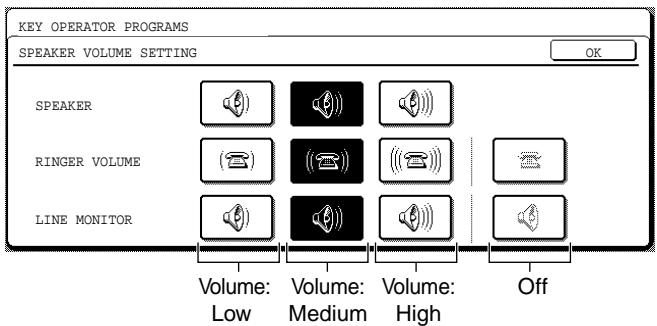
To change the volume, touch the desired volume key.
Original print on send error report
This setting is used to select whether a portion of the first page of the original is included on the Transaction Report that is printed after a memory transmission error occurs. The machine is normally set to include a portion of the original.
Remote reception number setting
(only when extension phone is connected)
Fax reception can be activated from an extension phone connected to the machine by entering a 1-digit number and pressing "*" twice on the phone's keypad. This number is called the remote reception number, and you can set it to any number from "0" to "9". The number is normally set to "5".
Transaction report print select setting
This setting is used to select the conditions for printing out Transaction Reports. Conditions can be selected for normal transmissions, broadcast transmissions, receptions, and confidential receptions.
SINGLE SENDING
PRINT OUT ALL REPORT
PRINT OUT ERROR REPORT ONLY
NO PRINTED REPORT
BROADCASTING
PRINT OUT ALL REPORT
PRINT OUT ERROR REPORT ONLY
NO PRINTED REPORT
Touch the ▼ key to display the next two settings. Select the print conditions for receptions and confidential receptions
RECEIVING
PRINT OUT ALL REPORT
PRINT OUT ERROR REPORT ONLY
NO PRINTED REPORT
CONFIDENTIAL RECEPTION
PRINT OUT NOTICE PAGE
The normal settings are indicated by shading above.
Activity report print select setting
You can select whether to have the activity report automatically printed out after 50 transactions (both transmissions and receptions) have been recorded, or specify a time that the report is to be automatically printed out (once a day only). Both settings can be selected if desired.
The machine is initially set to not print the report. To have the report automatically printed every 50 transactions, check the AUTO PRINT AT MEMORY FULL box. To have the report automatically printed at a specified time, check the PRINT DAILY AT DESIGNATED TIME box and then select the time with the HOUR and MINUTE keys that appear.
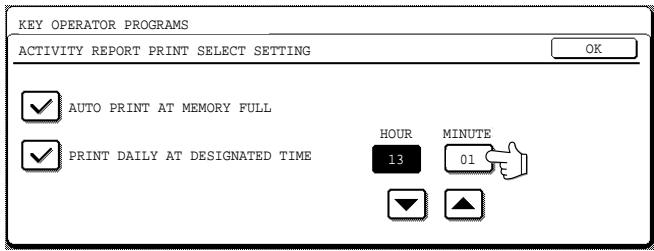
Touch the HOUR key and then set the hour by touching the ▼ and ▲ keys. Set the minute in the same way. When finished, touch the OK key.
NOTES
- If you only select the PRINT DAILY AT DESIGNATED TIME setting and the number of recorded transactions exceeds 50 before the specified time, each new transaction will delete the oldest transaction (the oldest transaction will not be printed).
- The activity report can also be printed out on demand (page 8-10).
ECM
(This setting is only effective if the other machine is a G3 machine that supports ECM)
Line conditions can sometimes distort a transmitted fax image. When ECM (Error Correction Mode) is turned on, pages that are distorted are automatically re-transmitted. This setting is initially turned on. If turned off, distorted images will be transmitted without being corrected.
NOTE
If the other machine supports Super G3, ECM will function regardless of the setting.
Distinctive ring detection
If multiple telephone numbers have been assigned to your telephone line, the number called can be identified by its ringing pattern. By using one number for voice calls and another number for faxes, you can tell which type of call you are receiving by the ringing pattern. You can set your machine to automatically receive faxes when your fax number is called by setting the pattern that corresponds to your fax number. Six selections are available. Normally OFF is selected.
Fax send settings
The fax transmission settings allow you to adjust certain parameters for sending faxes to better suit your needs.
The fax send settings are as follows:
● Auto reduction sending setting ● Rotation sending setting ● Printing page number at receiver ● Call timer at memory sending ● Date/own number print position setting
● Recall in case of line busy
● Recall in case of communication error
● Times of recall setting in case of line busy
● Interval of recall setting
● Quick on line sending
Auto reduction sending setting
This setting lets you select whether to have a transmitted document reduced to match the size of the other machine's printing paper. Auto reduction is normally turned on. If the setting is turned off, documents are sent in their original size. Because the size is not adjusted to match the size of the printing paper, part of the received document may be cut off.
Rotation sending setting
When transmitting a document, this setting allows you to rotate a vertically oriented 8-1/2"x11" document to a horizontal orientation (8-1/2"x11"R), or rotate a 5-1/2"x8-1/2R" document to 5-1/2"x8-1/2". The setting is normally turned on, and documents are rotated counterclockwise. (8-1/2"x11"R documents are not rotated.)
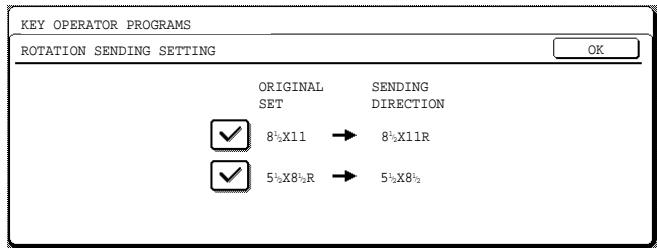
Rotation settings can be separately established for different document sizes. To turn off a rotation setting, touch the checkbox of the appropriate setting to remove the checkmark.
Printing page number at receiver
This setting lets you select whether page numbers are printed at the top of fax pages by the receiving machine. The normal setting is to have page numbers printed.
Call timer at memory sending
When sending a fax by automatic transmission, this setting lets you select the amount of time that the machine waits before breaking the connection when the other machine does not respond to your machine's calling tone. If the other machine does not respond within this set time, your machine will automatically break the connection. Time selections are 30 seconds, 45 seconds, and 60 seconds. This setting is normally set to 45 seconds.
Date/own number print position setting
This setting lets you select the position (inside or outside the original image) of the sender's name and number that are printed at the top of each fax page you send. Normally OUTSIDE THE ORIGINAL IMAGE is selected. To have your name and number printed inside the original image, select INSIDE THE ORIGINAL IMAGE. For more detailed information on the position of each setting, refer to page 3-9.
Recall in case of line busy
When sending a document, this setting is used to select whether your machine will automatically re-attempt the call when the other machine fails to answer or the line is busy. Normally your machine is set to re-attempt the call, and you can set the number of attempts and the interval between attempts with the "times of recall setting in case of line busy" and "interval of recall" settings below.
NOTE
Even if this setting is turned on, your machine will not re-attempt the call when a document is sent by manual transmission.
Recall in case of communication error
When sending a document, this setting is used to select whether your machine will re-attempt the call if the transmission fails due to a line error. Normally your machine is set to not automatically re-attempt the call. To set the machine to automatically re-attempt the call, touch the box so a checkmark appears, and then adjust the "interval of recall" setting below. Note that only one re-attempt is made (the number of re-attempts cannot be selected).
NOTE
Even if this setting is turned on, your machine will not re-attempt the call when a document is sent by manual transmission.
Times of recall setting in case of line busy
If you have set the machine to re-attempt a call when a fax transmission is not successful due to the line being busy, this setting lets you select the number of times the machine re-attempts the call. You can select any number from 1 to 14. Normally the number is set to "2".
Interval of recall setting
If you have set the machine to re-attempt a call when a fax transmission is not successful due to the line being busy or a communication error, this setting lets you select the interval at which the machine re-attempts the call (the attempt is stored as a transmission job). You can select any number of minutes from 1 to 15. Normally the number of minutes is set to "3".
Quick on line sending
When this setting is turned on, the machine will call the other machine and start transmitting the document as soon as the first page is scanned. Transmission therefore takes place at the same time as any further pages are being scanned. Normally this setting is turned on.
If you turn the setting off, transmission will not begin until all pages of the document have been scanned. Note that this setting does not apply to manual transmission.
Fax receive settings
The fax reception settings allow you to adjust certain parameters for receiving faxes to better suit your needs. Settings that can be adjusted depend on the peripheral devices installed.
The fax receive settings are as follows:
●Auto receive reduce setting ●Number of calls in auto reception ●Duplex reception setting (only when the duplex module is installed) ●Print style setting ●Set the telephone number for data forwarding ●Fax separator page ●Output tray setting
Auto receive reduce setting
When you receive a fax that includes the sender's name and number, the received image is slightly larger than the standard size. This setting lets you select whether to have the received image automatically reduced before printing to fit the standard size. Normally automatic reduction is turned on.
NOTE
If you turn automatic reduction off, the overall printed image may be larger than the original and in some cases must be split onto two pages. However, the printed image of the original itself will be the same size as the original, and thus clearer.
Number of calls in auto reception
This setting is used to select the number of rings on which the machine automatically receives a call and begins fax reception when the reception mode is set to auto. You can select a number of rings from 0 to 15. Normally "2" is selected.
NOTE
If you select "0" for the number of rings, the machine will immediately answer and begin fax reception without ringing in auto reception mode.
However, do not select "0" when an extension phone is connected to the machine.
Duplex reception setting
(only when the duplex module is installed)
When the duplex module is installed, you can use this setting to select whether received documents are printed on both sides of the paper. Normally this setting is turned off. If turned on, received documents will be printed on both sides of the paper whenever the received document consists of two or more pages of the same paper size.
Print style setting
This setting determines the selection condition for paper when printing received documents. Select one of the three conditions below. AUTO SIZE SELECT is normally selected.
• PRINT ACTUAL SIZE CUT OFF DISABLED: Each received image is printed at actual size without splitting the image onto multiple sheets of paper. If there is no paper available that is the same size as the image or greater, the entire document is temporarily stored in memory. • PRINT ACTUAL SIZE CUT OFF ENABLED: Each received image is printed at actual size. If necessary, the image is split onto multiple sheets of paper. • AUTO SIZE SELECT: Each received image is printed at actual size when possible. When not possible, the image is automatically reduced before printing.
Set the telephone number for data forwarding
When a problem prevents the machine from printing a received fax, the transfer function (page 3-12) can be used to forward the received fax to another fax machine. Use this setting to program the fax number of the destination fax machine. Only one fax number can be programmed (maximum of 64 digits).
If you wish to specify an F-code confidential memory box in the destination machine, touch the SUB ADDRESS key after entering the fax number to enter a slash "/", and then enter the sub-address. Enter a passcode as well if needed.
Fax separator page
This setting is used to have the machine output a blank sheet of paper after printing each received fax. The blank sheet acts as a separator between received faxes, making it easy to distinguish where one fax ends and another begins. This setting is normally turned off.
If you wish to have the machine insert separator sheets between faxes, touch the box to remove the checkmark.
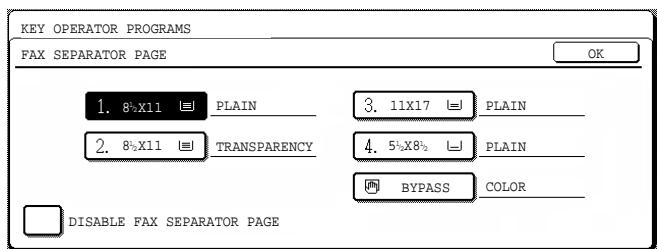
When the setting is turned on, the tray keys can be touched. Select the tray from which you would like the separator paper to be drawn.
Output tray setting
This setting is used to select the output tray for received faxes. The trays that can be selected will vary depending on what peripheral devices have been installed.
Fax polling security
These settings are for using the Public Box for polling memory. Note that they do not apply to F-code polling memory.
The fax polling security are as follows:
●Polling security setting ●Passcode number setting ●Set number of times public box may be polled
Polling security setting
When performing polling memory, this setting is used to select whether any machine will be allowed to poll your machine, or only machines that have been programmed in your machine. Polling security is normally turned on (a checkmark appears in the box). To allow any machine to poll your machine, touch the box to remove the checkmark.
Passcode number setting
When the polling security setting is turned on, use this setting to program (or delete) the fax numbers of the machines that are allowed to poll your machine. Programmed fax numbers are called passcodes. Up to 10 fax numbers can be programmed.
Programming passcode numbers
1 Touch the ENTER key.
The passcode entry screen appears.
2 Touch a blank key (a key in which no number appears).
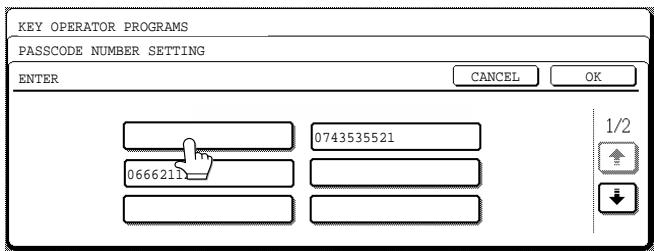
Keys with numbers cannot be touched. If numbers have been stored in all of the keys, a message will appear and no further numbers can be stored. First delete a number that is no longer needed and then store the new number.
3 Press the numeric keys to store the fax number.
Up to 20 digits can be entered.
To enter a space, touch the SPACE key. To enter a "+", press the "*" key.
If you make a mistake, press the C key.
4 Touch the OK key.
You will return to the screen of step 2 and the stored fax number will appear. To store another number, repeat steps 2 through 4.
Deleting a passcode
1 Touch the DELETE key. The passcode delete screen appears.
2 Touch the key of the number you wish to delete.
Touch the YES key in the message that appears to delete the number. If you touch the NO key, you will return to the passcode delete screen without deleting the number.
Set number of times public box may be polled
This setting is used to select whether the document stored in the Public Box is automatically cleared after one polling transmission (polling memory), or whether the document is left in the Public Box to allow polling an unlimited number of times.
Normally the machine is set to automatically clear the document after transmission (the ONCE key is highlighted), so that polling can only take place once. If you wish to leave the document in the Public Box to allow polling an unlimited number of times, select the UNLIMITED key.
PRINTING OUT SETTINGS
Settings established with the key operator programs can be verified by printing them out.
1 Press the CUSTOM SETTINGS key.
2 Touch the KEY OPERATOR PROGRAMS key.![graph TD A["DISPLAY CONTRAST"] --> B["ADDRESS CONTROL"] C["LIST PRIN"] --> B D["RECEIVE MO"] --> B E["KEY OPERATOR PROGRAMS"] --> B](/content/2024/12/122344/images/bbe2f3bffbcaa5c4e59cf86245f6fcbbb186f8444d6224bcc2e29c293488daf0.jpg)
3 Touch the LIST PRINT key.![graph TD A["ON"] --> B["DEVICE CONTROL"] C["END"] --> D["LIST PRINT"]](/content/2024/12/122344/images/997971a1872cbec8e6c9eee0b275c00a775caac75583f13ea2d3a9063da1c014.jpg)
4 Touch the ALL KEY OPERATOR PROGRAMS LIST key.![graph TD A["ALL KEY OPERATOR PROGRAMS LIST"] --> B["SENDER LIST"] B --> C["IMAGE SENDING ACTIVITY REPORT"]](/content/2024/12/122344/images/b343bb51a750ee092bbcc5f610f1aab62c0eb830bdec257319b3127c894b788d.jpg)
PROCESSING PRINT DATA appears in the message screen and printing begins. To cancel printing, touch the CANCEL key.
NOTES
- The list is printed before other jobs waiting to be printed.
- In the screen of Step 4, you can touch the SENDER LIST key to print the Sender List. This allows you to check the name and fax number you programmed in "Own number and name set" on page 8-4.
- In the screen of Step 4, you can touch the IMAGE SENDING ACTIVITY REPORT key to print an activity report (transmissions and receptions). Print this list when you wish to check the activity record.
CHAPTER 9
APPENDIX
This chapter contains reference information regarding the fax features of the machine.
Page
SPECIFICATIONS 9-2
SPECIFICATIONS
For information on power requirements, power consumption, dimensions, weight, and other specifications that are common to all features of the machine, refer to page 6-2 of "Operation manual (for printer operation and general information)".
For the specifications of the scanner unit, refer to "Operation manual (for copier)".
| Applicable telephone line | Public switched telephone network |
| Compression method | MH, MR, MMR, JBIG |
| Transmission modes | Super G3, G3 (the machine can only send faxes to and receive faxes from machines that support G3 or Super G3) |
| Scanning method | CCD flatbed scanning |
| Scanning resolution | 200 x 100 dpi (Standard) |
| (Supports ITU-T standards) | 200 x 200 dpi (Fine, Fine-Halftone) |
| 300 x 300 dpi (Super Fine, Super Fine - Halftone) | |
| 400 x 400 dpi (Ultra Fine, Ultra Fine - Halftone) | |
| Printing method | Electrophotographic system (laser) |
| Transmission speed | 33.6 kbps → 2.4 kbps Automatic fallback |
| Transmission time*1 | 2 seconds (Super G3 mode / 33.6 kbps, JBIG), 6 seconds (G3 ECM mode / 14.4 kbps, MMR) |
| Paper sizes | 11"x17" to 5-1/2"x8-1/2", A3, B4, A4, B5, A5 |
| Effective print width | 11" max. (11"x17" printing) |
| Input document size | 11"x17" to 5-1/2"x8-1/2" (5-1/2"x8-1/2": Vertically-oriented feeding); Maximum length: 31-1/2" (using DSPF)*Refer to pages 2 - 4 for transmission of 5-1/2"x8-1/2" size documents. |
| Effective scanning width | 11.7" maximum |
| Halftone transmission | Yes (256 levels) |
| Contrast adjustment | Automatic (dark and light by manual adjustment) |
| Extension telephone connection | Possible (1 telephone) |
| Auto dialing | Combined total of 500 one-touch and group keys, redialing (automatic) |
| Timer transmission | Yes |
| Program function | Yes (8 programs) |
| F-code support | Yes (can transmit and receive SUB/SEP (sub-address) and SID/PWD (passcode) signals) |
| Automatic document feeding | Yes (50 pages; 8-1/2"x14" or larger sizes: 30 pages) |
| Image memory | 2 MB*2 |
| Error Correction Mode (ECM) | Yes |
*1 Transmission speed is for an 8-1/2"x11" document with approximately 700 characters at standard resolution (8x3.85 lines/mm) sent in high speed mode (33.6 kbps (JBIG) or 14.4 kbps (MMR)). This is only the time required to transmit the image information; the time required to send protocol signals is not included. Actual transmission times will vary depending on the contents of the document, the receiving machine type, and telephone line conditions. *2 Image memory can be expanded by installing the optional fax expansion memory (8 MB).
Some discrepancies may exist in the illustrations and content due to improvements to the machine.
NOTE
NOTE
SHARP CORPORATION
SHARP®
LASER PRINTER
Operation manual
(for printer operation and general information)
Be sure to become thoroughly familiar with this manual to gain the maximum benefit from the product.
Before installing this product, be sure to read the installation requirements and cautions sections.
Be sure to keep all operation manuals handy for reference, including this manual, the "Operation manual for printer operation and general information," and operation manuals for any optional equipment that has been installed.
The power switch positions are marked "I" to indicate power "ON" and "⬇" to indicate stand-by. In the stand-by position, power is being supplied to a drying heater within the optical system of the copier.
Caution:
For complete electrical disconnection, pull out the main plug.
The socket-outlet shall be installed near the equipment and shall be easily accessible.
To protect against loss or theft, record and retain for reference the printer's serial number located on the back of the unit.
Model Number
Serial Number
Date of Purchase
Place of Purchase
Authorized Sharp Printer
Service Department Number
Warranty
While every effort has been made to make this document as accurate and helpful as possible, SHARP Corporation makes no warranty of any kind with regard to its content. All information included herein is subject to change without notice. SHARP is not responsible for any loss or damages, direct or indirect, arising from or related to the use of this operation manual.
© Copyright SHARP Corporation 2001. All rights reserved. Reproduction, adaptation or translation without prior written permission is prohibited, except as allowed under copyright laws.
Trademark Acknowledgments
Microsoft Windows, MS-DOS, and Windows NT are trademarks of Microsoft Corporation in the U.S.A. and other countries.
Macintosh, Power Macintosh, Mac OS, LaserWriter, and AppleTalk are registered trademarks of Apple Computer, Inc.
IBM, PC/AT, and PowerPC are trademarks of International Business Machines Corporation.
Pentium is a registered trademark of Intel Corporation.
PCL is a trademark of the Hewlett-Packard Company.
PostScript® is a registered trademark of Adobe Systems Incorporated.
NetWare is a registered trademark of Novell, Inc.
All other trademarks and copyrights are the property of their respective owners.
INSTALLATION REQUIREMENTS
Improper installation may damage this product. Please note the following during initial installation and whenever the machine is moved.
- The machine should be installed near an accessible power outlet for easy connection.
- Be sure to connect the power cord only to a power outlet that meets the specified voltage and current requirements. Also make certain the outlet is properly grounded.
- For the power supply requirements, see the name plate of the main unit.
- Do not install your machine in areas that are:
- damp, humid, or very dusty
- exposed to direct sunlight
- poorly ventilated
- subject to extreme temperature or humidity changes, e.g., near an air conditioner or heater.
- Be sure to allow the required space around the machine for servicing and proper ventilation.
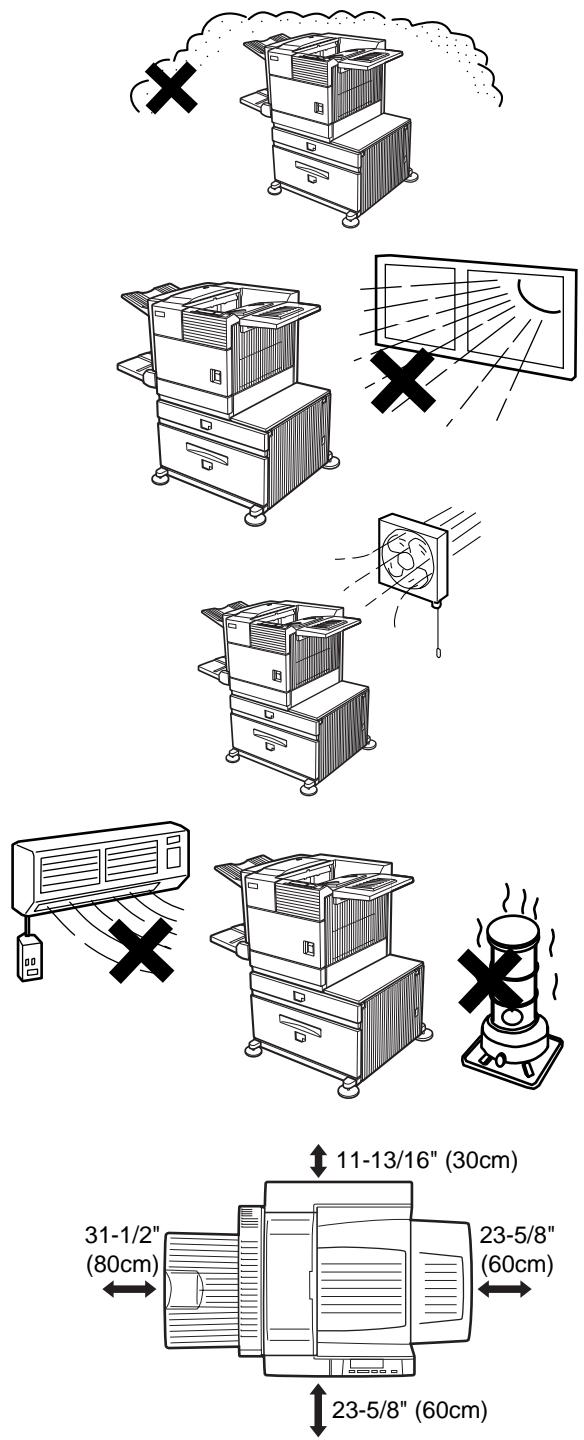
A small amount of ozone is produced within the printer during operation. The emission level is insufficient to cause any health hazard.
NOTE:
The present recommended long term exposure limit for ozone is 0.1 ppm (0.2 mg/m³) calculated as an 8 hr. time-weighted average concentration.
However, since the small amount that is emitted may have an objectionable odor, it is advisable to place the copier in a ventilated area.
Moving this machine
Lift this machine at the positions shown in the illustration below and carry it horizontally.
CAUTION
Two people are required to lift and carry this machine.
The center of gravity of the machine is slightly to the left of the center of the machine when viewed from the front. If a duplex module is installed, the center of gravity will be even further shifted to the left. When lifting the machine, be careful to steady it to prevent it from toppling. Also be sure that all covers and the duplex module are securely closed and latched before lifting.
If a duplex module is installed, do not lift the machine by the module as it may come off, causing it and the machine to drop.
Remove the multi-purpose drawer and lift at the positions shown in the illustration.
For removal and installation of the multi-purpose drawer, see page 4-4. To avoid injury, be sure to completely remove the multi-purpose drawer.
Front side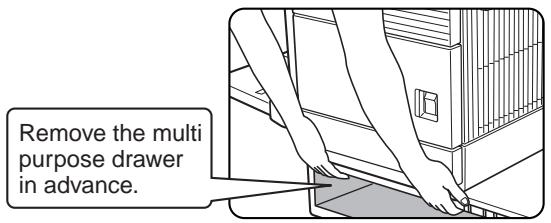
Rear side
If the machine has been placed on a stand/paper drawer:
The stand/paper drawer is on casters for moving. Unlock the adjusters of the stand/paper drawer and gently move the machine, taking care to steady it to prevent it from toppling.
For locking and unlocking the adjusters, see page 0-3.
CAUTION
The center of gravity of this machine is a little deviated to the left from the center. If the machine is not equipped with a multi-purpose drawer or a stand/paper drawer, take care in opening the left side cover (or the duplex module) not to cause toppling of the machine.
CAUTIONS
- Do not touch the photoconductive drum. Scratches or smudges on the drum will cause dirty prints.
- The fusing unit is extremely hot. Exercise care in this area.
- Do not look directly at the light source of the scanner module. Doing so may damage your eyes.
- Five adjusters are provided on all optional stand/paper drawer units. These adjusters should be lowered until they contact the floor.
- Do not make any modifications to this machine. Doing so may result in personal injury or damage to the machine.
- Since this machine is heavy, it is recommended that it be moved by more than one person to prevent injury.
- When connecting this machine to a computer, be sure to first turn both the computer and the machine off.
- Do not print anything which is prohibited from printing by law. The following items are normally prohibited from printing by national law. Other items may be prohibited by local law.
- Money - Stamps - Bonds - Stocks
- Bank drafts - Checks - Passports
- Driver's licenses
Fusing unit
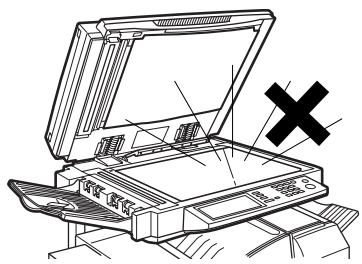
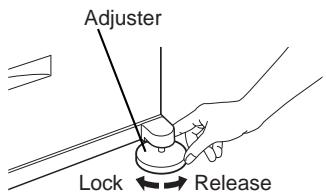
"BATTERY DISPOSAL"
THIS MACHINE CONTAINS A MANGANESE DIOXIDE BATTERY WHICH MUST BE DISPOSED OF PROPERLY. CONTACT YOUR SHARP DEALER OR SERVICER FOR INSTRUCTIONS.
This product utilizes tin-lead solder, and a fluorescent lamp containing a small amount of mercury. Disposal of these materials may be regulated due to environmental considerations.
For disposal or recycling information, please contact your local authorities or the Electronics Industries Alliance: www.eia.org
Cautions on laser
| Wave length | 785 nm +10 nm-15 nm |
| Pulse times | North America: 35 cpm model: (4.1 μs ± 4.1 ns)/7 mm45 cpm model: (5.7 μs ± 5.7 ns)/7 mmEurope: 35 cpm model: (3.8 μs ± 3.8 ns)/7 mm45 cpm model: (4.4 μs ± 4.4 ns)/7 mm |
| Output power | 0.2 mW - 0.4 mW |
At the production line, the output power of the scanner unit is adjusted to 0.4 milliwatt plus 8% and is maintained constant by the operation of the Automatic Power Control (APC).
Caution
This product contains a low power laser device. To ensure safety, do not remove any cover or attempt to gain access to the inside of the product. Refer all servicing to qualified personnel.
For North America:
SAFETY PRECAUTIONS
This Digital Equipment is rated Class 1 and complies with 21 CFR 1040.10 and 1040.11 of the CDRH standards. This means that the equipment does not produce hazardous laser radiation. For your safety, observe the precautions below.
- Do not remove the cabinet, operation panel, or any other covers.
- The equipment's exterior covers contain several safety interlock switches. Do not bypass any safety interlock by inserting wedges or other items into switch slots.
Caution
Use of controls or adjustments or performance of procedures other than those specified herein may result in hazardous radiation exposure.
For Europe:
CLASS 1 LASER PRODUCT
LASER CLASS 1
CLASS 1 LASER PRODUCT
CLASS 1 LASER APPARATUS
CAUTION
INVISIBLE LASER RADIATION WHEN OPEN INTERLOCKS DEFEATED. AVOID EXPOSURE TO BEAM.
CAUTION


CAUTION INVISIBLE LASER RADIATION WHEN OPEN AND INTERLOCKS DEFEATED. AVOID EXPOSURE TO BEAM. CAUTION INVISIBLE LASER RADIATION WHEN OPEN AND INTERLOCKS DEFEATED. AVOID EXPOSURE TO BEAM. WARNING INVISIBLE LASER RADIATION WHEN OPEN AND INTERLOCKS DEFEATED. AVOID EXPOSURE TO BEAM. WARNING INVISIBLE LASER RADIATION WHEN OPEN AND INTERLOCKS DEFEATED. AVOID EXPOSURE TO BEAM. WARNING INVISIBLE LASER RADIATION WHEN OPEN AND INTERLOCKS DEFEATED. AVOID EXPOSURE TO BEAM. WARNING INVISIBLE LASER RADIATION WHEN OPEN AND INTERLOCKS DEFEATED. AVOID EXPOSURE TO BEAM.
⚠ CAUTION (FOR SERVICE PERSONNEL)
FACSIMILE FEATURE
To extend the capabilities of this product to include facsimile functions, an optional facsimile expansion kit must be installed. Refer to the facsimile operation manual for details on using the facsimile features.
■ Line connection
Use the telephone cable supplied with the facsimile expansion kit to connect the machine to a telephone line. Connect the cable so that the connector nearest to the noise suppression core is inserted into the socket located on the expansion kit box. Insert the other end into the telephone line socket.
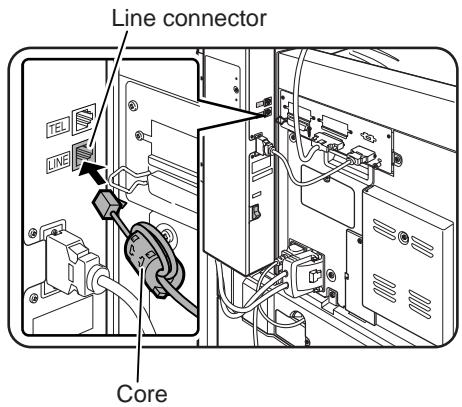
■ Fax power switch
For the facsimile features to function, the power switch located on the expansion kit box must be turned on.
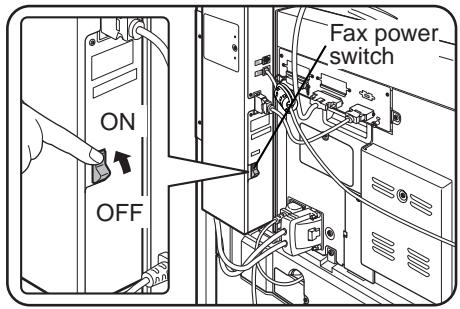
CONTENTS
INSTALLATION REQUIREMENTS 0-1
- Carrying this machine 0-2
CAUTIONS 0-3
FACSIMILE FEATURE 0-6
CONTENTS 0-7
CHAPTER 1
BEFORE USING THE PRODUCT
INTRODUCTION 1-2
MAIN FEATURES 1-3
PART NAMES AND FUNCTIONS 1-4
- Exterior 1-4
- Interior 1-5
- Part names and functions of peripheral devices 1-6
- Operation panel of the main unit.... 1-9
- Operation panel of the scanner module ..... 1-12
- Touch panel (on the scanner module) ..... 1-13
LOADING PAPER 1-16
- Loading paper in paper tray 1 ..... 1-16
- Changing the paper size in paper tray 1 ..... 1-16
- Specifications of paper trays 1-17
- Setting the paper size and type ..... 1-19
- Loading paper in the multi purpose drawer . . . 1-21
- Specifications (multi purpose drawer) ..... 1-23
- Loading paper in the stand/ 3 x 500 sheet paper drawer ..... 1-23
- Specifications (stand/3 x 500 sheet paper drawer) ..... 1-23
- Loading paper in the stand/ MPD & 2000 sheet paper drawer ..... 1-24
- Specifications (stand/MPD & 2000 sheet paper drawer) ..... 1-24
ADDING TONER 1-25
STORAGE OF SUPPLIES 1-25
CHAPTER 2
PRINTING FROM A COMPUTER
CONNECTING TO A COMPUTER 2-2
SOFTWARE FOR WINDOWS 2-2
INSTALLING PRINTER DRIVERS AND PRINTER UTILITIES 2-3
UNINSTALLING PRINTER DRIVERS AND PRINTER UTILITIES 2-3
INSTALLING PRINTER DRIVERS USING PLUG & PLAY OR THE "ADD PRINTER WIZARD" ..... 2-4
- Before installation 2-4
SETTING THE PRINTER DRIVER.... 2-5
- Printer driver settings under Windows (selecting and setting print conditions) ..... 2-5
PRINTER CONFIGURATION THROUGH THE NETWORK 2-6
SETTING THE PRINTER DRIVER.... 2-5
- Printer driver settings under Windows (selecting and setting print conditions) ..... 2-5
PRINTER CONFIGURATION THROUGH
THE NETWORK 2-6
- Environment required for accessing Web pages 2-6
- Accessing Web pages and displaying help . . . . 2-6
- Items and outline of menu frame of Web pages.... 2-7
JOB CONTROL 2-9
- “JOB CONTROL” operation 2-9
- Hold job list 2-10
- Printer account control 2-12
USING THE MACHINE AS A POSTSCRIPT
PRINTER 2-13
- Using the printer in the Windows environment 2-13
- Using the printer in the Macintosh environment 2-15
CHAPTER 3
PRINTER BASIC SETTINGS
MAKING CONFIGURATION SETTING ..... 3-2
- Operation procedure common to all printer configuration settings (items that can be set from the operation panel) 3-2
- Default settings 3-4
- PCL settings 3-4
- PostScript settings.... 3-4
CUSTOM SETTINGS.... 3-5
- Operation procedure common to all custom settings (items that can be set from the operation panel) 3-5
- Setting items 3-7
CHAPTER 4
TROUBLESHOOTING AND MAINTENANCE
MISFEED REMOVAL.... 4-2
- General misfeed removal procedure ..... 4-2
- Misfeed removal guidance 4-3
- Misfeed in the paper feed area 4-4
- Misfeed in the transport area, fusing area, and exit area 4-6
- Misfeed in the duplex module.... 4-7 TROUBLESHOOTING 4-8 USER MAINTENANCE 4-11
- Cleaning the scanner module ..... 4-11
CHAPTER 5
PERIPHERAL DEVICES
DUPLEX MODULE 5-2 - Part names 5-2 - Specifications 5-2 - Loading paper in the bypass tray 5-3 - Setting the printer driver for duplex module, bypass tray and exit tray 5-4 - Copying in the duplex mode 5-4 - Troubleshooting (concerning the duplex module) 5-5 MAIL-BIN STACKER 5-6 - Part names 5-6 - Specifications 5-6 - Specifying mail bins to receive printed output . 5-7 - Setting in the printer driver 5-7 - Misfeed in the mail-bin stacker 5-8 FINISHER 5-9 - Part names 5-9 - Specifications 5-9 - Finisher functions 5-10 - Using the finisher functions ..... 5-11 - Staple cartridge replacement 5-12 - Misfeed in the finisher 5-14 - Troubleshooting finisher problems ..... 5-15 - Stapling position quick reference guide for duplex output 5-16
SADDLE STITCH FINISHER 5-17
- Part names 5-17
- Specifications 5-17
- Saddle stitch finisher functions 5-18
- Using the saddle stitch finisher 5-20
- Staple cartridge replacement and staple jam removal.... 5-21
- Misfeed in the saddle stitch finisher ..... 5-24
- Troubleshooting (concerning the saddle stitch finisher) ..... 5-26
- Stapling position quick reference guide for duplex output 5-27
- Relation between print image and saddle stitch 5-28
CHAPTER 6
APPENDIX
PRINTER SPECIFICATIONS.... 6-2
- List of principal printer driver functions ..... 6-3
LIST OF COMBINATION OF PERIPHERAL DEVICES 6-4
NOTICE PAGE PRINTING 6-5
PRINT AREA 6-6
CHAPTER 1
BEFORE USING THE PRODUCT
This chapter describes basic information that should be read before using this product.
Page
INTRODUCTION 1-2
MAIN FEATURES 1-3
PART NAMES AND FUNCTIONS 1-4
● Exterior 1-4 ● Interior 1-5 ● Part names and functions of peripheral devices 1-6 ● Operation panel of the main unit 1-9 ● Operation panel of the scanner module 1-12 ● Touch panel (on the scanner module).... 1-13
LOADING PAPER 1-16
● Loading paper in paper tray 1 1-16 ● Changing the paper size in paper tray 1 1-16 ● Specifications of paper trays 1-17 - Setting the paper size and type 1-19 ● Loading paper in the multi purpose drawer.... 1-21 ● Specifications (multi purpose drawer) 1-23 ● Loading paper in the stand/3 x 500 sheet paper drawer ..... 1-23 ● Specifications (stand/3 x 500 sheet paper drawer) 1-23 ● Loading paper in the stand/MPD & 2000 sheet paper drawer ..... 1-24 ● Specifications (stand/MPD & 2000 sheet paper drawer) ...... 1-24
ADDING TONER 1-25
STORAGE OF SUPPLIES 1-25
INTRODUCTION
To gain the maximum benefits in using this product, it is recommended that the user read this manual to become familiar with all the features and functions of the basic product and the precautionary information contained in the manual.
NOTE
In this manual, American spellings are used.
This product is a high speed laser printer that can be extended to become multifunctional through the installation of optional peripheral devices. The product can be extended to include copier, network scanning, facsimile or network printing capabilities. This manual describes the basic use of the product as a printer and does not contain use information for any of the optional peripheral devices. Separate operation manuals are included with each of the optional peripheral devices. Refer to these manuals for their operation.
Original and paper sizes
This machine allows use of standard sizes in both the inch and AB systems.
The standard sizes available in this machine are shown below.
| Sizes in the inch system | |
| When the machine is being operated from the operation panel on the main unit: | When the machine is being operated from the touch panel on a scanner module: |
| LEDGER | 11 x 17 |
| LEGAL | 8-1/2 x 14 |
| FOOLSCAP | 8-1/2 x 13 |
| LETTER | 8-1/2 x 11 |
| EXECUTIVE | 7-1/4 x 10-1/2 |
| INVOICE | 5-1/2 x 8-1/2 |
| Sizes in the AB system |
| A3 |
| B4 |
| A4 |
| B5 |
| A5 |
In this manual, the indications for the scanner module touch panel as shown in the table above are used.
The meaning of "R" in original and paper size indications
Some original and paper sizes can be placed in either the portrait or landscape orientations. To differentiate between landscape and portrait, the landscape orientation size indication will contain an "R". These are indicated as 8-1/2 x 11R, 5-1/2 x 8-1/2R, A4R, B5R, etc. Sizes that can be placed only in the landscape orientation (11 x 17, 8-1/2 x 14, 8-1/2 x 13, A3, B4) do not contain the "R" in their size indication.
Size indication with "R"
Landscape orientation
Size indication without "R"

Portrait orientation
MAIN FEATURES
Laser printer able to accept a range of peripherals allowing it to be configured to specific needs
This product is a laser printer that can be used as a local printer which can be configured by the addition of peripheral devices to extend its capabilities to include copier, network printer, network scanner or facsimile features.
A range of optional units to enhance productivity
Optional additions such as duplex units for producing two-sided output, additional paper feed units to increase the variety of available paper sizes and paper capacity, paper output units to sort and otherwise organize the output and a scanner module for automatically scanning documents.
600 dpi high resolution printing
High-definition and high quality printing with 600 dpi resolution can be performed. Also high image quality equivalent to 1200 dpi can be output by using a smoothing function.
High speed monochrome printing
Depending upon the model chosen, high speed printing at 35 letter (A4) size pages/minute or 45 letter (A4) size pages/minute is available.
PostScript compatible
Installation of a PS3 expansion kit gives PostScript compatibility (PostScript level 3).
Energy saving features
This product has the following two power reducing modes that conform to the Energy Star guidelines which help to conserve natural resources and reduce environmental pollution.
Preheat mode
The preheat mode is the first level of power reduction. The power is reduced to the fuser unit a preset time after the machine has completed a job and no further machine operations have been made. The machine can recover to the ready condition within a short period of time. The preset time to enter the mode can be set by a key operator program.
Auto power shut-off mode
The auto power shut-off mode is the second level of power reduction. In this mode power is shut off to the fusing unit and the touch panel. In this state more energy is saved than in the preheat mode but the time to recover to the ready condition will be longer. The preset time to enter this mode can be set by a key operator program.

As an ENERGY STAR® Partner, SHARP has determined that this product meets the ENERGY STAR® guidelines for energy efficiency.
When this product is used as a printer, and either of the above modes is active, the mode will be deactivated automatically by an incoming job and the machine will automatically warm up and start to print when it has reached the ready temperature.
When this product is configured for multi-function operation, and either of the above modes is active, the mode will be deactivated as above by either an incoming print job or received facsimile data. Either mode will also be deactivated by any key operation on the operation panel or by the action of an original being placed for copying or facsimile transmission.
PART NAMES AND FUNCTIONS
Exterior
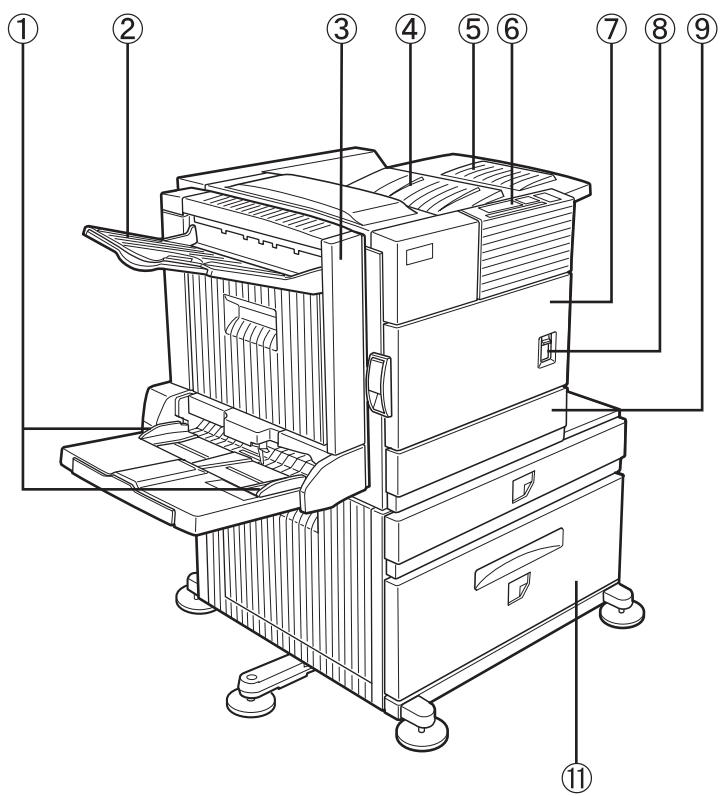
① Bypass tray paper guide
② Exit tray*
③ Duplex module/bypass tray*
Module for two-sided printing
④ Upper paper output area
Finished sheets are deposited here.
⑤ Upper exit tray extension*
Provides support for large size paper.
⑥ Operation panel (See page 1-9.)
⑦ Front cover
Open to add toner.
⑧ Main switch
Press to turn power on and off.
⑨ Paper tray 1
⑩ Stand/3 x 500 sheet paper drawer* (See page 1-23.)
⑪ Stand/MPD & 2000 sheet paper drawer* (See page 1-24.)
⑫ Multi purpose drawer* (See page 1-21.)
* ②, ③, ⑤, ⑩, ⑪, and ⑫ are peripheral devices. For description of these devices, see page 1-7. One of devices ⑩, ⑪, and ⑫ must be installed. If you install ⑩ or ⑪, a power supply unit (page 1-8) must also be installed.
Interior
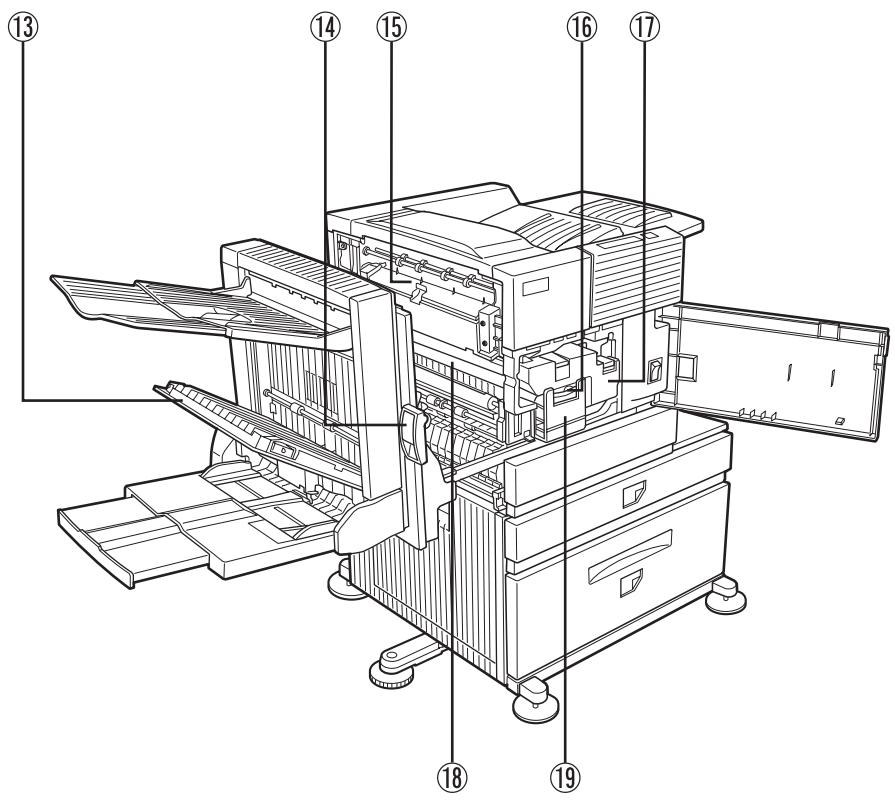
⑬ Duplex module side cover
Open when a misfeed has occurred in the duplex module.
⑭ Side cover latch
Push up to open the side cover when a misfeed has occurred in the main unit.
⑮ Fusing unit
Lift up to open the side cover when a misfeed has occurred in the main unit.
CAUTION
The fusing unit is hot. Take care in removing misfed paper.
⑯ Developer cartridge*
This cartridge contains developer and must be removed and replaced by a new cartridge when indicated on the operation panel.
⑰ Toner cartridge (drum/toner cartridge)*
The toner cartridge must be replaced when indicated on the operation panel.
⑱ Photoconductive drum
Images are formed on the photoconductive drum.
NOTE
Do not touch or damage the photoconductive drum.
⑲ Cartridge lock lever
When replacing the drum, toner or developer cartridge, turn down this lever and pull it out.
Part names and functions of peripheral devices
![graph TD A["①"] --> B["②"] B --> C["③"] C --> D["④"] D --> E["⑤"] E --> F["⑥"] F --> G["⑦"] G --> H["⑧"] H --> I["⑨"] I --> J["⑩"] J --> K["⑪"]](/content/2024/12/122344/images/86501cb9d0a5191f8e58993e442eab575d9c0e382fd5c1783110aa70ab5ab231.jpg)
① B/W scanner module/DSPF (AR-EF1)
This unit is a monochrome scanner that uses two scanning modes. In one mode, sheet originals are fed and scanned by the action of the moving originals. In this mode either one side of an original can be scanned or both sides of an original can be scanned at the same time. The other mode of scanning uses a moving mirror for scanning originals placed on the glass platen.
② Upper exit tray extension (AR-TE4)
Mount this unit to the upper paper exit tray. This extension is needed to support large size paper.
③ Finisher (AR-FN6)
Output sheets can either be sorted in page order or grouped by page. Sorted sets or groups are offset stacked for easy separation when removed. Sorted sets can be delivered either stapled or unstapled.
④ Mail-bin stacker (AR-MS1)
This unit is an output sorter that has seven receiving bins.
The bin to receive printed output can be selected in the printer driver. Each bin can be assigned to receive printed output by an individual person or by groups of people so that their prints are separated from other users making them easy to retrieve.
When this unit is installed, any copies or facsimile prints will be sent to the top tray and not into the mail bins.
⑤ Stand/MPD & 2000 sheet paper drawer (AR-D13)
This paper feed unit contains an upper multi-purpose drawer (see item ⑥) and a lower drawer which can hold a maximum of 2000 sheets of 20 lbs. (80 g/m²) paper.
⑥ Multi purpose drawer (AR-MU1)
Up to 500 sheets of 20 lbs. (80 g/m²) paper can be loaded. Also special papers such as envelopes (standard sizes only) and postcards can be set.
⑦ Stand/3 x 500 sheet paper drawer (AR-D14)
This paper feed unit contains an upper multi-purpose drawer (see item ⑥) and two lower drawers each of which can hold a maximum of 500 sheets of 20 lbs. (80 g/m²) paper.
⑧ Saddle stitch finisher (AR-FN7)
The saddle stitch finisher can automatically place two staples for centerline binding of prints or copies and fold them along the centerline.
An optional hole punch module (AR-PN1B) is available for installation into the finisher.
⑨ Duplex module (AR-DU3)
An optional duplex module must be installed for automatic two-sided printing.
⑩ Duplex module/bypass tray (AR-DU4)
This module is basically the same as ⑨ above with the addition of a manual bypass paper feed unit.
⑪ Exit tray (AR-TE3)
Mounted to the paper output port of a duplex module.
Some peripheral devices cannot be installed together while others may require the installation of one or more others to be functional. See page 6-4, "LIST OF COMBINATION OF PERIPHERAL DEVICES."
Peripheral devices are basically optional, but some are provided as standard equipment for some models.
■ Other optional equipment
- Scanner rack (AR-RK1)
This rack is required to support the scanner module above the printer.
● Power supply unit (AR-DC1)
Some peripheral devices require the installation of this power supply.
- Print server card (AR-NC5J)
A NIC (network interface card) is necessary for connecting the printer to a network.
- Multi-function controller board (AR-M11)
This print controller is necessary to provide copier, facsimile and network scanning capabilities.
• PS3 expansion kit (AR-PK1)
This kit provides compatibility of PostScript level 3 to the printer.
- Hard disk drive (AR-HD3)
Extends the image storing capacity for the printer and copier features. This unit is required for the job retention function (see page 2-9) to operate.
- Facsimile expansion kit (AR-FX5)
This kit is required to add facsimile features.
• Additional fax memory (8 MB) (AR-MM9)
• Network scanner expansion kit (AR-NS2)
This kit is required to add the network scanning feature.
Operation panel of the main unit
The display and indicators show the current status of the printer. All printer settings are made by using the keys and display panel.
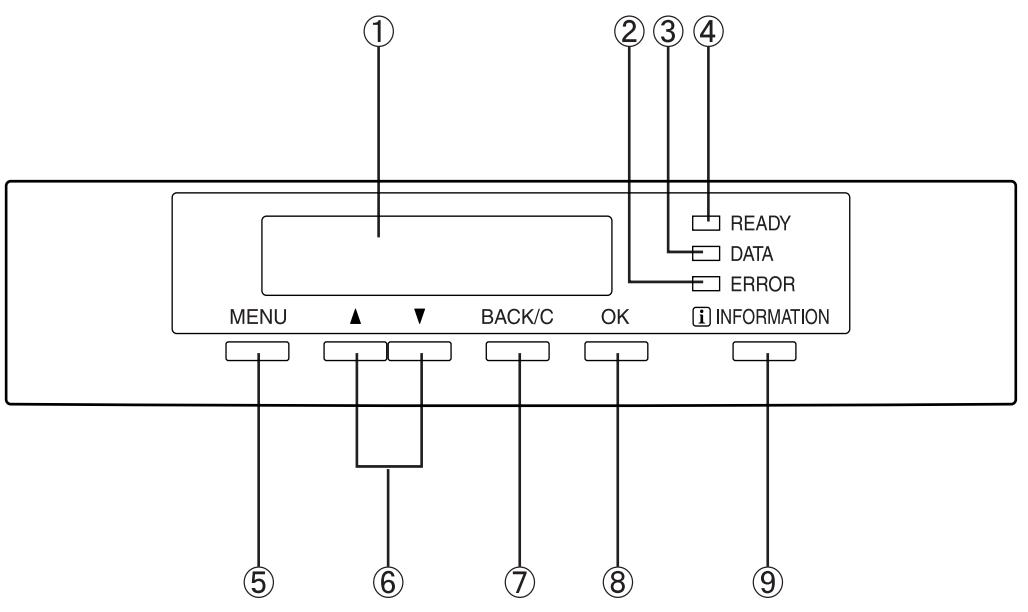
① Message display
Displays the current status of the printer.
[ i ] displayed in any message indicates that the [INFORMATION] key should be pressed.
② [ERROR] indicator
Lights up when paper or toner must be added or when a misfeed has occurred in the machine. Blinks when an abnormal condition has occurred in the machine.
③ [DATA] indicator
Lights up or blinks when print data is being received or output. Also lights up when job data is stored by the job retention function (page 2-9).
④ [READY] indicator
Print data can be received when this indicator is lit.
⑤ [MENU] key
Press to select a menu group such as printer configuration menu (page 3-2), custom settings (page 3-5) or execution of print jobs held by the retention function (page 2-9). Also, press to return to the job status screen from the setting screen of each job status group.
⑥ [▲/▼] keys
Press to select menu or function items or to set numerical values for those items.
⑦ [BACK/C] key
Use this key to return to the previous screen in each menu selection, to cancel and delete the current job or to delete a reserved job that has been selected.
⑧ [OK] key
Press to register the selected menu or function.
⑨ [INFORMATION] key
When [i] is displayed with a message indicating a paper misfeed, the relevant operation procedure can be displayed by pressing the [INFORMATION] key. If the [INFORMATION] key or the [BACK/C] key is pressed while the operation procedure is displayed, the information mode will be canceled. If you press and hold down this key while printing is being performed or in standby, the total number of printed pages and quantity of toner remaining (as a percentage) will be displayed.
Menu group and explanation of the use of the keys on the main unit operation panel
The menu groups are classified into five groups and are selected consecutively by pressing the [MENU] key. If the [OK] key is pressed when the desired menu screen is displayed, a message will appear to indicate the next required operation.
![graph TD A["READY."] --> B["[MENU"] key] B --> C["PRINT JOBS ON HOLD"] C --> D["[MENU"] key] D --> E["SET OPERATIONS CONDITIONS"] E --> F["[MENU"] key] F --> G["CUSTOM SETTINGS"] G --> H["[MENU"] key] H --> I["KEY OPERATOR PROGRAMS"] I --> J["[MENU"] key] K["Job status screen\nThe message "WARM…](/content/2024/12/122344/images/575883007b6d2084a5835a9cf0be87abe33b7022ffe61d65c105ca32cfb04144.jpg)
Canceling a print job and deleting print data
- To cancel a print job in progress and delete the print data: Press the [BACK/C] key during printing. Printing will stop and a message asking for confirmation to delete the job will appear. To delete the data, press the [OK] key. To cancel deletion, press the [BACK/C] key. Printing will resume.
- To delete print data of a reserved job (jobs stored in the printer):
Print data transmitted from computers will be stored in this printer (up to 99 jobs) and will be printed sequentially. To delete print data of a reserved job before starting printing, press the [▲] or [▼] key to display the desired data in the message display. If you press the [BACK/C] key at this time, a confirmation message for deletion will appear. To delete the data, press the [OK] key.
To cancel deletion, press the [BACK/C] key. Printing will resume.
Operation panel of the scanner module
When the printer is equipped with a scanner module, the operation panel on the main unit will become inoperative and the panel on the scanner module must be used.
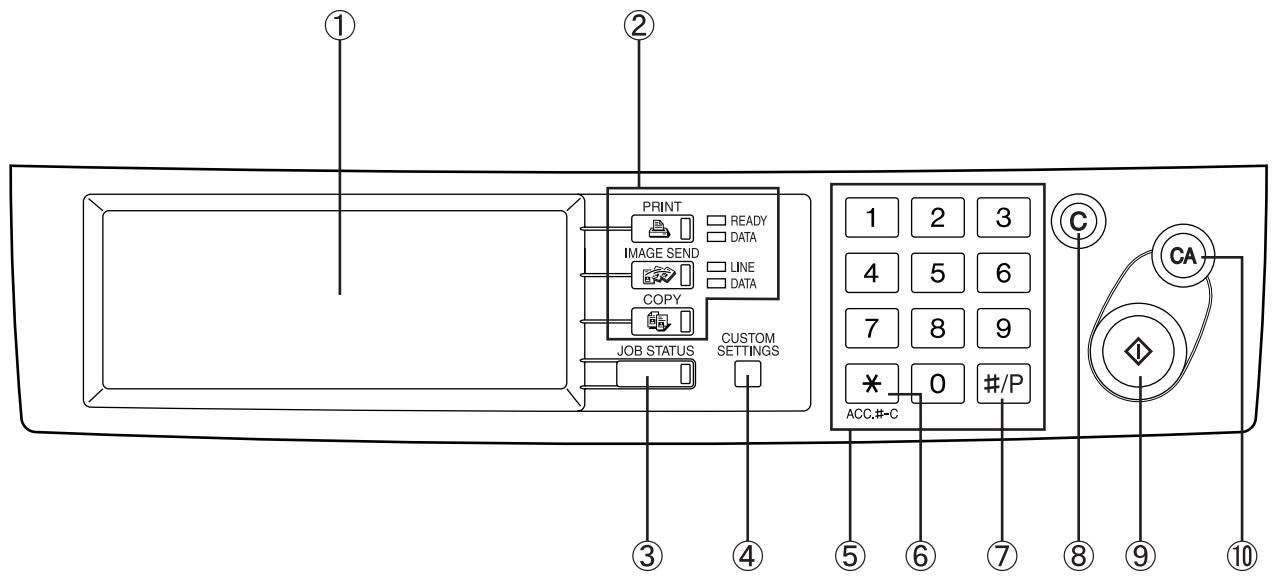
① Touch panel
The machine status, messages and touch keys are displayed on the panel. The display will change to show the status of print, copy, network scan or fax according to which of those modes is selected. For details see the next page.
② Mode select keys and indicators
Use to switch the display mode of the touch panel.
[PRINT] key/READY indicator/DATA indicator
Press to enter the print mode. (See next page.)
● READY indicator
Print data can be received when this indicator is lit.
- DATA indicator
Lights up or blinks when print data is being received. Also lights up or blinks when printing is being performed.
[IMAGE SEND] key/LINE indicator/DATA indicator
Press to enter the network scan/fax mode. (See the facsimile operation manual.)
[COPY] key
Press to select the copy mode.*
③ [JOB STATUS] key
Press to display the current job status. (See page 1-14.)
④ [CUSTOM SETTINGS] key
Use to adjust the contrast of the touch panel or to set key operator programs. (See page 3-5.)
⑤ Numeric keys
Use to enter number values for various settings.
⑥ [※] key ([ACC.#-C] key)
Use for account control for copying and fax sending.
⑦ [#/P] key*
This key is used as a program key for copy features and in dialing for fax features.
⑧ [C] key*
This key is active for copy and fax features.
⑨ Start key*
Use to start copying and fax jobs.
Functions in the copy and fax modes.
Touch panel (on the scanner module)
Print mode screen
This screen is displayed when the print mode is selected.
(The display varies with the mode. For the display in other modes, see their respective operation manuals.)
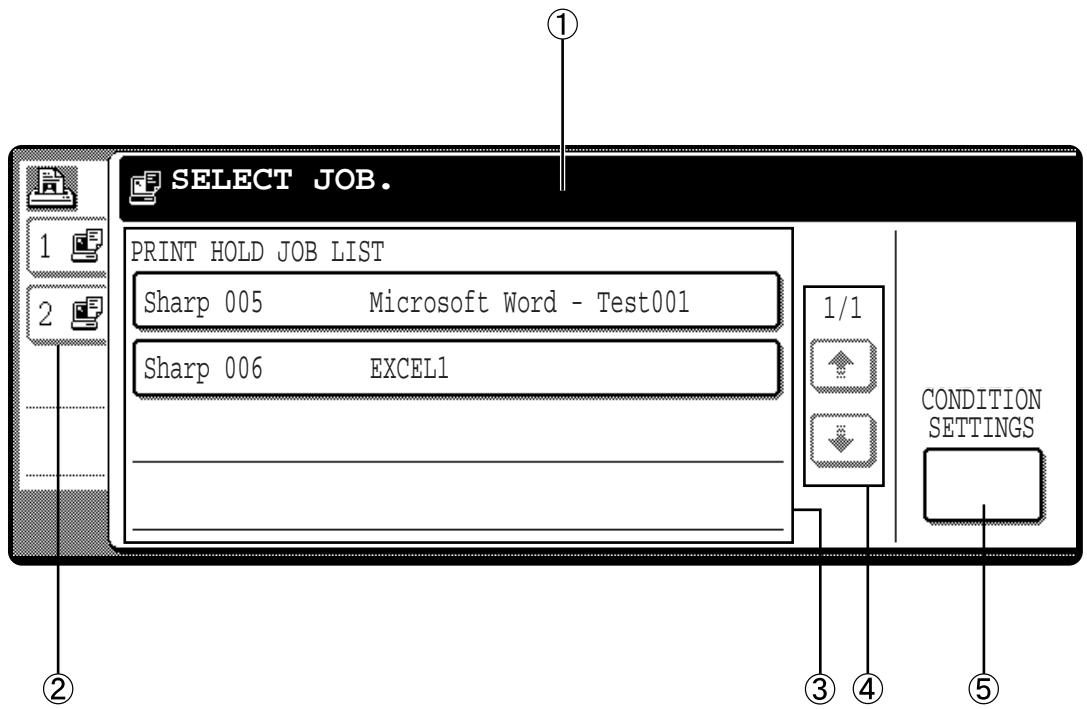
① Message display ② Job status screen (See next page.) ③ Print hold job list
If the job retention function (see page 2-9) is used, the list of stored print jobs is displayed here (up to 100 jobs). The job retention function can be used only if the printer is equipped with a hard disk drive unit. If the main switch is turned off, stored print data will be cleared.
④ Display scroll keys
Use these keys to view the job hold list when it is contained on more than one screen.
⑤ [CONDITION SETTINGS] key
Use to switch the display to the printer configuration menu (see page 3-2).
Job status screen (common to print, copy, network scan, and fax modes)
This screen is displayed when the [JOB STATUS] key on the operation panel is pressed.
A job list showing the current job at the top of the job queue or a list showing completed jobs can be displayed. The contents of the jobs can be viewed, moved up to the highest priority in the job queue or deleted from the queue.
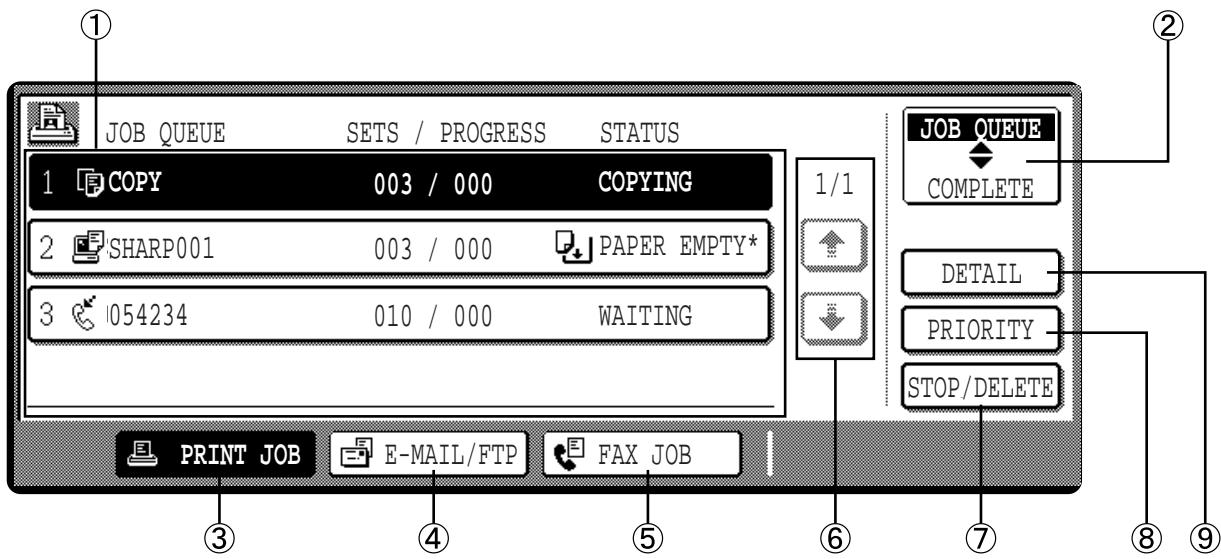
① Job list
A job list which indicates the current job and reserved jobs or a job list which indicates completed jobs is displayed. The icons to the left of the jobs in queue represent the job mode.

Print mode

Copy mode

Network scan mode

Fax mode (reception job)

Fax mode (transmission job)
When a job list which indicates the current job and reserved jobs is displayed, the displayed jobs themselves are operation keys. To cancel printing or to give a job the highest print priority, touch the relevant job key to select the job and execute the desired operation using the keys described in ⑦, ⑧, and ⑨.
* "PAPER EMPTY" in the job status display
When a job status display indicates "PAPER EMPTY", the specified size paper is not loaded in any tray to run that job.
In this case, printing is suspended for that job until the required paper is loaded.
Until the required paper is loaded, another reserved job data will be printed if possible.
(If paper runs out during printing, another job will not be printed.) If you wish to change the paper size because you do not have the specified size paper, you can change the size by touching the current job key to select it and touch the [DETAIL] key described in ⑨.
② Mode switching key
Use to switch the job list between "JOB QUEUE" and "COMPLETE".
"JOB QUEUE": Displays the list of the current job and the reserved jobs.
"COMPLETE": Displays the list of completed jobs.
③ [PRINT JOB] key
Use to display the print job list for all modes (print, copy, network scan, and fax).
④ [E-MAIL/FTP] key
Use to display the list of jobs that use the network for sending e-mail by SNMP protocol or sending to an ftp site or desktop by ftp protocol.
⑤ [FAX JOB] key
Use to display the fax communication status and the reserved transmission job status.
⑥ Display switching keys
Use to switch the page of the displayed job list.
⑦ [STOP/DELETE] key
Use to cancel or delete the current job or delete the selected reserved job. Received fax print jobs that have been reserved, however, cannot be deleted.
⑧ [PRIORITY] key
If you select a job among the reserved jobs in the "JOB QUEUE" job list to which you wish to give the highest priority and touch this key, the job will move to the highest priority reserved job.
⑨ [DETAIL] key
Use to display the detailed information of the selected job. The paper size for printing can be changed from the specified size. This function, however, cannot be used when a fax reception print job is selected.
Using the touch panel
■ How to use the touch panel
[Example 1]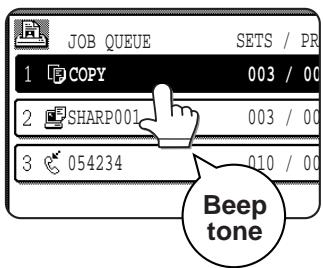
Items on the touch panel are easily selectable by touching the key associated with the item with a finger. Selection of an item will be accompanied with a beep tone to confirm the item was selected. Also, the key area for the item will be highlighted for visual confirmation.
[Example 2]
Keys which are grayed out on any screen are not selectable. If a grayed out key is touched, a double beep will be sounded.
The confirmation beeps can be disabled by a key operator program. (See page 9 of the Key Operator's Guide.)
■ Selection of function [Example 1]
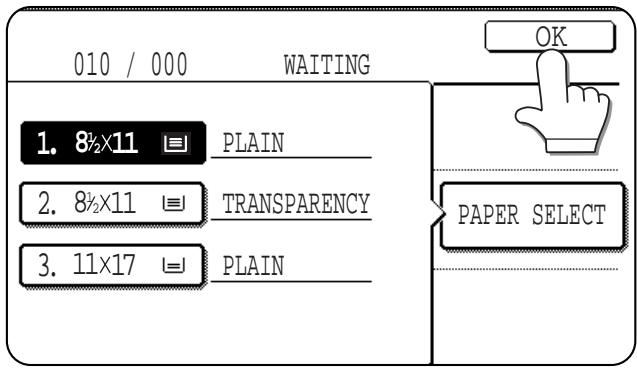
Items which are highlighted at the time a screen appears are already selected and will be registered to function if the [OK] key is touched.
[Example 2]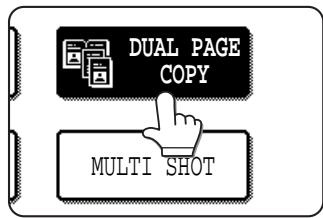
When the machine is used in the copy or fax modes, the functions shown below can only be set on the special feature screen. They can be set or cancelled by alternate touches on the panel.
| Copier feature | Facsimile feature |
| Dual page copyJob build | PollingDual page scan |
[Example 3]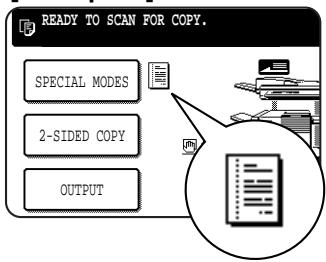
When the machine is used in the copy or fax modes and a special feature is selected, a corresponding icon representing the feature will appear on the touch key and on the main screen of the mode selected. If this icon is touched, the setting screen of the function (or a menu screen) will appear, allowing the settings to be checked or adjusted and the function to be canceled easily.
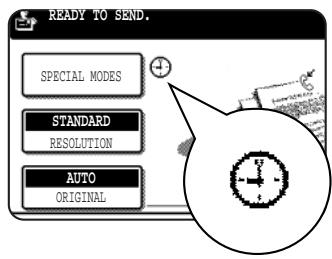
LOADING PAPER
The message “ADD PAPER” or “OPEN TRAY □□ AND ADD PAPER” will appear when paper runs out during operation. Follow the procedure below to load paper.
NOTES
- Do not use curled or folded paper. Doing so may cause a misfeed.
- For best results use paper supplied by SHARP. (See page 1-18.)
- When you change the paper type and size in paper tray 1, set the paper type and size referring to “Setting the paper size and type” (page 1-19).
- Do not place heavy objects or press hard on any tray which is pulled out.
Loading paper in paper tray 1
1 Pull out paper tray 1.
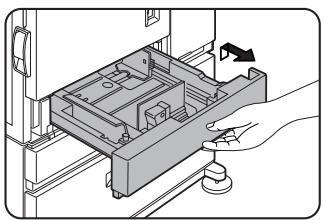
Gently pull the tray out until it stops.
2 Load paper into the tray.
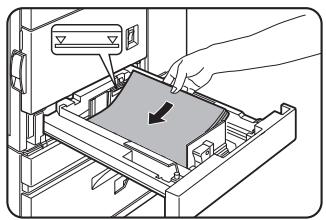
Do not load paper above the maximum height line (approximately 500 sheets of 20 lbs. (80 g/m²) paper).
3 Gently push tray 1 into the machine.
Push the tray firmly all the way into the machine.
4 Set the paper type.
If you change the paper type, be sure to set the paper type referring to "Setting the paper size and type" (page 1-19).
Loading paper in paper tray 1 is now complete.
Changing the paper size in paper tray 1
For paper tray 1, 8-1/2" x 11", A4, or B5 size paper can be set. Use the following procedure to change the size as needed.
1. Pull out paper tray 1.
If paper remains in the tray, remove it.
2. Adjust the guide plates A and B in the tray to the length and width of the paper.
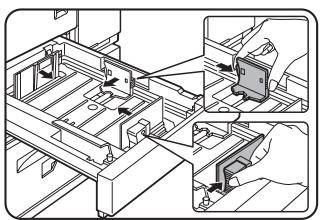
The guide plates A and B are slidable. Adjust them to the paper size to be loaded while squeezing their lock levers.
3. Load paper into the tray.
4. Gently push tray 1 into the machine.
Push the tray firmly all the way into the machine.
5. Set the paper size.
Be sure to set the paper size and paper type referring to "Setting the paper size and type" (page 1-19). If this is not done, paper misfeeds will occur.
6. Changing paper size in paper tray 1 is now complete.
Specifications of paper trays
The specifications for types and sizes of paper for loading paper trays are shown below.
| Tray | Tray No.(tray name) | Applicable paper types | Applicable paper sizes | Paper weight | ||
| Paper tray 1 | Tray 1 | Plain paper (Refer to the next page for applicable plain papers.) | 8-1/2 x 11, A4, B5 | 16 to 28 lbs. or 60 to 105 g/m2 | ||
| Multi purpose drawer/bypass tray | Tray 2/bypass tray | Plain paper (Refer to the next page for applicable plain papers.) | If "AUTO-INCH" is selected in setting the paper size and type (page 1-19), the following paper sizes can be used with the automatic detection function: 11 x 17, 8-1/2 x 14, 8-1/2 x 11, 8-1/2 x 11R, 7-1/4 x 10-1/2R, 5-1/2 x 8-1/2RIf "AUTO-AB" is selected in setting the paper size and type (page 1-19), the following paper sizes can be used with the automatic detection function: A3, B4, A4, A4R, B5, B5R, A5R, 8-1/2 x 13Non-standard sizes | 16 to 34 lbs. or 60 to 128 g/m2 | ||
| Special paper(Refer to the next page for applicable special papers.) | Thick paperLabels, transparency film | If "AUTO-INCH" is selected in setting the paper size and type (page 1-19), the following paper sizes can be used with the automatic detection function: 8-1/2 x 11, 8-1/2 x 11RIf "AUTO-AB" is selected in setting the paper size and type (page 1-19), the following paper sizes can be used with the automatic detection function: A4, A4R, B5, B5RNon-standard sizes smaller than 8-1/2 x 11 or A4 | See the remarks for special paper on the next page. | |||
| Postcard | Japanese official postcard | |||||
| Envelopes can only be fed from the multi-purpose drawer.Applicable paper stock weight for envelopes is 20 to 23 lbs. or 75 to 90 g/m2. | Applicable standard size envelopes: COM-10, Monarch, DL, C5, ISO B5Non-standard size | |||||
| Stand/3 x 500 sheet paper drawer | Upper | Tray 2 | Same as multi purpose drawer | |||
| Middle | Tray 3 | Plain paper (Refer to the next page for applicable plain papers.) | If "AUTO-INCH" is selected in setting the paper size and type (page 1-19), the following paper sizes can be used with the automatic detection function: 11 x 17, 8-1/2 x 14, 8-1/2 x 11, 8-1/2 x 11R, 7-1/2 x 10-1/2R, 5-1/2 x 8-1/2RIf "AUTO-AB" is selected in setting the paper size and type (page 1-19), the following paper sizes can be used with the automatic detection function: A3, B4, A4, A4R, B5, B5R, A5R, 8-1/2 x 13 | 16 to 28 lbs. or 60 to 105 g/m2 | ||
| Lower | Tray 4 | |||||
| Stand/MPD & 2000 sheet paper drawer | Upper | Tray 2 | Same as multi purpose drawer | |||
| Lower | Tray 3 | Plain paper (Refer to the next page for applicable plain papers.) | 8-1/2 x 11, A4 | 16 to 28 lbs. or 60 to 105 g/m2 | ||
Applicable plain paper
For satisfactory results, plain paper must conform to the following requirements.
| Paper in AB system | Paper in inch system | |
| A5 to A3 | 5-1/2 x 8-1/2 to 11 x 17 | |
| Plain paper | 16 to 28 lbs. or 60 to 105 g/m2 | |
| Recycled, colored, pre-punched, pre-printed and letterhead papers must conform to the same conditions as above. | ||
Applicable special paper
For satisfactory results, special paper must conform to the following requirements.
| Type | Remarks | |
| Special paper | Thick paper | For 5-1/2 x 8-1/2 to 8-1/2 x 11 or A5 to A4 sizes, thick paper ranging from 16 to 34 lbs. or 60 to 128 g/m2 can be used.For sizes larger than 8-1/2 x 11 or A4, thick paper ranging from 16 to 28 lbs. or 60 to 105 g/m2 can be used.Other thick papersIndex stock (65 lbs. or 176 g/m2) can be used.Cover stock (110 lbs. or 200 to 205 g/m2) can be used but only for 8-1/2 x 11, A4 paper in the portrait orientation.For 5-1/2 x 8-1/2 or A5 paper, the orientation must be landscape. |
| Transparency film, labels, and tracing paper | Use SHARP recommended paper. Do not use labels other than SHARP recommended labels. Doing so may leave adhesive residue in the printer, causing paper misfeeds, smudges on prints or other machine trouble. | |
| Postcards | Japanese official postcards can be used. | |
| Envelopes | Applicable standard envelopes: COM-10, Monarch, DL, C5, ISO B5Envelopes can only be fed from the multi-purpose drawer. Applicable paper stock weight for envelopes is 20 to 23 lbs. or 75 to 90 g/m2. |
Setting the paper size and type
For the specifications for types and sizes of paper for loading paper trays, see page 1-17.
Setting the paper size and type from the operation panel on the main printer
When the paper size or type is changed in a paper tray, set them referring to the following procedure.
1 Press the [MENU] key repeatedly until "CUSTOM SETTINGS" appears in the message display.
2 Press the [OK] key.
When the [OK] key is pressed, "TRAY SETTING" will appear in the message display.
3 Press the [OK] key.
When the [OK] key is pressed, the message shown to the left will appear in the message display.
4 Select the desired paper tray.
Press the ▲ or ▼ key repeatedly until the desired paper tray is indicated in the display.
5 Press the [OK] key.
The paper size and paper type of the tray selected in step 4 will appear.
If TRAY 1 is selected in step 4, the message shown to the left will appear in the display.
6 Press the ▼ key.
If TRAY 1 is selected in step 4, the message shown to the left will appear in the display.
7 Press the [OK] key.
To cancel the setting change, press the [BACK/C] key to return to step 4.
8 Select the paper type that has been set in the tray.
Press the ▲ or ▼ key repeatedly until the paper type that has been set appears.
NOTE
Special paper such as thick paper, transparency film, labels, and postcards can be set for tray 2 and the bypass tray.
Envelopes can be set only for tray 2.
9 Press the [OK] key.
10 Ensure that the desired paper size is selected.
Press the ▲ key or ▼ key repeatedly until the desired paper size appears.
- Depending on the selected tray, a selection for "AUTO-AB" and "AUTO-INCH" may appear.
"AUTO-AB": Select when you have set AB system paper.
"AUTO-INCH": Select when you have set inch system paper.
When the paper system is changed from the inch system to the AB system or vice versa, the paper type must be designated. Select the paper type.
- If you have set paper of non-standard size, select "NON STANDARD". This size can be selected when tray 2 or the bypass tray has been selected in step 4.
11 Press the [OK] key to complete the setting.
Setting the paper type and size from the touch panel
1 Press the [CUSTOM SETTINGS] key.
The custom setting menu screen will appear.
2 Press the [TRAY SETTINGS] key.
![graph TD A["TOTAL COUNT"] --> B["TRAY SETTINGS"] B --> C["Arrow pointing to the bottom"]](/content/2024/12/122344/images/0184e6882de15a30d2c75d8a550bcb9a58e361cd4459517c106edd7560caf048.jpg)
The paper tray selection screen will appear.
3 Select the paper tray for which the setting is to be made.
If the desired tray is not on the display, use the [up arrow] or [down arrow] key to scroll the display until it appears.
4 Select the paper type and the paper size.
- If TRAY 1 has been selected in step 3:
The highlighted keys indicate the current selections. To change either type or size or both, touch the desired keys to highlight the selections.
Paper types
Special papers such as transparency film and labels can be set for tray 2 and the bypass tray. Envelopes can be set only for tray 2.
Paper sizes
- Depending on the selected tray, a selection for "AUTO-AB" and "AUTO-INCH" may appear. "AUTO-AB": Select when you have set AB system paper.
"AUTO-INCH": Select when you have set inch system paper.
When the paper system is changed from the inch system to the AB system or vice versa, the paper type must be designated. Select the paper type.
- If you have set paper of non-standard size, select "NON STANDARD SIZE". This size key appears when tray 2 or the bypass tray has been selected in step 3.
5 Touch the [OK] key to complete the setting.
Loading paper in the multi purpose drawer
The method of loading paper into the multipurpose drawer is the same as for paper tray 1 described on page 1-16. For specifications of paper, see page 1-17. When loading envelopes, postcards or transparency film, follow the descriptions below.
- Two maximum height lines are indicated: one for plain paper and one for special paper.
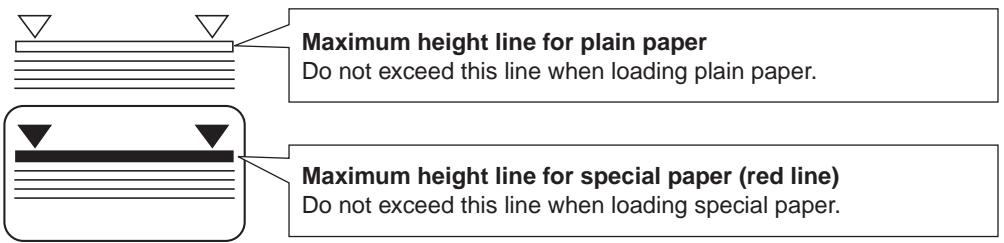
■ How to change the paper size
To change the paper size or paper type when paper is loaded into a tray, refer to page 1-19 for details.
■ Setting envelopes or postcards
When setting envelopes or postcards in the multi purpose drawer, set them in the orientation shown below.
[Loading postcards]
Load postcards print side up to the rear left of the tray as shown.
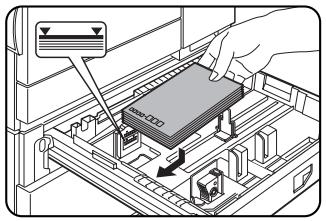
[Loading envelopes]
Envelopes can only be printed on the address side. Be sure to place envelopes with the address side up and the top of the envelope to the rear.
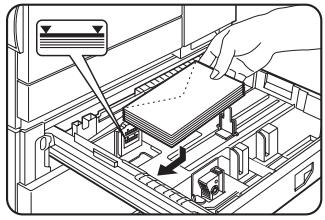
Printing onto envelopes or postcards
- Attempting to print onto both sides of envelopes or postcards may result in misfeeds or poor prints.
- Do not use pre-printed envelopes.
- To avoid wrinkling, misfeeds or poor printing, make sure the postcard stock is not curled.
Printing onto envelopes
- Do not use envelopes that have metal clasps, plastic snaps, string closures, windows, linings, self-adhesive patches or synthetic materials. Attempting to print on these may cause misfeeds, inadequate toner adherence or other trouble.
- Envelopes of which the surface is not flat because of embossing may cause the prints to become smudged.
- Under high humidity and temperature conditions the glue flaps on some envelopes may become sticky and be sealed closed when printed.
- Use only envelopes which are flat and crisply folded. Curled or poorly formed envelopes may be poorly printed or may cause misfeeds.
Fusing unit pressure adjusting levers
When feeding envelopes from the multi purpose drawer, damage to the envelopes or smudges on prints may occur even if envelopes within specification are used. In this case, the problem may be reduced by shifting the fusing unit pressure adjusting levers from the normal position to the lower pressure position. Follow the procedure below.
NOTE
Be sure to return the lever to the normal position when finished feeding envelopes. If not, inadequate toner adherence, paper misfeeds or other trouble may occur.
1. Unlatch the duplex module and slide it to the left.
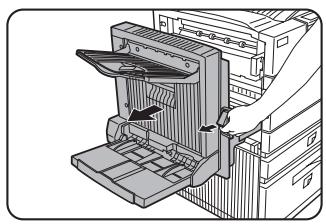
Unlatch the module and gently move the module away from the machine. If the machine is not equipped with a duplex module, open the side cover similarly.
3. Gently close the duplex module.
If the machine is not equipped with a duplex module, close the side cover.
2. Lower the two fusing unit pressure adjusting levers marked A and B in the illustration.
A: Rear side of fusing unit B: Front side of fusing unit
■ Loading transparency film
Be sure to load the transparency film with the white label side up. Make sure no image will be printed on the label. Printing on the label may cause smudges on prints. Transparency film must be set in the portrait orientation.
Specifications (multi purpose drawer)
| Name | Multi purpose drawer |
| Paper size/weight | See specifications of paper trays on page 1-17. |
| Paper capacity | 500 sheets (20 lbs. (80 g/m 2 )) of paper, 40 envelopes, 20 postcards |
| Dimensions | 25-3/4" (W) x 22-21/64" (D) x 5-43/64" (H)(654 mm (W) x 567 mm (D) x 144 mm (H)) |
| Weight | Approximately 24.3 lbs. or 11 kg |
Specifications are subject to change for improvement without notice.
Loading paper in the stand/3 x 500 sheet paper drawer
Upper paper tray:
The upper tray is the same as the multi-purpose drawer. Use the upper tray according to the instructions for the multi-purpose drawer on page 1-21.
Middle and lower paper trays:
Up to 500 sheets of SHARP recommended plain paper can be loaded in these trays. The method of loading paper is the same as for paper tray 1 in the main unit. See the description (page 1-16).
NOTE
If the paper size or paper type is changed in either paper tray, the tray settings must be changed in custom settings. Refer to “Setting the paper size and type” on page 1-19.
Specifications (stand/3 x 500 sheet paper drawer)
| Name | Stand/3 x 500 sheet paper drawer |
| Paper size/weight | See specifications of paper trays on page 1-17. |
| Paper capacity (ordinary paper) | 500 sheets (20 lbs. (80 g/m2)) each |
| Dimensions | 24-3/8" (W) x 26-5/32" (D) x 15-29/32" (H)(619 mm (W) x 664 mm (D) x 404 mm (H)) |
| Weight | Approximately 70.6 lbs. or 32 kg |
Loading paper in the stand/MPD & 2000 sheet paper drawer
Upper paper tray:
The upper paper tray is equivalent to the multi purpose drawer. The method of loading paper and the paper that can be used are the same as for the multi purpose drawer. Refer to the description of the multi purpose drawer (see page 1-21).
Lower paper tray:
The lower paper tray is a large capacity tray that holds 2,000 sheets of 8-1/2" x 11" or A4 paper (20 lbs. (80 g/m²)). Use the following procedure to load paper in the large capacity tray.
NOTE
If the paper size or paper type is changed in either paper tray, the tray settings must be changed in custom settings. Refer to “Setting the paper size and type” on page 1-19.
1 Pull out the large capacity tray.
Gently pull the tray out until it stops.
2 Load paper onto the right and left paper feed tables.
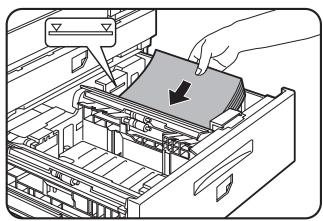
- Load paper onto the right paper feed table. The right table holds approximately 1,200 sheets.
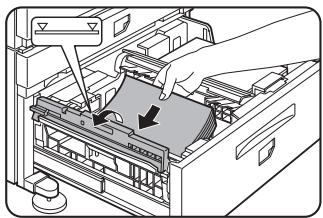
- Raise the paper guide and load paper onto the left paper feed table. The left table holds approximately 800 sheets. After loading paper, be sure to return the paper guide.
3 Gently push the large capacity paper tray into the printer.
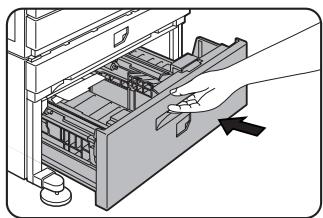
Push the tray firmly all the way into the printer.
4 Set the paper type.
If you have changed the paper size from the AB system to the inch system or vice versa, select the relevant type referring to "Setting the paper size and type" on page 1-19.
5 Loading paper in the stand/MPD & 2000 sheet paper drawer is now complete.
Specifications (stand/MPD & 2000 sheet paper drawer)
| Name | Stand/MPD & 2000 sheet paper drawer |
| Paper sizes/weight | See specifications of paper trays on page 1-17. |
| Paper capacity (ordinary paper) | Upper tray: 500 sheets (20 lbs. (80 g/m2)), Lower tray: 2,000 sheets (20 lbs. (80 g/m2)) |
| Dimensions | 24-3/8" (W) x 26-5/32" (D) x 15-29/32" (H)(619 mm (W) x 664 mm (D) x 404 mm (H)) |
| Weight | Approximately 75 lbs. or 34 kg |
ADDING TONER
When toner runs out, the message “CHANGE THE TONER CARTRIDGE” will appear on the display indicating that the toner cartridge must be replaced. For some models, a message to replace the developer cartridge may appear.
For the procedure for replacement of these cartridges, see the separate “Operation manual (Read this document before installing the product.).”
NOTE
If you press and hold down the [INFORMATION] key or the [COPY] key while printing is being performed or in standby, the quantity of toner remaining (as a percentage) will be displayed. When the percentage becomes 25 - 0 %, prepare a new toner cartridge.
STORAGE OF SUPPLIES
Standard supplies for this product that are to be replaced by the user include paper, toner cartridge (drum/toner cartridge), developer cartridge*, and staple cartridge for the finisher.
* For some models, developer cartridges are not replaced by users.
SHARP
For best copying results, be sure to use only Sharp Genuine Supplies which are designed, engineered, and tested to maximize the life and performance of Sharp products. Look for the Genuine Supplies label on the toner package.
GENUINE SUPPLIES
■ Proper storage
1 Store the supplies in a location that is:
- clean and dry,
- at a stable temperature, • not exposed to direct sunlight.
2 Store paper in the wrapper and lying flat.
- Paper stored in packages standing up or out of the wrapper may curl or become damp, resulting in paper misfeeds.
CHAPTER 2
PRINTING FROM A COMPUTER
This chapter describes how to install and how to use the printer drivers and printer utilities on a computer. This chapter also describes the job retention function that allows a print start operation from the operation panel of the printer.
CONNECTING TO A COMPUTER 2-2
SOFTWARE FOR WINDOWS 2-2
INSTALLING PRINTER DRIVERS AND PRINTER UTILITIES 2-3
UNINSTALLING PRINTER DRIVERS AND PRINTER UTILITIES ...... 2-3
INSTALLING PRINTER DRIVERS USING PLUG &
PLAY OR THE "ADD PRINTER WIZARD" 2-4
● Before installation 2-4
SETTING THE PRINTER DRIVER 2-5
● Printer driver settings under Windows (selecting and setting print conditions) 2-5
PRINTER CONFIGURATION THROUGH THE NETWORK 2-6
● Environment required for accessing Web pages 2-6
- Accessing Web pages and displaying help.... 2-6
● Items and outline of menu frame of Web pages 2-7
JOB CONTROL 2-9
● "JOB CONTROL" operation 2-9
● Hold job list.... 2-10
● Printer account control 2-12
USING THE MACHINE AS A POSTSCRIPT PRINTER 2-13
● Using the printer in the Windows environment 2-13
● Using the printer in the Macintosh environment 2-15
CONNECTING TO A COMPUTER
1. Using this machine as a local printer
When using this machine as a local printer, connect your computer to the parallel interface connector as shown in the illustration.
The cable is not supplied with the printer. A shielded cable which conforms to both the printer specifications and your computer specifications must be obtained. Consult your computer manual for the computer connection
requirements.
The parallel interface of the printer conforms to IEEE-STD-1284-1993.
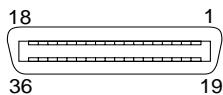
The connector type on the printer is a 36-pin DDK 57LE-40360-730B (D29)
female connector or equivalent.
For the specifications of the parallel interface connector on the computer, see the computer manual.
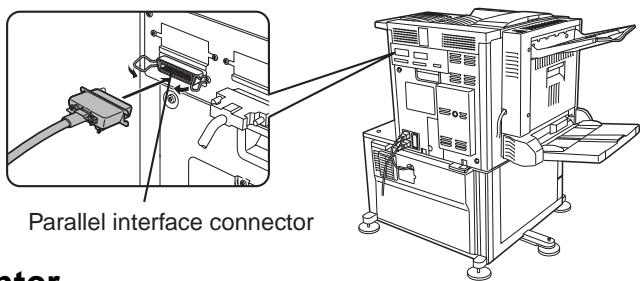
2. Using this machine as a network printer
For using this machine as a network printer, a print server card is needed.
See the operation manual supplied with the print server card.
For a network cable, use a shielded cable.
SOFTWARE FOR WINDOWS
When using this product in a Windows environment, you must install a printer driver in your computer system. Use the CD-ROM supplied with this unit for the installation. This product can be connected through a parallel interface connector as described above, or connected as a network printer through a print server card (network interface card).
The print server card may be installed as a standard component or an optional component depending upon the specific printer model.
The following software for Windows is contained in the CD-ROM.
- Printer drivers
- Printer utilities
- Installer
This is software for installing the printer drivers and printer utilities. If you use Plug and Play or the “Add Printer Wizard” to install the driver without using the installer, see instructions on page 2-4.
■ Printer drivers
● PCL printer drivers (PCL5e and PCL6) - Optional PostScript printer driver (compatible to PostScript 3) and PPD files (PostScript Printer Description files)
■ Printer utilities
● Printer Administration Utility - Printer Status Monitor - PCL Display Font
1. Printer drivers
Printer driver software converts print data from any application into data understood by the printer.
2. Printer utilities
Printer Administration Utility* provides setting and monitoring of printers on a computer. The Printer Status Monitor provides monitoring of printer status, display and notification on a computer for network environment. (only in the Windows environment)
For use of Printer Administration Utility and Printer Status Monitor, see the help file.
* Printer Administration Utility is software for system administrators.
INSTALLING PRINTER DRIVERS AND PRINTER UTILITIES
![graph LR A["Windows client<br>• Printer Status Monitor"] --> B["Windows software<br>• PCL printer drivers<br>• PCL display font"] C["Network administrator<br>• Network Administration Utility"] --> B](/content/2024/12/122344/images/c8a71930c4ff5cbfa45d8e346df3787e4e5cb6f76db453bd7196ce3992327060.jpg)
The following software can be installed from the installer supplied in the CD-ROM :
● PCL printer drivers (PCL5e and PCL6) - PCL display font ● Printer Administration Utility - Printer Status Monitor
Execute installation from the CD-ROM using the following procedure.
1 Start Windows. 2 Insert the supplied CD-ROM into a CD-ROM drive of your computer. If your computer is configured for auto start on the CD-ROM, the language select or user select screen described in step 5 will appear. (Steps 3 and 4 are not needed.) 3 On the [Start] menu, click "Run." 4 Enter the CD-ROM drive and setup command. Then click the [OK] button. Example: If the CD-ROM drive is designated as drive R, enter "R:\SETUP.EXE". 5 Read the text of Readme First and then click the [Next] button. 6 Select the tools to be installed and click the [Next] button. - If you select general user tools, you can install the following software. PCL5e printer driver, PCL6 printer driver, PCL display font, Printer Status Monitor - If you select administrator tools, you can install the following software. Printer Administrator Utility 7 The printer drivers and printer utilities that can be installed from the CD-ROM will be listed. Select the check boxes of the desired drivers and utilities and click the [Next] button.
If you click the icon next to a check box and click the [display README] button, the information of the specified software will be displayed. When installing the Printer Administration Utility and the Printer Status Monitor, read the README text and check to see if the computer system requirements are satisfied.
NOTE
The Printer Administration Utility and the Printer Status Monitor can be used only if this product is used as a network printer.
8 Click the [Start] button.
The installation screen of the file selected with a check box will appear. Follow the instructions on your screen to install the selected printer drivers and utilities.
9 When installation is complete, the message "Setup has finished installing your selected package(s)." will appear. Click the [Close] button.
NOTE
Restart of your computer may be needed depending on the system. Click [Yes] to restart the computer.
UNINSTALLING PRINTER DRIVERS AND PRINTER UTILITIES
When uninstalling a printer driver that has been installed from the Add Printer wizard, right-click the printer to be deleted from "Printers" of "Control Panel" and select [Delete]. When uninstalling a printer driver that has been installed using the installer, the Printer Administration Utility or the Printer Status Monitor, use "Add/Remove Programs" of "Control Panel". Use the Windows standard operation for each case.
INSTALLING PRINTER DRIVERS USING PLUG & PLAY OR THE "ADD PRINTER WIZARD"
Before installation
Before installing the printer drivers, check the following items.
- Ensure that your computer system meets the following requirements.
Computer type:
IBM PC/AT or compatible computer
Hardware requirements of the operating system must be satisfied.
Operating system:
Windows 95
Windows 98
Windows 2000
Windows NT 4.0
Windows Me
When using Plug and Play or using the “Add Printer Wizard” to install printer drivers, enter the directory name indicated below as a source directory.
![graph TD A["Shp_prt (R.)"] --> B["Option"] A --> C["English"] C --> D["2k_PCL5e"] C --> E["2k_PCL6"] C --> F["9x_PCL5e"] C --> G["9x_PCL6"] C --> H["NT_PCL5e"] C --> I["NI_PCL6"] C --> J["PCLFont"] D --> K["Path for using PCL5e driver under Windows 2000 R:\Option\English\2k_pcl5e"] E --> L["Path for…](/content/2024/12/122344/images/487d03cc4bfe54c8988be7cc9b4d68adfbd0fff0ee8331d4c05c42ce8211f840.jpg)
■ Example of installation of a printer driver using the “Add Printer Wizard” under Windows 98
The installation method of a printer driver under Windows 98 is shown below.
The installation example is described assuming that the printer is connected as a local printer (see “Using this machine as a local printer” on page 2-2) and that the CD-ROM drive is designated as drive R. The procedure may differ depending on the system environment.
1 Start Windows 98.
2 Insert the supplied CD-ROM into the CD-ROM drive.
If your computer is configured for auto start on the CD-ROM, the Readme First screen will appear. Click [Cancel] to close the screen.
3 On the [Start] menu, select [Settings] and then [Printers].
The Printer window will appear.
4 Double-click the [Add Printer] icon.
5 Click the [Next] button.
6 Check the [Local Printer] radio button and then click the [Next] button.
7 Click the [Have Disk] button.
The "Install From Disk" dialog box will appear.
Enter the file path as follows:
R:\Option\English\9x_pcl5e or
R:\Option\English\9x_pcl6
8 Click the [OK] button.
9 Select the printer model to be used and click the [Next] button.
Follow the instructions displayed by the “Add Printer Wizard.”
■ Installing PCL display fonts
The PCL display fonts are the fonts displayed on your computer screen. The CD-ROM supplied with this product contains the PCL display fonts that correspond to the resident fonts of this product. These display fonts can be installed to your computer (Windows 95/98/Me/NT/2000) from the installer. Installation of the PCL display fonts can be specified in step 6 of “INSTALLING PRINTER DRIVERS AND PRINTER UTILITIES” on page 2-3.
To install the PCL display fonts by Windows basic operation without using the installer (Start→Settings→Control Panel→Fonts→Install New Font), specify the following path.
R:\Option\PCLFont
The CD-ROM drive is designated as drive R as an example.
SETTING THE PRINTER DRIVER
This section describes how to change the printer driver settings from your computer.
If no printer driver has been installed, use the supplied CD-ROM to install it, referring to “INSTALLING PRINTER DRIVERS AND PRINTER UTILITIES” on page 2-3.
Printer driver settings under Windows (selecting and setting print conditions)
Change the settings using the printer properties.
■ Windows 95 / 98 / Me
Screens for Windows 98 are used in the description below.
1. On the [Start] menu, select [Settings] and then [Printers].
The Printer window will appear.
2. Right-click the installed printer driver and select [Properties].
This example is the screen displayed by selecting AR-P350PCL5e.
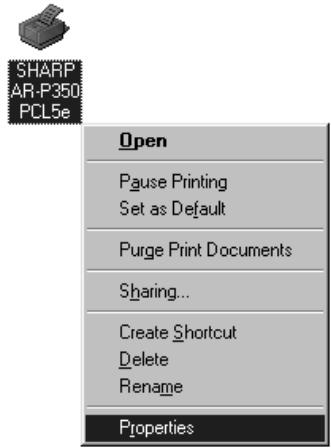
■ Windows NT 4.0 / 2000
Screens for Windows NT 4.0 are used in the description below.
1. On the [Start] menu, select [Settings] and then [Printers].
The Printer window will appear.
2. Right-click the installed printer driver and select [Document Defaults].
This example is the screen displayed by selecting AR-P350PCL5e.
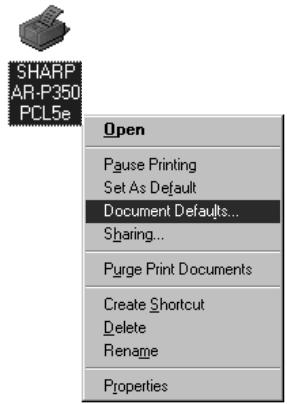
3 Set each item.
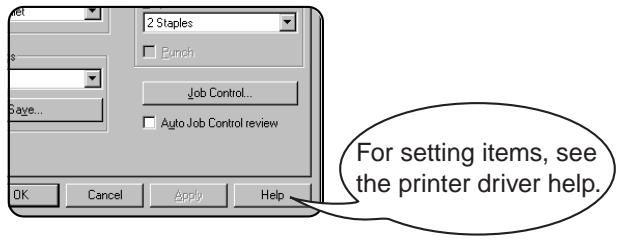
3 Set each item.
4 Click the [OK] button.
4 Click the [OK] button.
NOTE
For the setting concerning optional peripheral devices such as the duplex module, finisher, and stand/3 x 500 sheet paper drawer, right-click the installed printer, select [Properties], and then open the [Configuration] tab. If you use this product as a network printer and you have installed the Printer Status Monitor, the configuration of peripheral devices will be automatically set by clicking "Auto Configuration". If you click the [Update Tray Status] button in the [Tray Status] dialog box of the [Paper] tab, the current tray information (paper size, paper type, and quantity of paper remaining) will be displayed.
PRINTER CONFIGURATION THROUGH THE NETWORK
If you access the Web pages of this product from your computer using a Web browser such as Netscape Navigator and Internet Explorer, various settings can be adjusted through the network.
Environment required for accessing Web pages
The following products and computer system requirements are needed for accessing the Web pages of this product.
- Optional print server card (network interface card)
- Recommended Web browser Microsoft Internet Explorer 4.0 or later or equivalent Netscape Navigator 4.0 or later or equivalent
NOTE
The following characters cannot be input in the Web pages when setting the Web pages in the Web server located in this product. Input characters are case-sensitive.
- Characters that cannot be input: < > "
- Examples of improper input: <abc "abc" "abc abc"
Accessing Web pages and displaying help
Use the following procedure to access the Web pages. If the help button under the menu frame is clicked, the help screen for description of various function settings that can be operated remotely from the Web pages for this product through the network will appear. For the setting of each function, see the detailed description.
1 Open the Web browser on your computer. 2 Input the IP Address previously specified for this product to the ADDRESS field of the browser.
Input the IP address previously specified in this product. (See page 13 of the Key Operator's Guide.)
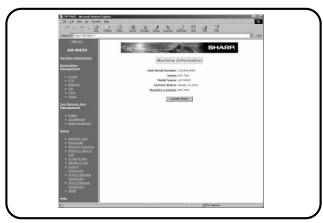
When the connection is completed, the Web page information of this product will be displayed.
3 Click the [Help] button under the menu frame.
For details of each function setting, see the help under the menu frame. The configuration settings are described in detail.
4 Close the help.
Click the ☒ button. The display will return to the Web page information of this product.
Items and outline of menu frame of Web pages
Destination Management
The basic screen on which you can add, modify, or delete the destinations for image data scanned by the network scanner. The recipient information for facsimile and Internet facsimile features (destination address, facsimile number, etc.) is described below.
- Up to 500 destinations in total can be registered. In addition, up to 100 destinations can be registered in the file server and desktop in total.
■ Setting E-mail Destinations
Sets the destination information for E-mail delivery from the network scanner.
Destination E-mail addresses and file types as well as information for destination control (destination name, index, name for front panel display, etc.) are configured by this control.
■ Setting FTP Destinations
Sets the storage location information for file server storage scan of network scan data. File server information (such as host name) and file types as well as information for destination control (destination name, user index, name for front panel display, etc.) are configured by this control.
■ Setting Desktop Destinations
Sets the destination information for desktop delivery of network scan data. Destination computer information (such as host name) in which the network scanner tool/Sharpdesk has been installed and file types as well as the information for destination control (destination name, user index, name for front panel display, etc.).
■ Setting Fax Destinations
Sets the fax destination. Fax numbers of recipients and communication mode as well as information for destination control (destination name, index, name for front panel display, etc.).
■ Setting i-Fax Destinations
Sets the Internet fax destination information. E-mail addresses of destination and file types as well as information for destination control (destination name, index, name for front panel display, etc.).
■ Setting Group Destinations
Sets destination groups for transmitting data at a time by collecting destinations that have been set as E-mail destination, fax destination and i-fax destination.
■ Delete Destination
Screen for checking to see if deletion may be executed after selecting a destination to be deleted from the destination list on the destination management screen and clicking the Delete button. The destination data will be deleted when the Yes button is clicked.
Fax Memory Box Management
Basic screen for setting the memory area (memory box) for fax images. The memory box has the following three functions. Up to 100 items in total can be registered for these functions.
- Polled memory box control
- Relay broadcasting
- Confidential reception
■ Polled Memory Box Control
Original data that has been stored in this machine can be transmitted to another facsimile machine when the remote facsimile machine requests transmission.
■ Confidential reception
Data to be printed is sent to this machine and held until released for printing from the operation panel of this machine.
■ Relay broadcasting
Memory box information for transmitting received data can be configured by this control.
Access setup
The restriction on access to the Web pages and basic settings for using the network scanner and the status/alert E-mail function are described below.
■ Network Card Setup
A link to the network card Web page for configuring the print server card (network interface card) is provided.
The Admin password is the same as the Web Page password of the network card.
■ Password Setup
Password access to the Web pages can be set. Two types of passwords (user and administrator) are configurable.
The Admin password is the same as the Web Page password of the network card.
■ Network Scanning Setup
Basic setting screen for the network scanner. E-mail subject for scanner delivery, file name, etc. are set. To use the network scanner, you must set up E-mail & DNS Setup. This screen displays the E-mail & DNS Settings and provides a link to E-mail & DNS Setup.
■ Status & Alert E-mail Setup
Basic setting screen for the status & alert E-mail system. Machine name, machine code, and machine installation location are set. To use the status & alert E-mail function, you must set up E-mail & DNS Setup. This screen displays the settings of E-mail & DNS Settings and provides a link to E-mail & DNS Setup.
■ E-mail & DNS Setup
Basic setting screen for transmitting E-mail. E-mail server, system administrator address, DNS server, etc. are set.
■ Sender E-mail Setup
The sender of E-mail transmissions from the network scanner is configured. The sender will be set as the “From” item of the E-mail header. Up to 20 senders can be registered and a sender can be selected among them from the operation panel.
■ Custom Directory Setup
User index names in the display list on the operation panel are set.
■ Status Message Parameters Setup
The parameters used when the current counter information of this machine, such as print count, copy count, and total output, is delivered in accordance with the specified schedule by an E-mail status message.
■ Alerts Message Parameters Setup
The parameters for the alert message address information are registered by alert message setup. The alert message is transmitted when a problem such as a supplies requirement (toner or paper) or errors (device failure or paper misfeed) occur.
■ SNMP Trap Setup
IP addresses, trap community, and authentic community are set.
JOB CONTROL
This section describes the operation procedure required for “JOB CONTROL”. To use job control in your print job, select “Properties” on the printer driver screen, open the “Main” tab, and click “Job control.” The job hold function can be used only if your printer is equipped with the hard disk drive option.
"JOB CONTROL" operation
1 Normal print
(For "Normal print", no input from the operation panel of the printer is needed.)
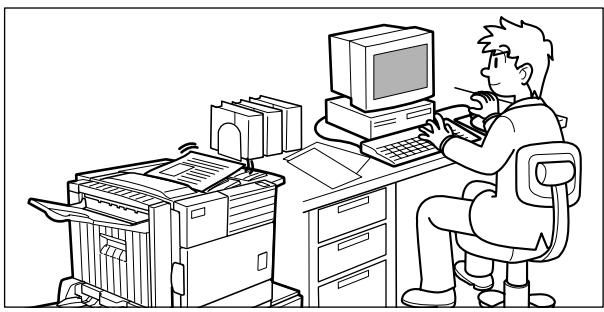
The print setting in this mode is the basic print operation. If no problem such as a paper misfeed and empty toner occurs in the printer, the print start operation is completed on the computer and printing will be executed on the printer.
2 Hold after print
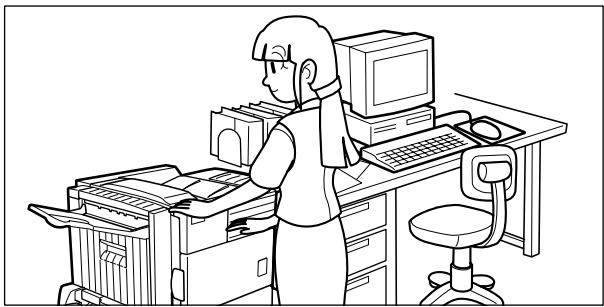
In this mode, print data will be held in the hold job list even after printing is complete. Printing can be executed again from the operation panel of the printer if needed. Also the data can be deleted from the operation panel if it is not necessary.
3 Hold before print
This print mode can reduce the possibility of missing printout. If printing is made in this mode from the computer, print data will not be output immediately and will be stored in the printer as a hold job until released from the operation panel. Print start operation can be made on the operation panel of the printer as needed. Also you can delete the data without executing printing. (See step 7 on page 2-10 or step 5 on page 2-11.)
4 Proof print
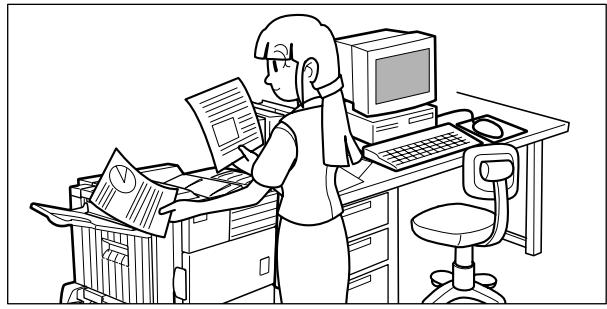
This mode can prevent a high-volume misprint when a lot of sets must be printed. If printing is executed in this mode, only one set will be printed and the remaining sets will be held as a hold job.
After checking the finished printout including print position on paper and stapling position, you can start printing of the remaining sets from the operation panel of the printer. Also you can delete the data without executing printing. (See step 7 on page 2-10 and step 5 on page 2-11.)
5 Password (5 digits)
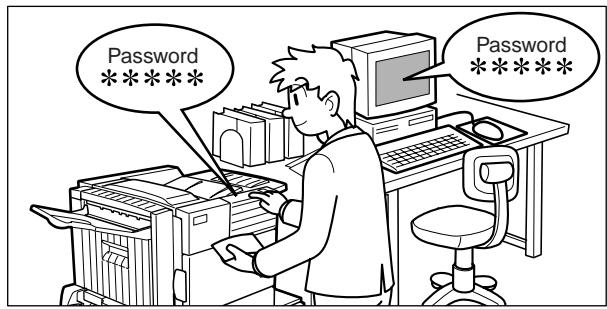
If a password is set in the printer driver setting, a password entry is needed to start printing of a password protect job. This mode can increase the security of hold jobs.
- Hold After Print mode with password: Password entry on the operation panel of the printer is needed for additional printing the hold job.
- Hold Before Print mode with password: Password entry on the operation panel of the printer is needed to start printing.
- Proof Print mode with password: Password entry on the operation panel of the printer is needed for printing remaining sets after printing one set. The first set is printed without password entry.
Hold job list
If “Print after hold”, “Print before hold” or “Proof print” operation is performed on the computer, print data will be held as a hold job. (Up to 100 jobs can be held. If the main switch is turned off, the stored data of all jobs in hold will be cleared.)
If the number of jobs exceeds 100, the job is processed as follows.
- If Hold After Print is executed:
Printing will be executed but the job will not be held. (A notice page will be printed. See page 6-5.)
- If Hold Before Print is executed:
Printing will not be executed and the job will not be held. (A notice page will be printed. See page 6-5.)
- If Proof Print is executed:
Printing of one set will be executed but the job will not be held. (A notice page will be printed. See page 6-5.)
When the machine is being operated from the operation panel on the main unit:
- For operation from the operation panel with touch panel, see the next page.
1 Press the [MENU] key.
"PRINTJOBS ON HOLD" will appear in the message display.
2 Press the [OK] key.
When the [OK] key is pressed, a user name and a file name of the print data stored as a hold job will appear.
3 Select the desired data.
Press the ▲ or ▼ key on the operation panel repeatedly until the desired print job is displayed.
4 Press the [OK] key.
5 Enter the first digit of the password and press the [OK] key.
(needed only if a password has been set)
Be sure to enter the same number that has been entered on the computer. If no password has been set, operation of steps 5 and 6 is not needed. (Proceed to step 7.)
![SHARP DM-3551 - Enter the first digit of the password and press the [OK] key. - 1](/content/2024/12/122344/images/219855f9f5e99d95ab9f82fcf4a3db3b6d537c311443bd402a049027cbbdbb45.jpg)
When you press the [OK] key to register the first digit after entering it using the ▲ or ▼ key on the operation panel, “*” will appear and “-” at the second digit will blink. If you press the [BACK/C] key, you can correct the entered number.
NOTE:
The password is entered one digit at a time starting with the first digit. The inactive digits are shown as “-”.
6 Use the same procedure as step 5 to enter the password from the second digit to the fifth digit and then press the [OK] key.
![SHARP DM-3551 - Use the same procedure as step 5 to enter the password from the second digit to the fifth digit and then press the [OK] key. - 1](/content/2024/12/122344/images/bfc8c863dc2a2ac16101c6cf883ea73c6a96f0d3488437d3165f04a682832216.jpg)
7 Select execution of printing, cancellation of printing or data retention after printing, and then press the [OK] key.
Deletion or retention of data after printing can be selected. Alternatively deletion of data without printing can be selected. Press the ▲ or ▼ key until the desired choice appears.
![SHARP DM-3551 - Select execution of printing, cancellation of printing or data retention after printing, and then press the [OK] key. - 1](/content/2024/12/122344/images/8948ff29ae1e280d48dff51ecb07767a32303fa82c9da3e93b25b62acf20daaa.jpg)
● Data will be deleted after printing.
![SHARP DM-3551 - Select execution of printing, cancellation of printing or data retention after printing, and then press the [OK] key. - 2](/content/2024/12/122344/images/c4cec7a07fbd98a92d57ef65f3c2e194fbc20f231a89c8e27f50a682266ca30c.jpg)
● Data will be held after printing.
![SHARP DM-3551 - Select execution of printing, cancellation of printing or data retention after printing, and then press the [OK] key. - 3](/content/2024/12/122344/images/ad47906daed46db923804f2ee3a45e410215227fcb183c643aad46aea2d22e3b.jpg)
- Data will be deleted without printing. If this item is selected, the operation will be complete. Steps 8 and 9 are not needed.
8 Verify that the desired number of copies is set.
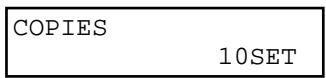
The number of copies can be changed by using the ▲ or ▼ key on the operation panel.
9 Press the [OK] key.
- Printing will start. If printing of another job is being executed, however, your job will be registered as a print job. Printing of the job will start after preceding jobs are completed.
10 Operation is now complete.
To continue operation, repeat steps 1 to 9.
When the machine is being operated from the touch panel on a scanner module:
1 Press the [PRINT] key to display the printer basic screen.
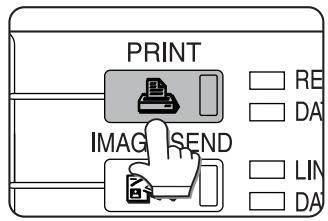
2 Select the desired data.
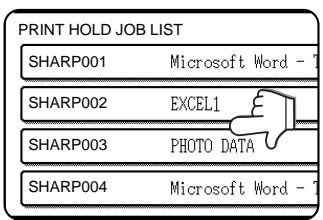
To switch the screen, touch the ▲ or ▼ key.
3 Use the [Numeric] keys to enter the 5-digit password.
(needed only if a password has been set)
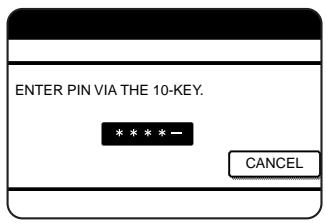
Be sure to enter the password that has been entered on the computer. If no password has been set, operation of this step is not needed.
NOTE:
Each time a number is entered, “−” will change to “*”.
4 Ensure that the desired number of prints is set.
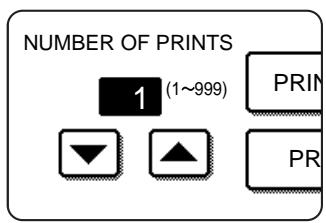
The number of prints can be changed by using the ▲ or ▼ key.
5 Execute printing.
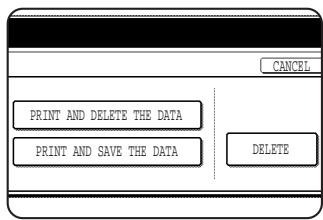
To delete the print data after completing the print job, touch the [PRINT AND DELETE THE DATA] key. To keep the print data after printing, touch the [PRINT AND SAVE THE DATA] key. To cancel printing and clear the print data, touch the [DELETE] key.
- If you select execution of the print job, printing will start. If printing of another job is being executed, your job will be registered as a print job. Printing of the job will start after preceding jobs are completed.
6 Operation is now complete.
Printer account control
If the key operator program “Auditing mode” is set, the number of printed pages can be accumulated for each account. The accounts for auditing are the accounts that have been set for counting the number of pages for the printer with a key operator program. For registration of account numbers, see the Key Operator's Guide (page 7).
When executing print operation from the computer, you must enter an account number on the setting screen of the printer driver. The account number entry screen will be displayed by clicking “Job control” in the “Main” tab of the printer driver.
When an invalid account number is entered or no account number is entered, if key operator program “Cancel jobs of invalid accounts” has been set, printing will not be performed. To perform printing in any case, disable program “Cancel jobs of invalid accounts”. In this case, the number of printed pages will be accumulated to “OTHERS”.
The job control screen will always appear when print operation is executed from the printer driver if the “Auto Job Control review” check box in the “Main” tab of the printer driver is set.
USING THE MACHINE AS A POSTSCRIPT PRINTER
If an optional PS3 expansion kit (AR-PK1) is installed, this machine can be used as a PostScript compatible printer. The machine can be used in the Macintosh environment as well as in the Windows environment when used as a PostScript printer. In the Macintosh environment, however, the printer can be connected only through a network.
Using the printer in the Windows environment
To use this machine as a PostScript printer, the PostScript printer driver or the PPD files (PostScript Printer Description files) must be installed to your computer. For installation of the printer driver, use the PRINTER UTILITIES CD-ROM supplied with an optional PS3 expansion kit (AR-PK1).
■ Installing the PostScript printer driver
1. Insert the PRINTER UTILITIES CD-ROM of the PS3 expansion kit into a CD-ROM drive of your computer.
2. On the [Start] menu, click "RUN".
3. Enter the CD-ROM drive and setup command. Then click the [OK] button.
Example: If the CD-ROM drive is designated as drive R, enter "R:\SETUP.EXE".
4. Follow the instructions on the screen to install the desired software.
To install the PostScript printer driver using the “Add Printer” wizard in place of using the installer, enter the directory name of the file as follows. The directory names for PPD files are also shown in the illustration.
Directory information of the PS3 expansion kit PRINTER UTILITIES CD-ROM
(The CD-ROM drive is assumed to be drive R.)
![graph TD A["Shp_prt (R)"] --> B["Option"] A --> C["English"] A --> D["2k_PS"] A --> E["2k_PSPPD"] A --> F["9x_PS"] A --> G["9x_PSPPD"] A --> H["Nt_ps"] A --> I["Nt_psppd"] A --> J["PSFont"] A --> K["Packages"] L["Windows 2000>"] --> M["Path for using PostScript driver R:\Option\English\2k_PS"] L -->…](/content/2024/12/122344/images/89d364f82c5bc30f4065ddf7fc94e62c96b8c7ba4886b2623c1a0599eb7c4a7f.jpg)
■ Installing the PPD files (PostScript printer description files)
Insert the PRINTER UTILITIES CD-ROM of the PS3 expansion kit into a CD-ROM drive of your computer. The installation procedure is basically the same as the procedure described on page 2-4, which is performed by using the “Add Printer” wizard for installing a printer driver. However, the following items are different.
● The PRINTER UTILITIES CD-ROM of a PS3 expansion kit is used.
- The path of the PPD files must be entered in step 7 on page 2-4. The path for each Windows version is shown below. (The CD-ROM drive is assumed to be drive R.)
- Windows 2000: R:\Option\English\2k_PSPPD
- Windows 95/98/Me: R:\Option\English\9x_PSPPD
- Windows NT: R:\Option\English\NT_PSPPD
- When selecting the printer model in step 9 on page 2-4, select the PPD file name that matches your printer model.
■ PS display font
The PRINTER UTILITIES CD-ROM of a PS3 expansion kit contains PS display fonts. Install the PS display fonts as needed when the PostScript printer driver is installed. To install the PS display fonts, select them when installing the PostScript printer driver using the installer.
■ Installing the resident font information for PPD (Windows 95/98/Me)
After installing the PPD files, follow the procedure below to install the resident font information.
NOTES
- Before installing the resident font information, be sure to install the PPD files.
- When installing the resident font information, be sure to close all other open applications.
- When the printer is used as a network printer, if you have changed the port for the printer from Properties of the printer driver, reinstall the resident font information.
The screens in the Windows 98 environment are used below as examples.
1. Start Windows. 2. Insert the PRINTER UTILITIES CD-ROM of a PS3 expansion kit into a CD-ROM drive.
If your computer is configured for auto start on the CD-ROM, the package selection screen will appear. Click the [Cancel] button.
3. On the [START] menu, click "RUN". 4. Enter the CD-ROM drive and "Option\English\9x_psppd\Pfmsetup.exe", and click the [OK] button.
If the CD-ROM drive is designated as drive R, type "R:\Option\English\9x_psppd\Pfmsetup.exe" and click the [OK] button.
The following window will appear.
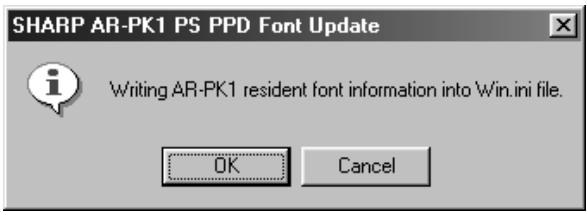
5. Click the [OK] button.
The following window will appear.
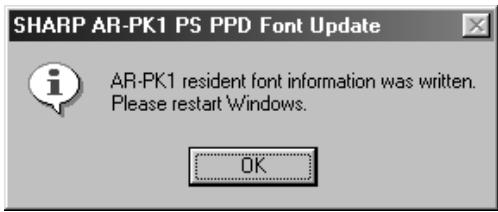
If the PPD files have not been installed, a message indicating it will appear and the resident font information cannot be installed.
6. Click the [OK] button. 7. After installing the resident font, restart Windows.
Installation of the resident font is complete.
Using the printer in the Macintosh environment
To use the printer in the Macintosh environment, the PPD files (PostScript printer description files) for Macintosh contained in the PRINTER UTILITIES CD-ROM of an optional PS3 expansion kit must be installed. The printer can be used as a PostScript compatible printer. The printer, however, must be connected to the computer through a network. An optional Print Server Card (AR-NC5J) is needed for network connection. Also the Macintosh computer must be equipped with an Ethernet port. If your computer is not equipped with an Ethernet port, install an Ethernet interface.
NOTE
If this printer is connected to the computer via a cross cable, be sure to turn on the Macintosh computer before turning on this printer. If not, the printer cannot be recognized as a network printer.
■ PPD files
The PPD files for Macintosh are the files which a Macintosh computer refers to when using its LaserWriter printer driver for printing.
■ SHARP PPD Utility
The SHARP PPD Utility is used to register account numbers and passwords when the auditing mode (page 7 of the Key Operator's Guide) or the job retention function with password (page 2-9) is used. This utility is also used to change the registered account numbers and passwords.
■ Display fonts
The PRINTER UTILITIES CD-ROM contains the display fonts for Macintosh. If you use the PPD files, install the display fonts as needed.
■ Before installing the PPD files and the PPD Utility
Before installing the software above, check the hardware and software requirements.
Computer: Apple Macintosh series
Apple Power Macintosh series
Operating system: Mac OS 8.51 to 9.x
Printer driver: LaserWriter 8 version 8.4.1 or later
For other conditions such as CPU and RAM capacity, the requirements of the operating system must be satisfied.
Ensure that LaserWriter 8 has been installed in the Macintosh system. If not, install it from the system CD-ROM supplied with your Macintosh computer.
■ Installing the utilities
The screens in the Mac OS 9.0 environment are used below as examples. The display varies with the operating system and printer driver versions.
1. Turn on the computer and start the operating system. 2. Insert the supplied SHARP PS3 Expansion Kit AR-PK1 PRINTER UTILITIES CD-ROM into a CD-ROM drive.
The AR-PK1 icon will appear on the desktop.
3. Close all other applications and double-click the AR-PK1 icon on the desktop.
The files contained in the CD-ROM will be displayed. The Printer Manual is not for this product.
4. Double-click the Installer icon.
The installer screen will appear.
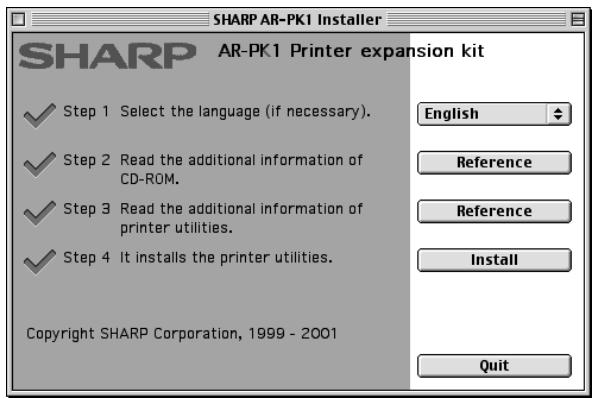
5. Click [Reference] of steps 2 and 3 to read the text.
Be sure to read the descriptions, which contain information on use of this product as a printer.
6. Click the [Install] button of step 4.
The SHARP Installer dialog box will appear. Ensure that "Easy Install" is selected, select the drive, and click the [Install] button.
NOTES
- "Easy Install" is recommended.
- To cancel the installation, click the [Cancel] button.
- When uninstalling the PPD files from your computer, select "Custom Remove" on the installation type selection window, select the features to be removed, and click the [Remove] button.
7 After installation is complete, click the [Quit] button and remove the CD-ROM.
■ Selecting the printer
Follow the procedure below to select the printer.
1 Ensure that the printer is connected to the network to which your computer is connected. 2 Select the Chooser from the Apple Menu. 3 Click the LaserWriter 8 icon.
- The names of connected printers are displayed in the right hand box. If multiple AppleTalk zones are displayed, select the zone which includes the desired printer.
4 Select the desired printer.
- The default printer name of this product is "SCXXXXXX" (XXXXXX: 6 alphanumeric characters). The printer name can be changed by adjusting the setting for the Print Server Card (AR-NC5J).
5 Click 'Create', 'Setup' or 'Setup...'.
(Phrase depends on the version of MAC OS installed)
- If you are setting this printer for the first time: When the “Select a PostScript Printer Description File:” dialog box appears, select the PPD file name with your printer model name and click ‘Select’.
- If you are setting this printer again:
1) Click 'Auto Setup'. 2) When the "Select a PostScript Printer Description File:" dialog box appears, select the PPD file name with your printer model name and click 'Select'. 3) Click 'OK'.
● Printer configuration will be set automatically.
6 Click the Close box to close the Chooser.
■ Paper setting
1 Select "Page Setup" from the [File] menu of the application software.
The following display will appear. (The display varies with the operating system versions, printer driver versions, and application software.)
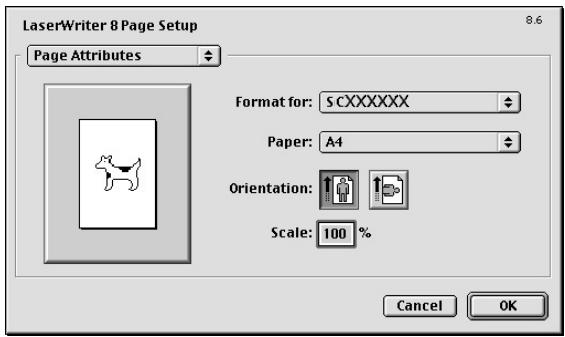
2 Adjust each setting.
- Paper size, reduction/enlargement, and orientation can be set.
3 Click the [OK] button.
■ Print condition setting
1 Select "Print" from the [File] menu of the application software.
The following display will appear. (The display varies with the operating system versions, printer driver versions, and application software.)
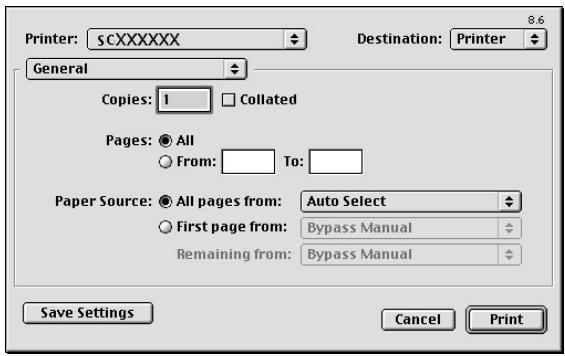
2 Adjust each setting.
Number of copies, page range, and other settings can be made.
If the printer has been configured for the auditing mode, an assigned 5-digit account number must be specified. To use the job retention with password, specify a five-digit password.
To specify an account number or a password for the job retention function, click “◀” to the right of ‘General’ and select ‘Job Control’.
- The account numbers used for printing are the same as those used for copying. The account numbers for printing must be registered to the computer using the PPD utility.
3 Click the [Print] button.
■ Installing the display fonts
The display fonts for Macintosh are contained in the Font folder of the AR-PK1 PRINTER UTILITIES CD-ROM. Install the display fonts as needed.
Copy the required display font files to the Fonts folder under the System folder of your computer.
NOTE
If any malfunction occurs due to the installation of display fonts, delete the fonts from the system.
■ Using the SHARP PPD Utility
Before using the printer auditing mode or the job retention function with password from a Macintosh computer, you must use the PPD Utility to register account numbers and passwords. The PPD Utility is installed together with the PPD files using the installer for Macintosh contained in the SHARP PS3 Expansion Kit AR-PK1 PRINTER UTILITIES CD-ROM.
This utility allows up to 20 account numbers to be registered for the computer. The account numbers are the same as those for the copier auditing mode and must be registered using one of the key operator programs for the copier feature. When printing in the auditing mode, one of the registered account numbers must be specified on the screen used for setting print conditions. Also use this utility to change the registered account numbers.
When using the job retention function with password, a password must be specified when printing. This utility allows up to 20 passwords to be registered. One of the passwords must be specified when you set the print conditions.
To start this utility, select SHARP AR-PK1 Extras folder and then double click the PPD Utility icon.
NOTE
Do not use the AR230_270 PPD Utility. This utility is not for this model.
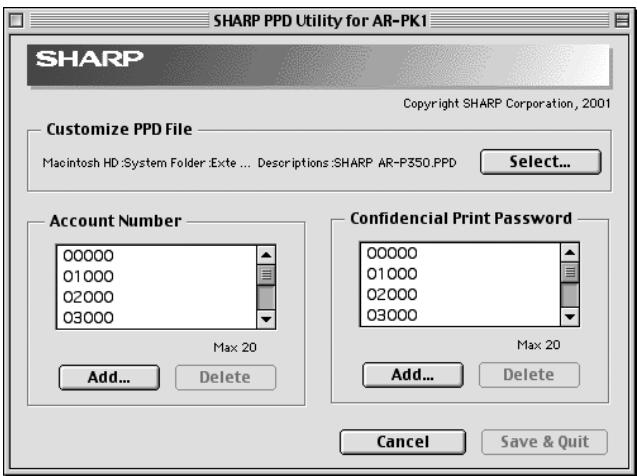
1 Click the [Select] button and select the PPD files for your printer. 2 To register an account number for the computer, click the [Add] button for Account Number. The Account Number screen will appear. Enter a 5-digit account number and click the [OK] button.
To delete a registered account number, select the account number in the box and click the [Delete] button.
3 To register a security password for the job retention function, click the [Add] button for Confidential Print Password. The Confidential Print Password screen will appear. Enter a 5-digit number in the box and click the [OK] button. To delete a registered security password, select the password in the box and click the [Delete] button. 4 To save the registered account numbers and passwords and to exit the utility, click the [Save & Quit] button. 5 If the PPD file is changed using this utility, be sure to select the printer again through the Chooser. Use the procedure described in "Selecting the Printer" on page 2-17.
CHAPTER 3
PRINTER BASIC SETTINGS
This chapter describes the following items.
- Printer configuration settings
- Custom settings based on the customer's operating conditions.
MAKING CONFIGURATION SETTING ...... 3-2 Page
● Operation procedure common to all printer configuration settings (items that can be set from the operation panel) 3-2 ● Default settings 3-4 ● PCL settings 3-4 ● PostScript settings 3-4
CUSTOM SETTINGS 3-5
● Operation procedure common to all custom settings (items that can be set from the operation panel) 3-5 - Setting items ...... 3-7
MAKING CONFIGURATION SETTING
The printer configuration setting allows basic printer settings to be made. The items set with the printer configuration settings are shown below.
● Default settings ...... Basic settings used in printing (See page 3-4.) ● PCL settings .... Sets a PCL symbol set. (See page 3-4.) - PostScript settings* .... Sets whether a PostScript error page is printed or not when a PostScript error has occurred. (See page 3-4.)
* An optional PS3 expansion kit is needed.
Operation procedure common to all printer configuration settings (items that can be set from the operation panel)
When the machine is being operated from the operation panel on the main unit:
1 Press the [MENU] key to display the configuration setting menu screen.
Press the [MENU] key repeatedly until “SET OPERATIONS CONDITIONS” appears.
Any print jobs held in the printer and any job currently transmitted to the printer will be printed in the former print conditions.
2 Press the [OK] key.
3 Press the ▲ or ▼ key to display the desired setting item.
4 Press the [OK] key.
5 Press the ▲ or ▼ key to display the desired setting.
For the details of each setting item, see the description on and after page 3-4.
6 Press the [OK] key.
“*” will be displayed to the right of the selected item and setting will be registered. To set another item, press the [BACK/C] key to return to step 3 and repeat the procedure to step 6.
7 When setting is complete, press the [MENU] key to return to the basic screen.
NOTE
If the [BACK/C] key is pressed after each setting is complete, the display that has called the setting will appear again. If selection of a number is mistaken during setting operation, press the [BACK/C] key to correct the selected number.
When the machine is being operated from the touch panel on a scanner module:
1. Touch the [CONDITION SETTINGS] key on the printer screen to display the configuration setting menu screen.
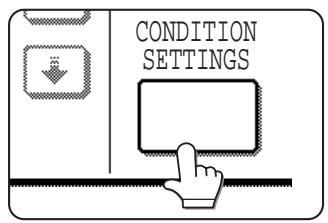
Any print jobs held in the printer and any job currently transmitted to the printer will be printed in the former print conditions.
2. Touch the key of the desired item to display its setting screen.
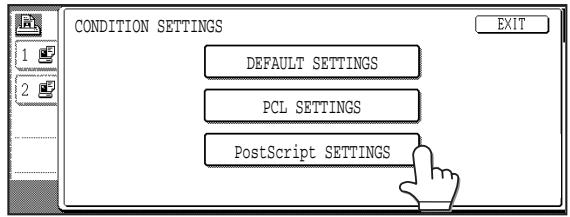
Detailed descriptions for configuration setting start on the next page.
3. Touch the desired setting on the setting screen of the desired item and touch the [OK] key.
To set another item, repeat steps 2 and 3.
4. To finish the setting operation, touch the [EXIT] key.
Supplementary explanation of key operation for configuration setting
(when using the touch panel)
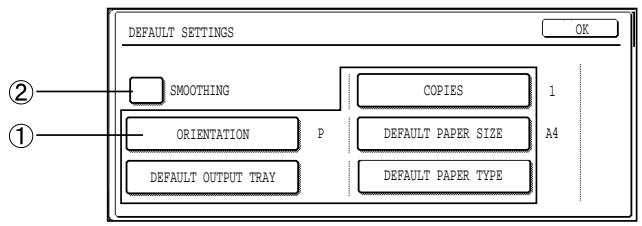
These keys and indicator are available on setting screens that require the entry of numerical values.
![graph TD A["20 (1-999)"] --> B["↓"] A --> C["↑"] B --> D["③"] C --> E["④"]](/content/2024/12/122344/images/545618f18cd9d25adbf54f01aa61f3ac709cbfc134849280d03e8ab80a062db8.jpg)
① The name of the configuration category or particular item to be set will appear on the touch key. A touch of the key will select the item displayed. ② Check mark boxes are touch keys that show the status of selections. A box with a check mark means the function is “on” (enabled) and an unchecked box means the function is “off” (disabled). Alternate touches of a box will change the on/off status. - If a configuration step requires more than one screen to display all available settings for a configuration step, [↑] and [↓] arrow touch keys on the setting screens allow access to the available selections on all screens. If a selection is accepted on one of the screens by a press of the [OK] key, the display will return through the previous selection screens within the same setting step to confirm the settings. After all settings are confirmed, the [OK] key must be pushed again to advance to the next step. ③ The currently set numerical value is displayed. ④ Numerical values can be set by touching the [▲] and [▼] keys.
Default settings
The default settings allow detailed print conditions to be set for printing without any printer driver (for example, printing from MS-DOS and printing from a computer without any printer driver installed). The setting items are shown below.
NOTE
When some items can be set both in the printer driver and on the operation panel, the values set in the printer driver override those set on the operation panel. For items that can be set in the printer driver, perform setting in the printer driver.
■ Smoothing
SMOOTHING reduces jaggies seen at roundish curved portions of characters and images to be printed and improves pseudo resolution.
Default setting: On
Smoothing on or off can be selected.
Copies
COPIES is set when the number of copies to be printed is set.
Default setting: 1
The number of copies can be set from 1 to 999.
■ Orientation
ORIENTATION allows portrait orientation or landscape orientation to be selected for printing.
Default setting: PORTRAIT
PORTRAIT or LANDSCAPE can be set.
■ Default paper size
The paper size to be used for printing in the normal conditions is set.
Printing will be performed onto the specified size paper unless otherwise specified.
Default setting: 8-1/2 x 11 or A4
11 x 17, 8-1/2 x 14, 8-1/2 x 13, 8-1/2 x 11, 7-1/4 x 10-1/2, 5-1/2 x 8-1/2, A3, B4, A4, B5 or A5 can be set.
(If the operation panel on the main unit is used, the sizes are displayed as follows in the display: LEDGER, LEGAL, FOOLSCAP, LETTER, EXECUTIVE, INVOICE, A3, B4, A4, B5, and A5.)
■ Default paper type
The paper type to be used for printing in the normal conditions is set.
Printing will be performed onto the specified type paper unless otherwise specified.
Default setting: PLAIN
Plain paper, pre-printed paper, recycled paper, transparency film letter head paper, pre-punched paper or color paper can be set.
■ Default output tray
The output tray to be used for printing in the normal conditions is set. Printed sheets will be output to the specified tray unless otherwise specified by application software.
Default setting: Depends on installation of peripheral devices.
The trays that can be selected depend on installation of peripheral devices. This item itself may not be selected.
2-SIDED PRINT
Printing mode, 1-SIDED or 2-SIDED, to be used for printing in the normal condition is set.
This key cannot be selected on the printer without the duplex module.
Default setting: 1-SIDED
1-SIDED, 2-SIDED (BOOK) or 2-SIDED (TABLET) can be set.
PCL settings
PCL SETTINGS is used to assign a part of character codes to characters of a country in the PCL symbol set. (Used when different symbols are used depending on the country.)
Default setting: "1" (Roman-8)
For setting items of the symbol set, see page 6-6.
The list of the numbers to be set and their corresponding symbol sets can be printed using “PCL symbol set list printing” (see page 3-7).
When using the operation panel on the main unit, select the desired symbol set item and register it. When using the operation panel with touch panel, select the number that corresponds to the desired symbol set and register it.
PostScript settings
This setting specifies whether an error page describing the cause of an error is printed or not when a PostScript error has occurred.
Selections are available to choose printing or not printing of error pages.
Default setting: Not print
CUSTOM SETTINGS
Custom settings are used for various settings based on the customer operating conditions. The items that can be set with the custom settings are shown below.
● Total count ...... The number of printed pages and the like are displayed. (See page 3-7.) - Display contrast *1: The display contrast of the operation panel is adjusted. (See page 3-7.) ● List print .... Used to print a list of settings that have been made or a font list. (See page 3-7.) ● Clock...... The date and time of the built-in clock of the printer are set. ● Tray settings ...... The paper type and paper size for each tray are set. ● Auto tray switching...... Used to switch automatically the paper tray of the same paper size when paper runs out in continuous printing.
For the items below, detailed setting procedure is described in the facsimile operation manual.
- Address control *3 .... Used to register destination E-mail addresses, fax numbers, and Internet fax addresses. Also group entry, memory box entry, custom index entry, and scanner sender entry can be set.
- Receive mode *2: The fax receive mode (automatic or manual) is set. ● Fax data forward *2 ...... Received fax data in memory can be forwarded to another destination.
● Key operator programs ...... Setting programs are provided for key operators (administrators of this machine). If this product is equipped with a scanner module, this key will appear in the CUSTOM SETTINGS menu screen. For settings, see the Key Operator's Guide.
*1 Can be set if this product is equipped with a scanner module. *2 Can be set if this product is equipped with a scanner module and the facsimile feature can be used. *3 Can be set if this product is equipped with a scanner module and the facsimile feature or the network scanner feature can be used.
Operation procedure common to all custom settings (items that can be set from the operation panel)
When the machine is being operated from the operation panel on the main unit:
1 Press the [MENU] key to display the custom settings menu screen.
Press the [MENU] key repeatedly until the message “CUSTOM SETTINGS” appears.
Any print jobs held in the printer and any job currently transmitted to the printer will be printed in the former custom setting conditions.
2 Press the [OK] key.
3 Press the ▲ or ▼ key to select the desired setting item.
4 Press the [OK] key.
5 Press the ▲ or ▼ key to select the desired setting.
For details of each setting item, see the description on and after page 3-7.
6 Press the [OK] key.
“*” will be displayed to the right of the selected item, and the setting will be registered. Depending on the setting item, additional item selection and registration operation may be needed. In this case, use the ▲ or ▼ key to select an item and press the [OK] key to register it. To set another item, press the [BACK/C] key and repeat steps 5 and 6.
7 When setting is complete, press the [MENU] key to return to the basic screen.
NOTE
If the [BACK/C] key is pressed after each setting is complete, the display that has called the setting will appear again. If selection of a number is mistaken during setting operation, press the [BACK/C] key to correct the selected number.
When the machine is being operated from the touch panel on a scanner module:
1 Press the [CUSTOM SETTINGS] key when the printer screen is displayed to display the custom settings menu screen.
Any print jobs held in the printer and any job currently transmitted to the printer will be printed in the former custom setting conditions.
2 Touch the key of the desired item to display its setting screen.
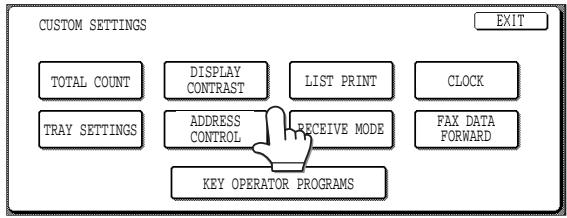
Detailed descriptions for custom settings start on the next page.
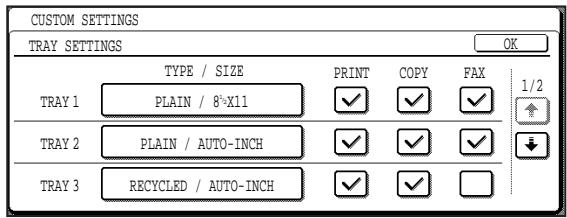
Depending on the setting item, additional item setting keys may be displayed and page switching keys may be displayed.
Check mark boxes are touch keys that show the status of selections. A box with a check mark means the function is “on” (enabled) and an unchecked box means the function is “off” (disabled). Alternate touches of a box will change the on/off status.
3 Touch the desired setting on the setting screen of the desired item and touch the [OK] key.
To set another item, repeat steps 2 and 3.
4 To finish the setting operation, touch the [EXIT] key.
![graph TD A["TOTAL COUNT"] --> B["DISPLAY CONTRAST"] C["TRAY SETTINGS"] --> D["ADDRESS CONTROL"] E["CLOCK"] --> F["LIST PRINT"] G["ACCESS"] --> H["RECEIVE MODE"] I["FAX DATA FORWARD"] --> J["KEY OPERATOR PROGRAMS"] K["EXIT"] --> L["Arrow pointing to CLOSE"]](/content/2024/12/122344/images/a43f8baa4ef9976b0b5103bb247cb8e6279c8938ab165e830db763669a9ac8b8.jpg)
Setting items
■ Total count
The number of total printed pages in this product can be displayed and printed.
If the product is equipped with an optional scanner to include copying and facsimile functions, the number of copies made and facsimile images sent can also be displayed or printed.
■ Display contrast
Can be set if this product is equipped with a scanner module.
This item is used to adjust the contrast of the touch panel display.
■ List print
Test pages such as a list of setting items configured in this product and a list of the resident fonts for checking can be printed.
The types of test pages are shown below.
● All custom setting list: The settings in the printer feature (condition settings and custom settings) are printed. The key operator program settings are not printed. ● Printer test page: - PCL font list printing: A list of fonts that can be used with the PCL printer drivers is printed. - PCL symbol set printing: A PCL symbol set list is printed. - NIC page printing: A list of settings used by the NIC (Network Interface Card), namely the print server card, is printed. - PostScript font list printing: A list of fonts that can be used with the PostScript printer driver is printed.
NOTE
If test page printing is disabled with key operator program "DISABLE TEST PAGE PRINTING" (page 11 of the Key Operator's Guide.), the printer test pages cannot be printed.
Clock
The date and time of the built-in clock of this product are set. These settings will be used for the functions that require date and time information.
■ Tray settings
Paper type, paper size, operation mode, and use of automatic tray switching are set for each tray. For details on setting the paper type and paper size, see pages 1-19 and 1-20.
"Operation mode" means copy, print or fax mode. Use of a paper tray is set for each mode. This setting is available when the machine is operated from the touch panel on a scanner module.
When the machine is being operated from the operation panel on the main unit, use the item "Auto tray switching" described below for setting the automatic tray switching function.
■ Auto tray switching
If the auto tray switching function is set and more than one tray of the same paper size is installed in this product, printing can be continued by switching automatically the paper tray when paper of a tray runs out. This item is used to enable the auto tray switching function. When the machine is operated from the touch panel on a scanner module, use the item “Tray settings” to set this function.
CHAPTER 4
TROUBLESHOOTING AND MAINTENANCE
This chapter describes misfeed removal, user maintenance, etc.
Page MISFEED REMOVAL 4-2
● General misfeed removal procedure 4-2 ● Misfeed removal guidance.... 4-3 - Misfeed in the paper feed area 4-4 ● Misfeed in the transport area, fusing area, and exit area ..... 4-6 - Misfeed in the duplex module 4-7
TROUBLESHOOTING 4-8
USER MAINTENANCE.... 4-11
- Cleaning the scanner module 4-11
MISFEED REMOVAL
When the machine is being operated from the operation panel on the main unit:
- If the machine is not equipped with a scanner, all messages will appear on the display panel of the main unit. For machines equipped with a scanner, messages will appear on the touch panel display on the scanner module.
When a misfeed has occurred, printing will stop and the message shown below will appear. Follow the procedure below to remove misfed paper.
PAPER JAM. [i]
NOTES
- Do not damage or touch the photoconductive drum. (See pages 1-5 and 4-6.)
- Be careful not to tear the misfed paper during removal.
- If paper is accidentally torn during removal, be sure to remove all pieces.
! CAUTION
The fusing unit is hot. Take care in removing paper.
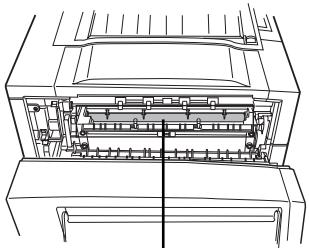
Fusing unit
General misfeed removal procedure
If the INFORMATION key is pressed when a misfeed has occurred, messages will appear giving guidance for misfeed removal. The messages will appear in sequence and can be viewed by using the ▲ and ▼ keys.
1 Press the INFORMATION key.
2 Press the ▼ key.
Use the ▲ or ▼ keys on the operation panel to scroll through the guidance messages.
The messages in the table below provide guidance for misfeed removal. For more detailed guidance, refer to the pages indicated in the table.
| Message | Page |
| PULL OUT TRAY * AND CHECK THE PAPER. | 4-4 |
| OPEN THE LOWER LEFT COVER. | 4-5 |
| OPEN THE LEFT COVER. | 4-6 |
| REMOVE PAPER FROM BYPASS TRAY. | 4-7 |
| OPEN THE DUPLEX COVER. | 4-7 |
| OPEN THE MAIL-BIN COVER. | 5-8 |
| OPEN THE CENTER COVER. | 5-8,5-14 |
| OPEN THE FINISHER TOP COVER. | 5-14, 5-24 |
| SLIDE THE FINISHER AWAY FROM MACHINE. | 5-24 |
| OPEN THE FINISHER FRONT COVER. | 5-24 |
3 Press the INFORMATION key to close the misfeed removal guidance.
When the machine is being operated from the touch panel on a scanner module:
When a misfeed has occurred during printing, the message “A MISFEED HAS OCCURRED.” will appear in the touch panel display of the operation panel and printing including copying and facsimile output will stop. The approximate misfeed locations are indicated with “▼” shown in the illustration below. The page numbers for detailed information on misfeed removal are also shown.
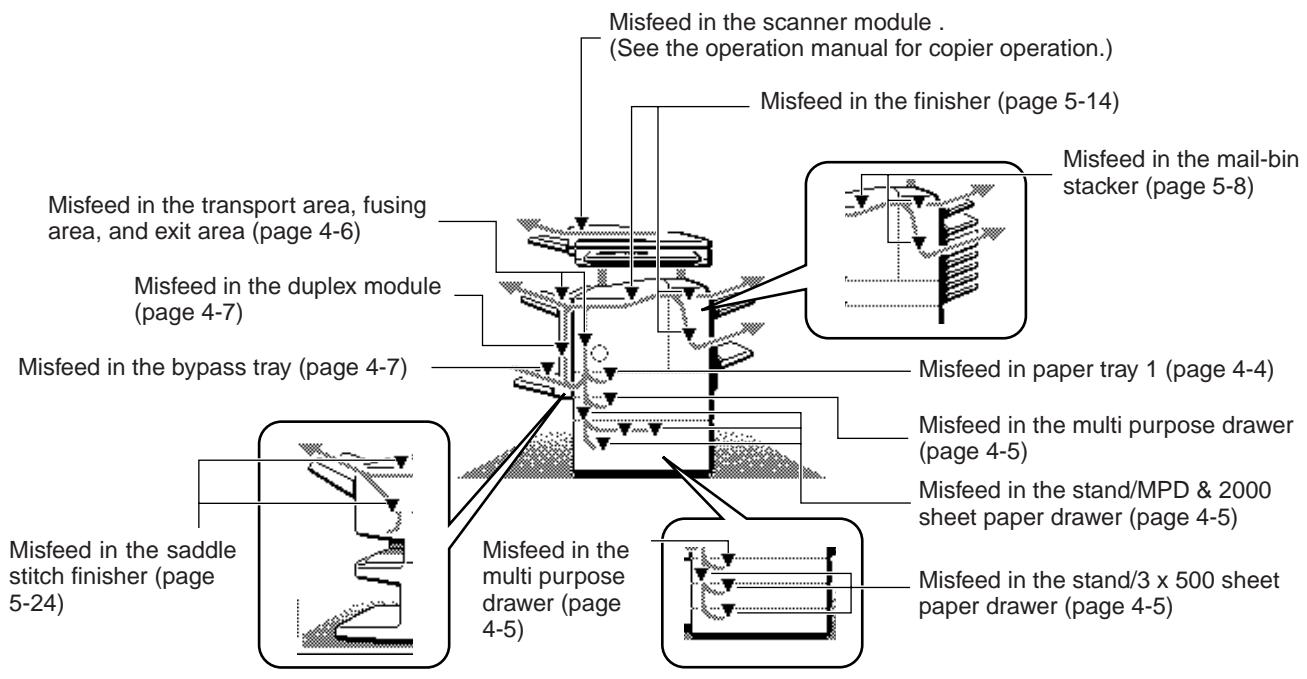
NOTES
- Facsimile reception data is always temporarily stored in memory. After misfed paper is removed, any received data in memory will be automatically printed.
- If the machine is performing a scanning operation, vibrations resulting from hard operation of machine covers or trays during misfeed removal will cause uneven scanning. Also, if a hard disk drive unit is installed, it may malfunction due to vibration.
NOTES
- Do not damage or touch the photoconductive drum. (See pages 1-5 and 4-6.)
- Be careful not to tear the misfed paper during removal.
- If paper is accidentally torn during removal, be sure to remove all pieces.
! CAUTION
The fusing unit is hot. Take care in removing paper.
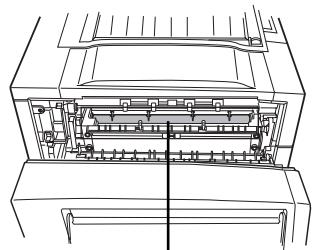
Fusing unit
Misfeed removal guidance
Misfeed removal guidance can be displayed by touching the INFORMATION key on the touch panel after a misfeed has occurred.
Misfeed in the paper feed area
NOTE
Be sure to follow the misfeed removal sequence. Do not pull the paper tray out first as paper may be located between the paper tray and the paper feed section. If the tray is pulled first, the misfed paper may be torn and difficult to remove. The following procedure shows the removal sequence when the machine is equipped with a duplex module. If the machine is not equipped with a duplex module or any output device, the procedure is basically the same. The left side of the machine must be opened and cleared before the paper tray is pulled out.
■ Misfeed in paper tray 1
1 Unlatch the duplex module and slide it to the left.
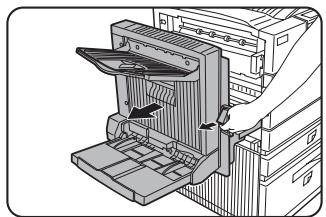
Unlatch the module and gently move the module away from the machine. If the machine is not equipped with a duplex module, open the side cover similarly.
2 Remove the misfed paper.
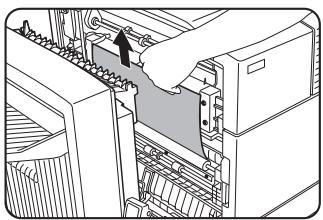
Be careful not to tear the misfed paper during removal.
NOTE
The paper may not be extending out far from inside the machine but must be removed if it is possible to grasp it. If it is not possible to grasp it, go to the next step.
3 If misfed paper is not found in step 2, pull out paper tray 1 and remove the misfed paper.
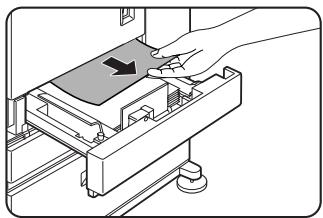
Be careful not to tear the misfed paper during removal.
4 Gently close the paper tray.
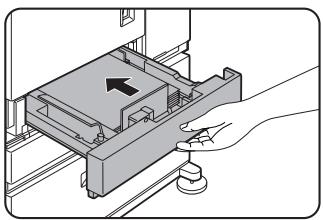
Push the paper tray back into the machine.
5 Gently close the duplex module.
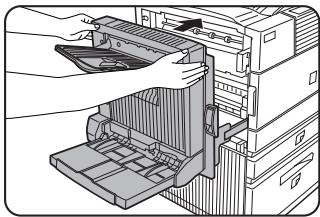
If the machine is not equipped with a duplex module, close the side cover.
After closing, confirm that the misfeed message has been cleared and the normal display appears.
NOTE
If paper drops beyond the rear side of the paper tray that has been pulled out, remove the paper tray and then remove the paper. (For removal of the paper tray, see the illustration below.)
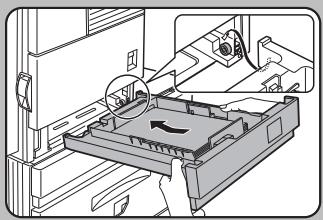
After pulling out the paper tray until it stops, gently lift and pull the tray to remove it. To reinstall the paper tray, insert it at an angle and then push it into the machine.
To remove a paper tray from a stand/paper drawer, pull the tray out until it stops then rotate it to the left to disengage it from the stand. When reinstalling it, place the left rear or the drawer into the slot and rotate the drawer to the right and into the stand.
Installation of trays in the stand/3x500 sheet paper drawer
The middle and lower trays cannot be installed in the upper tray position and the upper tray cannot be installed to the middle and lower tray positions. (These cannot be pushed into the machine.)
Take care not to install a tray to an improper position after removing the tray.
■ Misfeed in the multi purpose drawer
1 Unlatch the duplex module and slide it to the left.
Unlatch the module and gently move the module away from the machine. If the machine is not equipped with a duplex module, open the side cover similarly.
2 Open the left cover of the stand/paper drawer.
Hold the knob and gently open the cover. If the machine is not equipped with a stand/paper drawer, open the left cover of the multi purpose drawer.
3 Remove the misfed paper.
Be careful not to tear the misfed paper during removal.
NOTE
The paper may not be extending out far from inside the machine but must be removed if it is possible to grasp it. If it is not possible to grasp it, go to the next step.
4 Close the left cover of the stand/paper drawer.
5 Gently close the duplex module.
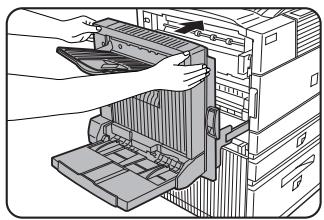
If the machine is not equipped with a duplex module, close the side cover.
After closing, confirm that the misfeed message has been cleared and the normal display appears.
6 If misfed paper is not found in step 3, refer to "Misfeed in paper tray 1" (steps 1 to 5 on the previous page) to remove the misfed paper.
■ Misfeed in the stand/3 x 500 sheet paper drawer
For misfeed removal in the upper tray, follow the procedure of “Misfeed in the multi purpose drawer” shown to the left to remove the misfed paper.
■ Misfeed in the stand/MPD & 2000 sheet paper drawer
For misfeed removal in the upper tray, follow the procedure of “Misfeed in the multi purpose drawer” shown to the left to remove the misfed paper. For misfeed removal in the lower large capacity tray, follow the procedure below.
1 Follow steps 1 to 4 of “Misfeed in the multi purpose drawer” shown to the left. 2 If misfed paper is not found in step 1, refer to "Misfeed in paper tray 1" on the previous page. 3 If misfed paper is not found in steps 1 and 2, pull out the large capacity tray (lower tray) and remove the misfed paper as shown in the illustrations below.
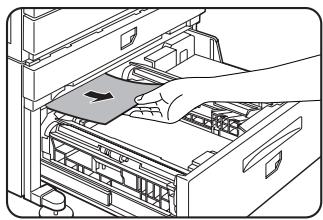
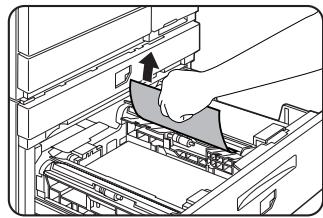
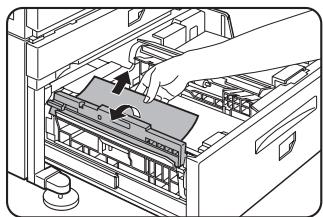
Raise the paper guide and remove the misfed paper. After removing the misfed paper, be sure to return the paper guide.
4 Gently close the large capacity tray.
Push the paper tray all the way into the machine.
5 Gently close the duplex module.
If the machine is not equipped with a duplex module, close the side cover.
After closing, confirm that the misfeed message has been cleared and the normal display appears.
Misfeed in the transport area, fusing area, and exit area
CAUTION
The fusing unit is hot. Take care in removing paper. (Do not touch the metal parts.)
1 Unlatch the duplex module and slide it to the left.
Unlatch the module and gently move the module away from the machine. If the machine is not equipped with a duplex module, open the side cover similarly.
2 Remove the misfed paper as shown in the illustrations below.
If paper is misfed in the transport area, turn roller rotating knob A in the direction of the arrow to remove the misfed paper.
NOTE
Do not touch or damage the transfer roller.
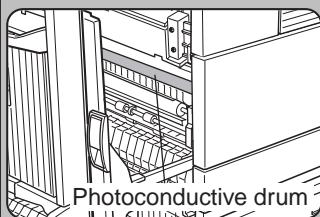
Do not touch or damage the photoconductive drum.
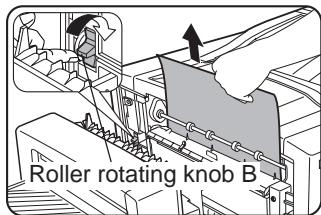
If paper is misfed in the fusing area, turn roller rotating knob B in the direction of the arrow to remove the misfed paper.
CAUTION
The fusing unit is hot. Take care in removing paper. (Do not touch any metal parts.)
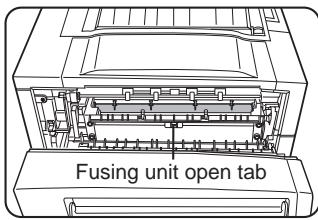
If the misfed paper is inside the fusing area, turn down the fusing unit open tab to open the fusing unit and remove the misfed paper.
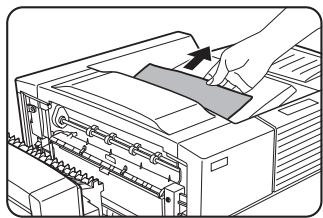
If paper is misfed in the exit area, remove it as shown while taking care not to tear the paper.
If the duplex module is equipped with an exit tray and paper is misfed in the exit area, remove the misfed paper as shown in the illustration.
3 Gently close the duplex module.
If the machine is not equipped with a duplex module, close the side cover.
After closing, confirm that the misfeed message has been cleared and the normal display appears.
Misfeed in the duplex module
1 Unlatch the duplex module and slide it to the left.
Unlatch the unit and gently move the module away from the machine.
2 If the duplex module has an exit tray, rotate it up out of the way and open the cover of the duplex module.
If no exit tray is attached, just open the cover of the duplex module and ignore any reference to the tray in the following steps.
3 While holding the exit tray up, remove the misfed paper as shown in the illustrations below.
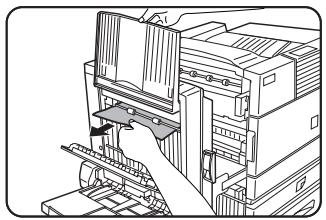
If paper is misfed at the upper part of the duplex module, gently remove it while taking care not to tear the paper.
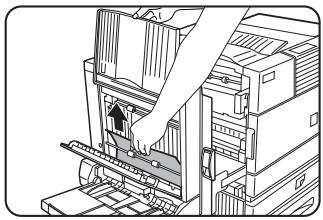
If paper is misfed at the lower part of the duplex module, gently remove it while taking care not to tear the paper.
4 Close the cover of the duplex module and lower the exit tray.
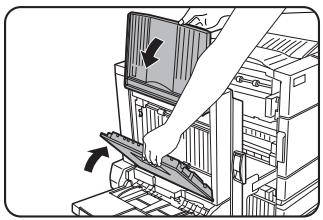
5 Gently close the duplex module.
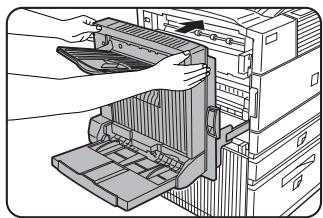
After closing the duplex module, confirm that the misfeed message has been cleared and the normal display appears.
■ Misfeed in the bypass tray
1 Unlatch the duplex module and slide it to the left.
Unlatch the unit and gently move the module away from the machine.
2 Remove the misfed from the bypass tray.
Be careful not to tear the misfed paper during removal.
3 Gently close the duplex module.
After closing the duplex module, confirm that the misfeed message is cleared and that the normal display appears.
TROUBLESHOOTING
Whenever the printer stops or operation is not possible, check the operation panel display for messages. In most cases these messages will give sufficient information to return the machine to an operating condition. In cases where this information is not enough, check the list below for more information.
This section describes problems concerning printer features.
For troubleshooting specific problems related to copier, facsimile, or network scanner features, see the separate manuals provided for them. For problems related to peripheral devices, see chapter 5 of this manual.
| Problem | Check | Solution or cause |
| Printer does not operate. | Printer plugged in? | Plug the printer into a grounded outlet. |
| Main power switch on? | Turn on the main power switch. | |
| READY indicator off? | The printer is warming up. (Warm-up time is approximately 80 seconds.) Wait until the READY indicator lights up. | |
| Message indicating need to load paper displayed? | Load paper. (page 1-16) | |
| Message indicating need to replace the toner cartridge displayed? (ERROR indicator lit at the same time on the operation panel of the main unit?) | Replace the toner cartridge.See the separate "Operation manual (Read this document before installing the product.)." | |
| Message indicating a paper misfeed displayed? (ERROR indicator lit at the same time on the operation panel of the main unit?) | Remove misfed paper. (page 4-2) | |
| Printer is on but data is not received. | Is the correct interface cable properly connected between the printer and your computer? | Ensure that the correct interface cable is connected between the printer and your computer. (page 2-2) |
| Is the correct printer driver installed? | Install the appropriate printer driver. (page 2-3) | |
| Has the printer been selected properly in the application software or, when the printer is being used as a network printer, has it been properly registered on the network? | Ensure that this printer is selected on the application software or use an appropriate utility to check that the printer is registered on the network. | |
| Data is received but not printed. | Is paper of the specified and type loaded in the printer? | Load paper, select another paper size or cancel printing. |
| Printer cannot be selected from computer. | Is the printer driver installed correctly? | Install the printer driver correctly. (page 2-3) |
| The orientation of the image is incorrect on the print. | Is the orientation setting in the printer driver correct? | Correct the orientation in the printer driver. |
| Image loss has occurred. The image is larger than the paper. | Zoom printing? | Check the zoom setting in the driver. |
| Black pages | ● Iss a color on color image being printed? | Some color on color images may be printed as all black. |
| Black and white areas are reversed. | ● Negative image printing? | Check print driver setting. |
| Printer prints in reverse order. | ● Is the reverse order selected in the application software? | Cancel the reverse order printing in the application software. |
| Printer stops in the middle of a print job. | ● Too much paper in the exit tray? | Remove the paper from the exit tray. |
| ● Is the printer out of paper? | Load paper. | |
| Printing is not on desired paper size. | ● Is paper selection of driver "Auto"? | Ensure that the desired paper is set in a paper tray of the printer and select "Auto" in the paper selection of the printer driver. |
| Printer resident font cannot be selected from the application software when the PPD file of an optional PS3 expansion kit is used in Windows (except NT) environment. | ● Has the resident font information been installed? | Install (or reinstall) the resident font information. (page 2-14) |
| Printer write error occurs when printing from the parallel port. | ● Is the timeout time set to be too short in the printer driver? | Set a longer time in the timeout setting in the printer driver. |
| Only one set has been output when more than one set has been specified. | ● Is the size of the file being printed too large for the available memory? Check for a printed notice page. | The print file size exceeds storage capacity of this printer. Print additional sets one at a time. Installation of a hard disk drive will enable printing of larger size files. |
| Two-sided printing is specified but only a notice page is printed. | ● Two-sided printing of a large number of pages is specified? | The print file size exceeds storage capacity of this printer. Installation of a hard disk drive will enable printing of large size files. |
| Printed image is too light or too dark. | ● Is the exposure control set properly? | The printer exposure level can be adjusted by using a key operator program. Contact your key operator. (page 11 of the Key Operator's Guide.) |
| Smudges on printed sheets | Is a message indicating a need of maintenance or replacement of developer cartridge displayed ([ERROR] indicator on the main unit operation panel lit)? | See the Operation Manual (Read this document before installing the product.). |
| Cannot select the desired paper in the printer driver or on the copier operation panel. | Has the paper size and type been set from the operation panel on the printer? | Be sure to set the paper size referring to "Setting the paper size and type" when you change the paper size in tray 1. (page 1-19) |
| Paper misfeeds frequently. | Paper curled or damp? | Do not use curled or crimped paper. If you do not use paper for a long time, store paper in the wrapper in a dry location. |
| Paper curled and misfed in the duplex module or finisher? | Paper may be curled when output depending on the paper type and quality. In some cases turning the paper over in the tray will reduce misfeeding due to curling. | |
| Multiple sheets of paper fed simultaneously? |  Remove the paper from the paper tray or the bypass tray, fan the paper as shown in the illustration, and then load it again. Remove the paper from the paper tray or the bypass tray, fan the paper as shown in the illustration, and then load it again. | |
| Printed paper is wrinkled or the image rubs off easily. | Is paper size or weight out of the allowable range? | Use paper in the allowable range. |
| Paper damp? | Be sure to store paper in the wrapper in a dry location and do not store paper in a location that ishumidat a high temperature or an extremely low temperature. | |
| The contrast on the touch panel is too high or too low. | Is LCD contrast properly adjusted? | Adjust the contrast using "DISPLAY CONTRAST" of custom settings. (page 3-7) |
| A notice page is printed when a print job is sent to the printer for retention. | Has the number of job sreached the maximum of 100 jobs in retention? | No further jobs can be retained until some jobs already in retention are deleted. |
| Password entry is requested. | Password set in the retention function? | Password is needed when executing printing. If the password is not known, printing cannot be executed. |
| Priority of reserved print jobs cannot be changed. | Has the paper to be used run out? | Load paper. (page 1-16) |
| Exit tray full? | Remove paper from the exit tray if it is full. |
USER MAINTENANCE
To ensure good service from this product over a long period of time, it is recommended that the following maintenance be performed on a regular basis.
NOTE
When cleaning, do not use thinner, benzene, or similar volatile cleaning agents.
Cleaning the scanner module
If the document glass, DSPF scanning section glass or document cover have dirty spots, these spots will become part of scanned images. These will show up as defects when the images are printed. Clean these areas by wiping them with a soft, clean cloth dampened with water or a small amount of a neutral detergent and then wipe them dry.
If black or white stripes appear on printed images of originals that were fed through the DSPF, wipe the scanning section glasses shown as A and B in the illustration.
Black stripes
White stripes
CHAPTER 5
PERIPHERAL DEVICES
This chapter describes operating instructions for the Mail-Bin Stacker, the Finisher, the Saddle Stitch Finisher, and the Duplex Module.
DUPLEX MODULE 5-2
● Part names 5-2 - Specifications 5-2 ● Loading paper in the bypass tray 5-3 - Setting the printer driver for duplex module, bypass tray and exit tray 5-4 ● Copying in the duplex mode 5-4 ● Troubleshooting (concerning the duplex module) 5-5
MAIL-BIN STACKER 5-6
● Part names 5-6 - Specifications 5-6 - Specifying mail bins to receive printed output 5-7 - Setting in the printer driver 5-7 ● Misfeed in the mail-bin stacker 5-8
FINISHER 5-9
● Part names 5-9 - Specifications 5-9 ● Finisher functions 5-10 ● Using the finisher functions 5-11 ● Staple cartridge replacement 5-12 ● Misfeed in the finisher 5-14 ● Troubleshooting finisher problems 5-15 ● Stapling position quick reference guide for duplex output ..... 5-16
SADDLE STITCH FINISHER 5-17
● Part names 5-17 - Specifications 5-17 ● Saddle stitch finisher functions 5-18 ● Using the saddle stitch finisher 5-20 ● Staple cartridge replacement and staple jam removal 5-21 ● Misfeed in the saddle stitch finisher 5-24 ● Troubleshooting (concerning the saddle stitch finisher) 5-26 ● Stapling position quick reference guide for duplex output 5-27 ● Relation between print image and saddle stitch 5-28
DUPLEX MODULE
If a duplex module is installed, printing onto both sides of paper can be performed.
Two types of duplex modules are available: duplex module/bypass tray and duplex module. The descriptions in this manual are for the duplex module/bypass tray. For misfeed removal for these modules, see page 4-7.
Part names
Exit tray
The tray is extendable to support large size paper. Extend the tray when 11" x 17", 8-1/2" x 14", 8-1/2" x 13", A3 or B4 paper is being used. For a duplex module (not duplex module/bypass tray), the exit tray is optional.
Bypass tray
This tray can also be used for special papers including transparency film. (See next page and page 1-17.)
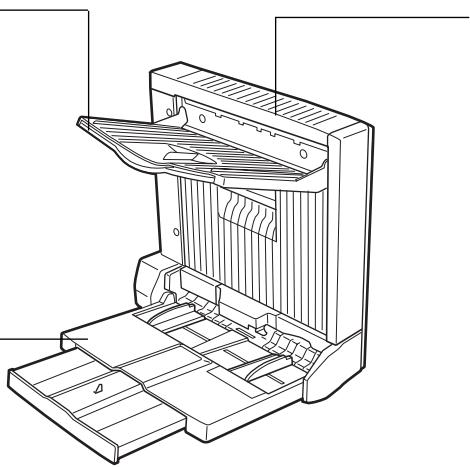
Duplex module
NOTE
Automatic two-sided printing can be done only onto plain paper. Special papers cannot be used for two-sided printing. (See page 1-18 for explanation on special paper.)
NOTES
- Do not press down on the bypass tray or the exit tray.
- The duplex module requires the installation of other peripheral devices in order to be functional and cannot be installed together with some other devices. The table on page 6-4 shows the configurations which are compatible.
Specifications
| Name | Duplex module or Duplex module/bypass tray |
| Paper size (for duplex copy)*1 | 11 x 17, 8-1/2 x 14, 8-1/2 x 13, 8-1/2 x 11, 8-1/2 x 11R, 5-1/2 x 8-1/2 R, A3, B4, A4, A4R, B5, A5R |
| Paper weight (for duplex copy)*1 | 16 to 28 lbs. or 60 to 105 g/m2 |
| Reference paper position | Center |
| Bypass tray paper capacity*2 | 100 sheets (8-1/2" x 11" or A4 size, 20 lbs. or 80 g/m2) |
| Dimensions | Duplex module: 4-17/32" (W) x 16-15/64" (D) x 16-25/64" (H) (115 mm (W) x 412 mm (D) x 416 mm (H))Duplex module/bypass tray: 17-49/64" (W) x 17-19/64" (D) x 16-25/64" (H) (451 mm (W) x 439 mm (D) x 416 mm (H)) |
| Weight | Duplex module: Approx. 11.1 lbs. (5 kg)Duplex module/bypass tray: Approx. 16.6 lbs. (7.5 kg) |
*1 For paper size and paper weight for the bypass tray, see “Specifications of paper trays (types and sizes of applicable papers for trays)” on page 1-17. *2 Duplex module/bypass tray only.
| Name | Exit tray |
| Paper output | Print face down |
| Paper capacity | 100 sheets (8-1/2" x 11" or A4 size, 20 lbs. or 80 g/m2) |
| Paper size | Max. 11" x 17" or A3, Min. 5-1/2" x 8-1/2"R or A5R |
| Paper type and weight to be output | Plain paper, 16 to 28 lbs. or 60 to 105 g/m2 |
Specifications are subject to change for improvement without notice.
Loading paper in the bypass tray
The bypass tray can be used for plain paper and special papers including labels. Up to 100 sheets of standard paper can be set. For paper types that can be used in the bypass tray, refer to page 1-17.
NOTE
If the paper type or size is changed, be sure to enter the paper type and size as in step 4.
1 Open the bypass tray.
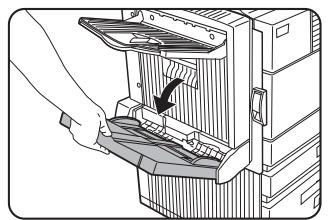
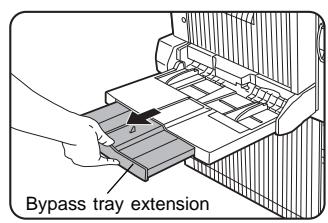
When setting 11" x 17", 8-1/2" x 14", 8-1/2" x 13", A3, or B4 paper, be sure to extend the bypass tray extension.
2 Set the bypass tray paper guides to the width of the paper to be used.
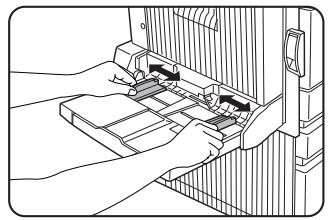
3 Insert the paper all the way into the bypass tray.
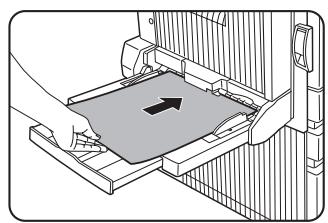
Set the paper face down. If there is a clearance between the paper and the paper guides, the paper may not be fed correctly. Adjust the guides so that they contact the edges of the paper.
NOTES
- When using 5-1/2" x 8-1/2" paper, A5 paper, or postcards, be sure to load them with their shorter edge into the feed slot as shown in the illustration.
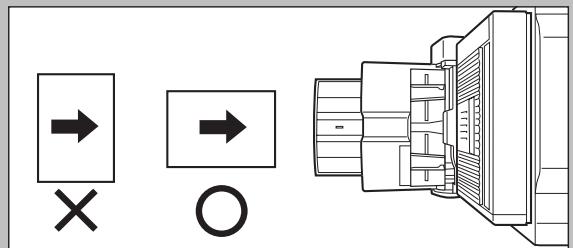
- When using special paper, postcards, or transparency film, be sure to feed them one sheet at a time. If you set more than one sheet, a paper misfeed may occur.
- When adding paper, first remove remaining paper, combine it with the paper to be added, and then reload as a single stack. Adding paper without stacking it correctly may cause a paper misfeed.
- When printing onto transparency film, remove the output sheets as soon as possible.
- For transparency film, use SHARP recommended film.
4 Set the type and size of the loaded paper.
When the paper system is changed from the inch system to the AB system or vice versa, or when the paper type is changed, the paper type must be designated. For setting the paper size and type, see page 1-19.
5 Loading paper in the bypass tray is now complete.
Setting the printer driver for duplex module, bypass tray, and exit tray
When using the duplex module (including the bypass tray and the exit tray) for printing, select “Properties” and make selections as follows for the print job.
The screens used in the following descriptions are for a PCL driver in the Windows 98 environment.
■ Two-sided printing
Open the "Main" tab and check the radio button of the desired two-sided printing mode.
■ Using the bypass tray
Open the “Paper” tab shown in the illustration below and select “Bypass Tray” in the “Paper Selection” drop down.
■ Using the exit tray mounted to the duplex module
Open the “Paper” tab shown in the illustration below and select “Left Side Tray” in the “Output” drop down.
NOTES
- The settings screens above will appear only if the devices have been set properly in the printer driver configuration (see NOTE on page 2-5).
- The combination of paper selection and other functions may not be compatible. For instance, if heavy paper, envelopes, label stock, etc. are selected, it will not be possible to select duplex, offset tray, saddle stitch, etc. For details, see printer driver help.
Copying in the duplex mode
For copying in the duplex mode, press the COPY key on the operation panel and make all selections on the copy mode basic screen.
■ Automatic duplex copying
Touch the [2-SIDED COPY] key on the copy mode basic screen. A selection screen for two-sided copying will appear.
Using the bypass tray
Touch the [PAPER SELECT] key on the copy mode basic screen. A selection screen for paper source will appear. Select the bypass tray on this screen.
Using the exit tray
Touch the [OUTPUT] key on the copy mode basic screen. A selection screen for output will appear. Select the exit tray mounted to the duplex module on this screen.
Troubleshooting (concerning the duplex module)
Check the list below before calling for service.
| Problem | Check | Solution or cause |
| The printer will not print duplex prints. | Message indicating the paper type cannot be used for two-sided printing displayed? | Special paper cannot be used for two-sided printing. Use a paper type adequate for two-sided printing. (See pages 1-18 and 5-2.) |
| Message indicating the paper size cannot be used for two-sided printing displayed? | Use a paper size adequate for two-sided printing. (See pages 1-18 and 5-2.) | |
| Two-sided printing cannot be set in printing on the printer driver? | Open the Configuration tab in the printer driver setting and check the check box of Duplex Module. (See NOTE on page 2-5.) | |
| Bypass tray extension not extended? | When using 11 x 17, 8-1/2 x 14, 8-1/2 x 13, A3 or B4 paper, the bypass tray extension must be extended. | |
| Printed images onto paper from the bypass tray are skewed. | Does the number of sheets exceed the limit? | Set paper within the allowable range. |
| Paper guides properly set? | Set the paper guides properly to the paper size. | |
| A paper misfeed occurs in the bypass tray. | Paper size and type set properly? | When using non-standard size paper or special paper, be sure to set the paper size and type. (See pages 1-17 to 1-19.) |
| Does the number of sheets exceed the limit? | Set paper within the allowable range. | |
| Paper guides properly set? | Set the paper guides properly to the paper size. |
MAIL-BIN STACKER
The mail-bin stacker has 7 mail bins which can each be designated to receive printed output from a user or a group of users.
Output paper in the copy mode and the fax mode will be delivered to the top tray of the stacker separated from printed output. (Printed output can also be delivered to the top tray.)
Part names
Top cover
Open for misfeed removal.
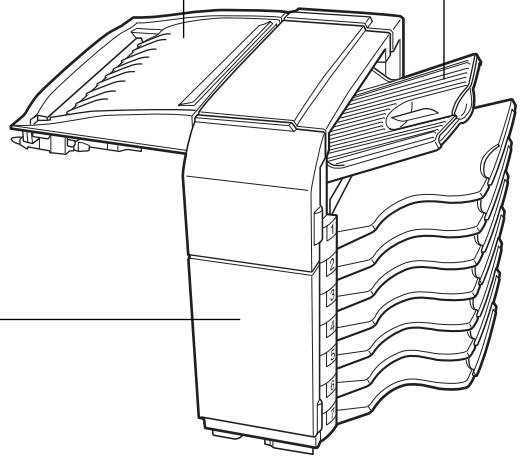
Top tray
Output paper from the printer, copier, and facsimile features can be delivered here.
Mail bins
Each bin can be designated to receive printed output for assigned users. These bins cannot be used for copier or facsimile output.
NOTES
- Do not put pressure on the mail-bin stacker, particularly on the top tray and mail bins.
- Do not place anything on the top cover. Doing so will interfere with the machine's paper handling during duplex printing.
- The top tray and each mail bin are extendable. To print onto large paper (11" x 17", 8-1/2" x 14", 8-1/2" x 13", A3 or B4), extend the tray.
- The mail-bin stacker requires the installation of other peripheral devices in order to be functional and cannot be installed together with some other devices. The table on page 6-4 shows the configurations which are compatible.
Specifications
| Name | Mail-bin stacker |
| Number of trays | 8 (Top tray and seven mail bins) |
| Paper output | Print face down |
| Tray type | Top tray: normal tray, Mail bins: mail bin tray |
| Tray capacity | Top tray: 250 sheets (8-1/2" x 11" or A4 size, 20 lbs. or 80 g/m2)Mail bins: 100 sheets each (8-1/2" x 11" or A4 size, 20 lbs. or 80 g/m2) |
| Paper sizes | Top tray: same as the specifications of paper for feeding in the main unitMail bins: 11 x 17, 8-1/2 x 14, 8-1/2 x 13, 8-1/2 x 11, 8-1/2 x 11R, 7-1/4 x 10-1/2,A3, B4, A4, A4R, B5, B5R |
| Paper weight | Top tray: same as the specifications of paper for feeding in the main unitMail bins: 15 to 34 lbs. or 60 to 105 g/m2 |
| Paper types | Top tray: same as the specifications of paper for feeding in the main unitMail bins: plain paper only |
| Tray full detection | Provided in both the top tray and the mail bins |
| Power supply | Requires the installation of an optional power supply unit (See page 1-8.) |
| Dimensions | 18-5/16" (W) x 20-7/8" (D) x 20" (H) (465 mm (W) x 530 mm (D) x 508 mm (H)) |
| Weight | Approx. 41.9 lbs. (19 kg) |
Specifications are subject to change for improvement without notice.
Specifying mail bins to receive printed output
Printed output can be specified in the printer driver to be delivered to an assigned mail bin or to the top tray. Assigning mail bins to individual users or groups of users reduces the mixing of print jobs simplifying the retrieval of printed output. When separation of output is not required, the top tray can be selected for delivery.
■ Using the mail-bin stacker
Top tray
Mail bin 1 ..... Product Planning department
Mail bin 2 ..... Engineering department
Mail bin 3
Mail bin 4
Mail bin 5
Mail bin 6
Mail bin 7 ..... Business department
1 Assign users to mail bins.
It is recommended that the network administrator assign bins by individual or by department. For example, the Product Planning department can be assigned to mail bin 1 and the Engineering department assigned to mail bin 2 etc.
2 Select the mail bin for receiving prints in the printer driver.
For the setting in the printer driver, see the description below.
Setting in the printer driver
Select “Properties” in the printer driver setting screen and proceed as below.
■ Specifying a mail bin
Open the "Paper" tab and select a mail bin for delivery under "Output".
NOTES
- The settings screens to the right will appear only if the devices have been set properly in the printer driver configuration (see NOTE on page 2-5).
- The combination of paper selection and other functions may not be compatible. For instance, if heavy paper, envelopes, label stock, etc. are selected, it will not be possible to select duplex, offset tray, saddle stitch, etc. For details, see printer driver help.
The illustration below shows the screen for a PCL printer driver in the Windows 98 environment as an example.
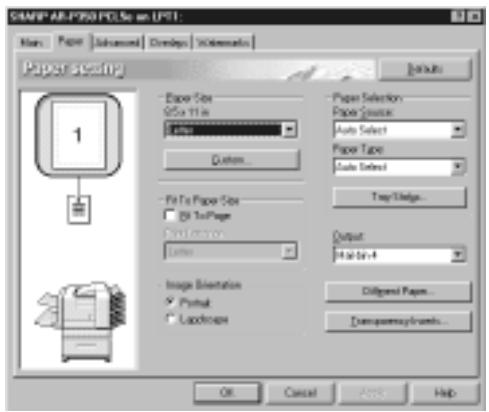
Misfeed in the mail-bin stacker
If a misfeed has occurred in the mail-bin stacker during printing, remove the misfed paper following the procedure below.
1 Open the top cover.
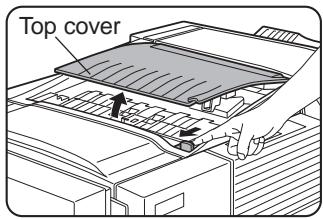
Move the release lever in the direction of the arrow in the illustration to open the top cover.
6 Remove the misfed paper.
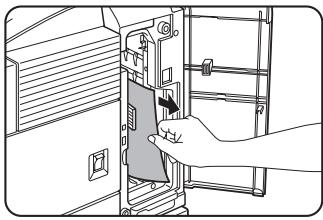
Be careful not to tear the misfed paper during removal.
2 Remove the misfed paper.
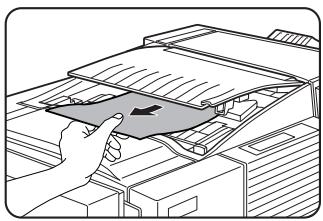
Be careful not to tear the misfed paper during removal.
After removing the paper, press down on the top cover to close it.
7 Close the paper guide.
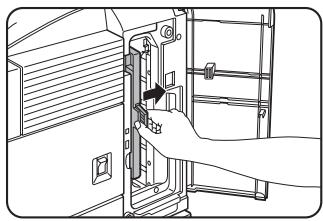
Close the paper guide securely.
3 If the misfed paper is not found in step 2, open the front cover.
8 Close the front cover.
4 Turn the roller rotating knob in the direction of the arrow to remove the misfed paper.
5 Open the paper guide.
Unlatch the paper guide and open it in the direction of the arrow.
FINISHER
The finisher can deliver collated sets either stapled or unstapled. Unstapled sets can be offset stacked from the previous set for easy separation of the sets.
Part names
Latch
Release the latch to open the finisher for misfeed removal.
Top cover
Open for misfeed removal.
Staple box
Pull the box out to replace the staple cartridge or to remove jammed staples.
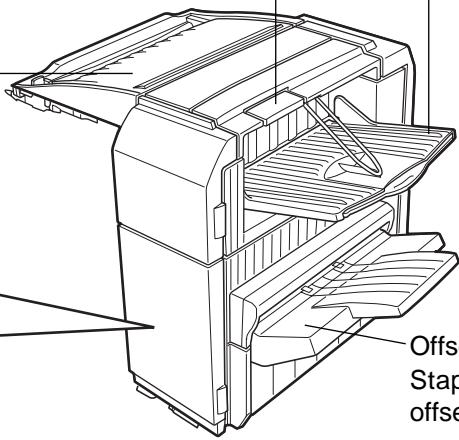
Top tray
Printer, copier and fax output can be delivered here.
To print onto large paper (11" x 17", 8-1/2" x 14", 8-1/2" x 13", A3 or B4), extend the tray.
Offset tray
Stapled sets or sets to be offset will be delivered here.
NOTES
- Do not put pressure on the finisher (particularly each tray).
- Do not place anything on the top cover. Doing so will interfere with the machine's paper handling during duplex printing. ● The tray moves up and down during operation. Be careful not to impede its movement.
- The finisher requires the installation of other peripheral devices in order to be functional and cannot be installed together with some other devices. The table on page 6-4 shows the configurations which are compatible.
Specifications
| Name | Finisher |
| Number of trays | 2 |
| Paper output | Print face down |
| Tray type | Top tray: normal tray, Lower tray: offset tray |
| Tray capacity | Top tray: 500 sheets (8-1/2" x 11" or A4 size, 20 lbs. or 80 g/m2)Lower tray: 750 sheets (8-1/2" x 11" or A4 size, 20 lbs. or 80 g/m2) |
| Paper sizes | Top tray: same as the specifications of paper for feeding in the main unitLower tray: Max. 8-1/2" x 11" or A4, Min. B5 |
| Paper weight | Top tray: same as the specifications of paper for feeding in the main unitLower tray: 16 to 34 lbs. or 60 to 128 g/m2 |
| Paper types | Top tray: same as the specifications of paper for feeding in the main unitLower tray: plain paper only |
| Tray full detection | Provided in both the top tray and the lower tray |
| Offset function | Provided for the lower tray only. The offset amount is approx. 1 inch (25 mm) |
| Paper sizes for stapling | 8-1/2" x 11", A4, and B5 |
| Stapling capacity | 30 sheets* (8-1/2" x 11" or A4 or smaller 20 lbs. or 80 g/m2)*Up two sheets of cover stock (34 lbs. or 128 g/m2) can be included. |
| Staples | Single staple can be placed in the top left or lower left corners or two staples can be centered on the left side |
| Power supply | Requires the installation of an optional power supply unit (See page 1-8.) |
| Dimensions | 18-1/8" (W) x 20-7/8" (D) x 20" (H) (460 mm (W) x 530 mm (D) x 508 mm (H)) |
| Weight | Approx. 46.3 lbs. (21 kg) |
Specifications are subject to change for improvement without notice.
Supplies
AR-SC1 staple cartridges must be used for this finisher. The cartridge package contains three cartridges approx. 3000 staples each.
Finisher functions
Sort mode
Sorted sets will be delivered.
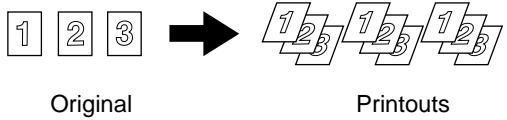
■ Group mode
Groups of prints or copies of the same page will be delivered.
![graph LR A["1 2 3"] --> B["1 1 2 2 3 3"] style A fill:#fff,stroke:#000 style B fill:#fff,stroke:#000 note bottom of A: Original note bottom of B: Printouts](/content/2024/12/122344/images/a082f916acf1789cc6968a15501bb5c5a5d662d0f1713e9b285d5760ad1b5376.jpg)
Offset mode
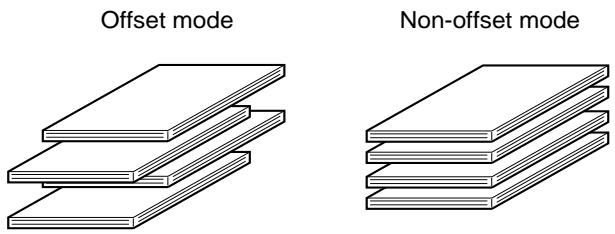
Sets will move from side to side so that each set or group will be offset from the previous set or group for easy separation.
Offset will function for non-stapled printer or copier output. Non-offset can only be selected for copier output.
Stapled sets will not be offset.
■ Staple sort mode
Collated sets will be stapled and delivered to the offset tray. The stapling positions, orientation, paper size for stapling, and stapling capacity are shown below.
| Stapling positions | Portrait orientation | Landscape orientation | ||
| Top left corner of printouts |  | Available paper sizes: 8-1/2" x 11", A4 and B5Stapling capacity: Up to 30 sheets for any available sizes | Stapling cannot be made. | |
| Center left two positions of printouts | 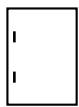 | Same as above | ||
| Lower left corner of printouts | 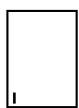 | Same as above | ||
Using the finisher functions
- Selecting the stapling function from a printer driver.
Select "Properties" on the printer driver setting screen and open the "Main" tab. Select "Left", "Right" or "Top" under "Binding Edge" and then select "1 Staple" or "2 Staples" under "Staple".
NOTES
- The settings screens to the right will appear only if the devices have been set properly in the printer driver configuration (see NOTE on page 2-5).
- The combination of paper selection and other functions may not be compatible. For instance, if heavy paper, envelopes, label stock, etc. are selected, it will not be possible to select duplex, offset tray, saddle stitch, etc. For details, see printer driver help.
The illustration below shows the screen for a PCL printer driver in the Windows 98 environment as an example.
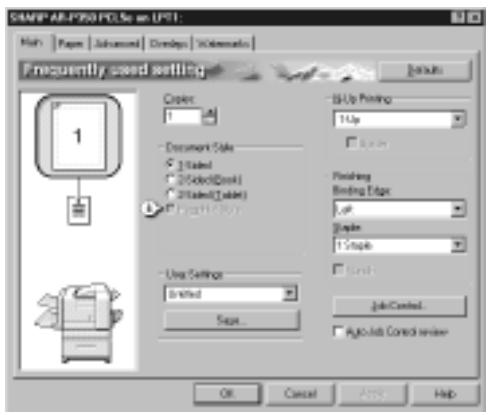
■ Using the finisher functions in the copy mode
When the [OUTPUT] key on the copy mode basic screen is touched, a screen for selecting the sort/group/staple sort functions and selecting an exit tray will appear. As a selection is made, the touch key for the selection will be highlighted.
![graph TD A["OUTPUT"] --> B["SORT"] A --> C["STAPLE SORT"] A --> D["GROUP"] B --> E["1"] C --> F["2"] D --> G["3"] E --> H["4"] F --> I["5"] G --> J["6"] H --> K["TOP TRAY"] I --> L["OFFSET TRAY"] J --> M["OFFSET"] K --> N["OK"] L --> O["OK"]](/content/2024/12/122344/images/251dd118ff653a1339fb840527f323bae3fd7cc706d2d01a49d59e511d257689.jpg)
① [GROUP] key (See page 5-10.) When Group is selected, all copies of the same original will be grouped. ② [STAPLE SORT] key (See page 5-10.) When Staple Sort is selected, sorted sets will be stapled and delivered to the offset tray. (They will not be offset stacked.) ③ [SORT] key (See page 5-10.) When Sort is selected, sets of copies will be sequentially delivered. ④ Icon display An icon representing a selected function (sort, staple sort or group) is displayed.
⑤ [OFFSET] key (See page 5-9.) If Offset is checked, offset is enabled. If not checked, offset will not function. If staple sort is selected, the check mark of offset will be automatically canceled. ⑥ [OFFSET TRAY] key (See page 5-9.) When the offset tray is selected, copies will be delivered to the offset tray. When staple sort is selected, the offset tray will be automatically selected. ⑦ [TOP TRAY] key When top tray is selected, copies will be delivered to the top tray. ⑧ [OK] key Press to close the output screen and to return to the basic screen.
Staple cartridge replacement
When the staple cartridge becomes empty, the message “Add staples.” will appear in the message display of the operation panel.
Follow the procedure below to replace the staple cartridge.
1 Open the front cover.
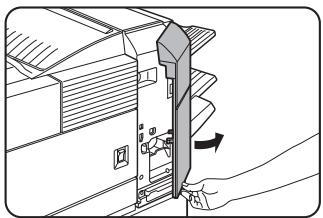
2 Turn the staple unit to face up.
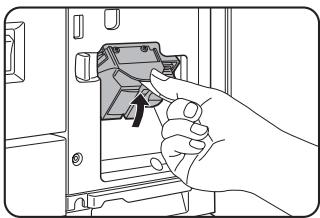
3 Pull the release lever for the staple box and remove the box.
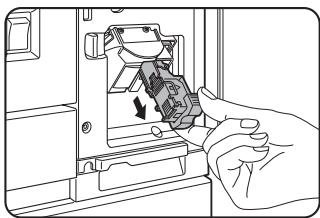
4 Remove the empty staple cartridge from the staple box.
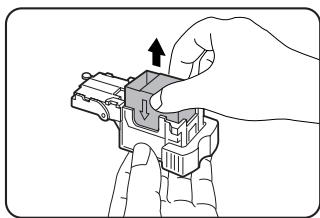
5 Insert a new staple cartridge into the staple box aligning the arrow of the staple cartridge with that of the staple box.
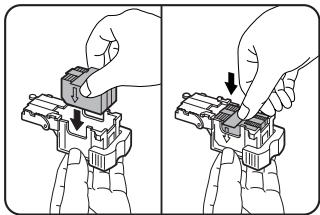
NOTES
- Do not remove the tape from the cartridge before inserting the staple cartridge into the box.
- When reinstalling the staple box, push it in until it clicks into place.
6 Remove the tape from the staple cartridge by pulling it straight.
7 Reinstall the staple box.
Push the staple box in until it clicks into place.
8 While pushing the staple unit release lever to the left, rotate the staple unit to face down.
9 Close the front cover.
NOTE
Make a test print or copy in the staple sort mode to ensure that stapling is performed properly.
■ Checking the staple unit
If the message “CHECK THE STAPLER UNIT” or “CHECK STAPLER POSITION OR STAPLER JAM” appears, follow the procedure below.
1 Open the finisher compiler.
Release the latch to open the finisher compiler.
2 Remove the misfed paper from the stapler compiler.
Be careful not to tear the misfed paper during removal.
3 Close the finisher compiler.
4 Open the finisher front cover.
5 Turn the staple unit to face up.
6 Pull the release lever for the staple box and remove the box.
7 Raise the lever at the end of the staple box.
Remove the top staple if it is bent. If bent staples remain, a staple jam will occur again.
8 Return the lever to its original position.
9 Reinstall the staple box.
Push the staple box in until it clicks into place.
10 While pushing the staple unit release lever to the left, rotate the staple unit to face down.
11 Close the front cover.
NOTE
Make a test print or copy in the staple sort mode to ensure that stapling is performed properly.
Misfeed in the finisher
When a misfeed occurs in the finisher, remove the misfed paper following the procedure below.
1 Remove the misfed paper from the output area.
Be careful not to tear the misfed paper during removal.
5 Raise the paper guide and remove the misfed paper.
Do not remove paper from the stapler compiler.
2 Open the finisher top cover.
Move the tab in the direction of the arrow as shown in the illustration to open the top cover.
6 Close the finisher compiler.
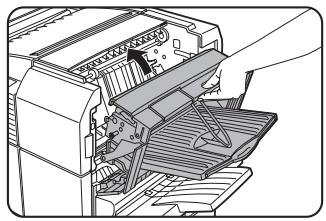
3 Remove the misfed paper.
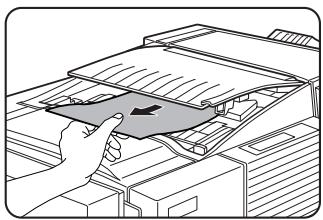
Be careful not to tear the misfed paper during removal.
After removing the paper, press down on the top cover to close it.
4 Open the finisher compiler.
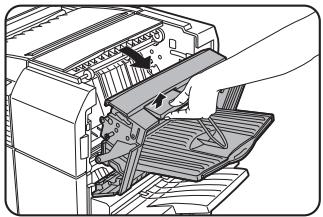
Release the latch to open the finisher compiler.
Troubleshooting finisher problems
Check the list below before calling for service.
| Problem | Check | Solution or cause |
| Stapling position is not correct. | Stapling position not set correctly? | Check the stapling position setting. (See page 5-16.) |
| The finisher does not operate. | Are any finisher covers open? | Close all covers. |
| Message indicating need to remove paper from the stapler compiler displayed? | Open the finisher as described in step 4 on page 5-14 and remove all paper  from the stapler compiler. from the stapler compiler. | |
| Stapling cannot be performed. | Is a “CHECK THE STAPLER UNIT” or “CHECK STAPLER POSITION OR STAPLER JAM” message displayed? | Check the staple unit. (See page 5-13.) |
| Is a message “ADD STAPLES” displayed? | Replace the staple cartridge. (See page 5-12.) | |
| Different size paper included? | Stapling cannot be performed onto different size paper. | |
| Stapled sets are not stacked correctly or some sheets in a set are not stapled. | Paper heavily curled? | Paper may be curled heavily depending on the paper type and quality. Remove paper from the paper tray or the bypass tray, turn it upside down, and load it again. |
Stapling position quick reference guide for duplex output
The orientation of the copy paper, original, scanned original data, and binding position selection are all interrelated. The table below shows these relationships.
| Orientation of original or original data | Output result | |||||
| Page 1 | Page 2 | Page 1 & Page 2 Duplexed | ||||
| Portrait orientation printing | Left binding |  | 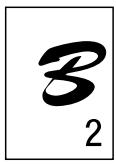 |  | One-position stapling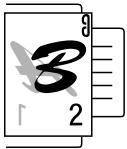 | Two-position stapling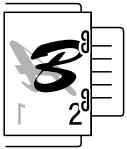 |
| Top binding |  |  |  | One-position stapling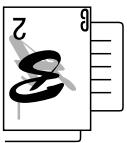 | Two-position stapling with top binding cannot be made. | |
| Right binding |  | 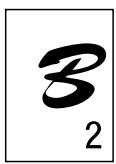 |  | One-position stapling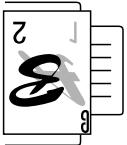 | Two-position stapling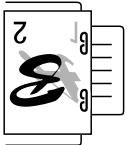 | |
| Landscape orientation printing | Left binding |  | 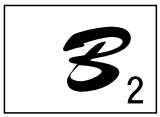 |  | One-position stapling | Two-position stapling with left binding cannot be made. |
| Top binding |  |  |  | One-position stapling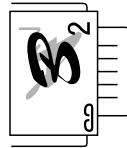 | Two-position stapling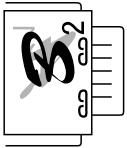 | |
| Right binding |  |  |  | One-position stapling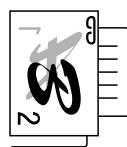 | Two-position stapling with right binding cannot be made. | |
NOTES
- Stapling can only be done when the offset tray has been selected.
- If mixed paper sizes are selected for stapling jobs, stapling will be automatically canceled.
NOTE
Transparency film, labels, envelopes and postcards cannot be stapled.
SADDLE STITCH FINISHER
The saddle stitch finisher can automatically place two staples for centerline binding of prints or copies and fold them along the centerline.
An optional hole punching unit is available for installation into the finisher.
Part names
Stapler compiler
Paper to be stapled is stacked temporarily.
Offset tray
Output which is stapled or offset will be delivered to this tray.
Saddle stitch tray
Saddle stitched output is delivered here.
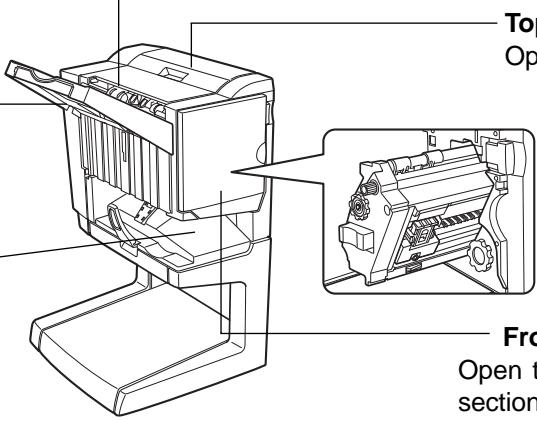
Top cover
Open for misfeed removal.
Stapler section
Open the front cover and pull out this section to replace the staple cartridge or to remove jammed staples.
Open the front cover and pull out this section for staple cartridge replacement or to remove jammed staples.
NOTES
- Do not press on the saddle stitch finisher (particularly the offset tray).
- Be careful about the offset tray during printing because the tray moves up and down.
- The saddle stitch finisher requires the installation of other peripheral devices in order to be functional and cannot be installed together with some other devices. The table on page 6-4 shows the configurations which are compatible.
Specifications
| Name | Saddle stitch finisher |
| Number of trays | 2 |
| Paper output | Print face down |
| Tray system | Upper tray: offset tray, Lower tray: saddle stitch tray |
| Tray capacity | Upper tray:Non-stapling: Max. 1,000 sheets for 8-1/2 x 11 or A4 or smaller sizes (20 lbs. or 80 g/m2), max. 500 sheets for 8-1/2 x 13 or B4 or larger sizes (20 lbs. or 80 g/m2)Stapling: Max. 30 stapled sets and max. 1,000 sheets for 8-1/2 x 11 or A4 or smaller sizes (20 lbs. or 80 g/m2), max. 30 stapled sets and max. 500 sheets for 8-1/2 x 13 or B4 or larger sizes (20 lbs. or 80 g/m2)Lower tray: Stapled print capacity is (6 - 10) sheets x 10 sets or (1 - 5) sheets x 20 sets. |
| Paper size | Upper tray: 11 x 17, 8-1/2 x 14, 8-1/2 x 13, 8-1/2 x 11, 8-1/2 x 11R, 7-1/4 x 10-1/2, 5-1/2 x 8-1/2R, A3, B4, A4, A4R, B5, B5R, A5RLower tray: max. 11 x 17, 8-1/2 x 11R, A3, B4, A4R |
| Paper weight | Upper tray: 16 to 54 lbs. or 60 to 205 g/m2Lower tray: 17 to 34 lbs. or 64 to 80 g/m2 |
| Paper types | Upper tray: plain paper, thick paperLower tray: plain paper only |
| Tray full detection | Provided in both trays |
| Offset function | Upper tray only |
| Paper sizes for stapling | Upper tray: 11" x 17", 8-1/2" x 14", 8-1/2" x 13", 8-1/2" x 11", 8-1/2" x 11"R, A3, B4, A4, A4R, B5, and B5RLower tray: 11" x 17", 8-1/2" x 11"R, A3, B4, and A4R |
(Continued on next page)
| Stapling capacity | 8-1/2" x 11" or A4 or smaller size: 50 sheets*(20 lbs. or 80 g/m2)8-1/2" x 14" or B4 or larger size: 25 sheets*(20 lbs. or 80 g/m2)*Up to two sheets of 34 lbs. or 128 g/m2 paper can be included as covers. |
| Staples | Upper tray: Single staple can be placed in the top left or lower left corners or two staples can be centered on the left side.Lower tray: 4-47/64" (120 mm) pitch from the center of paper |
| Power supply | Requires the installation of an optional power supply unit (See page 1-8.) |
| Dimensions | 28-9/32" (W) x 23-3/4" (D) x 39-3/8" (H) (718 mm (W) x 603 mm (D) x 1000 mm (H)) |
| Weight | Approx. 86 lbs. (39 kg) |
| Name | Punch module |
| Paper sizes for hole punching | 3 holes: 11" x 17", 8-1/2" x 11", A3, B42 holes: 8-1/2" x 14", 8-1/2" x 11"R |
Specifications are subject to change for improvement without notice.
Supplies
AR-SC2 staple cartridges must be used for this finisher. The cartridge package contains three cartridges approx. 5000 staples each.
Saddle stitch finisher functions
Sort mode
Sorted sets will be delivered.
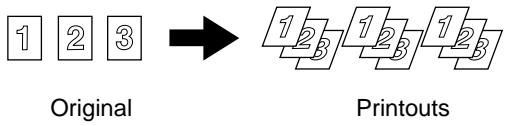
■ Group mode
Groups of copies of the same page will be delivered.
![graph LR A["1 2 3"] --> B["1 1 2 2 3 3"] style A fill:#fff,stroke:#000 style B fill:#fff,stroke:#000 note bottom of A: Original note bottom of B: Printouts](/content/2024/12/122344/images/7161f3ce4ed384f40d87a6bc2ca891c057cb368c8db156aaa6b413f049b06877.jpg)
Offset mode
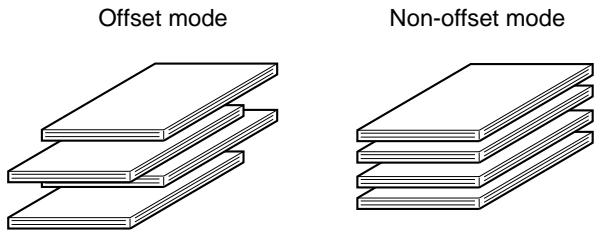
Sets will move from side to side so that each set or group will be offset from the previous set or group for easy separation.
Offset will function for non-stapled printer or copier output. Non-offset can only be selected for copier output.
Stapled sets will not be offset.
■ Staple sort mode
Collated sets of prints or copies will be stapled and delivered to the offset tray. When saddle stitching is selected, the prints or copies will be stapled at the center and delivered to the saddle stitch tray. The stapling positions, orientation, paper size for stapling, and stapling capacity are shown below.
| Stapling positions | Portrait orientation | Landscape orientation | ||
| Top left corner of printouts |  | Available paper sizes: 8-1/2" x 11", A4 and B5Stapling capacity: Up to 50 sheets for any sizes |  | Available paper sizes: 11" x 17", 8-1/2" x 14", 8-1/2" x 13", 8-1/2" x 11" R, A3, B4, A4R, and B5RStapling capacity: Up to 50 sheets for 8-1/2" x 11"R, A4R and B5R, and up to 25 sheets for other sizes |
| Center left two positions of printouts |  | Same as above |  | Same as above |
| Lower left corner of printouts |  | Same as above |  | Same as above |
| Saddle stitch on centerfold line. |  | Paper in the portrait direction cannot be saddle stitched. |  | Available paper sizes: 11" x 17", 8-1/2" x 11"R, A3, B4, and A4RStapling capacity: Up to 10 sheets for any sizes |
■ Saddle stitch function
The saddle stitch finisher can automatically place two staples for centerline binding of prints or copies and fold them along the centerline.
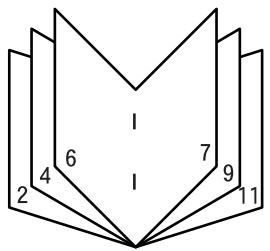
■ Hole punching (only if a punch module is installed)
If the saddle stitch finisher is equipped with a hole punch module, printed paper can be hole punched and delivered to the offset tray. Saddle stitching and hole punching cannot be selected at the same time. The automatic image rotation will not function when the hole punching function is used.
Two or three holes can be punched depending on the paper size. (See paper sizes for hole punching on page 5-18.)
{Original 1}

{Original 2}
{Punch positions}

Punch positions
Using the saddle stitch finisher
Selecting staple or saddle stitch from the printer driver.
Select “Properties” on the printer driver setting screen and open the “Main” tab shown in the illustration to the right. For normal edge or corner stapling, select “Left”, “Right” or “Top” under Binding Edge and “1 Staple” or “2 Staples” under “Staple”. For saddle stitch selection, check the radio button of “Pamphlet Style” under the Document Style heading, then select “Tiled Pamphlet” or “2-Up pamphlet”. Then select “2 Staples” in the “Staple” drop down under the “Finishing” heading.
Selecting hole punching
Open the "Main" tab and check "Punch" under the "Finishing" heading.
The illustration below shows the screen for a PCL printer driver in the Windows 98 environment as an example.
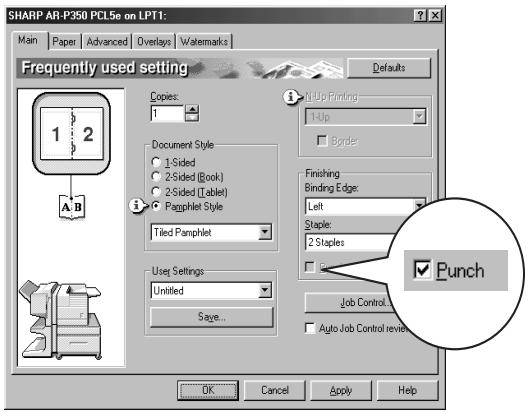
NOTES
● The settings screens above will appear only if the devices have been set properly in the printer driver configuration (see NOTE on page 2-5). - The combination of paper selection and other functions may not be compatible. For instance, if heavy paper, envelopes, label stock, etc. are selected, it will not be possible to select duplex, offset tray, saddle stitch, etc. For details, see printer driver help.
Using the finisher functions in the copy mode
When [OUTPUT] is selected on the copy mode basic screen, a screen for making selections for sort, group, staple, punch and exit tray will appear.
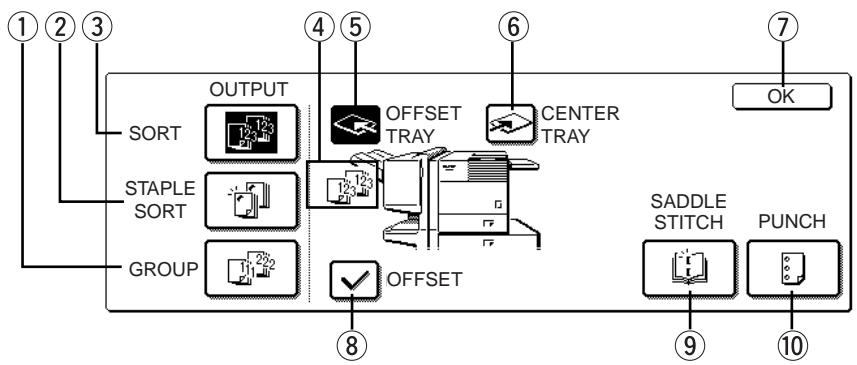
① [GROUP] key (See page 5-18.)
When Group is selected, all copies of the same original will be grouped.
② [STAPLE SORT] key (See page 5-19.)
When Staple Sort is selected, sorted sets will be stapled and delivered to the offset tray. (They will not be offset stacked.)
③ [SORT] key (See page 5-18.)
When Sort is selected, sets of copies will be sequentially delivered.
④ Icon display
An icon representing a selected function (sort, staple sort or group) is displayed.
⑤ [OFFSET TRAY] key (See page 5-17.)
If Offset is checked, the offset will be enabled. If not checked, the offset will not function. If the staple sort is selected, the check mark of offset will be automatically canceled.
⑥ [CENTER TRAY] key
If the center tray is selected, output paper will be delivered to the exit tray located above the main unit.
⑦ [OK] key
Press to close the [OUTPUT] screen and to return to the basic screen.
⑧ [OFFSET] key (See page 5-18.)
When the offset tray is selected, copies will be delivered to the offset tray. When staple sort is selected, the offset tray will be automatically selected.
⑨ [SADDLE STITCH] key (See page 5-19.)
When saddle stitching is selected, the copies will be stapled at the center and delivered to the saddle stitch tray.
⑩ [PUNCH] key (See page 5-19.)
If the saddle stitch finisher is equipped with a hole punch module, printed paper can be hole punched and delivered to the offset tray.
Staple cartridge replacement and staple jam removal
When the staple cartridge becomes empty or staples become jammed, a message will appear in the message display of the operation panel.
Follow the procedure below to replace the staple cartridge or remove jammed staples.
■ Staple cartridge replacement
1 Open the front cover.
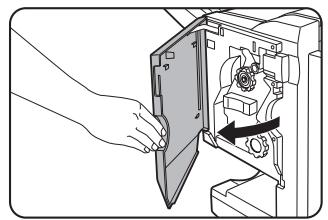
2 Pull out the stapler section.
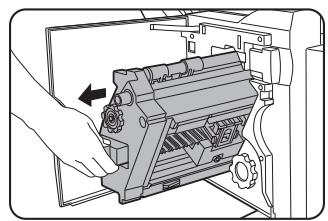
3 Turn roller rotating knob A in the direction of the arrow to move the staple unit to the front.
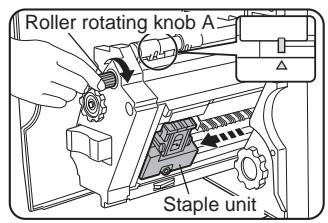
Turn the roller rotating knob until the triangle mark is aligned with the index.
4 Remove the empty staple box.
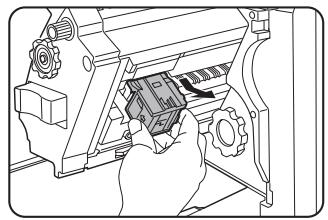
5 Remove the empty staple cartridge.
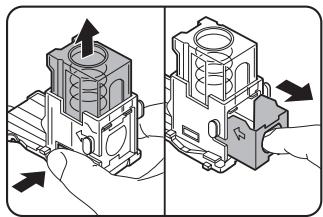
Press the lock button to unlock the staple box cover and remove the staple cartridge.
NOTE
If staples remain, the staple cartridge cannot be removed.
6 Insert a new staple cartridge into the staple box.
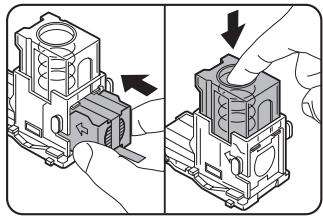
After inserting the staple cartridge, press down on the staple box cover to lock the cartridge in place.
NOTES
- Do not remove the tape from the cartridge before inserting the staple cartridge into the box.
- When reinstalling the staple box, push it in until it clicks into place.
7 Remove the tape from the staple cartridge by pulling it straight.
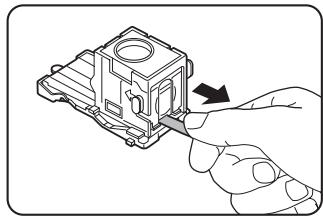
8 Insert the staple box.
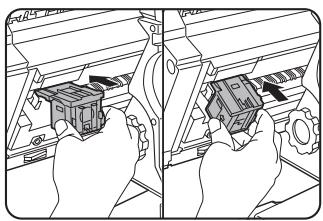
Push the staple box in until it clicks into place.
9 Push the stapler section back into the finisher.
■ Staple jam removal
1 Unlatch the saddle stitch finisher and slide it away from the printer.
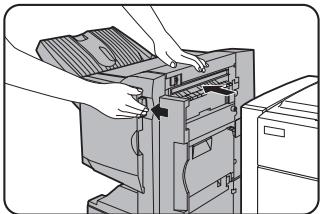
2 Open the front cover.
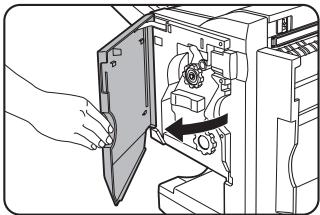
3 Turn roller rotating knob C as shown in the illustration until the blue indication is seen.
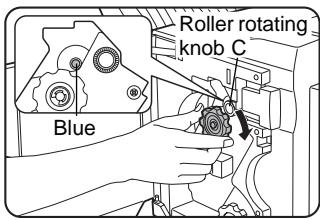
4 Remove the paper from the stapler compiler.
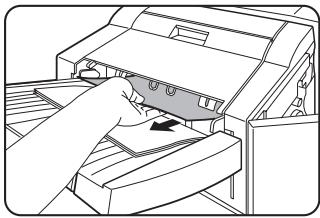
10 Close the front cover.
NOTE
Make a test print or copy in the staple sort mode to ensure that stapling is performed properly.
5 If saddle stitch was selected, open the saddle stitch section cover.
6 Remove the misfed paper.
Be careful not to tear the misfed paper during removal.
7 Close the saddle stitch section cover.
8 Open the front cover and pull out the stapler unit.
9 Turn roller rotating knob A in the direction of the arrow to move the staple unit to the front.
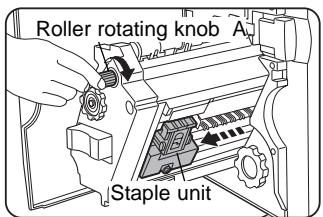
Turn the roller rotating knob until the triangle mark is aligned with the index.
10 Remove the staple box.
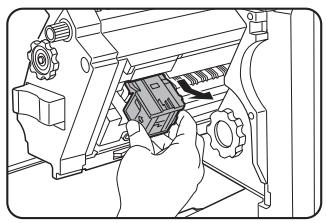
11 Raise the lever at the end of the staple box.
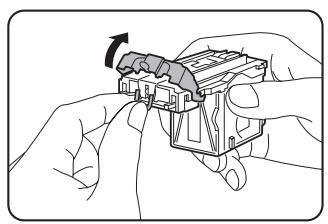
Remove the top staple if it is bent. If bent staples remain, a staple jam will occur again.
■ Disposal of hole punch scrap
1 Unlatch the saddle stitch finisher and slide it away from the printer.
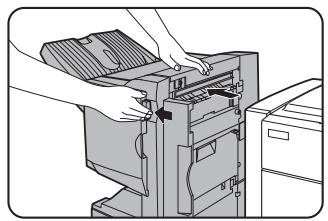
2 Pull out the punch scrap collecting container and empty it.
12 Return the lever to its original position.
13 Reinstall the staple box.
Push the staple box in until it clicks into place.
14 Push the stapler section back into the finisher.
15 Close the front cover.
16 Push the saddle stitch finisher back against the printer.
NOTE
Make a test print or copy in the staple sort mode to ensure that stapling is performed properly.
3 Return the punch scrap collecting container to its original position.
4 Push the saddle stitch finisher back against the printer.
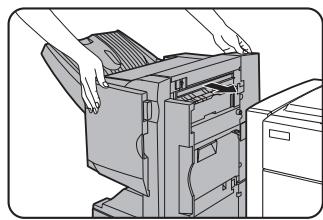
Misfeed in the saddle stitch finisher
When a misfeed occurs in the saddle stitch finisher, remove the misfed paper following the procedure below.
1 Unlatch the saddle stitch finisher and slide it away from the printer.
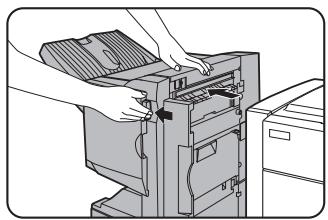
2 Remove the misfed paper from the main unit.
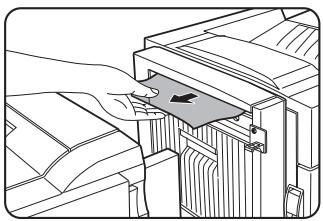
After removing the misfed paper, open and close the duplex module to reset the jam indicator. (step 1 or 5 on page 4-4)
3 If misfed paper is not found in step 1, open the top cover.
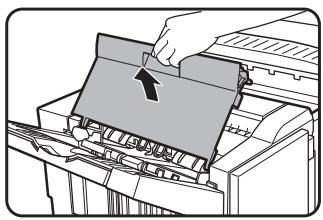
4 While pulling and turning roller rotating knob B, remove the misfed paper.
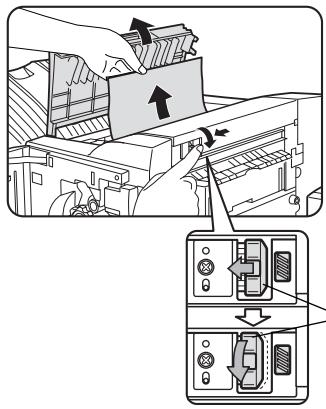
If the misfed paper is released by turning roller rotating knob B, remove it taking care not to tear the paper.
Roller rotating knob B
5 Close the top cover.
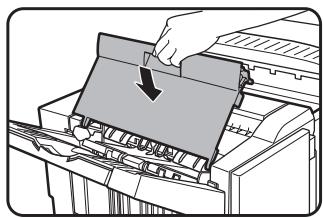
6 If saddle stitch was selected, open the front cover.
7 Remove the misfed paper from the stapler compiler.
Be careful not to tear the misfed paper during removal.
8 Open the saddle stitch section cover.
9 Remove the misfed paper.
Be careful not to tear the misfed paper during removal.
10 Turn roller rotating knob in the direction of the arrow.
11 Remove any misfed paper from the saddle stitch tray.
Be careful not to tear the misfed paper during removal.
12 Close the saddle stitch section cover.
13 Close the front cover.
14 Push the saddle stitch finisher back against the printer.
Troubleshooting (concerning the saddle stitch finisher)
Check the list below before calling for service.
| Problem | Check | Solution or cause |
| Stapling position is not correct (including saddle stitch). | Stapling position not set properly? | Check the stapling position setting. (See pages 5-27 and 5-28.) |
| The saddle stitch finisher does not operate. | Are any saddle stitch finisher covers open? | Close all covers. (See page 5-17.) |
| Message indicating need to remove paper from the stapler compiler displayed? | Remove all remaining paper from the stapler compiler referring to step 4 on page 5-22. | |
| Stapling cannot be performed (including saddle stitch). | Message requesting check for the staple unit displayed? | Remove jammed staples. (See page 5-22.) |
| Message requesting adding staples displayed? | Replace the staple cartridge. (See page 5-21.) Check that a staple cartridge has been installed. (See page 5-22.) | |
| Different size paper included? | Stapling cannot be performed onto different size paper. | |
| Stapled sets are not stacked correctly or some sheets in a set are not stapled. | Paper heavily curled? | Paper may be curled heavily depending on the paper type and quality. Remove paper from the paper tray or the bypass tray, turn it upside down, and load it again. |
| Cannot be punched.* | Message requesting check for punch module displayed? | Dispose of punch scraps. (See page 5-23.) |
* When a hole punch module is installed
Stapling position quick reference guide for duplex output
The orientation of the copy paper, original, scanned original data, and binding position selection are all interrelated. The table below shows these relationships.
| Orientation of original or original data | Output result | |||||
| Page 1 | Page 2 | Page 1 & Page 2 Duplexed | ||||
| Portrait orientation printing | Left binding |  |  |  | One-position stapling | Two-position stapling |
 | Two-position stapling along the shorter edge cannot be made. | |||||
| Top binding |  |  |  | One-position stapling | Two-position staplingTop binding with two-position stapling cannot be made. | |
| [IMAGE] |  | |||||
| Right binding |  |  |  | One-position stapling | Two-position stapling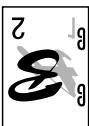 | |
| [IMAGE] | Two-position stapling along the shorter edge cannot be made. | |||||
| Landscape orientation printing | Left binding |  |  , , |  | One-position stapling | Left binding with two-position stapling cannot be made. |
| [IMAGE] |  | |||||
| Top binding |  |  |  | One-position stapling | Two-position stapling | |
| [IMAGE] | Two-position stapling along the shorter edge cannot be made. | |||||
| Right binding |  |  , , |  | One-position stapling | Right binding with two-position stapling cannot be made. | |
| [IMAGE] |  | |||||
Relation between print image and saddle stitch
The orientation of the copy paper, original, scanned original data, and binding position selection are all interrelated. The table below shows these relationships.
| Orientation of original or original data | Output result | ||||
| Portrait orientation printing | Left binding | Page 1 | Page 2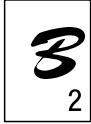 | Page 1 & Page 2 Duplexed | 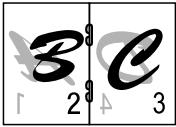 |
Page 3 | Page 4 | Page 3 & Page 4 Duplexed | |||
| Right binding | Same as above | 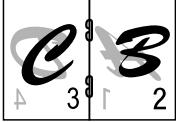 | |||
| Landscape orientation printing | Page 1 | Page 2 | Page 1 & Page 2 Duplexed |  | |
Page 3 | Page 4 | Page 3 & Page 4 Duplexed | |||
NOTES
- Transparency film, labels, envelopes and postcards cannot be stapled.
- If mixed paper sizes are selected for stapling jobs, stapling will be automatically canceled.
CHAPTER 6
APPENDIX
Page
PRINTER SPECIFICATIONS 6-2
● List of principal printer driver functions 6-3
LIST OF COMBINATION OF PERIPHERAL DEVICES 6-4
NOTICE PAGE PRINTING 6-5
PRINT AREA 6-6
PRINTER SPECIFICATIONS
| Type | Desktop (can be upgraded to console type if an optional stand is installed.) |
| Print system | Electrophotographic system |
| Exposure system | Semiconductor laser diode system |
| Developer system | Magnetic brush development |
| Paper feed system | Paper trays |
| Fusing system | Heat roller |
| CPU | 64 bit RISC, 200 MHz |
| Memory capacity (standard) | 32 MB/(64 MB for models with a multi-function controller board) |
| DIMM slots for additional memory | One (64 MB to 256 MB memory can be mounted.) |
| Page description language | PCL6, PCL5e, PS3 emulation* |
| Resident font | Outline font: 46 (including Line printer font)PostScript compatible font: 136**An optional PS3 expansion kit is needed. |
| Parallel interface | IEEE-1284 compatible parallel interface (P1284B connector) |
| Network interface | 10 Base T/100 Base TX (To extend this product to include network features,an optional Print Server Card is needed.) |
| Warm up time | Approx. 80 seconds |
| Continuous print speed(8-1/2" x 11" or A4 paper) | 35 ppm type: 35 pages/min., 45 ppm type: 45 pages/min. |
| Resolution | 600 x 600 dpi |
| Print color | Black |
| Printing orientation | Portrait/landscape |
| Power supply | USA: AC120V, 60Hz, 12AOther countries: Local voltage ± 10% (For power supply requirements, see the name plate of the main unit.) |
| Power consumption | Max. 1,450 W |
| Operating environments | Temperature: 59°F to 86°F (15°C to 30°C),Humidity: 20% to 80% |
Dimensions: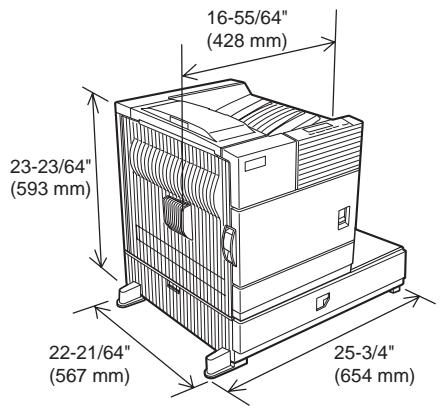
Acoustic Noise Emission (measurement according to ISO7779)
| Printing mode | Standby mode | ||
| Sound power level LwA | 6.7 B | 4.8 B | |
| Sound pressure level LpA | Bystander positions | 53 dB(A) | 33 dB(A) |
Emission Concentration (measurement according to RAL UZ62)
| Ozone | 0.02 mg/m3 or less |
| Dust | 0.075 mg/m3 or less |
| Styrene | 0.07 mg/m3 or less |
Weight: Approx. 111 lbs. (50 kg) (including a multi purpose drawer)
List of principal printer driver functions
| When an optional PS3 expansion kit is installed | |||||
| Driver selections | PCL5e/PCL6 | PS | PPD (Windows) | PPD (Macintosh) | |
| General | Copies | 1 - 999 | 1 - 999 | 1 - 999 | 1 - 999 |
| Orientation | Yes | Yes | Yes | Yes | |
| Duplex print | Yes | Yes | Yes | Yes | |
| Saddle stitch | Yes | Yes | N/A | N/A | |
| Binding edge | Left/top/right | Left/top/right | Long/short | Long/short | |
| N-up | 2/4/6/8 | 2/4/6/8 | 2/4*3*4 | 2/4/6/9/16 | |
| N-up direction | Fixed | Fixed | Fixed | Selectable | |
| N-up border line | Yes | Yes | Yes (always) | Yes | |
| Paper | Paper size | Yes | Yes | Yes | Yes |
| Custom paper size | 1 size | 1 size | 3 sizes*3*5 | N/A | |
| Source selection | Yes | Yes | Yes | Yes | |
| Different first page | Yes | Yes | N/A | Yes | |
| Transparency inserts | Yes | Yes | N/A | Yes | |
| Paper output | Output tray selection | Yes | Yes | Yes | Yes |
| Mail bin | Yes | Yes | Yes | Yes | |
| Staple | Yes | Yes | Yes | Yes | |
| Offset | Yes | Yes | Yes | Yes | |
| Punch | Yes | Yes | Yes | Yes | |
| Graphic | Resolution | 600/300 dpi | 600 dpi | 600 dpi | 600 dpi |
| Halftone | N/A | Yes | Yes | N/A | |
| Graphic mode | Yes | N/A | N/A | N/A | |
| Smoothing | Yes | Yes | Yes | Yes | |
| Toner save | Yes | Yes | Yes | Yes | |
| Photo enhancement | Yes*8 | Yes | N/A | N/A | |
| Negative image | N/A | Yes | Yes | Yes | |
| Mirror image | N/A | Horizontal/vertical | Horizontal | Horizontal/vertical | |
| Zoom | N/A | N/A | Yes | Yes | |
| Fit to page | Yes | Yes | N/A | N/A | |
| Font | Resident font | 46 fonts | 136 fonts | 136 fonts*6 | 35 fonts |
| Download font | Bitmap TrueType, Graphic | Bitmap Type1 TrueType | Bitmap Type1 TrueType | N/A | |
| Others | Watermark*7 | Yes | Yes | Yes | Yes |
| Overlay | Yes | Yes | N/A | N/A | |
| Job retention*1 | Yes | Yes | N/A | Yes | |
| Account control | Yes | Yes | N/A | Yes | |
| Custom settings | Yes | Yes | N/A | N/A | |
| Automatic configuration*2 | Yes | Yes | N/A | Yes | |
| Job end notification | Yes | Yes | N/A | N/A | |
*1 ... In the models without a hard disk drive, an optional hard disk drive must be installed. *2 ... Functions when peripheral devices are installed. *3 ... Not supported in the Windows NT 4.0 environment. *4 ... 2/4/6/9/16 is supported in the Windows 2000 environment. *5 ... Only one size is supported in the Windows 2000 environment. *6 ... Only 35 fonts are supported in the Windows NT 4.0 environment. *7 ... This function is limited for PPD. *8 ... PCL6 only
LIST OF COMBINATION OF PERIPHERAL DEVICES
The table below shows the possible system configurations. Some devices require the installation of others (®) to be functional and some cannot be installed together (A).
| B | ||||||||||||||||||||||
| B/W scanner module/DSPF | Scanner rack | Multi purpose drawer | Stand/3 x 500 sheet paper drawer | Stand/MPD & 2000 sheet | Duplex module/bypass tray | Duplex module | Saddle stitch finisher | Finisher | Mail-bin stacker | Exit tray | Upper exit tray extension | Punch unit | Multi-function controller board | Print server card | PS3 expansion kit | Network scanner expansion kit | Facsimile expansion kit | Fax memory (8 MB) | Power supply unit | Hard disk drive | ||
| A | Related to scanner feature | B/W scanner module/DSPF | - | ○ | × | O*1 | ○ | ○ | ||||||||||||||
| Scanner rack | O*1 | - | × | O*1 | ○ | ○ | ||||||||||||||||
| Related to paper feed unit | ||||||||||||||||||||||
| Multi purpose drawer | × | × | - | × | × | × | × | × | × | × | ||||||||||||
| Stand/3 x 500 sheet paper drawer | × | - | × | ○ | ||||||||||||||||||
| Stand/MPD & 2000 sheet paper drawer | × | × | - | ○ | ||||||||||||||||||
| Duplex module/bypass tray*2 | O*1 | - | × | × | ○ | |||||||||||||||||
| Duplex module*2 | O*1 | - | ○ | |||||||||||||||||||
| Output units | ||||||||||||||||||||||
| Saddle stitch finisher | × | O*1 | × | ○ | - | × | × | ○ | ||||||||||||||
| Finisher | O*1 | × | - | × | × | ○ | ||||||||||||||||
| Mail-bin stacker | O*1 | × | - | ○ | ||||||||||||||||||
| Exit tray | O*1 | × | - | × | ||||||||||||||||||
| Upper exit tray extension | × | × | - | |||||||||||||||||||
| Punch unit | × | O*1 | × | ○ | ○ | × | × | - | ○ | |||||||||||||
| Related to extension of functions and others | ||||||||||||||||||||||
| PS3 expansion kit | - | |||||||||||||||||||||
| Network scanner expansion kit | O*1 | ○ | × | O*1 | ○ | ○ | - | |||||||||||||||
| Facsimile expansion kit | O*1 | ○ | × | O*1 | ○ | - | ||||||||||||||||
| Fax memory (8 MB) | O*1 | ○ | × | O*1 | ○ | ○ | - | ○ | ||||||||||||||
| Power supply unit | - | |||||||||||||||||||||
| Hard disk drive | - | |||||||||||||||||||||
| Multi-function controller board | O*1 | ○ | × | O*1 | - | |||||||||||||||||
| Print server card | - | |||||||||||||||||||||
O = (A) and (B) must be installed together. O*1 = () requires installation of one of the () units. X = Cannot be installed together. *2 If the multi purpose drawer is installed, the power supply unit is not needed.
NOTICE PAGE PRINTING
A notice page will be printed when the current print job cannot be completed due to a system limitation and an explanation of the limitation is too lengthy to be shown in the message display. A notice page will describe the limitation and other possibilities to run the job.
A notice page will be printed in the following cases.
- When sufficient memory is not available to store the print data. This may happen even if the amount of data for the job is not large when the memory becomes full with data of other jobs.
- When a print job is sent to the printer and the number of print hold jobs has reached the maximum of 100 jobs.
- When different paper sizes have been selected for printing within a print job and one or more of the sizes cannot be delivered to the selected exit tray or to the stapler compiler. In these cases printed paper will be delivered partly to the specified destination (tray or compiler) and partly to another exit tray.
- When a function has been selected for printing but has been disabled by a key operator program. (Duplex module is disabled, stapler is disabled, punch is disabled, specified exit tray is disabled, etc.)
- An invalid account number is entered when the auditing mode has been set.
Disabling of notice page printing
Notice page printing can be disabled using a key operator program. See “Disable notice page printing” on page 11 of the Key Operator’s Guide.
PRINT AREA
The print area of this product is shown below.
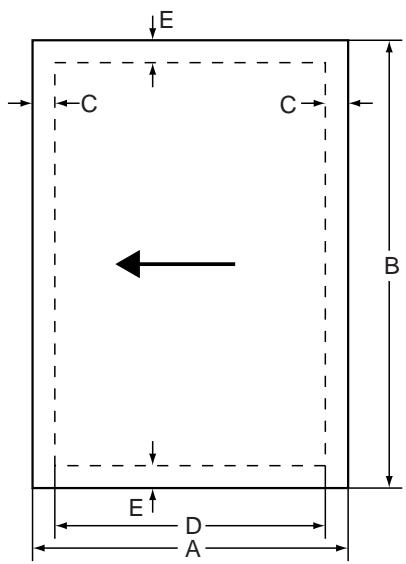
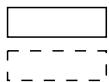
Paper size
Printable area
- If a printer driver for Windows or Macintosh is used for printing, the printable area will be smaller. The actual printable area depends on the printer driver to be used.
Dimension in mm
| Paper size | A | B | C | D | E |
| A3 | 297 | 420 | 4 | 289 | 4 |
| B4 | 257 | 364 | 4 | 242 | 4 |
| A4 | 210 | 297 | 4 | 202 | 4 |
| B5 | 182 | 257 | 4 | 168 | 4 |
| A5 | 148 | 210 | 4 | 140 | 4 |
| Japanese postcard | 100 | 148 | 4 | 92 | 4 |
| Ledger | 279 | 432 | 4 | 271 | 4 |
| Legal | 216 | 356 | 4 | 208 | 4 |
| Foolscap | 216 | 330 | 4 | 208 | 4 |
| Letter | 216 | 279 | 4 | 208 | 4 |
| Executive | 184 | 267 | 4 | 183 | 4 |
| Invoice | 140 | 216 | 4 | 132 | 4 |
| Com-10 (envelope) | 105 | 241 | 4 | 97 | 4 |
| C5 (envelope) | 162 | 229 | 4 | 154 | 4 |
| Monarch (envelope) | 98 | 191 | 4 | 90 | 4 |
| DL (envelope) | 110 | 220 | 4 | 102 | 4 |
| ISO B5 (envelope) | 176 | 250 | 4 | 168 | 4 |
PCL symbol set
| No. | symbol set |
| 1 | Roman-8 |
| 2 | ISO 8859-1 Latin 1 |
| 3 | PC-8 |
| 4 | PC-8 Danish/Norwegian |
| 5 | PC-850 |
| 6 | ISO 6 ASCII |
| 7 | Legal |
| 8 | ISO 21 German |
| 9 | ISO 17 Spanish |
| 10 | ISO 69 French |
| 11 | ISO 15 Italian |
| 12 | ISO 60 Norwegian v1 |
| 13 | ISO 4 United Kingdom |
| 14 | ISO 11 Swedish : |
| 15 | PC1004 (OS/2) |
| 16 | DeskTop |
| 17 | PS Text |
| 18 | Microsoft Publishing |
| 19 | Math-8 |
| 20 | PS Math |
| No. | symbol set |
| 21 | Pi Font |
| 22 | ISO 8859-2 Latin 2 |
| 23 | ISO 8859-9 Latin 5 |
| 24 | ISO 8859-10 Latin 6 |
| 25 | PC-852 |
| 26 | PC-775 |
| 27 | PC Turkish |
| 28 | MC Text |
| 29 | Windows 3.1 Latin 1 |
| 30 | Windows 3.1 Latin 2 |
| 31 | Windows 3.1 Latin 5 |
| 32 | Windows Baltic (not 3.1) |
| 33 | Windows 3.0 Latin 1 |
| 34 | Symbol |
| 35 | Wingdings |
- These symbol sets are trademarks or registered trademarks of their respective owners.
SHARP®
SHARP ELECTRONICS CORPORATION
Sharp Plaza, Mahwah, New Jersey 07430-2135.
SHARP CORPORATION
Operation Manual
(Read this document before installing the product.)
Be sure to become thoroughly familiar with this manual to gain the maximum benefit from the product.
Before installing this product, be sure to read the installation requirements and cautions sections of the "Operation manual for printer operation and general information".
Be sure to keep all operation manuals handy for reference including this manual, the "Operation manual for printer operation and general information" and operation manuals for any optional equipment which has been installed.
WARNING:
FCC Regulations state that any unauthorized changes or modifications to this equipment not expressly approved by the manufacturer could void the user's authority to operate this equipment.
Note:
This equipment has been tested and found to comply with the limits for a Class A digital device, pursuant to Part 15 of the FCC Rules. These limits are designed to provide reasonable protection against harmful interference when the equipment is operated in a commercial environment. This equipment generates, uses and can radiate radio frequency energy and, if not installed and used in accordance with the operation manual, may cause harmful interference to radio communications. Operation of this equipment in a residential area is likely to cause harmful interference in which case the user will be required to correct the interference at his own expense.
PRODUCT CONFIGURATION
This manual applies to the following models.
(As of April 2004)
| Model name | Product configuration |
| DM-3551 | 35 page/minute network printer including a multi-function controller board*1 and a print server card*2 |
| DM-4551 | 45 page/minute network printer including a multi-function controller board*1 and a print server card*2 |
Although peripheral devices are basically optional, some devices may be provided as standard components depending on the model.
*1 A multi-function controller board is required to extend the function of the product to include copier, facsimile and network scanning features. *2 A print server card is required to extend the function of the product to include network printing.
OPERATION MANUALS FOR THIS PRODUCT
Several operation manuals are provided for this product. Read all manuals that apply to the configuration of the model you purchased.
● Operation manual (Read this document before installing the product.) ● Operation manual (for printer operation and general information)
Describes the basic printer operation, operation of optional devices and basic procedures for loading paper, misfeed removal, and user maintenance.
● Operation manual (for copier)
This manual describes all copier functions for models equipped (either as standard or with optional devices) to include copier functions. The manual is included with models configured with a multi-function controller board and a scanner module.
● Operation manual (for network scanner)
This manual describes all network scanning functions for models equipped with an optional network scanner expansion kit. This manual is supplied with models equipped with a multi-function controller board.
● Operation manual (for facsimile)
This manual describes all facsimile functions for models equipped with an optional facsimile expansion kit. The manual is included with the kit.
Key Operator's Guide
Describes the use of key operator programs for customizing printer and copier functions.
SOFTWARE LICENSE
PLEASE READ THIS LICENSE CAREFULLY BEFORE USING THE SOFTWARE. BY USING THE SOFTWARE, YOU ARE AGREEING TO BE BOUND BY THE TERMS OF THIS LICENSE.
- License. The application, demonstration, system and other software accompanying this License, whether on disk, in read only memory, or on any other media (the "Software") and related documentation are licensed to you by SHARP. You own the disk on which the Software is recorded but SHARP and/or SHARP's Licensors retain title to the Software and related documentation. This License allows you to use the Software on one or more computers connected to a single printer and make one copy of the Software in machine-readable form for backup purposes only. You must reproduce on such copy the SHARP copyright notice, the copyright notice of SHARP's Licensors and any other proprietary legends of SHARP and/or its Licensors that were on the original copy of the Software. You may also transfer all your license rights in the Software, the backup copy of the Software, the related documentation and a copy of this License to another party, provided the other party reads and agrees to the terms and conditions of this License.
- Restrictions. The Software contains copyrighted material, trade secrets and other proprietary material which is owned by SHARP and/or its Licensors and in order to protect them you may not decompile, reverse engineer, disassemble or otherwise reduce the Software to a human-perceivable form. You may not modify, network, rent, lease, loan, distribute or create derivative works based upon the Software in whole or in part. You may not electronically transmit the Software from one computer to another or over a network.
- Termination. This license is effective until terminated. You may terminate this License at any time by destroying the Software and related documentation and all copies thereof. This License will terminate immediately without notice from SHARP and/or SHARP's Licensors if you fail to comply with any provision of this License. Upon termination you must destroy the Software and related documentation and all copies thereof.
- Export Law Assurances. You agree and certify that neither the Software nor any other technical data received from SHARP, nor the direct product thereof, will be exported outside the United States except as authorized and as permitted by the laws and regulations of the United States. If the Software has been rightfully obtained by you outside of the United States, you agree that you will not re-export the Software nor any other technical data received from SHARP, nor the direct product thereof, except as permitted by the laws and regulations of the United States and the laws and regulations of the jurisdiction in which you obtained the Software.
- Government End Users. If you are acquiring the Software on behalf of any unit or agency of the United States Government, the following provisions apply. The Government agrees:
(i) if the Software is supplied to the Department of Defense (DoD), the Software is classified as “Commercial Computer Software” and the Government is acquiring only “restricted rights” in the Software and its documentation as that term is defined in Clause 252.227-7013 (c)(1)(Oct. 1988) of the DFARS; and
(ii) if the Software is supplied to any unit or agency of the United States Government other than DoD, the Government's rights in the Software and its documentation will be as defined in Clause 52.227-19 (c)(2) of the FAR or, in the case of NASA, in Clause 18-52.227-86 (d) of the NASA Supplement to the FAR.
- Limited Warranty on Media. SHARP warrants the disks on which the Software is recorded to be free from defects in materials and workmanship under normal use for a period of ninety (90) days from the date of purchase as evidenced by a copy of the receipt. The entire liability of SHARP and/or its Licensors and your exclusive remedy will be replacement of the disk which fails to meet the limited warranty provided by this Clause 6. A disk will be replaced when it is returned to SHARP or a SHARP authorized representative with a copy of the receipt. SHARP will have no responsibility to replace a disk damaged by accident, abuse or misapplication.
ANY IMPLIED WARRANTIES ON THE DISKS, INCLUDING THE IMPLIED WARRANTIES OF MERCHANTABILITY AND FITNESS FOR A PARTICULAR PURPOSE, ARE LIMITED IN DURATION TO NINETY (90) DAYS FROM THE DATE OF DELIVERY. THIS WARRANTY GIVES YOU SPECIFIC LEGAL RIGHTS, AND YOU MAY ALSO HAVE OTHER RIGHTS WHICH VARY FROM JURISDICTION TO JURISDICTION.
- Disclaimer of Warranty on Software. You expressly acknowledge and agree that use of the Software is at your sole risk. The Software and related documentation are provided "AS IS" and without warranty of any kind and SHARP and SHARP's Licensor(s) (for the purpose of provisions 7 and 8, SHARP and SHARP's Licensor(s) shall be collectively referred to as "SHARP") EXPRESSLY DISCLAIM ALL WARRANTIES, EXPRESS OR IMPLIED, INCLUDING, BUT NOT LIMITED TO, THE IMPLIED WARRANTIES OF MERCHANTABILITY AND FITNESS FOR A PARTICULAR PURPOSE. SHARP DOES NOT WARRANT THAT THE FUNCTIONS CONTAINED IN THE SOFTWARE WILL MEET YOUR REQUIREMENTS, OR THAT THE OPERATION OF THE SOFTWARE WILL BE UNINTERRUPTED OR ERROR-FREE, OR THAT DEFECTS IN THE SOFTWARE WILL BE CORRECTED. FURTHERMORE, SHARP DOES NOT WARRANT OR MAKE ANY REPRESENTATIONS REGARDING THE USE OR THE RESULTS OF THE USE OF THE SOFTWARE OR RELATED DOCUMENTATION IN TERMS OF THEIR CORRECTNESS, ACCURACY, RELIABILITY, OR OTHERWISE. NO ORAL OR WRITTEN INFORMATION OR ADVICE GIVEN BY SHARP OR A SHARP AUTHORIZED REPRESENTATIVE SHALL CREATE A WARRANTY OR IN ANY WAY INCREASE THE SCOPE OF THIS WARRANTY. SHOULD THE SOFTWARE PROVE DEFECTIVE, YOU (AND NOT SHARP OR A SHARP AUTHORIZED REPRESENTATIVE) ASSUME THE ENTIRE COST OF ALL NECESSARY SERVICING, REPAIR OR CORRECTION, SOME JURISDICTIONS DO NOT ALLOW THE EXCLUSION OF IMPLIED WARRANTIES, SO THE ABOVE EXCLUSION MAY NOT APPLY TO YOU.
- Limitation of Liability. UNDER NO CIRCUMSTANCES INCLUDING NEGLIGENCE, SHALL SHARP BE LIABLE FOR ANY INCIDENTAL, SPECIAL OR CONSEQUENTIAL DAMAGES THAT RESULT FROM THE USE OR INABILITY TO USE THE SOFTWARE OR RELATED DOCUMENTATION, EVEN IF SHARP OR A SHARP AUTHORIZED REPRESENTATIVE HAS BEEN ADVISED OF THE POSSIBILITY OF SUCH DAMAGES. SOME JURISDICTIONS DO NOT ALLOW THE LIMITATION OR EXCLUSION OF LIABILITY FOR INCIDENTAL OR CONSEQUENTIAL DAMAGES SO THE ABOVE LIMITATION OR EXCLUSION MAY NOT APPLY TO YOU.
In no event shall SHARP's total liability to you for all damages, losses, and causes of action (whether in contract, tort (including negligence) or otherwise) exceed the amount paid by you for the Software.
- Controlling Law and Severability. For a portion of the Software related with Apple Macintosh and Microsoft Windows, this license shall be governed by and construed in accordance with the laws of the state of California and Washington, respectively. For a portion of the Software and/or the documentation relating thereto which has been licensed to SHARP by Software 2000 International Limited, this license shall be governed by and construed in accordance with the laws of England. If for any reason a court of competent jurisdiction finds any provision of this License, or portion thereof, to be unenforceable, that provision of the License shall be enforced to the maximum extent permissible so as to effect the intent of the parties, and the remainder of this License shall continue in full force and effect.
- Complete Agreement. This License constitutes the entire agreement between the parties with respect to the use of the Software and related documentation, and supersedes all prior or contemporaneous understandings or agreements, written or oral, regarding such subject matter. No amendment to or modification of this License will be binding unless in writing and signed by a duly authorized representative of SHARP.
ADDING TONER
When the drum/toner cartridge becomes empty of toner, a message indicating the need to replace the drum/toner cartridge will appear on the display. Replace the drum/toner cartridge following the procedure below.
The machine as shipped does not have a cartridge installed. Follow steps 5 and 6 below for installing the first cartridge.
SHARP® GENUINE SUPPLIES
NOTE
- The drum/toner cartridge contains toner and a photoconductive drum. The photoconductor on the drum can deteriorate by exposure to light for an extended period of time.
- Do not remove the cartridge from its protective package until it is to be installed into the machine.
1 Open the front cover.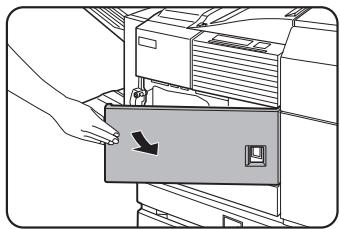
2 Lower the cartridge lock lever.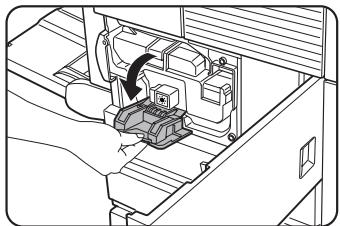
3 Pull out the duplex module.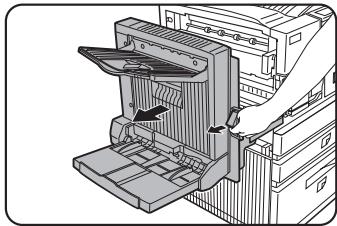
4 While depressing the lock release button, pull out the drum/toner cartridge and remove it.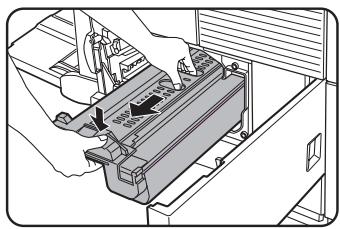
5 Remove a new drum/toner cartridge from its bag and remove the protective material A.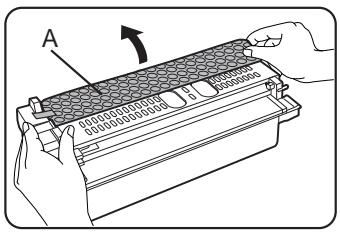
6 Shake the new cartridge horizontally five or six times.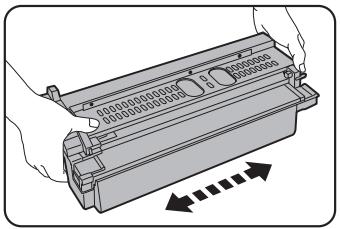
7 Insert the new drum/toner cartridge.
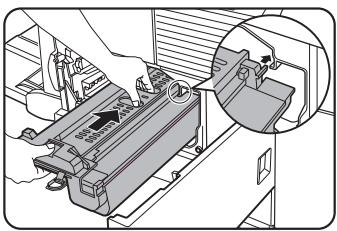
Push the cartridge in until it locks securely into place.
8 Gently remove the sealing tape from the cartridge.
9 Remove the drum protective sheet from the drum/toner cartridge.
Do not touch or damage the surface of the photoconductive drum.
10 Close the duplex module.
If the machine is not equipped with a duplex module, close the side cover.
11 Return the cartridge lock lever and close the front cover.
NOTE
Do not shake the drum/toner cartridge after the sealing tape has been removed. If the cartridge is shaken after the tape is removed, some toner will come out of the cartridge.
DEVELOPER CARTRIDGE REPLACEMENT
When replacement of the developer cartridge is needed, a message indicating the need to replace it will appear in the display. Follow the procedure below to replace the developer cartridge.
The machine as shipped from the factory does not have a cartridge installed. Follow the same procedure below to install the first cartridge but omit step 3.
1 Open the front cover.
2 Lower the cartridge lock lever.
3 Remove the developer cartridge.
① Push the lock release button and pull out the developer cartridge until it stops.
② Push the lock button at the rear side and remove the developer cartridge.
4 Remove a new developer cartridge from the bag and remove protective materials A and B.
① Remove the tape and protective material A.
② Remove the tape and protective material B.
5 Shake the new developer cartridge horizontally 5 or 6 times.
6 Insert the new developer cartridge.
7 Push the cartridge in until it locks securely into place.
8 Gently remove the sealing tape from the cartridge.
9 Return the cartridge lock lever.
10 Close the front cover.
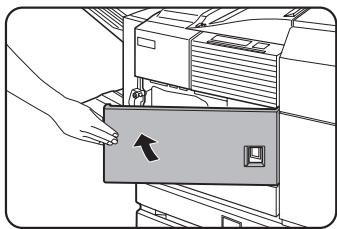
The machine will become ready after about two minutes.
NOTE
Do not shake the developer cartridge after the sealing tape has been removed. If the cartridge is shaken after the tape is removed, some developer will come out of the cartridge.
SUPPLY LIST
Be sure to use the supply cartridges specified by SHARP.
| Supply | Part number |
| Drum/toner cartridge (black) | DM-350DT |
| Developer cartridge (black) | DM-350DV |
For storage of supplies, see page 1-25 of the operation manual for printer operation and general information.
CAUTION
- If a cartridge is to be discarded, dispose of it according to local requirements.
- Store drum/toner cartridges and developer cartridges out of the reach of children.
NOTE
For recycling of used drum/toner cartridges and developer cartridges, see the information included with the cartridges.
SHARP®
SHARP ELECTRONICS CORPORATION
Sharp Plaza, Mahwah, New Jersey 07430-2135.
SHARP CORPORATION
- OPERATION MANUAL (FOR COPIER)
- INTRODUCTION
- CONTENTS
- PAGE
- PART NAMES AND FUNCTIONS (B/W SCANNER MODULE/DSPF)
- EXTERIOR
- OPERATION PANEL
- TOUCH PANEL (BASIC SCREEN OF COPY MODE)
- AUTOMATIC DOCUMENT FEEDER
- ACCEPTABLE ORIGINALS
- SIZE AND WEIGHT OF ACCEPTABLE ORIGINALS
- TOTAL AMOUNT OF ORIGINALS THAT CAN BE SET IN THE DOCUMENT FEEDER TRAY
- NOTES ON USE OF THE AUTOMATIC DOCUMENT FEEDER
- SETTING ORIGINALS
- WHEN USING THE AUTOMATIC DOCUMENT FEEDER
- WHEN USING THE DOCUMENT GLASS
- NOTE
- STANDARD ORIGINAL SETTING ORIENTATION
- AUTOMATIC COPY IMAGE ROTATION - ROTATION COPYING
- NORMAL COPYING
- COPYING FROM THE AUTOMATIC DOCUMENT FEEDER
- SIDED COPIES OF 1-SIDED ORIGINALS
- SELECT THE DESIRED OUTPUT MODE (SEE BELOW)
- USE THE NUMERIC KEYS TO SET THE DESIRED NUMBER OF COPIES
- PRESS THE [START] KEY
- OUTPUT MODES (SORT MODE AND GROUP MODE)
- SORT COPY
- ● GROUP COPY
- AUTOMATIC TWO-SIDED COPYING FROM THE AUTOMATIC DOCUMENT FEEDER
- COPYING FROM THE DOCUMENT GLASS
- SET AN ORIGINAL ON THE DOCUMENT GLASS. (PAGE 7)
- ENSURE THAT THE 1-SIDED TO 1-SIDED COPY MODE IS SELECTED
- ENSURE THAT PAPER OF THE SAME SIZE AS THE ORIGINAL IS AUTOMATICALLY SELECTED. (*NOTE)
- TOUCH THE [READ-END] KEY
- OUTPUT MODE (SORT COPY AND GROUP COPY)
- GROUP COPY
- AUTOMATIC TWO-SIDED COPYING FROM THE DOCUMENT GLASS
- EXPOSURE ADJUSTMENTS
- AUTOMATIC EXPOSURE ADJUSTMENT
- EXPOSURE MODE SELECTION AND MANUAL EXPOSURE ADJUSTMENT
- EXPOSURE MODE SELECTION
- EXPOSURE LEVELS IN THE TEXT MODE
- REDUCTION/ENLARGEMENT/ZOOM
- AUTOMATIC SELECTION (AUTO IMAGE)
- PLACE THE ORIGINAL IN THE DOCUMENT FEEDER TRAY OR ON THE DOCUMENT GLASS. (PAGE 7)
- TOUCH THE [PAPER SELECT] KEY AND THEN SELECT THE DESIRED PAPER SIZE
- TOUCH THE [AUTO IMAGE] KEY
- MAKE ALL OTHER DESIRED SETTINGS SUCH AS EXPOSURE OR THE NUMBER OF COPIES, AND PRESS THE [START] KEY
- MANUAL SELECTION
- TOUCH THE [COPY RATIO] KEY
- SELECT THE DESIRED COPY RATIO BY TOUCHING A FIXED COPY RATIO KEY FOR REDUCTION OR ENLARGEMENT AND TOUCH THE [OK] KEY. USE THE 📊 AND 🔍 KEYS TO MAKE FINE ADJUSTMENTS AS NEEDED
- ENSURE THAT THE DESIRED PAPER SIZE HAS BEEN AUTOMATICALLY SELECTED BASED ON THE SELECTED COPY RATIO OR SELECT ANOTHER SIZE AS NEEDED
- MAKE ALL OTHER DESIRED SETTINGS SUCH AS EXPOSURE OR THE NUMBER OF COPIES AND PRESS THE [START] KEY
- SPECIAL PAPERS
- LOAD THE SPECIAL PAPER IN THE BYPASS TRAY OR IN THE MULTI PURPOSE DRAWER
- TOUCH THE [PAPER SELECT] KEY AND THEN SELECT THE BYPASS TRAY OR THE MULTI PURPOSE DRAWER
- SPECIAL MODE
- COMMON OPERATION PROCEDURE FOR USING THE SPECIAL FUNCTIONS
- TOUCH THE [SPECIAL MODES] KEY
- TOUCH THE KEY FOR THE DESIRED SPECIAL MODE
- MARGIN SHIFT
- TOUCH THE [MARGIN SHIFT] KEY ON THE SPECIAL MODES SCREEN
- SELECT THE SHIFT DIRECTION
- SET THE SHIFT AMOUNT AS NEEDED AND TOUCH THE [OK] KEY
- TOUCH THE [OK] KEY ON THE SPECIAL MODES SCREEN. AFTER ADJUSTING THE EXPOSURE, FOLLOW ANY OF THE COPYING PROCEDURES
- ERASE
- EDGE ERASE
- CENTER ERASE
- EDGE + CENTER ERASE
- TOUCH THE [ERASE] KEY ON THE SPECIAL MODES SCREEN
- SELECT THE DESIRED ERASE MODE
- ADJUST THE AMOUNT OF ERASE AND TOUCH THE [OK] KEY
- DUAL PAGE COPY
- TOUCH THE [DUAL PAGE COPY] KEY ON THE SPECIAL MODES SCREEN
- TOUCH THE [OK] KEY ON THE SPECIAL MODES SCREEN
- PLACE THE ORIGINALS ON THE DOCUMENT GLASS
- ENSURE THAT 8-1/2" X 11" OR A4 SIZE PAPER IS SELECTED
- PAMPHLET COPY
- JOB BUILD
- TOUCH THE [JOB BUILD] KEY ON THE SPECIAL MODES SCREEN
- TOUCH THE [OK] KEY ON THE SPECIAL MODES SCREEN WHILE JOB BUILD IS HIGHLIGHTED
- PLACE THE FIRST SECTION ORIGINALS IN THE DOCUMENT FEEDER TRAY. (PAGE 7)
- MAKE ALL OTHER DESIRED SETTINGS SUCH AS THE NUMBER OF COPIES, AND PRESS THE [START] KEY
- TOUCH THE [READ-END] KEY AFTER THE LAST SECTION OF ORIGINALS HAS BEEN SCANNED
- MULTI SHOT
- JOB PROGRAM MEMORY
- STORING A JOB PROGRAM
- RECALLING A JOB PROGRAM
- PRESS THE [#/P] KEY
- TOUCH THE DESIRED STORAGE REGISTER NUMBER KEY TO RECALL THE JOB FROM MEMORY
- SET THE NUMBER OF COPIES AS NEEDED AND PRESS THE [START] KEY
- DELETING A STORED JOB PROGRAM
- TOUCH THE [DELETE] KEY
- INTERRUPTING A PRINT OR COPY RUN
- TOUCH THE [INTERRUPT] KEY
- MAKE ALL OTHER DESIRED SETTINGS SUCH AS EXPOSURE, PAPER SIZE AND NUMBER OF COPIES AND THEN PRESS THE [START] KEY
- MISFEED REMOVAL
- MISFEED IN SCANNER MODULE
- NOTES
- OPEN THE DOCUMENT FEEDING AREA COVER AND REMOVE ANY MISFED ORIGINALS
- CLOSE THE DOCUMENT FEEDING AREA COVER
- OPEN THE DOCUMENT COVER AND TURN THE GREEN ROTATING KNOB IN THE DIRECTION OF THE ARROW TO REMOVE ANY MISFED ORIGINALS
- CLOSE THE DOCUMENT COVER
- TROUBLESHOOTING
- SPECIFICATIONS
- KEY OPERATOR PROGRAMS
- USING THE KEY OPERATOR PROGRAMS
- SETTING PROGRAMS
- COPY FUNCTION SETTINGS
- INITIAL STATUS SETTINGS
- EXPOSURE ADJUSTMENT
- ROTATION COPY SETTING
- AUTO PAPER SELECTION SETTING
- DPI X 600DPI SCANNING MODE
- QUICK SCAN FROM DOCUMENT GLASS
- DEVICE CONTROL
- ORIGINAL SIZE DETECTOR SETTING
- DISABLING OF DOCUMENT FEEDER
- SHARP®
- OPERATION MANUAL (FOR NETWORK SCANNER)
- TABLE OF CONTENTS
- SETTINGS AND PROGRAMMING REQUIRED FOR THE NETWORK SCANNER FEATURE
- ABOUT THE WEB PAGE
- SETTING PASSWORDS
- BASIC SETTINGS FOR NETWORK SCANNING
- SELECT THE METHOD FOR ASSIGNING A FILE NAME TO A SCANNED IMAGE
- SELECTING AN E-MAIL SUBJECT (ONLY USED FOR SCAN TO E-MAIL)
- E-MAIL SERVER AND DNS SERVER SETTINGS
- SETTING UP DESTINATION INFORMATION
- STORING DESTINATIONS FOR SCAN TO E-MAIL AND INTERNET-FAX
- STORING DESTINATIONS FOR SCAN TO FTP
- STORING DESTINATIONS FOR SCAN TO DESKTOP
- STORING GROUPS
- ITEMS COMMON TO ALL TRANSMISSION METHODS WHEN STORING DESTINATIONS
- FULL NAME, DISPLAY NAME
- INITIAL, CUSTOM DIRECTORY
- FILE FORMAT
- STORING SENDER INFORMATION
- STORING A CUSTOM DIRECTORY
- CONDITION SETTING SCREEN OF SCANNER MODE
- CONDITION SETTING SCREEN
- ADDRESS DIRECTORY SCREEN (ALPHABETICALLY ORDERED)
- ① ONE-TOUCH KEY DISPLAY
- ② DISPLAY SWITCHING KEYS
- ③ CONDITION SETTINGS KEY
- ④ ABC ◆ GROUP KEY
- ⑤ INDEX KEYS
- SENDING AN IMAGE
- BASIC TRANSMISSION METHOD
- MAKE SURE THE MACHINE IS IN SCANNER MODE
- LOAD THE ORIGINAL
- CHECK THE ORIGINAL SIZE
- IF NEEDED, ADJUST THE RESOLUTION SETTING. (REFER TO PAGE 13.)
- IF NEEDED, ADJUST THE EXPOSURE SETTING. (REFER TO PAGE 14.)
- IF NEEDED, SELECT THE FILE FORMAT. (REFER TO PAGE 15.)
- TOUCH THE SENDER LIST KEY
- TOUCH A KEY TO SELECT A SENDER
- TOUCH THE OK KEY
- TOUCH THE ADDRESS DIRECTORY KEY
- TOUCH THE ONE-TOUCH KEY FOR THE DESIRED DESTINATION
- USING THE AUTO DOCUMENT FEEDER
- PRESS THE START KEY
- USING THE DOCUMENT GLASS
- IF YOU HAVE ANOTHER PAGE TO SCAN, CHANGE PAGES AND THEN PRESS THE START KEY
- AFTER THE FINAL PAGE IS SCANNED, TOUCH THE READ-END KEY
- CANCELING TRANSMISSION
- IMPORTANT POINTS WHEN USING SCAN TO E-MAIL
- TRANSMISSION METHODS FOR SCAN TO E-MAIL (MANUAL ENTRY, BROADCAST TRANSMISSION)
- SCANNING AND TRANSMITTING A TWO-SIDED ORIGINAL
- SCANNING SETTINGS (ORIGINAL SIZE, RESOLUTION, EXPOSURE, AND FILE FORMAT)
- MANUALLY SETTING THE SCANNING SIZE
- TOUCH THE ORIGINAL KEY
- TOUCH THE MANUAL KEY
- TOUCH THE DESIRED ORIGINAL SIZE KEY
- TOUCH THE OUTER OK KEY
- THE SELECTED SIZE APPEARS IN THE TOP HALF OF THE ORIGINAL KEY
- SELECTING THE RESOLUTION
- CHANGE THE RESOLUTION
- TOUCH THE RESOLUTION KEY
- TOUCH THE DESIRED RESOLUTION KEY
- SELECTING THE EXPOSURE
- CHANGE THE EXPOSURE
- TOUCH THE EXPOSURE KEY
- TOUCH THE DESIRED EXPOSURE KEY
- EXPOSURE SETTINGS
- SELECTING THE FILE FORMAT
- PRIORITY TRANSMISSION OF A STORED JOB
- CANCELING AN E-MAIL/FTP TRANSMISSION
- STORING, EDITING, AND CLEARING FROM THE TOUCH PANEL
- STORING ONE-TOUCH KEYS (ONLY ADDRESSES FOR SCAN TO E-MAIL AND INTERNET-FAX)
- TOUCH THE ADDRESS KEY
- CHECK THE KEY NAME
- CHECK THE FILE FORMAT AND THE COMPRESSION MODE
- FOR A SCAN TO E-MAIL DESTINATION
- FOR AN INTERNET-FAX DESTINATION
- WHEN YOU HAVE FINISHED PROGRAMMING THE ONE-TOUCH KEY, TOUCH THE EXIT KEY. IF YOU WISH TO PROGRAM ANOTHER ONE-TOUCH KEY, TOUCH THE NEXT KEY
- EDITING AND DELETING ONE-TOUCH KEYS
- PROGRAMMING A GROUP KEY
- EDITING AND DELETING GROUP KEYS
- EDITING AND DELETING SENDER INFORMATION
- STORING A GROUP INDEX
- PRINTING PROGRAMMED INFORMATION
- IF YOUR E-MAIL IS RETURNED
- IF A TRANSMISSION ERROR OCCURS
- OPERATION SETTINGS
- DEFAULT DISPLAY SETTING
- THE NUMBER OF DIRECT ADDRESS KEYS DISPLAYED SETTING
- MUST INPUT NEXT ADDRESS KEY AT BROADCAST SETTING
- INITIAL RESOLUTION SETTING
- SCAN TO E-MAIL INITIAL STATUS SETTINGS
- DEFAULT SENDER SET
- INITIAL FILE FORMAT SETTING
- COMPRESSION MODE AT BROADCASTING
- PRINTING OUT SETTINGS
- SHARP CORPORATION
- OPERATION MANUAL (FOR FACSIMILE)
- CAUTION
- WARNING
- FAX INTERFACE CABLE AND LINE CABLE
- TO USE THIS PRODUCT CORRECTLY AS A FACSIMILE
- SETTINGS AND PROGRAMMING
- LITHIUM BATTERY
- OTHER INFORMATION
- CHAPTER 1 BEFORE USING THE FAX FEATURE
- CHAPTER 2 BASIC OPERATIONS
- CHAPTER 3 USING CONVENIENT FUNCTIONS 1 ADVANCED TRANSMISSION METHODS
- CHAPTER 4 USING CONVENIENT FUNCTIONS 2 TRANSMISSION USING F-CODES
- CHAPTER
- USING CONVENIENT FUNCTIONS 3 CONVENIENT METHODS OF USE
- PROGRAMMING
- APPENDIX
- FCC NOTICE TO USERS
- ABOUT THE TELEPHONE CONSUMER PROTECTION ACT OF
- IMPORTANT SAFETY INFORMATION
- NOTICE FOR USERS IN CANADA
- BEFORE USING THE FAX FEATURE
- POINTS TO CHECK AND PROGRAMMING AFTER INSTALLATION
- MAKE SURE THE FAX POWER SWITCH IS TURNED ON
- MAKE SURE THE CORRECT DATE AND TIME HAVE BEEN SET
- PROGRAM THE SENDER'S NAME AND SENDER'S NUMBER
- FAX MODE (CONDITION SETTING SCREEN)
- ORIGINALS
- ORIGINALS THAT CAN BE FAXED
- SCANNING AREA OF ORIGINAL
- AUTOMATIC REDUCTION OF FAXED DOCUMENT
- LOADING A DOCUMENT
- CHECKING THE SIZE OF A LOADED ORIGINAL
- IF YOU LOADED A LONG ORIGINAL
- SELECTING RESOLUTION AND EXPOSURE SETTINGS
- RESOLUTION SETTINGS
- CONVENIENT DIALING METHODS
- ● ONE-TOUCH DIALING
- ● GROUP DIALING
- REDIALING
- ● ON-HOOK DIALING
- BASIC OPERATIONS
- SENDING A FAX
- BASIC PROCEDURE FOR SENDING FAXES
- MAKE SURE THE MACHINE IS IN FAX MODE
- IF NEEDED, ADJUST THE RESOLUTION SETTING. (REFER TO PAGE 1-9.)
- IF NEEDED, ADJUST THE EXPOSURE SETTING. (REFER TO PAGE 1-10.)
- DIAL THE FAX NUMBER
- ENTERING A PAUSE
- QUICK ON-LINE
- STORING TRANSMISSION JOBS (MEMORY TRANSMISSION)
- IF THE RECEIVING PARTY IS BUSY
- IMAGE ROTATION
- TRANSMISSION BY AUTO-DIALING
- TRANSMITTING A TWO-SIDED DOCUMENT
- PRESS THE JOB STATUS KEY
- TOUCH THE FAX JOB KEY
- TOUCH THE JOB KEY OF THE TRANSMISSION JOB TO WHICH YOU WISH TO GIVE PRIORITY
- TOUCH THE PRIORITY KEY
- CANCELING A FAX TRANSMISSION
- TOUCH THE JOB KEY OF THE TRANSMISSION JOB YOU WISH TO CANCEL
- TOUCH THE STOP/DELETE KEY
- RECEIVING FAXES
- RECEIVING A FAX
- NUMBER OF RINGS
- IF RECEIVED DATA CANNOT BE PRINTED
- USING CONVENIENT FUNCTIONS 1 ADVANCED TRANSMISSION METHODS
- SENDING THE SAME DOCUMENT TO MULTIPLE DESTINATIONS IN A SINGLE OPERATION (BROADCAST TRANSMISSION)
- USING BROADCAST TRANSMISSION
- AUTOMATIC TRANSMISSION AT A SPECIFIED TIME (TIMER TRANSMISSION)
- SETTING UP A TIMER TRANSMISSION
- IN FAX MODE, TOUCH THE SPECIAL MODES KEY
- TOUCH THE TIMER KEY
- SELECT THE DAY OF THE WEEK. (TOUCH THE ▼ KEY OR THE ▲ KEY UNTIL THE DESIRED DAY IS SELECTED.)
- SELECT THE TIME. (TOUCH THE ▼ KEY OR THE ▲ KEY UNTIL THE DESIRED TIME APPEARS.)
- PERFORM THE DESIRED TRANSMISSION OPERATION
- TRANSMISSION AND RECEPTION USING THE POLLING FUNCTION
- POLLING
- POLLING MEMORY
- USING THE POLLING FUNCTION
- TOUCH THE SPECIAL MODES KEY IN FAX MODE, AND THEN TOUCH THE POLLING KEY
- DIAL THE NUMBER OF THE OTHER FAX MACHINE OR TOUCH AN AUTO-DIAL KEY (ONE-TOUCH OR GROUP KEY) (REFER TO PAGE 2-5)
- WHEN YOU HAVE FINISHED ENTERING THE DESTINATION(S), PRESS THE START KEY
- MANUAL POLLING
- TOUCH THE SPEAKER KEY IN FAX MODE, AND DIAL THE NUMBER OF THE OTHER MACHINE
- TOUCH THE SPECIAL MODES KEY
- WHEN YOU HEAR THE FAX TONE FROM THE OTHER MACHINE, PRESS THE POLLING KEY
- POLLING RECEPTION BEGINS
- USING POLLING MEMORY
- SCANNING A DOCUMENT INTO MEMORY (PUBLIC BOX) FOR POLLING MEMORY
- TO CANCEL SCANNING
- PRINTING DOCUMENT DATA IN THE PUBLIC BOX
- TOUCH THE SPECIAL MODES KEY IN FAX MODE AND THEN TOUCH THE MEMORY BOX KEY
- TOUCH THE PRINT DATA KEY
- TOUCH THE PUBLIC BOX KEY
- DELETING DOCUMENT DATA FROM THE PUBLIC BOX
- TOUCH THE DELETE DATA KEY
- TOUCH THE YES KEY
- RESTRICTING POLLING ACCESS (POLLING SECURITY)
- OWN NUMBER SENDING
- EXAMPLE OF FAX PAGE PRINTED OUT BY THE RECEIVING MACHINE
- POSITION OF SENDER'S INFORMATION
- FAXING A DIVIDED ORIGINAL (DUAL PAGE SCAN)
- SELECTING DUAL PAGE SCAN
- TOUCH THE SPECIAL MODES KEY IN FAX MODE AND THEN TOUCH DUAL PAGE SCAN
- PLACE THE ORIGINAL ON THE DOCUMENT GLASS (PAGE 1-7), AND PERFORM THE TRANSMISSION OPERATION
- PROGRAMMING FREQUENTLY USED OPERATIONS
- USING A PROGRAM
- TRANSFERRING RECEIVED FAXES TO ANOTHER MACHINE WHEN PRINTING IS NOT POSSIBLE
- USING THE TRANSFER FUNCTION
- PROGRAM THE FAX NUMBER OF THE TRANSFER DESTINATION
- TRANSFERRING RECEIVED DATA
- PRESS THE CUSTOM SETTINGS KEY
- TOUCH THE FAX DATA FORWARD KEY
- TO CANCEL TRANSFER
- USING CONVENIENT FUNCTIONS 2 TRANSMISSION USING F-CODES
- TRANSMISSION BETWEEN MACHINES SUPPORTING F-CODES
- MEMORY BOXES AND SUB-ADDRESSES/PASSCODES REQUIRED FOR F-CODE TRANSMISSION
- ENTERING A SUB-ADDRESS AND PASSCODE FOR A MEMORY BOX IN THE OTHER MACHINE
- DIAL THE FAX NUMBER OF THE OTHER MACHINE, OR TOUCH A ONE-TOUCH KEY
- USE THE NUMERIC KEYS TO ENTER THE SUB-ADDRESS OF THE OTHER MACHINE'S MEMORY BOX (MAX. 20 DIGITS)
- TOUCH THE SUB ADDRESS KEY
- TOUCH THE SUB ADDRESS KEY ONCE AGAIN. A SLASH "/" APPEARS AT THE END OF THE SUB-ADDRESS
- USE THE NUMERIC KEYS TO ENTER THE PASSCODE OF THE OTHER MACHINE'S MEMORY BOX (MAX. 20 DIGITS). IF A PASSCODE HAS NOT BEEN ESTABLISHED FOR THE OTHER BOX, THIS STEP IS NOT NECESSARY
- CREATING A MEMORY BOX FOR F-CODE TRANSMISSION
- F-CODE POLLING MEMORY
- HOW F-CODE POLLING MEMORY WORKS
- USING F-CODE POLLING MEMORY
- SCANNING A DOCUMENT INTO AN F-CODE POLLING MEMORY BOX
- CHECKING AND CLEARING DOCUMENT DATA IN A MEMORY BOX
- PROCEDURE FOR F-CODE POLLING
- IN FAX MODE, TOUCH THE SPECIAL MODES KEY AND THEN THE POLLING KEY
- ENTER THE FAX NUMBER, SUB-ADDRESS, AND PASSCODE OF THE OTHER FAX MACHINE
- F-CODE CONFIDENTIAL TRANSMISSION
- PRINTING A DOCUMENT RECEIVED TO AN F-CODE CONFIDENTIAL MEMORY BOX
- IN FAX MODE, TOUCH THE SPECIAL MODES KEY AND THEN TOUCH THE MEMORY BOX KEY
- TOUCH THE MEMORY BOX KEY THAT HAS THE DOCUMENT DATA YOU WISH TO PRINT
- PRESS THE NUMERIC KEYS TO ENTER THE 4-DIGIT PRINT PIN
- F-CODE RELAY BROADCAST TRANSMISSION
- USING THE F-CODE RELAY BROADCAST FUNCTION
- USING THE F-CODE RELAY REQUEST FUNCTION
- STAMPING SCANNED ORIGINALS (VERIFICATION STAMP FUNCTION)
- TURNING ON THE VERIFICATION STAMP FUNCTION
- REPLACING THE VERIFICATION STAMP CARTRIDGE
- CONNECTING AN EXTENSION PHONE
- INSERT THE END OF THE EXTENSION PHONE CORD INTO THE EXTENSION PHONE JACK ON THE REAR OF THE MACHINE
- SENDING A FAX AFTER TALKING ON THE PHONE (MANUAL TRANSMISSION)
- USING AN EXTENSION PHONE TO RECEIVE A FAX
- CHANGING THE RECEPTION MODE TO MANUAL
- TOUCH THE MANUAL RECEPTION KEY
- TOUCH THE RECEIVE MODE KEY
- RECEIVING A FAX AFTER TALKING (MANUAL RECEPTION)
- ACTIVATING FAX RECEPTION FROM AN EXTENSION PHONE (REMOTE RECEPTION)
- IF YOU ARE ON A PULSE DIAL LINE, SET YOUR PHONE TO ISSUE TONE SIGNALS
- PRESS THE "5" KEY ON THE EXTENSION PHONE'S KEYPAD, AND THEN PRESS THE "*" KEY TWICE
- REPLACE THE EXTENSION PHONE
- WHEN THE MACHINE IS IN FAX MODE
- WHEN THE MACHINE RINGS, LIFT THE EXTENSION PHONE AND SPEAK
- WITH THE EXTENSION PHONE STILL LIFTED, TOUCH THE FAX RECEIVE KEY
- STORING, EDITING, AND DELETING AUTO DIAL KEYS AND PROGRAMS
- GROUP KEY
- AMEND/DELETE KEY
- STORING ONE-TOUCH DIAL KEYS
- MAKE SURE THE FAX KEY IS CHECKED AND THEN TOUCH THE NAME KEY
- TOUCH THE INITIAL KEY
- TOUCH A LETTER KEY
- TOUCH THE INDEX KEY
- TOUCH AN INDEX KEY
- TOUCH THE FAX NO. KEY
- USE THE NUMERIC KEYS TO ENTER THE FAX NUMBER
- TRANSMISSION SPEED
- INTERNATIONAL CORRESPONDENCE MODE
- IF YOU CANNOT EDIT OR DELETE A ONE-TOUCH KEY
- TOUCH THE AMEND/DELETE KEY
- TOUCH THE GROUP KEY YOU WISH TO EDIT OR DELETE
- TOUCH THE KEY OF THE ITEM YOU WISH TO CHANGE (TO EDIT THE ITEM, FOLLOW THE SAME STEPS AS FOR ONE-TOUCH KEYS ON PAGE 6-3)
- MAKE SURE THE EDITED INFORMATION IS CORRECT, AND THEN TOUCH THE EXIT KEY
- TOUCH THE DELETE KEY
- IF YOU CANNOT EDIT OR DELETE A GROUP KEY
- STORING A PROGRAM
- TOUCH THE PROGRAM NAME KEY
- TOUCH THE SETTINGS KEY
- TOUCH THE KEYS FOR THE SETTINGS YOU WISH TO STORE
- YOUR SETTINGS ARE DISPLAYED. MAKE SURE THEY ARE CORRECT
- WHEN YOU ARE FINISHED, TOUCH THE EXIT KEY. IF YOU WISH TO STORE ANOTHER PROGRAM, TOUCH THE NEXT KEY
- EDITING AND DELETING PROGRAMS
- TOUCH THE PROGRAM KEY
- TOUCH THE PROGRAM YOU WISH TO EDIT OR DELETE
- TO EDIT THE PROGRAM, FOLLOW THE SAME PROCEDURE AS FOR STORING THE PROGRAM
- PROGRAMMING, EDITING, AND DELETING F-CODE MEMORY BOXES
- PROGRAMMING AN F-CODE MEMORY BOX
- USE THE NUMERIC KEYS TO ENTER A PASSCODE (MAX. 20 DIGITS)
- SETTING FOR F-CODE POLLING MEMORY BOXES (NUMBER OF TRANSMISSIONS)
- TOUCH THE POLLING TIMES KEY
- TOUCH THE KEY FOR THE DESIRED NUMBER OF TRANSMISSIONS
- SETTING FOR F-CODE CONFIDENTIAL TRANSMISSION MEMORY BOXES (PRINT PIN.)
- TOUCH THE PRINT PIN KEY
- USE THE NUMERIC KEYS TO ENTER A 4-DIGIT NUMBER
- SETTING FOR F-CODE RELAY BROADCAST MEMORY BOXES (END RECEIVING MACHINES)
- TOUCH THE RECIPIENT KEY
- TOUCH THE ONE-TOUCH KEYS YOU WISH TO INCLUDE AS END RECEIVING MACHINES, TOUCHING INDEXES AND THE ↑ ↓ KEYS AS NEEDED
- TO CHECK THE DESTINATIONS THAT HAVE BEEN SELECTED AS END RECEIVING MACHINES, TOUCH THE ADDRESS REVIEW KEY
- EDITING AND DELETING A MEMORY BOX
- TOUCH THE KEYS AS NEEDED TO EDIT OR DELETE THE INFORMATION
- ENTERING CHARACTERS
- ENTERING ALPHABETICAL CHARACTERS
- (EXAMPLE: SHARP ÄÄ)
- TOUCH THE ABC ◆ ABC KEY
- TOUCH THE "H" KEY, "A" KEY, "R" KEY, AND "P" KEY
- TOUCH THE SPACE KEY
- TOUCH THE ▶ ÃÄÂ/ÃÄÂ KEY
- TOUCH THE "Ä" KEY
- TOUCH THE ÄÄÄ◄► ÄÄÅ KEY
- WHEN FINISHED, TOUCH THE OK KEY
- ENTERING NUMBERS AND SYMBOLS
- TOUCH THE AB/AB ◆ 12#\$% KEY
- ENTER THE DESIRED NUMBER OR SYMBOL
- WHEN YOU HAVE FINISHED ENTERING CHARACTERS, TOUCH THE OK KEY
- WHEN A TRANSACTION REPORT IS PRINTED
- INFORMATION APPEARING IN THE TYPE/NOTE COLUMN
- VIEWING THE COMMUNICATION ACTIVITY REPORT
- WHEN AN ALARM SOUNDS AND A WARNING MESSAGE IS DISPLAYED
- PROBLEMS AND SOLUTIONS
- DEFAULT VERIFICATION STAMP
- FAX DEFAULT SETTINGS
- OWN NUMBER AND NAME SET
- TOUCH THE NAME KEY AND ENTER THE NAME
- TOUCH THE FAX NO. KEY AND ENTER THE FAX NUMBER
- DIAL MODE SETTING
- (SETTING YOUR LINE TYPE)
- AUTO WAKE UP PRINT
- PAUSE TIME SETTING
- SPEAKER VOLUME SETTING
- ORIGINAL PRINT ON SEND ERROR REPORT
- REMOTE RECEPTION NUMBER SETTING
- (ONLY WHEN EXTENSION PHONE IS CONNECTED)
- TRANSACTION REPORT PRINT SELECT SETTING
- SINGLE SENDING
- BROADCASTING
- RECEIVING
- CONFIDENTIAL RECEPTION
- ACTIVITY REPORT PRINT SELECT SETTING
- ECM
- (THIS SETTING IS ONLY EFFECTIVE IF THE OTHER MACHINE IS A G3 MACHINE THAT SUPPORTS ECM)
- DISTINCTIVE RING DETECTION
- FAX SEND SETTINGS
- AUTO REDUCTION SENDING SETTING
- ROTATION SENDING SETTING
- PRINTING PAGE NUMBER AT RECEIVER
- CALL TIMER AT MEMORY SENDING
- DATE/OWN NUMBER PRINT POSITION SETTING
- RECALL IN CASE OF LINE BUSY
- RECALL IN CASE OF COMMUNICATION ERROR
- TIMES OF RECALL SETTING IN CASE OF LINE BUSY
- INTERVAL OF RECALL SETTING
- QUICK ON LINE SENDING
- FAX RECEIVE SETTINGS
- AUTO RECEIVE REDUCE SETTING
- NUMBER OF CALLS IN AUTO RECEPTION
- DUPLEX RECEPTION SETTING
- (ONLY WHEN THE DUPLEX MODULE IS INSTALLED)
- PRINT STYLE SETTING
- SET THE TELEPHONE NUMBER FOR DATA FORWARDING
- FAX SEPARATOR PAGE
- OUTPUT TRAY SETTING
- FAX POLLING SECURITY
- POLLING SECURITY SETTING
- PASSCODE NUMBER SETTING
- PROGRAMMING PASSCODE NUMBERS
- TOUCH THE ENTER KEY
- TOUCH A BLANK KEY (A KEY IN WHICH NO NUMBER APPEARS)
- PRESS THE NUMERIC KEYS TO STORE THE FAX NUMBER
- DELETING A PASSCODE
- SET NUMBER OF TIMES PUBLIC BOX MAY BE POLLED
- LASER PRINTER
- OPERATION MANUAL
- WARRANTY
- TRADEMARK ACKNOWLEDGMENTS
- INSTALLATION REQUIREMENTS
- MOVING THIS MACHINE
- CAUTIONS
- BATTERY DISPOSAL
- SAFETY PRECAUTIONS
- ⚠ CAUTION (FOR SERVICE PERSONNEL)
- FACSIMILE FEATURE
- LINE CONNECTION
- FAX POWER SWITCH
- BEFORE USING THE PRODUCT
- PRINTING FROM A COMPUTER
- PRINTER BASIC SETTINGS
- TROUBLESHOOTING AND MAINTENANCE
- PERIPHERAL DEVICES
- ORIGINAL AND PAPER SIZES
- THE MEANING OF "R" IN ORIGINAL AND PAPER SIZE INDICATIONS
- MAIN FEATURES
- ENERGY SAVING FEATURES
- PREHEAT MODE
- AUTO POWER SHUT-OFF MODE
- PART NAMES AND FUNCTIONS
- INTERIOR
- PART NAMES AND FUNCTIONS OF PERIPHERAL DEVICES
- ① B/W SCANNER MODULE/DSPF (AR-EF1)
- ② UPPER EXIT TRAY EXTENSION (AR-TE4)
- ③ FINISHER (AR-FN6)
- ④ MAIL-BIN STACKER (AR-MS1)
- ⑤ STAND/MPD & 2000 SHEET PAPER DRAWER (AR-D13)
- ⑥ MULTI PURPOSE DRAWER (AR-MU1)
- ⑦ STAND/3 X 500 SHEET PAPER DRAWER (AR-D14)
- ⑧ SADDLE STITCH FINISHER (AR-FN7)
- ⑨ DUPLEX MODULE (AR-DU3)
- ⑩ DUPLEX MODULE/BYPASS TRAY (AR-DU4)
- ⑪ EXIT TRAY (AR-TE3)
- OTHER OPTIONAL EQUIPMENT
- SCANNER RACK (AR-RK1)
- ● POWER SUPPLY UNIT (AR-DC1)
- PRINT SERVER CARD (AR-NC5J)
- MULTI-FUNCTION CONTROLLER BOARD (AR-M11)
- PS3 EXPANSION KIT (AR-PK1)
- HARD DISK DRIVE (AR-HD3)
- FACSIMILE EXPANSION KIT (AR-FX5)
- ADDITIONAL FAX MEMORY (8 MB) (AR-MM9)
- NETWORK SCANNER EXPANSION KIT (AR-NS2)
- OPERATION PANEL OF THE MAIN UNIT
- ① MESSAGE DISPLAY
- ② [ERROR] INDICATOR
- ③ [DATA] INDICATOR
- ④ [READY] INDICATOR
- ⑤ [MENU] KEY
- ⑥ [▲/▼] KEYS
- ⑦ [BACK/C] KEY
- ⑧ [OK] KEY
- ⑨ [INFORMATION] KEY
- MENU GROUP AND EXPLANATION OF THE USE OF THE KEYS ON THE MAIN UNIT OPERATION PANEL
- CANCELING A PRINT JOB AND DELETING PRINT DATA
- OPERATION PANEL OF THE SCANNER MODULE
- ① TOUCH PANEL
- ② MODE SELECT KEYS AND INDICATORS
- [PRINT] KEY/READY INDICATOR/DATA INDICATOR
- ● READY INDICATOR
- DATA INDICATOR
- [IMAGE SEND] KEY/LINE INDICATOR/DATA INDICATOR
- [COPY] KEY
- ③ [JOB STATUS] KEY
- ④ [CUSTOM SETTINGS] KEY
- ⑤ NUMERIC KEYS
- ⑥ [※] KEY ([ACC.#-C] KEY)
- ⑦ [#/P] KEY
- ⑧ [C] KEY
- ⑨ START KEY
- TOUCH PANEL (ON THE SCANNER MODULE)
- PRINT MODE SCREEN
- JOB STATUS SCREEN (COMMON TO PRINT, COPY, NETWORK SCAN, AND FAX MODES)
- ① JOB LIST
- PAPER EMPTY" IN THE JOB STATUS DISPLAY
- ② MODE SWITCHING KEY
- ③ [PRINT JOB] KEY
- ④ [E-MAIL/FTP] KEY
- ⑤ [FAX JOB] KEY
- ⑥ DISPLAY SWITCHING KEYS
- ⑦ [STOP/DELETE] KEY
- ⑧ [PRIORITY] KEY
- ⑨ [DETAIL] KEY
- USING THE TOUCH PANEL
- HOW TO USE THE TOUCH PANEL
- SELECTION OF FUNCTION [EXAMPLE 1]
- LOADING PAPER
- LOADING PAPER IN PAPER TRAY
- PULL OUT PAPER TRAY
- LOAD PAPER INTO THE TRAY
- GENTLY PUSH TRAY 1 INTO THE MACHINE
- SET THE PAPER TYPE
- LOADING PAPER IN PAPER TRAY 1 IS NOW COMPLETE
- CHANGING THE PAPER SIZE IN PAPER TRAY
- ADJUST THE GUIDE PLATES A AND B IN THE TRAY TO THE LENGTH AND WIDTH OF THE PAPER
- SET THE PAPER SIZE
- CHANGING PAPER SIZE IN PAPER TRAY 1 IS NOW COMPLETE
- SPECIFICATIONS OF PAPER TRAYS
- APPLICABLE PLAIN PAPER
- APPLICABLE SPECIAL PAPER
- SETTING THE PAPER SIZE AND TYPE
- SETTING THE PAPER SIZE AND TYPE FROM THE OPERATION PANEL ON THE MAIN PRINTER
- PRESS THE [CUSTOM SETTINGS] KEY
- PRESS THE [TRAY SETTINGS] KEY
- SELECT THE PAPER TRAY FOR WHICH THE SETTING IS TO BE MADE
- SELECT THE PAPER TYPE AND THE PAPER SIZE
- TOUCH THE [OK] KEY TO COMPLETE THE SETTING
- LOADING PAPER IN THE MULTI PURPOSE DRAWER
- HOW TO CHANGE THE PAPER SIZE
- SETTING ENVELOPES OR POSTCARDS
- [LOADING POSTCARDS]
- [LOADING ENVELOPES]
- PRINTING ONTO ENVELOPES OR POSTCARDS
- PRINTING ONTO ENVELOPES
- FUSING UNIT PRESSURE ADJUSTING LEVERS
- UNLATCH THE DUPLEX MODULE AND SLIDE IT TO THE LEFT
- GENTLY CLOSE THE DUPLEX MODULE
- LOWER THE TWO FUSING UNIT PRESSURE ADJUSTING LEVERS MARKED A AND B IN THE ILLUSTRATION
- LOADING TRANSPARENCY FILM
- LOADING PAPER IN THE STAND/3 X 500 SHEET PAPER DRAWER
- UPPER PAPER TRAY
- MIDDLE AND LOWER PAPER TRAYS
- LOADING PAPER IN THE STAND/MPD & 2000 SHEET PAPER DRAWER
- LOWER PAPER TRAY
- PULL OUT THE LARGE CAPACITY TRAY
- LOAD PAPER ONTO THE RIGHT AND LEFT PAPER FEED TABLES
- GENTLY PUSH THE LARGE CAPACITY PAPER TRAY INTO THE PRINTER
- LOADING PAPER IN THE STAND/MPD & 2000 SHEET PAPER DRAWER IS NOW COMPLETE
- ADDING TONER
- STORAGE OF SUPPLIES
- GENUINE SUPPLIES
- PROPER STORAGE
- CONNECTING TO A COMPUTER
- USING THIS MACHINE AS A LOCAL PRINTER
- USING THIS MACHINE AS A NETWORK PRINTER
- SOFTWARE FOR WINDOWS
- PRINTER DRIVERS
- PRINTER UTILITIES
- INSTALLING PRINTER DRIVERS AND PRINTER UTILITIES
- UNINSTALLING PRINTER DRIVERS AND PRINTER UTILITIES
- INSTALLING PRINTER DRIVERS USING PLUG & PLAY OR THE "ADD PRINTER WIZARD
- BEFORE INSTALLATION
- COMPUTER TYPE
- OPERATING SYSTEM
- EXAMPLE OF INSTALLATION OF A PRINTER DRIVER USING THE “ADD PRINTER WIZARD” UNDER WINDOWS
- INSTALLING PCL DISPLAY FONTS
- SETTING THE PRINTER DRIVER
- PRINTER DRIVER SETTINGS UNDER WINDOWS (SELECTING AND SETTING PRINT CONDITIONS)
- WINDOWS 95 / 98 / ME
- WINDOWS NT
- SET EACH ITEM
- CLICK THE [OK] BUTTON
- PRINTER CONFIGURATION THROUGH THE NETWORK
- ENVIRONMENT REQUIRED FOR ACCESSING WEB PAGES
- ACCESSING WEB PAGES AND DISPLAYING HELP
- ITEMS AND OUTLINE OF MENU FRAME OF WEB PAGES
- DESTINATION MANAGEMENT
- SETTING E-MAIL DESTINATIONS
- SETTING FTP DESTINATIONS
- SETTING DESKTOP DESTINATIONS
- SETTING FAX DESTINATIONS
- SETTING I-FAX DESTINATIONS
- SETTING GROUP DESTINATIONS
- DELETE DESTINATION
- FAX MEMORY BOX MANAGEMENT
- POLLED MEMORY BOX CONTROL
- RELAY BROADCASTING
- ACCESS SETUP
- NETWORK CARD SETUP
- PASSWORD SETUP
- NETWORK SCANNING SETUP
- STATUS & ALERT E-MAIL SETUP
- E-MAIL & DNS SETUP
- SENDER E-MAIL SETUP
- CUSTOM DIRECTORY SETUP
- STATUS MESSAGE PARAMETERS SETUP
- ALERTS MESSAGE PARAMETERS SETUP
- SNMP TRAP SETUP
- JOB CONTROL
- JOB CONTROL" OPERATION
- NORMAL PRINT
- HOLD AFTER PRINT
- HOLD BEFORE PRINT
- PROOF PRINT
- PASSWORD (5 DIGITS)
- HOLD JOB LIST
- PRESS THE [MENU] KEY
- PRESS THE [OK] KEY
- SELECT THE DESIRED DATA
- ENTER THE FIRST DIGIT OF THE PASSWORD AND PRESS THE [OK] KEY
- USE THE SAME PROCEDURE AS STEP 5 TO ENTER THE PASSWORD FROM THE SECOND DIGIT TO THE FIFTH DIGIT AND THEN PRESS THE [OK] KEY
- SELECT EXECUTION OF PRINTING, CANCELLATION OF PRINTING OR DATA RETENTION AFTER PRINTING, AND THEN PRESS THE [OK] KEY
- VERIFY THAT THE DESIRED NUMBER OF COPIES IS SET
- OPERATION IS NOW COMPLETE
- PRESS THE [PRINT] KEY TO DISPLAY THE PRINTER BASIC SCREEN
- USE THE [NUMERIC] KEYS TO ENTER THE 5-DIGIT PASSWORD
- ENSURE THAT THE DESIRED NUMBER OF PRINTS IS SET
- EXECUTE PRINTING
- PRINTER ACCOUNT CONTROL
- USING THE MACHINE AS A POSTSCRIPT PRINTER
- USING THE PRINTER IN THE WINDOWS ENVIRONMENT
- INSTALLING THE POSTSCRIPT PRINTER DRIVER
- DIRECTORY INFORMATION OF THE PS3 EXPANSION KIT PRINTER UTILITIES CD-ROM
- INSTALLING THE PPD FILES (POSTSCRIPT PRINTER DESCRIPTION FILES)
- PS DISPLAY FONT
- INSTALLING THE RESIDENT FONT INFORMATION FOR PPD (WINDOWS 95/98/ME)
- USING THE PRINTER IN THE MACINTOSH ENVIRONMENT
- PPD FILES
- SHARP PPD UTILITY
- DISPLAY FONTS
- BEFORE INSTALLING THE PPD FILES AND THE PPD UTILITY
- INSTALLING THE UTILITIES
- SELECTING THE PRINTER
- PAPER SETTING
- SELECT "PAGE SETUP" FROM THE [FILE] MENU OF THE APPLICATION SOFTWARE
- ADJUST EACH SETTING
- PRINT CONDITION SETTING
- SELECT "PRINT" FROM THE [FILE] MENU OF THE APPLICATION SOFTWARE
- CLICK THE [PRINT] BUTTON
- INSTALLING THE DISPLAY FONTS
- USING THE SHARP PPD UTILITY
- MAKING CONFIGURATION SETTING
- OPERATION PROCEDURE COMMON TO ALL PRINTER CONFIGURATION SETTINGS (ITEMS THAT CAN BE SET FROM THE OPERATION PANEL)
- PRESS THE [MENU] KEY TO DISPLAY THE CONFIGURATION SETTING MENU SCREEN
- PRESS THE ▲ OR ▼ KEY TO DISPLAY THE DESIRED SETTING ITEM
- PRESS THE ▲ OR ▼ KEY TO DISPLAY THE DESIRED SETTING
- WHEN SETTING IS COMPLETE, PRESS THE [MENU] KEY TO RETURN TO THE BASIC SCREEN
- TOUCH THE [CONDITION SETTINGS] KEY ON THE PRINTER SCREEN TO DISPLAY THE CONFIGURATION SETTING MENU SCREEN
- TOUCH THE KEY OF THE DESIRED ITEM TO DISPLAY ITS SETTING SCREEN
- TOUCH THE DESIRED SETTING ON THE SETTING SCREEN OF THE DESIRED ITEM AND TOUCH THE [OK] KEY
- TO FINISH THE SETTING OPERATION, TOUCH THE [EXIT] KEY
- SUPPLEMENTARY EXPLANATION OF KEY OPERATION FOR CONFIGURATION SETTING
- DEFAULT SETTINGS
- SMOOTHING
- COPIES
- ORIENTATION
- DEFAULT PAPER SIZE
- DEFAULT PAPER TYPE
- DEFAULT OUTPUT TRAY
- SIDED PRINT
- PCL SETTINGS
- POSTSCRIPT SETTINGS
- CUSTOM SETTINGS
- OPERATION PROCEDURE COMMON TO ALL CUSTOM SETTINGS (ITEMS THAT CAN BE SET FROM THE OPERATION PANEL)
- PRESS THE [MENU] KEY TO DISPLAY THE CUSTOM SETTINGS MENU SCREEN
- PRESS THE ▲ OR ▼ KEY TO SELECT THE DESIRED SETTING ITEM
- PRESS THE ▲ OR ▼ KEY TO SELECT THE DESIRED SETTING
- PRESS THE [CUSTOM SETTINGS] KEY WHEN THE PRINTER SCREEN IS DISPLAYED TO DISPLAY THE CUSTOM SETTINGS MENU SCREEN
- SETTING ITEMS
- TOTAL COUNT
- DISPLAY CONTRAST
- LIST PRINT
- CLOCK
- TRAY SETTINGS
- AUTO TRAY SWITCHING
- GENERAL MISFEED REMOVAL PROCEDURE
- PRESS THE INFORMATION KEY
- PRESS THE ▼ KEY
- PRESS THE INFORMATION KEY TO CLOSE THE MISFEED REMOVAL GUIDANCE
- WHEN THE MACHINE IS BEING OPERATED FROM THE TOUCH PANEL ON A SCANNER MODULE
- MISFEED REMOVAL GUIDANCE
- MISFEED IN THE PAPER FEED AREA
- MISFEED IN PAPER TRAY
- REMOVE THE MISFED PAPER
- IF MISFED PAPER IS NOT FOUND IN STEP 2, PULL OUT PAPER TRAY 1 AND REMOVE THE MISFED PAPER
- GENTLY CLOSE THE PAPER TRAY
- INSTALLATION OF TRAYS IN THE STAND/3X500 SHEET PAPER DRAWER
- MISFEED IN THE MULTI PURPOSE DRAWER
- OPEN THE LEFT COVER OF THE STAND/PAPER DRAWER
- CLOSE THE LEFT COVER OF THE STAND/PAPER DRAWER
- IF MISFED PAPER IS NOT FOUND IN STEP 3, REFER TO "MISFEED IN PAPER TRAY 1" (STEPS 1 TO 5 ON THE PREVIOUS PAGE) TO REMOVE THE MISFED PAPER
- MISFEED IN THE STAND/3 X 500 SHEET PAPER DRAWER
- MISFEED IN THE STAND/MPD & 2000 SHEET PAPER DRAWER
- GENTLY CLOSE THE LARGE CAPACITY TRAY
- MISFEED IN THE TRANSPORT AREA, FUSING AREA, AND EXIT AREA
- REMOVE THE MISFED PAPER AS SHOWN IN THE ILLUSTRATIONS BELOW
- MISFEED IN THE DUPLEX MODULE
- USER MAINTENANCE
- CLEANING THE SCANNER MODULE
- DUPLEX MODULE
- PART NAMES
- EXIT TRAY
- BYPASS TRAY
- LOADING PAPER IN THE BYPASS TRAY
- OPEN THE BYPASS TRAY
- SET THE BYPASS TRAY PAPER GUIDES TO THE WIDTH OF THE PAPER TO BE USED
- INSERT THE PAPER ALL THE WAY INTO THE BYPASS TRAY
- SET THE TYPE AND SIZE OF THE LOADED PAPER
- LOADING PAPER IN THE BYPASS TRAY IS NOW COMPLETE
- SETTING THE PRINTER DRIVER FOR DUPLEX MODULE, BYPASS TRAY, AND EXIT TRAY
- TWO-SIDED PRINTING
- USING THE BYPASS TRAY
- USING THE EXIT TRAY MOUNTED TO THE DUPLEX MODULE
- COPYING IN THE DUPLEX MODE
- AUTOMATIC DUPLEX COPYING
- USING THE EXIT TRAY
- TROUBLESHOOTING (CONCERNING THE DUPLEX MODULE)
- MAIL-BIN STACKER
- SPECIFYING MAIL BINS TO RECEIVE PRINTED OUTPUT
- USING THE MAIL-BIN STACKER
- ASSIGN USERS TO MAIL BINS
- SELECT THE MAIL BIN FOR RECEIVING PRINTS IN THE PRINTER DRIVER
- SETTING IN THE PRINTER DRIVER
- SPECIFYING A MAIL BIN
- MISFEED IN THE MAIL-BIN STACKER
- OPEN THE TOP COVER
- CLOSE THE PAPER GUIDE
- IF THE MISFED PAPER IS NOT FOUND IN STEP 2, OPEN THE FRONT COVER
- CLOSE THE FRONT COVER
- TURN THE ROLLER ROTATING KNOB IN THE DIRECTION OF THE ARROW TO REMOVE THE MISFED PAPER
- OPEN THE PAPER GUIDE
- FINISHER
- SUPPLIES
- FINISHER FUNCTIONS
- SORT MODE
- GROUP MODE
- OFFSET MODE
- STAPLE SORT MODE
- USING THE FINISHER FUNCTIONS
- SELECTING THE STAPLING FUNCTION FROM A PRINTER DRIVER
- USING THE FINISHER FUNCTIONS IN THE COPY MODE
- STAPLE CARTRIDGE REPLACEMENT
- OPEN THE FRONT COVER
- TURN THE STAPLE UNIT TO FACE UP
- PULL THE RELEASE LEVER FOR THE STAPLE BOX AND REMOVE THE BOX
- REMOVE THE EMPTY STAPLE CARTRIDGE FROM THE STAPLE BOX
- INSERT A NEW STAPLE CARTRIDGE INTO THE STAPLE BOX ALIGNING THE ARROW OF THE STAPLE CARTRIDGE WITH THAT OF THE STAPLE BOX
- REMOVE THE TAPE FROM THE STAPLE CARTRIDGE BY PULLING IT STRAIGHT
- REINSTALL THE STAPLE BOX
- WHILE PUSHING THE STAPLE UNIT RELEASE LEVER TO THE LEFT, ROTATE THE STAPLE UNIT TO FACE DOWN
- CHECKING THE STAPLE UNIT
- OPEN THE FINISHER COMPILER
- REMOVE THE MISFED PAPER FROM THE STAPLER COMPILER
- CLOSE THE FINISHER COMPILER
- OPEN THE FINISHER FRONT COVER
- RAISE THE LEVER AT THE END OF THE STAPLE BOX
- RETURN THE LEVER TO ITS ORIGINAL POSITION
- MISFEED IN THE FINISHER
- TROUBLESHOOTING FINISHER PROBLEMS
- STAPLING POSITION QUICK REFERENCE GUIDE FOR DUPLEX OUTPUT
- SADDLE STITCH FINISHER
- STAPLER COMPILER
- OFFSET TRAY
- SADDLE STITCH TRAY
- TOP COVER
- STAPLER SECTION
- SADDLE STITCH FINISHER FUNCTIONS
- SADDLE STITCH FUNCTION
- HOLE PUNCHING (ONLY IF A PUNCH MODULE IS INSTALLED)
- USING THE SADDLE STITCH FINISHER
- SELECTING STAPLE OR SADDLE STITCH FROM THE PRINTER DRIVER
- SELECTING HOLE PUNCHING
- STAPLE CARTRIDGE REPLACEMENT AND STAPLE JAM REMOVAL
- INSERT THE STAPLE BOX
- PUSH THE STAPLER SECTION BACK INTO THE FINISHER
- STAPLE JAM REMOVAL
- IF SADDLE STITCH WAS SELECTED, OPEN THE SADDLE STITCH SECTION COVER
- CLOSE THE SADDLE STITCH SECTION COVER
- OPEN THE FRONT COVER AND PULL OUT THE STAPLER UNIT
- MISFEED IN THE SADDLE STITCH FINISHER
- TROUBLESHOOTING (CONCERNING THE SADDLE STITCH FINISHER)
- RELATION BETWEEN PRINT IMAGE AND SADDLE STITCH
- PRINTER SPECIFICATIONS
- LIST OF COMBINATION OF PERIPHERAL DEVICES
- NOTICE PAGE PRINTING
- DISABLING OF NOTICE PAGE PRINTING
- PRINT AREA
- (READ THIS DOCUMENT BEFORE INSTALLING THE PRODUCT.)
- PRODUCT CONFIGURATION
- OPERATION MANUALS FOR THIS PRODUCT
- SOFTWARE LICENSE
- INSERT THE NEW DRUM/TONER CARTRIDGE
- GENTLY REMOVE THE SEALING TAPE FROM THE CARTRIDGE
- REMOVE THE DRUM PROTECTIVE SHEET FROM THE DRUM/TONER CARTRIDGE
- CLOSE THE DUPLEX MODULE
- RETURN THE CARTRIDGE LOCK LEVER AND CLOSE THE FRONT COVER
- DEVELOPER CARTRIDGE REPLACEMENT
- SUPPLY LIST
- SHARP ELECTRONICS CORPORATION
Brand : SHARP
Model : DM-3551
Category : Photocopier