
LR-103 - Radiator Orava - Free user manual and instructions
Find the device manual for free LR-103 Orava in PDF.


| Product Type | Lint Remover (Fabric Shaver) |
| Brand | Orava |
| Model | LR-103 |
| Dimensions (W x H x D) | 12.3 x 6 x 6.5 cm |
| Weight | 170 g |
| Power Supply | Built-in rechargeable battery 2.4 V (2x NiMH 600 mAh) |
| Charging Method | USB cable (5 V, 500-1000 mA adapter not included) |
| Charging Time | Approximately 8 hours (first charge 10 hours) |
| Battery Life | Up to 30 minutes of continuous use |
| Blade Type | Rotary blades (sharp) |
| Lint Container | Yes, with easy-open cover |
| Protective Cover | Included |
| Suitable Fabrics | Synthetic and polyester fibers; avoid very thin materials like silk |
| Noise Level | 70 dB(A) |
| Protection Class | IP20 (not waterproof) |
| Operating Temperature | +5 to +40 °C |
| Humidity Range | 5 to 85% |
| Cleaning | Use cleaning brush; empty lint container regularly |
| Safety Features | Overcharge protection, protective cover, sharp blade warning |
| Accessories Included | Cleaning brush, USB charging cable, clothes brush, protective cover |
Frequently Asked Questions - LR-103 Orava
User questions about LR-103 Orava
0 question about this device. Answer the ones you know or ask your own.
Ask a new question about this device
Download the instructions for your Radiator in PDF format for free! Find your manual LR-103 - Orava and take your electronic device back in hand. On this page are published all the documents necessary for the use of your device. LR-103 by Orava.
USER MANUAL LR-103 Orava
natural_image
Black or silver Roava washing machine with circular perforated grille and clear glass cover (no visible text or symbols)CE
The intended use of the device
The device is designed exclusively to remove clumps of fi ne fi bers (junctions, knots) from the surface of the fabrics, to the extent determined by technical and operating parameters and functions, safety and user instructions and external influences of the operating environment.
ORAVA electrical appliances are manufactured according to the state of the art and recognized safety-technical rules. Nevertheless, the use or use contrary to designation may result in the risk of injury or endanger the life of the user or third person, damage to the device and other material values.
1. GENERAL SAFETY INSTRUCTIONS AND WARNINGS
- This document contains important safety instructions and warnings for safe, correct and economical operation of the electrical equipment. Its compliance helps the user avoid risks, increase reliability and product life.
- In this document, the general term product is used in text parts such as: electrical equipment - any device used for the production, conversion, transmission, distribution or use of electricity.
- From the point of view of the purpose of using electricity, the concept of electrical equipment in the strict sense of the word will include the following categories:
- household electric appliances,
- information and communication equipment,
- consumer electronics,
- lighting equipment,
- electrical and electronic tools,
- toys and equipment for sporting and recreational purposes,
- medical devices (aids),
- monitoring and control devices,
- vending machines.
1.1 General safety instructions
- Before operating the unit, we recommend that you carefully read the operating instructions and operate the equipment in accordance with the instructions!
-
The safety instructions and warnings in this manual do not cover all the possible conditions and situations that may arise when using the device. The user must understand that a factor that cannot be incorporated into any of the products is personal responsibility and caution. These factors must therefore be ensured by users serving this device.
-
Failure to follow the safety instructions and warnings is forbidden by the manufacturer for any damage to property or property!
- Keep the operating instructions as close to the device as possible throughout its service life. Always keep the operating instructions together with the appliance for future use and use by new users.
- Use the appliance only for the intended purpose and in the manner specified by the manufacturer.
- The appliance is intended for home and similar indoor use without special focus.
- This appliance is intended, in addition to domestic use, for the following uses:
- in shops, offi ces and other similar work environments;
- in economic buildings;
- in hotels, motels and other residential environments;
- in bed and breakfast establishments.
- It is not a professional device for commercial use.
- Do not change the technical parameters and features of the device by unauthorized modification or modification of any part of the device.
- The manufacturer is not responsible for damages caused during transportation, misuse, damage or destruction of the equipment due to unfavorable weather conditions.
1.2 Safety of the operating environment
- Do not use the device in an industrial environment or outside environment!
- Do not expose the appliance to:
- sources of excessive heat or open flame,
- dripping or splashing water,
- vibration and excessive mechanical stress,
- insects, animals and plants,
- aggressive and chemical substances.
- The operating environment of the device must always be in accordance with the basic characteristics set.
-
Features of the operating environment:
-
Ambient temperature: +5 ÷ +40 °C
- Humidity: 5 ÷ 85%
- Altitude: ≤ 2 000 m
- Occurrence of water: intermittent condensation of water or occurrence of water vapor
- Occurrence of foreign bodies: quantity and type of dust are insignificant
-
Protection degree: min. IP20 (device protected from touching dangerous parts by hand and non-waterproof)
-
This degree of protection is not indicated on the product and on the technical parameters in the operating instructions.
- If the protection class of the product is different from IPX0, this information is then displayed on the device label or in the technical manuals of the operating instructions.
- Other characteristics of the domestic operating environment (mechanical stress - vibrations and vibrations, occurrence of plant, animals, weather effects ...) are negligible in terms of effect on the correct and safe use of electrical equipment.
1.3 Electrical safety
- Before connecting the appliance to the power supply for the first time, make sure that the voltage on the appliance label corresponds to that of the household electrical outlet.
- The electrical appliance is designed to power from 1/N/PE \~ 230 V 50 Hz.
- The electrical safety of the appliance is guaranteed only if it is properly connected to the mains.
- Electrical protection class I equipment is equipped with a protection against electric shock by means of protective earthing of inanimate parts, which can become dangerous when the device is malfunctioning. Always connect such devices to properly installed mains sockets that are equipped with earthing conductors and have a properly grounded earthing conductor.
All electrical equipment is equipped with a three-wire power supply.
- Class II electrical equipment is protected against electric shock by double insulation or by enhanced insulation of hazardous live electrical parts. The Class II device must not be equipped with means to connect a protective ground.
All electrical equipment is equipped with two-wire power supply.
- Class III electrical equipment is a device that is powered by a small safe voltage source (battery or accumulator) and does not present any danger to the user from electrical shock.
- In order to provide increased safety against the risk of electric shock due to the use of electrical appliances by laypersons, it is recommended to install the power supply circuit for sockets with a rated current not exceeding 20 A RCD with a rated operating current not exceeding 30 mA.
To ensure the safety and correctness of the electrical installation, consult a qualified electrician.
- Only use a power cord with a plug (mains lead) supplied with the device and compatible with a wall outlet. Using another cable may result in fire or electric shock.
Always connect an electrical appliance to an easily accessible power socket. In the event of an operating fault, the appliance must be switched off as soon as possible and disconnected from mains supply.
- The power cord and mains plug must always be easily accessible for safe disconnection of the electrical appliance from the power supply.
- Do not pull the power cord by pulling on the cord. Disconnect the power cord by pulling the plug behind the power cord/power cord plug.
- If you use an extension cord, make sure that the total rated power of all devices connected to the extension cord does not exceed the max. current load on the extension cable.
- If you need to use an extension cord or power supply block, make sure that the extension cord or power pack is plugged into an electrical outlet and not to another extension cord or power supply. The extension power cord or power supply block must be designed for grounded electrical plugs and connected to a properly grounded electrical socket.
- The power plug of the appliance must be compatible with the mains socket. Never use any adapters or modify the socket in any other way. Do not use inappropriate or damaged sockets!
- To avoid electrical shock, plug the power cables into properly grounded electrical sockets. If the device is equipped with a 3-pole plug, do not use adapters that do not have a grounding element or remove the grounding element from the plug or adapter.
- Do not bend, crush or otherwise expose the power cord of the appliance to mechanical stress or external heat sources. Damage to the power cord may result in electric shock.
- If the power cord is damaged, disconnect the appliance from the mains and do not use it again.
- If the power cord is damaged, it must be replaced by the manufacturer, its service department or a similarly qualified person to avoid the risk of electric shock.
- Regularly check and maintain the electrical appliance as well as the power cord and power socket. Plug the power plug off regularly and clean it if necessary. Pollution by dust or other substances may cause disruption of the insulating state and consequently fire.
- Do not expose the appliance to water or moisture. The ingress of water into the appliance increases the risk of electric shock. If the power cord is wet or the water has penetrated the water, disconnect it immediately from the mains. If the appliance is plugged into a mains socket and if possible, turn off the power supply before attempting to disconnect the power supply. If you are pulling wet wires from a live power source, be very careful.
- If the electrical equipment is installed (connecting) the protective covers are dismantled, the electrical parts must not be accessible to the user when the installation is finished.
1.4 Safety of persons
- This appliance is intended for use and operation by persons without electrotechnical qualification - lay people, according to the instructions specified by the manufacturer.
- Device operation includes activities such as switching on and off, user manipulation and setting of operating parameters, visual or auditory inspection of the equipment, and user cleaning and maintenance.
- This appliance can be used by children under the age of 8 and persons with reduced physical, sensory or mental capabilities or lack of experience or knowledge when supervised or instructed in the safe use of the appliance and understand the dangers involved.
• Children may not play with the appliance.
- Cleaning and maintenance for users may not be performed by children unattended.
- Always keep the appliance out of reach of children during use and operation. Be sure to download the appliance even for a freely accessible power cord.
- Always be careful when operating the electric appliance! Do not use an electric appliance if you are overly tired, under the influence of medication or narcotic drugs that reduce attention and focus.
- Inattention during operation may result in serious injury.
1.5 Cleaning, maintenance and repairs
- Observe the normal user cleaning and maintenance of the appliance in the recommended way. Do not use solvents or harsh cleaners for cleaning. Pollution and visible stains from finger contact, respectively. hands can be cleaned using detergent detergents specially designed to clean household appliances.
- If you do not use the appliance, clean it or disconnect the appliance from the power supply when the appliance is faulty.
- Electrical appliances that are cleaned after use and are not intended to be completely or partially immersed in water or other liquid, protect against the effects of dripping and / or splashing water and before immersion.
- Electric household appliances, like all other technical devices, are subject to the surrounding environment and natural wear. Since the legal framework of regular maintenance is not laid down for lay-in household appliances, the manufacturer recommends that the user have the appliance checked and cleaned at least once a year by a specialist workshop.
- By doing so, it is possible to achieve safety, operational reliability and increased service life.
- Do not disassemble the electric appliance! The appliance works with a dangerous voltage. For this reason, always switch off the appliance and disconnect it from the mains supply during user maintenance. In the event of a fault, please have the repair serviced by an authorized service center.
• Before calling a service: - Turn the appliance off and on to make sure the fault reappears.
- If the malfunction of the appliance persists even after the above operations, call the nearest professional service.
- Never repair the electric appliance yourself!
- Unauthorized, unqualified and improper use of an electric appliance may result in electric shock or other serious injury.
- Only carry out the warranty or post-warranty repair of an electrical appliance to an authorized qualified person (*).
2. Special Safety Instructions. Read carefully!
- Electrical equipment is designed and manufactured in such a way as to allow for safe operation and use by persons without a professional qualification. Despite all the measures taken by the manufacturer to ensure safe use, handling and use, it carries with it some residual risks and associated potential hazards.
- To warn of possible hazards, the following symbols and their meanings have been used on the device and in the accompanying documentation:

This symbol alerts users that the device is operating a dangerous electrical voltage. Do not remove protective covers on the device.
Failure to observe the safety instructions during use and operation of the unit may entail the following: Danger of electric shock!
Danger of serious injury or life threatening!
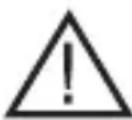
This symbol alerts users that the following precautions can be avoided if the following precautions are observed when operating and operating the device:
Danger of serious injury or life threatening! Danger of damage to equipment or other damage to property!
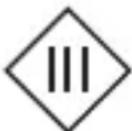
This symbol indicates that the product is equipped with circuits in which the maximum electrical voltage does not exceed the permitted values of the low safe voltage. Such a device cannot cause electric shock when it comes into contact with live parts in normal operation or with non-live parts in the event of equipment failure.
Transport/Carriage
- When transporting and transporting, be careful when moving, to prevent overturning, falling and damage to the device.
There is a risk of damage to the device!
Unpacking/Packaging
- Unpack the equipment and accessories before putting it into service and remove all parts of the packaging material, labels and labels.
- Store the packaging in a safe place or keep it out of the reach of children and inappropriate persons.
There is a risk of serious injury!
There is a risk of choking!
Check/Commissioning
- We recommend performing both initial and subsequent periodic inspections of the device. Only use the device with accessories supplied and approved by the manufacturer.
- Never use the device if it is incomplete or damaged during use has been damaged parts or accessories (eg. By being dropped, wear).
There is a risk of serious injury!
- Check and assemble the machine before operating it as described in „Before Use“.
- Never clean the device (body with electrical parts) in a way that it could get into the liquid and flood the liquid into the device.
- Clean the electrical parts with a damp cloth only and wipe dry or let it dry.
- Keep the appliance clean and dry.
- If the device was stored at low temperatures, first acclimate (about 12 to 1 hour) before further use to remove any moisture inside the enclosure, solidify the moving parts and preserve the mechanical strength of the plastic parts.
Operation/Use
Warning!
- The device is intended for use with a power supply with a built-in rechargeable battery that is not user-replaceable.
- Only a qualifi ed service technician may replace the battery.
Caution!
- Do not use a device with an AC power cord when the cord or its parts are damaged. Do not repair the cord by yourself self.
Ask a specialist service to replace the power cord with the same type. There is a risk of electric shock!
- The device is suitable for removing smears that occur on the surface of fabrics and fabrics due to wearing of textiles or weaving of fabric and human body.
- Resins are most often formed on the surface of textiles made of synthetic and especially polyester fibers and textiles containing these materials.
- To avoid damage or degradation of the garment or fabric, always check the suitability of using the device on a small, wearable, minor area.
- The device is not suitable for removing fi bers from very thin materials such as silk, microfi bre, and the like. The structure of the material may be damaged.
Caution!
- Never use the appliance to remove hair from parts of the human body.
There is a risk of serious injury!
Caution!
- Always make sure that the machine is switched off by the main switch before handling any equipment (common use, cleaning, etc.).
- Do not switch on or use the appliance unless the rotary blade planer is correctly seated and threaded on the machine.
- Rotary blades move at high speed and are very sharp.
- At the same time, the knife and knife blade can be damaged.
- Do not use the device when the blade of the rotary blades is damaged (eg broken, ruptured or missing part of the metal perforated surface).
- Do not use the appliance' when the jar and fi ber trays are planted.
There is a risk of serious injury!
There is a risk of damage to the device!
- Do not use a device to remove junk from clothing directly on people.
- Do not use the appliance on damp and wet fabrics. Moisture in the fibers of the fabric results in clogging and contaminating the device and reducing the effect of the rotary knives.
- Do not use the appliance on textiles that are dirty with solid and hard dirt.
- Do not expose any hard objects (such as metal fibers, wires, etc.) to the planes. These items can damage or even destroy planchette and rotary knives.
There is a risk of damage to the device!
- Use the machine only on fl at and fi rm washers. Do not use the device on soft, uneven or high-loose mats.
There is a risk of damage to the device!
There is a risk of damage to the fabric!
Warning!
- Use the device on textiles that are straight, well-tightened and do not contain signifi cant irregularities or folds.
Caution!
- Keep the device dry. The appliance must not be immersed in water or other liquids. Do not use the appliance in places where it could fall into a washbasin, bath, or other container containing water, including a swimming pool.
- If the appliance falls into the water, do not pull it out. First disconnect the power plug from the mains socket and then select the appliance from the water.
• Take the appliance to a specialist service to check if it is safe and working properly.
There is a risk of electric shock!
There is a risk of damage to the device!
- Do not overload the machine beyond the limits specified by the technical specifications!
- Observe the operating mode of the device (operating time/operation and breaks) in accordance with the operating and operating instructions.
- Clean the machine regularly. Pollution of the device may result in a decrease in operating parameters and possible subsequent irreversible damage.
- Do not expose the plane to excessive mechanical pressure and other mechanical stresses. Excessive pressure of solid and hard objects may cause permanent plastic deformation of the surface of the floor and decommissioning of the device.
There is a risk of serious injury!
There is a risk of damage to equipment or other property damage!
• Always attach the protective cover to the planer after use. This prevents possible damage or damage to the planer.
- If any safety component/part(mechanical, electrical) is part of the device, never disable this part/component! If the safety component/component is damaged or not working, do not use the appliance!
- Never underestimate the potential hazards and take extreme caution!!!
- Depending on the type, the device may be powered by a rechargeable
built-in rechargeable battery or replaceable batteries.
Charging the built-in battery.
- The device comes with a non-fully charged built-in rechargeable battery.
- To achieve the maximum capacity and the longest battery life, the battery needs to be fully discharged and then charged to its maximum level (it may take about 8 to 10 hours to charge before using it for the first time). This procedure must be repeated for at least 3 cycles, always after the battery has been fully discharged.
- Charge the battery for about 8 hours while using the device. Do not overload the battery charging time.
- The device is equipped with a protective circuit that restricts the battery overload.
- The fully charged battery pack is capable of operating for about 45 minutes. Extension of the operating time is possible with the charging of the built-in battery.
- To ensure optimal battery life, it is recommended that the device inactivity (the battery discharge / charging time) is not longer than 2-3 months.
- To charge the built-in battery, follow these steps:
- Turn off the main switch before charging the battery.
- A power cord is provided for charging the battery, which is part of the supplied accessories.
- Insert the power cord connector (socket) into the power/charging connector of the device's battery.
- Plug the power cord plug into the 230 V power socket.
- When the power is connected, the power/operation indicator light turns red.
- The signal is always on when the device is connected to AC power and is in operation.
- The signal does not inform you about the battery charging/ discharging status.
- After charging the battery (after a set time), disconnect the power cord plug from the wall socket. Disconnect the power cord connector from the device connector.
- The device's power source is ready and the device can be used.
- During use, the battery is gradually drained. For further use, recharge the battery as instructed.
Warning.
- Do not use the device at a very low battery level. The output of the device is small and the rotary knife rotations are low. There may be jamming of rotating knives and damage to the fabric.
Parts description

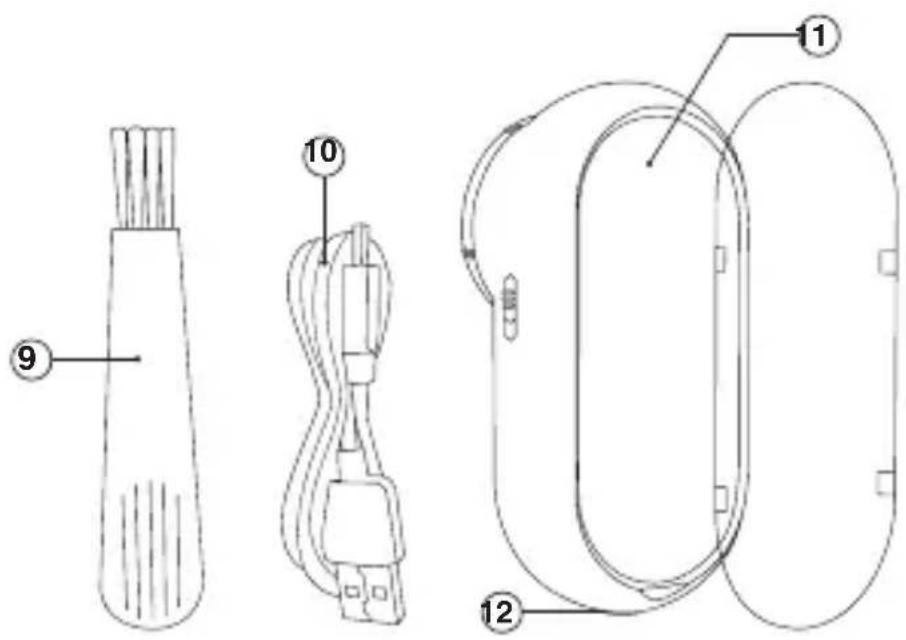
1 Protective cover
2 Planchet
3 Motor shaft
4 Knives
5 Lint tray
6 Power USB mini-connector
(connection of the supplied cable and a suitable AC power adapter)
7 Switch
8 LED indicator light
9 Cleaning brush
10 USB charging cable
11 Clothes brush
12 Tank cover release button
Charging
- Turn off the power switch.
- Plug the mini connector of the supplied cable into the power mini connector on this device and the other USB connector into the USB connector on the optional AC adapter (DC output voltage 5 V, 500 - 1000 mA). Plug the AC adapter into an electrical outlet.
- The red LED charging indicator will fl ash while charging. Charge the device for about 8 to 10 hours. The device does not indicate the state of the charged battery, but it contains a circuit preventing the battery from being overcharged. Disconnect the device from the charging source, then you can use it.
- The duration of a charged battery is 30 min.
Notes:
- The first charging takes about 8 to 10 hours. This procedure must be repeated at least 3 cycles, always after the battery is completely discharged.
- During normal use of the device, charge the battery for approx. 8 hours. Do not exceed the battery charging time disproportionately.
- To achieve optimal battery condition, use the device for the first three cycles until the battery is fully discharged, then always charge it to the maximum.
- Charge the device at temperatures between 5 and 35^ .
Before using the device
Warning!
Do not use the device on clothes that have just been worn. There is a risk of injury!
To avoid damage, be careful with the following parts of clothing:
- buttons, zippers
- foreign objects (badges, brooches) - unfasten them before use
- a thin part of the fabric, garment hems, garment stitching or cuffs
Using the device
-
Remove the transparent protective cover from the device.
-
Slide the power switch to the ON position. turn on the device.
-
Hold the device at a slight angle against the stretched fabric. Gently press it against the garment and move it back and forth to remove lint. Tighten the garment with the other hand. Move the device in different directions. As you gain experience, you can increase the pressure slightly. However, excessive pressure will not increase the quality of lint removal.

-
Switch off the device by moving the switch again to the OFF position.
-
To avoid damage to the planchet, always put a protective cover on the device after use.
Warning!
- Do not press too hard on the fabric, it could damage the fabric.
- Do not use lint remover on clothes!
Different ways to use the device
1. Quick removal:
Remove lint from smaller sections by swiping left and right.
2. Removing tough lint:
Remove lint by swiping left and right and up and down multiple times.
3. Removing lint from thin fabrics:
Fold the garment into two layers and stretch it on a fi rm board.
- Removing lint from wrinkled fabrics: Always straighten the creases. If the fold cannot be straightened, avoid it.
5. Removing lint from structured patterned fabrics:
Remove lint by sliding along the plastic pattern.
Cleaning and maintenance
-
Turn off the device.
-
Open the cover by pressing button 12, remove it from the body of the device and empty the dirt from the reservoir.
-
Unscrew the frame with the planchet to the left.
-
Firmly grasp the inner knives at the edge of the head and pull them straight out. Be careful not to cut yourself.
BEWARE THE KNIVES ARE VERY SHARP!
There is a risk of injury.

-
Clean the dirt in the planchet with the supplied cleaning brush.
-
Clean dirt from the inner knives with the supplied cleaning brush.
BEWARE THE KNIVES ARE VERY SHARP!
-
After cleaning, reassemble all parts in the reverse order of disassembly.
-
To prevent damage to the planchet and internal knives, put a protective cover on the device.
- Be careful when handling knives to avoid injury.
- Do not press on the planchet. It can get damaged.
- Use a dry cloth to clean the surface.
- Always remove lint from the lint container before it is completely full.
- Clumps of fl uff hidden between the planchet and the knives impair sharpness and rotation. Clean them with a brush.
Technical specifications
Power supply: 2.4 V built-in battery
(2x NiMH 600 mAh)
Charging: optional AC adapter with output
direct voltage
5 V, 500 - 1000 mA (not supplied)
Dimensions (w x h x d): 12.3 x 6 x 6.5 cm
Power consumption: 2 W (when charging)
Weight: 170 g
Noise level: 70 dB (A)
The declared value of the noise emission of this appliance is 70 dB (A), which represents level A of the acoustic power with respect to the reference acoustic power of 1 pW.
Producer:
ORAVA retail 1, a.s.
Seberíniho 2
821 03 Bratislava
Slovenská republika
Importer:
ORAVA retail 1, a.s.
Seberíniho 2
821 03 Bratislava
Slovenská republika
ORAVA distribution CZ, s.r.o.
Ostravská 494
739 25 Sviadnov
Ceská republika
INSTRUCTIONS AND INFORMATION REGARDING THE DISPOSAL OF USED PACKAGING
Dispose of used packaging material at a municipal waste disposal site.
DISPOSAL OF USED ELECTRICAL AND ELECTRONIC EQUIPMENT
natural_image
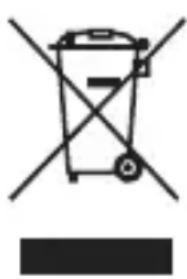
Symbol of a trash bin with crossed-out lines and a solid black rectangle below (no text or labels)This symbol on the products or in the accompanying documents means that used electrical and electronic products should not be mixed with general household waste. For proper disposal, recovery and recycling, please return these products to designated collection points. Alternatively, in some countries of the European Union or other European countries, you may return your products to your local retailer when purchasing an equivalent new product. By ensuring this product is disposed of correctly, you will help prevent potential negative consequences for the environment natural resources and help prevent potential negative effects on environment and human health, which could be the consequences of improper disposal waste. Contact your local authority or nearest offi ce for more details collection point. Improper disposal of this type of waste may result in penalties in accordance with national regulations.
For business entities in the countries of the European Union
If you wish to discard electrical and electronic equipment, please request the necessary information from your seller or supplier.
Disposal in other countries outside the European Union
This symbol is valid in the European Union. If you wish to discard this product, please request obtain the necessary information on the correct method of disposal from the local authorities or from the your supplier.
This product complies with all the essential requirements of the EU directives that apply to it.
- The intended use of the device
- GENERAL SAFETY INSTRUCTIONS AND WARNINGS
- General safety instructions
- Safety of the operating environment
- Electrical safety
- Safety of persons
- Cleaning, maintenance and repairs
- Special Safety Instructions. Read carefully!
- Transport/Carriage
- Unpacking/Packaging
- Check/Commissioning
- Operation/Use
- Warning!
- Caution!
- Charging the built-in battery.
- Warning.
- Parts description
- Charging
- Notes:
- Before using the device
- To avoid damage, be careful with the following parts of clothing:
- Using the device
- Different ways to use the device
- Quick removal:
- Removing tough lint:
- Removing lint from thin fabrics:
- Removing lint from structured patterned fabrics:
- Cleaning and maintenance
- Technical specifications
- Producer:
- Importer:
- INSTRUCTIONS AND INFORMATION REGARDING THE DISPOSAL OF USED PACKAGING
- DISPOSAL OF USED ELECTRICAL AND ELECTRONIC EQUIPMENT
- For business entities in the countries of the European Union
- Disposal in other countries outside the European Union
Brand : Orava
Model : LR-103
Category : Radiator