DocuColor 8000AP - Printer XEROX - Free user manual and instructions
Find the device manual for free DocuColor 8000AP XEROX in PDF.


User questions about DocuColor 8000AP XEROX
0 question about this device. Answer the ones you know or ask your own.
Ask a new question about this device
Download the instructions for your Printer in PDF format for free! Find your manual DocuColor 8000AP - XEROX and take your electronic device back in hand. On this page are published all the documents necessary for the use of your device. DocuColor 8000AP by XEROX.
USER MANUAL DocuColor 8000AP XEROX
DocuColor 7000AP/8000AP User Guide
Prepared by:
Xerox Corporation
Global Knowledge & Language Services
800 Phillips Road
Building 845
Webster, New York 14580
©Copyright 2007 by Xerox Corporation. All Rights Reserved.
Copyright protection claimed includes all forms and matters of copyrighted material and information now allowed by statutory or judicial law or hereinafter granted, including without limitation, material generated from the software programs that are displayed on the screen such as styles, templates, icons, screen displays, looks, etc.
Xerox ^® , Xerox Canada Ltd ^® , Xerox Limited ^® , and all Xerox product names and product numbers mentioned in this publication are trademarks of XEROX CORPORATION. Copyright protection claimed includes all forms and matters of copyrightable material and information now allowed by statutory or judicial law or hereinafter granted, including without limitations, material generated from the software programs which are displayed on the screen such as styles, templates, icons, screen displays looks, etc. Other company brands and product names may be trademarks or registered trademarks of the respective companies and are also acknowledged.
While every care has been taken in the preparation of this material, no liability will be accepted by Xerox Corporation arising out of any inaccuracies or omissions.
Changes are periodically made to this document. Changes, technical innacuracies, and typographic errors will be corrected in subsequent editions.
Table of Contents
1. Machine Introduction 1-1
Machine Introduction 1-1
Major Components....1-1
Table 1 1-2
User Interface (UI)....1-3
Touch Screen 1-3
Control Panel 1-4
Job Management 1-5
Job Status 1-5
2. Where to find Help 2-1
1-800 Telephone numbers 2-1
How to find the machine serial number 2-1
How to read the Billing Meters 2-2
Reference Documents 2-2
3. Loading Paper 3-1
Loading paper (Trays 1-4) 3-1
Paper Tray Guidelines 3-3
4. How to clear Jams 4-1
Printer jam clearance 4-1
Paper tray jams....4-1
Upper Transport Area 4-2
Transport Module 4-2
Exit Module 4-3
Right/Left Door paper path 4-3
Jam clearance with 2-sided printing 4-5
High Capacity Stacker 80 (HCS80) 4-5
Bypass area 4-6
High Capacity Stacker/Stapler (HCSS) and Commn Stacker/Stapler (CSS) 4-6
5. How to adjust Paper Curl 5-1
Paper Curl 5-1
Tool Mode....5-1
6. How to run Tabs 6-1
Tabs 6-1
7. Productivity Settings 7-1
Overview 7-1
Changing the Productivity Setting 7-2
8. Optional Accessories 8-1
Trays 3 and 4 (Second Feeder Module)....8-1
High Capacity Stacker 80 (HCS80) 8-1
Top Tray 8-1
Stacker Tray/Cart 8-1
Bypass 8-2
Identifying the parts....8-2
HCS80 Control panel 8-2
HCS80 Cooling fan....8-3
Unloading the HCS80 Stacker Tray 8-3
HCSS80/CSS....8-5
Identifying the components....8-5
HCSS80/CSS Control Panel 8-6
HCSS80/CSS Paper Path....8-6
HCS80/CSS Operation 8-7
HCS80/CSS Stapling Hints 8-7
Unloading the HCS80/CSS Finishers 8-7
Loading Staples in the HCS80/CSS 8-8
Undocking the Stacker Stapler 8-9
9. Maintenance 9-1
Cleaning the Digital Press 9-1
Cleaning the UI Touch Screen 9-1
Cleaning the Corotrons....9-2
Cleaning the Paper Transport and Fusing areas 9-4
Replacing Consumable Supplies 9-5
Replacing A Dry Ink/Toner Cartridge. 9-5
Adding Fuser Oil 9-6
Changing the Waste Dry Ink Bottle....9-7
Replacing a Corotron 9-8
When to replace a charge corotron 9-8
Which charge corotron to replace 9-8
Banding samples 9-9
Corotron Replacement....9-10
Replacing the Fuser Web 9-11
Consumable Supplies 9-13
10. Basic Troubleshooting 10-1
Digital Press Troubleshooting.... 10-1
Printer Fault Codes 10-4
HCS80 Troubleshooting....10-5
Loss of Power 10-6
HCSS and CSS Problem Solving 10-6
11. Specifications 11-1
Printer Specifications 11-1
Paper specifications 11-1
Tray Capacity 11-2
Duplexing 11-2
Transparency Guidelines 11-2
Tabbed Inserts.... 11-3
Drilled Paper 11-3
Simplex Print Jobs 11-4
Duplex Print Jobs 11-4
Letterhead....11-4
Nonstandard size paper 11-5
Paper weight conversion tables 11-6
Weight conversion ranges 11-6
High Capacity Stacker 80 Specifications ..... 11-7
HCS80 Paper Specifications 11-7
HCS80 Paper Guidelines 11-8
HCS80 Recommended Baseline/Centerline 11-8
HCS80 Paper Destination Specifications 11-9
HCSS and CSS Specifications.... 11-10
Electrical / Environmental Requirements 11-10
Paper Stock Specifications 11-11
Paper Specifications for Stapling 11-12
Staple Positions 11-13
Stapling capacity for different paper types and weights 11-14
12. Appendix 12-1
Machine Details 12-1
Maintenance tab....12-2
Help 12-3
Audio Tones 12-4
Alert Screens 12-4
Digital Press Technical Data....12-4
Electrical Power Specifications 12-4
Power Consumption 12-5
Warm-up Time....12-5
First Print Out Time....12-5
Environmental Requirements 12-5
Ambient Temperature and Humidity 12-5
Altitude 12-5
Illumination....12-6
Noise Levels 12-6
Ozone Emissions 12-6
Dust 12-6
Capabilities 12-6
Tray Capacity 12-6
Throughput....12-6
Print Rates 12-7
Physical Characteristics 12-9
Digital Press Size 12-9
Digital Press Weight 12-9
Floor Space Requirements....12-9
1. Machine Introduction
Read the Safety Notices found on the CD in your Nationalization Kit or go to www.xerox.com
Machine Introduction
The DocuColor 7000AP/8000AP is a full color/black and white digital press operating at a speed of eighty prints per minute. This chapter provides the location, name, and function of the various digital press components including:
- External components
• The User Interface (UI)
• The Control Panel - Internal components
- Optional Accessories
Major Components
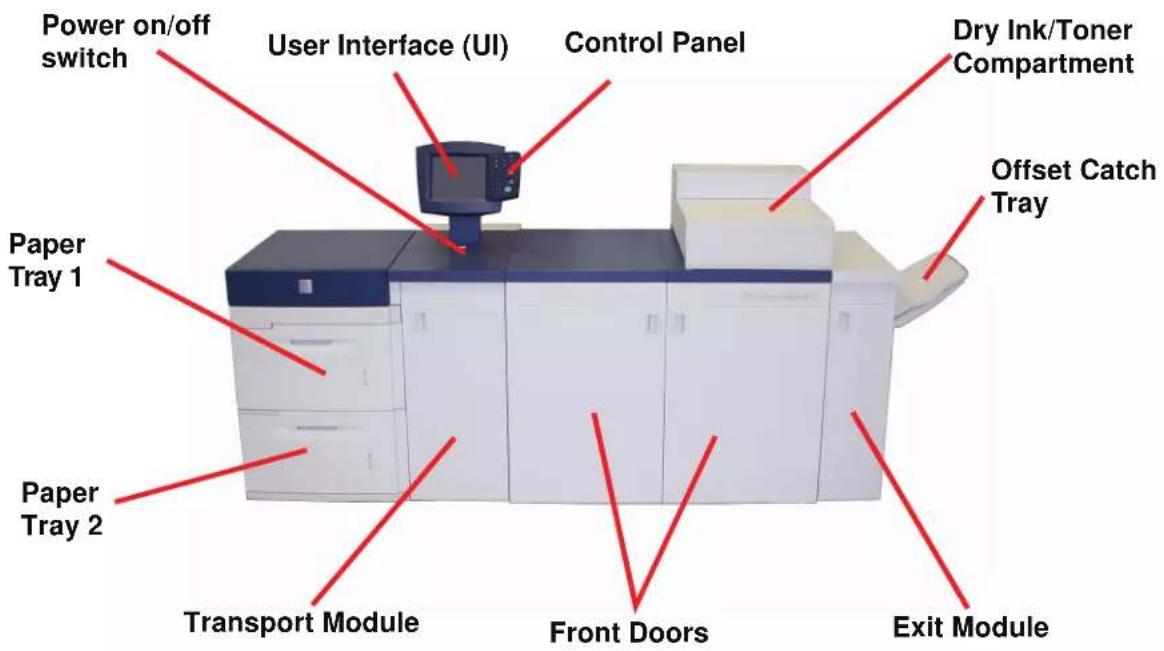
text_image
Power on/off switch User Interface (UI) Control Panel Dry Ink/Toner Compartment Paper Tray 1 Offset Catch Tray Paper Tray 2 Transport Module Front Doors Exit ModuleTable 1
| Part Description | |
| Paper Tray 1 | Holds 2000 sheets of 24 lb. (90 g/m2) paper. |
| Paper Tray 2 | Holds 2000 sheets of 24 lb. (90 g/m2) paper. |
| Transport Module | The Transport Module carries the paper from the paper trays to the upper paper path of the digital press. |
On/Off  Off Off | Press the Power Switch to the On position to power on the digital press.A screen message advises of a short wait while the Fuser warms up and the digital press runs a system check.Press the Power Switch to the Off position to power off the digital press.Allow the digital press to remain off for a minimum of twenty seconds before switching the power on again. |
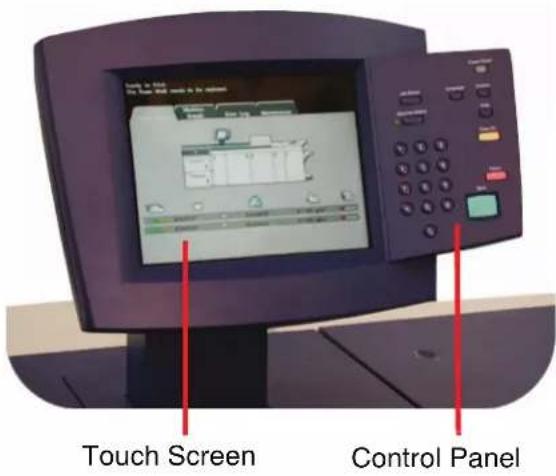
| User Interface | The User Interface contains two components: the Control Panel and the Touch Screen and is used for messaging and to select settings. |
| Control Panel Allows keypad selection of features. | |
| Dry Ink/Toner Compartment | Contains the Dry Ink/Toner cartridges. The cartridge colors from left to right, are black, cyan, magenta, and yellow. Refer to the Maintenance Chapter of this manual for instructions on changing the cartridges. |
| Offset Catch Tray (OCT) | Receives completed print job. Sets are offset for easy separation. Maximum capacity is 500 sheets of 24 lb. (90 g/m2) paper. |
| Right/Left Front Doors | Houses the image transfer system for simplex and duplex printing. Open to clear jams in the paper path in the Printing Module and at the Fuser. Follow the instructions precisely for clearing a jam in the Fuser. |
| Exit Module | Contains the decurler and the inverter. The decurler removes any curl from the printed page. The inverter is used when duplexing or face down output is selected. |
User Interface (UI)
text_image
Touch Screen Control PanelThe User Interface (UI) displays messages that indicate the status of the digital press during idle, run, or fault conditions.
Touch Screen
text_image
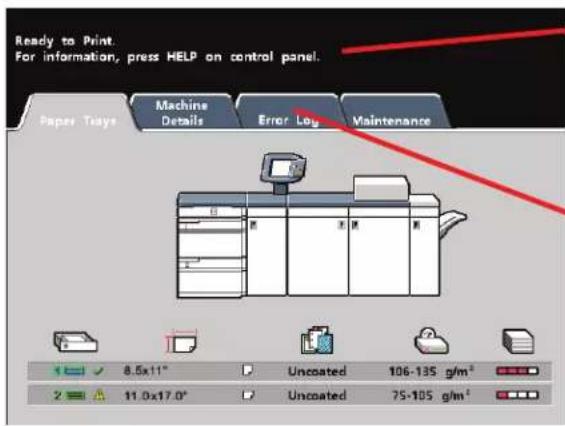
Ready to Print For information, press HELP on control panel. Paper Trays Machine Details Error Log Maintenance 1 8.5x11° 2 11.0x17.0° Uncoated 106-135 g/m² Uncoated 75-105 g/m²Message Area
The message area at the top of the UI displays messages concerning the digital press status, programming conflicts, or errors. Messages may also provide instructions for the operator.
Tabs and Functions
Some UI screens display tabs containing various selectable options.
Control Panel

text_image
Job Status Machine Status Language Power Saver Access Help Clear All 1 2 3 4 5 6 7 8 9 * 0 # C Pause StartKeypad:
Use the numeric keypad to enter your password for access to Tools Mode. Use the keypad for certain Tools Mode features. The keypad is also used by the service representative in the diagnostics mode.
Your digital press has one of two Control Panels: a Control Panel with words or one with international symbols. See the following for button functions.

Power Saver
Lights up when the digital press is in Sleep Mode. Press to return to Standby Mode.

Job Status
Displays a list on the UI of the current jobs and their status. You can hold, release, promote, delete, and see the options selected for each job.

Language
Allows you to select one of two languages.

Access
Allows access to the password-protected Tools Mode and the Auditor Mode.

Machine Status
Accesses the Paper Tray, Machine Details, Error Log, and Maintenance screens. Machine Status is where you find the serial number for the digital press, the customer support phone numbers, and the meters that show the count for color, black and white, color large size, and total output.

Help
Displays additional information useful in completing a task.

Clear All
The Clear All button is used in the Tools Mode for clearing certain selections or settings. Pause

Pause
Press the Pause button to pause printing in order to perform certain maintenance procedures such as changing the dry ink/toner cartridge. You must press Pause again to resume printing.

Start
The Start button is used in the Tools Mode for certain settings. It is also used by the service representative in the diagnostics mode.
Job Management
Job Status

text_image
Ready to Print. Job List Hold Job Release Job Promote Job Delete Job(Job Details 1 Network Print: 8.5x11.0" Quantity: 1 Printing Pages: 4 2 Network Print: 11.0x17.0" Quantity: 6 Queued Pages: 2 3 Network Print: 8.5x11.0" Quantity: 50 Queued Pages: 0 4 Network Print: 8.5x11.0" Quantity: 10 Queued Pages: 25 1/1When you press the Job Status button, the Job Status screen is displayed.
The Job Status screen includes Job Type, Current Status, Paper Size, Output Quantity (refers to the output in sheets for a single page job and in sets or stacks for a multiple page job), and total Number of Pages.
Jobs are numbered in the order they are received for processing.
Review the information that is provided for controlling the print workflow;
- Job List - Shows all jobs submitted to the digital press.
- Hold Job - Holds a job in the print queue until released.
- Release Job - Releases a Hold Job to be printed.
- Promote Job - Enables a job to be moved in front of other jobs in the queue.
- Delete Job - Deletes a selected job.
- Job Details - Shows the programmed options for a selected job.
- Up/Down Arrows - Enables scrolling through job list.
For more information about help, refer to Machine Details located in the Appendix.
2. Where to find Help
1-800 Telephone numbers
For system support, user help, and service support, call the appropriate number:
US: 1-800-821-2797 (Includes TTY Support)
Canada: 1-800-939-3769
Xerox also provides web-based customer support.
Go to:
www.xerox.com/eSupportCentre
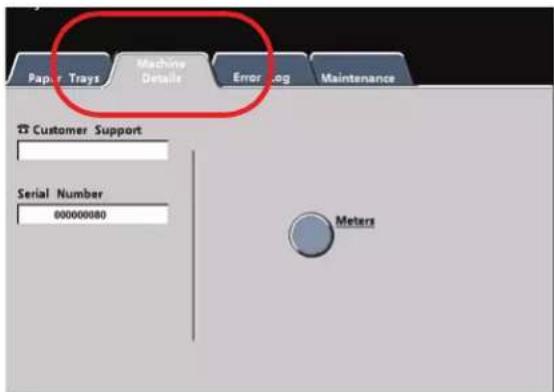
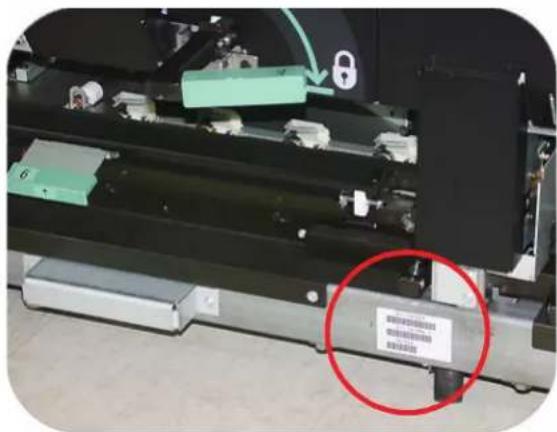
How to find the machine serial number
text_image
Paper Trays Machine Details Error Log Maintenance Customer Support Serial Number 00000080 MetersYou can find the serial number two places:
- Press the Machine Status button on the Control Panel and then press the Machine Details tab, or
natural_image
Close-up of a mechanical device with green components and a red circle highlighting a small label (no readable text or symbols)- Open the front doors to locate the serial number plate on the frame.
How to read the Billing Meters

text_image
Ready to Print. Paper Trays Machine Details Error Log Maintenance Customer Support Serial Number 00000000 Meters- Press the Machine Status button on the Control Panel.
- Press the Machine Details Tab.
- Press the Meters button.
Reference Documents
There are additional reference documents available to you that provide more detailed information. Refer to the list below for the title, description and the location of the document.
| Document Description Location | ||
| System Administration Guide P | provides detailed descriptions of System Administrator functions | Found on the Customer Documentation CD |
| Decurler Adjustment An adjustment to help correct decurling problems | Found on the Customer Documentation CD | |
| Specialty Media Guide Provides specialty media recommendations, hints and tips regarding best printing practices. | Found on the Customer Documentation CD | |
| Chapter 3 Loading Paper | Quick reference to loading paper | Found on the Customer Documentation CD |
| Corotron Test Test opattern used to help determine image quality problem | Found on the Customer Documentation CD | |
| Safety Guide All the safety information associated with this machine | Found on the Customer Documentation CD | |
3. Loading Paper
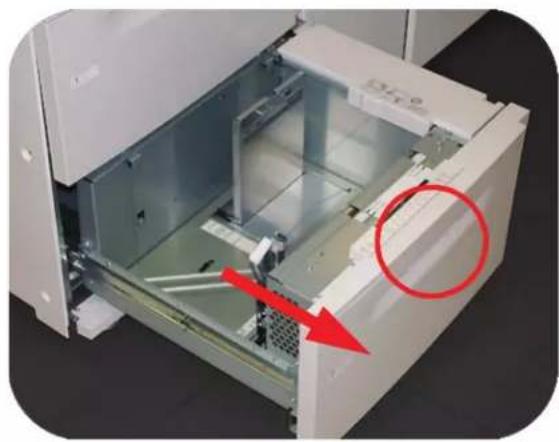
Loading paper (Trays 1-4)
natural_image
Interior view of a white electronic device with internal components and a red circle highlighting a specific area (no text or symbols visible)- Lift the handle and pull out the paper tray.

text_image
XEROX™ 24 lb 90 g/m² 500 Feuilles • 216 mm x 279 mm 8½ x 11 96 Brillance Couleur nu Xpressions Impre- malante laser couleur • Co- Imirimer d'abord su- Select the appropriate paper stock for your print job.
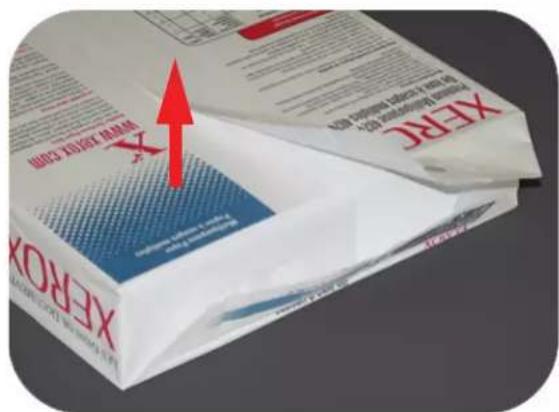
- Open the ream of paper seam side up and place it in the tray.
3. Loading Paper

natural_image
Interior view of a computer setup with a whiteboard and red arrow indicating direction (no text or symbols)- Place the paper in the front right corner of the tray.
text_image
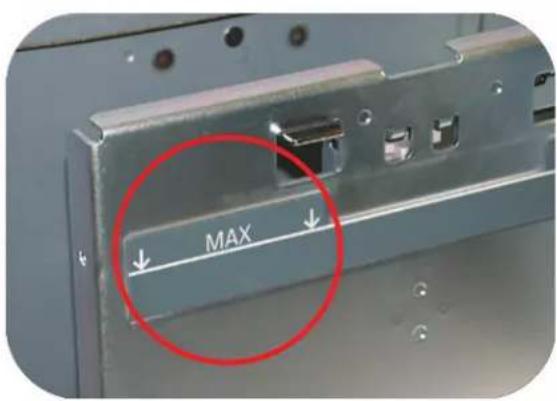
MAX- Do Not exceed the "Max" fill line.

natural_image
Interior view of a printer or printer with visible circuitry and two red-circled annotations (no readable text or symbols)- Squeeze the green levers, and slide the Paper Guides until they touch the side of the paper.

text_image
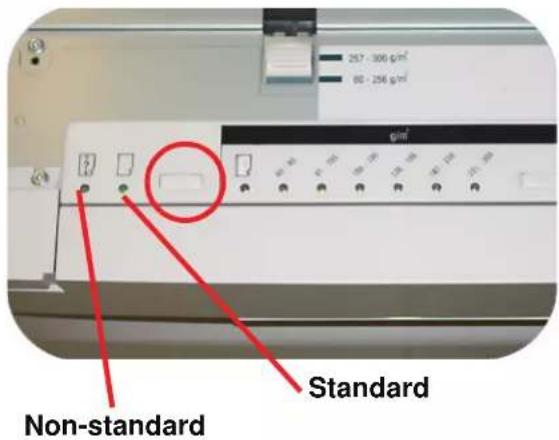
257 - 306 g/m³ 80 - 256 g/m³ Non-standard Standard- Press the button to select Non-Standard or Standard at the front of the tray. The green light will indicate your selection.
Non-standard size paper is any paper for which there is no paper guide setting within the minimum and maximum sizes for the trays: 7.16 to 12.6 inch Long Edge Feed (LEF) or 7.16 to 19.2 inch SEF (182 - 320 mm LEF or 182 x 488 mm Short Edge Feed (SEF))

text_image
257 - 300 g/m² 60 - 256 g/m² g/m² 60 - 40 41 - 100 100 - 130 130 - 180 181 - 220 221 - 300 222 - 300Transparency
- Press the button to select Transparency or the appropriate paper weight. The green light will indicate your selection.
text_image
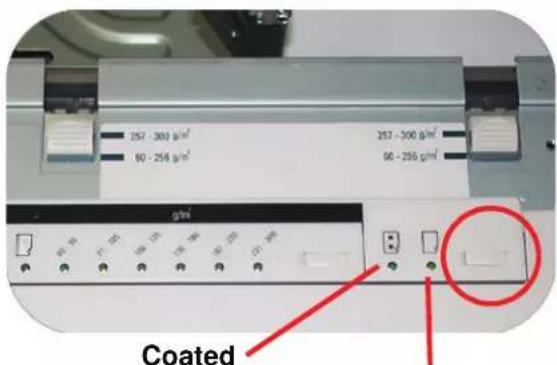
257 - 300 g/m² 60 - 256 g/m² 257 - 300 g/m² 60 - 256 g/m² g/m² CoatedUncoated
- Press the button to select Coated or Uncoated. The green light will indicate your selection.

text_image
257 - 300 g/m² 60 - 256 g/m² 257 - 300 g/m² 66 - 256 g/m²Paper Tray Guidelines
-
Select the position of the Paper Tray Blowers to match the weight of the paper stock in the tray.
-
Slide the tray back into the machine until it locks into place.
For best results, remember the following:
- Do not store reams of paper in any of the trays.
- Do not use wrinkled, torn, curled, or folded paper.
- Do not mix sizes or weights of paper in a paper tray.
4. How to clear Jams
Printer jam clearance
If a jam occurs, the digital press stops printing and a message is displayed on the User Interface (UI). Follow all instructions displayed completely and in sequence. Refer to this chapter for additional information to resolve the problem.
If power is interrupted during the printing process, it is imperative that you clear areas behind the Right and Left Front Doors last. Clear all other jam areas first.
Paper tray jams

CAUTION: Be careful of the Feed Heads and the Feed Rolls. They can be damaged with rough treatment.

CAUTION: If you hear paper tearing, stop opening the tray. Open the door of the Transport Module or the Second Feeder Module (SFM) Transport Area and clear the paper from the Transport Module before attempting to open the tray again.
- Open the tray with the jam.
- Carefully remove all jammed paper.
- Use the UI to determine if further jams exist and clear those areas.
Upper Transport Area
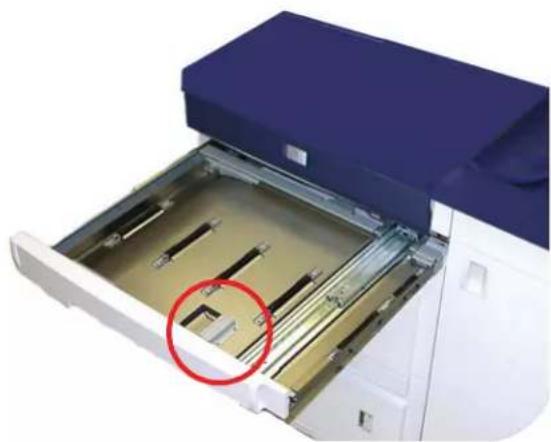
natural_image
Interior view of a printer drawer showing internal compartments and a highlighted section (no text or symbols visible)Jams occur in this area only when the Second Feeder Module containing Trays 3 and 4 is connected.
- Pull out the Transport Area drawer above Tray 1.
- Lift up the handle.
- Remove all jammed paper.
- Return the drawer to its original position.
- Follow the instructions on the UI to clear other areas or to resume your print job.
Transport Module click here for video
text_image
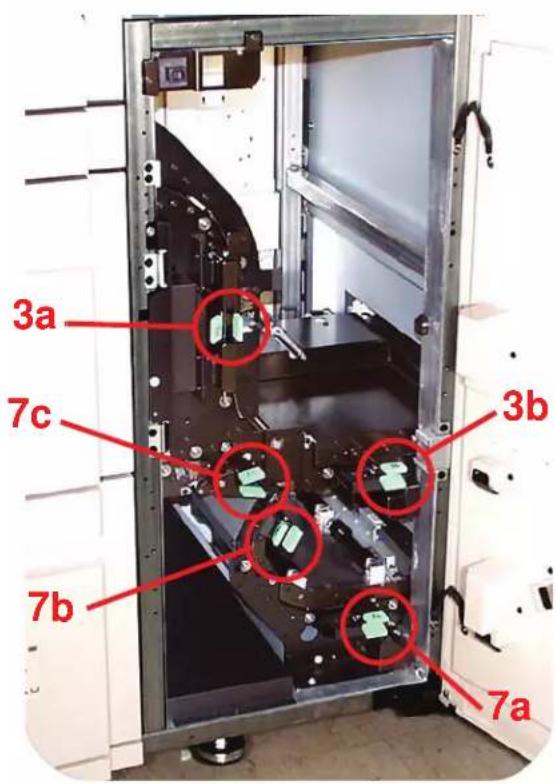
3a 7c 3b 7b 7aOpen the areas in the Transport Module indicated on the UI. Carefully remove all jammed paper.
- Open the Transport Module door.
- Grasp the green handles 3a, squeeze and move it to the right.
- Carefully remove all jammed paper.
- Reposition handles 3a.
-
Lift up green handles 3b.
-
Carefully remove all jammed paper and return handles 3b to the original position.
-
Follow the UI messages and, if required, lift handles 7a and remove all jammed paper. Return handles 7a to the original position.
-
Squeeze handles 7b and lower to the right. Remove all jammed paper. Return handles 7b to the original position.
-
Squeeze handles 7c and lower to the left. Remove all jammed paper. Return handles 7c to the original position.
-
Close the Transport Module door.
-
Follow the instructions on the UI to restart your print job.
Exit Module click here for video
text_image
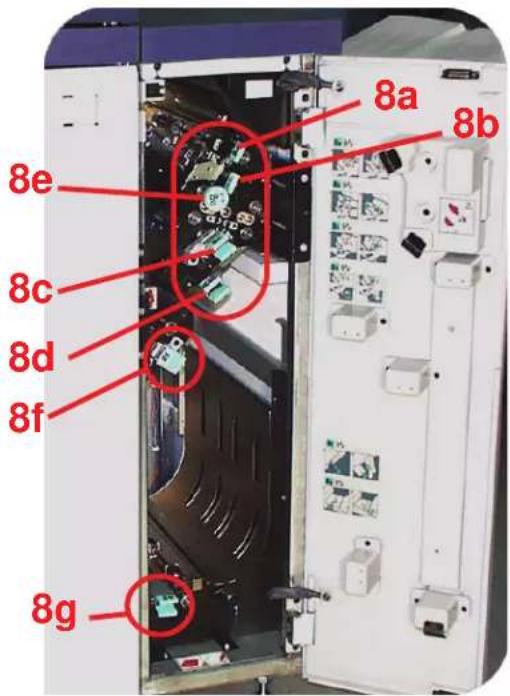
8a 8b 8e 8c 8d 8f 8gFollow the instructions on the UI to clear jams from all the areas indicated in the Exit Module.
Follow the instructions on the UI to restart your print job.
Right/Left Door paper path click here for video

WARNING: Be careful when clearing jams in the Fuser area. The Fuser is extremely hot and will cause injury.
Always follow the instructions on the UI to locate and clear jams.
NOTE: It is imperative that you clear all other jam areas before you open and clear the Right and Left Front Door areas.

natural_image
Interior view of a mechanical assembly with green components and a red circle highlighting a specific part (no visible text or symbols)
text_image
4a 4b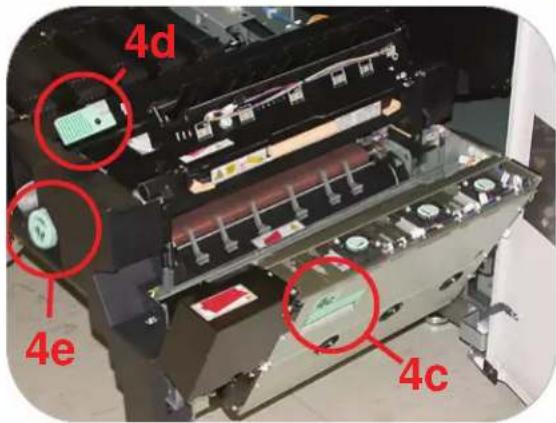
text_image
4d 4e 4c- Open the Right and Left Front Doors when directed to by a UI message.
- Grasp handle 4 and move it in the direction of the arrow.
-
Slowly pull out the Paper Transport module until it stops.
-
Lift handle 4a and carefully remove all jammed paper, ensuring that all pieces are removed if the paper is torn. Turn the green handle 4b to free any paper that is caught.
-
Reposition green handle 4a.
-
The Fuser area is on the right hand side of the Paper Transport module. Lift handle 4c on the right hand side and pull to open.
-
Lift up handle 4d until it stops and clear any jammed paper. Rotate knob 4e in the direction of the arrow on the knob to clear any paper that is caught.
Occasionally a sheet of paper wraps around the heat roll. (The heat roll is visible when handle 4d is up). DO NOT attempt to remove this sheet of paper because the stripper fingers may be damaged if you attempt this procedure. Call your Xerox service representative to remove this piece of paper.
-
Reposition green handle 4d and close area 4c. Ensure these are firmly in place.
-
Grasp handle 4 and slowly push in the Paper Transport until it stops. Turn the handle in the direction of the arrow to lock the module in place.
-
Close the Right and Left Front Doors.
-
Follow the instructions on the UI to restart your print job.
Jam clearance with 2-sided printing

text_image
6 5When printing 2-Sided output, the UI will direct you to clear the following areas if a jam occurs.
- Open the Right and Left Front Doors when directed to by a UI message.
- Lift handles 5 and 6 and clear any paper in the areas.

CAUTION: Paper can rip if not pushed back before removing it from under the lip of this area.
- Push the paper back until you see the front edge, then remove the paper.
- Reposition handles 5 and 6 by closing firmly.
- Close the Right and Left Front Doors.
- Follow the instructions on the UI to restart your print job.
High Capacity Stacker 80 (HCS80)
A paper jam in the HCS80 will be indicated by a message on the digital press UI. Follow the instructions displayed. The image on the HCS80 Control Panel will flash showing the area where the jam is located.
Bypass area

natural_image
Interior view of an electronic device with two red-circled components, no visible text or symbolsPerform the following steps to clear the HCS80 jam in the Bypass area and resume printing.
- Remove any paper from the Top Tray.
- Lift the HCS80 Top Cover.
- Lift the green handle, or handles, indicated on the UI and remove all paper in the Bypass area. Remove paper only from the areas indicated.
- Close each green handle.
- Close the HCS80 Top Cover.
- If the UI indicates there is a jam in the digital press, follow the instructions on the screen to remove any paper in the area indicates. Refer to the Jam Clearance section in the Problem Solving chapter in this manual.
- Follow the instructions displayed on the digital press UI to resume printing.
High Capacity Stacker/Stapler (HCSS) and Commn Stacker/Stapler (CSS)
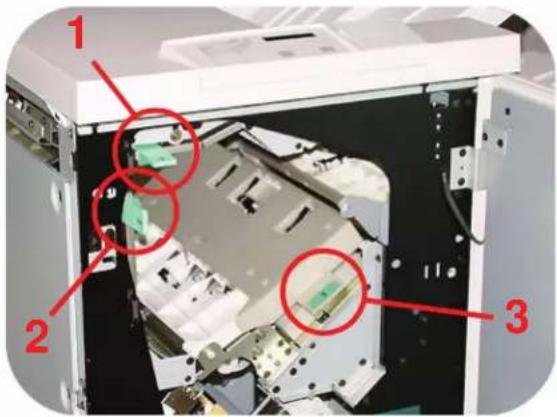
A paper jam in the finishers is indicated by a message on the digital press Touch Screen. The finisher Control Panel display illuminates the area where the jam has occurred.
Read the following steps for more information on how to clear a jam.
text_image
Labeled diagram of an electronic device showing internal components with numbered annotations- Open the finisher Front Door. There are three possible jam areas. Handle 1 moves down, handle 2 moves to the right, and handle 3 moves up.
- Remove all jammed paper only from the area indicated on the Touch Screen and the finisher Control Panel Display. Do not remove paper from any other areas.
- Reposition the handle.
- Close the finisher Front Door.
- Follow any instructions on the Touch Screen to restart your print job.
5. How to adjust Paper Curl
Paper Curl
When paper is exposed to heat, the paper loses moisture and curls toward the heat source. High coverage jobs tend to curl more due to the toner plastification effect on the paper surface. The system tries to reduce this by using mechanical devices within the paper path called decurlers.
Your system has been designed with an automatic curl control system that uses information such as: the amount of coverage on the page, paper weight, whether the paper is coated or uncoated, and the current humidity and temperature to determine the amount of pressure needed at the different decurlers to reduce output curl.
If the curl is unacceptable, you can change the setting.
To change the paper curl setting, you must enter the Tools mode.
Tool Mode

text_image
Please enter your Password. Follow the instructions on the Screen. Access Password Cancel Enter your password using the Numeric Keypad on the Control Panel, then press Enter. Password Enter- To enter Tools Mode, press the Access button on the Control Panel. The Access Password Screen appears.
- Use the keypad to enter your password.
- Press the Enter button.

text_image
Tools Mode. Machine Defaults 1 Machine Defaults 2 Service Call Exit Tools Decurler Setup Decurler & Table Settings Custom Paper Setup Alignment Adjustment Finishing System Module Profile- Press the Tools Pathway button to enter the Tools Mode.
- Press the Machine Default 2 Tab and then press the Decurler Setup button.
text_image
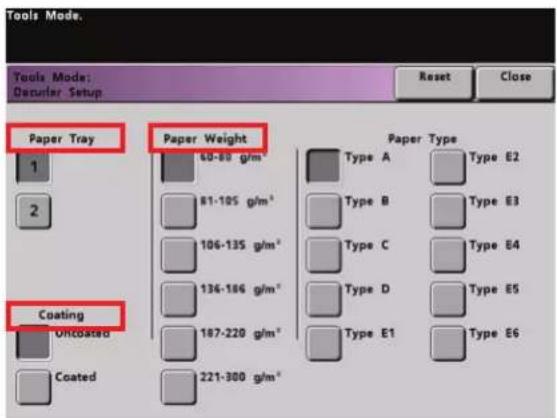
Tools Mode. Tools Mode: Decufer Setup Reset Close Paper Tray Paper Weight 1 2 Coating Uncoated Coated 40-80 g/m² 81-105 g/m² 106-135 g/m² 136-186 g/m² 187-220 g/m² 221-300 g/m² Type A Type B Type C Type D Type E1 Type E2 Type E3 Type E4 Type E5 Type E6- When the Decurler Setup screen appears, enter the paper tray number you are using, coated or non-coated and the paper weight.
- The default curl setting (Paper Type) for the selected paper will be displayed (A-D). Type A is selected in the example screen.
- Select a different setting (A-D) and run the job again. Some experimentation may be needed to find the correct setting.
NOTE: If you are not able to find an acceptable setting that minimizes curl, refer to the document entitled DocuColor 7000AP/8000AP Decurler Adjustment.
6. How to run Tabs
Tabs

natural_image
Close-up of a printer's paper sheet with a red arrow pointing upward (no text or symbols visible)Tabbed Inserts can be loaded into the paper trays as Non-Standard paper.
- Load 9 X 11 inch tab stock (228 x 279 mm) in the paper tray with the tabs with the short edge of the tabs in the lead edge position.
NOTE: If a jam occurs, there is no recovery procedure. You will need to manually recover.

text_image
60 - 256 g/m³ g/m³ 85, 90 81, 105 106, 130 134, 166 167, 220 221, 300- Press the button to select the appropriate tab weight. The green light will indicate your selection.
text_image
257 - 306 g/m² 80 - 256 g/m² Non-standard Standard- Press the button to select Non Standard or Standard at the front of the tray. The green light will indicate your selection.
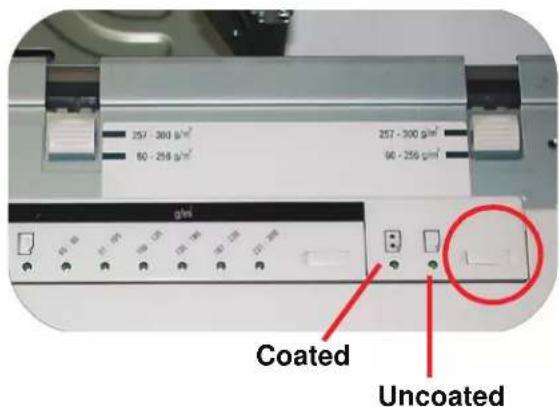
text_image
257 - 300 g/m² 80 - 258 g/m² 257 - 300 g/m² 96 - 256 g/m² g/m² Coated Uncoated- Press the button to select Coated or Uncoated. The green light will indicate your selection.

text_image
Please enter your Password. Follow the instructions on the Screen. Access Password Cancel Enter your password using the Numeric Keypad on the Control Panel, then press Enter. Password Enter-
Enter Tools Mode: Press the Access button on the Control Panel. The Access Password Screen appears.
-
Use the keypad to enter your password.
-
Press the Enter button.
-
Press the Tools Pathway button to enter the Tools Mode.
-
Press the Non-Standard Paper Size button.

text_image
Tools Mode. Machine Defaults 1 Machine Defaults 2 Service Call Exit Tools Initial Screen Audio Tones Set Date & Time NVM Read / Write Productivity Setting Dual Language Tray Priority Auto Tray Switching Non-Standard Paper Size System Timers Oversize Paper Offset D-MAX Setup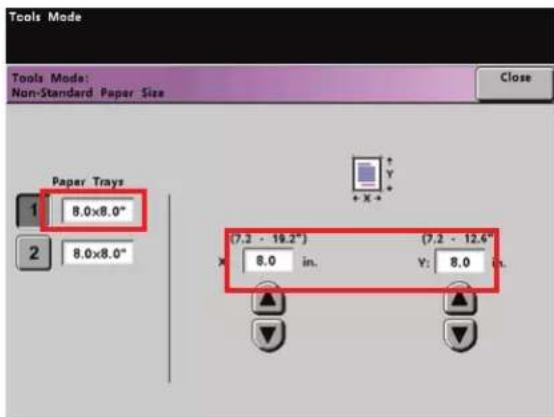
text_image
Tools Mode Tools Mode: Non-Standard Paper Size Close Paper Trays 8.0x8.0" 8.0x8.0" (7.2 - 19.2") 8.0 in. (7.2 - 12.6") 8.0 in.-
Select the appropriate Paper Tray and enter 11 in the X Axis box and 9 in the Y Axis box by using the up and down arrow buttons.
-
Run the tab job.
7. Productivity Settings
Overview

text_image
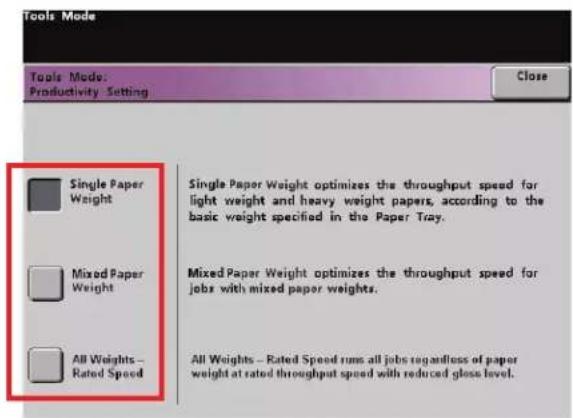
Tools Mode Tools Mode: Productivity Setting Close Single Paper Weight Mixed Paper Weight All Weights - Rated Speed Single Paper Weight optimizes the throughput speed for light weight and heavy weight papers, according to the basic weight specified in the Paper Tray. Mixed Paper Weight optimizes the throughput speed for jobs with mixed paper weights. All Weights - Rated Speed runs all jobs regardless of paper weight at rated throughput speed with reduced gloss level.The productivity of the digital press relates to the continuous speed of the media output as measured in prints per minute (ppm). The continuous speed is dependent on paper size, paper weight, and fuser temperature. Use this productivity setting to optimize the throughput speed for the type of paper you run most frequently.
Productivity Setting options are shown and explained in the illustration on the left:
• Single Paper Weight:
This setting optimizes the throughput speed for light weight or heavy weight papers, according to the weight range that is set in the paper tray.
- Mixed Paper Weight:
This setting optimizes the throughput speed of print jobs that contain mixed media weights from different paper trays.
• All Weights Rated Speed:
This setting runs all jobs at the rated speed regardless of the paper weight. Gloss level may appear lower on heavier weight media. If a higher level of gloss is required, run the job at the Single Paper Weight setting.
Changing the Productivity Setting

text_image
Please enter your Password. Follow the instructions on the Screen. Access Password Cancel Enter your password using the Numeric Keypad on the Control Panel, then press Enter. Password Enter- Enter Tools Mode: Press the Access button on the Control Panel. The Access Password Screen appears.
- Use the keypad to enter your password.
- Press the Enter button.
- Press the Tools Pathway button to enter the Tools Mode.

text_image
Tools Mode. Machine Defaults 1 Machine Defaults 2 Service Call Exit Tools Initial Screen Audio Tones Set Date & Time NVM Read / Write Produtivity Setting Dual Language Tray Priority Auto Tray Switching Non-Standard Paper Size System Timers O-MAX Setup O-- Press the Productivity Setting button.
text_image
Tools Mode Tools Mode: Productivity Setting Close Single Paper Weight Single Paper Weight optimizes the throughput speed for light weight and heavy weight papers, according to the basic weight specified in the Paper Tray. Mixed Paper Weight optimizes the throughput speed for jobs with mixed paper weights. All Weights - Rated Speed runs all jobs regardless of paper weight at rated throughput speed with reduced gloss level.-
Select the desired productivity setting.
-
Select Close.
All jobs will run at the selected productivity setting until changed in Tools Mode.
8. Optional Accessories
The accessories included in this module are:
• Paper Trays 3 and 4
• High Capacity Stacker 80 (HCS80)
• High Capacity Stacker Stapler 80 (HCSS80)/Common Stacker Stapler (CSS)
Trays 3 and 4 (Second Feeder Module)

text_image
Tray 3 Tray 4The Second Feeder Module (SFM) is an optional feeding device that contains Trays 3 and 4. This module holds the same number and types of Media as Trays 1 and 2.
The specifications and operation are identical to the First Feeder Module. (Trays 1 and 2).
High Capacity Stacker 80 (HCS80)

text_image
Control Panel Top Tray Bypass Stacker Tray/CartThe HCS80 is an optional finishing device that provides stacking and offsetting capabilities for output to a Stacker Tray. The HCS80 connects to the right side of the digital press replaces the Offset Catch Tray (OCT).
Top Tray
Sheets are transported to the Top Tray:
- When sheets are purged after a paper jam.
- When the Sample Set button is selected.
- When selected as an Output Location.
- Labels must be sent to the Top Tray.
Stacker Tray/Cart
Collated sets are transported to the Stacker Tray located on a moveable Stacker Cart.
Bypass
The Bypass (only required when a second stacking device is installed) transports collated sets through the HCS80 to a connected finishing device or to another HCS80.
If your system configuration has two stackers, the bypass on the second stacker is not used.
Identifying the parts
HCS80 Control panel
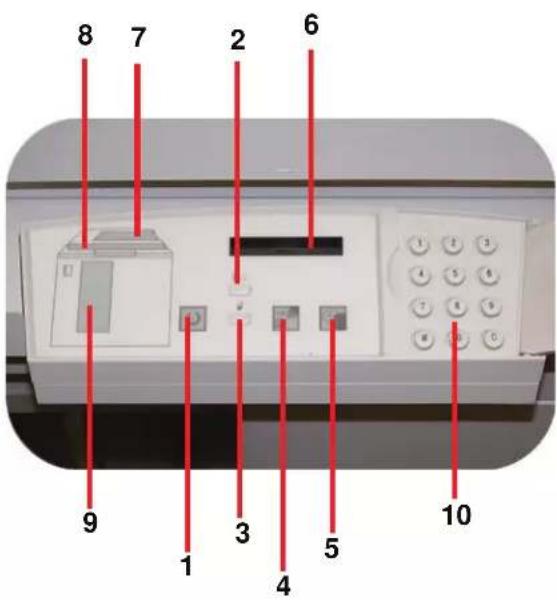
text_image
8 7 2 6 9 1 3 5 101 Ready light
The Ready light blinks during initialization and is constant when the HCS80 is in use or in standby mode.
2 Sample set button
Press to have the HCS80 deliver the next collated set to the top tray.
3 Unload button
Press once to lower the Stacker Tray and unlock the front door.
4 Unload light
Illuminates when the Stacker Tray has reached the down position and the front door can be opened.
5 Wait light
Blinks when the Stacker Tray is moving up or down.
6 Fault code display
Displays a code when a fault occurs in the HCS80. Refer to the HCS80 fault code table located in the Problem Solving section of this chapter.
7 Top tray jam area
Blinks when there is a jam.
8 Bypass jam area
Blinks when there is a jam.
9 Stacker tray jam area
Blinks when there is a jam or the door is open.
10 HCS80 Keypad
HCS80 Cooling fan

natural_image
Interior view of an industrial facility showing a rack-mounted unit and a close-up of its panel with a black arrow pointing to it (no visible text or symbols)The HCS80 is equipped with a cooling fan that you can switch on and off as required. The cooling fan is located inside the front door:
Only switch on the cooling fan when running paper that weighs 120 g/m^2 (80 lb.) or greater.
Remember to switch off the fan after your job(s) finishes and when running paper that weigh less than 120 g/m^2 (80 lb.).
Unloading the HCS80 Stacker Tray

text_image
16:10 16:10Use the following procedure to unload the Stacker Tray when it is full, or to retrieve a completed job.
- Press the Unload button on the Stacker Control Panel. The Wait light blinks until the Stacker Tray has reached the down position.

text_image
16:10 0-€ © ©- Open the front door when the Unload Light illuminates.
natural_image
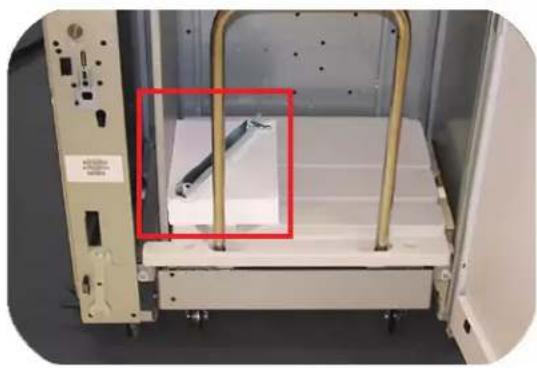
Interior view of a mechanical or electronic device with a highlighted component (no visible text or symbols)- Position the securing bar on top of the stacked paper.
- Pull the Stacker Cart straight out. Remove the securing bar.
- Remove the paper from the Stacker Tray.
- Push the empty Stacker Cart straight into the HCS80.
- Position the securing bar on the fixed area inside the HCS80.
- Close the door. The tray will rise to the operate position.
HCSS80/CSS
The HCSS80 and CSS are optional finishing devices (referred to as finishers) that provide stacking with offset and single or dual stapling output capabilities.
The finishers must be connected to the right end of the digital press, replacing the Offset Catch Tray. The finishers also have an Offset mode that provides separation between the stacked sets sent to the Stack Tray. The finishers can also send output (not stapled) to the Top Tray.
Identifying the components

text_image
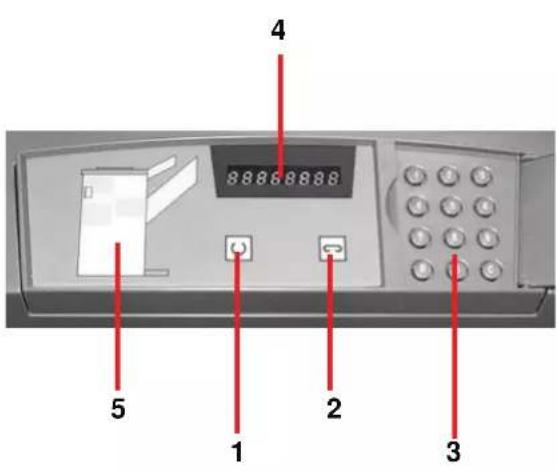
Control Panel Top Tray Offset Stacker/ Stapler TrayHCSS80/CSS Control Panel
text_image
4 88868888 5 1 2 31 Ready Indicator
The Ready Indicator blinks when the digital press is being initialized. The Ready Indicator is constant when in use or in standby.
2 Staple Indicator
The Staple Indicator blinks when the staple level in the stapler is low. The Staple Indicator is constant when the stapler is empty.
3 Keypad
The keypad, including the C button, is used only by the Xerox service representative.
4 Message Display
Shows the fault codes.
5 Jam Indicator
Area illuminates to indicate the location of a jam in the HCSS80.
HCSS80/CSS Paper Path

text_image
Control Panel Top Tray Stacker Cartridge Offset Stacker/ Stapler TrayAs media enters the finisher, it is fed to the Top Tray or to the Offset Stacker Stapler Tray, depending on your selections.
The Stapler Cartridge is a customer replaceable item.
HCS80/CSS Operation
Some important tips to remember:
- The finishers cannot staple jobs with mixed sizes of paper.
- The stacking may be skewed on the output from mixed-size paper jobs.
- Only remove paper jams at the area indicated on the finisher Control Panel. Do not remove paper from any other areas of the paper path.
HCS80/CSS Stapling Hints
There are three stapling options:
- Single Staple Position 1: The finishers place a staple in the upper left corner of Short Edge Feed (SEF) or Long Edge Feed (LEF) sets.
- Single Staple Position 2: The finishers place a staple in the bottom left corner of SEF sets only.
- Dual Staple: The finishers place two staples closer to the top/bottom center of the sheets than a single staple.
Unloading the HCS80/CSS Finishers
To ensure consistent quality, unload sets of less than four sheets and lighter weight paper after 50 sets are made, or when the curl of the sets inhibits the ability of the sets to exit the finishers.
When the Stack Tray is full, Fault Code 112-550 appears in the message display on the finishers. The digital press Touch Screen displays a message, "Unload the Main Tray of the Finisher."
The finishers continue to stack sheets into the Stack Tray after the message appears, but excess sheets may have a degraded stacking quality. For best performance, unload the tray when 2,000 sheets have been stacked.
Loading Staples in the HCS80/CSS click here for video

natural_image
Close-up of a mechanical assembly with red circles highlighting specific components (no visible text or symbols)-
Open the front door.
-
Push the yellow lever down with your left hand.
-
Grasp the grey handle on the cartridge unit and pull it towards you until it stops. Release the yellow level and the unit will lock into place.

natural_image
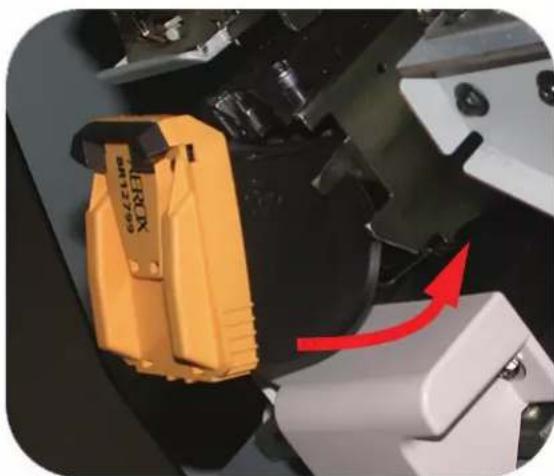
Close-up of a mechanical assembly with orange components and a red arrow indicating a directional movement (no visible text or symbols)- Grasp the yellow staple cartridge and pull it towards you. The entire unit will move forward, then the staple cartridge only will pull free of the unit.
natural_image
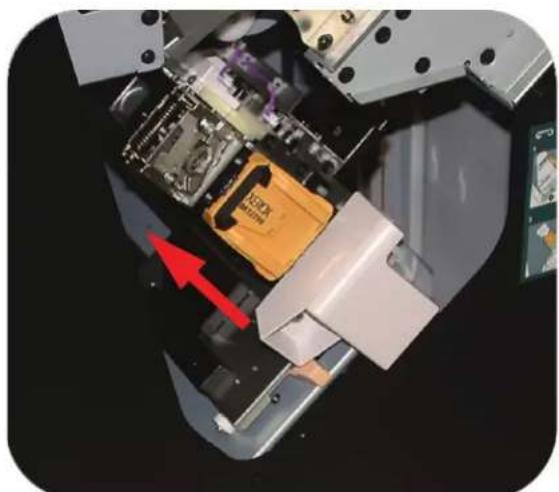
Close-up of a yellow and white electronic device with a red arrow pointing to a component (no visible text or symbols)- Insert a new cartridge into the unit until you hear it click into place.
natural_image
Close-up of a robotic arm with mechanical components and a red arrow indicating motion (no visible text or symbols)- Push the Cartridge in to the Stapler Unit.
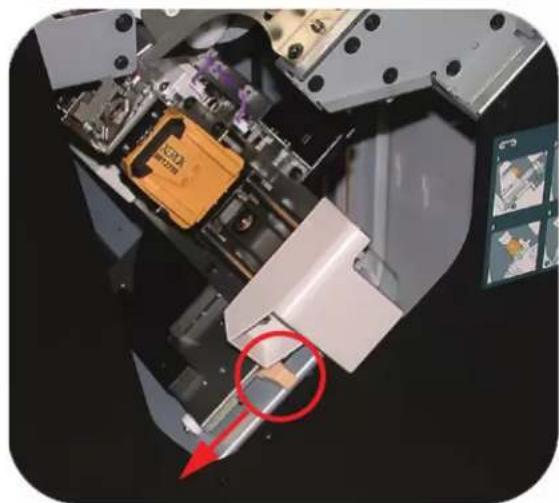
natural_image
Close-up of a robotic arm with visible mechanical components and a red circle highlighting a specific part (no text or symbols present)- Push the yellow lever down and the cartridge unit automatically swings back into place.
Undocking the Stacker Stapler

natural_image
Close-up of a mechanical device with a red circle highlighting a circular opening, no visible text or symbols- Open the Front Door of the Stacker Stapler
- Pull the lever toward you and hold it in position while moving the stacker/stapler a small distance (25.4mm, 1in.) away from the press. Release the lever and continue to move the stacker/stapler as far as required.
9. Maintenance
Cleaning the Digital Press click here for video

CAUTION: Do not use any other cleaners or solvents on the digital press as they may interact with the paint on the covers, eventually causing the paint to peel.

CAUTION: DO NOT pour or spray liquid directly into any of the paper trays. Always apply the liquid to the cloth first.
If the exterior surfaces requires cleaning, dampen a paper towel or a soft, clean cloth with a liquid, nonabrasive glass cleaner or water.
Cleaning the UI Touch Screen

text_image
Scanned image of a vintage computer monitor displaying a technical diagram with Chinese annotations and control buttons.Clean the UI Touch Screen during the digital press warm-up cycle at the start of each day. Remove all dust and fingerprints by wiping the screen with a clean, lint-free dry cloth.

CAUTION: To avoid damage, do not use any cleaner, water, or commercial cleaner on the Touch Screen.
Cleaning the Corotrons click here for video
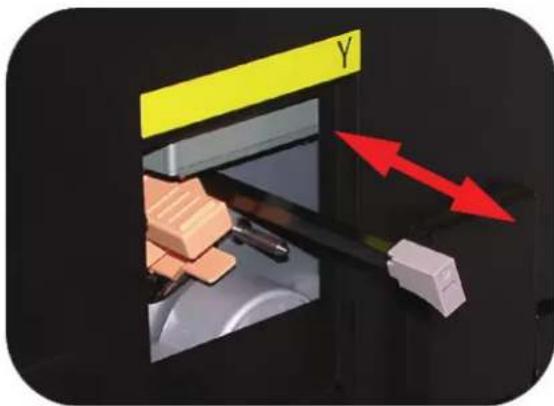
natural_image
Close-up of a mechanical component with yellow and red directional arrows indicating movement or force (no text or symbols)The Corotrons should be cleaned every day and after 5,000 prints.
- Open the Front Doors and slowly pull out the cleaning wand for each corotron fully and then push the wand back into place.
After the corotrons are cleaned, follow the prompts on the UI to record the activity.
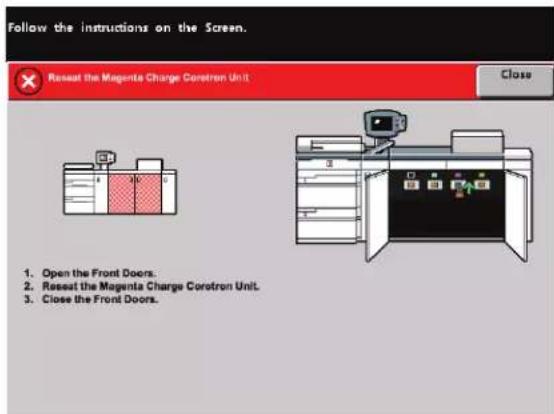
text_image
Follow the instructions on the Screen. Renset the Magenta Charge Corotron Unit Close 1. Open the Front Doors. 2. Renset the Magenta Charge Corotron Unit. 3. Close the Front Doors.If it is not seated properly, the User Interface will display the information on the screen. Re-seat the appropriate corotron.

CAUTION: If any problems occur while cleaning the pad or re-seating the wand, and/or if the above screen is continually displayed, call your Xerox service representative for assistance.

text_image
A Cover or Door is open. Follow the instructions on the Screen. Interlock Open Close Close the right and/or left front doors.- Once all the Corotron Cleaning Wands are properly seated in the corotron assembly, the User Interface displays the Interlock Open screen. Close the Front Doors.
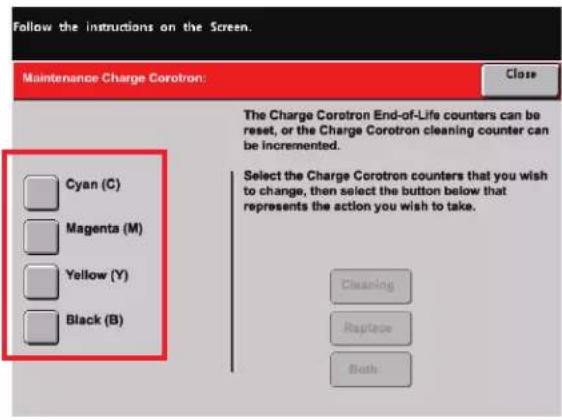
text_image
Follow the instructions on the Screen. Maintenance Charge Corotron: Cyan (C) Magenta (M) Yellow (Y) Black (B) The Charge Corotron End-of-Life counters can be reset, or the Charge Corotron cleaning counter can be incremented. Select the Charge Corotron counters that you wish to change, then select the button below that represents the action you wish to take. Cleaning Replace Both- After all the corotrons are cleaned and the front doors are closed, the Maintenance Charge Corotron screen is displayed. Select one or more corotrons by touching the corresponding button (Cyan, Magenta, Yellow, Black)

text_image
Follow the instructions on the Screen. Maintenance Charge Corotron: Close The Charge Corotron End-of-Life counters can be reset, or the Charge Corotron cleaning counter can be incremented. Cyan (C) Magenta (M) Yellow (Y) Black (B) Select the Charge Corotron counters that you wish to change, then select the button below that represents the action you wish to take. Cleaning Replace Both- Select the Cleaning button.
text_image
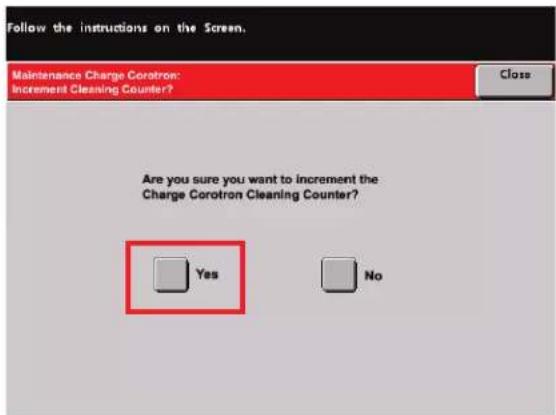
Follow the instructions on the Screen. Maintenance Charge Corotron: Increment Cleaning Counter? Close Are you sure you want to increment the Charge Corotron Cleaning Counter? Yes No- Select Yes.
NOTE: After incrementing the counter for a specific Corotron(s), it is no longer selectable.
- Select the Close button to finish the cleaning procedure.
natural_image
Interior view of a laptop chassis showing internal components and a highlighted green component (no visible text or symbols)
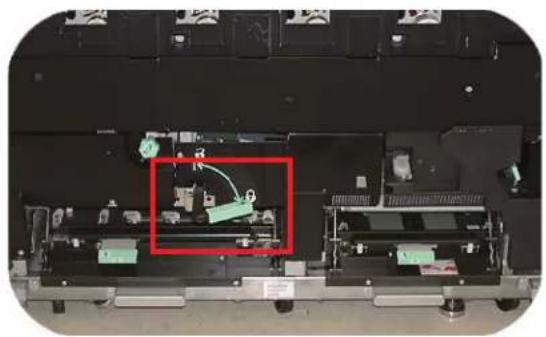
WARNING: If the digital press is switched on and the fuser is hot, switch off the digital press power and allow the Fuser to cool for 15 minutes.
natural_image
Close-up of a mechanical assembly with black components and red bounding boxes highlighting a specific area (no visible text or symbols)-
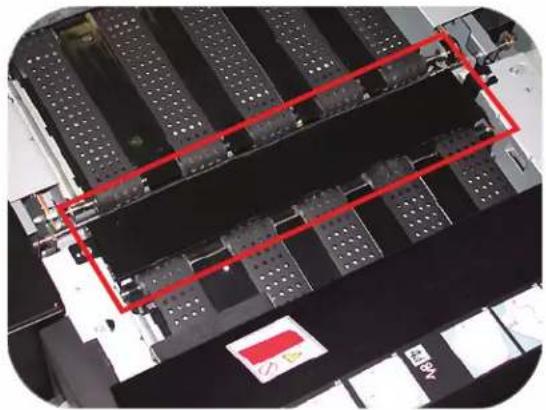
Open the Front Doors and pull out the Paper Transport Drawer using handle 4.
-
Clean the chute area with a lint-free cloth that was supplied with the digital press (Xerox Part Number: 19K03610).
natural_image
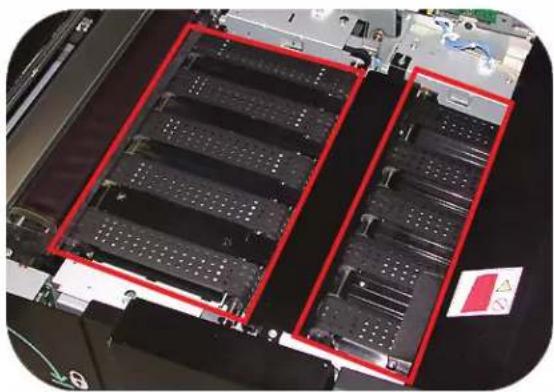
Interior view of a computer drive bay with multiple drive bays and a red-bordered mechanism (no visible text or symbols)- Clean the Horizontal Transport Belts and the surrounding area with a lint-free cloth that was supplied with the digital press (Xerox Part Number: 19K03610).
NOTE: Rotate the belts from left to right as you continue to wipe them. Use the cloth to rotate them as using your hands could leave grease or dirt and create paper jams.

natural_image
Close-up of a mechanical assembly with perforated panels and three red-circled features (no visible text or symbols)-
Clean the sensors with a lint-free cloth that was supplied with the digital press (Xerox Part Number: 19K03610).
-
Close the Paper Transport Drawer.
Replacing Consumable Supplies
A message is displayed on the UI when a consumable item is nearing the replacement time. Another message is displayed when you must replace consumable items. The digital press will not run after this message is displayed until the item is replaced.
Replacing A Dry Ink/Toner Cartridge click here for video
natural_image
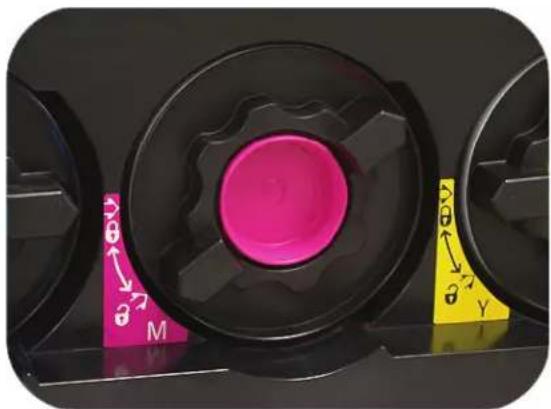
Close-up of a black plastic roller with pink center and yellow directional arrows indicating rotation (no text or symbols)Replace the Dry Ink Cartridge when the "Replace the Dry Ink Cartridge" message is displayed on the UI.
- Place a drop cloth on the floor below the Dry Ink compartment and open the Dry Ink compartment door
- Rotate the Dry Ink Cartridge to the "Unlock" label.
- Remove and dispose of the empty cartridge.
NOTE: Before installing a new cartridge, vigorously shake the cartridge to ensure that the material is not compacted.

natural_image
Close-up of a mechanical device interior with a red circle highlighting a component (no visible text or symbols)- To install the new cartridge, insert it into the compartment with the arrow at the top and push in as far as it will go.

natural_image
Close-up of a black circular device with pink central knob and yellow side buttons (no text or symbols visible)- Rotate the cartridge to the "Lock" label.
Adding Fuser Oil click here for video
Add Fuser Oil when the "Add Fuser Oil" message is displayed on the UI.

natural_image
Close-up of a 3D printer's internal structure with a green 4e button and white plastic clip (no text or symbols visible)-
Open the Right Front Door and place a drop cloth on the floor.
-
Open the Reservoir Cap.

natural_image
Close-up of a bottle being poured into a machine component, with no visible text or symbols.- Position the Filler Spout Cap on the oil bottle to add oil the reservoir.
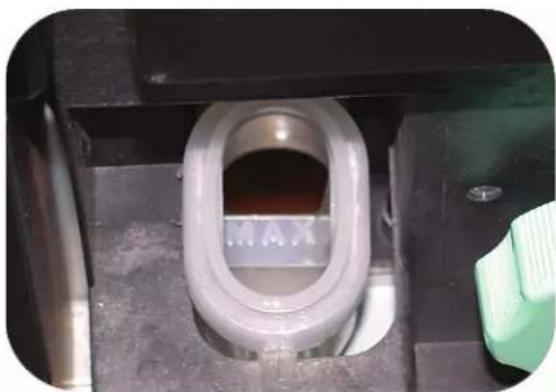
natural_image
Close-up of a mechanical component with a central oval opening and a green handle, no visible text or symbols.-
Do not fill above the MAX line.
-
Replace the reservoir cap and close the Right Front Door.
Changing the Waste Dry Ink Bottle click here for video
Change the Waste Bottle when the "Change Waste Bottle" message is displayed on the UI.
The waste bottle is located inside a lower rear compartment of the Exit Module.

natural_image
Interior view of a white electronic device with a green internal component and cable outlet (no visible text or symbols)- Open the Waste Bottle Door and pull the out the bottle.

natural_image
Close-up of a green plastic bottle with a red circle highlighting a circular feature, no visible text or symbols on the bottle itself.-
Install the cap (found on the side of the bottle) and dispose of the bottle in accordance to local regulations.
-
Install the new bottle and close the door.
Replacing a Corotron
When to replace a charge corotron
Unlike other consumable products for the digital press, a “replace corotron” message does not display on the UI. You should replace a corotron unit only when an image quality problem called banding, or rainbow banding, appear on prints. The Maintenance tab screen displays a yellow triangle or a red circle when a predetermined number of prints using a corotron unit have been made. You should ignore these symbols and continue to use the corotron until banding is seen on prints.
Which charge corotron to replace
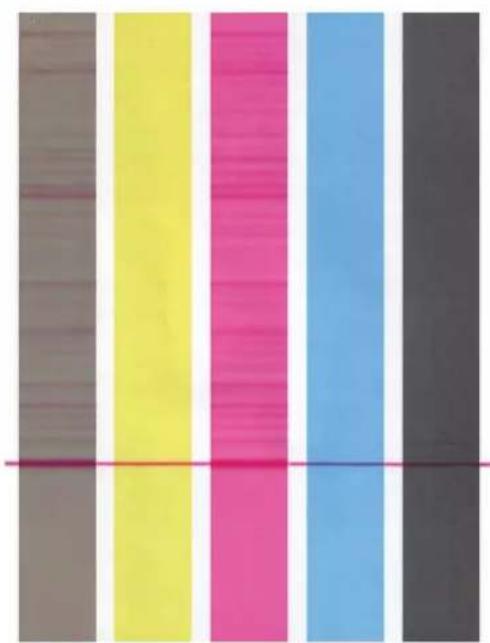
If you notice streaks or bands of color across prints, a charge corotron unit may need to be replaced. To determine which unit needs replacing, retrieve and print the file named Corotron Test.pdf from the Customer Documentation CD. The output print will show banding in the color bar of the corotron that needs to be replaced. Banding of multiple color bars means several corotrons need to be replaced.
Banding samples
The following examples of the test print show banding in the color bar of the corotron that needs to be replaced and in the 3-color bar. The 3-color bar (CMY) is there to help you identify which color is showing banding.

natural_image
Five vertical color bars in grayscale, gray, yellow, pink, blue, and dark gray (no text or symbols)Black Banding

natural_image
Five vertical color swatches in grayscale, alternating yellow, pink, blue, and dark gray (no text or symbols)Cyan Banding
natural_image
Five vertical color swatches in gray, yellow, pink, blue, and dark gray (no text or symbols)Magenta Banding

natural_image
Five vertical color swatches in grayscale, alternating with yellow, pink, blue, and dark gray (no text or symbols)Yellow Banding
Corotron Replacement click here for video

natural_image
Illustration of a hand pressing a button on a machine, with red arrows indicating motion (no text or symbols)-
Open the front doors.
-
Squeeze the corotron handle and slowly pull the corotron completely out of the machine. Dispose of the corotron according to local regulations.

natural_image
Close-up of mechanical components with red circles highlighting specific areas (no visible text or symbols)-
Insert the plastic guide sleeve on the new corotron onto the guide pins on the frame.
-
Push the corotron into the machine until the handle clicks into place. Remove the plastic sleeve and close the doors.
NOTE: DO NOT reset the counter on the UI.
Replacing the Fuser Web click here for video
There are two messages for the Fuser Web:
- Web is near empty (can continue to use machine)
• Web is empty (must replace)

WARNING: The Fuser area may be Hot; be extremely careful when replacing the web.
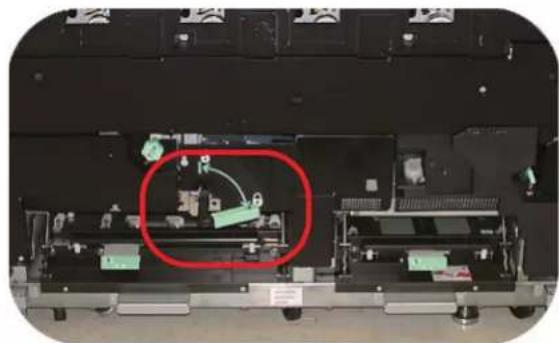
natural_image
Interior view of a printer or printer with visible circuitry and a red circle highlighting a component (no text or symbols)- Open the front doors and pull out the Paper Transport Drawer using handle 4.
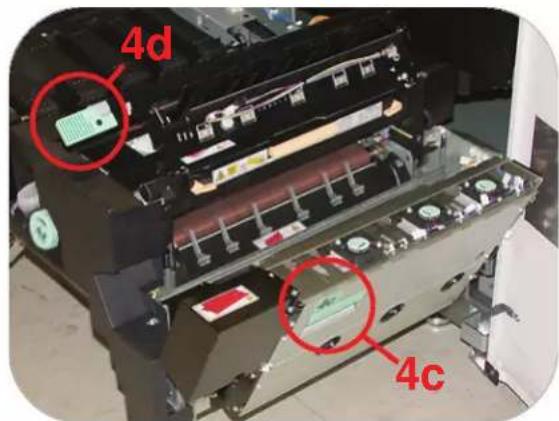
text_image
4d 4c- Pull open the Fuser Handle 4C and lift handle 4d.
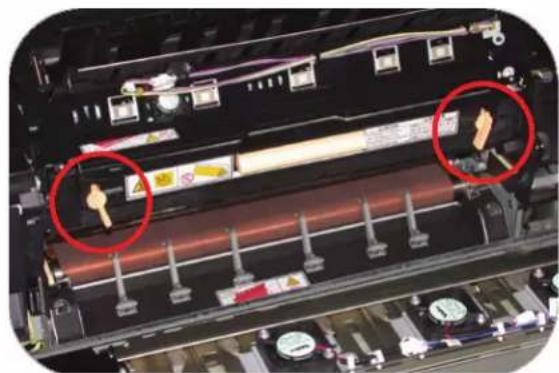
natural_image
Interior view of a printer's internal structure showing copper foil and journal tabs, with two red-circled annotations highlighting specific components (no readable text or symbols)- Rotate the yellow levers down.

natural_image
Close-up of a mechanical device with a red circle highlighting a component, no visible text or symbols- Lower and pull out the Fuser Web. Dispose of the web according to local regulations.

natural_image
Close-up of a mechanical assembly with a red circle highlighting a component (no visible text or symbols)-
Align the yellow tabs on the sides of the Fuser Web with the yellow marker on each rail and slide the web all the way into the fuser.
-
Raise the web up until it clicks into place and rotate the yellow levers up to lock the web.
-
Lower handle 4d and close the Fuser Exit Module (handle 4c).
-
Close the Paper Transport Drawer and close the Front Doors.
Consumable Supplies
The following items are consumables for the DocuColor 7000AP/8000AP. It is recommended that you have a supply of these items available to eliminate downtime when they need to be replaced.
| Supply Item | Supply Number Eastern Hemisphere | Supply Number Western Hemisphere | Supply Unit Shipped with digital press/Reorder Quantity | Approximate Print Yield/Carton (Full Color Prints^*) |
| Dry Ink/Toner (Black) | 6R90346 | 6R1199 | 1 | 30K |
| Dry Ink/Toner (Cyan) | 6R90347 | 6R1200 | 1 | 50K |
| Dry Ink/Toner (Magenta) | 6R90348 | 6R1201 | 1 | 50K |
| Dry Ink/Toner (Yellow) | 6R90349 | 6R1202 | 1 | 50K |
| Developer (Black) 5R90246 5R629 1 100K | ||||
| Developer (Cyan) | 5R90247 | 5R630 | 1 | 100K |
| Developer (Magenta) | 5R90248 | 5R631 | 1 | 100K |
| Developer (Yellow) | 5R90249 | 5R632 | 1 | 100K |
| Fuser Oil | 8R13031 | 8R13031 | 1 | 200K |
| *Waste Dry Ink/Toner Container | 8R12662 | 8R12662 | 1 | 50k |
| *Charge Corotron Unit | 13R596 | 13R596 | ||
| *Fuser Web Assembly | 8R12966 8R12966 | |||
| Paper | Colotech+ | Xerox Digital Color Xpressions+ | 2 reams | |
10. Basic Troubleshooting
When a problem occurs with your digital press or optional accessories, instructions appear on the UI. Refer to the information in this chapter to help resolve the problem.
Digital Press Troubleshooting
If the digital press has a loss of power and you cannot access the Machine Details screen to get the serial number, open the two main front doors. The serial number label is in the center of the bottom frame of the digital press.
The charts on the following pages lists problems and suggested solutions that apply to your digital press. If the problem persists after following all instructions, call your Xerox representative.
NOTE: If your color server indicates that the digital press has a fault and the UI does not readily display a message, press the Machine Status button on the Control Panel, then touch Error Log on the UI to display the fault history.
| Problem Suggested | solutions |
| The digital press does not power on. | ·Ensure the power cord is plugged into the receptacle correctly.·Ensure the power switch inside the front left door is set to the ON position.·Check the Ground Fault Interrupter (GFI) circuit breakers, located in the bottom left side of the Electrical module next to the power cord.·If the power in your location is working properly, you have tried the suggested solutions, and the digital press does not power on, call for assistance. |
| Prints are not on desired paper size. | ·Ensure that the proper paper is loaded in the paper trays.·Select the paper size, tray and weight through the digital press options on your PC.·Ensure that the correct weight is selected on the paper tray.·Ensure that “Fit to Paper” or an equivalent selection is not selected in your print driver. |
| Paper is misfed or wrinkles repeatedly.NOTE: Perform one step at a time. If the problem continues, perform the next step in the list. | ·If a message appears on the UI, follow the instructions displayed.·Ensure the proper paper (refer to the Paper chapter of this manual and The Recommended Materials List) is loaded correctly and not filled above the MAX line.·Turn the paper stack around and/or over in the selected paper tray.·Remove a few sheets from the top and the bottom of the stack in the paper tray.·Fan all four edges of the paper in the selected paper tray.·Remove any partially fed paper from the trays.·Ensure the paper you are using had been stored properly.·Replace the paper in the selected paper tray with paper from a new package. |
| The Touch Screen does not respond to a touch command. | ·Press Clear All on the Control Panel.·Touch a selectable button on the UI. A slight pressure is required to cause the digital press to react.·If the problem persists, open the Front Door of the digital press. Close the Front Door and make a selection on the UI. If the UI does not respond to any touch commands, switch off the power. Wait 15 seconds. Then switch on the power. |
| Transparencies are too oily. | ·Make 5 blank sheet copies with the Full Color option on paper stock to purge excess oil from system. Reload the transparencies and continue the copying job.·Refer to the Recommended Materials List and the Color Materials Usage Guide for more information about transparencies. |
| Problem Suggested solutions | |
| Multiple sheets feed from the paper trays. | Do not fill the paper trays above the MAX fill line indicator.Fan the paper, transparencies or drilled stock to separate the joined sheets.Paper and transparencies may stick together if environmental conditions are too dry and cause excessive static. Increase the humidity level in the room to minimize static. |
| Paper jams when exiting the Paper Trays | Ensure that the edge guides of the paper tray fit snugly against the paper stack.Do not fill the paper trays above the MAX fill line indicator.Close the tray slowly to avoid shifting the paper stack. |
| Output jams when exiting the digital press to the Offset Catch Tray | When no other output device is present, the Offset Catch Tray can hold up to 500 sheets of 24 pound (90 g/m ^2 ) paper. Empty the catch tray when output approaches this limit to ensure continuous production.Ensure the first sheet is not blocking the paper exit, particularly for 11 x 17 inch (A3) output. |
| Excessive paper curl • Ensure that the correct paper weight and paper type are selected.You can sometimes minimize curl problems by flipping the paper over in the tray and making the copies again. If excessive curl is still present, use a heavier paper.Empty the output device when output approaches this limit to ensure continuous production. | |
| It is difficult to perform secondary operations on the output prints, such as writing on them or using adhesives. | This problem is caused by the oil used in the fusing process. The problem can be reduced or eliminated by setting the prints aside for one or two hours before performing a secondary operation on them. Rubbing the print surface with a soft, clean cloth or eraser may also help. |
| Low gloss bands appearing on printed output. | Running all weights at rated speed may result in a Cross Process Low Gloss Band.On the heavy-weight stocks, this low gloss band defect starts approximately five inches (127 mm) from the lead edge and is approximately three inches (76 mm) wide.On light-weight stocks, the defect starts approximately six inches (152 mm) from the lead edge and is approximately two inches (50 mm) wide.NOTE:If this defect occurs, return the Productivity Setting to the Single Paper Weight setting. If the defect still occurs after running another print, call your Xerox service representative for further assistance. |
Printer Fault Codes

natural_image
Close-up of a mechanical device with green components and a red arrow pointing to a small label (no readable text or symbols)When there is a problem with the digital press or an accessory, refer to the UI where the Fault Code and a solution will be displayed. Follow all steps until the problem is corrected. If the problem persists, call one of the following numbers for assistance.
Prior to your call, record the following information:
- A complete description of the problem.
- Fault Code(s) located at the top of the Control Panel.
- The Machine Serial Number. Press the Machine Status button and then touch the Machine Details tab to read the serial number. If the serial number is not displayed, open the Right/Left Front Doors of the digital press. The serial number is also on a white label on the bottom front frame.)
- If copy quality is the problem, have a sample available to help you describe the defect.
- If possible, use a phone near the press when calling for assistance.
For system support, user help, and service support, call the appropriate number:
US: 1-800-821-2797 (Includes TTY Support)
Canada: 1-800-939-3769
Xerox also provides web-based customer support. Go to:
www.xerox.com/eSupportCentre
HCS80 Troubleshooting
If, after following the recommended solutions, the problem persists, call for assistance. The Fault Codes described below appear on the HCS80 display panel.
| Fault Code Cause | Solution | |
| 212 100212 110212 120212 130212 140212 900 | Paper jam • A jam occurred during feeding.Remove sheets from jam clearance areas.Open and close the top cover and front door. A purge sheet may eject to the top tray.If the jam occurs in the second HCS80, be sure to check the Bypass area in the first HCS80. | |
| 212 251212 252212 253212 254 | Stacker problem Power off, then power on. | |
| 212 302 Top Cover open Close the top cover. | ||
| 212 540 Stacker tray full Empty the Stacker Tray. | ||
| 212 541 | Stacker tray position | Press the Unload button. The Wait light blinks until the Stacker Tray has reached the down position.When the Stacker Tray has reached the down position, open the front door.Remove the Stacker Cart.Remove all stacked paper.Position the Stacker Cart securely into the HCS80.Close the front door. |
| 212 542 No Stacker Cart • Open the front door. | Remove the Stacker Cart from the HCS80.Position the Stacker Cart securely into the HCS80.Close the front door | |
| 212 544 Door open Close the door | ||
Loss of Power
| Problem Solution | |
| If power is interrupted to the finisher | ·Ensure the power cord is plugged in to the proper wall receptacle·Ensure that the digital press power is “On.”·Ensure that the Ground Fault Indicator is in the On position·If the power has not been restored by the above procedure, call for service. |
HCSS and CSS Problem Solving
If after reviewing the Problems list and following the recommended solutions the problem persists, call for assistance.
| Problem Cause | Solution | |
| Fault Code 112-100 Jam indicated in finisher, but actually is in the Exit Module. | Jammed Paper not visible in finisher, and fault code does not clear after opening and closing HCSS80 door. | ·Open the finisher door.·Jammed paper is not visible in the area indicated. Close the finisher door.·The Touch Screen indicates a jam in the Exit Module. Open the Exit Module and clear any visible sheets.·Open and close the finisher door.·Clear any other areas indicated on the Touch Screen. |
| Fault Code 112-100 Jam indicated in finisher. No visible jams in finisher because sheet is located over the Exit Module sensor. | Paper jammed between Exit Module and finisher sensors | ·Open the finisher door.·Jammed paper is not visible in the area indicated. Close the finisher door.·If the fault code remains, open the Exit Module. No jammed sheets are visible.·Undock the finisher. Find the jammed sheet between the Exit Module and the finisher. Refer to the Note below this table for information on how to undock the finisher.·Clear any other areas indicated on the Touch Screen. |
| Fault Code 112-130 Jam indicated in finisher, but is also in Exit Module. | Paper is jammed over both the Exit Module and finisher sensors. | ·Open the finisher door.·Clear any visible jams.·If no jammed paper is visible in the finisher area indicated, open the Exit Module door and clear any jammed paper. Close the Exit Module door.·Open and close the finisher door. |
| Fault Code 112-130 Jam indicated in finisher. | Paper is jammed between the Exit Module and the finisher sensors. | ·Open the finisher door.·If no jammed paper is visible in the area indicated, open the Exit Module door and clear any jammed paper. Close the Exit Module door.·Open and close the finisher door.·If the fault persists, undock the finisher and clear the jammed paper between the Exit Module and the finisher. Refer to the Note below this table for information on how to undock the finisher. |
| Fault Code 112-110 | Paper jammed in the finisher and the Exit Module during a purge of sheets to the Top Tray. | ·Clear the jammed paper from the finisher.·Clear the jammed paper from the Exit Module.·Open and close the finisher door.·Resume job. |
| Fault Code 052-310 | Communication problem | ·Cancel or save the job.·Power off the digital press. Wait 15 seconds and power on. |
| Fault Code 052-321 | Connection problem | ·Cancel or save the job.·Power off the digital press. Wait 15 seconds and power on. |
| Fault Code 052-320 | Unexpected connection | ·Cancel or save the job.·Power off the digital press. Wait 15 seconds and power on. |
| Fault Code 052-312 | Communication problem | ·Cancel or save the job.·Power off the digital press. Wait 15 seconds and power on. |
| Ready Indicator does not illuminate | No power · Check the p | power cord connected to the power source.·Check that the main switch is on. |
| Poor Stacking: | Mixed sizes of paper | ·Run separate jobs and empty stacker. |
| High paper curl · Adjust | digital press decurler.·Flip paper in digital press paper tray(s).·Rotate paper in the digital press paper tray(s). | |
| Mechanical obstruction | ·Check for obstruction in the stacker stapler paper path.·Ensure that all transports and baffles are properly seated. | |
| Paper Jams: | Use Top Tray | ·Deselect offset or restart job to the Top Tray. |
| High paper curl · Adjust | digital press decurler.·Flip paper in digital press paper tray(s).·Rotate paper in the digital press paper tray(s).·Switch to heavier paper. |
11. Specifications
This chapter provides specifications for the printer and optional accessories.
Printer Specifications
Paper specifications
| Paper All Paper Trays | |
| Minimum Paper Size 182mm x 182mm (7.16 x 7.16") | |
| Maximum Paper Size 320mm x 488mm(12.6 x 19.2") | |
| Standard Sizes • B5 LEF/SEF • A4 LEF/SEF • B4 SEF• A3 SEF • 8 x 10" LEF • 8.5 x 11" LEF/SEF• 8.5 x 13" SEF • 8.5 x 14" SEF • 11 x 17" SEF• 12 x 18" SEF • Kai8 SEF • Kai16 LEF• 12.6 x 17.7" SEF++ • 12.6 x 19.2" SEF++ | |
| Paper Weight Range | 60 - 300 g/m2 |
| Transparencies* | Yes (A4 LEF or 8.5 x 11" LEF) |
| Labels* | Yes |
| Transfer Paper* | No |
| Coated Paper**+ | Yes |
| Tabbed Inserts# | Yes |
| Drilled | Yes: 2, 3, 4 hole |
++ Refer to the Non-Standard Size Paper section in this chapter.
# Refer to the Tabbed Inserts section in this chapter.
* Refer to the Recommended Materials List and the Speciality Media Guide for guidelines.
** Duplex is limited to paper that is 220 g/m ^2 or less.
^+ L80 g/m ^2 cannot duplex in high humidity. L85 g/m ^2 coated media is not allowed.
11. Specifications
Tray Capacity
All paper trays have a capacity of 2000 sheets of 24 lb. (90 g/m ^2 ) paper.
Duplexing
The DocuColor 8000/7000 duplexes prints from all paper trays up to 220 g/m ^2 . The system does not duplex media larger than 12.6 x 18 inch (321.1 x 458.1 mm).
Transparency Guidelines
Use only the transparencies recommended.
Transparencies can be run from all the paper trays.
• Xerox Removable Paper Stripe: USA and Canada, 3R5765; Xerox Europe, 3R93179.
- Load transparencies into a tray with the paper stripe side facing DOWN and with the stripe as the leading edge. (The leading edge is the edge that feeds into the digital press first.)
- Do not mix paper and transparencies in a tray. Jams may occur.
- Ensure that Transparency is selected in the Paper Weight section at the top/front of the paper tray.
Tabbed Inserts
Tabbed Inserts can be loaded into the paper trays as Non-Standard paper.
- When loading, the non-tabbed, short edge of the tabbed insert should be the lead edge to the digital press.
- If a jam occurs while running tabbed sets, there is no recovery procedure.
You have to manually reassemble your originals and prints, determine where the job left off, and resume printing or cancel the job and start again. - The size of the tabbed insert should be 9 x 11 inch (229 x 279 mm) for letter size tabs (223.5 x 296 mm for A4 equivalent tabs).
- The correct weight of the insert should be selected on the tray.
- Select Non-Standard size on the paper tray and on the UI, Tools Mode, input 11 inches or 296 mm for A4 as the X axis and 9 inches or 223.5 mm for A4 as the Y axis dimensions for SEF.
Refer to the System Administration Guide for the procedure to program non-standard size paper.
Drilled Paper
Three-hole drilled paper can be run from all the trays either LEF or SEF with the holes facing any direction.
NOTE: If you are stapling 3-hole drilled paper with the optional High Capacity Stacker Stapler 80 (HCSS80), refer to the Accessories chapter for paper loading instructions, based on the position of the staple.
Drilled paper should be run in the Simplex (1-sided) and Duplex (2-sided) orientations shown below to avoid paper jams caused by the holes not aligning correctly with the paper sensor in the press.
Simplex Print Jobs
Rear of paper tray
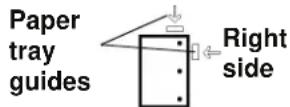
Front of paper tray
Load the drilled paper into any tray in the Long Edge Feed (LEF) direction. Refer to the illustration on the left.
Duplex Print Jobs
LEF direction
Rear of paper tray

Front of paper tray
Load drilled paper into any tray in either the Long Edge Feed (LEF) direction or Short Edge Feed (SEF) direction:
SEF direction
Rear of paper tray

Front of paper tray
Letterhead
Different inks and dry inks/toners are used to produce preprinted letterhead that may not pass through the digital press intact.
Refer to the Specialty Media Guide: Hints and Tips for information on using preprinted letterhead paper.
Nonstandard size paper
Nonstandard size paper is identified as any paper for which there is no paper guide setting within the minimum and maximum sizes for the trays: 7.16 to 12.6 inch LEF or 7.16 to 19.2 inch SEF (182 - 320 mm LEF or 182 x 488 mm SEF)
Non-Standard size paper can be loaded into all the trays. The Non-Standard setting must be selected on the top/front of the paper tray.
Refer to the System Administration Guide for the procedure to program a Non-Standard size paper to be the default setting for a particular tray.
Paper weight conversion tables
| Grammage g/m^2 | Xerographic Bond, Writing, pounds 17 x 22” - 500 sheets | Offset, Text, Book, pounds 25 x 38”- 500 sheets | Cover, pounds 20 x 26” - 500 sheets | Index, pounds 25.5 x 30.5” - 500 sheets | Bristol and Tag, pounds 22.5 x 28.5” - 500 sheets |
| 60 16 41 22 33 | 27 | ||||
| 64 17 43 24 35 | 29 | ||||
| 75 20 50 28 41 | 34 | ||||
| 80 21 54 30 44 | 36 | ||||
| 90 24 60 33 50 | 41 | ||||
| 105 28 70 39 58 | 48 | ||||
| 120 32 80 44 66 | 55 | ||||
| 135 35 90 50 75 | 62 | ||||
| 150 40 100 55 | 83 67 | ||||
| 158 42 107 58 | 87 72 | ||||
| 163 43 110 60 | 90 74 | ||||
| 176 47 119 65 | 97 80 | ||||
| 200 53 135 74 | 110 91 | ||||
| 203 54 137 75 | 112 93 | ||||
| 216 57 146 80 | 119 98 | ||||
| 220 59 149 81 | 122 100 | ||||
| 259 66 169 92 | 140 114 | ||||
| 280 74 189 104 | 155 128 | ||||
| 300 74 189 104 | 155 128 |

Yellow shading indicates grades widely used for this classification
Weight conversion ranges
| Grammage g/m^2 | Xerographic Bond, Writing, pounds17 x 22” - 500 sheets | Offset, Text, Book, pounds25 x 38” - 500 sheets | Cover, pounds20 x 26: - 500 sheets | Index, pounds25.5 x 30.5” - 500 sheets | Bristol and Tag, pounds22.5 x 28.5” - 500 sheets |
| 60 - 80 | 17 - 21 | 43 - 54 | 24 - 30 | 35 - 44 | 29 - 36 |
| 81 - 105 | 22 - 28 | 55 - 70 | 31 - 39 | 45 - 58 | 37 - 48 |
| 106 - 135 | 29 - 36 | 71 - 90 | 40 - 44 | 59 - 75 | 49 - 62 |
| 136 - 150 | 37 - 40 | 91 - 100 | 45 - 55 | 76 - 83 | 63 - 67 |
| 151 - 220 | 41 - 59 | 101 - 149 | 56 - 81 | 84 - 122 | 68 - 100 |
| 221 - 300 | 60 - 74 | 150 - 189 | 82 - 110 | 123 - 166 | 101 - 128 |
High Capacity Stacker 80 Specifications
HCS80 Paper Specifications
| Paper All Paper Trays | |
| Minimum Paper Size 182mm x 182mm(7.16 x 7.16") | |
| Maximum Paper Size 320mm x 488mm(12.6 x 19.2") | |
| Standard Sizes B5 LEF/SEF A4 LEF/SEFB4 SEF A3 SEF8 x 10" LEF 8.5 x 11" LEF/SEF8.5 x 13" SEF 8.5 x 14" SEF11 x 17" SEF 12 x 18" SEFKai8 SEF Kai16 LEF12.6 x 17.7" SEF ^1 12.6 x 19.2" SEF ^1 | |
| Paper Weight Range | 60 - 300 g/m ^2 |
| Transparencies ^2 | Yes(A4 LEF or 8.5 x 11" LEF) |
| Labels ^2 | Yes |
| Transfer Paper ^2 | No |
| Coated Paper ^3 4 | Yes |
| Tabbed Inserts ^5 | Yes |
| Drilled | Yes: 2, 3, 4 hole |
^1 Refer to the Non-Standard Size Paper section in this chapter.
^2 Refer to the Recommended Materials List and the Speciality Media Guide for guidelines.
^3 Duplex is limited to paper that is 220 g/m^2 or less.
^4 L80 g/m ^2 cannot duplex in high humidity. L85 g/m ^2 coated media is not allowed.
^5 Refer to the Tabbed Inserts section in this chapter.
HCS80 Paper Guidelines
- Stacker Tray will accept 64-280 g/m ^2 (either coated or uncoated stock) with the possibility of degraded stock quality and increased jam rate
- Transparencies may be run to either the Top Tray or the Stack Tray. Stack height should be limited to 100 transparencies.
- Coated paper lighter than 100g / m^2 may not run as reliably as coated paper heavier than 100 g / m^2 .
- Non-standard papers longer than 305 mm (12") in the feed direction require 210 mm (8.3") minimum measurement across the feed direction.
- Non-standard papers shorter than 254 mm (10") in the cross-feed direction require 330 mm (13") minimum measurement in the feed direction.
HCS80 Recommended Baseline/Centerline
The following papers are considered to be baseline/centerline and are recommended to ensure you receive the best quality from your HCS80:
- Uncoated: Xerox Digital Color Xpressions+, 90 g/m ^2 , 24 lbs. In Europe, Xerox Digital Color Colotech+ 90 g/m ^2 .
- Coated: Xerox Digital Color Gloss Coated Text (120 g/m ^2 /80 lbs.) In Europe, Xerox Digital Color Colotech + Gloss Coated 120 g/m ^2 .
HCS80 Paper Destination Specifications
| Paper Size Output | |||||
| Industry Designation | Inches Orientation Stacker Tray | 60 - 300g/m2 | Bypass 60 - 300 g/m2 | Top Tray 60 - 300 g/m2 | |
| B5 7.2 x 10 | 1 SEF Yes Yes | Yes | |||
| B5 7.2 x 10 | 1 LEF Yes Yes | Yes | |||
| A4 8.3 x 11 | 7 SEF Yes Yes | Yes | |||
| Letter 8.5 x 11 | 1 SEF Yes Yes | Yes | |||
| 8.5 x 13 | SEF Yes Yes Yes | ||||
| Legal | 8.5 x 14 | SEF | Yes | Yes | Yes |
| B4 | 10.1 x 14.3 | SEF | Yes | Yes | Yes |
| 11 x 14.9 | SEF Yes Yes Yes | ||||
| Tabloid | 11 x 17 | SEF | Yes | Yes | Yes |
| A3 | 11.7 x 16.5 | SEF | Yes | Yes | Yes |
| 12 x 18 | SEF Yes Yes Yes | ||||
| SRA3 | 12.6 x 17.7 | SEF | Yes | Yes | Yes |
| 8 x 10 | LEF | Yes | Yes | Yes | |
| A4 | 8.3 x 11.7 | LEF | Yes | Yes | Yes |
| Letter | 8.5 x 11 | LEF | Yes | Yes | Yes |
| Kai8 | 10.5 x 15.3 | SEF | Yes | Yes | Yes |
| Kai16 | 10.5 x 7.6 | LEF | Yes | Yes | Yes |
| Transparencies | A4 & Letter | LEF | Yes* | Yes* | Yes* |
| Labels | A4 & Letter | LEF | No | Yes* | Yes* |
* Customer recommendation is to run stacks of less than 100, but there is no system limit on customer selection.
HCSS and CSS Specifications
Electrical / Environmental Requirements
Western Hemisphere: 115 VAC, 15 amp, for 60 Hz. and 220 VAC, 10 amp for 50 Hz installations.
Europe: 200-240 Volt 10 amp 50 Hz service outlet. The finisher requires a separate power source from the digital press.
| Environmental requirements | Minimum Maximum |
| Temperature: 10^ C ( 50^ F) 32^ C ( 90^ F) | |
| Relative Humidity (% RH): | 5% 85% |
| Altitude: Not applicable Anything greater than 2000 meters (6560 ft.) above sea level may require field adjustments | |
NOTE: Best machine performance is achieved when conditions are maintained between 20-25° C (68-77° F).
Paper Stock Specifications
The Top Tray accepts all media types, sizes, and weights supported by the digital press. The Stack Tray accepts all standard media sizes supported by the digital press with the exception of sizes greater than A3/11 x 17 in.
Refer to the chart on the following page for information on accepted media types.
| Paper Size Output | ||||||
| Stack Tray50 sheet maximum for Stapling* | Top Tray | |||||
| Name Inches MM Orientation | 17-59 lb. (60-220 g/m2) Staple Position | 17-75 lb. (60-300 g/m2) | ||||
| JIS B5 | 7.2x10.1 | 182 x 257 | SEF | Yes | Portrait | Yes |
| A4 | 8.3x11.7 | 210 x 297 | SEF/LEF | Yes | Portrait/Landscape | Yes |
| Letter | 8.5x11 | 216 x 279 | SEF/LEF | Yes | Portrait/Landscape | Yes |
| 8.5x13 | 216 x 330 | SEF | Yes | Portrait/Landscape | Yes | |
| 8.5x14 | 216 x 256 | SEF | Yes | Portrait/Landscape | Yes | |
| JIS B4 | 10.1x14.33 | 257 x 364 | SEF | Yes | Portrait | Yes |
| 11x17 | 279 x 432 | SEF | Yes | Portrait/Dual | Yes | |
| A3 | 11.7x16.5 | 297 x 420 | SEF | Yes | Portrait/Dual | Yes |
| 12x18 | 305 x 457 | SEF | No | Not applicable | Yes | |
| SRA3 | 12.6x17.7 | 320 x 450 | SEF | No | Not applicable | Yes |
| 12.6x19.2 | 320 x 488 | SEF | No | Not applicable | No | |
| B5 | 7.2x10.1 | 182 x 257 | LEF | Yes | Portrait | Yes |
| 8x10 | 203 x 254 | LEF | Yes | Portrait | Yes | |
* Refer to the table on page 11-12 for information on the stapling capacity for various paper types and weights.
NOTE: Transparencies can be fed to both trays.
Paper Specifications for Stapling
The following chart shows the stapling details for paper size, orientation, destination, and staple position. Numbers have been rounded up or down.
| Staple Positions marked with an "O" may be selected in the position indicated. Positions marked with an "x" are not available for stapling. ^1 Front Corner = Single Staple Position 1 ^2 Rear Corner = Single Staple Position 2 | Output Destination | Staple Position | Output Destination | ||||
| Inches MM | Sheet Orientation | Stack Tray 64-220 g/m2(stapling) | Front corner ^1 | Rear corner ^2 | Dual | Top Tray 64-300 g/m2(no stapling) | |
| 7.2 x 10.1 | JIS B5 (182 x 257) | SEF Yes O x x Yes | |||||
| 8.3 x 11.7 | A4 (210 x 297) | SEF | Yes | O | O | x | Yes |
| 8.5 x 11 | 216 x 279 | SEF | Yes | O | O | x | Yes |
| 8.5 x 13 | 216 x 330 | SEF | Yes | O | O | x | Yes |
| 8.5 x 14 | 216 x 356 | SEF | Yes | O | O | x | Yes |
| 10.1 x 14.3 | JIS B4 (257 x 364) | SEF Yes O x x Yes | |||||
| 11 x 17 | 279 x 432 | SEF | Yes | O | x | O | Yes |
| 11.7 x 16.5 | A3 (297 x 420) | SEF | Yes | O | x | O | Yes |
| 12 x 18 | 305 x 457 | SEF | No | -- | -- | -- | Yes |
| 12.6 x 17.7 | 320 x 450 | SEF | No | -- | -- | -- | Yes |
| 7.2 x 10.1 | B5 (182 x 257) | LEF | Yes | O | x | x | Yes |
| 8 x 10 | 203 x 254 | LEF | Yes | O | x | x | Yes |
| 8.3 x 11.7 | A4 (210 x 297) | LEF | Yes | O | x | O | Yes |
| 8.5 x 11 | 216 x 279 | LEF | Yes | O | x | O | Yes |
| 10.5 x 15.3 | Kai 8 (267 x 388) Asian market size | SEF Yes O x x Yes | |||||
| 10.5 x 7.6 | Kai 16 (267 x 194) Asian market size | LEF | Yes | O | x | x | Yes |
NOTE: Stapled sets of large paper (A3, 11 x 17in. and greater) may stack slightly skewed. The stapled sets will be of high quality.
Staple Positions
| Size: Inches (mm) | Staple Position 1(Front Corner) | Staple Position 2(Rear Corner) | Dual Staple | |||
| SEF LEF SEF LEF SEF LEF | ||||||
| 7 . 2 x 1JIS B5 (182x257) | 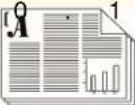 |  |  |  |  |  |
| 8x10 (203x254) |  | 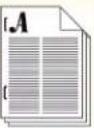 |  |  |  |  |
| 8x5x11 (216x279)A48.5x13 (216x330)8.5x14 (216x356) | 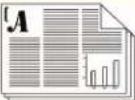 | 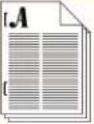 |  |  |  | 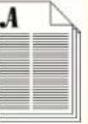 |
| 10.1x14.3JS B4 (257x364)10.5x15.3Kai 16(267x388:Asian market size) |  |  |  |  |  |  |
| 10.5x7.6Kai 16(267x194:Asian market size) |  |  |  |  |  |  |
| 11x17 (279x432)A3 |  |  |  |  |  |  |
| 12x18 (305x457)12.6x17.7(320x450) |  |  |  |  |  |  |
Stapling capacity for different paper types and weights
Following is the staple capacity for various types and weights of paper.
| Paper Weight | Coated | Uncoated | Mix Sizes |
| 64–80 g/m2 | 50 50 No | ||
| 81–105g/m2 | 42 42 No | ||
| 106–135 g/m2 | 31 31 No | ||
| 136–186 g/m2 | 26 26 No | ||
| 187–220 g/m2 | 18 18 No | ||
| 221–300 g/m2 | No * No * No | ||
| Transparencies No No | No |
* 221 to 300g / m^2 paper, either coated or uncoated, cannot be stapled. These weights will be stacked in the Top Tray.
Tip: The Offset Stacker/Stapler Tray may be limited to a maximum of 50 staple sets. In order to avoid system shutdown or jams, ensure that small staple set jobs do not exceed 50 sets. Before you send a stapled-print job to the machine, enable the offset jobs feature; this will improve tray capacity.
For information about technical data, refer to the Digital Press Technical Data located in the Appendix.
12. Appendix
This appendix contains supplemental detailed information. Refer to this information as required or when directed from previous chapters in the User Guide.
Machine Details

text_image
Ready to Print. Paper Trays Machine Details Error Log Maintenance Customer Support Serial Number 00000000 MetersThis screen provides the telephone number to call for support, the machine serial number and access to the meter counts.

text_image
Ready to Print For information, press HELP on control panel. Machine Details: Billing Meters Close Current Output Volume Color Impressions 7098 Black Impressions 1835 Color Large Impressions 822 Total Impressions 5727 Resettable MetersMeters keep track of print counts. To view the print count, touch the Meters button on the Machine Details screen. The Billing Meters screen is displayed.
12. Appendix

text_image
Ready to Print For information, press HELP on control panel. Billing Meters: Resettable Meters Current Output Volume Color Impressions 7888 Black Impressions 1039 Color Large Impressions 822 Total Impressions 5727To reset the meters to zero, touch the Resettable Meters button. On the following screen touch the Reset button.
Maintenance tab
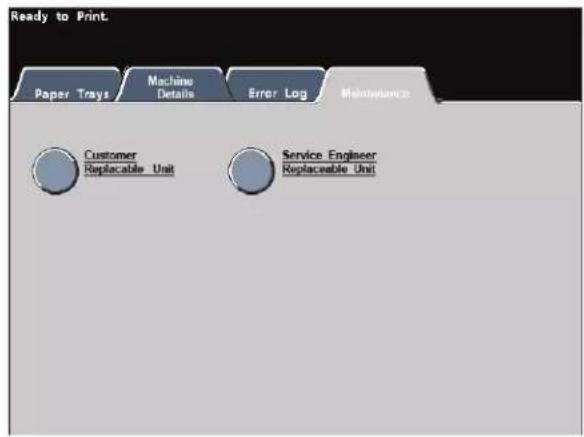
text_image
Ready to Print. Paper Trays Machine Details Error Log Maintenance Customer Replaceable Unit Service Engineer Replaceable UnitTouch the Customer Replaceable Unit button on the Maintenance screen to display a list of replaceable items and their status.
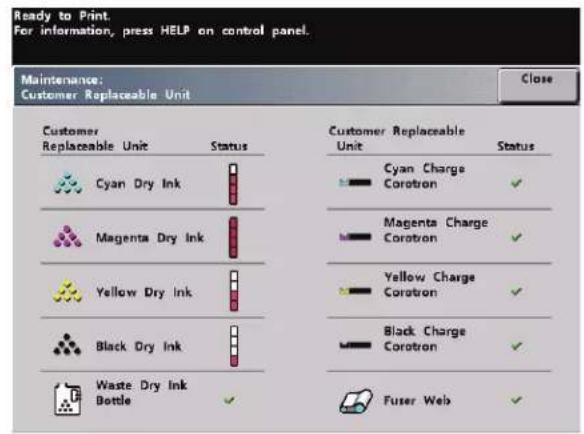
text_image
Ready to Print. For information, press HELP on control panel. Maintenance: Customer Replaceable Unit Customer Replaceable Unit Status Cyan Dry Ink Magenta Dry Ink Yellow Dry Ink Black Dry Ink Waste Dry Ink Bottle Customer Replaceable Unit Status Cyan Charge Corotron ✓ Magenta Charge Corotron ✓ Yellow Charge Corotron ✓ Black Charge Corotron ✓ Fuser Web ✓The Customer Replaceable Unit screen displays a gauge or a check mark indicating the level at which the consumable is.
For example, the gauges for the dry ink/toner cartridges indicate the amount of toner in each cartridge:
- The cartridge is full when all four bars are red.
- The cartridge is ^3/_4 full when three bars are red.
- The cartridge is ^1/2 full when two bars are red.
• The cartridge ^1/4 full when one bar is red.
For the other consumables, such as the Waste Dry Ink Bottle, each Corotron, and the Fuser Web, the following applies:

- A green check mark indicates that the level of the consumable is adequate
- A yellow triangle alerts you that the level is low, and
• A red circle indicates that the consumable is depleted


When a consumable item is depleted, the digital press automatically interrupts the current job and does not restart until the consumable is replaced.
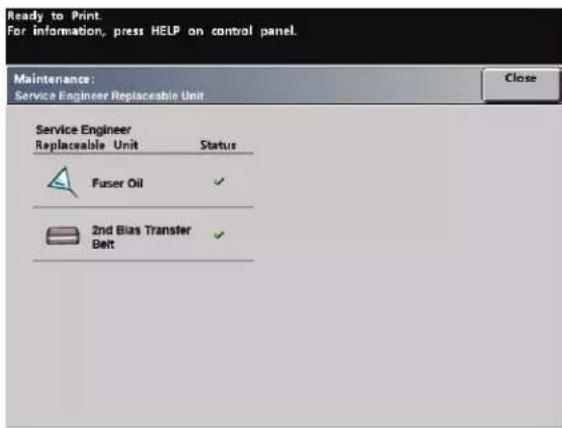
text_image
Ready to Print For information, press HELP on control panel. Maintenance: Service Engineer Replaceable Unit Close Service Engineer Replaceable Unit Status Fuser Oil 2nd Bias Transfer BeltYour Xerox service representative uses the Service Engineer Replaceable Unit function to check on the status items that are replaced only by the service engineer.
These items include the fuser oil and the second bias transfer belt.
Help


Press Help for an overview of the different options displayed in the various tabs on the UI.
Audio Tones
There are three audio tones:
- Attention:
The Attention Tone sounds six seconds after a scan job has been completed to remind you to remove the document from the Scanner glass.
- Button Selection:
A single tone indicates that the button you pressed can be selected. A double tone indicates that the button is not available.
- Fault:
The Fault Tone indicates that the digital press is in a fault condition and does not operate until the fault is cleared.
The Audio Tones can be deactivated or made louder or softer through the Tools Mode.
For more information, refer to the System Administration Guide.
Alert Screens
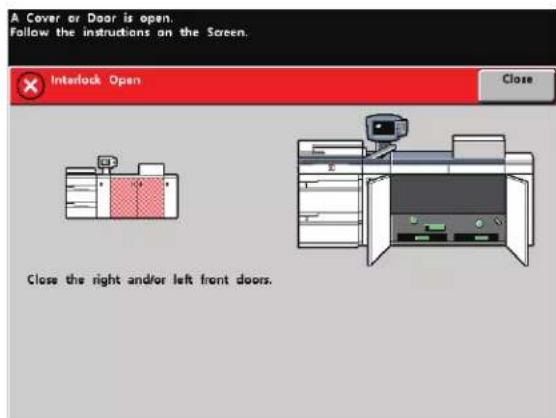
text_image
A Cover or Door is open. Follow the instructions on the Screen. Interlock Open Close Close the right and/or left front doors.An Alert screen has a red bar across the screen when a consumable product, such as Dry Ink/Toner, needs to be replaced. An Alert screen also indicates that the digital press is unable to make prints because of a fault condition. Follow the instructions on the UI to resolve the problem and resume printing.
Digital Press Technical Data
Electrical Power Specifications
200-240V - 50/60 Hz
Single phase - Three wire plus safety ground
Current service - 30 Amp sole use @ 200V to 240V, 60Hz
Range (line to neutral) - 200 V minimum to 240 V maximum
Frequency - 50/60 Hz
Power Consumption
Standby - 2.8 kW
Run - 6 kW
Power Saver - 45W
Warm-up Time
Within 7 minutes from power on or from Power Saver Mode.
First Print Out Time
16 seconds maximum.
Environmental Requirements
The DocuColor 7000AP/8000AP will enter the Power Saver mode after 15 minutes of no activity on the machine.
The factory default time of 15 minutes can be changed in the Tools Mode.
Ambient Temperature and Humidity
10 to 32°C, 15 to 85% RH
50 to 90°F, 15 to 85% RH
NOTE: Above 82^ F ( 28^ C), reduced humidity is required to maintain the specified performance.
12. Appendix
Altitude
Normal operation: 0 to 2,500 meters (0 to 8,200 feet).
Operation between 2,000 to 2,500 meters (6,557 to 8,200 feet) may require a field adjustment.
Illumination
Normal function (free from print quality defects) can be expected under 3,000 lx maximum.
Noise Levels
| Continuous Noise | Impulse Noise | |
| Standby 55 dB N/A | ||
| IOT Operation 78 dB 83 dB | ||
| Full System Operation | 81 dB 89 dB |
Ozone Emissions
Not to exceed 0.015 mg/m ^3
Dust
0.4mg/m ^3 or less per Environment Product Safety Manual, PS-22B008
Capabilities
Tray Capacity
All paper trays (First and Second Feeder modules) have a capacity of 2000 sheets each of 24 pound, 90 g/m ^2 paper.
Throughput
All paper trays:
Type: Coated or uncoated paper, transparencies
Sizes: Minimum = 182mm x 182mm (7.16 x 7.16")
Maximum = 320mm W, 488mm L (12.6 x 19.2")
Weights: 60g/m ^2 to 300g/m ^2
Size/Loading Orientation: B5 SEF/LEF
A4 SEF/LEF
B4 SEF
A3 SEF
8 x 10" LEF*
8.5 x 11" SEF/LEF
8.5 x 13" SEF
8.5 x 14" SEF
11 x 17" SEF
8 Kai SEF (267mm x 388mm)
16 Kai LEF (267mm x 194mm)
12 x 18" SEF
12.6 x 17.7 SEF
Print Rates
Use the Productivity Setting in the Tools Mode to optimize the throughput speed for the weight of the paper you are using.
- Selecting Single Paper Weight sets the Fuser temperature to 160^ , which optimizes the throughput speed for light and heavy weight papers, according to the weight range that is set in the paper tray, and uses less power.
- Selecting Mixed Paper Weight sets the Fuser temperature to 175^ , which optimizes the throughput speed for mixed paper weights from different paper trays, and uses more power.
- Selecting All Weights Rated Speed runs/prints all stocks at the rated throughput speed regardless of weight. The digital press produces/prints images with a reduced level of gloss on the output.
12. Appendix
Refer to the System Administrator Guide for the procedure to change the setting.
The following charts illustrate the print speeds for the three modes using 8.5x11" or A4 paper fed LEF:
| DocuColor 7000AP/8000AP | ||||||||||||
| Substrate | DocuColor 8000AP DocuColor 7000AP | |||||||||||
| Single Paper Weight | Mixed Paper Weight | All Weights Rated Speed | Single Paper Weight | Mixed Paper Weight | All Weights Rated Speed | |||||||
| 1 Sided | 2 Sided | 1 Sided | 2 Sided | 1 Sided | 2 Sided | 1 Sided | 2 Sided | 1 Sided | 2 Sided | 1 Sided | 2 Sided | |
| 60-80 g/m^2 | 80 ppm | 40 ppm | 80 ppm | 40 ppm | 80 ppm | 40 ppm | 70 ppm | 35 ppm | 70 ppm | 35 ppm | 70 ppm | 35 ppm |
| 81-105 g/m^2 | 80 ppm | 40 ppm | 80 ppm | 40 ppm | 80 ppm | 40 ppm | 70 ppm | 35 ppm | 70 ppm | 35 ppm | 70 ppm | 35 ppm |
| 106-135 g/m^2 | 80 ppm | 40 ppm | 60 ppm | 30 ppm | 80 ppm | 40 ppm | 70 ppm | 35 ppm | 60 ppm | 30 ppm | 70 ppm | 35 ppm |
| 136-186 g/m^2 | 60 ppm | 30 ppm | 60 ppm | 30 ppm | 80 ppm | 40 ppm | 50 ppm | 25 ppm | 50 ppm | 25 ppm | 70 ppm | 35 ppm |
| 187-220 g/m^2 | 60 ppm | 30 ppm | 40 ppm | 20 ppm | 80 ppm | 40 ppm | 50 ppm | 25 ppm | 40 ppm | 20 ppm | 70 ppm | 35 ppm |
| 221-300 g/m^2 | 40 ppm | ---- 40 | ppm | ---- 80 | ppm | ---- 35 | ppm | ---- 35 | ppm | ---- 70 | ppm | ---- |
| Transparencies | 30 ppm | ---- 30 | ppm | ---- 30 | ppm | ---- 30 | ppm | ---- 30 | ppm | ---- 30 | ppm | ---- |
*ppm = prints per minute
Physical Characteristics
Digital Press Size
Basic configuration of First Feeder Module, Digital Press with Exit Module, and Offset Catch Tray is 114.8 inches/2916 mm (W) x 43.5 inches/1105 mm (D) x 55.6 inches /1413 mm (H).
Digital Press Weight
2205 pounds/1000 Kg
Floor Space Requirements
Minimum space requirements for the basic configuration of the digital press, not including a color server:
• 158.3 inches/4020mm W x 134.8 inches/3425mm D.
12. Appendix
