60PS70FD - Soundbar LG - Free user manual and instructions
Find the device manual for free 60PS70FD LG in PDF.


User questions about 60PS70FD LG
0 question about this device. Answer the ones you know or ask your own.
Ask a new question about this device
Download the instructions for your Soundbar in PDF format for free! Find your manual 60PS70FD - LG and take your electronic device back in hand. On this page are published all the documents necessary for the use of your device. 60PS70FD by LG.
USER MANUAL 60PS70FD LG
PLASMA TV OWNER'S MANUAL
PLASMA TV MODELS
50PS70****
60PS70***
Please read this manual carefully before operating your TV.
Retain it for future reference.
Record the model number and serial number of the TV.
Refer to the label on the back cover and quote this information.
To your dealer when requiring any service.

Digital Video Broadcasting
Trade Mark of the DVB Digital Video Broadcasting Project (1991 to 1996)
ID Number(s): 6250:50PS70FD-AA 6249:60PS70FD-AA

This product qualifies for ENERGY STAR in the "factory default (Home Use mode)" setting and this is the setting in which power savings will be achieved.
Changing the factory default picture setting or enabling other features will increase power consumption that could exceed the limits necessary to qualify for Energy Star rating.
ACCESSORIES
Ensure that the following accessories are included with your TV. If an accessory is missing, please contact the dealer where you purchased the TV.
■ Image shown may differ from your TV.

Owner's Manual Batteries
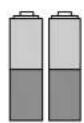
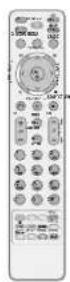
Remote Control

Power Cord
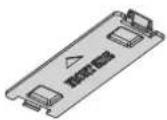
or
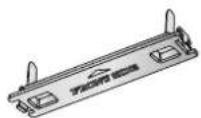
Protection Cover
(Refer to p.8)

Bolts for stand assembly
(Only 50PS70**)
(Refer to p.6)
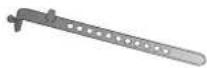
Cable Holder
(Refer to p.8)

Ferrite Core
(This item is not included for
all models.)
This item is not included for all models.
Polishing Cloth
Polishing cloth for use on the screen.
* Lightly wipe any stains or fingerprints on the surface of the TV with the polishing cloth.
Do not use excessive force. This may cause scratching or discolouration.

Cable management clip
(Refer to p.8)
Wall Mounting Bracket
(Separate purchase)
AW-50PG60MS
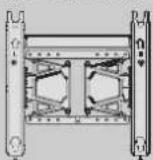
(50PS70**)
AW-60PG60MS

(60PS70+)
Use of ferrite core (This item is not included for all models.)
Ferrite core can be used to reduce the electromagnetic wave when connecting the power cord.
The closer the location of the ferrite core to the power plug, the better it is.
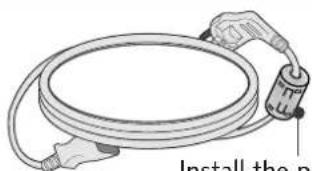
natural_image
Illustration of a coiled cable with a plug and connector, labeled 'Install the p' (no other text or symbols)Install the power plug closely.
CONTENTS
ACCESSORIES 1
PREPARATION
Front Panel Controls .... 4
Back Panel Information .... 5
Stand Installation 6
Careful installation advice 7
Back Cover for Wire Arrangement 8
Swivel Stand 8
Not using the desk-type stand 8
Desktop pedestal Installation 9
Wall Mount: Horizontal Installation ..... 9
Antenna Connection 10
EXTERNAL EQUIPMENT SETUP
HD Receiver Setup 11
DVD Setup 13
VCR Setup 14
AV Output Setup(Only Analogue Mode) ..... 15
Other A/V Source Setup 16
Digital Audio Out Setup 16
Usb Setup 17
PC Setup 18
- Screen Setup for PC Mode ..... 20
WATCHING TV / PROGRAMME CONTROL
Remote Control Key Functions 24
Turning on the TV 26
Programme Selection 26
Volume Adjustment 26
Quick Menu 27
On-Screen Menus Selection and Adjustment .. 28
Auto Programme Tuning 29
Manual Programme Tuning (In Digital Mode) .. 30
Manual Programme Tuning (In Analogue Mode) .. 31
Programme Edit 33
Booster 35
Software Update 36
Diagnostics 38
Selecting the Programme List ....39
Favourite Programme Setup .... 40
Brief Information 41
Input List 42
SIMPLINK 43
Input Label 45
AV Mode 46
Simple manual 47
Initialising (Reset to original factory settings) ...48
EPG (ELECTRONIC PROGRAMME GUIDE) (IN DIGITAL MODE)
EPG(Electronic programme guide)(In Digital Mode) 49
- Button Function in NOW/NEXT Guide Mode . 50
- Button Function in 8 Day Guide Mode .... 50
- Button Function in Date Change Mode .... 51
- Button Function in Extended Description Box .. 51
- Button Function in Schedule List Mode .... 51
TIME MACHINE
Precautions when using the USB Device .....52
Time Machine (Pause & Replay of Live TV) ....53
Recording 57
Schedule List....61
Recorded List 63
MULTIMEDIA
Entry Modes 66
Photo List 67
Music List ....71
Movie List 73
DivX Registration Code ....79
Deactivation 80
PICTURE CONTROL
Picture Size (Aspect Ratio) Control ..... 81
Picture Wizard 83
ENERGY SAVING 85
Preset Picture Settings
- Picture Mode-Preset 86
Manual Picture Adjustment
- Picture Mode-User option 87
Picture Improvement Technology 88
Expert Picture Control 89
Picture Reset 92
Image Sticking Minimization (ISM) Method ... 93
Demo Mode .....94
Mode Setting 95
SOUND & LANGUAGE CONTROL
Auto Volume leveller(Auto Volume) ..... 96
Clear Voice II 97
Preset Sound Settings (Sound Mode) ..... 98
Sound Setting Adjustment -User Mode ..... 99
SRS TruSurround XT 99
Balance 100
TV Speakers On/ Off Setup 101
Selecting Digital Audio Out ..... 102
Audio Reset 103
Stereo Reception(In Analogue Mode Only) ... 104
Language Selection(In Digital Mode Only) ...105
TIME SETTING
Clock Setup ....106
Auto On/ Off Time Setting 107
Sleep Timer Setting 107
PARENTAL CONTROL / RATINGS
Set Password & Lock System
- Setting up Your Password .... 108
- Lock System 109
- Set Password 110
Block Programme 111
Parental Guidance 112
External Input Blocking ....113
Key Lock 114
TELETEXT
Switch on/off 115
SIMPLE Text 115
TOP Text 115
FASTEXT 116
Special Teletext Functions ..... 116
APPENDIX
Troubleshooting 117
Maintenance 119
Product Specifications .... 120
Programming the Remote control ..... 121
IR Codes 122
External Control Device Setup 124
Open Source License 132
PREPARATION
FRONT PANEL CONTROLS

NOTE
▶ TV can be placed in standby mode in order to reduce the power consumption. And the TV should be switched off using the power switch on the TV if it will not be watched for some time, as this will reduce energy consumption.
The energy consumed during use can be significantly reduced if the level of brightness of the picture is reduced, and this will also reduce the overall running cost.
■ Image shown may differ from your TV.

CAUTION
When the TV cannot be turned on with the remote control, press the main power button on the TV. (When the power is turned off with the main power button on the TV, it will not be turned on with the remote control).
▶ Do not step on the glass stand or subject it to any impact.
It may break, causing possible injury from fragments of glass, or the TV may fall.
▶ Do not drag the TV. The floor or the product may be damaged.

text_image
PROGRAMME VOLUME OK MENU INPUT POWER Power/Standby Indicator • Illuminates red in standby mode. • The LED is off while the TV remains on.BACK PANEL INFORMATION
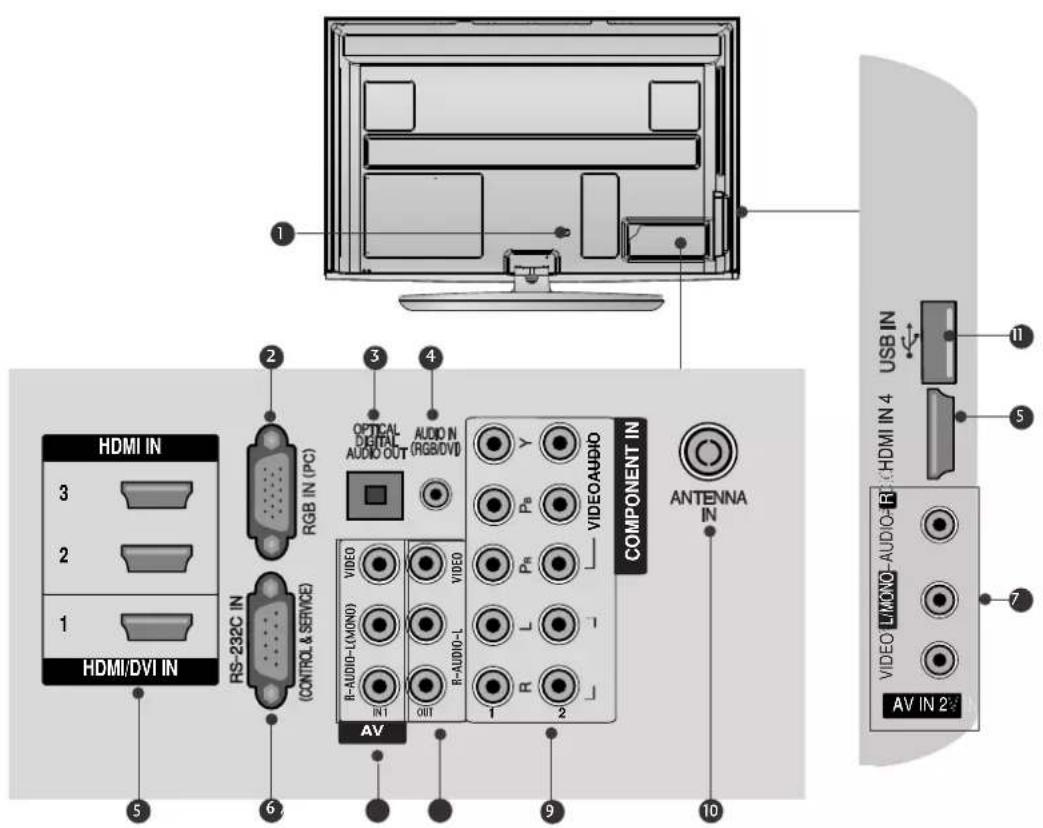
■ Image shown may differ from your TV.
text_image
HDMI IN 3 2 1 HDMI/DVI IN RS-232C IN (CONTROL & SERVICE) AV OPTICAL DIGITAL AUDIO OUT AUDIO N (RGB/0V) VIDEO AUDIO COMPONENT IN R-AUDIO-L(MONO) IN1 OUT VIDEO R-AUDIO-L 1 2 ANTENNA IN USB IN 11 5 7 VIDEO L/MONO-AUDIO-R AV IN 2① Power Cord Socket
This TV operates on an AC power. The voltage is indicated on the Specifications page. Never attempt to operate the TV on DC power.
② RGB Input
Connect the output from a PC.
3 OPTICAL DIGITAL AUDIO OUT
Connect digital audio to various types of equipment.
Connect to a Digital Audio Component.
Use an Optical audio cable.
4 RGB/DVI Audio Input
Connect the audio from a PC or DTV.
5 HDMI Input
Connect an HDMI signal to HDMI IN. Or DVI (VIDEO) signal to HDMI/DVI port with DVI to HDMI cable.
6 RS-232C IN (CONTROL & SERVICE) PORT Connect to the RS-232C port on a PC. This port is used for Service or Hotel mode.
⑦ Audio/Video Input (AV IN1/2)
Connect audio/video output from an external device to these jacks.
8 AV Output
Connect second TV or monitor to the AV OUT socket on the TV.
9 Component Input
Connect a component video/audio device to these jacks.
10 Antenna Input
Connect RF antenna to this jack.
11 USB Input
Connect USB storage device to this jack.
PREPARATION
STAND INSTALLATION
Only 50PS70\*\*
■ Image shown may differ from your TV.
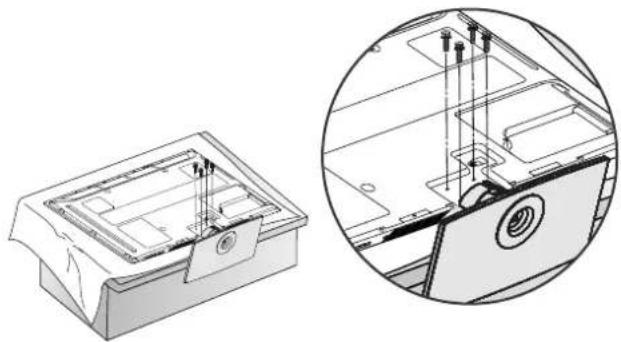
- When assembling the desk type stand, check whether the bolt is fully tightened. (If not tightened fully, the product can tilt forward after the product installation.) If you tighten the bolt with excessive force, the bolt can deviate from abrasion of the tightening part of the bolt.
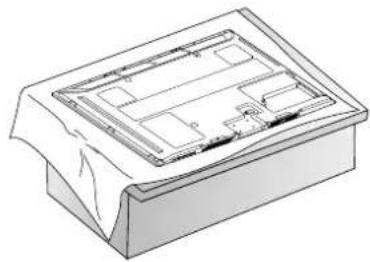
1 Carefully place the TV screen side down on a cushioned surface to protect the screen from damage.
natural_image
Technical line drawing of a mechanical component with internal compartments and mounting base (no text or symbols)2 Assemble the TV as shown.

natural_image
Technical line drawing of a mechanical device with an inset close-up showing internal components (no text or symbols)3 Fix the 4 bolts securely using the holes in the back of the TV.
natural_image
Technical illustration of a mechanical component with cross-sectional view (no text or symbols)
text_image
FrontWhen assembling the stand, make sure to distinguish and assemble the front and rear side of the stand correctly.
CAREFUL INSTALLATION ADVICE
■ You should purchase necessary components to fix the TV safety and secure to the wall from the market.
■ Position the TV close to the wall to avoid the possibility of it falling when pushed.
The instructions shown below are a safer way to set up the TV, by fixing it to the wall, avoiding the possibility of it falling forwards if pulled. This will prevent the TV from falling forward and causing injury. This will also prevent the TV from damage. Ensure that children do not climb or hang from the TV.

text_image
1 2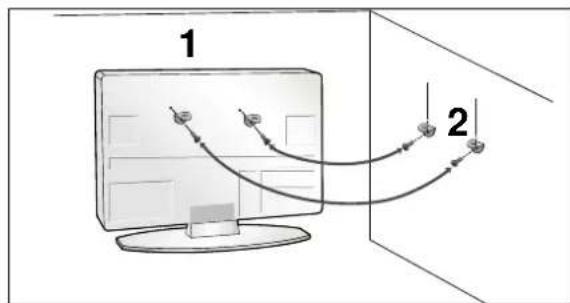
flowchart
graph TD
    A["1"] --> B["Computer Screen"]
    C["2"] --> B
    B --> D["Arrow 1"]
    B --> E["Arrow 2"]
1 Use the eye-bolts or TV brackets/bolts to fix the product to the wall as shown in the picture. (If your TV has bolts in the eyebolts, loosen then bolts.)
* Insert the eye-bolts or TV brackets/bolts and tighten them securely in the upper holes.
2 Secure the wall brackets with the bolts on the wall. Match the height of the bracket that is mounted on the wall.
natural_image
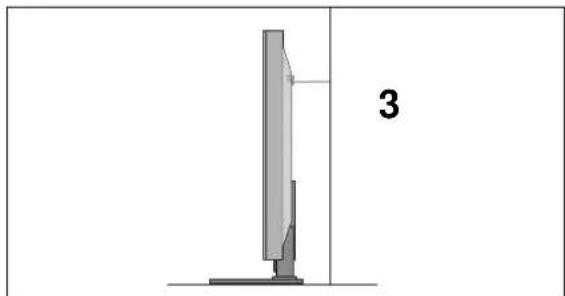
Architectural cross-section diagram of a vertical structural column with a base, labeled '3' (no text or symbols on the structure itself)3 Use a sturdy rope to tie the product for alignment. It is safer to tie the rope so it becomes horizontal between the wall and the product.
NOTE
▶ When moving the TV undo the cords first.
▶ Use a platform or cabinet strong and large enough to support the size and weight of the TV.
▶ To use the TV safely make sure that the height of the bracket on the wall and on the TV is the same.
PREPARATION
BACK COVER FOR WIRE ARRANGEMENT
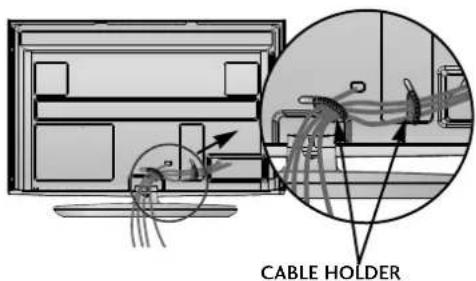
1 After Connecting the cables as necessary, install CABLE HOLDER as shown and bundle the cables. To connect additional equipment, see the External equipment Setup section.
text_image
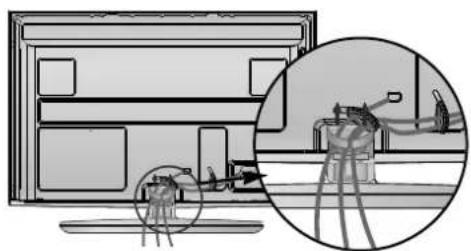
CABLE HOLDER2 Install the CABLE MANAGEMENT CLIP as shown.

text_image
CABLE MANAGEMENT CLHow to remove the cable man- agement clip
Hold the CABLE MANAGEMENT CLIP with both hands and pull it upward.
natural_image
Illustration of a monitor setup with an inset image showing a camera and a telescope mounted on a tripod (no text or symbols present)NOTE
▶ Do not use the CABLE MANAGEMENT CLIP to lift the TV. - If the TV is dropped, you may be injured or the TV may be damaged.
SWIVEL STAND
■ Image shown may differ from your TV. After installing the TV, you can adjust the TV set manually to the left or right direction by 20 degrees to suit your viewing position.

natural_image
Pure diagram of a mechanical component with no text, numbers, or symbolsNOT USING THE DESK-TYPE STAND
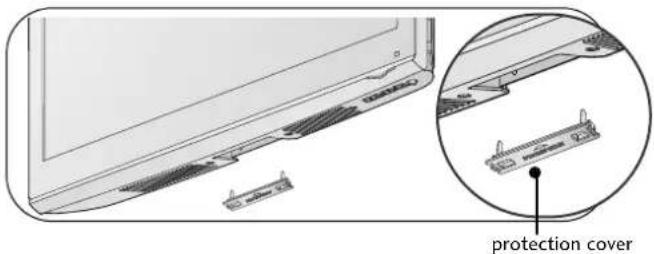
■ Image shown may differ from your TV. When installing the wall-mounted unit, use the protection cover. Insert the PROTECTION COVER into the TV until clicking sound.
text_image
protection coverEARTHING
Ensure that you connect the earth wire to prevent possible electric shock. If grounding methods are not possible, have a qualified electrician install a separate circuit breaker.
Do not try to earth the TV by connecting it to telephone wires, lightening rods or gas pipes.

text_image
Power Supply Circuit breaker■ The TV can be installed in various ways such as on a wall, or on a desktop etc.
■ The TV is designed to be mounted horizontally.
DESKTOP PEDESTAL INSTALLATION
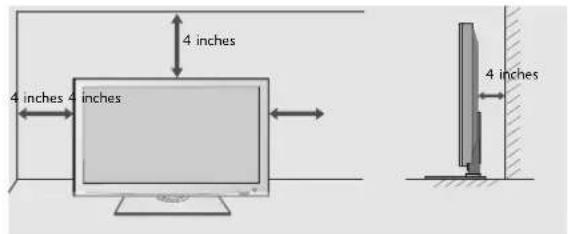
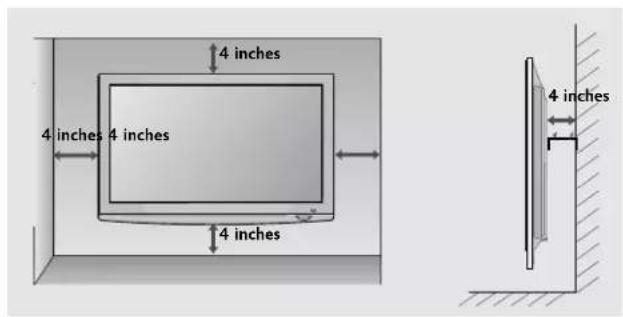
For adequate ventilation allow a clearance of 4" (10cm) all around the TV.
text_image
4 inches 4 inches 4 inches 4 inches 4 inchesWALL MOUNT: HORIZONTAL INSTALLATION
We recommend the use of a LG Brand wall mounting bracket when mounting the TV to a wall.
We recommend that you purchase a wall mounting bracket which supports VESA standard.
■ LG recommends that wall mounting be performed by a qualified professional installer.

NOTE
▶ Should Install wall mount on a solid wall perpendicular to the floor.
▶ Should use a special wall mount, if you want to install it to ceiling or slanted wall.
The surface that wall mount is to be mounted on should be of sufficient strength to support the weight of TV set; e.g. concrete, natural rock, brick and hollow block.
▶ Installing screw type and length depends on the wall mount used. Further information, refer to the instructions included with the mount.
▶ LG is not liable for any accidents or damage to property or TV due to incorrect installation:
- Where a non-compliant VESA wall mount is used.
- Incorrect fastening of screws to surface which may cause TV to fall and cause personal injury.
- Not following the recommended Installation method.
text_image
4 inches 4 inches 4 inches 4 inches 4 inches 4 inches
text_image
A B| Model | VESA (A * B) | Standard Screw | Quantity |
| 50PS70** | 400 × 400 | M6 | 4 |
| 60PS70** | 600 × 400 | M8 | 4 |
PREPARATION
■ To prevent damage do not connect to the mains outlet until all connections are made between the devices.
ANTENNA CONNECTION
■ For optimum picture quality, adjust antenna direction.
■ An antenna cable and converter are not supplied.

flowchart
graph LR
    A["Wall Antenna Socket"] --> B["Multi-family Dwellings/Apartments (Connect to wall antenna socket)"]
    C["Outdoor Antenna (VHF, UHF)"] --> D["Single-family Dwellings / Houses (Connect to wall jack for outdoor antenna)"]
    B --> E["RF Coaxial Wire (75 ohm)"]
    D --> E
    E --> F["Antenna IN"]

flowchart
graph LR
    A["Antenna"] --> B["UHF"]
    A --> C["VHF"]
    B --> D["Signal Amplifier"]
    C --> D
    D --> E["Antenna IN"]
In poor signal areas, to achieve better picture quality it may be necessary to install a signal amplifier to the antenna as shown above.
■ If signal needs to be split for two TVs, use an antenna signal splitter for connection.
EXTERNAL EQUIPMENT SETUP
■ To avoid damaging any equipment, never plug in any power cords until you have finished connecting all equipment.
■ Image shown may differ from your TV.
HD RECEIVER SETUP
This TV can receive Digital RF/Cable signals without an external digital set-top box. However, if you do receive Digital signals from a digital set-top box or other digital external device, refer to the diagram as shown below.
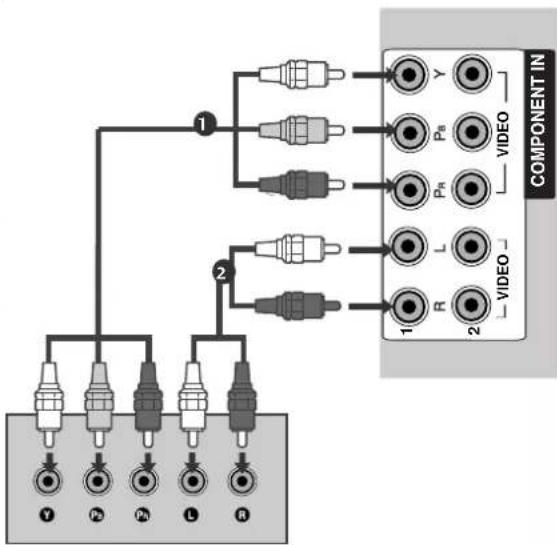
Connecting with a component cable
1 Connect the video outputs (Y, PB, PR) of the digital set top box to the COMPONENT IN VIDEO jacks on the TV.
2 Connect the audio output of the digital set-top box to the COMPONENT IN AUDIO jacks on the TV.
3 Turn on the digital set-top box. (Refer to the owner's manual for the digital set-top box).
4 Select Component1 input source using the INPUT button on the remote control.
If connected to COMPONENT IN 2 input, select Component 2 input source.
text_image
COMPONENT IN 1 2 Y Pa Pa L R VIDEO VIDEO 1 2| Signal | Component | HDMI |
| 480i/576i | O | X |
| 480p/576p | O | O |
| 720p/1080i | O | O |
| 1080p | O(50/60Hz only) | O(24Hz/30Hz/50Hz/60Hz) |
EXTERNAL EQUIPMENT SETUP
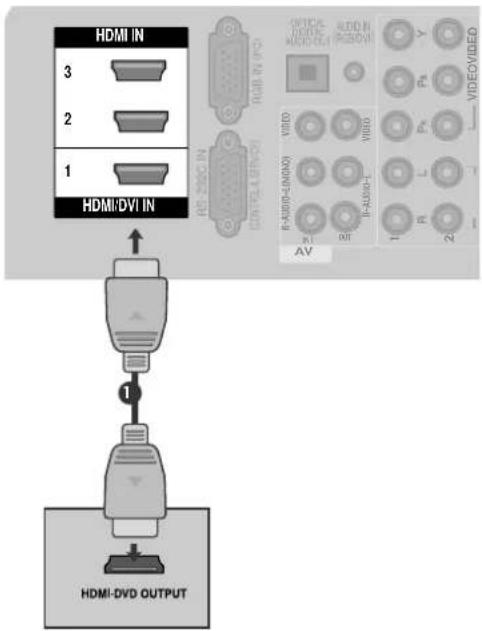
Connecting a set-top box with an HDMI cable
1 Connect the digital set-top box to HDMI/DVI IN 1, HDMI IN 2, HDMI IN 3 or HDMI IN 4 jack on the TV.
2 Turn on the digital set-top box. (Refer to the owner's manual for the digital set-top box.)
3 Select HDMI1, HDMI2, HDMI3 or HDMI 4 input source using the INPUT button on the remote control.
NOTE
▶ Check that your HDMI cable is version 1.3 or higher. If the HDMI cables don't support HDMI version 1.3, flickering or no screen display can result. Please use the latest cables that support at least HDMI version 1.3.
text_image
HDMI IN 3 2 1 HDMI/DVI IN HDMI-DVD OUTPUTConnecting with an HDMI to DVI cable
1 Connect the digital set-top box to HDMI/DVI IN 1 jack on the TV.
2 Connect the audio output of the digital set-top box to the AUDIO IN (RGB/DVI) jack on the TV.
3 Turn on the digital set-top box. (Refer to the owner's manual for the digital set-top box.)
4 Select HDMI1 input source using the INPUT button on the remote control.
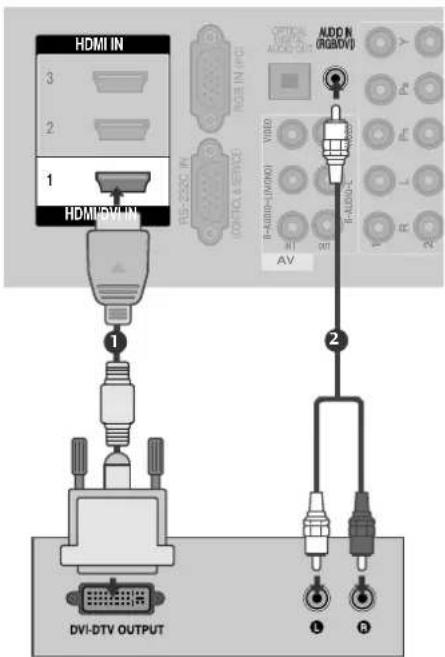
text_image
HDMI IN 3 2 1 HDMI/DVI IN 1 DVI-DTV OUTPUT 2 ADO N RGB(DVI) R-HDDI-1(WVD) WHD AV R-HDDI-2(WVD) R-HDDI-3(WVD) R-HDDI-4(WVD) R-HDDI-5(WVD) R-HDDI-6(WVD) R-HDDI-7(WVD) R-HDDI-8(WVD) R-HDDI-9(WVD) R-HDDI-10(WVD) R-HDDI-11(WVD) R-HDDI-12(WVD) R-HDDI-13(WVD) R-HDDI-14(WVD) R-HDDI-15(WVD) R-HDDI-16(WVD) R-HDDI-17(WVD) R-HDDI-18(WVD) R-HDDI-19(WVD) R-HDDI-20(WVD) R-HDDI-21(WVD) R-HDDI-22(WVD) R-HDDI-23(WVD) R-HDDI-24(WVD) R-HDDI-25(WVD) R-HDDI-26(WVD) R-HDDI-27(WVD) R-HDDI-28(WVD) R-HDDI-29(WVD) R-HDDI-30(WVD) R-HDDI-31(WVD) R-HDDI-32(WVD) R-HDDI-33(WVD) R-HDDI-34(WVD) R-HDDI-35(WVD) R-HDDI-36(WVD) R-HDDI-37(WVD) R-HDDI-38(WVD) R-HDDI-39(WVD) R-HDDI-40(WVD) R-HDDI-41(WVD) R-HDDI-42(WVD) R-HDDI-43(WVD) R-HDDI-44(WVD) R-HDDI-45(WVD) R-HDDI-46(WVD) R-HDDI-47(WVD) R-HDDI-48(WVD) R-HDDI-49(WVD) R-HDDI-50(WVD) R-HDDI-51(WVD) R-HDDI-52(WVD) R-HDDI-53(WVD) R-HDDI-54(WVD) R-HDDI-55(WVD) R-HDDI-56(WVD) R-HDDI-57(WVD) R-HDDI-58(WVD) R-HDDI-59(WVD) R-HDDI-60(WVD) R-HDDI-61(WVD) R-HDDI-62(WVD) R-HDDI-63(WVD) R-HDDI-64(WVD) R-HDDI-65(WVD) R-HDDI-66(WVD) R-HDDI-67(WVD) R-HDDI-68(WVD) R-HDDI-69(WVD) R-HDDI-70(WVD) R-HDDI-71(WVD) R-HDDI-72(WVD) R-HDDI-73(WVD) R-HDDI-74(WVD) R-HDDI-75(WVD) R-HDDI-76(WVD) R-HDDI-77(WVD) R-HDDI-78(WVD) R-HDDI-79(WVD) R-HDDI-80(WVD) R-HDDI-81(WVD) R-HDDI-82(WVD) R-HDDI-83(WVD) R-HDDI-84(WVD) R-HDDI-85(WVD) R-HDDI-86(WVD) R-HDDI-87(WVD) R-HDDI-88(WVD) R-HDDI-89(WVD) R-HDDI-90(WVD) R-HDDI-91(WVD) R-HDDI-92(WVD) R-HDDI-93(WVD) R-HDDI-94(WVD) R-HDDI-95(WVD) R-HDDI-96(WVD) R-HDDI-97(WVD) R-HDDI-98(WVD) R-HDDI-99(WVD) R-HDDI-100(WVD)DVD SETUP
Connecting with a component cable
1 Connect the video outputs (Y, PB, PR) of the DVD to the COMPONENT IN VIDEO jacks on the TV.
2 Connect the audio outputs of the DVD to the COMPONENT IN AUDIO jacks on the TV.
3 Turn on the DVD player, insert a DVD.
4 Select Component1 input source using the INPUT button on the remote control.
If connected to COMPONENT IN 2 input, select Component 2 input source.
5 Refer to the DVD player's manual for operating instructions.

text_image
COMPONENT IN 1 2 Y P2 P3 L R 1 Y P3 P4 L R 2Component Input ports
To achieve better picture quality, connect a DVD player to the component input ports as shown below.
| Component ports on the TV | Y | P_B | P_R |
| Video output ports on DVD player | Y | P_B | P_R |
| Y | B-Y | R-Y | |
| Y | Cb | Cr | |
| Y | Pb | Pr |
Connecting the HDMI cable
1 Connect the HDMI output of the DVD to the HDMI/DVI IN 1, HDMI IN 2, HDMI IN 3 or HDMI IN 4 jack on the TV.
2 Select HDMI1, HDMI2, HDMI 3 or HDMI 4 input source using the INPUT button on the remote control.
3 Refer to the DVD player's manual for operating instructions.
NOTE
The TV can receive video and audio signals simultaneously when using a HDMI cable.
▶ If the DVD does not support Auto HDMI, you must set the output resolution appropriately.
▶ Check that your HDMI cable is version 1.3 or higher. If the HDMI cables don't support HDMI version 1.3, flickering or no screen display can result. Please use the latest cables that support at least HDMI version 1.3.
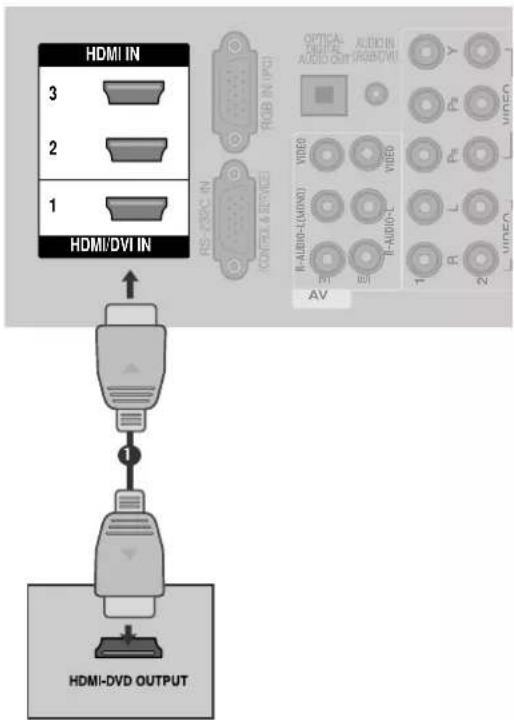
text_image
HDMI IN 3 2 1 HDMI/DVI IN OPTICAL OUTPUT AUDIO OUT RGB IN (RGB) VDD VIDEO AV R-AUDIO-L(MINRO) R-AUDIO-L 1 2 L P Y Ps VIDEO PH AV HDMI-DVD OUTPUTEXTERNAL EQUIPMENT SETUP
VCR SETUP
■ To avoid picture noise (interference), allow adequate distance between the VCR and TV.
Connecting with a RF Cable

flowchart
graph TD
    A["COMPONENT IN"] --> B["ANTenna IN"]
    B --> C["ANT OUT"]
    C --> D["S-VIDEO VIDEO"]
    D --> E["L"]
    D --> F["R"]
    C --> G["OUTPUT SWITCH"]
    G --> H["ANT IN"]
    H --> I["Wall Jack"]
    I --> J["Antenna"]
1 Connect the ANT OUT socket of the VCR to the ANTENNA IN socket on the TV.
2 Connect the antenna cable to the ANT IN socket of the VCR.
3 Press the PLAY button on the VCR and match the appropriate channel between the TV and VCR for viewing.
Connecting with a RCA cable
1 Connect the AUDIO/VIDEO jacks between TV and VCR. Match the jack colours (Video = yellow, Audio Left = white, and Audio Right = red)
2 Insert a video tape into the VCR and press PLAY on the VCR. (Refer to the VCR owner's manual.)
3 Select AV2 input source using the INPUT button on the remote control.
If connected to AV IN 1 input, select AV1 input source.
NOTE
If you have a mono VCR, connect the audio cable from the VCR to the AUDIO L/MONO jack of the TV.

text_image
VIDEO MONO-AUDIO-RKHD AV IN 2 1 S-VIDEO VIDEO L R ANT IN OUTPUT SWITCH ANT OUTAV OUTPUT SETUP (Only Analogue Mode)
The TV has a special signal output capability which allows you to hook up the second TV or monitor.
1 Connect the second TV or monitor to the TV's AV OUT jacks.
2 See the Operating Manual of the second TV or monitor for further details regarding that device's input settings.
NOTE
▶ Only Analog Channel and AV mode can be used for AV out. Component, RGB, HDMI input sources cannot be used for AV out.
We recommend to use the AV OUT jacks for VCR recording.
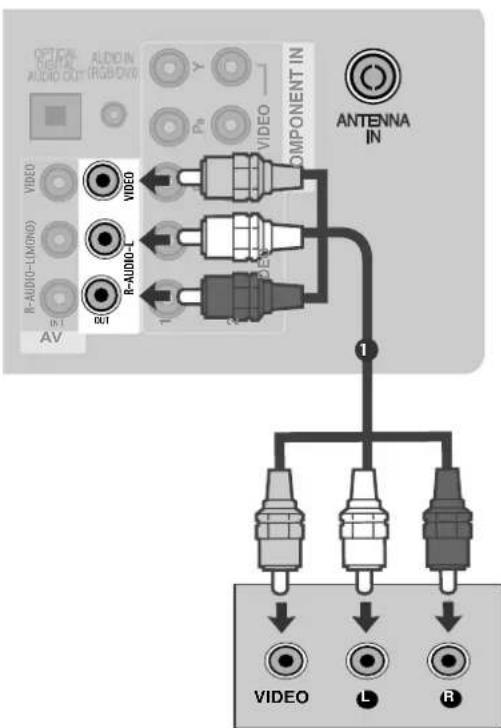
text_image
AUDIO IN AUDIO OUT (RGB/DVD) VIDEO VIDEO COMPONENT IN ANTENNA IN R-AUDIO-L(MINO) AV R-AUDIO-L 1 VIDEO L REXTERNAL EQUIPMENT SETUP
OTHER A/V SOURCE SETUP
1 Connect the AUDIO/VIDEO jacks between TV and external equipment. Match the jack colours (Video = yellow, Audio Left = white, and Audio Right = red)
2 Select AV2input source using the INPUT button on the remote control.
If connected to AV IN 1 input, select AV1 input source.
3 Operate the corresponding external equipment. Refer to external equipment operating guide.
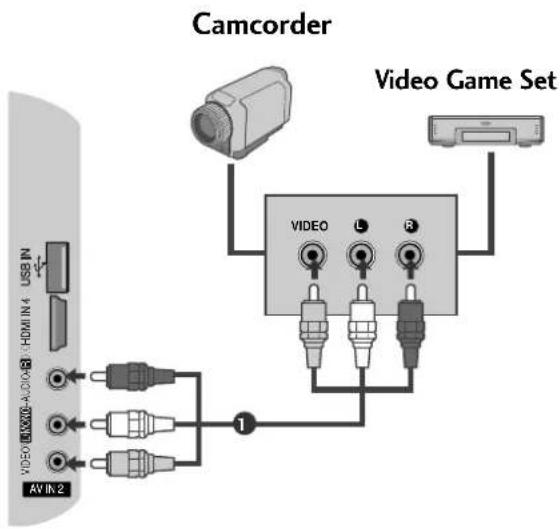
text_image
Camcorder Video Game Set VIDEO L R 1 VIDEO AV IN 2 USB IN HDMI IN 4 VDDA-AUDIO-B AV IN 2DIGITAL AUDIO OUT SETUP
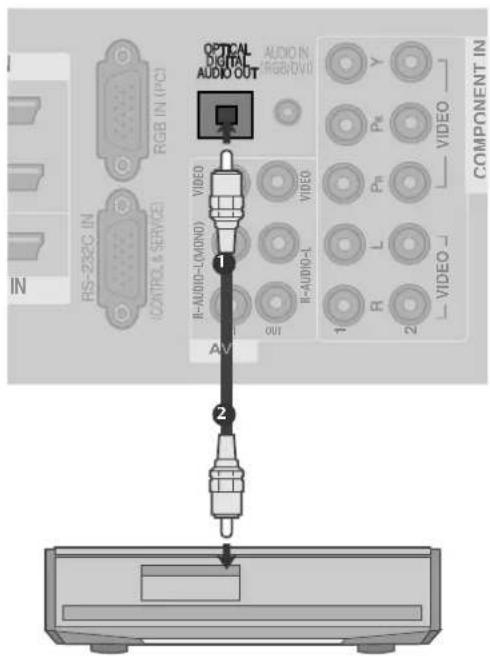
Sending the TV's audio signal to external audio equipment via the Digital Audio Output (Optical) port. If you want to enjoy digital broadcasting through 5.1-channel speakers, connect the OPTICAL DIGITAL AUDIO OUT terminal on the back of TV to a DVD Home Theatre (or amp).
1 Connect one end of an optical cable to the TV Digital Audio (Optical) Output port.
2 Connect the other end of the optical cable to the digital audio (Optical) input on the audio equipment.
3 Set the "TV Speaker option - Off" in the AUDIO menu.(▶p.101). Refer to the external audio equipment instruction manual for operation.
CAUTION
▶Do not look into the optical output port. Looking at the laser beam may damage your vision.
text_image
OPTICAL DIGITAL AUDIO OUT AUDIO IN RGB/100 RS-232C IN CONTROL & SERVICE VIDEO IN-AUDIO-L(MOND) AV R-AUDIO-L OUT 1 2 COMPONENT IN VIDEO L R VIDEO 1 2USB SETUP
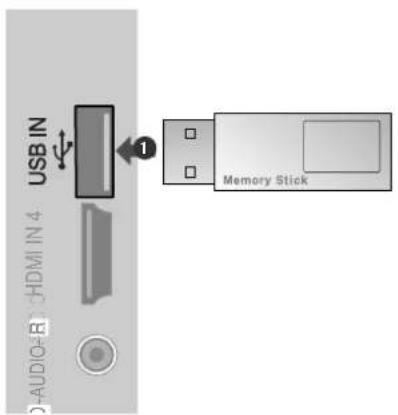
1 Connect the USB device to the USB IN jacks on the side of TV.
After connecting the USB IN jacks, you use the USB function. (▶ p.66)
CAUTION
▶ Before removing the USB device, please use the Remove USB Device in Quick Menu to prevent software, data loss or damage to USB HDD.
text_image
USB IN HDMI IN 4 3-AUDIO-R 1 Memory StickEXTERNAL EQUIPMENT SETUP
PC SETUP
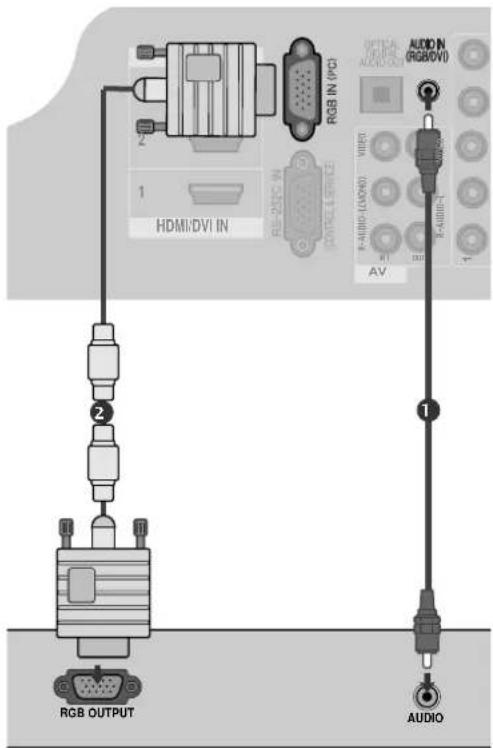
This TV provides Plug and Play capability, meaning that the PC adjusts automatically to the TV's settings.
Connecting with a D-sub 15 pin cable
1 Connect the RGB output of the PC to the RGB IN (PC) jack on the TV.
2 Connect the PC audio output to the AUDIO IN (RGB/DVI) jack on the TV.
3 Turn on the PC and the TV
4 Select RGB input source using the INPUT button on the remote control.
text_image
HDMI/DVI IN RGB IN (VCD) AUDIO AV T-AUDIO (LAMO) T-AUDIO AUDIO RGB OUTPUT AUDIOConnecting with a HDMI to DVI cable
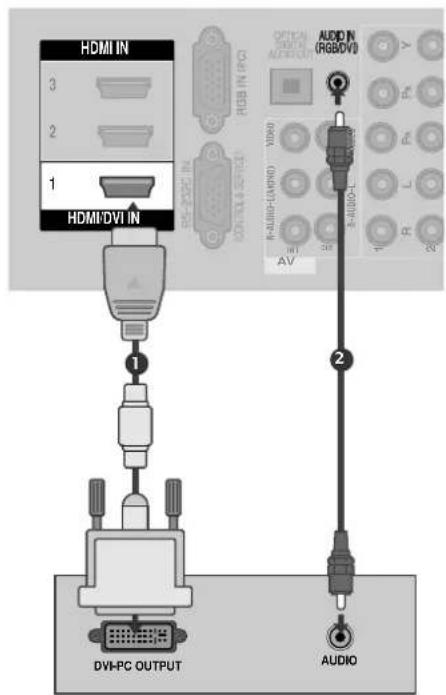
1 Connect the DVI output of the PC to the HDMI/DVI IN1 jack on the TV.
2 Connect the PC audio output to the AUDIO IN (RGB/DVI) jack on the TV.
3 Turn on the PC and the TV.
4 Select HDMI1 input source using the INPUT button on the remote control.
text_image
HDMI IN 3 2 1 HDMI/DVI IN 1 DVI-PC OUTPUT AUDIO AUDIO N (RGB/DVI) AV Audi AV Audi AV AV AV AV AV AV AVSupported Display Resolution
RGB-PC, HDMI/DVI-PC mode
| Resolution | Horizontal Frequency(kHz) | Vertical Frequency(Hz) |
| 720x400 | 31.468 | 70.08 |
| 640x480 | 31.469 | 59.94 |
| 800x600 | 37.879 | 60.31 |
| 1024x768 | 48.363 | 60.00 |
| 1280x768 | 47.776 | 59.87 |
| 1360x768 | 47.712 | 60.015 |
| 1280x1024 | 63.98 | 60.02 |
| 1400x1050 | 65.317 | 59.979 |
| 1920x1080 | 66.587 | 59.934 |
HDMI/DVI-DTV mode
| Resolution | Horizontal Frequency(kHz) | Vertical Frequency(Hz) |
| 640x480 | 31.649 | 59.94 |
| 31.469 | 60 | |
| 720x480 | 31.47 | 59.94 |
| 31.50 | 60 | |
| 720x576 | 31.25 | 50.00 |
| 1280x720 | 37.50 | 50.00 |
| 44.96 | 59.94 | |
| 45.00 | 60 | |
| 1920x1080 | 28.125 | 50.00 |
| 33.72 | 59.94 | |
| 33.75 | 60 | |
| 27.00 | 24.00 | |
| 33.75 | 30 | |
| 56.25 | 50.00 | |
| 67.433 | 59.94 | |
| 67.50 | 60 |
NOTE
- Avoid keeping a fixed image on the set's screen for prolonged periods of time. The fixed image may become permanently imprinted on the screen; use a screen saver when possible.
There may be interference relating to resolution, vertical pattern, contrast or brightness in PC mode. Change the PC mode to another resolution or change the refresh rate to another rate or adjust the brightness and contrast on the menu until the picture is clear. If the refresh rate of the PC graphic card can not be changed, change the PC graphic card or consult the manufacturer of the PC graphic card.
▶ The synchronization input waveform for Horizontal and Vertical frequencies are separate.
We recommend using 1920x1080, 60Hz(50PS70, 60PS70**) for the PC mode, they provide the best picture quality.
▶ Connect the signal cable from the monitor output port of the PC to the RGB (PC) port of the TV or the signal cable from the HDMI output port of the PC to the HDMI IN (or HDMI/DVI IN) port on the TV.
▶ Connect the audio cable from the PC to the Audio input on the TV. (Audio cables are not included with the TV).
▶ If using a sound card, adjust PC sound as required.
▶ If required, adjust the settings for Plug and Play functionality
▶ If the graphic card on the PC does not output analogue and digital RGB simultaneously, connect only one of either RGB or HDMI IN (or HDMI/DVI IN) to display the PC output on the TV.
▶ If the graphic card on the PC does output analogue and digital RGB simultaneously, set the TV to either RGB or HDMI; (the other mode is set to Plug and Play automatically by the TV.)
▶ DOS mode may not work depending on the video card if you use an HDMI to DVI cable.
▶ If you use an RGB-PC cable that is too long, there may be interference on the screen. We recommend using under 5m of cable. This provides the best picture quality.
EXTERNAL EQUIPMENT SETUP
Screen Setup for PC mode
Screen Reset
Returns Position, Size and Phase to the factory default settings.
This function works in the following mode: RGB[PC].

text_image
PICTURE • Contrast 100 • Brightness 50 • Sharpness 70 • Colour 70 • Tint 0 • Advanced Control • Reset Screen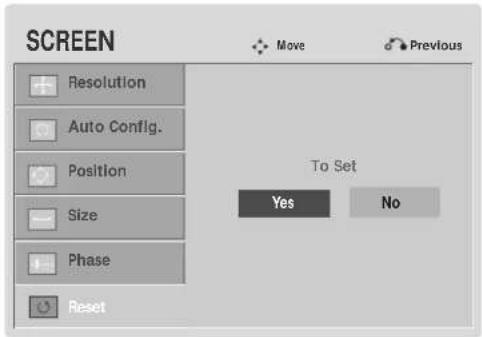
text_image
SCREEN Resolution Auto Config. Position Size Phase Reset Move Previous To Set Yes No
Select PICTURE.

Select Screen.

Select Reset.

Select Yes.

Run Reset.
- Press the MENU button to return to normal TV viewing.
- Press the RETURN button to move to the previous menu screen.
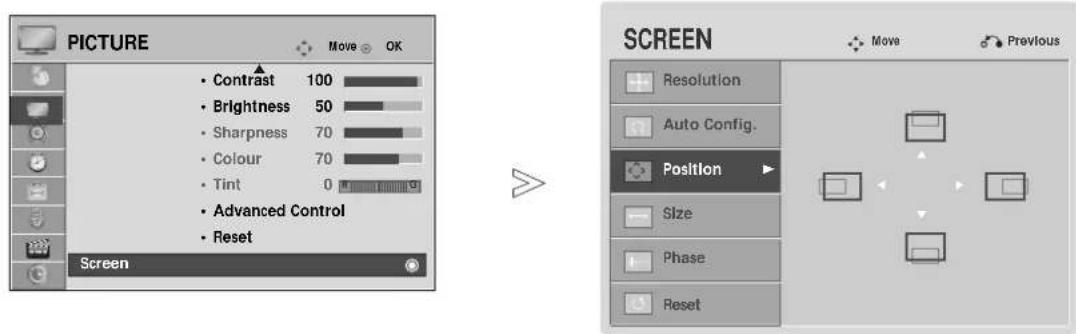
Adjustment for screen Position, Size, Phase
If the picture is not clear after auto adjustment and especially if characters are still trembling, adjust the picture phase manually.
This function works in the following mode: RGB[PC].
text_image
PICTURE • Contrast 100 • Brightness 50 • Sharpness 70 • Colour 70 • Tint 0 • Advanced Control • Reset Screen SCREEN Move OK → Balance Resolution Auto Config. Position Size Phase Reset
Select PICTURE.

Select Screen.

Select Position, Size or Phase.

Make appropriate adjustments.
- Press the MENU button to return to normal TV viewing.
- Press the RETURN button to move to the previous menu screen.
EXTERNAL EQUIPMENT SETUP
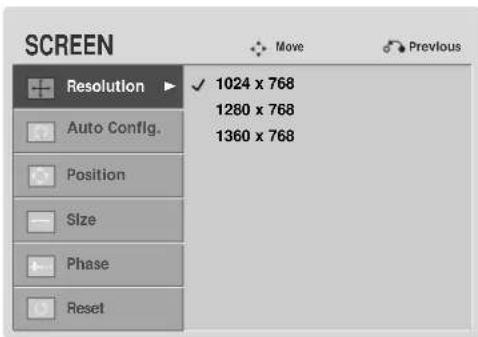
Selecting Resolution
To view a normal picture, match the resolution of RGB mode and selection of PC mode.
This function works in the following mode: RGB[PC]

text_image
PICTURE • Contrast 100 • Brightness 50 • Sharpness 70 • Colour 70 • Tint 0 • Advanced Control • Reset Screen
text_image
SCREEN Resolution ▶ Auto Config. Position Size Phase Reset Move Previous ✓ 1024 x 768 1280 x 768 1360 x 768
Select PICTURE.

Select Screen.
Select Resolution.

Select the desired resolution.
- Press the MENU button to return to normal TV viewing.
- Press the RETURN button to move to the previous menu screen.
Auto Configure (RGB [PC] mode only)
Automatically adjusts picture position and minimizes image instability. After adjustment, if the image is still not correct, your TV is functioning properly but needs further adjustment.
Auto configure
This function is for automatic adjustment of the screen position, size, and phase The displayed image will be unstable for a few seconds while the auto configuration is in progress.
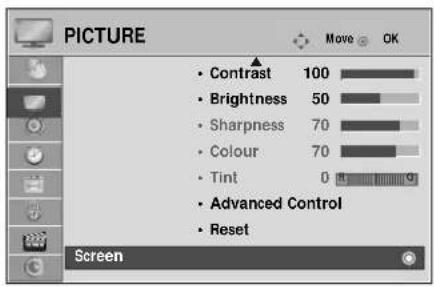
text_image
PICTURE • Contrast 100 • Brightness 50 • Sharpness 70 • Colour 70 • Tint 0 • Advanced Control • Reset Screen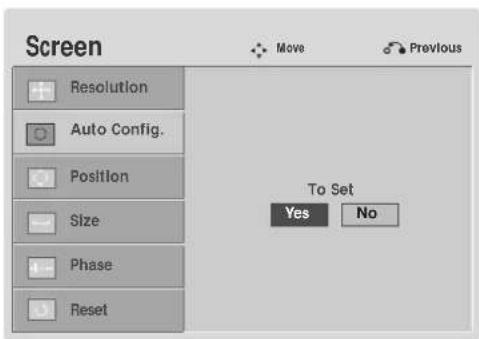
text_image
Screen Resolution Auto Config. Position Size Phase Reset Move Previous To Set Yes No
Select PICTURE.

Select Screen.
Select Auto Config..
Select Yes.

Run Auto Config-
- If the position of the image is still not correct, try Auto adjustment again.
- If picture needs to be adjusted again after Auto adjustment in RGB (PC), you can adjust the Position, Size or Phase.
-
Because the image with the black background may fail the auto adjustment, use the image with the bright background.
-
Press the MENU button to return to normal TV viewing.
- Press the RETURN button to move to the previous menu screen.
WATCHING TV / PROGRAMME CONTROL
REMOTE CONTROL KEY FUNCTIONS
When using the remote control, aim it at the remote control sensor on the TV.

text_image
TV/STB Select the remote operating mode: TV, or STB. POWER Switches the TV on from standby or off to standby. INPUT External input mode rotate in regular sequence. Switches the TV on from standby. (p.42) TV/RAD Selects Radio, TV and DTV channel. Q. MENU Select the desired quick menu source. (Aspect Ratio, Clear Voice II, Picture Mode, Sound Mode, Multi Audio, Sleep Timer, Favourite, Remove USB device.) (p.27) MENU Selects a menu. Clears all on-screen displays and returns to TV viewing from any menu. (p.28) GUIDE Shows programme schedule. (p.49) VOLUME UP Adjusts the volume. /DOWN MARK Check and un-check programmes in the USB menu or Recorded TV menu. FAV Displays the selected favourite programme. (p.40) MUTE Switches the sound on or off. Programme Selects a programme. UP/DOWN PAGE Move from one full set of screen information to the next one. UP/DOWN CHAR/NUM, Used to edit programme title in Recorded TV and schedule list. DELETE 0~9 number Selects a programme. button/ Selects numbered items in a menu. Use for character/number input. LIST Displays the programme table. (p.39) Q.VIEW Returns to the previously viewed programme.
text_image
TV POWER INPUT STB Q. MENU MENU TV/RAD GUIDE Time Machine TIME SHIFT OK TIME SHIFT RECORD STOPRETUF EXIT LIVE MARK FAV CHAR/NUM PAGE MUTE DELETE 1 2 ABC 3 DEF 4 GHI 5 JKL 6 MNO 7 PQRS 8 TUV 9 WAYZ LIST 0 Q.VIEW REPEAT INFO® TEXT T.OPT SUBTITLE RATIO AV MODE ENERGY SAVINGTHUMBSTICK Allows you to navigate the on-screen menus and adjust (Up/Down/Left/ the system settings to your preference.
Right) Arrow buttons.
OK Accepts your selection or displays the current mode.
Time Machine ◀◀ (Rewind), ▶▶ (Fast Forward), ▶ (Playback), Ⅱ(Pause), control buttons <, > (Jump thumbnail) (Freezes the current frame by pressing theⅡ(Pause) button.)
RETURN(EXIT) Allows the user to move return one step in an interactive application or other user interaction function.
RECORD Selects button to record the watching programme or make recording schedules.
STOP Stops processing of time machine function. (Playback, Record, etc)
LIVE Return to the live.
Coloured These buttons are used for teletext (onTELETEXT buttons models only), Programme edit, Multimedia, Guide, Schedule list.
REPEAT Used for playing the Recorded TV function.
1 TELETEXT These buttons are used for teletext. BUTTONS For further details, see the 'Teletext' section. (p.115)
SUBTITLE Recalls your preferred subtitle in digital mode.
INFO ⓘShows the present screen information.
Simplink See a list of AV devices connected to TV. When you toggle this button, the Simplink menu appears at the screen.(▶ p.43)
RATIO Selects your desired picture format.
AV MODE It helps you select and set images and sounds when connecting AV devices.(▶ p.46)
ENERGY SAVING Adjust the Energy Saving mode of the TV. (p.85)
Installing Batteries

natural_image
Illustration of two hands holding a mechanical component with an arrow indicating downward motion (no text or symbols)- Open the battery compartment cover on the back and install the batteries matching correct polarity (+with +,-with -).
■ Install two 1.5V AAA batteries. Do not mix old or used batteries with new ones. - Close cover.
WATCHING TV / PROGRAMME CONTROL
TURNING ON THE TV
- When your TV is turned on, you will be able to use its features.
1 Firstly, connect the power cord correctly and check the main power on the TV. At this stage, the TV switches to standby mode.
2 In standby mode to turn TV on, press the ⏻/ I, INPUT or P ▲ ▼ button on the TV or press the POWER, INPUT, P ∧ ∨ or NUMBER button on the remote control and the TV will switch on.
Initializing setup
If the OSD (On Screen Display) is displayed on the screen after turning on the TV, you can adjust the Mode Setting, Time Zone, Auto Tuning.
Note:
a. If you close without completing the initial setting, the Initial Setting menu can be displayed again.
b. Press the RETURN button to change the current OSD to the previous OSD.
c. For those countries without confirmed DTV broadcasting standards, some DTV features might not work, depending on the DTV broadcasting environment.
d. "Home Use" mode is the optimal setting for home environments, and is the TV's default mode.
e. "Store Demo" mode is the optimal setting for store environments. If a user modifies image quality data, "Store Demo" mode initializes the product to the image quality set by us after a certain period of time.
f. The mode (Home Use, Store Demo) can be changed by executing Mode Setting in the OPTION menu.
NOTE
If the TV is unplugged once or turn off with the ⏻ I(power) button on the TV, the time setting is set to Auto to set time automatically.
PROGRAMME SELECTION
1 Press the P ^ ∨ or NUMBER buttons to select a programme number.
VOLUME ADJUSTMENT
1 Press the + or - button to adjust the volume.
If you wish to switch the sound off, press the MUTE button.
You can cancel this function by pressing the MUTE, + , - or AV Mode button.
QUICK MENU
Your TV's OSD (On Screen Display) may differ slightly from that shown in this manual.
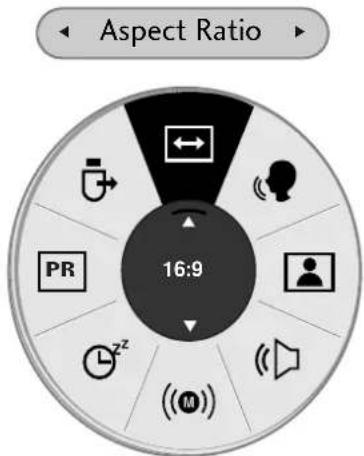
Q.Menu (Quick Menu) is a menu of features which users might use frequently.

Aspect Ratio: Selects your desired picture format. For Zoom Setting, select 14:9, Zoom or Cinema Zoom in Ratio Menu. After completing Zoom Setting, the display goes back to Q.Menu.

Clear Voice II: By differentiating the human sound range from others, it helps make human voices sound better.

Picture Mode: Selects the factory preset picture depend on the viewing environment.

Sound Mode: Selects the factory preset sound for type of programme.

Multi Audio: Selects the sound output.

Sleep Timer: Select the amount of time before your TV turns off automatically.

Favourite : Selects the favourite programme.

Remove USB device: Selects the remove USB device menu to detach safely a USB device from the TV.
text_image
Aspect Ratio 16:9

Display each menu.

Select your desired Source.
- Press the Q.MENU button to return to normal TV viewing.
WATCHING TV / PROGRAMME CONTROL
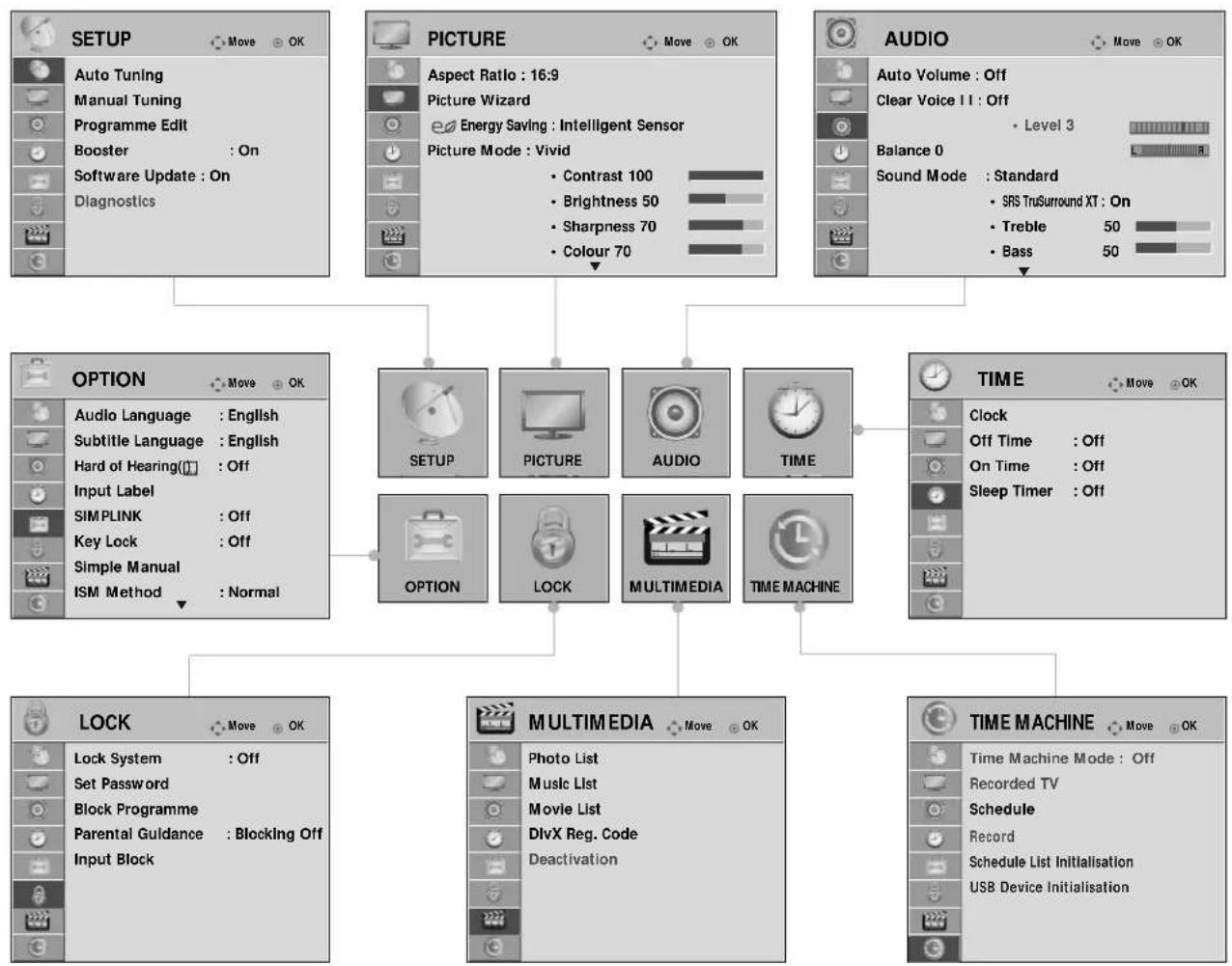
ON-SCREEN MENUS SELECTION AND ADJUSTMENT
Your TV's OSD (On Screen Display) may differ slightly from that shown in this manual.
flowchart
graph TD
    A["SETUP"] --> B["Auto Tuning"]
    A --> C["Manual Tuning"]
    A --> D["Programme Edit"]
    A --> E["Booster : On"]
    A --> F["Software Update : On"]
    A --> G["Diagnostics"]
    H["PICTURE"] --> I["Aspect Ratio : 16:9"]
    H --> J["Picture Wizard"]
    H --> K["Energy Saving : Intelligent Sensor"]
    H --> L["Picture Mode : Vivid"]
    H --> M["Contrast 100"]
    H --> N["Brightness 50"]
    H --> O["Sharpness 70"]
    H --> P Colour 70
    Q["AUDIO"] --> R["Auto Volume : Off"]
    Q --> S["Clear Voice II : Off"]
    Q --> T["Balance 0"]
    Q --> U["Sound Mode : Standard"]
    Q --> V["SRS TruSurround XT : On"]
    Q --> W["Treble 50"]
    Q --> X["Bass 50"]
    Y["OPTION"] --> Z["Audio Language : English"]
    Y --> AA["Subtitle Language : English"]
    Y --> AB["Hard of Hearing(□) : Off"]
    Y --> AC["Input Label"]
    Y --> AD["SIMPLINK : Off"]
    Y --> AE["Key Lock : Off"]
    Y --> AF["Simple Manual"]
    Y --> AG["ISM Method : Normal"]
    AH["TIME"] --> AI["Clock"]
    AH --> AJ["Off Time : Off"]
    AH --> AK["On Time : Off"]
    AH --> AL["Sleep Timer : Off"]
    AM["LOCK"] --> AN["Lock System : Off"]
    AM --> AO["Set Password"]
    AM --> AP["Block Programme"]
    AM --> AQ["Parental Guidance : Blocking Off"]
    AM --> AR["Input Block"]
    AS["MULTIMEDIA"] --> AT["Photo List"]
    AS --> AU["Music List"]
    AS --> AV["Movie List"]
    AS --> AW["DivX Reg. Code"]
    AS --> AX["Deactivation"]
    AY["TIME MACHINE"] --> AZ["Time Machine Mode : Off"]
    AY --> BA["Recorded TV"]
    AY --> BB["Schedule"]
    AY --> BC["Record"]
    AY --> BD["Schedule List Initialisation"]
    AY --> BE["USB Device Initialisation"]

Display each menu.

Select a menu item.
Move to the pop up menu.
- Press the INFO button, you can check the Simple Manual.
- Press the MENU button to return to normal TV viewing.
- Press the RETURN button to move to the previous menu screen.
AUTO PROGRAMME TUNING
Use this to automatically find and store all available programmes.
When you start auto programming, all previously stored service information will be deleted.
The maximum number of programmes that can be stored is 400. But the number may differ slightly depending on broadcasting signals.
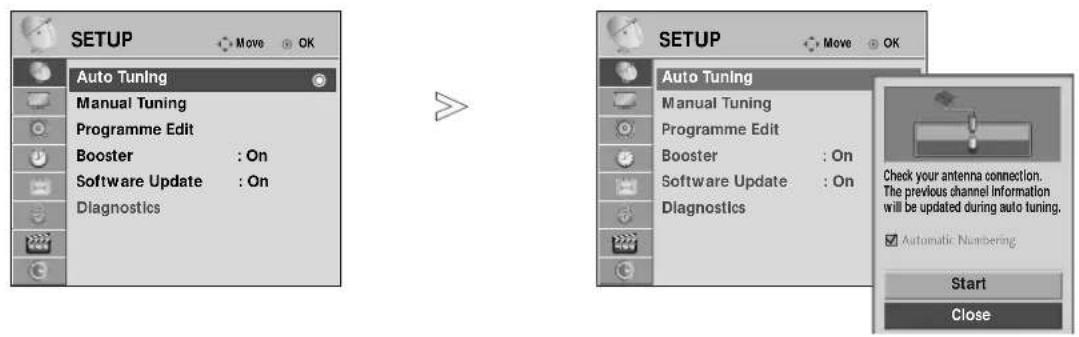

Select SETUP.

Select Auto Tuning.

Select Start.
Run Auto Tuning.
- Use NUMBER buttons to input a 4-digit password in Lock System 'O©.nn
-
If you wish to keep on auto tuning select Start using the ^ ∨ button. Then, press the OK button. Otherwise select Close.
• Automatic Numbering: Decide whether to use the programme numbers as sent by broadcasting stations for tuning. -
Press the MENU button to return to normal TV viewing.
- Press the RETURN button to move to the previous menu screen.
WATCHING TV / PROGRAMME CONTROL
MANUAL PROGRAMME TUNING (IN DIGITAL MODE)
Manual Tuning lets you manually add a programme to your programme list.
When selecting DTV input signal, you can view the on-screen signal strength monitor to see the quality of the signal being received.
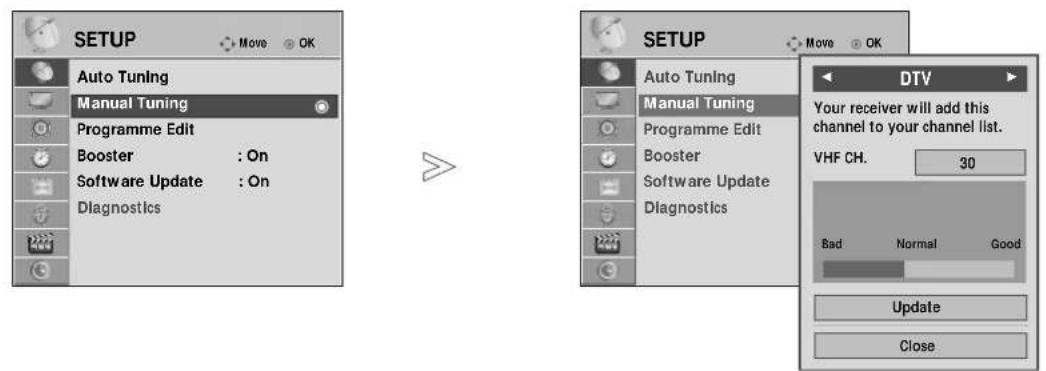
text_image
SETUP Auto Tuning Manual Tuning Programme Edit Booster : On Software Update : On Diagnostics SETUP Auto Tuning Manual Tuning Programme Edit Booster Software Update Diagnostics DTV Your receiver will add this channel to your channel list. VHF CH. 30 Bad Normal Good Update Close
Select SETUP.

Select Manual Tuning.

Select DTV.

Select the desired channel number.

Update.
- Use NUMBER buttons to input a 4-digit password in Lock System 'O'n
- Press the MENU button to return to normal TV viewing.
- Press the RETURN button to move to the previous menu screen.
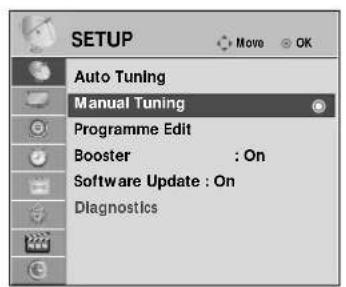
MANUAL PROGRAMME TUNING (IN ANALOGUE MODE)
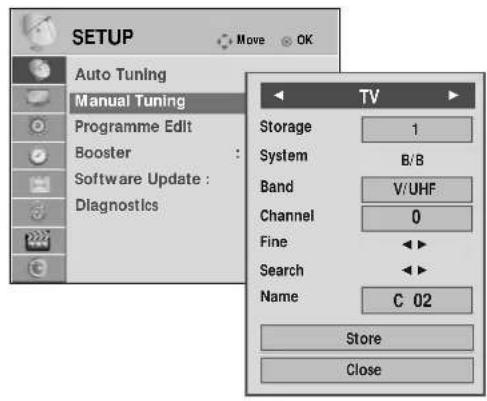
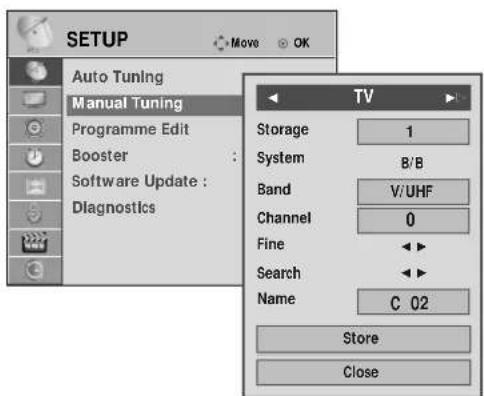
Manual Tuning lets you manually tune and arrange the stations in whatever order you desire.

text_image
SETUP Auto Tuning Manual Tuning Programme Edit Booster : On Software Update : On Diagnostics
text_image
SETUP Auto Tuning Manual Tuning Programme Edit Booster Software Update : Diagnostics TV Storage 1 System B/B Band V/UHF Channel 0 Fine Search Name C 02 Store Close
Select SETUP.

Select Manual Tuning
Select TTV

or

Select the desired pro- gramme number on.

Select V/UHF or Cable.

or

Select the desired channel number.

Commence searching.
Select Store.
- Press the MENU button to return to normal TV viewing.
-
Press the RETURN button to move to the previous menu screen.
-
Use NUMBER buttons to input a 4-digit password in Lock System 'On'
• To store another channel, repeat steps 4 to 9.
WATCHING TV / PROGRAMME CONTROL
text_image
SETUP Auto Tuning Manual Tuning Programme Edit Booster : On Software Update : On Diagnostics
text_image
SETUP Auto Tuning Manual Tuning Programme Edit Booster Software Update : Diagnostics TV Storage 1 System B/B Band V/UHF Channel 0 Fine Search Name C 02 Store Close■ Assigning a station name
You can assign a station name with five characters to each programme number.
Select SETUP.

Select Manual Tuning.

Select TT.VV
Select Name.
Select the position and make your choice of the second character, and so on.
You can use an the alphabet A to Z, the number 0 to 9, +/ -, and blank.
Select Close.
Select Store.
■ Fine Tuning
Normally fine tuning is only necessary if reception is poor.

Select SETUP.

Select Manual Tuning.

Select TT.VV
Select Fine.

Fine tune for the best picture and sound.
Select Store.
- Press the MENU button to return to normal TV viewing.
- Press the RETURN button to move to the previous menu screen.
PROGRAMME EDIT
When a programme number is skipped, it means that you will be unable to select it using P ∧ ∨ button during TV viewing.
If you wish to select the skipped programme, directly enter the programme number with the NUMBER buttons or select it in the Programme edit menu.
This function enables you to skip the stored programmes.
You can change the programme number using "Move" function, if "Automatic Numbering" is unchecked when you start Auto Tuning.

text_image
SETUP Auto Tuning Manual Tuning Programme Edit Booster : On Software Update : On Diagnostics 1 TEN Digital DTV RADIO TV 1 TEN Digital 2 ABC TV Sydney 7 7 Digital 9 Nine Digital 10 TEN Digital 11 TEN Guide 12 TEN HD 20 ABC HDTV 21 ABC2 22 ABC TV 70 7 HD Digital 71 7 Digital 1 72 7 Digital 2 73 7 Digital 3 77 7 Guide 90 Nine Digital HD Pr. Change Navigation Page Change Previous Skip
text_image
1 MENU Select SETUP.
text_image
2 OK Select Programme Edit.
text_image
3 OK Enter the Programme Edit.
text_image
4 Select a programme to be stored or skipped.- Press the MENU button to return to normal TV viewing.
- Press the RETURN button to move to the previous menu screen.
WATCHING TV / PROGRAMME CONTROL
IN DTV/RADIO MODE
■ Skipping a programme number

Select a programme number to be skipped.

Turn the programme number to blue.

Release.
- When programmes are to be skipped, the skipped programme shows in blue and these programmes will not be selected by the P?^√ buttons during TV viewing.
- If you wish to select a skipped programme, directly enter the programme number with the NUMBER buttons or select it in the programme edit or EPG.
IN TV MODE
This function enables you to delete or skip the stored programmes. You can also move some channels and use other programme numbers.
■ Deleting a programme

Select a programme number to be deleted.

Turn the programme number to red.

Delete.

Release.
- The selected programme is deleted, all the following programmes are shifted up one
■ Moving a programme

Select a programme number to be moved.


Turn the programme number to green.

Release.
■ Skipping a programme number

Select a programme number to be skipped.

Turn the programme number to blue.

Release.
- When a programme number is skipped it means that you will be unable to select it using the P ^ ∨ button during normal TV viewing.
- If you wish to select a skipped programme, directly enter the programme number with the NUMBER buttons or select it in the programme edit or EPG.
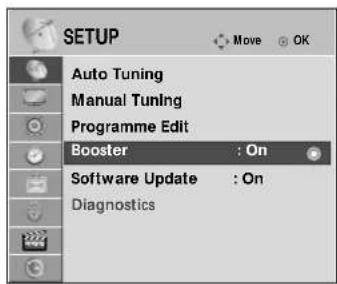
BOOSTER
If reception is poor select Booster to On.
When the signal is strong, select "Off".
text_image
SETUP Auto Tuning Manual Tuning Programme Edit Booster : On Software Update : On Diagnostics

text_image
SETUP Auto Tuning Manual Tuning Programme Edit Booster Software Update Diagnostics Off On
Select SETUP.

Select Booster.

Select On or Off.

Save.
- Press the MENU button to return to normal TV viewing.
- Press the RETURN button to move to the previous menu screen.
WATCHING TV / PROGRAMME CONTROL
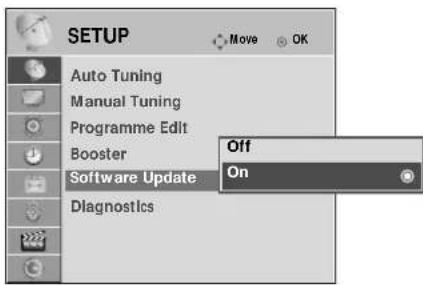
SOFTWARE UPDATE
Software Update means software can be downloaded through the digital terrestrial broadcasting system.

text_image
SETUP Auto Tuning Manual Tuning Programme Edit Booster : On Software Update : On Diagnostics
text_image
SETUP Auto Tuning Manual Tuning Programme Edit Booster Software Update Diagnostics Off On
Select SETUP.

Select Software Update.

Select On or Off.
- If you select On, a user confirm message box will be displayed to notify that new software is found.
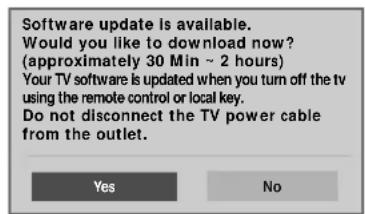
\* When setting "Software Update"
Occasionally, a transmission of updated digital software information will result in the following menu on the TV screen.
text_image
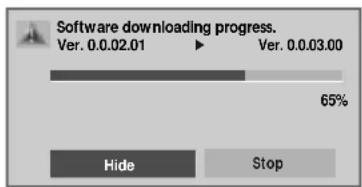
Software update is available. Would you like to download now? (approximately 30 Min ~ 2 hours) Your TV software is updated when you turn off the tv using the remote control or local key. Do not disconnect the TV power cable from the outlet.Select the Yes using the < > button and you will see the following picture.
text_image
Software downloading progress. Ver. 0.0.02.01 ▶ Ver. 0.0.03.00 65% Hide StopAfter the Software Update is complete, the System restarts.
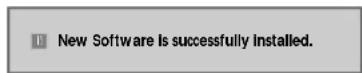
When the power is turned off, downloading starts. When the power is turned on while updating, the progress status is displayed.
- During Progress of a Software Update, please note the following:
- Power to the TV must not be interrupted.
- The TV must not be switched off.
- The antenna must not be disconnected.
- After Software Update, you can confirm the updated software version in Diagnostics menu.
- It may take hours to download the software, so make sure that the power stays on during the download.
WATCHING TV / PROGRAMME CONTROL
DIAGNOSTICS
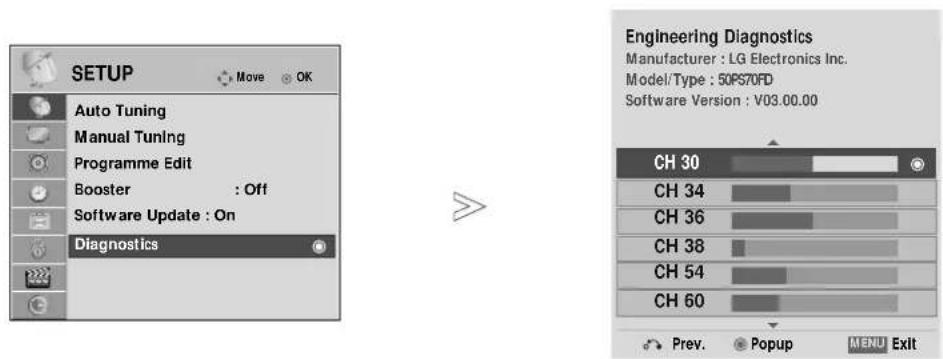
This function enables you to view information on the Manufacturer, Model/Type, Serial Number and Software Version.
This displays the information and signal strength of the tuned *MUX.
This displays the signal information and service name of the selected MUX.
(*MUX: A higher directory of channels in digital broadcasting (a single MUX contains multiple channels.))
text_image
SETUP Auto Tuning Manual Tuning Programme Edit Booster : Off Software Update : On Diagnostics Engineering Diagnostics Manufacturer : LG Electronics Inc. Model/Type : 50PS70FD Software Version : V03.00.00 CH 30 CH 34 CH 36 CH 38 CH 54 CH 60 Prev. Popup MENU Exit
Select SETUP.

Select Diagnostics.

Display Manufacturer, Model/Type and Software Version.

Display the information of Channel.
- Press the MENU button to return to normal TV viewing.
- Press the RETURN button to move to the previous menu screen.
SELECTING THE PROGRAMME LIST
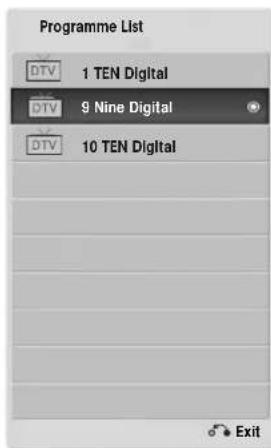
You can check which programmes are stored in the memory by displaying the programme table

Displayed when the Locked Programme.
text_image
Programme List DTV 1 TEN Digital DTV 9 Nine Digital DTV 10 TEN Digital Exit■ Displaying programme LIST

Display the Programme List.
- You may find some blue programmes. These have been set up to be skipped in the programme edit mode.
- Some programmes with the channel number shown in the programme LIST indicate there is no station name assigned.
■ Selecting a programme in the programme list

Select a programme.

From the programme you are currently watching, the mode will change from TV to DTV to Radio.
Switch to the chosen programme number.
■ Paging through a programme list
Turn the pages.

Return to normal TV viewing.
WATCHING TV / PROGRAMME CONTROL
FAVOURITE PROGRAMME SETUP
■ Selecting favourite programme
Your TV's OSD (On Screen Display) may differ slightly from what is shown in this manual.
Favourite programmes is a convenient feature that lets you quickly scan up to programmes of your choice without having to wait for the TV to scan through all the in-between programmes.

text_image
Favorite PR Off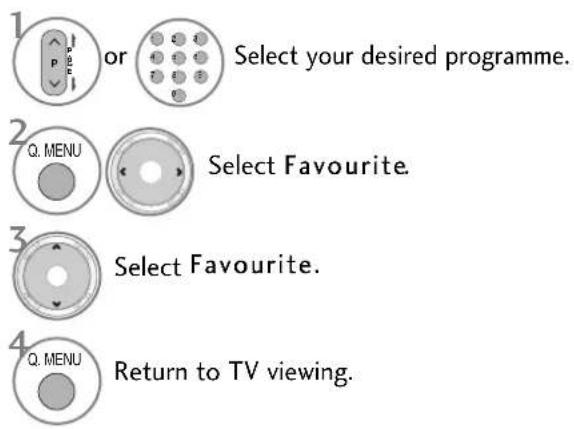
text_image
1 or Select your desired programme. 2 Q. MENU Select Favourite. 3 Select Favourite. 4 Q. MENU Return to TV viewing.- This will automatically include the selected programme into your favourite programme list.
■ Displaying the favourite programme list

text_image
Favourite List DTV 1 ABC TV Sydney DTV 9 Nine digital DTV 11 ABC TV Exit
Display the Favourite Programme List.
BRIEF INFORMATION
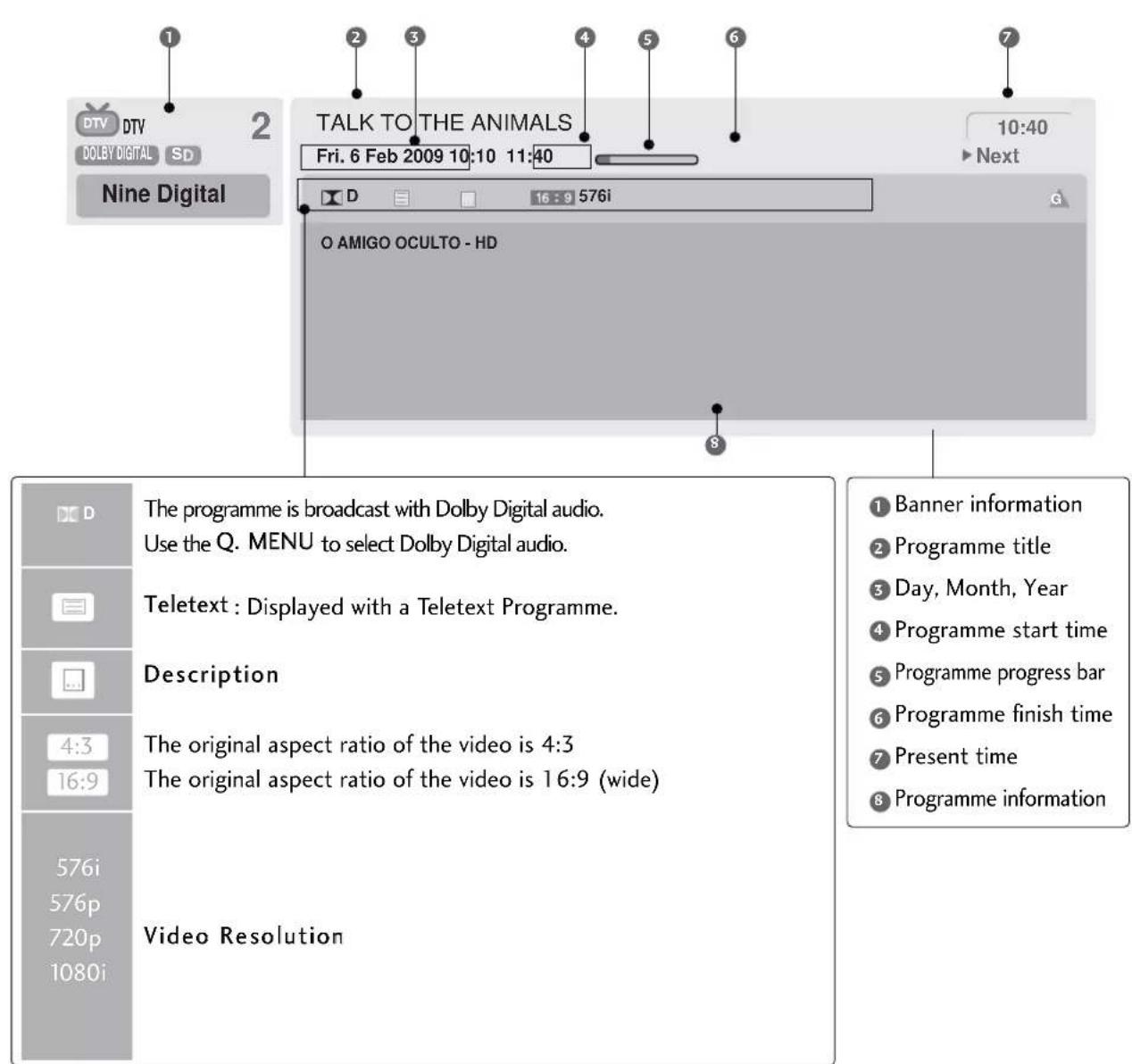
Brief Info shows the present screen information.

Show the Brief Info on the screen.
text_image
DTV DTV DOLBY DIGITAL SD Nine Digital TALK TO THE ANIMALS Fri. 6 Feb 2009 10:10 11:40 O AMIGO OCULTO - HD 10:40 Next D 16:3 576i The programme is broadcast with Dolby Digital audio. Use the Q. MENU to select Dolby Digital audio. Teletext : Displayed with a Teletext Programme. Description The original aspect ratio of the video is 4:3 The original aspect ratio of the video is 16:9 (wide) 576i 576p 720p 1080i Video Resolution ① Banner information ② Programme title ③ Day, Month, Year ④ Programme start time ⑤ Programme progress bar ⑥ Programme finish time ⑦ Present time ⑧ Programme information- Press the RETURN button to return to normal TV viewing.
WATCHING TV / PROGRAMME CONTROL
INPUT LIST
HDMI can be recognized by a detect pin and thus enabled only when an external device approves voltage.
And AV, Componet, RGB can be recognized when an external device is connected.
By using TV/RAD button, you can move from External Input to RF Input and to the last watched programme in DTV/RADIO/TV mode.
Select the input source.

flowchart
graph LR
    A["Antenna"] --> B["AV1"]
    B --> C["AV2"]
    C --> D["Component1"]
    D --> E["Component2"]
    F["HDMI4"] --> G["HDMI3"]
    G --> H["HDMI2"]
    H --> I["HDMI1"]
    I --> J["RGB"]
- Antenna: Select it when watching the DTV/RADIO/TV.
- AV1, AV2: Select it when watching the VCR or external equipment.
- Component1, Component2: Select it when using the DVD or the Digital set-top box depends on connector.
- RGB :Select it when using PC depends on connector.
- HDMI1, HDMI2, HDMI 3, HDMI4 : Select it when using DVD, PC or Digital set-top box depend on connector.

MPLINK
This function operates only with devices with the SIMPLINK logo.
Please check the SIMPLINK logo.
This TV might not function properly when using it with other products with HDMI-CEC function.
This allows you to control and play other AV devices connected to the display through HDMI cable without additional cables and settings.
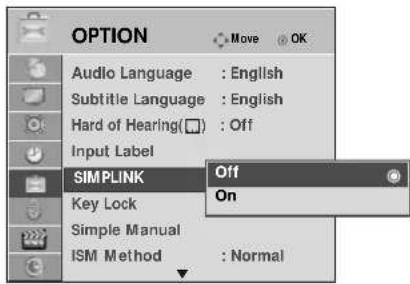
If you do not want SIMPLINK menu, select "Off".

text_image
OPTION Audio Language : English Subtitle Language : English Hard of Hearing(□) : Off Input Label SIMPLINK : Off Key Lock : Off Simple Manual ISM Method : Normal
text_image
OPTION Audio Language : English Subtitle Language : English Hard of Hearing(□) : Off Input Label SIMPLINK Off Key Lock On Simple Manual ISM Method : Normal
Select OPTION.

Select SIMPLINK.
Select On or Off.

Save.
- Press the MENU button to return to normal TV viewing.
- Press theRETURN button to move to the previous menu screen.
SIMPLINK Functions
Disc playback
Control connected AV devices by pressing the ,OK, < >

Direct Play
After connecting AV devices to the TV, you can directly control the devices and play media without additional settings.
Select AV device
Enables you to select one of the AV devices connected to the TV and operate it.
Power off all devices
When you switch off the TV, all connected devices are turned off.
Switch audio-out
Offers an easy way to switch audio-out.
Sync Power on
When the equipment with Simplink function connected HDMI terminal starts to play, The TV will change automatically to turn on mode.
* A device, which is connected to the TV through an HDMI cable but does not support SIMPLINK, does not provide this function.
Note: To operate SIMPLINK, an HDMI cable over Version 1.3 with *CEC function should be used. (*CEC: Consumer Electronics Control).
WATCHING TV / PROGRAMME CONTROL
Connecting to Home Theatre with the SIMPLINK logo.
1 Connect the HDMI/DVI IN 1, HDMI IN 2, HDMI IN 3 or HDMI IN 4 terminal on the back of the TV and the HDMI output terminal of the Home Theatre using HDMI cables.
2 Connect the Digital Audio output terminal on the back of the TV and the Digital Audio input terminal of the Home Theatre using optical cables.
3 Select Home Theatre in the Speaker menu by pushing the SIMPLINK button.
▶ When you select or operate a media device with home theatre-function, the speaker automatically switches to home theatre speaker (HT speaker).

flowchart
graph TD
    A["1 HDMI IN"] --> B["2 HDMI OUT"]
    B --> C["3 3.25 VIDE"]
    C --> D["4 4.00V"]
    D --> E["5 5.00V"]
    E --> F["6 6.00V"]
    F --> G["7 7.00V"]
    G --> H["8 8.00V"]
    H --> I["9 9.00V"]
    I --> J["10 10.00V"]
    J --> K["11 11.00V"]
    K --> L["12 12.00V"]
    L --> M["13 13.00V"]
    M --> N["14 14.00V"]
    N --> O["15 15.00V"]
    O --> P["16 16.00V"]
    P --> Q["17 17.00V"]
    Q --> R["18 18.00V"]
    R --> S["19 19.00V"]
    S --> T["20 20.00V"]
    T --> U["21 21.00V"]
    U --> V["22 22.00V"]
    V --> W["23 23.00V"]
    W --> X["24 24.00V"]
    X --> Y["25 25.00V"]
    Y --> Z["26 26.00V"]
    Z --> AA["27 27.00V"]
    AA --> AB["28 28.00V"]
    AB --> AC["29 29.00V"]
    AC --> AD["30 30.00V"]
NOTE
Connect the HDMI/DVI IN or HDMI IN terminal of the TV to the rear terminal (HDMI terminal) of the SIMPLINK device with the HDMI cable.
▶ When you switch the Input source using the INPUT button on the remote control, you can stop the operation of a device controlled by SIMPLINK.
SIMPLINK Menu
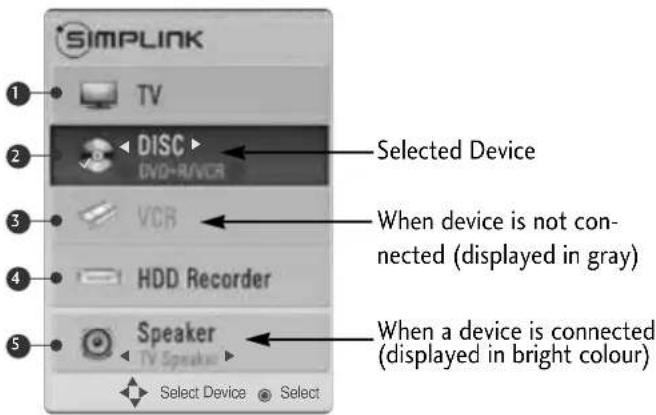
Press the ^ ∨ < > button and then OK button to select the desired SIMPLINK source.
TV viewing : Switch to the previous TV programme regardless of the current mode.
② DISC playback : Select and play connected discs. When multiple discs are available, the titles of discs are conveniently displayed at the bottom of the screen.
③ VCR playback : Play and control the connected VCR.
4 HDD Recordings playback : Play and control recordings stored in HDD.
5 Audio Out to Home theatre/Audio Out to TV: Select Home theatre or TV speaker for Audio Out.
text_image
SIMPLINK TV DISC DVD/RVCR Selected Device When device is not connected (displayed in gray) VCR HDD Recorder Speaker TV Speaker Select Device Select When a device is connected (displayed in bright colour)• Home theatre: Only one supported at a time
• DVD, Recorder: Up to four supported at a time
• VCR: Only one supported at a time
INPUT LABEL
You can set a label for each input source when it's not in use.
Available label: VCR -> DVD -> Set Top Box -> Satellite -> Cable Box -> Game -> PC -> HD-DVD -> Blu-ray.

text_image
OPTION Audio Language : English Subtitle Language : English Hard of Hearing(□) : Off Input Label SIMPLINK : Off Key Lock : Off Simple Manual ISM Method : Normal

text_image
OPTION Audio Language : English Subtitle Language : English Hard of Hearing(□) : Off Input Label SIMPLINK : Off Key Lock : Off Simple Manual ISM Method ▼ : Norma AV1 AV2 Component1 Component2 RGB HDMI1 HDMI2 HDMI3 HDMI4 Close
Select OPTION.

Select Input Label.

Select the source.

Select the label.
- Press the MENU button to return to normal TV viewing.
- Press the RETURN button to move to the previous menu screen.
WATCHING TV / PROGRAMME CONTROL
AV MODE
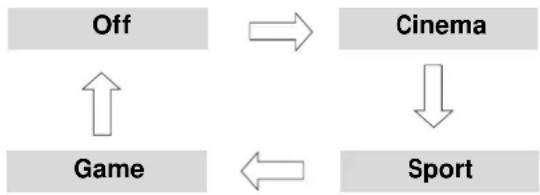
You can select the optimal images and sounds when connecting AV devices to external input.
Off Disables the AV MODE.
Cinema Optimizes video and audio for watching movies.
Sport Optimizes video and audio for watching sports events.
Game Optimizes video and audio for playing games.
flowchart
graph TD
    A["Off"] --> B["Cinema"]
    B --> C["Sport"]
    C --> D["Game"]
    D --> A
Press the AV MODE button repeatedly to select the desired source.

- If you select Cinema in AV mode, Cinema will be selected both for Picture Mode and Sound Mode in PICTURE menu and AUDIO menu respectively.
- If you select "Off" in AV mode, the picture and image which you initially set will be selected.
SIMPLE MANUAL
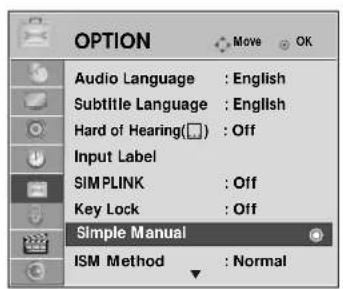
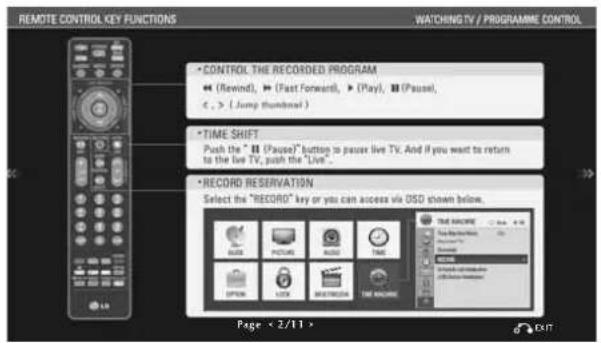
You can easily and effectively access the TV information by viewing a simple manual on the TV.
During the Simple Manual operation, audio will be muted.
text_image
OPTION Audio Language : English Subtitle Language : English Hard of Hearing(□) : Off Input Label SIMPLINK : Off Key Lock : Off Simple Manual ISM Method : Normal
text_image
REMOTE CONTROL KEY FUNCTIONS WATCHING TV / PROGRAMME CONTROL •CONTROL THE RECORDED PROGRAM ◀ (Rewind), ▶ (Fast Forward), ▶ (Play), ■ (Pause), < , > (. Jump thunderball ) •TIME SHIFT Push the " ■ (Pause)" button to pause live TV. And if you want to return to the live TV, push the "Live". •RECORD RESERVATION Select the "RECORD" key or you can access via DSO shown below. Page < 2/11 > EXIT
Select OPTION.

Select Simple Manual.
Select the part of the manual you want to see.
- Press the RETURN button to return to normal TV viewing.
WATCHING TV / PROGRAMME CONTROL
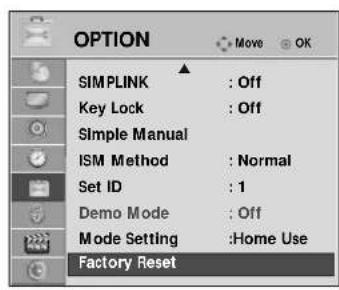
Initialising
(Reset to original factory settings)
This function initializes all settings.
It is useful to initialize the product or when you move to other city.
When the Factory Reset is completed, you must restart the Initializing setup.
When the Lock System menu is "OOn" the message to enter the password appears.
text_image
OPTION SIMPLINK : Off Key Lock : Off Simple Manual ISM Method : Normal Set ID : 1 Demo Mode : Off Mode Setting : Home Use Factory Reset

text_image
OPTION SIMPLINK : Off Key Lock : Off Simple Manu ISM Method Set ID Demo Mode Mode Setting :Home Use Factory Reset All user settings and channel settings will be reset. Still Continue? Yes No
Select OPTION.
- In Lock System "O n" if you forget your password, press '7', '7', '7', '7' on the remote control handset.

Select Factory Reset.

Select Yes.

Start Factory Reset.
- Press the MENU button to return to normal TV viewing.
- Press the RETURN button to move to the previous menu screen.
EPG (ELECTRONIC PROGRAMME GUIDE) (IN DIGITAL MODE)
EPG (ELECTRONIC PROGRAMME GUIDE) (IN DIGITAL MODE)
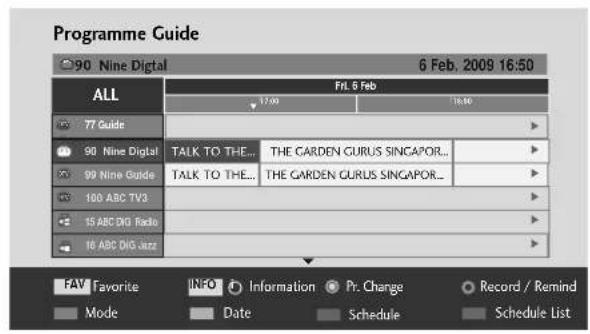
This system has an Electronic Programme Guide (EPG) to help your navigation through all the possible viewing options.
The EPG supplies information such as programme listings, start and end times for all available services. In addition, detailed information about the programme is often available in the EPG (the availability and amount of these programme details will vary, depending on the particular broadcaster).
This function can be used only when the EPG information is broadcast by broadcasting companies
The EPG displays the programme details for next 8 days.
text_image
Programme Guide 90 Nine Digital 6 Feb, 2009 16:50 ALL Ftl. 6 Feb 17:00 18:00 77 Guide 90 Nine Digital TALK TO THE... THE GARDEN GURUS SINCAPOR... 99 Nine Guide TALK TO THE... THE GARDEN GURUS SINGAPOR... 100 ABC TV3 15 ABC DIG Radio 16 ABC DIG Jazz FAV Favorite INFO Information Pr. Change Record / Remind Mode Date Schedule Schedule List
text_image
Programme Guide 90 Nine Digital 6 Feb. 2009 16:50 ALL TTL 5 Feb 17:30 18:00 77 Guide TALK TO THE... THE 90 Nine Guide TALK TO THE... THE 100 ABC TV3 15 ABC DX Audio 18 ABC Dig Jazz TALK TO THE... 90 Nine Digital 6 Feb. 2009 16:30~17:00 Record Go to this PR. Close FAV Favorite INFO Inform Mode Date D / Remind Schedule List
Display the Programme Guide.

Select desired programme.
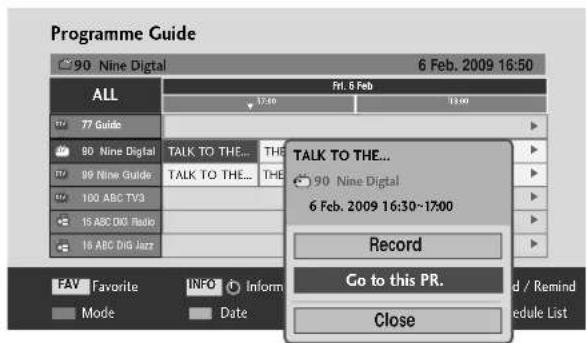
Show the Popup menu.
Select the desired Popup menu.
- If the TV is unplugged once or turn off with the (power) button on the TV, the reserved programme reminding will not work.
- When you press the YELLOW button from the currently broadcasting programme, 'Record', 'Go to this PR.', 'Close' will be displayed.
- When you press the YELLOW button from the programme after the current time that is not reserved, 'Record', 'Remind', 'Close' will be displayed.
- When you press the YELLOW button from the reserved programme reminding, 'Record', 'Cancel Remind', 'Close' will be displayed.
- When you press the YELLOW button from the reserved programme recording, 'Cancel Record', 'Remind', 'Close' will be displayed.
EPG (ELECTRONIC PROGRAMME GUIDE)(IN DIGITAL MODE)
Button Function in NOW/NEXT Guide Mode
Change EPG mode.

Move to schedule option popup.

Switch the Schedule list On or off.

Change Programme (Go to this Programme).

Change NOW&NEXT Mode.

Set Record/Remind.

Select the Broadcast Programme.

text_image
Programme Guide 90 Nine Digital 6 Feb, 2009 16:50 ALL Fri. 8 Feb 77 Guide 90 Nine Digital TALK TO THE... THE GARDEN CURUS SINGAPOR... 99 Nine Guide TALK TO THE... THE GARDEN CURUS SINGAPOR... 100 ABC TV3 15 ABC DIG Radio 16 ABC DIG Jazz FAV Favourite INFO Information Pr Change Record / Remind Mode Schedule Schedule List
Page Up/Down.

Switch off EPG.

The detail information on or off.

Change the favourite programme mode.
Button Function in 8Day Guide Mode

Change EPG mode.

Enter Date setting mode.

Move to schedule option popup.

Switch the Schedule list On or off.

Change Programme (Go to this Programme).

Select a Programme.

Select the Broadcast Programme.

Page Up/Down.

text_image
Programme Guide 90 Nine Digital 6 Feb. 2009 16:50 ALL 77 Guide 90 Nine Digital 99 Nine Guide 100 ABC TV3 16 ABC BIG Radio 16 ABC BIG Jazz FAT Favorite INFO Information Pt Change Record / Remind Mode Date Schedule Schedule List
Switch off EPG.

The detail information on or off.

Change the favourite programme mode.

Set Record/Remind.
Button Function in Date Change Mode

Switch off Date setting mode.

Select a date and change to the selected date.

Switch off EPG.
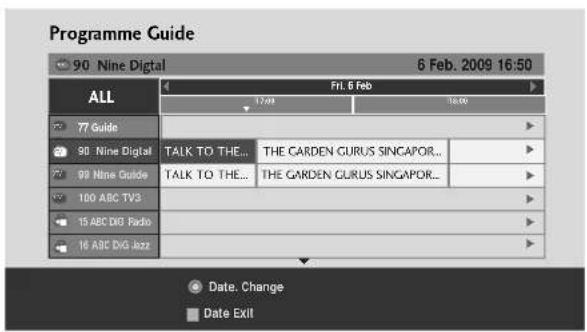
text_image
Programme Guide 90 Nine Digital 6 Feb. 2009 16:50 ALL 17/02 16:00 T7 Guide 90 Nine Digital TALK TO THE... THE GARDEN GURUS SINGAPOR... 90 Nine Guide TALK TO THE... THE GARDEN GURUS SINGAPOR... 100 ABC TV3 15 ABC DW Radio 16 ABC DW Jazz Date. Change Date ExitButton Function in Extended Description Box

Move to schedule option popup.

Text Up/Down.

Switch off EPG.

The detail information on or off.
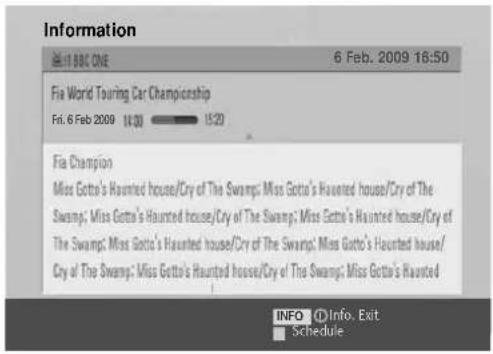
text_image
Information 11 BBC ONE 6 Feb. 2009 16:50 Fia World Touring Car Championship Fri. 6 Feb 2009 11:30 15:20 Fia Champion Miss Gotta's Haunted house/Cry of The Swamps; Miss Gotta's Haunted house/Cry of The Swamp; Miss Gotta's Haunted house/Cry of The Swamp; Miss Gotta's Haunted house/Cry of The Swamp; Miss Gotta's Haunted house/Cry of The Swamp; Miss Gotta's Haunted house/ Cry of The Swamp; Miss Gotta's Haunted house/Cry of The Swamp; Miss Gotta's Haunted INFO Info. Exit ScheduleButton Function in Schedule List Mode

Change to Guide mode.

Select Schedule list.

text_image
Schedule List Page1/1 Fri. 6 Feb. 2009 17:06 2009 02 Start Date Start Time Title Repeat Sun Mon Tue Wed Thu Fri Sat 1 2 3 4 5 6 7 8 9 10 11 12 13 14 15 16 17 18 19 20 21 22 23 24 25 26 27 28 Remind(Once) DTV 19 Nine Digital 6/2/2009(Fri.) 17:30 -18:00 6 Feb(Fri.) 16:00 Friend1 6 Feb(Fri.) 18:00 Friend2 Modify Delete Delete all Close Move Reservation Modify/Delete Page Change Exit Programme GuideTIME MACHINE
Precautions when using the USB device
▶ Only a USB storage device is recognizable.
▶ If the USB storage device is connected through a USB hub, the device is not recognizable.
▶ A USB storage device using an automatic recognition programme may not be recognized.
▶ A USB storage device which uses its own driver may not be recognized.
In case of a card reader, up to four memory cards are concurrently recognizable.
The recognition speed of a USB storage device may depend on each device.
Please do not unplug the power cord, turn off with the (power) button on the TV or with remote control or unplug the USB device when the connected USB storage device is working. When such device is suddenly separated or unplugged, the stored files or the USB storage device may be damaged.
▶ Only use a USB storage device which has normal music files, image files or movie files.
Please use only a USB storage device which was formatted as a FAT16, FAT32 or NTFS file system provided with the Windows operating system. In case of a storage device formatted as a different utility programme which is not supported by Windows, it may not be recognized.
▶ Please connect power to a USB storage device which requires an external power supply. If not, the device may not be recognized.
Please connect a USB storage device with cable is offered by USB maker. If connected with cable is not offered by USB maker or an excessively long cable, the device may not be recognized.
Some USB storage devices may not be supported or operate properly.
The TV will display up to 128 characters of a files name.
Please backup important files because data on USB device may be damaged. Data management is consumer's responsibility and as a result, the manufacturer does not cover data damage.
The recommended capacity is 1 TB or less for a USB external hard disk and 40GB or less for USB memory.
Any device with more than the recommended capacity may not work properly.
Playing a movie via a USB connection that doesn't support high speed may not work properly.
USB storage devices below USB 2.0 are supported as well. But they may not work properly in the movie list.
If the USB HDD does not have an external power source, the USB device may not be detected. So be sure to connect the external power source.
Please use a power adaptor for an external power source. We do not guarantee an USB cable for an external power source.
In case of USB HDD Having bad sector, Time Machine may not work.
Before removing the USB device, please use the Remove USB Device in Quick Menu to prevent software, data loss or damage to USB HDD.
Please maintain the stability of external HDD by using the HDD benchmarking tool in order to guarantee smooth action of HDD.
The HDD benchmarking tools is checking the performance of HDD that is read/write rate, access time, stability. It will be able to search at website and use easily it after download the HDD benchmarking tool.
TIME MACHINE(PAUSE & REPLAY OF LIVE TV)
This function allows the unit to automatically record live TV and make it available for viewing at any time.
With the Time Machine turned on, you may pause and rewind normal TV viewing at any time without missing any of the live broadcast.
(Time Machine and Recording functions may not work if the signal strength is weak.)
This function is only operated after initializing USB Device.
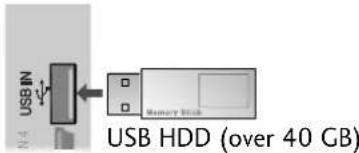
1 Connect the USB device to the USB IN jacks on the side(or back) of TV.
text_image
USB IN N.4 Memory Disk USB HDD (over 40 GB)2 To use the USB device (over 40 GB) for USBTime Machine, execute USB Device Initialisation.
- It initializes the HDD connected to the USB as disk mode for Time Machine.
- It is activated only when the USB HDD available for Time Machine is connected.
- When USB Device Initialisation is executed, all the data stored in the USB device is deleted.
- While performingUSB Device Initialisation, do not remove the USB device. It may cause error on the TV and the storage device.
USB device Initialisation

text_image
TIME MACHINE Move OK Time Machine Mode : On Recorded TV Schedule Record Schedule List Initialisation USB Device Initialisation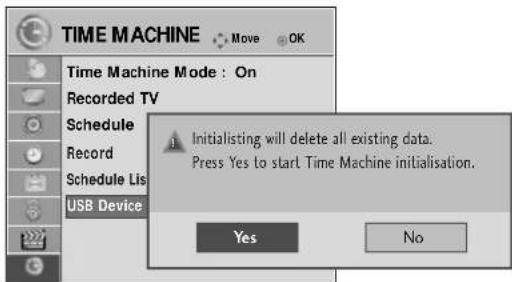
text_image
TIME MACHINE Move OK Time Machine Mode : On Recorded TV Schedule Record Schedule List USB Device Initialisting will delete all existing data. Press Yes to start Time Machine initialisation. Yes No
Select TIME MACHINE.

text_image
2 OK Select USB Device Initialisation.
- When initialisation is completed, a popup notice of completion is displayed and the connected USB HDD is available for Time Machine.
NOTE
▶ Depending on the capacity of the USB device, the initialisation time may vary.
▶ The initialised USB device is not recognized by the PC.
▶ When a USB device of less than 40 GB is connected, the USB Device Initialisation is not activated.
▶ Supported maximum USB HDD size for Time Machine is up to 1TB.
TIME MACHINE
Time Machine Mode

text_image
TIME MACHINE Move OK Time Machine Mode : On Recorded TV Schedule Record Schedule List Initialisation USB Device Initialisation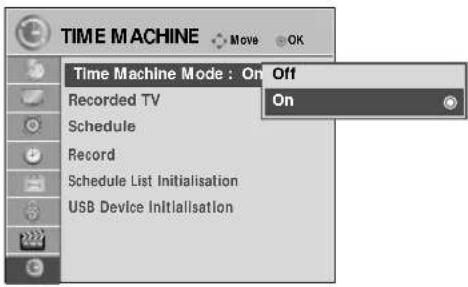
text_image
TIME MACHINE Move OK Time Machine Mode : On Off Recorded TV Schedule Record Schedule List Initialisation USB Device Initialisation
Select TIME MACHINE.
- Time Machine Mode is available in DTV mode.

Select Time Machine Mode.

Select On or Off.
- Press the MENU button to return to normal TV viewing.
- Press the RETURN button to move to the previous menu screen.
Time Machine Progress

text_image
Live TV 10:07 10:071 After selecting Time Machine Mode On, press the OOKK button.
- As soon as Time Machine starts, a progress bar indicating the current recording status is displayed in the bottom of the screen.
- Press the O OK button to display the 'Progress Bar' or press the RETURN button to hide the 'Progress Bar'.
- This function is preserved even change a programme on progressing the Time Machine.
2 When finished enter the Time Machine Mode menu and then turn Time Machine Mode Off.
The 'Progress Bar'?
This function indicates what Time Machine reviewing is possible, a current on-screen and live broadcasting position.
1 Preview
② Current Status while using the Time Machine
③ Current operating function while using the Time Machine
▶Playback
Fast forward
Rewind
Pause
Direct view +
Direct view -
By one screen
▶ Slow playback
4 Current location and progress time in playback
⑤ Total progress time of the Time Machine
NOTE
▶ In order to save hard-disk space, nothing is saved when there is no signal.
▶ Time Machine can be used for maximum of 2 hours.
▶ When turning power on, it may take up to a maximum of 3 minutes to initialize the HDD.
The Time Machine function will not initiate for a copy-protected programme.
▶ Instant recording time is set to 3 hours and supported maximum time is up to 5 hours.
▶ Time Machine is not supported in the audio only channel, but recording is possible.
TIME MACHINE
Playback during the Time Machine
During the Time Machine play, the following options are available.

text_image
Timeshift TV 3:07 20:14Use of remote control
You can playback the temporarily saved part in various methods during the Time Machine.
 | During playback, repeatedly, press the REW(◀◀)or FF(▶▶)button to speed up. Every time you press the button, the search speed will increase by stage (up to 5 stages). |
 | During playback, press the Pause(11)button. Pause screen is displayed. Every time you press the Pause(11)button from the pause screen, it will move screen by screen. (1▶1) Press the Pause(11)button and then use the FF(▶▶)button for slow motion. (1▶1) |
 | When you move the cursor using the Time Machine (<<, >>) button during play-back, and then press the O○ Button, the screen will directly play at the applicable screen where the cursor is located. ( , ) |
 | To view the current live broadcast, press the LIVE button during playback. |
RECORDING
Use this function when you cannot watch the desired programme due to being out.
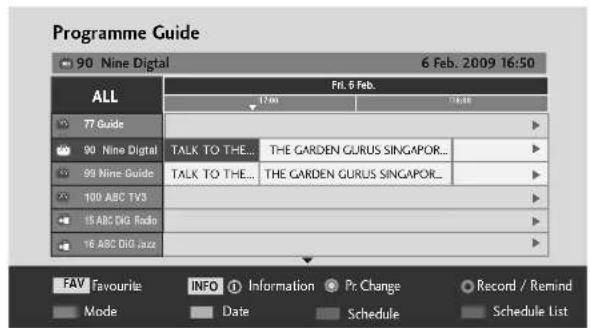
Recording or Reminding function in the Programme Guide
text_image
Programme Guide 90 Nine Digital 6 Feb. 2009 16:50 ALL 77 Guide 90 Nine Digital 99 Nine Guide 100 ABC TV3 15 ABC DIG Radio 16 ABC DIG Jazz Fri. 6 Feb. TALK TO THE... THE GARDEN GURUS SINGAPOR... TALK TO THE... THE GARDEN GURUS SINGAPOR... FAV Favourite INFO Information Pr Change Record / Remind Mode Date Schedule Schedule List

text_image
Programme Guide 90 Nine Digital 6 Feb. 2009 16:50 ALL 77 Guide 90 Nine Digital 99 Nine Guide 100 ABC TV3 15 ABC DIG Radio 16 ABC DIG Jazz TALK TO THE... TALK TO THE... TALK TO THE... TALK TO THE... 90 Nine Digital 6 Feb. 2009 16:30~17:00 Record Remind Close FAV Favourite INFO Inform Mode Date End / Remind Schedule List
Display the Programme Guide.

Select desired programme.

Select Record or Remind.
- You can also select Record or Remind by pressing the 📊 button repeatedly on the remote control.
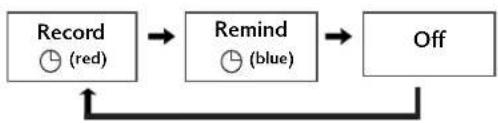
flowchart
graph LR
    A["Record\n( red)"] --> B["Remind\n( blue)"]
    B --> C["Off"]
- Press the RETURN button to move to the previous menu screen.
NOTE
If you turn off the main power during the recording, the programme being recorded may not be saved. Therefore it is good to press the Stop (■) button and check the reserved/recorded list, and then turn off the power.
▶ Recording cannot be reserved for a period less than 10 seconds.
Because the title and time of the programme for Record/Remind is based on the information transmitted from the broadcasting station, they may be different than the actual ones depending on the situation of the broadcasting station.
When it is time for the reserved recording to start and the power of the TV is turned off, the TV will turn on the power of the part required for the recording and proceed to the reservation.
When it is time for the reserved recording to start and the Immediate recording is in progress, the recording of the programme currently being recorded will be stopped and saved, and then proceed to the reserved recording.
▶ Broadcast materials are protected by copyright and that recording and playback of certain material would only be permissible by permission of the copyright owner. Audio and video recordings you make using this recorder are for your personal use only. You may not sell, lend or rent them to other people.
▶ If the TV is unplugged once or turn off with the ⏻/1 (power) button on the TV, the reserved recording will not work.
TIME MACHINE
Start/Stop record
You can record the channel you are watching for three hours.

text_image
RECORD 6 Feb. (Fri.) 15:09 You can record the channel you are watching for three hours. Start recording (3 hour recording) Modify recording and time Manual record Select a programme to record Move OK Start recording Exit REC DTV 2 Live TV1 When watching the programme, Select it you wish to record.

Display the recording setting.
■ You can also select this setting in the RECORD menu.

Start the recording.
- During recording, REC DTV 2 played. Recording will be set up to 3 hours.
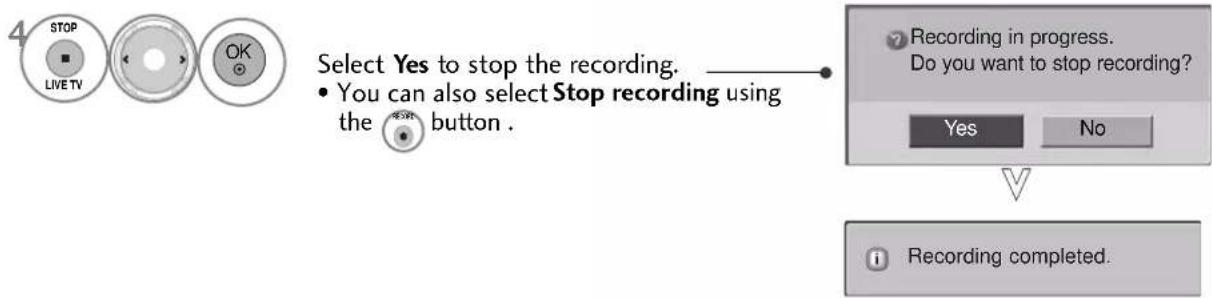
text_image
4 STOP LIVE TV OK Select Yes to stop the recording. • You can also select Stop recording using the button. Recording in progress. Do you want to stop recording? Yes No Recording completed.- Press the RETURN button to return to normal TV viewing.
Modify recording end time
You can shorten or extend the recording time.
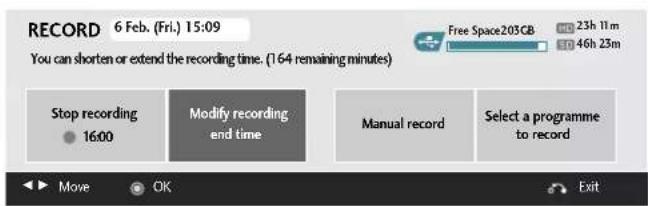
text_image
RECORD 6 Feb. (Fri.) 15:09 You can shorten or extend the recording time. (164 remaining minutes) Stop recording 16:00 Modify recording end time Manual record Select a programme to record Move OK Exit
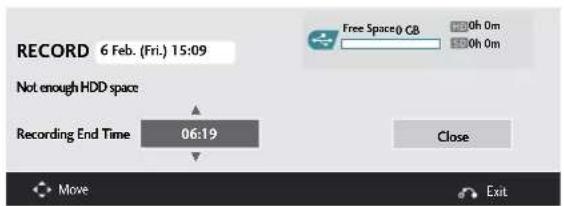
text_image
RECORD 6 Feb. (Fri.) 15:09 Not enough HDD space Recording End Time 06:19 Free Space CB 00h 0m 50h 0m Close Move Exit

During recording,
Select the Modify recording end time.

Set the Recording End Time.


Select the Close.
- Press the MENU button to return to normal TV viewing.
- Press the RETURN button to move to the previous menu screen.

NOTE
▶ When recording, if the available storage space is not sufficient, the recording will automatically Stop.
▶ Recordings of less than 10 seconds will not be saved.
▶ To save disk space while recording broadcasts, no data will be saved if there is no signal.
The recording function will not initiate for a copy-protected programme.
The displayed time may differ slightly from the actual time such as no signal.
TIME MACHINE
Manual record
This function is easy to register to reserved recording. Timer recording is set.

Select the Manual record.
Select Date.
Select the repeat option.
Set the desired Start Time, End Time, Input and Programme.
Select the Complete.
Display the Schedule List.
- Press the RETURN button to return to normal TV viewing.
NOTE
▶ Timeshift recording is not possible with copy-protected programmes.

Programme with copy protection fail to record.
▶ Manual Recording available time is maximum 3 hours and minimum 2 minutes.
▶ If different channels are set for the same time for on time and reserved recording, this TV is powered on to the reserved recording channel.
▶ When reserved recording started while watching DTV, you cannot change to the ATV programme.
SCHEDULE LIST
This function is used to show scheduled recordings.

text_image
TIME MACHINE Time Machine Mode : On Recorded TV Schedule Record Schedule List Initialisation USB Device Initialisation
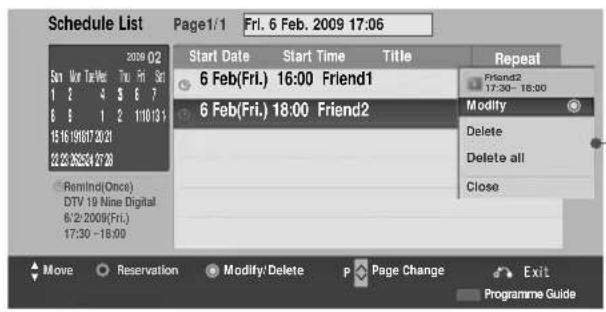
text_image
Schedule List Page1/1 Fri. 6 Feb. 2009 17:06 2009 02 Start Date Start Time Title Repeat Sun Mon Tue Wed Fri Fri Sat 1 2 3 4 5 6 7 6 8 1 2 1:10:13 15:16:19:07'20:21 22:25:05'54'27:28 Remind(Once) DTV 19 Nine Digital 6:2/2009(Fri.) 17:30 -18:00 6 Feb(Fri.) 16:00 Friend1 6 Feb(Fri.) 18:00 Friend2 Modify Delete Delete all Close Move Reservation Modify: Delete Page Change Exit Programme GuideWhen you select a desired item, this PopUp menu is displayed.
▶ Modify: Edit the contents of Start date/Start time/End time/Title/Repeat.
You must press the RETURN button to save the edited contents.
▶ Delete: Delete the selected item in the list.
▶ Delete all Delete all items in the list.
▶ Close: Close the pop-up menu.

Select Shedule.
Select a desired item in the schedule list.

Show the Popup menu.
Select the desired Popup menu.
- Press the RETURN button to return to normal TV viewing.
TIME MACHINE
Schedule List Initialisation
This function is to reset the schedule list.
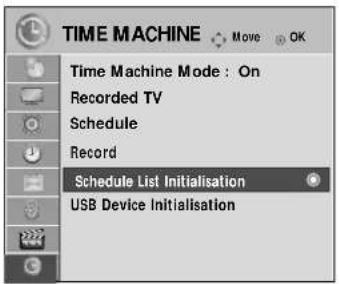
text_image
TIME MACHINE Time Machine Mode : On Recorded TV Schedule Record Schedule List Initialisation USB Device Initialisation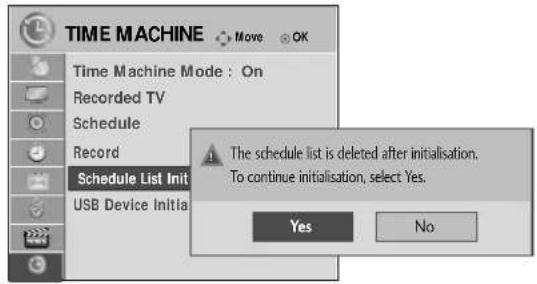
text_image
TIME MACHINE Move OK Time Machine Mode : On Recorded TV Schedule Record Schedule List Init USB Device Initia The schedule list is deleted after initialisation. To continue initialisation, select Yes. Yes No
Select TIME MACHINE.

Select Schedule List Initialisation.

Select Yes. Start the Schedule List Initialisation.
- Press the MENU button to return to normal TV viewing.
- Press the RETURN button to move to the previous menu screen.
RECORDED LIST
You can view the recorded programme list at a glance.
The recorded programme stored the USB device can be played.
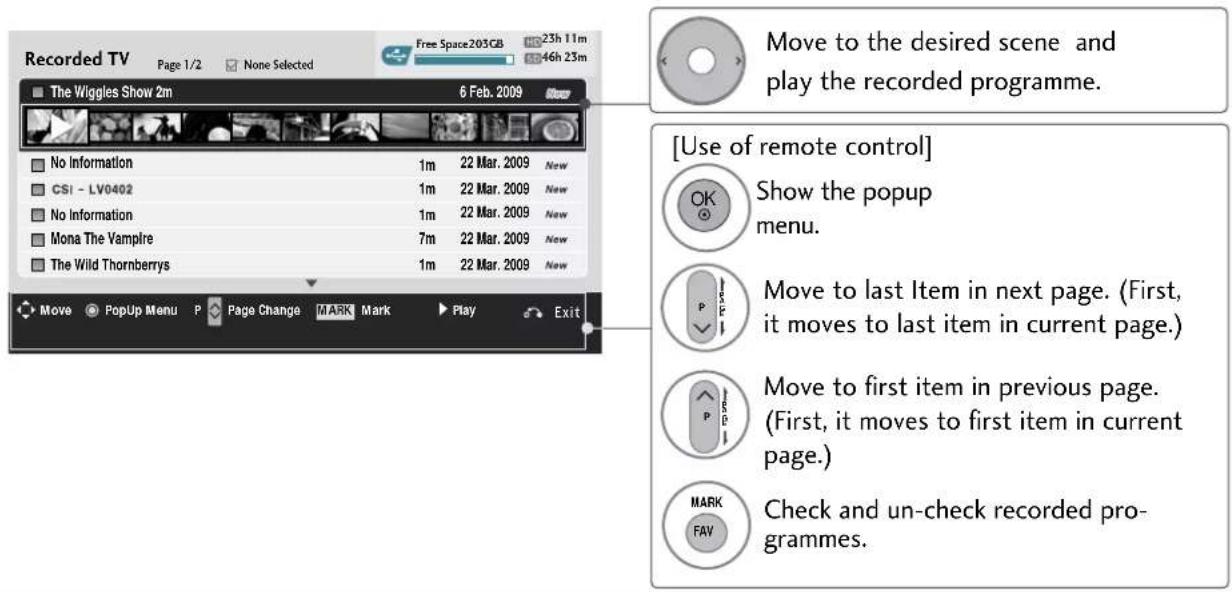
text_image
Recorded TV Page 1/2 None Selected Free Space203CB 23h 11m 46h 23m The Wiggles Show 2m 6 Feb. 2009 No Information 1m 22 Mar. 2009 New CSI - LV0402 1m 22 Mar. 2009 New No Information 1m 22 Mar. 2009 New Mona The Vampire 7m 22 Mar. 2009 New The Wild Thornberrys 1m 22 Mar. 2009 New Move PopUp Menu P Page Change MARK Mark Play Exit Move to the desired scene and play the recorded programme. [Use of remote control] OK Show the popup menu. Move to last Item in next page. (First, it moves to last item in current page.) Move to first item in previous page. (First, it moves to first item in current page.) MARK FAV Check and un-check recorded programmes.

Select TIME MACHINE.


Select Recorded TV.


Select a recorded programme.
- Press the RETURN button to return to normal TV viewing.
NOTE
▶ If there is a bad sector in the disk, part or all of the items of the Recording list can be deleted.
▶ Maximum number of recordings within the Recording list is 200. When the number of recordings in the Recording list is 200, you cannot record any more.
▶ When the full duration of the recording is played back, the screen will stay in the stopped condition for 10 seconds and then automatically end the playback.
The recording can be played back even during the recording/reserved recording.
During the playback of the recording, the hard disk can generate a certain level of noise. This noise is irrelevant from the performance and reliability of the product and is normal for a hard drive to have a certain level of noise.
The recording time will be different according to the programme resolution.
TIME MACHINE
Recorded programme Selection and Popup Menu
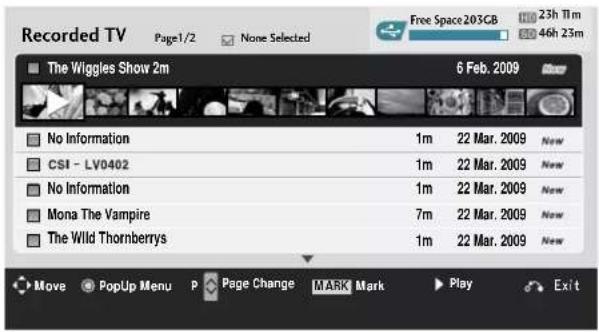
text_image
Recorded TV Page1/2 None Selected Free Space 203CB 23h 11m 46h 23m The Wiggles Show 2m 6 Feb. 2009 No Information 1m 22 Mar. 2009 New CSI - LV0402 1m 22 Mar. 2009 New No Information 1m 22 Mar. 2009 New Mona The Vampire 7m 22 Mar. 2009 New The Wild Thornberrys 1m 22 Mar. 2009 New

text_image
Recorded TV Page1/2 None Selected Free Space203GB 23h 11m 46h 23m TV6 16:10 - 12:00 Play Play Previous Mark All Delete Rename Close The Wiggles Show 2m No Information 1m CSI - LV0402 1m No Information 1m Mona The Vampire 7m The Wild Thornberrys 1m 22 Mar. 2009 Move PopUp Menu Page Change MARK Mark Play Exit▶ Play : Playback of selected recorded programmes.
▶ Play Previous : Resumes playing at the previously stopped point.
▶ Mark All : Mark all recorded programmes in the list.
▶ Unmark All : Change marked recorded programmes to unmarked recorded programmes.
▶ Delete : Delete the selected recorded programmes.
▶ Rename : Edit recorded programme title.
▶ Close : Close the pop-up menu.

text_image
CHARNUM DELETE SYMB @2 1 ABC 2 DEF 3 GHI 4 JKL 5 MNO 6 PQRS 7 TUV 8WXYZ 9 * ?1 0 # OK Cancel
Select TIME MACHINE.

Select Recorded TV.

Select a desired recorded programme.
Show the Popup menu.

Select the desired Popup menu.
- Press the RETURN button to return to normal TV viewing.
Playing Recorded programmes
You can play a selected programme from the recorded list.
1 Play a recorded programme.
When you press the OO Button during the playback, the information of the recorded programme you are current watching will be displayed at the top of the screen and a progress bar showing the current status of the playback at the bottom of the screen. (Playback status is displayed as follows.)
• To remove the progress bar, press the O O Button.
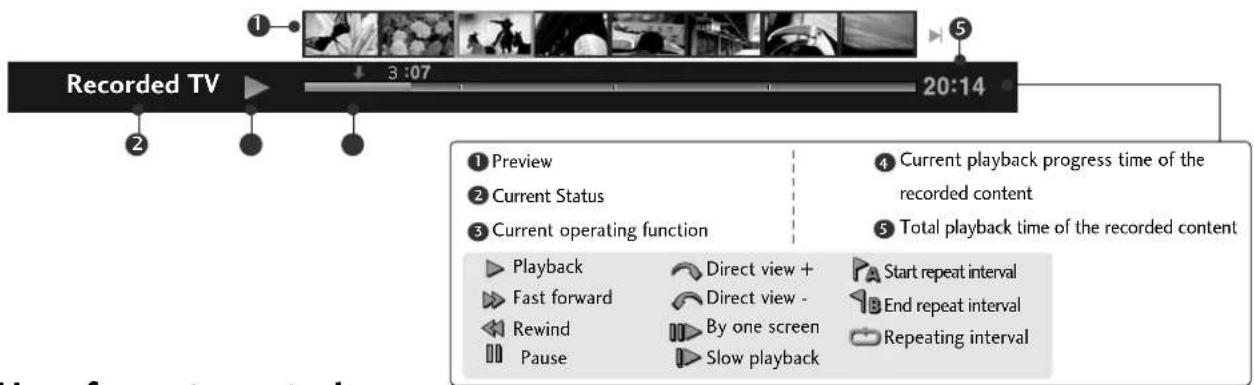
text_image
Recorded TV 3:07 20:14 Preview Current Status Current operating function Playback Fast forward Rewind Pause Direct view + Direct view - By one screen Slow playback Current playback progress time of the recorded content Total playback time of the recorded content Start repeat interval End repeat interval Repeating intervalUse of remote control
You can adjust various method during the recorded programme play.
 | During playback, repeatedly, press theREW(◀◀)or FF(▶▶)button to speed up. Every time you press the button, the search speed will increase by stage. (up to 5 stages) |
 | During playback, press the Pause(1) button. Pause screen is displayed. Every time you press the Pause(1) button from the pause screen, it will move screen by screen. (11▶1) Press the Pause(1) button and then use theFF(▶▶)button for slow motion. (1▶) If you don't press any button 10 minutes after the pause, it will return to the playback. |
 | When you move the cursor using the Time Machine (<, >) button during play-back, and then press the O○ Button, the screen will directly play at the applicable screen where the cursor is located. ( , ) |
 | When you press the LIVE button, the playback will end and you can watch the TV. |
 | * This function is available only the playback of a recorded programme. Press the REPEAT button at the starting point where you want to set the Interval repeat and press it again at the ending point. To cancel the playback for the interval repeat, press the REPEAT button one more time. The start of the Interval repeat is displayed as ▶ and end of the Interval repeat as ▶ in the recording progress bar at the bottom of the screen. Start and end of the Interval repeat can be set both in forward and reverse direction. Interval shorter than 10 seconds cannot be set. When the Interval repeat is cancelled, it will return to normal playback from the end point of the interval. |
 | To return to normal playback, press the PLAY(▶) button. |
MULTIMEDIA
ENTRY MODES
When you connect a USB device, this screen is displayed automatically. In USB device, you can not add a new folder or delete the existing folder.
1 Connect the USB device to the USB IN jacks on the side of TV.
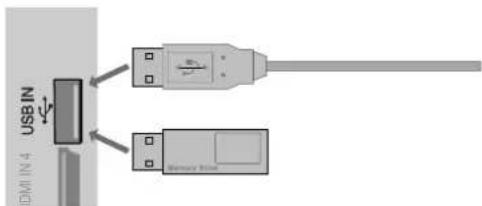
text_image
USB IN DMI IN 4 DNA Strand
Select PHOTO LIST, MUSIC LIST or MOVIE LIST.



When removing the USB device
Select the Remove USB device menu before removing the USB device.

Select Remove USB device.

Select Remove.

NOTE
The screen saver feature runs when the moving, deleting operation of a photo, music or movie file continues for a long time.
PHOTO LIST
You can view .JPG files from the USB devices.
The On Screen Display on your model may be slightly different.
This function is not operated after initializing USB Device.
Supported photo(\*.JPEG) file
Baseline: 15360× 8640
- You can play JPEG files only.
- Both baseline scan and progressive scan are supported.
• Non-supported files are displayed in the form of bitmap.
- When you are watching the photo by the Photo List function, you can not change the picture mode.



text_image
MULTIMEDIA Move OK Photo List Music List Movie List DivX Reg. Code Deactivation

Select MULTIMEDIA.


Select Photo List.


Screen Components
1 Moves to upper level folder
2 Preview: Display the thumbnail/folder name of the photo in the selected folder
3 Current page/Total pages
4 Total number of marked photos
5 Corresponding buttons on the remote control
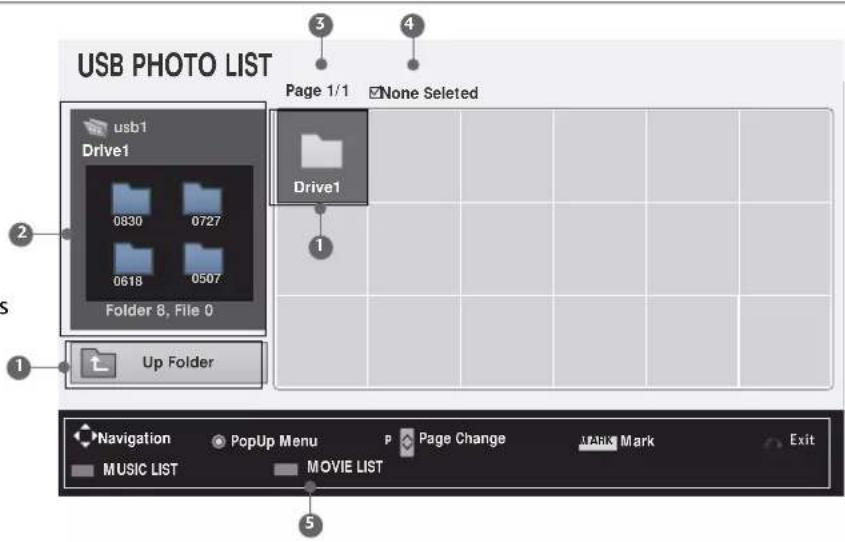
text_image
USB PHOTO LIST Page 1/1 None Selected usb1 Drive1 0830 0727 0618 0507 Folder 8, File 0 Drive1 1 Up Folder Navigation PopUp Menu Page Change Music Mark Exit MUSIC LIST MOVIE LISTMULTIMEDIA
Photo Selection and Popup Menu
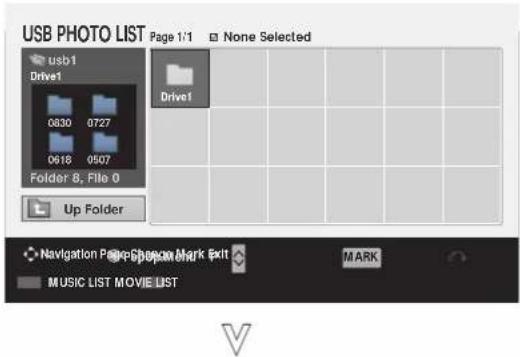
text_image
USB PHOTO LIST Page 1/1 □ None Selected usb1 Drive1 0830 0727 0618 0507 Folder 8, File 0 Up Folder Navigation Page: Open Span Mark Exit MARK MUSIC LIST MOVIE LIST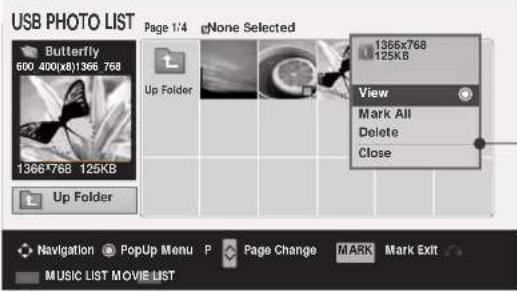
text_image
USB PHOTO LIST Page 1/4 pNone Selected Butterfly 600 400x8)1366 768 Up Folder 1366x768 125KB View Mark All Delete Close 1366*768 125KB Up Folder Navigation PopUp Menu P Page Change MARK Mark Exit MUSIC LIST MOVIE LISTWhen you select a file (not folder), this PopUp menu is displayed.
▶ View: Display the selected item.
▶ Mark All: Mark all photos on the screen.
▶ Unmark All: Deselect all marked photos.
▶ Delete: Delete the selected photo item(except NTFS file system).
▶ Delete Marked: Delete the marked photo item(except NTFS file system)
▶ Close: Close the pop-up menu.

Select the target folder or drive.
Select the desired photos.

Show the pop-up menu.

Select the desired Popup menu.
■ Use the P ^P ∧ ∨ button to navigate in the photo page.
■ Use the MARK button to mark or unmark a photo. When one or more photos are marked, you can view individual photos or a slide show of the marked photos. If no photos are marked, you can view all photos individually or all photos in the folder in a slide show.
Full Screen Menu
You can change the Photo List view so that it fills the screen. More operations are available in full screen mode.

text_image
USB PHOTO LIST Page 1/1 None Selected My Photo Drive1 0830 0727 0618 0507 Folder 8, File 0 Up Folder Drive1 Navigation PopUp Menu p Page Change MARK Mark Exit MUSIC LIST MOVIE LIST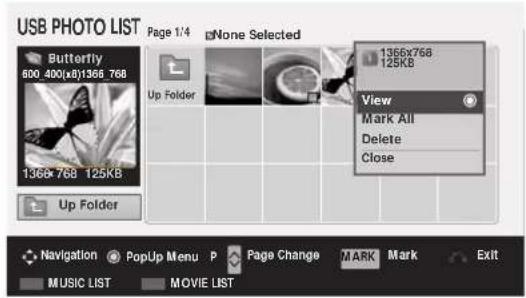
text_image
USB PHOTO LIST Page 1/4 None Selected Butterfly 600.400(x8)1366.768 Up Folder 1366x768 125KB View Mark All Delete Close Up Folder Navigation PopUp Menu P Page Change MARK Mark Exit MUSIC LIST MOVIE LIST
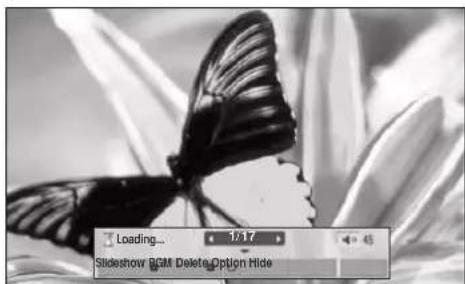
text_image
Loading... 17:17 Slideshow IGM Delete Option HideThe aspect ratio of a photo may change the size of the photo displayed on the screen in full size.

Select the target folder or drive.

Select the desired photos.

Show the pop-up menu.

Select View.
The selected photo is displayed in full size.
■ Use the PP^ ∨ button to navigate in the photo page.
MULTIMEDIA

natural_image
Black-and-white photo of a butterfly on a flower, no visible text or symbols in the main image area
Select the Slideshow, BGM, 📋 (Rotate), Delete, Option, or Hide.
- Use < > button to select the previous or next photo.
- Use < > button to select and control the menu on the full-sized screen.
▶ Slideshow: Selected photos are displayed during the slide show. If no photo is selected, all photos in the current folder are displayed during slide show.
- Set the time interval of the slide show in Option.
▶ BGM: Listen to music while viewing photos in full size.
- Set the BGM device and folder in Option.
▶ (Rotate): Rotate photos.
- Rotates the photo 90^ , 180^ , 270^ , 360^ clockwise.
▶ Delete: Delete a photo.
▶ Option: Set values for Slide Speed, BGM Device and BGM Folder.
- Use < > button and OK button to set values. Then go to OK and press OK to save the settings.
- You cannot change BGM Folder while BGM is playing.
▶ Hide : Hide the menu on the full-sized screen.
- To see the menu again on the full-sized screen, press OK button to display.
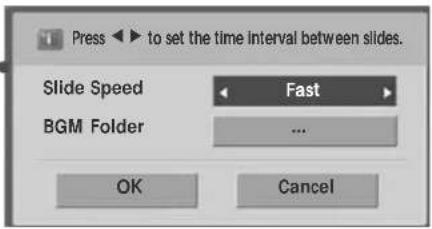
text_image
Press ▶ to set the time interval between slides. Slide Speed Fast BGM Folder ... OK Cancel
NOTE
This TV will not be able to decode most JPEG images saved using the Progressive option.
MUSIC LIST
You can use the Music List menu to play MP3 files form.
This TV cannot play back copy-protected files.
The On Screen Display on your model may be slightly different.
Supported music file: \*.MP3
- Bit rate range 40Kbps \~ 320Kbps
- Sampling rate (Sampling Frequency)
MPEG1 : 32000, 44100, 48000Hz
MPEG2 : 16000, 24000, 22050Hz


text_image
MULTIMEDIA Move OK Photo List Music List Movie List DivX Reg. Code Deactivation

Select MULTIMEDIA.


Select Music List.

Screen Components
① Moves to upper level folder
2 Preview: If any album jacket for the file exists, this jacket is displayed.
3 Current page/Total pages
4 Total number of marked music.
⑤ Corresponding buttons on the remote control

text_image
USB MUSIC LIST Page 1/1 None Selected usb1 Drive1 folder 8, file 0 Up Folder Title Play Time Drive1 Navigation PopUp Menu Page Change UMark Mark Exit PHOTO LIST MOVIE LIST 5MULTIMEDIA
Music Selection and Popup Menu
Up to 6 music titles are listed per page.
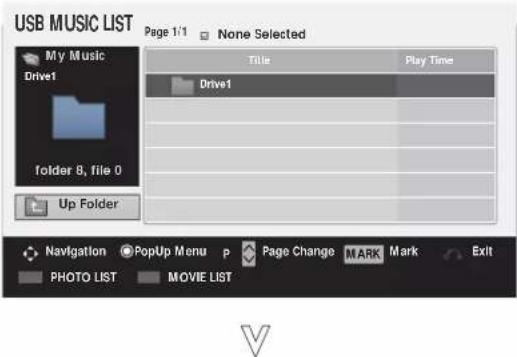
text_image
USB MUSIC LIST Page 1/1 None Selected My Music Drive1 Folder 8, file 0 Up Folder Title Play Time Drive1 Navigation PopUp Menu Page Change MARK Mark Exit PHOTO LIST MOVIE LIST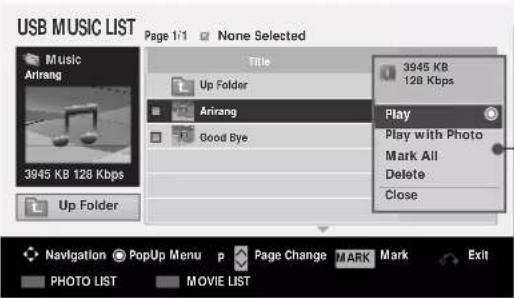
text_image
USB MUSIC LIST Page 1/1 None Selected Music Arirang 3945 KB 128 Kbps Up Folder Title Up Folder Arirang Good Bye Play Play with Photo Mark All Delete Close Up Folder Navigation PopUp Menu Page Change MARK Mark Exit PHOTO LIST MOVIE LIST▶ Play (During stop): Play the selected music. Once a song finishes playing, the next selected one will be played. When there is no selected music to play, the next one in the current folder will be played. If you go to a different folder and press the O ⊙ Button, the current music in playback will stop.
▶ Stop Play (During playback): Stop playing music.
▶ Play with Photo: Start playing the selected music and then move to the Photo List.
▶ Mark All: Mark all music in the folder.
▶ Unmark All: Deselect all marked music.
▶ Delete: Delete the selected music.
▶ Close: Close the pop-up menu.

Select the target folder or drive.

Select the desired music.
Show the pop-up menu.

Select the desired Popup menu.
■ Use the P ^5 ∧ ∨ button to navigation in the music page.
■ Use MARK button to mark or unmark a music file. If no music is marked, all the music in the folder will be played in sequence. When one or more music files are marked, the marked music files will be played in sequence. If you want to listen to only one song repeatedly, just mark that one file and play.
■ The play information box (as shown below) will automatically move across the screen when there is no user input to prevent a fixed image remaining on the screen for a extended period of time.
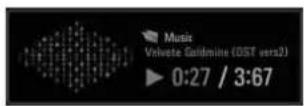
NOTE
When music is playing, is displayed in front of the music play time.
▶ A damaged or corrupted music file that cannot be played displays 00:00 as the play time.
▶ Music files with copy-protection will not play.
▶ Press O, K, or RETURN button to stop the screen saver.
This TV can not play music files less than 16 Kbytes.
MOVIE LIST
The movie list is activated once external HDD or USB devices are detected.
It is used when playing movie files on TV.
Displays the movies in the external HDD or USB devices and supports play.
Allows playback of all movies in the folder and user desired files.
It is a movie list that displays folder information and Divx file.


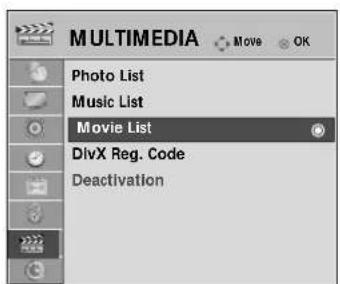
text_image
MULTIMEDIA Photo List Music List Movie List DivX Reg. Code Deactivation
Select MULTIMEDIA.

Select Movie List.
MULTIMEDIA
Screen Components
1 Moves to upper level folder
2 Preview: Selected movies are played at X4 speed. And sound is mute.
3 Current page/Total pages
4 Total number of marked movies
5 Corresponding buttons on the remote control

text_image
USB MOVIE LIST Page 1/1 None Selected usb1 Drive1 folder 8, file 0 Up Folder Title Play Time Drive1 Navigation PopUp Menu Page Change MARK Mark Exit PHOTO LIST MUSIC LISTMovie Selection and Popup Menu
Up to 6 movie titles are listed per page.

text_image
USB MOVIE LIST Page 1/1 None Selected My Movie Movie1 704 x 396 668 MB Up Folder Navigation PopUp Menu P Move Page MARK Mark Exit PHOTO LIST MUSIC LIST USB MOVIE LIST Page 1/1 None Selected Movie Scent of a waman. (1992) 704 x 396 668 MB Up Folder Scent of a waman. (1992) Lost Play Mark All Delete Close Up Folder Navigation PopUp Menu P Move Page MARK Exit PHOTO LIST MUSIC LIST▶ Play (During stop): Play the selected movie.
Once a movie finishes playing, the next selected one will be played. When there are no selected movies to play, the next one in the current folder and will be not played. While playing the movie, activating the movie list will stop playing the movie. If you go to a different folder and press the O O Button, the current movie in playback will stop.
▶ Mark All: Mark all movies in the folder.
▶ Unmark All: Deselect all marked movie.
▶ Delete: Delete the selected movie.
▶ Close: Close the pop-up menu.

Select the target folder or drive.

Select the desired movies.

Show the Popup menu.
Select the desired Popup menu.
■ Use the P ^2 button to navigate in the movie page.
■ Use MARK button to mark or unmark a movie file. When one or more movie files are marked, the marked movie files will be played in sequence.
Playing the Movie
You can adjust various method during the movie play.
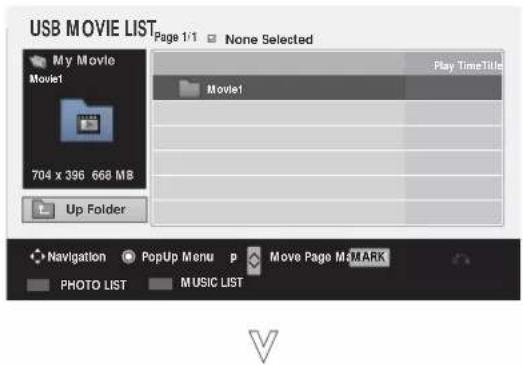
text_image
USB MOVIE LIST Page 1/1 None Selected My Movie Movie1 704 x 396 668 MB Up Folder Play TimeTitle Movie1 Navigation PopUp Menu Move Page M-MARK PHOTO LIST MUSIC LIST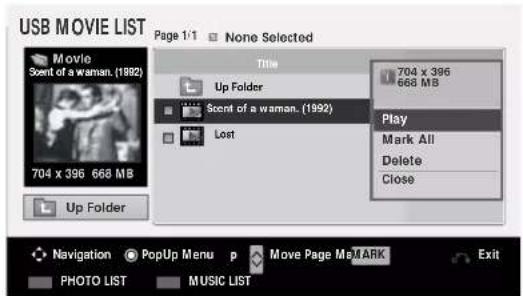
text_image
USB MOVIE LIST Page 1/1 None Selected Movie Scent of a woman. (1992) 704 x 396 668 MB Up Folder Scent of a woman. (1992) Lost 704 x 396 668 MB Play Mark All Delete Close Up Folder Navigation PopUp Menu p Move Page Memor Exit PHOTO LIST MUSIC LIST
Display the DivX Banner in the top of the screen.
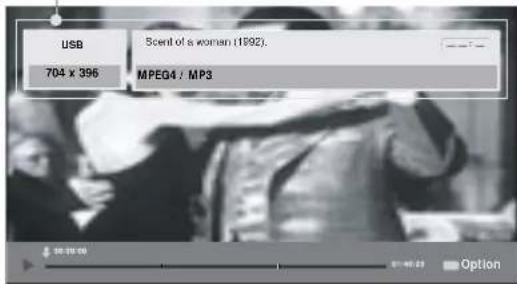
text_image
USB 704 x 396 Scend of a woman (1992) MPEG4 / MP3 Option
Select the target folder or drive.

Select the desired movies.

Show the pop-up menu.

Select Play.
[Use of remote control]
![LG 60PS70FD - [Use of remote control] - 1](/content/2026/06/1223283/images/5275c4b700d6fdb1e8fd07a31be2a605c940ff6789ea7c6a08ae9ecb58952c36.jpg)
Press the REW(◀◀) button to rewind. Press the FF(▶▶) button to forward fast.
![LG 60PS70FD - [Use of remote control] - 2](/content/2026/06/1223283/images/613d9da93590dd9f282017cc4a9fecd8189d22a10625a696df06ba5f36d892e5.jpg)
Press the Pause(II) button to pause the screen.
![LG 60PS70FD - [Use of remote control] - 3](/content/2026/06/1223283/images/27908dae0485fe757f5e6cf8c23b2096a44c37a2227caedd3e3ba3a0e27180e8.jpg)
Press the Stop(■) button to stop.
![LG 60PS70FD - [Use of remote control] - 4](/content/2026/06/1223283/images/b2c658983daa758a8edd23ee61065e9e2321617eb5e7d97f162d603661caa569.jpg)
Press the Pause(II) button and then use the FF(▶▶) button for slow motion.
NOTE
▶ Some special files are not supported in subtitles.

Display the current movie status progress bar in the bottom of the screen.
MULTIMEDIA
Option Menu Selection
During the movie play, the following options are available.
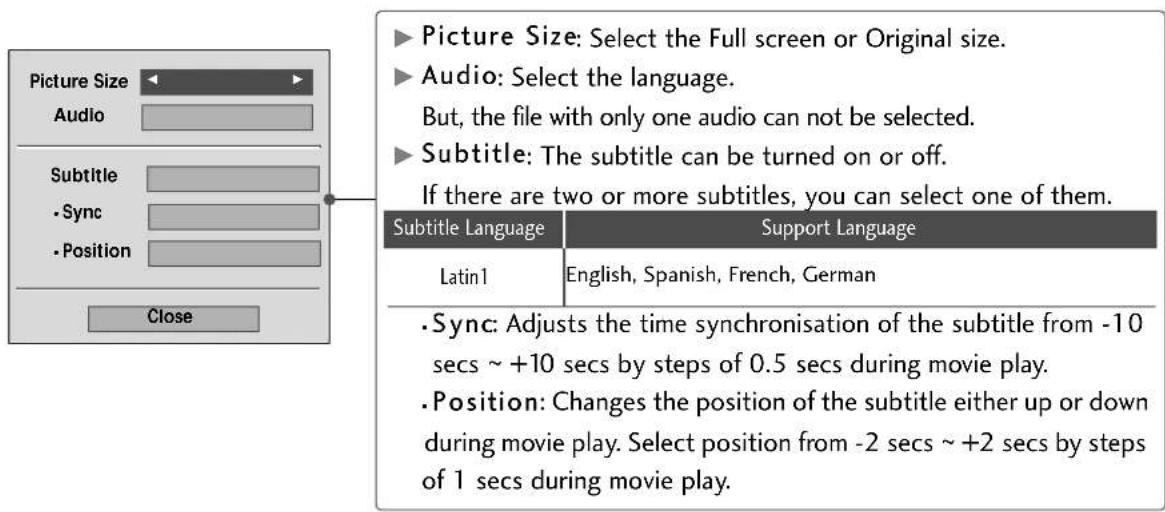
text_image
Picture Size Audio Subtitle - Sync - Position Close Picture Size: Select the Full screen or Original size. Audio: Select the language. But, the file with only one audio can not be selected. Subtitle: The subtitle can be turned on or off. If there are two or more subtitles, you can select one of them. Subtitle Language Support Language Latin1 English, Spanish, French, German Sync: Adjusts the time synchronisation of the subtitle from -10 secs ~ +10 secs by steps of 0.5 secs during movie play. Position: Changes the position of the subtitle either up or down during movie play. Select position from -2 secs ~ +2 secs by steps of 1 secs during movie play.
Display the Option menu.

Select the desired movie option.

Make appropriate adjustments.
Select Close.

NOTE
During the movie play, the repeat key is not supported.
Precautions when playing the DivX
Subtitle format :*.smi/ *.srt/ *.sub(MicroDVD, SubViewer 1.0/ 2.0)/ *.ass/ *.ssa/*.txt(TMPlayer), *.psb(PowerDivx)
Maximum supported DivX bitrate : 20Mbps(Mega bit per second)
Audio supported bit rate : within 32\~320 kbps(MP3)
Maximum supported display resolution : 1920 x1080
▶ Specific subtitles created by the user may not be operated normally.
Some special characters are not supported in subtitles.
HTML tags are not supported in subtitles.
Subtitles in languages other than the supported languages are not available.
Time information in an external subtitle file should be arranged in ascending order to be played.
▶ Damaged movie files may not be played, and certain functions could be limited during the playback.
▶ Playback for movie file exceeding 30GB (Giga Byte) is not supported.
If the video and audio structure of recorded file is not interleaved, either video or audio is outputted.
H.264/ AVC codec is supported up to profile level 4.1.
▶ Files encoded with GMC(Global Motion Compensation) or quarter pel motion estimation may not be played.
The video file and the subtitle file must be located in the same folder.
The name of the video file and the subtitle file must be the same to view the subtitles normally.
Even the supported codec may not be played depending on the encoded condition.
▶ Files had with not index may not be operated normally.
▶ Only the files saved in ASCII CODE is supported for the external subtitles of the movie.
▶ A subtitle of font, size and position may be not changed.
▶ Only 150 alphabets and 150 numbers are supported for each line of the subtitle.
Subtitles are displayed up to 5 lines on the screen.
An abnormal picture(still, fast) or an audio mute for a while may be occurred in case of change the audio language.
▶ Depend on the packet structure of video or audio files, it may support only audio or video.
when some frame in a movie file have higher resolution than maximum supporting resolution, it may not guarantee smooth playback.
It may not guarantee some playing movie files except for specified format.
▶ DTS Audio codec is not supported.
Some file format which are *.ts, *.trp, *.tp, *.mpe, *.mpeg, *.mpe does not support trick mode except for ▶▶▶
▶ Trick play except for ▶ ▶ is not available when the movie file has not index information.
Some movie files having special character may not playback.
When you are watching the movie byMovie List function, you can adjust an image by ENERGY SAVING and AV MODE key on the remote control. User setup for each image mode does not operate.
Supported Movie File
| File Extensions | A/V | Codec | Profile/Level Support |
| .asf.wmv.wma | Video | VC-1 Advanced Profile | Advanced Profile@Level 3 (e.g. 720p60, 1080i60, 1080p30)Only streams compliant to SMPTE 421M VC-1 standard are supported. |
| VC-1 Simple and Main Profiles | Simple Profile@Medium Level (eg CIF, QVCA)Main Profile@High Level (e.g. 1080p30)Only streams compliant to SMPTE 421M VC-1 standard are supported. | ||
| Audio | WMA Standard | ||
| WMA 9 Professional | |||
| .divx.avi | Video | Divx3.11 | |
| Divx4Divx5Divx6 | Advanced Simple Profile(720p/1080i) | ||
| XViD | |||
| Audio | MPEG-1 Layer I, II MPEG-1 Layer III(MP3) AC-3 | ||
| .mp4.m4a.m4v | Video | H.264 / AVC | Main Profile@ Level 4.1High Profile@ Level 4.1(e.g. 720p60, 1080i60, 1080p30) |
| MPEG-4 Part 2 | Advanced Simple Profile (720p/1080i) | ||
| Audio | AAC | AAC-LC and AAC-HE | |
| .mkv | Video | H.264 / AVC | Main Profile@ Level 4.1High Profile@ Level 4.1 (e.g. 720p60, 1080i60, 1080p30) |
| Audio | AACAC-3 | AAC-LC and AAC-HE | |
| .ts.trp.tp | Video | H.264 / AVC | Main Profile@ Level 4.1High Profile@ Level 4.1 (e.g. 720p60, 1080i60, 1080p30) |
| MPEG-2 | Main Profile@High Level(e.g. 720p60, 1080i60) | ||
| Audio | MPEG-1 Layer I, II MPEG-1 Layer III(MP3) AC-3 | ||
| AAC | AAC-LC and AAC-HE | ||
| .vob | Video | MPEG-1 | |
| MPEG-2 | Main Profile@High Level (e.g. 720p60, 1080i60) | ||
| Audio | AC-3LPCM MPEG-1 Layer I, II | ||
| .mpg.mpeg.mpe | Video | MPEG-1 | |
| Audio | MPEG-1 Layer I, II | Only streams compliant configured properly for TS, PS or ES |
DIVX REGISTRATION CODE
Confirm the DivX registration code number of the TV.
Using the registration number, movies can be rented or purchased at www.divx.com/vod.
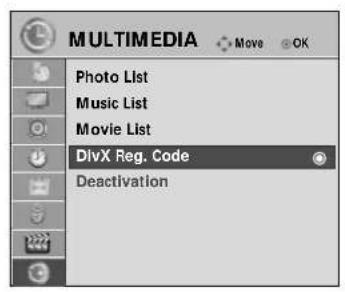
text_image
MULTIMEDIA Move OK Photo List Music List Movie List DivX Reg. Code Deactivation

text_image
MULTIMEDIA Move OK Photo List Music List Movie List DivX Reg. C Deactivation DixX(R) Video On Demand Your registration code is : xxxxxxxxxxxx To learn more visit www.divx.com/vod Close
Select MULTIMEDIA.

Select DivX Reg.Code.

- Press the MENU button to return to normal TV viewing.
- Press the RETURN button to move to the previous menu screen.

"DivX Certified to play DivX video up to HD 1080p, including premium content"
ABOUT DIVX VIDEO: DivX® is a digital video format created by DivX, Inc. This is an official DivX Certified device that plays DivX video. Visit www.divx.com for more information and software tools to convert your files into DivX video.
ABOUT DIVX VIDEO-ON-DEMAND: This DivX Certified® device must be registered in order to play DivX Video-on-Demand (VOD) content. To generate the registration code, locate the DivX VOD section in the device setup menu. Go to vod.divx.com with this code to complete the registration process and learn more about DivX VOD.
NOTE
▶ With a DivX registration code from another TV, playback of rented or purchased DivX file is not allowed. (Only DivX files matched with the registration code of the purchased TV are playable.)
The video or audio of a file converted based on a standard other than the DivX codec standard may be corrupted or unable to be played.
MULTIMEDIA
DEACTIVATION
Delete the existing authentication information to receive a new DivX user authentication for TV. Once this function is executed, a DivX user authentication is required again to see DivX DRM files.
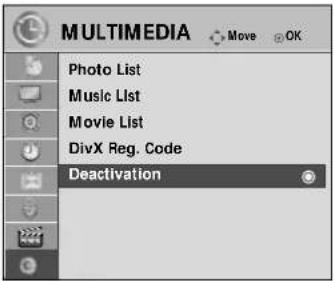
text_image
MULTIMEDIA Move OK Photo List Music List Movie List DivX Reg. Code Deactivation

text_image
MULTIMEDIA Move OK Photo List Music List Movie List DivX Reg. Code Deactivation DivX(R) Video On Demand Do you want to deactivate your device? Yes No
Select MULTIMEDIA.

Select Deactivation.

Select Yes or NNo
Display Deactivation.
- Press the MENU button to return to normal TV viewing.
- Press the RETURN button to move to the previous menu screen.
PICTURE CONTROL
PICTURE SIZE (ASPECT RATIO) CONTROL
You can watch the screen in various picture formats; 16:9, Just Scan, Original, 4:3, 14:9, Zoom, Cinema Zoom1.
If a fixed image is displayed on the screen for a long time, that fixed image may become imprinted on the screen and remain visible.
You can adjust the enlarge proportion using ∧ ∨ button.
This function works in the following signal.

Select Aspect Ratio.

Select the desired picture format.
• 16:9
The following selection will allow you to adjust the picture horizontally, in linear proportion, to fill the entire screen(useful for viewing 4:3 formatted DVDs)

natural_image
Close-up of several round balls on a surface (no text or symbols visible)- Just Scan
Following Selection will lead to you view the picture of best quality without loss of original picture in high resolution image.
Note : If there is noise in original Picture, You can see the noise at the edge.
text_image
JUST SCAN- You can also adjust Aspect Ratio in the PICTURE menu.
- For Zoom Setting, select 14:9, Zoom and Cinema Zoom1 in Ratio Menu. After completing Zoom Setting, the display goes back to Q.Menu.
- Original
When your TV receives a wide screen signal it will automatically change to the picture format broadcast.

text_image
Original• 4:3
The following selection will allow you to view a picture with an original 4:3 aspect ration, gray bars will appear on both the left and right of the screen.
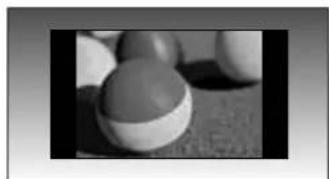
natural_image
Black and white photo of a set of round balls on a textured surface (no text or symbols visible)PICTURE CONTROL
• 14:9
You can view a picture format of 14:9 or a general TV programme in the 14:9 mode. The 14:9 screen is viewed in the same way as in 4:3, but is magnified to the left and right.
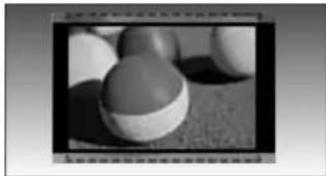
natural_image
Black and white photo of a pool ball on a gravel surface (no text or symbols visible)- Zoom
The following selection will allow you to view the picture without any alteration, while filling the entire screen. However, the top and bottom of the picture will be cropped.

natural_image
Black and white photo of a pool table with multiple balls on a surface (no text or symbols visible)- Cinema Zoom1
Choose Cinema Zoom1 when you want to enlarge the picture in correct proportion. Note: When enlarging or reducing the picture, the image may become distorted.
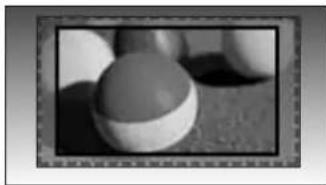
natural_image
Close-up of a ball on a textured surface (no text or symbols visible)
NOTE
▶ You can only select 4:3, 16:9 (Wide), 14:9, Zoom/Cinema Zoom in Component mode.
▶ You can only select 4:3, Original, 16:9 (Wide), 14:9, Zoom/Cinema Zoom in HDMI mode.
▶ You can only select 4:3, 16:9 (Wide) in RGB/ HDMI PC mode only.
▶ In DTV(over 576p)/HDMI/Component (over 720p) modeJust Scan is available.
PICTURE WIZARD
This feature lets you adjust the picture quality of the original image.
Use this to calibrate the screen quality by adjusting the Black and White Level etc. You can calibrate the screen quality by easily following each step.
When you adjust the image to Low, Recommended or High, you can see the example of the changes you made.
In RGB-PC/HDMI-PC/DVI-PC mode, the changed Colour, Tint and H/V Sharpness values are not applied.

text_image
PICTURE Aspect Ratio : 16:9 Picture Wizard Energy Saving : Intelligent Sensor Picture Mode : Vivid • Contrast 100 • Brightness 50 • Sharpness 70 • Colour 70
Select PICTURE.
Select PICTURE.
Select Picture Wizard.
Picture Wizard
With Picture Wizard, you can adjust the picture quality of the original image.
natural_image
Two side-by-side images of a historical painting of two figures in period attire, one holding a fan (no visible text or symbols)NextPrevious

Black Level
Set the screen above identical to the Recommended sample below.

Low

Recommended
High

NextPrevious

Adjust Black Level.
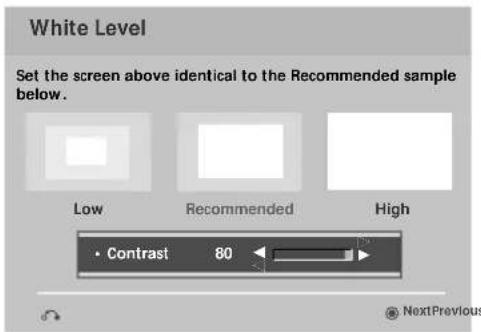
text_image
White Level Set the screen above identical to the Recommended sample below. Low Recommended High • Contrast 80 NextPrevious
Adjust White Level.
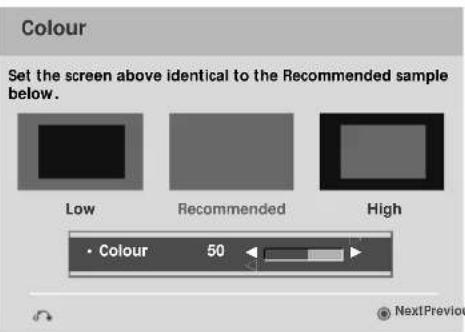
text_image
Colour Set the screen above identical to the Recommended sample below. Low Recommended High • Colour 50 NextPrevious
Adjust Colour.
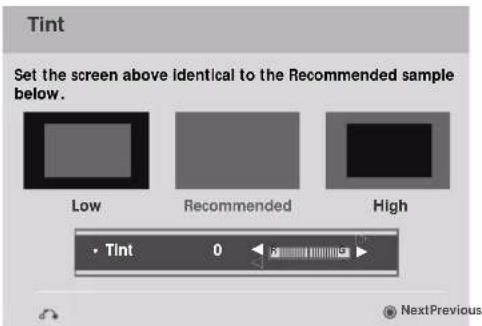
text_image
Tint Set the screen above identical to the Recommended sample below. Low Recommended High • Tint 0 NextPrevious
Adjust Tint.
PICTURE CONTROL

text_image
Horizontal Sharpness Set the screen above identical to the Recommended sample below. Low Recommended High • H Sharpness 50 Previous Next
Adjust Horizontal Sharpness.

text_image
Vertical Sharpness Set the screen above identical to the Recommended sample below. Low Recommended High • V Sharpness 50 Previous Next
Adjust Vertical Sharpness.

text_image
Complete Select (an) input(s) to apply the settings. ✓ DTV □ TV □ AV1 □ AV2 □ Component1 □ Component2 □ RGB ✓ HDMI1 ✓ HDMI2 ✓ HDMI3 ✓ HDMI4 Warning: The picture quality may vary according to the different types of signal and inputs. MARK MarkPreviousConfirmMove11
MARK
FAV
Select input source to apply the settings.
12 OK Save.
text_image
The current adjustment value is saved to Expert1. Close13 OK Finish the Picture Wizard.
- If you stop the setting before the final step, the changes will not be saved to the TV.
eENERGY SAVING
It reduces the plasma display's power consumption.
The default factory setting complies with the Energy Star requirements and is adjusted to the comfortable level to be viewed at home.
You can increase the brightness of your screen by adjusting the Energy Saving level or by setting the Picture Mode.

text_image
PICTURE Aspect Ratio : 16:9 Picture Wizard Energy Saving : Intelligent Sensor Picture Mode : Vivld • Contrast 100 • Brightness 50 • Sharpness 70 • Colour 70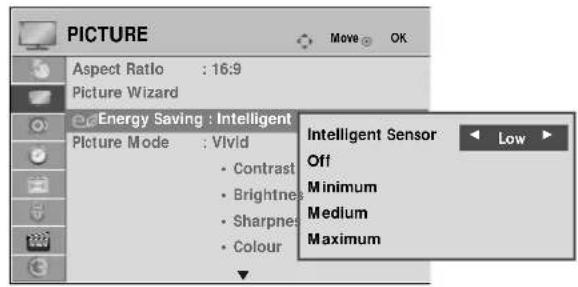
text_image
PICTURE Aspect Ratio : 16:9 Picture Wizard Energy Saving : Intelligent Picture Mode : Vivid • Contrast • Brightness • Sharpness • Colour Intelligent Sensor Off Minimum Medium Maximum
Select PICTURE.
Select e0 Energy Saving.

Select Intelligent Sensor, Off, Minimum, Medium or Maximum.
- When the Intelligent sensor function is on, the most suitable picture is automatically adjusted according to the surrounding conditions.
- Intelligent Sensor: Adjusts picture according to the surrounding conditions.
When the Intelligent Sensor is selected,
Select Low, Middle or High.
- Press the MENU button to return to normal TV viewing.
- Press the RETURN button to move to the previous menu screen.
PICTURE CONTROL
PRESET PICTURE SETTINGS
Picture Mode-Preset
- Picture Mode adjusts the TV for the best picture appearance. Select the preset value in the Picture Mode menu based on the programme category.
- Vivid, Standard, Cinema, Sport, and Game Settings are preset for the optimum picture quality at the factory.
- Vivid: This is the mode to maximize the effect of the video in the retail store. Strengthen the contrast, brightness, colour and sharpness for vivid picture.
- Standard: This is the mode to realize optimum viewing condition for the general user.
• Cinema: This mode optimizes video for watching movies. - Sport: This is the video mode to emphasize dynamic video and primary colour (e.g, white, uniform, grass, sky blue etc.) by realizing the optimal screen for sports.
• Game: This is the mode to realize fast response speed in a fast gaming screen. - Expert: This is the mode to adjust the video in detail for video quality expert and general user.
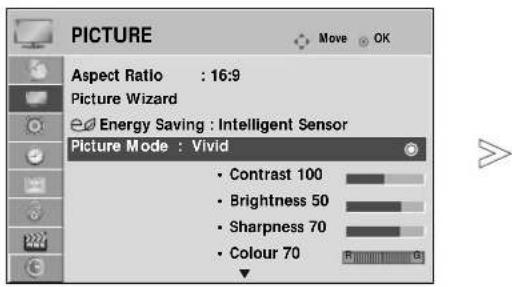
text_image
PICTURE Aspect Ratio : 16:9 Picture Wizard Energy Saving : Intelligent Sensor Picture Mode : Vivid • Contrast 100 • Brightness 50 • Sharpness 70 • Colour 70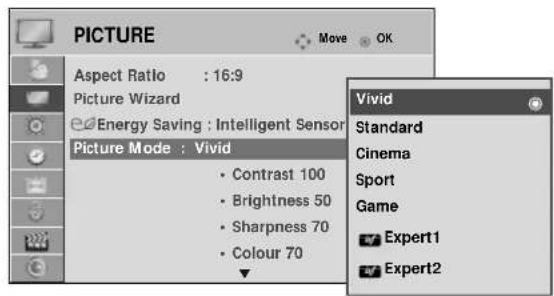
text_image
PICTURE Aspect Ratio : 16:9 Picture Wizard Energy Saving : Intelligent Sensor Picture Mode : Vivid Contrast 100 Brightness 50 Sharpness 70 Colour 70 Vivid Standard Cinema Sport Game Expert1 Expert2
Select PICTURE.

Select Picture Mode.

Select Vivid, Standard, Cinema, Sport, Game, Expert1 and Expert2.
- Picture Mode adjusts the TV for the best picture appearance. Select the preset value in the Picture Mode menu based on the programme category.
- You can also adjust Picture Mode in the Q. Menu.
- Press the MENU button to return to normal TV viewing.
- Press the RETURN button to move to the previous menu screen.
MANUAL PICTURE ADJUSTMENT
Picture Mode-User option
- Contrast
Adjusts the difference between light and dark levels in the picture.
- Brightness
Increases or decreases the amount of white in the picture.
- Sharpness
Adjusts the level of crispness in the edges between the light and dark areas of the picture.
The lower the level, the softer the image.
- Colour
Adjusts intensity of all colours.
• Tint
Adjusts the balance between red and green levels.

text_image
PICTURE Aspect Ratio : 16:9 Picture Wizard Energy Saving : Intelligent Sensor Picture Mode : Vivid • Contrast 100 • Brightness 50 • Sharpness 70 • Colour 70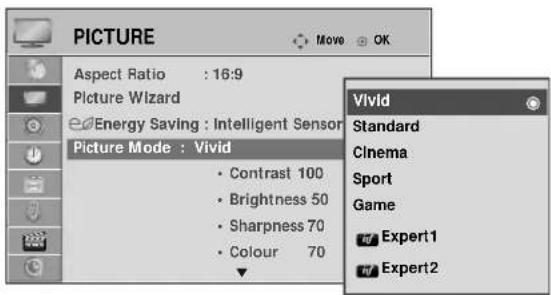
text_image
PICTURE Aspect Ratio : 16:9 Picture Wizard Energy Saving : Intelligent Sensor Picture Mode : Vivid Contrast 100 Brightness 50 Sharpness 70 Colour 70 Vivid Standard Cinema Sport Game Expert1 Expert2
Select PICTURE.

Select Picture Mode.

Select Vivid, Standard, Cinema, Sport, Game, Expert1 or Expert2.

Select Contrast, Brightness, Sharpness, Colour or Tint.

Make appropriate adjustments.
- Press the MENU button to return to normal TV viewing.
- Press the RETURN button to move to the previous menu screen.

NOTE
▶ You cannot adjust colour, sharpness and tint in the RGB/HDMI[PC] mode.
▶ When the Expert 1/2 is selected, you can select Contrast, Brightness, H Sharpness, V Sharpness, Colour or Tint.
PICTURE CONTROL
PICTURE IMPROVEMENT TECHNOLOGY
You can calibrate the screen for each Picture Mode or set the video value according to the special video screen.
You can set the video value differently for each input.
To reset to the factory default screen after making adjustment to each video mode, execute the "Picture Reset" function for each Picture Mode.

text_image
PICTURE • Brightness 50 • H Sharpness 50 • V Sharpness 50 • Colour 70 • Tint 0 • Advanced Control • Reset Screen PICTURE • Brightness • H Sharpness • V Sharpness • Colour • Tint • Advance • Reset Screen Move OK Move OK Colour Temperature Medium Dynamic Contrast High Dynamic Colour High Noise Reduction Medium Gamma Medium Black Level Auto Film Mode Off Close
Select PICTURE.

Select Advanced Control.

Select your desired Source.: Colour Temperature, Dynamic Contrast, Dynamic Colour, Noise Reduction, Gamma, Black Level, Film Mode, Colour Gamut, Edge Enhancer or xvYCC.

Make appropriate adjustments.
- Press the MENU button to return to normal TV viewing.
- Press the RETURNbutton to move to the previous menu screen.
Expert Picture Control
By segmenting categories, if Expert1 and if Expert2 provide more categories which users can set as they see fit, offering the optimal picture quality for users.
This may also be used to help a professional optimize the TV performance using specific videos.
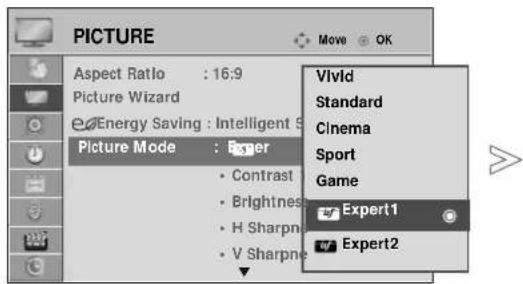
text_image
PICTURE Aspect Ratio : 16:9 Picture Wizard Energy Saving : Intelligent S Picture Mode : Expert Vivid Standard Cinema Sport Game Expert1 Expert2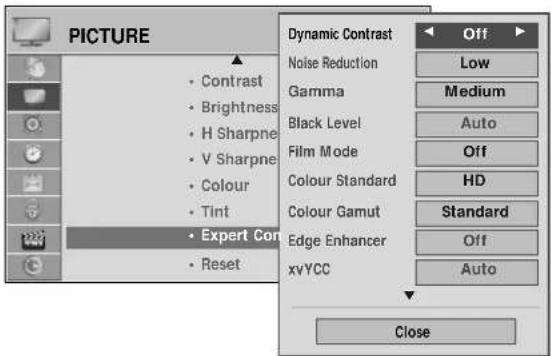
text_image
PICTURE • Contrast • Brightness • H Sharpne • V Sharpne • Colour • Tint • Expert Con • Reset Dynamic Contrast Noise Reduction Gamma Black Level Film Mode Colour Standard Colour Gamut Edge Enhancer xvYCC Off Low Medium Auto Off HD Standard Off Auto Close
Select PICTURE.

Select Picture Mode.
Select Expert1 or Expert2.

Select Expert Control.
Select your desired Source.

Make appropriate adjustments.
- Press the MENU button to return to normal TV viewing.
- Press the RETURN button to move to the previous menu screen.
PICTURE CONTROL
| Colour Temperature(Warm/Medium/Cool) | Choose one of three automatic colour adjustments. Set to warm to enhance hotter colours such as red, or set to cool to make picture bluish. |
| Dynamic Contrast(Off/Low/High) | Adjusts the contrast to keep it at the best level according to the brightness of the screen. The picture is improved by making bright parts brighter and dark parts darker. |
| Dynamic Colour(Off/Low/High ) | Adjusts screen colours so that they look livelier, richer and clearer. This feature enhances hue, saturation and luminance so that red, blue, green and white look more vivid. |
| Noise Reduction(Off/Low/Medium/High) | Reduces screen noise without compromising video quality. |
| Gamma(Low/Medium/High) | You can adjust brightness of dark area and middle gray level area of the picture.Low: Make dark and middle gray level area of the picture brighter.Medium: Express original picture levels.High: Make dark and middle gray level area of the picture darker. |
| Black Level(Low/High) | Low: The picture of the screen gets darker.High: The picture of the screen gets brighter.Auto: Realizing the black level of the screen and set it to High or Low automatically.Set black level of the screen to proper level.This function enables to select 'Low' or 'High' in the following mode: AV(NTSC-M), HDMI or Component. Otherwise, 'Black level' is set to 'Auto'. |
| Film Mode(On/Off) | You can watch a cinema-like video by eliminating judder effect.Use this function when you watch movies. |
| Colour Gamut(Wide/Standard) | Standard: Mode to reproduce original colour according to the standard of input signal independent of the display characteristics.Wide:Mode to use and set the rich colour area of the display.Maximize the utilization for colour area that can be expressed. |
| Edge Enhancer(On/Off) | Shows clearer and distinctive yet natural corners of the video. |
| xvYCC(Auto/off/on) | This is the function to express richer colour.This function is enabled in "Picture mode - Cinema, Expert" when xvYCC signal is inputted through HDMI, 1080p. |
| Colour Standard(SD/HD) | Converts the colour of a different video to HD colour. This function is set for SD video (BT-601) and HD video (BT-709) colour format. |
| Expert Pattern(Off/Pattern1/Pattern2) | This is the pattern necessary for expert adjustment.This function is enabled in "Picture Mode - Expert" when you watch DTV. |
| Colour Filter(Off/Red/Green/Blue) | This is the function to filter the specific colours of the video.You can use the RGB filter to set colour saturation and hue accurately. |
| White Balance(Medium/Warm/Cool) | This is the function to adjust the overall colour of the screen to the feeling you want.Method: 2 PointsPattern: Inner, OuterRed/Green/Blue Contrast, Red/Green/Blue Brightness:The adjustment range is -50 ~ +50.b.Method: 20 Point IREPattern: Inner / OuterIRE (Institute of Radio Engineers) is the unit to display the size of the video signal and can be set among 5, 10, 15 ~ 100. You can adjust Red, Green or Blue according to each setting.Red/Green/Blue: The adjustment range is -50 ~ +50. |
| Colour Management System | As the tool used by the experts to make adjustments by using the test patterns, this does not affect other colours but can be used to selectively adjust the 6 colour areas (Red/Green/Blue/Cyan/Magenta/Yellow).Colour difference may not be distinctive even when you make the adjustments for the general video.Adjusts Red/Green/Blue/Yellow/Cyan/Magenta.Red/Green/Blue/Yellow/Cyan, Magenta Colour: The adjustment range is -30 ~ +30.Red/Green/Blue/Yellow/Cyan/Magenta Tint: The adjustment range is -30 ~ +30.This feature is disable in RGB-PC and HDMI (PC) mode. |
PICTURE CONTROL
PICTURE RESET
Settings of the selected picture modes return to the default factory settings.

text_image
PICTURE • Contrast 100 • Brightness 50 • Sharpness 70 • Colour 70 • Tint 0 • Advanced Control • Reset Screen

text_image
PICTURE • Contrast 100 • Brightness 50 • Sharpness 70 • Colour 70 • Tint 0 • Adv • Res Screen Move OK Press Yes to start Picture Reset. Yes No
Select PICTURE.

Select Reset

Select Yes.
Initialize the adjusted value.
- Press the MENU button to return to normal TV viewing.
- Press the RETURN button to move to the previous menu screen.
IMAGE STICKING MINIMIZATION (ISM) METHOD
A frozen or still picture displayed on the screen for prolonged periods will result in a ghost image remaining even when you change the image. Avoid allowing a fixed image to remain on the screen for prolonged periods.
Orbiter
Orbiter may help prevent ghost images. However, it is best not to allow any fixed image to remain on the screen. To avoid a permanent image on the screen, the screen will move every 2 minutes.
Colour Wash
The colour block with the screen moved a little and the white pattern are alternately displayed. It is difficult to sense the afterimage occurred while the temporary afterimage is removed and the colour pattern is operating.
White Wash
White wash removes permanent images from the screen.
Note: An excessive permanent image may be impossible to clear entirely with White Wash.

text_image
OPTION SIMPLINK : Off Key Lock : Off Simple Manual ISM Method :Normal Set ID : 1 Demo Mode : Off Mode Setting : Home Use Factory Reset
text_image
OPTION SIMPLINK : Off Key Lock : Off Simple Manual ISM Method Set ID Demo Mode Mode Setting Factory Reset Normal Orbiter Colour Wash White Wash
Select OPTION.
- If you do not need this function, set Normal.

Select ISM Method.

Select Normal, Orbiter, Colour Wash or White Wash.

- Press the MENU button to return to normal TV viewing.
- Press the RETURN button to move to the previous menu screen.
PICTURE CONTROL
DEMO MODE
Display the slide show to explain the various logo of this TV.
It is not possible to use Demo Mode in Home Use mode.
In Store Demo, Demo Mode is automatically set to O n ^n
Once Demo Mode is set to Off in Store Demo, Demo Mode does not run and only the screen is reset.
The screen is reset automatically after 5 minutes in Demo Mode.
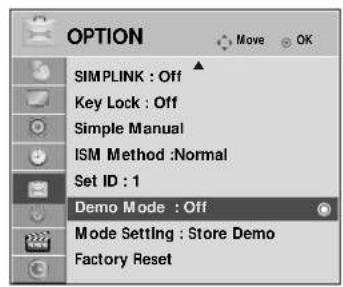
text_image
OPTION SIMPLINK : Off Key Lock : Off Simple Manual ISM Method :Normal Set ID : 1 Demo Mode : Off Mode Setting : Store Demo Factory Reset

text_image
OPTION SIMPLINK : Off Key Lock : Off Simple Manual ISM Method :Normal Set ID : Demo Mode : Mode Setting : Factory Reset Off On(LED On) On(LED Off)
Select OPTION.

Select Demo Mode.

Select On to show the various feature of the TV.

After a while, Demo Mode starts.
If you want to stop the demo, press any button (Except △ + or - and MUTE button).
- On(LED On): The LED at the bottom of TV operates in Store Mode.
-
On(LED Off): The LED at the bottom of TV does not operate in Store Mode.
-
Press the MENU button to return to normal TV viewing.
- Press the RETURN button to move to the previous menu screen.
MODE SETTING
We recommend setting the TV to "Home Use" mode for the best picture in your home environment.
"Store Demo" mode is an optimal setting for displaying at stores.
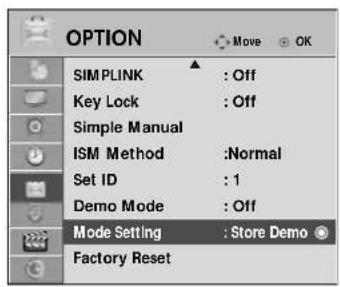
text_image
OPTION SIMPLINK : Off Key Lock : Off Simple Manual ISM Method :Normal Set ID : 1 Demo Mode : Off Mode Setting : Store Demo Factory Reset

text_image
Mode Setting Selecting the environment. Choose the setting mode you want. Store Demo Home Use Select [Home Use] to use this TV at home. To use this TV in store, select [Store Demo]. ENERGY STAR
Select OPTION.

Select Mode Setting.

Select Store Demo or Home Use.

Save.
- Press the RETURN button to return to normal TV viewing.
SOUND & LANGUAGE CONTROL
AUTO VOLUME LEVELER (AUTO VOLUME)
Auto Volume makes sure that the volume level remains consistent whether you are watching a commercial or a regular TV programme.
Because each broadcasting station has its own signal conditions, volume adjustment may be needed every time the channel is changed. This feature allows users to enjoy stable volume levels by making automatic adjustments for each programme.
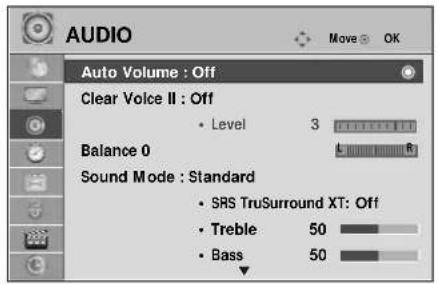
text_image
AUDIO Auto Volume : Off Clear Voice II : Off • Level 3 Balance 0 Sound Mode : Standard • SRS TruSurround XT: Off • Treble 50 • Bass 50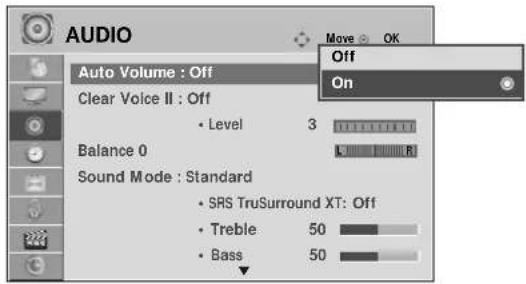
text_image
AUDIO Auto Volume : Off Clear Voice II : Off • Level 3 Balance 0 Sound Mode : Standard • SRS TruSurround XT: Off • Treble 50 • Bass 50
Select AUDIO.

Select Auto Volume.

Select OOn Off.

Save.
- Press the MENU button to return to normal TV viewing.
- Press the RETURN button to move to the previous menu screen.
CLEAR VOICE II
By differentiating the human sound range from others, it improves the sound quality of voices.
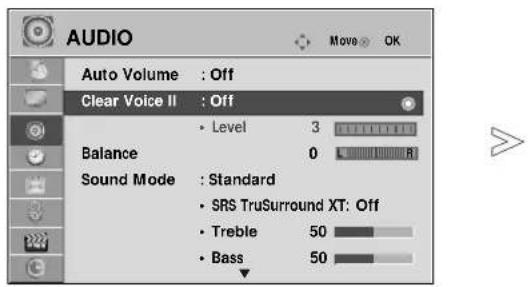
text_image
AUDIO Auto Volume : Off Clear Voice II : Off Level 3 Balance 0 R Sound Mode : Standard SRS TruSurround XT: Off Treble 50 Bass 50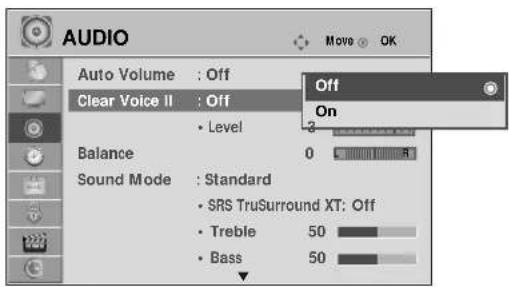
text_image
AUDIO Auto Volume : Off Clear Voice II : Off Level Balance 0 R Sound Mode : Standard SRS TruSurround XT: Off Treble 50 Bass 50
Select AUDIO.

Select Clear Voice II.

Select O or Off.
- If you select "Clear Voice II-On", SRS TruSurround XT feature will not work.
- Select levels from '-6' to '+6'.
Adjustment for Clear Voice II Level With selecting On

Select Level.

Make appropriate adjustments.

- Press the MENU button to return to normal TV viewing.
- Press the RETURN button to move to the previous menu screen.
SOUND & LANGUAGE CONTROL
PRESET SOUND SETTINGS (SOUND MODE)
Sound Mode lets you enjoy the best sound without any special adjustment as the TV sets the appropriate sound options based on the programme content.
Standard, Music, Cinema, Sport, and Game are preset for optimum sound quality at the factory.
Standard, Music, Cinema, Sport, and Game are preset for optimum sound quality at the factory.
Standard: Offers standard-quality sound.
Music: Optimizes sound for listening to music.
Cinema: Optimizes sound for watching movies.
Sport: Optimizes sound for watching sports events.
Game: Optimizes sound for playing games.

text_image
AUDIO Auto Volume : Off Clear Voice II : Off • Level 3 Balance 0 Sound Mode : Standard • SRS TruSurround XT: Off • Treble 50 • Bass 50

text_image
AUDIO Auto Volume : Off Clear Voice II : Off • Level 3 Balance 0 Sound Mode : Standard • SRS TruSurro • Treble • Bass Standard Music Cinema Sport Game
Select AUDIO.
- You can also adjust Sound Mode in the Q.MENU.

Select Sound Mode.

Select Standard, Music, Cinema, Sport or Game.
- Press the MENU button to return to normal TV viewing.
- Press the RETURN button to move to the previous menu screen.
SOUND SETTING ADJUSTMENT - USER MODE

text_image
AUDIO Auto Volume : Off Clear Voice II : Off • Level 3 Balance 0 R Sound Mode : Standard • SRS TruSurround XT: Off • Treble 50 • Bass 50
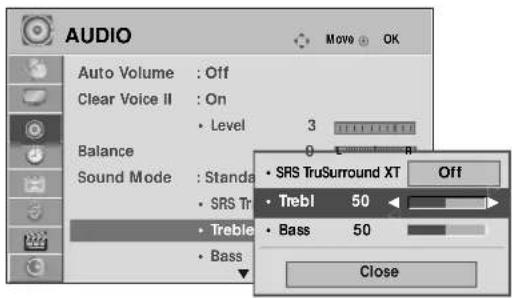
text_image
AUDIO Auto Volume : Off Clear Voice II : On • Level 3 Balance 0 R Sound Mode : Standa • SRS Tru • Treble • Bass • SRS TruSurround XT Off • Trebl 50 • Bass 50 Close
Select AUDIO.

Select Sound Mode.

Select Standard, Music, Cinema, Sport, or Game.

Select Treble or Bass.

Make appropriate adjustments.
- Press the MENU button to return to normal TV viewing.
- Press the RETURN button to move to the previous menu screen.
SRS TRUSURROUND XT

Select AUDIO.

Select SRS TruSurround XT

Select O on Off.
- SRS TruSurround XT: TruSurround XT takes advantage of any multi-channel format without needing to add extra speakers or equipment. Dialog clarity, bass enrichment, and the addition of stereo audio enhancement produces an immersive sound experience from standard stereo material.
- If sound quality or volume is not at the level you want, it is recommended to use a separate home theatre system or amplifier to cope with different user environments.
- Press the MENU button to return to normal TV viewing.
- Press the RETURN button to move to the previous menu screen.
SRS is a trademark of SRS Labs, Inc.
TruSurround XT technology is incorporated under license from SRS Labs, Inc.
SOUND & LANGUAGE CONTROL
BALANCE
Adjust the left/right sound of speaker to suit your taste and room situations.
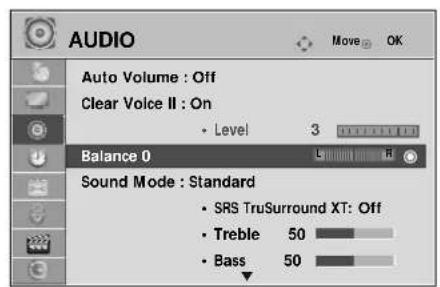
text_image
AUDIO Auto Volume : Off Clear Voice II : On • Level 3 Balance 0 Sound Mode : Standard • SRS TruSurround XT: Off • Treble 50 • Bass 50
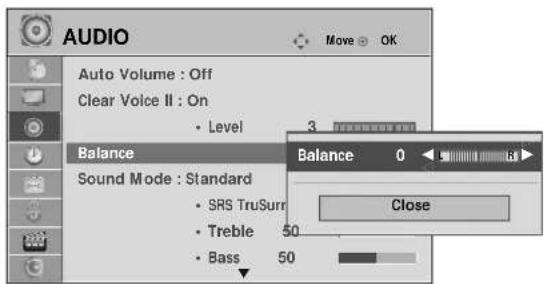
text_image
AUDIO Auto Volume : Off Clear Voice II : On • Level 3 Balance Sound Mode : Standard • SRS TruSurr • Treble 50 • Bass 50 Balance 0 Close
Select AUDIO.

Select Balance.

Make appropriate adjustments.
- Press the MENU button to return to normal TV viewing.
- Press the RETURN button to move to the previous menu screen.
TV SPEAKERS ON/OFF SETUP
You can adjust the TV internal speaker status.
In AV1, AV2, COMPONENT1, COMPONENT2, RGB and HDMI1, HDMI2, HDMI3, HDMI4 with HDMI to DVI cable, the TV speaker can be operational even when there is no video signal.
If you wish to use an external Hi-Fi system, turn off the TV's internal speakers.
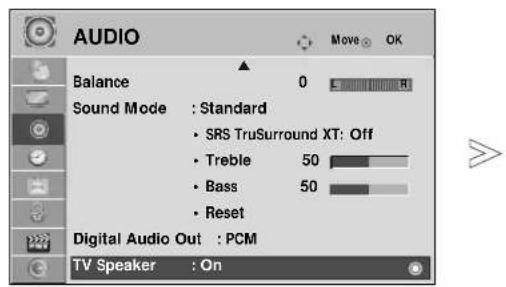
text_image
AUDIO Balance 0 Sound Mode : Standard • SRS TruSurround XT: Off • Treble 50 • Bass 50 • Reset Digital Audio Out : PCM TV Speaker : On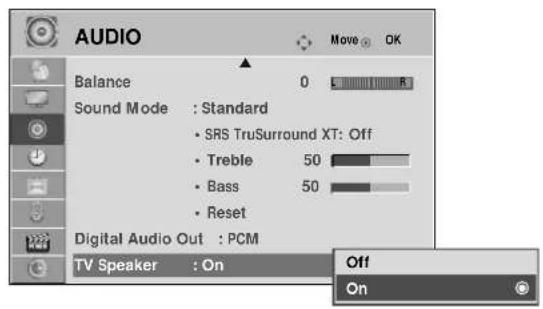
text_image
AUDIO Balance 0 Sound Mode : Standard • SRS TruSurround XT: Off • Treble 50 • Bass 50 • Reset Digital Audio Out : PCM TV Speaker : On Off On
Select AUDIO.

Select TV Speaker.

Select O or Off.
- Press the MENU button to return to normal TV viewing.
- Press the RETURN button to move to the previous menu screen.
NOTE
When the TV speaker is turned off while the Simplink home theatre is operating, the sound output automatically switches to the Home theatre speaker, but when the TV speaker is turned on, the sound output the TV speaker.
Some menus in AUDIO are disabled when TV Speaker is set to Off.
SOUND & LANGUAGE CONTROL
SELECTING DIGITAL AUDIO OUT
This function allows you to select your preferred Digital Audio Output.
The TV can only output DOLBY Digital if a programme is broadcast with Dolby Digital audio.
When Dolby digital is available, selecting Dolby Digital in the Digital Audio Out menu will set SPDIF(Sony Philips Digital Interface) output to Dolby Digital.
If Auto is selected in the digital audio out menu when only PCM is available, SPDIF output will be PCM(Pulse-code modulation).

text_image
AUDIO Balance 0 Sound Mode : Standard • SRS TruSurround XT: Off • Treble 50 • Bass 50 • Reset Digital Audio Out : PCM TV Speaker : On

text_image
AUDIO Balance 0 Sound Mode : Standard • SRS TruSurround XT: Off • Treble 50 • Bass 50 • Reset Digital Audio Out : PCM TV Speaker : On Auto PCM
Select AUDIO.

Select Digital Audio Out

Select Auto or PCM.

Manufactured under license from Dolby Laboratories. "Dolby" and the double-D symbol are trademarks of Dolby Laboratories.
- There is a possibility that when HDMI mode, some DVD player do not make SPDIF sound, At that time, set the output of the digital audio of the DVD player to PCM.(In HDMI, Dolby Digital Plus is not supported).
-
During recording or playback of audio only channel, Digital Audio Out is disabled.
-
Press the MENU button to return to normal TV viewing.
- Press the RETURN button to move to the previous menu screen.
AUDIO RESET
Settings of the selected Sound Mode return to the default factory settings.

text_image
AUDIO Level 0 Balance 0 Sound Mode : Standard SRS TruSurround XT: Off Treble 50 Bass Reset Digital Audio Out : PCM Press Yes to start Audio Reset. Yes No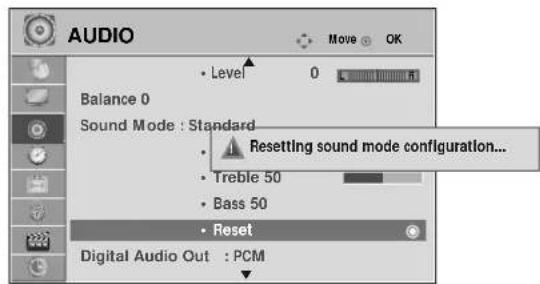
text_image
AUDIO Level 0 Balance 0 Sound Mode : Standard Resetting sound mode configuration... Treble 50 Bass 50 Reset Digital Audio Out : PCM
Select AUDIO.

Select Reset.

Select Yes or No.

Initialize the adjusted value.
- Press the MENU button to return to normal TV viewing.
- Press the RETURN button to move to the previous menu screen.
SOUND & LANGUAGE CONTROL
STEREO RECEPTION (IN ANALOGUE MODE ONLY)
When a programme is selected, the sound information for the station appears with the programme number and station name.
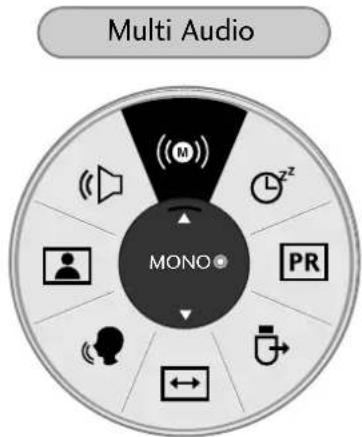
text_image
Multi Audio MONOAnalogue TV

Select Multi Audio.

Select Mono or Stereo.
- Press the RETURN button to return to normal TV viewing.
SPEAKER SOUND OUTPUT SELECTION
In AV, Component, RGB and HDMI mode, you can select output sound for the left and right loudspeakers.
Select the sound output.
L+R: Audio signal from audio L input is sent to the left loudspeaker and audio signal from audio R input is sent to the right loudspeaker.
L+L: Audio signal from audio L input is sent to left and right loudspeakers.
R+R: Audio signal from audio R input is sent to left and right loudspeakers.
LANGUAGE SELECTION (IN DIGITAL MODE ONLY)
The Audio function allows selection of a preferred language.
If audio data in a selected language is not broadcast, the default language audio will be played.
Use the Subtitle function when two or more subtitle languages are broadcast. If subtitle data in a selected language is not broadcast, the default language subtitle will be displayed.
When the languages you selected as the primary for Audio Language and Subtitle Language are not supported, you can select desired language in OPTION Menu.

Select OPTION.

Select Audio Language or Subtitle Language.

Select your desired language.


Select OPTION.

Select Hard of Hearing(☐).
Select O@on Off.
- Press the RETURN button to move to the previous menu screen.
< Audio Language Selection >
▶ When two or more audio languages are broadcast, you can select the audio language.

Select Multi Audio.

Select an audio language.

Audio Language OSD Information
| Display | Status |
| N.A | Not Available |
| MPEG | MPEG Audio |
| Dolby Digital Audio | |
| Audio for “Visual Impaired” | |
| Audio for “Hearing Impaired” |
▶ During recording or playback audio only channel, Audio Language Selection is disabled.
< Subtitle Language Selection >
▶ When two or more subtitle languages are broadcast, you can select the subtitle language with the SUBTITLE button on the remote control.
▶ Press the button to select a subtitle language.
- The audio/subtitles can be displayed in a simpler form with 1 to 3 characters broadcast by the service provider.
- When you select supplementary Audio (Audio for "Visual/Hearing Impaired") the TV may output a part of the Main audio.
| Subtitle Language OSD Information | |
| Display | Status |
| N.A | Not Available |
| Teletext Subtitle | |
| Subtitle for “Hard of Hearing” | |
TIME SETTING
CLOCK SETUP
The clock is set automatically when receiving a digital signal. (You can set the clock manually only if the TV has no DTV signal.)
You must set the time correctly before using on/off timer function or schedule recording.
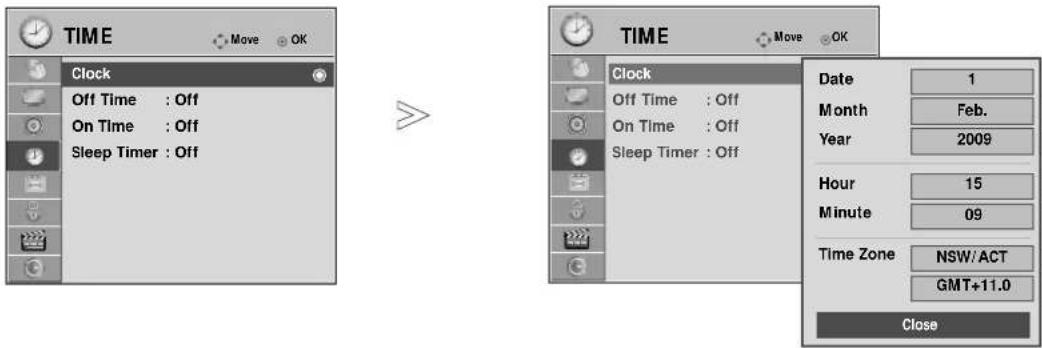
text_image
TIME Clock Off Time : Off On Time : Off Sleep Timer : Off TIME Clock Off Time : Off On Time : Off Sleep Timer : Off Date 1 Month Feb. Year 2009 Hour 15 Minute 09 Time Zone NSW/ACT GMT+11.0 Close
Select TIME.

Select Clock

Select either the year, date, or time option.

Set the year, date, and time options.
- Press the MENU button to return to normal TV viewing.
- Press the RETURN button to move to the previous menu screen.
AUTO ON/OFF TIME SETTING
The Off time function automatically switches the TV to standby at a preset time.
Two hours after the TV is switched on by the on time function it will automatically switch back to standby mode unless a button has been pressed.
The Off time function overrides the On timer function if both are set to the same time.
The TV must be in standby mode for the On timer to work.

Select Off Time or On Time.

Select Repeat

Select Off, Once, Daily, Mon.\~Fri., Mon.\~Sat., Sat.\~Sun., or Sunday.

Select and set Hour or Minute.
- To cancel On/Off Time function, select Off.
- Only for On Time function

Select Input.

Select the desired input source.

When Selecting Antenna: set the programme at turn-on.

Adjust to sound level at turn-on.
- Press the MENU button to return to normal TV viewing.
- Press the RETURN button to move to the previous menu screen.
SLEEP TIMER SETTING
You do not have to remember to switch the TV off before you go to sleep.
The sleep timer automatically switches the TV to standby after the preset time has elapsed.


Select Sleep Timer.

Select Off, 10, 20, 30, 60, 90, 120, 180 or 240 min..
- When you switch the TV off, the preset sleep timer is cancelled.
- You can also adjust Sleep Timer in the TIME menu.
PARENTAL CONTROL / RATINGS
SET PASSWORD & LOCK SYSTEM
Setting up Your Password
Set up blocking schemes to block specific programme, ratings, and external viewing sources. A password is required to gain access to this menu.
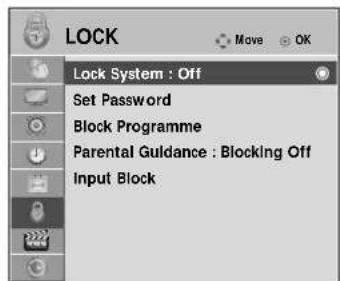
text_image
LOCK Move OK Lock System : Off Set Password Block Programme Parental Guidance : Blocking Off Input Block
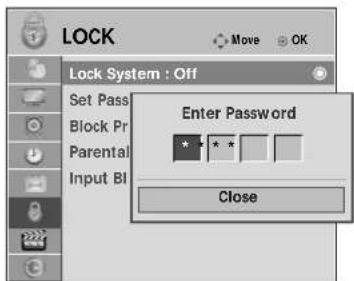
text_image
LOCK Set Pass Block Pr Parental Input BI Move OK Enter Password * * * Close
text_image
1 MENU 2 OKSelect LOCK.
Input the password.
- Enter the password as requested.
- The TV is set up with the initial password "0-0-0-0".
Lock System
Revitalize Block Programme, Parental Guidance and Input Block function.

text_image
LOCK Lock System : Off Set Password Block Programme Parental Guidance : Blocking Off Input Block
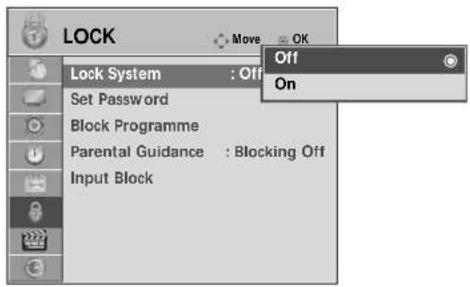
text_image
LOCK Move OK Off On Lock System : Off Set Password Block Programme Parental Guidance : Blocking Off Input Block
Select LOCK.
Input the password.

Select Lock System.

Select O or Off.
- If selecting O, rBlock Programme, Parental Guidance and Input Block operates.
- Press the MENU button to return to normal TV viewing.
- Press the RETURN button to move to the previous menu screen.
PARENTAL CONTROL / RATINGS
Set Password
Change the password by inputting a new password twice.

text_image
LOCK Lock System : On Set Password Block Programme Parental Guidance : Blocking Off Input Block
text_image
LOCK Move OK Lock System : On Set Password Block Channel Rating Input Block New Confirm Close
Select LOCK.

Select Set password.

Input the password.
Choose any 4 digits for your new password.
As soon as the 4 digits are entered, re-enter the same 4 digits on the Confirm.
- Press the MENU button to return to normal TV viewing.
- Press the RETURN button to move to the previous menu screen.
BLOCK PROGRAMME
Blocks any programme that you do not want to watch or that you do not want your children to watch.
It is available to use this function in Lock System "OOnn
Enter the password to watch a blocked programme.

text_image
LOCK Move OK Lock System : Off Set Password Block Programme Parental Guidance : Blocking Off Input Block 1 ABC TV DTV RADIO TV 1 ABC TV 2 ABC TV Sydney 4 ABC 2 5 ABC 3 6 ABC HDTV 8 Nine Digital Pr. Change Navigation Page Change Previous Block/Unblock
Select LOCK.
Input the password.

Select Block Programme.

Select a programme to block or unblock.

Block or unblock a programme.
- Press the MENU button to return to normal TV viewing.
- Press the RETURN button to move to the previous menu screen.
PARENTAL CONTROL / RATINGS
Parental Guidance
This function operates according to information from the broadcasting station. Therefore if the signal has incorrect information, this function does not operate.
A password is required to gain access to this menu.
This set is programmed to remember which option it was last set to even if you switch the set off.
Prevents children from watching certain adult's TV programmes, according to the ratings limit set.
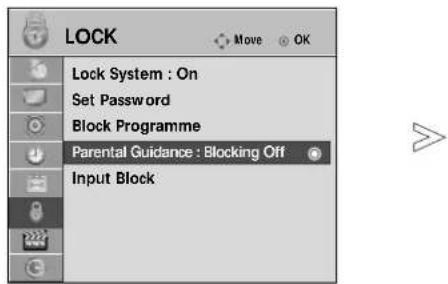
text_image
LOCK Move OK Lock System : On Set Password Block Programme Parental Guidance : Blocking Off Input Block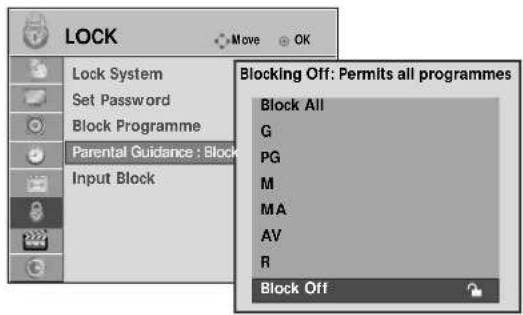
text_image
LOCK Lock System Set Password Block Programme Parental Guidance : Block Input Block Blocking Off: Permits all programmes Block All G PG M MA AV R Block Off
Select LOCK.

Input the password.

Select Parental Guidance.

Make appropriate adjustments.

Save.
- Press the MENU button to return to normal TV viewing.
- Press the RETURN button to move to the previous menu screen.
EXTERNAL INPUT BLOCKING
Enables you to block an input.
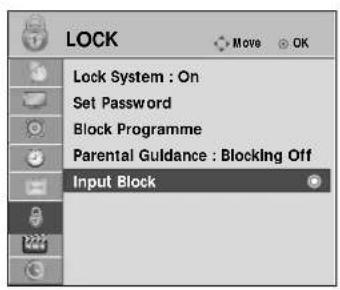
text_image
LOCK Lock System : On Set Password Block Programme Parental Guidance : Blocking Off Input Block
text_image
LOCK Lock System : Set Password Block Programme Parental Guidance : Blo Input Block AV1 Off AV2 Off Component1 Off Component2 Off RGB Off HDMI1 Off HDMI2 Off HDMI3 Off HDMI4 Off Close
Select LOCK.
Input the password.

Select Input Block.

Select input source.

Select O or Off.
Save.
- Press the MENU button to return to normal TV viewing.
- Press the RETURN button to move to the previous menu screen.
PARENTAL CONTROL / RATINGS
KEY LOCK
The TV can be set so that the remote control is required to control it. This feature can be used to prevent unauthorized viewing.
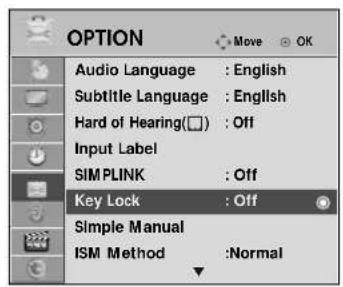
text_image
OPTION Audio Language : English Subtitle Language : English Hard of Hearing(□) : Off Input Label SIMPLINK : Off Key Lock : Off Simple Manual ISM Method : Normal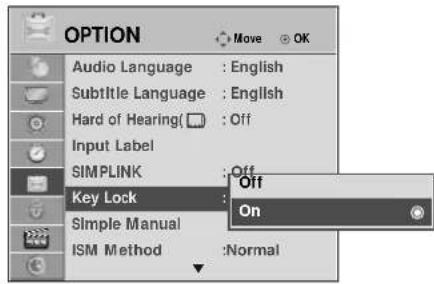
text_image
OPTION Audio Language : English Subtitle Language : English Hard of Hearing( □ : Off Input Label SIMPLINK : Off Key Lock : Off Simple Manual : On ISM Method : Normal
Select OPTION.

Select Key Lock.

Select On or Off.

Save.
- In Key Lock 'O', nif the TV is turned off, press the ⏻∅ I, INPUT, P ▲ or ▼ button on the TV or POWER, INPUT, P ∧ ∨ or NUMBER buttons on the remote control then the set will be turned on.
-
With the Key Lock On, the display ' 🔑 Key Lock' appears on the screen if any button on the front panel is pressed while viewing the TV. (Except for ⏻ I button)
-
Press the MENU button to return to normal TV viewing.
- Press the RETURN button to move to the previous menu screen.
TELETEXT
This feature is not available in all countries.
Teletext is a free service broadcast by most TV stations which gives up-to-the-minute information on news, weather, television programmes, share prices and many other topics.
The teletext decoder of this TV can support the SIMPLE, TOP and FASTEXT systems. SIMPLE (standard teletext) consists of a number of pages which are selected by directly entering the corresponding page number. TOP and FASTEXT are more modern methods allowing quick and easy selection of teletext information.
SWITCH ON/OFF
Press the TEXT button to switch to teletext. The initial page or last page viewed appears on the screen.
Two page numbers, TV station name, date and time are displayed on the screen headline. The first page number indicates your selection, while the second shows the current page displayed.
Press the TEXT button to switch off teletext. The previous mode reappears.
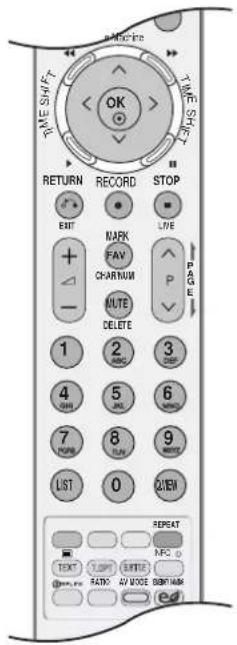
text_image
TIME SHIFT OK RETURN RECORD STOP EXIT MARK LIVE + FAV P - CHARTNUM P + ULTE - DELETE 1 2 3 4 5 6 7 8 9 LIST 0 CLIENT REPEAT MCC TEXT TLOW ENTIE RADIO AV VODE EBIT REM BEET REMSIMPLE TEXT
■ Page selection
① Enter the desired page number as a three digit number with the NUMBER buttons. If during selection you press a wrong number, you must complete the three digit number and then re-enter the correct page number.
② The P ∧ ∨ button can be used to select the preceding or following page.
TOP TEXT
The user guide displays four fields-red, green, yellow and blue at the bottom of the screen. The yellow field denotes the next group and the blue field indicates the next block.
■ Block / group / page selection
With the blue button you can progress from block to block.
2 Use the yellow button to proceed to the next group with automatic overflow to the next block.
③ With the green button you can proceed to the next existing page with automatic overflow to the next group. Alternatively the P ∧ button can be used.
4 The red button returns to the previous selection. Alternatively the P √ button can be used.
■ Direct page selection
As with SIMPLE teletext mode, you can select a page by entering it as a three digit number using the NUMBER buttons in TOP mode.
TELETEXT
FASTEXT
The teletext pages are colour coded along the bottom of the screen and are selected by pressing the corresponding coloured button.
Page selection
① Press the T.OPT button and then use ∧ ∨ button to select □ menu. Display the index page.
② You can select the pages which are colour coded along the bottom line with corresponding coloured buttons.
③ AS with SIMPLE teletext mode, you can select a page by entering its three digit page number with the NUMBER buttons in FASTEXT mode.
4 The P ∧ ∨ button can be used to select the preceding or following page.
SPECIAL TELETEXT FUNCTIONS
- Press the T. OPT button and then use ^ ∨ button to select the Text Option menu.

Index
Select the each index page.

Time
When viewing a TV programme, select this menu to display the time at the top right hand corner of the screen.
In the teletext mode, press this button to select a sub page number. The sub page number is displayed at the bottom of the screen. To hold or change the sub page, press the RED/GREEN, or NUMBER buttons.

text_image
Text Option Index Time Hold Reveal Update Close
Hold
Stops the automatic page change which will occur if a teletext page consists of 2 or more sub pages. The number of sub pages and the sub page displayed is, usually, shown on the screen below the time. When this menu is selected the stop symbol is displayed at the top left-hand corner of the screen and the automatic page change is inactive.

Reveal
Select this menu to display concealed information, such as solutions to riddles or puzzles.

Update
Displays the TV picture on the screen while waiting for a new teletext page. The display will appear at the top left hand corner of the screen. When the updated page is available then display will change to the page number. Select this menu again to view the updated teletext page.
TROUBLESHOOTING
The TV does not operate properly.
| The remote control does not work | Check to see if there is any object between the TV and the remote control causing an obstruction. Ensure you are pointing the remote control directly at the TV.Ensure that the batteries are installed with correct polarity (+ to +, - to -).Install new batteries. |
| Power is suddenly turned off | Is the sleep timer set?Check the power control settings. Has the Power supply been interrupted.The TV goes into Standby mode automatically if no signal is received and no operation is performed for 15 minutes. |
The video function does not work.
| No picture & No sound | Check whether the TV is switched on.Try another channel. The problem may be with the broadcast.Is the power cord inserted correctly into the mains?Check your antenna direction and/or location.Test the mains outlet by plugging another TV into the same outlet. |
| Picture appears slowly after switching on | This is normal, the image is muted during the TV startup process. Please contact your service centre, if the picture has not appeared after five minutes. |
| No or poor colour or poor picture | Adjust Colour in menu option.Allow a sufficient distance between the TV and the VCR.Try another channel. The problem may be with the broadcast.Are the video cables installed properly?Activate any function to restore the brightness of the picture. |
| Horizontal/vertical bars or picture shaking | Check for local interference such as an electrical appliance or power tool. |
| Poor reception on some channels | Station or cable channel experiencing problems, tune to another station.Station signal is weak, reposition the antenna to receive weaker stations.Check for sources of possible interference. |
| Lines or streaks in pictures | Check antenna (Change the position of the antenna). |
| No picture when connecting HDMI | Check that your HDMI cable is version 1.3 or higher.If the HDMI cables don’t support HDMI version 1.3, flickering or no screen display can result. Please use the latest cables that support at least HDMI version 1.3. |
| The audio function does not work. | |
| Picture OK & No sound | Press the △ + or --button.Sound muted? Press MUTE button.Try another channel. The problem may be with the broadcast.Are the audio cables installed properly? |
| No output from one of the speakers | Adjust Balance in menu option. |
| Unusual sound from inside the TV | A change in ambient humidity or temperature may result in an unusual noise when the TV is switched on or off and does not indicate a fault with the TV. |
| No sound when connecting HDMI or USB | Check HDMI cable over version 1.3.Check USB cable over version 2.0.*This feature is not available for all models. |
| There is a problem in PC mode. (Only PC mode applied) | |
| The signal is out of range (Invalid format) | ■ Adjust resolution, horizontal frequency, or vertical frequency.■ Check the input source. |
| Vertical bar or stripe on background & Horizontal Noise & Incorrect position | ■ Use Auto configure or adjust size, phase, or H/V position. (Option) |
| Screen colour is unstable or single colour | ■ Check the signal cable.■ Reinstall the PC video card. |
| There is a problem with PICTURE settings. | |
| When the user changes the picture settings, the TV automatically converts back to the initial settings after a certain period of time. | It means that the TV is currently set to Store Demo mode.To switch to Home Use mode you should do the followings:From the TV Menu, choose OPTION -> Choose Mode Setting -> Choose Home Use.Now, you have completed switching to theHome Use mode. |
MAINTENANCE
Early malfunctions can be prevented. Careful and regular cleaning can prolong the life of your new TV.
Caution: Be sure to switch the power off and unplug the power cord before you begin any cleaning.
Cleaning the Screen
A good way to keep the dust off your screen for a while is to wet a soft cloth in a mixture of lukewarm water and a little fabric softener or dish washing detergent. Wring the cloth until it is almost dry, and then use it to wipe the screen.
2 Ensure there is no excess water on the screen. Allow any water or dampness to evaporate before switching on.
Cleaning the Cabinet
■ To remove dirt or dust, wipe the cabinet with a soft, dry, lint-free cloth.
■ Do not to use a wet cloth.
Extended Absence
CAUTION
If you expect to leave your TV dormant for prolonged periods (such as a holiday), unplug the power cord to protect against possible damage from lightning or power surges.
APPENDIX
PRODUCT SPECIFICATIONS
| MODELS | 50PS7*** | 60PS7*** | |
| 50PS70FD-AA | 60PS70FD-AA | ||
| Dimensions(Width x Height x Depth) | with stand | 1228.8 x 835.8 x 309 mm48.4 x 32.9x 12.2inches | 1465.4x 986.4 x 371 mm57.7 x 38.9 x 14.6 inches |
| without stand | 1228.8x 784.5 x 78.9 mm48.4 x 30.9 x 3.1 inches | 1465.4 x 932.2 x 82.1 mm57.7 x 36.7 x 3.2 inches | |
| Weight | with stand | 38.1 kg / 84.0 lbs | 53.3kg / 117.5 lbs |
| without stand | 34.1kg / 75.2 lbs | 46.3kg / 102.1 lbs | |
| Power requirement | AC100-240V~ 50/60Hz | AC100-240V~50/60Hz | |
| Television SystemProgramme CoverageExternal Antenna Impedance | PAL B/B, DVB-TVHF 0-12, UHF 20-75, CATV 02-44, DTV 06-12, 27-6975 ohm | ||
| Environment condition | Operating Temperature | 32 ~ 104°F (0 ~ 40°C)Less than 80% | |
| Operating Humidity | |||
| Storage Temperature | -4 ~ 140°F (-20 ~ 60°C)Less than 85% | ||
| Storage Humidity | |||
| Supported movie files | Refer to p. 77 ~ 78 | ||
■ The specifications shown above may be changed without prior notice for quality improvement.
This function is not available for all models.
PROGRAMMING THE REMOTE CONTROL
The remote control is a multi brand or universal remote. It can be programmed. to operate most remote controlled devices from other manufacturers.
Note that the remote control may not control all models from other brands.
Programming a code into a remote mode
1 Testing your remote control.
To find out whether your remote control can operate other components without programming, turn on a component such as a STB and press the corresponding mode button (such as aSTB) on the remote control, while pointing at the component. Test the POWER and P buttons to see if the component responds correctly. If the component does not operate correctly, the remote control requires programming to operate the device.
2 Switch on the component to be programmed, then press the corresponding mode button (such as STB) on the remote control. The remote control button of the desired device is illuminated.
3 Press the MENU and MUTE buttons simultaneously, the remote control is ready to be programmed with the code.
4 Enter a code number using the number buttons on the remote control. Programming code numbers for the corresponding component can be found on the following pages. If the code is correct, the device will turn off.
5 Press the MENU button to store the code.
6 Test the remote control functions to see if the component responds correctly. If not, repeat from step 2.
HDSTB
| Brand Codes Brand Codes Brand Codes | ||||||||||||||
| ALPHASTAR DSR 123 | HOUSTON TRACKER | 033 037 | 039 | 051 | PROSAT | 072 | ||||||||
| AMPLICA 050 | 057 104 | RCA | 066 | 106 | ||||||||||
| BIRDVIEW 051 126 | 129 | HUGHES | 068 | REALISTIC | 043 | 074 | ||||||||
| CHANNEL MASTER | 013 | 014 | 015 | 018 | JANIEL | 060 | 147 | SAMSUNG | 123 | |||||
| 036 | 055 | JERROLD | 061 | SATELLITE SERVICE CO | 028 | 035 | 047 | 057 | ||||||
| CHAPARRAL | 008 | 009 | 012 | 077 | KATHREIN | 108 | 085 | |||||||
| CITOH | 054 | LEGEND | 057 | SCIENTIFIC ATLANTA | 032 | 138 | ||||||||
| CURTIS MATHES | 050 | 145 | LG | 001 | SONY | 103 | ||||||||
| DRAKE | 005 | 006 | 007 | 010 | LUTRON | 132 | STARCAST | 041 | ||||||
| 011 | 052 | 112 | 116 | LUXOR | 062 | 144 | SUPER GUIDE | 020 | 124 | 125 | ||||
| 141 | MACOM | 010 | 059 | 063 | 064 | TEECOM | 023 | 026 | 075 | 087 | ||||
| DX ANTENNA | 024 | 046 | 056 | 076 | 065 | 088 | 090 | 107 | 130 | |||||
| ECHOSTAR | 038 | 040 | 057 | 058 | MEMOREX | 057 | 137 | |||||||
| 093 | 094 | 095 | 096 | NEXTWAVE | 028 | 124 | 125 | TOSHIBA 002 | 127 | |||||
| 097 | 098 | 099 | 100 | NORSAT | 069 | 070 | UNIDEN | 016 | 025 | 042 | 043 | |||
| 122 | PACE SKY SATELLITE | 143 | 044 | 045 | 048 | 049 | ||||||||
| ELECTRO HOME | 089 | PANASONIC | 060 | 142 | 078 | 079 | 080 | 086 | ||||||
| EUROPLUS | 114 | PANSAT | 121 | 10 | 135 | 136 | ||||||||
| FUJITSU | 017 | 021 | 022 | 027 | PERSONAL CABLE | 117 | VIEWSTAR | 115 | ||||||
| 133 | 134 | PHILIPS | 071 | WINEGARD | 128 | 146 | ||||||||
| GENERAL INSTRUMENT | 003 | 004 | 016 | 029 | PICO | 105 | ZENITH | 081 | 082 | 083 | 084 | |||
| 031 | 059 | 101 | PRESIDENT | 019 | 102 | 091 | 120 | |||||||
| HITACHI | 139 | 140 | PRIMESTAR | 030 | 110 | 111 | ||||||||
APPENDIX
IR CODES
1. How to Connect
■ Connect your wired remote control to the Remote Control port on the TV.
2. Remote Control IR Codes
■ Output waveform
Single pulse, modulated with 37.917KHz signal at 455KHz
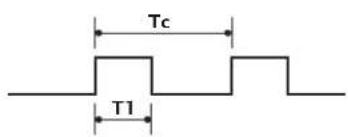
text_image
Tc T1
text_image
Carrier frequency FCAR = 1/Tc = fOSC/12 Duty ratio = T1/Tc = 1/3■ Configuration of frame
1st frame

flowchart
graph LR
    A["Lead code"] --> B["C0"]
    A --> C["C1"]
    A --> D["C2"]
    A --> E["C3"]
    A --> F["C4"]
    A --> G["C5"]
    A --> H["C6"]
    A --> I["C7"]
    A --> J["High custom code"]
    J --> K["C0"]
    J --> L["C1"]
    J --> M["C2"]
    J --> N["C3"]
    J --> O["C4"]
    J --> P["C5"]
    J --> Q["C6"]
    J --> R["C7"]
    J --> S["D0"]
    J --> T["D1"]
    J --> U["D2"]
    J --> V["D3"]
    J --> W["D4"]
    J --> X["D5"]
    J --> Y["D6"]
    J --> Z["D7"]
    K --> AA["Data code"]
    AA --> AB["D0"]
    AA --> AC["D1"]
    AA --> AD["D2"]
    AA --> AE["D3"]
    AA --> AF["D4"]
    AA --> AG["D5"]
    AA --> AH["D6"]
    AA --> AI["D7"]
Repeat frame

text_image
Repeat code TfLead code

text_image
9 ms 4.5 ms- Repeat code

text_image
0.55 ms 9 ms 2.25 msBit description

text_image
Bit "0" 0.56 ms 1.12 ms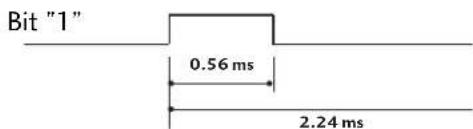
text_image
Bit "1" 0.56 ms 2.24 msFrame interval: Tf
The waveform is transmitted as long as a key is depressed.

text_image
Tf Tf Tf=108ms @455KHz| Code (Hexa) | Function | Note |
| 95 | Energy Saving | R/C BUTTON |
| 08 | POWER | R/C BUTTON(POWER ON/OFF) |
| 0B | INPUT | R/C BUTTON |
| 79 | RATIO | R/C BUTTON |
| F0 | TV/RAD | R/C BUTTON |
| 45 | Q.MENU | R/C BUTTON |
| 43 | MENU | R/C BUTTON |
| AB | GUIDE | R/C BUTTON |
| 40 | Up (λ) | R/C BUTTON |
| 41 | Down (↓) | R/C BUTTON |
| 07 | Left (↓) | R/C BUTTON |
| 06 | Right (↓) | R/C BUTTON |
| 44 | OK(◎) | R/C BUTTON |
| 28 | RETURN/EXIT | R/C BUTTON |
| AA | INFO 1 | R/C BUTTON |
| 30 | AV MODE | R/C BUTTON |
| 02 | Δ+ | R/C BUTTON |
| 03 | Δ- | R/C BUTTON |
| 1E | FAV | R/C BUTTON |
| 09 | MUTE | R/C BUTTON |
| 00 | P ∧ | R/C BUTTON |
| 01 | P ∨ | R/C BUTTON |
| 10~19 | Number Key 0~9 | R/C BUTTON |
| 53 | LIST | R/C BUTTON |
| 1A | Q.VIEW | R/C BUTTON |
| 72 | RED Key | R/C BUTTON |
| 71 | GREEN Key | R/C BUTTON |
| 63 | YELLOW Key | R/C BUTTON |
| 61 | BLUE Key | R/C BUTTON |
| 20 | TEXT | R/C BUTTON |
| 21 | T.OPT(T.Option) | R/C BUTTON |
| 39 | SUBTITLE | R/C BUTTON |
| 7E | SIMPLINK | R/C BUTTON |
| B1 | Stop/Live | R/C BUTTON |
| BD | Record | R/C BUTTON |
| 8F | ◀ | R/C BUTTON |
| 8E | ▶ | R/C BUTTON |
| B0 | ▶ | R/C BUTTON |
| BA | II II | R/C BUTTON |
EXTERNAL CONTROL DEVICE SETUP
RS-232C Setup
Connect the RS-232C (serial port) input jack to an external control device (such as a computer or an A/V control system) to control the product's functions externally.
Connect the serial port of the control device to the RS-232C jack on the product back panel.
Note: RS-232C connection cables are not supplied with the product.
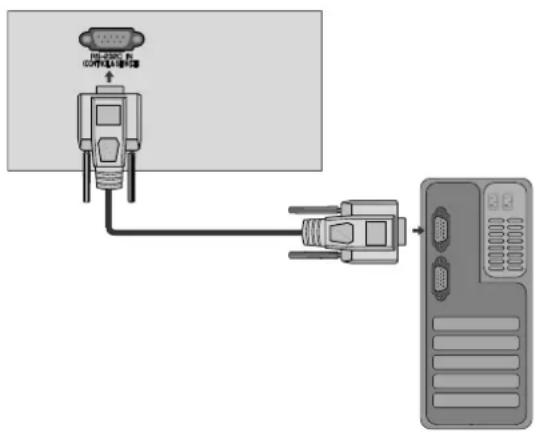
text_image
Diagram showing connection between a USB port and an external device with labeled ports and ports.Type of Connector; D-Sub 9-Pin Male
| No. | Pin | Name |
| 1 | No | connection |
| 2 RXD | (Receive data) | |
| 3 TXD | (Transmit data) | |
| 4 DTR | (DTE side ready) | |
| 5 GND | ||
| 6 DSR | (DCE side ready) | |
| 7 RTS | (Ready to send) | |
| 8 CTS | (Clear to send) | |
| 9 No Connection | ||

text_image
1 5 6 9RS-232C Configurations
7-Wire Configurations (Standard RS-232C cable)

3-Wire Configurations(Not standard)
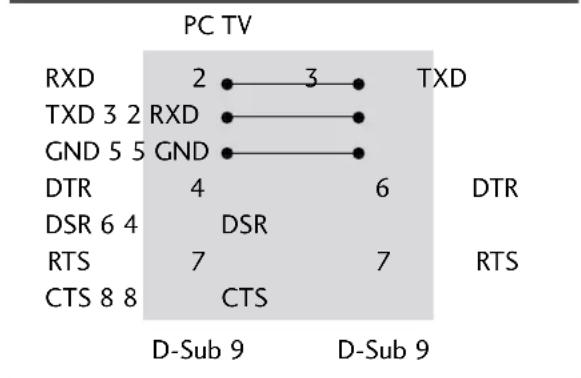
line
PC TV | Component | Pin 1 | Pin 2 | Pin 3 | Pin 4 | Pin 5 | Pin 6 | Pin 7 | Pin 8 | Pin 9 | | :--- | :--- | :--- | :--- | :--- | :--- | :--- | :--- | :--- | :--- | | RXD | 2 | ●-3-● | - | - | - | - | - | - | - | | TXD 3 2 | RXD | ●-●-● | - | - | - | - | - | - | - | | GND 5 5 | GND | ●-●-● | - | - | - | - | - | - | - | | DTR | 4 | - | - | - | - | 6 | - | - | DTR | | DSR 6 4 | DSR | - | - | - | - | - | - | - | - | | RTS | 7 | - | - | - | - | 7 | - | - | RTS | | CTS 8 8 | CTS | - | - | - | - | - | - | - | - | | D-Sub 9 D-Sub 9Set ID
Use this function to specify a set ID number.
Adjust Set ID to choose the desired TV ID number. The adjustment range of SET ID is 1\~99.
- Press RETURN to move to the previous menu screen.
Communication Parameters
■ Baud rate : 9600 bps (UART)
■ Data length : 8 bits
■ Parity : None
■ Stop bit : 1 bit
■ Communication code : ASCII code
■ Use a crossed (reverse) cable.
Command Reference List
| COMMAND 1 | COMMAND 2 | DATA (Hexadecimal) | |
| 01. Power Control k a 00 ~ 01 | |||
| 02. Aspect Ratio k c | Refer to p.127 | ||
| 03. Screen Mute k d | 00 ~ 01 | ||
| 04. Volume Mute k e 00 ~ 01 | |||
| 05. Volume Control k f 00 ~ 64 | |||
| 06. Contrast k g 00 ~ 64 | |||
| 07. Brightness | k h 00 ~ 64 | ||
| 08. Colour | k | i | 00 ~ 64 |
| 09. Tint | k | j | 00 ~ 64 |
| 10. Sharpness | k k 00 ~ 64 | ||
| 11. OSD Select | k | l | 00 ~ 01 |
| 12. Remote control lock mode | k | m | 00 ~ 01 |
| 13. Treble | k r 00 ~ 64 | ||
| 14. Bass | k | s | 00 ~ 64 |
| 15. Balance | k t 00 ~ 64 | ||
| 16. Colour Temperature | k | u | 00 ~ 02 |
| 17. ISM Method | j | p | Refer to p.129 |
| 18. Lower Power | j | q | 00 ~ 12 |
| 19. Auto Configure | j | u | 01 |
| 20. Tune Command | m a | Refer to p.130 | |
| 21. Programme Memory/ Skip | m | b | 00 ~ 01 |
| 22. Key | m c | Key Code | |
| 23. Input select | x | b | Refer to p.130 |
* When setting the 17 \~ 23, a menu does not appear on screen.
* Note: During USB operations such as Dvix or EMF, all commands except Power (ka) and Key (mc) are not executed and treated as NG.
Transmission / Receiving Protocol
Transmission
[Command1][Command2][ ][Set ID][ ][Data][Cr]
* [Command 1] : First command to control the TV.
(j, k, m or x)
* [Command 2] : Second command to control the TV.
* [Set ID] : You can adjust the set ID to choose desired monitor ID number in option menu. Adjustment range is 1 \~ 99.
When selecting Set ID '0', every connected set is controlled.
Set ID is indicated as decimal (1\~99) on menu and as Hexa decimal (0x0\~0x63) on transmission/receiving protocol.
* [DATA] : To transmit command data. Transmit 'FF' data to read status of command.
* [Cr] : Carriage Return ASCII code '0x0D'
* [ ] : ASCII code 'space (0x20)'
OK Acknowledgement
[Command2][ ][Set ID][ ][OK][Data][x]
* The set transmits ACK (acknowledgement) based on this format when receiving normal data. At this time, if the data is data read mode, it indicates present status data. If the data is data write mode, it returns the data of the PC computer.
Error Acknowledgement
[Command2][ ][Set ID][ ][NG][Data][x]
* The set transmits ACK (acknowledgement) based on this format when receiving abnormal data from non-viable functions or communication errors.
Data 00: Illegal Code
- Power Control(Command: k a)
To control Power On/Off of the TV.
Transmission
[k][a][ ][Set ID][ ][Data][Cr]
Data 00: Power Off
Data 01: Power On
Ack
[a][ ] [Set ID][ ] [OK] [Data][x]
- Aspect Ratio (Command: k c)
To adjust the screen format.
Transmission
[k][c][ ][Set ID][ ][Data][Cr]
Data 01: 4 : 3
02:16:9
04: Zoom
06: Original
07:14:9
09: Just Scan
10: Cinema Zoom1
1F: Cinema Zoom16
Ack
[c][ ][Set ID][ ][OK][Data][x]
- Screen Mute (Command: k d)
To select screen mute on/off. Transmission
[k][d][ ][Set ID][ ][Data][Cr]
Ack
[d][ ][Set ID][ ][OK][Data][x]
Data 00: Screen Mute off (Picture On)
Data 01: Screen Mute on (Picture Off)
* In case of screen mute on, TV will not display On Screen Display (OSD).
- Volume Mute (Command: ke)
To control volume mute on/off.
You can also adjust mute using the MUTE button on remote control.
Transmission
[k][e][ ][Set ID][ ][Data][Cr]
Data 00: Volume Mute On (Volume Off)
Data 01: Volume Mute Off (Volume On)
Ack
[e][ ] [Set ID][ ] [OK] [Data][x]
- Volume Control (Command: k f)
To adjust volume.
You can also adjust volume with the VOLUME buttons on Remote Control.
Transmission
[k][f][ ][Set ID][ ][Data][Cr]
Data Min: 00H \~ Max: 64H
(*transmit by Hexadecimal code)
*Refer to 'Real data mapping'.▶ p.129.
Ack
[f][ ][Set ID][ ][OK][Data][x]
To adjust screen contrast.
You can also adjust contrast in the PICTURE Menu.
Transmission
[k][g][ ][Set ID][ ][Data][Cr]
Data Min: 00H \~ Max: 64H
(*transmit by Hexadecimal code)
*Refer to 'Real data mapping'.▶ p.129.
Ack
[g][ ][Set ID][ ][OK][Data][x]
- Brightness (Command: k h)
To adjust screen brightness.
You can also adjust brightness in the PICTURE Menu.
Transmission
[k][h][ ][Set ID][ ][Data][Cr]
Data Min: 00H \~ Max: 64H
(*transmit by Hexadecimal code)
*Refer to 'Real data mapping'.▶ p.129.
Ack
[h][ ][Set ID][ ][OK][Data][x]
APPENDIX
- Colour (Command: k i)
To adjust screen colour.
You can also adjust colour in the PICTURE Menu.
Transmission
[k][i][ ][Set ID][ ][Data][Cr]
Data Min: 00H \~ Max: 64H
(*transmit by Hexadecimal code)
*Refer to 'Real data mapping'.▶ p.129.
Ack
[i][ ][Set ID][ ][OK][Data][x]
- Tint (Command: k j)
To adjust screen tint.
You can also adjust tint in the PICTURE Menu.
Transmission
[k][j][ ][Set ID][ ][Data][Cr]
Data Red: 00H \~ Green: 64H
(*transmit by Hexadecimal code)
*Refer to 'Real data mapping'.▶ p.129.
Ack
[j][ ][Set ID][ ][OK][Data][x]
- Sharpness (Command: k k)
To adjust screen sharpness.
You can also adjust sharpness in the PICTURE Menu.
Transmission
[k][j][ ][Set ID][ ][Data][Cr]
Data Min: 00H \~ Max: 64H
(*transmit by Hexadecimal code)
*Refer to 'Real data mapping'.▶ p.129.
Ack
[k][ ][Set ID][ ][OK/NG][Data][x]
- OSD Select (Command: k l)
To select OSD (On Screen Display) on/off.
Transmission
[k][l][ ][Set ID][ ][Data][Cr]
Data 00: OSD Off Data 01: OSD On
Ack
[1][ ][Set ID][ ][OK][Data][x]
- Remote Control Lock Mode (Command: k m)
To lock the remote control and the front panel controls on the set. Transmission
[k][l][ ][Set ID][ ][Data][Cr]
Data 00: off
Data 01: on
Ack
[1][ ] [Set ID][ ][OK/NG][Data][x]
If you're not using the remote control and front panel controls on the TV, use this mode. When main power is on/off, remote control lock is released.
- Treble (Command: k r)
To adjust treble.
You can also adjust treble in the AUDIO menu. Transmission
[k][r][ ][Set ID][ ][Data][Cr]
Data Min: 00H \~ Max: 64H
(*transmit by Hexadecimal code)
*Refer to 'Real data mapping'.▶ p.129.
Ack
[r][ ][Set ID][ ][OK][Data][x]
- Bass (Command: k s)
To adjust bass.
You can also adjust bass in the AUDIO menu. Transmission
[k][s][ ][Set ID][ ][Data][Cr]
Data Min: 00H \~ Max: 64H
(*transmit by Hexadecimal code)
*Refer to 'Real data mapping'.▶ p.129.
Ack
[s][ ][Set ID][ ][OK][Data][x]
- Balance (Command: k t)
To adjust balance.
You can also adjust balance in the AUDIO menu.
Transmission
[k][t][ ][Set ID][ ][Data][Cr]
Data Min: 00H \~ Max: 64H
(*transmit by Hexadecimal code)
*Refer to 'Real data mapping'.▶ p.129.
Ack
[t][ ] [Set ID][ ] [OK] [Data][x]
- Colour Temperature (Command: k u)
To adjust colour temperature.
You can also adjust colour temperature in the PICTURE menu. Transmission
[k][u][ ][Set ID][ ][Data][Cr]
Data 00: Medium 01: Cool 02: Warm
Ack
[u][ ][Set ID][ ][OK][Data][x]
- ISM Method (Command: j p)
To avoid having a fixed image remain on screen.
[j][p][Set ID][ ][Data][Cr]
| 0 | 0 | 0 | 0 | 0 | 0 | 0 | 0 |
| 2 th Byte | 1 th Byte | ||||||
| 7 | 6 | 5 | 4 | 3 | 2 | 1 | 0 | Data | Function |
| 0 | 0 | 0 | 0 | 0 | 0 | 1 | 0 | 2H | Orbiter |
| 0 | 0 | 0 | 0 | 0 | 1 | 0 | 0 | 4H | White Wash |
| 0 | 0 | 0 | 0 | 1 | 0 | 0 | 0 | 8H | Normal |
| 0 | 0 | 1 | 0 | 0 | 0 | 0 | 0 | 20H | Colour Wash |
| X | X | X | X | Reserved |
Ack
[p][ ][Set ID][ ][OK][Data][x]
Data: 2H, 4H, 8H, 20H
* More two kinds of function can not be set at a time.
- Low Power(Energy Saving) (Command: j q)
To control the low power function.
[j][q][Set ID][ ][Data][Cr]
| 0 | 0 | 0 | 0 | 0 | 0 | 0 | 0 |
| 5^th bit : 0 : Low Power | Level : 0~15 | ||||||
1 : Intelligent Power
6\~8 ^th bit : Reserved bit
| 7 | 6 | 5 | 4 | 3 | 2 | 1 | 0 | Data | Function |
| X | x | X | 0 | 0 | 0 | 0 | 0 | 00H | Off |
| X | X | x | 0 | 0 | 0 | 0 | 1 | 01 H | Minimum |
| X | X | x | 0 | 0 | 0 | 1 | 0 | 02H | Medium |
| x | x | X | 0 | 0 | 0 | 1 | 1 | 03H | Maximum |
| x | x | x | 1 | 0 | 0 | 0 | 0 | 10H | Intelligent(Low) |
| x | x | x | 1 | 0 | 0 | 0 | 1 | 11 H | Intelligent(Mid) |
| x | x | x | 1 | 0 | 0 | 1 | 0 | 12H | Intelligent(High) |
Ack
[q][ ][Set ID][ ][OK][Data][x]
Data: Low Power: 0H, 1H, 2H, 3H
Intelligent : 10H\~12H(*transmit by Hexadecimal code)
| * Real data mapping 1 | |
| 00 : Step 0 | |
| A : Step 10 (Set ID 10) | |
| F : Step 15 (Set ID 15) | |
| 10 : Step 16 (Set ID 16) | |
| 64: Step 100 | |
| 6E: Step 110 | |
| 73: Step 115 | |
| 74: Step 116 | |
| C7: Step 199 | |
| FE : Step 254 | |
| FF : Step 255 |
| * Real data mapping 2 |
| 00 :-40 |
| 01 :-39 |
| 02 :-38 |
| 28 : 0 |
| 4E : +38 |
| 4F : +39 |
| 50 : +40 |
APPENDIX
- Auto Configuration (Command: j u)
To adjust picture position and minimize image shaking automatically. Auto configuration only works in RGB-PC mode. Transmission
[j][u][ ][Set ID][ ][Data][Cr]
Data 1
Ack
[u][ ] [Set ID][ ][OK/NG][Data][x]
Data 1H
- Tune Command (Command: m a)
Tune channel to following physical number. Transmission
[m][a][ ][Set ID][ ][Data0][ ][Data1][ ][Data2][Cr]
Data 00 : High channel data
Data 01 : Low channel data ex. No. 47 -> 00 2F(2FH) No. 394 -> 018A(18AH) No. 0 -> Don't care
To set skip status for the current Programme. Transmission
[m][b][ ][Set ID][ ][Data][Cr]
Data 00 : Skip
01 : Memory
Ack
[b][ ][Set ID][ ][OK/NG][Data][x]
- Key (Command: m c)
IR remote key code. Transmission
[m][c][ ][Set ID][ ][Data][Cr]
Data: Key code - Refer to page 123.
Ack
[c][ ][Set ID][ ][OK][Data][x]
- Input select (Command: x b)
To select input source for TV. Transmission
[x][b][ ][Set ID][ ][Data][Cr]
Data Structure
MSB
LSB
| 0 | 0 | 0 | 0 | 0 | 0 | 0 | 0 |


| External Input | Data | |||
| 0 | 0 | 0 | 0 | DTV |
| 0 | 0 | 0 | 1 | Analogue |
| 0 | 0 | 1 | 0 | AV |
| 0 | 1 | 0 | 0 | Component |
| 0 | 1 | 1 | 0 | RGB |
| 1 | 0 | 0 | 1 | HDMI |
| Input Number | Data | |||
| 0 | 0 | 0 | 0 | Input1 |
| 0 | 0 | 0 | 1 | Input2 |
| 0 | 0 | 1 | 0 | Input3 |
| 0 | 0 | 1 | 1 | Input4 |
Ack
[b][ ] [Set ID][ ][OK][Data][x]
Open source software notice
The following GPL executables and LGPL/MPL libraries used in this product are subject to the GPL2.0/LGPL2.1/MPL1.1 License Agreements:
GPL EXECUTABLES:
- Linux kernel 2.6
- busybox
• |zo
LGPL LIBRARIES:
• uClibc
MPL LIBRARIES:
- Nanox
LG Electronics offers to provide source code to you on CD-ROM for a charge covering the cost of performing such distribution, such as the cost of media, shipping and handling upon e-mail request to LG Electronics at: opensource@lge.com This offer is valid for a period of three(3) years from the date of the distribution of this product by LG Electronics.
You can obtain a copy of the GPL, LGPL, MPL licenses from http://www.gnu.org/licenses/old-licenses/gpl-2.0.html, http://www.gnu.org/licenses/old-licenses/lgpl-2.1.html, http://www.mozilla.org/MPL/MPL-1.1.html. Also you can obtain the translation of GPL, LGPL licenses from http://www.gnu.org/licenses/old-licenses/gpl-2.0-translations.html, http://www.gnu.org/licenses/old-licenses/lgpl-2.1-translations.html.
This software is based in part on the work of the Independent JPEG Group copyright © 1991 – 1998, Thomas G. Lane.
This product includes
- libpng library : copyright © 2004 Glenn Randers-Pehrson
• Zlib compression library: Copyright © 1995-2002 Jean-loup Gailly and Mark Adler. - Tinyxml library : copyright (c) 2000-2006 Lee Thomason
OPEN SOURCE LICENSE
GNU GENERAL PUBLIC LICENSE
Version 2, June 1991
Copyright (C) 1989, 1991 Free Software Foundation, Inc., 51 Franklin Street, Fifth Floor, Boston, MA 02110-1301 USA Everyone is permitted to copy and distribute verbatim copies of this license document, but changing it is not allowed.
Preamble
The licenses for most software are designed to take away your freedom to share and change it. By contrast, the GNU General Public License is intended to guarantee your freedom to share and change free software--to make sure the software is free for all its users. This General Public License applies to most of the Free Software Foundation's software and to any other program whose authors commit to using it. (Some other Free Software Foundation software is covered by the GNU Lesser General Public License instead.) You can apply it to your programs, too.
When we speak of free software, we are referring to freedom, not price. Our General Public Licenses are designed to make sure that you have the freedom to distribute copies of free software (and charge for this service if you wish), that you receive source code or can get it if you want it, that you can change the software or use pieces of it in new free programs; and that you know you can do these things.
To protect your rights, we need to make restrictions that forbid anyone to deny you these rights or to ask you to surrender the rights. These restrictions translate to certain responsibilities for you if you distribute copies of the software, or if you modify it.
For example, if you distribute copies of such a program, whether gratis or for a fee, you must give the recipients all the rights that you have. You must make sure that they, too, receive or can get the source code. And you must show them these terms so they know their rights.
We protect your rights with two steps: (1) copyright the software, and (2) offer you this license which gives you legal permission to copy, distribute and/or modify the software.
Also, for each author's protection and ours, we want to make certain that everyone understands that there is no warranty for this free software. If the software is modified by someone else and passed on, we want its recipients to know that what they have is not the original, so that any problems introduced by others will not reflect on the original authors' reputations.
Finally, any free program is threatened constantly by software patents. We wish to avoid the danger that redistributors of a free program will individually obtain patent licenses, in effect making the program proprietary. To prevent this, we have made it clear that any patent must be licensed for everyone's free use or not licensed at all.
The precise terms and conditions for copying, distribution and modification follow.
GNU GENERAL PUBLIC LICENSE
TERMS AND CONDITIONS FOR COPYING, DISTRIBUTION AND MODIFICATION
- This License applies to any program or other work which contains a notice placed by the copyright holder saying it may be distributed under the terms of this General Public License. The "Program", below, refers to any such program or work, and a "work based on the Program" means either the Program or any derivative work under copyright law: that is to say, a work containing the Program or a portion of it, either verbatim or with modifications and/or translated into another language. (Hereinafter, translation is included without limitation in the term "modification".) Each licensee is addressed as "you".
Activities other than copying, distribution and modification are not covered by this License; they are outside its scope. The act of running the Program is not restricted, and the output from the Program is covered only if its contents constitute a work based on the Program (independent of having been made by running the Program). Whether that is true depends on what the Program does.
- You may copy and distribute verbatim copies of the Program's source code as you receive it, in any medium, provided that you conspicuously and appropriately publish on each copy an appropriate copyright notice and disclaimer of warranty; keep intact all the notices that refer to this License and to the absence of any warranty; and give any other recipients of the Program a copy of this License along with the Program.
You may charge a fee for the physical act of transferring a copy, and you may at your option offer warranty protection in exchange for a fee.
- You may modify your copy or copies of the Program or any portion of it, thus forming a work based on the Program, and copy and distribute such modifications or work under the terms of Section 1 above, provided that you also meet all of these conditions:
a) You must cause the modified files to carry prominent notices stating that you changed the files and the date of any change.
b) You must cause any work that you distribute or publish, that in whole or in part contains or is derived from the Program or any part thereof, to be licensed as a whole at no charge to all third parties under the terms of this License.
c) If the modified program normally reads commands interactively when run, you must cause it, when started running for such interactive use in the most ordinary way, to print or display an announcement including an appropriate copyright notice and a notice that there is no warranty (or else, saying that you provide a warranty) and that users may redistribute the program under these conditions, and telling the user how to view a copy of this License. (Exception: if the Program itself is interactive but does not normally print such an announcement, your work based on the Program is not required to print an announcement.)
These requirements apply to the modified work as a whole. If identifiable sections of that work are not derived from the Program, and can be reasonably considered independent and separate works in themselves, then this License, and its terms, do not apply to those sections when you distribute them as separate works. But when you distribute the same sections as part of a whole which is a work based on the Program, the distribution of the whole must be on the terms of this License, whose permissions for other licensees extend to the entire whole, and thus to each and every part regardless of who wrote it.
Thus, it is not the intent of this section to claim rights or contest your rights to work written entirely by you; rather, the intent is to exercise the right to control the distribution of derivative or collective works based on the Program.
In addition, mere aggregation of another work not based on the Program with the Program (or with a work based on the Program) on a volume of a storage or distribution medium does not bring the other work under the scope of this License.
- You may copy and distribute the Program (or a work based on it, under Section 2) in object code or executable form under the terms of Sections 1 and 2 above provided that you also do one of the following:
a) Accompany it with the complete corresponding machine-readable source code, which must be distributed under the terms of Sections 1 and 2 above on a medium customarily used for software interchange; or,
b) Accompany it with a written offer, valid for at least three years, to give any third party, for a charge no more than your cost of physically performing source distribution, a complete machine-readable copy of the corresponding source code, to be distributed under the terms of Sections 1 and 2 above on a medium customarily used for software interchange; or,
c) Accompany it with the information you received as to the offer to distribute corresponding source code. (This alternative is allowed only for non-commercial distribution and only if you received the program in object code or executable form with such an offer, in accord with Subsection b above.)
The source code for a work means the preferred form of the work for making modifications to it. For an executable work, complete source code means all the source code for all modules it contains, plus any associated interface definition files, plus the scripts used to control compilation and installation of the executable. However, as a special exception, the source code distributed need not include anything that is normally distributed (in either source or binary form) with the major components (compiler, kernel, and so on) of the operating system on which the executable runs, unless that component itself accompanies the executable.
APPENDIX
If distribution of executable or object code is made by offering access to copy from a designated place, then offering equivalent access to copy the source code from the same place counts as distribution of the source code, even though third parties are not compelled to copy the source along with the object code.
- You may not copy, modify, sublicense, or distribute the Program except as expressly provided under this License. Any attempt otherwise to copy, modify, sublicense or distribute the Program is void, and will automatically terminate your rights under this License. However, parties who have received copies, or rights, from you under this License will not have their licenses terminated so long as such parties remain in full compliance.
- You are not required to accept this License, since you have not signed it. However, nothing else grants you permission to modify or distribute the Program or its derivative works. These actions are prohibited by law if you do not accept this License. Therefore, by modifying or distributing the Program (or any work based on the Program), you indicate your acceptance of this License to do so, and all its terms and conditions for copying, distributing or modifying the Program or works based on it.
- Each time you redistribute the Program (or any work based on the Program), the recipient automatically receives a license from the original licensor to copy, distribute or modify the Program subject to these terms and conditions. You may not impose any further restrictions on the recipients' exercise of the rights granted herein. You are not responsible for enforcing compliance by third parties to this License.
- If, as a consequence of a court judgment or allegation of patent infringement or for any other reason (not limited to patent issues), conditions are imposed on you (whether by court order, agreement or otherwise) that contradict the conditions of this License, they do not excuse you from the conditions of this License. If you cannot distribute so as to satisfy simultaneously your obligations under this License and any other pertinent obligations, then as a consequence you may not distribute the Program at all. For example, if a patent license would not permit royalty-free redistribution of the Program by all those who receive copies directly or indirectly through you, then the only way you could satisfy both it and this License would be to refrain entirely from distribution of the Program.
If any portion of this section is held invalid or unenforceable under any particular circumstance, the balance of the section is intended to apply and the section as a whole is intended to apply in other circumstances.
It is not the purpose of this section to induce you to infringe any patents or other property right claims or to contest validity of any such claims; this section has the sole purpose of protecting the integrity of the free software distribution system, which is implemented by public license practices. Many people have made generous contributions to the wide range of software distributed through that system in reliance on consistent application of that system; it is up to the author/donor to decide if he or she is willing to distribute software through any other system and a licensee cannot impose that choice.
This section is intended to make thoroughly clear what is believed to be a consequence of the rest of this License.
- If the distribution and/or use of the Program is restricted in certain countries either by patents or by copyrighted interfaces, the original copyright holder who places the Program under this License may add an explicit geographical distribution limitation excluding those countries, so that distribution is permitted only in or among countries not thus excluded. In such case, this License incorporates the limitation as if written in the body of this License.
- The Free Software Foundation may publish revised and/or new versions of the General Public License from time to time. Such new versions will be similar in spirit to the present version, but may differ in detail to address new problems or concerns.
Each version is given a distinguishing version number. If the Program specifies a version number of this License which applies to it and "any later version", you have the option of following the terms and conditions either of that version or of any later version published by the Free Software Foundation. If the Program does not specify a version number of this License, you may choose any version ever published by the Free Software Foundation.
- If you wish to incorporate parts of the Program into other free programs whose distribution conditions are different, write to the author to ask for permission. For software which is copyrighted by the Free Software Foundation, write to the Free Software Foundation; we sometimes make exceptions for this. Our decision will be guided by the two goals of preserving the free status of all derivatives of our free software and of promoting the sharing and reuse of software generally.
NO WARRANTY
- BECAUSE THE PROGRAM IS LICENSED FREE OF CHARGE, THERE IS NO WARRANTY FOR THE PROGRAM, TO THE EXTENT PERMITTED BY APPLICABLE LAW. EXCEPT WHEN OTHERWISE STATED IN WRITING THE COPYRIGHT HOLDERS AND/OR OTHER PARTIES PROVIDE THE PROGRAM "AS IS" WITHOUT WARRANTY OF ANY KIND, EITHER EXPRESSED OR IMPLIED, INCLUDING, BUT NOT LIMITED TO, THE IMPLIED WARRANTIES OF MERCHANTABILITY AND FITNESS FOR A PARTICULAR PURPOSE. THE ENTIRE RISK AS TO THE QUALITY AND PERFORMANCE OF THE PROGRAM IS WITH YOU. SHOULD THE PROGRAM PROVE DEFECTIVE, YOU ASSUME THE COST OF ALL NECESSARY SERVICING, REPAIR OR CORRECTION.
- IN NO EVENT UNLESS REQUIRED BY APPLICABLE LAW OR AGREED TO IN WRITING WILL ANY COPYRIGHT HOLDER, OR ANY OTHER PARTY WHO MAY MODIFY AND/OR REDISTRIBUTE THE PROGRAM AS PERMITTED ABOVE, BE LIABLE TO YOU FOR DAMAGES, INCLUDING ANY GENERAL, SPECIAL, INCIDENTAL OR CONSEQUENTIAL DAMAGES ARISING OUT OF THE USE OR INABILITY TO USE THE PROGRAM (INCLUDING BUT NOT LIMITED TO LOSS OF DATA OR DATA BEING RENDERED INACCURATE OR LOSSES SUSTAINED BY YOU OR THIRD PARTIES OR A FAILURE OF THE PROGRAM TO OPERATE WITH ANY OTHER PROGRAMS), EVEN IF SUCH HOLDER OR OTHER PARTY HAS BEEN ADVISED OF THE POSSIBILITY OF SUCH DAMAGES.
END OF TERMS AND CONDITIONS
How to Apply These Terms to Your New Programs
If you develop a new program, and you want it to be of the greatest possible use to the public, the best way to achieve this is to make it free software which everyone can redistribute and change under these terms.
To do so, attach the following notices to the program. It is safest to attach them to the start of each source file to most effectively convey the exclusion of warranty; and each file should have at least the "copyright" line and a pointer to where the full notice is found.
This program is free software; you can redistribute it and/or modify it under the terms of the GNU General Public License as published by the Free Software Foundation; either version 2 of the License, or (at your option) any later version.
This program is distributed in the hope that it will be useful, but WITHOUT ANY WARRANTY; without even the implied warranty of MERCHANTABILITY or FITNESS FOR A PARTICULAR PURPOSE. See the GNU General Public License for more details.
You should have received a copy of the GNU General Public License along with this program; if not, write to the Free Software Foundation, Inc., 51 Franklin Street, Fifth Floor, Boston, MA 02110-1301 USA.
Also add information on how to contact you by electronic and paper mail.
If the program is interactive, make it output a short notice like this when it starts in an interactive mode:
Gnomovision version 69, Copyright (C) year name of author Gnomovision comes with ABSOLUTELY NO WARRANTY; for details type `show w'. This is free software, and you are welcome to redistribute it under certain conditions; type `show c' for details.
The hypothetical commands `show w' and `show c' should show the appropriate parts of the General Public License. Of course, the commands you use may be called something other than `show w' and `show c'; they could even be mouse-clicks or menu items--whatever suits your program.
You should also get your employer (if you work as a programmer) or your school, if any, to sign a "copyright disclaimer" for the program, if necessary. Here is a sample; alter the names:
Yoyodyne, Inc., hereby disclaims all copyright interest in the program `Gnomovision' (which makes passes at compilers) written by James Hacker.
This General Public License does not permit incorporating your program into proprietary programs. If your program is a subroutine library, you may consider it more useful to permit linking proprietary applications with the library. If this is what you want to do, use the GNU Lesser General Public License instead of this License.
GNU LESSER GENERAL PUBLIC LICENSE
Version 2.1, February 1999
Copyright (C) 1991, 1999 Free Software Foundation, Inc. 51 Franklin Street, Fifth Floor, Boston, MA 02110-1301 USA Everyone is permitted to copy and distribute verbatim copies of this license document, but changing it is not allowed.
[This is the first released version of the Lesser GPL. It also counts as the successor of the GNU Library Public License, version 2, hence the version number 2.1.]
Preamble
The licenses for most software are designed to take away your freedom to share and change it. By contrast, the GNU General Public Licenses are intended to guarantee your freedom to share and change free software--to make sure the software is free for all its users.
This license, the Lesser General Public License, applies to some specially designated software packages--typically libraries--of the Free Software Foundation and other authors who decide to use it. You can use it too, but we suggest you first think carefully about whether this license or the ordinary General Public License is the better strategy to use in any particular case, based on the explanations below.
When we speak of free software, we are referring to freedom of use, not price. Our General Public Licenses are designed to make sure that you have the freedom to distribute copies of free software (and charge for this service if you wish); that you receive source code or can get it if you want it; that you can change the software and use pieces of it in new free programs; and that you are informed that you can do these things.
To protect your rights, we need to make restrictions that forbid distributors to deny you these rights or to ask you to surrender these rights. These restrictions translate to certain responsibilities for you if you distribute copies of the library or if you modify it.
For example, if you distribute copies of the library, whether gratis or for a fee, you must give the recipients all the rights that we gave you. You must make sure that they, too, receive or can get the source code. If you link other code with the library, you must provide complete object files to the recipients, so that they can relink them with the library after making changes to the library and recompiling it. And you must show them these terms so they know their rights.
We protect your rights with a two-step method: (1) we copyright the library, and (2) we offer you this license, which gives you legal permission to copy, distribute and/or modify the library.
To protect each distributor, we want to make it very clear that there is no warranty for the free library. Also, if the library is modified by someone else and passed on, the recipients should know that what they have is not the original version, so that the original author's reputation will not be affected by problems that might be introduced by others.
Finally, software patents pose a constant threat to the existence of any free program. We wish to make sure that a company cannot effectively restrict the users of a free program by obtaining a restrictive license from a patent holder. Therefore, we insist that any patent license obtained for a version of the library must be consistent with the full freedom of use specified in this license.
Most GNU software, including some libraries, is covered by the ordinary GNU General Public License. This license, the GNU Lesser General Public License, applies to certain designated libraries, and is quite different from the ordinary General Public License. We use this license for certain libraries in order to permit linking those libraries into non-free programs.
When a program is linked with a library, whether statically or using a shared library, the combination of the two is legally speaking a combined work, a derivative of the original library. The ordinary General Public License therefore permits such linking only if the entire combination fits its criteria of freedom. The Lesser General Public License permits more lax criteria for linking other code with the library.
We call this license the "Lesser" General Public License because it does Less to protect the user's freedom than the ordinary General Public License. It also provides other free software developers Less of an advantage over competing non-free programs. These disadvantages are the reason we use the ordinary General Public License for many libraries. However, the Lesser license provides advantages in certain special circumstances.
For example, on rare occasions, there may be a special need to encourage the widest possible use of a certain library, so that it becomes a de-facto standard. To achieve this, non-free programs must be allowed to use the library. A more frequent case is that a free library does the same job as widely used non-free libraries. In this case, there is little to gain by limiting the free library to free software only, so we use the Lesser General Public License.
In other cases, permission to use a particular library in non-free programs enables a greater number of people to use a large body of free software. For example, permission to use the GNU C Library in non-free programs enables many more people to use the whole GNU operating system, as well as its variant, the GNU/Linux operating system.
Although the Lesser General Public License is Less protective of the users' freedom, it does ensure that the user of a program that is linked with the Library has the freedom and the wherewithal to run that program using a modified version of the Library.
The precise terms and conditions for copying, distribution and modification follow. Pay close attention to the difference between a "work based on the library" and a "work that uses the library". The former contains code derived from the library, whereas the latter must be combined with the library in order to run.
GNU LESSER GENERAL PUBLIC LICENSE TERMS AND CONDITIONS FOR COPYING, DISTRIBUTION AND MODIFICATION
- This License Agreement applies to any software library or other program which contains a notice placed by the copyright holder or other authorized party saying it may be distributed under the terms of this Lesser General Public License (also called "this License"). Each licensee is addressed as "you".
A "library" means a collection of software functions and/or data prepared so as to be conveniently linked with application programs (which use some of those functions and data) to form executables.
The "Library", below, refers to any such software library or work which has been distributed under these terms. A "work based on the Library" means either the Library or any derivative work under copyright law: that is to say, a work containing the Library or a portion of it, either verbatim or with modifications and/or translated straightforwardly into another language. (Hereinafter, translation is included without limitation in the term "modification".)
"Source code" for a work means the preferred form of the work for making modifications to it. For a library, complete source code means all the source code for all modules it contains, plus any associated interface definition files, plus the scripts used to control compilation and installation of the library.
Activities other than copying, distribution and modification are not covered by this License; they are outside its scope. The act of running a program using the Library is not restricted, and output from such a program is covered only if its contents constitute a work based on the Library (independent of the use of the Library in a tool for writing it). Whether that is true depends on what the Library does and what the program that uses the Library does.
- You may copy and distribute verbatim copies of the Library's complete source code as you receive it, in any medium, provided that you conspicuously and appropriately publish on each copy an appropriate copyright notice and disclaimer of warranty; keep intact all the notices that refer to this License and to the absence of any warranty; and distribute a copy of this License along with the Library.
You may charge a fee for the physical act of transferring a copy, and you may at your option offer warranty protection in exchange for a fee.
- You may modify your copy or copies of the Library or any portion of it, thus forming a work based on the Library, and copy and distribute such modifications or work under the terms of Section 1 above, provided that you also meet all of these conditions:
a) The modified work must itself be a software library.
b) You must cause the files modified to carry prominent notices stating that you changed the files and the date of any change.
c) You must cause the whole of the work to be licensed at no charge to all third parties under the terms of this License.
d) If a facility in the modified Library refers to a function or a table of data to be supplied by an application program that uses the facility, other than as an argument passed when the facility is invoked, then you must make a good faith effort to ensure that, in the event an application does not supply such function or table, the facility still operates, and performs whatever part of its purpose remains meaningful.
(For example, a function in a library to compute square roots has a purpose that is entirely well-defined independent of the application. Therefore, Subsection 2d requires that any application-supplied function or table used by this function must be optional: if the application does not supply it, the square root function must still compute square roots.)
These requirements apply to the modified work as a whole. If identifiable sections of that work are not derived from the Library, and can be reasonably considered independent and separate works in themselves, then this License, and its terms, do not apply to those sections when you distribute them as separate works. But when you distribute the same sections as part of a whole which is a work based on the Library, the distribution of the whole must be on the terms of this License, whose permissions for other licensees extend to the entire whole, and thus to each and every part regardless of who wrote it.
APPENDIX
Thus, it is not the intent of this section to claim rights or contest your rights to work written entirely by you; rather, the intent is to exercise the right to control the distribution of derivative or collective works based on the Library.
In addition, mere aggregation of another work not based on the Library with the Library (or with a work based on the Library) on a volume of a storage or distribution medium does not bring the other work under the scope of this License.
- You may opt to apply the terms of the ordinary GNU General Public License instead of this License to a given copy of the Library. To do this, you must alter all the notices that refer to this License, so that they refer to the ordinary GNU General Public License, version 2, instead of to this License. (If a newer version than version 2 of the ordinary GNU General Public License has appeared, then you can specify that version instead if you wish.) Do not make any other change in these notices.
Once this change is made in a given copy, it is irreversible for that copy, so the ordinary GNU General Public License applies to all subsequent copies and derivative works made from that copy.
This option is useful when you wish to copy part of the code of the Library into a program that is not a library.
- You may copy and distribute the Library (or a portion or derivative of it, under Section 2) in object code or executable form under the terms of Sections 1 and 2 above provided that you accompany it with the complete corresponding machine-readable source code, which must be distributed under the terms of Sections 1 and 2 above on a medium customarily used for software interchange.
If distribution of object code is made by offering access to copy from a designated place, then offering equivalent access to copy the source code from the same place satisfies the requirement to distribute the source code, even though third parties are not compelled to copy the source along with the object code.
- A program that contains no derivative of any portion of the Library, but is designed to work with the Library by being compiled or linked with it, is called a "work that uses the Library". Such a work, in isolation, is not a derivative work of the Library, and therefore falls outside the scope of this License.
However, linking a "work that uses the Library" with the Library creates an executable that is a derivative of the Library (because it contains portions of the Library), rather than a "work that uses the library". The executable is therefore covered by this License. Section 6 states terms for distribution of such executables.
When a "work that uses the Library" uses material from a header file that is part of the Library, the object code for the work may be a derivative work of the Library even though the source code is not. Whether this is true is especially significant if the work can be linked without the Library, or if the work is itself a library. The threshold for this to be true is not precisely defined by law.
If such an object file uses only numerical parameters, data structure layouts and accessors, and small macros and small inline functions (ten lines or less in length), then the use of the object file is unrestricted, regardless of whether it is legally a derivative work. (Executables containing this object code plus portions of the Library will still fall under Section 6.)
Otherwise, if the work is a derivative of the Library, you may distribute the object code for the work under the terms of Section 6. Any executables containing that work also fall under Section 6, whether or not they are linked directly with the Library itself.
- As an exception to the Sections above, you may also combine or link a "work that uses the Library" with the Library to produce a work containing portions of the Library, and distribute that work under terms of your choice, provided that the terms permit modification of the work for the customer's own use and reverse engineering for debugging such modifications.
You must give prominent notice with each copy of the work that the Library is used in it and that the Library and its use are covered by this License. You must supply a copy of this License. If the work during execution displays copyright notices, you must include the copyright notice for the Library among them, as well as a reference directing the user to the copy of this License. Also, you must do one of these things:
a) Accompany the work with the complete corresponding machine-readable source code for the Library including whatever changes were used in the work (which must be distributed under Sections 1 and 2 above); and, if the work is an executable linked with the Library, with the complete machine-readable "work that uses the Library", as object code and/or source code, so that the user can modify the Library and then relink to produce a modified executable containing the modified Library. (It is understood that the user who changes the contents of definitions files in the Library will not necessarily be able to recompile the application to use the modified definitions.)
b) Use a suitable shared library mechanism for linking with the Library. A suitable mechanism is one that (1) uses at run time a copy of the library already present on the user's computer system, rather than copying library functions into the executable, and (2) will operate properly with a modified version of the library, if the user installs one, as long as the modified version is interface-compatible with the version that the work was made with.
c) Accompany the work with a written offer, valid for at least three years, to give the same user the materials specified in Subsection 6a, above, for a charge no more than the cost of performing this distribution.
d) If distribution of the work is made by offering access to copy from a designated place, offer equivalent access to copy the above specified materials from the same place.
e) Verify that the user has already received a copy of these materials or that you have already sent this user a copy.
For an executable, the required form of the "work that uses the Library" must include any data and utility programs needed for reproducing the executable from it. However, as a special exception, the materials to be distributed need not include anything that is normally distributed (in either source or binary form) with the major components (compiler, kernel, and so on) of the operating system on which the executable runs, unless that component itself accompanies the executable.
It may happen that this requirement contradicts the license restrictions of other proprietary libraries that do not normally accompany the operating system. Such a contradiction means you cannot use both them and the Library together in an executable that you distribute.
- You may place library facilities that are a work based on the Library side-by-side in a single library together with other library facilities not covered by this License, and distribute such a combined library, provided that the separate distribution of the work based on the Library and of the other library facilities is otherwise permitted, and provided that you do these two things:
a) Accompany the combined library with a copy of the same work based on the Library, uncombined with any other library facilities. This must be distributed under the terms of the Sections above.
b) Give prominent notice with the combined library of the fact that part of it is a work based on the Library, and explaining where to find the accompanying uncombined form of the same work.
-
You may not copy, modify, sublicense, link with, or distribute the Library except as expressly provided under this License. Any attempt otherwise to copy, modify, sublicense, link with, or distribute the Library is void, and will automatically terminate your rights under this License. However, parties who have received copies, or rights, from you under this License will not have their licenses terminated so long as such parties remain in full compliance.
-
You are not required to accept this License, since you have not signed it. However, nothing else grants you permission to modify or distribute the Library or its derivative works. These actions are prohibited by law if you do not accept this License. Therefore, by modifying or distributing the Library (or any work based on the Library), you indicate your acceptance of this License to do so, and all its terms and conditions for copying, distributing or modifying the Library or works based on it.
-
Each time you redistribute the Library (or any work based on the Library), the recipient automatically receives a license from the original licensor to copy, distribute, link with or modify the Library subject to these terms and conditions. You may not impose any further restrictions on the recipients' exercise of the rights granted herein. You are not responsible for enforcing compliance by third parties with this License.
-
If, as a consequence of a court judgment or allegation of patent infringement or for any other reason (not limited to patent issues), conditions are imposed on you (whether by court order, agreement or otherwise) that contradict the conditions of this License, they do not excuse you from the conditions of this License. If you cannot distribute so as to satisfy simultaneously your obligations under this License and any other pertinent obligations, then as a consequence you may not distribute the Library at all. For example, if a patent license would not permit royalty-free redistribution of the Library by all those who receive copies directly or indirectly through you, then the only way you could satisfy both it and this License would be to refrain entirely from distribution of the Library.
If any portion of this section is held invalid or unenforceable under any particular circumstance, the balance of the section is intended to apply, and the section as a whole is intended to apply in other circumstances.
It is not the purpose of this section to induce you to infringe any patents or other property right claims or to contest validity of any such claims; this section has the sole purpose of protecting the integrity of the free software distribution system which is implemented by public license practices. Many people have made generous contributions to the wide range of software distributed through that system in reliance on consistent application of that system; it is up to the author/donor to decide if he or she is willing to distribute software through any other system and a licensee cannot impose that choice.
This section is intended to make thoroughly clear what is believed to be a consequence of the rest of this License.
- If the distribution and/or use of the Library is restricted in certain countries either by patents or by copyrighted interfaces, the original copyright holder who places the Library under this License may add an explicit geographical distribution limitation excluding those countries, so that distribution is permitted only in or among countries not thus excluded. In such case, this License incorporates the limitation as if written in the body of this License.
APPENDIX
- The Free Software Foundation may publish revised and/or new versions of the Lesser General Public License from time to time. Such new versions will be similar in spirit to the present version, but may differ in detail to address new problems or concerns.
Each version is given a distinguishing version number. If the Library specifies a version number of this License which applies to it and "any later version", you have the option of following the terms and conditions either of that version or of any later version published by the Free Software Foundation. If the Library does not specify a license version number, you may choose any version ever published by the Free Software Foundation.
- If you wish to incorporate parts of the Library into other free programs whose distribution conditions are incompatible with these, write to the author to ask for permission. For software which is copyrighted by the Free Software Foundation, write to the Free Software Foundation; we sometimes make exceptions for this. Our decision will be guided by the two goals of preserving the free status of all derivatives of our free software and of promoting the sharing and reuse of software generally.
NO WARRANTY
-
BECAUSE THE LIBRARY IS LICENSED FREE OF CHARGE, THERE IS NO WARRANTY FOR THE LIBRARY, TO THE EXTENT PERMITTED BY APPLICABLE LAW. EXCEPT WHEN OTHERWISE STATED IN WRITING THE COPYRIGHT HOLDERS AND/OR OTHER PARTIES PROVIDE THE LIBRARY "AS IS" WITHOUT WARRANTY OF ANY KIND, EITHER EXPRESSED OR IMPLIED, INCLUDING, BUT NOT LIMITED TO, THE IMPLIED WARRANTIES OF MERCHANTABILITY AND FITNESS FOR A PARTICULAR PURPOSE. THE ENTIRE RISK AS TO THE QUALITY AND PERFORMANCE OF THE LIBRARY IS WITH YOU. SHOULD THE LIBRARY PROVE DEFECTIVE, YOU ASSUME THE COST OF ALL NECESSARY SERVICING, REPAIR OR CORRECTION.
-
IN NO EVENT UNLESS REQUIRED BY APPLICABLE LAW OR AGREED TO IN WRITING WILL ANY COPY-RIGHT HOLDER, OR ANY OTHER PARTY WHO MAY MODIFY AND/OR REDISTRIBUTE THE LIBRARY AS PERMITTED ABOVE, BE LIABLE TO YOU FOR DAMAGES, INCLUDING ANY GENERAL, SPECIAL, INCIDENTAL OR CONSEQUENTIAL DAMAGES ARISING OUT OF THE USE OR INABILITY TO USE THE LIBRARY (INCLUDING BUT NOT LIMITED TO LOSS OF DATA OR DATA BEING RENDERED INACCURATE OR LOSSES SUSTAINED BY YOU OR THIRD PARTIES OR A FAILURE OF THE LIBRARY TO OPERATE WITH ANY OTHER SOFTWARE), EVEN IF SUCH HOLDER OR OTHER PARTY HAS BEEN ADVISED OF THE POSSIBILITY OF SUCH DAMAGES.
END OF TERMS AND CONDITIONS
How to Apply These Terms to Your New Libraries
If you develop a new library, and you want it to be of the greatest possible use to the public, we recommend making it free software that everyone can redistribute and change. You can do so by permitting redistribution under these terms (or, alternatively, under the terms of the ordinary General Public License).
To apply these terms, attach the following notices to the library. It is safest to attach them to the start of each source file to most effectively convey the exclusion of warranty; and each file should have at least the "copyright" line and a pointer to where the full notice is found.
This library is free software; you can redistribute it and/or modify it under the terms of the GNU Lesser General Public License as published by the Free Software Foundation; either version 2.1 of the License, or (at your option) any later version.
This library is distributed in the hope that it will be useful, but WITHOUT ANY WARRANTY; without even the implied warranty of MERCHANTABILITY or FITNESS FOR A PARTICULAR PURPOSE. See the GNU Lesser General Public License for more details.
You should have received a copy of the GNU Lesser General Public License along with this library; if not, write to the Free Software Foundation, Inc., 51 Franklin Street, Fifth Floor, Boston, MA 02110-1301 USA
Also add information on how to contact you by electronic and paper mail.
You should also get your employer (if you work as a programmer) or your school, if any, to sign a "copyright disclaimer" for the library, if necessary. Here is a sample; alter the names:
Yoyodyne, Inc., hereby disclaims all copyright interest in the library `Frob' (a library for tweaking knobs) written by James Random Hacker.
MOZILLA PUBLIC LICENSE
Version 1.1
[EMPTY]
1. Definitions.
1.0.1. "Commercial Use" means distribution or otherwise making the Covered Code available to a third party.
1.1. "Contributor" means each entity that creates or contributes to the creation of Modifications.
1.2. "Contributor Version" means the combination of the Original Code, prior Modifications used by a Contributor, and the Modifications made by that particular Contributor.
1.3. "Covered Code" means the Original Code or Modifications or the combination of the Original Code and Modifications, in each case including portions thereof.
1.4. "Electronic Distribution Mechanism" means a mechanism generally accepted in the software development community for the electronic transfer of data.
1.5. "Executable" means Covered Code in any form other than Source Code.
1.6. "Initial Developer" means the individual or entity identified as the Initial Developer in the Source Code notice required by Exhibit A.
1.7. "Larger Work" means a work which combines Covered Code or portions thereof with code not governed by the terms of this License.
1.8. "License" means this document.
1.8.1. "Licensable" means having the right to grant, to the maximum extent possible, whether at the time of the initial grant or subsequently acquired, any and all of the rights conveyed herein.
1.9. "Modifications" means any addition to or deletion from the substance or structure of either the Original Code or any previous Modifications. When Covered Code is released as a series of files, a Modification is:
A. Any addition to or deletion from the contents of a file containing Original Code or previous Modifications.
B. Any new file that contains any part of the Original Code or previous Modifications.
1.10. "Original Code" means Source Code of computer software code which is described in the Source Code notice required by Exhibit A as Original Code, and which, at the time of its release under this License is not already Covered Code governed by this License.
1.10.1. "Patent Claims" means any patent claim(s), now owned or hereafter acquired, including without limitation, method, process, and apparatus claims, in any patent Licensable by grantor.
1.11. "Source Code" means the preferred form of the Covered Code for making modifications to it, including all modules it contains, plus any associated interface definition files, scripts used to control compilation and installation of an Executable, or source code differential comparisons against either the Original Code or another well known, available Covered Code of the Contributor's choice. The Source Code can be in a compressed or archival form, provided the appropriate decompression or de-archiving software is widely available for no charge.
1.12. "You" (or "Your") means an individual or a legal entity exercising rights under, and complying with all of the terms of, this License or a future version of this License issued under Section 6.1.
For legal entities, "You" includes any entity which controls, is controlled by, or is under common control with You. For purposes of this definition, "control" means (a) the power, direct or indirect, to cause the direction or management of such entity, whether by contract or otherwise, or (b) ownership of more than fifty percent (50%) of the outstanding shares or beneficial ownership of such entity.
2. Source Code License.
2.1. The Initial Developer Grant.
The Initial Developer hereby grants You a world-wide, royalty-free, non-exclusive license, subject to third party intellectual property claims:
(a) under intellectual property rights (other than patent or trademark) Licensable by Initial Developer to use, reproduce, modify, display, perform, sublicense and distribute the Original Code (or portions thereof) with or without Modifications, and/or as part of a Larger Work; and
APPENDIX
(b) under Patents Claims infringed by the making, using or selling of Original Code, to make, have made, use, practice, sell, and offer for sale, and/or otherwise dispose of the Original Code (or portions thereof).
(c) the licenses granted in this Section 2.1(a) and (b) are effective on the date Initial Developer first distributes Original Code under the terms of this License.
(d) Notwithstanding Section 2.1(b) above, no patent license is granted: 1) for code that You delete from the Original Code; 2) separate from the Original Code; or 3) for infringements caused by: i) the modification of the Original Code or ii) the combination of the Original Code with other software or devices.
2.2. Contributor Grant.
Subject to third party intellectual property claims, each Contributor hereby grants You a world-wide, royalty-free, non-exclusive license
(a) under intellectual property rights (other than patent or trademark) Licensable by Contributor, to use, reproduce, modify, display, perform, sublicense and distribute the Modifications created by such Contributor (or portions thereof) either on an unmodified basis, with other Modifications, as Covered Code and/or as part of a Larger Work; and
(b) under Patent Claims infringed by the making, using, or selling of Modifications made by that Contributor either alone and/or in combination with its Contributor Version (or portions of such combination), to make, use, sell, offer for sale, have made, and/or otherwise dispose of: 1) Modifications made by that Contributor (or portions thereof); and 2) the combination of Modifications made by that Contributor with its Contributor Version (or portions of such combination).
(c) the licenses granted in Sections 2.2(a) and 2.2(b) are effective on the date Contributor first makes Commercial Use of the Covered Code.
(d) Notwithstanding Section 2.2(b) above, no patent license is granted: 1) for any code that Contributor has deleted from the Contributor Version; 2) separate from the Contributor Version; 3) for infringements caused by: i) third party modifications of Contributor Version or ii) the combination of Modifications made by that Contributor with other software (except as part of the Contributor Version) or other devices; or 4) under Patent Claims infringed by Covered Code in the absence of Modifications made by that Contributor.
3. Distribution Obligations.
3.1. Application of License.
The Modifications which You create or to which You contribute are governed by the terms of this License, including without limitation Section 2.2. The Source Code version of Covered Code may be distributed only under the terms of this License or a future version of this License released under Section 6.1, and You must include a copy of this License with every copy of the Source Code You distribute. You may not offer or impose any terms on any Source Code version that alters or restricts the applicable version of this License or the recipients' rights hereunder. However, You may include an additional document offering the additional rights described in Section 3.5.
3.2. Availability of Source Code.
Any Modification which You create or to which You contribute must be made available in Source Code form under the terms of this License either on the same media as an Executable version or via an accepted Electronic Distribution Mechanism to anyone to whom you made an Executable version available; and if made available via Electronic Distribution Mechanism, must remain available for at least twelve (12) months after the date it initially became available, or at least six (6) months after a subsequent version of that particular Modification has been made available to such recipients. You are responsible for ensuring that the Source Code version remains available even if the Electronic Distribution Mechanism is maintained by a third party.
3.3. Description of Modifications.
You must cause all Covered Code to which You contribute to contain a file documenting the changes You made to create that Covered Code and the date of any change. You must include a prominent statement that the Modification is derived, directly or indirectly, from Original Code provided by the Initial Developer and including the name of the Initial Developer in (a) the Source Code, and (b) in any notice in an Executable version or related documentation in which You describe the origin or ownership of the Covered Code.
3.4. Intellectual Property Matters
(a) Third Party Claims.
If Contributor has knowledge that a license under a third party's intellectual property rights is required to exercise the rights granted by such Contributor under Sections 2.1 or 2.2, Contributor must include a text file with the Source Code distribution titled "LEGAL" which describes the claim and the party making the claim in sufficient detail that a recipient will know whom to contact. If Contributor obtains such knowledge after the Modification is made available as described in Section 3.2, Contributor shall promptly modify the LEGAL file in all copies Contributor makes available thereafter and shall take other steps (such as notifying appropriate mailing lists or newsgroups) reasonably calculated to inform those who received the Covered Code that new knowledge has been obtained.
(b) Contributor APIs.
If Contributor's Modifications include an application programming interface and Contributor has knowledge of patent licenses which are reasonably necessary to implement that API, Contributor must also include this information in the LEGAL file.
(c) Representations.
Contributor represents that, except as disclosed pursuant to Section 3.4(a) above, Contributor believes that Contributor's Modifications are Contributor's original creation(s) and/or Contributor has sufficient rights to grant the rights conveyed by this License.
3.5. Required Notices.
You must duplicate the notice in Exhibit A in each file of the Source Code. If it is not possible to put such notice in a particular Source Code file due to its structure, then You must include such notice in a location (such as a relevant directory) where a user would be likely to look for such a notice. If You created one or more Modification(s)
You may add your name as a Contributor to the notice described in Exhibit A. You must also duplicate this License in any documentation for the Source Code where You describe recipients' rights or ownership rights relating to Covered Code. You may choose to offer, and to charge a fee for, warranty, support, indemnity or liability obligations to one or more recipients of Covered Code. However, You may do so only on Your own behalf, and not on behalf of the Initial
Developer or any Contributor. You must make it absolutely clear than any such warranty, support, indemnity or liability obligation is offered by You alone, and You hereby agree to indemnify the Initial Developer and every Contributor for any liability incurred by the Initial Developer or such Contributor as a result of warranty, support, indemnity or liability terms You offer.
3.6. Distribution of Executable Versions.
You may distribute Covered Code in Executable form only if the requirements of Section 3.1-3.5 have been met for that Covered Code, and if You include a notice stating that the Source Code version of the Covered Code is available under the terms of this License, including a description of how and where You have fulfilled the obligations of Section 3.2. The notice must be conspicuously included in any notice in an Executable version, related documentation or collateral in which You describe recipients' rights relating to the Covered Code. You may distribute the Executable version of Covered Code or ownership rights under a license of Your choice, which may contain terms different from this License, provided that You are in compliance with the terms of this License and that the license for the Executable version does not attempt to limit or alter the recipient's rights in the Source Code version from the rights set forth in this
License. If You distribute the Executable version under a different license You must make it absolutely clear that any terms which differ from this License are offered by You alone, not by the Initial Developer or any Contributor. You hereby agree to indemnify the Initial Developer and every Contributor for any liability incurred by the Initial Developer or such Contributor as a result of any such terms You offer.
3.7. Larger Works.
You may create a Larger Work by combining Covered Code with other code not governed by the terms of this License and distribute the Larger Work as a single product. In such a case, You must make sure the requirements of this License are fulfilled for the Covered Code.
4. Inability to Comply Due to Statute or Regulation.
If it is impossible for You to comply with any of the terms of this License with respect to some or all of the Covered Code due to statute, judicial order, or regulation then You must: (a) comply with the terms of this License to the maximum extent possible; and (b) describe the limitations and the code they affect. Such description must be included in the LEGAL file described in Section 3.4 and must be included with all distributions of the Source Code. Except to the extent prohibited by statute or regulation, such description must be sufficiently detailed for a recipient of ordinary skill to be able to understand it.
5. Application of this License.
This License applies to code to which the Initial Developer has attached the notice in Exhibit A and to related Covered Code.
6. Versions of the License.
6.1. New Versions.
Netscape Communications Corporation ("Netscape") may publish revised and/or new versions of the License from time to time. Each version will be given a distinguishing version number.
6.2. Effect of New Versions.
Once Covered Code has been published under a particular version of the License, You may always continue to use it under the terms of that version. You may also choose to use such Covered Code under the terms of any subsequent version of the License published by Netscape. No one other than Netscape has the right to modify the terms applicable to Covered Code created under this License.
APPENDIX
6.3. Derivative Works.
If You create or use a modified version of this License (which you may only do in order to apply it to code which is not already Covered Code governed by this License), You must (a) rename Your license so that the phrases "Mozilla", "MOZILLAPL", "MOZPL", "Netscape", "MPL", "NPL" or any confusingly similar phrase do not appear in your license (except to note that your license differs from this License) and (b) otherwise make it clear that Your version of the license contains terms which differ from the Mozilla Public License and Netscape Public License. (Filling in the name of the Initial Developer, Original Code or Contributor in the notice described in Exhibit A shall not of themselves be deemed to be modifications of this License.)
7. DISCLAIMER OF WARRANTY.
COVERED CODE IS PROVIDED UNDER THIS LICENSE ON AN "AS IS" BASIS, WITHOUT WARRANTY OF ANY KIND, EITHER EXPRESSED OR IMPLIED, INCLUDING, WITHOUT LIMITATION, WARRANTIES THAT THE COVERED CODE IS FREE OF DEFECTS, MERCHANTABILITY, FIT FOR A PARTICULAR PURPOSE OR NON-INFRINGEMENT. THE ENTIRE RISK AS TO THE QUALITY AND PERFORMANCE OF THE COVERED CODE IS WITH YOU. SHOULD ANY COVERED CODE PROVE DEFECTIVE IN ANY RESPECT, YOU (NOT THE INITIAL DEVELOPER OR ANY OTHER CONTRIBUTOR) ASSUME THE COST OF ANY NECESSARY SERVICING, REPAIR OR CORRECTION. THIS DISCLAIMER OF WARRANTY CONSTITUTES AN ESSENTIAL PART OF THIS LICENSE. NO USE OF ANY COVERED CODE IS AUTHORIZED HEREUNDER EXCEPT UNDER THIS DISCLAIMER.
8. TERMINATION.
8.1. This License and the rights granted hereunder will terminate automatically if You fail to comply with terms herein and fail to cure such breach within 30 days of becoming aware of the breach. All sublicenses to the Covered Code which are properly granted shall survive any termination of this License. Provisions which, by their nature, must remain in effect beyond the termination of this License shall survive.
8.2. If You initiate litigation by asserting a patent infringement claim (excluding declaratory judgment actions) against Initial Developer or a Contributor (the Initial Developer or Contributor against whom You file such action is referred to as "Participant") alleging that:
(a) such Participant's Contributor Version directly or indirectly infringes any patent, then any and all rights granted by such Participant to You under Sections 2.1 and/or 2.2 of this License shall, upon 60 days notice from Participant terminate prospectively, unless if within 60 days after receipt of notice You either: (i) agree in writing to pay Participant a mutually agreeable reasonable royalty for Your past and future use of Modifications made by such Participant, or (ii) withdraw Your litigation claim with respect to the Contributor Version against such Participant. If within 60 days of notice, a reasonable royalty and payment arrangement are not mutually agreed upon in writing by the parties or the litigation claim is not withdrawn, the rights granted by Participant to You under Sections 2.1 and/or 2.2 automatically terminate at the expiration of the 60 day notice period specified above.
(b) any software, hardware, or device, other than such Participant's Contributor Version, directly or indirectly infringes any patent, then any rights granted to You by such Participant under Sections 2.1(b) and 2.2(b) are revoked effective as of the date You first made, used, sold, distributed, or had made, Modifications made by that Participant.
8.3. If You assert a patent infringement claim against Participant alleging that such Participant's Contributor Version directly or indirectly infringes any patent where such claim is resolved (such as by license or settlement) prior to the initiation of patent infringement litigation, then the reasonable value of the licenses granted by such Participant under Sections 2.1 or 2.2 shall be taken into account in determining the amount or value of any payment or license.
8.4. In the event of termination under Sections 8.1 or 8.2 above, all end user license agreements (excluding distributors and resellers) which have been validly granted by You or any distributor hereunder prior to termination shall survive termination.
9. LIMITATION OF LIABILITY.
UNDER NO CIRCUMSTANCES AND UNDER NO LEGAL THEORY, WHETHER TORT (INCLUDING NEGLIGENCE), CONTRACT, OR OTHERWISE, SHALL YOU, THE INITIAL DEVELOPER, ANY OTHER CONTRIBUTOR, OR ANY DISTRIBUTOR OF COVERED CODE, OR ANY SUPPLIER OF ANY OF SUCH PARTIES, BE LIABLE TO ANY PERSON FOR ANY INDIRECT, SPECIAL, INCIDENTAL, OR CONSEQUENTIAL DAMAGES OF ANY CHARACTER INCLUDING, WITHOUT LIMITATION, DAMAGES FOR LOSS OF GOODWILL, WORK STOPPAGE, COMPUTER FAILURE OR MALFUNCTION, OR ANY AND ALL OTHER COMMERCIAL DAMAGES OR LOSSES, EVEN IF SUCH PARTY SHALL HAVE BEEN INFORMED OF THE POSSIBILITY OF SUCH DAMAGES. THIS LIMITATION OF LIABILITY SHALL NOT APPLY TO LIABILITY FOR DEATH OR PERSONAL INJURY RESULTING FROM SUCH PARTY'S NEGLIGENCE TO THE EXTENT APPLICABLE LAW PROHIBITS SUCH LIMITATION. SOME JURISDICTIONS DO NOT ALLOW THE EXCLUSION OR LIMITATION OF INCIDENTAL OR CONSEQUENTIAL DAMAGES, SO THIS EXCLUSION AND LIMITATION MAY NOT APPLY TO YOU.
10. U.S. GOVERNMENT END USERS.
The Covered Code is a "commercial item," as that term is defined in 48 C.F.R. 2.101 (Oct. 1995), consisting of "commercial computer software" and "commercial computer software documentation," as such terms are used in 48 C.F.R. 12.212 (Sept. 1995). Consistent with 48 C.F.R. 12.212 and 48 C.F.R. 227.7202-1 through 227.7202-4 (June 1995), all U.S. Government End Users acquire Covered Code with only those rights set forth herein.
11. MISCELLANEOUS.
This License represents the complete agreement concerning subject matter hereof. If any provision of this License is held to be unenforceable, such provision shall be reformed only to the extent necessary to make it enforceable. This License shall be governed by California law provisions (except to the extent applicable law, if any, provides otherwise), excluding its conflict-of-law provisions. With respect to disputes in which at least one party is a citizen of, or an entity chartered or registered to do business in the United States of America, any litigation relating to this License shall be subject to the jurisdiction of the Federal Courts of the Northern District of California, with venue lying in Santa Clara County, California, with the losing party responsible for costs, including without limitation, court costs and reasonable attorneys' fees and expenses. The application of the United Nations Convention on Contracts for the International Sale of Goods is expressly excluded. Any law or regulation which provides that the language of a contract shall be construed against the drafter shall not apply to this License.
12. RESPONSIBILITY FOR CLAIMS.
As between Initial Developer and the Contributors, each party is responsible for claims and damages arising, directly or indirectly, out of its utilization of rights under this License and You agree to work with Initial Developer and Contributors to distribute such responsibility on an equitable basis. Nothing herein is intended or shall be deemed to constitute any admission of liability.
13. MULTIPLE-LICENSED CODE.
Initial Developer may designate portions of the Covered Code as "Multiple-Licensed". "Multiple-Licensed" means that the Initial Developer permits you to utilize portions of the Covered Code under Your choice of the NPL or the alternative licenses, if any, specified by the Initial Developer in the file described in Exhibit A.
EXHIBIT A -Mozilla Public License.
The contents of this file are subject to the Mozilla Public License Version 1.1 (the "License"); you may not use this file except in compliance with the License. You may obtain a copy of the License at http://www.mozilla.org/MPL/
Software distributed under the License is distributed on an "AS IS" basis, WITHOUT WARRANTY OF ANY KIND, either express or implied. See the License for the specific language governing rights and limitations under the License.
The Original Code is ____.
The Initial Developer of the Original Code is ____. Portions created by ____ are Copyright (C) ____ ____. All Rights Reserved.
Contributor(s): ____.
Alternatively, the contents of this file may be used under the terms of the ____ license (the "[____] License"), in which case the provisions of [____] License are applicable instead of those above. If you wish to allow use of your version of this file only under the terms of the [____] License and not to allow others to use your version of this file under the MPL, indicate your decision by deleting the provisions above and replace them with the notice and other provisions required by the [____] License. If you do not delete the provisions above, a recipient may use your version of this file under either the MPL or the [____] License."
[NOTE: The text of this Exhibit A may differ slightly from the text of the notices in the Source Code files of the Original Code. You should use the text of this Exhibit A rather than the text found in the Original Code Source Code for Your Modifications.]