
P.I.P.-BP1 - Unspecified CROWN - Free user manual and instructions
Find the device manual for free P.I.P.-BP1 CROWN in PDF.


| Product Type | Stereo Band-Pass Processor Module (PIP) |
| Brand | Crown |
| Model | P.I.P.-BP1 (P.I.P.-BP1X with XLR, P.I.P.-BP1C with barrier block) |
| Dimensions (W x H x D) | 16.2 x 4.8 x 9.8 cm |
| Weight | 284 g (10 oz) |
| Power Supply | ±24 V DC from host amplifier |
| Input Connectors | Balanced female XLR (BP1X) or removable barrier block (BP1C) |
| Output Connectors (Daisy Chain) | Balanced male XLR (BP1X) or removable barrier block (BP1C) |
| Low-Pass Filter | 24 dB/octave (4th order) Butterworth, adjustable 80 Hz – 20 kHz via DIP switches |
| High-Pass Filter | 24 dB/octave (4th order) Butterworth, adjustable 23 Hz – 12 kHz via DIP switches |
| Low-Frequency Equalization (Vented Box) | 2nd order high-pass boost, +6 dB boost frequency adjustable via DIP switch (10 positions) |
| High-Frequency Equalization (CD Horn) | Shelving +3 dB and 12 dB/octave low-pass, adjustable via DIP switches |
| Compressor/Limiter | Variable threshold, infinite compression ratio, attack 10 ms, release 360 ms, dynamic range >16 dB |
| Signal-to-Noise Ratio | >85 dB (EIN, 20 Hz – 20 kHz) |
| Common Mode Rejection | >90 dB at 60 Hz, >60 dB at 20 kHz |
| Harmonic Distortion | <0.05% THD at 1 kHz (no compression), <0.5% at 1 kHz with 6 dB compression |
| Input Impedance | 36 kΩ balanced, 18 kΩ unbalanced |
| Maximum Input Level | +18 dB at mid-band |
| Nominal Gain | Unity ±0.5 dB |
| Warranty | 3 years (parts and labor) |
Frequently Asked Questions - P.I.P.-BP1 CROWN
User questions about P.I.P.-BP1 CROWN
0 question about this device. Answer the ones you know or ask your own.
Ask a new question about this device
Download the instructions for your Unspecified in PDF format for free! Find your manual P.I.P.-BP1 - CROWN and take your electronic device back in hand. On this page are published all the documents necessary for the use of your device. P.I.P.-BP1 by CROWN.
USER MANUAL P.I.P.-BP1 CROWN
P.I. PBP1X & P.I.P.-BP1C
REFERENCE MANUAL

©2000 by Crown International, Inc., P.O. Box 1000, Elkhart, IN 46515-1000 U.S.A. Telephone: 219-294-8000. Fax: 219-294-8329. Trademark Notice: PIPTM is a trademark, and Crown and IOC are registered trademarks of Crown International, Inc. Other trademarks are the property of their respective owners.

Fig. 1.1 P.I.P.-BP1X Shown
1 Welcome
Congratulations on your purchase of Crown's P.I.P.-BP1X or P.I.P.-BP1C PIPTM modules are designed to quickly install in the back of many Crown amplifiers. PIP stands for "Programmable Input Processor." Each PIP has features that expand the capabilities of your amplifier, enabling you to customize it for your particular needs.
The P.I.P.-BP1X and P.I.P.-BP1Care versatile stereo Band-Pass processors that plug into any PIP-capable Crown amplifier. TheP.I.P.-BP1Xuses XLR connectors and the P.I.P.-BP1C uses a removable barrier block. Each channel of the PIP is completely independent from the other and combines the functions of a low-pass filter, a high-pass filter, vented-speaker box equalization, horn equalization and compression.
DIP switches and convenient jumper blocks make it easy to configure any of its powerful operating features.
Features
☐ Variable 24-dB/octave (4th order) Butterworth low-pass filter.
☐ Variable 24-dB/octave (4th order)
Butterworth high-pass filter.
☐ Variable 12-dB/octave (2nd order) low-frequency filter with Q=2 for vented box equalization.
☐ Variable 6-dB/octave high-frequency shelving network with variable 12-dB/octave high-frequency low-pass filter for constant-directivity horn equalization.
☐ Variable threshold, feedback/error-driven compressor/limiter with infinite compression ratio.
☐ Configurable compressor control path.
☐ Configurable "daisy chain" outputs.
☐ Balanced 3-pin XLR connectors or quick-disconnect removable barrier block connectors (depending on model) for input and daisy chain outputs.

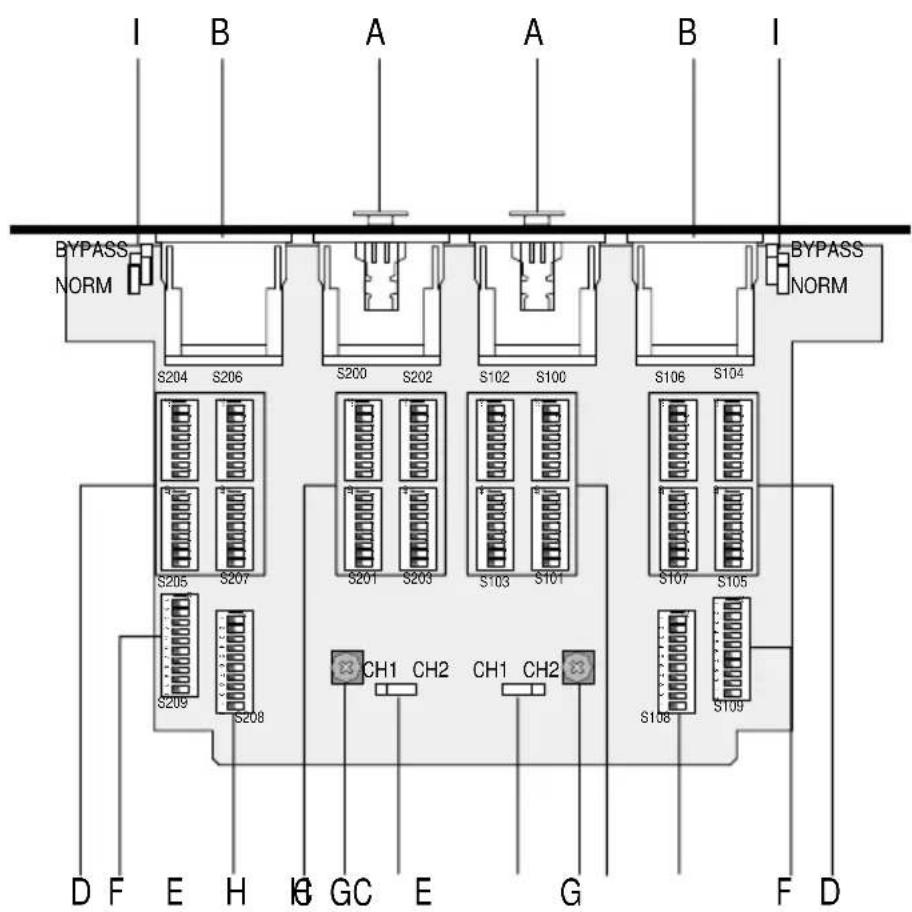
Fig. 2.1 P.I.P.-BP1X
Front & Bottom Views
2 Controls, Connectors & Setup
A/B. Connectors
Balanced 3-pin XLR or quick-disconnect removable barrier block connectors are provided for the inputs and outputs. The P.I.P.-BP1X is supplied with XLR Jacks: a female XLR for the input connector and a male XLR for the daisy chain output. These connectors are wired for pin 2 = Hot. The P.I.P.-BP1C is supplied with quick-disconnect removable barrier block connectors; mating connectors are supplied to allow the user to quickly disconnect an input or output and move it to the other channel. These connectors are wired pin1=Hot. (See Section 3 for input and output wiring examples.)
C. Low-Pass Filter DIP Switches
The input signal is processed first by a 4th-order (24-dB/octave) low-pass filter network with a Butterworth response characteristic. Four eight-segment DIP switches (S100,S101,S102 and S103 for channel 1),(S200,S201, S202 and S203 for channel 2) select the low-pass filter frequency at which the output is -3-dB down from the input. (See Figure 2.2 for a complete table of frequencies and settings and Figure 2.3 for sample frequency-response graphs.) Note that all four DIP switches must use the same settings for the response to be correct. These DIP switches are factory-set to 20 kHz.
D. High-Pass Filter DIP Switches
The signal is processed next by a 4th-order (24-dB/octave) high-pass filter network with a Butterworth response characteristic. Four eight-segment DIP switches(S104,S105,S106 and S107 for Channel 1), (S204,S205,S206 and S207 for Channel 2) select the high pass filter frequency at which the output is -3-dB down from the input. (See Figure 2.2 for a complete table of frequencies and settings and Figure 2.4 for sample frequency-response graphs.) Note that all four DIP switches must use the same settings for the response to be correct. These DIP switches are factory-set to 23 Hz.
E. Low-Frequency Equalization DIP Switches
Following the high-pass filter is a 6th-order loudspeaker equalization feature. A ten-segment DIP switch (S108 for Channel 1); (S208 for Channel 2) sets the +6 dB boost frequency of the vented-box equalization filter. Note: (Switch 7 is not active and can be set to either the "ON" or "OFF") position. This feature is used for loudspeakers that have been designed as a 6th-order system and require 2nd-order equalization to achieve optimum performance. The filter uses the Sallen-Key non-inverting second-order high-pass topology. The loudspeaker manufacturer determines the frequency to which this filter should be set. Low-Frequency Equalizaion is factory-set to Flat (Figure 2.5 shows a complete listing of equalization points and the corresponding switch positions; Figure 2.6 shows typical response curves for the filter).
F. Constant-Directivity Horn Equalization DIP Switches
This ten-segment DIP Switch (S109 for Channel 1)); (S209 for Channel 2) sets both the +3-dB shelving frequency and the -3-dB low-pass roll-off frequency of the constant-directivity horn equalization filter. Constant-directivity horns have an inherent roll-off in their
response that must be corrected electronically by this filter. The actual response is determined by the combination of a stage of first-order boost (controlled by switches 8, 9, and 10) and a stage of second-order high-frequency roll off (controlled by switches 1-6),
Note: switch 7 is not active and can be set at either the "ON" or "OFF" position.
The loudspeaker manufacturer determines the frequencies to which these switches should be set. Constant-Directivity Horn Equalizaion is factory-set to Flat. Refer to Figure 2.7a for -3-dB low pass roll-off frequency settings and corresponding switch positions. Refer to Figure 2.7a for +3-dB shelving frequency settings and corresponding switch positions. Figure 2.8 shows sample response curves.
G. Compressor Threshold Potentiometer
The compressor occurs in the signal path after the filters and equalizers. A variable-threshold signal-driven compressor is provided and by default is ON and is error driven. With error-driven compression, the compressor will activate if the amplifier clips, regardless of the output signal. Error-driven compression is useful when the possibility of over-driving the amplifier by several dB is present and the resulting distortion is unacceptable.
Reducing the output voltage at which the compressor will activate is useful for applications where driver and/or system protection is desired. Compression will then limit the output voltage to a predetermined level, even as the input to the amplifier is increased.
Attack time is 10 msec and release time is 360 msec. The compressor has an infinite compression ratio, meaning that when the threshold is reached, an increase in input level will not result in a change in output level. The range of compression is 16 dB. If the input is driven more than 16 dB over the threshold, the portion of the signal over 16 dB will be passed linearly. At that point, the next limit to output will be amplifier clipping. (See Figure 2.9 for a table of potentiometer settings and the corresponding voltage and power outputs from the amplifier.)
H. Compressor Control
This two-position jumper block controls the feedback path that will drive the compressors. The compressor in a certain channel can be controlled by the error amplifier of that channel, the error amplifier of the other channel, or neither (compressor turned off). When the compressor is turned off, no amplifier condition, whether it is high output voltage or clipping, will cause the compressor to activate. To turn the compressor off, place the jumper on only one pin of the jumper block.
I. Daisy Output Jumpers
These two-position jumpers are used to select between sending the processed signal (NORM) and the unprocessed signal (BYPASS) to the daisy chain outputs. Sending the processed signal to the daisy chain outputs will allow two or more amplifiers to run off of the same processed signal, so only one P.I.P.-BP1 would have to be used (the signal needs only to be processed once for all of the amplifiers that need the signal). Sending the unprocessed signal to the daisy chain outputs will enable the use of other P.I.P.-BP1 modules with different DIP switch settings or the use of other P.I.P. modules to perform different functions on the same input signal. Both jumpers of each channel must be in the same position for correct operation.
J. Input Ground Lift Jumper
The unit is shipped from the factory with pin 1 of each input XLR connected to signal ground through independent 0-ohm resistors. If hum problems are
experienced, the appropriate resistor may be removed. This will then connect pin 1 of the XLR from that channel to signal ground through an 82-ohm resistor in parallel with a 0.1×F capacitor.
Low Pass Frequencies
| SEICNEUQERFFOTUC | Switch Settings | Low Pass Frequency (Hz) | ||||||||||||||||||
| sgnitBefi | ||||||||||||||||||||
| 1 | 2 | 3 | 4 | 5 | 6 | 7 | 8 | 9 | 10 | 1 | 2 | 3 | 4 | 5 | 6 | 7 | 8 | 9 | 10 | |
| ON | ON | ON | ON | ON | ON | ON | ON | --- | OFF | ON | ON | OFF | OFF | ON | ON | ON | --- | --- | 1308 | |
| OFF | ON | ON | ON | ON | ON | ON | ON | --- | ON | OFF | ON | OFF | OFF | ON | ON | ON | --- | --- | 1279 | |
| ON | OFF | ON | ON | ON | ON | ON | ON | --- | OFF | OFF | ON | OFF | OFF | ON | ON | ON | --- | --- | 1257 | |
| OFF | OFF | ON | ON | ON | ON | ON | ON | --- | ON | ON | OFF | OFF | OFF | ON | ON | ON | --- | --- | 1211 | |
| ON | ON | OFF | ON | ON | ON | ON | ON | --- | OFF | ON | OFF | OFF | OFF | ON | ON | ON | --- | --- | 1191 | |
| OFF | ON | OFF | ON | ON | ON | ON | ON | --- | ON | OFF | OFF | OFF | OFF | ON | ON | ON | --- | --- | 1167 | |
| ON | OFF | OFF | ON | ON | ON | ON | ON | --- | OFF | OFF | OFF | OFF | OFF | ON | ON | ON | --- | --- | 1149 | |
| OFF | OFF | OFF | ON | ON | ON | ON | ON | --- | ON | ON | ON | ON | ON | OFF | ON | ON | --- | --- | 772 | |
| ON | ON | ON | OFF | ON | ON | ON | ON | --- | OFF | ON | ON | ON | ON | OFF | ON | ON | --- | --- | 764 | |
| OFF | ON | ON | OFF | ON | ON | ON | ON | --- | ON | OFF | ON | ON | ON | OFF | ON | ON | --- | --- | 750 | |
| ON | OFF | ON | OFF | ON | ON | ON | ON | --- | OFF | OFF | ON | ON | ON | OFF | ON | ON | --- | --- | 747 | |
| OFF | OFF | ON | OFF | ON | ON | ON | ON | --- | ON | ON | OFF | ON | ON | OFF | ON | ON | --- | --- | 730 | |
| ON | ON | OFF | OFF | ON | ON | ON | ON | --- | OFF | ON | OFF | ON | ON | OFF | ON | ON | --- | --- | 723 | |
| OFF | ON | OFF | OFF | ON | ON | ON | ON | --- | ON | OFF | OFF | ON | ON | OFF | ON | ON | --- | --- | 714 | |
| ON | OFF | OFF | OFF | ON | ON | ON | ON | --- | OFF | OFF | OFF | ON | ON | OFF | ON | ON | --- | --- | 707 | |
| OFF | OFF | OFF | OFF | ON | ON | ON | ON | --- | ON | ON | ON | OFF | ON | OFF | ON | ON | --- | --- | 668 | |
| ON | ON | ON | ON | OFF | ON | ON | ON | --- | OFF | ON | ON | OFF | ON | OFF | ON | ON | --- | --- | 663 | |
| OFF | ON | ON | ON | OFF | ON | ON | ON | --- | ON | OFF | ON | OFF | ON | OFF | ON | ON | --- | --- | 655 | |
| ON | OFF | ON | ON | OFF | ON | ON | ON | --- | OFF | OFF | ON | OFF | ON | OFF | ON | ON | --- | --- | 649 | |
| OFF | OFF | ON | ON | OFF | ON | ON | ON | --- | ON | ON | OFF | OFF | ON | OFF | ON | ON | --- | --- | 637 | |
| ON | ON | OFF | ON | OFF | ON | ON | ON | --- | OFF | ON | OFF | OFF | ON | OFF | ON | ON | --- | --- | 631 | |
| OFF | ON | OFF | ON | OFF | ON | ON | ON | --- | ON | OFF | OFF | OFF | ON | OFF | ON | ON | --- | --- | 624 | |
| ON | OFF | OFF | ON | OFF | ON | ON | ON | --- | OFF | OFF | OFF | OFF | ON | OFF | ON | ON | --- | --- | 619 | |
| OFF | OFF | OFF | ON | OFF | ON | ON | ON | --- | ON | ON | ON | ON | OFF | OFF | ON | ON | --- | --- | 557 | |
| ON | ON | ON | OFF | OFF | ON | ON | ON | --- | OFF | ON | ON | ON | OFF | OFF | ON | ON | --- | --- | 553 | |
Figure 2.2a Low Pass Cutoff Frequencies
Note: Switches 9 and 10 are not active. "---" denotes switch may be set to either the ON or OFF position.
Low Pass Frequencies
| SEICNEUQERFFOTUC | |||||||||||||||||||||
| sgnitteShc8w | ssaPwoLycneue | sgnitteShc8w | ssaPwoLycneue | ||||||||||||||||||
| 1 | 2 | 3 | 4 | 5 | 6 | 7 | 8 | 9 | 10 | (Hz) | 1 | 2 | 3 | 4 | 5 | 6 | 7 | 8 | 9 | 10 | |
| ON | OFF | ON | ON | OFF | OFF | ON | ON | --- | 548 | OFF | OFF | ON | OFF | ON | ON | OFF | ON | --- | 302 | ||
| OFF | OFF | ON | ON | OFF | OFF | ON | ON | --- | 544 | ON | ON | OFF | OFF | ON | ON | OFF | ON | --- | 300 | ||
| ON | ON | OFF | ON | OFF | OFF | ON | ON | --- | 535 | OFF | ON | OFF | OFF | ON | ON | OFF | ON | --- | 298 | ||
| OFF | ON | OFF | ON | OFF | OFF | ON | ON | --- | 531 | ON | OFF | OFF | OFF | ON | ON | OFF | ON | --- | 296 | ||
| ON | OFF | OFF | ON | OFF | OFF | ON | ON | --- | 526 | OFF | OFF | OFF | OFF | ON | ON | OFF | ON | --- | 295 | ||
| OFF | OFF | OFF | ON | OFF | OFF | ON | ON | --- | 522 | ON | ON | ON | ON | OFF | ON | OFF | ON | --- | 280 | ||
| ON | ON | ON | ON | OFF | OFF | ON | ON | --- | 501 | OFF | ON | ON | ON | OFF | ON | OFF | ON | --- | 279 | ||
| OFF | ON | ON | OFF | OFF | OFF | ON | ON | --- | 498 | ON | OFF | ON | ON | OFF | ON | OFF | ON | --- | 278 | ||
| ON | OFF | ON | OFF | OFF | OFF | ON | ON | --- | 493 | OFF | OFF | ON | ON | OFF | ON | OFF | ON | --- | 277 | ||
| OFF | OFF | ON | OFF | OFF | OFF | ON | ON | --- | 490 | ON | ON | OFF | ON | OFF | ON | OFF | ON | --- | 274 | ||
| ON | ON | OFF | OFF | OFF | OFF | ON | ON | --- | 483 | OFF | ON | OFF | ON | OFF | ON | OFF | ON | --- | 273 | ||
| OFF | ON | OFF | OFF | OFF | OFF | ON | ON | --- | 480 | ON | OFF | OFF | ON | OFF | ON | OFF | ON | --- | 272 | ||
| ON | OFF | OFF | OFF | OFF | OFF | ON | ON | --- | 476 | OFF | OFF | OFF | ON | OFF | ON | OFF | ON | --- | 271 | ||
| OFF | OFF | OFF | OFF | OFF | OFF | ON | ON | --- | 473 | ON | ON | ON | OFF | OFF | ON | OFF | ON | --- | 265 | ||
| ON | ON | ON | ON | ON | ON | OFF | ON | --- | 326 | OFF | ON | ON | OFF | OFF | ON | OFF | ON | --- | 264 | ||
| OFF | ON | ON | ON | ON | ON | OFF | ON | --- | 324 | ON | OFF | ON | OFF | OFF | ON | OFF | ON | --- | 263 | ||
| ON | OFF | ON | ON | ON | ON | OFF | ON | --- | 322 | OFF | OFF | ON | OFF | OFF | ON | OFF | ON | --- | 262 | ||
| OFF | OFF | ON | ON | ON | ON | OFF | ON | --- | 321 | ON | ON | OFF | OFF | OFF | ON | OFF | ON | --- | 260 | ||
| ON | ON | OFF | ON | ON | ON | OFF | ON | --- | 318 | OFF | ON | OFF | OFF | OFF | ON | OFF | ON | --- | 259 | ||
| OFF | ON | OFF | ON | ON | ON | OFF | ON | --- | 317 | ON | OFF | OFF | OFF | OFF | ON | OFF | ON | --- | 258 | ||
| ON | OFF | OFF | ON | ON | ON | OFF | ON | --- | 315 | OFF | OFF | OFF | OFF | OFF | ON | OFF | ON | --- | 257 | ||
| OFF | OFF | OFF | ON | ON | ON | OFF | ON | --- | 314 | ON | ON | ON | ON | ON | OFF | OFF | ON | --- | 232 | ||
| ON | ON | ON | OFF | ON | ON | OFF | ON | --- | 306 | OFF | ON | ON | ON | ON | OFF | OFF | ON | --- | 231 | ||
| OFF | ON | ON | OFF | ON | ON | OFF | ON | --- | 304 | ON | OFF | ON | ON | ON | OFF | OFF | ON | --- | 230 | ||
| ON | OFF | ON | OFF | ON | ON | OFF | ON | --- | 303 | OFF | OFF | ON | ON | ON | OFF | OFF | ON | --- | 229 | ||
Figure 2.2b Low Pass Cutoff Frequencies
Note: Switches 9 and 10 are not active. "---" denotes switch may be set to either the ON or OFF position.
Low Pass Frequencies
| SEICNEUQERFFOTUC | ssaPwoLycneuqe(Hz) | sgnitteShc8w | secP.ycneuqe(Hz) | ||||||||||||||||||||
| 1 | 2 | 3 | 4 | 5 | 6 | 7 | 8 | 9 | 10 | 1 | 2 | 3 | 4 | 5 | 6 | 7 | 8 | 9 | 10 | ||||
| ON | ON | OFF | ON | ON | OFF | OFF | ON | --- | - | 228 | OFF | OFF | OFF | ON | OFF | ON | ON | OFF | --- | --- | 122 | ||
| OFF | ON | OFF | ON | ON | OFF | OFF | ON | --- | --- | 227 | ON | ON | ON | OFF | OFF | ON | ON | OFF | --- | --- | 121 | ||
| ON | OFF | OFF | ON | ON | OFF | OFF | ON | --- | - | 226 | ON | ON | OFF | OFF | OFF | ON | ON | OFF | --- | --- | 120 | ||
| ON | ON | ON | OFF | ON | OFF | OFF | ON | --- | --- | 221 | OFF | OFF | OFF | OFF | OFF | ON | ON | OFF | --- | --- | 119 | ||
| ON | OFF | ON | OFF | ON | OFF | OFF | ON | --- | - | 220 | ON | ON | ON | ON | ON | OFF | ON | OFF | --- | --- | 114 | ||
| OFF | OFF | ON | OFF | ON | OFF | OFF | ON | --- | --- | 219 | ON | OFF | ON | ON | ON | OFF | ON | OFF | --- | --- | 113 | ||
| ON | ON | OFF | OFF | ON | OFF | OFF | ON | --- | - | 218 | ON | OFF | OFF | ON | ON | OFF | ON | OFF | --- | --- | 112 | ||
| OFF | ON | OFF | OFF | ON | OFF | OFF | ON | --- | --- | 217 | ON | ON | ON | OFF | ON | OFF | ON | OFF | --- | --- | 111 | ||
| ON | OFF | OFF | OFF | ON | OFF | OFF | ON | --- | - | 216 | ON | ON | OFF | OFF | ON | OFF | ON | OFF | --- | --- | 110 | ||
| ON | ON | ON | ON | OFF | OFF | OFF | ON | --- | --- | 208 | ON | ON | ON | ON | OFF | OFF | ON | OFF | --- | --- | 108 | ||
| OFF | ON | ON | ON | OFF | OFF | OFF | ON | --- | - | 207 | OFF | ON | ON | ON | OFF | OFF | ON | OFF | --- | --- | 107 | ||
| ON | OFF | ON | ON | OFF | OFF | OFF | ON | --- | --- | 206 | ON | OFF | OFF | ON | OFF | OFF | ON | OFF | --- | --- | 106 | ||
| ON | ON | OFF | ON | OFF | OFF | OFF | ON | --- | - | 204 | ON | ON | ON | OFF | OFF | OFF | ON | OFF | --- | --- | 105 | ||
| ON | OFF | OFF | ON | OFF | OFF | OFF | ON | --- | --- | 203 | ON | ON | OFF | OFF | OFF | OFF | ON | OFF | --- | --- | 104 | ||
| ON | ON | ON | OFF | OFF | OFF | OFF | ON | --- | - | 199 | ON | ON | ON | ON | ON | ON | OFF | OFF | --- | --- | 95 | ||
| ON | OFF | ON | OFF | OFF | OFF | OFF | ON | --- | --- | 198 | OFF | ON | ON | ON | ON | ON | OFF | OFF | --- | --- | 94 | ||
| ON | ON | OFF | OFF | OFF | OFF | OFF | ON | --- | - | 196 | ON | ON | ON | OFF | ON | ON | OFF | OFF | --- | --- | 93 | ||
| ON | OFF | OFF | OFF | OFF | OFF | OFF | ON | --- | --- | 195 | OFF | OFF | ON | OFF | ON | ON | OFF | OFF | --- | --- | 92 | ||
| ON | ON | ON | ON | ON | ON | ON | OFF | --- | - | 132 | ON | ON | ON | ON | OFF | ON | OFF | OFF | --- | --- | 90 | ||
| ON | ON | OFF | ON | ON | ON | ON | OFF | --- | --- | 131 | ON | OFF | OFF | ON | OFF | ON | OFF | OFF | --- | --- | 89 | ||
| OFF | OFF | OFF | ON | ON | ON | ON | OFF | --- | - | 130 | ON | OFF | ON | OFF | OFF | ON | OFF | OFF | --- | --- | 88 | ||
| ON | ON | ON | OF | ON | ON | ON | OFF | --- | --- | 129 | ON | ON | ON | ON | ON | OFF | OFF | OFF | --- | --- | 85 | ||
| OFF | OFF | ON | OFF | ON | ON | ON | OFF | --- | - | 128 | ON | OFF | ON | ON | ON | OFF | OFF | OFF | --- | --- | 84 | ||
| ON | OFF | OFF | OFF | ON | ON | ON | OFF | --- | --- | 127 | ON | ON | ON | OFF | ON | OFF | OFF | OFF | --- | --- | 83 | ||
| ON | ON | ON | ON | OFF | ON | ON | OFF | --- | - | 124 | ON | OFF | OFF | OFF | ON | OFF | OFF | OFF | --- | --- | 82 | ||
| ON | ON | OFF | ON | OFF | ON | ON | OFF | — | — | 123 | OFF | OFF | OFF | OFF | OFF | OFF | OFF | OFF | --- | --- | 80 | ||
Figure 2.2c Low Pass Cutoff Frequencies
Note: Switches 9 and 10 are not active. "---" denotes switch may be set to either the ON or OFF position.
High Pass Frequencies
| SEICNEUQERFFOTUC | |||||||||||||||||||||||
| sgnitteSho8w | ssaPhglycneuqe(Hz) | sgnitteSho8w | ssaPhglycneuqe(Hz) | ||||||||||||||||||||
| 1 | 2 | 3 | 4 | 5 | 6 | 7 | 8 | 9 | 10 | 1 | 2 | 3 | 4 | 5 | 6 | 7 | 8 | 9 | |||||
| OFF | OFF | OFF | OFF | OFF | OFF | OFF | OFF | --- | -- | 23 | ON | OFF | OFF | ON | OFF | ON | OFF | ON | --- | -- | 80 | ||
| OFF | OFF | OFF | ON | OFF | OFF | OFF | --- | --- | 24 | OFF | OFF | ON | ON | OFF | ON | OFF | ON | --- | --- | 81 | |||
| ON | OFF | OFF | ON | OFF | OFF | OFF | --- | -- | 25 | ON | ON | ON | ON | OFF | ON | OFF | ON | --- | -- | 82 | |||
| ON | OFF | ON | OFF | OFF | ON | OFF | OFF | --- | --- | 26 | OFF | OFF | OFF | ON | ON | OFF | ON | --- | --- | 86 | |||
| ON | OFF | OFF | ON | OFF | ON | OFF | OFF | --- | -- | 27 | ON | OFF | OFF | OFF | ON | ON | OFF | ON | --- | -- | 87 | ||
| ON | ON | ON | OFF | ON | ON | OFF | OFF | --- | --- | 28 | OFF | OFF | ON | OFF | ON | ON | OFF | ON | --- | --- | 88 | ||
| ON | ON | OFF | OFF | OFF | OFF | ON | OFF | --- | -- | 32 | OFF | ON | ON | OFF | ON | ON | OFF | ON | --- | -- | 89 | ||
| ON | ON | OFF | OFF | ON | OFF | ON | OFF | --- | --- | 33 | OFF | OFF | OFF | ON | ON | ON | OFF | ON | --- | --- | 91 | ||
| ON | OFF | OFF | ON | ON | OFF | ON | OFF | --- | -- | 34 | OFF | ON | OFF | ON | ON | ON | OFF | ON | --- | -- | 92 | ||
| OFF | OFF | OFF | OFF | ON | ON | OFF | --- | --- | 36 | OFF | OFF | ON | ON | ON | ON | ON | OFF | ON | --- | --- | 93 | ||
| ON | ON | ON | OFF | OFF | ON | ON | OFF | --- | -- | 37 | ON | ON | ON | ON | ON | ON | OFF | ON | --- | -- | 94 | ||
| ON | OFF | OFF | OFF | ON | ON | ON | OFF | --- | --- | 38 | OFF | OFF | OFF | OFF | OFF | OFF | ON | ON | --- | --- | 148 | ||
| OFF | OFF | ON | OFF | ON | ON | ON | OFF | --- | -- | 39 | ON | OFF | OFF | OFF | OFF | OFF | ON | ON | --- | -- | 149 | ||
| ON | ON | ON | ON | ON | ON | ON | OFF | --- | --- | 40 | OFF | ON | OFF | OFF | OFF | OFF | ON | ON | --- | --- | 150 | ||
| ON | OFF | OFF | OFF | OFF | OFF | OFF | ON | --- | -- | 58 | ON | ON | OFF | OFF | OFF | OFF | ON | ON | --- | -- | 151 | ||
| ON | ON | ON | OFF | OFF | OFF | OFF | ON | --- | --- | 59 | OFF | OFF | ON | OFF | OFF | OFF | ON | ON | --- | --- | 153 | ||
| ON | OFF | OFF | ON | OFF | OFF | OFF | ON | --- | -- | 60 | ON | OFF | ON | OFF | OFF | OFF | ON | ON | --- | -- | 154 | ||
| ON | OFF | ON | ON | OFF | OFF | OFF | ON | --- | --- | 61 | OFF | ON | ON | OFF | OFF | OFF | ON | ON | --- | --- | 155 | ||
| ON | OFF | OFF | OFF | ON | OFF | OFF | ON | --- | -- | 64 | ON | ON | ON | OFF | OFF | OFF | ON | ON | --- | -- | 156 | ||
| ON | ON | ON | OFF | ON | OFF | OFF | ON | --- | --- | 65 | OFF | OFF | OFF | ON | OFF | OFF | ON | ON | --- | --- | 162 | ||
| ON | OFF | OFF | ON | ON | OFF | OFF | ON | --- | -- | 66 | ON | OFF | OFF | ON | OFF | OFF | ON | ON | --- | -- | 163 | ||
| OFF | ON | OFF | OFF | OFF | ON | OFF | ON | --- | --- | 76 | OFF | ON | OFF | ON | OFF | OFF | ON | ON | --- | --- | 165 | ||
| ON | ON | OFF | OFF | OFF | ON | OFF | ON | --- | -- | 77 | ON | ON | OFF | ON | OFF | OFF | ON | ON | --- | -- | 166 | ||
| OFF | ON | ON | OFF | OFF | ON | OFF | ON | --- | --- | 78 | OFF | OFF | ON | ON | OFF | OFF | ON | ON | --- | --- | 168 | ||
| OFF | OFF | OFF | ON | OFF | ON | OFF | ON | --- | -- | 79 | ON | OFF | ON | ON | OFF | OFF | ON | ON | --- | -- | 169 | ||
Figure 2.2d High Pass Cutoff Frequencies
Note: Switches 9 and 10 are not active. "---" denotes switch may be set to either the ON or OFF position.
High Pass Frequencies
| SEICNEUQERFFOTUC | |||||||||||||||||||||||||
| sgnitteSho8w | ssaPhdi ycreuqe(Hz) | sgnitteSho8w | ssaPhdi ycreuqe(Hz) | ||||||||||||||||||||||
| 1 | 2 | 3 | 4 | 5 | 6 | 7 | 8 | 9 | 10 | 1 | 2 | 3 | 4 | 5 | 6 | 7 | 8 | 9 | 10 | ||||||
| OFF | ON | ON | ON | OFF | OFF | ON | ON | --- | - | 170 | ON | ON | ON | OFF | OFF | ON | ON | ON | --- | --- | 440 | ||||
| ON | ON | ON | ON | OFF | OFF | ON | ON | --- | --- | 171 | OFF | OFF | OFF | ON | OFF | ON | ON | ON | --- | --- | 500 | ||||
| OFF | OFF | OFF | OFF | ON | OFF | ON | ON | --- | - | 194 | ON | OFF | OFF | ON | OFF | ON | ON | ON | --- | --- | 509 | ||||
| ON | OFF | OFF | OFF | ON | OFF | ON | ON | --- | --- | 195 | OFF | ON | OFF | ON | OFF | ON | ON | ON | --- | --- | 522 | ||||
| OFF | ON | OFF | OFF | ON | OFF | ON | ON | --- | - | 197 | ON | ON | OFF | ON | OFF | ON | ON | ON | --- | --- | 531 | ||||
| ON | ON | OFF | OFF | ON | OFF | ON | ON | --- | --- | 200 | OFF | OFF | ON | ON | OFF | ON | ON | ON | --- | --- | 558 | ||||
| OFF | OFF | ON | OFF | ON | OFF | ON | ON | --- | - | 202 | ON | OFF | ON | ON | OFF | ON | ON | ON | --- | --- | 569 | ||||
| ON | OFF | ON | OFF | ON | OFF | ON | ON | --- | --- | 203 | OFF | ON | ON | ON | OFF | ON | ON | ON | --- | --- | 586 | ||||
| OFF | ON | ON | OFF | ON | OFF | ON | ON | --- | - | 205 | ON | ON | ON | ON | OFF | ON | ON | ON | --- | --- | 625 | ||||
| ON | ON | ON | OFF | ON | OFF | ON | ON | --- | --- | 207 | OFF | OFF | OFF | OFF | ON | ON | ON | ON | --- | --- | 997 | ||||
| OFF | OFF | OFF | ON | ON | OFF | ON | ON | --- | - | 219 | ON | OFF | OFF | OFF | ON | ON | ON | ON | --- | --- | 1031 | ||||
| ON | OFF | OFF | ON | ON | OFF | ON | ON | --- | --- | 221 | OFF | ON | OFF | OFF | ON | ON | ON | ON | --- | --- | 1088 | ||||
| OFF | ON | OFF | ON | ON | OFF | ON | ON | --- | - | 223 | ON | ON | OFF | OFF | ON | ON | ON | ON | --- | --- | 1128 | ||||
| ON | ON | OFF | ON | ON | OFF | ON | ON | --- | --- | 225 | OFF | OFF | ON | OFF | ON | ON | ON | ON | --- | --- | 1258 | ||||
| OFF | OFF | ON | ON | ON | OFF | ON | ON | --- | - | 229 | ON | OFF | ON | OFF | ON | ON | ON | ON | --- | --- | 1311 | ||||
| ON | OFF | ON | ON | ON | OFF | ON | ON | --- | --- | 231 | OFF | ON | ON | OFF | ON | ON | ON | ON | --- | --- | 1405 | ||||
| OFF | ON | ON | ON | ON | OFF | ON | ON | --- | - | 234 | ON | ON | ON | OFF | ON | ON | ON | ON | --- | --- | 1500 | ||||
| ON | ON | ON | ON | ON | OFF | ON | ON | --- | --- | 236 | OFF | OFF | OFF | ON | ON | ON | ON | ON | --- | --- | 2458 | ||||
| OFF | OFF | OFF | OFF | OFF | ON | ON | ON | --- | - | 385 | ON | OFF | OFF | ON | ON | ON | ON | ON | --- | --- | 2673 | ||||
| ON | OFF | OFF | OFF | OFF | ON | ON | ON | --- | --- | 390 | OFF | ON | OFF | ON | ON | ON | ON | ON | --- | --- | 3091 | ||||
| OFF | ON | OFF | OFF | OFF | ON | ON | ON | --- | - | 398 | ON | ON | OFF | ON | ON | ON | ON | ON | --- | --- | 3400 | ||||
| ON | ON | OFF | OFF | OFF | ON | ON | ON | --- | --- | 403 | OFF | OFF | ON | ON | ON | ON | ON | ON | --- | --- | 5000 | ||||
| OFF | OFF | ON | OFF | OFF | ON | ON | ON | --- | - | 419 | ON | OFF | ON | ON | ON | ON | ON | ON | --- | --- | 6000 | ||||
| ON | OFF | ON | OFF | OFF | ON | ON | ON | --- | --- | 425 | OFF | ON | ON | ON | ON | ON | ON | ON | --- | --- | 8700 | ||||
| OFF | ON | ON | OFF | OFF | ON | ON | ON | --- | - | 434 | ON | ON | ON | ON | ON | ON | ON | ON | --- | --- | 1200 | ||||
Figure 2.2e High Pass Cutoff Frequencies
Note: Switches 9 and 10 are not active. "---" denotes switch may be set to either the ON or OFF position.
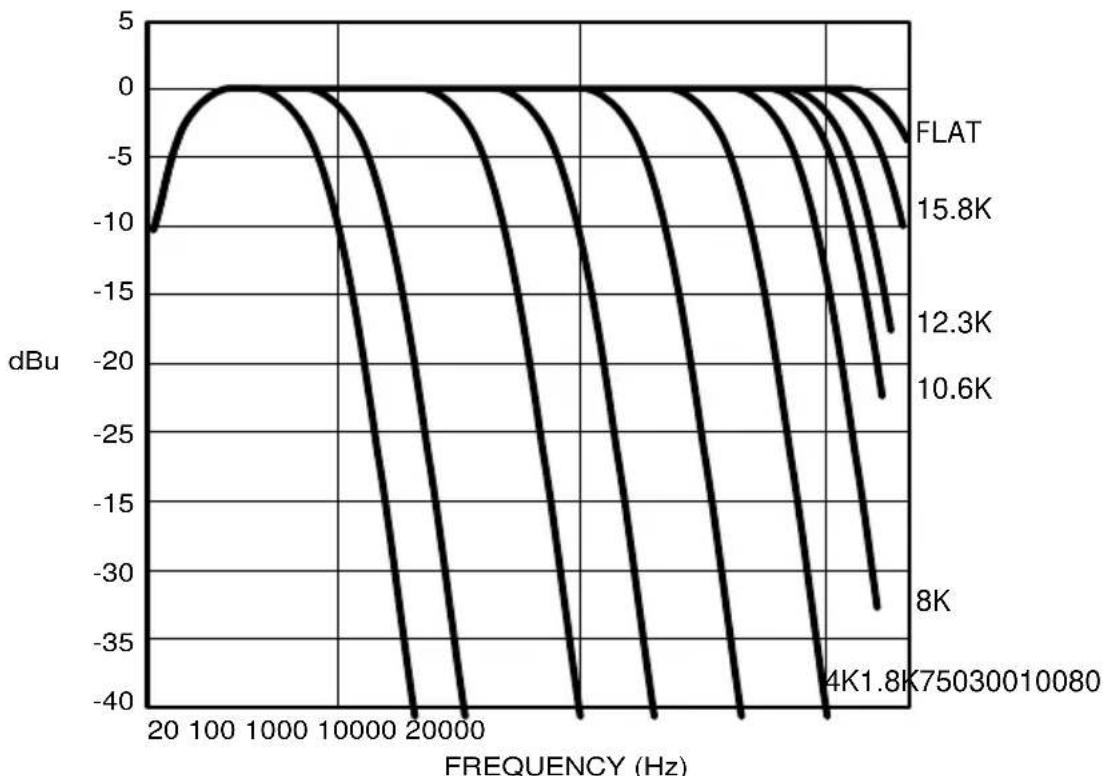
Fig. 2.3 Low-Pass Frequency Responses

line
| FWHN (Hz) | dBu (dBu) | | --------- | --------- | | 20 | -40 | | 100 | -35 | | 1000 | -30 | | 10000 | -25 | | 20000 | -20 | | 30000 | -15 | | 40000 | -10 | | 65 | -5 | | 83 | 0 | | 150 | 5 | | 220 | 10 | | 625 | 15 | | 1.5K | 20 | | 3.4K | 25 | | 5K | 30 | | 8.7K | 35 | | 6K | 40 | | 12K | 45 |Fig. 2.4 High-Pass Frequency Responses
| LOW-FREQUENCY (BOX) EQUALIZATION | ||||||||||
| Switch Settings | +6 dB Freq. (Hz) | |||||||||
| 1 | 2 | 3 | 4 | 5 | 6 | 7 | 8 | 9 | 10 | |
| ON | ON | ON | OFF | OFF | OFF | --- | ON | ON | ON | 20 |
| ON | ON | OFF | OFF | ON | ON | --- | OFF | ON | ON | 24 |
| OFF | ON | ON | OFF | OFF | OFF | --- | ON | ON | OFF | 28 |
| ON | ON | ON | OFF | ON | ON | --- | ON | ON | ON | 30 |
| ON | ON | OFF | OFF | ON | ON | --- | OFF | ON | ON | 36 |
| OFF | ON | OFF | OFF | OFF | OFF | --- | OFF | ON | OFF | 38 |
| OFF | ON | ON | OFF | ON | ON | --- | ON | ON | OFF | 42 |
| ON | OFF | ON | OFF | OFF | OFF | --- | ON | OFF | ON | 44 |
| OFF | ON | OFF | OFF | ON | ON | --- | OFF | ON | OFF | 56 |
| ON | OFF | ON | OFF | ON | ON | --- | ON | OFF | ON | 65 |
| ON | OFF | OFF | OFF | OFF | OFF | --- | OFF | OFF | ON | 68 |
| ON | OFF | OFF | OFF | ON | ON | --- | OFF | OFF | ON | 102 |
| OFF | OFF | ON | OFF | OFF | OFF | --- | ON | OFF | OFF | 120 |
| OFF | OFF | ON | OFF | ON | ON | --- | ON | OFF | OFF | 180 |
| --- | -- | --- | ON | --- | --- | --- | --- | --- | --- | FLAT |
Fig. 2.5 Low Frequency EQ Settings
Note: Switch 7 not active.
“---” denotes switch may be set to either
the ON or OFF position.

line
| FREQUENCY (Hz) | dB | | -------------- | ------ | | 0 | -6 | | 100 | +6 | | 1000 | 0 | | 10000 | -6 | | 100000 | -6 | | 1000000 | -6 |Fig. 2.6 Low-Frequency EQ Response Curves
| ONTAZILAUQENROHYTIVITCERID-TNATSNOC | |||||||
| sgnittySeuqerFffOlbRBd3-902S###S)GencS(w | |||||||
| sgnitteShctiwS | ffORb3-ycneuqerF)zHk( | ||||||
| 1 | 2 | 3 | 4 | 5 | 6 | 7 | |
| OFF | OFF | OFF | OFF | OFF | OFF | --- | 12 |
| ON | OFF | OFF | ON | OFF | OFF | --- | 15 |
| OFF | ON | OFF | ON | ON | OFF | --- | 16 |
| ON | ON | OFF | ON | ON | OFF | --- | 18 |
| OFF | OFF | ON | OFF | OFF | ON | --- | 22 |
| ON | OFF | ON | ON | OFF | ON | --- | 25 |
| OFF | ON | ON | OFF | ON | ON | --- | 26 |
| ON | ON | ON | ON | ON | ON | --- | 28 |
Fig. 2.7a -3dB Roll-Off Frequency Settings for CD Horn EQ
| ONTAZILAUQENROHYTIVITCERID-TNATSNOC | ||||
| sgnittySeuqgrHehSBd3+902S###S)0se6ctiwS( | ||||
| sgnittyeShc8w gniehSBd3+ycneuqerF)zHk( | ||||
| 7 | 8 | 9 | 01 | |
| --- | ON | ON | ON | 1.8 |
| --- | OFF | ON | ON | 2.2 |
| --- | ON | OFF | ON | 2.4 |
| --- | OFF | OFF | ON | 3.2 |
| --- | ON | ON | OFF | 4.0 |
| --- | OFF | ON | OFF | 6.8 |
| --- | ON | OFF | OFF | 10 |
| --- | OFF | OFF | OFF | IIA |
Fig. 2.7b -3dB Shelving Frequency Settings for CD Horn EQ
Note: Switch 7 not active.
“---” denotes switch may be set to either the ON or OFF position.

line
| FREQUENCY (Hz) | dB | | -------------- | ------ | | 200 | -20 | | 1K | 0 | | 10K | +18 | | 20K | +18 |
line
| FREQUENCY (Hz) | HORN EQ | | -------------- | ------- | | 0 | -18 | | 10K | +18 | | 20K | +18 | | 30K | +18 | | 40K | +18 | | 50K | +18 | | 60K | +18 | | 70K | +18 | | 80K | +18 | | 90K | +18 | | 100K | +18 |
line
| FREQUENCY (Hz) | dB | | -------------- | ------ | | 0 | -18 | | 10 | -6 | | 20 | 0 | | 30 | 6 | | 40 | 12 | | 50 | 16 | | 60 | 18 | | 70 | 18 | | 80 | 18 | | 90 | 18 | | 100 | 18 | | 200 | 18 | | 1K | 18 |
line
| FREQUENCY (Hz) | dB | | -------------- | ------ | | 200 | -18.0 | | 1K | -6.0 | | 10K | +12.0 | | 20K | +18.0 |
line
| FREQUENCY (Hz) | dB | | -------------- | ------ | | 0 | -18 | | 10 | -6 | | 20 | +6 | | 30 | +12 | | 40 | +18 |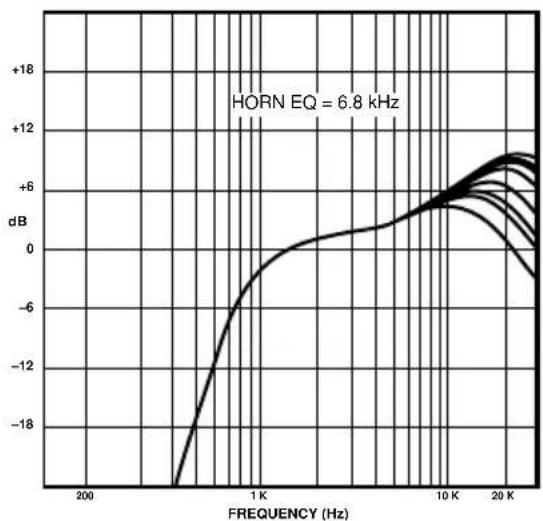
line
| FREQUENCY (Hz) | dB | | -------------- | ------ | | 200 | -18 | | 1K | -6 | | 10K | +6 | | 20K | +12 |Fig. 2.8a High-Frequency EQ Response Curves (800 Hz High-Pass)

line
| FREQUENCY (Hz) | dB | | -------------- | ------ | | 0 | -18 | | 10 | -6 | | 20 | 0 | | 30 | 4 | | 40 | 6 | | 50 | 7 | | 60 | 8 | | 70 | 9 | | 80 | 10 | | 90 | 11 | | 100 | 12 | | 110 | 13 | | 120 | 14 | | 130 | 15 | | 140 | 16 | | 150 | 17 | | 160 | 18 | | 170 | 19 | | 180 | 20 | | 190 | 21 | | 200 | 22 | | 210 | 23 | | 220 | 24 | | 230 | 25 | | 240 | 26 | | 250 | 27 | | 260 | 28 | | 270 | 29 | | 280 | 30 | | 290 | 31 | | 300 | 32 | | 310 | 33 | | 320 | 34 | | 330 | 35 | | 340 | 36 | | 350 | 37 | | 360 | 38 | | 370 | 39 | | 380 | 40 | | 390 | 41 | | 400 | 42 | | 410 | 43 | | 420 | 44 | | 430 | 45 | | 440 | 46 | | 450 | 47 | | 460 | 48 | | 470 | 49 | | 480 | 50 | | 490 | 51 | | 500 | 52 | | 510 | 53 | | 520 | 54 | | 530 | 55 | | 540 | 56 | | 550 | 57 | | 560 | 58 | | 570 | 59 | | 580 | 60 | | 590 | 61 | | 600 | 62 | | 610 | 63 | | 620 | 64 | | 630 | 65 | | 640 | 66 | | 650 | 67 | | 660 | 68 | | 670 | 69 | | 680 | 70 | | 690 | 71 | | 700 | 72 | | 710 | 73 | | 720 | 74 | | 730 | 75 | | 740 | 76 | | 750 | 77 | | 760 | 78 | | 770 | 79 | | 780 | 80 | | 790 | 81 | | 800 | 82 | | 810 | 83 | | 820 | 84 | | 830 | 85 | | 840 | 86 | | 850 | 87 | | 860 | 88 | | 870 | 89 | | 880 | 90 | | 890 | 91 | | 900 | 92 | | 910 | 93 | | 920 | 94 | | 930 | 95 | | 940 | 96 | | 950 | 97 | | 960 | 98 | | 970 | 99 | | 980 | 100 | | Note: The actual values may vary due to the label 'HORN EQ' and the number 'K' specified in the code. The numbers provided in the code are not explicitly labeled in the original data series. The values are estimated based on the formula 'HORN EQ'.
line
| FREQUENCY (Hz) | dB | | -------------- | ------ | | 200 | -18.0 | | 1K | -6.0 | | 10K | 0.0 | | 20K | -18.0 |Fig. 2.8b High-Frequency EQ Response Curves (800 Hz High-Pass)
| THRESHOLD CONVERSION | ||||
| Percent Rotation | RMS Volts | Watts @ 8 Ohms | Watts @ 4 Ohms | Watts @ 2 Ohms |
| 5 | 4 | 2 | 5 | 9 |
| 10 | 9 | 10 | 20 | 39 |
| 15 | 14 | 23 | 46 | 92 |
| 20 | 18 | 43 | 85 | 170 |
| 25 | 24 | 69 | 139 | 278 |
| 30 | 29 | 105 | 209 | 419 |
| 35 | 35 | 149 | 298 | 596 |
| 40 | 40 | 204 | 408 | 817 |
| 45 | 47 | 271 | 542 | 1085 |
| 50 | 53 | 352 | 703 | 1407 |
| 55 | 60 | 448 | 895 | 1790 |
| 60 | 67 | 561 | 1122 | 2244 |
| 65 | 75 | 695 | 1389 | 2778 |
| 70 | 83 | 851 | 1702 | 3404 |
| 75 | 91 | 1033 | 2067 | 4134 |
| 80 | 100 | 1246 | 2492 | 4984 |
| 85 | 109 | 1493 | 2986 | 5973 |
| 90 | 119 | 1780 | 3561 | 7121 |
| 95 | 130 | 2114 | 4227 | 8455 |
| 100 | 141 | 2501 | 5002 | 10003 |
OUTPUT VOLTAGE POT PERCENTAGE OF ROTATION

radar
| Value (%) | |-----------| | 100% | | 0% | | 10 | | 20 | | 30 | | 40 | | 50 | | 60 | | 70 | | 80 | | 90 |Fig. 2.9 Threshold Conversion Table
(Peak Power in Watts to RMS Volts)
3 Installation
To avoid damaging the P.I.P.-BP1 turn off the amplifier's power before making any changes (the P.I.P.-EXTaccessory should not be used to adjust settings with the power on).
Input/Output Wiring
Both models of the P.I.P.-BP1, have balanced inputs and daisy-chain outputs. XLR connectors are supplied with the P.I.P.-BP1X and are wired such that pin 1 is ground, pin 2 is non-inverting ("hot"), and pin 3 is inverting. (Figures 3.1 and 3.2 illustrate this.)

Fig. 3.1 Balanced Input Wiring

Fig. 3.2 Unbalanced Input Wiring
The P.I.P.-BP1C, comes supplied with removable barrier block connectors. These connectors are wired with pin 1 non-inverting ("hot"), pin 2 ground and pin 3 inverting. (See Figure 3.3.) Matting barrier block connectors are supplied with the unit that are used to attach to the interconnecting cables. The barrier block connectors can then be connected and disconnected easily.

Fig. 3.3 Audio Wiring
Some Crown amplifiers come supplied with permanent 1/4-inch input jacks. These should not be used for input while the P.I.P.-BP1, is installed but they may be used as unbalanced daisy chain outputs with loads greater than 5 k ohms. If used in this manner, the signal available at each jack will be the channel output signal from the PIP. This signal is the same signal that is sent to the amplifier to which the PIP is connected. This provides another way to have several amplifiers track the signal that one P.I.P.-BP1 produces. (Another is to use the daisy chain outputs of the PIP.)

Fig. 3.4 Installation into a Standard P.I.P. Amplifier
Installation
You may need a Phillips screwdriver to remove the existing PIP module or panel from your amplifier.
CAUTION: Before connecting this or any PIP to your amplifier, it is important to turn the amplifier's level controls down, turn it off and remove the AC power. Don't touch the circuitry. Even though the amplifier is off, there could still be enough energy remaining to cause electric shock.
-
Turn down the level controls (full counterclockwise), turn off the amplifier and unplug it from the AC power source.
-
Remove the existing PIP module or panel (two screws). For PIP2 amplifiers, this may involve disconnecting the PIP from a PIP2 input adapter (see Figures 3.5 and 3.6). If a PIP2 input adapter is already present do not remove the ribbon cables from the adapter. Otherwise you will have to reconnect them in the next step.
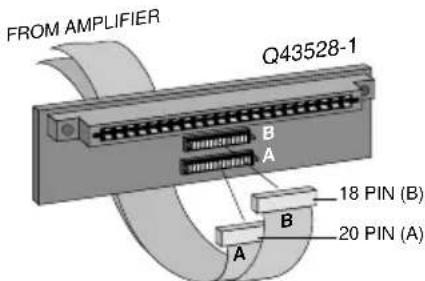
Fig. 3.5 PIP2 Input Adapter Connection
- Standard PIP Amplifiers: Align the edges of the P.I.P.-BP1 in the P.I.P. card rails and firmly push the unit in until it is seated against the mounting bracket (see Figure 3.4).
PIP2 Amplifiers: (Requires a PIP2 input adaptor, included.) Connect the PIP2 input adapter to the two

Fig. 3.6 Installation into a PIP2 Amplifier
input cables of the amplifier (see Figure 3.5). Notice that the PIP2 input adapter should be positioned with the PIP edge connector on top and facing away from the amplifier. The 20-pin cable (A) is connected first, then the 18-pin cable (B) is connected. Both ribbon cables should extend below the PIP2 input adapter.
Next, insert the edge connector of the P.I.P.-BP1 into the PIP2 input adapter (see Figure 3.6) and insert the assembly into the PIP opening in the back of the amplifier.
- Tighten the two PIP mounting screws.
- Connect input and output wiring as described in the preceding section (Input/Output Wiring).
- Plug in the amplifier and turn it on. Adjust its level controls to a desired setting. (In Dual mode, the level controls can now be used to balance the low and high frequencies.)
Do not tamper with the circuitry. Circuit changes made by unauthorized personnel, or unauthorized circuit modifications are not allowed.
Remember: Crown is not liable for any damage resulting from overdriving other components in your sound system.
4 Specifications
Signal to Noise Ratio: Greater than 85 dB (equivalent input noise) from 20 Hz to 20 kHz.
Common Mode Rejection: Greater than 90 dB at 60 Hz; greater than 60 dB at 20 kHz.
Crosstalk: Greater than 46 dB below the signal level at 20 kHz.
Harmonic Distortion: Less than 0.05% THD at 1 kHz with any setting and no compression. Less than 0.5% at 1 kHz with 6 dB of compression.
Input Impedance: Nominally 36 k ohms balanced and 18 k ohms unbalanced.
Maximum Input Level: +18 dB at mid-band. Other bands will vary with equalizer amplitude boost.
Nominal Gain: Unity ±0.5 dB.
Low-Pass Filter: Butterworth, 24-dB/octave (4th order) with Sallen-Key topology. Corner Frequency: Variable from 80 Hz to 20 kHz via DIP switches. Factory set to 20 kHz.
High-Pass Filter: Butterworth, 24-dB/octave (4th order) with Sallen-Key topology. Corner Frequency: Variable from 23 Hz to 12 kHz via DIP switches. Factory set to 23 Hz.
Compressor: Driven by the audio and the IOCircledR error signal. Threshold: continuously adjustable from 0 volts to 85 VRMS or “off” such that compressor is driven by amplifier clipping. Dynamic Range: greater than 16 dB. Attack: 10 msec. Decay: 360 msec. Compression Ratio: ∞ :1.
Connectors
Input: Balanced female 3-pin XLR on P.I.P.-BP1XRemovable barrier block disconnect with mating connectors on P.I.P.-BP1C
Output: Balanced male 3-pin XLR on P.I.P.-BP1XRemovable barrier block disconnect with mating connectors on P.I.P.-BP1C
Maximum Output Level: +18 dB (into a 600-ohm load).
Power Requirements: The P.I.P.-BP1 requires the ±24 volts that is typically supplied by amplifiers with PIP capability.
Dimensions: 638 × 178 × 378 in. (16.2 x 4.8 x 9.8 cm).
Weight: 10 ounces (284 grams).
Note: All specifications are referenced to a 0.775-V input signal.
6 Service
This unit has very sophisticated circuitry which should only be serviced by a fully trained technician.
6.1 Worldwide Service
Service may be obtained from an authorized service center. (Contact your local Crown/Amcron representative or our office for a list of authorized service centers.) To obtain service, simply present the bill of sale as proof of purchase along with the defective unit to an authorized service center. They will handle the necessary paperwork and repair.
Remember to transport your unit in the original factory pack.
6.2 North American Service
Service may be obtained in one of two ways: from an authorized service center or from the factory. You may choose either. It is important that you have your copy of the bill of sale as your proof of purchase.
6.2.1 Service at a North American Service Center
Simply present your bill of sale along with the defective unit to an authorized service center to obtain service. They will handle the necessary paperwork and repair. Remember to transport the unit in the original factory pack. A list of authorized service centers in your area can be obtained from our Technical Support Group.

natural_image
Simple line drawing of an open box with the word 'crown' on the front face (no other text or symbols)Always use the original factory pack to transport the unit.
6.2.2 Factory Service
To obtain factory service, fill out the service information pages provided information page back of this manual and send it along with your proof of purchase and the defective unit to the Crown factory.
For warranty service, we will pay for ground shipping both ways in the United States. Contact Crown Factory Service or Technical Support to obtain prepaid shipping labels prior to sending the unit. Or, if you prefer, you may prepay the cost of shipping, and Crown will reimburse you. Send copies of the shipping receipts to Crown to receive reimbursement.
Your repaired unit will be returned via UPS ground. Please contact us if other arrangements are required.
Factory Service Shipping Instructions:
-
When sending a Crown product to the factory for service, be sure to fill out the service information form that follows and enclose it inside your unit's shipping pack. Do not send the service information form separately.
-
To ensure the safe transportation of your unit to the factory, ship it in an original factory packing container. If you don't have one, call or write Crown's Parts Department. With the exception of polyurethane or wooden crates, any other packing material will not be sufficient to withstand the stress of shipping. Do not use loose, small size packingnot materials.materials.
-
Do not ship the unit in any kind of cabinet (wood or metal). Ignoring this warning may result in extensive damage to the unit and the cabinet. Accessories are not needed—do not send the instruction manual, cables and other hardware.
If you have any questions, please call or write the Crown Technical Support Group.
Crown Audio Customer Service
Technical Support / Factory Service Plant 2 SW, 1718 W. Mishawaka Rd., Elkhart, Indiana 46517 U.S.A.
Telephone: 219-294-8200 800-342-6939 (North America, Puerto Rico, and Virgin Islands only)
Facsimile: 219-294-8301 (Technical Support) 219-294-8124 (Factory Service)
eFrooBacksmall 212e298a0206gr
800-294-4094
(North America only)
219-294-8100
(International)
Internet: www.crownaudio.com

NORTH AMERICA
SUMMARYOFWARRANTY
The Crown Audio Division of Crown International, Inc., 1718 West Mishawaka Road, Elkhart, Indiana 46517-4095 U.S.A. warrants to you, the ORIGINAL PURCHASER and ANY SUBSEQUENT OWNER of each NEW Crown product, for a period of three (3) years from the date of purchase by the original purchaser (the "warranty period") that the new Crown product is free of defects in materials and workmanship. We further warrant the new Crown product regardless of the reason for failure, except as excluded in this Warranty.
ITEMS EXCLUDED FROM THIS CROWN WARRANTY
This Crown Warranty is in effect only for failure of a new Crown product which occurred within the Warranty Period. It does not cover any product which has been damaged because of any intentional misuse, accident, negligence, or loss which is covered under any of your insurance contracts. This Crown Warranty also does not extend to the new Crown product if the serial number has been defaced, altered, or removed.
WHAT THE WARRANTORWILL DO
We will remedy any defect, regardless of the reason for failure (except as excluded), by repair, replacement, or refund. We may not elect refund unless you agree, or unless we are unable to provide replacement, and repair is not practical or cannot be timely made. If a refund is elected, then you must make the defective or malfunctioning product available to us free and clear of all liens or other encumbrances. The refund will be equal to the actual purchase price, not including interest, insurance, closing costs, and other finance charges less a reasonable depreciation on the product from the date of original purchase. Warranty work can only be performed at our authorized service centers or at the factory. We will remedy the defect and ship the product from the service center or our factory within a reasonable time after receipt of the defective product at our authorized service center or our factory. All expenses in remedying the defect, including surface shipping costs in the United States, will be borne by us. (You must bear the expense of shipping the product between any foreign country and the port of entry in the United States and all taxes, duties, and other customs fees for such foreign shipments.)
HOW TO OBTAIN WARRANTY SERVICE
You must notify us of your need for warranty service not later than ninety (90) days after expiration of the warranty period. All components must be shipped in a factory pack, which, if needed, may be obtained from us free of charge. Corrective action will be taken within a reasonable time of the date of receipt of the defective product by us or our authorized service center. If the repairs made by us or our authorized service center are not satisfactory, notify us or our authorized service center immediately.
DISCLAIMER OF CONSEQUENTIAL & INCIDENTAL DAMAGES
YOU ARE NOT ENTITLED TO RECOVER FROM US ANY INCIDENTAL DAMAGES RESULTING FROM ANY DEFECT IN THE NEW CROWN PRODUCT. THIS INCLUDES ANY DAMAGE TO ANOTHER PRODUCT OR PRODUCTS RESULTING FROM SUCH A DEFECT.
SOME STATEMENT NOT ALLOW THE EXCLUSION OR LIMITATION ON OTOW BLOW INCIDENTIAL CORRESPONSEQUENTIAL DAWAGES, SOTHE ABOVE LIMITATION OR ORDERING QUENTI, EXCLUSION MAXIMUM NOY CAPPL
WARRANTY ALTERATIONS
No person has the authority to enlarge, amend, or modify this Crown Warranty. This Crown Warranty is not extended by the length of time which you are deprived of the use of the new Crown product. Repairs and replacement parts provided under the terms of this Crown Warranty shall carry only the unexpired portion of this Crown Warranty.
DESIGNCHANGES
We reserve the right to change the design of any product from time to time without notice and with no obligation to make corresponding changes in products previously manufactured.
LEGAL REMEDIES OF PURCHASER
THIS CROWN WARRANTY GIVES YOU SPECIFIC LEGAL RIGHTS, YOU MAY ALSO HAVE OTHER RIGHTS WHICH VARY FROM STATE TO STATE. No action to enforce this Crown Warranty shall be commenced later than ninety (90) days after expiration of the warranty period.
THIS STATEMENT OF WARRANTY SUPERSEDES ANY OTHERS CONTAINED IN THIS MANUAL FOR CROWN PRODUCTS.
WORLDWIDE
SUMMARYOFWARRANTY
The Crown Audio Division of Crown International, Inc., 1718 West Mishawaka Road, Elkhart, Indiana 46517-4095 U.S.A. warrants to you, the ORIGINAL PURCHASER and ANY SUBSEQUENT OWNER of each NEW Crown 1 product, for a period of three (3) years from the date of purchase by the original purchaser (the "warranty period") that the new Crown product is free of defects in materials and workmanship, and we further warrant the new Crown product regardless of the reason for failure, except as excluded in this Crown Warranty.
1 Note: If your unit bears the name “Amcron,” please substitute it for the name “Crown” in this warranty.
ITEMS EXCLUDED FROM THIS CROWN WARRANTY
This Crown Warranty is in effect only for failure of a new Crown product which occurred within the Warranty Period. It does not cover any product which has been damaged because of any intentional misuse, accident, negligence, or loss which is covered under any of your insurance contracts. This Crown Warranty also does not extend to the new Crown product if the serial number has been defaced, altered, or removed.
WHAT THEWARRANTORWILL DO
We will remedy any defect, regardless of the reason for failure (except as excluded), by repair, replacement, or refund. We may not elect refund unless you agree, or unless we are unable to provide replacement, and repair is not practical or cannot be timely made. If a refund is elected, then you must make the defective or malfunctioning product available to us free and clear of all liens or other encumbrances. The refund will be equal to the actual purchase price, not including interest, insurance, closing costs, and other finance charges less a reasonable depreciation on the product from the date of original purchase. Warranty work can only be performed at our authorized service centers. We will remedy the defect and ship the product from the service center within a reasonable time after receipt of the defective product at our authorized service center.
HOW TO OBTAIN WARRANTY SERVICE
You must notify us of your need for warranty service not later than ninety (90) days after expiration of the warranty period. All components must be shipped in a factory pack. Corrective action will be taken within a reasonable time of the date of receipt of the defective product by our authorized service center. If the repairs made by our authorized service center are not satisfactory, notify our authorized service center immediately.
DISCLAIMER OF CONSEQUENTIAL & INCIDENTAL DAMAGES
YOU ARE NOT ENTITLED TO RECOVER FROM US ANY INCIDENTAL DAMAGES RESULTING FROM ANY DEFECT IN THE NEW CROWN PRODUCT. THIS INCLUDES ANY DAMAGE TO ANOTHER PRODUCT OR PRODUCTS RESULTING FROM SUCH A DEFECT.
WARRANTY ALTERATIONS
No person has the authority to enlarge, amend, or modify this Crown Warranty. This Crown Warranty is not extended by the length of time which you are deprived of the use of the new Crown product. Repairs and replacement parts provided under the terms of this Crown Warranty shall carry only the unexpired portion of this Crown Warranty.
DESIGNCHANGES
We reserve the right to change the design of any product from time to time without notice and with no obligation to make corresponding changes in products previously manufactured.
LEGAL REMEDIES OF PURCHASER
No action to enforce this Crown Warranty shall be commenced later than ninety (90) days after expiration of the warranty period.
THIS STATEMENT OF WARRANTY SUPERSEDES ANY OTHERS CONTAINED IN THIS MANUAL FOR CROWN PRODUCTS.
9/90

Crown Factory Service Information
Shipping Address: Crown Factory Service,
Plant 2 SW, 1718 W. Mishawaka Rd., Elkhart, IN U.S.A. 46517
Phone: 1-800-342-6939 or 1-219-294-8200 Fax: 1-219-294-8124
Owner's Name:
Shipping Address:
Phone Number:
Fax Number:
Model:
Serial Number:
Purchase Date:
NATURE OF PROBLEM
(Be sure to describe the conditions that existed when the problem occurred and what attempts were made to correct it.)
Other equipment in your system:
If warranty has expired, payment will be:
□ Cash/Check
□ VISA
MasterCard
□ C.O.D.
Card Number:
Exp. Date:
Signature:
ENCLOSE THIS PORTION WITH THE UNIT.
DO NOT MAIL SEPARATELY.
For Technical Support contact:
Crown Audio Division Technical Support Group
Plant 2 SW, 1718 W. Mishawaka Rd., Elkhart, Indiana 46517 U.S.A.
Phone: 800-342-6939 (North America, Puerto Rico and Virgin Islands) or 219-294-8200
Fax: 219-294-8301 Fax Back: 800-294-4094 (North America only) or 219-293-9200
Internet: www.crownaudio.com
- P.I. PBP1X & P.I.P.-BP1C
- REFERENCE MANUAL
- Welcome
- Features
- Controls, Connectors & Setup
- A/B. Connectors
- Low-Pass Filter DIP Switches
- High-Pass Filter DIP Switches
- Low-Frequency Equalization DIP Switches
- Constant-Directivity Horn Equalization DIP Switches
- Compressor Threshold Potentiometer
- Compressor Control
- Daisy Output Jumpers
- Input Ground Lift Jumper
- Installation
- Input/Output Wiring
- Installation
- Specifications
- Connectors
- Service
- Worldwide Service
- North American Service
- Service at a North American Service Center
- Factory Service
- Factory Service Shipping Instructions:
- Crown Audio Customer Service
- NORTH AMERICA
- SUMMARYOFWARRANTY
- ITEMS EXCLUDED FROM THIS CROWN WARRANTY
- WHAT THE WARRANTORWILL DO
- HOW TO OBTAIN WARRANTY SERVICE
- DISCLAIMER OF CONSEQUENTIAL & INCIDENTAL DAMAGES
- WARRANTY ALTERATIONS
- DESIGNCHANGES
- LEGAL REMEDIES OF PURCHASER
- THIS STATEMENT OF WARRANTY SUPERSEDES ANY OTHERS CONTAINED IN THIS MANUAL FOR CROWN PRODUCTS.
- WORLDWIDE
- WHAT THEWARRANTORWILL DO
- Crown Factory Service Information
- NATURE OF PROBLEM
Brand : CROWN
Model : P.I.P.-BP1
Category : Unspecified