
DI700E - Range hood LG - Free user manual and instructions
Find the device manual for free DI700E LG in PDF.


| Product Type | Range hood |
| Model | DI700E |
| Brand | LG |
| Installation Type | Telescopic chimney, ceiling or shelf mounted |
| Minimum Installation Height | 650 mm above hob |
| Air Duct Diameter | 120 mm or 150 mm |
| Version | Ducted (air exhaust) or recirculation (with charcoal filter) |
| Control Type | Touch buttons with LED indicators |
| Fan Speeds | 4 speeds (1, 2, 3, intensive) |
| Intensive Mode | Automatic shut-off after 10 minutes |
| Lighting | 20 W halogen lamp |
| Grease Filters | Washable metal, saturation alarm after 100 working hours |
| Charcoal Filter | Replaceable (optional), saturation alarm after 200 working hours |
| Power Supply | 220-240 V, 50/60 Hz (check rating plate) |
| Electrical Connection | Via double-pole switch with minimum 3 mm contact gap |
| Safety Class | Class I (requires earthing) |
| Material | Metal (stainless steel likely) |
| Included Accessories | Telescopic chimney, flanges, drilling template, screws, wall plugs |
| Weight (approx.) | 15 kg (estimated) |
Frequently Asked Questions - DI700E LG
User questions about DI700E LG
0 question about this device. Answer the ones you know or ask your own.
Ask a new question about this device
Download the instructions for your Range hood in PDF format for free! Find your manual DI700E - LG and take your electronic device back in hand. On this page are published all the documents necessary for the use of your device. DI700E by LG.
USER MANUAL DI700E LG
natural_image
Technical line drawing of a mechanical mounting base with a cylindrical component and mounting base (no text or symbols)Model Numbers DI700E


IT Libretto Istruzioni
GB Instruction Manual
FR Manuel d'Instructions
DE Bedienungsanleitung
NL Gebruiksaanwijzing
RU Руководство по эксплуатации
SE Bruksanvisning
Instructions Manual INDEX
RECOMMENDATIONS AND SUGGESTIONS....19
CHARACTERISTICS....20
INSTALLATION 22
USE 26
MAINTENANCE....27
INSTALLATION
The manufacturer will not be held liable for any damages resulting from incorrect or improper installation.
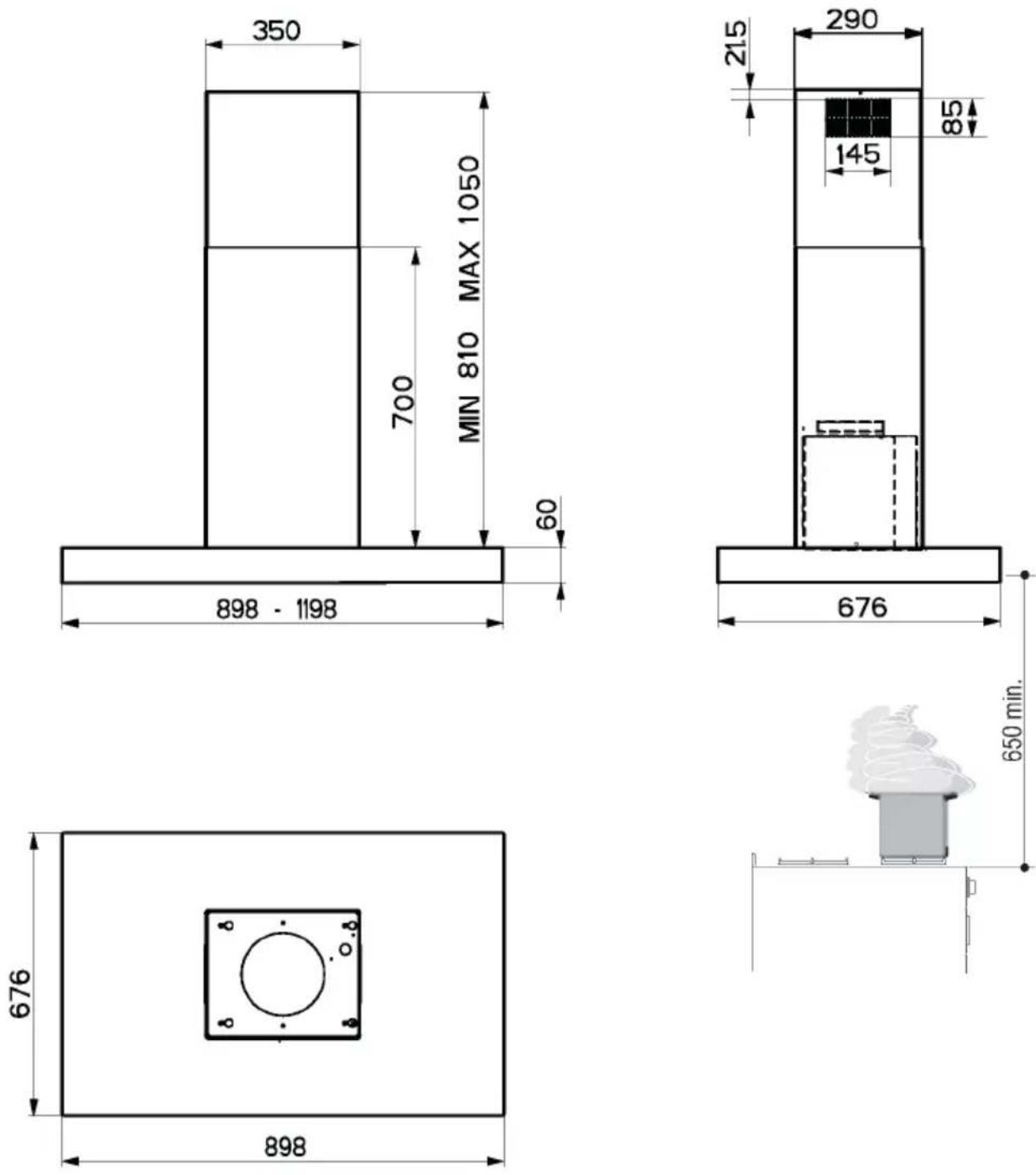
The minimum safety distance between the cooker top and the extractor hood is 650 mm.
Check that the mains voltage corresponds to that indicated on the rating plate fixed to the inside of the hood.
For Class I appliances, check that the domestic power supply guarantees adequate earthing.
Connect the extractor to the exhaust flue through a pipe of minimum diameter 120 mm. The route of the flue must be as short as possible.
Do not connect the extractor hood to exhaust ducts carrying combustion fumes (boilers, fireplaces, etc.).
If the extractor is used in conjunction with non-electrical appliances (e.g. gas burning appliances), a sufficient degree of aeration must be guaranteed in the room in order to prevent the backflow of exhaust gas. The kitchen must have an opening communicating directly with the open air in order to guarantee the entry of clean air.
⚠️ Installation of the extractor hood over a solid-fuel burner(coal, wood, etc.) which could constitute a potential fire hazard (e.g. due to flying sparks) is only permitted if the burner is equipped with an enclosed, non-removable cover and all country-specific regulations are observed. This restriction dose not apply to gas cookers and gas hobs.
⚠️ Regulations concerning the discharge of air have to be fulfilled.

natural_image
Illustration of a kitchen appliance with a green bowl and a crossed green ribbon, no text or symbols present.USE
The extractor hood has been designed exclusively for household use to eliminate kitchen smells.
Never use the hood for purposes other than for which it has been designed.
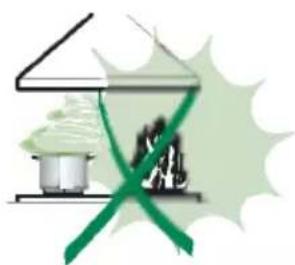
Never leave high naked flames under the hood when it is in operation.
Adjust the flame intensity to direct it onto the bottom of the pan only, making sure that it does not engulf the sides.
Deep fat fryers must be continuously monitored during use: overheated oil can burst into flames.
The hood should not be used by children or persons not instructed in its correct use.
Do not use the appliance if it is damaged in any way.
⚠️ Never operate the extractor hood without a grease filter.
Do not flambe food directly under the extractor hood.
MAINTENANCE
Switch off or unplug the appliance from the mains supply before carrying out any maintenance work.
Clean and/or replace the Filters after the specified time period.
Clean the hood using a damp cloth and a neutral liquid detergent.
Defective bulbs should be replaced immediately to prevent the remaining bulbs from overloading.
There is a fire risk if cleaning is not carried out in accordance with the instructions.
Dimensions
Components
| Ref. | Q.ty | Product Components |
| 1 | 1 | Hood Body, complete with: Controls, Light, Blower, Filters |
| 2 | 1 | Telescopic Chimney comprising: |
| 2.1 | 1 | Upper Section |
| 2.2 | 1 | Lower Section |
| 7.1 | 1 | Telescopic frame complete with extractor, consisting of: |
| 7.1a | 1 | Upper frame |
| 7.1b | 1 | Lower frame |
| 9 | 1 | Reducer Flange ø 150-120 mm |
| 10 | 1 | Flange ø 150 |
| 10a | 1 | Dumper ø 150mm |
| 15 | 1 | Air Outlet Connection |
| 24 | 1 | Junction box |
| 25 | 2 | Pipe clamps |
| Ref. | Q.ty | Installation Components |
| 11 | 4 | Wall Plugs ø 10 |
| 12c | 6 | Screws 2,9 x 6,5 |
| 12e | 2 | Screws 2,9 x 9,5 |
| 12f | 4 | Screws M6 x 10 |
| 12g | 4 | Screws M6 x 80 |
| 12h | 4 | Screws 5,2 x 70 |
| 21 | 1 | Drilling template |
| 22 | 4 | 6.4 mm int. dia washers |
| 23 | 4 | M6 nuts |
| Q.ty | Documentation | |
| 1 | Instruction Manual |


natural_image
Pure technical diagram showing a 3D mechanical assembly with no text, numbers, or symbolsDrilling the Ceiling/shelf and fixing the frame
DRILLING THE CEILING/SHELF
- Use a plumb line to mark the centre of the hob on the ceiling/support shelf.
- Place the drilling template 21 provided on the ceiling/support shelf, making sure that the template is in the correct position by lining up the axes of the template with those of the hob.
• Mark the centres of the holes in the template. -
Drill the holes at the points marked:
-
For concrete ceilings, drill for plugs appropriate to the screw size.
- For hollow brick ceilings with wall thickness of 20 mm: drill 10 mm(immediately insert the Dowels 11 supplied).
- For wooden beam ceilings, drill according to the wood screws used.
- For wooden shelf, drill 7 mm.
- For the power supply cable feed, drill 10 mm.
- For the air outlet (Ducted Version), drill according to the diameter of the external air exhaust duct connection.
- Insert two screws of the following type, crossing them and leaving 4-5 mm from the ceiling:
- For concrete ceilings, use the appropriate plugs for the screw size (not provided).
- for Cavity ceiling with inner space, with wall thickness of approx. 20 mm, Screws 12h, supplied.
- For wooden beam ceilings, use 4 wood screws (not provided).
- For wooden shelf, use 4 screws 12g with washers 22 and nuts 23, provided.
FIXING THE frame
- Loosen the two screws fastening the lower chimney and remove this from the lower frame.
- Loosen the two screws fastening the upper chimney and remove this from the upper frame.
If you wish to adjust the height of the frame, proceed as follows:
- Unfasten the eight metric screws joining the two columns, located at the sides of the frame.
- Adjust the frame to the height required, then replace all the screws removed as above.
- Insert the upper chimney stack from above, and leave it running free on the frame.
- Lift up the frame, fit the frame slots onto the screws up to the slot end positions.
- Tighten the two screws and fasten the other two screws provided with the hood.
Before tightening the screws completely it is possible to adjust the frame by turning it. Make sure that the screws do not come out of their seats in the slotted holes.
- The frame mountings must be secure to withstand the weight of the hood and any stresses caused by the occasional side thrust applied to the device.
On completion, check that the base is stable, even if the frame is subjected to bending.
- In all cases where the ceiling is not strong enough at the suspension point, the installer must provide strengthening using suitable plates and backing pieces anchored to the structurally sound parts.

natural_image
Technical illustration of a screwdriver inserted into a mechanical component (no text or symbols)
natural_image
Technical diagram of a mechanical assembly with arrows indicating force or movement (no text or symbols present)Connections
DUCTED VERSION AIR EXHAUST SYSTEM
When installing the ducted version, connect the hood to the chimney using either a flexible or rigid pipe 150 or 120mm, the choice of which is left to the installer.
To install a 150
• To install the dumper 10
- Fix the pipe in position using sufficient pipe clamps (not supplied).
To install a 120
- To install a 120 mm air exhaust connection, insert the reducer flange 9 on the dumper 10.
- Fix the pipe in position using sufficient pipe clamps (not supplied).
- Remove any activated charcoal filters.

Recirculation version air outlet
- Fix the connection 15 to the frame using the 4 screws provided.
- Fix the flange 10 to the lower opening of the connection 15.
- Connect the hood air outlet to the flange in the lower part of the junction using a rigid or flexible 150 tube (by installer's choice).

Flue assembly - Mounting the hood body
- Position the upper chimney section and fix the upper part to the frame using the 2 screws 12c (2,9 x 6,5) provided.
• Similarly, position the lower chimney section and fix the lower part to the frame using the 2 screws 12c (2,9 x 6,5) provided.
Before fixing the hood body to the frame:
- Remove the grease filters from the hood body.
- Remove any activated charcoal filters.
- From below, use the 4 screws 12f (M6 x 10) provided to fix the hood body to the frame.

ELECTRICAL CONNECTION
- Connect the hood to the mains through a two-pole switch having a contact gap of at least 3 mm.
- Remove the grease filters (see paragraph Maintenance) being sure that the connector of the feeding cable is correctly inserted in the socket placed on the side of the fan.
- Connect the control connector Cmd.
- Connect the lights connector Lux.
- Place the connectors in the junction box 24 and close it using the 2 screws 12e (2,9 x 9,5) provided.
- Fix the junction box to the hood body using the 2 screws 12c (2,9 x 6,5) provided.
- For the recirculation version, fit the activated carbon odour filter.
- Replace the grease filters.


The hood can be switched on pushing directly onto the requested speed without firstly having to select 0/1 button.
| KEY | LED | FUNCTIONS | |
| L | 0/1 Light | Turns lighting on and off. | |
| T1 | 0/1 Motor on | First speed.When pressed for about 1 seconds the motor is switched off. | |
| T2 | Speed | on | Second speed. |
| T3 | Speed | on | Third speed. |
| T4 | Speed | Fixed | Max. speed |
| Flashing | Intensive speed.Suitable for the strongest cooking vapours and odours.The function becomes active when the button is pushed for about 2 seconds. After 10 minutes of functioning it turns off automatically. This function can be interrupted by means of pressing any of the buttons. | ||
| S1 | Led | Fixed | Indicates that the Metal grease filters saturation alarm has been triggered, and the filters need to be washed. The alarm is triggered after 100 working hours. (Reset; check the Maintenance-paragraph) |
| Flashing | indicates that the activated charcoal odour filter saturation alarm has been triggered, and the filter has to be replaced; the metal grease filters must also be washed. The activated charcoal odour filter is triggered after 200 working hours. (Activation and Reset; check the Maintenance-paragraph)) | ||
Grease filters
CLEANING METAL GREASE FILTERS
Alarm signal reset
- Switch of the lights and extractor motor.
- Press button T3 for at least 3 seconds, until the leds start to flash.
Cleaning the filters
- The filters are washable and must be cleaned when led S1 flashes or at least every 2 months of operation, or more frequently for particularly heavy usage.
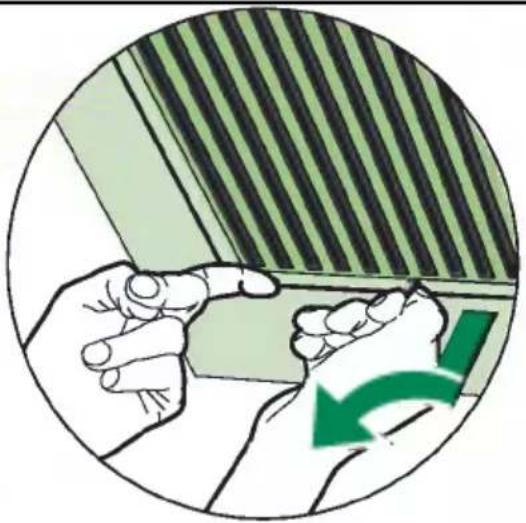
- Remove the filters one at a time, supporting them with one hand and turning the safety knobs (pull and turn).
- Wash the filters, taking care not to bend them. Allow them to dry before refitting.
- Replace them and fix them using the safety knobs provided (pull and turn).
natural_image
Illustration of hands adjusting a striped panel with a green circular arrow indicating rotation (no text or symbols)- The filter is not washable and cannot be regenerated. It must be replaced when led S1 flashes or at least every 4 months. The alarm signal will only light up when the extractor motor is switched on.
Alarm signal activation
- In Recirculation version Hoods, the Filter saturation alarm can be enabled on installation or at a later date. Turn the Lights and the suction Motor off.
- Disconnect the Hood using the Main switch or the double-pole switch on the mains power supply.
- Restore the connection by pressing and holding T1.
- Release the button. All five LEDs are turned on
- Within 3 seconds press T1 until LEDs T1 and T4 flash in confirmation: LED flashes twice - Activated charcoal filter saturation alarm ENABLED LED flashes once - Activated charcoal filter saturation alarm DISABLED
Replacing the activated charcoal filter
Alarm signal reset
- Switch off the lights and extractor motor.
- Press button T3 for at least 3 seconds, until the leds start to flash.
Replacing the Filter
- Remove the metal grease filters
- Remove the saturated activated carbon filter by releasing the fixing hooks
• Fit the new filter by hooking it into its seating - Replace the metal grease filters.

natural_image
Illustration of a hand pressing a component on a green surface, with a green arrow symbol indicating direction (no text or symbols present)Lighting
LIGHT REPLACEMENT
20 W halogen light.
- Remove the snap-on lamp cover by levering it from under the metal ring, supporting it with one hand.
- Remove the halogen lamp from the lamp holder by pulling gently.
- Replace the lamp with a new one of the same type, making sure that you insert the two pins properly into the housings on the lamp holder.
- Replace the snap-on lamp cover.
When switched on, the halogen bulbs become very hot. Even for some time after the bulbs have been switched off there is still a risk of burns.

natural_image
Illustration of a hand holding a small object with a circular top, enclosed in a circle (no text or symbols)Disposal of your old appliance
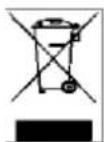
- When this crossed-out wheeled bin symbol is attached to a product it means the product is covered by the European Directive 2002/96/EC.
- All electrical and electronic products should be disposed of separately from the municipal waste stream via designated collection facilities appointed by the government or the local authorities.
- The correct disposal of your old appliance will help prevent potential negative consequences for the environment and human health.
- For more detailed information about disposal of your old appliance, please contact your city office, waste disposal service or the shop where you purchased the product.

- Instructions Manual INDEX
- INSTALLATION
- USE
- MAINTENANCE
- Drilling the Ceiling/shelf and fixing the frame
- DRILLING THE CEILING/SHELF
- FIXING THE frame
- Connections
- DUCTED VERSION AIR EXHAUST SYSTEM
- To install a 150
- To install a 120
- Recirculation version air outlet
- Flue assembly - Mounting the hood body
- ELECTRICAL CONNECTION
- Grease filters
- CLEANING METAL GREASE FILTERS
- Alarm signal reset
- Cleaning the filters
- Replacing the activated charcoal filter
- Replacing the Filter
- Lighting
- LIGHT REPLACEMENT
- W halogen light.
- Disposal of your old appliance
Brand : LG
Model : DI700E
Category : Range hood