PIC18F87J90 - Electronic component Microchip - Free user manual and instructions
Find the device manual for free PIC18F87J90 Microchip in PDF.


User questions about PIC18F87J90 Microchip
0 question about this device. Answer the ones you know or ask your own.
Ask a new question about this device
Download the instructions for your Electronic component in PDF format for free! Find your manual PIC18F87J90 - Microchip and take your electronic device back in hand. On this page are published all the documents necessary for the use of your device. PIC18F87J90 by Microchip.
USER MANUAL PIC18F87J90 Microchip
PICDEM™ LCD 2 Demonstration Kit User's Guide
Note the following details of the code protection feature on Microchip devices:
• Microchip products meet the specification contained in their particular Microchip Data Sheet.
- Microchip believes that its family of products is one of the most secure families of its kind on the market today, when used in the intended manner and under normal conditions.
- There are dishonest and possibly illegal methods used to breach the code protection feature. All of these methods, to our knowledge, require using the Microchip products in a manner outside the operating specifications contained in Microchip's Data Sheets. Most likely, the person doing so is engaged in theft of intellectual property.
• Microchip is willing to work with the customer who is concerned about the integrity of their code.
- Neither Microchip nor any other semiconductor manufacturer can guarantee the security of their code. Code protection does not mean that we are guaranteeing the product as "unbreakable."
Code protection is constantly evolving. We at Microchip are committed to continuously improving the code protection features of our products. Attempts to break Microchip's code protection feature may be a violation of the Digital Millennium Copyright Act. If such acts allow unauthorized access to your software or other copyrighted work, you may have a right to sue for relief under that Act.
Information contained in this publication regarding device applications and the like is provided only for your convenience and may be superseded by updates. It is your responsibility to ensure that your application meets with your specifications. MICROCHIP MAKES NO REPRESENTATIONS OR WARRANTIES OF ANY KIND WHETHER EXPRESS OR IMPLIED, WRITTEN OR ORAL, STATUTORY OR OTHERWISE, RELATED TO THE INFORMATION, INCLUDING BUT NOT LIMITED TO ITS CONDITION, QUALITY, PERFORMANCE, MERCHANTABILITY OR FITNESS FOR PURPOSE. Microchip disclaims all liability arising from this information and its use. Use of Microchip devices in life support and/or safety applications is entirely at the buyer's risk, and the buyer agrees to defend, indemnify and hold harmless Microchip from any and all damages, claims, suits, or expenses resulting from such use. No licenses are conveyed, implicitly or otherwise, under any Microchip intellectual property rights.
QUALITY MANAGEMENT SYSTEM
CERTIFIED BY DNV
=ISO/TS 16949:2002=
Trademarks
The Microchip name and logo, the Microchip logo, dsPIC, KEELOQ, KEELOQ logo, MPLAB, PIC, PICmicro, PICSTART, PIC ^32 logo, rfPIC and UNI/O are registered trademarks of Microchip Technology Incorporated in the U.S.A. and other countries.
FilterLab, Hampshire, HI-TECH C, Linear Active Thermistor, MXDEV, MXLAB, SEEVAL and The Embedded Control Solutions Company are registered trademarks of Microchip Technology Incorporated in the U.S.A.
Analog-for-the-Digital Age, Application Maestro, CodeGuard, dsPICDEM, dsPICDEM.net, dsPICworks, dsSPEAK, ECAN, ECONOMONITOR, FanSense, HI-TIDE, In-Circuit Serial Programming, ICSP, Mindi, MiWi, MPASM, MPLAB Certified logo, MPLIB, MPLINK, mTouch, Omniscient Code Generation, PICC, PICC-18, PICDEM, PICDEM.net, PICkit, PICtail, REAL ICE, rfLAB, Select Mode, Total Endurance, TSHARC, UniWinDriver, WiperLock and ZENA are trademarks of Microchip Technology Incorporated in the U.S.A. and other countries.
SQTP is a service mark of Microchip Technology Incorporated in the U.S.A.
All other trademarks mentioned herein are property of their respective companies.
© 2010, Microchip Technology Incorporated, Printed in the U.S.A., All Rights Reserved.
Printed on recycled paper.
ISBN: 978-1-60932-686-9
Microchip received ISO/TS-16949:2002 certification for its worldwide headquarters, design and wafer fabrication facilities in Chandler and Tempe, Arizona; Gresham, Oregon and design centers in California and India. The Company's quality system processes and procedures are for its PIC® MCUs and dsPIO® DSCs, KEELOQ® code hopping devices, Serial EEPROMs, microperipherals, nonvolatile memory and analog products. In addition, Microchip's quality system for the design and manufacture of development systems is ISO 9001:2000 certified.
Table of Contents
Preface 5
Chapter 1. Introduction
1.1 Welcome 11
1.2 PICDEM LCD 2 Demonstration Board Hardware Features .... 12
1.3 Sample Devices 13
1.4 Sample Programs ...... 13
Chapter 2. Getting Started
2.1 PICDEM LCD 2 as a Stand-Alone Board – Preprogrammed Device ..... 15
2.2 PICDEM LCD 2 Used with an In-Circuit Emulator or In-Circuit Debugger ... 16
Chapter 3. Using the Demo Software
3.1 Demo Firmware Operation 17
Appendix A. Board Technical Information
A.1 Processors 25
A.2 LCD Display 26
A.3 LED Display 46
A.4 Charge Pump and VLCAP 46
A.5 Resistive Ladder Versus Charge Pump 46
A.6 Oscillator Options 47
A.7 RS-232 Serial Port 47
A.8 Real-Time Clock 47
A.9 Serial EEPROM 47
A.10 Analog Input 47
A.11 Temperature Sensor 48
A.12 Switches 48
A.13 ICD Connector 48
A.14 Power Supply 49
A.15 Board Layout and Schematics 52
A.16 PIM Layout and Schematics 56
Worldwide Sales and Service 66
NOTES:
Preface
NOTICE TO CUSTOMERS
All documentation becomes dated, and this manual is no exception. Microchip tools and documentation are constantly evolving to meet customer needs, so some actual dialogs and/or tool descriptions may differ from those in this document. Please refer to our web site (www.microchip.com) to obtain the latest documentation available.
Documents are identified with a "DS" number. This number is located on the bottom of each page, in front of the page number. The numbering convention for the DS number is "DSXXXXXA", where "XXXXX" is the document number and "A" is the revision level of the document.
For the most up-to-date information on development tools, see the MPLAB ^® IDE on-line help. Select the Help menu, and then Topics to open a list of available online help files.
The VL logo is a registered logo of Varitronix Limited. The illustrations on pages 26, 27, 31, 36, 39 and 45 are copyrighted materials of Varitronix and VL Electronics. Reprinted with permission.
INTRODUCTION
This chapter contains general information that will be useful to know before using the PICDEM™ LCD 2 Demonstration Board. Items discussed in this chapter include:
- Document Layout
- Conventions Used in this Guide
- Warranty Registration
- Recommended Reading
• The Microchip Web Site - Development Systems Customer Change Notification Service
- Customer Support
• Document Revision History
DOCUMENT LAYOUT
This document describes how to use the PICDEM LCD 2 as a development tool to emulate and debug firmware on a target board. The manual layout is as follows:
- Chapter 1. "Introduction" – Describes the hardware of the PICDEM LCD 2 Demonstration Board.
- Chapter 2. “Getting Started” – Describes how to use the PICDEM LCD 2 Demonstration Board.
- Chapter 3. “Using the Demo Software” – Describes how to use the application in Demo mode and also how it can be customized.
- Appendix A. "Board Technical Information" – Shows the schematic and layout diagrams for the PICDEM LCD 2 Demonstration Board.
CONVENTIONS USED IN THIS GUIDE
This manual uses the following documentation conventions:
DOCUMENTATION CONVENTIONS
| Description Represents Examples | ||
| Arial font: | ||
| Italic characters Referenced books | MPLAB | ^ IDE User's Guide |
| Emphasized text ...is the only compiler... | ||
| Initial caps A window the Output | ut window | |
| A dialog the Settings dialog | ||
| A menu selection select Enable Programmer | ||
| Quotes A field name in a window or dialog | "Save project before build" | |
| Underlined, italic text with right angle bracket | A menu path File>Save | —— |
| Bold characters A dialog button | Click OK | |
| A tab Click the Power tab | ||
| N'Rnnnn | A number in verilog format, where N is the total number of digits, R is the radix and n is a digit. | 4'b0010, 2'hF1 |
| Text in angle brackets <> | A key on the keyboard | Press,, |
| Courier New font: | ||
| Plain Courier New | Sample source code | #define START |
| Filenames | autoexec.bat | |
| File paths c:\mcc18\h | ||
| Keywords | _asm, _endasm, static | |
| Command-line options | -Opa+, -Opa- | |
| Bit values | 0, 1 | |
| Constants | 0xFF, 'A' | |
| Italic Courier New | A variable argument | file.o, where file can be any valid filename |
| Square brackets [] | Optional arguments | mcc18 [options] file [options] |
| Curly brackets and pipe character: { | } | Choice of mutually exclusive arguments; an OR selection | errorlevel {0|1} |
| Ellipses... | Replaces repeated text | var_name [, var_name...] |
| Represents code supplied by user | void main (void) { ... } | |
WARRANTY REGISTRATION
Please complete the enclosed Warranty Registration Card and mail it promptly. Sending in the Warranty Registration Card entitles users to receive new product updates. Interim software releases are available at the Microchip web site.
RECOMMENDED READING
For the latest information on using other tools, read the tool-specific Readme files in the Readmes subdirectory of the MPLAB ^® IDE installation directory. The Readme files contain update information and known issues that may not be included in this user's guide.
The following documents are comprehensive references for Microchip's enhanced microcontrollers with LCD driver:
"PIC18F85J90 Family Data Sheet" (DS39770)
"PIC18F87J90 Family Data Sheet" (DS39933)
"PIC18F6390/6490/8390/8490 Data Sheet" (DS39629)
"PIC16C9XX Data Sheet" (DS30444)
"PIC16C925/926 Data Sheet" (DS39544)
"PIC16F917/916/914/913 Data Sheet" (DS41250)
"PIC16F/LF1946/47 Data Sheet" (DS41414)
Microchip provides online support via our web site at www.microchip.com. This web site is used as a means to make files and information easily available to customers. Accessible by using your favorite Internet browser, the web site contains the following information:
- Product Support – Data sheets and errata, application notes and sample programs, design resources, user's guides and hardware support documents, latest software releases and archived software
- General Technical Support – Frequently Asked Questions (FAQs), technical support requests, online discussion groups, Microchip consultant program member listing
- Business of Microchip – Product selector and ordering guides, latest Microchip press releases, listing of seminars and events, listings of Microchip sales offices, distributors and factory representatives
DEVELOPMENT SYSTEMS CUSTOMER CHANGE NOTIFICATION SERVICE
Microchip's customer notification service helps keep customers current on Microchip products. Subscribers will receive e-mail notification whenever there are changes, updates, revisions or errata related to a specified product family or development tool of interest.
To register, access the Microchip web site at www.microchip.com, click on Customer Change Notification and follow the registration instructions.
The Development Systems product group categories are:
- Compilers – The latest information on Microchip C compilers and other language tools. These include the MPLAB C18 and MPLAB C30 C compilers; MPASM™ and MPLAB ASM30 assemblers; MPLINK™ and MPLAB LINK30 object linkers; and MPLIB™ and MPLAB LIB30 object librarians.
- Emulators – The latest information on Microchip in-circuit emulators. This includes the MPLAB ICE 2000 and MPLAB ICE 4000.
- In-Circuit Debuggers – The latest information on the Microchip in-circuit debugger, MPLAB ICD 2.
- MPLAB ^® IDE – The latest information on Microchip MPLAB IDE, the Windows ^® Integrated Development Environment for development systems tools. This list is focused on the MPLAB IDE, MPLAB SIM simulator, MPLAB IDE Project Manager and general editing and debugging features.
- Programmers – The latest information on Microchip programmers. These include the MPLAB PM3 and PRO MATE® II device programmers and the PICSTART® Plus and PICkit™ 1 development programmers.
CUSTOMER SUPPORT
Users of Microchip products can receive assistance through several channels:
• Distributor or Representative
- Local Sales Office
• Field Application Engineer (FAE)
- Technical Support
Customers should contact their distributor, representative or field application engineer (FAE) for support. Local sales offices are also available to help customers. A listing of sales offices and locations is included in the back of this document.
Technical support is available through the web site at: http://support.microchip.com
DOCUMENT REVISION HISTORY
Revision C (November 2010)
- Added device information for the PIC16F/LF1946/7.
NOTES:
Chapter 1. Introduction
1.1 WELCOME
Thank you for purchasing the PICDEM LCD 2 Demonstration Kit from Microchip Technology Incorporated. The PICDEM LCD 2 demonstrates the capabilities of the PIC18FXXJ90, PIC18FXX90, PIC16X9XX, and PIC16X19XX families of devices.
The PICDEM LCD 2 can be used stand-alone with a preprogrammed part, with an in-circuit emulator (e.g., MPLAB ^® ICE) or with an in-circuit debugger (e.g., MPLAB ICD 2). Sample programs are provided to demonstrate the unique features of the supported devices.
The PICDEM LCD 2 Demonstration Kit comes with the following:
- PICDEM LCD 2 Demonstration Board (Figure 1-1)
- Sample Plug-in Module (PIM)
- CD-ROM which contains:
- Sample Programs
- "PICDEM™ LCD 2 Demonstration Kit User's Guide"
If you are missing any part of the kit, please contact your nearest Microchip sales office listed in the back of this publication for help.
1.2 PICDEM LCD 2 DEMONSTRATION BOARD HARDWARE FEATURES
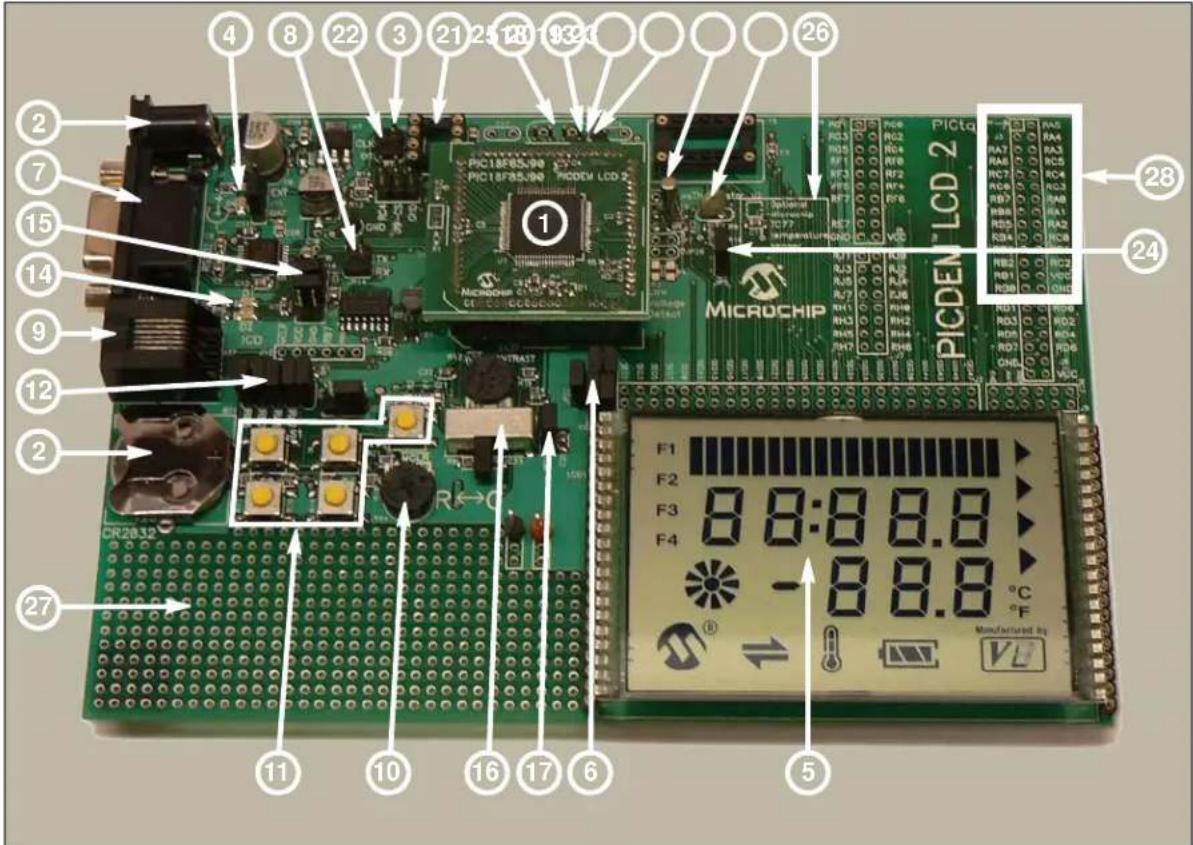
The PICDEM LCD 2 Demonstration Board has the following hardware features; each feature's number corresponding to the number in Figure 1-1:
- The demonstration board provides a daughter board option for the PIC18F85J90, PIC18F87J90, PIC18F8490, PIC16F914/917, PIC16F946, and PIC16F/LF1946/47 families of devices and MPLAB ICE. The board is also supplied with a PIM populated with a PIC18F85J90 device.
Note: Optional PIMs populated with PIC18FXX90, PIC18FXX90, PIC16F9XX, and PIC16X19XX devices are available for purchase from Microchip Direct (www.microchipdirect.com).
The MPLAB ICE can be plugged onto the board without any transition socket for PIC18FXX90 devices. For other devices, a transition socket may be needed.
-
On-board adjustable voltage regulator for direct input from 9V, 100 mA AC/DC wall adapter or 3V button cell battery.
-
Jumper J15 to select different power options.
-
Green power-on indicator LED for direct input from 9V.
-
Varitronix custom segmented LCD display.
-
Jumpers, COM0, COM1, COM2 and COM3, to disconnect COM pins from on-board LCD and allow the usage of any customized LCD glass.
-
RS-232 connection and associated hardware for direct connection to RS-232 interface.
-
Jumpers, JP13 and JP14, to disconnect TX and RX.
-
In-Circuit Debugger (ICD) connector.
-
R44, 10 kΩ, potentiometer for devices with analog inputs.
-
Five push button switches (S1 through S5) for external stimulus and Reset.
-
Jumpers, JP19, JP18, JP1 and JP2, to disconnect switches from RB6, RB7, RA6 and RA7 input pins.
-
Jumper, J11, to select either 10 kΩ (POT R44) or the S1-S4 switches to AN0 (RA0).
-
Two green LEDs connected to RC3 and RC4 (device dependent).
-
Jumpers in J14 to disconnect LEDs from RC3 and RC4.
-
A slide switch (S6) to select either the resistor ladder or the charge pump option for generating the bias values for the LCD pins.
-
Jumper, JP21, to physically tie the resistor ladder to ground.
-
Unpopulated holes provided for crystal connection.
-
Jumpers, JP11 and JP12, to disconnect crystal from OSC1 and OSC2.
-
32.768 kHz crystal with Timer1 for Real-Time Clock (RTC) operation.
-
A Microwire EEPROM 93AA46C provided on a socket.
-
Jumpers, JP15 and JP16, to disconnect EEPROM from CK and DT. Jumper, J6, to connect CS to GND or to RC4 (device dependent). Jumper, J13, to select either 128 x 8 or 64 x 16 memory organization.
-
Thermistor for sensing temperature.
-
Jumper, JP5, to connect thermistor to AN1 (RA1) (device dependent).
-
Jumper, JP17, to select either V cc or I/O to power the peripherals.
-
Unpopulated option for TC77 temperature sensor.
-
Prototype area for user hardware.
-
PICtail™ daughter board connection. (The pin names on the board are valid only for the PIC18F8490 device. For other devices, the PICtail daughter board pin connections may be different or not connected.)
FIGURE 1-1: PICDEM™ LCD 2 HARDWARE
text_image
PIC18F85/90 PIC18F85/90 PICDEM LCD 2 MICROCHIP PIC18F85/90 PICDEM LCD 2 PICta PICDEM LCD 2 PICDEN R1 R2 R3 R4 R5 R6 R7 R8 R9 R10 R11 R12 R13 R14 R15 R16 R17 R18 R19 R20 R21 R22 R23 R24 R25 R26 PICDEN LCD 2 F1 F2 F3 F4 -8.8.8 °C Manufactured by1.3 SAMPLE DEVICES
A PIM, populated with the PIC18F85J90, is included.
1.4 SAMPLE PROGRAMS
The PICDEM LCD 2 Demonstration Kit includes a CD-ROM with sample demonstration programs. Depending on the device, these programs may be used with some of the included sample devices with an In-Circuit Emulator (ICE) or with an In-Circuit Debugger (ICD). For each type of device (PIC16F946, PIC16F917, PIC18F8490, PIC18F85J90, PIC18F87J90 and PIC16F/LF1946/47), demo source code, several C and/or .asm files and compiled code (one HEX file) are provided.
NOTES:
Chapter 2. Getting Started
The PICDEM LCD 2 may be used as a stand-alone board with a preprogrammed device, with an In-Circuit Emulator (ICE) or with an In-Circuit Debugger (ICD). For a list of PIC ^® microcontroller compatible ICEs or ICDs, please refer to the “Microchip Development Systems Ordering Guide” (DS30177).
2.1 PICDEM LCD 2 AS A STAND-ALONE BOARD – PREPROGRAMMED DEVICE
The PICDEM LCD 2 may be demonstrated immediately by following the steps listed below:
- Apply power to the PICDEM LCD 2. For information on acceptable power sources, see Appendix A. "Board Technical Information".
Note: In the event that the preprogrammed PICDEM LCD 2 Demonstration Board with the PIC18F85J90 PIM does not operate, check the following conditions:
- The jumper, J15, is configured as per the power supply used. The slide switch, S6, is switched to C.
- JP1, JP2, JP6, JP18 and JP19 are connected.
- The middle two jumpers of J14 are connected.
- JP9 and JP10 are connected.
- J11 connecting POT to AN0 and JP17 connecting V cc to I/O.
The status of all other jumpers will not affect the preprogrammed demonstration.
Refer to Figure A-1 in Appendix A. "Board Technical Information".
To reprogram the sample device, the following will be necessary:
- User source code may be programmed to the device or the sample program may be restored from the file on the included CD-ROM.
- An assembler, such as the MPASM™ Assembler (available with MPLAB IDE), or a compiler, such as MPLAB C18 C Compiler (PIC18XXXX/18XXJXX devices only) must be used.
Source code must be assembled or compiled into a HEX file before it can be programmed into the device. Microchip Technology's MPASM Assembler or MPLAB C18 C Compiler may be used. Both are compatible with MPLAB IDE; however, other assemblers/compilers may be used.
- Once the sample program is in the HEX file format, it can be programmed to a Flash device using an MPLAB ICD 2 or PM3 with an ICSP™ module. Microchip Technology's MPLAB ICD 2 is compatible with MPLAB IDE.
If the code protection bit(s) have not been programmed, the on-chip program memory can be read out for verification purposes.
2.2 PICDEM LCD 2 USED WITH AN IN-CIRCUIT EMULATOR OR IN-CIRCUIT DEBUGGER
To use the PICDEM LCD 2 with an In-Circuit Emulator (ICE) or In-Circuit Debugger (ICD), refer to the tool's user's guide for instructions on how to power-up and configure the ICE/ICD, as well as how to connect to target boards.
Configure the PICDEM LCD 2 for the desired oscillator as described in Table 2-1. Refer to the ICE/ICD user's guide for any oscillator configuration requirements.
TABLE 2-1: OSCILLATOR SELECTION
| Oscillator Selection on PICDEM ^TM LCD 2 | Modification on PICDEM ^TM LCD 2 |
| Crystal JP9 and JP10 not connected. No canned oscillator on board, crystal in Y2, JP11 and JP12 connected, caps in C16 and C17. | |
| Canned Oscillator Put canned | oscillator on socket Y3. Y2 empty, JP9, JP11 and JP12 not connected. |
| Device Internal Oscillator JP11 | and JP12 not connected. No canned oscillator on board. |
| Ceramic Resonator – no internal caps | JP9 and JP10 not connected. No canned oscillator on board, resonator in Y2, JP11 and JP12 connected, caps in C16 and C17. |
| Ceramic Resonator – with internal caps | JP9 and JP10 not connected. No canned oscillator on board, resonator in Y2, JP11 and JP12 connected, C16 and C17 empty. |
Note: The MPLAB ICE can be plugged onto the board without any transition socket for PIC18FXX90 devices. For other devices, a transition socket may be needed.
Chapter 3. Using the Demo Software
The demo programs are preprogrammed into the sample devices. Also, this program is included on the CD-ROM program disk for user reference. This demo program uses the functions or macros provided by the firmware LCD driver module to display the required characters, strings or icons on the LCD.
The demo firmware is made up of four components, which are individually displayed on the LCD. The PIC microcontroller's internal RC oscillator is used as the system clock source.
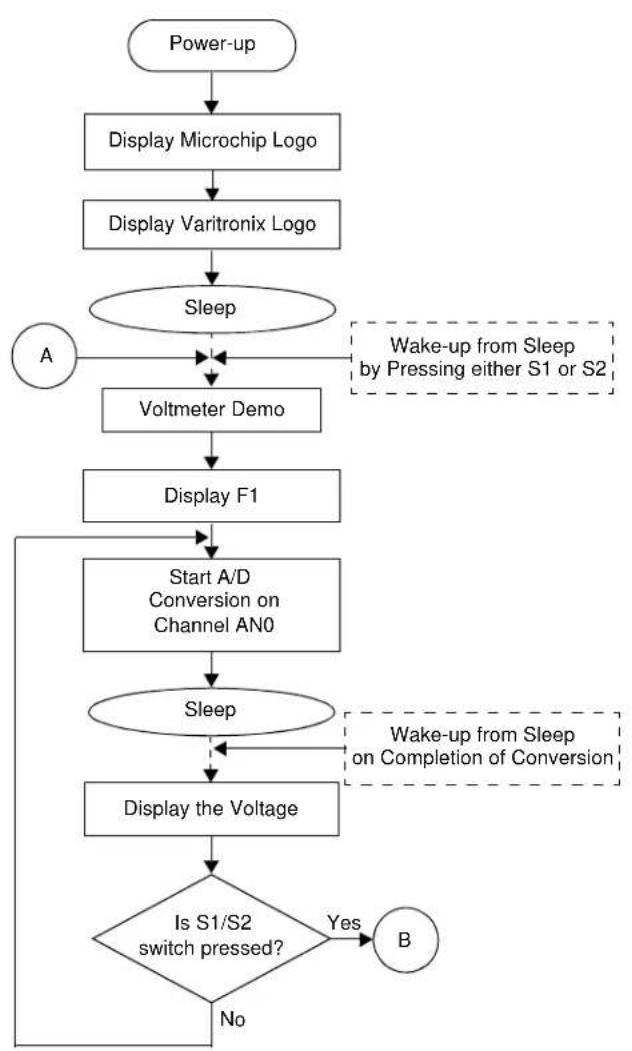
1. Voltmeter (F1)
This mode uses the A/D module to measure the voltage of the R44 pot through analog channel AN0, and displays a voltage between 0.00V and 3.30V on the LCD using the LCD module. Voltage is continually updated until the mode is exited by pressing either the S1 or S2 switch.
2. Thermometer (F2)
This mode uses the A/D module to measure the voltage of the thermistor R11 through analog channel AN1, and converts to temperature both in Celsius and Fahrenheit and displays the temperature on the LCD using the LCD module. Temperature is continually updated until the mode is exited by pressing either the S1 or S2 switch.
3. Clock (F3) ^(1)
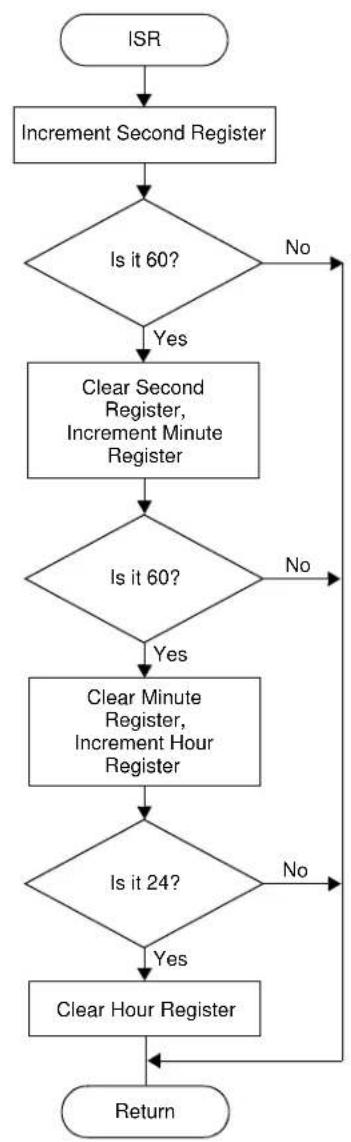
This mode uses the Timer1 module and a 32 kHz clock crystal. Once this mode is entered from the main menu, the Real-Time Clock will start counting from 00:00:00. The S3 switch is used to increment minutes and the S4 switch is used to increment hours. To perform the increment operations, press and hold the switches. The clock keeps running continuously until the mode is exited by pressing either the S1 or S2 switch.
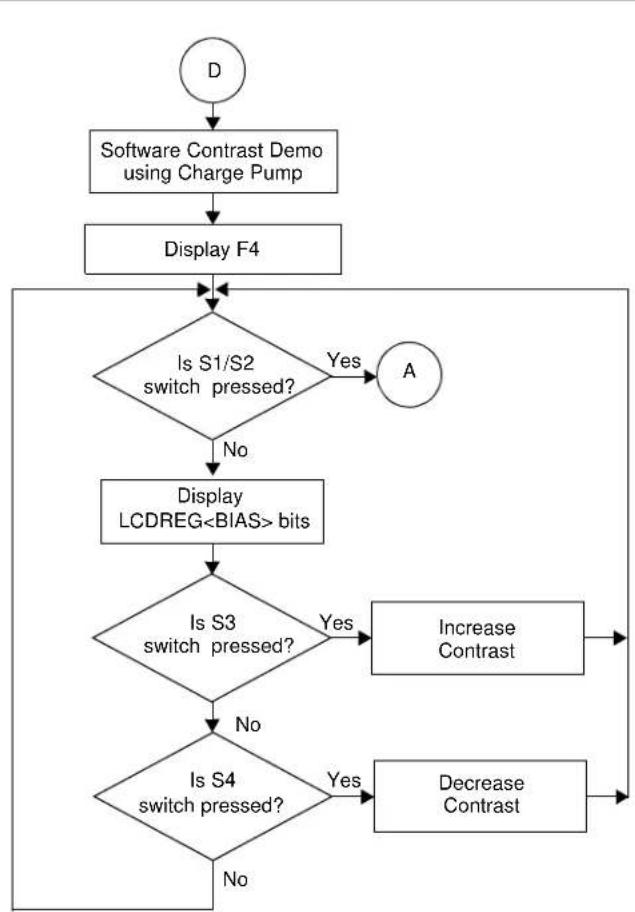
4. Charge Pump and Software Contrast (F4) ^(1)
This mode is available only for the PIC18F85J90 and PIC18F87J90 families of devices and uses the on-board charge pump and LCD voltage regulator. The LCD module is configured in Charge Pump mode and software contrast is achieved by either pressing S3 to increase the contrast or S4 to decrease the contrast until the mode is exited by pressing either the S1 or S2 switch. By exiting this mode, the Voltmeter mode is entered and retains the contrast level.
Note 1: For low-power battery operation in JP17, remove jumper on Vcc and I/O and connect I/O and RB0.
FIGURE 3-1: DEMO PROGRAM FLOWCHART
flowchart
graph TD
    A["Power-up"] --> B["Display Microchip Logo"]
    B --> C["Display Varitronix Logo"]
    C --> D{Sleep}
    D -->|Yes| E["Voltmeter Demo"]
    D -->|No| F["Display F1"]
    E --> F
    F --> G["Start A/D Conversion on Channel AN0"]
    G --> H{Sleep}
    H -->|Yes| I["Display the Voltage"]
    H -->|No| J{Is S1/S2 switch pressed?}
    I --> J
    J -->|Yes| K["B"]
    J -->|No| L["A"]
    style D stroke:#000,stroke-width:2px
    style E stroke:#000,stroke-width:2px
    style F stroke:#000,stroke-width:2px
    style G stroke:#000,stroke-width:2px
    style H stroke:#000,stroke-width:2px
    style I stroke:#000,stroke-width:2px
    style J stroke:#000,stroke-width:2px
    note right of D Wake-up from Sleep by Pressing either S1 or S2
FIGURE 3-2: DEMO PROGRAM FLOWCHART

flowchart
graph TD
    B["Start"] --> A["Thermometer Demo"]
    A --> B
    B --> C["Display F2"]
    C --> D["Start A2D Conversion on Channel AN1"]
    D --> E["Sleep"]
    E --> F["Display the Temperature"]
    F --> G{Is S1/S2 switch pressed?}
    G -->|Yes| H["C"]
    G -->|No| I["End"]
    H --> I
    style E stroke-dasharray: 5 5
    note right of E Wake-up from Sleep on Completion of Conversion
FIGURE 3-3: DEMO PROGRAM FLOWCHART

flowchart
graph TD
    A["C"] --> B["Real-Time Clock Demo"]
    B --> C["Display F3"]
    C --> D{Is S1/S2 switch pressed?}
    D -->|Yes| E["D"]
    D -->|No| F["Display Time"]
    F --> G["Sleep"]
    G --> H{Is S3 switch pressed?}
    H -->|Yes| I["Increment Minute"]
    H -->|No| J{Is S4 switch pressed?}
    J -->|Yes| K["Increment Hour"]
    J -->|No| L["End"]
    I --> L
    K --> L
    style G stroke-dasharray: 5 5
    style H stroke-dasharray: 5 5
    style J stroke-dasharray: 5 5
    note right of G Wake-up from Sleep Every Second
FIGURE 3-4: DEMO PROGRAM FLOWCHART
flowchart
graph TD
    A["D"] --> B["Software Contrast Demo using Charge Pump"]
    B --> C["Display F4"]
    C --> D{Is S1/S2 switch pressed?}
    D -->|Yes| E["A"]
    D -->|No| F["Display LCDREG<BIAS> bits"]
    F --> G{Is S3 switch pressed?}
    G -->|Yes| H["Increase Contrast"]
    G -->|No| I{Is S4 switch pressed?}
    I -->|Yes| J["Decrease Contrast"]
    I -->|No| K["End"]
FIGURE 3-5: DEMO PROGRAM FLOWCHART
flowchart
graph TD
    A["ISR"] --> B["Increment Second Register"]
    B --> C{Is it 60?}
    C -->|No| B
    C -->|Yes| D["Clear Second Register, Increment Minute Register"]
    D --> E{Is it 60?}
    E -->|No| D
    E -->|Yes| F["Clear Minute Register, Increment Hour Register"]
    F --> G{Is it 24?}
    G -->|No| F
    G -->|Yes| H["Clear Hour Register"]
    H --> I["Return"]
Appendix A. Board Technical Information
The PICDEM™ LCD 2 hardware is not complicated and is intended to illustrate the ease of use of various PIC® microcontrollers. The PICDEM LCD 2 features the following hardware elements.
Note: Many of the following hardware sections will require specific demo board jumper configurations. If a jumper is not listed in a particular section, then that jumper has no effect on the circuitry within the hardware section you are working. Figure A-1 shows a diagram of the PICDEM LCD 2 silkscreen with all necessary jumpers highlighted in gray. Also, refer to the schematic for circuit connections.
FIGURE A-1: PICDEM™ LCD 2 DEFAULT JUMPER LOCATION

text_image
PICtail™ RA5 RA4 RA3 RC5 RC4 RC3 RA0 RA1 RA2 RC0 RC1 RC2 VCC GND RD0 RD2 RD4 RD6 RB5 AN1 +V VCC RG0 RG2 RG4 RF0 RF2 RF4 RF6 VCC SEQ47 SEQ45 SEQ43 SEQ41 SEQ39 SEQ37 SEQ35 SEQ33 SEQ31 SEQ29 SEQ27 SEQ25 SEQ23 SEQ21 SEQ19 SEQ17 SEQ15 SEQ13 SEQ11 SEG9 SEG8 SEG7 SEG5 SEG3 SEG1 SEG0 SEG2 SEG11 SEG10 SEG9 SEG6 SEG4 SEG3 SEG2 SEG10 SEG0 SEG3F E1F2F3F4F5F6F7F8F9F10F11F12F13F14F15F16F17F18F19F20F21F22F23F24F25F26F27F28F29F30F31F32F33F34F35F36F37F38F39F40F41F42F43F44F45F46F47 RJ0JUJUJUJUJUJUJUJUJUJUJUJUJUJUJUJUJUJUJUJUJUJUJUJUJUJUJUJUJUJUJUJUJUJUJUJUJUJUJUJUJUJUJUJUJUJUJUJUJUJUJ U-1 0.0V 0.0V 0.0V 0.0V 0.0V 0.0V 0.0V 0.0V 0.0V 0.0V 0.0V 0.0V 0.0V 0.0V 0.0V 0.0V 0.0V 0.0V 0.0V 0.0V 0.0S LED_VLS573 MICROCHIP Microchip EEEPROM C17 C18 C17 C16 C15 C14 C13 C12 C11 C10 C9 C8 C7 C6 C5 C4 C3 C2 C1 C0 C8 C7 C5 C3 C2 C1 C0 C8 C7 C5 C3 C2 C1 C0 C8 C7 C5 C3 C2 C1 C0 C8 C7 C5 C3 C2 C1 C0 C8 C7 C5 C3 C2 C1 C0 C8 C7 C5 C3 C2 C1 C0 C8 C7 C5 C3 C2 C1 C0 C8 C7 C5 C2 C1 C0 C8 C7 C5 C3 C2 C1 C0 C8 C7 C5 C3 C2 C1 C0 C8 C7 C5 C3 C2 C1 C0 C8 C7 C5 C3 C2 C1 C0 C8 C7 C5 C3 C2 C1C O P O T R S S S S S S S S S S S S S S S S S S S S S S S S S S S S S S S S S S S S S S S S S S S S S S S S S S S S S S S S S S S S S S S S S S S S S S S S S S S S S S S S S S S S S S S S S S S S S S S S S S S S.S F L D D E N A N A N A N A N A N A N A N A N A N A N A N A N A N A N A N A N A N A N A N A N A N A N A N A N A N A N A N A N A N A N A N A N A N A N A N A N A N A N A N A N A N A N A N A N A N A N A N A N A N A N B L D D E N A N B L D D E E M L O U V V V V V V V V V V V V V V V V V V V V V V V V V V V V V V V V V V V V V V V V V V V V V V V V V V V V V V V V V V V V V V V V V V V V V V V V V V V V V V V V V V V V V V V V V V V V V V V V V V V V I L D D E N A N B L D D E E M L O U V V I L D D E E M L O U U V I L D D E E M L O U U I I U I I I I I I I I I I I I I I I I I I I I I I I I I I I I I I I I I I I I I I I I I I I I I I I I I I I I I I I I I I I I I I I I I I I I I I I I I I I I I I I I I I I I I I I I I I I I I I I I I I II F L D D E E M L O U U U i l l l l l l l l l l l l l l l l l l l l l l l l l l l l l l l l l l l l l l l l l l l l l l l l l l l l l l l l l l l l l l l l l l l l l l l l l l l l l l l l l l l l l l l l l l l l l l l l l l l l ll r s s s s s s s s s s s s s s s s s s s s s s s s s s s s s s s s s s s s s s s s s s s s s s s s s s s s s s s s s s s s s s s s s s s s s s s s s s s s s s s s s s s s s s s s s s s s s s s s s s s s.s r r r r r r r r r r r r r r r r r r r r r r r r r r r r r r r r r r r r r r r r r r r r r r r r r r r r r r r r r r r r r r r r r r r r r r r r r r r r r r r r r r r r r r r r r r r r r r r r r r r r v f o f o f o f o f o f o f o f o f o f o f o f o f o f o f o f o f o f o f o f o f o f o f o f o f o f o f o f o f o f o f o f o f o f o f o f o f o f o f o f o f o f o f o f o f o f o f o f o f o f o f u n a n a n a n a n a n a n a n a n a n a n a n a n a n a n a n a n a n a n a n a n a n a n a n a n a n a n a n a n a n a n a n a n a n a n a n a n a n a n a n a n a n a n a n a n a n a n a n a n a n a n b m c c c c c c c c c c c c c c c c c c c c c c c c c c c c c c c c c c c c c c c c c c c c c c c c c c c c c c c c c c c c c c c c c c c c c c c c c c c c c c c c c c c c c c c c c c c c c c c c c c c c t e d e d e d e d e d e d e d e d e d e d e d e d e d e d e d e d e d e d e d e d e d e d e d e d e d e d e d e d e d e d e d e d e d e d e d e d e d e d e d e d e d e d e d e d e d e d e d e d e d e d e de i v j v j v j v j v j v j v j v j v j v j v j v j v j v j v j v j v j v j v j v j v j v j v j v j v j v j v j v j v j v j v j v j v j v j v j v j v j v j v j v j v j v j v j v j v j v j v j v j v j v j vj v jv jv jv jv jv jv jv jv jv jv jv jv jv jv jv jv jv jv jv jv jv jv jv jv jv jv jv jv jv jv jv jv jv jv jv jv jv jv jv jv jv jv jv jv jv jv jv jv jv jv jw y w IN +9V IN -D6 D5 EFPROM JCP JCP JCP JCP JCP JCP JCP JCP JCP JCP JCP JCP JCP JCP JCP JCP JCP JCP JCP JCP JCP JCP JCP JCP JCP JCP JCP JCP JCP JCP JCP JCP JCP JCP JCP JCP JCP JCP JCP JCP JCP JCP JCP JCP JCP JCP JCP JCP JCP JCP Jcp Jcp Jcp Jcp Jcp Jcp Jcp Jcp Jcp Jcp Jcp Jcp Jcp Jcp Jcp Jcp Jcp Jcp Jcp Jcp Jcp Jcp Jcp Jcp Jcp Jcp Jcp Jcp Jcp Jcp Jcp Jcp Jcp Jcp Jcp Jcp Jcp Jcp Jcp Jcp Jcp Jcp Jcp Jcp Jcp Jcp Jcp Jcp Jcp Jcp Jp KDC GND GND GND GND GND GND GND GND GND GND GND GND GND GND GND GND GND GND GND GND GND GND GND GND GND GND GND GND GND GND GND GND GND GND GND GND GND GND GND GND GND GND GND GND GND GND GND GND GND GND GDDGCGCGCGCGCGCGCGCGCGCGCGCGCGCGCGCGCGCGCGCGCGCGCGCGCGCGCGCGCGCGCGCGCGCGCGCGCGCGCGCGCGCGCGCGCGCGCGCGCGCGCGCGCGCGCGCGCGCGCGCGCGCGCGCGCGCGCGCGCGCGCGCGCGCGCGCGCGCGCGCGCGCGCGCGCGCGCGCGCGCGCGCGCGCGCGCGCGCGCGCGGTCGTCGTCGTCGTCGTCGTCGTCGTCGTCGTCGTCGTCGTCGTCGTCGTCGTCGTCGTCGTCGTCGTCGTCGTCGTCGTCGTCGTCGTCGTCGTCGTCGTCGTCGTCGTCGTCGTCGTCGTCGTCGTCGTCGTCGTCGTCGTCGTCGTCGCTGCTGCTGCTGCTGCTGCTGCTGCTGCTGCTGCTGCTGCTGCTGCTGCTGCTGCTGCTGCTGCTGCTGCTGCTGCTGCTGCTGCTGCTGCTGCTGCTGCTGCTGCTGCTGCTGCTGCTGCTGCTGCTGCTGCTGCTGCTGCTGCTGCTGACTCCTCCTCCTCCTCCTCCTCCTCCTCCTCCTCCTCCTCCTCCTCCTCCTCCTCCTCCTCCTCCTCCTCCTCCTCCTCCTCCTCCTCCTCCTCCTCCTCCTCCTCCTCCTCCTCCTCCTCCTCCTCCTCCTCCTCCTCCTCCTCCTCCTCCTCATTCCATCCATCCATCCATCCATCCATCCATCCATCCATCCATCCATCCATCCATCCATCCATCCATCCATCCATCCATCCATCCATCCATCCATCCATCCATCCATCCATCCATCCATCCATCCATCCATCCATCCATCCATCCATCCATCCATCCATCCATCCATCCATCCATCCATCCATCCATCCATCCATCCATCCATCCCATCCATCCATCCATCCATCCATCCATCCATCCATCCATCCATCCATCCATCCATCCATCCATCCATCCATCCATCCATCCATCCATCCATCCATCCATCCATCCATCCATCCATCCATCCATCCATCCATCCATCCATCCCATTCCCATTCCCATTCCCATTCCCATTCCCATTCCCATTCCCATTCCCATTCCCATTCCCATTCCCATTCCCATTCCCATTCCCATTCCCATTCCCATTCCCATTCCCATTCCCATTCCCATTCCCATTCCCATTCCCATTCCCATTCCCATTCCCATTCCCATTCCCATTCCCATTCCCATTCCCATTCCCATTCCCATTCCCATTCCCATTCCCATTCCCATTCCCATTCCCATTCCCATTCCCATTCCCATTCCCATTCCCATTCCCATTCCCATTCCCATTCCCATTCCCATTCCCATAA FLOWSBGSGSGSGSGSGSGSGSGSGSGSGSGSGSGSGSGSGSGSGSGSGSGSGSGSGSGSGSGSGSGSGSGSGSGSGSGSGSGSGSGSGSGSGSGSGSGSGSGSGSGSGSGSGSGSGSGSGSGSGSGSGSGSGSGSGSGSGSGSGSGSGSGSGSGSGSGSGSGSGSGSGSGSGSGSGSGSGSGSGSGSGSGSGSGSGSGSGSGSGSgsgssgssgssgssgssgssgssgssgssgssgssgssgssgssgssgssgssgssgssgssgssgssgssgssgssgssgssgssgssgssgssgssgssgssgssgssgssgssgssgssgssgssgssgssgssgssgssgssgssgssgSSSSSSSSSSSSSSSSSSSSSSSSSSSSSSSSSSSSSSSSSSSSSSSSSSSSSSSSSSSSSSSSSSSSSSSSSSSSSSSSSSSSSSSSSSSSSSSSSSSSSSSSSSSSSSSSSSSSSSSSSSSSSSSSSSSSSSSSSSSSSSSSSSSSSSSSSSSSSSSSSSSA.1 PROCESSORS
While there is no actual processor populated on the board, a processor is provided with the plug-in module (PIM) that is shipped with the demonstration board. The default processor on the PIM is the PIC18F85J90.
The board also supports the PIC18F87J90, PIC18F8490, PIC16F946, PIC16F917, and PIC16F/LF1946/47 processors, which have been designed for use with the PICDEM LCD 2. These three processors are in the PICDEM LCD 2 PIM Pack which is available for separate purchase.
The part numbers for a replacement PIC18F85J90 and the PIM pack are given in Table A-1.
TABLE A-1: PART NUMBERS (†)
| Item Part number | |
| PICDEM LCD 2 PIM Pack• PIC18F8490 PIM• PIC16F946 PIM• PIC16F917 PIM | MA180019 |
| PIC18F85J90 PIM MA180022 | |
| PIC16F1946/7 PIMPIC16LF1946/7 PIM | MA160016MA160015 |
† For the availability and pricing of parts, go to www.microchipdirect.com.
Note: The PIC16LF1946/7 PIM (MA160015) is limited to a maximum of 3.3V operating voltage.
A.2 LCD DISPLAY
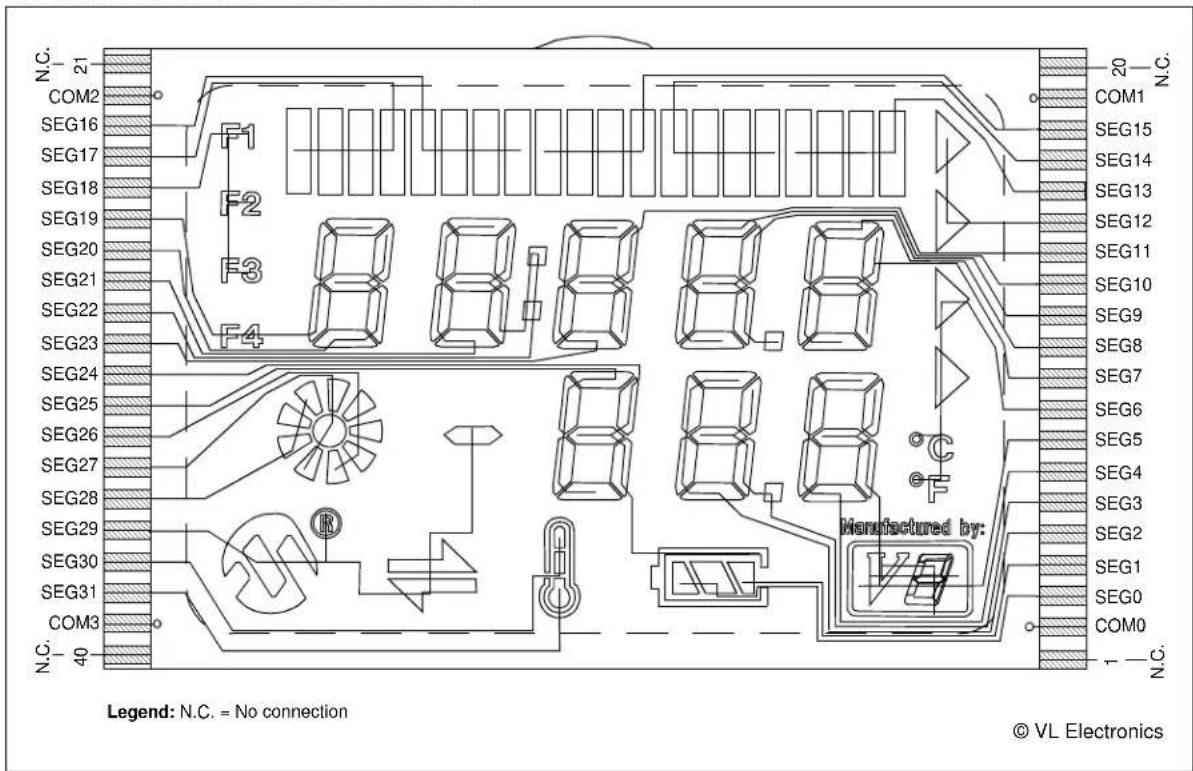
A custom-made segmented LCD glass, manufactured by the Varitronix Corporation, is provided as shown in Figure A-2. This LCD has 4 commons and 32 segments. Table A-2 provides a few of the specifics for the display. Refer to the Varitronix specification sheet (VL_5573_V00) for additional details.
FIGURE A-2: PICDEM™ LCD 2 DISPLAY
text_image
N.C. 21 COM2 SEG16 SEG17 SEG18 SEG19 SEG20 SEG21 SEG22 SEG23 SEG24 SEG25 SEG26 SEG27 SEG28 SEG29 SEG30 SEG31 COM3 N.C. 40 F1 F2 F3 F4 F5 F6 F7 F8 F9 F10 F11 F12 F13 F14 F15 F16 F17 F18 F19 F20 F21 F22 F23 F24 F25 F26 F27 F28 F29 F30 F31 F32 F33 F34 F35 F36 F37 F38 F39 F40 N.C. C. Manufactured by: V17 N.C. © VL ElectronicsTABLE A-2: LCD GLASS SPECIFICATIONS
| Type Specification | |
| P.I.D. VL_5573_V00 | |
| Mode/Color/Type Positive / -- / TN | |
| Viewing Direction 6:00 O’Clock | |
| Driving Scheme 1/4 Duty, 1/3 Bias | |
| Drive Voltage (VLCD) ~3.0 Volt (p-p), +20°C | |
| Operating Temperature 0°C - +50°C | |
| Storage Temperature | -10°C - +60°C |
| Polarizer – Front | STD.Transmissive |
| Polarizer – Back | STD.Reflective |
Since the glass used on the PICDEM LCD 2 operates at 3V, there is a voltage protection circuit on the LCDBIAS3 pin, which is enabled in the default configuration. When enabled, even if the VDD is greater than 3V, it regulates the LCDBIAS3 voltage such that it always maintains the value to 3V. This is not necessary for operation of the LCD module, but it is a protection circuit to prevent accidentally applying voltages higher than 3V to the LCD glass present on the board.
FIGURE A-3: DISPLAY DEFINITIONS

text_image
PIN21 (MIN V.A. 44.80) PIN40 (MAX 3.00) (MIN V.A. 66.40) (1.27±0.4) (PITCH 2.54 X 19 = 48.26) (1.50 TYP.) PIN20 X21 X20 X27 X28 X36 X33 X32 S4 6 8 DP1 DP2 S12 S9 S10 S11 S13 S2 S3 S6 S7 S5 S8 S13 X24 X26 X25 X27 X28 F4 F3 F2 F1 F0 F1 F2 F3 F4 F5 F6 F7 F8 F9 F10 F11 F12 F13© VL Electronics
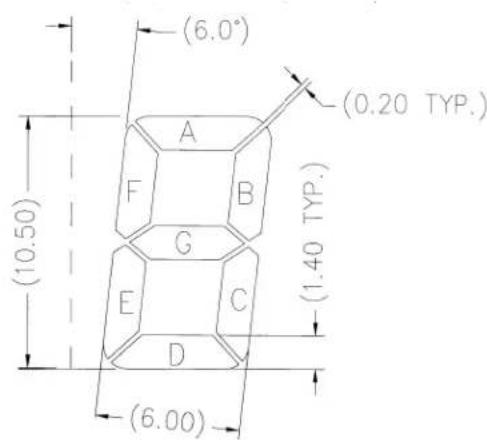
FIGURE A-4: DIGIT DESCRIPTION
text_image
(6.0°) (0.20 TYP.) (10.50) (1.40 TYP.) (6.00)DIGIT 1-8
© VL Electronics
TABLE A-3: LCD SEGx AND COMx
| Pin ICE Pin COM0 COM1 COM2 COM3 | |||||
| 1 N.C. N.C. N.C. | |||||
| 2 | C | O | |||
| 3 SEG0 | S12 — — S10 | ||||
| 4 SEG1 | S11 | — — — | |||
| 5 | SEG2 | 7D | 7F | 7A | 7E |
| 6 | SEG3 | DP2 | 7G | 7B | 7C |
| 7 | SEG4 | 8D | 8F | 8A | 8E |
| 8 | SEG5 | S13 | 8G | 8B | 8C |
| 9 SEG6 | X23 | X25 | X26 | X24 | |
| 10 | SEG7 | 5B | 5C | — | 5G |
| 11 | SEG8 | 5A | 5E | 5D | 5F |
| 12 | SEG9 | 4B | 4C | DP1 | 4G |
| 13 | SEG10 | 4A | 4E | 4D | 4F |
| 14 | SEG11 | 3B | 3C | — | 3G |
| 15 | SEG12 | — X22 | X21 — | ||
| 16 | SEG13 | X17 | X19 | X20 | X18 |
| 17 | SEG14 | X16 | X14 | X13 | X15 |
| 18 | SEG15 | X9 | X11 | X12 | X10 |
| 19 | — | COM1 | — — | ||
| 20 | N.C. N.C. | N.C. N.C. | |||
| 21 | N.C. N.C. | N.C. N.C. | |||
| 22 | — — | COM2 | — | ||
| 23 | SEG16 | X8 | X6 | X5 | X7 |
| 24 | SEG17 | X1 | X3 | X4 | X2 |
| 25 | SEG18 | — | F2 | F1 | F3 |
| 26 | SEG19 | 1A | 1E | F4 | 1F |
| 27 | SEG20 | 1B | 1C | 1D | 1G |
| 28 | SEG21 | 2A | 2E | 2D | 2F |
| 29 | SEG22 | 2B | 2C | COL | 2G |
| 30 | SEG23 | 3A | 3E | 3D | 3F |
| 31 | SEG24 | S9 | 6G | 6B | 6C |
| 32 | SEG25 | 6D | 6F | 6A | 6E |
| 33 | SEG26 | X31 | X33 | X34 | X32 |
| 34 | SEG27 | — | X27 | X35 | X30 |
| 35 | SEG28 | — | X28 | X36 | X29 |
| 36 | SEG29 | S1 | S3 | S4 | S2 |
| 37 | SEG30 S6 | — — | 7 | ||
| 38 | SEG31 S5 | — — | 8 | ||
| 39 | — — — | COM3 | |||
| 40 | N.C. N.C. | N.C. N.C. | |||
Legend: N.C. = No connection
A.2.1 Device-Specific LCD Segment Configuration
The following figures and tables detail which segments are available for specific PIC ^® devices.
TABLE A-4: PIC18F85J90 PIM AND ICE PIN/PORT COMPARISON
| PIC18F85J90PIM Pin No. | PIC18F85J90Port | PIC18F85J90Pin | ICE Pin | ICE Port | ICE Pin No. |
| 1 | RH2 | SEG45 | SEG30 | RG0 | 16 |
| 2 | RH3 | SEG44 | SEG29 | RG1 | 17 |
| 3 | RE1 | BIAS2 | BIAS2 | RE1 | 14 |
| 4 RE0 | BIAS1 | BIAS1 RE0 | 15 44 | ||
| 5 | RG0 | BIAS0 | BIAS0 | RB5 | 67 |
| 6 | RG1 | NC | NC | ||
| 7 | RG2 | VLCAP1 | VLCAP1 | RC3 | 57 |
| 8 | RG3 | VLCAP2 | VLCAP2 | RC4 | 58 |
| 9 | RG5 | MCLR | ICEMCLR | RG5 | 20 |
| 10 | RG4 | SEG26 | SEG26 | RG4 | 21 |
| 11 | Vss | Vss | Vss | Vss | 23 |
| 12 | VDDCORE | VDDCORE | VDD | VDD | 24 |
| 13 | RF7 | SEG25 | SEG25 | RF7 | 25 |
| 14 | RF6 | SEG24 | SEG24 | RF6 | 26 |
| 15 | RF5 | SEG23 | SEG23 | RF5 | 27 |
| 16 | RF4 | SEG22 | SEG22 | RF4 | 28 |
| 17 | RF3 | SEG21 | SEG21 | RF3 | 29 |
| 18 | RF2 | SEG20 | SEG20 | RF2 | 30 |
| 19 | RH7 | SEG43 | SEG43 | RH7 | 31 |
| 20 | RH6 | SEG42 | SEG42 | RH6 | 32 |
| 21 | RH5 | SEG41 | SEG41 | RH5 | 33 |
| 22 | RH4 | SEG40 | SEG40 | RH4 | 34 |
| 23 | RF1 | SEG19 | SEG19 | RF1 | 35 |
| 24 | ENVREG | ENVREG | |||
| 25 | AVDD | AVDD | ICEVDD | AVDD | 37 |
| 26 | AVss | AVss | AVss | AVss | 38 |
| 27 | RA3 | NC | NC | ||
| 28 | RA2 | AN2 | AN1 | RA1 | 41 |
| 29 | RA1 | SEG18 | SEG18 | RF0 | 36 |
| 30 | RA0 | AN0 | AN0 | RA0 | 42 |
| 31 | Vss | Vss | Vss | Vss | 44 |
| 32 | VDD | ICEVDD | ICEVDD | VDD | 45 |
| 33 | RA5 SEG15 | SEG15 | RA5 46 73 | ||
| 34 | RA4 | SEG14 | SEG14 | RA4 | 47 |
| 35 | RC1 | T1OSCI | T1OSCI | RC1 | 48 |
| 36 | RC0 | T1OSCO | T1OSCO | RC0 | 49 |
| 37 | RC6 | TX/CK | TX/CK | RC6 | 50 |
| 38 | RC7 | RX/DT | RX/DT | RC7 | 51 |
| 39 | RJ4 | SEG39 | SEG39 | RJ4 | 52 |
| 40 | RJ5 | SEG38 | SEG38 | RJ5 | 53 |
Legend: Unshaded cells indicate where a perfect match between PIM and ICE pins and ports exists.
Shaded cells indicate where differences between PIM and ICE ports and pins exist.
Bold text indicates the PIM pins that are not connected to any ICE pins or ports.
TABLE A-5: PIC18F85J90 LCD CONNECTIONS COMPARISON
| PIC18F85J90 | ICE Pin # | Pin # | ICE PIC18F85J90 | ||||
| NC | 21 | NC NC | 20 | NC | |||
| COM2 COM2 22 COM3 COM3 COM3 COM3 COM3 COM3 COM3 COM3 COM3 COM3 COM3 COM3 COM3 COM3 COM3 COM3 COM3 COM3 COM3 COM3 COM3 COM3 COM3 COM3 COM3 COM3 COM3 COM3 COM3 COM3 COM3 COM3 COM3 COM3 COM3 COM3 COM3 COM3 COM3 COM3 COM3 COM3 COM3 COM3 COM3 COM3 COM3 COM3 COM3 COM3 COM | X8,X6,X5,X7 X9,X11,X12,X10 | X1,X3,X4,X2 | X16,X14,X13,X15 | 17 | SEG14 | SEG14 | |
| SEG16 SEG16 23 X8, X6, X5, X7 X9, X11, X12, X15 | SEG17 | 24 | -, F2, F1, F3 | X17, X19, X20, X18 | 16 | SEG13 | SEG13 |
| SEG18 | SEG18 | 25 | 1A, 1E, F4, 1F | -, X22, X21, - | 15 | SEG12 | SEG12 |
| SEG19 | SEG19 | 26 | 1B, 1C, 1D, 1G | 3B, 3C, -, 3G | 14 | SEG11 | SEG11 |
| SEG20 | SEG20 | 27 | 1B, 1C, 1D, 1G | 3B, 3C, -, 3G | 14 | SEG11 | SEG11 |
| SEG21 SEG21 28 2A, 2E, 2D, 2F 4A, 4E, 4D, 4F 13 SEG10 SEG10 | |||||||
| SEG22 | SEG22 | 29 | 2B, 2C, COL, 2G | 4B, 4C, DP1, 4G | 12 | SEG9 | SEG9 |
| SEG23 SEG23 30 3A, 3E, 3D, 3F 5A, 5E, 5D, 5F 11 SEG8 | SEG8 | ||||||
| SEG24 | SEG24 | 31 | S9, 6G, 6B, 6C | 5B, 5C, -, 5G | 10 | SEG7 | SEG7 |
| SEG25 | SEG25 | 32 | 6D, 6F, 6A, 6E | X23, X25, X26, X24 | 9 | SEG6 | SEG6 |
| SEG26 | SEG26 | 33 | X31, X33, X34, X32 | S13, 8G, 8B, 8C | 8 | SEG5 | SEG5 |
| SEG29 | SEG27 | 34 | -, X27, X35, X30 | 8D, 8F, 8A, 8E | 7 | SEG4 | SEG4 |
| SEG31 | SEG28 | 35 | -, X28, X36, X29 | DP2, 7G, 7B, 7C | 6 | SEG3 | SEG3 |
| SEG44 | SEG29 | 36 | S1, S3, S4, S2 | 7D, 7F, 7A, 7E | 5 | SEG2 | SEG2 |
| SEG45 | SEG30 | 37 | S6, -, -, S7 | S11, -, -, - | 4 | SEG1 | SEG1 |
| SEG46 | SEG31 | 38 | S5, -, -S8 | S12, -, -, S10 | 3 | SEG0 | SEG0 |
| COM3 COM3 39 COM4 COM4 COM4 COM4 COM4 COM4 COM4 COM4 COM4 COM4 COM4 COM4 COM4 COM4 COM4 COM4 COM4 COM4 COM4 COM4 COM4 COM4 COM4 COM4 COM4 COM4 COM4 COM4 COM4 COM4 COM4 COM4 COM4 COM4 COM4 COM4 COM4 COM4 COM4 COM4 COM4 COM4 COM4 COM4 COM4 COM4 COM4 COM4 COM4 COM4 COM | |||||||
| NC | 40 | NC NC | 1 | NC | |||
Legend: Unshaded cells indicate a perfect match between the PIM and the glass.
Shaded cells indicate the pins that are remapped to the corresponding pin on the PIM.
FIGURE A-5: SEGMENT CONFIGURATION FOR PIC18F85J90 DEVICES

text_image
N.C. 21 COM2 SEG16 SEG17 SEG18 SEG19 SEG20 SEG21 SEG22 SEG23 SEG24 SEG25 SEG26 SEG29 → SEG27(2) SEG31 → SEG28(2) SEG44(1) → SEG29 SEG45(1) → SEG30(2) SEG46(1) → SEG31 COM3 N.C. 40 F1 F2 F3 F4 Manufactured by: N.C. = No connection Note 1: SEG44, SEG45, and SEG46 exist only on PIC18F85J90 devices. 2: Disable SEG27, SEG28, SEG30, and SEG32 when the LCD module is enabled. Although SEG32 is not listed in the diagram, it is multiplexed with the Timer1 oscillator, and therefore, must be disabled when the Timer1 oscillator is enabled. © VL ElectronicsTABLE A-6: PIC18F85J90 PORT AND PIN COMPARISON
| PIC18F85J90 Port | PIC18F85J90 PIN ICE Pin ICE Port | ||
| RA0 AN0 AN0 RA0 | |||
| RA1 SEG18 SEG18 RF0 | |||
| RA6 OSC2 OSC2 RA6 | |||
| RA7 OSC1 OSC1 RA7 | |||
| RB0 RB0 RB0 RB0 | |||
| RB5 | SEG29 | SEG27 | RG3 |
| RB6 RB6 RB6 RB6 | |||
| RB7 RB7 RB7 RB7 | |||
| RC0 | T1OSC1 T1OSC0 | RC0 | |
| RC1 | TIOSC0 | TIOSC1 | RC1 |
| RC3 | SEG17 | SEG17 | RA3 |
| RC4 | SEG16 | SEG16 | RA2 |
| RC6 | TX/CK | TX/CK | RC6 |
| RC7 | RX/DT | RX/DT | RC7 |
Legend: Unshaded cells indicate a perfect match between the PIM and the glass. Shaded cells indicate the pins that are remapped to the corresponding pin on the PIM.
TABLE A-7: PIC18F87J90 PIM AND ICE PIN/PORT COMPARISON
| PIC18F87J90PIM Pin No. | PIC18F87J90Port | PIC18F87J90Pin | ICE Pin | ICE Port | ICE Pin No. |
| 1 | RH2 | SEG45 | SEG30 | RG0 | 16 |
| 2 | RH3 | SEG44 | SEG29 | RG1 | 17 |
| 3 | RE1 | BIAS2 | BIAS2 | RE1 | 14 |
| 4 RE0 | BIAS1 | BIAS1 RE0 | 15 44 | ||
| 5 | RG0 | BIAS0 | BIAS0 | RB5 | 67 |
| 6 | RG1 | NC | NC | ||
| 7 | RG2 | VLCAP1 | VLCAP1 | RC3 | 57 |
| 8 | RG3 | VLCAP2 | VLCAP2 | RC4 | 58 |
| 9 | RG5 | MCLR | ICEMCLR | RG5 | 20 |
| 10 | RG4 | SEG26 | SEG26 | RG4 | 21 |
| 11 | Vss | Vss | Vss | Vss | 23 |
| 12 | VDDCORE | VDDCORE | VDD | VDD | 24 |
| 13 | RF7 | SEG25 | SEG25 | RF7 | 25 |
| 14 | RF6 | SEG24 | SEG24 | RF6 | 26 |
| 15 | RF5 | SEG23 | SEG23 | RF5 | 27 |
| 16 | RF4 | SEG22 | SEG22 | RF4 | 28 |
| 17 | RF3 | SEG21 | SEG21 | RF3 | 29 |
| 18 | RF2 | SEG20 | SEG20 | RF2 | 30 |
| 19 | RH7 | SEG43 | SEG43 | RH7 | 31 |
| 20 | RH6 | SEG42 | SEG42 | RH6 | 32 |
| 21 | RH5 | SEG41 | SEG41 | RH5 | 33 |
| 22 | RH4 | SEG40 | SEG18 | RF0 | 34 |
| 23 | RF1 | SEG19 | SEG19 | RF1 | 35 |
| 24 | ENVREG | ENVREG | |||
| 25 | AVDD | AVDD | ICEVDD | AVDD | 37 |
| 26 | AVss | AVss | AVss | AVss | 38 |
| 27 | RA3 | CTMU | NC | ||
| 28 | RA2 | AN2 | AN1 | RA1 | 41 |
| 29 | RA1 | CTMU | NC | 36 | |
| 30 | RA0 | AN0 | AN0 | RA0 | 42 |
| 31 | Vss | Vss | Vss | Vss | 44 |
| 32 | VDD | ICEVDD | ICEVDD | VDD | 45 |
| 33 | RA5 SEG15 | SEG15 | RA5 46 73 | ||
| 34 | RA4 | SEG14 | SEG14 | RA4 | 47 |
| 35 | RC1 | T1OSCI | T1OSCI | RC1 | 48 |
| 36 | RC0 | T1OSCO | T1OSCO | RC0 | 49 |
| 37 | RC6 | TX/CK | TX/CK | RC6 | 50 |
| 38 | RC7 | RX/DT | RX/DT | RC7 | 51 |
| 39 | RJ4 | SEG39 | SEG39 | RJ4 | 52 |
| 40 | RJ5 | SEG38 | SEG38 | RJ5 | 53 |
Legend: Unshaded cells indicate where a perfect match between PIM and ICE pins and ports exists.
Shaded cells indicate where differences between PIM and ICE ports and pins exist.
Bold text indicates the PIM pins that are not connected to any ICE pins or ports.
TABLE A-8: PIC18F87J90 LCD CONNECTIONS COMPARISON
| PIC18F87J90 | ICE Pin # | Pin # | ICE P | C18F87J90 | ||||
| NC | 21 | NC NC | 20 | NC | ||||
| COM2 COM2 22 COM3 COM2 19 COM1 COM1 | ||||||||
| SEG16 SEG16 23 X8,X6,X5,X7 X9,X11,X12,X10 18 SEG15 SEG15 | ||||||||
| SEG17 SEG17 24 X1,X3,X4,X2 X16,X14,X13,X15 17 SEG14 SEG14 | ||||||||
| SEG40 SEG18 25 | -,F2,F1,F3 X17,X19,X20,X18 16 SEG13 SEG13 | |||||||
| SEG19 | SEG19 | 26 | 1A,1E,F4,1F | -,X22,X21,- | 15 | SEG12 | SEG12 | |
| SEG20 | SEG20 | 27 | 1B,1C,1D,1G | 3B,3C,-,3G | 14 | SEG11 | SEG11 | |
| SEG21 SEG21 28 2A,2E,2D,2F 4A,4E,4D,4F 13 SEG10 SEG10 | ||||||||
| SEG22 | SEG22 | 29 | 2B,2C,COL,2G | 4B,4C,DP1,4G | 12 | SEG9 | SEG9 | |
| SEG23 | SEG23 | 30 | 3A,3E,3D,3F | 5A,5E,5D,5F | 11 | SEG8 | SEG8 | |
| SEG24 | SEG24 | 31 | S9,6G,6B,6C | 5B,5C,-,5G | 10 | SEG7 | SEG7 | |
| SEG25 SEG25 32 6D,6F,6A,6E X23,X25,X26,X24 9 SEG6 SEG6 | ||||||||
| SEG26 | SEG26 | 33 | X31,X33,X34,X32 | S13,8G,8B,8C | 8 | SEG5 | SEG5 | |
| SEG29 | SEG27 | 34 | -,X27,X35,X30 | 8D,8F,8A,8E | 7 | SEG4 | SEG4 | |
| SEG31 | SEG28 | 35 | -,X28,X36,X29 | DP2,7G,7B,7C | 6 | SEG3 | SEG3 | |
| SEG44 | SEG29 | 36 | S1,S3,S4,S2 | 7D,7F,7A,7E | 5 | SEG2 | SEG2 | |
| SEG45 | SEG30 | 37 | S6,-,-,S7 | S11,-,-,- | 4 | SEG1 | SEG1 | |
| SEG46 | SEG31 | 38 | S5,-,-S8 | S12,-,-,S10 | 3 | SEG0 | SEG0 | |
| COM3 COM3 39 COM4 COM1 2 COM0 COM0 | ||||||||
| NC | 40 | NC NC | 1 | NC | ||||
Legend: Unshaded cells indicate a perfect match between the PIM and the glass. Shaded cells indicate the pins that are remapped to the corresponding pin on the PIM.
FIGURE A-6: SEGMENT CONFIGURATION FOR PIC18F87J90 DEVICES

text_image
N.C. 21 COM2 SEG16 SEG17 SEG18 SEG19 SEG20 SEG21 SEG22 SEG23 SEG24 SEG25 SEG26 SEG29→SEG27(2) SEG31→SEG28(2) SEG44(1)→SEG29 SEG45(1)→SEG30(2) SEG46(1)→SEG31 COM3 N.C. 40 F1 F2 F3 F4 Manufactured by: N.C. = No connection Note 1: SEG44, SEG45, and SEG46 exist only on PIC18F87J90 devices. 2: Disable SEG27, SEG28, SEG30, and SEG32 when the LCD module is enabled. Although SEG32 is not listed in the diagram, it is multiplexed with the Timer1 oscillator, and therefore, must be disabled when the Timer1 oscillator is enabled. © VL ElectronicsTABLE A-9: PIC18F87J90 PORT AND PIN COMPARISON
| PIC18F87J90 Port | PIC18F87J90 PIN ICE Pin ICE Port | ||
| RA0 AN0 AN0 RA0 | |||
| RA6 OSC2 OSC2 RA6 | |||
| RA7 OSC1 OSC1 RA7 | |||
| RB0 RB0 RB0 RB0 | |||
| RB5 SEG29 SEG27 | RG3 | ||
| RB6 RB6 RB6 RB6 | |||
| RB7 RB7 RB7 RB7 | |||
| RC0 T1OSC1 | T1OSC0 | RC0 | |
| RC1 | TIOSC0 | TIOSC1 | RC1 |
| RC3 SEG17 SEG17 | RA3 | ||
| RC4 SEG16 SEG16 | RA2 | ||
| RC6 | TX/CK | TX/CK | RC6 |
| RC7 | RX/DT | RX/DT | RC7 |
Legend: Unshaded cells indicate a perfect match between the PIM and the glass. Shaded cells indicate the pins that are remapped to the corresponding pin on the PIM.
TABLE A-10: PIC18F8490 PIM AND ICE PORT/PIN COMPARISON
| PIC18F8490PIM Pin No. | PIC18F8490Port | PIC18F8490Pin | ICE Pin | ICE Port | ICE Pin No. | PIC18F8490PIM Pin No. | PIC18F8490Port | PIC18F8490Pin | ICE Pin | ICE Port | ICE Pin No. |
| 1 RH2 | SEG45 SEG4 | 5 RH2 12 41 | RJ6 SEG3 | 7 SEG3 | 7 RJ6 | 54 | |||||
| 2 RH3 | SEG44 SEG4 | 4 RH3 13 42 | RJ7 SEG3 | 6 SEG3 | 6 RJ7 | 55 | |||||
| 3 | LCDBIAS2 | LCDBIAS2 | BIAS2 | RE1 | 14 | 43 | RC2 | SEG13 | SEG13 | RC2 | |
| 4 | LCDBIAS1 | LCDBIAS1 | BIAS1 | RE0 | 15 | 44 | RC3 | RC3 | RC3 | RC3 | |
| 5 | RG0 | SEG30 | SEG30 | RG0 | 16 | 45 | RC4 | RC4 | RC4 | RC4 | |
| 6 | RG1 | SEG29 | SEG29 | RG1 | 17 | 46 | RC5 | SEG12 | SEG12 | RC5 | |
| 7 | RG2 | SEG28 | SEG28 | RG2 | 18 | 47 | RB7 | RB7 | RB7 | RB7 | |
| 8 | RG3 | SEG27 | SEG27 | RG3 | 19 | 48 | VDD | VDD | ICEVDD | VDD | |
| 9 | RG5 | MCLR | ICEMCLR | RG5 | 20 | 49 | RA7 | OSC1 | OSC1 | RA7 | |
| 10 | RG4 | SEG26 | SEG26 | RG4 | 21 | 50 | RA6 | OSC2 | OSC2 | RA6 | |
| 11 | Vss | Vss | Vss | Vss | 23 | 51 | Vss | Vss | Vss | Vss | |
| 12 | VDD | VDD | ICEVDD | VDD | 24 | 52 | RB6 | RB6 | RB6 | RB6 | |
| 13 | RF7 | SEG25 | SEG25 | RF7 | 25 | 53 | RB5 | RB5 | RB5 | RB5 | |
| 14 | RF6 | SEG24 | SEG24 | RF6 | 26 | 54 | RB4 | SEG11 | SEG11 | RB4 | |
| 15 | RF5 | SEG23 | SEG23 | RF5 | 27 | 55 | RB3 | SEG10 | SEG10 | RB3 | |
| 16 | RF4 | SEG22 | SEG22 | RF4 | 28 | 56 | RB2 | SEG9 | SEG9 | RB2 | |
| 17 | RF3 | SEG21 | SEG21 | RF3 | 29 | 57 | RB1 | SEG8 | SEG8 | RB1 | |
| 18 | RF2 | SEG20 | SEG20 | RF2 | 30 | 58 | RB0 | RB0 | RB0 | RB0 | |
| 19 | RH7 | SEG43 SEG43 RH7 | 31 59 RJ3 SEG35 | SEG35 RJ3 | 73 | ||||||
| 20 | RH6 | SEG42 SEG42 RH6 | 32 60 RJ2 SEG34 | SEG34 RJ2 | 74 | ||||||
| 21 | RH5 | SEG41 SEG41 RH5 | 33 61 RJ1 SEG33 | SEG33 RJ1 | 75 | ||||||
| 22 | RH4 | SEG40 SEG40 RH4 | 34 62 RJ0 SEG32 | SEG32 RJ0 | 76 | ||||||
| 23 | RF1 | SEG19 | SEG19 | RF1 | 35 | 63 | RD7 | SEG7 | SEG7 | RD7 | |
| 24 | RF0 | SEG18 | SEG18 | RF0 | 36 | 64 | RD6 | SEG6 | SEG6 | RD6 | |
| 25 | AVDD | AVDD | ICEVDD | AVDD | 37 | 65 | RD5 | SEG5 | SEG5 | RD5 | |
| 26 | AVss | AVss | AVss | AVss | 38 | 66 | RD4 | SEG4 | SEG4 | RD4 | |
| 27 | RA3 | SEG17 | SEG17 | RA3 | 39 | 67 | RD3 | SEG3 | SEG3 | RD3 | |
| 28 | RA2 | SEG16 | SEG16 | RA2 | 40 | 68 | RD2 | SEG2 | SEG2 | RD2 | |
| 29 | RA1 | AN1 | AN1 | RA1 | 41 | 69 | RD1 | SEG1 | SEG1 | RD1 | |
| 30 | RA0 | AN0 | AN0 | RA0 | 42 | 70 | Vss | Vss | Vss | Vss | |
| 31 | Vss | Vss | Vss | Vss | 44 | 71 | VDD | VDD | VDD | VDD | |
| 32 | VDD | VDD | ICEVDD | VDD | 45 | 72 | RD0 | SEG0 | SEG0 | RD0 | |
| 33 | RA5 | SEG15 | SEG15 | RA5 | 46 | 73 | RE7 | SEG31 | SEG31 | RE7 | |
| 34 | RA4 | SEG14 | SEG14 | RA4 | 47 | 74 | RE6 | COM3 | COM3 | RE6 | |
| 35 | RC1 | TIOSC0 | TIOSC1 | RC1 | 48 | 75 | RE5 | COM2 | COM2 | RE5 | |
| 36 | RC0 | T1OSC1 | T1OSC0 | RC0 | 49 | 76 | RE4 | COM1 | COM1 | RE4 | |
| 37 | RC6 | TX/CK | TX/CK | RC6 | 50 | 77 | COM0 | COM0 | COM0 | RE3 | |
| 38 | RC7 | RX/DT | RX/DT | RC7 | 51 | 78 | LCDBIAS3 | LCDBIAS3 | BIAS3 | RE2 | |
| 39 | RJ4 | SEG39 | SEG39 | RJ4 | 52 | 79 | RH0 | SEG47 | SEG47 | RH0 | |
| 40 | RJ5 | SEG38 | SEG38 | RJ5 | 53 | 80 | RH1 | SEG46 | SEG46 | RH1 | |
TABLE A-11: PIC18F8490 LCD CONNECTIONS COMPARISON
| PIC18F8490 | ICE Pin # Pin # ICE PIC18F8490 | |||||||
| NC 21 NC NC 20 NC | ||||||||
| COM2 | COM2 | 22 | COM3 | COM2 | 19 | COM1 | COM1 | |
| SEG16 | SEG16 | 23 | X8,X6,X5,X7 | X9,X11,X12,X10 | 18 | SEG15 | SEG15 | |
| SEG17 | SEG17 | 24 | X1,X3,X4,X2 | X16,X14,X13,X15 | 17 | SEG14 | SEG14 | |
| SEG18 | SEG18 | 25 | -,F2,F1,F3 | X17,X19,X20,X18 | 16 | SEG13 | SEG13 | |
| SEG19 | SEG19 | 26 | 1A,1E,F4,1F | -,X22,X21,- | 15 | SEG12 | SEG12 | |
| SEG20 | SEG20 | 27 | 1B,1C,1D,1G | 3B,3C,-,3G | 14 | SEG11 | SEG11 | |
| SEG21 | SEG21 | 28 | 2A,2E,2D,2F | 4A,4E,4D,4F | 13 | SEG10 | SEG10 | |
| SEG22 | SEG22 | 29 | 2B,2C,COL,2G | 4B,4C,DP1,4G | 12 | SEG9 | SEG9 | |
| SEG23 | SEG23 | 30 | 3A,3E,3D,3F | 5A,5E,5D,5F | 11 | SEG8 | SEG8 | |
| SEG24 | SEG24 | 31 | S9,6G,6B,6C | 5B,5C,-,5G | 10 | SEG7 | SEG7 | |
| SEG25 | SEG25 | 32 | 6D,6F,6A,6E | X23,X25,X26,X24 | 9 | SEG6 | SEG6 | |
| SEG26 | SEG26 | 33 | X31,X33,X34,X32 | S13,8G,8B,8C | 8 | SEG5 | SEG5 | |
| SEG27 | SEG27 | 34 | -,X27,X35,X30 | 8D,8F,8A,8E | 7 | SEG4 | SEG4 | |
| SEG28 | SEG28 | 35 | -,X28,X36,X29 | DP2,7G,7B,7C | 6 | SEG3 | SEG3 | |
| SEG29 | SEG29 | 36 | S1,S3,S4,S2 | 7D,7F,7A,7E | 5 | SEG2 | SEG2 | |
| SEG30 | SEG30 | 37 | S6,-,-,S7 | S11,-,-,- | 4 | SEG1 | SEG1 | |
| SEG31 | SEG31 | 38 | S5,-,-S8 | S12,-,-,S10 | 3 | SEG0 | SEG0 | |
| COM3 | COM3 | 39 | COM4 | COM1 | 2 | COM0 | COM0 | |
| NC 40 NC NC | 1 NC | |||||||
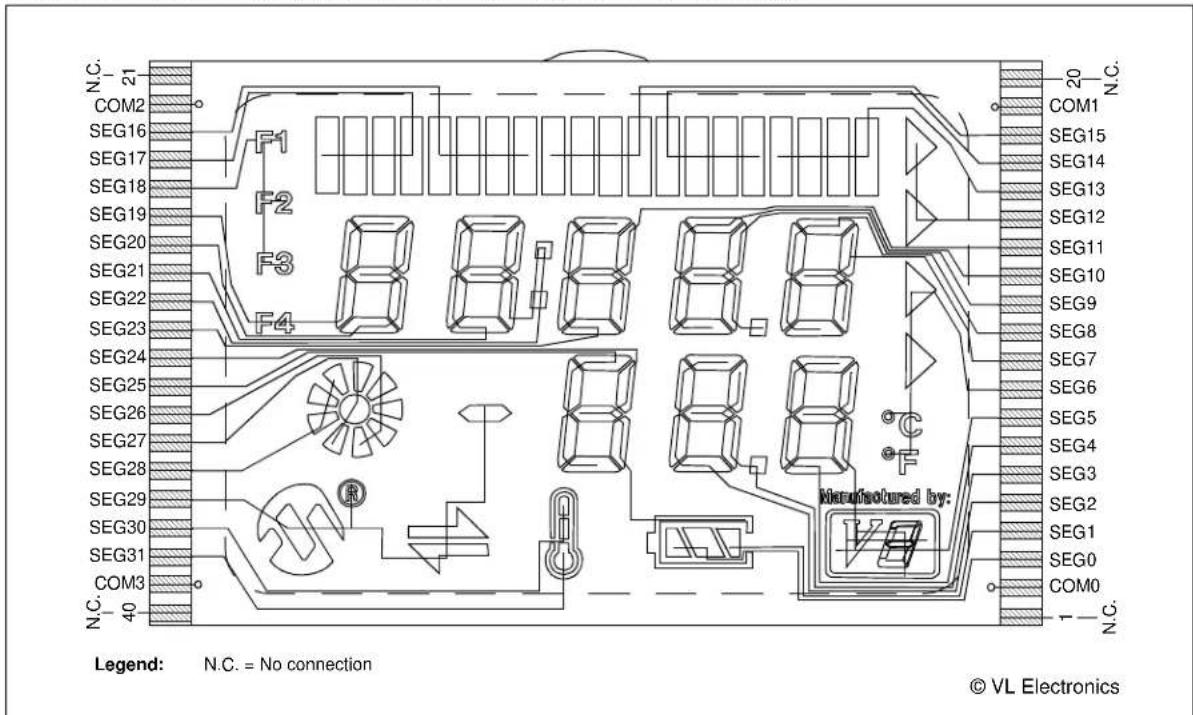
FIGURE A-7: SEGMENT CONFIGURATION FOR PIC18F8490 DEVICES
text_image
N.C. 21 COM2 SEG16 SEG17 SEG18 SEG19 SEG20 SEG21 SEG22 SEG23 SEG24 SEG25 SEG26 SEG27 SEG28 SEG29 SEG30 SEG31 COM3 N.C. 40 F1 F2 F3 F4 Manufactured by: N.C. = No connection 20 N.C. COM1 SEG15 SEG14 SEG13 SEG12 SEG11 SEG10 SEG9 SEG8 SEG7 SEG6 SEG5 SEG4 SEG3 SEG2 SEG1 SEG0 COM0 N.C. Legend: N.C. = No connection © VL ElectronicsTABLE A-12: PIC18F8490 PIN AND PORT COMPARISON
| PIC18F8490 Port PIC | 18F8490 Pin ICE Pin ICE Port | ||
| RA0 AN0 AN0 RA0 | |||
| RA1 AN1 AN1 RA1 | |||
| R | A | 6 | O S |
| R | A | 7 | O S |
| RB0 RB0 RB0 RB0 | |||
| RB5 RB5 RB5 RB5 | |||
| RB6 RB6 RB6 RB6 | |||
| RB7 RB7 RB7 RB7 | |||
| RC0 T1OSC1 T1OSC0 RC0 | |||
| RC1 T1OSC0 T1OSC1 RC1 | |||
| RC3 RC3 RC3 RC3 | |||
| RC4 RC4 RC4 RC4 | |||
| RC6 TX/CK TX/CK RC6 | |||
| RC7 RX/DT | RX/DT RC7 | ||
TABLE A-13: PIC16F946 PIM AND ICE PIN/PORT COMPARISON
| PIC16F946PIM PinNo. | PIC16F946Port | PIC16F946Pin | ICE Pin | ICE Port | ICE PinNo. |
| 1 | RD6 | SEG19 | SEG19 | RF1 | 35 |
| 2 | RD7 | SEG20 | SEG20 | RF2 | 30 |
| 3 | RG0 | SEG36 | SEG36 | RB1 | 71 |
| 4 | RG1 | SEG37 | SEG37 | RB2 | 70 |
| 5 | RG2 | SEG38 | SEG38 | RJ5 | 53 |
| 6 | RG3 | SEG39 | SEG39 | RJ4 | 52 |
| 7 | RG4 | SEG40 | SEG40 | RH4 | 34 |
| 8 | RG5 | SEG41 | SEG41 | RH5 | 33 |
| 9 | Vss | Vss | Vss | Vss | 23 |
| 10 | VDD | VDD | ICEVDD | ICEVDD | 24 |
| 11 | RF0 | SEG32 | SEG32 | RJ0 | 76 |
| 12 | RF1 | SEG33 | SEG33 | RD0 | 3 |
| 13 | RF2 | SEG34 | SEG34 | RD6 | 78 |
| 14 | RF3 | SEG35 | SEG35 | RD7 | 77 |
| 15 | RB0 | RB0 | RB0 | RB0 | 72 |
| 16 | RB1 | SEG1 | SEG1 | RD1 | 83 |
| 17 | RB2 | SEG2 | SEG2 | RD2 | 82 |
| 18 | RB3 | SEG3 | SEG3 | RD3 | 81 |
| 19 | VDD | VDD | ICEVDD | ICEVDD | 37 |
| 20 | Vss | Vss | Vss | AVss | 38 |
| 21 | RB4 | COM0 | COM0 | RE3 | 8 |
| 22 | RB5 | COM1 | COM1 | RE4 | 7 |
| 23 | RB6 | RB6 | RB6 | RB6 | 66 |
| 24 | RB7 | RB7 | RB7 | RB7 | 60 |
| 25 | AVDD | AVDD | ICEVDD | ICEVDD | 45 |
| 26 | AVss | AVss | AVss | AVss | 44 |
| 27 | RA0 | AN0 | AN0 | RA0 | 42 |
| 28 | RA1 | AN1 | AN1 | RA1 | 41 |
| 29 | RA2 | COM2 | COM2 | RE5 | 6 |
| 30 | RA3 | SEG15 | SEG15 | RA5 | 46 |
| 31 | RA4 | SEG4 | SEG4 | RD4 | 80 |
| 32 | RA5 | SEG5 | SEG5 | RD5 | 79 |
Legend: Unshaded cells indicate where a perfect match between PIM and ICE pins and ports exists.
Shaded cells indicate where differences between PIM and ICE ports and pins exist.
Bold text indicates the PIM pins that are not connected to any ICE pins or ports.
TABLE A-14: PIC16F946 LCD CONNECTIONS COMPARISON
| PIC16F946 | CE Pin # Pin # ICE P | C16F946 | ||||||
| NC 21 | NC NC 20 | NC | ||||||
| COM2 | COM2 | 22 | COM3 | COM2 | 19 | COM1 | COM1 | |
| SEG16 | SEG16 | 23 | X8,X6,X5,X7 | X9,X11,X12,X10 | 18 | SEG15 | SEG15 | |
| SEG17 | SEG17 | 24 | X1,X3,X4,X2 | X16,X14,X13,X15 | 17 | SEG14 | SEG41 | |
| SEG18 | SEG18 | 25 | -,F2,F1,F3 | X17,X19,X20,X18 | 16 | SEG13 | SEG40 | |
| SEG19 | SEG19 | 26 | 1A,1E,F4,1F | -,X22,X21,- | 15 | SEG12 | SEG39 | |
| SEG20 | SEG20 | 27 | 1B,1C,1D,1G | 3B,3C,-,3G | 14 | SEG11 | SEG38 | |
| SEG21 | SEG21 | 28 | 2A,2E,2D,2F | 4A,4E,4D,4F | 13 | SEG10 | SEG10 | |
| SEG22 | SEG22 | 29 | 2B,2C,COL,2G | 4B,4C,DP1,4G | 12 | SEG9 | SEG37 | |
| SEG23 | SEG23 | 30 | 3A,3E,3D,3F | 5A,5E,5D,5F | 11 | SEG8 | SEG36 | |
| SEG24 | SEG24 | 31 | S9,6G,6B,6C | 5B,5C,-,5G | 10 | SEG7 | SEG35 | |
| SEG25 | SEG25 | 32 | 6D,6F,6A,6E | X23,X25,X26,X24 | 9 | SEG6 | SEG34 | |
| SEG26 | SEG26 | 33 | X31,X33,X34,X32 | S13,8G,8B,8C | 8 | SEG5 | SEG5 | |
| SEG27 | SEG27 | 34 | -,X27,X35,X30 | 8D,8F,8A,8E | 7 | SEG4 | SEG4 | |
| SEG28 | SEG28 | 35 | -,X28,X36,X29 | DP2,7G,7B,7C | 6 | SEG3 | SEG3 | |
| SEG29 | SEG29 | 36 | S1,S3,S4,S2 | 7D,7F,7A,7E | 5 | SEG2 | SEG2 | |
| SEG30 | SEG30 | 37 | S6,-,-,S7 | S11,-,-,- | 4 | SEG1 | SEG1 | |
| SEG31 | SEG31 | 38 | S5,-,-S8 | S12,-,-,S10 | 3 | SEG0 | SEG33 | |
| COM3 | COM3 | 39 | COM4 | COM1 | 2 | COM0 | COM0 | |
| NC 40 NC NC | 1 NC | |||||||
Legend: Unshaded cells indicate a perfect match between the PIM and the glass. Shaded cells indicate the pins that are remapped to the corresponding pin on the PIM.
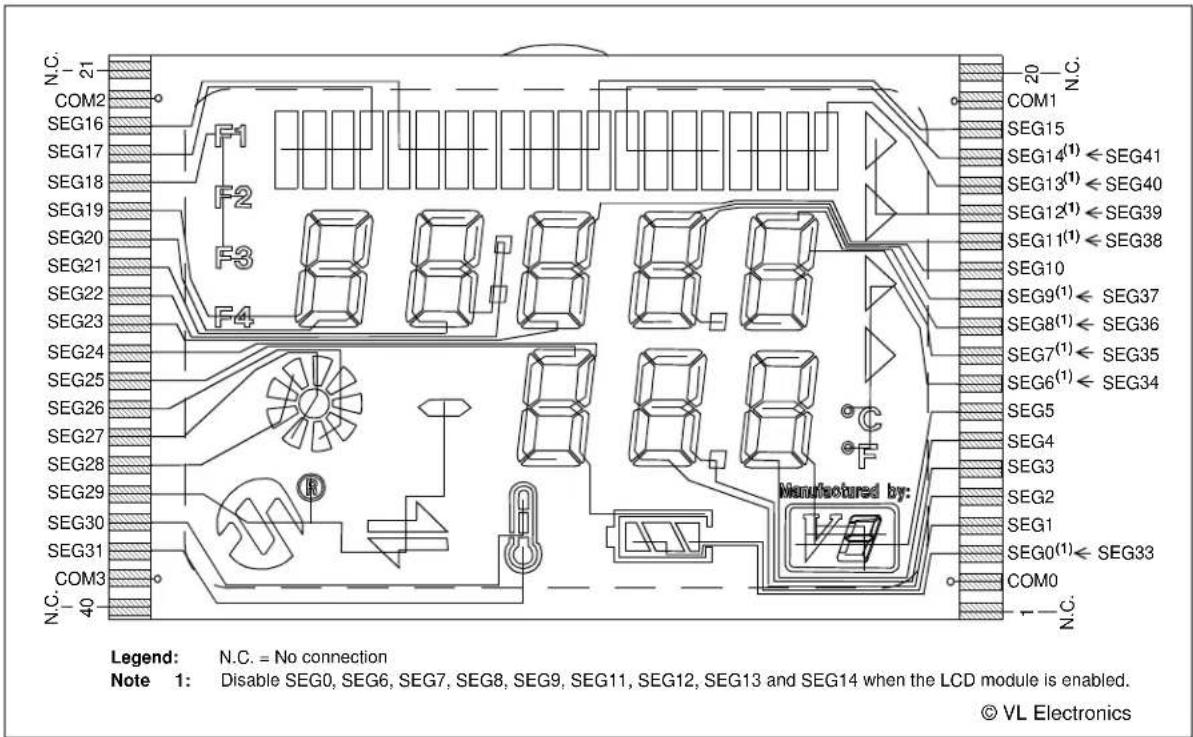
FIGURE A-8: SEGMENT CONFIGURATION FOR PIC16F946 DEVICES
text_image
N.C. 21 COM2 SEG16 SEG17 SEG18 SEG19 SEG20 SEG21 SEG22 SEG23 SEG24 SEG25 SEG26 SEG27 SEG28 SEG29 SEG30 SEG31 COM3 N.C. 40 F1 F2 F3 F4 Manufactured by: N.C. = No connection Note 1: Disable SEG0, SEG6, SEG7, SEG8, SEG9, SEG11, SEG12, SEG13 and SEG14 when the LCD module is enabled. © VL ElectronicsTABLE A-15: PIC16F946 PORT AND PIN COMPARISON
| PIC16F946 Port PIC16F946 Pin ICE Pin ICE Port | |||
| RA0 AN0 AN0 RA0 | |||
| RA1 AN1 AN1 RA1 | |||
| RA6 T1OSCO T1OSCO RC0 | |||
| RA7 T1OSCI T1OSCI RC1 | |||
| RB0 RB0 RB0 RB0 | |||
| RB5 COM1 COM1 RE4 | |||
| RB6 RB6 RB6 RB6 | |||
| RB7 RB7 RB7 RB7 | |||
| RC0 VLCD1 BIAS1 RE0 | |||
| RC1 VLCD2 BIAS2 RE1 | |||
| RC3 | RC3 | RC3 | RC3 |
| RC4 | RC4 | RC4 | RC4 |
| RC6 | TX/CK | TX/CK | RC6 |
| RC7 | RX/DT RX/DT | RC7 | |
Legend: Unshaded cells indicate a perfect match between the PIM and the glass.
Shaded cells indicate the pins that are remapped to the corresponding pin/port on the PIM.
TABLE A-16: PIC16F/LF1946/7 PIM AND ICE PIN/PORT COMPARISON
| PIC16/LF1946/7 PIMPin No. | PIC16F/LF1946/7 Port | PIC16F/LF1946/7 Pin | ICE Pin | ICE Port | ICE PinNo. |
| 1 RE1 | VLCD2 BIA$2 E1 14 33 | C2 SEG13 | SEG13 | RC2 56 | |
| 2 | RE0 | VLCD1 | BIAS1 | E0 | 15 |
| 3 | RG0 | SEG42 | SEG42 | RH6 | 32 |
| 4 | RG1 | SEG43 | SEG43 | RH7 | 31 |
| 5 | RG2 | SEG44 | SEG44 | RJ3 | 13 |
| 6 | RG3 | SEG45 | SEG45 | RG5 | 20 |
| 7 | RG5 | MCLR | ICEMCLR | RG5 | 20 |
| 8 | RG4 | SEG26 | SEG26 | RG4 | 21 |
| 9 | Vss | Vss | Vss | Vss | 23 |
| 10 | VDD | VDD | ICEVDD | ICEVDD | 24 |
| 11 | RF7 | SEG25 | SEG25 | RF7 | 25 |
| 12 | RF6 | SEG24 | SEG24 | RF6 | 26 |
| 13 | RF5 | SEG23 | SEG23 | RF5 | 27 |
| 14 | RF4 | SEG22 | SEG22 | RF4 | 28 |
| 15 | RF3 | SEG21 | SEG21 | RF3 | 29 |
| 16 | RF2 | SEG20 | SEG20 | RF2 | 30 |
| 17 | RF1 | SEG19 | SEG19 | RF1 | 35 |
| 18 | RF0 | SEG41 | SEG41 | RH5 | 33 |
| 19 | VDD | VDD | ICEVDD | ICEVDD | 37 |
| 20 | Vss | Vss | Vss | Vss | 38 |
| 21 | RA3 | SEG35 | SEG35 | RJ3 | 73 |
| 22 | RA2 | SEG34 | SEG34 | RJ2 | 74 |
| 23 | RA1 | AN1 | AN1 | RA1 | 41 |
| 24 | RA0 | AN0 | AN0 | RA0 | 42 |
| 25 | Vss | Vss | ICEVss | ICEVss | 44 |
| 26 | VDD | VDD | ICDVDD | ICDVDD | 45 |
| 27 | RA5 | SEG15 | SEG15 | RA5 | 46 |
| 28 | RA4 | SEG14 | SEG14 | RA4 | 47 |
| 29 | RC1 | T1OSC1 | T1OSC1 | RC1 | 48 |
| 30 | RC0 | T1OSC0 | T1OSC0 | RC0 | 49 |
| 31 | RC6 | TX/CK | TX/CK | RC6 | 50 |
| 32 | RC7 | RX/DT | RX/DT | RC7 | 79 |
Legend: Unshaded cells indicate where a perfect match between PIM and ICE pins and ports exists. Shaded cells indicate where differences between PIM and ICE ports and pins exist. Bold text indicates the PIM pins that are not connected to any ICE pins or ports.
TABLE A-17: PIC16F/LF1946/7 LCD CONNECTIONS COMPARISON
| PIC16F/LF 1946/7 | ICE | LCD Pin # | LCD Pin # | ICE | PIC16F/LF1 946/7 | |||
| NC 21 NC NC 20 NC | ||||||||
| COM2 COM2 22 COM3 COM2 | 19 COM1 COM1 | |||||||
| SEG34 | SEG16 | 23 | X8,X6,X5,X7 | X9,X11,X12,X10 | 18 | SEG15 | SEG15 | |
| SEG35 | SEG17 | 24 | X1,X3,X4,X2 | X16,X14,X13,X15 | 17 | SEG14 | SEG14 | |
| SEG41 | SEG18 | 25 | -,F2,F1,F3 | X17,X19,X20,X18 | 16 | SEG13 | SEG13 | |
| SEG19 | SEG19 | 26 | 1A,1E,F4,1F | -,X22,X21,- | 15 | SEG12 | SEG12 | |
| SEG20 | SEG20 | 27 | 1B,1C,1D,1G | 3B,3C,-,3G | 14 | SEG11 | SEG11 | |
| SEG21 | SEG21 | 28 | 2A,2E,2D,2F | 4A,4E,4D,4F | 13 | SEG10 | SEG10 | |
| SEG22 | SEG22 | 29 | 2B,2C,COL,2G | 4B,4C,DP1,4G | 12 | SEG9 | SEG9 | |
| SEG23 | SEG23 | 30 | 3A,3E,3D,3F | 5A,5E,5D,5F | 11 | SEG8 | SEG8 | |
| SEG24 | SEG24 | 31 | S9,6G,6B,6C | 5B,5C,-,5G | 10 | SEG7 | SEG7 | |
| SEG25 | SEG25 | 32 | 6D,6F,6A,6E | X23,X25,X26,X24 | 9 | SEG6 | SEG6 | |
| SEG26 | SEG26 | 33 | X31,X33,X34,X32 | S13,8G,8B,8C | 8 | SEG5 | SEG5 | |
| SEG45 | SEG27 | 34 | -,X27,X35,X30 | 8D,8F,8A,8E | 7 | SEG4 | SEG4 | |
| SEG44 | SEG28 | 35 | -,X28,X36,X29 | DP2,7G,7B,7C | 6 | SEG3 | SEG3 | |
| SEG43 | SEG29 | 36 | S1,S3,S4,S2 | 7D,7F,7A,7E | 5 | SEG2 | SEG2 | |
| SEG42 | SEG30 | 37 | S6,-,-,S7 | S11,-,-,- | 4 | SEG1 | SEG1 | |
| SEG31 | SEG31 | 38 | S5,-,-S8 | S12,-,-,S10 | 3 | SEG0 | SEG33 | |
| COM3 COM3 39 COM4 COM1 | 2 COM0 | COM0 | ||||||
| NC 40 NC NC | 1 NC | |||||||
Legend: Unshaded cells indicate a perfect match between the PIM and the glass. Shaded cells indicate the pins that are remapped to the corresponding pin on the PIM.
FIGURE A-9: SEGMENT CONFIGURATION FOR PIC16F/LF1946/7 DEVICES
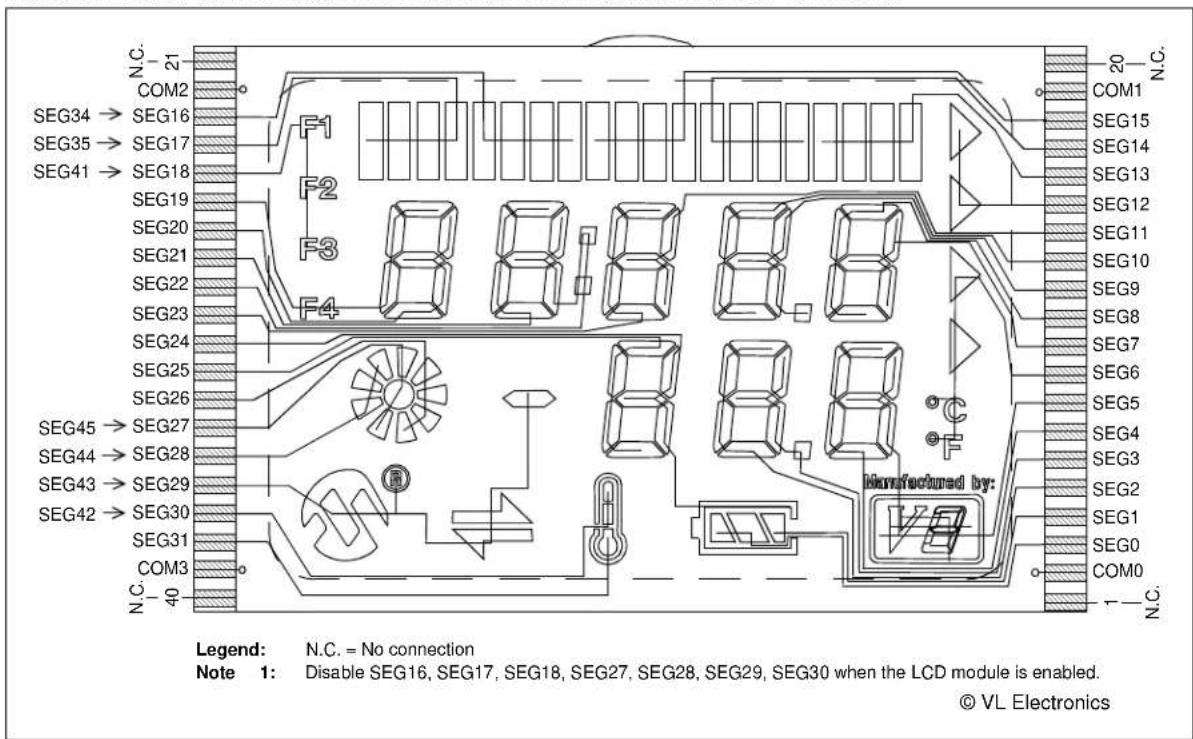
text_image
N.C. COM2 SEG34 → SEG16 SEG35 → SEG17 SEG41 → SEG18 SEG19 SEG20 SEG21 SEG22 SEG23 SEG24 SEG25 SEG26 SEG45 → SEG27 SEG44 → SEG28 SEG43 → SEG29 SEG42 → SEG30 SEG31 COM3 N.C. 40 F1 F2 F3 F4 Manufactured by: N.C. = No connection Note 1: Disable SEG16, SEG17, SEG18, SEG27, SEG28, SEG29, SEG30 when the LCD module is enabled. © VL ElectronicsTABLE A-18: PIC16F/LF1946/7 PORT AND PIN COMPARISON
| PIC16F/LF1946/7 Port | PIC16F/LF1946/7 Pin ICE | Pin ICE Port | |
| RA0 AN0 AN0 | RA0 | ||
| RA1 AN1 AN1 | RA1 | ||
| RC0 T1OSCO | T1OSCO RC0 | ||
| RC1 T1OSCI | T1OSCI RC1 | ||
| RB0 RB0 RB0 | RB0 | ||
| RE3 COM0 COM0 | RE3 | ||
| RB5 COM1 COM1 | RE4 | ||
| RE5 COM2 COM2 | RE5 | ||
| RE6 COM3 COM3 | RE6 | ||
| RB6 RB6 RB6 | RB6 | ||
| RB7 RB7 RB7 | RB7 | ||
| RE0 VLCD1 BIAS1 | RE0 | ||
| RE1 VLCD2 BIAS2 | RE1 | ||
| RE2 VLCD3 BIAS3 | RE2 | ||
| RC3 | RC3 | RC3 | RC3 |
| RC4 | RC4 | RC4 | RC4 |
| RC6 | TX/CK | TX/CK | RC6 |
| RC7 | RX/DT | RX/DT | RC7 |
Legend: Unshaded cells indicate a perfect match between the PIM and the glass. Shaded cells indicate the pins that are remapped to the corresponding pin/port on the PIM.
TABLE A-19: PIC16F917 PIM AND ICE PIN/PORT COMPARISON
| PIC16F917PIM Pin No. | PIC16F917Port | PIC16F917Pin | ICE Pin ICE | Port ICE Pin No. | |
| 1 RC7 RX/DT RX/DT RC7 51 | |||||
| 2 | RD4 SEG17 | SEG17 RA3 17 | |||
| 3 | RD5 SEG18 | SEG18 RF0 18 | |||
| 4 | RD6 SEG19 | SEG19 RF1 19 | |||
| 5 | RD7 SEG20 | SEG20 RF2 20 | |||
| 6 | Vss | Vss | Vss | Vss | Vss |
| 7 | VDD | ICEVDD | ICEVDD | VDD | 45 |
| 8 | RB0 | RB0 | RB0 | RB0 | 72 |
| 9 | RB1 | SEG1 | SEG6 | RD6 | 78 |
| 10 | RB2 | SEG2 | SEG7 | RD7 | 77 |
| 11 | RB3 | SEG3 | SEG8 | RB1 | 71 |
| 14 | RB4 | COM0 | COM0 | RE3 | 8 |
| 15 | RB5 | COM1 | COM1 | RE4 | 7 |
| 16 RB6 | RB6 | RB6 | RB6 66 | ||
| 17 RB7 | RB7 | RB7 | RB7 60 | ||
| 18 | ICEMCLR | ICEMCLR | ICEMCLR | ICEMCLR | 20 |
| 19 RA0 | AN0 | AN0 | RA0 42 | ||
| 20 RA1 | AN1 | AN1 | RA1 41 | ||
| 21 | RA2 | COM2 | COM2 | RE5 | 6 |
| 22 | RA3 SEG15 | SEG15 RA5 15 | |||
| 23 | RA4 | SEG4 | SEG9 | RB2 | 4 |
| 24 | RA5 | SEG5 | SEG10 | RB3 | 5 |
| 25 | RE0 SEG21 | SEG21 RF3 21 | |||
| 26 | RE1 SEG22 | SEG22 RF4 22 | |||
| 27 | RE2 SEG23 | SEG23 RF5 23 | |||
| 28 | VDD | ICEVDD2 | ICEVDD | VDD | 2 |
| 29 | Vss | Vss | Vss | Vss | Vss |
| 30 | RA7 | T1OSCI | T1OSCI | RC1 | 48 |
| 31 | RA6 T1OSCO | T1OSCO | RC0 49 | ||
| 32 | RC0 VLCD1 | BIAS1 | RE0 15 | ||
| 35 | RC1 VLCD2 | BIAS2 | RE1 14 | ||
| 36 | RC2 VLCD3 | BIAS3 | RE2 9 | ||
| 37 | RC3 | SEG6 | SEG11 | RB4 | 68 |
| 38 | RD0 | COM3 | COM3 | RE6 | 5 |
| 39 | RD1 | RD1 | RC3 | RC3 | 57 |
| 40 | RD2 | RD2 | RC4 | RC4 | 58 |
| 41 | RD3 SEG16 | SEG16 RA2 16 | |||
| 42 | RC4 SEG11 | SEG14 RA4 47 | |||
| 43 | RC5 SEG10 | SEG13 RC2 56 | |||
| 44 RC6 TX/CK | TX/CK | RC6 50 | |||
Legend: Unshaded cells indicate where a perfect match between PIM and ICE pins and ports exists. Shaded cells indicate where differences between PIM and ICE ports and pins exist. Bold text indicates the PIM pins that are not connected to any ICE pins or ports.
TABLE A-20: PIC16F917 LCD CONNECTIONS COMPARISON
| PIC16F917 | ICE Pin # Pin | # ICE PIC16F917 | ||||||
| NC 21 NC NC 20 NC | ||||||||
| COM2 | COM2 | 22 | COM3 | COM2 | 19 | COM1 | COM1 | |
| SEG16 | SEG16 | 23 | X8,X6,X5,X7 | X9,X11,X12,X10 | 18 | SEG15 | SEG15 | |
| SEG17 | SEG17 | 24 | X1,X3,X4,X2 | X16,X14,X13,X15 | 17 | SEG14 | SEG11 | |
| SEG18 | SEG18 | 25 | -,F2,F1,F3 | X17,X19,X20,X18 | 16 | SEG13 | SEG10 | |
| SEG19 | SEG19 | 26 | 1A,1E,F4,1F | -,X22,X21,- | 15 | SEG12 | NC | |
| SEG20 | SEG20 | 27 | 1B,1C,1D,1G | 3B,3C,-,3G | 14 | SEG11 | SEG6 | |
| SEG21 | SEG21 | 28 | 2A,2E,2D,2F | 4A,4E,4D,4F | 13 | SEG10 | SEG5 | |
| SEG22 | SEG22 | 29 | 2B,2C,COL,2G | 4B,4C,DP1,4G | 12 | SEG9 | SEG4 | |
| SEG23 | SEG23 | 30 | 3A,3E,3D,3F | 5A,5E,5D,5F | 11 | SEG8 | SEG3 | |
| NC | SEG24 | 31 | S9,6G,6B,6C | 5B,5C,-,5G | 10 | SEG7 | SEG2 | |
| NC | SEG25 | 32 | 6D,6F,6A,6E | X23,X25,X26,X24 | 9 | SEG6 | SEG1 | |
| NC | SEG26 | 33 | X31,X33,X34,X32 | S13,8G,8B,8C | 8 | SEG5 | NC | |
| NC | SEG27 | 34 | -,X27,X35,X30 | 8D,8F,8A,8E | 7 | SEG4 | NC | |
| NC | SEG28 | 35 | -,X28,X36,X29 | DP2,7G,7B,7C | 6 | SEG3 | NC | |
| NC | SEG29 | 36 | S1,S3,S4,S2 | 7D,7F,7A,7E | 5 | SEG2 | NC | |
| NC | SEG30 | 37 | S6,-,-,S7 | S11,-,-,- | 4 | SEG1 | NC | |
| NC | SEG31 | 38 | S5,-,-S8 | S12,-,-,S10 | 3 | SEG0 | NC | |
| COM3 COM3 39 COM4 | COM1 | 2 COMO COM0 | ||||||
| NC 40 NC NC | 1 NC | |||||||
Legend: Unshaded cells indicate a perfect match between the PIM and the glass. Shaded cells indicate the pins that are remapped to the corresponding pin on the PIM. Bold text indicates the PIM pins that are not connected.
FIGURE A-10: SEGMENT CONFIGURATION FOR PIC16F914/917 DEVICES

text_image
N.C. 21 COM2 SEG16→SEG16 F1 SEG17→SEG17 F2 SEG18→SEG18 F3 SEG19→SEG19 F4 SEG20→SEG20 F5 SEG21→SEG21 F6 SEG22→SEG22 F7 SEG23→SEG23 F8 SEG24 SEG25 SEG26 SEG27 SEG28 SEG29 SEG30 SEG31 COM3 N.C. 40 20 N.C. COM1 SEG15←SEG15 SEG14(1)←SEG11 SEG13(1)←SEG10 SEG12(1) SEG11←SEG6 SEG10←SEG5 SEG9(1)←SEG4 SEG8(1)←SEG3 SEG7(1)←SEG2 SEG6←SEG1 SEG5 SEG4 SEG3 SEG2 SEG1 SEGO(1) COM0 Manufactured by: N.C. = No connection = Only segments available to PIC16F914/917 devices Note 1: Disable SEG0, SEG7, SEG8, SEG9, SEG12, and SEG14 when the LCD module is enabled. © VL ElectronicsTABLE A-21: PIC16F917 PIN AND PORT COMPARISON
| PIC16F917 Port PIC16F917 Pin ICE Pin ICE Port | |||
| RA0 AN0 AN0 RA0 | |||
| RA1 AN1 AN1 RA1 | |||
| RA6 T1OSCO T1OSCO RC0 | |||
| RA7 T1OSCI T1OSCI RC1 | |||
| RB0 RB0 RB0 RB0 | |||
| RB5 COM1 | COM1 RE4 | ||
| RB6 RB6 RB6 RB6 | |||
| RB7 RB7 RB7 RB7 | |||
| RC0 | VLCD1 BIAS1 | RE0 | |
| RC1 | VLCD2 BIAS2 | RE1 | |
| RC3 | SEG6 | SEG11 | RB4 |
| RC4 | SEG11 | SEG14 | RA4 |
| RC6 | TX/CK | TX/CK | RC6 |
| RC7 | RX/DT RX/DT | RC7 | |
Legend: Unshaded cells indicate a perfect match between the PIM and the glass. Shaded cells indicate the pins that are remapped to the corresponding pin on the PIM.
A.3 LED DISPLAY
Two green LEDs are connected to RC3 and RC4 of U1A through the J14 pins, 1, 2 and 7, 8 (outer ends), respectively.
One green LED is provided to determine whether there is power to the LCD 2 Demonstration Board (LED on) or not (LED off).
Note 1: For the PIC18F85J90 and PIC18F87J90 PIM, the RG2 and RG3 pins are connected to RC3 and RC4 of U1A, respectively.
2: For the PIC16F17 PIM, the RD1 and RD2 pins are connected to RC3 and RC4 of U1A, respectively.
3: For the PIC18F8490 PIM, the RC3 and RD4 pins are connected to RC3 and RC4 of U1A, respectively
A.4 CHARGE PUMP AND VLCAP
For charge pump mode operation in PIC18F85J90 and PIC18F87J90 devices, it is required that RC3 and RC4 of U1A connect to charge pump capacitor C7 through the J14 pins, 3, 4 and 5, 6 (inner pins), respectively.
A.5 RESISTIVE LADDER VERSUS CHARGE PUMP
The switch, S6, allows the connection of either the resistor ladder or the capacitors to the BIAS pins to generate the BIAS voltages for the LCD operation. For the Charge Pump mode operation in PIC18F85J90 and PIC18F87J90 devices, it is required that the S6 switch is flipped towards C and the VLCAP is connected through the inner jumpers of J14. For the resistor ladder, S6 must be flipped towards R. The R45 potentiometer controls the contrast to the LCD in the Resistive Ladder mode.
A.5.1 Jumper JP21
When jumper JP21 is on, the LCDBIAS0 is physically tied to ground. The jumper needs to be on for PIC18F85J90 and PIC18F87J90 devices when the bias voltages are generated through the resistor ladder.
A.6 OSCILLATOR OPTIONS
The on-board firmware uses the internal RC oscillator running at 8 MHz.
- Internal RC oscillator running at 8 MHz can be used.
- Pads provided for user-furnished crystal/resonator (Y2) and two capacitors (C16 and C17).
- Socket provided for a canned oscillator (Y3). This oscillator can be disabled by removing jumpers, JP9, JP11 and JP12.
- 32.768 kHz (watch-type) crystal for Timer1 (Y1) is always connected to RC0 and RC1.
A.7 RS-232 SERIAL PORT
An RS-232 level shifting IC has been provided with all necessary hardware to support connection of an RS-232 host through the DB9 connector (PI). The port is configured as DCE and can be connected to a PC using a serial cable.
A.8 REAL-TIME CLOCK
This circuit allows the user to configure a PIC microcontroller for timekeeping using a 32.768 kHz clock crystal connected to Timer1 module's T1OSO and T1OSI pins.
A.9 SERIAL EEPROM
A socket for a Microwire EEPROM is provided on the board to illustrate usage of the Synchronous mode of operation of the USART module. For its operation:
- Jumpers, JP15 and JP16, should be connected.
- In the jumper, J6, U9-CS should be connected with RB5.
- In the jumper, J13, U9-ORG (pin 6) should be connected to GND.
Note 1: For the PIC18F85J90 and PIC18F87J90 PIM, the RG2 and RG3 pins are connected to RC3 and RC4 of U1A, respectively.
2: For the PIC16F917 PIM, the RD1 and RD2 pins are connected to RC3 and RC4 of U1A, respectively.
3: For the PIC18F8490, PIC16F946 and PIC16F/LF/1946/7 PIMs, the RC3 and RC4 pins are connected to RC3 and RC4 of U1A, respectively.
A.10 ANALOG INPUT
A 10 kΩ potentiometer is connected through a series of 100Ω resistors to AN0. The potentiometer can be adjusted from V cc to GND. The jumper, J11, should be connecting the potentiometer to AN0.
A.11 TEMPERATURE SENSOR
A 10 kΩ TC thermistor (R11) is provided to sense the temperature. It is connected to AN1 (RA1) through the jumper, JP5. An optional unpopulated TC77-based circuit is provided to read the temperature serially using the USART module. The jumpers, JP15 and JP16, are to be connected and RA1 of U1A should be made digital to be used to enable TC77.
Note 1: For the PIC18F85J90 and PIC18F87J90 PIM, the RA2 pin is connected to RA1 of U1A and AN2 is used instead of AN1.
2: For the PIC18F8490, PIC16F/LF/1946/7, PIC16F946, and PIC16F917 PIMs, the RA1 pin is connected to RA1 of U1A.
A.12 SWITCHES
Four switches provide the following functions for digital I/Os:
- S1 – Active-low switch connected to RB6.
- S2 – Active-low switch connected to RB6 and RB7.
- S3 – Active-low switch connected to RB6, RB7 and RA6.
- S4 – Active-low switch connected to RB6, RB7, RA6 and RA7.
For this type of sensing, the jumpers, JP1, JP2, JP6, JP18, JP19, JP9 and JP10, should be connected and the potentiometer should be connected to AN0 through J11. Sensing should be done in the sequence, S1, S2, S3 and S4, only. Individual switch sensing is not allowed.
Additionally, the four switches provide the following functions for analog input (AN0):
- S1 – AN0 will be approximately at V cc/2.
- S2 – AN0 will be approximately at V cc/3.
- S3 – AN0 will be approximately at V cc/5.2.
- S4 – AN0 will be approximately at V cc/7.7.
For this type of sensing, the jumpers, JP1, JP2, JP6, JP18 and JP19, should not be connected and the SWT should be connected to AN0 through J11.
A.13 ICD CONNECTOR
By way of the modular connector (J37), the MPLAB ICD 2 can be connected for low-cost debugging. The ICD connector utilizes RB6/PGC and RB7/PGD of the microcontrollers for in-circuit debugging.
A.14 POWER SUPPLY
There are four ways to supply power to the PICDEM LCD 2:
- A 3V button cell (CR2032) can be plugged into BT1.
- A 9V, 100 mA unregulated AC to DC supply can be plugged into J5. A power supply can be purchased through Microchip Technology (Part Number AC162039).
- A 100 mA regulated DC supply of maximum +5V can be connected to the hooks provided.
Note: There is one J15 jumper associated with the power supply circuit. This jumper must be correctly connected to select the required power supply. Refer to Figure A-11 for jumper setting examples.
MPLAB ICD 2 users may use the ICD to power the target board to 5V, up to 200 mA, for the following devices only: PIC18F8490, PIC16F/LF/1946/7, PIC16F946 and PIC16F916. The PIC18F85J90 and PIC18F87J90 families of devices do not support this capability.
The default power on the board is 5V. The board voltage can be varied based on resistors populated on the PIM in conjunction with the processor being used.
FIGURE A-11: J15 POWER SUPPLY CIRCUIT SETTING EXAMPLES
EXAMPLE A EXAMPLE B EXAMPLE C

VLCDBIAS = 3V, External Power

VLCDBIAS = Battery
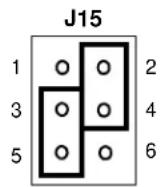
VLCDBIAS = Vcc
a) External Supply with VLCDBIAS Regulated (Default): This is the recommended jumper setting to operate when using external supply. This configuration allows the VLCDBIAS to be regulated to 3V even if the VDD of the board is higher than 3V.
b) Battery Operation: This is the recommend jumper setting when operating on a battery. In this configuration, VLCDBIAS is directly connected to the battery voltage.
c) External Supply with VLCDBIAS Unregulated: This is not recommended to use with on-board glass as voltage higher than 3V may damage the glass. If an external glass is connected to J2 and is capable of handling higher voltages, then this jumper setting allows Vcc to connect directly to the VLCDBIAS when an external power supply is used.
Note: For all examples shown above, the voltage regulation on the VLCDBIAS for 3V is not required for the regular operation of the module or device. It is added here for additional protection for the glass since the board is capable of generating 3.3V or 5V depending on the PIM being used.
A.14.1 Using the Adjustable Voltage Regulator
The PICDEM LCD 2 board features an adjustable voltage regulator, the venerable LM317. It is U3 on the board, and can be recognized by the SO-223 package on the upper left side. Nearby, there is a header, J10, and two resistors, R25 and R26. R25 and R26 are used to set the output voltage of the LM317. By default, R25 = 1K and R26 = 330R, which results in an output voltage of 5.0V.
The reason an adjustable voltage regulator is provided is so that the PICDEM LCD 2 Demonstration Board can be used with a wide range of LCD PIC microcontrollers. The PIC18FXXJ90 family of devices tolerates a maximum VDD of 3.6V, whereas the PIC18FXX90, PIC16F91X and PIC16F946 tolerate a maximum VDD of 5.5V. The adjustable voltage regulator allows a different VDD to be provided for PIC18FJ devices and PIC18F and PIC16F LCD devices.
The switching between 3.6V and 5.5V parts is very convenient. The plug-in module boards are populated with the R101 and R102, appropriately, according to the processor module requirement which mates with the daughter board/emulator header that surrounds the ICE module (U1A). J10 on the PICDEM LCD 2 board is intended to connect with the 3-pin header on the plug-in module. This allows the resistors, R101 and R102, on the plug-in module to be connected in parallel to the resistors, R25 and R26. This way VDD can automatically be adjusted to the voltage appropriate to the part soldered onto the plug-in module.
The plug-in module is prepopulated with the values shown in Table A-22:
TABLE A-22: PIM PREPOPULATED VALUES
| Module R101 R102 VDD | |||
| PIC18F87J90 Open 1.18K 3.3V | |||
| PIC18F85J90 Open 1.18K 3.3V | |||
| PIC18F8490 Open Open 5.0V | |||
| PIC16F914/917 | Open Open 5.0V | ||
| PIC16F946 | Open Open 5.0V | ||
| PIC16F1946/7 | Open Open 5.0V | ||
| PIC16LF1946/7 | Open 1.18K 3.3V | ||
For V_DD = 3.3 volts, R101 can be left unpopulated and R102 can be 1.18K. (1% resistors are recommended for precise adjustment of V_DD .)
Now, let's look at how to determine R101 and R102 if a different VDD is desired. First, it is a good idea to look at the data sheet for the LM317 to understand how the voltage is adjusted. We will not duplicate all the details here. The following equation is taken from an LM317 data sheet:
EQUATION A-1:
$$ V O U T = V R E F (1 + R 2 / R 1) + I A D J * R 2 $$
IADJ is minimized by the LM317, so it can be assumed to be zero or at least very small. VREF = 1.25V; it is the reference voltage developed by the LM317 between the output and adjustment terminal.
That gives us the following equation:
EQUATION A-2:
$$ \begin{array}{l} V O U T = 1. 2 5 V (1 + R 2 / R 1) \ R 2 = R 2 5 \mid \mid R 1 0 2 = (R 2 5 * R 1 0 2) / (R 2 5 + R 1 0 2) \ R 1 = R 2 6 \left| R 1 0 1. = (R 2 6 * R 1 0 1) / (R 2 6 + R 1 0 1) \right. \ \end{array} $$
As stated previously, R25 = 1K and R26 = 330. You can see that without R102 and R101, VOUT = 1.25V(1 + 1K/330R) = 5.04V.
For a desired VOUT, first solve for R2, given R1 = R26 = 330R. Then, knowing R2 and R25, solve for R102. Determine the nearest available resistor value for R102 and recalculate the resulting VDD to make sure it does not exceed the maximum VDD for the part you will be using.
Table A-23 shows values for R101 and R102 for different VDD values, assuming that R25 and R26 on the PICDEM LCD 2 Board are left as their default values of 1K and 330R.
TABLE A-23: R101 AND R102 V DD VALUES
| VDD R101 R102 | ||
| 5V Open Open | ||
| 3.6V Open 1.62K | ||
| 3.3V Open 1.18K | ||
| 3.0V Open 866R |
Recommended operating voltages for the various PIMs are:
- PIC18F85J90 and PIC18F87J90 families of devices – 3.3V
• PIC18F8490 family of devices – 5V
• PIC16F917/914 devices – 5V - PIC16F946 – 5V (when operating on an external 9V DC supply)
• PIC16F1946/7 - 5V
• PIC16LF1946/7 - 3.3V
A.14.2 Slide Switch (S6)
The slide switch allows choosing the BIAS values, either generated by the resistor ladder, or by the capacitive charge pump. When S6 is switched to the left, the LCDBIAS pins of the microcontroller are connected to the resistor ladder. When S6 is switched to the right, the LCDBIAS pins of the microcontroller are connected to the capacitor network.
A.15 BOARD LAYOUT AND SCHEMATICS
The following figures show the parts layout (silkscreen) and schematics for the PICDEM LCD 2 board.
FIGURE A-12: PICDEM™ LCD 2 DEMONSTRATION BOARD PARTS LAYOUT (SILKSCREEN)

text_image
PICtail TM RA5 RA4 RA3 RC5 RC4 RC3 RC2 RA1 RA2 RC0 RC1 RC2 VCC GND RD0 RD2 RD4 RD6 VCC RC7 RB8 AN1 GND RD1 RD3 RD5 RD7 VCC RD1 RL2 RL4 RL6 SE047 SE045 SE043 SE041 SE039 SE037 SE035 SE033 SE031 SE029 SE027 SE025 SE023 SE021 SE019 SE017 SE015 SE013 SE011 SE09 SE07 SE05 SE03 SE02 SE01 F1 F2 F3 F4 LCD_VLS5573 ECPROM EPROM J17 J17 VCC I/O RR0 C17 C18 C28 R12 R11 R9 JP12 JP11 JP9 CND C3 J13 J14 J15 RX Battery VLDBIAS = 3.0V C27 GND GND C28 U3 U9 CLK DT JP16 J17 R26 R27 R14 R12 R13 TX J15 Battery VLDBIAS = 3.0V C38 C16 C27 R26 C28 U3 U9 CLK DT JP16 J17 R26 R27 R14 R12 R13 TX J15 Battery VLDBIAS = 3.0V C38 C16 C27 R26 R27 U3 U9 CLK DT JP16 J17 R26 R27 U3 U9 R26 R27 U3 U9 R26 R27 U3 U9 R26 R27 U3 U9 R26 R27 U3 U9 R26 R27 U3 U9 R26 R27 U3 U9 R26 R27 U3 U9 R26 R27 U3 U9 R26 R27 U3 U9FIGURE A-13: PICDEM™ LCD 2 SCHEMATIC SHEET 1 OF 3
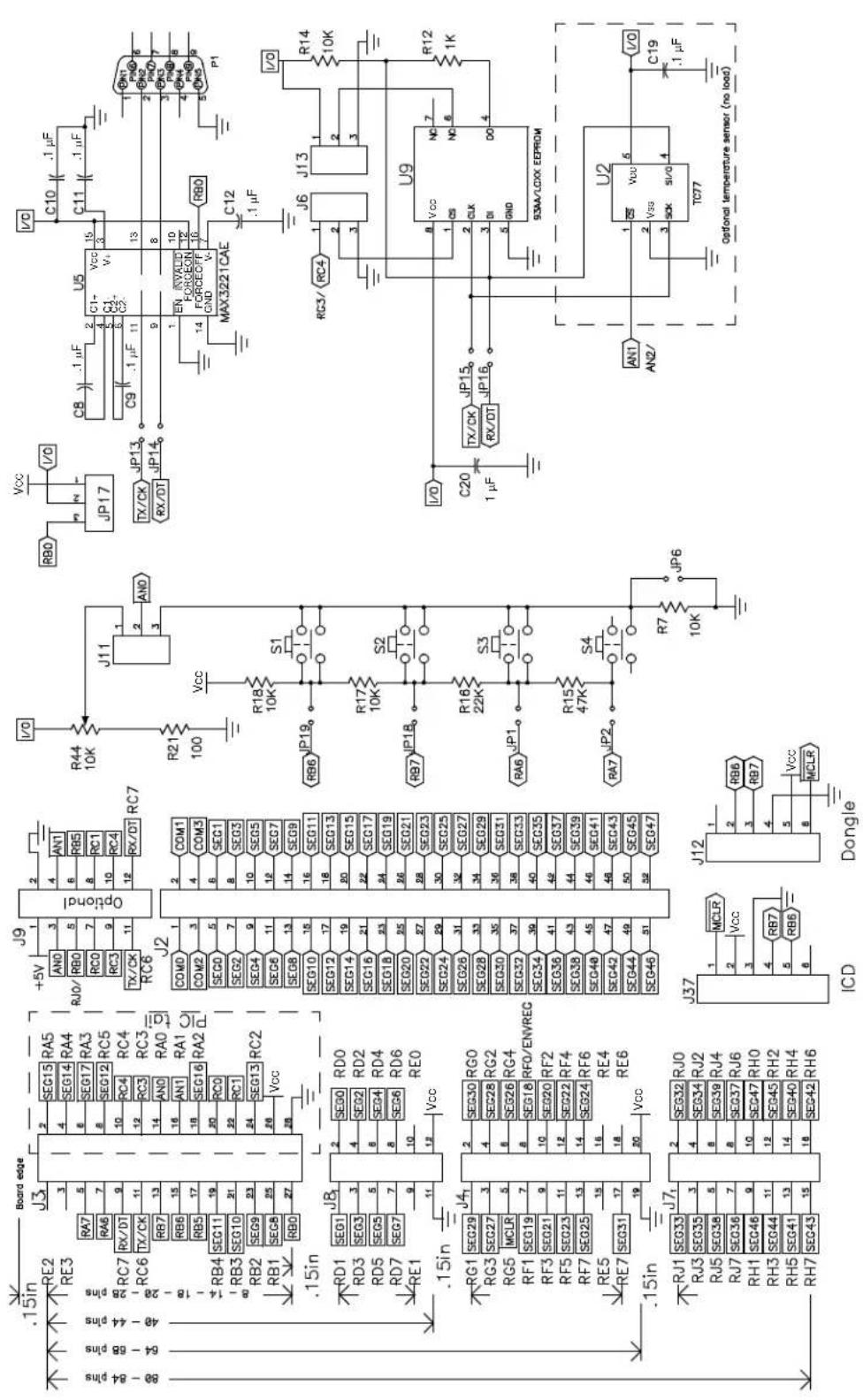
text_image
C10 C11 C12 J5 Vcc C8 1.1µF C11 1.1µF U5 Vcc C9 1.1µF C13 1.1µF C14 1.1µF C15 1.1µF C16 1.1µF C17 1.1µF C18 1.1µF C19 1.1µF C20 1.1µF C21 1.1µF C22 1.1µF C23 1.1µF C24 1.1µF C25 1.1µF C26 1.1µF C27 1.1µF C28 1.1µF C29 1.1µF C30 1.1µF C31 1.1µF C32 1.1µF C33 1.1µF C34 1.1µF C35 1.1µF C36 1.1µF C37 1.1µF C38 1.1µF C39 1.1µF C40 1.1µF C41 1.1µF C42 1.1µF C43 1.1µF C44 1.1µF C45 1.1µF C46 1.1µF C47 1.1µF C48 1.1µF C49 1.1µF C50 1.1µF C51 1.1µF C52 1.1µF C53 1.1µF C54 1.1µF C55 1.1µF C56 1.1µF C57 1.1µF C58 1.1µF C59 1.1µF C60 1.1µF C61 1.1µF C62 1.1µF C63 1.1µF C64 1.1µF C65 1.1µF C66 1.1µF C67 1.1µF C68 1.1µF C69 1.1µF C70 1.1µF C71 1.1µF C72 1.1µF C73 1.1µF C74 1.1µF C75 1.1µF C76 1.1µF C77 1.1µF C78 1.1µF C79 1.1µF C80 1.1µF C81 1.1µF C82 1.1µF C83 1.1µF C84 1.1µF C85 1.1µF C86 1.1µF C87 1.1µF C88 1.1µF C89 1.1µF C90 1.1µF C91 1.1µF C92 1.1µF C93 1.1µF C94 1.1µF C95 1.1µF C96 1.1µF C97 1.1µF C98 1.1µF C99 1.1µF C9A 2 3 4 5 6 7 8 9 0 0 0 0 0 0 0 0 0 0 0 0 0 0 0 0 0 0 0 0 0 0 0 0 0 0 0 0 0 0 0 0 0 0 0 0 0 0 0 0 0 0 0 0 0 0 0 0 0 0 5/2/2/2/2/2/2/2/2/2/2/2/2/2/2/2/2/2/2/2/2/2/2/2/2/2/2/2/2/2/2/2/2/2/2/2/2/2/2/2/2/2/2/2/2/2/2/2/2/2/2/4/4/4/4/4/4/4/4/4/4/4/4/4/4/4/4/4/4/4/4/4/4/4/4/4/4/4/4/4/4/4/4/4/4/4/4/4/4/4/4/4/4/4/4/4/4/4/4/4/4/6-6-6-6-6-6-6-6-6-6-6-6-6-6-6-6-6-6-6-6-6-6-6-6-6-6-6-6-6-6-6-6-6-6-6-6-6-6-6-6-6-6-6-6-6-6-6-6-6-6-6 -6 -6 -6 -6 -6 -6 -6 -6 -6 -6 -6 -6 -6 -6 -6 -6 -6 -6 -6 -6 -6 -6 -6 -6 -6 -6 -6 -6 -6 -6 -6 -6 -6 -6 -6 -6 -6 -6 -6 -6 -6 -6 -6 -6 -6 -6 -6 -6 -6 -6 - J5 J5 J5 J5 J5 J5 J5 J5 J5 J5 J5 J5 J5 J5 J5 J5 J5 J5 J5 J5 J5 J5 J5 J5 J5 J5 J5 J5 J5 J5 J5 J5 J5 J5 J5 J5 J5 J5 J5 J5 J5 J5 J5 J5 J5 J5 J5 J5 J5 J5 J5 A 3 B C D E F G H I K I L M N O P Q R S T V X U V V W X X Y Z Z C D E X D E Y D E Z D E X D E Y D E Z D E X D E Y D E Z D E X D E Y D E Z D E X D E Y D E Z D E X D E Y D E Z D E X D E Y D E Z D E X D E Y D E Z D E X D E Y D E Z D E X D E Y D E Z D E X D E Y D E Z D E X D E Y D E ZD C D C C C C C C C C C C C C C C C C C C C C C C C C C C C C C C C C C C C C C C C C C C C C C C C C C C C C C C C C C C C C C C C C C C C C C C C C C C C C C C C C C C C C C C C C C C C C C C C C C C C C/C/C/C/C/C/C/C/C/C/C/C/C/C/C/C/C/C/C/C/C/C/C/C/C/C/C/C/C/C/C/C/C/C/C/C/C/C/C/C/C/C/C/C/C/C/C/C/C/C/C/C/C/C/C/C/C/C/C/C/C/C/C/C/C/C/C/C/C/C/C/C/C/C/C/C/C/C/C/C/C/C/C/C/C/C/C/C/C/C/C/C/C/C/C/C/C/C/C/C/C/A NC NC NC NC NC NC NC NC NC NC NC NC NC NC NC NC NC NC NC NC NC NC NC NC NC NC NC NC NC NC NC NC NC NC NC NC NC NC NC NC NC NC NC NC NC NC NC NC NC NC NC NC NC NC NC NC NC NC NC NC NC NC NC NC NC NC NC NC NC NC NC NC NC NC NC NC NC NC NC NC NC NC NC NC NC NC NC NC NC NC NC NC NC NC NC NC NC NC NC NCNCN CND CND CND CND CND CND CND CND CND CND CND CND CND CND CND CND CND CND CND CND CND CND CND CND CND CND CND CND CND CND CND CND CND CND CND CND CND CND CND CND CND CND CND CND CND CND CND CND CND CND CNDO CCDC CCDC CCDC CCDC CCDC CCDC CCDC CCDC CCDC CCDC CCDC CCDC CCDC CCDC CCDC CCDC CCDC CCDC CCDC CCDC CCDC CCDC CCDC CCDC CCDC CCDC CCDC CCDC CCDC CCDC CCDC CCDC CCDC CCDC CCDC CCDC CCDC CCDC CCDC CCDC CCDC CCDC CCDC CCDC CCDC CCDC CCDC CCDC CCDC CCDC CCDO CCDO CCDO CCDO CCDO CCDO CCDO CCDO CCDO CCDO CCDO CCDO CCDO CCDO CCDO CCDO CCDO CCDO CCDO CCDO CCDO CCDO CCDO CCDO CCDO CCDO CCDO CCDO CCDO CCDO CCDO CCDO CCDO CCDO CCDO CCDO CCDO CCDO CCDO CCDO CCDO CCDO CCDO CCDO CCDO CCDOCCOCCOCCOCCOCCOCCOCCOCCOCCOCCOCCOCCOCCOCCOCCOCCOCCOCCOCCOCCOCCOCCOCCOCCOCCOCCOCCOCCOCCOCCOCCOCCOCCOCCOCCOCCOCCOCCOCCOCCOCCOCCOCCOCCOCCOCCOCCOCCOCCOCCOCCOCOCCOCCOCCOCCOCCOCCOCCOCCOCCOCCOCCOCCOCCOCCOCCOCCOCCOCCOCCOCCOCCOCCOCCOCCOCCOCCOCCOCCOCCOCCOCCOCCOCCOCCOCCOCCOCCOCCOCCOCCOCCOCCOCCOCCOCCOCCOCCOCCOCCOcc Oo Oo Oo Oo Oo Oo Oo Oo Oo Oo Oo Oo Oo Oo Oo Oo Oo Oo Oo Oo Oo Oo Oo Oo Oo Oo Oo Oo Oo Oo Oo Oo Oo Oo Oo Oo Oo Oo Oo Oo Oo Oo Oo Oo Oo Oo Oo Oo Oo Oo Ou Ou Ou Ou Ou Ou Ou Ou Ou Ou Ou Ou Ou Ou Ou Ou Ou Ou Ou Ou Ou Ou Ou Ou Ou Ou Ou Ou Ou Ou Ou Ou Ou Ou Ou Ou Ou Ou Ou Ou Ou Ou Ou Ou Ou Ou Ou Ou Ou Ou O u o o o o o o o o o o o o o o o o o o o o o o o o o o o o o o o o o o o o o o o o o o o o o o o o o o o o o o o o o o o o o o o o o o u v v v v v v v v v v v v v v v v v v v v v v v v v v v v v v v v v v v v v v v v v v v v v v v v v v v v v v v v v v v v v v v v v v v v v v v v v v v v v v v v v v v v v v v v v v v v v v v v v v v v w x y z z z z z z z z z z z z z z z z z z z z z z z z z z z z z z z z z z z z z z z z z z z z z z z z z z z z z z z z z z z z z z z z z z z z z z z z z z z z z z z z z z z z z z z z z z z z z z z z zz j j j j j j j j j j j j j j j j j j j j j j j j j j j j j j j j j j j j j j j j j j j j j j j j j j j j j j j j j j j j j j j j j j j j j j j j j j j j j j j j j j j j j j j j j j j j j j j j j j j jj i i i i i i i i i i i i i i i i i i i i i i i i i i i i i i i i i i i i i i i i i i i i i i i i i i i i i i i i i i i i i i i i i i i i i i i i i i i i i i i i i i i i i i i i i i i i i i i i i i i i iiiiiiiiiiiiiiiiiiiiiiiiiiiiiiiiiiiiiiiiiiiiiiiiiiiiiiiiiiiiiiiiiiiiiiiiiiiiiiiiiiiiiiiiiiiiiiiiiiiiiiiiiiiiiiiiiiiiiiiiiiiiiiiiiiiiiiiiiiiiiiiiiiiiiiiiiiiiiiiiiiiiiiiiiiiijijijijijijijijijijijijijijijijijijijijijijijijijijijijijijijijijijijijijijijijijijijijijijijijijijijijijijijijijijijijijijijijijijijijijijijijijijijijijijijijijijijijijijijijijijijijijijijijijijijijjjijijijijijijijijijijijijijijijijijijijijijijijijijijijijijijijijijijijijijijjijjijjjjjjjjjjjjjjjjjjjjjjjjjjjjjjjjjjjjjjjjjjjjjjjjjjjjjjjjjjjjjjjjjjjjjjjjjjjjjjjjjjjjjjjjjjjjjjjjjjjjjjjjjjjjjjjjjjjjjjjjjjjjjjjjjjjjjjjjjjjjjjjjjjjjjjjjjjjjjjjjjjjjjjjjjjjjjjjjjjjjjjjjjjjjjjjjjjggg g g g g g g g g g g g g g g g g g g g g g g g g g g g g g g g g g g g g g g g g g g g g g g g g g g g g g g g g g g g g g g g g g g g g g g g g g g g g g g g g g g g g g g g g g g g g g g g g g g g g c c c c c c c c c c c c c c c c c c c c c c c c c c c c c c c c c c c c c c c c c c c c c c c c c c c c c c c c c c c c c c c c c c c c c c c c c c c c c c c c c c c c c c c c c c c c c c c c c c c c cc d d e f f e f f e f f e f f e f f e f f e f f e f f e f f e f f e f f e f f e f f e f f e f f e f f e f f e f f e f f e f f e f f e f f e f f e f f e f f e f f e f f e f f e f f e f f e f f e f f e f f e f f f e f f e f f e f f e f f e f f e f f e f f e f f e f f e f f e f f e f f e f f e f f e f f e f f e f f e f f e f f e f f e f f e f f e f f e f f e f t h d d d d d d d d d d d d d d d d d d d d d d d d d d d d d d d d d d d d d d d d d d d d d d d d d d d d d d d d d d d d d d d d d d d d d d d d d d d d d d d d d d d d d d d d d d d d d d d d d d d d t h n l m l r M U L R M U L R M U L R M U L R M U L R M U L R M U L R M U L R M U L R M U L R M U L R M U L R M U L R M U L R M U L R M U L R M U L R M U L R M U L R M U L R M U L R M U L R M U L R M U L R M U L R M U LR M U L R M U L R M U L R M U L R M U L R M U L R M U L R M U L R M U L R M U L R M U L R M U L R M U L R M U L R M U L R M U L R M U L R M U L R M U L R M U L R M U L R M U L R M U L R M U L R M U L_R M U L_R M U L_R M U L_R M U L_R M U L_R M U L_R M U L_R M U L_R M U L_R M U L_R M U L_R M U L_R M U L_R M U L_R M U L_R M U L_R M U L_R M U L_R M U L_R M U L_R M U L_R M U L_R M U L_R M U L_R M U L R M U L R M U L R M U L R M U L R M U L R M U L R M U L R M U L R M U L R M U L R M U L R M U L R M U L R M U L R M U L R M U L R M U L R M U L R M U L R M U L R M U L R M U L R M U L R M U L B r b r b r b r b r b r b r b r b r b r b r b r b r b r b r b r b r b r b r b r b r b r b r b r b r b r b r b r b r b r b r b r b r b r b r b r b r b r b r b r b r b r b r b r b r b r b r b r b r b r b r h h h h h h h h h h h h h h h h h h h h h h h h h h h h h h h h h h h h h h h h h h h h h h h h h h h h h h h h h h h h h h h h h h h h h h h h h h h h h h h h h h h h h h h h h h h h h h h h h h h h t a s a s a s a s a s a s a s a s a s a s a s a s a s a s a s a s a s a s a s a s a s a s a s a s a s a s a s a s a s a s a s a s a s a s a s a s a s a s a s a s a s a s a s a s a s a s a s a s a s a s a t a s a t a s a t a s a t a s a t a s a t a s a t a s a t a s a t a s a t a s a t a s a t a s a t a s a t a s a t a s a t a s a t a s a t a s a t a s a t a s a t a s a t a s a t a s a t a s a t a s a s a t a s a t a s a t a s a t a s a t a s a t a s a t a s a t a s a t a s a t a s a t a s a t a s a t a s a t a s a t a s a t a s a t a s a t a s A t A t A t A t A t A t A t A t A t A t A t A t A t A t A t A t A t A t A t A t A t A t A t A t A t A t A t A t A t A t A t A t A t A t A t A t A t A t A t A t A t A t A t A t A t A t A t A t A t A t A at B # B # B # B # B # B # B # B # B # B # B # B # B # B # B # B # B # B # B # B # B # B # B # B # B # B # B # B # B # B # B # B # B # B # B # B # B # B # B # B # B # B # B # B # B # B # B # B # B # B # B# B#B#B#B#B#B#B#B#B#B#B#B#B#B#B#B#B#B#B#B#B#B#B#B#B#B#B#B#B#B#B#B#B#B#B#B#B#B#B#B#B#B#B#B#B#B#B#B#B#B#B#FIGURE A-14: PICDEM™ LCD 2 SCHEMATIC SHEET 2 OF 3

text_image
U1A ICE MODULE VCC R2 10K S5 .1μF C21 .1μF VCC R3 TBD R4 TBD optional VCC R9 10K R1 1K C21 .1μF VCC R2 10K S5 .1μF VCC R3 TBD R4 TBD optional VCC R9 10K R1 1K C21 .1μF VCC R2 10K S5 .1μF VCC R3 TBD R4 TBD optional VCC R9 10K R1 1K S5 .1μF VCC R2 10K S5 .1μF VCC R3 TBD R4 TBD optional VCC R9 10K R1 1K S5 .1μF VCC R3 TBD R4 TBD optionalFIGURE A-15: PICDEM™ LCD 2 SCHEMATIC SHEET 3 OF 3

text_image
Circuit schematic diagram with component labels, pinout, and wiring connections for a power supply or electronics control system.A.16 PIM LAYOUT AND SCHEMATICS
The following figures show the layout (silkscreen) for the individual PIMs.
FIGURE A-16: PIC18F65J90 AND PIC18F85J90 PIM LAYOUT

text_image
PIC18F65J90 C104 PIC18F85J90 PICDEM™ LCD 2 R102 | | | R101 | |C105 U1 C103[ | R105 C102 | | R103 C106 R104 C101 | |Γ_¬D101FIGURE A-17: PIC16F914/917 PIM LAYOUT

text_image
PIC16F917/914 R102 [ ] J102 [ ] C101 R101 U4 C102[ ] PICDEM™ LCD 2 MICROCHIPFIGURE A-18: PIC16F946 PIM LAYOUT
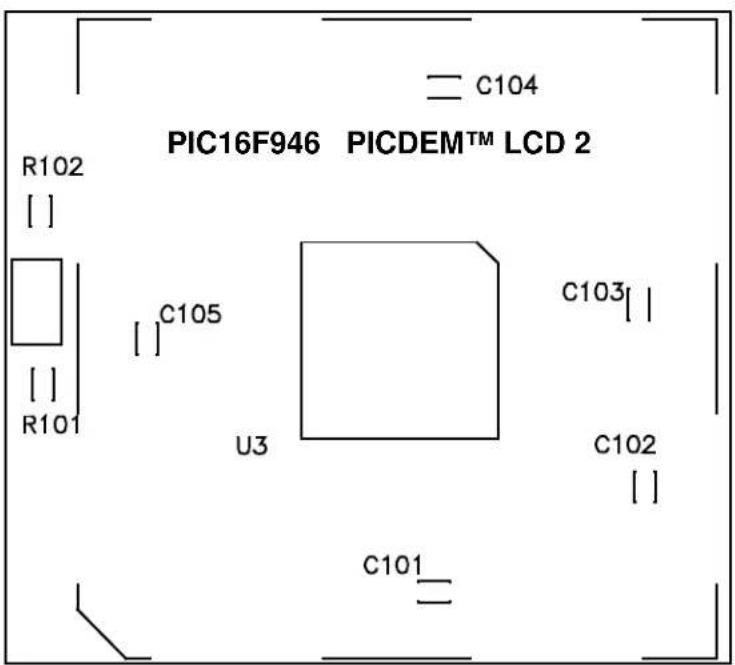
text_image
C104 PIC16F946 PICDEM™ LCD 2 R102 [ ] [ ] R101 C105 U3 C103 C102 [ ] C101FIGURE A-19: PIC16F/LF1946/7 PIM LAYOUT
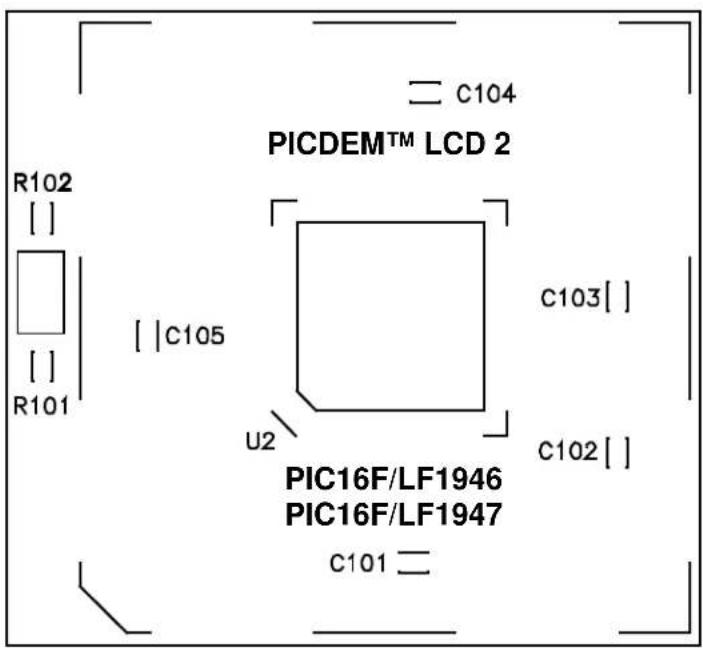
text_image
C104 PICDEM™ LCD 2 R102 [ ] [ ] R101 [ | C105 U2 C103[ ] C102[ ] PIC16F/LF1946 PIC16F/LF1947 C101=FIGURE A-20: PIC18F6490/8490 PIM LAYOUT
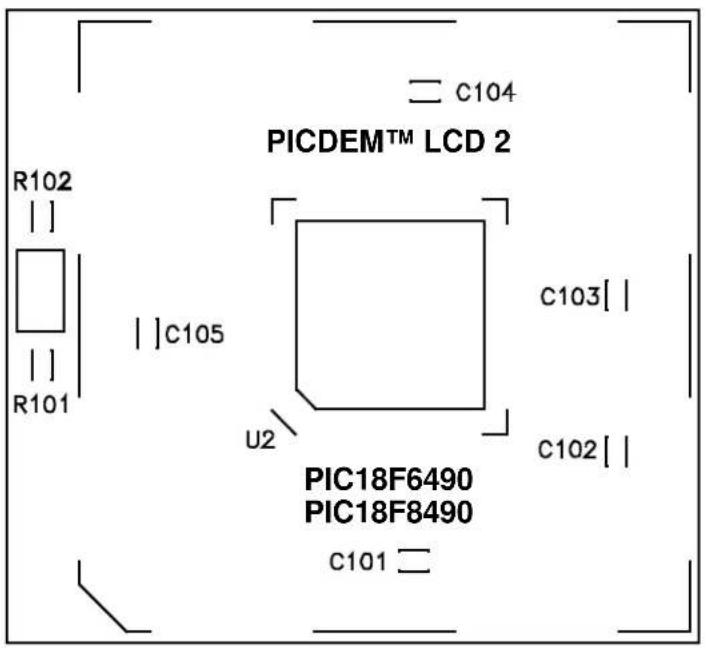
text_image
C104 PICDEM™ LCD 2 R102 ||| ||| R101 || C105 U2 C103| C102| PIC18F6490 PIC18F8490 C101FIGURE A-21: PIC18F87J90 PIM LAYOUT

natural_image
Pure electrical circuit lines without any symbols or textFIGURE A-22: PICDEM™ LCD 2 PIC16F914/917 PIM SCHEMATIC
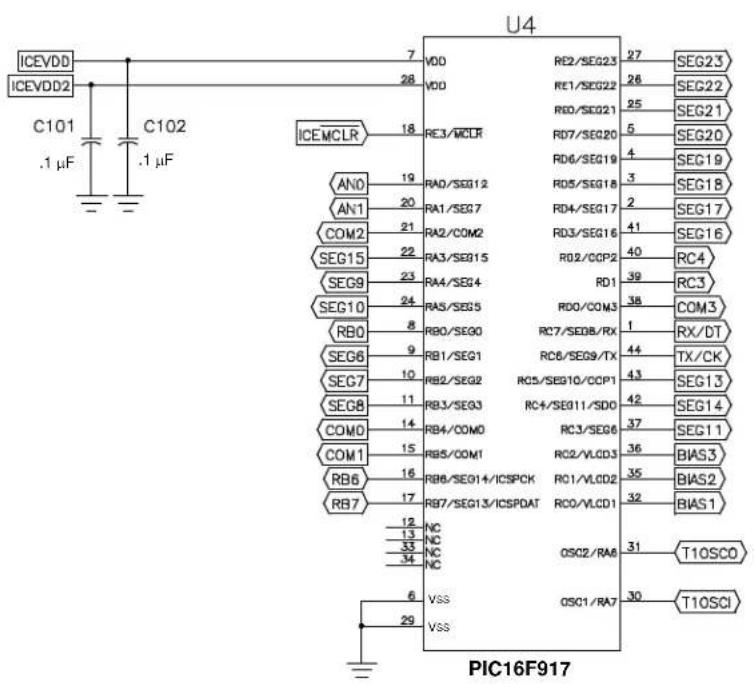
text_image
ICEVDD ICEVDD2 C101 .1 µF C102 .1 µF ICEMCLR 7 28 18 AN0 19 AN1 20 COM2 21 SEG15 22 SEG9 23 SEG10 24 RB0 8 SEG6 9 SEG7 10 SEG8 11 COM0 14 COM1 15 RB6 16 RB7 17 NC 13 NC 33 NC 34 NC 6 VSS 29 VSS U4 RE2/SEG23 27 26 25 5 RD7/SEG20 4 RD6/SEG19 3 RD5/SEG18 2 RD4/SEG17 41 RD3/SEG16 40 RD2/CCP2 39 RD1 38 RD0/COM3 37 RC7/SEDB/RX 44 RC6/SEG9/TX 43 RC5/SEG10/CCP1 42 RC4/SEG11/SDO 37 RC3/SEG6 36 RC2/VLCD3 35 RC1/VLCD2 32 RC0/VLCD1 31 OSC2/RA8 30 OSC1/RA7 T10SCO T10SCI PIC16F917FIGURE A-23: PICDEM LCD 2 PIC16F/LF1946/7 64-PIN PIM SCHEMATIC

text_image
U3 PIC16F/LF1946 PIC16F/LF1947 SEG19 1 RD6/SEG19 SEG20 2 RD7/SEG20 SEG8 3 RG0/SEG36 SEG9 4 RG1/SEG37 SEG11 5 RG2/SEG38 SEG12 6 RG3/SEG39 SEG13 7 RG4/SEG40 SEG14 8 RG5/SEG41 VDD48 9 VSS SEG32 10 VDD SEG0 11 RF0/SEG32 SEG6 12 RF1/SEG33 SEG7 13 RF2/SEG34 RB0 14 RF3/SEG35 RB1 15 RB0/INT/SEG0 SEG1 16 RB1/SEG1 RD6/SEG18 RD7/SEG17 RD8/SEG16 RD9/SEG15 RD10/SEG14 RD11/SEG13 RD12/SEG12 RD13/SEG11 RD14/SEG10 RD15/SEG0 RD16/SEG0 RD17/SEG0 RD18/SEG0 RD19/SEG0 RD5/SEG08 RD6/SEG09 RD7/SEG08 RD8/SEG07 RD9/SEG06 RD10/SEG10 RD11/SEG10 RD12/SEG09 RD13/SEG08 RD14/SEG07 RD15/SEG06 RD16/SEG05 RD17/SEG04 RD18/SEG03 RD19/SEG02 RD20/SEG01 RD21/SEG00 RD22/SEG09 RD23/SEG08 RD24/SEG07 RD25/SEG06 RD26/SEG05 RD27/SEG04 RD28/SEG03 RD29/SEG02 RD30/SEG01 RD31/SEG00 RD32/SEG09 RD33/SEG08 RD34/SEG07 RD35/SEG06 RD36/SEG05 RD37/SEG04 RD38/SEG03 RD39/SEG02 RD40/SEG01 RD41/SEG00 RD42/SEG09 RD43/SEG08 RD44/SEG07 RD45/SEG06 RD46/SEG05 RD47/SEG04 RD48/SEG03 RD5/SEG08 RD6/SEG09 RD7/SEG08 RD8/SEG07 RD9/SEG06 RD10/SEG10 RD11/SEG10 RD12/SEG10 RD13/SEG10 RD14/SEG10 RD15/SEG10 RD16/SEG10 RD5/SEG08 RD6/SEG09 RD7/SEG08 RD8/SEG07 RD9/SEG06 RD10/SEG10 RD11/SEG10 RD12/SEG10 RD13/SEG10 RD14/SEG10 RD15/SEG10 RD5/SEG08 RD6/SEG09 RD7/SEG08 RD8/SEG07 RD9/SEG06 RD10/SEG10 RD11/SEG10 RD12/SEG10 RD13/SEG10 RD14/SEG10 RD15/SEG10 RD5/SEG08 RD6/SEG09 RD7/SEG08 RD8/SEQ9 RD9/SEQ8 RD10/SEQ7 RD11/SEQ6 RD12/SEQ5 RD13/SEQ4 RD14/SEQ3 RD15/SEQ2 RD16/SEQ1 RD5/SEQ8 RD6/SEQ9 RD7/SEQ8 RD8/RSEQ9 RCE/RSEQ8 RCE/RSEQ7 RCE/RSEQ6 RCE/RSEQ5 RCE/RSEQ4 RCE/RSEQ3 RCE/RSEQ2 RCE/RSEQ1 RCE/RSEQ0 RCE/RSEQ-SEC RD5RSEQ9 RCE/RSEQ8 RCE/RSEQ7 RCE/RSEQ6 RCE/RSEQ5 RCE/RSEQ4 RCE/RSEQ3 RCE/RSEQ2 RCE/RSEQ1 RCE/RSEQ-SEC RD5RSEQ9 RCE/RSEQ8 RCE/RSEQ7 RCE/RSEQ6 RCE/RSEQ5 RCE/RSEQ4 RCE/RSEQ3 RCE/RSEQ2 RCE/RSEQ1 RCE/RSEQ-SEC RD5RSEQ9 RCE/RSEQ8 RCE/RSEQ7 RCE/RSEQ6 RCE/RSEQ7 RCE/RSEQ5 RCE/RSEQ4 RCE/RSEQ3 RCE/RSEQ2 RCE/RSEQ1 RCE/RSEQ-SEC RD5RSEQ9 RCE/RSEQ8 RCE/RSEQ7 RCE/RSEQ6 RCE/RSEQ5 RCE/RSEQ4 RCE/RSEQ3 RCE/RSEQ2 RCE/RSEQ1 RCE/RSEQ-SECFIGURE A-24: PICDEM™ LCD 2 PIC16F946 PIM SCHEMATIC
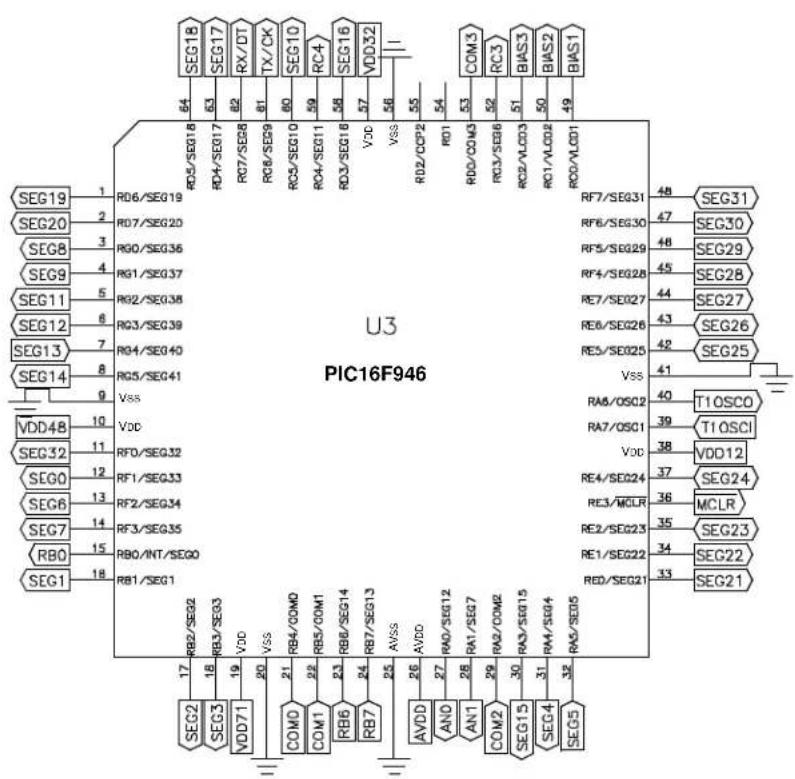
text_image
U3 PIC16F946 SEG19 1 RD6/SEG19 SEG20 2 RD7/SEG20 SEG8 3 RG0/SEG36 SEG9 4 RG1/SEG37 SEG11 5 RG2/SEG38 SEG12 6 RG3/SEG39 SEG13 7 RG4/SEG40 SEG14 8 RG5/SEG41 VDD4B 9 Vdd SEG32 10 RFD/SEG32 SEG0 11 RF1/SEG33 SEG6 12 RF2/SEG34 SEG7 13 RF3/SEG35 RB0 14 RB0/INT/SEG0 RB1 15 RB1/SEG1 RD2/SEG2 RB3/SEG3 VDD VDD VSS VSS AVDD AVDD AVDD AVDD AVDD AVDD AVDD AVDD AVDD AVDD AVDD AVDD AVDD AVDD AVDD AVDD AVDD AVDD AVDD AVDD AVDD AVDD AVDD AVDD AVDD AVDD AVDD AVDD AVDD AVDD AVDD AVDD AVDD AVDD AVDD AVDD AVDD AVDD AVDD AVDD AVDD AVDD AVDD AVDD AVDD AVDD AVDD AVDD AVDD AVDD AVD RD5/SEG18 RC4/SEG17 RC7/SEG8 RC8/SEG9 RC9/SEG10 RC4/SEG11 RC4/SEG16 VDC VSS RD2/CCP2 RD1 RD2/COM3 RC3/SEG6 RC2/VLD3 RC1/VLD2 RD2/VD01 RD6/SEG19 RC4/SEG17 RC7/SEG8 RC8/SEG9 RC9/SEG10 RC4/SEG11 RC4/SEG16 VDC VSS RD2/CCP2 RD1 RD2/COM3 RC3/SEG6 RC2/VLD3 RC1/VLD2 RD2/VD01 RF7/SEG31 48 SEG31 RF6/SEG30 47 SEG30 RF5/SEG29 48 SEG29 RF4/SEG28 45 SEG28 RE7/SEG27 44 SEG27 RE8/SEG26 43 SEG26 RE5/SEG25 42 SEG25 Vss 41 RA6/OSC2 40 T1OSCO RA7/OSC1 39 T1OSCI Vcc 38 VDD12 RE4/SEG24 37 SEG24 RE3/MCLR 36 MCLR RE2/SEG23 35 SEG23 RE1/SEG22 34 SEG22 RED/SEG21 33 SEG21 RD5/SE05FIGURE A-25: PICDEM™ LCD 2 PIC18F6490 64-PIN PIM SCHEMATIC

text_image
U2A PIC18F6490 BIAS2 1 LC0BAS2 BIAS1 2 LC0BAS1 SEG30 3 RG0/SEG30 SEG29 4 RG1/TX2/CK2/SEG29 SEG28 5 RG2/RX2/D12/SEG28 SEG27 6 RG3/SEG27 MCLR 7 RG5/MCLR/VPP SEG26 8 RG4/SEG26 VDD12 9 VSS SEG25 10 VDD SEG24 11 RF7/SS/SEG25 SEG23 12 RF5/AN11/C1IN-/SEG24 SEG22 13 RF5/AN10/C1IN+/SEG23 SEG21 14 RF4/AN9/C2IN-/SEG22 SEG20 15 RF3/AN8/C2IN+/SEG21 SEG19 16 RF2/AN7/C1OUT/SEG20 VDD25 17 18 19 20 21 22 23 24 25 26 27 28 29 30 31 32 33 SEQ18 34 VDD32 35 VDD15 36 SEG14 37 T1OSC1 38 T1OSC0 39 TX/CK RX/DT SEQ17 40 VDD33 41 VDD16 42 VDD17 43 VDD18 44 VDD19 45 VDD20 46 VDD21 47 VDD22 48 VDD23 49 VDD24 50 VDD25 51 VDD26 52 VDD27 53 VDD28 54 VDD29 55 VDD30 56 VDD31 57 VDD32 58 VDD33 59 VDD34 60 VDD35 61 VDD36 62 VDD37 63 VDD38 64 VDD39 65 VDD40 66 VDD41 67 VDD42 68 VDD43 69 VDD44 70 VDD45 71 VDD46 72 VDD47 RIO/INTO RB0 RB1/INT1/SEG8 RB2/INT2/SEG8 RB3/INT3/SEG10 RB4/KBIO/PGN RB5/KB1/PDG RB6/KB2/PDG VSS OSC2/CLKD/RAS OSC1/CLKI VDD RB7/KB0/POD RC5/SDO/SEG12 RC4/SDI/SDA RC3/SCK/SCL RC7/RK1/RD1/SEG13 RIO/INTO RB0 RB1/INT1/SEG8 RB2/INT2/SEG8 RB3/INT3/SEG10 RB4/KBIO/PGN RB5/KB1/PDG RB6/KB2/PDG VSS OSC2/CLKD/RAS OSC1/CLKI VDD RB7/KB0/POD RC5/SDO/SEG12 RC4/SDI/SDA RC3/sCK/SCL RC7/RK1/RD1/SEG13 VDD33 34 VDD34 VDD35 35 RIO/TIOSC0/RCPX RIO/TIOSC/TI3DKI RC7/RK1/RD1/SEG13 VDD36 36 RIO/TIOSC0/RCPX RIO/TIOSC/TI3DKI RC7/RK1/RD1/SEG13 VDD37 37 RC4/SCK/SCL RC7/RK1/RD1/SEG13 VDD38 38 RC4/SCK/SCL RC7/RK1/RD1/SEG13 VDD39 39 RC4/SCK/SCL RC7/RK1/RD1/SEG13 VDD40 40 OSC2 VDD41 RCSC1 VDD42 RCSC1 VDD43 RCSC1 VDD44 RCSC1 VDD45 RCSC1 VDD46 RCSC1 VDD47 RCSC1 VDD48 RCSC1 VDD49 RCSC1 VDD50 RCSC1 VDD51 RCSC1 VDD52 RCSC1 VDD53 RCSC1 VDD54 RCSC1 VDD55 RCSC1 VDD56 RCSC1 VDD57 RCSC1 VDD58 RCSC1 VDD59 RCSC1 VDD60 RCSC1 VDD61 RCSC1 VDD62 RCSC1 VDD63 RCSC1 VDD64 RCSC1 VDD65 RCSC1 VDD66 RCSC1 VDD67 RCSC1FIGURE A-26: PICDEM™ LCD 2 PIC18F8490 80-PIN PIM SCHEMATIC

text_image
U2 PIC18F8490 SEG45 1 RH2/SEG45 SEC44 2 RH3/SEG44 BIAS2 3 LC0BAS2 BIAS1 4 LC0BAS1 SEC30 5 RD0/SEG30 SEC29 6 RG1/TX2/CK2/SEG29 SEC28 7 RG2/RX2/DT2/SEG28 SEC27 8 RG3/SEG27 MCLR 9 RC5/MCLR/APP SEC26 10 RC4/SEG26 VDD12 11 VSS SEC25 12 VIIO SEC24 13 RF7/SS/SEG25 SEC23 14 RF8/AN11/C1IN-/SEG24 SEC22 15 RF5/AN10/C1IN+/SEG23 SEC21 16 RF4/AN9/C2IN-/SEG22 SEC20 17 RF3/AN8/C2IN+/SEG21 SEC20 18 RF2/AN7/C1OUT/SEG20 SEC43 19 RH7/SEG43 SEC42 20 RH6/SEG42 RJ1/SEG46 RH7/SEG46 RJ0/SEG47 RJ0/SEG47 RD1/SEQ1 RD2/SEQ2 RD3/SEQ3 RD4/SEQ4 RD5/SEQ5 RD6/SEQ6 RD7/SEQ7 RD8/SEQ8 RD9/SEQ9 RD10/SEQ10 VDD11 70 VDD71 70 VSS 69 RD1/SEQ1 RD2/SEQ2 RD3/SEQ3 RD4/SEQ4 RD5/SEQ5 RD6/SEQ6 RD7/SEQ7 RD8/SEQ8 RD9/SEQ9 RD10/SEQ10 VDD10 60 RJ2/SEG34 59 SEC34 RJ3/SEG35 RB0/INT0 RB1/INT1/SEG8 RB2/INT2/SEG9 RB3/INT3/SEG10 RB4/KB0/SEG11 RB5/KB1/PGK RB6/KB2/PGC VSS S1 OSC2/CLKO/RA8 OSC1/CLKI/RA7 VDD 48 VDD48 RJ7/KB3/PGD RC5/SDD/SEG12 RC4/SDI/SDA RC3/SCK/SCL RC2/DDP1/SEG13 RJ7/SEG36 RJ8/SEG37 RJ6/SEQ38 RJ5/SEQ38 RJ4/SEQ39 RJ3/SEQ40 RJ2/SEQ41 RJ1/SEQ42 RJ0/SEQ43 RJ0/SEQ44 RJ0/SEQ45 RJ0/SEQ46 RJ0/SEQ47 RJ0/SEQ48 RJ0/SEQ49 RJ0/SEQ50 RJ0/SEQ51 RJ0/SEQ52 RJ0/SEQ53 RJ0/SEQ54 RJ0/SEQ55 RJ0/SEQ56 RJ0/SEQ57 RJ0/SEQ58 RJ0/SEQ59 RJ0/SEQ60 RJ0/SEQ61 RJ0/SEQ62 RJ0/SEQ63 RJ0/SEQ64 RJ0/SEQ65 RJ0/SEQ66 RJ0/SEQ67 RJ0/SEQ68 RJ0/SEQ69 RJ0/SEQ70 RJ0/SEQ71 RJ0/SEQ72 RJ0/SEQ73 RJ0/SEQ74 RJ0/SEQ75 RJ0/SEQ76 RJ0/SEQ77 RJ0/SEQ78 RJ0/SEQ79 RJ0/SEQ80 RJ0/SEQ81 RJ0/SEQ82 RJ0/SEQ83 RJ0/SEQ84 RJ0/SEQ85 RJ0/SEQ86 RJ0/SEQ87 RJ0/SEQ88 RJ0/SEQ89 RJ0/SEQ9A RJ0/SEQ9B RJ0/SEQ9C RJ0/SEQ9D RJ0/SEQ9E RJ0/SEQ9F RJ0/SEQ9G RJ0/SEQ9H RJ0/SEQ9I RJ0/SEQ9J RJ0/SEQ9K RJ0/SEQ9L RJ0/SEQ9M RJ0/SEQ9N RJ0/SEQ9O RJ0/SEQ9P RJ0/SEQ9Q RJ0/SEQ9S RJ0/SEQ9T RJ0/SEQ9U RJ0/SEQ9V RJ0/SEQ9W RJ0/SEQ9X RJ0/SEQ9Y RJ0/SEQ9Z RJ0/SEQ9A RJ0/SEQ9B RJ0/SEQ9C RJ0/SEQ9D RJ0/SEQ9E RJ0/SEQ9F RJ0/SEQ9G RJ0/SEQ9H RJ0/SEQ9I RJ0/SEQ9J RJ0/SEQ9KFIGURE A-27: PICDEM™ LCD 2 PIC18F6XJ90 64-PIN PIM SCHEMATIC

text_image
U2 PIC18F6XJ90 BIAS2 1 BIAS1 2 BIAS0 3 RBO 4 VLCAP1 5 VLCAP2 6 MCLR 7 SEC26 8 VDDCORE 9 SEG25 10 SEG24 11 SEG23 12 SEG22 13 SEG21 14 SEG20 15 ENVREG 16 RD1/LCDBIAS2 RE0/LCDBIAS1 RG0/LCDBIAS0 RG1/TX2/CK2 RG2/RX2/DT2/Vcap1 (RC3) RG3/VCAP2 (RC4) (RC3) MCLR RG4/SEQ26 VSS VDDCORE/VCAP RF7/AN5/SS/SEG25 RF6/AN11/C1INA/SEG24 RF5/AN10/C1INB/SEG23 RF4/AN9/C2INA/SEG22 RF3/AN8/C2INB/SEG21 RF2/AN7/C1OUT/SEG20 RF1/AN6/C2OUT/SEQ19 (RA1) ENVREG 17 AVDD 18 AVDD 19 AVSS 20 RA3 AN3/VREF+ RA2/AN2/VREF- RA1/AN1/SEG18 RA8/AN0 VSS VDD32 21 SEG15 22 AN1 23 AN0 24 VDD33 25 AVDD 26 AVDD 27 RA5/AN4/SEG15 RA4/TDDR/SEG14 RC1/T1OSO/TCI3CKI RC0/T1OSO/T3CKI RC7/RX/TDITI 31 TX/CK RX/DT 32 RX/DT 33 OSC2 34 OSC1 35 RB7 36 RB6 37 RB5/KBI1/SEG29 RB6/KBI2/PDC VSS RB4/SDL/SDA/SEG16 RC4/SCL/SEG17 RC7/SPC1/SEG13 RB7/KBI3/PGD RC5/SDD/SEG12 RC4/SDL/SDA/SEG16 RC6/TX/CK I/OCCP1/SEG17 RC8/SCL/SEG18 RC9/TX/CK I/OCCP1/SEG19 RC10/SDL/SDA/SEG16 RC11/T1OSO/TCI3CKI RC12/SCL/SEG17 RC13/SCL/SEG18 RC14/T1OSO/TCI3CKI RC15/T1OSO/TCI3CKI RC16/TX/CK I/OCCP1/SEG19 RC17/SCL/SEG18 RC18/TX/CK I/OCCP1/SEG19 RC19/TX/CK I/OCCP1/SEG19 RC20/TX/CK I/OCCP1/SEG19 RC21/TX/CK I/OCCP1/SEG19 RC22/TX/CK I/OCCP1/SEG19 RC23/TX/CK I/OCCP1/SEG19 RC24/TX/CK I/OCCP1/SEG19 RC25/TX/CK I/OCCP1/SEG19 RC26/TX/CK I/OCCP1/SEG19 RC27/TX/CK I/OCCP1/SEG19 RC28/TX/CK I/OCCP1/SEG19 RC29/TX/CK I/OCCP1/SEG19 RC30/TX/CK I/OCCP1/SEG19 RC31/TX/CK I/OCCP1/SEG19 RC32/TX/CK I/OCCP1/SEG19 RC33/TX/CK I/OCCP1/SEG19 RC34/TX/CK I/OCCP1/SEG19 RC35/TX/CK I/OCCP1/SEG19 RC36/TX/CK I/OCCP1/SEG19 RC37/TX/CK I/OCCP1/SEG19 RC38/TX/CK I/OCCP1/SEG19 RC39/TX/CK I/OCCP1/SEG19 RC40/TX/CK I/OCCP1/SEG19 RC41/TX/CK I/OCCP1/SEG19 RC42/TX/CK I/OCCP1/SEG19 RC43/TX/CK I/OCCP1/SEG19 RC44/TX/CK I/OCCP1/SEG19 RC45/TX/CK I/OCCP1/SEG19 RC46/TX/CK I/OCCP1/SEG19 RC47/TX/CK I/OCCP1/SEG19 RC48/TX/CK I/OCCP1/SEG19 RC49/TX/CK I/OCCP1/SEG19 RC50/TX/CK I/OCCP1/SEG19 RC51/TX/CK I/OCCP1/SEG19 RC52/TX/CK I/OCCP1/SEG19 RC53/TX/CK I/OCCP1/SEG19 RC54/TX/CK I/OCCP1/SEG19 RC55/TX/CK I/OCCP1/SEG19 RC56/TX/CK I/OCCP1/SEG19 RC57/TX/CK I/OCCP1/SEG19 RC58/TX/CK I/OCCP1/SEG19 RC59/TX/CK I/OCCP1/SEG19 RC60/TX/CK I/OCCP1/SEG19 RC61/TX/CK I/OCCP1/SEG19 RC62/TX/CK I/OCCP1/SEG19 RC63/TX/CK I/OCCP1/SEG19 RC64/TX/CK I/OCCP1/SEG19 RC65/TX/CK I/OCCP1/SEG19 RC66/TX/CK I/OCCP1/SEG19 RC67/TX/CK I/OCCP1/SEG19 RC68/TX/CK I/OCCP1/SEG19 RC69/TX/CK I/OCCP1/SEG19 RC70/TX/CK I/OCCP1/SEG19 RC71/TX/CK I/OCCP1/SEG19 RC72/TX/CK I/OCCP1/SEG19 RC73/TX/CK I/OCCP1/SEG19 RC74/TX/CK I/OCCP1/SEG19 RC75/TX/CK I/OCCP1/SEG19 RC76/TX/CK I/OCCP1/SEG19 RC77/TX/CK I/OCCP1FIGURE A-28: PICDEM™ LCD 2 PIC18F87J90 80-PIN PIM SCHEMATIC
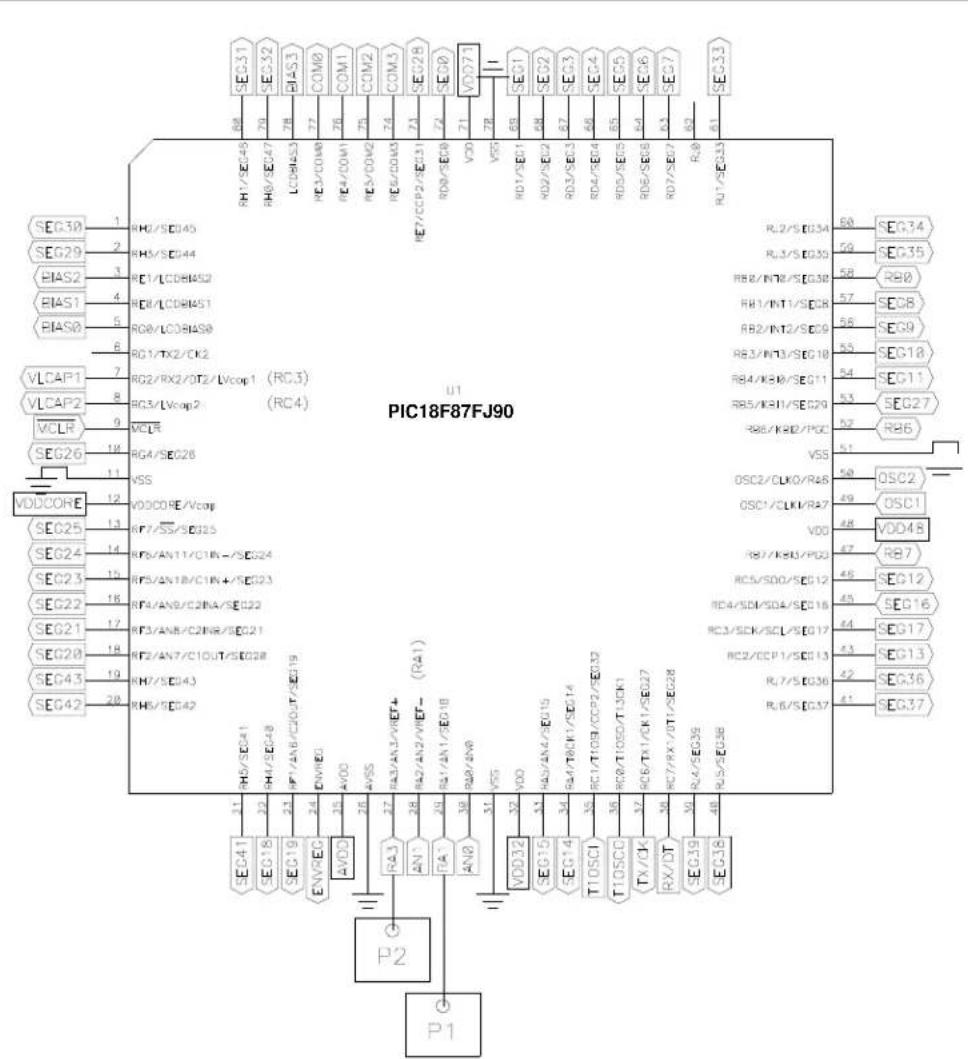
text_image
PIC18F87FJ90 U1 SEC30 1 RH2/SE045 SEC29 2 RH3/SE044 BIAS2 3 RE1/LCD8A52 BIAS1 4 RE1/LCD8A51 BIAS0 5 RO0/LCD8A50 VLCAP1 6 RG1/TX2/CK2 VLCAP2 7 RG2/RX2/DT2/Vcop1 (RC3) VCLR 8 RC3/Vcop2 (RC4) SEG26 9 VCLR VDDCORE 10 RG4/SE026 SEG25 11 VSS SEG24 12 VDDCORE/Vcop SEG23 13 RF7/SS/SE025 SEG22 14 RF5/AN11/C1R-/SE024 SEG21 15 RF5/AN18/C1R+/SE023 SEG20 16 RF4/AN9/C2INA/SE022 SEG21 17 RF3/AN8/C2INR/SE021 SEG20 18 RF2/AN7/C1OUT/SE028 SEG43 19 RH7/SE043 SEG42 20 RH5/SE042 P2 P1 SEC41 31 RH6/SE041 SEC18 32 RH7/SE048 SEC19 33 NF/AN6/C2OUT/SE019 EVVEC 34 ENVEO AVOD 35 AVOD AVOS 36 AVSS RA3 37 RA3/AN3/VIEF+ (RA1) AN1 38 RA2/AN2/VIEF- (RA2) PA7 39 RA1/AN1/SE018 AN8 40 RBP/AN9 VDD32 41 VDD VDD35 42 VDD/AN4/VIEF+ (VDD) AN1 43 NA 44 RA4/TRCKI/YSDI- (VDD) AN8 45 RA4/TRCKI/YSDI- (VDD) VDD32 46 RA4/TRCKI/YSDI- (VDD) VDD35 47 RA4/TRCKI/YSDI- (VDD) VDD35 48 RA4/TRCKI/YSDI- (VDD) T1OSCI 49 T1OSCO 50 TX/CK 51 RX/DT 52 SEC39 53 SEC38 TEOSO/T1OSO/T1OSO/T1OSO/T1OSO/T1OSO/T1OSO/T1OSO/T1OSO/T1OSO/T1OSO/T1OSO/T1OSO/T1OSO/T1OSO/T1OSO/T1OSO/T1OSO/T1OSO/T1OSO/T1OSO/T1OSO/T1OSO/T1OSO/T1OSO/T1OSO/T PLS/SE036 PLS/SE037 PLS/SE038 PLS/SE039 PLS/SE040 PLS/SE041 PLS/SE042 PLS/SE043 PLS/SE044 PLS/SE045 PLS/SE046 PLS/SE047 PLS/SE048 PLS/SE049 PLS/SE050 PLS/SE051 PLS/SE052 PLS/SE053 PLS/SE054 PLS/SE055 PLS/SE056 PLS/SE057 PLS/SE058 PLS/SE059 PLS/SE060 PLS/SE061 PLS/SE062 PLS/SE063 PLS/SE064 PLS/SE065 PLS/SE066 PLS/SE067 PLS/SE068 PLS/SE069 PLS/SE070 PLS/SE071 PLS/SE072 PLS/SE073 PLS/SE074 PLS/SE075 PLS/SE076 PLS/SE077 PLS/SE078 PLS/SE079 PLS/SE080 PLS/SE081 PLS/SE082 PLS/SE083 PLS/SE084 PLS/SE085 PLS/SE086 PLS/SE087 PLS/SE088 PLS/SE089 PLS/SE090 PLS/SE091 PLS/SE092 PLS/SE093 PLS/SE094 PLS/SE095 PLS/SE096 PLS/SE097 PLS/SE098 PLS/SE099 PLS/SE1.ORG34 RL3/SEO35 RB8/INT8/SEO36 RB2/INT2/SEO9 RB3/INT3/SEO18 RB4/KB/B/SEO11 RB5/KB/I/SEO29 RB6/KB/D/PGQ OSC2/OLO/RAB OSC1/OLO/RATZ VDD48 VDD48 VDD48 VDD48 VDD48 VDD48 VDD48 VDD48 VDD48 VDD48 VDD48 VDD48 VDD48 VDD48 VDD48 VDD48 VDD48 VDD48 VDD48 VDD48 VDD48 VDD48 VDD48 VDD48 VDD48 VDD48FIGURE A-29: PICDEM™ LCD 2 PIC18F85J90 80-PIN PIM SCHEMATIC
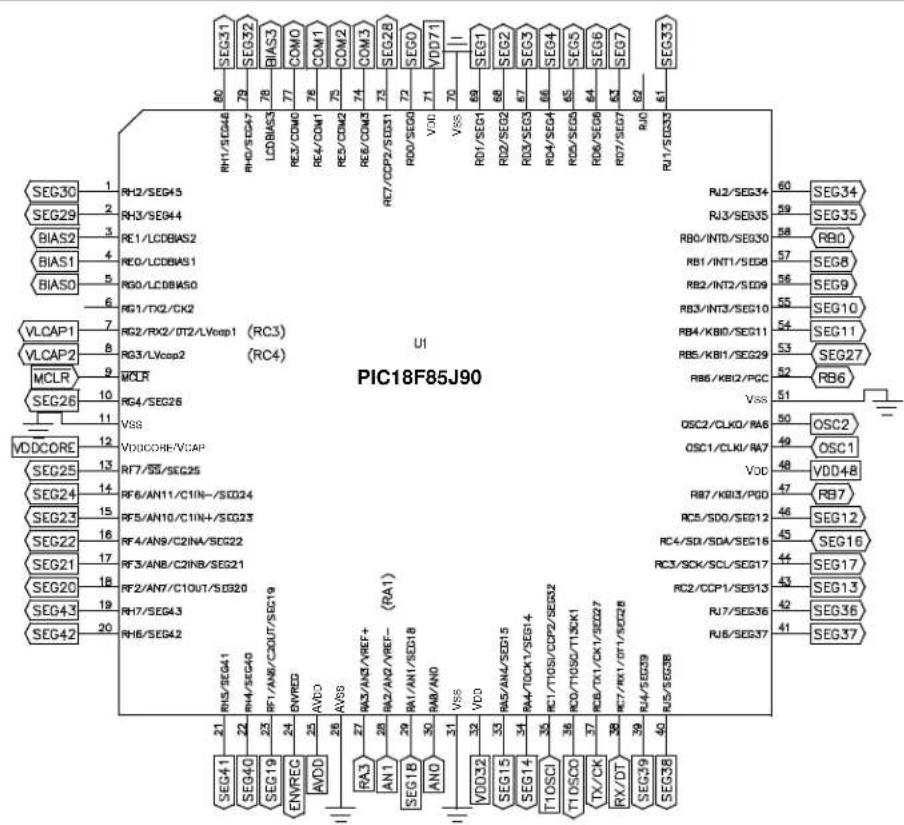
text_image
PIC18F85J90 U1 SEG30 1 RH2/SEG45 SEG29 2 RH3/SEG44 BIAS2 3 RE1/LCDBIAS2 BIAS1 4 REG/LCDBIAS1 BIAS0 5 RG0/LCDBIAS0 VLCAP1 6 RG1/TX2/CK2 VLCAP2 7 RG2/RX2/DT2/LVoop1 (RC3) MCLR 8 RG3/LVoop2 (RC4) SEG26 9 MCLR VDDCORE 10 RG4/SEG26 SEG25 11 VDDCORE/VDCCORE SEG24 12 RF7/SS/SEG25 SEG23 13 RF6/AN11/C1IN-/SEG24 SEG22 14 RF5/AN10/C1IN+/SEG23 SEG21 15 RF4/AN9/C2INA/SEG22 SEG20 16 RF3/AN8/C2INB/SEG21 SEG19 17 RF2/AN7/C1OUT/SEG20 SEG43 18 RH7/SEG43 SEG42 19 RH6/SEG42 SEG41 20 RH5/SEG41 SEG40 21 RAVS/ANSS SEG19 22 RAVI/AN8/C3OUT/SEG19 ENREC 23 ENVREG AVDD 24 AVDD AVDD 25 AVDD AVDD 26 AVDD AVDD 27 AVDD AVDD 28 AVDD AVDD 29 AVDD AVDD 30 AVDD AVDD 31 AVDD AVDD 32 AVDD AVDD 33 AVDD AVDD 34 AVDD AVDD 35 AVDD AVDD 36 AVDD AVDD 37 AVDD AVDD 38 AVDD AVDD 39 AVDD AVDD 40 AVDD AVDD 41 AVDD AVDD 42 AVDD AVDD 43 AVDD AVDD 44 AVDD AVDD 45 AVDD AVDD 46 AVDD AVDD 47 AVDD AVDD 48 AVDD AVDD 49 AVDD AVDD 50 AVDD AVDD 51 AVDD AVDD 52 AVDD AVDD 53 AVDD AVDD 54 AVDD AVDD 55 AVDD AVDD 56 AVDD AVDD 57 AVDD AVDD 58 AVDD AVDD 59 AVDD AVDD 60 AVDD AVDD 61 AVDD AVDD 62 AVDD AVDD 63 AVDD AVDD 64 AVDD AVDD 65 AVDD AVDD 66 AVDD AVDD 67 AVDD AVDD 68 AVDD AVDD 69 AVDD AVDD 70 AVDD AVDD 71 AVDD AVDD 72 AVDD AVDD 73 AVDD AVDD 74 AVDD AVDD 75 AVDD AVDD 76 AVDD AVDD 77 AVDD AVDD 78 AVDD AVDD 79 AVDD AVDD 80 AVDD AVDD 81 AVDD AVDD 82 AVDD AVDD 83 AVDD AVDD 84 AVDD AVDD 85 AVDD AVDD 86 AVDD AVDD 87 AVDD AVDD 88 AVDD AVDD 89 AVDD AVDD 90 AVDD AVDD 91 AVDD AVDD 92 AVDD AVDD 93 AVDD AVDD 94 AVDD AVDD 95 AVDD AVDD 96 AVDD AVDD 97 AVDD AVDD 98 AVDD AVDD 99 AVDD AVDD 100 AVDDNOTES:
Index
A
Analog Input 47
B
Board 11
C
Charge Pump and Software Contrast.... 17
Clock....17
Customer Notification Service....8
Customer Support....9
D
Demonstration Board. See Board
Demonstration Programs. See Sample Programs.
Documentation
Conventions....6
Layout.... 5
H
Hardware Features 12
|
Internet Address....8
K
Kit Components 11
L
LCD
Digit Description.... 27
Display Definition.... 27
SEGx and COMx 28
LCD Display.... 26
LEDs
Green Display.... 46
Green Power 46
M
Microchip Internet Web Site....8
MPASM Assembler.... 15
MPLAB C18 C Compiler 15
MPLAB ICD 2....11, 16, 48
MPLAB ICE....11, 16
MPLAB IDE.... 15
0
Oscillator Options.... 47
Oscillator Selection 16
P
Part Numbers.... 25
PIC16XXXX
Demo 17
PIC18XXXX
Demo Program.... 17
PICDEM LCD 2 Board
Hardware 23
PICDEM LCD 2 Board. See Board
PICDEM LCD 2 Demo Board.... 12
PICDEM LCD 2 Hardware (Graphic) 13
PICDEM LCD 2 Kit. See Kit Components.
PICDEM LCD 2 Stand-Alone Board.... 15
Power Supply.... 15
PICDEM LCD2 Board
Power Supply.... 49
Processors 25
Push Buttons. See Switches.
R
Reading, Recommended 7
Real-Time Clock.... 47
RS-232 12,47
s
Sample Devices 13
Sample PIM....11
Sample Programs 11, 13
Serial EEPROM 47
Switches.... 12
Analog Input.... 48
Digital I/O 48
T
Temperature Sensor 48
Thermometer.... 17
U
Using the Demo Software 17
V
Voltmeter.... 17
W
Warranty Registration 7
WWW Address....8
Worldwide Sales and Service
AMERICAS
Corporate Office
2355 West Chandler Blvd.
Chandler, AZ 85224-6199
Tel: 480-792-7200
Fax: 480-792-7277
Technical Support:
http://support.microchip.com
Web Address:
www.microchip.com
Atlanta
Duluth, GA
Tel: 678-957-9614
Fax: 678-957-1455
Boston
Westborough, MA
Tel: 774-760-0087
Fax: 774-760-0088
Chicago
Itasca, IL
Tel: 630-285-0071
Fax: 630-285-0075
Cleveland
Independence, OH
Tel: 216-447-0464
Fax: 216-447-0643
Dallas
Addison, TX
Tel: 972-818-7423
Fax: 972-818-2924
Detroit
Farmington Hills, MI
Tel: 248-538-2250
Fax: 248-538-2260
Kokomo
Kokomo, IN
Tel: 765-864-8360
Fax: 765-864-8387
Los Angeles
Mission Viejo, CA
Tel: 949-462-9523
Fax: 949-462-9608
Santa Clara
Santa Clara, CA
Tel: 408-961-6444
Fax: 408-961-6445
Toronto
Mississauga, Ontario,
Canada
Tel: 905-673-0699
Fax: 905-673-6509
ASIA/PACIFIC
Asia Pacific Office
Suites 3707-14, 37th Floor
Tower 6, The Gateway
Harbour City, Kowloon
Hong Kong
Tel: 852-2401-1200
Fax: 852-2401-3431
Australia - Sydney
Tel: 61-2-9868-6733
Fax: 61-2-9868-6755
China - Beijing
Tel: 86-10-8528-2100
Fax: 86-10-8528-2104
China - Chengdu
Tel: 86-28-8665-5511
Fax: 86-28-8665-7889
China - Chongqing
Tel: 86-23-8980-9588
Fax: 86-23-8980-9500
China - Hong Kong SAR
Tel: 852-2401-1200
Fax: 852-2401-3431
China - Nanjing
Tel: 86-25-8473-2460
Fax: 86-25-8473-2470
China - Qingdao
Tel: 86-532-8502-7355
Fax: 86-532-8502-7205
China - Shanghai
Tel: 86-21-5407-5533
Fax: 86-21-5407-5066
China - Shenyang
Tel: 86-24-2334-2829
Fax: 86-24-2334-2393
China - Shenzhen
Tel: 86-755-8203-2660
Fax: 86-755-8203-1760
China - Wuhan
Tel: 86-27-5980-5300
Fax: 86-27-5980-5118
China - Xian
Tel: 86-29-8833-7252
Fax: 86-29-8833-7256
China - Xiamen
Tel: 86-592-2388138
Fax: 86-592-2388130
China - Zhuhai
Tel: 86-756-3210040
Fax: 86-756-3210049
ASIA/PACIFIC
India - Bangalore
Tel: 91-80-3090-4444
Fax: 91-80-3090-4123
India - New Delhi
Tel: 91-11-4160-8631
Fax: 91-11-4160-8632
India - Pune
Tel: 91-20-2566-1512
Fax: 91-20-2566-1513
Japan - Yokohama
Tel: 81-45-471-6166
Fax: 81-45-471-6122
Korea - Daegu
Tel: 82-53-744-4301
Fax: 82-53-744-4302
Korea - Seoul
Tel: 82-2-554-7200
Fax: 82-2-558-5932 or
82-2-558-5934
Malaysia - Kuala Lumpur
Tel: 60-3-6201-9857
Fax: 60-3-6201-9859
Malaysia - Penang
Tel: 60-4-227-8870
Fax: 60-4-227-4068
Philippines - Manila
Tel: 63-2-634-9065
Fax: 63-2-634-9069
Singapore
Tel: 65-6334-8870
Fax: 65-6334-8850
Taiwan - Hsin Chu
Tel: 886-3-6578-300
Fax: 886-3-6578-370
Taiwan - Kaohsiung
Tel: 886-7-213-7830
Fax: 886-7-330-9305
Taiwan - Taipei
Tel: 886-2-2500-6610
Fax: 886-2-2508-0102
Thailand - Bangkok
Tel: 66-2-694-1351
Fax: 66-2-694-1350
EUROPE
Austria - Wels
Tel: 43-7242-2244-39
Fax: 43-7242-2244-393
Denmark - Copenhagen
Tel: 45-4450-2828
Fax: 45-4485-2829
France - Paris
Tel: 33-1-69-53-63-20
Fax: 33-1-69-30-90-79
Germany - Munich
Tel: 49-89-627-144-0
Fax: 49-89-627-144-44
Italy - Milan
Tel: 39-0331-742611
Fax: 39-0331-466781
Netherlands - Drunen
Tel: 31-416-690399
Fax: 31-416-690340
Spain - Madrid
Tel: 34-91-708-08-90
Fax: 34-91-708-08-91
UK - Wokingham
Tel: 44-118-921-5869
Fax: 44-118-921-5820