AT86RF232 - Electronic component Microchip - Free user manual and instructions
Find the device manual for free AT86RF232 Microchip in PDF.


User questions about AT86RF232 Microchip
0 question about this device. Answer the ones you know or ask your own.
Ask a new question about this device
Download the instructions for your Electronic component in PDF format for free! Find your manual AT86RF232 - Microchip and take your electronic device back in hand. On this page are published all the documents necessary for the use of your device. AT86RF232 by Microchip.
USER MANUAL AT86RF232 Microchip
- High Performance RF-CMOS 2.4GHz radio transceiver targeted for IEEE® 802.15.4, ZigBee®, RF4CE, 6LoWPAN, and ISM applications
• Industry leading link budget:
- Receiver sensitivity -100dBm
- Programmable output power from -17dBm up to +3dBm
• Ultra-low current consumption:
- SLEEP = 0.4μA
- TRX_OFF = 330μA
- RX_ON = 11.8mA (LISTEN)
-
BUSY_TX = 13.8mA (at max. transmit power)
-
Ultra-low supply voltage (1.8V to 3.6V) with internal regulator
• Support for coin cell operation - Optimized for low BoM cost and ease of production:
- Few external components necessary (crystal, capacitors and antenna)
- Easy to use interface:
- Registers, frame buffer and AES accessible through fast SPI
- Only two microcontroller GPIO lines necessary
- One interrupt pin from radio transceiver
- Clock output
• Radio transceiver features:
- 128-byte FIFO (SRAM) for data buffering
- Fully integrated, fast settling PLL to support Frequency Hopping
- Battery monitor
- Fast Wake-Up time < 0.4msec
- Special IEEE 802.15.4 ^TM -2011 hardware support:
- FCS computation and Clear Channel Assessment
- RSSI measurement, Energy Detection and Link Quality Indication
• MAC hardware accelerator:
- Automated acknowledgement, CSMA-CA and retransmission
- Automatic address filtering
- Automated FCS check
- Extended feature set hardware support:
- AES 128-bit hardware accelerator
- Antenna Diversity
- True Random Number Generation for security application
• Commercial temperature range:
- 0°C to +70°C
• I/O and packages:
- 32-pin low-profile QFN package 5 x 5 x 0.9mm ^4
- RoHS/Fully Green
• Compliant to IEEE 802.15.4-2011, IEEE 802.15.4-2006 and IEEE 802.15.4-2003
• Compliant to EN 300 328/440, FCC-CFR-47 Part 15, ARIB STD-66, RSS-210

Low Power, 2.4GHz Transceiver for ZigBee, IEEE 802.15.4, 6LoWPAN, RF4CE and ISM Applications
AT86RF232
PRELIMINARY
Rev. 8321A-MCU Wireless-10/11
1 Pin-out Diagram
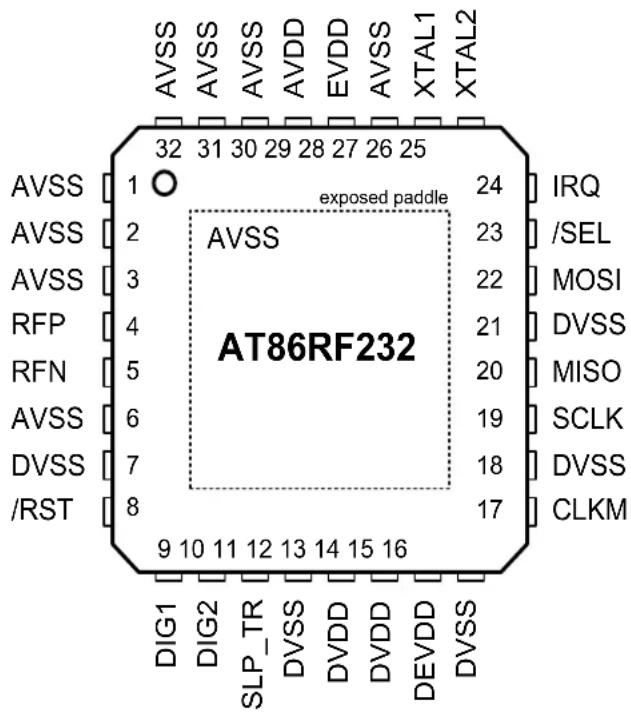
Figure 1-1. Atmel AT86RF232 Pin-out Diagram.
text_image
AVSS AVSS AVDD EVDD AVSS XTAL1 XTAL2 32 31 30 29 28 27 26 25 AVSS 1 AVSS 2 AVSS 3 RFP 4 RFN 5 AVSS 6 DVSS 7 /RST 8 AT86RF232 exposed paddle AVSS 24 /SEL 23 MOSI 22 DVSS 21 MISO 20 SCLK 19 DVSS 18 CLKM 17 DIG1 DIG2 SLP_TR DVSS DVDD DVDD DEVDD DVSSNote: 1. The exposed paddle is electrically connected to the die inside the package. It shall be soldered to the board to ensure electrical and thermal contact and good mechanical stability.
1.1 Pin Descriptions
Table 1-1. Atmel AT86RF232 Pin Description.
| Pins | Name | Type | Description |
| 1 | AVSS | Ground | Analog ground |
| 2 | AVSS | Ground | Analog ground |
| 3 | AVSS | Ground | Ground for RF signals |
| 4 | RFP | RF I/O | Differential RF signal |
| 5 | RFN | RF I/O | Differential RF signal |
| 6 | AVSS | Ground | Ground for RF signals |
| 7 | DVSS | Ground | Digital ground |
| 8 | /RST | Digital input | Chip reset; active low |
| 9 | DIG1 | Digital output (Ground) | 1. Antenna Diversity RF switch control, see Section 11.32. If disabled, pull-down enabled (DVSS) |
| 10 | DIG2 | Digital output (Ground) | 1. Antenna Diversity RF switch control (DIG1 inverted), see Section 11.32. RX Frame Time Stamping, see Section 11.43. TX Frame Time Stamping, see Section 11.44. If functions disabled, pull-down enabled (DVSS) |
| 11 | SLP_TR | Digital input | Controls sleep, transmit start, receive states; active high, see Section 6.5 |
| 12 | DVSS | Ground | Digital ground |
| 13, 14 | DVDD | Supply | Regulated 1.8V voltage regulator; digital domain, see Section 9.4 |
| 15 | DEVDD | Supply | External supply voltage; digital domain |
| 16 | DVSS | Ground | Digital ground |
| 17 | CLKM | Digital output | Master clock signal output; low if disabled, see Section 9.6 |
| 18 | DVSS | Ground | Digital ground |
| 19 | SCLK | Digital input | SPI clock |
| 20 | MISO | Digital output | SPI data output (master input slave output) |
| 21 | DVSS | Ground | Digital ground |
| 22 | MOSI | Digital input | SPI data input (master output slave input) |
| 23 | /SEL | Digital input | SPI select, active low |
| 24 | IRQ | Digital output | 1. Interrupt request signal; active high or active low; configurable2. Frame Buffer Empty Indicator; active high, see Section 11.5 |
| 25 | XTAL2 | Analog input | Crystal pin, see Section 9.6 |
| 26 | XTAL1 | Analog input | Crystal pin or external clock supply, see Section 9.6 |
| 27 | AVSS | Ground | Analog ground |
| 28 | EVDD | Supply | External supply voltage, analog domain |
| 29 | AVDD | Supply | Regulated 1.8V voltage regulator; analog domain, see Section 9.4 |
| 30, 31, 32 | AVSS | Ground | Analog ground |
| Paddle | AVSS | Ground | Analog ground; Exposed paddle of QFN package |
1.2 Analog and RF Pins
1.2.1 Supply and Ground Pins
EVDD, DEVDD
EVDD and DEVDD are analog and digital supply voltage pins of the Atmel® AT86RF232 radio transceiver.
AVDD, DVDD
AVDD and DVDD are outputs of the internal 1.8V voltage regulators. The voltage regulators can be configured for external supply.
For details, refer to Section 9.4.
AVSS, DVSS
AVSS and DVSS are analog and digital ground pins respectively. The analog and digital power domains should be separated on the PCB.
1.2.2 RF Pins
RFN, RFP
A differential RF port (RFP/RFN) provides common-mode rejection to suppress the switching noise of the internal digital signal processing blocks. At board-level, the differential RF layout ensures high receiver sensitivity by rejecting any spurious emissions originated from other digital ICs such as a microcontroller.
A simplified schematic of the RF front end is shown in Figure 1-2.
Figure 1-2. Simplified RF Front-end Schematic.

text_image
AT86RF232PCB LNA RX PA TX 0.9V CM Feedback M0 RXTXThe RF port is designed for a 100 differential load. A DC path between the RF pins is allowed. A DC path to ground or supply voltage is not allowed.
The RF port DC values depend on the operating state, see Chapter 7. In TRX_OFF state, when the analog front-end is disabled (see Section 7.1.2.3), the RF pins are pulled to ground, preventing a floating voltage.
In transmit mode, a control loop provides a common-mode voltage of 0.9V. Transistor M0 is off, allowing the PA to set the common-mode voltage. The common-mode capacitance at each pin to ground shall be <30pF to ensure the stability of this common-mode feedback loop.
In receive mode, the RF port provides a low-impedance path to ground when transistor M0, see Figure 1-2, pulls the inductor center tap to ground. A DC voltage drop of 20mV across the on-chip inductor can be measured at the RF pins.
1.2.3 Crystal Oscillator Pins
XTAL1, XTAL2
The pin 26 (XTAL1) of Atmel AT86RF232 is the input of the reference oscillator amplifier (XOSC), the pin 25 (XTAL2) is the output. A detailed description of the crystal oscillator setup and the related XTAL1/XTAL2 pin configuration can be found in Section 9.6.
When using an external clock reference signal, XTAL1 shall be used as input pin. For further details, refer to Section 9.6.3.
1.2.4 Analog Pin Summary
Table 1-2. Analog Pin Behavior – DC values.
| Pin | Values and Conditions | Comments |
| RFP/RFN | V_DC = 0.9V (BUSY\_TX) V_DC = 20mV (receive states) V_DC = 0mV (otherwise) | DC level at pins RFP/RFN for various transceiver states.AC coupling is required if a circuitry with DC path to ground or supply is used. Serial capacitance and capacitance of each pin to ground must be < 30pF. |
| XTAL1/XTAL2 | V_DC = 0.9V at both pins C_PAR = 3pF | DC level at pins XTAL1/XTAL2 for various transceiver states.Parasitic capacitance ( C_par ) of the pins must be considered as additional load capacitance to the crystal. |
| DVDD | V_DC = 1.8V (all states, except SLEEP) V_DC = 0mV (otherwise) | DC level at pin DVDD for various transceiver states.Supply pins (voltage regulator output) for the digital 1.8V voltage domain, recommended bypass capacitor 100nF. |
| AVDD | V_DC = 1.8V (all states, except P_ON, SLEEP, RESET, and TRX_OFF) V_DC = 0mV (otherwise) | DC level at pin AVDD for various transceiver states.Supply pin (voltage regulator output) for the analog 1.8V voltage domain, recommended bypass capacitor 100nF. |
1.3 Digital Pins
The Atmel AT86RF232 provides a digital microcontroller interface. The interface comprises a slave SPI (/SEL, SCLK, MOSI and MISO) and additional control signals (CLKM, IRQ, SLP_TR, /RST and DIG2). The microcontroller interface is described in detail in Chapter 6.
Additional digital output signals DIG1 and DIG2 are provided to control external blocks, that is for Antenna Diversity RF switch control, see Section 11.3.
1.3.1 Driver Strength Settings
The driver strength of all digital output pins (MISO, IRQ, DIG1, and DIG2) and CLKM pin are fixed. The capacitive load should be as small as possible as, not larger than 50pF.
1.3.2 Pull-up and Pull-down Configuration
All digital input pins are internally pulled-up or pulled-down in radio transceiver state P_ON, see Section 7.1.2.1. Table 1-3 summarizes the pull-up and pull-down configuration.
Table 1-3. Pull-up / Pull-Down Configuration of Digital Input Pins.
| Pins | H = pull-up, L = pull-down |
| /RST | H |
| /SEL | H |
| SCLK | L |
| MOSI | L |
| SLP_TR | L |
In all other radio transceiver states, no pull-up or pull-down circuitry is connected to any of the digital input pins mentioned in Table 1-3. In RESET state, the pull-up or pull-down resistors are not enabled.
If the additional digital output signals DIG1 or DIG2 are not activated, these pins are pulled-down to digital ground.
2 Disclaimer
Typical values contained in this datasheet are based on simulations and testing. Minimum and maximum values are available when the radio transceiver has been fully characterized.
3 Overview
The Atmel AT86RF232 is a low-power 2.4GHz radio transceiver designed for consumer ZigBee/IEEE 802.15.4, RF4CE, 6LoWPAN, and 2.4GHz ISM band applications. The radio transceiver is a true SPI-to-antenna solution. All RF-critical components except the antenna, crystal and de-coupling capacitors are integrated on-chip. Therefore, the AT86RF232 is particularly suitable for applications like:
• 2.4GHz IEEE 802.15.4 and ZigBee systems
- RF4CE systems
- 6LoWPAN systems
- Wireless sensor networks
• Residential and commercial automation
- Health care
- Consumer electronics
- PC peripherals
The AT86RF232 can be operated by using an external microcontroller like Atmel AVR ^® microcontrollers. A comprehensive software programming description can be found in reference [6], AT86RF232 Software Programming Model.
4 General Circuit Description
This single-chip radio transceiver provides a complete radio transceiver interface between an antenna and a microcontroller. It comprises the analog radio, digital modulation and demodulation including time and frequency synchronization and data buffering. The number of external components is minimized such that only the antenna, the crystal and decoupling capacitors are required. The bidirectional differential antenna pins (RFP, RFN) are used for transmission and reception, thus no external antenna switch is needed.
The Atmel AT86RF232 block diagram is shown in Figure 4-1.
Figure 4-1. AT86RF232 Block Diagram.

flowchart
graph TD
    subgraph "Antenna Diversity"
        A["AD"] --> B["LNA"]
        B --> C["PPF EPF ADC"]
        C --> D["×"]
        D --> E["×"]
        E --> F["Limiter"]
        F --> G["AGC"]
        G --> H["Control Logic"]
    end

    subgraph "Configuration Registers"
        I["TX BBP"] --> J["Frame Buffer"]
        K["DVREG"] --> L["SPI (Slave)"]
        M["/SEL"] --> N["MISO"]
        O["MOSI"] --> P["SCLK"]
        Q["SCLK"] --> R["IQ"]
        S["CLKM"] --> T["DIG2"]
        U["/RST"] --> V["SLP_TR"]
    end

    X["XTAL1"] --> Y["XOSC"]
    Z["XTAL2"] --> AA["XOSC"]
    AB["RFP"] --> AC["LNA"]
    AD["RFN"] --> AE["LNA"]
    AF["XT Data"] --> AG["PLL PA"]
    AH["RTN, BATMON"] --> AI["FFTN, BATMON"]
    AJ["RSSI"] --> AK["Limiter"]
    AL["PGP"] --> AM["LNA"]
    AN["AGC"] --> AO["Control Logic"]
    AP["XT Data"] --> AQ["Configuration Registers"]
    AR["Frame Buffer"] --> AS["SPI (Slave)"]
    AT["Frame Buffer"] --> AU["Configuration Registers"]
    AV["Configuration Registers"] --> AW["Configuration Registers"]
    AX["Configuration Registers"] --> AY["Configuration Registers"]
    AZ["Configuration Registers"] --> BA["Configuration Registers"]
    BB["Configuration Registers"] --> BC["Configuration Registers"]
    BD["Configuration Registers"] --> BE["Configuration Registers"]
    BF["Configuration Registers"] --> BG["Configuration Registers"]
    BH["Configuration Registers"] --> BI["Configuration Registers"]
    BJ["Configuration Registers"] --> BK["Configuration Registers"]
    BL["Configuration Registers"] --> BM["Configuration Registers"]
    BN["Configuration Registers"] --> BO["Configuration Registers"]
    BP["Configuration Registers"] --> BQ["Configuration Registers"]
    BR["Configuration Registers"] --> BS["Configuration Registers"]
    BT["Configuration Registers"] --> BU["Configuration Registers"]
    BV["Configuration Registers"] --> BW["Configuration Registers"]
    BX["Configuration Registers"] --> BY["Configuration Registers"]
    BZ["Configuration Registers"] --> CA["Configuration Registers"]
    CB["Configuration Registers"] --> DA["Configuration Registers"]
    DB["Configuration Registers"] --> DBA["Configuration Registers"]
    DC["Configuration Registers"] --> DBB["Configuration Registers"]
    DD["Configuration Registers"] --> DBC["Configuration Registers"]
    DBE["Configuration Registers"] --> DCB["Configuration Registers"]
    DCF["Configuration Registers"] --> DCG["Configuration Registers"]
    DCG --> DBH["Configuration Registers"]
    DBH --> DCI["Control Logic"]
    DCI --> DBJ["Control Logic"]
    DBJ --> DCK["Control Logic"]
    DCK --> DBL["Control Logic"]
    DCL --> DBM["Control Logic"]
    DCM --> DBN["Control Logic"]
    DCN --> DBO["Control Logic"]
    DCO --> DBP["Control Logic"]
    DCP --> DBQ["Control Logic"]
    DCQ --> DBR["Control Logic"]
    DCW --> DBS["Control Logic"]
    DCY --> DBT["Control Logic"]
    DCU --> DBU
    DCV --> DBV
    DCW --> DBW
    DCX --> DBX
    DCY --> DBY
    DCZ --> DBZ
    DCY --> DBX
    DCY --> DBY
The received RF signal at pin 5 (RFN) and pin 6 (RFP) is differentially fed through the low-noise amplifier (LNA) to the RF filter (PPF) to generate a complex signal, driving the integrated channel filter (BPF). The limiting amplifier provides sufficient gain to drive the succeeding analog-to-digital converter (ADC) and generates a digital RSSI signal. The ADC output signal is sampled by the digital base band receiver (RX BBP).
The transmit modulation scheme is offset-QPSK (O-QPSK) with half-sine pulse shaping and 32-length block coding (spreading) according to [1] and [2]. The modulation signal is generated in the digital transmitter (TX BBP) and applied to the fractional-N frequency synthesis (PLL), to ensure the coherent phase modulation required for demodulation of O-QPSK signals. The frequency-modulated signal is fed to the power amplifier (PA).
Two on-chip low-dropout voltage regulators (A|DVREG) provide the analog and digital 1.8V supply.
An internal 128-byte RAM for RX and TX (Frame Buffer) buffers the data to be transmitted or the received data.
The configuration of the Atmel AT86RF232, reading and writing of Frame Buffer is controlled by the SPI interface and additional control lines.
The AT86RF232 further contains comprehensive hardware-MAC support (Extended Operating Mode) and a security engine (AES) to improve the overall system power efficiency and timing. The stand-alone 128-bit AES engine can be accessed in parallel to all PHY operational transactions and states using the SPI interface, except during SLEEP state.
To improve the reliability of an RF connection the RF performance can further be improved by using Antenna Diversity.
Additional features of the Extended Feature Set, see Chapter 11, are provided to simplify the interaction between radio transceiver and microcontroller.
5 Application Circuits
5.1 Basic Application Schematic
A basic application schematic of the Atmel AT86RF232 with a single-ended RF connector is shown in Figure 5-1. The 50Ω single-ended RF input is transformed to the 100Ω differential RF port impedance using balun B1. The capacitors C1 and C2 provide AC coupling of the RF input to the RF port, optional capacitor C4 improves matching if required.
Figure 5-1. Basic Application Schematic.

text_image
AT86RF232 DVSS AVSS AVSS AVSS AVDD EVDD AVSS XTAL1 XTAL2 CB1 CB2 CX1 CX2 XTAL VDD 32 31 30 29 28 27 26 25 AVSS AVSS AVSS AVDD EVDD AVSS XTAL1 XTAL2 AVSS AVSS AVSS AVSS AVDD AVDD AVSS XTAL1 XTAL2 RV C4 B1 C1 C2 RFP RFN AVSS DVSS /RST DIG1 DIG2 SLP_TR DVSS DVDD DVDD DEVDD DVSS IRQ 24 /SEL 23 MOSI 22 DVSS 21 MISO 20 SCLK 19 DVSS 18 R1 VDD CLKM 17 C3 CB3 CB4 Digital InterfaceThe power supply decoupling capacitors (CB2, CB4) are connected to the external analog supply pin 28 (EVDD) and external digital supply pin 15 (DEVDD). Capacitors CB1 and CB3 are bypass capacitors for the integrated analog and digital voltage regulators to ensure stable operation. All decoupling and bypass capacitors should be placed as close as possible to the pins and should have a low-resistance and low-inductance connection to ground to achieve the best performance.
The crystal (XTAL), the two load capacitors (CX1, CX2), and the internal circuitry connected to pins XTAL1 and XTAL2 form the crystal oscillator. To achieve the best accuracy and stability of the reference frequency, large parasitic capacitances should be avoided. Crystal lines should be routed as short as possible and not in proximity of digital I/O signals.
Crosstalk from digital signals on the crystal pins or the RF pins can degrade the system performance. Therefore, a low-pass filter (C3, R1) is placed close to the Atmel AT86RF232 CLKM output pin to reduce the emission of CLKM signal harmonics. This is not needed if the pin 17 (CLKM) is not used as a microcontroller clock source. In that case, the output should be turned off during device initialization.
The ground plane of the application board should be separated into four independent fragments, the analog, the digital, the antenna and the XTAL ground plane. The exposed paddle shall act as the reference point of the individual grounds.
Table 5-1. Example Bill of Materials (BoM) for Basic Application Schematic.
| Designator | Description | Value | Manufacturer | Part Number | Comment |
| B1 | SMD balun | 2.45GHz | Wuerth | 748421245 | 2.45GHz Balun |
| B1(alternatively) | SMD balun / filter | 2.45GHz | Johanson Technology | 2450FB15L0001 | 2.45GHz Balun / Filter |
| CB1 | LDO VREG bypass capacitor | 100nF | Generic | X7R 10% 16V (0402) | |
| CB2 | Power supply decoupling | 1μF | AVX Murata | 0603YD105KAT2A GRM188R61C105KA12D | X5R 10% 16V (0603) |
| CB4 | |||||
| CX1, CX2 | Crystal load capacitor | 12pF | AVX Murata | 06035A120JA GRM1555C1H120JA01D | COG 5% 50V (0402) |
| C1, C2 | RF coupling capacitor | 22pF | Murata Epcos AVX | GRM1555C1H220JA01J B37920 06035A220JAT2A | C0G 5% 50V (0402 or 0603) |
| C3 | CLKM low-pass filter capacitor | 2.2pF | AVX Murata | 06035A229DA GRP1886C1H2R0DA01 | COG ±0.5pF 50V (0603) |
| Designed for _f_KM =1MHz | |||||
| C4 (optional) | RF matching | Value depends on final PCB implementation | |||
| R1 | CLKM low-pass filter resistor | 680Ω | Designed for _f_KM =1MHz | ||
| XTAL | Crystal | CX-4025 16MHz SX-4025 16MHz | ACAL Taitjen Siward | XWBBPL-F-1 A207-011 |
5.2 Extended Feature Set Application Schematic
The Atmel AT86RF232 supports additional features like:
• Security Module (AES) Section 11.1
• Random Number Generator Section 11.2
- Antenna Diversity uses pins DIG1(/2) Section 11.3
- RX and TX Frame Time Stamping (TX_ARET) uses pin DIG2 Section 11.4
• Frame Buffer Empty Indicator uses pin IRQ Section 11.5
• Dynamic Frame Buffer Protection Section 11.6
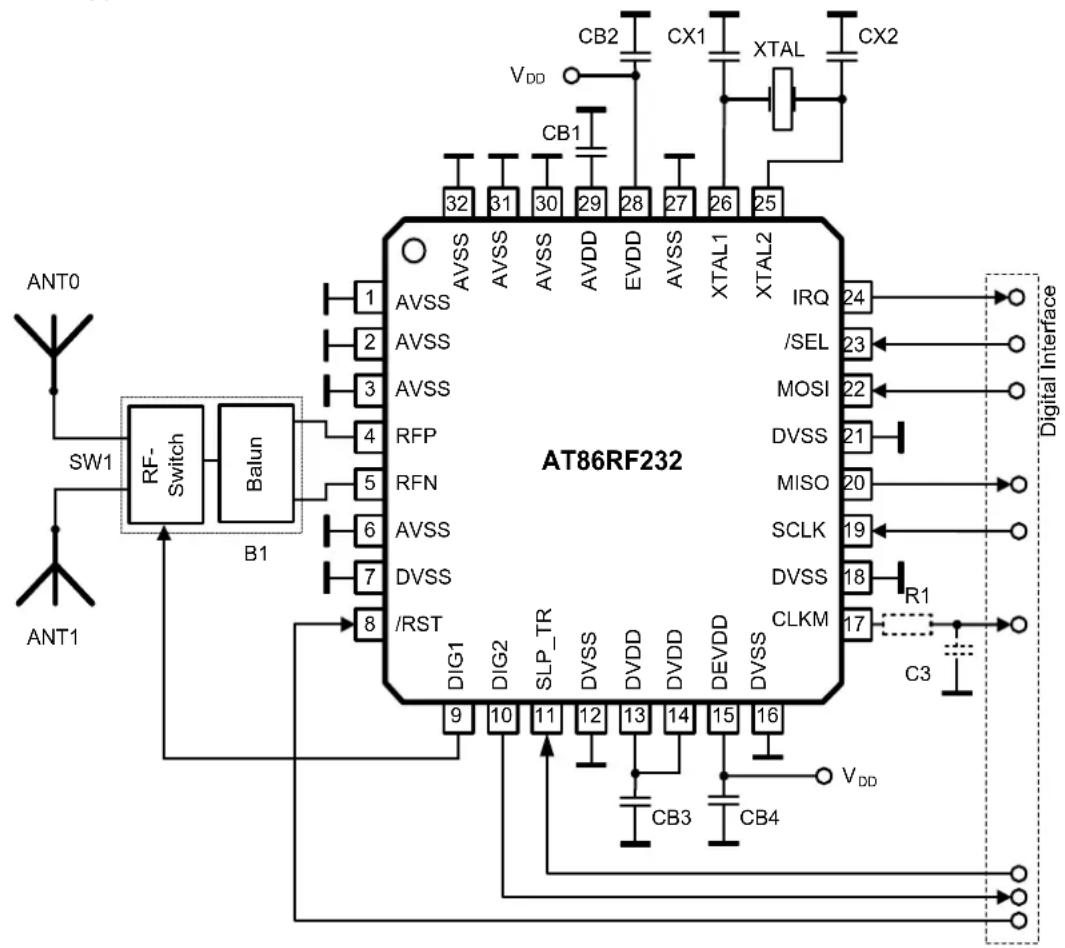
An extended feature set application schematic illustrating the use of the AT86RF232 Extended Feature Set, see Chapter 11, is shown in Figure 5-2 Although this example shows all additional hardware features combined, it is possible to use all features separately or in various combinations.
Figure 5-2. Extended Feature Application Schematic.
text_image
ANT0 SW1 Ant1 RF-Switch Balun B1 AVSS AVSS AVSS AVDD EVDD AVSS XTAL1 XTAL2 AT86RF232 1 2 3 4 5 6 7 8 RFP RFN AVSS DVSS /RST DIG1 DIG2 SLP_TR DVSS DVDD DVDD DEVDD DVSS CB1 CB2 CB3 CB4 CB1 CX1 XTAL CX2 IRQ 24 /SEL 23 MOSI 22 DVSS 21 MISO 20 SCLK 19 DVSS 18 R1 CLKM 17 C3 V_DDIn this example, a balun (B1) transforms the differential RF signal at the Atmel AT86RF232 radio transceiver RF pins (RFP/RFN) to a single ended RF signal, similar to the Basic Application Schematic; refer to Figure 5-1. During receive mode the radio transceiver searches for the most reliable RF signal path using the Antenna Diversity algorithm. One antenna is selected (SW2) by the Antenna Diversity RF switch control pin 9 (DIG1), refer to Section 11.3.
RX and TX Frame Time stamping is implemented through pin 10 (DIG2), refer to Section 11.4.
The security engine (AES) does not require specific circuitry to operate, for details refer to Section 11.1.
6 Microcontroller Interface
This section describes the Atmel AT86RF232 to microcontroller interface. The interface comprises a slave SPI and additional control signals; see Figure 6-1. The SPI timing and protocol are described below.
Figure 6-1. Microcontroller to AT86RF232 Interface.

flowchart
graph LR
    A["Microcontroller AT86RF232 SPI"] --> B["SPI - Master"]
    A --> C["SPI - Slave"]
    B --> D["/SEL /SEL"] --> E["/SEL"] --> F["MOSI"] --> G["MOSI"] --> H["MISO"] --> I["SCLK"] --> J["MISO"] --> K["SCLK"] --> L["GPIO1/CLK"] --> M["CLKM"] --> N["CLKM"] --> O["GPIO2/IRQ"] --> P["IQ"] --> Q["IRQ"] --> R["GPIO3"] --> S["SLP_TR"] --> T["SLP_TR"] --> U["GPIO4"] --> V["/RST"] --> W["/RST"] --> X["GPIO5 DIG2"] --> Y["DIG2"] --> Z["GPIO1/CLK"] --> AA["CLKM"] --> AB["CLKM"] --> AC["GPIO2/IRQ"] --> AD["IQ"] --> AE["IRQ"] --> AF["GPIO3"] --> AG["SLP_TR"] --> AH["SLP_TR"] --> AI["GPIO4"] --> AJ["/RST"] --> AK["/RST"]
    style A fill:#f9f,stroke:#333
    style B fill:#ccf,stroke:#333
    style C fill:#cfc,stroke:#333
    style D fill:#fcc,stroke:#333
    style E fill:#cff,stroke:#333
    style F fill:#ffc,stroke:#333
    style G fill:#ffc,stroke:#333
    style H fill:#ffc,stroke:#333
    style I fill:#ffc,stroke:#333
    style J fill:#ffc,stroke:#333
    style K fill:#ffc,stroke:#333
    style L fill:#ffc,stroke:#333
    style M fill:#ffc,stroke:#333
    style N fill:#ffc,stroke:#333
    style O fill:#ffc,stroke:#333
    style P fill:#ffc,stroke:#333
    style Q fill:#ffc,stroke:#333
    style R fill:#ffc,stroke:#333
    style S fill:#ffc,stroke:#333
    style T fill:#ffc,stroke:#333
    style U fill:#ffc,stroke:#333
    style V fill:#ffc,stroke:#333
    style W fill:#ffc,stroke:#333
    style X fill:#ffc,stroke:#333
    style Y fill:#ffc,stroke:#333
Microcontrollers with a master SPI such as Atmel AVR family interface directly to the AT86RF232. The SPI is used for register, Frame Buffer, SRAM and AES access. The additional control signals are connected to the GPIO/IRQ interface of the microcontroller. Table 6-1 introduces the radio transceiver I/O signals and their functionality.
Table 6-1. Signal Description of Microcontroller Interface.
| Signal | Description |
| /SEL | SPI select signal, active low |
| MOSI | SPI data (master output slave input) signal |
| MISO | SPI data (master input slave output) signal |
| SCLK | SPI clock signal |
| CLKM | Optional, Clock output, refer to Section 9.6.4, usable as:- microcontroller clock source- high precision timing reference |
| IRQ | Interrupt request signal, further used as:- Frame Buffer Empty indicator, refer to Section 11.5 |
| SLP_TR | Multi purpose control signal (functionality is state dependent, see Section 6.5):- Sleep/Wakeup enable/disable SLEEP state- TX start BUSY_TX_(ARET) state |
| /RST | AT86RF232 reset signal, active low |
| DIG2 | Optional,- IRQ_2 (RX_START) for RX Frame Time Stamping, see Section 11.4- Signals frame transmit within TX_ARET mode for TX Time Stamping |
6.1 SPI Timing Description
Pin 17 (CLKM) can be used as a microcontroller master clock source. If the microcontroller derives the SPI master clock (SCLK) directly from CLKM, the SPI operates in synchronous mode, otherwise in asynchronous mode.
In asynchronous mode, the maximum SCLK frequency f_async is limited to 7.5MHz. The signal at pin 17 (CLKM) is not required to derive SCLK and may be disabled to reduce power consumption and spurious emissions.
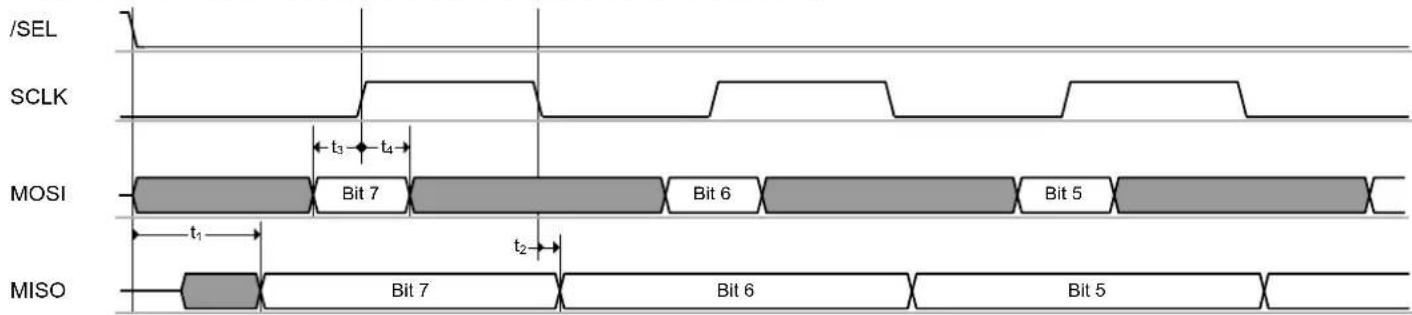
Figure 6-2 and Figure 6-3 illustrate the SPI timing and introduces its parameters. The corresponding timing parameter definitions t_1 - t_9 are defined in Section 12.4.
Figure 6-2. SPI Timing, Global Map and Definition of Timing Parameters t_5 , t_6 , t_8 , t_9 .

text_image
/SEL SCLK MOSI MISO t0 t8 t5 t6 Bit 7 Bit 6 Bit 5 Bit 4 Bit 3 Bit 2 Bit 1 Bit 0 Bit 7 Bit 6 Bit 5 Bit 4 Bit 3 Bit 2 Bit 1 Bit 0Figure 6-3. SPI Timing, Detailed Drawing of Timing Parameters t_1 to t_4 .
text_image
/SEL SCLK MOSI MISO t₁ t₂ t₃ t₄ Bit 7 Bit 6 Bit 5 Bit 7 Bit 6 Bit 5The SPI is based on a byte-oriented protocol and is always a bidirectional communication between master and slave. The SPI master starts the transfer by asserting /SEL = L. Then the master generates eight SPI clock cycles to transfer one byte to the radio transceiver (via MOSI). At the same time, the slave transmits one byte to the master (via MISO). When the master wants to receive one byte of data from the slave it must also transmit one byte to the slave. All bytes are transferred with MSB first. An SPI transaction is finished by releasing /SEL = H.
An SPI register access consists of two bytes, a Frame Buffer or SRAM access of at least two or more bytes as described in Section 6.2.
/SEL = L enables the MISO output driver of the Atmel AT86RF232. The MSB of MISO is valid after t_1 (see Section 12.4 parameter) and is updated at each falling edge of SCLK. If the driver is disabled, there is no internal pull-up circuitry connected to it. Driving the appropriate signal level must be ensured by the master device or an external pull-up resistor.
Note: 1. When both /SEL and /RST are active, the MISO output driver is also enabled.
Referring to Figure 6-2 and Figure 6-3 Atmel AT86RF232 MOSI is sampled at the rising edge of the SCLK signal and the output is set at the falling edge of SCLK. The signal must be stable before and after the rising edge of SCLK as specified by t_3 and t_4 , refer to Section 12.4 parameters.
This SPI operational mode is commonly known as "SPI mode 0".
6.2 SPI Protocol
Each SPI sequence starts with transferring a command byte from the SPI master via MOSI (see Table 6-2) with MSB first. This command byte defines the SPI access mode and additional mode-dependent information.
Table 6-2. SPI Command Byte Definition.
| Bit 7 | Bit 6 | Bit 5 | Bit 4 | Bit 3 | Bit 2 | Bit 1 | Bit 0 | Access Mode | Access Type |
| 1 | 0 | Register address [5:0] | Register access | Read access | |||||
| 1 | 1 | Register address [5:0] | Write access | ||||||
| 0 | 0 | 1 | reserved | Frame Buffer access | Read access | ||||
| 0 | 1 | 1 | reserved | Write access | |||||
| 0 | 0 | 0 | reserved | SRAM access | Read access | ||||
| 0 | 1 | 0 | reserved | Write access | |||||
Each SPI transfer returns bytes back to the SPI master on MISO. The content of the first byte (see value "PHY_STATUS" in Figure 6-4 to Figure 6-14) is set to zero after reset. To transfer status information of the radio transceiver to the microcontroller, the content of the first byte can be configured with register bits SPI_CMD_MODE (register 0x04, TRX_CTRL_1). For details, refer to Section 6.3.1.
In Figure 6-4 to Figure 6-14 and the following chapters logic values stated with XX on MOSI are ignored by the radio transceiver, but need to have a valid logic level. Return values on MISO stated as XX shall be ignored by the microcontroller.
The different access modes are described within the following sections.
6.2.1 Register Access Mode
A register access mode is a two-byte read/write operation initiated by /SEL = L. The first transferred byte on MOSI is the command byte including an identifier bit (bit[7] = 1), a read/write select bit (bit[6]), and a 6-bit register address.
On read access, the content of the selected register address is returned in the second byte on MISO (see Figure 6-4).
Figure 6-4. Packet Structure - Register Read Access.

text_image
byte 1 (command byte) → byte 2 (data byte) 1 ADDRESS[5:0]0 XXMOSI PHY_STATUS(1) READ DATA[7:0]MISONote: 1. Each SPI access can be configured to return radio controller status information (PHY_STATUS) on MISO, for details refer to Section 6.3.
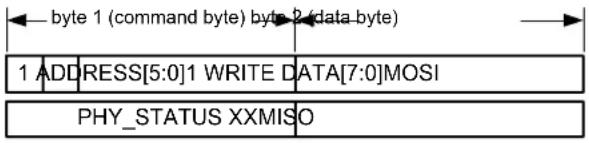
On write access, the second byte transferred on MOSI contains the write data to the selected address (see Figure 6-5).
Figure 6-5. Packet Structure - Register Write Access.
text_image
byte 1 (command byte) byte 2 (data byte) 1 ADDRESS[5:0]1 WRITE DATA[7:0]MOSI PHY_STATUS XXMISOEach register access must be terminated by setting /SEL = H.
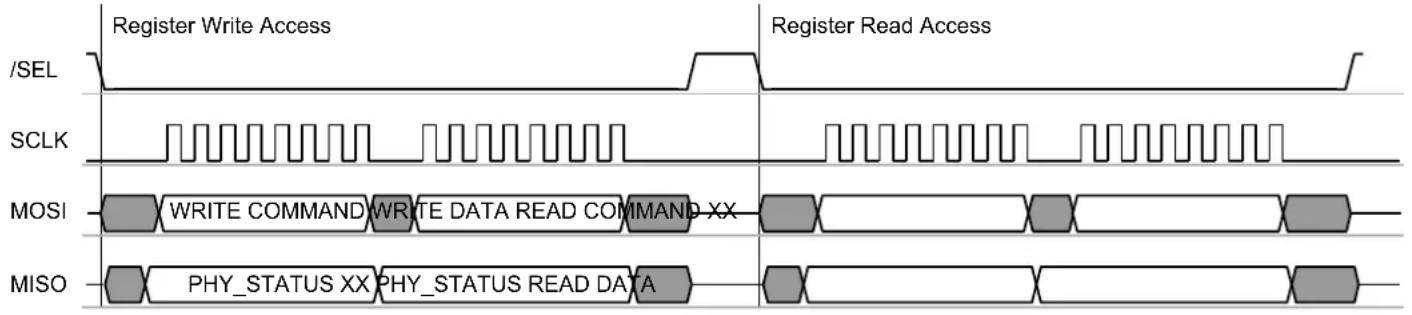
Figure 6-6 illustrates a typical SPI sequence for a register access sequence for write and read respectively.
Figure 6-6. Example SPI Sequence – Register Access Mode.
text_image
/SEL Register Write Access SCLK Register Read Access MOSI WRITE COMMAND WRITE DATA READ COMMAND XX MISO PHY_STATUS XX PHY_STATUS READ DATA6.2.2 Frame Buffer Access Mode
The Atmel AT86RF232 128-byte Frame Buffer can hold the PHY service data unit (PSDU) data of one IEEE 802.15.4 compliant RX or one TX frame of maximum length at a time. A detailed description of the Frame Buffer can be found in Section 9.3. An introduction to the IEEE 802.15.4 frame format can be found in Section 8.1.
Frame Buffer read and write accesses are used to read or write frame data (PSDU and additional information) from or to the Frame Buffer. Each access starts with /SEL = L followed by a command byte on MOSI. If this byte indicates a frame read or write access, the next byte PHR indicates the frame length followed by the PSDU data, see Figure 6-7 and Figure 6-8.
On Frame Buffer read access, PHY header (PHR) and PSDU are transferred via MISO starting with the second byte. After the PSDU data, three more bytes are transferred containing the link quality indication (LQI) value, the energy detection (ED) value, and the status information (RX_STATUS) of the received frame, for LQI details refer to Section 8.6. The Figure 6-7 illustrates the packet structure of a Frame Buffer read access.
Figure 6-7. Packet Structure - Frame Read Access.

text_image
byte 1 (command byte) byte 2 (data byte) byte 3 (data byte) MOSI 0 0 1 reserved[4:0] XX XX ... MISO PHY_STATUS PHR[7:0] PSDU[7:0] ... byte n-1 (data byte) byte n (data byte)The structure of RX_STATUS is described in Table 6-3.
Table 6-3. Structure of RX_STATUS.
| Bit | 7 | 6 | 5 | 4 | |
| RX_CRC_VALID | TRAC_STATUS | RX_STATUS | |||
| Read/Write | R | R | R | R | |
| Reset value | 0 | 0 | 0 | 0 | |
| Bit | 3 | 2 | 1 | 0 | |
| reserved | RX_STATUS | ||||
| Read/Write | R | R | R | R | |
| Reset value | 0 | 0 | 0 | 0 | |
Note: 1. More information to RX_CRC_VALID, see Section 8.2.5, and to TRAC_STATUS, see Section 7.2.6.
On Frame Buffer write access the second byte transferred on MOSI contains the frame length (PHR field) followed by the payload data (PSDU) as shown by Figure 6-8.
Figure 6-8. Packet Structure - Frame Write Access.

text_image
byte 1 (command byte) byte 2 (data byte) byte 3 (data byte) 0 es rdr [7:0]MOS PSDU[7:0] ... PSDU[7:0] PSDU[7:0] PHY_STATUSMISO XX XX ... XX XXThe number of bytes n for one frame access is calculated as follows:
Read Access: n = 5 + frame_length
[PHY_STATUS, PHR byte, PSDU data, LQI, ED, and RX_STATUS]
Write Access: n = 2 + frame_length
[command byte, PHR byte, and PSDU data]
Each read or write of a data byte automatically increments the address counter of the Frame Buffer until the access is terminated by setting /SEL = H. A Frame Buffer read access may be terminated (/SEL = H) at any time without affecting the Frame Buffer content. Another Frame Buffer read operation starts again at the PHR field.
The content of the Atmel AT86RF232 Frame Buffer is overwritten by a new received frame or a Frame Buffer write access.
Figure 6-9 and Figure 6-10 illustrate an example SPI sequence of a Frame Buffer access to read a frame with 2-byte PSDU and write a frame with 4-byte PSDU.
Figure 6-9. Example SPI Sequence - Frame Buffer Read of a Frame with 2-byte PSDU.

text_image
/SEL SCLK MOSI COMMAND XX XX XX XX XX XX MISO PHY_STATUS PHR PSDU 1 PSDU 2 LQI ED RX_STATUSFigure 6-10. Example SPI Sequence - Frame Buffer Write of a Frame with 4-byte PSDU.

text_image
/SEL SCLK MOSI COMMAND PHR PSDU 1 PSDU 2 PSDU 3 PSDU 4 MISO PHY_STATUS XX XXXX XXXXAccess violations during a Frame Buffer read or write access are indicated by interrupt IRQ_6 (TRX_UR). For further details, refer to Section 9.3.
Notes: 1. The Frame Buffer is shared between RX and TX; therefore, the frame data are overwritten by new incoming frames. If the TX frame data are to be retransmitted, it must be ensured that no frame was received in the meanwhile.
2. To avoid overwriting during receive Dynamic Frame Buffer Protection can be enabled, refer to Section 11.6.
3. For exceptions, receiving acknowledgement frames in Extended Operating Mode (TX_ARET) refer to Section 7.2.4.
6.2.3 SRAM Access Mode
The SRAM access mode allows accessing dedicated bytes within the Atmel AT86RF232 Frame Buffer or AES address space, refer to Section 11.1.
During frame receive after occurrence of interrupt IRQ_2 (RX_START) an SRAM access can be used to upload the PHR field while preserving Dynamic Frame Buffer Protection, see Section 11.6.
Each SRAM access starts with /SEL = L. The first transferred byte on MOSI shall be the command byte and must indicate an SRAM access mode according to the definition in Table 6-2. The following byte indicates the start address of the write or read access.
SRAM address space:
• Frame Buffer: 0x00 to 0x7F
• AES: 0x82 to 0x94
On SRAM read access, one or more bytes of read data are transferred on MISO starting with the third byte of the access sequence (see Figure 6-11).
Figure 6-11. Packet Structure – SRAM Read Access.

text_image
byte 1 (command byte) byte 2 (address) byte 3 (data byte) MOSI 0 0 0 reserved[4:0] ADDRESS[7:0] XX ... XX MISO PHY_STATUS XX DATA[7:0] ... DATA[7:0] DATA[7:0]On SRAM write access, one or more bytes of write data are transferred on MOSI starting with the third byte of the access sequence (see Figure 6-12).
Figure 6-12. Packet Structure – SRAM Write Access.

text_image
byte 1 (command byte) byte 2 (address) byte 3 (data byte) 0 eserved address DATA[7:0] ... DATA[7:0] DATA[7:0] PHY_STATUSMISO XX XX ... XX XXAs long as /SEL = L, every subsequent byte read or byte write increments the address counter of the Frame Buffer until the SRAM access is terminated by /SEL = H.
Figure 6-13 and Figure 6-14 illustrate an example SPI sequence of an Atmel AT86RF232 SRAM access to read and write a data package of five byte length respectively.
Figure 6-13. Example SPI Sequence – SRAM Read Access of a 5-byte Data Package.

text_image
/SEL SCLK MOSI COMMAND ADDRESS XX XX XX XX XX MISO PHY_STATUS XX DATA 1 DATA 2 DATA 3 DATA 4 DATA 5Figure 6-14. Example SPI Sequence – SRAM Write Access of a 5-byte Data Package.

text_image
/SEL SCLK MOSI COMMAND ADDRESS DATA 1 DATA 2 DATA 3 DATA 4 DATA 5 MISO PHY_STATUS XX XX XX XX XXNotes: 1. The SRAM access mode is not intended to be used as an alternative to the Frame Buffer access modes (see Section 6.2.2).
- Frame Buffer access violations are not indicated by a TRX_UR interrupt when using the SRAM access mode, for further details refer to Section 9.3.3.
6.3 Radio Transceiver Status information
Each Atmel AT86RF232 SPI access can be configured to return status information of the radio transceiver (PHY_STATUS) to the microcontroller using the first byte of the data transferred via MISO.
The content of the radio transceiver status information can be configured using register bits SPI_CMD_MODE (register 0x04, TRX_CTRL_1). After reset, the content on the first byte send on MISO to the microcontroller is set to zero.
6.3.1 Register Description
Register 0x04 (TRX\_CTRL\_1):
The TRX_CTRL_1 register is a multi-purpose register to control various operating modes and settings of the radio transceiver.
Figure 6-15. Register TRX_CTRL_1.
| Bit | 7 | 6 | 5 | 4 | |
| 0x04 | reserved | IRQ_2_EXT_EN | TX_AUTO_CRC_ON | RX_BL_CTRL | TRX_CTRL_1 |
| Read/Write | R/W | R/W | R/W | R/W | |
| Reset value | 0 | 0 | 1 | 0 | |
| Bit | 3 | 2 | 1 | 0 | |
| 0x04 | SPI_CMD_MODE | IRQ_MASK_MOD | IRQ_POLARITY | TRX_CTRL_1 | |
| Read/Write | R/W | R/W | R/W | R/W | |
| Reset value | 0 | 0 | 1 | 0 | |
- Bit 3:2 - SPI\_CMD\_MODE
Each SPI transfer returns bytes back to the SPI master. The content of the first byte (PHY_STATUS) can be configured using register bits SPI_CMD_MODE.
Table 6-4. SPI CMD MODE.
| Register Bits | Value | Description |
| SPI_CMD_MODE | 0 | Default (empty, all bits zero) |
| 1 | Monitor TRX_STATUS register | |
| 2 | Monitor PHY_RSSI register | |
| 3 | Monitor IRQ_STATUS register |
Note: 1. More information to register TRX_STATUS, see Section 7.1.5, to register PHY_RSSI, see Section 8.3, and to register IRQ_STATUS, see Section 6.6.
6.4 Radio Transceiver Identification
The Atmel AT86RF232 can be identified by four registers. One register contains a unique part number and one register the corresponding version number. Two additional registers contain the JEDEC manufacture ID.
6.4.1 Register Description
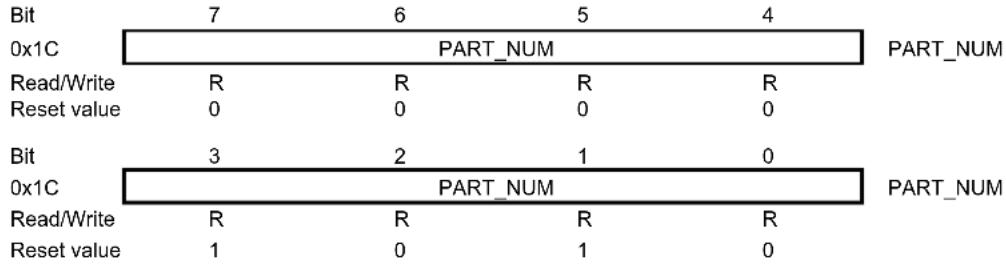
Register 0x1C (PART\_NUM):
The register PART_NUM can be used for the radio transceiver identification and includes the device part number.
Figure 6-16. Register PART_NUM.
bar_stacked
| Bit | 0x1C | PART_NUM | | ------- | ---- | -------- | | 0x1C | 7 | 6 | | 0x1C | 6 | 5 | | 0x1C | 5 | 4 | | 0x1C | 4 | PART_NUM | | Read/Write | R | R | | Reset value | 0 | 0 | | Bit | 3 | 2 | | 0x1C | 7 | PART_NUM | | Read/Write | R | R | | Reset value | 1 | 0 | | PART_NUM | PART_NUM | PART_NUM |- Bit 7:0 - PART\_NUM
Table 6-5. PART_NUM.
| Register Bits | Value | Description |
| PART_NUM | 0x0A | AT86RF232 part number |
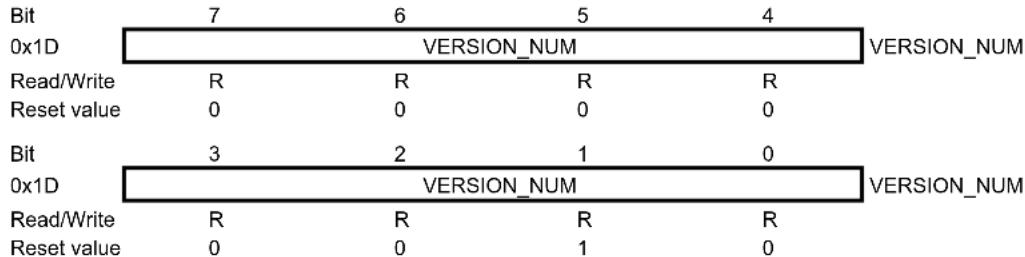
Register 0x1D (VERSION\_NUM):
The register VERSION_NUM can be used for the radio transceiver identification and includes the device version number.
Figure 6-17. Register VERSION_NUM.
bar_stacked
| Bit/Value | 0x1D | VERSION_NUM | | ---------- | ---- | ---------- | | Bit | 3 | 2 | | 0x1D | 0 | 1 |- Bit 7:0 - VERSION\_NUM
Table 6-6. VERSION NUM.
| Register Bits | Value | Description |
| VERSION_NUM | 0x02 | Revision A |
Register 0x1E (MAN\_ID\_0):
Part one of the JEDEC manufacturer ID.
Figure 6-18. Register MAN_ID_0.

bar_stacked
| Bit | 7 | 6 | 5 | 4 | | --- | --- | --- | --- | --- | | 0x1E | MAN_ID_0 | | | | | Read/Write | R | R | R | R | | Reset value | 0 | 0 | 0 | 1 | | Bit | 3 | 2 | 1 | 0 | | 0x1E | MAN_ID_0 | | | | | Read/Write | R | R | R | R | | Reset value | 1 | 1 | 1 | 1 |- Bit 7:0 - MAN\_ID\_0
Table 6-7. MAN ID 0.
| Register Bits | Value | Description |
| MAN_ID_0 | 0x1F | Atmel JEDEC manufacturer ID, bits[7:0] of the 32-bit JEDEC manufacturer ID are stored in register bits MAN_ID_0. Bits [15:8] are stored in register 0x1F (MAN_ID_1). The higher 16 bits of the ID are not stored in registers. |
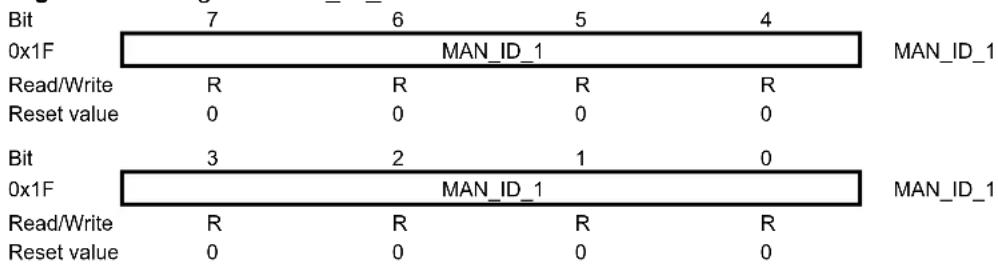
Register 0x1F (MAN\_ID\_1):
Part two of the JEDEC manufacturer ID.
Figure 6-19. Register MAN_ID_1.
bar_stacked
| Bit Type | Value 1 | Value 2 | Value 3 | Value 4 | |----------|---------|---------|---------|---------| | 0x1F | 7 | 6 | 5 | 4 | | Read/Write | R | R | R | R | | Reset value | 0 | 0 | 0 | 0 | | Bit | 3 | 2 | 1 | 0 | | 0x1F | 7 | 6 | 5 | 4 | | Read/Write | R | R | R | R | | Reset value | 0 | 0 | 0 | 0 |- Bit 7:0 - MAN\_ID\_1
Table 6-8. MAN ID 1.
| Register Bits | Value | Description |
| MAN_ID_1 | 0x00 | Atmel JEDEC manufacturer ID, bits[15:8] of the 32-bit JEDEC manufacturer ID are stored in register bits MAN_ID_1. Bits [7:0] are stored in register 0x1E (MAN_ID_0). The higher 16 bits of the ID are not stored in registers. |
6.5 Sleep/Wake-up and Transmit Signal (SLP\_TR)
Pin 11 (SLP_TR) is a multi-functional pin. Its function relates to the current state of the Atmel AT86RF232 and is summarized in Table 6-9. The radio transceiver states are explained in detail in Chapter 7.
Table 6-9. SLP_TR Multi-functional Pin.
| Transceiver Status | Function | Transition | Description |
| PLL_ON | TX start | L ⇔ H | Starts frame transmission |
| TX_ARET_ON | TX start | L ⇔ H | Starts TX_ARET transaction |
| TRX_OFF | Sleep | L ⇔ H | Takes the radio transceiver into SLEEP state, CLKM disabled |
| SLEEP | Wakeup | H ⇔ L | Takes the radio transceiver back into TRX_OFF state, level sensitive |
In states PLL_ON and TX_ARET_ON, pin 11 (SLP_TR) is used as trigger input to initiate a TX transaction. Here SLP_TR is sensitive on rising edge only.
After initiating a state change by a rising edge at pin 11 (SLP_TR) in radio transceiver state TRX_OFF, the radio transceiver remains in the new state as long as the pin is logical high and returns to the preceding state with the falling edge.
SLEEP state
The SLEEP state is used when radio transceiver functionality is not required, and thus the AT86RF232 can be powered down to reduce the overall power consumption.
A power-down scenario is shown in Figure 6-20. When the radio transceiver is in TRX_OFF state the microcontroller forces the AT86RF232 to SLEEP by setting SLP_TR = H. If pin 17 (CLKM) provides a clock to the microcontroller this clock is switched off after 35 CLKM cycles. The AT86RF232 awakes when the microcontroller releases pin 11 (SLP_TR).
The CLKM clock frequency setting for 62.5kHz are not intended to directly clock the microcontroller. When using these clock rates, CLKM is turned off immediately when entering SLEEP state.
Figure 6-20. Sleep and Wake-up Initiated by Asynchronous Microcontroller Timer.

text_image
SLP_TR CLKM tTR3 (35 CLKM clock cycles) CLKM off tTR1a async timer elapses (microcontroller)Note: 1. Timing figures t_TR3 and t_TR1a refer to Table 7-1.
6.6 Interrupt Logic
6.6.1 Overview
The Atmel AT86RF232 differentiates between nine interrupt events (eight physical interrupt registers, one shared by two functions). Each interrupt is enabled by setting the corresponding bit in the interrupt mask register 0x0E (IRQ_MASK). Internally, each pending interrupt is stored in a separate bit of the interrupt status register. All interrupt events are OR-combined to a single external interrupt signal (IRQ pin). If an interrupt is issued, pin 24 (IRQ) = H, the microcontroller shall read the interrupt status register 0x0F (IRQ_STATUS) to determine the source of the interrupt. A read access to this register clears the interrupt status register and thus the IRQ pin, too.
Interrupts are not cleared automatically when the event that caused them vanishes. Exceptions are IRQ_0 (PLL_LOCK) and IRQ_1 (PLL_UNLOCK) because the occurrence of one clears the other.
The supported interrupts for the Basic Operating Mode are summarized in Table 6-10.
Table 6-10. Interrupt Description in Basic Operating Mode.
| IRQ Name | Description | Section |
| IRQ_7 (BAT_LOW) | Indicates a supply voltage below the programmed threshold. | 9.5.4 |
| IRQ_6 (TRX_UR) | Indicates a Frame Buffer access violation. | 9.3.3 |
| IRQ_5 (AMI) | Indicates an address match. | 7.2.3.4 |
| IRQ_4 (CCA_ED_DONE) | Multi-functional interrupt:1. AWAKE_END:Indicates finished transition to TRX_OFF state from P_ON, SLEEP, or RESET state.2. CCA_ED_DONE:Indicates the end of a CCA or ED measurement. | 7.1.2.38.4.48.5.4 |
| IRQ_3 (TRX_END) | RX: Indicates the completion of a frame reception.TX: Indicates the completion of a frame transmission. | 7.1.37.1.3 |
| IRQ_2 (RX_START) | Indicates the start of a PSDU reception. Register bits TRX_STATUS changes to BUSY_RX, the PHR is valid to be read from Frame Buffer. | 7.1.3 |
| IRQ_1 (PLL_UNLOCK) | Indicates PLL unlock. If the radio transceiver is in BUSY_TX / BUSY_TX_ARET state, the PA is turned off immediately. | 9.7.5 |
| IRQ_0 (PLL_LOCK) | Indicates PLL lock. | 9.7.5 |
Note: 1. The IRQ_4 (AWAKE_END) interrupt can usually not be seen when the transceiver enters TRX_OFF state after P_ON, or RESET, because register 0x0E (IRQ_MASK) is reset to mask all interrupts. It is recommended to enable IRQ_4 (AWAKE_END) to be notified once the TRX_OFF state is entered.
The interrupt handling in Extended Operating Mode is described in Section 7.2.5.
6.6.2 Interrupt Mask Modes and Pin Polarity
If register bit IRQ_MASK_MODE (register 0x04, TRX_CTRL_1) is set, an interrupt event can be read from IRQ_STATUS register even if the interrupt itself is masked. However, in that case no timing information for this interrupt is provided. The Table 6-11, Figure 6-21, and Figure 6-22 describes the function.
Table 6-11. IRQ Mask Configuration.
| IRQ_MASK Value | IRQ_MASK_MODE | Description |
| 0 | 0 | IRQ is suppressed entirely and none of interrupt causes are shown in register IRQ_STATUS. |
| 0 | 1 | IRQ is suppressed entirely but all interrupt causes are shown in register IRQ_STATUS. |
| ≠0 | 0 | All enabled interrupts are signaled on IRQ pin and are also shown in register IRQ_STATUS. |
| ≠0 | 1 | All enabled interrupts are signaled on IRQ pin and all interrupt causes are shown in register IRQ_STATUS. |
Figure 6-21. IRQ_MASK_MODE = 0.

flowchart
graph LR
    A["Interrupt Sources"] --> B["IRQ_MASK (register 0x0E)"]
    B --> C["IRQ_STATUS (register 0x0F)"]
    C --> D["OR"]
    D --> E["IRQ"]
Figure 6-22. IRQ_MASK_MODE = 1.

flowchart
graph LR
    A["Interrupt Sources"] --> B["IRQ_STATUS (register 0x0F)"]
    B --> C["IRQ_MASK (register 0x0E)"]
    C --> D["OR"]
    D --> E["IRQ"]
The Atmel AT86RF232 IRQ pin polarity can be configured with register bit IRQ_POLARITY (register 0x04, TRX_CTRL_1). The default behavior is active high, which means that pin 24 (IRQ) = H issues an interrupt request.
If "Frame Buffer Empty Indicator" is enabled during Frame Buffer read access the IRQ pin has an alternative functionality, refer to Section 11.5 for details.
6.6.3 Register Description
Register 0x0E (IRQ\_MASK):
The IRQ_MASK register controls the interrupt signaling via pin 24 (IRQ).
Figure 6-23. Register IRQ_MASK.
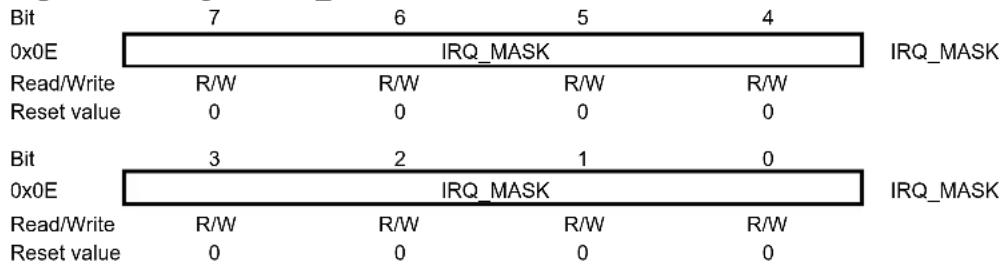
bar_stacked
| Bit/Read/Write | 0x0E | IRQ_MASK | | -------------- | ---- | -------- | | Read/Write | R/W | R/W | | Reset value | 0 | 0 | | Bit | 3 | 2 | | Read/Write | R/W | R/W | | Reset value | 0 | 0 |- Bit 7:0 - IRQ\_MASK
Mask register for interrupts. IRQ_MASK[7] correspondents with IRQ_7_BAT_LOW. IRQ_MASK[0] correspondents with IRQ_0_PLL_LOCK.
Table 6-12. IRQ_MASK.
| Register Bits | Value | Description |
| IRQ_MASK | 0x00 | The IRQ_MASK register is used to enable or disable individual interrupts. An interrupt is enabled if the corresponding bit is set to one. All interrupts are disabled after power-on sequence (P_ON state) or reset (RESET state).Valid values are [0xFF, 0xFE, ..., 0x00]. |
Note: 1. If an interrupt is enabled it is recommended to read the interrupt status register 0x0F (IRQ_STATUS) first to clear the history.
Register 0x0F (IRQ\_STATUS):
The IRQ_STATUS register contains the status of the pending interrupt requests.
Figure 6-24. Register IRQ_STATUS.
| Bit 0x0F | 7 | 6 | 5 | 4 | IRQ_STATUS |
| IRQ_7_BAT_LOV | IRQ_6_TRX_UR | IRQ_5_AMI | IRQ_4_CCA_ED_DONE | ||
| Read/Write | R | R | R | R | |
| Reset value | 0 | 0 | 0 | 0 | |
| Bit 0x0F | 3 | 2 | 1 | 0 | IRQ_STATUS |
| IRQ_3_TRX_END | IRQ_2_RX_START | IRQ_1_PLL_UNLOCK | IRQ_0_PLL_LOCK | ||
| Read/Write | R | R | R | R | |
| Reset value | 0 | 0 | 0 | 0 |
For more information to meanings of interrupts, see Table 6-10 Interrupt Description in Basic Operating Mode.
By reading the register after an interrupt is signaled at pin 24 (IRQ) the source of the issued interrupt can be identified. A read access to this register resets all interrupt bits, and so clears the IRQ_STATUS register.
Notes: 1. If register bit IRQ_MASK_MODE (register 0x04, TRX_CTRL_1) is set, an interrupt event can be read from IRQ_STATUS register even if the interrupt itself is masked. However in that case no timing information for this interrupt is provided.
2. If register bit IRQ_MASK_MODE (register 0x04, TRX_CTRL_1) is set, it is recommended to read the interrupt status register 0x0F (IRQ_STATUS) first to clear the history.
Register 0x04 (TRX\_CTRL\_1):
The TRX_CTRL_1 register is a multi-purpose register to control various operating modes and settings of the radio transceiver.
Figure 6-25. Register TRX_CTRL_1.
| Bit | 7 | 6 | 5 | 4 | |
| 0x04 | reserved | IRQ_2_EXT_EN | TX_AUTO_CRC_ON | RX_BL_CTRL | TRX_CTRL_1 |
| Read/Write | R/W | R/W | R/W | R/W | |
| Reset value | 0 | 0 | 1 | 0 | |
| Bit | 3 | 2 | 1 | 0 | |
| 0x04 | SPI_CMD_MODE | IRQ_MASK_MOD | IRQ_POLARITY | TRX_CTRL_1 | |
| Read/Write | R/W | R/W | R/W | R/W | |
| Reset value | 0 | 0 | 1 | 0 | |
- Bit 6 - IRQ\_2\_EXT\_EN
Controls external signaling for time stamping via pin 10 (DIG2).
Table 6-13. IRQ_2_EXT_EN.
| Register Bits | Value | Description |
| IRQ_2_EXT_EN | 0 | Time stamping over pin 10 (DIG2) is disabled |
| 1^(1) | Time stamping over pin 10 (DIG2) is enabled |
Notes: 1. The pin 10 (DIG2) is also active even if the corresponding interrupt event IRQ_2 (RX_START) mask bit in register 0x0E (IRQ_MASK) is set to zero.
- The pin remains at high level until the end of the frame receive or transmit procedure.
The timing of a received frame can be determined by a separate pin 10 (DIG2). If register bit IRQ_2_EXT_EN is set to one, the reception of a PHR is directly issued on pin 10 (DIG2), similar to interrupt IRQ_2 (RX_START).
For further details refer to Section 11.4.
- Bit 1 - IRQ\_MASK\_MODE
The radio transceiver supports polling of interrupt events. Interrupt polling can be enabled by register bit IRQ_MASK_MODE.
Table 6-14. IRQ MASK MODE.
| Register Bits | Value | Description |
| IRQ_MASK_MODE | 0 | Interrupt polling is disabledMasked off IRQ bits will not appear in IRQ_STATUS register. |
| 1 | Interrupt polling is enabledMasked off IRQ bits will appear in IRQ_STATUS register. |
Even if an interrupt request is masked by the corresponding bit in register 0x0E (IRQ_MASK), the event is indicated in register 0x0F (IRQ_STATUS).
- Bit 0 - IRQ\_POLARITY
The register bit IRQ_POLARITY controls the polarity for pin 24 (IRQ). The default polarity of the pin 24 (IRQ) is active high. The polarity can be configured to active low via register bit IRQ_POLARITY.
Table 6-15. IRQ POLARITY.
| Register Bits | Value | Description |
| IRQ_POLARITY | 0 | Pin IRQ is high active |
| 1 | Pin IRQ is low active |
Note: 1. A modification on IRQ_POLARITY bit has no influence to RX_BL_CTRL behavior.
This setting does not affect the polarity of the “Frame Buffer Empty Indicator”, refer to Section 11.5. The Frame Buffer Empty Indicator is always active high.
7 Operating Modes
7.1 Basic Operating Mode
This section summarizes all states to provide the basic functionality of the Atmel AT86RF232, such as receiving and transmitting frames, the power-on sequence, and sleep. The Basic Operating Mode is designed for IEEE 802.15.4 and general ISM band applications; the corresponding radio transceiver states are shown in Figure 7-1.
Figure 7-1. Basic Operating Mode State Diagram (for timing refer to Table 7-1).

flowchart
graph TD
    A["TRX_OFF (Clock State)"] -->|12/3/5/7/8/9/10/11/12/13| B["RESET"]
    A -->|15/2/3/4/6/8/9/10/11/12/13| C["P_ON (Power-on after V_DD)"]
    A -->|12/3/5/7/8/9/10/11/12/13| D["SLEEP (Sleep State)"]
    A -->|15/2/3/4/6/8/9/10/11/12/13| E["BUSY_RX (Receive State)"]
    A -->|12/3/5/7/8/9/10/11/12/13| F["RX_ON (Rx Listen State)"]
    A -->|12/3/5/7/8/9/10/11/12/13| G["PLL_ON (PLL State)"]
    A -->|12/3/5/7/8/9/10/11/12/13| H["BUSY_TX (Transmit State)"]
    A -->|12/3/5/7/8/9/10/11/12/13| I["BUSY_RX (Receive State)"]
    A -->|12/3/5/7/8/9/10/11/12/13| J["BUSY_TX (Transmit State)"]
    style A fill:#f9f,stroke:#333
    style B fill:#ccf,stroke:#333
    style C fill:#cfc,stroke:#333
    style D fill:#cfc,stroke:#333
    style E fill:#cfc,stroke:#333
    style F fill:#cfc,stroke:#333
    style G fill:#cfc,stroke:#333
    style H fill:#cfc,stroke:#333
    style I fill:#cfc,stroke:#333
    style J fill:#cfc,stroke:#333
7.1.1 State Control
The radio transceiver states are controlled either by writing commands to register bits TRX_CMD (register 0x02, TRX_STATE), or directly by two signal SLP_TR and /RST pins. A successful state change can be verified by reading the radio transceiver status from register bits TRX_STATUS (register 0x01, TRX_STATUS).
If TRX_STATUS = 0x1F (STATE_TRANSITION_IN_PROGRESS) the Atmel AT86RF232 is within a state transition. Do not try to initiate a further state change while the radio transceiver is in STATE_TRANSITION_IN_PROGRESS.
Pin 11 (SLP_TR) is a multifunctional pin, refer to Section 6.5. Depending on the radio transceiver state, a rising edge of pin 11 (SLP_TR) causes the following state transitions:
- TRX_OFF SLEEP (level sensitive)
- PLL_ON BUSY_TX
Whereas the falling edge of pin SLP_TR causes the following state transitions:
- SLEEP TRX_OFF (level sensitive)
A low level on pin 8 (/RST) causes a reset of all registers (register bits CLKM_CTRL are shadowed, for details refer to Section 9.6.4) and forces the radio transceiver into TRX_OFF state. However, if the device was in P_ON state it remains in the P_ON state.
For all states except SLEEP, the state change commands FORCE_TRX_OFF or TRX_OFF lead to a transition into TRX_OFF state. If the radio transceiver is in active receive or transmit states (BUSY_ ^* ), the command FORCE_TRX_OFF interrupts these active processes, and forces an immediate transition to TRX_OFF. In contrast a TRX_OFF command is stored until an active state (receiving or transmitting) has been finished. After that the transition to TRX_OFF is performed.
For a fast transition from any non sleep states to PLL_ON state, the command FORCE_PLL_ON is provided. In contrast to FORCE_TRX_OFF this command does not disable PLL and analog voltage regulator (AVREG). It is not available in states P_ON, SLEEP, or RESET.
The completion of each requested state change shall always be confirmed by reading the register bits TRX_STATUS (register 0x01, TRX_STATUS).
Note: 1. If FORCE_TRX_OFF and FORCE_PLL_ON commands are used, it is recommended to set pin 11 (SLP_TR) = L before.
7.1.2 Basic Operating Mode Description
7.1.2.1 P\_ON - Power-On after V_DD
When the external supply voltage ( V_DD ) is firstly applied to the AT86RF232, the radio transceiver goes into the P_ON state performing an on-chip reset. The crystal oscillator is activated and the default 1MHz master clock is provided at pin 17 (CLKM) after the crystal oscillator has stabilized. CLKM can be used as a clock source to the microcontroller. The SPI interface and digital voltage regulator (DVREG) are enabled.
The on-chip power-on-reset sets all registers to their default values. A dedicated reset signal from the microcontroller at pin 8 (/RST) is not necessary, but recommended for hardware / software synchronization reasons.
All digital inputs are pulled-up or pulled-down during P_ON state, refer to Section 1.3.2. This is necessary to support microcontrollers where GPIO signals are floating after power-on or reset. The input pull-up and pull-down circuitry is disabled when the radio transceiver leaves the P_ON state. Output pins DIG1/DIG2 are pulled-down to digital ground, unless their configuration is changed.
Prior to leaving P_ON, the microcontroller must set the Atmel AT86RF232 pins to the default operating values: pin 11 (SLP_TR) = L, pin 8 (/RST) = H and pin 23 (/SEL) = H.
All interrupts are disabled by default. Thus, interrupts for state transition control are to be enabled first, for example enable IRQ_4 (AWAKE_END) to indicate a state transition to TRX_OFF state or interrupt IRQ_0 (PLL_LOCK) to signal a locked PLL in PLL_ON state. In P_ON state a first access to the radio transceiver registers is possible after a default 1MHz master clock is provided at pin 17 (CLKM), refer to t_TR1 to Table 7-1.
Once the supply voltage has stabilized and the crystal oscillator has settled (see parameter t_XTAL refer to Table 7-2), a valid SPI write access to register bits TRX_CMD (register 0x02, TRX_STATE) with the command TRX_OFF or FORCE_TRX_OFF initiate a state change from P_ON towards TRX_OFF state, which is then indicated by an interrupt IRQ_4 (AWAKE_END) if enabled.
7.1.2.2 SLEEP – Sleep State
In SLEEP state, the entire radio transceiver is disabled. No circuitry is operating beyond the circuitry monitoring pin 11 (SLP_TR) and pin 8 (/RST). This state can only be entered from state TRX_OFF, by setting the SLP_TR = H.
If CLKM is enabled with a clock rates higher than 62.5kHz, the SLEEP state is entered 35 CLKM cycles after the rising edge at pin 11 (SLP_TR). At that time CLKM is turned off. If the CLKM output is already turned off (register bits CLKM_CTRL = 0), the SLEEP state is entered immediately. At clock rate 62.5kHz, the main clock at pin 17 (CLKM) is turned off immediately.
Setting SLP_TR = L returns the radio transceiver to the TRX_OFF state. During SLEEP state the radio transceiver register contents and the AES register contents remain valid while the contents of the Frame Buffer are destroyed.
/RST = L in SLEEP state returns the radio transceiver to TRX_OFF state and thereby sets all registers to their default values. Exceptions are register bits CLKM_CTRL (register 0x03, TRX_CTRL_0). These register bits require a specific treatment, for details see Section 9.6.4.
Note: 1. If during SLEEP state a voltage jump on V_DD occurs of more than 0.8V within 1ms, the internal Power-On logic detects this as a P_ON reset and the AT86RF232 goes into the P_ON state.
7.1.2.3 TRX\_OFF - Clock State
In TRX_OFF the crystal oscillator is running and the master clock is available if enabled. The SPI interface and digital voltage regulator are enabled, thus the radio transceiver registers, the Frame Buffer and security engine (AES) are accessible (see Section 9.3 and Section 11.1).
In contrast to P_ON state the pull-up and pull-down configuration is disabled.
Pin 11 (SLP_TR) and pin 8 (/RST) are available for state control. The analog front-end is disabled during TRX_OFF state.
Entering the TRX_OFF state from P_ON, SLEEP or RESET state is indicated by interrupt IRQ_4 (AWAKE_END) if enabled.
7.1.2.4 PLL\_ON - PLL State
Entering the PLL_ON state from TRX_OFF state enables the analog voltage regulator (AVREG) first. After the voltage regulator has been settled, the PLL frequency
synthesizer is enabled. When the PLL has been settled at the receive frequency to a channel defined by register bits CHANNEL (register 0x08, PHY_CC_CCA), refer to Section 9.7.2, a successful PLL lock is indicated by issuing an interrupt IRQ_0 (PLL_LOCK).
If an RX_ON command is issued in PLL_ON state, the receiver is enabled immediately. If the PLL has not been settled before the state change nevertheless takes place. Even if the register bits TRX_STATUS (register 0x01, TRX_STATUS) indicates RX_ON, actual frame reception can only start once the PLL has locked.
The PLL_ON state corresponds to the TX_ON state in IEEE 802.15.4.
7.1.2.5 RX\_ON and BUSY\_RX - RX Listen and Receive State
In RX_ON state the receiver module and the PLL frequency synthesizer are enabled.
The Atmel AT86RF232 receive mode is internally separated into RX_ON state and BUSY_RX state. There is no difference between these states with respect to the analog radio transceiver circuitry, which is always turned on. In both states, the receiver and the PLL frequency synthesizer are enabled.
During RX_ON state, the receiver listens for incoming frames. After detecting a valid synchronization header (SHR), the AT86RF232 automatically enters the BUSY_RX state. The reception of a valid PHY header (PHR) generates an IRQ_2 (RX_START) and starts the PSDU data demodulation.
During PSDU reception, the frame data are stored continuously in the Frame Buffer until the last byte was received. The completion of the frame reception is indicated by an interrupt IRQ_3 (TRX_END) and the radio transceiver reenters the state RX_ON. At the same time the register bit RX_CRC_VALID (register 0x06, PHY_RSSI) is updated with the result of the FCS check (see Section 8.2).
Received frames are passed to the frame filtering unit, refer to Section 7.2.3.4. If the content of the MAC addressing fields (refer to [1] IEEE 802.15.4-2006 Section 7.2.1) of a frame matches to the expected addresses, which is further dependent on the addressing mode, an address match interrupt IRQ_5 (AMI) is issued, refer to Section 6.6. The expected address values are to be stored in registers 0x20 - 0x2B (Short address, PAN-ID and IEEE address). Frame filtering is available in Basic Operating Mode and Extended Operating Mode, refer to Section 7.2.3.4.
Leaving state RX_ON is possible by writing a state change command to register bits TRX_CMD in register 0x02 (TRX_STATE).
7.1.2.6 BUSY\_TX - Transmit State
A transmission can be initiated in state PLL_ON. There are two ways to start a transmission:
- Rising edge of pin 11 (SLP_TR)
- TX_START command to register bits TRX_CMD (register 0x02, TRX_STATE).
Either of these takes the radio transceiver into the BUSY_TX state.
During the transition to BUSY_TX state, the PLL frequency shifts to the transmit frequency. The actual transmission of the first data chip of the SHR starts after 16 s to allow PLL settling and PA ramp-up, see Figure 7-6. After transmission of the SHR, the Frame Buffer content is transmitted. In case the PHR indicates a frame length of zero, the transmission is aborted.
After the frame transmission has completed, the Atmel AT86RF232 automatically turns off the power amplifier, generates an IRQ_3 (TRX_END) interrupt and returns into PLL_ON state.
7.1.2.7 RESET State
The RESET state is to reset all registers and state machines of the AT86RF232 to their default values, exception are register bits CLKM_CTRL (register 0x03, TRX_CTRL_0). These register bits require a specific treatment, for details see Section 9.6.4.
A reset forces the radio transceiver into TRX_OFF state. If the device is still in the P_ON state it remains in the P_ON state though.
A reset is initiated with pin 8 (/RST) = L and the state is left after setting /RST = H. The reset pulse should have a minimum length as specified in Section 12.4 see parameter t_10 .
During reset the microcontroller has to set the radio transceiver control SLP_TR and /SEL pins to their default values.
An overview about the register reset values is provided in Table 14-2.
7.1.3 Interrupt Handling
All interrupts provided by the Atmel AT86RF232 (see Table 6-10) are supported in Basic Operating Mode.
For example, interrupts are provided to observe the status of radio transceiver RX and TX operations.
On reception IRQ_2 (RX_START) indicates the detection of a valid PHR first, IRQ_5 (AMI) an address match and IRQ_3 (TRX_END) the completion of the frame reception.
On transmission IRQ_3 (TRX_END) indicates the completion of the frame transmission.
Figure 7-2 shows an example for a transmit/receive transaction between two devices and the related interrupt events in Basic Operating Mode. Device 1 transmits a frame containing a MAC header (in this example of length seven), payload and valid FCS. The frame is received by Device 2 which generates the interrupts during the processing of the incoming frame. The received frame is stored in the Frame Buffer.
The first interrupt IRQ_2 (RX_START) signals the reception of a valid PHR.
If the received frame passes the address filter, refer to Section 7.2.3.4, an address match interrupt IRQ_5 (AMI) is issued after the reception of the MAC header (MHR).
In Basic Operating Mode the third interrupt IRQ_3 (TRX_END) is issued at the end of the received frame. In Extended Operating Mode, refer to Section 7.2; the interrupt is only issued if the received frame passes the address filter and the FCS is valid. Further exceptions are explained in Section 7.2.
Processing delay t_IRQ is a typical value, refer to Section 12.4.
Figure 7-2. Timing of RX_START, AMI and TRX_END Interrupts in Basic Operating Mode.

text_image
-16 0 128 160 192 192+(9+m)*32 Time [µs] TRX_STATE PLL_ON BUSY_TX PLL_ON SLP_TR IRQ Typ. Processing Delay tTR10 Number of Octets 4 1 1 7 m 2 Frame Content Preamble SFD PHR MHR MSDU FCS TRX_STATE RX_ON BUSY_RX RX_ON IRQ Interrupt latency tIRQ tIRQ IRQ_2 (RX_START) IRQ_5 (AMI) TRX_END tIRQ tIRQ tIRQ Frame on Air RX (Device 2)7.1.4 Basic Operating Mode Timing
The following paragraphs depict Atmel AT86RF232 state transitions and their timing properties. Timing figures are explained in Table 7-1, Table 7-2, and Section 12.4.
7.1.4.1 Power-on Procedure
The power-on procedure to P_ON state is shown in Figure 7-3.
Figure 7-3. Power-on Procedure to P_ON State.

text_image
0 100 400 Time [µs] Event VDD on CLKM on State P_ON Block XOSC, DVREG Time7.1.4.2 Wake-up Procedure
The wake-up procedure from SLEEP state is shown in Figure 7-4. Figure 7-4. Wake-up Procedure from SLEEP State. text_image
0 200 Time [µs] Event SLP_TR = L CLKM on IRQ_4 (AWAKE_END) State SLEEP TRX_OFF Block XOSC, DVREG FTN XOSC, DVREG Time tTR27.1.4.3 PLL\_ON and RX\_ON States
The transition from TRX\_OFF to PLL\_ON or RX\_ON mode is shown in Figure 7-5. Figure 7-5. Transition from TRX\_OFF to PLL\_ON or RX\_ON state. text_image
Event State TRX_OFF Block Command Time 0 80 Time [µs] IRQ_0 (PLL_LOCK) PLL_ON RX_ON AVREG PLL / RX PLL_ON RX_ON tTR4 tTR87.1.4.4 BUSY\_TX and RX\_ON States
The transition from PLL\_ON to BUSY\_TX state and subsequently to RX\_ON state is shown in Figure 7-6. Figure 7-6. PLL\_ON to BUSY\_TX to RX\_ON Timing. text_image
0 16 x x + 32 Time [µs] Pin SLP_TR State PLL_ON BUSY_TX RX_ON Block PLL PA PA, TX PLL RX Command or command TX_START RX_ON Time tTR10 tTR117.1.4.5 Reset Procedure
The radio transceiver reset procedure is shown in Figure 7-7. Figure 7-7. Reset Procedure. text_image
0 x x + 10 x + 30 Time [µs] Event [IRQ_4 (AWAKE_END)] State various TRX_OFF Block XOSC, DVREG FTN XOSC, DVREG Pin /RST Time >t₁₀ >t₁₁ tᵣ₃₁₃7.1.4.6 State Transition Timing Summary
The Atmel AT86RF232 transition numbers correspond to Figure 7-1 and do not include SPI access time unless otherwise stated. See measurement setup in Figure 5-1. Table 7-1. State Transition Timing.| Symbol | Parameter | Condition | Min. | Typ. | Max. | Unit |
| t_TR1 | P_ON⇒CLKM is available | Depends on crystal oscillator setup ( C_L = 10pF) and external capacitor at DVDD (100nF nom.). | 330 | 1000 | μs | |
| t_TR1a | SLEEP⇒CLKM is available | Depends on crystal oscillator setup ( C_L = 10pF) and external capacitor at DVDD (100nF nom.). | 180 | 1000 | μs | |
| t_TR2 | SLEEP⇒TRX_OFF | Depends on crystal oscillator setup ( C_L = 10pF) and external capacitor at DVDD (100nF nom.). | 210 | 1000 | μs | |
| t_TR3 | TRX_OFF⇒SLEEP | For f_CLKM>62.5kHz .Otherwise. | 350 | CLKM cyclesCLKM cycles | ||
| t_TR4 | TRX_OFF⇒PLL_ON | Depends on external capacitor at AVDD (100nF nom.). | 80 | μs | ||
| t_TR5 | PLL_ON⇒TRX_OFF | 1 | μs | |||
| t_TR6 | TRX_OFF⇒RX_ON | Depends on external capacitor at AVDD (100nF nom.). | 80 | μs | ||
| t_TR7 | RX_ON⇒TRX_OFF | 1 | μs | |||
| t_TR8 | PLL_ON⇒RX_ON | 1 | μs | |||
| t_TR9 | RX_ON⇒PLL_ON | Transition time is also valid for TX_ARET_ON, RX_AACK_ON. | 1 | μs | ||
| t_TR10 | PLL_ON⇒BUSY_TX | When asserting pin 11 (SLP_TR) or TRX_CMD = TX_START first symbol transmission is delayed by one symbol period (PLL settling and PA ramp-up). | 16 | μs | ||
| t_TR11 | BUSY_TX⇒PLL_ON | PLL settling time. | 32 | μs | ||
| t_TR12 | Various states⇒TRX_OFF | Using TRX_CMD = FORCE_TRX_OFF; not valid for SLEEP. | 1 | μs | ||
| t_TR13 | RESET⇒TRX_OFF | Not valid for P_ON or SLEEP. | 26 | μs | ||
| t_TR14 | Various states⇒PLL_ON | Using TRX_CMD = FORCE_PLL_ON; not valid for P_ON, SLEEP, or RESET. | 1 | μs | ||
| t_TR15 | P_ON⇒TRX_OFF | Using TRX_CMD = TRX_OFF directly after CLKM is available. | 360 | 1000 | μs |
| Symbol | Parameter | Condition | Min. | Typ. | Max. | Unit |
| t_XTAL | Reference oscillator settling time | Start XTAL⇒clock available at pin 17 (CLKM). Depends on crystal Q factor and load capacitor. | 330 | 1000 | μs | |
| t_FTN | FTN calibration time | 25 | μs | |||
| t_DVREG | DVREG settling time | Depends on external bypass capacitor at DVDD (CB3 = 100nF nom., 10μF worst case). | 50 | 1000 | μs | |
| t_AVREG | AVREG settling time | Depends on external bypass capacitor at AVDD (CB1 = 100nF nom., 10μF worst case). | 50 | 1000 | μs | |
| t_PLL\_INIT | Initial PLL settling time | PLL settling time TRX_OFF⇒PLL_ON, including 50μs AVREG settling time. | 80 | 250 | μs | |
| t_PLL\_SW | PLL settling time on channel switch | Duration of channel switch within frequency band. | 11 | 100 | μs | |
| t_PLL\_CF | PLL CF calibration | PLL center frequency calibration. | 8 | 24 | μs | |
| t_PLL\_DCU | PLL DCU calibration | PLL DCU calibration. | 6 | μs | ||
| t_RX\_TX | RX⇒TX | Maximum settling time RX⇒TX. | 16 | μs | ||
| t_TX\_RX | TX⇒RX | Maximum settling time TX⇒RX. | 32 | μs | ||
| t_SHR\_SYNC | SHR, sync | SHR synchronization period. | 32 | 96 | 160 | μs |
| t_RSSI | RSSI, update | RSSI update period in receive states. | 2 | μs | ||
| t_ED | ED measurement | ED measurement period is eight symbols. | 135 | 180 | μs | |
| t_CCA | CCA measurement | CCA measurement period is eight symbols. | 135 | 180 | μs | |
| t_RND | Random value, update | Random value update period. | 1 | μs | ||
| t_AES | AES core cycle time | 23.4 | 24 | μs |
7.1.5 Register Description
Register 0x01 (TRX\_STATUS):
The read-only register TRX\_STATUS signals the present state of the radio transceiver as well as the status of a CCA operation. Figure 7-8. Register TRX\_STATUS. - Bit 4:0 - TRX\_STATUS
The register bits TRX\_STATUS signals the current radio transceiver status. Table 7-3. TRX STATUS.| Register Bits | Value | Description |
| TRX_STATUS | 0x00 | P_ON |
| 0x01 | BUSY_RX | |
| 0x02 | BUSY_TX | |
| 0x06 | RX_ON | |
| 0x08 | TRX_OFF (CLK Mode) | |
| 0x09 | PLL_ON (TX_ON) | |
| 0x0F^(1) | SLEEP | |
| 0x11^(2) | BUSY_RX_AACK | |
| 0x12^(2) | BUSY_TX_ARET | |
| 0x16^(2) | RX_AACK_ON | |
| 0x19^(2) | TX_ARET_ON | |
| 0x1F^(3) | STATE_TRANSITION_IN_PROGRESS | |
| All other values are reserved |
Register 0x02 (TRX\_STATE):
The radio transceiver states are controlled via register TRX\_STATE using register bits TRX\_CMD. The read-only register bits TRAC\_STATUS indicate the status or result of an Extended Operating Mode transaction. Figure 7-9. Register TRX\_STATE. - Bit 4:0 - TRX\_CMD
A write access to register bits TRX\_CMD initiates a radio transceiver state transition. Table 7-4. TRX\_CMD.| Register Bits | Value | Description |
| TRX_CMD | 0x00^(1) | NOP |
| 0x02^(2) | TX_START | |
| 0x03 | FORCE_TRX_OFF | |
| 0x04^(3) | FORCE_PLL_ON | |
| 0x06 | RX_ON | |
| 0x08 | TRX_OFF (CLK Mode) | |
| 0x09 | PLL_ON (TX_ON) | |
| 0x16^(4) | RX_AACK_ON | |
| 0x19^(4) | TX_ARET_ON | |
| All other values are reserved |
7.2 Extended Operating Mode
The Extended Operating Mode is a hardware MAC accelerator and goes beyond the basic radio transceiver functionality provided by the Basic Operating Mode. It handles time critical MAC tasks as requested by the IEEE 802.15.4 standard, by hardware, such as automatic acknowledgement, automatic CSMA-CA and retransmission. This results in a more efficient IEEE 802.15.4 software MAC implementation including reduced code size and may allow the use of a smaller microcontroller or to operate at low clock rates. The Extended Operating Mode is designed to support IEEE 802.15.4-2006 and IEEE 802.15.4-2011 compliant frames; the mode is backward compatible to IEEE 802.15.4-2003 and supports non IEEE 802.15.4 compliant frames. This mode comprises the following procedures:Automatic acknowledgement (RX\_AACK) divides into the tasks:
• Frame reception and automatic FCS check - Configurable addressing fields check - Interrupt indicating address match - Interrupt indicating frame reception, if it passes address filtering and FCS check - Automatic ACK frame transmission (if the received frame passed the address filter and FCS check and if an ACK is required by the frame type and ACK request) - Support of slotted acknowledgment using SLP\_TR pinAutomatic CSMA-CA and Retransmission (TX\_ARET) divides into the tasks:
• CSMA-CA including automatic CCA retry and random back-off • Frame transmission and automatic FCS field generation - Reception of ACK frame (if an ACK was requested) • Automatic frame retry if ACK was expected but not received - Interrupt signaling with transaction status Automatic FCS check and generation, refer to Section 8.2, is used by the RX\_AACK and TX\_ARET modes. In RX\_AACK mode, an automatic FCS check is always performed for incoming frames. In TX\_ARET mode, an ACK, received within the time required by IEEE 802.15.4, is accepted if the FCS is valid, and if the sequence number of the ACK matches the sequence number of the previously transmitted frame. Dependent on the value of the frame pending subfield in the received acknowledgement frame the transaction status is set, see TRAC\_STATUS, Section 7.2.7. An Atmel AT86RF232 state diagram including the Extended Operating Mode states is shown in Figure 7-10. Yellow marked states represent the Basic Operating Mode; blue marked states represent the Extended Operating Mode. Figure 7-10. Extended Operating Mode State Diagram. flowchart
graph TD
    A["TRX_OFF (Clock State)"] -->|12 13| B["BUSY_RX (Receive State)"]
    A -->|7 5 4| C["PLL_ON (PLL State)"]
    A -->|6 7 5 4| D["TX_ARET_ONRX_AACK_BUSY_TX_ARET"]
    A -->|8 RX_ON 9| C
    A -->|6 RX_ON 6| E["RX_ON (Rx Listen State)"]
    A -->|7 RX_ON 7| F["PULL_ON (PLL State)"]
    A -->|6 RX_ON 6| G["BUSY_RX_AACK"]
    A -->|7 RX_ON 8| H["BUSY_TX (Transmit State)"]
    A -->|6 RX_ON 6| I["PULL_ON (PLL State)"]
    A -->|7 RX_ON 7| J["BUSY_RX (Receive State)"]
    A -->|6 RX_ON 6| K["BUSY_TX (Transmit State)"]
    A -->|7 RX_ON 8| L["BUSY_RX (Receive State)"]
    A -->|6 RX_ON 6| M["PULL_ON (PLL State)"]
    A -->|7 RX_ON 9| N["BUSY_TX (Transmit State)"]
    A -->|6 RX_ON 6| O["BUSY_RX (Receive State)"]
    A -->|7 RX_ON 8| P["PULL_ON (PLL State)"]
    A -->|6 RX_ON 6| Q["BUSY_TX (Receive State)"]
    A -->|7 RX_ON 9| R["BUSY_TX (Transmit State)"]
    A -->|6 RX_ON 6| S["PULL_ON (PLL State)"]
    A -->|7 RX_ON 8| T["BUSY_RX (Receive State)"]
    A -->|6 RX_ON 6| U["PULL_ON (PLL State)"]
    A -->|7 RX_ON 9| V["PULL_ON (PLL State)"]
    A -->|6 RX_ON 6| W["PULL_ON (PLL State)"]
    A -->|7 RX_ON 8| X["PULL_ON (PLL State)"]
    A -->|6 RX_ON 6| Y["PULL_ON (PLL State)"]
    A -->|7 RX_ON 9| Z["PULL_ON (PLL State)"]
    A -->|6 RX_ON 6| AA["PULL_ON (PLL State)"]
    A -->|7 RX_ON 8| AB["PULL_ON (PLL State)"]
    A -->|6 RX_ON 6| AC["PULL_ON (PLL State)"]
    A -->|7 RX_ON 9| AD["PULL_ON (PLL State)"]
    A -->|6 RX_ON 6| AE["PULL_ON (PLL State)"]
    A -->|7 RX_ON 8| AF["PULL_ON (PLL State)"]
    A -->|6 RX_ON 6| AG["PULL_ON (PLL State)"]
    A -->|7 RX_ON 9| AH["PULL_ON (PLL State)"]
    A -->|6 RX_ON 6| AI["PULL_ON (PLL State)"]
    A -->|7 RX_ON 8| AJ["PULL_ON (PLL State)"]
    A -->|6 RX_ON 6| AK["PULL_ON (PLL State)"]
    A -->|7 RX_ON 9| AL["PULL_ON (PLL State)"]
    A -->|6 RX_ON 6| AM["PULL_ON (PLL State)"]
    A -->|7 RX_ON 8| AN["PULL_ON (PLL State)"]
    A -->|6 RX_ON 6| AO["PULL_ON (PLL State)"]
    A -->|7 RX_ON 9| AP["PULL_ON (PLL State)"]
    A -->|6 RX_ON 6| AQ["PULL_ON (PLL State)"]
    A -->|7 RX_ON 8| AR["PULL_ON (PLL State)"]
    A -->|6 RX_ON 6| AS["PULL_ON (PLL State)"]
    A -->|7 RX_ON 9| AT["PULL_ON (PLL State)"]
    A -->|6 RX_ON 6| AU["PULL_ON (PLL State)"]
    A -->|7 RX_ON 8| AV["PULL_ON (PLL State)"]
    A -->|6 RX_ON 6| AW["PULL_ON (PLL State)"]
    A -->|7 RX_ON 9| AX["PULL_ON (PLL State)"]
    A -->|6 RX_ON 6| AY["PULL_ON (PLL State)"]
    A -->|7 RX_ON 8| AZ["PULL_ON (PLL State)"]
    A -->|6 RX_ON 6| BA["PULL_ON (PLL State)"]
    A -->|7 RX_ON 9| BB["PULL_ON (PLL State)"]
7.2.1 State Control
The Extended Operating Mode states RX\_AACK and TX\_ARET are controlled via register bits TRX\_CMD (register 0x02, TRX\_STATE), which receives the state transition commands. The states are usually entered from TRX\_OFF or PLL\_ON state as illustrated by Figure 7-10. The completion of each state change command shall always be confirmed by reading the register bits TRX\_STATUS (register 0x01, TRX\_STATUS).RX\_AACK - Receive with Automatic ACK
A state transition to RX\_AACK\_ON is initiated by writing the command RX\_AACK\_ON to the register bits TRX\_CMD. The state change should be confirmed by reading register bits TRX\_STATUS (register 0x01, TRX\_STATUS). The RX\_AACK state is left by writing a new command to the register bits TRX\_CMD. If the Atmel AT86RF232 is within a frame receive or acknowledgment procedure (BUSY\_RX\_AACK), the state change is executed after finishing. Alternatively, the commands FORCE\_TRX\_OFF or FORCE\_PLL\_ON can be used to cancel the RX\_AACK transaction and change into radio transceiver state TRX\_OFF or PLL\_ON, respectively.TX\_ARET - Transmit with Automatic Frame Retransmission and CSMA-CA Retry
A state transition to TX\_ARET\_ON is initiated by writing command TX\_ARET\_ON to register bits TRX\_CMD. The radio transceiver is in the TX\_ARET\_ON state after register bits TRX\_STATUS (register 0x01, TRX\_STATUS) changes to TX\_ARET\_ON. The TX\_ARET transaction is started with a rising edge of pin 11 (SLP\_TR) or writing the command TX\_START to register bits TRX\_CMD. The TX\_ARET state is left by writing a new command to the register bits TRX\_CMD. If the AT86RF232 is within a CSMA-CA transaction, a frame transmission or an acknowledgment procedure (BUSY\_TX\_ARET), the state change is executed after finishing. Alternatively, the command FORCE\_TRX\_OFF or FORCE\_PLL\_ON can be used to instantly terminate the TX\_ARET transaction and change into radio transceiver state TRX\_OFF or PLL\_ON, respectively. Note: 1. A state change request from TRX\_OFF to RX\_AACK\_ON or TX\_ARET\_ON internally passes the state PLL\_ON. Thus the ability to receive or transmit data is delayed accordingly. It is recommended to use interrupt IRQ\_0 (PLL\_LOCK) as an indicator.7.2.2 Configuration
The use of the Extended Operating Mode is based on Basic Operating Mode functionality. Only features beyond the basic radio transceiver functionality are described in the following sections. For details on the Basic Operating Mode refer to Section 7.1. When using the RX\_AACK or TX\_ARET modes, the following registers needs to be configured.RX\_AACK configuration steps:
- Short address, PAN-ID and IEEE address registers 0x20 – 0x2B - Configure RX\_AACK properties registers 0x2C, 0x2E ○ Handling of Frame Version Subfield - Handling of Pending Data Indicator ○ Characterize as PAN coordinator - Handling of Slotted Acknowledgement • Additional Frame Filtering Properties registers 0x17, 0x2E - Promiscuous Mode - Enable or disable automatic ACK generation - Handling of reserved frame types The addresses for the address match algorithm are to be stored in the appropriate address registers. Additional control of the RX\_AACK mode is done with register 0x17 (XAH\_CTRL\_1) and register 0x2E (CSMA\_SEED\_1). As long as a short address has not been set, only broadcast frames and frames matching the IEEE address can be received. Configuration examples for different device operating modes and handling of various frame types can be found in Section 7.2.3.1.TX\_ARET configuration steps:
- Leave register bit TX\_AUTO\_CRC\_ON = 1 register 0x04, TRX\_CTRL\_1 - Configure CSMA-CA - MAX\_FRAME\_RETRIES register 0x2C, XAH\_CTRL\_0 - MAX\_CSMA\_RETRIES register 0x2C, XAH\_CTRL\_0 o CSMA\_SEED registers 0x2D, 0x2E - MAX\_BE, MIN\_BE register 0x2F, CSMA\_BE \- Configure CCA (see Section 8.5) MAX\_FRAME\_RETRIES (register 0x2C, XAH\_CTRL\_0) defines the maximum number of frame retransmissions. The register bits MAX\_CSMA\_RETRIES (register 0x2C, XAH\_CTRL\_0) configure the number of CSMA-CA retries after a busy channel is detected. The register bits CSMA\_SEED (registers 0x2D, 0x2E) define a random seed for the back-off-time random-number generator in the Atmel AT86RF232. The register bits MAX\_BE and MIN\_BE (register 0x2F, CSMA\_BE) set the maximum and minimum CSMA back-off exponent (see [1]), respectively.7.2.3 RX\_AACK\_ON - Receive with Automatic ACK
The general functionality of the RX\_AACK procedure is shown in Figure 7-11. The gray shaded area is the standard flow of an RX\_AACK transaction for IEEE 802.15.4 compliant frames, refer to Section 7.2.3.2. All other procedures are exceptions for specific operating modes or frame formats, refer to Section 7.2.3.3. The frame filtering operation is described in detail in Section 7.2.3.4. In RX\_AACK\_ON state, the radio transceiver listens for incoming frames. After detecting a valid PHR, the radio transceiver parses the frame content of the MAC header (MHR), refer to Section 8.1.2. If the content of the MAC addressing fields of the received frame (refer to IEEE 802.15.4 Section 7.2.1) matches one of the configured addresses, dependent on the addressing mode, an address match interrupt IRQ\_5 (AMI) is issued, refer to Section 7.2.3.4. The expected address values are to be stored in registers 0x20 - 0x2B (Short address, PAN-ID and IEEE address). Frame filtering as described in Section 7.2.3.4 is also applied in Basic Operating Mode. However, in Basic Operating Mode, the result of frame filtering or FCS check do not affect the generation of an interrupt IRQ\_3 (TRX\_END). By default, only frames that match the address filter and have a valid FCS generate an interrupt IRQ\_3 (TRX\_END). An exception applies if promiscuous mode is enabled; see Section 7.2.3.2, in that case an IRQ\_3 (TRX\_END) interrupt is issued, even if the FCS fails. During reception the Atmel AT86RF232 parses bit[5] (ACK Request) of the frame control field of the received data or MAC command frame to check if an ACK reply is expected. In that case and if the frame passes the third level of filtering, see IEEE 802.15.4-2006, Section 7.5.6.2, the radio transceiver automatically generates and transmits an ACK frame. The sequence number is copied from the received frame. The content of the frame pending subfield of the ACK response is set by register bit AACK\_SET\_PD (register 0x2E, CSMA\_SEED\_1) when the ACK frame is sent in response to a data request MAC command frame, otherwise this subfield is set to zero. Optionally, the start of the transmission of the acknowledgement frame can be influenced by register bit AACK\_ACK\_TIME. Default value (according to standard IEEE 802.15.4) is 12 symbol periods after the reception of the last symbol of a data or MAC command frame. If the register bit AACK\_DIS\_ACK (register 0x2E, CSMA\_SEED\_1) is set, no acknowledgement frame is sent even if an acknowledgment frame was requested. This is useful for operating the MAC hardware accelerator in promiscuous mode, see Section 7.2.3.2. The status of the RX\_AACK operation is indicated by register bits TRAC\_STATUS (register 0x02, TRAC\_STATUS), see Section 7.2.7. During the operations described above, the AT86RF232 remains in BUSY\_RX\_AACK state. Figure 7-11. Flow Diagram of RX\_AACK. flowchart
graph TD
    A["TRX_STATE = RX_AACK_ON"] --> B{SHR detected}
    B -->|Y| C["TRX_STATE = BUSY_RX_AACK"]
    C --> D["Generate IRQ_2 (RX_START)"]
    D --> E["Scanning MHR"]
    E --> F{Frame Filtering}
    F -->|N| G["Generate IRQ_5 (AMI)"]
    F -->|Y| H["FCS valid (see Note 2)"]
    H --> I["Generate IRQ_3 (TRX_END)"]
    I --> J{ACK requested (see Note 3)}
    J -->|N| K{Slotted Operation == 0}
    J -->|Y| L{AACK_ACK_TIME == 0}
    K -->|N| M["Wait 2 symbol periods"]
    K -->|Y| N["Wait 12 symbol periods"]
    L --> O["Wait 2 symbol periods"]
    M --> P{pin 11 (SLP_TR) rising edge}
    N --> P
    O --> P
    P --> Q["Transmit ACK"]
    Q --> R["TRX_STATE = RX_AACK_ON"]
    S["Promiscuous Mode"] --> T["Frame reception"]
    T --> U{AACK_PROM_MODE == 1}
    U -->|N| V["Generate IRQ_3 (TRX_END)"]
    U -->|Y| W["FCF[2:0"] > 3]
    W --> X["AACK_UPLD_RES_FT == 1"]
    X --> Y{FCS valid}
    Y -->|N| Z["Generate IRQ_3 (TRX_END)"]
    Y -->|Y| AA["Reserved Frames"]
    AA --> V
    style A fill:#f9f,stroke:#333
    style V fill:#ccf,stroke:#333
7.2.3.1 Description of RX\_AACK Configuration Bits
Overview
Table 7-5 summarizes all register bits which affect the behavior of an RX\_AACK transaction. For address filtering it is further required to setup address registers to match the expected address. Configuration and address bits are to be set in TRX\_OFF or PLL\_ON state prior to switching to RX\_AACK mode. A graphical representation of various operating modes is illustrated in Figure 7-11. Table 7-5. Overview of RX\_AACK Configuration Bits.| Register Address | Register Bits | Register Name | Description |
| 0x20,0x210x22,0x230x24...0x2B | SHORT_ADDR_0/1PAN_ADDR_0/1IEEE_ADDR_0...IEEE_ADDR_7 | Set node addresses. | |
| 0x0C | 7 | RX_SAFE_MODE | Protect buffer after frame reception. |
| 0x17 | 1 | AACK_PROM_MODE | Support promiscuous mode. |
| 0x17 | 2 | AACK_ACK_TIME | Change auto acknowledge start time. |
| 0x17 | 4 | AACK_UPLD_RES_FT | Enable reserved frame type reception,needed to receive non-standard compliantframes. |
| 0x17 | 5 | AACK_FLTR_RES_FT | Filter reserved frame types like data frametype, needed for filtering of non-standardcompliant frames. |
| 0x2C | 0 | SLOTTED_OPERATION | If set, acknowledgment transmission hasto be triggered by pin 11 (SLP_TR) |
| 0x2E | 3 | AACK_I_AM_COORD | If set, the device is a PAN coordinator,that is responds to a null address. |
| 0x2E | 4 | AACK_DIS_ACK | Disable generation of acknowledgment. |
| 0x2E | 5 | AACK_SET_PD | Set frame pending subfield in FrameControl Field (FCF), refer toSection 8.1.2.2. |
| 0x2E | 7:6 | AACK_FVN_MODE | Controls the ACK behavior, depending onFCF frame version number. |
7.2.3.2 Configuration of IEEE Scenarios
Normal Device
Table 7-6 shows a typical Atmel AT86RF232 RX\_AACK configuration of an IEEE 802.15.4 device operating as a normal device, rather than a PAN coordinator or router. Table 7-6. Configuration of IEEE 802.15.4 Devices.| Register Address | Register Bits | Register Name | Description |
| 0x20,0x210x22,0x230x24...0x2B | SHORT_ADDR_0/1PAN_ADDR_0/1IEEE_ADDR_0...IEEE_ADDR_7 | Set node addresses. | |
| 0x0C | 7 | RX_SAFE_MODE | 0: Disable frame protection.1: Enable frame protection. |
| 0x2C | 0 | SLOTTED_OPERATION | 0: Slotted acknowledgment transmissions are not to be used.1: Slotted acknowledgment transmissions are to be used. |
| 0x2E | 7:6 | AACK_FVN_MODE | Controls the ACK behavior, depending on FCF frame version number.0x00: Acknowledges only frames with version number 0, that is according to IEEE 802.15.4-2003 frames.0x01: Acknowledges only frames with version number 0 or 1, that is frames according to IEEE 802.15.4-2006.0x10: Acknowledges only frames with version number 0 or 1 or 2.0x11: Acknowledges all frames, independent of the FCF frame version number. |
PAN-Coordinator
Table 7-7 shows the Atmel AT86RF232 RX\_AACK configuration for a PAN coordinator. Table 7-7. Configuration of a PAN Coordinator.| Register Address | Register Bits | Register Name | Description |
| 0x20,0x210x22,0x230x24...0x2B | SHORT_ADDR_0/1PAN_ADDR_0/1IEEE_ADDR_0...IEEE_ADDR_7 | Set node addresses. | |
| 0x0C | 7 | RX_SAFE_MODE | 0: Disable frame protection.1: Enable frame protection. |
| 0x2C | 0 | SLOTTED_OPERATION | 0: Slotted acknowledgment transmissions are not to be used.1: Slotted acknowledgment transmissions are to be used. |
| 0x2E | 3 | AACK_I_AM_COORD | 1: Device is PAN coordinator. |
| 0x2E | 5 | AACK_SET_PD | 0: Frame pending subfield is not set in FCF.1: Frame pending subfield is set in FCF. |
| 0x2E | 7:6 | AACK_FVN_MODE | Controls the ACK behavior, depends on FCF frame version number.0x00: Acknowledges only frames with version number 0, that is according to IEEE 802.15.4-2003 frames.0x01: Acknowledges only frames with version number 0 or 1, that is frames according to IEEE 802.15.4-2006.0x10: Acknowledges only frames with version number 0 or 1 or 2.0x11: Acknowledges all frames, independent of the FCF frame version number. |
Promiscuous Mode
The promiscuous mode is described in IEEE 802.15.4-2006, Section 7.5.6.5. This mode is further illustrated in Figure 7-11. According to IEEE 802.15.4-2006 when in promiscuous mode, the MAC sub layer shall pass received frames with correct FCS to the next higher layer and shall not process them further. That implies that frames should never be acknowledged. Only second level filter rules as defined by IEEE 802.15.4-2006, Section 7.5.6.2, are applied to the received frame. Table 7-8 shows the typical configuration of a device operating promiscuous mode. Table 7-8. Configuration of Promiscuous Mode.| Register Address | Register Bits | Register Name | Description |
| 0x20,0x210x22,0x230x24...0x2B | SHORT_ADDR_0/1PAN_ADDR_0/1IEEE_ADDR_0...IEEE_ADDR_7 | Each address shall be set: 0x00. | |
| 0x17 | 1 | AACK_PROM_MODE | 1: Enable promiscuous mode. |
| 0x2E | 4 | AACK_DIS_ACK | 1: Disable generation of acknowledgment. |
| 0x2E | 7:6 | AACK_FVN_MODE | Controls the ACK behavior, depends on FCF frame version number.0x00: Acknowledges only frames with version number 0, that is according to IEEE 802.15.4-2003 frames.0x01: Acknowledges only frames with version number 0 or 1, that is frames according to IEEE 802.15.4-2006.0x10: Acknowledges only frames with version number 0 or 1 or 2.0x11: Acknowledges all frames, independent of the FCF frame version number. |
7.2.3.3 Configuration of non IEEE 802.15.4 Compliant Scenarios
Sniffer
Table 7-9 shows an Atmel AT86RF232 RX\_AACK configuration to setup a sniffer device. Other RX\_AACK configuration bits, refer to Table 7-5, should be set to their reset values. All frames received are indicated by an IRQ\_2 (RX\_START) and IRQ\_3 (TRX\_END). After frame reception register bit RX\_CRC\_VALID (register 0x06, PHY\_RSSI) is updated with the result of the FCS check (see Section 8.2). The RX\_CRC\_VALID bit needs to be checked in order to dismiss corrupted frames. Table 7-9. Configuration of a Sniffer Device.| Register Address | Register Bits | Register Name | Description |
| 0x17 | 1 | AACK_PROM_MODE | 1: Enable promiscuous mode. |
| 0x2E | 4 | AACK_DIS_ACK | 1: Disable generation of acknowledgment. |
Reception of Reserved Frames
In RX\_AACK mode, frames with reserved frame types, refer to Section 8.1.2.2, can also be handled. This might be required when implementing proprietary, non-standard compliant, protocols. It is an extension of the address filtering in RX\_AACK mode. Received frames are either handled similar to data frames, or may be allowed to completely bypass the address filter. Table 7-10 shows the required configuration for a node to receive reserved frames, Figure 7-11 shows the corresponding flow chart. Table 7-10. RX\_AACK Configuration to Receive Reserved Frame Types.| Register Address | Register Bits | Register Name | Description |
| 0x20,0x210x22,0x230x24...0x2B | SHORT_ADDR_0/1PAN_ADDR_0/1IEEE_ADDR_0...IEEE_ADDR_7 | Set node addresses. | |
| 0x0C | 7 | RX_SAFE_MODE | 0: Disable frame protection.1: Enable frame protection. |
| 0x17 | 4 | AACK_UPLD_RES_FT | 1: Enable reserved frame type reception. |
| 0x17 | 5 | AACK_FLTR_RES_FT | Filter reserved frame types like data frame type, see note below.0: Disable reserved frame types filtering.1: Enable reserved frame types filtering. |
| 0x2C | 0 | SLOTTED_OPERATION | 0: Slotted acknowledgment transmissions are not to be used.1: Slotted acknowledgment transmissions are to be used. |
| 0x2E | 3 | AACK_I_AM_COORD | 0: Device is not PAN coordinator.1: Device is PAN coordinator. |
| 0x2E | 4 | AACK_DIS_ACK | 0: Enable generation of acknowledgment.1: Disable generation of acknowledgment. |
| 0x2E | 7:6 | AACK_FVN_MODE | Controls the ACK behavior, depends on FCF frame version number.0x00: Acknowledges only frames with version number 0, that is according to IEEE 802.15.4-2003 frames.0x01: Acknowledges only frames with version number 0 or 1, that is frames according to IEEE 802.15.4-2006.0x10: Acknowledges only frames with version number 0 or 1 or 2.0x11: Acknowledges all frames, independent of the FCF frame version number. |
Short Acknowledgment Frame (ACK) Start Timing
Register bit AACK\_ACK\_TIME (register 0x17, XAH\_CTRL\_1), see Table 7-11, defines the symbol time between frame reception and transmission of an acknowledgment frame. Table 7-11. Overview of RX\_AACK Configuration Bits.| Register Address | Register Bit | Register Name | Description |
| 0x17 | 2 | AACK_ACK_TIME | 0: Standard compliant acknowledgement timing of 12 symbol periods. In slotted acknowledgement operation mode, the acknowledgment frame transmission can be triggered two symbol periods after reception of the frame earliest.1: Reduced acknowledgment timing of two symbol periods (32μs). |
7.2.3.4 Frame Filtering
Frame Filtering is an evaluation whether or not a received frame is addressed to this node. To accept a received frame and to generate an address match interrupt IRQ\_5 (AMI) a filtering procedure as described in IEEE 802.15.4-2006 Section 7.5.6.2. (Third level of filtering) is applied to the frame. The Atmel AT86RF232 RX\_AACK mode accepts only frames that satisfy all of the following requirements (quote from IEEE 802.15.4-2006, Section 7.5.6.2): 1. The Frame Type subfield shall not contain a reserved frame type. 2. The Frame Version subfield shall not contain a reserved value. 3. If a destination PAN identifier is included in the frame, it shall match macPANId or shall be the broadcast PAN identifier (0xFFFF). 4. If a short destination address is included in the frame, it shall match either macShortAddress or the broadcast address (0xFFFF). Otherwise, if an extended destination address is included in the frame, it shall match aExtendedAddress. 5. If the frame type indicates that the frame is a beacon frame, the source PAN identifier shall match macPANId unless macPANId is equal to 0xFFFF, in which case the beacon frame shall be accepted regardless of the source PAN identifier. 6. If only source addressing fields are included in a data or MAC command frame, the frame shall be accepted only if the device is the PAN coordinator and the source PAN identifier matches macPANId. The AT86RF232 requires satisfying two additional rules: 7. The frame type indicates that the frame is not an ACK frame (refer to Table 8-4). 8. At least one address field must be present. Address match, indicated by interrupt IRQ\_5 (AMI), is further controlled by the content of subfields of the frame control field of a received frame according to the following rule: If (Destination Addressing Mode = 0 OR 1) AND (Source Addressing Mode = 0) no IRQ\_5 (AMI) is generated, refer to Section 8.1.2.2. This effectively causes all acknowledgement frames not to be announced, which would otherwise always pass the filter, regardless of whether they are intended for this device or not. For backward compatibility to IEEE 802.15.4-2003 third level filter rule two (Frame Version) can be disabled by register bits AACK\_FVN\_MODE (register 0x2E, CSMA\_SEED\_1). Frame filtering is available in Extended and Basic Operating Mode, refer to Section 7.1, a frame passing the frame filtering generates an IRQ\_5 (AMI), if enabled. Notes: 1. Filter rule one is affected by register bits AACK\_FLTR\_RES\_FT and AACK\_UPLD\_RES\_FT, Section 7.2.7. 2. Filter rule two is affected by register bits AACK\_FVN\_MODE, Section 7.2.7.7.2.3.5 RX\_AACK Slotted Operation – Slotted Acknowledgement
Atmel AT86RF232 supports slotted acknowledgement operation, refer to IEEE 802.15.4-2006, Section 7.5.6.4.2, in conjunction with the microcontroller. In RX\_AACK mode with register bit SLOTTED\_OPERATION (register 0x2C, XAH\_CTRL\_0) set, the transmission of an acknowledgement frame has to be controlled by the microcontroller. If an ACK frame has to be transmitted, the radio transceiver expects a rising edge on pin 11 (SLP\_TR) to actually start the transmission. This waiting state is signaled two symbol periods after the reception of the last symbol of a data or MAC command frame by register bits TRAC\_STATUS (register 0x02, XAH\_CTRL\_0), which are set to SUCCESS\_WAIT\_FOR\_ACK in that case. In networks using slotted operation the start of the acknowledgment frame, and thus the exact timing, must be provided by the microcontroller. A timing example of an RX\_AACK transaction with register bit SLOTTED\_OPERATION (register 0x2C, XAH\_CTRL\_0) set is shown in Figure 7-12. The acknowledgement frame is ready to be transmitted two symbol times after the reception of the last symbol of a data or MAC command frame. The transmission of the acknowledgement frame is initiated by the microcontroller with the rising edge of pin 11 (SLP\_TR) and starts t_TR10 = 16 s later. The interrupt latency t_IRQ is specified in Section 12.4. Figure 7-12. Example Timing of an RX\_AACK Transaction for Slotted Operation. text_image
Frame Type SFD Data Frame (Length = 10, ACK=1) ACK Frame TRX_STATE RX_AACK_ON BUSY_RX_AACK RX_AACK_ON RX/TX RX TX RX IRQ TRX_END Typ. Processing Delay tIRQ 32 µs (2 symbols) ACK transmission initiated by microcontroller SLP_TR waiting period signaled by register bits TRAC_STATUS SLP_TR tTR107.2.3.6 RX\_AACK Mode Timing
A timing example of an RX\_AACK transaction is shown in Figure 7-13. In this example a data frame of length 10 with an ACK request is received. The Atmel AT86RF232 changes to state BUSY\_RX\_AACK after SFD detection. The completion of the frame reception is indicated by an IRQ\_3 (TRX\_END) interrupt. Interrupts IRQ\_2 (RX\_START) and IRQ\_5 (AMI) are disabled in this example. The ACK frame is automatically transmitted after a default wait period of 12 symbols (192 s), register bit AACK\_ACK\_TIME = 0 (reset value). The interrupt latency t IRQ is specified in Section 12.4. Figure 7-13. Example Timing of an RX\_AACK Transaction. text_image
Frame Type SFD Data Frame (Length = 10, ACK=1) ACK Frame TRX_STATE RX_AACK_ON BUSY_RX_AACK RX_AACK_ON RX/TX RX TX IRQ Typ. Processing Delay TRX_END 102 µs (12 symbols) Frame on Air RX/TX7.2.4 TX\_ARET\_ON - Transmit with Automatic Frame Retransmission and CSMA-CA Retry
Figure 7-14. Flow Diagram of TX\_ARET. flowchart
graph TD
    A["TRX_STATE = TX_ARET_ON"] --> B["frame_rctr = 0"]
    B --> C{Start TX}
    C -->|N| D["TRX_STATE = BUSY_TX_ARET_TRAC_STATUS = INVALID"]
    C -->|Y| E["TRX_STATE = BUSY_TX_ARET_TRAC_STATUS = INVALID"]
    E --> F{MAX_CSMA_RETRIES <7}
    F -->|N| G["(see Note 1)"]
    F -->|Y| H["csma_rctr = 0"]
    H --> I["Random Back-Off csma_rctr = csma_rctr + 1 CCA"]
    I --> J{CCA Result}
    J -->|Failure| K{csma_rctr > MAX_CSMA_RETRIES}
    K -->|Y| L["Transmit Frame frame_rctr = frame_rctr + 1"]
    K -->|N| M["ACK requested"]
    M --> N{Receive ACK until timeout}
    N -->|N| O{ACK valid}
    N -->|Y| P{ frame_rctr > MAX_FRAME_RETRIES }
    P -->|N| Q["TRAC_STATUS = NO_ACK"]
    P -->|Y| R["TRAC_STATUS = SUCCESS_DATA_PENDING"]
    R --> S["Issue IRQ_3 (TRX_END) interrupt"]
    S --> T["TRX_STATE = TX_ARET_ON"]
    O -->|N| U["Data Pending"]
    U --> V["TRAC_STATUS = SUCCESS"]
    U --> W["TRAC_STATUS = SUCCESS"]
    V --> X["TRAC_STATUS = CHANNEL_ACCESS_FAILURE"]
Overview
The implemented TX\_ARET algorithm is shown in Figure 7-14. In TX\_ARET mode, the Atmel AT86RF232 first executes the CSMA-CA algorithm, as defined by IEEE 802.15.4–2006, Section 7.5.1.4, initiated by a transmit start event. If the channel is IDLE a frame is transmitted from the Frame Buffer. If the acknowledgement frame is requested the radio transceiver additionally checks for an ACK reply. The completion of the TX\_ARET transmit transaction is indicated by an IRQ\_3 (TRX\_END) interrupt.Description
Configuration and address bits are to be set in TRX\_OFF or PLL\_ON state prior to switching to TX\_ARET mode. It is further recommended to transfer the PSDU data to the Frame Buffer in advance. The transaction is started by either using pin 11 (SLP\_TR), refer to Section 6.5, or writing a TX\_START command to register bits TRX\_CMD (register 0x02, TRX\_STATE). If the CSMA-CA detects a busy channel, it is retried as specified by the register bits MAX\_CSMA\_RETRIES (register 0x2C, XAH\_CTRL\_0). In case that CSMA-CA does not detect a clear channel after MAX\_CSMA\_RETRIES, it aborts the TX\_ARET transaction, issues interrupt IRQ\_3 (TRX\_END), and set the value of the register bits TRAC\_STATUS to CHANNEL\_ACCESS\_FAILURE. During transmission of a frame the radio transceiver parses bit 5 (ACK Request) of the MAC header (MHR) frame control field of the PSDU data (PSDU octet #1) to be transmitted to check if an ACK reply is expected. If an ACK is expected, the radio transceiver automatically switches into receive mode to wait for a valid ACK reply. After receiving an ACK frame the Frame Pending subfield of that frame is parsed and the status register bits TRAC\_STATUS are updated accordingly, refer to Table 7-12. This receive procedure does not overwrite the Frame Buffer content. Transmit data in the Frame Buffer is not changed during the entire TX\_ARET transaction. Received frames other than the expected ACK frame are discarded. If no valid ACK is received or after timeout of 54 symbol periods (864 s), the radio transceiver retries the entire transaction, (including CSMA-CA) until the maximum number of retransmissions (as set by the register bits MAX\_FRAME\_RETRIES (register 0x2C, XAH\_CTRL\_0)) is exceeded. The current CSMA-CA and frame retransmission counter values of an ongoing TX\_ARET transaction can be retrieved by the register bits ARET\_FRAME\_RETRIES and ARET\_CSMA\_RETRIES (register 0x19, XAH\_CTRL\_2). Additionally to the RX Frame Time stamping via pin 10 (DIG2), a TX Frame Time stamping within TX\_ARET mode can be activated, if the register bits IRQ\_2\_EXT\_EN (register 0x04, TRX\_CTRL\_1) and ARET\_TX\_TS\_EN (register 0x17, XAH\_CTRL\_1) are set to one, see Section 11.4. After that, the microcontroller may read the value of the register bits TRAC\_STATUS (register 0x02, TRX\_STATE) to verify whether the transaction was successful or not. The register bits are set according to the following cases, additional exit codes are described in Section 7.2.6: Table 7-12. Interpretation of TRAC\_STATUS Register Bits.| Value | Name | Description |
| 0 | SUCCESS | The transaction was responded by a valid ACK, or, if no ACK is requested, after a successful frame transmission. |
| 1 | SUCCESS_DATA_PENDING | Equivalent to SUCCESS, indicates pending frame data according to the MHR frame control field of the received ACK response. |
| 3 | CHANNEL_ACCESS_FAILURE | Channel is still busy after MAX_CSMA_RETRIES of CSMA-CA. |
| 5 | NO_ACK | No acknowledgement frames were received during all retry attempts. |
| 7 | INVALID | Transaction not yet finished. |
text_image
0 128 672 x x+352 time [µs] FrameType Data Frame (Length = 10, ACK=1) ACK Frame TRX_STATE TX_ARET_ON BUSY_TX_ARET TX_ARET_ON RX/TX RX SLP_TR RX IRQ TRX_END Typ. Processing Delay tCSMA-CA tR10 tR11 tRQ Frame on Air RX/TX7.2.5 Interrupt Handling
The Atmel AT86RF232 interrupt handling in the Extended Operating Mode is similar to the Basic Operating Mode, refer to Section 7.1.3. The microcontroller enables interrupts by setting the appropriate bit in register 0x0E (IRQ\_MASK). For RX\_AACK and TX\_ARET modes the following interrupts inform about the status of a frame reception and transmission: Table 7-13. Interrupt Handling in Extended Operating Mode.| Mode | Interrupt | Description |
| RX_AACK | IRQ_2 (RX_START) | Indicates a PHR reception |
| IRQ_5 (AMI) | Issued at address match | |
| IRQ_3 (TRX_END) | Signals completion of RX_AACK transaction if successful- A received frame must pass the address filter- The FCS is valid | |
| TX_ARET | IRQ_3 (TRX_END) | Signals completion of TX_ARET transaction |
| Both | IRQ_0 (PLL_LOCK) | Entering RX_AACK_ON or TX_ARET_ON state from TRX_OFF state, the PLL_LOCK interrupt signals that the transaction can be started |
RX\_AACK
For RX\_AACK mode, it is recommended to enable IRQ\_3 (TRX\_END). This interrupt is issued only if a frame passes the frame filtering, refer to Section 7.2.3.4, and has a valid FCS. This is in contrast to Basic Operating Mode, refer to Section 7.1.3. The use of the other interrupts is optional. On reception of a valid PHR an IRQ\_2 (RX\_START) is issued. IRQ\_5 (AMI) indicates address match, refer to filter rules in Section 7.2.3.4, and the completion of a frame reception with a valid FCS is indicated by interrupt IRQ\_3 (TRX\_END). Thus, it can happen that an IRQ\_2 (RX\_START) and/or IRQ\_5 (AMI) are issued, but no IRQ\_3 (TRX\_END) interrupt.TX\_ARET
In TX\_ARET mode, interrupt IRQ\_3 (TRX\_END) is only issued after completing the entire TX\_ARET transaction. Reception of acknowledgement frames does not issue IRQ\_5 (AMI) or IRQ\_3 (TRX\_END) interrupts. All other interrupts as described in Section 6.6, are also available in Extended Operating Mode.7.2.6 Register Summary
The following Atmel AT86RF232 registers are to be configured to control the Extended Operating Mode: Table 7-14. Register Summary.| Reg.-Addr. | Register Name | Description |
| 0x01 | TRX_STATUS | Radio transceiver status, CCA result |
| 0x02 | TRX_STATE | Radio transceiver state control, TX_ARET status |
| 0x04 | TRX_CTRL_1 | TX_AUTO_CRC_ON |
| 0x08 | PHY_CC_CCA | CCA mode control, see Section 8.5.6 |
| 0x09 | CCA_THRES | CCA threshold settings, see Section 8.5.6 |
| 0x17 | XAH_CTRL_1 | TX_ARET and RX_AACK control |
| 0x19 | XAH_CTRL_2 | TX_ARET control |
| 0x20 – 0x2B | Address filter configuration- Short address, PAN-ID and IEEE address | |
| 0x2C | XAH_CTRL_0 | TX_ARET control, retries value control |
| 0x2D | CSMA_SEED_0 | CSMA-CA seed value |
| 0x2E | CSMA_SEED_1 | CSMA-CA seed value, RX_AACK control |
| 0x2F | CSMA_BE | CSMA-CA back-off exponent control |
7.2.7 Register Description – Control Registers
Register 0x01 (TRX\_STATUS):
The read-only register TRX\_STATUS signals the present state of the radio transceiver as well as the status of a CCA operation. Figure 7-16. Register TRX\_STATUS.| Bit | 7 | 6 | 5 | 4 | |
| 0x01 | CCA_DONE | CCA_STATUS | reserved | TRX_STATUS | TRX_STATUS |
| Read/Write | R | R | R | R | |
| Reset value | 0 | 0 | 0 | 0 | |
| Bit | 3 | 2 | 1 | 0 | |
| 0x01 | TRX_STATUS | TRX_STATUS | |||
| Read/Write | R | R | R | R | |
| Reset value | 0 | 0 | 0 | 0 | |
- Bit 4:0 - TRX\_STATUS
The register bits TRX\_STATUS signals the current radio transceiver status. Table 7-15. TRX\_STATUS.| Register Bits | Value | Description |
| TRX_STATUS | 0x00 | P_ON |
| 0x01 | BUSY_RX | |
| 0x02 | BUSY_TX | |
| 0x06 | RX_ON | |
| 0x08 | TRX_OFF (CLK Mode) | |
| 0x09 | PLL_ON (TX_ON) | |
| 0x0F^(1) | SLEEP | |
| 0x11^(2) | BUSY_RX_AACK | |
| 0x12^(2) | BUSY_TX_ARET | |
| 0x16^(2) | RX_AACK_ON | |
| 0x19^(2) | TX_ARET_ON | |
| 0x1F^(3) | STATE_TRANSITION_IN_PROGRESS | |
| All other values are reserved |
Register 0x02 (TRX\_STATE):
The radio transceiver states are controlled via register TRX\_STATE using register bits TRX\_CMD. The read-only register bits TRAC\_STATUS indicate the status or result of an Extended Operating Mode transaction. Figure 7-17. Register TRX\_STATE. text_image
Bit 7 6 5 4 0x02 TRAC_STATUS TRX_CMD TRX_STATE Read/Write R R R R/W Reset value 0 0 0 0 Bit 3 2 1 0 0x02 TRX_CMD TRX_STATE Read/Write R/W R/W R/W R/W Reset value 0 0 0 0| Register Bits | Value | Description | RX_AACK | TX_ARET |
| TRAC_STATUS | 0^(1) | SUCCESS | X | X |
| 1 | SUCCESS_DATA_PENDING | X | ||
| 2 | SUCCESS_WAIT_FOR_ACK | X | ||
| 3 | CHANNEL_ACCESS_FAILURE | X | ||
| 5 | NO_ACK | X | ||
| 7^(1) | INVALID | X | X | |
| All other values are reserved |
RX\_AACK
SUCCESS\_WAIT\_FOR\_ACK: Indicates an ACK frame is about to be sent in RX\_AACK slotted acknowledgement. Slotted acknowledgement operation must be enabled with register bit SLOTTED\_OPERATION (register 0x2C, XAH\_XTRL\_0). The microcontroller must pulse pin 11 (SLP\_TR) at the next back-off slot boundary in order to initiate a transmission of the ACK frame. For details refer to IEEE 802.15.4-2006, Section 7.5.6.4.2.TX ARET
SUCCESS\_DATA\_PENDING: Indicates a successful reception of an ACK frame with frame pending bit set to one.- Bit 4:0 - TRX\_CMD
A write access to register bits TRX\_CMD initiates a radio transceiver state transition. Table 7-17. TRX\_CMD.| Register Bits | Value | Description |
| TRX_CMD | 0x00^(1) | NOP |
| 0x02^(2) | TX_START | |
| 0x03 | FORCE_TRX_OFF | |
| 0x04^(3) | FORCE_PLL_ON | |
| 0x06 | RX_ON | |
| 0x08 | TRX_OFF (CLK Mode) | |
| 0x09 | PLL_ON (TX_ON) | |
| 0x16^(4) | RX_AACK_ON | |
| 0x19^(4) | TX_ARET_ON | |
| All other values are reserved |
Register 0x04 (TRX\_CTRL\_1):
The TRX\_CTRL\_1 register is a multi-purpose register to control various operating modes and settings of the radio transceiver. Figure 7-18. Register TRX\_CTRL\_1.| Bit | 7 | 6 | 5 | 4 | |
| 0x04 | reserved | IRQ_2_EXT_EN | TX_AUTO_CRC_ON | RX_BL_CTRL | TRX_CTRL_1 |
| Read/Write | R/W | R/W | R/W | R/W | |
| Reset value | 0 | 0 | 1 | 0 | |
| Bit | 3 | 2 | 1 | 0 | |
| 0x04 | SPI_CMD_MODE | IRQ_MASK_MOD | IRQ_POLARITY | TRX_CTRL_1 | |
| Read/Write | R/W | R/W | R/W | R/W | |
| Reset value | 0 | 0 | 1 | 0 | |
- Bit 5 - TX\_AUTO\_CRC\_ON
The register bit TX\_AUTO\_CRC\_ON controls the automatic FCS generation for transmit operations. Table 7-18. TX AUTO CRC ON.| Register Bits | Value | Description |
| TX_AUTO_CRC_ON | 0 | Automatic FCS generation is disabled |
| 1 | Automatic FCS generation is enabled |
Register 0x17 (XAH\_CTRL\_1):
The XAH\_CTRL\_1 register is a multi-purpose control register for Extended Operating Mode. Figure 7-19. Register XAH\_CTRL\_1. other
| Bit | 7 | 6 | 5 | 4 | XAH_CTRL_1 | |---|---|---|---|---|---| | 0x17 | ARET_TX_TS_EI | reserved | AACK_FLTR_RESFT | AACK_UPLD_RESFT | XAH_CTRL_1 | | Read/Write | R/W | R/W | R/W | R/W | | | Reset value | 0 | 0 | 0 | 0 | | | Bit | 3 | 2 | 1 | 0 | | | 0x17 | reserved | AACK_ACK_TIME | AACK_PROM_MODE | reserved | XAH_CTRL_1 | | Read/Write | R | R/W | R/W | R/W | | | Reset value | 0 | 0 | 0 | 0 | |- Bit 7 - ARET\_TX\_TS\_EN
If register bit ARET\_TX\_TS\_EN = 1, then any frame transmission within TX\_ARET mode is signaled via pin 10 (DIG2). Table 7-19. ARET\_TX\_TS\_EN.| Register Bits | Value | Description |
| ARET_TX_TS_EN | 0 | TX_ARET time stamping via pin 10 (DIG2) is disabled |
| 1^(1) | TX_ARET time stamping via pin 10 (DIG2) is enabled |
- Bit 5 - AACK\_FLTR\_RES\_FT
Filter reserved frame types like data frame type. The register bit AACK\_FLTR\_RES\_FT shall only be set if register bit AACK\_UPLD\_RES\_FT = 1. Table 7-20. AACK FLTR RES FT.| Register Bits | Value | Description |
| AACK_FLTR_RES_FT | 0^(1) | Filtering reserved frame types is disabled |
| 1^(2) | Filtering reserved frame types is enabled |
- Bit 4 - AACK\_UPLD\_RES\_FT
Upload reserved frame types within RX\_AACK mode. Table 7-21. AACK\_UPLD\_RES\_FT.| Register Bits | Value | Description |
| AACK_UPLD_RES_FT | 0 | Upload of reserved frame types is disabled |
| 1^(1) | Upload of reserved frame types is enabled |
- Bit 2 - AACK\_ACK\_TIME
The register bit AACK\_ACK\_TIME controls the acknowledgment frame response time within RX\_AACK mode. Table 7-22. AACK ACK TIME.| Register Bits | Value | Description |
| AACK_ACK_TIME | 0 | Acknowledgment time is 12 symbols (aTurnaroundTime) |
| 1 | Acknowledgment time is two symbols |
- Bit 1 - AACK\_PROM\_MODE
The register bit AACK\_PROM\_MODE enables the promiscuous mode, within the RX\_AACK mode. Table 7-23. AACK PROM MODE.| Register Bits | Value | Description |
| AACK_PROM_MODE | 0 | Promiscuous mode is disabled |
| 1 | Promiscuous mode is enabled |
Register 0x19 (XAH\_CTRL\_2):
The read-only register XAH\_CTRL\_2 retrieves the current counter values for Extended Operating Mode. Figure 7-20. Register XAH\_CTRL\_2. bar_stacked
| Bit | 7 | 6 | 5 | 4 | |---------|-----|-----|-----|-----| | 0x19 | ARET_FRAME_RETRIES | XAH_CTRL_2 | XAH_CTRL_2 | XAH_CTRL_2 | | Read/Write | R | R | R | R | | Reset value | 0 | 0 | 0 | 0 | | Bit | 3 | 2 | 1 | 0 | | 0x19 | ARET_CSMA_RETRIES | reserved | reserved | XAH_CTRL_2 | | Read/Write | R | R | R | R | | Reset value | 0 | 0 | 0 | 0 |- Bit 7:4 - ARET\_FRAME\_RETRIES
Retrieves current frame retry counter value. Table 7-24. ARET FRAME RETRIES.| Register Bits | Value | Description |
| ARET_FRAME_RETRIES | 0x0 | Minimum possible frame retry counter value |
| 0xF | Maximum possible frame retry counter value |
- Bit 3:1 - ARET\_CSMA\_RETRIES
Retrieves current CSMA-CA retry counter value. Table 7-25. ARET\_CSMA\_RETRIES.| Register Bits | Value | Description |
| ARET_CSMA_RETRIES | 0 | Minimum possible CSMA-CA retry counter value |
| 5 | Maximum possible CSMA-CA retry counter value |
Register 0x2C (XAH\_CTRL\_0):
The XAH\_CTRL\_0 register is a control register for Extended Operating Mode. Figure 7-21. Register XAH\_CTRL\_0.| Bit | 7 | 6 | 5 | 4 | |
| 0x2C | MAX_FRAME_RETRIES | XAH_CTRL_0 | |||
| Read/Write | R/W | R/W | R/W | R/W | |
| Reset value | 0 | 0 | 1 | 1 | |
| Bit | 3 | 2 | 1 | 0 | |
| 0x2C | MAX_CSMA_RETRIES | SLOTTED_OPERATION | XAH_CTRL_0 | ||
| Read/Write | R/W | R/W | R/W | R/W | |
| Reset value | 1 | 0 | 0 | 0 | |
- Bit 7:4 - MAX\_FRAME\_RETRIES
Number of retransmission attempts in TX\_ARET mode before the transaction gets cancelled. Table 7-26. MAX FRAME RETRIES.| Register Bits | Value | Description |
| MAX_FRAME_RETRIES | 0x3 | The setting of MAX_FRAME_RETRIES in TX_ARET mode specifies the number of attempts to retransmit a frame, when it was not acknowledged by the recipient, before the transaction gets cancelled. Valid values are [0x7, 0x6, ..., 0x0]. |
- Bit 3:1 - MAX\_CSMA\_RETRIES
Number of retries in TX\_ARET mode to repeat the CSMA-CA procedure before the transaction gets cancelled. Table 7-27. MAX CSMA RETRIES.| Register Bits | Value | Description |
| MAX_CSMA_RETRIES | 0^(1) | no retries |
| 1^(1) | One retry | |
| 2^(1) | Two retries | |
| 3^(1) | Three retries | |
| 4^(1) | Four retries | |
| 5^(1) | Five retries | |
| 7^(3) | Immediate frame transmission without performing CSMA-CA |
- Bit 0 - SLOTTED\_OPERATION
For RX\_AACK mode, the register bit SLOTTED\_OPERATION determines, if the transceiver will require a time base for slotted operation. Table 7-28. SLOTTED OPERATION.| Register Bits | Value | Description |
| SLOTTED_OPERATION | 0 | The radio transceiver operates in unslotted mode. An acknowledgment frame is automatically sent if requested. |
| 1 | The transmission of an acknowledgement frame has to be controlled by the microcontroller. |
Register 0x2D (CSMA\_SEED\_0):
The register CSMA\_SEED\_0 contains the lower 8-bit of CSMA\_SEED. Figure 7-22. Register CSMA\_SEED\_0. bar_stacked
| Bit/Write Type | 7 | 6 | 5 | 4 | | --- | --- | --- | --- | --- | | 0x2D | CSMA_SEED_0 | CSMA_SEED_0 | CSMA_SEED_0 | CSMA_SEED_0 | | Read/Write | R/W | R/W | R/W | R/W | | Reset value | 1 | 1 | 1 | 0 | | Bit | 3 | 2 | 1 | 0 | | 0x2D | CSMA_SEED_0 | CSMA_SEED_0 | CSMA_SEED_0 | CSMA_SEED_0 | | Read/Write | R/W | R/W | R/W | R/W | | Reset value | 1 | 0 | 1 | 0 |- Bit 7:0 - CSMA\_SEED\_0
Lower 8-bit of CSMA\_SEED, bits[7:0]. Used as seed for random number generation in the CSMA-CA algorithm. Table 7-29. CSMA\_SEED\_0.| Register Bits | Value | Description |
| CSMA_SEED_0 | 0xEA | This register contains the lower 8-bit of the CSMA_SEED, bits[7:0]. The higher 3-bit are part of register bits CSMA_SEED_1 (register 0x2E, CSMA_SEED_1). CSMA_SEED is the seed for the random number generation that determines the length of the back-off period in the CSMA-CA algorithm. |
Register 0x2E (CSMA\_SEED\_1):
The CSMA\_SEED\_1 register is a control register for RX\_AACK and contains a part of the CSMA\_SEED for the CSMA-CA algorithm. Figure 7-23. Register CSMA\_SEED\_1. other
| Bit | 7 | 6 | 5 | 4 | CSMA_SEED_1 | |---|---|---|---|---|---| | 0x2E | AACK_FVN_MODE | | AACK_SET_PD | AACK_DIS_ACK | | | Read/Write | R/W | R/W | R/W | R/W | | | Reset value | 0 | 1 | 0 | 0 | | | Bit | 3 | 2 | 1 | 0 | | | 0x2E | AACK_I_AM_COORD | | CSMA_SEED_1 | | CSMA_SEED_1 | | Read/Write | R/W | R/W | R/W | R/W | | | Reset value | 0 | 0 | 1 | 0 | |- Bit 7:6 - AACK\_FVN\_MODE
Controls the ACK behaviour dependent from FCF frame version number within RX\_AACK mode. Table 7-30. AACK FVN MODE.| Register Bits | Value | Description |
| AACK_FVN_MODE | 0 | Accept frames with version number 0 |
| 1 | Accept frames with version number 0 or 1 | |
| 2 | Accept frames with version number 0 or 1 or 2 | |
| 3 | Accept frames independent of frame version number |
- Bit 5 - AACK\_SET\_PD
The content of AACK\_SET\_PD bit is copied into the frame pending subfield of the acknowledgment frame if the ACK is the answer to a data request MAC command frame. Table 7-31. AACK\_SET\_PD.| Register Bits | Value | Description |
| AACK_SET_PD | 0 | Pending data bit set to zero |
| 1 | Pending data bit set to one |
- Bit 4 - AACK\_DIS\_ACK
If this bit is set no acknowledgment frames are transmitted in RX\_AACK Extended Operating Mode, even if requested. Table 7-32. AACK DIS ACK.| Register Bits | Value | Description |
| AACK_DIS_ACK | 0 | Acknowledgment frames are transmitted |
| 1 | Acknowledgment frames are not transmitted |
- Bit 3 - AACK\_I\_AM\_COORD
This register bit has to be set if the node is a PAN coordinator. It is used for frame filtering in RX\_AACK. Table 7-33. AACK I AM COORD.| Register Bits | Value | Description |
| AACK_I_AM_COORD | 0 | PAN coordinator addressing is disabled |
| 1 | PAN coordinator addressing is enabled |
- Bit 2:0 - CSMA\_SEED\_1
Higher 3-bit of CSMA\_SEED, bits[10:8]. Seed for random number generation in the CSMA-CA algorithm. Table 7-34. CSMA\_SEED\_1.| Register Bits | Value | Description |
| CSMA_SEED_1 | 2 | These register bits are the higher 3-bit of the CSMA_SEED, bits [10:8]. The lower part is in register 0x2D (CSMA_SEED_0), see register CSMA_SEED_0 for details. |
Register 0x2F (CSMA\_BE):
The register CSMA\_BE contains the back-off exponents for the CSMA-CA algorithm. Figure 7-24. Register CSMA\_BE. other
| Bit | 7 | 6 | 5 | 4 | |---|---|---|---|---| | 0x2F | MAX_BE | | | CSMA_BE | | Read/Write | R/W | R/W | R/W | R/W | | Reset value | 0 | 1 | 0 | 1 | | Bit | 3 | 2 | 1 | 0 | | 0x2F | MIN_BE | | | CSMA_BE | | Read/Write | R/W | R/W | R/W | R/W | | Reset value | 0 | 0 | 1 | 1 |- Bit 7:4 - MAX\_BE
Maximum back-off exponent in the CSMA-CA algorithm. Table 7-35. MAX\_BE.| Register Bits | Value | Description |
| MAX_BE | 0x5 | Register bits MAX_BE defines the maximum back-off exponent used in the CSMA-CA algorithm to generate a pseudo random number for CCA back-off. Valid values are [0x8, 0x7, ..., 0x0]. |
- Bit 3:0 - MIN\_BE
Minimum back-off exponent in the CSMA-CA algorithm. Table 7-36. MIN BE.| Register Bits | Value | Description |
| MIN_BE | 0x3 | Register bits MIN_BE defines the minimum back-off exponent used in the CSMA-CA algorithm to generate a pseudo random number for CCA back-off. Valid values are [MAX_BE, (MAX_BE - 1), ..., 0]. |
7.2.8 Register Description – Address Registers
Register 0x20 (SHORT\_ADDR\_0):
This register contains the lower 8-bit of the MAC short address for Frame Filter address recognition, bits[7:0]. Figure 7-25. Register SHORT\_ADDR\_0. text_image
Bit 7 6 5 4 0x20 SHORT_ADDR_0 SHORT_ADDR_0 Read/Write R/W R/W R/W R/W Reset value 1 1 1 1 Bit 3 2 1 0 0x20 SHORT_ADDR_0 SHORT_ADDR_0 Read/Write R/W R/W R/W R/W Reset value 1 1 1 1Register 0x21 (SHORT\_ADDR\_1):
This register contains the higher 8-bit of the MAC short address for Frame Filter address recognition, bits[15:8]. Figure 7-26. Register SHORT\_ADDR\_1. text_image
Bit 7 6 5 4 0x21 SHORT_ADDR_1 SHORT_ADDR_1 Read/Write R/W R/W R/W R/W Reset value 1 1 1 1 Bit 3 2 1 0 0x21 SHORT_ADDR_1 SHORT_ADDR_1 Read/Write R/W R/W R/W R/W Reset value 1 1 1 1Register 0x22 (PAN\_ID\_0):
This register contains the lower 8-bit of the MAC PAN ID for Frame Filter address recognition, bits[7:0]. Figure 7-27. Register PAN\_ID\_0. other
| Bit | 7 | 6 | 5 | 4 | |---|---|---|---|---| | 0x22 | PAN_ID_0 | PAN_ID_0 | PAN_ID_0 | PAN_ID_0 | | Read/Write | R/W | R/W | R/W | R/W | | Reset value | 1 | 1 | 1 | 1 | | Bit | 3 | 2 | 1 | 0 | | 0x22 | PAN_ID_0 | PAN_ID_0 | PAN_ID_0 | PAN_ID_0 | | Read/Write | R/W | R/W | R/W | R/W | | Reset value | 1 | 1 | 1 | 1 |Register 0x23 (PAN\_ID\_1):
This register contains the higher 8-bit of the MAC PAN ID for Frame Filter address recognition, bits[15:8]. Figure 7-28. Register PAN\_ID\_1. bar_stacked
| Bit/Read/Write | 7 | 6 | 5 | 4 | | --- | --- | --- | --- | --- | | 0x23 | PAN_ID_1 | PAN_ID_1 | PAN_ID_1 | PAN_ID_1 | | Read/Write | R/W | R/W | R/W | R/W | | Reset value | 1 | 1 | 1 | 1 | | Bit | 3 | 2 | 1 | 0 | | 0x23 | PAN_ID_1 | PAN_ID_1 | PAN_ID_1 | PAN_ID_1 | | Read/Write | R/W | R/W | R/W | R/W | | Reset value | 1 | 1 | 1 | 1 |Register 0x24 (IEEE\_ADDR\_0):
This register contains the lower 8-bit of the MAC IEEE address for Frame Filter address recognition, bits[7:0]. Figure 7-29. Register IEEE\_ADDR\_0. bar_stacked
| Bit Type | IEEE_ADDR_0 | IEEE_ADDR_0 Error | | -------- | ------------ | ------------------ | | 0x24 | 6 | 1 | | 0x24 | 5 | 1 | | 0x24 | 4 | 1 | | 0x24 | 3 | 1 | | 0x24 | 2 | 1 | | 0x24 | 1 | 1 | | 0x24 | 0 | 1 | | 0x24 | R/W | 1 | | 0x24 | R/W | 1 | | 0x24 | R/W | 1 | | 0x24 | R/W | 1 | | 0x24 | R/W | 1 | | 0x24 | R/W | 1 | | 0x24 | R/W | 1 | | 0x24 | R/W | 1 | | 0x24 | R/W | 1 | | 0x24 | R/W | 1 | | 0x24 | R/W | 1 | | 0x24 | R/W | 1 | | 0x24 | R/W | 1 | | 3x24 | 6 | 1 | | 3x24 | 5 | 1 | | 3x24 | 4 | 1 | | 3x24 | 3 | 1 | | 3x24 | 2 | 1 | | 3x24 | 1 | 1 | | 3x24 | 0 | 1 | | 3x24 | R/W | 1 | | 3x24 | R/W | 1 | | 3x24 | R/W | 1 | | 3x24 | R/W | 1 | | 3x24 | R/W | 1 | | 3x24 | R/W | 1 | | 3x24 | R/W | 1 | | 3x24 | R/W | 1 | | 3x24 | R/W | 1 | | 3x24 | R/W | 1 | | 3x24 | R/W | 1 | | 3x24 | R/W | 1 | | 3x24 | R/W | 1 | | 0x24 | 6 | 1 | | 0x24 | 5 | 1 | | 0x24 | 4 | 1 | | 0x24 | 3 | 1 | | 0x24 | 2 | 1 | | 0x24 | 1 | 1 | | 3x24 | 6 | 1 | | 3x24 | 5 | 1 | | 3x24 | 4 | 1 | | 3x24 | 3 | 1 | | 3x24 | 2 | 1 | | 3x24 | 1 | 1 | | Note: The actual values for "IEEE_ADDR_0" are not provided in the code. The actual values for "R/W" and "R/W" are not provided in the code. I have been extracted from the code as they are not explicitly provided in the image. There is no additional data series in this case. I have been labeled as "IEEE_ADDR_0".Register 0x25 (IEEE\_ADDR\_1):
This register contains 8-bit of the MAC IEEE address for Frame Filter address recognition, bits[15:8]. Figure 7-30. Register IEEE\_ADDR\_1. bar_stacked
| Bit | IEEE_ADDR_1 | IEEE_ADDR_1 | | ------- | ------------ | ------------ | | 0x25 | IEEE_ADDR_1 | IEEE_ADDR_1 | | Read/Write | R/W | R/W | | Reset value | 0 | 0 | | Bit | 3 | 2 | | 0x25 | IEEE_ADDR_1 | IEEE_ADDR_1 |Register 0x26 (IEEE\_ADDR\_2):
This register contains 8-bit of the MAC IEEE address for Frame Filter address recognition, bits[23:16]. Figure 7-31. Register IEEE\_ADDR\_2. text_image
Bit 7 6 5 4 0x26 IEEE_ADDR_2 IEEE_ADDR_2 Read/Write R/W R/W R/W R/W Reset value 0 0 0 0 Bit 3 2 1 0 0x26 IEEE_ADDR_2 IEEE_ADDR_2 Read/Write R/W R/W R/W R/W Reset value 0 0 0 0Register 0x27 (IEEE\_ADDR\_3):
This register contains 8-bit of the MAC IEEE address for Frame Filter address recognition, bits[31:24]. Figure 7-32. Register IEEE\_ADDR\_3.| Bit | 7 | 6 | 5 | 4 | |
| 0x27 | IEEE_ADDR_3 | IEEE_ADDR_3 | |||
| Read/Write | R/W | R/W | R/W | R/W | |
| Reset value | 0 | 0 | 0 | 0 | |
| Bit | 3 | 2 | 1 | 0 | |
| 0x27 | IEEE_ADDR_3 | IEEE_ADDR_3 | |||
| Read/Write | R/W | R/W | R/W | R/W | |
| Reset value | 0 | 0 | 0 | 0 | |
Register 0x28 (IEEE\_ADDR\_4):
This register contains 8-bit of the MAC IEEE address for Frame Filter address recognition, bits[39:32]. Figure 7-33. Register IEEE\_ADDR\_4.| Bit | 7 | 6 | 5 | 4 | |
| 0x28 | IEEE_ADDR_4 | IEEE_ADDR_4 | |||
| Read/Write | R/W | R/W | R/W | R/W | |
| Reset value | 0 | 0 | 0 | 0 | |
| Bit | 3 | 2 | 1 | 0 | |
| 0x28 | IEEE_ADDR_4 | IEEE_ADDR_4 | |||
| Read/Write | R/W | R/W | R/W | R/W | |
| Reset value | 0 | 0 | 0 | 0 | |
Register 0x29 (IEEE\_ADDR\_5):
This register contains 8-bit of the MAC IEEE address for Frame Filter address recognition, bits[47:40]. Figure 7-34. Register IEEE\_ADDR\_5. other
| Bit | 7 | 6 | 5 | 4 | IEEE_ADDR_5 | |---|---|---|---|---|---| | 0x29 | IEEE_ADDR_5 | IEEE_ADDR_5 | IEEE_ADDR_5 | IEEE_ADDR_5 | IEEE_ADDR_5 | | Read/Write | R/W | R/W | R/W | R/W | | | Reset value | 0 | 0 | 0 | 0 | | | Bit | 3 | 2 | 1 | 0 | | | 0x29 | IEEE_ADDR_5 | IEEE_ADDR_5 | IEEE_ADDR_5 | IEEE_ADDR_5 | IEEE_ADDR_5 | | Read/Write | R/W | R/W | R/W | R/W | | | Reset value | 0 | 0 | 0 | 0 | |Register 0x2A (IEEE\_ADDR\_6):
This register contains 8-bit of the MAC IEEE address for Frame Filter address recognition, bits[55:48]. Figure 7-35. Register IEEE\_ADDR\_6.| Bit | 7 | 6 | 5 | 4 | |
| 0x2A | IEEE_ADDR_6 | IEEE_ADDR_6 | |||
| Read/Write | R/W | R/W | R/W | R/W | |
| Reset value | 0 | 0 | 0 | 0 | |
| Bit | 3 | 2 | 1 | 0 | |
| 0x2A | IEEE_ADDR_6 | IEEE_ADDR_6 | |||
| Read/Write | R/W | R/W | R/W | R/W | |
| Reset value | 0 | 0 | 0 | 0 | |
Register 0x2B (IEEE\_ADDR\_7):
This register contains the higher 8-bit of the MAC IEEE Frame Filter address for address recognition, bits[63:56]. Figure 7-36. Register IEEE\_ADDR\_7. text_image
Bit 7 6 5 4 0x2B IEEE_ADDR_7 IEEE_ADDR_7 Read/Write R/W R/W R/W R/W Reset value 0 0 0 0 Bit 3 2 1 0 0x2B IEEE_ADDR_7 IEEE_ADDR_7 Read/Write R/W R/W R/W R/W Reset value 0 0 0 08 Functional Description
8.1 Introduction – IEEE 802.15.4-2006 Frame Format
Figure 8-1 provides an overview of the physical layer (PHY) frame structure as defined by IEEE 802.15.4. Figure 8-2 shows the frame structure of the medium access control (MAC) layer. Figure 8-1. IEEE 802.15.4 Frame Format - PHY-Layer Frame Structure (PPDU).| PHY Protocol Data Unit (PPDU) | |||
| Preamble Sequence | SFD | Frame Length | PHY Payload |
| 5 octetsSynchronization Header (SHR) | 1 octet(PHR) | Maximum 127 octetsPHY Service Data Unit (PSDU) | |
| MAC Protocol Data Unit (MPDU) | |||
8.1.1 PHY Protocol Layer Data Unit (PPDU)
8.1.1.1 Synchronization Header (SHR)
The SHR consists of a four-octet preamble field (all zero), followed by a single byte start-of-frame delimiter (SFD, value 0xA7). During transmission, the SHR is automatically generated by the Atmel AT86RF232, thus the Frame Buffer shall contain PHR and PSDU only. The transmission of the SHR requires 160 s (10 symbols). As the SPI data rate is normally higher than the over-air data rate, this allows the microcontroller to initiate a transmission without having transferred the full frame data already. Instead it is possible to subsequently write the frame content. During frame reception, the SHR is used for synchronization purposes. The matching SFD determines the beginning of the PHR and the following PSDU payload data.8.1.1.2 PHY Header (PHR)
The PHY header is a single octet following the SHR. The least significant seven bits denote the frame length of the following PSDU, while the most significant bit of that octet is reserved, and shall be set to zero for IEEE 802.15.4 compliant frames. On reception, the PHR is returned as the first octet during Frame Buffer read access. While the IEEE 802.15.4-2006 standard declares bit seven of the PHR octet as being reserved, the AT86RF232 preserves this bit upon transmission and reception so it can be used to carry additional information within proprietary networks. Nevertheless, this bit is not considered to be part of the frame length, so only frames between one and 127 octets are possible. For IEEE 802.15.4 compliant operation bit[7] has to be masked by software. The reception of a valid PHR (that is frame length greater than zero) is signaled by an interrupt IRQ\_2 (RX\_START). On transmission the PHR is to be supplied by the microcontroller during Frame Buffer write access as the first octet.8.1.1.3 PHY Payload (PHY Service Data Unit, PSDU)
The PSDU has a variable length between zero and aMaxPHYPacketSize (127, maximum PSDU size in octets). The length of the PSDU is signaled by the frame length field (PHR), refer to Table 8-1. The PSDU contains the MAC Protocol Layer Data Unit (MPDU). Received frames with a frame length field set to zero (invalid PHR) are not signaled to the microcontroller. Table 8-1 summarizes the type of payload versus the frame length value. Table 8-1. Frame Length Field – PHR.| Frame Length Value | Payload |
| 0 - 4 | Reserved |
| 5 | MPDU (Acknowledgement) |
| 6 - 8 | Reserved |
| 9 - aMaxPHYPacketSize | MPDU |
8.1.2 MAC Protocol Layer Data Unit (MPDU)
Figure 8-2 shows the frame structure of the MAC layer. Figure 8-2. IEEE 802.15.4 Frame Format - MAC-Layer Frame Structure (MPDU). 8.1.2.1 MAC Header (MHR) Fields
The MAC header consists of the Frame Control Field (FCF), a sequence number, and the addressing fields (which are of variable length, and can even be empty in certain situations).8.1.2.2 Frame Control Field (FCF)
The FCF consists of 16 bits, and occupies the first two octets of the MPDU or PSDU, respectively. Figure 8-3. IEEE 802.15.4-2006 Frame Control Field (FCF).| 0 1 2 | 3 4 5 6 7 8 | 9 10 11 12 | 13 14 15 | |||||||||||
| Frame Type | Sec. Enabled | Frame Pending | ACK Request | PAN ID Comp. | Reserved Frame Version | Destination addressing mode | Source addressing mode | |||||||
| Frame Control Field 2 octets | ||||||||||||||
| Frame Control Field Bit Assignments | Description | |
| Frame Type Value b_2 b_1 b_0 | Value | |
| 000 | 0 | Beacon |
| 001 | 1 | Data |
| 010 | 2 | Acknowledge |
| 011 | 3 | MAC command |
| 100 – 111 | 4 – 7 | Reserved |
| Frame Control Field Bit Assignments | Description | |
| Addressing Mode b_11 b_10 b_15 b_14 | Value | |
| 00 | 0 | PAN identifier and address fields are not present |
| 01 | 1 | Reserved |
| 10 | 2 | Address field contains a 16-bit short address |
| 11 | 3 | Address field contains a 64-bit extended address |
| Frame Control Field Bit Assignments | Description | |
| Frame Version b_13 b_12 | Value | |
| 00 | 0 | Frames are compatible with IEEE 802.15.4-2003 |
| 01 | 1 | Frames are compatible with IEEE 802.15.4-2006 |
| 10 | 2 | Reserved |
| 11 | 3 | Reserved |
8.1.2.3 Frame Compatibility between IEEE 802.15.4-2003 and IEEE 802.15.4-2006
All unsecured frames according to IEEE 802.15.4-2006 are compatible with unsecured frames compliant with IEEE 802.15.4-2003 with two exceptions: a coordinator realignment command frame with the "Channel Page" field present (see IEEE 802.15.4-2006, Section 7.3.8) and any frame with a MAC Payload field larger than aMaxMACSafePayloadSize octets. Compatibility for secured frames is shown in Table 8-5, which identifies the security operating modes for IEEE 802.15.4-2006. Table 8-5. Frame Control Field – Security and Frame Version.| Frame Control Field Bit Assignments | Description | |
| Security Enabled b_3 | Frame Version b_13 b_12 | |
| 0 | 00 | No security. Frames are compatible between IEEE 802.15.4-2003 and IEEE 802.15.4-2006. |
| 0 | 01 | No security. Frames are not compatible between IEEE 802.15.4-2003 and IEEE 802.15.4-2006. |
| 1 | 00 | Secured frame formatted according to IEEE 802.15.4-2003. This frame type is not supported in IEEE 802.15.4-2006. |
| 1 | 01 | Secured frame formatted according to IEEE 802.15.4-2006 |
8.1.2.4 Sequence Number
The one-octet sequence number following the FCF identifies a particular frame, so that duplicated frame transmissions can be detected. While operating in RX\_AACK mode, the content of this field is copied from the frame to be acknowledged into the acknowledgment frame.8.1.2.5 Addressing Fields
The addressing fields of the MPDU are used by the Atmel AT86RF232 for address matching indication. The destination address (if present) is always first, followed by the source address (if present). Each address field consists of the PAN-ID and a device address. If both addresses are present, and the “PAN ID compression” subfield in the FCF is set to one, the source PAN-ID is omitted. Note that in addition to these general rules, IEEE 802.15.4 further restricts the valid address combinations for the individual possible MAC frame types. For example, the situation where both addresses are omitted (source addressing mode = 0 and destination addressing mode = 0) is only allowed for acknowledgment frames. The address filter in the AT86RF232 has been designed to apply to IEEE 802.15.4 compliant frames. It can be configured to handle other frame formats and exceptions.8.1.2.6 Auxiliary Security Header Field
The Auxiliary Security Header specifies information required for security processing and has a variable length. This field determines how the frame is actually protected (security level) and which keying material from the MAC security PIB is used (see IEEE 802.15.4-2006, Section 7.6.1). This field shall be present only if the Security Enabled subfield b3, see Section 8.1.2.3, is set to one. For details of its structure, see IEEE 802.15.4-2006, Section 7.6.2 Auxiliary security header.8.1.2.7 MAC Service Data Unit (MSDU)
This is the actual MAC payload. It is usually structured according to the individual frame type. A description can be found in IEEE 802.15.4-2006, Section 5.5.3.2.8.1.2.8 MAC Footer (MFR) Fields
The MAC footer consists of a two-octet Frame Checksum (FCS), for details refer to Section 8.2.8.2 Frame Check Sequence (FCS)
The Frame Check Sequence (FCS) is characterized by: - Indicate bit errors, based on a cyclic redundancy check (CRC) of length 16-bit - Uses International Telecommunication Union (ITU) CRC polynomial • Automatically evaluated during reception - Can be automatically generated during transmission8.2.1 Overview
The FCS is intended for use at the MAC layer to detect corrupted frames at a first level of filtering. It is computed by applying an ITU CRC polynomial to all transferred bytes following the length field (MHR and MSDU fields). The frame check sequence has a length of 16-bit and is located in the last two bytes of a frame (MAC footer, see Figure 8-2). The Atmel AT86RF232 applies an FCS check on each received frame. The FCS check result is stored in register bit RX\_CRC\_VALID (register 0x06, PHY\_RSSI). On transmission the radio transceiver generates and appends the FCS bytes during the frame transmission. This behavior can be disabled by setting register bit TX\_AUTO\_CRC\_ON = 0 (register 0x04, TRX\_CTRL\_1).8.2.2 CRC calculation
The CRC polynomial used in IEEE 802.15.4 networks is defined by $$ _ {1 6} (\quad) \quad^ {5 1 2 1 6} $$ The FCS shall be calculated for transmission using the following algorithm: Let $$ M (x) = b _ {0} x ^ {k - 1} + b _ {1} x ^ {k - 2} + \dots + b _ {k - 2} x + b _ {k - 1} $$ be the polynomial representing the sequence of bits for which the checksum is to be computed. Multiply M(x) by x^16 , giving the polynomial $$ N (x) = M (x) \cdot x ^ {1 6} $$ Divide N(x) modulo two by the generator polynomial, G_16(x) , to obtain the remainder polynomial, $$ R (x) = r _ {0} x ^ {1 5} + r _ {1} x ^ {1 4} + \dots + r _ {1 4} x + r _ {1 5} $$ The FCS field is given by the coefficients of the remainder polynomial, R(x) .Example:
Considering a five octet ACK frame. The MHR field consists of 0100 0000 0000 0000 0101 0110. The leftmost bit ( b_0 ) is transmitted first in time. The FCS is in this case 0010 0111 1001 1110. The leftmost bit (r_0) is transmitted first in time.8.2.3 Automatic FCS generation
The automatic FCS generation is activated with register bit TX\_AUTO\_CRC\_ON = 1 (reset value). This allows the Atmel AT86RF232 to compute the FCS autonomously. For a frame with a frame length specified as N ( 3 ≤ N ≤ 127 ), the FCS is calculated on the first N-2 octets in the Frame Buffer, and the resulting FCS field is transmitted in place of the last two octets from the Frame Buffer. If the radio transceiver's automatic FCS generation is enabled, the Frame Buffer write access can be stopped right after MAC payload. There is no need to write FCS dummy bytes. In RX\_AACK mode, when a received frame needs to be acknowledged, the FCS of the ACK frame is always automatically generated by the AT86RF232, independent of the TX\_AUTO\_CRC\_ON setting.Example:
A frame transmission of length five with TX\_AUTO\_CRC\_ON set, is started with a Frame Buffer write access of five bytes (the last two bytes can be omitted). The first three bytes are used for FCS generation; the last two bytes are replaced by the internally calculated FCS.8.2.4 Automatic FCS check
An automatic FCS check is applied on each received frame with a frame length N ≥ 2 . Register bit RX\_CRC\_VALID (register 0x06, PHY\_RSSI) is set if the FCS of a received frame is valid. The register bit is updated when issuing interrupt IRQ\_3 (TRX\_END) and remains valid until the next TRX\_END interrupt caused by a new frame reception. In RX\_AACK mode, if FCS of the received frame is not valid, the radio transceiver rejects the frame and the TRX\_END interrupt is not issued. In TX\_ARET mode, the FCS and the sequence number of an ACK is automatically checked. If one of these is not correct, the ACK is not accepted.8.2.5 Register Description
Register 0x04 (TRX\_CTRL\_1):
The TRX\_CTRL\_1 register is a multi-purpose register to control various operating modes and settings of the radio transceiver. Figure 8-4. Register TRX\_CTRL\_1.| Bit 0x04 | 7 | 6 | 5 | 4 | TRX_CTRL_1 |
| reserved | IRQ_2_EXT_EN | TX_AUTO_CRC_ON | RX_BL_CTRL | ||
| Read/Write | R/W | R/W | R/W | R/W | |
| Reset value | 0 | 0 | 1 | 0 | |
| Bit | 3 | 2 | 1 | 0 | |
| 0x04 | SPI_CMD_MODE | IRQ_MASK_MOD | IRQ_POLARITY | TRX_CTRL_1 | |
| Read/Write | R/W | R/W | R/W | R/W | |
| Reset value | 0 | 0 | 1 | 0 | |
- Bit 5 - TX\_AUTO\_CRC\_ON
The register bit TX\_AUTO\_CRC\_ON controls the automatic FCS generation for transmit operations. Table 8-6. TX AUTO CRC ON.| Register Bits | Value | Description |
| TX_AUTO_CRC_ON | 0 | Automatic FCS generation is disabled |
| 1 | Automatic FCS generation is enabled |
Register 0x06 (PHY\_RSSI):
The PHY\_RSSI register is a multi-purpose register that indicates FCS validity, provides random numbers and shows the actual RSSI value. Figure 8-5. Register PHY\_RSSI. bar_stacked
| Bit/Write | RX_CRC_VALID | RND_VALUE | RSSI | | --------- | ------------ | ---------- | ---- | | 0x06 | R | R | R | | 0x06 | 0 | 1 | 0 | | 0x06 | 3 | 2 | 1 | | 0x06 | RSSI | | | | 0x06 | R | R | R | | 0x06 | 0 | 0 | 0 |- Bit 7 - RX\_CRC\_VALID
The register bit RX\_CRC\_VALID signals the FCS check status for a received frame. Table 8-7. RX CRC VALID.| Register Bits | Value | Description |
| RX_CRC_VALID | 0 | FCS is not valid |
| 1 | FCS is valid |
8.3 Received Signal Strength Indicator (RSSI)
The Atmel AT86RF232 Received Signal Strength Indicator is characterized by: - Minimum RSSI level is -91dBm (RSSI BASE\_VAL) • Dynamic range is 87dB • Minimum RSSI value is 0 • Maximum RSSI value is 288.3.1 Overview
The RSSI is a 5-bit value indicating the receive power in the selected channel, in steps of 3dB. No attempt is made to distinguish IEEE 802.15.4 signals from others, only the received signal strength is evaluated. The RSSI provides the basis for an ED measurement, see Section 8.4.8.3.2 Reading RSSI
In Basic Operating Mode the RSSI value is valid in any receive state, and is updated every t_RSSI = 2 s to register 0x06 (PHY\_RSSI). It is not recommended to read the RSSI value when using the Extended Operating Mode. The automatically generated ED value should be used alternatively, see Section 8.4.8.3.3 Data Interpretation
The RSSI value is a 5-bit value indicating the receive power, in steps of 3dB and with a range of zero to 28. An RSSI value of zero indicates a receiver RF input power of r_P ≤ -91dBm . For an RSSI value in the range of one to 28, the RF input power can be calculated as follows: $$ P _ {R F} [ \mathrm{dBm} ] = R S S I _ {\text { BASE\_VAL }} + 3 \times R S S I $$ Figure 8-6. Mapping between RSSI Value and Received Input Power. line
| RSSI | Measured [dBm] | Ideal [dBm] | |------|----------------|-------------| | 0 | -90 | -90 | | 2 | -88 | -88 | | 4 | -86 | -86 | | 6 | -84 | -84 | | 8 | -82 | -82 | | 10 | -80 | -80 | | 12 | -78 | -78 | | 14 | -76 | -76 | | 16 | -74 | -74 | | 18 | -72 | -72 | | 20 | -70 | -70 | | 22 | -68 | -68 | | 24 | -66 | -66 | | 26 | -64 | -64 | | 28 | -62 | -62 | | 30 | -60 | -60 | | 32 | -58 | -58 | | 34 | -56 | -56 | | 36 | -54 | -54 | | 38 | -52 | -52 | | 40 | -50 | -50 | | 42 | -48 | -48 | | 44 | -46 | -46 | | 46 | -44 | -44 | | 48 | -42 | -42 | | 50 | -40 | -40 | | 52 | -38 | -38 | | 54 | -36 | -36 | | 56 | -34 | -34 | | 58 | -32 | -32 | | 60 | -30 | -30 | | 62 | -28 | -28 | | 64 | -26 | -26 | | 66 | -24 | -24 | | 68 | -22 | -22 | | 70 | -20 | -20 | | 72 | -18 | -18 | | 74 | -16 | -16 | | 76 | -14 | -14 | | 78 | -12 | -12 | | 80 | -10 | -10 | | 82 | -8 | -8 | | 84 | -6 | -6 | | 86 | -4 | -4 | | 88 | -2 | -2 | | 90 | 0 | 0 | | 92 | 2 | 2 | | 94 | 4 | 4 | | 96 | 6 | 6 | | 98 | 8 | 8 | | 100 | 10 | 10 |8.3.4 Register Description
Register 0x06 (PHY\_RSSI):
The PHY\_RSSI register is a multi-purpose register that indicates FCS validity, provides random numbers and shows the actual RSSI value. Figure 8-7. Register PHY\_RSSI. bar_stacked
| Bit/Read/Write | RX_CRC_VALID | RND_VALUE | RSSI | | --- | --- | --- | --- | | 0x06 | R | R | R | | 0x06 | 0 | 1 | 1 | | 0x06 | 3 | 2 | 1 | | 0x06 | | RSSI | | | 0x06 | R | R | R | | 0x06 | 0 | 0 | 0 |- Bit 4:0 - RSSI
Received signal strength as a linear curve on a logarithmic input power scale with a resolution of 3dB. Table 8-8. RSSI.| Register Bits | Value | Description |
| RSSI | 0x00 | Minimum RSSI value |
| 0x1C | Maximum RSSI value |
8.4 Energy Detection (ED)
The Atmel AT86RF232 Energy Detection (ED) module is characterized by: • 84 unique energy levels defined - 1dB resolution8.4.1 Overview
The receiver ED measurement is used by the network layer as part of a channel selection algorithm. It is an estimation of the received signal power within the bandwidth of an IEEE 802.15.4 channel. No attempt is made to identify or decode signals on the channel. The ED value is calculated by averaging RSSI values over eight symbols (128 s).8.4.2 Measurement Description
There are two ways to initiate an ED measurement: - Manually, by writing an arbitrary value to register 0x07 (PHY\_ED\_LEVEL), or - Automatically, after detection of a valid SHR of an incoming frame. For manually initiated ED measurements the radio transceiver needs to be in one of the states RX\_ON or BUSY\_RX state. The end of the ED measurement is indicated by an interrupt IRQ\_4 (CCA\_ED\_DONE). An automated ED measurement is started if an SHR is detected. The end of the automated measurement is not signaled by an interrupt. Note: 1. The ED result is not updated during the rest of the frame reception, even by requesting an ED measurement manually. The measurement result is stored after t_ED = 180 s (max.) (128 s measurement duration and processing delay) in register 0x07 (PHY\_ED\_LEVEL), refer to Table 7-2. Thus by using Basic Operating Mode, a valid ED value from the currently received frame is accessible 108 s after IRQ\_2 (RX\_START) and remains valid until a new RX\_START interrupt is generated by the next incoming frame or until another ED measurement is initiated. When using the Extended Operating Mode, it is recommended to mask IRQ\_2 (RX\_START), thus the interrupt cannot be used as timing reference. A successful frame reception is signalized by interrupt IRQ\_3 (TRX\_END). The minimum time span between an IRQ\_3 (TRX\_END) interrupt and a following SFD detection is t_SHR\_SYNC = 96 s due to the length of the SHR. Including the ED measurement time, the ED value needs to be read within 224 s after the TRX\_END interrupt; otherwise, it could be overwritten by the result of the next measurement cycle. This is important for time critical applications or if interrupt IRQ\_2 (RX\_START) is not used to indicate the reception of a frame. Note: 2. It is not recommended to manually initiate an ED measurement when using the Extended Operating Mode.8.4.3 Data Interpretation
The PHY\_ED\_LEVEL is an 8-bit register. The ED\_LEVEL value of the Atmel AT86RF232 has a valid range from 0x00 to 0x53 with a resolution of 1dB. A value of 0xFF indicates the reset value. All other values do not occur. Due to environmental conditions (temperature, voltage, semiconductor parameters, etc.) the calculated ED\_LEVEL value has a maximum tolerance of ±5dB , this is to be considered as constant offset over the measurement range. An ED\_LEVEL value of zero indicates an RF input power of P_RF ≤ -91dBm (see parameter RSSI _BASE\_VAL , Section 12.7). For an ED\_LEVEL value in the range of one to 83, the RF input power can be calculated as follows: $$ P _ {R F} [ d B m ] = R S S I _ {B A S E \_ V A L} + E D \_ L E V E L $$ Figure 8-8. Mapping between Received Input Power and ED Value. line
| PHY_ED_LEVEL | Measured [dBm] | Ideal [dBm] | | ------------ | -------------- | ----------- | | 0 | -90 | -90 | | 10 | -85 | -85 | | 20 | -80 | -80 | | 30 | -75 | -75 | | 40 | -70 | -70 | | 50 | -65 | -65 | | 60 | -60 | -60 | | 70 | -55 | -55 | | 80 | -50 | -50 | | 90 | -45 | -45 | | 100 | -40 | -40 | | 110 | -35 | -35 | | 120 | -30 | -30 | | 130 | -25 | -25 | | 140 | -20 | -20 | | 150 | -15 | -15 | | 160 | -10 | -10 | | 170 | -5 | -5 | | 180 | 0 | 0 | | 190 | 5 | 5 | | 200 | 10 | 10 |8.4.4 Interrupt Handling
Interrupt IRQ\_4 (CCA\_ED\_DONE) is issued at the end of a manually initiated ED measurement. Note: 1. An ED request should only be initiated in receive states. Otherwise the radio transceiver generates an IRQ\_4 (CCA\_ED\_DONE); however no ED measurement was performed.8.4.5 Register Description
Register 0x07 (PHY\_ED\_LEVEL):
The PHY\_ED\_LEVEL register contains the result of an ED measurement. Figure 8-9. Register PHY\_ED\_LEVEL. bar_stacked
| Bit | 0x07 | PHY_ED_LEVEL | | ------- | ---- | ------------ | | 7 | | 4 | | 6 | | 4 | | 5 | | 4 | | 4 | | 4 |- Bit 7:0 - ED\_LEVEL
The register bits ED\_LEVEL signals the ED level for current channel. Table 8-9. ED LEVEL.| Register Bits | Value | Description |
| ED_LEVEL | 0x00 | Minimum ED level value |
| 0x53 | Maximum ED level value | |
| 0xFF | Reset value |
8.5 Clear Channel Assessment (CCA)
The main features of the Clear Channel Assessment (CCA) module are: - All four modes are available as defined by IEEE 802.15.4-2006 in Section 6.9.9 - Adjustable threshold for energy detection algorithm8.5.1 Overview
A CCA measurement is used to detect a clear channel. Four modes are specified by IEEE 802.15.4-2006: Table 8-10. CCA Mode Overview.| CCA Mode | Description |
| 1 | Energy above threshold.CCA shall report a busy medium upon detecting any energy above the ED threshold. |
| 2 | Carrier sense only.CCA shall report a busy medium only upon the detection of a signal with the modulation and spreading characteristics of an IEEE 802.15.4 compliant signal.The signal strength may be above or below the ED threshold. |
| 0, 3 | Carrier sense with energy above threshold.CCA shall report a busy medium using a logical combination of- Detection of a signal with the modulation and spreading characteristics of this standard and- Energy above the ED threshold.Where the logical operator may be configured as either OR (mode 0) or AND (mode 3). |
8.5.2 Configuration and Request
The CCA modes are configurable via register 0x08 (PHY\_CC\_CCA). Using the Basic Operating Mode, a CCA request can be initiated manually by setting CCA\_REQUEST = 1 (register 0x08, PHY\_CC\_CCA), if the Atmel AT86RF232 is in any RX state. The current channel status (CCA\_STATUS) and the CCA completion status (CCA\_DONE) are accessible in register 0x01 (TRX\_STATUS). The CCA evaluation is done over eight symbol periods and the result is accessible t_CCA = 180 s (max.) (128 s measurement duration and processing delay) after the request), refer to Table 7-2. The end of a manually initiated CCA measurement is indicated by an interrupt IRQ\_4 (CCA\_ED\_DONE). The register bits CCA\_ED\_THRES of register 0x09 (CCA\_THRES) defines the received power threshold of the "Energy above threshold" algorithm. The threshold is calculated by RSSI _BASE\_VAL + 2 x CCA\_ED\_THRES [dB]. Any received power above this level is interpreted as a busy channel. Note: 1. It is not recommended to manually initiate a CCA measurement when using the Extended Operating Mode.8.5.3 Data Interpretation
The Atmel AT86RF232 current channel status (CCA\_STATUS) and the CCA completion status (CCA\_DONE) are accessible in register 0x01 (TRX\_STATUS). Note, register bits CCA\_DONE and CCA\_STATUS are cleared in response to a CCA\_REQUEST. The completion of a measurement cycle is indicated by CCA\_DONE = 1. If the radio transceiver detected no signal (idle channel) during the measurement cycle, the CCA\_STATUS bit is set to one. When using the “energy above threshold” algorithm, any received power above CCA\_ED\_THRES level is interpreted as a busy channel. The “carrier sense” algorithm reports a busy channel when detecting an IEEE 802.15.4 signal above the RSSI _BASE\_VAL (see Section 12.7). The radio transceiver is also able to detect signals below this value, but the detection probability decreases with the signal power. It is almost zero at the radio transceiver’s sensitivity level (see parameter P_SENS ).8.5.4 Interrupt Handling
Interrupt IRQ\_4 (CCA\_ED\_DONE) is issued at the end of a manually initiated CCA measurement. Notes: 1. A CCA request should only be initiated in Basic Operating Mode receive states. Otherwise the radio transceiver generates an IRQ\_4 (CCA\_ED\_DONE) and sets the register bit CCA\_DONE = 1, even though no CCA measurement was performed. 2. Requesting a CCA measurement in BUSY\_RX state and during an ED measurement, an IRQ\_4 (CCA\_ED\_DONE) could be issued immediately after the request. If in this case register bit CCA\_DONE = 0, an additional interrupt CCA\_ED\_DONE is issued after finishing the CCA measurement and register bit CCA\_DONE is set to one.8.5.5 Measurement Time
The response time for a manually initiated CCA measurement depends on the receiver state. In RX\_ON state the CCA measurement is done over eight symbol periods and the result is accessible t_CCA = 180 s after the request (see above). Table 8-11. CCA Measurement Period and Access in BUSY RX state.| CCA Mode | Request within ED measurement(1) | Request after ED measurement |
| 1 | Energy above threshold. | |
| CCA result is available after finishing automated ED measurement period. | CCA result is immediately available after request. | |
| 2 | Carrier sense only. | |
| CCA result is immediately available after request. | ||
| 3 | Carrier sense with Energy above threshold (AND). | |
| CCA result is available after finishing automated ED measurement period. | CCA result is immediately available after request. | |
| 0 | Carrier sense with Energy above threshold (OR). | |
| CCA result is available after finishing automated ED measurement period. | CCA result is immediately available after request. | |
8.5.6 Register Description
Register 0x01 (TRX\_STATUS):
The read-only register TRX\_STATUS signals the present state of the radio transceiver as well as the status of a CCA operation. Figure 8-10. Register TRX\_STATUS. - Bit 7 - CCA\_DONE
Table 8-12. CCA\_DONE.| Register Bits | Value | Description |
| CCA_DONE | 0 | CCA calculation not finished |
| 1 | CCA calculation finished |
- Bit 6 - CCA\_STATUS
Table 8-13. CCA STATUS.| Register Bits | Value | Description |
| CCA_STATUS | 0 | Channel indicated as busy |
| 1 | Channel indicated as idle |
Register 0x08 (PHY\_CC\_CCA):
The PHY\_CC\_CCA register is a multi-purpose register that controls CCA configuration, CCA measurement, and the IEEE 802.15.4 channel setting. Figure 8-11. Register PHY\_CC\_CCA.| Bit | 7 | 6 | 5 | 4 | |
| 0x08 | CCA_REQUEST | CCA_MODE | CHANNEL | PHY_CC_CCA | |
| Read/Write | R/W | R/W | R/W | R/W | |
| Reset value | 0 | 0 | 1 | 0 | |
| Bit | 3 | 2 | 1 | 0 | |
| 0x08 | CHANNEL | PHY_CC_CCA | |||
| Read/Write | R/W | R/W | R/W | R/W | |
| Reset value | 1 | 0 | 1 | 1 | |
- Bit 7 - CCA\_REQUEST
The register bit CCA\_REQUEST initiates a manual started CCA measurement. Table 8-14. CCA REQUEST.| Register Bits | Value | Description |
| CCA_REQUEST | 0 | Reset value |
| 1 | Starts a CCA measurement |
- Bit 6:5 - CCA\_MODE
The CCA mode can be selected using register bits CCA\_MODE. Table 8-15. CCA\_MODE.| Register Bits | Value | Description |
| CCA_MODE | 0 | Mode 3a, Carrier sense OR energy above threshold |
| 1 | Mode 1, Energy above threshold | |
| 2 | Mode 2, Carrier sense only | |
| 3 | Mode 3b, Carrier sense AND energy above threshold |
Register 0x09 (CCA\_THRES):
The CCA\_THRES register sets the ED threshold level for CCA. Figure 8-12. Register CCA\_THRES. other
| Bit | 7 | 6 | 5 | 4 | CCA_THRES | |---|---|---|---|---|---| | 0x09 | reserved | reserved | reserved | reserved | reserved | | Read/Write | R/W | R/W | R/W | R/W | R/W | | Reset value | 1 | 1 | 0 | 0 | R/W | | Bit | 3 | 2 | 1 | 0 | R/W | | 0x09 | CCA_ED_THRES | CCA_ED_THRES | CCA_ED_THRES | CCA_ED_THRES | CCA_THRES | | Read/Write | R/W | R/W | R/W | R/W | R/W | | Reset value | 0 | 1 | 1 | 1 | R/W | The values in the table are estimated based on the given code. The values in the table represent the sum of the two numbers of the values for each bit. The values in the table represent the sum of the two numbers of the values for each bit. There is no additional data series present.- Bit 3:0 - CCA\_ED\_THRES
An ED value above the threshold signals the channel during a CCA\_ED measurement as busy. Table 8-16. CCA ED THRES.| Register Bits | Value | Description |
| CCA_ED_THRES | 0x7 | The CCA Mode 1 request indicates a busy channel if the measured received power is above RSSI_BASE_VAL + 2 x CCA_ED_THRES [dB]. CCA Modes 0 and 3 are logical related to this result. |
8.6 Link Quality Indication (LQI)
According to IEEE 802.15.4, the LQI measurement is a characterization of the strength and/or quality of a received packet. The measurement may be implemented using receiver ED, a signal-to-noise ratio estimation, or a combination of these methods. The use of the LQI result by the network or application layers is not specified in this standard. LQI values shall be an integer ranging from 0x00 to 0xFF. The minimum and maximum LQI values (0x00 and 0xFF) should be associated with the lowest and highest quality compliant signals, respectively, and LQI values in between should be uniformly distributed between these two limits.8.6.1 Overview
The LQI measurement of the Atmel AT86RF232 is implemented as a measure of the link quality which can be described with the packet error rate (PER) for this link. An LQI value can be associated with an expected packet error rate. The PER is the ratio of erroneous received frames to the total number of received frames. A PER of zero indicates no frame error, whereas at a PER of one no frame was received correctly. The radio transceiver uses correlation results of multiple symbols within a frame to determine the LQI value. This is done for each received frame. The minimum frame length for a valid LQI value is two octets PSDU. LQI values are integers ranging from zero to 255. As an example, Figure 8-13 shows the conditional packet error rate (PER) when receiving a certain LQI value. Figure 8-13. Conditional Packet Error Rate versus LQI. line
| LQI | Value | | --- | --- | | 0 | 1.0 | | 50 | 1.0 | | 100 | 1.0 | | 150 | 0.98 | | 200 | 0.95 | | 250 | 0.85 | | 300 | 0.75 | | 350 | 0.65 | | 400 | 0.55 | | 450 | 0.45 | | 500 | 0.35 | | 550 | 0.25 | | 600 | 0.15 | | 650 | 0.10 | | 700 | 0.05 | | 750 | 0.02 | | 800 | 0.01 | | 850 | 0.005 | | 900 | 0.002 | | 950 | 0.001 | | 1000 | 0.0 |8.6.2 Request an LQI Measurement
The LQI byte can be obtained after a frame has been received by the radio transceiver. One additional byte is automatically attached to the received frame containing the LQI value. This information can also be read via Frame Buffer read access, see Section 6.2.2. The LQI byte can be read after IRQ\_3 (TRX\_END) interrupt.8.6.3 Data Interpretation
According to IEEE 802.15.4 a low LQI value is associated with low signal strength and/or high signal distortions. Signal distortions are mainly caused by interference signals and/or multipath propagation. High LQI values indicate a sufficient high signal power and low signal distortions. Note: 1. The received signal power as indicated by received signal strength indication (RSSI) value or energy detection (ED) value of the Atmel AT86RF232 do n characterize the signal quality and the ability to decode a signal. As an example, a received signal with an input power of about 6dB above the receiver sensitivity likely results in a LQI value close to 255 for radio channels with very low signal distortions. For higher signal power the LQI value becomes independent of the actual signal strength. This is because the packet error rate for these scenarios tends towards zero and further increased signal strength, that is increasing the transmission power does not decrease the error rate any further. In this case RSSI or ED can be used to evaluate the signal strength and the link margin. ZigBee networks often require the identification of the “best” routing between two nodes. Both, the LQI and the RSSI/ED can be used for this, dependent on the optimization criteria. If a low packet error rate (corresponding to high throughput) is the optimization criteria then the LQI value should be taken into consideration. If a low transmission power or the link margin is the optimization criteria then the RSSI/ED value is also helpful. Combinations of LQI, RSSI and ED are possible for routing decisions. As a rule of thumb RSSI and ED values are useful to differentiate between links with high LQI values. Transmission links with low LQI values should be discarded for routing decisions even if the RSSI/ED values are high. This is because RSSI/ED does not say anything about the possibility to decode a signal. It is only an information about the received signal strength whereas the source can be an interferer.9 Module Description
9.1 Receiver (RX)
9.1.1 Overview
The Atmel AT86RF232 receiver is split into an analog radio front-end and a digital base band processor (RX BBP), see Figure 9-1. Figure 9-1. Receiver Block Diagram. flowchart
graph LR
    A["RFP"] --> B["LNA"]
    C["RFN"] --> B
    B --> D["LO"]
    D --> E["×"]
    E --> F["PF Limiter ADC"]
    F --> G["×"]
    G --> H["Square Block"]
    H --> I["AGC"]
    I --> J["RSSI"]
    J --> K["Control, Registers"]
    K --> L["SPIRX"]
    L --> M["SPIX"]
    N["Frame Buffer"] --> O["Square Block"]
    O --> P["SPIRX"]
    Q["μC I/F"] --> R["Control, Registers"]
    R --> S["SPIRX"]
    T["Analog Domain Digital Domain"] --> U["RFN"]
    T --> V["LNA"]
9.1.2 Frame Receive Procedure
The frame receive procedure including the radio transceiver setup for reception and reading PSDU data from the Frame Buffer is described in Section 10.1 Frame Receive Procedure.9.1.3 Configuration
In Basic Operating Mode the receiver is enabled by writing command RX\_ON to register bits TRX\_CMD (register 0x02, TRX\_STATE) in states TRX\_OFF or PLL\_ON. Similarly in Extended Operating Mode, the receiver is enabled for RX\_AACK operation from states TRX\_OFF or PLL\_ON by writing the command RX\_AACK\_ON. There is no additional configuration required to receive IEEE 802.15.4 compliant frames when using the Basic Operating Mode. However, the frame reception in the Atmel AT86RF232 Extended Operating Mode requires further register configurations, for details refer to Section 7.2. The AT86RF232 receiver has an outstanding sensitivity performance of -100dBm. It may be useful to manually decrease this sensitivity. This is achieved by adjusting the synchronization header detector threshold using register bits RX\_PDT\_LEVEL (register 0x15, RX\_SYN). Received signals with an RSSI value below the threshold do not activate the demodulation process. Furthermore, it may be useful to protect a received frame against overwriting by subsequent received frames. A Dynamic Frame Buffer Protection is enabled with register bit RX\_SAFE\_MODE (register 0x0C, TRX\_CTRL\_2) set, see Section 11.6. The receiver remains in RX\_ON or RX\_AACK\_ON state until the whole frame is read by the microcontroller, indicated by pin 23 (/SEL) = H during the SPI Frame Receive Mode. The Frame Buffer content is only protected if the FCS is valid. A Static Frame Buffer Protection is enabled with register bit RX\_PDT\_DIS (register 0x15, RX\_SYN) set. The receiver remains in RX\_ON or RX\_AACK\_ON state and no further SHR is detected until the register bit RX\_PDT\_DIS is set back.9.1.4 Register Description
Register 0x15 (RX\_SYN):
The register RX\_SYN controls the blocking of receiver path and the sensitivity threshold of the receiver. Figure 9-2. Register RX\_SYN. other
| Bit | 7 | 6 | 5 | 4 | |---|---|---|---|---| | 0x15 | RX PDT_DIS | reserved | reserved | RX_SYN | | Read/Write | R/W | R | R | R | | Reset value | 0 | 0 | 0 | 0 | | Bit | 3 | 2 | 1 | 0 | | 0x15 | RX PDT_LEVEL | reserved | reserved | RX_SYN | | Read/Write | R/W | R/W | R/W | R/W | | Reset value | 0 | 0 | 0 | 0 |- Bit 7 - RX\_PDT\_DIS
The register bit RX\_PDT\_DIS prevents the reception of a frame during RX phase. Table 9-1. RX\_PDT\_DIS.| Register Bits | Value | Description |
| RX_PDT_DIS | 0 | RX path is enabled |
| 1 | RX path is disabled |
- Bit 3:0 - RX\_PDT\_LEVEL
The register bits RX\_PDT\_LEVEL desensitize the receiver in steps of 3dB. Table 9-2. RX PDT LEVEL.| Register Bits | Value | Description |
| RX_PDT_LEVEL | 0x00 | Maximum RX sensitivity |
| 0x0F | RX input level > RSSI_BASE_VAL + 3 x 14 |
| Register Value | RX Input Threshold Level | Value [dBm] |
| 0x0 | disabled, maximum RX sensitivity | RSSI value not considered |
| 0x1 | > RSSI_BASE_VAL + 3 x 0 | >-91 |
| ... | ||
| 0xE | > RSSI_BASE_VAL + 3 x 13 | >-52 |
| 0xF | > RSSI_BASE_VAL + 3 x 14 | >-49 |
9.2 Transmitter (TX)
9.2.1 Overview
The Atmel AT86RF232 transmitter consists of a digital base band processor (TX BBP) and an analog radio front end, see Figure 9-3. Figure 9-3. Transmitter Block Diagram. flowchart
graph LR
    A["RF"] --> B["Amplifier"]
    C["RFN"] --> B
    B --> D["Buf"]
    D --> E["PLL - TX Modulation PA"]
    E --> F["TX Data"]
    F --> G["Control, Registers"]
    G --> H["μC I/F"]
    G --> I["SPI I/F"]
    G --> J["TX BBP"]
    J --> K["Frame Buffer"]
    K --> L["SPI"]
    style A fill:#f9f,stroke:#333
    style C fill:#f9f,stroke:#333
    style B fill:#ccf,stroke:#333
    style D fill:#ccf,stroke:#333
    style E fill:#ccf,stroke:#333
    style F fill:#ccf,stroke:#333
    style G fill:#ccf,stroke:#333
    style H fill:#ccf,stroke:#333
    style I fill:#ccf,stroke:#333
    style J fill:#ccf,stroke:#333
    style K fill:#ccf,stroke:#333
    style L fill:#ccf,stroke:#333
    style_M["Ext. RF front-end and Output Power Control"] --> N["Control, Registers"]
    O["PLL - TX Modulation PA"] --> N
    P["Frame Buffer"] --> N
9.2.2 Frame Transmit Procedure
The frame transmit procedure including writing PSDU data in the Frame Buffer and initiating a transmission is described in Section 10.2 Frame Transmit Procedure.9.2.3 Configuration
The maximum output power of the transmitter is typically +3dBm. The output power can be configured via register bits TX\_PWR (register 0x05, PHY\_TX\_PWR). The output power of the transmitter can be controlled over a range of 20dB. A transmission can be started from PLL\_ON or TX\_ARET\_ON state by a rising edge of pin 11 (SLP\_TR) or by writing TX\_START command to register bits TRX\_CMD (register 0x02, TRX\_STATE). Figure 9-4. TX Power Ramping for maximum TX Power. other
| Signal | Time (μs) | |-----------------|-----------| | TRX_STATE | PLL_ON | | SLP_TR | 0 | | PA buffer | 0 | | PA | 0 | | Modulation | 0 |9.2.4 TX Power Ramping
To optimize the output power spectral density (PSD), the PA buffer and PA are enabled sequentially, see in Figure 9-4. In this example the transmission is initiated with the rising edge of pin 11 (SLP\_TR). The radio transceiver state changes from PLL\_ON to BUSY\_TX. The modulation of the frame starts 16 s after SLP\_TR rising edge.9.2.5 Register Description
Register 0x05 (PHY\_TX\_PWR):
The PHY\_TX\_PWR register controls the output power of the transmitter. Figure 9-5. Register PHY\_TX\_PWR. bar_stacked
| Bit | 7 | 6 | 5 | 4 | |---|---|---|---|---| | 0x05 | reserved | PHY_TX_PWR | PHY_TX_PWR | PHY_TX_PWR | | Read/Write | R | R/W | R | R | | Reset value | 0 | 0 | 0 | 0 | | Bit | 3 | 2 | 1 | 0 | | 0x05 | TX_PWR | PHY_TX_PWR | PHY_TX_PWR | PHY_TX_PWR | | Read/Write | R/W | R/W | R/W | R/W | | Reset value | 0 | 0 | 0 | 0 |- Bit 3:0 - TX\_PWR
The register bits TX\_PWR determine the TX output power of the radio transceiver. Table 9-4. TX Output Power.| Register Bits | Value | TX Output Power [dBm] |
| TX_PWR | 0x0 | +3.0 |
| 0x1 | +2.8 | |
| 0x2 | +2.3 | |
| 0x3 | +1.8 | |
| 0x4 | +1.3 | |
| 0x5 | +0.7 | |
| 0x6 | 0.0 | |
| 0x7 | -1 | |
| 0x8 | -2 | |
| 0x9 | -3 | |
| 0xA | -4 | |
| 0xB | -5 | |
| 0xC | -7 | |
| 0xD | -9 | |
| 0xE | -12 | |
| 0xF | -17 |
9.3 Frame Buffer
The Atmel AT86RF232 contains a 128 byte dual port SRAM. One port is connected to the SPI interface, the other to the internal transmitter and receiver modules. For data communication, both ports are independent and simultaneously accessible. The Frame Buffer uses the address space 0x00 to 0x7F for RX and TX operation of the radio transceiver and can keep one IEEE 802.15.4 RX or one TX frame of maximum length at a time. Frame Buffer access modes are described in Section 6.2.2. Frame Buffer access conflicts are indicated by an under run interrupt IRQ\_6 (TRX\_UR). Note: 1. The IRQ\_6 (TRX\_UR) interrupt also occurs on the attempt to write frames longer than 127 octets to the Frame Buffer. In that case the content of the Frame Buffer cannot be guaranteed. Frame Buffer access is only possible if the digital voltage regulator (DVREG) is turned on. This is valid in all device states except in SLEEP state. An access in P\_ON state is possible if pin 17 (CLKM) provides the 1MHz master clock.9.3.1 Data Management
Data in Frame Buffer (received data or data to be transmitted) remains valid as long as: - No new frame or other data are written into the buffer over SPI - No new frame is received (in any BUSY\_RX state) - No state change into SLEEP state is made - No RESET took place By default there is no protection of the Frame Buffer against overwriting. Therefore, if a frame is received during Frame Buffer read access of a previously received frame, interrupt IRQ\_6 (TRX\_UR) is issued and the stored data might be overwritten. Even so, the old frame data can be read, if the SPI data rate is higher than the effective over air data rate. For a data rate of 250kb/s a minimum SPI clock rate of 1MHz is recommended. Finally the microcontroller should check the transferred frame data integrity by an FCS check. To protect the Frame Buffer content against being overwritten by newly incoming frames the radio transceiver state should be changed to PLL\_ON state after reception. This can be achieved by writing immediately the command PLL\_ON to register bits TRX\_CMD (register 0x02, TRX\_STATE) after receiving the frame, indicated by IRQ\_3 (TRX\_END). Alternatively, Dynamic Frame Buffer Protection can be used to protect received frames against overwriting, for details refer to Section 11.6. Both procedures do not protect the Frame Buffer from overwriting by the microcontroller. In Extended Operating Mode during TX\_ARET operation, see Section 7.2.4, the radio transceiver switches to receive, if an acknowledgement of a previously transmitted frame was requested. During this period received frames are evaluated, but not stored in the Frame Buffer. This allows the radio transceiver to wait for an acknowledgement frame and retry the frame transmission without writing them again. A radio transceiver state change, except a transition to SLEEP, or RESET state, does not affect the Frame Buffer contents. If the radio transceiver is forced into SLEEP, the Frame Buffer is powered off and the stored data gets lost.9.3.2 User accessible Frame Content
The Atmel AT86RF232 supports an IEEE 802.15.4 compliant frame format as shown in Figure 9-6. Figure 9-6. AT86RF232 Frame Structure. text_image
0 Length [octets] 4 5 6 n + 3 n + 5 n + 6 n + 7 n + 8 Frame Preamble Sequence SFD PHR Payload LQI FCS (1) ED(1) RX_STATUS(1) Duration 4 octets 1 n octets (n <= 128) 3 octets Access SHR not accessible PHY generated TX: Frame Buffer content RX: Frame Buffer content9.3.3 Interrupt Handling
Access conflicts may occur when reading and writing data simultaneously at the two independent ports of the Frame Buffer, TX/RX BBP and SPI. These ports have their own address counter that points to the Frame Buffer's current address. Access violations occurs during concurrent Frame Buffer read or write accesses, when the SPI port's address counter value becomes higher than or equal to that of TX/RX BBP port. While receiving a frame, primarily the data needs to be stored in the Atmel AT86RF232 Frame Buffer before reading it. This can be ensured by accessing the Frame Buffer 32 s after IRQ\_2 (RX\_START) at the earliest. When reading the frame data continuously the SPI data rate shall be lower than 250kb/s to ensure no under run interrupt occurs. To avoid access conflicts and to simplify the Frame Buffer read access Frame Buffer Empty indication may be used, for details refer to Section 11.5. During transmission, an access violation occurs on Frame Buffer write access, when the SPI port's address counter value becomes less than or equal to that of TX BBP port. Both these access violations may cause data corruption and are indicated by IRQ\_6 (TRX\_UR) interrupt when using the Frame Buffer access mode. Access violations are not indicated when using the SRAM access mode. Notes: 1. Interrupt IRQ\_6 (TRX\_UR) is valid 64μs after IRQ\_2 (RX\_START). The occurrence of the interrupt can be disregarded when reading the first byte of the Frame Buffer between 32μs and 64μs after the RX\_START interrupt. 2. If a Frame Buffer read access is not finished until a new frame is received, an IRQ\_6 (TRX\_UR) interrupt occurs. Nevertheless the old frame data can be read, if the SPI data rate is higher than the effective PHY data rate. A minimum SPI clock rate of 1MHz is recommended in this case. Finally, the microcontroller should check the integrity of the transferred frame data by calculating the FCS. 3. When writing data to the Frame Buffer during frame transmission, the SPI data rate shall be higher than the PHY data rate to ensure no under run interrupt. The first byte of the PSDU data must be available in the Frame Buffer before SFD transmission is complete, which takes 176 s (16 s PA ramp-up + 160 s SHR) from the rising edge of pin 11 (SLP\_TR) (see Figure 7-2).9.4 Voltage Regulators (AVREG, DVREG)
The main features of the Voltage Regulator blocks are: - Bandgap stabilized 1.8V supply for analog and digital domain - Low dropout (LDO) voltage regulator - Configurable for usage of external voltage regulator9.4.1 Overview
The internal voltage regulators supply a stabilized voltage to the Atmel AT86RF232. The AVREG provides the regulated 1.8V supply voltage for the analog section and the DVREG supplies the 1.8V supply voltage for the digital section. A simplified schematic of the internal voltage regulator is shown in Figure 9-7. Figure 9-7. Simplified Schematic of AVREG/DVREG. text_image
Bandgap voltage reference 1.25V (D)EVDD AVDD, DVDD9.4.2 Configuration
The voltage regulators can be configured by the register 0x10 (VREG\_CTRL). It is recommended to use the internal regulators, but it is also possible to supply the low voltage domains by an external voltage supply. For this configuration, the internal regulators need to be switched off by setting the register bits to the values AVREG\_EXT = 1 and DVREG\_EXT = 1. A regulated external supply voltage of 1.8V needs to be connected to the pins 13, 14 (DVDD) and pin 29 (AVDD). When turning on the external supply, ensure a sufficiently long stabilization time before interacting with the AT86RF232.9.4.3 Data Interpretation
The status bits AVDD\_OK = 1 and DVDD\_OK = 1 of register 0x10 (VREG\_CTRL) indicate an enabled and stable internal supply voltage. Reading value zero indicates a disabled or internal supply voltage not settled to the final value.9.4.4 Register Description
Register 0x10 (VREG\_CTRL):
The VREG\_CTRL register controls the use of the voltage regulators and indicates the status of these. Figure 9-8. Register VREG\_CTRL. other
| Bit | 7 | 6 | 5 | 4 | VREG_CTRL | |---|---|---|---|---|---| | 0x10 | AVREG_EXT | AVDD_OK | reserved | reserved | reserved | | Read/Write | R/W | R | R | R | reserved | | Reset value | 0 | 0 | 0 | 0 | reserved | | Bit | 3 | 2 | 1 | 0 | reserved | | 0x10 | DVREG_EXT | DVDD_OK | reserved | reserved | reserved | | Read/Write | R/W | R | R | R | reserved | | Reset value | 0 | 0 | 0 | 0 | reserved |- Bit 7 - AVREG\_EXT
If set this register bit disables the internal analog voltage regulator to apply an external regulated 1.8V supply for the analog building blocks. Table 9-5. AVREG\_EXT.| Register Bits | Value | Description |
| AVREG_EXT | 0 | Internal voltage regulator enabled, analog section |
| 1 | Internal voltage regulator disabled, use external regulated 1.8V supply voltage for the analog section |
- Bit 6 - AVDD\_OK
This register bit indicates if the internal 1.8V regulated voltage supply AVDD has settled. The bit is set to logic high, if AVREG\_EXT = 1. Table 9-6. AVDD OK.| Register Bits | Value | Description |
| AVDD_OK | 0 | Analog voltage regulator is disabled or supply voltage not stable |
| 1 | Analog supply voltage has been settled |
- Bit 3 - DVREG\_EXT
If set this register bit disables the internal digital voltage regulator to apply an external regulated 1.8V supply for the digital building blocks. Table 9-7. DVREG EXT.| Register Bits | Value | Description |
| DVREG_EXT | 0 | Internal voltage regulator enabled, digital section |
| 1 | Internal voltage regulator disabled, use external regulated 1.8V supply voltage for the digital section |
- Bit 2 - DVDD\_OK
This register bit indicates if the internal 1.8V regulated voltage supply DVDD has settled. The bit is set to logic high, if DVREG\_EXT = 1. Table 9-8. DVDD OK.| Register Bits | Value | Description |
| DVDD_OK | 0 | Digital voltage regulator is disabled or supply voltage not stable |
| 1 | Digital supply voltage has settled |
9.5 Battery Monitor (BATMON)
The main features of the battery monitor are: - Configurable voltage threshold range: 1.7V to 3.675V - Generates an interrupt when supply voltage drops below a threshold9.5.1 Overview
The Atmel AT86RF232 battery monitor (BATMON) detects and indicates a low supply voltage of the external supply voltage at pin 28 (EVDD). This is done by comparing the voltage on the external supply pin 28 (EVDD) with a configurable internal threshold voltage. A simplified schematic of the BATMON with the most important input and output signals is shown in Figure 9-9. Figure 9-9. Simplified Schematic of BATMON. flowchart
graph LR
    A["BATMON_HR"] --> B["DAC"]
    C["BATMON_VTH"] --> B
    B --> D["Threshold Voltage"]
    D --> E["+"]
    E --> F["BATMON_OK"]
    G["For input-to-output mapping see control register 0x11 (BATMON)"] --> B
    H["1"] --> I["d"]
    I --> J["clear"]
    J --> K["Q"]
    K --> L["BATMON_IRQ"]
    M["EVDD"] --> N["+"]
    N --> E
9.5.2 Configuration
The BATMON can be configured using the register 0x11 (BATMON). Register bits BATMON\_VTH sets the threshold voltage. It is configurable with a resolution of 75mV in the upper voltage range (BATMON\_HR = 1) and with a resolution of 50mV in the lower voltage range (BATMON\_HR = 0), for details refer to register 0x11 (BATMON).9.5.3 Data Interpretation
The signal register bit BATMON\_OK of register 0x11 (BATMON) monitors the current value of the battery voltage: - If BATMON\_OK = 0, the battery voltage is lower than the threshold voltage - If BATMON\_OK = 1, the battery voltage is higher than the threshold voltage After setting a new threshold, the value BATMON\_OK should be read out to verify the current supply voltage value. Note: 1. The battery monitor is inactive during P\_ON, and SLEEP states, see register bits TRX\_STATUS (register 0x01, TRX\_STATUS).9.5.4 Interrupt Handling
A supply voltage drop below the configured threshold value is indicated by an interrupt IRQ\_7 (BAT\_LOW), see Section 6.6. Note: 1. The Atmel AT86RF232 IRQ\_7 (BAT\_LOW) interrupt is issued only if BATMON\_OK changes from one to zero. No interrupt is generated when: - The battery voltage is under the default 1.8V threshold at power-on (BATMON\_OK was never one), or - A new threshold is set, which is still above the current supply voltage (BATMON\_OK remains zero). When the battery voltage is close to the programmed threshold voltage, noise or temporary voltage drops may generate unwanted interrupts. To avoid this: - Disable the IRQ\_7 (BAT\_LOW) in register 0x0E (IRQ\_MASK) and treat the battery as empty, or - Set a lower threshold value.9.5.5 Register Description
Register 0x11 (BATMON):
The BATMON register signals and configures the battery monitor to observe the supply voltage at pin 28 (EVDD). Figure 9-10. Register BATMON. - Bit 5 - BATMON\_OK
The register bit BATMON\_OK indicates the level of the external supply voltage with respect to the programmed threshold BATMON\_VTH. Table 9-9. BATMON\_OK.| Register Bits | Value | Description |
| BATMON_OK | 0 | The battery voltage is below the threshold |
| 1 | The battery voltage is above the threshold |
- Bit 4 - BATMON\_HR
The register bit BATMON\_HR sets the range and resolution of the battery monitor. Table 9-10. BATMON HR.| Register Bits | Value | Description |
| BATMON_HR | 0 | Enables the low range, see BATMON_VTH |
| 1 | Enables the high range, see BATMON_VTH |
- Bit 3:0 - BATMON\_VTH
The threshold values for the battery monitor are set by register bits BATMON\_VTH. Table 9-11. Battery Monitor Threshold Voltages.| ValueBATMON_VTH | Voltage [V]BATMON_HR = 1 | Voltage [V]BATMON_HR = 0 |
| 0x0 | 2.550 | 1.70 |
| 0x1 | 2.625 | 1.75 |
| 0x2 | 2.700 | 1.80 |
| 0x3 | 2.775 | 1.85 |
| 0x4 | 2.850 | 1.90 |
| 0x5 | 2.925 | 1.95 |
| 0x6 | 3.000 | 2.00 |
| 0x7 | 3.075 | 2.05 |
| 0x8 | 3.150 | 2.10 |
| 0x9 | 3.225 | 2.15 |
| 0xA | 3.300 | 2.20 |
| 0xB | 3.375 | 2.25 |
| 0xC | 3.450 | 2.30 |
| 0xD | 3.525 | 2.35 |
| 0xE | 3.600 | 2.40 |
| 0xF | 3.675 | 2.45 |
9.6 Crystal Oscillator (XOSC)
The main crystal oscillator features are: • 16MHz amplitude controlled crystal oscillator • 180 s typical settling time after leaving SLEEP state - Configurable trimming capacitance array - Configurable clock output (CLKM)9.6.1 Overview
The crystal oscillator generates the reference frequency for the Atmel AT86RF232. All other internally generated frequencies of the radio transceiver are derived from this unique frequency. Therefore, the overall system performance is mainly determined by the accuracy of crystal reference frequency. The external components of the crystal oscillator should be selected carefully and the related board layout should be done with caution (see Chapter 5). The register 0x12 (XOSC\_CTRL) provides access to the control signals of the oscillator. Two operating modes are supported. It is recommended to use the integrated oscillator setup as described in Figure 9-11; nevertheless a reference frequency can be fed to the internal circuitry by using an external clock reference as shown in Figure 9-12.9.6.2 Integrated Oscillator Setup
Using the internal oscillator, the oscillation frequency depends on the load capacitance between the crystal pin 26 (XTAL1) and pin 25 (XTAL2). The total load capacitance C_L must be equal to the specified load capacitance of the crystal itself. It consists of the external capacitors CX and parasitic capacitances connected to the XTAL nodes. Figure 9-11 shows all parasitic capacitances, such as PCB stray capacitances and the pin input capacitance, summarized to C_PAR . Figure 9-11. Simplified XOSC Schematic with External Components. text_image
VDD EVDD XTAL1 16MHz XTAL2 PCB AT86RF232 CTRIM XTAL_TRIM[3:0] XTAL_TRIM[3:0] CTRIM EVDD9.6.3 External Reference Frequency Setup
When using an external reference frequency, the signal must be connected to pin 26 (XTAL1) as indicated in Figure 9-12 and the register bits XTAL\_MODE (register 0x12, XOSC\_CTRL) need to be set to the external oscillator mode for power saving reasons. The oscillation peak-to-peak amplitude shall be between 100mV and 500mV, the optimum range is between 400mV and 500mV. Pin 25 (XTAL2) should not be wired. It is possible, among other waveforms, to use sine and square wave signals. Note: 1. The quality of the external reference (that is phase noise) determines the system performance. Figure 9-12. Setup for Using an External Frequency Reference. text_image
16MHz XTAL1 XTAL2 PCB AT86RF2329.6.4 Master Clock Signal Output (CLKM)
The generated reference clock signal can be fed to a microcontroller using pin 17 (CLKM). The internal 16MHz raw clock can be divided by an internal prescaler. Thus, clock frequencies of 1MHz or 62.5kHz can be supplied by pin 17 (CLKM). The CLKM frequency is configurable using register 0x03 (TRX\_CTRL\_0). There are two possibilities to change the CLKM frequency. If CLKM\_SHA\_SEL = 0, changing the register bits CLKM\_CTRL (register 0x03, TRX\_CTRL\_0) immediately affects a glitch free CLKM clock rate change. Otherwise (CLKM\_SHA\_SEL = 1) the new clock rate is supplied when leaving the SLEEP state the next time. To reduce power consumption and spurious emissions, it is recommended to turn off the Atmel AT86RF232 CLKM clock when not in use. Note: 1. During reset procedure, see Section 7.1.2.7, register bits CLKM\_CTRL are shadowed. Although the clock setting of CLKM remains after reset, a read access to register bits CLKM\_CTRL delivers the reset value one. For that reason it is recommended to write the previous configuratic (before reset) to register bits CLKM\_CTRL to align the radio transceiver behavior and register configuration. Otherwise the CLKM clock rate set back to the reset value (1MHz) after the next SLEEP cycle.9.6.5 Register Description
Register 0x03 (TRX\_CTRL\_0):
The TRX\_CTRL\_0 register controls the CLKM clock rate. Figure 9-13. Register TRX\_CTRL\_0. bar_stacked
| Bit | CLKM_SHA_SEL | CLKM_CTRL | | ------- | ------------ | ---------- | | 0x03 | 3 | 2 | | 0x03 | 1 | 1 |- Bit 3 - CLKM\_SHA\_SEL
The register bit CLKM\_SHA\_SEL defines if a new clock rate, defined by CLKM\_CTRL, is set immediately or after the next SLEEP cycle. Table 9-12. CLKM SHA SEL.| Register Bits | Value | Description |
| CLKM_SHA_SEL | 0 | CLKM clock rate change appears immediately |
| 1 | CLKM clock rate change appears after SLEEP cycle |
- Bit 2:0 - CLKM\_CTRL
The register bits CLKM\_CTRL sets the clock rate of pin 17 (CLKM). Table 9-13. CLKM CTRL.| Register Bits | Value | Description |
| CLKM_CTRL | 0 | No clock at pin CLKM, pin set to logic low |
| 1 | 1MHz | |
| 7 | 62.5kHz (IEEE 802.15.4 symbol rate) | |
| All other values are reserved |
Register 0x12 (XOSC\_CTRL):
The XOSC\_CTRL register controls the operation of the crystal oscillator. Figure 9-14. Register XOSC\_CTRL. bar_stacked
| Bit/Value | 0x12 | XTAL_MODE | XTAL_TRIM | |-----------|------|-----------|------------| | Read/Write | R/W | R/W | R/W | | Reset value | 1 | 1 | 1 | | Bit | 3 | 2 | 1 | | 0x12 | XTAL_MODE | XTAL_MODE | XTAL_TRIM | | Read/Write | R/W | R/W | R/W | | Reset value | 0 | 0 | 0 |- Bit 7:4 - XTAL\_MODE
The register bits XTAL\_MODE sets the operating mode of the crystal oscillator. Table 9-14. XTAL\_MODE.| Register Bits | Value | Description |
| XTAL_MODE | 0x5 | Internal crystal oscillator disabled, use external reference frequency |
| 0xF | Internal crystal oscillator enabled and XOSC voltage regulator enabled | |
| All other values are reserved |
- Bit 3:0 - XTAL\_TRIM
The register bits XTAL\_TRIM controls internal capacitance arrays connected to pin 26 (XTAL1) and pin 25 (XTAL2). Table 9-15. XTAL\_TRIM.| Register Bits | Value | Description |
| XTAL_TRIM | 0x0 | A capacitance value in the range from 0pF to 4.5pF is selectable with a resolution of 0.3pF. Valid values are [0xF, 0xE, ..., 0x0]. |
9.7 Frequency Synthesizer (PLL)
The main PLL features are: - Generate RX/TX frequencies for all IEEE 802.15.4 – 2.4GHz channels - Autonomous calibration loops for stable operation within the operating range - Two PLL-interrupts for status indication - Fast PLL settling to support frequency hopping9.7.1 Overview
The PLL generates the RF frequencies for the Atmel AT86RF232. During receive operation the frequency synthesizer works as a local oscillator on the radio transceiver receive frequency, during transmit operation the voltage-controlled oscillator (VCO) is directly modulated to generate the RF transmit signal. The frequency synthesizer is implemented as a fractional-N PLL. Two calibration loops ensure correct PLL functionality within the specified operating limits.9.7.2 RF Channel Selection
The PLL is designed to support 16 channels in the 2.4GHz ISM band with channel spacing of 5MHz according to IEEE 802.15.4. The center frequency of these channels is defined as follows: $$ \mathrm{Fc} [ \mathrm{MHz} ] = 2 4 0 5 + 5 \times (k - 1 1), \text { for } k = 1 1, 1 2, \dots , 2 6 $$ where k is the channel number. The channel k is selected by register bits CHANNEL (register 0x08, PHY\_CC\_CA).9.7.3 Frequency Agility
When the PLL is enabled during state transition from TRX\_OFF to PLL\_ON, the settling time is typically t_TR4 = 80 s , including settling of the analog voltage regulator (AVREG) and PLL self calibration, refer to Table 7-2 and Figure 13-12. A lock of the PLL is indicated with an interrupt IRQ\_0 (PLL\_LOCK). Switching between 2.4GHz ISM band channels in PLL\_ON or RX\_ON states is typically done within t_PLL\_SW = 11 s . This makes the radio transceiver highly suitable for frequency hopping applications. When starting the transmit procedure the PLL frequency is changed to the transmit frequency within a period of _RX\_TX = 16 s before starting the transmission. After the transmission the PLL settles back to the receive frequency within a period of t_TX\_RX = 32 s . This frequency step does not generate an interrupt IRQ\_0 (PLL\_LOCK) or IRQ\_1 (PLL\_UNLOCK) within these periods.9.7.4 Calibration Loops
Due to variation of temperature, supply voltage and part-to-part variations of the radio transceiver the VCO characteristics may vary. To ensure a stable operation, two automated control loops are implemented, center frequency (CF) tuning and delay cell (DCU) calibration. Both calibration loops are initiated automatically when the PLL is enabled during state transition from TRX\_OFF to PLL\_ON state. Additionally, center frequency calibration is initiated when the PLL changes to a different channel center frequency. If the Atmel AT86RF232 PLL operates for a long time on the same channel, for example more than five minutes, or the operating temperature changes significantly, it is recommended to initiate the calibration loops manually. Both calibration loops can be initiated manually by setting PLL\_CF\_START = 1 (register 0x1A, PLL\_CF) and register bit PLL\_DCU\_START = 1 (register 0x1B, PLL\_DCU). To start the calibration the device must be in PLL\_ON or RX\_ON state. The completion of the center frequency tuning is indicated by a PLL\_LOCK interrupt. Both calibration loops may be run simultaneously.9.7.5 Interrupt Handling
Two different interrupts indicate the PLL status (refer to register 0x0F). IRQ\_0 (PLL\_LOCK) indicates that the PLL has locked. IRQ\_1 (PLL\_UNLOCK) interrupt indicates an unexpected unlock condition. A PLL\_LOCK interrupt clears any preceding PLL\_UNLOCK interrupt automatically and vice versa. An IRQ\_0 (PLL\_LOCK) interrupt is supposed to occur in the following situations: - State change from TRX\_OFF to PLL\_ON / RX\_ON / TX\_ARET\_ON / RX\_AACK\_ON - Channel change in states PLL\_ON / RX\_ON / TX\_ARET\_ON / RX\_AACK\_ON Any other occurrences of PLL interrupts indicate erroneous behavior and require checking of the actual device status. The state transition from BUSY\_TX to PLL\_ON after successful transmission does not generate an IRQ\_0 (PLL\_LOCK) within the settling period.9.7.6 Register Description
Register 0x08 (PHY\_CC\_CCA):
The PHY\_CC\_CCA register is a multi-purpose register that controls CCA configuration, CCA measurement, and the IEEE 802.15.4 channel setting. Figure 9-15. Register PHY\_CC\_CCA. other
| Bit | 7 | 6 | 5 | 4 | PHY_CC_CCA | |---|---|---|---|---|---| | 0x08 | CCA_REQUEST | CCA_MODE | | CHANNEL | | | Read/Write | R/W | R/W | R/W | R/W | | | Reset value | 0 | 0 | 1 | 0 | | | Bit | 3 | 2 | 1 | 0 | | | 0x08 | CHANNEL | CHANNEL | | | PHY_CC_CCA | | Read/Write | R/W | R/W | R/W | R/W | | | Reset value | 1 | 0 | 1 | 1 | |- Bit 4:0 – CHANNEL
The register bits CHANNEL define the RX/TX channel. The channel assignment is according to IEEE 802.15.4. Table 9-16. Channel Assignment for IEEE 802.15.4 – 2.4GHz Band.| Register Bits | Value | IEEE 802.15.4 Channel Number k | Center Frequency [MHz] |
| CHANNEL | 0x0B | 11 | 2405 |
| 0x0C | 12 | 2410 | |
| 0x0D | 13 | 2415 | |
| 0x0E | 14 | 2420 | |
| 0x0F | 15 | 2425 | |
| 0x10 | 16 | 2430 | |
| 0x11 | 17 | 2435 | |
| 0x12 | 18 | 2440 | |
| 0x13 | 19 | 2445 | |
| 0x14 | 20 | 2450 | |
| 0x15 | 21 | 2455 | |
| 0x16 | 22 | 2460 | |
| 0x17 | 23 | 2465 | |
| 0x18 | 24 | 2470 | |
| 0x19 | 25 | 2475 | |
| 0x1A | 26 | 2480 | |
| All other values are reserved | |||
Register 0x1A (PLL\_CF):
The PLL\_CF register controls the operation of the center frequency calibration loop. Figure 9-16. Register PLL\_CF. bar_stacked
| Bit/Read/Write | PLL_CF_START | PLL_CF | | ------------- | ------------ | ------ | | 0x1A | 7 | 6 | | 0x1A | 6 | 5 | | 0x1A | 5 | 4 | | 0x1A | reserved | | | Read/Write | R/W | R/W | | Reset value | 0 | 1 | | Bit | 3 | 2 | | 0x1A | PLL_CF | | | Read/Write | R/W | R/W | | Reset value | 0 | 1 | | 0x1A | 1 | 1 | | 0x1A | 0 | 0 | | PLL_CF | | | | PLL_CF | | | | PLL_CF | | | | PLL_CF | | | | PLL_CF | | | | PLL_CF | | | | PLL_CF | | | | PLL_CF | | | | PLL_CF | | | | PLL_CF | | | | PLL_CF | | | | PLL_CF | | | | PLL_CF | | |- Bit 7 - PLL\_CF\_START
Manual start of center frequency calibration cycle. Table 9-17. PLL\_CF\_START.| Register Bits | Value | Description |
| PLL_CF_START | 0 | Center frequency calibration cycle is finished |
| 1 | Initiates center frequency calibration cycle |
- Bit 3:0 - PLL\_CF
VCO center frequency control word. Table 9-18. PLL\_CF.| Register Bits | Value | Description |
| PLL_CF | 0x7 | Initial CF start wordValid values are [0xF, 0xE, ..., 0x0] |
Register 0x1B (PLL\_DCU):
The PLL\_DCU register controls the operation of the delay cell calibration loop. Figure 9-17. Register PLL\_DCU.| Bit | 7 | 6 | 5 | 4 |
| 0x1B | PLL_DCU_STAR' | reserved | ||
| Read/Write | R/W | R | R/W | R/W |
| Reset value | 0 | 0 | 1 | 0 |
| Bit | 3 | 2 | 1 | 0 |
| 0x1B | reserved | |||
| Read/Write | R/W | R/W | R/W | R/W |
| Reset value | 0 | 0 | 0 | 0 |
- Bit 7 - PLL\_DCU\_START
Manual start of delay cell calibration cycle. Table 9-19. PLL\_DCU\_START.| Register Bits | Value | Description |
| PLL_DCU_START | 0 | Delay cell calibration cycle is finished |
| 1 | Initiates delay cell calibration cycle |
9.8 Automatic Filter Tuning (FTN)
9.8.1 Overview
The Atmel AT86RF232 FTN is incorporated to compensate device tolerances for temperature, supply voltage variations as well as part-to-part variations of the radio transceiver. The filter-tuning result is used to correct the analog baseband filter transfer function and the PLL loop-filter time constant, refer to Chapter 4. An FTN calibration cycle is initiated automatically when entering the TRX\_OFF state from the P\_ON, SLEEP, or RESET state. Although receiver and transmitter are very robust against these variations, it is recommended to initiate the FTN manually if the radio transceiver does not use the SLEEP state. If necessary, a calibration cycle is to be initiated in states TRX\_OFF, PLL\_ON or RX\_ON. The recommended calibration interval is five minutes or less.9.8.2 Register Description
Register 0x18 (FTN\_CTRL):
The FTN\_CTRL register controls the operation of the filter tuning network calibration loop. Figure 9-18. Register FTN\_CTRL. - Bit 7 - FTN\_START
Manual start of a filter calibration cycle. Table 9-20. FTN\_START.| Register Bits | Value | Description |
| FTN_START | 0 | Filter calibration is finished |
| 1 | Initiates filter calibration cycle |
10 Radio Transceiver Usage
This section describes basic procedures to receive and transmit frames using the Atmel AT86RF232. For a detailed programming description refer to reference [6].10.1 Frame Receive Procedure
A frame reception comprises of two actions: The PHY listens for, receives and demodulates the frame to the Frame Buffer and signalizes the reception to the microcontroller. After or while that the microcontroller read the available frame data from the Frame Buffer via the SPI interface. While in state RX\_ON or RX\_AACK\_ON the radio transceiver searches for incoming frames on the selected channel. Assuming the appropriate interrupts are enabled, a detection of an IEEE 802.15.4 compliant frame is indicated by interrupt IRQ\_2 (RX\_START) first. The frame reception is completed when issuing interrupt IRQ\_3 (TRX\_END). Different Frame Buffer read access scenarios are recommended for: - Non-time critical applications read access starts after IRQ\_3 (TRX\_END) - Time-critical applications read access starts after IRQ\_2 (RX\_START) Waiting for IRQ\_3 (TRX\_END) interrupt before starting a Frame Buffer read access is recommended for operations considered to be none time critical. Figure 10-1 illustrates the frame receive procedure using IRQ\_3 (TRX\_END). Figure 10-1. Transactions between AT86RF232 and Microcontroller during Receive. flowchart
graph TD
    A["AT86RF232"] --> B["IRQ issued (IRQ_2)"]
    B --> C["Read IRQ status, pin 24 (IRQ) deasserted"]
    C --> D["IRQ issued (IRQ_3)"]
    D --> E["Read IRQ status, pin 24 (IRQ) deasserted"]
    E --> F["Read frame data (Frame Buffer access)"]
    style A fill:#f9f,stroke:#333
    style B fill:#ccf,stroke:#333
    style C fill:#cfc,stroke:#333
    style D fill:#fcc,stroke:#333
    style E fill:#cff,stroke:#333
    style F fill:#ffc,stroke:#333
10.2 Frame Transmit Procedure
A frame transmission comprises of two actions, a Frame Buffer write access and the transmission of the Frame Buffer content. Both actions can be run in parallel if required by critical protocol timing. Figure 10-2 illustrates the Atmel AT86RF232 frame transmit procedure, when writing and transmitting the frame consecutively. After a Frame Buffer write access, the frame transmission is initiated by asserting pin 11 (SLP\_TR) or writing command TX\_START to register bits TRX\_CMD (register 0x02, TRX\_STATE), while the radio transceiver is in state PLL\_ON or TX\_ARET\_ON. The completion of the transaction is indicated by interrupt IRQ\_3 (TRX\_END). Figure 10-2. Transaction between AT86RF232 and Microcontroller during Transmit. flowchart
graph TD
    A["AT86RF232"] --> B["Write frame data (Frame Buffer access)"]
    B --> C["Write TRX_CMD = TX_START, or assert pin 11 (SLP_TR)"]
    C --> D["IRQ_3 (TRX_END) issued"]
    D --> E["Read IRQ_STATUS register, pin 24 (IRQ) deasserted"]
    E --> F["Microcontroller"]
flowchart
graph TD
    A["Write TRX_CMD = TX_START, or assert pin 11 (SLP_TR)"] --> B["Write frame data (Frame Buffer access)"]
    B --> C["IRQ_3 (TRX_END) issued"]
    C --> D["Read IRQ_STATUS register, pin 24 (IRQ) deasserted"]
    D --> E["Microcontroller"]
11 AT86RF232 Extended Feature Set
11.1 Security Module (AES)
The security module (AES) is characterized by: - Hardware accelerated encryption and decryption - Compatible with AES-128 standard (128-bit key and data block size) - ECB (encryption/decryption) mode and CBC (encryption) mode support - Stand-alone operation, independent of other blocks11.1.1 Overview
The security module is based on an AES-128 core according to FIPS197 standard, refer to [5]. The security module works independent of other building blocks of the Atmel AT86RF232, encryption and decryption can be performed in parallel to a frame transmission or reception. Controlling the security block is implemented as an SRAM access to address space 0x82 to 0x94. A Fast SRAM access mode allows simultaneously writing new data and reading data from previously processed data within the same SPI transfer. This access procedure is used to reduce the turnaround time for ECB and CBC modes, see Section 11.1.5. In addition, the security module contains another 128-bit register to store the initial key used for security operations. This initial key is not modified by the security module.11.1.2 Security Module Preparation
The use of the security module requires a configuration of the security engine before starting a security operation. The following steps are required: Table 11-1. AES Engine Configuration Steps.| Step | Description | Description | Section |
| 1 | Key Setup | Write encryption or decryption key to SRAM | 11.1.3 |
| 2 | AES mode | Select AES mode: ECB or CBCSelect encryption or decryption | 11.1.4.111.1.4.2 |
| 3 | Write Data | Write plaintext or cipher text to SRAM | 11.1.5 |
| 4 | Start operation | Start AES operation | |
| 5 | Read Data | Read cipher text or plaintext from SRAM | 11.1.5 |
11.1.3 Security Key Setup
The setup of the key is prepared by setting register bits AES\_MODE = 1 (SRAM address 0x83, AES\_CTRL). Afterwards the 128-bit key must be written to SRAM addresses 0x84 through 0x93 (registers AES\_KEY). It is recommended to combine the setting of control register 0x83 (AES\_CTRL) and the 128-bit key transfer using only one SRAM access starting from address 0x83. The address space for the 128-bit key and 128-bit data is identical from programming point of view. However, both use different pages which are selected by register bit AES\_MODE before storing the data. A read access to registers AES\_KEY (0x84 - 0x93) returns the last round key of the preceding security operation. After an ECB encryption operation, this is the key that is required for the corresponding ECB decryption operation. However, the initial AES key, written to the security module in advance of an AES run, see step one in Table 11-1, is not modified during an AES operation. This initial key is used for the next AES run even it cannot be read from AES\_KEY. Note: 1. ECB decryption is not required for IEEE 802.15.4 or ZigBee security processing. The Atmel AT86RF232 provides this functionality as an additional feature.11.1.4 Security Operation Modes
11.1.4.1 Electronic Code Book (ECB)
ECB is the basic operating mode of the security module. After setting up the initial AES key, register bits AES\_MODE = 0 (SRAM address 0x83, AES\_CTRL) sets up ECB mode. Register bit AES\_DIR (SRAM address 0x83, AES\_CTRL) selects the direction, either encryption or decryption. The data to be processed has to be written to SRAM addresses 0x84 through 0x93 (registers AES\_STATE). An example for a programming sequence is shown in Figure 11-1. This example assumes a suitable key has been loaded before. A security operation can be started within one SRAM access by appending the start command AES\_REQUEST = 1 (register 0x94, AES\_CTRL\_MIRROR) to the SPI sequence. Register AES\_CTRL\_MIRROR is a mirrored version of register 0x83 (AES\_CTRL). Figure 11-1. ECB Programming SPI Sequence – Encryption. text_image
byte 0 (cmd.) byte 1 (address) byte 3 byte 18 byte 19 (AES cmd)byte 0 0 0 0 0 0 0 0 1 0 0 0 0 0 1 data_007609 0 0 .... 1 0 0 0 0 0 0 0 data_15[7:0] SRAM write □ 0x83 □ ECB, encryption □ AES start □flowchart
graph TD
    A["Plaintext"] --> B["Block Cipher Encryption"]
    C["Encryption Key"] --> B
    B --> D["Ciphertext"]
    E["Plaintext"] --> F["Block Cipher Encryption"]
    G["Encryption Key"] --> F
    F --> H["Ciphertext"]
flowchart
graph TD
    A["Ciphertext"] --> B["Block Cipher Decryption"]
    B --> C["Plaintext"]
    D["Ciphertext"] --> E["Block Cipher Decryption"]
    E --> F["Plaintext"]
    B -->|Decryption Key| G
    E -->|Decryption Key| H
11.1.4.2 Cipher Block Chaining (CBC)
In CBC mode, the result of a previous AES operation is XORed with the new incoming vector, forming the new plaintext to encrypt, see Figure 11-4. This mode is used for the computation of a cryptographic checksum (message integrity code, MIC). Figure 11-4. CBC Mode – Encryption. flowchart
graph TD
    A["Plaintext Initialization Vector (IV)"] --> B["Block Cipher Encryption"]
    B --> C["Ciphertext"]
    D["Plaintext"] --> E["Block Cipher Encryption"]
    E --> F["Ciphertext"]
    B -->|Encryption Key| G["ECB mode"]
    E -->|Encryption Key| H["CBC mode"]
11.1.5 Data Transfer – Fast SRAM Access
The ECB and CBC modules including the AES core are clocked with 16MHz. One AES operation takes t_AES = 23.4 s to execute, refer to Table 7-2. That means that the processing of the data is usually faster than the transfer of the data via the SPI interface. To reduce the overall processing time the Atmel AT86RF232 provides a Fast SRAM access for the address space 0x82 to 0x94. Figure 11-5. Packet Structure – Fast SRAM Access Mode. flowchart
graph TD
    subgraph_AES_run_0["AES run #0"]
        direction LR
        A["cmd add cfg P0 P1 ... P14 P15 start"] --> B["stat xx xx xx xx ... xx xx xx"]
    end
    subgraph_AES_run_n["AES run #n"]
        direction LR
        C["cmd add cfg P0 P1 ... P14 P15 start"] --> D["stat xx xx xx C0 ... C13 C14 C15"]
    end
    E["byte 0 (cmd) byte 1 (addr.) byte 2 (cfg) byte 3 byte byte 18 byte 19 (start)"] --> F["SRAM write MOS Address 0x83 <AES_CTRL> P0[7:0"] P1["7:0"] ... P15["7:0"] <AES_CTRL^(1)]
    G["PHY_STATUS MISO XX XX C0[7:0"] ... C14["7:0"] C15["7:0"]] --> H["Address 0x83 0x84 0x85 0x93 0x94"]
    I["Address"] --> J["..."]
    style AES_run_0 fill:#f9f,stroke:#333
    style AES_run_n fill:#f9f,stroke:#333
11.1.6 Start of Security Operation and Status
A security operation is started within one Atmel AT86RF232 SRAM access by appending the start command AES\_REQUEST = 1 (register 0x94, AES\_CTRL\_MIRROR) to the SPI sequence. Register AES\_CTRL\_MIRROR is a mirrored version of register 0x83 (AES\_CTRL). The status of the security processing is indicated by register 0x82 (AES\_STATUS). After t_AES = 24 s (max.) AES processing time register bit AES\_DONE changes to 1 (register 0x82, AES\_STATUS) indicating that the security operation has finished.11.1.7 SRAM Register Summary
The following registers are required to control the security module: Table 11-2. SRAM Security Module Address Space Overview.| SRAM-Addr. | Register Name | Description |
| 0x82 | AES_STATUS | AES status |
| 0x83 | AES_CTRL | Security module control, AES mode |
| 0x84 – 0x93 | AES_KEYAES_STATE | Depends on AES_MODE setting:AES_MODE = 1:- Contains AES_KEY (key)AES_MODE = 0 | 2:- Contains AES_STATE (128 bit data block) |
| 0x94 | AES_CTRL_MIRROR | Mirror of register 0x83 (AES_CTRL) |
11.1.8 AES SRAM Configuration Register
Register 0x82 (AES\_STATUS):
The read-only register AES\_STATUS signals the status of the security module and operation. Figure 11-6. Register AES\_STATUS. bar_stacked
| Bit | AES_ER | reserved | | ------- | ------ | -------- | | Read/Write | R | R | | Reset value | 0 | 0 | | Bit | 3 | 2 | | 0x82 | reserved | AES_DONE | | Read/Write | R | R | | Reset value | 0 | 0 |- Bit 7 - AES\_ER
This SRAM register bit indicates an error of the AES module. An error may occur for instance after an access to SRAM register 0x83 (AES\_CTRL) while an AES operation is running or after reading less than 128-bits from SRAM register space 0x84 - 0x93 (AES\_STATE). Table 11-3. AES\_ER.| Register Bits | Value | Description |
| AES_ER | 0 | No error of the AES module |
| 1 | AES module error |
- Bit 0 - AES\_DONE
The bit AES\_DONE signals the status of AES operation. Table 11-4. AES\_DONE.| Register Bits | Value | Description |
| AES_DONE | 0 | AES module is not finished |
| 1 | AES module has finished |
Register 0x83 (AES\_CTRL):
The AES\_CTRL register controls the operation of the security module. Figure 11-7. Register AES\_CTRL.| Bit | 7 | 6 | 5 | 4 | |
| 0x83 | AES_REQUEST | AES_MODE | AES_CTRL | ||
| Read/Write | W | R/W | R/W | R/W | |
| Reset value | 0 | 0 | 0 | 0 | |
| Bit | 3 | 2 | 1 | 0 | |
| 0x83 | AES_DIR | reserved | AES_CTRL | ||
| Read/Write | R/W | R | R | R | |
| Reset value | 0 | 0 | 0 | 0 | |
- Bit 7 - AES\_REQUEST
A write access with AES\_REQUEST = 1 initiates the AES operation. Table 11-5. AES\_REQUEST.| Register Bits | Value | Description |
| AES_REQUEST | 0 | Security module, AES core idle |
| 1 | A write access starts the AES operation |
- Bit 6:4 - AES\_MODE
This register bit sets the AES operation mode. Table 11-6. AES\_MODE.| Register Bits | Value | Description |
| AES_MODE | 0 | ECB mode |
| 1 | KEY mode | |
| 2 | CBC mode | |
| All other values are reserved |
- Bit 3 - AES\_DIR
The register bit AES\_DIR sets the AES operation direction, either encryption or decryption. Table 11-7. AES\_DIR.| Register Bits | Value | Description |
| AES_DIR | 0 | AES encryption (ECB, CBC) |
| 1 | AES decryption (ECB) |
Register 0x94 (AES\_CTRL\_MIRROR):
Register 0x94 is a mirrored version of register 0x83 (AES\_CTRL), for details refer to register 0x83 (AES\_CTRL). This register could be used to start a security operation within a single SRAM access by appending it to the data stream and setting register bit AES\_REQUEST = 1.11.2 Random Number Generator
11.2.1 Overview
The Atmel AT86RF232 incorporates a two bit truly random number generator by observation of noise. This random number can be used to: - Generate random seeds for CSMA-CA algorithm see Section 7.2 - Generate random values for AES key generation see Section 11.1 The random number is updated every t_RND = 1 s in Basic Operation Mode receive states. The values are stored in register bits RND\_VALUE (register 0x06, PHY\_RSSI).11.2.2 Register Description
Register 0x06 (PHY\_RSSI):
The PHY\_RSSI register is a multi-purpose register that indicates FCS validity, provides random numbers and shows the actual RSSI value. Figure 11-8. Register PHY\_RSSI. - Bit 6:5 - RND\_VALUE
The 2-bit random value can be retrieved by reading register bits RND\_VALUE. Table 11-8. RND VALUE.| Register Bits | Value | Description |
| RND_VALUE | 3 | Deliver two bit noise value within receive state. Valid values are [3, 2, ..., 0]. |
11.3 Antenna Diversity
The Antenna Diversity implementation is characterized by: - Improves signal path robustness between nodes - Atmel AT86RF232 self-contained antenna diversity algorithm - Direct register based antenna selection11.3.1 Overview
Due to multipath propagation effects between network nodes, the receive signal strength may vary and affect the link quality, even for small changes of the antenna location. These fading effects can result in an increased error floor or loss of the connection between devices. To improve the reliability of an RF connection between network nodes Antenna Diversity can be applied to reduce effects of multipath propagation and fading. Antenna Diversity uses two antennas to select the most reliable RF signal path. To ensure highly independent receive signals on both antennas, the antennas should be carefully separated from each other. If a valid IEEE 802.15.4 frame is detected on one antenna, this antenna is selected for reception. Otherwise the search is continued on the other antenna and vice versa. Antenna Diversity can be used in Basic and Extended Operating Modes and can also be combined with other features and operating modes.11.3.2 Antenna Diversity Application Example
A block diagram for an application using an antenna switch is shown in Figure 11-9. Figure 11-9. Antenna Diversity – Block Diagram. flowchart
graph TD
    ANT0["Ant0"] --> RF_Switch["RF-Switch"]
    RF_Switch --> Balun["Balun"]
    Balun --> AVSS1["AVSS"]
    Balun --> AVSS2["AVSS"]
    Balun --> AVSS3["AVSS"]
    Balun --> RFP["RFP"]
    Balun --> RFN["RFN"]
    Balun --> AVSS4["AVSS"]
    AVSS1 --> AT86RF232["AT86RF232"]
    AVSS2 --> AT86RF232
    AVSS3 --> AT86RF232
    AVSS4 --> AT86RF232
    AVSS5["AVSS"] --> AT86RF232
    AVSS6["AVSS"] --> AT86RF232
    AVSS7["AVSS"] --> AT86RF232
    AVSS8["AVSS"] --> AT86RF232
    AVSS9["AVSS"] --> AT86RF232
    AVSS10["AVSS"] --> AT86RF232
    AT86RF232 --> DIG1["DIG1"]
    AT86RF232 --> DIG2["DIG2"]
    AT86RF232 --> ...[...]
    AT86RF232 --> 9["9"]
    AT86RF232 --> 10["10"]
User Defined Antenna Selection
A microcontroller defined selection of a certain antenna can be done by disabling the automated Antenna Diversity algorithm (ANT\_DIV\_EN = 0) and selecting one antenna using register bits ANT\_CTRL = 1 / 2. The antenna defined by register bits ANT\_CTRL (register 0x0D, ANT\_DIV) is used for transmission and reception.Autonomous Antenna Selection
The autonomous Antenna Diversity algorithm is enabled with register bits ANT\_DIV\_EN = 1 and ANT\_CTRL = 0 / 3 (register 0x0D, ANT\_DIV). It allows the use of Antenna Diversity even if the microcontroller does currently not control the radio transceiver, for instance in Extended Operating Mode. Upon reception of a frame the AT86RF232 selects one antenna. The selected antenna is then indicated by register bit ANT\_SEL (register 0x0D, ANT\_DIV). If required, it is recommended to read register bit ANT\_SEL after IRQ\_2 (RX\_START). After the frame reception is completed, the antenna selection continues searching for new frames on both antennas. However, the register bit ANT\_SEL maintains its previous value (from the last received frame) until a new IEEE 802.15.4 frame has been detected, and the selection algorithm locked into one antenna again. At this time the register bit ANT\_SEL is updated again. If a device is in RX\_AACK mode, receiving a frame containing an ACK request, the ACK frame is transmitted using the same antenna as used during receive. If a device performs a transaction in TX\_ARET mode, it starts to listen for an ACK on the transmit antenna. If no ACK was received, the next transmission attempt is done on the other transmit antenna. This will be repeated with each retry.11.3.3 Antenna Diversity Sensitivity Control
Due to a different receive algorithm used by the Antenna Diversity algorithm, the correlator threshold of the receiver has to be adjusted. It is recommended to set register bits PDT\_THRES (register 0x0A, RX\_CTRL) to three.11.3.4 Register Description
Register 0x0A (RX\_CTRL):
The RX\_CTRL register controls the sensitivity of the Antenna Diversity mode. Figure 11-10. Register RX\_CTRL. bar_stacked
| Bit | 7 | 6 | 5 | 4 | |---------|-----|-----|-----|-----| | 0x0A | reserved | reserved | reserved | reserved | | Read/Write | R | R | R/W | R/W | | Reset value | 0 | 0 | 1 | 1 | | Bit | 3 | 2 | 1 | 0 | | 0x0A | PDT_THRES | reserved | reserved | reserved | | Read/Write | R/W | R/W | R/W | R/W | | Reset value | 0 | 1 | 1 | 1 |- Bit 3:0 - PDT\_THRES
The register bits PDT\_THRES controls the sensitivity of the receiver correlation unit. Table 11-9. PDT THRES.| Register Bits | Value | Description |
| PDT_THRES | 0x3^(1) | Recommended correlator threshold for Antenna Diversity operation |
| 0x7 | To be used if Antenna Diversity algorithm is disabled | |
| All other values are reserved |
Register 0x0D (ANT\_DIV):
The ANT\_DIV register controls Antenna Diversity. Figure 11-11. Register ANT\_DIV. other
| Bit | 7 | 6 | 5 | 4 | |---|---|---|---|---| | 0x0D | ANT_SEL | reserved | | ANT_DIV | | Read/Write | R | R | R | R | | Reset value | 0 | 0 | 0 | 0 | | Bit | 3 | 2 | 1 | 0 | | 0x0D | ANT_DIV_EN | ANT_EXT_SW_EI | ANT_CTRL | ANT_DIV | | Read/Write | R/W | R/W | R/W | R/W | | Reset value | 0 | 0 | 0 | 0 |- Bit 7 - ANT\_SEL
Signals selected antenna, related to the last received frame. Table 11-10. ANT SEL.| Register Bits | Value | Description |
| ANT_SEL | 0 | Antenna 0 |
| 1 | Antenna 1 |
- Bit 3 - ANT\_DIV\_EN
The register bit ANT\_DIV\_EN activates the autonomous Antenna Diversity algorithm. Table 11-11. ANT DIV EN.| Register Bits | Value | Description |
| ANT_DIV_EN | 0 | Antenna Diversity algorithm is disabled |
| 1 | Antenna Diversity algorithm is enabled |
- Bit 2 - ANT\_EXT\_SW\_EN
The register bit ANT\_EXT\_SW\_EN controls the external antenna switch. Table 11-12. ANT EXT SW EN.| Register Bits | Value | Description |
| ANT_EXT_SW_EN | 0 | Antenna Diversity RF switch control is disabled |
| 1 | Antenna Diversity RF switch control is enabled |
- Bit 1:0 - ANT\_CTRL
These register bits provide a static control of an Antenna Diversity switch. Table 11-13. ANT\_CTRL.| Register Bits | Value | Description |
| ANT_CTRL | 0 | Mandatory setting for applications not using Antenna Diversity and if autonomous antenna selection is enabled |
| 1 | Antenna 0DIG1 = LDIG2 = H | |
| 2 | Antenna 1DIG1 = HDIG2 = L | |
| 3 | Same behaviour as value zero |
11.4 RX and TX Frame Time Stamping (TX\_ARET)
11.4.1 Overview
An exact timing of received and transmitted frames is signaled by Atmel AT86RF232 pin 10 (DIG2). A valid PHR reception or start of frame transmission is indicated by a DIG2 posedge. The pin remains high during frame reception or transmission. TX Frame Time Stamping is limited to TX\_ARET, whereas the RX Frame Time Stamping is available for all receive modes. Exemplary, Figure 11-12 illustrates a frame reception example. Figure 11-12. Timing of RX\_START and DIG2 for RX Frame Time Stamping. other
| Event Type | Count | | ---------------------- | ----- | | Number of Octets | 4 | | Frame Content | Preamble | | SFD | SFD | | PHR | PHR | | m < 128 | 1 | | PSDU (250 kb/s) | 1 | | TRX_STATE | RX_ON | | BUSY_RX | RX_ON | | DIG2 (RX Frame Time Stamp) | | | IRQ | | | TRX_END | | | Interrupt latency | | | t_IRQ | t_IRQ |11.4.2 Register Description
Register 0x04 (TRX\_CTRL\_1):
The TRX\_CTRL\_1 register is a multi-purpose register to control various operating modes and settings of the radio transceiver. Figure 11-13. Register TRX\_CTRL\_1.| Bit 0x04 | 7 | 6 | 5 | 4 | TRX_CTRL_1 |
| reserved | IRQ_2_EXT_EN | TX_AUTO_CRC_ON | RX_BL_CTRL | ||
| Read/Write Reset value | R/W 0 | R/W 0 | R/W 1 | R/W 0 | |
| Bit 0x04 | 3 | 2 | 1 | 0 | TRX_CTRL_1 |
| SPI_CMD_MODE | IRQ_MASK_MODE | IRQ_POLARITY | |||
| Read/Write Reset value | R/W 0 | R/W 0 | R/W 1 | R/W 0 | |
- Bit 6 - IRQ\_2\_EXT\_EN
Controls external signaling for time stamping via pin 10 (DIG2). Table 11-14. IRQ 2 EXT EN.| Register Bits | Value | Description |
| IRQ_2_EXT_EN | 0 | Time stamping over pin 10 (DIG2) is disabled |
| 1^(1) | Time stamping over pin 10 (DIG2) is enabled |
Register 0x17 (XAH\_CTRL\_1):
The XAH\_CTRL\_1 register is a multi-purpose control register for Extended Operating Mode. Figure 11-14. Register XAH\_CTRL\_1.| Bit | 7 | 6 | 5 | 4 | |
| 0x17 | ARET_TX_TS_EI | reserved | AACK_FLTR_RES FT | AACK_UPLD_RES FT | XAH_CTRL_1 |
| Read/Write | R/W | R/W | R/W | R/W | |
| Reset value | 0 | 0 | 0 | 0 | |
| Bit | 3 | 2 | 1 | 0 | |
| 0x17 | reserved | AACK_ACK_TIME | AACK_PROM MODE | reserved | XAH_CTRL_1 |
| Read/Write | R | R/W | R/W | R/W | |
| Reset value | 0 | 0 | 0 | 0 |
- Bit 7 - ARET\_TX\_TS\_EN
If register bit ARET\_TX\_TS\_EN = 1, then any frame transmission within TX\_ARET mode is signaled via pin 10 (DIG2). Table 11-15. ARET\_TX\_TS\_EN.| Register Bits | Value | Description |
| ARET_TX_TS_EN | 0 | TX_ARET time stamping via pin 10 (DIG2) is disabled |
| 1^(1) | TX_ARET time stamping via pin 10 (DIG2) is enabled |
11.5 Frame Buffer Empty Indicator
11.5.1 Overview
For time critical applications that want to start reading the frame data as early as possible, the Atmel AT86RF232 Frame Buffer status can be indicated to the microcontroller through a dedicated pin. This pin indicates to the microcontroller if an access to the Frame Buffer is not possible since valid PSDU data are missing. Pin 24 (IRQ) can be configured as a Frame Buffer Empty Indicator during a Frame Buffer read access. This mode is enabled by register bit RX\_BL\_CTRL (register 0x04, TRX\_CTRL\_1). The IRQ pin turns into Frame Buffer Empty Indicator after the Frame Buffer read access command, see note (1) in Figure 11-15, has been transferred on the SPI bus until the Frame Buffer read procedure has finished indicated by /SEL = H, see note (4). Figure 11-15. Timing Diagram of Frame Buffer Empty Indicator. text_image
/SEL SCLK MOSI Command XX Command XX XX XX XX XX XX XX XX XX XX XX XX XX XX XX XX XX XX XX XX XX XX XX XX XX XX XX XX XX XX XX XX XX XX XX XX XX XX XX XX XX XX XX XX XX XX XX XX XX XX XX XX XX XX XX XX XX XX XX XX XX XX XX XX XX XX XX XX XX XX XX XX XX XX XX XX XX XX XX XX XX XX XX XX XX XX XX XX XX XX XX XX XX XX XX XX XX XX XX XX XXX XXX XXX XXX XXX XXX XXX XXX XXX XXX XXX XXX XXX XXX XXX XXX XXX XXX XXX XXX XXX XXX XXX XXX XXX XXX XXX XXX XXX XXX XXX XXX XXX XXX XXX XXX XXX XXX XXX XXX XXX XXX XXX XXX XXX XXX XXX XXX XXX XXX XXX XXX XXX XXX XXX XXX XXX XXX XXX XXX XXX XXX XXX XXX XXX XXX XXX XXX XXX XXX XXX XXX XXX XXX XXX XXX XXX XXX XXX XXX XXX XXX XXX XXX XXX XXX XXX XXX XXX XXX XXX XXX XXX XXX XXX XXX XXX XXX XXX XXX X MISO PHY_STATUS IRQ_STATUS TRX_STATUS PHR[7:0] PSDU[7:0] PSDU[7:0] PSDU[7:0] LQI[7:0] ED[7:0] RX_STATUS TRX_STATUS IRQ_STATUS IRQ IRQ_2 (RX_START) Frame Buffer Empty Indicator IRQ_3 (TRX_END) (1) (4)(3)Notes (2)11.5.2 Register Description
Register 0x04 (TRX\_CTRL\_1):
The TRX\_CTRL\_1 register is a multi-purpose register to control various operating modes and settings of the radio transceiver. Figure 11-16. Register TRX\_CTRL\_1.| Bit | 7 | 6 | 5 | 4 | |
| 0x04 | reserved | IRQ_2_EXT_EN | TX_AUTO_CRC_ON | RX_BL_CTRL | TRX_CTRL_1 |
| Read/Write | R/W | R/W | R/W | R/W | |
| Reset value | 0 | 0 | 1 | 0 | |
| Bit | 3 | 2 | 1 | 0 | |
| 0x04 | SPI_CMD_MODE | IRQ_MASK_MOD | IRQ_POLARITY | TRX_CTRL_1 | |
| Read/Write | R/W | R/W | R/W | R/W | |
| Reset value | 0 | 0 | 1 | 0 | |
- Bit 4 - RX\_BL\_CTRL
The register bit RX\_BL\_CTRL controls the Frame Buffer Empty Indicator. Table 11-16. RX\_BL\_CTRL.| Register Bits | Value | Description |
| RX_BL_CTRL | 0 | Frame Buffer Empty Indicator disabled |
| 1 | Frame Buffer Empty Indicator enabled |
11.6 Dynamic Frame Buffer Protection
11.6.1 Overview
The Atmel AT86RF232 continues the reception of incoming frames as long as it is in any receive state. When a frame was successfully received and stored into the Frame Buffer, the following frame will overwrite the Frame Buffer content again. To relax the timing requirements for a Frame Buffer read access the Dynamic Frame Buffer Protection prevents that a new valid frame passes to the Frame Buffer until a Frame Buffer read access has ended (indicated by /SEL = H, refer to Section 6.2). A received frame is automatically protected against overwriting: - in Basic Operating Mode, if its FCS is valid - in Extended Operating Mode, if an IRQ\_3 (TRX\_END) is generated The Dynamic Frame Buffer Protection is enabled with RX\_SAFE\_MODE set and applicable transceiver states RX\_ON and RX\_AACK\_ON. Note: 1. The Dynamic Frame Buffer Protection only prevents write accesses from the air interface – not from the SPI interface.11.6.2 Register Description
Register 0x0C (TRX\_CTRL\_2):
The TRX\_CTRL\_2 register is a multi-purpose control register to control various settings of the radio transceiver. Figure 11-17. Register TRX\_CTRL\_2. bar_stacked
| Bit | 7 | 6 | 5 | 4 | TRX_CTRL_2 | |---|---|---|---|---|---| | 0x0C | RX_SAFE_MODE | reserved | reserved | reserved | TRX_CTRL_2 | | Read/Write | R/W | R | R/W | R | | | Reset value | 0 | 0 | 1 | 0 | | | Bit | 3 | 2 | 1 | 0 | | | 0x0C | reserved | reserved | reserved | reserved | TRX_CTRL_2 | | Read/Write | R | R/W | R/W | R/W | | | Reset value | 0 | 0 | 0 | 0 | |- Bit 7 - RX\_SAFE\_MODE
Protect Frame Buffer after frame receive with valid FCF check. Table 11-17. RX\_SAFE\_MODE.| Register Bits | Value | Description |
| RX_SAFE_MODE | 0 | Disable Dynamic Frame Buffer protection |
| 1^(1) | Enable Dynamic Frame Buffer protection |
12 Electrical Characteristics
12.1 Absolute Maximum Ratings
Note: Stresses beyond those listed under “Absolute Maximum Ratings” may cause permanent damage to the device. This is a stress rating only and functional operation of the device at these or any other conditions beyond those indicated in the operational sections of this specification are not implied. Exposure to absolute maximum rating conditions for extended periods may affect device reliability.| Symbol | Parameter | Condition | Min. | Typ. | Max. | Unit |
| T_STOR | Storage temperature | -50 | 150 | °C | ||
| T_LEAD | Lead temperature | T = 10s(soldering profile compliant with IPC/JEDEC J STD 020B) | 260 | °C | ||
| V_ESD | ESD robustness | Compl. to [3], Compl. to [4] | 2500 | kVV | ||
| P_RF | Input RF level | +10 | dBm | |||
| V_DIG | Voltage on all pins(except pins 4, 5, 13, 14, 29) | -0.3 | V_DD+0.3 | V | ||
| V_ANA | Voltage on pins 4, 5, 13, 14, 29 | -0.3 | 2.0 | V |
12.2 Recommended Operating Range
| Symbol | Parameter | Condition | Min. | Typ. | Max. | Unit |
| T_OP | Operating temperature range | 0 | +25 | +70 | °C | |
| V_DD | Supply voltage | Voltage on pins 15, 28(1) | 1.8 | 3.0 | 3.6 | V |
| V_DD1.8 | Supply voltage (on pins 13, 14, 29) | External voltage supply(2) | 1.7 | 1.8 | 1.9 | V |
12.3 Digital Pin Characteristics
Test Conditions: T_OP = +25^ (unless otherwise stated).| Symbol | Parameter | Condition | Min. | Typ. | Max. | Unit |
| V_IH | High level input voltage^(1) | V_DD-0.4 | V | |||
| V_IL | Low level input voltage^(1) | 0.4 | V | |||
| V_OH | High level output voltage^(1) | V_DD-0.4 | V | |||
| V_OL | Low level output voltage^(1) | 0.4 | V | |||
| C_Load | Capacitive load^(1) | 50 | pF |
12.4 Digital Interface Timing Characteristics
Test Conditions: T_OP = +25^ , V_DD = 3.0V , C_Load = 50pF (unless otherwise stated).| Symbol | Parameter | Condition | Min. | Typ. | Max. | Unit |
| f_async | SCLK frequency | Asynchronous operation | 7.5 | MHz | ||
| t_1 | /SEL falling edge to MISO active | 180 | ns | |||
| t_2 | SCLK falling edge to MISO out | Data hold time | 25 | ns | ||
| t_3 | MOSI setup time | 10 | ns | |||
| t_4 | MOSI hold time | 10 | ns | |||
| t_5 | LSB last byte to MSB next byte | SPI read/write, standard SRAM and frame access modes | 250^(1) | ns | ||
| t_6a | LSB last byte to MSB next byte | Fast SRAM read/write access mode | 500^(1) | ns | ||
| t_6 | /SEL rising edge to MISO tri state | 10 | ns | |||
| t_7 | SLP_TR pulse width | TX start trigger | 62.5 | Note ^(2) | ns | |
| t_8 | SPI idle time: SEL rising to falling edge | SPI read/write, standard SRAM and frame access modesIdle time between consecutive SPI accesses | 250^(1) | ns | ||
| t_8a | SPI idle time: SEL rising to falling edge | Fast SRAM read/write access modeIdle time between consecutive SPI accesses | 500^(1) | ns | ||
| t_9 | Last SCLK rising edge to /SEL rising edge | 250 | ns | |||
| t_10 | Reset pulse width | ≥ 10 clock cycles at 16MHz | 625 | ns | ||
| t_11 | SPI access latency after reset | ≥ 10 clock cycles at 16MHz | 625 | ns | ||
| t_12 | Frame buffer empty indicator latency | rising edge of last SCLK clock of the Frame Buffer read command byte to rising edge of IRQ | 750 | ns | ||
| t_IRQ | IRQ_2, IRQ_3, IRQ_4 latency | Relative to the event to be indicated | 9 | μs | ||
| f_CLKM | Output clock frequency at pin 17 (CLKM) | Configurable in register 0x03 | 0162.5 | MHzMHzkHz |
12.5 General RF Specifications
Test Conditions (unless otherwise stated): $$ V _ {D D} = 3. 0 \mathrm{V}, f _ {R F} = 2 4 4 5 \mathrm{MHz}, T _ {O P} = + 2 5 ^ {\circ} \mathrm{C}, \text { Measurement setup see Figure 5 - 1 }. $$| Symbol | Parameter | Condition | Min. | Typ. | Max. | Unit |
| f_RF | Frequency range | As specified in [1], [2] | 2405 | 2445 | 2480 | MHz |
| f_CH | Channel spacing | As specified in [1], [2] | 5 | MHz | ||
| f_HDR | Header bit rate (SHR, PHR) | As specified in [1], [2] | 250 | kb/s | ||
| f_PSDU | PSDU bit rate | As specified in [1], [2] | 250 | kb/s | ||
| f_CHIP | Chip rate | As specified in [1], [2] | 2000 | kchip/s | ||
| f_CLK | Crystal oscillator frequency | Reference oscillator | 16 | MHz | ||
| f_SRD | Symbol rate deviationReference frequency accuracy for correct functionality | PSDU bit rate250kb/s | -60(1) | +60 | ppm | |
| f_20dB | 20dB bandwidth | 2.8 | MHz |
12.6 Transmitter Characteristics
Test Conditions (unless otherwise stated): $$ V _ {D D} = 3. 0 \mathrm{V}, f _ {R F} = 2 4 4 5 \mathrm{MHz}, T _ {O P} = + 2 5 ^ {\circ} \mathrm{C}, \text { Measurement setup see Figure 5 - 1 }. $$| Symbol | Parameter | Condition | Min. | Typ. | Max. | Unit |
| P_TX\_MAX | TX Output power | Maximum configurable TX output power valueRegister bit TX_PWR = 0 | +3 | dBm | ||
| P_RANGE | Output power range | 16 steps, configurable in register 0x05 (PHY_TX_PWR) | 20 | dB | ||
| P_ACC | Output power tolerance | ±5 | dB | |||
| EVM | EVM | 30 | %rms | |||
| P_HARM | Harmonics | 2^nd harmonic 3^rd harmonic | -45 | -40 | dBmdBm | |
| P_SPUR\_TX | Spurious Emissions(1) | 30 – ≤ 1000MHz>1 – 12.75GHz1.8 – 1.9GHz5.15 – 5.3GHz | -36-30-47-47 | dBmdBmdBmdBm |
12.7 Receiver Characteristics
Test Conditions (unless otherwise stated): V_DD = 3.0V, f_RF = 2445MHz, T_OP = +25^ , Measurement setup see Figure 5-1.| Symbol | Parameter | Condition | Min. | Typ. | Max. | Unit |
| P_SENS | Receiver sensitivity | 250kb/s ^(1) Antenna Diversity250kb/s ^(1) | -100-99 | dBmdBm | ||
| RL_RX | RX Return loss | 100Ω differential impedance | 10 | dB | ||
| NF | Noise figure | 6 | dB | |||
| P_RX\_MAX | Maximum RX input level | 250kb/s ^(1) | 8 | dBm | ||
| P_ACRN | Adjacent channel rejection:-5MHz | 250kb/s ^(1) , P_RF = -82dBm | 32 | dB | ||
| P_ACRP | Adjacent channel rejection:+5MHz | 250kb/s ^(1) , P_RF = -82dBm | 35 | dB | ||
| P_AACRN | Adjacent channel rejection:-10MHz | 250kb/s ^(1) , P_RF = -82dBm | 48 | dB | ||
| P_AACRP | Adjacent channel rejection:+10MHz | 250kb/s ^(1) , P_RF = -82dBm | 48 | dB | ||
| P_AACR2N | 2ndalternate channel rejection:-15MHz | 250kb/s ^(1) , P_RF = -82dBm | 54 | dB | ||
| P_AACR2P | 2ndalternate channel rejection:+15MHz | 250kb/s ^(1) , P_RF = -82dBm | 54 | dB | ||
| P_SPUR\_RX | Spurious emissions | LO leakage30 – ≤ 1000MHz>1 – 12.75GHz | -70-47 | dBmdBmdBm | ||
| f_CAR\_OFFS | TX/RX carrier frequency offset | Sensitivity loss ≤ 2dB | -300 ^(2) | +300 | kHz | |
| RSSI_TOL | RSSI tolerance | Tolerance within gain step | ±5 | dB | ||
| RSSI_RANGE | RSSI dynamic range | 87 | dB | |||
| RSSI_RES | RSSI resolution | 3 | dB | |||
| RSSI_BASE\_VAL | RSSI sensitivity | Defined as RSSI_BASE_VAL | -91 | dBm | ||
| RSSI_MIN | Minimum RSSI value | P_RF ≤ RSSI\_BASE\_VAL | 0 | |||
| RSSI_MAX | Maximum RSSI value | P_RF ≥ RSSI\_BASE\_VAL + 84dB | 28 |
12.8 Current Consumption Specifications
Test Conditions (unless otherwise stated): V_DD = 3.0V, f_RF = 2445MHz, T_OP = +25^ , Measurement setup see Figure 5-1.| Symbol | Parameter | Condition | Min. | Typ. | Max. | Unit |
| I_BUSY\_TX | Supply current transmit state | P_TX=+3dBm P_TX=+0dBm P_TX=-17dBm | 13.811.87.2 | mA mA mA | ||
| I_RX\_ON | Supply current RX_ON state | high sensitivity RX PDT_LEVEL = [0x0] | 11.8 | mA | ||
| I_RX\_ON\_L0 | Supply current RX_ON state with active receiver desensitize | receiver desensitize RX PDT_LEVEL = [0x1, ..., 0xE, 0xF] ^(1) | 11.3 | mA | ||
| I_PLL\_ON | Supply current PLL_ON state | 5.2 | mA | |||
| I_TRX\_OFF | Supply current TRX_OFF state | 330 | μA | |||
| I_SLEEP | Supply current SLEEP state | 0.4 | μA |
12.9 Crystal Parameter Requirements
| Symbol | Parameter | Condition | Min. | Typ. | Max. | Unit |
| f_0 | Crystal frequency | 16 | MHz | |||
| C_L | Load capacitance | 8 | 14 | pF | ||
| C_0 | Static capacitance | 7 | pF | |||
| R_1 | Series resistance | 100 | Ω |
13 Typical Characteristics
13.1 Active Supply Current
The following charts showing each a typical behavior of the Atmel AT86RF232. These figures are not tested during manufacturing. All power consumption measurements are performed with pin 17 (CLKM) disabled, unless otherwise stated. The measurement setup used for the measurements is shown in Figure 5-1. The power consumption of the microcontroller, which is required to program the radio transceiver, is not included in the measurement results. The power consumption in SLEEP state is independent from CLKM master clock rate selection. The current consumption depends on several factors such as: operating voltage, operating frequency, loading of I/O pins, switching rate of I/O pins, and ambient temperature. The dominating factors are operating voltage and ambient temperature. If possible the measurement results are not affected by current drawn from I/O pins. Register, SRAM or Frame Buffer read or write accesses are not performed during current consumption measurements.13.1.1 P\_ON and TRX\_OFF states
Figure 13-1. Current Consumption in P\_ON State. line
| EVDD [V] | 70°C | 25°C | 0°C | | -------- | ----- | ----- | ----- | | 1.8 | 0.32 | 0.30 | 0.29 | | 2.0 | 0.33 | 0.31 | 0.29 | | 2.2 | 0.34 | 0.31 | 0.29 | | 2.4 | 0.35 | 0.32 | 0.30 | | 2.6 | 0.36 | 0.32 | 0.30 | | 2.8 | 0.37 | 0.33 | 0.31 | | 3.0 | 0.38 | 0.34 | 0.32 | | 3.2 | 0.39 | 0.35 | 0.33 | | 3.4 | 0.40 | 0.36 | 0.34 | | 3.6 | 0.41 | 0.37 | 0.35 | | 3.8 | 0.42 | 0.38 | 0.36 |line
| EVDD [V] | 70°C | 25°C | 0°C | | -------- | ------ | ------ | ------ | | 1.8 | 0.32 | 0.30 | 0.29 | | 2.0 | 0.33 | 0.30 | 0.29 | | 2.2 | 0.34 | 0.31 | 0.29 | | 2.4 | 0.35 | 0.31 | 0.29 | | 2.6 | 0.36 | 0.32 | 0.30 | | 2.8 | 0.37 | 0.32 | 0.31 | | 3.0 | 0.38 | 0.33 | 0.32 | | 3.2 | 0.39 | 0.34 | 0.33 | | 3.4 | 0.40 | 0.35 | 0.34 | | 3.6 | 0.41 | 0.36 | 0.35 | | 3.8 | 0.42 | 0.37 | 0.36 |13.1.2 PLL\_ON state
Figure 13-3. Current Consumption in PLL\_ON State. line
| EVDD [V] | 70°C | 25°C | 0°C | | -------- | ---- | ---- | --- | | 1.8 | 5.5 | 5.1 | 4.9 | | 2.0 | 5.6 | 5.2 | 4.9 | | 2.2 | 5.6 | 5.2 | 4.9 | | 2.4 | 5.6 | 5.2 | 4.9 | | 2.6 | 5.6 | 5.2 | 4.9 | | 2.8 | 5.6 | 5.2 | 4.9 | | 3.0 | 5.6 | 5.2 | 4.9 | | 3.2 | 5.6 | 5.2 | 4.9 | | 3.4 | 5.6 | 5.2 | 4.9 | | 3.6 | 5.6 | 5.2 | 4.9 | | 3.8 | 5.6 | 5.2 | 4.9 |13.1.3 RX\_ON state
Figure 13-4. Current Consumption in RX\_ON State – High Sensitivity. line
| EVDD [V] | 70°C | 25°C | 0°C | | -------- | ----- | ----- | ----- | | 1.8 | 12.8 | 11.6 | 10.8 | | 2.0 | 13.0 | 11.8 | 11.0 | | 2.2 | 13.0 | 11.8 | 11.0 | | 2.4 | 13.0 | 11.8 | 11.0 | | 2.6 | 13.0 | 11.8 | 11.0 | | 2.8 | 13.0 | 11.8 | 11.0 | | 3.0 | 13.0 | 11.8 | 11.0 | | 3.2 | 13.0 | 11.8 | 11.0 | | 3.4 | 13.0 | 11.8 | 11.0 | | 3.6 | 13.0 | 11.8 | 11.0 | | 3.8 | 13.0 | 11.8 | 11.0 |line
| EVDD [V] | 70°C | 25°C | 0°C | | -------- | ----- | ----- | ----- | | 1.8 | 12.3 | 11.1 | 10.4 | | 2.0 | 12.5 | 11.3 | 10.6 | | 2.2 | 12.5 | 11.3 | 10.6 | | 2.4 | 12.5 | 11.3 | 10.6 | | 2.6 | 12.5 | 11.3 | 10.6 | | 2.8 | 12.5 | 11.3 | 10.6 | | 3.0 | 12.5 | 11.3 | 10.6 | | 3.2 | 12.5 | 11.3 | 10.6 | | 3.4 | 12.5 | 11.3 | 10.6 | | 3.6 | 12.5 | 11.3 | 10.6 | | 3.8 | 12.5 | 11.3 | 10.6 |13.1.4 TX\_BUSY state
Figure 13-6. Current Consumption in TX\_BUSY State – Minimum Output Power. line
| EVDD [V] | 70°C | 25°C | 0°C | | -------- | ---- | ---- | --- | | 1.8 | 7.8 | 7.0 | 6.7 | | 2.0 | 7.9 | 7.1 | 6.8 | | 2.2 | 7.9 | 7.1 | 6.8 | | 2.4 | 7.9 | 7.1 | 6.8 | | 2.6 | 7.9 | 7.1 | 6.8 | | 2.8 | 7.9 | 7.1 | 6.8 | | 3.0 | 7.9 | 7.1 | 6.8 | | 3.2 | 7.9 | 7.1 | 6.8 | | 3.4 | 7.9 | 7.1 | 6.8 | | 3.6 | 7.9 | 7.1 | 6.8 | | 3.8 | 7.9 | 7.1 | 6.8 |line
| EVDD [V] | 70°C | 25°C | 0°C | | -------- | ----- | ----- | ----- | | 1.8 | 12.2 | 11.5 | 11.0 | | 2.0 | 12.5 | 11.8 | 11.2 | | 2.2 | 12.6 | 11.9 | 11.3 | | 2.4 | 12.6 | 11.9 | 11.3 | | 2.6 | 12.6 | 11.9 | 11.3 | | 2.8 | 12.6 | 11.9 | 11.3 | | 3.0 | 12.6 | 11.9 | 11.3 | | 3.2 | 12.6 | 11.9 | 11.3 | | 3.4 | 12.6 | 11.9 | 11.3 | | 3.6 | 12.6 | 11.9 | 11.3 | | 3.8 | 12.6 | 11.9 | 11.3 |line
| EVDD [V] | 70°C | 25°C | 0°C | | -------- | ---- | ---- | --- | | 1.8 | 14.0 | 13.2 | 12.8 | | 2.0 | 14.5 | 13.8 | 13.2 | | 2.2 | 14.5 | 13.8 | 13.2 | | 2.4 | 14.5 | 13.8 | 13.2 | | 2.6 | 14.5 | 13.8 | 13.2 | | 2.8 | 14.5 | 13.8 | 13.2 | | 3.0 | 14.5 | 13.8 | 13.2 | | 3.2 | 14.5 | 13.8 | 13.2 | | 3.4 | 14.5 | 13.8 | 13.2 | | 3.6 | 14.5 | 13.8 | 13.2 | | 3.8 | 14.5 | 13.8 | 13.2 |13.1.5 SLEEP
Figure 13-9. Current Consumption in SLEEP. line
| EVDD [V] | 70°C | 25°C | 0°C | | -------- | ------ | ------ | ------ | | 1.8 | 0.85 | 0.13 | 0.07 | | 2.0 | 0.90 | 0.15 | 0.09 | | 2.2 | 0.91 | 0.17 | 0.11 | | 2.4 | 0.91 | 0.17 | 0.11 | | 2.6 | 0.91 | 0.17 | 0.11 | | 2.8 | 0.91 | 0.17 | 0.11 | | 3.0 | 0.91 | 0.17 | 0.11 | | 3.2 | 0.92 | 0.17 | 0.11 | | 3.4 | 0.93 | 0.17 | 0.11 | | 3.6 | 0.94 | 0.17 | 0.11 | | 3.8 | 0.94 | 0.17 | 0.11 |13.2 State Transition Timing
Figure 13-10. Transition Time from EVDD to P\_ON (CLKM available). line
| EVDD [V] | 70°C | 25°C | 0°C | | -------- | ------ | ------ | ------ | | 1.6 | 380.0 | 350.0 | 345.0 | | 1.8 | 375.0 | 345.0 | 340.0 | | 2.0 | 370.0 | 340.0 | 335.0 | | 2.2 | 365.0 | 335.0 | 330.0 | | 2.4 | 360.0 | 330.0 | 325.0 | | 2.6 | 355.0 | 325.0 | 320.0 | | 2.8 | 350.0 | 320.0 | 315.0 | | 3.0 | 345.0 | 315.0 | 310.0 | | 3.2 | 340.0 | 310.0 | 305.0 | | 3.4 | 335.0 | 305.0 | 300.0 | | 3.6 | 330.0 | 300.0 | 295.0 | | 3.8 | 325.0 | 295.0 | 290.0 |line
| EVDD [V] | 70°C | 25°C | 0°C | | -------- | ----- | ----- | ----- | | 1.8 | 90.0 | 76.0 | 72.0 | | 2.0 | 89.5 | 75.5 | 73.0 | | 2.2 | 89.0 | 75.0 | 73.5 | | 2.4 | 89.0 | 74.5 | 73.0 | | 2.6 | 89.0 | 74.0 | 73.5 | | 2.8 | 89.0 | 74.0 | 70.0 | | 3.0 | 89.0 | 74.5 | 69.5 | | 3.2 | 89.0 | 75.0 | 69.0 | | 3.4 | 89.0 | 74.5 | 68.5 | | 3.6 | 89.0 | 74.0 | 68.0 | | 3.8 | 89.0 | 74.0 | 68.0 |14 Register Reference
The Atmel AT86RF232 provides a register space of 64 8-bit registers, used to configure, control and monitor the radio transceiver. Note: All registers not mentioned within the following table are reserved for internal use and must not be overwritten. When writing to a register, any reserved bits shall be overwritten only with their reset value. Table 14-1. Register Summary.| Addr | Name | Bit 7 | Bit 6 | Bit 5 | Bit 4 | Bit 3 | Bit 2 | Bit 1 | Bit 0 | Page |
| 0x01 | TRX_STATUS | CCA_DONE | CCA_STATUS | reserved | TRX_STATUS | 41,62,95 | ||||
| 0x02 | TRX_STATE | TRAC_STATUS | TRX_CMD | 42,63 | ||||||
| 0x03 | TRX_CTRL_0 | reserved | reserved | reserved | reserved | CLKM_SHA_SEL | CLKM_CTRL | 116 | ||
| 0x04 | TRX_CTRL_1 | reserved | IRQ_2_EXT_EN | TX_AUTO_CRC_ON | RX_BL_CTRL | SPI_CMD_MODE | IRQ_MASK_MODE | IRQ_POLARITY | 21,28,65,86,138,142 | |
| 0x05 | PHY_TX_PWR | reserved | reserved | reserved | TX_PWR | 104 | ||||
| 0x06 | PHY_RSSI | RX_CRC_VALID | RND_VALUE | RSSI | 86,89,133 | |||||
| 0x07 | PHY_ED_LEVEL | ED_LEVEL | 92 | |||||||
| 0x08 | PHY_CC_CCA | CCA_REQUEST | CCA_MODE | CHANNEL | 96,119 | |||||
| 0x09 | CCA_THRES | reserved | CCA_ED_THRES | 97 | ||||||
| 0x0A | RX_CTRL | reserved | reserved | reserved | PDT_THRES | 136 | ||||
| 0x0C | TRX_CTRL_2 | RX_SAFE_MODE | reserved | reserved | reserved | reserved | 143 | |||
| 0x0D | ANT_DIV | ANT_SEL | reserved | ANT_DIV_EN | ANT_EXT_SW_EN | ANT_CTRL | 136 | |||
| 0x0E | IRQ_MASK | IRQ_MASK | 27 | |||||||
| 0x0F | IRQ_STATUS | IRQ_7_BAT_LOW | IRQ_6_TRX_UR | IRQ_5_AMI | IRQ_4_CCA_ED_DON | IRQ_3_TRX_END | IRQ_2_RX_START | IRQ_1_PLL_UNLOCK | IRQ_0_PLL_LOCK | 27 |
| 0x10 | VREG_CTRL | AVREG_EXT | AVDD_OK | reserved | DVREG_EXT | DVDD_OK | reserved | 109 | ||
| 0x11 | BATMON | reserved | reserved | BATMON_OK | BATMON_HR | BATMON_VTH | 112 | |||
| 0x12 | XOSC_CTRL | XTAL_MODE | XTAL_TRIM | 117 | ||||||
| 0x15 | RX_SYN | RX_PDT_DIS | reserved | RX_PDT_LEVEL | 101 | |||||
| 0x17 | XAH_CTRL_1 | ARET_TX_TS_EN | reserved | AACK_FLTR_RES_F | AACK_UPLD_RES_F | reserved | AACK_ACK_TIME | AACK_PROM_MODE | reserved | 66,140 |
| 0x18 | FTN_CTRL | FTN_START | reserved | reserved | 122 | |||||
| 0x19 | XAH_CTRL_2 | ARET_FRAME_RETRIES | ARET_CSMA_RETRIES | reserved | 68 | |||||
| 0x1A | PLL_CF | PLL_CF_START | reserved | reserved | PLL_CF | 120 | ||||
| 0x1B | PLL_DCJ | PLL_DCJ_START | reserved | reserved | 121 | |||||
| 0x1C | PART_NUM | PART_NUM | 22 | |||||||
| 0x1D | VERSION_NUM | VERSION_NUM | 22 | |||||||
| 0x1E | MAN_ID_0 | MAN_ID_0 | 23 | |||||||
| 0x1F | MAN_ID_1 | MAN_ID_1 | 23 | |||||||
| 0x20 | SHORT_ADDR | SHORT_ADDR_0 | 75 | |||||||
| 0x21 | SHORT_ADDR | SHORT_ADDR_1 | 75 | |||||||
| 0x22 | PAN_ID_0 | PAN_ID_0 | 75 | |||||||
| 0x23 | PAN_ID_1 | PAN_ID_1 | 76 | |||||||
| 0x24 | IEEE_ADDR_0 | IEEE_ADDR_0 | 76 | |||||||
| 0x25 | IEEE_ADDR_1 | IEEE_ADDR_1 | 76 | |||||||
| 0x26 | IEEE_ADDR_2 | IEEE_ADDR_2 | 77 | |||||||
| 0x27 | IEEE_ADDR_3 | IEEE_ADDR_3 | 77 | |||||||
| 0x28 | IEEE_ADDR_4 | IEEE_ADDR_4 | 77 | |||||||
| 0x29 | IEEE_ADDR_5 | IEEE_ADDR_5 | 78 | |||||||
| 0x2A | IEEE_ADDR_6 | IEEE_ADDR_6 | 78 | |||||||
| 0x2B | IEEE_ADDR_7 | IEEE_ADDR_7 | 78 | |||||||
| 0x2C | XAH_CTRL_0 | MAX_FRAME_RETRIES | MAX_CSMA_RETRIES | SLOTTED_OPERATIC | 69 | |||||
| 0x2D | CSMA_SEED_0 | CSMA_SEED_0 | 71 | |||||||
| 0x2E | CSMA_SEED_1 | AACK_FVN_MODE | AACK_SET_PD | AACK_DIS_ACK | AACK_I_AM_COORI | CSMA_SEED_1 | 71 | |||
| 0x2F | CSMA_BE | MAX_BE | MIN_BE | 73 | ||||||
| 0x36 | TST_CTRL_DIO | reserved | reserved | reserved | reserved | TST_CTRL_DIG | 166 | |||
| Address | Reset Value |
| 0x00 | 0x00 |
| 0x01 | 0x00 |
| 0x02 | 0x00 |
| 0x03 | 0x09 |
| 0x04 | 0x22 |
| 0x05 | 0x00 |
| 0x06 | 0x60 |
| 0x07 | 0xFF |
| 0x08 | 0x2B |
| 0x09 | 0xC7 |
| 0x0A | 0x37 |
| 0x0B | 0xA7 |
| 0x0C | 0x20 |
| 0x0D | 0x00 |
| 0x0E | 0x00 |
| 0x0F | 0x00 |
| Address | Reset Value |
| 0x10 | 0x00 |
| 0x11 | 0x02 |
| 0x12 | 0xF0 |
| 0x13 | 0x00 |
| 0x14 | 0x00 |
| 0x15 | 0x00 |
| 0x16 | 0xC1 |
| 0x17 | 0x00 |
| 0x18 | 0x58 |
| 0x19 | 0x00 |
| 0x1A | 0x57 |
| 0x1B | 0x20 |
| 0x1C | 0x0A |
| 0x1D | 0x02 |
| 0x1E | 0x1F |
| 0x1F | 0x00 |
| Address | Reset Value |
| 0x20 | 0xFF |
| 0x21 | 0xFF |
| 0x22 | 0xFF |
| 0x23 | 0xFF |
| 0x24 | 0x00 |
| 0x25 | 0x00 |
| 0x26 | 0x00 |
| 0x27 | 0x00 |
| 0x28 | 0x00 |
| 0x29 | 0x00 |
| 0x2A | 0x00 |
| 0x2B | 0x00 |
| 0x2C | 0x38 |
| 0x2D | 0xEA |
| 0x2E | 0x42 |
| 0x2F | 0x53 |
| Address | Reset Value |
| 0x30 | 0x00 |
| 0x31 | 0x00 |
| 0x32 | 0x00 |
| 0x33 | 0x00 |
| 0x34 | 0x00 |
| 0x35 | 0x00 |
| 0x36 | 0x00 |
| 0x37 | 0x00 |
| 0x38 | 0x00 |
| 0x39 | 0x40 |
| 0x3A | 0x00 |
| 0x3B | 0x00 |
| 0x3C | 0x00 |
| 0x3D | 0x00 |
| 0x3E | 0x00 |
| 0x3F | 0x00 |
15 Abbreviations
AACK - Automatic acknowledgement ACK - Acknowledgement ADC - Analog-to-digital converter AD - Antenna diversity AGC - Automated gain control AES - Advanced encryption standard ARET - Automatic retransmission AVREG - Voltage regulator for analog building blocks AWGN - Additive White Gaussian Noise BATMON - Battery monitor BBP - Base band processor BPF - Band pass filter CBC - Cipher block chaining CRC - Cyclic redundancy check CCA - Clear channel assessment CSMA-CA - Carrier sense multiple access/Collision avoidance CW - Continuous wave DFBP - Dynamic Frame Buffer Protection DVREG - Voltage regulator for digital building blocks ECB - Electronic code book ED - Energy detection ESD - Electrostatic discharge EVM - Error vector magnitude FCF - Frame control field FCS - Frame check sequence FIFO - First in first out FTN - Filter tuning network GPIO - General purpose input output ISM - Industrial, scientific, and medical LDO - Low-drop output LNA - Low-noise amplifier LO - Local oscillator LQI - Link quality indicator LSB - Least significant bit MAC - Medium access control MFR - MAC footer MHR - MAC header MISO - SPI Interface: Master input slave output MOSI - SPI Interface: Master output slave input MSB - Most significant bit MSDU - MAC service data unit MPDU - MAC protocol data unit MSK - Minimum shift keying O-QPSK - Offset - quadrature phase shift keying PA - Power amplifier PAN - Personal area network PCB - Printed circuit board PER - Packet error rate PHR - PHY header PHY - Physical layer PLL - Phase locked loop POR - Power-on reset PPF - Poly-phase filter PRBS - Pseudo random bit sequence PSDU - PHY service data unit PSD - Power spectral mask QFN - Quad flat no-lead package RF - Radio frequency RSSI - Received signal strength indicator RX - Receiver SCLK - SPI Interface: SPI clock /SEL - SPI Interface: SPI select SFD - Start-of-frame delimiter SHR - Synchronization header SPI - Serial peripheral interface SRAM - Static random access memory SSBF - Single side band filter TX - Transmitter VCO - Voltage controlled oscillator VREG - Voltage regulator XOSC - Crystal oscillator 16 Ordering Information| Ordering Code | Packaging | Package | Voltage Range | Temperature Range |
| AT86RF232-ZX | Tray | QN | 1.8V – 3.6V | Commercial (0°C to +70°C) Lead-free/Halogen-free |
| AT86RF232-ZXR | Tape & Reel | QN | 1.8V – 3.6V | Commercial (0°C to +70°C) Lead-free/Halogen-free |
| Package Type | Description |
| QN | 32QN2, 32-lead 5.0 x 5.0mm Body, 0.50mm Pitch, Quad Flat No-lead Package (QFN) Sawn |
17 Soldering Information
Recommended soldering profile is specified in IPC/JEDEC J-STD-.020C. 18 Package Thermal Properties| Thermal Resistance | |
| Velocity [m/s] | Theta ja [K/W] |
| 0 | 40.9 |
| 1 | 35.7 |
| 2.5 | 32.0 |
text_image
D E Pin 1 Cornertext_image
A A3 A1 A2text_image
Pin 1 Corner D2 E2 + e L b| SYMBOL | MIN. | NOM. MAX. NOTE | ||
| D | 5.00 BSC | |||
| E | 5.00 BSC | |||
| D2 | 3.20 | 3.30 | 3.40 | |
| E2 | 3.20 | 3.30 | 3.40 | |
| A | 0.80 | 0.90 | 1.00 | |
| A1 | 0.0 | 0.02 | 0.05 | |
| A2 | 0.0 | 0.65 | 1.00 | |
| A3 | 0.20 REF | |||
| L | 0.30 | 0.40 | 0.50 | |
| e | 0.50 BSC | |||
| b | 0.18 | 0.23 | 0.30 | 2 |
 | Package Drawing Contact:packagedrawings@atmel.com | TITLE32QN2, 32-lead 5.0 x 5.0 mm Body, 0.50 mm Pitch,Quad Flat No Lead Package (QFN) Sawn | GPCZJZ | DRAWING NO.32QN2 | REV.A |
Appendix A - Continuous Transmission Test Mode
A.1 - Overview
The Atmel AT86RF232 offers a Continuous Transmission Test Mode to support final application / production tests as well as certification tests. Using this test mode the radio transceiver transmits continuously a previously transferred frame (PRBS mode) or a continuous wave signal (CW mode). In CW mode two different signal frequencies per channel can be transmitted: - f_1 = Fc + 0.5MHz - f_2 = Fc - 0.5MHz Here Fc is the channel center frequency, refer to Section 9.7.2. Note: 1. In CW mode it is not possible to transmit a RF signal directly on the channel center frequency. PSDU data in the Frame Buffer must contain at least a valid PHR (see Section 8.1). It is recommended to use a frame of maximum length (127 bytes) and arbitrary PSDU data for the PRBS mode. The SHR and the PHR are not transmitted. The transmission starts with the PSDU data and is repeated continuously.A.2 - Configuration
Before enabling Continuous Transmission Test Mode all register configurations shall be done as follow: • TX channel setting (optional) • TX output power setting (optional) - Mode selection (PRBS / CW) A register access to register 0x36 and 0x1C enables the Continuous Transmission Test Mode. The transmission is started by enabling the PLL (TRX\_CMD = PLL\_ON) and writing the TX\_START command to register 0x02. Even for CW signal transmission it is required to write valid PSDU data to the Frame Buffer. For PRBS mode it is recommended to write a frame of maximum length. The detailed programming sequence is shown in Table A-0-1. The column R/W informs about writing (W) or reading (R) a register or the Frame Buffer. Table A-0-1. Continuous Transmission Programming Sequence.| Step | Action | Register | R/W | Value | Description |
| 1 | RESET | Reset AT86RF232 | |||
| 2 | Register Access | 0x0E | W | 0x01 | Set IRQ mask register, enable IRQ_0 (PLL_LOCK) |
| 3 | Register Access | 0x04 | W | 0x00 | Disable TX_AUTO_CRC_ON |
| 4 | Register Access | 0x02 | W | 0x03 | Set radio transceiver state TRX_OFF |
| 5 | Register Access | 0x03 | W | 0x01 | Set clock at pin 17 (CLKM) |
| 6 | Register Access | 0x08 | W | 0x33 | Set IEEE 802.15.4 CHANNEL, for example channel 19 |
| 7 | Register Access | 0x05 | W | 0x00 | Set TX output power, for example to P_TX\_MAX |
| 8 | Register Access | 0x01 | R | 0x08 | Verify TRX_OFF state |
| 9 | Register Access | 0x36 | W | 0x0F | Enable Continuous Transmission Test Mode – step # 1 |
| 10^(1) | Register Access | 0x0C | W | 0x03 | Enable raw data mode |
| 11^(1) | Register Access | 0x0A | W | 0x37 | Enable raw data mode |
| 12^(2) | Frame Buffer Write Access | W | Write PSDU data (even for CW mode), refer to Table A-0-2 | ||
| 13 | Register Access | 0x1C | W | 0x54 | Enable Continuous Transmission Test Mode – step # 2 |
| 14 | Register Access | 0x1C | W | 0x46 | Enable Continuous Transmission Test Mode – step # 3 |
| 15 | Register Access | 0x02 | W | 0x09 | Enable PLL_ON state |
| 16 | Interrupt event | 0x0F | R | 0x01 | Wait for IRQ_0 (PLL_LOCK) |
| 17 | Register Access | 0x02 | W | 0x02 | Initiate Transmission, enter BUSY_TX state |
| 18 | Measurement | Perform measurement | |||
| 19 | Register Access | 0x1C | W | 0x00 | Disable Continuous Transmission Test Mode |
| 20 | RESET | Reset AT86RF232 |
| Step | Action | Frame Content | Comment |
| 12 | Frame Buffer Access | Random Sequence | Modulated RF signal |
| 0x00 (each byte of PSDU) | Fc – 0.5MHz, CW signal | ||
| 0xFF (each byte of PSDU) | Fc + 0.5MHz, CW signal |
A.3 – Register Description
Register 0x36 (TST\_CTRL\_DIGI): The TST\_CTRL\_DIG register enables the continuous transmission test mode. Figure 0-1. Register TST\_CTRL\_DIGI. other
| Bit | 7 | 6 | 5 | 4 | TST_CTRL_DIG | |---|---|---|---|---|---| | 0x36 | reserved | reserved | reserved | reserved | reserved | | Read/Write | R/W | R/W | R/W | R/W | R/W | | Reset value | 0 | 0 | 0 | 0 | 0 | | Bit | 3 | 2 | 1 | 0 | 0 | | 0x36 | TST_CTRL_DIG | TST_CTRL_DIG | TST_CTRL_DIG | TST_CTRL_DIG | TST_CTRL_DIG | | Read/Write | R/W | R/W | R/W | R/W | R/W | | Reset value | 0 | 0 | 0 | 0 | 0 |- Bit 3:0 - TST\_CTRL\_DIG
The register bits TST\_CTRL\_DIG with value 0xF enables continuous transmission. Table 0-3. TST\_CTRL\_DIG.| Register Bits | Value | Description |
| TST_CTRL_DIG | 0x0 | No mode is active |
| 0xF | Continuous Transmission enabled | |
| All other values are reserved |