X12SPG-NF - Motherboard Supermicro - Free user manual and instructions
Find the device manual for free X12SPG-NF Supermicro in PDF.


User questions about X12SPG-NF Supermicro
0 question about this device. Answer the ones you know or ask your own.
Ask a new question about this device
Download the instructions for your Motherboard in PDF format for free! Find your manual X12SPG-NF - Supermicro and take your electronic device back in hand. On this page are published all the documents necessary for the use of your device. X12SPG-NF by Supermicro.
USER MANUAL X12SPG-NF Supermicro
The information in this user's manual has been carefully reviewed and is believed to be accurate. The manufacturer assumes no responsibility for any inaccuracies that may be contained in this document, and makes no commitment to update or to keep current the information in this manual, or to notify any person or organization of the updates. Please Note: For the most up-to-date version of this manual, please see our website at www.supermicro.com.
Super Micro Computer, Inc. ("Supermicro") reserves the right to make changes to the product described in this manual at any time and without notice. This product, including software and documentation, is the property of Supermicro and/or its licensors, and is supplied only under a license. Any use or reproduction of this product is not allowed, except as expressly permitted by the terms of said license.
IN NO EVENT WILL Super Micro Computer, Inc. BE LIABLE FOR DIRECT, INDIRECT, SPECIAL, INCIDENTAL, SPECULATIVE OR CONSEQUENTIAL DAMAGES ARISING FROM THE USE OR INABILITY TO USE THIS PRODUCT OR DOCUMENTATION, EVEN IF ADVISED OF THE POSSIBILITY OF SUCH DAMAGES. IN PARTICULAR, SUPER MICRO COMPUTER, INC. SHALL NOT HAVE LIABILITY FOR ANY HARDWARE, SOFTWARE, OR DATA STORED OR USED WITH THE PRODUCT, INCLUDING THE COSTS OF REPAIRING, REPLACING, INTEGRATING, INSTALLING OR RECOVERING SUCH HARDWARE, SOFTWARE, OR DATA.
Any disputes arising between manufacturer and customer shall be governed by the laws of Santa Clara County in the State of California, USA. The State of California, County of Santa Clara shall be the exclusive venue for the resolution of any such disputes. Supermicro's total liability for all claims will not exceed the price paid for the hardware product.
FCC Statement: This equipment has been tested and found to comply with the limits for a Class A digital device pursuant to Part 15 of the FCC Rules. These limits are designed to provide reasonable protection against harmful interference when the equipment is operated in a commercial environment. This equipment generates, uses, and can radiate radio frequency energy and, if not installed and used in accordance with the manufacturer's instruction manual, may cause harmful interference with radio communications. Operation of this equipment in a residential area is likely to cause harmful interference, in which case you will be required to correct the interference at your own expense.
California Best Management Practices Regulations for Perchlorate Materials: This Perchlorate warning applies only to products containing CR (Manganese Dioxide) Lithium coin cells. "Perchlorate Material-special handling may apply. See www.dtsc.ca.gov/hazardouswaste/perchlorate".

WARNING: This product can expose you to chemicals including lead, known to the State of California to cause cancer and birth defects or other reproductive harm. For more information, go to www.P65Warnings.ca.gov.
The products sold by Supermicro are not intended for and will not be used in life support systems, medical equipment, nuclear facilities or systems, aircraft, aircraft devices, aircraft/emergency communication devices or other critical systems whose failure to perform be reasonably expected to result in significant injury or loss of life or catastrophic property damage. Accordingly, Supermicro disclaims any and all liability, and should buyer use or sell such products for use in such ultra-hazardous applications, it does so entirely at its own risk. Furthermore, buyer agrees to fully indemnify, defend and hold Supermicro harmless for and against any and all claims, demands, actions, litigation, and proceedings of any kind arising out of or related to such ultra-hazardous use or sale.
Manual Revision 1.0a
Release Date: November 03, 2021
Unless you request and receive written permission from Super Micro Computer, Inc., you may not copy any part of this document. Information in this document is subject to change without notice. Other products and companies referred to herein are trademarks or registered trademarks of their respective companies or mark holders.
Copyright © 2021 by Super Micro Computer, Inc.
All rights reserved.
Printed in the United States of America
Preface
About This Manual
This manual is written for system integrators, IT technicians and knowledgeable end users. It provides information for the installation and use of the motherboard.
About This Motherboard
The Supermicro X12SPG-NF supports a 3rd Generation Intel® Xeon Scalable Processor with up to 40 cores and a TDP of 270W. Built with the Intel C621A chipset, the X12SPG-NF supports 2TB of ECC RDIMM/LRDIMM and RDIMM/LRDIMM 3DS DDR4 memory with speeds of up to 3200MHz, SATA 3.0 ports, M.2 slots, AIOM, and a Trusted Platform Module (TPM) header. This motherboard is optimized for high-performance, GPU applications, and data center needs. Note that this motherboard is intended to be installed and serviced by professional technicians only. For processor/memory updates, refer to our website at http://www.supermicro.com/products/.
Conventions Used in the Manual
Special attention should be given to the following symbols for proper installation and to prevent damage done to the components or injury to yourself:

Warning! Indicates important information given to prevent equipment/property damage or personal injury.

Warning! Indicates high voltage may be encountered while performing a procedure.

Important: Important information given to ensure proper system installation or to relay safety precautions.

Note: Additional Information given to differentiate various models or to provide information for proper system setup.
Contacting Supermicro
Headquarters
Address: Super Micro Computer, Inc.
980 Rock Ave.
San Jose, CA 95131 U.S.A.
Tel: +1 (408) 503-8000
Fax: +1 (408) 503-8008
Email: marketing@supermicro.com (General Information)
support@supermicro.com (Technical Support)
Website: www.supermicro.com
Europe
Address: Super Micro Computer B.V.
's-Hertogenbosch, The Netherlands
Tel: +31 (0) 73-6400390
Fax: +31 (0) 73-6416525
Email: sales@supermicro.nl (General Information)
support@supermicro.nl (Technical Support)
rma@supermicro.nl (Customer Support)
Website: www.supermicro.nl
Asia-Pacific
Address: Super Micro Computer, Inc.
3F, No. 150, Jian 1st Rd.
Zhonghe Dist., New Taipei City 235
Taiwan (R.O.C)
Tel: +886-(2) 8226-3990
Fax: +886-(2) 8226-3992
Email: support@supermicro.com.tw
Website: www.supermicro.com.tw
Table of Contents
Chapter 1 Introduction
1.1 Important Links....8
Quick Reference 11
Quick Reference Table....12
Motherboard Features....13
1.2 Processor and Chipset Overview....16
1.3 Special Features ....16
Recovery from AC Power Loss....16
1.4 System Health Monitoring....17
Onboard Voltage Monitors ....17
Fan Status Monitor with Firmware Control ....17
Environmental Temperature Control ....17
System Resource Alert....17
1.5 ACPI Features....17
1.6 Power Supply ....18
1.7 Serial Port....18
Chapter 2 Installation
2.1 Static-Sensitive Devices....19
Precautions ....19
Unpacking ....19
2.2 Processor and Heatsink Installation....20
The 3rd Generation Intel Xeon Scalable Processor....20
Overview of the Processor Carrier Assembly 21
Overview of the CPU Socket 21
Overview of the Processor Heatsink Module....22
Creating the 3rd Generation Intel Xeon Scalable Processor Carrier Assembly....23
Assembling the Processor Heatsink Module 24
Preparing the CPU Socket for Installation....25
Installing the Processor Heatsink Module....26
Removing the Processor Heatsink Module....27
2.3 Motherboard Installation....28
Tools Needed ....28
Location of Mounting Holes 28
Installing the Motherboard....29
2.4 Memory Support and Installation ....30
Memory Support....30
DDR4 Memory Support....30
General Guidelines for Optimizing Memory Performance....31
DIMM Installation ....32
DIMM Removal 32
2.5 Rear I/O Ports ....33
2.6 Connectors ....38
Power Connections....38
Headers....39
2.7 Jumper Settings 42
How Jumpers Work....42
2.8 LED Indicators....44
Chapter 3 Troubleshooting
3.1 Troubleshooting Procedures ....46
Before Power On 46
No Power 46
System Boot Failure 47
Memory Errors 47
Losing the System's Setup Configuration....47
When the System Becomes Unstable ....48
3.2 Technical Support Procedures ....50
3.3 Frequently Asked Questions ....51
3.4 Battery Removal and Installation ....52
Battery Removal....52
Proper Battery Disposal....52
Battery Installation....52
3.5 Returning Merchandise for Service....53
Chapter 4 UEFI BIOS
4.1 Introduction....54
4.2 Main Setup....55
4.3 Advanced....57
4.4 Event Logs ....89
4.5 IPMI 91
4.6 Security....94
4.7 Boot....100
4.8 Save & Exit....103
Appendix A Software
Appendix B Standardized Warning Statements
Chapter 1
Introduction
Congratulations on purchasing your computer motherboard from an industry leader. Supermicro motherboards are designed to provide you with the highest standards in quality and performance.

Note: This motherboard was designed to be a part of an integrated server solution.
No shipping package will be included in the shipment.
1.1 Important Links
For your system to work properly, follow the links below to download all necessary drivers/utilities and the user's manual for your server.
• Supermicro product manuals: http://www.supermicro.com/support/manuals/
- Product drivers and utilities: https://www.supermicro.com/wdl/driver/
- Product safety info: http://www.supermicro.com/about/policies/safety_information.cfm
- A secure data deletion tool designed to fully erase all data from storage devices can be found at our website: https://www.supermicro.com/about/policies/disclaimer.cfm?url=/wdl/utility/Lot9_Secure_Data_Deletion_Utility/
- If you have any questions, contact our support team at: support@supermicro.com
This manual may be periodically updated without notice. Check the Supermicro website for possible updates to the manual revision level.
Figure 1-1. X12SPG-NF Motherboard Image

natural_image
Green computer motherboard with CPU socket and processor socket (no readable text or symbols)
Note: All graphics shown in this manual were based upon the latest PCB revision available at the time of publication of the manual. The motherboard you received may or may not look exactly the same as the graphics shown in this manual.
Figure 1-2. X12SPG-NF Motherboard Layout
(not drawn to scale)

text_image
VGA VID COM1 JWD1 MH2 JIPMB1 JWCI.WATCH DOG 1.2 X31 23 X01 JPRD3 JTPM1 JTPM1 TPW/PORT80 JDBG2 JDBG1 JSD1 JSD2 JSD1 SATA DOM POWER JSD2 SATA DOM POWER S SATA1 SUPER DOM S SATA1 M13 LEDPWR JRK1 JRK1 RAID KEY LEHDOD JPME2 M.2-H_2 W2_CONN_2 1-2 NORVAL 2-3 MIE W/NUP/DURING MODE M.2-H_1 M2_CONN_1 X12SPG-NF DESIGNED IN USA CPU XRB1-1 JSXB1-4 XSB1-2 DIMWG1 DIMWG1 DIMWG1 DIMWG1 DIMWG1 DIMWG1 DIMWG1 DIMWG1 DIMWG1 DIMWG1 DIMWG1 DIMWG1 DIMWG1 DIMWG1 DIMWG1 DIMWG1 DIMWG1 DIMWG1 DIMWG1 DIMWG1 DIMWG1 DIMWG1 DIMWG1 DIMWG1 DIMWG1 DIMWG2-1 JSXB2-1 JPYWR3 JPYWR2 JPYWR2 FAN2 FAN1 SHXB2.PGE-4.0x6 VMH0 VMH0 HS JPYWR1 JPYWR2 JPYWR3 JPYWR2 JPYWR2 JPYWR3 JPYWR2 JPYWR2 JPYWR3 JPYWR2 JPYWR3 JPYWR2 JPYWR3 JPYWR2 JPYWR3 JPYWR2 JPYWR3 JPYWR2 JPYWR3 JPYWR2 JPYWR3 JPYWR2 JPYWR3 JPYWR2 JPYWR3 JPYWR2 JPYWR3 JPYWR2 JPYWR5-1090000000000000000000000000000000000000000000000000000000000000000000000000000000000000000000000000000
Note: Components not documented are for internal testing only.
Quick Reference

flowchart
graph TD
    subgraph Top_Layer
        A["VMC_LAN USB1/2(3.2 Gen 1)"] --> B["VGA"]
        A --> C["MH1"]
        A --> D["JBPMB1"]
        A --> E["JDBG2"]
        A --> F["JDBG1"]
        A --> G["LEDBMC"]
        A --> H["JCP LD1"]
        A --> I["S-SATA0"]
        A --> J["M.2-H_2"]
    end

    subgraph Middle_Layer
        K["JB T1 MH5"] --> L["X SUPER"]
        M["JSXB1-1"] --> L
        N["AIOM1"] --> L
        O["SH6"] --> P["X12SPG-NF"]
        Q["JSXB1-2"] --> P
    end

    subgraph Bottom_Layer
        R["DIMMG1"] --> S["CPU"]
        T["DIMMH1"] --> S
        U["DIMME1"] --> S
        V["DIMMF1"] --> S
        W["SH8"] --> X["CPU"]
        Y["JPWR3"] --> X
        Z["JPWR2"] --> X
        AA["JSXB2-1"] --> X
        AB["JSXB2-2"] --> AC["VRM_HSMH9MH10"]
        AD["FAN2"] --> AC
        AE["FAN1"] --> AC
    end

    B --> F
    C --> G
    D --> H
    E --> I
    F --> J
    G --> K
    H --> L
    I --> M
    J --> N
    K --> O
    L --> P
    M --> Q
    N --> R
    O --> S
    P --> X
    Q --> Y
    R --> AC
    S --> AC
    T --> AC
    U --> AC
    V --> AC
    W --> AC
    X --> AC

    subgraph Bottom_Layer
        S --> T
        S --> U
        S --> X
        T --> Y
        T --> AC
    end

    subgraph Bottom_Layer
        X --> S
        X --> T
        X --> U
        X --> V
        X --> W
        X --> AC

    subgraph Bottom_Layer
        Y --> S
        Y --> T
        Y --> U
        Y --> V
        Y --> AC

    subgraph Bottom_Layer
        AC --> S
        AC --> T
        AC --> U
        AC --> V
        AC --> W

    subgraph Bottom_Layer
        AC --> AC

    subgraph Bottom_Layer
        AC --> S
        AC --> T
        AC --> U

    subgraph Bottom_Layer
        AC --> V

    subgraph Bottom_Layer
        AC --> W

    subgraph Bottom_Layer
        AC --> AC

    subgraph Bottom_Layer
        AC --> S

    subgraph Bottom_Layer
        AC --> T

    subgraph Bottom_Layer
        AC --> U

    subgraph Bottom_Layer
        AC --> V

    subgraph Bottom_Layer
        AC --> W

    end

Notes:
• See Chapter 2 for detailed information on jumpers, I/O ports, and connections.
- "indicates the location of Pin 1."
- Jumpers/LED indicators not indicated are used for testing only.
- Use only the correct type of onboard CMOS battery as specified by the manufacturer. Do not install the onboard battery upside down to avoid possible explosion.
Quick Reference Table
Jumper Description Default Setting
| JBT1 CMOS Clear Open (Normal) |
| JPME2 ME Manufacturing Mode Pins 1-2 (Normal) |
LED Description Status
| LEDBMC BMC Heartbeat Blinking Green: Device Working | ||
| LEDHDD HDD Activity LED Blinking Green: HDD Active | ||
| LEDPWR Onboard Power LED | Solid Green: Power On | |
| UID LED | Unit Identifier LED | Solid Blue: Unit Identified |
| Connector | Description | |
| AIOM1 | Advanced I/O Module (AIOM) Networking Slot | |
| BMC_LAN | Dedicated BMC LAN Port | |
| BT1 | Onboard Battery | |
| COM1 | COM Port | |
| FAN1 - FAN2 | CPU/System Fan Headers | |
| JIPMB1 | System Mangement Bus Header (for IPMI only) | |
| JMP1-JMP3 | Connectors for SCC-P2N2FG-P1A-B or SCC-P2N2FG-P1A-A | |
| JPWR1 - JPWR3 | GPU 12V 8-pin Power Connectors | |
| JRK1 | Intel RAID Key Header | |
| JSD1 - JSD2 | SATA DOM Power Connectors | |
| JSXB1 | PCIe 4.0 x16 Slot | |
| JSXB2 | PCIe 4.0 x16 Slot | |
| JSXB3 | PCIe 4.0 x16 Slot | |
| JTPM1 | Trusted Platform Module/Port 80 Connector | |
| M.2-H_1, M.2-H_2 | M.2 M-Keys 2280/22110 (supports PCIe 3.0 x4/SATA3) Slot | |
| MH1 - MH14 | Mounting Holes, MH11 - MH14 for M.2 Use | |
| S-SATA0, S-SATA1 | SATA 3.0 Ports with SATA DOM Power | |
| UID | Unit Identifier Switch | |
| USB0/1 | Rear Accessible USB 3.2 Gen 1 Ports | |
| VGA | VGA Port | |
Motherboard Features
| Motherboard Features |
| CPUSupports a 3rd Generation Intel Xeon Scalable Processor (Socket P+) with up to 40 cores and a thermal design power (TDP) of up to 270W. |
| MemoryUp to 2TB of ECC RDIMM/LRDIMM and RDIMM/LRDIMM 3DS DDR4 memory with speeds of up to 3200MHz in eight memory slots |
| DIMM SizeUp to 256GBNote: For the latest CPU/memory updates, refer to our website athttp://www.supermicro.com/products/motherboard. |
| ChipsetIntel C621A |
| Expansion SlotsOne PCIe 4.0 x8 routing to a interconnector for 2x front NVMe SSDsTwo M.2 22110/2280 (PCIe 3.0 x4/SATA) SlotsThree RSC PCIe 4.0 slots to support up to three DW/FL/FH x16 GPU AOCs |
| Baseboard Management ControllerAspeed AST2500 |
| NetworkOne Realtek RTL8211F PHY (dedicated IPMI) |
| Super I/OASpeed AST2500 |
| GraphicsASpeed AST2500 BMC |
| I/O DevicesOne AIOM with fixed PCIe 4.0 x8IPMI 2.0 with dedicated LAN; Node Manager; TPM headerTwo SATA 3.0 portsTwo SMC SATA-DOM connectorsThree PCIe 8-pin GPU power connectorsOne rear accessible VGA portOne rear accessible COM port |

Note: The table above is continued on the next page.
Motherboard Features
Peripheral Devices
• Two rear accessible USB 3.2 Gen 1 ports
BIOS
• 256Mb SPI AMI® BIOS
• SPI dual/quad speed support
• Riser Card solo detection support
Power Management
• ACPI power management
• Power button override mechanism
• Power-on mode for AC power recovery
• Power supply monitoring
- Wake On LAN
System Health Monitoring
- Onboard voltage monitoring for +3.3V, +5V, +12V, +3.3V stdby, +5V stdby, Vcore, Vmem, CPU temperature, PCH temperature, system temperature, memory temperature, and peripheral temperature
• 7+1 CPU switch phase voltage regulator
• CPU thermal trip support
• Platform Environment Control Interface (PECI)/TSI
Fan Control
• Fan speed control
• Trusted Platform Module (TPM) support
- SuperDoctor® 5
• Server Platform Service
LED Indicators
• Power/Suspend State Indicator LED
- UID LED
- HDD activity LED
• Dedicated BMC LAN Activity/link LED
Dimensions
• 9.6" (W) x 14.5" (L) ATX (243.84mm x 368.3mm), proprietary FF

Note 1: The CPU maximum thermal design power (TDP) is subject to chassis and heatsink cooling restrictions. For proper thermal management, check the chassis and heatsink specifications for proper CPU TDP sizing.

Note 2: For BMC configuration instructions, refer to the Embedded BMC Configuration User's Guide available at http://www.supermicro.com/support/manuals/.
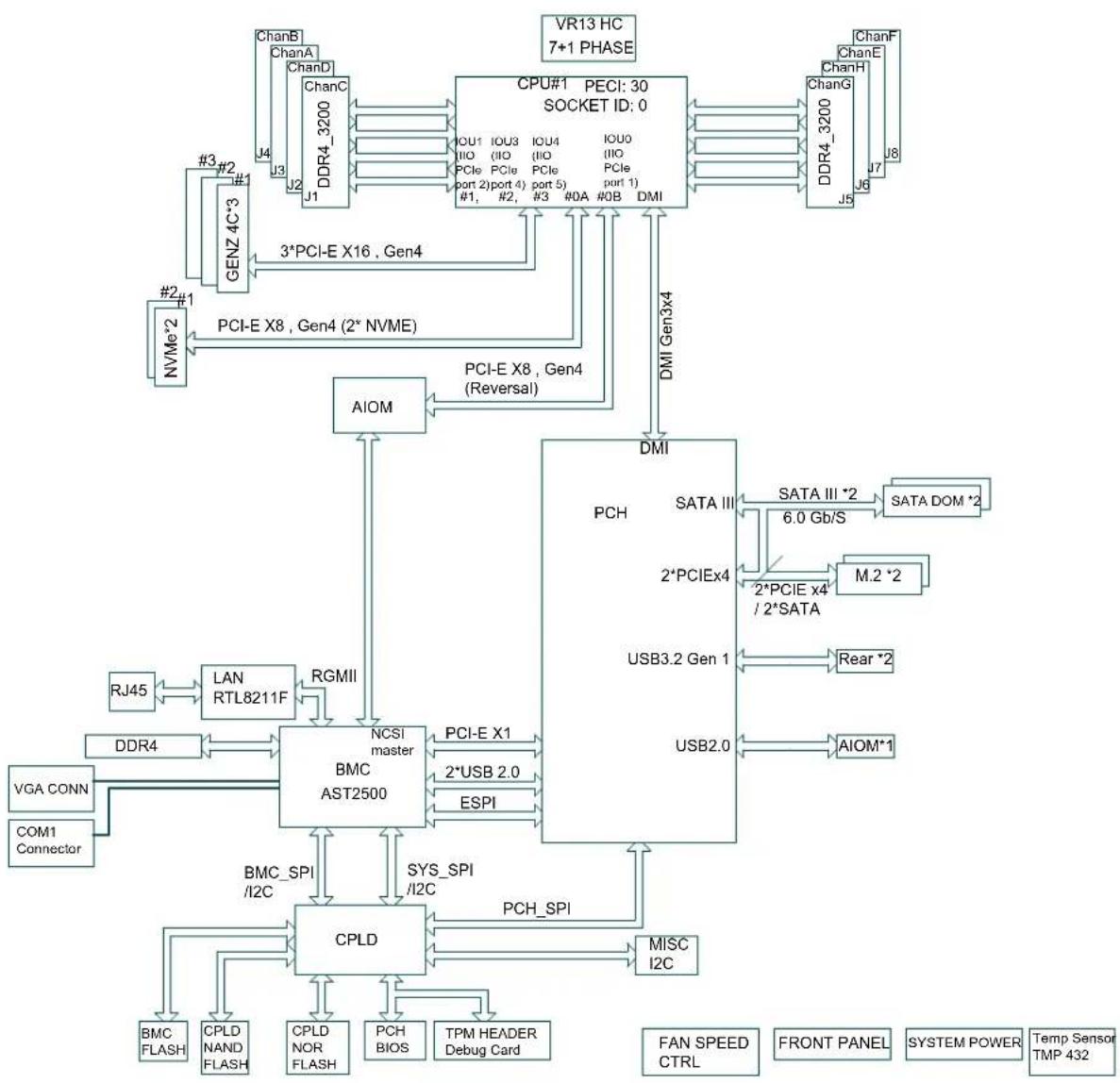
Figure 1-3. System Block Diagram
flowchart
graph TD
    subgraph_CPU_1_PECI["CPU#1 PECI: 30 SOCKET ID: 0"]
        A["VR13 HC 7+1 PHASE"] --> B["ChanB"]
        A --> C["ChanA"]
        A --> D["ChanD"]
        A --> E["ChanC"]
        A --> F["DDR4_3200"]
        A --> G["J4"]
        A --> H["J3"]
        A --> I["J2"]
        A --> J["J1"]
        A --> K["3*PCI-E X16, Gen4"]
        K --> L["NVMe*2"]
        K --> M["PCI-E X8, Gen4 (2* NVME)"]
        M --> N["PCI-E X8, Gen4 (Reversal)"]
        N --> O["PCI-E X8, Gen4 (Reversal)"]
        O --> P["PCI-E X8, Gen4 (Reversal)"]
        P --> Q["PCI-E X8, Gen4 (Reversal)"]
        Q --> R["PCI-E X8, Gen4 (Reversal)"]
        R --> S["PCI-E X8, Gen4 (Reversal)"]
        S --> T["PCI-E X8, Gen4 (Reversal)"]
        T --> U["PCI-E X8, Gen4 (Reversal)"]
        U --> V["PCI-E X8, Gen4 (Reversal)"]
        V --> W["PCI-E X8, Gen4 (Reversal)"]
        W --> X["PCI-E X8, Gen4 (Reversal)"]
        X --> Y["PCI-E X8, Gen4 (Reversal)"]
        Y --> Z["PCI-E X8, Gen4 (Reversal)"]
        Z --> AA["PCI-E X8, Gen4 (Reversal)"]
        AA --> AB["PCI-E X8, Gen4 (Reversal)"]
        AB --> AC["PCI-E X8, Gen4 (Reversal)"]
        AC --> AD["PCI-E X8, Gen4 (Reversal)"]
        AD --> AE["PCI-E X8, Gen4 (Reversal)"]
        AE --> AF["PCI-E X8, Gen4 (Reversal)"]
        AF --> AG["PCI-E X8, Gen4 (Reversal)"]
        AG --> AH["PCI-E X8, Gen4 (Reversal)"]
        AH --> AI["PCI-E X8, Gen4 (Reversal)"]
        AI --> AJ["PCI-E X8, Gen4 (Reversal)"]
        AJ --> AK["PCI-E X8, Gen4 (Reversal)"]
        AK --> AL["PCI-E X8, Gen4 (Reversal)"]
        AL --> AM["PCI-E X8, Gen4 (Reversal)"]
        AM --> AN["PCI-E X8, Gen4 (Reversal)"]
        AN --> AO["PCI-E X8, Gen4 (Reversal)"]
        AO --> AP["PCI-E X8, Gen4 (Reversal)"]
        AP --> AQ["PCI-E X8, Gen4 (Reversal)"]
        AQ --> AR["PCI-E X8, Gen4 (Reversal)"]
        AR --> AS["PCI-E X8, Gen4 (Reversal)"]
        AS --> AT["PCI-E X8, Gen4 (Reversal)"]
        AT --> AU["PCI-E X8, Gen4 (Reversal)"]
        AU --> AV["PCI-E X8, Gen4 (Reversal)"]
        AV --> AW["PCI-E X8, Gen4 (Reversal)"]
        AW --> AX["PCI-E X8, Gen4 (Reversal)"]
        AX --> AY["PCI-E X8, Gen4 (Reversal)"]
        AY --> AZ["PCI-E X8, Gen4 (Reversal)"]
        AZ --> BA["PCI-E X8, Gen4 (Reversal)"]
        BA --> BB["PCI-E X8, Gen4 (Reversal)"]
        BB --> BC["PCI-E X8, Gen4 (Reversal)"]
        BC --> BD["PCI-E X8, Gen4 (Reversal)"]
        BD --> BE["PCI-E X8, Gen4 (Reversal)"]
        BE --> BF["PCI-E X8, Gen4 (Reversal)"]
        BF --> BG["PCI-E X8, Gen4 (Reversal)"]
        BG --> BH["PCI-E X8, Gen4 (Reversal)"]
        BH --> BI["PCI-E X8, Gen4 (Reversal)"]
        BI --> BJ["PCI-E X8, Gen4 (Reversal)"]
        BJ --> BK["PCI-E X8, Gen4 (Reversal)"]
        BK --> BL["PCI-E X8, Gen4 (Reversal)"]
        BL --> BM["PCI-E X8, Gen4 (Reversal)"]
        BM --> BN["PCI-E X8, Gen4 (Reversal)"]
        BN --> BO["PCI-E X8, Gen4 (Reversal)"]
        BO --> BP["PCI-E X8, Gen4 (Reversal)"]
        BP --> BQ["PCI-E X8, Gen4 (Reversal)"]
        BQ --> BR["PCI-E X8, Gen4 (Reversal)"]
        BR --> BS["PCI-E X8, Gen4 (Reversal)"]
        BS --> BT["PCI-E X8, Gen4 (Reversal)"]
        BT --> BU["PCI-E X8, Gen4 (Reversal)"]
        BU --> BV["PCI-E X8, Gen4 (Reversal)"]
        BV --> BW["PCI-E X8, Gen4 (Reversal)"]
        BW --> BX["PCI-E X8, Gen4 (Reversal)"]
        BX --> BY["PCI-E X8, Gen4 (Reversal)"]
        BY --> BZ["PCI-E X8, Gen4 (Reversal)"]
        BZ --> CA["PCI-E X8, Gen4 (Reversal)"]
        CA --> CB["PCI-E X8, Gen4 (Reversal)"]
        CB --> CC["PCI-E X8, Gen4 (Reversal)"]
        CC --> CD["PCI-E X8, Gen4 (Reversal)"]
        CD --> CE["PCI-E X8, Gen4 (Reversal)"]
        CE --> CF["PCI-E X8, Gen4 (Reversal)"]
        CF --> CG["PCI-E X8, Gen4 (Reversal)"]
        CG --> CH["PCI-E X8, Gen4 (Reversal)"]
        CH --> CI["PCI-E X8, Gen4 (Reversal)"]
        CI --> CJ["PCI-E X8, Gen4 (Reversal)"]
        CJ --> CK["PCI-E X8, Gen4 (Reversal)"]
        CK --> CL["PCI-E X8, Gen4 (Reversal)"]
        CL --> CM["PCI-E X8, Gen4 (Reversal)"]
        CM --> CN["VGA CONN"]
        CN --> CO["VGA CONNECTOR"]
        CO --> CP["COM1 Connector"]
    end

    subgraph Control_Serial
    direction TB
    A
    B
    C
    D
    E
    F
    G
    H
    I
    J
    K
    L
    M
    N
    O
    P
    Q
    R
    S
    T
    U
    V
    W
    X
    Y
    Z
    AA
    AB
    AC
    AD
    AE
    AF
    AG
    AH
    AI
    AJ
    AK
    AL
    AM
    AN
    AO
    AP
    AQ
    AR
    AS
    AT
    AU
    AV
    AW
    AX
    AY
    AZ
    BA
    BB
    BC
    BD
    BE
    BF
    BG
    BH
    BI
    BJ
    BK
    BL
    BM
    BN
    BO
    BP
    BP
    BP
    BP
    BP
    BP
    BP
    BP
    BP
    BP
    BP
    BP
    BP
    BP
    BP
    BP
    BP
    BP
    BP
    BP
    BP
    BP
    BP
    BP
    BP
    BP
    BP
    BP
    BP
    BP
    BP
    BP
    BP
    BP

Note: This is a general block diagram and may not exactly represent the features on your motherboard. See the previous pages for the actual specifications of your motherboard.
1.2 Processor and Chipset Overview
Built upon the functionality and capability of the 3rd Generation Intel Xeon Scalable Processor and the Intel C621A chipset, the X12SPG-NF motherboard provides system performance, power efficiency, and feature sets to address the needs of next-generation computer users.
The X12SPG-NF dramatically increases system performance for a multitude of server applications and supports:
- 2TB ECC RDIMM/LRDIMM and RDIMM/LRDIMM 3DS DDR4 memory with speeds of up to 3200MHz
• SATA 3.0, USB 3.2 Gen 1
• Support for Management Engine (ME)
• Support of SMBus speeds of up to 400KHz for BMC connectivity
• Intel Rapid Storage Technology Enterprise
• Intel Virtualization Technology for Directed I/O (VT-d) - SPI Enhancements
- Intel Node Manager for advanced power monitoring, capping and management for BMC enhancement (see note below)
- BMC supports remote management, virtualization, and the security package for enterprise platforms

Note: Node Manager support depends on the power supply used in your system.
1.3 Special Features
Recovery from AC Power Loss
The Basic I/O System (BIOS) provides a setting that determines how the system will respond when AC power is lost and then restored to the system. You can choose for the system to remain powered off (in which case you must press the power switch to turn it back on), or for it to automatically return to the power-on state. See the Advanced BIOS Setup section for this setting. The default setting is Last State.
1.4 System Health Monitoring
Onboard Voltage Monitors
An onboard voltage monitor will scan the voltages of the onboard chipset, memory, CPU, and battery continuously. Once a voltage becomes unstable, a warning is given, or an error message is sent to the screen. The user can adjust the voltage thresholds to define the sensitivity of the voltage monitor.
Fan Status Monitor with Firmware Control
The system health monitor embedded in the BMC chip can check the RPM status of the cooling fans. The CPU and chassis fans are controlled via IPMI.
Environmental Temperature Control
System Health sensors monitor temperatures and voltage settings of onboard processors and the system in real time via the IPMI interface. Whenever the temperature of the CPU or the system exceeds a user-defined threshold, system/CPU cooling fans will be turned on to prevent the CPU or the system from overheating.

Note: To avoid possible system overheating, provide adequate airflow to your system.
System Resource Alert
This feature is available when used with SuperDoctor 5 ^® in the Windows OS or in the Linux environment. SuperDoctor is used to notify the user of certain system events. For example, you can configure SuperDoctor to provide you with warnings when the system temperature, CPU temperatures, voltages and fan speeds go beyond a predefined range.
1.5 ACPI Features
The Advanced Configuration and Power Interface (ACPI) specification defines a flexible and abstract hardware interface that provides a standard way to integrate power management features throughout a computer system, including its hardware, operating system and application software. This enables the system to automatically turn on and off peripherals such as CD-ROMs, network cards, hard disk drives and printers.
In addition to enabling operating system-directed power management, ACPI also provides a generic system event mechanism for Plug and Play, and an operating system-independent interface for configuration control. ACPI leverages the Plug and Play BIOS data structures, while providing a processor architecture-independent implementation that is compatible with appropriate Windows operating systems. For detailed information regarding OS support, refer to the Supermicro website.
1.6 Power Supply
As with all computer products, a stable power source is necessary for proper and reliable operation. It is even more important for processors that have high CPU clock rates where noisy power transmission is present.
1.7 Serial Port
The X12SPG-NF motherboard supports one serial communication connection. COM1 can be used for input/output. The UART provides legacy speeds with a baud rate of up to 115.2 Kbps as well as an advanced speed with baud rates of 250 K, 500 K, or 1 Mb/s, which support high-speed serial communication devices.
Chapter 2
Installation
2.1 Static-Sensitive Devices
Electrostatic Discharge (ESD) can damage electronic components. To avoid damaging your system board, it is important to handle it very carefully. The following measures are generally sufficient to protect your equipment from ESD.
Precautions
- Use a grounded wrist strap designed to prevent static discharge.
- Touch a grounded metal object before removing the board from the antistatic bag.
- Handle the motherboard by its edges only; do not touch its components, peripheral chips, memory modules or gold contacts.
- When handling chips or modules, avoid touching their pins.
- Put the motherboard and peripherals back into their antistatic bags when not in use.
- For grounding purposes, make sure that your computer chassis provides excellent conductivity between the power supply, the case, the mounting fasteners and the motherboard.
- Use only the correct type of onboard CMOS battery. Do not install the onboard battery upside down to avoid possible explosion.
Unpacking
The motherboard is shipped in antistatic packaging to avoid static damage. When unpacking the motherboard, make sure that the person handling it is static protected.
2.2 Processor and Heatsink Installation
The processor (CPU) and processor carrier should be assembled together first to form the processor carrier assembly. This will be attached to the heatsink to form the processor heatsink module (PHM) before being installed onto the CPU socket.
Notes:
- Use ESD protection.
- Unplug the AC power cord from all power supplies after shutting down the system.
- Check that the plastic protective cover is on the CPU socket and none of the socket pins are bent. If they are, contact your retailer.
- When handling the processor, avoid touching or placing direct pressure on the LGA lands (gold contacts). Improper installation or socket misalignment can cause serious damage to the processor or CPU socket, which may require manufacturer repairs.
- Thermal grease is pre-applied on a new heatsink. No additional thermal grease is needed.
• Refer to the Supermicro website for updates on processor support. - All graphics in this manual are for illustrations only. Your components may look different.
The 3rd Generation Intel Xeon Scalable Processor
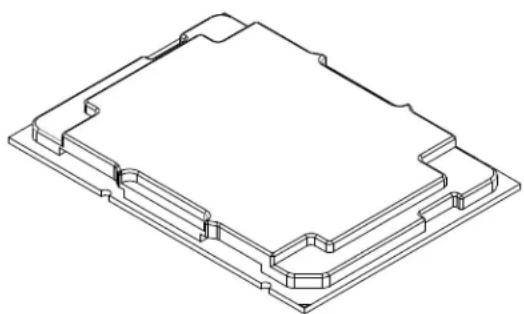
natural_image
Isometric line drawing of a rectangular electronic component or housing (no text or symbols)3rd Generation Intel Xeon Scalable Processor
Overview of the Processor Carrier Assembly
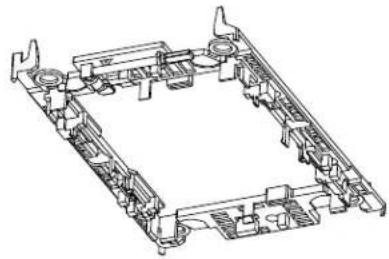
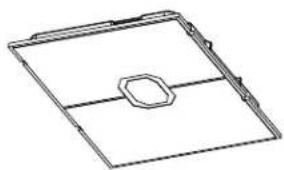
The processor carrier assembly contains the 3rd Generation Intel Xeon Scalable Processor and a processor carrier.
-
Processor
-
Processor Carrier
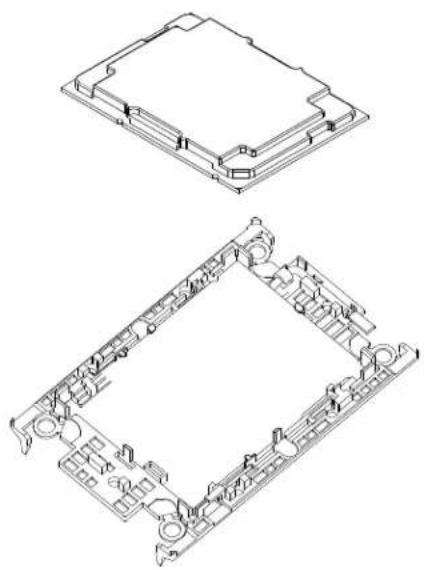
natural_image
Technical line drawings of a mechanical or electronic component assembly (no text or symbols)Overview of the CPU Socket
The CPU socket is protected by a plastic protective cover.
- Plastic Protective Cover

natural_image
Technical line drawing of a mechanical component with mounting brackets and a central square (no text or symbols)- CPU Socket

natural_image
Technical line drawing of a mechanical housing or enclosure with multiple cylindrical components and mounting holes (no text or symbols)Overview of the Processor Heatsink Module
The Processor Heatsink Module (PHM) contains a heatsink, a processor carrier, and the processor.
- Heatsink with Thermal Grease
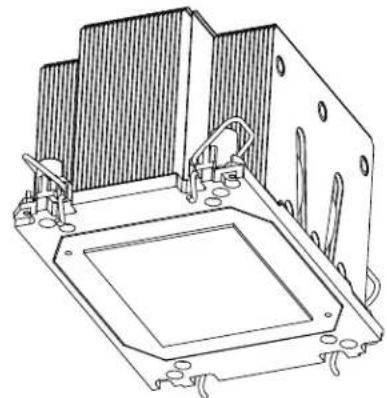
natural_image
Technical line drawing of a mechanical component with mounting holes and internal structure (no text or symbols)- Processor Carrier
natural_image
Technical line drawing of a mechanical assembly with no visible text or symbols- Processor
natural_image
Pure technical line drawing of a mechanical component or bracket (no text or symbols)Processor Heatsink Module


natural_image
Technical line drawing of a computer motherboard with cooling fins and mounting hardware (no text or symbols)Creating the 3rd Generation Intel Xeon Scalable Processor Carrier Assembly
To install the processor into the processor carrier, follow the steps below:
-
Hold the processor with the LGA lands (gold contacts) facing up. Locate the small, gold triangle in the corner of the processor and the corresponding hollowed triangle on the processor carrier. These triangles indicate pin 1. The triangles can be found on the top and bottom of the processor. See the images below.
-
Using the triangles as a guide, carefully align and place Point A of the processor into the carrier. Then gently snap in the other side of the carrier for the processor to fasten into Point B.

Note: The 3rd Generation Intel Xeon Scalable Processor carrier contains four metal rings on each corner.
- Examine all corners to ensure that the processor is firmly attached to the carrier.

text_image
Pin 1 A B Allow carrier to fasten onto CPU Allow carrier to fasten onto CPU Allow carrier to fasten onto CPUProcessor Carrier Assembly

Note: The following CPU carriers have been successfully tested in our labs and are available from Supermicro. Please order the CPU carriers with the CPU heatsink.
| Intel 3rd Generation Xeon Scalable Processors | SKT-1205L-P4IC-FXC |
| SKT-1205L-P4IC-TYC |
Assembling the Processor Heatsink Module
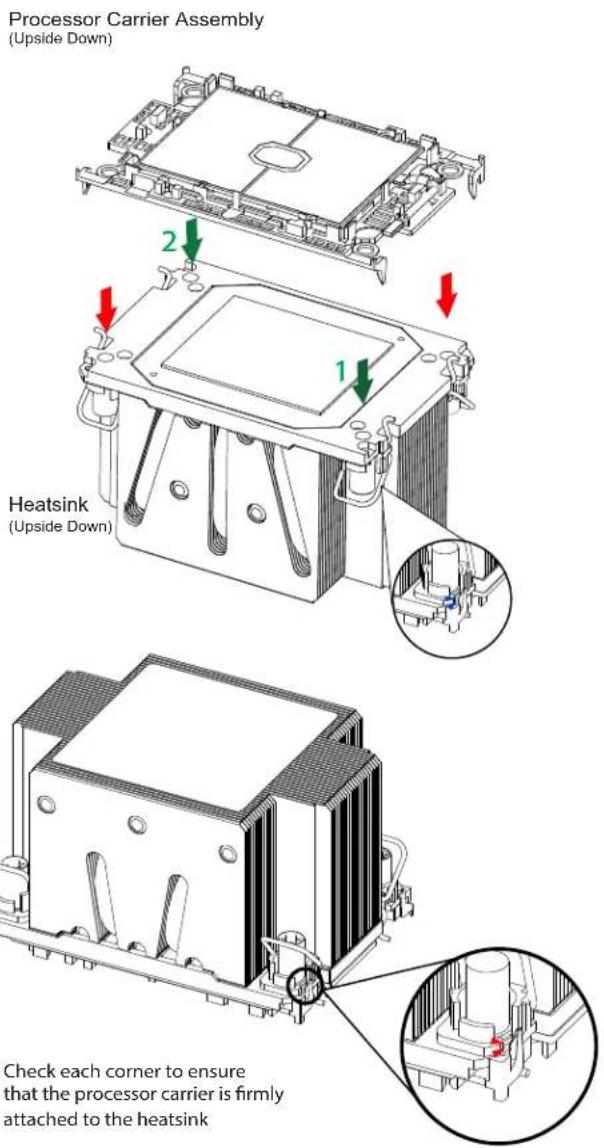
After creating the processor carrier assembly for the processor, mount it onto the heatsink to create the processor heatsink module (PHM):
- Note the label on top of the heatsink, which marks the heatsink mounting holes as 1, 2, 3, and 4. If this is a new heatsink, the thermal grease has been pre-applied on the underside. Otherwise, apply the proper amount of thermal grease.
- Turn the heatsink over with the thermal grease facing up. Hold the processor carrier assembly so the processor's gold contacts are facing up, then align the triangle on the assembly with hole 1 of the heatsink. Press the processor carrier assembly down. The plastic clips of the assembly will lock outside of holes 1 and 2, while the remaining clips will snap into their corresponding holes.
- Examine all corners to ensure that the plastic clips on the processor carrier assembly are firmly attached to the heatsink.
text_image
Processor Carrier Assembly (Upside Down) Heatsink (Upside Down) Check each corner to ensure that the processor carrier is firmly attached to the heatsinkPreparing the CPU Socket for Installation
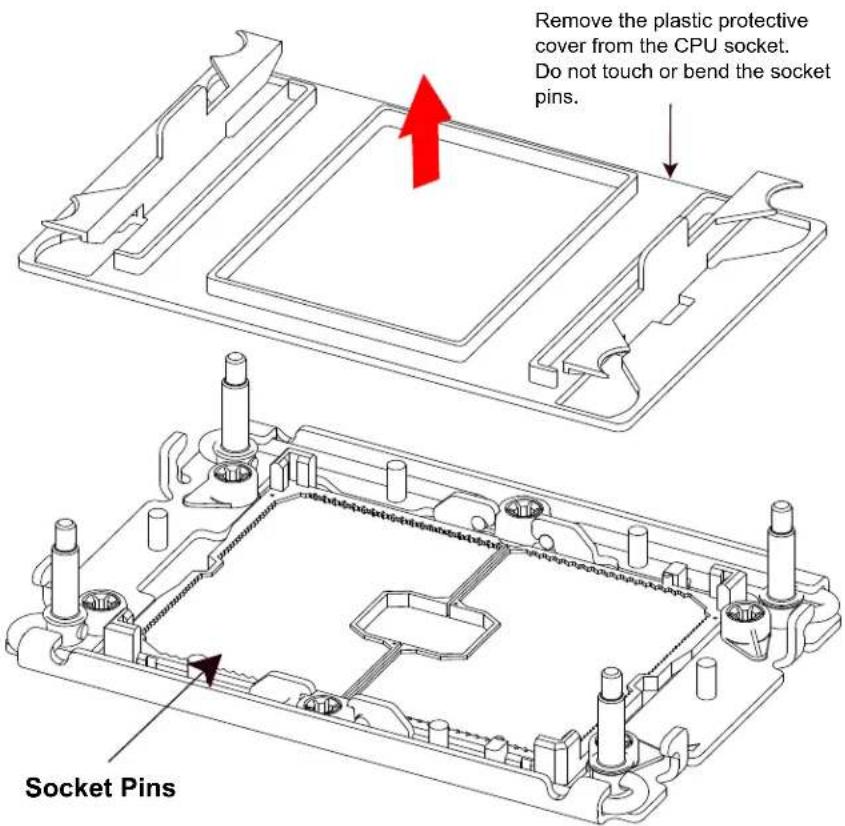
This motherboard comes with a plastic protective cover installed on the CPU socket. Remove it from the socket to install the Processor Heatsink Module (PHM). Gently pull up one corner of the plastic protective cover to remove it.

natural_image
Technical line drawing of a mechanical component with mounting brackets and internal features (no text or symbols)CPU Socket with Plastic Protective Cover
text_image
Remove the plastic protective cover from the CPU socket. Do not touch or bend the socket pins. Socket PinsInstalling the Processor Heatsink Module
After assembling the Processor Heatsink Module (PHM), install it onto the CPU socket:
- Align hole 1 of the heatsink with the printed triangle on the CPU socket. See the left image below.
- Make sure all four holes of the heatsink are aligned with the socket before gently placing the heatsink on top.
- With a T30 Torx-bit screwdriver, gradually tighten screws #1 - #4 to ensure even pressure. The order of the screws is shown on the label on top of the heatsink. To avoid damaging the processor or socket, do not use a force greater than 12 lbf-in when tightening the screws.
- Examine all corners to ensure that the PHM is firmly attached to the socket.
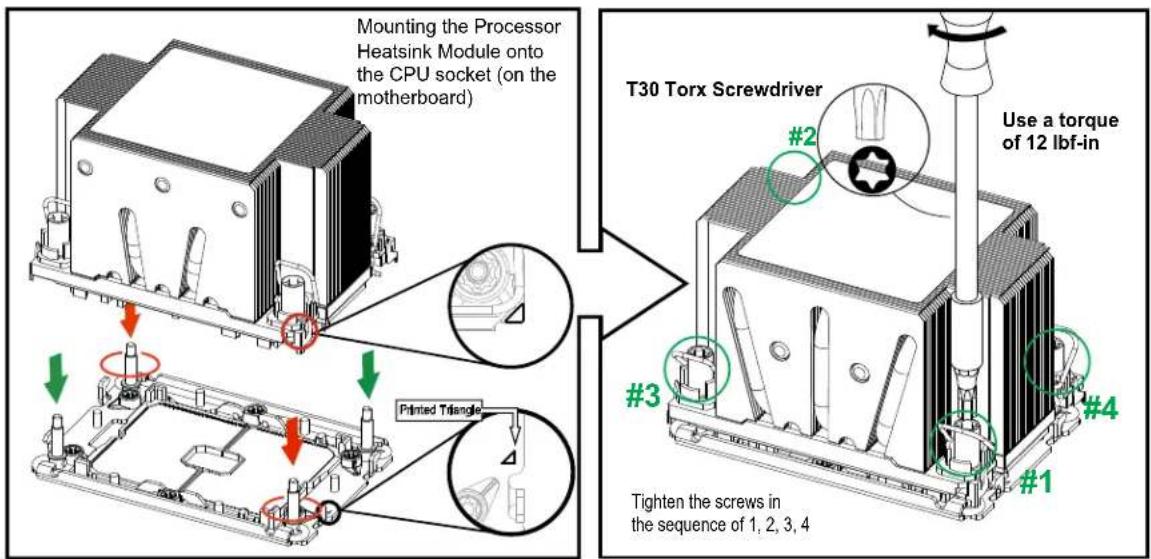
text_image
Mounting the Processor Heatsink Module onto the CPU socket (on the motherboard) Printed Triangle T30 Torx Screwdriver Use a torque of 12 lbf-in #1 #2 #3 #4 Tighten the screws in the sequence of 1, 2, 3, 4Removing the Processor Heatsink Module
Before removing the processor heatsink module (PHM) from the motherboard, shut down the system and then unplug the AC power cord from all power supplies.
Then follow the steps below:
- Use a T30 Torx-bit screwdriver to loosen the four screws in a backwards sequence of #4, #3, #2, and #1.
- Gently lift the PHM upwards to remove it from the socket.
- Move the lever to its unlocked position and gently remove the CPU.

text_image
Remove the screws in the sequence of 4, 3, 2, 1 #2 #3 #1 #4
text_image
CPU Socket
text_image
Move the lever to its unlocked position and gently remove the CPU.2.3 Motherboard Installation
All motherboards have standard mounting holes to fit different types of chassis. Make sure that the locations of all the mounting holes for both the motherboard and the chassis match. Although a chassis may have both plastic and metal mounting fasteners, metal ones are highly recommended because they ground the motherboard to the chassis. Make sure that the metal standoffs click in or are screwed in tightly.
Tools Needed

text_image
Phillips Screwdriver (1) Phillips Screws (10) Standoffs (10) Only if Needed X128PG-AF SUPER TOP 12 TOP 12 TOP 12 TOP 12 TOP 12 TOP 12 TOP 12 TOP 12 TOP 12 TOP 12 TOP 12 TOP 12 TOP 12 TOP 12 TOP 12 TOP 12 TOP 12 TOP 12 TOP 12 TOP 12 TOP 10 TOP 10 TOP 10 TOP 10 TOP 10 TOP 10 TOP 10 TOP 10 TOP 10 TOP 10 TOP 10 TOP 10 TOP 10 TOP 10 TOP 10 TOP 10 TOP 10 TOP 10 TOP 10 TOP 10 TOP 15 TOP 15 TOP 15 TOP 15 TOP 15 TOP 15 TOP 15 TOP 15 TOP 15 TOP 15 TOP 15 TOP 15 TOP 15 TOP 15 TOP 15 TOP 15 TOP 15 TOP 15 TOP 15 TOP 15 TOP 10 TOP 10 TOP 10 TOP 10 TOP 10 TOP 10 TOP 10 TOP 10 TOP 10 TOP 10 TOP 10 TOP 10 TOP 10 TOP 10 TOP 10 TOP 10 TOP 10 TOP 10 TOP 10 TOP 12 TOP 12 TOP 12 TOP 12 TOP 12 TOP 12 TOP 12 TOP 12 TOP 12 TOP 12 TOP 12 TOP 12 TOP 12 TOP 12 TOP 12 TOP 12 TOP 12 TOP 12 TOP 12Location of Mounting Holes

Note 1: To avoid damaging the motherboard and its components, do not use a force greater than 8 lbf-in on each mounting screw during motherboard installation.

Note 2: Some components are very close to the mounting holes. Take precautionary measures to avoid damaging these components when installing the motherboard to the chassis.
Installing the Motherboard
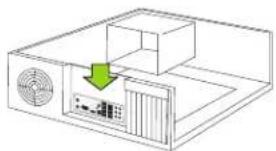
- Install the I/O shield into the back of the chassis, if applicable.
natural_image
Diagram of a computer setup with a monitor, ventilation unit, and a green arrow indicating a download or transfer (no text or symbols present)- Locate the mounting holes on the motherboard. See the previous page for the location.

text_image
Chassis Chassis- Locate the matching mounting holes on the chassis. Align the mounting holes on the motherboard against the mounting holes on the chassis.
text_image
3x5 Motherboard Chassis 3x5 Motherboard Chassis-
Install standoffs in the chassis as needed.
-
Install the motherboard into the chassis carefully to avoid damaging other motherboard components.
-
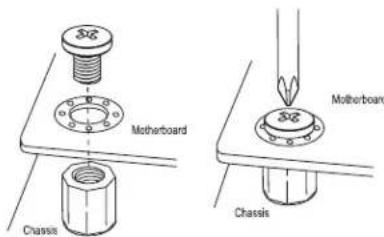
Using the Phillips screwdriver, insert a pan head #6 screw into a mounting hole on the motherboard and its matching mounting hole on the chassis.
-
Repeat Step 6 to insert #6 screws into all mounting holes.
-
Make sure that the motherboard is securely placed in the chassis.

Note: Images displayed are for illustration only. Your chassis or components might look different from those shown in this manual.
2.4 Memory Support and Installation

Note: Check the Supermicro website for recommended memory modules.

Important: Exercise extreme care when installing or removing DIMM modules to prevent any possible damage.
Memory Support
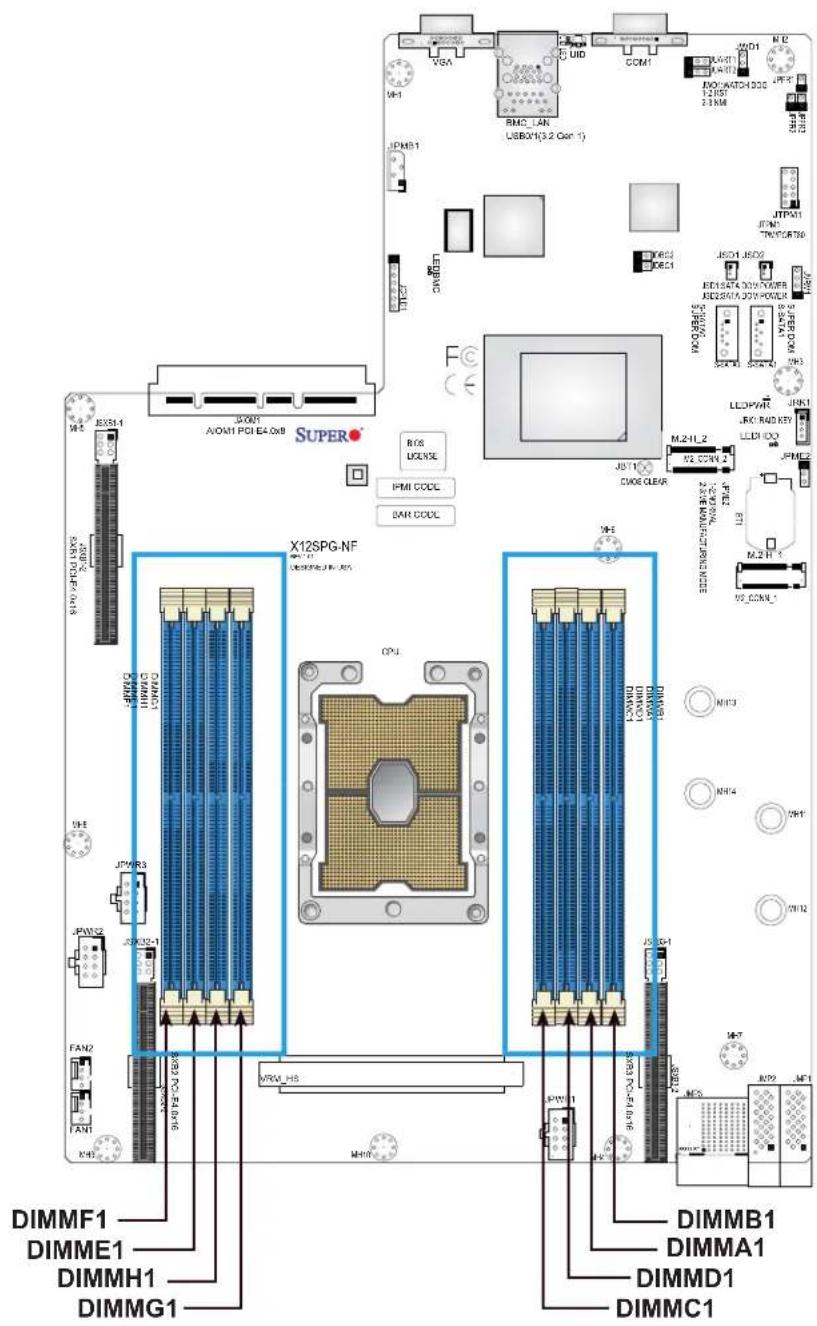
The X12SPG-NF supports up to 2TB of ECC RDIMM/LRDIMM and RDIMM/LRDIMM 3DS DDR4 memory with speeds of up to 3200MHz in eight memory slots. Refer to the table below for the recommended DIMM population order.
| 1 CPU, 8 DIMM Slots | |
| Number of DIMMs Memory | Population Sequence |
| 1 DIMMA1 | |
| 2 DIMMA1 / DIMME1 | |
| 4 DIMMA1 / DIMME1 | 1 / DIMMC1 / DIMMG1 |
| 6 DIMMA1 / DIMME1 | 1 / DIMMC1 / DIMMG1 / DIMMB1 / DIMMF1 |
| 8 DIMMC1 / DIMMD1 | 1 / DIMMA1 / DIMMB1 / DIMMG1 / DIMMH1 / DIMME1 / DIMMF1 |
DDR4 Memory Support
| Type | Ranks Per DIMM and Data Width | DIMM Capacity (GB) | Speed (MT/s); Voltage (V); Slot Per Channel (SPC) and DIMM Per Channel (DPC)*Data below assumes 2 SPC unless otherwise noted. | |
| 1DPC | ||||
| 8 GB 16 GB 1.2V | ||||
| RDIMM | SRx8 8 GB 16 GB | 3200 | ||
| SRx4 16 GB 32 GB | ||||
| DRx8 16 GB 32 GB | ||||
| DRx4 32GB 64 GB | ||||
| RDIMM-3DS | (4R/8R) x4 | 2H-64F GB4H-128 GB | 2H-128 GB4H 256 GB | 3200 |
| LRDIMM | QRx4 | 64 GB | 128 GB | 3200 |
| LRDIMM-3DS | (4R/8R) X4 | 4H-128 GB | 2H-128 GB4H-256 GB | 3200 |
General Guidelines for Optimizing Memory Performance
- It is recommended to use DDR4 memory of the same type, size, and speed.
- Mixed DIMM speeds can be installed. However, all DIMMs will run at the speed of the slowest DIMM.
- The motherboard will support odd-numbered modules (one or three modules installed). However, to achieve the best memory performance, a balanced memory population is recommended.
text_image
Technical diagram of a computer motherboard with labeled components and connections, including CPU, memory, and peripheral modules.DIMM Installation
- Insert DIMM modules in the following order: DIMMC1, DIMMD1, DIMMA1, DIMMB1, DIMMG1, DIMMH1, DIMME1, DIMMF1, and insert the desired number of DIMMs into the memory slots based on the Recommended Memory Population Guide table on page 32.
- Push the release tabs outwards on both ends of the DIMM slot to unlock it.
- Align the key of the DIMM module with the receptive point on the memory slot.
- Align the notches on both ends of the module against the receptive points on the ends of the slot.
- Push both ends of the module straight down into the slot until the module snaps into place.
- Press the release tabs to the lock positions to secure the DIMM module into the slot.
DIMM Removal
Press both release tabs on the ends of the DIMM module to unlock it. Once the DIMM module is loosened, remove it from the memory slot.

text_image
Technical diagram of a computer motherboard with labeled components and a close-up view of the internal structure.
text_image
Notches Release Tabs
text_image
Push both ends straight down into the memory slot2.5 Rear I/O Ports
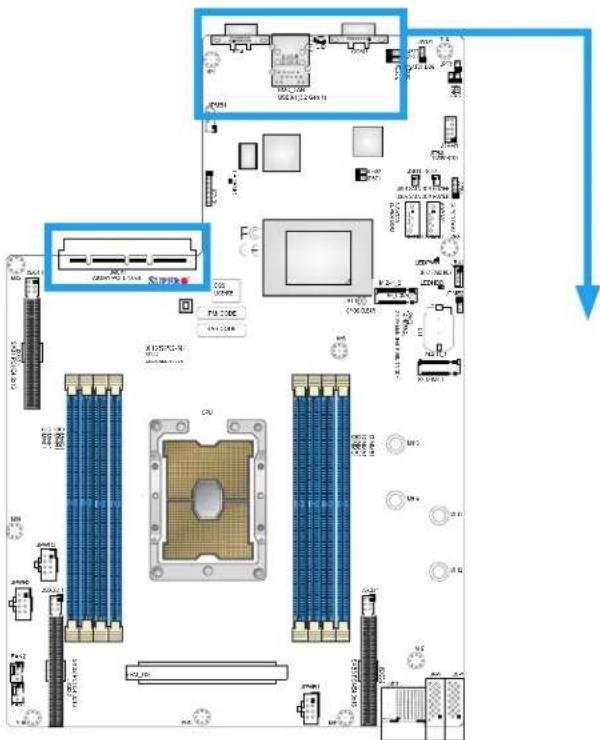
See Figure 2-1 below for the locations and descriptions of the various I/O ports on the rear of the motherboard.
text_image
Circuit board layout diagram with labeled components and connectors, including CPU, memory, and peripheral modulesFigure 2-1. I/O Port Locations and Definitions

text_image
Diagram showing labeled components of a computer interface, including VGA, Ethernet, and Ethernet ports with numbered labels.| Rear I/O Ports | |||
| # Description # Description | |||
| 1 COM1 5 USB1 | |||
| 2 UID Switch 6 VGA Port | |||
| 3 Dedicated BMC_LAN 7 AIOM | |||
| 4 USB2 | |||
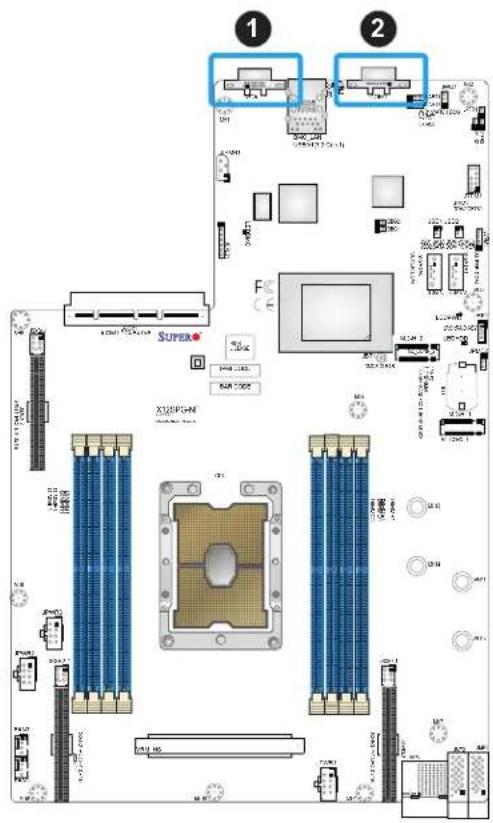
VGA Port
A video (VGA) port is located on the I/O back panel. Refer to the board layout below for the location.
COM Port
There is one COM connection on this motherboard. COM1 is located on the I/O back panel.
| COM PortPin Definitions | |||
| Pin# Definition Pin# Definition | |||
| 1 DCD | 6 DSR | ||
| 2 RXD | 7 RTS | ||
| 3 TXD | 8 CTS | ||
| 4 DTR | 9 RI | ||
| 5 Ground | 10 N/A | ||
text_image
Diagram of a computer motherboard layout with labeled components and connectors, including CPU socket, memory chips, and indicator lights.- VGA Port
- COM Port
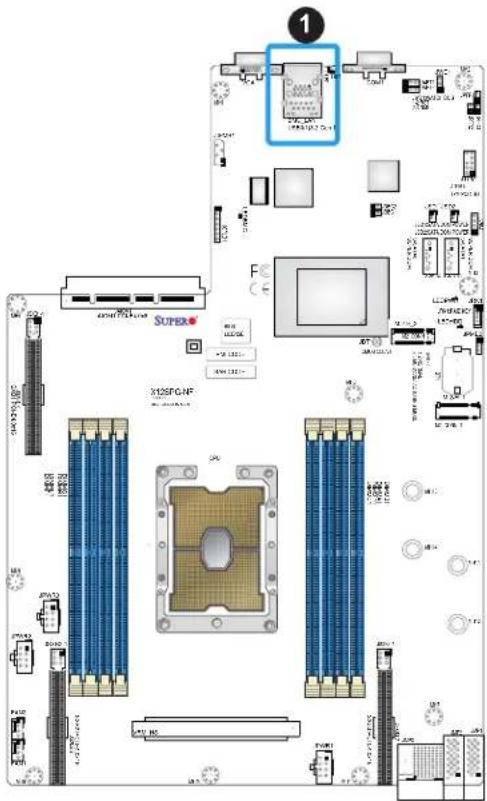
BMC LAN Port
The motherboard has one dedicated BMC LAN port located above the USB1/2 ports. The port accepts RJ45 cables. Refer to the LED Indicator section for LAN LED information.
| BMC LANPin Definitions | ||
| Pin# Definition Pin# Definition | ||
| 9 19 GND | ||
| 10 TD0+ 20 | Act LED(Yellow) | |
| 11 TD0- 21 | Link 100 LED(Green) | |
| 12 TD1+ 22 | Link 1000LED (Amber) | |
| 13 TD1- 23 SGND | ||
| 14 TD2+ 24 SGND | ||
| 15 TD2- 25 SGND | ||
| 16 TD3+ 26 SGND | ||
| 17 TD3- | ||
| 18 GND | ||

text_image
Circuit board layout diagram with labeled components and connectors, including CPU socket, memory chips, and power supply connections.- BMC LAN
Universal Serial Bus (USB) Ports
There are two USB 3.2 Gen 1 ports (USB1/2) on the I/O back panel.
| Back Panel USB 1/2 (3.2 Gen 1)Pin Definitions | |||
| Pin# Definition Pin# Definition | |||
| A1 VBUS B1 Power | |||
| A2 D-B2 USB_N | |||
| A3 D+B3 USB_P | |||
| A4 GND B4 GND | |||
| A5 Stda_SSRX-B5 USB3_RN | |||
| A6 Stda_SSRX+B6 USB3_RP | |||
| A7 GND B7 GND | |||
| A8 Stda_SSTX-B8 USB3_TN | |||
| A9 Stda_SSTX+B9 USB3_TP | |||
text_image
Exploded view diagram of a computer motherboard with labeled components and connectors- USB1/2
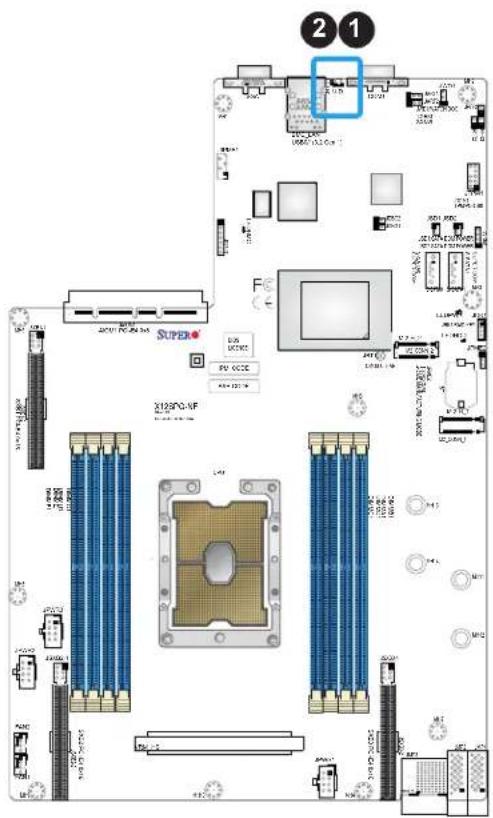
Unit Identifier Switch (UID-SW): One button with two functions
A Unit Identifier (UID) switch and two LED Indicators are located on the motherboard. The UID switch is located next to the VGA port on the back panel.
| Function User Input Behavior LED Activity | |||
| UID LED Indicator | Push Once Turns on the UID LED UID LED turns solid blue | ||
| Push Again Turns off the UID LED UID LED turns off | |||
| BMC Reset | Push and hold for 6 seconds | BMC will do a cold boot | BMC Hearbeat LED turns solid green |
| Push and hold for 12 seconds | BMC will reset to factory default | BMC Hearbeat LED turns solid green | |

Note: After pushing and holding the UID-SW for 12 seconds, all BMC settings including username and password will revert back to the factory default. Only the network settings and FRU are retained.
| UID SwitchPin Definitions |
| Pin# Definition |
| 1 Button In |
| 2 Ground |
| 3 Ground |
| G1 Ground |
| G2 Ground |
| UID LEDPin Definitions |
| Color StatusBlue: On Unit Identified |
text_image
Diagram of a computer motherboard layout with labeled components and connectors, including CPU socket, memory chips, and CPU interface.- UID Switch
- UIDLED
2.6 Connectors
Power Connections
Main Power and GPU Power Connectors
JPWR1 is the 8-pin power connector used to provide power to the motherboard while the 8-pin GPU power connectors JPWR2 and JPWR3 can be connected to power the GPU card. These power connectors meet the SSI EPS 12V specification. See the tables below for pin definitions.
| Main Power Connector(JMP1)Pin Definitions |
| Pin# Definition |
| 1-24 +12V |
| Main Power Connector(JMP2)Pin Definitions |
| Pin# Definition |
| 1-24 GND |
| 8-pin GPU PowerPin Definitions | |
| Pin# | Definition |
| 1-4 | GND |
| 5-8 | 12V |
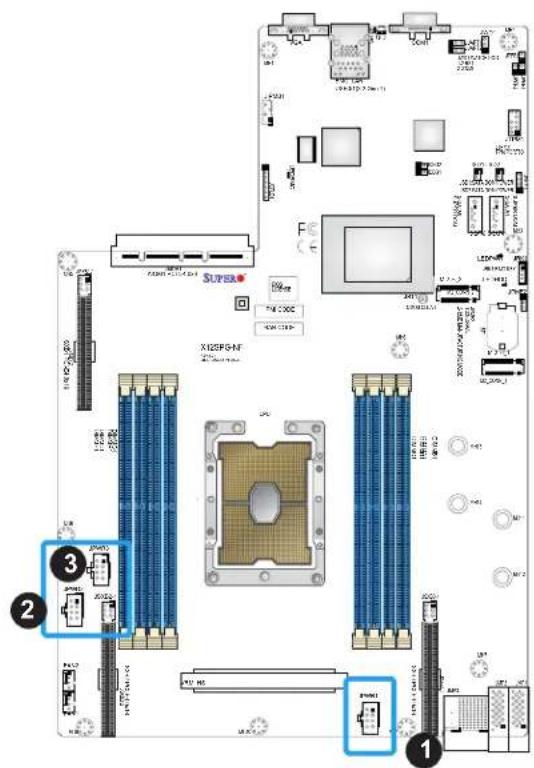
text_image
SUPER X125F0-HF 3 2 1- 8-Pin GPU Power
- 8-Pin GPU Power
- 8-Pin GPU Power
Headers
TPM/Port 80 Header
A Trusted Platform Module (TPM)/Port 80 header is located at JTPM1 to provide TPM support and Port 80 connection. Use this header to enhance system performance and data security. Refer to the table below for pin definitions. Visit the following link for more information on the TPM: http://www.supermicro.com/manuals/other/TPM.pdf.
| Trusted Platform Module Header Pin Definitions | |
| Pin# Definition Pin# Definition | |
| 1 +3.3V 2 SPI_CS# | |
| 3 RESET# 4 SPI_MISO | |
| 5 SPI_CLK 6 GND | |
| 7 SPI_MOSI 8 NC | |
| 9 +3.3V Stdby 10 SPI_IRQ# | |
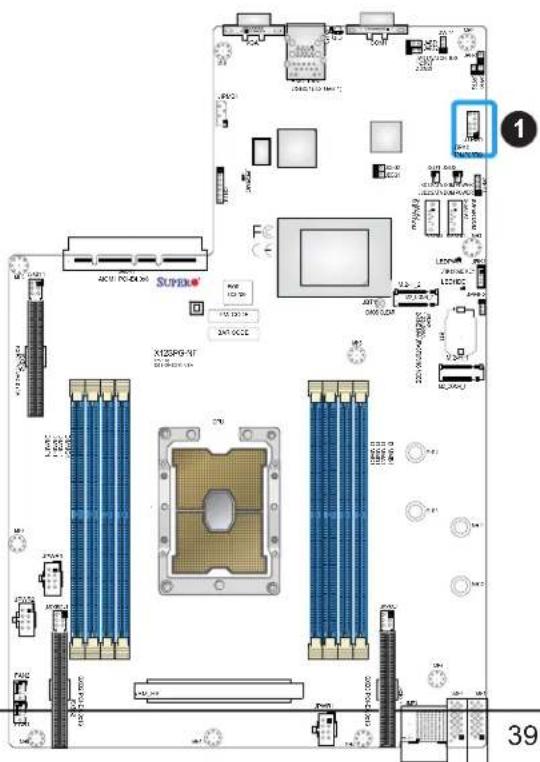
text_image
1 2 39- TPM Header
Intel RAID Key Header
The JRK1 header allows you to enable RAID functions for NVMe connections. Refer to the table below for pin definitions.
| Intel RAID Key HeaderPin Definitions | |
| Pin# Definition | |
| 1 GND | |
| 2 PU 3.3V Stdby | |
| 3 | GND |
| 4 | PCH RAID KEY |

text_image
Circuit board layout diagram with labeled components and connectors, including CPU socket, memory chips, and I/O ports- Intel RAID Key Header
SATA 3.0 Ports
This motherboard has two SATA 3.0 ports (S-SATA0, SATA1). S-SATA0 and S-SATA1 can be used with Supermicro SuperDOM's SATA DOM connectors with power pins built in, and do not require external power cables. Supermicro SuperDOMs are backward compatible with regular SATA HDDs or SATA DOMs that need external power cables.
M.2 Slots
This motherboard has two M.2 slots. M.2 was formerly known as Next Generation Form Factor (NGFF) and serves to replace mini PCIe. M.2 allows for a variety of card sizes, increased functionality, and spatial efficiency. The M.2 slot on the motherboard supports PCIe 3.0 x4 and SATA3 in the 22110 and 2280 form factors.

text_image
Labeled diagram of a computer motherboard showing CPU socket, memory chips, and hardware components with numbered annotations.- S-SATA0
- S-SATA1
- M.2 Slot
- M.2 Slot
2.7 Jumper Settings
How Jumpers Work
To modify the operation of the motherboard, jumpers can be used to choose between optional settings. Jumpers create shorts between two pins to change the function of the connector. Pin 1 is identified with a square solder pad on the printed circuit board. See the diagram below for an example of jumping pins 1 and 2. Refer to the motherboard layout page for jumper locations.

Note: On two-pin jumpers, Closed means the jumper is on and Open means the jumper is off the pins.
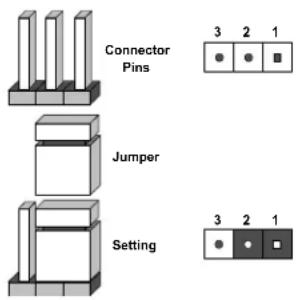
text_image
Connector Pins Jumper Setting 3 2 1 3 2 1CMOS Clear
JBT1 is used to clear CMOS, which will also clear any passwords. Instead of pins, this jumper consists of contact pads to prevent accidentally clearing the contents of CMOS.
To Clear CMOS
- First power down the system and unplug the power cord(s).
- Remove the cover of the chassis to access the motherboard.
- Remove the onboard battery from the motherboard.
- Short the CMOS pads with a metal object such as a small screwdriver for at least four seconds.
- Remove the screwdriver (or shorting device).
- Replace the cover, reconnect the power cord(s), and power on the system.

Note: Clearing CMOS will also clear all passwords.
Do not use the PW_ON connector to clear CMOS.

JBT1 contact pads
ME Manufacturing Mode
Close pins 2-3 of jumper JPME2 to bypass SPI flash security and force the system to operate in the manufacturing mode, which will allow you to flash the system firmware from a host server for system setting modifications. Refer to the table below for jumper settings.
| ME Manufacturing ModeJumper Settings | |
| Jumper Setting Definition | |
| Pins 1-2 Normal | (Default) |
| Pins 2-3 Manufacturing Mode | |

text_image
X12E6F6-NF SUSP3X 1- ME Manufacturing Mode
2.8 LED Indicators
Onboard Power LED
LEDPWR is the onboard Power LED. When this LED is on, the system is on. Turn off the system and unplug the power cord before removing or installing components. Refer to the table below for more information.
| Onboard Power LED Indicator | |
| LED Color Definition | |
| Off | System Off (power cable not connected) |
| Green System | On |
BMC Heartbeat LED
LEDBMC is the BMC Heartbeat LED. When the LED is blinking green, BMC is functioning normally. Refer to the table below for the LED status.
| BMC Heartbeat LED | |
| LED Color Definition | |
| Green: Blinking BMC Normal |

text_image
Labeled diagram of a computer motherboard showing CPU socket, RAM slots, and hardware components with numbered annotations.- Onboard Power LED
- BMC Heartbeat LED
LEDHDD
LEDHDD is the HDD Activity LED. When the LED is blinking green, HDD is functioning normally. Refer to the table below for the LED status.
| HDD LED | |
| LED Color Definition | |
| Green: Blinking HDD Active |

text_image
Labeled diagram of a computer motherboard showing CPU socket, RAM slots, and hardware components with Chinese annotations.- LEDHDD
Chapter 3
Troubleshooting
3.1 Troubleshooting Procedures
Use the following procedures to troubleshoot your system. If you have followed all of the procedures below and still need assistance, refer to the 'Technical Support Procedures' and/or 'Returning Merchandise for Service' section(s) in this chapter. Always disconnect the AC power cord before adding, changing or installing any non hot-swap hardware components.
Before Power On
- Make sure that there are no short circuits between the motherboard and chassis.
- Disconnect all ribbon/wire cables from the motherboard, including those for the keyboard and mouse.
- Remove all add-on cards.
- Install the CPU (making sure it is fully seated) and connect the front panel connectors to the motherboard.
No Power
- Make sure that there are no short circuits between the motherboard and the chassis.
- Make sure that the ATX power connectors are properly connected.
- Check that the 115V/230V switch, if available, on the power supply is properly set.
- Turn the power switch on and off to test the system, if applicable.
- Check the CPU socket for bent pins and make sure the CPU is fully seated.
- The battery on your motherboard may be old. Check to verify that it still supplies \~3VDC. If it does not, replace it with a new one.
System Boot Failure
If the system does not display Power-On-Self-Test (POST) or does not respond after the power is turned on, do the following:
- Check the screen for an error message.
- Clear the CMOS settings by unplugging the power cord and contacting both pads on the CMOS clear jumper (JBT1). Restart the system. Refer to Section 2-8 in Chapter 2.
- Remove all components from the motherboard and turn on the system with only one DIMM module installed. If the system boots, turn off the system and repopulate the components back into the system to retest. Add one component at a time to isolate which one may have caused the system boot issue.
Memory Errors
When suspecting faulty memory is causing the system issue, check the following:
- Make sure that the memory modules are compatible with the system and are properly installed. See Chapter 2 for installation instructions. (For memory compatibility, refer to the "Tested Memory List" link on the motherboard's product page to see a list of supported memory.)
- Check if different speeds of DIMMs have been installed. It is strongly recommended that you use the same RAM type and speed for all DIMMs in the system.
- Make sure that you are using the correct type of ECC DDR4 modules recommended by the manufacturer.
- Check for bad DIMM modules or slots by swapping a single module among all memory slots and check the results.
Losing the System's Setup Configuration
- Make sure that you are using a high-quality power supply. A poor-quality power supply may cause the system to lose the CMOS setup information. Refer to Chapter 2 for details on recommended power supplies.
- The battery on your motherboard may be old. Check to verify that it still supplies \~3VDC. If it does not, replace it with a new one.
- If the above steps do not fix the setup configuration problem, contact your vendor for repairs.
When the System Becomes Unstable
A. If the system becomes unstable during or after OS installation, check the following:
-
CPU/BIOS support: Make sure that your CPU is supported and that you have the latest BIOS installed in your system.
-
Memory support: Make sure that the memory modules are supported by testing the modules using memtest86 or a similar utility.

Note: Click on the "Tested Memory List" link on the motherboard's product page to see a list of supported memory.
- HDD support: Make sure that all hard disk drives (HDDs) work properly. Replace the bad HDDs with good ones.
- System cooling: Check the system cooling to make sure that all heatsink fans and CPU/system fans, etc., work properly. Check the hardware monitoring settings in the IPMI to make sure that the CPU and system temperatures are within the normal range. Also check the front panel Overheat LED and make sure that it is not on.
- Adequate power supply: Make sure that the power supply provides adequate power to the system. Make sure that all power connectors are connected. Refer to our website for more information on the minimum power requirements.
- Proper software support: Make sure that the correct drivers are used.
B. If the system becomes unstable before or during OS installation, check the following:
- Source of installation: Make sure that the devices used for installation are working properly, including boot devices such as CD/DVD.
- Cable connection: Check to make sure that all cables are connected and working properly.
- Use the minimum configuration for troubleshooting: Remove all unnecessary components (starting with add-on cards first), and use the minimum configuration (but with the CPU and a memory module installed) to identify the trouble areas. Refer to the steps listed in Section A above for proper troubleshooting procedures.
- Identify bad components by isolating them: If necessary, remove a component in question from the chassis, and test it in isolation to make sure that it works properly. Replace a bad component with a good one.
-
Check and change one component at a time instead of changing several items at the same time. This will help isolate and identify the problem.
-
To find out if a component is good, swap this component with a new one to see if the system will work properly. If so, then the old component is bad. You can also install the component in question in another system. If the new system works, the component is good and the old system has problems.
3.2 Technical Support Procedures
Before contacting Technical Support, take the following steps. Also, note that as a motherboard manufacturer, Supermicro also sells motherboards through its channels, so it is best to first check with your distributor or reseller for troubleshooting services. They should know of any possible problems with the specific system configuration that was sold to you.
- Go through the Troubleshooting Procedures and Frequently Asked Questions (FAQ) sections in this chapter or see the FAQs on our website (http://www.supermicro.com/FAQ/index.php) before contacting Technical Support.
- BIOS upgrades can be downloaded from our website (http://www.supermicro.com/ResourceApps/BIOS_IPMI_Intel.html).
-
If you still cannot resolve the problem, include the following information when contacting Supermicro for technical support:
-
Motherboard model and PCB revision number
-
BIOS release date/version (This can be seen on the initial display when your system first boots up.)
• System configuration -
An example of a Technical Support form is on our website at http://www.supermicro.com/RmaForm/.
-
Distributors: For immediate assistance, have your account number ready when placing a call to our Technical Support department. We can be reached by email at support@supermicro.com.
3.3 Frequently Asked Questions
Question: What type of memory does my motherboard support?
Answer: The motherboard supports up to 2TB of ECC RDIMM/LRDIMM and RDIMM/LRDIMM 3DS DDR4 memory with speeds of up to 3200MHz in eight memory slots. To enhance memory performance, do not mix memory modules of different speeds and sizes. Follow all memory installation instructions given on Section 2-4 in Chapter 2.
Question: How do I update my BIOS?
Answer: It is recommended that you do not upgrade your BIOS if you are not experiencing any problems with your system. Updated BIOS files are located on our website at http://www.supermicro.com/ResourceApps/BIOS_IPMI_Intel.html. Check our BIOS warning message and the information on how to update your BIOS on our website. Select your motherboard model and download the BIOS file to your computer. Also, check the current BIOS revision to make sure that it is newer than your BIOS before downloading.
Unzip the BIOS file onto a bootable USB device and then boot into the built-in UEFI Shell and type "flash.nsh
Warning: Do not shut down or reset the system while updating the BIOS to prevent possible system boot failure! Read the X12_AMI_BIOS_Uppgrade_README file carefully before you perform the BIOS update.
3.4 Battery Removal and Installation
Battery Removal
To remove the onboard battery, follow the steps below:
- Power off your system and unplug your power cable.
- Locate the onboard battery as shown below.
- Using a tool such as a pen or a small screwdriver, push the battery lock outwards to unlock it. Once unlocked, the battery will pop out from the holder.
- Remove the battery.
Proper Battery Disposal
Warning: Handle used batteries carefully. Do not damage the battery in any way; a damaged battery may release hazardous materials into the environment. Do not discard a used battery in the garbage or a public landfill. Comply with the regulations set up by your local hazardous waste management agency to dispose of your used battery properly.
Battery Installation
- To install an onboard battery, follow steps 1 and 2 above and continue below:
- Identify the battery's polarity. The positive (+) side should be facing up.
- Insert the battery into the battery holder and push it down until you hear a click to ensure that the battery is securely locked.
Warning: When replacing a battery, be sure to only replace it with the same type.

text_image
LITHIUM BATTERY BATTERY HOLDER OR LITHIUM BATTERY BATTERY HOLDER3.5 Returning Merchandise for Service
A receipt or copy of your invoice marked with the date of purchase is required before any warranty service will be rendered. You can obtain service by calling your vendor for a Returned Merchandise Authorization (RMA) number. When returning the motherboard to the manufacturer, the RMA number should be prominently displayed on the outside of the shipping carton, and the shipping package is mailed prepaid or hand-carried. Shipping and handling charges will be applied for all orders that must be mailed when service is complete. For faster service, you can also request a RMA authorization online (http://www.supermicro.com/RmaForm/).
This warranty only covers normal consumer use and does not cover damages incurred in shipping or from failure due to the alternation, misuse, abuse or improper maintenance of products.
During the warranty period, contact your distributor first for any product problems.
Chapter 4
UEFI BIOS
4.1 Introduction
This chapter describes the AMIBIOS™ Setup utility for the motherboard. The BIOS is stored on a chip and can be easily upgraded using a flash program.

Note: Due to periodic changes to the BIOS, some settings may have been added or deleted and might not yet be recorded in this manual. Refer to the Manual Download area of our website for any changes to the BIOS that may not be reflected in this manual.
Starting the Setup Utility
To enter the BIOS Setup Utility, hit the
The Main BIOS screen has two main frames. The left frame displays all the options that can be configured. "Grayed-out" options cannot be configured. The right frame displays the key legend. Above the key legend is an area reserved for a text message. When an option is selected in the left frame, it is highlighted in white. Often a text message will accompany it. (Note that the BIOS has default text messages built in. We retain the option to include, omit, or change any of these text messages.) Settings printed in Bold are the default values.
A "▶" indicates a submenu. Highlighting such an item and pressing the
The BIOS setup utility uses a key-based navigation system called hot keys. Most of these hot keys (
4.2 Main Setup
When you first enter the AMI BIOS setup utility, you will enter the Main setup screen. You can always return to the Main setup screen by selecting the Main tab on the top of the screen. The Main BIOS setup screen is shown below and the following items are displayed:
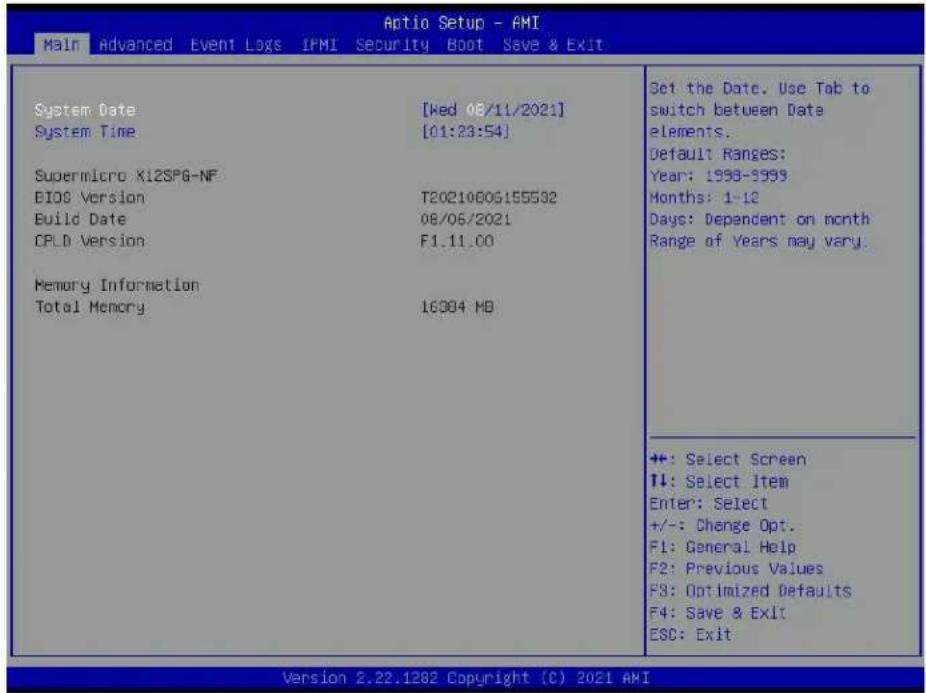
text_image
Actio Setup - AMI Main Advanced Event Logs IFMI Security Boot Save & Exit System Date [Wed 08/11/2021] System Time [01:23:54] Supermicro X12SPG-NF BIOS Version T20210806155532 Build Date 08/06/2021 CPLD Version F1.11.00 Memory Information Total Memory 16304 MB Get the Date. Use Tab to switch between Data elements. Default Ranges: Year: 1998-1999 Months: 1-12 Days: Dependent on month Range of Years may vary. ++: Select Screen T#: Select Item Enter: Select +/-: Change Opt. F1: General Help F2: Previous Values F3: Optimized Defaults F4: Save & Exit ESC: Exit Version 2.22.1282 Copyright (C) 2021 AMISystem Date/System Time
Use this option to change the system date and time. Highlight System Date or System Time using the arrow keys. Enter new values using the keyboard. Press the

Note: The time is in the 24-hour format. For example, 5:30 P.M. appears as 17:30:00. The date's default value is the BIOS build date after RTC reset.
Supermicro X12SPG-NF
BIOS Version
This feature displays the version of the BIOS ROM used in the system.
Build Date
This feature displays the date when the version of the BIOS ROM used in the system was built.
Memory Information
Total Memory
This feature displays the total size of memory available in the system.
4.3 Advanced
Use the arrow keys to select the Advanced menu and press
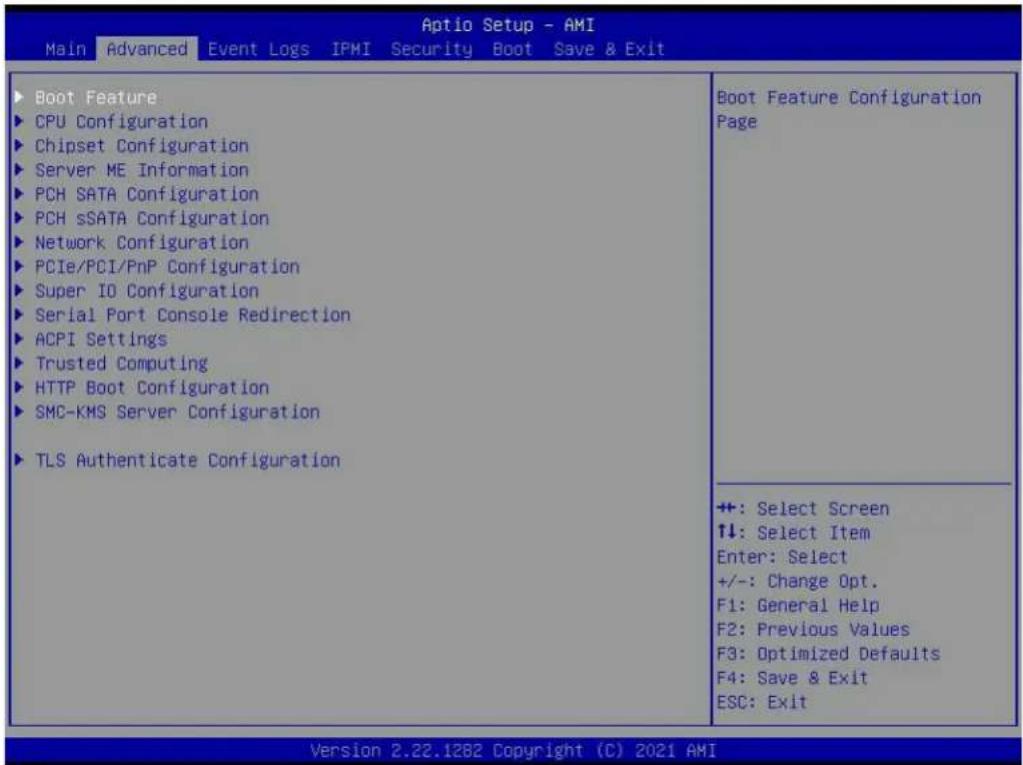
text_image
Aptio Setup - AMI Main Advanced Event Logs IPMI Security Boot Save & Exit ▶ Boot Feature ▶ CPU Configuration ▶ Chipset Configuration ▶ Server ME Information ▶ PCH SATA Configuration ▶ PCH sSATA Configuration ▶ Network Configuration ▶ PCIe/PCI/PnP Configuration ▶ Super IO Configuration ▶ Serial Port Console Redirection ▶ ACPI Settings ▶ Trusted Computing ▶ HTTP Boot Configuration ▶ SMC-KMS Server Configuration ▶ TLS Authenticate Configuration Boot Feature Configuration Page ++: Select Screen ↑↓: Select Item Enter: Select +/-: Change Opt. F1: General Help F2: Previous Values F3: Optimized Defaults F4: Save & Exit ESC: Exit Version 2.22.1282 Copyright (C) 2021 AMIWarning: Take caution when changing the Advanced settings. An incorrect value, a very high DRAM frequency, or an incorrect DRAM timing setting may make the system unstable. When this occurs, revert to default manufacturer settings.
▶Boot Feature
Quiet Boot
Use this feature to select the screen display between the POST messages and the OEM logo upon boot up. Select Disabled to display the POST messages. Select Enabled to display the OEM logo instead of the normal POST messages. The options are Disabled and Enabled.
Option ROM Messages
Use this feature to set the display mode for the Option ROM. Select Keep Current to display the current AddOn ROM setting. Select Force BIOS to use the Option ROM display set by the system BIOS. The options are Force BIOS and Keep Current.
Bootup NumLock State
Use this feature to set the Power-on state for the
Wait For "F1" If Error
Use this feature to force the system to wait until the "F1" key is pressed if an error occurs. The options are Disabled and Enabled.
INT19 (Interrupt 19) Trap Response
Interrupt 19 is the software interrupt that handles the boot disk function. When this feature is set to Immediate, the ROM BIOS of the host adapters will "capture" Interrupt 19 at boot up immediately and allow the drives that are attached to these host adapters to function as bootable disks. If this feature is set to Postponed, the ROM BIOS of the host adapters will not capture Interrupt 19 immediately and allow the drives attached to these adapters to function as bootable devices at boot up. The options are Immediate and Postponed.
Re-try Boot
If this feature is enabled, the BIOS automatically reboots the system from a specified boot device after its initial boot failure. The options are Disabled, Legacy Boot, and EFI Boot.
Power Configuration
Watch Dog Function
If enabled, the Watch Dog Timer allows the system to reset or generate NMI based on jumper settings when it is expired for more than five minutes. The options are Disabled and Enabled.
*If the feature above is set to Enabled, Watch Dog Action is available for configuration:
Watch Dog Action
Use this feature to reset the system or generate NMI. The options are Reset and NMI.
Front USB Port(s)
Use this feature to enable or disable front USB ports. If this feature is set to Enabled (Dynamic), then front USB ports can be enabled or disabled with resetting the system. The options are Enabled, Disabled, and Enabled (Dynamic).
Rear USB Port(s)
Use this feature to enable or disable rear USB ports. If this feature is set to Enabled (Dynamic), then rear USB ports can be enabled or disabled with resetting the system. The options are Enabled, Disabled, and Enabled (Dynamic).
Restore on AC Power Loss
Use this feature to set the power state after a power outage. Select Stay Off for the system power to remain off after a power loss. Select Power On for the system power to be turned on after a power loss. Select Last State to allow the system to resume its last power state before a power loss. The options are Stay Off, Power On, and Last State.
Power Button Function
This feature controls how the system shuts down when the power button is pressed. Select 4 Seconds Override for you to power off the system after pressing and holding the power button for four seconds or longer. Select Instant Off to instantly power off the system as soon as you press the power button. The options are Instant Off and 4 Seconds Override.
▶CPU Configuration
The following CPU information is displayed:
- Processor BSP Revision
- Processor Socket
- Processor ID
- Processor Frequency
- Processor Max Ratio
- Processor Min Ratio
- Microcode Revision
• L1 Cache RAM (Per Core)
• L2 Cache RAM (Per Core)
• L3 Cache RAM (Per Package) - Processor 0 Version
▶CPU1 Core Disable Bitmap
CPU1 Core Disable Bitmap
Core Disable Bitmap(Hex)
Select 0 to enable all cores or FFFFFFFF to disable all cores. One core must be enabled.
Hyper-Threading (ALL)
Select Enable to support Intel Hyper-threading Technology to enhance CPU performance. The options are Disable and Enable.
Hardware Prefetcher
If set to Enable, the hardware prefetcher prefetches streams of data and instructions from the main memory to the L2 cache to improve CPU performance. The options are Disable and Enable.
Adjacent Cache Prefetch
The CPU prefetches the cache line for 64 bytes if this feature is set to Disabled. The CPU prefetches both cache lines for 128 bytes as comprised if this feature is set to Enable. The options are Enable and Disable.
DCU Streamer Prefetcher (Available when supported by the CPU)
Select Enable to enable the Data Cache Unit (DCU) Streamer Prefetcher, which streams and prefetches data and sends it to the Level 1 data cache to improve data processing and system performance. The options are Disable and Enable.
DCU IP Prefetcher (Available when supported by the CPU)
Select Enable for Data Cache Unit (DCU) IP Prefetcher support, which prefetches IP addresses to improve network connectivity and system performance. The options are Enable and Disable.
LLC Prefetch
If set to Enable, the hardware prefetcher prefetches streams of data and instructions from the main memory to the L3 cache to improve CPU performance. The options are Disable and Enable.
Extended APIC
Select Enable to activate Advanced Programmable Interrupt Controller (APIC) support. The options are Disable and Enable.
VMX
Use this feature to enable or disable Vanderpool Technology. The options are Disable and Enable.
Enable SMX
Use this feature to enable or disable Safer Mode Extensions. The options are Disable and Enable.
PPIN Control
Select Unlock/Enable to use the Protected Processor Inventory Number (PPIN) in the system. The options are Unlock/Disable and Unlock/Enable.
AES-NI
Select Enable to use the Intel Advanced Encryption Standard (AES) New Instructions (NI) to ensure data security. The options are Disable and Enable.
TME, TME-MT, TDX
Total Memory Encryption
Use this feature to enable or disable total memory encryption. The options are Disabled and Enabled.
Limit CPU PA to 46 Bits
Use this feature to limit the CPU physical address to 46 bits to support older hyper-v. The options are Disable and Enable.
▶ Advanced Power Management Configuration
Power Technology
Use this feature to enable or disable processor power management features. The options are Disable, Energy Efficient, and Custom.
Power Performance Tuning
Use this feature to select whether the BIOS or the operating system chooses energy performance tuning. The options are OS Controls EPB and BIOS Controls EPB.
*If the feature above is set to BIOS Controls EPB, the next feature is available for configuration:
ENERGY\_PERF\_BIAS CFG Mode
Use this feature to set the energy performance bias. The options are Maximum Performance, Performance, Balanced Performance, Balanced Power, and Power.
▶CPU P State Control
SpeedStep (P-States)
Intel SpeedStep Technology allows the system to automatically adjust processor voltage and core frequency to reduce power consumption and heat dissipation. The options are Disable and Enable.
Dynamic SST-PP
Use this feature to enable or disable Intel Speed Select Technology Performance Profile (SST-PP). The options are Disable and Enable.
Intel SST-PP
Use this feature to select the base frequency conditions for SST-PP. The options are Base, Config 3, and Config 4.
AVX-P1
Use this feature to select the AVX-P1 level. The options are Normal, Level 1, and Level 2.
Activate SST-BF
Use this feature to enable or disable the Intel Speed Select Technology Base Frequency. The options are Disable and Enable.
*If the feature above is set to Enable, the next feature is available for configuration:
Configure SST-BF
Enable this feature for the BIOS to configure the SST-BF High Priority Cores so the software does not configure it. The options are Disable and Enable.
EIST PSD Funtion
This feature allows you to choose between Hardware and Software to control the processor's frequency and performance (P-state). In HW_ALL mode, the processor hardware is responsible for coordinating the P-state, and the OS is responsible for keeping the P-state request up to date on all Logical Processors. In SW_ALL mode, the OS Power Manager is responsible for coordinating the P-state, and must initiate the transition on all Logical Processors. In SW_ANY mode, the OS Power Manager is responsible for coordinating the P-state and may initiate the transition on any Logical Processors. The options are HW_ALL, and SW_ALL.
Turbo Mode
This feature enables dynamic control of the processor, allowing it to run above stock frequency. The options are Disable and Enable
CPU Flex Ratio Override
Use this feature to enable or disable CPU Flex Ratio Prgoramming. The options are Disable and Enable.
CPU Core Flex Ratio
Use this feature to set the non-turbo mode processor core ratio multiplier. The default value is 23.
▶Hardware PM State Control
Hardware P-States
This setting allows you to select between OS and hardware-controlled P-states. Selecting Native Mode allows the OS to choose a P-state. Selecting Out of Band Mode allows the hardware to autonomously choose a P-state without OS guidance. Selecting Native Mode with No Legacy Support functions as Native Mode with no support for older hardware. The options are Disable, Native Mode, Out of Band Mode, and Native Mode with No Legacy Support.
▶ Frequency Prioritization
RAPL Prioritization
Use this feature to enable the RAPL balancer. The options are Enable and Disable.
▶CPU C State Control
Enable Monitor MWAIT
Select Enabled to enable the Monitor/Mwait instructions. The Monitor instructions monitors a region of memory for writes, and MWait instructions instruct the CPU to stop until the monitored region begins to write. The options are Disable and Enable.
CPU C6 Report
Select Enable to allow the BIOS to report the CPU C6 State (ACPI C3) to the operating system. During the CPU C6 State, the power to all cache is turned off. The options are Disable, Enable, and Auto.
Enhanced Halt State (C1E)
Select Enable to use Enhanced Halt State technology, which significantly reduces the CPU's power consumption by reducing its clock cycle and voltage during a Halt-state. The options are Disable and Enable.
▶Package C State Control
Package C State
This feature allows you to set the limit on the C State package register. The options are C0/C1 state, C2 state, C6(non Retention) state, and Auto.
▶CPU T State Control
Software Controlled T-States
Use this feature to enable Software Controlled T-States. The options are Disable and Enable.
*If the feature above is set to Enable, the next feature is available for configuration:
T-State Throttle Level
Use this feature to enable or disable CPU throttling, which reduces power consumption. The options are Disable, 6.25%, 12.5%, 18.75%, 25.0%, 31.25%, 37.5%, 43.75%, 50.0%, 56.25%, 62.5%, 68.75%, 75.0%, 81.25%, 87.5%, 93.75%.
▶Chipset Configuration
Warning: Setting the wrong values in the following features may cause the system to malfunction.
▶ North Bridge
▶Uncore Configuration
Uncore Configuration
- Number of CPU
• Number of IIO
• Current UPI Link Speed
• Current UPI Link Frequency
• Global MMIO Low Base / Limit
• Global MMIO High Base / Limit - Pci-e Configuration Base / Size
Degrade Precedence
Use this feature to set degrade precedence when system settings are in conflict. Select Topology Precedence to degrade Features. Select Feature Precedence to degrade Topology. The options are Topology Precedence and Feature Precedence.
Link L0p Enable
Select Enable for the QPI to enter the L0p state for power saving. The options are Disable, Enable, and Auto.
Link L1 Enable
Select Enable for the QPI to enter the L1 state for power saving. The options are Disable, Enable, and Auto.
XPT Remote Prefetch
Use this feature to enable or disable Extended Prediction Table (XPT) Remote Prefetch. The options are Disable, Enable, and Auto.
KTI Prefetch
If this feature is enabled, the KTI Prefetcher preloads the L1 cache with data deemed relevant to allow the memory read to start earlier on a DDR bus in an effort to reduce latency. The options are Disable, Enable, and Auto.
Local/Remote Threshold
Use this feature to set the threshold for the IRQ signals that handle hardware interruptions. The options are Disable, Auto, Low, Medium, and High.
IO Directory Cache (IODC)
IO Directory Cache is an 8-entry cache that stores the directory state of remote IIO writes and memory lookups, and saves directory updates. Use this feature to lower cache to cache (C2C) transfer latencies. The options are Disable, Auto, Enable for Remote InvItoM Hybrid Push, InvItoM AllocFlow, Enable for Remote InvItoM Hybrid AllocNonAlloc, and Enable for Remote InvItoM and Remote WViLF.
SNC (Sub NUMA)
Use this feature to enable or disable Sub NUMA Clustering. Disable this feature to support 1-cluster and enable to support 2-clusters. The options are Disable and SNC2 (2-clusters)
XPT Prefetch
Use this feature to enable or disable XPT Prefetch support, which allows an LLC request to be duplicated and sent to an appropriate memory controller based on the recent LLC history to reduce latency. The options are Disable, Enable, and Auto.
Snoop Throttle Configuration
Use this feature to select the level of snoop throttle setting. The options are Disabled, Low, Medium, High, and Auto.
PCIe Remote P2P Relaxed Ordering
Enable peer-to-peer relaxed ordering to optimize system performance. The options are Disable and Enable.
Stale AtoS
Use this feature to enable or disable Stale A to S optimization. There are three states in the in-memory directory: invalid (I), snoopAll (A), and shared (S). Data in the I state is clean and does not exist in other sockets. Data in the A state may exist in another exclusive or modified socket. Data in the S state is clean and may be shared across one or more sockets. The options are Disable, Enable, and Auto.
LLC Dead Line Alloc
Select Enable to opportunistically fill dead lines in the LLC. Select Disable to never fill dead lines in LLC. The options are Disable, Enable, and Auto.
▶ Memory Configuration
Enhanced PPR
Use this feature to enable or disable the Samsung TestBIOS Enhanced PPR (STEP) function. The options are Disable and Enable.
*If the feature above is set to Enable, the next feature is available for configuration:
Operation Mode
Use this feature to set the operation mode for the STEP function. The options are Test Only and Test and Repair.
Enforce POR
Select Plan of Record (POR) to enforce POR restrictions on DDR4 frequency and voltage programming. The options are POR and Disable.
PPR Type
Use this feature to select the Post Package Repair (PPR) type. The options are PPR Disabled, Hard PPR, and Soft PPR.
Memory Frequency
Use this feature to set the maximum memory frequency for onboard memory modules. The options are Auto, 2133, 2200, 2400, 2600, 2666, 2800, 2933, 3000, and 3200.
Data Scrambling for DDR4
Use this feature to enable or disable data scrambling for DDR4 memory. The options are Disable and Enable.
2x Refresh Enable
Use this feature to enable 2x memory refresh support to enhance memory performance. The options are Auto, Disable, and Enable.
▶ Memory Topology
This feature displays the information of memory modules detected by the BIOS.
▶ Memory RAS Configuration Setup
Enabled Pcode WA for SAI PG
Use this feature to enable Pcode Work Around for SAI Policy group for A Step. The options are Disabled and Enabled.
Correctable Error Threshold
Use this feature to specify the threshold value for correctable memory-error logging, which sets a limit on the maximum number of events that can be logged in the memory error log at a given time. The default setting is 512.
Partial Cache Line Sparing PCLS
Use this feature to enable or disable Partial Cache Line Sparing (PCLS). The options are Disabled and Enabled.
ADDDC Sparing
Adaptive Double Device Data Correction (ADDDC) Sparing detects when the predetermined threshold for correctable errors is reached, copying the contents of the failing DIMM to spare memory. The failing DIMM or memory rank will then be disabled. The options are Disabled and Enabled.
Patrol Scrub
Patrol Scrubbing is a process that allows the CPU to correct correctable memory errors detected on a memory module and send the correction to the requestor (the original source). When this item is set to Enable, the IO hub reads and writes back one cache line every 16K cycles if there is no delay caused by internal processing. By using this method, roughly 64 GB of memory behind the IO hub is scrubbed every day. The options are Disabled, Enabled, and Enable at End of POST.
▶ IIO Configuration
▶CPU1 Configuration
IOU0/1/3/4 (IIO PCIe Port 1/2/4/5)
Use this feature to configure the bifurcation setting for the PCIe port. The options are Auto, x4x4x4x4, x4x4x8, x8x4x4, x8x8, and x16.
*For detailed slot bifurcation mapping, refer to the system block diagram in Chapter 1.
NVMe0/NVMe1
Link Speed
Use this feature to select the link speed for the PCIe port. The options are Auto, Gen 1 (2.5 GT/s), Gen 2 (5 GT/s), Gen 3 (8 GT/s), and Gen 4 (16 GT/s).
The following information is displayed:
• PCI-E Port Link Status
• PCI-E Port Link Max
- PCI-E Port Link Speed
PCI-E Port Max Payload Size
Selecting Auto for this feature enables the motherboard to automatically detect the maximum Transaction Layer Packet (TLP) size for the connected PCIe device, allowing for maximum I/O efficiency. Selecting 128B or 256B designates maximum packet size of 128 or 256. The options are 128B, 256B, 512B, and Auto.
▶RSC-GB-6G4 SLOT1/RSC-GF-6G4 SLOT1/RSC-GF-6G4 SLOT1
Link Speed
Use this feature to select the link speed for the PCIe port. The options are Auto, Gen 1 (2.5 GT/s), Gen 2 (5 GT/s), Gen 3 (8 GT/s), and Gen 4 (16 GT/s).
The following information is displayed:
• PCI-E Port Link Status
- PCI-E Port Link Max
- PCI-E Port Link Speed
PCI-E Port Max Payload Size
Selecting Auto for this feature enables the motherboard to automatically detect the maximum Transaction Layer Packet (TLP) size for the connected PCIe device, allowing for maximum I/O efficiency. Selecting 128B or 256B designates maximum packet size of 128 or 256. The options are 128B, 256B, 512B, and Auto.
▶ IOAT Configuration
Disable TPH
Transparent Huge Pages (TPH) is a Linux memory management system that enables communication in larger blocks (pages). Enabling this feature increases performance. The options are No and Yes.
Prioritize TPH
Use this feature to enable Prioritize TPH support. The options are Enable and Disable.
Relaxed Ordering
Select Enable to enable Relaxed Ordering support, which allows certain transactions to violate the strict-ordering rules of PCI bus for a transaction to be completed prior to other transactions that have already been enqueued. The options are Yes and No.
Intel(R) for Directed I/O (VT-d)
Intel® VT for Directed I/O (VT-d)
Select Yes to use Intel Virtualization Technology for Direct I/O VT-d support by reporting the I/O device assignments to the Virtual Machine Monitor (VMM) through the DMAR ACPI tables. This feature offers fully-protected I/O resource sharing across Intel platforms, providing greater reliability, security and availability in networking and data-sharing. The options are Enable and Disable.
ACS Control
Select Yes to program Access Control Services (ACS) to the chipset PCIe root port bridge. Select No to program ACS to all PCIe root port bridges. The options are Enable and Disable.
Interrupt Remapping
Use this feature to enable Interrupt Remapping support, which detects and controls external interrupt requests. The options are Enable, Disable, and Auto.
Intel(R) VMD Technology
NVMe Mode Switch
Use this feature to select the NVMe mode switch. The options are Manual, VMD, and Auto.
*If the feature above is set to Manual, the next menu is available for configuration:
Intel(R) VMD for Volume Management Device on CPU1
VMD Config for PCH ports
Enable/Disable VMD
Use this feature to enable or disable the volume management device for this stack. The options are Disable and Enable.
*If the feature above is set to Enable, the following features are available for configuration:
M.2-H_1 VMD
M.2-H_2 VMD
VMD Config for IOU 0
Enable/Disable VMD
Use this feature to enable or disable the volume management device for this stack. The options are Disable and Enable.
*If the feature above is set to Enable, the following features are available for configuration:
NVMe0 VMD
Use this feature to enable or disable volume management device for this port. The options are Disable and Enable.
NVMe1 VMD
Use this feature to enable or disable volume management device for this port. The options are Disable and Enable.
AIOM1 PCI-E 4.0 x8 VMD
Use this feature to enable or disable AIOM1 for this port. The options are Disable and Enable.
Hot Plug Capable
Use this feature to enable or disable hot plug for this port. The options are Disable and Enable.
VMD Config for IOU 1
Enable/Disable VMD
Use this feature to enable or disable the volume management device for this stack. The options are Disable and Enable.
*If the feature above is set to Enable, the following features are available for configuration:
RSC-GB-6G4 SLOT1 VMD
Use this feature to enable or disable the device for this port. The options are Disable and Enable.
Hot Plug Capable
Use this feature to enable or disable hot plug for this port. The options are Disable and Enable.
VMD Config for IOU 3
Enable/Disable VMD
Use this feature to enable or disable the volume management device for this stack. The options are Disable and Enable.
*If the feature above is set to Enable, the following features are available for configuration:
RSC-GF-6G4 SLOT1 VMD
Use this feature to enable or disable volume management device for this port. The options are Disable and Enable.
Hot Plug Capable
Use this feature to enable or disable hot plug for this port. The options are Disable and Enable.
VMD Config for IOU 4
Enable/Disable VMD
Use this feature to enable or disable the volume management device for this stack. The options are Disable and Enable.
*If the feature above is set to Enable, the following features are available for configuration:
RSC-GF-6G4 SLOT1 VMD
Use this feature to enable or disable the device for this port. The options are Disable and Enable.
Hot Plug Capable
Use this feature to enable or disable hot plug for this port. The options are Disable and Enable.
PCI-E ASPM Support (Global)
Use this feature to enable or disable ASPM support for all downstream devices. The options are Disable and Auto.
IIO eDPC Support
Use this feature to enable or disable IIO enhanced DPC support. The options are Disable, On Fatal Error, and On Fatal and Non-Fatal Errors.
▶ South Bridge
The following USB information is displayed:
- USB Module Version
- USB Devices
Legacy USB Support
This feature enables support for USB 2.0 and older. The options are Enabled, Disabled, and Auto.
XHCI Hand-off
When this feature is disabled, the motherboard will not support USB 3.0. The options are Enabled and Disabled.
Port 60/64 Emulation
This feature allows legacy I/O support for USB devices like mice and keyboards. The options are Disabled and Enabled.
PCIe PLL SSC
Use this feature to enable or disable PCIe PLL SSC. The options are Disabled and Enabled.
Port 61h Bit-4 Emulation
Select Enabled to enable the emulation of Port 61h bit-4 toggling in System Management Mode (SMM). The options are Disabled and Enabled.
▶Server ME Information
The following General ME Configuration is displayed:
• Oper. Firmware Version
• Backup Firmware Version
• Recovery Firmware Version
• ME Firmware Status #1
• ME Firmware Status #2
- Current State
- Error Code
▶PCH SATA Configuration
SATA Controller
This feature enables or disables the onboard SATA controller supported by the Intel PCH chip. The options are Disable and Enable.
Configure SATA as
Select AHCI to configure an sSATA drive specified as an AHCI drive. Select RAID to configure an sSATA drive specified as a RAID drive. The options are AHCI and RAID.
*If the feature above is set to RAID, the SATA RSTe Boot Info and SATA RAID Option ROM/UEFI Driver are available for configuration:
SATA RSTe Boot Info
Select Enable to provide full int13h support for the devices attached to sSATA controller. The options are Disable and Enable.
Support Aggressive Link Power Management
When this feature is set to Enable, the SATA AHCI controller manages the power usage of the SATA link. The controller puts the link in a low power mode during extended periods of I/O inactivity and then returns the link to an active state when I/O activity resumes. The options are Disable and Enable.
SATA RAID Option ROM/UEFI Driver
Select UEFI to load the EFI driver for system boot. Select Legacy to load a legacy driver for system boot. The options are Disable, EFI, and Legacy.
M.2-H\_1/M.2-H\_2
M.2-H\_1/M.2-H\_2 Spin Up Device
Set this feature to enable or disable the PCH to initialize the device. The options are Disable and Enable.
SATA Device Type
Use this feature to specify if the SATA port specified should be connected to a Solid State Drive or a Hard Disk Drive. The options are Hard Disk Drive and Solid State Drive.
▶PCH sSATA Configuration
sSATA Controller
This feature enables or disables the onboard SATA controller supported by the Intel PCH chip. The options are Enable and Disable.
Configure sSATA as
Select AHCI to configure an sSATA drive specified as an AHCI drive. Select RAID to configure an sSATA drive specified as a RAID drive. The options are AHCI and RAID.
*If the feature above is set to RAID, the sSATA RSTe Boot Info and sSATA RAID Option ROM/UEFI Driver are available for configuration:
sSATA RSTe Boot Info
Select Enable to provide full int13h support for the devices attached to sSATA controller. The options are Disable and Enable.
Support Aggressive Link Power Management
When this feature is set to Enable, the SATA AHCI controller manages the power usage of the SATA link. The controller puts the link in a low power mode during extended periods of I/O inactivity and then returns the link to an active state when I/O activity resumes. The options are Disable and Enable.
sSATA RAID Option ROM/UEFI Driver
Select UEFI to load the EFI driver for system boot. Select Legacy to load a legacy driver for system boot. The options are Disable, EFI, and Legacy.
S-SATA0/S-SATA1
This feature displays the information detected on the installed SATA drive on the particular SATA port.
- Software Preserve Support
S-SATA0/S-SATA1 Hot Plug
Set this feature to Enable for hot plug support, which allows you to replace a SATA drive without shutting down the system. The options are Disable and Enable.
Spin Up Device
Set this feature to enable or disable the PCH to initialize the device. The options are Disable and Enable.
sSATA Device Type
Use this feature to specify if the SATA port specified should be connected to a Solid State Drive or a Hard Disk Drive. The options are Hard Disk Drive and Solid State Drive.
▶Network Configuration
Network Stack
Select Enabled to enable Preboot Execution Environment (PXE) or Unified Extensible Firmware Interface (UEFI) for network stack support. The options are Disabled and Enabled.
IPv4 PXE Support
Select Enabled to enable IPv4 PXE boot support. The options are Disabled and Enabled.
IPv4 HTTP Support
Select Enabled to enable IPv4 HTTP boot support. The options are Disabled and Enabled.
IPv6 PXE Support
Select Enabled to enable IPv6 PXE boot support. The options are Disabled and Enabled.
IPv6 HTTP Support
Select Enabled to enable IPv6 HTTP boot support. The options are Disabled and Enabled.
PXE Boot Wait Time
Use this option to specify the wait time to press the ESC key to abort the PXE boot. Press "+" or "-" on your keyboard to change the value. The default setting is 0.
Media Detect Count
Use this option to specify the number of times media is checked. Press "+" or "-" on your keyboard to change the value. The default setting is 1.
▶ PCIe/PCI/PnP Configuration
PCI Bus Driver Version
PCI Devices Common Settings:
Above 4G Decoding (Available if the system supports 64-bit PCI decoding)
Select Enabled to decode a PCI device that supports 64-bit in the space above 4G Address. The options are Disabled and Enabled.
SR-IOV Support
Use this feature to enable or disable Single Root IO Virtualization Support. The options are Disabled and Enabled.
ARI Support
Use this feature to enable or disable ARI support. The options are Disabled and Enabled.
Bus Master Enable
Use this feature to enable the Bus Master, which enables the Bus Master Attribute for DMA transaction. The options are Disabled and Enabled.
Consistent Device Name Support
Use this feature to enable ACPI_DSM device name support for onboard devices and slots. The options are Disabled and Enabled.
MMIO High Base
Use this feature to select the base memory size according to memory-address mapping for the IO hub. The options are 56T, 40T, 32T, 24T, 16T, 4T, 2T, 1T, and 512 G.
MMIO High Granularity Size
Use this feature to select the high memory size according to memory-address mapping for the IO hub. The options are 1G, 4G, 16G, 64G, 256G, and 1024G.
Maximum Read Request
Use this item to select the Maximum Read Request size of the PCIe device, or select Auto to allow the System BIOS to determine the value. The options are Auto, 128 Bytes, 256 Bytes, 512 Bytes, 1024 Bytes, 2048 Bytes, and 4096 Bytes.
MMCFG Base
Use this feature to select the low base address for PCIe adapters to increase base memory. The options are 1G, 1.5G, 1.75G, 2G, 2.25G, 3G, and Auto.
NVMe Firmware Source
The feature determines which type of NVMe firmware should be used in your system. The options are Vendor Defined Firmware and AMI Native Support.
VGA Priority
Use this feature to select VGA priority when multiple VGA devices are detected. Select Onboard to give priority to your onboard video device. Select Offboard to give priority to your graphics card. The options are Onboard and Offboard.
Onboard Video Option ROM
Use this feature to select which firmware function to be loaded for LAN1 used for system boot. The options are Disabled and Legacy (if the Boot Mode Select feature under the Boot tab is set to Legacy), Disabled and EFI (if the Boot Mode Select feature under the Boot tab is set to UEFI), and Disabled, Legacy, and EFI (if the Boot Mode Select feature under the Boot tab is set to Dual).
RSC-GB-6G4 SLOT1 PCI-E 4.0 x16 OPROM/RSC-GF-6G4 SLOT1 PCI-E 4.0 X16 OPROM/RSC-GF-6G4 SLOT1 PCI-E 4.0 X16 OPROM
Use this feature to select which firmware type to be loaded for the add-on card in these slots. The options are Disabled and Legacy (if the Boot Mode Select feature under the Boot tab is set to Legacy), Disabled and EFI (if the Boot Mode Select feature under the Boot tab is set to UEFI), and Disabled, Legacy, and EFI (if the Boot Mode Select feature under the Boot tab is set to Dual).
M.2-H\_1 OPROM/M.2-H\_2 OPROM
Use this feature to select which firmware type to be loaded for the add-on card in this slot. The options are Disabled and Legacy (if the Boot Mode Select feature under the Boot tab is set to Legacy), Disabled and EFI (if the Boot Mode Select feature under the Boot tab is set to UEFI), and Disabled, Legacy, and EFI (if the Boot Mode Select feature under the Boot tab is set to Dual).
AOC-ATG-i2T LAN1 OPROM
Use this feature to select which firmware type to be loaded for the add-on card in this slot. The options are Disabled and PXE (if the Boot Mode Select feature under the Boot tab is set to Legacy), Disabled and EFI (if the Boot Mode Select feature under the Boot tab is set to UEFI), and Disabled, EFI, and PXE (if the Boot Mode Select feature under the Boot tab is set to Dual).
*If the feature above is set to Disabled or PXE, the following feature is available for configuration:
AOC-ATG-i2T LAN2 OPROM
Use this feature to select which firmware type to be loaded for the add-on card in this slot. The options are Disabled and PXE (if the Boot Mode Select feature under the Boot tab is set to Legacy), Disabled and EFI (if the Boot Mode Select feature under the Boot tab is set to UEFI), and Disabled and PXE (if the Boot Mode Select feature under the Boot tab is set to Dual).
NVMe0/NVMe1 Option ROM
Use this feature to select a desired firmware function to be loaded for the specified NVMe slot. The options are Disabled and Legacy (if the Boot Mode Select feature under the Boot tab is set to Legacy), Disabled and EFI (if the Boot Mode Select feature under the Boot tab is set to UEFI), and Disabled, Legacy, and EFI (if the Boot Mode Select feature under the Boot tab is set to Dual).
▶Super IO Configuration
The following Super IO information is display:
• Super IO Chip AST2500
▶ Serial Port 1 Configuration
This submenu allows you to configure the settings of Serial Port 1.
Serial Port 1
Select Enabled to enable the selected onboard serial port. The options are Disabled and Enabled.
Device Settings
This feature displays the status of the serial port.
Change Settings
This feature specifies the base I/O port address and the Interrupt Request address of the serial port. Select Auto to allow the BIOS to automatically assign the base I/O and IRQ address. The options are Auto, (IO=3F8h; IRQ=4;), (IO=2F8h; IRQ=4;), (IO=3E8h; IRQ=4;), and (IO=2E8h; IRQ=4;).
▶SOL Configuration
This submenu allows you to configure the settings of Serial Port 2.
Serial Port 2
Select Enabled to enable the selected onboard serial port. The options are Disabled and Enabled.
Device Settings
This feature displays the status of the serial port.
Change Settings
This feature specifies the base I/O port address and the Interrupt Request address of the serial port. Select Auto to allow the BIOS to automatically assign the base I/O and IRQ address. The options are Auto, (IO=3F8h; IRQ=3;), (IO=2F8h; IRQ=3;), (IO=3E8h; IRQ=3;), and (IO=2E8h; IRQ=3;).
Serial Port 2 Attribute (Available for Serial Port 2 only)
Select SOL to use COM Port 2 as a Serial Over LAN (SOL) port for console redirection. The options are SOL and COM.
▶ Serial Port Console Configuration
COM1 Console Redirection
Select Enabled to enable console redirection support for the serial port. The options are Enabled and Disabled.
*If the feature above is set to Enabled, the following features is available for configuration:
▶COM1 Console Redirection Settings
Use this feature to specify how the host computer exchanges data with the client computer, which is the remote computer used by the user.
Terminal Type
This feature allows you to select the target terminal emulation type for Console Redirection. Select VT100 to use the ASCII Character set. Select VT100+ to add color and function key support. Select ANSI to use the Extended ASCII Character Set. Select VT-UTF8 to use UTF8 encoding to map Unicode characters into one or more bytes. The options are VT100, VT100+, VT-UTF8, and ANSI.
Bits Per Second
Use this feature to set the transmission speed for a serial port used in Console Redirection. Make sure that the same speed is used in the host computer and the client computer. A lower transmission speed may be required for long and busy lines. The options are 9600, 19200, 38400, 57600 and 115200 (bits per second).
Data Bits
Use this feature to set the data transmission size for Console Redirection. The options are 7 Bits and 8 Bits.
Parity
A parity bit can be sent along with regular data bits to detect data transmission errors. Select Even if the parity bit is set to 0, and the number of 1s in data bits is even. Select Odd if the parity bit is set to 0, and the number of 1s in data bits is odd. Select None if you do not want to send a parity bit with your data bits in transmission. Select Mark to add a mark as a parity bit to be sent along with the data bits. Select Space to add a Space as a parity bit to be sent with your data bits. The options are None, Even, Odd, Mark, and Space.
Stop Bits
A stop bit indicates the end of a serial data packet. Select 1 Stop Bit for standard serial data communication. Select 2 Stop Bits if slower devices are used. The options are 1 and 2.
Flow Control
Use this feature to set the flow control for Console Redirection to prevent data loss caused by buffer overflow. Send a "Stop" signal to stop sending data when the receiving buffer is full. Send a "Start" signal to start sending data when the receiving buffer is empty. The options are None and Hardware RTS/CTS.
VT-UTF8 Combo Key Support
Select Enabled to enable VT-UTF8 Combination Key support for ANSI/VT100 terminals. The options are Disabled and Enabled.
Recorder Mode
Select Enabled to capture the data displayed on a terminal and send it as text messages to a remote server. The options are Disabled and Enabled.
Resolution 100x31
Select Enabled for extended-terminal resolution support. The options are Disabled and Enabled.
Legacy OS Redirection Resolution
Use this feature to select the number of rows and columns used in Console Redirection for legacy OS support. The options are 80x24 and 80x25.
Putty KeyPad
This feature selects the settings for Function Keys and KeyPad used for Putty, which is a terminal emulator designed for the Windows OS. The options are VT100, LINUX, XTERMR6, SC0, ESCN, and VT400.
Redirection After BIOS POST
Use this feature to enable or disable legacy console redirection after BIOS POST. When set to Bootloader, legacy console redirection is disabled before booting the OS. When set to Always Enable, legacy console redirection remains enabled when booting the OS. The options are Always Enable and Bootloader.
SOL Console Redirection
Select Enabled to use the SOL port for Console Redirection. The options are Disabled and Enabled.
*If the feature above is set to Enabled, the following features are available for configuration:
▶SOL Console Redirection Settings
Use this feature to specify how the host computer exchanges data with the client computer, which is the remote computer used by the user.
Terminal Type
Use this feature to select the target terminal emulation type for Console Redirection. Select VT100 to use the ASCII Character set. Select VT100+ to add color and function key support. Select ANSI to use the Extended ASCII Character Set. Select VT-UTF8 to use UTF8 encoding to map Unicode characters into one or more bytes. The options are ANSI, VT100, VT100+, and VT-UTF8.
Bits Per Second
Use this feature to set the transmission speed for a serial port used in Console Redirection. Make sure that the same speed is used in the host computer and the client computer. A lower transmission speed may be required for long and busy lines. The options are 9600, 19200, 38400, 57600 and 115200 (bits per second).
Data Bits
Use this feature to set the data transmission size for Console Redirection. The options are 7 Bits and 8 Bits.
Parity
A parity bit can be sent along with regular data bits to detect data transmission errors. Select Even if the parity bit is set to 0, and the number of 1s in data bits is even. Select Odd if the parity bit is set to 0, and the number of 1s in data bits is odd. Select None if you do not want to send a parity bit with your data bits in transmission. Select Mark to add a mark as a parity bit to be sent along with the data bits. Select Space to add a Space as a parity bit to be sent with your data bits. The options are None, Even, Odd, Mark and Space.
Stop Bits
A stop bit indicates the end of a serial data packet. Select 1 Stop Bit for standard serial data communication. Select 2 Stop Bits if slower devices are used. The options are 1 and 2.
Flow Control
Use this feature to set the flow control for Console Redirection to prevent data loss caused by buffer overflow. Send a "Stop" signal to stop sending data when the receiving buffer is full. Send a "Start" signal to start sending data when the receiving buffer is empty. The options are None and Hardware RTS/CTS.
VT-UTF8 Combo Key Support
Select Enabled to enable VT-UTF8 Combination Key support for ANSI/VT100 terminals. The options are Disabled and Enabled.
Recorder Mode
Select Enabled to capture the data displayed on a terminal and send it as text messages to a remote server. The options are Disabled and Enabled.
Resolution 100x31
Select Enabled for extended-terminal resolution support. The options are Disabled and Enabled.
Legacy OS Redirection Resolution
Use this feature to select the number of rows and columns used in Console Redirection for legacy OS support. The options are 80x24 and 80x25.
Putty KeyPad
This feature selects Function Keys and KeyPad settings for Putty, which is a terminal emulator designed for the Windows OS. The options are VT100, LINUX, XTERMR6, SCO, ESCN, and VT400.
Redirection After BIOS POST
Use this feature to enable or disable legacy Console Redirection after BIOS POST. When set to Bootloader, legacy Console Redirection is disabled before booting the OS. When set to Always Enable, legacy Console Redirection remains enabled when booting the OS. The options are Always Enable and Bootloader.
Legacy Console Redirection
Legacy Serial Redirection Port
Use this feature to select a COM port to display redirection of Legacy OS and Legacy OPROM messages. The options are COM1 and SOL.
Console Redirection EMS (Emergency Management Services)
Select Enabled to use a COM port selected by you for EMS Console Redirection. The options are Enabled and Disabled.
*If the feature above is set to Enabled, the following features are available for configuration:
▶EMS Console Redirection Settings
This feature allows you to specify how the host computer exchanges data with the client computer, which is the remote computer used by the user.
Out-of-Band Mgmt Port
The feature selects a serial port in a client server to be used by the Microsoft Windows Emergency Management Services (EMS) to communicate with a remote host server. The options are COM1 and SOL.
Terminal Type
Use this feature to select the target terminal emulation type for Console Redirection. Select VT100 to use the ASCII character set. Select VT100+ to add color and function key support. Select ANSI to use the extended ASCII character set. Select VT-UTF8 to use UTF8 encoding to map Unicode characters into one or more bytes. The options are VT100, VT100+, VT-UTF8, and ANSI.
Bits Per Second EMS
This item sets the transmission speed for a serial port used in Console Redirection. Make sure that the same speed is used in the host computer and the client computer. A lower transmission speed may be required for long and busy lines. The options are 9600, 19200, 57600, and 115200 (bits per second).
Flow Control EMS
Use this item to set the flow control for Console Redirection to prevent data loss caused by buffer overflow. Send a "Stop" signal to stop sending data when the receiving buffer is full. Send a "Start" signal to start sending data when the receiving buffer is empty. The options are None, Hardware RTS/CTS, and Software Xon/Xoff.
Data Bits EMS
Parity EMS
Stop Bits EMS
▶ACPI Settings
NUMA
Use this feature to enable or disable Non-Uniform Memory Access (NUMA), a feature that improves memory-to-processor communication and performance. The options are Disabled and Enabled.
UMA-Based Clustering
Use this feature to enable or disable Uniform Memory Access (UMA) clustering. The options are Disable (All2All) and Hemishpere (2-clusters).
WHEA Support
Select Enabled to support the Windows Hardware Error Architecture (WHEA) platform and provide a common infrastructure for the system to handle hardware errors within the Windows OS environment to reduce system crashes and to enhance system recovery and health monitoring. The options are Disabled and Enabled.
High Precision Event Timer
Select Enabled to activate the High Precision Event Timer (HPET) that produces periodic interrupts at a much higher frequency than a Real-time Clock (RTC) does in synchronizing multimedia streams, providing smooth playback and reducing the dependency on other timestamp calculation devices, such as an x86 RDTSC Instruction embedded in the CPU. The High Performance Event Timer is used to replace the 8254 Programmable Interval Timer. The options are Disabled and Enabled.
▶Trusted Computing
The motherboard supports TPM 1.2 and 2.0. The following Trusted Platform Module (TPM) information is displayed if a TPM 2.0 module is detected:
- Vendor Name
- Firmware Version
Security Device Support
If this feature and the TPM jumper on the motherboard are both set to Enabled, onboard security devices are enabled for Trusted Platform Module (TPM) support to enhance data integrity and network security. Reboot the system for changes to take effect. The options are Disable and Enable.
• Active PCR Bank
• Available PCR banks
SHA-1 PCR Bank
Use this feature to disable or enable the SHA-1 Platform Configuration Register (PCR) bank for the installed TPM device. The options are Disabled and Enabled.
SHA256 PCR Bank
Use this feature to disable or enable the SHA256 Platform Configuration Register (PCR) bank for the installed TPM device. The options are Disabled and Enabled.
Pending Operation
Use this feature to schedule a TPM-related operation to be performed by a security device for system data integrity. Your system will reboot to carry out a pending TPM operation. The options are None and TPM Clear.
Platform Hierarchy
Use this feature to disable or enable platform hierarchy for platform protection. The options are Disabled and Enabled.
Storage Hierarchy
Use this feature to disable or enable storage hierarchy for cryptographic protection. The options are Disabled and Enabled.
Endorsement Hierarchy
Use this feature to disable or enable endorsement hierarchy for privacy control. The options are Disabled and Enabled.
TPM 20 Interface Type
PH Randomization
Use this feature to disable or enable Platform Hierarchy (PH) Randomization. The options are Disabled and Enabled.
Disable Block sid
Select Enabled to allow SID authentication be performed in TCG Storage devices. The options are Enabled and Disabled.
SMCI BIOS-Based TPM Provision Support
Use this feature to enable the Supermicro TPM Provision support. The options are Disabled and Enabled.
TXT Support
Intel Trusted Execution Technology (TXT) helps protect against software-based attacks and ensures protection, confidentiality, and integrity of data stored or created on the system. Use this feature to enable or disable TXT Support. The options are Disabled and Enabled.
▶HTTP Boot Configuration
HTTP Boot Configuration
HTTP Boot Policy
Use this feature to select the boot policy. The options are Apply to all LANs, Apply to each LAN, and Boot Priority #1 instantly.
HTTPS Boot Checks Hostname
Use this feature to select whether HTTPS Boot checks the hostname of TLS certificates matches the hosname provided by the remote server. The options are Enabled and Disabled (WARNING: Security Risk!!)
Priority of HTTP Boot:
Instance of Priority 1:
Use this feature to set the rank target port. The default value is 1.
Select IPv4 or IPv6
Use this feature to select which LAN port to boot from. The options are IPv4 and IPv6.
Boot Description
Highlight the feature and press enter to create a boot description. The description cannot be more than 75 characters.
Boot URI
Highlight the feature and press enter to create a boot URI.
Instance of Priority 2
Use this feature to set the rank target port. The default value is 0.
▶SMC-KMS Server Configuration
SMC-KMS Server IP address
Enter the IP4 address in dotted-decimal notation (e.g., 255.255.255.255).
SMC-KMS TCP Port number
Enter the SMC-KMS TCP port number (from 100 to 9999). The default is 5696.
SMC-KMS Time Out
Use this feature to determine when the server connection times out. The range is 2 - 30 seconds.
TimeZone
Use this feature to select the current time zone
TCG Nvme KMS Policy
Use this feature to select the Trusted Computing Group (TCG) NVMe KMS policy. The options are Normal Unlock, Do Nothing, Reset All Devices, and Delete Key Id List.
TCG Nvme KMS Retry Count
Use this feature to select the number of attempts of test connections to the Key Management Server. The options are 0 - 300 seconds and the default is 2.
Client UserName
Press Enter to create a client username.
Client Password
Press Enter to create a client password.
KMS TLS Certificate
▶CA Certificate
Use this feature to enroll factory defaults or load the CA certificates from a file. The options are Update, Delete, and Export.
▶Client Certificate
Use this feature to enroll factory defaults or load the client certificates from a file. The options are Update, Delete, and Export.
▶Client Private Key
Use this feature to enroll factory defaults or load the client private key from a file. The options are Update, Delete, and Export.
▶TLS Authenticate Configuration
This submenu allows you to configure Transport Layer Security (TLS) settings.
▶Server CA Configuration
▶Enroll Certification
Enroll Certification Using File
Use this feature to enroll certification from a file.
Certification GUID
Use this feature to input the certification GUID.
Commit Changes and Exit
Use this feature to save all changes and exit TLS settings.
Discard Changes and Exit
Use this feature to discard all changes and exit TLS settings.
▶ Delete Certification
Use this feature to delete certification.
4.4 Event Logs
Use this menu to configure Event Log settings.
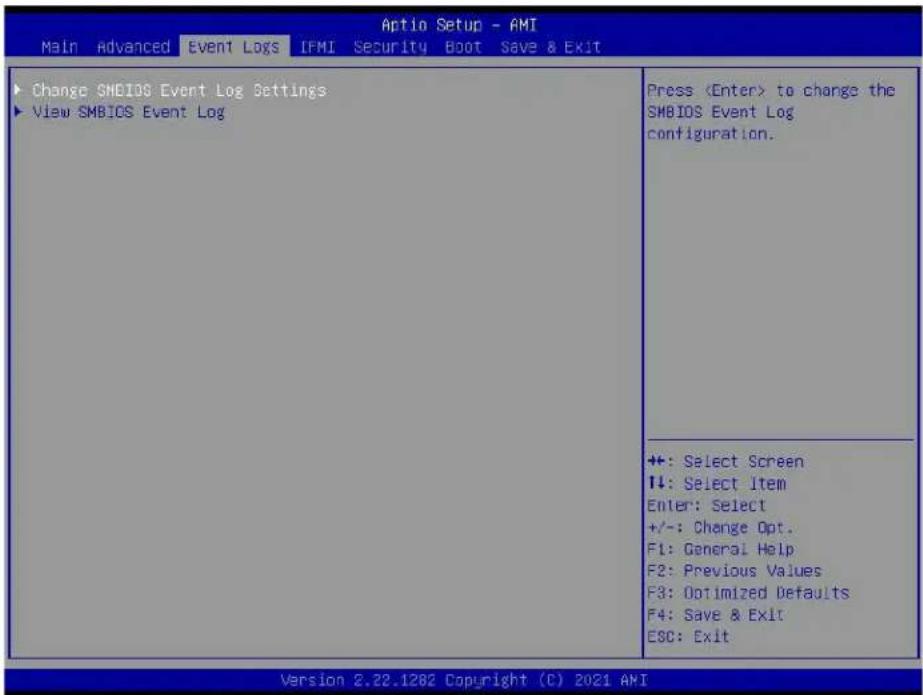
text_image
Action Setup - AMI Main Advanced Event Logs IFMI Security Boot Save & Exit Change SMBIOS Event Log Settings View SMBIOS Event Log Press▶Change SMBIOS Event Log Settings
Enabling/Disabling Options
SMBIOS Event Log
Change this feature to enable or disable all features of the SMBIOS Event Logging during system boot. The options are Disabled and Enabled.
Erasing Settings
Erase Event Log
If No is selected, data stored in the event log will not be erased. Select Yes, Next Reset, data in the event log will be erased upon next system reboot. Select Yes, Every Reset, data in the event log will be erased upon every system reboot. The options are No, Yes, Next reset, and Yes, Every reset.
When Log is Full
Select Erase Immediately for all messages to be automatically erased from the event log when the event log memory is full. The options are Do Nothing and Erase Immediately.
SMBIOS Event Log Standard Settings
Log System Boot Event
This option toggles the System Boot Event logging to enabled or disabled. The options are Disabled and Enabled.
MECI
The Multiple Event Count Increment (MECI) counter counts the number of occurrences that a duplicate event must happen before the MECI counter is incremented. This is a numeric value. The default value is 1.
METW
The Multiple Event Time Window (METW) defines the number of minutes that must pass between duplicate log events before MECI is incremented. This is in minutes, from 0 to 99. The default value is 60.

Note: All values changed here do not take effect until computer is restarted.
▶View SMBIOS Event Log
Select this submenu and press enter to see the contents of the SMBIOS event log. The following categories is displayed: Date/Time/Error Codes/Severity.
4.5 IPMI
Use this menu to configure Intelligent Platform Management Interface (IPMI) settings.

text_image
RPTLO Setup - AMI Main Advanced Event Logs IPMI Security Boot Save & Exit SBC Firmware Revision 00:23.43 IPMI STATUS Working System Event Log BKC Network Configuration PressBMC Firmware Revision
This feature displays the IPMI firmware revision used in your system.
IPMI STATUS (Baseboard Management Controller)
This feature displays the status of the IPMI firmware installed in your system.
▶System Event Log
Enabling/Disabling Options
SEL Components
Select Enabled for all system event logging at boot up. The options are Disabled and Enabled.
Erasing Settings
Erase SEL
Select Yes, On next reset to erase all system event logs upon next system reboot. Select Yes, On every reset to erase all system event logs upon each system reboot. Select No to keep all system event logs after each system reboot. The options are No, Yes, On next reset, and Yes, On every reset.
When SEL is Full
This feature allows you to decide what the BIOS should do when the system event log is full. Select Erase Immediately to erase all events in the log when the system event log is full. The options are Do Nothing and Erase Immediately.

Note: All values changed here do not take effect until computer is restarted.
▶BMC Network Configuration
BMC Network Configuration
Update IPMI LAN Configuration
Select Yes for the BIOS to implement all IP/MAC address changes at the next system boot. The options are No and Yes.
*If the feature above is set to Yes, Configuration Address Source, VLAN, and IPv6 Support are available for configuration:
Configure IPv4 Support
IPMI LAN Selection
IPMI Network Link Status
Configuration Address Source
This feature allows you to select the source of the IP address for this computer. If Static is selected, you need to know the IP address of this computer and enter it to the system manually in the field. If DHCP is selected, the BIOS searches for a Dynamic Host Configuration Protocol (DHCP) server in the network that is attached to and request the next available IP address for this computer. The options are DHCP and Static.
*If the feature above is set to Static, the following features are available for configuration:
Station IP Address
This feature displays the Station IP address for this computer. The address can be manually entered. This should be in decimal and in dotted quad form (i.e., 192.168.10.253).
Subnet Mask
This feature displays the sub-network that this computer belongs to. The address can be manually entered. The value of each three-digit number separated by dots should not exceed 255.
Station MAC Address
Gateway IP Address
This feature displays the Gateway IP address for this computer. The address can be manually entered. This should be in decimal and in dotted quad form (i.e., 172.31.0.1).
VLAN
This feature displays the virtual LAN settings. The options are Disabled and Enabled.
VLAN ID
This feature is enabled if VLAN is enabled.
Configure IPv6 Support
IPv6 Address Status
IPv6 Support
Use this feature to enable IPv6 support. The options are Enabled and Disabled.
4.6 Security
Use this menu to configure the following security settings for the system.
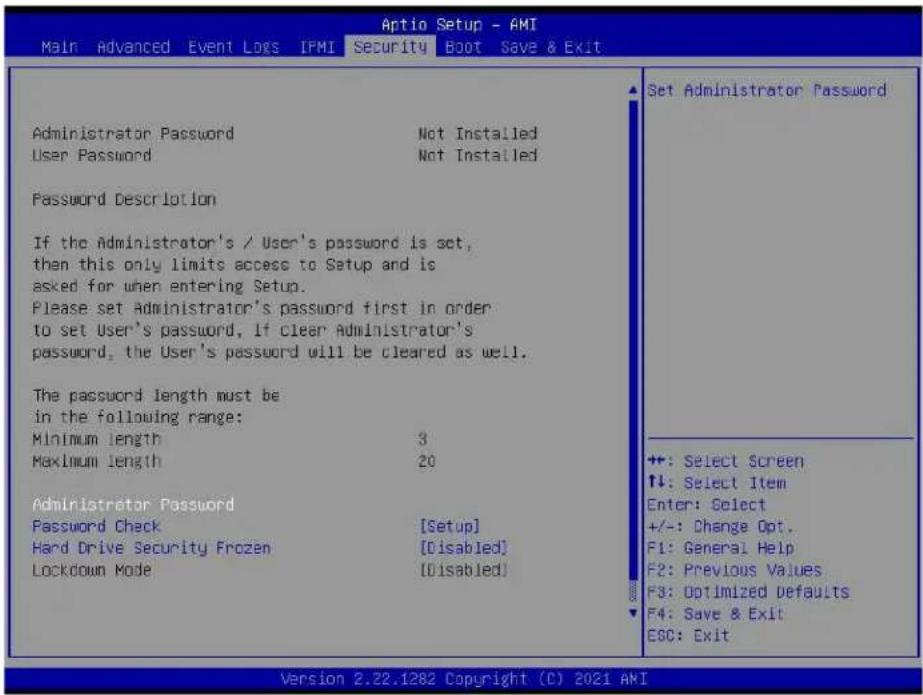
text_image
Antio Setup - AMI Main Advanced Event Logs IPMI Security Boot Save & Exit Administrator Password Not Installed User Password Not Installed Password Description If the Administrator's / User's password is set, then this only limits access to Setup and is asked for when entering Setup. Please set Administrator's password first in order to set User's password, if clear Administrator's password, the User's password will be cleared as well. The password length must be in the following range: Minimum length 3 Maximum length 20 Administrator Password Password Check [Setup] Hard Drive Security Frozen [Disabled] Lockdown Mode [Disabled] Set Administrator Password ++: Select Screen ↑↓: Select Item Enter: Select +/-: Change Opt. F1: General Help F2: Previous Values F3: Optimized Defaults F4: Save & Exit ESC: Exit Version 2.22.1282 Copyright (C) 2021 AMIAdministrator Password
Press Enter to create a new, or change an existing Administrator password.
Password Check
Select Setup for the system to check for a password at Setup. Select Always for the system to check for a password at boot up or upon entering the BIOS Setup utility. The options are Setup and Always.
Hard Drive Security Frozen
Use this feature to enable or disable the BIOS security frozen command for SATA and NVMe devices. The options are Enabled and Disabled.
Lockdown Mode
This feature is grayed out when the DCMS Key is not installed.
▶Secure Boot
This section displays the contents of the following secure boot features:
- System Mode
- Vendor Keys
- Secure Boot
Secure Boot
Use this feature to enable secure boot. The options are Disabled and Enabled.
Secure Boot Mode
Use this item to configure Secure Boot variables without authentication. The options are Standard and Custom.
CSM Support
This feature is for manufacturing debugging purposes.
Enter Audit Mode
This submenu can only be used if current System Mode is set to User (refer to Exit Deployed Mode). The PK variable will be erased on transition to Audit Mode.
Enter Deployed Mode
Press
▶Key Management
This submenu allows you to configure the following Key Management settings.
Provision Factory Default
Select Enabled to install the default Secure Boot keys set by the manufacturer. The options are Disabled and Enabled.
▶ Reset to Setup Mode
This feature deletes all Secure Boot key databases from NVRAM.
▶ Export Secure Boot variables
This feature allows you to copy NVRAM content of Secure boot variables to files in a root folder on a file system device.
▶Enroll EFI Image
This feature allows the image to run in Secure Boot Mode. Enroll SHA256 Hash Certificate of the image into the Authorized Signature Database.
Device Guard Ready
▶Remove 'UEFI CA' from DB
This feature allows you to decide if all secure boot variables should be saved.
Select Yes to restore the DB defaults.
Secure Boot Variable
▶ Platform Key (PK)
Details
Select this feature to view the details of the PK.
Export
Select Yes to export a PK from a file on an external media.
Update
Select Yes to load a factory default PK or No to load from a file on an external media.
Delete
Select Ok to remove the PK and then the system will reset to Setup/Audit Mode.
▶Key Exchange Key
Details
Select this feature to view the details of the KEK.
Export
Select Yes to export a KEK from a file on an external media.
Update
Select Yes to load a factory default KEK or No to load from a file on an external media.
Append
Select Yes to add the KEK from the manufacturer's defaults list to the existing KEK. Select No to load the KEK from a file. The options are Yes and No.
Delete
Select Ok to remove the KEK and then the system will reset to Setup/Audit Mode.
▶ Authorized Signatures
Details
Select this feature to view the details of the DB.
Export
Select Yes to export a DB from a file on an external media.
Update
Select Yes to load a factory default DB or No to load from a file on an external media.
Append
Select Yes to add the DB from the manufacturer's defaults list to the existing DB. Select No to load the DB from a file. The options are Yes and No.
Delete
Select Ok to remove the DB and then the system will reset to Setup/Audit Mode.
▶ Forbidden Signatures
Details
Select this feature to view the details of the DBX.
Export
Select Yes to export a DBX from a file on an external media.
Update
Select Yes to load a factory default DBX or No to load from a file on an external media.
Append
Select Yes to add the DBX from the manufacturer's defaults list to the existing DBX.
Select No to load the DBX from a file. The options are Yes and No.
Delete
Select Ok to remove the DBX and then the system will reset to Setup/Audit Mode.
▶ Authorized TimeStamps
Details
Select this feature to view the details of the DBT.
Export
Select Yes to export a DBT from a file on an external media.
Update
Select Yes to load a factory default DBT or No to load from a file on an external media.
Append
Select Yes to add the DBT from the manufacturer's defaults list to the existing DBT. Select No to load the DBT from a file. The options are Yes and No.
Delete
Select Ok to remove the DBT and then the system will reset to Setup/Audit Mode.
OsRecovery Signature
Details
Select this feature to view the details of the DBR.
Export
Select Yes to export a DBR from a file on an external media.
Update
Select Yes to load a factory default DBR or No to load from a file on an external media.
Append
Select Yes to add the DBR from the manufacturer's defaults list to the existing DBR. Select No to load the DBR from a file. The options are Yes and No.
Delete
Select Ok to remove the DBR and then the system will reset to Setup/Audit Mode.
4.7 Boot
Use this menu to configure Boot settings.
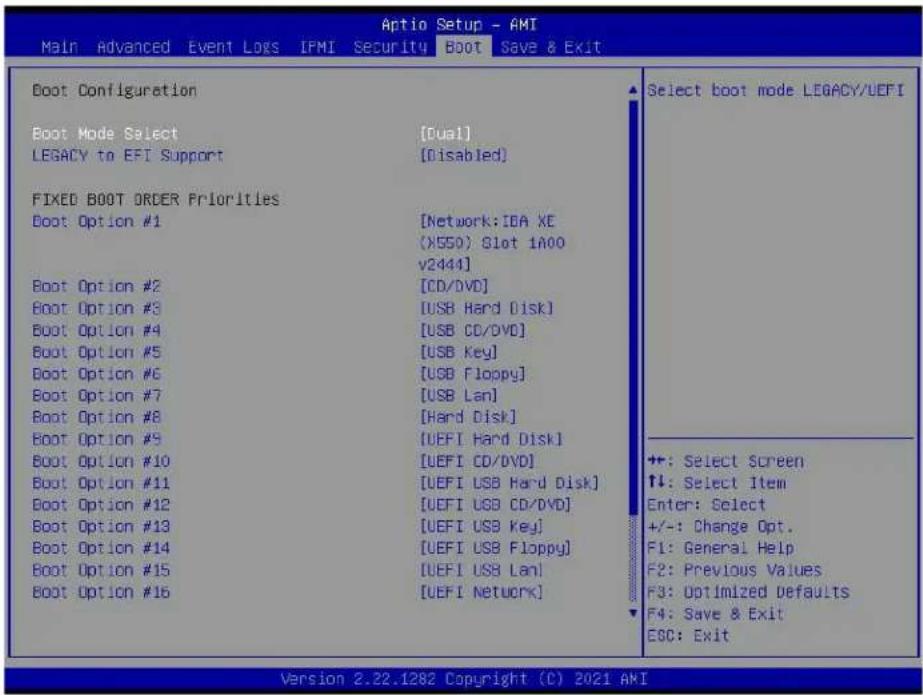
text_image
Boot Configuration Boot Mode Select LEGACY to EFI Support FIXED BOOT ORDER Priorities Boot Option #1 [Dual] [Disabled] [Network: IBA XE (X550) Slot iA00 v2444] [CD/DVD] [USB Hard Disk] [USB CD/DVD] [USB Key] [USB Floppy] [USB Lan] [Hard Disk] [UEFI Hard Disk] [UEFI CD/DVD] [UEFI USB Hard Disk] [UEFI USB CD/DVD] [UEFI USB Key] [UEFI USB Floppy] [UEFI USB Lan] [UEFI Network] Select boot mode LEGACY/UEFI ++: Select Screen ↑↓: Select Item Enter: Select +/-: Change Opt. F1: General Help F2: Previous Values F3: Optimized Defaults F4: Save & Exit ESC: Exit Version 2.22.1282 Copyright (C) 2021 AMIBoot Mode Select
Use this feature to select the type of device that the system is going to boot from. The options are Legacy, UEFI, and Dual.
Legacy to EFI Support
Select Enabled to boot EFI OS support after Legacy boot order has failed. The options are Disabled and Enabled.
Fixed Boot Order Priorities
This feature prioritizes the order of bootable devices that the system boots from. Press
*If the feature "Boot Mode Select" is set to Legacy, UEFI, or Dual, the following features are displayed:
- Boot Option #1
- Boot Option #2
- Boot Option #3
- Boot Option #4
- Boot Option #5
- Boot Option #6
- Boot Option #7
- Boot Option #8
- Boot Option #9
- Boot Option #10
- Boot Option #11
- Boot Option #12
- Boot Option #13
- Boot Option #14
- Boot Option #15
- Boot Option #16
- Boot Option #17
▶ Delete Boot Option
This feature allows you to select a boot device to delete from the boot priority list.
Delete Boot Option
Use this feature to remove an EFI boot option from the boot priority list.
▶UEFI USB Key Drive BBS Priorities
This feature sets the system boot order of detected devices.
- Boot Option #1
▶UEFI NETWORK Drive BBS Priorities
This feature sets the system boot order of detected devices.
- Boot Option #1 - #12
▶UEFI Application Boot Priorities
This feature sets the system boot order of detected devices.
- Boot Option #1
▶NETWORK Drive BBS Priorities
This feature sets the system boot order of detected devices.
- Boot Option #1
4.8 Save & Exit
Use this menu to save settings and exit from the BIOS.

text_image
Antio Setup - AMI Main Advanced Event Logs JPMI Security Boot Save & Exit Save Options Discard Changes and Exit Save Charges and Reset Save Changes Discard Changes Default Options Restore Optimized Defaults Save as User Defaults Restore User Defaults Boot Override IBN XE (K550) Slot 1800 V2444 UEFI: Built-in EFI Shell Launch EFI Shell from filesystem device Exit system setup without saving any changes. +: Select Screen T1: Select Item Enter: Select +/-: Change Opt. F1: General Help F2: Previous Values F3: Optimized Defaults F4: Save & Exit ESC: Exit Version 2.22.1252 Copyright (C) 2021 AMISave Options
Discard Changes and Exit
Select this option to quit the BIOS Setup without making any permanent changes to the system configuration, and reboot the computer. Select Discard Changes and Exit from the Save & Exit menu and press
Save Changes and Reset
After completing the system configuration changes, select this option to save the changes you have made. This will not reboot the system.
Save Changes
When you have completed the system configuration changes, select this option to leave the BIOS setup utility and reboot the computer for the new system configuration parameters to take effect. Select Save Changes from the Save & Exit menu and press
Discard Changes
Select this option and press
Default Options
Restore Optimized Defaults
To set this feature, select Restore Defaults from the Save & Exit menu and press
Save As User Defaults
To set this feature, select Save as User Defaults from the Save & Exit menu and press
To set this feature, select Restore User Defaults from the Save & Exit menu and press
Boot Override
This feature allows you to override the Boot priorities sequence in the Boot menu, and immediately boot the system with a device specified instead of the one specified in the boot list. This is a one-time override.
Appendix A
Software
After the hardware has been installed, you can install the Operating System (OS), configure RAID settings and install the drivers.
A.1 Microsoft Windows OS Installation
If you will be using RAID, you must configure RAID settings before installing the Windows OS and the RAID driver. Refer to the RAID Configuration User Guides posted on our website at www.supermicro.com/support/manuals.
Installing the OS
- Create a method to access the MS Windows installation ISO file. That might be a DVD, perhaps using an external USB/SATA DVD drive, or a USB flash drive, or the IPMI KVM console.
- Retrieve the proper RST/RSTe driver. Go to the Supermicro web page for your motherboard and click on "Download the Latest Drivers and Utilities", select the proper driver, and copy it to a USB flash drive.
- Boot from a bootable device with Windows OS installation. You can see a bootable device list by pressing F11 during the system startup.

text_image
Please select boot device: ATEN Virtual CDROM YSOJ → IPMI virtual drive (Legacy) ASUS SDRW-08D2S-U F601 → USB DVD device (Legacy) USB FLASH DRIVE PMAP → USB flash drive with OS installation (Legacy) IBA 40-10G Slot 1900 v1060 → PXE boot (Legacy) UEFI: ATEN Virtual CDROM YSOJ → IPMI virtual drive (UEFI) UEFI: ASUS SDRW-08D2S-U F601 → USB DVD device (UEFI) UEFI: Built-in EFI Shell Enter Setup ↑ and ↓ to move selection ENTER to select boot device ESC to boot using defaultsFigure A-1. Select Boot Device
- During Windows Setup, continue to the dialog where you select the drives on which to install Windows. If the disk you want to use is not listed, click on "Load driver" link at the bottom left corner.
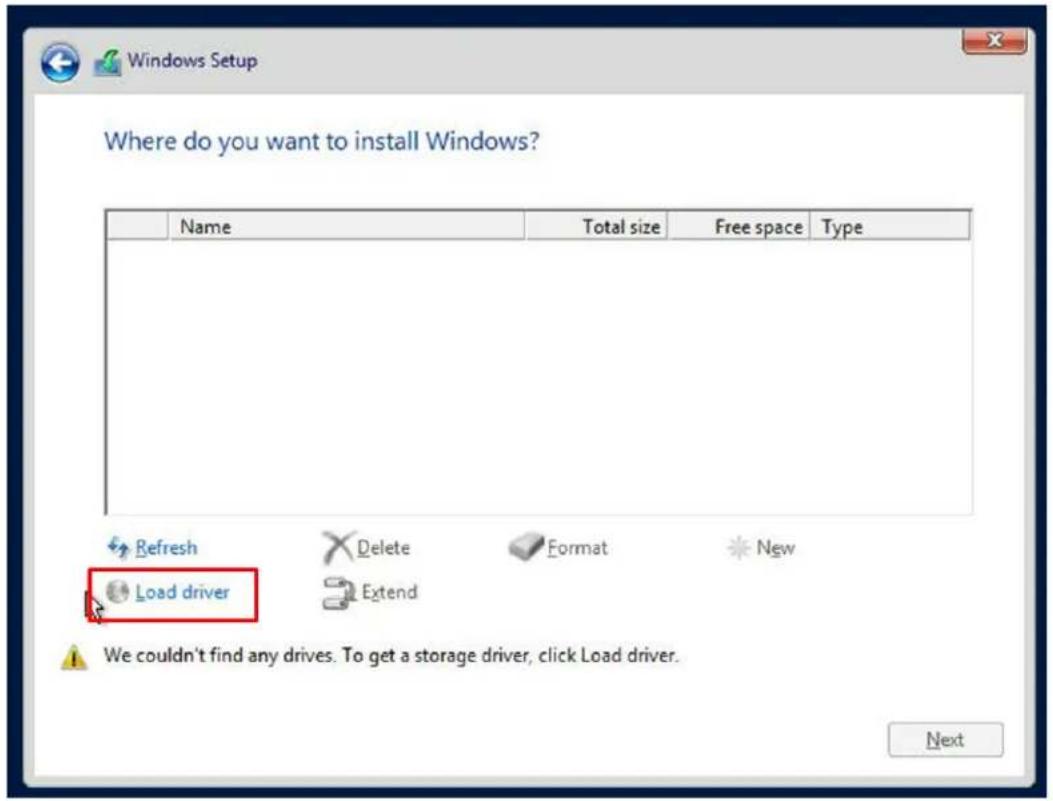
text_image
Where do you want to install Windows? Name Total size Free space Type Refresh Delete Format New Load driver Extend We couldn't find any drives. To get a storage driver, click Load driver. NextFigure A-2. Load Driver Link
To load the driver, browse the USB flash drive for the proper driver files.
- For RAID, choose the SATA/sSATA RAID driver indicated then choose the storage drive on which you want to install it.
-
For non-RAID, choose the SATA/sSATA AHCI driver indicated then choose the storage drive on which you want to install it.
-
Once all devices are specified, continue with the installation.
- After the Windows OS installation has completed, the system will automatically reboot multiple times.
A.2 Driver Installation
The Supermicro website that contains drivers and utilities for your system is at https://www.supermicro.com/wdl/driver/. Some of these must be installed, such as the chipset driver.
After accessing the website, go into the CDR_Images (in the parent directory of the above link) and locate the ISO file for your motherboard. Download this file to a USB flash drive or a DVD. (You may also use a utility to extract the ISO file if preferred.)
Another option is to go to the Supermicro website at http://www.supermicro.com/products/. Find the product page for your motherboard and download the latest drivers and utilities.
Insert the flash drive or disk and the screenshot shown below should appear.

text_image
SUPERMICRO X12SPG-NF Motherboard Drivers & Tools (Win2019) Intel® C621A Chipset X12SPG-NF SUPERMICRO Computer Inc. Intel Chipset INF files Microsoft .Net Framework 4.8(Optional) ASPEED Graphics Driver Intel Virtual RAID on CPU Intel PRO Network Connections Drivers SUPERMICRO SuperDoctor 5 Build driver diskettes and manuals Browse CD Auto Start Up Next Time For more information, please visit SUPERMICRO's web site.Figure A-3. Driver & Tool Installation Screen
Note: Click the icons showing a hand writing on paper to view the readme files for each item. Click the computer icons to the right of these items to install each item (from top to bottom) one at a time. After installing each item, you must reboot the system before moving on to the next item on the list. The bottom icon with a CD on it allows you to view the entire contents.
A.3 SuperDoctor® 5
The Supermicro SuperDoctor 5 is a program that functions in a command-line or web-based interface for Windows and Linux operating systems. The program monitors such system health information as CPU temperature, system voltages, system power consumption, fan speed, and provides alerts via email or Simple Network Management Protocol (SNMP).
SuperDoctor 5 comes in local and remote management versions and can be used with Nagios to maximize your system monitoring needs. With SuperDoctor 5 Management Server (SSM Server), you can remotely control power on/off and reset chassis intrusion for multiple systems with SuperDoctor 5 or IPMI. SuperDoctor 5 Management Server monitors HTTP, FTP, and SMTP services to optimize the efficiency of your operation.

Note: The default User Name and Password for SuperDoctor 5 is ADMIN / ADMIN.

text_image
SuperDoctor 5 Matherboard: C7S386-CB-ML Voltage 0.98 V 12.4 V 14.0 V 16.0 V 18.0 V 20.0 V 22.0 V 24.0 V 26.0 V 28.0 V 30.0 V 32.0 V 34.0 V 36.0 V 38.0 V 40.0 V 42.0 V 44.0 V 46.0 V 48.0 V 50.0 V 52.0 V 54.0 V 56.0 V 58.0 V 60.0 V 62.0 V 64.0 V 66.0 V 68.0 V 70.0 V 72.0 V 74.0 V 76.0 V 78.0 V 80.0 V 82.0 V 84.0 V 86.0 V 88.0 V 90.0 V 92.0 V 94.0 V 96.0 V 98.0 V 100.0 V 102.0 V 104.0 V 106.0 V 108.0 V 110.0 V 112.0 V 114.0 V 116.0 V 118.0 V 120.0 V 122.0 V 124.0 V 126.0 V 128.0 V 130.0 V 132.0 V 134.0 V 136.0 V 138.0 V 140.0 V 142.0 V 144.0 V 146.0 V 148.0 V 150.0 V 152.0 V 154.0 V 156.0 V 158.0 V 160.0 V 162.0 V 164.0 V 166.0 V 168.0 V 170.0 V 172.0 V 174.0 V 176.0 V 178.0 V 180.0 V 182.0 V 184.0 V 186.0 V 188.0 V 190.0 V 192.0 V 194.0 V 196.0 V 198.0 V 200.0 V Status: Chaseless Immersion Temperature LPG Time Power Time Pressure Time Hard Disk Initial Smart Inverticks A PHYSICAL DRIVES (2536/CKD) Memory Ask me insertingFigure A-4. SuperDoctor 5 Interface Display Screen (Health Information)
A.4 IPMI
The 10th Generation Intel Xeon, Core™ i3, Pentium, Celeron supports the Intelligent Platform Management Interface (IPMI). IPMI is used to provide remote access, monitoring and management. There are several BIOS settings that are related to IPMI.
Supermicro ships standard products with a unique password for the BMC ADMIN user. This password can be found on a label on the motherboard. For general documentation and information on IPMI, visit our website at https://www.supermicro.com/en/support/BMC_Unique_Password.
Appendix B
Standardized Warning Statements
The following statements are industry standard warnings, provided to warn the user of situations which have the potential for bodily injury. Should you have questions or experience difficulty, contact Supermicro's Technical Support department for assistance. Only certified technicians should attempt to install or configure components.
Read this section in its entirety before installing or configuring components.
These warnings may also be found on our website at http://www.supermicro.com/about/policies/safety_information.cfm.
Battery Handling

Warning! There is the danger of explosion if the battery is replaced incorrectly. Replace the battery only with the same or equivalent type recommended by the manufacturer. Dispose of used batteries according to the manufacturer's instructions
電池の取り扱い
Warning! Ultimate disposal of this product should be handled according to all national laws and regulations.