A3SPI-8C-HLN4F - Motherboard Supermicro - Free user manual and instructions
Find the device manual for free A3SPI-8C-HLN4F Supermicro in PDF.


| Product Type | Motherboard |
| Brand | Supermicro |
| Model | A3SPI-8C-HLN4F |
| Form Factor | ATX |
| Dimensions (W x H) | 12 x 9.6 inches (305 x 244 mm) |
| Weight | 2.5 lbs (1.13 kg) |
| Power Supply Requirement | ATX 24-pin + 8-pin EPS |
| CPU Socket | LGA 4189 |
| Supported Processors | Intel Xeon Scalable 3rd Gen |
| Memory Support | 8x DDR4 DIMM slots, up to 2TB RDIMM/LRDIMM |
| Storage Interfaces | 8x SATA3, 2x M.2 NVMe |
| Expansion Slots | 4x PCIe 4.0 x16, 1x PCIe 4.0 x8 |
| Networking | 4x 10GbE LAN ports |
| USB Ports | 2x USB 3.2 Gen2, 4x USB 3.2 Gen1 |
| Main Functions | Enterprise-grade server motherboard with high memory capacity, multiple PCIe lanes for GPU/accelerator cards, and 10GbE networking. |
| Maintenance & Cleaning | Use compressed air to remove dust. Avoid liquid cleaners. Handle with ESD protection. |
| Safety | Complies with CE, FCC, and RoHS standards. Operate in well-ventilated environment. |
| Spare Parts & Repairability | Replacement CMOS battery, capacitors, and fan headers available. Contact Supermicro support for RMA. |
| General Information | Supermicro A3SPI-8C-HLN4F is a high-performance server motherboard designed for data centers and enterprise applications. |
Frequently Asked Questions - A3SPI-8C-HLN4F Supermicro
User questions about A3SPI-8C-HLN4F Supermicro
0 question about this device. Answer the ones you know or ask your own.
Ask a new question about this device
Download the instructions for your Motherboard in PDF format for free! Find your manual A3SPI-8C-HLN4F - Supermicro and take your electronic device back in hand. On this page are published all the documents necessary for the use of your device. A3SPI-8C-HLN4F by Supermicro.
USER MANUAL A3SPI-8C-HLN4F Supermicro
The information in this user's manual has been carefully reviewed and is believed to be accurate. The vendor assumes no responsibility for any inaccuracies that may be contained in this document, and makes no commitment to update or to keep current the information in this manual, or to notify any person or organization of the updates. Please Note: For the most up-to-date version of this manual, please see our website at www.supermicro.com.
Super Micro Computer, Inc. ("Supermicro") reserves the right to make changes to the product described in this manual at any time and without notice. This product, including software and documentation, is the property of Supermicro and/or its licensors, and is supplied only under a license. Any use or reproduction of this product is not allowed, except as expressly permitted by the terms of said license.
IN NO EVENT WILL Super Micro Computer, Inc. BE LIABLE FOR DIRECT, INDIRECT, SPECIAL, INCIDENTAL, SPECULATIVE OR CONSEQUENTIAL DAMAGES ARISING FROM THE USE OR INABILITY TO USE THIS PRODUCT OR DOCUMENTATION, EVEN IF ADVISED OF THE POSSIBILITY OF SUCH DAMAGES. IN PARTICULAR, SUPER MICRO COMPUTER, INC. SHALL NOT HAVE LIABILITY FOR ANY HARDWARE, SOFTWARE, OR DATA STORED OR USED WITH THE PRODUCT, INCLUDING THE COSTS OF REPAIRING, REPLACING, INTEGRATING, INSTALLING OR RECOVERING SUCH HARDWARE, SOFTWARE, OR DATA.
Any disputes arising between manufacturer and customer shall be governed by the laws of Santa Clara County in the State of California, USA. The State of California, County of Santa Clara shall be the exclusive venue for the resolution of any such disputes. Supermicro's total liability for all claims will not exceed the price paid for the hardware product.
FCC Statement: This equipment has been tested and found to comply with the limits for a Class B digital device pursuant to Part 15 of the FCC Rules. These limits are designed to provide reasonable protection against harmful interference when the equipment is operated in a commercial environment. This equipment generates, uses, and can radiate radio frequency energy and, if not installed and used in accordance with the manufacturer's instruction manual, may cause harmful interference with radio communications. Operation of this equipment in a residential area is likely to cause harmful interference, in which case you will be required to correct the interference at your own expense.
California Best Management Practices Regulations for Perchlorate Materials: This Perchlorate warning applies only to products containing CR (Manganese Dioxide) Lithium coin cells. "Perchlorate Material-special handling may apply. See www.dtsc.ca.gov/hazardouswaste/perchlorate.
WARNING: This product can expose you to chemicals including lead, known to the State of California to cause cancer and birth defects or other reproductive harm. For more information, go to www.P65Warnings.ca.gov.
The products sold by Supermicro are not intended for and will not be used in life support systems, medical equipment, nuclear facilities or systems, aircraft, aircraft devices, aircraft/emergency communication devices or other critical systems whose failure to perform be reasonably expected to result in significant injury or loss of life or catastrophic property damage. Accordingly, Supermicro disclaims any and all liability, and should buyer use or sell such products for use in such ultra-hazardous applications, it does so entirely at its own risk. Furthermore, buyer agrees to fully indemnify, defend and hold Supermicro harmless for and against any and all claims, demands, actions, litigation, and proceedings of any kind arising out of or related to such ultra-hazardous use or sale.
Manual Revision 1.0a
Release Date: May 08, 2023
Unless you request and receive written permission from Super Micro Computer, Inc., you may not copy any part of this document. Information in this document is subject to change without notice. Other products and companies referred to herein are trademarks or registered trademarks of their respective companies or mark holders.
Copyright © 2023 by Super Micro Computer, Inc.
All rights reserved.
Printed in the United States of America
Preface
About This Manual
This manual is written for system integrators, IT technicians and knowledgeable end users. It provides information for the installation and use of the A3SPI-4C/8C-LN6PF/HLN4F motherboard.
About This Motherboard
The A3SPI-4C/8C-LN6PF/HLN4F motherboard supports the Intel® Atom® System-on-Chip (SoC) C5000 series processor with up to eight cores and a thermal design power (TDP) of up to 41W. It comes in a mini-ITX form factor and supports both DC12V and ATX power input, and up to 128GB of DDR4 ECC RDIMM memory with speeds of up to 2933 MT/s in two DIMM slots. Its I/O expandability and high-speed connections include one PCIe 3.0 x4 slot, M.2 M-key/B-key connections, one SuperDOM SATA 3.0 port, Oculink with support for PCIe/SATA/NVMe, quad GbE LAN ports, dual 10G SFP+ ports (LN6PF), and 1GbE Base-T ports. It also offers the most advanced remote system management and data protection capability with a dedicated BMC LAN port and a Trusted Platform Module (TPM).
The motherboard is built upon advanced technologies such as Intel Virtualization to improve security and reliability of systems, and Thermal Monitoring to reduce power consumption. Optimized for high-performance, high-end computing platforms that require small form factor hardware, it is ideal for the next generation of embedded storage systems, uCPE, and Edge network infrastructure.
Please note that this motherboard is intended to be installed and serviced by professional technicians only. For processor/memory updates, please refer to our website at http://www.supermicro.com/products/.
Conventions Used in the Manual
Special attention should be given to the following symbols for proper installation and to prevent damage done to the components or injury to yourself:

Warning! Indicates important information given to prevent equipment/property damage or personal injury.

Warning! Indicates high voltage may be encountered when performing a procedure.

Important: Important information given to ensure proper system installation or to relay safety precautions.

Note: Additional Information given to differentiate various models or information for correct system setup.
Contacting Supermicro
Headquarters
Address: Super Micro Computer, Inc.
980 Rock Ave.
San Jose, CA 95131 U.S.A.
Tel: +1 (408) 503-8000
Fax: +1 (408) 503-8008
Email: Marketing@supermicro.com (General Information)
Sales-USA@supermicro.com (Sales Inquiries)
Government_Sales-USA@supermicro.com (Gov. Sales Inquiries)
Support@supermicro.com (Technical Support)
RMA@supermicro.com (RMA Support)
Webmaster@supermicro.com (Webmaster)
Website: www.supermicro.com
Europe
Address: Super Micro Computer B.V.
's-Hertogenbosch, The Netherlands
Tel: +31 (0) 73-6400390
Fax: +31 (0) 73-6416525
Email: Sales_Europe@supermicro.com (General Information)
Support_Europe@supermicro.com (Technical Support)
RMA_Europe@supermicro.com (RMA Support)
Website: www.supermicro.nl
Asia-Pacific
Address: Super Micro Computer, Inc.
3F, No. 150, Jian 1st Rd.
Zhonghe Dist., New Taipei City 235
Taiwan (R.O.C)
Tel: +886-(2) 8226-3990
Fax: +886-(2) 8226-3992
Email: Sales-Asia@supermicro.com.tw (Sales Inquiry)
Support@supermicro.com.tw (Technical Support)
RMA@supermicro.com.tw (RMA Support)
Website: www.supermicro.com.tw
Table of Contents
Chapter 1 Introduction
1.1 Checklist....8
Quick Reference ....12
Quick Reference Table....13
Motherboard Features....15
1.2 Processor Overview....18
1.3 Special Features ....18
Recovery from AC Power Loss....18
1.4 ACPI Features....19
1.5 Power Supply ....19
1.6 Serial Port....19
1.7 Advanced Power Management....19
Management Engine (ME)....19
Chapter 2 Installation
2.1 Static-Sensitive Devices....19
Precautions 19
Unpacking ....19
2.2 Motherboard Installation....20
Tools Needed ....20
Location of Mounting Holes 20
Installing the Motherboard....21
2.3 Memory Support and Installation 22
Memory Support....22
General Guidelines for Optimizing Memory Performance....23
DIMM Installation 24
DIMM Removal ....24
2.4 Rear I/O Ports 25
2.5 Front Control Panel....29
2.6 Connectors ....33
Power Connections....33
Headers....35
2.7 Jumper Settings ....46
How Jumpers Work....46
2.8 LED Indicators....53
Chapter 3 Troubleshooting
3.1 Troubleshooting Procedures ....55
Before Power On ....55
No Power ....55
No Video ....55
System Boot Failure....56
Memory Errors ....56
Losing the System's Setup Configuration....57
When the System Becomes Unstable....57
3.2 Technical Support Procedures ....59
3.3 Frequently Asked Questions ....60
3.4 Battery Removal and Installation 62
Battery Removal....62
Proper Battery Disposal....62
Battery Installation....62
3.5 Returning Merchandise for Service....63
Chapter 4 UEFI BIOS
4.1 Introduction....64
4.2 Main Setup 65
4.3 Advanced....67
4.4 BMC....92
4.5 Event Logs ....95
4.6 Security....97
4.7 Boot....103
4.8 Save & Exit....105
Appendix A BIOS Codes
A.1 BIOS POST Codes....108
Appendix B Software Installation
B.1 Supermicro SuperDoctor 5....109
Appendix C Standardized Warning Statements
Appendix D UEFI BIOS Recovery
D.1 Overview....111
D.2 Recovering the UEFI BIOS Image 111
D.3 Recovering the BIOS Block with a USB Device....111
Chapter 1
Introduction
Congratulations on purchasing your computer motherboard from an industry leader. Supermicro boards are designed to provide you with the highest standards in quality and performance. In addition to the motherboard, several important parts that are included with the system are listed below. If anything listed is damaged or missing, please contact your retailer.
1.1 Checklist
| Main Parts List (Retail Single Package) | ||
| Description Part Number Quantity | ||
| Motherboard A3SPI-4C/8C-LN6PF/HLN4F 1 | ||
| Quick Reference Guide MNL-2467-QRG 1 | ||
| Oculink to SATA Cable CBL-SAST-0933 1 | ||
| I/O Shield MCP-260-00173-0N 1 | ||
| SATA Cable CBL-0044L 1 | ||
Important Links
For your system to work properly, please follow the links below to download all necessary drivers/utilities and the user's manual for your server.
- Supermicro product manuals: http://www.supermicro.com/support/manuals/
- Product drivers and utilities: https://www.supermicro.com/wdl/driver/
- Product safety info: http://www.supermicro.com/about/policies/safety_information.cfm
- A secure data deletion tool designed to fully erase all data from storage devices can be found at our website: https://www.supermicro.com/wdl/utility/Lot9_Secure_Data_Deletion_Utility/
- If you have any questions, please contact our support team at: support@supermicro.com
This manual may be periodically updated without notice. Please check the Supermicro website for possible updates to the manual revision level.
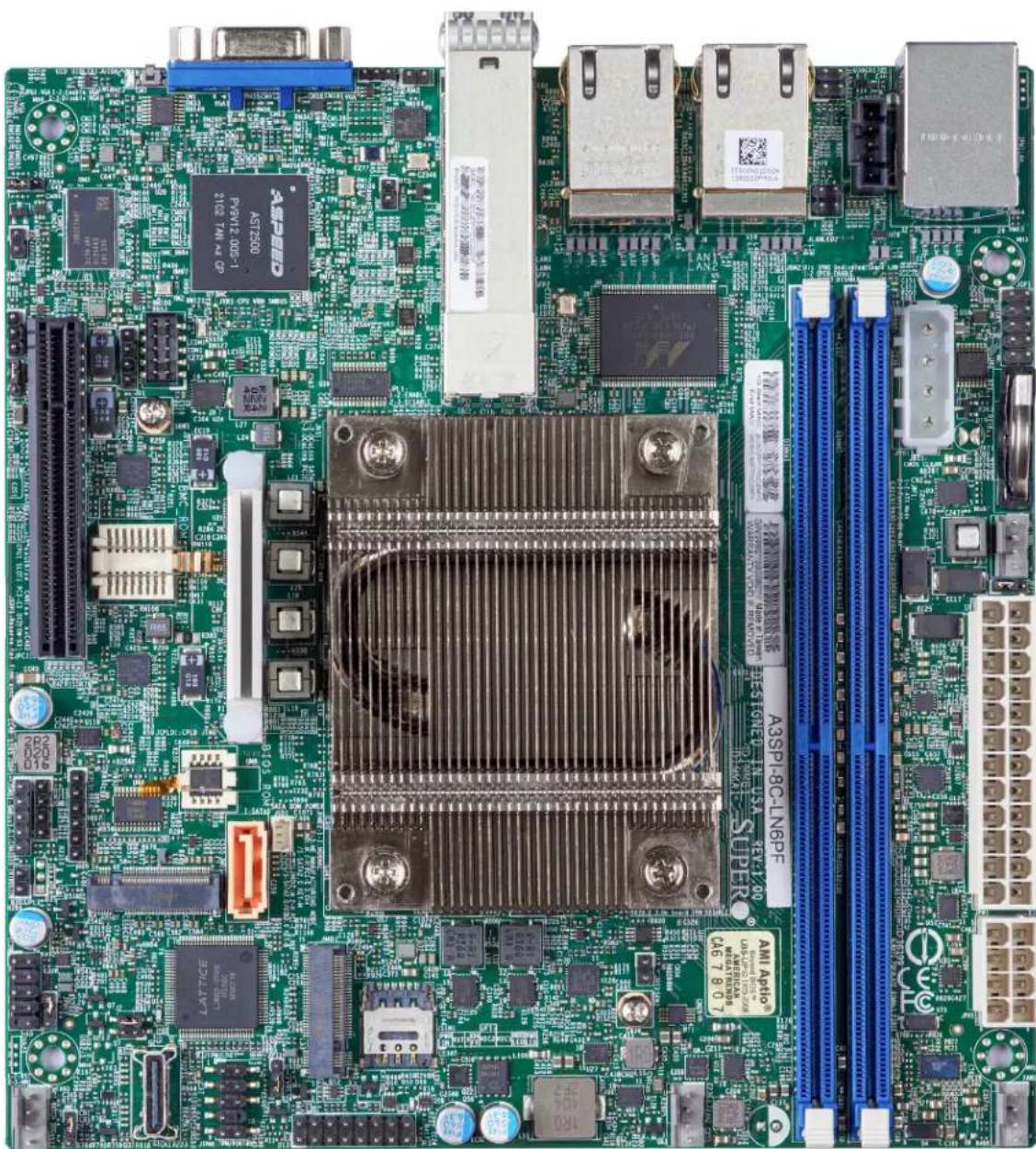
Figure 1-1. A3SPI-4C-HLN4F Motherboard Image

natural_image
Close-up of a green printed circuit board with various electronic components and connectors (no readable text or symbols)Figure 1-2. A3SPI-8C-LN6PF Motherboard Image
natural_image
Close-up of a green printed circuit board with various electronic components and connectors (no readable text or symbols)
Note: All graphics shown in this manual were based upon the latest PCB revision available at the time of publication of the manual. The motherboard you received may or may not look exactly the same as the graphics shown in this manual.
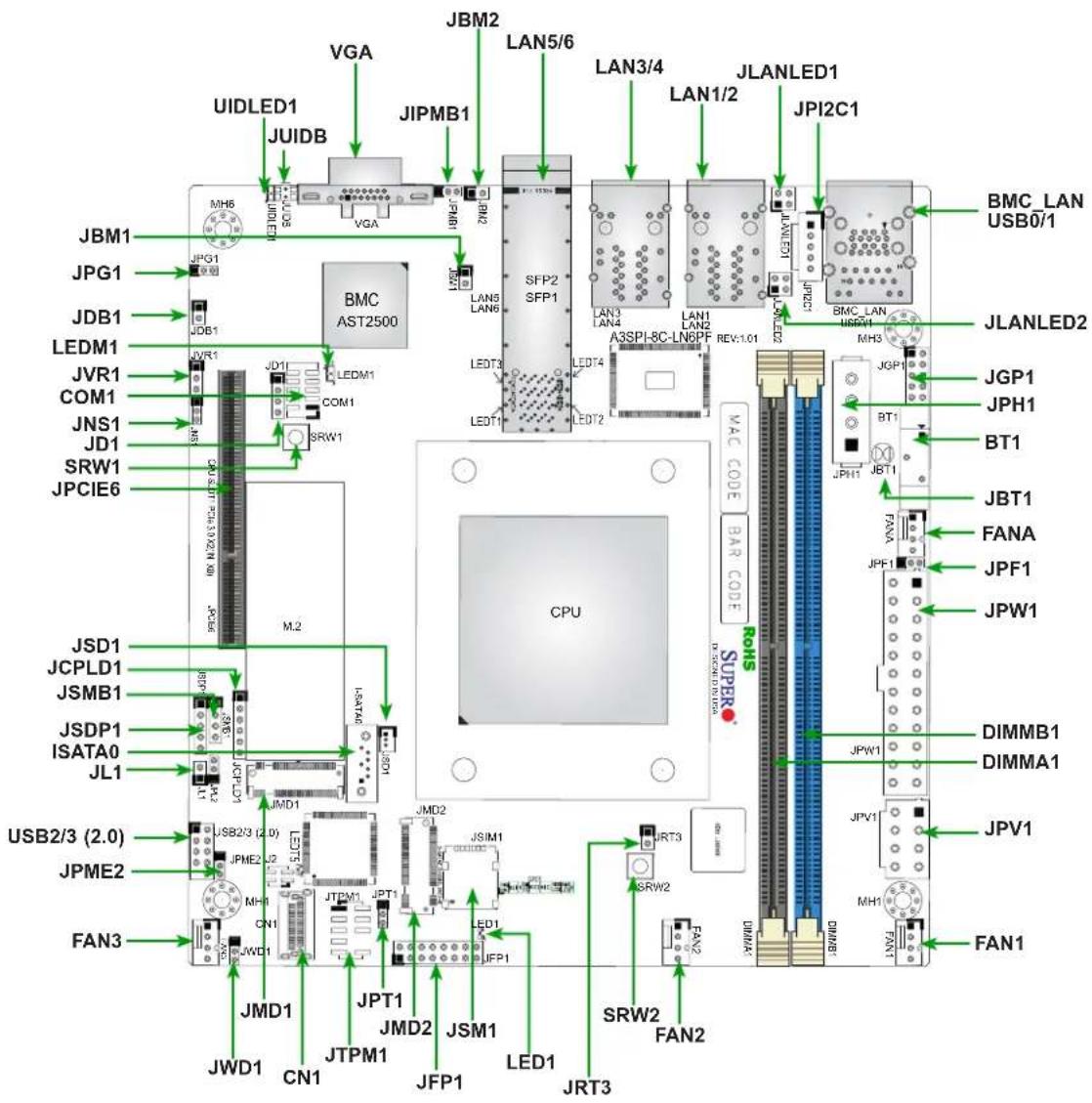
Figure 1-3. Motherboard Layout
(not drawn to scale)

text_image
JPG1 JDB1 JVR1 JJD1 LEDM1 COM1 SRW1 CPU 5.0T1PC-3.0XIN JPGE5 JSP4 JPL2 JCPLD1 JMD1 JMSR1 JPL1 JWD1 JPM2 JPM1 JPTM1 JPT1 JPM2 JPM1 JPM2 JPM1 JPM2 JPM1 JPM2 JPM1 JPM2 JPM1 JPM2 JPM1 JPM2 JPM1 JPM2 JPM1 JPM2 JPM1 JPM2 JPM1 JPM2 JPM1 JPM2 JPM1 JPM2 JPM1 JPF1 JPF2 JPF1 JPF2 JPF1 JPF2 JPF1 JPF2 JPF1 JPF2 JPF1 JPF2 JPF1 JPF2 JPF1 JPF2 JPF1 JPF2 JPF1 JPF2 JPF1 JPF2 JPF1 JPF2 JPF1 JPF2 JPF2 JPF1 JPF2 JPF1 JPF2 JPF1 JPF2 JPF1 JPF2 JPF1 JPF2 JPF1 JPF2 JPF1 JPF2 JPF1 JPF2 JPF1 JPF2 JPF1 JPF2 JPF1 JPF2 JPF1 JPF1 JPF2 JPF1 JPF2 JPF1 JPF2 JPF1 JPF2 JPF1 JPF2 JPF1 JPF2 JPF1 JPF2 JPF1 JPF2 JPF1 JPF2 JPF1 JPF2 JPF1 JPF2 JPF1 JPF2 JDF6A/8C-LN6FP REV: 1.01
Note: Components not documented are for internal testing only.
Quick Reference
text_image
UIDLED1 JUIDB VGA JBM2 LAN5/6 JIPMB1 LAN3/4 LAN1/2 JLANLED1 JPI2C1 JBM1 JPG1 JDB1 LEDM1 JVR1 COM1 JNS1 JD1 SRW1 JPCIE6 JSD1 JCPLD1 JSMB1 JSDP1 ISATA0 JL1 USB2/3 (2.0) JPME2 FAN3 JMD1 JWD1 CN1 JPT1 JPM1 JPM2 JPM1 JPM2 JPM1 JPM2 JPM1 JPM2 JPM1 JPM2 JPM1 JPM2 JPM1 JPM2 JPM1 JPM2 JPM1 JPM2 JPM1 JPM2 JPM1 JPM2 JPM1 JPM2 JPM1 JPM2 JPM2 JPM1 JPM2 JPM1 JPM2 JPM1 JPM2 JPM1 JPM2 JPM1 JPM2 JPM1 JPM2 JPM1 JPM2 JPM1 JPM2 JPM1 JPM2 JPM1 JPM2 JPM1 JPM2 JPM1 JPM3 JMD2 JSIM1 JRT3 FAN2 FAN1 FAN0/1 JLANLED2 JGP1 JPH1 BT1 JBTP1 JBTP1 JBTP1/8C-LN6PF REV:1.01 A3SPI-8C-LN6PF LEDT3 SFP2 SFP1 LAN5 LAN6 LAN3 LAN4 LAN2 LAN1 LAN2 LAN0 LAN0 LAN0 LAN0 LAN0 LAN0 LAN0 LAN0 LAN0 LAN0 LAN0 LAN0 LAN0 LAN0 LAN0 LAN0 LAN0 LAN0 LAN0 LAN0 LAN0 LAN0 LAN0 LAN0 LAN0 LAN0 LAN0 LAN0 LAN0 LAN0 LAN0 LAN0 LAN0 LAN0 LAN0 LAN0 LAN0 LAN0 LAN0 LAN0 LAN0 LAN0 LAN0 LAN0 LAN0 LAN0 LAN0 LAN0 LAN0 LAN0 LAN 3.5x 3.5x 3.5x 3.5x 3.5x 3.5x 3.5x 3.5x 3.5x 3.5x 3.5x 3.5x 3.5x 3.5x 3.5x 3.5x 3.5x 3.5x 3.5x 3.5x 3.5m
Notes:
- See Chapter 2 for detailed information on jumpers, I/O ports, and JFP1 front panel connections.
- "■ indicates the location of Pin 1.
- Jumpers/LED indicators not indicated are used for testing only.
- Use only the correct type of onboard CMOS battery as specified by the manufacturer.
Quick Reference Table
Jumper Description Default Setting
| JBM1 Disable IPMI Shared LAN Pins 1-2 Open: Enable | ||
| JBM2 Disable IPMI Dedicated LAN Pins 1-2 Open: Enable | ||
| JBT1 CMOS Clear Open: Normal | ||
| JDB1 COM Port or BMC Debug Port Select Open: COM PORT | ||
| JNS1 OCuLink to SATA or PCIe Mode Selection | Pins 1-2: SATA (Default)Pins 2-3: NVMe | |
| JPF1 ATX or Force PS-ON Mode | Pins 1-2: ATX ModePins 2-3: Force PS-ON Mode | |
| JPG1 Onboard VGA Enable/Disable | Pins 1-2: Enabled (Default)Pins 2-3: Disable VGA | |
| JPME2 ME Manufacturing Mode Pins 1-2: Normal | ||
| JPT1 Onboard TPM Enable/Disable Pins 1-2: Enabled | ||
| JWD1 Watch Dog | Pins 1-2: Reset | |
| LED | Description Status | |
| LED1 Power LED | Solid Green: Power On | |
| LEDM1 | BMC Heartbeat | Blinking Green: BMC Normal |
| UIDLED1 | UID LED | Solid Blue: Unit Identified |
| Connector | Description | |
| CN1 | OCuLink Connector (to PCIe x4/SATA or NVMe) | |
| BMC_LAN | BMC LAN Port | |
| BT1 | Onboard Battery | |
| COM1 COM Header | ||
| FAN1/2/3, FANA | System Fan Headers | |
| I-SATA0 | SATA 3.0 Port (I-SATA0: SuperDOM) | |
| JCPLD1 | Complex-Programmable Logical Device (CPLD) header | |
| JD1 | Speaker Header | |
| JFP1 | Front Control Panel Header | |
| JGP1 | General Purpose I/O Header | |
| JIPMB1 | System Management Bus Header (for IPMI card) | |
| JL1 | Chassis Intrusion Header | |
| JLANLED1 | LAN1/LAN2 Activity LED Header (LN6PF)LAN3/LAN4 Activity LED Header (HLN4F)(LAN1 and LAN2 Activity LED for HLN4F goes to JFP1) | |
| JLANLED2 | LAN3/LAN4 Activity LED Header (LN6PF) | |
| JMD1 | M.2 Slot (PCIe 3.0 x4, M-Key 2280)(For 4C SKU with C5315 CPU, only M.2 or OCuLink is available) | |
| JMD2 | M.2 Slot (PCIe 3.0 x2 / USB 3.0 / SATA3, B-Key 3052) (*SATA mux with I-SATA0) | |
| JPCIE6 | PCIe 3.0 x2 (IN x8) | |
Connector Description
| JPH1 4-pin HDD and NVMe HDD Power Connector | |
| JPI^2C1 Power Supply SMBus I | ^2C Header(if the power supply has the PMbus 1x5 (male) pin) |
| JPV1 8-pin 12V DC Power Connector | |
| JPW1 24-pin ATX Power Connector | |
| JRT3 Thermal Diode Header | |
| JSD1 SATA DOM Power Connector | |
| JSDP1 Software Defined Pins | |
| JSIM1 Nano SIM Card Slot | |
| JSMB1 System Management Bus Header | |
| JTPM1 Trusted Platform Module (TPM)/Port80 Header | |
| JUIDB UID Switch | |
| JVR1 VRM Programming Header (Manufacturing Use Only) | |
| LAN1-LAN4 Gigabit Ethernet RJ45 Ports | |
| LAN5-LAN6 10G SFP+ LAN Ports (LAN5: SFP1, LAN6: SFP2) | |
| SRW1, SRW2 M.2 Mounting Screws | |
| USB0/1 Back Panel USB 3.0 Ports | |
| USB2/3 USB 2.0 Headers | |
| VGA | VGA Port |
Motherboard Features
| Motherboard Features |
| CPU |
| • Intel Atom SoC C5000 series processor (FCBGA2106) |
| Memory |
| • Supports up to 128GB of DDR4 ECC RDIMM memory with speeds of up to 2400 MT/s for 4C SKU and 2933 MT/S for 8C SKU |
| DIMM Size |
| • 4GB, 8GB, 16GB, 32GB, 64GB |
| Expansion Slots |
| • One PCIe 3.0 x2 (IN x8)• One M.2 (PCIe 3.0 x2 / USB 3.0 / SATA3, B-Key 3052)• One M.2 (PCIe 3.0 x4, M-Key 2280)• One OCuLink supports PCIe x4/SATA/NVMe |
| Network |
| • Quad Gigabit Ethernet LAN Ports with RJ45• Dual 10G SFP+ Ports (LN6PF) |
| Baseboard Management Controller (BMC) |
| • ASPEED AST2500 BMC |
| Graphics |
| • VGA support via ASPEED AST2500 BMC |
| I/O Devices |
| • COM Header • One COM Header (COM1)• SATA Port • One SATA 3.0 (I-SATA0)• PMBus Header • One SMBus header |
| Peripheral Devices |
| • Two USB 3.0 ports on the rear I/O panel (USB0/1)• Two USB 2.0 ports via headers (USB2/3) |
| BIOS |
| • 256Mb SPI AMI BIOS• ACPI 3.0 or later, SMBIOS 2.7 or later, PCI F/W 3.0, BIOS rescue hot-key, Real Time Clock (RTC) wakeup, UEFI BIOS |
| Operating System |
| • Linux (RHEL 8.3 and Kernel 4.18.0-240 or above) |

Note: The table above is continued on the next page.
Motherboard Features
Power Management
• ACPI power management
S4, S5
• Power button override mechanism
• Power-on mode for AC power recovery
• TXE Management Engine
• RTC Battery (typical voltage: 3.0V, normal discharge capacity: 220mAh)
System Health Monitoring
- Onboard voltage monitoring for +3.3V, +5V, +12V, 3.3V standby, VCPU (PVCCIN), Vmem, 5V standby, VBAT, PVPP, P1V2_AUX_BMC, P1V15_AUX_BMC
• CPU switching phase voltage regulator
• CPU thermal trip support
Fan Control
• 4-pin fan headers
• Dual Zone Fan Control
System Management
• Trusted Platform Module (TPM) 2.0 support
• SuperDoctor® 5, Watch Dog, RoHS
LED Indicators
Power LED
- UID LED
• BMC Heartbeat LED
• LAN LEDs
Mechanical Specification
• Mini ITX, Dimensions: 6.7" (L) x 7.1" (W) (170.18mm x 180.34mm)
Environment
• Operating Temperature Range: ℃ - 60°C

Note: The CPU maximum thermal design power (TDP) is subject to chassis and heatsink cooling restrictions. For proper thermal management, please check the chassis and heatsink specifications for proper CPU TDP sizing.
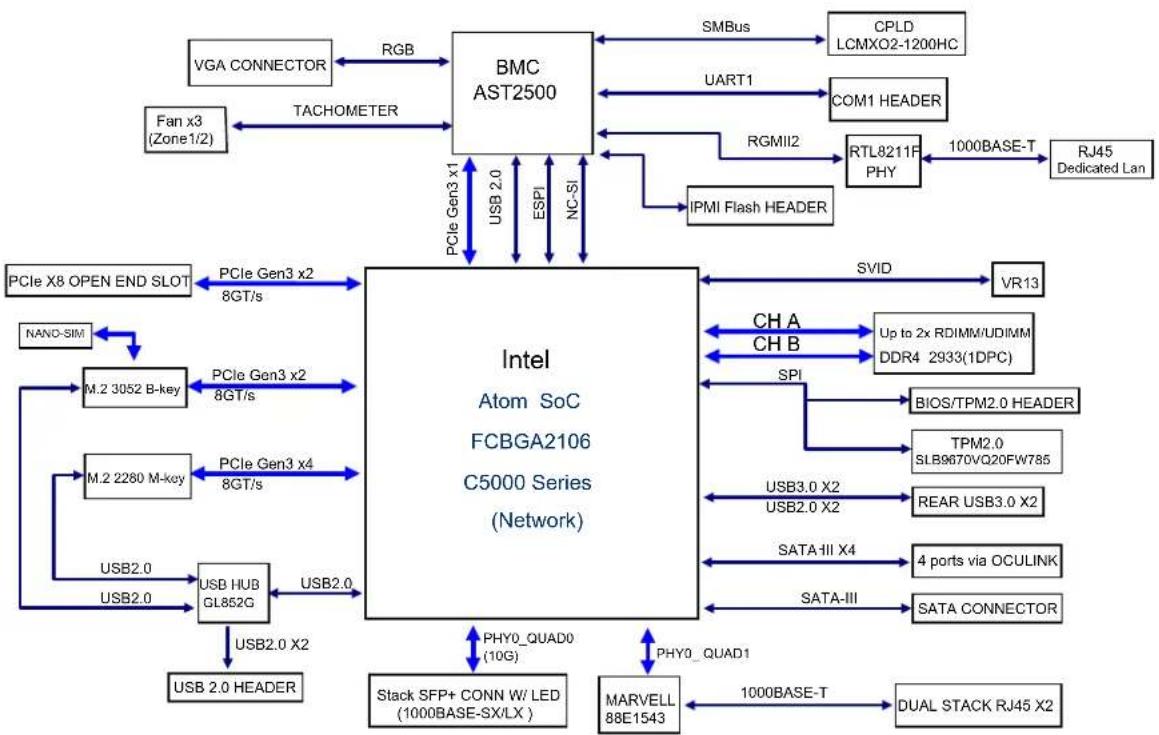
Figure 1-4. System Block Diagram
flowchart
graph TD
    A["BMC AST2500"] -->|USB 2.0| B["PCIe Gen3 x1"]
    A -->|USB 2.0| C["PCIe Gen3 x2 8GT/s"]
    A -->|USB 2.0| D["PCIe Gen3 x4 8GT/s"]
    A -->|USB 2.0| E["USB HUB GL852G"]
    A -->|USB 2.0| F["USB 2.0 HEADER"]
    A -->|USB 2.0| G["Stack SFP+ CONN W/ LED (1000BASE-SX/LX)"]
    A -->|USB 2.0| H["MARVELL 88E1543"]
    A -->|USB 2.0| I["SATA-III"]
    A -->|USB 2.0| J["SATA CONNECTOR"]
    A -->|USB 2.0| K["REAR USB3.0 X2"]
    A -->|USB 2.0| L["TMEMBER TACHOMETER"]
    A -->|USB 2.0| M["NANO-SIM"]
    A --> N["PCIe Gen3 x1"]
    A --> O["PCIe Gen3 x2 8GT/s"]
    A --> P["PCIe Gen3 x4 8GT/s"]
    A --> Q["PCIe Gen3 x1"]
    A --> R["PCIe Gen3 x2 8GT/s"]
    A --> S["PCIe Gen3 x4 8GT/s"]
    A --> T["PCIe Gen3 x1"]
    A --> U["PCIe Gen3 x2 8GT/s"]
    A --> V["PCIe Gen3 x1"]
    A --> W["PCIe Gen3 x1"]
    A --> X["PCIe Gen3 x1"]
    A --> Y["PCIe Gen3 x1"]
    A --> Z["PCIe Gen3 x1"]
    A --> AA["PCIe Gen3 x1"]
    A --> AB["PCIe Gen3 x1"]
    A --> AC["PCIe Gen3 x1"]
    A --> AD["PCIe Gen3 x1"]
    A --> AE["PCIe Gen3 x1"]
    A --> AF["PCIe Gen3 x1"]
    A --> AG["PCIe Gen3 x1"]
    A --> AH["PCIe Gen3 x1"]
    A --> AI["PCIe Gen3 x1"]
    A --> AJ["PCIe Gen3 x1"]
    A --> AK["PCIe Gen3 x1"]
    A --> AL["PCIe Gen3 x1"]
    A --> AM["PCIe Gen3 x1"]
    A --> AN["PCIe Gen3 x1"]
    A --> AO["PCIe Gen3 x1"]
    A --> AP["PCIe Gen3 x1"]
    A --> AQ["PCIe Gen3 x1"]
    A --> AR["PCIe Gen3 x1"]
    A --> AS["PCIe Gen3 x1"]
    A --> AT["PCIe Gen3 x1"]
    A --> AU["PCIe Gen3 x1"]
    A --> AV["PCIe Gen3 x1"]
    A --> AW["PCIe Gen3 x1"]
    A --> AX["PCIe Gen3 x1"]
    A --> AY["PCIe Gen3 x1"]
    A --> AZ["PCIe Gen3 x1"]
    A --> BA["PCIe Gen3 x1"]
    A --> BB["PCIe Gen3 x1"]
    A --> BC["PCIe Gen3 x1"]
    A --> BD["PCIe Gen3 x1"]
    A --> BE["PCIe Gen3 x1"]
    A --> BF["PCIe Gen3 x1"]
    A --> BG["PCIe Gen3 x1"]
    A --> BH["PCIe Gen3 x1"]
    A --> BI["PCIe Gen3 x1"]
    A --> BJ["PCIe Gen3 x1"]
    A --> BK["PCIe Gen3 x1"]
    A --> BL["PCIe Gen3 x1"]
    A --> BM["PCIe Gen3 x1"]
    A --> BN["PCIe Gen3 x1"]
    A --> BO["PCIe Gen3 x1"]
    A --> BP["PCIe Gen3 x1"]
    A --> BQ["PCIe Gen3 x1"]
    A --> BR["PCIe Gen3 x1"]
    A --> BS["PCIe Gen3 x1"]
    A --> BT["PCIe Gen3 x1"]
    A --> BU["PCIe Gen3 x1"]
    A --> BV["PCIe Gen3 x1"]
    A --> BW["PCIe Gen3 x1"]
    A --> BX["PCIe Gen3 x1"]
    A --> BY["PCIe Gen3 x1"]
    A --> BZ["PCIe Gen3 x1"]
    A --> CA["PCIe Gen3 x1"]
    A --> CB["PCIe Gen3 x1"]
    A --> CC["PCIe Gen3 x1"]
    A --> CD["PCIe Gen3 x1"]
    A --> CE["PCIe Gen3 x1"]

Note: This is a general block diagram and may not exactly represent the features on your motherboard. See the previous pages for the actual specifications of your motherboard.
1.2 Processor Overview
Built upon the functionality and capability of the Intel Atom SoC C5000 series processor, the motherboard offers maximum I/O expandability, energy efficiency, and data reliability in a 10-nm process architecture. It is optimized for next generation of embedded storage solutions, networking applications, or cloud-computing platforms.
The Intel Atom SoC C5000 series processor supports the following features:
• Intel Virtualization Technology for Directed I/O (Intel VT-d)
• Adaptive Thermal Management/Monitoring
- Gen3 SATA ports with transfer rates of up to 6Gb/s
• System Management Bus (SMBus) Specification, Version 2.0
• M.2 slot with B-Key 3052 and M-Key 2280 modules
- TPM 2.0 (header and onboard)
1.3 Special Features
This section describes the health monitoring features of the motherboard. The motherboard has an onboard System Hardware Monitor chip that supports system health monitoring.
Recovery from AC Power Loss
The Basic I/O System (BIOS) provides a setting that determines how the system will respond when AC power is lost and then restored to the system. You can choose for the system to remain powered off (in which case you must press the power switch to turn it back on), or for it to automatically return to the power-on state. See the Advanced BIOS Setup section for this setting. The default setting is Last State.
1.4 ACPI Features
The Advanced Configuration and Power Interface (ACPI) specification defines a flexible and abstract hardware interface that provides a standard way to integrate power management features throughout a computer system including its hardware, operating system and application software. This enables the system to automatically turn on and off peripherals such as network cards, hard disk drives and printers.
In addition to enabling operating system-directed power management, ACPI also provides a generic system event mechanism for Plug and Play and an operating system-independent interface for configuration control. ACPI leverages the Plug and Play BIOS data structures while providing a processor architecture-independent implementation.
1.5 Power Supply
As with all computer products, a stable power source is necessary for proper and reliable operation. It is even more important for processors that have high CPU clock rates. In areas where noisy power transmission is present, you may choose to install a line filter to shield the computer from noise. It is recommended that you also install a power surge protector to help avoid problems caused by power surges.
1.6 Serial Port
This motherboard supports one serial communication connection. COM1 can be used for input/output. The UART provides legacy speeds with a baud rate of up to 115.2 Kbps as well as an advanced speed with baud rates of 250 K, 500 K, or 1 Mb/s, which support high-speed serial communication devices.
1.7 Advanced Power Management
The following new advanced power management features are supported by the motherboard.
Management Engine (ME)
The Management Engine, which is the general purpose controller that resides in the SoC, provides Server Platform Services (SPS) to your system. The services provided by SPS are different from those provided by the ME on client platforms.
Chapter 2
Installation
2.1 Static-Sensitive Devices
Electrostatic Discharge (ESD) can damage electronic components. To prevent damage to your motherboard, it is important to handle it very carefully. The following measures are generally sufficient to protect your equipment from ESD.
Precautions
- Use a grounded wrist strap designed to prevent static discharge.
- Touch a grounded metal object before removing the board from the antistatic bag.
- Handle the board by its edges only; do not touch its components, peripheral chips, memory modules or gold contacts.
- When handling chips or modules, avoid touching their pins.
- Put the motherboard and peripherals back into their antistatic bags when not in use.
- For grounding purposes, make sure that your chassis provides excellent conductivity between the power supply, the case, the mounting fasteners and the motherboard.
- Use only the correct type of CMOS onboard battery as specified by the manufacturer. Do not install the CMOS battery upside down, which may result in a possible explosion.
Unpacking
The motherboard is shipped in antistatic packaging to avoid static damage. When unpacking the motherboard, make sure that the person handling it is static protected.
2.2 Motherboard Installation
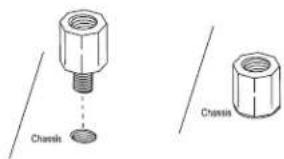
All motherboards have standard mounting holes to fit different types of chassis. Make sure that the locations of all the mounting holes for both the motherboard and the chassis match. Although a chassis may have both plastic and metal mounting fasteners, metal ones are highly recommended because they ground the motherboard to the chassis. Make sure that the metal standoffs click in or are screwed in tightly.
Phillips Screwdriver (1)

Phillips Screws (4)

Standoffs (4)
Only if Needed
Tools Needed

text_image
BMC AST2500 JPG1 JDG1 JVR1 RST CP1 3.0F7-CP8 10A-CTW-MH JVR1 JSP JPLD1 JMD1 USB2/3 (2.0) JPXE2 J2 MH4 CN1 JWD1 JMD2 JSIM1 JPT1 JTPM1 LED1 JFP1 CPU SFP2 SFP1 LAN5 LAN6 SFP4 LEDT3 LEDT4 LEDT1 LEDT2 LAN3 LAN4 LAN2 LAN2 A3SPI-8C-LN6PF REV:1.01 LANILED JPN-AAN-CCO JPG1 JGP1 BT1 JPH1 JBT1 RAVA JPF1 ROS-SUPER® DESIGNED IN USA MAC CODE BAR CODE DVMAX1 JRT3 SRW2 FAN2 DHMX1 JRT3 JPMV1 JPW1 JPW1 DHMX1 DHMX1 DHMX1 DHMX1Location of Mounting Holes

Notes: 1) To avoid damaging the motherboard and its components, please do not use a force greater than 8 lb/inch on each mounting screw during motherboard installation. 2) Some components are very close to the mounting holes. Please take precautionary measures to avoid damaging these components when installing the motherboard to the chassis.
Installing the Motherboard
- Locate the mounting holes on the motherboard. See the previous page for the location.
text_image
Chassis Chassis- Locate the matching mounting holes on the chassis. Align the mounting holes on the motherboard against the mounting holes on the chassis.

text_image
3-6 Motherboard Chassis Motherboard Chassis-
Install standoffs in the chassis as needed.
-
Install the motherboard into the chassis carefully to avoid damaging other motherboard components.
-
Using the Phillips screwdriver, insert a Phillips head #6 screw into a mounting hole on the motherboard and its matching mounting hole on the chassis.
-
Repeat Step 5 to insert #6 screws into all mounting holes.
-
Make sure that the motherboard is securely placed in the chassis.

Note: Images displayed are for illustration only. Your chassis or components might look different from those shown in this manual.
2.3 Memory Support and Installation

Note: Check the Supermicro website for recommended memory modules.

Important: Exercise extreme care when installing or removing DIMM modules to prevent any possible damage.
Memory Support
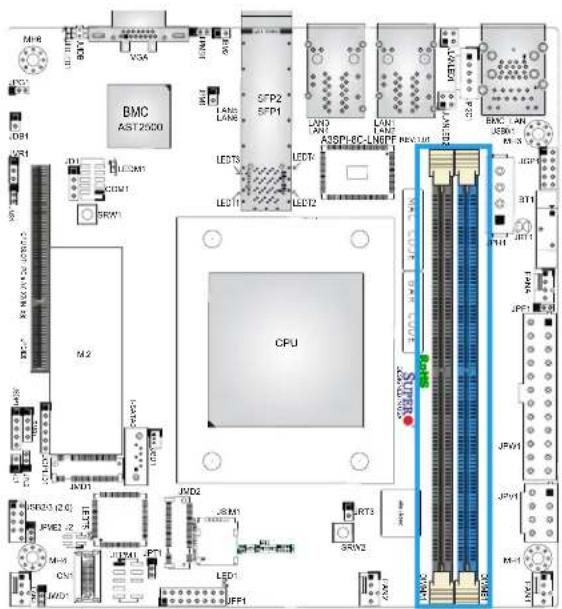
The A3SPI-4C/8C-LN6PF/HLN4F motherboard supports up to 128GB of DDR4 ECC RDIMM with speeds of up to 2933 MT/s in two DIMM slots.
| Recommended Population (Balanced) | ||
| DIMMA1 DI | MMB1 Total System Memory | |
| 4GB 4GB | 8GB | |
| 8GB 8GB | 16GB | |
| 16GB 16GB | 32GB | |
| 32GB 32GB | 64GB | |
| 64GB 64GB | 128GB | |
General Guidelines for Optimizing Memory Performance
• The blue slot must be populated first.
- It is recommended to use DDR4 memory of the same type, size, and speed.
- Mixed DIMM speeds can be installed. However, all DIMMs will run at the speed of the slowest DIMM.
- The motherboard will support odd-numbered modules. However, to achieve the best memory performance, a balanced memory population is recommended.

text_image
JPG1 JDB1 JVR1 JDB2 VGA JPM1 LAN5 SFP2 SFP1 LAN3 LAN4 LAN1 LAN2 LAN1LED1 JPM1 JPM2 JPM3 JPM4 JPM5 JPM6 JPM7 JPM8 JPM9 JPM10 JPM11 JPM12 JPM13 JPM14 JPM15 JPM16 JPM17 JPM18 JPM19 JPM20 JPM21 JPM22 JPM23 JPM24 JPM25 JPM26 JPM27 JPM28 JPM29 JPM30 JPM31 JPM32 JPM33 JPM34 JPM35 JPM36 JPM37 JPM38 JPM39 JPM40 JPM41 JPM42 JPM43 JPM44 JPM45 JPM46 JPM47 JPM48 JPM49 JPM50 JPM51 JPM52 JPM53 JPM54 JPM55 JPM56 JPM57 JPM58 JPM59 JPM60 JPM61 JPM62 JPM63 JPM64 JPM65 JPM66 JPM67 JPM68 JPM69 JPM70 JPM71 JPM72 JPM73 JPM74 JPM75 JPM76 JPM77 JPM78 JPM79 JPM80 JPM81 JPM82 JPM83 JPM84 JPM85 JPM86 JPM87 JPM88 JPM89 JPM90 JPM91 JPM92 JPM93 JPM94 JPM95 JPM96 JPM97 JPM98 JPM99 JPM100DIMM Installation
- Insert DIMM modules in the following order: DIMMA1, DIMMB1. For the system to work properly, please use memory modules of the same type and speed.
- Push the release tabs outwards on both ends of the DIMM slot to unlock it.
- Align the key of the DIMM module with the receptive point on the memory slot.
- Align the notches on both ends of the module against the receptive points on the ends of the slot.
- Push both ends of the module straight down into the slot until the module snaps into place.
- Press the release tabs to the lock positions to secure the DIMM module into the slot.
DIMM Removal
Press both release tabs on the ends of the DIMM module to unlock it. Once the DIMM module is loosened, remove it from the memory slot.
text_image
MHB VCM JPM1 JPM2 JPM3 JPM4 JPM5 JPM6 JPM7 JPM8 JPM9 JPM10 JPM11 JPM12 JPM13 JPM14 JPM15 JPM16 JPM17 JPM18 JPM19 JPM20 JPM21 JPM22 JPM23 JPM24 JPM25 JPM26 JPM27 JPM28 JPM29 JPM30 JPM31 JPM32 JPM33 JPM34 JPM35 JPM36 JPM37 JPM38 JPM39 JPM40 JPM41 JPM42 JPM43 JPM44 JPM45 JPM46 JPM47 JPM48 JPM49 JPM50 JPM51 JPM52 JPM53 JPM54 JPM55 JPM56 JPM57 JPM58 JPM59 JPM60 JPM61 JPM62 JPM63 JPM64 JPM65 JPM66 JPM67 JPM68 JPM69 JPM70 JPM71 JPM72 JPM73 JPM74 JPM75 JPM76 JPM77 JPM78 JPM79 JPM80 JPM81 JPM82 JPM83 JPM84 JPM85 JPM86 JPM87 JPM88 JPM89 JPM90 JPM91 JPM92 JPM93 JPM94 JPM95 JPM96 JPM97 JPM98 JPM99 JPM100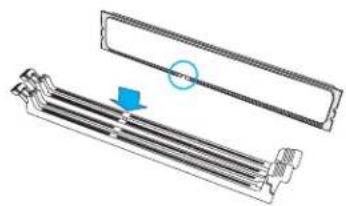
natural_image
Technical illustration of a heat exchanger or cooling unit with a blue arrow indicating airflow direction (no text or symbols present)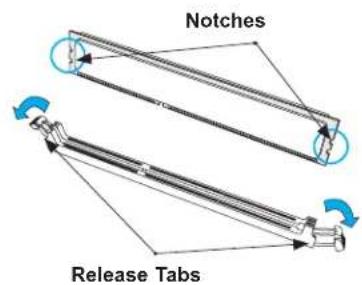
text_image
Notches Release Tabs
text_image
Push both ends straight down into the memory slot.2.4 Rear I/O Ports
See Figure 2-1 below for the locations and descriptions of the various I/O ports on the rear of the motherboard.

text_image
MHB JPG1 JD81 JVR1 MDI J203/SDT 20000000000000000000000000000000000000000000000000000000000000000000 JMD1 JPM2 J2 JPM4 J7 JWD1 JMD2 JPM1 JPT1 JPM2 JPT1 JPM3 JMT1 JPM4 JMT1 JPM5 JMT1 JPM6 JMT1 JPM7 JMT1 JPM8 JMT1 JPM9 JMT1 JPM10 JMT1 JPM11 JMT1 JPM12 JMT1 JPM13 JMT1 JPM14 JMT1 JPM15 JMT1 JPM16 JMT1 JPM17 JMT1 JPM18 JMT1 JPM19 JMT1 JPM20 JMT1 JPM21 JMT1 JPM22 JMT1 JPM23 JMT1 JPM24 JMT1 JPM25 JMT1 JPM26 JMT1 JPM27 JMT1 JPM28 JMT1 JPM29 JMT1 JPM30 JMT1 JPM31 JMT1 JPM32 JMT1 JPM33 JMT1 JPM34 JMT1 JPM35 JMT1 JPM36 JMT1 JPM37 JMT1 JPM38 JMT1 JPM39 JMT1 JPM40 JMT1 JPM41 JMT1 JPM42 JMT1 JPM43 JMT1 JPM44 JMT1 JPM45 JMT1 JPM46 JMT1 JPM47 JMT1 JPM48 JMT1 JPM49 JMT1 JPM50 JMT1 JPM51 JMT1 JPM52 JMT1 JPM53 JMT1 JPM54 JMT1 JPM55 JMT1 JPM56 JMT1 JPM57 JMT1 JPM58 JMT1 JPM59 JMT1 JPM60 JMT1 JPM61 JMT1 JPM62 JMT1 JPM63 JMT1 JPM64 JMT1 JPM65 JMT1 JPM66 JMT1 JPM67 JMT1 JPM68 JMT1 JPM69 JMT1 JPM70 JMT1 JPM71 JMT1 JPM72 JMT1 JPM73 JMT1 JPM74 JMT1 JPM75 JMT1 JPM76 JMT1 JPM77 JMT1 JPM78 JMT1 JPM79 JMT1 JPM80 JMT1 A3SPI-8C-LN6PF REV:1.01 LEDT3 LEDT4 LEDT2 LEDT3 LEDT4 LEDT3 LEDT3 LEDT3 LEDT3 LEDT3 LEDT3 LEDT3 LEDT3 LEDT3 LEDT3 LEDT3 LEDT3 LEDT3 LEDT3 LEDT3 LEDT3 LEDT3 LEDT3 LEDT3 LEDT3 LEDT3 LEDT3 LEDT3 LEDT3 LEDT3 LEDT3 LEDT3 LEDT3 LEDT3 LEDT3 LEDT3 LEDT3 LEDT3 LEDT3Figure 2-1. I/O Port Locations and Definitions

text_image
Diagram showing 11 labeled network device ports including Ethernet, Ethernet, USB, and VGA connectors| Rear I/O Ports | |||||
| # | Description | # | Description | # | Description |
| 1 | BMC_LAN | 5 | LAN1 (Share NIC) | 9 | LAN5 (LN6PF) |
| 2 | USB1 | 6 | LAN4 | 10 | VGA |
| 3 | USB0 | 7 | LAN3 | 11 | UID Switch |
| 4 | LAN2 | 8 | LAN6 (LN6PF) | ||
VGA Port
A video (VGA) port is located on the I/O back panel. Refer to the board layout below for the location.
Unit Identifier Switch/UID LED Indicator
A Unit Identifier (UID) switch and an LED Indicator are located on the motherboard. The UID switch is located at JUIDB1 on the back panel. The UID LED (UIDLED1) is located next to the UID switch. When you press the UID switch, the UID LED will be turned on. Press the UID switch again to turn off the LED indicator. The UID Indicator provides easy identification of a system unit that may be in need of service.

Note: UID can also be triggered via IPMI on the motherboard. For more information on IPMI, please refer to the IPMI User's Guide posted on our website at https://www.supermicro.com/support/manuals/.
| UID SwitchPin Definitions | |
| Pin# | Definition |
| 1 | Ground |
| 2 | Ground |
| 3 | Button In |
| 4 | Button In |
| UID LEDPin Definitions | |
| Color | Status |
| Blue: On | Unit Identified |
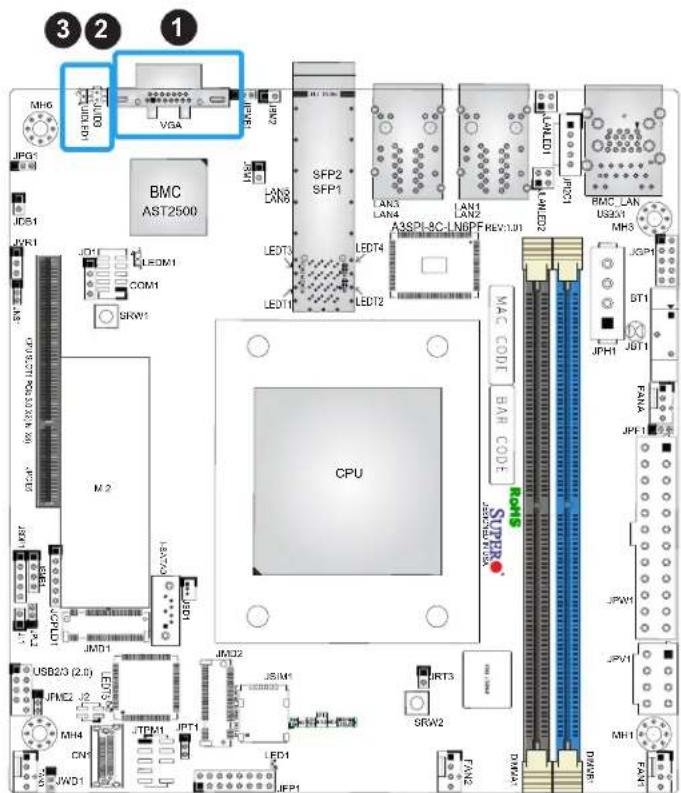
text_image
3 2 1 JUD0 VSA JPM2 SFP2 SFP1 LAN3 LAN4 A3SP1-8C-LN6PF REV:1J1 LAN1 LAN2 LAN3LED1 JPM1 JPM2 LAN USBX1 MH3 JDP1 BT1 JPH1 JPT1 JPM1 JPM2 JPM2 JPM2 JPM2 JPM2 JPM2 JPM2 JPM2 JPM2 JPM2 JPM2 JPM2 JPM2 JPM2 JPM2 JPM2 JPM2 JPM2 JPM2 JPM2 JPM2 JPM2 JPM2 JPM2 JPM2 JPM1 JPM1 JPM1 JPM1 JPM1 JPM1 JPM1 JPM1 JPM1 JPM1 JPM1 JPM1 JPM1 JPM1 JPM1 JPM1 JPM1 JPM1 JPM1 JPM1 JPM1 JPM1 JPM1 JPM1 JPM1 JPM2 JPM2 JPM2 JPM2 JPM2 JPM2 JPM2 JPM2 JPM2 JPM2 JPM2 JPM2 JPM2 JPM2 JPM2 JPM2 JPM2 JPM2 JPM2 JPM2 JPM2 JPM2 JPM2 Jpm30000000000000000000000000000000000000000000000000000000000000000000000000000000000000000000000000000- VGA Port
- UID Switch
- UID LED
LAN Ports
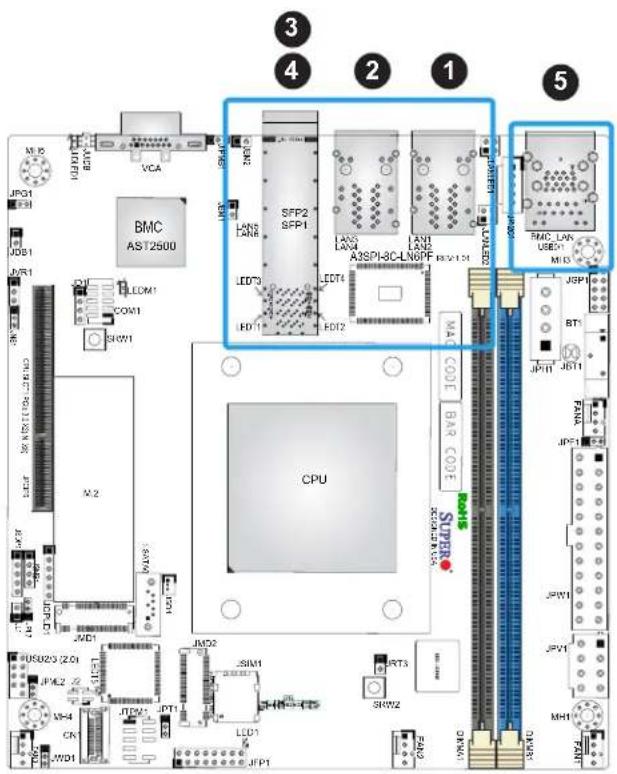
There are six LAN ports on the -LN6PF motherboard and four LAN ports on the -HLN4F motherboard. The -LN6PF supports four RJ45 connectors on LAN1-LAN4 and two SFP+ connectors on LAN5-LAN6. The -HLN4F supports four RJ45 connectors on LAN1-LAN4. The motherboard also offers a BMC LAN port.
| Top LAN PortPin Definition | |||
| Pin# | Definition | Pin# | Definition |
| B1 | TRD0- | B11 | YEL+ |
| B2 | TRD0+ | B12 | YEL- |
| B3 | TRD1- | B13 | GRE+/ORG- |
| B4 | TRD1+ | B14 | GRE-/ORG+ |
| B5 | TRD2- | ||
| B6 | TRD2+ | ||
| B7 | TRD3- | ||
| B8 | TRD3+ | ||
| B9 | COMMCT | ||
| B10 | GND | ||
| Bottom LAN PortPin Definition | |||
| Pin# | Definition | Pin# | Definition |
| A1 | TRD0- | A11 | YEL+ |
| A2 | TRD0+ | A12 | YEL- |
| A3 | TRD1- | A13 | GRE+/ORG- |
| A4 | TRD1+ | A14 | GRE-/ORG+ |
| A5 | TRD2- | A15 | CG1 |
| A6 | TRD2+ | A16 | CG2 |
| A7 | TRD3- | A17 | CG3 |
| A8 | TRD3+ | A18 | CG4 |
| A9 | COMMCT | ||
| A10 | GND | ||
text_image
M15 JPG1 F31 JDB1 JPR1 LEDM1 COM1 SIW1 M2 JMD1 JMSU23 (Z01) JPK2 JND1 M4 CK1 WD1 VCA SFP2 SFP1 LED3 LED4 LED7 LED11 LED12 A3SPI-3C-LN0PF A3SPI-3C-LN0PF A3SPI-3C-LN0PF A3SPI-3C-LN0PF A3SPI-3C-LN0PF A3SPI-3C-LN0PF A3SPI-3C-LN0PF A3SPI-3C-LN0PF A3SPI-3C-LN0PF A3SPI-3C-LN0PF| BMC LANPin Definition | |||
| Pin# | Definition | Pin# | Definition |
| 20 | TX1+ | 31 | YEL+ |
| 21 | TX1- | 32 | YEL- |
| 22 | TX2+ | 29 | ORG-/GRN+ |
| 23 | TX2- | 30 | ORG+/GRN- |
| 24 | TX3+ | 37 | CG5 |
| 25 | TX3- | 38 | CG6 |
| 26 | TX4+ | 39 | CG7 |
| 27 | TX4- | 40 | CG8 |
| 19 | VCC | ||
| 28 | GND | ||
- LAN1/LAN2
- LAN3/LAN4
- LAN5 (SFP1)
- LAN6 (SFP2)
- BMC LAN
Universal Serial Bus (USB) Ports
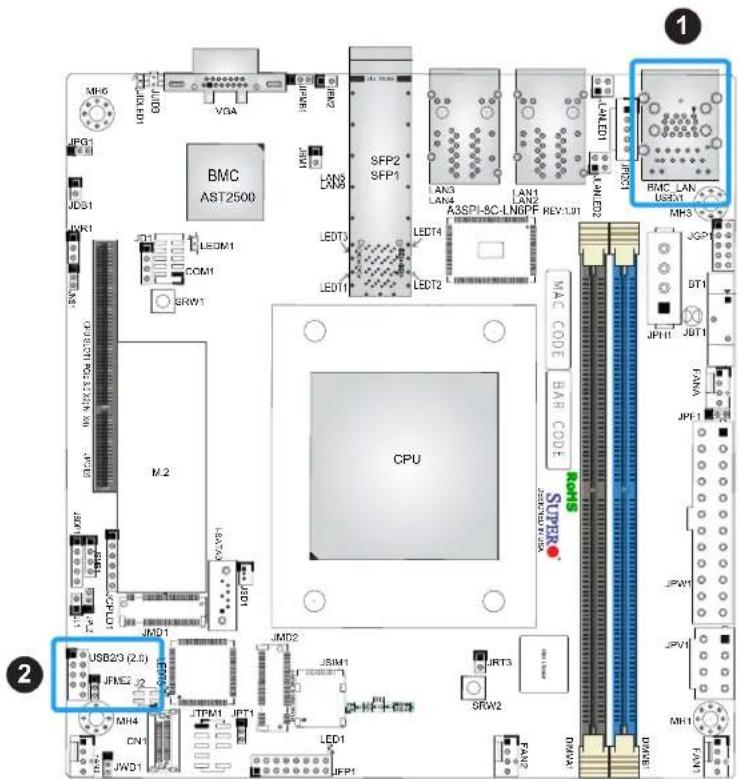
There are two USB 3.0 ports (USB0/1) on the I/O back panel. The motherboard also has one USB 2.0 header that provides two USB connections (USB2/3). The onboard USB header can be used to provide front side USB access with a cable.
| Back Panel USB 3.0 (USB0/1)Pin Definitions | |||
| Pin# | Definition | Pin# | Definition |
| 14 | STDA_SSRX2N | 10 | VBUS |
| 15 | STDA_SSRX2P | 11 | D2-N |
| 16 | GND_DRAIN | 12 | D2-P |
| 17 | STDA_SSTX2N | 13 | Ground |
| 18 | STDA_SSTX2P | ||
| 5 | STDA_SSRX1N | 1 | VBUS1 |
| 6 | STDA_SSRX1P | 2 | D1N |
| 7 | GND_DRAIN | 3 | D1P |
| 8 | STDA_SSTX1M | 4 | GND |
| 9 | STDA_SSTX1P | 33 | CG1 |
| 34 | CG2 | ||
| 35 | CG3 | ||
| 36 | CG4 | ||
| Front Panel USB 2.0 (USB2/3)Header Pin Definitions | |||
| Pin# | Definition | Pin# | Definition |
| 1 | USB_PWR | 2 | USB_PWR |
| 3 | USB_CON_N3 | 4 | USB_CON_N4 |
| 5 | USB_CON_P3 | 6 | USB_CON_P4 |
| 7 | GND | 8 | GND |
| 9 | 10 | GND | |
text_image
BMC AST2500 JPG1 JDS1 JNK1 M.2 JMD1 JMD2 JPM1 JPT1 JWD1 JPM2 JPM3 JPM4 JPM5 JPM6 JPM7 JPM8 JPM9 JPM10 JPM11 JPM12 JPM13 JPM14 JPM15 JPM16 JPM17 JPM18 JPM19 JPM20 JPM21 JPM22 JPM23 JPM24 JPM25 JPM26 JPM27 JPM28 JPM29 JPM30 JPM31 JPM32 JPM33 JPM34 JPM35 JPM36 JPM37 JPM38 JPM39 JPM40 JPM41 JPM42 JPM43 JPM44 JPM45 JPM46 JPM47 JPM48 JPM49 JPM50 JPM51 JPM52 JPM53 JPM54 JPM55 JPM56 JPM57 JPM58 JPM59 JPM60 JPM61 JPM62 JPM63 JPM64 JPM65 JPM66 JPM67 JPM68 JPM69 JPM70 JPM71 JPM72 JPM73 JPM74 JPM75 JPM76 JPM77 JPM78 JPM79 JPM80 JPM81 JPM82 JPM83 JPM84 JPM85 JPM86 JPM87 JPM88 JPM89 JPM90 JPM91 JPM92 JPM93 JPM94 JPM95 JPM96 JPM97 JPM98 JPM99 JPM100-
USB0/1
-
USB2/3
2.5 Front Control Panel
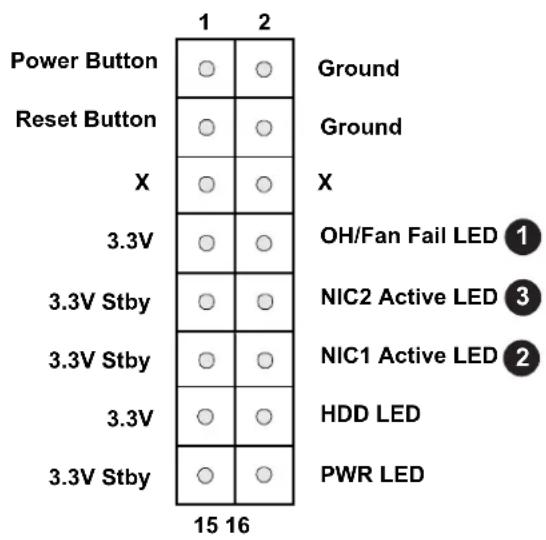
JFP1 contains header pins for various buttons and indicators that are normally located on a control panel at the front of the chassis. These connectors are designed specifically for use with Supermicro chassis. See the figure below for the descriptions of the front control panel buttons and LED indicators.
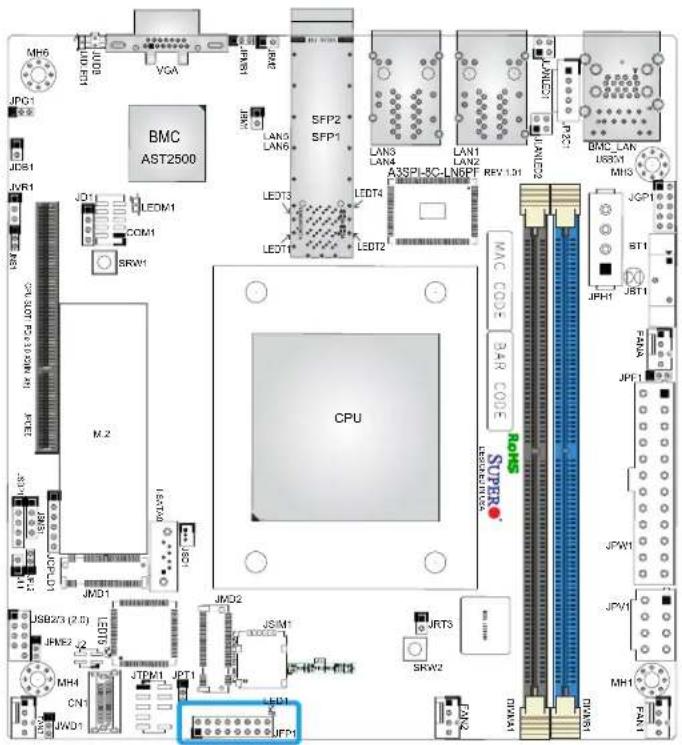
text_image
Power Button Reset Button X 3.3V 3.3V Stby 3.3V Stby 3.3V 15 16 Ground Ground X OH/Fan Fail LED NIC2 Active LED NIC1 Active LED HDD LED PWR LEDPower Button
The Power Button connection is located on pins 1 and 2 of JFP1. Momentarily contacting both pins will power on/off the system. This button can also be configured to function as a suspend button (with a setting in the BIOS—see Chapter 4). To turn off the power in the suspend mode, press the button for at least 4 seconds. See the table below for pin definitions.
| Power ButtonPin Definitions (JFP1) | |
| Pin# | Definition |
| 1 | Power Button |
| 2 | GND |
Reset Button
The Reset Button connection is located on pins 3 and 4 of JFP1. Attach it to a hardware reset switch on the computer case to reset the system. See the table below for pin definitions.
| Reset ButtonPin Definitions (JFP1) | |
| Pin# | Definition |
| 3 Reset | |
| 4 Ground | |

text_image
1 Power Button 2 Reset Button X 3.3V 3.3V Stby 3.3V Stby 3.3V 15 16 Ground Ground X OH/Fan Fail LED NIC2 Active LED NIC1 Active LED HDD LED PWR LED-
Power Button
-
Reset Button
Overheat (OH)/Fan Fail
Connect an LED cable to pins 7 and 8 of the Front Control Panel to use the Overheat/Fan Fail LED connections. The LED on pin 8 provides warnings of overheating or fan failure. Refer to the tables below for pin definitions.
| OH/Fan Fail Indicator Status | |
| State | Definition |
| Off Normal | |
| On Overheat | |
| Flashing Fan Fail | |
| OH/Fan Fail LEDPin Definitions (JFP1) | |
| Pin# | Definition |
| 7 | 3.3V |
| 8 | OH/Fan Fail LED |
The NIC (Network Interface Controller) LED connection for LAN port 1 is located on pins 11 and 12 of JFP1, and LAN port 2 is on pins 9 and 10. Attach the NIC LED cables here to display network activity. Refer to the table below for pin definitions.
| NIC1/NIC2 LEDPin Definitions (JFP1) | |
| Pin# | Definition |
| 9 3.3 | V Stby |
| 10 NIC | 2 Link LED |
| 11 3.3 | V Stby |
| 12 NIC | 1 Link LED |
text_image
Power Button Reset Button X 3.3V 3.3V Stby 3.3V Stby 3.3V 15 16 Ground Ground X OH/Fan Fail LED ① NIC2 Active LED ③ NIC1 Active LED ② HDD LED PWR LED- Overheat/Fan Fail
- NIC1 LED
- NIC2 LED
HDD LED
The HDD LED connection is located on pins 13 and 14 of JFP1. Attach a cable to pin 14 to show hard drive activity status. Refer to the table below for pin definitions.
| HDD LEDPin Definitions (JFP1) |
| Pins Definition |
| 13 3.3V |
| 14 HDD Active |
Power LED
The Power LED connection is located on pins 15 and 16 of JFP1. Refer to the table below for pin definitions.
| Power LEDPin Definitions (JFP1) | |
| Pins Definition | |
| 15 3.3 | Stby |
| 16 PWR LED | |

text_image
Power Button Reset Button X 3.3V 3.3V Stby 3.3V Stby 3.3V 15 16 Ground Ground X OH/Fan Fail LED NIC2 Active LED NIC1 Active LED HDD LED ① PWR LED ②- HDD LED
- Power LED
2.6 Connectors
Power Connections
ATX Power Supply Connector
The 24-pin power supply connector (JPW1) meets the ATX SSI EPS 24-pin specification.
| ATX Power 24-pin Connector Pin Definitions | |||
| Pin# Definition Pin# Definition | |||
| 13 | +3.3V | 1 | +3.3V |
| 14 | -12V | 2 | +3.3V |
| 15 | Ground | 3 | Ground |
| 16 | PS_ON | 4 | +5V |
| 17 | Ground | 5 | Ground |
| 18 | Ground | 6 | +5V |
| 19 | Ground | 7 | Ground |
| 20 | Res (NC) | 8 | PWR_OK |
| 21 | +5V | 9 | 5VSB |
| 22 | +5V | 10 | +12V |
| 23 | +5V | 11 | +12V |
| 24 | Ground | 12 | +3.3V |

text_image
JPG1 JDG1 JVR1 M2 JMD1 USB2/3 (2.0) JFME2 J2 MH4 CN1 JWD1 JMD2 LED15 JPM1 JPT1 JPM2 JPM3 JRT3 SRW2 LED1 JFP1 CPU SFP2 SFP1 LNT LAN9 LEDT3 LEDT4 LEDT2 A3SPI-8C-LN6PF REV-1.01 LAN3 LAN2 LAN1 LAN2 JSP1 JSP2 JSP3 JPG1 BT1 JBT1 JPM1 JPM2 JPM3 JPM4 JPM5 JPM6 JPM7 JPM8 JPM9 JPM10 JPM11 JPM12 JPM13 JPM14 JPM15 JPM16 JPM17 JPM18 JPM19 JPM20 JPM21 JPM22 JPM23 JPM24 JPM25 JPM26 JPM27 JPM28 JPM29 JPM30 JPM31 JPM32 JPM33 JPM34 JPM35 JPM36 JPM37 JPM38 JPM39 JPM40 JPM41 JPM42 JPM43 JPM44 JPM45 JPM46 JPM47 JPM48 JPM49 JPM50 JPM51 JPM52 JPM53 JPM54 JPM55 JPM56 JPM57 JPM58 JPM59 JPM60 JPM61 JPM62 JPM63 JPM64 JPM65 JPM66 JPM67 JPM68 JPM69 JPM70 JPM71 JPM72 JPM73 JPM74 JPM75 JPM76 JPM77 JPM78 JPM79 JPM80- 24-pin ATX Power
HDD Power Connector
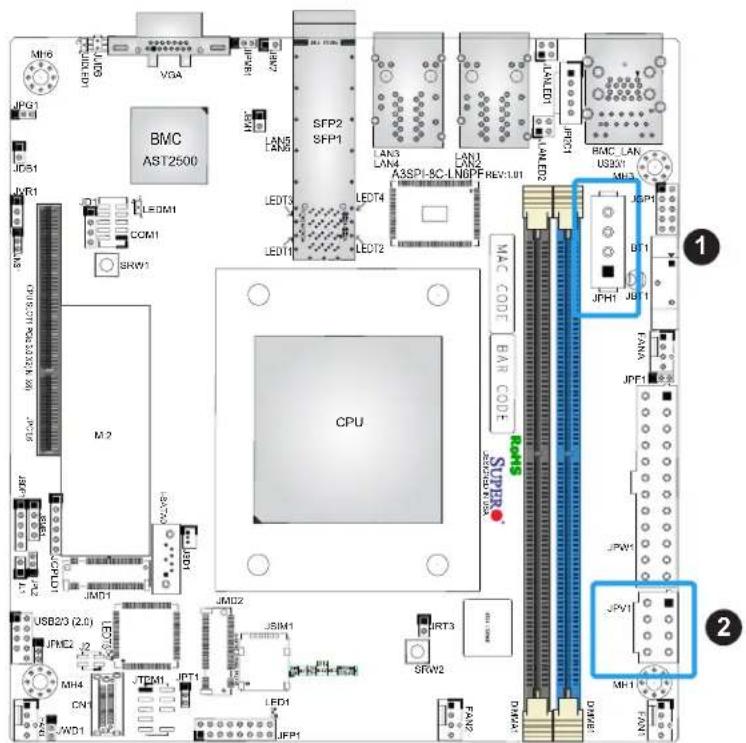
The 4-pin HDD power connector JPH1 provides power to onboard HDD devices. See the table below for pin definitions.
| 4-pin HDD Power Pin Definitions | |
| Pin# | Definition |
| 1 | 12V |
| 2 | Ground |
| 3 | Ground |
| 4 | 5V |
8-pin 12V Power Connector
JPV1 is a 8-pin 12V DC power input for alternative single power source for special enclosure when 24-pin ATX power is not in use. See the table below for pin definitions.
| 8-pin 12V PowerPin Definitions | |
| Pins | Definition |
| 1-4 | Ground |
| 5-8 | +12V |
text_image
M16 JUD0 VGA JPM2 JPM1 JPG1 JDS1 BMC AST2500 LED1 COM1 SRW1 M2 JPM1 JPM2 JPM3 USB20 (2.8) JPM2 JPM4 JPM1 JPM1 JPM2 JPM3 JPM4 JPM5 JPM6 JPM7 JPM8 JPM9 JPM10 JPM11 JPM12 JPM13 JPM14 JPM15 JPM16 JPM17 JPM18 JPM19 JPM20 JPM21 JPM22 JPM23 JPM24 JPM25 JPM26 JPM27 JPM28 JPM29 JPM30 JPM31 JPM32 JPM33 JPM34 JPM35 JPM36 JPM37 JPM38 JPM39 JPM40 JPM41 JPM42 JPM43 JPM44 JPM45 JPM46 JPM47 JPM48 JPM49 JPM50 JPM51 JPM52 JPM53 JPM54 JPM55 JPM56 JPM57 JPM58 JPM59 JPM60 JPM61 JPM62 JPM63 JPM64 JPM65 JPM66 JPM67 JPM68 JPM69 JPM70 JPM71 JPM72 JPM73 JPM74 JPM75 JPM76 JPM77 JPM78 JPM79 JPM80 JPM81 JPM82 JPM83 JPM84 JPM85 JPM86 JPM87 JPM88 JPM89 JPM90 JPM91 JPM92 JPM93 JPM94 JPM95 JPM96 JPM97 JPM98 JPM99 JPM100- 4-pin HDD Power
- 8-pin 12V Power
Headers
Fan Headers
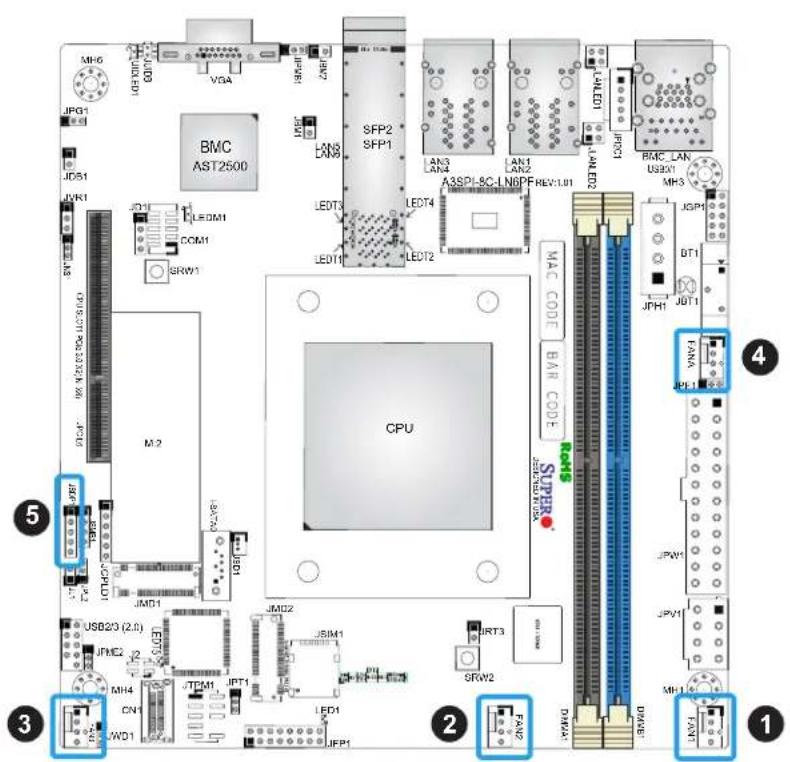
There are four 4-pin fan headers on the motherboard. These 4-pin fans are backward compatible with traditional 3-pin fans. The onboard fan speeds are controlled by Thermal Management (via Hardware Monitoring) in the BIOS. When using the Thermal Management setting, please use all 3-pin fans or all 4-pin fans.
| Fan HeaderPin Definitions | |
| Pin# | Definition |
| 1 | Ground (Black) |
| 2 | +12V (Red) |
| 3 | Tachometer |
| 4 | PWM Control |
Software Defined Pins
Software Defined Pins (JSDP1) can be used to connect to auxiliary devices, enable or disable devices, and for other miscellaneous hardware or software-control purposes. These pins can be individually configured to act as either standard inputs, General-Purpose Interrupt (GPI) inputs or output pins, as well as the default value of all pins configured as outputs. See the table below for the pin definitions.
text_image
JPG1 JJD51 JVR1 M2 JMD1 USB2/3 (2.0) JMC2 MH4 CN1 JWD1 JPM2 JPM1 JPM7 LED1 JPM1 JPM7 LED2 JPM1 JPM7 LED3 JPM1 JPM7 LED4 JPM1 JPM7 LED5 JPM1 JPM7 LED6 JPM1 JPM7 LED7 JPM1 JPM7 LED8 JPM1 JPM7 LED9 JPM1 JPM7 LED10 JPM1 JPM7 LED11 JPM1 JPM7 LED12 JPM1 JPM7 LED13 JPM1 JPM7 LED14 JPM1 JPM7 LED15 JPM1 JPM7 LED16 JPM1 JPM7 LED17 JPM1 JPM7 LED18 JPM1 JPM7 LED19 JPM1 JPM7 LED20 JPM1 JPM7 LED21 JPM1 JPM7 LED22 JPM1 JPM7 LED23 JPM1 JPM7 LED24 JPM1 JPM7 LED25 JPM1 JPM7 LED26 JPM1 JPM7 LED27 JPM1 JPM7 LED28 JPM1 JPM7 LED29 JPM1 JPM7 LED30 JPM1 JPM7 LED31 JPM1 JPM7 LED32 JPM1 JPM7 LED33 JPM1 JPM7 LED34 JPM1 JPM7 LED35 JPM1 JPM7 LED36 JPM1 JPM7 LED37 JPM1 JPM7 LED38 JPM1 JPM7 LED39 JPM1 JPM7 LED40 JPM1 JPM7 LED41 JPM1 JPM7 LED42 JPM1 JPM7 LED43 JPM1 JPM7 LED44 JPM1 JPM7 LED45 JPM1 JPM7 LED46 JPM1 JPM7 LED47 JPM1 JPM7 LED48 JPM1 JPM7 LED49 JPM1 JPM7 LED50| JSDP1 HeaderPin Definitions | |
| Pin# | Definition |
| 1 | B_SDP2_0 |
| 2 | B_SDP2_1 |
| 3 | B_SDP2_2 |
| 4 | B_SDP2_3 |
| 5 | GND |
- FAN1
- FAN2
- FAN3
- FANA
- JSDP1
OCuLink Connector
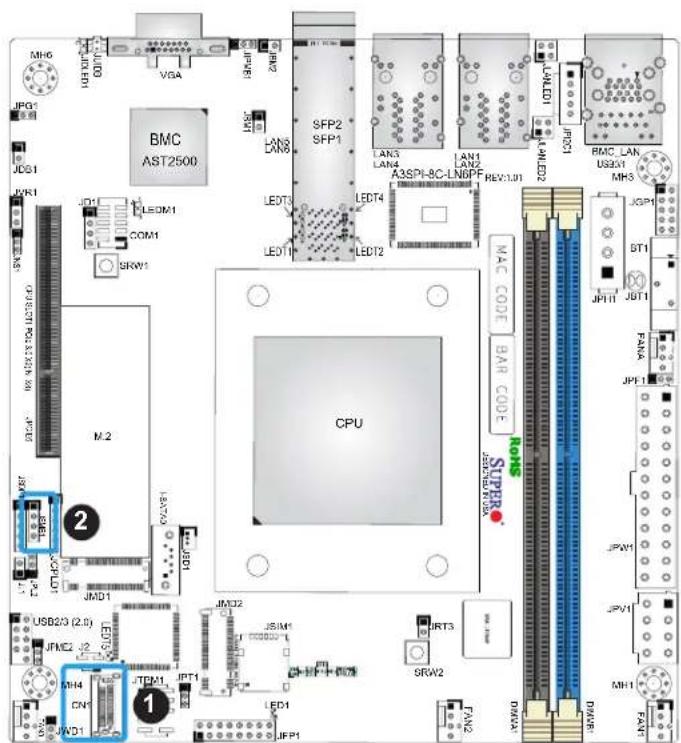
The motherboard features one internal OCuLink connector (CN1) for high-performance storage connectivity via the NVMe interface or for additional SATA storage.
Depending on the setting via jumper JNS1, the OCuLink connector can be utilized as PCIe x4/SATA ports or a single U.2 NVMe port. NVMe provides lower data latency for increased efficiency and storage performance.
System Management Bus Header
A System Management Bus header for additional slave devices or sensors is located at JSMB1 on the bottom side of the motherboard. See the table below for pin definitions.
| SMBus HeaderPin Definitions | |
| Pin# | Definition |
| 1 | SMB_DATA |
| 2 | GND |
| 3 | SMB_CLK |
text_image
MHC JPG1 JDS1 PXR1 JDI COM1 SRW1 M.2 JMD1 USB2/3 (2.5) JPM2 JPM1 JPM4 CN1 WD1 SFP2 SFP1 LAN3 LAN8 LEDT3 LEDT4 LEDT1 LEDT2 A3SP1-8C-LN8PF REV:101 LAN3 LAN4 AN1 AN2 A3SP1-8C-LN8PF REV:101 LUNLED MLED2 BMC_LAN USB31 MH3 JGP1 BT1 JPT11 JBT1 PANK JPE1 JPW1 JPW1 JPM1 JPM2 JRT3 SRW2 DINAM MAC CODE BAR CODE SUPER RMS- OCuLink Connector
- SMBus Header
COM Header
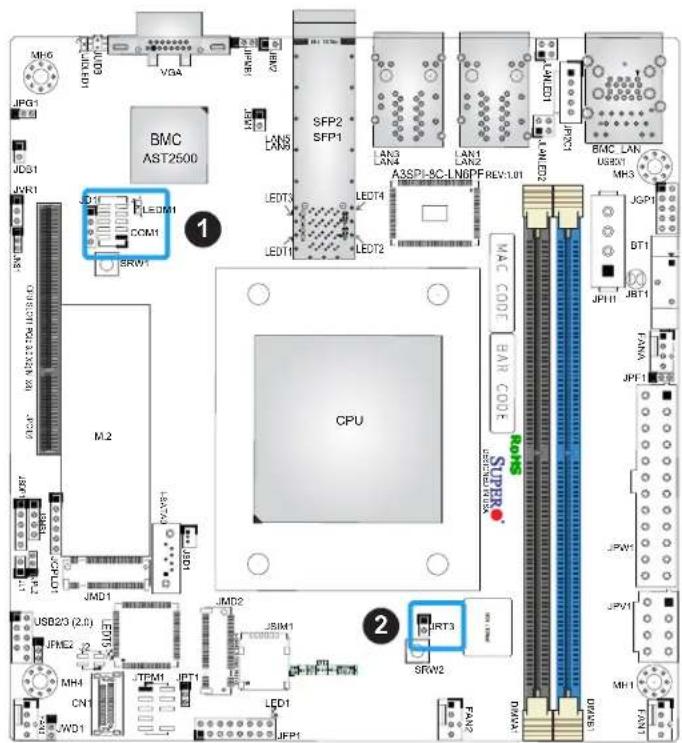
The motherboard has one COM header (COM1) that provides serial connections and supports RS-232 COM connections. Refer to the table below for pin definitions.
| COM PortPin Definitions | |||
| Pin# | Definition | Pin# | Definition |
| 1 | DCD | 6 | DSR |
| 2 | RXD | 7 | RTS |
| 3 | TXD | 8 | CTS |
| 4 | DTR | 9 | RI |
| 5 | Ground | 10 | N/A |
Thermal Diode Headers
JRT3 is the thermal diode header. This header that provides additional system temperature monitoring.
| Thermal Diode Header Pin Definitions | |
| Pin# | Definition |
| 1 | TD1_P |
| 2 | TD1_N |
text_image
JPG1 JDS1 JVR1 JMD1 JMD2 JPM1 JPM2 JPM3 JPM4 JPM5 JPM6 JPM7 JPM8 JPM9 JPM10 JPM11 JPM12 JPM13 JPM14 JPM15 JPM16 JPM17 JPM18 JPM19 JPM20 JPM21 JPM22 JPM23 JPM24 JPM25 JPM26 JPM27 JPM28 JPM29 JPM30 JPM31 JPM32 JPM33 JPM34 JPM35 JPM36 JPM37 JPM38 JPM39 JPM40 JPM41 JPM42 JPM43 JPM44 JPM45 JPM46 JPM47 JPM48 JPM49 JPM50 JPM51 JPM52 JPM53 JPM54 JPM55 JPM56 JPM57 JPM58 JPM59 JPM60 JPM61 JPM62 JPM63 JPM64 JPM65 JPM66 JPM67 JPM68 JPM69 JPM70 JPM71 JPM72 JPM73 JPM74 JPM75 JPM76 JPM77 JPM78 JPM79 JPM80 JPM81 JPM82 JPM83 JPM84 JPM85 JPM86 JPM87 JPM88 JPM89 JPM90 JPM91 JPM92 JPM93 JPM94 JPM95 JPM96 JPM97 JPM98 JPM99 JPM100-
COM Header
-
Thermal Diode Header
TPM/Port 80 Header
A Trusted Platform Module (TPM)/Port 80 header is located at JTPM1 to provide TPM support and Port 80 connection. Use this header to enhance system performance and data security. Refer to the table below for pin definitions. Please go to the following link for more information on the TPM: http://www.supermicro.com/manuals/other/TPM.pdf.
| Trusted Platform Module/Port80 Header Pin Definitions | |||
| Pin# | Definition | Pin# | Definition |
| 1 | 3.3V | 2 | SPI_CS# |
| 3 | RESET# | 4 | SPI_MISO |
| 5 | SPI_CLK# | 6 | GND |
| 7 | SPI_MOSI | 8 | NC |
| 9 | +3.3V Stdby | 10 | SPI_IRQ# |

text_image
JPG1 JUD03 VGA JPM2 JAK1 JPM2 JPM1 JPM3 JPM4 JPM5 JPM6 JPM7 JPM8 JPM9 JPM10 JPM11 JPM12 JPM13 JPM14 JPM15 JPM16 JPM17 JPM18 JPM19 JPM20 JPM21 JPM22 JPM23 JPM24 JPM25 JPM26 JPM27 JPM28 JPM29 JPM30 JPM31 JPM32 JPM33 JPM34 JPM35 JPM36 JPM37 JPM38 JPM39 JPM40 JPM41 JPM42 JPM43 JPM44 JPM45 JPM46 JPM47 JPM48 JPM49 JPM50 JPM51 JPM52 JPM53 JPM54 JPM55 JPM56 JPM57 JPM58 JPM59 JPM60 JPM61 JPM62 JPM63 JPM64 JPM65 JPM66 JPM67 JPM68 JPM69 JPM70 JPM71 JPM72 JPM73 JPM74 JPM75 JPM76 JPM77 JPM78 JPM79 JPM80 JPM81 JPM82 JPM83 JPM84 JPM85 JPM86 JPM87 JPM88 JPM89 JPM90 JPM91 JPM92 JPM93 JPM94 JPM95 JPM96 JPM97 JPM98 JPM99 JPM100- TPM Header
General Purpose I/O Header
The JGP1 (General Purpose Input/Output) header is a general purpose I/O expander on a pin header via the SMBus. Each pin can be configured to be an input pin or output pin in 2.54mm pitch. The GPIO is controlled via the PCA9554APW 8-bit GPIO expansion from PCH SMBus. The base address is 0xEFA0. The expander slave address is 0x70 for WRITE and 0x71 for READ. See the table below for pin definitions.
| JGP1 HeaderPin Definitions | |
| Pin# | Definition |
| 1 | P5V |
| 2 | GND |
| 3 | JGP1_0 |
| 4 | JGP1_1 |
| 5 | JGP1_2 |
| 6 | JGP1_3 |
| 7 | JGP1_4 |
| 8 | JGP1_5 |
| 9 | JGP1_6 |
| 10 | JGP1_7 |
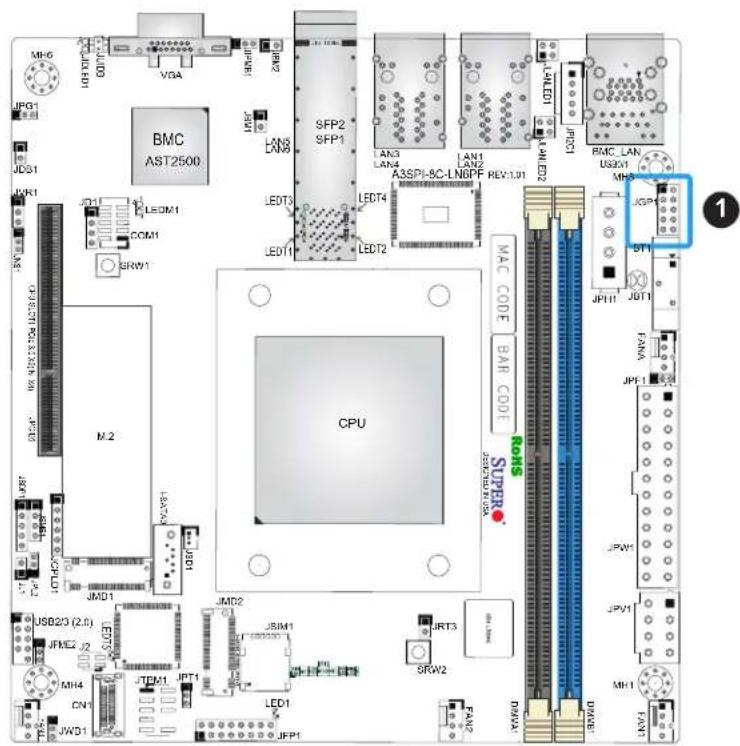
text_image
JPG1 JDS1 JRS1 JMS1 M.2 JSP1 JSP2 AST2500 LED1 COM1 SRW1 JMD1 USB2/3 (2.0) JFME2 MH4 CN1 JWD1 JPM1 JPT1 JPM2 JPM1 JPM2 JPM1 JPM2 JPM1 JPM2 JPM1 JPM2 JPM1 JPM2 JPM1 JPM2 JPM1 JPM2 JPM1 JPM2 JPM1 JPM2 JPM1 JPM2 JPM1 JPM2 JPM1 JPM2 JPM1 JFM1 JFM2 JFM1 JFM2 JFM1 JFM2 JFM1 JFM2 JFM1 JFM2 JFM1 JFM2 JFM1 JFM2 JFM1 JFM2 JFM1 JFM2 JFM1 JFM2 JFM1 JFM2 JFM1 JFM2 JFM1 JFM2 JFM2 JFM1 JFM2 JFM1 JFM2 JFM1 JFM2 JFM1 JFM2 JFM1 JFM2 JFM1 JFM2 JFM1 JFM2 JFM1 JFM2 JFM1 JFM2 JFM1 JFM2 JFM1 JFM2 JFM1 JFM3 JPM1 JPM2 JPM1 JPM2 JPM1 JPM2 JPM1 JPM2 JPM1 JPM2 JPM1 JPM2 JPM1 JPM2 JPM1 JPM2 JPM1 JPM2 JPM1 JPM2 JPM1 JPM2 JPM1 JPM2 JPM3 JPM1 JPM2 JPM1 JPM2 JPM1 JPM2 JPM3- General Purpose Header
Disk-On-Module Power Connector
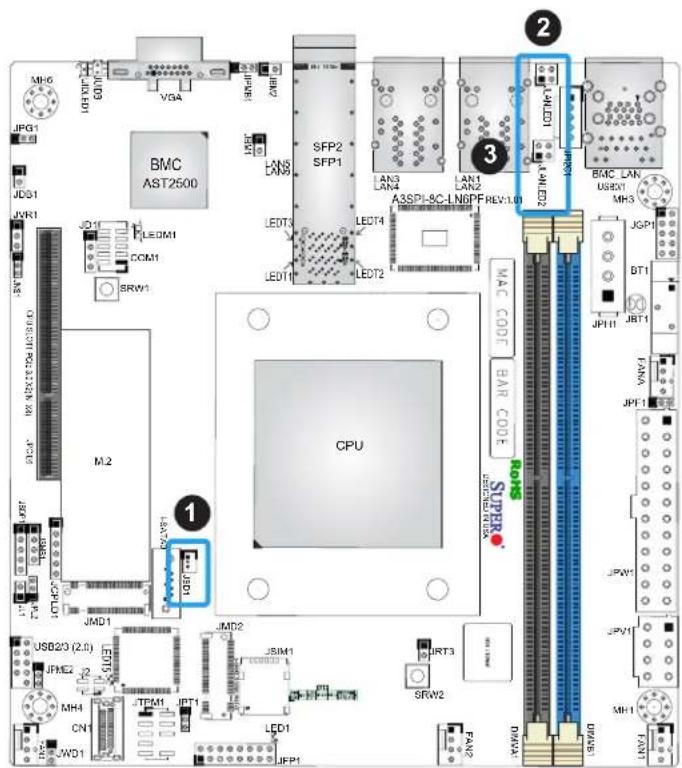
One power connector for SATA DOM (Disk-On-Module) devices is located at JSD1. Connect appropriate cables here to provide power support for your Serial Link DOM devices.
| DOM PowerPin Definitions | |
| Pin# | Definition |
| 1 | 5V |
| 2 | Ground |
| 3 | Ground |
LAN Port Activity LED
JLANLED1 is the activity LED for LAN1/LAN2 (LN6PF) and LAN3/LAN4 (HLN4F), and JLANLED2 is the activity LED for LAN3/LAN4 (LN6PF).
| LAN Activity LEDPin Definitions | |
| Pin# | Definition |
| 1 | 3V3 Stby |
| 2 | LAN_ACT_N |
| 3 | 3V3 Stby |
| 4 | LAN_ACT_N |
text_image
JPG1 JDS1 JVR1 JDS2 JMD1 JMD2 JPM1 JPM2 JPM3 JPM4 JPM5 JPM6 JPM7 JPM8 JPM9 JPM10 JPM11 JPM12 JPM13 JPM14 JPM15 JPM16 JPM17 JPM18 JPM19 JPM20 JPM21 JPM22 JPM23 JPM24 JPM25 JPM26 JPM27 JPM28 JPM29 JPM30 JPM31 JPM32 JPM33 JPM34 JPM35 JPM36 JPM37 JPM38 JPM39 JPM40 JPM41 JPM42 JPM43 JPM44 JPM45 JPM46 JPM47 JPM48 JPM49 JPM50 JPM51 JPM52 JPM53 JPM54 JPM55 JPM56 JPM57 JPM58 JPM59 JPM60 JPM61 JPM62 JPM63 JPM64 JPM65 JPM66 JPM67 JPM68 JPM69 JPM70 JPM71 JPM72 JPM73 JPM74 JPM75 JPM76 JPM77 JPM78 JPM79 JPM80 JPM81 JPM82 JPM83 JPM84 JPM85 JPM86 JPM87 JPM88 JPM89 JPM90 JPM91 JPM92 JPM93 JPM94 JPM95 JPM96 JPM97 JPM98 JPM99 JPM100- SATA DOM Power Connector
- JLANLED1
- JLANLED2
M.2 Slots
The motherboard has two M.2 slots (JMD1 and JMD2). M.2 allows for a variety of card sizes, increased functionality, and spatial efficiency. JMD1 supports an M-Key PCIe 3.0 x4 device in the 2280 form factor, whereas JMD2 supports a B-Key PCIe 3.0 x2/SATA3.0/USB 3.0 device in the 3052 form factor. The JMD1 pin definition table is on this page and the JMD2 table is on the next page.
- JMD1
- JMD2

text_image
JPG1 JDB1 JVR1 LEDM1 COM1 SNW1 M.2 1 JMD1 JMD2 JMD3 JPM2 JPM4 JPM5 JPM6 JPM7 JPM8 JPM9 JPM10 JPM11 JPM12 JPM13 JPM14 JPM15 JPM16 JPM17 JPM18 JPM19 JPM20 JPM21 JPM22 JPM23 JPM24 JPM25 JPM26 JPM27 JPM28 JPM29 JPM30 JPM31 JPM32 JPM33 JPM34 JPM35 JPM36 JPM37 JPM38 JPM39 JPM40 JPM41 JPM42 JPM43 JPM44 JPM45 JPM46 JPM47 JPM48 JPM49 JPM50 JPM51 JPM52 JPM53 JPM54 JPM55 JPM56 JPM57 JPM58 JPM59 JPM60 JPM61 JPM62 JPM63 JPM64 JPM65 JPM66 JPM67 JPM68 JPM69 JPM70 JPM71 JPM72 JPM73 JPM74 JPM75 JPM76 JPM77 JPM78 JPM79 JPM80 JPM81 JPM82 JPM83 JPM84 JPM85 JPM86 JPM87 JPM88 JPM89 JPM90 JPM91 JPM92 JPM93 JPM94 JPM95 JPM96 JPM97 JPM98 JPM99 JPM100| M.2 Slot Pin Definitions (JMD1 M-Key) | |||
| Pin# | Definition | Pin# | Definition |
| 1 | GND | 2 | P3V3_DUAL |
| 3 | USB_JMD2_DP | 4 | P3V3_DUAL |
| 5 | USB_JMD2_DN | 6 | |
| 7 | GND | 8 | |
| 9 | 10 | ||
| 11 | 12 | ||
| 13 | 14 | ||
| 15 | 16 | ||
| 17 | 18 | GND | |
| 19 | 20 | UART_BT_WAKE_R_N | |
| 21 | 22 | ||
| 23 | 24 | ||
| 25 | 26 | ||
| 27 | 28 | ||
| 29 | 30 | ||
| 31 | 32 | ||
| 33 | GND | 34 | |
| 35 | PE_PCH_TX_C_P0 | 36 | |
| 37 | PE_PCH_TX_C_NO | 38 | |
| 39 | GND | 40 | |
| 41 | PE_M2E_RX_DP | 42 | |
| 43 | PE_M2E_RX_DN | 44 | M2E_WLAN_COEX3 |
| 45 | GND | 46 | M2E_WLAN_COEX2 |
| 47 | CLK_100M_M2E_DP | 48 | M2E_WLAN_COEX1 |
| 49 | CLK_100M_M2E_DN | 50 | M2E_SUSCLK_R |
| 51 | GND | 52 | PLTRST_M2E_R |
| 53 | CLKREQ_M2E_R_N | 54 | M2E_W_DISABLE2_N_R |
| 55 | PE_WAKE_M2E_R_N | 56 | M2E_W_DISABLE1_N_R |
| 57 | GND | 58 | M2E_I2C_DAT_R |
| 59 | 60 | M2E_I2C_CLK_R | |
| 61 | 62 | ||
| 63 | GND | 64 | |
| 65 | 66 | ||
| 67 | 68 | ||
| 69 | GND | 70 | |
| 71 | 72 | P3V3_DUAL | |
| 73 | 74 | P3V3_DUAL | |
| 75 | GND | ||
| M.2 Slot Pin Definitions (JMD2 B-Key) | |||
| Pin# | Definition | Pin# | Definition |
| 1 NC | 2 | P3V3SB | |
| 3 GND | 4 | P3V3SB | |
| 5 GND | 6 | FULL_CARD_POW- | ER_OFF#(PU to P1V8SB only) |
| 7 USB | D+ | 8 W_DISABLE1#(PU to P3V3SB only) | |
| 9 USB | D- | 10 NC | |
| 11 GND | 12 | ||
| 13 14 | |||
| 15 16 | |||
| 17 18 | |||
| 19 20 NC | |||
| 21 NC | 22 NC | ||
| 23 WWAN_ | WAKE_N(PU to P1V8SB only) | 24 NC | |
| 25 NC | 26 RF_KILL_ | GPS_1P8_N(PU to P1V8SB only) | |
| 27 GND | 28 NC | ||
| 29 NC | 30 NC | ||
| 31 NC | 32 NC | ||
| 33 GND | 34 NC | ||
| 35 NC | 36 NC | ||
| 37 NC | 38 DEVSLP | (reserved) | |
| 39 GND | 40 SMB_CLK | (reserved) | |
| 41 PERn0/SATARX+ | 42 SME_DATA | (reserved) | |
| 43 PERp0/SATARX- | 44 ALERT(PU to P1V8SB only) | ||
| 45 GND | 46 NC | ||
| 47 PETn0/SATATX- | 48 NC | ||
| 49 PETn0/SATATX+ | 50 PERST (PLTRST) | ||
| 51 GND | 52 CLK_REQ_N | ||
| 53 REFCLK- | 54 PE_WAKE_N | ||
| 55 REFCLK+ | 56 NC | ||
| 57 GND | 58 NC | ||
| 59 NC | 60 NC | ||
| 61 NC | 62 NC | ||
| 63 NC | 64 NC | ||
| 65 NC | 66 NC | ||
| 67 NC | 68 SYSCLK (reserved) | ||
| 69 PE_DET | 70 P3V3SB | ||
| 71 GND | 72 P3V3SB | ||
| 73 GND | 74 P3V3SB | ||
| 75 NC | |||
Chassis Intrusion
A Chassis Intrusion header is located at JL1 on the motherboard. Attach the appropriate cable from the chassis to inform you of a chassis intrusion when the chassis is opened. Refer to the table below for pin definitions.
| Chassis Intrusion Pin Definitions | |
| Pin# | Definition |
| 1 | Intrusion Input |
| 2 | Ground |
Speaker/Buzzer
On the JD1 header, pins 1-4 are for the speaker and pins 3-4 are for the buzzer. If you wish to use an external speaker, connect its cable to pins 1-4.
| Speaker ConnectorPin Definitions | |
| Pin # | Definition |
| 1-4 | Speaker |
| 3-4 | Buzzer |

text_image
1 2 BMC AST2500 JDS1 JVR1 JMS3 JMD1 JMD2 JMD1 JMD1 (2.0) JME2 JWD1 JSDM1 COM1 SRW1 M.2 CPU JMD1 JMD2 JSDM1 JPT1 JMT1 JPT1 JMD1 JMD2 JMD1 JMD2 JMD1 JMD2 JMD1 JMD2 JMD1 JMD2 JMD1 JMD2 JMD1 JMD2 JMD1 JMD2 JMD1 JMD2 JMD1 JMD2 JMD1 JMD2 JMD1 JMD2 JMD1 JMD2 JMD2 JMD1 JMD2 JMD1 JMD2 JMD1 JMD2 JMD1 JMD2 JMD1 JMD2 JMD1 JMD2 JMD1 JMD2 JMD1 JMD2 JMD1 JMD2 JMD1 JMD2 JMD1 JMD2 JMD1 JMD3 JMT1 JMT2 JMT3 JMT4 JMT5 JMT6 JMT7 JMT8 JMT9 JMT10 JMT11 JMT12 JMT13 JMT14 JMT15 JMT16 JMT17 JMT18 JMT19 JMT20 JMT21 JMT22 JMT23 JMT24 JMT25 JMT26 JMT27 JMT28 JMT29 JMT30 JMT31 JMT32 JMT33 JMT34 JMT35 JMT36 JMT37 JMT38 JMT39 JMT40 JMT41 JMT42 JMT43 JMT44 JMT45 JMT46 JMT47 JMT48 JMT49 JMT50 JMT51 JMT52 JMT53 JMT54 JMT55 JMT56 JMT57 JMT58 JMT59 JMT60 JMT61 JMT62 JMT63 JMT64 JMT65 JMT66 JMT67 JMT68 JMT69 JMT70 JMT71 JMT72 JMT73 JMT74 JMT75 JMT76 JMT77 JMT78 JMT79 JMT80 JMT81 JMT82- Chassis Intrusion
- Speaker Buzzer
I-SATA 3.0 Port
The motherboard has one I-SATA 3.0 port (I-SATA0). I-SATA0 can be used with Supermicro SuperDOMs that are yellow SATA DOM connectors with power pins built in, and do not require external power cables. Supermicro SuperDOMs are backward compatible with regular SATA HDDs or SATA DOMs that need external power cables.
| SATA 3.0 PortPin Definitions | |
| Pin# | Signal |
| 1 | Ground |
| 2 | SATA_TXP |
| 3 | SATA_TXN |
| 4 | Ground |
| 5 | SATA_RXN |
| 6 | SATA_RXP |
| 7 | Ground |
Nano SIM Slot
The JSIM1 slot supports a Nano SIM card. Please refer to jumper JP1 for additional settings.

text_image
JPG1 JDS1 JVR1 JMD1 USB23 (2.0) JFHE2 MH4 CN1 WD1 LED0 VGA JPM1 JPTM JPT1 JMD2 JSIM1 JRT3 SRW2 LED1 JFP1 CPU SFP2 SFP1 LAN3 LAN4 LAN1 LAN2 LAN0 A3SDL-8C-LN0PF REV:1.01 LED2 JSP1 JGT1 JPM1 JBT1 JPM1 JPM1 JPM1 JPM1 JPM1 JPM1 JPM1 JPM1 JPM1 JPM1 JPM1 JPM1 JPM1 JPM1 JPM1 JPM1 JPM1 JPM1 JPM1 JPM1 JPM1 JPM1 JPM1 JPM1 JPM1 JFM2 JPM1 JPM1 JPM1 JPM1 JPM1 JPM1 JPM1 JPM1 JPM1 JPM1 JPM1 JPM1 JPM1 JPM1 JPM1 JPM1 JPM1 JPM1 JPM1 JPM1 JPM1-
I-SATA0
-
Nano SIM Slot
Power SMB (I²C) Header
The Power System Management Bus (I²C) connector (JPI²C1) monitors the power supply, fan, and system temperatures. Refer to the table below for pin definitions.
| Power SMB HeaderPin Definitions | |
| Pin# | Definition |
| 1 | SCL4_BMC |
| 2 | SDA4_BMC |
| 3 | PWRFAIL_N |
| 4 | GND |
| 5 | NC |
System Management Bus Header
A System Management Bus header for IPMI 2.0 is located at JIPMB1. Connect the appropriate cable here to use the IPMB I²C connection on your system. Refer to the table below for pin definitions.
| External FC HeaderPin Definitions | |
| Pin# | Definition |
| 1 | SDA6_BMC |
| 2 | Ground |
| 3 | SCL6_BMC |

text_image
JPG1 JDS1 JVR1 JMD1 JMD2 JPM1 JPM2 JPM3 JPM4 JPM5 JPM6 JPM7 JPM8 JPM9 JPM10 JPM11 JPM12 JPM13 JPM14 JPM15 JPM16 JPM17 JPM18 JPM19 JPM20 JPM21 JPM22 JPM23 JPM24 JPM25 JPM26 JPM27 JPM28 JPM29 JPM30 JPM31 JPM32 JPM33 JPM34 JPM35 JPM36 JPM37 JPM38 JPM39 JPM40 JPM41 JPM42 JPM43 JPM44 JPM45 JPM46 JPM47 JPM48 JPM49 JPM50 JPM51 JPM52 JPM53 JPM54 JPM55 JPM56 JPM57 JPM58 JPM59 JPM60 JPM61 JPM62 JPM63 JPM64 JPM65 JPM66 JPM67 JPM68 JPM69 JPM70 JPM71 JPM72 JPM73 JPM74 JPM75 JPM76 JPM77 JPM78 JPM79 JPM80 JPM81 JPM82 JPM83 JPM84 JPM85 JPM86 JPM87 JPM88 JPM89 JPM90 JPM91 JPM92 JPM93 JPM94 JPM95 JPM96 JPM97 JPM98 JPM99 JPM100- Power SMB Header
- System Management Bus Header
2.7 Jumper Settings
How Jumpers Work
To modify the operation of the motherboard, jumpers can be used to choose between optional settings. Jumpers create shorts between two pins to change the function of the connector. Pin 1 is identified with a square solder pad on the printed circuit board. See the diagram below for an example of jumping pins 1 and 2. Refer to the motherboard layout page for jumper locations.

Note: On two-pin jumpers, Closed means the jumper is on and Open means the jumper is off the pins.

text_image
Connector Pins Jumper Setting 3 2 1 3 2 1CMOS Clear
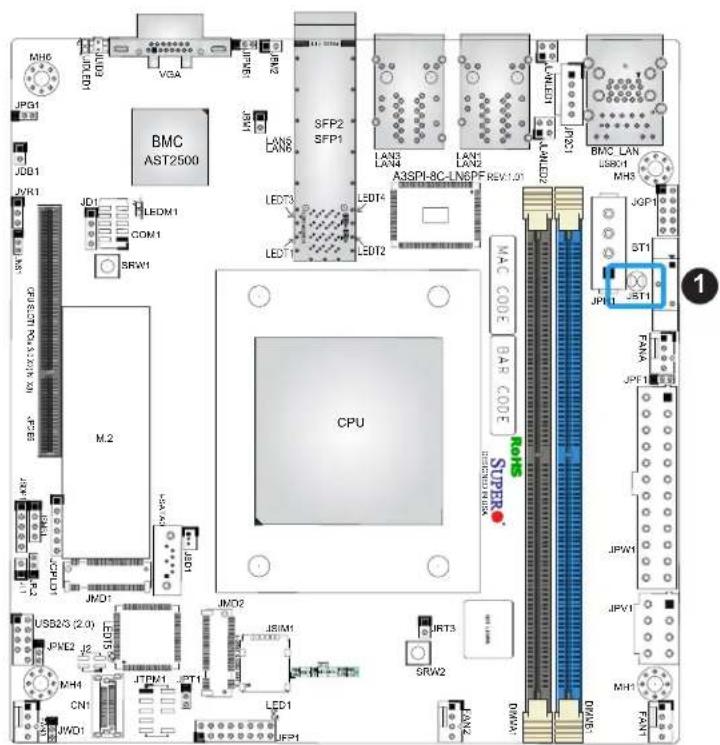
JBT1 is used to clear CMOS, which will also clear any passwords. Instead of pins, this jumper consists of contact pads to prevent accidentally clearing the contents of CMOS.
To Clear CMOS
-
First power down the system and unplug the power cord(s).
-
Remove the cover of the chassis to access the motherboard.
-
Remove the onboard battery from the motherboard.
-
Short the CMOS pads with a metal object such as a small screwdriver for at least four seconds.
-
Remove the screwdriver (or shorting device).
-
Replace the cover, reconnect the power cord(s), and power on the system.

Note: Clearing CMOS will also clear all passwords.

JBT1 contact pads
text_image
BMC AST2500 JDB1 JVR1 JDI LEDM1 COM1 SRW1 M.2 JMD1 JMD2 JMD3 JMD4 JMD5 JMD6 JMD7 JMD8 JMD9 JMD10 JMD11 JMD12 JMD13 JMD14 JMD15 JMD16 JMD17 JMD18 JMD19 JMD20 JMD21 JMD22 JMD23 JMD24 JMD25 JMD26 JMD27 JMD28 JMD29 JMD30 JMD31 JMD32 JMD33 JMD34 JMD35 JMD36 JMD37 JMD38 JMD39 JMD40 JMD41 JMD42 JMD43 JMD44 JMD45 JMD46 JMD47 JMD48 JMD49 JMD50 JMD51 JMD52 JMD53 JMD54 JMD55 JMD56 JMD57 JMD58 JMD59 JMD60 JMD61 JMD62 JMD63 JMD64 JMD65 JMD66 JMD67 JMD68 JMD69 JMD70 JMD71 JMD72 JMD73 JMD74 JMD75 JMD76 JMD77 JMD78 JMD79 JMD80 JMD81 JMD82 JMD83 JMD84 JMD85 JMD86 JMD87 JMD88 JMD89 JMD90 JMD91 JMD92 JMD93 JMD94 JMD95 JMD96 JMD97 JMD98 JMD99 JMD100- CMOS Clear
Onboard TPM Enable/Disable
Use JPT1 to enable or disable support for the onboard TPM 2.0 module. See the table below for jumper settings.
| TPM Enable/DisableJumper Settings | |
| Jumper Setting | Definition |
| Pins 1-2 | Enable (Default) |
| Pins 2-3 | Disable |
Manufacturing Mode Select
Close JPME2 to bypass SPI flash security and force the system to use the Manufacturing Mode, which will allow you to flash the system firmware from a host server to modify system settings. See the table below for jumper settings.
| Manufacturing ModeJumper Settings | |
| Jumper Setting | Definition |
| Pins 1-2 | Normal (Default) |
| Pins 2-3 | Manufacturing Mode |

text_image
JPG1 JDS1 JVR1 M2 JCP-UDT1 USB2/3 (2.5) JPM2 JPM4 CN1 JWD1 JPM1 LED1 COM1 SRW1 JMD2 JPM1 JPT1 JPM2 JPM3 JPM4 JPM5 JPM6 JPM7 JPM8 JPM9 JPM10 JPM11 JPM12 JPM13 JPM14 JPM15 JPM16 JPM17 JPM18 JPM19 JPM20 JPM21 JPM22 JPM23 JPM24 JPM25 JPM26 JPM27 JPM28 JPM29 JPM30 JPM31 JPM32 JPM33 JPM34 JPM35 JPM36 JPM37 JPM38 JPM39 JPM40 JPM41 JPM42 JPM43 JPM44 JPM45 JPM46 JPM47 JPM48 JPM49 JPM50 JPM51 JPM52 JPM53 JPM54 JPM55 JPM56 JPM57 JPM58 JPM59 JPM60 JPM61 JPM62 JPM63 JPM64 JPM65 JPM66 JPM67 JPM68 JPM69 JPM70 JPM71 JPM72 JPM73 JPM74 JPM75 JPM76 JPM77 JPM78 JPM79 JPM80 JPM81 JPM82 JPM83 JPM84 JPM85 JPM86 JPM87 JPM88 JPM89 JPM90 JPM91 JPM92 JPM93 JPM94 JPM95 JPM96 JPM97 JPM98 JPM99 JPM100- TPM Enable
- Manufacturing Mode
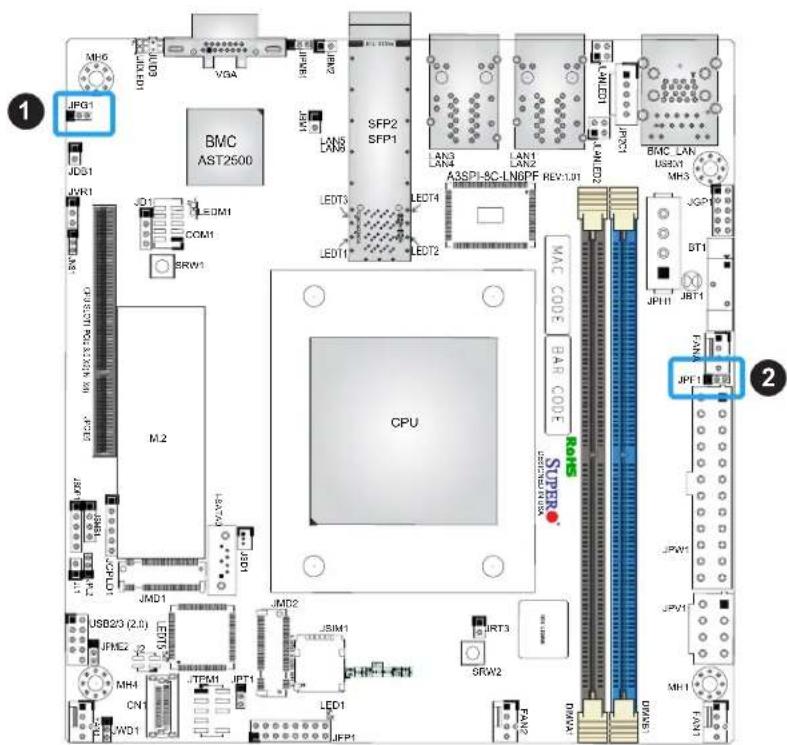
VGA Enable/Disable
Use jumper JPG1 to enable or disable the onboard VGA connector. Refer to the table below for jumper settings.
| VGA Enable/DisableJumper Settings | |
| Jumper Setting | Definition |
| Pins 1-2 | Enabled (Default) |
| Pins 2-3 | Disabled |
ATX/Force PS-ON Mode Select
Use jumper JPF1 to select ATX or Force PS-ON Mode (default). Refer to the table below for pin definitions.
| ATX/Force PS-ON ModeJumper Settings | |
| Jumper Setting | Definition |
| Pins 1-2 | ATX Mode |
| Pins 2-3 | Force PS-ON Mode |
text_image
1 JPG1 JDS1 JVR1 JCM2 JMD1 USB2/3 (2.5) JFME2 MH4 CN1 WD1 JPM1 JPT1 LED10 JPM2 JPM1 JRT3 SRW2 LED1 JFP1 JPM2 JPM1 JPM1 JPM1 JPM1 JPM1 JPM1 JPM1 JPM1 JPM1 JPM1 JPM1 JPM1 JPM1 JPM1 JPM1 JPM1 JPM1 JPM1 JPM1 JPM1 JPM1 JPM1 JPM1 JPM1 JPM1 JPM2 JPM2 JPM2 JPM2 JPM2 JPM2 JPM2 JPM2 JPM2 JPM2 JPM2 JPM2 JPM2 JPM2 JPM2 JPM2 JPM2 JPM2 JPM2 JPM2 JPM2 JPM2 JPM2 JPM2 JPM2 JPM1 JPM1 JPM1 JPM1 JPM1 JPM1 JPM1 JPM1 JPM1 JPM1 JPM1 JPM1 JPM1 JPM1 JPM1 JPM1 JPM1 JPM1 JPM1 JPM1 JPM1 JPM1 JPM1 JPM2 JPM3 JPM3 JPM3 JPM3 JPM3 JPM3 JPM3 JPM3 JPM3 JPM3 JPM3 JPM3 JPM3 JPM3 JPM3 JPM3 JPM3 JPM3 JPM3 JPM3 JPM3 JPM3 JPM3 JPM3 JPM3 JPM4 JPM4 JPM4 JPM4 JPM4 JPM4 JPM4 JPM4 JPM4 JPM4 JPM4 JPM4 JPM4 JPM4 JPM4 JPM4 JPM4 JPM4 JPM4 JPM4 JPM4 JPM4 JPM4 JPM4 JPM4 JPM5 JPM5 JPM5 JPM5 JPM5 JPM5 JPM5 JPM5 JPM5 JPM5 JPM5 JPM5 JPM5 JPM5 JPM5 JPM5 JPM5 JPM5 JPM5 JPM5-
Video Enable
-
Power Mode
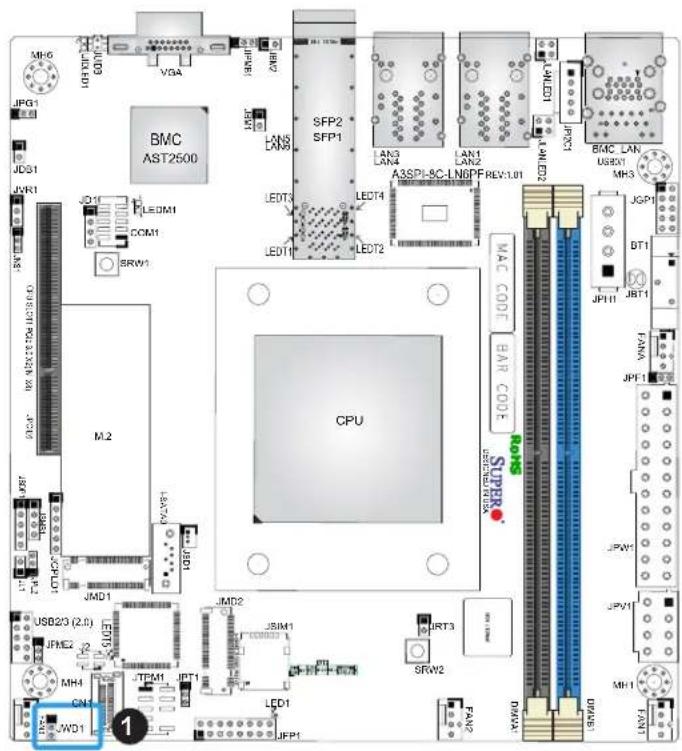
Watch Dog
JWD1 controls the Watch Dog function. Watch Dog is a monitor that can reboot the system when a software application hangs. Jumping pins 1-2 will cause Watch Dog to reset the system if an application hangs. Jumping pins 2-3 will generate a non-maskable interrupt signal for the application that hangs. Watch Dog must also be enabled in BIOS. The default setting is Reset.

Note: When Watch Dog is enabled, users need to write their own application software to disable it.
| Watch DogJumper Settings | |
| Jumper Setting | Definition |
| Pins 1-2 | Reset (Default) |
| Pins 2-3 | NMI |
| Open | Disabled |
text_image
JPG1 JDS1 JVR1 M2 JMD1 USB23 (2.5) JFHE2 MH4 CN1 JWD1 JMD2 JPM1 JPT1 LED1 JPM1 JPT3 JRT3 SRW2 LED2 LED1 LED3 LED4 LED7 LED8 SFP2 SFP1 LAN3 LAN4 LAN1 LAN2 A3SP1-8C-LN9PF REV.1.01 LNDLED1 LNDLED2 BMC AST2500 MAC CODE BAR CODE SUPERO DANA1 JPG1 BT1 JPH1 JBT1 JPM1 JPY1 JPW1 JPY1 DHASE LMH1 LMH1- Watch Dog
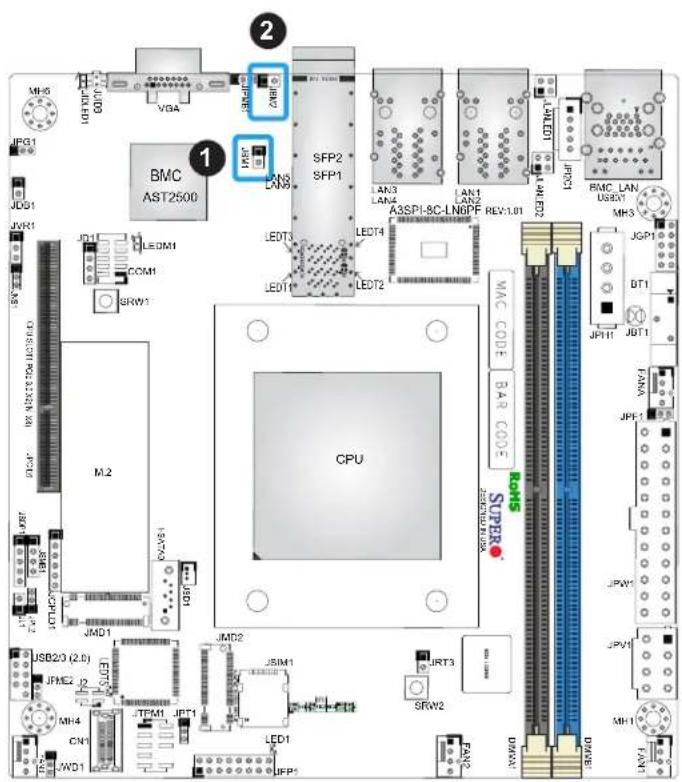
IPMI Shared LAN Enable/Disable
Set the JBM1 jumper to enabled to share LAN1 with IPMI.
| IPMI Share LAN Enable/Disable Jumper Settings | |
| Jumper Setting | Definition |
| Pins 1-2 (Open) | Enabled (Default) |
| Pins 1-2 (Short) | Disabled |
IPMI Dedicated/Shared LAN Enable/Disable
Use JBM2 to enable or disable the dedicated IPMI LAN port. Refer to the table below for jumper settings.
| IPMI Dedicated/Share LANEnable/DisableJumper Settings | |
| Jumper Setting | Definition |
| Pins 1-2 (Open) | Enabled (Default) |
| Pins 1-2 (Short) | Disabled |
text_image
MP-6 JJD-H1 VGA JJD-1 JJD1 JJD1 JVR1 JVRH1 COM1 SRW1 M.2 JMD1 USB2/3 (2.8) JFME2 JPM4 CN1 WD1 JPM2 JPM1 JPT1 LED1 JFP1 SFP2 SFP1 LED3 LED4 LED7 LED1 LED2 A3SPI-8C-LN0PF REV:1.01 LAN3 LAN4 LAN5 LAN6 LAN7 LAN8 LAN9 LAN10 LAN11 LAN12 LAN13 LAN14 LAN15 LAN16 LAN17 LAN18 LAN19 LAN20 LAN21 LAN22 LAN23 LAN24 LAN25 LAN26 LAN27 LAN28 LAN29 LAN30 LAN31 LAN32 LAN33 LAN34 LAN35 LAN36 LAN37 LAN38 LAN39 LAN40 LAN41 LAN42 LAN43 LAN44 LAN45 LAN46 LAN47 LAN48 LAN49 LAN50 MAC CODE BAR CODE Super® JPF1 JBT1 JPM1 JPF2 JPM3 JPM4 JPM5 JPM6 JPM7 JPM8 JPM9 JPM10 JPM11 JPM12 JPM13 JPM14 JPM15 JPM16 JPM17 JPM18 JPM19 JPM20 JPM21 JPM22 JPM23 JPM24 JPM25 JPM26 JPM27 JPM28 JPM29 JPM30 JPM31 JPM32 JPM33 JPM34 JPM35 JPM36 JPM37 JPM38 JPM39 JPM40 JPM41 JPM42 JPM43 JPM44 JPM45 JPM46 JPM47 JPM48 JPM49 JPM50 JPM51 JPM52 JPM53 JPM54 JPM55 JPM56 JPM57 JPM58 JPM59 JPM60 JPM61 JPM62 JPM63 JPM64 JPM65 JPM66 JPM67 JPM68 JPM69 JPM70 JPM71 JPM72 JPM73 JPM74 JPM75 JPM76 JPM77 JPM78 JPM79 JPM80 JPM81 JPM82 JPM83 JPM84 JPM85 JPM86 JPM87 JPM88 JPM89 JPM90 JPM91 JPM92 JPM93 JPM94 JPM95 JPM96 JPM97 JPM98 JPM99 JPM100- IPMI Share
- IPMI Dedicated/Share
SATA/PCIe Mode Select
Use jumper JNS1 to select SATA or PCIe mode. Refer to the table below for jumper settings definition.
| SATA/PCIe ModeJumper Settings | |
| Jumper Setting | Definition |
| Pins 1-2 | SATA (Default) |
| Pins 2-3 | PCIe |
COM Port/BMC Debug Port Select
Use jumper JDB1 to select COM Port or BMC Debug Port. Refer to the table below for jumper settings.
| COM Port/BMC Debug Port SelectJumper Settings | |
| Jumper Setting | Definition |
| Open | COM Port/VRM I2C for BMC monitoring (Default) |
| Close | BMC Debug Port/VRM I2C for PCH programming |

text_image
2 JDS1 JVR1 JDS2 JMD1 JMD2 JPM1 JPM2 JPM3 JPM4 JPM5 JPM6 JPM7 JPM8 JPM9 JPM10 JPM11 JPM12 JPM13 JPM14 JPM15 JPM16 JPM17 JPM18 JPM19 JPM20 JPM21 JPM22 JPM23 JPM24 JPM25 JPM26 JPM27 JPM28 JPM29 JPM30 JPM31 JPM32 JPM33 JPM34 JPM35 JPM36 JPM37 JPM38 JPM39 JPM40 JPM41 JPM42 JPM43 JPM44 JPM45 JPM46 JPM47 JPM48 JPM49 JPM50 JPM51 JPM52 JPM53 JPM54 JPM55 JPM56 JPM57 JPM58 JPM59 JPM60 JPM61 JPM62 JPM63 JPM64 JPM65 JPM66 JPM67 JPM68 JPM69 JPM70 JPM71 JPM72 JPM73 JPM74 JPM75 JPM76 JPM77 JPM78 JPM79 JPM80 JPM81 JPM82 JPM83 JPM84 JPM85 JPM86 JPM87 JPM88 JPM89 JPM90 JPM91 JPM92 JPM93 JPM94 JPM95 JPM96 JPM97 JPM98 JPM99 JPM100- SATA/PCIe Mode Select
- COM/BMC Debug
2.8 LED Indicators
LAN LEDs
Four RJ45 LAN ports (LAN1–LAN4) and two SFP+ LAN ports (LAN5–LAN6) are located on the I/O back panel. Each Ethernet LAN port has two LEDs. One LED indicates activity, while the other Link LED may be green, amber, or off to indicate the speed of the connection. Refer to the tables below for more information. When the system is in the S1/S3/S4/S5 states, the LAN Link LED will be in the solid on state.
| Activity Indicator | ||
| Color | Status | Definition |
| Off | No Connection | |
| Yellow | Flashing | Active |
| 1G RJ45 LAN Link | |
| LED Color | Definition |
| Off | No Connection or 10 Mb/s |
| Green | 100 Mb/s |
| Amber | 1 Gb/s |
| 10G SFP+ LAN Link LED (LAN5 - LAN6) | |
| LED Color | Definition |
| Off | No Connection |
| Amber | 10G |
| Activity Indicator | ||
| Color | Status | Definition |
| Off | No Connection | |
| Yellow | Flashing | Active |

text_image
JPG1 JDS1 JPR1 LEDM1 COM1 SRW1 M.2 JMD1 USB2/3 (2.5) JFME2 MH4 CN1 WD1 JPM1 JPT1 LED1 JFP1 SFP2 SFP1 LED8 LED7 LED6 LED5 LED4 LED3 LED2 SFP2 SFP1 LAN3 LAN4 A3SDI-9C-LN0PFEREV-1.01 AN1 LAN2 LAN3 LAN4 JPG1 JPG1 JPM1 JPM1 JPM1 JPM1 JPM1 JPM1 JPM1 JPM1 JPM1 JPM1 JPM1 JPM1 JPM1 JPM1 JPM1 JPM1 JPM1 JPM1 JPM1 JPM1 JPM1 JPM1 JPM1 JPM1 JPM1 JPN3 JPM3 JPM3 JPM3 JPM3 JPM3 JPM3 JPM3 JPM3 JPM3 JPM3 JPM3 JPM3 JPM3 JPM3 JPM3 JPM3 JPM3 JPM3 JPM3 JPM3- LAN1/LAN2 LEDs
- LAN3/LAN4 LEDs
- LAN5/LAN6 LEDs
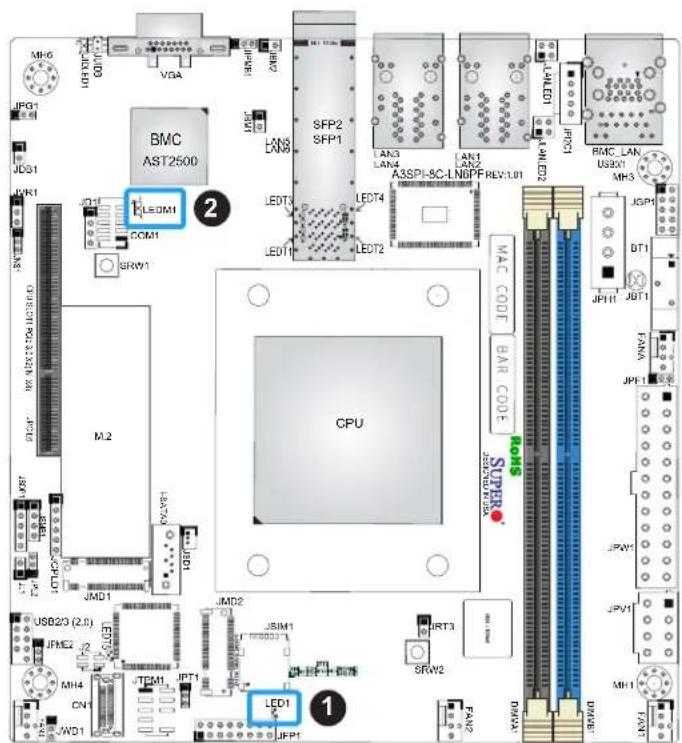
Power LED
LED1 is an onboard Power LED. When this LED is lit, it means power is present on the motherboard. In suspend mode, this LED will blink on and off. Turn off the system and unplug the power cord before removing or installing components.
| Onboard Power LED Indicator | |
| LED Color | Definition |
| Off | System Off(power cable not connected) |
| Green | System On |
BMC Heartbeat LED
LEDM1 is the BMC heartbeat LED. When the LED is blinking green, BMC is working. Refer to the table below for the LED status.
| Onboard Power LED Indicator | |
| LED Color | Definition |
| Blinking Green | BMC Normal |
text_image
JPG1 JDS1 JVR1 JMD1 USB23 (2.5) JFHE2 M14 CN1 JWD1 JMD1 LED1 JFP1 JPM1 JPT1 JPM2 JSIM1 JRT3 SRW2 LED1 CPU SFP2 SFP1 LAN8 LEDT3 LEDT4 LEDT2 LAN3 LAN4 A3SDP-8C-LN8PF REV.1.01 LAN1 AN2 A3LED ALED2 LUNLED JPG1 BMC_LAN USBX1 MH3 JSP1 DT1 JPN1 JBT1 JPM1 JFW1 JPW1 JPY1 DANA5 DHNA5-
Power LED
-
BMC Hearbeat LED
Chapter 3
Troubleshooting
3.1 Troubleshooting Procedures
Use the following procedures to troubleshoot your system. If you have followed all of the procedures below and still need assistance, refer to the 'Technical Support Procedures' and/or 'Returning Merchandise for Service' section(s) in this chapter. Always disconnect the AC power cord before adding, changing or installing any non hot-swap hardware components.
Before Power On
- Make sure that there are no short circuits between the motherboard and chassis.
- Disconnect all ribbon/wire cables from the motherboard, including those for the keyboard and mouse.
- Remove all add-on cards.
- Install the CPU (making sure it is fully seated) and connect the front panel connectors to the motherboard.
No Power
- Make sure that there are no short circuits between the motherboard and the chassis.
- Make sure that the ATX power connectors are properly connected.
- Check that the 115V/230V switch, if available, on the power supply is properly set.
- Turn the power switch on and off to test the system, if applicable.
- The battery on your motherboard may be old. Check to verify that it still supplies approximately 3VDC. If it does not, replace it with a new one.
No Video
- If the power is on but you have no video, remove all add-on cards and cables.
-
Use the speaker to determine if any beep codes are present. Refer to Appendix A for details on beep codes.
-
Remove all memory modules and turn on the system (if the alarm is on, check the specs of memory modules, reset the memory or try a different one).
System Boot Failure
If the system does not display POST or does not respond after the power is turned on, check the following:
- Check for any error beep from the motherboard speaker.
- If there is no error beep, try to turn on the system without DIMM modules installed. If there is still no error beep, replace the motherboard.
- If there are error beeps, clear the CMOS settings by unplugging the power cord and contacting both pads on the CMOS clear jumper (JBT1). (Refer to Section 2-8 in Chapter 2.)
- Remove all components from the motherboard, especially the DIMM modules. Make sure that system power is on and that memory error beeps are activated.
- Turn on the system with only one DIMM module installed. If the system boots, check for bad DIMM modules or slots by following the Memory Errors Troubleshooting procedure in this chapter.
Memory Errors
When a no-memory beep code is issued by the system, check the following:
-
Make sure that the memory modules are compatible with the system and that the DIMMs are properly and fully installed. Click on the Tested Memory List link on the motherboard product page to see a list of supported memory.
-
Check if different speeds of DIMMs have been installed. It is strongly recommended that you use the same RAM type and speed for all DIMMs in the system.
-
Make sure that you are using the correct type of DIMM modules recommended by the manufacturer.
-
Check for bad DIMM modules or slots by swapping a single module among all memory slots and check the results.
-
Make sure that all memory modules are fully seated in their slots. Follow the instructions given in Section 2-4 in Chapter 2.
-
Please follow the instructions given in the DIMM population tables listed in Section 2-4 to install your memory modules.
Losing the System's Setup Configuration
- Make sure that you are using a high-quality power supply. A poor-quality power supply may cause the system to lose the CMOS setup information. Refer to Section 2-7 for details on recommended power supplies.
- The battery on your motherboard may be old. Check to verify that it still supplies approximately 3VDC. If it does not, replace it with a new one. If the above steps do not fix the setup configuration problem, contact your vendor for repairs.
When the System Becomes Unstable
A. If the system becomes unstable during or after OS installation, check the following:
1. CPU/BIOS support: Make sure that your CPU is supported and that you have the latest BIOS installed in your system.
2. Memory support: Make sure that the memory modules are supported by testing the modules using memtest86 or a similar utility.

Note: Click on the Tested Memory List link on the motherboard product page to see a list of supported memory.
- HDD support: Make sure that all hard disk drives (HDDs) work properly. Replace the bad HDDs with good ones.
- System cooling: Check the system cooling to make sure that all heatsink fans and CPU/system fans, etc., work properly. Check the hardware monitoring settings in the IPMI to make sure that the CPU and system temperatures are within the normal range. Also check the front panel Overheat LED and make sure that it is not on.
- Adequate power supply: Make sure that the power supply provides adequate power to the system. Make sure that all appropriate power connectors are connected. Please refer to our website for more information on the minimum power requirements.
-
Proper software support: Make sure that the correct drivers are used.
B. If the system becomes unstable before or during OS installation, check the following: -
Source of installation: Make sure that the devices used for installation are working properly, including boot devices such as USB flash or media drives.
-
Cable connection: Check to make sure that all cables are connected and working properly.
-
Use the minimum configuration for troubleshooting: Remove all unnecessary components (starting with add-on cards first), and use the minimum configuration (but with the CPU and a memory module installed) to identify the trouble areas. Refer to the steps listed in Section A above for proper troubleshooting procedures.
- Identify bad components by isolating them: If necessary, remove a component in question from the chassis, and test it in isolation to make sure that it works properly. Replace a bad component with a good one.
- Check and change one component at a time instead of changing several items at the same time. This will help isolate and identify the problem.
- To find out if a component is good, swap this component with a new one to see if the system will work properly. If so, then the old component is bad. You can also install the component in question in another system. If the new system works, the component is good and the old system has problems.
3.2 Technical Support Procedures
Before contacting Technical Support, please take the following steps. Also, please note that as a motherboard manufacturer, Supermicro also sells motherboards through its channels, so it is best to first check with your distributor or reseller for troubleshooting services. They should know of any possible problems with the specific system configuration that was sold to you.
- Please go through the Troubleshooting Procedures and Frequently Asked Questions (FAQ) sections in this chapter or see the FAQs on our website (http://www.supermicro.com/FAQ/index.php) before contacting Technical Support.
- BIOS upgrades can be downloaded from our website (http://www.supermicro.com/ResourceApps/BIOS_IPMI_Intel.html).
-
If you still cannot resolve the problem, include the following information when contacting Supermicro for technical support:
-
Motherboard model and PCB revision number
- BIOS release date/version (This can be seen on the initial display when your system first boots up.)
-
System configuration
-
An example of a Technical Support form is on our website at https://webpr3.supermicro.com/SupportPortal/.
- Distributors: For immediate assistance, please have your account number ready when placing a call to our Technical Support department. We can be reached by email at support@supermicro.com.
3.3 Frequently Asked Questions
Question: What type of memory does my motherboard support?
Answer: The motherboard supports up to 128GB ECC/non-ECC UDIMM/RDIMM DDR4 memory with speeds of up to 2400 MT/s for 4C SKU and 2933 MT/S for 8C SKU in two DIMM slots. To enhance memory performance, do not mix memory modules of different speeds and sizes. Please follow all memory installation instructions given on Section 2-3 in Chapter 2.
Question: How do I update my BIOS?
Answer: It is recommended that you do not upgrade your BIOS if you are not experiencing any problems with your system. Updated BIOS files are located on our website at http://www.supermicro.com/ResourceApps/BIOS_IPMI_Intel.html. Please check our BIOS warning message and the information on how to update your BIOS on our website. Select your motherboard model and download the BIOS file to your computer. Also, check the current BIOS revision to make sure that it is newer than your BIOS before downloading. You can choose from the zip file and the .exe file. If you choose the zip BIOS file, please unzip the BIOS file onto a bootable USB device. Run the batch file using the format FLASH.BAT filename.rom from your bootable USB device to flash the BIOS. Then, your system will automatically reboot.
Warning: Do not shut down or reset the system while updating the BIOS to prevent possible system boot failure!

Note: The SPI BIOS chip used on this motherboard cannot be removed. Send your motherboard back to our RMA Department at Supermicro for repair. For BIOS Recovery instructions, please refer to the AMI BIOS Recovery Instructions posted at http://www.supermicro.com/support/manuals/.
Question: Why does the A3SPI-4C-HLN4F and A3SPI-8C-HLN4F show eight LAN ports in the operation system?
Answer: Because of the Intel SoC limitation (QUAD 0) cannot be disabled as an architecture limitation. This limitation causes six LAN ports to show in the operating system even though there are four LAN ports on the motherboard.
Question: How to select OCuLink and M.2 M-Key in the A3SPI-4C-HLN4F/LN6PF BIOS setup menu.
Answer: Access the Flexible I/O selection in the BIOS setup menu to select Oculink or M.2 M-Key.
Question: Why is the 180-degree angled TPM module recommended instead of the 90-degree angled module?
Answer: Use the 180 degree angled TPM module (e.g., AOM-TPM-9760V) instead of the 90 degree angled module to prevent interference with other devices in the system.
Question: Why doesn't the Front Panel HDD LED blink when there is activity with the M.2 PCIe SSD?
Answer: The HDD LED in the front panel is designed to blink when there is activity with the SATA SSD and not with the M.2 PCIe SSD.
3.4 Battery Removal and Installation
Battery Removal
To remove the onboard battery, follow the steps below:
- Power off your system and unplug your power cable.
- Locate the onboard battery as shown below.
- Using a tool such as a pen or a small screwdriver, push the battery lock outwards to unlock it. Once unlocked, the battery will pop out from the holder.
- Remove the battery.
Proper Battery Disposal
Please handle used batteries carefully. Do not damage the battery in any way; a damaged battery may release hazardous materials into the environment. Do not discard a used battery in the garbage or a public landfill. Please comply with the regulations set up by your local hazardous waste management agency to dispose of your used battery properly.
Battery Installation
- To install an onboard battery, follow steps 1 and 2 above and continue below:
- Identify the battery's polarity. The positive (+) side should be facing up.
- Insert the battery into the battery holder and push it down until you hear a click to ensure that the battery is securely locked.

Important: When replacing a battery, be sure to only replace it with the same type.

text_image
LITHIUM BATTERY BATTERY HOLDER OR LITHIUM BATTERY BATTERY HOLDER3.5 Returning Merchandise for Service
A receipt or copy of your invoice marked with the date of purchase is required before any warranty service will be rendered. You can obtain service by calling your vendor for a Returned Merchandise Authorization (RMA) number. When returning to the manufacturer, the RMA number should be prominently displayed on the outside of the shipping carton and mailed prepaid or hand-carried. Shipping and handling charges will be applied for all orders that must be mailed when service is complete.
For faster service, RMA authorizations may be requested online (http://www.supermicro.com/support/rma/).
This warranty only covers normal consumer use and does not cover damages incurred in shipping or from failure due to the alteration, misuse, abuse or improper maintenance of products.
During the warranty period, contact your distributor first for any product problems.
Chapter 4
UEFI BIOS
4.1 Introduction
This chapter describes the AMIBIOS™ Setup utility for the motherboard. The BIOS is stored on a chip and can be easily upgraded using a flash program.

Note: Due to periodic changes to the BIOS, some settings may have been added or deleted and might not yet be recorded in this manual. Please refer to the Manual Download area of our website for any changes to the BIOS that may not be reflected in this manual.
Starting the Setup Utility
To enter the BIOS Setup Utility, hit the
The Main BIOS screen has two main frames. The left frame displays all the options that can be configured. "Grayed-out" options cannot be configured. The right frame displays the key legend. Above the key legend is an area reserved for a text message. When an option is selected in the left frame, it is highlighted in white. Often a text message will accompany it. (Note that the BIOS has default text messages built in. We retain the option to include, omit, or change any of these text messages.) Settings printed in Bold are the default values.
A "▶" indicates a submenu. Highlighting such an item and pressing the
The BIOS setup utility uses a key-based navigation system called hot keys. Most of these hot keys (
4.2 Main Setup
You will see the Main setup screen when you first enter the AMI BIOS setup utility. You can always return to the Main setup screen by selecting the Main tab on the top of the screen. The Main BIOS setup screen is shown below and the following items will be displayed:

text_image
Antio Setup - AMI Main Advanced EMC Event Logs Security Boot Save & Exit System Date [Fri 08/12/2022] System Time [14:12:35] Supermicro A3SPI BIOS Version 1.0 Build Date 08/04/2022 CPLD Version 04.A3.03 Memory Information Total Memory 8192 MB Set the Date. Use Tab to switch between Date elements. Default Ranges: Year: 1998-1999 Months: 1-12 Days: Dependent on month Range of Years may vary. ++: Select Screen T#: Select Item Enter: Select +/-: Change Opt. F1: General Help F2: Previous Values F3: Optimized Defaults F4: Save & Exit ESC: Exit Version 2.21.1276 Copyright (C) 2022 AMISystem Date/System Time
Use this option to change the system date and time. Highlight System Date or System Time using the arrow keys. Enter new values using the keyboard. Press the

Note: The time is in the 24-hour format. For example, 5:30 P.M. appears as 17:30:00. The date's default value is the BIOS build date after RTC reset.
Supermicro A3SPI
BIOS Version
This feature displays the version of the BIOS ROM used in the system.
Build Date
This feature displays the date when the version of the BIOS ROM used in the system was built.
Memory Information
Total Memory
This feature displays the total size of memory available in the system.
4.3 Advanced
Use the arrow keys to select the Advanced menu and press

text_image
Antio Setup - AMT Main Advanced BMC Event Logs Security Boot Save & Exit Boot Feature CPU Configuration Chipset Configuration Server ME Information PCH SATA Configuration PCH sDATA Configuration Network Configuration PCIe/PCI/PnP Configuration Super IO Configuration Serial Port Console Redirection ACPI Settings Trusted Computing HTTP Boot Configuration Intel(R) Ethernet Connection E822-L for SFP - 3C:EC:EF:D0:85:38 Intel(R) Ethernet Connection E822-L for SFP - 3C:EC:EF:D0:85:39 Intel(R) Ethernet Connection E822-L 1GbE - 3C:EC:EF:D0:85:10 Intel(R) Ethernet Connection E822-L 1GbE - 3C:EC:EF:D0:85:11 Intel(R) Ethernet Connection E822-L 1GbE - 3C:EC:EF:D0:85:12 Intel(R) Ethernet Connection E822-L 1GbE - 3C:EC:EF:D0:85:13 TLS Authenticate Configuration Driver Health Boot Feature Configuration Page ++: Select Screen I4: Select Item Enter: Select +/-: Change Opt. F1: General Help F2: Previous Values F3: Optimized Defaults F4: Save & Exit ESC: Exit Version 2.21.1276 Copyright (C) 2022 AMIWarning: Take caution when changing the Advanced settings. An incorrect value, a very high DRAM frequency, or an incorrect DRAM timing setting may make the system unstable. When this occurs, revert to default manufacturer settings.
▶Boot Feature
Quiet Boot
Use this feature to select the screen display between the POST messages and the OEM logo upon boot up. Select Disabled to display the POST messages. Select Enabled to display the OEM logo instead of the normal POST messages. The options are Disabled and Enabled.
Bootup NumLock State
Use this feature to set the power on state for the
Wait For "F1" If Error
Use this feature to force the system to wait until the "F1" key is pressed if an error occurs. The options are Disabled and Enabled.
Re-try Boot
If this feature is enabled, the BIOS will automatically reboot the system from a specified boot device after its initial boot failure. The options are Disabled, Legacy Boot, and EFI Boot.
Power Configuration
Watch Dog Function
If enabled, the Watch Dog Timer will allow the system to reset or generate NMI based on jumper settings when it is expired for more than five minutes. The options are Disabled and Enabled.
Restore on AC Power Loss
Use this feature to set the power state after a power outage. Select Stay Off for the system power to remain off after a power loss. Select Power On for the system power to be turned on after a power loss. Select Last State to allow the system to resume its last power state before a power loss. The options are Stay Off, Power On, and Last State.
Power Button Function
This feature controls how the system shuts down when the power button is pressed. Select 4 Seconds Override to power off the system after pressing and holding the power button for four seconds or longer. Select Instant Off to instantly power off the system as soon as the user presses the power button. The options are Instant Off and 4 Seconds Override.
▶CPU Configuration
The following CPU information will display:
- Processor BSP Revision
- Processor Socket
- Processor ID
- Processor Frequency
- Processor Max Ratio
- Processor Min Ratio
- Microcode Revision
• L1 Cache RAM (Per Core)
• L2 Cache RAM (Per Package)
• L3 Cache RAM (Per Package) - Processor 0 Version
▶CPU1 Core Disable Bitmap
CPU1 Core Disable Bitmap
Core Disable Bitmap(Hex)
Select 0 to enable all cores or FFFFFFFF to disable all cores. One core must be enabled.
Hardware Prefetcher (Available when supported by the CPU)
If set to Enable, the hardware prefetcher will prefetch streams of data and instructions from the main memory to the L2 cache to improve CPU performance. The options are Enable and Disable.
DCU Streamer Prefetcher (Available when supported by the CPU)
Select Enable to enable the Data Cache Unit (DCU) Streamer Prefetcher, which streams and prefetches data and sends it to the Level 1 data cache to improve data processing and system performance. The options are Enable and Disable.
DCU IP Prefetcher (Available when supported by the CPU)
Select Enable for Data Cache Unit (DCU) IP Prefetcher support, which prefetches IP addresses to improve network connectivity and system performance. The options are Enable and Disable.
Extended APIC
Select Enable to activate Advanced Programmable Interrupt Controller (APIC) support. The options are Disable and Enable.
Intel (VMX) Virtualization Technology
Use this feature to enable the Vanderpool Technology. This technology allows the system to run several operating systems simultaneously. The options are Disable and Enable.
Enable SMX
Use this feature to enable or disable Safer Mode Extensions. The options are Disable and Enable.
PPIN Control
Select Unlock/Enable to use the Protected Processor Inventory Number (PPIN) in the system. The options are Lock/Disable and Unlock/Enable.
AES-NI
Select Enable to use the Intel Advanced Encryption Standard (AES) New Instructions (NI) to ensure data security. The options are Disable and Enable.
▶ Advanced Power Management Configuration
▶CPU P State Control
SpeedStep (P-States)
Intel SpeedStep Technology allows the system to automatically adjust processor voltage and core frequency to reduce power consumption and heat dissipation. The options are Disable and Enable.
Config TDP Lock
Use this feature to enable or disable the TDP Control Lock Bit. The options are Disable and Enable.
EIST PSD Function
This feature allows you to choose between Hardware and Software to control the processor's frequency and performance (P-state). In HW_ALL mode, the processor hardware is responsible for coordinating the P-state, and the OS is responsible for keeping the P-state request up to date on all Logical Processors. In SW_ALL mode, the OS Power Manager is responsible for coordinating the P-state, and must initiate the transition on all Logical Processors. In SW_ANY mode, the OS Power Manager is responsible for coordinating the P-state and may initiate the transition on any Logical Processors. The options are HW_ALL and SW_ALL.
Turbo Mode
This feature enables dynamic control of the processor, allowing it to run above stock frequency. The options are Disable and Enable.
▶CPU C State Control
Enable Monitor MWAIT
Select Enabled to enable the Monitor/Mwait instructions. The Monitor instructions monitors a region of memory for writes, and MWait instructions instruct the CPU to stop until the monitored region begins to write. The options are Disable and Enable.
CPU C6 Report
Select Enable to allow the BIOS to report the CPU C6 State (ACPI C3) to the operating system. During the CPU C6 State, the power to all cache is turned off. The options are Disable, Enable, and Auto.
Enhanced Halt State (C1E)
Select Enable to use Enhanced Halt State technology, which significantly reduces the CPU's power consumption by reducing its clock cycle and voltage during a Halt-state. The options are Disable and Enable.
▶CPU T State Control
Software Controlled T-States
Use this feature to enable Software Controlled T-States. The options are Disable and Enable.
*If the feature above is set to Enable, the next feature is available for configuration:
T-State Throttle Level
Use this feature to enable or disable CPU throttling, which reduces power consumption. The options are Disable, 6.25%, 12.5%, 18.75%, 25.0%, 31.25%, 37.5%, 43.75%, 50.0%, 56.25%, 62.5%, 68.75%, 75.0%, 81.25%, 87.5%, and 93.75%.
▶Chipset Configuration
Warning: Setting the wrong values in the following features may cause the system to malfunction.
▶ North Bridge
▶Uncore Configuration
Uncore Configuration
• Number of CPU
• Number of IIO
• Current UPI Link Speed
• Current UPI Link Frequency
• Global MMIO Low Base / Limit
• Global MMIO High Base / Limit
- PCIe Configuration Base / Size
XPT Remote Prefetch
Use this feature to enable or disable Extended Prediction Table (XPT) Remote Prefetch. The options are Disable, Enable, and Auto.
PCIe Remote P2P Relaxed Ordering
Enable peer-to-peer relaxed ordering to optimize system performance. The options are Disable and Enable.
Stale AtoS
Use this feature to enable or disable Stale A to S optimization. There are three states in the in-memory directory: invalid (I), snoopAll (A), and shared (S). Data in the I state is clean and does not exist in other sockets. Data in the A state may exist in another exclusive or modified socket. Data in the S state is clean and may be shared across one or more sockets. The options are Disable, Enable, and Auto.
LLC Dead Line Alloc
Select Enable to opportunistically fill dead lines in the LLC. Select Disable to never fill dead lines in LLC. The options are Disable, Enable, and Auto.
▶ Memory Configuration
Enforce POR
Select Plan of Record (POR) to enforce POR restrictions on DDR4 frequency and voltage programming. The options are POR and Disable.
PPR Type
Use this feature to select the Post Package Repair (PPR) type. The options are PPR Disabled, Hard PPR, and Soft PPR.
Memory Frequency
Use this feature to set the maximum memory frequency for onboard memory modules. The options are Auto, 2133, 2200, 2400, 2600, 2666, 2800, 2933, 3000, and 3200.
Data Scrambling for DDR4
Use this feature to enable or disable data scrambling for DDR4 memory. The options are Disable and Enable.
2x Refresh Enable
Use this feature to enable 2x memory refresh support to enhance memory performance. The options are Auto, Disable, and Enable.
▶ Memory Topology
This feature displays the information of memory modules detected by the BIOS.
▶ Memory RAS Configuration Setup
Correctable Error Threshold
Use this feature to specify the threshold value for correctable memory-error logging, which sets a limit on the maximum number of events that can be logged in the memory error log at a given time. The default setting is 512.
Partial Cache Line Sparing PCLS
Use this feature to enable or disable Partial Cache Line Sparing (PCLS). The options are Disabled and Enabled.
Patrol Scrub
Patrol Scrubbing is a process that allows the CPU to correct correctable memory errors detected on a memory module and send the correction to the requestor (the original source). When this feature is set to Enable, the IO hub reads and writes back one cache line every 16K cycles if there is no delay caused by internal processing. By using this method, roughly 64 GB of memory behind the IO hub is scrubbed every day. The options are Disabled, Enabled, and Enable at End of POST.
▶IIO Configuration
▶ IOAT Configuration
Disable TPH
Transparent Huge Pages (TPH) is a Linux memory management system that enables communication in larger blocks (pages). Enabling this feature increases performance. The options are No and Yes.
*If the feature above is set to No, the feature below is available for configuration:
Prioritize TPH
Use this feature to enable Prioritize TPH support. The options are Enable and Disable.
Relaxed Ordering
Select Yes to enable Relaxed Ordering support, which allows certain transactions to violate the strict-ordering rules of PCI bus for a transaction to be completed prior to other transactions that have already been enqueued. The options are No and Yes.
Intel(R) VT for Directed I/O (VT-d)
Intel® VT for Directed I/O (VT-d)
Select Enable to use Intel Virtualization Technology for Direct I/O VT-d support by reporting the I/O device assignments to the Virtual Machine Monitor (VMM) through the DMAR ACPI tables. This feature offers fully-protected I/O resource sharing across Intel platforms, providing greater reliability, security and availability in networking and data sharing. The options are Enable and Disable.
ACS Control
Select Enable to program Access Control Services (ACS) to the chipset PCIe root port bridge. Select No to program ACS to all PCIe root port bridges. The options are Enable and Disable.
Interrupt Remapping
Use this feature to enable Interrupt Remapping support, which detects and controls external interrupt requests. The options are Auto, Enable, and Disable.
PCIe ASPM Support (Global)
Use this feature to enable or disable ASPM support for all donwstream devices. The options are Disable and Auto.
South Bridge
The following USB information is displayed:
- USB Module Version
- USB Devices
Legacy USB Support
This feature enables support for USB 2.0 and older. The options are Enabled, Disabled, and Auto.
XHCI Hand-off
When this feature is disabled, the motherboard will not support USB 3.0. The options are Enabled and Disabled.
PCIe PLL SSC
Use this feature to enable or disable PCIe PLL SSC. The options are Disabled and Enabled.
M.2 (B-Key) I/O Selection
Use this feature to select the I/O type for the M.2 device. The options are SATA/USB and PCIe.
▶Server ME Information
The following General ME Configuration will display:
- General ME Configuration
• Oper. Firmware Version
• Backup Firmware Version
• Recovery Firmware Version
• ME Firmware Status #1
• ME Firmware Status #2 - Current State
- Error Code
▶PCH SATA Configuration
SATA Controller
This feature enables or disables the onboard SATA controller supported by the Intel PCH chip. The options are Enabled and Disabled.
Aggressive LPM Support
When this feature is set to Enable, the SATA AHCI controller manages the power usage of the SATA link. The controller puts the link in a low power mode during extended periods of I/O inactivity, and returns the link to an active state when I/O activity resumes. The options are Disabled and Enabled.
OCuLink SATA P1-P4 Hot Plug
Set this feature to Enable for hot plug support, which allows you to replace a SATA drive without shutting down the system. The options are Disable and Enable.
OCuLink SATA P1-P4 Spin Up Device
Set this feature to enable or disable the PCH to initialize the device. The options are Disable and Enable.
OCuLink SATA P1-P4 SATA Device Type
Use this feature to specify if the SATA port specified should be connected to a Solid State Drive or a Hard Disk Drive. The options are Hard Disk Drive and Solid State Drive.
M.2 KEY-M
This section displays information if a device is detected by the system.
▶PCH sSATA Configuration
sSATA Controller
This feature enables or disables the onboard SATA controller supported by the Intel PCH chip. The options are Enable and Disable.
Aggressive LPM Support
When this feature is set to Enable, the SATA AHCI controller manages the power usage of the SATA link. The controller puts the link in a low power mode during extended periods of I/O inactivity, and returns the link to an active state when I/O activity resumes. The options are Disable and Enable.
I-SATA0 Hot Plug
Set this feature to Enable for hot plug support, which allows you to replace a SATA drive without shutting down the system. The options are Disabled and Enabled.
I-SATA0 Spin Up Device
Set this feature to enable or disable the PCH to initialize the device. The options are Disabled and Enabled.
I-SATA0 SATA Device Type
Use this feature to specify if the SATA port specified should be connected to a Solid State Drive or a Hard Disk Drive. The options are Hard Disk Drive and Solid State Drive.
M.2 KEY-B
This section displays information if a device is detected by the system.
▶Network Configuration
Network Stack
Select Enabled to enable Preboot Execution Environment (PXE) or Unified Extensible Firmware Interface (UEFI) for network stack support. The options are Disabled and Enabled.
IPv4 PXE Support
Select Enabled to enable IPv4 PXE boot support. The options are Disabled and Enabled.
IPv4 HTTP Support
Select Enabled to enable IPv4 HTTP boot support. The options are Disabled and Enabled.
IPv6 PXE Support
Select Enabled to enable IPv6 PXE boot support. The options are Disabled and Enabled.
IPv6 HTTP Support
Select Enabled to enable IPv6 HTTP boot support. The options are Disabled and Enabled.
PXE Boot Wait Time
Use this option to specify the wait time to press the ESC key to abort the PXE boot. Press "+" or "-" on your keyboard to change the value. The default setting is 0.
Media Detect Count
Use this option to specify the number of times media is checked. Press "+" or "-" on your keyboard to change the value. The default setting is 1.
▶MAC:xxxxxxxxxxxx-IPv6 Network Configuration
▶MAC:xxxxxxxxxxxx-IPv6 Network Configuration
▶MAC:xxxxxxxxxxxx-IPv6 Network Configuration
▶MAC:xxxxxxxxxxxx-IPv6 Network Configuration
▶MAC:xxxxxxxxxxxx-IPv6 Network Configuration
▶MAC:xxxxxxxxxxxx-IPv6 Network Configuration
▶ Enter Configuration Menu
Interface Name
Interface Type
MAC Address
Host addresses
Route Table
Gateway addresses
DNS addresses
Interface ID
Use this feature to set the 64-bit alternative interface ID for the device.
DAD Transmit Count
If this set feature is set to 0, the Duplication Address Detection is not performed. Set the value to a preferred selection.
Policy
Use this feature to set the policy to automatic or manual. The options or automatic and manual.
Save Changes and Exit
Select this feature to save the changes for the features above and exit.
▶MAC:xxxxxxxxxxxx-IPv4 Network Configuration
▶MAC:xxxxxxxxxxxx-IPv4 Network Configuration
▶MAC:xxxxxxxxxxxx-IPv4 Network Configuration
▶MAC:xxxxxxxxxxxx-IPv4 Network Configuration
▶MAC:xxxxxxxxxxxx-IPv4 Network Configuration
▶MAC:xxxxxxxxxxxx-IPv4 Network Configuration
Configured
Use this feature to indicate whether the network address is configured successfully or not. The options or Disabled and Enabled.
*If the feature above is set to Enabled, the next four features are available for configuration:
Enable DHCP
Use this feature to enable or disable DHCP. The options or Disabled and Enabled.
Local IP Address
Use this feature to enter the IP address in dotted-decimal notation.
Local NetMask
Use this feature to enter the NetMask in dotted-decimal notation.
Local Gateway
Use this feature to enter the Gateway IP address in dotted-decimal notation.
Save Changes and Exit
Select this feature to save the changes for the features above and exit.
▶PCIe/PCI/PnP Configuration
PCI Bus Driver Version
PCI Devices Common Settings:
Above 4G Decoding (Available if the system supports 64-bit PCI decoding)
Select Enabled to decode a PCI device that supports 64-bit in the space above 4G Address. The options are Disabled and Enabled.
SR-IOV Support
Use this feature to enable or disable Single Root IO Virtualization Support. The options are Disabled and Enabled.
Bus Master Enable
Use this feature to enable the Bus Master, which enables the Bus Master Attribute for DMA transaction. The options are Disabled and Enabled.
Consistent Device Name Support
This feature controls the device naming for network devices and slots. The options are Disabled and Enabled.
Maximum Read Request
Use this feature to select the Maximum Read Request size of the PCIe device, or select Auto to allow the System BIOS to determine the value. The options are Auto, 128 Bytes, 256 Bytes, 512 Bytes, 1024 Bytes, 2048 Bytes, and 4096 Bytes.
NVMe Firmware Source
The feature determines which type of NVMe firmware should be used in your system. The options are Vendor Defined Firmware and AMI Native Support.
VGA Priority
Use this feature to select VGA priority when multiple VGA devices are detected. Select Onboard to give priority to your onboard video device. Select Offboard to give priority to your graphics card. The options are Onboard and Offboard.
Onboard Video Option ROM
Enable this feature to select which onboard video firmware type to be loaded. The options are Disabled and EFI.
CPU SLOT1 PCIe 3.0 X2 (IN X8) OPROM
Use this feature to select which firmware type to be loaded for the add-on card in this slot. The options are Disabled and EFI.
KEY-M PCIe 3.0 x4/S-SATA 2.0 OPROM
Use this feature to select which firmware type to be loaded for the add-on card in this slot. The options are Disabled and EFI.
KEY-B PCIe 3.0 X2/S-SATA 2.0/USB 3.0 OPROM
Use this feature to select which firmware type to be loaded for the add-on card in this slot. The options are Disabled and EFI.
OCuLink U.2 OPROM
Use this feature to select which firmware type to be loaded for the add-on card in this slot. The options are Disabled and EFI.
Onboard LAN Option ROM
Use this feature to select which firmware function to be loaded for LAN 1 used for system boot. The options are Disabled and EFI.
▶Super IO Configuration
The following Super IO information is displayed:
• Super IO Chip AST2500
▶ Serial Port 1 Configuration
This submenu allows you to configure the settings of Serial Port 1.
Serial Port 1
Select Enabled to enable the selected onboard serial port. The options are Disabled and Enabled.
Device Settings
This feature displays the I/O and IRQ addresses.
Change Settings
This feature specifies the base I/O port address and the Interrupt Request address of the serial port. Select Auto to allow the BIOS to automatically assign the base I/O and IRQ address. The options are Auto, (IO=3F8h; IRQ=4;), (IO=2F8h; IRQ=4;), (IO=3E8h; IRQ=4;), and (IO=2E8h; IRQ=4;).
▶ Serial Port 2 Configuration
This submenu allows you to configure the settings of Serial Port 2.
Serial Port 2
Select Enabled to enable the selected onboard serial port. The options are Disabled and Enabled.
Device Settings
This feature displays the I/O and IRQ addresses.
Change Settings
This feature specifies the base I/O port address and the Interrupt Request address of the serial port. Select Auto to allow the BIOS to automatically assign the base I/O and IRQ address. The options are Auto, (IO=3F8h; IRQ=3;), (IO=2F8h; IRQ=3;), (IO=3E8h; IRQ=3;), and (IO=2E8h; IRQ=3;).
Serial Port 2 Attribute (Available for Serial Port 2 only)
Select SOL to use COM Port 2 as a Serial Over LAN (SOL) port for console redirection. The options are SOL and COM.
▶ Serial Port Console Redirection
Console Redirection
Select Enabled to enable console redirection support for a serial port. The options are Enabled and Disabled.
*If the feature above is set to Enabled, the following features are available for configuration:
▶Console Redirection Settings
Use this feature to specify how the host computer will exchange data with the client computer, which is the remote computer.
Terminal Type
This feature allows you to select the target terminal emulation type for Console Redirection. Select VT100 to use the ASCII Character set. Select VT100+ to add color and function key support. Select ANSI to use the Extended ASCII Character Set. Select VT-UTF8 to use UTF8 encoding to map Unicode characters into one or more bytes. The options are VT100, VT100+, VT-UTF8, and ANSI.
Bits Per Second
Use this feature to set the transmission speed for a serial port used in Console Redirection. Make sure that the same speed is used in the host computer and the client computer. A lower transmission speed may be required for long and busy lines. The options are 9600, 19200, 38400, 57600, and 115200 (bits per second).
Data Bits
Use this feature to set the data transmission size for Console Redirection. The options are 7 Bits and 8 Bits.
Parity
A parity bit can be sent along with regular data bits to detect data transmission errors. Select Even if the parity bit is set to 0, and the number of 1's in data bits is even. Select Odd if the parity bit is set to 0, and the number of 1's in data bits is odd. Select None if you do not want to send a parity bit with your data bits in transmission. Select Mark to add a mark as a parity bit to be sent along with the data bits. Select Space to add a Space as a parity bit to be sent with your data bits. The options are None, Even, Odd, Mark, and Space.
Stop Bits
A stop bit indicates the end of a serial data packet. Select 1 Stop Bit for standard serial data communication. Select 2 Stop Bits if slower devices are used. The options are 1 and 2.
Flow Control
Use this feature to set the flow control for Console Redirection to prevent data loss caused by buffer overflow. Send a "Stop" signal to stop sending data when the receiving buffer is full. Send a "Start" signal to start sending data when the receiving buffer is empty. The options are None and Hardware RTS/CTS.
VT-UTF8 Combo Key Support
Select Enabled to enable VT-UTF8 Combination Key support for ANSI/VT100 terminals. The options are Disabled and Enabled.
Recorder Mode
Select Enabled to capture the data displayed on a terminal and send it as text messages to a remote server. The options are Disabled and Enabled.
Resolution 100x31
Select Enabled for extended-terminal resolution support. The options are Disabled and Enabled.
Legacy OS Redirection Resolution
Use this feature to select the number of rows and columns used in Console Redirection for legacy OS support. The options are 80x24 and 80x25.
Putty KeyPad
This feature selects the settings for Function Keys and KeyPad used for Putty, which is a terminal emulator designed for the Windows OS. The options are VT100, LINUX, XTERMR6, SC0, ESCN, and VT400.
Redirection After BIOS POST
Use this feature to enable or disable legacy console redirection after BIOS POST. When set to Bootloader, legacy console redirection is disabled before booting the OS. When set to Always Enable, legacy console redirection remains enabled when booting the OS. The options are Always Enable and Bootloader.
Console Redirection
Select Enabled to enable console redirection support for the specified serial port. The options are Disabled and Enabled.
*If the feature above is set to Enabled, the following features are available for configuration:
▶ Console Redirection Settings
Terminal Type
Use this feature to select the target terminal emulation type for Console Redirection. Select VT100 to use the ASCII Character set. Select VT100+ to add color and function key support. Select ANSI to use the Extended ASCII Character Set. Select VT-UTF8 to use UTF8 encoding to map Unicode characters into one or more bytes. The options are VT100, VT100+, VT-UTF8, and ANSI.
Bits Per Second
Use this feature to set the transmission speed for a serial port used in Console Redirection. Make sure that the same speed is used in the host computer and the client computer. A lower transmission speed may be required for long and busy lines. The options are 9600, 19200, 38400, 57600, and 115200 (bits per second).
Data Bits
Use this feature to set the data transmission size for Console Redirection. The options are 7 Bits and 8 Bits.
Parity
A parity bit can be sent along with regular data bits to detect data transmission errors. Select Even if the parity bit is set to 0, and the number of 1's in data bits is even. Select Odd if the parity bit is set to 0, and the number of 1's in data bits is odd. Select None if you do not want to send a parity bit with your data bits in transmission. Select Mark to add a mark as a parity bit to be sent along with the data bits. Select Space to add a Space as a parity bit to be sent with your data bits. The options are None, Even, Odd, Mark, and Space.
Stop Bits
A stop bit indicates the end of a serial data packet. Select 1 Stop Bit for standard serial data communication. Select 2 Stop Bits if slower devices are used. The options are 1 and 2.
Flow Control
Use this feature to set the flow control for Console Redirection to prevent data loss caused by buffer overflow. Send a "Stop" signal to stop sending data when the receiving buffer is full. Send a "Start" signal to start sending data when the receiving buffer is empty. The options are None and Hardware RTS/CTS.
VT-UTF8 Combo Key Support
Select Enabled to enable VT-UTF8 Combination Key support for ANSI/VT100 terminals. The options are Disabled and Enabled.
Recorder Mode
Select Enabled to capture the data displayed on a terminal and send it as text messages to a remote server. The options are Disabled and Enabled.
Resolution 100x31
Select Enabled for extended-terminal resolution support. The options are Disabled and Enabled.
Legacy OS Redirection Resolution
Use this feature to select the number of rows and columns used in Console Redirection for legacy OS support. The options are 80x24 and 80x25.
Putty KeyPad
This feature selects Function Keys and KeyPad settings for Putty, which is a terminal emulator designed for the Windows OS. The options are VT100, LINUX, XTERMR6, SCO, ESCN, and VT400.
Redirection After BIOS POST
Use this feature to enable or disable legacy Console Redirection after BIOS POST. When set to Bootloader, legacy Console Redirection is disabled before booting the OS. When set to Always Enable, legacy Console Redirection remains enabled when booting the OS. The options are Always Enable and Bootloader.
Serial Port for Out-Of-Band Management/Windows Emergency Management Services (EMS)
Console Redirection EMS
Select Enabled to enable console redirection support for the specified serial port. The options are Disabled and Enabled.
*If the feature above is set to Enabled, the following features are available for configuration:
▶Console Redirection Settings
This feature allows you to specify how the host computer will exchange data with the client computer, which is the remote computer.
Out-of-Band Mgmt Port
The feature selects a serial port in a client server to be used by the Microsoft Windows Emergency Management Services (EMS) to communicate with a remote host server. The options are COM1 and SOL/COM2.
Terminal Type
Use this feature to select the target terminal emulation type for Console Redirection. Select VT100 to use the ASCII character set. Select VT100+ to add color and function key support. Select ANSI to use the extended ASCII character set. Select VT-UTF8 to use UTF8 encoding to map Unicode characters into one or more bytes. The options are VT100, VT100+, VT-UTF8, and ANSI.
Bits Per Second EMS
This feature sets the transmission speed for a serial port used in Console Redirection. Make sure that the same speed is used in the host computer and the client computer. A lower transmission speed may be required for long and busy lines. The options are 9600, 19200, 57600, and 115200 (bits per second).
Flow Control EMS
Use this feature to set the flow control for Console Redirection to prevent data loss caused by buffer overflow. Send a "Stop" signal to stop sending data when the receiving buffer is full. Send a "Start" signal to start sending data when the receiving buffer is empty. The options are None, Hardware RTS/CTS, and Software Xon/Xoff.
Data Bits EMS, Parity EMS, Stop Bits EMS
▶ACPI Settings
NUMA
Use this feature to enable or disable Non-Uniform Memory Access (NUMA), a feature that improves memory-to-processor communication and performance. The options are Disabled and Enabled.
WHEA Support
Select Enabled to support the Windows Hardware Error Architecture (WHEA) platform and provide a common infrastructure for the system to handle hardware errors within the Windows OS environment to reduce system crashes and to enhance system recovery and health monitoring. The options are Disabled and Enabled.
Headless Support
Enable this feature for the system to function without a keyboard, monitor or mouse attached. The options are Disabled and Enabled.
▶Trusted Computing
The motherboard supports TPM 1.2 and 2.0. The following Trusted Platform Module (TPM) information displays if a TPM 2.0 module is detected:
- Firmware Version
- Vendor
Security Device Support
If this feature and the TPM jumper on the motherboard are both set to Enabled, onboard security devices will be enabled for Trusted Platform Module (TPM) support to enhance data integrity and network security. Please reboot the system for a change on this setting to take effect. The options are Disabled and Enabled.
• Active PCR Banks
• Available PCR Banks
*If the feature above is set to Enabled, the next five features are available for configuration:
SHA-1 PCR Bank
Use this feature to disable or enable the SHA-1 Platform Configuration Register (PCR) bank for the installed TPM device. The options are Disabled and Enabled.
SHA256 PCR Bank
Use this feature to disable or enable the SHA256 Platform Configuration Register (PCR) bank for the installed TPM device. The options are Disabled and Enabled.
Pending Operation
Use this feature to schedule a TPM-related operation to be performed by a security device for system data integrity. Your system will reboot to carry out a pending TPM operation. The options are None and TPM Clear.
Platform Hierarchy
Use this feature to disable or enable platform hierarchy for platform protection. The options are Disabled and Enabled.
Storage Hierarchy
Use this feature to disable or enable storage hierarchy for cryptographic protection. The options are Disabled and Enabled.
Endorsement Hierarchy
Use this feature to disable or enable endorsement hierarchy for privacy control. The options are Disabled and Enabled.
PH Randomization
Use this feature to disable or enable Platform Hierarchy (PH) Randomization. The options are Disabled and Enabled.
Disable Block Sid
Use this feature to disable or enable Block SID. The options are Enabled and Disabled.
SMCI BIOS-Based TPM Provision Support
Use this feature to enable Supermicro TPM Provision support. The options are Disabled and Enabled.
TXT Support
Intel Trusted Execution Technology (TXT) helps protect against software-based attacks and ensures protection, confidentiality, and integrity of data stored or created on the system. Use this feature to enable or disable TXT Support. The options are Disabled and Enabled.
▶HTTP Boot Configuration
HTTP Boot Configuration
HTTP Boot Policy
Use this feature to select the boot policy. The options are Apply to all LANs, Apply to each LAN, and Boot Priority #1 instantly.
HTTP Boot Checks Hostname
Use this feature to select whether the HTTPS Boot checks the hostname of the TLS certificates to match the hostname provided by the remote server. The options are Enabled and Disabled (WARNING: Security Risk!!).
Priority of HTTP Boot:
Instance of Priority 1:
Use this feature to set the rank target port. The default value is 1.
Select IPv4 or IPv6
Use this feature to select which LAN port to boot from. The options are IPv4 and IPv6.
Boot Description
Highlight the feature and press enter to create a boot description. The description cannot be more than 75 characters.
Boot URI
Highlight the feature and press enter to create a boot URI.
Instance of Priority 2:
Use this feature to set the rank target port. The default value is 0.
Instance of Priority 3:
Use this feature to set the rank target port. The default value is 0.
Instance of Priority 4:
Use this feature to set the rank target port. The default value is 0.
Instance of Priority 5:
Use this feature to set the rank target port. The default value is 0.
Instance of Priority 6:
Use this feature to set the rank target port. The default value is 0.
Intel(R) Ethernet Connection E822-L for SFP - xx:xx:xx:xx:xx:xx Intel(R) Ethernet Connection E822-L for SFP - xx:xx:xx:xx:xx:xx Intel(R) Ethernet Connection E822-L 1GbE - xx:xx:xx:xx:xx:xx Intel(R) Ethernet Connection E822-L 1GbE - xx:xx:xx:xx:xx:xx Intel(R) Ethernet Connection E822-L 1GbE - xx:xx:xx:xx:xx:xx Intel(R) Ethernet Connection E822-L 1GbE - xx:xx:xx:xx:xx:xx
▶Firmware Image Properties
Option ROM version
Unique NVM/EEPROM ID
NVM Version
▶NIC Configuration
Wake On LAN
Select Enabled for wake on LAN support, which allows the system to wake up when an onboard LAN device receives an incoming signal. The options are Disabled and Enabled.
LLDP Agent
Use this feature to enable or disable the firmware's Link Layer Dsiscovery Protocol (LLDP) agent. This protocol is used by networks to advertise their information to other devices on the network. The options are Disabled and Enabled.
▶Device Level Configuration
▶Port Option Configuration
Port Option
Use this feature to configure the port option of the device. The option is Option 0: -4x16.
Blink LEDs
Use this feature to identify the physical network port by blinking the associated LED. Use the keyboard to select a value.
UEFI Driver
Adapter PBA
Device Name
Chip Type
PCI Device ID
PCI Address
Link Status
MAC Address
Virtual MAC Address
▶TLS Authentication Configuration
This submenu allows you to configure Transport Layer Security (TLS) settings.
▶Server CA Configuration
▶Enroll Certification
Enroll Certification Using File
Use this feature to enroll certification from a file.
Certification GUID
Use this feature to input the certification GUID.
Commit Changes and Exit
Use this feature to save all changes and exit TLS settings.
Discard Changes and Exit
Use this feature to discard all changes and exit TLS settings.
▶ Delete Certification
Use this feature to delete certification.
▶Driver Health
This feature provides the health status for the network drivers and controllers.
Intel(R) 100GbE 4.0.12
Intel(R) Ethernet Connection E822-L for SFP
Intel(R) Ethernet Connection E822-L for SFP
Intel(R) 100GbE 4.0.12
Intel(R) Ethernet Connection E822-L for SFP
Intel(R) Ethernet Connection E822-L for SFP
Intel(R) 100GbE 4.0.12
Intel(R) Ethernet Connection E822-L 1GbE
Intel(R) Ethernet Connection E822-L 1GbE
Intel(R) 100GbE 4.0.12
Intel(R) Ethernet Connection E822-L 1GbE
Intel(R) Ethernet Connection E822-L 1GbE
Intel(R) 100GbE 4.0.12
Intel(R) Ethernet Connection E822-L 1GbE
Intel(R) Ethernet Connection E822-L 1GbE
Intel(R) 100GbE 4.0.12
Intel(R) Ethernet Connection E822-L 1GbE
Intel(R) Ethernet Connection E822-L 1GbE
4.4 BMC
Use this menu to configure BMC settings.
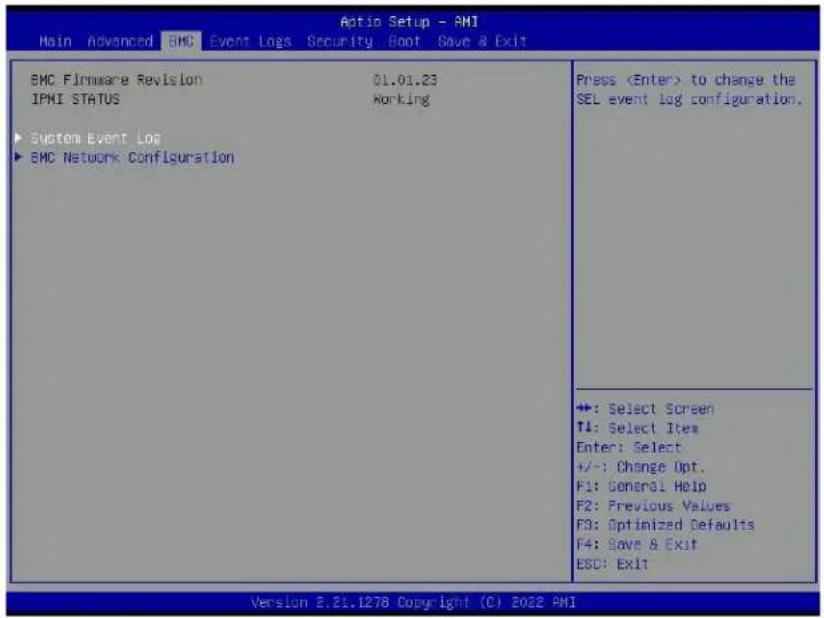
text_image
Auto Setup - AMI Main Advanced BMC Event Logs Security Boot Save & Exit BMC Firmware Revision 01.01.23 IPMI STATUS Working ► System Event Log ► BMC Network Configuration PressBMC Firmware Revision
This feature displays the IPMI firmware revision used in your system.
IPMI STATUS
This feature displays the status of the IPMI firmware installed in your system.
▶System Event Log
Enabling/Disabling Options
SEL Components
Select Enabled for all system event logging at boot up. The options are Disabled and Enabled.
Erasing Settings
Erase SEL
Select Yes, On next reset to erase all system event logs upon next system reboot. Select Yes, On every reset to erase all system event logs upon each system reboot. Select No to keep all system event logs after each system reboot. The options are No, Yes, On next reset, and Yes, On every reset.
When SEL is Full
This feature allows you to decide what the BIOS should do when the system event log is full. Select Erase Immediately to erase all events in the log when the system event log is full. The options are Do Nothing and Erase Immediately.

Note: All values changed here do not take effect until the computer is restarted.
▶BMC Network Configuration
BMC Network Configuration
Update BMC LAN Configuration
Select Yes for the BIOS to implement all IP/MAC address changes at the next system boot. The options are No and Yes.
*If the feature above is set to Yes, Configuration Address Source, VLAN, and IPv6 Support are available for configuration:
Configure IPv4 Support
BMC LAN Selection
BMC Network Link Status
Configuration Address Source
This feature allows you to select the source of the IP address for this computer. If Static is selected, you need to know the IP address of this computer and enter it to the system manually in the field. If DHCP is selected, the BIOS searches for a Dynamic Host Configuration Protocol (DHCP) server in the network that is attached to and request the next available IP address for this computer. The options are DHCP and Static.
*If the feature above is set to Static, the following features are available for configuration:
Station IP Address
This feature displays the Station IP address for this computer. The address can be manually entered. This should be in decimal and in dotted quad form (i.e., 192.168.10.253).
Subnet Mask
This feature displays the sub-network that this computer belongs to. The address can be manually entered. The value of each three-digit number separated by dots should not exceed 255.
Station MAC Address
This feature displays the MAC address that this computer belongs to.
Gateway IP Address
This feature displays the Gateway IP address for this computer. The address can be manually entered. This should be in decimal and in dotted quad form (i.e., 172.31.0.1).
VLAN
Use this feature to enable or disable the IPMI VLAN function. The options are Disable and Enable.
VLAN ID
This feature is enabled if VLAN is enabled. Enter a VLAN ID. The ID range is from 1 to 4094.
Configure IPv6 Support
IPv6 Address Status
IPv6 Support
Use this feature to enable IPv6 support. The options are Enabled and Disabled.
Configuration Address Source
Use this feature to configure the LAN channel parameters. The options are Static and DHCP.
Station IPv6 Address
This feature displays the IPv6 address.
Prefix Length
This feature displays the prefix length
IPv6 Router1 IP Address
This feature displays the IP address of the IPv6 router.
4.5 Event Logs
Use this menu to configure Event Log settings.
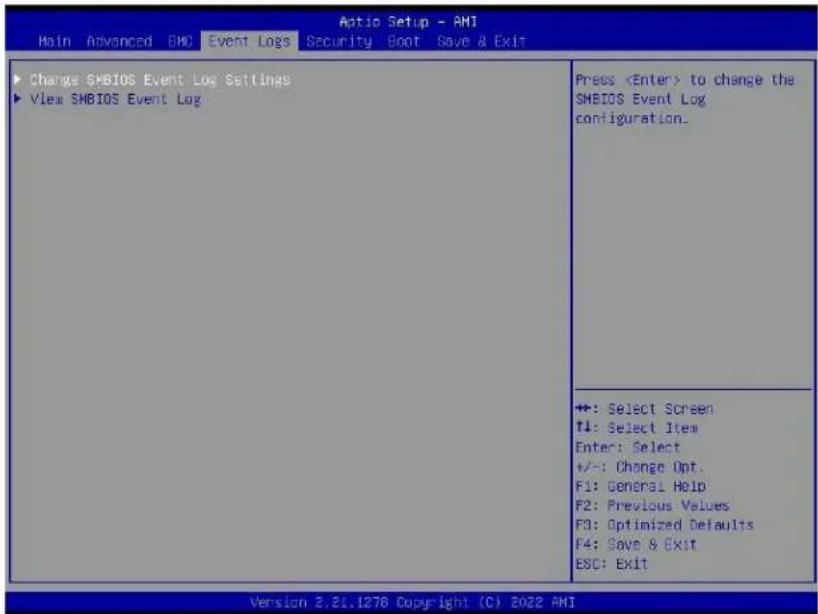
text_image
Action Setup - AMI Main Advanced EMC Event Logs Security Boot Save & Exit Change SMBIOS Event Log Settings View SMBIOS Event Log Press▶Change SMBIOS Event Log Settings
Enabling/Disabling Options
SMBIOS Event Log
Change this feature to enable or disable all features of the SMBIOS Event Logging during system boot. The options are Disabled and Enabled.
Erasing Settings
Erase Event Log
If No is selected, data stored in the event log will not be erased. Select Yes, Next Reset, data in the event log will be erased upon next system reboot. Select Yes, Every Reset, data in the event log will be erased upon every system reboot. The options are No, Yes, Next reset, and Yes, Every reset.
When Log is Full
Select Erase Immediately for all messages to be automatically erased from the event log when the event log memory is full. The options are Do Nothing and Erase Immediately.
SMBIOS Event Log Standard Settings
Log System Boot Event
This option toggles the System Boot Event logging to enabled or disabled. The options are Disabled and Enabled.
MECI
The Multiple Event Count Increment (MECI) counter counts the number of occurrences that a duplicate event must happen before the MECI counter is incremented. This is a numeric value. The default value is 1.
METW
The Multiple Event Time Window (METW) defines the number of minutes that must pass between duplicate log events before MECI is incremented. This is in minutes, from 0 to 99. The default value is 60.

Note: All values changed here do not take effect until the computer is restarted.
▶View SMBIOS Event Log
Select this submenu and press enter to see the contents of the SMBIOS event log. The following categories will be displayed: Date/Time/Error Codes/Severity.
4.6 Security
Use this menu to configure the security settings for the system.
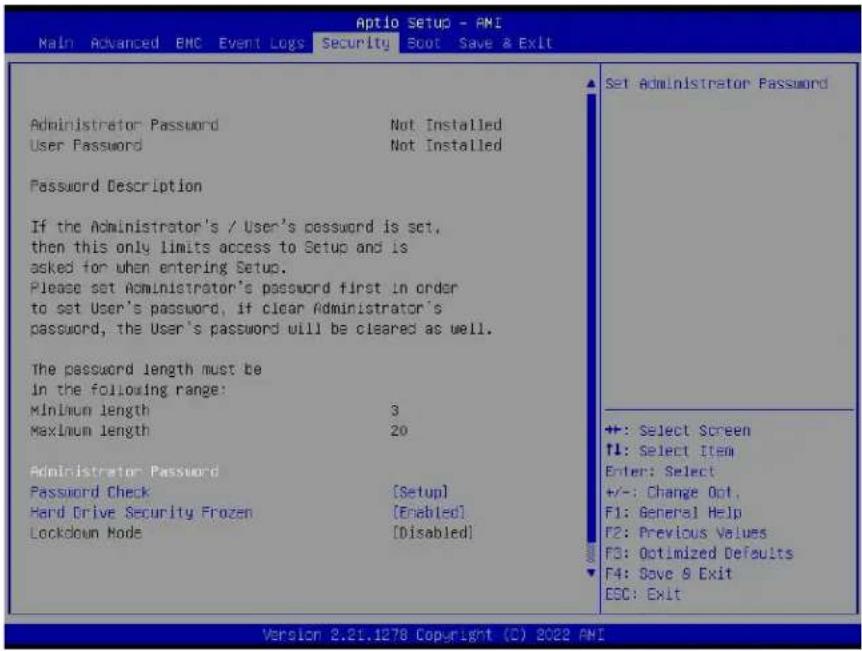
text_image
Aptio Setup - AMI Main Advanced EMC Event Logs Security Boot Save & Exit Administrator Password Not Installed User Password Not Installed Password Description If the Administrator's / User's password is set, then this only limits access to Setup and is asked for when entering Setup. Please set Administrator's password first in order to set User's password, if clear Administrator's password, the User's password will be cleared as well. The password length must be in the following range: Minimum length 3 Maximum length 20 Administrator Password Password Check [Setup] Hard Drive Security Frozen [Enabled] Lockdown Mode [Disabled] Set Administrator Password ++: Select Screen ↑1: Select Item Enter: Select +/-: Change Oct. F1: General Help F2: Previous Values F3: Optimized Defaults F4: Save & Exit ESC: Exit Version 2.21.1278 Copyright (C) 2022 AMIAdministrator Password
Press Enter to create a new, or change an existing, Administrator password.
User Password
Press Enter to create a new, or change an existing, user password.
Password Check
Select Setup for the system to check for a password at Setup. Select Always for the system to check for a password at boot up or upon entering the BIOS Setup utility. The options are Setup and Always.
Hard Drive Security Frozen
Use this feature to enable or disable the BIOS security frozen command for SATA and NVMe devices. The options are Enabled and Disabled.
▶SMCI Security Erase Configuration
This section displays information if a storage device is detected by the system.
- HDD Name
-
HDD Serial Number
-
Security Mode
- TCG Device Type
• Estimated Time - Admin Pwd Status
Security Function
Use this feature to enable or disable the BIOS security frozen command for SATA and NVMe devices. The options are Disable, Set Password, Security Erase - Password, Security Erase - PSID, and Security Erase - Wtihout Password.
Password
Use this feature to set a password for the Supermicro HDD Security Function.
Lockdown Mode
Use this feature to put the BIOS into lockdown mode. The options are Enabled and Disabled.
▶Secure Boot
This section displays the contents of the following secure boot features:
- System Mode
- Vendor Keys
- Secure Boot
Secure Boot
Use this feature to enable secure boot. The options are Disabled and Enabled.
Secure Boot Mode
Use this feature to configure Secure Boot variables without authentication. The options are Standard and Custom.
▶ Enter Audit Mode
This submenu can only be used if current System Mode is set to User (refer to Exit Deployed Mode). The PK variable will be erased on transition to Audit Mode.
▶Key Management
Vendor Keys
Provision Factory Defaults
Use this feature to install the factory default secure boot keys after the platform reset and while the system is in setup mode. The options are Disabled and Enabled.
Force System to User Mode. Install factory default Secure Boot key databases. The options are Yes and No.
▶ Reset to Setup Mode
This feature deletes all Secure Boot key databases from NVRAM. The options are Yes and No.
▶ Export Secure Boot variables
This feature allows you to copy NVRAM content of Secure boot variables to files in a root folder on a file system device.
Enroll EFI Image
This feature allows the image to run in Secure Boot Mode. Enroll SHA256 Hash Certificate of the image into the Authorized Signature Database.
Device Guard Ready
▶Remove 'UEFI CA' from DB
This feature allows you to decide if all secure boot variables should be saved.
Select Yes to restore the DB defaults.
Secure Boot Variable
▶ Platform Key (PK)
Details
Select this feature to view PK information.
Export
Select this feature to export the PK from a file system.
Update
Select Yes to load the PK from factory default or No to load from a file or external media.
Delete
Select ok to remove the PK. Reset the system for it to enter Setup/Audit Mode.
▶Key Exchange Key
Details
Select this feature to view KEK information.
Export
Select this feature to export the KEK from a file system.
Update
Select Yes to load the KEK from factory default or No to load from a file or external media.
Append
Select Yes to load the KEK from factory default or No to load from a file or external media.
Delete
Select Yes to delete the variable or No to delete a certificate from the key database.
▶ Authorized Signatures
Details
Select this feature to view authorized signatures information.
Export
Select this feature to export the db from a file system.
Update
Select Yes to load the db from factory default or No to load from a file or external media.
Append
Select Yes to load the db from factory default or No to load from a file or external media.
Delete
Select Yes to delete the variable or No to delete a certificate from the key database.
▶ Forbidden Signatures
Details
Select this feature to view forbidden signatures information.
Export
Select this feature to export the dbx from a file system.
Update
Select Yes to load the dbx from factory default or No to load from a file or external media.
Append
Select Yes to load the dbx from factory default or No to load from a file or external media.
Delete
Select Yes to delete the variable or No to delete a certificate from the key database.
▶ Authorized TimeStamps
Details
Select this feature to view authorized time stamp information.
Export
Select this feature to export the dbt from a file system.
Update
Select Yes to load the dbt from factory default or No to load from a file or external media.
Append
Select Yes to load the dbt from factory default or No to load from a file or external media.
Delete
Select Yes to delete the variable or No to delete a certificate from the key database.
OsRecovery Signature
Details
Select this feature to view authorized time stamp information.
Export
Select this feature to export the dbr from a file system.
Update
Select Yes to load the dbr from factory default or No to load from a file or external media.
Append
Select Yes to load the dbr from factory default or No to load from a file or external media.
Delete
Select Yes to delete the variable or No to delete a certificate from the key database. Select Yes to add the dbr from the manufacturer's defaults list to the existing dbr. Select No to load the dbr from a file. The options are Yes and No.
4.7 Boot
Use this menu to configure Boot settings.
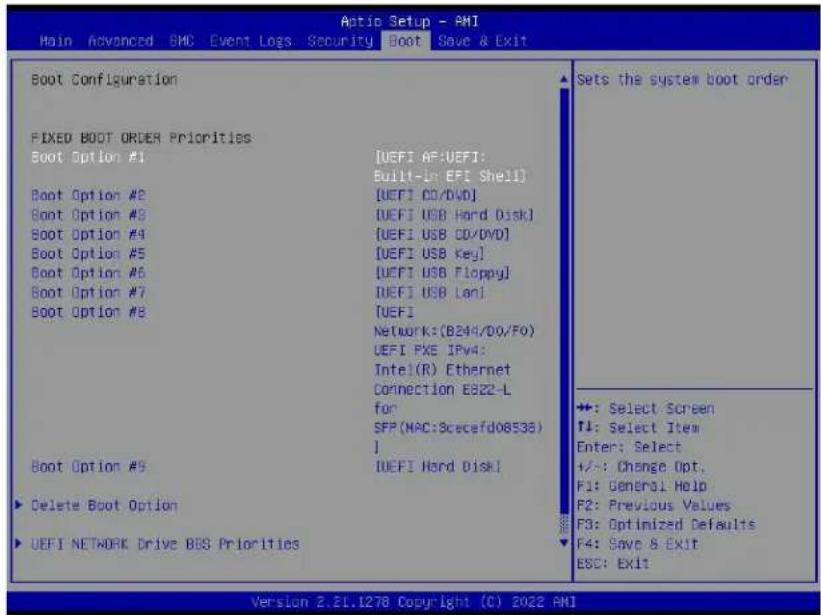
text_image
Boot Configuration FIXED BOOT ORDER Priorities Boot Option #1 [UEFI AF:UEFI: Built-in EFI Shell] Boot Option #2 [UEFI CD/DVD] Boot Option #3 [UEFI USB Hard Disk] Boot Option #4 [UEFI USB CD/DVD] Boot Option #5 [UEFI USB Key] Boot Option #6 [UEFI USB Floppy] Boot Option #7 [UEFI USB Lan] Boot Option #8 [UEFI Network:(B244/DO/F0) UEFI FXE IPv4: Intel(R) Ethernet Connection E822-L for SFP(NAC:Secefd08538) ] Boot Option #9 [UEFI Hard Disk] ► Delete Boot Option ► UEFI NETWORK Drive BGS Priorities Sets the system boot order +: Select Screen ↑↓: Select Item Enter: Select +/-: Change Opt. F1: General Help F2: Previous Values F3: Optimized Defaults F4: Save & Exit ESC: Exit Version 2.21.1278 Copyright (C) 2022 AMI- Boot Option #1
- Boot Option #2
- Boot Option #3
- Boot Option #4
- Boot Option #5
- Boot Option #6
- Boot Option #7
- Boot Option #8
- Boot Option #9
▶ Delete Boot Option
This feature allows you to select a boot device to delete from the boot priority list.
Delete Boot Option
Use this feature to remove an EFI boot option from the boot priority list.
▶UEFI NETWORK Drive BBS Priorities
This feature sets the system boot order of detected devices.
▶UEFI Application Boot Priorities
This feature sets the system boot order of detected devices.
- Boot Option #1
4.8 Save & Exit
Use this menu to save settings and exit from the BIOS.

text_image
Active Setup - AMI Main Advanced EMC Event Logs Security Boot Save & Exit Save Options Discard Changes and Exit Save Changes and Reset Save Changes Discard Changes Default Options Restore Optimized Defaults Save as User Defaults Restore User Defaults Boot Override UEFI: Built-in EFI Shell (B244/D0/F0) UEFI PXE IPv4: Intel(R) Ethernet Connection E822-L for SFP(MAC:3cecef008538) (B244/D0/F1) UEFI PXE IPv4: Intel(R) Ethernet Connection E822-L for SFP(MAC:3cecef008539) (B244/D0/F0) UEFI PXE IPv6: Intel(R) Ethernet Connection E822-L for SFP(MAC:3cecef008538) (B244/D0/F1) UEFI PXE IPv6: Intel(R) Ethernet Connection E822-L for SFP(MAC:3cecef008539) (B244/D0/F4) UEFI PXE IPv4: Intel(R) Ethernet Connection E822-L 1GbE(MAC:3cecef008510) (B244/D0/F5) UEFI PXE IPv4: Intel(R) Ethernet Connection E822-L 1GbE(MAC:3cecef008511) Exit system setup without saving any charges. +: Select Screen ↑↓: Select Item Enter: Select +/-: Change Opt. F1: General Help F2: Previous Values F3: Optimized Defaults F4: Save & Exit ESC: Exit Version 2.21.1278 Copyright (C) 2022 AMISave Options
Discard Changes and Exit
Select this option to quit the BIOS Setup without making any permanent changes to the system configuration, and reboot the computer. Select Discard Changes and Exit from the Save & Exit menu and press
Save Changes and Reset
After completing the system configuration changes, select this option to save the changes you have made. This will not reset (reboot) the system.
Save Changes
When you have completed the system configuration changes, select this option to leave the BIOS setup utility and reboot the computer for the new system configuration parameters to take effect. Select Save Changes from the Save & Exit menu and press
Discard Changes
Select this option and press
Default Options
Restore Optimized Default
To set this feature, select Restore Defaults from the Save & Exit menu and press
Save As User Defaults
To set this feature, select Save as User Defaults from the Save & Exit menu and press
To set this feature, select Restore User Defaults from the Save & Exit menu and press
Boot Override
Listed in this section are other boot options for the system (i.e., Built-in EFI shell). The options may vary on each system. Select an option, press
UEFI: Built-in EFI Shell
(B244/D0/F0) UEFI PXE IPv4: Intel(R) Ethernet Connection E822-L for SFP (MAC:xxxxxxxxxxxxx)
(B244/D0/F1) UEFI PXE IPv4: Intel(R) Ethernet Connection E822-L for SFP (MAC:xxxxxxxxxxxxx)
(B244/D0/F0) UEFI PXE IPv6: Intel(R) Ethernet Connection E822-L for SFP (MAC:xxxxxxxxxxxxx)
(B244/D0/F1) UEFI PXE IPv6: Intel(R) Ethernet Connection E822-L for SFP (MAC:xxxxxxxxxxxxx)
(B244/D0/F4) UEFI PXE IPv4: Intel(R) Ethernet Connection E822-L 1GbE (MAC:xxxxxxxxxxxxx)
(B244/D0/F5) UEFI PXE IPv4: Intel(R) Ethernet Connection E822-L 1GbE (MAC:xxxxxxxxxxxxx)
(B244/D0/F6) UEFI PXE IPv4: Intel(R) Ethernet Connection E822-L 1GbE (MAC:xxxxxxxxxxxxx)
(B244/D0/F7) UEFI PXE IPv4: Intel(R) Ethernet Connection E822-L 1GbE (MAC:xxxxxxxxxxxxx)
(B244/D0/F4) UEFI PXE IPv6: Intel(R) Ethernet Connection E822-L 1GbE (MAC:xxxxxxxxxxxxx)
(B244/D0/F5) UEFI PXE IPv6: Intel(R) Ethernet Connection E822-L 1GbE (MAC:xxxxxxxxxxxxx)
(B244/D0/F6) UEFI PXE IPv6: Intel(R) Ethernet Connection E822-L 1GbE (MAC:xxxxxxxxxxxxx)
(B244/D0/F7) UEFI PXE IPv6: Intel(R) Ethernet Connection E822-L 1GbE (MAC:xxxxxxxxxxxxx)
Launch EFI Shell from filesystem device
Appendix A
BIOS Codes
A.1 BIOS POST Codes
The AMI BIOS supplies additional checkpoint codes, which are documented online at http://www.supermicro.com/support/manuals/ ("AMI BIOS POST Codes User's Guide").
For information on AMI updates, please refer to http://www.ami.com/products/.
Appendix B
Software Installation
B.1 Supermicro SuperDoctor 5
The Supermicro SuperDoctor 5 is a hardware monitoring program that functions in a command-line or web-based interface in Linux operating systems. The program monitors system health information, such as CPU temperature, system voltages, system power consumption, and fan speed, and provides alerts via email or the Simple Network Management Protocol (SNMP).
SuperDoctor 5 comes in local and remote management versions and can be used with Nagios to maximize your system monitoring needs. With the SuperDoctor 5 Management Server (SSM Server), you can remotely control the power status and reset chassis intrusion for multiple systems with SuperDoctor 5 or IPMI. SD5 Management Server monitors HTTP, FTP, and SMTP services to optimize the efficiency of your operation.

Note: The SuperDoctor 5 program and user's manual can be downloaded from the Supermicro website at http://www.supermicro.com/products/nfo/sms_sd5.cfm.
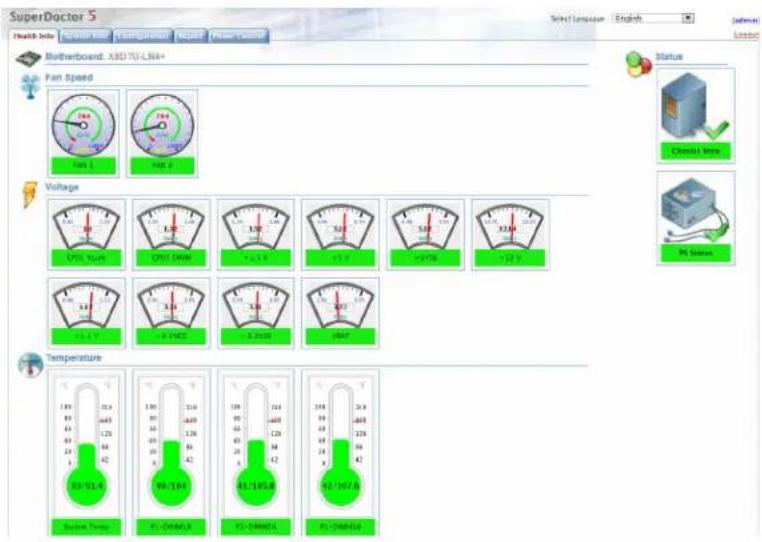
text_image
SuperDoctor 5 Health Info: Mastercard: X3010-LSA+ Fan Speed 200 Max 1 780 Max 2 Voltage DCB Value DCB DMM DCB E DCB F DCB G DCB H DCB I DCB J DCB K DCB L DCB M DCB N DCB O DCB P DCB Q DCB R DCB S DCB T DCB U DCB V DCB W DCB X DCB Y DCB Z DCB AA DCB AB DCB AC DCB AD DCB AE DCB AF DCB AG DCB AH DCB AI DCB AJ DCB AK DCB AL DCB AM DCB AN DCB AO DCB AP DCB AQ DCB AR DCB AS DCB AT DCB AU DCB AV DCB AW DCB AX DCB AY DCB AZ DCB BA DCB BB DCB BC DCB BD DCB BE DCB BF DCB BG DCB BH DCB BI DCB BJ DCB BK DCB BL DCB BM DCB BN DCB BO DCB BP DCB BPY DCB BPZ DCB BPYZ DCB BPYZZ Status Chassis here PI StatusFigure B-1. SuperDoctor 5 Interface Display Screen (Health Information)
Appendix C
Standardized Warning Statements
The following statements are industry standard warnings, provided to warn the user of situations which have the potential for bodily injury. Should you have questions or experience difficulty, contact Supermicro's Technical Support department for assistance. Only certified technicians should attempt to install or configure components.
Read this section in its entirety before installing or configuring components.
These warnings may also be found on our website at http://www.supermicro.com/about/policies/safety_information.cfm.
Battery Handling

Warning! There is the danger of explosion if the battery is replaced incorrectly. Replace the battery only with the same or equivalent type recommended by the manufacturer. Dispose of used batteries according to the manufacturer's instructions
電池の取り扱い
Warning! Ultimate disposal of this product should be handled according to all national laws and regulations.
製品の廃棄
Warning: Do not upgrade the BIOS unless your system has a BIOS-related issue. Flashing the wrong BIOS can cause irreparable damage to the system. In no event shall Supermicro be liable for direct, indirect, special, incidental, or consequential damages arising from a BIOS update. If you need to update the BIOS, do not shut down or reset the system while the BIOS is updating to avoid possible boot failure.
D.1 Overview
The Unified Extensible Firmware Interface (UEFI) provides a software-based interface between the operating system and the platform firmware in the pre-boot environment. The UEFI specification supports an architecture-independent mechanism that will allow the UEFI OS loader stored in an add-on card to boot the system. The UEFI offers clean, hands-off management to a computer during system boot.
D.2 Recovering the UEFI BIOS Image
A UEFI BIOS flash chip consists of a recovery BIOS block and a main BIOS block (a main BIOS image). The recovery block contains critical BIOS codes, including memory detection and recovery codes for the user to flash a healthy BIOS image if the original main BIOS image is corrupted. When the system power is first turned on, the boot block codes execute first. Once this process is completed, the main BIOS code will continue with system initialization and the remaining Power-On Self-Test (POST) routines.

Note 1: Follow the BIOS recovery instructions below for BIOS recovery when the main BIOS block crashes.
Note 2: When the BIOS recovery block crashes, you will need to follow the procedures to make a Returned Merchandise Authorization (RMA) request. (For a RMA request, please see section 3.5 for more information).
D.3 Recovering the BIOS Block with a USB Device
This feature allows the user to recover the main BIOS image using a USB-attached device without additional utilities used. A USB flash device such as a USB flash or media drive can be used for this purpose. However, a USB Hard Disk drive cannot be used for BIOS recovery at this time.
The file system supported by the recovery block is FAT (including FAT12, FAT16, and FAT32), which is installed on a bootable or non-bootable USB-attached device. However, the BIOS might need several minutes to locate the SUPER.ROM file if the media size becomes too large due to the huge volumes of folders and files stored in the device.
To perform UEFI BIOS recovery using a USB-attached device, follow the instructions below:
- Using a different machine, copy the "Super.ROM" binary image file into the disc Root "\" directory of a USB flash or media drive.

Note 1: If you cannot locate the "Super.ROM" file in your driver disk, visit our website at www.supermicro.com to download the BIOS package. Extract the BIOS binary image into a USB flash device and rename it "Super.ROM" for the BIOS recovery use.

Note 2: Before recovering the main BIOS image, confirm that the "Super.ROM" binary image file you download is the same version or a close version meant for your motherboard.
- Insert the USB device that contains the new BIOS image ("Super.ROM") into your USB port and reset the system until the following screen appears:

text_image
BMC IP:10.132.161.98 System Initializing.. F1- After locating the new BIOS binary image, the system will enter the BIOS Recovery menu as shown below:
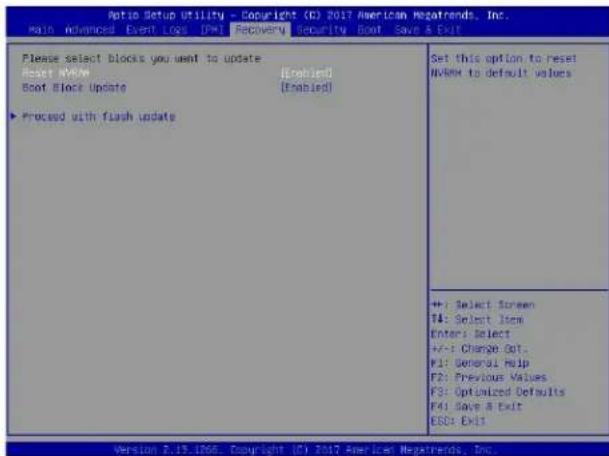
text_image
Ratio Setup Utility = Copyright (C) 2017 American Megatrends, Inc. Main Advanced Event Log [PK] Recovery Security Boot Save & Exit Please select blocks you want to update Reset NAVA Boot Block Update [Enabled] ►Proceed with flash update Set this option to reset NAVA to default values +: Select Screen T4: Select Item Enter: Select +/-: Change Out. F1: General Help F2: Previous Values F3: Optimized Defaults F4: Save & Exit ESC: Exit Version 2.19.1766. Copyright (C) 2017 American Megatrends, Inc.Note: At this point, you may decide if you want to start the BIOS recovery. If you decide to proceed with BIOS recovery, follow the procedures below.
- When the screen as shown above displays, use the arrow keys to select the item "Proceed with flash update" and press the
key. You will see the BIOS recovery progress as shown in the screen below:
Note: Do not interrupt the BIOS flashing process until it has completed.
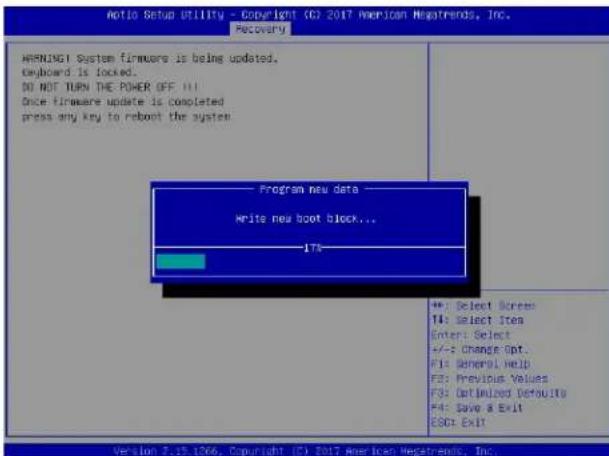
text_image
Anotio Setup Utility - Copyright (C) 2017 American Newsrends, Inc. Recovery WARNING System firmware is being updated. Keyboard is locked. DO NOT TURN THE POWER OFF III Once firmware update is completed press any key to reboot the system Program new data Write new boot block... 17% +: Select Screen T4: Select Item Enter: Select +/-: Change Opt. F1: General help F2: Previous Values F3: Optimized Defaults F4: Save a Exit ESC: Exit Version 7.15.1266, Copyright (C) 2017 American Newsrends, Inc.- After the BIOS recovery process is completed, press any key to reboot the system.
- Using a different system, extract the BIOS package into a USB flash drive.
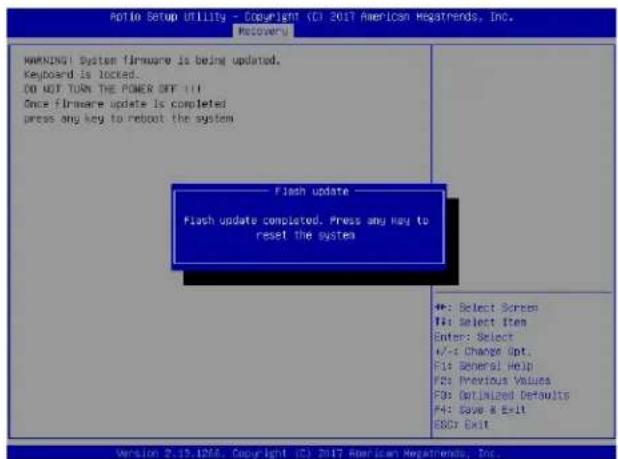
text_image
NOTIO Setup Utility - Copyright (CI) 2017 American Megatrends, Inc. RECOVERY WARNING! System firmware is being updated. Keyboard is locked. DO NOT TURN THE POWER OFF !!! Once firmware update is completed press any key to reboot the system Flash update Flash update completed. Press any key to reset the system #: Select Screen #: Select Item Enter: Select +/-: Change Opt. F1: General Help F2: Previous Values F3: Optimized Defaults F4: Save a Exit ESC: Exit Version 2.19.1986. Copyright (CI) 2017 American Megatrends, Inc.- Press
during system boot to enter the BIOS Setup utility. From the top of the tool bar, select Boot to enter the submenu. From the submenu list, select Boot Option #1 as shown below. Then, set Boot Option #1 to [UEFI AP:UEFI: Built-in EFI Shell]. Pressto save the settings and exit the BIOS Setup utility. - When the UEFI Shell prompt appears, type fs# to change the device directory path. Go to the directory that contains the BIOS package you extracted earlier from Step 6. Enter flash.nsh BIOSname.### at the prompt to start the BIOS update process.

Note: Do not interrupt this process until the BIOS flashing is complete.
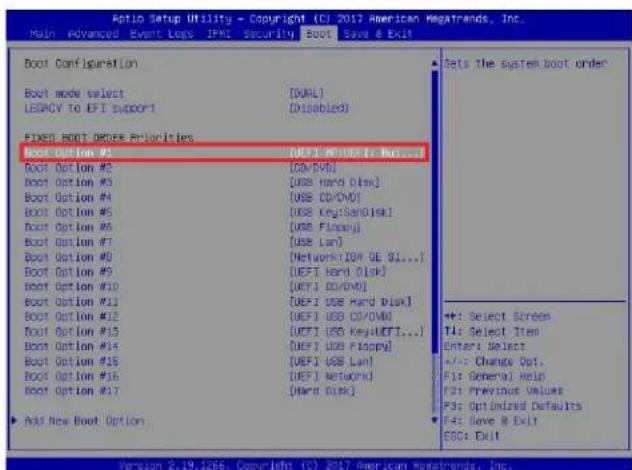
text_image
Auto Setup Utility - Copyright (CI 2017 American Megatrends, Inc. Main Advanced Event Lost IPM Security Boot Save & Exit Boot Configuration Boot mode select LEGACY to EFI support [DVAL] [Disabled] FIXED BOOT ORDER Priorities Boot Option #1 [DEFI MP:UEFI: Max... Boot Option #2 [CD/DVD] Boot Option #3 [USB Hard Disk] Boot Option #4 [USB CD/DVD] Boot Option #5 [USB Key:SanDisk] Boot Option #6 [USB Floppy] Boot Option #7 [USB Lan] Boot Option #8 [Network:10M GE S1...) Boot Option #9 [DEFI Hard Disk] Boot Option #10 [DEFI CD/DVD] Boot Option #11 [DEFI USB Hard Disk] Boot Option #12 [DEFI USB CD/DVD] Boot Option #13 [DEFI USB Key:UEFI...] Boot Option #14 [DEFI USB Floppy] Boot Option #15 [DEFI USB Lan] Boot Option #16 [DEFI Network] Boot Option #17 [Hard Disk] Add New Boot Option Sets the system boot order <<: Select Screen T4: Select Item Enter: Select +/-: Change Opt. F1: General Rels F2: Previous Values F3: Optimized Defaults F4: Save & Exit ESC: Exit Version 2.19.1286 Copyright (C) 2017 American Mexatrends, Inc.
text_image
UFF (Interactive Shell #2.1 OK 11) UFF V2.50 (American Megatrends, 0x00x5000) Mapping Table FOS: A1lai(1):H00rb:BLK1; FOS:Rout(0x0):Fe(0x14,6x0)/USB(0x11,6x0)/HB(1,MER,0x07961872,0x806,0x0 (0x552) BLK1: A1lai(1): FOS:Rout(0x0):Fe(0x14,6x0)/USB(0x11,6x0) Press UFR is 1 seconds to skip startup.sh or any other key to continue. Shell: FOS: FOS:VAVDOS: cd SWPHE2_03352017 FOS:VAVDOS:SWPHE2_03352017 - Hash.nsh_X1SPBT-3YL Done. [ Access Own Part Ex ] dbioob Docker 8x51: 0x18 Done. ********************************************************************** * Program BDO and ME (including RDT) regions... ********************************************************************** AMT Firmware Update Utility V5.97.01.131Y Copyright (C)2017 American Megatrends Inc. All Rights Reserved. CPUD = 50652 Reading Flash ....../..... done - HE Data Size checking , ok - FPS checksums ....../..... OK - Check RootLayout ....../..... Ok Adding Boot Block ....../..... done Updating Boot Block ....../..... done Verifying Boot Block ....../..... done Ending Main Block ....../..... 0x00152849 (OM) Verifying Home Block ....../..... done - Update success for FOR - Update success for E... - Successful Update Recovery Loader to OPRs!! - Successful Update MPSI1- - Successful Update RPMI1- - Successful Update RMS, 1MVI and 1M82!! - Successful Update FLOO and UTXI!! - HE Failure: I keep update success || warning : System must power-off to have the changes take effect! moving FOR#A#FUSDS/SWPMHE2_8316287X/4xtv64,efi -> FOR#A#FUSDS/SWPMHE2_0336287X/f ft.snc - [e] moving FOR#A#FUSDS/SWPMHE2_8316287X/4xtv64,efi -> FOR#A#FUSDS/SWPMHE2_0336287X/f Feature1.snc - [e] ********************************************************************** * Please ignore this "Shell: Cannot read from file - device error" * Learning message due to it does not impact flashing process. ********************************************************************** altering ' Delete successful. FOS(1)- The screen above indicates that the BIOS update process is complete. When you see the screen above, unplug the AC power cable from the power supply, clear CMOS, and plug the AC power cable in the power supply again to power on the system.
- Press
to enter the BIOS Setup utility. - Press
to load the default settings. - After loading the default settings, press
to save the settings and exit the BIOS Setup utility.