MS23F312EEK - Microwave oven SAMSUNG - Free user manual and instructions
Find the device manual for free MS23F312EEK SAMSUNG in PDF.


User questions about MS23F312EEK SAMSUNG
0 question about this device. Answer the ones you know or ask your own.
Ask a new question about this device
Download the instructions for your Microwave oven in PDF format for free! Find your manual MS23F312EEK - SAMSUNG and take your electronic device back in hand. On this page are published all the documents necessary for the use of your device. MS23F312EEK by SAMSUNG.
USER MANUAL MS23F312EEK SAMSUNG
Safety instructions 3
Important safety instructions 3
General safety 5
Microwave operation precautions 6
Limited warranty 6
Installation 7
Accessories 7
Installation site 7
Turntable 7
Maintenance 8
Cleaning 8
Replacement (repair) 8
Care against an extended period of disuse 8
Oven features 9
Oven 9
Control panel 9
Oven use 10
How a microwave oven works 10
Cooking/Reheating 10
Power levels and time variations 11
Auto energy saving function 11
Adjusting the cooking time 11
Stopping the cooking 11
Using the Auto Defrost features 12
Cookware guide 13
Cooking guide 14
Troubleshooting 15
Troubleshooting 15
Technical specifications 18
2 English
Safety instructions
IMPORTANT SAFETY INSTRUCTIONS
READ CAREFULLY AND KEEP FOR FUTURE REFERENCE.
WARNING: If the door or door seals are damaged, the oven must not be operated until it has been repaired by a competent person.
WARNING: It is hazardous for anyone other than a competent person to carry out any service or repair operation that involves the removal of a cover which gives protection against exposure to microwave energy.
WARNING: Liquids and other foods must not be heated in sealed containers since they are liable to explode.
WARNING: Only allow children to use the oven without supervision when adequate instructions have been given so that the child is able to use the oven in a safe way and understands the hazards of improper use.
This appliance is intended to be used in household only and it is not intended to be used such as:
- staff kitchen areas in shops, offices and other working environments;
-
farm houses;
-
by clients in hotels, motels and other residential environments;
• bed and breakfast type environments.
Only use utensils that are suitable for use in microwave ovens.
When heating food in plastic or paper containers, keep an eye on the oven due to the possibility of ignition.
The microwave oven is intended for heating food and beverages. Drying of food or clothing and heating of warming pads, slippers, sponges, damp cloth and similar may lead to risk of injury, ignition or fire.
If smoke is observed (emitted), switch off or unplug the appliance and keep the door closed in order to stifle any flames.
Microwave heating of beverages can result in delayed eruptive boiling, therefore care must be taken when handling the container.
The contents of feeding bottles and baby food jars shall be stirred or shaken and the temperature checked before consumption, in order to avoid burns.
Eggs in their shell and whole hard-boiled eggs should not be heated in microwave ovens since they may explode, even after microwave heating has ended.
English 3
Safety instructions
The oven should be cleaned regularly and any food deposits removed.
Failure to maintain the oven in a clean condition could lead to deterioration of the surface that could adversely affect the life of the appliance and possibly result in a hazardous situation.
The microwave oven is intended to be used on the counter top (freestanding) use only, the microwave oven shall not be placed in a cabinet.
Metallic containers for food and beverages are not allowed during microwave cooking.
The care should be taken not to displace the turntable when removing containers from the appliance.
The appliance shall not be cleaned with a steam cleaner.
The appliance should not be cleaned with a water jet.
The appliance is not intended for installing in road vehicles, caravans and similar vehicles etc.
This appliance is not intended for use by persons (including children) with reduced physical, sensory or mental capabilities, or lack of experience and knowledge, unless they have been given supervision or instruction concerning use of the appliance by a person responsible for their safety.
Children should be supervised to ensure that they do not play with the appliance.
This appliance can be used by children aged from 8 years and above and persons with reduced physical, sensory or mental capabilities or lack of experience and knowledge if they have been given supervision or instruction concerning use of the appliance in a safe way and understand the hazards involved.
Children shall not play with the appliance. Cleaning and user maintenance shall not be made by children without supervision. If the supply cord is damaged, it must be replaced by the manufacturer, its service agent or similarly qualified persons in order to avoid a hazard.
This oven should be positioned proper direction and height permitting easy access to cavity and control area.
Before using the your oven first time, oven should be operated with the water during 10 minute and then used.
If the oven generates a strange noise, a burning smell, or smoke is emitted, unplug the power plug immediately and contact your nearest service center.
The microwave oven has to be positioned so that plug is accessible.
General safety
Any modifications or repairs must be performed by qualified personnel only. Do not heat food or liquids sealed in containers for the microwave function. Do not use benzene, thinner, alcohol, or steam or high-pressure cleaners to clean the oven.
Do not install the oven; near a heater or flammable material; locations that are humid, oily, dusty or exposed to direct sunlight or water; or where gas may leak; or an uneven surface.
This oven must be properly grounded in accordance with local and national codes. Regularly use a dry cloth to remove foreign substances from the power plug terminals and contacts.
Do not pull, excessively bend, or place heavy objects on the power cord. If there is a gas leak (propane, LP, etc) ventilate immediately. Do not touch the power cord.
Do not touch the power cord with wet hands.
While the oven is operating, do not turn it off by unplugging the power cord. Do not insert fingers or foreign substances. If foreign substances enter the oven, unplug the power cord and contact a local Samsung service centre.
Do not apply excessive pressure or impact to the oven.
Do not place the oven over fragile objects.
Ensure the power voltage, frequency, and current matches the product specifications.
Firmly plug the power plug into the wall socket. Do not use multiple plug adapters, extension cords, or electric transformers.
Do not hook the power cord on metal objects. Make sure the cord is between objects or behind the oven.
Do not use a damaged power plug, power cord, or loose wall socket. For damaged power plugs or cords, contact a local Samsung service centre. Do not pour or directly spray water onto the oven.
Do not place objects on the oven, inside, or on the oven door.
Do not spray volatile materials such as insecticide on the oven.
Do not store flammable materials in the oven. Because alcohol vapours can contact hot parts of the oven, use caution when heating food or drinks containing alcohol. Children may bump themselves or catch their fingers on the door. When opening/closing the door, keep children away.
Microwave warning
Microwave heating of beverages may result in delayed eruptive boiling; always use caution when handling the container. Always allow beverages to stand at least 20 seconds before handling. If necessary, stir during heating. Always stir after heating.
In the event of scalding, follow these First Aid instructions:
-
Immerse the scalded area in cold water for at least 10 minutes.
-
Cover with a clean, dry dressing.
-
Do not apply any creams, oils, or lotions.
To avoid damaging the tray or rack, do not put the tray or rack in water shortly after cooking.
Do not use the oven for deep fat frying because the oil temperature cannot be controlled. This could result in a sudden boil over of hot oils.
Microwave oven precautions
Only use microwave-safe utensils. Do not use metallic containers, gold or silver trimmed dinnerware, skewers, etc.
Remove wire twist ties. Electric arcing may occur.
Do not use the oven to dry papers or clothes.
Use shorter times for small amounts of food to prevent overheating or burning. Keep the power cord and power plug away from water and heat sources.
To avoid the risk of explosion, do not heat eggs with shells or hard-boiled eggs. Do not heat airtight or vacuum-sealed containers, nuts, tomatoes, etc.
Do not cover the ventilation slots with cloth or paper. This is a fire hazard. The oven may overheat and turn off automatically and will remain off until it cools sufficiently.
Always use oven mitts when removing a dish.
Stir liquids halfway during heating or after heating ends and allow the liquid stand at least 20 seconds after heating to prevent eruptive boiling.
Stand at arms length from the oven when opening the door to avoid getting scalded by escaping hot air or steam.
Do not operate the oven when it is empty. The oven will automatically shut down for 30 minutes for safety purposes. We recommend placing a glass of water inside the oven at all times to absorb microwave energy in case the oven is started accidentally.
Safety instructions
Install the oven in compliance with the clearances in this manual. (See Installing your microwave oven.) Use caution when connecting other electrical appliances to sockets near the oven.
Microwave operation precautions
Failure to observe the following safety precautions may result in harmful exposure to microwave energy.
- Do not operate the oven with the door open. Do not tamper with the safety interlocks (door latches). Do not insert anything into the safety interlock holes.
- Do not place any object between the oven door and front face or allow food or cleaner residue to accumulate on sealing surfaces. Keep the door and door sealing surfaces clean by wiping with a damp cloth and then with a soft, dry cloth after each use.
- Do not operate the oven if it is damaged. Only operate after it has been repaired by a qualified technician. Important: the oven door must close properly. The door must not be bent; the door hinges must not be broken or loose; the door seals and sealing surfaces must not be damaged.
- All adjustments or repairs must be done by a qualified technician.
Limited warranty
Samsung will charge a repair fee for replacing an accessory or repairing a cosmetic defect if the damage to the unit or accessory was caused by the customer. Items this stipulation covers include:
- Door, handles, out-panel, or control panel that are dented, scratched, or broken. - A broken or missing tray, guide roller, coupler, or wire rack.
Use this oven only for its intended purpose as described in this instruction manual. Warnings and Important Safety Instructions in this manual do not cover all possible conditions and situations that may occur. It is your responsibility to use common sense, caution, and care when installing, maintaining, and operating your oven.
Because these following operating instructions cover various models, the characteristics of your microwave oven may differ slightly from those described in this manual and not all warning signs may be applicable. If you have any questions or concerns, contact a local Samsung service centre or find help and information online at www.samsung.com.
Use this oven for heating food only. It is intended for domestic use only. Do not heat any type of textiles or cushions filled with grains. The manufacturer cannot be held liable for damage caused by improper or incorrect use of the oven. To avoid deterioration of the oven surface and hazardous situations, always keep the oven clean and well maintained.
Installation
Accessories
Depending on the model that you have purchased, you are supplied with several accessories that can be used in a variety of ways.


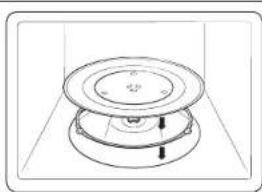
01 Roller ring, to be placed in the centre of the oven. The roller ring supports the turntable.
02 Turntable, to be placed on the roller ring with the centre fitting to the coupler. The turntable serves as the main cooking surface; it can be easily removed for cleaning.

CAUTION
DO NOT operate the microwave oven without the roller ring and turntable.
Installation site
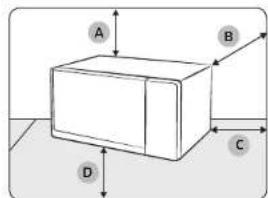
text_image
A B C DA. 20 cm above
B. 10 cm behind
C. 10 cm on the side
D. 85 cm of the floor
- Select a flat, level surface approx. 85 cm above the floor. The surface must support the weight of the oven.
- Secure room for ventilation, at least 10 cm from the rear wall and both sides, and 20 cm from above.
- Do not install the oven in hot or damp surroundings, such as next to other microwave ovens or radiators.
- Conform to the power supply specifications of this oven. Use only approved extension cables if you need to use.
- Wipe the interior and the door seal with a damp cloth before using your oven for the first time.
Turntable
natural_image
Simple line drawing of a circular mechanical component with a central hub and base, no text or symbols present.Remove all packing materials inside the oven. Install the roller ring and turntable. Check that the turntable rotates freely.
Maintenance
Cleaning
Clean the oven regularly to prevent impurities from building up on or inside the oven. Also pay special attention to the door, door sealing, and turntable and roller ring (applicable models only).
If the door won't open or close smoothly, first check if the door seals have built up impurities. Use a soft cloth in soapy water to clean both the inner and outer sides of the oven. Rinse and dry well.
To remove stubborn impurities with bad smells from inside the oven
-
With an empty oven, put a cup of diluted lemon juice on the centre of the turntable.
-
Heat the oven for 10 minutes at max power.
-
When the cycle is complete, wait until the oven cools down. Then, open the door and clean the cooking chamber.
To clean inside swing-heater models
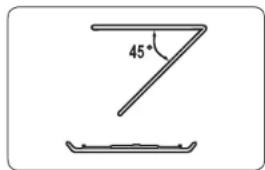
text_image
45°To clean the upper area of the cooking chamber, lower the top heating element by 45^ as shown. This will help clean the upper area. When done, reposition the top heating element.

CAUTION
- Keep the door and door sealing clean and ensure the door opens and closes smoothly. Otherwise, the oven's lifecycle may be shortened.
• Take caution not to spill water into the oven vents. - Do not use any abrasive or chemical substances for cleaning
• After each use of the oven, use a mild detergent to clean the cooking chamber after waiting for the oven to cool down.
Replacement (repair)

WARNING
This oven has no user-removable parts inside. Do not try to replace or repair the oven yourself.
- If you encounter a problem with hinges, sealing, and/or the door, contact a qualified technician or a local Samsung service centre for technical assistance.
- If you want to replace the light bulb, contact a local Samsung service centre. Do not replace it yourself.
- If you encounter a problem with the outer housing of the oven, first unplug the power cord from the power source, and then contact a local Samsung service centre.
Care against an extended period of disuse
If you don't use the oven for an extended period of time, unplug the power cord and move the oven to a dry, dust-free location. Dust and moisture that builds up inside the oven may affect the performance of the oven.
8 English
Oven features
Oven
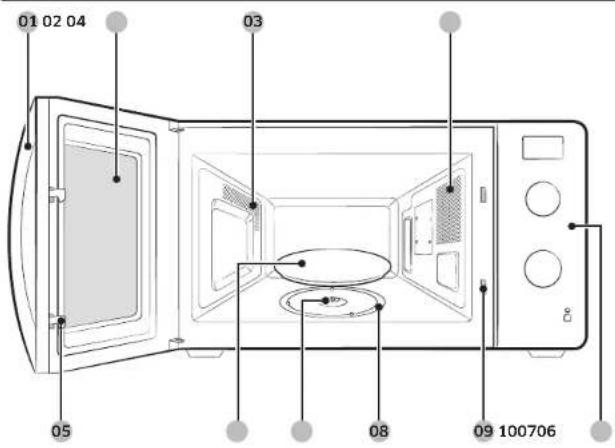
text_image
01 02 04 03 05 08 09 10070601 Door handle
02 Door
03 Ventilation holes
04 Light
05 Door latches
06 Turntable
07 Coupler
08 Roller ring
09 Safety interlock holes
10 Control panel
Control panel
text_image
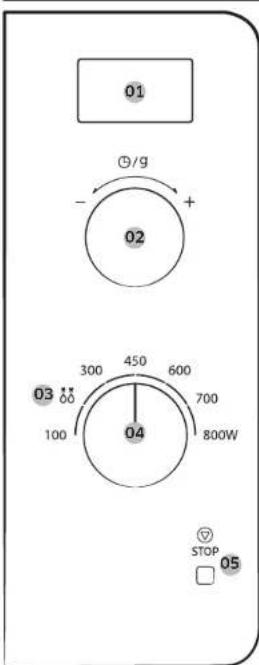
01 + /g - 02 300 450 600 700 03 00 100 04 800W STOP 0501 Display
02 Time/Weight Dial
03 Auto Defrost
04 Variable Cooking Power Control Dial
05 Stop (Cancel) Button
Oven use
How a microwave oven works
Microwaves are high-frequency electromagnetic waves; the energy released enables food to be cooked or reheated without changing either the form or the colour.
You can use your microwave oven to:
• Defrost
- Reheat
• Cook
Cooking principle.
natural_image
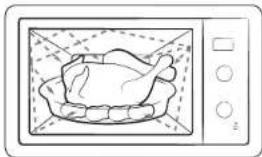
Line drawing of a microwave oven with a roasted chicken inside (no text or symbols)- The microwaves generated by the magnetron reflected at cavity and are distributed uniformly as the food rotates on the turntable. The food is thus cooked evenly.
- The microwaves are absorbed by the food up to a depth of about 1 inch (2.5 cm). Cooking then continues as the heat is dissipated within the food.
- Cooking times vary according to the container used and the properties of the food:
• Quantity and density
- Water content
- Initial temperature (refrigerated or not)

CAUTION
As the centre of the food is cooked by heat dissipation, cooking continues even when you have taken the food out of the oven. Standing times specified in recipes and in this booklet must therefore be respected to ensure:
• Even cooking of the food right to the centre.
• The same temperature throughout the food.
Cooking/Reheating
The following procedure explains how to cook or reheat food.

CAUTION
- ALWAYS check your cooking settings before leaving the oven unattended.
- Never turn the microwave oven on when it is empty
Open the door. Place the food in the centre of the turntable. Close the door.
text_image
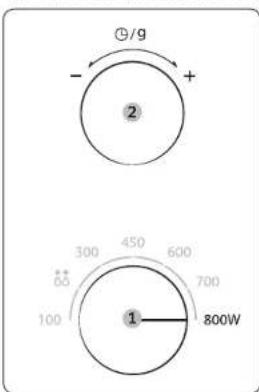
①/9 - + ② 300 450 600 100 700 800W- Set the power level to maximum by turning Cooking Power Control dial. (Maximum power: 800 W)
- Set the time by turning Time/Weight (A/g)
The oven light comes on and the turntable starts rotating.
1) Cooking starts and when it has finished the oven beeps 4 times
2) The end reminder signal will beep 3 times (once every minute).
3) "0" is displayed again.

NOTE
You can change the power level during cooking by turning the Cooking Power Control dial.
Power levels and time variations
The power level function enables you to adapt the amount of energy dissipated and thus the time required to cook or reheat your food, according to its type and quantity.
| Power level Output | |
| HIGH 800 W | |
| REHEAT 700 W | |
| MEDIUM HIGH 600 W | |
| MEDIUM 450 W | |
| MEDIUM LOW 300 W | |
| AUTO DEFROST (1) | 180 W |
| LOW / KEEP WARM 100 W |
The cooking times given in recipes and in this booklet correspond to the specific power level indicated.
| If you select a... Then the cooking time must be... | |
| Higher power level | Decreased |
| Lower power level | Increased |
Auto energy saving function
Oven Lamp will be turned off after 5 minutes with door open condition.
Adjusting the cooking time
chemical
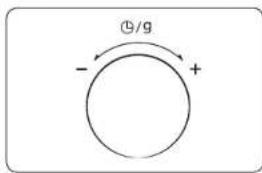
Simple diagram showing a circular structure with polarity labels and an arrow indicating rotation around the circle.Adjust the remaining cooking time by rotating the Time/Weight (5/9) dial. Turn the dial right to increase the cooking time of your food during the cooking process.
Stopping the cooking
You can stop cooking at any time so that you can:
- Check the food
• Turn the food over or stir it - Leave it to stand
| To stop the cooking... Then... | |
| Temporarily • Open the door. | Cooking stops. To resume cooking, close the door again and then it will be automatically started. |
| Completely | • Press Stop Button. Cooking stops and "0" will be displayed.• Turn the Time/Weight (5/g) dial to the left.Cooking stops and "0" will be displayed. |
| To stop the cooking... Then... | |
| Temporarily • Open the door. | Cooking stops. To resume cooking, close the door again and then it will be automatically started. |
| Completely | • Press Stop Button. Cooking stops and "0" will be displayed.• Turn the Time/Weight (5/g) dial to the left.Cooking stops and "0" will be displayed. |
Oven use
Using the Auto Defrost features
The Auto Defrost features enable you to defrost meat, poultry and fish.

CAUTION
Use only containers that are microwave-safe.
Open the door. Place the frozen food on a ceramic in the centre of the turntable. Close the door.

text_image
① 100 300 450 600 700 800W ② -/+- Turn the Cooking Power Control dial to the Auto Defrost (86)
- Turn the Time/Weight (5/g) dial select the appropriate weight.
The oven light comes on and the turntable starts rotating.
1) Cooking starts and when it has finished the oven beeps 4 times.
2) The end reminder signal will beep 3 times (once every minute).
3) "0" is displayed again.
The following table presents the various Auto Defrost programmes, serving size, standing times and appropriate instructions. Remove all kind of package material before defrosting. Place meat, poultry and fish on a flat glass dish or ceramic plate.
| Food Serving size | Standing time (min.) | Instructions |
| Meat 200-1500 g 20-60 | Shield the edges with aluminium foil. Turn the food over when the oven beeps. | |
| Poultry 200-1500 g 20-60 | ||
| Fish 200-1500 g 20-50 |
Cookware guide
To cook food in the microwave oven, the microwaves must be able to penetrate the food, without being reflected or absorbed by the dish used.
Care must therefore be taken when choosing the cookware. If the cookware is marked microwave-safe, you do not need to worry.
The following table lists various types of cookware and indicates whether and how they should be used in a microwave oven.
| Cookware | Microwave-safe | Comments |
| Aluminum foil | √✗ | Can be used in small quantities to protect areas against overcooking. Arcing can occur if the foil is too close to the oven wall or if too much foil is used. |
| Crust plate | √ | Do not preheat for more than 8 minutes. |
| China and earthenware | √ | Porcelain, pottery, glazed earthenware and bone china are usually suitable, unless decorated with a metal trim. |
| Disposable polyester cardboard dishes | √ | Some frozen foods are packaged in these dishes. |
| Fast-food packagingPolystyrene cups containersPaper bags or newspaperRecycled paper or metal trims | √✗✗ | Can be used to warm food. Overheating may cause the polystyrene to melt.May catch fire.May cause arcing. |
| GlasswareOven-to-tablewareFine glassware | √√ | Can be used, unless decorated with a metal trim.Can be used to warm foods or liquids.Delicate glass may break or crack if heated suddenly. |
| Cookware | Microwave-safe | Comments |
| Glass jars | √ | Must remove the lid. Suitable for warming only. |
| MetalDishesFreezer bag twist tics | ✗✗ | May cause arcing or fire. |
| PaperPlates, cups, napkins and kitchen paperRecycled paper | √✗ | For short cooking times and warming. Also to absorb excess moisture.May cause arcing. |
| PlasticContainers | √ | Particularly if heat-resistant thermoplastic. Some other plastics may warp or discolour at high temperatures. Do not use Melamine plastic. |
| Cling filmFreezer bags | √✗ | Can be used to retain moisture. Should not touch the food. Take care when removing the film as hot steam will escape. Only if boilable or oven-proof. Should not be airtight. Prick with a fork, if necessary. |
| Wax or grease-proof paper | √ | Can be used to retain moisture and prevent spattering. |
✓ : Recommended √X : Use caution X : Unsafe
Cooking guide
Microwaves
Microwave energy actually penetrates food, attracted and absorbed by its water, fat and sugar content. The microwaves cause the molecules in the food to move rapidly. The rapid movement of these molecules creates friction and the resulting heat cooks the food.
Cooking
Cookware for microwave cooking:
Cookware must allow microwave energy to pass through it for maximum efficiency. Microwaves are reflected by metal, such as stainless steel, aluminium and copper, but they can penetrate through ceramic, glass, porcelain and plastic as well as paper and wood. So food must never be cooked in metal containers.
Food suitable for microwave cooking:
Many kinds of food are suitable for microwave cooking, including fresh or frozen vegetables, fruit, pasta, rice, grains, beans, fish, and meat. Sauces, custard, soups, steamed puddings, preserves, and chutneys can also be cooked in a microwave oven. Generally speaking, microwave cooking is ideal for any food that would normally be prepared on a hob. Melting butter or chocolate, for example (see the chapter with tips, techniques and hints).
Covering during cooking
To cover the food during cooking is very important, as the evaporated water rises as steam and contributes to cooking process. Food can be covered in different ways: e.g. with a ceramic plate, plastic cover or microwave suitable cling film,
Standing times
After cooking is over food the standing time is important to allow the temperature to even out within the food.
Reheating liquids and food
Use the power levels and times in this table as a guide lines for reheating.
| Food Serving size Power Time (min.) | |||
| Drinks(Coffee, Tea and Water) | 150 ml (1 cup)250 ml (1 mug) | 800 W 1-1 12 | 1 12 -2 |
| InstructionsPour into cup and reheat uncovered. Put cup / mug in the centre of turntable. Keep in microwave oven during standing time and stir well. Stand for 1-2 minutes. | |||
| Soup (Chilled) 250 g | 800 W 3-3 12 | ||
| InstructionsPour into a deep ceramic plate. Cover with plastic lid. Stir well after reheating. Stir again before serving. Stand for 2 3 minutes. | |||
| Stew (Chilled) 350 g | 600 W 5 12 -6 12 | ||
| InstructionsPut stew in a deep ceramic plate. Cover with plastic lid. Stir occasionally during reheating and again before standing and serving. Stand for 2-3 minutes. | |||
| Pasta with Sauce(Chilled) | 350 g 600 W | 4 12 -5 12 | |
| InstructionsPut pasta (e.g. spaghetti or egg noodles) on a flat ceramic plate. Cover with microwave cling film. Stir before serving. Stand for 3 minutes. | |||
Troubleshooting
| Food Serving | size Power Time (m)n.) | ||
| Filled Pasta with Sauce (Chilled) | 350 g 600 W | 5-6 | |
| InstructionsPut filled pasta (e.g. ravioli, tortellini) in a deep ceramic plate. Cover with plastic lid. Stir occasionally during reheating and again before standing and serving. Stand for 3 minutes. | |||
| Plated Meal (Chilled) | 350 g 600 W | 512 - 612 | |
| InstructionsPlate a meal of 2-3 chilled components on a ceramic dish.Cover with microwave cling-film. Stand for 3 minutes. | |||
| Pasta (Frozen)(Cannelloni, Macaroni, Lasagne) | 400 g 450 W | 16-16 12 | |
| InstructionsPut frozen pasta into a small flat rectangular glass pyrex dish. Put the dish directly on the turntable. Stand for 2-3 minutes. | |||
Troubleshooting
If you have any of the problems listed below try the solutions given.
| Problem Cause | Action | |
| General | ||
| The buttons cannot be pressed properly. | Foreign matter may be caught between the buttons. | Remove the foreign matter and try again. |
| For touch models: Moisture is on the exterior. | Wipe the moisture from the exterior. | |
| Child lock is activated. Deactivate Child lock. | ||
| The oven does not work. | Power is not supplied. Make sure power is supplied. | |
| The door is open. Close the door and try again. | ||
| The door open safety mechanisms are covered in foreign matter. | Remove the foreign matter and try again. | |
| The oven stops while in operation. | The user has opened the door to turn food over. | After turning over the food, close the door again to start operation. |
Troubleshooting
| Problem Cause | Action | |
| The power turns off during operation. | The oven has been cooking for an extended period of time. | After cooking for an extended period of time, let the oven cool. |
| The cooling fan is not working. | Listen for the sound of the cooling fan. | |
| Trying to operate the oven without food inside. | Put food in the oven. | |
| There is not sufficient ventilation space for the oven. | There are intake/exhaust outlets on the front and rear of the oven for ventilation.Keep the gaps specified in the product installation guide. | |
| Several power plugs are being used in the same socket. | Designate only one socket to be used for the oven. | |
| There is a popping sound during operation, and the oven doesn't work. | Cooking sealed food or using a container with a lid may causes popping sounds. | Do not use sealed containers as they may burst during cooking due to expansion of the contents. |
| The oven exterior is too hot during operation. | There is not sufficient ventilation space for the oven. | There are intake/exhaust outlets on the front and rear of the oven for ventilation.Keep the gaps specified in the product installation guide. |
| Objects are on top of the oven. | Remove all objects on the top of the oven. | |
| The door cannot be opened properly. | Food residue is stuck between the door and oven interior. | Clean the oven and then open the door. |
| Problem Cause | Action | |
| Heating including the Warm function does not work properly. | The oven may not work, too much food is being cooked, or improper cookware is being used. | Put one cup of water in a microwave-safe container and run the microwave for 1-2 minutes to check whether the water is heated. Reduce the amount of food and start the function again. Use a cooking container with a flat bottom. |
| The thaw function does not work. | Too much food is being cooked. | Reduce the amount of food and start the function again. |
| The interior light is dim or does not turn on. | The door has been left open for a long time. | The interior light may automatically turn off when the Eco function operates. Close and reopen the door. |
| The interior light is covered by foreign matter. | Clean the inside of the oven and check again. | |
| A beeping sound occurs during cooking. | If the Auto Cook function is being used, this beeping sound means it's time to turn over the food during thawing. | After turning over the food, close the door again to restart operation. |
| The oven is not level. | The oven is installed on an uneven surface. | Make sure the oven is installed on flat, stable surface. |
| There are sparks during cooking. | Metal containers are used during the oven/thawing functions. | Do not use metal containers. |
| When power is connected, the oven immediately starts to work. | The door is not properly closed. | Close the door and check again. |
| There is electricity coming from the oven. | The power or power socket is not properly grounded. | Make sure the power and power socket are properly grounded. |
| 1. Water drips.2. Steam emits through a door crack.3. Water remains in the oven. | There may be water or steam in some cases depending on the food. This is not an oven malfunction. | Let the oven cool and then wipe with a dry dish towel. |
| The brightness inside the oven varies. | Brightness changes depending on power output changes according to function. | Power output changes during cooking are not malfunctions. This is not an oven malfunction. |
| Cooking is finished, but the cooling fan is still running. | To ventilate the oven, the cooling fan continues to run for about 3 minutes after cooking is complete. | This is not an oven malfunction. |
| Problem Cause | Action | |
| Turntable | ||
| while turning, the turntable comes out of place or stops turning. | There is no roller ring, or the roller ring is not properly in place. | Install the roller ring and then try again. |
| The turn table drags while turning. | The roller ring is not properly in place, there is too much food, or the container is too large and touches the inside of the microwave. | Adjust the amount of food and do not use containers that are too large. |
| The turn table rattles while turning and is noisy. | Food residue is stuck to the bottom of the oven. | Remove any food residue stuck to the bottom of the oven. |
NOTE
If the suggested solution does not solve the problem, contact your local SAMSUNG Customer Care Centre.
Technical specifications
SAMSUNG strives to improve its products at all times. Both the design specifications and these user instructions are thus subject to change without notice.
| Model MS23F312E** | |
| Power source 230 V | ~50 Hz AC |
| Power consumption Microwave 1250 W | |
| Output power 100 W / 800 W (IEC-705) | |
| Operating frequency 2450 MHz | |
| Magnetron 2M303K(SS) | |
| Dimensions (W x H x D) Outside (Include Handle) Oven cavity | 489 x 275 x 374 mm330 x 211 x 324 mm |
| Volume 23 liter | |
| Weight Net 11.50 kg approx. | |
Memo
18 English
Memo
SAMSUNG
Please be advised that the Samsung warranty does NOT cover service calls to explain product operation, correct improper installation, or perform normal cleaning or maintenance.
QUESTIONS OR COMMENTS?
| COUNTRY / LOCATION | CALL OR VISIT US ONLINE AT | |
| AUSTRALIA 1300 362 603 | www.samsung.com/au/support | |
| NEW ZEALAND 0800 726 786 | www.samsung.com/nz/support | |
| CHINA 400 810 5858 | www.samsung.com/cn/support | |
| HONG KONG 3698 4698 | www.samsung.com/hk/support (Chinese)www.samsung.com/hk_en/support (English) | |
| INDIA | 1800 40 SAMSUNG (1800 40 7267864) (Toll-Free)1800 5 SAMSUNG (1800 5 7267864) (Toll-Free) | www.samsung.com/in/support |
| BANCLADESH | 0361230030008000300300 (Toll free) | www.samsung.com/in/support |
| INDONESIA | 021-5699-77770800-112-8888(All Product. Toll Free) | www.samsung.com/id/support |
| JAPAN 0120 363 905 | www.galaxymobile.jp/p/support | |
| MALAYSIA | 1800-88-9599+803-7713 7420 (Overseas contact) | www.samsung.com/my/support |
| PHILIPPINES | 1-800-10-726-7864[ PLDT Toll Free ]1-800-8-726-7864[Globe Landline and Mobile ]02-8-422-2111 [ Standard Landline ] | www.samsung.com/ph/support |
This product is RoHS compliant
| COUNTRY / LOCATION | CALL OR VISIT US ON | LINE AT |
| SINCAPORE 1800 | 7267864 | 1800-SAMSUNG | www.samsung.com/sg/support |
| THAILAND | Hotline no : 1282 (For all Product)0-2689-3232 (For OTH products)1800-29-3232 (Toll free for all product) | www.samsung.com/th/support |
| TAIWAN 0800 | -32-9999 | www.samsung.com/tw/support |
| VIETNAM 1800 | 585 889 | www.samsung.com/vn/support |
| MYANMAR +95 | 1-2399-888 | www.samsung.com/mm/support |
| MACAU 0800 | 333 | www.samsung.com/hk/support(Chinese)www.samsung.com/hk_en/support(English) |
| SRI LANKA 011 | SAMSUNG (011 7267864) | www.samsung.com/in/support |
| CAMBODIA | +855-23-9932321800-20-3232 (Toll free) | www.samsung.com/th/support |
| LAOS +856 | -214-17333 | www.samsung.com/th/support |
| NEPAL | 16600172667(Toll Free for NTC Only)9801572667(Toll Free for Ncell users) | www.samsung.com/in/support |

DE68-04237Q-00