SuperServer 6029TP-HC1R - Server Supermicro - Free user manual and instructions
Find the device manual for free SuperServer 6029TP-HC1R Supermicro in PDF.


User questions about SuperServer 6029TP-HC1R Supermicro
0 question about this device. Answer the ones you know or ask your own.
Ask a new question about this device
Download the instructions for your Server in PDF format for free! Find your manual SuperServer 6029TP-HC1R - Supermicro and take your electronic device back in hand. On this page are published all the documents necessary for the use of your device. SuperServer 6029TP-HC1R by Supermicro.
USER MANUAL SuperServer 6029TP-HC1R Supermicro
text_image
Front panel diagram of a rack-mounted server rack with labeled ports and indicator lightsUSER'S MANUAL
Revision 1.0c
The information in this User's Manual has been carefully reviewed and is believed to be accurate. The vendor assumes no responsibility for any inaccuracies that may be contained in this document, and makes no commitment to update or to keep current the information in this manual, or to notify any person or organization of the updates. Please Note: For the most up-to-date version of this manual, please see our website at www.supermicro.com.
Super Micro Computer, Inc. ("Supermicro") reserves the right to make changes to the product described in this manual at any time and without notice. This product, including software and documentation, is the property of Supermicro and/or its licensors, and is supplied only under a license. Any use or reproduction of this product is not allowed, except as expressly permitted by the terms of said license.
IN NO EVENT WILL Super Micro Computer, Inc. BE LIABLE FOR DIRECT, INDIRECT, SPECIAL, INCIDENTAL, SPECULATIVE OR CONSEQUENTIAL DAMAGES ARISING FROM THE USE OR INABILITY TO USE THIS PRODUCT OR DOCUMENTATION, EVEN IF ADVISED OF THE POSSIBILITY OF SUCH DAMAGES. IN PARTICULAR, SUPER MICRO COMPUTER, INC. SHALL NOT HAVE LIABILITY FOR ANY HARDWARE, SOFTWARE, OR DATA STORED OR USED WITH THE PRODUCT, INCLUDING THE COSTS OF REPAIRING, REPLACING, INTEGRATING, INSTALLING OR RECOVERING SUCH HARDWARE, SOFTWARE, OR DATA.
Any disputes arising between manufacturer and customer shall be governed by the laws of Santa Clara County in the State of California, USA. The State of California, County of Santa Clara shall be the exclusive venue for the resolution of any such disputes. Supermicro's total liability for all claims will not exceed the price paid for the hardware product.
FCC Statement: This equipment has been tested and found to comply with the limits for a Class A digital device pursuant to Part 15 of the FCC Rules. These limits are designed to provide reasonable protection against harmful interference when the equipment is operated in a commercial environment. This equipment generates, uses, and can radiate radio frequency energy and, if not installed and used in accordance with the manufacturer's instruction manual, may cause harmful interference with radio communications. Operation of this equipment in a residential area is likely to cause harmful interference, in which case you will be required to correct the interference at your own expense.
California Best Management Practices Regulations for Perchlorate Materials: This Perchlorate warning applies only to products containing CR (Manganese Dioxide) Lithium coin cells. "Perchlorate Material-special handling may apply. See www.dtsc.ca.gov/hazardouswaste/perchlorate".

WARNING: This product can expose you to chemicals including lead, known to the State of California to cause cancer and birth defects or other reproductive harm. For more information, go to www.P65Warnings.ca.gov.
The products sold by Supermicro are not intended for and will not be used in life support systems, medical equipment, nuclear facilities or systems, aircraft, aircraft devices, aircraft/emergency communication devices or other critical systems whose failure to perform be reasonably expected to result in significant injury or loss of life or catastrophic property damage. Accordingly, Supermicro disclaims any and all liability, and should buyer use or sell such products for use in such ultra-hazardous applications, it does so entirely at its own risk. Furthermore, buyer agrees to fully indemnify, defend and hold Supermicro harmless for and against any and all claims, demands, actions, litigation, and proceedings of any kind arising out of or related to such ultra-hazardous use or sale.
Manual Revision 1.0c
Release Date: June 24, 2019
Unless you request and receive written permission from Super Micro Computer, Inc., you may not copy any part of this document. Information in this document is subject to change without notice. Other products and companies referred to herein are trademarks or registered trademarks of their respective companies or mark holders.
Copyright © 2019 by Super Micro Computer, Inc.
All rights reserved.
Printed in the United States of America
Preface
About this Manual
This manual is written for professional system integrators and PC technicians. It provides information for the installation and use of the SuperServer 6029TP-HTR/HC0R/HC1R. Installation and maintenance should be performed by experienced technicians only.
Please refer to the 6029TP-HTR/HC0R/HC1R server specifications page on our website for updates on supported memory, processors and operating systems (http://www.supermicro.com).
Notes
For your system to work properly, please follow the links below to download all necessary drivers/utilities and the user's manual for your server.
• Supermicro product manuals: http://www.supermicro.com/support/manuals/
- Product drivers and utilities: ftp://ftp.supermicro.com
- Product safety info: http://www.supermicro.com/about/policies/safety_information.cfm
If you have any questions, please contact our support team at:
support@supermicro.com
This manual may be periodically updated without notice. Please check the Supermicro website for possible updates to the manual revision level.
Warnings
Special attention should be given to the following symbols used in this manual.

Warning! Indicates important information given to prevent equipment/property damage or personal injury.

Warning! Indicates high voltage may be encountered when performing a procedure.
Contents
Chapter 1 Introduction
1.1 Overview....8
1.2 Unpacking the System 8
1.3 System Features 9
1-4 2U Twin2: System Notes....10
Nodes....10
System Power....10
Hard Drive Backplane/Drives....10
1-5 Server Chassis Features....11
Control Panel 11
Front Features....13
Rear Features....14
1.5 Motherboard Layout....15
Quick Reference Table....16
Chapter 2 Server Installation
2.1 Overview....18
2.2 Preparing for Setup....18
Choosing a Setup Location....18
Rack Precautions....18
Server Precautions....19
Rack Mounting Considerations....19
Ambient Operating Temperature....19
Airflow 19
Mechanical Loading....19
Circuit Overloading....20
Reliable Ground....20
2.3 Installing the Rails....20
Identifying the Rails....21
Locking Tabs 22
Releasing the Inner Rail....22
Installing the Chassis Rails....23
Installing the Outer Rails on the Rack....24
Standard Chassis Installation....25
Chapter 3 Maintenance and Component Installation
3.1 Removing Power....26
3.2 Accessing the System....26
3.3 Motherboard Components....27
Processor and Heatsink Installation....27
The Intel® Xeon Series Processor....28
Assembling the Processor Package....29
Removing the Dust Cover from the CPU Socket....32
Installing the Processor Heatsink Module (PHM) 33
Removing the Processor Heatsink Module from the Motherboard 34
Memory Support and Installation 35
ESD Precautions ....35
Precautions....35
Introduction to Intel® Optane DC Persistent Memory....35
Memory Support ....35
DIMM Module Population Sequence....36
Memory Installation Sequence 36
General Memory Population Requirements ....37
Memory Population Sequence ....37
DIMM Population Guidelines for Optimal Performance ....37
DIMM Installation 40
DIMM Module Removal....40
PCI Expansion Card Installation 41
Motherboard Battery 41
3.4 Chassis Components 42
Hard Drives 42
Hard Drive Carrier Indicators....46
System Cooling 46
Optional Fan Configurations ....46
Installing Fans....47
Air Shroud....49
Adapter Card Replacement....51
Installing an Add-on Card....52
SIOM Modules 54
Power Supply....59
Power Supply Replacement....59
Chapter 4 Motherboard Connections
4.1 Power Connections ....60
4.2 Headers and Connectors ....60
4.3 Ports 62
4.4 Jumpers....65
Explanation of Jumpers....65
4.5 LED Indicators....66
Chapter 5 Software
5.1 Microsoft Windows OS Installation....67
5.2 Driver Installation....69
5.3 SuperDoctor® 5....70
5.4 IPMI....70
Chapter 6 BIOS
6.1 Introduction....71
Starting the Setup Utility ....71
6.2 Main Setup 72
6.3 Advanced Setup Configurations....73
4.4 Event Logs 100
6.5 IPMI 102
6.6 Security Settings 105
6.7 Boot Settings....108
6.8 Save & Exit....111
Appendix A BIOS Codes
Appendix B Standardized Warning Statements for AC Systems
Appendix C System Specifications
Appendix D UEFI BIOS Recovery
Appendix E BSMI Warning and RoHs Statement
Contacting Supermicro
Headquarters
Address: Super Micro Computer, Inc.
980 Rock Ave.
San Jose, CA 95131 U.S.A.
Tel: +1 (408) 503-8000
Fax: +1 (408) 503-8008
Email: marketing@supermicro.com (General Information)
support@supermicro.com (Technical Support)
Website: www.supermicro.com
Europe
Address: Super Micro Computer B.V.
's-Hertogenbosch, The Netherlands
Tel: +31 (0) 73-6400390
Fax: +31 (0) 73-6416525
Email: sales@supermicro.nl (General Information)
support@supermicro.nl (Technical Support)
rma@supermicro.nl (Customer Support)
Website: www.supermicro.nl
Asia-Pacific
Address: Super Micro Computer, Inc.
3F, No. 150, Jian 1st Rd.
Zhonghe Dist., New Taipei City 235
Taiwan (R.O.C)
Tel: +886-(2) 8226-3990
Fax: +886-(2) 8226-3992
Email: support@supermicro.com.tw
Website: www.supermicro.com.tw
Chapter 1
Introduction
1.1 Overview
This chapter provides a brief outline of the functions and features of the 6029TP-HTR/HC0R/HC1R. The 6029TP-HTR/HC0R/HC1R is based on the X11DPT-PS motherboard and the SC827HQ+-R2K20BP2 chassis.
In addition to the motherboard and chassis, several important parts that are included with the system are listed below.
| Main Parts List | ||
| Description Part Number Quantity | ||
| Passive CPU heatsinks for rear CPU SNK-P0067PSM 4 | ||
| Passive CPU heatsinks w/narrow ILM SNK-P0067PS 4 | ||
| SC217HQ+ TwinPro 2pcs air shroud or TwinPro 4pcs air shroud | MCP-310-21707-0B or MCP-310-21716-0B | 4 |
| 8-cm cooling fans FAN-0162L4 4 | ||
| HD backplanes | BPN-ADP-6SATA3P BPN-ADP-S3008L-L6IP BPN-ADP-S3108L-H6iRP | 4 |
| SAS backplane HDD BPN-SAS3-827HQ2 1 | ||
| Hot-swap 3.5" HDD trays MCP-220-00075-0B 12 | ||
| Riser cards RSC-R1UTP-E16R | 4 | |
| Riser cards RSC-P-6 | 4 | |
| Rackmount rail kit | MCP-290-00053-0N | 1 |
1.2 Unpacking the System
Inspect the box the SuperServer 6029TP-HTR/HC0R/HC1R was shipped in and note if it was damaged in any way. If any equipment appears damaged, please file a damage claim with the carrier who delivered it.
Decide on a suitable location for the rack unit that will hold the server. It should be situated in a clean, dust-free area that is well ventilated. Avoid areas where heat, electrical noise and electromagnetic fields are generated. It will also require a grounded AC power outlet nearby. Be sure to read the precautions and considerations noted in Appendix B.
1.3 System Features
The following table provides you with an overview of the main features of the 6029TP-HTR/HC0R/HC1R. Please refer to Appendix C for additional specifications.
| System Features |
| Motherboard |
| X11DPT-PS |
| Chassis |
| SC827HQ+-R2K20BP2 |
| CPU |
| Dual Intel® Xeon 81xx/61xx/51xx/41xx/31xx or 82xx/62xx/52xx/42xx/32xx series processorsNote: Both CPUs need to be installed for full access to the PCI-E slots, DIMM slots, and onboard controllers.Refer to the block diagram on page 16 to determine which slots or devices may be affected.Note: The 6029TP-HTR/HC0R/HC1R system does not support Omni-Path Fabric CPUs.Note: Please contact Supermicro Technical Support for supporting conditions of high power (TDP 150W and above) or high base frequency (3.0 GHz and above) processors |
| Socket Type |
| Socket P (LGA 3647) |
| Memory |
| Integrated memory controller supports up to 2 TB of 3DS LRDIMM/RDIMM/NVDIMM DDR4 (288-pin) ECC 2933/2666/2400/2133 MHz modules in 16 slots at up to 128GB at 1.2V.Note 1: Memory speed support depends on the processors used in the system.Note 2: For the latest CPU/memory updates, please refer to our website athttp://www.supermicro.com/products/motherboard. |
| Chipset |
| Intel C621 chipset |
| Expansion Slots |
| The following PCI-E slots are available on the serverboard:One (1) PCI-Express 3.0 x8 slot supported by CPU1 for use of S-SATA 0-5 devices (SXB1)One (1) PCI-Express 3.0 x16 slot supported by CPU2 for use of I-SATA 0-3 devices (SXB2)One (1) PCI-Express 3.0 x16 slot supported by CPU1 (SXB3_1)One (1) PCI-Express 3.0 x8 slot supported by CPU2 (SXB3_2)One (1) PCI-E 3.0 x16 slot supported by CPU2 (SXB4) |
| Hard Drives |
| 12 3.5" HDDs |
| Power |
| Model PWS-2K20A-1R, 2200 Watts power supply |
| Dimensions |
| (WxHxD) 17.25 x 3.47 x 30.5 in. (438 x 88 x 774 mm) |
1-4 2U Twin2: System Notes
As a 2U Twin ^2 configuration, the SuperServer 6029TP-HTR/HC0R/HC1R is a unique server system. With four system boards incorporated into a single chassis acting as four separate nodes, there are several points you should keep in mind.
Nodes
Each of the four serverboards act as a separate node in the system. As independent nodes, each may be powered off and on without affecting the others. In addition, each node is a hot-swappable unit that may be removed from the rear of the chassis. The nodes are connected to the server backplane by means of an adapter card.
Note: A guide pin is located between the upper and lower nodes on the inner chassis wall. This guide pin also acts as a "stop" when a node is fully installed. If too much force is used when inserting a node this pin may break off. Take care to slowly slide a node in until you hear the "click" of the locking tab seating itself.
System Power
Dual 2200 Watt power supplies are used to provide the power for all four serverboards. Each serverboard however, can be shut down independently of the other with the power button on its own control panel.
Hard Drive Backplane/Drives
As a system, the SuperServer 6029TP-HTR/HC0R/HC1R supports the use of 12 hard drives (SAS or SATA). A single backplane works to apply system-based control for power and fan speed functions, yet at the same time logically connects a set of three hard drives to each of the four nodes. Consequently, RAID setup is limited to a three-drive scheme (RAID cannot be spread across all 12 drives). See the Drive Bay Installation/Removal section in Chapter 6 for the logical hard drive and node configuration.
1-5 Server Chassis Features
Control Panel
The SC827HQ+-R2K20BP2 chassis includes four front panels on the handles of the chassis which control each of the nodes. Each control panel on the SuperServer 6029TP-HTR/HC0R/HC1R provides you with system monitoring and control for one server node. LEDs indicate system power, HDD activity, network activity, system overheat and power supply failure. A main power button and a UID button are also included.
The switches and LEDs located on the control panel are described below. See Chapter 4 for details on the control panel connections.
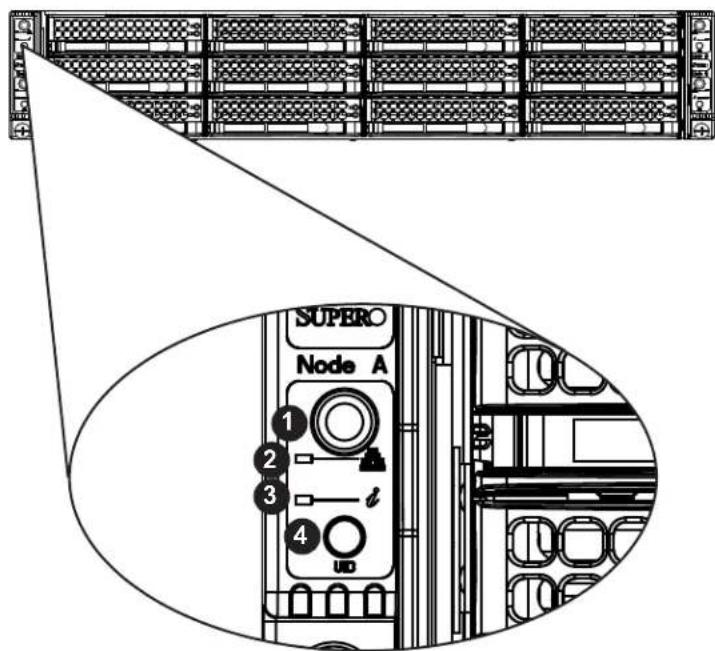
text_image
SUPERO Node A 1 2 3 d 4 UDFigure 1-1. Control Panel View
| Control Panel Features | ||
| Item Feature Description | ||
| 1 Power Button | The main power button on each of the control panels is used to apply or remove power from the power supply to associated node Turning power to the system off with this button removes the main power, but keeps standby power supplied to the system. The power button has a built-in LED which will turn green when the power is on | |
| 2 | NIC1 LED | This LED indicates network activity on either LAN1 or LAN2 when flashing. |
| 3 Information | LED See the following table for the status shown by this LED. | |
| 4 UID Button | When used with a UID compatible motherboard, the UID button is used to turn on or off the blue light function of the LED. This light is displayed in the front as part of the UID button and with a separate LED at the rear of the node. The light helps locate the node in large racks and server banks. | |
| Information LED | |
| Status Description | |
| Continuously on and red | An overheat condition has occurred. (This may be caused by cable congestion.) |
| Blinking red (1 Hz) | Fan failure: check for an inoperative fan. |
| Blinking red (0.25 Hz) | Power failure: check for an inoperative power supply. |
| Solid blue Local UID has been activated. Use this function to locate the server in a rack environment. | |
| Blinking blue (300 Msec) | Remote UID has been activated. Use this function to locate the server from a remote location. |
Front Features
The SC827HQ+-R2K20BP2 is a mini 2U chassis. See the illustration below for the features included on the front of the chassis.

text_image
Diagram of a rack-mounted server rack with labeled ports and internal grid layoutsFigure 1-2. Chassis Front View
| Front Chassis Features | ||
| Item Feature Description | ||
| 1 Control Panels (each Node) | Four control panels are provided on the chassis front for each node in the system. | |
| 2 Drive Bays | Twelve drive bays for 3.5" drives are provided on the chassis front, three for each node. | |
Rear Features
The illustration below shows the features included on the rear of the chassis.

text_image
Technical diagram of a rack-mounted server rack with labeled ports and connectorsFigure 1-3. Chassis Rear View
| Rear Chassis Features | ||
| Item Feature Description | ||
| 1 | Power Supplies | Two redundant power supplies are accessible through the rear of the chassis. |
| 2 I/O Ports Rear I/O ports for each node are accessible on the chassis rear. | ||
| 3 | PCI-E Expansion Card Slots | PCI-E expansion cards can be accessed through these chassis slots. |
1.5 Motherboard Layout
Below is a layout of the X11DPT-PS with jumper, connector and LED locations shown. See the table on the following page for descriptions. For detailed descriptions, pinout information and jumper settings, refer to Chapter 4.
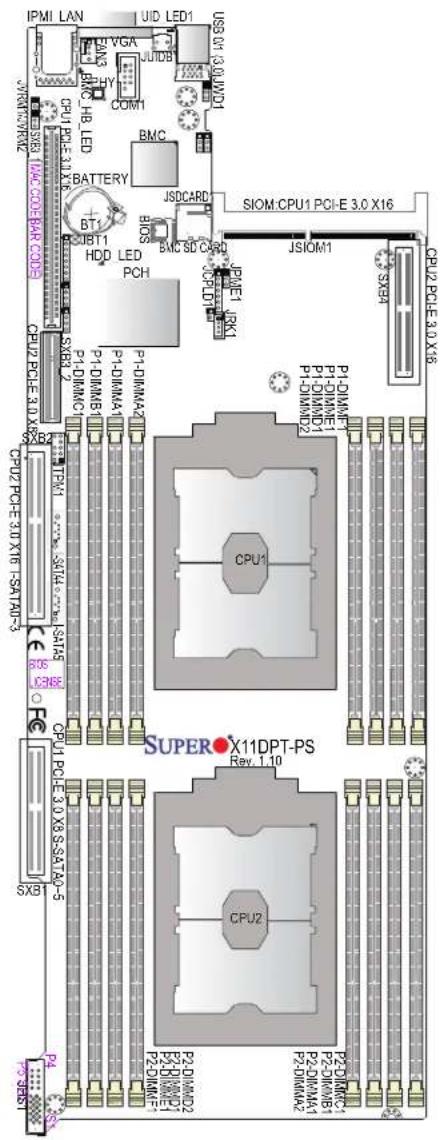
text_image
IPMI LAN UID LED1 US$ 01 3.0 X16 VGA JUDB COM1 CPU1 PCI-E 3.0 X16 SIXB1 BMC BATTERY BT1 HDD LED PCH SIOM CPU1 PCI-E 3.0 X16 JSDCARD BMC SD CARD JPIE1 JRIK1 CPU2 PCLE 3.0 X16 SIXB4 CPU2 PCLE 3.0 X16 SIXB2 CPU2 PCLE 3.0 X16 SIXB3 CPU2 PCLE 3.0 X16 SIXB4 CPU2 PCLE 3.0 X16 SIXB5 CPU2 PCLE 3.0 X16 SIXB6 CPU2 PCLE 3.0 X16 SIXB7 CPU2 PCLE 3.0 X16 SIXB8 CPU2 PCLE 3.0 X16 SIXB9 CPU2 PCLE 3.0 X16 SIXB10 CPU2 PCLE 3.0 X16 SIXB11 CPU2 PCLE 3.0 X16 SIXB12 CPU2 PCLE 3.0 X16 SIXB13 CPU2 PCLE 3.0 X16 SIXB14 CPU2 PCLE 3.0 X16 SIXB15 CPU2 PCLE 3.0 X16 SIXB16 CPU2 PCLE 3.0 X16 SIXB17 CPU2 PCLE 3.0 X16 SIXB18 CPU2 PCLE 3.0 X16 SIXB19 CPU2 PCLE 3.0 X16 SIXB20 CPU2 PCLE 3.0 X16 SIXB21 CPU2 PCLE 3.0 X16 SIXB22 CPU2 PCLE 3.0 X16 SIXB23 CPU2 PCLE 3.0 X16 SIXB24 CPU2 PCLE 3.0 X16 SIXB25 CPU2 PCLE 3.0 X16 SIXB26 CPU2 PCLE 3.0 X16 SIXB27 CPU2 PCLE 3.0 X16 SIXB28 CPU2 PCLE 3.0 X16 SIXB29 CPU2 PCLE 3.0 X16 SIXB30 CPU2 PCLE 3.0 X16 SIXB31 CPU2 PCLE 3.0 X16 SIXB32 CPU2 PCLE 3.0 X16 SIXB33 CPU2 PCLE 3.0 X16 SIXB34 CPU2 PCLE 3.0 X16 SIXB35 CPU2 PCLE 3.0 X16 SIXB36 CPU2 PCLE 3.0 X16 SIXB37 CPU2 PCLE 3.0 X16 SIXB38 CPU2 PCLE 3.0 X16 SIXB39 CPU2 PCLE 3.0 X16 SIXB40 CPU2 PCLE 3.0 X16 SIXB41 CPU2 PCLE 3.0 X16 SIXB42 CPU2 PCLE 3.0 X16 SIXB43 CPU2 PCLE 3.0 X16 SIXB44 CPU2 PCLE 3.0 X16 SIXB45 CPU2 PCLE 3.0 X16 SIXB46 CPU2 PCLE 3.0 X16 SIXB47 CPU2 PCLE 3.0 X16 SIXB48 CPU2 PCLE 3.0 X16 SIXB49 CPU2 PCLE 3.0 X16 SIXB50 CPU2 PCLE 3.0 X16 SIXB51 CPU2 PCLE 3.0 X16 SIXB52 CPU2 PCLE 3.0 X16 SIXB53 CPU2 PCLE 3.0 X16 SIXB54 CPU2 PCLE 3.0 X16 SIXB55 CPU2 PCLE 3.0 X16 SIXB56 CPU2 PCLE 3.0 X16 SIXB57 CPU2 PCLE 3.0 X16 SIXB58 CPU2 PCLE 3.0 X16 SIXB59 CPU2 PCLE 3.0 X16 SIXB60 CPU2 PCLE 3.0 X16 SIXB61 CPU2 PCLE 3.0 X16 SIXB62 CPU2 PCLE 3.0 X16 SIXB63 CPU2 PCLE 3.0 X16 SIXB64 CPU2 PCLE 3.0 X16 SIXB65 CPU2 PCLE 3.0 X16 SIXB66 CPU2 PCLE 3.0 X16 SIXB67 CPU2 PCLE 3.0 X16 SIXB68 CPU2 PCLE 3.0 X16 SIXB69 CPU2 PCLE 3.0 X16 SIXB70 CPU2 PCLE 3.0 X16Figure 1-4. Motherboard Layout
Notes:
- See Chapter 4 for detailed information on jumpers, I/O ports, and JF1 front panel connections.
- " " Indicates the location of Pin 1.
- Jumpers/components/LED indicators not indicated are used for internal testing only.
Quick Reference Table
| Jumper Description | Default Setting | |
| JBT1 CMOS Clear Open | (Normal) | |
| JPME1 Manufacturing Mode | Select Pins 1-2 (Normal) |
| Connector Description | |
| BT1 Onboard battery | |
| COM1 COM port (COM1) | on the I/O backplane |
| FAN3 System cooling fan | header |
| IPMI_LAN Dedicated IPMI LAN port (IPMI_LAN1) | |
| I-SATA4/I-SATA5 | Intel® PCH SATA3.0 ports with power-pin built-in w/support of SuperDOM (Device-On Module) |
| JHS1 SMCI-Proprietary Power supply header | |
| JRK1 RAID_Key for onboard SATA devices | |
| JSDCARD1 | BMC_SD card header |
| JSIOM1 | Super I/O Module used as CPU1 PCI-E 3.0 x16 slot |
| JTPM1 | Trusted Platform Module/Port 80 connector |
| JUIDB1 | UID (Unit Identifier) switch |
| SXB1 (for S-SATA 0-5) | PCI-E 3.0 x8 slot supported by CPU1 for use of S-SATA 0-5 devices |
| SXB2 (for I-SATA 0-3) | PCI-E 3.0 x16 slot supported by CPU2 for use of I-SATA 0-3 devices |
| SXB3_1 | PCI-E 3.0 x16 slot supported by CPU1 |
| SXB3_2 | PCI-E 3.0 x8 slot supported by CPU2 |
| SXB4 | PCI-E 3.0 x16 slot supported by CPU2 |
| USB0/1 | Backplane Universal Serial Bus (USB) 3.0 ports 0/1 |
| VGA | VGA Port |
| LED | Description State: Status | |
| BMC_HB_LED | BMC Heartbeat LED | Blinking Green: BMC Normal |
| UID_LED1 | UID (Unit Identifier) LED | Solid Blue: Unit Identified |

flowchart
graph TD
    subgraph Systematics
        A["DDR4 2133/2666"] -->|SPI| B["BMC AST2500"]
        C["DRAM1"] -->|SPI| B
        D["DRAM2"] -->|SPI| B
        E["DRAM1"] -->|SPI| B
        F["DRAM2"] -->|SPI| B
        G["DRAM1"] -->|SPI| B
        H["DRAM2"] -->|SPI| B
        I["DRAM1"] -->|SPI| B
        J["DRAM2"] -->|SPI| B
        K["DRAM1"] -->|SPI| B
        L["DRAM2"] -->|SPI| B
        M["DRAM1"] -->|SPI| B
        N["DRAM2"] -->|SPI| B
        O["DRAM1"] -->|SPI| B
        P["DRAM2"] -->|SPI| B
        Q["DRAM1"] -->|SPI| B
        R["DRAM2"] -->|SPI| B
        S["DRAM1"] -->|SPI| B
        T["DRAM2"] -->|SPI| B
        U["DRAM1"] -->|SPI| B
        V["DRAM2"] -->|SPI| B
        W["DRAM1"] -->|SPI| B
        X["DRAM2"] -->|SPI| B
        Y["DRAM1"] -->|SPI| B
        Z["DRAM2"] -->|SPI| B
    end

    subgraph Control Systems
        AA["VCCP0 VR13 5-1 PHASE 165W/205W"] --> AB["CPU1"]
        AC["VCCP1 VR13 5-1 PHASE 165W/205W"] --> AD["CPU2"]
        AE["PCI-E X16"] --> AF["SIOM"]
        AG["PCI-E X8"] --> AH["PCI-E X16"]
        AI["UPLINK PCI-E X8 or X1"] --> AJ["PCI-E X16"]
        AK["UPI 10.4/1.2G"] --> AL["PCI-E X16"]
        AM["P0"] --> AN["PCI-E X8"]
        AO["P1"] --> AP["PCI-E X16"]
        AQ["P0"] --> AR["PCI-E X8"]
        AS["DIIM3"] --> AT["PCI-E X16"]
        AU["UPLINK PCI-E X8 or X1"] --> AV["PCI-E X16"]
        AW["UPI 10.4/1.2G"] --> AX["PCI-E X16"]
        AY["P0"] --> AZ["PCI-E X8"]
        BA["P1"] --> BB["PCI-E X16"]
        BC["P0"] --> BD["PCI-E X8"]
        BE["P0"] --> BF["PCI-E X16"]
        BG["P0"] --> BH["PCI-E X8"]
        BI["P0"] --> BJ["PCI-E X16"]
    end

    subgraph System Details
        BK["SATA"] --> BL["USB"]
        BL --> BM["USB"]
        BN["SATA-DOM"] --> BO["USB"]
    end

    subgraph Control Systems
        BP["SATA-DOM"] --> BQ["SATA"]
    end

    subgraph System Details
        BR["RJ45"] --> BS["LAN3 RTL8211F"]
        BT["RGRMII"] --> BS
        BU["NCSI master"] --> BV["NCSI master"]
        BW["NCSI master"] --> BX["NCSI master"]
    end

    subgraph Control Systems
        BY["SATA-DOM"] --> BQ["SATA-DOM"]
    end

    subgraph Control Systems
        CA["SATA-DOM"] --> BQ["SATA-DOM"]
    end

    subgraph Control Systems
        CB["SATA-DOM"] --> BQ["SATA-DOM"]
    end

    subgraph Control Systems
        CC["SATA-DOM"] --> BQ["SATA-DOM"]
    end

    subgraph Control Systems
        DD["SATA-DOM"] --> BQ["SATA-DOM"]
    end

    subgraph Control Systems
        DB["SATA-DOM"] --> BQ["SATA-DOM"]
    end

    subgraph Control Systems
        DC["SATA-DOM"] --> BQ["SATA-DOM"]
    end

    subgraph Control Systems
        DDb["SATA-DOM"] --> BQb["SATA-DOM"]
    end

    subgraph Control Systems
        DBb["SATA-DOM"] --> BQb["SATA-DOM"]
    end

    subgraph Control Systems
        DBc["SATA-DOM"] --> BQc["SATA-DOM"]
    end

    subgraph Control Systems
        DBcS["SATA-DOM"] --> BQcS["SATA-DOM"]
    end

    subgraph Control Systems
        DBd["SATA-DOM"] --> BQd["SATA-DOM"]
    end

    subgraph Control Systems
        DBdSb["SATA-DOM"] --> BQdSb["SATA-DOM"]
    end

    subgraph Control Systems
        DBdSbS["SATA-DOM"] --> BQdSbS["SATA-DOM"]
    end

    subgraph Control Systems
        DBdSbX["SATA-DOM"] --> BQdX["SATA-DOM"]
    end

    subgraph Control Systems
        DBdXb["SATA-DOM"] --> BQdXb["SATA-DOM"]
    end

    subgraph Control Systems
        DBdXbXb["SATA-DOM"] --> BQdXbXb["SATA-DOM"]
    end

    subgraph Control Systems
        DBdXbXbS["XAMATI 2133/2666"]
        DBdXbXbXb["XAMATI 2133/2666"]
        DBdXbXbXb["XAMATI 2133/2666"]
        DBdXbXbXb["XAMATI 2133/2666"]
    end

    subgraph Control Systems
        BB["SMA3_1 (Rear Left)"]
        BC["SMA3_1 (Rear Right)"]
        DD["SMA3_1 (Rear Left)"]
        DE["SMA3_1 (Rear Right)"]
    end

    subgraph Control Systems
        DDx["SMA3_1 (Rear Left)"]
        DEx["SMA3_1 (Rear Right)"]
    end

    subgraph Control Systems
        DDy["SMA3_1 (Rear Left)"]
        DEy["SMA3_1 (Rear Right)"]
    end

    subgraph Control Systems
        DDz["SMA3_1 (Rear Left)"]
        DEz["SMA3_1 (Rear Right)"]
    end

    subgraph Control Systems
        DDxx["SMA3_1 (Rear Left)"]
        DExx["x"][RL8211F], DDy["x"][RL8211F], DDz["x"][RL8211F], DDz["x"][RL8211F], DDz["x"][RL8211F], DDz["x"][RL8211F], DDz["x"][RL8211F], DDz["x"][RL8211F], DDz["x"][RL8211F], DDz["x"][RL8211F], DDz["x"][RL8211F], DDz.x["s"][RL8211F], DDz.x["s"][RL8211F], DDz.x["s"][RL8211F], DDz.x["s"][RL8211F], DDz.x["s"][RL8211F], DDz.x["s"][RL8211F], DDz.x["s"][RL8211F], DDz.x["s"][RL8211F], DDz.x["s"][RL87718W]
    end

    subgraph Control Systems
        BB["SMA3_2 (Rear Left)"]
        BC["SMA3_2 (Rear Left)"]
        DD["SMA3_2 (Rear Left)"]
        DE["SMA3_2 (Rear Left)"]
        AB["SMA3_2 (Rear Left)"]
        AC["SMA3_2 (Rear Left)"]
        AD["SMA3_2 (Rear Left)"]
        AE["SMA3_2 (Rear Left)"]
        AF["SMA3_2 (Rear Left)"]
        AG["SMA3_2 (Rear Left)"]
        AH["SMA3_2 (Rear Left)"]
        AI["SMA3_2 (Rear Left)"]
        AJ["SMA3_2 (Rear Left)"]
        AK["SMA3_2 (Rear Left)"]
        AL["SMA3_2 (Rear Left)"]
        AM["SMA3_2 (Rear Left)"]
        AN["SMA3_2 (Rear Left)"]
        AO["SMA3_2 (Rear Left)"]
        AP["SMA3_2 (Rear Left)"]
        AQ["SMA3_2 (Rear Left)"]
        AR["SMA3_2 (Rear Left)"]
        AS["SMA3_2 (Rear Left)"]
        AT["SMA3_2 (Rear Left)"]
        AU["SMA3_2 (Rear Left)"]
        AV["SMA3_2 (Rear Left)"]
        AW["SMA3_2 (Rear Left)"]
        AX["SMA3_2 (Rear Left)"]
        AY["SMA3_2 (Rear Left)"]
        AZ["SMA3_2 (Rear Left)"]
        BA["SMA3_2 (Rear Left)"]
        BB["SMA3_2 (Rear Left)"]
        BC["SMA3_2 (Rear Left)"]
        AD["SMA3_2 (Rear Left)"]
        AE["SMA3_2 (Rear Left)"]
        AF["SMA3_2 (Rear Left)"]
        AG["SMA3_2 (Rear Left)"]
        AH["SMA3_2 (Rear Left)"]
        AI["SMA3_2 (Rear Left)"]
        AJ["SMA3_2 (Rear Left)"]
        AK["SMA3 20000 MHz Master"]
    end
Figure 1-5. Intel C621 Chipset: System Block Diagram
Note: This is a general block diagram and may not exactly represent the features on your motherboard. See the System Specifications appendix for the actual specifications of your motherboard.
Chapter 2
Server Installation
2.1 Overview
This chapter provides advice and instructions for mounting your system in a server rack. If your system is not already fully integrated with processors, system memory etc., refer to Chapter 4 for details on installing those specific components.
Caution: Electrostatic Discharge (ESD) can damage electronic components. To prevent such damage to PCBs (printed circuit boards), it is important to use a grounded wrist strap, handle all PCBs by their edges and keep them in anti-static bags when not in use.
2.2 Preparing for Setup
The box in which the system was shipped should include the rackmount hardware needed to install it into the rack. Please read this section in its entirety before you begin the installation.
Choosing a Setup Location
- The system should be situated in a clean, dust-free area that is well ventilated. Avoid areas where heat, electrical noise and electromagnetic fields are generated.
- Leave enough clearance in front of the rack so that you can open the front door completely (\~25 inches) and approximately 30 inches of clearance in the back of the rack to allow sufficient space for airflow and access when servicing.
- This product should be installed only in a Restricted Access Location (dedicated equipment rooms, service closets, etc.).
- This product is not suitable for use with visual display workplace devices according to §2 of the German Ordinance for Work with Visual Display Units.
Rack Precautions
- Ensure that the leveling jacks on the bottom of the rack are extended to the floor so that the full weight of the rack rests on them.
-
In single rack installations, stabilizers should be attached to the rack. In multiple rack installations, the racks should be coupled together.
-
Always make sure the rack is stable before extending a server or other component from the rack.
- You should extend only one server or component at a time - extending two or more simultaneously may cause the rack to become unstable.
Server Precautions
- Review the electrical and general safety precautions in Appendix B.
- Determine the placement of each component in the rack before you install the rails.
- Install the heaviest server components at the bottom of the rack first and then work your way up.
- Use a regulating uninterruptible power supply (UPS) to protect the server from power surges and voltage spikes and to keep your system operating in case of a power failure.
- Allow any drives and power supply modules to cool before touching them.
- When not servicing, always keep the front door of the rack and all covers/panels on the servers closed to maintain proper cooling.
Rack Mounting Considerations
Ambient Operating Temperature
If installed in a closed or multi-unit rack assembly, the ambient operating temperature of the rack environment may be greater than the room's ambient temperature. Therefore, consideration should be given to installing the equipment in an environment compatible with the manufacturer's maximum rated ambient temperature (TMRA).
Airflow
Equipment should be mounted into a rack so that the amount of airflow required for safe operation is not compromised.
Mechanical Loading
Equipment should be mounted into a rack so that a hazardous condition does not arise due to uneven mechanical loading.
Circuit Overloading
Consideration should be given to the connection of the equipment to the power supply circuitry and the effect that any possible overloading of circuits might have on overcurrent protection and power supply wiring. Appropriate consideration of equipment nameplate ratings should be used when addressing this concern.
Reliable Ground
A reliable ground must be maintained at all times. To ensure this, the rack itself should be grounded. Particular attention should be given to power supply connections other than the direct connections to the branch circuit (i.e. the use of power strips, etc.).

To prevent bodily injury when mounting or servicing this unit in a rack, you must take special precautions to ensure that the system remains stable. The following guidelines are provided to ensure your safety:
- This unit should be mounted at the bottom of the rack if it is the only unit in the rack.
- When mounting this unit in a partially filled rack, load the rack from the bottom to the top with the heaviest component at the bottom of the rack.
- If the rack is provided with stabilizing devices, install the stabilizers before mounting or servicing the unit in the rack.
2.3 Installing the Rails
There are a variety of rack units on the market, which may require a slightly different assembly procedure.
The following is a basic guideline for installing the system into a rack with the rack mounting hardware provided. You should also refer to the installation instructions that came with the specific rack you are using.
The chassis package includes two rail assemblies in the rack mounting kit. Each assembly consists of three sections: An inner chassis rail which secures directly to the chassis, an outer rail that secures to the rack, and a middle rail which extends from the outer rail (see Figure 2-1). These assemblies are specifically designed for the left and right side of the chassis.
NOTE: This rail will fit a rack between 26.5" and 36.4" deep.
Identifying the Rails
The rack rails and the related hardware should have been included with the system. Refer to Figure 2-1 to identify the rail sections.

text_image
Rail Assembly (Shown with Rails Retracted) Outer Rail Middle Rail Locking Tab Inner Rail This Side Faces OutwardFigure 2-1. Identifying the Rail Sections

Slide rail mounted equipment is not to be used as a shelf or a work space.

Warning: do not pick up the server with the front handles. They are designed to pull the system from a rack only.
Locking Tabs
Each inner rail has a locking tab. This tab locks the chassis into place when installed and pushed fully into the rack. These tabs also lock the chassis in place when fully extended from the rack. This prevents the server from coming completely out of the rack when when the chassis is pulled out for servicing.
Releasing the Inner Rail
Use the procedure below to release the inner rails from the outer rails.
Releasing Inner Rail from the Outer Rails
- Identify the left and right outer rail assemblies as described previously.
- Pull the inner rail out of the outer rail until it is fully extended as illustrated below.
- Press the locking tab down to release the inner rail.
- Pull the inner rail all the way out.
- Repeat steps 1-3 for the second outer rail.
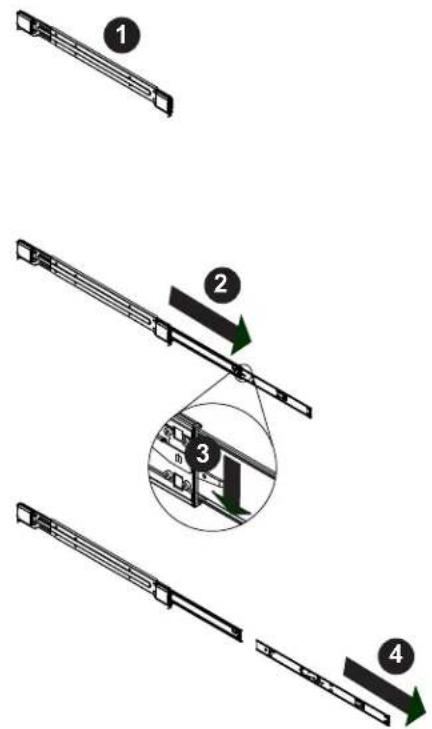
text_image
Diagram illustrating four steps of a mechanical assembly or assembly process, labeled 1 to 4 with arrows and a magnified inset showing step 3.Figure 2-2. Extending and Releasing the Inner Rail
Installing the Chassis Rails
Begin the rack mounting procedure by installing the inner rails to the server chassis.
Installing the Inner Rails
- Confirm that the left and right inner rails have been correctly identified.
- Place the inner rail firmly against the side of the chassis, aligning the hooks on the side of the chassis with the holes in the inner rail.
- Slide the inner rail forward toward the front of the chassis until the rail clicks into the locked position, which secures the inner rail to the chassis.
- Secure the inner rail to the chassis with the screws provided.
- Repeat steps 1 through 4 above for the other inner rail.
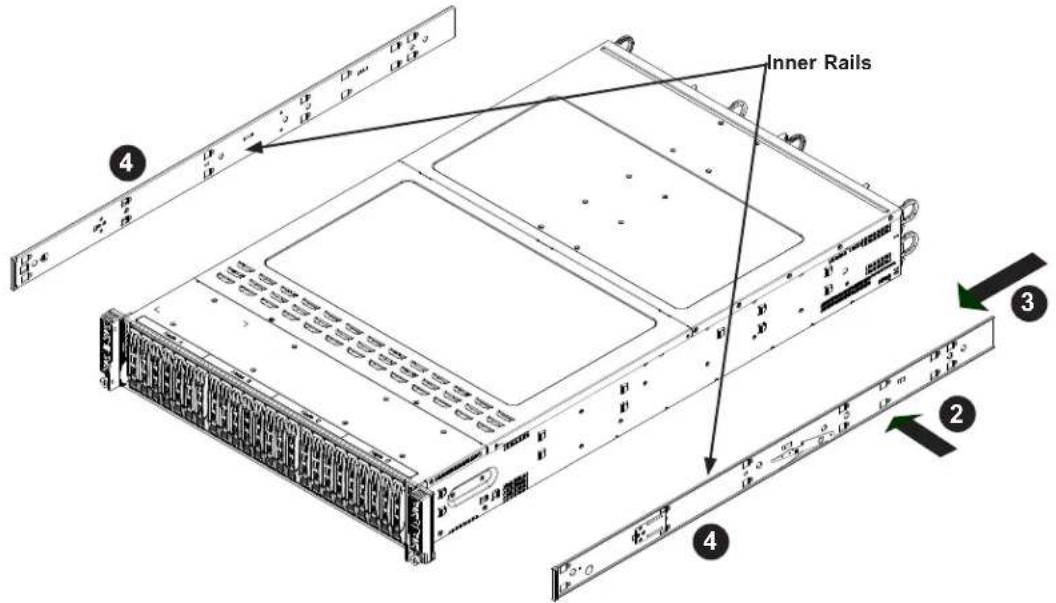
text_image
Inner Rails 4 3 2 4Figure 2-3. Installing the Inner Rails
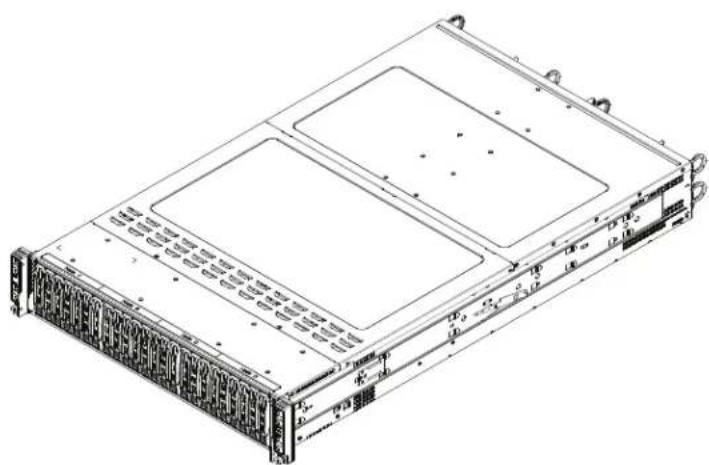
natural_image
Technical line drawing of a server rack unit with ventilation grilles and drive bays (no text or labels)Figure 2-4. Inner Rails Installed on the Chassis
Installing the Outer Rails on the Rack
Determine where you want to place the server in the rack (see the Rack and Server Precautions in Section 2.2).
Note: that servers should always be installed to the bottom of a rack first for stability reasons.
Use the procedure below to install the outer rails onto the rack.
Installing the Outer Rails
- Press upward on the locking tab at the rear end of the middle rail.
- Push the middle rail back into the outer rail.
- Hang the hooks of the front of the outer rail onto the slots on the front of the rack. If necessary, use screws to secure the outer rails to the rack, as illustrated above.
- Pull out the rear of the outer rail, adjusting the length until it fits within the posts of the rack.
- Hang the hooks of the rear portion of the outer rail onto the slots on the rear of the rack. If necessary, use screws to secure the rear of the outer rail to the rear of the rack.
- Repeat steps 1-5 for the remaining outer rail.
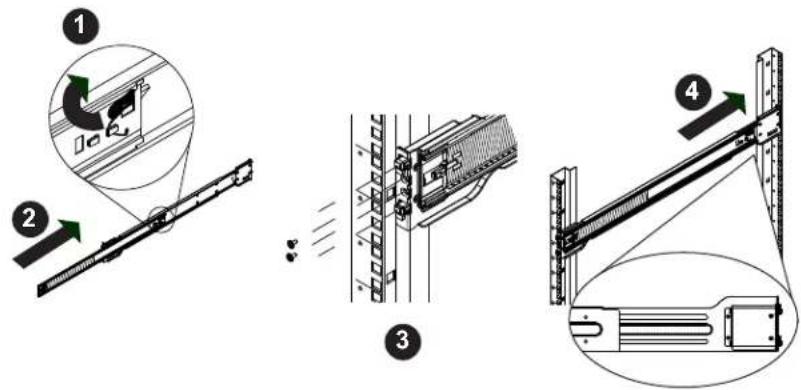
text_image
Technical diagram illustrating four stages of a mechanical assembly with labeled components and directional arrows indicating motion.Figure 2-5. Extending and Releasing the Outer Rails
Standard Chassis Installation
Installing the Chassis into a Rack
- Confirm that the inner rails are properly installed on the chassis.
- Confirm that the outer rails are correctly installed on the rack.
- Pull the middle rail out from the front of the outer rail and make sure that the ball-bearing shuttle is at the front locking position of the middle rail.
- Align the chassis inner rails with the front of the middle rails.
- Slide the inner rails on the chassis into the middle rails, keeping the pressure even on both sides, until the locking tab of the inner rail clicks into the front of the middle rail, locking the chassis into the fully extended position.
- Depress the locking tabs of both sides at the same time and push the chassis all the way into the rear of the rack.
- If necessary for security purposes, use screws to secure the chassis handles to the front of the rack.
Note: The figure below is for illustration purposes only. Always install servers to the bottom of the rack first.
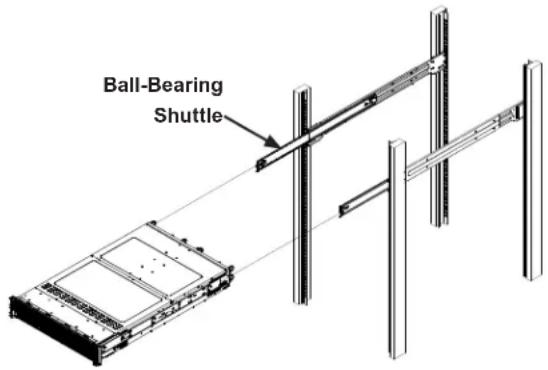
text_image
Ball-Bearing Shuttle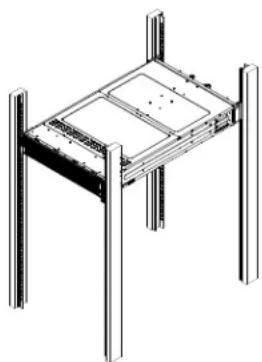
natural_image
Isometric line drawing of a four-legged table with legs and a central tray (no text or symbols)Figure 2-6. Installing the Server into a Rack
Note: Figure is for illustrative purposes only. Always install servers to the bottom of a rack first.
Chapter 3
Maintenance and Component Installation
This chapter provides instructions on installing and replacing main system components. To prevent compatibility issues, only use components that match the specifications and/or part numbers given.
Installation or replacement of most components require that power first be removed from the system. Please follow the procedures given in each section.
3.1 Removing Power
Use the following procedure to ensure that power has been removed from the system. This step is necessary when removing or installing non hot-swap components or when replacing a non-redundant power supply.
-
Use the operating system to power down the system.
-
After the system has completely shut-down, disconnect the AC power cord(s) from the power strip or outlet. (If your system has more than one power supply, remove the AC power cords from all power supply modules.)
-
Disconnect the power cord(s) from the power supply module(s).
3.2 Accessing the System
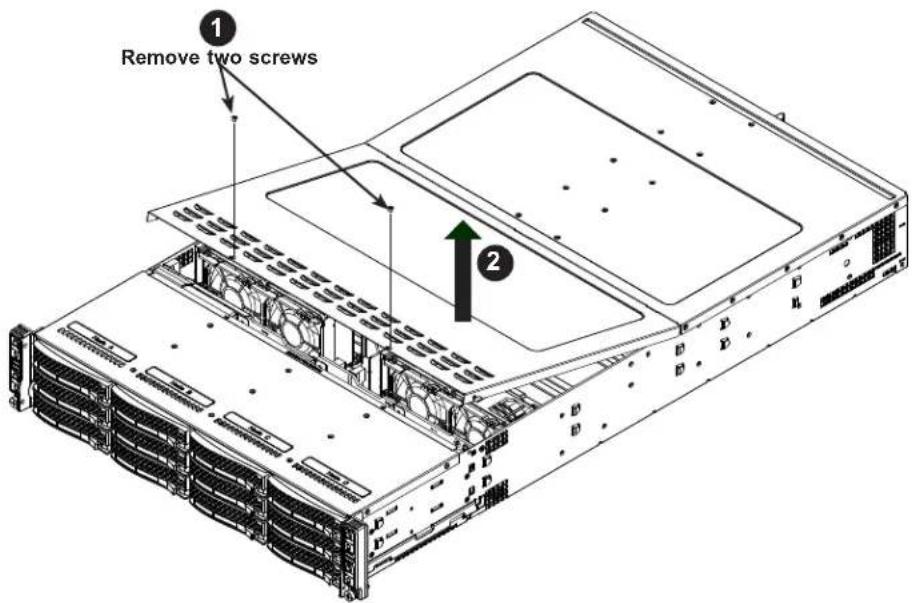
The SC827HQ+-R2K20BP2 features a removable top cover, which allows easy access to the inside of the chassis.
Removing the Top Cover
- Remove the two screws which secure the top cover onto the chassis as shown above.
- Lift the top cover up and off the chassis.
Warning: Except for short periods of time, do not operate the server without the cover in place. The chassis cover must be in place to allow for proper airflow and to prevent overheating.
text_image
Remove two screws ① ②Figure 3-1. Removing the Chassis Cover
3.3 Motherboard Components
Processor and Heatsink Installation
The Intel® Xeon 81xx/61xx/51xx/41xx/31xx or 82xx/62xx/52xx/42xx/32xx series processor comes in two models: Fabric (F model) and Non-Fabric (Non-F model). Only the Non-Fabric model is supported for this system.
The processor (CPU) and heatsink should be assembled together first to form the processor heatsink module (PHM), and then install the PHM into the CPU socket.
Caution: Use ESD protection. Do not touch the underside of the CPU. Improper installation or socket misalignment can cause serious damage to the CPU or socket which may require manufacturer repairs.
Notes:
- All power should be off, as described in Section 3.1, before installing the processors.
- When handling the processor package, avoid placing direct pressure on the label area of the CPU or socket.
- Check that the plastic socket dust cover is in place and none of the socket pins are bent—otherwise, contact your retailer.
• Refer to the Supermicro website for updates on CPU support. - Graphics in this manual are for illustration. Your components may look slightly different.
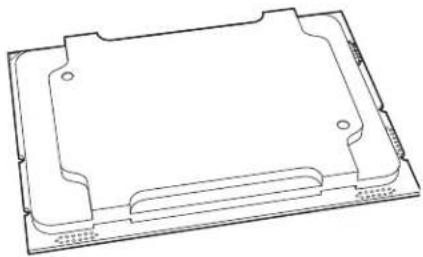
The Intel® Xeon Series Processor
natural_image
Technical line drawing of a rectangular electronic component with mounting holes and internal structure (no text or symbols)Processor
Note: All graphics, drawings, and pictures shown in this manual are for illustration only. The components that came with your machine may or may not look exactly the same as those shown in this manual.
Assembling the Processor Package
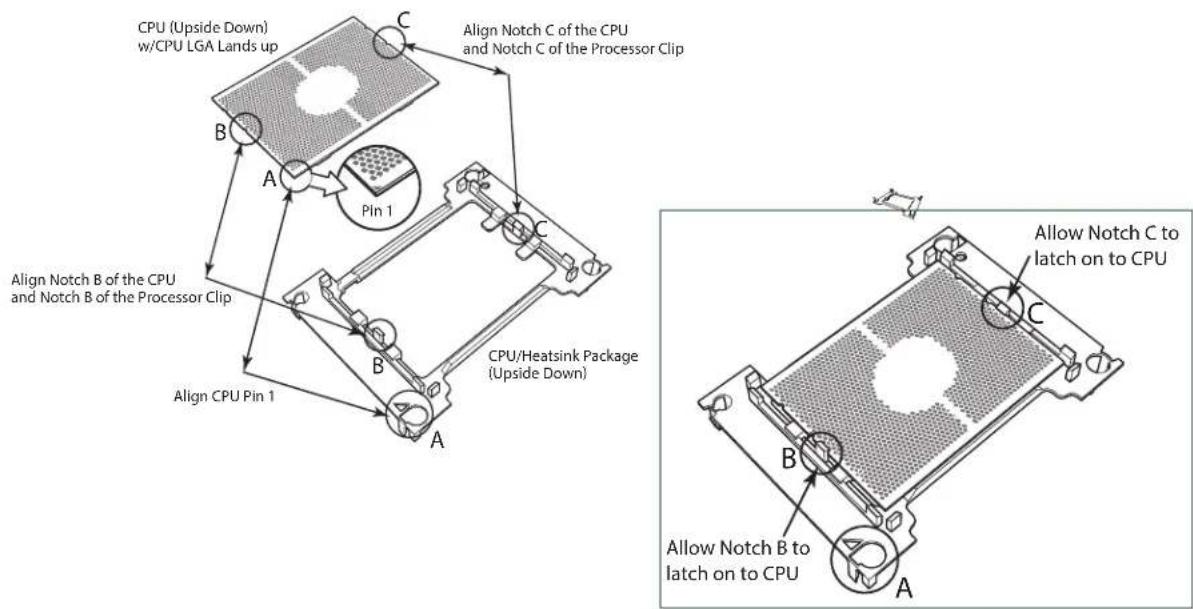
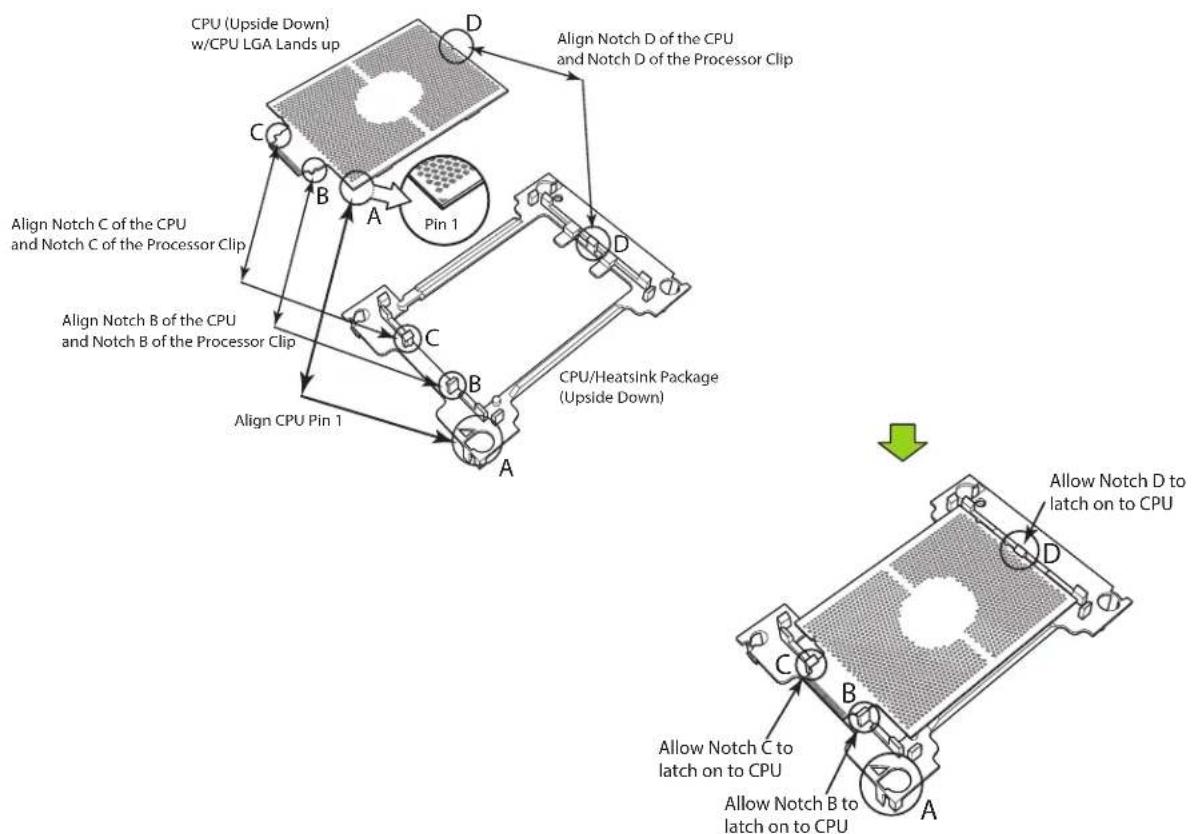
Attach the processor to the thin processor clip to create the processor package.
- On the top corner of the CPU, locate pin 1 (A), marked by a triangle. Also, locate notch B and notch C (and notch D for F models) on the CPU as shown below.
- On the top of the processor clip, locate the corner marked by a hollow triangle as the position for pin 1. Also locate notch B and notch C (and D for F models) on the processor clip.
- Align pin 1 of the CPU with its proper position on the processor clip and carefully insert the CPU into the processor clip. Slide notch B of the CPU into tab B of the processor clip, and slide notch C of the CPU into tab C of the processor clip (and D for F models) until the processor clip tabs snap onto the CPU.
- Examine all corners to ensure that the CPU is properly seated and secure on the processor clip.
The processor package assembly is created.
text_image
CPU (Upside Down) w/CPU LGA Lands up C Align Notch C of the CPU and Notch C of the Processor Clip Pin 1 Align Notch B of the CPU and Notch B of the Processor Clip CPU/Heatsink Package (Upside Down) Align CPU Pin 1 A B C Allow Notch B to latch on to CPU C Allow Notch C to latch on to CPUProcessor Package Assembly for the non-F Model Processors
flowchart
graph TD
    A["CPU (Upside Down) w/CPU LGA Lands up"] --> B["Pin 1"]
    B --> C["Align Notch C of the CPU and Notch C of the Processor Clip"]
    B --> D["Align Notch B of the CPU and Notch B of the Processor Clip"]
    B --> E["Align CPU Pin 1"]
    E --> F["CPU/Heatsink Package (Upside Down)"]
    F --> G["Allow Notch D to latch on to CPU"]
    F --> H["Allow Notch B to latch on to CPU"]
    style A fill:#f9f,stroke:#333
    style G fill:#ccf,stroke:#333
    style H fill:#ccf,stroke:#333
Processor Package Assembly for the F Model Processors
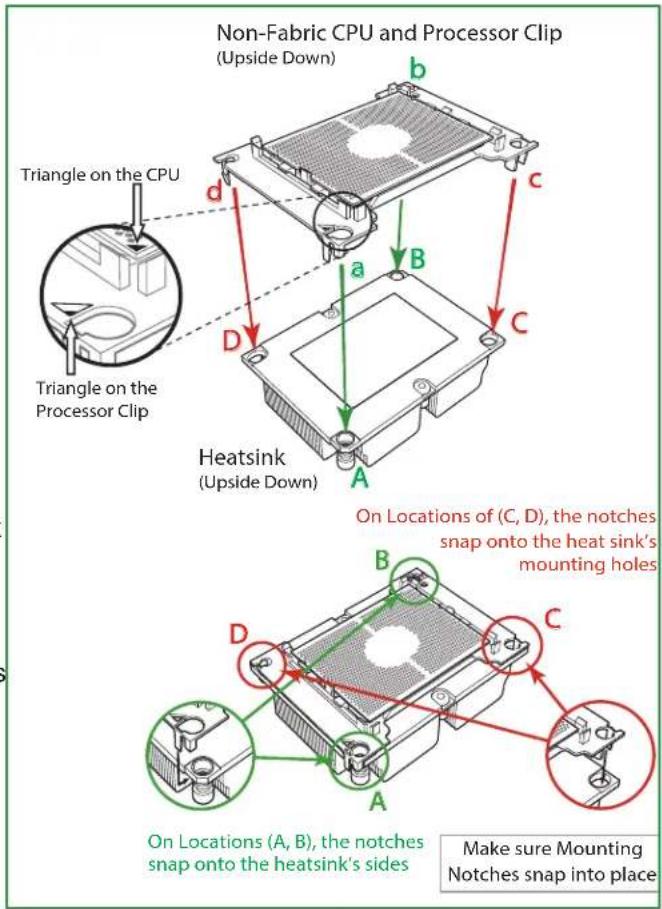
After creating the processor package assembly, mount it onto the heatsink to create the processor heatsink module (PHM).
- On the heatsink label, locate "1" and the corner next to it. Turn the heatsink upside down with the thermal grease side facing up, keeping track of the "1" corner.
- Remove the protective thermal film if present. If this is a new heatsink, the necessary thermal grease has been pre-applied in the factory. If the heatsink is not new, apply the proper amount of the thermal grease.
- In the plastic processor clip, locate the hollow triangle at the corner ("a" in the drawing below) next to a hole and plastic mounting clips. There is a similar hole and mounting clips at the diagonal corner of the of the processor clip ("b" in the drawing).
- With the underside of heatsink and the underside of the processor package facing up, align the "1" corner on the heatsink ("A" in the drawing) against the mounting clips next to the hollow triangle ("a") on the processor package.
- Also align the corner ("B") at the diagonal side of the heatsink with the corresponding clips on the processor package ("b").
- Once aligned, press the processor package assembly onto the heatsink until the mounting clips (at a, b, c, and d) snap into place.
The processor heatsink module is assembled.
text_image
Non-Fabric CPU and Processor Clip (Upside Down) Triangle on the CPU Triangle on the Processor Clip Heatsink (Upside Down) On Locations of (C, D), the notches snap onto the heat sink's mounting holes On Locations (A, B), the notches snap onto the heatsink's sides Make sure Mounting Notches snap into placeAssembling the Processor Heatsink Module
Removing the Dust Cover from the CPU Socket
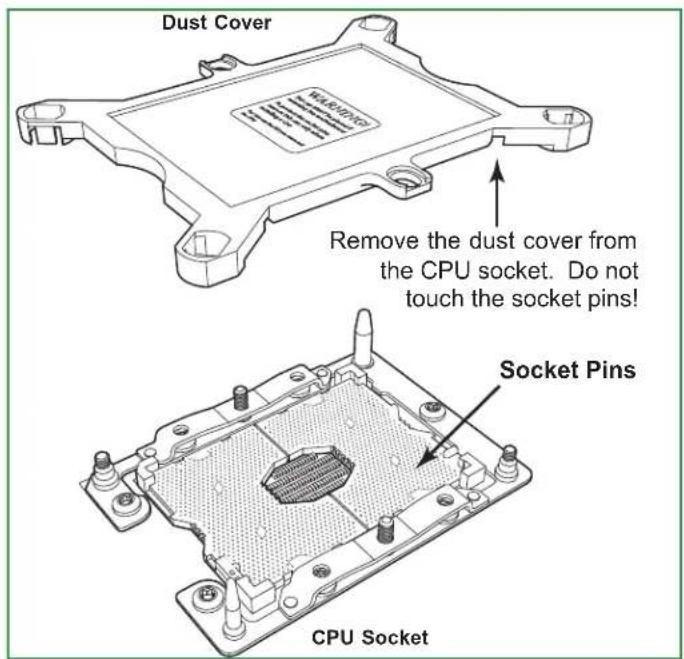
Remove the dust cover from the CPU socket, exposing the socket pins as shown below.
Caution: Do not touch the socket pins.
text_image
Dust Cover Remove the dust cover from the CPU socket. Do not touch the socket pins! Socket Pins CPU SocketRemoving the Socket Dust Cover
Installing the Processor Heatsink Module (PHM)
-
Locate the triangle (pin 1) on the CPU socket. Also locate the pin 1 corner of the PHM that is closest to "1" on the heatsink label. To confirm, look at the underside of the PHM and note the hollow triangle in the processor clip and printed triangle on the CPU located next to a screw at the corner.
-
Align the pin 1 corner of the PHM over the pin 1 corner on the CPU socket.
-
Align the two holes at diagonal corners of the PHM onto the two guide posts on the socket bracket and carefully lower the PHM onto the socket.
-
Use a T30 Torx-bit screwdriver to install four screws into the mounting holes on the socket to securely attach the PHM onto the motherboard in the sequence of 1, 2, 3, and 4, as marked on the heatsink label. Gradually tighten each to assure even pressure.
Note: Use only 12 foot-pounds of torque when tightening the screws to avoid damaging the processor or the socket.

text_image
Oval C Oval D Large Guiding Post Small Guiding Post Printed Triangle Mounting the Processor Heatsink Module into the CPU socket (on the motherboard) Tighten the screws in the sequence of 1, 2, 3, 4 (top 3 quarter view) Use a torque of 12 lbf T30 Torx Driver #1 #2 #3Installing the Processor Heatsink Module
Removing the Processor Heatsink Module from the Motherboard
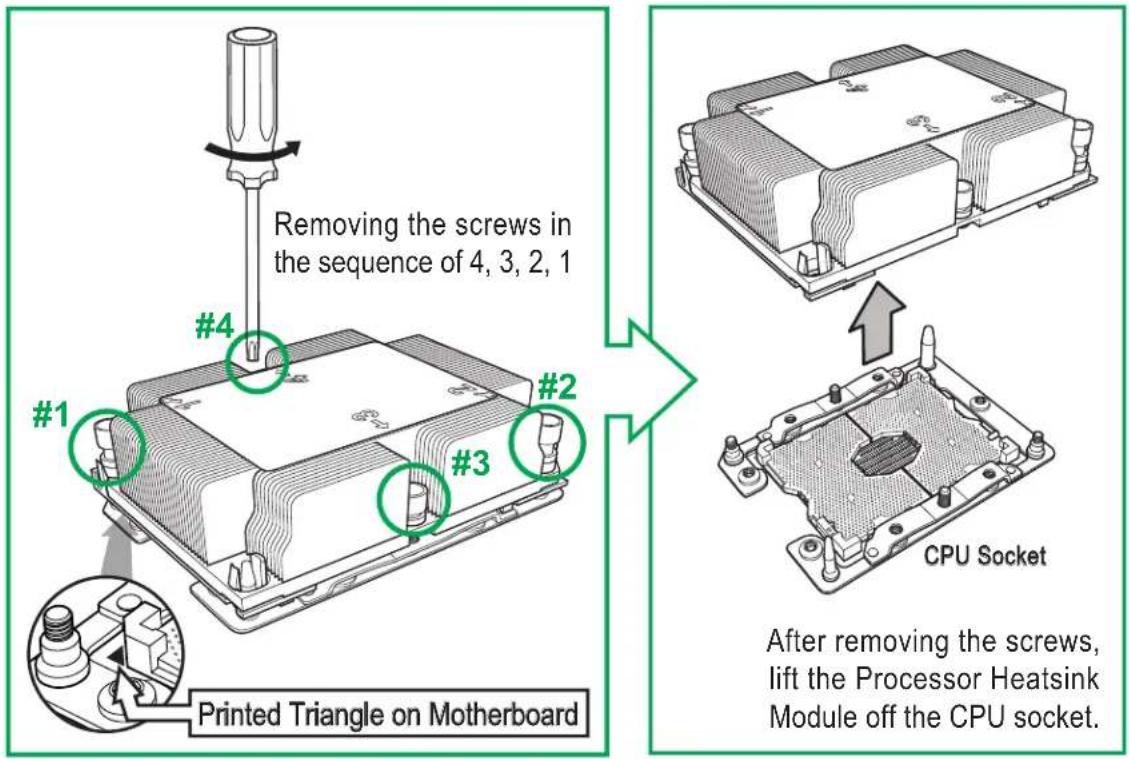
Before removing the processor heatsink module (PHM), power down as described in Section 3.1.
-
Using a T30 Torx-bit screwdriver, loosen and remove the screws on the PHM from the socket, starting with the screw marked #4, in the sequence of 4, 3, 2, 1.
-
Pull up the PHM while releasing the small snap tabs on two corners of the socket.
text_image
Removing the screws in the sequence of 4, 3, 2, 1 #1 #2 #3 Printed Triangle on Motherboard CPU Socket After removing the screws, lift the Processor Heatsink Module off the CPU socket.Removing the Processor Heatsink Module
Memory Support and Installation
To ensure proper memory installation, please carefully follow the information and instructions provided in this user's guide.
ESD Precautions
Electrostatic Discharge (ESD) can damage electronic components including memory modules. To avoid damaging your DIMM modules, it is important to handle it very carefully. The following measures are generally sufficient to protect your equipment from ESD.
Precautions
- Use a grounded wrist strap designed to prevent static discharge.
- Handle the memory module by its edges only.
- Put the memory modules into the antistatic bags when not in use.
- Check the Supermicro website for recommended memory modules
Introduction to Intel® Optane DC Persistent Memory
Intel® 82xx/62xx/52xx/42xx supports new DCPMM (Optane™ DC Persistent Memory Modules) technology. DCPMM offers data persistence with higher capacity at lower latencies than the existing memory modules and provides hyper-speed storage capability for high performance computing platforms with flexible configuration options.
Note: 2933 MHz memory is supported by the 82xx/62xx series processors only.
Warning! Exercise extreme care when installing or removing DIMM modules to prevent any possible damage. Check the Supermicro website for recommended memory modules.
Memory Support
The X11DPT-PS supports up to 2 TB of 3DS LRDIMM/RDIMM/NVDIMM DDR4 (288-pin) ECC 2933/2666/2400/2133 MHz modules in 16 slots at up to 128 GB at 1.2V. Populating these DIMM modules with a pair of memory modules of the same type and size will result in interleaved memory, which will improve memory performance.
DIMM Module Population Sequence
The blue slots must be populated first.
| DDR4 Memory Support for 81xx/61xx/51xx/41xx/31xx Processors | ||||||
| Type | Ranks Per DIMM and Data Width | DIMM Capacity (GB) | Speed (MT/s) | |||
| One Slot per Channel | Two Slots per Channel | |||||
| DRAM Density | One DIMM per Channel | One DIMM per Channel | Two DIMMs per Channel | |||
| 4 Gb 8 Gb 1.2 Volts 1.2 Volts 1.2 Volts | ||||||
| RDIMM | SRx4 4 GB | 8 GB | 2666 2666 2666 | |||
| SRx8 8 GB | 16 GB | |||||
| DRx8 8 GB | 16 GB | |||||
| DRx4 16 GB | 32 GB | |||||
| RDIMM 3Ds | QRX4 N/A | 2H-64GB | ||||
| 8RX4 N/A | 4H-128GB | |||||
| LRDIMM QRx4 | 32 GB 64 GB | |||||
| LRDIMM 3Ds | QRx4 N/A | 2H-64GB | ||||
| 8Rx4 N/A | 4H-128 GB | |||||
| DDR4 Memory Support for 82xx/62xx/52xx/42xx/32xx Processors | |||||||
| Type | Ranks Per DIMM and Data Width | DIMM Capacity (GB) | Speed (MT/s) | ||||
| One Slot per Channel | Two Slots per Channel | ||||||
| DRAM Density | One DIMM per Channel | One DIMM per Channel | Two DIMMs per Channel | ||||
| 4 Gb 8 | Gb | 16 Gb 1.2 Volts | 1.2 Volts | 1.2 Volts | |||
| RDIMM | SRx4 | 4 GB | 8 GB | 16 GB | 2933 | 2933 | 2933 |
| SRx8 | 8 GB | 16 GB | 32 GB | ||||
| DRx8 | 8 GB | 16 GB | 32 GB | ||||
| DRx4 | 16 GB | 32 GB | 64 GB | ||||
| RDIMM 3Ds | QRX4 | N/A 2H-64GB | 2H-128GB | ||||
| 8RX4 | N/A 4H-128GB | 4H-256GB | |||||
| LRDIMM | QRx4 | 32 GB | 64 GB | 128 GB | |||
| LRDIMM 3Ds | QRx4 | N/A 2H-64GB | 2H-64GB | ||||
| 8Rx4 | N/A 4H-128 GB | 4H-256 GB | |||||
Check the Supermicro website for possible updates to memory support.
Memory Installation Sequence
Memory modules for the X11 UP/DP/MP motherboards are populated using the "Fill First" method. The blue memory slot of each channel is considered the "first DIMM module" of the channel, and the black slot, the second module of the channel. When installing memory modules, be sure to populate the blue memory slots first and then populate the black slots.
To maximize memory capacity, please populate all DIMM slots on the motherboard, including all blue slots and black slots.
General Memory Population Requirements
- Be sure to use the memory modules of the same type and speed on the motherboard. Mixing of memory modules of different types and speeds is not allowed.
- Using unbalanced memory topology such as populating two DIMMs in one channel while populating one DIMM in another channel on the same motherboard will result in reduced memory performance.
- Populating memory slots with a pair of DIMM modules of the same type and size will result in interleaved memory, which will improve memory performance.
Memory Population Sequence
Blue slots versus black slots: Install the first DIMM in the blue memory slot, which is the first of a memory channel. Then, if using two DIMMs per channel, install the second DIMM in the black slot.
The following memory population sequence table was created based on guidelines provided by Intel to support Supermicro motherboards. The diagram is for illustrative purposes; your motherboard may look different.
DIMM Population Guidelines for Optimal Performance
For optimal memory performance, follow the instructions listed in the tables below when populating memory modules.
Key Parameters for DIMM Configuration
| Key Parameters for DIMM Configurations | |
| Parameters Possible Values | |
| Number of Channels 1, 2, | 3, 4, 5, or 6 |
| Number of DIMMs per Channel | 1DPC (1 DIMM Per Channel) or 2DPC (2 DIMMs Per Channel) |
| DIMM Type RDIMM (w/ECC), 3DS RDIMM, LRDIMM, 3DS LRDIMM | |
| DIMM Construction non-3 | DS RDIMM Raw Cards: A/B (2Rx4), C (1Rx4), D (1Rx8), E (2Rx8)3DS RDIMM Raw Cards: A/B (4Rx4)non-3DS LRDIMM Raw Cards: D/E (4Rx4)3DS LRDIMM Raw Cards: A/B (8Rx4) |
DIMM Mixing Guidelines
| General DIMM Mixing Guidelines | |||
| All DIMMs must be all DDR4 DIMMs.x4 and x8 DIMMs can be mixed in the same channel.Mixing of LRDIMMs and RDIMMs is not allowed in the same channel, across different channels, and across different sockets.Mixing of non-3DS and 3DS LRDIMM is not allowed in the same channel, across different channels, and across different sockets. | |||
| Mixing of DIMM Types within a Channel | |||
| DIMM Types RDIMM | LRDIMM 3DS LRDIMM | ||
| RDIMM Allowed Not Allowed Not Allowed | |||
| LRDIMM Not Allowed Allowed Not Allowed | |||
| 3DS LRDIMM Not Allowed Not Allowed Allowed | |||
| Memory Population Table for the X11DP Motherboard w/16 DIMM Slots Onboard | |
| CPUs/DIMMs Memory Population Sequence | |
| 1 CPU & 1 DIMM CPU | 1: P1-DIMMA1 |
| 1 CPU & 2 DIMMs CPU | 1: P1-DIMMA1/P1-DIMMD1 |
| 1 CPU & 3 DIMMs CPU | 1: P1-DIMMC1/P1-DIMMB1/P1-DIMMA1 |
| 1 CPU & 4 DIMMs CPU | 1: P1-DIMMB1/P1-DIMMA1/P1-DIMMD1/P1-DIMME1 |
| 1 CPU & 5 DIMMs* CPU | 1: P1-DIMMC1/P1-DIMMB1/P1-DIMMA1/P1-DIMMD1/P1-DIMME1 |
| 1 CPU & 6 DIMM CPU | 1: P1-DIMMC1/P1-DIMMB1/P1-DIMMA1/P1-DIMMD1/P1-DIMME1/P1-DIMMF1 |
| 1 CPU & 7 DIMMs* | CPU1: P1-DIMMC1/P1-DIMMB1/P1-DIMMA1/P1-DIMMA2/P1-DIMMD1/P1-DIMME1/P1-DIMMF1 |
| 1 CPU & 8 DIMMs* | CPU1: P1-DIMMC1/P1-DIMMB1/P1-DIMMA1/P1-DIMMA2/P1-DIMMD2/P1-DIMMD1/P1-DIMME1/P1-DIMMF1 |
| 2 CPUs & 2 DIMMs | CPU1: P1-DIMMA1CPU2: P2-DIMMA1 |
| 2 CPUs & 4 DIMMs | CPU1: P1-DIMMA1/P1-DIMMD1CPU2: P2-DIMMA1/P2-DIMMD1 |
| 2 CPUs & 6 DIMMs | CPU1: P1-DIMMC1/P1-DIMMB1/P1-DIMMA1CPU2: P2-DIMMC1/P2-DIMMB1/P2-DIMMA1 |
| 2 CPUs & 8 DIMMs | CPU1: P1-DIMMB1/P1-DIMMA1/P1-DIMMD1/P1-DIMME1CPU2: P2-DIMMB1/P2-DIMMA1/P2-DIMMD1/P2-DIMME1 |
| 2 CPUs & 10 DIMMs | CPU1: P1-DIMMC1/P1-DIMMB1/P1-DIMMA1/P1-DIMMD1/P1-DIMME1/P1-DIMMF1CPU2: P2-DIMMB1/P2-DIMMA1/P2-DIMMD1/P2-DIMME1 |
| 2 CPUs & 12 DIMMs | CPU1: P1-DIMMC1/P1-DIMMB1/P1-DIMMA1/P1-DIMMD1/P1-DIMME1/P1-DIMMF1CPU2: P2-DIMMC1/P2-DIMMB1/P2-DIMMA1/P2-DIMMD1/P2-DIMME1/P2-DIMMF1 |
| 2 CPUs & 14 DIMMs* | CPU1: P1-DIMMC1/P1-DIMMB1/P1-DIMMA1/P1-DIMMA2/P1-DIMMD1/P1-DIMME1/P1-DIMMF1CPU2: P2-DIMMC1/P2-DIMMB1/P2-DIMMA1/P2-DIMMA2/P2-DIMMD1/P2-DIMME1/P2-DIMMF1 |
| 2 CPUs & 16 DIMMs* | CPU1: P1-DIMMC1/P1-DIMMB1/P1-DIMMA1/P1-DIMMA2/P1-DIMMD2/P1-DIMMD1/P1-DIMME1/P1-DIMMF1CPU2: P2-DIMMC1/P2-DIMMB1/P2-DIMMA1/P2-DIMMA2/P2-DIMMD2/P2-DIMMD1/P2-DIMME1/P2-DIMMF1 |
*Unbalanced, not recommended.
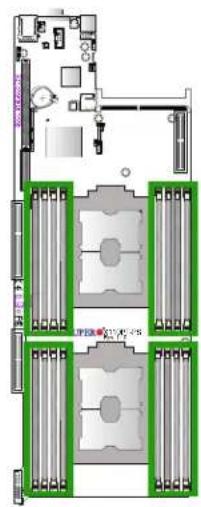
Note: The drawing at right shows DIMM module population for each CPU installed on the motherboard. Please install your processors starting with CPU Socket 1.

text_image
SUPER X11DPT-PS Rev 1.10Symmetric Population within 1 CPU Socket
| Modes | P1-DIMMF1 | P1-DIMME1 | P1-DIMMD1 | P1-DIMMD2 | P1-DIMMA2 | P1-DIMMA1 | P1-DIMMB1 | P1-DIMMC1 | Channel Config. |
| AD DRAM1 | DRAM1 | DRAM1 | DCPMM | DCPMM | DRAM1 | DRAM1 | DRAM1 | 2-1-1 | |
| MM DRAM2 | DRAM2 | DRAM2 | DCPMM | DCPMM | DRAM2 | DRAM2 | DRAM2 | 2-1-1 | |
| AD + MM | DRAM3 | DRAM3 | DRAM3 | DCPMM | DCPMM | DRAM3 | DRAM3 | DRAM3 | 2-1-1 |
| AD DCPMM | DRAM1 | DRAM1 | -- | DRAM1 | DRAM1 | DCPMM | 1-1-1 | ||
| MM DCPMM | DRAM1 | DRAM1 | -- | DRAM1 | DRAM1 | DCPMM | 1-1-1 | ||
| AD + MM | DCPMM | DRAM3 | DRAM3 | -- | DRAM3 | DRAM3 | DCPMM | 1-1-1 |
| Asymmetric Population within 1 CPU Socket | |||||||||
| Modes | P1-DIMMF1 | P1-DIMME1 | P1-DIMMD1 | P1-DIMMD2 | P1-DIMMA2 | P1-DIMMA1 | P1-DIMMB1 | P1-DIMMC1 | Channel Config. |
| AD | DRAM1 | DRAM1 | DRAM1 | - | DCPMM | DRAM1 | DRAM1 | DRAM1 | 2-1-1 |
| AD* | DRAM1 | DRAM1 | DRAM1 | - | DCPMM | DRAM1 | DRAM1 | DRAM1 | 2-1-1 |
| Legend (for the two tables above) | |||||
| DDR4 Type | Capacity | ||||
| DRAM1 | RDIMM | 3DS RDIMM | LRDIMM | 3DS LRDIMM | Any Capacity |
| DRAM2 | RDIMM | - | - | Refer to Validation Matrix (DDR4 DIMMs validated with DCPMM) below. | |
| DRAM3 | RDIMM | 3DS RDIMM | LRDIMM | - | |
Note: DDR4 single rank x8 is not available for DCPMM Memory Mode or App-Direct Mode.
| Legend (for the first two tables above) | |
| Capacity | |
| DCPMM | Any Capacity (Uniformly for all channels for a given configuration) |
• * 2nd socket has no DCPMM DIMM
- For MM, general NM/FM ratio is between 1:4 and 1:16. Excessive capacity for FM can be used for AD. (NM = Near Memory; FM = Far Memory)
- For each individual population, rearrangements between channels are allowed as long as the resulting population is compliant with the PDG rules for the 82xx/62xx/52xx/42xx platform.
- For each individual population, please use the same DDR4 DIMM in all slots.
- For each individual population, sockets are normally symmetric with exceptions for 1 DCPMM per socket and 1 DCPMM per node case. Currently, DCPMM modules operate at 2666 MHz.
- No mixing of DCPMM and NVMDIMMs within the same platform is allowed.
- This DCPMM population guide targets a balanced DCPMM-to-DRAM-cache ratio in MM and MM + AD modes.
| Validation Matrix (DDR4 DIMMs Validated w/DCPMM) | |||
| DIMM Type | Ranks Per DIMM & Data Width (Stack) | DIMM Capacity (GB) | |
| DRAM Density | |||
| 4Gb | 8Gb | ||
| RDIMM | 1Rx4 | 8GB | 16GB |
| 2Rx8 | 8GB | 16GB | |
| 2Rx4 | 16GB | 32GB | |
| LRDIMM | 4Rx4 | N/A | 64GB |
| LRDIMM 3DS | 8Rx4 (4H) | N/A | 128GB |
DIMM Installation
- Follow the instructions given in the memory population guidelines listed in the previous sections to install memory modules on your motherboard. For the system to work properly, please use memory modules of the same type and speed on the motherboard. (See the Note below.)
- Push the release tabs outwards on both ends of the DIMM slot to unlock it.
- Align the key of the DIMM module with the receptive point on the memory slot.
- Align the notches on both ends of the module against the receptive points on the ends of the slot.
- Use two thumbs together to press the DIMM module straight down into the slot until the module snaps into place.
- Press the release tabs to the lock positions to secure the DIMM module into the slot.
text_image
Floor plan diagram with labeled rooms and furniture layout, including a central room marked 'UPEX' and a green floor plan with 'UPEX' label.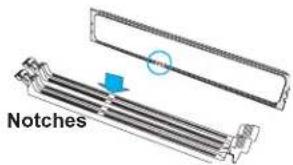
text_image
Notches
text_image
Release TabsInsert the DIMM module into the memory slot.

natural_image
Illustration of two hands holding a metal rod with blue arrows indicating direction (no text or symbols)DIMM Module Removal
Press the release tabs on both ends of the DIMM socket to release the DIMM module from the socket as shown in the drawing on the right.
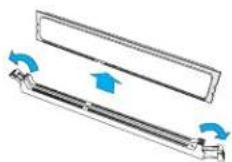
Warning! 1. T to avoid damage to the DIMM module or the DIMM socket, do not use excessive force when pressing the release tabs on the ends of the DIMM socket. 2. Handle DIMM modules with care. Carefully follow all the instructions given in Section 1 of this user guide to avoid ESD-related damage to your components or system. 3. All graphics, including the layout drawing above, are for reference only. Your system components may or may not look the same as shown in this user guide.
PCI Expansion Card Installation
The system includes a pre-installed riser cards (RSC-R1UTP-E16R and RSC-P-6) that positions standard size PCI-E x16 card card at a 90 degree angle, allowing it to fit inside the chassis.
Installing PCI Expansion Cards
The riser card has already been pre-installed into the motherboard. Perform the following steps to install an add-on card:
Begin by removing power from the system as described in section 3.1.
- Remove the chassis cover to access the inside of the system.
- Remove the PCI slot shield on the chassis by releasing the locking tab.
- Insert the expansion (add-on) card into the riser card.
- Secure the card with the locking tab.
Motherboard Battery
The motherboard uses non-volatile memory to retain system information when system power is removed. This memory is powered by a lithium battery residing on the motherboard.
Replacing the Battery
Begin by removing power from the system as described in section 3.1.
- Push aside the small clamp that covers the edge of the battery. When the battery is released, lift it out of the holder.
- To insert a new battery, slide one edge under the lip of the holder with the positive (+) side facing up. Then push the other side down until the clamp snaps over it.
Note: Handle used batteries carefully. Do not damage the battery in any way; a damaged battery may release hazardous materials into the environment. Do not discard a used battery in the garbage or a public landfill. Please comply with the regulations set up by your local hazardous waste management agency to dispose of your used battery properly.

text_image
LITHIUM BATTERY BATTERY HOLDERFigure 3-2. Installing the Onboard Battery
Warning: There is a danger of explosion if the onboard battery is installed upside down (which reverses its polarities). This battery must be replaced only with the same or an equivalent type recommended by the manufacturer (CR2032).
3.4 Chassis Components
Hard Drives
You do not need to access the inside of the chassis or remove power to replace or swap drives. Proceed to the next step for instructions. You must use standard 1" high, drives in the system.
Note: Refer to Supermicro's web site for setup guidelines: http://www.supermicro.com/support/manuals/.
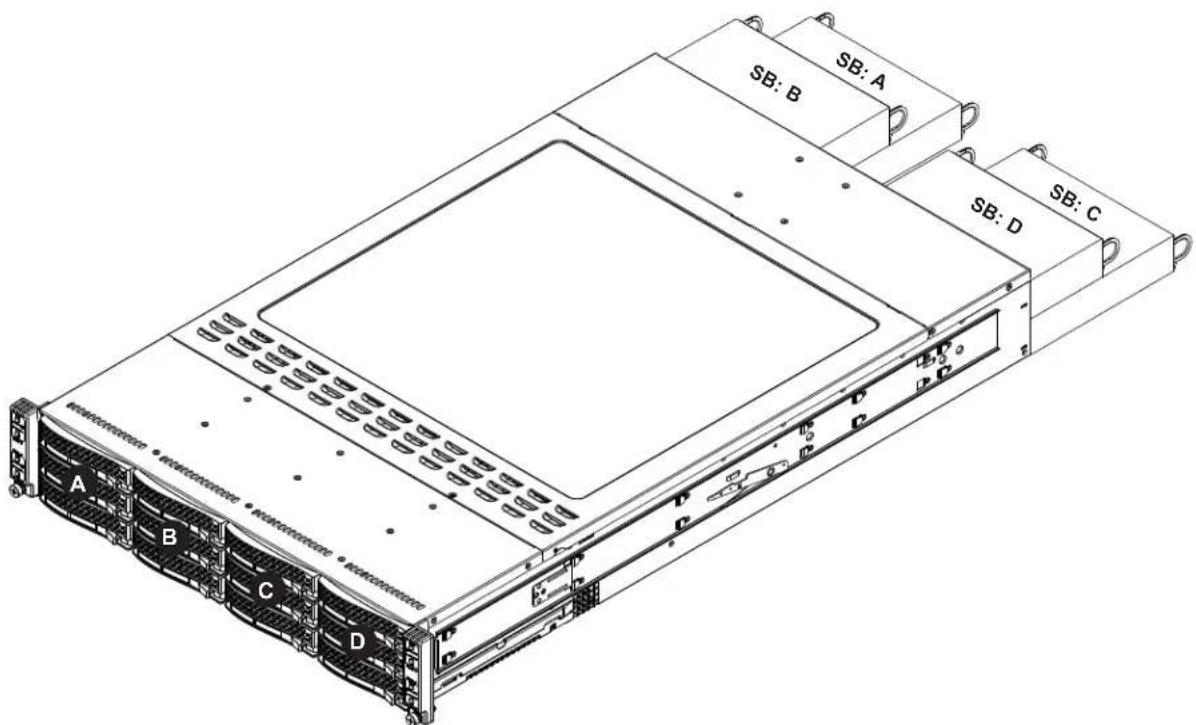
The SC827HQ+ chassis contains four individual serverboards in separate node drawers (Figure 3-3). Each serverboard node controls a set of three hard drives. Note that if a serverboard node drawer is pulled out of the chassis, the hard drives associated with that node will power down as well.
| Serverboard Drawer Locations in the Chassis | |
| Serverboard BControls HDDs B1, B2 and B3 | Serverboard DControls HDDs D1, D2 and D3 |
| Serverboard AControls HDDs A1, A2 and A3 | Serverboard CControls HDDs C1, C2 and C3 |
text_image
SB: A SB: B SB: C A B C DFigure 3-3. Hard Drives and their Corresponding Serverboard Nodes
Removing a Drive Carrier from the Chassis
- Press the release button on the drive carrier. This extends the drive bay handle.
- Use the handle to pull the drive out of the chassis.

natural_image
Technical line drawing of a server rack with internal components and an inset view showing internal structure (no text or symbols)Figure 3-5. Removing a Drive Carrier
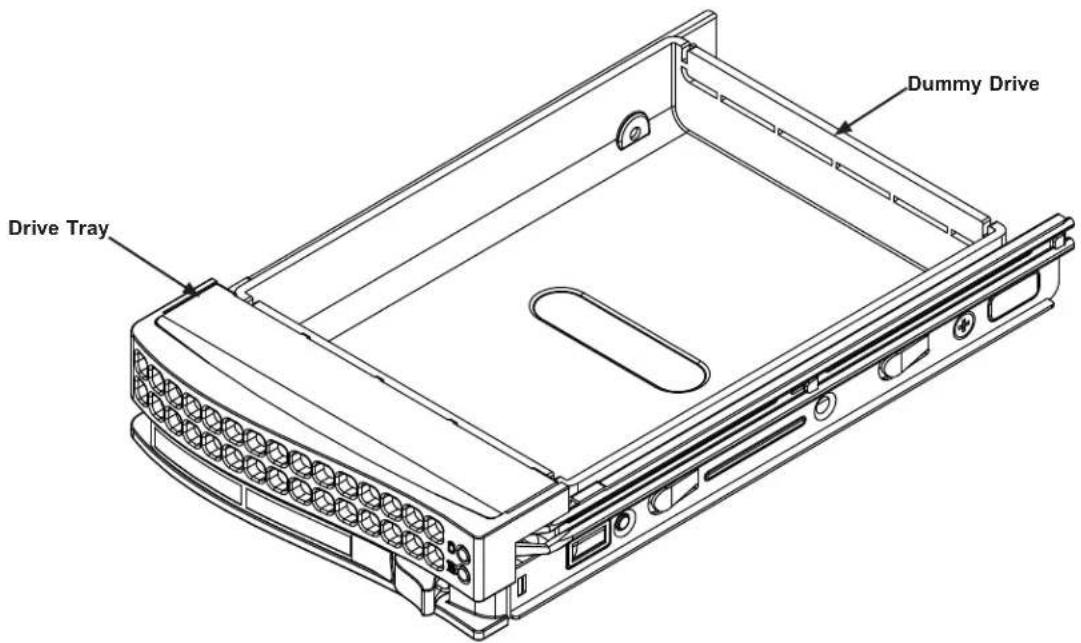
The drives are mounted in drive carriers to simplify their installation and removal from the chassis (Figure 3-6). These carriers also help promote proper airflow for the drive bays.
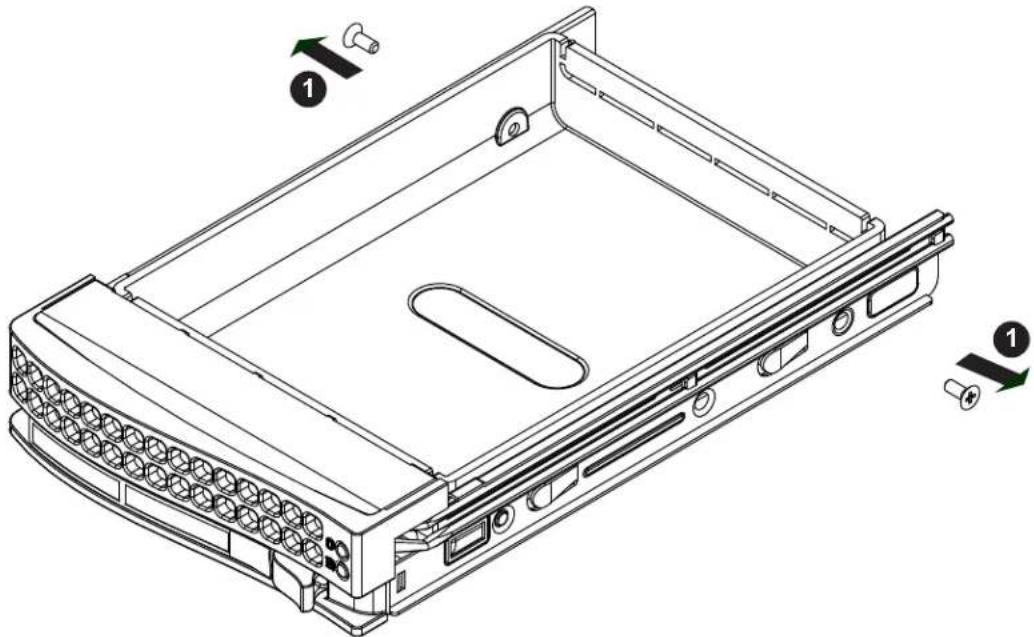
Installing a Drive into the Hard Drive Tray
- Remove the screws holding connecting the drive tray the carrier.
- Remove the tray from the carrier.
text_image
Dummy Drive Drive TrayFigure 3-6. Chassis Drive Tray
text_image
Technical diagram of a server rack with labeled components and numbered partsFigure 3-7. Removing Dummy Drive from Tray
Caution: Except for short periods of time while swapping hard drives, do not operate the server with the hard drives empty.
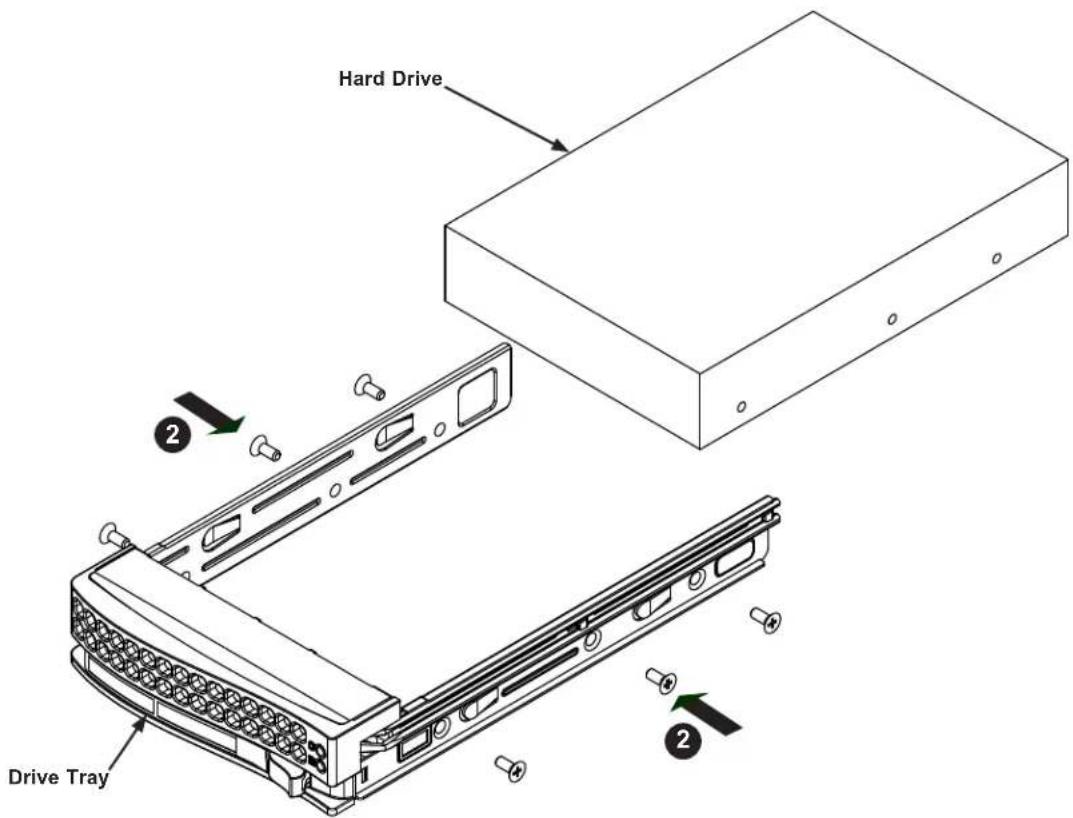
Installing the Hard Drive
- Install a new drive into the carrier with the printed circuit board side facing down so that the mounting holes align with those in the carrier.
- Secure the hard drive by tightening all six screws.
- Use the open handle to replace the drive tray into the chassis. Make sure the close the drive tray handle.
text_image
Hard Drive Drive TrayFigure 3-8. Installing the Hard Drive
Note: Enterprise level hard disk drives are recommended for use in Supermicro chassis and servers. For information on recommended HDDs, visit the Supermicro website at http://www.supermicro.com/products/nfo/files/storage/SBB-HDDCompList.pdf
Hard Drive Carrier Indicators
Each hard drive carrier has two LED indicators: an activity indicator and a status indicator. In RAID configurations, the status indicator lights to indicate the status of the drive. In non-RAID configurations, the status indicator remains off. See the table below for details.
| LED Color | State Status | ||
| Activity LED | Blue Solid On | SAS/NVMe drive installed | |
| Blue Blinking | I/O activity | ||
| Status LED | Red Solid On | Failed drive for SAS/SATA/NVMe with RSTe support | |
| Red Blinking | at 1 Hz Rebuild drive for SAS/SATA/NVMe with RSTe support | ||
| Red Blinking | with two blinks and one stop at 1 Hz | Hot spare for SAS/SATA/NVMe with RSTe support | |
| Red | On for five seconds, then off | Power on for SAS/SATA/NVMe with RSTe support | |
| Red Blinking | at 4 Hz Identify drive for SAS/SATA/NVMe with RSTe support | ||
| Green Solid | On Safe to remove NVMe device | ||
| Amber Blinking | at 1 Hz Attention state-do not remove NVMe device |
System Cooling
Four 8-cm fans provide the cooling for the system. The SC827HQ+ system fans are easy-to-change modules. There is no need to uninstall any other parts inside the system when replacing fans, and no tools are required for installation. These fans are NOT redundant, hot-plug and must be replaced when they fail.
It is very important that the chassis top cover is installed for the cooling air to circulate properly through the chassis and cool the components.
Optional Fan Configurations
The SC827HQ+ model chassis is designed so that the default configuration of the system is for each serverboard to control two fans (Figure 3-9). The fans are hot-swappable. Each serverboard node in the chassis is connected to the backplane through the adapter card, mounted in the serverboard drawer. In the event that one of the serverboard drawers is removed, then the remaining serverboard will operate both fans.
| Fan Configurations Options |
| SC827HQ+ Hot-Swappable Default Configuration |
| Fan A connected to backplane, backplane connected to Node A by adapter card |
| Fan B connected to backplane, backplane connected to Node B by adapter card |
| Fan C connected to backplane, backplane connected to Node C by adapter card |
| Fan D connected to backplane, backplane connected to Node D by adapter card |
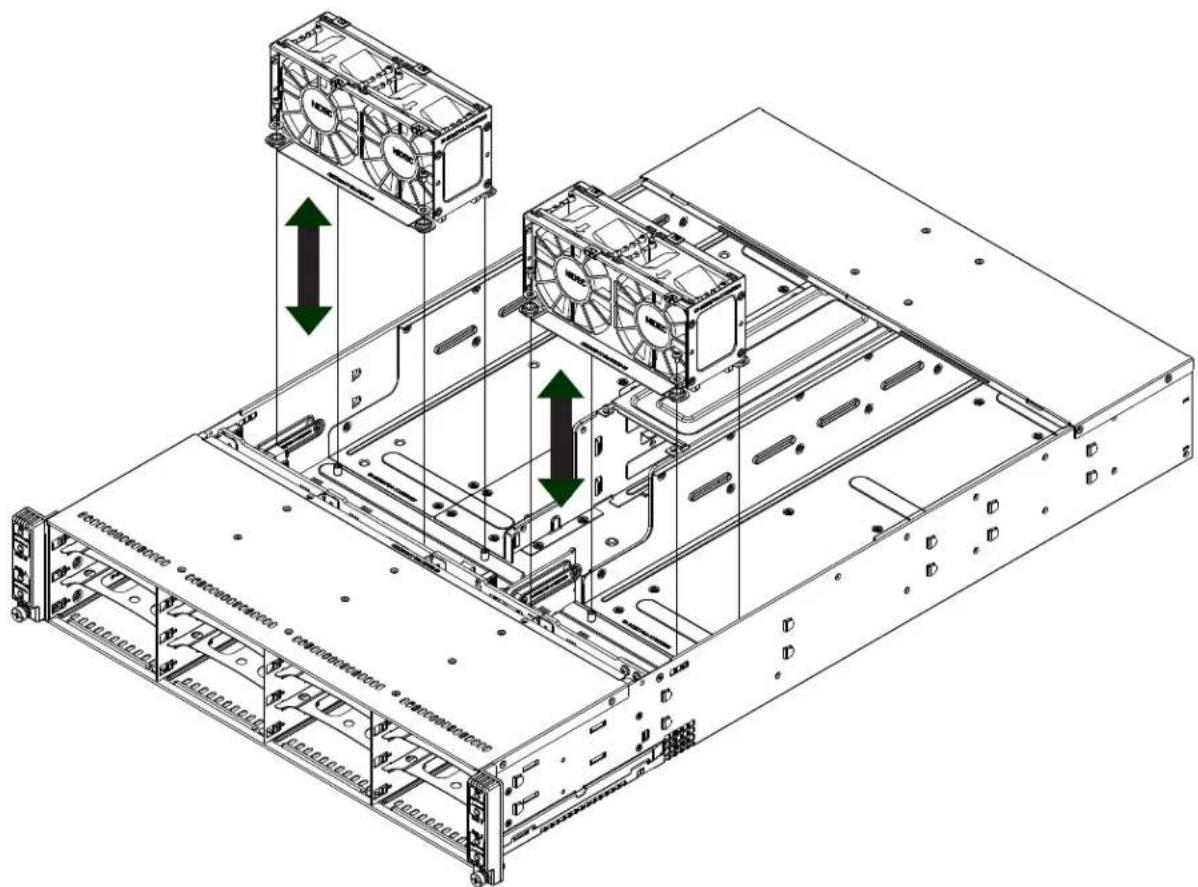
text_image
Technical diagram of a server rack with two fans and directional arrows indicating ventilation or cooling system movement.Figure 3-9. System Fan Placement
Installing Fans
Fan speed is controlled by system temperature via IPMI. If a fan fails, the remaining fans will ramp up to full speed. Replace any failed fan at your earliest convenience with the same type and model (the system can continue to run with a failed fan).
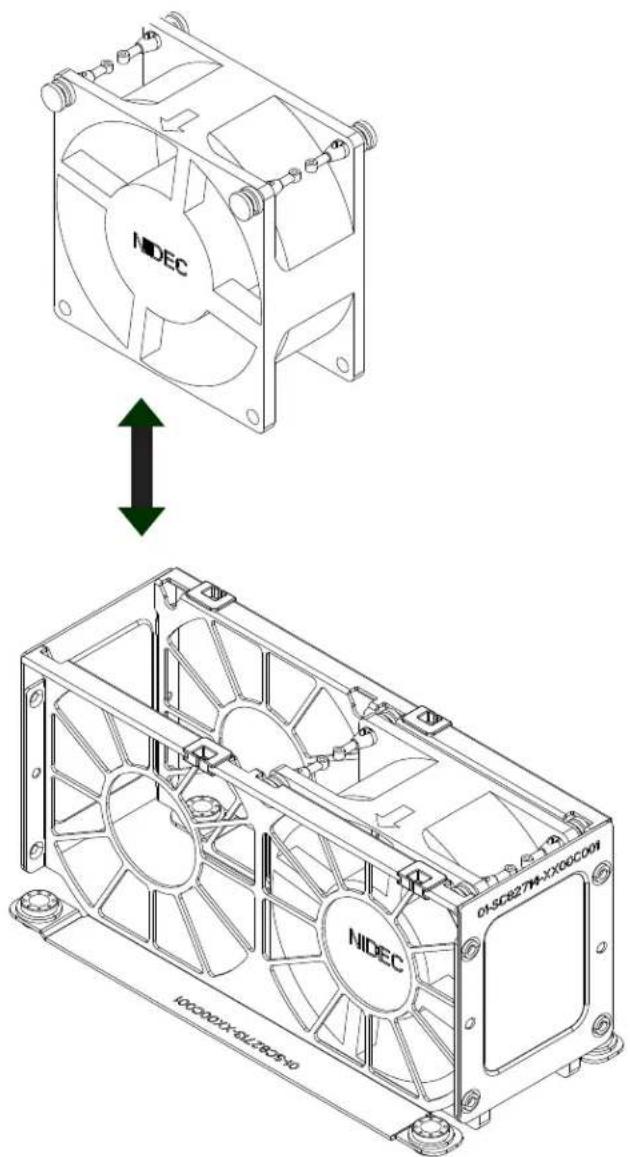
Changing a System Fan
- If necessary, open the chassis while the power is running to determine which fan has failed. (Never run the server for an extended period of time with the chassis cover open.)
- Remove the failed fan's power cord from the backplane.
- Lift the fan housing up and out of the chassis.
- Push the fan up from the bottom and out of the top of the housing.
- Place the replacement fan into the vacant space in the housing while making sure the arrows on the top of the fan (indicating air direction) point in the same direction as the arrows on the other fans.
-
Put the fan back into the chassis and reconnect the cable.
-
Confirm that the fan is working properly before replacing the chassis cover.
text_image
NIDEC 01-SCR27M-XX00C001 NIDEC 100000X-0CL28CS40Figure 3-10. Replacing a System Fan
Air Shroud
The air shroud is used to concentrate airflow to maximize fan efficiency.
Installing the MCP-310-21707-0B Air Shroud
- Lay the chassis on a flat, stable surface and remove the chassis cover.
- Make sure that the motherboard expansion card (if applicable) and all components are properly installed in each motherboard node.
- If necessary, move any cables that interfere with the air shroud placement.
- Place the air shroud in the chassis. The air shroud fits just behind the two fans in the fan rack. Slide the air shroud into the grooves just behind the fan rack.
- Repeat the procedure for the remaining three motherboard nodes.
- Reroute any cables that were moved and replace the chassis cover.
Installing the MCP-310-21716-0B Air Shroud
- Lay the chassis on a flat, stable surface and remove the chassis cover.
- Make sure that the motherboard expansion card (if applicable) and all components are properly installed in each motherboard node.
- If necessary, move any cables that interfere with the air shroud placement.
- Place the air shroud in the chassis. The air shroud fits just behind the two fans in the fan rack. Slide the air shroud into the grooves just behind the fan rack.
- Repeat the procedure for the remaining three motherboard nodes.
- Reroute any cables that were moved and replace the chassis cover.

text_image
Air Shroud ComponentsFigure 3-11. Installing the MCP-310-21707-0B Air Shroud

text_image
Air Shroud ComponentsFigure 3-12. Installing the MCP-310-21716-0B Air Shroud
Adapter Card Replacement
Each serverboard drawer comes equipped with an adapter card which plugs into the backplane. In the unlikely event that the adapter card needs to be replaced, installation requires only a Phillips head screwdriver.
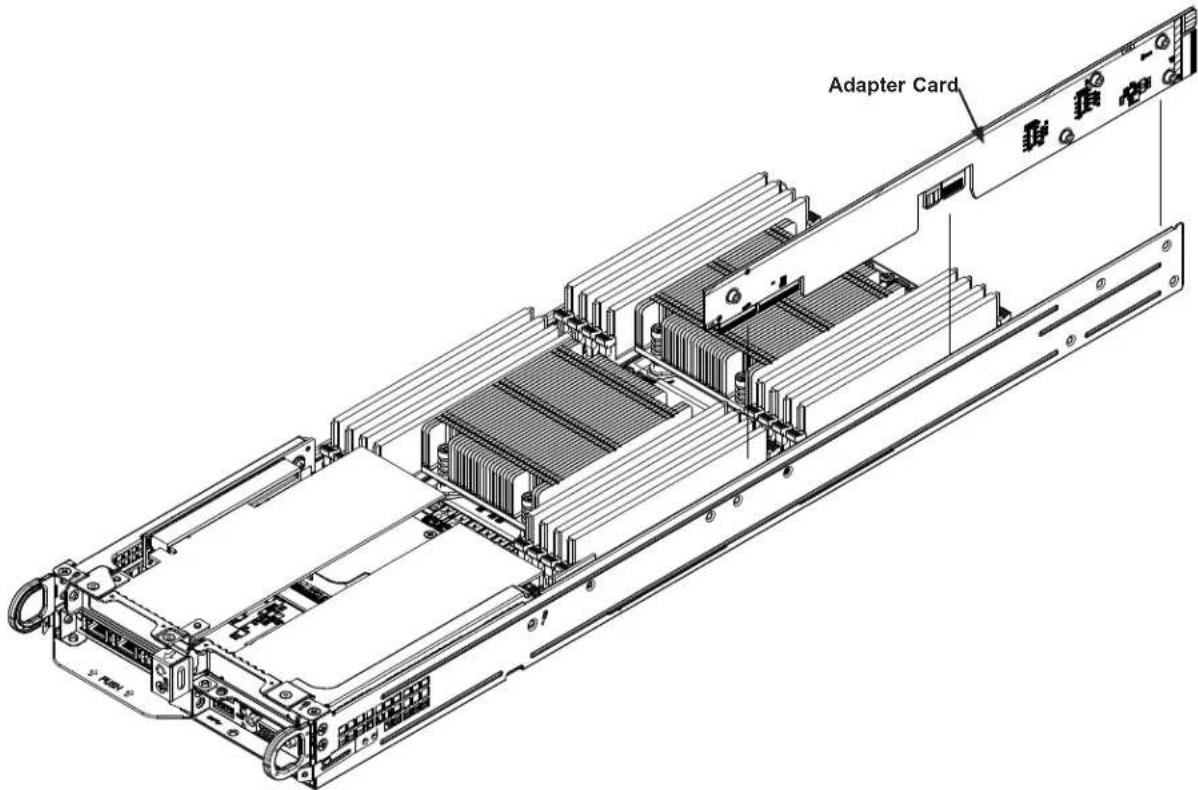
text_image
Adapter Card FAMFigure 3-13. Adapter Card Installation
Note: This picture is for illustrative purposes only. Your system may not resemble this picture. Removing the Adapter Card
- Disconnect the wiring connecting the adapter card to the serverboard.
- Remove the serverboard drawer from the chassis.
- Remove the serverboard from the serverboard drawer by removing the screws securing it to the drawer. Set the screws aside for later use.
- Remove the five screws securing the adapter card to the drawer and set them aside for later use.
- Remove the adapter card from the serverboard drawer.
Installing the Adapter Card (Figure 3-14)
- Place the adapter card in the serverboard drawer, aligning the holes in the adapter card with the holes in the serverboard drawer.
- Secure the adapter card to the serverboard drawer, using the five screws which were previously set aside.
- Reconnect the wiring from the serverboard to the adapter card.
- Return the serverboard drawer to the closed position in the chassis.
Installing an Add-on Card
The SC827HQ+ chassis includes I/O slots for PCI add-on cards. Each side supports one low profile/half length add-on card for a total of four per chassis, one per drawer.
Installing Add-on Cards
- Disconnect the power supply, lay the chassis on a flat surface, and open the chassis cover.
- Pull open the add-on card slot clip in the rear of the chassis.
- Slide the temporary PCI slot shield toward the slot clip and remove the temporary shield from the chassis.
- Connect the add-on card to the riser card.
- Secure the riser card to the serverboard tray using the riser card screw.
- Slide the add-on card bracket into the rear add-on card slot and secure with the add-on card bracket screws.
- Close the add-on card slot clip.
Note: Under normal circumstances, the riser card and add-on card bracket are not separated.
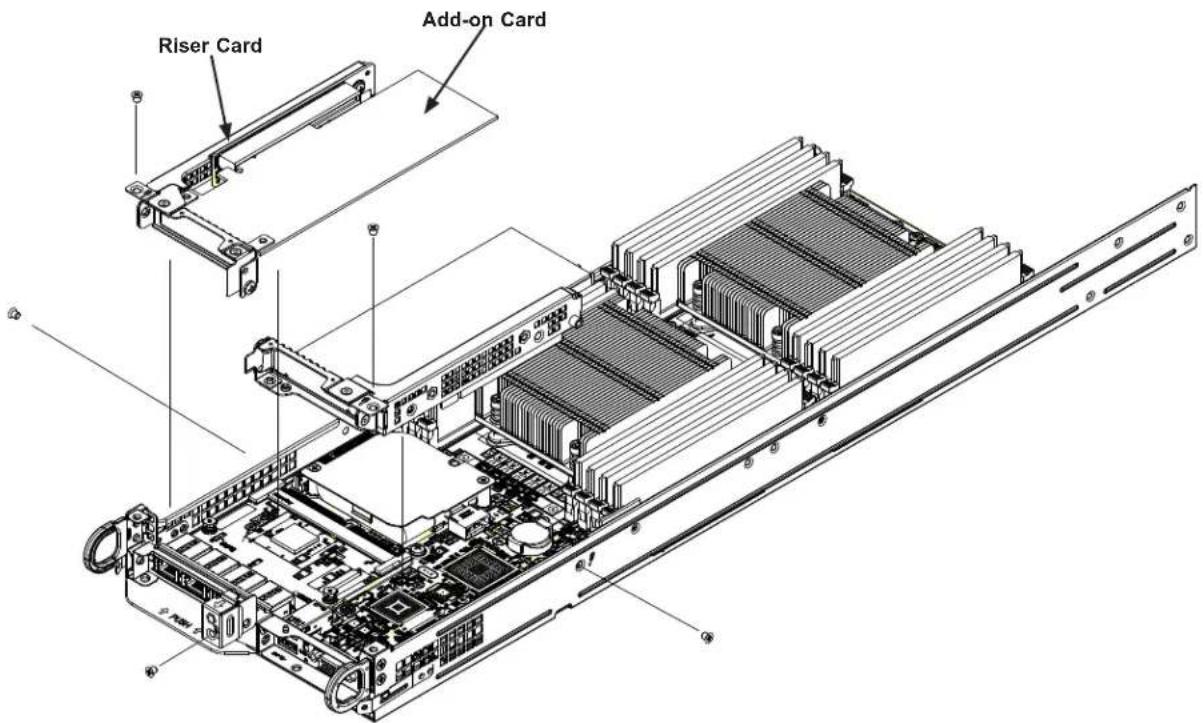
text_image
Riser Card Add-on CardFigure 3-14. Installing a Low Profile Add-On Card
SIOM Modules
The 2028TP-HTR/HC0R/HC1R is designed to accept one of four different SIOM modules (Supermicro I/O Module) to satisfy the specific I/O functions required by the system. The various SIOM modules are as follows:
• AOC-MGP-i2M: two RJ45 (1GbE) ports supported by an Intel i350-AM2 controller.
- AOC-MGP-i4M: four RJ45 (1GbE) ports supported by an Intel i350-AM4 controller.
- AOC-MTGN-i2SM: two SFP+ (10GbE) ports supported by an Intel 82599ES controller.
- AOC-MTGN-i4SM: four SFP+ (10GbE) ports supported by an Intel XL710-BM1 controller.
- AOC-MTG-i2TM: two RJ45 (10GbE) ports supported by an Intel X550 controller
- AOC-MTG-i2TM: two RJ45 (10GbE) ports supported by an Intel X550 controller
- AOC-MHIBF-m2Q2GM: two RJ45 (40GbE) supported by an Intel i350 controller, and two QSFP (56GbE) supported by an Mellanox® ConnectX-3 Pro InfiniBand FDR controller
- AOC-MHIBF-m1Q2GM: two RJ45 (40GbE) supported by an Intel i350 controller, and one QSFP (56GbE) supported by an Mellanox® ConnectX-3 Pro InfiniBand FDR controller
Installing a SIOM Module into the Chassis
- Take out the five screws securing the two front riser brackets in the chassis.
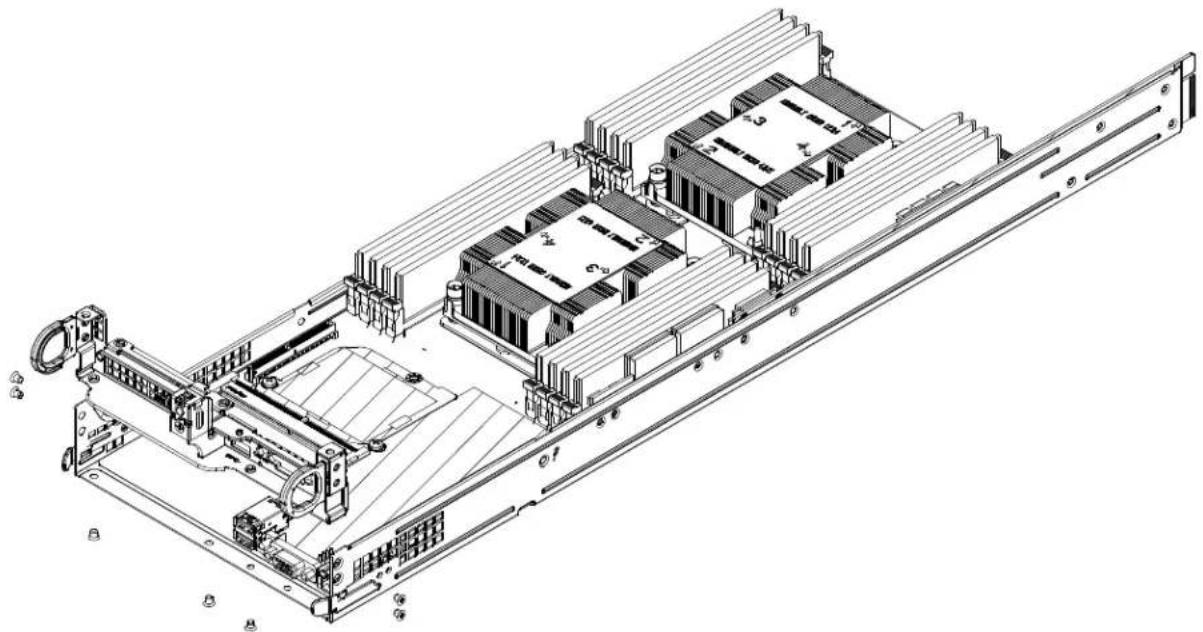
natural_image
Technical line drawing of a server rack with multiple internal components and mounting hardware (no text or symbols)Figure 3-15. Removing the Five Screws Securing the Two Front Riser Brackets
- Remove the two screws from the Pulling Ear and one screw from the side of the SIOM mounting bracket.

natural_image
Technical line drawing of a mechanical assembly with no visible text or symbolsFigure 3-16. Removing the Screws from the Pulling Ear and Side of the Bracket
- Flip the chassis and take out the two screws securing the sled back.
- Flip back the chassis upward and take out the SIOM bracket.

natural_image
Technical line drawing of a server rack with multiple internal components and mounting brackets (no text or symbols)Figure 3-17. Removing the Screws Securing the Sled Back
- Remove the two screws holding the SIOM module and carefully remove the module out of the chassis.

natural_image
Technical line drawing of a mechanical assembly frame with mounting brackets and housing (no text or symbols)Figure 3-18. Removing the SIOM Bracket
- Replace with the new SIOM module desired and put the SIOM bracket back in place. Secure the bracket with its two screws (from step 5) using about 3-pounds of torque and a slow speed (if using a power tool) or manually using a screwdriver.
- Flip the chassis and secure the sled back using its two screws (from step 3).
- Put the Pulling Ear back in place and secure it using its screw at the SIOM mounting bracket (from step 2).
- Replace the five screws securing the two riser brackets (from step 1).
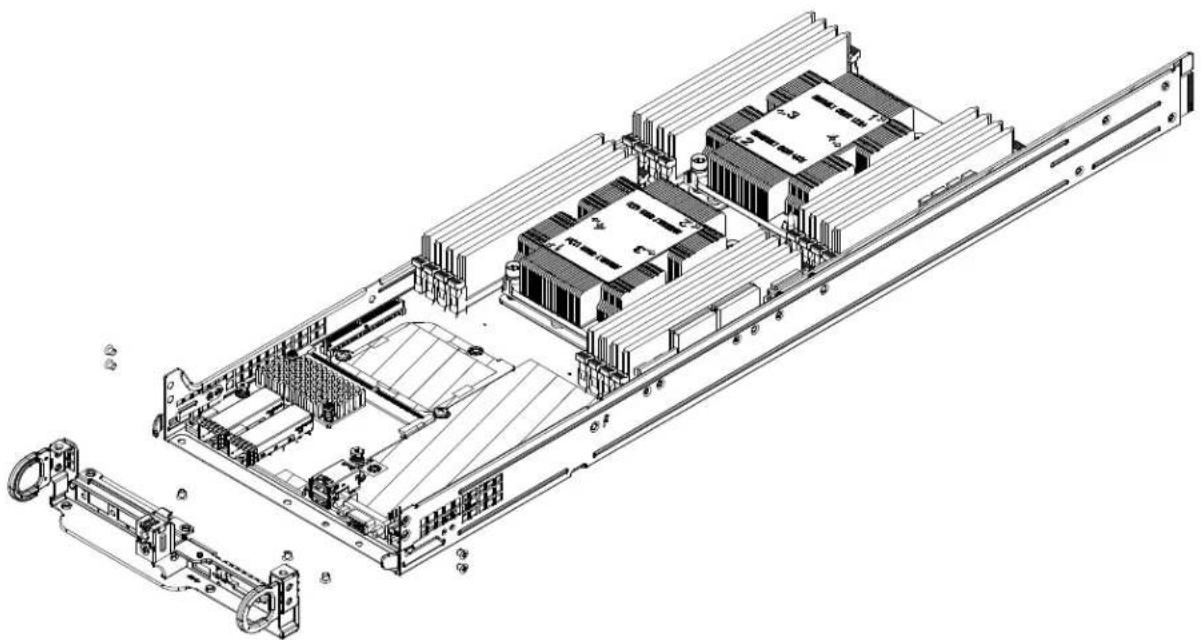
natural_image
Technical line drawing of a server rack with internal components and mounting bracket (no text or symbols)Figure 3-19. Replace the Screws and Secure the SIOM Bracket
Power Supply
The 6029TP-HTR/HC0R/HC1R has a high-efficiency single 2200 Watt power supply, which is auto-switching capable. This enables it to automatically sense and operate with a 100V to 240V input voltage.
Power Supply Replacement
The SC827HQ+ chassis utilizes two redundant power supplies. In the unlikely event that the power supply unit needs to be replaced, one power supply can be removed, without powering down the system. Replacement units can be ordered directly from Supermicro (See the contact information in the Preface of this manual).
Changing the Power Supply (Figure 3-19)
- Power down all four nodes and unplug the power cord.
- Push the release tab (on the back of the power supply) as illustrated.
- Pull the power supply out using the handle provided.
- Push the new power supply module into the power bay until you hear a click.
- Plug the AC power cord back into the module and power up the nodes.

text_image
Release TabFigure 3-20. Removing/Replacing a Power Supply
Chapter 4
Motherboard Connections
This section describes the connections on the motherboard and provides pinout definitions. Note that depending on how the system is configured, not all connections are required. The LEDs on the motherboard are also described here. A severboard layout indicating component locations may be found in Chapter 1.
Please review the Safety Precautions in Chapter 3 before installing or removing components.
4.1 Power Connections
SMCI-Propietary Power Connector
An SMCI-proprietary power connector is located at JHS1 on the motherboard. Connect an appropriate power cable here to provide adequate power to your system.
4.2 Headers and Connectors
Onboard Fan Header
An onboard fan header (FAN3) is located next to COM port (COM1) on the motherboard. This is a 4-pin fan header, which is backward compatible with a traditional 3-pin fan. The onboard fan speed is controlled by Thermal Management (via Hardware Monitoring) in the BIOS. When using Thermal Management setting, please use all 3-pin fans or all 4-pin fans.
| Fan HeaderPin Definitions | |
| Pin# | Definition |
| 1 | Ground (Black) |
| 2 | +12V (Red) |
| 3 | Tachometer |
| 4 | PWM Control |
RAID Key Header
A RAID_Key header is located at JRK1 on the motherboard. RAID key is used to support NVMe SDD. Please refer to the layout below for JRK1 location.
| RAID Key HeaderPin Definitions | |
| Pin# Definition | |
| 1 Ground | |
| 2 P3V3_STBY (RAID_KEY_PU) | |
| 3 Ground | |
| 4 P3V3_STBY (RAID_KEY) |
TPM Header
The JTPM1 header is used to connect a Trusted Platform Module (TPM)/Port 80, which is available from a third-party vendor. The TPM/Port 80 connector is a security device that supports encryption and authentication in hard drives. It allows the motherboard to deny access if the TPM associated with the hard drive is not installed in the system. See the table below for pin definitions.
| Trusted Platform Module/Port 80 Header Pin Definitions | |||
| Pin# Definition Pin# Definition | |||
| 1 P3V3 | 2 SPI_TPM_CS_N | ||
| 3 PCI | RESET_N 4 SPI_PCH | MISO | |
| 5 SPI | PCH_CLK 6 Ground | ||
| 7 SPI | PCH_MOSI 8 x | ||
| 9 P3V3 | STBY 10 P3V3_STBY | ||
I-SATA 3.0 and S-SATA 3.0 Ports
The X11DPT-PS has six I-SATA 3.0 ports (I-SATA0-3, I-SATA4/I-SATA5) and six S-SATA (S-SATA0-5) on the motherboard. These SATA ports are supported by the Intel C621 chipset. I-SATA0-3 are supported by CPU2 PCI-E 3.0 x16 slot on SXB2, and S-SATA0-5 are supported by the CPU1 PCI-E 3.0 x8 slot on SXB1. I-SATA4/ I-SATA5 can be used with Supermicro SuperDOMs, which are yellow SATA DOM connectors with power pins built in, and do not require external power cables. Supermicro SuperDOMs are backward-compatible with regular SATA HDDs or SATA DOMs that need external power cables. All these SATA ports provide serial-link signal connections, which are faster than the connections of Parallel ATA.
| SATA 3.0 Port Pin Definitions | |
| Pin# Signal | |
| 1 | Ground |
| 2 | SATA_TXP |
| 3 | SATA_TXN |
| 4 | Ground |
| 5 | SATA_RXN |
| 6 | SATA_RXP |
| 7 | Ground |
4.3 Ports
See Figure 4-1 below for the locations and descriptions of the various I/O ports on the rear of the motherboard.

text_image
PDL 10V LED 10V VGA VDD VDD VDD VDD VDD VDD VDD VDD VDD VDD VDD VDD VDD VDD VDD VDD VDD VDD VDD VDD VDD VDD VDD VDD VDD VDD VDD VDD VDD VDD VDD VDD VDD VDDFigure 2-2. I/O Port Locations and Definitions

text_image
Diagram showing labeled components of a network interface, including server, VGA, and Ethernet ports with numbered annotations.| Rear I/O Ports | |
| # Description | |
| 1. USB 0 (3.0) | |
| 2. USB 1 (3.0) | |
| 3. Unit Identifier (UID) Switch (JUIDB1) | |
| 4. VGA | |
| 5. IPMI LAN |
VGA Port
The onboard VGA port is located next to IPMI_LAN on the I/O back panel. Use this connection for VGA display.
Serial Port
A COM port (COM1) is located next to the VGA port on the motherboard. This COM port provides serial communication support. See the table below for pin definitions.
| COM PortPin Definitions | |||
| Pin# Definition Pin# Definition | |||
| 1 DCD | 6 DSR | ||
| 2 RXD | 7 RTS | ||
| 3 TXD | 8 CTS | ||
| 4 DTR | 9 RI | ||
| 5 Ground | 10 N/A | ||
Universal Serial Bus (USB) Ports
Two USB 3.0 port (USB0/1) are located on the I/O back panel. Connect appropriate cables here to use USB support. (USB cables are not included).
| Back Panel USB (3.0)Pin Definitions | |||
| Pin# Definition Pin# Definition | |||
| 1 VBUS 10 Power | |||
| 2 | D- | 11 | USB 2.0 Differential Pair |
| 3 D+ | 12 | ||
| 4 | Ground | 13 | Ground of PWR Return |
| 5 StdA_SSRX- 14 | SuperSpeed Receiver | ||
| 6 | StdA_SSRX+ | 15 | Differential Pair |
| 7 | GND_DRAIN | 16 | Ground for Signal Return |
| 8 | StdA_SSTX- | 17 | SuperSpeed Transmitter |
| 9 | StdA_SSTX+ | 18 | Differential Pair |
Unit Identifier Switch/UID LED Indicator
A Unit Identifier (UID) switch (JUIDB1) and a UID LED Indicator (UID_LED1) are located on the rear side of the system. When you press the UID switch, the UID LED indicator will be turned on. Press the UID switch again to turn off the LED. The UID Indicator provides easy identification of a system unit that may be in need of service.
Note: UID can also be triggered via IPMI on the motherboard. For more information on IPMI, please refer to the IPMI User's Guide posted on our website at http://www.supermicro.com.
| UID Switch Pin Definitions |
| Pin# Definition |
| 1 Ground |
| 2 Ground |
| 3 Button In |
| 4 Button In |
| UID LEDPin Definitions |
| Color Status |
| Blue: On Unit Identified |
Ethernet Ports
An IPMI_Dedicated LAN that supports Gigabit LAN is located next to the VGA port on the I/O back panel. This LAN port is supported by the onboard AST 2500 BMC and accepts an RJ45 type cable. Refer to the LED Indicator Section for LAN LED information.
4.4 Jumpers
Explanation of Jumpers
To modify the operation of the motherboard, jumpers are used to choose between optional settings. Jumpers create shorts between two pins to change the function associated with it. Pin 1 is identified with a square solder pad on the printed circuit board. See the motherboard layout page for jumper locations.
Note: On a two-pin jumper, "Closed" means the jumper is on both pins and "Open" indicates the jumper is either on only one pin or has been completely removed.
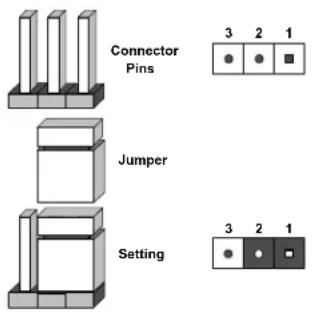
text_image
Connector Pins Jumper Setting 3 2 1 3 2 1CMOS Clear
JBT1 is used to clear CMOS, which will also clear any passwords. Instead of pins, this jumper consists of contact pads to prevent accidentally clearing the contents of CMOS.
To Clear CMOS
- First power down the system and unplug the power cord(s).
- Remove the cover of the chassis to access the motherboard.
- Remove the onboard battery from the motherboard.
- Short the CMOS pads with a metal object such as a small screwdriver for at least four seconds.
- Remove the screwdriver (or shorting device).
- Replace the cover, reconnect the power cord(s) and power on the system.
Notes: Clearing CMOS will also clear all passwords.
Do not use the PW ON connector to clear CMOS.

JBT1 contact pads
Manufacturing Mode Select
Close JPME1 to bypass SPI flash security and force the system to use the Manufacturing Mode, which will allow you to flash the system firmware from a host server to modify system settings. See the table below for jumper settings.
| Manufacturing Mode SelectJumper Settings | |
| Jumper Setting Definition | |
| Pins 1-2 Normal | (Default) |
| Pins 2-3 Manufacturing Mode | |
4.5 LED Indicators
LAN LEDs
Two LAN ports (LAN 1 and LAN 2) are located on the I/O back panel of the motherboard. Each Ethernet LAN port has two LEDs. The green LED indicates activity, while the other Link LED may be green, amber, or off to indicate the speed of the connection. Refer to the tables below for more information.
| LAN1/2 Activity LED (Right)LED State | |
| Color Status Definition | |
| Green Flashing Active | |
| LAN1/2 Link LED (Left)LED State | |
| LED Color Definition | |
| Green 10Gbps | |
| Yellow/Amber 1Gbps | |
Dedicated IPMI LAN LEDs
In addition to LAN1 and LAN2, an IPMI LAN is also located on the I/O back panel. The amber LED on the right of the IPMI LAN port indicates activity, while the green LED on the left indicates the speed of the connection. See the table below for more information.
| IPMI LAN LEDs | ||
| LED Color/State Definition | ||
| Link (left) | Green: SolidAmber: Solid | 100 Mb/s1Gbps |
| Activity (right) | Amber: Blinking | Active |

Activity LEDLink LED
Chapter 5
Software
After the hardware has been installed, you can install the Operating System (OS), configure RAID settings and install the drivers.
5.1 Microsoft Windows OS Installation
If you will be using RAID, you must configure RAID settings before installing the Windows OS and the RAID driver. Refer to the RAID Configuration User Guides posted on our website at www.supermicro.com/support/manuals.
Installing the OS
- Create a method to access the MS Windows installation ISO file. That might be a DVD, perhaps using an external USB/SATA DVD drive, or a USB flash drive, or the IPMI KVM console.
- Retrieve the proper RST/RSTe driver. Go to the Supermicro web page for your motherboard and click on "Download the Latest Drivers and Utilities", select the proper driver, and copy it to a USB flash drive.
- Boot from a bootable device with Windows OS installation. You can see a bootable device list by clicking F11 during the system startup.

text_image
Please select boot device: ATEN Virtual CDROM YSOJ → IPMI virtual drive (Legacy) ASUS SDRW-08D2S-U F601 → USB DVD device (Legacy) USB FLASH DRIVE PMAP → USB flash drive with OS installation (Legacy) IBA 40-10G Slot 1900 v1060 → PXE boot (Legacy) UEFI: ATEN Virtual CDROM YSOJ → IPMI virtual drive (UEFI) UEFI: ASUS SDRW-08D2S-U F601 → USB DVD device (UEFI) UEFI: Built-in EFI Shell Enter Setup ↑ and ↓ to move selection ENTER to select boot device ESC to boot using defaultsFigure 5-1. Select Boot Device
- During Windows Setup, continue to the dialog where you select the drives on which to install Windows. If the disk you want to use is not listed, click on "Load driver" link at the bottom left corner.

text_image
Where do you want to install Windows? Name Total size Free space Type Refresh Delete Format New Load driver Extend We couldn't find any drives. To get a storage driver, click Load driver. NextFigure 5-2. Load Driver Link
To load the driver, browse the USB flash drive for the proper driver files.
- For RAID, choose the SATA/sSATA RAID driver indicated then choose the storage drive on which you want to install it.
-
For non-RAID, choose the SATA/sSATA AHCI driver indicated then choose the storage drive on which you want to install it.
-
Once all devices are specified, continue with the installation.
- After the Windows OS installation has completed, the system will automatically reboot multiple times.
5.2 Driver Installation
The Supermicro website contains drivers and utilities for your system at https://www.supermicro.com/wftp/driver. Some of these must be installed, such as the chipset driver.
After accessing the website, go into the CDR_Images (in the parent directory of the above link) and locate the ISO file for your motherboard. Download this file to a USB flash drive or a DVD. (You may also use a utility to extract the ISO file if preferred.)
Another option is to go to the Supermicro website at http://www.supermicro.com/products/. Find the product page for your motherboard, and "Download the Latest Drivers and Utilities".
Insert the flash drive or disk and the screenshot shown below should appear.

text_image
SUPERMICRO X11DPT-PS Motherboard Drivers & Tools (Win7) Intel C621 Chipset X11DPT-PS SUPERMICRO Computer Inc. Intel Chipset INF files Microsoft .Net Framework 4.5.2 (Optional) ASPEED Graphics Driver Intel Rapid Storage Technology Enterprise Intel USB 3.0 Drivers Intel PRO Network Connections Drivers SUPERMICRO SuperDoctor 5 Build driver diskettes and manuals Browse CD Auto Start Up Next Time For more information, please visit SUPERMICRO's web site.Figure 5-1. Driver & Tool Installation Screen
Note: Click the icons showing a hand writing on paper to view the readme files for each item. Click the computer icons to the right of these items to install each item (from top to the bottom) one at a time. After installing each item, you must re-boot the system before moving on to the next item on the list. The bottom icon with a CD on it allows you to view the entire contents.
5.3 SuperDoctor® 5
The Supermicro SuperDoctor 5 is a program that functions in a command-line or web-based interface for Windows and Linux operating systems. The program monitors such system health information as CPU temperature, system voltages, system power consumption, fan speed, and provides alerts via email or Simple Network Management Protocol (SNMP).
SuperDoctor 5 comes in local and remote management versions and can be used with Nagios to maximize your system monitoring needs. With SuperDoctor 5 Management Server (SSM Server), you can remotely control power on/off and reset chassis intrusion for multiple systems with SuperDoctor 5 or IPMI. SuperDoctor 5 Management Server monitors HTTP, FTP, and SMTP services to optimize the efficiency of your operation.
Note: The default User Name and Password for SuperDoctor 5 is ADMIN / ADMIN.
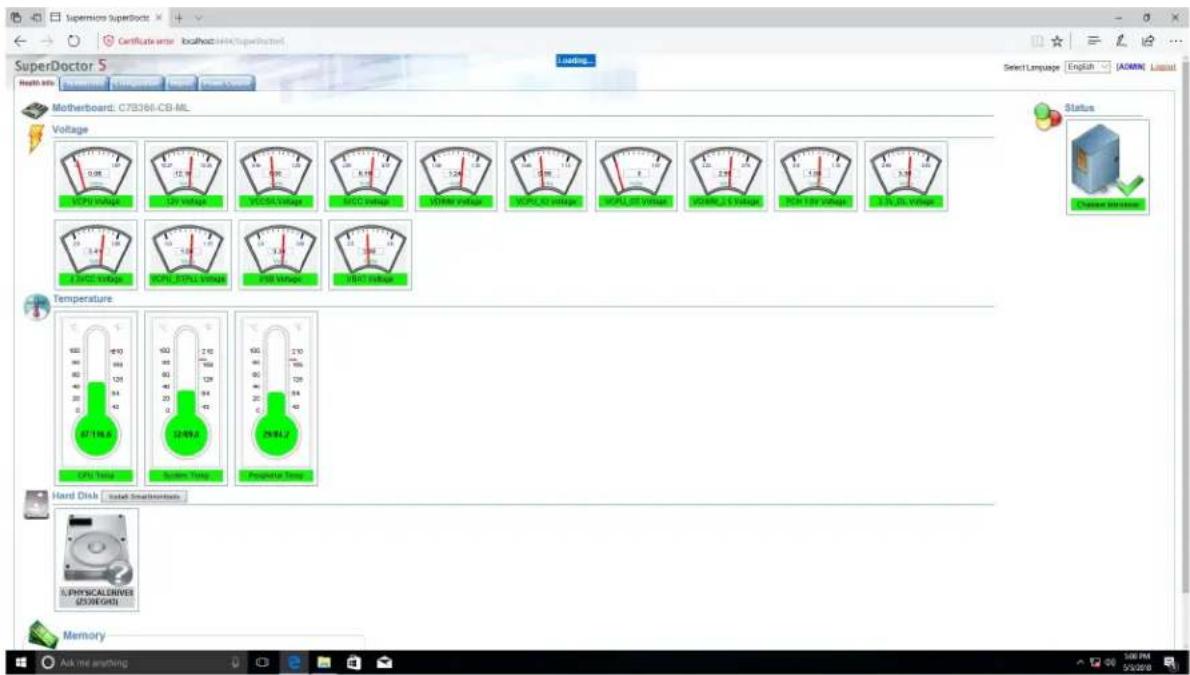
text_image
SuperDoctor 5 Health MIs Certificate error localhost:144k/SuperDoctor Loading... Select Language English (ADMIN) Layout Motherboard: C7B366-CB-ML Voltage 0.08 12.00 14.00 16.00 18.00 20.00 22.00 24.00 26.00 28.00 30.00 32.00 34.00 36.00 38.00 40.00 42.00 44.00 46.00 48.00 50.00 52.00 54.00 56.00 58.00 60.00 62.00 64.00 66.00 68.00 70.00 72.00 74.00 76.00 78.00 80.00 82.00 84.00 86.00 88.00 90.00 92.00 94.00 96.00 98.00 100.00 102.00 104.00 106.00 108.00 110.00 112.00 114.00 116.00 118.00 120.00 122.00 124.00 126.00 128.00 130.00 132.00 134.00 136.00 138.00 140.00 142.00 144.00 146.00 148.00 150.00 152.00 154.00 156.00 158.00 160.00 162.00 164.00 166.00 168.00 170.00 172.00 174.00 176.00 178.00 180.00 182.00 184.00 186.00 188.00 190.00 192.00 194.00 196.00 198.00 200.00 202.00 204.00 206.00 208.00 210.00 212.00 214.00 216.00 218.00 220.00 222.00 224.00 226.00 228.00 230.00 232.00 234.00 236.00 238.00 240.00 242.00 244.0Figure 5-2. SuperDoctor 5 Interface Display Screen (Health Information)
5.4 IPMI
The X11DPT-PS supports the Intelligent Platform Management Interface (IPMI). IPMI is used to provide remote access, monitoring and management. There are several BIOS settings that are related to IPMI.
For general documentation and information on IPMI, please visit our website at: http://www.supermicro.com/products/nfo/IPMI.cfm.
Chapter 6
BIOS
6.1 Introduction
This chapter describes the AMIBIOS™ Setup utility for theX11DPT-PS X11DPT-PS motherboard. The BIOS is stored on a chip and can be easily upgraded using a flash program.
Note: Due to periodic changes to the BIOS, some settings may have been added or deleted and might not yet be recorded in this manual. Please refer to the Manual Download area of our website for any changes to BIOS that may not be reflected in this manual.
Starting the Setup Utility
To enter the BIOS setup utility, press the
The Main BIOS screen has two main frames. The left frame displays all the options that can be configured. "Grayed-out" options cannot be configured. The right frame displays the key legend. Above the key legend is an area reserved for a text message. When an option is selected in the left frame, it is highlighted in white. Often a text message will accompany it. (Note that BIOS has default text messages built in. We retain the option to include, omit, or change any of these text messages.) Settings printed in Bold are the default values.
A "▶" indicates a submenu. Highlighting such an item and pressing the
The BIOS setup utility uses a key-based navigation system called hot keys. Most of these hot keys (
6.2 Main Setup
When you first enter the AMI BIOS setup utility, you will enter the Main setup screen. You can always return to the Main setup screen by selecting the Main tab on the top of the screen. The Main BIOS setup screen is shown below. The following Main menu items will be displayed:
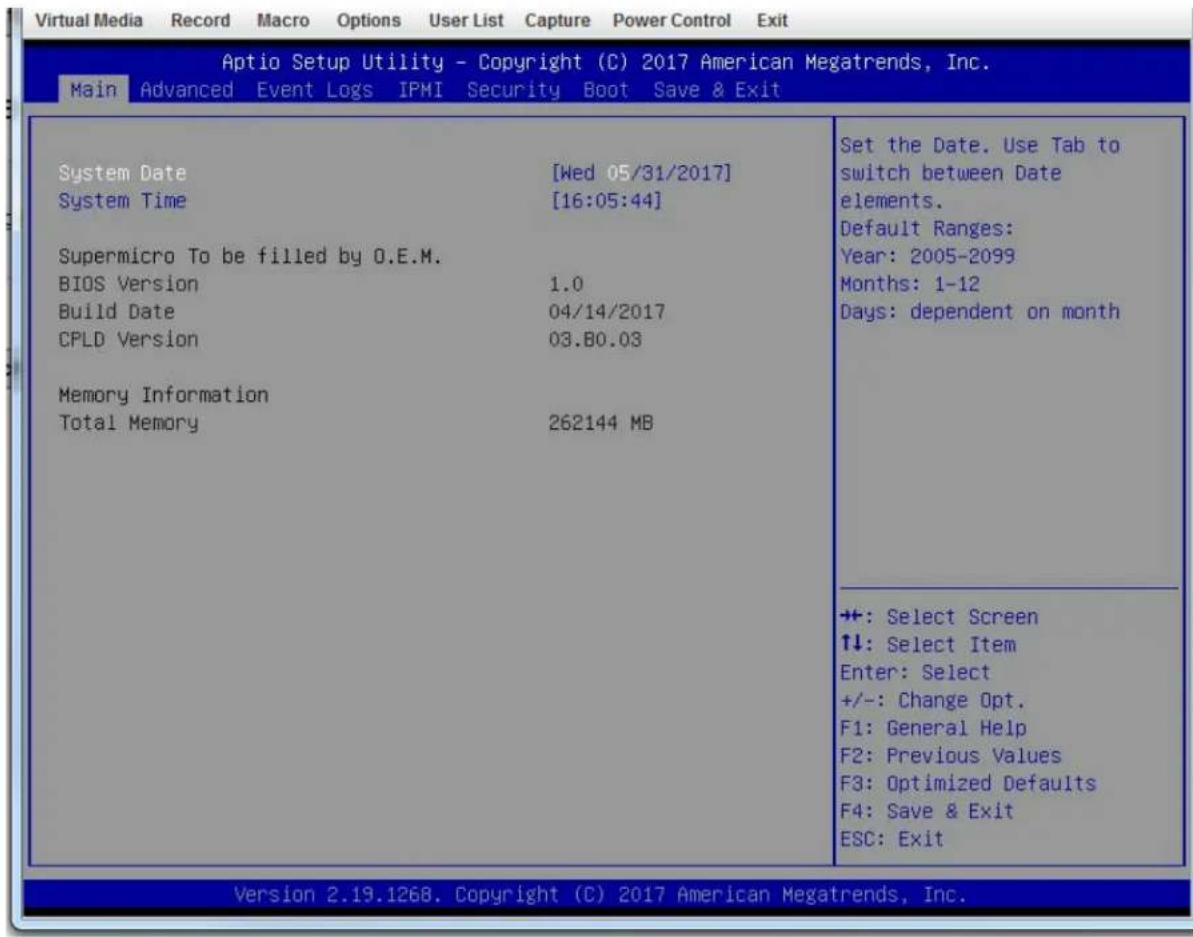
text_image
Virtual Media Record Macro Options User List Capture Power Control Exit Aptio Setup Utility - Copyright (C) 2017 American Megatrends, Inc. Main Advanced Event Logs IPMI Security Boot Save & Exit System Date [Wed 05/31/2017] System Time [16:05:44] Supermicro To be filled by O.E.M. BIOS Version 1.0 Build Date 04/14/2017 CPLD Version 03.B0.03 Memory Information Total Memory 262144 MB Set the Date. Use Tab to switch between Date elements. Default Ranges: Year: 2005-2099 Months: 1-12 Days: dependent on month +: Select Screen ↑↓: Select Item Enter: Select +/-: Change Opt. F1: General Help F2: Previous Values F3: Optimized Defaults F4: Save & Exit ESC: Exit Version 2.19.1268. Copyright (C) 2017 American Megatrends, Inc.System Date/System Time
Use this feature to change the system date and time. Highlight System Date or System Time using the arrow keys on the keyboard. Press the
Note: The time is in the 24-hour format. For example, 5:30 P.M. appears as 17:30:00. The date's default value is 01/01/2014 after RTC reset.
Supermicro X11DPT-PS
BIOS Version
This item displays the version of the BIOS ROM used in the system.
Build Date
This item displays the date when the version of the BIOS ROM used in the system was built.
CPLD Version
This item displays the version of the CPLD (Complex-Programmable Logical Device) used in the system.
Memory Information
Total Memory
This item displays the total size of memory available in the system.
Memory Speed
This item displays the default speed of the memory modules installed in the system.
6.3 Advanced Setup Configurations
Use the arrow keys to select the Advanced submenu and press
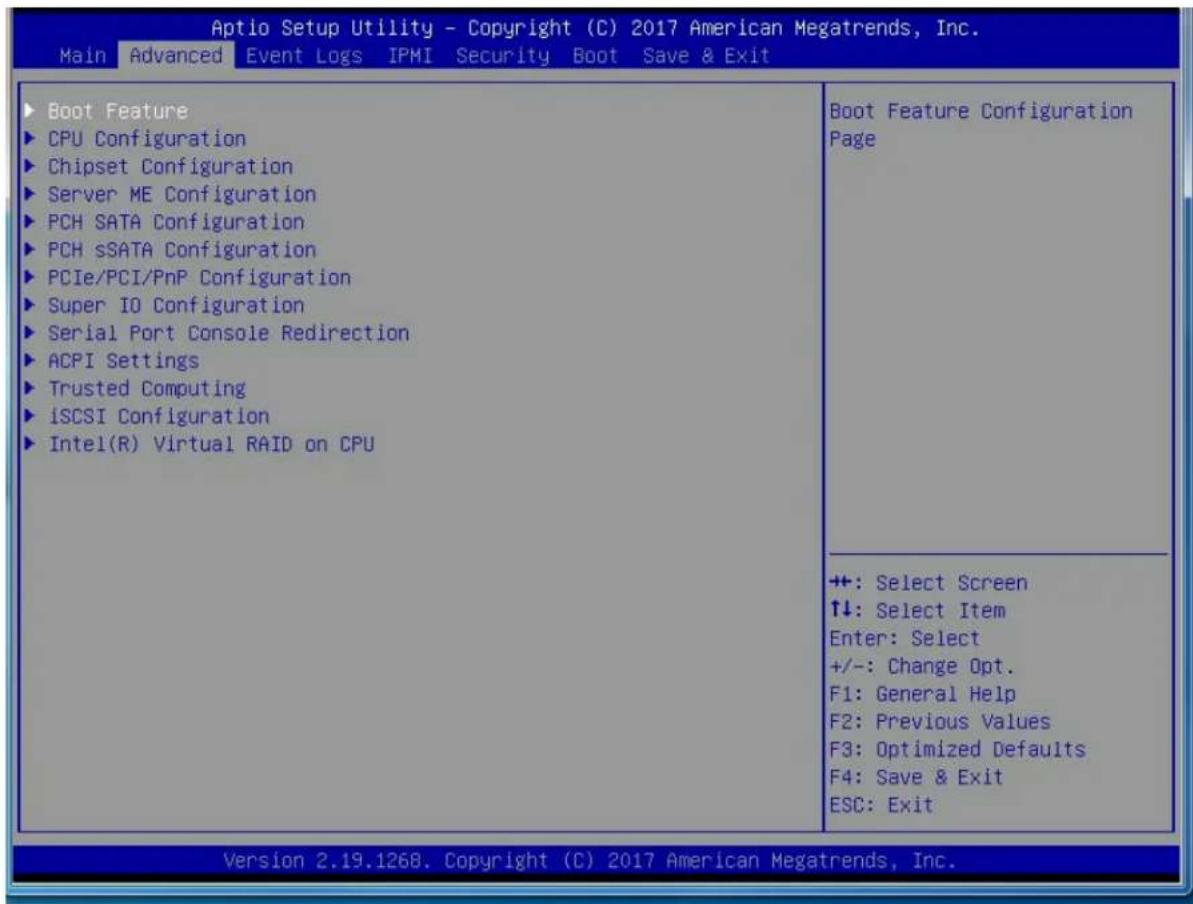
text_image
Aptio Setup Utility - Copyright (C) 2017 American Megatrends, Inc. Main Advanced Event Logs IPMI Security Boot Save & Exit ▶ Boot Feature ▶ CPU Configuration ▶ Chipset Configuration ▶ Server ME Configuration ▶ PCH SATA Configuration ▶ PCH sSATA Configuration ▶ PCIe/PCI/PnP Configuration ▶ Super IO Configuration ▶ Serial Port Console Redirection ▶ ACPI Settings ▶ Trusted Computing ▶ iSCSI Configuration ▶ Intel(R) Virtual RAID on CPU Boot Feature Configuration Page ++: Select Screen ↑↓: Select Item Enter: Select +/-: Change Opt. F1: General Help F2: Previous Values F3: Optimized Defaults F4: Save & Exit ESC: Exit Version 2.19.1268. Copyright (C) 2017 American Megatrends, Inc.Warning: Take Caution when changing the Advanced settings. An incorrect value, an incorrect DRAM frequency, or an incorrect BIOS timing setting may cause the system to malfunction. When this occurs, restore the setting to the manufacture default setting.
▶Boot Feature
Quiet Boot
Use this feature to select the screen between displaying POST messages or the OEM logo at bootup. Select Disabled to display the POST messages. Select Enabled to display the OEM logo instead of the normal POST messages. The options are Enabled and Disabled.
Note: POST message is always displayed regardless of the item setting.
Option ROM Messages
Use this feature to set the display mode for the Option ROM. Select Keep Current to use the current AddOn ROM display setting. Select Force BIOS to use the Option ROM display mode set by the system BIOS. The options are Force BIOS and Keep Current.
Bootup NumLock State
Use this feature to set the Power-on state for the Numlock key. The options are Off and On.
Wait For 'F1' If Error
Select Enabled to force the system to wait until the 'F1' key is pressed if an error occurs. The options are Disabled and Enabled.
INT19 Trap Response
Interrupt 19 is the software interrupt that handles the boot disk function. When this item is set to Immediate, the ROM BIOS of the host adaptors will "capture" Interrupt 19 at bootup immediately and allow the drives that are attached to these host adaptors to function as bootable disks. If this item is set to Postponed, the ROM BIOS of the host adaptors will not capture Interrupt 19 immediately and allow the drives attached to these adaptors to function as bootable devices at bootup. The options are Immediate and Postponed.
Re-try Boot
When EFI (Expansible Firmware Interface) Boot is selected, the system BIOS will automatically reboot the system from an EFI boot device after an initial boot failure. Select Legacy Boot to allow the BIOS to automatically reboot the system from a Legacy boot device after an initial boot failure. The options are Disabled, Legacy Boot, and EFI Boot.
Install Windows 7 USB Support
Select Enabled to install Windows 7 and the XHCI drivers for USB keyboard/mouse support. After you've installed the Windows 7 and XHCI drivers, be sure to set this feature to "Disabled" (default). The options are Disabled and Enabled.
Port 61h Bit-4 Emulation
Select Enabled for I/O Port 61h-Bit 4 emulation support to enhance system performance. The options are Enabled and Disabled.
Power Configuration
Watch Dog Function
Select Enabled to allow the Watch Dog timer to reboot the system when it is inactive for more than 5 minutes. The options are Enabled and Disabled.
Restore on AC Power Loss
Use this feature to set the power state after a power outage. Select Power-Off for the system power to remain off after a power loss. Select Power-On for the system power to be turned on after a power loss. Select Last State to allow the system to resume its last power state before a power loss. The options are Power-On, Stay-Off and Last State.
Power Button Function
This feature controls how the system shuts down when the power button is pressed. Select 4 Seconds Override for the user to power off the system after pressing and holding the power button for 4 seconds or longer. Select Instant Off to instantly power off the system as soon as the user presses the power button. The options are 4 Seconds Override and Instant Off.
Throttle on Power Fail
Select Enabled to decrease system power input by throttling CPU frequency when the power supply fails. The options are Enabled and Disabled.
▶CPU Configuration
Warning: Setting the wrong values in the following sections may cause the system to malfunction.
▶Processor Configuration
The following CPU information will be displayed:
Processor BSP Revision
Processor Socket
Processor ID
Processor Frequency
Processor Max Ratio
Processor Min Ratio
Microcode Revision
L1 Cache RAM
L2 Cache RAM
L3 Cache RAM
Processor 0 Version
Processor 1 Version
Hyper-Threading (ALL)
Select Enable to use Intel Hyper-Threading Technology to enhance CPU performance. The options are Enable and Disable.
Execute Disable Bit (Available if supported by the OS & the CPU)
Select Enable to enable Execute Disable Bit support which will allow the processor to designate areas in the system memory where an application code can execute and where it cannot, thus preventing a worm or a virus from flooding illegal codes to overwhelm the processor, damaging the system during a virus attack. The options are Enable and Disable. (Refer to Intel and Microsoft websites for more information.)
Intel Virtualization Technology
Select Enable to use Intel Virtualization Technology which will allow the I/O device assignments to be directly reported to the VMM (Virtual Memory Management) through the DMAR ACPI tables. This feature offers fully-protected I/O resource-sharing across the Intel platforms, providing the user with greater reliability, security and availability in networking and data-sharing. The settings are Enable and Disable.
PPIN Control
Select Unlock/Enable to use the Protected-Processor Inventory Number (PPIN) in the system. The options are Unlock/Enable and Unlock/Disable.
Hardware Prefetcher (Available when supported by the CPU)
If this feature is set to Enable, the hardware prefetcher will prefetch streams of data and instructions from the main memory to the Level 2 (L2) cache to improve CPU performance. The options are Disable and Enable.
Adjacent Cache Prefetch (Available when supported by the CPU)
Select Enable for the CPU to prefetch both cache lines for 128 bytes as comprised. Select Disable for the CPU to prefetch both cache lines for 64 bytes. The options are Disable and Enable.
Note: Please power off and reboot the system for the changes you've made to take effect. Please refer to Intel's website for detailed information.
DCU Streamer Prefetcher (Available when supported by the CPU)
If this feature is set to Enable, the DCU (Data Cache Unit) streamer prefetcher will prefetch data streams from the cache memory to the DCU (Data Cache Unit) to speed up data accessing and processing for CPU performance enhancement. The options are Disable and Enable.
DCU IP Prefetcher
If this feature is set to Enable, the IP prefetcher in the DCU (Data Cache Unit) will prefetch IP addresses to improve network connectivity and system performance. The options are Enable and Disable.
LLC Prefetch
If this feature is set to Enable, LLC (hardware cache) prefetching on all threads will be supported. The options are Disable and Enable.
Extended APIC (Extended Advanced Programmable Interrupt Controller)
Based on the Intel Hyper-Threading technology, each logical processor (thread) is assigned 256 APIC IDs (APIDs) in 8-bit bandwidth. When this feature is set to Enable, the APIC ID will be expanded from 8 bits to 16 bits to provide 512 APIDs to each thread to enhance CPU performance. The options are Disable and Enable.
AES-NI
Select Enable to use the Intel Advanced Encryption Standard (AES) New Instructions (NI) to ensure data security. The options are Enable and Disable.
▶Advanced Power Management Configuration
▶CPU P State Control
SpeedStep (PStates)
EIST (Enhanced Intel SpeedStep Technology) allows the system to automatically adjust processor voltage and core frequency in an effort to reduce power consumption and heat dissipation. Please refer to Intel's website for detailed information. The options are Disable and Enable.
EIST PSD Function (Available when SpeedStep is set to Enable)
Use this feature to configure the processor's P-State coordination settings. During a P-State, the voltage and frequency of the processor will be reduced when it is in operation. This makes the processor more energy efficient, resulting in further energy gains. The options are HW_ALL, SW_ALL and SW-ANY.
Turbo Mode (Available when SpeedStep is set to Enable)
Select Enable for processor cores to run faster than the frequency specified by the manufacturer. The options are Disable and Enable.
▶Hardware PM (Power Management) State Control
Hardware P-States
If this feature is set to Disable, hardware will choose a P-state setting for the system based on an OS request. If this feature is set to Native Mode, hardware will choose a P-state setting based on OS guidance. If this feature is set to Native Mode with No Legacy Support, hardware will choose a P-state setting independently without OS guidance. The options are Disable, Native Mode, Out of Band Mode, and Native Mode with No Legacy Support.
▶CPU C State Control
Autonomous Core C-State
Select Enable to support Autonomous Core C-State control which will allow the processor core to control its C-State setting automatically and independently. The options are Enable and Disable.
CPU C6 Report
Select Enable to allow the BIOS to report the CPU C6 state (ACPI C3) to the operating system. During the CPU C6 state, power to all caches is turned off. The options are Auto, Enable, and Disable.
Enhanced Halt State (C1E)
Select Enable to enable "Enhanced Halt State" support, which will significantly reduce the CPU's power consumption by minimizing CPU's clock cycles and reduce voltage during a "Halt State." The options are Disable and Enable.
▶Package C State Control
Package C State
Use this feature to set the limit on the C-State package register. The options are C0/1 state, C2 state, C6 (non-Retention) state, C6 (Retention) state, No Limit, and Auto.
▶CPU T State Control
Software Controlled T-States
If this feature is set to Enable, CPU throttling settings will be supported by the software of the system. The options are Disable and Enable.
▶Chipset Configuration
Warning: Setting the wrong values in the following sections may cause the system to malfunction.
▶North Bridge
This feature allows the user to configure the settings for the Intel North Bridge.
▶UPI (Ultra Path Interconnect) Configuration
This section displays the following UPI General Configuration information:
• Number of CPU
• Number of IIO
• Current UPI Link Speed
• Current UPI Link Frequency
• UPI Global MMIO Low Base/Limit
• UPI Global MMIO High Base/Limit
• UPI PCI-E Configuration Base/Size
Degrade Precedence
Use this feature to select the degrading precedence option for Ultra Path Interconnect connections. Select Topology Precedent to degrade UPI features if system options are in conflict. Select Feature Precedent to degrade UPI topology if system options are in conflict. The options are Topology Precedence and Feature Precedence.
Link L0p Enable
Select Enable to enable Link L0p. The options are Disable, Enable, and Auto.
Link L1 Enable
Select Enable to enable Link L1 (Level 1 link). The options are Disable, Enable, and Auto.
IO Directory Cache
Select Enable for the IODC (I/O Directory Cache) to generate snoops instead of generating memory lockups for remote IIO (InvIToM) and/or WCiLF (Cores). Select Auto for the IODC to generate snoops (instead of memory lockups) for WCiLF (Cores). The options are Disable, Auto, Enable for Remote InvItoM Hybrid Push, InvItoM AllocFlow, Enable for Remote InvItoM Hybrid AllocNonAlloc, and Enable for Remote InvItoM and Remote WViLF.
Isoc Mode
Select Enable to enable Isochronous support to meet QoS (Quality of Service) requirements. This feature is especially important for Virtualization Technology. The options are Disable, Enable, and Auto.
▶Memory Configuration
Enforce POR
Select POR to enforce POR restrictions for DDR4 memory frequency and voltage programming. The options are POR and Disable.
Memory Frequency
Use this feature to set the maximum memory frequency for onboard memory modules. The options are Auto, 1866, 2000, 2133, 2200, 2400, 2600, and 2666.
Data Scrambling for NVDIMM
Select Enable to enable data scrambling for onboard NVDIMM memory to enhance system performance and security. The options are Auto, Disable, and Enable.
Data Scrambling for DDR4
Select Enable to enable data scrambling for DDR4 memory to enhance system performance and security. The options are Auto, Disable, and Enable.
tCCD\_L Relaxation
If this feature is set to Enable, SPD (Serial Presence Detect) will override tCCD_L ("Column to Column Delay-Long", or "Command to Command Delay-Long" on the column side.) If this feature is set to Disable, tCCD_L will be enforced based on the memory frequency. The options are Enable and Disable.
Enable ADR
Select Enable for ADR (Automatic Diagnostic Repository) support to enhance memory performance. The options are Enable and Disable.
2X Refresh
Select Enable for memory 2X refresh support to enhance memory performance. The options are Enable and Auto.
▶Memory Topology
This item displays the information of onboard memory modules as detected by the BIOS.
• P1 DIMMA1/P1 DIMMA2 to P1 DIMMF1/P1 DIMMF2
• P2 DIMMA1/P2 DIMMA2 to P2 DIMMF1/P2 DIMMF2
▶Memory RAS (Reliability\_Availability\_Serviceability) Configuration
Use this submenu to configure the following Memory RAS settings.
Static Virtual Lockstep Mode
Select Enable to support Static Virtual Lockstep mode to enhance memory performance. The options are Enable and Disable.
Mirror Mode
Use this feature to configure the mirror mode settings for all 1LM/2LM memory modules installed in the system which will create a duplicate copy of data stored in the memory to increase memory security, but it will reduce the memory capacity into half. The options are Disable, Mirror Mode 1LM, and Mirror Mode 2LM.
UEFI ARM Mirror
If this feature is set to Enable, mirror mode configuration settings for UEFI-based Address Range memory will be activated upon system boot. This will create a duplicate copy of data stored in the memory to increase memory security, but it will reduce the memory capacity into half. The options are Disable and Enable.
Memory Rank Sparing
Select Enable to support memory-rank sparing to optimize memory performance. The options are Enable and Disable.
Note: This item will not be available when memory mirror mode is enabled.
Correctable Error Threshold
Use this item to enter the threshold value for correctable memory errors. The default setting is 10.
SDDC Plus One
Select Enable for SDDC (Single Device Data Correction) Plus One support, which will increase the reliability and serviceability of your system memory. The options are Enable and Disable.
ADDDC (Adaptive Double Device Data Correction) Sparing
Select Enable for ADDDC sparing support to enhance memory performance. The options are Enable and Disable.
Patrol Scrub
Patrol Scrubbing is a process that allows the CPU to correct correctable memory errors detected in a memory module and send the corrections to the requestor (the original source). When this item is set to Enable, the IO hub will read and write back one cache line every 16K cycles if there is no delay caused by internal processing. By using this method, roughly 64 GB of memory behind the IO hub will be scrubbed every day. The options are Enable and Disable.
Patrol Scrub Interval
Use this item to specify the number of hours (between 0 to 24) required for the system to complete a full patrol scrubbing. Enter 0 for patrol scrubbing to be performed automatically. The default setting is 24.
Note: This item is hidden when Patrol Scrub item is set to Disable.
▶IIO Configuration
EV DFX (Device Function On-Hide) Features
When this feature is set to Enable, the EV_DFX Lock Bits that are located in a processor will always remain clear during electric tuning. The options are Disable and Enable.
▶CPU1 Configuration/CPU2 Configuration
IOU0 (IIO PCIe Br1)
This feature configures the PCI-E Bifuraction setting for a PCI-E port specified by the user. The options are x4x4x4x4, x4x4x8, x8x4x4, x8x8, x16, and Auto.
IOU1 (IIO PCIe Br2)
This feature configures the PCI-E Bifuraction setting for a PCI-E port specified by the user. The options are x4x4x4x4, x4x4x8, x8x4x4, x8x8, x16, and Auto.
IOU2 (IIO PCIe Br3)
This feature configures the PCI-E Bifuraction setting for a PCI-E port specified by the user. The options are x4x4x4x4, x4x4x8, x8x4x4, x8x8, x16, and Auto.
MCP0 (IIO PCIe Br4)
This feature configures the PCI-E Bifuraction setting for a PCI-E port specified by the user. The options are x16 and Auto.
MCP1 (IIO PCIe Br5)
This feature configures the PCI-E Bifuraction setting for a PCI-E port specified by the user. The options are x16 and Auto.
▶CPU1 PCI-E Br0D00F0 - Port 0/DMI (Available for CPU 1 Configuration only)
Link Speed
This feature configures the link speed of a PCI-E port specified by the user. The options are Auto, Gen 1 (Generation 1) (2.5 GT/s), Gen 2 (Generation 2) (5 GT/s), and Gen 3 (Generation 3) (8 GT/s)
The following information will be displayed as well:
• PCI-E Port Link Status
- PCI-E Port Link Max
• PCI-E Port Link Speed
PCI-E Port Max (Maximum) Payload Size (Available for CPU 1 Configuration only)
Select Auto for the system BIOS to automatically set the maximum payload value for a PCI-E device specified by to user to enhance system performance. The options are Auto, 128B, and 256B.
▶IOAT Configuration
Disable TPH (TLP Processing Hint)
TPH is used for data-tagging with a destination ID and a few important attributes. It can send critical data to a particular cache without writing through to memory. Select No in this item for TLP Processing Hint support, which will allow a "TPL request" to provide "hints" to help optimize the processing of each transaction occurred in the target memory space. The options are Yes and No.
Prioritize TPH (TLP Processing Hint)
Select Yes to prioritize the TPL requests that will allow the "hints" to be sent to help facilitate and optimize the processing of certain transactions in the system memory. The options are Enable and Disable.
Relaxed Ordering
Select Enable to enable Relaxed Ordering support which will allow certain transactions to violate the strict-ordering rules of PCI and to be completed prior to other transactions that have already been enqueued. The options are Disable and Enable.
▶Intel® VT for Directed I/O (VT-d)
Intel® VT for Directed I/O (VT-d)
Select Enable to use Intel Virtualization Technology support for Direct I/O VT-d by reporting the I/O device assignments to the VMM (Virtual Machine Monitor) through the DMAR ACPI tables. This feature offers fully-protected I/O resource sharing across Intel platforms, providing greater reliability, security and availability in networking and data-sharing. The options are Enable and Disable.
Interrupt Remapping
Select Enable for Interrupt Remapping support to enhance system performance. The options are Enable and Disable.
PassThrough DMA
Select Enable for the Non-Iscoh VT-d engine to pass through DMA (Direct Memory Access) to enhance system performance. The options are Enable and Disable.
ATS
Select Enable to enable ATS (Address Translation Services) support for the Non-Iscoh VT-d engine to enhance system performance. The options are Enable and Disable.
Posted Interrupt
Select Enable to support VT_D Posted Interrupt which will allow external interrupts to be sent directly from a direct-assigned device to a client machine in non-root mode to improve virtualization efficiency by simplifying interrupt migration and lessening the need of physical interrupts. The options are Enable and Disable.
Coherency Support (Non-Isoch)
Select Enable for the Non-Iscoh VT-d engine to pass through DMA (Direct Memory Access) to enhance system performance. The options are Enable and Disable.
▶Intel® VT for Directed I/O (VT-d)
IIO-PCIE Express Global Options
The section allows the user to configure the following PCI-E global options:
PCI-E Completion Timeout Disable
Select Yes to disable the PCI-E Completion Time-out settings. The options are Yes, No, and Per-Port.
▶ South Bridge
The following South Bridge information will display:
- USB Module Version
- USB Devices
Legacy USB Support
Select Enabled to support onboard legacy USB devices. Select Auto to disable legacy support if there are no legacy USB devices present. Select Disable to have all USB devices available for EFI applications only. The options are Enabled, Disabled and Auto.
XHCI Hand-Off
This is a work-around solution for operating systems that do not support XHCI (Extensible Host Controller Interface) hand-off. The XHCI ownership change should be claimed by the XHCI driver. The options are Enabled and Disabled.
Port 60/64 Emulation
Select Enabled for I/O port 60h/64h emulation support, which in turn, will provide complete legacy USB keyboard support for the operating systems that do not support legacy USB devices. The options are Enabled and Disabled.
▶Server ME (Management Engine) Configuration
This feature displays the following system ME configuration settings.
General ME Configuration
Operational Firmware Version
Backup Firmware Version
Recovery Firmware Version
ME Firmware Status #1/ME Firmware Status #2
Current State
Error Code
▶PCH SATA Configuration
When this submenu is selected, the AMI BIOS automatically detects the presence of the SATA devices that are supported by the Intel PCH chip and displays the following items:
SATA Controller
This item enables or disables the onboard SATA controller supported by the Intel PCH chip. The options are Enable and Disable.
Configure SATA as (Available when the item above: SATA Controller is set to enabled)
Select AHCI to configure a SATA drive specified by the user as an AHCI drive. Select RAID to configure a SATA drive specified by the user as a RAID drive. The options are AHCI and RAID. (Note: This item is hidden when the SATA Controller item is set to Disabled.)
SATA HDD Unlock
Select Enable to unlock SATA HDD password in the OS. The options are Enable and Disable.
SATA/sSATA RAID Boot Select (Available when the item "Configure SATA as" is set to "RAID")
This feature allows the user to decide which controller should be used for system boot. The options are None, SATA Controller, sSATA Controller, and Both.
Aggressive Link Power Management
When this item is set to Enabled, the SATA AHCI controller manages the power use of the SATA link. The controller will put the link in a low power mode during an extended period of I/O inactivity, and will return the link to an active state when I/O activity resumes. The options are Enable and Disable.
SATA RAID Option ROM/UEFI Driver (Available when the item "Configure SATA as" is set to "RAID")
Select EFI to load the EFI driver for system boot. Select Legacy to load a legacy driver for system boot. The options are Disable, EFI, and Legacy.
SATA Port 0 - SATA Port 7
Hot Plug
Select Enable to support Hot-plugging for the device installed on a selected SATA port which will allow the user to replace the device installed in the slot without shutting down the system. The options are Enable and Disable.
Spin Up Device
On an edge detect from 0 to 1, set this item to allow the SATA device installed on the SATA port specified by the user to start a COMRESET initialization. The options are Enable and Disable.
SATA Device Type
Use this item to specify if the device installed on the SATA port selected by the user should be connected to a Solid State drive or a Hard Disk Drive. The options are Hard Disk Drive and Solid State Drive.
▶PCH sSATA Configuration
When this submenu is selected, AMI BIOS automatically detects the presence of the sSATA devices that are supported by the PCH sSATA controller and displays the following items:
sSATA Controller
This item enables or disables the onboard sSATA controller supported by the Intel SCU. The options are Enable and Disable.
Configure sSATA as
Select AHCI to configure an sSATA drive specified by the user as an AHCI drive. Select RAID to configure an sSATA drive specified by the user as a RAID drive. The options are AHCI and RAID. (Note: This item is hidden when the sSATA Controller item is set to Disabled.)
SATA HDD Unlock
Select Enable to unlock sSATA HDD password in the OS. The options are Enable and Disable.
SATA/sSATA RAID Boot Select (Available when the item "Configure SATA as" is set to "RAID")
This feature allows the user to decide which controller should be used for system boot. The options are None, SATA Controller, sSATA Controller, and Both.
Support Aggressive Link Power Management
When this item is set to Enable, the sSATA AHCI controller manages the power use of the SATA link. The controller will put the link in a low power mode during an extended period of I/O inactivity, and will return the link to an active state when I/O activity resumes. The options are Disable and Enable.
sSATA RAID Option ROM/UEFI Driver (Available when the item "Configure SATA as" is set to "RAID")
Select EFI to load the EFI driver for system boot. Select Legacy to load a legacy driver for system boot. The options are Disable, EFI, and Legacy.
sSATA Port 0 - sSATA Port 5
Hot Plug
Select Enable to support Hot-plugging for the device installed on an sSATA port selected by the user which will allow the user to replace the device installed in the slot without shutting down the system. The options are Disable and Enabled.
Spin Up Device
On an edge detect from 0 to 1, set this item to allow the sSATA device installed on the sSATA port specified by the user to start a COMRESET initialization. The options are Enable and Disable.
sSATA Device Type
Use this item to specify if the device installed on the sSATA port specified by the user should be connected to a Solid State drive or a Hard Disk Drive. The options are Hard Disk Drive and Solid State Drive.
▶PCIe/PCI/PnP Configuration
The following PCI information will be displayed:
PCI Bus Driver Version
PCI Devices Common Settings:
Above 4G Decoding (Available if the system supports 64-bit PCI decoding)
Select Enabled to decode a PCI device that supports 64-bit in the space above 4G Address. The options are Enabled and Disabled.
SR-IOV Support (Available if the system supports Single-Root Virtualization)
Select Enabled for Single-Root IO Virtualization support. The options are Enabled and Disabled.
MMIO High Base
Use this feature to select the base memory size according to memory-address mapping for the IO hub. The base memory size must be between 4032G to 4078G. The options are 56T, 40T, 24T, 16T, 4T, and 1T.
MMIO High Granularity Size
Use this feature to select the high memory size according to memory-address mapping for the IO hub. The options are 1G, 4G, 16G, 64G, 256G, and 1024G.
PCI PERR/SERR Support
Use this feature to enable or disable the runtime event for SERR (System Error)/ PERR (PCI/PCI-E Parity Error). The options are Disabled and Enabled.
Maximum Read Request
Select Auto for the system BIOS to automatically set the maximum size for a read request for a PCI-E device to enhance system performance. The options are Auto, 128 Bytes, 256 Bytes, 512 Bytes, 1024 Bytes, 2048 Bytes, and 4096 Bytes.
MMCFG Base
This feature determines the lowest MMCFG (Memory-Mapped Configuration) base assigned to PCI devices. The options are 1G, 1.5G, 1.75G. 2G, 2.25G, and 3G.
NVMe Firmware Source
This feature determines which type of the NVMe firmware should be used in your system. The options are Vendor Defined Firmware and AMI Native Support.
VGA Priority
This feature selects the graphics device to be used as the primary video display for system boot. The options are Auto, Onboard and Offboard.
SIOM: CPU1 PCI-E 3.0X16 Option ROM
Use this feature to select the Onboard SIOM Option ROM type for system boot. The options are Disabled, Legacy and EFI.
Onboard SAS Option ROM
Use this feature to select the Onboard SAS Option ROM type for system boot. The options are Disabled, Legacy and EFI.
Onboard Video Option ROM
Use this feature to select the Onboard Video Option ROM type. The options are Disabled, Legacy and EFI.
▶Network Stack Configuration
Network Stack
Select Enabled to enable PXE (Preboot Execution Environment) or UEFI (Unified Extensible Firmware Interface) for network stack support. The options are Enabled and Disabled.
*If "Network Stack" is set to Enabled, the following items will display:
Ipv4 PXE Support
Select Enabled to enable lpv4 PXE boot support. If this feature is disabled, it will not create the lpv4 PXE boot option. The options are Disabled and Enabled.
Ipv4 HTTP Support
Select Enabled to enable lpv4 HTTP boot support. If this feature is disabled, it will not create the lpv4 HTTP boot option. The options are Enabled and Disabled.
Ipv6 PXE Support
Select Enabled to enable lpv6 PXE boot support. If this feature is disabled, it will not create the lpv6 PXE boot option. The options are Disabled and Enabled.
Ipv6 HTTP Support
Select Enabled to enable lpv6 HTTP boot support. If this feature is disabled, it will not create the lpv6 HTTP boot option. The options are Enabled and Disabled.
PXE Boot Wait Time
Use this feature to select the wait time to press the
Media Detect Time
Use this feature to select the wait time in seconds for the BIOS ROM to detect the LAN media (Internet connection or LAN port). The default is 1.
▶Super IO Configuration
Super IO Chip AST2500
▶ Serial Port 1 Configuration
Serial Port
Select Enabled to enable the onboard serial port specified by the user. The options are Enabled and Disabled.
Device Settings
This feature displays the base I/O port address and the Interrupt Request address of a serial port specified by the user.
Note: This item is hidden when Serial Port 1 is set to Disabled.
Change Settings
This feature specifies the base I/O port address and the Interrupt Request address of Serial Port 1. Select Auto for the BIOS to automatically assign the base I/O and IRQ address to a serial port specified.
The options for Serial Port 1 are Auto, (IO=3F8h; IRQ=4), (IO=3F8h; IRQ=3, 4, 5, 6, 7, 9, 10, 11, 12), (IO=2F8h; IRQ=3, 4, 5, 6, 7, 9, 10, 11, 12); (IO=3E8h; IRQ=3, 4, 5, 6, 7, 9, 10, 11, 12), and (IO=2E8h; IRQ=3, 4, 5, 6, 7, 9, 10, 11, 12).
▶ Serial Port 2 Configuration
Serial Port
Select Enabled to enable the onboard serial port specified by the user. The options are Enabled and Disabled.
Device Settings
This feature displays the base I/O port address and the Interrupt Request address of a serial port specified by the user.
Note: This item is hidden when Serial Port 1 is set to Disabled.
Change Settings
This feature specifies the base I/O port address and the Interrupt Request address of Serial Port 2. Select Auto for the BIOS to automatically assign the base I/O and IRQ address to a serial port specified. The options for Serial Port 2 are Auto, (IO=2F8h; IRQ=3), (IO=3F8h; IRQ=3, 4, 5, 6, 7, 9, 10, 11, 12), (IO=2F8h; IRQ=3, 4, 5, 6, 7, 9, 10, 11, 12); (IO=3E8h; IRQ=3, 4, 5, 6, 7, 9, 10, 11, 12), and (IO=2E8h; IRQ=3, 4, 5, 6, 7, 9, 10, 11, 12).
Serial Port 2 Attribute
Select SOL to use COM Port 2 as a Serial_Over_LAN (SOL) port for console redirection. The options are COM and SOL.
▶Serial Port Console Redirection
COM 1 Console Redirection
Select Enabled to enable COM Port 1 for Console Redirection, which will allow a client machine to be connected to a host machine at a remote site for networking. The options are Enabled and Disabled.
*If the item above set to Enabled, the following items will become available for configuration:
▶Console Redirection Settings (for COM1)
Terminal Type
Use this feature to select the target terminal emulation type for Console Redirection. Select VT100 to use the ASCII Character set. Select VT100+ to add color and function key support. Select ANSI to use the Extended ASCII Character Set. Select VT-UTF8 to use UTF8 encoding to map Unicode characters into one or more bytes. The options are ANSI, VT100, VT100+, and VT-UTF8.
Bits Per second
Use this feature to set the transmission speed for a serial port used in Console Redirection. Make sure that the same speed is used in the host computer and the client computer. A lower transmission speed may be required for long and busy lines. The options are 9600, 19200, 38400, 57600 and 115200 (bits per second).
Data Bits
Use this feature to set the data transmission size for Console Redirection. The options are 7 (Bits) and 8 (Bits).
Parity
A parity bit can be sent along with regular data bits to detect data transmission errors. Select Even if the parity bit is set to 0, and the number of 1's in data bits is even. Select Odd if the parity bit is set to 0, and the number of 1's in data bits is odd. Select None if you do not want to send a parity bit with your data bits in transmission. Select Mark to add a mark as a parity bit to be sent along with the data bits. Select Space to add a Space as a parity bit to be sent with your data bits. The options are None, Even, Odd, Mark and Space.
Stop Bits
A stop bit indicates the end of a serial data packet. Select 1 Stop Bit for standard serial data communication. Select 2 Stop Bits if slower devices are used. The options are 1 and 2.
Flow Control
Use this feature to set the flow control for Console Redirection to prevent data loss caused by buffer overflow. Send a "Stop" signal to stop sending data when the receiving buffer is full. Send a "Start" signal to start sending data when the receiving buffer is empty. The options are None and Hardware RTS/CTS.
VT-UTF8 Combo Key Support
Select Enabled to enable VT-UTF8 Combination Key support for ANSI/VT100 terminals. The options are Enabled and Disabled.
Recorder Mode
Select Enabled to capture the data displayed on a terminal and send it as text messages to a remote server. The options are Disabled and Enabled.
Resolution 100x31
Select Enabled for extended-terminal resolution support. The options are Disabled and Enabled.
Legacy OS Redirection Resolution
Use this feature to select the number of rows and columns used in Console Redirection for legacy OS support. The options are 80x24 and 80x25.
Putty KeyPad
This feature selects Function Keys and KeyPad settings for Putty, which is a terminal emulator designed for the Windows OS. The options are VT100, LINUX, XTERMR6, SCO, ESCN, and VT400.
Redirection After BIOS Post
Use this feature to enable or disable legacy Console Redirection after BIOS POST. When the option-Bootloader is selected, legacy Console Redirection is disabled before booting the OS. When the option-Always Enable is selected, legacy Console Redirection remains enabled upon OS bootup. The options are Always Enable and Bootloader.
SOL (Serial-Over-LAN)/COM2
Console Redirection (for SOL/COM2)
Select Enabled to use the SOL port for Console Redirection. The options are Enabled and Disabled.
*If the item above set to Enabled, the following items will become available for user's configuration:
▶Console Redirection Settings (for SOL/COM2)
Use this feature to specify how the host computer will exchange data with the client computer, which is the remote computer used by the user.
Terminal Type
Use this feature to select the target terminal emulation type for Console Redirection. Select VT100 to use the ASCII Character set. Select VT100+ to add color and function key support. Select ANSI to use the Extended ASCII Character Set. Select VT-UTF8 to use UTF8 encoding to map Unicode characters into one or more bytes. The options are ANSI, VT100, VT100+, and VT-UTF8.
Bits Per second
Use this feature to set the transmission speed for a serial port used in Console Redirection. Make sure that the same speed is used in the host computer and the client computer. A lower transmission speed may be required for long and busy lines. The options are 9600, 19200, 38400, 57600 and 115200 (bits per second).
Data Bits
Use this feature to set the data transmission size for Console Redirection. The options are 7 (Bits) and 8 (Bits).
Parity
A parity bit can be sent along with regular data bits to detect data transmission errors. Select Even if the parity bit is set to 0, and the number of 1's in data bits is even. Select Odd if the parity bit is set to 0, and the number of 1's in data bits is odd. Select None if you do not want to send a parity bit with your data bits in transmission. Select Mark to add a mark as a parity bit to be sent along with the data bits. Select Space to add a Space as a parity bit to be sent with your data bits. The options are None, Even, Odd, Mark and Space.
Stop Bits
A stop bit indicates the end of a serial data packet. Select 1 Stop Bit for standard serial data communication. Select 2 Stop Bits if slower devices are used. The options are 1 and 2.
Flow Control
Use this feature to set the flow control for Console Redirection to prevent data loss caused by buffer overflow. Send a "Stop" signal to stop sending data when the receiving buffer is full. Send a "Start" signal to start data-sending when the receiving buffer is empty. The options are None and Hardware RTS/CTS.
VT-UTF8 Combo Key Support
Select Enabled to enable VT-UTF8 Combination Key support for ANSI/VT100 terminals. The options are Enabled and Disabled.
Recorder Mode
Select Enabled to capture the data displayed on a terminal and send it as text messages to a remote server. The options are Disabled and Enabled.
Resolution 100x31
Select Enabled for extended-terminal resolution support. The options are Disabled and Enabled.
Legacy OS Redirection Resolution
Use this feature to select the number of rows and columns used in Console Redirection for legacy OS support. The options are 80x24 and 80x25.
Putty KeyPad
This feature selects Function Keys and KeyPad settings for Putty, which is a terminal emulator designed for the Windows OS. The options are VT100, LINUX, XTERMR6, SCO, ESCN, and VT400.
Redirection After BIOS Post
Use this feature to enable or disable legacy Console Redirection after BIOS POST (Power-On Self-Test). When this feature is set to Bootloader, legacy Console Redirection is disabled before booting the OS. When this feature is set to Always Enable, legacy Console Redirection remains enabled upon OS boot. The options are Always Enable and Bootloader.
▶Legacy Console Redirection Settings
Legacy Console Redirection Settings
Use the feature to select the COM port to display redirection of Legacy OS and Legacy OPROM messages. The default setting is COM1.
Serial Port for Out-of-Band Management/Windows Emergency Management Services (EMS)
The submenu allows the user to configure Console Redirection settings to support Out-of-Band Serial Port management.
Console Redirection (for EMS)
Select Enabled to use a COM port selected by the user for EMS Console Redirection. The options are Disabled and Enabled.
*If the item above set to Enabled, the following items will become available for user's configuration:
▶EMS Console Redirection Settings
Out-of-Band Management Port
The feature selects a serial port in a client server to be used by the Windows Emergency Management Services (EMS) to communicate with a remote host server. The options are COM1 (Console Redirection) and COM2/SOL (Console Redirection).
Terminal Type
Use this feature to select the target terminal emulation type for Console Redirection. Select VT100 to use the ASCII character set. Select VT100+ to add color and function key support. Select ANSI to use the extended ASCII character set. Select VT-UTF8 to use UTF8 encoding to map Unicode characters into one or more bytes. The options are ANSI, VT100, VT100+, and VT-UTF8.
Bits Per Second
This feature sets the transmission speed for a serial port used in Console Redirection. Make sure that the same speed is used in both host computer and the client computer. A lower transmission speed may be required for long and busy lines. The options are 9600, 19200, 57600, and 115200 (bits per second).
Flow Control
Use this feature to set the flow control for Console Redirection to prevent data loss caused by buffer overflow. Send a "Stop" signal to stop data-sending when the receiving buffer is full. Send a "Start" signal to start data-sending when the receiving buffer is empty. The options are None, Hardware RTS/CTS, and Software Xon/Xoff.
The setting for each these features is displayed:
Data Bits, Parity, Stop Bits
▶ACPI Settings
Use this feature to configure Advanced Configuration and Power Interface (ACPI) power management settings for your system.
NUMA Support (Available when the OS supports this feature)
Select Enabled to enable Non-Uniform Memory Access support to enhance system performance. The options are Enabled and Disabled.
WHEA Support
Select Enabled to support the Windows Hardware Error Architecture (WHEA) platform and provide a common infrastructure for the system to handle hardware errors within the Windows OS environment to reduce system crashes and to enhance system recovery and health monitoring. The options are Enabled and Disabled.
High Precision Timer
Select Enabled to activate the High Precision Event Timer (HPET) that produces periodic interrupts at a much higher frequency than a Real-time Clock (RTC) does in synchronizing multimedia streams, providing smooth playback and reducing the dependency on other timestamp calculation devices, such as an x86 RDTSC Instruction embedded in the CPU. The High Performance Event Timer is used to replace the 8254 Programmable Interval Timer. The options are Enabled and Disabled.
▶Trusted Computing (Available when a TPM device is installed and detected by the BIOS)
When a TPM (Trusted-Platform Module) device is detected in your machine, the following information will be displayed.
- TPM2.0 Device Found
- Vendor
- Firmware Version
Security Device Support
If this feature and the TPM jumper (JPT1) on the motherboard are both enabled, the onboard security (TPM) device will be enabled in the BIOS to enhance data integrity and system security. Please note that the OS will not show the security device. Neither TCG EFI protocol nor INT1A interaction will be made available for use. If you have made changes on the setting on this item, be sure to reboot the system for the change to take effect. The options are Disable and Enable. If this option is set to Enable, the following screen and items will display:
• Active PCR Banks
• Available PCR Banks
Pending Operation
Use this feature to schedule a TPM-related operation to be performed by a security (TPM) device at the next system boot to enhance system data integrity. Your system will reboot to carry out a pending TPM operation. The options are None and TPM Clear.
Note: Your system will reboot to carry out a pending TPM operation.
Platform Hierarchy (for TPM Version 2.0 and above)
Select Enabled for TPM Platform Hierarchy support which will allow the manufacturer to utilize the cryptographic algorithm to define a constant key or a fixed set of keys to be used for initial system boot. This early boot code is shipped with the platform and is included in the list of "public keys". During system boot, the platform firmware uses this trusted public key to verify a digital signature in an attempt to manage and control the security of the platform firmware used in a host system via a TPM device. The options are Enabled and Disabled.
Storage Hierarchy
Select Enabled for TPM Storage Hierarchy support that is intended to be used for non-privacy-sensitive operations by the platform owner such as an IT professional or the end user. Storage Hierarchy has an owner policy and an authorization value, both of which can be set and are held constant (-rarely changed) through reboots. This hierarchy can be cleared or changed independently of the other hierarchies. The options are Enabled and Disabled.
Endorsement Hierarchy
Select Enabled for Endorsement Hierarchy support, which contains separate controls to address the user's privacy concerns because the primary keys in this hierarchy are certified by the TPM or a manufacturer to be constrained to an authentic TPM device that is attached to an authentic platform. A primary key can be an encrypted, and a certificate can be created using TPM2_ActivateCredential. It allows the user to independently enable "flag, policy, and authorization value" without involving other hierarchies. A user with privacy concerns can disable the endorsement hierarchy while still using the storage hierarchy for TPM applications and permitting the platform software to use the TPM. The options are Enabled and Disabled.
PH (Platform Hierarchy) Randomization (for TPM Version 2.0 and above)
Select Enabled for Platform Hierarchy Randomization support, which is used only during the platform developmental stage. This feature cannot be enabled in the production platforms. The options are Disabled and Enabled.
TXT Support
Select Enabled to enable Intel Trusted Execution Technology (TXT) support to enhance system security and data integrity. The options are Disabled and Enabled.
Note 1: If the option for this item (TXT Support) is set to Enabled, be sure to disable EV DFX (Device Function On-Hide) support for the system to work properly. (EV DFX is under "IIO Configuration" in the "Chipset/North Bridge" submenu).
Note 2: For more information on TPM, please refer to the TPM manual at http://www.supermicro.com/manuals/other.
▶iSCSi Configuration
iSCSI Initiator Name
This feature allows the user to enter the unique name of the iSCSI Initiator in IQN format. Once the name of the iSCSI Initiator is entered into the system, configure the proper settings for the following items.
▶ Add an Attempt
▶ Delete Attempts
▶Change Attempt order
Intel® Virtual RAID on CPU
When this submenu is selected and the RAID devices are detected, the BIOS screen displays the following items:
Intel® VROC with VMD Technology 5.1.0.1006
4.4 Event Logs
Use this feature to configure Event Log settings.
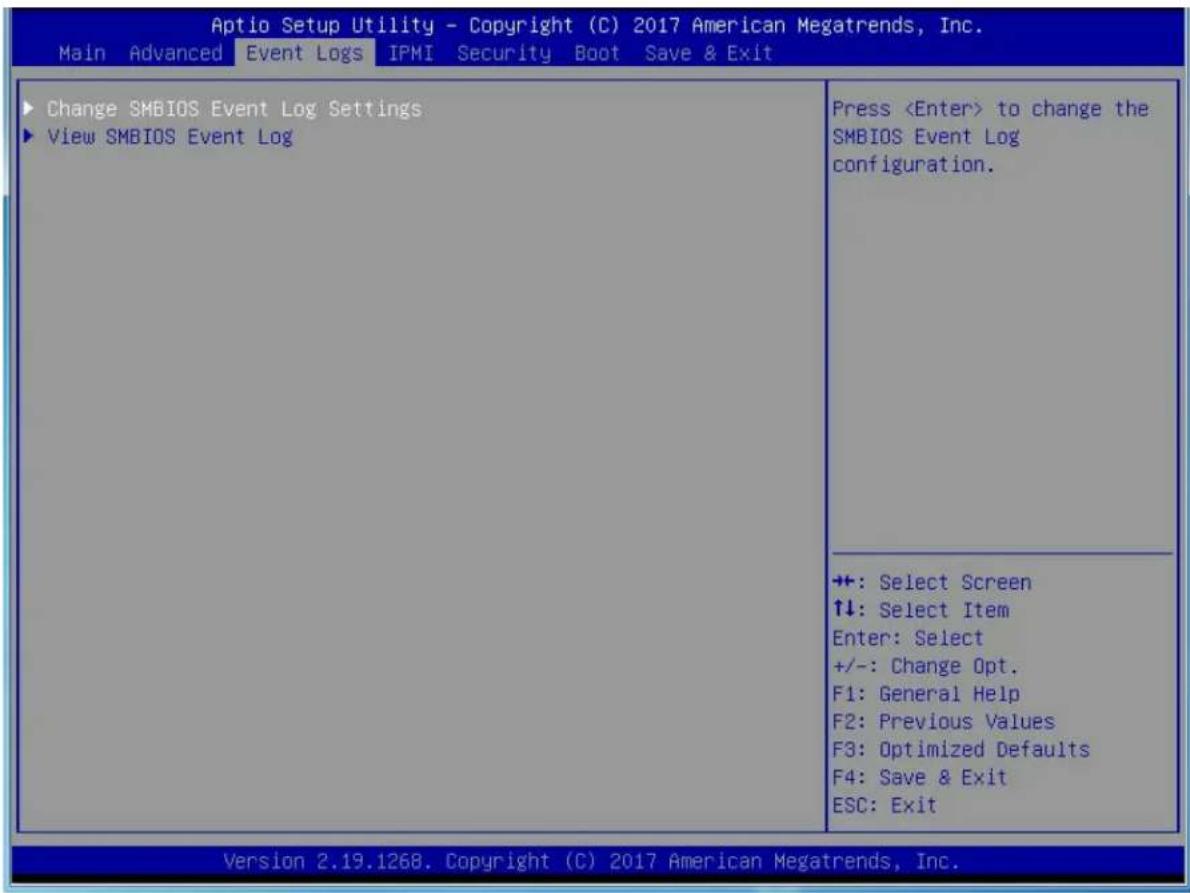
text_image
Aptio Setup Utility - Copyright (C) 2017 American Megatrends, Inc. Main Advanced Event Logs IPMI Security Boot Save & Exit ► Change SMBIOS Event Log Settings ► View SMBIOS Event Log Press▶Change SMBIOS Event Log Settings
Enabling/Disabling Options
SMBIOS Event Log
Select Enabled to enable SMBIOS (System Management BIOS) Event Logging during system boot. The options are Enabled and Disabled.
Erasing Settings
Erase Event Log
Select Enabled to erase all error events in the SMBIOS (System Management BIOS) log before an event logging is initialized at bootup. The options are No, Yes, Next Reset, and Yes, Next Reset.
When Log is Full
Select Erase Immediately to immediately erase all errors in the SMBIOS event log when the event log is full. Select Do Nothing for the system to do nothing when the SMBIOS event log is full. The options are Do Nothing and Erase Immediately.
SMBIOS Event Log Standard Settings
Log System Boot Event
Select Enabled to log system boot events. The options are Enabled and Disabled.
MECI (Multiple Event Count Increment)
Enter the increment value for the multiple event counter. Enter a number between 1 to 255. The default setting is 1.
METW (Multiple Event Count Time Window)
Use this feature to determine how long (in minutes) the multiple event counter should wait before generating a new event log. Enter a number between 0 to 99. The default setting is 60.
Note: Please reboot the system for the changes to take effect.
Customer Options
Log OEM Codes
Select Enabled to log the EFI Status codes as OEM codes if these codes have not been converted to Legacy. The options are Enabled and Disabled.
Convert OEM Codes
Select Enabled to convert the EFI Status codes to standard SMBIOS codes. Please note that this option is not available for all EFI Status codes. The options are Enabled and Disabled.
Note: Please reboot the system for the changes to take effect.
▶View System Event Log
This item allows the user to view the event in the system event log. Select this feature and press
Date/Time/Error Code/Severity
6.5 IPMI
Use this feature to configure Intelligent Platform Management Interface (IPMI) settings.
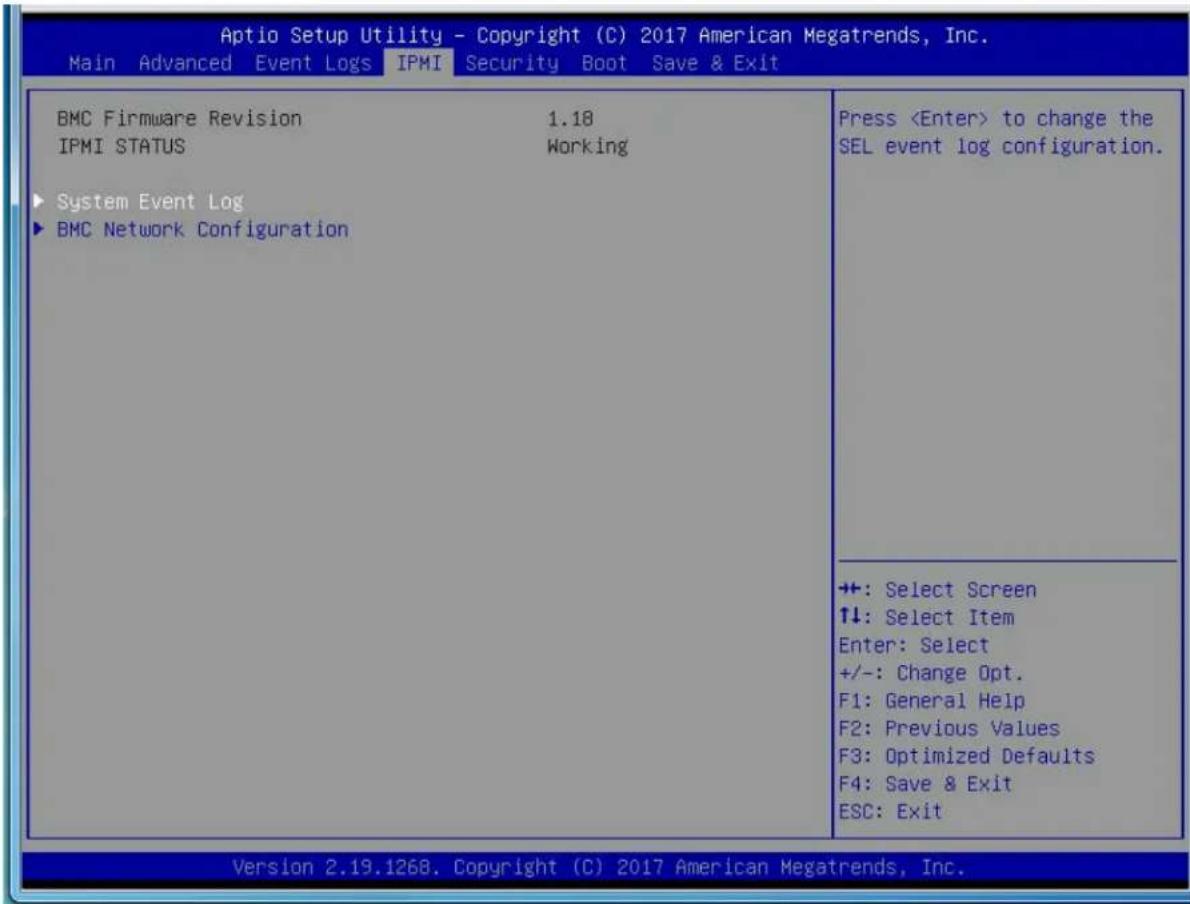
text_image
Aptio Setup Utility - Copyright (C) 2017 American Megatrends, Inc. Main Advanced Event Logs IPMI Security Boot Save & Exit BMC Firmware Revision 1.18 IPMI STATUS Working ► System Event Log ► BMC Network Configuration PressWhen you select this submenu and press the
- BMC Firmware Revision: This feature indicates the IPMI firmware revision used in your system.
- Status of BMC: This feature indicates the status of the BMC (Baseboard Management Controller) installed in your system.
▶System Event Log
Enabling/Disabling Options
SEL Components
Select Enabled for all system event logging at bootup. The options are Enabled and Disabled.
Erasing Settings
Erase SEL
Select Yes, On next reset to erase all system event logs upon next system reboot. Select Yes, On every reset to erase all system event logs upon each system reboot. Select No to keep all system event logs after each system reboot. The options are No, Yes, On next reset, and Yes, On every reset.
When SEL is Full
This feature allows the user to determine what the BIOS should do when the system event log is full. Select Erase Immediately to erase all events in the log when the system event log is full. The options are Do Nothing and Erase Immediately.
Custom EFI Logging Options
Log EFI Status Codes
Select EFI (Extensible Firmware Interface) Status Codes to log EFI status codes. Select Error Codes to log EFI error codes. Select Progress Code to log the EFI progress code. Select both to log both EFI error codes and progress codes. The options are Disabled, Both, Error code and Progress code.
Note: After making changes on a setting, be sure to reboot the system for the changes to take effect.
▶BMC Network Configuration
The following items will be displayed:
- IPMI LAN Selection: This feature displays the IPMI LAN setting. The default setting is Failover.
- IPMI Network Link Status: This item displays the IPMI Network Link status. The default setting is Dedicated LAN.
- Update IPMI LAN Configuration: Select Yes for the BIOS to implement all IP/MAC address changes at the next system boot. The default setting is No.
- Current Configuration Address Source: This feature displays the source of the current IPMI LAN address. The default setting is DHCP (Dynamic Host Configuration Protocol).
- Station IP Address: This feature displays the Station IP address for this computer. This should be in decimal and in dotted quad form (i.e., 192.168.10.253).
- Subnet Mask: This feature displays the sub-network that this computer belongs to. The value of each three-digit number separated by dots should not exceed 255.
-
Station MAC Address: This feature displays the Station MAC address for this computer. Mac addresses are 6 two-digit hexadecimal numbers.
-
Gateway IP Address: This feature displays the Gateway IP address for this computer. This should be in decimal and in dotted quad form (i.e., 192.168.10.253).
- VLAN: Select Enabled to enable IPMI VLAN support. The options are Enabled and Disabled.
IPV6 Support
Select Enabled for IPV6 support. The options are Enabled and Disabled.
Configuration Address Source
Use this feature to select the IP address source for this computer. If Static is selected, you will need to know the IP address of this computer and enter it to the system manually in the field. If DHCP is selected, AMI BIOS will search for a DHCP (Dynamic Host Configuration Protocol) server attached to the network and request the next available IP address for this computer. The options are Unspecified, DHCP and Static.
The following features will be displayed:
• Current Configuration Address Source
• Station IPV6 Address
- Prefix Length
• IPV6 Router1 IP Address
• IPV6 Address Status
• IPV6 DHCP Algorithm
6.6 Security Settings
This menu allows the user to configure the following security settings for the system.
| Aptio Setup Utility - Copyright (C) 2017 American Megatrends, Inc. Main Advanced Event Logs IPMI Security Boot Save & Exit | |
| Password Description If ONLY the Administrator's password is set, then this only limits access to Setup and is only asked for when entering Setup. If ONLY the User's password is set, then this is a power on password and must be entered to boot or enter Setup. In Setup the User will have Administrator rights. The password length must be in the following range: Minimum length 3 Maximum length 20 | |
| Administrator Password User Password Password Check [Setup] HDD Security Configuration: P4:INTEL SSDSC2BB160G4 Secure Boot | Set Administrator Password ++: Select Screen ↑↓: Select Item Enter: Select +/-: Change Opt. F1: General Help F2: Previous Values F3: Optimized Defaults F4: Save & Exit ESC: Exit |
| Version 2.19.1268. Copyright (C) 2017 American Megatrends, Inc. | |
Administrator Password
Use this feature to set the administrator password which is required to enter the BIOS setup utility. The length of the password should be from 3 characters to 20 characters long.
User Password
Use this feature to set the user password which is required to enter the BIOS setup utility. The length of the password should be from 3 characters to 20 characters long.
Password Check
Select Setup for the system to check for a password at Setup. Select Always for the system to check for a password at bootup or upon entering the BIOS Setup utility. The options are Setup and Always.
HDD Security Configuration:
P4: Intel SSDSC2BB160G4
▶Secure Boot
When you select this submenu and press the
- System Mode
- Secure Boot
- Vendor Keys
Secure Boot
If this feature is set to Enabled, Secure Boot will be activated when a Platform Key (PK) is entered. A Platform Key is a security key used to manage the security settings of the platform firmware used in your system. The options are Enabled and Disabled.
Secure Boot Mode
Use this feature to select the desired secure boot mode for the system. The options are Standard and Custom.
CMS Support
Select Enbabled for CMS support to enhance system performance. The options are Enabled and Disabled.
▶Key Management
Provision Factory Default Keys
Select Enabled to install all manufacturer default keys to configure the following system security settings. The options are Enabled and Disabled.
▶Enroll All Factor Defaults
Select Yes to install all manufacturer defaults to configure the following system security settings. The options are Yes and No.
▶Enroll EFI Image
Select this item and press
▶Save All Secure Boot Variables
This feature allows the user to set and save the secure boot key variables specified by the user.
▶Platform Key (PK)
This feature allows the user to enter and configure a set of values to be used as a platform firmware key for the system. This set of values also indicate the size, the keys numbers, and the key source of the Platform Key. The options are Save to File, Set New, and Erase.
▶Key Exchange Keys
This feature allows the user to enter and configure a set of values to be used as a Key-Exchange-Keys for the system. This set of values also indicate the size, the keys numbers, and the key source of the Key-Exchange-Keys. The options are Save to File, Set New, and Erase.
▶ Authorized Signatures
This feature allows the user to enter and configure a set of values to be used as Authorized Signatures for the system. These values also indicate the size, the keys numbers, and the key source of the Authorized Signatures. The options are Set New and Append.
Secure Boot Variable/Size/Key#/Key Sources The options are Save to File, Set New, and Erase.
▶Forbidden Signatures
This feature allows the user to enter and configure a set of values to be used as Forbidden Signatures for the system. These values also indicate the size, the keys numbers, and the key source of the Forbidden Signatures. The options are Save to File, Set New, and Erase.
▶Authorized TimeStamps
This feature allows the user to set and save the timestamps for Authorized Signatures to indicate when these signatures were entered into the system. The options are Save to File, Set New, and Erase.
▶OsRecovery Signatures
This feature allows the user to set and save the Authorized Signatures used for OS recovery. The options are Save to File, Set New, and Erase.
6.7 Boot Settings
Use this feature to configure Boot Settings:

text_image
Aptio Setup Utility - Copyright (C) 2017 American Megatrends, Inc. Main Advanced Event Logs IPMI Security Boot Save & Exit Boot Configuration Boot mode select [DUAL] LEGACY to EFI support [Disabled] FIXED BOOT ORDER Priorities Boot Option #1 [Hard Disk: INTEL ...] Boot Option #2 [CD/DVD] Boot Option #3 [USB Hard Disk] Boot Option #4 [USB CD/DVD] Boot Option #5 [USB Key] Boot Option #6 [USB Floppy] Boot Option #7 [USB Lan] Boot Option #8 [Network] Boot Option #9 [UEFI Hard Disk] Boot Option #10 [UEFI CD/DVD] Boot Option #11 [UEFI USB Hard Disk] Boot Option #12 [UEFI USB CD/DVD] Boot Option #13 [UEFI USB Key] Boot Option #14 [UEFI USB Floppy] Boot Option #15 [UEFI USB Lan] Boot Option #16 [UEFI Network] Boot Option #17 [UEFI AP:UEFI: Bui...] ► Delete Boot Option ▲ Select boot mode LEGACY/UEFI ++: Select Screen ↑↓: Select Item Enter: Select +/-: Change Opt. F1: General Help F2: Previous Values F3: Optimized Defaults F4: Save & Exit ESC: ExitVersion 2.19.1268. Copyright (C) 2017 American Megatrends, Inc.
Boot Mode Select
Use this feature to select the type of devices to be used for system boot. The options are Legacy, UEFI (Unified Extensible Firmware Interface), and Dual.
Legacy to EFI Support
Select Enabled for the system to boot from an EFI OS when the Legacy OS fails. The options are Enabled and Disabled.
Fixed Boot Order Priorities
This feature prioritizes the order of a bootable device from which the system will boot. Press
When the item above - "Boot Mode Select" is set to Dual (default), the following items will be displayed for configuration:
- Boot Option #1 - Boot Option #15
When the item above - "Boot Mode Select" is set to Legacy, the following items will be display for configuration:
- Boot Option #1 - Boot Option #7
When the item above - "Boot Mode Select" is set to UEFI, the following items will be display for configuration:
• Boot Option #1 - Boot Option #8
Add New Boot Option
This feature allows the user to add a new boot option to the boot priority features for your system.
Add Boot Option
Use this feature to specify the name for the new boot option.
Path for Boot Option
Use this feature to enter the path for the new boot option in the format fsx:\path\filename.efi.
Boot Option File Path
Use this feature to specify the file path for the new boot option.
Create
After the name and the file path for the boot option are set, press
▶ Delete Boot Option
Use this feature to select a boot device to delete from the boot priority list.
Delete Boot Option
Use this feature to remove an EFI boot option from the boot priority list.
▶ Add New Driver Option
Use this feature to select a new driver to add to the boot priority list.
Add Driver Option
Use this feature to specify the name of the driver that the new boot option is added to.
Path for Drover Option
Use this feature to specify the path to the driver that the new boot option is added to.
Driver Option File Path
Use this feature to specify the file path of the driver that the new boot option is added to.
Create
After the driver option name and the file path are set, press
▶ Delete Driver Option
Use this item to select a boot driver to delete from the boot priority list.
Delete Drive Option
Select the target boot driver to delete from the boot priority list.
▶ Hard Disk Drive BBS Priorities
- Boot Option #1 - #5
▶ Network Drive BBS Priorities
- Boot Option #1
▶ USB Key Drive BBS Priorities
- Boot Option #1
▶ UEFI Hard Disk Drive BBS Priorities
- Boot Option #1
▶ UEFI USB Key Drive BBS Priorities
- Boot Option #1
▶ UEFI Application Boot Priorities
- Boot Option #1
6.8 Save & Exit
Select the Save & Exit tab from the BIOS setup screen to configure the settings below.

text_image
Aptio Setup Utility - Copyright (C) 2017 American Megatrends, Inc. Main Advanced Event Logs IPMI Security Boot Save & Exit Save Options Discard Changes and Exit Save Changes and Reset Save Changes Discard Changes Default Options Restore Optimized Defaults Save as User Defaults Restore User Defaults Boot Override ISATA P4: INTEL SSDSC2BB160G4 UEFI: Built-in EFI Shell Save Changes done so far to any of the setup options. ++: Select Screen ↑↓: Select Item Enter: Select +/-: Change Opt. F1: General Help F2: Previous Values F3: Optimized Defaults F4: Save & Exit ESC: Exit Version 2.19.1268. Copyright (C) 2017 American Megatrends, Inc.Save Options
Discard Changes and Exit
Select this option to quit the BIOS setup without making any permanent changes to the system configuration and reboot the computer. Select Discard Changes and Exit from the Exit menu and press
Save Changes and Reset
When you have completed the system configuration changes, select this option to leave the BIOS setup utility and reboot the computer for the new system configuration parameters to take effect. Select Save Changes and Exit from the Exit menu and press
Save Changes
When you have completed the system configuration changes, select this option to save all changes made. This will not reset (reboot) the system.
Discard Changes
Select this option and press
Default Options
Restore Optimized Defaults
To set this feature, select Restore Defaults from the Exit menu and press
Save As User Defaults
To set this feature, select Save as User Defaults from the Exit menu and press
To set this feature, select Restore User Defaults from the Exit menu and press
Boot Override
This feature allows the user to override the Boot priorities sequence in the Boot menu, and immediately boot the system with a device specified by the user instead of the one specified in the boot list. This is a one-time override.
Appendix A
BIOS Codes
A.1 BIOS Error POST (Beep) Codes
During the POST (Power-On Self-Test) routines, which are performed each time the system is powered on, errors may occur.
Non-fatal errors are those which, in most cases, allow the system to continue the boot-up process. The error messages normally appear on the screen.
Fatal errors are those which will not allow the system to continue the boot-up procedure. If a fatal error occurs, you should consult with your system manufacturer for possible repairs.
These fatal errors are usually communicated through a series of audible beeps. The numbers on the fatal error list (on the following page) correspond to the number of beeps for the corresponding error. All errors listed, with the exception of Beep Code 8, are fatal errors.
| BIOS Beep (POST) Codes | ||
| Beep Code Error | Message Description | |
| 1 beep Refresh Circuits have been reset (Ready to power up) | ||
| 5 short, 1 long Memory error No memory detected in system | ||
| 5 long, 2 short Display memory read/write error Video adapter missing or with faulty memory | ||
| 1 long continuous System OH System overheat condition | ||
A.2 Additional BIOS POST Codes
The AMI BIOS supplies additional checkpoint codes, which are documented online at http://www.supermicro.com/support/manuals/ ("AMI BIOS POST Codes User's Guide").
When BIOS performs the Power On Self Test, it writes checkpoint codes to I/O port 0080h. If the computer cannot complete the boot process, a diagnostic card can be attached to the computer to read I/O port 0080h (Supermicro p/n AOC-LPC80-20).
For information on AMI updates, please refer to http://www.ami.com/products/.
Appendix B
Standardized Warning Statements for AC Systems
B.1 About Standardized Warning Statements
The following statements are industry standard warnings, provided to warn the user of situations which have the potential for bodily injury. Should you have questions or experience difficulty, contact Supermicro's Technical Support department for assistance. Only certified technicians should attempt to install or configure components.
Read this appendix in its entirety before installing or configuring components in the Supermicro chassis.
These warnings may also be found on our website at http://www.supermicro.com/about/policies/safety_information.cfm.
Warning Definition

Warning! This warning symbol means danger. You are in a situation that could cause bodily injury. Before you work on any equipment, be aware of the hazards involved with electrical circuitry and be familiar with standard practices for preventing accidents.
警告の定義
この警告サインは危険を意味します。
Installation Instructions

Warning! Read the installation instructions before connecting the system to the power source.
設置手順書
Warning! This product relies on the building's installation for short-circuit (overcurrent) protection. Ensure that the protective device is rated not greater than: 250 V, 20 A.
サーキット・ブレーカー
Power Disconnection Warning

Warning! The system must be disconnected from all sources of power and the power cord removed from the power supply module(s) before accessing the chassis interior to install or remove system components.
電源切断の警告
Equipment Installation

Warning! Only trained and qualified personnel should be allowed to install, replace, or service this equipment.
機器の設置
Warning! This unit is intended for installation in restricted access areas. A restricted access area can be accessed only through the use of a special tool, lock and key, or other means of security. (This warning does not apply to workstations).
アクセス制限区域
Warning! There is the danger of explosion if the battery is replaced incorrectly. Replace the battery only with the same or equivalent type recommended by the manufacturer. Dispose of used batteries according to the manufacturer's instructions
電池の取り扱い
Redundant Power Supplies

Warning! This unit might have more than one power supply connection. All connections must be removed to de-energize the unit.
冗長電源装置
Warning! Hazardous voltage or energy is present on the backplane when the system is operating. Use caution when servicing.
バックプレーンの電圧
Comply with Local and National Electrical Codes

Warning! Installation of the equipment must comply with local and national electrical codes.
地方および国の電気規格に準拠
Warning! Ultimate disposal of this product should be handled according to all national laws and regulations.
製品の廃棄
Warning! Hazardous moving parts. Keep away from moving fan blades. The fans might still be turning when you remove the fan assembly from the chassis. Keep fingers, screwdrivers, and other objects away from the openings in the fan assembly's housing.
ファン・ホットスワップの警告
Power Cable and AC Adapter

Warning! When installing the product, use the provided or designated connection cables, power cables and AC adaptors. Using any other cables and adaptors could cause a malfunction or a fire. Electrical Appliance and Material Safety Law prohibits the use of UL or CSA-certified cables (that have UL/CSA shown on the cord) for any other electrical devices than products designated by Supermicro only.
電源コードとACアダプター
System Specifications
Processors
Dual Intel® Xeon Socket P (LGA 3647) supported processors
Note: The 6029TP-HTR/HC0R/HC1R system does not support Omni-Path Fabric CPUs.
Chipset
Intel Intel C621 chipset
BIOS
128 Mb AMI® Flash ROM
Memory
Integrated memory controller supports up to 2 TB of 3DS LRDIMM/RDIMM/NVDIMM DDR4 (288-pin) ECC 2933/2666/2400/2133 MHz modules in 16 slots at up to 128 GB at 1.2V.
Note: For the latest CPU/memory updates, please refer to our website at http://www.supermicro.com/products/motherboard.
SATA Controller
On-chip (Intel C621) controller
Drive Bays
12 hot-swap drive bays
PCI Expansion Slots
The following PCI-E slots are available on the serverboard:
• One PCI-Express 3.0 x8 slot supported by CPU1 for use of S-SATA 0-5 devices (SXB1)
• One PCI-Express 3.0 x16 slot supported by CPU2 for use of I-SATA 0-3 devices (SXB2)
• One PCI-Express 3.0 x16 slot supported by CPU1 (SXB3_1)
• One PCI-Express 3.0 x8 slot supported by CPU2 (SXB3_2)
• One PCI-E 3.0 x16 slot supported by CPU2 (SXB4)
Motherboard
X11DPT-PS; Micro ATX form factor: 6.8" x 18.86" (172.7 mm x 479 mm)
Chassis
SC827HQ+-R2K20BP2 (2U rackmount)
Dimensions: (WxHxD) 17.25 x 3.47 x 30.5 in. (438 x 88 x 774 mm)
System Cooling
The system has four 8-cm PWM system cooling fans
Power Supply
Model: PWS-2K20A-1R
AC Input Voltages: 100-240 VAC
Rated Input Current: 14-11A (110-140V), 12.5-9.5A (180-240V)
Rated Input Frequency: 50-60 Hz
Rated Output Power: 2200 Watt
Rated Output Voltages: +12V (167A), +5Vsb (1A)
Operating Environment
Operating Temperature: 0° to 35° C (32° to 95° F)
Non-operating Temperature: -40^ to 70^ C ( -40^ to 158^ F)
Operating Relative Humidity: 20% to 95% (non-condensing)
Non-operating Relative Humidity: 5 to 95% (non-condensing)
Regulatory Compliance
Electromagnetic Emissions: FCC Class A, EN 55032 Class A, EN 61000-3-2/3-3, CISPR 32 Class A
Electromagnetic Immunity: EN 55024/CISPR 24, (EN 61000-4-2, EN 61000-4-3, EN 61000-4-4, EN 61000-4-5, EN 61000-4-6, EN 61000-4-8, EN 61000-4-11), CNS14336-1, CNS13438, GB4943.1-2011, GB9254-2008(Class A) and GB17625.1-2012
Safety: CSA/EN/IEC/UL 60950-1 Compliant, UL or CSA Listed (USA and Canada), CE Marking (Europe)
Other: VCCI-CISPR 32 and AS/NZS CISPR 32
Environmental: Directive 2011/65/EU and Delegated Directive (EU) 2015/863 and Directive 2012/19/EU
Perchlorate Warning
California Best Management Practices Regulations for Perchlorate Materials: This Perchlorate warning applies only to products containing CR (Manganese Dioxide) Lithium coin cells. "Perchlorate Material-special handling may apply. See www.dtsc.ca.gov/hazardouswaste/perchlorate"
Appendix D
UEFI BIOS Recovery
Warning: Do not upgrade the BIOS unless your system has a BIOS-related issue. Flashing the wrong BIOS can cause irreparable damage to the system. In no event shall Supermicro be liable for direct, indirect, special, incidental, or consequential damages arising from a BIOS update. If you need to update the BIOS, do not shut down or reset the system while the BIOS is updating to avoid possible boot failure.
D.1 Overview
The Unified Extensible Firmware Interface (UEFI) provides a software-based interface between the operating system and the platform firmware in the pre-boot environment. The UEFI specification supports an architecture-independent mechanism that will allow the UEFI OS loader stored in an add-on card to boot the system. The UEFI offers clean, hands-off management to a computer during system boot.
D.2 Recovering the UEFI BIOS Image
A UEFI BIOS flash chip consists of a recovery BIOS block and a main BIOS block (a main BIOS image). The boot block contains critical BIOS codes, including memory detection and recovery codes for the user to flash a new BIOS image if the original main BIOS image is corrupted. When the system power is first turned on, the boot block codes execute first. Once this process is completed, the main BIOS code will continue with system initialization and the remaining POST (Power-On Self-Test) routines.
Note 1: Follow the BIOS recovery instructions below for BIOS recovery when the main BIOS boot crashes.
Note 2: When the BIOS boot block crashes, you will need to follow the procedures to make a Returned Merchandise Authorization (RMA) request. (For a RMA request, please see section 3.5 for more information). Also, you may use the Supermicro Update Manager (SUM) Out-of-Band (OOB) (https://www.supermicro.com.tw/products/nfo/SMS_SUM.cfm) to reflash the BIOS.
D.3 Recovering the BIOS Block with a USB Device
This feature allows the user to recover a BIOS image using a USB-attached device without additional utilities used. A USB flash device such as a USB Flash Drive, or a USB CD/DVD ROM/RW device can be used for this purpose. However, a USB Hard Disk drive cannot be used for BIOS recovery at this time.
The file system supported by UEFI is FAT (including FAT12, FAT16, and FAT32) which is installed on a bootable or non-bootable USB-attached device. However, the BIOS might need several minutes to locate the SUPER.ROM file if the media size becomes too large due to the huge volumes of folders and files stored in the device.
To perform UEFI BIOS recovery using a USB-attached device, follow the instructions below.
- Using a different machine, copy the "Super.ROM" binary image file into the disc Root "\" directory of a USB device or a writable CD/DVD.
Note: If you cannot locate the "Super.ROM" file in your driver disk, visit our website at www.supermicro.com to download the BIOS image into a USB flash device and rename it "Super.ROM" for BIOS recovery use. - Insert the USB device that contains the new BIOS image ("Super.ROM") into your USB drive and power on the system
- While powering on the system, please keep pressing
and simultaneously on your keyboard until the following screen (or a screen similar to the one below) displays.

text_image
SUNTER System Initializing... DNC IP: 10.132.161.98 F1Note: On the other hand, if the following screen displays, please load the "Super.ROM" file to the root folder and connect this folder to the system. (You can do so by inserting a USB device that contains the new "Super.ROM" image to your machine for BIOS recovery.)
text_image
Option Setup Utility - Copyright (C) 2017 American Hegatrends, Inc. MAIN Advanced Event Logs IPHI Recovery Security Boot Save & Exit ROM Image is not loaded ROM Image update denied +: Select Screen II: Select Item Enter: Select +/-: Change Opt. F1: General Help F2: Previous Values F3: Optimized Defaults F4: Save & Exit ESD: Exit version 2.19.1068, Copyright (C) 2017 American Hegatrends, Inc.Warning: Please stop pressing the
text_image
Aptio Setup Utility - Copyright (C) 2017 American Megatrends, Inc. Main Advanced Event Loss IPM Recovery Security Boot Safe & Exit Please select blocks you want to update Reset NURAH [Enabled] Boot Block Update [Enabled] ► Proceed with flash update Set this option to reset NURAH to default values ++: Select Screen T4: Select Item Enter: Select +/-: Change Opt. F1: General Help F2: Previous Values F3: Optimized Defaults F4: Save & Exit ESC: Exit Version 2.15.1268. Copyright (C) 2017 American Megatrends, Inc.screen (or a similar screen) below; otherwise, it will trigger a system reboot.
- After locating the new BIOS binary image, the system will enter the BIOS Recovery menu as shown below.
Note: At this point, you may decide if you want to start the BIOS recovery. If you decide to proceed with BIOS recovery, follow the procedures below.

text_image
Aptio Setup Utility - Copyright (C) 2017 American Megatrends, Inc. Recovery WARNING! System firmware is being updated. Keyboard is locked. DO NOT TURN THE POWER OFF !!! Once firmware update is completed press any key to reboot the system Program new data Write new boot block... 17% ++: Select Screen F1: Select Item Enter: Select +/-: Change Opt. F1: General Help F3: Previous Values F3: Optimized Defaults F4: Save & Exit ESC: Exit Version 2.19.1266, Copyright (C) 2017 American Megatrends, Inc.- When the screen as shown above displays, use the arrow keys to select the item
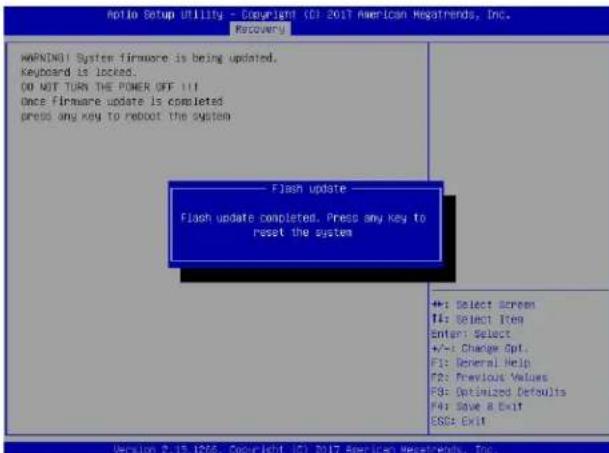
text_image
Action Setup Utility - Copyright (C) 2017 American MegaTrends, Inc. Recovery WARNING! System firmware is being updated. Keyboard is locked. DO NOT TURN THE POWER OFF !!! Once firmware update is completed press any key to reboot the system Flash update Flash update completed. Press any key to reset the system +:- Select Screen F4: Select Item Enter: Select +/-: Change Opt. F1: General Help F2: Previous Values F3: Optimized Defaults F4: Save & Exit ESC: Exit Version 0.15.1266. Copyright (C) 2017 American MegaTrends, Inc."Proceed with flash update" and press the
Note: Do not interrupt the BIOS flashing process until it has completed.

text_image
Antio Setup Utility - Copyright (CI 2017 American Megatrends, Inc. Main Advanced Event Logs IPRI Security Boot Save & Exit Boot Configuration Boot mode select [QUAL] LEGACY to EFI support [Disabled] FIXED BOOT ORDER Priorities Boot Option #1 [UEFI API/UEFI: Do... Boot Option #2 [COV/DVD] Boot Option #3 [USB Hard Disk] Boot Option #4 [USB CD/DVD] Boot Option #5 [USB Key: SandDisk] Boot Option #6 [USB Floppy] Boot Option #7 [USB Lan] Boot Option #8 [Network: IBA GE SI...] Boot Option #9 [UEFI Hard Disk] Boot Option #10 [UEFI CD/DVD] Boot Option #11 [UEFI USB Hard Disk] Boot Option #12 [UEFI USB CD/DVD] Boot Option #13 [UEFI USB Key: UEFI...] Boot Option #14 [UEFI USB Floppy] Boot Option #15 [UEFI USB Lan] Boot Option #16 [UEFI Network] Boot Option #17 [Hard Disk] Add New Boot Option Sets the system boot order +: Select Screen T4: Select Item Enter: Select +/-: Change Opt. F1: General Help F2: Previous Values F3: Optimized Defaults F4: Save & Exit ESC: Exit Version 3.12.1265 Copyright (CI 2017 American Megatrends, Inc.- After the BIOS recovery process is completed, press any key to reboot the system.
- Using a different system, extract the BIOS package into a USB flash drive.

text_image
UIFI Interactive Shell v2.1 EDI 11 UIFI v2.50 (American Megatiredo, 0x0050000) Mapping table F50: Alias(s)HDORobsBLK1; PCIProt(KN0)/PCI(0x14,0x0)/USB(0x11,0x0)/HD(1,HDR,0x37901D72,0x880,0x1 CA932E) BLK0: Alias(S) PCIProt(KN0)/PCI(0x14,0x0)/USB(0x11,0x0) Press IEC in 1 seconds to skip startup.sen or any other key to continue. Shell 163 F50: AFC PAXOS F50:AVFUDOS: cd SNPH2_03162011 F50:AVFUDOS:SNPH2_03162017; flash.nsh x11R07.314- Press
continuously during system boot to enter the BIOS setup utility. From the

text_image
Done: I Access Dose Port Ex I dired Index 0x51: 0x18 Done. ********************************************************************** * Program BIOS and ME (including PDT) regions... * ********************************************************************** AM1 Firmware Update Utility vs.09.01.1017 Copyright (D1017 American Registrends Inc. All Rights Reserved. CPUID = 50x62 Reading flash ....... done - ME Data Size checking . ok - FPS check-ins ....... ok - Check BootLayout ....... ok Erasing Boot Block ....... done Updating Boot Block ....... done Verifying Boot Block ....... done Erasing Main Block ....... 0x00182000 (0%)top of the tool bar, click on Boot and press
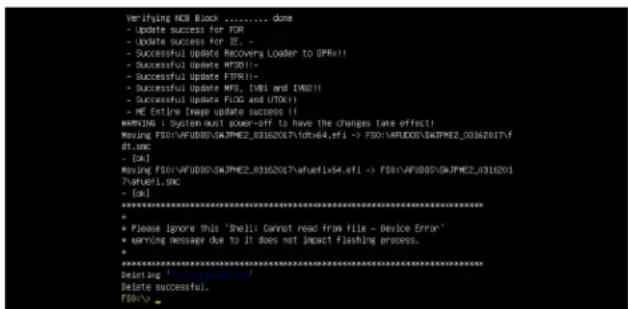
text_image
Verifying HCM Block ....... done - Update success for FSR - Update success for SE. - Successful Update Recovery Loader to IPRs!! - Successful Updates MTR01((-) - Successful Update FTR01((-) - Successful Update NPs, TMS and TMS21((-) - Successful Updates FLO and UTO0((-) - HE Entire Time update success!! WARNING : System must power-off to have the changes take effect! Moving FSO:VARUDOS/SKJPME2_03162017/fdxv64.efi -> FSO:VARUDOS/SKJPME2_03162017/f df.smc - (ak) Moving FSO:VARUDOS/SKJPME2_03162017/afuefu1x54.efi -> FSO:VARUDOS/SKJPME2_03162017 ?Varuf1.SRC - (ak) ********************************************************************** *Please Ignore this 'Shell' cannot read from File - Device Error'
* Serving message due to it does not direct flashing process. ********************************************************************** Deleting ' Delete successful. FBOV...AP:UEFI: Built-in EFI Shell]. Press
- When the UEFI Shell prompt appears, type fs# to change the device directory path. Go to the directory that contains the BIOS package you extracted earlier from Step 7. Enter flash.nsh BIOSname.### at the prompt to start the BIOS update process.
Note: Do not interrupt this process until the BIOS flashing is complete.
- The screen above indicates that the BIOS update process is completed. When you see the screen above, unplug the AC power cable from the power supply, clear CMOS, and plug the AC power cable in the power supply again to power on the system.
- Press
continuously to enter the BIOS setup utility. - Press
to load the default settings. - After loading the default settings, press
to save the settings and exit the BIOS setup utility.
Appendix E
BSMI Warning and RoHs Statement
限用物質含有情況標示聲明書
Declaration of the Presence Condition of the Restricted Substances Marking
| 設備名稱:伺服器/ServerEquipment name型號(型式):827-22Type designation (Type)(系列型號:SYS-6029TP-HTR,SYS-6029TP-HCOR,SYS-6029TP-HC1R,SYS-6029TP-DCNR) | ||||||
| 單元Unit | Restricted substances and its chemical symbols限用物質及其化學符號 | |||||
| 鉛Lead(Pb) | 汞Mercury(Hg) | 鎘Cadmium(Cd) | 六價鉻Hexavalent chromium( Cr^+6 ) | 多溴聯苯Polybrominated biphenyls(PBB) | 多溴二苯醚Polybrominated diphenyl ethers(PBDE) | |
| 機殼(Chassis) | ○ | ○ | ○ | ○ | ○ | ○ |
| 機殼風扇(Chassis Fan) | - | ○ | ○ | ○ | ○ | ○ |
| 線材(Cable) | ○ | ○ | ○ | ○ | ○ | ○ |
| 主機板(Motherboard) | - | ○ | ○ | ○ | ○ | ○ |
| 電源供應器(Power Supply) | - | ○ | ○ | ○ | ○ | ○ |
| 硬碟(Hard Disk) | - | ○ | ○ | ○ | ○ | ○ |
| 電源背板(PDB) | - | ○ | ○ | ○ | ○ | ○ |
| 附加卡(Add-on Card) | - | ○ | ○ | ○ | ○ | ○ |
| 備考1. “超出0.1 wt %”及“超出0.01 wt %”係指限用物質之百分比含量超出百分比含量基準值。Note 1: “Exceeding 0.1 wt %” and “exceeding 0.01 wt %” indicate that the percentage content of the restricted substance exceeds the reference percentage value of presence condition.備考2. “○”係指該項限用物質之百分比含量未超出百分比含量基準值。Note 2: “○” indicates that the percentage content of the restricted substance does not exceed the percentage of reference value of presence.備考3. “-”係指該項限用物質為排除項目。Note 3: The “-” indicates that the restricted substance corresponds to the exemption. | ||||||

警告使用者: