MIC95410 - Electronic component Microchip - Free user manual and instructions
Find the device manual for free MIC95410 Microchip in PDF.


User questions about MIC95410 Microchip
0 question about this device. Answer the ones you know or ask your own.
Ask a new question about this device
Download the instructions for your Electronic component in PDF format for free! Find your manual MIC95410 - Microchip and take your electronic device back in hand. On this page are published all the documents necessary for the use of your device. MIC95410 by Microchip.
USER MANUAL MIC95410 Microchip
6.6 mΩ R _DS(ON) , 7A, 5.5V V _IN Load Switch in 1.2 mm x 2.0 mm VQFN
Features
• Ultra-Low R _DS(ON) : 6.6 mΩ Typical
• True 7A Current Capability
• Power Rail Switching from sub-1V to 5.5V
• Bias Voltage from 2.7V to 9V
- ≤1 μA OFF-State Bias Supply Current
- ≤1 μA OFF-State Power Switch Leakage Current
- Adjustable Slew Rate for Inrush Current Limiting by External Capacitor
- Load Discharge
• TTL-Compatible Control Input
- 10-Lead 1.2 mm x 2.0 mm VQFN Package, 0.5 mm Pin Pitch
- - 40^ C to + 125^ C Junction Temperature Range
Applications
- Embedded Computing Boards
- Servers
• Data Storage Equipment
General Description
The MIC95410 is a high-side load switch for computing and ultra-dense embedded computing boards where high-current low-voltage rails from sub-1V to 5.5V have to be sectioned. The integrated 6.6 mΩ B_S(ON) N-channel MOSFET ensures low voltage drop and low power dissipation while delivering up to 7A of load current.
The MIC95410 is internally powered by a separated bias voltage from 2.7V to 9V. It includes a TTL-logic level to gate a voltage translator driving a charge pump, and an output discharge function when disabled. The OFF-state current from bias supply ( V_S ) and the power switch OFF-state leakage current ( I_OFF ) are both below 1 A.
The MIC95410 provides user-adjustable slew rate controlled turn-on to limit the inrush current to the input supply voltage.
The MIC95410 is available in a thermally efficient, space-saving 10-lead 1.2 mm x 2.0 mm VQFN package with 0.5 mm pin pitch and an operating junction temperature range from -40°C to +125°C.
Package Type
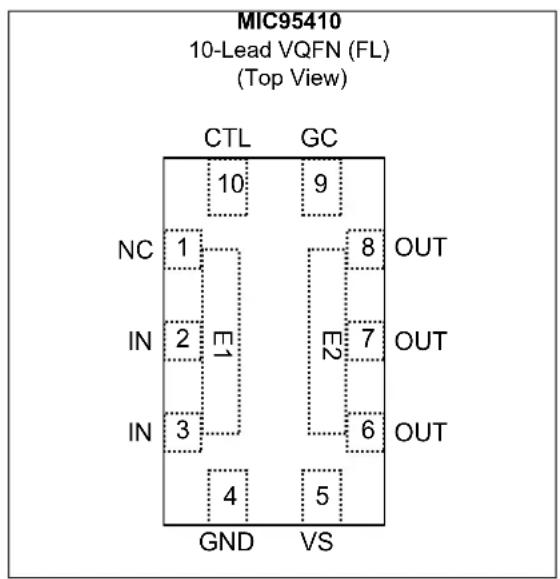
text_image
MIC95410 10-Lead VQFN (FL) (Top View) CTL GC 10 9 NC 1 8 OUT IN 2 E 7 OUT IN 3 6 OUT 4 5 GND VSTypical Application Circuit

text_image
MIC95410 LOAD SWITCH ON/OFF_ CTL GC NC MIC95410 OUT IN OUT IN OUT GND:VS V_IN LOAD V_BUSFunctional Block Diagram
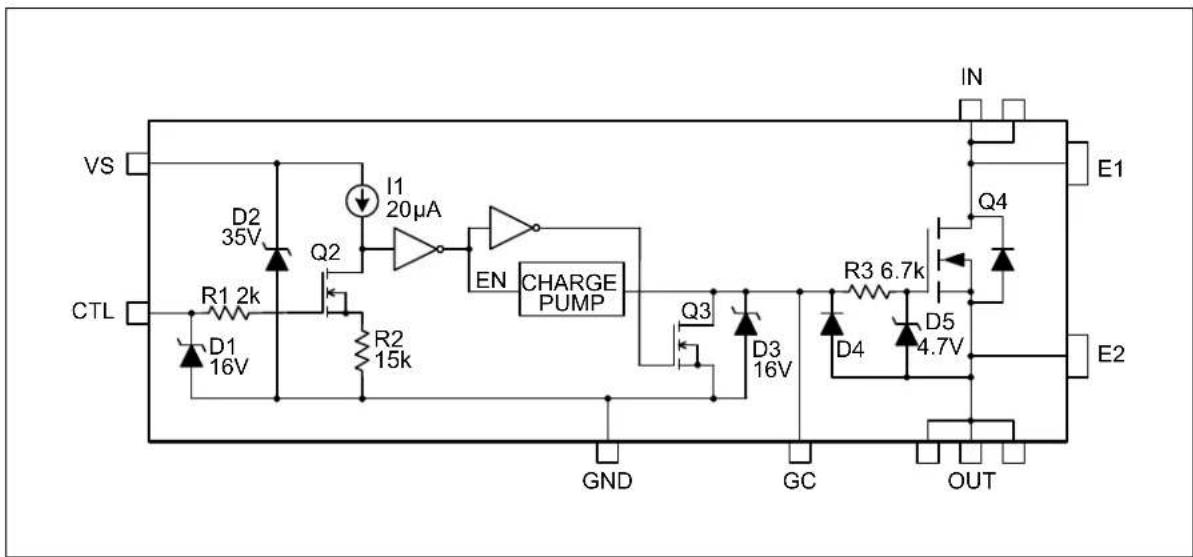
text_image
VS CTL D2 35V R1 2k D1 16V Q2 I1 20µA EN CHARGE PUMP GND Q3 D3 16V GC IN E1 Q4 R3 6.7k D4 D5 4.7V OUT E21.0 ELECTRICAL CHARACTERISTICS
Absolute Maximum Ratings †
IN, OUT to GND....-0.3V to +6V
IN to OUT....-0.3V to +6V
IN to GC....+6V
VS to GND -0.6V to +10V
CTL to GND +0.6V to V_VS
ESD Rating (Note 1) 1.5 kV (HBM)
ESD Rating (Note 1) 150V (MM)
Operating Ratings ††
Input Voltage ( V_IN ) ....+5.5V
Bias Voltage ( V_VS ) ....+2.7V to +9V
Gate Connection Voltage ( V_GC )....0V to +11V
ON-State Current ( I_IN )....7A
† Notice: Stresses above those listed under “Absolute Maximum Ratings” may cause permanent damage to the device. This is a stress rating only and functional operation of the device at those or any other conditions above those indicated in the operational sections of this specification is not intended. Exposure to maximum rating conditions for extended periods may affect device reliability.
†† Notice: The device is not guaranteed to function outside its operating ratings.
Note 1: Devices are ESD sensitive. Handling precautions are recommended. Human body model, 1.5 kΩ in series with 100 pF.
ELECTRICAL CHARACTERISTICS
Electrical Characteristics: V_VS = V_IN = V_CTL = 5V , C_VS = 4.7 F , C_IN = 1 F , C_OUT = 100 nF , R = 50Ω unless otherwise specified. Typical values at T_A = +25^ . Bold values valid for -40^ ≤ T_A ≤ +125^ , unless noted. Note 1
| Parameter Sym. Min. | Typ. Max. | Units Conditions | ||||
| Supply Current I | S | — | 0 | . | 1 | 9 μA |
| — | — | 140 | ||||
| — | 7 | 0 | ||||
| — | 0 | . | ||||
| — | — | 300 | ||||
| — | 150 | 200 | ||||
| Control Input Voltage V | CTL | 0 | — | 0.8 | V | 2.7V ≤ VVS ≤ 9V, logic-0 |
| 2.0 | —V | vs | ||||
| 2.4 | —V | vs | ||||
| 5V < VVS ≤ 9V, logic-1 | ||||||
| Control Input Current | ICTL | — | 0.01 | 1 | μA | 2.7V ≤ VVS ≤ 9V |
| Control Input Capacitance | CCTL | — | 5 | — | pF | — |
| Switch ON-Resistance | RON | — | 6 | . | 6 mΩ9.9 | VVS=2.7V, VIN=1V, IN=IOUT=4A |
| — | 6 | . | VVS=3.3V, VIN=3.3V, IN=IOUT=4A | |||
| — | 6 | . | VVS=5V, VIN=5V, IN=IOUT=4A | |||
| Switch Input Leakage Current | IOFF | — | 0.02 | 1 | μA | VVS=5V, VIN=5.5V, VCTL=0V |
| Gate Charge Current | IGC | — | 27 | — | μA | VGC=4.0V, RLOAD=∞ |
| — | 630 | — | VGC=0.5V, RLOAD=∞ | |||
| Turn-On Time (Note 2) | tON | — | 1 | . | ms 2 | CGC=10 nE, VIN=5V |
| — | 0 | . | GC=100 θF, VIN=1V C | |||
| Turn-Off Time (Note 3) | tOFF | — | 3 | 0 | 6 μs | CGC=10 nF, VIN=5V, C3=0 μF |
| — | 150 | 300 | CGC=100 nF, VIN=1V, C3=0 μF | |||
| Discharge Resistance | RD | — | 2 | . | 3 kΩ — | VOUT=5V, RLOAD=∞ |
| — | 2 | . | OUT=4V, RLOAD=∞ | |||
| — | 1 | . | OUT=2.5V, RLOAD=∞ | |||
| Discharge Diode Forward Drop (VOUT-VCG) | VD | — | 0.5 | 0.75 | VV | CTL=0V, IOUT=-10 μA |
Note 1: Specification for packaged product only.
2: The turn-on time is defined as the time it takes from asserting CTL to V_OUT reaching 90% of V_IN (rising).
3: The turn-off time is defined as the time it takes from the falling edge of CTL to V_OUT reaching 90% of V_IN (falling).
TEMPERATURE SPECIFICATIONS
| Parameters Sym. Min. Typ. Max. Units Conditions | ||||||
| Temperature Ranges | ||||||
| Junction Temperature Range T | J | -40 — | +125 °C | Note 1 | ||
| Storage Temperature Range T | S | -65 — | +150 °C | — | ||
| Lead Temperature — — +260 — | °C | Soldering, 10 sec. | ||||
| Package Thermal Resistance | ||||||
| Thermal Resistance, VQFN 10-Ld | _JA | — | 60 | — | °C/W | — |
Note 1: Sustained junction temperatures above +125°C can impact the device reliability.
2: Junction-to-Ambient Thermal Resistance _JA is measured using the Evaluation Board as described in section PCB Layout Recommendations.
2.0 TYPICAL OPERATING CHARACTERISTICS
Note: The graphs and tables provided following this note are a statistical summary based on a limited number of samples and are provided for informational purposes only. The performance characteristics listed herein are not tested or guaranteed. In some graphs or tables, the data presented may be outside the specified operating range (e.g., outside specified power supply range) and therefore outside the warranted range.
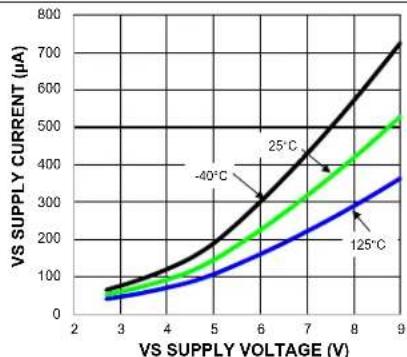
line
| VS SUPPLY VOLTAGE (V) | -40°C | 25°C | 125°C | | --------------------- | ----- | ---- | ----- | | 2 | 50 | 60 | 40 | | 3 | 80 | 100 | 60 | | 4 | 120 | 150 | 90 | | 5 | 180 | 220 | 130 | | 6 | 250 | 300 | 180 | | 7 | 350 | 400 | 250 | | 8 | 450 | 500 | 320 | | 9 | 550 | 600 | 400 |FIGURE 2-1: VS Supply Current vs. VS Supply Voltage.

line
| GC CAPACITANCE (nF) | Turn-on Time (ms) | | ------------------- | ----------------- | | 0 | 0.00 | | 2 | ~0.50 | | 4 | ~1.50 | | 6 | ~2.50 | | 8 | ~3.50 | | 10 | ~4.50 | | 12 | ~5.50 | | 14 | ~6.50 | | 16 | ~7.50 | | 18 | ~8.50 | | 20 | ~9.50 | | 22 | ~12.00 |FIGURE 2-4: Turn-On Time vs. GC Capacitance, V_IN = 5V .
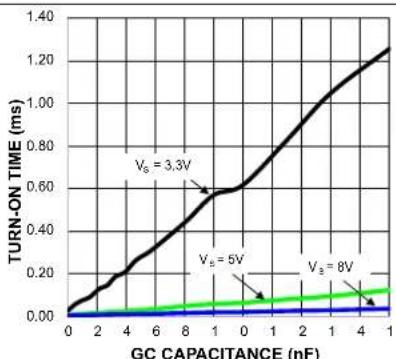
line
| GC CAPACITANCE (nF) | TURN-ON TIME (ms) | | ------------------ | ----------------- | | 0 | 0.00 | | 2 | 0.10 | | 4 | 0.20 | | 6 | 0.30 | | 8 | 0.40 | | 1 | 0.50 | | 2 | 0.60 | | 4 | 0.70 | | 6 | 0.80 | | 8 | 0.90 | | 1 | 1.00 | | 2 | 1.10 | | 4 | 1.20 | | 6 | 1.30 | | 8 | 1.40 |FIGURE 2-2: Turn-On Time vs. GC Capacitance, V_IN = 1.05V .
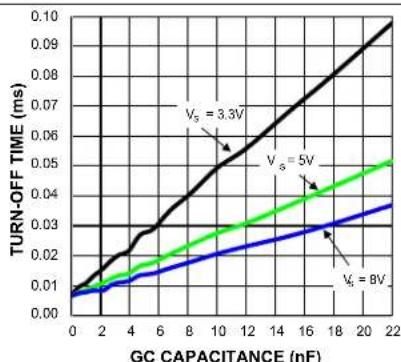
line
| GC CAPACITANCE (nF) | V_s = 3.3V | V_s = 5V | V_s = 8V | | ------------------- | ---------- | -------- | -------- | | 0 | 0.01 | 0.01 | 0.01 | | 2 | 0.02 | 0.015 | 0.012 | | 4 | 0.03 | 0.02 | 0.015 | | 6 | 0.04 | 0.025 | 0.018 | | 8 | 0.05 | 0.03 | 0.02 | | 10 | 0.06 | 0.035 | 0.022 | | 12 | 0.07 | 0.04 | 0.025 | | 14 | 0.08 | 0.045 | 0.028 | | 16 | 0.09 | 0.05 | 0.03 | | 18 | 0.10 | 0.055 | 0.032 | | 20 | 0.11 | 0.06 | 0.035 | | 22 | 0.12 | 0.065 | 0.038 |FIGURE 2-5: Turn-Off Time vs. GC Capacitance, V_IN = 1.05V .
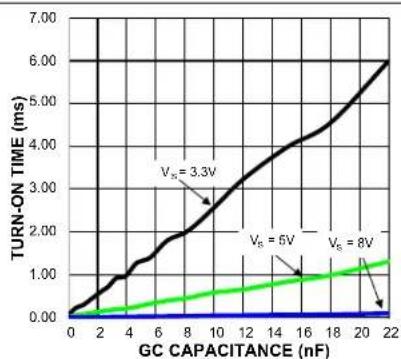
line
| GC CAPACITANCE (nF) | TURN-ON TIME (ms) | | ------------------- | ----------------- | | 0 | 0.00 | | 2 | 0.50 | | 4 | 1.00 | | 6 | 1.50 | | 8 | 2.00 | | 10 | 2.50 | | 12 | 3.00 | | 14 | 3.50 | | 16 | 4.00 | | 18 | 4.50 | | 20 | 5.00 | | 22 | 6.00 |FIGURE 2-3: Turn-On Time vs. GC Capacitance, V_IN = 3.3V .

line
| GC CAPACITANCE (nF) | Turn-OFF TIME (ms) for V_s = 3.3V | Turn-OFF TIME (ms) for V_s = 5V | Turn-OFF TIME (ms) for V_s = 8V | | ------------------- | --------------------------------- | ------------------------------ | ------------------------------ | | 0 | 0.00 | 0.00 | 0.00 | | 2 | ~0.01 | ~0.005 | ~0.005 | | 4 | ~0.02 | ~0.01 | ~0.01 | | 6 | ~0.03 | ~0.015 | ~0.015 | | 8 | ~0.04 | ~0.02 | ~0.02 | | 10 | ~0.05 | ~0.025 | ~0.025 | | 12 | ~0.06 | ~0.03 | ~0.03 | | 14 | ~0.07 | ~0.035 | ~0.035 | | 16 | ~0.08 | ~0.04 | ~0.04 | | 18 | ~0.09 | ~0.045 | ~0.045 | | 20 | ~0.10 | ~0.05 | ~0.05 | | 22 | ~0.11 | ~0.055 | ~0.055 |FIGURE 2-6: Turn-Off Time vs. GC Capacitance, V_IN = 3.3V .

line
| GC CAPACITANCE (nF) | TURN-OFF TIME (ms) for V_IN = 3.3V | TURN-OFF TIME (ms) for V_IN = 5V | TURN-OFF TIME (ms) for V_IN = 8V | | ------------------- | ---------------------------------- | -------------------------------- | -------------------------------- | | 0 | 0.00 | 0.00 | 0.00 | | 2 | ~0.01 | ~0.01 | ~0.005 | | 4 | ~0.02 | ~0.015 | ~0.01 | | 6 | ~0.03 | ~0.02 | ~0.015 | | 8 | ~0.04 | ~0.025 | ~0.02 | | 1 | ~0.05 | ~0.03 | ~0.025 | | 2 | ~0.06 | ~0.035 | ~0.03 | | 4 | ~0.07 | ~0.04 | ~0.035 | | 1 | ~0.08 | ~0.045 | ~0.04 |FIGURE 2-7: Turn-Off Time vs. GC Capacitance, V_IN = 5V .
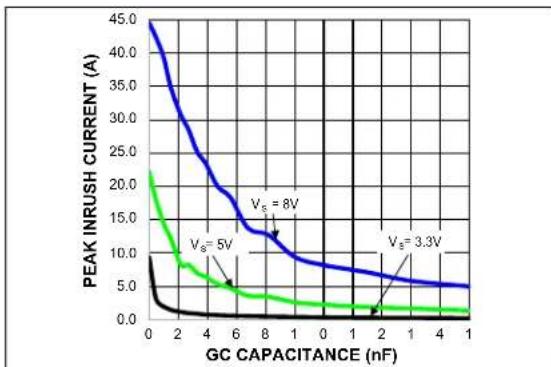
line
| GC CAPACITANCE (nF) | PEAK INRUSH CURRENT (A) | | ------------------ | ------------------------ | | 0 | 45.0 | | 2 | 30.0 | | 4 | 15.0 | | 6 | 10.0 | | 8 | 8.0 | | 1 | 7.0 | | 2 | 6.0 | | 4 | 5.0 | | 1 | 4.0 |FIGURE 2-10: Initial Peak Inrush Current (Input) vs. GC Capacitance, V_IN = 5V , C_LOAD = 100 F .
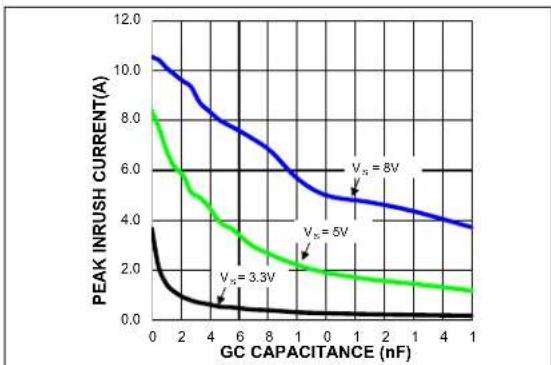
line
| GC CAPACITANCE (nF) | PEAK INRUSH CURRENT(A) at V_S = 3.3V | PEAK INRUSH CURRENT(A) at V_S = 5V | PEAK INRUSH CURRENT(A) at V_S = 8V | | ------------------ | ----------------------------------- | --------------------------------- | ---------------------------------- | | 0 | 10.5 | 8.0 | 10.5 | | 2 | 9.0 | 6.5 | 9.0 | | 4 | 7.5 | 5.0 | 7.5 | | 6 | 6.0 | 4.0 | 6.0 | | 8 | 5.0 | 3.0 | 5.0 | | 1 | 4.5 | 2.5 | 4.5 | | 2 | 4.0 | 2.0 | 4.0 | | 4 | 3.5 | 1.5 | 3.5 | | 6 | 3.0 | 1.0 | 3.0 | | 8 | 2.5 | 0.8 | 2.5 | | 1 | 2.0 | 0.6 | 2.0 | | 2 | 1.5 | 0.5 | 1.5 | | 4 | 1.0 | 0.4 | 1.0 | | 6 | 0.8 | 0.3 | 0.8 | | 8 | 0.6 | 0.2 | 0.6 | | 1 | 0.5 | 0.1 | 0.5 | | 2 | 0.4 | 0.1 | 0.4 | | 4 | 0.3 | 0.1 | 0.3 | | 6 | 0.2 | 0.1 | 0.2 | | 8 | 0.1 | 0.1 | 0.1 | | 1 | 0.1 | 0.1 | 0.1 | | 2 | 0.1 | 0.1 | 0.1 | | 4 | 0.1 | 0.1 | 0.1 | | 6 | 0.1 | 0.1 | 0.1 | | 8 | 0.1 | 0.1 | 0.1 | | 1 | 0.1 | 0.1 | 0.1 | | 2 | 0.1 | 0.1 | 0.1 | | 4 | 0.1 | 0.1 | 0.1 | | 6 | - | - | - | | 8 | - | - | - | | 1 | - | - | - | | 2 | - | - | - | | 4 | - | - | - | | 6 | - | - | - | | 8 | - | - | - | | 1 | - | - | - | | 2 | - | - | - | | 4 | - | - | - | | 6 | - | - | - | | 8 | - | - | - | | | 1 | - | - | - | | 2 | - | - | - | | 4 | - | - | - | | 6 | - | - | - | | 8 | - | - | - | | 1 | - | - | - | | 2 | - | - | - | |FIGURE 2-8: Initial Peak Inrush Current (Input) vs. GC Capacitance, V_IN = 1.05V , C_LOAD = 100 F .
line
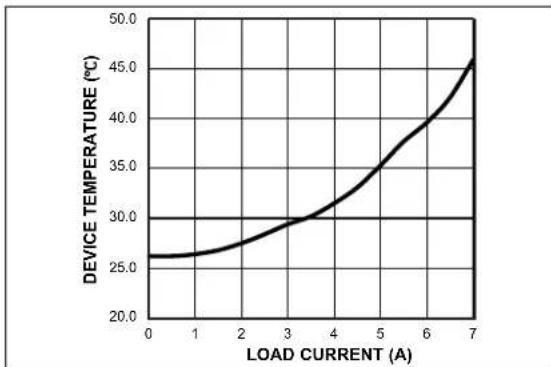
| LOAD CURRENT (A) | DEVICE TEMPERATURE (°C) | | ---------------- | ------------------------ | | 0 | 26.0 | | 1 | 26.5 | | 2 | 27.5 | | 3 | 29.0 | | 4 | 31.0 | | 5 | 35.0 | | 6 | 40.0 | | 7 | 45.0 |FIGURE 2-11: Device Temperature (Top of Package) vs. Load Current, V_IN = 5V , V_VS = 5V .
line
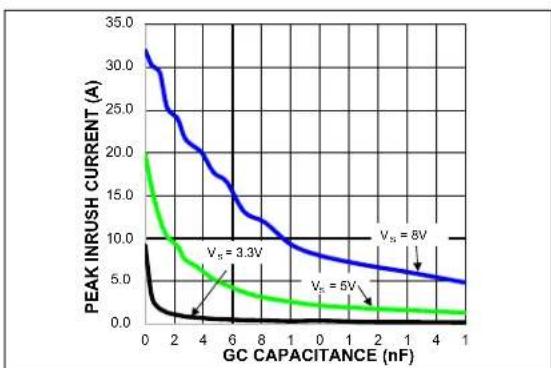
| GC CAPACITANCE (nF) | PEAK INRUSH CURRENT (A) | | ------------------ | ------------------------ | | 0 | 32.0 | | 2 | 25.0 | | 4 | 18.0 | | 6 | 12.0 | | 8 | 8.0 | | 10 | 6.0 | | 1.2 | 5.0 | | 1.4 | 4.5 | | 1.6 | 4.0 |FIGURE 2-9: Initial Peak Inrush Current (Input) vs. GC Capacitance, V_IN = 3.3V , C_LOAD = 100 F .
line
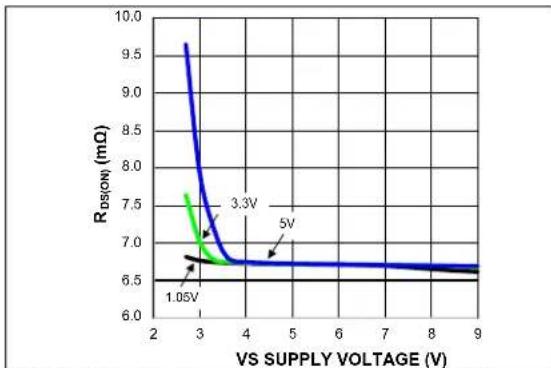
| VS SUPPLY VOLTAGE (V) | R_DS(ON) (mΩ) | | --------------------- | ------------- | | 2 | 9.7 | | 3 | 7.6 | | 4 | 6.8 | | 5 | 6.7 | | 6 | 6.7 | | 7 | 6.7 | | 8 | 6.7 | | 9 | 6.7 |FIGURE 2-12: R _DS(ON) vs. Supply Voltage.
line
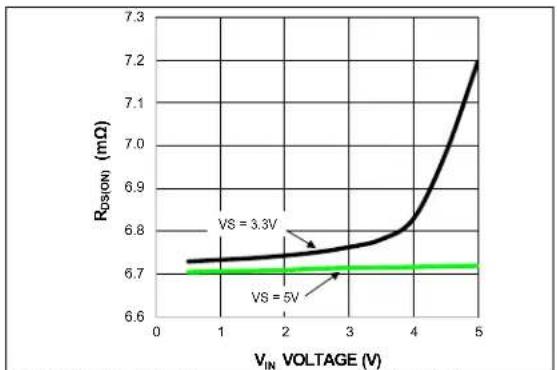
| V_IN VOLTAGE (V) | R_DSON (mΩ) | | ---------------- | ----------- | | 0 | 6.7 | | 1 | 6.7 | | 2 | 6.7 | | 3 | 6.8 | | 4 | 6.9 | | 5 | 7.2 |FIGURE 2-13: R DS(ON) vs. V_IN Voltage.

line
| Time (800μs/div) | V_CTL (5V/div) | V_GC (5V/div) | V_OUT (2V/div) | | ---------------- | -------------- | ------------- | -------------- | | Value | 5 | 5 | 5 | | C_GC = 10nF | - | - | - | | V_IN = 5V | - | - | - | | VS = 5V | - | - | - | | C_IN = 1μF | - | - | - | | C_OUT = 0.1μF | - | - | - | | R_LOAD = 10Ω | - | - | - |FIGURE 2-16: Turn-On Response.

line
| Time (200μs/div) | V_CTL (5V/div) | V_GC (2V/div) | V_OUT (500mV/div) | | ---------------- | -------------- | ------------- | ----------------- | | 0 | 1.05 | 1.05 | 1.05 | | 200 | 1.05 | 1.05 | 1.05 | | 400 | 1.05 | 1.05 | 1.05 | | 600 | 1.05 | 1.05 | 1.05 | | 800 | 1.05 | 1.05 | 1.05 | | 1000 | 1.05 | 1.05 | 1.05 | | 1200 | 1.05 | 1.05 | 1.05 | | 1400 | 1.05 | 1.05 | 1.05 | | 1600 | 1.05 | 1.05 | 1.05 | | 1800 | 1.05 | 1.05 | 1.05 | | 2000 | 1.05 | 1.05 | 1.05 |FIGURE 2-14: Turn-On Response.
line
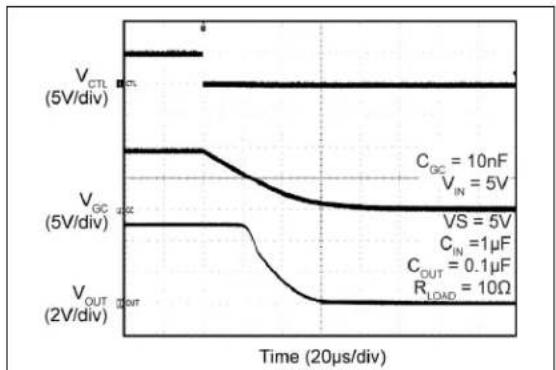
| Time (20μs/div) | V_CTL (5V/div) | V_GC (5V/div) | V_OUT (2V/div) | | --------------- | -------------- | ------------- | -------------- | | 0 | 10 | 10 | 10 | | 20 | 10 | 10 | 10 | | 40 | 10 | 10 | 10 | | 60 | 10 | 10 | 10 | | 80 | 10 | 10 | 10 | | 100 | 10 | 10 | 10 | | 120 | 10 | 10 | 10 | | 140 | 10 | 10 | 10 | | 160 | 10 | 10 | 10 | | 180 | 10 | 10 | 10 | | 200 | 10 | 10 | 10 | | 220 | 10 | 10 | 10 | | 240 | 10 | 10 | 10 | | 260 | 10 | 10 | 10 | | 280 | 10 | 10 | 10 | | 300 | 10 | 10 | 10 | | 320 | 10 | 10 | 10 | | 340 | 10 | 10 | 10 | | 360 | 10 | 10 | 10 | | 380 | 10 | 10 | 10 | | 400 | 10 | 10 | 10 | | 420 | 10 | 10 | 10 | | 440 | 10 | 10 | 10 | | 460 | 10 | 10 | 10 | | 480 | 10 | 10 | 10 | | 500 | 10 | 10 | 10 | | 520 | 10 | 10 | 10 | | 540 | 10 | 10 | 10 | | 560 | 10 | 10 | 10 | | 580 | 10 | 10 | 10 | | 600 | 10 | 10 | 10 | | 620 | 10 | 10 | 10 | | 640 | 10 | 10 | 10 | | 660 | 10 | 10 | 10 | | 680 | 10 | 10 | 10 | | 700 | 10 | 10 | 10 | | 720 | 10 | 10 | 10 | | 740 | 10 | 10 | 10 | | 760 | 10 | 10 | 10 | | 780 | 10 | 10 | 10 | | 800 | 10 | 10 | 10 | | 820 | 10 | 10 | 10 | | 840 | 10 | 10 | 10 | | 860 | 10 | 10 | 10 | | 880 | 10 | 10 | 10 | | 900 | 10 | 10 | 10 | | 920 | 10 | 10 | 10 | | 940 | 10 | 10 | 10 | | 960 | 10 | 10 | 10 | | 980 | 10 | 10 | 10 | | Note: The values for V_CTL and V_GC are not explicitly labeled in the code snippet, but they are calculated based on the given formula C_GC = -5V / C_IN = -5μF. The values for V_GC and V_OUT are calculated based on the given formula C_IN = -5μF and C_OUT = -5μF respectively. The values for V_IN and V_S are calculated based on the given formula C_IN = -5μF and C_OUT = -5μF respectively. The values for V_IN and V_S are calculated based on the given formula C_IN = -5μF and C_OUT = -5μF respectively. The values for V_IN and V_S are calculated based on the given formula C_IN = -5μF and C_OUT = -5μF respectively. The values for V_IN and V_S are calculated based upon the given formula C_IN = -5μF and C_OUT = -5μF, respectively. The values for V_IN and V_S are calculated based on the given formula C_IN = -5μF and C_OUT = -5μF respectively. The values for V_IN and V_S are calculated based on the given formula C_IN = -5μF and C_OUT = -5μF respectively. The values for V_IN and V_S are calculated based on the given formula C_IN = -5μF and C_OUT = -5μF respectively. The value for V_IN is calculated by summing up the sum of the other two curves. The value for V_IN is calculated by summing down the sum of the other two curves. The value for V_IN is calculated by summing up the sum of the other two curves. The value for V_IN is calculated by summing down the sum of the other two curves. The value for V_IN is calculated by summing up the sum of the other two curves. The value for V_IN is calculated by summing down the sum of the other two curves. The value for V_IN is calculated by summing up the sum of the other two curves. The value for W_CG is calculated by summing up the sum of the other two curves. The value for W_CIN is calculated by summing down the sum of the other two curves. The value for W_OUT is calculated by summing up the sum of the other two curves. The value for W_LOAD is calculated by summing up the sum of the other two curves. The value for W_CG is calculated by summing down the sum of the other two curves. The value for W_CIN is calculated by summing down the sum of the other two curves. The value for W_OUT is calculated by summing up the sum of the other two curves. The value for W_LOAD is calculated by summing up the sum of the other two curves. The value for W_CG is calculated by summing down the sum of the other two curves. The value for W_CIN is calculated by summing down the mean of the other two curves. The value for W_OUT is calculated by summing up the mean of the other two curves. The value for W_LOAD is calculated by summing up the mean of the other two curves. The values for W_CG and W_CIN are calculated as follows: C_GC = -5nF, C_IN = -5μF, C_OUT = -5μF, R_LOAD = -5Ω.FIGURE 2-17: Turn-Off Response.

line
| Time (20μs/div) | V_CTL (5V/div) | V_GC (2V/div) | V_OUT (500mV/div) | | --------------- | -------------- | ------------- | ----------------- | | 0 | 1.05 | 5 | 10 | | 20 | 1.05 | 5 | 10 | | 40 | 1.05 | 5 | 10 | | 60 | 1.05 | 5 | 10 | | 80 | 1.05 | 5 | 10 | | 100 | 1.05 | 5 | 10 | | 120 | 1.05 | 5 | 10 | | 140 | 1.05 | 5 | 10 | | 160 | 1.05 | 5 | 10 | | 180 | 1.05 | 5 | 10 | | 200 | 1.05 | 5 | 10 | | 220 | 1.05 | 5 | 10 | | 240 | 1.05 | 5 | 10 | | 260 | 1.05 | 5 | 10 | | 280 | 1.05 | 5 | 10 | | 300 | 1.05 | 5 | 10 | | 320 | 1.05 | 5 | 10 | | 340 | 1.05 | 5 | 10 | | 360 | 1.05 | 5 | 10 | | 380 | 1.05 | 5 | 10 | | 400 | 1.05 | 5 | 10 | | 420 | 1.05 | 5 | 10 | | 440 | 1.05 | 5 | 10 | | 460 | 1.05 | 5 | 10 | | 480 | 1.05 | 5 | 10 | | 500 | 1.05 | 5 | 10 | | 520 | 1.05 | 5 | 10 | | 540 | 1.05 | 5 | 10 | | 560 | 1.05 | 5 | 10 | | 580 | 1.05 | 5 | 10 | | 600 | 1.05 | 5 | 10 | | 620 | 1.05 | 5 | 10 | | 640 | 1.05 | 5 | 10 | | 660 | 1.05 | 5 | 10 | | 680 | 1.05 | 5 | 10 | | 700 | 1.05 | 5 | 10 | | 720 | 1.05 | 5 | 10 | | 740 | 1.05 | 5 | 10 | | 760 | 1.05 | 5 | 10 | | 780 | 1.05 | 5 | 10 | | 800 | 1.05 | 5 | 10 | | 820 | 1.05 | 5 | 10 | | 840 | 1.05 | 5 | 10 | | 860 | 1.05 | 5 | 10 | | 880 | 1.05 | 5 | 10 | | 900 | 1.05 | 5 | 10 | | 920 | 1.05 | 5 | 10 | | 940 | 1.05 | 5 | 10 | | 960 | 1.05 | 5 | 10 | | 980 | 1.05 | 5 | 10 | | Note: The actual values for V_CTL and V_GC are not provided in the code snippet, so they are calculated based on the given code snippet 'C_GC' and 'C_IN'. The values for V_IN and C_IN are calculated based on the given code snippet 'VS' and 'C_IN'. The values for C_OUT and R_LOAD are calculated based on the given code snippet 'C_OUT'.FIGURE 2-15: Turn-Off Response.
3.0 PIN DESCRIPTIONS
The descriptions of the pins are listed in Table 3-1.
TABLE 3-1: PIN FUNCTION TABLE
| Pin Number | Pin Name Description | |
| 1 | NC | Not internally connected. It is recommended to connect pin 1 to IN such that the width of the input trace can be maximized in the layout. |
| 2, 3, E1 IN | Power switch | input (up to 5.5V). |
| 4 GND | Driver ground and discharge return. | |
| 5 | VS | Bias supply input (2.7V to 9V). Bypass with 4.7 μF ceramic capacitor to GND. |
| 6, 7, 8, E2 OUT | Power switch output. | |
| 9 | GC | Gate connection of power FET. Add a ceramic capacitor from GC to ground GND for slew rate control. |
| 10 | CTL | Control input. TTL compatible. Logic high enables the power switch. A logic low disables the power switch and discharges OUT. |
4.0 FUNCTIONAL DESCRIPTION
The MIC95410 is a non-inverting device. Applying a logic-high signal to control input (CTL) turns on an internal N-channel MOSFET switch (Q4). The gate control (GC) output can be used to reduce the turn-on speed of the MOSFET by connecting a capacitor from GC to ground.
4.1 Supply
Supply (VS) is rated for +2.7V to +9V. An external 4.7 F capacitor (minimum) is recommended.
4.2 ON/OFF Control
Control (CTL) is a TTL-compatible input. CTL must be forced high or low by an external signal. A floating input may cause unpredictable operation.
A high input turns on Q2, which sinks the output of current source I1, and makes the input of the first inverter low. The inverter output becomes high, enabling the charge pump.
4.3 Charge Pump
The charge pump is enabled when CTL is logic high. The charge pump is powered from VS and consists of an oscillator and a 4x voltage multiplier. Output voltage is limited to 16V by an internal Zener diode. The charge pump output current raises the voltage on the GC pin and causes the internal MOSFET Q4 to be turned on. The gate-source voltage of Q4 is internally limited by R3 and D5.
The charge pump oscillator operates from approximately 70 kHz to approximately 100 kHz depending upon the supply voltage and temperature.
4.4 Gate Control
The charge pump output is connected directly to the GC output. The charge pump is active only when CTL is high. When CTL is low, Q3 is turned on by the second inverter and discharges the gate of Q4 to force it off.
If CTL is high, and the voltage applied to VS drops to zero, the gate output will be floating and unpredictable.
4.5 ESD Protection
D1 and D2 clamp positive and negative ESD voltages. R1 isolates the gate of Q2 from sudden changes on the CTL input. Zener D3 also clamps ESD voltages for the GC output. D4 protects the gate of Q4 from ESD on the GC pin.
5.0 APPLICATION INFORMATION
5.1 Turn-On
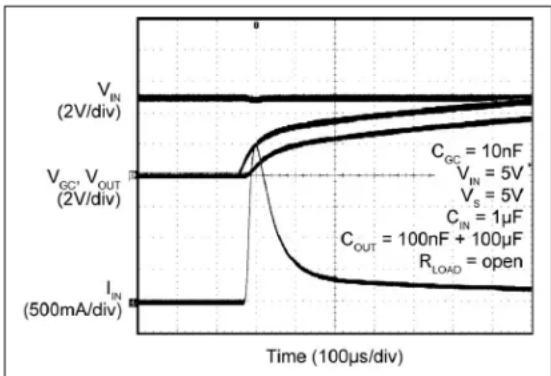
The MIC95410 is turned on by setting CTL ≥2.0V . The CTL pin enables the MIC95410, which releases the pull-down on GC and starts the charge pump. When the charge pump is turned on, the OUT waveform will exhibit a two-stage rise-time. In the first stage, a higher drive current causes GC to rise rapidly, while in the second phase a lower drive current causes GC to rise more slowly. This is shown in Figure 5-1. With a purely capacitive load C_OUT , the current exhibits an initial peak ( I_PEAK ) during the first stage and a limiting, flattening value I_CHARGE in the second stage.
line
| Time (100μs/div) | V_IN (2V/div) | V_OUT (2V/div) | I_IN (500mA/div) | | ---------------- | ------------- | -------------- | ---------------- | | 0 | 0 | 0 | 0 | | Peak | ~1.0 | ~1.0 | ~1.0 | | Peak C_GC | 10nF | - | - | | Peak V_IN | 5V | - | - | | Peak V_S | 5V | - | - | | Peak C_IN | 1μF | - | - | | Peak C_OUT | 100nF | +100μF | - | | R_LOAD | open | - | - |FIGURE 5-1: OUT Voltage and Inrush Current Waveform During Turn-On (IN Current Scale is 500 mA/div).
An analytical prediction of I_PEAK is complicated because it involves many factors. For an estimation of I_PEAK , and selection of the GC capacitor, the user can refer to the corresponding Typical Operating Characteristics plots (given for C_OUT = 100 F ), and scale the values in proportion to the actual capacitive load. Note that these plots do not include any additional DC loads because large load capacitances are the most important factor to consider in initial peak inrush current estimation. DC contributions are either negligible at very low output voltage (e.g. resistive load) or typically activated when the OUT voltage has already approached its final value.
The input current during the second (flattening) stage can be estimated as shown in Equation 5-1:
EQUATION 5-1:
$$ I _ {C H A R G E} \quad \frac {I _ {S T A G E 2} \times C _ {O U T}}{C _ {G C}} $$
For example, if C_GC = 10 nF, Q_OUT = 100 F (no additional DC load), I_STAGE2 = 27 A (see dc parameter in the Electrical Characteristics table) then we obtain I_CHARGE = 0.27A . This calculation is in reasonable agreement with the measurement shown in Figure 5-1.
Note that for very low input voltages, the duration of the turn-on transition is likely to be dominated by the first stage, where the I_GC current is much stronger than in the second stage. In this case, an increase of the C_GC capacitance could be needed.
Also note that during turn-on the internal power switch can instantaneously dissipate a large amount of power due to the transition through the linear region. Depending upon the instantaneous values of load current and voltage, make sure the turn-on V-I trajectory stays within the Safe Operating Area plot shown in the Power Switch SOA section.
5.2 Turn-Off
The turn-off of the MIC95410 is started by taking CTL to a logic low where the GC pin is pulled to GND with a resistive MOSFET switch of approximately 2 kΩ (see MOSFET Q3 in the Functional Block Diagram). Pulling GC to GND will cause the power MOSFET to be turned off (see MOSFET Q4 in the Functional Block Diagram). Further, the diode D4 between the OUT pin and the GC pin turns on and discharges OUT with a controlled discharge path (D4-Q3).
5.3 Power Dissipation Considerations
The junction temperature ( T_J ) can be estimated from power dissipation, ambient temperature, and the junction-to-ambient thermal resistance ( _JA ).
EQUATION 5-2:
$$ T _ {J} = P _ {D I S S} \times \theta_ {J A} T + \quad_ {A} $$
For steady-state condition, P_DISS is calculated as I_IN^2 × R_ON(MAX) . _JA is found in the Operating Ratings section of the data sheet. This is the value of _JA measured in still air on the evaluation kit board. Note that the actual _JA in the final application is strongly dependent on the PCB layout, on the PCB thermal properties, as well as cooling techniques (e.g. forced convection vs. still air). Therefore, the _JA value given for the evaluation kit board should be used with caution when trying to estimate T_J in the end user application.
5.4 Power Switch SOA
The safe operating area (SOA) curve shown in Figure 5-2 represents the boundary of maximum safe operating current and voltage for transient operation.

line
| V_in - V_out (V) | I_in (A) | | ---------------- | -------- | | 0.1 | 20 | | 0.5 | 80 | | 1 | 90 | | 2 | 90 | | 3 | 90 | | 4 | 90 | | 5 | 1 | | 6 | 0.1 | | 7 | 0.1 | | 8 | 0.1 | | 9 | 0.1 | | 10 | 0.1 |FIGURE 5-2: MIC95410 Power Switch
Safe Operating Area.
Ensure that the V-I trajectory stays within recommended SOA boundaries during the turn-on and turn-off transients.
Also note that the SOA plot does not provide safe operating limits for continuous operation and it is only applicable for transient operation. For continuous (DC) operation, the allowable power dissipation limit is dictated by the ambient temperature T_A and the actual _JA of the device in the end user application as follows:
EQUATION 5-3:
$$ \begin{array}{c c} \hline P _ {D I S S M A X (} & \frac {T _ {J M A X ^ {-}} T _ {A -}}{\theta_ {J A}} \ \text {Where:} \ T _ {J (M A X)} = 1 2 5 ^ {\circ} C. \end{array} $$
6.0 PCB LAYOUT
RECOMMENDATIONS
The IN and OUT traces should be made as wide as possible because the main heat-sinking action will be performed by heat removal through the IN/E1 and OUT/E2 connections on the top layer. The traces should widen up as soon as space constraints allow it.
Note that a two-layer routing is adequate for a very compact solution. In case multiple internal planes are used, it is recommended to keep internal planes as solid as possible and to extend them under the MIC95410 and its vicinity (in special the IN and OUT top traces) in order to increase vertical, then lateral, heat transfer.
Another method is to copy the IN and OUT traces on the bottom layer and to stitch them through many thermal vias to the top layers IN and OUT connections, in particular in the immediate vicinity of the MIC95410 IC.
7.0 PACKAGING INFORMATION
7.1 Package Marking Information
10-Lead VQFN* Example
XXXX
9541


Legend: XX...X Product code or customer-specific information
Y Year code (last digit of calendar year)
YY Year code (last 2 digits of calendar year)
WW Week code (week of January 1 is week '01')
NNN Alphanumeric traceability code
ePb-free JEDEC ^® designator for Matte Tin (Sn)
* This package is Pb-free. The Pb-free JEDEC designator (e3) can be found on the outer packaging for this package.
•, ▲, ▼ Pin one index is identified by a dot, delta up, or delta down (triangle mark).
Note: In the event the full Microchip part number cannot be marked on one line, it will be carried over to the next line, thus limiting the number of available characters for customer-specific information. Package may or may not include the corporate logo.
Underbar (_) and/or Overbar (−) symbol may not be to scale.
10-Lead VQFN Package Outline and Recommended Land Pattern
10-Lead Very Thin Plastic Quad Flat, No Lead Package (NDA) - 1.2x2.0x0.9 mm Body [VQFN]; Micrel Legacy Package FQFN1220-10LD-PL-1
Note: For the most current package drawings, please see the Microchip Packaging Specification located at http://www.microchip.com/packaging
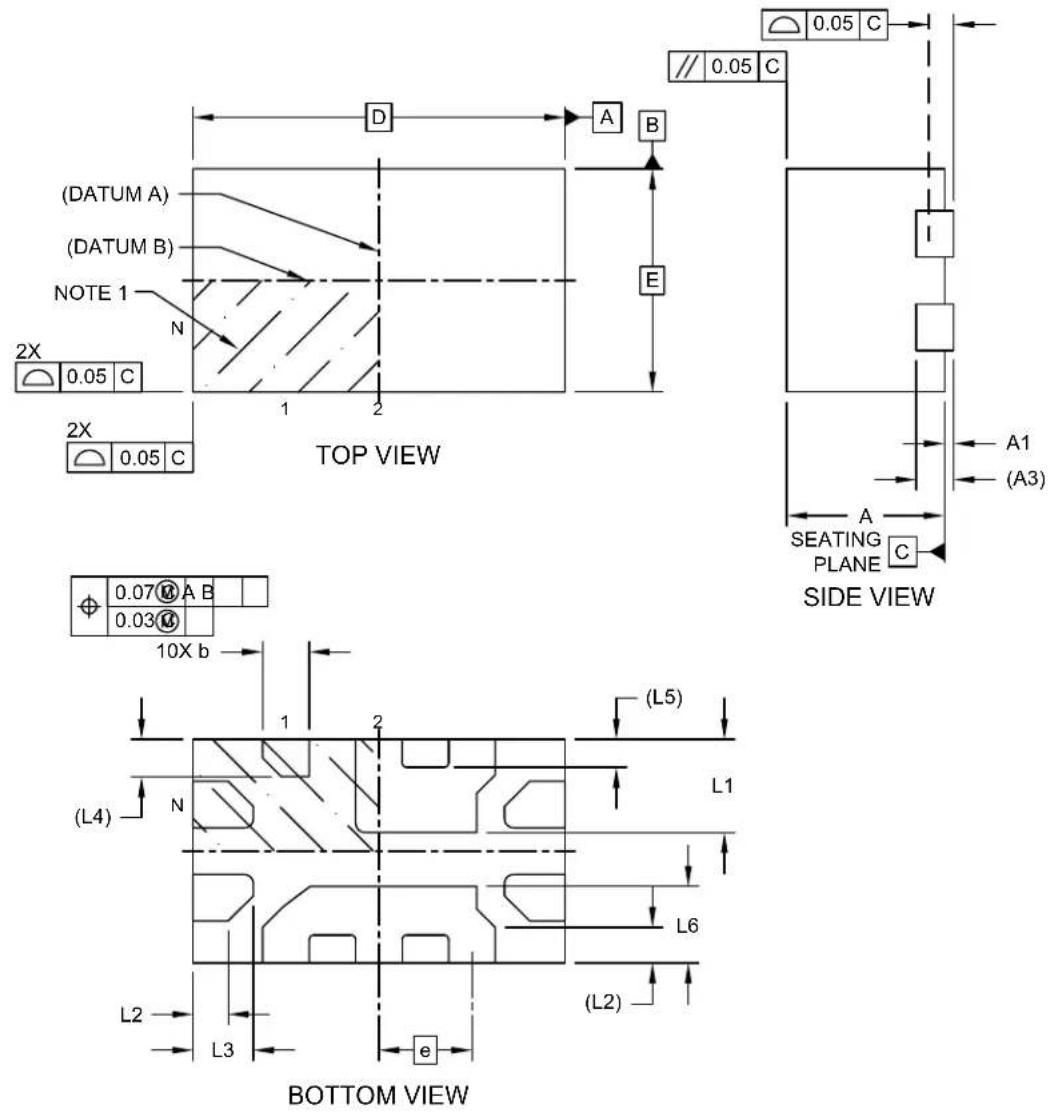
Microchip Technology Drawing C04-1029 Rev A Sheet 1 of 2
10-Lead Very Thin Plastic Quad Flat, No Lead Package (NDA) - 1.2x2.0x0.9 mm Body [VQFN]; Micrel Legacy Package FQFN1220-10LD-PL-1
Note: For the most current package drawings, please see the Microchip Packaging Specification located at http://www.microchip.com/packaging
![Microchip MIC95410 - 10-Lead Very Thin Plastic Quad Flat, No Lead Package (NDA) - 1.2x2.0x0.9 mm Body [VQFN]; Micrel Legacy Package FQFN1220-10LD-PL-1 - 1](/content/2026/06/1219344/images/540fd7705231c95c082d72ccb72527ce887884f9337c09906a45da7852f5bc4b.jpg)
natural_image
Isometric line drawing of two rectangular electronic components with internal slots and mounting holes (no text or symbols)| Units | MILLIMETERS | |||
| Dimension Limits | MIN | NOM | MAX | |
| Number of Terminals | N | 10 | ||
| Pitch | e | 0.50 BSC | ||
| Overall Height | A | 0.80 | 0.85 | 0.90 |
| Standoff | A1 | 0.00 | 0.02 | 0.05 |
| Terminal Thickness | A3 | 0.203 REF | ||
| Overall Length D 2.00 BSC | ||||
| Overall Width | E | 1.20 BSC | ||
| Terminal Width | b | 0.20 0.25 | 0.30 | |
| Terminal Length 0.45 0.50 0.55 | L1 | |||
| Terminal Length | L2 | 0.19 REF | ||
| L3 | 0.3250.275 | 0.375Ter | ||
| Terminal Length | L4 0.20 REF | |||
| Terminal Length | L5 | 0.15 REF | ||
| L6 | 0.410.36 | 0.46Termin | ||
minal Length
Notes:
- Pin 1 visual index feature may vary, but must be located within the hatched area.
- Package is saw singulated
- Dimensioning and tolerancing per ASME Y14.5M BSC: Basic Dimension. Theoretically exact value shown without tolerances. REF: Reference Dimension, usually without tolerance, for information purposes only.
Microchip Technology Drawing C04-1029 Rev A Sheet 2 of 2
10-Lead Very Thin Plastic Quad Flat, No Lead Package (NDA) - 1.2x2.0x0.9 mm Body [VQFN]; Micrel Legacy Package FQFN1220-10LD-PL-1
Note: For the most current package drawings, please see the Microchip Packaging Specification located at http://www.microchip.com/packaging
![Microchip MIC95410 - 10-Lead Very Thin Plastic Quad Flat, No Lead Package (NDA) - 1.2x2.0x0.9 mm Body [VQFN]; Micrel Legacy Package FQFN1220-10LD-PL-1 - 1](/content/2026/06/1219344/images/a0fff86ed963badd8b4eb86abb55b81b769e18565364aa2bef17d7c6b205ec28.jpg)
text_image
C1 X2 Y2 C2 E Y1 SILK SCREEN X1 E OPTIONAL PADS FOR ENHANCED THERMAL PERFORMANCERECOMMENDED LAND PATTERN
| Units | MILLIMETERS | |||
| Dimension Limits | MIN | NOM | MAX | |
| Contact Pitch | E | 0.50 BSC | ||
| Optional Center Pad Width (X2) | X2 | 1.00 | ||
| Optional Center Pad Length (X2) | Y2 | 0.225 | ||
| C1 | Contact Pad Spacing 1.90 | |||
| Contact Pad Spacing | C2 | 1.00 | ||
| Contact Pad Width (X10) | X1 | 0.25 | ||
| Contact Pad Length (X10) | Y1 | 0.30 | ||
| Contact Pad to Contact Pad (Xnn) Y1 | 0.30 | |||
Notes:
Dimensioning and tolerancing per ASME Y14.5M1.
BSC: Basic Dimension. Theoretically exact value shown without tolerances.
Microchip Technology Drawing C04-3029 Rev A
APPENDIX A: REVISION HISTORY
Revision A (October 2020)
- Converted Micrel document MIC95410 to Microchip data sheet template DS20006431A.
- Minor grammatical text changes throughout.
- Typical Application Schematic, Bill of Materials, and the full PCB Layout Recommendations sections have been moved to the User's Guide for this device.
NOTES:
PRODUCT IDENTIFICATION SYSTEM
To order or obtain information, e.g., on pricing or delivery, contact your local Microchip representative or sales office.
Device
XX
-XX
一
Part No.
Temperature Range
Package
Media Type
Device:
MIC95410:
6.6 mΩ R DS(ON) , 7A, 5.5V V IN Load Switch
Temperature
Y = -40^ to +125^
Range:
Package: FL = 10-Lead VQFN
Media Type:
T5 = 500/Reel TR = 5,000/Reel
Examples:
a) MIC95410YFL-T5: MIC95410, -40°C to +125°C, 10-Lead VQFN, 500/Reel
b) MIC95410YFL-TR: MIC95410, -40°C to +125°C, 10-Lead VQFN, 5,000/Reel
Note 1: Tape and Reel identifier only appears in the catalog part number description. This identifier is used for ordering purposes and is not printed on the device package. Check with your Microchip Sales Office for package availability with the Tape and Reel option.
NOTES:
Note the following details of the code protection feature on Microchip devices:
• Microchip products meet the specifications contained in their particular Microchip Data Sheet.
• Microchip believes that its family of products is secure when used in the intended manner and under normal conditions.
- There are dishonest and possibly illegal methods being used in attempts to breach the code protection features of the Microchip devices. We believe that these methods require using the Microchip products in a manner outside the operating specifications contained in Microchip's Data Sheets. Attempts to breach these code protection features, most likely, cannot be accomplished without violating Microchip's intellectual property rights.
• Microchip is willing to work with any customer who is concerned about the integrity of its code.
- Neither Microchip nor any other semiconductor manufacturer can guarantee the security of its code. Code protection does not mean that we are guaranteeing the product is "unbreakable." Code protection is constantly evolving. We at Microchip are committed to continuously improving the code protection features of our products. Attempts to break Microchip's code protection feature may be a violation of the Digital Millennium Copyright Act. If such acts allow unauthorized access to your software or other copyrighted work, you may have a right to sue for relief under that Act.
Information contained in this publication is provided for the sole purpose of designing with and using Microchip products. Information regarding device applications and the like is provided only for your convenience and may be superseded by updates. It is your responsibility to ensure that your application meets with your specifications.
THIS INFORMATION IS PROVIDED BY MICROCHIP "AS IS". MICROCHIP MAKES NO REPRESENTATIONS OR WARRANTIES OF ANY KIND WHETHER EXPRESS OR IMPLIED, WRITTEN OR ORAL, STATUTORY OR OTHERWISE, RELATED TO THE INFORMATION INCLUDING BUT NOT LIMITED TO ANY IMPLIED WARRANTIES OF NON-INFRINGEMENT, MERCHANTABILITY, AND FITNESS FOR A PARTICULAR PURPOSE OR WARRANTIES RELATED TO ITS CONDITION, QUALITY, OR PERFORMANCE.
IN NO EVENT WILL MICROCHIP BE LIABLE FOR ANY INDIRECT, SPECIAL, PUNITIVE, INCIDENTAL OR CONSEQUENTIAL LOSS, DAMAGE, COST OR EXPENSE OF ANY KIND WHATSOEVER RELATED TO THE INFORMATION OR ITS USE, HOWEVER CAUSED, EVEN IF MICROCHIP HAS BEEN ADVISED OF THE POSSIBILITY OR THE DAMAGES ARE FORESEEABLE. TO THE FULLEST EXTENT ALLOWED BY LAW, MICROCHIP'S TOTAL LIABILITY ON ALL CLAIMS IN ANY WAY RELATED TO THE INFORMATION OR ITS USE WILL NOT EXCEED THE AMOUNT OF FEES, IF ANY, THAT YOU HAVE PAID DIRECTLY TO MICROCHIP FOR THE INFORMATION. Use of Microchip devices in life support and/or safety applications is entirely at the buyer's risk, and the buyer agrees to defend, indemnify and hold harmless Microchip from any and all damages, claims, suits, or expenses resulting from such use. No licenses are conveyed, implicitly or otherwise, under any Microchip intellectual property rights unless otherwise stated.
Trademarks
The Microchip name and logo, the Microchip logo, Adaptec, AnyRate, AVR, AVR logo, AVR Freaks, BesTime, BitCloud, chipKIT, chipKIT logo, CryptoMemory, CryptoRF, dsPIC, FlashFlex, flexPWR, HELDO, IGLOO, JukeBlox, KeeLoq, Kleer, LANCheck, LinkMD, maXStylus, maXTouch, MediaLB, megaAVR, Microsemi, Microsemi logo, MOST, MOST logo, MPLAB, OptoLyzer, PackeTime, PIC, picoPower, PICSTART, PIC32 logo, PolarFire, Prochip Designer, QTouch, SAM-BA, SenGenuity, SpyNIC, SST, SST Logo, SuperFlash, Symmetricom, SyncServer, Tachyon, TempTrackr, TimeSource, tinyAVR, UNI/O, Vectron, and XMEGA are registered trademarks of Microchip Technology Incorporated in the U.S.A. and other countries.
APT, ClockWorks, The Embedded Control Solutions Company, EtherSynch, FlashTec, Hyper Speed Control, HyperLight Load, IntelliMOS, Libero, motorBench, mTouch, Powermite 3, Precision Edge, ProASIC, ProASIC Plus, ProASIC Plus logo, Quiet-Wire, SmartFusion, SyncWorld, Temux, TimeCesium, TimeHub, TimePictra, TimeProvider, Vite, WinPath, and ZL are registered trademarks of Microchip Technology Incorporated in the U.S.A.
Adjacent Key Suppression, AKS, Analog-for-the-Digital Age, Any Capacitor, AnyIn, AnyOut, BlueSky, BodyCom, CodeGuard, CryptoAuthentication, CryptoAutomotive, CryptoCompanion, CryptoController, dsPICDEM, dsPICDEM.net, Dynamic Average Matching, DAM, ECAN, EtherGREEN, In-Circuit Serial Programming, ICSP, INICnet, Inter-Chip Connectivity, JitterBlocker, KleerNet, KleerNet logo, memBrain, Mindi, MiWi, MPASM, MPF, MPLAB Certified logo, MPLIB, MPLINK, MultiTRAK, NetDetach, Omniscient Code Generation, PICDEM, PICDEM.net, PICkit, PICtail, PowerSmart, PureSilicon, QMatrix, REAL ICE, Ripple Blocker, SAM-ICE, Serial Quad I/O, SMART-I.S., SQI, SuperSwitcher, SuperSwitcher II, Total Endurance, TSHARC, USBCheck, VariSense, ViewSpan, WiperLock, Wireless DNA, and ZENA are trademarks of Microchip Technology Incorporated in the U.S.A. and other countries.
SQTP is a service mark of Microchip Technology Incorporated in the U.S.A.
The Adaptec logo, Frequency on Demand, Silicon Storage Technology, and Symmcom are registered trademarks of Microchip Technology Inc. in other countries.
GestIC is a registered trademark of Microchip Technology Germany II GmbH & Co. KG, a subsidiary of Microchip Technology Inc., in other countries.
All other trademarks mentioned herein are property of their respective companies.
© 2020, Microchip Technology Incorporated, All Rights Reserved.
ISBN: 978-1-5224-6894-3
For information regarding Microchip's Quality Management Systems, please visit www.microchip.com/quality.
Worldwide Sales and Service
AMERICAS
Corporate Office
2355 West Chandler Blvd.
Chandler, AZ 85224-6199
Tel: 480-792-7200
Fax: 480-792-7277
Technical Support:
http://www.microchip.com/
support
Web Address:
www.microchip.com
Atlanta
Duluth, GA
Tel: 678-957-9614
Fax: 678-957-1455
Austin, TX
Tel: 512-257-3370
Boston
Westborough, MA
Tel: 774-760-0087
Fax: 774-760-0088
Chicago
Itasca, IL
Tel: 630-285-0071
Fax: 630-285-0075
Dallas
Addison, TX
Tel: 972-818-7423
Fax: 972-818-2924
Detroit
Novi, MI
Tel: 248-848-4000
Houston, TX
Tel: 281-894-5983
Indianapolis
Noblesville, IN
Tel: 317-773-8323
Fax: 317-773-5453
Tel: 317-536-2380
Los Angeles
Mission Viejo, CA
Tel: 949-462-9523
Fax: 949-462-9608
Tel: 951-273-7800
Raleigh, NC
Tel: 919-844-7510
New York, NY
Tel: 631-435-6000
San Jose, CA
Tel: 408-735-9110
Tel: 408-436-4270
Canada - Toronto
Tel: 905-695-1980
Fax: 905-695-2078
ASIA/PACIFIC
Australia - Sydney
Tel: 61-2-9868-6733
China - Beijing
Tel: 86-10-8569-7000
China - Chengdu
Tel: 86-28-8665-5511
China - Chongqing
Tel: 86-23-8980-9588
China - Dongguan
Tel: 86-769-8702-9880
China - Guangzhou
Tel: 86-20-8755-8029
China - Hangzhou
Tel: 86-571-8792-8115
China - Hong Kong SAR
Tel: 852-2943-5100
China - Nanjing
Tel: 86-25-8473-2460
China - Qingdao
Tel: 86-532-8502-7355
China - Shanghai
Tel: 86-21-3326-8000
China - Shenyang
Tel: 86-24-2334-2829
China - Shenzhen
Tel: 86-755-8864-2200
China - Suzhou
Tel: 86-186-6233-1526
China - Wuhan
Tel: 86-27-5980-5300
China - Xian
Tel: 86-29-8833-7252
China - Xiamen
Tel: 86-592-2388138
China - Zhuhai
Tel: 86-756-3210040
ASIA/PACIFIC
India - Bangalore
Tel: 91-80-3090-4444
India - New Delhi
Tel: 91-11-4160-8631
India - Pune
Tel: 91-20-4121-0141
Japan - Osaka
Tel: 81-6-6152-7160
Japan - Tokyo
Tel: 81-3-6880-3770
Korea - Daegu
Tel: 82-53-744-4301
Korea - Seoul
Tel: 82-2-554-7200
Malaysia - Kuala Lumpur
Tel: 60-3-7651-7906
Malaysia - Penang
Tel: 60-4-227-8870
Philippines - Manila
Tel: 63-2-634-9065
Singapore
Tel: 65-6334-8870
Taiwan - Hsin Chu
Tel: 886-3-577-8366
Taiwan - Kaohsiung
Tel: 886-7-213-7830
Taiwan - Taipei
Tel: 886-2-2508-8600
Thailand - Bangkok
Tel: 66-2-694-1351
Tel: 43-7242-2244-39
Fax: 43-7242-2244-393
Denmark - Copenhagen
Tel: 45-4485-5910
Fax: 45-4485-2829
Finland - Espoo
Tel: 358-9-4520-820
France - Paris
Tel: 33-1-69-53-63-20
Fax: 33-1-69-30-90-79
Germany - Garching
Tel: 49-8931-9700
Germany - Haan
Tel: 49-2129-3766400
Germany - Heilbronn
Tel: 49-7131-72400
Germany - Karlsruhe
Tel: 49-721-625370
Germany - Munich
Tel: 49-89-627-144-0
Fax: 49-89-627-144-44
Germany - Rosenheim
Tel: 49-8031-354-560
Israel - Ra'anana
Tel: 972-9-744-7705
Italy - Milan
Tel: 39-0331-742611
Fax: 39-0331-466781
Italy - Padova
Tel: 39-049-7625286
Netherlands - Drunen
Tel: 31-416-690399
Fax: 31-416-690340
Norway - Trondheim
Tel: 47-7288-4388
Poland - Warsaw
Tel: 48-22-3325737
Romania - Bucharest
Tel: 40-21-407-87-50
Spain - Madrid
Tel: 34-91-708-08-90
Fax: 34-91-708-08-91
Sweden - Gothenberg
Tel: 46-31-704-60-40
Sweden - Stockholm
Tel: 46-8-5090-4654
UK - Wokingham
Tel: 44-118-921-5800
Fax: 44-118-921-5820