MIC23031-4YMT - Electronic component Microchip - Free user manual and instructions
Find the device manual for free MIC23031-4YMT Microchip in PDF.


User questions about MIC23031-4YMT Microchip
0 question about this device. Answer the ones you know or ask your own.
Ask a new question about this device
Download the instructions for your Electronic component in PDF format for free! Find your manual MIC23031-4YMT - Microchip and take your electronic device back in hand. On this page are published all the documents necessary for the use of your device. MIC23031-4YMT by Microchip.
USER MANUAL MIC23031-4YMT Microchip
The MIC23031 is a 400mA 4MHz switching regulator featuring HyperLight Load ^® mode. The MIC23031 is highly-efficient throughout the entire output current range, drawing just 21μA of quiescent current in operation. The tiny 1.6mm × 1.6mm Thin DFN package in combination with the 4MHz switching frequency enables a compact sub-1mm height solution with only three external components. The MIC23031 provides accurate output voltage regulation under the most demanding conditions responding extremely quickly to a load transient with exceptionally small output voltage ripple.
Factoring in the output current, the internal circuitry of the MIC23031 automatically selects between two modes of operation for optimum efficiency. Under light-load conditions, the MIC23031 goes into HyperLight Load mode. HyperLight Load uses a pulse-frequency modulation (PFM) control scheme that controls the off-time at light load. This proprietary architecture reduces the amount of switching needed at light loads, thereby increasing operating efficiency. The MIC23031 attains up to 88% efficiency at 1mA output load. As the load current increases beyond approximately 100mA, the device operates using the pulse-width modulation (PWM) method for up to 93% efficiency at higher loads. The two modes of operation ensure the highest efficiency across the entire load range.
The MIC23031 operates from an input voltage range of 2.7V to 5.5V and features internal power MOSFETs that deliver up to 400mA of output current. This step-down regulator provides an output voltage accuracy of ±2.5% across the junction temperature range of -40°C to +125°C. The MIC23031 is available in fixed or adjustable versions supporting an output voltage as low as 0.7V.
Datasheets and support documentation are available on Micrel's web site at: www.micrel.com.
Requirements
The MIC23031 evaluation board requires an input power source that is able to deliver greater than 500mA at 2.7V to the MIC23031. The output load can either be an active (electronic) or passive (resistive) load.
Getting Started
1. Connect an external supply to the VIN (J1) terminal.
Apply the desired input voltage to VIN (J1) and ground (J2) terminals of the evaluation board, paying careful attention to polarity and supply voltage ( 2.7V ≤ V_IN ≤ 5.5V ). An ammeter may be placed between the input supply and the VIN (J1) terminal. Be sure to monitor the supply voltage at the VIN (J1) terminal, since the ammeter and/or power-lead resistance can reduce the voltage supplied to the device.
2. Connect a load to the VOUT (J3) and ground terminal (J4).
The load can be either passive (resistive) or active (electronic) load. An ammeter may be placed between the load and the output terminal. Ensure the output voltage is monitored at the VOUT (J3) terminal.
3. Enable the MIC23031.
The MIC23031 evaluation board has a pull-up resistor to VIN. To disable the device, apply a voltage below 0.5V to the EN (J5) terminal or place a jumper on JP1 to ground EN. In the absence of the pull-up resistor, the device is enabled by applying a voltage greater than 1.2V to the EN (J5) terminal. The EN pin must be either pulled high or low for proper operation. Remove the pull-up regulator to operate in an indeterminable state.
Output Voltage
The MIC23031 evaluation board is available with the output voltage options listed in the Ordering Information table.
Ordering Information
| Part Number Description |
| MIC23031-AYMT EV Adjustable-Output Evaluation Board |
| MIC23031-CYMT EV 1.0V Fixed-Output Evaluation Board |
| MIC23031-4YMT EV 1.2V Fixed-Output Evaluation Board |
| MIC23031-FYMT EV 1.5V Fixed-Output Evaluation Board |
| MIC23031-GYMT EV 1.8V Fixed-Output Evaluation Board |
Note: Other voltage options available upon request.
HyperLight Load is a registered trademark of Micrel, Inc.
Micrel Inc. • 2180 Fortune Drive • San Jose, CA 95131 • USA • tel +1 (408) 944-0800 • fax +1 (408) 474-1000 • http://www.micrel.com
Output Voltage (Adjustable Option Only)
The output voltage of the MIC23031-AYMT regulator is determined by feedback resistors R1 and R2 whose values are calculated in Equation 1:
$$ \text { OUT } \quad \mathrm{V62} \left(\frac {\mathrm{R1}}{\mathrm{R2}} + x = \right. \quad \text { Eq. 1 } $$
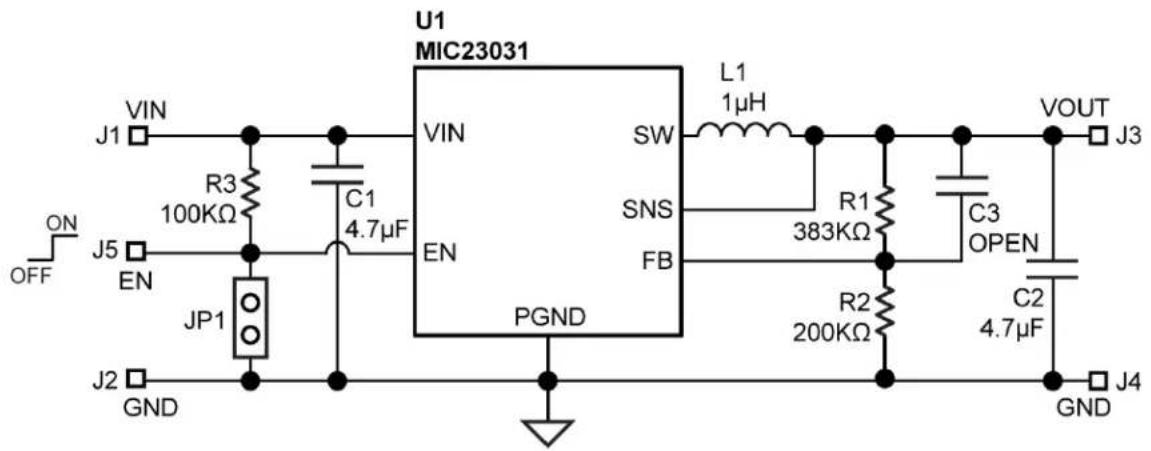
The output on the evaluation board is by default set to 1.8V (R1 = 383kΩ, R2 = 200kΩ), but can easily be modified by removing R1 and replacing it with the value that yields the desired output voltage.
$$ R 1 = \left(\frac {V _ {\text {OUT}}}{V 6 2 . 0} - 1\right) \times R 2 \tag {Eq.2} $$
For optimum transient response performance, R2 should be in the range of 180kΩ to 220kΩ.
HyperLight Load
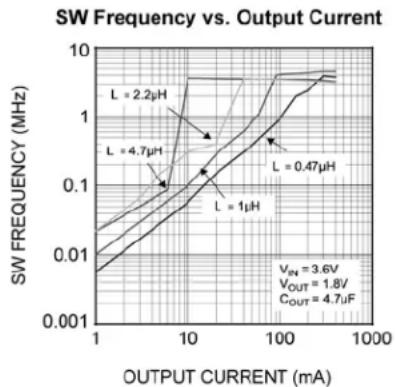
MIC23031 uses a patented minimum on and off time control loop at light loads. When the output voltage falls below the lower regulation threshold, the error comparator begins a switching cycle that turns the PMOS on and keeps it on for the duration of the minimum on-time. This increases the output voltage. Once the output voltage rises to the higher regulation threshold, the error comparator turns the PMOS off for a minimum off-time until the output drops down to the lower threshold. The NMOS acts as an ideal rectifier that conducts when the PMOS is off. Using a NMOS switch instead of a diode reduces power dissipation as current is sourced from ground. In discontinuous mode, the MIC23031 works in PFM to regulate the output. As the output current increases, the off-time decreases, therefore more energy is delivered to the output. This switching scheme improves the efficiency of the MIC23031 during light load currents by activating the power FETs only as needed. As the load current increases, the MIC23031 goes into continuous conduction mode (CCM) and switches at a frequency centered at 4MHz. Equation 3 calculates the load where the MIC23031 goes into continuous-conduction mode:
$$ I _ {\text {LOAD}} > \left(\frac {(V _ {\text {IN}} - V _ {\text {OUT}}) \times D}{2 L \times f}\right) \tag {Eq.3} $$
As shown in Equation 3, the load at which the MIC23031 transitions from HyperLight Load mode to PWM mode is a function of the input voltage (VIN), output voltage (VOUT), duty cycle (D), inductance (L), and frequency (f) (Figure 1). Suitable inductors for the MIC23031 range from 0.47μH to 4.7μH. The device may be tailored to enter HyperLight Load mode or PWM mode at a specific load current by selecting the appropriate inductor. For example, if a 4.7μH inductor is selected in a 3.6VIN to 1.8VOUT application, the MIC23031 will transition into PWM mode at a load of approximately 5mA. If, under the same conditions, a 1μH inductor is chosen, the MIC23031 will transition into PWM mode at approximately 70mA.
line
| OUTPUT CURRENT (mA) | SW FREQUENCY (MHz) | | ------------------- | ------------------ | | 1 | 0.001 | | 10 | 0.1 | | 100 | 1 | | 1000 | 10 |Figure 1. MIC23031 SW Frequency vs. Output Current
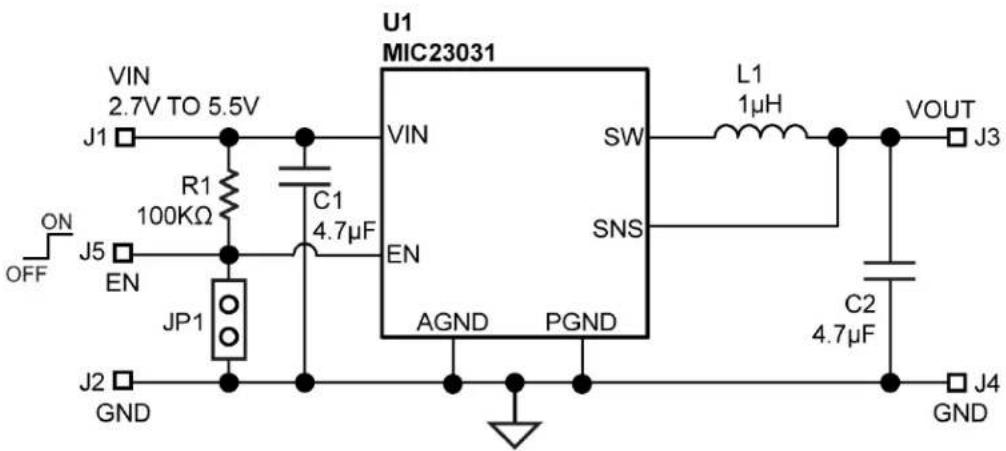
MIC23031 Typical Application Circuit (Fixed)
text_image
VIN 2.7V TO 5.5V J1 R1 100KΩ C1 4.7μF JP1 ON OFF J5 EN J2 GND U1 MIC23031 VIN SW L1 1μH VOUT J3 EN AGND PGND SNS C2 4.7μF J4 GNDBill of Materials
| Item | Part Number | Manufacturer | Description | Qty. |
| C1, C2 | C1608X5R0J475K | TDK^(1) 4.7μF | Ceramic Capacitor, 6.3V, X5R, Size 0603 2 | |
| R1 CRC | W06031003FT1 Vishay | ^(2) 100kΩ, 1%, Size 0603 1 | ||
| L1 | LQM21PN1R0MC0D Murata | ^(3) | 1μH, 0.8A, 190mΩ, L2mm × W1.25mm × H0.5mm | 1 |
| LQH32CN1R0M33 Murata | 1μH, 1A, 60mΩ, L3.2mm × W2.5mm × H2.0mm | |||
| LQM31PN1R0M00 Murata | 1μH, 1.2A, 120mΩ, L3.2mm × W1.6mm × H0.85mm | |||
| LQM31PNR47M00 Murata | 0.47μH, 1.4A, 80mΩ, L3.2mm × W1.8mm × H0.85mm | |||
| GLF251812T1R0M | TDK | 1μH, 0.8A, 100mΩ, L2.5mm × W1.8mm × H1.2mm | ||
| MIPF2520D1R5 | FDK^(4) | 1.5μH, 1.5A, 70mΩ, L2.5mm × W2mm × H1mm | ||
| EPL2010-102 | Coilcraft^(5) | 1μH, 1A, 86mΩ, L2mm × W1.8mm × H1mm | ||
| U1 | MIC23031-xYMT | Micrel, Inc. ^(6) | 4MHz PWM 400mA Buck Regulator with HyperLight Load | 1 |
Notes:
1. TDK: www.tdk.com.
2. Vishay: www.vishay.com.
3. Murata: www.murata.com.
4. FDK: www.fdk.co.jp.
5. Coilcraft: www.coilcraft.com.
6. Micrel, Inc.: www.micrel.com.
MIC23031 Typical Application Circuit (Adjustable 1.8V)
text_image
U1 MIC23031 VIN J1 R3 100KΩ C1 4.7μF JP1 ON OFF J5 EN J2 GND VOUT J3 L1 1μH SW SNS FB PGND R1 383KΩ C3 OPEN R2 200KΩ C2 4.7μF GND J4Bill of Materials
| Item | Part Number | Manufacturer | Description | Qty. |
| C1, C2 | C1608X5R0J475K | TDK^(7) 4.7μF | Ceramic Capacitor, 6.3V, X5R, Size 0603 2 | |
| C3 Open | ||||
| R1 | CRCW06033833FT1 | Vishay^(8) 383kΩ, 1%, Size 0603 | 1 | |
| R2 | CRCW06032003FT1 | Vishay | 200kΩ, 1%, Size 0603 | 1 |
| R3 | CRCW06031003FT1 | Vishay | 100kΩ, 1%, Size 0603 | 1 |
| L1 | LQM21PN1R0MC0D | Murata^(9) | 1μH, 0.8A, 190mΩ, L2mm × W1.25mm × H0.5mm | 1 |
| LQH32CN1R0M33 | Murata | 1μH, 1A, 60mΩ, L3.2mm × W2.5mm × H2.0mm | ||
| LQM31PN1R0M00 | Murata | 1μH, 1.2A, 120mΩ, L3.2mm × W1.6mm × H0.85mm | ||
| LQM31PNR47M00 | Murata | 0.47μH, 1.4A, 80mΩ, L3.2mm × W1.8mm × H0.85mm | ||
| GLF251812T1R0M | TDK | 1μH, 0.8A, 100mΩ, L2.5mm × W1.8mm × H1.2mm | ||
| MIPF2520D1R5 | FDK^(10) | 1.5μH, 1.5A, 70mΩ, L2.5mm × W2mm × H1mm | ||
| EPL2010-102 | Coilcraft^(11) | 1μH, 1A, 86mΩ, L2mm × W1.8mm × H1mm | ||
| U1 | MIC23031-AYMT | Micrel, Inc. ^(12) | 4MHz PWM 400mA Buck Regulator with HyperLight Load | 1 |
Notes:
- TDK: www.tdk.com.
- Vishay: www.vishay.com.
- Murata: www.murata.com.
- FDK: www.fdk.co.jp.
- Coilcraft: www.coilcraft.com.
- Micrel, Inc.: www.micrel.com.
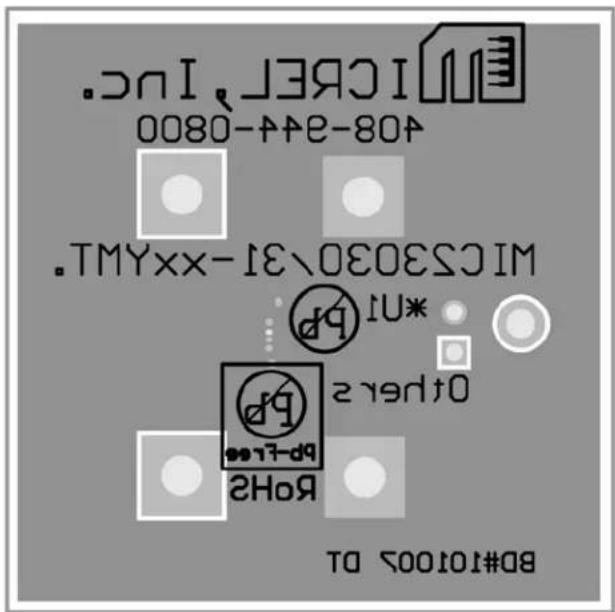
PCB Layout Recommendations

text_image
ICREL, Inc. 408-944-0800 J1 VIN J2 GND S C1 L1 C2 JP1 J5 EN J3 VOUT J4 GND MIC2303 YMTTop Layer (Fixed)
text_image
.ICER.1uc. 108-244-0800 .TMYxx-1E MIC3030\31-XXYLT *.B# 0+Pc12 Bp17-16 RoH2 BD#101005 DTBottom Layer (Fixed)
PCB Layout Recommendations (Continued)

text_image
ICREL, Inc. 408-944-0800 J1 VIN J2 GND E C1 L1 R2 C2 R3 J5 EN J4 GND J3 VOUT MIC2303 YMTTop Layer (Adjustable)
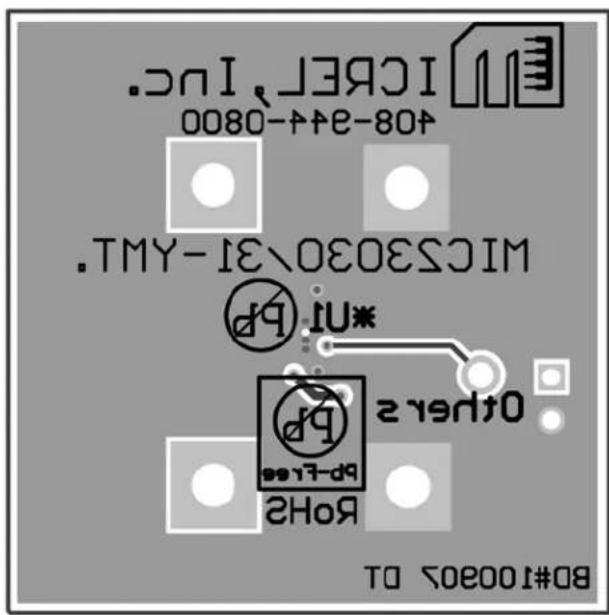
text_image
.DCI JUC. ICER.00 108-44-0800 .TMY-10C3030\31-YMT. OK *NT OK OK B0#100A05 01 B0#100A05 01Bottom Layer (Adjustable)
Package Information and Recommended Landing Pattern ^(13)
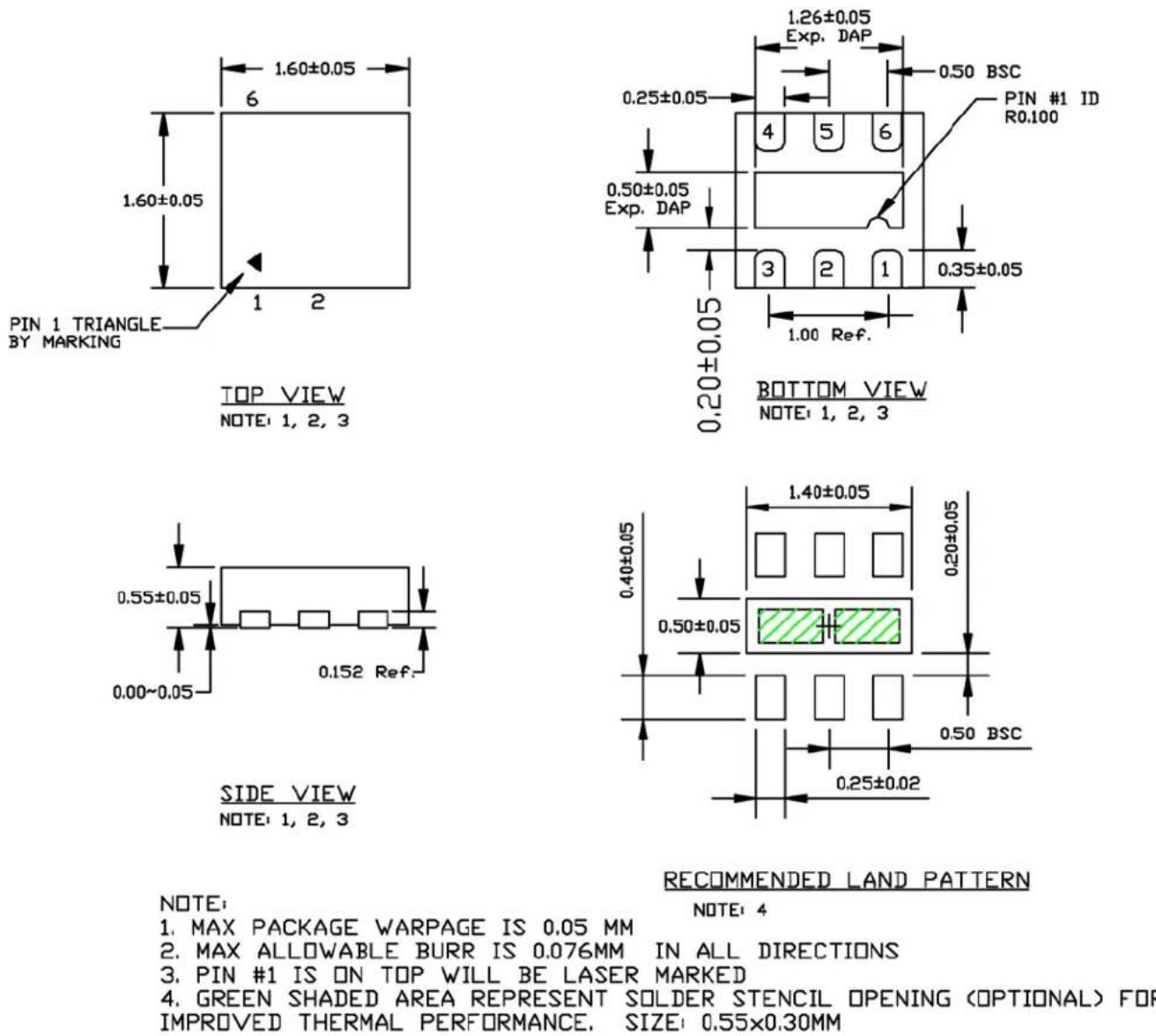
NOTE:
-
MAX PACKAGE WARPAGE IS 0.05 MM
-
MAX ALLOWABLE BURR IS 0.076MM
IN ALL DIRECTIONS
-
PIN #1 IS ON TOP WILL BE LASER MARKED
-
GREEN SHADED AREA REPRESENT SOLDER STENCIL OPENING (OPTIONAL) FOR IMPROVED THERMAL PERFORMANCE. SIZE: 0.55×0.30MM
6-Pin 1.6mm × 1.6mm Thin DFN (MM)
Note:
- Package information is correct as of the publication date. For updates and most current information, go to www.micrel.com.
MICREL, INC. 2180 FORTUNE DRIVE SAN JOSE, CA 95131 USA
TEL +1 (408) 944-0800 FAX +1 (408) 474-1000 WEB http://www.micrel.com
Micrel makes no representations or warranties with respect to the accuracy or completeness of the information furnished in this data sheet. This information is not intended as a warranty and Micrel does not assume responsibility for its use. Micrel reserves the right to change circuitry, specifications and descriptions at any time without notice. No license, whether express, implied, arising by estoppel or otherwise, to any intellectual property rights is granted by this document. Except as provided in Micrel's terms and conditions of sale for such products, Micrel assumes no liability whatsoever, and Micrel disclaims any express or implied warranty relating to the sale and/or use of Micrel products including liability or warranties relating to fitness for a particular purpose, merchantability, or infringement of any patent, copyright or other intellectual property right.
Micrel Products are not designed or authorized for use as components in life support appliances, devices or systems where malfunction of a product can reasonably be expected to result in personal injury. Life support devices or systems are devices or systems that (a) are intended for surgical implant into the body or (b) support or sustain life, and whose failure to perform can be reasonably expected to result in a significant injury to the user. A Purchaser's use or sale of Micrel Products for use in life support appliances, devices or systems is a Purchaser's own risk and Purchaser agrees to fully indemnify Micrel for any damages resulting from such use or sale.
© 2008 Micrel, Incorporated.