
SR10DB1 - Power Supply Microchip - Free user manual and instructions
Find the device manual for free SR10DB1 Microchip in PDF.


| Product Type | Inductorless Switching Power Supply Demoboard |
| Brand | Microchip (formerly Supertex) |
| Model | SR10DB1 |
| Category | Power Supply |
| Input Voltage | 90 VAC to 275 VAC |
| Input Frequency | 50 Hz to 60 Hz |
| Output Voltage | 6 V, 12 V, 24 V ±10% (fixed) or 6-28 V (adjustable via feedback divider) |
| Output Current | Up to 50 mA |
| No-load Input Power | As low as 20 mW |
| Efficiency | Up to 75% |
| Board Dimensions | 88 mm x 28 mm |
| Topology | Capacitor-coupled switched shunt (CCSS) |
| Rectification | Selectable half-wave or full-wave via jumper |
| Configurability | Highly configurable with socketed components |
| Socketed Components | Yes, for easy substitution |
| Feedback Divider | On-board for adjustable output voltage |
| LED Drive Capability | Can be configured for constant-current LED drive |
| Overvoltage Protection | Yes, via external Zener diode |
| Safety Note | Do not connect earth-grounded loads without isolation transformer |
| Manual Availability | Free PDF download on notice-facile.com |
Frequently Asked Questions - SR10DB1 Microchip
User questions about SR10DB1 Microchip
0 question about this device. Answer the ones you know or ask your own.
Ask a new question about this device
Download the instructions for your Power Supply in PDF format for free! Find your manual SR10DB1 - Microchip and take your electronic device back in hand. On this page are published all the documents necessary for the use of your device. SR10DB1 by Microchip.
USER MANUAL SR10DB1 Microchip
Inductorless Switching Power Supply Demoboard
Introduction:
The Supertex SR10 is an inductorless switching power supply controller intended for operation directly from a rectified 120/240VAC line. Due to the capacitor-coupled, switched shunt topology (CCSS), it exhibits low standby power and good efficiency while employing no magnetics nor high voltage electrolytic capacitors.
To meet a wide variety of applications, the SR10DB1 is highly configurable. Many components are socketed. Half or full-wave rectification is jumper-selectable. Output voltage is jumper-selectable to 3 fixed voltages or may be set anywhere in the range of 6 - 28V using an on-board feedback divider.
Specifications
| Parameter Value | |
| AC Input | 90VAC to 275VAC50Hz to 60Hz |
| Output voltage | 6V, 12V, 24V ±10%or 6-28V using divider |
| Output\ current1 | up to 50mA |
| No-load input power1 | as low as 20mW |
| Efficiency1 | up to 75% |
| Actual board size 88mm x 28mm | |
Notes:
1. Dependent upon configuration and degree of transient protection.
Board Layout and Connection Diagram
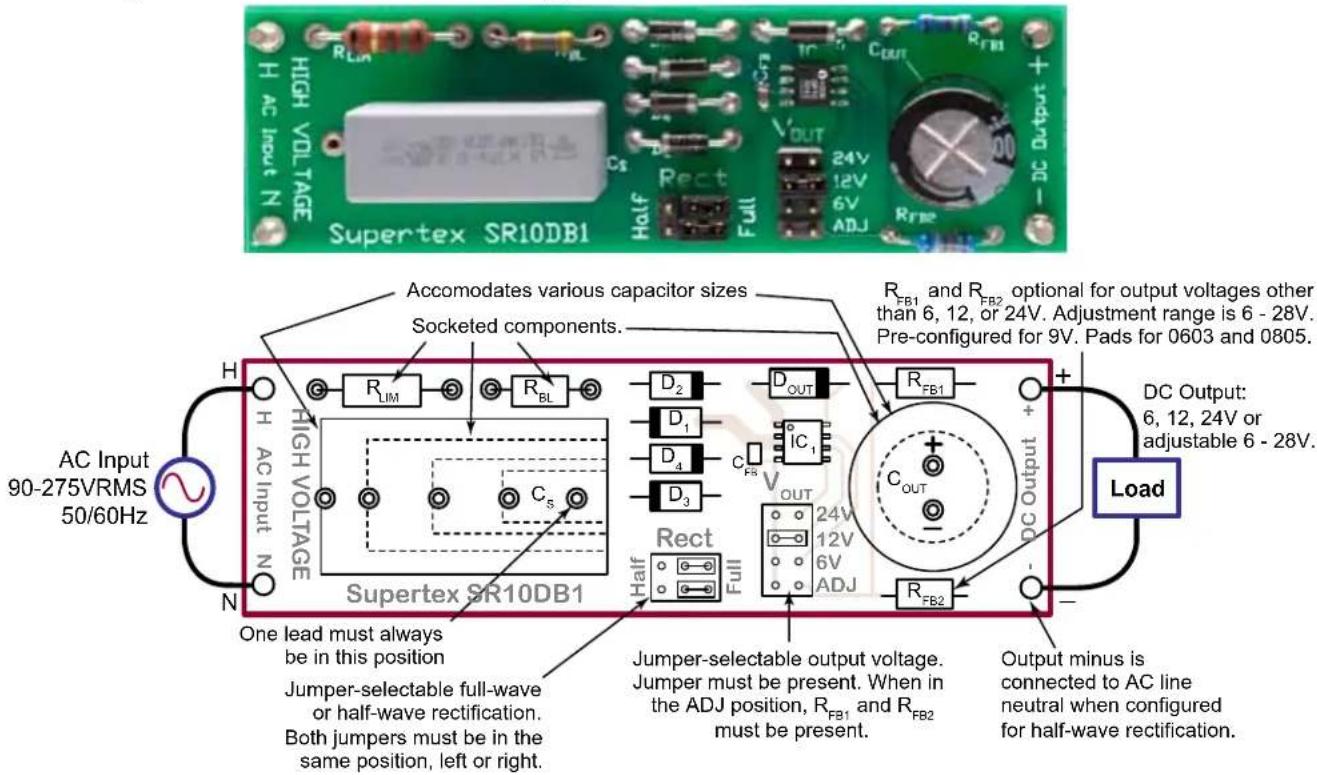
AC Input (H and N)
Connect to the AC line. The 'H' terminal should be connected to the AC line hot conductor. The 'N' terminal should be connected to the AC line neutral conductor. When configured for half-wave rectification, the N terminal is connected to the DC output minus (−) terminal.
DC Output (+ and -)
Connect the load to these terminals. Do not connect earth-grounded loads or test equipment without using an isolation transformer on the AC line.
Output voltage is jumper-selectable at 6, 12, or 24V, or it may be set in the range of 6 - 28V using the R FB feedback divider and setting the jumper to ADJ.
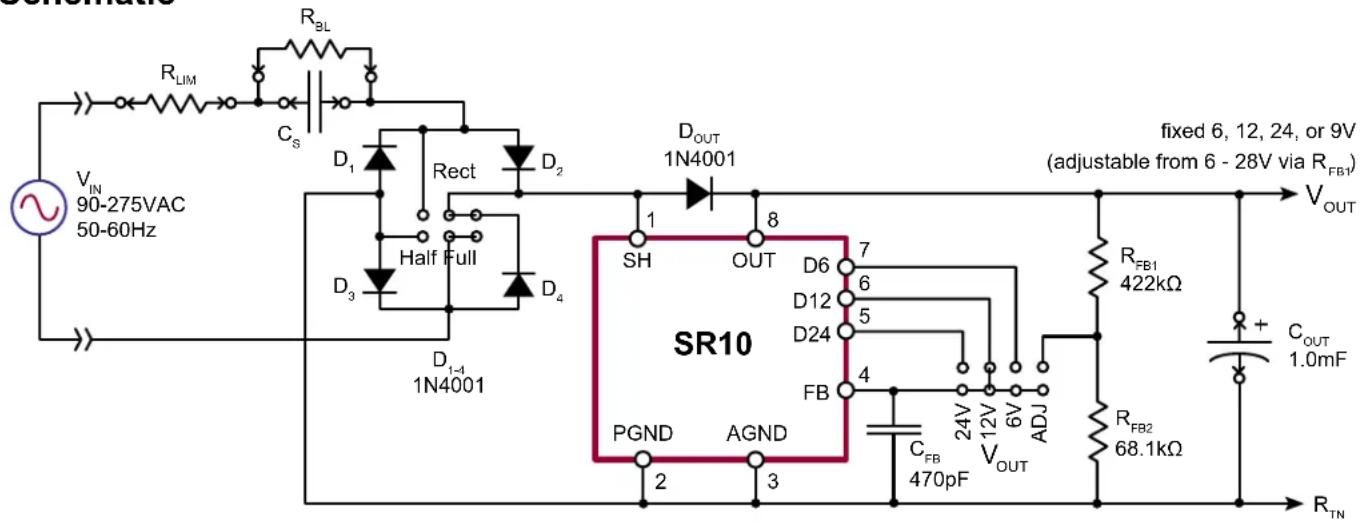
Schematic
Bill of Materials
| Designation | Description | Value | Rating | Mfg | PN |
| RLIM | Resistor, fusible | 22Ω | 2W | any | — |
| RBL | Resistor | 4.7MΩ | 1/4W | any | — |
| RFB1 | Resistor | 422kΩ | 1/4W | any | — |
| RFB2 | Resistor | 68.1kΩ | 1/4W | any | — |
| CS | Capacitor, film | 220nF to 2.2μF | 275VAC,X2 | any | — |
| COUT | Capacitor, alum | 220μF min | 35V | any | — |
| CFB | Capacitor, ceramic NPO | 470pF | 6V | any | — |
| D1-4 | Rectifier | — | 1A, 50V | any | 1N4001 |
| DOUT | Rectifier | — | 1A, 50V | any | 1N4001 |
| IC1 | CCSS regulator | — | — | Supertex | SR10 |
Socketed Components
The SR10DB1 is provided with all components pre-installed. Other components may be substituted for the on-board components to meet other requirements.
Refer to the above schematic and BOM, and the drawing and photo on page 1 to determine the proper locations for the components.
Output Voltage
Fixed output voltages of 6V, 12V, or 24V may be selected by setting the appropriate jumper on the VOUT header.
For other output voltages, the on-board resistive feedback divider may be used to provide any voltage in the range of 6 - 28V. To maintain a minimum 15 µ A through the feedback divider, only RFB1 should be changed.
R _ FB 1 = R _ FB 2 ( V _ OUTV _ FB - 1) = 6 8. 1 kΩ ( V _ OUT1 . 2 5 V - 1)
Output Current ( Cs selection)
Output current is primarily dependent on input voltage, Cs value, and rectification (full or half). Given the minimum input voltage and choice of rectification, the minimum value of Cs
is given by the following equations. Don't forget to take tolerances into account. The SR10 is powered by VOUT , so the available output current is reduced by the SR10's operating current (150μA nom, 200μA max). Current may also be reduced \~5% due to losses.
For standard capacitance values, see the table on page 4.
Full-wave:
C _ s ≥ I _ OUT4 f _ IN (V _ IN √ 2 - V _ OUT - 3 V _ D)
Half-wave:
C _ s ≥ I _ OUTf _ IN (2 V _ IN √ 2 - V _ OUT - 2 V _ D)
where: IOUT is the maximum output current
fIN is the AC line frequency
Cs is the series cap on the AC line
VIN is the RMS AC line voltage
VOUT is the DC output voltage
VD is the diode forward voltage ( 700mV )
Limiting Resistor ( RLIM )
The limiting resistor in series with the AC line is to protect against transients on the AC line. For safety reasons it fusible and is the most upstream component on the AC line. Higher values provide greater protection but at the expense of higher losses.
P _ LIM ≈ (V _ IN · 2 πf _ IN · C _ S) ^ 2 · R _ LIM
Output Capacitor ( COUT )
The output capacitor serves 2 functions - it supplies the load when the shunt is on, and helps absorb transients on the AC line. The supplied value may be lowered but at the expense of higher ripple voltage and increased output voltage during a transient.
Input Power Measurements
The high ratio between the imaginary and real power components makes power measurements difficult. To make accurate measurements of real power, the imaginary component may be eliminated by measuring input voltage after Cs . This excludes Cs losses, but AC rated film capacitors exhibit very low losses, so the error is minimal.
Since the PCB is laid out with RLIM upstream of CS for safety reasons, it must be relocated after CS if RLIM losses are to be included.
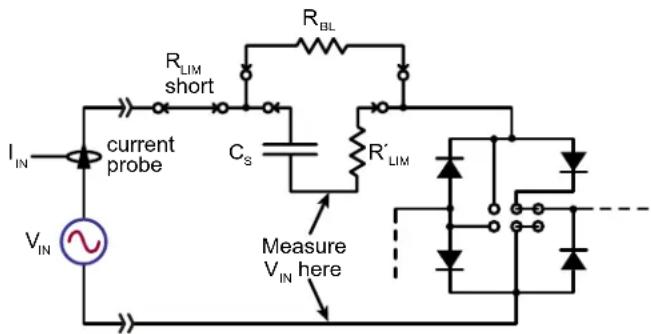
Do not connect earth-grounded instruments when operating off the AC line! Use either battery-powered equipment, high voltage differential probes, or an isolation transformer on the AC line. Note that many Variacs (variable transformers) do not provide isolation.
Ideally, RBL should be removed. Its contribution to loss is approximately VIN2 / RBL
Since the input current is not a perfect sine wave, real power cannot be obtained by simply multiplying RMS input current by RMS input voltage. One way to make correct measurements is by multiplying instantaneous current by instantaneous voltage on a time-point basis and taking the average over an integer number of 50/60Hz cycles. At low load currents the shunt turns off only occasionally, requiring a long time window for accurate power measurements.
is This measurement technique may be performed on most digital oscilloscopes. When taking the average, be sure to window the average over an integer number of cycles.
Driving LEDs
The SR10 can be configured to provide a constant-current output to drive LEDs. A current sense resistor ( RSNS ) is used to convert LED current to the 1.25V feedback voltage required by the SR10.
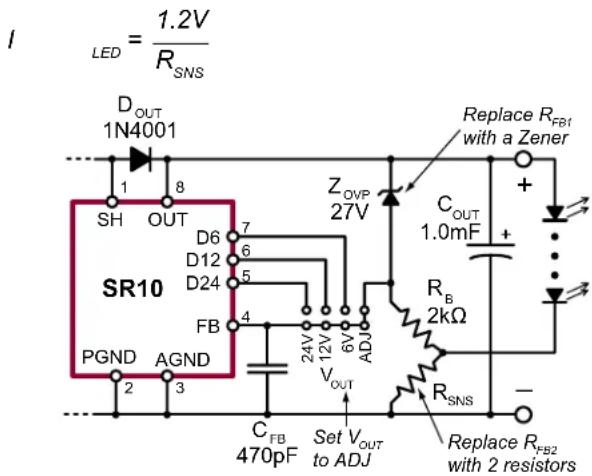
Driving LEDs
When operated over a wide supply voltage range, a small COUT can result in overcharging at higher line voltages. It may take several cycles for the voltage to drop back down to the regulation threshold. This may cause visible flicker. The remedy is to increase COUT .
To protect against open LEDs, an overvoltage protection (OVP) circuit is employed. The OVP level is set by the value of the OVP Zener. RB limits the current thru the Zener.
V _ OVP = V _ z + 1. 2 V
Cs Table
The following table is based on the previously provided equations for Cs . Actual output current may be less due to losses ( 5% less). AC line voltage is assumed to be 90 - 135VRMS @ 60Hz or 190 - 275VRMS @ 50Hz. Slashed cells exceed recommended operating conditions for peak shunt current at 85°C.
For universal 120V and 240V operation choose Cs based on 120VAC and make sure that operation at 240VAC does not fall in a slashed cell. The relevant cells are adjacent to each other. For example, if 50mA at 12V is needed and full rectification used, a Cs capacitor of 2.2µF ± 10% provides 53.8mA at 120VAC (90VAC low line). But at 240VAC, the cell to the right (240VAC column) is slashed, and universal operation is not possible. This assumes 120VAC low line is 90VAC and 240VAC high line is 275VAC. For other high/low voltages use the equations.
Output current capability (mA)
| Cs | CsTol | 6V Output 12V Output 24V Output | |||||||||||
| Half Full Half Full Half Full | |||||||||||||
| 120V 60Hz | 240V 50Hz | 120V 60Hz | 240V 50Hz | 120V 60Hz | 240V 50Hz | 120V 60Hz | 240V 50Hz | 120V 60Hz | 240V 50Hz | 120V 60Hz | 240V 50Hz | ||
| 220nF | 10% 2 | 9 5.2 5.7 | 10.3 2.9 | 5.2 5.4 | 10.1 2.7 | 5.1 4.8 | 9.6 | ||||||
| 20% 2 | 6 4.7 5.0 | 9.2 2.5 | 4.6 4.8 9 | 0.2 4.4 | 5 4.3 8.5 | ||||||||
| 330nF | 10% 4 | 4 7.9 8.5 | 15.5 4.3 | 7.8 8.1 | 15.1 4.1 | 7.6 7.2 | 14.4 | ||||||
| 20% | 3.9 | 7.0 | 7.6 | 13.8 | 3.8 | 6.9 | 7.2 | 13.4 | 3.6 | 6.8 | 6.4 | 12.8 | |
| 470nF | 10% 6 | 3 11.2 1 | 2.1 22.0 | 6.1 11.1 | 11.5 21.5 | 5 5.8 10.8 | 10.3 20.5 | ||||||
| 20% 5 | 6 10.0 1 | 0.8 19.6 | 5.4 9.9 1 | 0.2 19.1 | 5.2 9.6 | 9.1 18.2 | |||||||
| 680nF | 10% 9 | 1 16.2 1 | 7.5 31.9 | 8.9 16.0 | 16.6 31.2 | 8.4 15.7 | 14.9 29.7 | ||||||
| 20% 8 | 1 14.4 1 | 5.6 28.4 | 7.9 14.3 | 14.8 27.7 | 7.5 13.9 | 13.2 26.4 | |||||||
| 1.0μF | 10% | 13.3 | 23.9 | 25.7 | 46.9 | 13.0 | 23.6 | 24.4 | 45.8 | 12.4 | 23.0 | 21.9 | 43.7 |
| 20% 1 | 1.9 21.2 | 22.9 41.7 | 11.6 21 | 0 21.7 | 40.7 11.0 | 20.5 19 | 4 38.8 | ||||||
| 1.5μF | 10% | 20.0 | 35.8 | 38.6 | 70.4 | 19.5 | 35.4 | 36.7 | 68.7 | 18.6 | 34.6 | 32.8 | 65.5 |
| 20% | 17.8 | 31.8 | 34.3 | 62.5 | 17.4 | 31.4 | 32.6 | 61.1 | 16.5 | 30.7 | 29.1 | 58.2 | |
| 2.2μF | 10% | 29.4 | 52.5 | 56.6 | 103.2 | 28.6 | 51.9 | 53.8 | 100.8 | 27.2 | 50.7 | 48.1 | 96.1 |
| 20% | 6.1 46.6 | 50.3 91.7 | 25.5 46.1 | 47.8 | 89.6 24.2 | 45.1 42.7 | 85.4 | ||||||

= Exceeds Recommended Operating Limits
Supertex inc. does not recommend the use of its products in life support applications, and will not knowingly sell them for use in such applications unless it receives an adequate "product liability indemnification insurance agreement." Supertex Inc. does not assume responsibility for use of devices described, and limits its liability to the replacement of the devices determined defective due to workmanship. No responsibility is assumed for possible omissions and inaccuracies. Circuitry and specifications are subject to change without notice. For the latest product specifications refer to the Supertex inc. (website: http://www.supertex.com)




Brand : Microchip
Model : SR10DB1
Category : Power Supply