MIC28517 - Carte d'évaluation Microchip - Free user manual and instructions
Find the device manual for free MIC28517 Microchip in PDF.


User questions about MIC28517 Microchip
0 question about this device. Answer the ones you know or ask your own.
Ask a new question about this device
Download the instructions for your Carte d'évaluation in PDF format for free! Find your manual MIC28517 - Microchip and take your electronic device back in hand. On this page are published all the documents necessary for the use of your device. MIC28517 by Microchip.
USER MANUAL MIC28517 Microchip
Note the following details of the code protection feature on Microchip devices:
• Microchip products meet the specifications contained in their particular Microchip Data Sheet.
• Microchip believes that its family of products is secure when used in the intended manner and under normal conditions.
- There are dishonest and possibly illegal methods being used in attempts to breach the code protection features of the Microchip devices. We believe that these methods require using the Microchip products in a manner outside the operating specifications contained in Microchip's Data Sheets. Attempts to breach these code protection features, most likely, cannot be accomplished without violating Microchip's intellectual property rights.
• Microchip is willing to work with any customer who is concerned about the integrity of its code.
- Neither Microchip nor any other semiconductor manufacturer can guarantee the security of its code. Code protection does not mean that we are guaranteeing the product is "unbreakable." Code protection is constantly evolving. We at Microchip are committed to continuously improving the code protection features of our products. Attempts to break Microchip's code protection feature may be a violation of the Digital Millennium Copyright Act. If such acts allow unauthorized access to your software or other copyrighted work, you may have a right to sue for relief under that Act.
Information contained in this publication is provided for the sole purpose of designing with and using Microchip products. Information regarding device applications and the like is provided only for your convenience and may be superseded by updates. It is your responsibility to ensure that your application meets with your specifications.
THIS INFORMATION IS PROVIDED BY MICROCHIP "AS IS". MICROCHIP MAKES NO REPRESENTATIONS OR WARRANTIES OF ANY KIND WHETHER EXPRESS OR IMPLIED, WRITTEN OR ORAL, STATUTORY OR OTHERWISE, RELATED TO THE INFORMATION INCLUDING BUT NOT LIMITED TO ANY IMPLIED WARRANTIES OF NON-INFRINGEMENT, MERCHANTABILITY, AND FITNESS FOR A PARTICULAR PURPOSE OR WARRANTIES RELATED TO ITS CONDITION, QUALITY, OR PERFORMANCE.
IN NO EVENT WILL MICROCHIP BE LIABLE FOR ANY INDIRECT, SPECIAL, PUNITIVE, INCIDENTAL OR CONSEQUENTIAL LOSS, DAMAGE, COST OR EXPENSE OF ANY KIND WHATSOEVER RELATED TO THE INFORMATION OR ITS USE, HOWEVER CAUSED, EVEN IF MICROCHIP HAS BEEN ADVISED OF THE POSSIBILITY OR THE DAMAGES ARE FORESEEABLE. TO THE FULLEST EXTENT ALLOWED BY LAW, MICROCHIP'S TOTAL LIABILITY ON ALL CLAIMS IN ANY WAY RELATED TO THE INFORMATION OR ITS USE WILL NOT EXCEED THE AMOUNT OF FEES, IF ANY, THAT YOU HAVE PAID DIRECTLY TO MICROCHIP FOR THE INFORMATION. Use of Microchip devices in life support and/or safety applications is entirely at the buyer's risk, and the buyer agrees to defend, indemnify and hold harmless Microchip from any and all damages, claims, suits, or expenses resulting from such use. No licenses are conveyed, implicitly or otherwise, under any Microchip intellectual property rights unless otherwise stated.
Trademarks
The Microchip name and logo, the Microchip logo, Adaptec, AnyRate, AVR, AVR logo, AVR Freaks, BesTime, BitCloud, chipKIT, chipKIT logo, CryptoMemory, CryptoRF, dsPIC, FlashFlex, flexPWR, HELDO, IGLOO, JukeBlox, KeeLoq, Kleer, LANCheck, LinkMD, maXStylus, maXTouch, MediaLB, megaAVR, Microsemi, Microsemi logo, MOST, MOST logo, MPLAB, OptoLyzer, PackeTime, PIC, picoPower, PICSTART, PIC32 logo, PolarFire, Prochip Designer, QTouch, SAM-BA, SenGenuity, SpyNIC, SST, SST Logo, SuperFlash, Symmetricom, SyncServer, Tachyon, TimeSource, tinyAVR, UNI/O, Vectron, and XMEGA are registered trademarks of Microchip Technology Incorporated in the U.S.A. and other countries.
AgileSwitch, APT, ClockWorks, The Embedded Control Solutions Company, EtherSynch, FlashTec, Hyper Speed Control, HyperLight Load, IntelliMOS, Libero, motorBench, mTouch, Powermite 3, Precision Edge, ProASIC, ProASIC Plus, ProASIC Plus logo, Quiet-Wire, SmartFusion, SyncWorld, Temux, TimeCesium, TimeHub, TimePictra, TimeProvider, WinPath, and ZL are registered trademarks of Microchip Technology Incorporated in the U.S.A.
Adjacent Key Suppression, AKS, Analog-for-the-Digital Age, Any Capacitor, AnyIn, AnyOut, Augmented Switching, BlueSky, BodyCom, CodeGuard, CryptoAuthentication, CryptoAutomotive, CryptoCompanion, CryptoController, dsPICDEM, dsPICDEM.net, Dynamic Average Matching, DAM, ECAN, Espresso T1S, EtherGREEN, IdealBridge, In-Circuit Serial Programming, ICSP, INICnet, Intelligent Paralleling, Inter-Chip Connectivity, JitterBlocker, maxCrypto, maxView, memBrain, Mindi, MiWi, MPASM, MPF, MPLAB Certified logo, MPLIB, MPLINK, MultiTRAK, NetDetach, Omniscient Code Generation, PICDEM, PICDEM.net, PICkit, PICtail, PowerSmart, PureSilicon, QMatrix, REAL ICE, Ripple Blocker, RTAX, RTG4, SAM-ICE, Serial Quad I/O, simpleMAP, SimpliPHY, SmartBuffer, SMART-I.S., storClad, SQI, SuperSwitcher, SuperSwitcher II, Switchtec, SynchroPHY, Total Endurance, TSHARC, USBCheck, VariSense, VectorBlox, VeriPHY, ViewSpan, WiperLock, XpressConnect, and ZENA are trademarks of Microchip Technology Incorporated in the U.S.A. and other countries.
SQTP is a service mark of Microchip Technology Incorporated in the U.S.A. The Adaptec logo, Frequency on Demand, Silicon Storage Technology, and Symmcom are registered trademarks of Microchip Technology Inc. in other countries. GestIC is a registered trademark of Microchip Technology Germany II GmbH & Co. KG, a subsidiary of Microchip Technology Inc., in other countries. All other trademarks mentioned herein are property of their respective companies.
© 2020-2021, Microchip Technology Incorporated, All Rights Reserved.
ISBN: 978-1-5224-8465-3
For information regarding Microchip's Quality Management Systems, please visit www.microchip.com/quality.
Table of Contents
Preface 5
Chapter 1. Product Overview
1.1 Introduction ...... 9
1.2 MIC28517 Evaluation Board Overview 9
1.3 MIC28517 Evaluation Board Features 10
1.4 Contents of the MIC28517 Evaluation Board Kit 10
Chapter 2. Installation and Operation
2.1 System and Configuration Requirements .... 11
2.2 Board Setup 11
2.3 Circuit Description 12
2.3.1 Feedback Resistors 12
2.3.2 SW Node 13
2.3.3 Current Limit 13
2.3.4 Loop Gain Measurement 13
2.3.5 Setting the Switching Frequency 13
2.3.6 MODE Selection Pin 14
2.3.7 Auxiliary Bootstrap LDO (EXTVDD) 14
Appendix A. Schematic and Layouts
A.1 Introduction 15
A.2 Board – Schematic 16
A.3 Board – Top Silk 17
A.4 Board – Top Copper and Silk 17
A.5 Board – Top Copper 18
A.6 Board – Bottom Copper 18
A.7 Board – Bottom Copper and Silk 19
A.8 Board – Bottom Silk 19
A.9 Board – Bottom View with Heatsink HS1 Mounted 20
Appendix B. Bill of Materials (BOM)
Worldwide Sales and Service 23
NOTES:
Preface
NOTICE TO CUSTOMERS
All documentation becomes dated, and this manual is no exception. Microchip tools and documentation are constantly evolving to meet customer needs, so some actual dialogs and/or tool descriptions may differ from those in this document. Please refer to our website (www.microchip.com) to obtain the latest documentation available.
Documents are identified with a "DS" number. This number is located on the bottom of each page, in front of the page number. The numbering convention for the DS number is "DSXXXXXXXXA", where "XXXXXXXXX" is the document number and "A" is the revision level of the document.
For the most up-to-date information on development tools, see the MPLAB ^® IDE online help. Select the Help menu, and then Topics, to open a list of available online help files.
INTRODUCTION
This chapter contains general information that will be useful to know before using the MIC28517 Evaluation Board. Items discussed in this chapter include:
- Document Layout
- Conventions Used in this Guide
- Recommended Reading
• The Microchip Website - Customer Support
• Document Revision History
DOCUMENT LAYOUT
This document describes how to use the MIC28517 Evaluation Board as a development tool to emulate and debug firmware on a target board. The manual layout is as follows:
- Chapter 1. “Product Overview” – Important information about the MIC28517 Evaluation Board.
- Chapter 2. “Installation and Operation” – Includes instructions on installing and starting the MIC28517 Evaluation Board.
- Appendix A. "Schematic and Layouts" – Shows the schematic and layout diagrams for the MIC28517 Evaluation Board.
- Appendix B. “Bill of Materials (BOM)” – Lists the parts used to build the MIC28517 Evaluation Board.
CONVENTIONS USED IN THIS GUIDE
This manual uses the following documentation conventions:
DOCUMENTATION CONVENTIONS
| Description Represents Examples | ||
| Arial font: | ||
| Italic characters Referenced books | oks MPLAB | ^ IDE User's Guide |
| Emphasized text ...is the only compiler... | ||
| Initial caps A window the Output | window | |
| A dialog the Settings dialog | ||
| A menu selection select Enable Programmer | ||
| Quotes A field name in a window or dialog | "Save project before build" | |
| Underlined, italic text with right angle bracket | A menu path File>Save | —— |
| Bold characters A dialog button | Click OK | |
| A tab | Click the Power tab | |
| N'Rnnnn | A number in verilog format, where N is the total number of digits, R is the radix and n is a digit. | 4'b0010, 2'hF1 |
| Text in angle brackets <> | A key on the keyboard | Press,, |
| Courier New font: | ||
| Plain Courier New | Sample source code | #define START |
| Filenames | autoexec.bat | |
| File paths | c:\mcc18\h | |
| Keywords | _asm, _endasm, static | |
| Command-line options | -0pa+, -0pa- | |
| Bit values | 0, 1 | |
| Constants | 0xFF, 'A' | |
| Italic Courier New | A variable argument | file.o, where file can be any valid filename |
| Square brackets [] | Optional arguments | mccl8 [options] file [options] |
| Curly brackets and pipe character: { | } | Choice of mutually exclusive arguments; an OR selection | errorlevel {0|1} |
| Ellipses... | Replaces repeated text | var_name [, var_name...] |
| Represents code supplied by user | void main (void) { ... } | |
RECOMMENDED READING
This user's guide describes how to use the MIC28517 Evaluation Board. Another useful document is listed below. The following Microchip document is available and recommended as a supplemental reference resource:
- MIC28517 Data Sheet – “70V/8A Hyper Speed Control® Synchronous DC/DC Buck Regulator with External Mode Control” (DS20006317)
THE MICROCHIP WEBSITE
Microchip provides online support via our website at www.microchip.com. This website is used as a means to make files and information easily available to customers. Accessible by using your favorite Internet browser, the website contains the following information:
- Product Support – Data sheets and errata, application notes and sample programs, design resources, user's guides and hardware support documents, latest software releases and archived software
- General Technical Support – Frequently Asked Questions (FAQs), technical support requests, online discussion groups, Microchip consultant program member listing
- Business of Microchip – Product selector and ordering guides, latest Microchip press releases, listing of seminars and events, listings of Microchip sales offices, distributors and factory representatives
CUSTOMER SUPPORT
Users of Microchip products can receive assistance through several channels:
• Distributor or Representative
- Local Sales Office
• Field Application Engineer (FAE)
- Technical Support
Customers should contact their distributor, representative or field application engineer (FAE) for support. Local sales offices are also available to help customers. A listing of sales offices and locations is included in the back of this document.
Technical support is available through the website at:
http://www.microchip.com/support.
DOCUMENT REVISION HISTORY
Revision B (June 2021)
- Updated Figure 2-1.
- Minor editorial corrections.
Revision A (July 2020)
- Initial release of this document
NOTES:
Chapter 1. Product Overview
1.1 INTRODUCTION
This chapter provides an overview of the MIC28517 Evaluation Board and covers the following topics:
• MIC28517 Evaluation Board Overview
• MIC28517 Evaluation Board Features
- Contents of the MIC28517 Evaluation Board Kit
1.2 MIC28517 EVALUATION BOARD OVERVIEW
The MIC28517 Evaluation Board is a constant frequency, synchronous buck controller featuring a unique adaptive on-time control architecture. The MIC28517 operates over an input supply range of 4.5V to 70V. The output voltage is adjustable down to 0.6V with an ensured accuracy of ±1%. The device operates with a programmable switching frequency from 270 kHz to 800 kHz. The Mode pin allows the user to select either the forced CCM operation or HLL mode of operation for improved efficiency at light loads.

text_image
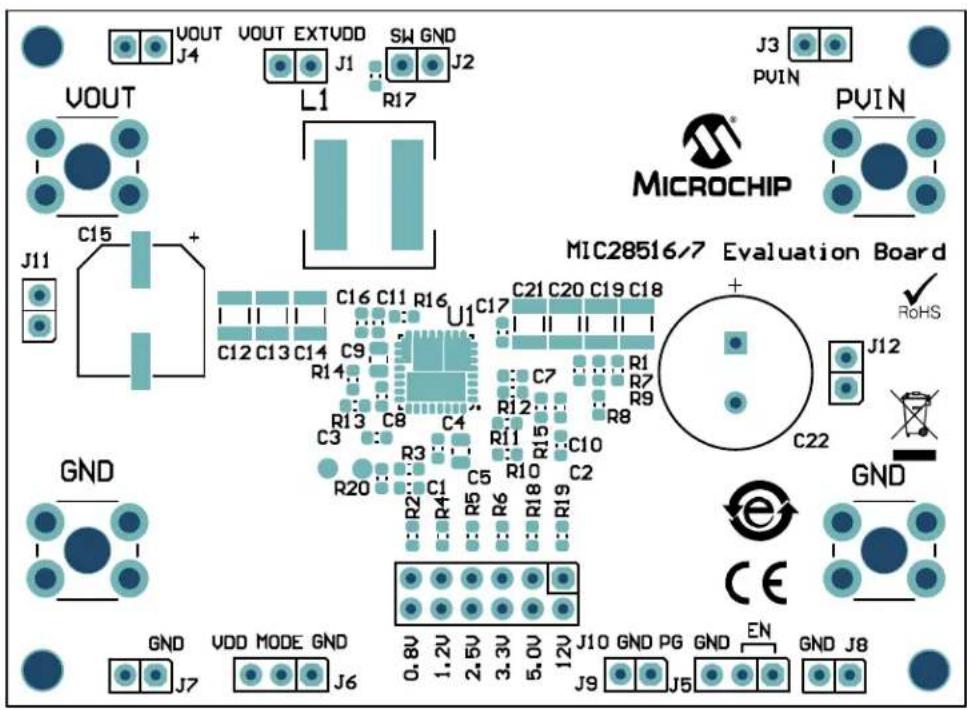
VOUT VOUT EXTVDD SW GND J4 J1 R17 J2 VOUT Marking PUIN MICROCHIP MIC28516/7 Evaluation Board ALU C16 C11 R16 U1 C17 C21 C20 C19 C18 GND C12 C13 C14 C9 R14 C7 R1 R7 R13 C8 C4 R12 R8 C3 R3 R11 C10 R20 R2 C1 R5 R6 R10 R19 C2 GND VDD MODE GND 0.8V 1.2V 2.5V 3.3V 5.0V 12V J10 GND PG GND EN GND J8 J7 J6 J9 J5 J7 J6 J9 J5 J7 J6FIGURE 1-1: MIC28517 Evaluation Board.
1.3 MIC28517 EVALUATION BOARD FEATURES
The MIC28517 Evaluation Board:
- Features a Mode selection pin through jumper J6, which allows the user to select either the CCM or HLL mode of operation.
- Features six selectable output voltages: 0.8V, 1.2V, 2.5V, 3.3V, 5V and 12V.
- Features an auxiliary bootstrap Low Dropout (LDO) which improves the system efficiency by supplying the internal bias power from the output of the converter.
- Features a logic level Enable (EN) signal that can be used to enable or disable the controller.
- Can start up monotonically into a pre-biased output.
- Features an open-drain Power Good signal (PG), which signals when the output is in regulation.
The basic parameters of the evaluation board are:
- Input: 10V to 70V (optimized for 48V)
- Output: 0.8V, 1.2V, 2.5V, 3.3V, 5V or 12V Selectable through jumper J10 at 8A (default option is set to 5V)
- 270 kHz Switching Frequency (adjustable from 270 kHz to 800 kHz)
1.4 CONTENTS OF THE MIC28517 EVALUATION BOARD KIT
The MIC28517 Evaluation Board includes the following items:
• MIC28517 Evaluation Board (ADM00995)
- Important Information Sheet.
Chapter 2. Installation and Operation
2.1 SYSTEM AND CONFIGURATION REQUIREMENTS
The MIC28517 Evaluation Board requires only a single power supply with at least 8A current capability. The MIC28517 has an internal V_DD LDO so no external linear regulator is required to power the internal biasing of the IC. In applications with V_IN < +5.5V , PV_DD should be tied to PV_IN to bypass the internal linear regulator. The output load can either be a passive or an active load.
Note: The MIC28517 Evaluation Board does not have reverse polarity protection. Applying a negative voltage to the V_IN and GND terminals may damage the device. The maximum V_IN of the board is rated at 70V. Exceeding 70V on the V_IN could damage the device.
2.2 BOARD SETUP
Follow these steps prior to using the MIC28517 Evaluation Board:
- Connect a supply to the V_IN and GND terminals, paying attention to the polarity and the supply range (10V < V_IN < 70V). Monitor I_IN with a current meter, and the input voltage at the V_IN and GND terminals with a voltmeter. Do not apply power until Step 4.
- Connect a load to the V_OUT and GND terminals. The load can be either a passive (resistive) or an active (electronic) type. A current meter may be placed between the V_OUT terminal and load to monitor the output current. Ensure the output voltage is monitored at the V_OUT terminal.
- Enable input. An EN connector is provided on the evaluation board for users to easily access the enable feature. Applying an external logic signal on the EN pin to pull it low, or using a jumper to short the EN pin to GND, will shut off the output of the MIC28517 Evaluation Board.
- Turn on the V_IN supply and verify that the output voltage is regulated to the specific selected voltage.
2.3 CIRCUIT DESCRIPTION
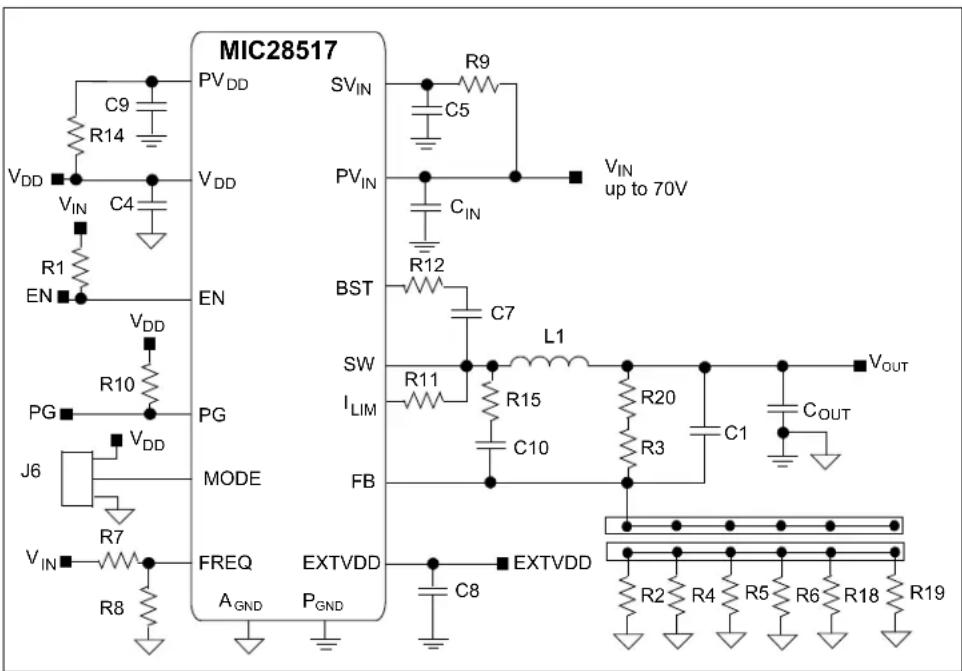
This section describes the working principles and limitations that should be taken into account when using the MIC28517 Evaluation Board. The external components have been selected in order to optimize performance for the specific conditions of V_IN = 48 V and V_OUT = 5 V . Although the application will behave correctly for other output and input voltages, further optimization (fine-tuning of the inductor, output capacitors and ripple injection components) can be done in order to improve efficiency and transient response.
text_image
MIC28517 PVDD SVIN R9 C5 VDD VIN C4 VDD PVIN CIN VIN up to 70V R12 EN EN BST C7 L1 PG R10 PG SW R11 LIM R15 R20 C10 COUT J6 VDD MODE FB VOUT VDD VDD FREQ EXTVDD AGND PGND C8 EXTVDD R2 R4 R5 R6 R18 R19FIGURE 2-1: Evaluation Board Circuit Description.
2.3.1 Feedback Resistors
The output voltages available on the MIC28517 Evaluation Board are: 0.8V, 1.2V, 2.5V, 3.3V, 5V and 12V, which are selectable using jumper J10.
Voltages other than the ones already available can be set by modifying the R_bot resistors according to Equation 2-1.
EQUATION 2-1:
$$ R _ {b o t} = \frac {R _ {3} \times V _ {R E F}}{V _ {O U T} - V _ {R E F}} $$
$$ \begin{array}{l} V _ {R E F} = 0. 6 \mathrm{V} \ R _ {3} = 1 0 \mathrm{k} \Omega \ \end{array} $$
Where:
Note that the output voltage should not be set to exceed 15V due to the 16V voltage rating on the output capacitors.
For output voltage higher than 15V, output capacitors of a voltage rating higher than the set output voltage should be used.
2.3.2 SW Node
Test point J2 ( V_SW ) is placed for monitoring the switching waveform, one of the most critical waveforms for the converter.
2.3.3 Current Limit
The MIC28517 Evaluation Board uses the low-side MOSFET R_DS(ON) to sense inductor current. In each switching cycle of the MIC28517 converter, the inductor current is sensed by monitoring the voltage across the low-side MOSFET, during the off period of the switching cycle, during which the low-side MOSFET is on. An internal current source of 96 A generates a voltage across the external Current-Limit Resistor, R_CL .
The I_LIM Pin Voltage ( V_ILIM ) is the difference of the voltage across the low-side MOSFET and the voltage across the resistor ( V_CL ). The sensed voltage, V_ILIM , is compared with the Power Ground (PGND) after a blanking time of 150 ns.
If the absolute value of the voltage drop across the low-side MOSFET is greater than the absolute value of the voltage across the current setting resistor ( V_CL ), the MIC28517 triggers the current-limit event. Consecutive eight current-limit events trigger the Hiccup mode. The hiccup sequence, including the Soft Start, reduces the stress on the internal MOSFETs, and protects the load and supply from severe short conditions.
The short-circuit current limit can be programmed by using the formula shown in Equation 2-2.
EQUATION 2-2:
$$ R _ {I I} = \frac {(I _ {C L I M} + \Delta I L _ {P P} \times 0 . 5) \times R _ {D S (O N)}}{I _ {C L}} $$
Where:
$$ I _ {C L I M} = \text { Desired output current limit } $$
$$ \Delta I L _ {P P} = \text { Inductor current peak - to - peak } $$
$$ R _ {D S (O N)} = \text { On resistance of low - side power MOSFET(18 m } \Omega) $$
$$ I _ {C L} = \text { Current - limit source current, the typical value is } 9 6 \mu \mathrm{A} $$
It is mandatory to make sure that the inductor current used to charge the output capacitance during Soft Start is under the current limit; otherwise, the supply will go into Hiccup mode and may not finish the Soft Start successfully.
The MOSFET R_DS(ON) can vary up to 30%-40% with temperature. Therefore, it is recommended to add a 30% margin to the I_CLIM in the above equation to avoid false current limiting due to an increased MOSFET junction temperature rise.
2.3.4 Loop Gain Measurement
Resistor R20 is placed in series with the regulator feedback path. The control loop gain can be measured by connecting an impedance analyzer across the resistor and selecting the resistor value between 10Ω to 50Ω.
2.3.5 Setting the Switching Frequency
The MIC28517 Evaluation Board is an adjustable frequency, synchronous buck converter featuring a unique adaptive on-time control architecture. The switching frequency can be adjusted between 270 kHz and 800 kHz by changing the resistor divider network consisting of R_7 and R_8 .
Equation 2-3 shows the estimated switching frequency:
EQUATION 2-3:
$$ f _ {S W} = f _ {0} \times \frac {R _ {8}}{R _ {7} + R _ {8}} $$
Where:
f_0 = Switching frequency when FREQ pin is connected to the input voltage, f_0 is typically 800 kHz
The evaluation board design is optimized for a switching frequency of 270 kHz. If the switching frequency is programmed to either lower end or higher end, the design needs optimization.
2.3.6 MODE Selection Pin
In Continuous mode, the inductor current can go negative at light loads. However, at light loads, the MIC28517 is able to force the inductor current to operate in Discontinuous mode when MODE is set to HLL mode. In HLL mode, the efficiency is optimized by shutting down all the non-essential circuits and minimizing the supply current. Jumper J6 can be used to select between the two modes of operation.
2.3.7 Auxiliary Bootstrap LDO (EXTVDD)
The MIC28517 Evaluation Board features an auxiliary bootstrap LDO which improves the system efficiency by supplying the MIC28517 internal circuit bias power from the converter output voltage. This LDO is enabled when the voltage on the EXTVDD pin is above 4.6V (typical), and at the same time, the main LDO, which operates from V_IN , is disabled to reduce power consumption. If the regulator output voltage is ≥5V and ≤12V , use the output voltage to power the MIC28517, which will increase system efficiency. The J1 jumper can be shorted to use the output voltage as EXTVDD.
Appendix A. Schematic and Layouts
A.1 INTRODUCTION
This appendix contains the following schematics and layouts for the MIC28517 Evaluation Board - ADM00995:
- Board – Schematic
- Board – Top Silk
- Board – Top Copper and Silk
- Board – Top Copper
- Board – Bottom Copper
- Board – Bottom Copper and Silk
- Board – Bottom Silk
- Board – Bottom View with Heatsink HS1 Mounted
A.2 BOARD - SCHEMATIC

text_image
J1 R12 C0 724 15V 2323 R14 H2 162815 R17 42.5V ICR-2.5V/Max-1x2 J2 R1 15V 2323 C8 724 15V 2323 R29 15V 2323 C1 10V 4631 50V R3 10V 2323 C2 10V 4631 60V R4 10V 60V C3 0.3A F 20V 60V C4 2.4V 60V C5 15V 1379 20V C6 15V 2323 C7 2.4V 1379 20V C8 15V 2323 C9 15V 2323 C10 15V 2323 C11 10W F 32V 29G 24P C12 15V 1279 1279 C13 15V 1279 C14 15V 1279 C15 15V 14.0 C16 1.4V 32V 29G 24P C17 1.4V 1279 1279 C18 1.4V 1279 C19 1.4V 1279 C20 1.4V 1279 C21 1.4V 1279 C22 1.4V 1279 C23 1.4V 1279 C24 1.4V 1279 C25 1.4V 1279 C26 1.4V 1279 C27 1.4V 1279 C28 1.4V 1279A.3 BOARD - TOP SILK
text_image
VOUT J4 VOUT EXTVDD SW GND J1 J2 L1 R17 J3 PUIN PVIN MICROCHIP MIC28516/7 Evaluation Board J11 C15 + J12 RoHS GND GND VDD MODE GND 0.8V 1.2V 2.5V 3.3V 5.0V 12V J10 GND PG GND EN GND J8 J7 J6 J9 J5 J8A.4 BOARD - TOP COPPER AND SILK

text_image
VOUT VOUT EXTVDD SW GND J3 J4 J1 J2 PUIN VOUT L1 R17 J11 C15 + C16 C11 R16 U1 C17 C21 C20 C19 C18 MICROCHIP MIC28516/7 Evaluation Board RoHS GND GND VDD MODE GND 0.8U 1.2V 2.5V 3.3V 5.0V 12V J10 GND PG GND EN GND J8 J7 J6 J9 J5 J7 J6 J9 J5 J7A.5 BOARD - TOP COPPER
natural_image
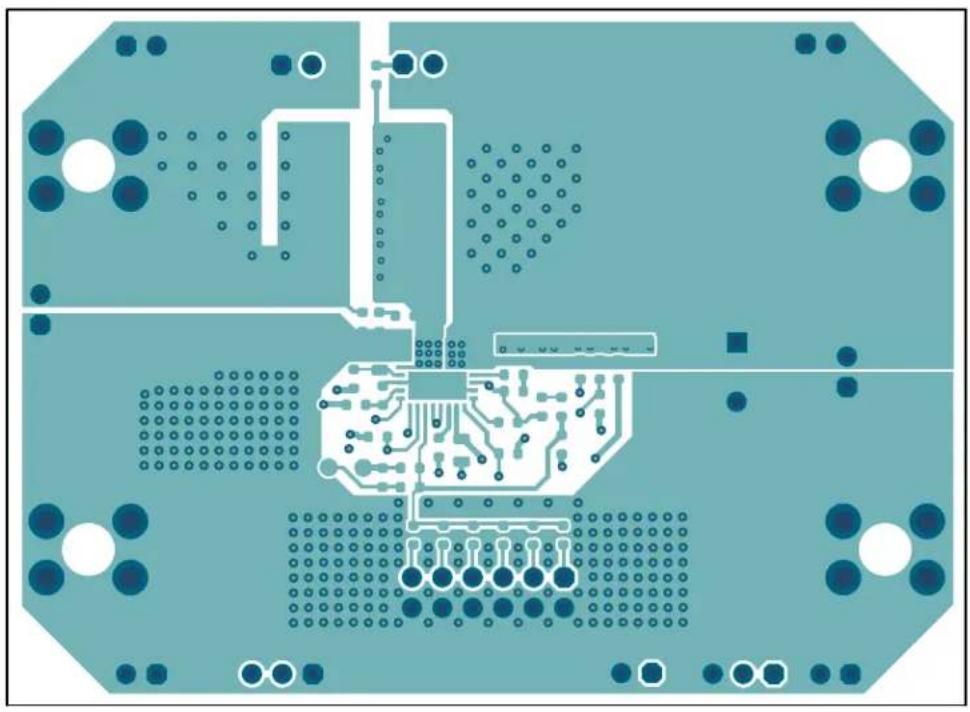
Top-down schematic of a microchip or circuit board layout with no visible text, numbers, or symbols.A.6 BOARD - BOTTOM COPPER
natural_image
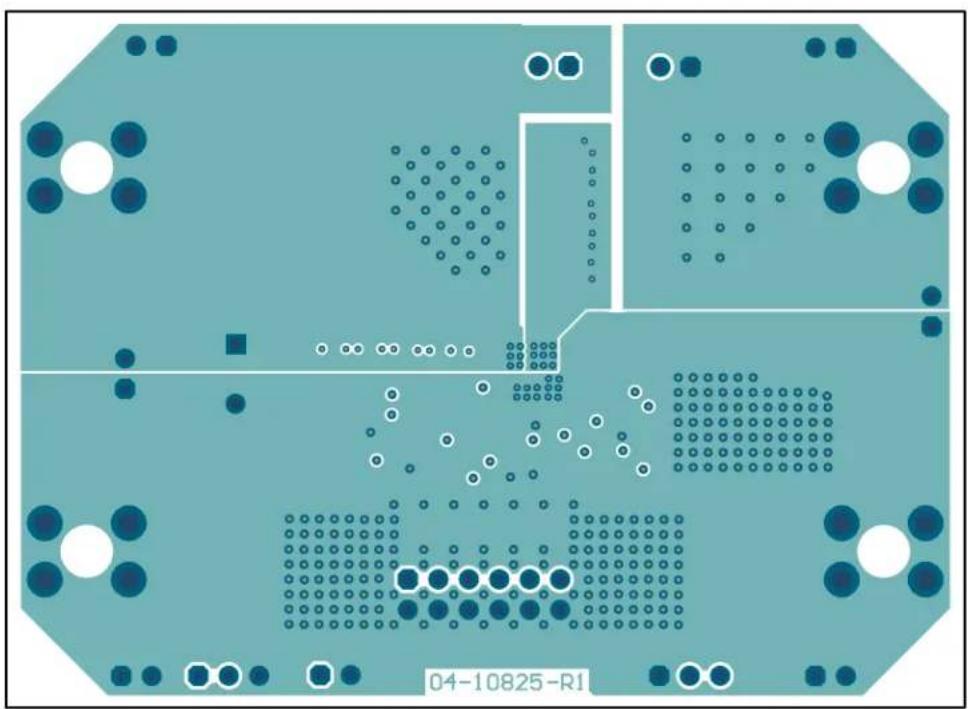
Abstract geometric pattern with blue circles and dots on a teal background, no text or symbols presentA.7 BOARD - BOTTOM COPPER AND SILK
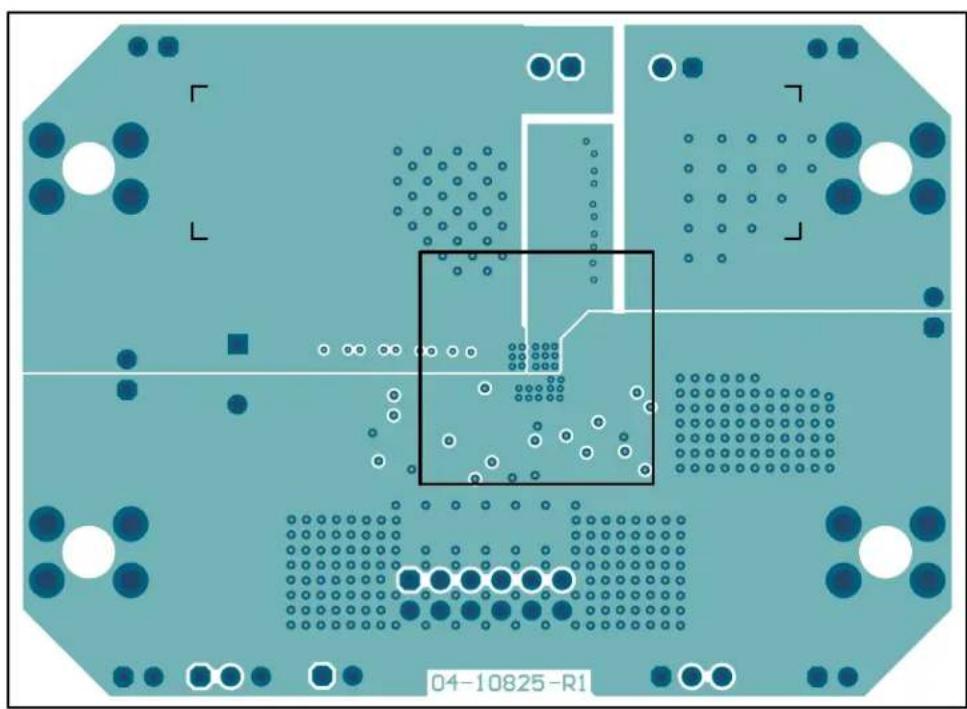
natural_image
Microscopic view of a circuit board layout with scattered blue and white circular components, no visible text or symbolsA.8 BOARD - BOTTOM SILK
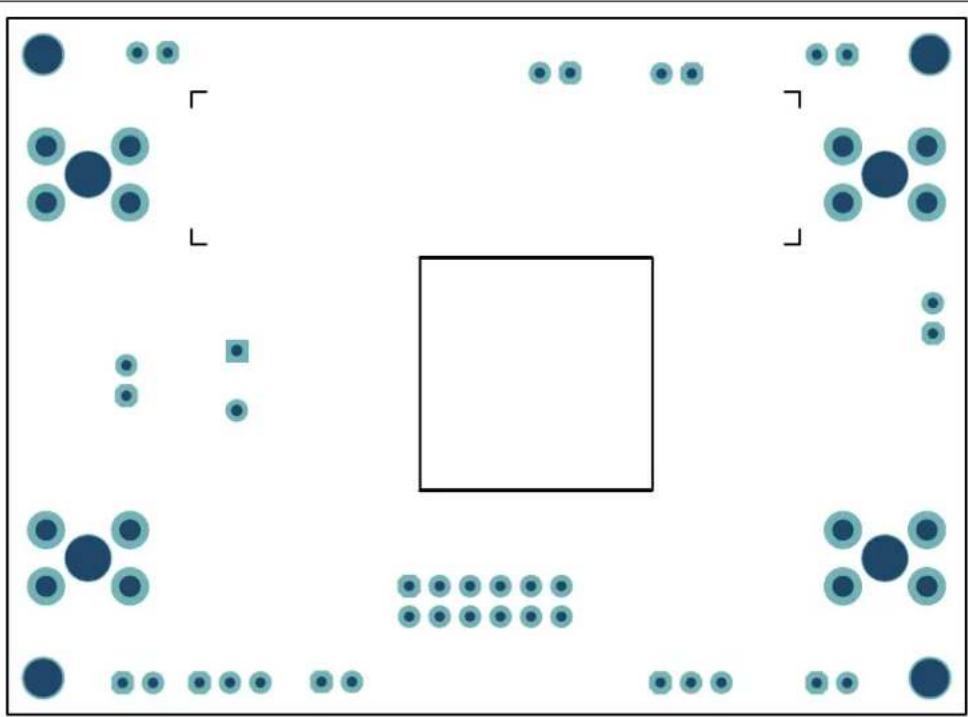
natural_image
Abstract geometric pattern with dark blue circles and teal squares arranged in a grid, no text or symbols presentA.9 BOARD - BOTTOM VIEW WITH HEATSINK HS1 MOUNTED
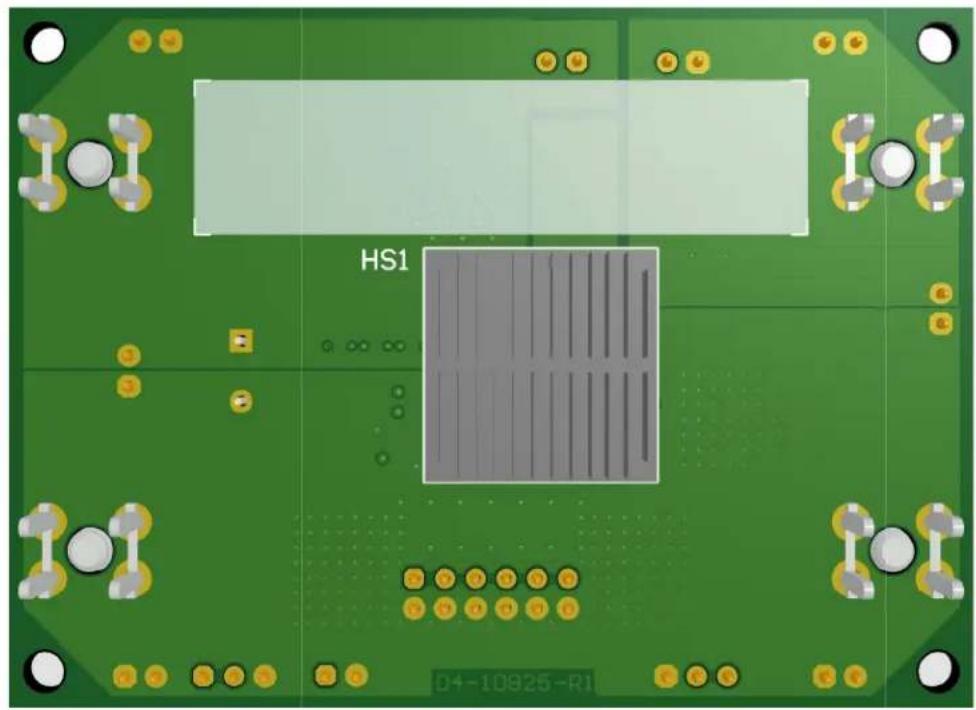
natural_image
Green printed circuit board with HS1 chip and connector components (no readable text or symbols)Appendix B. Bill of Materials (BOM)
TABLE B-1: BILL OF MATERIALS (BOM)
| Qty. | Reference | Description Manufacturer Part Number | ||
| 1 C1 | Capacitor, Ceramic, 4700 pF, 50V, 10%, X7R, SMD, 0603 | KEMET C0603C472K5 | RACTU | |
| 1 C2 | Do Not Populate - Capacitor, Ceramic, 10 pF, 50V, 0.5 pF, C0G, SMD, 0603 | TDK Corporation C1608 | C0G1H100D | |
| 1 C3 | Capacitor, Ceramic, 0.010 μF, 25V, 10%, X7R, SMD, 0603 | Yageo Corporation | CC0603KRX7R8BB103 | |
| 2 C4, | C8 Capacitor, Ceramic, 2.2 μF, 16V, 10%, X5R, SMD, 0603 | TDK Corporation C1608 | X5R1C225K | |
| 1 C5 | Capacitor, Ceramic, 1 μF, 100V, 10%, X7S, SMD, 0805 | TDK Corporation C2012 | X7S2A105K125AB | |
| 3 C7, | C10, C17 | Capacitor, Ceramic, 0.1 μF, 100V, 10%, X7R, SMD, 0603 | Murata Electronics® North America, Inc. | GRM188R72A104KA35D |
| 1 C9 | Capacitor, Ceramic, 4.7 μF, 25V, 10%, X5R, SMD, 0805 | Murata Electronics North America, Inc. | GRM21BR61E475KA12L | |
| 1 C11 | Do Not Populate - Capacitor Ceramic, 1000 pF, 50V, 20%, X7R, SMD, 0603 | Panasonic® - ECG | ECJ-1VB1H102K | |
| 3 | C12, C13, C14 | Capacitor, Ceramic, 47 μF, 16V, 20%, X5R, SMD, 1210 | Yageo Corporation | CC1210MKX5R7BB476 |
| 1 C15 | Capacitor, Aluminum, 1000 μF, 16V, 20%, SMD, G | Panasonic - ECG | 16SVPF1000M | |
| 1 C16 | Capacitor, Ceramic, 0.1 μF, 16V, 10%, X7R, SMD, 0603 | AVX Corporation | 0603YC104KAT2A | |
| 4 | C18, C19, C20, C21 | Capacitor, Ceramic, 2.2 μF, 100V, 10%, X7R, SMD, 1210 | KEMET C1210Cn225K1 | RACTU |
| 1 C22 | Capacitor, Aluminum, 100 μF, 100V, 20%, TH, P5D12.5H20 | United Chemi-Con | EKZE101ELL101MK16S | |
| 9 J1, | J2, J3, J4, J7, J8, J9, J11, J12 | Connector, Header-2.54 Male, 1x2, Gold, 5.84MH, TH, VERT | FCI | 77311-118-02LF |
| 2 J5, | J6 Connector, Header-2.54 Male, 1x3, Gold, 5.84MH, TH, VERT | FCI | 68000-103HLF | |
| 1 J10 | Connector, Header-2.54 Male, 2x6, Gold, 5.84MH, TH, VERT | Samtec, Inc. | TSW-106-07-G-D | |
| 4 J13, | J14, J15, J16 | Connector, Terminal, 15A, Female, 1x1, TH, Vertical | Keystone Electronics | 8195 |
| 1 | L1 (2) | Inductor, 6.8 μH, 21.5A, 20%, SMD, L11.6W10.5H8.8 | Wurth Elektronik | 74439369068 |
Note 1: The components listed in this Bill of Materials are representative of the PCB assembly. The released BOM used in manufacturing uses all RoHS-compliant components.
2: The user can choose different values for the L1 inductor from the same recommended series, 74439369 from Wurth, according to their specific load requirements.
TABLE B-1: BILL OF MATERIALS (BOM) (CONTINUED)
| Qty. | Reference | Description | Manufacturer | Part Number |
| 1 PC | B1 ADM009 | 95 - Printed Circuit Board Microchip | Technology Inc. | 04-10825-R1 |
| 1 R1 | Resistor, TKF | 100 kΩ, 5%, 1/10W, SMD, 0603, (Don't Use, Duplicate, Use RSMT0026) | Panasonic - ECG ERJ-3 | GEYJ104V |
| 1 | R2 | Resistor, TKF, 30 kΩ, 1%, 1/10W, SMD, 0603 | Stackpole Electronics, Inc. | RMCF0603FT30K0 |
| 4 R3, | R4, R8, R10 | Resistor, TF, 10 kΩ, 1%, 1/8W, SMD, 0603 | Vishay Beyschlag | MCT06030C1002FP500 |
| 1 | R7 | Resistor, TKF, 20 kΩ, 1%, 1/10W, SMD, 0603 | Panasonic - ECG | ERJ-3EKF2002V |
| 1 | R5 | Resistor, TKF, 3.16 kΩ, 1%, 1/10W, SMD, 0603 | Panasonic - ECG | ERJ-3EKF3161V |
| 1 | R6 | Resistor, TKF, 2.2 kΩ, 1%, 1/10W, SMD, 0603 | Panasonic - ECG | ERJ-3EKF2201V |
| 1 | R9 | Resistor, TKF, 2R, 1%, 1/4W, SMD, 0603 | Vishay/Dale | CRCW06032R00FKEAHP |
| 1 | R11 | Resistor, TKF, 2.21 kΩ, 1%, 1/10W, SMD, 0603 | Panasonic - ECG | ERJ-3EKF2211V |
| 1 | R12 | Resistor, TKF, 0R, 1/10W, SMD, 0603 | Panasonic - ECG | ERJ-3GSY0R00V |
| 2 | R13, R14 | Resistor, TKF, 1R, 1%, 1/10W, SMD, 0603 | Yageo Corporation | RC0603FR-071RL |
| 1 | R15 | Resistor, TKF, 16.2 kΩ, 1%, 1/10W, SMD, 0603 | Panasonic - ECG | ERJ-3EKF1622V |
| 1 | R16 | Do Not Populate – Resistor, TKF, 1R, 1%, 1/10W, SMD, 0603 | Yageo Corporation | RC0603FR-071RL |
| 1 | R17 | Resistor, TKF, 49.9R, 1%, 1/10W, SMD, 0603 | Panasonic - ECG | ERJ-3EKF49R9V |
| 1 | R18 | Resistor, TKF, 1.37 kΩ, 1%, 1/10W, SMD, 0603 | Yageo Corporation | RC0603FR-071K37L |
| 1 | R19 | Resistor, TKF, 523R, 1%, 1/10W, SMD, 0603 | Yageo Corporation | ERJ3EKF5230V |
| 1 | R20 | Resistor, TKF, 15R, 1%, 1/16W, SMD, 0603 | Stackpole Electronics, Inc. | RMCF0603FT15R0 |
| 1 U1 | Microchip A | Analog Switcher Buck, 0.6V to 32V, 8A, MIC28517T-E/PHA VQFN-32 | Microchip Technology, Inc. | MIC28517T-E/PHA |
Note 1: The components listed in this Bill of Materials are representative of the PCB assembly. The released BOM used in manufacturing uses all RoHS-compliant components.
2: The user can choose different values for the L1 inductor from the same recommended series, 74439369 from Wurth, according to their specific load requirements.
TABLE B-2: BILL OF MATERIALS (BOM) – MECHANICAL PARTS
| Qty. | Reference | Description | Manufacturer | Part Number |
| 1 | HS1 | Mechanical HW Heatsink, Adhesive Tape,L19W19H6.3 | CTS Corporation APF | 9-19-06CB/A01 |
| 1 JP1 | Mechanical HW Jumper, 2.54 mm, 1x2, Handle Gold | TE Connectivity | 881545-2 | |
| 1 | LABEL1 | Label, AIPD Board Assembly | — | — |
| 4 SCR1, SCR2,SCR3, SCR4 | Mechanical HW Screw #6-32 x 1/4" PanHeadPHIL Nylon | B&FTM Fasteners Supply | NY PMS 632 0025 PH | |
| 4 STANDOFF1,STANDOFF2,STANDOFF3,STANDOFF4 | Mechanical HW Stand-Off #6-32 x 3/8" F Hex Nylon | Keystone Electronics | 1903B | |
Note 1: The components listed in this Bill of Materials are representative of the PCB assembly. The released BOM used in manufacturing uses all RoHS-compliant components.
Worldwide Sales and Service
AMERICAS
Corporate Office
2355 West Chandler Blvd.
Chandler, AZ 85224-6199
Tel: 480-792-7200
Fax: 480-792-7277
Technical Support:
http://www.microchip.com/
support
Web Address:
www.microchip.com
Atlanta
Duluth, GA
Tel: 678-957-9614
Fax: 678-957-1455
Austin, TX
Tel: 512-257-3370
Boston
Westborough, MA
Tel: 774-760-0087
Fax: 774-760-0088
Chicago
Itasca, IL
Tel: 630-285-0071
Fax: 630-285-0075
Dallas
Addison, TX
Tel: 972-818-7423
Fax: 972-818-2924
Detroit
Novi, MI
Tel: 248-848-4000
Houston, TX
Tel: 281-894-5983
Indianapolis
Noblesville, IN
Tel: 317-773-8323
Fax: 317-773-5453
Tel: 317-536-2380
Los Angeles
Mission Viejo, CA
Tel: 949-462-9523
Fax: 949-462-9608
Tel: 951-273-7800
Raleigh, NC
Tel: 919-844-7510
New York, NY
Tel: 631-435-6000
San Jose, CA
Tel: 408-735-9110
Tel: 408-436-4270
Canada - Toronto
Tel: 905-695-1980
Fax: 905-695-2078
ASIA/PACIFIC
Australia - Sydney
Tel: 61-2-9868-6733
China - Beijing
Tel: 86-10-8569-7000
China - Chengdu
Tel: 86-28-8665-5511
China - Chongqing
Tel: 86-23-8980-9588
China - Dongguan
Tel: 86-769-8702-9880
China - Guangzhou
Tel: 86-20-8755-8029
China - Hangzhou
Tel: 86-571-8792-8115
China - Hong Kong SAR
Tel: 852-2943-5100
China - Nanjing
Tel: 86-25-8473-2460
China - Qingdao
Tel: 86-532-8502-7355
China - Shanghai
Tel: 86-21-3326-8000
China - Shenyang
Tel: 86-24-2334-2829
China - Shenzhen
Tel: 86-755-8864-2200
China - Suzhou
Tel: 86-186-6233-1526
China - Wuhan
Tel: 86-27-5980-5300
China - Xian
Tel: 86-29-8833-7252
China - Xiamen
Tel: 86-592-2388138
China - Zhuhai
Tel: 86-756-3210040
ASIA/PACIFIC
India - Bangalore
Tel: 91-80-3090-4444
India - New Delhi
Tel: 91-11-4160-8631
India - Pune
Tel: 91-20-4121-0141
Japan - Osaka
Tel: 81-6-6152-7160
Japan - Tokyo
Tel: 81-3-6880-3770
Korea - Daegu
Tel: 82-53-744-4301
Korea - Seoul
Tel: 82-2-554-7200
Malaysia - Kuala Lumpur
Tel: 60-3-7651-7906
Malaysia - Penang
Tel: 60-4-227-8870
Philippines - Manila
Tel: 63-2-634-9065
Singapore
Tel: 65-6334-8870
Taiwan - Hsin Chu
Tel: 886-3-577-8366
Taiwan - Kaohsiung
Tel: 886-7-213-7830
Taiwan - Taipei
Tel: 886-2-2508-8600
Thailand - Bangkok
Tel: 66-2-694-1351
Tel: 43-7242-2244-39
Fax: 43-7242-2244-393
Denmark - Copenhagen
Tel: 45-4485-5910
Fax: 45-4485-2829
Finland - Espoo
Tel: 358-9-4520-820
France - Paris
Tel: 33-1-69-53-63-20
Fax: 33-1-69-30-90-79
Germany - Garching
Tel: 49-8931-9700
Germany - Haan
Tel: 49-2129-3766400
Germany - Heilbronn
Tel: 49-7131-72400
Germany - Karlsruhe
Tel: 49-721-625370
Germany - Munich
Tel: 49-89-627-144-0
Fax: 49-89-627-144-44
Germany - Rosenheim
Tel: 49-8031-354-560
Israel - Ra'anana
Tel: 972-9-744-7705
Italy - Milan
Tel: 39-0331-742611
Fax: 39-0331-466781
Italy - Padova
Tel: 39-049-7625286
Netherlands - Drunen
Tel: 31-416-690399
Fax: 31-416-690340
Norway - Trondheim
Tel: 47-7288-4388
Poland - Warsaw
Tel: 48-22-3325737
Romania - Bucharest
Tel: 40-21-407-87-50
Spain - Madrid
Tel: 34-91-708-08-90
Fax: 34-91-708-08-91
Sweden - Gothenberg
Tel: 46-31-704-60-40
Sweden - Stockholm
Tel: 46-8-5090-4654
UK - Wokingham
Tel: 44-118-921-5800
Fax: 44-118-921-5820