HV583 - Unspecified Microchip - Free user manual and instructions
Find the device manual for free HV583 Microchip in PDF.


User questions about HV583 Microchip
0 question about this device. Answer the ones you know or ask your own.
Ask a new question about this device
Download the instructions for your Unspecified in PDF format for free! Find your manual HV583 - Microchip and take your electronic device back in hand. On this page are published all the documents necessary for the use of your device. HV583 by Microchip.
USER MANUAL HV583 Microchip
Note the following details of the code protection feature on Microchip devices:
• Microchip products meet the specification contained in their particular Microchip Data Sheet.
- Microchip believes that its family of products is one of the most secure families of its kind on the market today, when used in the intended manner and under normal conditions.
- There are dishonest and possibly illegal methods used to breach the code protection feature. All of these methods, to our knowledge, require using the Microchip products in a manner outside the operating specifications contained in Microchip's Data Sheets. Most likely, the person doing so is engaged in theft of intellectual property.
• Microchip is willing to work with the customer who is concerned about the integrity of their code.
- Neither Microchip nor any other semiconductor manufacturer can guarantee the security of their code. Code protection does not mean that we are guaranteeing the product as "unbreakable."
Code protection is constantly evolving. We at Microchip are committed to continuously improving the code protection features of our products. Attempts to break Microchip's code protection feature may be a violation of the Digital Millennium Copyright Act. If such acts allow unauthorized access to your software or other copyrighted work, you may have a right to sue for relief under that Act.
Information contained in this publication regarding device applications and the like is provided only for your convenience and may be superseded by updates. It is your responsibility to ensure that your application meets with your specifications. MICROCHIP MAKES NO REPRESENTATIONS OR WARRANTIES OF ANY KIND WHETHER EXPRESS OR IMPLIED, WRITTEN OR ORAL, STATUTORY OR OTHERWISE, RELATED TO THE INFORMATION, INCLUDING BUT NOT LIMITED TO ITS CONDITION, QUALITY, PERFORMANCE, MERCHANTABILITY OR FITNESS FOR PURPOSE. Microchip disclaims all liability arising from this information and its use. Use of Microchip devices in life support and/or safety applications is entirely at the buyer's risk, and the buyer agrees to defend, indemnify and hold harmless Microchip from any and all damages, claims, suits, or expenses resulting from such use. No licenses are conveyed, implicitly or otherwise, under any Microchip intellectual property rights unless otherwise stated.
Trademarks
The Microchip name and logo, the Microchip logo, dsPIC, FlashFlex, flexPWR, JukeBlox, KEELOQ, KEELOQ logo, Kleer, LANCheck, MediaLB, MOST, MOST logo, MPLAB, OptoLyzer, PIC, PICSTART, PIC ^82 logo, RightTouch, SpyNIC, SST, SST Logo, SuperFlash and UNI/O are registered trademarks of Microchip Technology Incorporated in the U.S.A. and other countries.
The Embedded Control Solutions Company and mTouch are registered trademarks of Microchip Technology Incorporated in the U.S.A.
Analog-for-the-Digital Age, BodyCom, chipKIT, chipKIT logo, CodeGuard, dsPICDEM, dsPICDEM.net, ECAN, In-Circuit Serial Programming, ICSP, Inter-Chip Connectivity, KleerNet, KleerNet logo, MiWi, motorBench, MPASM, MPF, MPLAB Certified logo, MPLIB, MPLINK, MultiTRAK, NetDetach, Omniscient Code Generation, PICDEM, PICDEM.net, PICkit, PICtail, RightTouch logo, REAL ICE, SQL, Serial Quad I/O, Total Endurance, TSHARC, USBCheck, VariSense, ViewSpan, WiperLock, Wireless DNA, and ZENA are trademarks of Microchip Technology Incorporated in the U.S.A. and other countries.
SQTP is a service mark of Microchip Technology Incorporated in the U.S.A.
Silicon Storage Technology is a registered trademark of Microchip Technology Inc. in other countries.
GestIC is a registered trademark of Microchip Technology Germany II GmbH & Co. KG, a subsidiary of Microchip Technology Inc., in other countries.
All other trademarks mentioned herein are property of their respective companies.
© 2015, Microchip Technology Incorporated, Printed in the U.S.A., All Rights Reserved.
ISBN: 978-1-5224-0112-4
QUALITY MANAGEMENT SYSTEM
CERTIFIED BY DNV
=ISO/TS 16949=
Microchip received ISO/TS-16949:2009 certification for its worldwide headquarters, design and wafer fabrication facilities in Chandler and Tempe, Arizona; Gresham, Oregon and design centers in California and India. The Company's quality system processes and procedures are for its PIC® MCUs and dsPIC® DSCs, KEELoo® code hopping devices, Serial EEPROMs, microperipherals, nonvolatile memory and analog products. In addition, Microchip's quality system for the design and manufacture of development systems is ISO 9001:2000 certified.
Object of Declaration: HV583 128-Channel High-Voltage Driver IC Evaluation Board
EU Declaration of Conformity
Manufacturer:
Microchip Technology Inc.
2355 W. Chandler Blvd.
Chandler, Arizona, 85224-6199
USA
This declaration of conformity is issued by the manufacturer.
The development/evaluation tool is designed to be used for research and development in a laboratory environment. This development/evaluation tool is not a Finished Appliance, nor is it intended for incorporation into Finished Appliances that are made commercially available as single functional units to end users under EU EMC Directive 2004/108/EC and as supported by the European Commission's Guide for the EMC Directive 2004/108/EC (8 ^th February 2010).
This development/evaluation tool complies with EU RoHS2 Directive 2011/65/EU.
This development/evaluation tool, when incorporating wireless and radio-telecom functionality, is in compliance with the essential requirement and other relevant provisions of the R&TTE Directive 1999/5/EC and the FCC rules as stated in the declaration of conformity provided in the module datasheet and the module product page available at www.microchip.com.
For information regarding the exclusive, limited warranties applicable to Microchip products, please see Microchip's standard terms and conditions of sale, which are printed on our sales documentation and available at www.microchip.com.
Signed for and on behalf of Microchip Technology Inc. at Chandler, Arizona, USA

VP Development Tools
12-Sep-14 Date
NOTES:
Table of Contents
Preface 7
Introduction....7
Document Layout 7
Conventions Used in this Guide....8
Warranty Registration....8
Recommended Reading....9
The Microchip Web Site 9
Development Systems Customer Change Notification Service 9
Customer Support 10
Document Revision History.... 10
Chapter 1. Product Overview
1.1 Introduction ...... 11
1.2 HV583 Device Overview 11
1.3 HV583 Evaluation Board Overview 11
1.4 HV583 Evaluation Board Kit Contents 13
Chapter 2. Installation and Operation
2.1 Getting Started 15
2.2 Setup Procedure 15
2.3 Using the Evaluation Board with a Generic Logic Signal Pattern Generator 17
2.4 Using the Evaluation Board with the PIC32 Starter Kit (DM320001) ..... 19
Appendix A. Schematic and Layouts
A.1 Introduction 25
A.2 Evaluation Board – Schematic 26
A.3 Evaluation Board – Top Silk 27
A.4 Evaluation Board – Top Copper and Silk 27
A.5 Evaluation Board – Top Copper 28
A.6 Evaluation Board – Ground Plane 28
A.7 Evaluation Board – Mid Layer 1 29
A.8 Evaluation Board – Mid Layer 2 ...... 29
A.9 Evaluation Board – Power Plane 30
A.10 Evaluation Board – Bottom Copper 30
A.11 Evaluation Board – Bottom Copper and Silk 31
A.12 Evaluation Board – Bottom Silk 31
Appendix B. Bill of Materials (BOM).... 33
Appendix C. HV583 Typical Waveforms
C.1 Introduction 35
Worldwide Sales and Service 40
NOTES:
Preface
NOTICE TO CUSTOMERS
All documentation becomes dated, and this manual is no exception. Microchip tools and documentation are constantly evolving to meet customer needs, so some actual dialogs and/or tool descriptions may differ from those in this document. Please refer to our web site (www.microchip.com) to obtain the latest documentation available.
Documents are identified with a "DS" number. This number is located on the bottom of each page, in front of the page number. The numbering convention for the DS number is "DS50000000A", where "50000000" is the document number and "A" is the revision level of the document.
For the most up-to-date information on development tools, see the MPLAB ^® IDE online help. Select the Help menu, and then Topics to open a list of available online help files.
INTRODUCTION
This chapter contains general information that will be useful to know before using the HV583 128-Channel High-Voltage Driver IC Evaluation Board. Items discussed in this chapter include:
- Document Layout
- Conventions Used in this Guide
- Warranty Registration
- Recommended Reading
• The Microchip Web Site
• Development Systems Customer Change Notification Service - Customer Support
• Document Revision History
DOCUMENT LAYOUT
This document describes how to use the HV583 128-Channel High-Voltage Driver IC Evaluation Board as a development tool. The manual layout is as follows:
- Chapter 1. “Product Overview” – Important information about the HV583 128-Channel High-Voltage Driver IC Evaluation Board.
- Chapter 2. “Installation and Operation” – This chapter includes a detailed description of each function of the HV583 128-Channel High-Voltage Driver IC Evaluation Board and instructions on how to use it.
- Appendix A. "Schematic and Layouts" – Shows the schematic and layout diagrams for the HV583 128-Channel High-Voltage Driver IC Evaluation Board.
- Appendix B. “Bill of Materials (BOM)” – Lists the parts used to build the HV583 128-Channel High-Voltage Driver IC Evaluation Board.
- Appendix C. "HV583 Typical Waveforms" – Describes the various plots and waveforms for the HV583 128-Channel High-Voltage Driver IC Evaluation Board.
CONVENTIONS USED IN THIS GUIDE
This manual uses the following documentation conventions:
DOCUMENTATION CONVENTIONS
| Description Represents Examples | ||
| Arial font: | ||
| Italic characters Referenced books | MPLAB | ^ IDE User's Guide |
| Emphasized text ...is the only compiler... | ||
| Initial caps A window the Output | ut window | |
| A dialog the Settings dialog | ||
| A menu selection select Enable Programmer | ||
| Quotes A field name in a window or dialog | "Save project before build" | |
| Underlined, italic text with right angle bracket | A menu path File>Save | —— |
| Bold characters A dialog button | Click OK | |
| A tab | Click the Power tab | |
| N'Rnnnn | A number in verilog format, where N is the total number of digits, R is the radix and n is a digit. | 4'b0010, 2'hF1 |
| Text in angle brackets <> | A key on the keyboard | Press,, |
| Courier New font: | ||
| Plain Courier New | Sample source code | #define START |
| Filenames | autoexec.bat | |
| File paths c:\mcc18\h | ||
| Keywords | _asm, _endasm, static | |
| Command-line options | -Opa+, -Opa- | |
| Bit values | 0, 1 | |
| Constants | 0xFF, 'A' | |
| Italic Courier New | A variable argument | file.o, where file can be any valid filename |
| Square brackets [] | Optional arguments | mccl8 [options] file [options] |
| Curly brackets and pipe character: { | } | Choice of mutually exclusive arguments; an OR selection | errorlevel {0|1} |
| Ellipses... | Replaces repeated text | var_name [, var_name...] |
| Represents code supplied by user | void main (void) { ... } | |
WARRANTY REGISTRATION
Please complete the enclosed Warranty Registration Card and mail it promptly. Sending in the Warranty Registration Card entitles users to receive new product updates. Interim software releases are available at the Microchip web site.
RECOMMENDED READING
This user's guide describes how to use the HV583 128-Channel High-Voltage Driver IC Evaluation Board. Other useful documents are listed below. The following Microchip documents are available and recommended as supplemental reference resources.
- HV583 Data Sheet – “128-Channel Serial to Parallel Converter with Push-Pull Outputs” (DS20005461).
Additional documentation (including schematic and code samples) is available under the PIC32 Starter Kit (DM320001) section on the web site.
Microchip provides online support via our web site at www.microchip.com. This web site is used as a means to make files and information easily available to customers. Accessible by using your favorite Internet browser, the web site contains the following information:
- Product Support – Data sheets and errata, application notes and sample programs, design resources, user's guides and hardware support documents, latest software releases and archived software
- General Technical Support – Frequently Asked Questions (FAQs), technical support requests, online discussion groups, Microchip consultant program member listing
- Business of Microchip – Product selector and ordering guides, latest Microchip press releases, listing of seminars and events, listings of Microchip sales offices, distributors and factory representatives
DEVELOPMENT SYSTEMS CUSTOMER CHANGE NOTIFICATION SERVICE
Microchip's customer notification service helps keep customers current on Microchip products. Subscribers will receive e-mail notification whenever there are changes, updates, revisions or errata related to a specified product family or development tool of interest.
To register, access the Microchip web site at www.microchip.com, click on Customer Change Notification and follow the registration instructions.
The Development Systems product group categories are:
- Compilers – The latest information on Microchip C compilers, assemblers, linkers and other language tools. These include all MPLAB® C compilers; all MPLAB assemblers (including MPASM™ assembler); all MPLAB linkers (including MPLINK™ object linker); and all MPLAB librarians (including MPLIB™ object librarian).
- Emulators – The latest information on Microchip in-circuit emulators. This includes the MPLAB REAL ICE™ and MPLAB ICE 2000 in-circuit emulators.
- In-Circuit Debuggers – The latest information on the Microchip in-circuit debuggers. This includes MPLAB ICD 3 in-circuit debuggers and PICkit™ 3 debug express.
- MPLAB IDE – The latest information on Microchip MPLAB IDE, the Windows® Integrated Development Environment for development systems tools. This list is focused on the MPLAB IDE, MPLAB IDE Project Manager, MPLAB Editor and MPLAB SIM simulator, as well as general editing and debugging features.
- Programmers – The latest information on Microchip programmers. These include production programmers such as MPLAB REAL ICE in-circuit emulator, MPLAB ICD 3 in-circuit debugger and MPLAB PM3 device programmers. Also included are nonproduction development programmers, such as PICkit 2 and 3.
CUSTOMER SUPPORT
Users of Microchip products can receive assistance through several channels:
- Distributor or Representative
- Local Sales Office
• Field Application Engineer (FAE) - Technical Support
Customers should contact their distributor, representative or field application engineer (FAE) for support. Local sales offices are also available to help customers. A listing of sales offices and locations is included in the back of this document.
Technical support is available through the web site at:
http://www.microchip.com/support
DOCUMENT REVISION HISTORY
Revision A (December 2015)
- Initial release of this document.
Chapter 1. Product Overview
1.1 INTRODUCTION
This chapter covers the following topics:
• HV583 Device Overview
• HV583 Evaluation Board Overview
• HV583 Evaluation Board Kit Contents
1.2 HV583 DEVICE OVERVIEW
The HV583 is a unipolar 128-channel, low-voltage serial to high-voltage parallel converter with push-pull outputs, dedicated to printer driver and plasma display applications. The device has been designed for applications that require high channel count and high output voltage swing (0-80V) with current sinking and sourcing capabilities of 30 mA.
The device consists of four parallel 32-bit Shift registers, a 128-bit latch and 128 high-voltage outputs. The 32-bit Shift registers can operate up to a 40 MHz speed rate, allowing for fast data update. The parallel arrangement of the registers permits four times the speed of a single register, providing a fast update rate for the 128 output channels. Data flow can be shifted from a clockwise to a counterclockwise direction via the DIR pin. All high-voltage outputs can be forced to a low-level, high-level or high-impedance state (high Z) through the OL, OH and OE pins, respectively.
1.3 HV583 EVALUATION BOARD OVERVIEW
The HV583 128-Channel High-Voltage Driver IC Evaluation Board facilitates the quick implementation for display and printer driver applications with its flexible input/output connection interface.
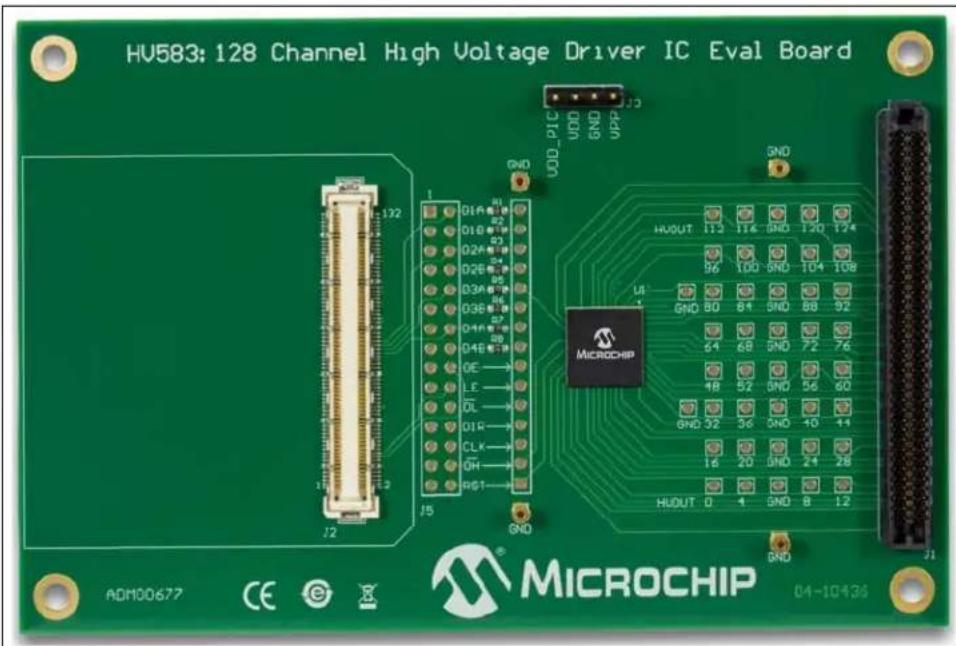
The evaluation board is designed to be operated together with the Microchip Technology PIC32 Starter Kit (DM320001) or with a generic signal pattern generator via the dedicated J5 pin header connector (see Figure 1-1).
There are 32 test point pads corresponding to the first 32-bit register (D1A/D1B) that control the high-voltage outputs: HV_OUT0 , 4, 8...124. Ground pads are provided along with the test point pads to facilitate the analysis of the high-voltage output channels. Refer to Figure 1-1 and to the HV583 Data Sheet.
All output channels are available via a 160-position, high-density array female connector, where only 128 positions are used (refer to the Evaluation Board – Schematic in Appendix A. "Schematic and Layouts" for more details).
The HV583 contains four parallel 32-bit Shift registers. Each 32-bit Shift register features two ports that can be set as either inputs or outputs by controlling the DIR pin, as shown in the following list:
- setting the DIR pin high enables the DnA pins as inputs and the DnB pins as outputs (counterclockwise input data)
- setting the DIR pin low configures DnB pins as inputs and DnA pins as outputs (clockwise input data)
Shunt (zero Ohm) resistors are placed right after the pin header connectors (D1B to D4B) to facilitate the adjustment of the Input registers in any desired manner.
Note: The HV583 128-Channel High-Voltage Driver IC Evaluation Board comes equipped with shunt resistors only on the DnB pins. Shunt resistors are not installed on the DnA pins.
1.3.1 HV583 Evaluation Board Block Diagram
Figure 1-1 presents the HV583 128-Channel High-Voltage Driver IC Evaluation Board block diagram with the main sections labeled and explained.

1 = FX10A-120S/12-SV(71) connector (J2) for PIC32 Starter Kit (DM320001), not included
2 = Header connector for (generic) signal pattern generator (J5), not installed
3 = HV583 169-Ball TFBGA package
4 = Power connection pin header
5 = 32 HVOUTn test points and ground pads
6 = 160-position, high-density array female connector
FIGURE 1-1: HV583 128-Channel High-Voltage Driver IC Evaluation Board Block Diagram.
1.4 HV583 EVALUATION BOARD KIT CONTENTS
The HV583 128-Channel High-Voltage Driver IC Evaluation Board Kit includes:
• HV583 128-Channel High-Voltage Driver IC Evaluation Board (ADM00677)
• Important Information Sheet
text_image
HV583: 128 Channel High Voltage Driver IC Eval Board HIVOUT 113 114 GND 120 124 96 100 GND 104 108 GND 80 81 GND 88 92 UI GND 69 GND 72 76 48 52 GND 56 60 GND 32 36 GND 40 41 16 20 GND 24 28 HIVOUT 0 4 GND 8 12 GND J2 J5 GND J2 ADM00677 CE R MICROCHIP 04-10436FIGURE 1-2: HV583 128-Channel High-Voltage Driver IC Evaluation Board – Top View.
NOTES:
Chapter 2. Installation and Operation
2.1 GETTING STARTED
The HV583 128-Channel High-Voltage Driver IC Evaluation Board is fully assembled and tested.
2.1.1 Tools Required for Operation
- A low DC power supply for V_DD (and VDD_PIC) that can produce 5V
- A high DC power supply for V_PP with a voltage range up to +80V
- A logic signal driver: PIC32 Starter Kit (DM320001) or a generic signal pattern generator
- An oscilloscope and/or a multimeter to observe waveforms and measure electrical parameters.
2.2 SETUP PROCEDURE
To prepare the HV583 128-Channel High-Voltage Driver IC Evaluation Board for operation, the following steps must be followed:
WARNING
Read the HV583 128-Channel High-Voltage Driver IC Evaluation Board User's Guide (this document) fully before proceeding to board setup.
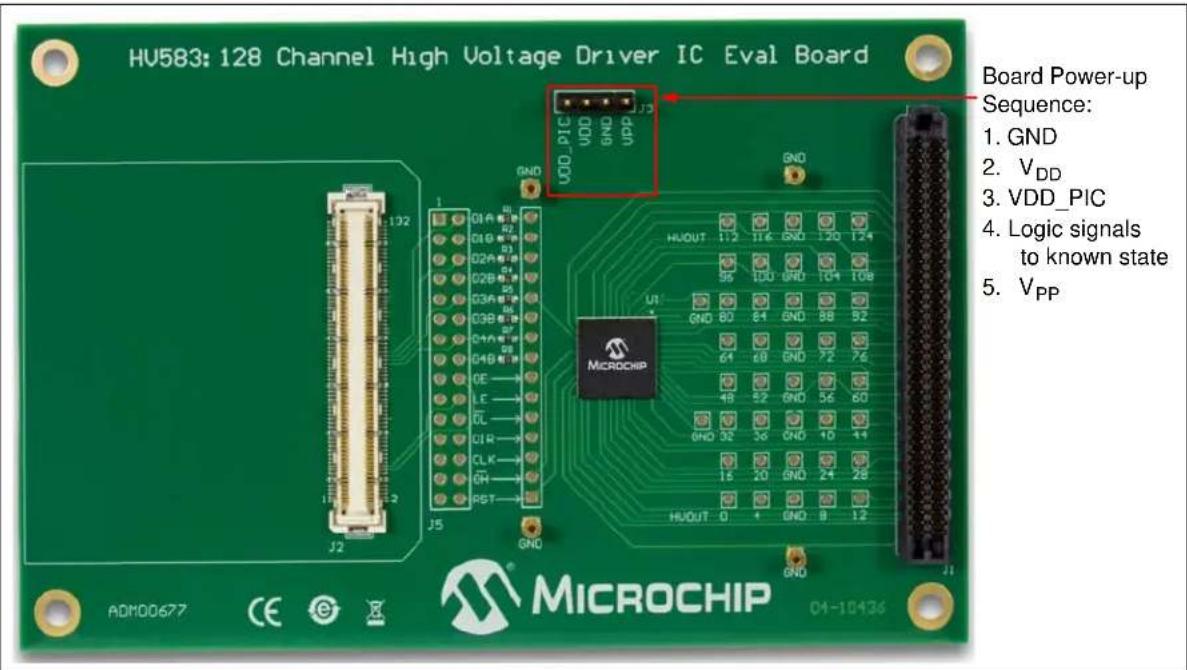
- Connect the power supplies by following the steps indicated by this power-up sequence:
a) Connect GND
b) Apply V DD
c) Connect VDD_PIC (if PIC32 Starter Kit is mounted and used) ^(1)
d) Set logic input signals to a known state
e) Apply V PP
Note 1: If the PIC32 Starter Kit is used and connected to the USB debug cable, there is no need to power the VDD_PIC pin.
Note: To power down the board, follow the reverse order of the power-up sequence.
text_image
HU583: 128 Channel High Voltage Driver IC Eval Board J3 UDD_PIC GND GND GND_PIC GND_PIC GND_PIC GND_PIC GND_PIC GND_PIC GND_PIC GND_PIC GND_PIC GND_PIC GND_PIC GND_PIC GND_PIC GND_PIC GND_PIC GND_PIC GND_PIC GND_PIC GND_PIC GND_PIC GND_PID GND_PID GND_PID GND_PID GND_PID GND_PID GND_PID GND_PID GND_PID GND_PID GND_PID GND_PID GND_PID GND_PID GND_PID GND_PID GND_PID GND_PID GND_PID GND_PID GND_PIP GND_PIP GND_PIP GND_PIP GND_PIP GND_PIP GND_PIP GND_PIP GND_PIP GND_PIP GND_PIP GND_PIP GND_PIP GND_PIP GND_PIP GND_PIP GND_PIP GND_PIP GND_PIP GND_PIP GND_PIN GND_PIN GND_PIN GND_PIN GND_PIN GND_PIN GND_PIN GND_PIN GND_PIN GND_PIN GND_PIN GND_PIN GND_PIN GND_PIN GND_PIN GND_PIN GND_PIN GND_PIN GND_PIN GND_PIN GND_PIP GND_PIP GND_PIP GND_PIP GND_PIP GND_PIP GND_PIP GND_PIP GND_PIP GND_PIP GND_PIP GND_PIP GND_PIP GND_PIP GND_PIP GND_PIP GND_PIP GND_PIP GND_PIP GND_PIPC V_DD V_DD PIC Logic signals to known state V_PPFIGURE 2-1: Board Power-up Sequence.
- Apply the voltage settings by following the steps indicated in Table 2-1.
TABLE 2-1: VOLTAGE SETTINGS
| Step | Terminal Name Description | |
| 1 | GND Ground | |
| 2 | V_DD | 5.0V, logic power supply for HV583 |
| 3 | VDD_PIC 5.0V, power supply for PIC32 Starter Kit (1) | |
| 4 | V_PP | +15V to +80V, high-voltage power supply for all HV_OUTn |
Note 1: If the PIC32 Starter Kit is used and not connected to the USB debug cable.
After following the power-up sequence and applying the voltage settings correctly, the evaluation board is ready to operate.
The HV583 128-Channel High-Voltage Driver IC Evaluation Board can be driven by a generic signal pattern generator or by the suggested PIC32 Starter Kit (DM320001). Section 2.3 “Using the Evaluation Board with a Generic Logic Signal Pattern Generator” and Section 2.4 “Using the Evaluation Board with the PIC32 Starter Kit (DM320001)” elaborate on the operation and evaluation process in detail.
2.3 USING THE EVALUATION BOARD WITH A GENERIC LOGIC SIGNAL PATTERN GENERATOR
2.3.1 Introduction
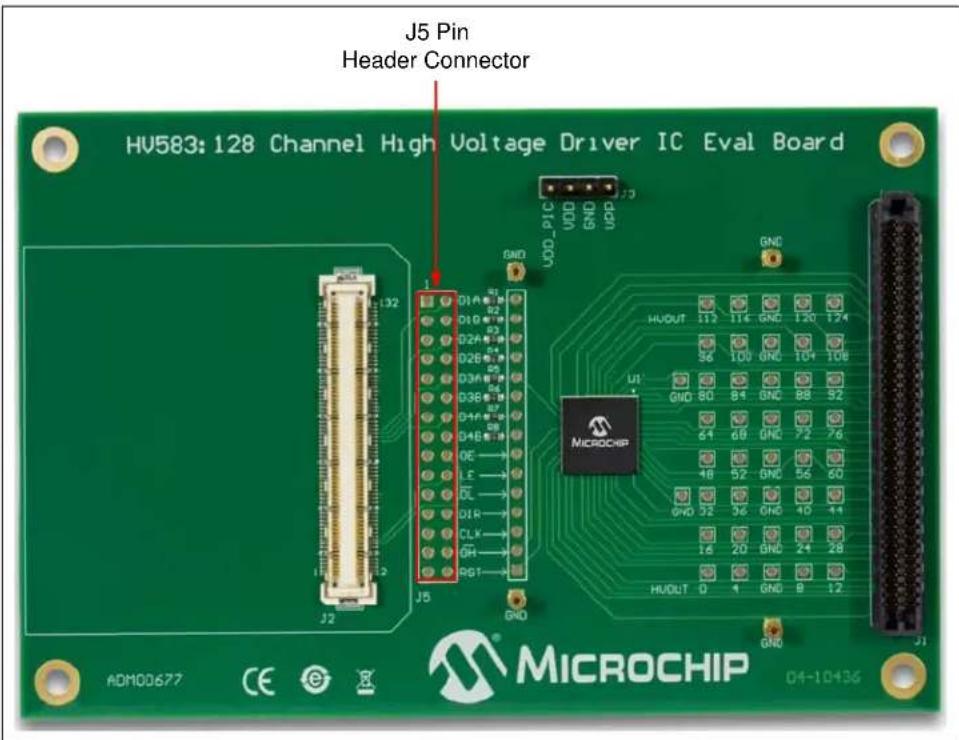
The HV583 128-Channel High-Voltage Driver IC Evaluation Board can be operated by a generic logic signal pattern generator, or by any signal driver, via the J5 pin header connector (pin header not installed).
text_image
HV583: 128 Channel High Voltage Driver IC Eval Board J5 Pin Header Connector ADH00677 CE GND J2 J5 GND UDD PIC VDD GND GND HUAOUT 112 114 GNC 120 124 36 109 GNC 104 108 U1 GND 80 84 GNC 88 92 64 68 GNC 72 76 48 52 GNC 56 60 GND 32 36 GNC 40 44 16 20 GNC 24 28 HUAOUT 0 1 GNG 9 12 J1 MICROCHIP D4-1043GFIGURE 2-2: J5 Pin Header Connector.
The user must ensure the minimum DC and AC electrical parameters are achieved by the signal pattern generator. For more information, refer to the HV583 data sheet (DS20005461).
2.3.2 Operating the Evaluation Board
When operating the evaluation board with a generic logic signal pattern generator, the VDD_PIC pin should not be powered on. The VDD_PIC pin is an optional power pin used only for the PIC32 Starter Kit (DM320001).
In case a read operation is required for the signal driver, it is recommended to operate the pattern generator at the same voltage potential as the evaluation board ( V_DD ). If, for instance, the signal pattern generator is operating at a lower voltage (e.g., 3.3V) than that of the evaluation board (5.0V), this will cause the ESD protection diodes of the signal generator to forward bias and possibly damage the board.
WARNING
If a read-back operation is required by the generic signal pattern generator (or by any signal driver), the operational voltage level of the logic signals must be equal to the voltage potential of the evaluation board ( V_DD ).
Figure 2-3 presents the logic diagram of a sample data transmission for testing and understanding the functionality of the HV583.

other
| Channel | Time (s) | |---------|----------| | CLK | 5 ns (MIN) | | D1B | 5 ns (MIN) | | D2B, D3B, D4B | 5 ns (MIN) | | DIR | 5 ns (MIN) | | RST | 5 ns (MIN) | | OH, OL | 5 ns (MIN) | | OE | 5 ns (MIN) | | LE | 5 ns (MIN) | | HVOUT 124, HVOUT 116 HVOUT 108 Rest of channels OFF | 5 ns (MIN) | | HVOUT 124, HVOUT 116 HVOUT 108 Rest of channels OFF | 5 ns (MIN) | | HVOUT 124, HVOUT 116 HVOUT 108 Rest of channels OFF | 5 ns (MIN) | | HVOUT 124, HVOUT 116 HVOUT 108 Rest of channels OFF | 5 ms (Min) | | HVOUT 124, HVOUT 116 HVOUT 108 Rest of channels OFF | 5 ms (Min) | | HVOUT 124, HVOUT 116 HVOUT 108 Rest of channels OFF | 5 ms (Min) | | HVOUT 124, HVOUT 116 HVOUT 108 Rest of channels OFF | 5 ms (Min) | | HH | 5 ms (Min) | | HH | 5 ms (Min) | | HH | 5 ms (Min) | | HH | 5 ms (Min) | | HH | 5 ms (Min) | | HH | 5 ms (Min) | | HH | 5 ms (Min) | | HH | 5 ms (Min) | | HH | 5 ms (Min) | | HH - HH | 5 ms (Min) | | HH - HH | 5 ms (Min) | | HH - HH | 5 ms (Min) | | HH - HH | 5 ms (Min) | | HH - HH | 5 ms (Min) | | HH - HH | 5 ms (Min) | | HH - HH | 5 ms (Min) | | HH - HH | - HH | | HH - HH | - HH | | HH - HH | - HH | | HH - HH | - HH | | HH - HH | - HH | | HH - HH | - HH | | HH - HH | - HH | | HH - HH | - HH | | HH - HH | - HH | | HH - HH | - HH |FIGURE 2-3: Sample Data Transmission Timing Diagram.
2.4 USING THE EVALUATION BOARD WITH THE PIC32 STARTER KIT (DM320001)
2.4.1 Introduction
The HV583 128-Channel High-Voltage Driver IC Evaluation Board can be operated by the Microchip PIC32 Starter Kit (DM320001) via the FX10A-120S/12-SV(71) connector, J2 (see Figure 2-4).
Note: Several PIC32 Starter Kits might be compatible with the HV583 Evaluation Board, but only the DM320001 is supported with code.
2.4.2 Software Requirements
In order to operate the PIC32 Starter Kit, the MPLAB® X IDE software and MPLAB® XC32 compiler must be installed in the user's system. Software and compilers are available for download on the Microchip web site at: www.microchip.com.
For detailed information regarding the installation and usage of MPLAB X IDE software, refer to the "MPLAB® X IDE User's Guide" (DS50002027).
2.4.3 Connecting the PIC32 Starter Kit to the HV583 Evaluation Board
Mount the PIC32 Starter Kit (DM320001) onto the J2 connector before powering up the board. Follow the power-up sequence and apply the voltage settings indicated in Section 2.2 "Setup Procedure".

text_image
HV583: 128 Channel High Voltage Driver IC Eval Board FX10A-120S/12-SV(71) J2 Connector ADM00677 CE GND J2 J5 GND UDD_PIC GND GND_PIC GND GND_PIC GND_PIC GND_PIC GND_PIC GND_PIC GND_PIC GND_PIC GND_PIC GND_PIC GND_PIC GND_PIC GND_PIC GND_PIC GND_PIC GND_PIC GND_PIC GND_PIC GND_PIC GND_PIC GND_PIC GND_PID GND_PID GND_PID GND_PID GND_PID GND_PID GND_PID GND_PID GND_PID GND_PID GND_PID GND_PID GND_PID GND_PID GND_PID GND_PID GND_PID GND_PID GND_PID GND_PID GND_PIP GND_PIP GND_PIP GND_PIP GND_PIP GND_PIP GND_PIP GND_PIP GND_PIP GND_PIP GND_PIP GND_PIP GND_PIP GND_PIP GND_PIP GND_PIP GND_PIP GND_PIP GND_PIP GND_PIP GND_PIN GND_PIN GND_PIN GND_PIN GND_PIN GND_PIN GND_PIN GND_PIN GND_PIN GND_PIN GND_PIN GND_PIN GND_PIN GND_PIN GND_PIN GND_PIN GND_PIN GND_PIN GND_PIN GND_PIN GND_PIP GND_PIP GND_PIP GND_PIP GND_PIP GND_PIP GND_PIP GND_PIP GND_PIP GND_PIP GND_PIP GND_PIP GND_PIP GND_PIP GND_PIP GND_PIP GND_PIP GND_PIP GND_PIP GND_PIPCFIGURE 2-4: FX10A-120S/12-SV(71) Connector, J2.
2.4.4 PIC32 Starter Kit Software Code
The source code for driving the HV583 128-Channel High-Voltage Driver IC Evaluation Board, PIC32_HV583.x, is available for download on the Microchip web site. The objective of the code is to provide a starting platform for utilizing the HV583 evaluation board.
The code flowchart is presented in Figure 2-5.

flowchart
graph TD
    A["START"] --> B["INITIALIZE PORTS"]
    B --> C{ANY BUTTON PRESS}
    C -->|NO| B
    C -->|YES| D{SW1?}
    D -->|YES| E["TRASMIT DATA TO Hvoutn"]
    D -->|NO| F{SW2?}
    F -->|YES| G["MAKE ALL Hvoutn LOW"]
    F -->|NO| H{SW3?}
    H -->|YES| I["MAKE ALL Hvoutn HIGH"]
    H -->|NO| J["End"]
FIGURE 2-5: Program Code Flowchart.
Table 2-2 provides a summary of the software code operation.
TABLE 2-2: SOFTWARE CODE OPERATION (1)
| Switch | Description |
| SW1 LED 1 turns on, data is sent to Input registers, D1B, D2B, D3B and D4B | |
| SW2 LED 2 turns on, makes all (HV OUTn) High-Voltage channels low (GND) | |
| SW3 LED 3 turns on, makes all (HV OUTn) High-Voltage channels high (VPP) | |
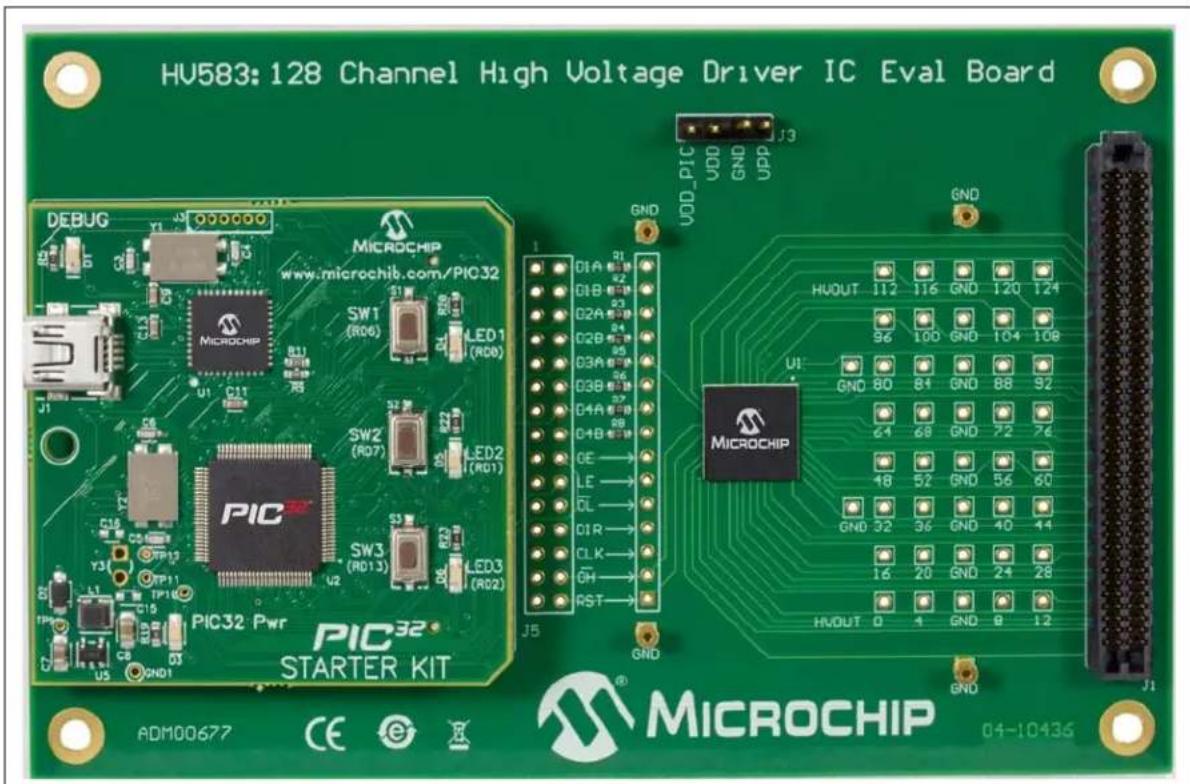
Note 1: Push button switches are located on the PIC32 Starter Kit; see Figure 2-6 and Section 2.4.6 "Modifying the Control Signals and Data in the Code".
text_image
HV583:128 Channel High Voltage Driver IC Eval Board DEBUG MICROCHIP www.microchib.com/PIC32 SW1 (R06) S1 R06 LED1 (R00) U1 C11 C6 SW2 (R07) S2 R22 LED2 (R01) U2 S3 SW3 (R013) S4 R03 LED3 (R02) PIC32 Pwr PIC32 STARTER KIT J1 J5 GND VDD_PIC VDD GND UPP J3 GND DIA 91 DIB 92 D2A 93 D2B 94 D3A 95 D3B 96 D4A 97 D4B 98 GE 99 LE 100 CL 101 CIR 102 CLK 103 GH 104 RST 105 HUAOUT 112 116 GND 120 124 96 100 GND 104 108 U1 GND 80 84 GND 88 92 64 68 GND 72 76 18 52 GND 56 60 GND 32 36 GND 40 44 16 20 GND 24 28 HVOUT 0 4 GND 9 12 GND MICROCHIP ADM00677 CE e R 04-10436 J1FIGURE 2-6: HV583 128-Channel High-Voltage Driver IC Evaluation Board with PIC32 Starter Kit (DM320001) Connected on J2 – Top View.
2.4.5 Programming the PIC32 Starter Kit
This section assumes that the MPLAB X IDE software and the MPLAB XC32 compiler are installed on the user's system, and the PIC32 Starter Kit is connected to the PC via the USB debug cable.
To load the PIC32_HV583.x code, follow these steps:
- Open the MPLAB X IDE and then the PIC32_HV583.x program code.
- Select the Clean and Build Project icon ( 🔍 ). Ignore warning messages.
- Select the Make and Program Device icon ().

text_image
MPLAB X IDE v3.05 - PIC32_HV583 : default File Edit View Navigate Source Refactor Run Debug Team Tools Window Help default Files PIC32_HV583 Header Files HV583_defs.h Important Files Linker Files Source Files main.c Libraries Loadables Start Page main.c HV583_defs.h Recent ProFIGURE 2-7: MPLAB ^® X IDE Workspace.
2.4.6 Modifying the Control Signals and Data in the Code
To modify the control signals and the data to be sent to the HV583, open the HV583Defines.h file located under the Header Files folder.
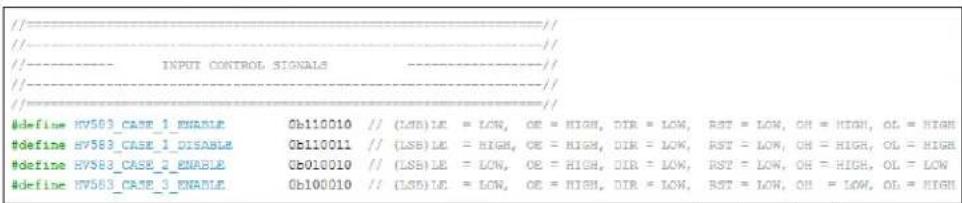
To change the control signals, LE, OE, DIR, RST, and , locate the section in the file labeled, INPUT CONTROL SIGNALS (see Figure 2-8), and modify accordingly. Data transmission is controlled by pressing the push button switches on the PIC32 Starter Kit (see Figure 2-6). The user can select one of three available cases:
- HV583_CASE_1_ENABLE and HV583_CASE_1_DISABLE control the data transmission; selectable by pressing SW1.
- HV583_CASE_2_ENABLE makes all HV_OUTn channels low; selectable by pressing SW2.
- HV583_CASE_3_ENABLE makes all HV_OUTn channels high; selectable by pressing SW3.
text_image
//---------------- //---------------- //------------------- INPUT CONTROL SIGNALS ---------------/ //------------------- #define HV583_CASE_1_ENABLE Ob110010 // (LSB)LE = LOW, OE = HIGH, DIR = LOW, RST = LOW, OH = HIGH, OL = HIGH #define HV583_CASE_1_DISABLE Ob110011 // (LSB)LE = HIGH, OE = HIGH, DIR = LOW, RST = LOW, OH = HIGH, OL = HIGH #define HV583_CASE_2_ENABLE Ob010010 // (LSB)LE = LOW, OE = HIGH, DIR = LOW, RST = LOW, OH = HIGH, OL = LOW #define HV583_CASE_3_ENABLE Ob100010 // (LSB)LE = LOW, OE = HIGH, DIR = LOW, RST = LOW, OH = LOW, OL = HIGHFIGURE 2-8: Input Control Signals: LE, OE, DIR, RST, OH and OL.
To change the data to be sent to the Input registers of the HV583, scroll to the bottom of the file, locate the section, DATA TO SEND TO REGISTERS, and change the values as desired (see Figure 2-9).
The HV583 consists of four 32-bit Shift registers.
The first 32-bit register uses D1A/D1B as input/output pins. The second register uses D2A/D2B, the third register uses D3A/D3B and the fourth register uses D4A/D4B.
In the code, DATA_1, corresponds to the first bit of data to be sent to all of the four registers. The Least Significant Bit (LSB) corresponds first to D1A/D1B, second to D2A/D2B, third to D3A/D3B, and fourth to D4A/D4B.
| //====================// |
| //====================// |
| //====================//DATA TO SEND TO REGISTERS====================// |
| //====================// |
| //====================// |
| #define DATA_1 0b1011 //((LSB)D1A/B = 1, D2A/B =1, D3A/B = 0, D4A/B = 1) |
| #define DATA_2 0b1110 |
| #define DATA_3 0b1111 |
| #define DATA_4 0b1100 |
| #define DATA_5 0b1111 |
| #define DATA_6 0b1110 |
| #define DATA_7 0b1110 |
| #define DATA_8 0b1110 |
| #define DATA_9 0b1110 |
| #define DATA_10 0b1110 |
| #define DATA_11 0b1110 |
| #define DATA_12 0b1110 |
| #define DATA_13 0b1110 |
| #define DATA_14 0b1110 |
| #define DATA_15 0b1110 |
| #define DATA_16 0b1010 |
| #define DATA_17 0b1110 |
| #define DATA_18 0b1110 |
| #define DATA_19 0b1110 |
| #define DATA_20 0b1110 |
| #define DATA_21 0b1000 |
| #define DATA_22 0b1010 |
| #define DATA_23 0b1000 |
| #define DATA_24 0b1000 |
| #define DATA_25 0b1000 |
| #define DATA_26 0b1000 |
| #define DATA_27 0b1000 |
| #define DATA_28 0b1000 |
| #define DATA_29 0b0110 |
| #define DATA_30 0b1000 |
| #define DATA_31 0b1110 |
| #define DATA_32 0b1001 |
FIGURE 2-9: Data to Send to the HV583 Input Registers.
The code flow is specified in the main.c file (see Figure 2-7) located under the Source Files folder.
NOTICE
By default, the code provided sends data into the DnB Input registers of the HV583.
WARNING
The PIC32 Starter Kit (DM320001) cannot be used to read data back from the HV583 Evaluation Board because of the difference in the logic voltage level: 3.3V (PIC32) vs. 5.0V ( V_DD ). If used, this will cause the ESD protection diodes in the PIC32 board to forward bias and possibly damage the board.
NOTES:
Appendix A. Schematic and Layouts
A.1 INTRODUCTION
This appendix contains the following layouts and schematic for the HV583
128-Channel High-Voltage Driver IC Evaluation Board (ADM00677):
- Evaluation Board – Schematic
- Evaluation Board – Top Silk
- Evaluation Board – Top Copper and Silk
- Evaluation Board – Top Copper
- Evaluation Board – Ground Plane
- Evaluation Board – Mid Layer 1
- Evaluation Board – Mid Layer 2
- Evaluation Board – Power Plane
- Evaluation Board – Bottom Copper
- Evaluation Board – Bottom Copper and Silk
- Evaluation Board – Bottom Silk
A.2 EVALUATION BOARD - SCHEMATIC

text_image
HV583 ROW1 ROW2 ROW4 CX5050x 6.5V/1.5V/1.5V/1.5V/1.5V/1.5V/1.5V/1.5V/1.5V/1.5V/1.5V/1.5V/1.5V/1.5V/1.5V/1.5V/1.5V/1.5V/1.5V/1.5V/1.5V/270-700-700-700-700-700-700-700-700-700-700-700-700-700-700-700-700-700-700-700-700-700-700-700-700-700-719-719-719-719-719-719-719-719-719-719-719-719-719-719-719-719-719-719-719-719-719-719-719-719-719-718-718-718-718-718-718-718-718-718-718-718-718-718-718-718-718-718-718-718-718-718-718-718-718-718-716-716-716-716-716-716-716-716-716-716-716-716-716-716-716-716-716-716-716-716-716-716-716-716-716-714 D50 D50 D50 D50 D50 D50 D50 D50 D50 D50 D50 D50 D50 D50 D50 D50 D50 D50 D50 D50 D50 D50 D50 D50 D50 D52 D52 D52 D52 D52 D52 D52 D52 D52 D52 D52 D52 D52 D52 D52 D52 D52 D52 D52 D52 D52 D52 D52 D52 D52 D53 D53 D53 D53 D53 D53 D53 D53 D53 D53 D53 D53 D53 D53 D53 D53 D53 D53 D53 D53 D53 D53 D53 D53 D53 D54 D54 D54 D54 D54 D54 D54 D54 D54 D54 D54 D54 D54 D54 D54 D54 D54 D54 D54 D54 D54 D54 D54 D54 D54 D56 D56 D56 D56 D56 D56 D56 D56 D56 D56 D56 D56 D56 D56 D56 D56 D56 D56 D56 D56A.3 EVALUATION BOARD – TOP SILK

text_image
HV583: 128 Channel High Voltage Driver IC Eval Board J3 UDD_PIC VDD GND UPP 132 1 GND DIA R1 D1B R2 D2A R3 D2B R4 D3A R5 D3B R6 D4A R7 D4B R8 OE → LE → OL → DIR → CLK → OH → RST → J5 GND HVOUT 112 116 GND 120 124 96 100 GND 104 108 GND 80 84 GND 88 92 64 68 GND 72 76 48 52 GND 56 60 GND 32 36 GND 40 44 16 20 GND 24 28 HVOUT 0 4 GND 8 12 J1 ADM00677 CE © MICROCHIPA.4 EVALUATION BOARD – TOP COPPER AND SILK

text_image
HV583: 128 Channel High Voltage Driver IC Eval Board J2 132 1 D1A R1 D1B R2 D2A R3 D2B R4 D3A R5 D3B R6 D4A R7 D4B R8 OE LE OL DIR CLK GI RST J5 GND UDD_PIC UDD GND UPP J3 GND HUOUT 112 I16 GND 120 I24 96 100 GND 104 108 UI: GND 80 84 GND 88 92 61 68 GND 72 76 18 52 GND 56 60 GND 32 36 GND 40 44 16 20 GND 24 28 HUOUT 0 1 GND 8 12 GND J1 ADM00677 CE e X MICROCHIP 04-10436A.5 EVALUATION BOARD – TOP COPPER

natural_image
Pure electrical circuit lines without any symbols or text, showing parallel traces and dots (no readable text or labels)A.6 EVALUATION BOARD – GROUND PLANE
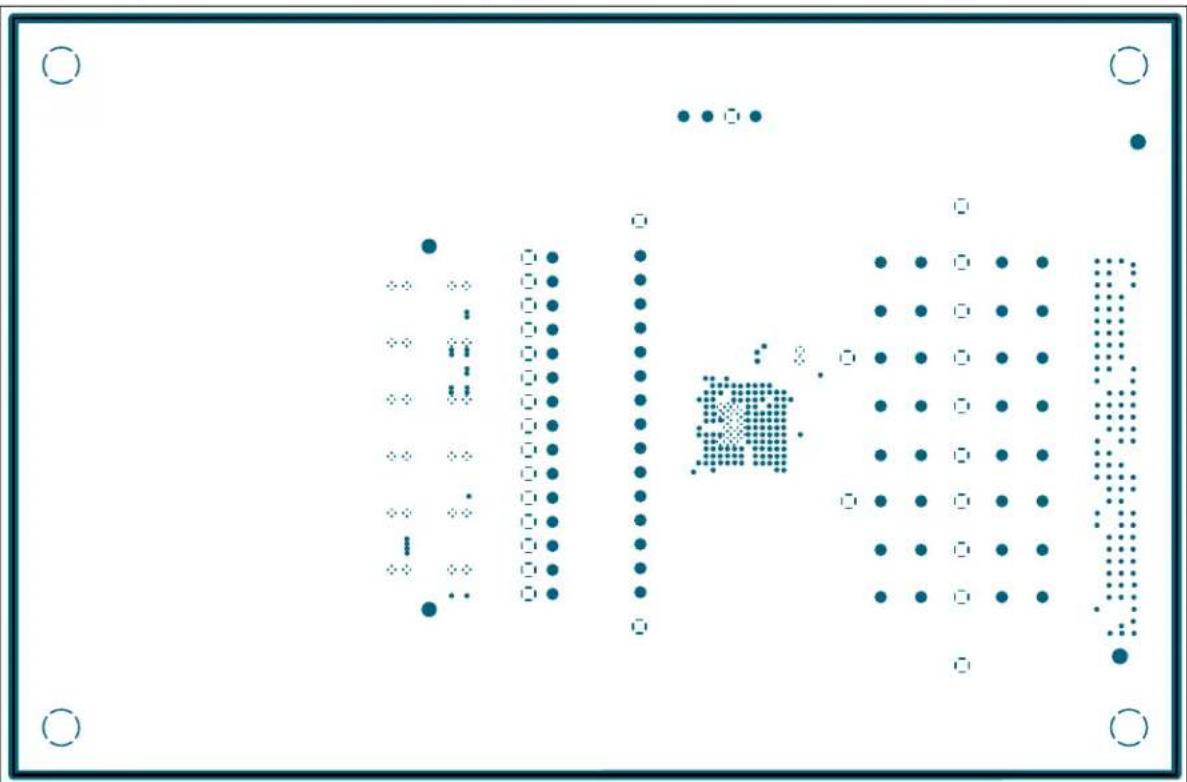
text_image
Diagram with pixelated dot patterns and a central grid, possibly representing a logic or data structure layout.A.7 EVALUATION BOARD – MID LAYER 1
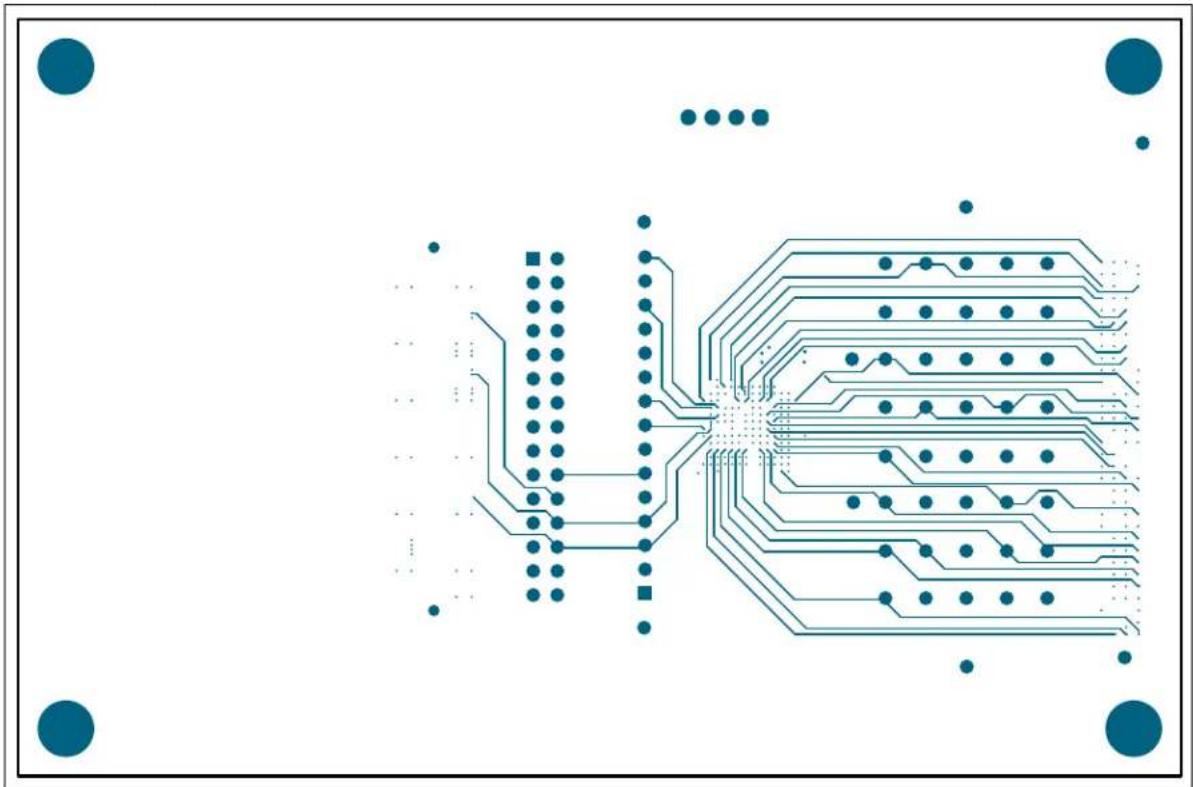
natural_image
Pure electrical circuit lines without any symbolsA.8 EVALUATION BOARD – MID LAYER 2
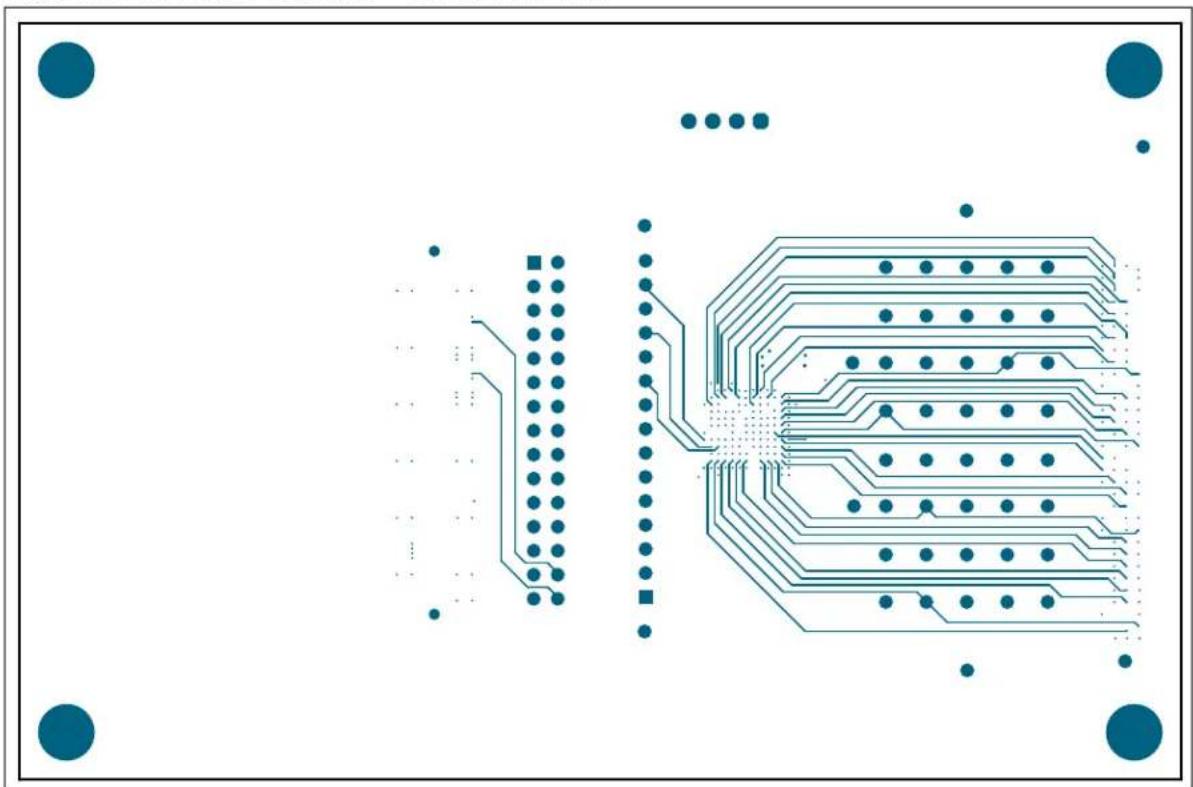
natural_image
Pure electrical circuit lines without any symbolsA.9 EVALUATION BOARD – POWER PLANE

natural_image
Pure electrical circuit lines without any symbolsA.10 EVALUATION BOARD - BOTTOM COPPER

natural_image
Pure electrical circuit lines without any symbolsA.11 EVALUATION BOARD – BOTTOM COPPER AND SILK

natural_image
Pure electrical circuit lines without any symbolsA.12 EVALUATION BOARD – BOTTOM SILK

natural_image
Pure electrical circuit lines without any symbolsNOTES:
Appendix B. Bill of Materials (BOM)
TABLE B-1: BILL OF MATERIALS (BOM)
| Qty. | Designator | Description Manufacturer Part Number | ||
| 1 C1 | Ceramic Capacitor, 1 μF, 100V AVX Corporation 12061C105KAT2A | |||
| 1 C2 | Ceramic Capacitor, 0.1 μF, 25V AVX Corporation 06033C104JAT2A | |||
| 1 J1 | 160 Position | High-Density Array Connector, Female | Molex®, LLC 0465574145 | |
| 1 J2 | Board-to-Board High-Speed Connector, 120 Positions, w/Post, SMD | Hirose Electric Co. Ltd. FX10A-120S/12-SV(71) | ||
| 1 J3 | Connector Header, 4 Positions, 100", SGL, Gold | Samtec Inc. | TSW-104-07-G-S | |
| 4 GND | Connector PC Pin, Circular, 0.030 Diameter, Gold | Mill-Max Manufacturing Corp. | 3132-0-00-15-00-00-08-0 | |
| 6 N/A | Rubber Bumper Square, 0.5"L x 0.5"W, Black | 3M | SJ-5518 (BLACK) | |
| 1 PCB | HV583 128-Channel High-Voltage Driver IC Evaluation Board – Printed Circuit Board | — | 04-10436 | |
| 4 R1, R3, R5, R7 | DO NOT POPULATE | — | — | |
| 4 R2, R4, R6, R8 | Resistor, SMD, 0.0 Ohm, Jumper, 1/10W | Stackpole Electronics, Inc. | RMCF0603ZT0R00 | |
| 1 U1 | HV583, Unipolar 128-Channel Low-voltage Serial to High-Voltage Parallel Converter with Push-Pull Outputs | Microchip Technology Inc. | HV583GA-G | |
Note: The components listed in this Bill of Materials are representative of the PCB assembly. The released BOM used in manufacturing uses all RoHS-compliant components.
NOTES:
Appendix C. HV583 Typical Waveforms
C.1 INTRODUCTION
Waveforms presented in this section correspond to two consecutive data transmissions: Transmission 1 and Transmission 2. No load is connected to the output channels.
C.1.1 Transmission 1
Turns on HVOUT124, 116, 108 and 0. Turns off the rest of the HVOUT channels. The control signals not shown in the waveforms have the states listed in Table C-1:
TABLE C-1: TRANSMISSION 1: CONTROL SIGNAL STATES
| Signal State | |
| DIR Low | |
| RST Low | |
| High | |
| High | |
| D2B Low | |
| D3B Low | |
| D4B Low |
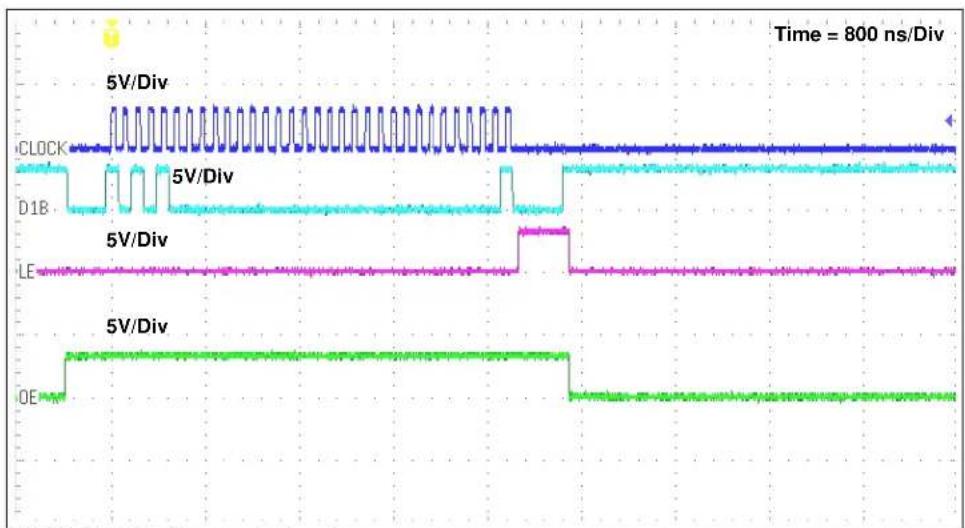
line
| Time (ns) | 5V/Div | D1B | LE | OE | |-----------|--------|-----|----|----| | 0 | 0 | 0 | 0 | 0 | | 800 | 0 | 0 | 0 | 0 |FIGURE C-1: Transmission 1.
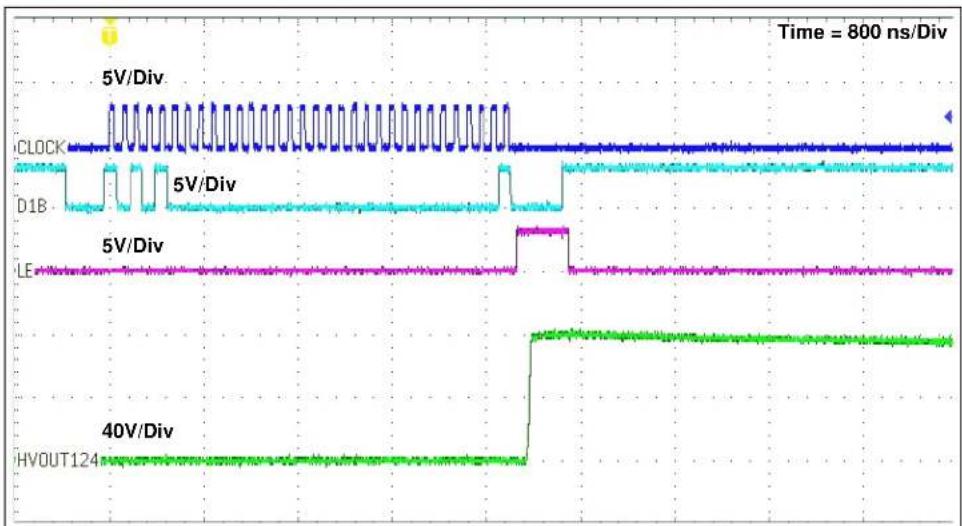
line
| Time (ns) | 5V/Div | 5V/Div | 5V/Div | 40V/Div | |-----------|--------|--------|--------|---------| | 0 | 0 | 0 | 0 | 0 | | 800 | 0 | 0 | 0 | 0 | | 1600 | 0 | 0 | 0 | 0 | | 2400 | 0 | 0 | 0 | 0 | | 3200 | 0 | 0 | 0 | 0 | | 4000 | 0 | 0 | 0 | 0 | | 4800 | 0 | 0 | 0 | 0 | | 5600 | 0 | 0 | 0 | 0 | | 6400 | 0 | 0 | 0 | 0 | | 7200 | 0 | 0 | 0 | 0 | | 8000 | 0 | 0 | 0 | 0 | | 8800 | 0 | 0 | 0 | 0 | | 9600 | 0 | 0 | 0 | 0 | | 10400 | 0 | 0 | 0 | 0 | | 11200 | 0 | 0 | 0 | 0 | | 12000 | 0 | 0 | 0 | 0 | | 12800 | 0 | 0 | 0 | 0 | | 13600 | 0 | 0 | 0 | 0 | | 14400 | 0 | 0 | 0 | 0 | | 15200 | 0 | 0 | 0 | 0 | | 16000 | 0 | 0 | 0 | 0 | | 16800 | 0 | 0 | 0 | 0 | | 17600 | 0 | 0 | 0 | 0 | | 18400 | 0 | 0 | 0 | 0 | | 19200 | 0 | 0 | 0 | 0 | | 20000 | 0 | 0 | 0 | 0 | | | | | | | | | | | | | | | | | | | | | | | | | | | | | | | | | | | | | | | | | | | | | | | | | | | | | | | | | | | | |FIGURE C-2: Transmission 1: HV OUT124 Displayed Instead of OE.
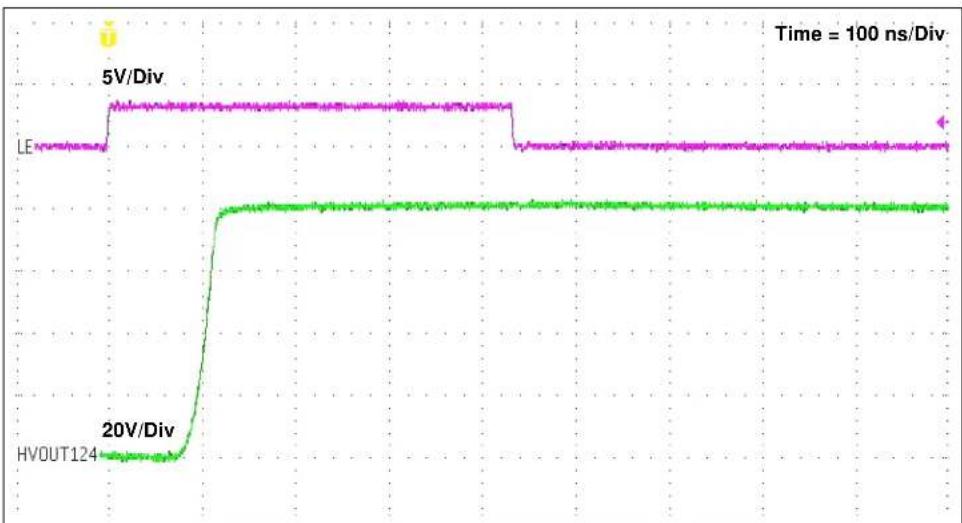
FIGURE C-3: Transmission 1: Zoom Version, LE and HV OUT ^124 .
C.1.2 Transmission 2
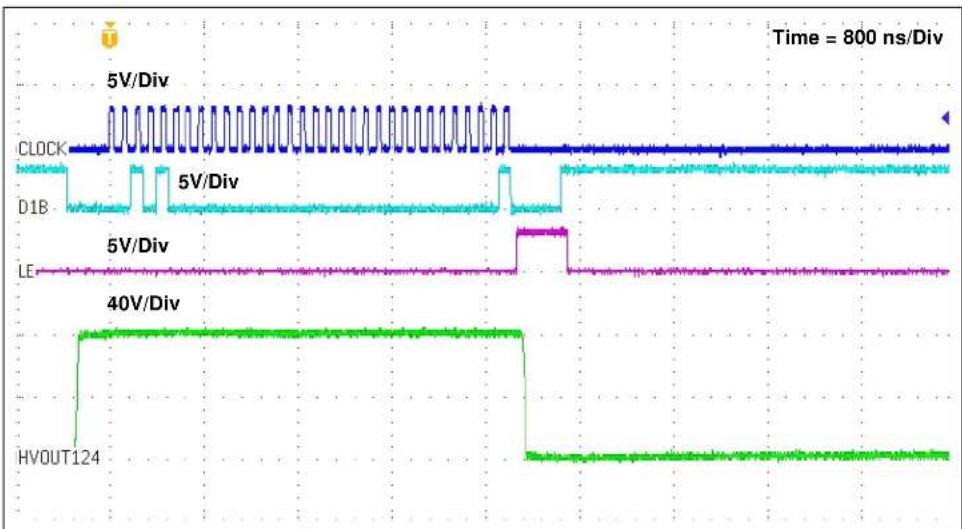
Turns on HV_OUT116 , 108 and 0. Turns off HV_OUT124 and the rest of the HV_OUT channels. This transmission illustrates the turn-off transition for HV_OUT124 , which is at a high level ( V_PP ) due to Transmission 1.
The control signals not shown in the waveforms have the states listed in Table C-2:
TABLE C-2: TRANSMISSION 2: CONTROL SIGNAL STATES
| Signal State | |
| DIR Low | |
| RST Low | |
| High | |
| High | |
| D2B Low | |
| D3B Low | |
| D4B Low |
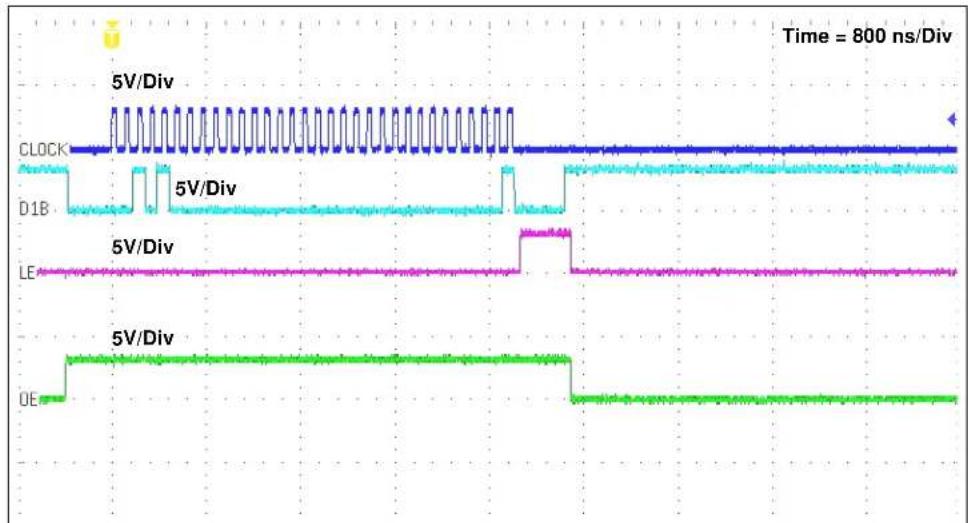
line
| Time (ns) | 5V/Div (Blue) | D1B (Cyan) | LE (Magenta) | OE (Green) | |-----------|---------------|------------|--------------|------------| | 0 | High | Low | Low | Low | | 800 | High | Low | Low | Low |FIGURE C-4: Transmission 2.
line
| Time (ns) | 5V/Div | D1B | LE | 40V/Div | HVOUT124 | |-----------|--------|-----|----|---------|----------| | 0 | 0 | 0 | 0 | 0 | 0 | | 800 | 0 | 0 | 0 | 0 | 0 | | 124 | 0 | 0 | 0 | 0 | 0 |FIGURE C-5: Transmission 2: HV OUT124 Displayed Instead of OE.
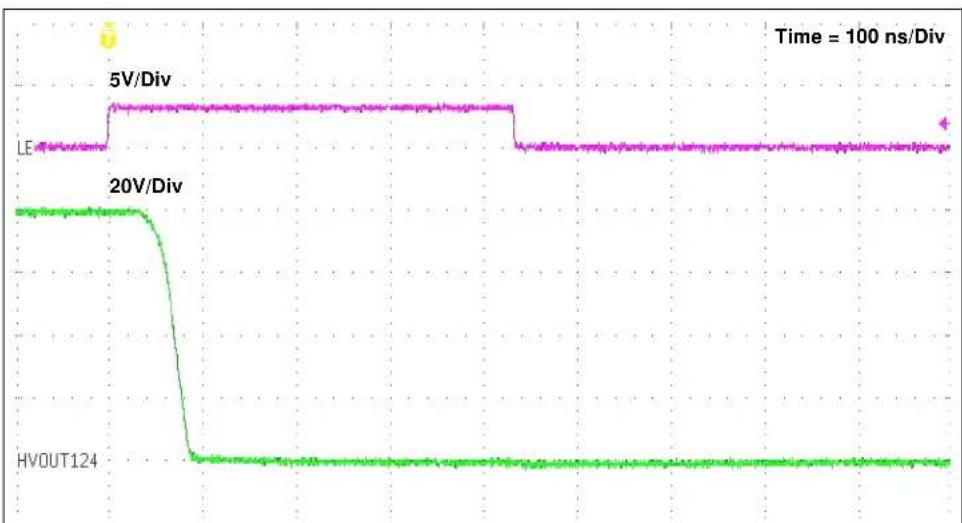
FIGURE C-6: Transmission 2: Zoom Version, LE and HV OUT124.
NOTES:
Worldwide Sales and Service
AMERICAS
Corporate Office
2355 West Chandler Blvd.
Chandler, AZ 85224-6199
Tel: 480-792-7200
Fax: 480-792-7277
Technical Support:
http://www.microchip.com/
support
Web Address:
www.microchip.com
Atlanta
Duluth, GA
Tel: 678-957-9614
Fax: 678-957-1455
Austin, TX
Tel: 512-257-3370
Boston
Westborough, MA
Tel: 774-760-0087
Fax: 774-760-0088
Chicago
Itasca, IL
Tel: 630-285-0071
Fax: 630-285-0075
Cleveland
Independence, OH
Tel: 216-447-0464
Fax: 216-447-0643
Dallas
Addison, TX
Tel: 972-818-7423
Fax: 972-818-2924
Detroit
Novi, M
Tel: 248-848-4000
Houston, TX
Tel: 281-894-5983
Indianapolis
Noblesville, IN
Tel: 317-773-8323
Fax: 317-773-5453
Los Angeles
Mission Viejo, CA
Tel: 949-462-9523
Fax: 949-462-9608
New York, NY
Tel: 631-435-6000
San Jose, CA
Tel: 408-735-9110
Canada - Toronto
Tel: 905-673-0699
Fax: 905-673-6509
ASIA/PACIFIC
Asia Pacific Office
Suites 3707-14, 37th Floor
Tower 6, The Gateway
Harbour City, Kowloon
Hong Kong
Tel: 852-2943-5100
Fax: 852-2401-3431
Australia - Sydney
Tel: 61-2-9868-6733
Fax: 61-2-9868-6755
China - Beijing
Tel: 86-10-8569-7000
Fax: 86-10-8528-2104
China - Chengdu
Tel: 86-28-8665-5511
Fax: 86-28-8665-7889
China - Chongqing
Tel: 86-23-8980-9588
Fax: 86-23-8980-9500
China - Dongguan
Tel: 86-769-8702-9880
China - Hangzhou
Tel: 86-571-8792-8115
Fax: 86-571-8792-8116
China - Hong Kong SAR
Tel: 852-2943-5100
Fax: 852-2401-3431
China - Nanjing
Tel: 86-25-8473-2460
Fax: 86-25-8473-2470
China - Qingdao
Tel: 86-532-8502-7355
Fax: 86-532-8502-7205
China - Shanghai
Tel: 86-21-5407-5533
Fax: 86-21-5407-5066
China - Shenyang
Tel: 86-24-2334-2829
Fax: 86-24-2334-2393
China - Shenzhen
Tel: 86-755-8864-2200
Fax: 86-755-8203-1760
China - Wuhan
Tel: 86-27-5980-5300
Fax: 86-27-5980-5118
China - Xian
Tel: 86-29-8833-7252
Fax: 86-29-8833-7256
ASIA/PACIFIC
China - Xiamen
Tel: 86-592-2388138
Fax: 86-592-2388130
China - Zhuhai
Tel: 86-756-3210040
Fax: 86-756-3210049
India - Bangalore
Tel: 91-80-3090-4444
Fax: 91-80-3090-4123
India - New Delhi
Tel: 91-11-4160-8631
Fax: 91-11-4160-8632
India - Pune
Tel: 91-20-3019-1500
Japan - Osaka
Tel: 81-6-6152-7160
Fax: 81-6-6152-9310
Japan - Tokyo
Tel: 81-3-6880-3770
Fax: 81-3-6880-3771
Korea - Daegu
Tel: 82-53-744-4301
Fax: 82-53-744-4302
Korea - Seoul
Tel: 82-2-554-7200
Fax: 82-2-558-5932 or
82-2-558-5934
Malaysia - Kuala Lumpur
Tel: 60-3-6201-9857
Fax: 60-3-6201-9859
Malaysia - Penang
Tel: 60-4-227-8870
Fax: 60-4-227-4068
Philippines - Manila
Tel: 63-2-634-9065
Fax: 63-2-634-9069
Singapore
Tel: 65-6334-8870
Fax: 65-6334-8850
Taiwan - Hsin Chu
Tel: 886-3-5778-366
Fax: 886-3-5770-955
Taiwan - Kaohsiung
Tel: 886-7-213-7828
Taiwan - Taipei
Tel: 886-2-2508-8600
Fax: 886-2-2508-0102
Thailand - Bangkok
Tel: 66-2-694-1351
Fax: 66-2-694-1350
EUROPE
Austria - Wels
Tel: 43-7242-2244-39
Fax: 43-7242-2244-393
Denmark - Copenhagen
Tel: 45-4450-2828
Fax: 45-4485-2829
France - Paris
Tel: 33-1-69-53-63-20
Fax: 33-1-69-30-90-79
Germany - Dusseldorf
Tel: 49-2129-3766400
Germany - Karlsruhe
Tel: 49-721-625370
Germany - Munich
Tel: 49-89-627-144-0
Fax: 49-89-627-144-44
Italy - Milan
Tel: 39-0331-742611
Fax: 39-0331-466781
Italy - Venice
Tel: 39-049-7625286
Netherlands - Drunen
Tel: 31-416-690399
Fax: 31-416-690340
Poland - Warsaw
Tel: 48-22-3325737
Spain - Madrid
Tel: 34-91-708-08-90
Fax: 34-91-708-08-91
Sweden - Stockholm
Tel: 46-8-5090-4654
UK - Wokingham
Tel: 44-118-921-5800
Fax: 44-118-921-5820