HSNCS50B - Water heater Rinnai - Free user manual and instructions
Find the device manual for free HSNCS50B Rinnai in PDF.


User questions about HSNCS50B Rinnai
0 question about this device. Answer the ones you know or ask your own.
Ask a new question about this device
Download the instructions for your Water heater in PDF format for free! Find your manual HSNCS50B - Rinnai and take your electronic device back in hand. On this page are published all the documents necessary for the use of your device. HSNCS50B by Rinnai.
USER MANUAL HSNCS50B Rinnai
C Series Cooling Only Models:
HSNCS25B
HSNCS34B
HSNCS50B
HSNCS70B
HSNCS80B

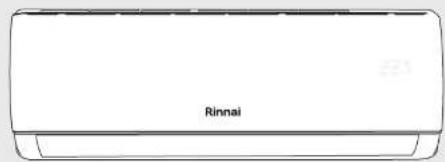
natural_image
Front view of a Rinnai air conditioner unit (no text or symbols on body)
natural_image
Line drawing of a Rinnai air conditioning unit with fan grille and ventilation slots (no text or symbols on the fan itself)
Split System Air Conditioner
This appliance must be installed in accordance with:
• Manufacturer's Installation Instructions
• Current AS/NZS 3000, AS/NZS 5141
- Local Regulations and Municipal Building Codes including local OH&S requirements
This appliance must be installed, maintained and removed only by an Authorised Person.
For continued safety of this appliance it must be installed and maintained in accordance with the manufacturer's instructions.

REFRIGERANT
R32
TABLE OF CONTENTS
Warnings and Important Information 4
Installation General 7
Contents Checklist 7
Appliance Components 7
Weights & Dimensions 7
Location
Indoor Unit 8
Outdoor Unit 8
Pipe Length & Elevation Limits 8
Installation
Indoor Unit 9
Wall Mounting Plate 9
Wall Penetration 9
Drain Pipe 9
Electrical Connections 10
Wall Installation 10
Outdoor Unit 11
Electrical Connections 11
DRED Connection (optional) 12
Refrigerant Pipes 13
Flaring 13
Connecting Vapour / Liquid Pipes To Indoor & Outdoor Units 13
Air Purging & Leakage Test 14
WARNINGS AND IMPORTANT INFORMATION

READ ALL INSTRUCTIONS BEFORE USING THE APPLIANCE.
Always comply with the following precautions to avoid dangerous situations and to ensure optimum performance.
Failure to carefully read and follow all instructions in this manual can result in equipment malfunction, property damage, personal injury and/or death.
DANGER: Indicates an imminently hazardous situation which, if not avoided, will result in personal injury or death.
WARNINGS: Indicates a potentially hazardous situation which, if not avoided, could result in personal injury or death.
CAUTIONS: Indicates a potentially hazardous situation which, if not avoided, could result in minor or moderate injury or damage to the appliance. It may also be used to alert against unsafe practices.

REGULATORY
This appliance shall be installed in accordance with:
Manufacturer's Installation Instructions.
Current AS/NZS 3000, AS/NZS 5141.
Local Regulations and Municipal Building Codes including local OH&S requirements.
This appliance must be installed, maintained and removed ONLY by an Authorised Person.
For continued safety of this appliance it must be installed and maintained in accordance with the manufacturers instructions.
This appliance uses R32 refrigerant.
This appliance is heavy, use 2 people or mechanical lifting device. Improper lifting may result in serious injury.
Take care when opening or unpacking this appliance. Failure to do so may result in serious injury or product failure.

INSTALLATION
This appliance shall be installed in accordance with local electrical safety regulations by an authorised person such as a licensed electrician.
This appliance is a Type 1 Electrical Appliance.
Make sure the live wire, neutral wire and earth wire in the power socket are properly connected. Inadequate or incorrect electrical connections may cause fire or electric shock.
The yellow-green wire in air conditioner is the earthing wire which cannot be used for other purposes. Improper earthing may cause electric shock.
The circuit breaker must have the functions of magnetic tripping and heat tripping to prevent short circuit and overload.
Use a standard circuit breaker and fuse conforming with the rating of the appliances.
| Model | HSNCS34B HS | NCS50B HSNC | $70B HSNCS80B | ||
| Circuit Breaker (Amps) | 6 16 20 25 |
The unit must be earthed in accordance with local regulations.
Connect all wiring tightly. Failure to do so may result in electric shock or product failure.
DO NOT supply power to the unit until all wiring and tubing are completed.
Select an installation location where the components can be mounted securely and accessible for service and replacement.
Make sure tubing is properly insulated to ensure optimum performance.
Install the drain hose properly for smooth drainage of condensed water.
Make sure to check for and rectify any refrigerant leaks after you install or repair the unit.
This appliance uses R32 (difluoromethane) refrigerant, which is a flammable gas class 2.2 according to AS/NZS 1677 and must be handled by a refrigeration mechanic with appropriate Australian refrigerant handling licence.

WARNING Risk of fire / flammable material. If the refrigerant is leaked, together with an external ignition course, there is a possibility of ignition

OPERATION
DO NOT let the air conditioner run for extended periods when the humidity is very high or when doors or windows are left open. As this may result in an excessive operational loading and lead to product failure.
DO NOT cover or place articles on any part of this appliance.
DO NOT touch, operate or clean the air conditioner with wet hands. It may result in electric shock or product failure.
DO NOT insert hands or other objects through the air inlet or outlet while the appliance is operating. It may result in electric shock or product failure.
DO NOT place a heater or other heating appliances near this appliance, always ensure sufficient ventilation when using this appliance and a heating appliance at the same time. Failure to do so may result in product misoperation.
Turn main power off before cleaning. Failure to do so may result in fire, electric shock, or product failure.
DO NOT use solvents, abrasives or harsh detergent to clean any part or surface of this appliance or spray water or allow liquids to enter the indoor unit. The enclosure of the appliance and remote control can be cleaned using a soft, damp cloth and a mild detergent.
NEVER touch the metal parts of the air conditioner when you remove the air filter. It may result in electric shock or product failure.
DO NOT leave flammable materials near the appliance. It may result in explosion or fire.
If there is excessive noise, smell or smoke coming from the appliance, turn the appliance off, isolate the power supply and contact a service agent.
DO NOT operate the appliance if it has been submerged into water due to flooding, contact a service agent. Failure to do so may result in electric shock, fire, serious injury, or product failure.
This appliance is not intended for use by persons (including children) with reduced physical, sensory or mental capabilities, or lack of experience and knowledge unless they have been given supervision or instruction concerning use of the appliance by a person responsible for their safety.
INSTALLATION GENERAL
CONTENTS CHECKLIST
| Item and quantity provided(Indoor) | |||||
| Indoor unit x1 Indoor unit support | bracket x1 Operation manual x1 Installation manual x1 Rubber vibration damper x4 | ||||
| Remote controller x1 Drain pipe x1 | |||||
| Remote control wall bracket | x1 | Brass nut (small) | x2 | Energy label | x1 |
| AAA battery | x2 | Brass nut (large) | x2 | ||
| Item and quantity provided (Outdoor) | |
| Tape | x1 |
| Putty | x1 |
APPLIANCE COMPONENTS
- Indoor unit air inlet
- Filter (located behind front access panel)
- Manual ON/OFF (Auto) override button (located behind front access panel)
- Indoor unit air outlet (with louvres and vanes for setting air flow direction)
- Remote control
- Signal receiver window and temperature display (the display is built into the front access panel)
- Refrigerant pipes, electrical cable(s) (covered with binding tape)
- Condensate drain hose (covered with binding tape)
- Refrigerant entry (for service and installer use only)
- Outdoor unit air inlet (on rear & left side of unit)
- Outdoor unit air discharge and protective

text_image
INDOOR UNIT Rinnai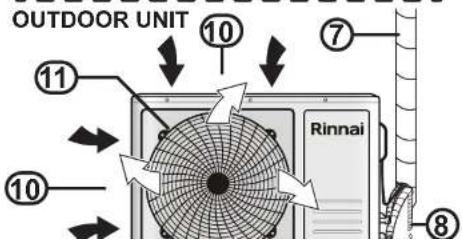
text_image
OUTDOOR UNIT 10 ⑦ Rinnai ⑪ ⑩ ⑧LOCATION
INDOOR UNIT
- Ensure the indoor unit is located away from heat or steam.
- Ensure the indoor unit is located so it can be accessed for service and replacement.
- Ensure the indoor unit is located so condensate can be drained away.
- Select a location where the indoor unit can be securely mounted.
- The clearances shown MUST BE maintained.
OUTDOOR UNIT
- Select the location where exposure to direct sunlight and strong wind are minimised.
- Select the location where the outdoor unit can be securely mounted.
- Select the location where the noise and air flow will not cause nuisance.
- Ensure there are no obstructions in the air flow path.
- Ensure the outdoor unit is located so it can be accessed for service and replacement.
- Do not place animals and plants near the air discharge.
- The clearances shown MUST BE maintained.
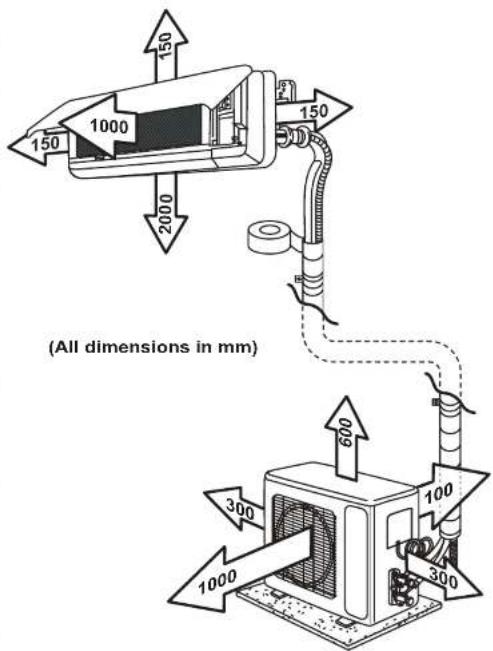
text_image
(All dimensions in mm)PIPE LENGTH & ELEVATION LIMITS
INSTALLATION
INDOOR UNIT
Wall Mounting Plate
- The wall or structure on which the units are to be mounted must be capable of supporting the weight of the appliance and the associated pipe-work.
- Fix the mounting plate on to the wall using, ensuring that it is both level and firmly mounted with the appropriate fixings.

DO NOT install the unit in a place where electrical wiring or conduits are located.

text_image
(HINCS25B / HINSCS34B) (HINCS50B / HINSCS70B / HINSCS80B) Ø70 B C D E A| Wall Mounting Plate Positioning Dimensions (mm) | ||||||||||||||||||
| HINCS25B HINCS34B HINCS50B / HINCS70B / HINCS80B | ||||||||||||||||||
| A B | C D E F | A B C | D E F A | B C D E F | ||||||||||||||
| 294 9 | 10 225 | 170 40 | 150 315 | 1010 235 180 | 40 120 | 340 | 1186 | 265 | 205 | 81 | 128 | |||||||
Wall Penetration
Drill a ∅70mm wall penetration through the wall with a 2° to 4° fall to the outside wall.
INSTALLATION
Electrical Connections

Must be installed, maintained and removed by authorised persons in accordance with AS/NZS 3000 and all other relevant local regulations and municipal building codes including OH&S requirements.
Ensure electric wiring is installed properly. Improper installation may cause malfunction, fire, or electric shock.
The unit must be earthed following local electrical codes.
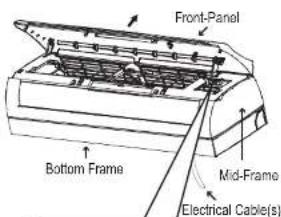
- Open the front panel.
- Remove the wiring cover.
- Insert the electrical cable(s) through the bottom side at the back of indoor unit.
- Secure the cable onto the control board with the cable clip.
- Connect the cables as shown on the drawing to the corresponding terminals.
- Re-install the wiring cover.
- Close the front panel.
text_image
Front-Panel Bottom Frame Mid-Frame Electrical Cable(s)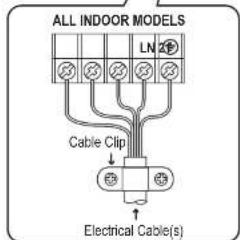
text_image
ALL INDOOR MODELS LN 2P Cable Clip Electrical Cable(s)Wall Installation
- Remove the two foam shipping blocks from the rear of indoor unit as shown.
- Position the piping as shown on the drawing.
- Tape the refrigerant pipes, electric cable(s) and drain hose. Ensure the water drain hose is located at the lowest side of the bundle.

Available connection installation routing
Left connection / access cutout

INSTALLATION
- Hang the mounting slots of the indoor unit on the upper portion of the mounting plate. Ensure that the hooks are properly seated on the plate.
- Push the unit towards to the wall, and hook the unit onto the lower fixing hook.

text_image
Indoor Unit Wall mounting bracket Connections CLICK
Ensure that there is no leakage from the drain pipe connection and that the drain pipe has a continuous fall to the outside.
Ensure that all wall penetrations are sufficiently weatherproofed.
OUTDOOR UNIT
Electrical Connections

Must be installed, maintained and removed by authorised persons in accordance with AS/NZS 3000 and to all other relevant local regulations and municipal building codes including OH&S requirements.
Ensure electric wiring is installed properly. Improper installation may cause malfunction, fire, or
INSTALLATION
DRED Connection (optional)
This appliance is supplied with an DRED interface, the interface provides one connection method of an RJ45 socket.

Must be installed, maintained and removed by authorised persons in accordance with AS/NZS 3000 and to all other relevant local regulations and municipal building codes including OH&S requirements.
Ensure electric wiring is installed properly. Improper installation may cause malfunction, fire, or electric shock.
- Remove the wiring cover.
- Connect the power feed to the terminal block as shown on the drawing below.
- Connect the communication cable to DRED interface using either the four wire terminal connections or RJ45 socket provided.
- Re-install the wiring cover.

text_image
All Other Outdoor Models Wiring cover Electrical Cable(s) To Mins Power DCSR DRED Y/G IN 2 L N L I N 2 L T-DCSR T-DCR Y/GINSTALLATION
REFRIGERANT PIPES
Flaring

• The main cause for refrigerant leakage is due to defects with the flaring work.
- The installer must ensure that all piping used complies with both:
AS/NZS 1571:1995 - Copper - Seamless tubes for air conditioning and refrigeration.
AS/NZS 4041:2006 - Pressure piping.
- All pipework and fittings should be thoroughly examined for cleanliness and suitability for the system and refrigerant prior to assembling.
- All unsealed tubing must be thoroughly inspected and, if necessary, cleaned before assembly to remove any copper residue and/or scale particles such as dirt or metal.
- Metal filings must not be left in pipework after cutting as they can cause damage compressor (i.e. shaft seals, bearings, etc.).
- Prior to assembly, refrigeration pipes must be clean and burr free. They must not be crushed or kinked.
- For flare connections, a suitable lubricant must be used between the back of the flare and the nut to avoid tearing the flare when tightening the nut.
Connecting Vapour / Liquid Pipes To Indoor & Outdoor Units
- Align the centre of the pipes.
- Sufficiently tighten the flare nut with fingers, then tighten with a spanner and torque wrench.

To prevent heat loss and wet floors due to dripping of condensation, both pipes must be properly insulated.
| Pipe Dimensions (∅) | Torque Wrench Setting | |
| Metric Imperial | ||
| ∅ 6.35 mm ∅ 1/4" 18 Nm | ||
| ∅ 9.52 mm ∅ 3/8" 42 Nm | ||
IN
Air Purging & Leakage Test

DO NOT mix any substance other than the specified refrigerant (R32) into refrigerant system.
When refrigerant gas leaks occur, ventilate the room immediately.
R32, as well as other refrigerants, should always be recovered and never be released directly into the environment.
Use a vacuum pump for R32 exclusively. Using the same vacuum pump for different refrigerants may damage the vacuum pump or the unit.

It is necessary to purge air and check for gas leakage after piping work is completed.
If using additional refrigerant, perform air purging from the refrigerant pipes and indoor unit using a vacuum pump, then charge additional refrigerant.
Use a hex socket (3/16") to operate the service valves.
All refrigerant pipe joints to be tightened with a torque wrench at the specified torque.
Evacuation Vacuum Method / Leak Test
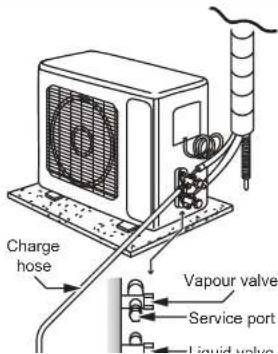
- Remove the caps from the vapour valve, vapour valve service port and the liquid valve.
- Connect charge hose from the low pressure gauge (manifold gauge set) to the vapour valve service port.
- Open the low pressure gauge valve (manifold gauge set), turn on the vacuum pump and run for a minimum of 15 minutes.
- Close low pressure gauge valve (manifold gauge set) and turn off vacuum pump.
- Wait 2 minutes to allow pressure to stabilise, then check that the low pressure gauge is maintaining a pressure of -100 kPa (-76 cmHg).
- Disconnect charge hose from the vapour valve service port and replace the vapour valve service port cap.
- Open both the vapour and the liquid valves to charge the refrigerant
text_image
Charge hose Vapour valve Service port Liquid valveFINAL CHECKLIST

The checklist is ONLY to be completed by an Authorised Person.
Check Item What can happen

ecked
Is the indoor unit installed securely? Falling, vibration, noise

|
Has an inspection been made to check for gas leakage? No

eating
Has all thermal insulation been completed (vapour pipes, liquid pipes, indoor portions of the drain hose extension)?

Condensation
Is the drainage secure? Water leakage

No cooling or heating, may cause electrical shock or electrical fire.
Are the electric wires installed correctly?

ectrical fire
Are all inlets / outlets of the indoor and outdoor units free of any obstructions?

No cooling or heating
Are the stop valves open? No cooling or heating

The image contains no text or characters. It is a graphical element (a blank white square with a thin black border).
Are the pipes designed for use with R32? Pipe or pipe connection leakage
Rinnai Australia Pty Ltd
ABN74005138769 | AU24752