PN-55H - Monitor AG Neovo - Free user manual and instructions
Find the device manual for free PN-55H AG Neovo in PDF.


User questions about PN-55H AG Neovo
0 question about this device. Answer the ones you know or ask your own.
Ask a new question about this device
Download the instructions for your Monitor in PDF format for free! Find your manual PN-55H - AG Neovo and take your electronic device back in hand. On this page are published all the documents necessary for the use of your device. PN-55H by AG Neovo.
USER MANUAL PN-55H AG Neovo
natural_image
Abstract geometric pattern with diagonal black and white stripes (no text or symbols)
neovo
THE DISPLAY CHOICE OF PROFESSIONALS ^TM
TABLE OF CONTENTS
SAFETY INFORMATION .... 1
Federal Communications Commission (FCC) Notice (U.S. Only)....1
Polish Center for Testing and Certification Notice 2
Electric, Magnetic and Electromagnetic Fields ("EMF") 3
Information for U.K. only 4
North Europe (Nordic Countries) Information....5
End-of-Life Disposal 6
Waste Electrical and Electronie Equipment-WEEE 6
Turkey RoHS....7
Ukraine RoHS 7
PRECAUTIONS 8
Cautions When Setting Up 8
Cautions When Using....9
Cleaning and Maintenance....9
Notice for the LCD Display 1
CHAPTER 1: PRODUCT DESCRIPTION.... 11
1.1 Package Contents 11
1.2 Preparing for the Installation 12
1.3 Installing and Removing Table Stands (optional) 12
1.4 Wall Mounting Installation.... 13
1.4.1 VESA Grid 13
1.4.2 Ventilation Requirements for Enclosure Locating.... 14
1.5 Mounting in Portrait Position 14
1.6 LCD Display Overview 15
4.2.1 Control Panel 45
TABLE OF CONTENTS
2.3 Connecting External Equipment (DVD/VCR/VCD)....24
2.3.1 Using COMPONENT Video Input 24
2.3.2 Using Video Source Input 24
2.3.3 Using HDMI Video Input 25
2.4 Connecting Audio Equipment 25
2.4.1 Connecting External Speakers 25
2.4.2 Connecting an External Audio Device 26
2.5 Connecting Multiple Displays in a Daisy-chain Configuration 27
2.5.1 Display Control Connection....27
2.5.2 Digital Video Connection....27
2.5.3 Analog Video Connection 28
2.6 IR Connection....29
2.7 IR Pass-Through Connection 29
2.8 Connecting to Wired Network....30
CHAPTER 3: USING THE LCD DISPLAY....31
3.1 Turning on the Power 31
3.2 Selecting the Input Source Signal 31
3.3 Adjusting the Volume....32
3.4 Changing the Picture Format 32
3.5 Choosing Your Preferred Picture Settings.... 33
3.6 Choosing Your Preferred Sound Settings.... 33
3.7 Playing Multimedia Files via Local Area Network.... 34
3.7.1 Set Up the Network 34
3.7.2 How to Use DLNA-DMP 35
3.7.3 How to Use DLNA-DMR from PC....36
2.2 Playing Multimedia Files from USB Device 37
TABLE OF CONTENTS
CHAPTER 6: APPENDIX....62
6.1 Warning Messages....62
6.2 USB Device Compatibility 63
6.3 Supported Resolution....66
6.4 Cleaning 67
6.5 Troubleshooting....68
6.6 Transporting the LCD Display 69
CHAPTER 7: SPECIFICATIONS....70
7.1 Display Specifications 70
7.2 Display Dimensions....71
7.2.1 PN-55D / PN-55H Dimensions 71
SAFETY INFORMATION
Federal Communications Commission (FCC) Notice (U.S. Only)

This equipment has been tested and found to comply with the limits for a Class B digital device, pursuant to part 15 of the FCC Rules. These limits are designed to provide reasonable protection against harmful interference in a residential installation. This equipment generates, uses and can radiate radio frequency energy and, if not installed and used in accordance with the instructions, may cause harmful interference to radio communications. However, there is no guarantee that interference will not occur in a particular installation. If this equipment does cause harmful interference to radio or television reception, which can be determined by turning the equipment off and on, the user is encouraged to try to correct the interference by one or more of the following measures:
- Reorient or relocate the receiving antenna.
- Increase the separation between the equipment and receiver.
- Connect the equipment into an outlet on a circuit different from that to which the receiver is connected.
- Consult the dealer or an experienced radio/TV technician for help.

Changes or modifications not expressly approved by the party responsible for compliance could void the user's authority to operate the equipment.
Use only an RF shielded cable that was supplied with the display when connecting this display to a computer device.
To prevent damage which may result in fire or shock hazard, do not expose this appliance to rain or excessive moisture.
THIS CLASS B DIGITAL APPARATUS MEETS ALL REQUIREMENTS OF THE CANADIAN INTERFERENCE-
SAFETY INFORMATION
Polish Center for Testing and Certification Notice
The equipment should draw power from a socket with an attached protection circuit (a three-prong socket). All equipment that works together (computer, display, printer, and so on) should have the same power supply source.
The phasing conductor of the room's electrical installation should have a reserve short-circuit protection device in the form of a fuse with a nominal value no larger than 16 amperes (A).
To completely switch off the equipment, the power supply cable must be removed from the power supply socket, which should be located near the equipment and easily accessible.
A protection mark "B" confirms that the equipment is in compliance with the protection usage requirements of standards PN-93/T-42107 and PN-89/E-06251.
Electric, Magnetic and Electromagnetic Fields ("EMF")
• We manufacture and sell many products targeted at consumers, which, like any electronic apparatus, in general have the ability to emit and receive electromagnetic signals.
- One of our leading Business Principles is to take all necessary health and safety measures for our products, to comply with all applicable legal requirements and to stay well within the EMF standards applicable at the time of producing the products.
• We are committed to develop, produce and market products that cause no adverse health effects.
- We confirm that if its products are handled properly for their intended use, they are safe to use according to scientific evidence available today.
- We play an active role in the development of international EMF and safety standards, enabling us to anticipate further developments in standardization for early integration in its products.
SAFETY INFORMATION
Information for U.K. only
WARNING - THIS APPLIANCE MUST BE EARTHED.

text_image
(A) (B)Important:
This apparatus is supplied with an approved moulded 13A plug. To change a fuse in this type of plug proceed as follows:
1 Remove fuse cover and fuse.
2 Fit new fuse which should be a BS 1362 5A,A.S.T.A. or BSI approved type.
3 Refit the fuse cover.
If the fitted plug is not suitable for your socket outlets, it should be cut off and an appropriate 3-pin plug fitted in its place.

Note:
The severed plug must be
SAFETY INFORMATION

natural_image
Diagram of a plug socket with colored wires (green, blue, red) and connectors (no text or labels)How to connect a plug
The wires in the mains lead are coloured in accordance with the following code:
BLUE - "NEUTRAL" ("N")
BROWN - "LIVE" ("L")
GREEN & YELLOW - "EARTH" ("E")
- The GREEN & YELLOW wire must be connected to the terminal in the plug which is marked with the letter "E" or by the Earth symbol or coloured GREEN or GREEN & YELLOW.
- The BLUE wire must be connected to the terminal which is marked with the letter "N" or coloured BLACK.
- The BROWN wire must be connected to the terminal which marked with the letter "L" or coloured RED. Before replacing the plug cover, make certain that the cord grip is clamped over the sheath of the lead - not simply over the three wires.
SAFETY INFORMATION
End-of-Life Disposal
Your new Public Information Display contains materials that can be recycled and reused. Specialized companies can recycle your product to increase the amount of reusable materials and to minimize the amount to be disposed of.
Please find out about the local regulations on how to dispose of your old display from your local dealer.
(For customers in Canada and U.S.A.)
This product may contain lead and/or mercury. Dispose of in accordance to local-state and federal regulations. For additional information on recycling contact www.eia.org (Consumer Education Initiative).
Waste Electrical and Electronie Equipment-WEEE
Attention users in European Union private households

This marking on the product or on its packaging illustrates that, under European Directive 2012/19/EU governing used electrical and electronic appliances, this product may not be disposed of with normal household waste. You are responsible for disposal of this equipment through a designated waste electrical and electronic equipment collection. To determine the locations for dropping off such waste electrical and electronic, contact your local government office, the waste disposal organization that serves your household or the store at which you purchased the product.
Attention users in United States:
Please dispose of according to all Local, State and Federal Laws. For the disposal or recycling information, contact: www.mygreenelectronics.com or www.eiae.org.
SAFETY INFORMATION
Batteries

For EU: The crossed-out wheeled bin implies that used batteries should not be put to the general household waste! There is a separate collection system for used batteries, to allow proper treatment and recycling in accordance with legislation.
Please contact your local authority for details on the collection and recycling schemes.
For Switzerland: The used battery is to be returned to the selling point.
For other non-EU countries: Please contact your local authority for correct method of disposal of the used battery.
According to EU directive 2006/66/EC, the battery can't be disposed improperly. The battery shall be separated to collect by local service.
Turkey RoHS
Symbols used in this manual
| This icon indicates the existence of a potential hazard that could result in personal injury or damage to the product. | |
| This icon indicates important operating and servicing information. |
Notice
- Read this User Manual carefully before using the LCD display and keep it for future reference.
- The product specifications and other information provided in this User Manual are for reference only. All information is subject to change without notice. Updated content can be downloaded from our web site at http://www.agneovo.com.
• To register online, go to http://www.agneovo.com. - To protect your rights as a consumer, do not remove any stickers from the LCD display. Doing so may affect the determination of the warranty period.
Cautions When Setting Up
PRECAUTIONS
Cautions When Using
- Use only the power cord supplied with the LCD display.
- The power outlet should be installed near the LCD display and be easily accessible.
- If an extension cord is used with the LCD display, ensure that the total current consumption plugged into the power outlet does not exceed the ampere rating.
- Do not allow anything to rest on the power cord. Do not place the LCD display where the power cord may be stepped on.
- If the LCD display will not be used for an indefinite period of time, unplug the power cord from the power outlet.
- To disconnect the power cord, grasp and pull by the plug head. Do not tug on the cord; doing so may cause fire or electric shock.
- Do not unplug or touch the power cord with wet hands.
- When turning off the display by detaching the power cord, wait 6 seconds before re-attaching the power cord for normal operation.
- Do not knock or drop the display during operation or transportation.
Cleaning and Maintenance
- To protect your display from possible damage, do not put excessive pressure on the LCD panel. When moving your

Warning:

Unplug the power cord from the power outlet and refer to qualified service
personnel under the following conditions:
When the power cord is damaged.
- If the LCD display has been dropped or the housing has been damaged.
◆ If the LCD display emits smoke or a distinct odor.
PRECAUTIONS
Notice for the LCD Display
- In order to maintain the stable luminous performance, it is recommended to use low brightness setting.
- Due to the lifespan of the lamp, it is normal that the brightness quality of the LCD display may decrease with time.
- When static images are displayed for long periods of time, the image may cause an imprint on the LCD display. This is called image retention or burn-in.
◆ To prevent image retention, do any of the following:
- Set the LCD display to turn off after a few minutes of being idle.
- Use a screen saver that has moving graphics or a blank white image.
- Execute the ANTI-BURN-IN function of the LCD display. See "General Settings, ANTI-BURN-IN" section.
- Switch desktop backgrounds regularly.
- Adjust the LCD display to low brightness settings.
- Turn off the LCD display when the system is not in use.
◆ Things to do when the LCD display shows image retention:
- Turn off the LCD display for extended periods of time. It can be several hours or several days.
- Use a screen saver and run it for extended periods of time.
- Use a black and white image and run it for extended periods of time.
- There are millions of micro transistors inside the LCD display. It is normal for a few transistors to be damaged and to produce spots. This is acceptable and is not considered a failure.
- IMPORTANT: Always activate a moving screen saver program when you leave your display unattended
CHAPTER 1: PRODUCT DESCRIPTION
1.1 Package Contents
When unpacking, check if the following items are included in the package. If any of them is missing or damaged, contact your dealer.

LCD Display

natural_image
Plain light blue background with no visible text, symbols, or objects
User Manual


Remote control


Power cord

RS232 daisy-chain
Note:
◆ Remote control is shipped with the supplied AAA batteries.
For all other regions, apply a power cord that conforms to the AC voltage of the power socket and has been approved by and complies with the safety regulations of the particular
PRODUCT DESCRIPTION
1.2 Preparing for the Installation
- Due to the high power consumption, always use the plug exclusively designed for this product. If an extended line is required, please consult your service agent.
- The product should be installed on a flat surface to avoid tipping. The distance between the back of the product and the wall should be maintained for proper ventilation. Avoid installing the product in the kitchen, bathroom or any other places with high humidity so as not to shorten the service life of the electronic components.
- The product can normally operate only under 5000m in altitude. In installations at altitudes above 3000m, some abnormalities may be experienced.
1.3 Installing and Removing Table Stands (optional)
To install table stands:
1 Ensure your display is powered off.
2 Spread a protective sheet on a flat surface.
3 Grab the carrying handles and place the display face-down on the protective sheet.
4 After inserting the stand in the guide block, tighten the screws on both sides of the display.
Carrying handle

Warning:
Do not press too hard on the LCD panel or edge of the frame, as this may cause the device to malfunction.
During unpacking, make sure to hold the carrying handles to remove the device from its packaging.
PRODUCT DESCRIPTION
1.4 Wall Mounting Installation
To mount this display to a wall, you will have to obtain a standard wall-mounting kit (commercially available). We recommend using a mounting interface that complies with TUV-GS and/or UL1678 standard in North America.
To wall-mount the LCD display, screw the mounting bracket to the VESA holes at the rear of the LCD display.

text_image
400mm 400mm1.4.1 VESA Grid
Note:
- Avoid the wall-mounting kit to block the ventilation holes on the back of the display.
- Secure the LCD display on a solid wall strong enough to bear its weight.
- Lay a protective sheet on a table, which was wrapped around the display when it was packaged, beneath the screen surface so as not to scratch the screen face.
- Ensure you have all accessories for mounting this display (wall mount, ceiling mount, table stand, etc).
♦ Follow the instructions that come with the base mounting kit. Failure to follow correct mounting procedures could result in damage to the
PRODUCT DESCRIPTION
1.4.2 Ventilation Requirements for Enclosure Locating
To allow heat to disperse, leave space between surrounding objects as shown in the diagram below.

text_image
100 mm 100 mm 100 mm 100 mm1.5 Mounting in Portrait Position
This display can be installed in portrait position.
1 Remove the table stand, if attached.
2 Rotate 90 degrees counter-clockwise.

natural_image
Pure mechanical assembly diagrams without any text, numbers, or symbolsPRODUCT DESCRIPTION
1.6 LCD Display Overview
1.6.1 Control Panel

text_image
9 NUTE INPUTMENT+ 1 23 671 [+] Power
Turn the display on or put the display to standby.
7 [▼] Down
Move the highlight bar down to adjust the selected item while OSD menu is on.
2 MUTE
8 MENU
PRODUCT DESCRIPTION
1.6.2 Input/Output Terminals

text_image
Technical diagram of an electronic device rear panel with labeled ports and connectors
AC IN
AC power input from the wall outlet.

Main power switch
Switch the main power on/off.

IR IN/ IR OUT

HDMI1 IN/ HDMI2 IN
HDMI video/audio input.

DVI IN
DVI-D video input.

DVI OUT / VGA OUT
PRODUCT DESCRIPTION
17
AUDIO IN
Audio input from external AV device (RCA).
18
AUDIO OUT
Audio output to external AV device.
19
USB PORT
Connect your USB storage device.
20
EXT. SPEAKER TERMINAL
Audio output to external speakers.
21
OPS SLOT
Slot for installing the optional OPS module.
22
SECURITY LOCK
Used for security and theft prevention.
PRODUCT DESCRIPTION
1.7 Remote Control
1.7.1 General Functions

text_image
1 2 3 4 5 6 7 8 9 10 11 NORMAL ID ←←→→→→→→→→→→→→→→→→→→→→→→→→→→→→→→→→→→→→→→→→→→→→→→→→→→→→→→→→→→→→→→→→→→→→→→→→→→→→→→→→ SOURCE → ← → ← → ← → ← → ← → ← → ← → ← → ← → ← → ← → ← → ← → ← → ← → ← → ← → ← → ← → ← → ← → ← → ← → ← → ← → ← → ← → ← → ← → ← → ← → ← → ← → ← → ← → ← → ← → ← → ← → ← → ← → ← → ← → ← → ← → ← → ← → ← → ← → ← → ↑ LIST INFO INT 12 13 14 15 16 17 18 19 20 21 22 23 24 25 26 27 28 29 30 31 32 33 34 35 36 37 38 39 40 41 42 43 44 45 46 47 48 49 50 51 52 53 54 55 56 57 58 59 60 61 62 63 64 65 66 67 68 69 70 71 72 73 74 75 76 77 78 79 801 [POWER]
Turn the display on or to put the display into standby mode.
2 PLAY
Control playback in multimedia mode.
3 [SOURCE
Choose input source. Press the ▲ or □ button to choose from USB, Network, HDMI 1, HDMI 2, DisplayPort, Card OPS, DVI-D, YPbPr, AV, or VGA. Press the OK button to confirm and exit.
4 [HOME
Access the OSD menu.
5 LIST
No function.
6 [I] [J] [+[-]→NAVIGATION buttons
Navigate through menus and choose items.
7 [∅∅K
Confirm an entry or selection.
8 [1]ADJUST
Access currently available picture and sound menus.
9 [i]MUTE
Turn the mute function on/off.
10 [ ][ ][ ][ ] COLOR
- Red: Press to play all songs in the playlist. - Cross: Press to sort the playlist.
PRODUCT DESCRIPTION
1.7.2 ID Remote Control
You can set the remote control ID when you want to use this remote control on one of several different displays.

text_image
R SOURCE FORMAT LIST INFO OK ADJUST OPTIONS VOL 4 OH 5 JL 6 MINTo set the remote control ID:
1 Press the ID button. The red LED blinks twice.
2 Press the ID SET button for 3 seconds to enter the ID mode. The red LED lights up.
Press the ID SET button again will exit the ID mode. The red LED lights off.
3 Press the digit numbers [0] \~ [9] to select the display you want to control. For example:
• Display ID #1: press [0], [0], [1]
• Display ID #11: press [0], [1], [1]
The numbers available are from [001] \~ [255].
- Not pressing any button within 10 seconds will exit the ID mode.
- If an error pressing of buttons other than the digits occurred, wait 1 second after the red LED lights off and then lights up again, then press the correct digits again.
4 Press the ENTER button to confirm. The red LED blinks twice and then lights off.
PRODUCT DESCRIPTION
1.7.3 Inserting the Batteries in the Remote Control
The remote control is powered by two 1.5V AAA batteries.
To install or replace batteries:
1 Press and then slide the cover to open it.
2 Align the batteries according to the (+) and (-) indications inside the battery compartment.
3 Replace the cover.


1.7.4 Handling the Remote Control
- Do not subject to strong shock.
- Do not allow water or other liquid to splash the remote control. If the remote control gets wet, wipe it dry immediately.
- Avoid exposure to heat and steam.
- Other than to install the batteries, do not open the remote control.
1.7.5 Operating Range of the Remote Control

Caution:
The incorrect use of batteries can result in leaks or bursting. Be sure to follow these instructions:
Place "AAA" batteries matching the (+) and (−) signs on each battery to the (+) and (−) signs of the battery compartment.
♦ Do not mix battery types.
Do not combine new batteries with used ones. It causes shorter life or leakage of batteries.
Remove the dead batteries immediately to prevent them from liquid leaking in the battery compartment. Don't touch exposed battery acid, as it can damage your skin.
Note:
◆ If you do not intend to use
CHAPTER 2: MAKING CONNECTIONS
2.1 Connecting the Power
1 Connect one end of the power cord to the AC IN connector at the rear of the LCD display.
2 Connect the other end of the power cord to a power outlet or a power supply.
3 Set the Main Power switch to ON.

natural_image
Technical line drawing of a device rear panel with cable and power outlet (no text or symbols)
Caution:
Make sure that the LCD display is not connected to the power outlet before making any connections.
MAKING CONNECTIONS
2.2 Connecting a Computer
2.2.1 Using VGA Input
Connect one end of a D-sub cable to the VGA IN connector of the LCD display and the other end of a D-sub cable to the VGA OUT (D-Sub) connector of the computer.
For audio input, connect one end of an audio cable to the AUDIO IN connector of the LCD display and the other end of an audio cable to the AUDIO OUT connector of the computer.

text_image
VGA IN AUDIO IN AUDIO OUT VGA OUT D-Sub 15 pin Computer2.2.2 Using DVI Input
MAKING CONNECTIONS
2.2.3 Using HDMI Input
Connect one end of an HDMI cable to the HDMI1 IN/ HDMI2 IN connector of the LCD display and the other end of an HDMI cable to the HDMI OUT connector of the computer.

text_image
HDMI IN HDMI OUT Computer2.2.4 Using DisplayPort Input
Connect one end of a DisplayPort cable to the DisplayPort IN connector of the LCD display and the other end of a DisplayPort cable to the DisplayPort OUT connector of the computer.
MAKING CONNECTIONS
2.3 Connecting External Equipment (DVD/VCR/VCD)
2.3.1 Using COMPONENT Video Input
Connect one end of a component cable to the COMPONENT IN connector of the LCD display and the other end of a component cable to the COMPONENT OUT connectors of the video player (DVR/VCR/VCD).
For audio input, connect one end of an audio cable to the AUDIO IN connectors of the LCD display and the other end of an audio cable to the AUDIO OUT connectors of the video player (DVR/VCR/VCD).

text_image
AUDIO IN R L AUDIO OUT DVR/VCR/VCD COMPONENT IN (YPbPr) COMPONENT OUT (YPbPr)2.3.2 Using Video Source Input
Connect one end of a video cable to the Y/CVBS in port of the LCD display and the other end of a video cable
MAKING CONNECTIONS
2.3.3 Using HDMI Video Input
Connect one end of an HDMI cable to the HDMI1 IN/ HDMI2 IN connector of the LCD display and the other end of an HDMI cable to the HDMI out connector of the video player (DVR/VCR/VCD).

text_image
HDMI1 IN/ HDMI2 IN HDMI OUT DVR/VCR/VCD2.4 Connecting Audio Equipment
2.4.1 Connecting External Speakers
MAKING CONNECTIONS
2.4.2 Connecting an External Audio Device
Connect one end of an audio cable to the AUDIO OUT connector of the LCD display and the other end of an audio cable to the AUDIO IN connector of the audio device.

text_image
AUDIO OUT AUDIO IV Audio DeviceMAKING CONNECTIONS
2.5 Connecting Multiple Displays in a Daisy-chain Configuration
You can interconnect multiple displays to create a daisy-chain configuration for applications such as a video wall.

Caution:
To avoid unnecessary strain on the bezel, it is highly recommended to keep a minimum space of 0.5mm in which a business card is able to slip between all displays on all sides.

text_image
0.5 mm2.5.1 Display Control Connection
Connect the RS232C OUT connector of DISPLAY 1 to the RS232C IN connector of DISPLAY 2.

DISPLAY 1
DISPLAY 2
MAKING CONNECTIONS
Connect the DisplayPort OUT connector of DISPLAY 1 to the DisplayPort IN connector of DISPLAY 2.

flowchart
graph TD
    PC["PC"] -->|DP| A["Device 1"]
    A -->|DP IN| B["Display 1"]
    A -->|DP OUT| C["Display 2"]
    C -->|DP IN| D["Device 2"]
    C -->|DP OUT| E["Device 3"]
Note:
Before selecting the DisplayPort 1.1a (DP 1.1a) version, make sure the Tiling > Enable setting is set to Off.
When using DP 1.1a, each display will clone the same content as the source.
◆ DP 1.2 supports MST up to 4 displays.
Connect the DVI OUT connector of DISPLAY 1 to the DVI IN connector of DISPLAY 2.

flowchart
graph LR
    A["DVD / VCR / VCD"] -->|HDMI| B["Display 1"]
    B -->|DVI IN| C["Display 2"]
    B -->|DVI OUT| D["Display 2"]
    C --> E["Output"]
MAKING CONNECTIONS
2.6 IR Connection
Connect the IR sensor cable to the IR IN connector of the LCD display.

text_image
External IR Receiver [IR IN]Note:
This display's remote control sensor will stop working if the [IR IN] is connected.
2.7 IR Pass-Through Connection
Connect one end of an IR extender cable to the IR OUT connector of the LCD display and the other end of an IR extender cable to the IR IN connector of the video player (DVR/VCR/VCD).

text_image
[IR OUT] CVD / VCR / VCCMAKING CONNECTIONS
2.8 Connecting to Wired Network
If you connect this LCD display to a home network, you can play photos, music, and videos from your computer.

flowchart
graph TD
    A["Computer"] --> B["RJ-45"]
    B --> C["ROI 1R"]
    C --> D["INTERNET"]
    C --> E["RJ-45"]
To setup the network:
1 Switch on the router and switch on its DHCP setting.
2 Connect the router to the LCD display with an Ethernet cable.
3 Press the ↑ button to display the OSD menu.
4 Press the I or I button to select Network settings. Press the OK button to enter its submenu.
5 Press the 1 or 1 button to select Network configuration. Press the OK to enter its submenu.
6 Press the ▲ or ▲ button to select DHCP & Auto IP. Press the OK button to confirm.
Note:
- Connecting with a shielded CAT-5 Ethernet cable to comply with the EMC directive
CHAPTER 3: USING THE LCD DISPLAY
3.1 Turning on the Power

text_image
NORMAL C ←←→→→→→→→→→→→→→→→→→→→→→→→→→→→→→→→→→→→→→→→→→→→→→→→→→→→→→→→→→→→→→→→→→→→→→→→→→→→→→→→→→→→→→→→→→ SOURCE → I/O/INRAT → ←←→→→→→→→→→→→→→→→→→→→→→→→→→→→ LIST → INFOPOWER button
1 Plug the power cord to a power outlet or power supply.
2 Press the ⏻ button to turn the LCD display on.
When the LCD display is turned on, press the ⏻ button to turn off the LCD display.
3.2 Selecting the Input Source Signal

Note:
The LCD display still consumes power as long as the power cord is connected to the power outlet. Disconnect the power cord to completely cut off power.
Note:
- After pressing the button, a menu with available input sources will be displayed on the screen.

USING THE LCD DISPLAY
3.3 Adjusting the Volume

text_image
LET ADD OFF VOLUME buttonsPress the -er button to adjust the volume.
3.4 Changing the Picture Format

Note:
- After pressing the — or + button, the volume icon is displayed on the screen automatically.

- Press the button to mute the audio.
Note:
The available picture formats include:
- Auto zoom: Enlarge the picture to fill the screen. Recommended for minimal screen distortion but not for HD or PC.
USING THE LCD DISPLAY
3.5 Choosing Your Preferred Picture Settings

text_image
US7 INS0 - OK ADJUST OPTONS - ADJUST button VOL1 While this display is playing video source, press the button.
2 Press the -or -button to choose Picture style, then press the OK button.
3 Press the ↓ or ↑ button to choose an option, then press the OKilton.

3.6 Choosing Your Preferred Sound Settings

Note:
The available picture styles include:
◆ Personal: Apply your personalised picture settings.
♦ Vivid: Rich and dynamic settings, ideal for daytime viewing.
♦ Natural: Natural picture settings.
Standard: Default settings that suit most environments and types of video.
♦ Movie: Ideal settings for movies.
◆ Photo: Ideal settings for photos.
◆ Energy saving: Settings that conserve the most energy.
Note:
The available sound settings
USING THE LCD DISPLAY
3.7 Playing Multimedia Files via Local Area Network
To play files via Local Area Network, you will need:
- A wired home network, connected with a Universal Plug and Play (uPnP) router.
- Optional: A LAN cable that connects your display to your home network.
• A media server running on your computer. - Appropriate settings on your computer firewall to allow you to run the media server.
3.7.1 Set Up the Network
1 Connect your display and the computer to the same home network. See illustration below to connect your display to a network.
2 Switch on your computer and the router.
- Single display setup:

flowchart
graph LR
    A["Computer"] -->|RXUTB| B["USB Port"]
    B --> C["RJ-45"]
    style A fill:#f9f,stroke:#333
    style B fill:#ccf,stroke:#333
    style C fill:#cfc,stroke:#333
- Multiple display setup
USING THE LCD DISPLAY
Set Up Media Sharing
1 Install a media server on your computer to share media files. These are some media servers:
• For PC: Windows Media Player 11 (or higher) or Tversity
- For Mac: Twonky
2 Switch on media sharing on your computer using the media server. For more information on how to set up the media server, refer to the website of the media server.
3.7.2 How to Use DLNA-DMP
1 Please connect display and your PC to the same router via RJ-45.
2 Run windows media player. Set stream handling as public sharing.
Play Files from Display
1 Press the + button, choose network and press the OKtton.

2 Now you can see all the PC's connected to the same router on the screen. Choose the right one
USING THE LCD DISPLAY
3.7.3 How to Use DLNA-DMR from PC
1 Press the ⬆ button. Then choose Network settings and press the OK button.

text_image
Picture Sound Tiling General settings Network settings View network settings Network configuration Static IP configuration Digital Media Render... Network name2 Set the Digital Media Renderer -DMR setting to On.

text_image
Picture Sound Tiling General settings Network settings View network settings Network configuration Static IP configuration Digital Media Render... Network name Off On3 Set the name of your display.

USING THE LCD DISPLAY
8 Now, go to the directory of your media files. Choose the media file by right click. On the submenu from Play To, You can find all displays connected to your network. Choose the display, and click the media file to play.
Play Files
1 Press the button. Then choose Network and press the OKton.
2 Choose a file from the content browser, and press the OK button to start playing.
3 Press the PLAY buttons (◀, ▶, ▶) on the remote control to control the media playback.
Tips:
- Choose the top bar to filter your files by type.
- Choose Sort to arrange the files by album name, artist, or other fields.
- To clear the list of offline media servers, press the button. Then, choose Clear offline servers and press the OKilton.
3.8 Playing Multimedia Files from USB Device
1 Connect your USB device to the USB connector on the LCD display.

natural_image
Pure electrical circuit lines without any symbolsUSING THE LCD DISPLAY
5 Choose the file you want. Press the butok to start playing.
6 Follow the on-screen instructions to control the play option.
7 Press the PLAY buttons (◀, ▶, ▶) on the remote control to control the media playback.
3.9 Play Options
3.9.1 Playing Music Files
1 Choose 📁 Music in the top bar.

2 Choose one music track, and press the button.
- To play all the tracks in a folder, choose one music file. Then, press the button to Play All.
- To view USB device, press the button.
- To skip to the next or previous track, press the ▲ or ▶ button.
- To pause the track, press the OK or button. Press the OK button again to resume playback.
- To skip backward or forward 10 seconds, press the or button.
- To search backward or forward, press the ◀ or ▶ button, press repeatedly to toggle between different speeds.
USING THE LCD DISPLAY
3.9.2 Playing Movie Files
1 Choose Movie in the top bar.

2 Choose a video, and press the butok.
• To play all the videos in a folder, choose one video file. Then, press the — button to Play All.
- To view USB device, the button.
- To pause the video, press the OK button. Press the or OKon again to resume playback.
- To skip backward or forward 10 seconds, press the -or -button.
- To search backward or forward, press the ◀ or ▶ button, press repeatedly to toggle between different speeds.
• To stop the video, press the ■ button.
Movie options
While playing video, press the ☐ button, then use ↓, ↑, or → to choose an option. Then press the OK button to select an option:
- Subtitles: Choose the available subtitle settings.
- Subtitle language: Choose the language for subtitles if available.
USING THE LCD DISPLAY
3.9.3 Playing Photo Files
1 Choose 📄 Photo in the top bar.

2 Choose a photo thumbnail, then press the button.
Start a Slideshow
If there are multiple photos in a folder, choose a photo. Then, press the — button to Play All.
- To skip to the previous or next photo, press the or button, and then press the button.
• To stop the slideshow, press the ■ button.
Slideshow options
While you play a slideshow, press the button, then press the button to choose an option:
- Shuffle: Enable or disable random display of pictures in the slideshow.
- Repeat: Choose Repeat to watch a slideshow repeatedly or Play Once to watch once.
- Slideshow Time: Choose the displaying time for each photo in the slideshow.
- Slideshow Transitions: Choose the transition from one photo to the next.
CHAPTER 4: ON SCREEN DISPLAY MENU
4.1 Using the OSD Menu
| # Menu Navigation | Operation | ||
| Control Panel Remote Control | |||
| 1 | Display the main menu screen. | Press the MENU button. | Press the ↑button. |
| 2 | 1 Press the ▲or▼button to select the menu item.2 Press the INPUT button to enter the submenu. | 1 Press the ↓or ↑button to select the menu item.2 Press the OK or → button to enter the submenu. | |
| 3 | 1 Press the ▲,▼+, or →button to adjust the value. | 1 Press the ↓↓→, or →button to adjust the value. | |
ON SCREEN DISPLAY MENU
| # | Menu Navigation | Operation | |
| Control Panel Remote Control | |||
| 4 | Exit the submenu. Press the INPUT | button to return to the previous menu. | Press the ➕ or ➕ button to return to the previous menu. |
| 5 | Close the OSD window. Press the MENU | button again. | Press the ➕ button again. |
When settings are modified, all changes are saved when the user does the following:
• Proceeds to the another menu.
- Exits the OSD menu.
- Waits for the OSD menu to disappear.
Note:
◆ Availability of some menu items depend on the input source signal. If the menu is not available, it is disabled and grayed out.
ON SCREEN DISPLAY MENU
4.2 OSD Menu Tree

text_image
Picture Sound Tiling General settings Network settings Picture style Restore style Backlight Colour Sharpness Noise reduction MPEG artifact reducti... Digital Crystal Clear Advanced Game or computer Format and edges| Main Menu Submenu Remarks | ||
| 1. Picture • Picture style | See page 45. | |
| Restore styleBacklightColourSharpnessNoise reduction |
ON SCREEN DISPLAY MENU
| Main Menu Submenu Remarks | ||
| 3. Tiling • Enable | H monitorsV monitorsPositionFrame comp. | See page 50. |
| 4. General settings • Menu language | Monitor IDEco modeAuto searchClockSchedulingSleep timerEasyLinkAuto AdjustLocal KB lockRC lock | See page 52. |
| 5. Network settings • View network settings | Network configurationStatic IP configurationDigital Media Renderer - DMRNetwork name | See page 60. |
CHAPTER 5: ADJUSTING THE LCD DISPLAY
5.1 Picture Settings

Picture style
Restore style
Backlight
Colour
Sharpness
Noise reduction
MPEG artifact reducti.
Digital Crystal Clear
Advanced
Game or computer
Format and edges
1 Press the MENU button on the control panel or the button on the remote control to call out the OSD window.
2 Select Picture, then press the INPUT button on the control panel or the OK button on the remote control.
3 Press the ▲▼ button on the control panel or the √1 button on the remote control to select an option.
| Item Function Operation Range | |||
| Picture style | Choose a predefined picture setting.Note: The default value is Standard. | Press the ▲/▼button on the control panel or the ∥button on the remote control to select the setting. | Personal Vivid Natural Standard Movie Photo Energy saving |
| Restore style | Restore the last-selected predefined picture setting. | Press the +/−button on the control panel or the + button on the remote control to select the setting. | Yes No |
| Adjust the brightness of this | Press the ▲/▼button on the | ||
ADJUSTING THE LCD DISPLAY
| Item Function Operation Range | |||
| Noise Reduction Off | Noise Reduction On | ||
 |  | ||
| MPEG artifact reduction | Smoothen transitions and haziness in the digital picture.Note: The default value is Off. | Press the ▲▼button on the control panel or the √button on the remote control to select the setting. | OffOn |
| Digital Crystal Clear | Fine-tune each pixel to match surrounding pixels and produce a brilliant, high-definition image. | ||
| • Advanced sharpness: Enable superior sharpness, especially on lines and contours in the picture.Note: The default value is Off. | Press the ▲▼button on the control panel or the √button on the remote control to select the setting. | OffOn | |
| • Dynamic contrast: Enable superior sharpness, especially on lines and contours in the picture. | Press the ▲▼button on the control panel or the √button on the remote control to select the setting. | OffMinimumMediumMaximum | |
ADJUSTING THE LCD DISPLAY
| Item Function Operation Range | |||
| Advanced (continued) | •Color temp.: Change the colour balance. -Cool: Applies a bluish tint for cooler colours. -Normal: commonly used for normal lighting conditions. -Warm: Applies a reddish tint for warmer colours. -Custom: When selected, the user can adjust manually the values of Cool, Normal, and Warm in Custom tint menu. Note: The default value is Cool. | Press the ▲/▼button on the control panel or the √ button on the remote control to select the setting. | Cool Normal Warm Custom |
| •Custom tint: Customise colour balance setting. Only available if Color temp. setting is set to Custom. Note: The default value of Cool, Normal, and Warm setting is 128. | Press the ▲/▼button on the control panel or the √ button on the remote control to adjust the value. | 0 to 255 | |
| •Video contrast: Adjust video black level and white level. Note: The default value is 100. | Press the ▲/▼button on the control panel or the √ button on the remote control to adjust the value. | 0 to 100 | |
Original Setting High Setting Low Setting    | |||
ADJUSTING THE LCD DISPLAY
| Item Function Operation Range | |||
| Game or computer | Game: Choose when viewing content from a connected game console.Computer: Choose when a computer is connected through HDMI.Make sure thatFormat and edges > Picture format >Unscaledis selected so as to view maximum detail.Note:The default value isOff. | Press the ▲▼button on the control panel or the √∥button on the remote control to select the setting. | OffGameComputer |
| Format and edges | Picture format: Choose the picture format depending on the displayed content.Note:The default value isAuto zoom. | Press the ▲▼button on the control panel or the √∥button on the remote control to select the setting. | Auto zoomMovie expand 16:9Wide screenUnscaled4:3 |
5.2 Sound Settings

Sound style
Restore style
Bass
Treble
Balance
1 Press the MENU button on the control
panel or the ↑ button on the remote
control to call out the OSD window.
2 Select Sound then press the INPIIT
ADJUSTING THE LCD DISPLAY
| Item Function Operation Range | |||
| Bass | Adjust to increase or decrease lower-pitched sounds. Note: The default value is 0. | Press the ▲▼button on the control panel or the √∥button on the remote control to adjust the value. | -8 to +8 |
| Treble | Adjust to increase or decrease higher-pitched sounds. Note: The default value is 0. | Press the ▲▼button on the control panel or the √∥button on the remote control to adjust the value. | -8 to +8 |
| Balance | Adjust to emphasize left or right audio output balance. Note: The default value is 0. | Press the ▲▼button on the control panel or the √∥button on the remote control to adjust the value. | -8 to +8 |
| Surround mode | Enhance your audio experience. Note: The default value is Off. | Press the ▲▼button on the control panel or the √∥button on the remote control to select the setting. | Off On |
| Audio out | Adjust audio output volume. Note: The default value is 25. | Press the ▲▼button on the control panel or the √∥button on the remote control to adjust the value. | 0 to 60 |
| Advanced | • Auto volume leveling: Enable the reduction of sudden volume changes. Note: The default value is On. | Press the ▲▼button on the control panel or the √∥button on the remote control to select the setting. | On Off |
| • Speaker settings: Turn on or off the internal speakers. Note: The default value is On. | Press the ▲▼button on the control panel or the √∥button on the remote control to select the setting. | On Off | |
ADJUSTING THE LCD DISPLAY
5.3 Tiling Settings

Enable H monitors V monitors Position Frame comp.
1 Press the MENU button on the control panel or the Button on the remote control to call out the OSD window.
2 Select Tiling, then press the INPUT button on the control panel or the OK button on the remote control.
3 Press the ▲/▼ button on the control panel or the √ button on the remote control to select an option.
| Item Function Operation Range | |||
| Enable | With this function, you can create a single large-screen matrix (video wall) that consists of up to 100 sets of this display (up to 10-sets on the vertical and 10-sets on the horizontal sides).If tiling is enabled, you can configure the following display settings:H monitorsV monitorsPosition | Press the ▲/▼button on the control panel or the √/button on the remote control to select the setting. | OffOn |
ADJUSTING THE LCD DISPLAY
| Item Function Operation Range | |||
| Position | Adjust the position of this display in the screen matrix. Please see the Example1 and Example2 for reference.Note: The default value is 1. | Press the ▲▼button on the control panel or the ▼▼button on the remote control to adjust the value. | 0 to 10 |
Example1: 2 x 2 screen matrix (4 displays)H monitors = 2 displaysV monitors= 2 displaysH monitors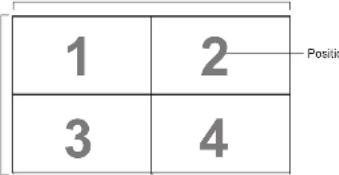 Example2: 5 x 5 screen matrix (25 displays)H monitors = 5 displaysV monitors = 5 displaysH monitors Example2: 5 x 5 screen matrix (25 displays)H monitors = 5 displaysV monitors = 5 displaysH monitors | |||
ADJUSTING THE LCD DISPLAY
5.4 General Settings

Menu language
Monitor ID
Eco mode
Auto search
Clock
Scheduling
Sleep timer
EasyLink
Auto Adjust
Local KB lock
RC lock
1 Press the MENU button on the control panel or the button on the remote control to call out the OSD window.
2 Select General settings, then press the INPUT button on the control panel or the OK button on the remote control.
3 Press the ▲/▼ button on the control panel or the √/! button on the remote control to select an option.
| Item Function Operation Range | |||
| Menu language | Choose the language used for OSD menus. | Press the ▲▼button on the control panel or the ∥button on the remote control to select the setting. | EnglishGermanTraditionalChineseFrenchItalianSpanishRussianPolishTurkishSimplifiedChinese |
ADJUSTING THE LCD DISPLAY
| Item Function Operation Range | |||
| Auto search | Choose to let this display detect and display available signal sources automatically.Note: The default value is Off. | Press the ▲▼button on the control panel or the ∥button on the remote control to select the setting. | OffOnFailover |
| Clock | Set the current date and time for the display's internal clock. | ||
| Daylight saving: Choose the daylight saving time.Note: The default value is Daylight saving. | Press the ▲▼button on the control panel or the ∥button on the remote control to select the setting. | Daylight saving timeStandard time | |
| Date: Set current date. | Press the ▲▼button on the control panel or the ∥button on the remote control to set month, day, and year.Press the +/−button on the control panel or the ← button on the remote control to navigate between month, day, and year fields. | CancelDone | |
| Time: Set current time. | Press the ▲▼button on the control panel or the ∥button on the remote control to set hours and minutes.Press the +/−button on the control panel or the ← button | CancelDone | |
ADJUSTING THE LCD DISPLAY
| Item Function Operation Range | |||
| Scheduling (continued) | Status: Enable or disable the schedule.Note: The default value is Off. | Press the ▲▼ button on the control panel or the ∥ button on the remote control to select the setting. | OffOn |
| Source: Choose the source for the schedule.Note: The default value is USB. | Press the ▲▼ button on the control panel or the ∥ button on the remote control to select the setting. | USBHDMI 1HDMI 2Display portCard OPSDVI-DYPbPrAVVGA | |
| On time: Set time when the schedule is turned on. | Press the ▲▼ button on the control panel or the ∥ button on the remote control to set hours and minutes.Press the +/− button on the control panel or the ∥ button button on the remote control to navigate between hours and minutes fields. | CancelDone | |
| Press the ▲▼ button on the control panel or the ∥ button on the remote control to set hours | |||
ADJUSTING THE LCD DISPLAY
Item Function Operation Range
- Play setting: Choose the file to be included in the playlist.
Note:
◆ Each playlist supports up to 30 files.
- Playlist will not be cleared after Factory settings. You have to manually remove the files or delete usb_schedulinglist.txt on the USB disk drive.
- Press the ▲/▼ button on the control panel or the √/∥ button on the remote control to choose the file.
- Press the INPUT button on the control panel or the OK button on the remote control to set or clear the playlist.
Playlist View

text_image
File Print- Press the — button on the remote control, then select Save list to to save the playlist.
- Press the button on the remote control to exit Playlist and return to the OSD menu.
Save List

Scheduling (continued)
ADJUSTING THE LCD DISPLAY
| Item Function Operation Range | |||
| Auto adjust | Use this function to automatically optimize the display of VGA input image.Note: This option is available only if the input source is VGA. | Press the +/−button on the control panel or the −button on the remote control to select the setting. | Cancel Start |
| Local KB lock | Choose to enable or disable the keyboard (control panel buttons) function of the LCD display.Unlock: Enable the keyboard function.Lock all: Lock all keyboard function.Lock but volume: Disable all the keyboard function except the + or −button.Lock but power: Disable all the keyboard function except the ⏻ button.Lock all expect volume and power: Disable all the keyboard function except the +, −or ⏻ button.Note: | Press the ▲/▼button on the control panel or the √button on the remote control to select the setting. | UnlockLock allLock but volumeLock but powerLock all except volume and power |
ADJUSTING THE LCD DISPLAY
| Item Function Operation Range | |||
| RC lock | Choose to enable or disable the button function of the remote control. Unlock: Enable the button function of the remote control. Lock all: Lock all button functions of the remote control. Lock but volume: Disable all the button functions except the — or +button. Lock but power: Disable all the button functions except the ⏻ button. Lock all expect volume and power: Disable all the button functions of the remote control except the —, +or 🔊 button. Note:♦ To disable the RC lock function, press the ⏻ button and buttons 1 9 9 8 on the remote control.♦ The default value is Unlock. | Press the ▲▼button on the control panel or the ∥∥button on the remote control to select the setting. | UnlockLock allLock but volumeLock but powerLock all except volume and power |
| For video input sources, enable | |||
ADJUSTING THE LCD DISPLAY
| Item Function Operation Range | |||
| LED | Set the display LED indicator on or off.Note: The default value is On. | Press the ▲▼button on the control panel or the √∥button on the remote control to select the setting. | OffOn |
| Switch on delay | Adjust the power-on delaying time (in seconds) allows a sequential powering-on for each display by their ID number when multiple displays are connected.Note: The default value is 0. | Press the ▲▼button on the control panel or the √∥button on the remote control to adjust the value. | 0 to 60 |
| Logo | When enabled, the AG Neovo logo will be shown on the startup screen.Note: The default value is On. | Press the ▲▼button on the control panel or the √∥button on the remote control to select the setting. | OffOn |
| APM | If APM function is enabled and no signal is detected, the LCD display will automatically turn off.Note: The default value is On. | Press the ▲▼button on the control panel or the √∥button on the remote control to select the setting. | OffOn |
| Information OSD | When this function is enabled and the display is turned on while in standby mode, an information OSD is displayed on the upper left corner of the screen.Note: The default value is On. | Press the ▲▼button on the control panel or the √∥button on the remote control to select the setting. | OffOn |
ADJUSTING THE LCD DISPLAY
| Item Function Operation Range | |||
| Cooling fan | Set the cooling fan operation.Off: Cooling fan is turned off.On: Cooling fan is turned on all the time during the LCD display is in operation.Auto: Cooling fan turns on when the LCD display temperature reaches 60°C (140°F).Note:A temperature warning message will appear on the screen when the temperature reaches 70°C (158°F).Regardless the cooling fan status off or on, the cooling fan is turned on automatically if the temperature reaches 70°C (158°F), for three successive minutes and a temperature-waning message is shown on the screen for 10 seconds. In this situation, the LCD display is shut down and the Power LED indicator will be blinking red and green.The default value is Auto. | Press the ▲▼button on the control panel or the ∥∥button on the remote control to select the setting. | OffOnAuto |
ADJUSTING THE LCD DISPLAY
5.5 Network Settings

View network settings Network configuration Static IP configuration Digital Media Render... Network name
1 Press the MENU button on the control panel or the button on the remote control to call out the OSD window.
2 Select Network settings, then press the INPUT button on the control panel or the OK button on the remote control.
3 Press the ▲▼ button on the control panel or the ▼▼ button on the remote control to select an option.
| Item Function Operation Range | |||
| View network settings | View connected network status. | Press the INPUT button on the control panel or the OK button on the remote control. | Cancel |
| Network configuration | Choose how the LCD display should assign addresses to the network resources. | Press the ▲/▼ button on the control panel or the I/II button on the remote control to select the setting. | DHCP & Auto IP Static IP |
| • Press the ▲/▼ button on the control panel or the I/II button on the remote control to select the item. Then press the INPUT button on the control panel or the OK button on the remote | |||
ADJUSTING THE LCD DISPLAY
| Item Function Operation Range | |||
| Network name | In the multiple-display connection, you can rename each display for easy identification. | Press the INPUT button on the control panel or the OK button on the remote control on the network name field to open the on-screen keyboard.Use the on-screen keyboard to enter the name. When done, select Done and press the INPUT button on the control panel or the OK button on the remote control.When the setting is complete, press the +/- button on the control panel or the - button on the remote control to select Done. Then press the INPUT button on the control panel or the OK button on the remote control to save the setting. | N/A |
CHAPTER 6: APPENDIX
6.1 Warning Messages
| Warning Messages Cause Solution | ||
 | The resolution or the refresh rate of the graphics card of the computer is set too high. | · Change the resolution or the refresh rate of the graphics card. |
| No signal | The LCD display cannot detect the input source signal. | · Check if the input source is turned ON.· Check if the signal cable is properly connected.· Check if any pin inside the cable connector is twisted or broken. |
| Local KB lock | The operation using the control panel buttons has been locked by the user. | · Disable the Local KB lock function. Refer to page 56. |
| RC lock | The operation using the remote control buttons has been locked by the user. | · Disable the RC lock function. Refer to page 57. |
APPENDIX
6.2 USB Device Compatibility
USB Video Subtitle Formats (for language subtitles, etc.).
| File Extensions | Container | Video codec | Maximum resolution | Max. Frame Rate (fps) | Max. Bit Rate (Mbps) | Audio codec |
| .mpg mpeg .vob | PS | MPEG-1 | 1920x1080 25p,30p,50i | 60i 30 MPEG- | 1(L1&L2), MPEG-1,2,2.5 L3, AAC/HE-AAC(v1&v2), DVD-PCM,AC3 | |
| MPEG-2 | 1920x1080 25p,30p,50i | 60i 30 | ||||
| MPEG-4 ASP | 1920x1080 25p,30p,50i,60i 30 | |||||
| H.264 | 1920x1080 25p,30p,50p | 60p,60i 30 | ||||
| .ts TS | MPEG-2 | 1920x1080 25p,30p,50i | 60i 30 | MPEG-1(L1&L2), MPEG-1,2,2.5 L3, AAC/HE-AAC (v1&v2), AC3,E-AC3, Dolby Pulse | ||
| MPEG-4 ASP | 1920x1080 25p,30p,50i,60i 30 | |||||
| H.264 | 1920x1080 25p,30p,50p | 60p,60i 30 | ||||
| MVC | 1920x1080i@field rate=50, 60Hz1920x1080p@frame rate=24, 25,30Hz1280x720p@frame rate=50, 60Hz | - 30 | ||||
| .ts | MPEG-2 | 1920x1080 25p,30p,50i | 60i 30 | MPEG-1(L1&L2), MPEG-1,2,2.5 | ||
| MPEG-4 ASP | 1920x1080 25p,30p,50i,60i 30 | |||||
| H.264 | 1920x1080 25p,30p,50p | 60p,60i 30 | ||||
APPENDIX
| File Extensions | Container | Video codec | Maximum resolution | Max. Frame Rate (fps) | Max. Bit Rate (Mbps) | Audio codec |
| .ts.m2ts.mts | AVCHD MVC | 1920x1080i@field rate=50, 60Hz1920x1080p@frame rate=24, 25,30Hz1280x720p @ frame rate=50, 60Hz | -30 | MPEG-1(L1&L2), MPEG-1,2,2.5 L3, AAC/HE-AAC (v1&v2), AC3,E-AC3, Dolby Pulse | ||
| .m4v M4V H.264 1920x1080 25p,30p,50p,60p,60i 30 AAC | ||||||
| .ism/Manifest.mpd | frag MP4 | H.264 1920x1080 25p,30p,50p,60p,60i 30 | AAC/HE-AAC(v1&v2), AC3,E-AC3,WMA, WMA-PRO | |||
| MVC | 1920x1080i@field rate=50, 60Hz1920x1080p@frame rate=24, 25,30Hz1280x720p @ frame rate=50, 60Hz | -30 | ||||
| .mp4 MP4 | MPEG-4 ASP | 1920x1080 25p,30p,50i,60i 30 | AAC/HE-AAC(v1&v2), AC3,E-AC3,WMA, WMA-PRO | |||
| H.264 1920x1080 30 | ||||||
| MVC | 1920x1080i@field rate=50, 60Hz1920x1080p@frame rate=24, 25,30Hz1280x720p @ frame rate=50, 60Hz | -30 | ||||
APPENDIX
USB Multimedia Formats
| File Extensions | Container Video codec | Maximum resolution | Frequency (kHz) | Max. Bit Rate (Mbps) | Audio codec | |
| .mp3 MP3 | - - 48 384 | MPEG-1,2,2.5 L3 | ||||
| .wma .asf | WMA(V2 up to V9.2) | - - 48 192 WMA | ||||
| .wma WMA Pro | - - 96 768 | WMA,WMA Pro | ||||
| .wav(PC) LFCM | - - 192 768 | LPCM | ||||
| .aif(mac).aiff(mac) | LPCM | - - 192 768 LPCM | ||||
| .aac .mp4 .m4a | AAC | - - 48 1024 | AAC,HE-AAC(v1&v2) | |||
| .pls .m3u | Playlists | - | - | - | ||
| .m4a | M4A | - - 48 1024 | AAC,HE-AAC(v1&v2) | |||
Note:
Sound or video may not work if the contents have a standard bit rate/frame rate above the compatible Frame/sec listed in the table above.
♦ Video content with a Bit rate or Frame rate larger than the rate specified in the table above can cause choppy video during playback.
APPENDIX
6.3 Supported Resolution
VGA Resolution:
| Standard Resolution | Active Resolution | Refresh Rate | Pixel Rate Aspect | Ratio Stand for Mode | ||
| H Pixels V | Lines | |||||
| VGA 640 | 480 | 60 Hz 25.1 | 75 MHz | 4:3 Video | Graphic Array72 Hz 31.5 M | |
| 75 Hz 31.5 | MHz | |||||
| WVGA 720 | 400 70 Hz | 33.75 MHz | 16:9 | Wide Video Graphic Array | ||
| SVGA 800 | 600 | 60 Hz 40 MHz | 4:3 Super VGA | |||
| 75 Hz 49.5 | MHz | |||||
| XGA | 1024 768 | 60 Hz 65 MHz | 4:3 | Extended Graphic Array | ||
| 75 Hz 78.75 MHz | ||||||
| WXGA | 1280 | 768 | 60 Hz | 79.5 MHz | 5:3 | Wide XGA |
| WXGA | 1280 | 800 | 60 Hz | 79.5 MHz | 16:10 | Wide XGA |
| SXGA | 1280 | 960 | 60 Hz | 108 MHz | 4:3 | Super XGA |
| SXGA | 1280 | 1024 | 60 Hz | 108 MHz | 5:4 | Super XGA |
| WXGA | 1360 | 768 | 60 Hz | 85.5 MHz | 16:9 | Wide XGA |
| WXGA | 1366 | 768 | 60 Hz | 85.5 MHz | 16:9 | Wide XGA |
| UXGA | 1600 | 1200 | 60 Hz | 162 MHz | 4:3 | Ultra XGA |
| HD1080 | 1920 | 1080 | 60 Hz | 148.5 MHz | 16:9 | HD1080 |
SDTV Resolution:
| Standard Resolution | Active Resolution | Refresh Rate | Pixel Rate Aspect | Ratio Stand for Mode | ||
| H Pixels V | Lines | |||||
| 480i | 29.97 Hz | 13.5 MHz | ||||
APPENDIX
- If a vertical and horizontal frequency-select mode exists, select 60Hz (vertical) and 31.5KHz (horizontal). In some cases, abnormal signals (such as stripes) might appear on the screen when the PC power is turned off (or if the PC is disconnected). If so, press the [INPUT] button to enter the video mode. Also, make sure that the PC is connected.
- When horizontal synchronous signals seem irregular in RGB mode, check PC power saving mode or cable connections.
- The display settings table complies to the IBM/VESA standards, and based on the analog input.
- The DVI support mode is regarded as same to the PC support mode.
- The best timing for the vertical frequency to each mode is 60Hz.
6.4 Cleaning
Caution When Using the Display
- Do not bring your hands, face or objects close to the ventilation holes of the display. The top of the display is usually very hot due to the high temperature of exhaust air being released through the ventilation holes. Burns or personal injuries may occur if any body parts are brought too close. Placing any object near the top of the display could also result in heat related damage to the object as well as the display itself.
- Be sure to disconnect all cables before moving the display. Moving the display with its cables attached may damage the cables and thus cause fire or electric shock.
- Disconnect the power plug from the wall outlet as a safety precaution before carrying out any type of cleaning or maintenance procedure.
Front Panel Cleaning Instructions
- The front of the display has been specially treated. Wipe the surface gently using only a cleaning cloth or a soft, lint-free cloth.
APPENDIX
6.5 Troubleshooting
| Symptom Possible Cause Remedy | ||
| No picture is displayed • The main power switch on the back of the display is not switched on.• The selected input has no connection.• The display is in standby mode. | 1 Plug in the power cord.2 Make sure the power switch is switched on.3 Connect a signal connection to the display. | |
| Interference displayed on the display or audible noise is heard | Caused by surrounding electrical appliances or fluorescent lights. | Move the display to another location to see is the interference is reduced. |
| Color is abnormal The signal cable is not connected properly. | Make sure that the signal cable is attached firmly to the back of the display. | |
| Picture is distorted with abnormal patterns | • The signal cable is not connected properly.• The input signal is beyond the capabilities of the display. | • Make sure that the signal cable is attached firmly.• Check the video signal source to see if it is beyond the range of the display. Please verify its specifications with this display's specification section. |
| Display image doesn't fill up the full size of the screen | The picture format is not set correctly. | Press the button and select Auto zoom. |
| Can hear sound, but no picture Improperly connected source signal cable. | Make sure that both video inputs and sound inputs are correctly connected. | |
| Can see picture but no sound is heard | • Improperly connected source signal cable. | • Make sure that both video and sound inputs are correctly connected. |
APPENDIX
6.6 Transporting the LCD Display
To transport the LCD display for repair or shipment, place the display in its original packaging carton.
1 Put all the accessories in the box (if necessary).
2 Place the lower foam cushion inside the lower box (a).
3 Place the LCD display down in the lower box (a).
4 Place the upper foam cushion on top of the LCD display.
5 Place the accessories box on the designated area (if necessary).
6 Place the upper box (b) on LCD display.
7 Secure the upper box to the lower box with the supplied locks (c).

text_image
Technical diagram of a rectangular block with labeled points and edges, including annotations c and b.CHAPTER 7: SPECIFICATIONS
7.1 Display Specifications
| PN-55DPN-55H | |||
| Panel Panel Type LED | -Backlit TFT LCD (IPS Technology) | LED-Backlit TFT LCD (IPS Technology) | |
| Panel Size 54.6" 54.6" | |||
| Max. Resolution FHD 1920 x 1080 FHD 1920 x 1080 | |||
| Pixel Pitch 0.630 mm 0.630 mm | |||
| Brightness 500 cd/m | ^2 | 700 cd/m ^2 | |
| Contrast Ratio 1400:1 1400:1 | |||
| Viewing Angle (H/V) | 178°/178° | 178°/178° | |
| Display Colour | 1.07B | 1.07B | |
| Response Time | 5 ms | 5 ms | |
| Frequency (H/V) | H Freq. | 31 kHz-92 kHz | 31 kHz-92 kHz |
| V Freq. | 48 Hz-85 Hz | 48 Hz-85 Hz | |
| Input DisplayPort | 1.2 x 1 | 1.2 x 1 | |
| HDMI | 1.3b x 2 | 1.3b x 2 | |
| DVI | 24-Pin DVI-D | 24-Pin DVI-D | |
| VGA 15-Pin D-Sub x 1 | 15-Pin D-Sub x 1 | ||
| Component | BNC x 1 | BNC x 1 | |
| Composite BNC x 1 (Share with Component-Y) | BNC x 1 (Share with Component-Y) | ||
| Output | DisplayPort | 1.2 x 1 | 1.2 x 1 |
| DVI | 29-Pin DVI-I x 1 (VGA) | 29-Pin DVI-I x 1 (VGA) | |
| External Control | IR In 3.5 mm Phone Jack | 3.5 mm Phone Jack | |
| IR Out | 3.5 mm Phone Jack | 3.5 mm Phone Jack | |
| RS232 in | 2.5 mm Phone Jack | 2.5 mm Phone Jack | |
| RS232 Out | 2.5 mm Phone Jack | 2.5 mm Phone Jack | |
| LAN (RJ45) | Yes | Yes | |
| Other Connectivity | USB | 2.0 x 1 (Service Port / Media Playback) | 2.0 x 1 (Service Port / Media Playback) |
| OPS Slot | Yes | Yes | |
| Audio Audio In | Stereo Audio Jack (3.5 mm) x 1Stereo Audio Jack (RCA) x 1 | Stereo Audio Jack (3.5 mm) x 1Stereo Audio Jack (RCA) x 1 | |
| Audio Out | Stereo Audio Jack (3.5 mm) x 1 | Stereo Audio Jack (3.5 mm) x 1 | |
SPECIFICATIONS
7.2 Display Dimensions
7.2.1 PN-55D / PN-55H Dimensions
