
KITPROV7388N - Pool pump GRE - Free user manual and instructions
Find the device manual for free KITPROV7388N GRE in PDF.


| Product Type | Above-ground pool kit |
| Model | KITPROV7388N |
| Brand | GRE |
| Dimensions | 10.00 x 5.50 m (oval), height 132 cm |
| Water Capacity | Approximately 50,000 liters (estimated based on dimensions) |
| Wall Material | Galvanized steel |
| Liner Material | Flexible PVC (thermoplastic) |
| Filter Pump | Included; 220 V, 30 mA RCD protected |
| Filter Type | Sand or cartridge filter (not specified; refer to filter manual) |
| Skimmer | Included |
| Return Valve | Included |
| Safety Requirements | Barrier, rescue equipment, CPR training, RCD protection |
| Liner Warranty | 2 years for seams and watertightness under normal use |
| Pump Warranty | 2 years for electrical issues under normal use |
| Other Components Warranty | 2 years |
| Assembly Required | Yes, by two or more adults |
| Ground Preparation | Firm, level ground; remove grass, roots, stones |
| Chemical Treatment | pH 7.2-7.6, chlorine 0.5-2 ppm |
| Winterization | Water level reduction, cover, disconnect pipes |
| Weight (estimated) | Approximately 300 kg (empty kit) |
Frequently Asked Questions - KITPROV7388N GRE
User questions about KITPROV7388N GRE
0 question about this device. Answer the ones you know or ask your own.
Ask a new question about this device
Download the instructions for your Pool pump in PDF format for free! Find your manual KITPROV7388N - GRE and take your electronic device back in hand. On this page are published all the documents necessary for the use of your device. KITPROV7388N by GRE.
USER MANUAL KITPROV7388N GRE
ASSEMBLY INSTRUCTIONS EN

natural_image
Line drawing of an octagonal-shaped container or tank structure with vertical supports (no text or symbols)1 03 - 04
Safety precautions.
2 05 - 08
Preparation of the site.
3 09 - 11
Components.
4 12 - 27
Installation.
5 28 - 29
Maintenance
6 30
Accessories.
safety precautions

#1
Safety precautions.


assembly instructions
Safety precautions.
Carefully read, understand, and follow all information in this user manual before installing and using the swimming pool. These warnings, instructions, and safety guidelines address some common risks of water recreation, but they cannot cover all risks and dangers in all cases. Always use caution, common sense, and good judgment when enjoying any water activity. Retain this information for future use.
Non-swimmers safety
Continuous, active, and vigilant supervision of weak swimmers and non-swimmers by a competent adult is required at all times (remembering that children under five are at the highest risk of drowning).
→ Designate a competent adult to supervise the pool each time it is being used.
→ Weak swimmers or non-swimmers should wear personal protection equipment when using the pool.
→ When the pool is not in use, or unsupervised, remove all toys from the swimming pool and its surrounding to avoid attracting children to the pool.
Safety devices
→ It is recommended to install a barrier land secure all doors and windows, where applicable to prevent unauthorized access to the swimming pool.
→ Barriers, pool covers, pool alarms, or similar safety devices are helpful aids, but they are not substitutes for continuous and competent adult supervision.
Safety equipment
→ It is recommended to keep rescue equipment (e.g. a ring buoy) by the pool.
→ Keep a working phone and a list of emergency phone numbers near the pool
Safe use of the pool
→ Encourage all users especially children to learn how to swim
→ Learn Basic Life Support (Cardiopulmonary Resuscitation - CPR) and refresh this knowledge regularly.
This can make a life-saving difference in the event of an emergency.
→ Instruct all pool users, including children, what to do in case of an emergency
→ Never dive into any shallow body of water. This can lead to serious injury or death.
Do not use the swimming pool when using alcohol or medication that may impair your ability to safely use the pool.
→ When pool covers are used, remove them completely from the water surface before entering the pool.
→ Protect pool occupants from water related illnesses by keeping the pool water treated and practicing good hygiene. Consult the water treatment guidelines in the user's manual.
→ Store chemicals (e.g. water treatment, cleaning or disinfection products) out of the reach of children.
→ Signage is to be displayed in a prominent position within 2 m of the pool.
→ Removable ladders shall be placed on a horizontal surface.

WARNING
Every electrical appliance fed in 220 V, has to be located at least at 3.50 m from the edge of the pool.
The equipment should be connected to a voltage, with earth connection, protected by a residual current device (RCD) having a rated residual operating current not exceeding 30 mA.
Read the instructions carefully and keep for future reference.
IF YOU HAVE ANY PROBLEM,
CONTACT US!
www.grepool.com/en/after-sales
preparation of the site

#2
Preparation of the site.


assembly instructions
2.1
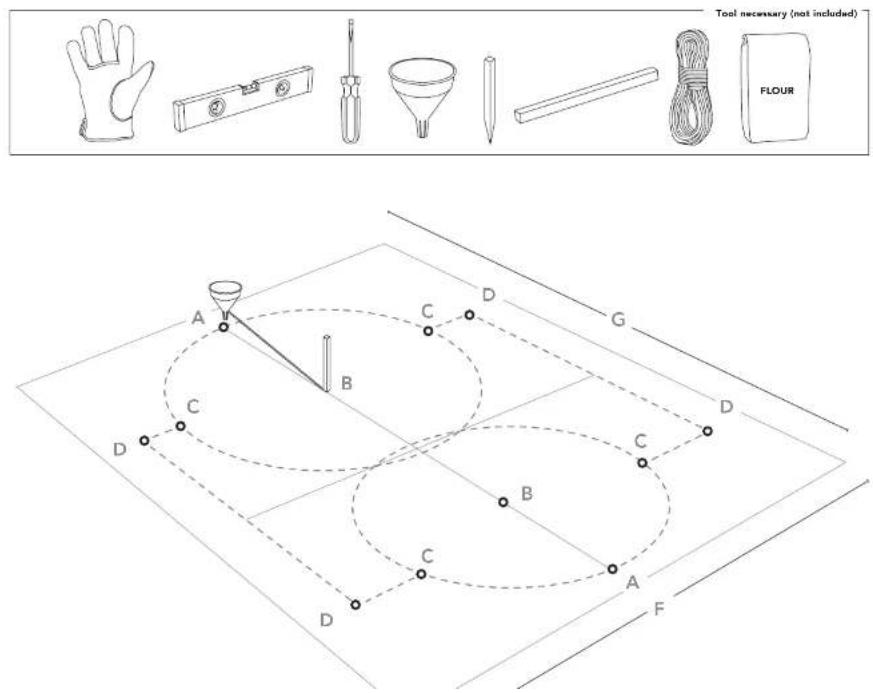
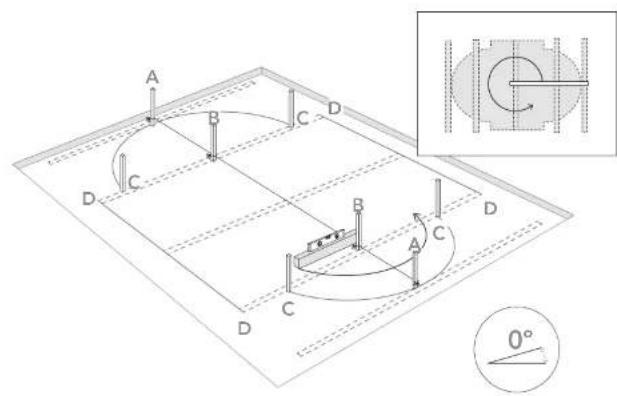
Levelling:
When levelling the ground, always remove material from the top of the slope rather than filling in the bottom: this will ensure greater ground stability and firmness. Always remove all grass, roots, stones, etc. Levelling is extremely important: devoting the necessary time and effort to ensuring that your pool sits properly on the ground will avoid problems later.
How to level: thanks to a large mason rule (aluminium or wood); and a level; level out the ground forming rectangles (or squares), locating this rule in the selected and cleaned area. When all the areas are on level and when the excess of ground is removed, you may fill in the small areas which are left to level out (with clean ground or sand) but always compacting and levelling again afterwards. It is very important the installation area is well compressed and firm in order the ground do not subsidize when the pool will be full of water. Please ask a professional builder, gardener...
2.3


assembly instructions
components

#3
Components.
Draw and classify all components included before assembly.
It's time to assemble the ladder and the pump, follow the respective instructions. Kits with missing parts will be covered by the warranty only if reported to the after-sales service within 15 days as from the date of purchase of the swimming pool.
In order to avoid any possible injury all swimming pool walking entrance must be regularly checked.
TPL & TP

natural_image
Technical line drawing of a curved structural component or beam (no text or symbols)
assembly instructions
Components.
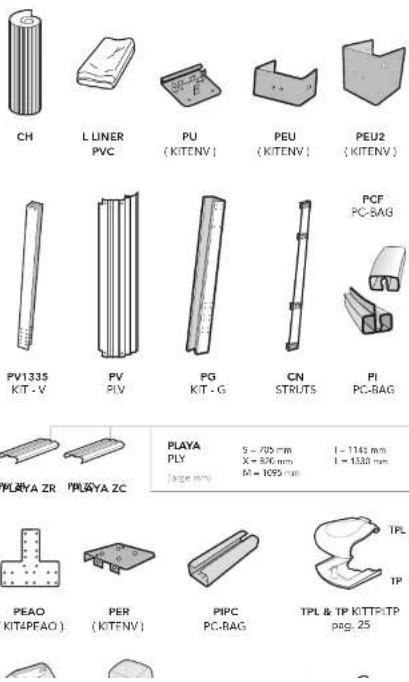

132 cm

| 10,00x | 9,15x | 8,00x | 7,30x | 6,10x | 5,00x |
| 5,50 m | 4,70 m | 4,70 m | 3,75 m | 3,75 m | 3,00 m |
| AP | 16 16 12 12 8 8 |
| B1 | 16 12 12 12 12 12 |
| B2 | 9 8 6 6 4 4 |
| CH | 1 1 1 1 1 1 |
| CN | 4 4 3 3 2 2 |
| EM1 | 6 6 4 4 2 2 |
| EM2 | 4 4 4 4 4 4 |
| LINER - I | 1 1 1 1 1 1 |
| PCF | 19 17 15 13 12 10 |
| PEAO | 16 16 12 12 8 8 |
| PER | 8 8 6 6 4 4 |
| PEU | 8 8 6 6 4 4 |
| PEU2 | 16 16 12 12 8 8 |
| PG | 8 8 6 6 4 4 |
| PI | 16 12 12 12 12 12 |
| PIPC*PLY ZR | 14 10 10 10 10 10 |
| *PLAYA ZC | 14L 10L 10L 10M 10M 10X |
| PLY*PLAYA ZR | 45 45 45 45 45 45+ - + + + + + |
| + | 10,00×5,50m | 9,15×4,70m | 8,00×4,70m | 7,30×3,75m | 6,10×3,75m | 5,00×3,00m |
| 2-3 | 2-3 | 2-3 | 2-3 | 2-3 | 2-3 | |
| 11h | 11h | 10h | 9h | 8h | 7h |
components
EN

flowchart
graph TD
    A["PV1335"] --> B["PEAO"]
    A --> C["EM1"]
    A --> D["TM6"]
    A --> E["PEAO"]
    A --> F["EM2"]
    A --> G["PIPAYA"]
    A --> H["CN"]
    A --> I["PCF"]
    A --> J["TPL"]
    A --> K["T"]
    A --> L["PER"]
    A --> M["PV1335"]
    A --> N["TP"]
    style A fill:#f9f,stroke:#333
    style B fill:#ccf,stroke:#333
    style C fill:#ccf,stroke:#333
    style D fill:#ccf,stroke:#333
    style E fill:#ccf,stroke:#333
    style F fill:#ccf,stroke:#333
    style G fill:#ccf,stroke:#333
    style H fill:#ccf,stroke:#333
    style I fill:#ccf,stroke:#333
    style J fill:#ccf,stroke:#333
    style K fill:#ccf,stroke:#333
    style L fill:#ccf,stroke:#333
    style M fill:#ccf,stroke:#333
    style N fill:#ccf,stroke:#333

assembly instructions
#4
Installation.
It is essential to follow these three steps to achieve a correct assembly.
- Section pieces must only be placed on the curve area located at the lower part of the pool (semi-circumferences), section pieces must not to be placed on the straight parts. The lower section pieces are curve (PI) and they have a flap (page 18). Flexible section
parts (PCF) are to be placed on the upper part of the pool in both curve and straight parts (page 22).
- When closing the pool plate (CH) using the screws (TC), make sure the screw heads are facing inwards and the washer and the blind nut outwards (page 19). Tighten the screws without distorting the plate.

Important: The liner used in the manufacturing of all our pools, is developed for exposition to heat and ultraviolet rays for long periods. Therefore, under certain weather and usage conditions, the liner qualities can vary slightly. The interior liner of the pool is manufactured from (flexible PVC (thermoplastic)). The properties of this material allow optimal installations conditions when the outside temperature is between 20 °C and 25 °C.
Note: Temperature too low: hard and rigid liner; later, too small. Temperature too high: flexible and elastic liner; later, too big.
4.1
10,00×5,50m
8.00×4.70m
6,10×3.75m
4.1
Installation of the swimming pool:
We recommend that this is done by two or more adults and on a day without wind. For your safety, it is very important to wear gloves while assembling the pool. All of these steps must be carried out on firm, level ground before digging the corresponding trenches.
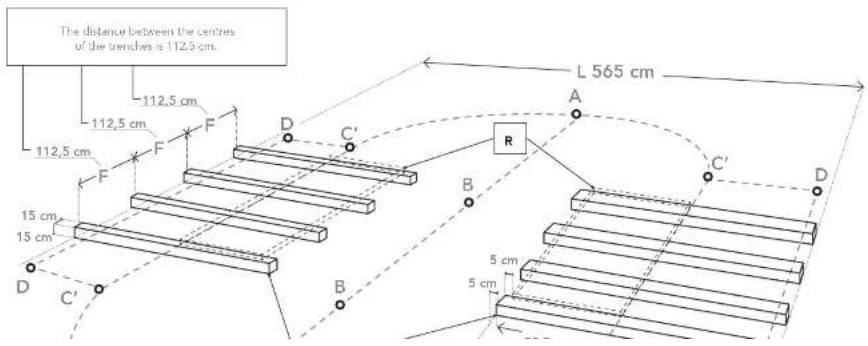
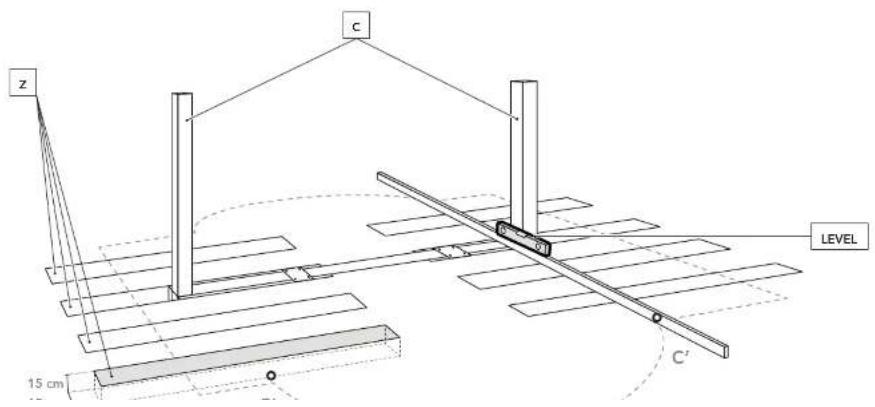
PREPARING THE TRENCHES (Z) FOR THE
UPRIGHTS (C) AND THE STRUTS (CN)
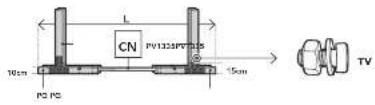
In accordance with the pool model, make the trenches according to the sketches. Trench dimensions: Z = Length / L x Width / 15 cm. X Depth / 15 cm. It is advisable to place a slab or tile beneath each upright.
IMPORTANT (R): When digging the tranches remember also to dig out the rectangular areas for installing plates AP (see page 16). These plates are buried 5cm in the ground and attached to their corresponding bottom rails PG.
| REF. F-D Z C'-D | ||||
| 1000 x 550cm | 915 x 470cm | 80 cm 134 x 15 x 15 cm 44,5 cm | ||
| 800 x 470 cm | 730 x 375 cm | 80 cm 134 x 15 x 15 cm 44,5 cm | ||
| 610 x 375 cm | 500 x 300 cm | 80 cm 134 x 15 x 15 cm 44,5 cm | ||
| L=5.5 m9.15 x 4.70 m8.00 x 4.70 m | L=4.65 m7.30 x 3.75 m6.10 x 3.75 m | L=3.90 m5.00 x 3.00 m |
 | ||

assembly instructions
4.2
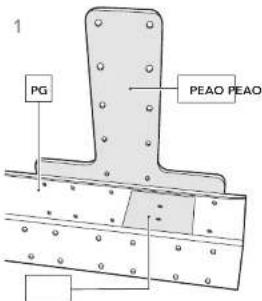
COLUMNS (C) ASSEMBLING:
Assemble the two uprights using the following parts:
1 PV1335 + 1 PG + 2 PEAC + 2 PEU2 and TV screws.
Note: nuts should always face inwards. All of these steps must be carried out on firm, level ground before digging the corresponding trenches. It is important that you carry out the assembly of these parts in a wide and level space for greater convenience.
1- Attach the part PEU2 so that the four holes which on either side coincide with the second and third line of holes of the PG (see Figure 1b) and the side with two holes
which remain face up. Do not screw the TV until the parts PEAO are fitted.
2- Screw 1 part PEAO on each side of the bottom rail PG (with TV screws and N° 13 spanner).
3- Attach another part PEU2 on the inner lower part of the PV1335. Affix the upright PV1335 to the bottom rail PG with screws TV through the PEAOs.
(Repeat the above steps for bottom rail PG and upright PV1335 at the other end).

natural_image
Technical diagram of a mechanical assembly with bolts and mounting brackets (no text or symbols)
4.3
ATTACHING THE STRUTS (CN) TO THE
1100LIGHTS (C)
4.4
INSTALLATION OF STRUCTURE
VERY IMPORTANT: When introducing the assembled structure (every 2 columns with the strap, depending on the pool model), you must wedge it so that the columns are at the same level with the ground, before and after covering the trench. It is recommended to put a tie or tile under the columns (for more resistance when filling the pool with water).
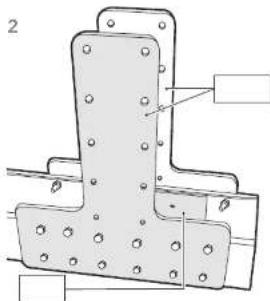
The previously assembled structures (2 columns + 1 girth) must be joined together by means of the central metal
brackets EM1. This will allow you to know the distance between the ditches that you will have to have depending on the pool model and the real length of the ditches. With these given you can run the ditches on the ground.
Do not forget to remove the EM1 squares before placing the individual structures (2 columns with 1 girth) in their respective ditch.
- Present and install the assembled structure in the trench (without the AP fins or EM1 brackets). Check the levels. - Fill the trench with soil, compact and control the level of the columns (that they are correctly levelled).
It is important that the structure is levelled (check with the EM1 brackets as well). The top of the pressure fires (AP) must be flushed with the ground and perfectly horizontal. (Buried)
Note: If the control levels of the columns (C), pressure fins (IAP), straps (CN) and EM1 brackets are not respected, the pool will not be mounted correctly.

assembly instructions
4.5

INSTALLATION OF THE OVERHANGS
7- Place a plate AP so that its two holes coincide with the two holes in the part PEU. Then place the other part AP and fasten it using 2 TM640 screws. (Before fitting the plates AP it is best to introduce the assembled beams in the ditch already prepared).
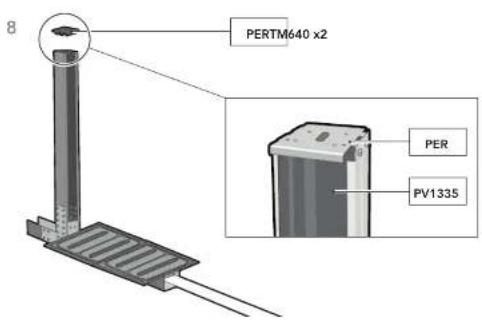
8- Using 2 T screws, provisionally attach part PER to the top of post PV1335 as though it was a lid, with the tab towards the interior of the pool (This will help you to mount the plate in the central area of the pool). Vertical post PER will have to be raised slightly when the wallplate is inserted (page 19) so that part PER presses against the top of the wallplate (CH).

4.6

ASSEMBLING THE METAL BRACKETS (EM1) Y (EM2)
Note: The structure must be entirely buried and properly levelled, so that these brackets are at ground level.
The central metal brackets (EM1) are installed in the central area (half on one side and half on the other side), attaching them to the uprights by joining them with TM6 screws to parts PEU (using 2 TRU nuts each, see page 15). The widest part of the metal bracket should be placed
nearest to the inside of the pool, and the narrowest part should be vertical, in order to attach it to part PEU. Once these brackets are in place and firmly screwed on, fit the outer brackets (EM2) (2 left and 2 right) onto the ends, also with TM6 screws, ensuring that the joining pieces (PU) to be fitted into the bracket (EM2) slots face towards the point where the relevant half-circular pool end begins (Point C).
EM1 EM1
| 10.00 x 5.50 m 3+3 2+2 | |
| 9.15 x 4.70 m 3+3 2+2 | |
| 8.00 x 4.70 m 2+2 2+2 | |
| 7.30 x 3.75 m 2+2 2+2 | |
| 6.10 x 3.75 m 1+1 2+2 | |
| 5.00 x 3.00 m 1+1 2+2 |


assembly instructions
4.7
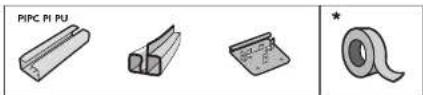
BOTTOM SECTION PIECES (PI) FOR OVAL SWIMMING POOLS.
Situate the lower profiles (PI) of each half circumference. Put a pressed piece in each profile (PU). Put the pressed piece on the end profiles at the same end. Join the profiles with the piece (PIPC) leaving 1cm separation between each one.
Important: the two half circumferences must be the same length and have equal distribution. If on completing the wallplate installation it does not fit exactly with the lengths of the half circumferences, you will have to close up the bottom section pieces (or if necessary open them up), always doing the same for both half circumferences.
Note: (LO) if the ground is not firm (concrete, etc.), it is ad-
visible to set a tile or slab into the ground under each part PU to prevent the upright supports PV from sinking under the weight of the water.
Note: Drop-forged parts PU under no circumstances shall be affixed to the ground by any means; in the event of doing so, you run the risk of swimming pool breakage and the automatic loss of the warranty.
* Use duct tape to cover parts PU and PIPC on the inside of the pool and thus avoid that may damage the liner.
1000 x 550 cm: 8 + 8 PU
915 x 470 cm: 6 + 6 PU
4.8
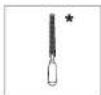
*IMPORTANT! BEFORE ASSEMBLY, DEBURRING, USING A FILE AND SANDPAPER, THE EDGE OF THE CLOSING WALL (CH).
Before fitting the plate, insert part B2 into the top of part PV1335 until it butts against piece PEAO. Report these steps for all PV1335 parts.
Fitting the wall plating: Fit the wall plating CH vertically on a piece of cardboard to avoid damaging the area prepared for the installation (checking that the cut out for the skimmer is at the top of the wall). DO NOT FULLY UNFOLD THE WALL PLATING as this may complicate assembly. Fit the end into place so that the skimmer cut-out is at the middle of one of the curved parts, between 2 joining-pieces (PU). Attach the plating provisionally to the 4 upright supports (PV) at the 4 corners 1 point C'1 of the straight part using 4 joining-pieces (PU), each with 3 screws (T) at the bottom and one screw (T) at the top. Attach the plating provisionally with a T screw to one of the upright supports (PV1335) at the mid-elle on both sides in the straight part using a joining piece (PTR) to stop it from falling. Fit the wall plating all around the pool and screw the ends together, ensuring that the screw heads face inwards and the washers and blind nuts outwards (Tighten the screws without distorting the material). If the wall plating is too long or too short, adjust the bottom section pieces in the curved parts of the pool to ensure that they are properly burned against each other and against the metal brackets where the curved parts meet the straight part.
If the circumference is too large to close the steel wall even when the profiles are joined together, only then must they be cut out.


assembly instructions
4.9
PROTECTIVE PVC STRIPS (POOL INTERIOR LINING):
Among the pool components there are 2 wide PVC strips (TPVCP) and 1 narrower PVC strip (TPVC). The narrower PVC strip is placed by hooking it to the highest nut of the plate closure and the strip is hung towards the interior of the pool to cover the screw heads. The 2 wider strips are to hold each one with adhesive tape so that they cover the metal brackets that are inside the pool in the straight area. The function of
all these strips is to protect the pool liner.
Warning: it is recommended to clean all dirt from the pool wall and floor with the help of a vacuum cleaner before placing the blanket or tapestry. Place the protective blanket or the mat inside the pool, eliminating all the folds, adjusting and cutting the excess from the total surface. Carry out the cut so that the lower profiles and the metal parts are covered. This way the liner will be protected when you install it.


4.10
UNFOLDING THE PVC LINER:
Stretch and extend the liner (L) in the shade so that it recovers its texture at least 2 hours before it is to be positioned. Ideal temperature: in order to handle the liner more easily, ensure that it is fitted at an ambient temperature of between 20 - 25°C.
The liner is oval in shape, to match the shape of the pool walls,
between the bottom and the side must be busted against the base of the wall plating all around the pool bottom, to prevent folds. Before positioning the liner, follow the steps below for assembly:
- Start at one of the straight parts. 2. Position the other half, i.e., the straight part opposite. 3. Continue from one of the ends on the straight part up to the middle of a semi-circumference. 4. Complete the other half of this same semi-circumference.
NOTE: if there are crosses on the base or wall of the liner this does not mean that it has to be changed for another since this does NOT indicate a manufacturing defect.
SERIAL NO.: located on the base of the liner. Take note of the serial no. in the box on the instruction sheet for any possible complaints.
4.11
Hang the upper edge of the liner over the upper part of the sheet. Hang the liner sides from the pool walls using the flexible PVC flap (SF). As you hang the liner in place, secure it provisionally with clothes-pages or with the top PVC section-pieces (without fitting them fully into place and with a 5 cm gap between them). If the liner wall is over large, distribute the excess evenly all around the pool to prevent wrinkles. If it seems too small, stretch it evenly around the pool perimeter. *Note: Some references HAVE NO FLEXIBLE OVERLAP (SF) on the liner side. The liner must be hung by folding it over the wallplate so that an oven 3-4 cm overlap is left.
The liner must hang over the sheet so there is a 3-4 cm overlap.


assembly instructions
4.12
FLEXIBLE TOP SECTION PIECES (PCF)
They are fitted on top of the liner once this has been fitted over the swimming pool sheet and they do not need to be joined together. They are positioned one after the other, and when the perimeter is completed, the extra length is cut off.
Place each PU piece over the top section pieces; they must be lined up with those located in the lower part.

natural_image
Simple line drawing of a 3D object resembling a curved surface or bracket, labeled 'PCF' (no other text or symbols)
installation

4.13
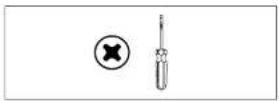
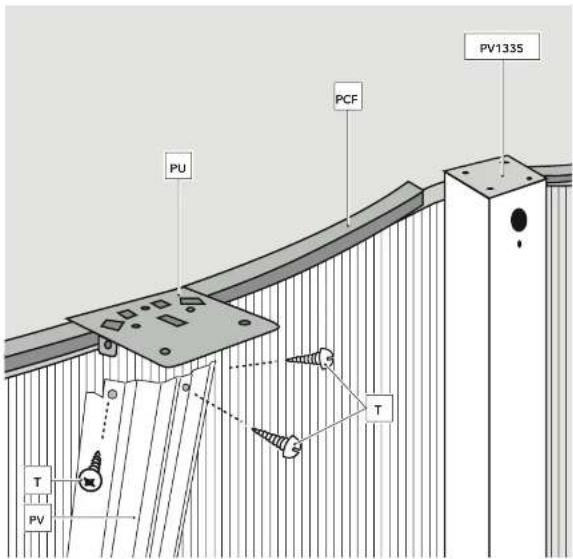
INSTALLATION AND FIXING OF VERTICAL PROFILES (VP)
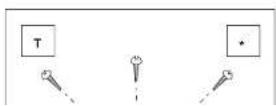
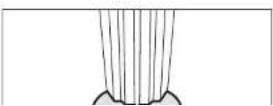
Screw the upright support (PV) to the appropriate bottom and top joining-pieces with 3 T screws each. Repeat this procedure until the half-circle is completed. Join the section-pieces together and check by looking at the ribbing on the wall-plating that the upright supports are properly vertical.
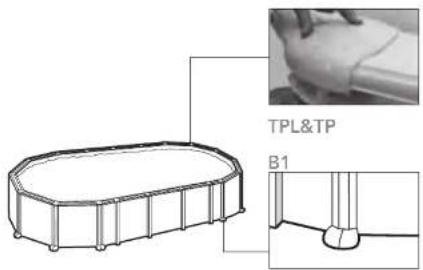
INJECTION BASES B1: Introduce the injection base (B1) through the upper part of the vertical profile (VP), screw the profile at its lower part and lower the base until it is on the ground.

assembly instructions
4.14
* Important! Before assembly, deburring, using a file and sandpaper, the ends of each PLY.
Installing the trim pieces PLAYA (PLY):
Take care that the trim pieces do not fall into the pool during firing, as they may damage the liner. Fit each trim piece supported on two consecutive PU with the rounded part outwards. Each trim piece has four holes (two inside and two outside) for fixing to the union pieces. Start fixing each trim piece to the union pieces, but only place the inside screws (1) on each side (and do not tighten down, so that there is some flexibility between them). When all the trim pieces have been placed, check again that the vertical sections are properly vertical. If not, correct their position. Next, place the outside screws (2) and fasten down all the screws in the structure.
WARNING: Do not climb onto, walk or sit on, jump or dive off the TRIM finishing pieces.

installation
EN
4.15
JOINT PROTECTORS: TPL and TP.
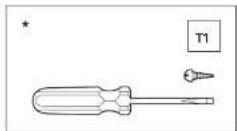
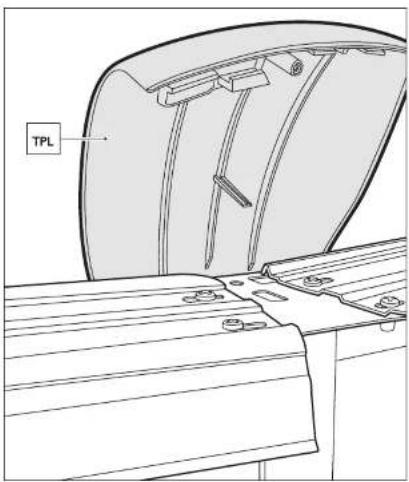
These pieces are to be fitted joining and protecting the trim pieces. Joint protectors are made up of 2 elements: Trim Piece protector (TPL) and Vertical Section protector (TP). First, the back side of TPL has to be fixed to the back side of the 2 trim pieces.
Then, it has to be tightened to the front side of the pool, fixing the TPL verge to the PU1 hole. Now, fix TP to TPL by the lower side using a screw T1 to join them. This process is to be repeated for all the joint protectors. ATTENTION: TP notch has to be removed to fix PV2 in the straight areas of the pool.


assembly instructions
4.16
FITTING THE RETURN VALVE (V):
This valve is located at the bottom of the pool wall, and water is returned to the pool through it after treatment in the treatment unit. Start pouring water into the pool through a garden hose, and stop 4 cm below the bottom of the valve hole (check the liner
is clean before filling the pool. Mark the position of the hole on the liner with a felt pen and make a cross-shaped cut in the centre of the mark with a stanley knife or similar. Do not cut beyond the edge of the hole. Place inside the pool through the cut, with a seal (J) and a friction ring (F). Cut the protruding part of the liner.
Fit the other seal (J) and the other friction ring (F) and tighten firmly with the nut (T). Insert the return hose (M) which goes from the outlet of the treatment unit to the return valve (V), and secure it with the clamp (A).
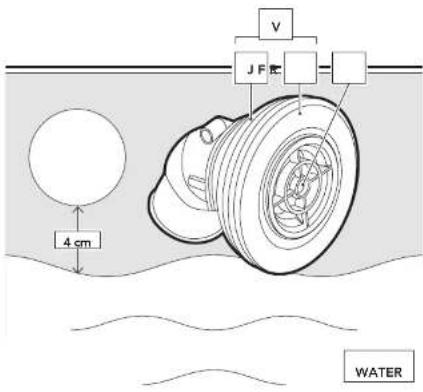

4.17
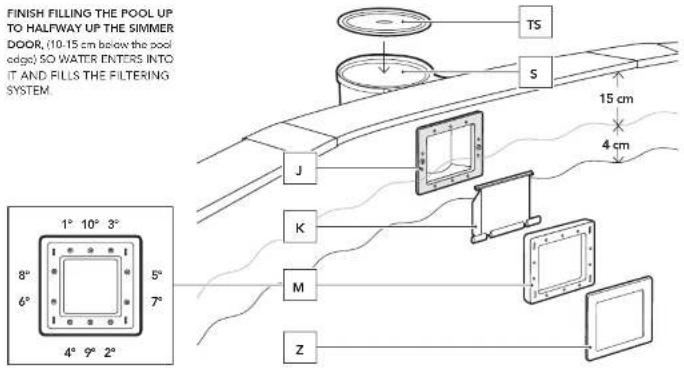
ATTACHING THE SKIMMER BODY (S) TO THE OUTSIDE OF THE POOL:
Fill the pool with water until the level is 4 cm from the bottom of the perforation for the skimmer. Using a
wall plate and liner are within the groove (X) made for this purpose and fit the two shorter screws into the larger centre holes from the inside of the pool through the double seal and the liner. Screw them into the center holes on the skimmer (S). Cover the
tightly to the skimmer, connect one end of the hose to the skimmer connecting bushing (C) using a clamp (A), and fit the other end to the treatment unit inlet. Clamp this end also.
installationinsta
4.18
FITTING THE SKIMMER FRAME (M):
Ensure that all holes are lined up properly (seal to wall plate perforation to skimmer). Screw 10 remaining screws closely through the frame to check that the fit is correct. Then tighten the screws a little more one by one in the order indicated. Finally, tighten them fully in the same order.
LAST DETAILS: Pressure fit the trim part of the skimmer frame (Z). To finish, introduce the flap (K) through the rectangular gap (delicately press the two ends and fit the protrusions). Place the basket (O) into the skimmer and the skimmer body cover (TS).


assembly instructions
#5
Maintenance and use.
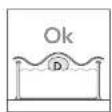

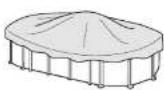


→ The pool water level must always be at least 15 cm from the edge of the upper edge of the same.
→ During the season for use of a pool kit, use the filtering system once a day to assure complete recycling of all the water and
→ The use of a pool kit involves respecting safety instructions defined in the maintenance and usage guide.
→ Never leave a pool kit for installation of the ground outside and empty.
→ Regularly clean the PVC liner and the wa-

RESPECT THE ENVIRONMENT DO NOT TAKE APART THE POOL UNLESS IT IS STRICTLY NECESSARY.
WINTER-SEASON:
A) If you choose not to dismount the pool:
1- Clean the liner bottom and sides with a non-abrasive product.
2- Treat the water with a chemical product for wintering. We recommend using LIQ-UID WINTERISER instead of floats with solid product to avoid discolouring the liner. 3- Leave the pool full of water considering:
a) For pools with skimmer and refulling pipe, reduce the water level 5 cm underneath the skimmer and close the refulling pipe with the screw tap which is included with the filter.
b) For pools with exhaustion and refulling pipes, reduce the water level 20 cm from the superior edge of the pool and close the pipes using the screw system incorporated.
4- Disconnect the pipes. Do not dismount the skimmer and the refulling and exhaustion pipes.
5- Protect the pool with a winter cover, and put a floating element between the cover and the water, in order to protect it from frost.
6- Filter: disconnect it from the pool. Clean it, empty the sand or remove the cartridge, dry it and keep it in a covered and sheltered from dampness place.
7- Accessories: remove every accessories (ladder, alarm, spotlight, pole...), rinse them with soft water and tidy them away.
TO RUN THE POOL AGAIN: Remove the winter cover, install the filter, change at least 1/3 of water and realize a chlorine treatment. Switch on the filter for at least 8 hours in an uninterrupted way, respecting the continuous working period indicated in the filter manuals.
B) If you choose to dismount the pool:
1- Empty the pool. Measures: Filter, Automatic pump for handling clean water or communicating vessels system. Communicating vessels system: Use the hose from your filter with the smallest cross-section. Fix a weight to one of its end and plunge it into the swimming pool. After this, sink the whole hose, until there is no air inside. With one hand, and under the water stop up hermetically the end of the hose and take it to the emptying point. Remove hand, and water will start running. Do not use this water for watering the plants, because it contains chemical products.
2- Clean every pool constituents with a sponge and a soap product with a neutral pH. Dry them and tidy them away in a dry and clean place.
That's normal that after having installed and dismounted the pool several times, the P.V.C liner dilate and loose its elasticity.
NEW START-UP: Read these instructions again from the beginning.
CHEMICAL MEASURES:
Please read carefully the chemical product manufacturer instructions. WARNING: Keep chemical products in a clean, dry and out of children place. Important:
Every products used have to be compatible with the P.V.C liner.
→ First filling: Analyse the water pH and chlorine (Cl) and adjust them to the optimal levels: pH: 7.2–7.6; Chlorine: 0.5–2 ppm.
→ Chlorine treatments: Consist in increasing the chlorine level until approximately 20 ppm to eliminate germs and seaweeds. This process has to be done only when the pool water comes from rivers or ponds, ... or if it stayed a long time without any treatments.
→ Checking: Check at least once a week the chlorine levels (use a chlorine and pH analyser). In the same way, we advise to add an algicid to prevent seaweeds appearance.
Never have a swim before the chlorine level stabilization. Do always use a floating dispenser for the chemical product (tablets) dissolution. The chemical product measuring out has to be done in accordance with Your pool water volume, the bathe frequency, the climatic conditions, the water temperature and the location. Do always move the water and wait for the chemical product dissolution before adding another one. Wait approximately 12 hours between any pH, chlorine or algicid adjustment using the filter system.
MECHANICAL MEASURES:
Check the filter, the skimmer, the valves and the pipes are well connected to the pool. Do consider high water temperature will involve more time for the filtering. Theoretic filtering time = Water volume / Filter system discharge (generally 8h/clay with water temperature of 21°C), (olaal: 2h in the morning - 4h around midday - 2h in the afternoon). PLEASE RESPECT THE CONTINUOUS WORKING PERIOD INDICATED IN THE FILTER MANUALS.
VACUUM CLEANER (MANUAL OR AUTOMATIC):
Only for pools with skimmer. Connect an hose extremity to the brush head and immerse it into the water to make it fill in. Connect the other pipe extremity to the exhaustion adapter (TA) and place it above the skimmer basket. Switch on the filter in the FILTER position and begin to clean the bottom. Pay special attention to areas with folds where dirt accumulates.
BOTTOM CLEANER VENTURY STYLE:
Connect a garden hose to the bottom cleaner join and introduce it into the pool. Open the tap until a normal pressure to make the water flow out against the bottom of the pool, producing in that way an ascendant stream which leave the dirt into the filter floor which is适宜 on the bottom cleaner.

assembly instructions
#6
Accessories.
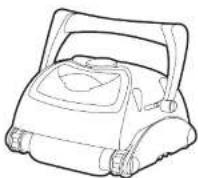
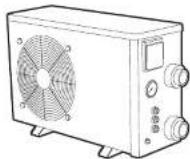
CLEANERS HEAT PUMPS HEATING SYSTEMS
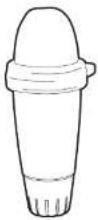
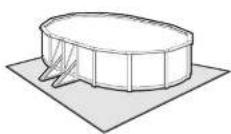
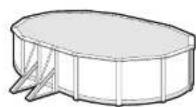

Guarantee card
Keep your manual with the purchase justification (payment receipt) for any type of reclamation.
Any reclamation against guarantee should be made by an online declaration, via the www.service-gre.com website, together with receipt of purchase. You may be asked for photographs to justify the claim. No returns of material will be accepted without previous agreement. The client will support all costs of all returns of goods (packaging and transport).
AFTER VERIFICATION AND CONFIRMATION OF A MANUFACTURING DEFECT
→ The products that effectively show defects will be repaired or will be replaced free of transport costs.
The guarantee is limited to the repair or replacement of the defective part. It does not include, under any circumstance, the payment of compensation for harm and damages.
THE GUARANTEE IS NOT APPLICABLE IN THE FOLLOWING SITUATIONS:
→ Use of materials that do not comply to our instructions.
→ Damages caused by mishandling or an installation not complying with the instructions.
→ The maintenance instructions were not followed.
→ Inappropriate or wrong use of the chemical product.
Likewise, all plastic parts are excluded from the additional commercial guarantee, that is to say.
→Theliner
→ Any decorative part
To be able to benefit from the guarantee, your pool should include this document.
Guarantee valid for pools sold after 1 January 2016.
→ Liner: 2 years for the seams and water tightness in normal conditions of use. The guarantee does not include: Ripping, tears, breakages, stains (caused by pouring treatment products directly into the water), stains linked to the growth of algae, stains related to the composition of foreign bodies in contact with the liner, stains and decolouring resulting from the action of oxidising products, colour maintenance and wear due to friction of the material over diverse surfaces. Deformation of the liner that has been left without water for 24 hours (never completely empty the pool). You should keep the label with the serial number of the liner that is on the product and on its packaging. This number and a sample of the liner will be required for any eventual reclamation against the guarantee.
→ Filter group: The pump has 2 years guarantee (electrical problem ), in normal conditions of use. The guarantee does not cover breakage of parts (pump base/sand deposit, pre-liter cover, multi-directional trap...), wear due to a poor connection, use of the pump without water, wear due to abrasion or corrosion (the liter group should be located in a cool and dry position, kept protected from water splashing ).
→ Other components: 2 years
THE FOLLOWING IS NOT INCLUDED IN THE GUARANTEE:
→ Cuts in the liner
→ The assembly and iter connection
IMPORTANT:
Manufactures Gre interchanges components in exchange for others to be varied. If, after the verification no anomaly or dysfunction is detected, Manufacturas Gre reserves the right to invoice the client for the cost for transport and other diverse expenses.


MANUFACTURAS GRE S.A.
Aritz Bidea, 57 BELAKO INDUSTRIALDEA, APARTADO 69, 48.100 - MUNGUIA (VIZCAYA) ESPAÑA


- 03 - 04
- 05 - 08
- 09 - 11
- 12 - 27
- 28 - 29
- 30
- #1
- Safety precautions.
- Non-swimmers safety
- Safety devices
- Safety equipment
- Safe use of the pool
- This can make a life-saving difference in the event of an emergency.
- WARNING
- Read the instructions carefully and keep for future reference.
- IF YOU HAVE ANY PROBLEM,
- #2
- Levelling:
- #3
- Components.
- #4
- Installation.
- 4.1
- Installation of the swimming pool:
- PREPARING THE TRENCHES (Z) FOR THE
- UPRIGHTS (C) AND THE STRUTS (CN)
- 4.2
- COLUMNS (C) ASSEMBLING:
- 4.3
- 4.4
- INSTALLATION OF STRUCTURE
- 4.5
- INSTALLATION OF THE OVERHANGS
- 4.6
- ASSEMBLING THE METAL BRACKETS (EM1) Y (EM2)
- 4.7
- BOTTOM SECTION PIECES (PI) FOR OVAL SWIMMING POOLS.
- 4.8
- 4.9
- PROTECTIVE PVC STRIPS (POOL INTERIOR LINING):
- 4.10
- UNFOLDING THE PVC LINER:
- 4.11
- 4.12
- FLEXIBLE TOP SECTION PIECES (PCF)
- 4.14
- Installing the trim pieces PLAYA (PLY):
- 4.15
- JOINT PROTECTORS: TPL and TP.
- 4.16
- FITTING THE RETURN VALVE (V):
- 4.17
- ATTACHING THE SKIMMER BODY (S) TO THE OUTSIDE OF THE POOL:
- 4.18
- FITTING THE SKIMMER FRAME (M):
- #5
- Maintenance and use.
- WINTER-SEASON:
- A) If you choose not to dismount the pool:
- B) If you choose to dismount the pool:
- CHEMICAL MEASURES:
- MECHANICAL MEASURES:
- VACUUM CLEANER (MANUAL OR AUTOMATIC):
- BOTTOM CLEANER VENTURY STYLE:
- #6
- Accessories.
- Guarantee card
- AFTER VERIFICATION AND CONFIRMATION OF A MANUFACTURING DEFECT
- THE GUARANTEE IS NOT APPLICABLE IN THE FOLLOWING SITUATIONS:
- THE FOLLOWING IS NOT INCLUDED IN THE GUARANTEE:
- IMPORTANT:
Brand : GRE
Model : KITPROV7388N
Category : Pool pump