PAC1932 - Electronic component Microchip - Free user manual and instructions
Find the device manual for free PAC1932 Microchip in PDF.


User questions about PAC1932 Microchip
0 question about this device. Answer the ones you know or ask your own.
Ask a new question about this device
Download the instructions for your Electronic component in PDF format for free! Find your manual PAC1932 - Microchip and take your electronic device back in hand. On this page are published all the documents necessary for the use of your device. PAC1932 by Microchip.
USER MANUAL PAC1932 Microchip
Note the following details of the code protection feature on Microchip devices:
• Microchip products meet the specification contained in their particular Microchip Data Sheet.
- Microchip believes that its family of products is one of the most secure families of its kind on the market today, when used in the intended manner and under normal conditions.
- There are dishonest and possibly illegal methods used to breach the code protection feature. All of these methods, to our knowledge, require using the Microchip products in a manner outside the operating specifications contained in Microchip's Data Sheets. Most likely, the person doing so is engaged in theft of intellectual property.
• Microchip is willing to work with the customer who is concerned about the integrity of their code.
- Neither Microchip nor any other semiconductor manufacturer can guarantee the security of their code. Code protection does not mean that we are guaranteeing the product as "unbreakable."
Code protection is constantly evolving. We at Microchip are committed to continuously improving the code protection features of our products. Attempts to break Microchip's code protection feature may be a violation of the Digital Millennium Copyright Act. If such acts allow unauthorized access to your software or other copyrighted work, you may have a right to sue for relief under that Act.
Information contained in this publication regarding device applications and the like is provided only for your convenience and may be superseded by updates. It is your responsibility to ensure that your application meets with your specifications. MICROCHIP MAKES NO REPRESENTATIONS OR WARRANTIES OF ANY KIND WHETHER EXPRESS OR IMPLIED, WRITTEN OR ORAL, STATUTORY OR OTHERWISE, RELATED TO THE INFORMATION, INCLUDING BUT NOT LIMITED TO ITS CONDITION, QUALITY, PERFORMANCE, MERCHANTABILITY OR FITNESS FOR PURPOSE. Microchip disclaims all liability arising from this information and its use. Use of Microchip devices in life support and/or safety applications is entirely at the buyer's risk, and the buyer agrees to defend, indemnify and hold harmless Microchip from any and all damages, claims, suits, or expenses resulting from such use. No licenses are conveyed, implicitly or otherwise, under any Microchip intellectual property rights unless otherwise stated.
Microchip received ISO/TS-16949:2009 certification for its worldwide headquarters, design and wafer fabrication facilities in Chandler and Tempe, Arizona; Gresham, Oregon and design centers in California and India. The Company's quality system processes and procedures are for its PIC® MCUs and dsPIC® DSCs, KEELOQ® code hopping devices, Serial EEPROMs, microperipherals, nonvolatile memory and analog products. In addition, Microchip's quality system for the design and manufacture of development systems is ISO 9001:2000 certified.
QUALITY MANAGEMENT SYSTEM CERTIFIED BY DNV = ISO/TS 16949=
Trademarks
The Microchip name and logo, the Microchip logo, AnyRate, AVR, AVR logo, AVR Freaks, BeaconThings, BitCloud, chipKIT, chipKIT logo, CryptoMemory, CryptoRF, dsPIC, FlashFlex, flexPWR, Heldo, JukeBlox, KEELOQ, KEELOQ logo, Kleer, LANCheck, LINK MD, maXStylus, maXTouch, MediaLB, megaAVR, MOST, MOST logo, MPLAB, OptoLyzer, PIC, picoPower, PICSTART, PIC32 logo, Prochip Designer, QTouch, RightTouch, SAM-BA, SpyNIC, SST, SST Logo, SuperFlash, tinyAVR, UNI/O, and XMEGA are registered trademarks of Microchip Technology Incorporated in the U.S.A. and other countries.
ClockWorks, The Embedded Control Solutions Company, EtherSynch, Hyper Speed Control, HyperLight Load, IntelliMOS, mTouch, Precision Edge, and Quiet-Wire are registered trademarks of Microchip Technology Incorporated in the U.S.A. Adjacent Key Suppression, AKS, Analog-for-the-Digital Age, Any Capacitor, AnyIn, AnyOut, BodyCom, CodeGuard, CryptoAuthentication, CryptoCompanion, CryptoController, dsPICDEM, dsPICDEM.net, Dynamic Average Matching, DAM, ECAN, EtherGREEN, In-Circuit Serial Programming, ICSP, InterChip Connectivity, JitterBlocker, KleerNet, KleerNet logo, Mindi, MiWi, motorBench, MPASM, MPF, MPLAB Certified logo, MPLIB, MPLINK, MultiTRAK, NetDetach, Omniscient Code Generation, PICDEM, PICDEM.net, PICkit, PICtail, PureSilicon, QMatrix, RightTouch logo, REAL ICE, Ripple Blocker, SAM-ICE, Serial Quad I/O, SMART-I.S., SQI, SuperSwitcher, SuperSwitcher II, Total Endurance, TSHARC, USBCheck, VariSense, ViewSpan, WiperLock, Wireless DNA, and ZENA are trademarks of Microchip Technology Incorporated in the U.S.A. and other countries.
SQTP is a service mark of Microchip Technology Incorporated in the U.S.A.
Silicon Storage Technology is a registered trademark of Microchip Technology Inc. in other countries.
GestIC is a registered trademark of Microchip Technology Germany II GmbH & Co. KG, a subsidiary of Microchip Technology Inc., in other countries.
All other trademarks mentioned herein are property of their respective companies.
© 2018, Microchip Technology Incorporated, All Rights Reserved. ISBN: 978-1-5224-2926-5
Table of Contents
Preface 5
Introduction....5
Document Layout 5
Conventions Used in this Guide 6
Recommended Reading....7
The Microchip Website....7
Customer Support 7
Document Revision History 7
Quick Start Guide 9
Chapter 1. Product Overview
1.1 Introduction ...... 11
1.2 MCP331x1 16/14/12-Bit 1 Msps SAR ADC Evaluation Board Features ..... 11
1.3 MCP331x1 16/14/12-Bit 1 Msps SAR ADC Evaluation Board Overview ..... 12
1.4 SAR ADC Device Configuration 14
1.5 Curiosity PIC32MZEF Development Board (DM320104) Overview ..... 15
1.6 SAR ADC Utility Software Overview 16
1.7 What the MCP331x1 16/14/12-Bit 1 Msps SAR ADC Evaluation Kit Contains 18
1.8 MCP331x1 16/14/12-Bit 1 Msps SAR ADC Evaluation Kit Requirements ... 18
Chapter 2. Installation and Operation
2.1 Configuration Requirements 19
2.1.1 Power Input Connection 19
2.2 Evaluation Kit Setup 19
2.2.1 Input Optimization 20
Chapter 3. Firmware
3.1 PIC32MZ2048EFM100 Initialization 21
3.2 Data Acquisition 21
3.3 USB Transfer 23
3.4 ADC functions 24
Appendix A. Schematic and Layouts
A.1 Introduction 27
A.2 ADM00872 27
A.3 ADM00873 27
A.4 Board ADM00872 – Schematic 28
A.5 Board ADM00872 – Schematic Regulators 29
A.6 Board ADM00872 – Top Silk Layer 30
A.7 Board ADM00872 – Top Copper and Silk Layer 31
A.8 Board ADM00872 – Top Copper Layer 32
A.9 Board ADM00872 – Bottom Copper Layer 33
A.10 Board ADM00872 – Bottom Copper and Silk Layer 34
A.11 Board ADM00872 – Bottom Silk Layer 35
A.12 Board ADM00873 – Schematic 36
A.13 Board ADM00873 – Schematic Regulators 37
A.14 Board ADM00873 – Top Silk Layer 38
A.15 Board ADM00873 – Top Copper and Silk Layer 39
A.16 Board ADM00873 – Top Copper Layer 40
A.17 Board ADM00873 – Bottom Copper Layer 41
A.18 Board ADM00873 – Bottom Copper and Silk Layer 42
A.19 Board ADM00873 – Bottom Silk Layer 43
Appendix B. Bill of Materials (BOM)
Worldwide Sales and Service ....53
Preface
NOTICE TO CUSTOMERS
All documentation becomes dated, and this manual is no exception. Microchip tools and documentation are constantly evolving to meet customer needs, so some actual dialogs and/or tool descriptions may differ from those in this document. Please refer to our website (www.microchip.com) to obtain the latest documentation available.
Documents are identified with a "DS" number. This number is located on the bottom of each page, in front of the page number. The numbering convention for the DS number is "DSXXXXXXXXA", where "XXXXXXXXX" is the document number and "A" is the revision level of the document.
For the most up-to-date information on development tools, see the MPLAB ^® IDE online help. Select the Help menu, and then Topics to open a list of available online help files.
INTRODUCTION
This chapter contains general information that will be useful to know before using the MCP331x1 16/14/12-Bit 1 Msps SAR ADC Evaluation Kit. Items discussed in this chapter include:
- Document Layout
• Conventions Used in this Guide - Recommended Reading
• The Microchip Website - Customer Support
• Document Revision History
DOCUMENT LAYOUT
This document describes how to use the MCP331x1 16/14/12-Bit 1 Msps SAR ADC Evaluation Kit to demonstrate the performance of the MCP331x1 device family. The manual layout is as follows:
- “Quick Start Guide”—Provides quick, step-by-step information on setting up the MCP331x1 16/14/12-Bit 1 Msps SAR ADC Evaluation Kit.
- Chapter 1. "Product Overview" – Important information about the MCP331x1 16/14/12-Bit 1 Msps SAR ADC Evaluation Kit.
- Chapter 2. “Installation and Operation” – Includes instructions on how to get started with the MCP331x1 16/14/12-Bit 1 Msps SAR ADC Evaluation Kit.
- Chapter 3. "Firmware" - Includes information about the firmware that is included with the MCP331x1 16/14/12-Bit 1 Msps SAR ADC Evaluation Kit.
- Appendix A. “Schematic and Layouts” – Refer to the board's web page for the complete Schematics and Layouts.
- Appendix B. “Bill of Materials (BOM)” – Refer to the board's web page for the complete Bill of Materials.
CONVENTIONS USED IN THIS GUIDE
This manual uses the following documentation conventions:
DOCUMENTATION CONVENTIONS
| Description Represents Examples | ||
| Arial font: | ||
| Italic characters Referenced books | Books MPLAB | ^ IDE User's Guide |
| Emphasized text ...is the only compiler... | ||
| Initial caps A window the Output | ut window | |
| A dialog the Settings dialog | ||
| A menu selection select Enable Programmer | ||
| Quotes A field name in a window or dialog | "Save project before build" | |
| Underlined, Italic text with right angle bracket | A menu path File>Save | —— |
| Bold characters | A dialog button | Click OK |
| A tab | Click the Power tab | |
| N'Rnnnn | A number in verilog format, where N is the total number of digits, R is the radix and n is a digit. | 4'b0010, 2'hF1 |
| Text in angle brackets <> | A key on the keyboard | Press,, |
| Courier New font: | ||
| Plain Courier New | Sample source code | #define START |
| Filenames | autoexec.bat | |
| File paths | c:\mccl8\h | |
| Keywords | _asm, _endasm, static | |
| Command-line options | -Opa+, -Opa- | |
| Bit values | 0, 1 | |
| Constants | 0xFF, 'A' | |
| Italic Courier New | A variable argument | file.o, where file can be any valid filename |
| Square brackets [] | Optional arguments | mccl8 [options] file [options] |
| Curly brackets and pipe character: { | } | Choice of mutually exclusive arguments; an OR selection | errorlevel {0|1} |
| Ellipses... | Replaces repeated text | var_name [, var_name...] |
| Represents code supplied by user | void main (void) { ... } | |
RECOMMENDED READING
This user's guide describes how to use the MCP331x1 16/14/12-Bit 1 Msps SAR ADC Evaluation Kit. Another useful document is listed below. The following Microchip document is available and recommended as a supplemental reference resource.
- MCP331x1 Data Sheet – “1 Msps 16/14/12-Bit Differential Input SAR ADC” (DS20005947)
THE MICROCHIP WEBSITE
Microchip provides online support via our website at www.microchip.com. This website is used as a means to make files and information easily available to customers. Accessible by using your favorite Internet browser, the website contains the following information:
- Product Support – Data sheets and errata, application notes and sample programs, design resources, user's guides and hardware support documents, latest software releases and archived software
- General Technical Support – Frequently Asked Questions (FAQs), technical support requests, online discussion groups, Microchip consultant program member listing
- Business of Microchip – Product selector and ordering guides, latest Microchip press releases, listing of seminars and events, listings of Microchip sales offices, distributors and factory representatives
CUSTOMER SUPPORT
Users of Microchip products can receive assistance through several channels:
• Distributor or Representative
- Local Sales Office
• Field Application Engineer (FAE)
- Technical Support
Customers should contact their distributor, representative or field application engineer (FAE) for support. Local sales offices are also available to help customers. A listing of sales offices and locations is included in the back of this document.
Technical support is available through the website at: http://www.microchip.com/support.
DOCUMENT REVISION HISTORY
Revision A (April 2018)
- Initial release of this document.
NOTES:
Quick Start Guide
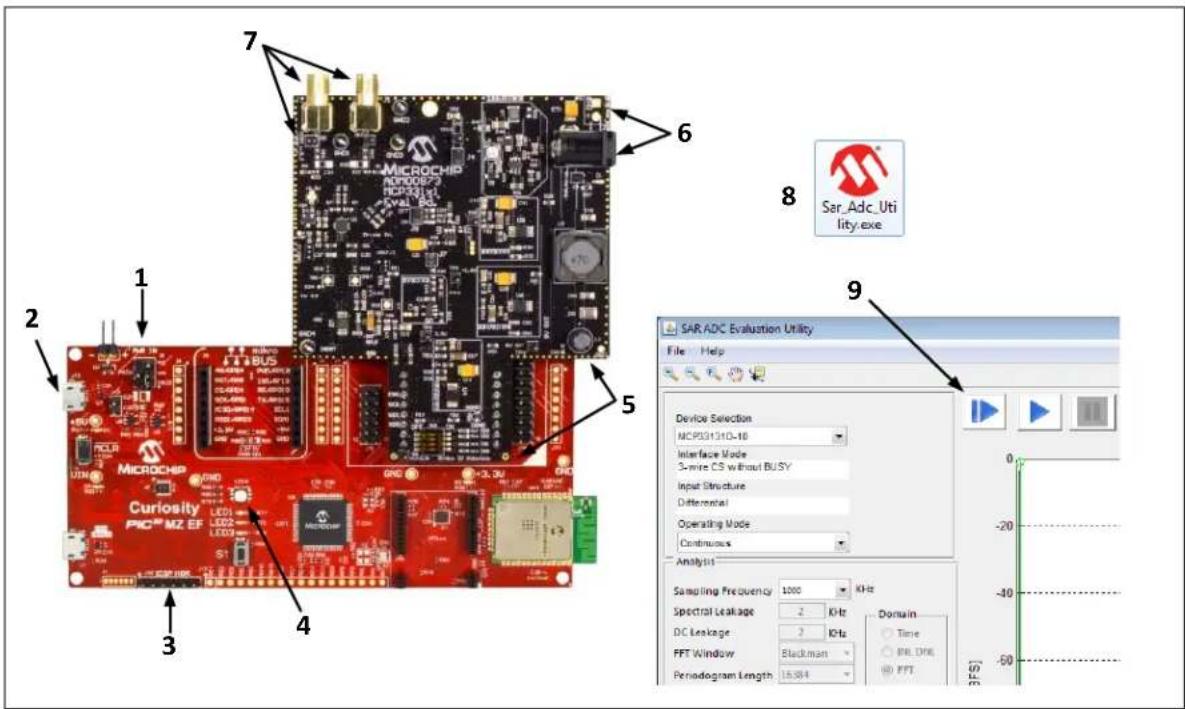
Steps 1-9 below provide a quick start for setting up the MCP331x1 16/14/12-Bit 1 Msps SAR ADC Evaluation Kit:
text_image
MICROCHIP ADP00873 HCP5311 SAR_Adc_Uti lity.exe SAR_ADC_Evaluation_Utility File Help Device Selection MCP03131D-16 Interface Mode 3-minute CS without BUSY Input Structure Differential Operating Mode Continuous Analysis Sampling Frequency 1000 KHz Spectral Leakage 2 KHz DC Leakage 2 KHz FFT Window Blackman Periodogram Length 15.984 Domain Time PR_DFE FFT 3FSI- Move the PWR IN jumper to connect pins VIN and VBUS.
- Connect micro USB cable from PC to J12 on the PIC32MZ Curiosity board. This USB is used for both power and data transfer for the Curiosity board.
- Program the PIC32MZ with the latest MCP331x1_EVB.X firmware (available on Microchip.com) using an external programmer (ICD, PICKit, etc) connected to the ICSP HDR (J16).
- Once the firmware is loaded, remove the programmer and wait for LED4 to illuminate with a solid red light. A solid red lit LED indicates that the firmware is loaded and the board is working as intended.
- Connect the MCP331x1 EVB (ADM00872/ADM00873) to the top right mikroBUS header (J10).
- Connect a 9V power supply to the barrel jack connection point using either the supplied 9V wall power supply, or alternatively connect 9V from an external power source to the H1 headers. D1 directly below the barrel jack will illuminate to confirm that 9V is being supplied to the EVB.
- Connect a fully differential signal source to the SMA connectors at J1 (positive input) only, and place a jumper on J6 to connect the negative input to Vref/2.
- Install and launch SAR_ADC_Utility.exe (available on Microchip.com). The software will automatically recognize the plugged in device and launch the GUI.
- Once the GUI is open, use the blue 'play' buttons to run single or continuous acquisitions. The GUI will display all performance analysis data related to the acquired signal.
NOTES:
Chapter 1. Product Overview
1.1 INTRODUCTION
This chapter provides an overview of the MCP331x1 16/14/12-Bit 1 Msps SAR ADC Evaluation Board and covers the following topics:
• MCP331x1 16/14/12-Bit 1 Msps SAR ADC Evaluation Board Features
• MCP331x1 16/14/12-Bit 1 Msps SAR ADC Evaluation Board Overview
• SAR ADC Device Configuration
• Curiosity PIC32MZEF Development Board (DM320104) Overview
• SAR ADC Utility Software Overview
• What the MCP331x1 16/14/12-Bit 1 Msps SAR ADC Evaluation Kit Contains
- MCP331x1 16/14/12-Bit 1 Msps SAR ADC Evaluation Kit Requirements
1.2 MCP331X1 16/14/12-BIT 1 MSPS SAR ADC EVALUATION BOARD FEATURES
This MCP331x1 16/14/12-Bit 1 Msps SAR ADC Evaluation Kit is a fully-assembled, programmed and tested solution to evaluate and demonstrate the MCP331x1 operating performance.
The MCP331x1 16/14/12-Bit 1 Msps SAR ADC Evaluation Kit features:
• Full-Scale Analog Input Range: -V_REF to +V_REF
- ADM00872 with MCP33131D/21D/11D: -5 V PP to +5 V PP
- ADM00873 with MCP33131D/21D/11D: -4 V PP to +4 V PP
• Dynamic Performance Monitoring
- Evaluation of Performance Metrics, such as: SNR, SFDR, INL, DNL, and so on
- Ability to Save and Load Software Configurations
- Ability to Save and Load Raw Data for User Post-Processing
For information about the device features, refer to the MCP331x1 data sheet.
1.3 MCP331X1 16/14/12-BIT 1 MSPS SAR ADC EVALUATION BOARD OVERVIEW
The MCP331x1 16/14/12-Bit 1 Msps SAR ADC Evaluation Board is intended to demonstrate the performance of the MCP331x1 device family. This evaluation board is used together with:
• Curiosity PIC32MZEF Development Board (DM320104)
• SAR ADC Utility Software
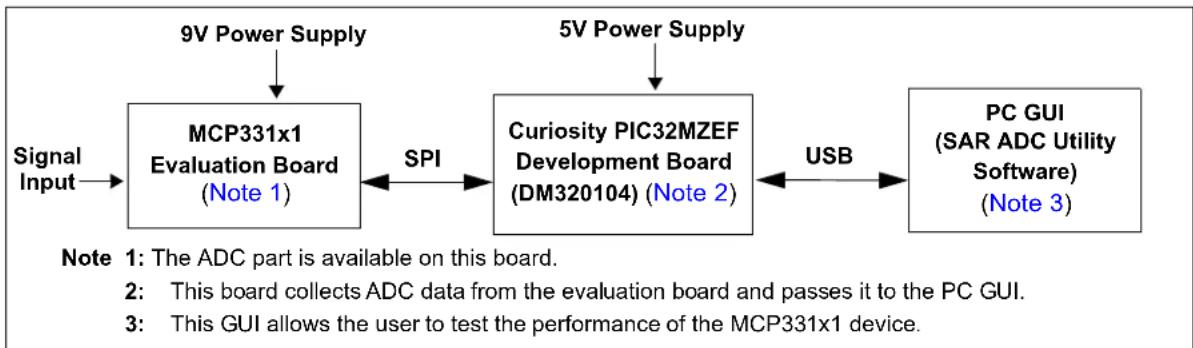
Figure 1-1 displays the system setup.
flowchart
graph LR
    A["Signal Input"] --> B["MCP331x1 Evaluation Board (Note 1)"]
    B --> C["SPI"]
    C --> D["Curiosity PIC32MZEF Development Board (DM320104) (Note 2)"]
    D --> E["USB"]
    E --> F["PC GUI (SAR ADC Utility Software) (Note 3)"]
    G["9V Power Supply"] --> B
    H["5V Power Supply"] --> D
FIGURE 1-1: MCP331x1 16/14/12-Bit 1 Msps SAR ADC Evaluation Kit System Setup.
This evaluation board supports the MCP331x1 device family, which is Microchip Technology Inc.'s baseline single-channel 12/14/16-bit 1 Msps SAR Analog-to-Digital Converter (ADC).
The MCP331x1 Evaluation Board comes with the MCP331x1 device on board. All conditions and features can be evaluated using this evaluation board. Refer to Figure 1-2 and Figure 1-3 for photos of the evaluation boards, and refer to Table 1-1 for our currently available device offerings.
TABLE 1-1: DEVICE OFFERING (1)
| Part Number | Resolution Sample | Rate SNR | (2) | SFDR (2) | Input Configuration |
| MCP33131D-10 | 16-bit | 1 Msps | 91.3 dBFS | 103.5 dB | Differential |
| MCP33121D-10 | 14-bit | 1 Msps | 85.1 dBFS | 103.5 dB | Differential |
| MCP33111D-10 | 12-bit | 1 Msps | 73.9 dBFS | 99.3 dB | Differential |
Note 1: Contact Microchip Technology Inc. for availability.
2: SNR and SFDR are measured with f_IN = 10 kHz , V_IN = -1 dBFS , V_REF = 5V
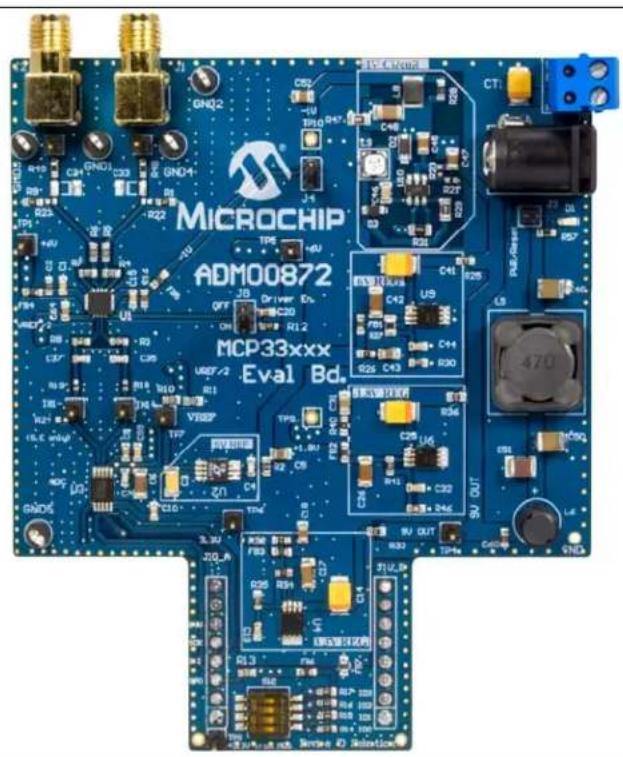
FIGURE 1-2: MCP331x1 16/14/12-Bit 1 Msps SAR ADC Evaluation Board, 5V Reference.

text_image
MUCROCHIP ADM00873 MCP331 x1 Eval Bd. 470 Device ID SelectionFIGURE 1-3: MCP331x1 16/14/12-Bit 1 Msps SAR ADC Evaluation Board, 4V Reference.
1.4 SAR ADC DEVICE CONFIGURATION
Each evaluation board features a 4-way SPST DIP switch (schematic designator: SW1) that allows the user to manually configure the board for a variety of available devices, as well as configure the input, resolution and speed for each device. Table 1-2 lists each available switch setting. Refer to Figure 2-1 from Chapter 2. "Installation and Operation" to view the location of SW1.
TABLE 1-2: SW1 DEVICE CONFIGURATION SETTINGS
| Part Number Resolution Speed | Input Configuration | SW1 Setting: (ID3:ID2:ID1:ID0) | Notes | ||
| MCP33111-05 12 | 500 ksps Single-Ended 0-0-0-0 | ||||
| MCP33111D-05 12 | 500 ksps | Differential | 0-0-0-1 | ||
| MCP33121-05 | 14 500 ksps Single-Ended 0-0-1-0 | ||||
| MCP33121D-05 | 14 | 500 ksps | Differential | 0-0-1-1 | |
| MCP33131-05 | 16 500 ksps Single-Ended 0-1-0-0 | ||||
| MCP33131D-05 | 16 | 500 ksps | Differential | 0-1-0-1 | |
| MCP33141-05 | 18 | 500 ksps | Single-Ended | 0-1-1-0 | Future Use |
| MCP33141D-05 | 18 | 500 ksps | Differential | 0-1-1-0 | Future Use |
| MCP33141-10 | 18 | 1 Msps | Single-Ended | 1-0-0-0 | Future Use |
| MCP33141D-05 | 18 | 1 Msps | Differential | 1-0-0-1 | Future Use |
| MCP33111-10 12 | 1 Msps Single-Ended 1-0-1-0 | ||||
| MCP33111D-10 | 12 | 1 Msps | Differential | 1-0-1-1 | |
| MCP33121-10 | 14 | 1 Msps | Single-Ended | 1-1-0-0 | |
| MCP33121D-10 | 14 | 1 Msps | Differential | 1-1-0-1 | |
| MCP33131-10 | 16 | 1 Msps | Single-Ended | 1-1-1-0 | |
| MCP33131D-10 | 16 | 1 Msps | Differential | 1-1-1-1 | Default |
1.5 CURIOSITY PIC32MZEF DEVELOPMENT BOARD (DM320104) OVERVIEW
The Curiosity PIC32MZEF Development Board (DM320104) is a fully-integrated 32-bit development platform featuring the high-performance PIC32MZ EF Series PIC® Microcontroller (PIC32MZ2048EFM100), which is utilized for capturing the digital data received from the MCP331x1 Analog-to-Digital Converter (ADC) evaluation board. Figure 1-1 shows the connection of the Curiosity Development Board (DM320104) directly between the MCP331x1 16/14/12-Bit 1 Msps SAR ADC Evaluation Board and the SAR ADC Utility Software.
The Curiosity Development Board (DM320104) connects to the PC through a USB cable, providing the user with two functionalities:
- The ability to send user commands directly to the device from the SAR ADC Utility Software.
- The ability to collect data from the evaluation board and send it to the SAR ADC Utility Software.
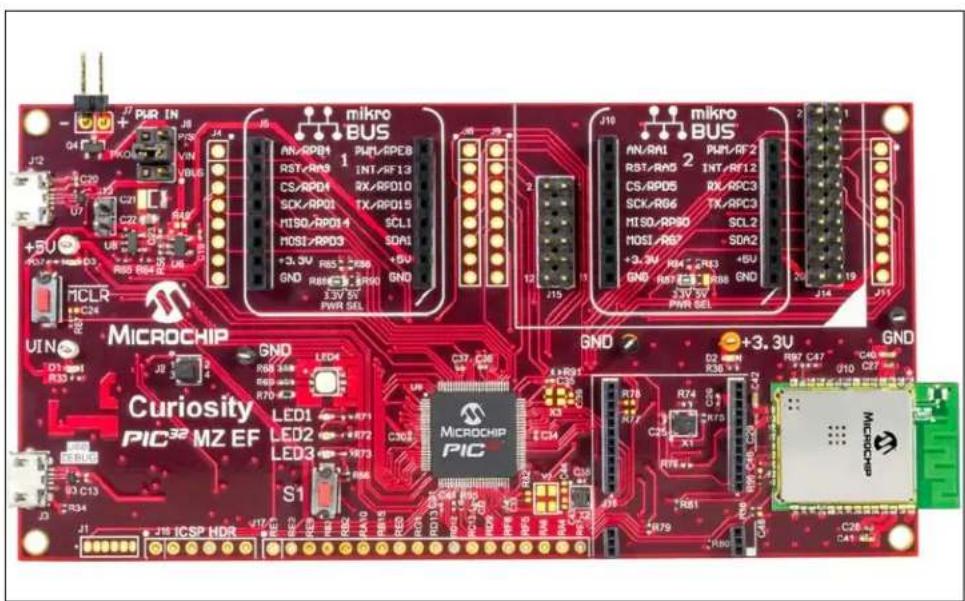
Refer to Figure 1-4 for close-up photos of the Curiosity PIC32MZEF Development Board (DM320104). More information, including user guides and other resources for the Curiosity Development Board, can be found by visiting www.microchip.com.
text_image
MICROCHIP Curiosity PIC32 MZ EF GND LED1 LED2 LED3 S1 J1 ICSP HDR J10 MICRO BUS AN/RP01 RST/RP03 CS/RP04 SCX/RP05 HISO/RP014 HOSI/RP03 +3.3V R85 2560 GND R86 2560 +5V +3.3V R85 2560 GND R79 R78 R77 R76 R75 R74 R73 R72 R71 R70 R69 R68 R67 R66 R65 R64 R63 R62 R61 R59 R58 R57 R56 R55 R54 R53 R52 R51 R49 R48 R47 R46 R45 R44 R43 R42 R41 R40 R39 R38 R37 R36 R35 R34 R33 R32 R31 R30 R29 R28 R27 R26 R25 R24 R23 R22 R21 R20 R19 UIN MICROCHIP GND LED4 LED3 C37 C26 MicroCHIP PIC GND 7 +3.3V GNDFIGURE 1-4: Curiosity PIC32MZEF Development Board (DM320104).
1.6 SAR ADC UTILITY SOFTWARE OVERVIEW
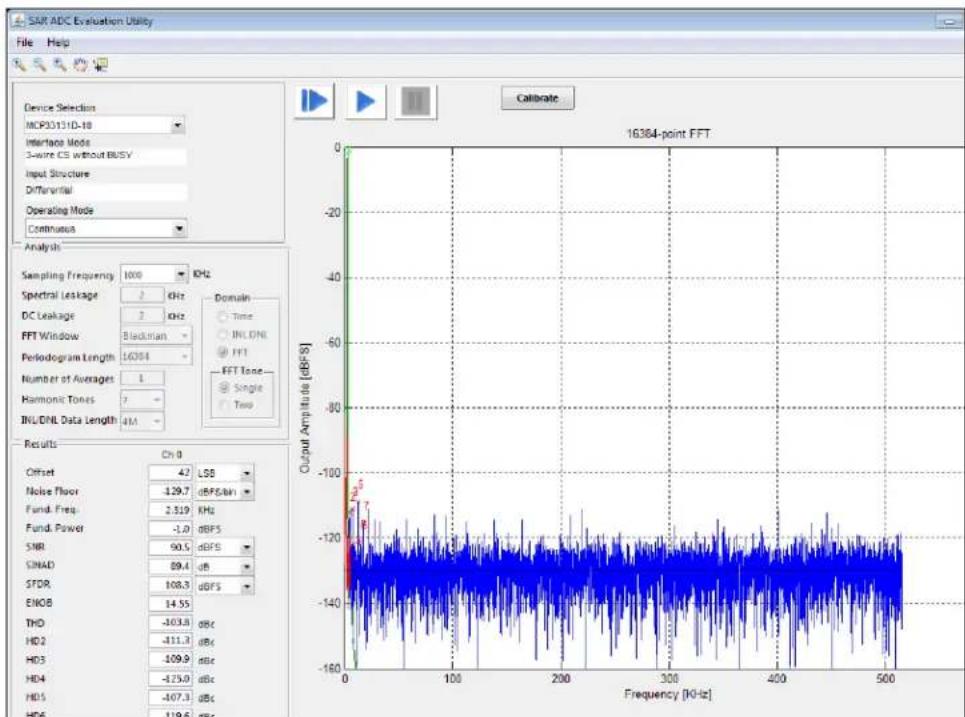
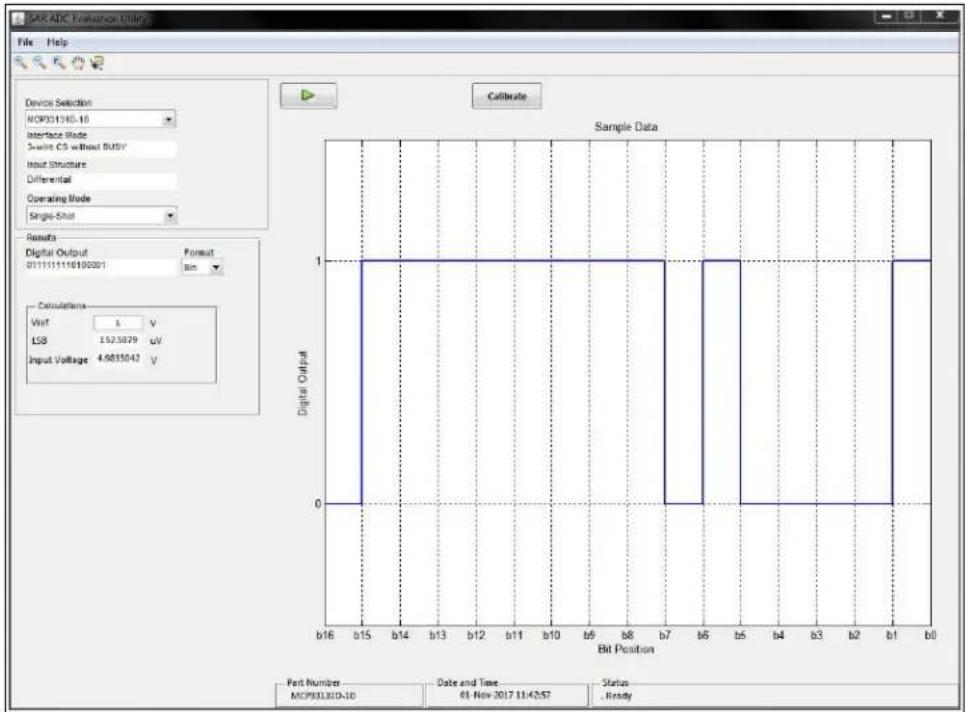
The SAR ADC Utility Software is the graphical user interface (GUI) used to communicate with the device and to configure its operating parameters. The software communicates with the part through the Curiosity PIC32MZEF Development Board and a USB cable, allowing the user to program the internal ADC registers. When the user interacts with the software (for example, by updating the registers), the user's commands are passed to the MCP331x1 device through the Curiosity PIC32MZEF Development Board. Once the commands are executed by the MCP331x1 Evaluation Board, the software receives the requested data from the Curiosity PIC32MZEF Development Board. The software will then analyze the data, perform a FFT or other analysis, and display the results. Refer to Figure 1-1 for a diagram of the system setup. Figure 1-5 shows a screen shot of the GUI with FFT display while running in Continuous operating mode. Figure 1-6 shows a screen shot of the GUI while running in Single-Shot mode 16-bit digital output display.
line
| Frequency (KHz) | Amplitude (dB) | | --------------- | -------------- | | 0 | 0 | | 50 | -120 | | 100 | -120 | | 150 | -120 | | 200 | -120 | | 250 | -120 | | 300 | -120 | | 350 | -120 | | 400 | -120 | | 450 | -120 | | 500 | -120 |FIGURE 1-5: SAR ADC Utility Software Displaying a Typical FFT Waveform.
line
| Bit Position | Digital Output | | ------------ | -------------- | | b16 | 0 | | b15 | 1 | | b14 | 1 | | b13 | 1 | | b12 | 1 | | b11 | 1 | | b10 | 1 | | b9 | 1 | | b8 | 1 | | b7 | 0 | | b6 | 1 | | b5 | 0 | | b4 | 0 | | b3 | 0 | | b2 | 0 | | b1 | 1 | | b0 | 1 |FIGURE 1-6: SAR ADC Utility Software Displaying a Single Acquisition Bit Position Digital Output.
The SAR ADC Utility Software is available for download at www.microchip.com. For instructions on using the GUI, refer to the software's supporting documentation included with the installation file, as well as within the application Help menu.
1.7 WHAT THE MCP331X1 16/14/12-BIT 1 MSPS SAR ADC EVALUATION KIT CONTAINS
The MCP331x1 16/14/12-Bit 1 Msps SAR ADC Evaluation Board includes the following items:
- MCP331x1 16/14/12-Bit 1 Msps SAR ADC Evaluation Board in two options:
- 4V_REF , (ADM00873), or
- 5V_REF , (ADM00872)
- 9V wall plug-in power supply
- Important Information Sheet
1.8 MCP331X1 16/14/12-BIT 1 MSPS SAR ADC EVALUATION KIT REQUIREMENTS
MCP331x1 16/14/12-Bit 1 Msps SAR ADC Evaluation Board requires:
- Sold separately
- Type A male-to-micro-B USB cable
- Not provided with the kit
- External signal input
- Supplied by the user
• SAR ADC Utility Software - Available on the Microchip website
- Curiosity PIC32MZEF Development Board (DM320104)
Chapter 2. Installation and Operation
2.1 CONFIGURATION REQUIREMENTS
To power-up and run the evaluation kit, the following are required:
• SAR ADC Utility Software
• MCP331x1 16/14/12-Bit 1 Msps SAR ADC Evaluation Board
• Curiosity PIC32MZEF Development Board (DM320104)
• Type A Male-to-Micro-B USB cable
- External Signal Source, differential or single-ended output (see Section 2.2.1 "Input Optimization")
2.1.1 Power Input Connection
This MCP331x1 Evaluation Board comes with a 9V wall plug-in switching power supply (Trident: WSU090-2000-13). This power supply is able to provide a 9V, 2A maximum output. It can be connected to an AC wall outlet rated between 100V AC and 240V AC, at a frequency of 50 Hz to 60 Hz. The other end of the power supply is a 2.1 mm barrel plug that connects to the MCP331x1 Evaluation Board (see Figure 2-1). If the user chooses to connect a different external power supply, a minimum output of 500 mA is required, with a voltage output between 6V-12V. There is no on-board 9V regulator, so the 9V OUT pin (TP4) will read a voltage equal to the voltage input value selected by the user.
WARNING
Avoid connecting a power supply with a voltage greater than what is recommended in this user guide. Doing so can damage the voltage regulators, requiring them to be replaced.
2.2 EVALUATION KIT SETUP
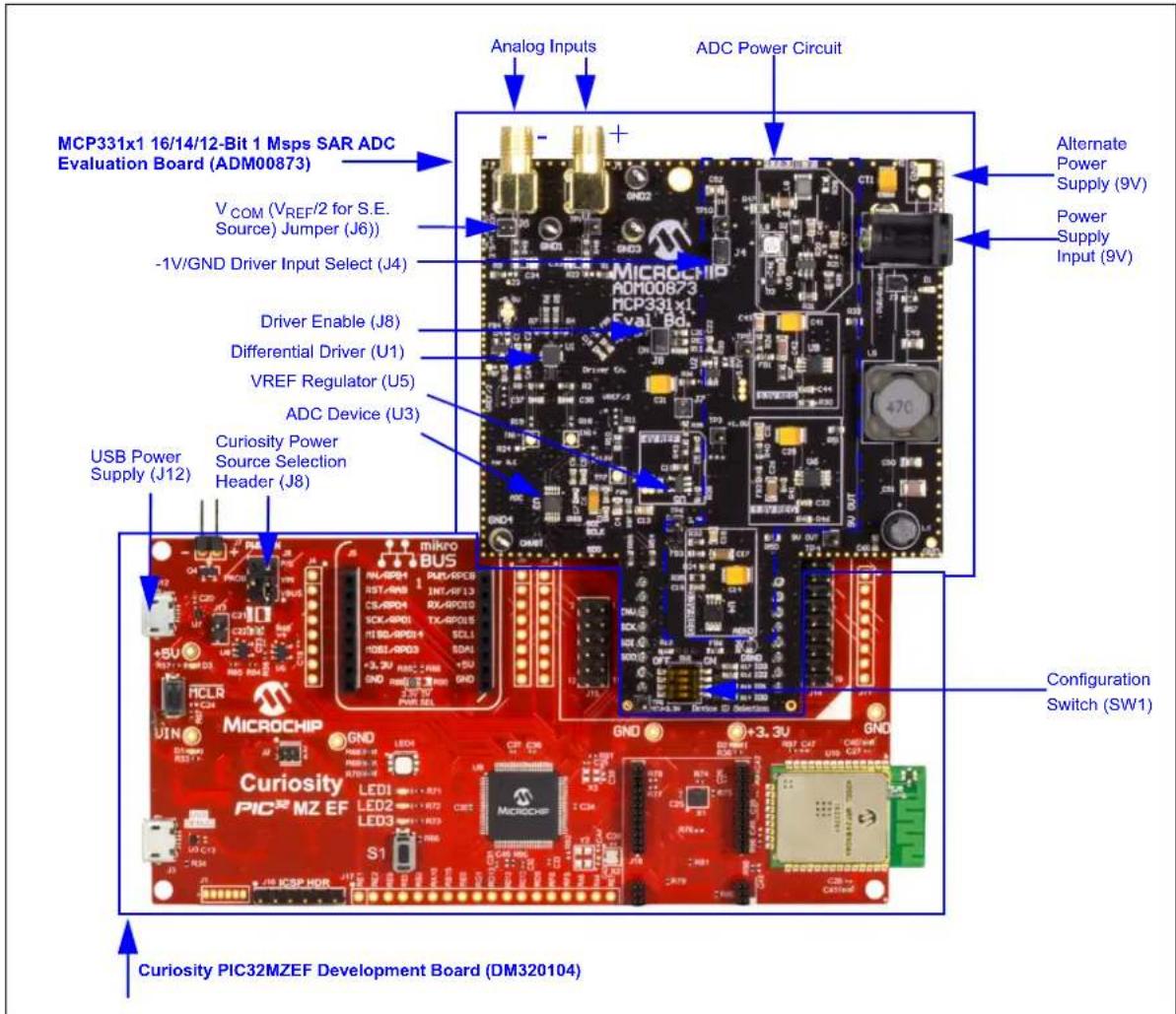
- Connect the MCP331x1 Evaluation Board and the Curiosity PIC32MZEF Development Board as shown in Figure 2-1.
- Connect the Curiosity PIC32MZEF Development Board to a computer using a type A male-to-micro-B USB cable. In order to power the Curiosity Board through USB, the USB cable must be plugged-in to the USB connection located at J12. In addition to this, the headers located at J8 need to have the jumper connecting the V_BUS pin to V_IN . Figure 2-1 shows the component locations.
- Power-up the MCP331x1 Evaluation Board using the provided 9V power supply.
- Connect a differential or single-ended analog input signal to the MCP331x1 Evaluation Board SMA terminals. For single-ended operation, populate jumper J6 (see Figure 2-1 for jumper location). By populating this jumper, the negative signal input will be tied to V_REF/2 ( V_COM ). Another option is to terminate the negative signal input using a 50Ω termination.
- Run the SAR ADC Utility Software. See Section 1.6 "SAR ADC Utility Software Overview".
text_image
Analog Inputs ADC Power Circuit MCP331x1 16/14/12-Bit 1 Msps SAR ADC Evaluation Board (ADM00873) VCOM (VREF/2 for S.E. Source) Jumper (J6) -1V/GND Driver Input Select (J4) Driver Enable (J8) Differential Driver (U1) VREF Regulator (U5) ADC Device (U3) USB Power Supply (J12) Curiosity Power Source Selection Header (J8) MICROCHIP ADH00873 HCP331x1 Eval Bd Configuration Switch (SW1) Curiosity PIC32MZEF Development Board (DM320104)FIGURE 2-1: The MCP331x1 16/14/12-Bit 1 Msps SAR ADC Evaluation Board (ADM00873), connected to the Curiosity PIC32MZEF Development Board (DM320104).
2.2.1 Input Optimization
The best way to evaluate the MCP331x1 device is to use a clean analog input signal with as little noise as possible, and no harmonic contents. The AP2722, for example, can be used to generate a clean analog signal for evaluation purposes. If using a less pure signal source, a filter can be added between the signal source and EVB to remove any noise outside of the desired frequency.
Chapter 3. Firmware
3.1 PIC32MZ2048EFM100 INITIALIZATION
MPLAB ^® X IDE and MPLAB ^® Harmony were used to develop the firmware for the PIC32MZ2048EFM100 on the Curiosity Development Board (DM320104).
The frequency of the PIC32MZ2048EFM100 was decreased under its maximum capabilities in order to achieve maximum SPI clock. The MCU runs at 130 MHz, and the SPI prescaler is set to perform a division by 2 in order to obtain an SPI clock frequency of 65 Mhz. This is the minimum SPI speed required to successfully read 16-bits of data out of the ADC at 1 Msps.
In the firmware for this demo, a USB stack was used to achieve communication with the GUI. Direct Memory Access (DMA) was used together with SPI and Output Compare in order to acquire data and to gate the clock during acquisition.
In this demonstration, the ADC acquisition is triggered by the CONV pulse (RPD5), which is generated by the OC2. The OC2 is generated by Timer3 (OCTSEL = 1). Timer 3 is also used to generate OC1 which triggers the DMA SPI transfer. Because both the SPI transfer and CONV pulse are generated by the same timer, they are synchronous. Figure 3-1 displays the timing diagram between CONV pulse and SPI transfer.

text_image
Tek Run Trig d a 130.3μs ----_110_1_ b 131.03μs ----_111_1_ Δ704.4Cns SFI(MOSI) FF FF SFI(MISO) OE 28 FF FF FF FF OB D8 CLK MISO CONV MOSI 200ns 2.500S/s D4 +→130.6664μs 100k points 1.40 V D15-D0 Timing Resolution: 2.00ns Bus Search events found: 41 8 Aug 2017 11:21:07FIGURE 3-1: SPI Transfer and CONV Pulse.
The reason for using OC2 and not SS is related to Electromagnetic Interference (EMI). By using OC2, the user can control the timing between falling edge of the CONV pulse and SPI transfer, and also the timing between the transfer and CONV rising edge-ADC conversion start. For best EMI performance, it is recommended to keep a few nanoseconds between SPI transfer and ADC start.
There are moments during the ADC operation where SPI transfer can affect the output results. There are two main periods during ADC operation: SAR register settling and sample and hold capacitor charging. Time intervals T1 and T2 from Figure 3-2 are the least recommended time intervals for SPI transfer. During T1, the SAR ADC is settling its lower bits and is most easily affected by noise. During T2, the sample and hold capacitor voltage needs to be as clean as possible for accurate conversion. By performing data read out in the recommended time interval, the maximum value of SNR can be achieved.

line
| x | y | | ---- | ----- | | 0.0 | 1.0 | | 0.7 | 1.0 | | 0.8 | 0.0 | | 1.0 | 1.0 |FIGURE 3-2: Recommended Period for Data Read Out.
Once the data is transferred from the ADC to SPI, the DMA will place it in a 8192 word buffer (ADC_BUFFER[ ]). Since the sampling speed is 1 Msps, this buffer will be updated every 8.1 ms, making timing less critical for other tasks.
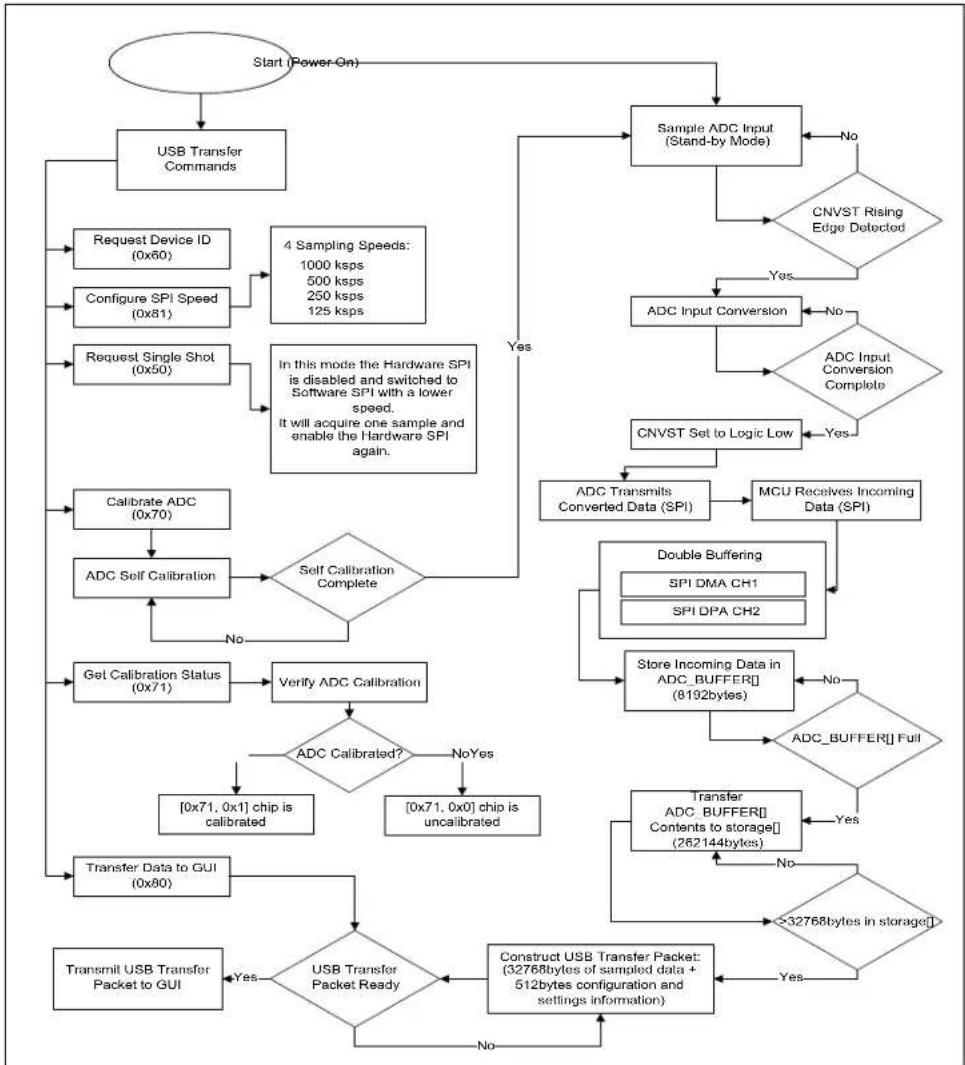
The GUI requires a larger amount of data to be processed in order to indicate accurate performance characteristics: FFT, THD, SINAD, etc. Because of this, a larger data buffer is created in RAM (storage \\ ), with a length of 262144bytes. 32 DMA transfers are required to fill this buffer. The flow chart in Figure 3-3 provides a simple overview of the sample acquisition process, and an overview of the entire firmware process.
flowchart
graph TD
    A["Start (Power-On)"] --> B["USB Transfer Commands"]
    B --> C["Request Device ID (0x60)"]
    C --> D["Configure SPI Speed (0x81)"]
    D --> E["4 Sampling Speeds: 1000 ksps, 500 ksps, 250 ksps, 125 ksps"]
    E --> F["Request Single Shot (0x50)"]
    F --> G["In this mode the Hardware SPI is disabled and switched to Software SPI with a lower speed. It will acquire one sample and enable the Hardware SPI again."]
    G --> H["Calibrate ADC (0x70)"]
    H --> I["ADC Self Calibration"]
    I --> J{Self Calibration Complete}
    J -->|No| K["Get Calibration Status (0x71)"]
    J -->|Yes| L["Calculate ADC Transmits Converted Data (SPI)"]
    L --> M["MCU Receives Incoming Data (SPI)"]
    M --> N["Double Buffering"]
    N --> O["SPI DMA CH1"]
    N --> P["SPI DPA CH2"]
    O --> Q["Store Incoming Data in ADC_BUFFER["] (8192bytes)]
    P --> Q
    Q --> R{ADC_BUFFER[] Full}
    R -->|No| S["Transfer ADC_BUFFER["] Contents_to_storage[] (262144bytes)]
    R -->|Yes| T["Transfer ADC_BUFFER["] Full]
    S --> U{USB Transfer Packet Ready}
    T --> U
    U --> V["Construct USB Transfer Packet: (32768bytes of sampled data + 512bytes configuration and settings information)"]
    V --> W["Transmit USB Transfer Packet to GUI"]
    W --> X["Transmit USB Transfer Packet to GUI"]
    X --> Y{USB Transfer Packet Ready}
    Y -->|No| Z["Calculate ADC Transmits Converted Data (SPI)"]
    Y -->|Yes| AA["Calculate ADC Transmits Converted Data (SPI)"]
    AA --> AB["CNVST Set to Logic Low"]
    AB --> AC["ADC Input Conversion"]
    AC --> AD{ADC Input Conversion Complete}
    AD -->|No| AE["CNVST Rising Edge Detected"]
    AE --> AF["Sample ADC Input (Stand-by Mode)"]
    AF --> AG["Start (Power-On)"]
FIGURE 3-3: Firmware and ADC Samples Acquisition Flowchart.
3.3 USB TRANSFER
The MCU firmware implements a WinUSB device to handle the data transfer between the USB host (a PC for example) and the USB device (evaluation board).
Each USB transfer has a length of 33280 bytes out of which first 512 bytes are configuration and setting bytes. The remaining 32768 bytes will contain samples. This will require 8 logical transfers to be executed (Figure 3-4). The physical USB layer will split the 33280 byte packets into 512 byte chunks before transmitting on the USB bus.

text_image
512 bytes for configuration 32768 bytes – samples 33280 bytes USB transfer packetFIGURE 3-4: USB Transfer Frame.
3.4 ADC FUNCTIONS
In addition to the actual sample transfer from MCU to PC, there are other ADC functions available: Calibration, Read Device ID, and Sampling Speed Change.
The PC not only receives data from the EVB, but it also sends 512 bits of data back to the MCU. The 512 length size is required because of the USB high-speed endpoint size. Out of these, only the first 5 are meaningful.
The first element: receivedDataBuffer[0] is indicating to the MCU the desired function. For 0x80, the MCU will send samples. For 0x81, the transfer is stopped and MCU RAM is filled with samples from the ADC. The code will not perform transfers in the same time as the acquisition of ADC samples.
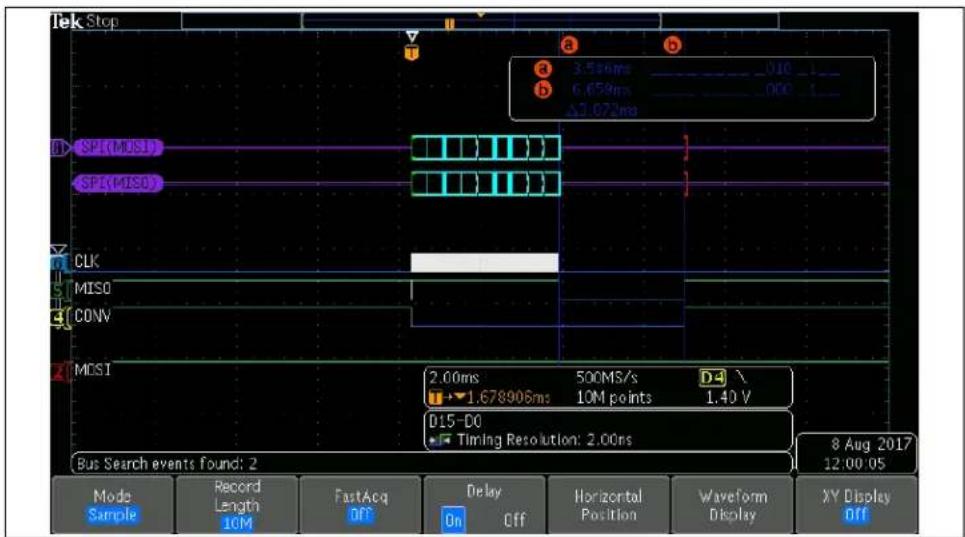
The Calibration function is executed when value 0x70 is received. Calibration status function has code 0x71. Table 3-1 provides the command structure byte values sent to and the responses from the PIC32MZ2048EFM100 on the Curiosity Development Board (DM320104). Figure 3-5 displays the timing diagram of the calibration process.
TABLE 3-1: COMMAND STRUCTURE BYTE VALUES
| Command | receivedDataBuffer[x] transmitDataBuffer[x] Description | |||||||
| Byte[0] | Byte[1] Byte[2] | Byte[3] Byte[0] | Byte[1] Byte[2] | Byte[3] Byte[4] Byte[5] | ||||
| Send Samples | 0x80 — | [0 to 7] Package Index | 0x80 | 0x00 | — | — | 33280 Byte reply [0-511] – Irrelevant [512 – 33279] – Data samples Combine the read data into a 16b signed value as follows: dataH: dataL = read[odd index]: read—even index] | |
| Change Sampling Speed | 0x81 — | 1-4 Sampling speed | 0x81 | 0x01 | — | — | Select sampling speed from Byte[3] and change transmitDataBuffer[1] = 0x80 to start send data | |
| 0x80 | 0x01 | — | — | |||||
| Calibrate ADC | 0x70 | — | — | 0x70 | 0x01 | — | — | [0x70, 0x01] – Command received successfully [0x70, 0x00]– Error |
| Calibration Status | 0x71 | — | — | 0x71 | 0x01 | — | — | [0x71, 0x01] – Calibration successful [0x71, 0x00] – Calibration failed |
| Acquire Single Sample | 0x50 | — | — | 0x50 | MSb | LSb | — | [0x50, ADCHighByte, ADCLOWByte] |
| Read Device ID | 0x60 | — | — | 0x60 | — | — | — | [0x60, chip ID] |
text_image
Tek Stop 3.5ms 6.65ms Δ3.072ms SPI(MOSI) SPI(COSO) CLK MISO CONV MOSI 2.00ms 500MS/s D4\ →1.678906ms 10M points 1.40 V D15-00 Timing Resolution: 2.00ms Bus Search events found: 2 8 Aug 2017 12:00:05 Mode Sample Record Length 10M FastAcq Off Delay On Off Horizontal Position Waveform Display XY Display OffFIGURE 3-5: ADC Calibration.
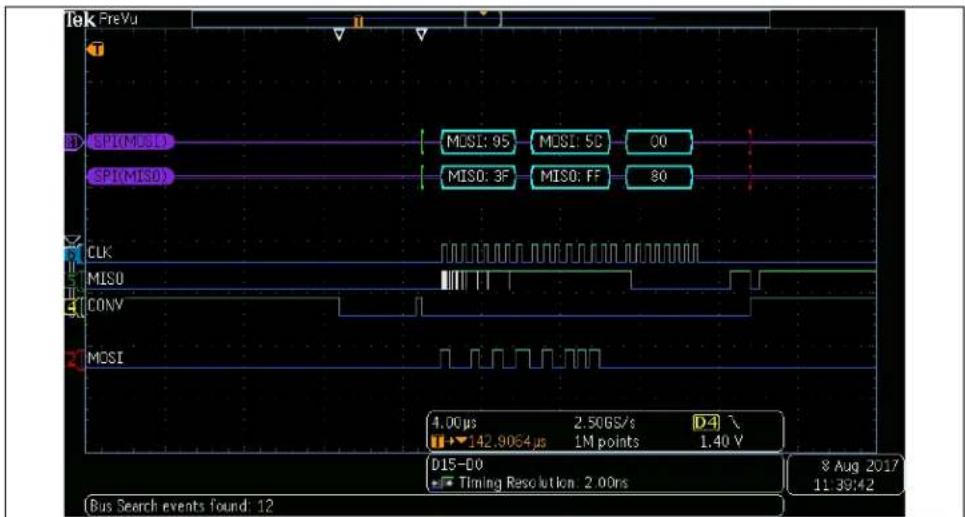
Read Device ID code is 0x60. In order to retrieve the chip ID, more read registers are required. Figure 3-6 describes the read register command format.
To retrieve the samples, the GUI will send to the MCU information on the packet required to be received as an index, which is a number from 0 to 7. This index is sent to the MCU in receivedDataBuffer[4].
Another function controlled by the GUI is the sampling speed change. There are four available sampling speeds. These are selected in accordance with the value received in receivedDataBuffer[3]. The sampling speed is controlled by changing the prescaler of the reference system clock.
text_image
Tek PreVu MISI: 95 MOSI: 5C 00 MISO: 3F MISO: FF 90 CLK MISO CONV MOSI 4.00μs 2.50GS/s D-4\ 142.9064 μs 1M points 1.40 V D15-00 Timing Resolution: 2.00ns Bus Search events found: 12 8 Aug 2017 11:39:42FIGURE 3-6: Read Register from ADC.
NOTES:
Appendix A. Schematic and Layouts
A.1 INTRODUCTION
This appendix contains the following schematics and layouts for the MCP331x1 16/14/12-Bit 1 Msps SAR ADC Evaluation Board (4V REF , ADM00873 and 5V REF , ADM00872).
A.2 ADM00872
• Board ADM00872 – Schematic
• Board ADM00872 – Schematic Regulators
- Board ADM00872 – Top Silk Layer
• Board ADM00872 – Top Copper and Silk Layer
• Board ADM00873 – Top Copper Layer
• Board ADM00873 – Bottom Copper Layer
• Board ADM00873 – Bottom Copper and Silk Layer
- Board ADM00872 – Bottom Silk Layer
A.3 ADM00873
• Board ADM00873 – Schematic
• Board ADM00873 – Schematic Regulators
- Board ADM00873 – Top Silk Layer
• Board ADM00873 – Top Copper and Silk Layer
• Board ADM00873 – Top Copper Layer
- Board ADM00873 – Bottom Copper Layer
• Board ADM00873 – Bottom Copper and Silk Layer
• Board ADM00873 – Bottom Silk Layer
DS50002733A-page 28 © 2018 Microchip Technology Inc.
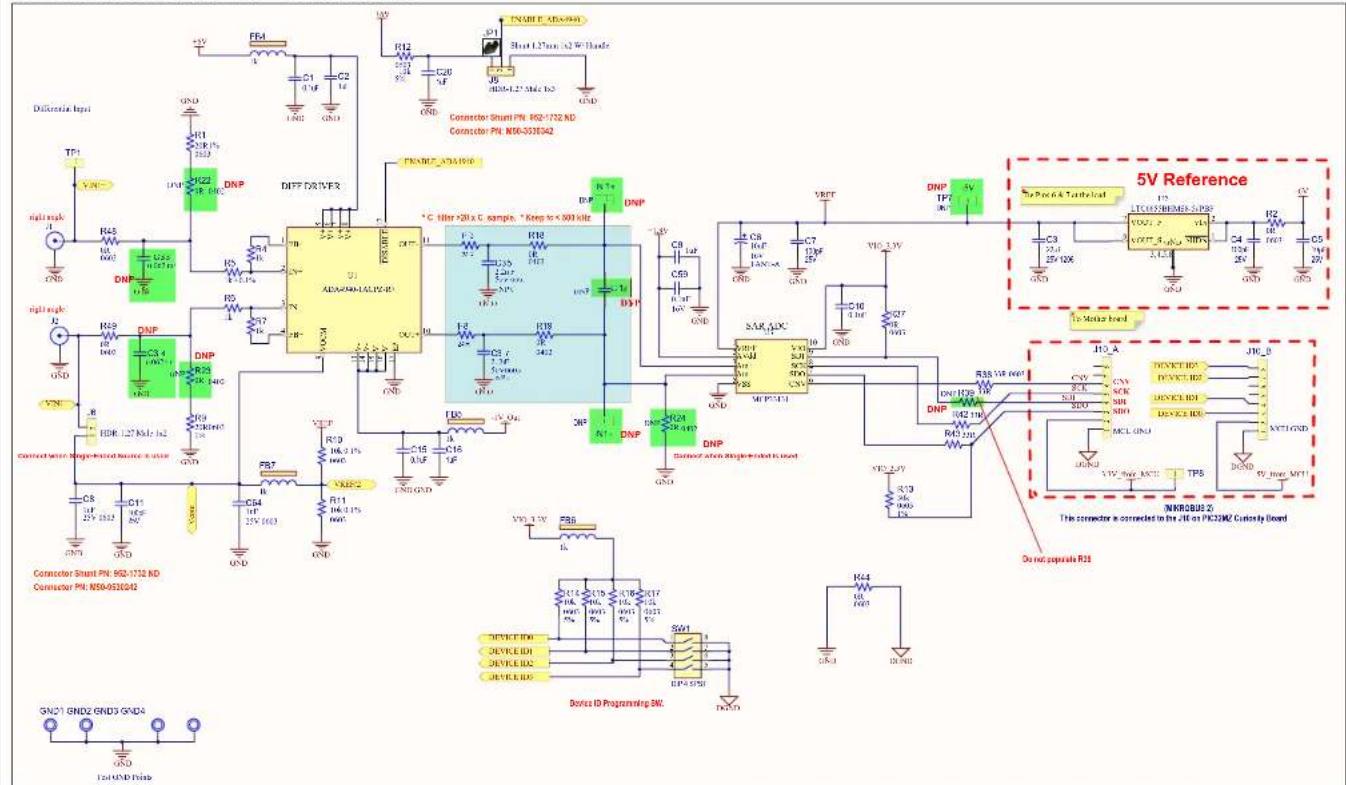
A.4 BOARD ADM00872 - SCHEMATIC
text_image
Differential Input TP1 R45 R22 DNP DIPF/DR/FR R3 DNP C8 C9 DNP C10 C11 DNP C12 DNP C13 DNP C14 DNP C15 DNP C16 DNP C17 DNP C18 DNP C19 DNP C20 DNP C21 DNP C22 DNP C23 DNP C24 DNP C25 DNP C26 DNP C27 DNP C28 DNP C29 DNP C30 DNP C31 DNP C32 DNP C33 DNP C34 DNP C35 DNP C36 DNP C37 DNP C38 DNP C39 DNP C40 DNP C41 DNP C42 DNP C43 DNP C44 DNP C45 DNP C46 DNP C47 DNP C48 DNP C49 DNP C50 DNP C51 DNP C52 DNP C53 DNP C54 DNP C55 DNP C56 DNP C57 DNP C58 DNP C59 DNP C60 DNP C61 DNP C62 DNP C63 DNP C64 DNP C65 DNP C66 DNP C67 DNP C68 DNP C69 DNP C70 DNP C71 DNP C72 DNP C73 DNP C74 DNP C75 DNP C76 DNP C77 DNP C78 DNP C79 DNP C80 DNP C81 DNP C82 DNP C83 DNP C84 DNP C85 DNP C86 DNP C87 DNP C88 DNP C89 DNP C90 DNP C91 DNP C92 DNP C93 DNP C94 DNP C95 DNP C96 DNP C97 DNP C98 DNP C99 DNPMCP331x1 16/14/12-Bit 1 Maps SAR ADC Evaluation Kit Users Guide
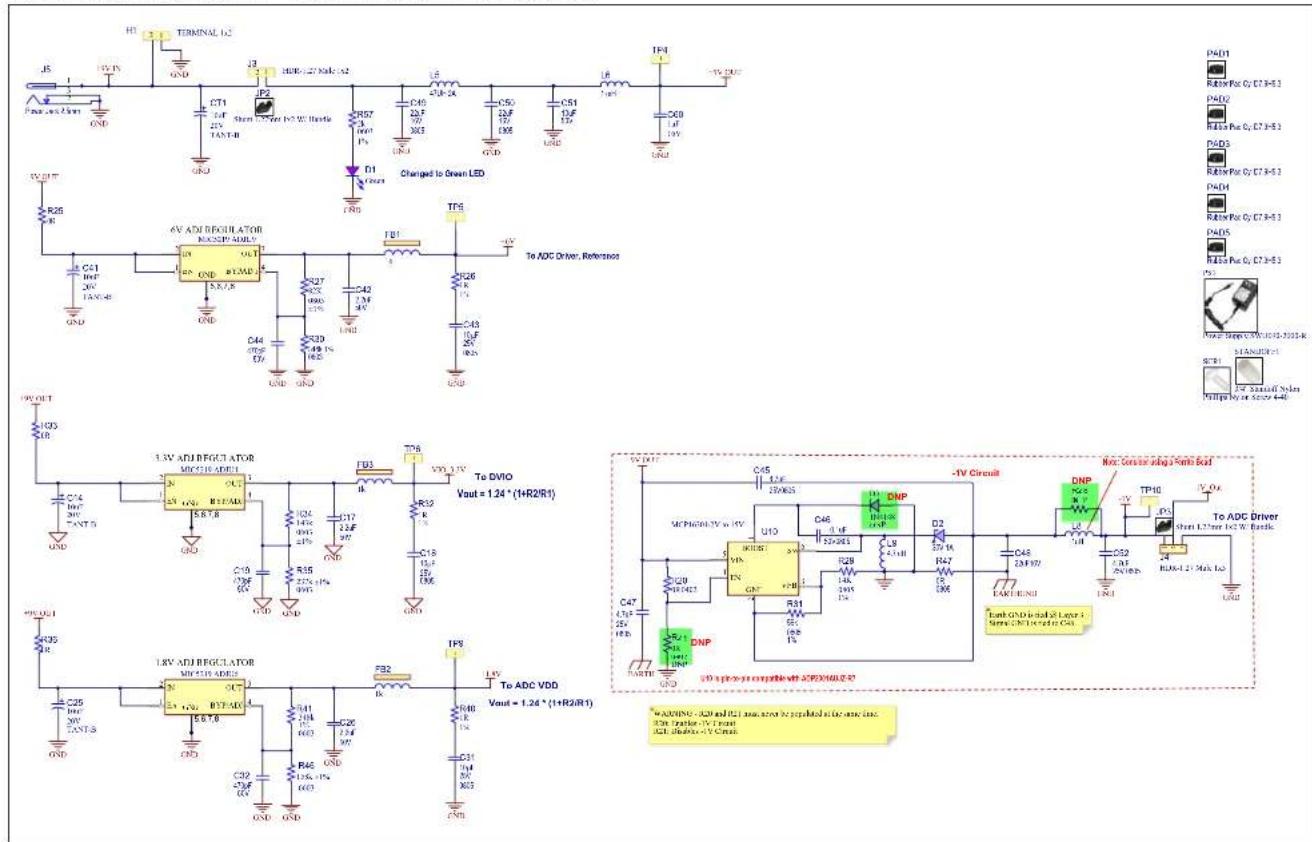
A.5 BOARD ADM00872 - SCHEMATIC REGULATORS
text_image
Terminal I.C J5 Power, am, 2 Vrms OND CT1 4V TANT-B R26 R C41 20V 1.3V-4E OND AV ADM REGULATOR MAX/SPY/ADRLY OND B1/MP S/N/S/B OND C44 80F OND C27 90X 1.3V-4E OND C20 40F OND C43 15F OND TP5 To ADC Driver, Reference Changed to Green LED TP4 ACI ACI ACI ACI ACI ACI ACI ACI ACI ACI ACI ACI ACI ACI ACI ACI ACI ACI ACI ACI ACI ACI ACI ACI ACI ACI ACI ACI ACI ACI ACI ACI ACI ACIA.6 BOARD ADM00872 - TOP SILK LAYER

text_image
J2 J1 GND2 C52 -1V TP10 R47 GND3 J6 GND1 R9 C34 R23 R1 C33 R22 TP1 GND3 J4 MicroCHIP ADM00872 MCP331 x1 S1V Circuit CT1 L8 R28 C48 L9 D2 C46 C47 C46 U10 R20 R21 R29 D3 R31 J3 D1 R57 PWR/Reset1 C49 C L5 AVREF1 U9 C44 R27 R30 Eval Bd. VREF/2 R19 IN1- R24 (SE only) R18 R10 R11 IN1 VREF TP7 C9 C65 C59 TP6 C3 Zn C4 TP6 +1.8V C5 R2 3.3V R32 C18 SD1 SCLK C10 R32 C17 R33 R34 R35 C19 C14 U4 AGND CNUST SD00 R3 R2 FB3 R34 C17 RF6 ON DGND R17 ID3 R16 ID2 R15 IDI R14 ID0 TPR HDU+3.3V Device ID SelectionA.7 BOARD ADM00872 - TOP COPPER AND SILK LAYER

text_image
J2 J6 GND1 GND2 TP1 GND3 J4 +6U R7 R1 R22 R23 C34 C33 C32 C31 C2 C1 U1 F85 J8 +6U OFF Driver En. ON TP5 C20 R12 R3 C36 R18 R10 VREF/2 R11 R19 IN1 R24 (ILE only) C9 C59 TP7 VREF VREF +1.8U TP6 3.3U R32 C18 SCLK GND4 CNUST S00 R12 R35 C19 C14 U4 D2B7A8E AGND DNV Circuit CT1 L8 R28 C48 D20 C45 R21 R29 D3 R31 C47 C16 U10 R29 R31 R27 U9 C41 R25 L5 PWR/Reset PWR/Reset PWR/Reset PWR/Reset PWR/Reset PWR/Reset PWR/Reset PWR/Reset PWR/Reset PWR/Reset PWR/Reset PWR/Reset PWR/Reset PWR/Reset PWR/Reset PWR/Reset PWR/Reset PWR/Reset PWR/Reset PWR/Reset PWR/Reset PWR/Reset PWR/Reset PWR/Reset PWR/Reset PWR/Reset SVD OUT GNDA.8 BOARD ADM00872 - TOP COPPER LAYER
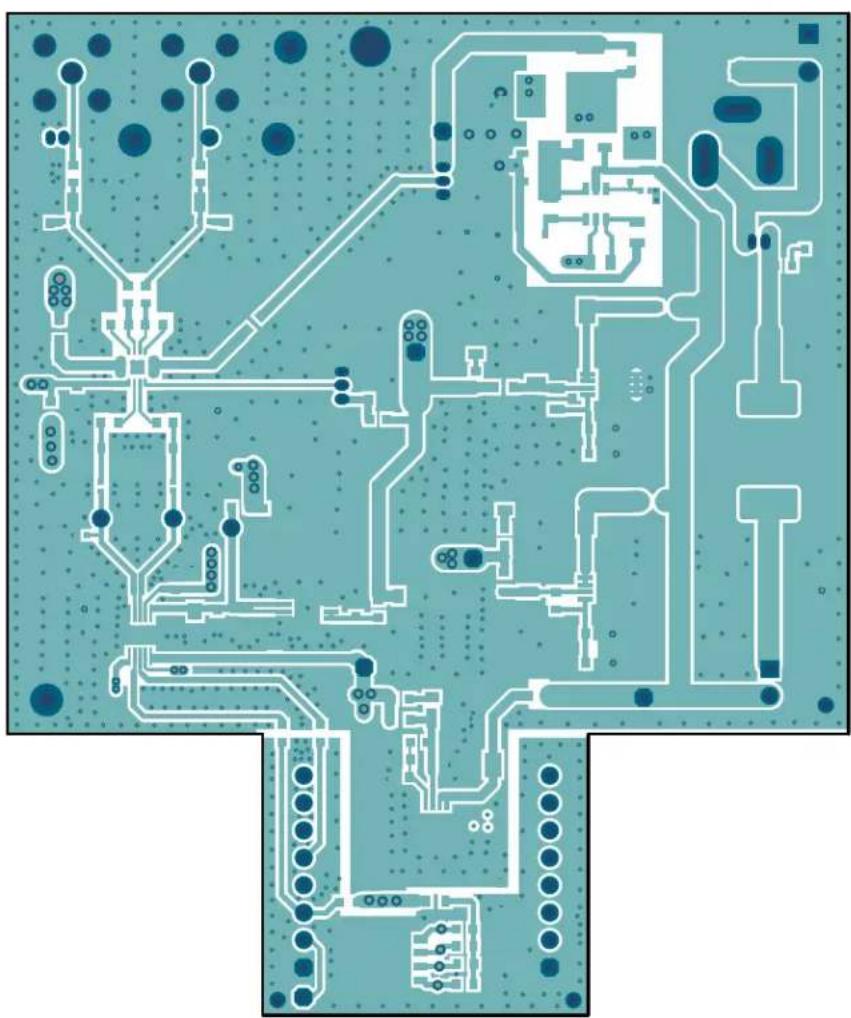
natural_image
Top-down schematic of a printed circuit board layout with traces, pads, and components (no text or labels)A.9 BOARD ADM00872 - BOTTOM COPPER LAYER
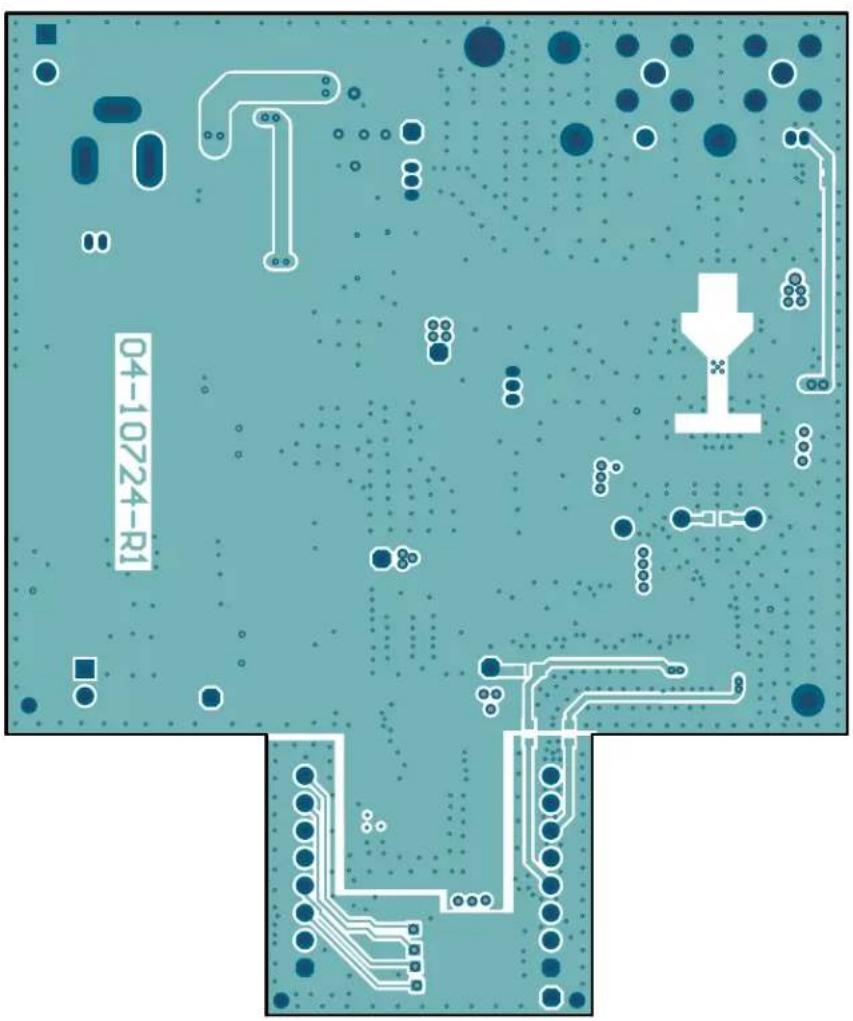
text_image
04-10724-R1A.10 BOARD ADM00872 - BOTTOM COPPER AND SILK LAYER

text_image
04-10724-R1 CE Earth GND LABEL1 C8 CI1 C12 R37 R38 AGND +3.3V from MCU +5V from MCU DGND Digital GNDA.11 BOARD ADM00872 - BOTTOM SILK LAYER

text_image
Earth GND C8 1 C C11 LABEL1 C12 AGND +3.3V from MCU +5V from MCU DGND Digital GNDA.12 BOARD ADM00873 - SCHEMATIC

text_image
Reference: 4.096V DGP-12 Main I/O 2nd Order LP: 11 Hz To by-pass US: Populate R2, Remove R38 and R28 DNP SAR ADC R5 C10 C20 C30 C40 C50 C60 C70 C80 C90 C100 C110 C120 C130 C140 C150 C160 C170 C180 C190 C200 C210 C220 C230 C240 C250 C260 C270 C280 C290 C300 C310 C320 C330 C340 C350 C360 C370 C380 C390 C400 C410 C420 C430 C440 C450 C460 C470 C480 C490 C500 C510 C520 C530 C540 C550 C560 C570 C580 C590 C600 C610 C620 C630 C640 C650 C660 C670 C680 C690 C700 C710 C720 C730 C740 C750 C760 C770 C780 C790 C800 C810 C820 C830 C840 C850 C860 C870 C880 C890 C900 C910 C920 C930 C940 C950 C960 C970 C980 C990 C1000 DNP 1.2 Main I/O, Share for Connector PN, ISO-1732 N/D Connector PR, VDD-3333142, CON1672 DNP 1.2 Main I/O, Share for Connector PN, ISO-1732 N/D Connector PR, VDD-3333142, CON1672 DNP 1.2 Main I/O, Share for Connector PN, ISO-1732 N/D Connector PR, VDD-3333142, CON1672 DNP 1.2 Main I/O, Share for Connector PN, ISO 1732 N/D Connector PR, VDD-3333142, CON1672 DNP 1.2 Main I/O, Share for Connector PN, ISO 1732 N/D Connector PR, VDD-3333142, CON1672 DNP 1.2 Main I/O, Share for Connector PN, ISO 1732 N/D Connector PR, VDD-333/HD Cutoff Board 1.2 Main I/O, Share for Connector PN, ISO-1732 N/D Connector PR, VDD-333/HD Cutoff Board 1.2 Main I/O, Share for Connector PN, ISO 1732 N/D Connector PR, VDD-333/HD Cutoff Board 1.2 Main I/O, Share for Connector PN, ISO 1732 N/D Connector PR, VDD-333/HD Cutoff Board 1.2 Main I/O, Share for Connector PN, ISO 1732 N/D Connector PR, VDD-333/HD Cutoff Board 1.2 Main I/O, Sharefor Connector PN, ISO-1732 N/D Connector PR, VDD-333/HD Cutoff Board 1.2 Main I/O, Sharefor Connector PN, ISO 1732 N/D Connector PR, VDD-333/HD Cutoff Board 1.2 Main I/O, Sharefor Connector PN, ISO 1732 N/D Connector PR, VDD-333/HD Cutoff Board 1.2 Main I/O, Sharefor Connector PN, ISO 1732 N/D Connector PR, VDD-333/HD Cutoff Board 1.2 Main I/O, Share for Connector PN, ISO 1732 N/D Connector PR, VDD-333/HD Cutoff Board 1.2 Main I/O, Sharefor Connector PN, ISO 1732 N/D Connector PR, VDD-333/HD Cutoff Board 1.2 Main I/O, Sharefor Connector PN, ISO 1732 N/D Connector PR, VDD-333/HD Cutoff Board 1.2Main I/O, Share for Connector PN, ISO 1732 N/D Connector PR, VDD-333/HD Cutoff Board 1.2Main I/O, Share for Connector PN, ISO 1732 N/D Connector PR, VDD-333/HD Cutoff Board 1.2Main I/O, Share for Connector PN, ISO 1732 N/D Connector PR, VDD-333/HD Cutoff Board 1.2 Main I/O, Sharefor Connector PN, ISO 1732 N/D Connector PR, VDD-333/HD Cutoff Board 1.2 Main I/O, Sharefor Connector PN, ISO 1732 N/D Connector PR, VDD-333/HD CutoffBoard 1.2 Main I/O, Sharefor Connector PN, ISO 1732 N/D Connector PR, VDD-333/HD Cutoff Board 1.2Main I/O, Sharefor Connector PN, ISO 1732 N/D Connector PR, VDD-333/HD Cutoff Board 1.2Main I/O, Sharefor Connector PN, ISO 1732 N/D Connector PR, VDD-333/HD Cutoff Board 1.2Main I/O, Sharefor Connector PN, ISO 1732 N/D Connector PR, VDD-333/HD CutoffBoard 1.2Main I/O, Sharefor Connector PN, ISO 1732 N/D Connector PR, VDD-333/HD Cutoff Board 1.2Main I/O, Sharefor Connector PN, ISO 1732 N/D Connector PR, VDD-333/HD Cutoff Board 1.2Main I/O, Sharefor Connector PN, ISO 1732 N/D Connector PR, VDD-334/HD Cutoff Board 1.2Main I/O, Sharefor Connector PN, ISO 1732 N/D Connector PR, VDD-334/HD Cutoff Board 1.2Main I/O, Sharefor Connector PN, ISO 1732 N/D Connector PR, VDD-334/HD Cutoff Board 1.2Main I/O, Sharefor Connector PN, ISO 1732 N/D Connector PR,VDD-5.5V Max (Max) / Max (Max) Optional: BW = -5Ω (Max) or -5Ω (Max) / Max (Max) GND+ GND+ GND+ GND+ GND+ GND+ GND+ GND+ GND+ GND+ GND+ GND+ GND+ GND+ GND+ GND+ GND+ GND+ GND+ GND+ GND+ GND+ GND+ GND+ GND+ GND+ GND+ GND+ GND+ GND+ GND+ GND+ GND+ GND+ GDN+ GND+ GND+ GND+ GND+ GND+ GND+ GND+ GND+ GND+ GND+ GND+ GND+ GND+ GND+ GND+ GND+ GND+ GND+ GND+ GND+ GND+ GND+ GND+ GND+ GND+ GND+ GND+ GND+ GND+ GND+ GND+ GND+ GND +GND +GND +GND +GND +GND +GND +GND +GND +GND +GND +GND +GND +GND +GND +GND +GND +GND +GND +GND +GND +GND +GND +GND +GND +GND +GND +GND +GND +GND +GND +GND +GND +GND +GUND +GND +GND +GND +GND +GND +GND +GND +GND +GND +GND +GND +GND +GND +GND +GND +GND +GND +GND +GND +GND +GND +GND +GND +GND +GND +GND +GND +GND +GND +GND +GND +GND +GND -GND -GND -GND -GND -GND -GND -GND -GND -GND -GND -GND -GND -GND -GND -GND -GND -GND -GND -GND -GND -GND -GND -GUND -GUND -GUND -GUND -GUND -GUND -GUND -GUND -GUND -GUND -GUND -GUND -GUND -GUND -GUND -GUND -GUND -GUND -GUND -GUND -GUND -GUND -GUND -GUND -GUND -GUND -GUND -GUND -GUND -GUND -GUND -BUND -BUND -BUND -BUND -BUND -BUND -BUND -BUND -BUND -BUND -BUND -BUND -BUND -BUND -BUND -BUND -BUND -BUND -BUND -BUND -BUND -BUND -BUND -BUND -BUND -BUND -BUND -BUND -BUND -BUND -BUND -BUND -BUND -BUNO BUND BUND BUND BUND BUND BUND BUND BUND BUND BUND BUND BUND BUND BUND BUND BUND BUND BUND BUND BUND BUND BUND BUND BUND BUND BUND BUND BUND BUND BUND BUND BUND BUND BUND BUND BUND BUND BUND BUND BUND BUND BUND BUND BUND BUND BUND BUND BUND BUND BUND BUNO BUND BUND BUND BUND BUND BUND BUND BUND BUND BUND BUND BUND BUND BUND BUND BUND BUND BUND BUND BUND BUND BUND BUND BUND BUND BUND BUND BUND BUND BUND BUND BUND BUND BUND BUND BUND BUND BUND BUND BUND BUND BUND BUND BUND BUND BUNO BUNO BUNO BUNO BUNO BUNO BUNO BUNO BUNO BUNO BUNO BUNO BUNO BUNO BUNO BUNO BUNO BUNO BUNO BUNO BUNO BUNO BUNO BUNO BUNO BUNO BUNO BUNO BUNO BUNO BUNOA.13 BOARD ADM00873 - SCHEMATIC REGULATORS
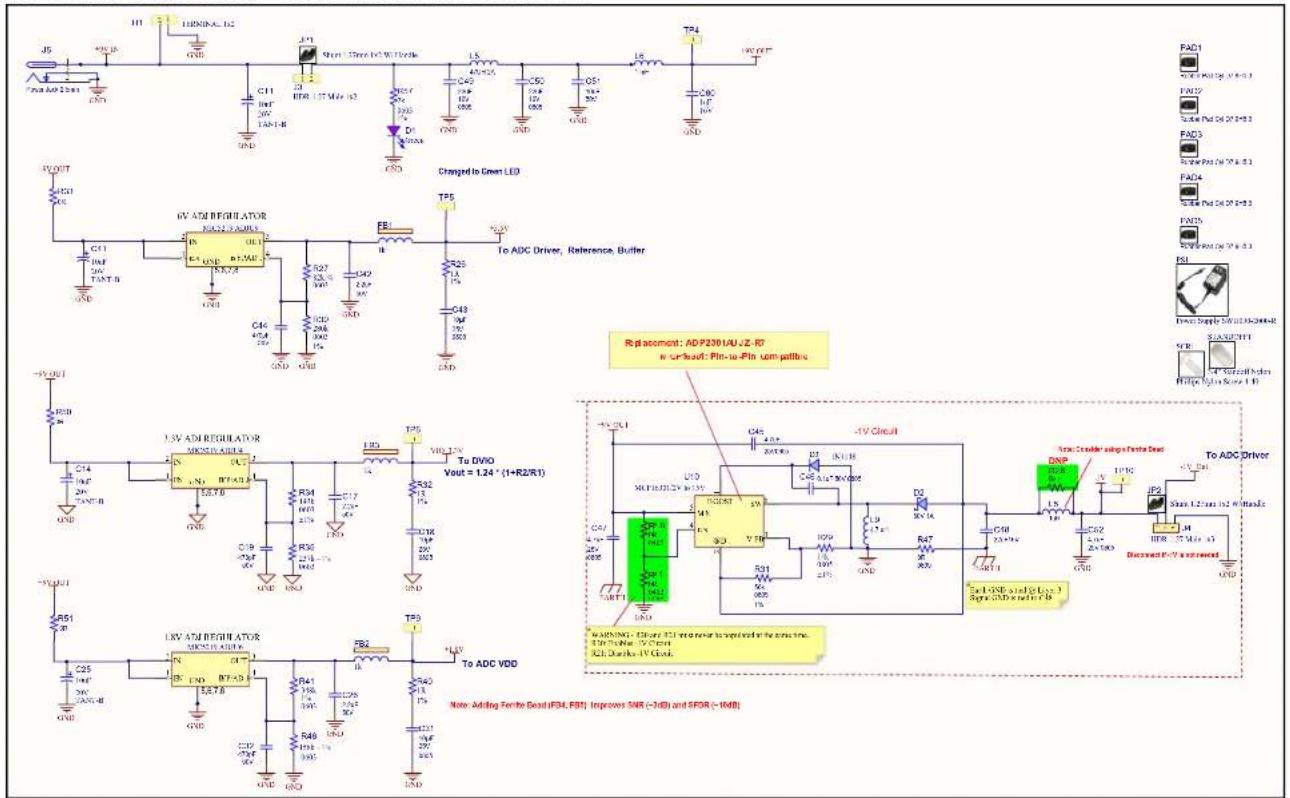
natural_image
Pure electrical circuit lines without any symbolsA.17 BOARD ADM00873 - BOTTOM COPPER LAYER
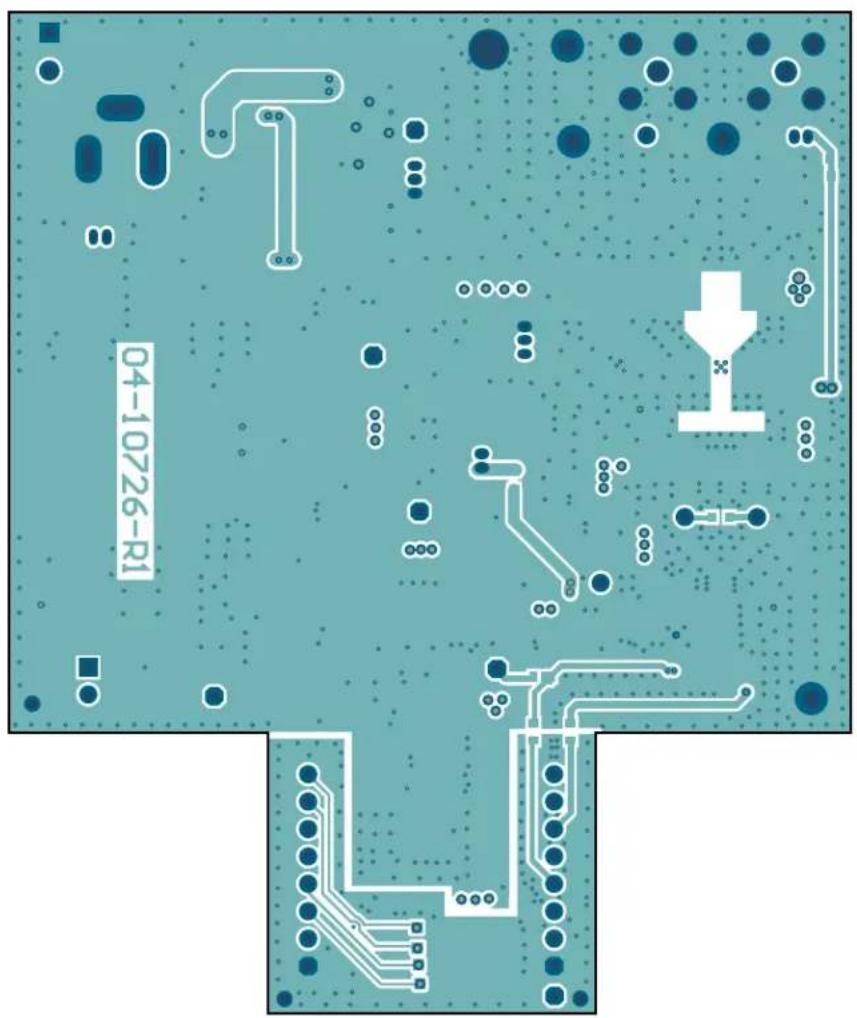
text_image
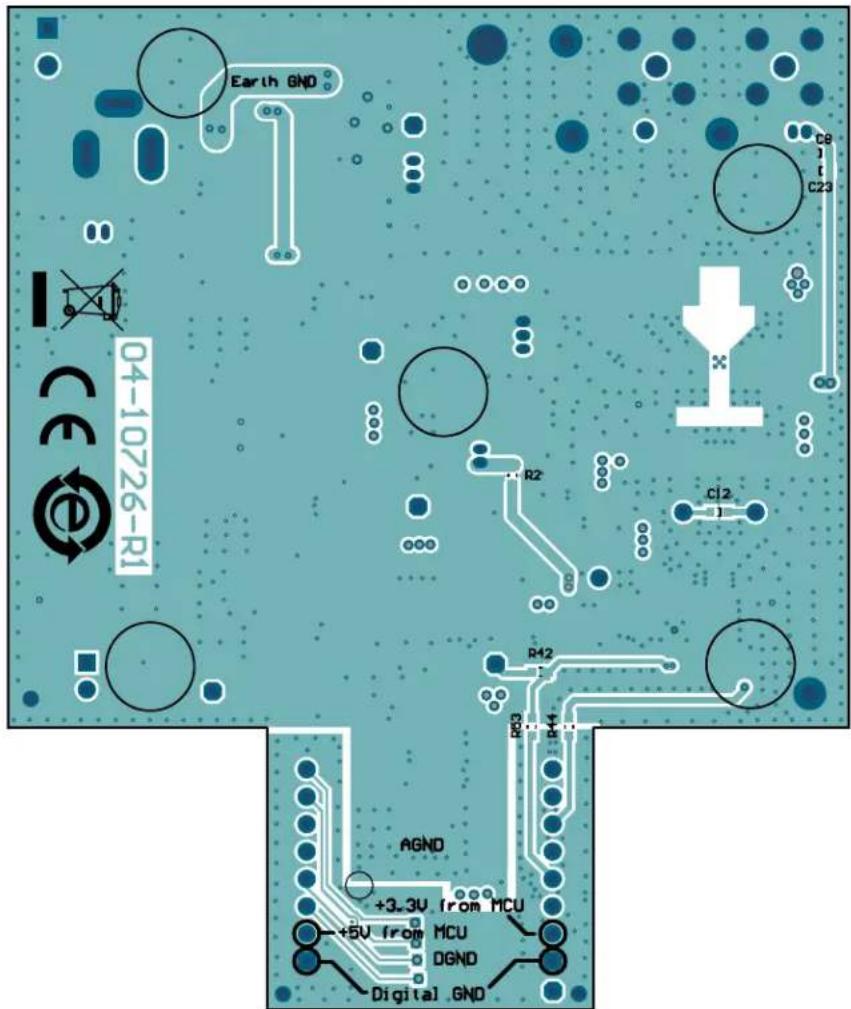
04-10726-R1A.18 BOARD ADM00873 - BOTTOM COPPER AND SILK LAYER
text_image
Earth GND 04-10726-R1 CE C8 1 C23 R2 Cl2 R42 R03 R44 AGND +3.3V from MCU +5V from MCU DGND Digital GNDA.19 BOARD ADM00873 - BOTTOM SILK LAYER
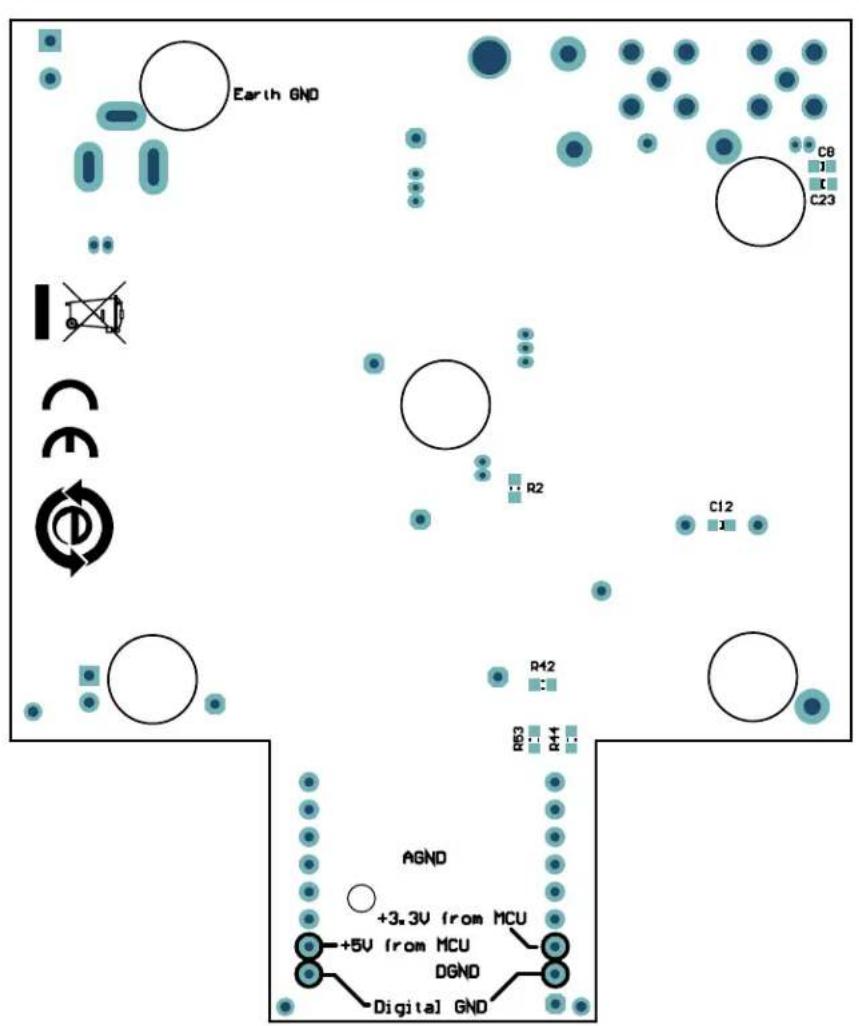
text_image
Earth GND C8 1 1 C23 R2 C12 R42 RB3 R44 AGND +3.3V from MCU +5V from MCU DGND Digital GNDNOTES:
Appendix B. Bill of Materials (BOM)
TABLE B-1: BILL OF MATERIALS (BOM) FOR ADM00872 (1)
| Qty. | Reference Description Manufacturer Part Number | |||
| 4 C1 | C10,C15, C59 | Capacitor ceramic 0.1 μF, 16V, 10%, X7R,SMD, 0603 | AVX Corporation 0603 | YC104KAT2A |
| 1 C12 | Capacitor ceramic, 0.1 μF, 16V, 10%, X7R,SMD, 0603DO NOT POPULATE | AVX Corporation 0603 | YC104KAT2A | |
| 4 C14 | C25,C41, CT1 | Capacitor tantalum 10 μF, 20V, 10%, 2.1Ω,SMD, 1210 | AVX Corporation TAJB | 106K020RNJ |
| 3 C17 | C26,C42 | Capacitor ceramic 2.2 μF, 50V, 10%, X7R,SMD, 1206 | TDK Corporation | CGA5L3X7R1H225K160AB |
| 3 C19 | C32,C44 | Capacitor ceramic 470 pF, 50V, 10%, X7R,SMD, 0603 | Johanson Dielectrics | 500R14W471KV4T |
| 6 C2 | C8, C9,C16, C20,C64 | Capacitor ceramic 1 μF, 16V, 10%, X7R,SMD, 0603 | SamsungElectro-MechanicsAmerica, Inc. | CL10B105KA8NNNC |
| 1 C3 | Capacitor ceramic 22 μF, ±10%, 25V, X5R,1206 | Murata ElectronicsNorth America, Inc. | GRM31CR61E226KE15L | |
| 2 C33 | C34 | Capacitor ceramic, 0.062 μF, 1206, CER,50V, 5%, COGDO NOT POPULATE | Murata ElectronicsNorth America, Inc. | GRM31C5C1H623JA01L |
| 2 C35 | C37 | Capacitor ceramic 2200 pF, 50V, C0G, NP0,0603 (1608 Metric) 0.063" L x 0.031 | Murata ElectronicsNorth America, Inc. | GRM1885C1H222FA01D |
| 3 C4 | C7, C11 | Capacitor ceramic, 100 pF, 25V, 10%, NP0,SMD, 0603 | AVX Corporation 0603 | 3A101KAT2A |
| 3 C45 | C47,C52 | Capacitor ceramic 4.7 μF, 25V, 10%, X7R,SMD, 0805 | TDK Corporation | C2012X7R1E475K125AB |
| 1 C46 | Capacitor ceramic 0.1 μF, 50V, 10%, X7R,SMD, 0805 | Yageo Corporation | CC0805KRX7R9BB104 | |
| 1 C48 | Capacitor ceramic 22 μF, 16V, 20%, X5R,SMD, 1206 | SamsungElectro-MechanicsAmerica, Inc. | CL31A226KOCLFNC | |
| 2 | C49, C50 | Capacitor ceramic 22 μF, 16V, X5R, 0805 | TDK Corporation | C2012X5R1C226K125AC |
| 4 C5 | C18,C31, C43 | Capacitor ceramic 10 μF, ±10%, 25V, X5R,MLCC, 0805 | Murata ElectronicsNorth America, Inc | GRM219R61E106KA12D |
| 1 C51 | Capacitor ceramic 10 μF, 50V, 20%, X7S,SMD, 1210 | TDK Corporation | C3225X7S1H106M | |
| 1 C6 | Capacitor tantalum 10 μF, 16V, 20%, 8Ω,SMD, A | KEMET | T491A106M016AT | |
| 1 C60 | Capacitor ceramic 1 μF, 16V, 10%, X7R,SMD, 0603 | Yageo Corporation | CC0603KRX7R7BB105 | |
| 1 D1 | Diode LED Red, 2V, 30 mA, 2 mcd, clear,SMD, 0603 | Lite-On®, Inc. | LTST-C190EKT | |
| Qty. | Reference | Description | Manufacturer | Part Number |
| 1 D2 | Diode schottky, 30V, 1A, POWERDI323 Diodes | Incorporated® | PD3S130L-7 | |
| 1 D3 | Diode rectifier, 1N4148, 855 mV, 300 mA, 75V, SOD-323DO NOT POPULATE | Diodes Incorporated 1 | N4148WS-7-F | |
| 7 | F B FB3, FB4, FB5, FB6, FB7 | Ferrite bead, 1R , 0B03, 12N Wurth Elektronik | 742792662 | |
| 4 GND1, GND2, GND3, GND4 | Connector TP, Loop, Black, TH Keystone Electronics Corp. | 5011 | ||
| 1 H1 | Connector terminal, 3.5 mm, 6A Female, 1 x 2 TH, R/A | Keystone Electronics Corp. | 8722 | |
| 3 IN1+, IN1-, TP7 | Connector header-2.54, Male, 1x1, Gold, 5.97MH, TH, Vertical DO NOT POPULATE | Samtec, Inc. TSW-101 | -07-L-S | |
| 2 J1, J2 Connector | radio frequency, Coaxial, SMA Female, TH, R/A | TE Connectivity, Ltd. | 5-1814400-1 | |
| 2 J10_A, J10_B | Connector header-2.54 Male, 1x8, Gold, 5.84MH, TH | FCI | 68001-108HLF | |
| 2 J3, J6 Connector | header, 1.27 mm, T/H, Gold, 2 POS | Harwin Plc. | M50-3530242 | |
| 2 | J4, J8 | Connector header, 1.27 mm, T/H, AU, 3 POS | Harwin Plc. | M50-3530342 |
| 1 | J5 | Connector power, Jack Male, 2.5 mm, CLSD | CUI Inc. | PJ-002B |
| 1 | L5 | Fixed inductor, 47 H, 2A, 135 m , SMD | Bourns®, Inc. | SRR1240-470M |
| 1 | L6 | Fixed inductor, 1 mH, 250 mA 6 , TH | Wurth Elektronik | 7447462102 |
| 1 | L8 | Fixed inductor, 1 H, 1A, 60 m , SMD | Murata Electronics North America, Inc | QH32CN1R0M33L |
| 1 | L9 | Fixed Shielded Power Inductor, 4.7 H | Coilcraft | LPS3015-472MRB |
| 1 PCB1 | MC P331x1 16/14/12-Bit 1 Msps SAR ADC Evaluation Board Printed Circuit Board | Microchip Technology Inc. | 04-10724-R1 | |
| 2 R1 | R9 Resistor TF, 20R, 1%, 1/16W, SMD, 0603 Stackpole Electronics, Inc. | RNCP0603FTD20R0 | ||
| 2 R10, R11 Resistor TF, 10k, 0.1%, 1/10W, SMD, 0603 Panasonic ® - ECG | ERA-3AEB103V | |||
| 5 R12, R14, R15, R16, R17 | Resistor TKF, 10k, 5%, 1/10W, SMD, 0603 | Panasonic - ECG | ERJ-3GEYJ103V | |
| 1 R13 Resistor TKF, 30k, 1%, 1/10W, SMD, 0603 Stackpole Electronics, Inc. | RMCF0603FT30K0 | |||
| 2 | R18, R19 | Resistor TKF, 0R, SMD, 0402 | Panasonic - ECG | ERJ-2GE0R00X |
| 8 R2 | R25, R33, R36, R37, R44, R48, R49 | Resistor TKF, 0R, 1/10W, SMD, 0603 | Panasonic - ECG | ERJ-3GSY0R00V |
| 1 | R20 | Resistor TKF, 0R, 1/16W, SMD, 0402 | Yageo Corporation | RC0402JR-070RL |
| 1 R21 | Resistor TKF, 0R, 1/16W, SMD, 0402DO NOT POPULATE | Yageo Corporation RC0402JR-070RL | ||
| 3 R22, R23, R24 | Resistor TKF, 0R, SMD, 0402DO NOT POPULATE | Panasonic - ECG ERJ-2GE0R00X | ||
| 3 R26, R32, R40 | Resistor TKF, 1R, 1%, 1/10W, SMD, 0603 ROHMSemiconductor | KTR03EZPF1R00 | ||
| 1 R27 | Thick Film Resistors, SMD, 0805, 82 kΩ, 1%, Anti-Surge, AEC-Q200 | Panasonic - ECG ERJ-P6WF8202V | ||
| 1 R28 | Resistor, TFK, 35.7 kΩ, 1%, 1/10W, SMD, 0603DO NOT POPULATE | Vishay/Dale CRCW060335K7FKEA | ||
| 1 | R29 | Resistor, SMD, 14 kΩ, 1%, 1/8W, 0805 | Panasonic - ECG | ERJ-6ENF1402V |
| 2 | R3, R8 | Resistor TKF, 24R, 1%, 1/10W, SMD, 0603 | Yageo Corporation | RC0603FR-0724RL |
| 2 R30, R41 | Resistor, TKF, 348k, 1/10W, 1%, SMD, 0603 Stackpole Electronics, Inc. | RMCF0603FT348K | ||
| 1 | R31 | Resistor TKF, 56k, 1%, 1/8W, SMD, 0805 | Vishay/Dale | CRCW080556K0FKEA |
| 1 | R34 | Resistor, SMD, 143 kΩ, 1%, 1/10W, 0603 | Bourns, Inc. | CR0603-FX-1433ELF |
| 1 R35 | Resistor, SMMD, 237 kΩ, 1%, 1/10W, 0603 Stackpole Electronics, Inc. | RMCF0603FT237K | ||
| 3 R38, R42, R43 | Resistor TKF, 33R, 5%, 1/10W, SMD, 0603 | Panasonic - ECG | ERJ-3GEYJ330V | |
| 1 R39 | Resistor, TKF, 33R, 5%, 1/10W, SMD, 0603DO NOT POPULATE | Panasonic - ECG ERJ-3GEYJ330V | ||
| 4 R4, R5, R6, R7 | Resistor TF, 1k, 0.1%, 1/10W, SMD, 0603 | Panasonic - ECG | ERA-3AEB102V | |
| 1 R46 | Resistor TKF, 158k, 1%, 1/10W, SMD, 0603 Yageo Corporation RC0603FR-07158KL | |||
| 1 R47 | Resistor TKF, 0R, 1/8W, SMD, 0805 Panasonic - ECG ERJ-6GEY0R00V | |||
| 1 | R57 | Resistor TKF, 2k, 1%, 1/10W, SMD, 0603 | Panasonic - ECG | ERJ-3EKF2001V |
| 1 | SW1 | Switch DIP, 4-POS, SLIDE, SMD, 6V | Nidec Copal Electronics, Inc. | CHS-04TB |
| 7 | TP1, TP4, TP5, TP6, TP8, TP9, TP10 | Connector header-2.54 Male, 1x1, Gold, 5.97MH, TH, Vertical | Samtec, Inc. | TSW-101-07-L-S |
| 1 | U1 | IC OP-AMP, Differential, RRO LFCSP-16 | Analog Devices Inc. | ADA4940-1ACPZ-R7 |
| 1 U2 | IC POWER, VREF, MSOP-8 Linear Technology Corporation | LTC6655BHMS8-5#PBF | ||
| 1 U3 | MCP33131D-10-I/MS Microchip Technology Inc. | MCP33131D-10-I/MS | ||
| 3 U4 | U6, U9 Microchip Analog LDO, 2.5V-5V, MSOP-8 Microchip Technology Inc. | MIC5219YMM | ||
| 1 U10 | Microchip Analog Switcher, Buck 2V to 15V, SOT-23-6 | Microchip Technology Inc. | MCP16301T-E/CH | |
Note 1: The components listed in this Bill of Materials are representative of the PCB assembly. The released BOM used in manufacturing uses all RoHS-compliant components.
TABLE B-2: BILL OF MATERIALS (BOM) - MECHANICAL PARTS FOR ADM00872 (1)
| Qty. | Reference Description | Manufacturer Part Number | ||
| 3 JP1 | JP2, JP3 1.27 mm Jumper at Pins 1 and 2 of J81.27 mm Jumper at Pins 1 and 2 of J31.27 mm Jumper at Pins 1 and2 of J4 | Harwin Plc. M50-2000 | 005 | |
| 1 LABEL1 Microchip Technology Product Label | ||||
| 5 PAD1 | PAD2, PAD3, PAD4, PAD5 | Mechanical Hardware Rubber Pad, Cylindrical, D7.9, H5.3, Black | 3M SJ61A11 | |
| 1 | PS1 | 100-240V, Wall Plug-in, Power Supply | Triad Magnetics | WSU090-2000-13 |
| 1 SCR1 | Mechanical Hardware Machine Screw, PAN Phillips, 4-40, Nylon | Digi-Key® Electronics | H544-ND | |
| STANDOFF1 | Mechanical HW Standoff, #4-40 x 3/4", F/F, HEX, Nylon | Keystone Electronics Corp. | 1902D | |
Note 1: The components listed in this Bill of Materials are representative of the PCB assembly. The released BOM used in manufacturing uses all RoHS-compliant components.
TABLE B-3: BILL OF MATERIALS (BOM) FOR ADM00873 ^(1)
| Qty. | Reference Description | Manufacturer | Part Number | |
| 4 | C1, C10, C15, C59 | Capacitor ceramic 0.1 μF, 16V, 10%, X7R, SMD, 0603 | AVX Corporation | 0603YC104KAT2A |
| 1 C12 | Capacitor ceramic, 0.1 μF, 16V, 10%, X7R, SMD, 0603DO NOT POPULATE | AVX Corporation | 0603YC104KAT2A | |
| 4 | C13, C18, C31, C43 | Capacitor ceramic 10 μF, ±10%, 25V, X5R, MLCC, 0805 | Murata Electronics North America, Inc. | GRM219R61E106-KA12D |
| 4 | C14, C25, C41, CT1 | Capacitor tantalum 10 μF, 20V, 10%, 2.1Ω, SMD, B | AVX Corporation TA | JB106K020RNJ |
| 3 C17, C26, C42 | Capacitor ceramic 2.2 μF, 50V, 10%, X7R, SMD, 1206 | TDK Corporation CG | A5L3X7R1H225K160AB | |
| 3 C19, C32, C44 | Capacitor ceramic 470 pF, 50V, 10%, X7R, SMD, 0603 | Johanson Dielectrics | 500R14W471KV4T | |
| 11 | C2, C3, C4, C8, C9, C11, C16, C20 C22, C60, C64 | Capacitor ceramic 1 μF, 25V, X7R, 0603 | Samsung Electro-Mechanics America, Inc. | CL10B105KA8NNNC |
| 1 C21 | Capacitor tantalum 22 μF, 16V, 10%, 2.3Ω, SMD, B | AVX Corporation | TAJB22226K016R | |
| 2 C33, C34 | Capacitor ceramic, 0.062 μF, 1206, CER, 50V, 5%, COGDO NOT POPULATE | Murata Electronics North America, Inc. | GRM31C5C1H623-JA01L | |
| 2 C35, C37 | Capacitor ceramic 2200 pF, 50V, C0G, NP0, 0603 (1608 Metric) 0.063" L x 0.031 | Murata Electronics North America, Inc. | GRM1885C1H222-FA01D | |
| 3 C45, C47, C52 | Capacitor ceramic 4.7 uF, 25V, 10%, X7R, SMD, 0805 | TDK Corporation | C2012X7R1E475K125 AB | |
| 1 C46 | Capacitor ceramic 0.1 uF, 50V, 10%, X7R, SMD, 0805 | Yageo Corporation | CC0805KRX-7R9BB104 | |
| 1 C48 | Capacitor ceramic 22 uF, 16V, 20%, X5R, SMD, 1206 | Samsung Electro-Mechanics America, Inc. | CL31A226KOCLFNC | |
| 2 C49, C50 | Capacitor tantalum 100 uF, 20V, 10%, 140 mΩ, SMD, R | Vishay/Dale | 595D107X9020R2T | |
| Qty. | Reference | Description | Manufacturer | Part Number |
| 1 C5 | Capacitor ceramic 2.2 u | F, 16V, 10%, X5R, SMD, 0603 | TDK Corporation C1 | 608X5R1C225K |
| 1 C51 | Capacitor ceramic 10 μ | F, 50V, 20%, X7S, SMD, 1210 | TDK Corporation C3 | 225X7S1H106M |
| 1 C6 | Capacitor tantalum 10 μ | F, 16V, 20%, 8Ω, SMD, A | KEMET T491A106M | 016AT |
| 2 C7 | C23 Capacitor ceramic | 100 pF, 25V, 10%, NP0, SMD, 0603 | AVX Corporation 06 | 033A101KAT2A |
| 1 D1 | Diode LED Red, 2V, 30 | mA, 2 mcd, clear, SMD, 0603 | Lite-On®, Inc. LTST- | C190EKT |
| 1 D2 | Diode schottky, 30V, 1A | POWERDI323 Diodes | Incorporated® | PD3S130L-7 |
| 1 D3 | Diode rectifier, 1N4148, | 855 mV, 300 mA, 75V, SOD-323 | Diodes Incorporated® | 1N4148WS-7-F |
| 1 | D4 | Diode array, 1.1V, 200 mA, 200V, SMD, SOT-23-3 | Fairchild Semiconductor® | MMBD1503A |
| 8 FB1 | FB2, FB3, FB4, FB5, FB6, FB7, FB8 | Ferrite bead, 1 kΩ, 0603, 1LN | Wurth Elektronik | 742792662 |
| 4 GND1 | GND2, GND3, GND4 | Connector TP, Loop, Black, TH | Keystone Electronics Corp. | 5011 |
| 1 H1 | Connector terminal, 3.5 | mm, 6A Female, 1 x 2 TH, R/A | Keystone Electronics Corp. | 8722 |
| 3 IN1 | +, IN1-, TP7 | Connector header-2.54, Male, 1x1, Gold, 5.97MH, TH, Vertical DO NOT POPULATE | Samtec, Inc. | TSW-101-07-L-S |
| 2 J1 | J2 | Connector radio frequency, Coaxial, SMA, Female, TH, R/A | TE Connectivity, Ltd. | 5-1814400-1 |
| 2 J10 | _A, J10_B | Connector header-2.54 Male, 1x8, Gold, 5.84MH, TH | FCI | 68001-108HLF |
| 3 J3 | J6, J7 | Connector header-1.27 Male, 1x2, Gold, TH, Vertical | Harwin PI | M50-3530242 |
| 2 J4 | J8 | Connector header, 1.27 mm, T/H, AU, 3 POS | Harwin Plc. | M50-3530342 |
| 1 J5 | Connector Power, Jack Male, 2.5 mm, CLSD | CUI Inc. | PJ-002B | |
| 1 L5 | Fixed inductor, 47 μH, 2A, 135 mΩ, SMD | Bourns®, Inc. | SRR1240-470M | |
| 1 | L6 | Fixed inductor, 1 mH, 250 mA 6Ω, TH | Wurth Elektronik | 7447462102 |
| 1 | L8 | Fixed inductor, 1 μH, 1A, 60 mΩ, SMD | Murata Electronics North America, Inc | LQH32CN1R0M33L |
| 1 | L9 | Fixed Shielded Power Inductor, 4.7 μH | Coilcraft | LPS3015-472MRB |
| 1 PCB1 | MC | P331x1 16/14/12-Bit 1 Msps SAR ADC Evaluation Board Printed Circuit Board | Microchip Technology Inc. | 04-10726-R1 |
| 2 R1 | R9 | Resistor TF, 20R, 1%, 1/16W, SMD, 0603 | Stackpole Electronics, Inc. | RNCP0603FTD20R0 |
| 2 R10 | R11 | Resistor TF, 10k, 0.1%, 1/10W, SMD, 0603 | Panasonic® - ECG | ERA-3AEB103V |
| 1 R12 | Resistor TF, 10k, 1%, | 1/16W, SMD, 0603 | TE Connectivity, Ltd. | 5-1879337-9 |
| 1 R13 | Resistor TKF, 30k, 5%, | 1/10W, SMD, 0603 | Panasonic® - ECG | ERJ-3GEYJ303V |
| 4 R14 | R15, R16, R17 Resistor | TKF, 10k, 5%, 1/10W, SMD, 0603 | Panasonic® - ECG | ERJ-3GEYJ103V |
| 2 R18 | R19 Resistor TKF, 0R | SMD, 0402 Panasonic | ® - ECG | ERJ-2GE0R00X |
| 1 R2 | Resistor TKF, 0R, 1/10W | SMD, 0603DO NOT POPULATE | Panasonic® - ECG | ERJ-3GSY0R00V |
| 1 R20 | R39 Resistor TKF, 0R | 1/16W, SMD, 0402 Yageo Corporation | RC0402JR-070RL | |
| 2 R21 | R45 Resistor TKF, 0R | 1/16W, SMD, 0402DO NOT POPULATE | Yageo Corporation | RC0402JR-070RL |
| 1 R25 | Resistor TKF, 7.15K, 1% | 1/10W, SMD, 0603 | Panasonic® - ECG | ERJ-3EKF7151V |
| 3 R22 | R23, R24 Resistor TKF | 0R, SMD, 0402DO NOT POPULATE | Panasonic® - ECG | ERJ-2GE0R00X |
| 3 R26 | R32, R40 Resistor TKF | 1R, 1%, 1/10W, SMD, 0603 | ROHM Semiconductor | KTR03EZPF1R00 |
| 1 R27 | Resistor TKF, 82K, 1% | 1/10W, SMD, 0603 | Panasonic® - ECG | ERJ-3EKF8202V |
| 1 R28 | Resistor, TFK, 35.7 kΩ | 1%, 1/10W, SMD, 0603DO NOT POPULATE | Vishay/Dale CRCW0 | 60335K7FKEA |
| 1 R29 | Resistor TKF, 14k, 1% | 1/8W, SMD, 0805 | Panasonic® - ECG | ERJ-6ENF1402V |
| 2 R3 | R8 | Resistor TKF, 24R, 1%, 1/10W, SMD, 0603 | Yageo Corporation | RC0603FR-0724RL |
| 1 R30 | Resistor TKF, 280k, 1% | 1/10W, SMD, 0603 | Panasonic® - ECG | ERJ-3EKF2803V |
| 1 R31 | Resistor TKF, 56k, 1% | 1/8W, SMD, 0805 | Vishay/Dale CRCW0 | 80556K0FKEA |
| 8 R33 | R38, R42, R48, R49, R50, R51, R56 | Resistor TKF, 0R, 1/10W, SMD, 0603 | Panasonic® - ECG | ERJ-3GSY0R00V |
| 1 R34 | Resistor, SMD, 143 kΩ | 1%, 1/10W, 0603 | Bourns®, Inc. | CR0603-FX-1433ELF |
| 1 R35 | Resistor, SMD, 237 kΩ | 1%, 1/10W, 0603 | Stackpole Electronics, Inc. | RMCF0603FT237K |
| 1 R36 | Resistor TKF, 10.5R, 1% | 1/10W, SMD, 0603 | Vishay/Dale CRCW0 | 60310R5FKEA |
| 1 R39 | Resistor, TKF, 33R, 5% | 1/10W, SMD, 0603DO NOT POPULATE | Panasonic® - ECG | ERJ-3GEYJ330V |
| 5 R4 | R5, R6, R7, R37 | Resistor TF, 1k, 0.1%, 1/10W, SMD, 0603 | Panasonic® - ECG | ERA-3AEB102V |
| 1 R41 | Resistor TKF, 348k, 1/10W, 1%, SMD, 0603 | Stackpole Electronics, Inc. | RMCF0603FT348K | |
| 1 R43 | Resistor TKF, 13.3k, 1% | 1/10W, SMD, 0603 | Stackpole Electronics, Inc. | RMCF0603FT13K3 |
| 4 R44 | R53, R54, R55 Resistor TKF, 33R, 1%, 1/10W, SMD, 0603 | ROHM Semiconductor | MCR03EZPFX33R0 | |
| 1 R46 | Resistor TKF, 158k, 1%, 1/10W, SMD, 0603 | Yageo Corporation | RC0603FR-07158KL | |
| 1 R47 | Resistor TKF, 0R, 1/8W, SMD, 0805 Panasonic | ® - ECG ERJ-6GEY0R00V | ||
| 1 R52 | Resistor TKF, 47k, 1%, 1/10W, SMD, 0603 | Panasonic® - ECG ERJ-3EKF4702V | ||
| 1 R57 | Resistor TKF, 2k, 1%, 1/10W, SMD, 0603 | Panasonic® - ECG ERJ-3EKF2001V | ||
| 1 SW1 | Switch DIP, 4-POS, SLIDE, SMD, 6V Copal Electronics | Inc. | CHS-04TB | |
| 7 TP1 | TP4, TP5, TP6, TP8, TP9, TP10 | Connector header-2.54 Male, 1x1, Gold, 5.97MH, TH, Vertical | Samtec, Inc. TSW-101-07-L-S | |
| 1 U1 | IC OP-AMP, Differential, RROLFCSP-16 | Analog Devices Inc. | ADA4940-1ACPZ-R7 | |
| 1 U2 | Microchip Analog, VREF, 4.096V, SOT-23-6 | Linear Technology Corporation | MCP1501T-40E/CHY | |
| 1 U3 | MCP33131D-10-I/MS Microchip | Technology Inc. | MCP33131D-10-I/MS | |
| 3 U4 | U6, U9 Microchip Analog LDO, 2.5V-5V, MSOP-8 | Microchip Technology Inc. | MIC5219YMM | |
| 1 U5 | IC Op Amp GP, 3.5 MHz, RRO, SOT23-5 | Microchip Technology Inc. | MCP6286T-E/OT | |
| 1 U10 | Microchip Analog Switcher, Buck 2V to 15V, SOT-23-6 | Microchip Technology Inc. | MCP16301T-I/CHY | |
Note 1: The components listed in this Bill of Materials are representative of the PCB assembly. The released BOM used in manufacturing uses all RoHS-compliant components.
TABLE B-4: BILL OF MATERIALS (BOM) - MECHANICAL PARTS FOR ADM00873 (1)
| Qty. | Reference | Description | Manufacturer | Part Number | |
| 3 JP1 | JP2, JP3 | 1.2 | 7 mm Jumper at Pins 1 and 2 of J81.27 mm Jumper at Pins 1 and 2 of J31.27 mm Jumper at Pins 1 and 2 of J4 | Harwin Plc. | M50-2000005 |
| 1 LABEL1 | Microchip Technology Product Label | ||||
| 5 PAD | D1, PAD2, PAD3,PAD4, PAD5 | Mechanical Hardware Rubber Pad,Cylindrical, D7.9, H5.3, Black | 3M | SJ61A11 | |
| 1 | PS1 | 100-240V, Wall Plug-in Power Supply | Triad Magnetics | WSU090-2000-13 | |
| 1 SCR1 | Mechanical Hardware Machine Screw,PAN Phillips, 4-40, Nylon | Digi-Key ^ Electronics | H544-ND | ||
| STANDOFF1 | Mechanical HW Standoff, #4-40 x 3/4",F/F, HEX, Nylon | Keystone Electronics Corp. | 1902D | ||
Note 1: The components listed in this Bill of Materials are representative of the PCB assembly. The released BOM used in manufacturing uses all RoHS-compliant components.
NOTES:
Worldwide Sales and Service
AMERICAS
Corporate Office
2355 West Chandler Blvd. Chandler, AZ 85224-6199
Tel: 480-792-7200
Fax: 480-792-7277
Technical Support:
http://www.microchip.com/
support
Web Address:
www.microchip.com
Atlanta
Duluth, GA
Tel: 678-957-9614
Fax: 678-957-1455
Austin, TX
Tel: 512-257-3370
Boston
Westborough, MA
Tel: 774-760-0087
Fax: 774-760-0088
Chicago
Itasca, IL
Tel: 630-285-0071
Fax: 630-285-0075
Dallas
Addison, TX
Tel: 972-818-7423
Fax: 972-818-2924
Detroit
Novi, MI
Tel: 248-848-4000
Houston, TX
Tel: 281-894-5983
Indianapolis
Noblesville, IN
Tel: 317-773-8323
Fax: 317-773-5453
Tel: 317-536-2380
Los Angeles
Mission Viejo, CA
Tel: 949-462-9523
Fax: 949-462-9608
Tel: 951-273-7800
Raleigh, NC
Tel: 919-844-7510
New York, NY
Tel: 631-435-6000
San Jose, CA
Tel: 408-735-9110
Tel: 408-436-4270
Canada - Toronto
Tel: 905-695-1980
Fax: 905-695-2078
ASIA/PACIFIC
Australia - Sydney
Tel: 61-2-9868-6733
China - Beijing
Tel: 86-10-8569-7000
China - Chengdu
Tel: 86-28-8665-5511
China - Chongqing
Tel: 86-23-8980-9588
China - Dongguan
Tel: 86-769-8702-9880
China - Guangzhou
Tel: 86-20-8755-8029
China - Hangzhou
Tel: 86-571-8792-8115
China - Hong Kong SAR
Tel: 852-2943-5100
China - Nanjing
Tel: 86-25-8473-2460
China - Qingdao
Tel: 86-532-8502-7355
China - Shanghai
Tel: 86-21-3326-8000
China - Shenyang
Tel: 86-24-2334-2829
China - Shenzhen
Tel: 86-755-8864-2200
China - Suzhou
Tel: 86-186-6233-1526
China - Wuhan
Tel: 86-27-5980-5300
China - Xian
Tel: 86-29-8833-7252
China - Xiamen
Tel: 86-592-2388138
China - Zhuhai
Tel: 86-756-3210040
ASIA/PACIFIC
India - Bangalore
Tel: 91-80-3090-4444
India - New Delhi
Tel: 91-11-4160-8631
India - Pune
Tel: 91-20-4121-0141
Japan - Osaka
Tel: 81-6-6152-7160
Japan - Tokyo
Tel: 81-3-6880-3770
Korea - Daegu
Tel: 82-53-744-4301
Korea - Seoul
Tel: 82-2-554-7200
Malaysia - Kuala Lumpur
Tel: 60-3-7651-7906
Malaysia - Penang
Tel: 60-4-227-8870
Philippines - Manila
Tel: 63-2-634-9065
Singapore
Tel: 65-6334-8870
Taiwan - Hsin Chu
Tel: 886-3-577-8366
Taiwan - Kaohsiung
Tel: 886-7-213-7830
Taiwan - Taipei
Tel: 886-2-2508-8600
Thailand - Bangkok
Tel: 66-2-694-1351
Tel: 43-7242-2244-39
Fax: 43-7242-2244-393
Denmark - Copenhagen
Tel: 45-4450-2828
Fax: 45-4485-2829
Finland - Espoo
Tel: 358-9-4520-820
France - Paris
Tel: 33-1-69-53-63-20
Fax: 33-1-69-30-90-79
Germany - Garching
Tel: 49-8931-9700
Germany - Haan
Tel: 49-2129-3766400
Germany - Heilbronn
Tel: 49-7131-67-3636
Germany - Karlsruhe
Tel: 49-721-625370
Germany - Munich
Tel: 49-89-627-144-0
Fax: 49-89-627-144-44
Germany - Rosenheim
Tel: 49-8031-354-560
Israel - Ra'anana
Tel: 972-9-744-7705
Italy - Milan
Tel: 39-0331-742611
Fax: 39-0331-466781
Italy - Padova
Tel: 39-049-7625286
Netherlands - Drunen
Tel: 31-416-690399
Fax: 31-416-690340
Norway - Trondheim
Tel: 47-7289-7561
Poland - Warsaw
Tel: 48-22-3325737
Romania - Bucharest
Tel: 40-21-407-87-50
Spain - Madrid
Tel: 34-91-708-08-90
Fax: 34-91-708-08-91
Sweden - Gothenberg
Tel: 46-31-704-60-40
Sweden - Stockholm
Tel: 46-8-5090-4654
UK - Wokingham
Tel: 44-118-921-5800
Fax: 44-118-921-5820