E320-C0E - TV VIZIO - Free user manual and instructions
Find the device manual for free E320-C0E VIZIO in PDF.


| Product Type | LED LCD TV |
| Brand | VIZIO |
| Model | E320-C0E |
| Screen Size | 32 inches (diagonal) |
| Display Technology | LED-backlit LCD |
| Resolution | 1366 x 768 (HD) |
| Refresh Rate | 60 Hz (effective) |
| Smart TV Platform | VIZIO Internet Apps (VIA) |
| Built-in Wi-Fi | Yes |
| HDMI Inputs | 2 |
| USB Ports | 1 |
| Composite Input | 1 (shared) |
| Audio Output | Digital optical audio out |
| Speaker Power | 2 x 5W |
| Power Consumption (typical) | 45 W |
| Stand Included | Yes |
| VESA Mount Pattern | 200 x 200 mm |
| Dimensions with Stand (WxHxD) | 28.9 x 19.6 x 7.2 inches |
| Weight with Stand | 12.5 lbs |
| Energy Star Certified | Yes |
| Remote Control | IR remote included |
| Cleaning Instructions | Wipe screen with dry microfiber cloth; do not use liquids |
Frequently Asked Questions - E320-C0E VIZIO
User questions about E320-C0E VIZIO
0 question about this device. Answer the ones you know or ask your own.
Ask a new question about this device
Download the instructions for your TV in PDF format for free! Find your manual E320-C0E - VIZIO and take your electronic device back in hand. On this page are published all the documents necessary for the use of your device. E320-C0E by VIZIO.
USER MANUAL E320-C0E VIZIO
natural_image
Large black TV displaying a red hexagonal patterned screen (no text or symbols visible)USER MANUAL
Model: E320-COE

DOLBY DIGITAL
Manufactured under license from Dolby Laboratories. Dolby and the double-D symbol are trademarks of Dolby Laboratories.

dts® TruSurround
For DTS patents, see
http://patents.dts.com.
Manufactured under license from DTS Licensing Limited. DTS, the Symbol, & DTS and the Symbol together are registered trademarks, and DTS Studio Sound is a trademark of DTS, Inc. © DTS, Inc. All Rights Reserved.

HIGH-DEFINITION MULTIMEDIA INTERFACE
HDMI, the HDMI logo and High-Definition Multimedia Interface are trademarks or registered trademarks of HDMI Licensing LLC.

This product qualifies for ENERGY STAR in the "factory default" setting and this is the setting in which power savings will be achieved. Changing the factory default picture settings or enabling other features will increase power consumption that could exceed the limits necessary to qualify for ENERGY STAR rating. For more information on the ENERGY STAR program, refer to www.energystar.gov.
Welcome
THANK YOU FOR CHOOSING VIZIO
Congratulations on the purchase of your new VIZIO HDTV.
To get the most out of your new VIZIO product, read these instructions before using your product and retain them for future reference. Be sure to inspect the package contents to ensure there are no missing or damaged parts.
PRODUCT REGISTRATION
To purchase or inquire about accessories and installation services for your VIZIO product, visit our website at www.VIZIO.com or call toll free at (877) 698-4946.
We recommend that you either:
Extended Warranties
For peace of mind, and to protect your investment beyond the standard warranty, VIZIO offers on-site extended warranty service plans. These plans provide additional coverage during the standard warranty period. To purchase an extended warranty service plan, visit www.VIZIO.com.
WHEN READING THIS MANUAL

When you see this symbol, please read the accompanying important warning or notice. It is intended to alert you to the presence of important operating instructions.

When you see this symbol, please read the accompanying helpful tip.
IMPORTANT SAFETY INSTRUCTIONS
Your TV is designed and manufactured to operate within defined design limits. Misuse may result in electric shock or fire. To prevent your TV from being damaged, the following instructions should be observed for the installation, use, and maintenance of your TV. Read the following safety instructions before operating your TV. Keep these instructions in a safe place for future reference.
damage, switch off the power before connecting other components to your TV.
accordance with the manufacturer's instructions.
heat registers, stoves, or other apparatus (including amplifiers) that produce heat.
grounding-type plug. A polarized plug has two blades with one wider than the other. A grounding type plug has two blades and a third grounding prong. The wide blade or the third prong are provided for your safety. If the provided plug does not fit into your outlet, consult an electrician for replacement of the obsolete outlet.
particularly at plugs, convenience receptacles, and the point where they exit from the apparatus.
manufacturer.
or table specified by the manufacturer, or sold with the apparatus. When a cart is used, use caution when moving the cart/apparatus combination to avoid injury from tip-over.

unused for long periods of time.
is required when the apparatus has been damaged in any way, such as power-supply cord or plug is damaged, liquid has been spilled or objects have fallen into the apparatus, the apparatus has been exposed to rain or moisture, does not operate normally or has been dropped.
to an area of high temperature, condensation may form in the housing. Wait before turning on your TV to avoid causing fire, electric shock, or component damage.
between your TV and any heat source, such as a radiator, heater, oven, amplifier etc. Do not install your TV close to smoke. Operating your TV close to smoke or moisture may cause fire or electric shock.
cabinet are provided for ventilation. To ensure reliable operation of your TV and to protect it from overheating, be sure these openings are not blocked or covered. Do not place your TV in a bookcase or cabinet unless proper ventilation is provided.
your TV cabinet. Do not place any objects on the top of your TV. Doing so could short circuit parts causing a fire or electric shock. Never spill liquids on your TV.
source indicated on the label. If you are not sure of the type of power supplied to your home, consult your dealer
or local power company.
This may compromise the integrity of the display. The manufacturer's warranty does not cover user abuse or improper installations.
voltage than the voltage specified. For more information, contact your dealer.
flowing into your TV. To totally disconnect power, unplug the power cord.
equilateral triangle is intended to alert the user to the presence of un-isolated, dangerous voltage within the inside of your TV that may be of sufficient magnitude to constitute a risk of electric shock to persons.
Overloading can result in fire or electric shock.
easily accessible.
TV. Any other voltage than the specified voltage may cause fire or electric shock.
electric shock, avoid handling the power cord during electrical storms.
be used for long period of time. This will protect your TV from damage due to power surges.
Opening or removing the back cover may expose you to high voltages, electric shock, and other hazards. If repair is required, contact your dealer and refer all servicing to qualified service personnel.
expose your TV to rain or moisture. If water penetrates into
your TV, unplug the power cord and contact your dealer. Continuous use in this case may result in fire or electric shock.
smoke or odor becomes apparent, unplug the power cord and contact your dealer immediately. Do not try to repair your TV yourself.
TV is dropped and the housing is damaged, the internal components may function abnormally. Unplug the power cord immediately and contact your dealer for repair. Continued use of your TV may cause fire or electric shock.
humidity. Operating your TV in environments with heavy dust or high humidity may cause fire or electric shock.
power cord and any other cables are unplugged before moving your TV.
adapter, not the cord. Pulling on the power cord may damage the wires inside the cord and cause fire or electric shock. When your TV will not be used for an extended period of time, unplug the power cord.
connector with wet hands.
polarities may cause the batteries to leak which can damage the remote control or injure the operator. Do not expose batteries to excessive heat such as sunshine, fire or the like.
- The power cord fails or frays.
- Liquid sprays or any object drops into your TV.
- Your TV is exposed to rain or other moisture.
- Your TV is dropped or damaged in any way.
- The performance of your TV changes substantially.
splashing and no objects filled with liquids, such as vases, shall be placed on the apparatus.
disconnect device, the disconnect device shall remain readily operable.
qualified service personnel only. To reduce the risk of electric shock, do not perform any servicing other than that contained in the operating instructions unless you are qualified to do so.

equilateral triangle is intended to alert the user to the presence of uninsulated DANGEROUS VOLTAGE within the product's enclosure that may be of sufficient magnitude to constitute a risk of electrical shock to persons.
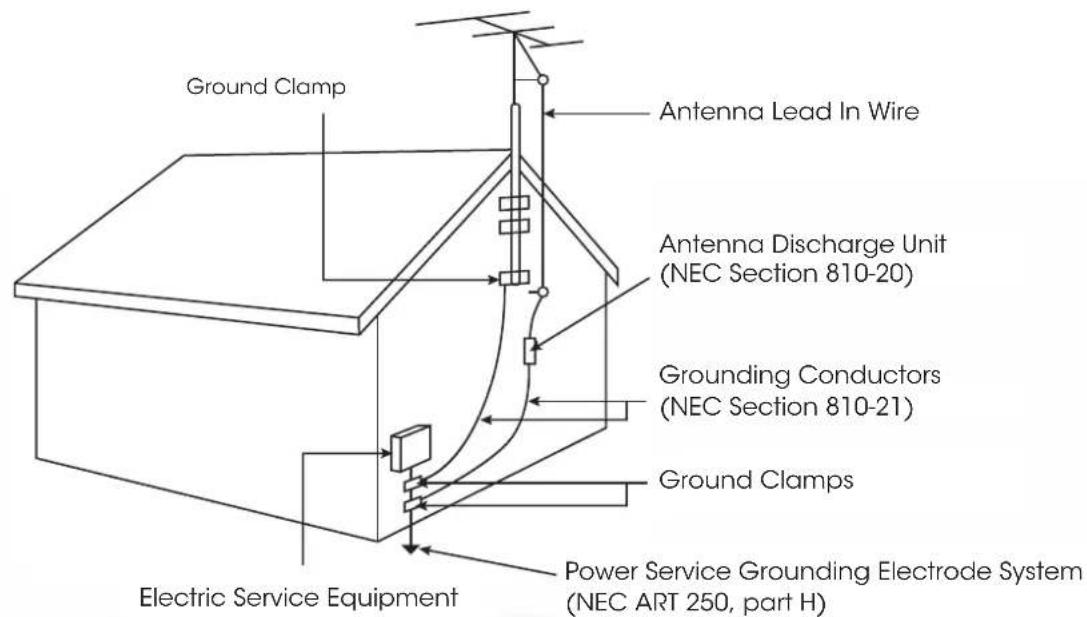
TELEVISION ANTENNA CONNECTION PROTECTION
If an outside antenna/satellite dish or cable system is to be connected to the TV, make sure that the antenna or cable system is electrically grounded to provide some protection against voltage surges and static charges.
Article 810 of the National Electrical Code, ANSI/NFPSA 70, provides information with regard to proper grounding of the mast and supporting structure, grounding of the lead-in wire to an antenna discharge unit, size of the grounding conductors, location of antenna discharge unit, connection to grounding electrodes, and requirements of the grounding electrode.
Lightning Protection
For added protection of the TV during a lightning storm or when it is left unattended or unused for long periods of time, unplug the TV from the wall outlet and disconnect the antenna or cable system.
Power Lines
Do not locate the antenna near overhead light or power circuits, or where it could fall into such power lines or circuits. Remember, the screen of the coaxial cable is intended to be connected to earth in the building installation.
text_image
Ground Clamp Antenna Lead In Wire Antenna Discharge Unit (NEC Section 810-20) Grounding Conductors (NEC Section 810-21) Ground Clamps Electric Service Equipment Power Service Grounding Electrode System (NEC ART 250, part H)Table of Contents
Installing the TV ....3
Inspecting the Package Contents .... 3
Installing the TV 3
Installing the TV Stand 3
Installing the TV on a Wall 6
Controls and Connections ....7
Back Panel 7
Side Panel 8
Front Panel 9
Replacing the Batteries ....11
Connecting Your Devices 12
Connecting A Device 12
Connecting a Device - Audio and Video Cable Types ..13
Connecting an Audio Device 15
Connecting an Audio Device - Audio Cable Types ..... 16
Completing the First-Time Setup ....17
Using the On-Screen Menu ....19
Navigating the On-Screen Menu 19
Changing the Input Source 20
Changing the Screen Aspect Ratio 20
Viewing Video with the Menu Open 21
Adjusting the Picture Settings 22
Adjusting the More Picture Settings ....23
Adjusting the Picture Mode Edit Settings 24
Adjusting the Color Calibration Settings .....25
Adjusting the Color Tuner Settings 25
Creating a Custom Picture Mode ....28
Locking and Unlocking the Custom Picture Modes .....29
Resetting a Custom Picture Mode 29
Adjusting the Audio Settings 30
Changing the Equalizer Settings ....31
Deleting the Custom Audio Mode ....31
Setting Timers 32
Setting the Sleep Timer 32
Setting the Auto Power Off Feature 32
Setting Up the CHANNELS 33
Selecting a Channel Source 33
Finding Channels 33
Adding New Channels 34
Skipping Channels....35
Listening to Alternate Audio 36
Changing the Analog Audio Language ....36
Changing the Digital Audio Language 36
Setting Up Closed Captioning 37
Changing the Appearance of Digital Closed Captions 37
Renaming Devices on the Input Menu 39
Changing the TV Settings 40
Viewing System Information 40
Changing the On-Screen Menu Language .....41
Setting the Time and Local Settings 41
Using the Parental Controls 42
Accessing the Parental Controls Menu 42
Enabling or Disabling Program Ratings 42
Locking and Unlocking Channels ....42
Blocking and Unblocking Content by Rating 43
Changing the Parental Control Passcode 43
Resetting the Content Locks ....43
Setting up View Mode....44
Changing the Wide setting ....44
Adjusting the CEC Settings 45
Turning the Power Indicator On or Off 45
Using the Reset & Admin Menu 46
Restoring the TV to Factory Default Settings ....46
Using the Guided Setup Menu 46
Using Guided Setup 46
Using the Info Window 47
Using the USB Media Player ....48
Using the USB Media Player 48
Preparing your USB drive to play USB media 48
Playing USB media 48
Removing the USB drive from the TV 48
Specifications 55
Limited Warranty 57
Legal & Compliance 58
FCC Class B Radio Interference Statement ....58
Notice 58
FCC warning 58
Installing the TV
1
INSPECTING THE PACKAGE CONTENTS
Before installing your new TV, take a moment to inspect the package contents. Use the images below to ensure nothing is missing or damaged.

natural_image
Dark abstract image with a faint diagonal gradient and no visible text or symbolsVIZIO LED HDTV

Remote control with batteries
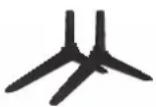
TV stands
Quick Start Guide
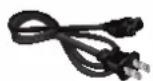
Power cord

4 x T3 30mm
Phillips screws
PACKAGE CONTENTS
INSTALLING THE TV
After removing the TV from the box and inspecting the package contents you can begin installing the TV. Your TV can be installed in two ways:
included)
Installing the TV Stand
Your TV includes a stand designed to support the weight of the TV and keep it from falling over. However, the TV can still fall over if:
secured.
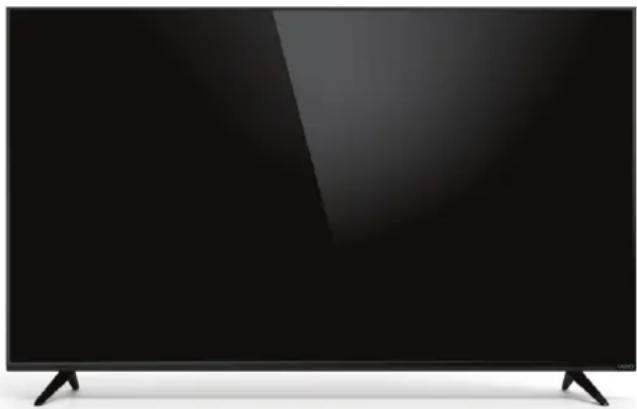
natural_image
Front view of a modern flat-screen TV with black screen and stand (no visible text or symbols)TV ON STANDS
1
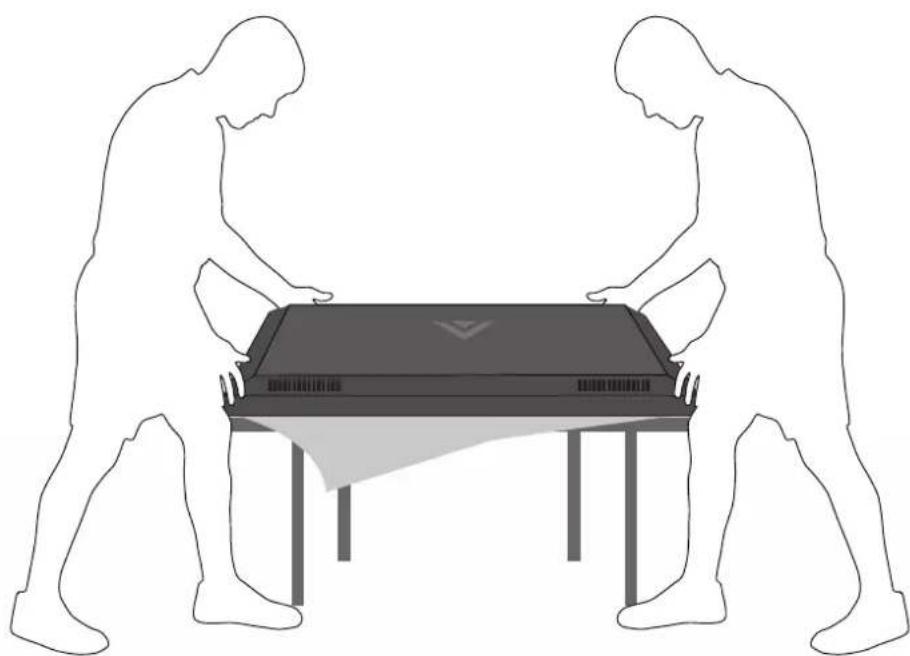
INSTALLING THE STAND
natural_image
Silhouette illustration of two figures assembling a table with a cloth (no text or symbols)It is recommended that two people take part in the stand installation.
Remove any plastic wrapping from the TV and the stand.
Place the TV screen-down on a clean, flat surface. To prevent scratches or damage to the screen, place the TV on a soft surface such as a blanket and avoid any sharp edges.
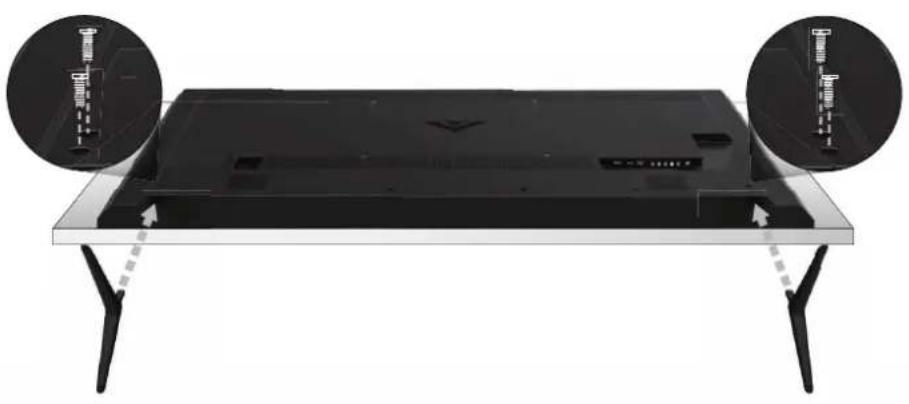
INSTALLING THE STAND
natural_image
Exterior view of a modern office building (no signage)Insert the left and right stands into the base of the TV.
Insert two (2) T3 30 mm Phillips screws (included) into the back of the TV and tighten them using a Phillips screwdriver, to secure each stand to the TV.
When you are finished, place the TV on a stable, level surface.
Installing the TV on a Wall
To mount your TV on a wall, you will need a wall mount. Consult the information below to find the appropriate mount for your TV model:

Installing a TV on a wall requires lifting. To prevent injury or damage to the TV, ask someone to help you.
E320-COE
| Screw Size: | M4 |
| Hole Pattern: | 100 mm (V) x 100 mm (H) |
| Weight w/o Stand: | 9.48 lbs |
Be sure the mount you choose is capable of supporting the weight of the TV. After you have determined that you have the correct mount for your TV, you can begin the installation.
To install your TV on a wall:
- Disconnect any cables connected to your TV.
- Place the TV face-down on a clean, flat, stable surface. Be sure the surface is clear of debris that can scratch or damage the TV.
- Remove the base by loosening and removing the screws.
- Attach your TV and wall mount to the wall, carefully following the instructions that came with your mount.
Use only with a UL-listed wall mount bracket rated for the weight/load of this TV.

For some wall mounts, you may want to use cables with right-angle connectors. This allows the TV to rest closer to the wall.

natural_image
Front view of a black TV with white directional arrows and a central logo (no readable text or symbols)WALL MOUNT SCREW LOCATIONS
Controls and Connections
2
text_image
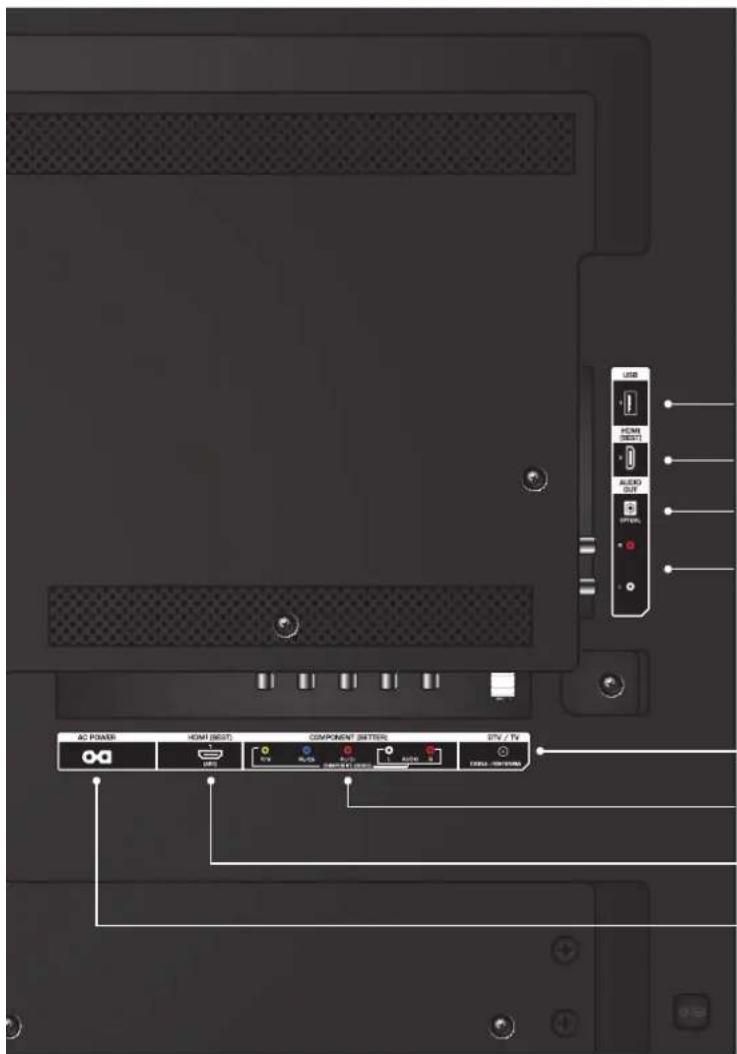
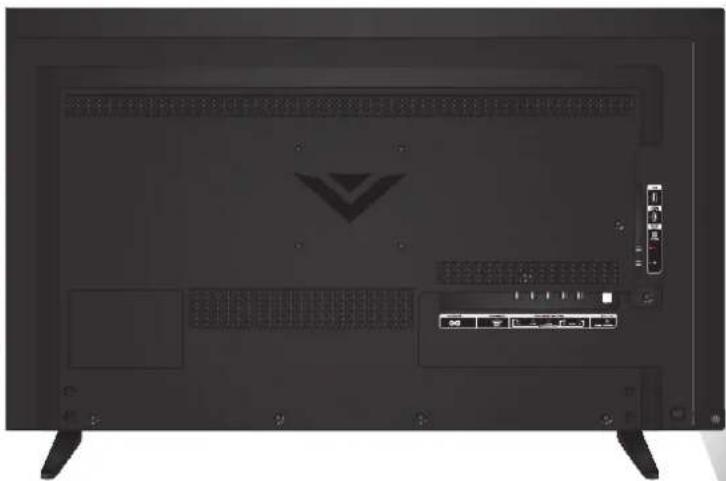
AC POWER HDMI (HDMI) COMPONENT SETTUR DTV / TV USB FDMI HDMI ALED I/O I/O I/O I/O I/O I/O I/O I/O I/OUSB - Connect USB thumb drive to play photo, music, or video.
HDMI - Connect HDMI device.
Optical Audio Out - Connect optical/SPDIF audio device, such as home audio receiver.
Stereo Audio Out - Connect RCA audio device, such as sound bar.
Coaxial - Connect coaxial cable from cable, satellite, or antenna.
Component/Composite - Connect component or composite device.
HDMI - Connect HDMI device.
AC POWER - Connect AC power cord.
BACK PANEL
Controls and Connections
2
natural_image
Front view of a black rectangular electronic device with visible ports and buttons, no text or symbols present.Note: The image shown here is for illustrative purposes only and may be subject to change. The actual number of parts and their locations may vary, depending on the model,
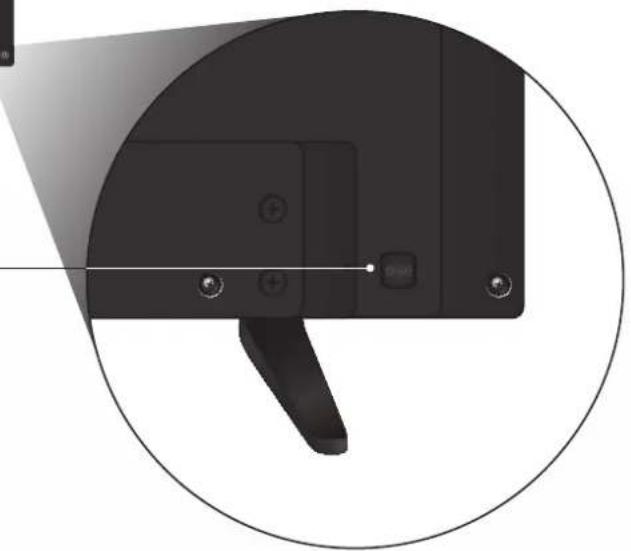
Power - Press once to turn on the TV.
Press and hold to turn off the TV
Input - Press once to access the INPUT menu.
natural_image
3D model of a black electronic device with a handle and control buttons, enclosed in a circular frame (no text or symbols visible)SIDE PANEL
2
natural_image
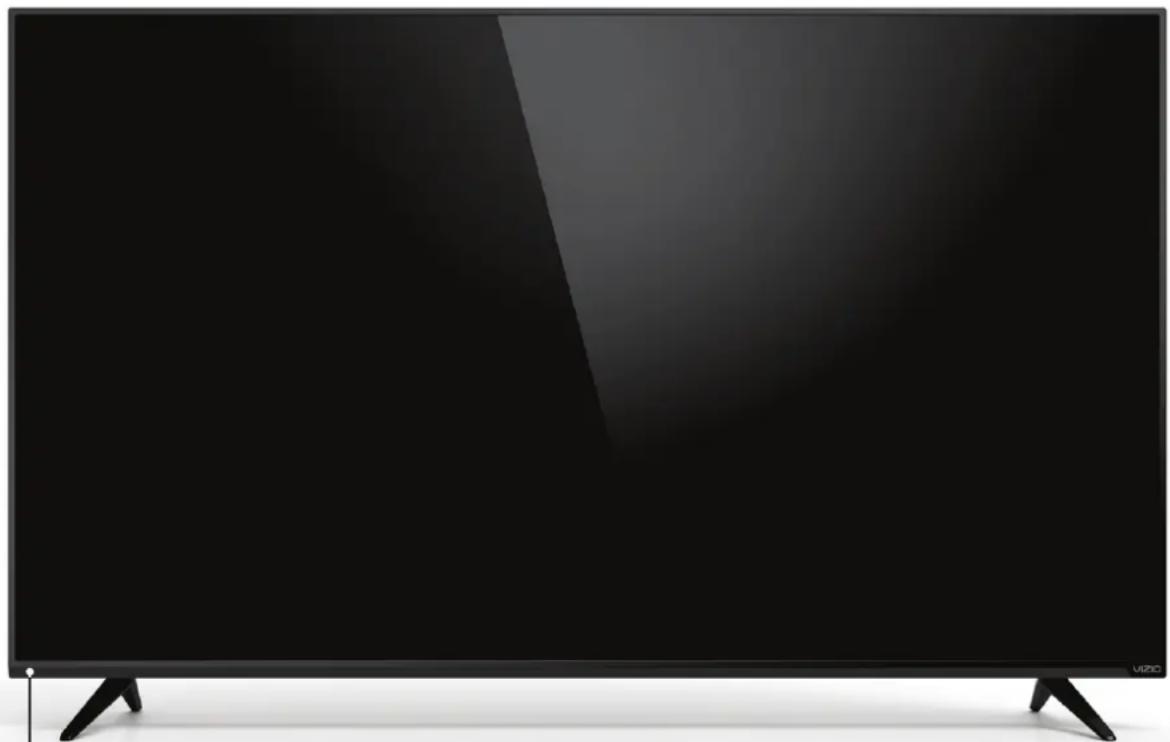
Front view of a black rectangular TV with a glossy black screen and stand (no visible text or symbols)REMOTE SENSOR & POWER INDICATOR
When using the remote, aim it directly at this sensor.
The power indicator flashes on when the TV turns on, then goes out after several seconds.
To keep the power indicator on as long as the TV is on, see Turning the Power Indicator On or Off on page 45.
FRONT PANEL
USING THE REMOTE
INPUT
Change the currently-displayed input.
EXIT
Close the on-screen menu.
OK
Select the highlighted menu option.
BACK
Go to the previous on-screen menu.
VOLUME UP/DOWN
Increase or decrease loudness of the audio.
MUTE
Turn the audio off or on.
NUMBER PAD
Manually enter a channel.
WIDE
Switch the display mode.

text_image
INPUT EXIT MENU OK BACK GUIDE VOL CH VOL CH WIDE 0 —POWER
Turn TV on or off.
MENU
Display the on-screen menu.
ARROW
Navigate the on-screen menu.
GUIDE
Display the info window.
V BUTTON
Open the USB photo viewer.
CHANNEL UP/DOWN
Change the channel.
LAST
Return to the channel last viewed.
DASH
Use with number pad to manually enter a digital sub-channel. (For example, 18-4 or 18-5.)
REMOTE CONTROL
2
Replacing the Batteries
natural_image
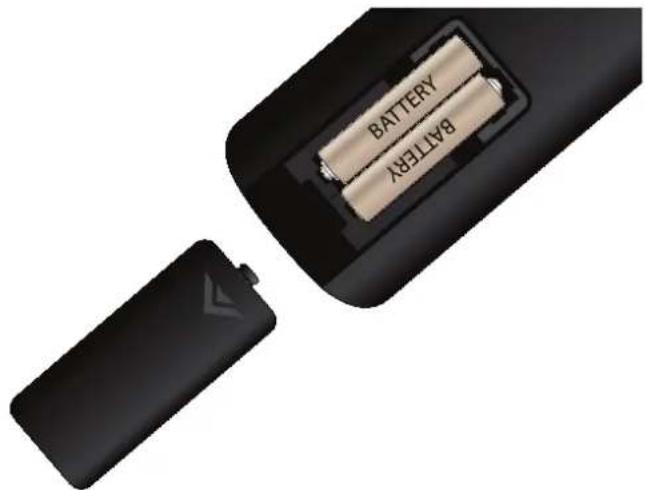
Close-up of a black battery inside a charging case, showing internal components and casing (no text or symbols visible)- Remove the battery cover.
- Insert two batteries into the remote control. Make sure that the (+) and (-) symbols on the batteries match the (+) and (-) symbols inside the battery compartment.
- Replace the battery cover.
Connecting Your Devices
3
CONNECTING A DEVICE
Your TV can be used to display output from most devices.
- Verify that your device has a video port that matches an available port on the TV (HDMI, Component, etc.).
- Turn the TV and your device off.
- Connect the appropriate cable (not included) to the TV and the device.
- Turn the TV and your device on. Set the TV's input to match the connection you used (HDMI-1, HDMI-2, etc.).
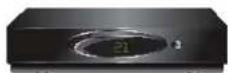
Cable/Satellite Box

DVD/Blu-ray Player
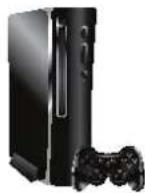
Game Console
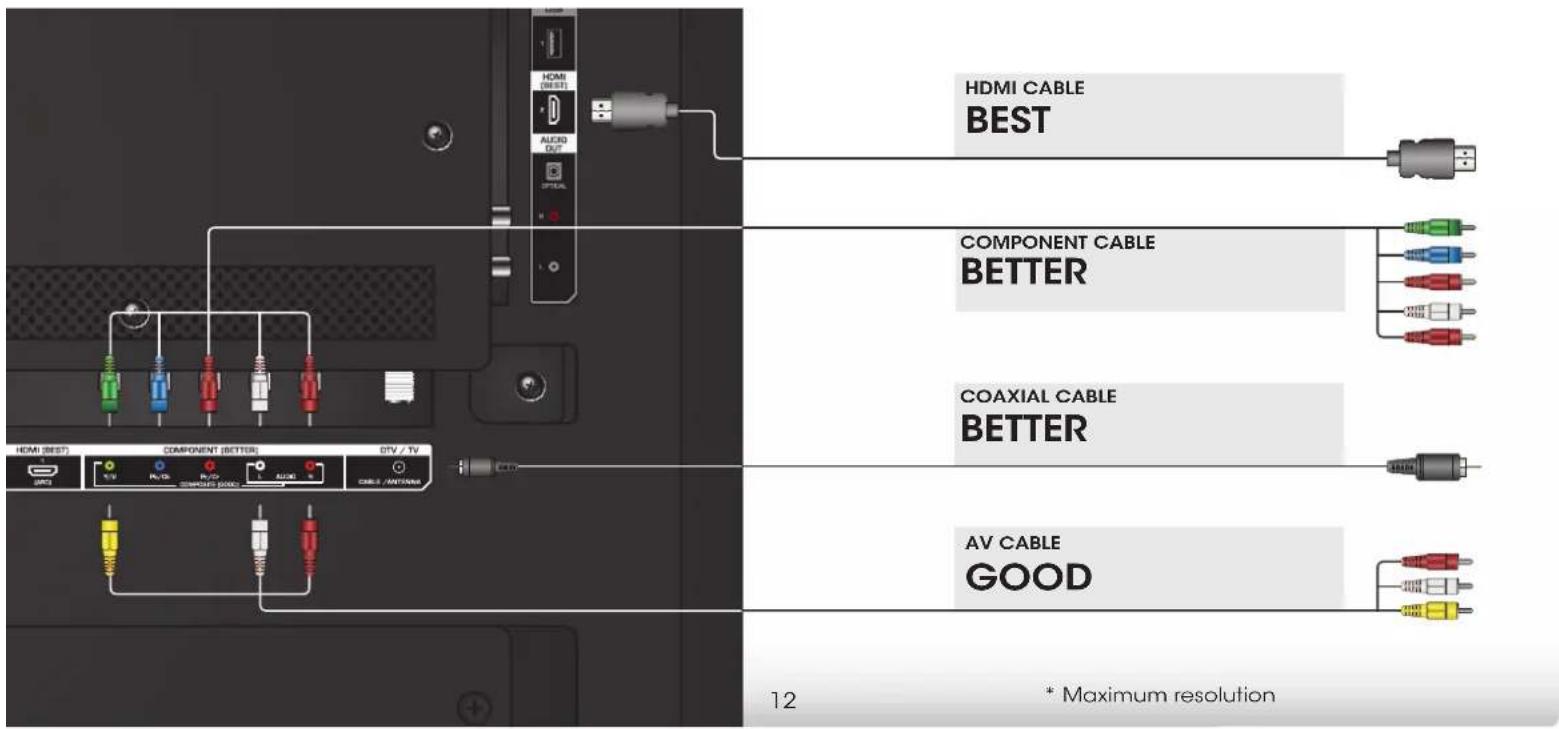
text_image
HDMI CABLE BEST COMPONENT CABLE BETTER COAXIAL CABLE BETTER AV CABLE GOOD 12 * Maximum resolution3
CONNECTING A DEVICE - AUDIO AND VIDEO CABLE TYPES
AV CABLE
AV cables (or Composite cables) are the traditional way of connecting your devices to your TV. Video signals are sent over the yellow connector while audio is sent over the red and white connectors.
COAXIAL CABLE
Coaxial cables are the traditional way of connecting antennas and cable television signals to your TV. Coaxial cables carry both audio and video signals through a single connector.

text_image
Y/V LR GOOD BETTER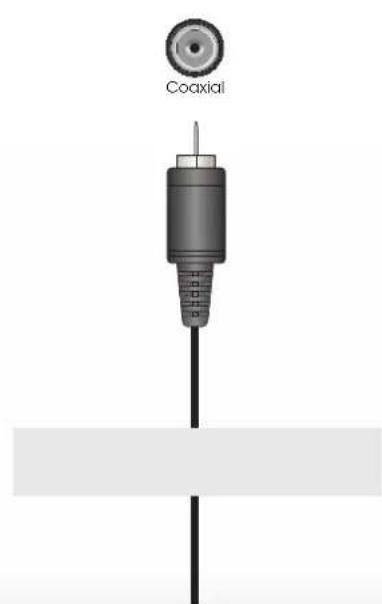
text_image
CoaxialCOMPONENT CABLE
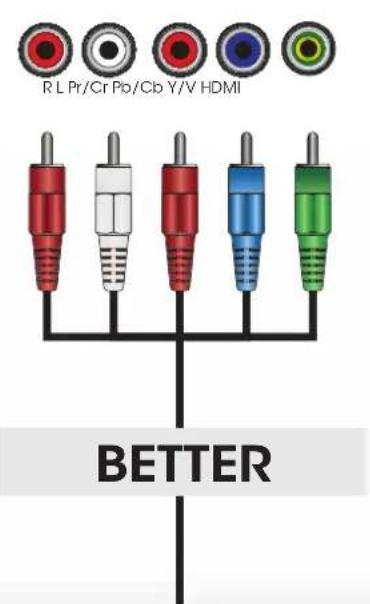
Component cables are designed to carry high definition video signals along with additional audio connections. Colors are delivered with color information split up three different ways over three connectors for video (separated into red, blue and green signals) and the left and right audio connectors (red and white).
text_image
R L Pr/Cr Pb/Cb Y/V HDMI BETTERHDMI CABLE
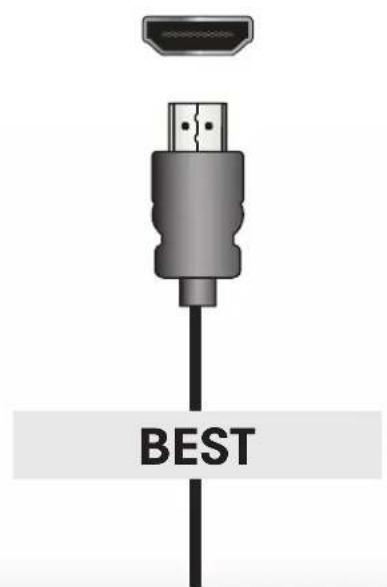
HDMI is the intelligent, all-digital interface that delivers both dazzling quality and unmatched ease of use. HDMI technology transmits crystal-clear digital video along with multi-channel surround audio. HDMI-connected devices have the ability to automatically adjust themselves for optimal viewing.
text_image
BESTCONNECTING AN AUDIO DEVICE
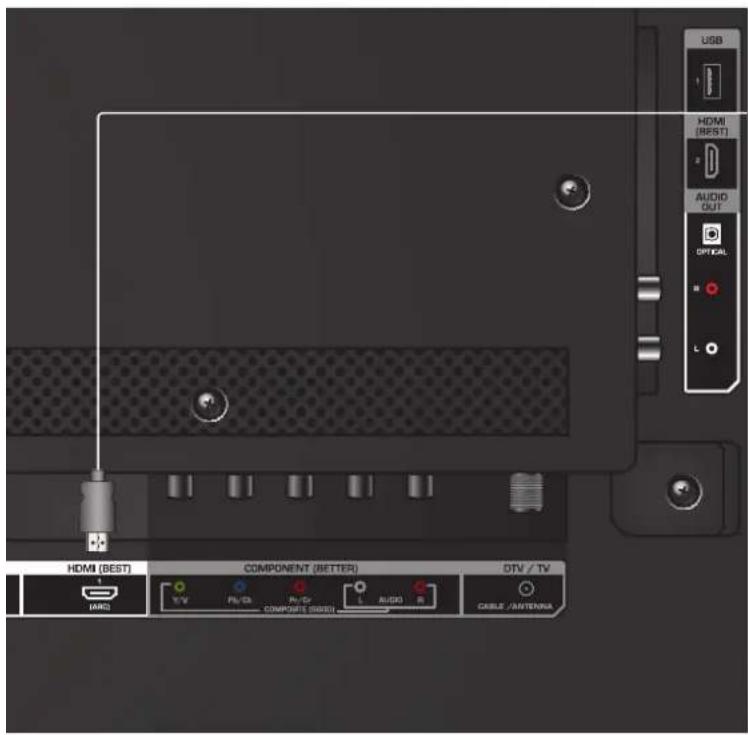
Your TV can output sound to an audio device, such as a receiver or sound bar.
- Verify that your device has an audio port that matches an available port on the TV (optical, RCA, etc.).
- Turn the TV and your audio device off.
- Connect the appropriate cable (not included) to the TV and the device.
- Turn the TV and your device on.
text_image
USB HDMI (BEST) AUDIO OUT OPTICAL L HDMI (BEST) COMPONENT (BETTER) DTV / TV (ARC) T/V P/V/CR P/V/CR COMPOSITE (BEEI) L AUDIO S CABLE /ANTenna
Home Audio Receiver

VIZIO Sound Bar
text_image
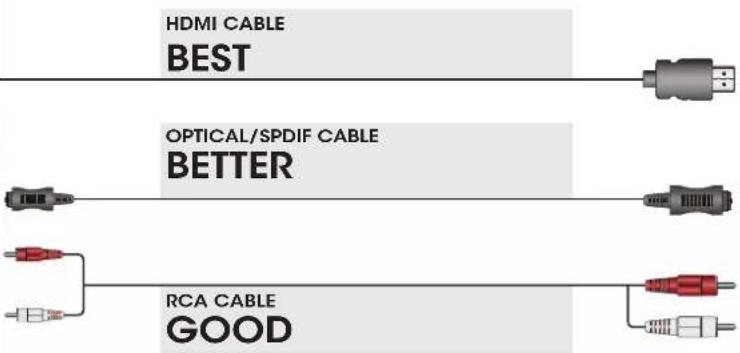
HDMI CABLE BEST OPTICAL/SPDIF CABLE BETTER RCA CABLE GOODCONNECTING AN AUDIO DEVICE - AUDIO CABLE TYPES
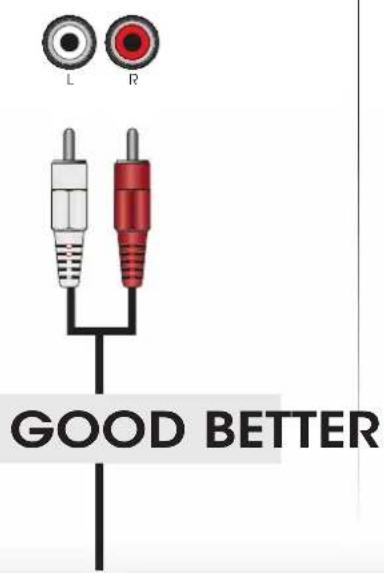
RCA CABLE
AV cables (or composite cables) are the traditional way of connecting your devices to your audio device. Audio signals are sent over the red and white connectors.
OPTICAL/SPDIF CABLE
Optical/SPDIF cables transmit audio signals as pulses of light through a cable made of plastic fibers. Audio signals are digitally transmitted between devices.
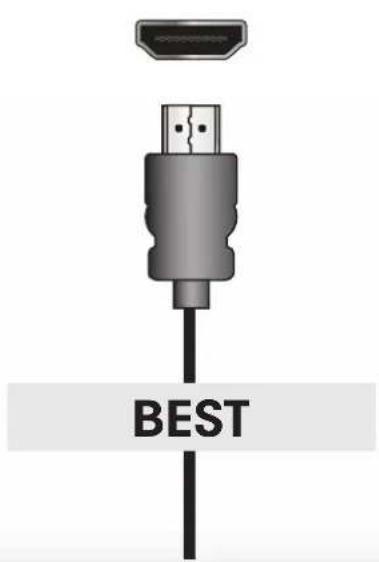
HDMI CABLE
HDMI technology transmits crystal-clear digital multi-channel surround audio through a single HDMI cable. Audio Return Channel-enabled (ARC) TVs allow audio to be sent over an already connected HDMI cable, eliminating the need for a separate audio cable. See Connecting an Audio Device - ARC on page 17.
text_image
L R GOOD BETTER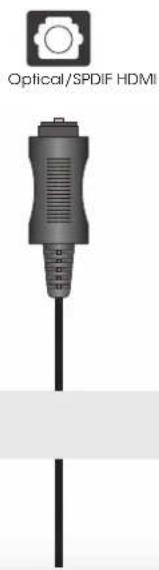
text_image
Optical/SPDIF HDMIDigital Audio Connection
text_image
BESTCONNECTING AN AUDIO DEVICE - ARC
Without HDMI ARC With HDMI ARC
Without an HDMI ARC setup, your TV will transmit audio signal from the built-in tuner and VIA apps to your home audio receiver through a separate audio connection.
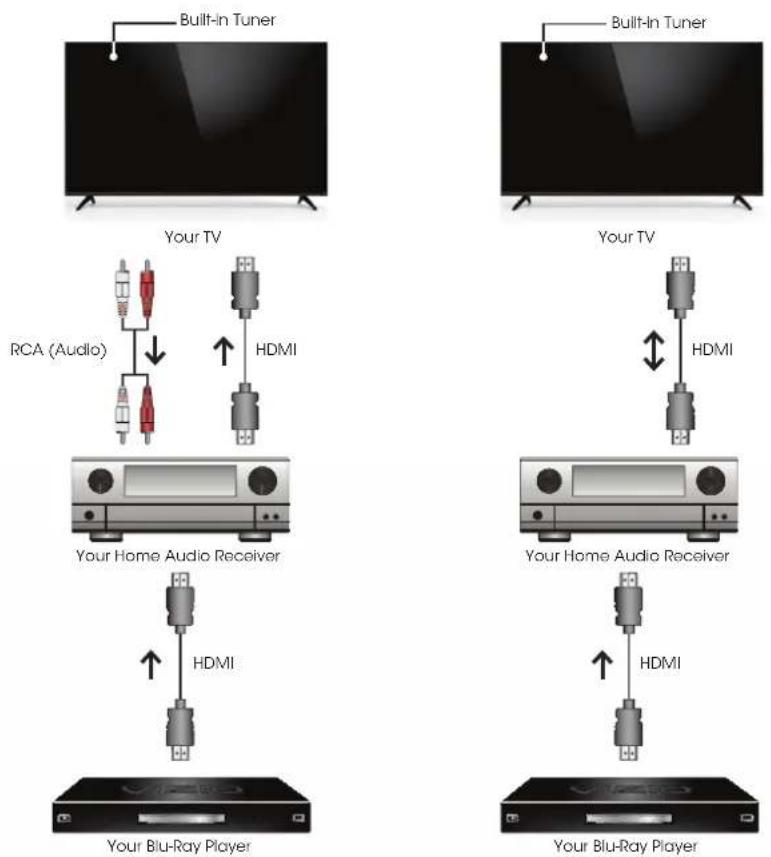
With an HDMI ARC setup, the audio connection between your TV and Home Audio Receiver can be removed. The HDMI cable will transmit audio signal to and from your TV with an all-digital audio/video connection.
Completing the First-Time Setup
The first time you turn on the TV, the Setup App will guide you through each of the steps necessary to get your TV ready for use.
Before you begin the first-time setup:
be connected to an electrical outlet.
password ready.
cable, connect it to the Ethernet port on the TV.
To complete the first-time setup:
-
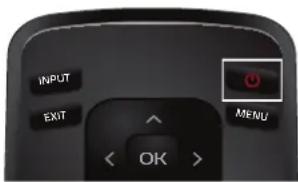
Press the Power/Standby button on the remote. The TV powers on and the Setup App starts.
-
Use the Arrow buttons on the remote to highlight Home Use and press OK.
-
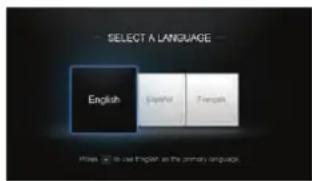
Use the Arrow buttons on the remote to highlight your preferred language, and then press the OK button.
text_image
INPUT EXIT MENU < OK >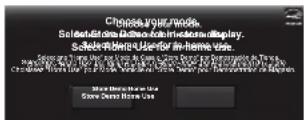
text_image
SELECT A LANGUAGE English English-French If you do to use English as the primary language- Use the Arrow buttons on the remote to highlight your TV source and press OK.
If you have cable TV, select whether you have a cable box or if you connect the TV directly to a cable from the wall.
- If the TV Signal channel scan screen appears, the TV will need to scan for channels, which takes several minutes. Use the arrow buttons on the remote to highlight Begin Scan and press OK.
Otherwise, use the Arrow and OK buttons on the remote to select the input your TV source is connected to.
(Number of inputs may vary depending on your TV.)
- When you are finished, the message "Your VIZIO TV is set up" will appear.

text_image
SELECT A COUNTRY USA Canada Mexico
text_image
TV SIGNAL from a your cable switcher? Cable Box OK Cancel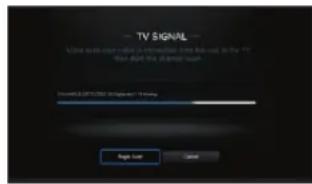
text_image
TV SIGNAL Digital audio was called to increase the video output to the TV. Then start the video output.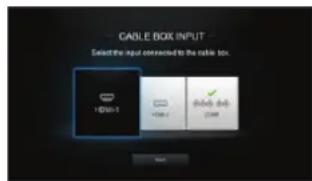
text_image
CABLE BOX INPUT Select the input connected to the cable box. I Spin-1 +USB-1 +USB-2 +USB-3 +USB-4 +USB-5Using the On-Screen Menu
Your TV features an easy-to-use on-screen menu.
To open the on-screen menu, press the MENU button on the remote.
From this menu, you can:

text_image
VIZIO IV SETTINGS Picture Audio Timers Channels Closed Captions Dovicos System Guided SetupNAVIGATING THE ON-SCREEN MENU
To open the on-screen menu, press the MENU button on the remote.
Use the Arrow buttons to highlight a menu option, and press the OK button to select that option.


While navigating the on-screen menu, you can press the BACK button at any time to return to the previous menu screen. The EXIT button will close the on-screen menu.
CHANGING THE INPUT SOURCE
External devices such as DVD players, Blu-ray Players, and video game consoles can be connected to your TV. To use one of these devices with your TV, you must first change the input source using the Input menu.
To change the input source:
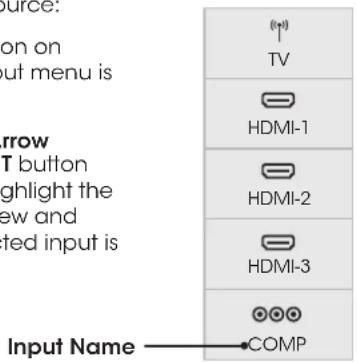
- Press the INPUT button on the remote. The Input menu is displayed.
- Use the Up/Down Arrow buttons or the INPUT button on the remote to highlight the input you wish to view and press OK. The selected input is displayed.
text_image
Source: on on out menu is arrow T button highlight the ew and ted input is Input Name —— COMPNote: Inputs may vary by TV.

You can change the input names that appear on the Input menu to make your devices easy to recognize. See Renaming Devices on the Input Menu on page 39 for more information.
CHANGING THE SCREEN ASPECT RATIO
The TV can display images in five different modes: Normal, Stretch, Panoramic, Wide, and Zoom. Each mode displays the picture differently.
To change the screen aspect ratio:
- Press the WIDE button on the remote.
- Use the Arrow buttons to highlight the aspect ratio you wish to view and press OK.
original aspect ratio. Since the 4:3 aspect ratio is not large enough to fill the TV's screen, black bars are added to the left and right of the display image.

text_image
Normal Panoramic Wide Zoom Normal Stretch Wide ZoomNote: Aspect ratio settings may vary by Input source.
Images may appear wider than intended. If you are watching widescreen (1.85:1 or 2.35:1) content, black bars will still appear on the top and bottom of the display image. This option is only available when the TV is
Images may appear wider than intended. If you are watching widescreen (1.85:1 or 2.35:1) content, black bars will still appear on the top and bottom of the display image. This option is only available when the TV is
of the screen. Since the picture is being stretched, the display image may appear distorted. If the program is already formatted for widescreen viewing (1.85:1 or 2.35:1), then black bars will appear on the top and bottom of the display image.
VIEWING VIDEO WITH THE MENU OPEN
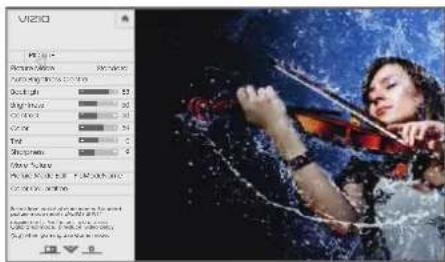
When the on-screen menu opens, it covers the left-hand portion of the picture. The picture can be displayed in three different ways:
portion of the picture covered by the menu.
the right of the menu.
The picture extends off of the right side of the screen.
To change the position of the picture while the on-screen menu is displayed:
- Use the Arrow buttons on the remote to highlight ☐ Resize Video.
- Press OK to cycle through the three display methods.
- Press the Up Arrow button on the remote to the menu.
text_image
VIZIO PICTURE Picture Mode Standard Backlight 85 Brightness 50 Contrast 50 Color 59 Tint 0 Sharpness 9 More Picture Picture Mode Edit Color Calibration Select from preset picture modes. Standard picture mode meets ENERGY STAR° requirements. For the best picture, use Calibrated mode. To reduce video decay (lag) when gaming, use Game mode. OK
text_image
VIZIO Histogram Histogram Range: 0-14 Histogram Range: 0-20 Histogram Range: 20-30 Histogram Range: 30-40 Histogram Range: 40-50 Histogram Range: 50-60 Histogram Range: 60-70 Histogram Range: 70-80 Histogram Range: 80-90 Histogram Range: 90-100 Histogram Range: 100-110 Histogram Range: 110-120 Histogram Range: 120-130 Histogram Range: 130-140 Histogram Range: 140-150 Histogram Range: 150-160 Histogram Range: 160-170 Histogram Range: 170-180 Histogram Range: 180-190 Histogram Range: 190-200 Histogram Range: 200-210 Histogram Range: 210-220 Histogram Range: 220-230 Histogram Range: 230-240 Histogram Range: 240-250 Histogram Range: 250-260 Histogram Range: 260-270 Histogram Range: 270-280 Histogram Range: 280-290 Histogram Range: 290-300 Histogram Range: 300-310 Histogram Range: 310-320 Histogram Range: 320-330 Histogram Range: 330-340 Histogram Range: 340-350 Histogram Range: 350-360 Histogram Range: 360-370 Histogram Range: 370-380 Histogram Range: 380-390 Histogram Range: 390-400 Histogram Range: 400-410 Histogram Range: 410-420 Histogram Range: 420-430 Histogram Range: 430-440 Histogram Range: 440-450 Histogram Range: 450-460 Histogram Range: 460-470 Histogram Range: 470-480 Histogram Range: 480-490 Histogram Range: 490-500 Histogram Range: 500-510 Histogram Range: 510-520 Histogram Range: 520-530 Histogram Range: 530-540 Histogram Range: 540-550 Histogram Range: 550-560 Histogram Range: 560-570 Histogram Range: 570-580 Histogram Range: 580-590 Histogram Range: 590-600 Histogram Range: 600-610 Histogram Range: 610-620 Histogram Range: 620-630 Histogram Range: 630-640 Histogram Range: 640-650 Histogram Range: 650-660 Histogram Range: 660-670 Histogram Range: 670-680 Histogram Range: 680-690 Histogram Range: 690-700 Histogram Range: 700-710 Histogram Range: 710-720 Histogram Range: 720-730 Histogram Range: 730-740 Histogram Range: 740-750 Histogram Range: 750-760 Histogram Range: 760-770 Histogram Range: 770-780 Histogram Range: 780-790 Histogram Range: 790-800 Histogram Range: 800-810 Histogram Range: 810-820 Histogram Range: 820-830 Histogram Range: 830-840 Histogram Range: 840-850 Histogram Range: 850-860 Histogram Range: 860-870 Histogram Range: 870-880 Histogram Range: 880-890 Histogram Range: 890-900 Histogram Range: 900-910 Histogram Range: 910-920 Histogram Range: 920-930 Histogram Range: 930-940 Histogram Range: 940-950 Histogram Range: 950-960 Histogram Range: 960-970 Histogram Range: 970-980 Histogram Range: 980-990 Histogram Range: 990-100FULL-SIZED AND CENTERED

text_image
V20 Audio Effect Audio Ratio: 1.0 Noise Level: 100 Oscilloscope: 20 Color: 20 Tuning: 0 Video Effects Video Work Tools - F-4 Audio Tools Video Work Tools - F-4 Audio ToolsRE-SIZED TO FIT
text_image
Vizio Play Action/Action Histogram Histogram Track Track Color Color Tint Showtime Show Time Show Time Show Time Show Time Show Time Show Time Show Time Show Time Show Time Show Time Show Time Show Time Show Time Show Time Show Time Show Time Show Time Show Time Show Time Show Time Show Time Show Time Show Time Show Time Show Time Show Time Show Time Show Time Show Time Show Time Show Time Show Time Show Time Show TimeFULL-SIZED AND ALIGNED TO RIGHT OF MENU
ADJUSTING THE PICTURE SETTINGS
Your TV display can be adjusted to suit your preferences and viewing conditions.

When changes are made while a preset picture mode is selected, an asterisk appears after the name of the picture mode. These settings can be saved as a new custom picture mode and the preset mode can be reset to its default settings (see Custom Picture Modes on pages 28 through 29).
To adjust the picture settings:
- Press the MENU button on the remote. The on-screen menu is displayed.
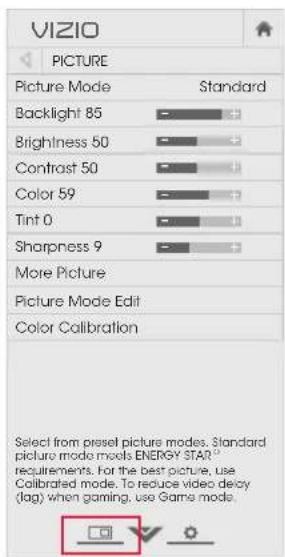
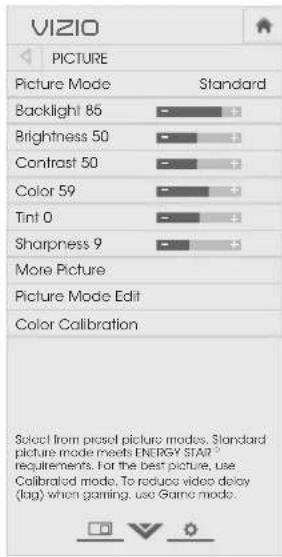
- Use the Arrow buttons on the remote to highlight Picture and press OK. The PICTURE menu is displayed.
- Use the Arrow buttons on the remote to highlight Picture Mode, then use the Left/Right Arrow buttons to change the picture mode:
picture settings to values that meet ENERGY STAR ^® requirements.
settings to values perfect for watching TV in a brightly-lit room.
text_image
VIZIO PICTURE Picture Mode Standard Backlight 85 Brightness 50 Contrast 50 Color 59 Tint 0 Sharpness 9 More Picture Picture Mode Edit Color Calibration Select from preset picture modes. Standard picture mode meets ENERGY STAR® requirements. For the best picture, use Calibrated mode. To reduce video delay (log) when gaming, use Game mode.perfect for watching TV in a dark room.
brighter, more vivid picture.
picture settings for displaying game console output.
computer output.
- To manually change each of the picture settings, use the Up/Down Arrow buttons on the remote to highlight that picture setting, then use the Left/Right Arrow buttons to adjust the setting:
brilliance of the picture. Backlight cannot be adjusted when starting from some picture modes.
this setting is too low, the picture may be too dark to distinguish details. When this setting is too high, the picture may appear faded or washed out.
this setting is too low, the picture may appear dark. When this setting is too high, the picture may appear faded or washed out. If the setting is too high or too low, detail may be difficult to distinguish in dark or bright areas of the picture.
in adjusting the flesh tones in the picture. If flesh appears too orange, reduce the level of color before adjusting tint.
elements. It can be used to sharpen non-HD (high definition) content; however, it will not produce detail that does not otherwise exist.
- When you have finished adjusting the picture settings, press BACK to adjust additional settings or EXIT.
Adjusting the More Picture Settings
To adjust the More Picture settings:
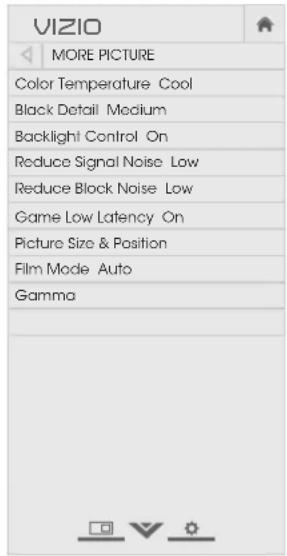
- From the PICTURE menu, use the Arrow buttons to highlight More Picture, and then press OK. The MORE PICTURE menu is displayed.
- Use the Arrow buttons to highlight the setting you wish to adjust, then press the Left/Right Arrow buttons to change the setting:
Adjusts the 'warmness' and 'coolness' of the white areas of the picture. Select Cool, Normal, or Computer.
blue-hued picture.
television viewing.
picture for use as a PC monitor.
text_image
VIZIO MORE PICTURE Color Temperature Cool Black Detail Medium Backlight Control On Reduce Signal Noise Low Reduce Block Noise Low Game Low Latency On Picture Size & Position Film Mode Auto Gammapicture to compensate for large areas of brightness. Select Off, Low, Medium, or High.
ration of the picture by adjusting the backlight. Select Off or On.
when viewing analog sources. The function helps to correct "speckle" noise with a slight reduction in sharpness. Select Off, Low, Medium, or High.
for mpeg files. Select Off, Low, Medium, or High.
gaming. Select Off, or On.
decreases the vertical and horizontal size of the displayed picture. Picture Position adjusts the vertical and horizontal positions of the picture to ensure the image is centered and completely fills the screen. Use the Left/Right Arrow buttons to adjust the horizontal position of the displayed picture. Use the Up/Down Arrow buttons to adjust the vertical position of the displayed picture. Press the OK button when you are finished.
Select Auto or Off.
values for bright room conditions and higher values
- When you have finished adjusting the Advanced Picture settings, press BACK to adjust additional settings or EXIT.
Adjusting the Picture Mode Edit Settings
To adjust the Picture Mode Edit settings:
-
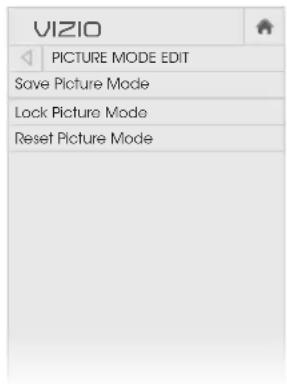
From the PICTURE menu, use the Arrow buttons to highlight More Picture > Picture Mode Edit, and then press the OK button. The PICTURE MODE EDIT menu is displayed.
-
Use the Arrow buttons to highlight the setting you wish to adjust, then press the Left/Right Arrow buttons to change the setting:
the settings for a custom picture mode.
allow changes to the currently selected custom picture mode. Select On or Off.
- Resets
the picture mode settings to factory default values.
- When you have finished adjusting the Picture Mode Edit settings, press BACK to adjust additional settings or EXIT.
text_image
VIZIO PICTURE MODE EDIT Save Picture Mode Lock Picture Mode Reset Picture ModeAdjusting the Color Calibration Settings
Color Calibration Settings allow you to make precise adjustments to the picture and to create picture modes to save groups of picture settings.

The Color Tuner, 11 Point White Balance, and test patterns allow technicians to manually calibrate the TV. Calibration requires specialized training, an input with precisely set colors, and a specialized light meter.
To adjust the color calibra picture settings:
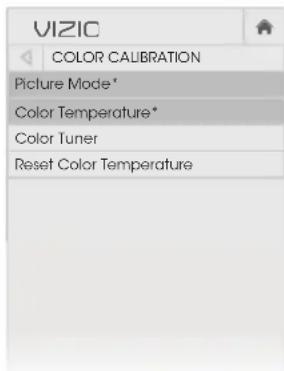
- From the PICTURE menu, use the Arrow buttons to highlight Color Calibration and press the OK button. The COLOR CALIBRATION menu is displayed.
- Use the Arrow buttons to highlight the setting you wish to adjust, then press the OK button to change the setting:
selectable (reference only). Changes to Hue, Saturation, and Brightness are saved here and indicated with an asterisk (*).
text_image
VIZIC COLOR CALIBRATION Picture Mode* Color Temperature* Color Tuner Reset Color Temperatureselectable (reference only). Changes to Offset and Gain are saved here and indicated with an asterisk (*).
11-point white balance, and display calibration test patterns.
to the currently selected custom picture mode.
Adjusting the Color Tuner Settings
The Color Tuner settings allow you to adjust the Hue, Saturation, and Brightness (HSB) color and 11 point white balance, turn color channels off for testing, and display color bar, flat, and ramp test patterns.
To adjust the HSB color settings:
- From the PICTURE menu, use the Arrow buttons to highlight Color Calibration and press the OK button. The COLOR CALIBRATION menu is displayed.
- Use the Arrow buttons to highlight Color Tuner, and press the OK button. The Color Tuner menu is displayed.
| Color Tuner | ||||||
| Red Green Blue Cyan Magenta Yellow | ||||||
| Hue 0 0 0 0 25 | -14 | |||||
| Saturation | -1 | 5 | -4 | 0 | -2 | 0 |
| Brightness | -24 | 0 | -22 | 0 | 0 | 0 |
| Offset | 0 0 0 | |||||
| Gain | 0 0 0 | |||||
- Use the Arrow buttons on the remote to highlight the Hue, Saturation, Brightness, (these 3 adjust the color) Offset, or Gain (these two adjust the color temperature) of the color you wish to adjust. Press the OK button.
- Use the Left/Right Arrow buttons to adjust the value. When you are finished press the OK button to save the setting.
- When you have finished adjusting the Color Tuner settings, press the BACK button to adjust additional settings or EXIT. Changes to Hue, Saturation, and Brightness are indicated with an asterisk (*) on the Picture Mode setting.
Changes to Offset and Gain are indicated with an asterisk (*). on the Color Temperature setting.
To turn color channels off and on:
- From the PICTURE menu, use the Arrow buttons to highlight Color Calibration and press the OK button. The COLOR CALIBRATION menu is displayed.
- Use the Arrow buttons to highlight Color Tuner, and then press the OK button. The Color Tuner menu is displayed ..
| Red Green Blue Cyan Magenta Yellow | ||||||
| Hue 0 0 0 0 25-14 | ||||||
| Saturation | -1 | 5 | -4 | 0 | -2 | 0 |
| Brightness | -24 | 0 | -22 | 0 | 0 | 0 |
| Offset | 0 0 0 | |||||
| Gain | 0 0 0 | |||||
- Use the Arrow buttons on the remote to highlight Red, Green, or Blue.
- Press the OK button to turn the color channel off or on. An X appears over a color channel that has been turned off.
- Use the Arrow buttons to highlight another color channel to turn off or on. Only two color channels can be turned off at the same time.
- When you are finished with the color channels, press the BACK button to adjust additional settings or EXIT.
To adjust the 11 Point White Balance settings:
- From the Color Tuner menu, use the Arrow buttons to highlight Color Tuner, and then press the Left/Right Arrow buttons until the 11 Point White Balance menu is displayed.
| 11 Point White Balance | ||||
| Gain | Red Green Blue | |||
| 5% | 0 | 0.0 | ||
- Use the Arrow buttons on the remote to highlight the Gain and Color values you wish to adjust. Press the OK button and use the Left/Right Arrow buttons to adjust the value. When you are finished press the OK button to save the setting.
- When you are finished, press the BACK button to adjust additional settings or EXIT.
All changes here are saved to Color Temperature.
To show or hide the Color Bar Test Pattern:
- Ensure that you are on an input that is displaying active content. From the Color Tuner menu, use the Arrow buttons to highlight Color Tuner, and then press the Left/Right Arrow buttons until the SMPTE Test Pattern menu is displayed.

text_image
SMPTE Test Pattern Off- Use the Arrow buttons on the remote to highlight Off. Use the Left/Right Arrow buttons to highlight On to show the Color Bar.
—or—
To hide the Color Bar Test Pattern, use the Left/Right Arrow buttons to highlight Off.
- When you are finished, press the BACK button to adjust additional settings or EXIT.
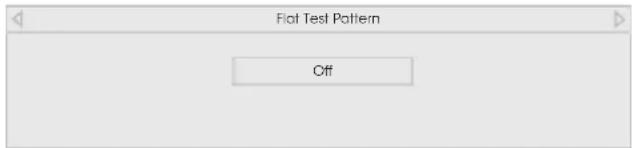
To show or hide the Flat Test Pattern:
- Ensure that you are on an input that is displaying active content. From the Color Tuner menu, use the Arrow buttons to highlight Color Tuner, and then press the Left/Right Arrow buttons until the Flat Test Pattern menu is displayed.
text_image
Flat Test Pattern Off- Use the Arrow buttons on the remote to highlight Off. Use the Left/Right Arrow buttons to select the percentage brightness for the flat test pattern. Selecting a percentage immediately shows the flat pattern at that brightness.
—Or—
To disable the Flat Test Pattern, use the Left/Right Arrow buttons to highlight Off.
- When you are finished, press the BACK button to adjust additional settings or EXIT.
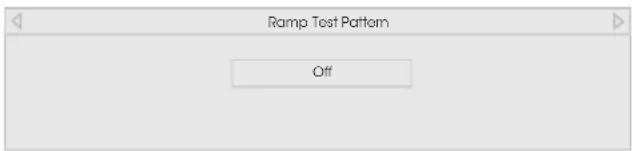
To show or hide the Ramp Test Pattern:
- Ensure that you are on an input that is displaying active content. From the Color Tuner menu, use the Arrow buttons to highlight Color Tuner, and then press the Left/Right Arrow buttons until the Ramp Test Pattern menu is displayed.
text_image
Ramp Test Pattern Off- Use the Arrow buttons on the remote to highlight Off. Use the Left/Right Arrow buttons to select the color for the ramp test pattern. Selecting a color immediately shows that color ramp.
—or—
To hide the Ramp Test Pattern, use the Left/Right Arrow buttons to highlight Off.
- When you are finished, press the BACK button to adjust additional settings or EXIT.
Creating a Custom Picture Mode
Custom picture modes allow you to save a group of custom settings for various viewing conditions and video sources.
whenever picture settings are changed while in any preset picture mode.

A custom picture mode only applies to the input (HDMI-1, COMP, etc.) in use when it was created. Each input can have up to six custom picture modes.
To create a custom picture mode:
- Set the Picture Mode to an existing custom setting. See Adjusting the Picture Settings on page 22.
- From the PICTURE menu, use the Arrow buttons to highlight Picture Mode Edit and press OK. The PICTURE MODE EDIT menu is displayed.
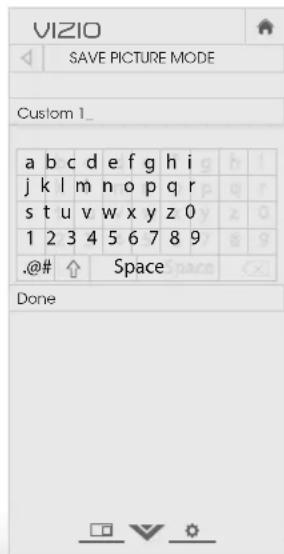
- On the PICTURE MODE EDIT menu, select Save Picture
SAVE PICTURE MODE menu is displayed.
- Use the Arrow buttons to enter a custom name using the on-screen keyboard.
- Highlight Done and press OK.
- Press the EXIT button to exit the menu screens.
text_image
VIZIO SAVE PICTURE MODE Custom 1_ a b c d e f g h i j k l m n o p q r s t u v w x y z 0 1 2 3 4 5 6 7 8 9 .@# ↑ Space DoneLocking and Unlocking the Custom Picture Modes
Custom picture modes can be locked with a unique PIN to prevent accidental changes to their settings.
To lock all custom picture modes:
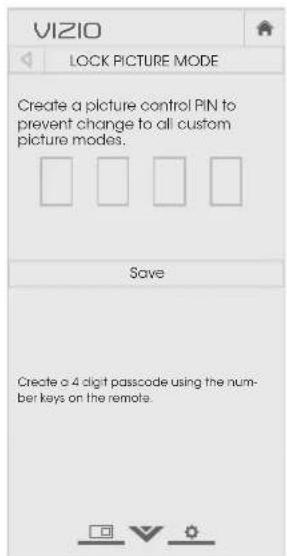
- From the PICTURE menu, use the Arrow buttons to highlight Picture Mode Edit and select Lock or Unlock Picture Mode, then press OK. The LOCK PICTURE MODE menu is displayed.
- Use the Number Pad on your remote to enter a unique 4-digit PIN.
- Highlight Save and then press the OK button.
- Press the EXIT button to exit the menu screens.
To unlock all custom picture modes:
- From the PICTURE menu, use the Arrow buttons to highlight Picture Mode Edit and select Lock or Unlock Picture Mode, then press OK. The LOCK PICTURE MODE menu is displayed.
- Use the Number Pad on your remote to enter your 4-digit PIN.
- Make any desired changes to the picture modes.
- To relock picture modes, you must create a new 4-digit PIN.
text_image
VIZIO LOCK PICTURE MODE Create a picture control PIN to prevent change to all custom picture modes. Save Create a 4 digit passcode using the number keys on the remote.Deleting a Custom Picture Mode
Custom picture modes that are no longer needed can be deleted.

Inputs assigned to a deleted custom picture mode become assigned to the Calibrated picture mode.
To delete a custom picture mode:
- From the PICTURE menu, use the Arrow buttons to highlight Picture Mode Edit and select Lock or Unlock Picture Mode, then press OK. The DELETE PICTURE MODE window is displayed.

- Use the Left/Right Arrow buttons to highlight Delete and press OK.
- Press the BACK button to adjust additional settings or EXIT.
ADJUSTING THE AUDIO SETTINGS
To adjust the audio settings:
- Press the MENU button on the remote. The on-screen menu is displayed.
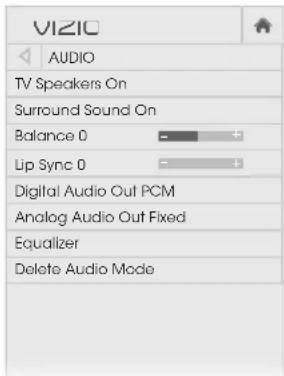
- Use the Arrow buttons on the remote to highlight Audio and press OK. The AUDIO menu is displayed.
- Use the Arrow buttons to highlight the setting you wish to adjust, then press Left/Right Arrow buttons to change the setting:
built-in speakers on or off.
text_image
VIZIO AUDIO TV Speakers On Surround Sound On Balance 0 Lip Sync 0 Digital Audio Out PCM Analog Audio Out Fixed Equalizer Delete Audio Mode
When the TV speakers are set to On, DTS signals cannot be passed through digital audio outputs.
IM
to deliver an immersive surround sound experience from the TV's internal speakers. TruSurround completes the entertainment experience by providing deep, rich bass and by delivering crisp details and clear, intelligible dialog. Select On or Off.
the left and right speakers.
display image and the accompanying audio track.

You must select Bitstream for audio with more than two channels (3.0, 5.0, or 5.1, for example).
for the 3.5mm (headphone jack) connector when connected to a home theater audio system. Select Variable to control the headphones' volume from the TV's volume controls, or select Fixed to control the headphones' volume from your home theater system controls. (Some external speakers can also be connected to the 3.5mm connector.)
frequencies using either preset or custom settings. See Changing the Equalizer Settings on page 31.
created using the Equalizer Settings. See Deleting the Custom Audio Mode on page 31.

This option is cannot be selected if no custom audio mode has been created.
- When you have finished adjusting the audio settings, press the BACK button to adjust additional settings or EXIT.
Changing the Equalizer Settings
The graphic equalizer has several pre-set modes and allows you to create one custom mode.
To select a pre-set audio mode:
- Press the MENU button on the remote. The on-screen menu is displayed.
- Use the Arrow buttons on the remote to highlight Audio and press OK. The AUDIO menu is displayed.
- Use the Arrow buttons to highlight Equalizer and press OK. The Audio Mode and equalizer settings screen appears.
-
Use the Left and Right Arrow buttons to select an audio mode (Flat, Dynamic, Center, Bass Boost, or Bright). The equalizer bars change to reflect the mode.
-
Press the BACK button to adjust additional settings or EXIT.
To create, modify, or replace the single custom equalizer setting:
- Press the MENU button on the remote. The on-screen menu is displayed.
- Use the Arrow buttons on the remote to highlight Audio and press OK. The AUDIO menu is displayed.
- Use the Arrow buttons to highlight Equalizer and press OK. The Audio Mode and equalizer settings screen appears.
- Use the Left and Right Arrow buttons to select any audio mode as a starting point.
- Use the Arrow buttons to highlight a frequency and then press OK.
- Use the Up and Down Arrow buttons to adjust the boost (up) and attenuation (down) for the frequency.
- Use the Left and Right Arrow buttons to select another frequency, if desired, and adjust it.
- Press the BACK button to adjust additional settings or EXIT.
Deleting the Custom Audio Mode
To delete the custom audio mode that has been created:
- Press the MENU button on the remote. The on-screen menu is displayed.
- Use the Arrow buttons on the remote to highlight Audio and press OK. The AUDIO menu is displayed.
- Use the Arrow buttons to highlight Delete Audio Mode and press OK. The TV displays, "To delete the user created custom audio mode, select the Delete button."
- Highlight Delete and press OK.
- Press the BACK button to adjust additional settings or EXIT.
SETTING TIMERS
This TV has several timers to save energy and to turn off when you go to sleep.
Setting the Sleep Timer
When activated, the TV's sleep timer will turn the TV off after a set period of time.
- Press the MENU button on the remote. The on-screen menu is displayed.
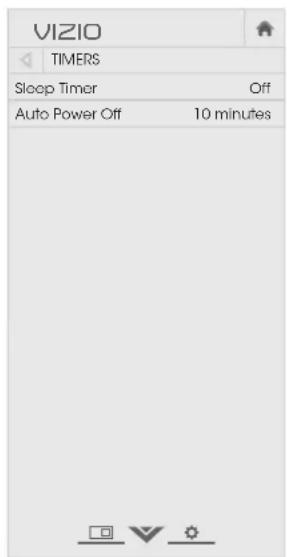
- Use the Arrow buttons on the remote to highlight Timers and press OK. The TIMERS menu is displayed.
- Use the Left/Right Arrow buttons on the remote to highlight the period of time after which you want the TV to
the sleep timer to activate, change the setting to Off.
- When you have finished setting the sleep timer, press the BACK button to adjust additional settings or EXIT.
text_image
VIZIO TIMERS Sleep Timer Off Auto Power Off 10 minutesSetting the Auto Power Off Feature
To help save energy, your TV is set by default to turn off after 10 minutes without a video or audio signal. This feature can be deactivated.
To set the Auto Power Off feature:
- From the TIMERS menu, use the Up/Down Arrow buttons on the remote to highlight Auto Power Off.
- Use the Left/Right Arrow buttons on the remote to change whether the TV will turn off. If you don't want the TV to turn off when there is no signal, change the setting to Off or 10 minutes.
- When you have finished setting the auto power off time, press the BACK button to adjust additional settings or EXIT.
SETTING UP CHANNELS
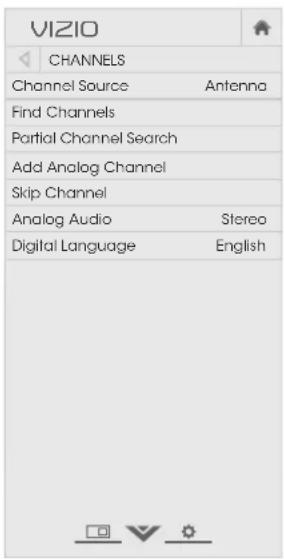
You can use the TV's Channels menu to:
text_image
VIZIO CHANNELS Channel Source Antenna Find Channels Partial Channel Search Add Analog Channel Skip Channel Analog Audio Stereo Digital Language EnglishSelecting a Channel Source
- On the remote control, press Input and use the Arrow button to highlight TV (antenna icon), then press OK.
CHANNELS menu is displayed.
- On the CHANNELS menu, highlight Channel Source and using the left/right Arrow buttons to select either Antenna or Cable.
Finding Channels
The TV may need to scan for channels before it can display programs and their associated information. A channel scan is required for free over-the-air channels (using an antenna) and cable channels from an out-of-the-wall connection (without a cable box). Moving the TV to an area with different channels requires the TV to scan for channels again.
To perform an Auto Channel Scan:
- From the CHANNELS menu, highlight Find Channels and press OK. The auto channel scan begins.
- Wait until the channel scan is 100% complete. Highlight Done and press OK.
- Press the EXIT button on the remote.
If the channel scan is cancelled, the channels that were already discovered are retained. A new channel scan will clear all channels.

text_image
VIZIO FIND CHANNELS Channels Found Digital: 0 Analog: 19 18% Complete Cancel Cancel the channel scan.Adding New Channels
Occasionally, you may need to add a new range of channels or add a new analog channel. You can do this by using the Partial Channel Scan and Add Analog Channel options. This is quicker than scanning all possible channels.
To add a range of new channels:
- From the CHANNELS menu, highlight Partial Channel Search, and press OK. The PARTIAL CHANNEL SEARCH menu is displayed.
- Highlight Scan Mode and select the type of channel you are adding: Analog, Digital, or Analog/Digital.
- Highlight From Channel and type the channel where you want to begin the scan. (Use the left Arrow button to backspace. Use the Number Pad on the remote to type the channel.)
- Highlight To Channel and enter the channel where you want to end the scan. (Use the left Arrow button to backspace. Use the Number Pad on the remote to enter the channel.)
- Highlight Start and press OK. The partial channel search begins.
- Wait until the partial channel search is 100% complete. Highlight Done and press OK.
- Press the EXIT button on the remote.
To add a single new analog channel:
- From the CHANNELS menu, highlight Add Analog Channel and press OK. The ADD ANALOG CHANNEL menu is displayed.
- Highlight Enter Channel # and use the Number Pad on the remote to type the number of the channel to be added.
- Highlight Add Channel and press OK. The TV scans for the channel.
- When the TV is done scanning for the channel, press the EXIT button on the remote.

text_image
VIZIO ADD ANALOG CHANNEL Enter Channel # Add ChannelSkipping Channels
After a channel scan is completed, you may find that some channels are too weak to watch comfortably. There may also be some channels you do not want to view. You can remove these channels from the TV's memory with the Skip Channel feature.

Channels that have been removed with the Skip Channel feature can still be viewed if the channel is entered using the Number Pad. If you wish to completely block a channel from being viewed, use the parental controls. See Locking and Unlocking Channels on page 42.
To remove a channel:
- From the CHANNELS menu, highlight Skip Channel, and press OK. The SKIP CHANNEL menu is displayed.
- For each channel you wish to remove, use the Up/Down Arrow buttons on the remote to highlight the channel and press OK. A √ appears to the right of each channel you select.
- When you have selected all of the channels you wish to remove, press BACK to adjust additional settings or EXIT.

text_image
VIZIO SKIP CHANNEL 1 Test 0 1 Test 1 ✓ 1-2 Test 2 ✓ 2 Test 3 2-2 Test 4 ✓ 2-3 Test 5LISTENING TO ALTERNATE AUDIO
Changing the Analog Audio Language
Some analog over-the-air (free) and cable channels broadcast programs in more than one language. The TV's Analog Audio feature allows you to listen to audio in an alternate language using Secondary Audio Programming (SAP).

Not all programs are broadcast in SAP. The Analog Audio Language feature only works when the program being viewed is being broadcast with Secondary Audio Programming.
To use the Analog Audio feature:
- From the CHANNELS menu, highlight Analog Audio and press OK. The ANALOG AUDIO menu is displayed.
- Select Stereo, SAP (secondary audio programming), or Mono Press OK.
- Press BACK to adjust additional settings or EXIT.

text_image
VIZIO ANALOG AUDIO Stereo SAP MonoChanging the Digital Audio Language
Some digital over-the-air (free), cable, and satellite channels broadcast programs in more than one language. The TV's Digital Audio feature allows you to listen to audio in alternate languages.

Not all programs are broadcast in alternate languages. The Digital Audio Language feature only works when the program being viewed is being broadcast in the language you select.
- From the CHANNELS menu, highlight Digital Language and press OK. The DIGITAL LANGUAGE menu is displayed.
- Select your preferred language: and press OK.
- Press BACK to adjust additional settings or EXIT.

text_image
VIZIO DIGITAL LANGUAGE English Español FrançaisSETTING UP CLOSED CAPTIONING
Your TV can display closed captions for programs that include them. Closed captions display a transcription of a program's dialogue.

If the program you are viewing is not being broadcast with closed captions, the TV will not display them.

The Closed Captions menu does not appear when an HDMI input is selected.
To activate or deactivate closed captions:
- Press the MENU button on the remote. The on-screen menu is displayed.
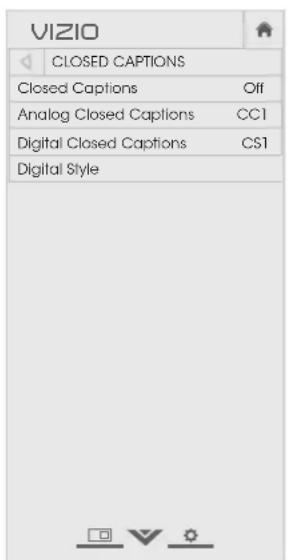
- Use the Arrow buttons on the remote to highlight Closed Captions and press OK. The CLOSED CAPTIONS menu is displayed.
- Use the Arrow buttons on the remote to highlight Closed Captions and then use the Left/Right Arrow buttons to select On or Off.
- Use the Arrow buttons on the remote to highlight either Analog or Digital Closed Captions.
- Use the Left/Right Arrow buttons on the remote to select the caption channel you wish to display, then press BACK to adjust additional settings or EXIT.
text_image
VIZIO CLOSED CAPTIONS Closed Captions Off Analog Closed Captions CC1 Digital Closed Captions CS1 Digital StyleChanging the Appearance of Digital Closed Captions
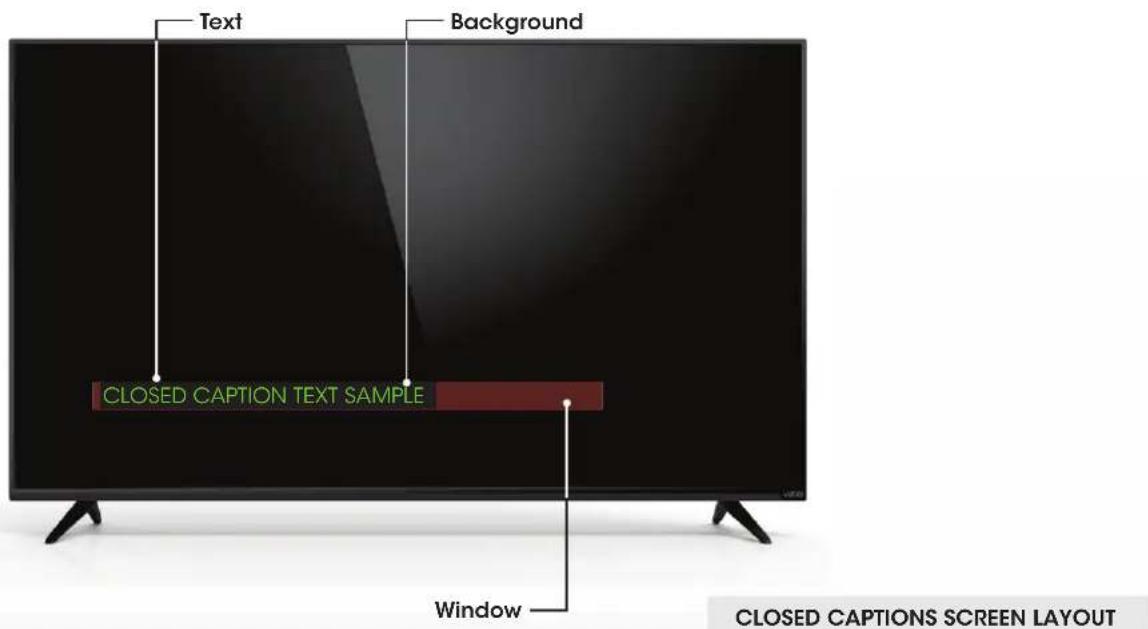
Digital closed captions can be displayed according to your preference. See the diagram on the next page for an explanation of the parts of the closed caption area.
To change the appearance of digital closed captions:
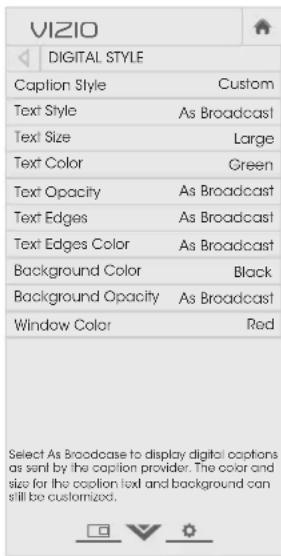
- From the CLOSED CAPTIONS menu, use the Arrow buttons to highlight Digital Style and press OK.
- Use the Left/Right Arrow buttons on the remote to select Custom and press OK. The DIGITAL STYLE menu is displayed.
- Use the Up/Down Arrow buttons on the remote to highlight the setting you wish to change, then use the Left/Right Arrow buttons to change the setting:
As Broadcast to keep default settings or Custom to manually change each setting.
font used for the closed captioning text.
text_image
VIZIO DIGITAL STYLE Caption Style Custom Text Style As Broadcast Text Size Large Text Color Green Text Opacity As Broadcast Text Edges As Broadcast Text Edges Color As Broadcast Background Color Black Background Opacity As Broadcast Window Color Red Select As Broadcast to display digital captions as sent by the caption provider. The color and size for the caption text and background can still be customized.such as raising the edges or adding drop shadows.
effects.
background directly behind the text.
background directly behind the text.
captioning box.
- When you are satisfied with the appearance of the closed captions, press the EXIT button on the remote.
Typical choices include:
of background appears behind the text, expanding as the text appears. This is the typical "As Broadcast" mode.
When text appears, the entire line fills with color at once.
In the example below, the closed caption text is green, the background is black, and the window is red.
text_image
Text Background CLOSED CAPTION TEXT SAMPLE Window CLOSED CAPTIONS SCREEN LAYOUTRENAMING DEVICES ON THE INPUT MENU
Inputs can be renamed to make them easier to recognize on the Input menu (see Changing the Input Source on page 20). For example, if you have a DVD player connected to the Component input, you can rename that input to display "DVD Player."
To change the name of an input:
- Press the MENU button on the remote. The on-screen menu is displayed.
- Use the Arrow buttons on the remote to highlight Devices and press the OK button. The DEVICES menu is displayed.
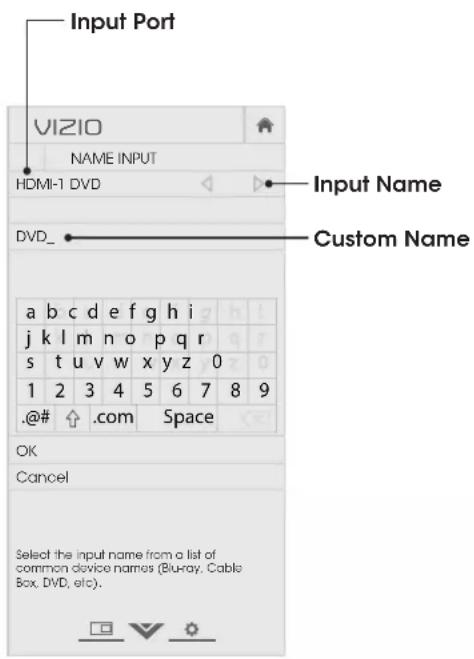
- Highlight the input port that you want to name and press OK.
- To use a preset input name:
a. Highlight the Input Port row and press OK.
b. Highlight the input name you want to use (HDMI-1, Blu-ray, Cable Box, Computer, DVD, DVR, Game, or Satellite) and press OK.
—Or—
To enter a custom name:
a. Enter your custom name using the on-screen keyboard.
b. Highlight OK and press OK.
c. The Input Name changes to show the custom name that you created.
- When you have finished naming your input, press the BACK button to adjust additional settings or EXIT.
text_image
Input Port VIZIO NAME INPUT HDMI-1 DVD Input Name Custom Name DVD_ a b c d e f g h i j k l m n o p q r s t u v w x y z 0 1 2 3 4 5 6 7 8 9 .@# ↑ .com Space OK Cancel Select the input name from a list of common device names (Blu-ray, Cable Box, DVD, etc).CHANGING THE TV SETTINGS
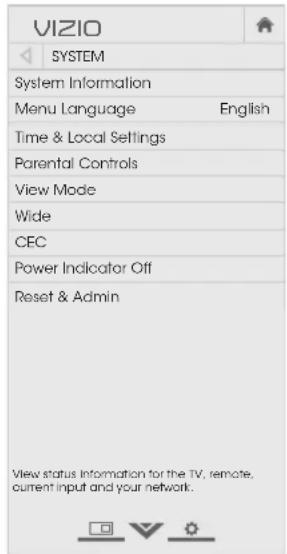
Using the System menu, you can:
menu language
settings
Commission (CEC) settings
indicator is illuminated
up administrative controls
text_image
VIZIO SYSTEM System Information Menu Language English Time & Local Settings Parental Controls View Mode Wide CEC Power Indicator Off Reset & Admin View status information for the TV, remote, current input and your network.Viewing System Information
To view a summary of the TV settings:
- Press the MENU button on the remote. The on-screen menu is displayed.
- Use the Arrow buttons on the remote to highlight System and press OK. The SYSTEM menu is displayed.
- Highlight System Information and press OK.
- Use the Up/Down Arrow buttons to scroll through the system information.

System information is used verify settings and the firmware version.
- When you are finished reviewing the system information, press the BACK button to view or change additional settings or EXIT.
Changing the On-Screen Menu Language
Your TV can display the on-screen menu in different languages.
To change the on-screen menu language:
- Press the MENU button on the remote. The on-screen menu is displayed.
- Use the Arrow buttons on the remote to highlight System and press OK. The SYSTEM menu is displayed.
- Use the Arrow buttons on the remote to highlight Menu Language and press OK. The MENU LANGUAGE menu is displayed.
- Highlight your preferred
or Français) and press OK. All screens will now be displayed in the selected language. - Press the BACK button to change additional settings or EXIT.

text_image
VIZIO MENU LANGUAGE English Español FrançaisSetting the Time and Local Settings
To ensure the correct time is displayed when you press the INFO button, set the TV's time zone:
- Press the MENU button on the remote. The on-screen menu is displayed.
- Use the Arrow buttons on the remote to highlight System and press OK. The SYSTEM menu is displayed.
- Use the Arrow buttons on the remote to highlight Time & Local Settings and press OK. The menu headed by the local date and time is displayed.
-
Highlight Time Zone and press OK. The TIME ZONE menu is displayed.
-
Highlight your time zone and press OK.
-
Highlight Daylight Saving Time and press OK. The DAYLIGHT SAVING TIME menu is displayed. Choose On if your locale observes daylight savings time, Off if it does not, or Auto to have your TV detect daylight savings automatically.
-
Press the BACK button to change additional settings or EXIT.

text_image
VIZIO TIME ZONE Alaska Hawaii Pacific Mountain Central Eastern Atlantic Newfoundland Indiana ArizonaUsing the Parental Controls
The TV's parental controls allow you to prevent the TV from displaying certain channels or programs without a password.
The Parental Controls menu only appears when:
when you are using an antenna for Over-the-Air signals or when connected to cable TV directly from the wall (no cable box).
cable or a coaxial cable, such as a VCR, satellite or cable box, or DVR.
Accessing the Parental Controls Menu
To access the Parental Controls menu:
- Press the MENU button on the remote. The on-screen menu is displayed.
- Use the Arrow buttons on the remote to highlight System and press OK. The SYSTEM menu is displayed.
- Use the Arrow buttons on the remote to highlight Parental Controls and press OK.
- Enter your parental passcode. If you have not set a passcode, enter the default, 0000. The PARENTAL CONTROLS menu is displayed.

To set a custom parental passcode, see Changing the Parental Control Passcode on page 43.
Enabling or Disabling Program Ratings
To manage program content according to its rating, you must enable the Program Rating feature.
To enable or disable the Program Rating feature:
From the PARENTAL CONTROLS menu, highlight Locks and use the left/right Arrow buttons to select On (enable) or Off (disable).
Locking and Unlocking Channels
When a channel is locked, it will be inaccessible. Locking a channel is a good way to prevent children from viewing inappropriate material.
To lock or unlock a channel:
- From the PARENTAL CONTROLS menu, highlight Channel Locks and press OK. The CHANNEL LOCKS menu is displayed.
- Highlight the channel you want to lock or unlock and press OK.
- When a channel is locked, the Lock icon appears locked. The channel is not accessible unless the parental passcode is entered.
- When a channel is unlocked, the Lock icon appears unlocked. The channel is accessible.
Blocking and Unblocking Content by Rating
A channel may sometimes broadcast programs that are meant for children, and at other times broadcast programs that are meant for mature audiences. You may not want to block the channel completely using a channel lock, but you may wish to block certain programs from being viewed.
When this is the case, you can use the TV's Rating Block feature to block content based on its rating.

For a list of content ratings and their definitions, visit www.tvguidelines.org.
To block or unblock content by its rating:
- From the PARENTAL CONTROLS menu, highlight the content type you want to adjust and press OK:
USA TV - USA television program broadcasts.
USA MOVIE - USA movie broadcasts.
Canadian English - Canadian English television program broadcasts.
Canadian French - Canadian French television program broadcasts.
-
For each rating type you want to block or unblock, use the Up/Down and Left/Right Arrow buttons on the remote to highlight the rating type and press OK.
-
When the rating type is blocked, the Lock icon appears locked. Content with this rating and all higher ratings cannot be viewed.
-
When the rating type is unblocked, the Lock icon appears unlocked. Content with this rating and all lower ratings can be viewed.
If you want to block all unrated content, highlight Block Unrated Shows and use the Arrow buttons on the remote to select On.
- When you are finished adjusting the rating level blocks, press the EXIT button on the remote.
Changing the Parental Control Passcode
If you use the parental controls, you should change the passcode to prevent children from accessing inappropriate material.
To change the parental control passcode:
- From the PARENTAL CONTROLS menu, highlight Change PIN and press OK. The CHANGE PIN menu is displayed.
- In the New PIN field, use the Number Pad on the remote to enter your new 4-digit parental control passcode.
- In the Confirm PIN field, use the Number Pad on the remote to re-enter your new 4-digit parental control passcode.
- Write down your new parental control passcode and save it in a secure location.
- Press the EXIT button on the remote.
Resetting the Content Locks
To reset the content locks to the factory-default settings:
- From the PARENTAL CONTROLS menu, highlight Reset Locks and press OK. The TV displays, "Select Reset to restore Parental Controls to the factory defaults."
- Highlight Reset and press OK.
Setting up View Mode
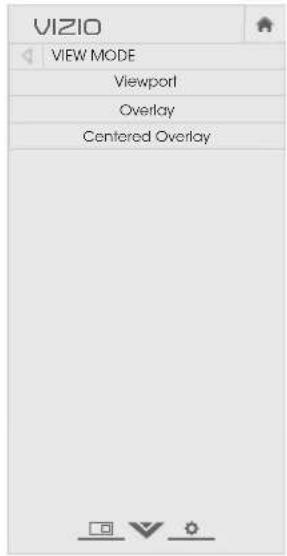
Your TV can display the screens in different modes.
To change the on-screen menu language:
- Press the MENU button on the remote. The on-screen menu is displayed.
- Use the Arrow buttons on the remote to highlight System and press OK. The SYSTEM menu is displayed.
- Use the Arrow buttons on the remote to highlight View Mode and press OK. The VIEW MODE menu is displayed.
- Highlight your preferred view mode (Viewport, Overlay, or Centered Overlay) and press OK. All screens will now be displayed in the selected mode.
- Press the BACK button to change additional settings or EXIT.
text_image
VIZIO VIEW MODE Viewport Overlay Centered OverlayChanging the Wide Setting
To change the aspect ration:
- Press the MENU button on the remote. The on-screen menu is displayed.
- Use the Arrow buttons on the remote to highlight System and press OK. The SYSTEM menu is displayed.
- Use the Arrow buttons on the remote to highlight Wide and press OK. The aspect ratio options are displayed.
- Select an aspect ratio. See Changing the Screen Aspect Ratio on page 20 for more information.
Adjusting the CEC Settings
The California Energy Commission (CEC) function on your TV enables you to control HDMI-connected devices with the included remote without any additional programming.

Not all HDMI devices support CEC. See your device's user manual for details.
To enable, disable, or adjust CEC settings:
- Press the MENU button on the remote. The on-screen menu is displayed.
- Use the Arrow buttons on the remote to highlight System and press OK. The SYSTEM menu is displayed.
- Use the Arrow buttons on the remote to highlight CEC and press OK. The CEC menu is displayed.
- Use the Arrow and OK buttons to adjust each setting:
device is connected and supports CEC.
- Press the BACK button to change additional settings or EXIT.
Turning the Power Indicator On or Off
The Power Indicator on the front of your TV normally does not glow when the TV is on. You can change this setting if you prefer the light to be on.
To turn the Power Indicator Light on or off:
- Press the MENU button on the remote. The on-screen menu is displayed.
- Use the Arrow buttons on the remote to highlight System and press OK. The SYSTEM menu is displayed.
- Highlight Power Indicator and press OK. The POWER INDICATOR menu is displayed.
- Use the Up/Down Arrow buttons to select On or Off, then press OK.
USING THE RESET & ADMIN MENU
Restoring the TV to Factory Default Settings
All of the on-screen menu settings can be reset to the factory default settings.

If you restore the TV to the factory default settings, all changes you have made to the settings will be lost!
To restore the TV to its factory default settings:
- Press the MENU button on the remote. The on-screen menu is displayed.
- Use the Arrow buttons on the remote to highlight System and press OK. The SYSTEM menu is displayed.
- Highlight Reset & Admin and press OK. The RESET & ADMIN menu is displayed.
- Highlight Reset TV to Factory Defaults and press OK.
- If you have changed the default parental control passcode, type it now.
The TV displays, "Select Reset to restore all TV settings to factory defaults and clear all account information."
-
Highlight Reset and press OK.
-
Wait for the TV to turn off. The TV will turn back on shortly afterward and the Setup App will begin.
-
To view a demonstration of TV functions on start-up, select Store Demo > On.
USING THE GUIDED SETUP MENU
The TV's Setup App can be used to easily set up the TV tuner.
To use guided setup:
- Press the MENU button on the remote. The on-screen menu is displayed.
- Highlight Guided Setup and press OK.
- Highlight the guided setup you want to use and press OK:
tuner.
- Follow the on-screen instructions. When finished, press the BACK button to change additional settings or EXIT.

text_image
VIZIO GUIDED SETUP Tuner SetupUSING THE INFO WINDOW
The Info Window can be displayed by pressing the INFO or GUIDE button on the remote:
channel, input, and display information.
program title, program rating, audio information, and the start and end times of the program.

text_image
Channel/Input Information 28-1 KCET-HD 1080p 6:15pm Display Information Normal Oliver's Holiday Surprise TV-PG-V Dolby Digital+ Stereo 11:00AM - 12:00PM Oliver wakes up one morning only to discover that his pals are missing. In this hour-long holiday special, Oliver goes on a journey in search of his pals. Who knows what he'll encounter on the way? Program Title/Rating Information Program DescriptionDIGITAL EPISODE GUIDE & INFO WINDOW
Using the USB Media Player
USING THE USB MEDIA PLAYER
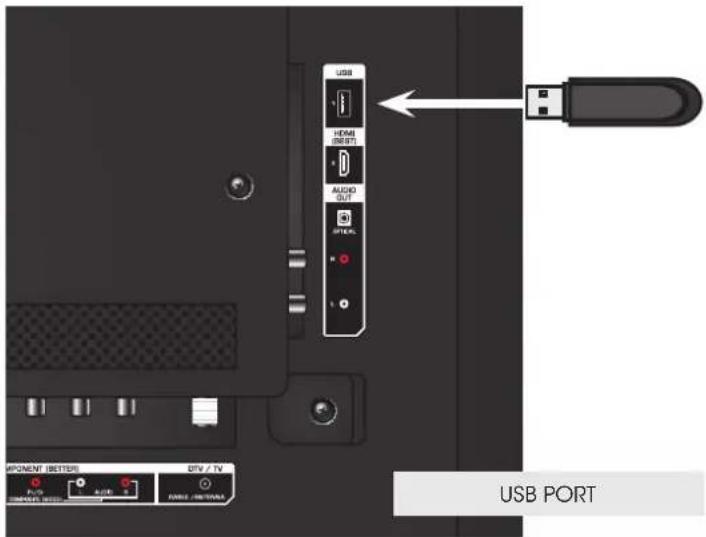
The USB Media Player allows you to connect a USB thumb drive to your TV and play music, video, or photos.
text_image
USB HDMI DIP AUDIO OUT SPEAK A POMENT BATTERB DTV / TV USB PORTPreparing your USB drive to play USB media
To play USB media, you must first save your files on a USB thumb drive:
extension (.mp3, .jpg, etc.).
smartphones.
Playing USB media
To play your USB media:
- Connect your USB thumb drive to the USB port on the side of the TV.
- Press the V button on the remote
- Use the Arrow buttons to highlight the Multimedia app in the V.I.A. Plus Dock and press OK. (The highlighted App is in the center of the dock.)
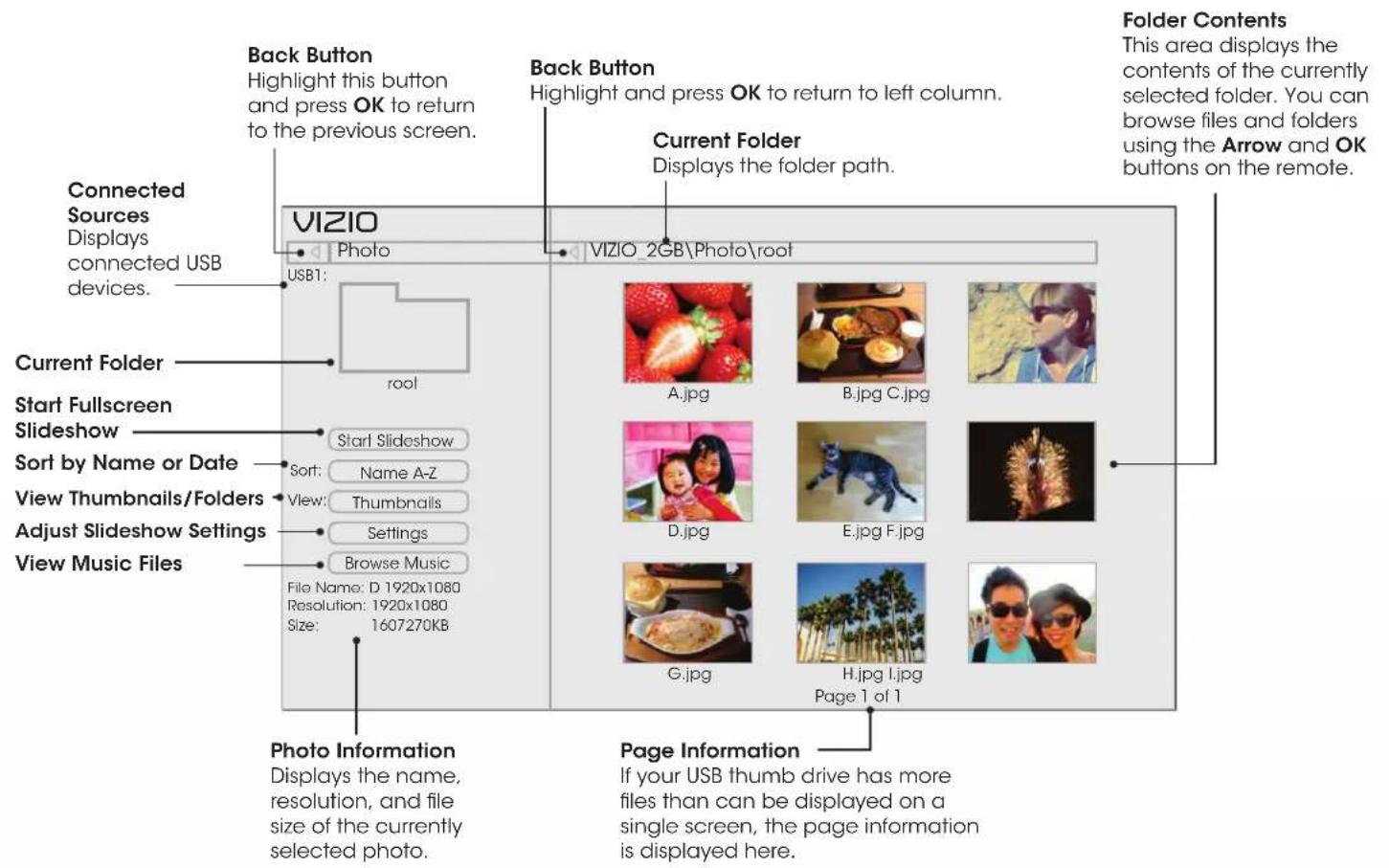
- Use the Arrow buttons to highlight the type of media to display (Music, Video, or Photo) and press OK.
- Use the Arrow buttons to highlight the file you want to display. Press OK. Music or video files play, photos display.

You can display your photos in fullscreen. Select the photo, press OK, then highlight Fullscreen and press OK.
Removing the USB drive from the TV

Do not remove the USB thumb drive while the TV is on. Doing so may damage the drive.
To safely remove your USB drive from the TV:
- Turn off the TV.
- Disconnect your USB thumb drive from the USB port on the side of the TV.
text_image
Back Button Highlight this button and press OK to return to the previous screen. Back Button Highlight and press OK to return to left column. Current Folder Displays the folder path. Folder Contents This area displays the contents of the currently selected folder. You can browse files and folders using the Arrow and OK buttons on the remote. Connected Sources Displays connected USB devices. VIZIO Photo VIZIO_2GB\Photo\root USB1: rool Current Folder Start Fullscreen Slideshow Sort by Name or Date Sort: Name A-Z View: Thumbnails Adjust Slideshow Settings View Music Files Browse Music File Name: D 1920x1080 Resolution: 1920x1080 Size: 1607270KB Photo Information Displays the name, resolution, and file size of the currently selected photo. Page Information If your USB thumb drive has more files than can be displayed on a single screen, the page information is displayed here.PHOTO VIEWER
Troubleshooting & Technical Support
A
Do you have questions? Find answers at
Find help with:

Live chat support available
Your can also contact our award-winning support team at:
(877) 698-4946 (toll-free) techsupport@VIZIO.com
Monday - Friday: 7 AM TO 11 PM (CST) Saturday - Sunday: 9 AM TO 6 PM (CST)
text_image
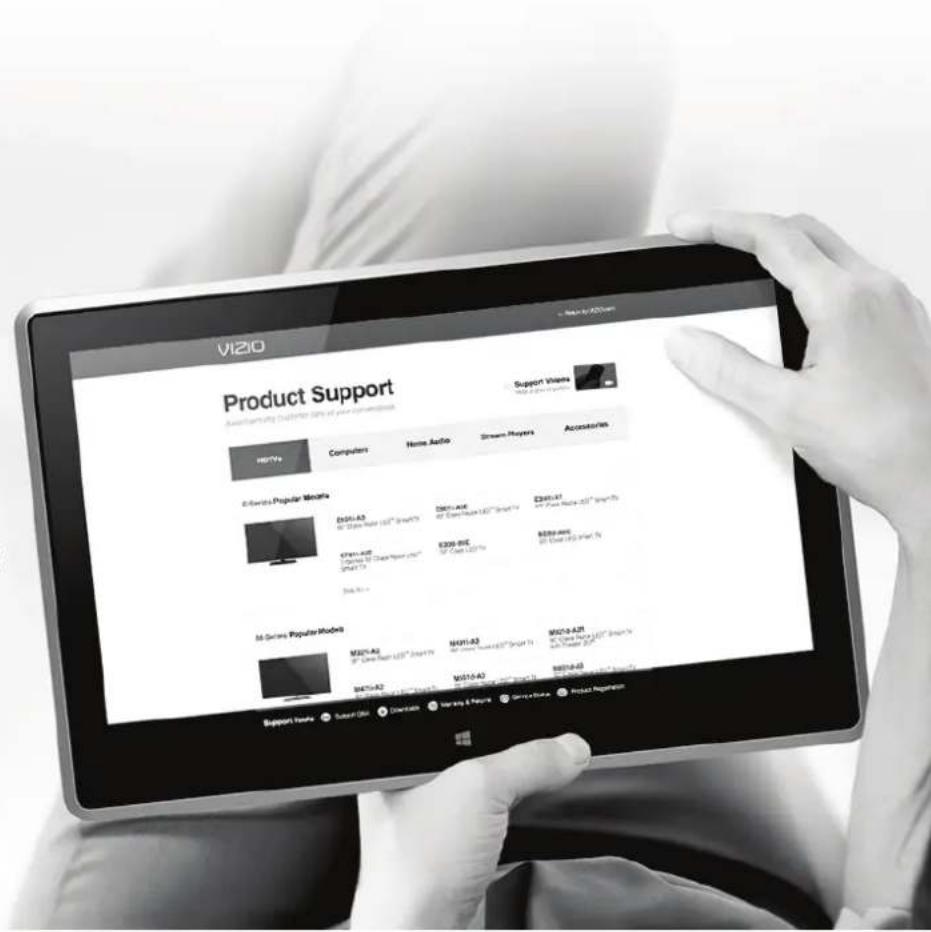
VIZIO Product Support Aircraft family customer calls your recommendation Support Vizio VIZIO Computers Home Audio Stream Players Accessor/OS E-Service Popular Media D351-A3 67" State Hotel (100" Smart TV) D801-A4 67" Country Hotel (100" Smart TV) E340-A7 67" Country Hotel (200" Smart TV) M-Service Popular Modell M351-A3 67" Country Hotel (100" Smart TV) M401-A2 67" Country Hotel (100" Smart TV) M501-A3 67" Country Hotel (100" Smart TV) M501-A4 67" Country Hotel (100" Smart TV) M501-A5 67" Country Hotel (100" Smart TV) Support Home: Tuxan Ohio Directrix Vanning & Privacy Service Update Product RegulationA
different input source.
directly to the TV, scan for channels. See Setting Up Channels on page 33.
the TV to turn the TV on.
differ; see your device's user manual for details.
Adjusting
the Picture Settings on page 22.
different input source.
off.
Adjusting the Audio
Settings on page 30.
(Blu-ray player, game console, cable/satellite box) that are connected to the TV.
channel may be low. Ensure your antenna is connected securely to the TV and move the antenna around the room or close to a window for the best signal.
Adjusting the Audio
Settings on page 30.
See Adjusting the Picture Settings on page 22.
A
do not operate with this model.
button.
Replacing the Batteries on page 11.
programs using digital sources. Connect your devices with HDMI cables.
channel may be low. Ensure your antenna is connected securely to the TV and move the antenna around the room or close to a window for the best signal.
TV. Separate the TV from electrical appliances, cars, or fluorescent lights.
press the WIDE button on the remote to change the screen mode.
high level of technology. However, sometimes pixels may not display correctly. These types of occurrences are inherent to this type of product and do not constitute a defective product.
digital broadcast signal, the signal is up-converted (improved) to match your TV's display capabilities. This up-converting can sometimes cause irregularities in the image.
channel may be low. Ensure your antenna is connected securely to the TV and move the antenna around the room or close to a window for the best signal.
source. If the viewing mode on the new input source differs from the one on the input source you switch from, the difference may be noticeable.
Changing the Screen Aspect Ratio on page 20.
Specifications
B
E320-C0E
| Screen Size: 32" Class | |
| Viewable Area: 31.50" | |
| Dimensions w/ Stand: | 28.71" x 19.08" x 7.87" |
| w/o Stand: | 28.71" x 17.11" x 2.91" |
| Weight w/ Stand: | 10.36 lbs |
| w/o Stand: | 9.48 lbs |
| TV Type: Full Array LED | |
| Refresh Rate: 60 Hz (Effective Refresh Rate) | |
| Maximum Resolution: 1366 x 768 (720p) | |
| Pixel Pitch: 0.51075 mm (H) x 0.51075 mm (V) | |
| Dynamic Contrast Ratio: 200,000:1 | |
| Viewing Angle: 178°/ 178° | |
| HDMI Inputs: 2 | |
| Component Video Inputs: 1 | |
| Composite Inputs: 1 | |
| RF Antenna Input: 1 | |
| Audio Outputs: | RCA Stereo, Optical Digital |
| OSD Language: English, Spanish, French | |
| Remote Control Model: XRT020 | |
| Certifications: | CSA-US, FCC Class B, HDMI (CEC, ARC), Dolby Digital |
B
E320-C0E
Compliance:
Energy Star 6.1
COUNEE
NRCan
Voltage Range: 120V @ 60 Hz
Power-On Consumption: 29 W
Standby Power Consumption: <0.5 W
Limited Warranty
C
ON PARTS AND LABOR
Covers units purchased as new in United States and Puerto Rico Only. VIZIO provides a warranty to the original purchaser of a new Product against defects in materials and workmanship for a period of one (1) year of non-commercial usage and ninety (90) days of commercial use. If a Product covered by this warranty is determined to be defective within the warranty period, VIZIO will either repair or replace the Product at its sole option and discretion.
To obtain warranty service, contact VIZIO Technical Support via e-mail: TechSupport@VIZIO.com or via phone at 877 MY VIZIO (877.698.4946) from 7:00AM to 11:00PM Monday through Friday and 9:00AM to 6:00PM Saturday and Sunday, Central Standard Time, or visit www.VIZIO.com. PRE-AUTHORIZATION MUST BE OBTAINED BEFORE SENDING ANY PRODUCT TO A VIZIO SERVICE CENTER. Proof of purchase in the form of a purchase receipt or copy thereof is required to show that a Product is within the warranty period.
Parts and Labor
There will be no charge for parts or labor during the warranty period. Replacement parts and Products may be new or recertified at VIZIO's option and sole discretion. Replacement parts and Products are warranted for the remaining portion of the original warranty or for ninety (90) days from warranty service or replacement, whichever is greater.
Type of Service
Defective Products must be sent to a VIZIO service center to obtain warranty service. VIZIO is not responsible for transportation costs to the service center, but VIZIO will cover return shipping to the customer. PRE-AUTHORIZATION IS REQUIRED BEFORE SENDING ANY PRODUCT TO A VIZIO SERVICE CENTER FOR WARRANTY SERVICE.
Product returns to VIZIO's service centers must utilize either the original carton box and shipping material or packaging that affords an equal degree of protection. VIZIO Technical Support will provide instructions for packing and shipping the covered Product to the VIZIO service center.
Limitations and Exclusions
VIZIO's one-year limited warranty only covers defects in materials and workmanship. This warranty does not cover, for example: cosmetic damage, normal wear and tear, improper operation, improper voltage supply or power surges, signal issues, damages from shipping, acts of God, any type of customer misuse, modifications or adjustments, as well as installation and set-up issues or any repairs attempted by anyone
other than by a VIZIO authorized service center. Products with unreadable or removed serial numbers, or requiring routine maintenance are not covered. This one year limited warranty does not cover Products sold "AS IS", "FACTORY RECERTIFIED", or by a non-authorized reseller.
THERE ARE NO EXPRESS WARRANTIES OTHER THAN THOSE LISTED OR DESCRIBED ABOVE. ANY IMPLIED WARRANTIES, INCLUDING ANY IMPLIED WARRANTY OF MERCHANTABILITY AND FITNESS FOR A PARTICULAR PURPOSE, SHALL BE LIMITED IN DURATION TO THE PERIOD OF TIME SET FORTH ABOVE. VIZIO'S TOTAL LIABILITY FOR ANY AND ALL LOSSES AND DAMAGES RESULTING FROM ANY CAUSE WHATSOEVER INCLUDING VIZIO'S NEGLIGENCE, ALLEGED DAMAGE, OR DEFECTIVE GOODS, WHETHER SUCH DEFECTS ARE DISCOVERABLE OR LATENT, SHALL IN NO EVENT EXCEED THE PURCHASE PRICE OF THE PRODUCT. VIZIO SHALL NOT BE RESPONSIBLE FOR LOSS OF USE, LOSS OF INFORMATION OR DATA, COMMERCIAL LOSS, LOST REVENUE OR LOST PROFITS, OR OTHER INCIDENTAL OR CONSEQUENTIAL DAMAGES. SOME STATES DO NOT ALLOW LIMITATIONS ON HOW LONG AN IMPLIED WARRANTY LASTS OR THE EXCLUSION OF INCIDENTAL OR CONSEQUENTIAL DAMAGES, SO THE ABOVE LIMITATIONS OR EXCLUSIONS MAY NOT APPLY TO YOU. THIS WARRANTY GIVES YOU SPECIFIC LEGAL RIGHTS, AND YOU MAY ALSO HAVE OTHER RIGHTS, WHICH VARY FROM STATE TO STATE. THIS WARRANTY IS SUBJECT TO CHANGE WITHOUT NOTICE.
CHECK WWW.VIZIO.COM FOR THE MOST CURRENT VERSION.
Personal Data
If your VIZIO product is capable of storing personal data and other information, ALL CONTENTS AND INFORMATION WILL BE DELETED IN THE COURSE OF SOME IN-HOME AND ALL SHIP-IN WARANTY SERVICE. If this occurs, your product will be restored to you configured as originally purchased. You will be responsible for restoring all applicable data and passwords. Recovery and reinstallation of user data is not covered under this Limited Warranty. In order to protect your personal information, VIZIO recommends that you always clear all personal information from the unit before it is serviced, regardless of the servicer.
Zero Bright Pixel Defect Guarantee
This policy covers "zero bright pixel" defects for the duration of the limited "ONE YEAR WARRANTY" on select new product purchases. To determine if this guarantee applies to your product, refer to the "DETAILS" tab of the model's product information page (www.VIZIO.com) or look for the "zero bright pixel" guarantee on the box.
Legal & Compliance
D
FCC Class B Radio Interference Statement
NOTE: This equipment has been tested and found to comply with the limits for a Class B digital device, pursuant to Part 15 of the FCC Rules. These limits are designed to provide reasonable protection against harmful interference in a residential installation. This equipment generates, uses and can radiate radio frequency energy, and if not installed and used in accordance with the instructions, may cause harmful interference to radio communications. However, there is no guarantee that interference will not occur in a particular installation. If this equipment does cause harmful interference to radio or television reception, which can be determined by turning the equipment off and on, the user is encouraged to try to correct the interference by one or more of the following measures:
- Reorient or relocate the receiving antenna.
- Increase the separation between the equipment and receiver.
- Connect the equipment into an outlet on a circuit different from that to which the receiver is connected.
- Consult the dealer or an experienced radio/TV technician for help.
This device complies with Part 15 of the FCC Rules. Operation is subject to the following two conditions: (1) this device may not cause harmful interference, and (2) this device must accept any interference received, including interference that may cause undesired operation.
Notice
- The changes or modifications not expressly approved by the party responsible for compliance could void the user's authority to operate the equipment.
- Shielded interface cables and AC power cord, if any, must be used in order to comply with the emission limits.
- The manufacturer is not responsible for any radio or TV interference caused by unauthorized modification to this equipment. It is the responsibilities of the user to correct such interference.
FCC warning
Changes or modifications not expressly approved by the party responsible for compliance with the FCC Rules could void the user's authority to operate this equipment.
Other
Image(s) used under license from Shutterstock.com