Xacti VPC-C6E - Camcorder SANYO - Free user manual and instructions
Find the device manual for free Xacti VPC-C6E SANYO in PDF.


User questions about Xacti VPC-C6E SANYO
0 question about this device. Answer the ones you know or ask your own.
Ask a new question about this device
Download the instructions for your Camcorder in PDF format for free! Find your manual Xacti VPC-C6E - SANYO and take your electronic device back in hand. On this page are published all the documents necessary for the use of your device. Xacti VPC-C6E by SANYO.
USER MANUAL Xacti VPC-C6E SANYO
natural_image
Illustration of a digital camera with an open screen and ventilation grille (no text or symbols)Important note
This manual explains how to safely operate the VPC-C6EX, VPC-C6EXE, VPC-C6E and VPC-C6.
Any information regarding only one of these products will be labeled as such.
Please read these instructions carefully before using the camera.
Make sure to read and understand the separate booklet "SAFETY MANUAL".
Keep this manual in a safe place for later reference.
Warning
TO PREVENT THE RISK OF FIRE OR ELECTRIC SHOCK, DO NOT EXPOSE THIS APPLIANCE TO RAIN OR MOISTURE
FOR AMERICAN USERS
The following advisory is included in accordance with the laws of the State of California (USA):
WARNING:
This product contains chemicals, including lead, known to the State of California to cause cancer, birth defects or other reproductive harm. Wash hands after handling.
- This equipment has been tested and found to comply with the limits for a Class B digital device, pursuant to Part 15 of the FCC Rules. These limits are designed to provide reasonable protection against harmful interference in a residential installation. This equipment generates, uses and can radiate radio frequency energy and, if not installed and used in accordance with the instructions, may cause harmful interference to radio communications. However, there is no guarantee that interference will not occur in a particular installation. If this equipment does cause harmful interference to radio or television reception, which can be determined by turning the equipment off and on, the user is encouraged to try to correct the interference by one or more of the following measures:
- Reorient or relocate the receiving antenna.
- Increase the separation between the equipment and receiver.
- Connect the equipment into an outlet on a circuit different from that to which the receiver is connected.
- Consult the dealer or an experienced radio/TV technician for help.
- Changes or modifications not expressly approved by the party responsible for compliance could void the user's authority to operate the equipment.
Declaration of Conformity
Model number: VPC-C6
Trade Name: SANYO
Responsible party: SANYO FISHER COMPANY
Address: 21605 Plummer Street, Chatsworth, California 91311
Telephone No.: (818) 998-7322
This device complies with Part 15 of the FCC Rules. Operation is subject to the following two conditions:
(1) this device may not cause harmful interference, and
(2) this device must accept any interference received, including interference that may cause undesired operation.
i English
FOR CANADIAN USERS
- This Class B digital apparatus complies with Canadian ICES-003.
FOR EU USERS

natural_image
Symbol of a trash bin crossed with two crossed lines, no text or numbers presentNote:
- This symbol mark and recycle system apply only to EU countries and do not apply to countries in other areas of the world.
Your SANYO product is designed and manufactured with high quality materials and components which can be recycled and reused.
This symbol means that electrical and electronic equipment, at their end-of-life, should be disposed of separately from your household waste.
Please dispose of this equipment at your local community waste collection/recycling centre.
In the European Union there are separate collection systems for used electrical and electronic products.
Please help us to conserve the environment we live in!
Symbols used in this manual
HINT Points giving some extended instructions or special points to pay attention to.
CAUTION Points that require special attention.
(page xx) Refer to the page indicated for detailed information.
You may find the answers to questions or problems concerning camera operation in the sections “COMMONLY ASKED QUESTIONS” (page 155) and “TROUBLESHOOTING” (page 162).
GETTING UP AND RUNNING
Install the card
1 Insert the card.
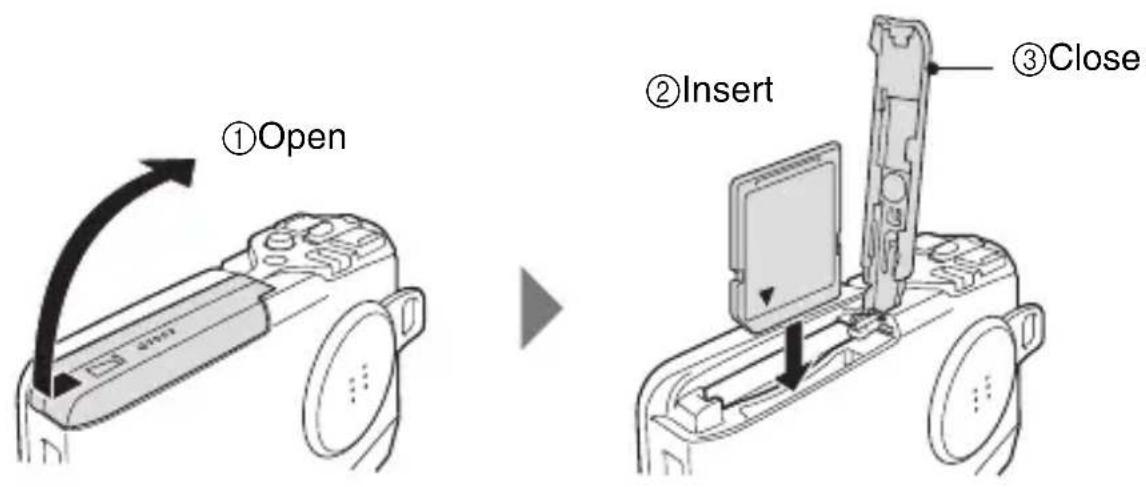
text_image
①Open ②Insert ③Close2 Connect the AC adaptor to the camera.
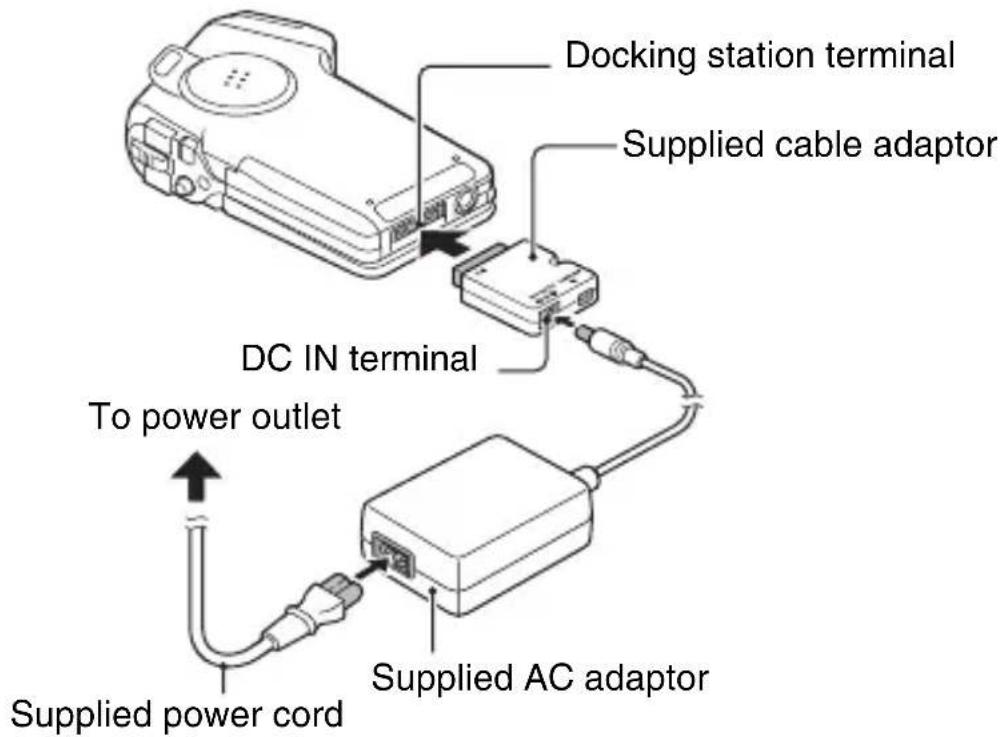
text_image
Docking station terminal Supplied cable adaptor DC IN terminal To power outlet Supplied power cord Supplied AC adaptoriii English
Shooting
■Video clip recording
1 Open the monitor unit, and press the ON/OFF button for at least 1 second to turn the camera on.
2 Set the main switch to REC.
3 Press the video clip recording button [ ]
- Recording begins.
• To stop recording, press the video clip recording button again.
■Still image photography
1 Open the monitor unit, and press the ON/OFF button for at least 1 second to turn the camera on.
2 Set the main switch to REC.
3 Press the still image shooting button [ ] • The image is captured.
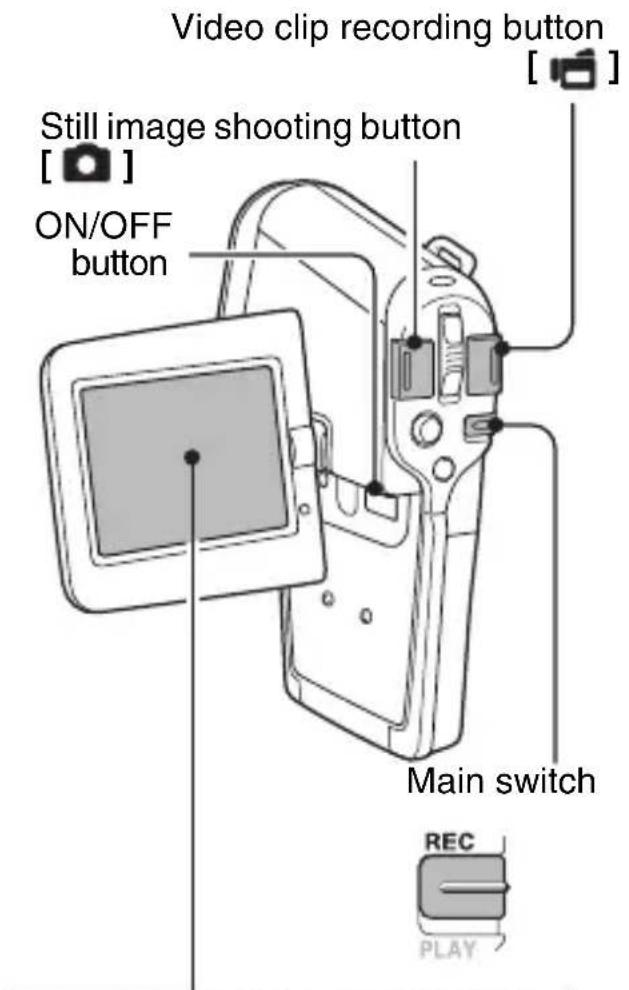
text_image
Video clip recording button [ ] Still image shooting button [ ] ON/OFF button Main switch REC PLAY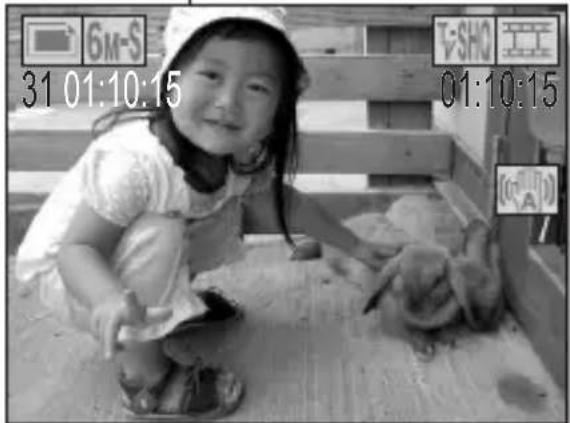
text_image
6M-S 31 01:10:15 01:10:15Playback
■Video clip playback
1 Set the main switch to PLAY.
• The display switches to the Playback Screen.
- Toggle the SET button to the left or right to display the video clip you wish to play back.
• Video clips are indicated by a video clip pattern along the top and bottom of the screen.
2 Press the SET button.
- Playback of the selected video clip begins.
- When the main switch is moved to REC, the display changes to the Shooting Screen.
■Still image playback
1 Set the main switch to PLAY.
• The display switches to the Playback Screen.
• To view other images, toggle the SET button to the left or right.
- When the main switch is moved to REC, the display changes to the Shooting Screen.
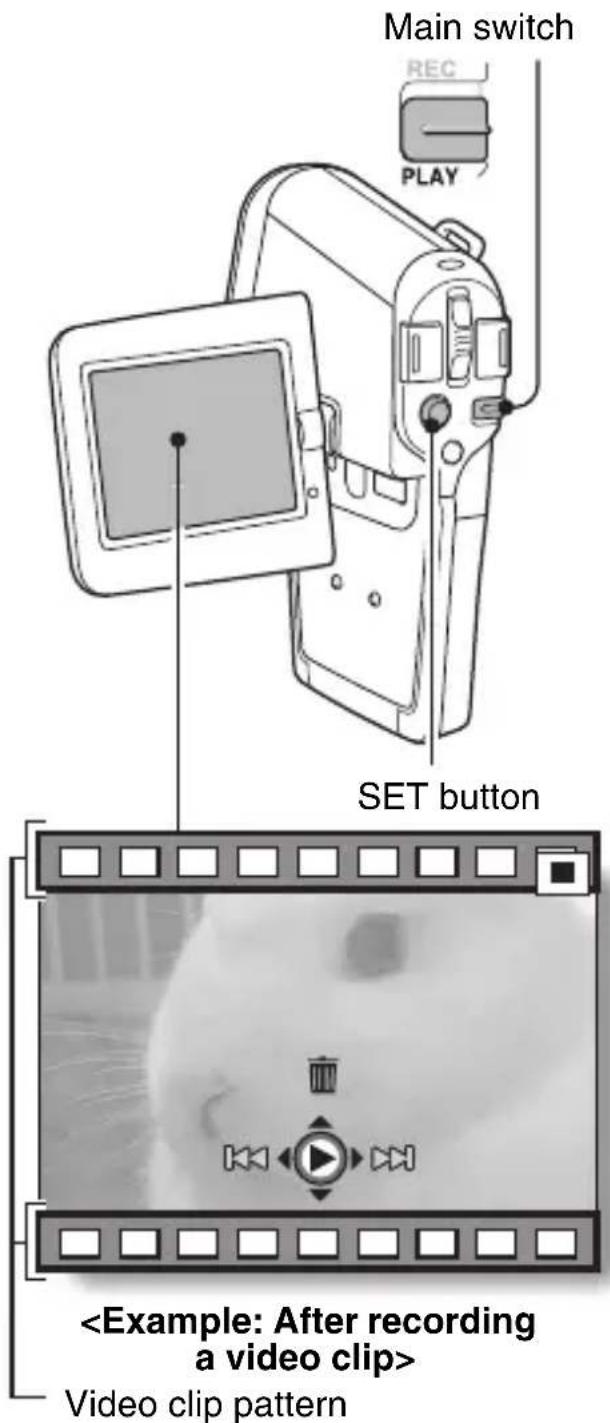
text_image
Main switch REC PLAY SET buttonWhen you are finished using the camera...
Press the ON/OFF button to turn the camera off.
v English
Your camera has an abundance of convenient features and functions. From creating precisely the photo you want, to viewing images using various techniques, you can locate the exact operation for your purposes in the following table.
| Basic operation | Convenient functions | Additional functions | |
| Shooting/recording | Getting started shooting/recording“ Recording video clips” on page 34“ Capturing still images” on page 36“ Shoot a still image while recording a video clip” on page 38“ MAKE AN AUDIO RECORDING” on page 41 | Log the date and time of your photos“ DATE AND TIME SETTING” on page 107Zoom in on the subject“ Using the zoom” on page 39Take vertical (portrait) format photos“ Still image mode (resolution) setting” on page 56Close-up photography“ FOCUS RANGE” (super macro mode) on page 66 | For more accurate focus“ FOCUS RANGE” (manual focus) page 66Set the focus to a narrow range“ FOCUS AREA SETTING” on page 68 |
| Optimize the photo quality“ Video clip mode (image quality) setting” on page 55“ Still image mode (resolution) setting” on page 56 | Reduce video clip flicker“FLICKER-REDUCTION” on page 117Set the camera’s color/contrast characteristics“ADJUST THE IMAGE QUALITY” on page 116 | ||
| Shooting/recording | Capture fast-moving subjects“SCENE SELECT” (sports mode) on page 57 | ||
| Shoot in dark conditions“Exposure correction” on page 40“FLASH SETTING” on page 60“SCENE SELECT” (night view mode/fireworks mode/lamp mode) on page 57 | |||
| Photographing people“SCENE SELECT” (portrait mode/night view mode) on page 57“FILTERS” (cosmetic filter) on page 59 | |||
| Photographing landscapes“SCENE SELECT” (landscape mode) on page 57 | |||
| Take a self-photo“SELF-TIMER” on page 62 | |||
| Make images lighter or darker“Exposure correction” on page 40 | Measure the brightness of a specific area“LIGHT-MEASURING MODE SETTING” on page 69Adjust the camera’s sensitivity“ISO SENSITIVITY” on page 70 | ||
| Change the color of the images“FILTERS” (monochrome filter/ sepia filter) on page 59 | Make white appear natural“WHITE BALANCE” on page 71 | ||
| Basic operation | Convenient functions | Additional functions | |
| Playback | Getting started viewing images“Playing back a video clip” on page 46 | Adjust the speaker volume“PLAYBACK VOLUME” on page 78 | Smooth out video clip playback“SMOOTH PLAYBACK” on page 102 |
| “VIEWING IMAGES” on page 43 | Search for image/ audio data“9-image display playback” on page 44Magnify an image“Magnifying (zooming in) the image” on page 45 | Change the angle of view“ROTATE IMAGE” on page 90 | |
| “PLAYING BACK AUDIO DATA” on page 48 | Adjust the speaker volume“PLAYBACK VOLUME” on page 78 | ||
| Slideshow playback“PLAYBACK MODE” on page 77 | |||
| Adjust the LCD monitor brightness“LCD MONITOR BRIGHTNESS” on page 119 | |||
| Playback on a TV“CONNECTING TO A TV” on page 137 | Set the TV system“TV OUTPUT SETTING” on page 121 | ||
| Data managing/processing | Search for image/audio data“9-image display playback” on page 44 | ||
| Delete data“ERASING DATA” on page 81 | Protect images from accidental erasure“IMAGE PROTECT” on page 79Format a card“FORMATTING A CARD” on page 128 | ||
| Edit the red-eye phenomenon in photos“RED-EYE CORRECTION” on page 92 | |||
| Delete a part of a video clip and join video clips“EDITING VIDEO CLIPS” on page 95 | |||
| Specify the number of prints, index print, and date imprint“PRINT SETTINGS” on page 83 | |||
| View the settings that were in effect when the image/audio data was recorded“DISPLAYING IMAGE PROPERTIES (INFORMATION SCREEN)” on page 103 | |||
CONTENTS
GETTING UP AND RUNNING .... iii
CHECKING THE INCLUDED ACCESSORIES ....7
GETTING THE MOST OUT OF YOUR CAMERA ....11
SYSTEM MAP 15
SETUP
PARTS NAMES ....16
INSTALLING THE BATTERY PACK AND CARD ....19
POWER FOR THE CAMERA 22
TURNING THE CAMERA ON AND OFF 26
BASIC SHOOTING FUNCTIONS ....39
MAKE AN AUDIO RECORDING 41
VIEWING IMAGES 43
PLAYING BACK AUDIO DATA 48
■ SHOOTING
DISPLAYING THE SHOOTING SETTING SCREENS ....49
IMAGE QUALITY ....55
SCENE SELECT ....57
FILTERS 59
FLASH SETTING 60
SELF-TIMER 62
MOTION COMPENSATION (IMAGE STABILIZER) 64
FOCUS RANGE 66
FOCUS AREA SETTING 68
LIGHT-MEASURING MODE SETTING 69
ISO SENSITIVITY 70
WHITE BALANCE 71
CONTENTS
■ PLAYBACK
DISPLAYING THE PLAYBACK SETTING SCREENS 73
PLAYBACK MODE 77
PLAYBACK VOLUME 78
IMAGE PROTECT 79
ERASING DATA 81
PRINT SETTINGS 83
ROTATE IMAGE 90
CHANGING IMAGE SIZE (RESIZE) 91
RED-EYE CORRECTION 92
EXTRACTING A STILL IMAGE FROM A VIDEO CLIP 94
EDITING VIDEO CLIPS 95
SMOOTH PLAYBACK 102
DISPLAYING IMAGE PROPERTIES (INFORMATION SCREEN) .... 103
■ OPTION SETTINGS
DISPLAYING THE OPTION SCREEN 104
DATE AND TIME SETTING 107
■ OTHER DEVICES AND CONNECTIONS
CONNECTING TO A TV 137
PREPARING AND USING THE REMOTE CONTROL UNIT ....140
DIRECT PRINTING 145
USING THE CABLE ADAPTOR 154
■ APPENDICES
COMMONLY ASKED QUESTIONS ....155
TROUBLESHOOTING 162
SPECIFICATIONS 172
HINTS FOR TAKING PICTURES ......182
CHECKING THE INCLUDED ACCESSORIES
- Neckstrap: 1 •
natural_image
Illustration of a pair of dental tools, one with a curved tip and the other with a flat blade (no text or symbols)- Li-ion battery pack: 1 •
natural_image
Isometric illustration of a rectangular electronic device with two ports and an internal connector (no text or symbols)- S-AV interface cable: 1 •
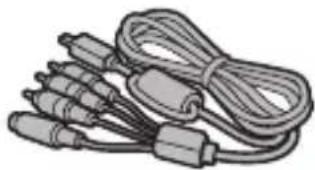
natural_image
Illustration of a coiled cable with multiple connectors (no text or symbols)- Remote control unit: 1
A lithium battery (CR2025) is installed at the time of purchase.
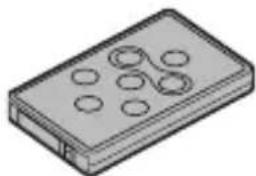
natural_image
Isometric illustration of a rectangular device with circular indentations on top (no text or symbols)- Cable adaptor: 1 •
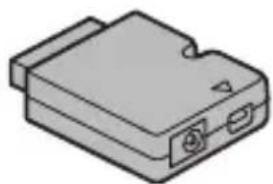
natural_image
3D illustration of a gray rectangular electronic component with two ports and a side port (no text or symbols)• SANYO Software Pack (CD-ROM): 2

natural_image
Two overlapping optical discs (CD/DVD) with visible blades and central hub, no text or symbols present.- Docking station: 1
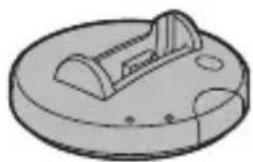
natural_image
Simple line drawing of a circular mechanical component with a central slot and mounting holes (no text or symbols)- USB interface cable: 1
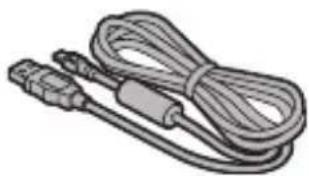
natural_image
Illustration of a coiled cable with two connectors (no text or symbols)- Lens cap and strap: 1
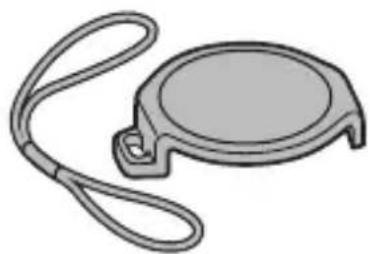
natural_image
Illustration of a pair of objects resembling a stylized object with a loop (no text or symbols)• AC adaptor and power cord: 1
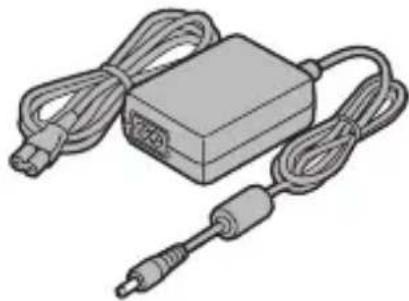
natural_image
Illustration of a gray electronic device with coiled cables and a connector (no text or symbols)7 English
- Camera case: 1

natural_image
Illustration of a closed wallet with a strap and handle (no text or symbols)- "SAFETY MANUAL" (safety precautions booklet) Please read this booklet carefully before using the digital camera.

text_image
Scanned image of a document with visible text and symbols, likely a form or template label.- Quick Guide

natural_image
Illustration of two overlapping credit cards with no visible text or symbols on the covers or background.CHECKING THE INCLUDED ACCESSORIES
How to use the accessories
Neckstrap
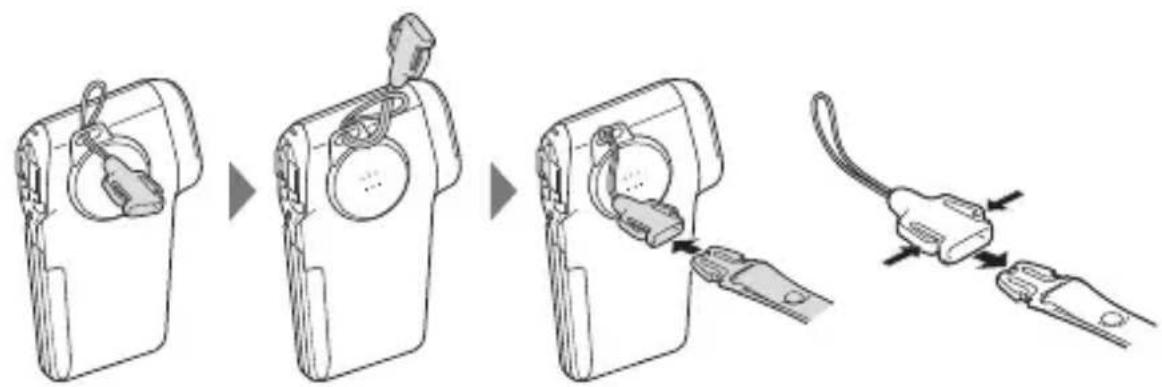
flowchart
graph TD
    A["Device with cable"] --> B["Load"]
    B --> C["Plug plug"]
    C --> D["Close-up cable plug"]
■Lens cap

flowchart
graph TD
    A["Initial eyeglasses"] --> B["Step 1: Insert eye"]
    B --> C["Step 2: Insert lens"]
    C --> D["Step 3: Insert mask with lens"]
    D --> E["Step 4: Insert camera with lens"]
    E --> F["Step 5: Insert lamp with lamp"]
■Camera case
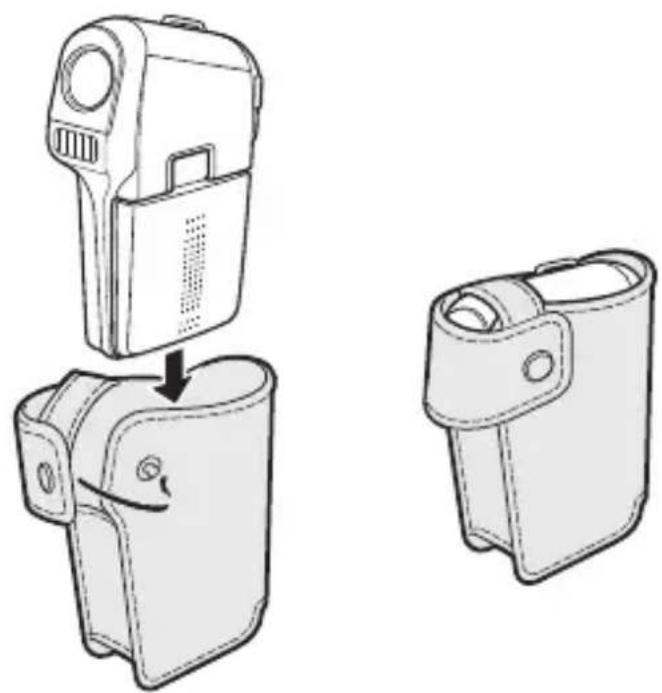
natural_image
Technical line drawing of a device with two views: top shows a device being inserted, bottom shows a device with a handle (no text or symbols)Media cards that can be used with this camera
The type of card that can be inserted into and used with this camera is:
- SD Memory Card
GETTING THE MOST OUT OF YOUR CAMERA
Your movie camera can not only record video clips, you can also take still photos and make audio recordings. For example, you can snap a still image while recording a video clip, or make just an audio recording.
Twin menus for easy operation (see pages 50 and 74)
The novice photographer will have no problem taking beautiful pictures using the easy settings on the PAGE 1 menu.
Of course, the PAGE 2 menu for the experienced photographer provides full control over detailed camera settings.
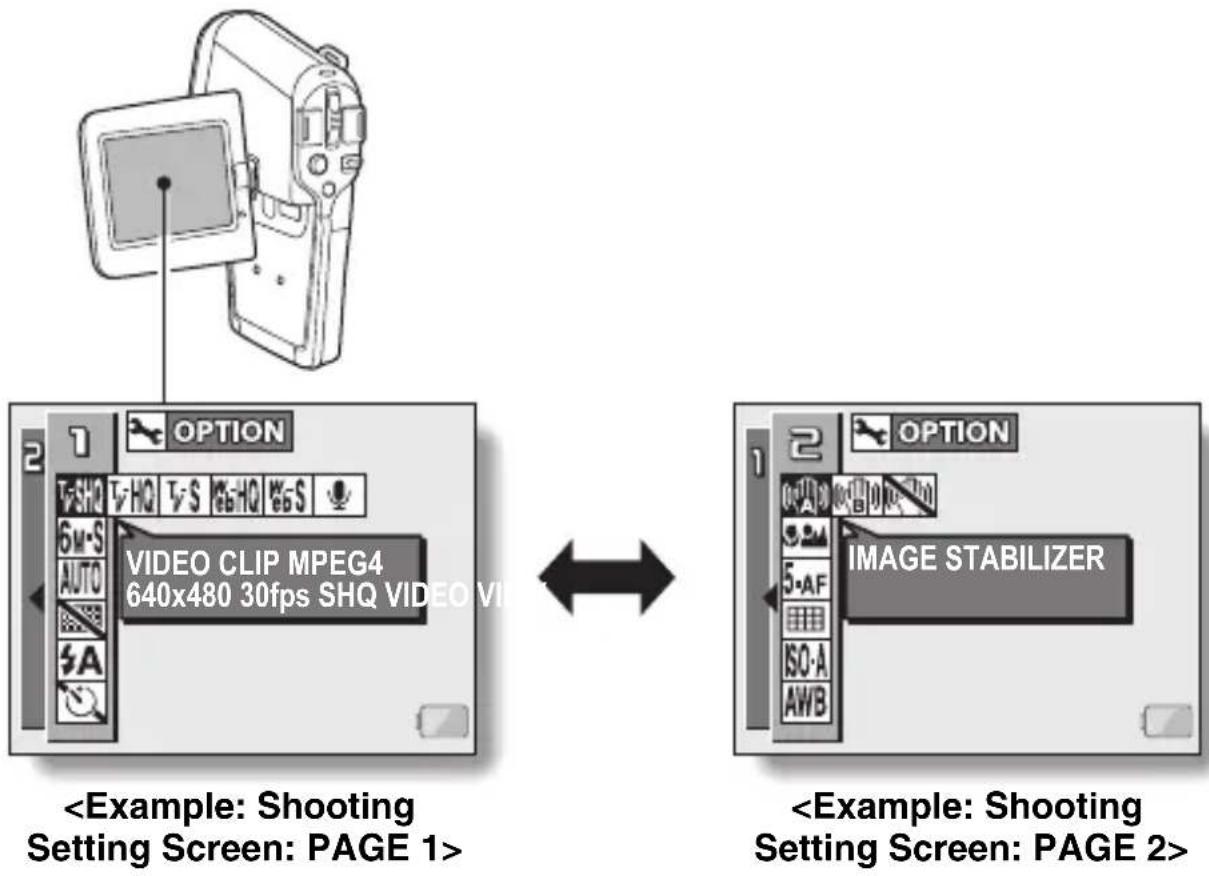
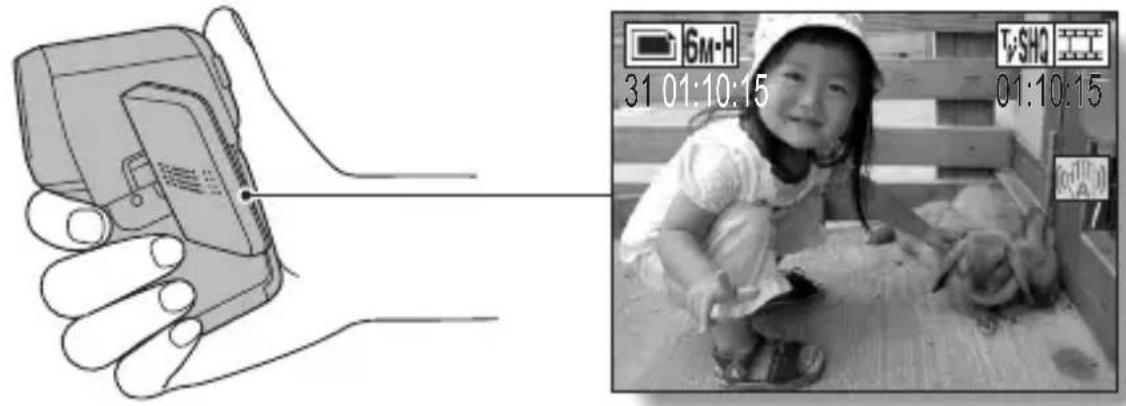
Shooting video clips (page 34)
You expect your camera to record great quality still photos, but you can record 640 × 480-pixel video clips as well. The maximum 30-frames-per-second shooting speed guarantees beautiful, flowing movies for you to enjoy. Another bonus is the capability to record small file sizes that are perfect for uploading to Internet websites.
Capture still shots while recording a video clip (page 38)
Suppose that while you're recording a video clip, there's a scene you'd like to keep as a still photo. Your camera makes it possible to record the still photo without interrupting the video clip recording.
text_image
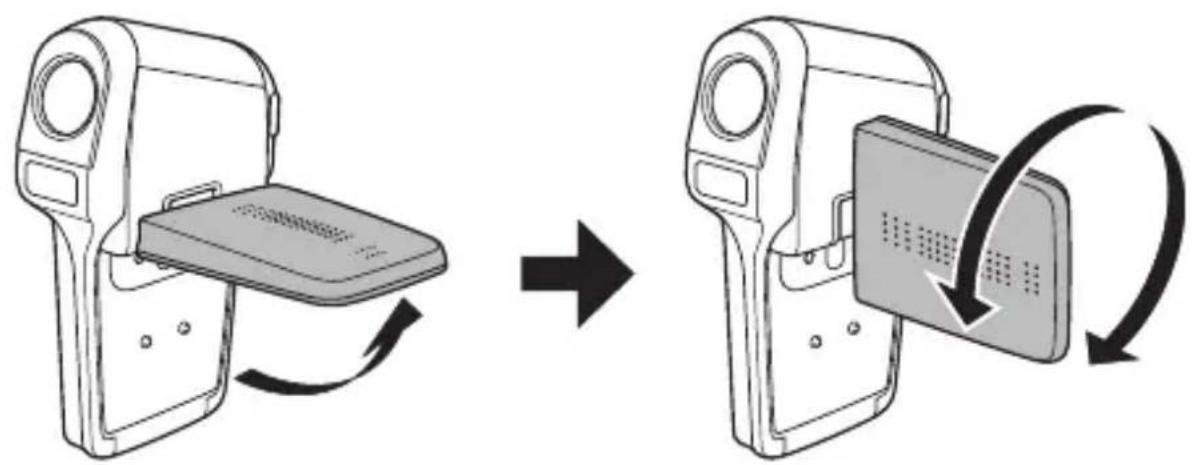
Black-and-white photo showing a hand holding a mobile phone and a child in a classroom setting, with overlaid camera interface displays showing time and device status.Movable monitor for any shooting angle
The movable LCD monitor lets you shoot from any angle. Hold the camera high to get a great view of a parade, or swivel the monitor around to snap a photo of yourself.
flowchart
graph TD
    A["Door Lock"] -->|Shift/Rotation Arrow| B["Door Panel"]
    B -->|Rotate Down/Up Roll| C["Downward Shift/Right Rotation"]
GETTING THE MOST OUT OF YOUR CAMERA
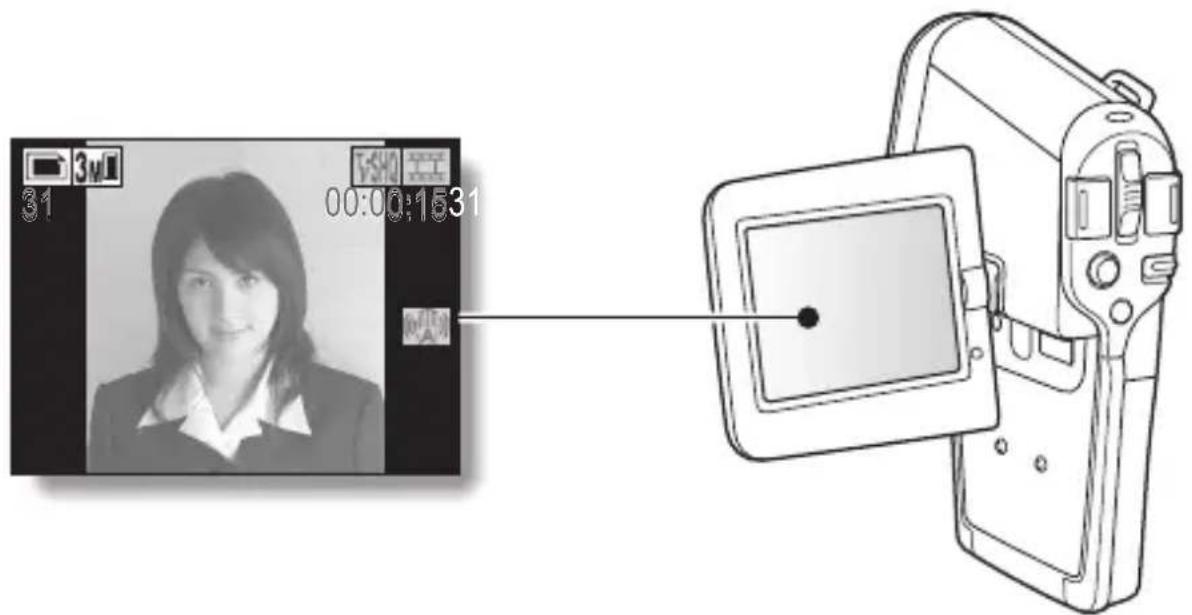
Easy to shoot vertically oriented photos (page 56)
A grip-type camera is compact and very easy to hold securely, but trying to take vertically oriented photos by changing the camera angle is a problem. However, your camera features a vertical shooting mode that allows you to take vertical (portrait) mode still images without having to change the camera angle.
text_image
31 3:11 00:00:1531Smooth out the motion during video clip playback: Smooth playback (page 102)
If a video clip was recording while the camera was moving fast, you might see a distracting video flicker when it is played back. For a playback that is comfortably even, you can use the “smooth playback function” to suppress the video flicker.

text_image
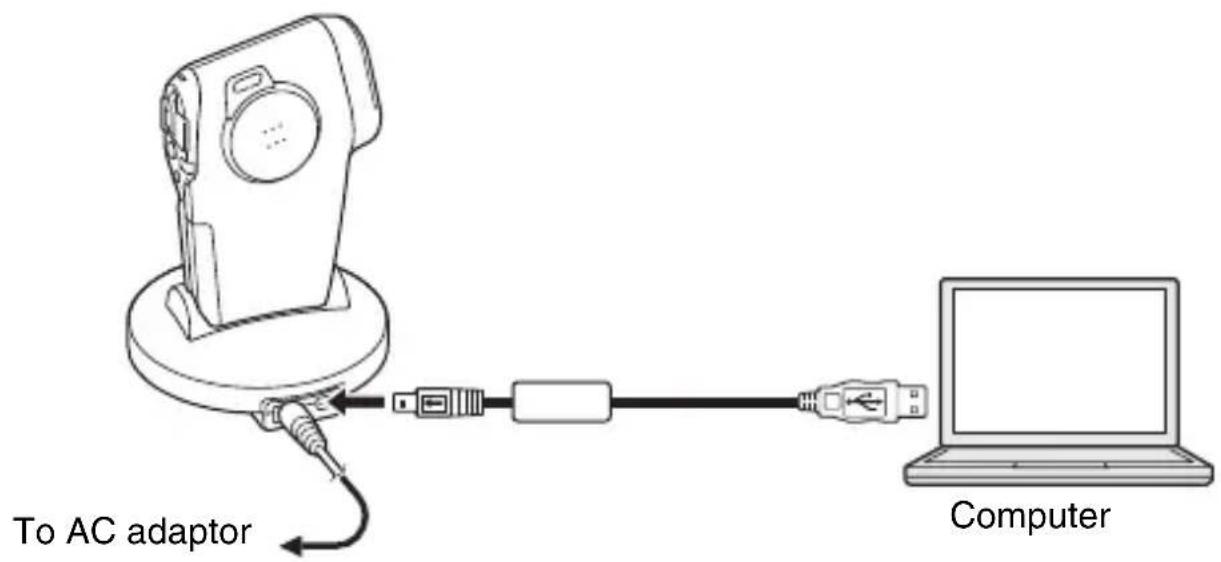
SMOOTH PLAYBACK ON OFFDocking station for easy connection
The docking station simplifies those complicated connections to your TV or computer. Just set the camera in the docking station, and you can view your photos on your TV or computer right away. The remote control unit makes it even more convenient.
text_image
To AC adaptor Computer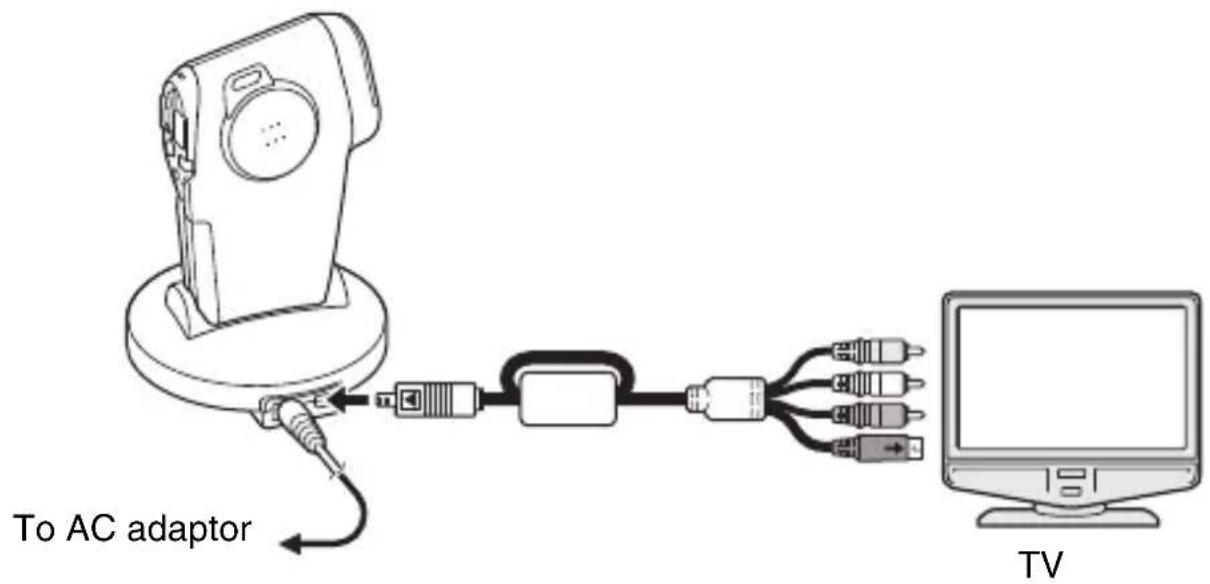
text_image
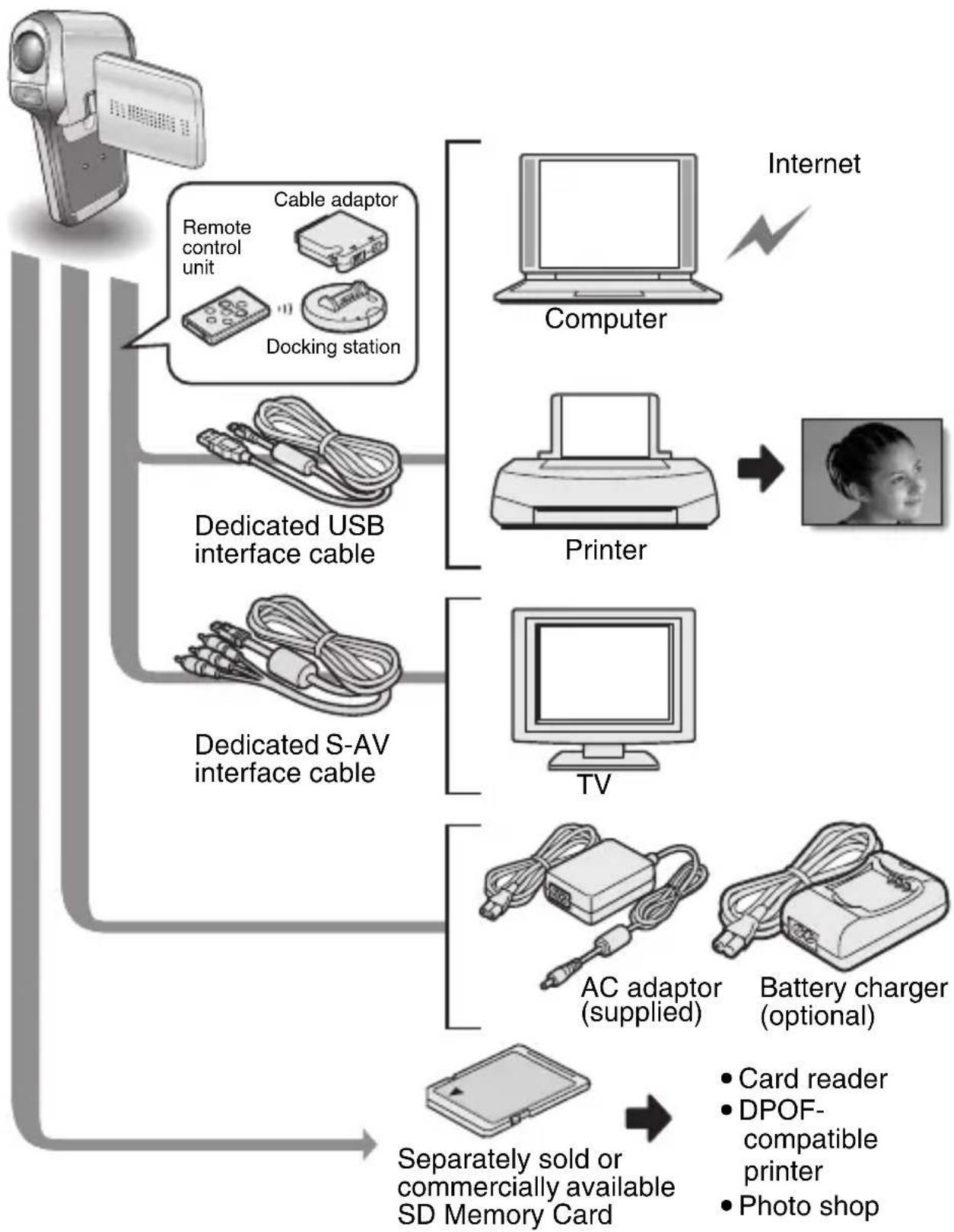
To AC adaptor TVSYSTEM MAP
You can connect the camera to various devices to expand its capabilities.
flowchart
graph TD
    A["Device"] --> B["Remote control unit"]
    A --> C["Cable adaptor"]
    A --> D["Docking station"]
    B --> E["Dedicated USB interface cable"]
    C --> F["Dedicated S-AV interface cable"]
    E --> G["Computer"]
    F --> H["Printer"]
    G --> I["Internet"]
    H --> J["TV"]
    I --> K["AC adaptor (supplied)"]
    J --> L["Battery charger (optional)"]
    K --> M["Separately sold or commercially available SD Memory Card"]
    L --> N["• Card reader\n• DPOF-compatible printer\n• Photo shop"]
PARTS NAMES
Camera
Front

text_image
Strap holder Speaker Lens Flash Monitor unit Stereo microphone
natural_image
Diagram showing a device being processed from a slide to a closed panel, with no visible text or symbols.PARTS NAMES
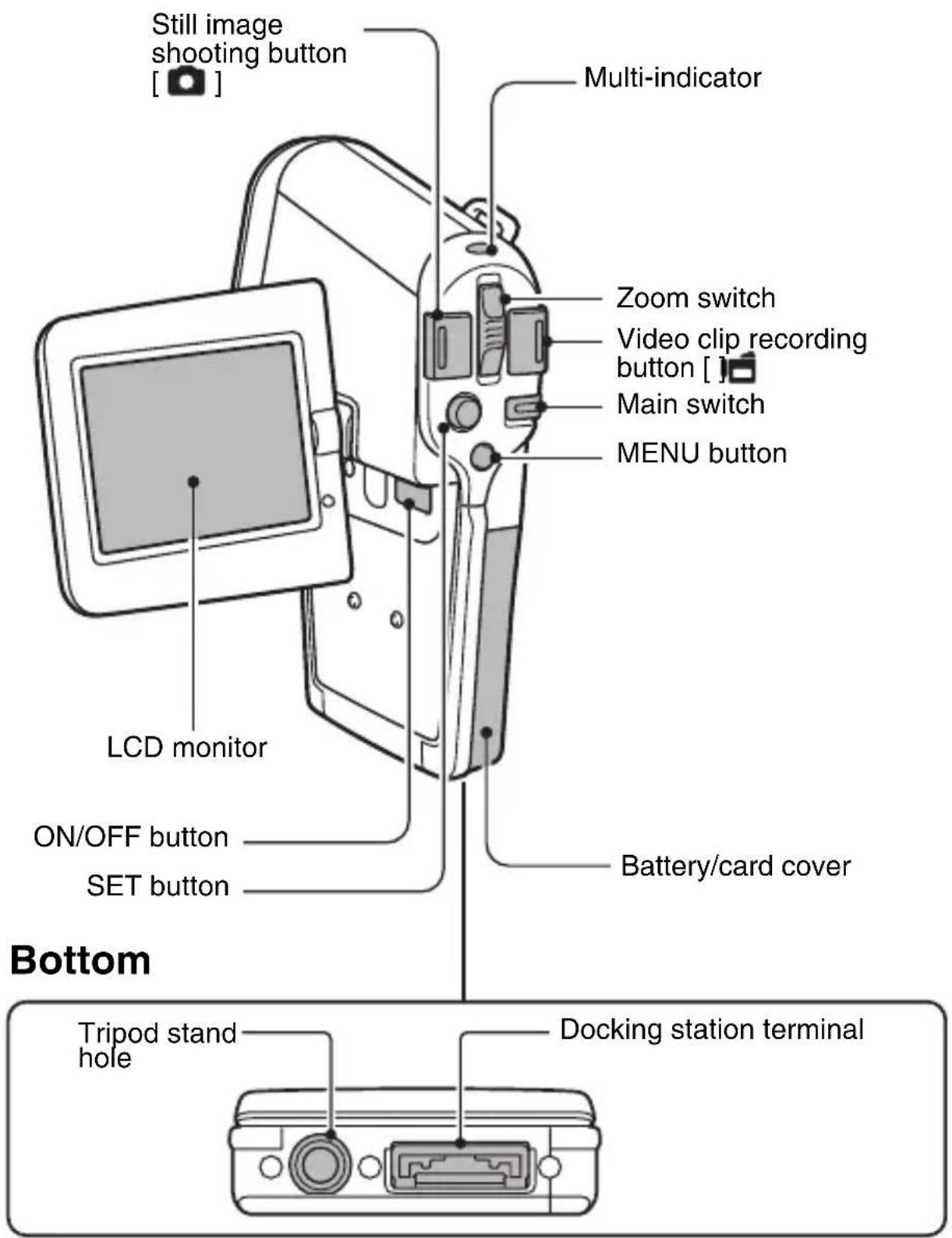
Rear
text_image
Still image shooting button [ ] Multi-indicator Zoom switch Video clip recording button [ ] Main switch MENU button LCD monitor ON/OFF button SET button Battery/card cover Bottom Tripod stand hole Docking station terminal17 English
Docking station
Front
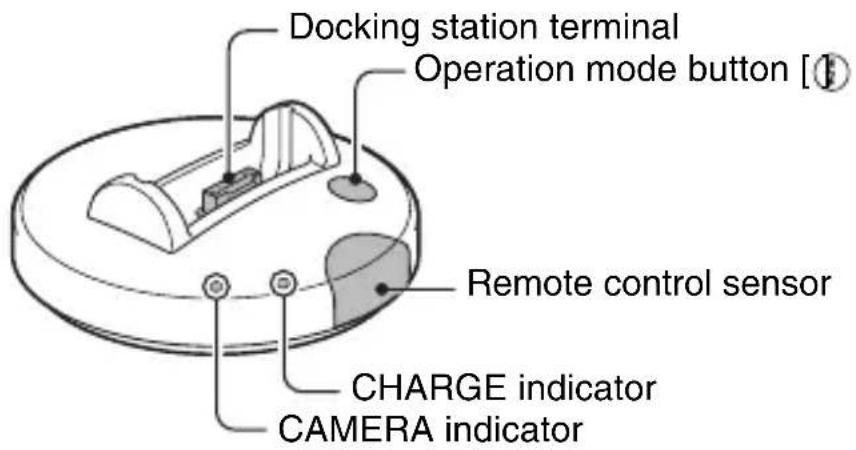
text_image
Docking station terminal Operation mode button [①] Remote control sensor CHARGE indicator CAMERA indicatorRear

text_image
USB/AV terminal DC IN terminalCable adaptor
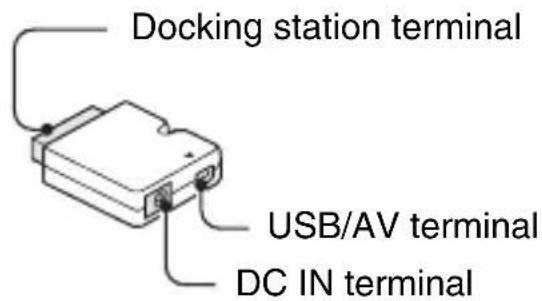
text_image
Docking station terminal USB/AV terminal DC IN terminalINSTALLING THE BATTERY PACK AND CARD
The card can be used after it has been formatted with the camera (page 128). Make sure that the battery pack and the card orientation are correct.
Install the battery pack
1 Open the battery/card cover.
- While gently pressing the cover, slide it open.
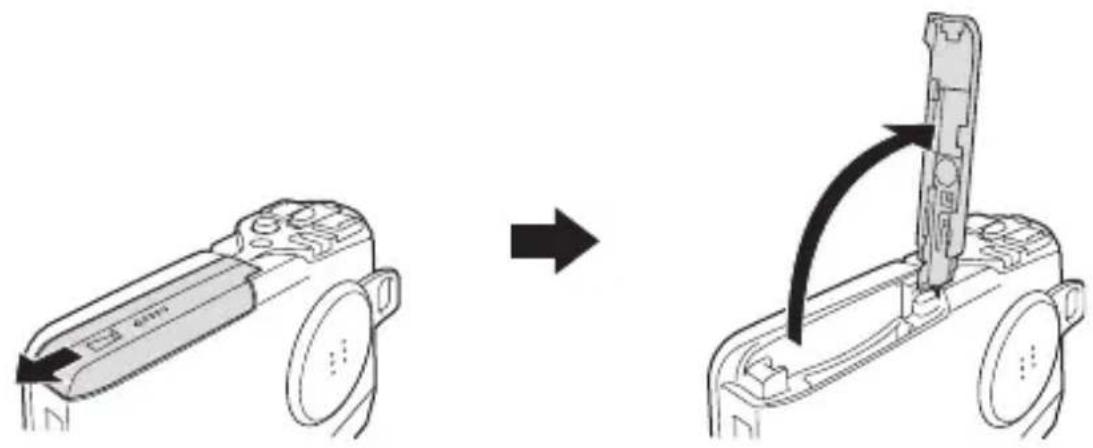
natural_image
Diagram showing a device being processed from a left-side tool to a right-side assembly (no text or symbols present)2 Insert the battery pack.
- Move the latch sideways, insert the battery pack, and firmly push it all the way in.

text_image
Slide to the side- Slide the latch securing the battery pack to the side, and remove the battery pack.

natural_image
Mechanical assembly diagram showing a component with arrows indicating motion or force (no text or symbols present)Slide to the side
3 Close the battery/card cover.
- Lower the cover, and slide it closed.
- At the time of purchase the battery pack is not charged. Be sure to fully charge the battery pack (pages 22, 24).
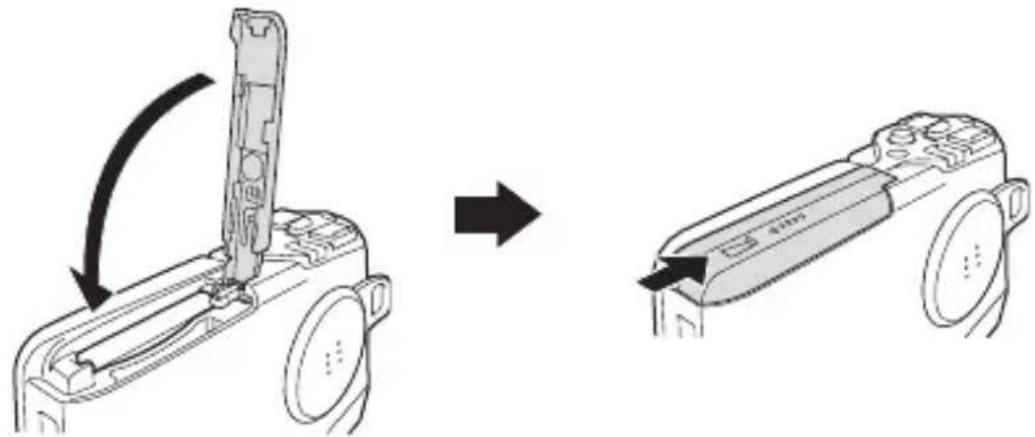
natural_image
Diagram showing a device being processed from a left-hand tool, with no visible text or symbols.INSTALLING THE BATTERY PACK AND CARD
Install the card
1 Open the battery/card cover.
2 Insert the card.
- Firmly insert the card until it clicks into place.
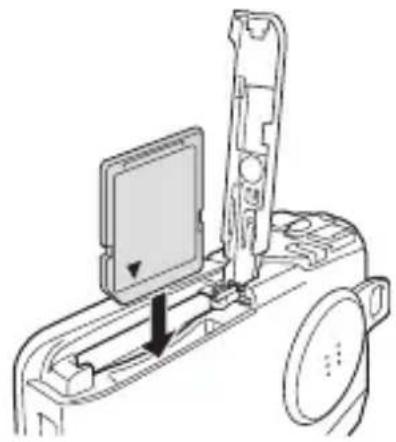
natural_image
Diagram of a device with a monitor and cable connector, showing internal components and a downward arrow indicating motion (no text or symbols)3 Close the battery/card cover.
• To remove the card, press it down, and then release. The card will protrude slightly, and you can then pull it out.
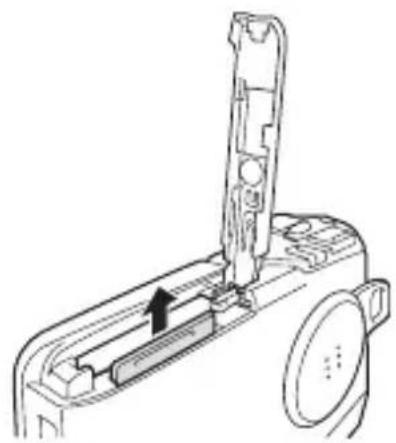
natural_image
Technical line drawing of a mechanical component with a vertical assembly and an arrow indicating direction (no text or symbols)CAUTION
Do not attempt to forcibly remove the card.
- Never remove the card when the multi-indicator is flashing red. In doing so, you risk losing the data stored in the card.
HINT
When not using the camera for a long time, remove the battery pack.
- A small amount of power is still used even if the camera is turned off, and it is therefore recommended that the battery pack be removed from the camera if it is not going to be used for a long time. Note that when the battery pack is removed for a long period, the time and date settings may be cleared. Before using your camera again, be sure to confirm that the camera settings are correct.
21 English
POWER FOR THE CAMERA
The supplied AC adaptor is used not only as the camera's AC adaptor, but also to charge the battery installed in the camera.
Using the battery pack
At the time of purchase, the battery pack is not charged. The battery pack must be charged before it can be used in the camera. Also, if the battery power becomes depleted when the camera is being used (see “CHECKING THE REMAINING BATTERY PACK CHARGE” on page 132), it should be recharged as soon as possible.
1 Install the battery pack in the camera, and attach the cable adaptor to the docking station terminal on the bottom of the camera.
2 Turn the camera off, and connect the AC adaptor to the DC IN socket of the cable adaptor.
- Charging begins when the AC adaptor is connected. However, the camera does not charge when it is set to the shooting mode or PC camera mode.
- The camera's multi-indicator lights red during charging.
- Charging will take approximately 90 minutes.
- The multi-indicator will turn off when the battery pack is fully charged.
POWER FOR THE CAMERA
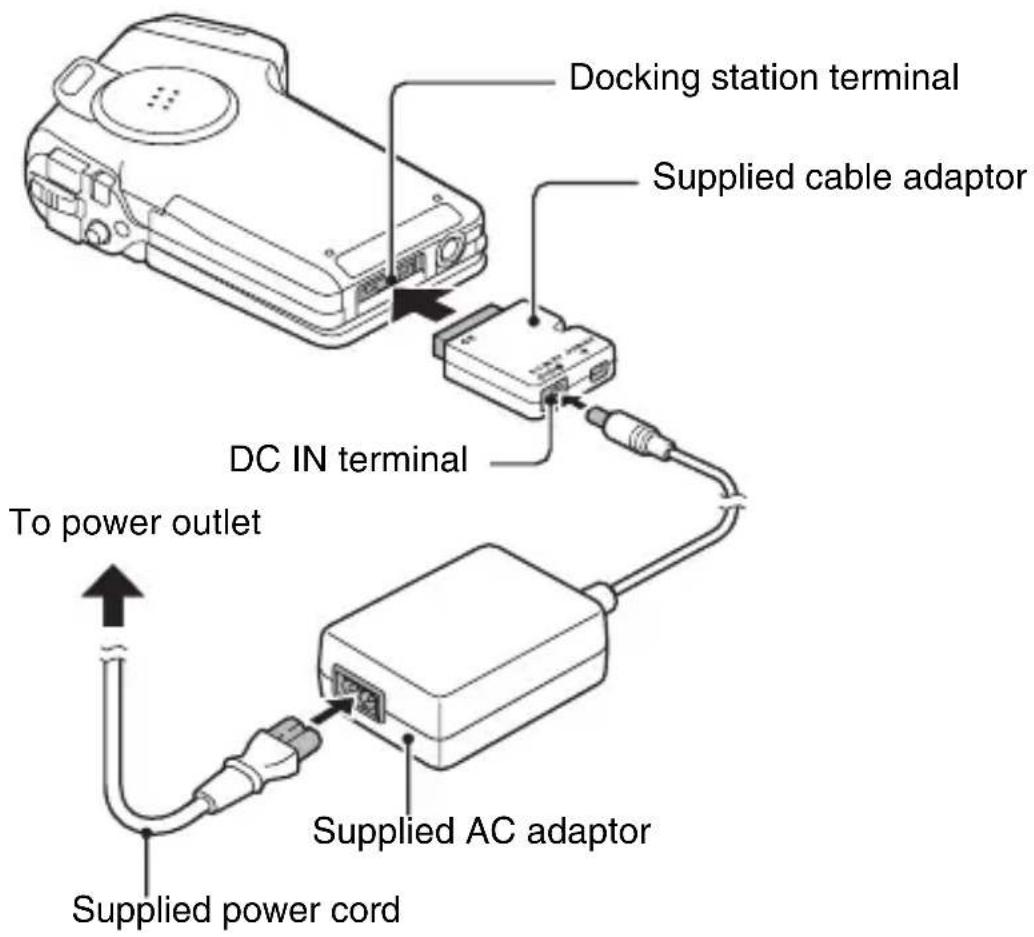
text_image
Docking station terminal Supplied cable adaptor DC IN terminal To power outlet Supplied AC adaptor Supplied power cord3 Disconnect the cable adaptor and the AC adaptor after charging is completed.
Using the docking station to charge the battery pack
When the battery pack is installed in your camera, you can recharge it by setting the camera in the docking station (page 134).
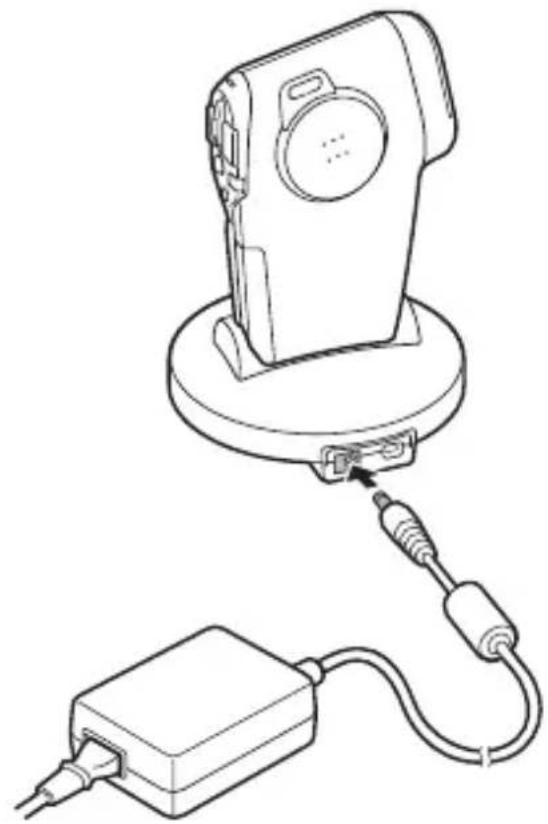
natural_image
Line drawing of a device with a camera and cable, no text or symbols presentPOWER FOR THE CAMERA
Using a power outlet
When the supplied AC adaptor is connected to the camera, power can be supplied from a power outlet.
HINT
About the internal backup battery
- This camera's internal battery serves to maintain the date and time settings, as well as the shooting settings. The backup battery will be fully charged when the battery pack is kept in the camera continuously for about 2 days. In the fully charged state, the backup battery will maintain the camera settings for about 7 days.
TURNING THE CAMERA ON AND OFF
Turning on the camera
1
Set the main switch.
To shoot pictures:
Set to REC
To play back images:
Set to PLAY
2
Open the monitor unit.
3
Press the ON/OFF button for about 1 second.
• The camera turns on, and an image appears on the LCD monitor.

text_image
Main switch Monitor unit LCD monitor ON/OFF buttonTurning on the camera when the power save (sleep) function is active In order to preserve battery pack power, the power save (sleep) function will automatically turn off the camera after one minute of no use during shooting, or five minutes of no use during playback (factory-preset setting).
- When the power save function is active, you can restore the power by any of the following methods:
- Move the main switch.
- Press the ON/OFF button.
- Press the Still image shooting/Video clip recording button.
- Press the SET or MENU button.
- Press the zoom switch.
- After the power save function has been active for about 1 hour, the camera will switch to the standby mode. In this case, you can restore the power by pressing the ON/OFF button, or by closing and then opening the monitor unit.
- When the AC adaptor is connected, the power save function will become active about 10 minutes after the camera is turned on (factory-preset setting).
- The user can specify the time elapsed before the power save function is activated (page 123).
- When the camera is connected to a computer or printer using the dedicated USB interface cable, the power save function is disabled, and the camera turns off after about 12 hours.
TURNING THE CAMERA ON AND OFF
Turning off the camera
1 Press the ON/OFF button for about 2 seconds.
- The camera turns off.
HINT
To immediately activate the power save function
- Press the ON/OFF button briefly to active the power save function.
About the standby mode
- To turn off the camera only briefly, you can close the monitor unit to put the camera in the standby mode. The standby mode uses almost no power. When the monitor unit is opened again, the camera turns on immediately and you are ready to shoot or view images without any delay.
If the Ⓤ? icon appears...
- When a picture is taken, the date and time it was captured is recorded with it. When the date and time cannot be recorded with the image because the date and time have not yet been set (page 107), the 🔊? icon appears. To have the date and time recorded with images, please make this setting before capturing images.
OPERATION BUTTONS
The procedures to change the camera settings, choose images, etc., are performed by using the SET button to control the LCD monitor display. This operation is used very frequently, so it is best to become familiar with it right away.
1 Turn on the camera (page 26).
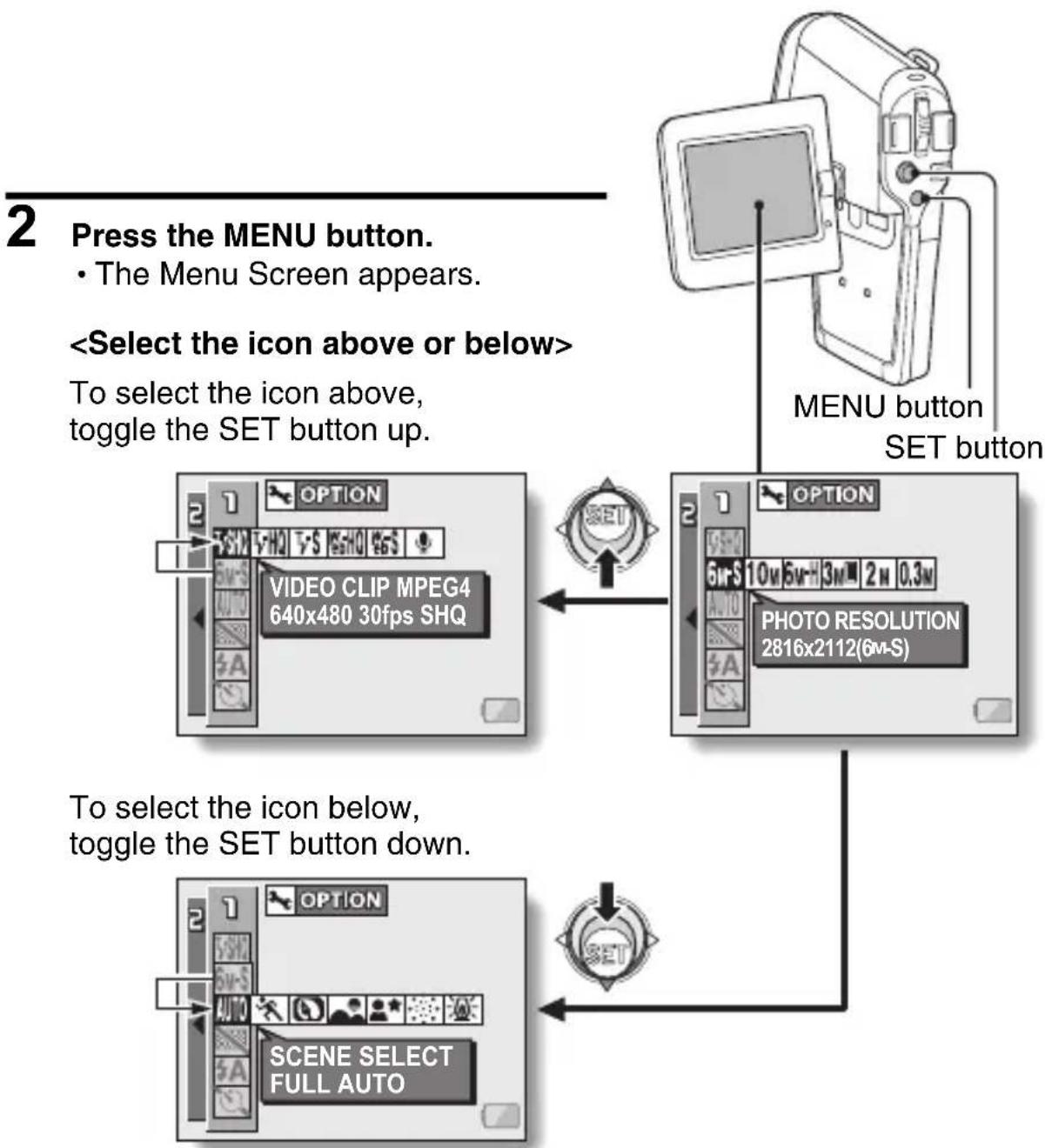
flowchart
graph TD
    A["MENU button SET button"] --> B["VIDEO CLIP MPEG4 640x480 30fps SHQ"]
    B --> C["PHOTO RESOLUTION 2816x2112(6m-S)"]
    C --> D["SCENE SELECT FULL AUTO"]
    style A fill:#f9f,stroke:#333
    style B fill:#ccf,stroke:#333
    style C fill:#cfc,stroke:#333
    style D fill:#fcc,stroke:#333
OPERATION BUTTONS

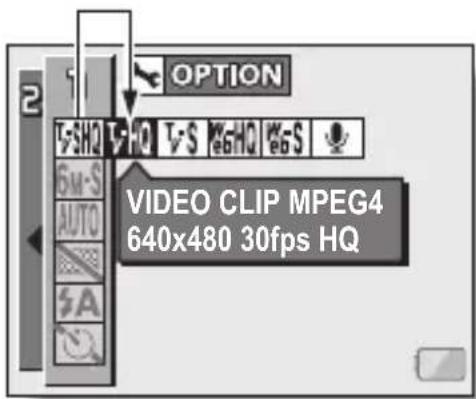
text_image
OPTION VIDEO CLIP MPEG4 640x480 30fps HQTo select the icon to the left, toggle the SET button to the left.
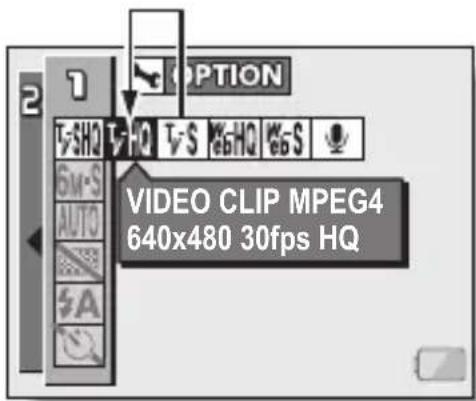
text_image
OPTION T-SHQ T-HQ T-V S X-GHQ X-S VIDEO CLIP MPEG4 640x480 30fps HQ

text_image
OPTION VIDEO CLIP MPEG4 640x480 30fps HQBEFORE TAKING PICTURES
For best results
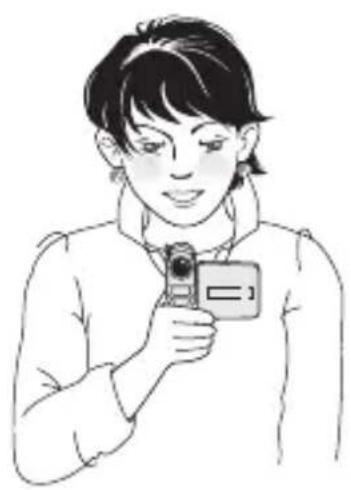
Hold the camera securely, keeping your elbows close to your body and making sure the camera is stable.
Correct hold Incorrect hold
natural_image
Line drawing of a person holding a digital camera (no text or symbols)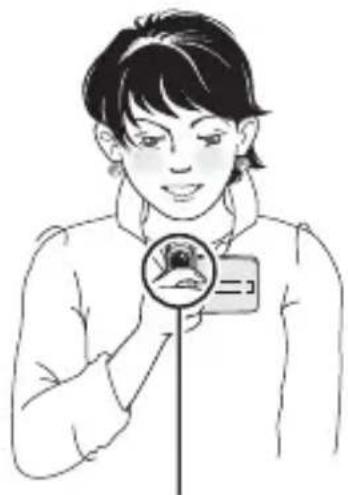
natural_image
Illustration of a person holding a magnifying glass with a small figure inside (no text or symbols)A finger is blocking the lens or flash.
Make sure that the lens and flash are not blocked by your fingers or the strap.
* For shooting vertically oriented still images, you can set the shooting orientation to the vertical (portrait) format still image mode (page 56).
HINT
- Images captured in the still image shooting mode can be rotated when they are played back (page 90).
- When the still image shooting button is pressed halfway, the image in the LCD monitor may waver vertically. This is the result of internal image processing and is not a malfunction. This wavering is not recorded and will not affect your images in any way.
- When the optical zoom is used or when the autofocus is operating, the image may appear to waver, but this is not a malfunction.
BEFORE TAKING PICTURES
Using the autofocus
The autofocus will work in almost all situations; however, there are certain conditions that may cause the autofocus function to not work properly. If the autofocus function is not working properly, set the focus range to capture images (page 66).
■Conditions that may cause incorrect focus
The following examples are some of the situations where the autofocus function may not work.
- Subjects with low contrast, very bright subjects at the center of the image or dark subjects or locations
Use the focus-lock function to lock the focus on an object with contrast at the same distance as the desired subject.

natural_image
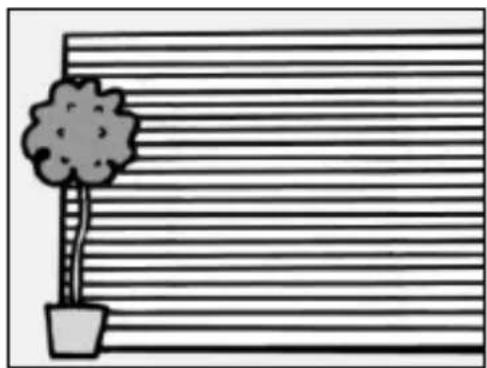
Illustration of a cartoon-style car with light rays and smoke, no text or symbols present- Subjects without vertical lines
Use the focus-lock function to lock the focus while framing the subject vertically, then re-orient the camera to compose a horizontally framed image.
natural_image
Simple line drawing of a potted tree with horizontal striped background (no text or symbols)The following examples are some of the situations where the autofocus function may work, but not as desired.
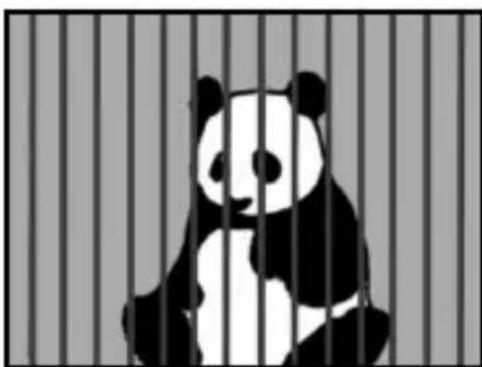
- When both near and far objects are present
Use the focus-lock function to lock the focus on an object at the same distance as the desired subject, then reposition the camera to compose the picture.
- Fast-moving subjects
Use the focus-lock function to lock the focus on an object at the same distance as the desired subject, then reposition the camera to compose the picture.
natural_image
Black and white illustration of a panda sitting in front of vertical bars (no text or symbols)
natural_image
Illustration of a soccer player kicking a ball (no text or symbols)BEFORE TAKING PICTURES
Hints for taking pictures
Muting the operation sounds
- The operation sounds that are generated, for example, when the still image shooting button, MENU button or SET button is pressed, as well as the audio guidance when you switch the mode, can be muted (page 110).
Where is the image and audio data saved?
- All the image and sound data is recorded on the card installed in the camera.
Taking pictures in backlight conditions...
- When taking pictures with the light coming from behind the subject, due to the characteristics of the lens, light lines or ghost patterns (flare phenomenon) may appear in the captured image. In this situation, it is recommended that you avoid taking pictures with the subject lit from behind.
While the image data is being recorded...
- While the multi-indicator is flashing red, the image data is being written to the memory, during which time it is not possible to capture another image. Another image can be captured after the flashing red indicator turns off. However, even when the multi-indicator is flashing red, depending on the camera's internal memory remaining capacity, in some cases the next image can be captured about 2 seconds after shooting.
Checking the last image shot (instant review)
- After shooting a picture, you can immediately view it by pressing the SET button once.
- During instant review of a video clip, normal play, reverse play and pause are available (page 46).
- If you wish to delete the image (for a video clip, it must be in the pause or stop mode), toggle the SET button up to access the delete function.
- You can view other images while the instant review display is showing by toggling the SET button to the left or right.
- Cancel the instant review display (for a video clip, it must be in the stop mode) by toggling the SET button down.
CAPTURING IMAGES
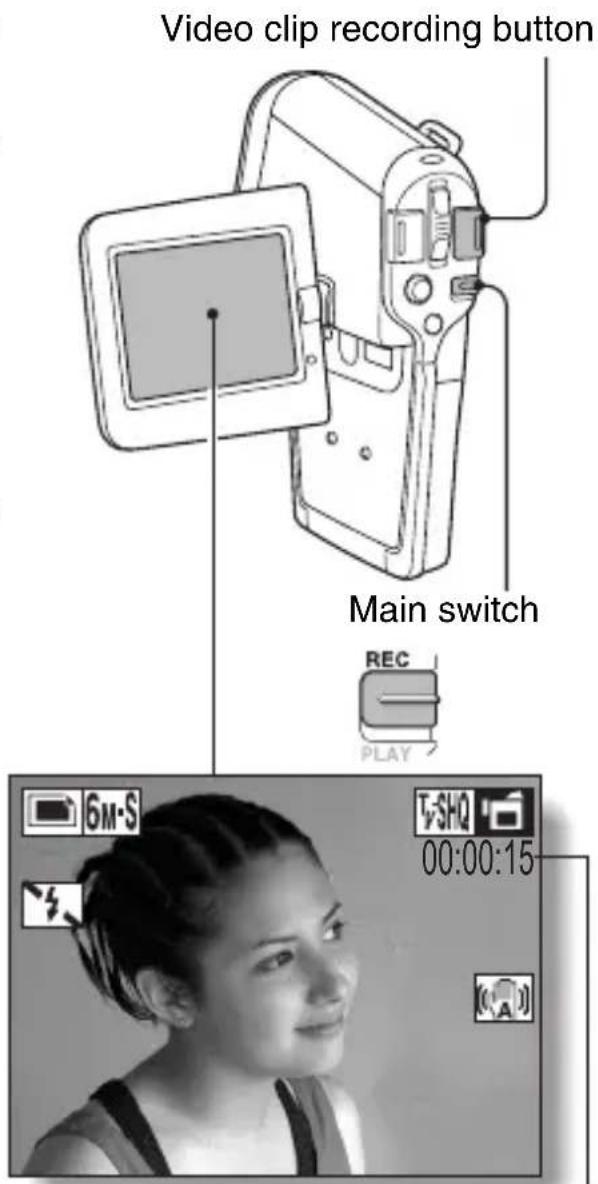
Recording video clips
1 Turn on the camera (page 26).
2 Set the main switch to REC.
3 Press the video clip recording button [ ] .
- Recording begins. During shooting, it is not necessary to continue pressing the video clip recording button.
4 End the recording.
- Press the video clip recording button again to stop recording.
text_image
Video clip recording button Main switch REC PLAY 6M-S T-SHQ 00:00:15Recording time
CAPTURING IMAGES
HINT
Adjusting the LCD monitor brightness
- While the Shooting Screen is active, You can quickly access the screen for adjusting the brightness of the LCD monitor by pressing the MENU button for at least 1 second.
Focus lock during video clip recording
- The autofocus can be set to a fixed focus during video clip recording if you toggle the SET button up. When the autofocus is fixed, the AF icon appears on the LCD monitor.
- When the SET button is toggled up again, or the focus range setting (page 66) is changed, the focus lock is released.
The data for a video clip is very large.
- Therefore, be aware that if the video clip is uploaded to a computer to be played back, the computer may not be able to play back the video fast enough, making it appear jerky. (The video will always be displayed properly on the LCD monitor or a television.)
When the remaining card memory becomes 10 percent or less of the total card capacity...
- The remaining memory icon appears on the LCD monitor.
- Depending on the card, shooting may end even before the possible shooting time indicated.
CAUTION
During video clip playback, the sound of a motor is audible...
- During recording, the sound of the optical zoom movement or autofocus movement was recorded. This is not a malfunction.
Capturing still images
1 Turn on the camera (page 26).
2 Set the main switch to REC.
3 Press the still image shooting button [ ]
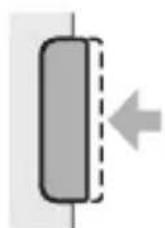
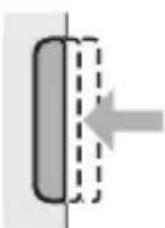
①Press the still image shooting button halfway.
• The autofocus operates, and the image is focused (focus lock).
②Continue to gently press the still image shooting button all the way.
• The shutter releases and the image is captured.
- You can view the captured image on the LCD monitor by keeping the still image shooting button depressed when you capture the image.
①
②
Main switch

text_image
REC PLAY Still image shooting button
text_image
6M·S A F3.5 1/42Target mark
CAPTURING IMAGES
HINT
What is the camera focusing on?
- A target mark [] on the LCD monitor shows the area the camera is focusing on.
- The camera automatically determines the correct focus by measuring from 5 different focus points within the shooting area. If the target mark is at a position that is different from the point you wish to focus on, you can refocus, for example, by changing the shooting angle.
- The large target mark appears when the camera focuses on a wide area in the center of the screen.
The shutter speed and aperture are displayed
- When the camera focuses and the target mark appears, at the same time, the shutter speed and aperture settings are also displayed. You can use them as a reference when shooting.
If the camera shake icon appears...
- During still image shooting, if the shutter speed is slow and the possibility that the image may be blurred due to camera shake becomes
high, the camera shake icon may appear on the LCD monitor. In this case, use a tripod to stabilize the camera when shooting, or set the flash operation mode to automatic (page 60).
- When shooting with the scene select function set to the fireworks mode, the camera shake icon always appears, but this is normal.

text_image
Target mark F3.5 1/42 Shutter speed Aperture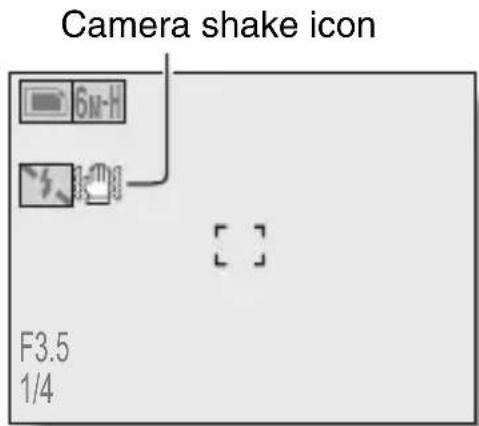
text_image
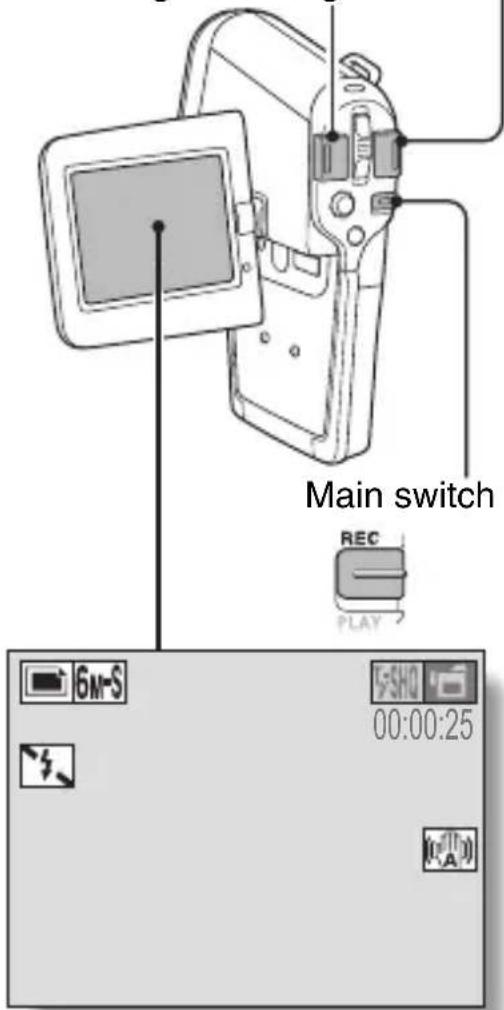
Camera shake icon 6N-H F3.5 1/4Shoot a still image while recording a video clip
You can capture a still image while recording a video clip.
1 Turn on the camera (page 26).
2 Set the main switch to REC.
3 Press the video clip recording button [ ]
4 When you see a scene you'd like to capture as a still image, press the still image shooting button [ ]
5 End the recording.
- Press the video clip recording button to stop recording.
Video clip recording button Still image shooting button
text_image
Main switch REC PLAY 6M-S 00:00:25CAUTION
- When shooting a still image while recording a video clip, the flash does not operate.
- When shooting a still image while recording a video clip, the display briefly pauses, and then returns to the video clip display after the still image is captured.
- If the still image resolution is set to 10M or 3M, it automatically changes to 6M-S and the image is captured.
BASIC SHOOTING FUNCTIONS
Using the zoom
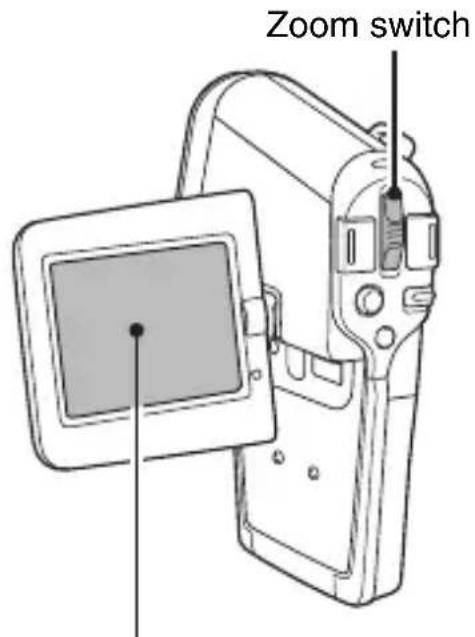
Your camera has two zoom functions: optical zoom and digital zoom. You can specify whether or not the digital zoom is enabled (page 118).
1 Point the camera lens at the subject.
2 Press the zoom switch to compose the desired image.
[T]: Zoom in on the subject.
[W]: Zoom out.
- When the zoom switch is pressed, the zoom bar appears on the LCD monitor.
- When the optical zoom factor is at maximum, zooming stops temporarily. When the zoom switch is pressed toward the [T] side again, the mode changes to the digital zoom mode and zooming continues.
text_image
Zoom switchLCD monitor

text_image
When both optical and digital zoom are enabled Zoom bar Pointer W T Optical zoom Digital zoom (yellow) When optical zoom only is enabled W I T3 Take the picture.
For video clip recording, see page 34.
For still image shooting, see page 36.
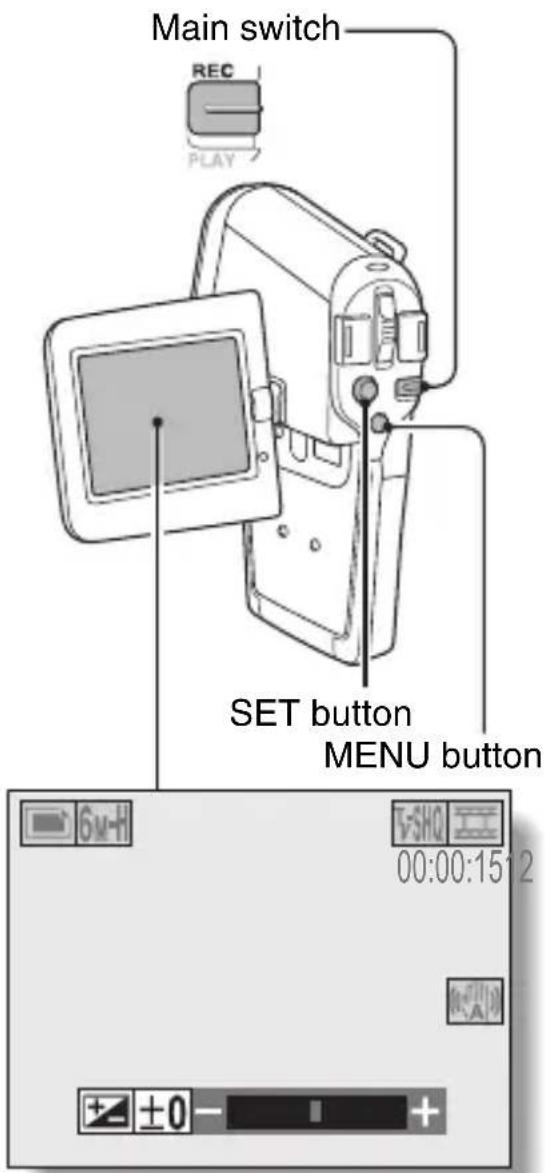
Exposure correction
When capturing images, you can make the image lighter or darker.
1 Set the main switch to REC.
• To exit the Shooting Setting Screen, press the MENU button.
2 While the Shooting Screen is displayed, toggle the SET button to the right.
• The exposure correction bar appears.
3 Toggle the SET button to the left or right to adjust the exposure.
• The exposure setting numerical value is shown at the left end of the exposure bar.
- The exposure can be set to a value from -1.8EV to +1.8EV .
4 Press the SET button or the MENU button.
• The exposure is set, and the exposure correction bar disappears.
text_image
Main switch REC PLAY SET button MENU button 00:00:15 2HINT
The exposure correction setting is canceled in the following cases:
- When the pointer is set to the center position.
• After a Playback or Option Screen is accessed. - When the main switch is set to PLAY.
• After the power is turned off.
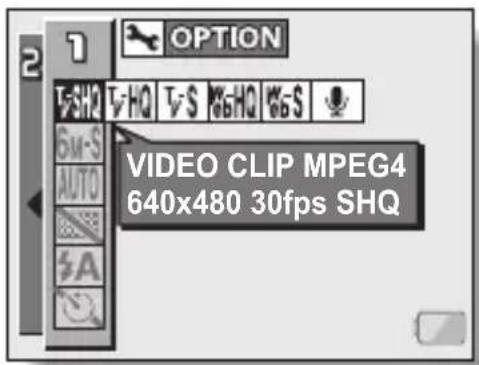
Your camera can make audio recordings.
1 Turn on the camera (page 26), and set the main switch to REC.
2 Press the MENU button.
• The menu display appears.
text_image
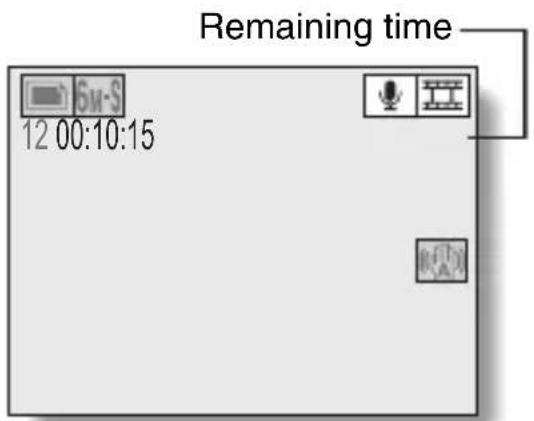
OPTION VIDEO CLIP MPEG4 640x480 30fps SHQ3 From the video clip mode menu, select the audio memo icon 🖼️, and press the SET button.
• The recording mode is enabled.
- The menu display is canceled if the MENU button is pressed.
text_image
Remaining time 6M-S 12 00:10:154 Press the video clip recording button.
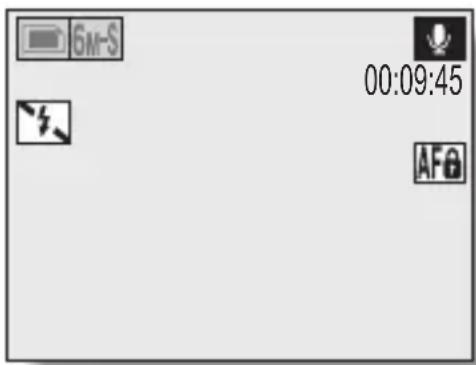
- Audio recording begins. During recording, 📄 appears in the LCD monitor. It is not necessary to continue pressing the video clip recording button while shooting.
• Take care not to cover the microphone with your fingers. - When the remaining recording time becomes short, the time remaining is indicated in red.
- The maximum time for recording a continuous audio memo is about 13 hours.
text_image
6M-S 00:09:45 AF@5 End the recording.
- Press the video clip recording button again to stop recording.
HINT
You can capture a still image during an audio recording
- Note, however, that if the resolution in the still image mode is set to 10M or 3M, it automatically changes to 6M-S and the image is captured.
VIEWING IMAGES
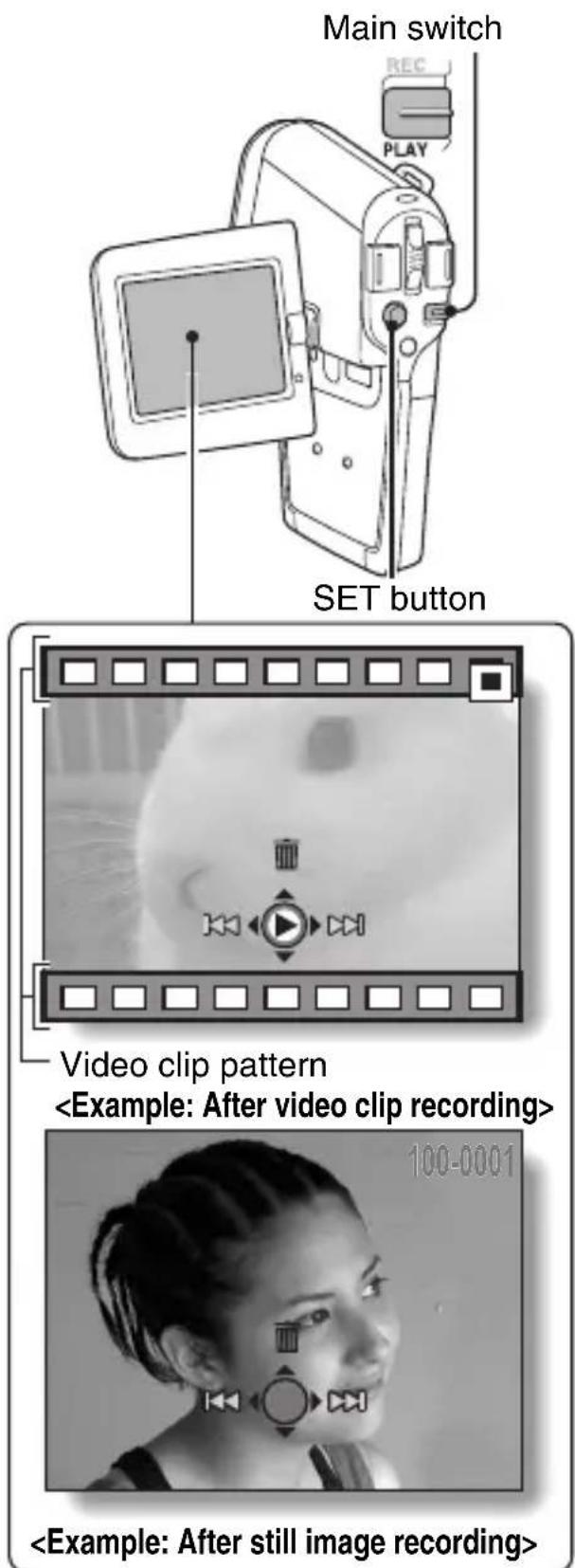
1 Turn on the camera (page 26), and set the main switch to PLAY.
• An image is displayed on the LCD monitor.
• Video clips are indicated by a video clip pattern along the top and bottom of the screen.
2 Select the image you wish to view.
To display the previous image, toggle the SET button to the left.
To display the next image, toggle the SET button to the right.
- For video clips and audio data, press the SET button to start playback.
text_image
Main switch REC PLAY SET button Video clip pattern9-image display playback
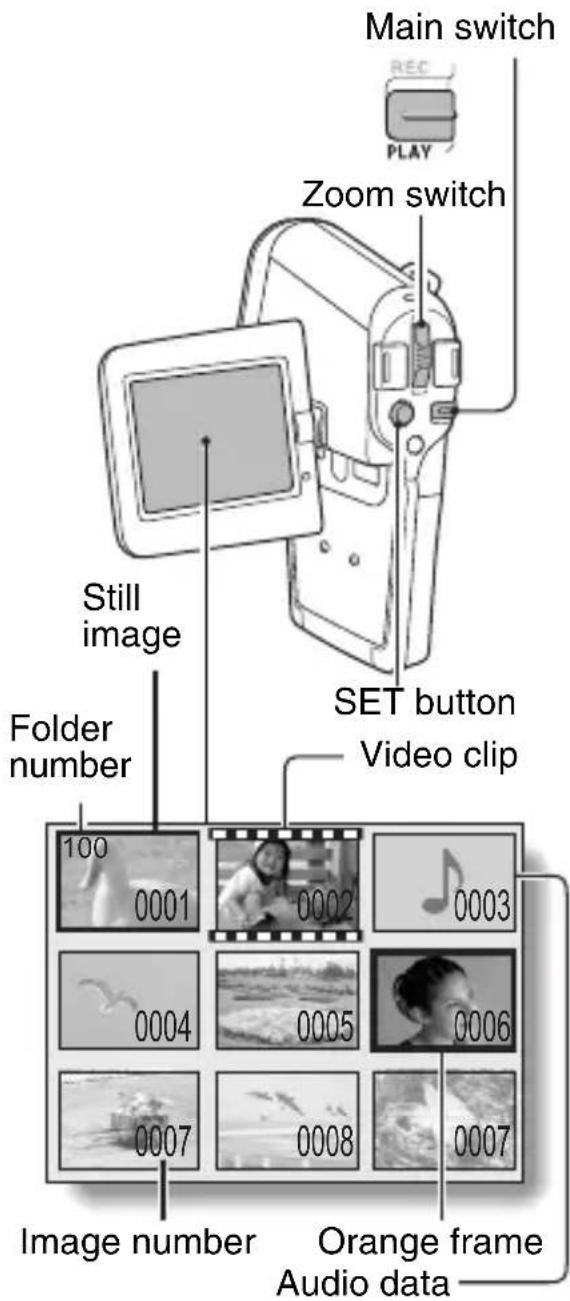
1 Turn on the camera (page 26), and set the main switch to PLAY.
2 Push the zoom switch toward the [W] ([☐]) side.
• The 9-image display appears.
3 Select the image to play back.
- Toggle the SET button up, down, left or right to move the orange frame to the desired image, and press the SET button. Instead of pressing the SET button, you can push the zoom switch toward the [T] ([○]) side to show the image full screen.
text_image
Main switch REC PLAY Zoom switch Still image Folder number SET button Video clip 100 0001 0002 0003 0004 0005 0006 0007 0008 0007 Image number Orange frame Audio dataHINT
- The 9-image multi-playback display can also be accessed by selecting 📁 on the Playback Setting Screen.
Magnifying (zooming in) the image
1 Display the image that you want to magnify.
- For a video clip, pause playback at the place you want to magnify.
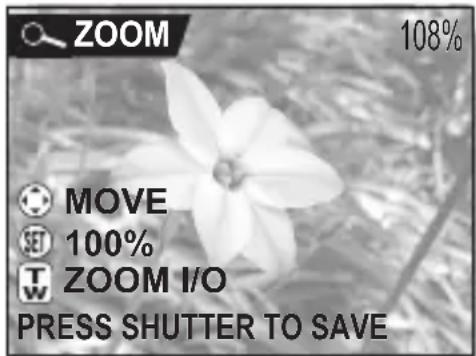
2 Push the zoom switch toward the [T] ([○]) side.
- Magnification is enabled.
- The image is magnified, and the central portion of image is displayed.
- Toggle the SET button to view different parts of the magnified image.
To magnify:
Magnification increases each time the zoom switch is pushed toward the [T] ([○]) side.
To return to normal size:
Magnification decreases each time the zoom switch is pushed toward the [W] ([☐]) side.
- Press the SET button to return to the normal (100%) view.
text_image
ZOOM 108% MOVE 100% ZOOM I/O PRESS SHUTTER TO SAVEHINT
The magnified portion of the image can be saved as a separate image.
- Press the still image shooting button. The magnified portion is saved as a new still image.
Playing back a video clip
Follow these steps to play back a video clip.
| To do this... Do this | ||
| Normal forward playback Press the SET button. | ||
| Stop playback During | playback, toggle the SET button down. | |
| Pause | During playback, press the SET button or toggle the SET button up.During accelerated playback, toggle the SET button up. | |
| To play back one image at a time (single-frame step) | During forward playback | After pausing playback, toggle the SET button to the right. |
| During reverse playback | After pausing playback, toggle the SET button to the left. | |
| Slow playback | During forward playback | After pausing playback, press and hold the SET button to the right. |
| During reverse playback | After pausing playback, press and hold the SET button to the left. | |
| To accelerate playback | Forward playback | During forward playback, toggle the SET button to the right.* The playback speed changes each time the SET button is toggled to the right, as follows: Normal playback → 2x → 5x → 10x→ 15xToggle the SET button to the left to resume normal playback speed. |
| Reverse playback | During forward playback, toggle the SET button to the left.* The playback speed changes each time the SET button is toggled to the left, as follows: 15x ← 10x ← 5xToggle the SET button to the right to resume normal playback speed. | |
| Return to normal playback speed | Press the SET button. | |
| Adjusting the volume | Louder: During playback, push the zoom switch toward the [T] side.Softer: During playback, push the zoom switch toward the [W] side. | |
VIEWING IMAGES
HINT
Display the video clip playback point
- During video clip playback, press the MENU button for at least 1 second to display a bar showing the current playback point in the video clip.
- Press the MENU button for about 1 second to cancel the bar.
CAUTION
If no audio is heard...
- The audio is not played back when the video clip is played back in the frame-by-frame, fast playback or reverse playback mode.
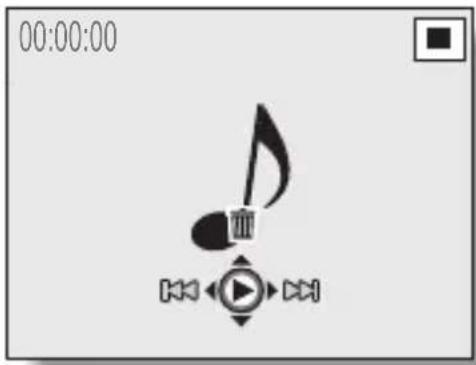
Listen to your audio recordings.
1 Display the desired audio data.
2 Play back the recording.
Start forward playback:
Press the SET button.
Pause: During playback, press the SET button, or toggle the SET button up. During fast forward or fast reverse, toggle the SET button up.
text_image
00:00:00Stop playback:
During playback, toggle the SET button down.
Fast forward/fast reverse:
- Fast forward/fast reverse playback is possible at 2x (forward only), 5x, 10x and 15x.
- Toggle the SET button to the left or right during playback to activate fast forward/fast reverse.
- The playback speed changes each time the SET button is toggled to the left or right.
Fast forward (toggle the SET button to the right)
$$ 2 x \rightarrow 5 x \rightarrow 1 0 x \rightarrow 1 5 x $$
* Toggle the SET button to the left to return to normal speed.
Fast reverse (toggle the SET button to the left)
$$ 1 5 x \leftarrow 1 0 x \leftarrow 5 x $$
* Toggle the SET button to the right to return to normal speed.
CAUTION
If no audio is heard...
- The audio is not played back when the audio file is played back in the fast playback or fast reverse mode.
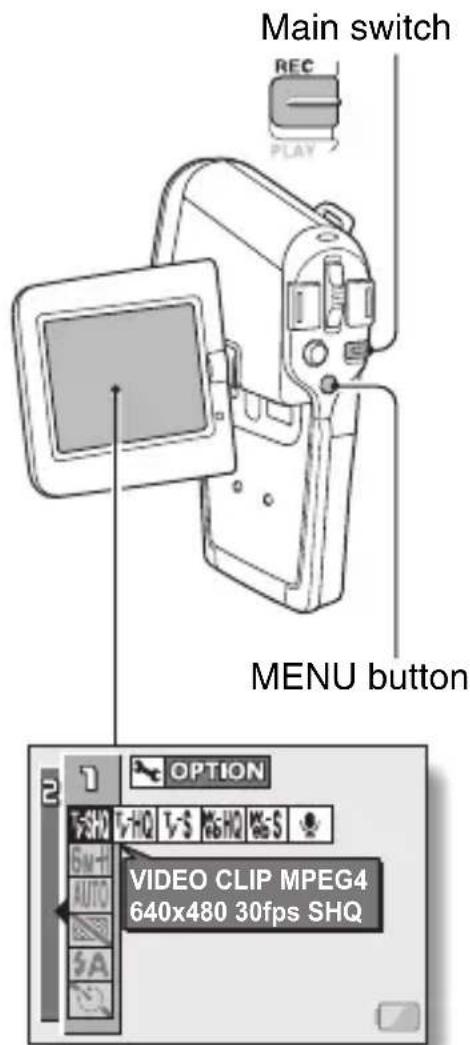
DISPLAYING THE SHOOTING SETTING SCREENS
The Shooting Setting Screens are used to adjust your camera's shooting settings. The Shooting Setting Screens are organized into two displays: PAGE 1 and PAGE 2. The PAGE 1 settings (page 51) cover the basic shooting settings, and the PAGE 2 settings (page 53) provide you with more detailed settings.
1 Turn on the camera (page 26).
2 Set the main switch to REC.
3 Press the MENU button.
• The Shooting Setting Screen appears.
- Pressing the MENU button again will cancel the Shooting Setting Screen.
text_image
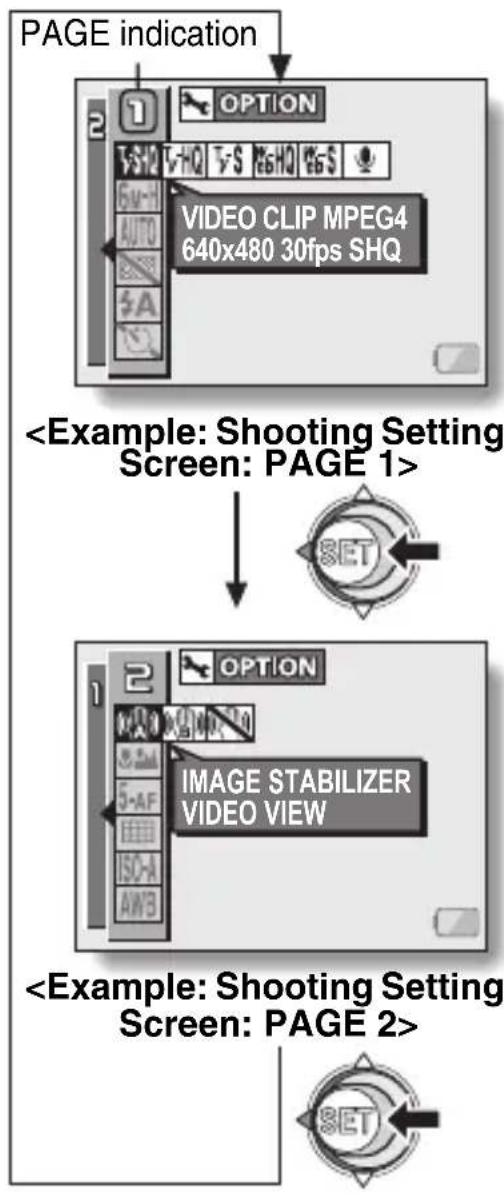
Main switch REC PLAY MENU button OPTION VIDEO CLIP MPEG4 640x480 30fps SHQSWITCHING THE PAGE
Switch from PAGE 1 to PAGE 2, or vice versa, depending on how you wish to use your camera.
1 Display a Shooting Setting Screen (page 49).
2 Toggle the SET button to the left.
• The Shooting Setting Screen PAGE changes.
• Each time the SET button is toggled to the left, the PAGE changes.
flowchart
graph TD
    A["PAGE indication"] --> B["VIDEO CLIP MPEG4 640x480 30fps SHQ"]
    B --> C["SET"]
    D["<Example: Shooting Setting Screen: PAGE 1>"] --> E["IMAGE STABILIZER VIDEO VIEW"]
    E --> F["SET"]
DISPLAYING THE SHOOTING SETTING SCREENS
Overview of the Shooting Setting Screens
PAGE 1

text_image
OPTION VIDEO CLIP MPEG4 640x480 30fps SHQ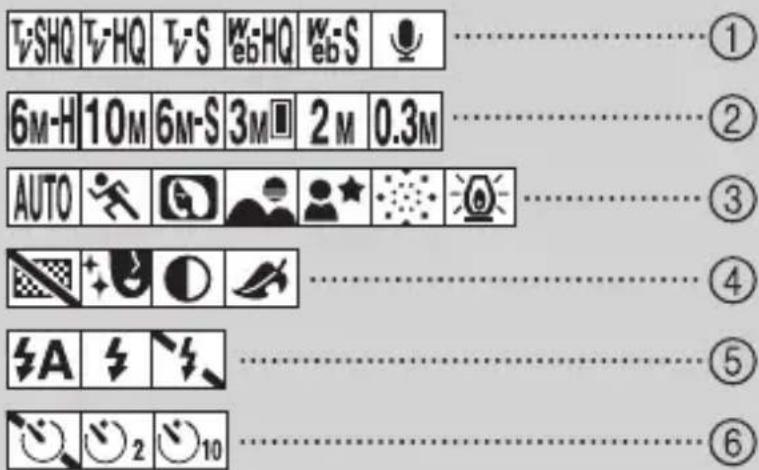
text_image
TVSHQ TV-HQ TV-S Wb-HQ Wb-S 6M-H 10M 6M-S 3M 2M 0.3M AUTO A A A 2 10 ① ② ③ ④ ⑤ ⑥①Video clip mode menu (page 55)
TSHQ: Record at 640 × 480 pixels, 30 frames per second, high bit rate
_VHQ : Record at 640 × 480 pixels, 30 frames per second, standard bit rate
^T -S: Record at 320 × 240 pixels, 30 frames per second
W6HQ: Record at 320 × 240 pixels, 15 frames per second
WBS: Record at 176 × 144 pixels, 15 frames per second
: Make an audio recording
②Still image mode menu (page 56)
6M-H: Shoot at 2,816 × 2,112 resolution (6 million pixels), low compression
10M: Shoot at 3,680 × 2,760 resolution (10 million pixels)
6M-S: Shoot at 2,816 × 2,112 resolution (6 million pixels), standard compression
3M: Shoot at 1,536 × 2,048 resolution (3 million pixels, vertical position)
2M: Shoot at 1,600 × 1,200 resolution (2 million pixels)
0.3M: Shoot at 640 × 480 resolution (300,000 pixels)
③Scene select menu (page 57)
AUTO: Full auto photography
: Sports photography
: Portrait photography
: Landscape photography
Night view photography
: Fireworks photography
: Lamp photography
④Filter menu (page 59)
: No filter
: Cosmetic filter selected
☐: Monochrome filter selected
: Sepia filter selected
⑤Flash menu (page 60)
A: Automatic flash mode
: Forced flash mode
: Flash off mode
⑥Self-timer menu (page 62)
: Self-timer off
☑2: Shooting begins 2 seconds after the still image shooting button or video clip recording button is pressed.
10: Shooting begins 10 seconds after the still image shooting button or video clip recording button is pressed.
⑦Option icon (page 104)
- Displays the Option Screen.
⑧PAGE display (page 50)
⑨Help display (page 112)
⑩Remaining battery power (page 132)
- When you specify multiple functions that cannot be simultaneously enabled, the function which was last set becomes the active setting, and the other settings accordingly change automatically.
DISPLAYING THE SHOOTING SETTING SCREENS
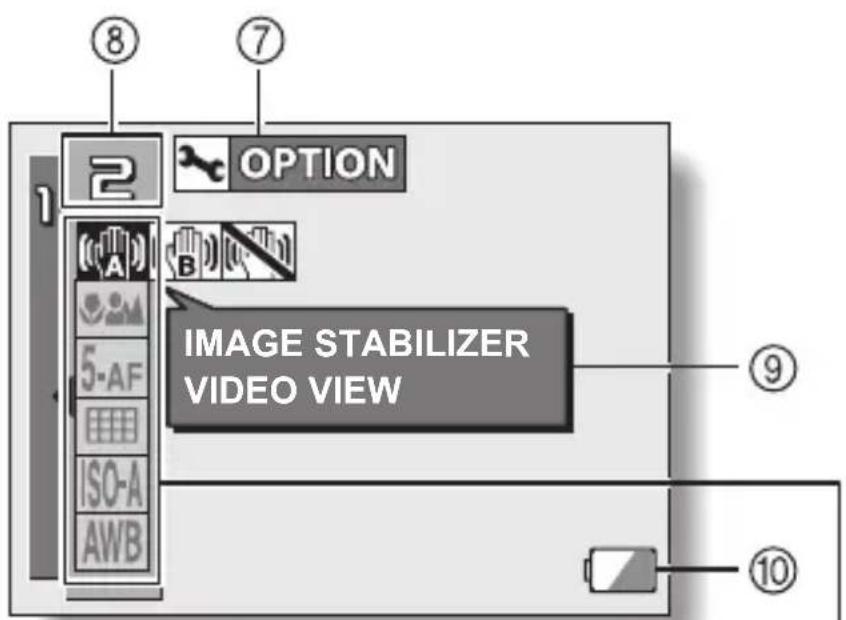
PAGE 2
text_image
OPTION IMAGE STABILIZER VIDEO VIEW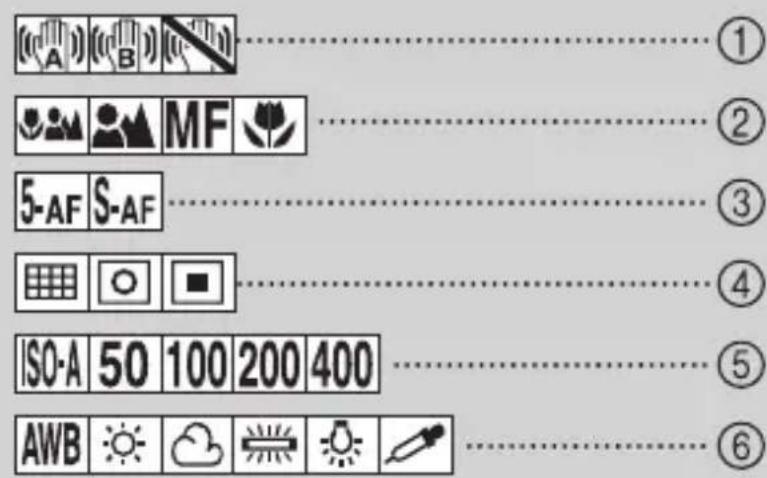
text_image
(A) (B) (C) (D) ① ② MF ③ 5-AF S-AF ④ ISO-A 50 100 200 400 ⑤ AWB ⑥①Image stabilizer menu (page 64)
☐: Shoot using the video clip field of view display.
☐: Shoot using the still image field of view display.
☐: Image stabilizer function off
② Focus range menu (page 66)
All ranges mode
: Normal mode
MF: Manual mode
: Super macro (close-up) mode
③ Focus mode menu (page 68)
5-AF: 5-point range finder focus setting
S-AF: Spot focus setting
④Light-measuring mode (EXP MEASURE) menu (page 69)
: Multi-section light-measuring setting
☐: Center-weighted light-measuring setting
☐: Spot light-measuring setting
⑤ISO sensitivity menu (page 70)
ISO-A: Auto sensitivity (corresponds to ISO 50 to 200)
50: Corresponds to ISO 50
100: Corresponds to ISO 100
200: Corresponds to ISO 200
400: Corresponds to ISO 400
- When you specify multiple functions that cannot be simultaneously enabled, the function which was last set becomes the active setting, and the other settings accordingly change automatically.
⑥White balance menu (page 71)
AWB: White balance is automatically adjusted depending on ambient lighting
: For photography in fair weather (sunny) conditions
: In overcast conditions
: Under fluorescent lighting
: Under incandescent lighting
: For setting the most accurate white balance
⑦Option icon (page 104) • Display the Option Screen.
⑧PAGE display (page 50)
⑨Help display (page 112)
⑩Remaining battery power (page 132)
IMAGE QUALITY
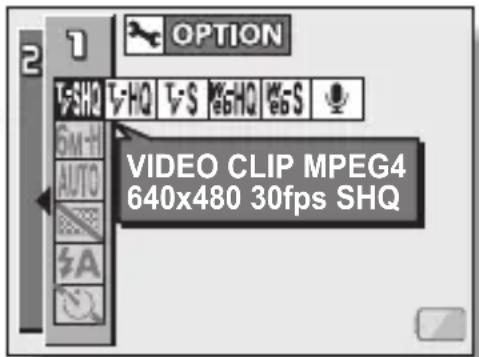
Video clip mode (image quality) setting
When it comes to video clips, a larger number of pixels and a higher frame rate means better image quality and smoother playback. On the other hand, the file size becomes large and uses more memory. Set the image quality to a setting that's right for your purpose.
1 Display the PAGE 1 Shooting Setting Screen (page 49).
2 Select the video clip menu.
TVSHQ: Record at 640 × 480 pixels, 30 frames per second, high bit rate
T_VHQ : Record at 640 × 480 pixels, 30 frames per second, standard bit rate
TV-S: Record at 320 × 240 pixels, 30 frames per second
W6-HQ: Record at 320 × 240 pixels, 15 frames per second
W6S: Record at 176 × 144 pixels, 15 frames per second
: Make an audio recording
text_image
OPTION VIDEO CLIP MPEG4 640x480 30fps SHQ3 Select the desired icon from the video clip mode menu, and press the SET button.
- This completes the video clip mode setting.
CAUTION
When editing video clips...
- In order for video clips to be joined, they must have been photographed in the same mode.
- Video clips that were photographed in different modes cannot be joined.
Still image mode (resolution) setting
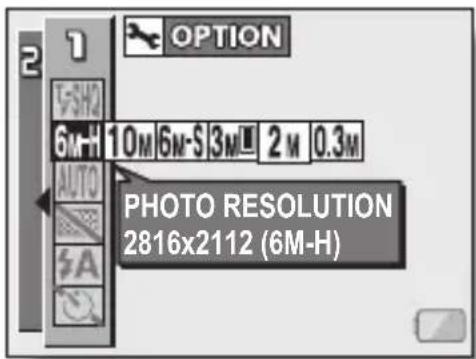
By setting the still image resolution (pixels) to a higher setting, image detail is enhanced for a smoother, finer picture. However, the file size also becomes large and uses more memory. Select the resolution setting that suits your purpose.
1 Display the PAGE 1 Shooting Setting Screen (page 49).
2 Select the still image mode menu.
6M-H: Shoot at 2,816 × 2,112 resolution (6 million pixels), low compression
10M: Shoot at 3,680 × 2,760 resolution (10 million pixels)
6M-S: Shoot at 2,816 × 2,112 resolution (6 million pixels), standard compression
3M: Shoot at 1,536 × 2,048 resolution (3 million pixels, vertical position)
2M: Shoot at 1,600 × 1,200 resolution (2 million pixels)
0.3M: Shoot at 640 × 480 resolution (300,000 pixels)
text_image
OPTION 1-SW2 6M-H 10M 6M-S 3M 2 M 0.3M AUTO PHOTO RESOLUTION 2816x2112 (6M-H)3 Select the desired icon from the still image resolution menu, and press the SET button.
• This completes the still image resolution setting.
SCENE SELECT
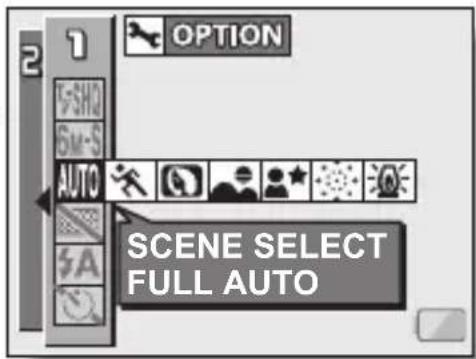
You can select from various preset settings (aperture, shutter speed, etc.) for specific shooting conditions.
1 Display the PAGE 1 Shooting Setting Screen (page 49).
2 Select the scene select menu.
AUTO: The camera automatically makes the optimum settings suitable for the surrounding conditions (full auto).
: Capture a split-second image of a fast-moving subject (sports mode).
☐: Enhance the 3D feeling of the subject by blurring the background (portrait mode).
: For beautiful shots of distant scenery (landscape mode).
: Photograph the subject while keeping the background night scenery (night view mode).
: For capturing fireworks at night (fireworks mode).
: Photograph in low-light conditions (lamp mode).
text_image
OPTION SCENE SELECT FULL AUTO3 Select the desired icon from the scene select menu, and press the SET button.
• This completes the scene select function setting.
4 Take the picture.
For video clip recording, see page 34.
For still image shooting, see page 36.
To return to normal photography, select AUTO from the scene select menu, and press the SET button.
HINT
- When capturing images using the fireworks 📄, lamp 🔒 or night view ⚙★ setting, use a tripod or other method to stabilize the camera.
- A table showing the limitations for settings corresponding to scene select icons other than AUTO is on page 171.
FILTERS
The filter feature changes image characteristics such as color tones, to apply unique effects to the photographed image.
1 Display the PAGE 1 Shooting Setting Screen (page 49).
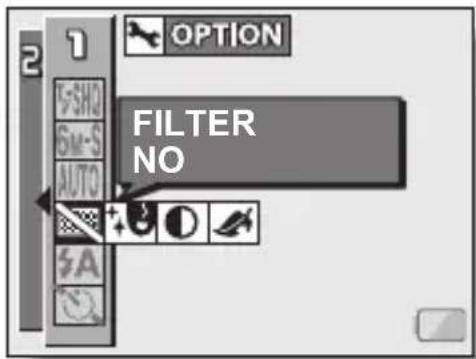
2 Select the filter menu.
☐: No filter is used (none).
: Skin tones are enhanced in close-up shots (cosmetic filter).
☐: Snap black-and-white photos (monochrome filter).
: Create a sepia-tone photo (sepia filter).
text_image
OPTION FILTER NO3 Select the desired icon from the filter menu, and press the SET button.
• This completes the filter setting.
4 Take the picture.
For video clip recording, see page 34.
For still image shooting, see page 36.
- To return to normal photography, select ☒ from the filter menu, and press the SET button.
HINT
- A table showing the limitations for settings corresponding to filter icons other than is on page 171.
FLASH SETTING
The flash is used not only for taking pictures where there is insufficient light, but also when the subject is in shade or in backlight conditions. Your camera has three modes of operation (automatic flash mode, forced flash mode, and flash off mode).
1 Display the PAGE 1 Shooting Setting Screen (page 49).
2 Select the flash menu.
A: The camera will detect the subject brightness and use the flash only when required. In a backlight situation, if only the center of the image is very dark, the flash will operate to compensate (auto flash).

text_image
OPTION FLASH AUTO AThe flash will operate with every image captured regardless of the conditions. Use this setting under backlight conditions, when the subject is in shade, under fluorescent lighting conditions, etc. (forced flash).
The flash will not operate even in dark situations. Use this setting when capturing an image in a location where flash photography is prohibited, or when shooting a night landscape scene (flash off).
FLASH SETTING
3 Select the desired icon from the flash menu, and press the SET button.
• This completes the flash setting.
4 Take the picture.
For still image shooting, see page 36.
- To return to normal photography, select ⚡A from the flash menu, and press the SET button.
HINT
- You can change the flash setting by toggling the SET button to the left while the Shooting Setting Screen is displayed.
SELF-TIMER
1 Display the PAGE 1 Shooting Setting Screen (page 49).
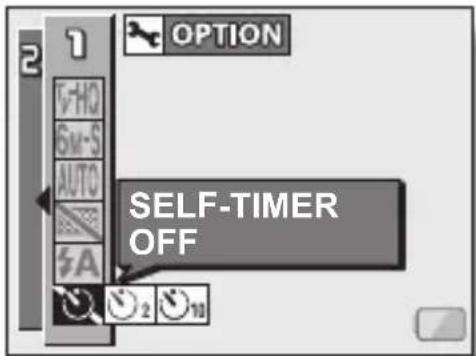
2 Select the self-timer menu.
: Turns off the self-timer function.
_2 : Turns on the self-timer function. The image is captured about 2 seconds after the still image shooting button or video clip recording button is pressed.
10: Turns on the self-timer function. The image is captured about 10 seconds after the still image shooting button or video clip recording button is pressed.
text_image
OPTION 1 V-HQ 6M-S AUTO A SELF-TIMER OFF 2 103 Select the desired icon from the self-timer menu, and press the SET button.
• This completes the self-timer setting.
4 Take the picture.
For video clip recording, see page 34. For still image shooting, see page 36.
HINT
To pause or cancel the self-timer function...
- If the video clip recording button or still image shooting button is pressed again before the shutter is released, the self-timer countdown temporarily stops. Press the video clip recording button or still image shooting button one more time to restart the self-timer.
- To cancel self-timer photography, select the 🤨 icon from the self-timer menu, and press the SET button.
- After the self-timer picture is snapped, the self-timer is automatically reset to off 📋.
When 10 is selected...
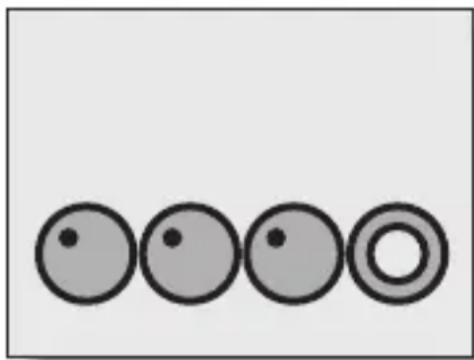
- When the still image shooting button or video clip recording button is pressed, the multi-indicator will blink for about 10 seconds, and then the image is captured. Also, 4 seconds before the shutter releases, the indication shown in the illustration appears on the LCD monitor.
- If you swivel the monitor unit towards the subject, the self-timer indication will be visible to the subject.
natural_image
Four gray circular shapes arranged horizontally, no text or symbols presentMOTION COMPENSATION (IMAGE STABILIZER)
Your camera can minimize a jittery picture by compensating for unintentional hand motion (video clips only).
1 Display the PAGE 2 Shooting Setting Screen (page 49).
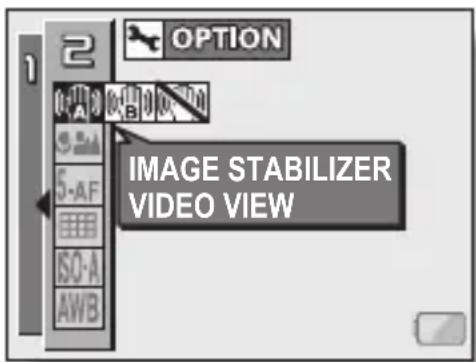
2 Select the image stabilizer menu.
(A): Compensate for camera shake during video clip recording. The field of view does not change when the video clip recording button is pressed, so this setting is convenient when shooting mostly video clips (video clip field of view display).
(B): Compensate for camera shake during video clip recording. The field of view does not change when the still image recording button is pressed, so this setting is convenient when shooting mostly still images (still image field of view display).
: Disengages the motion compensation function (OFF).
text_image
OPTION IMAGE STABILIZER VIDEO VIEW3 Select the desired icon from the image stabilizer menu, and press the SET button.
- This completes the image stabilizer setting.
HINT
If the motion compensation does not seem to be working...
- Due to the mechanical characteristics of this function, it may not be possible for the camera to compensate for violent motion.
- If the digital zoom (page 118) is being used, the large magnification factor may make it difficult for the motion compensation function to work correctly.
- When using a tripod or other means to stabilize the camera, please turn the motion compensation function off. If the motion compensation function is enabled when it is not actually needed, it may result in an image that appears unnatural.
MOTION COMPENSATION (IMAGE STABILIZER)
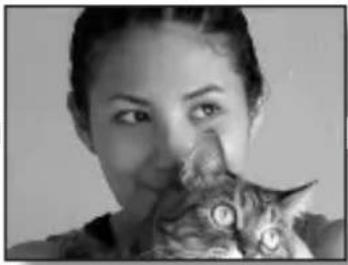
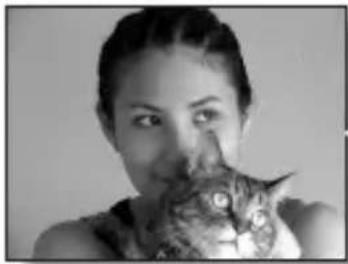
- When the motion compensation is set to ON, the field of view during recording standby differs from the recordable field of view as shown below.
- When set to the motion compensation [B] setting, the video clip recording range is as shown in the recording standby screen.
During still image
shooting

natural_image
Black-and-white photo of a woman holding a cat (no text or symbols visible)Display during
recording standby
For setting
natural_image
Black-and-white photo of a person holding a cat (no text or symbols visible)During video clip recording

natural_image
Black-and-white portrait of a person holding a cat (no text or symbols visible)For setting
natural_image
Black-and-white portrait of a woman holding an ornate cat (no text or symbols visible)
natural_image
Black-and-white photo of a person holding a cat, framed within a dashed border (no text or symbols visible)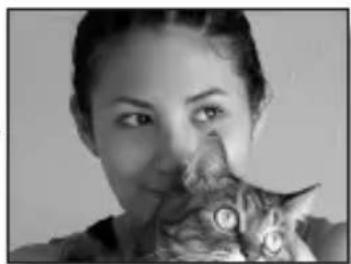
natural_image
Black-and-white photo of a person holding a cat, no visible text or symbolsrecording area
Video clip
For setting

natural_image
Black-and-white photo of a woman holding an otter cat (no text or symbols visible)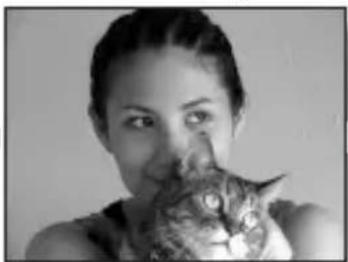
natural_image
Black-and-white portrait of a woman holding a cat (no text or symbols visible)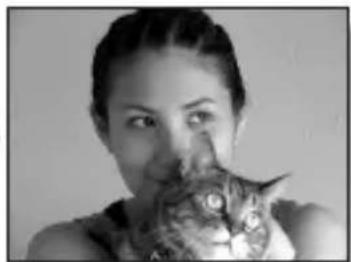
natural_image
Black-and-white portrait of a woman holding a cat (no text or symbols visible)- When the still image shooting resolution is set to 0.3M and the scene selection function to AUTO, 🚗, 📄 or 🏠 (page 57), a still image captured during video clip recording will have the same field of view as the video clip.
FOCUS RANGE
1 Display the PAGE 2 Shooting Setting Screen (page 49).
2 Select the focus range menu.
- When shooting a subject at a medium to far distance, by setting the focus range to 📁, you will find it both easier and faster to focus.
: Wide end: 10 cm (3.94 in.) to infinity Tele end: 80 cm (31.50 in.) to infinity (total range mode)
: 80 cm (31.50 in.) to infinity (standard mode)
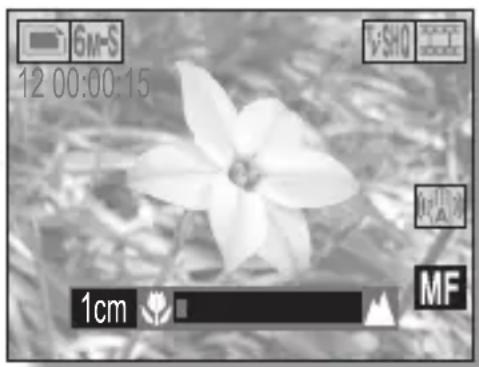
MF: The focus can be manually set to any distance from 1 cm (0.39 in.) to 8 m (26.25 ft.), as well as to infinity (manual focus).
☐: 1 cm (0.39 in.) to 80 cm (31.50 in.) (super macro mode: wide end only)
- When the focus range is set to 📁, 🙏 or MF, the corresponding indication appears on the LCD monitor.
3 Select the desired icon from the focus range menu, and press the SET button.
- This completes the focus range setting.
HINT
- From the Shooting Screen, you can quickly change the focus range setting by toggling the SET button down.
- When the focus range is set to super macro 📋, the zoom is temporarily set to the wide end.
FOCUS RANGE
How to use the manual focus
1 Select the manual focus icon MF from the focus menu, and press the SET button.
2 Press the SET button.
- The focus distance adjustment bar appears.
3 Toggle the SET button to the left or right to adjust the focus distance, and press the SET button.
- The focus distance is set, and you are returned to the Shooting Screen.
natural_image
Black-and-white photo of a white flower with blurred background, no visible text or symbolsHINT
About the focus range
- The focus distance indication shows the distance between the lens surface and the subject.
- In some cases there may be a slight variance between the distance (numerical figure) you set in the manual focus mode and the actual distance.
About zoom movement when using the manual focus
- If the focus distance is set to 70 cm (27.56 in.) or less, the zoom changes to the largest setting that is suitable for that focus distance.
- When the focus distance is set to 70 cm (27.56 in.) or less, the zoom will function only within the range at which the image is focused.
FOCUS AREA SETTING
You can choose from the following 2 types of autofocus (still image shooting only):
5-point range finder focus: The distance to the subject is detected by sampling from multiple areas of the entire shooting screen.
Spot focus: The camera focuses on the subject in the center of the LCD monitor.
1 Display the PAGE 2 Shooting Setting Screen (page 49).
2 Select the desired focus method from the focus mode menu, and press the SET button.
5-AF: 5-point range finder focus is selected.
S-AF: Spot focus is selected.
- When the spot focus setting is selected, the focus mark + appears in the center of the LCD monitor.

text_image
6M-S 12 00:00:52 Focus markLIGHT-MEASURING MODE SETTING
You can select from 3 types of light-measuring modes.
Multi-section light-measuring:
The exposure is adjusted after sampling from multiple areas of the entire shooting screen.
Center-weighted light-measuring:
The exposure is adjusted after light is measured from the entire image, but with emphasis on the center area.
Spot light-measuring:
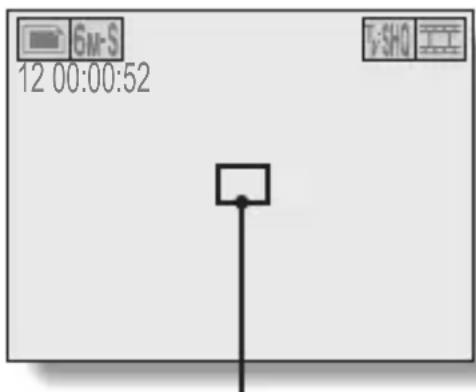
You can compose the picture and capture the image after first measuring the light only at the center spot of the LCD monitor.
1 Display the PAGE 2 Shooting Setting Screen (page 49).
2 Select the desired light-measuring mode from the light-measuring mode (EXP MEASURE) menu.
: Multi-section light-measuring
☐: Center-weighted light-measuring
: Spot light-measuring
3 Press the SET button.
- This completes the light-measuring mode setting.
- When spot light-measuring is selected, the light-measuring spot mark □ appears in the center of the LCD monitor.
text_image
6M-S 12 00:00:52 T-V-SHQLight-measuring spot mark
ISO SENSITIVITY
With the initial settings, the ISO sensitivity is automatically set according to the brightness of the subject. However, the ISO sensitivity can be set to a fixed setting.
1 Display the PAGE 2 Shooting Setting Screen (page 49).
2 Select the ISO sensitivity menu.
ISO-A: Sets the ISO sensitivity automatically (equivalent to ISO 50 to 200 [video clip shooting mode: ISO 450 to 3,600]).
50: Sets the sensitivity to ISO 50 equivalent (video clip shooting mode: ISO 450).
100: Sets the sensitivity to ISO 100 equivalent (video clip shooting mode: ISO 900).
200: Sets the sensitivity to ISO 200 equivalent (video clip shooting mode: ISO 1,800).
400: Sets the sensitivity to ISO 400 equivalent (video clip shooting mode: ISO 3,600).
3 Select the desired icon from the ISO sensitivity menu, and press the SET button.
- This completes the ISO sensitivity setting.
HINT
- By setting a higher ISO sensitivity, you can set higher shutter speeds and capture images in darker locations, but noise in the captured images may increase.
WHITE BALANCE
This camera automatically adjusts the white balance under most lighting conditions. However, if you want to specify the lighting conditions or change the overall tone of the image, the white balance can be manually set.
1 Display the PAGE 2 Shooting Setting Screen (page 49).
2 Select the white balance menu.
AWB: The camera will make the white balance adjustment automatically based on the natural and artificial light conditions.
☀️: For shooting outside on a sunny day.
☐: For shooting outside on a cloudy day.
☐: For shooting inside under fluorescent lighting.
: For shooting inside under incandescent lighting.
☐: This setting is used for a more accurate white balance using the existing light source (one push). Please use it when the light source cannot be identified, for example.
Setting procedure
① Select the 📋 icon and press the SET button.
- The icon moves to the left end of the line.
②Fill the entire screen with a plain white card (or piece of paper, etc.), and press the SET button.
3 Select the desired icon from the white balance menu, and press the SET button.
- Once the white balance setting is programmed for the 📄 icon, it is retained even if another white balance setting (AWB, 📅, 📃, 📄, or 📄) is selected. If you changed to another setting, whenever you select the 📄 icon and press the SET button, the previously programmed setting is recalled.
HINT
To cancel the white balance setting
- Perform step 1, select AWB, and then press the SET button.
DISPLAYING THE PLAYBACK SETTING SCREENS
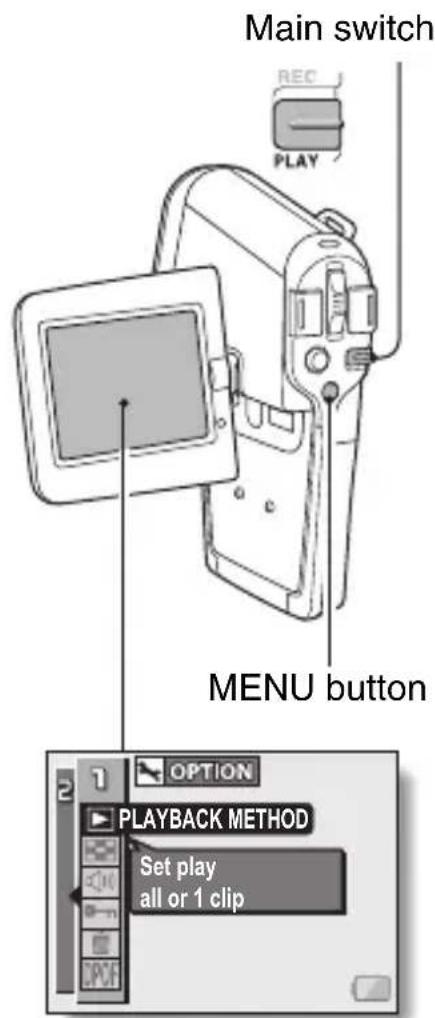
The Playback Setting Screens are used to adjust your camera's playback settings. The Playback Setting Screens are organized into two displays: PAGE 1 and PAGE 2. The PAGE 1 settings (page 75) cover the basic playback settings, and the PAGE 2 settings (page 76) provide you with more detailed settings.
1 Turn on the camera (page 26).
2 Set the main switch to PLAY.
3 Press the MENU button.
• The Playback Setting Screen appears.
- Pressing the MENU button again will cancel the Playback Setting Screen.
text_image
Main switch REC PLAY MENU button 2 1 OPTION PLAYBACK METHOD Set play all or 1 clip PDFSWITCHING THE PAGE
Switch from PAGE 1 to PAGE 2, or vice versa.
1 Display a Playback Setting Screen (page 73).
2 Toggle the SET button to the left.
• The Playback Setting Screen changes to the other PAGE.
• Each time the SET button is toggled to the left, the PAGE changes.

text_image
PAGE indication OPTION PLAYBACK METHOD Set play all or 1 clip
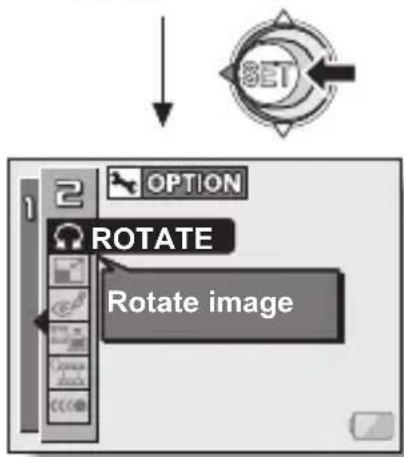
text_image
OPTION ROTATE Rotate image

DISPLAYING THE PLAYBACK SETTING SCREENS
Overview of the Playback Setting Screens
PAGE 1
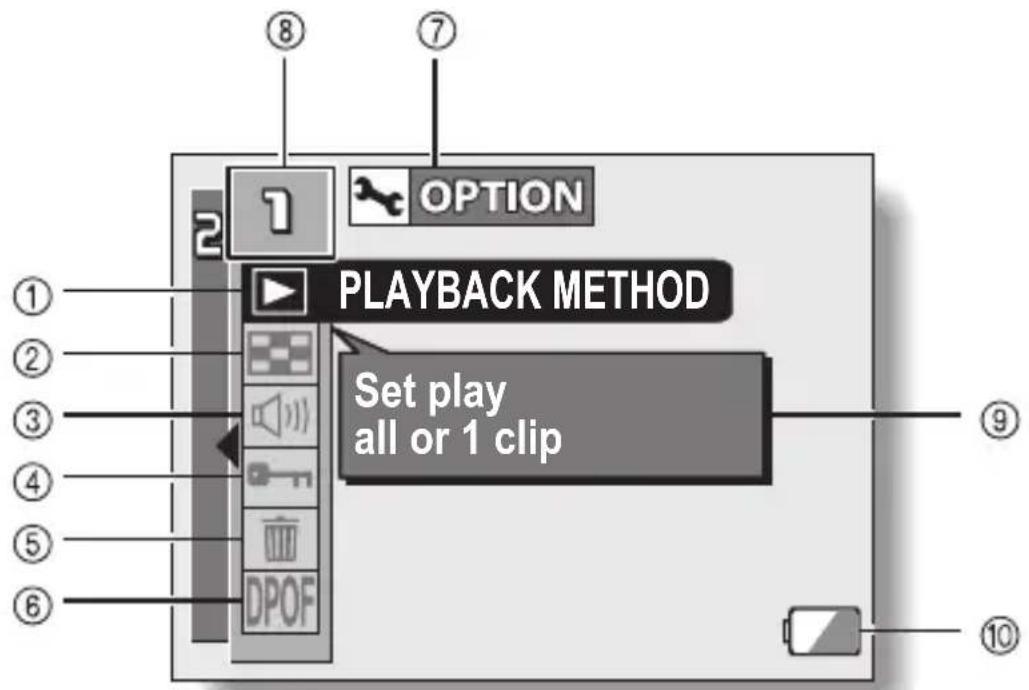
text_image
OPTION PLAYBACK METHOD Set play all or 1 clip①Playback method setting (page 77)
- Select continuous playback or single-frame playback.
②Multi-playback (page 44)
- Display images in the 9-frame multi-display format.
③Playback volume control (page 78)
- Adjust the playback volume for video clips and audio data.
④Data protect setting (page 79)
- Protect data from accidental erasure.
⑤Erase (page 81)
- Delete images from the card memory.
⑥Print settings (page 83)
- Specify the print settings (DPOF settings).
⑦Option icon (page 104)
- Display the Option Screen.
⑧PAGE display (page 74)
⑨Help display (page 112)
⑩Remaining battery power (page 132)
PAGE 2
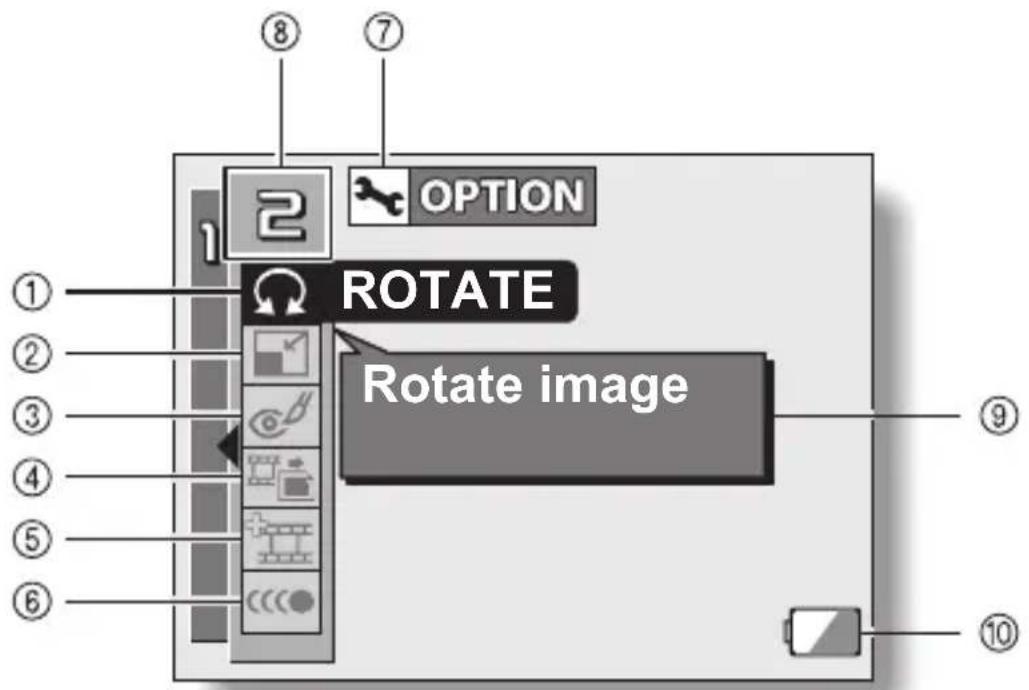
text_image
① ② ③ ④ ⑤ ⑥ ⑧ ⑦ OPTION ROTATE Rotate image ⑨ ⑩①Rotate image (page 90)
- Rotate still images.
②Resize (page 91)
- Reduce the resolution of a still image.
③Red-eye correction (page 92)
• Repair the red-eye effect to make eyes look more natural.
④Extract still image (page 94)
- Extract a still image from a video clip.
⑤Video clip edit (page 95)
- Edit video clips.
⑥Smooth playback (page 102)
- Smooth out the movement when playing back video clips.
⑦Option icon (page 104)
- Display the Option Screen.
⑧PAGE display (page 74)
⑨Help display (page 112)
⑩Remaining battery power (page 132)
PLAYBACK MODE
Images can be viewed continuously (slideshow playback) or you can choose to show single images.
1 Display the PAGE 1 Playback Setting Screen (page 73).
2 Select the playback method icon ▶, and press the SET button.
- The Playback Mode Screen appears.
PLAY ALL: Play back images in slideshow fashion.
1 CLIP: Display only the selected image (page 43).

text_image
PLAYBACK METHOD DURATION OF PHOTO : PLAY ALL 1SEC 1 CLIP3 Select the desired playback mode.
- The screen to set the time that each image is displayed appears.
①Toggle the SET button to the right to select playback time.
②Toggle the SET button up or down to specify the time that each image is shown.
③Press the SET button.

text_image
PLAYBACK METHOD DURATION OF PHOTO PLAY ALL 1SEC4 Press the SET button.
- The display time is set, and you are returned to the Playback Setting Screen.
77 English
PLAYBACK VOLUME
Adjust the playback volume for video clips and audio data, as well as the operation sounds.
1 Display the PAGE 1 Playback Setting Screen (page 73).
2 Select the playback volume icon, and press the SET button.
• The volume control bar appears.
3 Toggle the SET button left or right to adjust the volume, and press the SET button.
- The volume is set, and you are returned to the Playback Setting Screen.
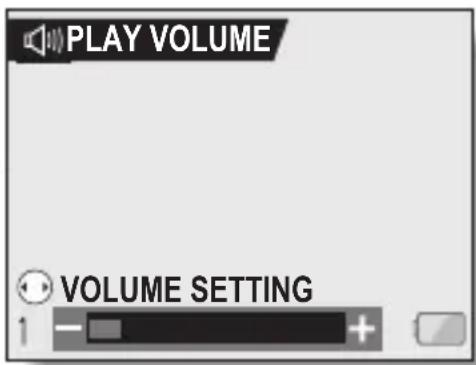
text_image
PLAY VOLUME VOLUME SETTINGHINT
- During video clip or audio memo playback, if you move the zoom switch, the volume control bar will appear, allowing you to adjust the volume.
IMAGE PROTECT
Prevent accidental erasure of image and audio data.
1 Display the data that you want to protect from accidental erasure, and display the PAGE 1 Playback Setting Screen (page 73).
2 Select the protect icon ☐, and press the SET button.
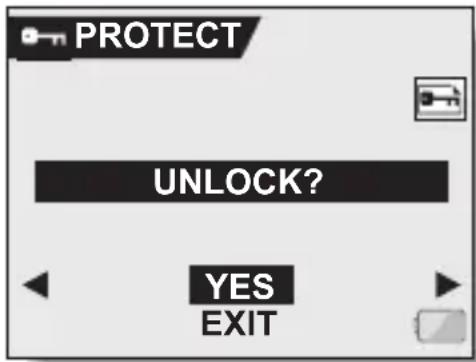
- "LOCK?" appears.
- If the protect mode has already been enabled for the data, then "UNLOCK?" appears.

text_image
PROTECT LOCK? YES EXIT3 Toggle the SET button up or down to select "YES", and press the SET button.
- The protect mode is set for the data.
- The protect mark [icon] indicates that the data is locked.
- To return to the Playback Setting Screen, press the MENU button.
text_image
PROTECT UNLOCK? YES EXITCAUTION
- Even if the protect mode is set for certain data files, they will be erased if the card is reformatted (page 128).
HINT
To select a different image in steps 2 and 3...
- Toggle the SET button to the left or right.
To cancel the protect mode for an image...
- Display the desired data and repeat steps 1 to 3. The protect mark will disappear and the protect mode is canceled.
ERASING DATA
You can erase data that is stored on the card if you no longer need it. You can erase the data one at a time, or all at once.
1 Display the PAGE 1 Playback Setting Screen (page 73).
2 Select the erase icon ☐, and press the SET button.
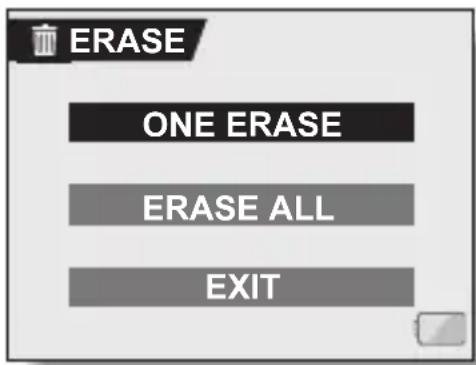
• The Erase Mode Screen appears.
ONE ERASE: Erases one data at a time.
ERASE ALL: Erases all the data.
EXIT: Returns to the
Playback Setting
Screen.
text_image
ERASE ONE ERASE ERASE ALL EXIT3 Toggle the SET button up or down the select the erase mode, and press the SET button.
• The Erase Confirmation Screen appears.
- Toggle the SET button to the left or right to select the data you wish to erase.
- Toggle the SET button to the left or right confirm the data to erase.
4 Toggle the SET button up to select "YES", and press the SET button.
- The currently displayed image is deleted.
- To erase other data, select the data, and press the SET button.
- The Erase Confirmation Screen again appears. To erase the data, select "YES", and press the SET button. When data erase is completed, "NO IMAGE" is shown.
CAUTION
- Data which is protected from accidental erase cannot be erased. To erase protected data, set the protect setting for the data to off (page 79), and then follow the data erase procedure.
HINT
- You can also access the One Erase Confirmation Screen from the Playback Screen by toggling the SET button up.
PRINT SETTINGS
In addition to using your printer to print out still images captured with your camera, as with conventional film, you can have prints made at shops offering digital print services. Moreover, this camera is DPOF-compatible, so you can use the camera to specify the number of prints, whether or not the date is displayed on the print, and also to specify an index print.
Display the Print Settings Screen
1 Display the PAGE 1 Playback Setting Screen (page 73).
2 Select the print settings icon DPOF, and press the SET button.
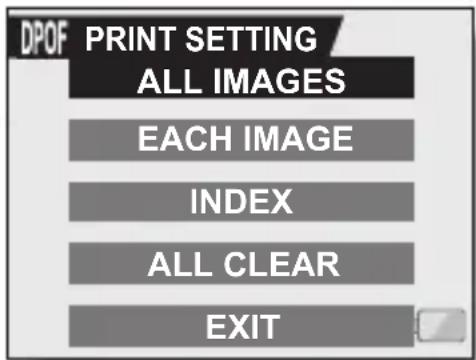
• The Print Setting Screen appears.
ALL IMAGES:
The specified print settings apply to all the still images on the card.
EACH IMAGE:
The print settings are specified for each individual image.
INDEX:
All the still images are printed as miniature images (thumbnail images), several images on one print.
ALL CLEAR:
Clear all the print settings. This cannot be selected if no print settings have been made for the image.
EXIT:
Return to the Still Image Playback Setting Screen.
text_image
DPOF PRINT SETTING ALL IMAGES EACH IMAGE INDEX ALL CLEAR EXITHINT
Printing a single frame from a video clip
- To print with a printer or have the digital print service shop print out a still image from a video clip, you must first save it (save frame) as a still image.
About the DPOF format
- DPOF (Digital Print Order Format) is a print order format. You can connect your camera to a DPOF-compatible printer to produce your prints. You can also set the print settings for the desired images, and then have the reserved images printed automatically (page 151).
About the finished prints
- Images that have been rotated will be printed in their original orientation.
- The quality of the print output will differ depending on the print service and printer used.
PRINT SETTINGS
Specifying date imprinting and print quantities
You can specify print settings for each individual image (EACH IMAGE), or apply the print settings to all the images on the card (ALL IMAGES).
1 Display the Print Setting Screen (page 83).
2 Select EACH IMAGE or ALL IMAGES.
ALL IMAGES:
The set print settings are applied to all the still images on the card.
EACH IMAGE:
The set print settings are applied only to the image currently displayed.

text_image
DPOF PRINT SETTING ALL IMAGES EACH IMAGE INDEX ALL CLEAR EXIT3 Press the SET button.
- The Date/Copies Print Screen appears.
- If "EACH IMAGE" was selected, toggle the SET button to the left or right to display the desired image to print.
- Under “SETTINGS” the settings that are currently active for the displayed image are shown. You can toggle the SET button to the left or right to confirm the print settings for each image.
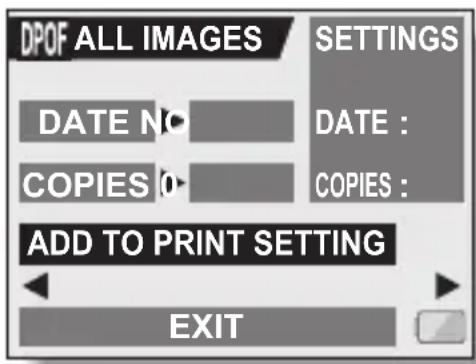
text_image
DPOF ALL IMAGES DATE NO. COPIES 0- SETTINGS DATE : COPIES : ADD TO PRINT SETTING EXIT4
Specify whether the date is displayed on the print, and the number of prints.
① Toggle the SET button up or down to select "DATE".
②Press the SET button.
• The Print Date Screen appears.
③Toggle the SET button up or down to select the desired option.
YES:
Print the date.
NO:
Do not print the date.
④Press the SET button.
- You are returned to the Date/Copies Print Screen.
① Toggle the SET button up or down to select "COPIES".
②Press the SET button.
• The Print Number Screen appears.
③Toggle the SET button up or down to specify the number of prints.
- Toggle the SET button up or down until the desired number of prints is displayed.
④Press the SET button.
- You are returned to the Date/Copies Print Screen.
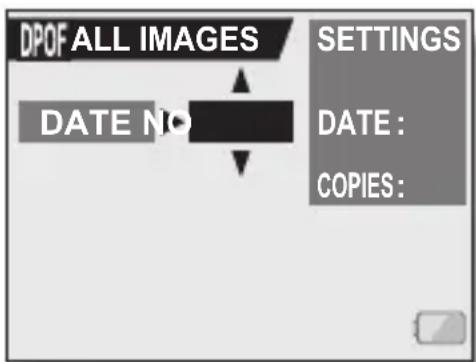
text_image
DPOF ALL IMAGES DATE NO SETTINGS DATE : COPIES :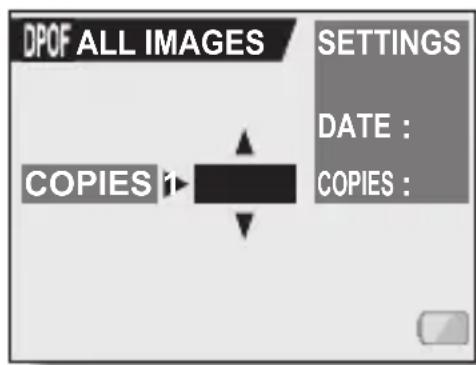
text_image
DPOF ALL IMAGES COPIES 1- SETTINGS DATE : COPIES :PRINT SETTINGS
5 Select "ADD TO PRINT SETTING" and press the SET button.
- The Confirm Print Settings Screen appears.
If the print settings are correct:
Select "EXIT", and press the SET button.
If the print settings were changed:
Select "MODIFY PRINT SETTING", and press the SET button.

text_image
DPOF ALL IMAGES DATE YES COPIES 1 SETTINGS DATE : YES COPIES : 1 MODIFY PRINT SETTING EXITIndex print
Printing out many small images on one sheet is called an “index print”. This is convenient for use as a list of the images you have captured.
1 Display the Print Setting Screen (page 83).
2 Select "INDEX".
3 Press the SET button.
• The Index Print Screen appears.
YES:
Specify an index print copy.
EXIT:
Discontinue the setting procedure, and return to the Print Setting Screen.
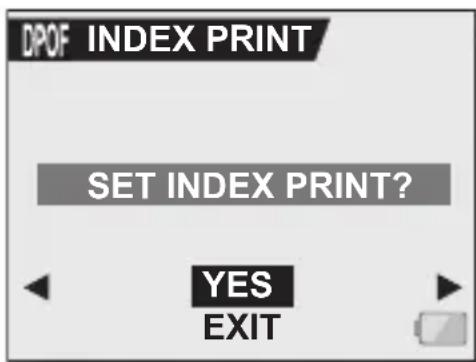
text_image
DPOF INDEX PRINT SET INDEX PRINT? YES EXIT4 Select "YES", and press the SET button.
- This completes the setting for the index print. You are returned to the Print Setting Screen.
Changing the print settings
1 Follow steps 1 to 4 on pages 85 and 86.
2 Select "MODIFY PRINT SETTING", and press the SET button.
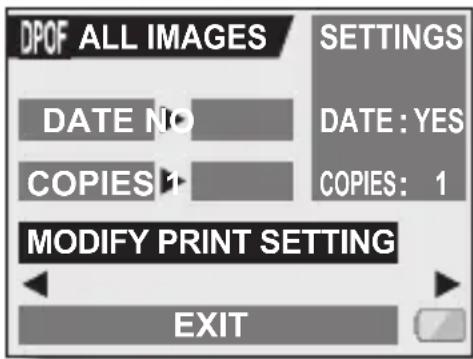
text_image
DPOF ALL IMAGES DATE NO COPIES 1 SETTINGS DATE: YES COPIES: 1 MODIFY PRINT SETTING EXITPRINT SETTINGS
Clearing all the print settings
Delete the print settings for all images.
1 Display the Print Setting Screen (page 83).
2 Select "ALL CLEAR".
3 Press the SET button.
• The Confirm All Clear Screen appears.
YES:
Clear the print settings for all images.
EXIT:
Cancel the clear procedure and return to the Print Setting Screen.
4 Select "YES", and press the SET button.
- All the print settings are cleared and you are returned to the Print Setting Screen.
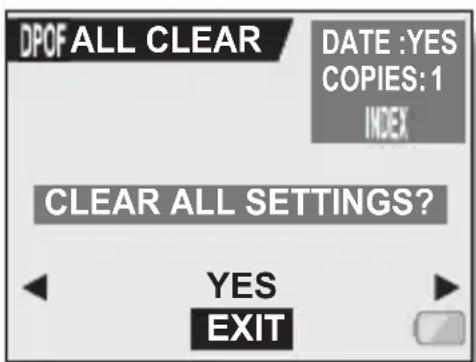
text_image
DPOF ALL CLEAR DATE :YES COPIES: 1 INDEX CLEAR ALL SETTINGS? YES EXITROTATE IMAGE
Captured still images can be rotated to the correct orientation for viewing.
1 Display the still image you wish to rotate, and display the PAGE 2 Playback Setting Screen (page 73).
2 Select the rotate icon 🔒, and press the SET button.
• The Rotate Image Screen appears.
RIGHT: Rotates image clockwise 90 degrees.
LEFT: Rotates image counterclockwise 90 degrees.
EXIT: Return to the Playback Setting Screen.

text_image
ROTATE RIGHT LEFT EXIT3 Select "RIGHT" or "LEFT", and press the SET button.
• Each time the SET button is pressed, the image is rotated another 90 degrees.
CHANGING IMAGE SIZE (RESIZE)
The size of a still image that has already been captured at a resolution of 2M or more can be changed to 1,600 × 1,200 pixels or 640 × 480 pixels. The resized image is saved as a separate image.
1 Display the still image whose size you want to change, and display PAGE 2 of the Playback Setting Screen (page 73).
2 Select the resize icon ☐, and press the SET button.
• The Resize Screen appears.

text_image
RESIZE 6 M (2816x2112) 2 M (1600x1200) 0.3 M (640x480) EXIT3 Toggle the SET button up or down to select the new image size.
2M (1600 × 1200): The saved image will be 1,600 × 1,200 pixels.
0.3M (640 × 480): The saved image will be 640 × 480 pixels.
EXIT: Return to the Playback Setting Screen.
4 Press the SET button.
- Resizing begins.
HINT
Why can't the image be resized?
- An image can be resized only to a smaller (or the same) size, not to a larger size.
RED-EYE CORRECTION
If you photograph your subjects at night using the flash, they may appear in the image with glowing red eyes (red-eye phenomenon). Now you can amend the image so that the subjects' eyes appear more natural (red-eye correction).
1 Display the image to be modified, and display the PAGE 2 Playback Setting Screen (page 73).
2 Select the red-eye correction icon, and press the SET button.
- The Red-Eye Correction Screen appears.
YES: Proceed with the red-eye correction.
EXIT: Return to the Playback Setting Screen.

text_image
RED-EYE CORRECT. YES EXIT3 Select "YES" and press the SET button.
- Red-eye correction is executed.
- During the red-eye correction process, "PROCESSING" is shown on the screen.
- When the correction is completed, the modified image is shown. Check the image to see if the post-processing result is satisfactory.

text_image
RED-EYE CORRECT. PRESS SHUTTER TO SAVERED-EYE CORRECTION
4 Press the still image shooting button.
- A screen appears for you to specify whether or not to keep the original image.
YES: The corrected image is saved as a separate image, and the original image is preserved.
NO: The corrected image replaces the original image.
EXIT: The corrections are canceled, and you are returned to the Playback Setting Screen.

text_image
RED-EYE CORRECT. SAVE ORIGINAL IMAGE ? YES NO EXIT5 Select the desired method to save the corrected image, and press the SET button.
- The corrected image is saved, and you are returned to the Red-eye Correction Screen.
HINT
If the “RED-EYE CORRECTION NOT SUCCESSFUL” message appears...
- The camera was not able to successfully correct the red-eye phenomenon.
- The red-eye correction function works to automatically edit the red-eye phenomenon that the camera detects in captured images. In some cases, the camera may fail to correctly detect the red-eye phenomenon, or it may incorrectly identify the red-eye phenomenon where it does not exist.
Concerning the date and time information for the saved image
- When an image is corrected and saved, the recorded date and time of capture (Exif information) remains unchanged from the original image. However, the file date shown on the computer changes to the date and time the image was revised.
EXTRACTING A STILL IMAGE FROM A VIDEO CLIP
You can select one image (scene) from a video clip, copy it, and save it as a still image (the original data remains unchanged).
1 Play back a video clip, and pause at the point you wish to copy and save.
2 Display the PAGE 2 Playback Setting Screen (page 73).
3 Select the extract still icon 📄, and press the SET button.
- The screen to extract an image appears.
YES: The image is copied and saved as a still image (the original data is left unchanged).
EXIT: You are returned to the Playback Setting Screen.
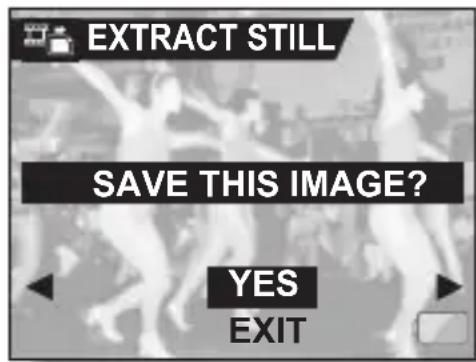
text_image
EXTRACT STILL SAVE THIS IMAGE? YES EXIT4 Select "YES" and press the SET button.
• The image is extracted.
HINT
To select a different image (frame) in step 3...
- Toggle the SET button to the left or right.
EDITING VIDEO CLIPS
You can delete ("cut") the first part or the last part of a video clip. You can choose anywhere in the video clip as the cutting point.
You can also join two video clips together and save them as one separate clip ("joining").
CAUTION
Warning concerning the battery pack remaining charge
- During the editing of lengthy video clips, the time to process the large amount of data can become quite long. To avoid problems caused by the battery pack becoming depleted in the middle of video clip editing, before starting to edit be sure that a sufficiently charged battery pack is installed in the camera, or connect the AC adaptor.
- It is recommended that a computer be used to edit long video clips.
Procedure to save part of a video clip as a separate clip
Play the video clip, and pause playback at the point you want to cut.

natural_image
Sequence of three frames showing a dynamic human figure in various poses, no text or symbols present
Select whether to delete the portion before the cut point or after the cut point.

Delete the specified portion.
- The specified portion is deleted.

- The original video clip is not affected.
natural_image
Illustration of a film strip showing multiple human figures in various poses (no text or symbols)(You can also choose to erase the original video clip when the new clip is saved.)
Procedure to join two video clips
Display the video clip that will come first.
Select the video clip that you wish to append (join).

Join the video clips. (Press the SET button.)
- The two video clips are saved together as a separate video clip.
● ●
- The original video clips are not affected. (You can also choose to erase the original video clips when the new clip is saved.)
natural_image
Film strip illustrations showing various human and athlete poses in motion (no text or symbols)CAUTION
Caution when editing video clips
- When editing video clips, do not move the main switch. If you move the main switch while editing video clips, not only will the editing not be properly completed, but the original video clip may also be erased.
- By repeating the clipping and joining procedures, you can create exactly the video clip you like. Note, however, that as the number or size of the video clips increases, the card memory may become full, making it impossible to edit the video clips. In this case, you will need to free some of the memory on the card either by deleting data that are no longer necessary (page 81), or by performing the procedure to erase the original video clip(s) (pages 99, 101).
EDITING VIDEO CLIPS
Deleting part of a video clip
1 Display the video clip you wish to edit.
2 Display the scene you wish to delete.
- In step 5 you will specify whether you wish to delete the portion from the beginning of the video clip up to the selected scene, or the portion from the selected scene to the end of the video clip.

text_image
First part Latter partVideo clip start Video clip end Selected scene
• To select the desired scene quickly, you can use a combination of the fast-forward (or reverse) playback, pause, and image-by-image playback functions (page 46).
- The actual cut point may be slightly before or after the displayed scene.
3 Display the PAGE 2 Playback Setting Screen (page 73).
4 Select the edit video icon ☐, and press the SET button.
• The Edit Video Screen appears.
5 Toggle the SET button up or down to select the portion you wish to delete.
DELETE 1ST PART:
Delete the first part of the video clip. DELETE 2ND PART:
Delete the latter part of the video clip.

text_image
EDIT VIDEO DELETE 1ST PART DELETE 2ND PART JOIN EXIT6 Press the SET button.
- A screen appears for you to confirm whether or not you want to keep the original video clip.

text_image
DELETE 1ST PART KEEP ORIGINAL IMAGE? YES NO EXITEDITING VIDEO CLIPS
7 Select whether you want the original video clip to be erased when clipping is executed.
YES:
The original video clip is saved.
NO:
The original video clip is not saved.
8 Press the SET button.
- Editing starts.
- If "YES" was selected, the edited video clip is saved as a new video clip.
- If “NO” was selected, the edited video clip is saved as a new video clip, and the original video clip is erased.
- When editing ends, you are returned to the Playback Setting Screen.
HINT
- If the original video clip is protected, even if you select "NO" in steps 7 and 8 and press the SET button, the original video clip will not be erased. If you want it to be erased, you will need to first remove the protection.
Joining two video clips
CAUTION
- Video clips that were photographed in different modes cannot be joined.
1 Display the first video clip.
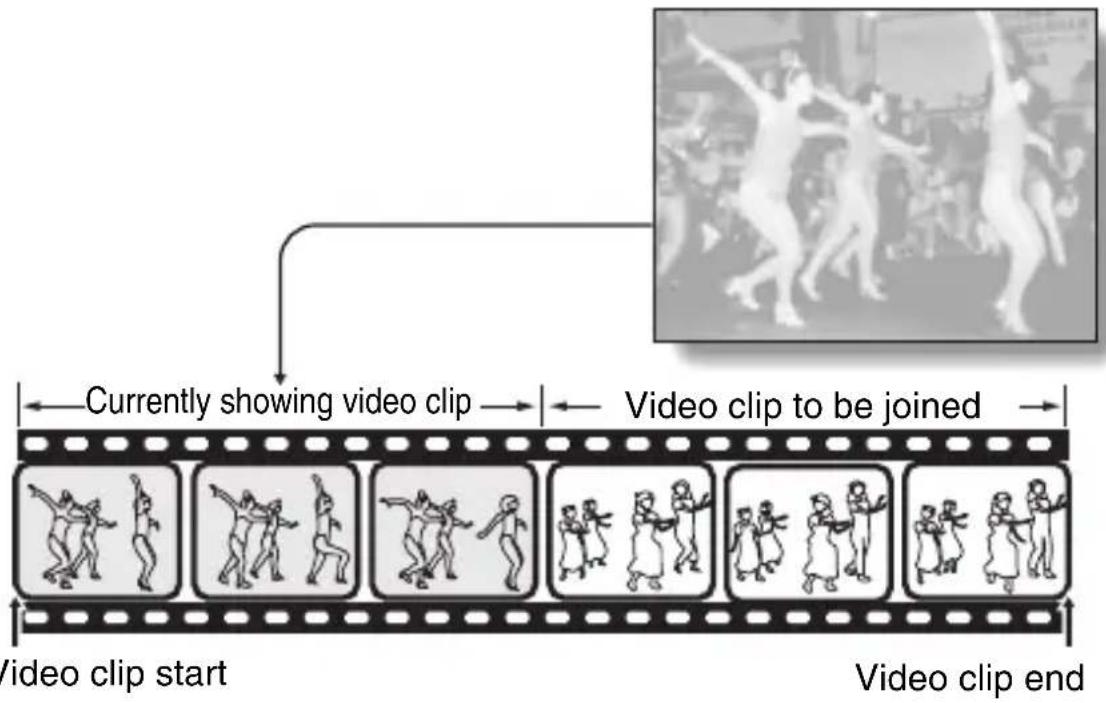
flowchart
graph LR
    A["Video clip start"] --> B["Currently showing video clip"]
    B --> C["Video clip to be joined"]
    C --> D["Video clip end"]
2 Display the PAGE 2 Playback Setting Screen (page 73).
3 Select the edit video icon ☐, and press the SET button.
• The Edit Video Screen appears.
4 Select the join icon 📄.
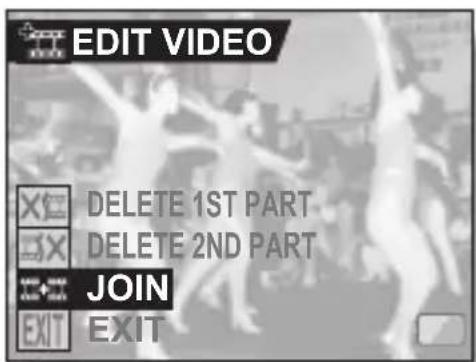
text_image
EDIT VIDEO DELETE 1ST PART DELETE 2ND PART JOIN EXIT EXITEDITING VIDEO CLIPS
5 Press the SET button.
- The 9-image playback display for video clips appears.
6 Toggle the SET button to move the orange frame to the video clip that you wish to join.
7 Press the SET button.
8 Select whether you want the original video clip to be erased when clipping is executed.
YES:
The original video clips are kept.
NO:
The original video clips are not kept.
9 Press the SET button.
- Editing starts.
- The two video clips are saved together as a separate video clip.
- If "NO" was selected in step 8, the original video clips are erased when
- When editing ends, you are returned to the Playback Setting Screen.
HINT
- If the original video clip is protected, even if you select "NO" in step 8 and press the SET button, the original video clip will not be erased. If you want it to be erased, you will need to first remove the protection.
Orange frame
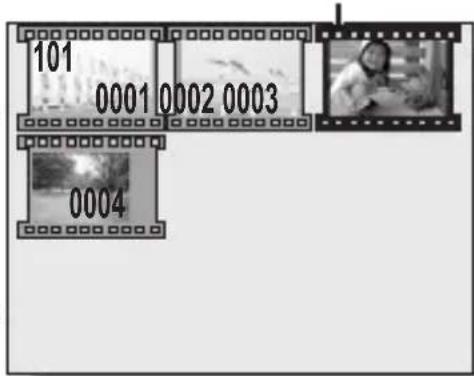
text_image
101 0001 0002 0003 0004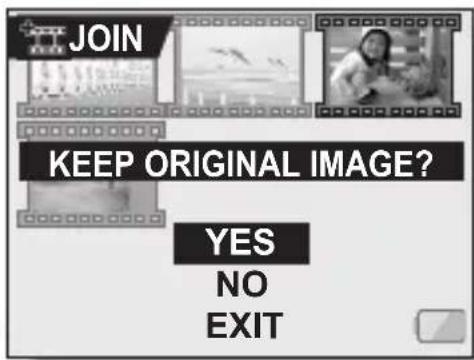
text_image
JOIN KEEP ORIGINAL IMAGE? YES NO EXITSMOOTH PLAYBACK
Suppress the video flicker that occurs, for example, when playing back video clips that were recorded with camera moving fast.
1 Display the PAGE 2 Playback Setting Screen (page 73).
2 Select the smooth playback icon, and press the SET button.
• The Smooth Playback Screen appears.
ON:
Activate smooth playback
OFF:
Deactivate smooth playback
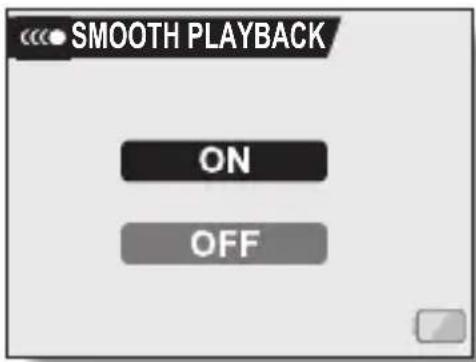
text_image
SMOOTH PLAYBACK ON OFF3 Select "ON", and press the SET button.
• This completes the smooth playback setting.
HINT
- Depending on the recording conditions, the smooth playback effect may be insignificant in some cases.
DISPLAYING IMAGE PROPERTIES (INFORMATION SCREEN)
On the Information Screen you can check what the settings were when an image was captured.
1 Display the desired image.
2 Press the MENU button for about 1 second.
• The Information Screen appears.
- If the MENU button is pressed again, the Information Screen is canceled.
①Video clip mode settings
②Image or sound number
③Protect setting
④File size
⑤ Shooting or recording time
⑥Remaining battery charge
⑦Date and time of image
⑧Still image resolution settings