
FA100 - Telephony OpenVox - Free user manual and instructions
Find the device manual for free FA100 OpenVox in PDF.


| Product Type | Failover Box for PSTN Line Switching |
| Brand | OpenVox |
| Model | FA100 |
| Dimensions | Approximately 120 x 80 x 30 mm |
| Weight | Approximately 200 g |
| Power Supply | USB (5V DC, 500 mA); dual USB ports for stability |
| USB Connector | USB Type B |
| USB Standard | USB 2.0 and 1.1 |
| Indicator Lights | Red and Green LEDs; both on = normal, only green = failover active |
| Standby Analog Ports | Up to 8 |
| Digital Ports | Up to 2 (E1/T1/BRI/Ethernet) |
| Network Ports | Two; each divided into A, B, C, D |
| Software Watchdog | Supported; configurable kick interval (100-9000 ms) |
| Compatible Cards | All OpenVox analog, E1/T1, and BRI cards |
| Operating System | Linux (with Asterisk and DAHDI) |
| Configuration File | /etc/asterisk/failover.conf |
| Multi-Device Support | Yes, multiple FA100 units in one system |
| Automatic Failover | Switches PSTN to backup phone when Asterisk or server power fails |
| Maintenance & Cleaning | Clean with a dry, soft cloth; avoid liquids and solvents |
| Safety | For indoor use only; do not open casing; no user-serviceable parts |
| Spare Parts & Repairability | No user-replaceable parts; contact technical support for repairs |
| General Information | Designed for Asterisk PBX systems; provides reliable PSTN failover |
Frequently Asked Questions - FA100 OpenVox
User questions about FA100 OpenVox
0 question about this device. Answer the ones you know or ask your own.
Ask a new question about this device
Download the instructions for your Telephony in PDF format for free! Find your manual FA100 - OpenVox and take your electronic device back in hand. On this page are published all the documents necessary for the use of your device. FA100 by OpenVox.
USER MANUAL FA100 OpenVox
natural_image
Front view of a network switch device with multiple Ethernet ports and I/O ports (no visible text or labels)OpenVox Communication Co. Ltd.
Address: F/2, Building No.14, Shangsha Science & Technology Park, No.9283, BinheRoad, Futian District, ShenZhen, Guangdong 518048, China
Tel: +86-755-82535095, 82535461,
Fax: +86-755-82535174
Email for Sales: sales@openvox.com.cn
Email for Technical Support: support@openvox.com.cn
Business Hours: 9:00AM-18:00PM from Monday-Friday
Thank You for Choosing OpenVox Products!
Table of Contents
FA100 Descripon 3
FA100 Features....4
FA100 Installaon Guide .... 5
Hardware Connecon 5
Device Driver Detecon 6
FA100 Operang Instrucon 7
FA100 Soware Installaon 10
Soware Download 10
Soware Installaon 10
Explanaon of Conguraon Files 11
Steps to Use 12
Technical Support.... 14
FA100 Descripon
Most of the time, users need to reconnect PSTN line to analog telephone to make it work when the PBX Sever faces a power failure. It may cause only a lile extra work for people who use simple and small PBX servers. But for those who run complex PBXs in server rooms, it becomes real problems.
How to eliminate this problem? The release of OpenVox FA100 failover box solves it. The FA100 can automacally switch the PSTN line to analog telephone when the power of the PBX server has been cut o and will automacally switch back to normal when the power is on again. In this way, you will no more need to worry whether the power is cut o.
FA100 is controlled through an Asterisk loadable module res_failover.so. This module keeps sending “running” signal to FA100 when Asterisk is running. Once Asterisk is down or system power is cut o, the module will not be able to send out the “running” signal, thus FA100 will automacally switch to the standby telephone.
FA100 provides a reliable and exible soluon to Asterisk PBX.
FA100 Features
- Easy installaon: Connected to computer or server by USB port. In order to provide more stable power supply, the number of USB port connected to hosts is two.
● Industry standard USB type B connector.
● Support USB 2.0 and 1.1.
● Support all compatible analog cards and E1/T1/BRI cards. - Two indicator lights: red and green. Two light, Asterisk and FA100 work normal. Only green lights, Asterisk hangs and FA100 switches PSTN line to the backup phone.
● Support up to 8 standby Analog ports and 2 E1/T1/BRI/Ethernet Ports.
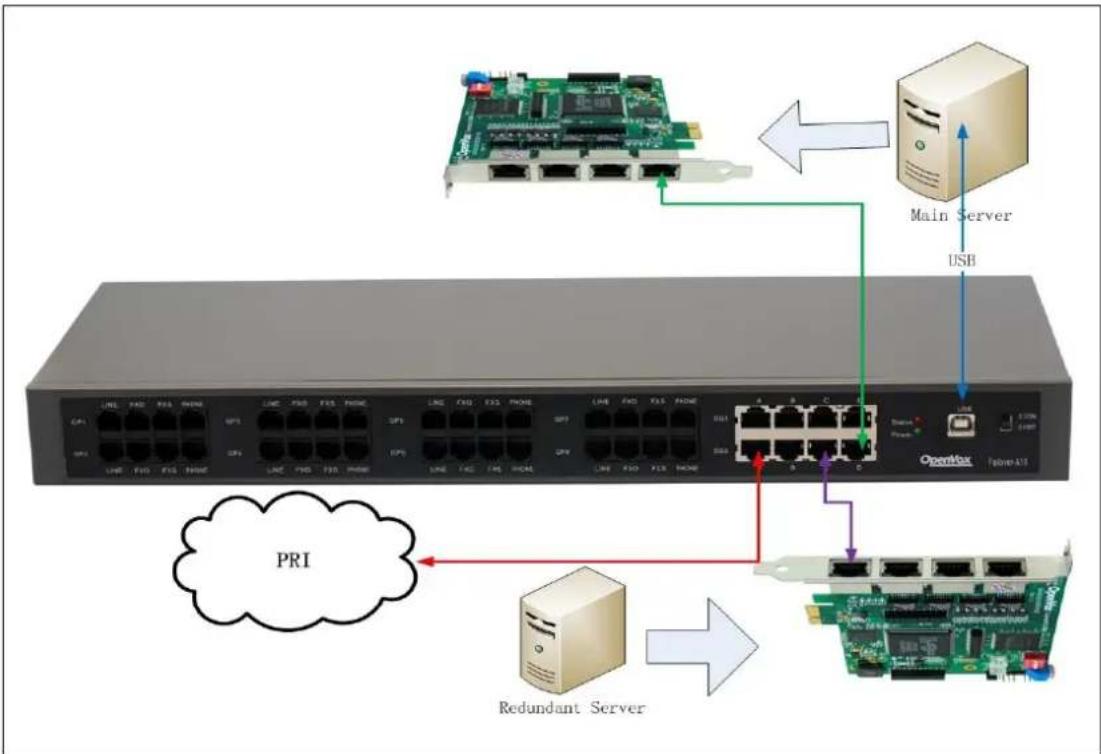
● Supports mulple FA100 devices in one system. - Two network ports. Each network interface is divided into four ports, A, B, C, D respectively, the port A and B are interconnected. The NET port of Digital cards can be connected to port A or B. And the other one port can be connected to our TAP cards to record, so as to meet your requirement of functional diversicaon. C and D are connected to CPE port of Digital cards, D is the port of the primary server, and C is the standby server. For cable conncon, LAN line is connected to port A or B, D is connected to the main server and C is connected to backup server.
● Supports soware watchdog.
FA100 Installaon Guide
Hardware Connection

flowchart
graph TD
    PSTN[" PSTN "] -->|Data Flow| Server[" Server "]
    Server -->|Ethernet| Telephone[" Telephone "]
    Server -->|Data Flow| Ethernet2[" Ethernet "]
    Server -->|Data Flow| Server3[" Server "]
    Server -->|Data Flow| Server4[" Server "]
    Server -->|Data Flow| Server5[" Server "]
    Server -->|Data Flow| Server6[" Server "]
    Server -->|Data Flow| Server7[" Server "]
    Server -->|Data Flow| Server8[" Server "]
    Server -->|Data Flow| Server9[" Server "]
    Server -->|Data Flow| Server10[" Server "]
    Server -->|Data Flow| Server11[" Server "]
    Server -->|Data Flow| Server12[" Server "]
    Server -->|Data Flow| Server13[" Server "]
    Server -->|Data Flow| Server14[" Server "]
    Server -->|Data Flow| Server15[" Server "]
    Server -->|Data Flow| Server16[" Server "]
    Server -->|Data Flow| Server17[" Server "]
    Server -->|Data Flow| Server18[" Server "]
    Server -->|Data Flow| Server19[" Server "]
    Server -->|Data Flow| Server20[" Server "]
    Server -->|Data Flow| Server21[" Server "]
    Server -->|Data Flow| Server22[" Server "]
    Server -->|Data Flow| Server23[" Server "]
    Server -->|Data Flow| Server24[" Server "]
    Server -->|Data Flow| Server25[" Server "]
    Server -->|Data Flow| Server26[" Server "]
    Server -->|Data Flow| Server27[" Server "]
    Server -->|Data Flow| Server28[" Server "]
    Server -->|Data Flow| Server29[" Server "]
    Server -->|Data Flow| Server30[" Server "]
    Server -->|Data Flow| Server31[" Server "]
    Server -->|Data Flow| Server32[" Server "]
    Server -->|Data Flow| Server33[" Server "]
    Server -->|Data Flow| Server34[" Server "]
    Server -->|Data Flow| Server35[" Server "]
    Server -->|Data Flow| Server36[" Server "]
    Server -->|Data Flow| Server37[" Server "]
    Server -->|Data Flow| Server38[" Server "]
    Server -->|Data Flow| Server39[" Server "]
    Server -->|Data Flow| Server40[" Server "]
    Server -->|Data Flow| Server41[" Server "]
    Server -->|Data Flow| Server42[" Server "]
    Server -->|Data Flow| Server43[" Server "]
    Server -->|Data Flow| Server44[" Server "]
    Server -->|Data Flow| Server45[" Server "]
    Server -->|Data Flow| Server46[" Server "]
    Server -->|Data Flow| Server47[" Server "]
    Server -->|Data Flow| Server48[" Server "]
    Server -->|Data Flow| Server49[" Server "]
    Server -->|Data Flow| Server50[" Server "]
    DataPort1["Telephone"] --> DataPort2["Phone"]
    DataPort3["Phone"] --> DataPort4["Phone"]
    DataPort5["Phone"] --> DataPort6["Phone"]
    DataPort7["Phone"] --> DataPort8["Phone"]
    DataPort9["Phone"] --> DataPort10["Phone"]
    DataPort11["Phone"] --> DataPort12["Phone"]
    DataPort13["Phone"] --> DataPort14["Phone"]
    DataPort15["Phone"] --> DataPort16["Phone"]
    DataPort17["Phone"] --> DataPort18["Phone"]
    DataPort19["Phone"] --> DataPort20["Phone"]
    DataPort21["Phone"] --> DataPort22["Phone"]
    DataPort23["Phone"] --> DataPort24["Phone"]
    DataPort25["Phone"] --> DataPort26["Phone"]
    DataPort27["Phone"] --> DataPort28["Phone"]
    DataPort29["Phone"] --> DataPort30["Phone"]
    DataPort31["Phone"] --> DataPort32["Phone"]
    DataPort33["Phone"] --> DataPort34["Phone"]
    DataPort35["Phone"] --> DataPort36["Phone"]
    DataPort37["Phone"] --> DataPort38["Phone"]
    DataPort39["Phone"] --> DataPort40["Phone"]
    DataPort41["Phone"] --> DataPort42["Phone"]
    DataPort43["Phone"] --> DataPort44["Phone"]
    DataPort45["Phone"] --> DataPort46["Phone"]
    DataPort47["Phone"] --> DataPort48["Phone"]
    DataPort49["Phone"] --> DataPort50["Phone"]
    DataPort51["Phone"] --> DataPort52["Phone"]
    DataPort53["Phone"] --> DataPort54["Phone"]
    DataPort55["Phone"] --> DataPort56["Phone"]
    DataPort57["Phone"] --> DataPort58["Phone"]
    DataPort59["Phone"] --> DataPort60["Phone"]
    DataPort61["Phone"] --> DataPort62["Phone"]
    DataPort63["Phone"] --> DataPort64["Phone"]
    DataPort65["Phone"] --> DataPort66["Phone"]
    DataPort67["Phone"] --> DataPort68["Phone"]
    DataPort69["Phone"] --> DataPort70["Phone"]
    DataPort71["Phone"] --> DataPort72["Phone"]
    DataPort73["Phone"] --> DataPort74["Phone"]
    DataPort75["Phone"] --> DataPort76["Phone"]
    DataPort77["Phone"] --> DataPort78["Phone"]
    DataPort79["Phone"] --> DataPort7Aa["Power A1A"]
    DataPort80["Power A1B"]
    DataPort81["Power A1C"]
    DataPort82["Power A1D"]
    DataPort83["Power A1E"]
    DataPort84["Power A1F"]
flowchart
graph TD
    A["Main Server"] -->|USB| B["USB"]
    B --> C["OpenMax"]
    C --> D["Redundant Server"]
    D --> E["PRI"]
    E --> F["Line 1: XRD, XRS, PND"]
    F --> G["Line 2: XRD, XRS, PND"]
    G --> H["Line 3: XRD, XRS, PND"]
    H --> I["Line 4: XRD, XRS, PND"]
    I --> J["Line 5: XRD, XRS, PND"]
    J --> K["Line 6: XRD, XRS, PND"]
    K --> L["Line 7: XRD, XRS, PND"]
    L --> M["Line 8: XRD, XRS, PND"]
    M --> N["Line 9: XRD, XRS, PND"]
    N --> O["Line 10: XRD, XRS, PND"]
    O --> P["Line 11: XRD, XRS, PND"]
    P --> Q["Line 12: XRD, XRS, PND"]
    Q --> R["Line 13: XRD, XRS, PND"]
    R --> S["Line 14: XRD, XRS, PND"]
    S --> T["Line 15: XRD, XRS, PND"]
    T --> U["Line 16: XRD, XRS, PND"]
    U --> V["Line 17: XRD, XRS, PND"]
    V --> W["Line 18: XRD, XRS, PND"]
    W --> X["Line 19: XRD, XRS, PND"]
    X --> Y["Line 20: XRD, XRS, PND"]
    Y --> Z["Line 21: XRD, XRS, PND"]
    Z --> AA["Line 22: XRD, XRS, PND"]
    AA --> AB["Line 23: XRD, XRS, PND"]
    AB --> AC["Line 24: XRD, XRS, PND"]
    AC --> AD["Line 25: XRD, XRS, PND"]
    AD --> AE["Line 26: XRD, XRS, PND"]
    AE --> AF["Line 27: XRD, XRS, PND"]
    AF --> AG["Line 28: XRD, XRS, PND"]
    AG --> AH["Line 29: XRD, XRS, PND"]
    AH --> AI["Line 30: XRD, XRS, PND"]
    AI --> AJ["Line 31: XRD, XRS, PND"]
    AJ --> AK["Line 32: XRD, XRS, PND"]
    AK --> AL["Line 33: XRD, XRS, PND"]
    AL --> AM["Line 34: XRD, XRS, PND"]
    AM --> AN["Line 35: XRD, XRS, PND"]
    AN --> AO["Line 36: XRD, XRS, PND"]
    AO --> AP["Line 37: XRD, XRS, PND"]
    AP --> AQ["Line 38: XRD, XRS, PND"]
    AQ --> AR["Line 39: XRD, XRS, PND"]
    AR --> AS["Line 40: XRD, XRS, PND"]
    AS --> AT["Line 41: XRD, XRS, PND"]
    AT --> AU["Line 42: XRD, XRS, PND"]
    AU --> AV["Line 43: XRD, XRS, PND"]
    AV --> AW["Line 44: XRD, XRS, PND"]
    AW --> AX["Line 45: XRD, XRS, PND"]
    AX --> AY["Line 46: XRD, XRS, PND"]
    AY --> AZ["Line 47: XRD, XRS, PND"]
    AZ --> BA["Line 48: XRD, XRS, PND"]
    BA --> BB["Line 49: XRD, XRS, PND"]
    BB --> BC["Line 50: XRD, XRS, PND"]
Device Driver Detection
Usually under Linux, you do not need to install driver program. Generally system already comes with a USB - to - Serial Drivers support. Users can run the following command to see if the FA100 has been recognized or detected by the system.
# dmesg | grep FTDI
![[root@lytest ~]# lsusb Bus 003 Device 002: ID 0403:6001 Future Technology Devices Interna tional, Ltd FT232 USB-Serial (UART) IC Bus 003 Device 001: ID 0000:0000 Bus 005 Device 001: ID 0000:0000 Bus 004 Device 001: ID 0000:0000 Bus 002 Device 001: ID 0000:0000 Bus 001 Device 001: ID 0000:0000](/content/2026/06/1213817/images/86ae10db563e6649fd287648764b096d5d18c664e399a372f2c21efaa379d2c3.jpg)
Users can also run "lsusb" command to check if the FA100 device is connected.
# lsusb
![[root@lytest ~]# dmesg | grep FTDI drivers/usb/serial/usb-serial.c: USB Serial support registered for FTDI USB Serial Device ftdi_sio 3-1:1.0: FTDI USB Serial Device converter detected usb 3-1: FTDI USB Serial Device converter now attached to ttyUSBO drivers/usb/serial/ftdi_sio.c: v1.4.3:USB FTDI Serial Converters D river](/content/2026/06/1213817/images/e3a1462dccffde639e616b52ed695f6dfda5fb0dfed33d49258c4e36858724b8.jpg)
FA100 Operating Instruction
The following picture shows how the FA100 works when the PBX Server and Asterisk work. The PSTN signal goes from:
1->(blue)2->(red)3->(green)4->(purple)

flowchart
graph TD
    PSTN[" PSTN "] -->|Data Flow| Server[" Server "]
    Server -->|Ethernet A10| EthernetA[" Ethernet A10 "]
    Server -->|Data Flow| Phone[" Phone "]
    Phone -->|Data Flow| Internet[" Internet "]
    Internet -->|Data Flow| TCP[" TCP "]
    TCP -->|Data Flow| EthernetA
    style PSTN fill:#f9f,stroke:#333
    style Server fill:#ccf,stroke:#333
    style Internet fill:#cfc,stroke:#333
When dial out from internal, the PSTN signal goes inversely.
If the PBX Server stops working (power o) or Asterisk works abnormally, FA100 will launch automac switching funcon, and the PSTN signal goes as follows:
When dial out from internal, the PSTN signal goes inversely.
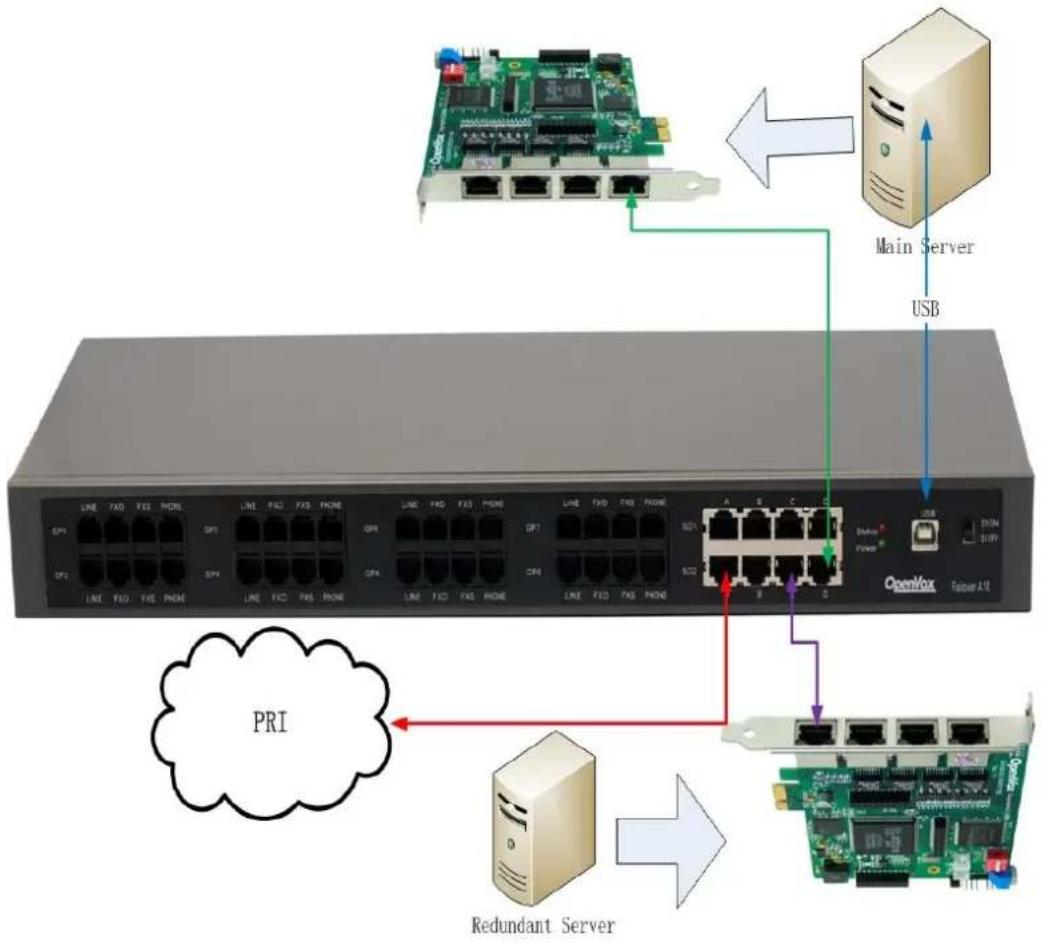
The picture below shows FA100 network ports conncon, such as the conncon between Network cable, PRI, BRI and port A or B.
When Asterisk normally works, the PSTN signal goes:
1->LAN (red) 2->main network (green)
When Asterisk works abnormally, the PSTN signal goes:
1->LAN (red) 2->Redundant network (purple)
If FA100 doesn't receive the "running" signal from the Main Server, then the internal circuits will be switched to Redundant Server automacally.
flowchart
graph TD
    A["Main Server"] -->|USB| B["Redundant Server"]
    B --> C["Router"]
    C --> D["Switch"]
    D --> E["USB"]
    style A fill:#f9f,stroke:#333
    style B fill:#ccf,stroke:#333
    style C fill:#cfc,stroke:#333
    style D fill:#fcc,stroke:#333
    subgraph Router
        E
        F["Switch"]
        G["Redundant Server"]
    end
    H["PRI"] -.-> I["Switch"]
    style H fill:#fff,stroke:#000
    style I fill:#fff,stroke:#000
FA100 Soware Installaon
Before installaon, make sure whether the host system (LINUX) is running well, whether the DAHDI and Asterisk have been installed well, whether boards (Analog cards) drivers have been loaded into the system. If you have bought our cards, but don't know how to install them, you can go to our ocial website to download user manuals. Aer everything prepared well, follow next steps.
Software Download
wget
www.openvox.cn/download/drivers/failover/failover-1.0.1.tar.gz
Software Installation
1) Unzip the le
tar -xvzf failover-1.0.1.tar.gz
cd failover
2) Copy the le to res directory under asterisk
# cp res_failover.c /usr/src/asterisk-**/res/
3) Copy the conguraon le to /etc/asterisk directory
# cp failover.conf /etc/asterisk/
4) Compile and install
cd /usr/src/asterisk-**/
make
make install
5)Reboot asterisk
reboot
Explanation of Configuration Files
[openvox_failover_1]
device=/dev/ttyUSB0
; Kick the soft watchdog every 4000ms
; default value: 4000
; Between 100ms and 9000ms
;kick_time_interval=4000
;event_cmd=no
;event_cmd=logger
; default value: yes
autorun=yes
;[openvox_failover_2]
;device=/dev/ttyUSB1
;kick_time_interval=500
;event_cmd=logger
;autorun=yes
- [openvox_failover_1]: Name of FA100 Device, to disnguish from dierent devices, Must Be Congurable:
- device=/dev/ttyUSB0: Name of USB device that FA100 uses, Must Be Congurable;
- kick_me_interval: the me interval of soware watch dog; the
default me is 4000ms, users can customize the me with 100ms for Minimum and 9000ms for Maximum;
- event_cmd: event command, default is logger, it will record the FA100 status in system log;
- autorun: it decides whether FA100 starts when asterisk boots; default is yes which means FA100 starts when asterisk boots; if no, the FA100 will not start when asterisk boots and users will need manually boot the device by running failover start command.
Steps to Use
1) Start asterisk
<h1 id="asterisk-vvvgc">asterisk -vvvgc</h1>
2) Start FA100 device
*CLI> failover start
3) Stop FA100 device
*CLI> failover stop
4) Show FA100 device informaon
*CLI> failover show
5) Reload FA100 device conguraon le
*CLI> failover stop
Before reloading conguraon le, must stop all FA100 devices
*CLI> failover reload
Reload conguraon le
6) Check conncon
*CLI>pri show spans
7) Reboot DAHDI
*CLI>dahdi restart
Technical Support
If you meet any technical problems when using OpenVox products, you can check our Forum for help or contact us directly be the following ways:
i. BBS feedback problems
Input issues to our BBS when you encounter technical problems, we will solve the problem you menoned as soon as possible.
http://bbs.openvox.cn/
ii. Email Support
You can email to the following email address:
support@openvox.com.cn
Unless it is an emergency, this is always the most ecient way to get support.
OpenVox is a trademark of OpenVox Communicaon Co. Ltd
All other trademarks are of their respective owners.


- Table of Contents
- FA100 Descripon
- FA100 Features
- FA100 Installaon Guide
- Hardware Connection
- Device Driver Detection
- FA100 Operating Instruction
- FA100 Soware Installaon
- Software Download
- wget
- Software Installation
- tar -xvzf failover-1.0.1.tar.gz
- cd failover
- cd /usr/src/asterisk-**/
- make
- make install
- reboot
- Explanation of Configuration Files
- Steps to Use
- Technical Support
Brand : OpenVox
Model : FA100
Category : Telephony