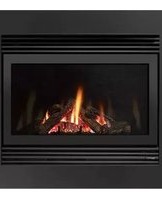
Panorama PG36LP-6 - Heating Regency - Free user manual and instructions
Find the device manual for free Panorama PG36LP-6 Regency in PDF.


| Product Type | Gas Log Fireplace (Room Sealed) |
| Model | Panorama PG36LP-6 |
| Gas Type | Propane (LPG) |
| Input Rating (High) | 31 MJ/h |
| Input Rating (Low) | 18 MJ/h |
| Supply Pressure (Min) | 2.75 kPa |
| Manifold Pressure (High) | 2.6 kPa |
| Manifold Pressure (Low) | 0.72 kPa |
| Injector Size | #52 (1.61 mm) |
| Electrical Supply | 240 V AC, 50 Hz, 1.0 A max |
| Circulation Fan | Variable speed, 240 CFM |
| Log Set | 7 ceramic fibre logs |
| Flue System | Co-axial (Simpson Dura-Vent or Regency Flex) |
| Minimum Clearance to Combustibles (Top) | 178 mm (mantel), 813 mm (ceiling) |
| Minimum Clearance to Side Wall | 152 mm |
| Glass Type | 5 mm Neoceram ceramic |
| Remote Control | Wireless handset with thermostat |
| Warranty (Firebox/Heat Exchanger) | Limited lifetime, 3 years labor |
| Annual Maintenance Required | Yes, by authorised service person |
Frequently Asked Questions - Panorama PG36LP-6 Regency
User questions about Panorama PG36LP-6 Regency
0 question about this device. Answer the ones you know or ask your own.
Ask a new question about this device
Download the instructions for your Heating in PDF format for free! Find your manual Panorama PG36LP-6 - Regency and take your electronic device back in hand. On this page are published all the documents necessary for the use of your device. Panorama PG36LP-6 by Regency.
USER MANUAL Panorama PG36LP-6 Regency
Owners & Installation

REGENCY®
FIREPLACE PRODUCTS
Panorama® PG36 Gas Log Fireplace
Models: PG36NG-6
PG36LP-6
Manual
LISTINGS AND CODE APPROVALS
These gas appliances have been tested in accordance with AS/NZS 5263.0 & AS/NZS 5263.1.3 and have been certified by the Australian Gas Association for installation and operation as described in these Installation and Operating Instructions. Must be installed as per AS/NZS5601.
Your unit should be serviced annually by an authorised service person.

natural_image
Modern living room interior with a large window overlooking the sea, a potted plant, and a heated gas stove (no visible text or symbols)FireGenie™
PLEASE KEEP THESE INSTRUCTIONS FOR FUTURE REFERENCE
| WARNING:Improper installation, adjustment, alteration, service or maintenance can cause injury or property damage. Refer to this manual. For assistance or additional information consult an authorised installer, service agency or the gas supplier. | FOR YOUR SAFETY:What to do if you smell gas:Do not try to light any applianceDo not touch any electrical switch: do not use any phone in your building.Immediately call your gas supplier from a neighbour's phone. Follow the gas supplier's instructions.If you cannot reach your gas supplier, call the fire department. |
| FOR YOUR SAFETY:Do not store or use gasoline or other flammable vapours and liquids in the vicinity of this or any other appliance. | |
| Installation and service must be performed by an authorised installer, service agency or the gas supplier. |
TO THE NEW OWNER:
Congratulations!
You are the owner of a state-of-the-art Gas Log Fireplace by FPI FIREPLACE PRODUCTS INTERNATIONAL LTD. The PG36 has been designed to provide you with all the warmth and charm of a wood fireplace at the flick of a switch. The model PG36 has been approved by the Australian Gas Association for both safety and efficiency. As it also bears our own mark, it promises to provide you with economy, comfort and security for many trouble free years to follow. Please take a moment now to acquaint yourself with these instructions and the many features of your Regency® Fireplace.
PAIRING YOUR REMOTE CONTROL
The control box will only learn the remote ID codes during the first 30 seconds after power is applied and will ignore this special command from the remote afterward.
To match the control box to the remote, follow the steps below:
- Remove a battery from the remote handset.
- Remove main power to the control box by turning off the isolation switch or switch on the GPO to the heater.
- Wait 30 seconds (approx.)
- Reconnect main power to the control box.
- Immediately put the battery back in the remote & point the remote in the direction of the heater.
- Press and hold the PROG and FAN buttons simultaneously. The letters "LC" will appear on the display indicating ID code transmission.
- Release both buttons.
- The display will revert to the normal off mode display. The heater should light - spark, burner, etc. - even though the remote screen says the heater is off.
- Press the OFF button on the remote. The heater should turn off.
- Wait approx. 30 seconds to turn the heater on again & check that all functions work - fan speed and flame height can be adjusted, etc.
Note: To view a step-by-step pairing video please visit regency-fire.com.au/Customer-Care/Fireplace-Care-Videos
Note: The remote control handset has a set of unique ID codes that is pre-programmed into its memory. This set of ID codes helps to differentiate one remote control handset from another; only the control box with a matching ID code will respond to a handset.
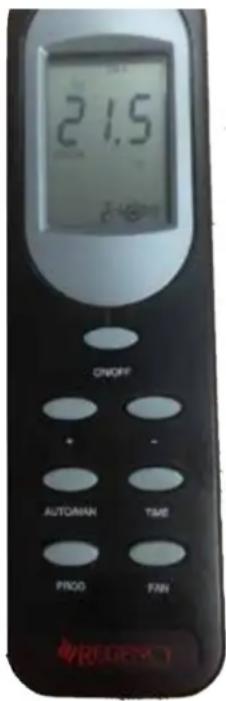
WARNING
DO NOT turn your fireplace on via any means or allow to be turned on unless you have conducted a thorough inspection of the area surrounding the fireplace immediately prior to its use, and you have satisfied yourself that there are no materials or other items in proximity to the fireplace which could present a fire risk.
DO NOT turn your fireplace on via any means or allow to be turned on if there are any unsupervised children, infirm or pets in the area surrounding the fireplace.
DO NOT use this fireplace, unless you have read this Manual, and strictly adhere to the user requirements and warnings set out in this Manual.
RELEASE
Without limiting any other acknowledgement, release or indemnity given by you, or limitation of liability, in favour of Fireplace Products Pty Ltd ("Company"), you irrevocably and unconditionally acknowledge and agree that failure to comply with, or strictly adhere to, the requirements and warnings set out in this Manual ("User Requirements") may result in:
- damage to the fireplace;
- damage to property;
- a house fire;
- severe burns or other personal injury; and/or
- death.
Subject to any remedy, guarantee, term, condition, warranty, undertaking, inducement or representation, implied or imposed by any legislation which cannot lawfully be excluded or limited, and to the maximum extent permitted by law:
- the Company will not be liable for any damage, personal injury or death arising out of or in connection with your failure to comply with any User Requirement; and
- you release the Company from all claims, actions, proceedings, liabilities, losses and damages in relation to death, any personal injury or property damage arising out of or in connection with your failure to comply with any User Requirement.
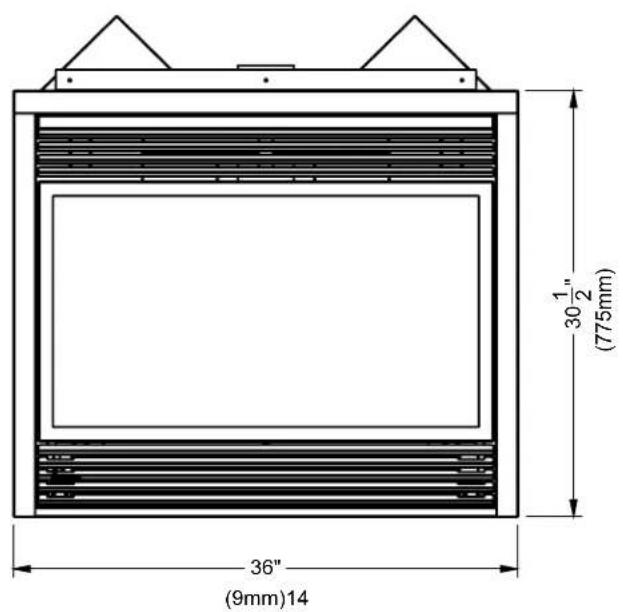

table of contents
Unit Dimensions ....4
Safety
Data Badge 6
Installation
Important Message ....7
Before You Start 7
General Safety Information ....7
Installation Checklist 7
Locating Your Fireplace 8
Clearances 8
Combustible Mantels 9
Mantel Leg Clearances 10
Framing and Finishing 10
Unit Assembly Prior to Installation 11
Top Facing Support Side Nailing Strips 11
Premium Flush Front Spacer Installation....11
Flueing Introduction 11
Exterior Flue Termination Locations 12
Flueing 13
Horizontal or Vertical Terminations 14
Flueing Arrangements - Horizontal Terminations......15
Flueing Arrangements - Vertical Terminations .....17
Direct Flue Zero Clearance Top Exit Vertical
Flue Kit Installation Instructions 19
Horizontal Terminations 20
Vertical Terminations ......21
Gas Connection 22
Gas Pipe Pressure Testing 22
SIT 845 Valve Description ....22
Aeration Adjustment 22
Conversion From NG to Propane Kit 23
Log Set Installation 25
Standard Flush Door 27
Premium Flush Front Installation ....28
Wiring Diagram 29
Remote Control 30
Operating Instructions 30
Lighting Instructions ....30
Resetting the Unit 30
Shutdown Instructions 30
First Fire 30
Operating Instructions
Adjusting Flame Height 31
Summary of Controls 31
Pilot Adjustment 31
Normal Operating Sounds of Gas Appliances ....31
Copy of the Lighting Plate Instructions 32
Maintenance
Maintenance Instructions ....33
General Flue Maintenance ....33
Log Replacement 34
Glass Gasket 34
Door Glass 34
Flush Glass Replacement ....34
Removing Valve Tray 35
Fan Replacement 36
Manual Control Switch Replacement ....37
Troubleshooting Guide 38
Gas Maintenance ....40
Parts
Electronic Components 41
Main Assembly 42
Burner Assembly & Log Set 43
Flush Front Accessories 44
Premium Flush Front Assembly 45
Warranty 46

WARNING!

natural_image
Illustration of a red blood cell with white blood vessels inside, enclosed in a partial square frame (no text or symbols)HOT GLASS WILL CAUSE BURNS
DO NOT TOUCH GLASS UNTIL COOLED
This is a copy of the label that accompanies each PG36 Zero Clearance Room Sealed Gas Fireplace. We have printed a copy of the contents here for your review.
The label is located on the front inside base of the unit, visible when the bottom louvre is open.
DATA BADGE NOTE: Regency® units are constantly being improved. Check the label on the unit and if there is a difference, the label on the unit is the correct one.
Regency Gas Fireplace
Model
PG36NG-6
PG36LP-6

Gas Type
NG
Propane
| Gas Consumption High | 33 MJ/h | 31 MJ/h |
| Gas Consumption Low | 20 MJ/h | 18 MJ/h |
| Min. Supply Pressure | 1.13 kPa | 2.75 kPa |
| Manifold Pressure High | 0.9 kPa | 2.6 kPa |
| Manifold Pressure Low | 0.27 kPa | 0.72 kPa |
| Injector Size | 1 x #37 | 1 x #52 |
| 2.65mm | 1.61mm | |
| Approval No. AGA 5815 G | ||
| AS/NZS 5263.0 & AS/NZS 5263.1.3 | ||
Electrical: 240VAC 50Hz 1.0 amp max.

N2134
Distributed by:
Western Australia:
Air Group Australia
28 Division St
Welshpool, WA 6106
Eastern Australia
Fireplace Products
Australia Pty. Ltd.
99 Colmans Road
Dandenong South, Vic, Australia 3175
To be installed by an authorised person in accordance with installation instructions provided with the appliance.
Serial Number 526
920-107a

DO NOT OPERATE THIS APPLIANCE BEFORE READING THE INSTRUCTIONS BOOKLET.
DO NOT PLACE ARTICLES ON OR AGAINST THIS APPLIANCE
DO NOT STORE CHEMICALS OR FLAMMABLE MATERIALS NEAR THIS APPLIANCE.
DO NOT OPERATE WITH PANELS, COVERS OR GUARDS REMOVED FROM THIS APPLIANCE.
THE GUARD IS FITTED TO THIS APPLIANCE TO REDUCE THE RISK OF FIRE OR INJURY FROM BURNS AND NO PART OF IT SHOULD BE PERMANENTLY REMOVED.
FOR PROTECTION OF YOUNG CHILDREN OR THE INFIRM, A SECONDARY GUARD IS REQUIRED.
Important Message SAVE THESE INSTRUCTIONS
The PG36NG-6 or PG36LP-6 Room Sealed Fireplace must be installed in accordance with AS/NZS5601 and these instructions. Carefully read all the instructions in this manual first. Consult the "authority having jurisdiction" to determine the need for a permit prior to starting the installation. It is the responsibility of the installer to ensure this fireplace is installed in compliance with manufacturer's instructions and all applicable codes.
Before You Start
NOTE: NOT INTENDED AS A FIREPLACE INSERT.
INSTALLATION AND REPAIR SHOULD BE DONE BY A AUTHORISED SERVICE PERSON. THE APPLIANCE SHOULD BE INSPECTED BEFORE USE AND AT LEAST ANNUALLY BY AN AUTHORISED SERVICE PERSON. MORE FREQUENT CLEANING MAY BE REQUIRED DUE TO EXCESSIVE LINT FROM CARPETING, BEDDING MATERIAL, ETC. IT IS IMPERATIVE THAT CONTROL COMPARTMENTS, BURNERS AND CIRCULATING AIR PASSAGEWAYS OF THE APPLIANCE BE KEPT CLEAN.
DUE TO HIGH TEMPERATURES, THE APPLIANCE SHOULD BE LOCATED OUT OF TRAFFIC AND AWAY FROM FURNITURE AND DRAPERIES.
WARNING: FAILURE TO INSTALL THIS APPLIANCE CORRECTLY WILL VOID YOUR WARRANTY AND MAY CAUSE A SERIOUS HOUSE FIRE.
CHILDREN AND ADULTS SHOULD BE ALERTED TO THE HAZARDS OF HIGH SURFACE TEMPERATURES, ESPECIALLY THE FIREPLACE GLASS, AND SHOULD STAY AWAY TO AVOID BURNS OR CLOTHING IGNITION.
YOUNG CHILDREN SHOULD BE CAREFULLY SUPERVISED WHEN THEY ARE IN THE SAME AREA AS THE APPLIANCE. TODDLERS, YOUNG CHILDREN AND OTHERS MAY BE SUSCEPTIBLE TO ACCIDENTAL CONTACT BURNS. A PHYSICAL BARRIERS IS RECOMMENDED IF THERE ARE AT RISK INDIVIDUAL IN THE HOUSE. TO RESTRICT ACCESS TO A FIREPLACE OR STOVE, INSTALL AN ADJUSTABLE SAFETY GATE TO KEEP TODDLERS, YOUNG CHILDREN AND OTHER AT RISK INDIVIDUALS OUT OF THE ROOM.
CLOTHING OR OTHER FLAMMABLE MATERIAL SHOULD NOT BE PLACED ON OR NEAR THE APPLIANCE. DO NOT USE AEROSOLS IN THE VICINITY OF THIS APPLIANCE.
General Safety Information
- The appliance shall be installed in accordance with the manufacturer's installation instructions, local gas fitting regulations, municipal building codes, water supply regulations, electrical wiring regulations, with AS/NZS5601
- Installation and repair should be done ONLY by an authorised person.
- THIS APPLIANCE IS NOT INTENDED AS A FIREPLACE INSERT. DO NOT CONNECT TO MASONRY FLUE.
- This appliance must be connected to the specified flue and termination cap to the outside of the building envelope. Never flue to another room or inside a building. Make sure that the flue is fitted as per Flueling Instructions.
- Inspect the flueing system annually for blockage and any signs of deterioration.
- Flueing terminals shall not be recessed into a wall or siding.
- Any safety glass removed for servicing must be replaced prior to operating the appliance.
- To prevent injury, do not allow anyone who is unfamiliar with the operation to use the fireplace.
- Wear gloves and safety glasses for protection while doing required maintenance.
- Be aware of electrical wiring locations in walls and ceilings when cutting holes fortermination.
- Under no circumstances should this appliance be modified. Parts that have to be removed for servicing should be replaced prior to operating this appliance.
- Installation and any repairs to this appliance should be done by an authorised service person. An authorised service person should be called to inspect this appliance annually. Make it a practice to have all of your gas appliances checked annually.
- Do not slam shut or strike the glass door.
- Under no circumstances should any solid fuels (wood, paper, cardboard, coal, etc.) be used in this appliance.
- The appliance area must be kept clear and free of combustible materials, (gases and other flammable vapours and liquids).
Installation Checklist
- Locate appliance. Refer to the following sections:
a) Locating Your Gas Fireplace
b) Combustible Mantels
c) Mantel Leg Clearances
d) Framing and Finishing
e) Flueing
- Assemble Top Standoffs and Top Facing Support and Side Nailing Strips. Refer to the "Unit Assembly Prior to Installation" section. (NOTE: must be done before installing unit into fireplace.)
- Install flue, refer to the "Horizontal Termination" & "Vertical Termination" sections.
- Make gas and electrical connections. Test the pilot. Must be as per diagram. Refer to the "Pilot Adjustment" section.
- Install standard and optional features. Refer to the following sections where applicable:
a. Log Set Installation
b. Flush Door
c. Premium Flush Front
d. Remote Controls
- Final check.
Before leaving this unit with the customer, the installer must ensure that the appliance is firing correctly and operation fully explained to customer.
This Includes:
- Clocking the appliance to ensure the correct firing rate (rate noted on label 33 MJ/h) after burning appliance for 15 minutes.
- If required, adjusting the primary air to ensure that the flame does not carbon. First allow the unit to burn for 15-20 min. to stabilize.
CAUTION: Any alteration to the product that causes sooting or carboning that results in damage is not the responsibility of the manufacturer.
This appliance will shut down during a power supply interruption and/or if there is insufficient voltage to the appliance.
"This unit must always terminate /flue directly to the outdoors."
installation
Locating Your Fireplace
- When selecting a location for your fireplace, ensure that the clearances outlined on this page are met.
- Provide adequate clearances for servicing.
- The appliance must be installed on a flat, solid, continuous surface (e.g. wood, metal, concrete). This may be the floor, or raised up on a platform to enhance its visual impact. If the appliance is going to be installed on carpeting, combustible linoleum tile or other combustible material other than wood flooring, the appliance must be installed on a metal or wood panel extending the full width and depth of the appliance.
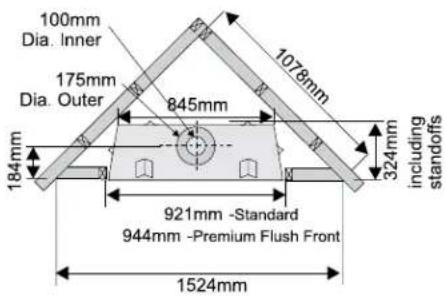
- The PG36 Co-Axial Flue Gas Fireplace can be installed in a recessed position or framed out into the room as in A, B, C, D. See Diagram 1.
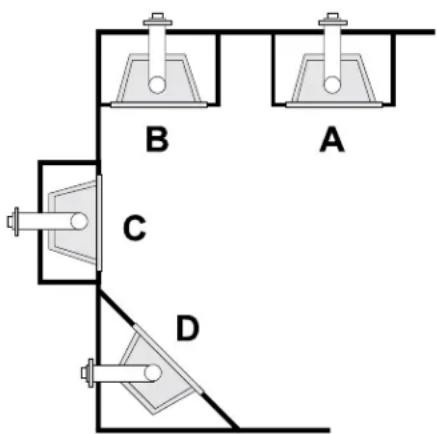
Diagram 1
A) Flat on Wall
B) Flat on Wall Corner
C) Recessed into Wall/Alcove
D) Corner
- The PG36 Co Axial Flue Gas Fireplace is approved for alcove installations, which meet the clearances listed on this page.
- We recommend that you plan your installation on paper using exact measurements for clearances and floor protection before actually installing this appliance. Have an authorized inspector, dealer, or installer review your plans before installation
Note: For flue terminations see the "Exterior Flue Termination Locations" section.
Clearances
The clearances listed below are Minimum distances unless otherwise stated:
A major cause of chimney related fires is failure to maintain required clearances (air space) to combustible materials. It is of the greatest importance that this fireplace and flue system be installed only in accordance with these instructions.

Clearances for Flush Front
NOTE: The minimum floor clearance must be maintained from the top surface of the carpeting, tile, etc.
Minimum Clearance from Top of Unit to:
Mantel* Minimum 178 mm
Ceiling from top of unit. 813 mm
Side Wall Clearance
Flush Front 152 mm
Horizontal Flue Clearances
Top 51 mm
Side 38 mm
Bottom 38 mm
Vertical Flue Clearances 32 mm
Alcove Clearances**:
Max. Depth 914 mm
Min. Width 1219 mm
Min. Height 1829 mm
* See mantel clearance instructions (Refer to the "Combustible Mantels," & "Mantel Leg Clearances" sections.)
WARNING
Fire hazard is an extreme risk if these clearances are not adhered to.
PACKAGING:
The unit and its contents are packaged to prevent damage during transport. After unboxing, remove and dispose of the cardboard spacers, plastic wrap, and protective film on the glass door.
Before commissioning of the unit, carefully remove the logs from inside the unit and set them aside.
Refer to subsequent instructions on proper setup and safety check before commissioning the unit.
Combustible Mantels
Due to the extreme heat this fireplace emits, the mantel clearances are critical. Combustible mantel clearances from the top of unit are shown in the diagrams below.
Note: A non-combustible mantel may be installed at a lower height if the framing is made of metal studs covered with a non-combustible board.
Note: Ensure the paint that is used on the mantel and the facing is "heat resistant" or the paint may discolour.
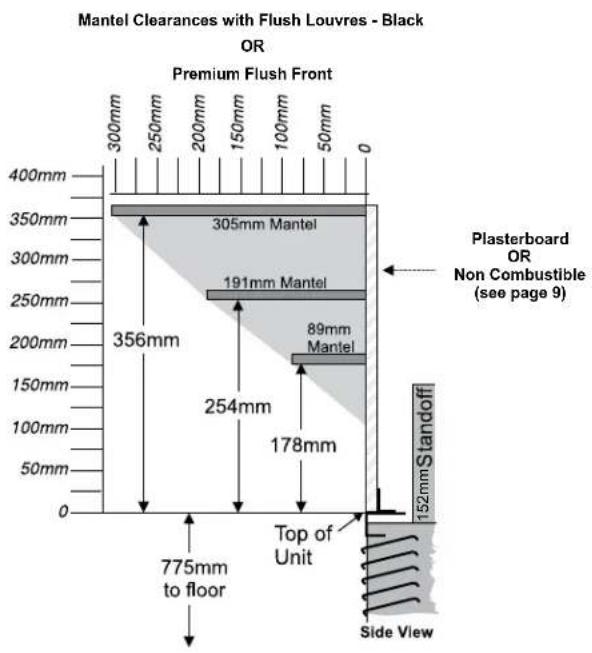
installation
Mantel Leg Clearances
Combustible mantel leg clearances as per diagram below:
Maximum 38mm projection at 51mm minimum clearance.

Framing and Finishing
- Determine the total thickness of facing material (e.g. plasterboard plus ceramic tiles) to allow the finished surface to be flush with the front of the unit. Total facing thickness can vary from 13mm to 32mm thick.
- Frame in the enclosure for the unit with framing material.
Note: The unit does not have to be completely enclosed in a chase. The clearance on top of the unit is 0mm to the standoffs so combustible building materials can be laid directly on top of the standoffs. You must maintain (38mm) clearance from the flue to combustible materials for flex (32mm) for Simpson Dura-Vent).
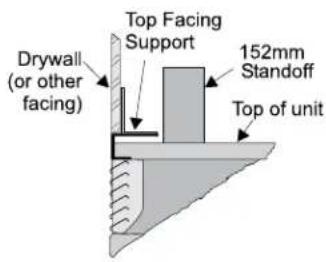
Install Side Nailing Strips, Top Facing Support, and Top Standoffs before unit is slipped into position. See "Unit Assembly Prior to Installation" section for assembly details.
NOTE:
When using the Premium Flush Front option, a finishing trim (962mm cover) needs to be installed to cover the spacers.
Maintain a physical gap between lining and spacers 2-5mm. (5mm clearance to framing each side).
- Use steel studs for framing where the 38mm clearance from the flue to combustible material cannot be maintained, e.g. front top header.
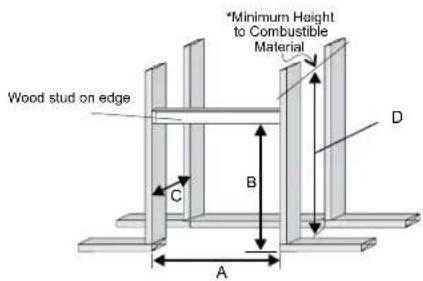
| Standard Framing Dimensions | |||
| A | B | C | D |
| 921mm | 921mm | 324mm 1 | 169mm* |
| Framing Dimensions with Premium Flush Front Option | |||
| A | B | C | D |
| 944mm | 946mm | 432mm 1 | 182mm* |
| *D' is Minimum height to combustible materials including the Minimum 51mm Top clearance to the Horizontal Flue, see flue clearances in section "Clearances." | |||
- For exterior walls, insulate the enclosure to the same degree as the rest of the house, apply vapour barrier and plasterboard, as per local installation codes. (Do not insulate the fireplace Itself.)
- The top of the unit must not be closer than 813mm to the ceiling.

Note: 1029mm is the minimum height for both flex termination or Simpson Dura-Vent flueing.

MINIMUM THICKNESS OF THE FINISHING MATERIAL: 12 mm
Unit Assembly Prior to Installation
The Top Facing Support, the Side Nailing Strips and the 2 Top Standoffs must be correctly positioned and attached to the top before unit is slipped into position.
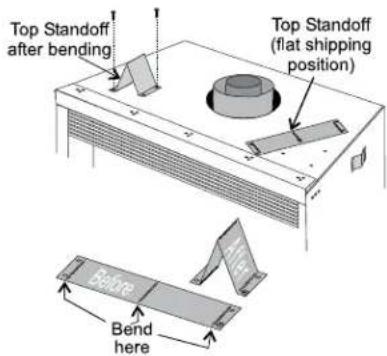
Top Standoff Assembly
The top standoffs are shipped in a flat position and must be folded into shape and attached.
- Remove the standoffs from the fireplace top.
- Take each standoff and bend into the correct shape. Bend up at the bend lines until the screw holes in the standoff and the pre-punched screw holes on the fireplace top line up.
- Attach the standoff securely to the top with 2 screws per standoff (on opposite corners).
Top Facing Support Side Nailing Strips
Determine the total thickness of facing material (e.g. plasterboard plus ceramic tiles) to allow the finished surface to be flush with the front of the unit. Total facing thickness can vary from 13mm to 32mm thick.
The Top Facing Support can be mounted in 3 different positions depending on the thickness of the facing material.
- Mount Top Facing Support using the 3 supplied screws into the three pre-punched screw holes on the top front of the unit. Use hole positions A, B, or C depending on your facing depth.
| Screw Position | Facing Material Depth |
| A | 13mm |
| B | 22mm |
| C* | 32mm |
| * For "C" screw position the top facing support is reversed. | |
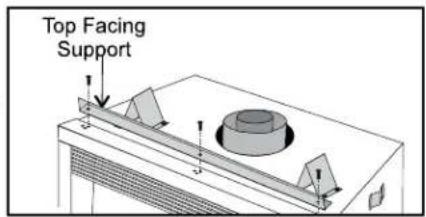

"C" Screw Position: For a facing material depth of 32mm, the top facing support must be reversed.

- Fold out the two nailing strips on each side.

Premium Flush Front Spacer Installation
Before the unit is slid into position, install the provided spacers to the side of the fireplace as follows:
- Align the screw locations on spacer with screw locations on the side of the firebox and secure in place using 3 screws.
- Repeat for other side.
NOTE: The side nailing strips are to be installed to the spacer after the spacer is attached to the unit.
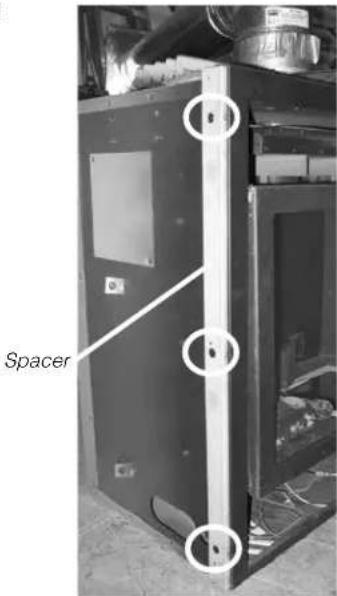
Left Side Shown
Flueing Introduction
The PG36 uses the "balanced flue" Technology Co Axial system. The inner liner flues products of combustion to the outside while the outer liner draws outside combustion air into the combustion chamber thereby eliminating the need to use heated room air for combustion and losing warm room air up the chimney.
Note: These flue pipes must not be connected to any other appliance.
The gas appliance and flue system must be flued directly to the outside of the building, and never be attached to a chimney serving a separate solid fuel or gas burning appliance. Each Co Axial Flue gas appliance must use it's own separate flue system. Common flue systems are prohibited.

Minimum clearances required for balanced flue terminals or the flue terminals of outdoor appliances according to AS5601-2004 (AGA gas installation code) or NZS 5261 (New Zealand)
Minimum
Clearance (mm)
a Below eaves, balconies or other projections:
- Appliances up to 50 MJ/h input 300
- Appliances over 50 MJ/h input 500
b From the ground or above a balcony 300
c From a return wall or external corner 500
d From a gas meter (M) 1000
e From an electricity meter or fuse box (P) 500
f From a drain or soil pipe 150
g Horizontal from any building structure (unless appliance is approved for closer installation) or obstruction facing a terminal 500
h From any other flue terminal, cowl or combustion air intake 500
j Horizontally from an openable window, door, or non-mechanical air inlet, or any other opening into a building, with the exception of sub-floor ventilation (see also Note (I)):
- Appliances up to 150 MJ/h input 500
- Appliances over 150 MJ/h input 1500
k Vertically below an openable window, door, or non-mechanical air inlet, or any other opening into a building, with the exception of sub-floor ventilation (see also Note (I)): see table below
| Clearance 'k' in mm | |||
| Space Heaters | All Other Appliances | ||
| Up to 50 MJ/h input | Up to 50 MJ/h input | Over 50 MJ/h input to 150 MJ/h input | Over 150 MJ/h input |
| 150 | 500 | 1000 | 1500 |
NOTES:
(I) For mechanical air inlets, including spa blowers, the clearance 'j' and 'k' shall be 1500 mm in all cases.
(II) All distances shall be measured vertically or horizontally along the wall to a point in line with the nearest par to of the terminal.
(III) Prohibited area below electricity meter or fuse box extends to ground level.
(IV) A flue terminal of this type shall not be located under a roofed area unless the roofed area is fully open on at least two sides and a free flow of air at the appliance is achieved.
Flueing
Regency® Direct Vent System (Flex)
Horizontal Terminations Only
These flueing systems, in combination with the PG36 Room Sealed Gas Fireplace, have been tested and listed as a Direct Vent type flue system by the Australian Gas Association. The location of the termination cap must conform to the requirements in the Flue Terminal Locations diagram in the "Exterior Flue Termination Locations" section.
Regency® Direct Vent (Flex) System Termination Kit (Part # 946-515) includes all the parts needed to install the PG36 with a maximum run of 1200 mm.
1) 175 mm dia. flexible liner (1200mm length)
2) 102 mm dia. flexible liner (1200mm length)
3) spring spacers (4)
4) thimble
5) AstroCap termination cap (1)
6) screws (12)
7) tube of Mill Pac (1)
8) plated screws (8)
9) screws #8 x 38 mm Drill Point, Stainless Steel (4)
If longer runs are needed, the Regency® Direct Vent system (Flex) # 946-516 Includes all the parts needed to install the PG36 with a maximum 3.0m run.
1) 175 mm dia. flexible liner (3.0m length)
2) 102 mm dia. flexible liner (3.0m length)
3) spring spacers (7)
4) thimble
5) AstroCap termination cap (1)
6) screws (12)
7) tube of Mill Pac (1)
8) plated screws (8)
9) screws #8 x 38 mm Drill Point, Stainless Steel (4)
Notes:
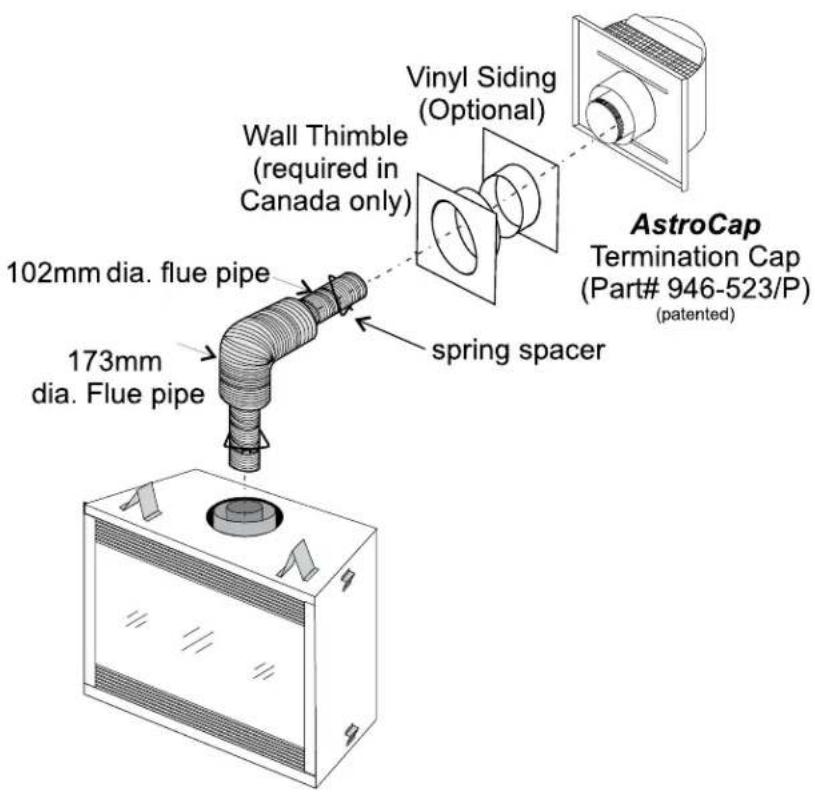
1) Liner sections should be continuous without any joints or seams.
2) Only Flex pipe purchased from Regency® may be used for Flex Installations.
installation
Horizontal or Vertical Terminations
Simpson Dura-vent Flueing
The Simpson Dura-Vent Co Axial Flue System offers a complete line of component parts for installation of both horizontal and vertical installations. Many items are offered in decorative black, as well as galvanized finish. We recommend using the galvanized finish for installation with the PG36.
The minimum components required for a basic horizontal termination are:
1 Horizontal Termination Cap
1 90 ° Elbow
1 Flue Adaptor
1 Wall Thimble
1 Length of pipe to suit wall thickness (see chart)
Wall thickness is measured from the back standoffs to the inside mounting surface of termination cap. For siding other than vinyl furring strips may be used, instead of the vinyl siding standoff, to create a level surface to mount the flue terminal. The Terminal must not be recessed into siding. Measure the wall thickness including furring strips.
If a Vinyl Siding Standoff is required (it must be used with vinyl siding), measure to outside surface of wall without siding and add 2 inches.
| Flat Wall Installation | |
| Wall Thickness (mm) | Vent Length Required (mm) |
| 102mm - 140mm 152mm | |
| 178mm - 216mm 229mm | |
| 254mm- 38mm 305mm | |
| 229mm - 368mm 279 - | 371mm Adj. Pipe |
| 381mm - 597mm 432- | 610mm Adj.Pipe |
| Corner Installation | |
| Wall Thickness (mm) | Vent Length Required (mm) |
| 83mm - 171mm 279 - | 371mm Adj. Pipe |
| 197mm - 413mm 432- | 610mm Adj.Pipe |
| 184mm - 222mm 152mm | + 305mm229mm + 229mm |
| 108mm- 146mm | 152mm + 305mm |

flowchart
graph TD
    A["Vertical Termination Cap"] --> B["Storm Collar"]
    B --> C["Flashing"]
    C --> D["90° Elbow"]
    D --> E["Pipe Length"]
    E --> F["Rigid Pipe Adaptor"]
    G["Vinyl Siding Standoff (Optional)"] --> H["Wall Thimble"]
    H --> I["Adj.Pipe Length"]
    I --> D
    J["Horizontal Termination Cap"] --> K["Vertical Termination Cap"]
Flueing Arrangements - Horizontal Terminations
Simpson Dura-Vent Direct Flue GS System and
Regency® Direct Flue System (Flex) (Propane & NG)
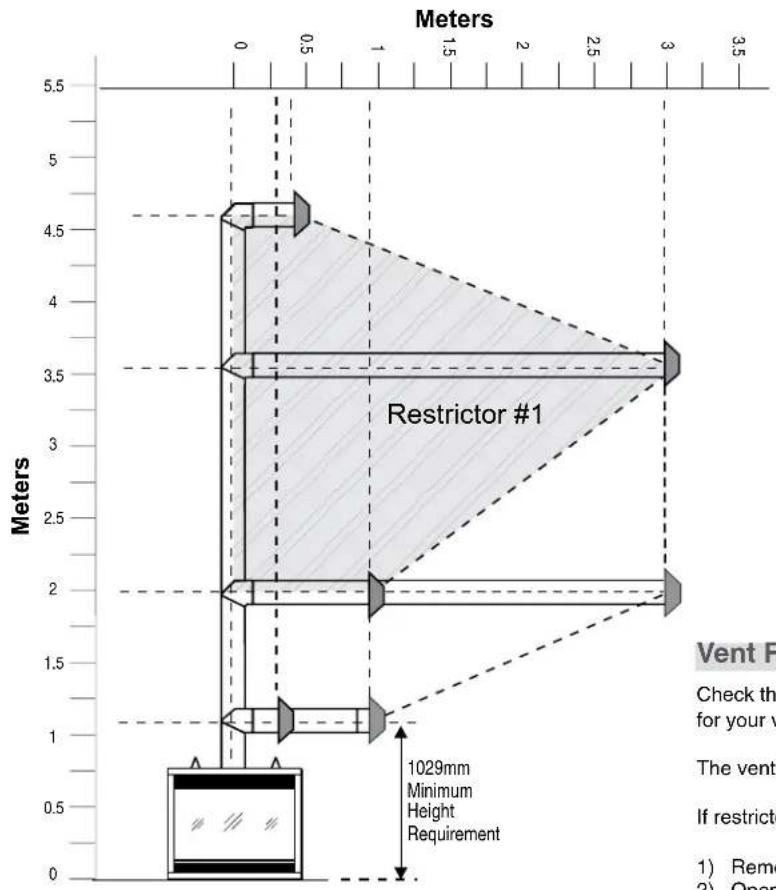
The diagram shows all allowable combinations of vertical runs with horizontal terminations, using one 90° elbow (two 45° elbows equal one 90° elbow).
Note: Must use optional flue adapter (Part # 510-994) when using Simpson Dura-Vent pipe.
Simpson Dura-Vent
102mm inner diameter
168mm outer diameter
Regency® Flex Vent
102mm inner diameter
175mm outer diameter
A flue guard should be used whenever the termination is lower than the specified minimum or as per local codes.
Note: Regency® Co Axial Flue System (Flex) is only approved for horizontal terminations.
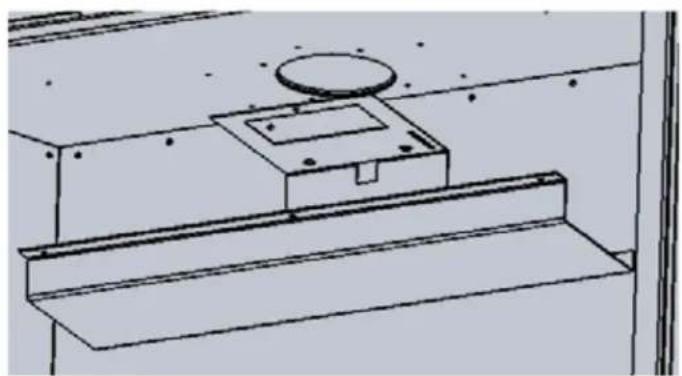
Vent Restrictor Installation
Check the vent diagrams to determine whether the vent restrictor is needed for your vent configuration.
The vent restrictor is packaged with the manuals inside the firebox.
If restrictor is required:
- Maintain clearances to combustibles as listed in the "Clearances," "Locating Your Gas Fireplace," "Combustible Mantels," "Mantel Leg Clearances" & "Framing and Finishing" sections.
• Horizontal flue must be supported every 0.9 meters.
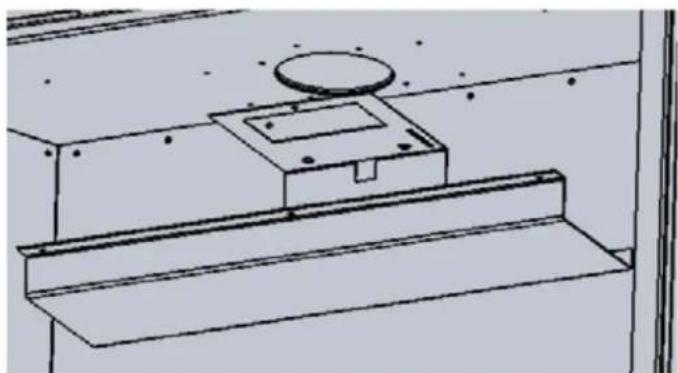
1) Remove the top louver.
2) Open and remove the glass door front.
3) Remove the internal baffle (3 screws) at the top of the firebox.
4) Place the restrictor on the baffle plate (see diagram below) and re-install the internal baffle plate.
natural_image
Technical line drawing of a mechanical assembly with a circular component mounted on a base plate (no text or symbols)installation
Flueing Arrangements - Horizontal Terminations
Simpson Dura-Vent Direct Flue GS System and
Regency® Co-axial Flue System (Flex) (Propane & NG)
The diagram below shows examples of horizontal termination arrangements using two 90° elbows (two 45° elbows equal one 90° elbow).
Note: 1) A maximum of two 90 ° elbows are permitted.
2) A minimum of 1.8m vertical from base of unit is required if two 90° elbows are used.
3) Minimum distance between elbows is 0.6m.
4) Determine the permitted range of horizontal termination arrangements by using chart in the "Simpson Dura-Vent Flueing" section and deducting 0.9m from the maximum horizontal distance for the second 90° elbow.
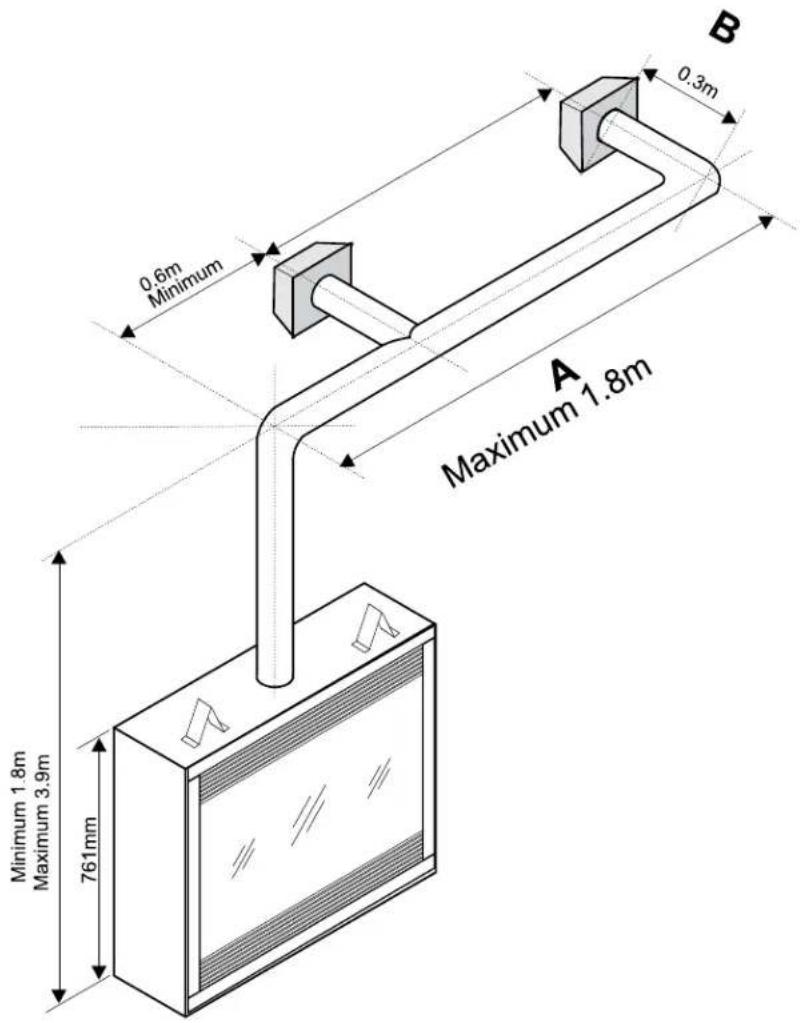
If length "B" is increased, length "A" must be decreased by a corresponding amount.
Simpson Dura-Vent
102mm inner diameter
168mm outer diameter
A flue guard should be used whenever the termination is lower than the specified minimum or as per local codes.
- Maintain clearances to combustibles as listed in the "Clearances," "Locating Your Gas Fireplace," "Combustible Mantels," "Mantel Leg Clearances" & "Framing and Finishing" sections.
• Horizontal flue must be supported every 0.9 meters.
Flueing Arrangements - Vertical Terminations
Simpson Dura-Vent Co-axial Flue GS System (Propane & NG)
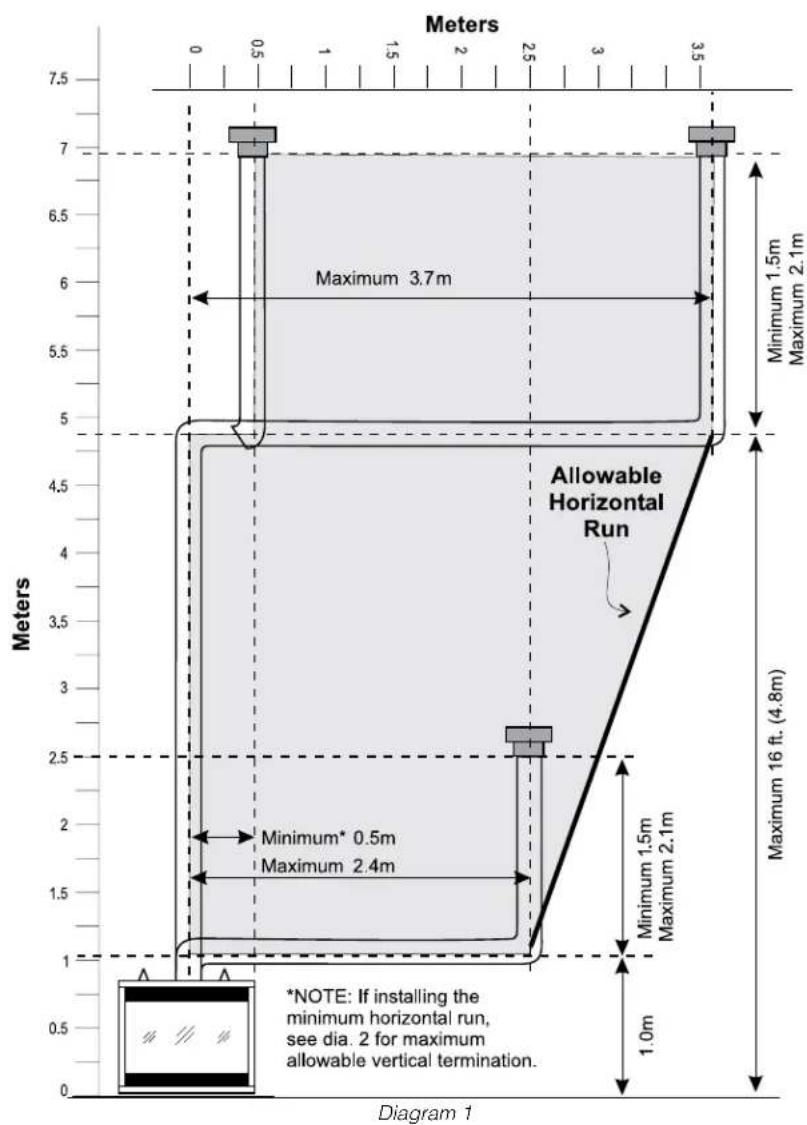
The PG36 is approved for a 7.0m vertical, with a maximum 3.7m horizontal offset using two 90elbows (two 45° elbows equal one 90° elbow) with Simpson Dura-Vent Co Axial Flue GS flue systems for Propane and NG, as per diagram 1.
The PG36 is approved for a 11.3m straight vertical, including a 0.5m horizontal offset using two 90° elbow (two 45° elbows equal one 90° elbow) with Simpson Dura-Vent Co Axial Flue GS flue systems for Propane and NG, as per the diagram 2.
- Flue must be supported at offsets
- Maintain clearances to combustibles as listed in the "Clearances," "Locating Your Gas Fireplace," "Combustible Mantels," "Mantel Leg Clearances" & "Framing and Finishing" sections.
Note: Must use optional flue adapter when using Simpson Dura-Vent pipe (Part # 510-994).
Note: Regency® Co Axial Flue System (Flex) is only approved for horizontal terminations.
Regency

bar
| Vertical Height (Meters) | Horizontal Offset (m) | | ------------------------ | --------------------- | | 11.5 | 50 | | 11.5 | 11.3 | | 0.5 | 0.5 | | 0.5 | 2.6 |PG36 Gas Fireplace
installation
The PG36 is approved for a 37 ft. (11.3 m) straight vertical, with Simpson Dura-Vent Co Axial Flue GS flue systems for Propane and NG, as per diagram 3.
The shaded area in diagram 3 shows all allowable combinations of straight vertical and offset to vertical terminations with Simpson Dura-Vent Co Axial Flue GS flue systems for Propane and NG. Maximum two 45elbows allowed.
- The vent restrictor must be used in the shaded area. Vent restrictors are shown in images below.
- Flue must be supported at offsets
- Firestops are required at each floor level and whenever passing through a wall.
- Maintain clearances to combustibles as listed in the "Clearances," "Locating Your Gas Fireplace," "Combustible Mantels," "Mantel Leg Clearances" & "Framing and Finishing" sections.

Vent Restrictor Installation
Check the vent diagrams to determine whether the vent restrictor is needed for your vent configuration.
The vent restrictor is packaged with the manuals inside the firebox.
If restrictor is required:
1) Remove the top louver.
2) Open and remove the glass door front.
3) Remove the internal baffle (3 screws) at the top of the firebox.
4) Place the restrictor on the baffle plate (see diagram below) and re-install the internal baffle plate.
natural_image
Technical line drawing of a mechanical assembly with a circular component mounted on a base (no text or symbols)5) Replace the door and louvers.
6) Fire up the unit and check for proper flame appearance and glow on logs.
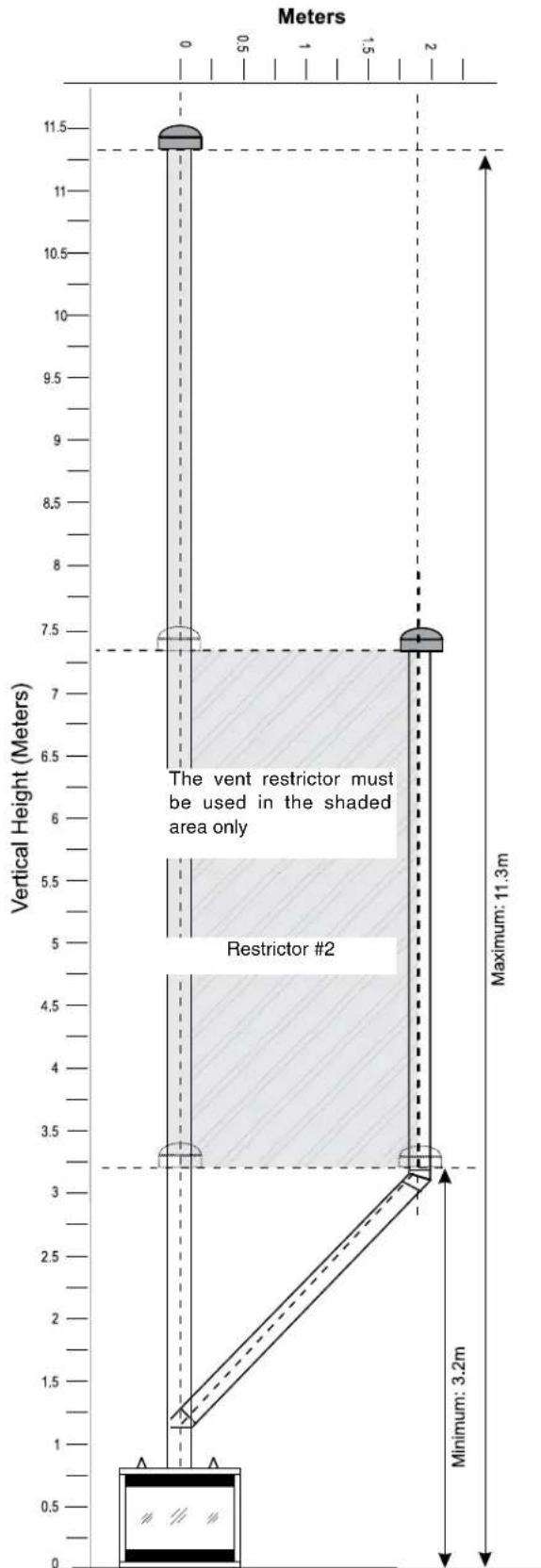
Diagram 3
Direct Flue Zero Clearance Top Exit Vertical Flue Kit Installation Instructions
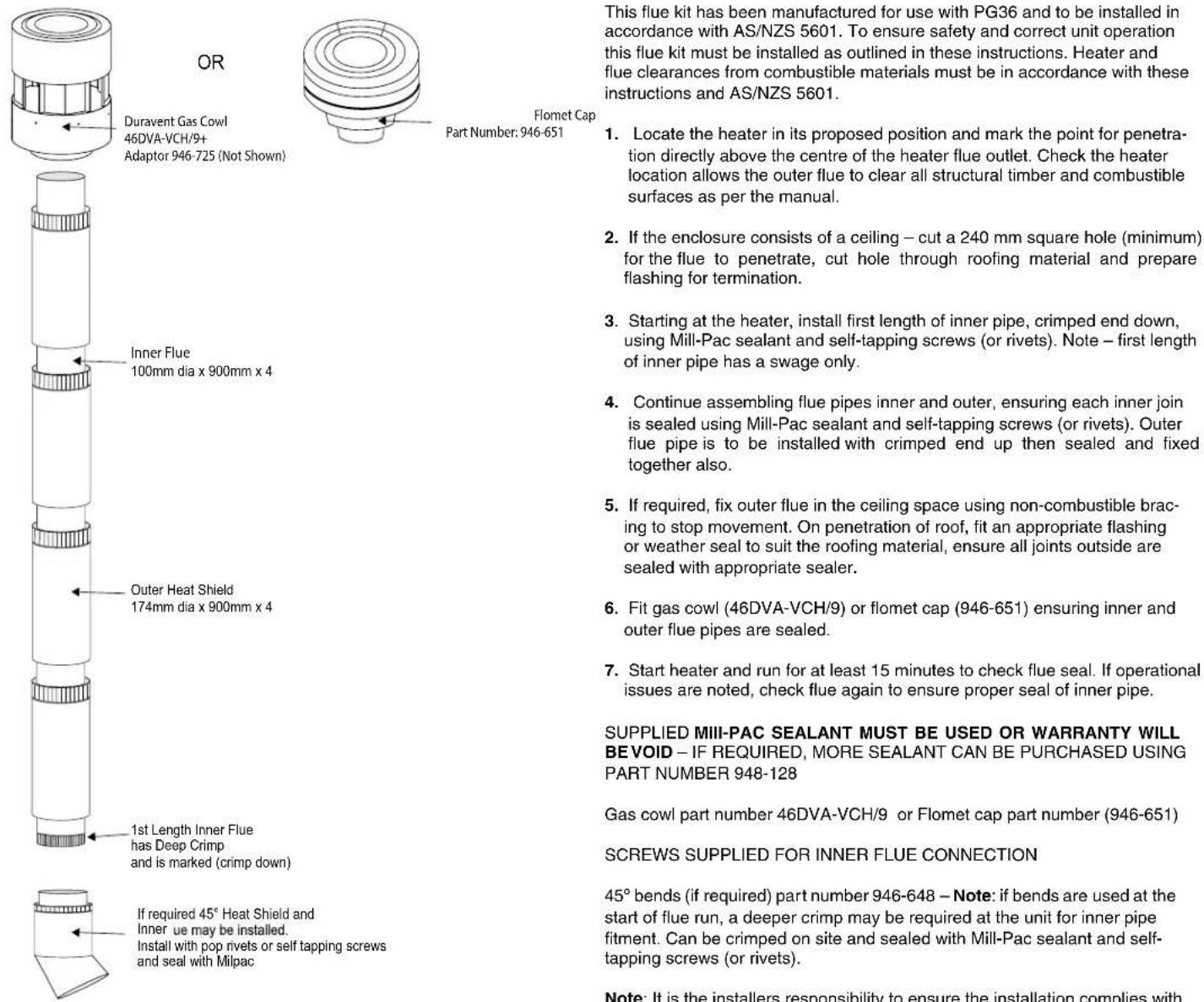
Duravent Gas Cowl
46DVA-VCH/9+
Adaptor 946-725 (Not Shown)
Flomet Cap
Part Number: 946-651
If required 45° Heat Shield and Inner ue may be installed.
Install with pop rivets or self tapping screws and seal with Milpac
This flue kit has been manufactured for use with PG36 and to be installed in accordance with AS/NZS 5601. To ensure safety and correct unit operation this flue kit must be installed as outlined in these instructions. Heater and flue clearances from combustible materials must be in accordance with these instructions and AS/NZS 5601.
- Locate the heater in its proposed position and mark the point for penetration directly above the centre of the heater flue outlet. Check the heater location allows the outer flue to clear all structural timber and combustible surfaces as per the manual.
- If the enclosure consists of a ceiling – cut a 240 mm square hole (minimum) for the flue to penetrate, cut hole through roofing material and prepare flashing for termination.
- Starting at the heater, install first length of inner pipe, crimped end down, using Mill-Pac sealant and self-tapping screws (or rivets). Note – first length of inner pipe has a swage only.
- Continue assembling flue pipes inner and outer, ensuring each inner join is sealed using Mill-Pac sealant and self-tapping screws (or rivets). Outer flue pipe is to be installed with crimped end up then sealed and fixed together also.
- If required, fix outer flue in the ceiling space using non-combustible bracing to stop movement. On penetration of roof, fit an appropriate flashing or weather seal to suit the roofing material, ensure all joints outside are sealed with appropriate sealer.
- Fit gas cowl (46DVA-VCH/9) or flomet cap (946-651) ensuring inner and outer flue pipes are sealed.
- Start heater and run for at least 15 minutes to check flue seal. If operational issues are noted, check flue again to ensure proper seal of inner pipe.
SUPPLIED MIII-PAC SEALANT MUST BE USED OR WARRANTY WILL BEVOID – IF REQUIRED, MORE SEALANT CAN BE PURCHASED USING PART NUMBER 948-128
Gas cowl part number 46DVA-VCH/9 or Flomet cap part number (946-651)
SCREWS SUPPLIED FOR INNER FLUE CONNECTION
45° bends (if required) part number 946-648 – Note: if bends are used at the start of flue run, a deeper crimp may be required at the unit for inner pipe fitment. Can be crimped on site and sealed with Mill-Pac sealant and self-tapping screws (or rivets).
Note: It is the installers responsibility to ensure the installation complies with AS/NZS 5601 and all local and building codes.
natural_image
Close-up of a metallic cylindrical object with a red arrow pointing to a feature, no visible text or symbols.MIII-Pac Sealant Inner Flue
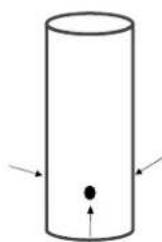
natural_image
Simple line drawing of a cylinder with an arrow indicating direction and a small dot at the center (no text or symbols)Screws
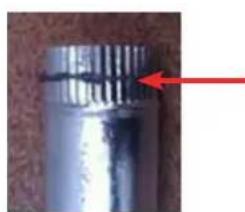
NOTE: USE A MINIMUM OF 3 SCREWS EQUIDISTANT TO SECURE EVERY INNER FLUE PIPE JOINT AS WELL AS MILL-PAC SEALANT
Regency
PG36 Gas Fireplace
installation
Horizontal Terminations
Install the flue system according to the manufacturer's instructions included with the components.
1) Set the unit in its desired location. Check to determine if wall studs or roof rafters are in the way when the flueing system is attached. If this is the case, you may want to adjust the location of the unit. Rough in the gas preferably on the right side of the unit and the electrical (junction block is on the left side) on the left.
2) Simpson Dura-vent Co Axial Flue pipe and fittings are designed with special twist-lock connections to connect the flueing system to the appliance flue outlet. A twist-lock appliance adaptor is an available option that must be used in conjunction with the Simpson Dura-Vent Co Axial Flue GS system.
3) Put a bead of high-temp silicone inside the outer section of the adapter and a bead of Stove Mate on the inner collar. Slip the adapter over the existing inner and outer flue collar and fasten to the outer collar only with the 3 supplied screws (drilling pilot holes will make this easier). Level the fireplace and fasten it to the framing using nails or screws through the nailing strips.
4) Assemble the desired combination of pipe and elbows to the appliance adaptor and twist-lock for a solid connection.
Note:
a) Twist-lock procedure: Four indentations, located on the female ends of pipes and fittings, are designed to slide straight onto the male ends of adjacent pipes and fittings, by orienting the four pipe indentations so they match and slide in to the four entry slots on the male ends, Diagram 1. Push the pipe sections completely together, then twist-lock one section clockwise approximately one-quarter turn, until the two sections are fully locked. The female locking lugs will not be visible from the outside, on the Black Pipe or fittings. They may be located by examining the inside of the female ends.

Diagram 1
Note: Apply sealant "Mill-Pac" to inner pipe and high temperature silicone sealant to outer pipe on every twist-lock joint.
b) Horizontal runs of flue must be supported every three feet. Wall straps are available for this purpose.
5) Mark the wall for a 254mm x 254mm square hole. The center of the square hole should line up with the centerline of the horizontal pipe. Cut and frame the 254mm square hole in the exterior wall where the flue will be terminated. If the wall being penetrated is constructed of non-combustible material, i.e. masonry block or concrete, a 178mm dia. 191mm dia. (for flex) hole is acceptable.
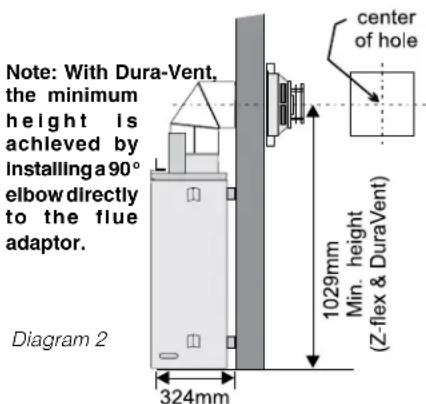
Note:
a) The horizontal run of flue must be level, or have a 1/4 inch (6mm) rise for every 1 foot (0.3m) of run towards the termination. Never allow the flue to run downward. This could cause high temperatures and may present the possibility of a fire.
b) The location of the horizontal flue termination on an exterior wall must meet all local and national building codes, and must not be blocked or obstructed. For External Flue Terminal Locations, see diagram in the "Exterior Flue Termination Locations" section.
6) The arrow on the flue cap should be pointing up. Insure that the 1-1/2" clearances to combustible materials are maintained. Install the termination cap, diagram 5.
The four wood screws provided should be replaced with appropriate fasteners for stucco, brick, concrete, or other types of sidings.
Note: If installing termination on a siding covered wall, a vinyl siding standoff or furring strips must be used to ensure that the termination is not recessed into the siding.

Diagram 3
7) Before connecting the horizontal run of flue pipe to the flue termination, slide the Wall Thimble (Part # 46DVA-WT) over the flue pipe.
8) Slide the appliance and flue assembly towards the wall carefully inserting the flue pipe into the flue cap assembly. It is important that the flue pipe extends into the flue cap sufficient distance so as to result in a minimum pipe overlap of 1-1/4 inches. Secure the connection between the flue pipe and the flue cap by attaching the two sheet metal strips extending from the flue cap assembly into the outer wall of the flue pipe. Use the two sheet metal screws provided to connect the strips to the pipe section. See Diagram 4.
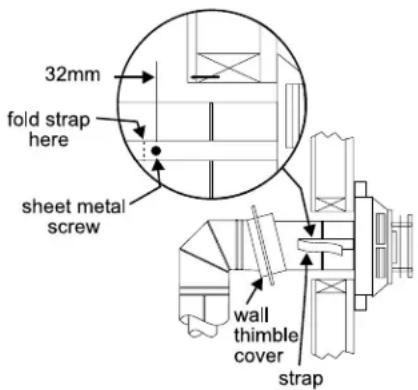
Diagram 4
9) Install wall thimble in the center of the 10" square and attach with wood screws (Diagram 5).
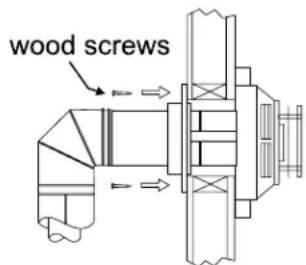
Diagram 5
Vertical Terminations
1) Maintain the 32mm clearances (air spaces) to combustibles when passing through ceilings, walls, roofs, enclosures, attic rafter, or other nearby combustible surfaces. Do not pack air spaces with insulation. Check section "Simpson Dura-vent Flueing" for the maximum vertical rise of the flueing system and the maximum horizontal offset limitations.
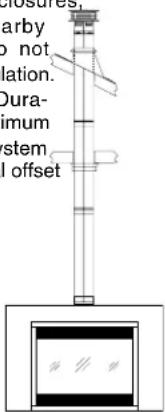
Diagram 1
- Assemble the desired lengths of pipe and elbows. Ensure that all pipes and elbow connections are in the fully twist-locked position and sealed.
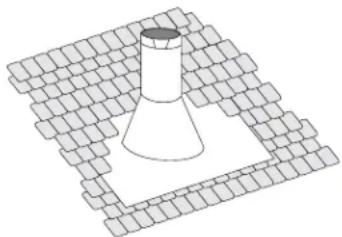
- Cut a hole in the roof centered on the small drilled hole placed in the roof in Step 2. The hole should be of sufficient size to meet the minimum requirements for clearance to combustibles of 38mm. Slip the flashing under the shingles (shingles should overlap half the flashing) as per Diagram 3.
natural_image
3D diagram of a conical funnel mounted on a grid-patterned base (no text or symbols)- Set the gas appliance in its desired location. Drop a plumb bob down from the ceiling to the position of the appliance flue exit, and mark the location where the flue will penetrate the ceiling. Drill a small hole at his point. Next, drop a plumb bob from the roof to the hole previously drilled in the ceiling, and mark the spot where the flue will penetrate the roof. Determine if ceiling joists, roof rafters or other framing will obstruct the flueing system. You may wish to relocate the appliance or to offset, as shown in Diagram 2 to avoid cutting load bearing members.
Diagram 3: The upper half of the flashing is installed under the roofing material and not nailed down until the chimney is installed. This allows for small adjustments.
- Continue to assemble pipe lengths.
Note: If an offset is necessary in the attic to avoid obstructions, it is important to support the flue pipe every metre, to avoid excessive stress on the elbows, and possible separation. Wall straps are available for this purpose (Diagram 2).

Diagram 2
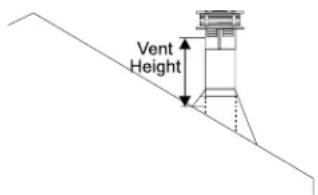
Diagram 4
Galvanized pipe is desirable above the roofline due to its higher corrosion resistance. Continue to add pipe sections through the flashing until the height of the flue cap meets the minimum height requirements specified in Diagram 5 or local codes. Note that for steep roof pitches, the vertical height must be increased. A poor draft, or down drafting can result from high wind conditions near big trees or adjoining roof lines, in these cases, increasing the flue height may solve the problem.
- Ensure flue is vertical and secure the base of the flashing to the roof with roofing rails, slide storm collar over the pipe section and seal with a mastic.
- Install the vertical termination cap by twist-locking it.
Note: Any closets or storage spaces, which the flue passes through must be enclosed.
| Roof Pitch | Minimum Flue Height |
| Meters | |
| flat to 7/12 | 0.61 |
| over 7/12 to 8/12 | 0.61 |
| over 8/12 to 9/12 | 0.61 |
| over 9/12 to 10/12 | 0.76 |
| over 10/12 to 11/12 | 0.99 |
| over 11/12 to 12/12 | 1.22 |
| over 12/12 to 14/12 | 1.52 |
| over 14/12 to 16/12 | 1.83 |
| over 16/12 to 18/12 | 2.13 |
| over 18/12 to 20/12 | 2.29 |
| over 20/12 to 21/12 | 2.44 |
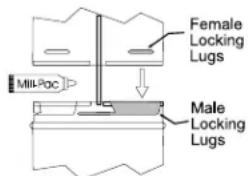
Note: Apply sealant "Mill-Pac" to inner pipe and high temperature silicone sealant to outer pipe on every twist-lock joint.
installation
| PG36NG-6 System Data | |
| For 0 to 4500 feet altitudeBurner Inlet Orifice Sizes: #37(2.65mm) | |
| Max. Input Rating | 33 MJ/h |
| Min. Input Rating | 20 MJ/h |
| Supply Pressure | min.1.13 kPa |
| Manifold Pressure(High)(Low) | 0.9 kPa0.27 kPa |
| Electrical: 240 V A.C. System.Circulation Fan: variable speed 240 CFM.Log Set: Ceramic fibre, 7 per set.Flue System: Simpson Dura-Vent DirectVent System or Regency® DirectVent System (Flex) | |
| PG36LP-6 System Data | |
| For 0 to 4500 feet altitudeBurner Inlet Orifice Sizes: #52 (1.61mm) | |
| Max. Input Rating | 31 MJ/h |
| Min. Input Rating | 18 MJ/h |
| Supply Pressure | min.2.75 kPa |
| Manifold Pressure(High)(Low) | 2.6 kPa0.72 kPa |
| Electrical: 240 V A.C. System.Circulation Fan: variable speed 240 CFM.Log Set: Ceramic fibre, 7 per set.Flue System: Simpson Dura-Vent Co AxialFlue System | |
Gas Connection
The gas line should be rigid pipe. Copper may also be used if approved by AS5601.
The gas connection at the valve is 1/2 male. For minimum and maximum supply pressure see the System Data Table.
Gas Pipe Pressure Testing
The appliance must be isolated from the gas supply piping system by closing its individual manual shut-off valve during any pressure testing of the gas supply piping system at test pressures equal to or less than 1/2 psig. (3.45 kPa). Disconnect piping from valve at pressures over 3.45 kPa (14" w.c.).
The manifold pressure is controlled by a regulator built into the gas control, and should be checked at the pressure test point.
Note: To properly check gas pressure, both inlet and manifold pressures should be checked using the valve pressure ports on the valve.
- Make sure the valve is in the "OFF" position.
- Loosen the "IN" (# 3) and/or "OUT" (# 4) pressure tap(s), turning counterclockwise with a 1/8" wide flat screwdriver.
- Attach manometer to "IN" and/or "OUT" pressure tap(s) using a 5/16" (8mm) ID hose.
- Seal and or check the pilot outlet (# 8)
- The pressure check should be carried out with the unit burning and the setting should be within the limits specified on the safety label.
- When finished reading manometer, turn off the gas valve, disconnect the hose and tighten the screw (clockwise) with a 1/8" flat screwdriver. Screw should be snug, but do not over tighten.
SIT 845 Valve Description
1) On-Off Solenoid Valve EV1
2) On-Off Solenoid Valve EV2
3) Inlet Pressure Test Point
4) Outlet Pressure Test Point
5) Connection for Pressure Regulator / Combustion Chamber Compensation
6) Pressure Regulator for Minimum and Maximum Outlet Pressure
7) Gas Outlet Pressure Electric Modulator
8) Pilot Outlet
9) Main Gas Outlet
10) Side Outlet
11) Main Gas Inlet

Aeration Adjustment
The air shutter can be adjusted by moving the adjusting wire up or down. The wire is accessed through the bottom louvre opening. Open the air shutter for a blue flame or close for a yellower flame. The burner aeration is factory set but may need adjusting due to either the local gas supply or altitude. This adjustment is performed by the gas fitter.
Minimum Air Shutter Opening:
8 mm NG
Full Open Propane
CAUTION: Carbon will be produced if air shutter is closed too much.
Note: Any damage due to carboning resulting from improperly setting the aeration controls is NOT covered under warranty.
Closed - Tall yellow
Open - Short Blue
THIS CONVERSION MUST BE DONE BY A QUALIFIED GAS FITTER IF IN DOUBT DO NOT DO THIS CONVERSION!!
Propane Conversion Kit Contains:
Qty. Part # Description
1 904-390 Burner Orifice #52
1 904-529 5/32" Allen Key
1 918-590 Label "Converted to LP"
1 919-728 Orange Propane label
1 910-037 #30 ULPG Pilot Orifice
1 920-209 Instruction Sheet
1) Shut off the gas supply and unplug the power cord.
2) Carefully remove the glass, logs and lava rock.
3) Remove burner.
4) Remove burner orifice with a 1/2" wrench and discard. Use a wrench to hold on to the elbow behind the orifice.
5) Reinstall new burner orifice stamped #52 and tighten.

natural_image
Close-up of a mechanical component with a circular inset showing a small bolt (no visible text or symbols)Burner Orifice
6) Pull out the pilot hood by hand.
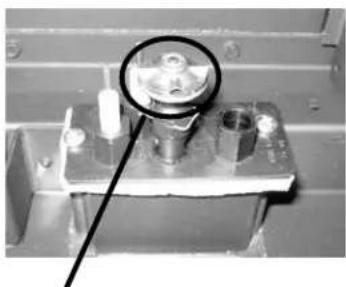
natural_image
Close-up of a mechanical component with a circular inset showing a magnified view of a cylindrical feature (no visible text or symbols)Pilot
Hood
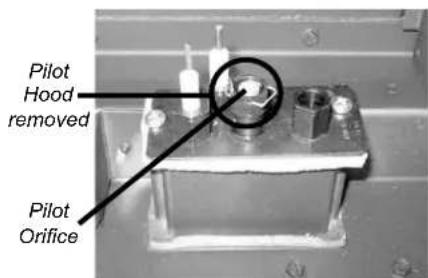
7) Remove the pilot orifice with the allen key.

natural_image
Close-up of a mechanical component with a circular mark and a tool, no visible text or symbols8) Put in the new LPG orifice with the allen key. Then put back the pilot hood.

natural_image
Mechanical component with cylindrical and flanged parts mounted on a metal frame (no visible text or symbols)9) Adjust the burner aeration setting to full open and re-install the burner.
10) Open the bottom louver.
11) Remove the front cover by undoing the 2 screws.
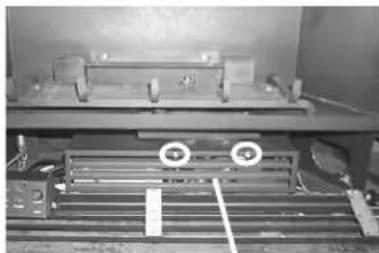
natural_image
Interior view of a mechanical assembly with no visible text or symbolsFront Cover
12) Stick the conversion label "This unit has been converted to Propane" over top of the serial number decal.
13) Replace the black "NG" label with the orange "Propane" label.
14) Carefully pull out the control box from underneath the firebox.
Note: The control box is held in place with velcro.
installation
15) Remove the heat shield from the ECS box by undoing the 2 screws.
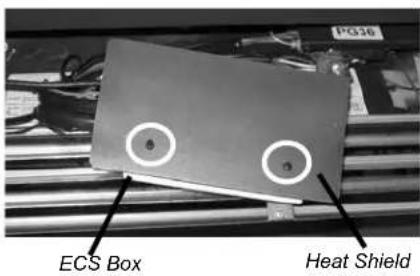
16) Remove the control box cover by undoing the 3 screws. Maneuver through antenna.
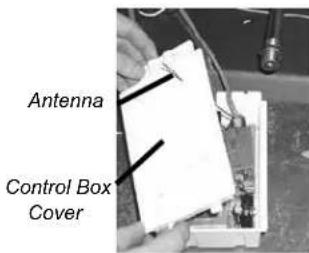
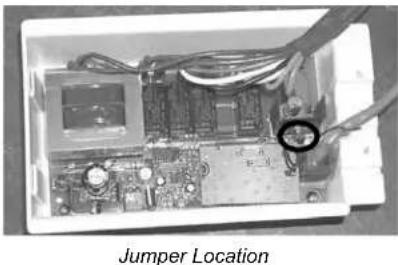
17) Remove the jumper using a plier.
natural_image
Interior view of an electronic device showing a circuit board, wires, and a labeled jumper location (no readable text or symbols beyond label)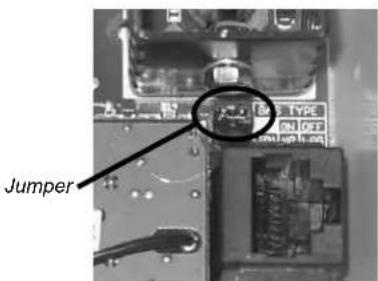
18) Stick the conversion label "This unit has been converted to LPG" on the control box cover.
19) Reverse steps 15 and 14.
20) Turn on gas supply and plug in power cord.
21) Adjusting the Outlet Pressure: All the adjustments must be carried out in the following order:
Remove the modulator plastic cap (A) using needle nose pliers.
Maximum pressure: Turn the unit ON to its highest input rating. Screw in the nut (B) to increase the outlet pressure and screw it out to decrease it. Use a 10 mm wrench.
Note: The outlet pressure must be set to maximum 2.6 kPa.
Minimum pressure: Remove one of the cables connected to the electric modulator. Keeping the nut (B) blocked, screw in the screw (C) to increase the pressure and screw it out to decrease it. Use a screwdriver 6 x 1 blade.
Note: The outlet pressure must be set to minimum 0.72 kPa.
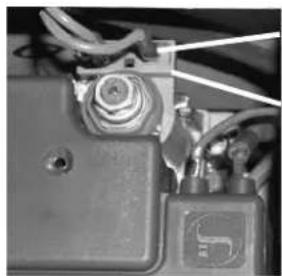
natural_image
Close-up of a mechanical component with wires and a tool, no visible text or symbolsCable
Electric Modulator
After carrying out all adjustments, block the setting screws with paint, taking care not to obstruct the breather orifice of the pressure.
Put back the modulator plastic cap.
WARNING: To ensure the correct operation of the modulator it is necessary that the plastic cap (A) is returned to its original location.

22) At the end of all setting and adjustment operations, check electrical insulation and gas leaks.
23) Check operation of flame control.
24) Check for proper flame appearance and glow on logs.
Installer Notice: These instructions must be left with the appliance.
Log Set Installation
Read the instructions below carefully and refer to the diagrams. If logs are broken do not use the unit until they are replaced. Broken logs can interfere with the pilot operation.
The gas log kit (Part # 512-930) contains the following pieces:
a) 02-49 Rear Log
b) 02-55 Middle Left Log
c) 02-50 Front Left Log
d) 02-53 Center Left Log
e) 02-51 Front Bottom Log
f) 02-54 Center Right Log
g) 02-52 Middle Right Log
h) Embers
i) Vermiculite
NOTE: If you will be installing the optional Brick Panels, install the Brick Panels prior to installing the logs.

The "02" refer numbers (i.e. 02-49) are molded into the rear of each log.
1) Carefully remove the logs from the box and unwrap them. The logs are fragile, handle with care - do not force into position.
2) Sprinkle the vermiculite around the firebox base.
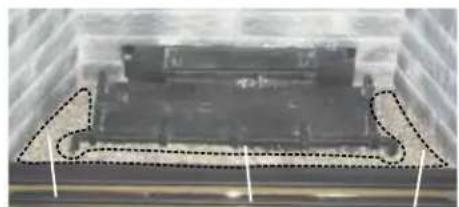
natural_image
Close-up of a dark electronic component with dashed outline and measurement lines, no visible text or symbolsVermiculite
Vermiculite Vermiculite
3) Place the Log 02-49 on the rear log support pins with the flat side to the back.
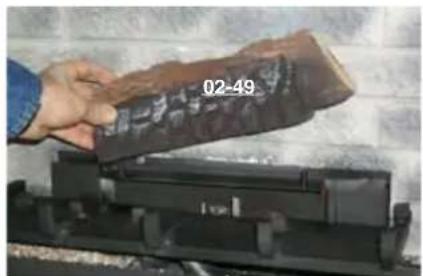
natural_image
Hand holding a brown log outdoors on a metal rack, with no visible text or symbols
natural_image
Exterior view of a modern office building (no signage)4) Place Log 02-51 on the front right side of the burner. Push the back of the log against the 2 brackets with the notch on the bottom right side of the log fitting into the right side of the grate.

natural_image
Close-up of a hand pressing down on a firewood firecracker (no visible text or symbols)Bracket
Bracket
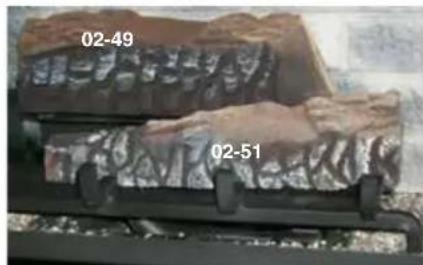
5) Position Log 02-53 across the cutouts in Logs 02-49 and 02-51 with the notch on the left side of the log fitting into the 2nd grate tab.

2nd Grate Tab
Cutouts

natural_image
Close-up of a firewood stove burner with visible flames and wooden handle (no text or symbols)6) Place the bottom left front edge of Log 02-55 against the rear bracket on the burner tray and rest the log on the cutout on Log 02-53.
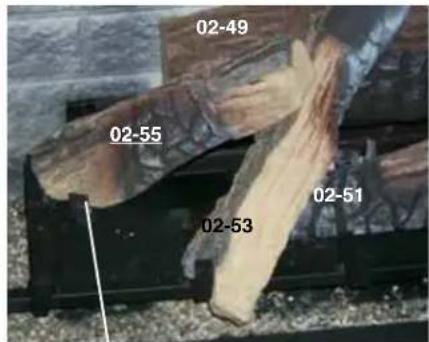
Rear Bracket
7) Sit Log 02-50 on the front left side of the burner. Push the back of the log against the 2 front brackets with the notch on the bottom of the log fitting into the first grate tab.
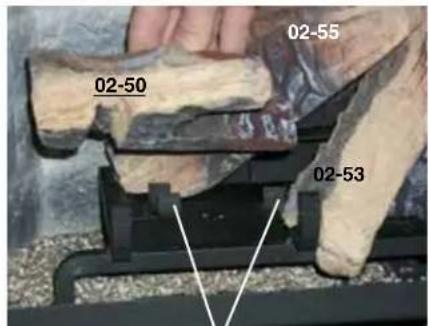
Front Brackets

Notch
installation
8) Position Log 02-54 across the cutouts in Logs 02-51 and 02-53. The notch in the bottom right end fitting against the 5th grate tab.

5th Grate Tab
10) Place the embers on the front of the burner tray in the places shown on the photo.

natural_image
Close-up of wood firewood on a gravel surface, with two circled annotations highlighting specific areas (no text or symbols present)Place embers in these 3 locations on the burner tray.

9) Place Log 02-52 between Logs 02-51 and 02-49 and on the indentation on Log 02-54. The bottom right end sits behind the rear grate tab.

natural_image
Close-up of a wooden cutting board with a knife inserted, showing wood and grain (no text or symbols visible)Embers
11) Test fire to ensure proper light off (make sure flame flows smoothly from one end of burner to the other). If there is any flame hesitation, check that area for any blockage of the burner ports.
12) Install flush glass and bay glass (if used) as per instructions in this manual.
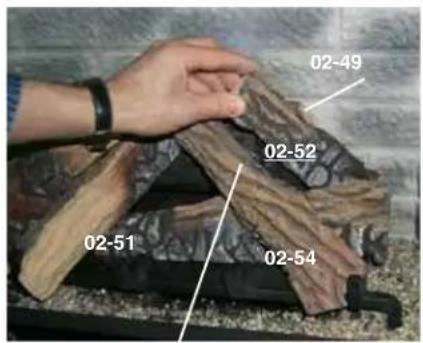
Log Indentation

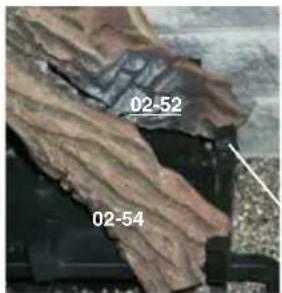
Rear Grate Tab
Photo shows rear grate tab. Log 02-51 was removed to show the positioning of Log 02-52.
Standard Flush Door
The standard flush door comes with a black frame.
To install the frame, hook the top door flange onto the top of the unit and swing the door towards the unit, Diagram 1.
Use the hook to pull the spring out until you can put the hook into the slot on the bottom door bracket. Repeat for 2nd spring. See diagram 3.
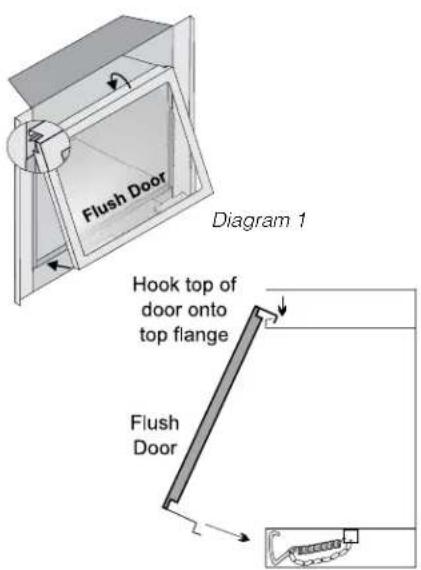
Be careful that the glass gasket does not roll up; there must be a gap between the gasket and the door lip to ensure that the door sits securely on the unit. Diagram 2.
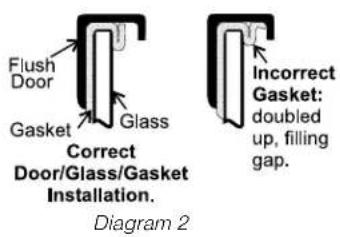

Diagram 3
To remove the flush door, reverse the above steps.
Flush Louvres
1) Install the top louvre by sliding the two bracket clips into the brackets located underneath the top of the firebox.
2) The bottom louvre has a hinge that is attached (2 screws per hinge) to the lip on bottom of the unit.
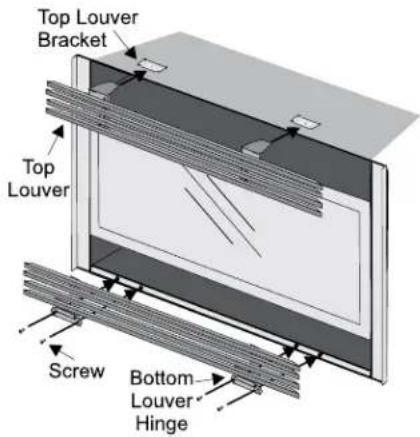
Note: Top and bottom louvres are different.
installation
Premium Flush Front Installation
1) Unplug the power source.
2) Remove the top louver (if fitted) by carefully pulling it out.
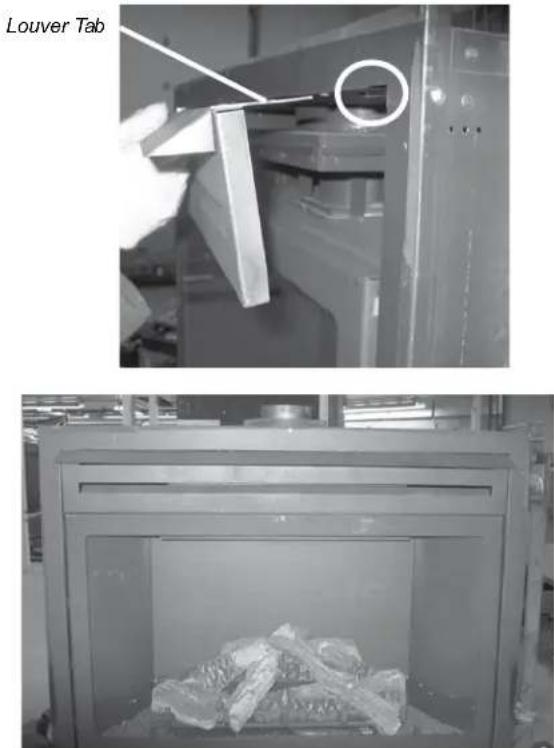
3) Install the premium fl ush front top louver in place by sliding the louver tabs into the louver brackets on the inside top of the fl rebox.
natural_image
Two-panel black-and-white photo showing a laptop with a ladder and a labeled 'Louver Tab' (no readable text or symbols in the image)Premium Flush Front Top Louver in place.
4) Open the bottom louver.
5) Remove the manual control switch bracket from the bottom louver (if fitted) by undoing the 2 screws.

Wiring Diagram

operating instructions
Remote Control
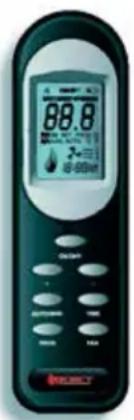
Use the Regency ^® Remote Control Kit approved for this unit. Use of other systems may void your warranty.
The remote control kit comes with a hand held transmitter and a wall mounting plate.
- Choose a convenient location to mount the hand held transmitter, protection from extreme heat is very important.
The remote can also be used as a wall thermostat.
Operating Instructions
Before operating this appliance, proceed through the following check list.
- Read and understand these Instructions before operating this appliance.
- Check to see that all wiring is correct and enclosed to prevent possible shock.
- Check to ensure there are no gas leaks.
- Make sure the three pieces of door glass are properly positioned. Never operate the appliance with any of the glass removed or with the door open.
- Verify that all flueing and the cap is unobstructed.
- Verify log placement.
Lighting Instructions
- Plug the power cord into a power outlet.
- Press and release the ON/OFF button once to start the unit.
- After approximately 3 seconds the spark ignition system will spark for 40 seconds to light the main burner.
- If the main burner does not light, reset the unit.
Resetting the Unit
- Open the bottom louver of the unit.
- Press and release the reset button, located on the unit's control panel once.
- Wait for approximately 3 seconds and the pilot sparks can be heard and seen. It would take 2 to 3 seconds for the flame to be lit.
NOTE: A period of 30 seconds must pass before another reset is attempted.
Shutdown Instructions
- Press the ON/OFF button once.
- Turn off all electric power to the appliance if service is to be performed.
First Fire
The FIRST FIRE in your heater is part of the paint curing process. To ensure that the paint is properly cured, it is recommended that you burn your fireplace for at least four (4) hours the first time you use it with the fan on.
When first operated, the unit will release an odour caused by the curing of the paint and the burning off of any oils remaining from manufacturing. Smoke detectors in the house may go off at this time. Open a few windows to ventilate the room for a couple of hours. The glass may require cleaning.
NOTE: The main burner will always start on "HIGH" and resume it's last setting after 20 seconds of operation.
NOTE: When the glass is cold and the appliance is lit, it may cause condensation and fog the glass. This condensation is normal and will disappear in a few minutes as the glass heats up.
DO NOT ATTEMPT TO CLEAN THE GLASS WHILE IT IS STILL HOT!
DO NOT BURN THE APPLIANCE WITHOUT THE GLASS FRONT IN PLACE.
During the first few fires, a white film may develop on the glass front as part of the curing process. The glass should be cleaned or the film will bake on and become very difficult to remove. Use a non-abrasive cleaner and NEVER clean the glass while it is hot.
operating instructions
Adjusting Flame Height
There are six flame settings that can be adjusted by pressing and releasing the plus (+) and minus (-) FLAME button.
The FLAME setting button is located on the control panel in behind the pedestal door.
Summary of Controls
On/Off Button
If the unit is switched off, pressing and releasing this button once will switch the unit on. The unit will resume its last settings.
If the unit is switched on, pressing and releasing this button once will switch the unit off.
Flame:
Increase - If the unit is switched on, pressing and releasing the plus (+) button once will increase the flame height to the next available high setting.
Decrease - If the unit is switched on, pressing and releasing the minus (-) button once will decrease the flame height to the next available low setting.
Fan:
The fan speed is changed by pressing and releasing the fan button.
It operates in 4 modes: OFF, LOW, MEDIUM and HIGH.
Pilot Adjustment
Periodically check the pilot flames. Correct flame pattern has two strong blue flames: 1 flowing around the flame sensor and 1 flowing across the burner (it does not have to be touching the burner).
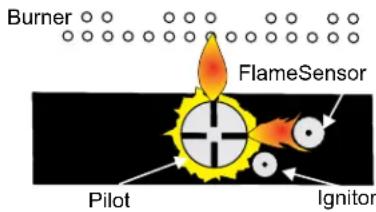
Note: If you have an incorrect flame pattern, contact your Regency ^® dealer for further instructions.
Incorrect flame pattern will have small, probably yellow flames, not coming into proper contact with the rear burner or flame sensor.
Normal Operating Sounds of Gas Appliances
It is possible that you will hear some sounds from your gas appliance. This is perfectly normal due to the fact that there are various gauges and types of steel used within your appliance. Listed below are some examples. All are normal operating sounds and should not be considered as defects in your appliance.
Blower:
Regency® gas appliances use high tech blowers to push heated air farther into the room. It is not unusual for the fan to make a "whirring" sound when ON. This sound will increase or decrease in volume depending on the speed setting of your fan speed control.
Burner Tray:
The burner tray is positioned directly under the burner tube(s) and logs and is made of a different gauge material from the rest of the firebox and body. Therefore, the varying thicknesses of steel will expand and contract at slightly different rates which can cause "ticking" and "cracking" sounds. You should also be aware that as there are temperature changes within the unit these sounds will likely re-occur. Again, this is normal for steel fireboxes.
Gas Control Valve:
As the gas control valve turns ON and OFF, a dull clicking sound may be audible, this is normal operation of a gas regulator or valve.
Unit Body/Firebox:
Different types and thicknesses of steel will expand and contract at different rates resulting in some "cracking" and "ticking" sounds will be heard throughout the cycling process.
WARNING:
DO NOT USE OR STORE FLAMMABLE MATERIALS IN OR NEAR THIS APPLIANCE
WARNING:
DO NOT PLACE ARTICLES ON OR AGAINST THIS APPLIANCE.
WARNING:
DO NOT MODIFY THIS APPLIANCE.
WARNING:
DO NOT SPRAY AEROSOLS IN THE VICINITY OF THIS APPLIANCE WHILE IN OPERATION.
FOR YOUR SAFETY READ BEFORE LIGHTING
This appliance must be installed in accordance with local codes, if any; if not, follow the current AS/NZS 5601.
WARNING: If you do not follow these instructions exactly, a fire or explosion may result causing property damage, personal injury or loss of life. Improper installation, adjustment, alteration, service or maintenance can cause injury or property damage. Refer to the owner's information manual provided with this appliance. For assistance or additional information consult a qualified installer, service agency or gas supplier.
SUITABLE ONLY FOR INDOOR INSTALLATION
A) BEFORE LIGHTING smell all around the appliance area for gas. Be sure to smell next to the floor because some gas is heavier than air and will settle on the floor.
WHAT TO DO IF YOU SMELL GAS
- Do not try to light any appliance
- Do not touch any electric switch, do not use any phone in your building
- Immediately call your gas supplier from a neighbors phone. Follow the gas supplier's instructions.
- If you cannot reach your gas supplier, call the fire department.
B) Do not use this appliance if any part has been under water. Immediately call a qualified service technician to inspect the appliance and to replace any part of the control system and any gas control which has been under water.
This appliance needs fresh air for safe operation and must be installed so there are provisions for adequate combustion and ventilation air.
CAUTION: Hot while in operation. Do not touch. Severe Burns may result. Due to high surface temperatures keep children, clothing and furniture, gasoline and other liquids having favourable vapors away. Keep burner and control compartment clean. See installation and operating instructions accompanying appliance.
LIGHTING INSTRUCTIONS
STOP! Read the safety information above on this label.
1) Plug the power cord into a power outlet.
2) Press and release the ON/OFF button once to start the unit.
3) After approximately 3 seconds the spark ignition system will spark for 25 seconds to light the main burner.
4) If the main burner does not light, check the gas and reset the unit.
TO TURN OFF GAS APPLIANCE
1) Press the ON/OFF button once.
2) Turn off all electric power to the unit if service is to be performed.
DO NOT REMOVE THIS INSTRUCTION PLATE
918-3320
WARNING:
DO NOT SPRAY AEROSOLS IN THE VICINITY OF THIS APPLIANCE WHILE IN OPERATION.
Maintenance Instructions
Any maintenance required accessing the glass door of the unit must be performed by an authorized service person.
-
Always unplug the power cord before cleaning. For relighting, refer to lighting instructions. Keep the burner and control compartment clean by brushing and vacuuming at least once a year. When cleaning the logs, use a soft clean brush as the logs are fragile and easily damaged.
-
Clean glass (never when unit is hot), appliance, louvres, and door with a damp cloth. Never use an abrasive cleaner. The gold louvres (and optional gold door) may be scratched if abrasives are used to clean them.
The heater is finished in a heat resistant paint and should only be refinished with heat resistant paint (not with wall paint). Regen&y uses StoveBright Paint - Metallic Black #6309.
-
Make a periodic check of burner for proper position and condition. Visually check the flame of the burner periodically, making sure the flames are steady; not lifting or floating. If there is a problem, call an authorized service person.
-
The appliance and flueing system must be inspected before use, and at least annually, by an authorized field service person, to ensure that the flow of combustion and ventilation air is not obstructed.
During the annual service call, the burners should be removed from the burner tray and cleaned. Replace the embers - do not block the pilot or burner ports.
-
Keep the area near the appliance clear and free from combustible materials, gasoline and other flammable vapours and liquids.
-
Verify proper operation after servicing.
WARNING: CHILDREN AND ADULTS SHOULD BE ALERTED TO THE HAZARDS OF HIGH SURFACE TEMPERATURE AND SHOULD STAY AWAY TO AVOID BURNS OR CLOTHING IGNITION. YOUNG CHILDREN SHOULD BE CAREFULLY SUPERVISED WHEN THEY ARE IN THE SAME ROOM AS THE APPLIANCE.
CAUTION: ANY SAFETY SCREEN OR GUARD REMOVED FOR SERVICING AN APPLIANCE MUST BE REPLACED PRIOR TO OPERATING THE APPLIANCE.
CLOTHING OR OTHER FLAMMABLE MATERIAL SHOULD NOT BE PLACED ON OR NEAR THE APPLIANCE.
DO NOT USE THIS APPLIANCE IF ANY PART HAS BEEN UNDER WATER IMMEDIATELY CALL AN AUTHORIZED SERVICE TECHNICIAN TO INSPECT THE APPLIANCE AND TO REPLACE ANY PART OF CONTROL SYSTEM AND ANY GAS CONTROL WHICH HAS BEEN UNDER WATER.
General Flue Maintenance
Conduct an inspection of the flueing system semi-annually. Recommended areas to inspect as follows:
-
Check the Flueing System for corrosion in areas that are exposed to the elements. These will appear as rust spots or streaks, and in extreme cases, holes. These components should be replaced immediately.
-
Remove the Cap, and shine a flashlight down the Flue. Remove any bird nests, or other foreign material.
-
Check for evidences of excessive condensation, such as water droplets forming in the inner liner, and subsequently dripping out the joints, Continuous condensation can cause corrosion of caps, pipe, and fittings. It may be caused by having excessive lateral runs, too many elbows, and exterior portions of the system being exposed to cold weather.
-
Inspect joints, to verify that no pipe sections or fittings have been disturbed, and consequently loosened. Also check mechanical supports such as Wall Straps, or plumbers' tape for rigidity.
maintenance
Log Replacement
Regency ^® dealer only, and follow our step-by-step instructions for replacement.
The unit should never be used with broken logs. Turn off the gas valve and allow the unit to cool before opening door and carefully remove the logs. If for any reason a log should need replacement, you must use the proper replacement log. The position of these logs must be as shown in the diagrams under Log Installation.
Note: Improper positioning of logs may create carbon build-up and will severely alter the unit's performance which is not covered under warranty.
WARNING: Donotoperatetheappliance with the glass panels removed, cracked or broken. Replacement of the glass panels should be done by a licensed or qualified service person.
Caution: Wear gloves when removing damaged or broken glass.
Glass Gasket
If the glass gasket requires replacement use 5/8" flat glass gasket for the Bay Front (Part # 936-243) and a tadpole glass gasket for the Flush Front (Part # 936-155).
Flush Glass Replacement
Remove the flush door front (as per instructions in the "Standard Flush Door" section). Remove the 4 glass clips from each corner. Slide in the new replacement glass. Push the 4 glass clips back onto the frame. The glass must have gasketing around it.
Door Glass
Your Regency® fireplace is supplied with high temperature, 5 mm Neoceram ceramic glass that will withstand the highest heat that your unit will produce. If your glass requires cleaning, we recommend using an approved glass cleaner available at all authorized dealers. Do not use abrasive materials. Do not clean the glass when hot.
In the event that you break your glass by impact, purchase your replacement from an authorized
Removing Valve Tray
- Shut off the gas supply.
- Remove the louvres.
- Open the flush door and remove door.
- Remove the logs.
- Remove the burner/grate assembly by removing the left and right side Phillips head screws and then lift the burner assembly out.
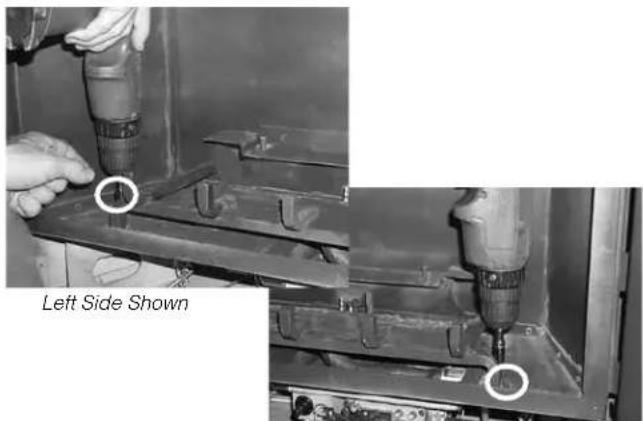
natural_image
Close-up of hands using a drill bit to adjust or install a mechanical component, with no visible text or symbols.Right Side Shown

natural_image
Close-up of a hand inserting a black cable into a device (no visible text or symbols)Lift out the burner/grate assembly.
- Remove the rear log log stand by removing the 2 screws.

natural_image
Industrial machine component with mounting holes and a central shaft (no visible text or symbols)Rear Log Stand
- Disconnect the inlet gas line.
- Remove the 10 Phillips screws which secure the valve tray assembly.

natural_image
Close-up of a mechanical component with circular annotations highlighting features (no readable text or symbols)- Remove the front cover by removing the 2 screws which secure the front cover to the valve tray.

natural_image
Industrial machine component with two circular annotations highlighting features (no readable text or symbols)Front Cover
- Unplug the 2 orange wires from the Gas Pressure Electric Modulator.
- Unplug the 5 pin Molex Connector from the valve.
- Unplug the ignitor and flame cables from the module and then lift the entire valve tray assembly out.

5 Pin Molex
Connector
2 Orange Wires
Module

natural_image
Interior view of an electronic device with exposed circuit board and wiring (no visible text or symbols)Valve Tray Assembly
- To replace the burner tray assembly reverse these instructions.
- Check for any gas leaks.
- Check for proper flame appearance and glow on logs.
maintenance
Fan Replacement
- Shut off the power supply.
- Remove the top louvre.
- Remove the glass door.
- Remove the 3 screws which secure the manual control box to the bottom louvre and remove the bottom louvre.
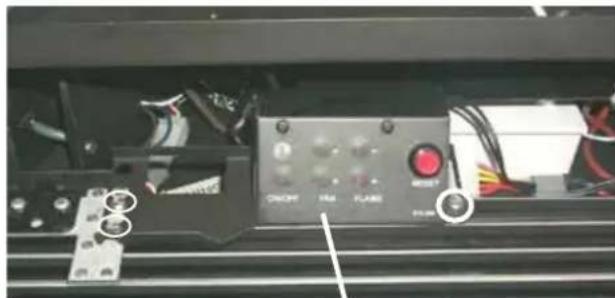
natural_image
Close-up of an electronic control panel with labeled buttons and wiring (no readable text or symbols)Manual Control Box
- Unplug the 6 pin Molex connector and carefully pull out the ECS box.

natural_image
Interior view of a device with visible wiring and components (no readable text or symbols)6 Pin Molex
Connector
ECS Box
- Remove the electric cover by undoing the 2 screws, pull out the grommet and the harness.
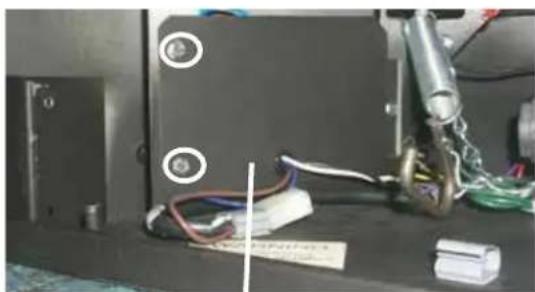
natural_image
Close-up of a mechanical or electronic component with wires, connectors, and a battery (no visible text or symbols)Electric Cover
- Unplug the black wire from the resistor.
- Carefully slide the fan to the front left side of the unit.
- Remove the screw which holds the ground wire and disconnect all electrical connectors that are attached to the fan.

natural_image
Interior view of an industrial machine with visible wiring and components (no text or symbols)Ground Wire
- Pull out the fan.
- Reverse steps to install new fan.
Manual Control Switch Replacement
- Unplug the power source.
- Open the bottom louver.
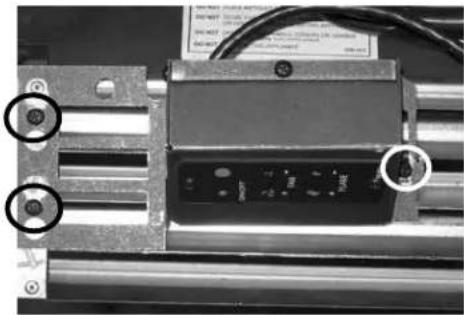
- Remove the 3 screws that secure the manual control louver bracket to the louver.
natural_image
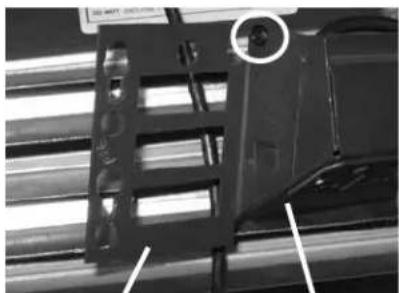
Close-up of a mechanical device with two circular annotations pointing to features, no visible text or symbols.- Remove the louver bracket from the manual control box by undoing one screw.
natural_image
Close-up of a mechanical component with circular features and a highlighted circular detail (no visible text or symbols)Louver Bracket
Manual Control Box
- Remove the valve heat shield by undoing the 2 screws.

natural_image
Close-up of a vehicle's front grille with two circled features, no visible text or symbolsValve Heat Shield
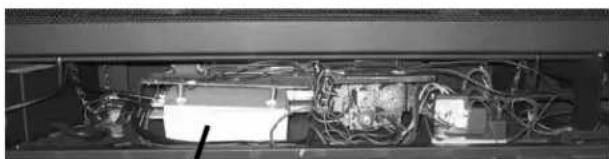
- Pull out the ECS box by carefully lifting it up off the velcro.
natural_image
Interior view of an electronic device showing exposed circuitry and wiring (no visible text or symbols)ECS Box
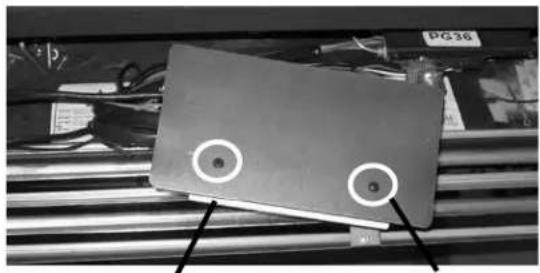
- Remove the heat shield from the ECS box by undoing the 2 screws.
natural_image
Black-and-white photo of a rectangular electronic device with two circular annotations pointing to its sides, placed on a corrugated metal surface (no visible text or symbols)ECS Box
Heat Shield
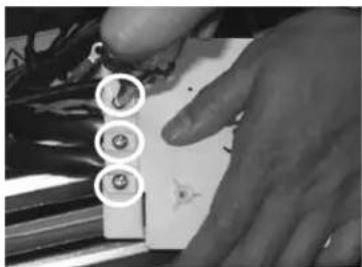
- Remove the ECS box cover by undoing the 3 screws.
natural_image
Close-up of a hand adjusting a small object with three circular insets (no visible text or symbols)- Unplug in the CAT5 cable of the manual control box from the connector in the ECS box.

natural_image
Black-and-white photo of an open computer case with visible circuitry and a magnified inset showing a device (no text or symbols)- Plug the replacement manual control switch CAT5 cable into the connector in the ECS box.
- Re-install the cover on the ECS box. Ensure to fit the rest of the cable into the groove in the ECS box.
- Re-install the heat shield on the ECS box.
- Put the ECS box back in place under the firebox.
- Reverse steps 5 to 1.
| ALL WORK MUST BE CARRIED OUT BY A LICENSED/QUALIFIED TECHNICIANIt is critical that this appliance is earthed and that Active and Neutral are not crossed* Pilot light models only | ||
| SYMPTOM | CAUSE | SOLUTION |
| Unit does not operate(No ignition & No Fan) | No power supply (240V) to unit or control box | Check 240V power supply |
| Faulty ECS box | Replace ECS module & Cat 5 Cable | |
| Unit will not operate using remote control, but OK using manual control | Remote control not tuned into unit. | Tune remote control into unit |
| Remote is not tuning to the unit | Replace Remote control and or ECS module | |
| * Unit goes through ignition cycle,but pilot light does not igniteDirect Spark unitsIgniter sparks but main burner doesn't light | No gas to unit or fitting line has not been purged | Check gas supply or purge fitting line |
| * Blocked pilot | * Clean or replace pilot assembly | |
| Faulty ignition pack | Replace Ignition pack | |
| Ignitor earthing or sparking to incorrect location | Ensure sparker is in good condition, replace if necessary | |
| * Pilot light ignites but main burner does not ignite, igniter continues to spark for 10 seconds then goes to lock outDirect Spark unitsMain burner ignites but igniter continues to spark for 10 seconds then goes to lock out | Faulty sensor lead/ circuit | Check flame sensor is connected and not damaged |
| Crossed polarity, Faulty extension lead or power board | Check polarity at power point connection into heater and ECS control box | |
| Faulty Ignition Module | Replace Ignition module | |
| * Pilot light ignites but main burner does not ignite, igniter stop sparking and pilot flame stays on | No Gas to main burner | Check burner injector for blockage |
| Pressure switch not activating | Ensure Fan is running | |
| Clear any blockage in hose from pressure switch to fan. | ||
| Clean the fan | ||
| Replace Pressure switch | ||
| No power out of ignition module | Replace Ignition Module | |
Troubleshooting Guide
| Unit ignites, main burner becomes unstable, flame lifts off burner, unit goes into lockout | Incorrect burner pressure settings | Adjust burner pressure to correct setting (See Data plate) |
| Flue blocked, Incorrect flue installation or flue joints not sealed | Clear blocked flue, install flue correctly and seal all flue joints | |
| Burner aeration not correctly adjusted | Adjust burner aeration (See Unit Manual) | |
| Log set incorrectly installed | Install log set as per Owner's Manual | |
| Flue Restrictor not set correctly | Adjust Flue restrictor (See unit manual) | |
| Fan operates but no ignition sequence (no spark) | Unit ignition pack gone into lockout | Reset ignition pack by depressing black reset button while unit controls are in the "ON" position (fan running) |
| Carbon build up on glass/media/logs | Burner cracked | Replace burner |
| Log set / media incorrectly installed | Install log set / media as per owner's manual | |
| Aeration setting too far closed | Set aeration as per owner's manual | |
| Aeration blocked | Clean blockage at aeration shutter | |
| Flue restrictor not set correctly | Adjust flue restrictor as per owner's manual | |
| Partial blockage in flue | Clear blocked flue |
Gas Maintenance - Recommended Annual Routine
In order for your Regency appliance to continue to provide comfort to your home periodic maintenance must be performed to ensure it is operating at peak efficiency. The items in the list should be checked by a licensed gas service technician during the annual service check. Your unit may require more frequent maintenance checks if you notice any changes in how it operates. Operational changes to look for can include, but are not limited to, extended start up time, increased fan noise, residue/carbon build up, white build up on the glass/firebox, increased operating noise etc. Should any of these or other conditions arise, discontinue use and schedule a service check with your local licensed gas technician. The list below shows items your licensed service technician will need to check and service at least annually.
Clean
- Glass
- Interior bricks / panels
- Burner ports & burner air shutter
- Fan blades
- Log set
- Pilot orifices
- Pilot hood (change as needed)
- Flame sensor (electronic ignition models)
- Flame electrode
- Burner orifice
• Thermocouple (millivolt models)
• Thermopile (millivolt models)
Inspect
- Pilot assembly
- Burner
• Pressure relief gaskets/doors - Flue connector gasket if present
- Door seal
- Firebox
- Venting
• Batteries (remote handheld, remote receiver, DC sparker, change as needed) - Burner media (change as needed)
- Air shutter setting
- Wiring
Check
• Voltage on thermocouple/thermopile (millivolt models)
- Ohms reading on flame sense (electronic ignition models)
• Inlet/outlet fuel pressures as per rating plate
• Voltage/ohms readings on gas valve
- Ohms reading to on/off switch circuit (Mili-volt models)
Gas Leak Tests
- Check main gas line connection to valve
- Check shut off valve connections
- Check connection at gas valve outlet
- Check connection at main burner orifice
- Check pilot fuel line at valve and at pilot assembly
Electronic Components Parts List
Note: Depending on the model, the diagram below may not be exactly as shown - for reference purposes only.

| FG38 FG39 PG33 PG36 / | PG36D | PG121/PG131 | GFI300L | IG34 GF900L/C | GF1500L | ||||
| 910-909 Fan Resistor | √ √ | √ √ √ | √ | √ | √ | √ | |||
| 910-936 Intermittent Pilot | N/A | √ √ | √ √ | N/A | √ | √ | N/A | ||
| 911-146 Intermittent Pilot | N/A | N/A | N/A | N/A | N/A | √ | N/A | N/A | √ |
| 910-082 Direct Spark Ignitor | √ | N/A | N/A | N/A | N/A | N/A | N/A | N/A | N/A |
| 910-089 Flame Cable | √ | N/A | N/A | N/A | N/A | N/A | N/A | N/A | N/A |
| 910-088 Spark Cable | √ | N/A | N/A | N/A | N/A | N/A | N/A | N/A | N/A |
| 910-084 Control Box | √ √ | √ √ √ | N/A | √ | N/A | N/A | |||
| 911-101 Control Box | N/A | N/A | N/A | N/A | N/A | √ | N/A | √ | N/A |
| 910-527 Manual Control Switch | √ | √ | N/A | N/A | N/A | N/A | √ | N/A | N/A |
| 910-080 Valve | √ √ | √ √ √ | √ | √ | √ | √ | |||
| 910-521 Control Box Cable (1)910-522 Control Box Cable (2)910-523 Control Box Cable (3)910-525 Control Box Cable (4) | *N/A | (2) | (1) | (1)(3) | N/A | (2) | N/A | N/A | |
| 910-912 Ignition Module to Valve Cable | N/A | N/A | √ √ | √ √ | √ | √ | √ | ||
| 911-183 Reset Switch | N/A | √ √ | √ √ √ | √ | √ | √ | |||
| 910-083 Ignition Module (1)911-121 Ignition Module (2) | (1)(2) | (2) | (2) | (2) | (2) | (2) | (2) | (2) | (2) |
| 910-514 Jumper Wire | N/A | √ √ | √ √ √ | ||||||
| 910-935 Manual Control Switch | N/A | N/A | √ √ | √ | N/A | √ | N/A | N/A | |
| **Note: The Control Box Cable wires for the FG38 come separately: 910-502, 910-505, 910-506, 910-507, 910-509 | |||||||||
parts list
Main Assembly
Part # Description
3) 948-045 Chain
4) 948-025 Spring
910-169/P Fan Motor
910-904 Wire Harness (Fan End)
910-714 Power Cord (240 V)
14) 510-026 Hinge Bracket - Left/Right
15) 948-253 Door Handle
17) * Wire Holder Clip
20) 510-033 Top Nailing Strip
21) 510-064 Side Nailing Strip
22) 510-153 Baffle Plate
23) 510-011F Standoff - Top
24) 511-044 Standoff - Side/Back
27) * Outer Flue Collar
28) * Inner Flue Collar Assembly
29) 517-025 Vertical Vent Restrictor
30) 517-027 Horizontal Vent Restrictor
31) * Gasket for Flue Collar
32) * Flue Mounting Plate
918-744 Manual
513-968 Conversion Kit - NG to LPG
*Not available as a replacement part.
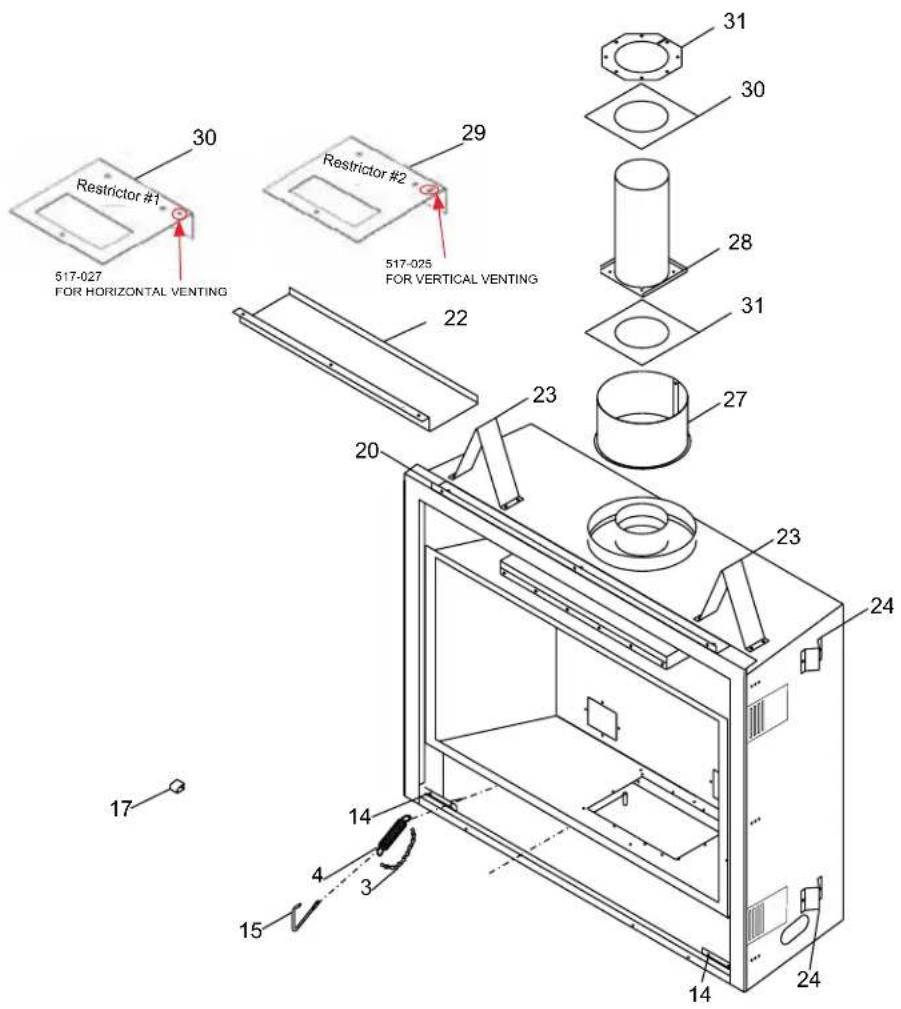
Burner Assembly & Log Set
Part # Description
516-574/P Valve Assy - NG
516-576/P Valve Assy - LPG
910-080 Sigman Gas Valve
*Not available as a replacement part.
NS - not shown
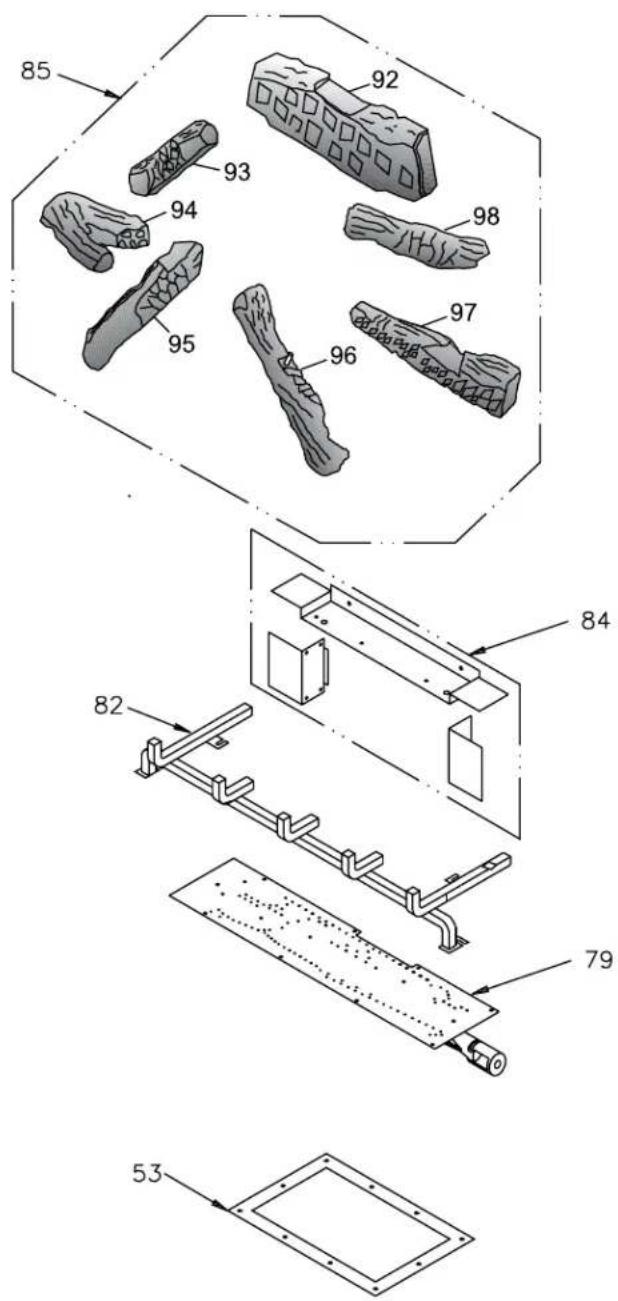
Part # Description
132) 512-518 Flush Door Assembly
135) 940-090/P Glass (Flush)
136) 936-155 Glass Gasket (Tadpole)
904-691 U-Clip
138) 510-922 Flush Louvres-Black (set)
904-196 Magnet (1" round)
510-934 Flush Glass Trim - Brass (2/Set)
510-947 Flush Glass Trim - Steel (2/set)
510-986 Finishing Trim (3 piece) - Black
516-925 Finishing Trim (3 piece) - Steel
516-927 Finishing Trim (4 piece) - Steel
157) Finishing Trim Left
158) Finishing Trim Top
159) Finishing Trim Right
160) Finishing Trim Bottom
161) 517-523 Screen Assembly.
*Not available as a replacement part

Premium Flush Front Assembly
Part # Description
516-916 Premium Flush Front - Black
516-948 Wiring
910-975 Thermodisc
*Not available as a replacement part.

Limited Lifetime Warranty
FPI Fireplace Products International Ltd. ("the manufacturer") through its wholly owned subsidiary, Fireplace Products Australia Pty Ltd (for Australia and New Zealand customers) and sold under the Regency® brand of fireplace products (collectively referred to herein as "FPI"), extends this Limited Lifetime Warranty to the original purchaser of this appliance provided the product remains in the original place of installation. The items covered by this limited warranty and the period of such coverage is set forth in the table below.
Some conditions apply (see below).
The policy is not transferable, amendable or negotiable under any circumstances.
| Indoor Gas Products Warranty Coverage Parts and Labor | Part Lifetime | 5 years | 2 years | 1 year | Supplier Warranty | Labor Coverage (Years) |
| Firebox and Heat Exchanger | √ | 3 | ||||
| Steel Burner Tube | √ | 3 | ||||
| Glass Thermal breakage only | √ | 3 | ||||
| All Surrounds/Inlays Finishes | √ | 3 | ||||
| Brick Panels/Log sets/Ceramic Burners | √ | 3 | ||||
| All Castings | √ | 3 | ||||
| Valve assembly and all gas control components (Pilot assembly, flame sensors, Spark Electrode, Pilot Tubing, Orifices, Thermocouple, Thermopile) | √ | 2 | ||||
| All Other Electrical components with the exception of WIFI Dongle (Ignition Control Boards, Wiring, Switches, Fans, Fan Control Module, Battery Pack, Remote Control Systems) | √ | 1 | ||||
| Enamel Panels | √ | 1 | ||||
| Venting/Venting Components | √ | 1 | ||||
| All Stainless steel surrounds | √ | 1 | ||||
| All Firebox Media (Crystals, Fire beads, Volcanic, Ceramic & Spa Stones) | √ | 1 | ||||
| All hardware | √ | 1 | ||||
| Mesh/Glass Safety Barriers | √ | 1 | ||||
| Accent Light Bulbs | √ | 1 | ||||
| Glass (Crazing) | √ | 1 | ||||
| WIFI Dongle (Applicable Models) | √ | 1 |
After the original warranty coverage for any of the parts above have expired, any repair and/or replacement parts purchased by the consumer from FPI or through an accredited distributor or dealer will carry a ninety (90) day warranty (valid only with an original copy of the tax invoice). No labor coverage is included with any repair and/or replacement part.
Replacement parts are limited to one per warranty term.
Conditions:
Warranty protects against defect in manufacture or FPI factory assembled components only, unless herein specified otherwise. This warranty will only apply to those products which are acquired at the time of this warranty being effective. FPI will not be liable for any damage or loss that falls outside the scope of the warranty.
Any part(s) found to be defective during the warranty period as outlined above will be repaired or replaced at FPI's option through an accredited distributor, dealer or pre-approved and assigned agent provided that the defective part is returned to the distributor, dealer or agent for inspection if requested by FPI. Alternatively, FPI may at its own discretion fully discharge all of its obligations under the warranty by refunding the verified purchase price of the product to the original purchaser. The purchase price must be confirmed by an original copy of the tax invoice.
The authorised selling dealer, or an alternative authorised FPI dealer if pre-approved by FPI, is responsible for all in-field diagnosis and service work related to all warranty claims. This warranty does not cover dealer travel costs for diagnostic or service work. Dealers may charge homeowner for travel and additional time. Check with your selling dealer in advance for any costs to you when arranging a warranty call. FPI is not responsible for results or costs of workmanship of unauthorised FPI dealers or agents in the negligence of their service work. Additional service fees may apply if you are seeking warranty service from a dealer other than the dealer from whom you originally purchased the product.
At all times FPI reserves the right to inspect reported complaints on location in the field claimed to be defective and determine whether the warranty will apply prior to processing or authorising of any claim. Failure to allow this upon request will void the warranty.
All warranty claims must be submitted by the dealer servicing the claim, including an original copy of the tax invoice (proof of purchase by you). All claims must be complete and provide full details as requested by FPI to receive consideration for evaluation, including proof of maintenance records. Incomplete claims may be rejected. FPI has absolute discretion to assess and determine any warranty claim and may accept or reject a claim as it considers appropriate. Any part or parts of the unit found to be defective will be repaired or replaced at FPI's option, through an accredited distributor or service agent provided that the defective part be returned to the distributor or agent, Transportation Prepaid, if requested. It is the general practice of FPI to charge for larger, higher priced replacement parts and issue credit once the replaced component has been returned to FPI and evaluated for manufacturer defect.
If a consumer has a unit installed outside an accredited distributor, dealer or pre-approved service agent's service area, or the closest approved service agent is situated more than thirty (30) kilometres from the installation, FPI is not obliged to arrange warranty repairs or shipping/transportation costs. In these cases, the consumer must arrange warranty service with its selling dealer, and shipping, travel and/or additional labor charges will apply.
Unit must be installed according to all manufacturers' instructions as per the manual.
All Local and National required codes must be met.
The installer is responsible to ensure the unit is operating as designed at the time of installation.
The original purchaser is responsible for annual maintenance of the unit, as outlined in the owner's manual. As outlined below, the warranty may be voided due to problems caused by lack of maintenance. Annual maintenance records should be retained.
Repair/replacement parts purchased by the consumer from FPI after the original coverage has expired on the unit will carry a 90 day warranty, valid with a receipt only. Any item shown to be defective will be repaired or replaced at our discretion. No labor coverage is included with these parts.
Exclusions:
This Limited Lifetime Warranty does not extend to paint, rust or corrosion of any kind due to a lack of maintenance or improper venting, combustion air provision, corrosive chemicals (i.e. chlorine, salt, air, etc.), door or glass gasket.
Malfunction, damage or performance based issues as a result of environmental conditions, location, chemical damages, downdrafts, installation error, installation by an unqualified installer, incorrect chimney components (including but not limited to cap size or type), operator error, abuse, misuse, use of improper fuels, accidents, lack of regular maintenance and upkeep, acts of God, weather related problems from hurricanes, tornadoes,
warranty
earthquakes, floods, lightning strikes/bolts or acts of terrorism or war, which result in malfunction of the appliance are not covered under the terms of this Limited Lifetime Warranty.
FPI has no obligation to enhance or modify any unit once manufactured (i.e. as products evolve, field modifications or upgrades will not be performed on existing appliances).
Any unit showing signs of neglect or misuse will not be covered under the terms of this warranty policy and may void this warranty. This includes units with rusted or corroded fireboxes which have not been reported as rusted or corroded within three (3) months of installation/purchase. Any alteration to the unit which causes sooting or carboning that results in damage to the exterior fascia or over firing that can cause component or firebox/heat exchanger failure will not be covered by this warranty.
Units which show evidence of being operated while damaged, or with problems known to the purchaser and causing further damages will void this warranty.
Units where the serial no. has been altered, deleted, removed or made illegible will void this warranty.
Minor movement, expansion and contraction of the steel is normal and is not covered under the terms of this warranty.
Freight damages for products or parts are not covered under the terms of the warranty.
Porcelain/Enamel: Absolute perfection is neither guaranteed nor commercially possible. Any chips must be reported and inspected by the authorised selling dealer within three (3) days of installation. Any damage of this type not reported after this time period will be subject to rejection and any related warranty will not apply.
Special Finishes: Expect some changes in color as the product "ages" with constant heating and cooling. The manufacturer warranty does not cover tarnishing, changing colors and/or marks (i.e. finger prints, etc.) after the purchase of the product. Damage from the use of abrasive cleaners is not covered by warranty.
Products made or provided by other manufacturers and used in conjunction with the FPI appliance without prior authorisation from FPI may void this warranty.
INCORRECT INSTALLATION OR GAS PRESSURE SETTINGS ARE NOT COVERED BY WARRANTY. A SERVICE OR CALLOUT FEE WILL BE CHARGED IN THESE CIRCUMSTANCES.
Limitations of Liability:
1. Exclusion of implied terms
The customer may have the benefit of consumer guarantees under the Australian Consumer Law. To the maximum extent permitted by law, all terms, conditions or warranties that would be implied into this Warranty or in connection with the supply of any goods or services by the supplier under law or statute or custom or international conventions are excluded.
2. Limitation of liability
(a) To the maximum extent permitted by law and subject to clauses 1 and 3, the supplier's total liability arising out of or in connection with its performance or its obligations pursuant to this Warranty, or arising out of or in connection with the supply of specific goods or services (including pursuant to or for breach of this Warranty, under statute, in equity or for tort, including negligent acts or omissions) is limited as follows: (i) the supplier shall have no liability to the customer for any Consequential Loss; (ii) without limiting the effect of clause 2(a)(i), the supplier's total aggregate liability for Loss, however arising, shall not exceed the GST exclusive aggregate price paid by the customer to the supplier for the specific goods or services that gave rise to the Loss in question.
(b) The limitations and exclusions in this sub-clause do not apply to the extent that any Loss is directly attributable to: (i) the personal injury or death caused by the supplier's default, breach of this Warranty or negligence; or (ii) fraud by the supplier.
(c) Each party must take reasonable steps to mitigate any Loss it suffers or incurs.
3. Limitation of liability under Australian Consumer Law Guarantees
(a) To the extent that goods supplied by the supplier are not goods of a kind ordinarily acquired for personal, domestic or household use and the customer is deemed to be a consumer for the purposes of section 64A of the Australian Consumer Law, the customer agrees that the supplier's liability for a failure to comply with a consumer guarantee that the customer may have a benefit under the Australian Consumer Law (other than a guarantee under sections 51 (title), 52 (undisturbed possession) and 53 (undisclosed securities)), is limited to, at the option of the supplier, one or more of the following: (i) replacement of the goods or the supply of equivalent goods; (ii) the repair of the goods; (iii) the payment of the cost of replacing the goods or of acquiring equivalent goods; or (iv) equivalent goods; or (v) the payment of the cost of having the goods repaired.
(b) To the extent that services supplied by the supplier are services other than services of a kind ordinarily acquired for personal, domestic or household use or consumption, the supplier's liability for failure to comply with a consumer guarantee that the customer may have the benefit of is limited to, at the option of the supplier: (i) the supply of the services again; or (ii) the payment of the cost of having the services supplied again.
4. Subject to Change
This Limited Warranty is given at the time of sale and purchase of the relevant fireplace product. The terms of this Limited Warranty may be amended from time to time by FPI in accordance with changes to business practices, consumer laws or other legal requirements. The rights and protections granted under the Limited Warranty are those in force in relation to a fireplace product at the time and in the place of sale of that product, and only those terms will be applicable in respect of that product.
5. Severability
Any term of this Limited Warranty that is invalid or unenforceable in any jurisdiction is to be read down for the purposes of that jurisdiction, if possible, so as to be valid and enforceable, and is otherwise capable of being severed to the extent of the invalidity or unenforceability, without affecting the remaining provisions of this Limited Warranty or affecting the validity or enforceability of that provision in any other jurisdiction.
6. Definitions
For purposes of clauses 1, 2 and 3:
(a) Consequential Loss means loss of expected savings, loss of use, loss of opportunity, loss of profit, loss of revenue, increased financing costs, loss arising from delay, or any consequential, special or indirect loss or damage, whether or not the possibility or potential extent of the loss or damage was known or foreseeable, and whether arising from a claim under indemnity, contract, tort (including negligence), statute or otherwise.
(b) Loss means any expense, cost or damage of any kind and includes Consequential Loss and a fine or penalty imposed by a statutory or other authority.
warranty
How to Obtain Warranty Service:
Customers should contact the authorised selling dealer to obtain warranty service. In the event the authorised selling dealer is unable to provide warranty service, please contact FPI by mail at the address listed below. Please include your name, address, purchase date, selling dealer, serial #, type of unit, a brief description of the problem, email and telephone contact information, and a copy of your original tax invoice. A representative will contact you to make arrangements for an inspection and/or warranty service. (See below for Western Australia and/or New Zealand)
Please note Fireplace Products Australia Pty Ltd does not provide installation services.
Fireplace Products Australia Pty Ltd
99 Colmans Road
Dandenong, VIC
Australia, 3175
Phone: +61 3 9799 7277
Fax: +61 3 9799 7822
To obtain warranty service in Western Australia and/or New Zealand, please contact one of our authorised distributors in those areas:
Western Australia:
New Zealand:
Air Group Australia
28-30 Division St.
Welshpool, WA
Australia, 6106
Phone: (08) 9350 2200
Fax: (08) 9353 4225
Aber Holdings Ltd
PO Box 10095
Te Rapa, Hamilton
New Zealand, 3241
Freephone: 0800 161 161
Product Registration and Customer Support:
Thank you for choosing a Regency Fireplace. Regency strives to be a world leader in the design, manufacture, and marketing of hearth products. To provide the best support for your product, we request that you complete a product registration form at http://www.regency-fire.com.au/Customer-Care/Warranty-Registration.aspx within ninety (90) days of purchase.
Product Registration and Customer Support:
Thank you for choosing a Regency Fireplace. Regency strives to be a world leader in the design, manufacture, and marketing of hearth products. To provide the best support for your product, we request that you complete a product registration form found on our Web Site under Customer Care within ninety (90) days of purchase.
For purchases made in CANADA or the UNITED STATES:
http://www.regency-fire.com/Customer-Care/Warranty-Registration.aspx
For purchases made in AUSTRALIA:
http://www.regency-fire.com.au/Customer-Care/Warranty-Registration.aspx
You may also complete the warranty registration form below to register your Regency Fireplace Product and mail and/or fax it back to us, and we will register the warranty for you. It is important you provide us with all the information below in order for us to serve you better.
Warranty Registration Form (or Register online immediately at the above Web Site):
| Warranty Details | |
| Serial Number (required): | |
| Purchase Date (required) (mm/dd/yyyy): | |
| Product Details | |
| Product Model (required): | |
| Dealer Details | |
| Dealer Name (required): | |
| Dealer Address: | |
| Dealer Phone #: | |
| Installer: | |
| Date Installed (mm/dd/yyyy): | |
| Your Contact Details (required) | |
| Name: | |
| Address: | |
| Phone: | |
| Email: | |
For purchases made in CANADA:
For purchases made in the UNITED STATES:
For purchases made in AUSTRALIA:
FPI Fireplace Products
International Ltd.
6988 Venture St.
Delta, British Columbia
Canada, V4G 1H4
Fireplace Products US, Inc.
PO Box 2189 PMB 125
Blaine, WA
United States, 98231
Fireplace Products Australia Pty Ltd
99 Colmans Road
Dandenong, VIC
Australia, 3175
Phone: 604-946-5155
Fax: 1-866-393-2806
Phone: 604-946-5155
Fax: 1-866-393-2806
Phone: +61 3 9799 7277
Fax: +61 3 9799 7822
For fireplace care and tips and answers to most common questions please visit our Customer Care section on our Web Site. Please feel free to contact your selling dealer if you have any questions about your Regency product.
warranty
notes
notes
IMPORTANT: A certificate of compliance or equivalent by an authorised installer must be obtained on commissioning of appliance to obtain warranty.
Installer: Please complete the following information
Dealer Name & Address: ____
Installer:
Phone #: ____
Date Installed: ____
Serial #: ____
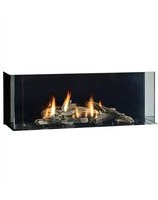
- Owners & Installation
- REGENCY®
- FIREPLACE PRODUCTS
- Panorama® PG36 Gas Log Fireplace
- Manual
- LISTINGS AND CODE APPROVALS
- FireGenie™
- PLEASE KEEP THESE INSTRUCTIONS FOR FUTURE REFERENCE
- TO THE NEW OWNER:
- PAIRING YOUR REMOTE CONTROL
- WARNING
- RELEASE
- table of contents
- Safety
- Installation
- Operating Instructions
- Maintenance
- Parts
- WARNING!
- Regency Gas Fireplace
- Important Message SAVE THESE INSTRUCTIONS
- Before You Start
- General Safety Information
- Installation Checklist
- This Includes:
- Locating Your Fireplace
- Clearances
- PACKAGING:
- Combustible Mantels
- Mantel Leg Clearances
- Framing and Finishing
- NOTE:
- Unit Assembly Prior to Installation
- Top Standoff Assembly
- Premium Flush Front Spacer Installation
- Flueing Introduction
- Note: These flue pipes must not be connected to any other appliance.
- NOTES:
- Flueing
- Regency® Direct Vent System (Flex)
- Horizontal Terminations Only
- Horizontal or Vertical Terminations
- Simpson Dura-vent Flueing
- Flueing Arrangements - Horizontal Terminations
- Simpson Dura-Vent Direct Flue GS System and
- Regency® Direct Flue System (Flex) (Propane & NG)
- Vent Restrictor Installation
- Regency® Co-axial Flue System (Flex) (Propane & NG)
- Flueing Arrangements - Vertical Terminations
- Simpson Dura-Vent Co-axial Flue GS System (Propane & NG)
- Direct Flue Zero Clearance Top Exit Vertical Flue Kit Installation Instructions
- SUPPLIED MIII-PAC SEALANT MUST BE USED OR WARRANTY WILL BEVOID – IF REQUIRED, MORE SEALANT CAN BE PURCHASED USING PART NUMBER 948-128
- SCREWS SUPPLIED FOR INNER FLUE CONNECTION
- Horizontal Terminations
- Vertical Terminations
- Gas Connection
- Gas Pipe Pressure Testing
- SIT 845 Valve Description
- Aeration Adjustment
- THIS CONVERSION MUST BE DONE BY A QUALIFIED GAS FITTER IF IN DOUBT DO NOT DO THIS CONVERSION!!
- Propane Conversion Kit Contains:
- Qty. Part # Description
- Log Set Installation
- Standard Flush Door
- Flush Louvres
- Premium Flush Front Installation
- Wiring Diagram
- Remote Control
- Lighting Instructions
- Resetting the Unit
- Shutdown Instructions
- First Fire
- DO NOT ATTEMPT TO CLEAN THE GLASS WHILE IT IS STILL HOT!
- DO NOT BURN THE APPLIANCE WITHOUT THE GLASS FRONT IN PLACE.
- Adjusting Flame Height
- Summary of Controls
- On/Off Button
- Flame:
- Fan:
- Pilot Adjustment
- Normal Operating Sounds of Gas Appliances
- Blower:
- Burner Tray:
- Gas Control Valve:
- Unit Body/Firebox:
- WARNING:
- FOR YOUR SAFETY READ BEFORE LIGHTING
- SUITABLE ONLY FOR INDOOR INSTALLATION
- TO TURN OFF GAS APPLIANCE
- DO NOT REMOVE THIS INSTRUCTION PLATE
- Maintenance Instructions
- General Flue Maintenance
- Log Replacement
- Glass Gasket
- Flush Glass Replacement
- Door Glass
- Removing Valve Tray
- Fan Replacement
- Manual Control Switch Replacement
- Troubleshooting Guide
- Gas Maintenance - Recommended Annual Routine
- Clean
- Inspect
- Check
- Gas Leak Tests
- Electronic Components Parts List
- parts list
- Main Assembly
- Part # Description
- Burner Assembly & Log Set
- Premium Flush Front Assembly
- Limited Lifetime Warranty
- Conditions:
- Exclusions:
- warranty
- Limitations of Liability:
- Exclusion of implied terms
- Limitation of liability
- Limitation of liability under Australian Consumer Law Guarantees
- Subject to Change
- Severability
- Definitions
- How to Obtain Warranty Service:
- Fireplace Products Australia Pty Ltd
- Air Group Australia
- Aber Holdings Ltd
- Product Registration and Customer Support:
- notes
Brand : Regency
Model : Panorama PG36LP-6
Category : Heating