FP93E - Monitor BENQ - Free user manual and instructions
Find the device manual for free FP93E BENQ in PDF.


User questions about FP93E BENQ
0 question about this device. Answer the ones you know or ask your own.
Ask a new question about this device
Download the instructions for your Monitor in PDF format for free! Find your manual FP93E - BENQ and take your electronic device back in hand. On this page are published all the documents necessary for the use of your device. FP93E by BENQ.
USER MANUAL FP93E BENQ
19.0" LCD Panel Size
User Manual
Welcome
Copyright
Copyright © 2006 by BenQ Corporation. All rights reserved. No part of this publication may be reproduced, transmitted, transcribed, stored in a retrieval system or translated into any language or computer language, in any form or by any means, electronic, mechanical, magnetic, optical, chemical, manual or otherwise, without the prior written permission of BenQ Corporation.
Disclaimer
BenQ Corporation makes no representations or warranties, either expressed or implied, with respect to the contents hereof and specifically disclaims any warranties, merchantability or fitness for any particular purpose. Further, BenQ Corporation reserves the right to revise this publication and to make changes from time to time in the contents hereof without obligation of BenQ Corporation to notify any person of such revision or changes.
Please follow these safety instructions for best performance, and long life for your monitor
Power Safety
- The AC plug isolates this equipment from the AC supply.
- The power supply cord serves as a power disconnect device for pluggable equipment. The socket outlet should be installed near the equipment and be easily accessible.
- This product should be operated from the type of power indicated on the marked label. If you are not sure of the type of power available, consult your dealer or local power company.
Care And Cleaning
- Cleaning. Always unplug your monitor from the wall outlet before cleaning. Clean the LCD monitor surface with a lint-free, non-abrasive cloth. Avoid using any liquid, aerosol or glass cleaners.
- Slots and openings on the back or top of the cabinet are for ventilation. They must not be blocked or covered. Your monitor should never be placed near or over a radiator or heat source, or in a built-in installation unless proper ventilation is provided.
- Never push objects or spill liquid of any kind into this product.
Servicing
- Do not attempt to service this product yourself, as opening or removing covers may expose you to dangerous voltages or other risks. If any of the above mentioned misuse or other accident such as dropping or mishandling occurs, contact qualified service personnel for servicing.
Table of Contents
Getting started 4
Getting to know your monitor ....6
Front view 6
Back view ....6
How to assemble your monitor hardware ....7
Viewing angle adjustment 10
Storing the monitor 10
Getting the most from your BenQ monitor 11
How to install the monitor on a new computer ....12
How to upgrade the monitor on an existing computer ....13
How to install on Windows XP system 14
How to install on Windows 2000 system ....16
How to complete the Windows Upgrade Device Driver Wizard 17
How to adjust the screen resolution 19
How to adjust the screen refresh rate 20
Picture optimization 21
How to adjust your monitor 22
The control panel 22
On Screen Display (OSD) menu structure 23
Hot key mode 24
Main menu mode 25
Troubleshooting 34
Frequently asked questions (FAQ) 34
Need more help? 35
Supported PC Timings 36
Specifications 37
1. Getting started
When unpacking please check you have the following items. If any are missing or damaged, please contact the place of purchase for a replacement.
| BenQ LCD Monitor |  |
| Quick Start Guide | 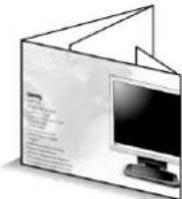 |
| CD-ROM |  |
| Power Cord |  |
| Signal Cable: D-Sub | 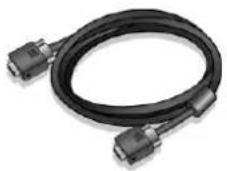 |
| Signal Cable: DVI-D (optional) | 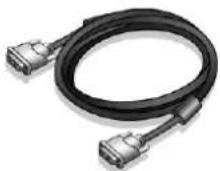 |
| Audio Cable |  |

Consider keeping the box and packaging in storage for use in the future when you may need to transport the monitor. The fitted foam packing is ideal for protecting the monitor during transport.
2. Getting to know your monitor
Front view
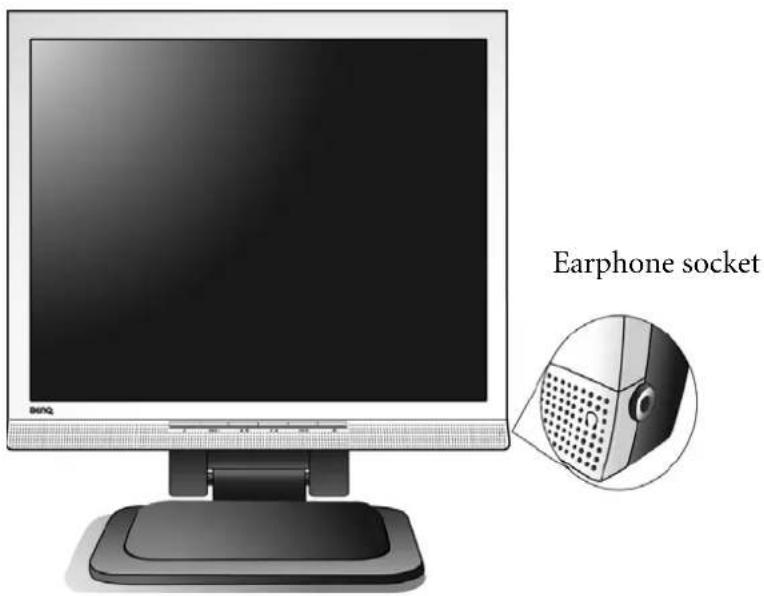
text_image
Earphone socketBack view
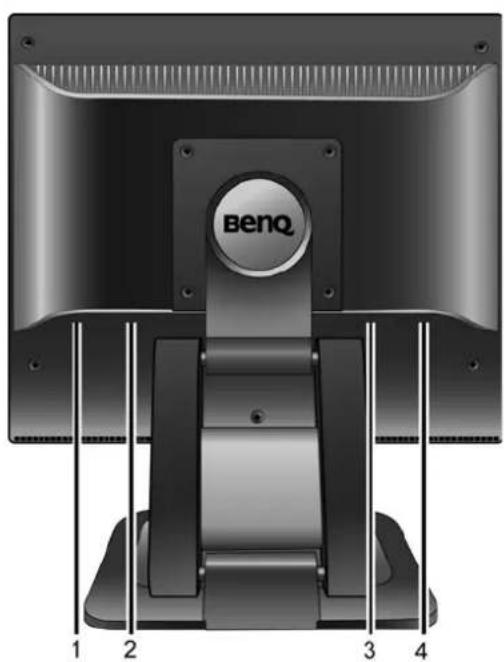
natural_image
Technical diagram of a BenQ computer monitor with labeled parts (1-4), showing internal components and mounting brackets (no text beyond label)- Audio cable socket
- Power AC input jack
- DVI-D input socket
- D-Sub input socket
3. How to assemble your monitor hardware

If the computer is turned on you must turn it off before continuing. Do not plug-in or turn-on the power to the monitor until instructed to do so.
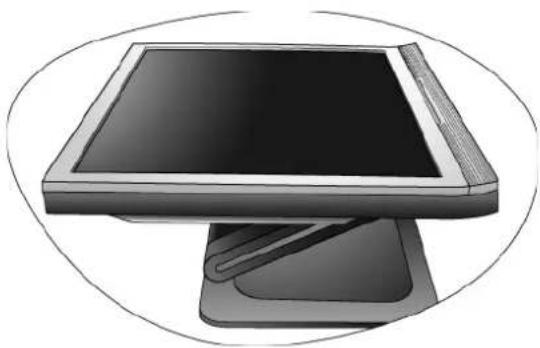
- Unpack the monitor and place the monitor on the desk as illustrated before you cut the retaining strap.

Please be careful to prevent damage to the monitor. Placing the screen surface on an object like a stapler or a mouse will crack the glass or damage the LCD substrate voiding your warranty. Sliding or scraping the monitor around on your desk will scratch or damage the monitor surround and controls.
Protect the monitor and screen by clearing a flat open area on your desk and placing a soft item like the monitor packaging bag on the desk for padding.
- Adjust the viewing angle.
Lift the screen upward and then pull the screen forward until a clicking sound is heard.
For more information about the adjustment of the viewing angle, refer to "Viewing angle adjustment on page 10".

You should position the monitor and angle the screen to minimize unwanted reflections from other light sources.
natural_image
Illustration of a desktop computer monitor with a stand, enclosed in an oval frame (no text or symbols)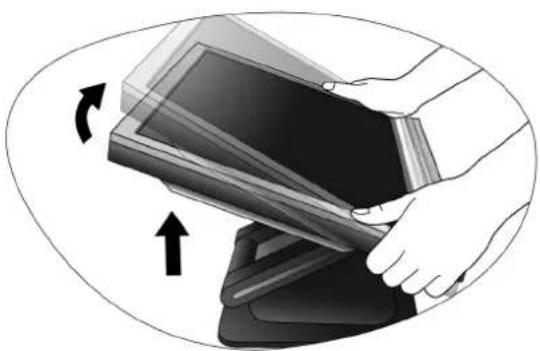
natural_image
Illustration of a hand holding a stack of books with arrows indicating rotation (no text or symbols)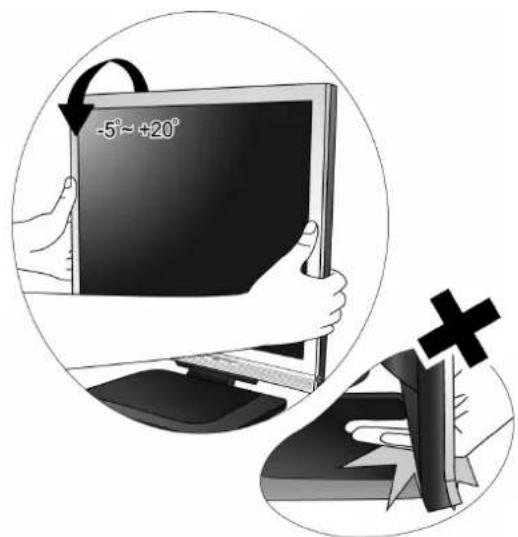
text_image
-5°~+20°3. Connect the PC video cable.

Do not use both DVI-D cable and D-Sub cable on the same PC. The only case in which both cables can be used is if they are connected to two different PCs with appropriate video systems.
Connect one end of the DVI-D cable to the monitor DVI-D socket and the other end to the DVI-D port on your computer. (optional)

The DVI-D format is used for direct digital connection between source video and digital LCD monitors or projectors. The digital video signals produce a superior quality picture than analog video signals.
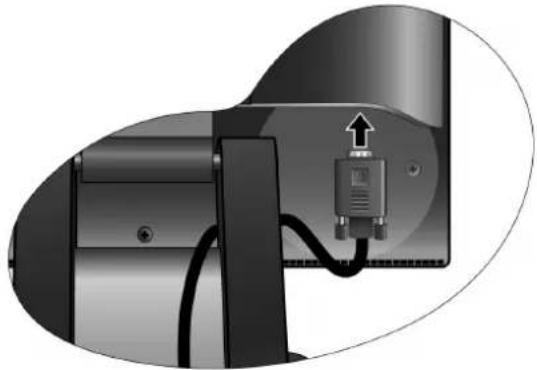
Connect the plug of the D-Sub cable (at the end without the ferrite filter) to the monitor D-Sub socket. Connect the other plug of the D-Sub cable (at the end with the ferrite filter) to the computer video D-Sub socket.
Tighten all finger screws to prevent the plugs from accidentally falling out during use.
4. Connect the audio cable.
Connect the audio cable between the socket on the rear of the monitor and your computer audio outlet.

If you wish, you may connect an earphone into the earphone socket located on the side panel of the monitor.
Either

natural_image
Diagram of a mechanical device with a central component and directional arrow, no visible text or symbolsOr
natural_image
Close-up of a mechanical device with a sensor or connector inserted, showing no visible text or symbols.
natural_image
Close-up of a mechanical device with a screw and cable inserted, showing internal components (no text or symbols visible)
natural_image
Diagram showing a device connected to a cable with an arrow indicating direction (no text or symbols present)- Connect the power cable to the monitor.
Plug one end of the power cord into the socket labelled 'POWER IN' on the rear of the monitor. Do not connect the other end to a power point just yet.

natural_image
Mechanical assembly diagram showing a cylindrical component inserted into a housing with a cable, no visible text or symbols- Turn on the power.
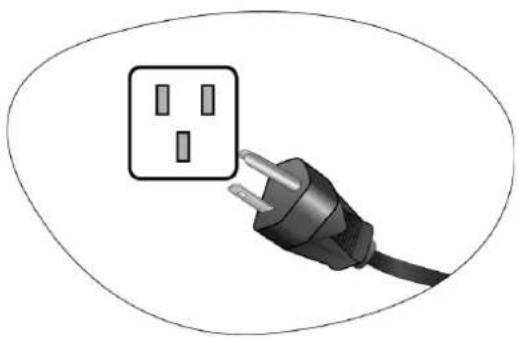
Plug the other end of the power cord into a power point and turn it on.
Turn on the monitor by pressing the power button on the front of the monitor.
Turn on the computer too, and follow the instructions in Section 4: Getting the most from your BenQ monitor on page 11 to install the monitor software.
natural_image
Illustration of a black electrical plug with three slots, connected to a square socket (no text or symbols)
text_image
ENTERViewing angle adjustment
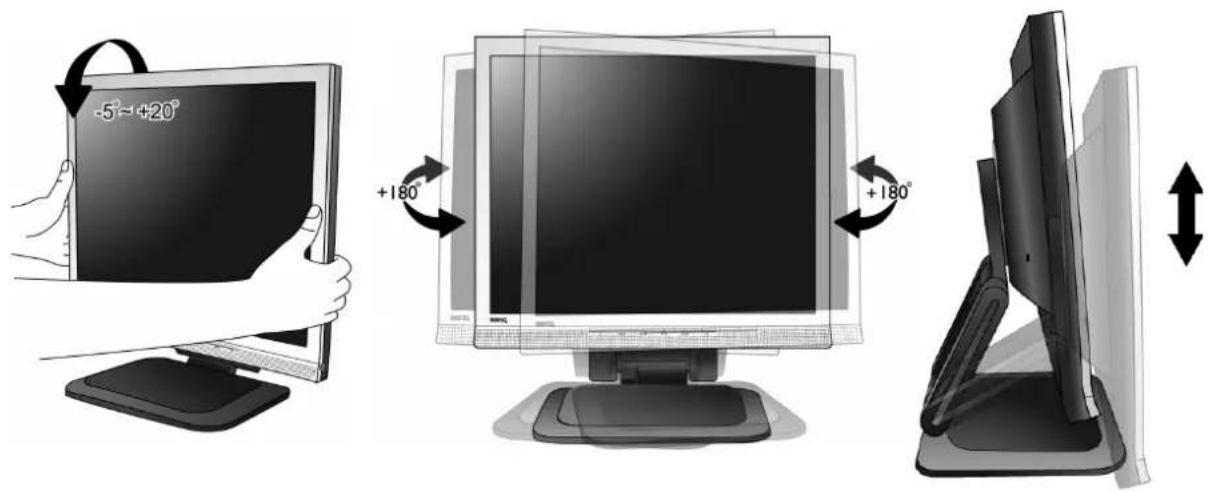
You may position the screen to the desired angle with -5^ to +20^ monitor tilt, 360^ monitor swivel, and 60 ~mm monitor height.
text_image
-5°~+20° +180° +180°Storing the monitor
If you need to store your monitor for an extended period of time, please unplug your monitor from the electric outlet and all connected cables before any action is taken. It is recommended to pack the monitor in its original equipment.
To pack the display itself
Hold the monitor base with your left hand and gently tilt the display backward with your right hand till the display reaches the second lock. Then push the display back to its place as illustrated.

natural_image
Illustration showing a hand holding a tablet device with directional arrows indicating movement (no text or symbols present)4. Getting the most from your BenQ monitor
To gain the most benefit from your new BenQ color LCD flat screen monitor, you should install the custom BenQ LCD Monitor driver software as provided on the BenQ LCD Monitor CD-ROM.
The circumstances under which you connect and install your BenQ LCD Monitor will determine which process you need to follow to successfully install the BenQ LCD Monitor driver software. These circumstances relate to which version of Microsoft Windows you are using, and whether you are connecting the monitor and installing the software onto a new computer (without existing monitor driver software), or whether you are upgrading an existing installation (which already has existing monitor driver software) with a newer monitor.
In either case however, the very next time you turn on your computer (after connecting the monitor to your computer), Windows will automatically recognise the new (or different) hardware, and will launch its Found New Hardware wizard.
Follow the wizard instructions until it asks you to select a monitor model. At that point, click the Have Disk button, insert the BenQ LCD Monitor CD-ROM and select the appropriate monitor model. Further details and step-by-step instructions for both an automatic (new) or upgrade (existing) installation follow. See:
- How to install the monitor on a new computer on page 12.
- How to upgrade the monitor on an existing computer on page 13
If you require a User Name and Password to login to your Windows computer, you must be logged on as an Administrator or as a member of the Administrators group in order to install the monitor driver software. Furthermore, if your computer is connected to a network which has security access requirements, network policy settings may prevent you from installing software on your computer.
How to install the monitor on a new computer
This instruction details the procedure for selecting and installing the BenQ LCD Monitor driver software on a new computer which has never had a monitor driver installed before. This instruction is only suitable for a computer which has never been used before, and for which the BenQ LCD Monitor is the first ever monitor to be connected to it.
If you are adding the BenQ LCD Monitor to an existing computer that has already had another monitor connected to it (and has monitor driver software installed), you should not be following these instructions. You should instead be following the instructions for How to upgrade the monitor on an existing computer.
-
Follow the instructions in How to assemble your monitor hardware on page 7. When Windows (2000 or later) starts, it will automatically detect the new monitor and launch the Found New Hardware Wizard. Follow the prompts until it displays the option to Install Hardware Device drivers.
-
Insert the BenQ LCD Monitor CD-ROM into a CD drive on the computer.
-
Check Search for a suitable driver for my device option, and click Next.
-
Check the option for CD-ROM drives (unchecked all others) and click Next.
-
Look to confirm that the wizard has selected the correct name of your monitor as "BenQ FP93E" and click Next.
-
Click Finish.
-
Restart the computer.
How to upgrade the monitor on an existing computer
This instruction details the procedure for manually updating the existing monitor driver software on your Microsoft Windows computer. It is currently tested as compatible (and recommended only) for Windows 2000 and Windows XP Operating System (OS).
The BenQ LCD Monitor driver for your model may well function perfectly with other versions of Windows, however, as at the time of writing, BenQ has done no testing of this driver on other versions of Windows and cannot guarantee its operation on those systems.
Installing monitor driver software involves selecting an appropriate information file (.inf) on the BenQ LCD Monitor CD-ROM for the particular model monitor you have connected, and letting Windows install the corresponding driver files from the CD. You need only steer it in the right direction. Windows has an Upgrade Device Driver Wizard to automate the task and guide you through the file selection and installation process.
See:
• How to install on Windows XP system on page 14.
• How to install on Windows 2000 system on page 16.
How to install on Windows XP system
1. Open Display Properties.
The quickest shortcut to Display Properties is through the Windows desktop.
Right-click the desktop and select Properties from the popup menu.
Alternatively, the Windows menu to Display Properties is located in Control Panel.
In Windows XP version, Control Panel is located directly under the main Start menu item.
The menu options displayed will depend upon which type of view is selected for your system.
• Under the Classic view, click Start | Control Panel | Display.
- Under the Category view, click Start | Control Panel | Appearance and Themes | Change the screen resolution.
The Display Properties window will display.
2. Click the Settings tab and the Advanced button.
The Advanced Display Properties window will display.
3. Click the Monitor tab and select the 'Plug and Play Monitor' from the list.
If there is only one monitor in the list, it will already be selected for you.
4. Click the Properties button.
The Monitor Properties window will display.
If the driver provider is listed as BenQ, and the model matches that of your new monitor, the proper drivers are already installed, and you need do nothing further. Cancel out of these property windows.
However, if BenQ is not listed as the manufacturer, or the correct model is not currently shown, you will need to continue with these instructions.
5. Click the Driver tab and the Update Driver button.
The Hardware Update Wizard will display. Follow the wizard instructions noting the steps below:
6. Insert the BenQ LCD Monitor CD-ROM into a CD drive on the computer you attached the monitor to.
7. Check the option 'Install from a list or specific location' and click Next.
8. Check the option 'Search for the best driver in these locations' and also check 'Search removable media', then click Next.
Please wait while the wizard searches for drives and the BenQ LCD Monitor CD inserted in step 6. When complete, the wizard should have found and selected the BenQ driver on the CD appropriate to your monitor model, in this case 'BenQ FP93E' in the location 'd:\driver\BenQFP93E.inf' or similar.
The drive letter for your CD drive may differ from the example above depending upon your system – it may be 'D:' or 'E:' or 'F:' etc.
9. Select (single-click) the file named 'BenQ FP93E' on the CD, and click the Next button.
This will copy and install the appropriate monitor driver files to your computer.
10. Click Finish.
This will close the wizard and return you to the Monitor Properties window, now renamed BenQ FP93E Properties.
11. Click Close, OK, and OK.
This will close the Display Properties windows. You do not need to restart Windows XP, as the BenQ LCD monitor drivers will operate immediately with no further action required by you.
How to install on Windows 2000 system
You do not need to follow this instruction if you are installing onto a computer which has a Windows XP (or later) version system. In that case, see the instructions at How to install on Windows XP system on page 14.
- Open Display Properties.
The quickest shortcut to Display Properties is through the Windows desktop.
Right-click the desktop and select Properties from the popup menu.
Alternatively, the Windows menu to Display Properties is located in Control Panel.
In Windows 2000 version, Control Panel is located under the Settings menu item.
Click Start | Settings | Control Panel | Display.
The Display Properties window will display.
- Click the Settings tab and the Advanced button.
The Advanced Display Properties window will display.
- In Windows 2000, click the Monitor tab and the Properties button.
The Monitor Properties window will display.
- In Windows 2000, click the Driver tab and the Update Driver button.
The Upgrade Device Driver Wizard will display.
See How to complete the Windows Upgrade Device Driver Wizard on page 17.
How to complete the Windows Upgrade Device Driver Wizard
-
Load the BenQ LCD Monitor CD-ROM which came with your monitor.
Insert the CD-ROM into a CD drive on the computer you attached the monitor to.
The autorun User's Guide language selection page will display in your web browser.
You can select a language and view the online version of this manual from the next window.
You could then print it out for reference if you wish to work off-line. When you're ready, Cancel the browser as it is not required for the Windows Upgrade Device Driver Wizard. -
Launch the Windows Upgrade Device Driver Wizard and click Next.
-
Check the option 'Display a list of known drivers...' and click Next.
-
Click the Have Disk button.
The Install From Disk window will display.
- Click the Browse button and navigate to the BenQ LCD Monitor CD-ROM.
This is the CD you loaded in step 1 above. The CD Drive will have a Windows designated drive letter (like D: or E: or F:). Select the drive letter corresponding to the drive you put the CD into.
- Double-click the folder labelled 'Driver'.
The contents of the 'Driver' folder will display.
- Click the Open button.
This will return you to the Install from Disk window, and it will have entered the address to the BenQ LCD Monitor CD 'Driver' folder into the field titled 'Copy manufacturer's files from:'.
The field will contain something like, "D:\Driver", or "E:\Driver", or "F:\Driver".
- Click the OK button.
This will return you to the Upgrade Device Driver Wizard.
-
Select (single-click) the file named BenQ FP93E, and click the Next button.
-
Click Next.
This will copy the appropriate monitor driver files to your computer.
- Click Finish.
On Windows 2000, this will close the wizard and return you to the Monitor Properties window, now renamed 'BenQ FP93E Properties'.
Should you wish to do so, this is where you can change the screen refresh rate and other monitor properties to suit your needs. See How to adjust the screen refresh rate on page 20 for details.
- In Windows 2000, click Close.
This will close the BenQ FP93E Properties window and return you to the Advanced Display Properties window.
- In Windows 2000, click OK.
This will close the Advanced Display Properties window, and return you to the Display Properties window.
Should you wish to do so, this is where you can change the screen resolution (area and color).
See How to adjust the screen resolution on page 19 for details.
14. Click OK.
This will close the Display Properties window, and if you made any changes to the screen resolution, Windows 2000 will prompt you for confirmation to effect the changes, and further confirmation to accept the changes. Click OK and Yes respectively.
5. How to adjust the screen resolution
Due to the nature of liquid crystal display (LCD) technology, the screen resolution is always fixed. The best possible picture for your FP93E is achieved with a resolution of 1280 x 1024. This is called “Native Resolution” or maximal resolution – that is, the clearest picture. Lower resolutions are displayed on a full screen through an interpolation circuit. Image blurring across pixel boundaries can occur with the interpolated resolution depending upon the image type and its initial resolution.
To take full advantage of LCD technology you should select the native resolution setting of 1280 x 1024.
- Open Display Properties and select the Settings tab. You can open Display Properties by right-clicking on the Windows desktop and selecting Properties from the pop-up menu.
- Use the slider in the 'Screen area' section to adjust the screen resolution. Select the recommended resolution of 1280 x 1024 then click Apply.

If you select some other resolution, be aware that this other resolution is interpolated and may not accurately display the screen image as well as it could do at the native resolution setting.
- Click OK then Yes.
- Close the Display Properties window.
6. How to adjust the screen refresh rate
You don't have to choose the highest possible refresh rate on an LCD display, because it is not technically possible for an LCD display to flicker. The best results are obtained by using the factory modes already set in your computer. There is a table with the factory modes in the specification section of this User's Manual: Supported PC Timings on page 36

You can choose 60, 70 and 75 Hertz, (but not 72Hz) for the native resolution of 1280 x 1024.
- Double click the Display icon in Control Panel.
- From the Display Properties window, select the Settings tab and click the Advanced button.
-
Select the Adapter tab, and select an appropriate refresh rate to match one of the applicable factory modes as listed in the specification table.
-
Click Change, OK, then Yes.
-
Close the Display Properties window.
7. Picture optimization
The easiest way to obtain an optimal display from an analog (D-Sub) input is to use the i key function. Press the i key to optimize the currently displayed image to the screen.

When you connect a digital video output using a digital (DVI) cable to your monitor, the i key and the Auto Adjustment function will be disabled, because the monitor will automatically display the best image.

Please ensure that the connected graphic card on your computer is set to the native resolution of the monitor (1280 x 1024) when you use the i key function.
If you wish, you can always adjust the screen geometric settings manually using geometry menu items. To assist you in this endeavour, BenQ has provided a screen test image utility which you can use to check for screen color, grayscale and line gradient display.
-
Run the test program auto.exe from CD-ROM. You could also use any other image, such as the desktop of your operating system. However, we recommend that you use auto.exe. As you run auto.exe, a test pattern displays.
-
Press the i key on the monitor.
-
Press the MENU key to access the monitor On-Screen Display (OSD) menu.
-
Use the ◀ or ▶ keys to select DISPLAY and press the ENTER key to enter the menu.
-
If you notice a vertical noise (like a curtain effect-shimmering of vertical lines), press the ◀ or ▶ keys to select Pixel Clock and press the ENTER key. Then press the ◀ or ▶ keys to adjust the monitor until the noise disappears.
-
If you notice a horizontal noise, press the ◀ or ▶ keys to select Phase and press the ENTER key. Then press the ◀ or ▶ keys adjust the monitor until the noise disappears.
8. How to adjust your monitor
The control panel
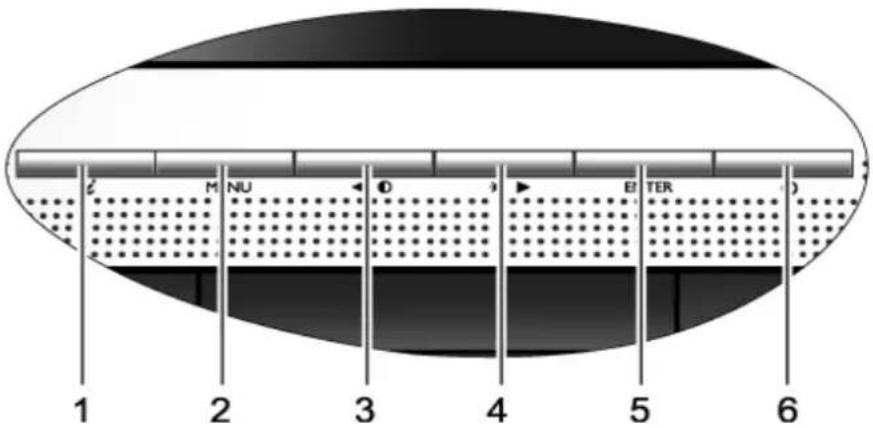
text_image
1 2 3 4 5 6 M NU O E' TER-
"ikey": Adjust vertical position, phase, horizontal position and pixel clock automatically.
-
"MENU" key: Activate OSD main menu and return to the previous menu or exit OSD.
-
(Left) key: For Left/Decrease adjustment. Left key is the hot key for Contrast.
-
▶ (Right) key: For Right/Increase adjustment. Right key is the hot key for Brightness.
-
"ENTER" key: Enter sub menus and select items.
-
"Power": Turn the power on or off.

OSD = On Screen Display.
The hot-keys will display a graduated scale for adjusting the value of that setting, and will only operate whilst the OSD menu is not currently displaying. Hot-key displays will disappear after a few seconds of no key activity. See Hot key mode on page 24.
On Screen Display (OSD) menu structure
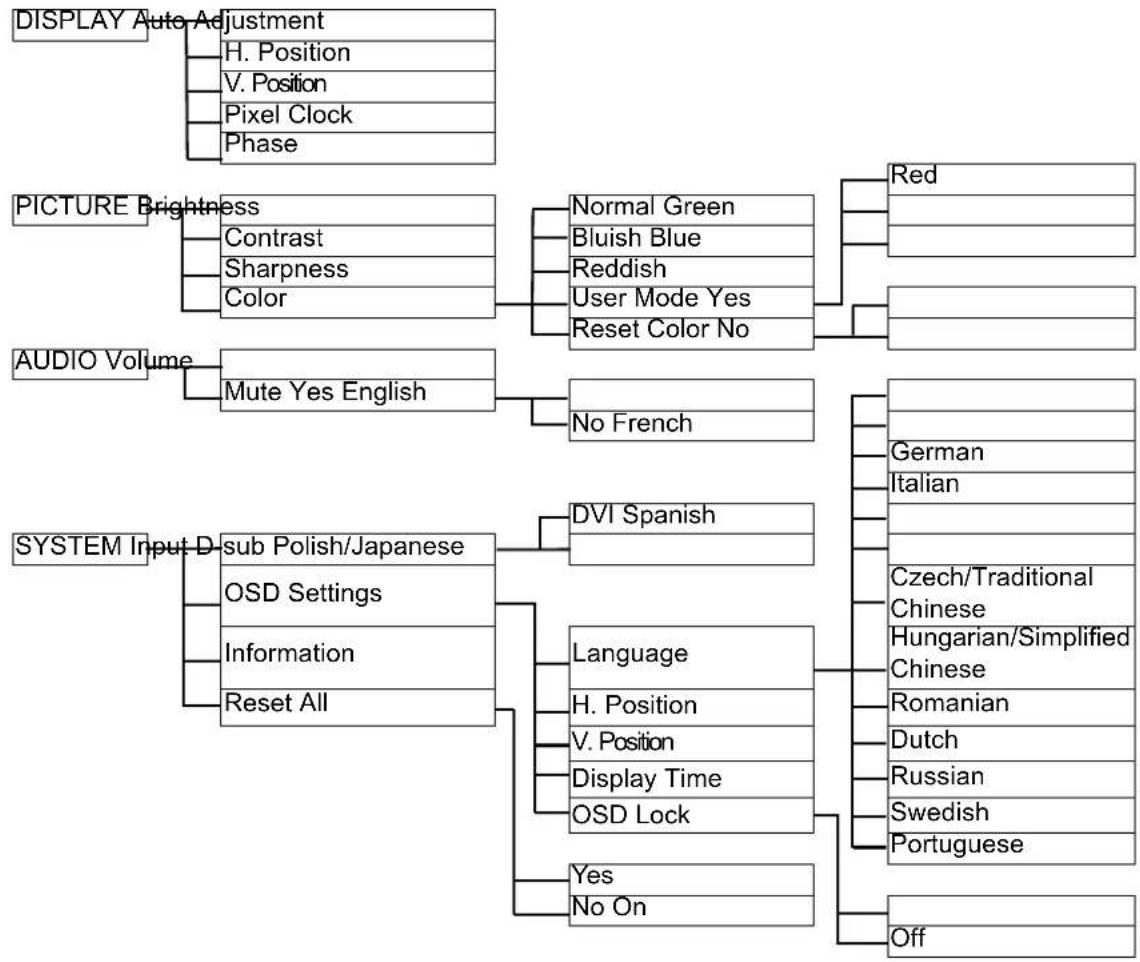
flowchart
graph TD
    A["DISPLAY Auto Adjustment"] --> B["H. Position"]
    A --> C["V. Position"]
    A --> D["Pixel Clock"]
    A --> E["Phase"]

    F["PICTURE Brightness"] --> G["Contrast"]
    F --> H["Sharpness"]
    F --> I["Color"]

    J["AUDIO Volume"] --> K["Mute Yes English"]
    K --> L["No French"]

    M["SYSTEM Input D"] --> N["sub Polish/Japanese"]
    N --> O["OSD Settings"]
    N --> P["Information"]
    N --> Q["Reset All"]

    R["TYPE"] --> S["Normal Green"]
    R --> T["Bluish Blue"]
    R --> U["Reddish"]
    R --> V["User Mode Yes"]
    R --> W["Reset Color No"]

    X["TYPE"] --> Y["German"]
    X --> Z["Italian"]

    AA["TYPE"] --> AB["Czech/Traditional Chinese"]
    AA --> AC["Hungarian/Simplified Chinese"]
    AA --> AD["Romanian"]
    AA --> AE["Dutch"]
    AA --> AF["Russian"]
    AA --> AG["Swedish"]
    AA --> AH["Portuguese"]

    AI["TYPE"] --> AJ["Yes"]
    AI --> AK["No On"]

    AL["TYPE"] --> AM["Off"]
Hot key mode
The monitor keys perform as hotkeys to provide direct access to particular functions whenever the menu isn't currently displaying on-screen.
Brightness hot key
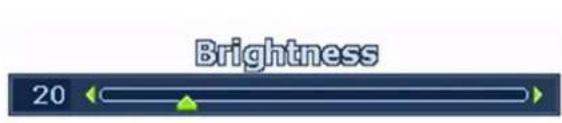
text_image
Brightness 20Press the ▶ key to display the Brightness indicator. Further press the ▶ key to increase or the ◀ key to decrease the screen brightness, and press the MENU key to exit.
Contrast hot key

text_image
Contrast 20Press the ◀ key to display the Contrast indicator. Further press the ▶ key to increase or the ◀ key to decrease the screen contrast, and press the MENU key to exit.
Volume hot key

text_image
Volume 20Press the ENTER key to enter the Volume indicator. Further press the ◀ key to increase or the ◀ key to decrease the volume, and press the MENU key to exit.
Main menu mode
You can use the OSD (On Screen Display) menu to adjust all the settings on your monitor. Press the MENU key to display the following main OSD menu.
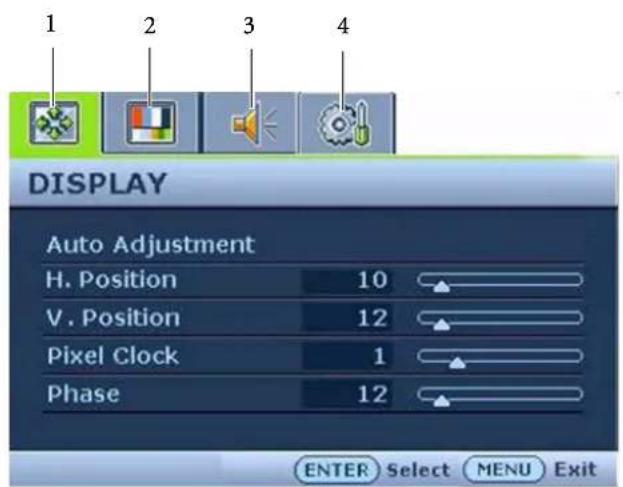
text_image
1 2 3 4 DISPLAY Auto Adjustment H. Position 10 V. Position 12 Pixel Clock 1 Phase 12 ENTER Select MENU ExitThere are four main OSD menus:
- Display
- Picture
- Audio
- System
Use the ◀ (left) or ▶ (right) keys to highlight a menu item, and press the ENTER key to enter the Menu item settings.

There are 14 different menu languages, see "Language on page 32" under "OSD Settings" for more details.
For more information on each menu, please refer to the following pages:
• Display menu on page 26
• Picture menu on page 28
• Audio menu on page 30
• System menu on page 31
Display menu
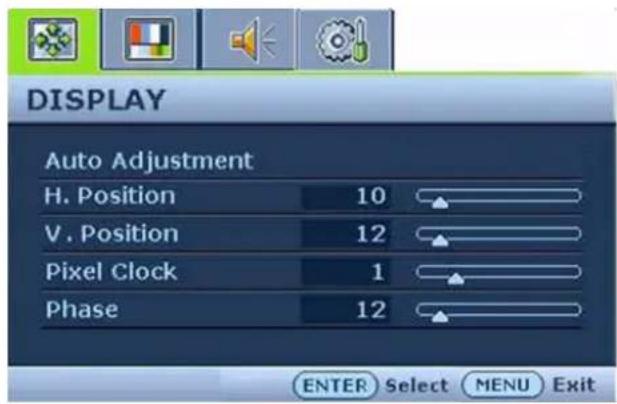
text_image
DISPLAY Auto Adjustment H. Position 10 V. Position 12 Pixel Clock 1 Phase 12 ENTER Select MENU Exit- Press the MENU key to display the main menu.
- Press the ◀ or ▶ keys to select DISPLAY and then press the ENTER key to enter the menu.
- Press the ◀ or ▶ keys to move the highlight to a menu item and then press the ENTER key to select that item.
- Press the ◀ or ▶ keys to make adjustments or selections.
- To return to the previous menu, press the MENU button.
| Item Function Operation Range | |||
| Auto Adjustment | Optimizes and adjusts the screen settings automatically for you. The i key is a ‘hot-key’ for this function.When you connect a digital video output using a digital (DVI) cable to your monitor, the i key and the Auto Adjustment function will be disabled. | Press the ENTER key to select this option and make adjustment. | |
| H. Position Adjusts the horizontal position of the screen image. | Press the ◀ or ► keys to adjust the value. | 0 to 100 |
| V. Position Adjusts the vertical position of the screen image. | 0 to 100 | |
| Pixel Clock Adjusts the pixel clock frequency timing to synchronise with the analog input video signal. Not applicable to a digital input signal.See also: Picture optimization on page 21 | 0 to 100 | |
| Phase Adjusts the pixel clock phase timing to synchronise with the analog input video signal. Not applicable to a digital input signal.See also: Picture optimization on page 21 | 0 to 63 |
Picture menu
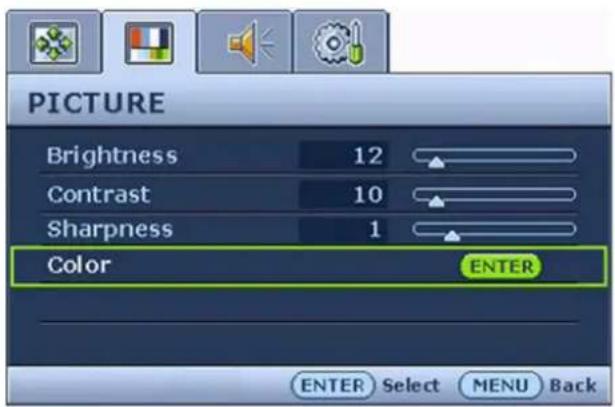
text_image
PICTURE Brightness 12 Contrast 10 Sharpness 1 Color ENTER ENTER Select MENU Back- Press the MENU key to display the main menu.
- Press the ◀ or ▶ keys to select PICTURE and then press the ENTER key to enter the menu.
- Press the ◀ or ▶ keys to move the highlight to a menu item and then press the ENTER key to select that item.
- Press the ◀ or ▶ keys to make adjustments or selections.
- To return to the previous menu, press the MENU button.
| Item Function Operation Range | |||
| Brightness Adjusts the balance between light and dark shades. | Press the ► key to increase the brightness and press the ◀ key to decrease the brightness. | 0 to 100 | |
| Contrast Adjusts the degree of difference between darkness and lightness. | Press the ► key to increase the contrast and press the ◀ key to decrease the contrast. | 0 to 100 | |
| Sharpness Adjusts the clarity and visibility of the edges of the subjects in the image. | Press the ► key to improve the crispness of the display and press the ◀ key to have softness effect on the display. | 1 to 5 | |
| Color - Press ENTER to enter the Color menu. | |||
| Normal Allows | video and still photographs to be viewed with natural coloring. This is the factory default color. | Press the ◀ or ▶ keys to select this option. | |
| Bluish Applies a | cool tint to the image and is factory pre-set to the PC industry standard white color. | ||
| Reddish Applies | a warm tint to the image and is factory pre-set to the news print standard white color. | ||
| User Mode Tailors | the image color tint. The blend of the Red, Green and Blue primary colors can be altered to change the color tint of the image. The default start setting is 50. Decreasing one or more of the colors will reduce their respective influence on the color tint of the image. e.g. if you reduce the Blue level the image will gradually take on a yellowish tint. If you reduce Green, the image will become a magenta tint. | Press the ◀ or ▶ keys and the ENTER key to select Red, Green, or Blue. Then use the ◀ or ▶ keys to make the color adjustments. | • Red(0 to 100)• Green(0 to 100)• Blue(0 to 100) |
| Reset Color Resets | the User Mode custom color settings to the factory defaults. | Press the ◀ or ▶ keys to adjust the value. | • YES• NO |
Audio menu

text_image
AUDIO Volume 10 Mute OFF ENTER Adjust MENU Back-
Press the MENU key to display the main menu.
-
Press the ◀ or ▶ keys to select AUDIO and then press the ENTER key to enter the menu.
-
Press the ◀ or ▶ keys to move the highlight to a menu item and then press the ENTER key to select that item.
-
Press the ◀ or ▶ keys to make adjustments or selections.
-
To return to the previous menu, press the MENU button.
| Item Function Operation Range | |||
| Volume Adjusts | the level of volume. | Press the ▶ key to increase the volume and press the ◀ key to decrease the volume. | 0 to 100 |
| Mute Mutes the | audio input. | Press the ◀ or ▶ keys to adjust the value. | • ON• OFF |
System menu
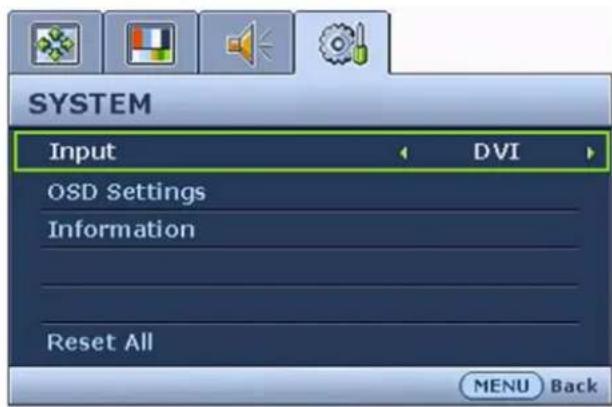
text_image
SYSTEM Input DVI OSD Settings Information Reset All MENU Back-
Press the MENU key to display the main menu.
-
Press the ◀ or ▶ keys to select SYSTEM and then press the ENTER key to enter the menu.
-
Press the ◀ or ▶ keys to move the highlight to a menu item and then press the ENTER key to select that item.
-
Press the ◀ or ▶ keys to make adjustments or selections.
-
To return to the previous menu, press the MENU button.
| Item Function Operation Range | |||
| Input Selects the | D-sub (analog)or DVI (digital) input. Use this to change the input to that appropriate to your video cable connection type. | Press the ◀ or ▶ keys to adjust the value. | • DVI• D-sub |
| OSD Settings - Press ENTER to enter the OSD Settings menu. | |||
| Language Sets the OSD menu language. | Press the◀or▶keys to adjust the value.The language options displayed on your OSD may differ from those shown on the right, depending on the product supplied in your region. | ·English·French·German·Italian·Spanish·Polish/Japanese·Czech/Traditional Chinese·Hungarian/Simplified Chinese·Serbo-Croatian·Romanian·Dutch·Russian·Swedish·Portuguese |
| H. Position Adjusts the horizontal position of the OSD menu. | Press the◀or▶keys to adjust the value. | 0 to 100 |
| V. Position Adjusts the vertical position of the OSD menu. | 0 to 100 | |
| Display Time Adjusts the display time of the OSD menu. | ·5 sec.·10 sec.·15 sec.·20 sec.·25 sec.·30 sec. | |
| OSD Lock Prevents all the monitor settings from being accidentally changed. When this function is activated, the OSD controls and hotkey operations will be disabled. | Press the◀or▶keys to adjust the value.To unlock the OSD controls when the OSD is preset to be locked, press and hold the 'MENU' button for 15 seconds to enter the 'OSD Lock' option and make changes. | ·ON·OFF |
| Press MENU to leave the OSD Settings menu. | ||
| Information Displays the current monitor property settings. | Press the ENTER key to select this option. | |
| Reset All Resets | all mode, color and geometry settings to the factory default values. | Press the ◀ or ▶ keys to adjust the value. | • YES• NO |
9. Troubleshooting
Frequently asked questions (FAQ)
⑦ The image is blurred:
Read the How to adjust the screen resolution on page 19 section, and then select the correct resolution, refresh rate and make adjustments based on these instructions.
How do you use a VGA extension cable?
Remove the extension cable for the test. Is the image now in focus? If not, optimize the image by working through the instructions in the How to adjust the screen refresh rate on page 20 section It is normal for blurring to occur due to conduction losses in extension cables. You can minimize these losses by using an extension cable with better conduction quality or with a built-in booster.
Does the blurring only occur at resolutions lower than the native (maximum) resolution?
Read the How to adjust the screen resolution on page 19 section. Select the native resolution.
⑦ Pixel errors can be seen:
One of several pixels is permanently black, one or more pixels are permanently white, one or more pixels are permanently red, green, blue or another color.
- Clean the LCD screen.
- Cycle power on-off.
- These are pixels that are permanently on or off and is a natural defect that occurs in LCD technology.
⑦ The image has a faulty coloration:
It has a yellow, blue or pink appearance.
Select MENU > PICTURE > Color > Reset Color, and then choose "Yes" in the "Caution" message box to reset the color settings to the factory defaults.
If the image is still not correct and the OSD also has faulty coloration, this means one of the three primary colors is missing in the signal input. Now check the signal cable connectors. If any pin is bent or broken off, please contact your dealer to get necessary support.
⑦ No image can be seen:
Is the prompt on the display illuminated in green?
If the LED is illuminated in green and there is a message “Out of Range” on the screen, this means you are using a display mode that this monitor does not support, please change the setting to one of the supported mode. Please read “Supported PC Timings on page 36” section.
⑦ Faint shadow from the static image displayed is visible on the screen:
- Activate the power management function to let your computer and monitor go into a low power "sleep" mode when not actively in use.
- Use a screensaver to prevent the occurrence of image retention.
⑦ Is the prompt on the display illuminated in orange?
If the LED is illuminated in orange, the power management mode is active. Press any button on the computer keyboard or move the mouse. If that does not help, check the signal cable connectors. If any pin is bent or broken off, please contact your dealer to get necessary support.
Is the prompt on the display not illuminated at all?
Check the power supply mains socket, the external power supply and the mains switch.
⑦ The image is distorted, flashes or flickers:
Read the How to adjust the screen resolution on page 19 section and then select the correct resolution, refresh rate and make adjustments based on these instructions.
⑦ The image is displaced in one direction:
Read the How to adjust the screen resolution on page 19 section and then select the correct resolution, refresh rate and make adjustments based on these instructions.
Need more help?
If your problems remain after checking this manual, please contact your place of purchase or e-mail us at: Support@BenQ.com
10. Supported PC Timings
| Incoming display mode (Input timing) | ||||
| Resolution Horizontal Frequency (KHz) | Vertical Frequency (Hz) | Pixel Frequency (MHz) | Comment | |
| 640 x 350 31.47(P) 70.08(N) 25.17 | DOS | |||
| 720 x 400 31.47(N) 70.08(P) 28.32 | DOS | |||
| 640 x 480 31.47(N) 60.00(N) 25.18 | DOS | |||
| 640 x 480 35.00(N) 67.00(N) 30.24 | Macintosh | |||
| 640 x 480 37.86(N) 72.80(N) 31.50 | VESA | |||
| 640 x 480 37.50(N) 75.00(N) 31.50 | VESA | |||
| 800 x 600 35.16(P) 56.25(P) 36.00 | VESA | |||
| 800 x 600 37.88(P) 60.32(P) 40.00 | VESA | |||
| 800 x 600 48.08(P) 72.19(P) 50.00 | VESA | |||
| 800 x 600 46.87(P) 75.00(P) 49.50 | VESA | |||
| 832 x 624 49.72(N) 74.55(N) 57.29 | Macintosh | |||
| 1024 x 768 48.36(N) 60.00(N) 65.00 | VESA | |||
| 1024 x 768 56.48(N) 70.10(N) 75.00 | VESA | |||
| 1024 x 768 60.02(P) 75.00(P) 78.75 | VESA | |||
| 1152 x 864 67.50(P) 75.00(P) 108.00 | VESA | |||
| 1152 x 870 68.68(N) 75.06(N) 100.00 | Macintosh | |||
| 1152 x 900 61.80(N) 66.00(N) 94.50 | SUN 66 | |||
| 1152 x 900 71.81(N) 76.14(N) 108.00 | SUN | |||
| 1280 x 1024 | 64.00(P) | 60.00(P) | 108.00 | VESA |
| 1280 x 1024 | 75.83(N) 71.53(N) | 128.00 | IBMI | |
| 1280 x 1024 | 80.00(P) | 75.00(P) | 135.00 | VESA |
| 1280 x 1024 | 81.18(N) | 76.16(N) | 135.09 | SPARC2 |
- Modes not listed in the table may not be supported. For an optimal picture, we recommended you choose a mode listed in the table above.
- There are 22 available modes that are compatible with Windows.
- Image disruption may occur as a result of signal frequency differences from graphic cards which do not correspond with the usual standard. This is not, however, an error. You may improve this situation by altering an automatic setting or by manually changing the phase setting and the pixel frequency from the “DISPLAY” menu.
- If you switch off the monitor, interference lines can occur on your screen. But do not be concerned about this, as it is normal.
- To extend the service life of the product, we recommend that you use your computer's power management function.
11. Specifications
BenQ FP93E
| Model FP93E | |
| Display type | 19.0", active, TFT |
| Viewable diagonal | 480 mm |
| Native (maximum) resolution | 1,280 x 1,024 |
| Colors | 16.2 million |
| Contrast / Brightness | 550:1 / 270 cd/m2 |
| Response time | 8 ms |
| Viewing angle (left/right, up/down) | 140, 135 (CR=10) |
| 160, 160 (CR=5) | |
| Line frequency | 31 - 81 kHz Multi- frequency monitor |
| Image frequency | 56 - 76 Hz modes within these parameters |
| Image diagnostics | Digital, OSD Technology, i key (automatic image setting) |
| Controls | 5 buttons and i key. |
| Functions | Contrast, brightness, vert. & hor. image position, phase, pixel clock, color balance, color palette, multiple-language OSD, OSD position, OSD lock, input selection |
| Power management | VESA DPMS, EPA |
| Max. power consumption | 50 Watt |
| Standby power consumption | < 1 Watt |
 This product comply with ENERGY STAR®Program Requirements Computer Monitors.Version 4.0 This product comply with ENERGY STAR®Program Requirements Computer Monitors.Version 4.0 | |
| Input signal | |
| PC | RGB analog 0.7 Vpp/75 Ohm positive |
| Speaker | Digital: DVI-D (optional) |
| Synchronization | 1 W x 2 |
| TTL separate signal connection 15-pin mini D-sub cable | |
| Temperature (operating) | 0 °C - 40 °C |
| Air humidity (operating) | 10% - 90% |
| Certifications TCO 03, TÜV/Ergonomics, TÜV/ GS, FCC ClassB, ISO 13406-2, VCCI, CB Report, CE, C-Tick, BSMI, Fimko, GOST, CSA, CCC, eK, MIC | |
| Operating voltage | Automatic switched mode power supply, 100-260 V, 50-60 Hz |
| Tilt (down/up) | -5° ~ +20° |
| Swivel (left/right) | 180°/180° |
| Height adjustment | 60 mm |
| Dimensions (H x W x D) | 429 x 409.2 x 222 mm |
| Weight | 6.79 kg |