D1420LF - Washing machine LG - Free user manual and instructions
Find the device manual for free D1420LF LG in PDF.


User questions about D1420LF LG
0 question about this device. Answer the ones you know or ask your own.
Ask a new question about this device
Download the instructions for your Washing machine in PDF format for free! Find your manual D1420LF - LG and take your electronic device back in hand. On this page are published all the documents necessary for the use of your device. D1420LF by LG.
USER MANUAL D1420LF LG
Please read this manual carefully before operating your dishwasher. Retain it for future reference.
You may also find user manual in video version at following link www.guidelg.com/dishwasher
Dishwasher
SAFETY AND CAUTION 3
INSTALLATION INSTRUCTIONS 5
PARTS NAME 9
FUNCTION OF CONTROL BUTTON 10
BEFORE USING FOR THE FIRST TIME 13
HOW TO USE AND OPERATE 15
IMPORTANT SAFETY INSTRUCTIONS

WARNING - When using your dishwasher, follow basic precautions, including the following:
- Please read this manual carefully before using the dishwasher for the first time.
- This manual contains very important notes regarding the installation, use and maintenance of your dishwasher.
- The manufacturer can not be responsible for problems caused by ignoring these safety and caution instructions.
- This dishwasher is designed for normal household use.
- Do not use the dishwasher for industrial and commercial use, or other purpose.
- The appliance is not intended for use by young children or infirm persons without supervision.
- Check packaging and dishwasher immediately for signs of transport damage. If the appliance is damaged, do not put it into use but contact your supplier without delay.
■ During installation
- Electrical connection must be in accordance with the rating label.
- Electrical safety is only guaranteed when the earth system of your house is in accordance with the related local regulations.(Do not use an extension cable or cord.)
- If the hot water exceeds 65^ , adjust the water heater setting. If the hot water temperature can not be maintained below 65^ , the dishwasher must be connected to cold water.
- If power supply cord is damaged, it must only be replaced by the manufacturer or its service agent or a similar qualified person in order to avoid a hazard.
- This appliance must be positioned so that the plug is accessible.
- The appliance is to be connected to the water mains using new hose-sets and that old hose-sets should not be reused.
■ During use
- Only suitable household utensils should be placed in the dishwasher.
(Please avoid utensils; that are non-heatresistant, metal decorated, etc.) - Do not use any kinds of solvent in your dishwasher. They may cause an explosion or fire.
- Do not spray water on the appliance. It may cause the failure of electric parts or electric shock.
- Do not push down or sit on the inner door when the door opened. It may cause the deformation or failure of your dishwasher.
- Do not use the detergent for hand washing. The detergent for dishwasher should be used for normal operation.
- This appliance is tted with a safety function that automatically stops the operation of the dishwasher when it is exposed to heavy disturbance on its mains.
- Dishwasher detergents are strongly alkaline. They can be extremely dangerous if swallowed. Avoid contact with skin and eyes and keep children away from the dishwasher when the door is open.
Check that the detergent receptacle is empty after completion of the wash cycle.
■ Child Safety
- Controls may be locked using “Child Lock” mode to prevent from all the setting from being changed by a child.
- Keep children away from detergents and rinse-aids.
- Do not allow children to operate the dishwasher.
- Young children should be supervised to ensure that they do not play with the appliance.
CAUTION concerning the Power Cord
Most appliances recommend they be placed upon a dedicated circuit; that is, a single outlet circuit which powers only that appliance and has no additional outlets or branch circuits. Check the speci cation page of this owner's manual to be certain.
Do not overload wall outlets. Overloaded wall outlets, loose or damaged wall outlets, extension cords, frayed power cords, or damaged or cracked wire insulation are dangerous. Any of these conditions could result in electric shock or re. Periodically examine the cord of your appliance, and if its appearance indicates damage or deterioration, unplug it, discontinue use of the appliance, and have the cord replaced with an exact replacement part by an authorized servicer.
Protect the power cord from physical or mechanical abuse, such as being twisted, kinked, pinched, closed in a door, or walked upon. Pay particular attention to plugs, wall outlets, and the point where the cord exits the appliance.
CAUTION The instructions shall state the substance of the following :
This appliance is not intended for use by persons (including children) with reduced physical, sensory or mental capabilities, or lack of experience and knowledge, unless they have been given supervision or instruction concerning use of the appliance by a person responsible for their safety.
Children should be supervised to ensure that they do not play with the appliance.
SAVE THESE INSTRUCTIONS
GROUNDING INSTRUCTIONS
This appliance must be grounded. In the event of a malfunction or breakdown, grounding will reduce the risk of electric shock by providing a path of least resistance for electric current. This appliance is equipped with a cord having an equipment-grounding conductor and a grounding plug. The plug must be plugged into an appropriate outlet that is installed and grounded in accordance with all local codes and ordinances.
WARNING - Improper connection of the equipment-grounding conductor can result in a risk of electric shock. Check with a qualified electrician or service representative if you are in doubt whether the appliance is properly grounded. Do not modify the plug provided with the appliance; if it will not fit the outlet have a proper outlet installed by a qualified electrician.
text_image
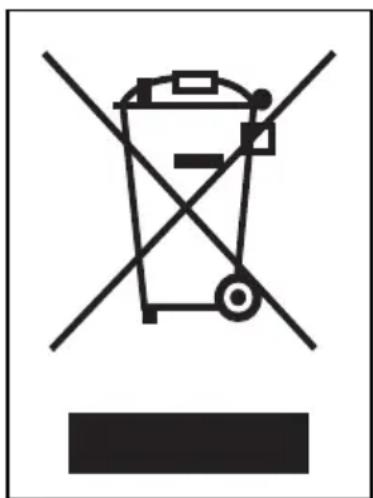
Prohibition sign depicting a trash bin crossed with a diagonal line, indicating no waste or discharge.Disposal of your old appliance
- When this crossed-out wheeled bin symbol is attached to a product it means the product is covered by the European Directive 2002/96/EC.
- All electrical and electronic products should be disposed of separately from the municipal waste stream via designated collection facilities appointed by the government or the local authorities.
- The correct disposal of your old appliance will help prevent potential negative consequences for the environment and human health.
- For more detailed information about disposal of your old appliance, please contact your city office, waste disposal service or the shop where you purchased the product.
I
INSTALLATION INSTRUCTIONS
WARNING
A qualified electrician/plumber or competent person should carry out any electrical/plumbing work required to install this appliance.
Step 1 :
PREPARE CUPBOARD OPENING
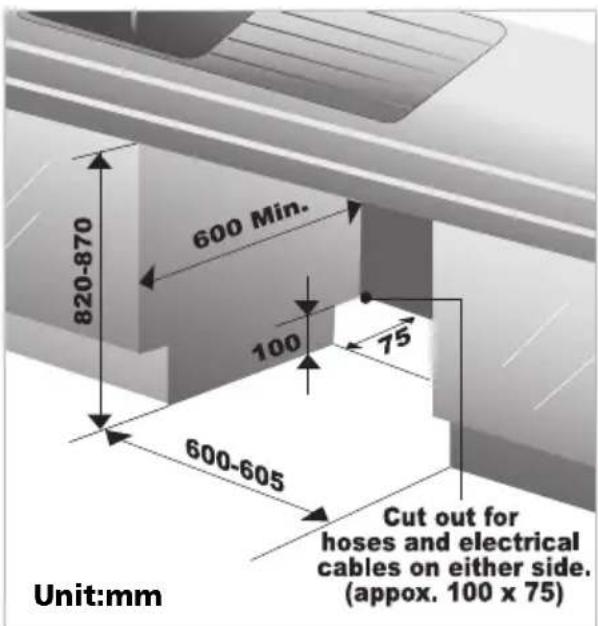
1 This dishwasher is designed to fit the size shown as below.
2 Select a location as close to sink as possible for ease of connection to the water and drain pipes.
3 To ensure good drainage, the dishwasher should not be installed more than 3 meters away from the sink.
4 If dishwasher is installed in a corner, a minimum of 5cm of space is required between the washer and an adjacent cabinet or wall.
text_image
600 Min. 820-870 100 75 600-605 Unit:mm Cut out for hoses and electrical cables on either side. (appox. 100 x 75)Any bare wood surrounding the dishwasher should be sealed with a waterproof paint or sealant to prevent swelling.
Step 2 :
PREPARATION FOR ELECTICAL WIRING
CAUTION
For personal safety, remove house fuse or open circuit breaker before installation. Do not use an extension cord or adapter plug with this appliance. Electrical and earthing connections must comply with the national electrical code/provincial and municipal code and/or other local codes.
1 This appliance must be supplied with correct rating voltage and hertz as shown on instruction manual, and connected to an individual, properly earthed branch circuit, protected by a minimum 15 amp circuit breaker or time delay fuse. Wiring must be 2 wire with Earth.
2 The power plug must be in a accessible location adjacent to and not behind the dishwasher and within 1.2 meters of the dishwasher side.(See page 7 Fig.A)
3 The power plug must be correctly earthed, if in doubt, have it checked by a qualified Electrician. No other appliance should be connected to the same plug outlet by a double adapter or similar plug.
Dangerous voltage
5036

To indicate hazards arising from dangerous voltages.
Note – In case of application in a warning sign the rules according to ISO 3864 shall be adhered to.
I
INSTALLATION INSTRUCTIONS
Step 3 :
PREPARING THE DISHWASHER FOR INSTALLATION
1 Lay the dishwasher on its back.
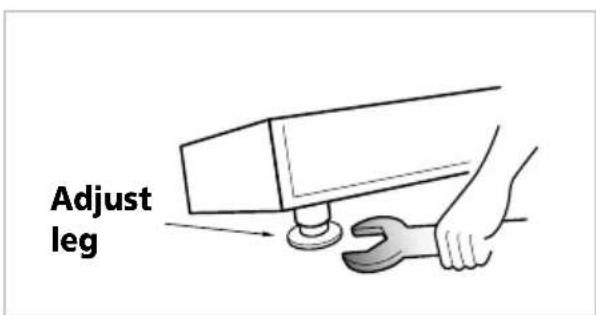
2 Adjust the legs to the required height as shown in below figure.
text_image
Adjust legStep 4 :
INSTALLING THE DISHWASHER IN CUPBOARD
1 Before sliding the dishwasher into the cupboard opening, all necessary height and balancing adjustments should be made using a spanner.
2 Slide the dishwasher into the cabinet opening carefully. Make sure that the drain hose inside the cabinet is not kinked or stretched.

CAUTION
If the height of the cupboard is below 850mm, you should remove the top table by unscrewing the 2 screws. (Two of rear)

text_image
600mm 820~870mm 600~605mm Top tableI
INSTALLATION INSTRUCTIONS
Step 5 :
DRAIN LINE CONNECTION
1 If the end of drain hose does not t to the drain line, use a rubber connector(not supplied) that is resistant to heat and detergent.
2 This should be available from a plumbing shop or DIY merchants.
3 There are two typical connections as shown in Figure A, B.
The “S” trap spigot must be drilled out cleanly and free of obstruction to its maximum internal diameter, if used for drainage.
To prevent siphoning, one of the following methods must be used:
i EWhen the drain hose is connected to a sink “s” trap or waste disposal unit, the hose must be looped up to the underside of the bench top and secured.

text_image
770 mm Min. 1000 mm Max. Drain Hose Inlet Hose 300 mm Min. Power CordFig. A
When the drain hose is connected to a separate standpipe, it is essential that an airtight connection be made. Refer to Fig.B

text_image
Air Tight Connection 770mm Min. / 1000 mm Max. 300 mm Min. Standpipe 40 mm diametre Min.Fig. B : Drainage connection - stand pipe.
Drain hose Extension
Extend drain hose as shown below.

text_image
Sink 200 mm Max. 300 mm Min. Copper pipe Ø 20mm flared at drain nose and other end if required. 770 mm Min. / 1000 mm Max. Use the couplings for connections when you extend drain hose. Drain hose extension or 16-20mm inside Ø rubber hose able to withstand 90°C hot water.!
CAUTION
When you connect or extend drain hose, make sure that drain hose is not kinked. (Bends should have a 40 mm radius.)
[Non-Text]
INSTALLATION INSTRUCTIONS
Step 6 :
WATER SUPPLY CONNECTION
1 Connect the water supply hose to the water tap as shown.(Some models consist of an inlet valve and hose.) This dishwasher may be fed with either hot or cold water. If the water can not be maintained below 65°C, the dishwasher must be connected to cold water.
2 When connecting, the sealant tape or sealing compound to avoid water leaks.
Make sure that the line is not kinked or sharply bent.
The new hose-sets supplied with the appliance are to be used and that old hose-sets should not be reused.
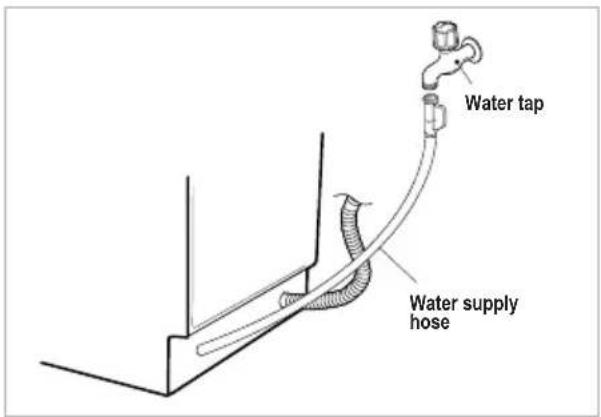
text_image
Water tap Water supply hoseStep 7 :
FINAL CHECK AND ASSEMBLING
1 Securely hand tighten supply hose to the water supply. Plug the power supply cord into an earthed electrical point and switch on.
2 After installing and prior to using the dishwasher with crockery, we recommend that you use the dishwasher on 'Quick' mode to rinse through. At this stage it is useful to ensure that there are no operating problems or water leaks.
When the dishwasher is used for the first, there may be a loud noise, if this happens, turn off the power and restart the dishwasher.
Step 8 :
HOW TO LEVEL THE DISHWASHER
After installing the dishwasher, you may notice a slight sticking of the door to the dishwasher, when you open or close the door. If this does happen you need to adjust the level of the dishwasher.
Case 1. In case the door is slanted to the right

text_image
Slant to the right DOOR Fig. C- If the door slants to the right, see g, C and follow these instructions: 1) Unscrew(counter-clockwise) the left leg of the back side and correct the level. 2) Check the opening of door and repeat if necessary until the door opens and closes properly. - When the product is correctly leveled, There should be no slant, stickiness or friction sound.
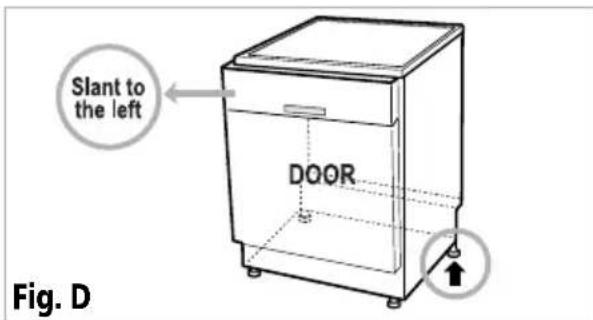
Case 2. In case the door is slanted to the left
text_image
Slant to the left DOOR Fig. D- If the door slants to the left, see fig. D and follow these instructions: 1) Check the opening of door if there still remains sticky or friction sound. 2) Check the opening of door and repeat if necessary until the door opens and closes properly. - When the product is correctly leveled, There should be no slant, stickiness or friction sound.

text_image
Technical diagram of a washing machine with numbered parts for identification and assembly reference.- Control Panel
- Door Handle
- Front Cover
- Lower Cover
- Display Window
- Power Button
- Drain Hose
- Inlet Hose
- Power Cord
-
Adjustable Leg
-
Upper Rack
- Cutlery Basket
- Detergent And Rinse Aid Dispenser
- Vapor Vent Cover
- Upper Spray Arm
- Lower Spray Arm
- Filter ASM
- Lower Rack
- Salt Container Cap
- Cutlery Rack
Accessory

Funnel
i The appearance and specifications may vary without notice.
F
UNCTION OF CONTROL BUTTON
§ MODEL : D1420W(L,M,T,B,C,D,A)F(B,U)
Program
Dual Wash
Pre Wash
Quick

Auto
Eco
Gentle
§ MODEL : D1421W(L,M,T,B,C,D,A)F(B,U)
Program
Dual Wash
Pre Wash
Quick
Auto
Eco
Gentle

text_image
UV Indicator Time Left Beep On/Off Rinse Half Load UV Delay Start 18:88 Wash Rinse Dry Upper Lower Extra Hot Rinse+ Strong Medium Soft Half Load Rinse Spray 3 in 1 Power Delay Start Spray Power Child Lock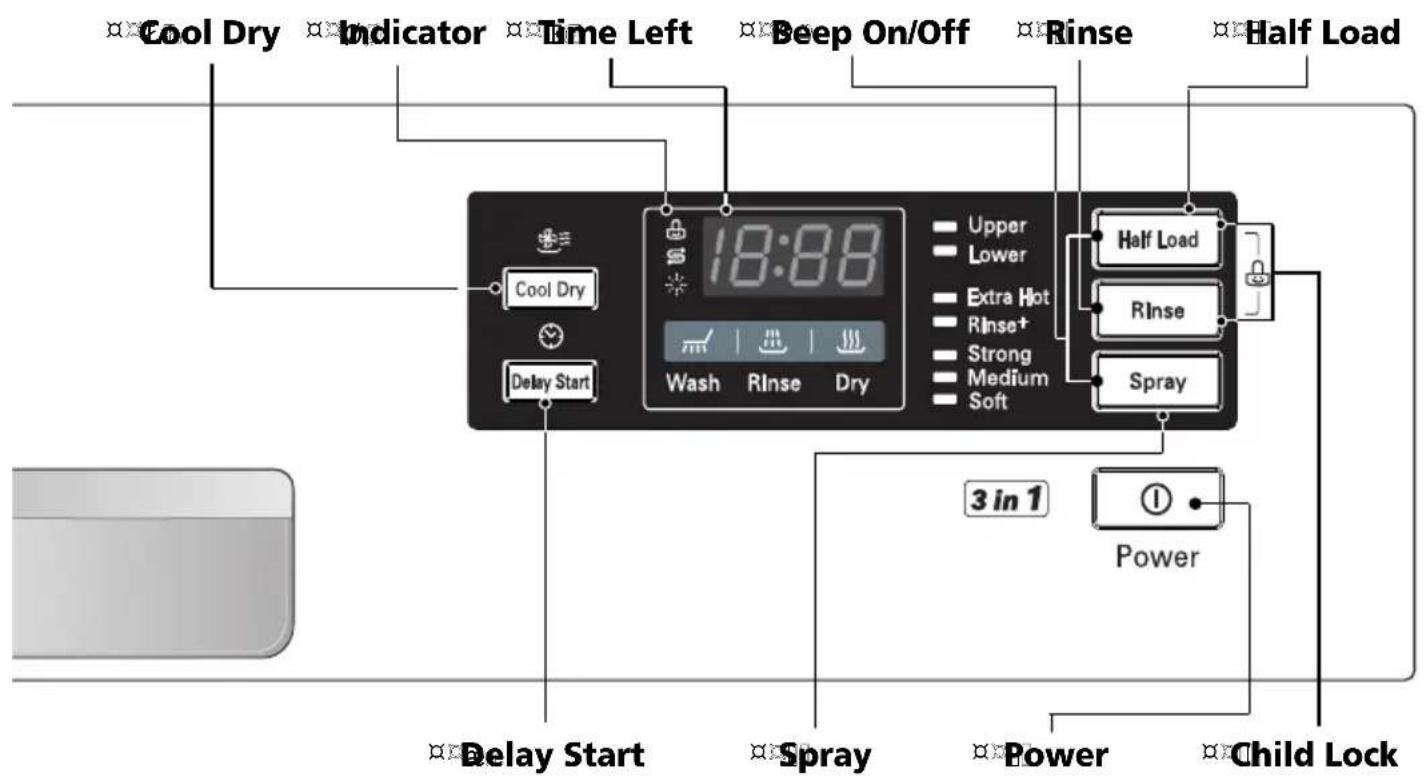
text_image
Cool Dry Indicator Time Left Beep On/Off Rinse Half Load Cool Dry 18:00 Upper Lower Extra Hot Rinse+ Strong Medium Soft Delay Start Wash Rinse Dry Half Load Rinse Spray 3 in 1 Power Delay Start Spray Power Child LockProgram
- When you want to select program, press this button.
UV
- If you want to sterilize the dishes, press UV button.
• After drying cycle, sterilizer will be performed by UV lamp. - At this time, "St" code is displayed in display window.
- When you open the door of dishwasher, UV lamp is turned off.
※Don't look at the lamp directly with the naked eye.
Cool Dry
- When you want better drying performance, press this button.
• This process is not part of the program.
• After drying cycle, the fan will operate for a few more minutes to diminish any remaining moisture.
At this time, "Cd" code is displayed in display window.
- If you want, you can open the door and unload the dishes at any time.
Indicator

- Child Lock.
- Re ll with special salt.
- Refill with rinse aid.
Time Left
- Before starting, the display window shows the running time of the selected program.
• After starting, the display window shows the remaining time. - If the dishwasher has a trouble, the trouble type is displayed.
- If this error letters are displayed, please refer to the trouble shooting guide page 25 and follow the guide.
Beep On/Off
• The dishwasher must be switched on.
- The beep on/off function can be set by pressing the Half Load and Spray button simultaneously for a few seconds. Then, a "On" will appear in the display.
- The beep on/off function is automatically canceled when power failure occur.
Rinse
- Repeated pressing of the Rinse button will select Extra Hot, Rinse+, Extra Hot & Rinse+.
- If you select the Extra Hot function, the operating temperature will be up to 80 i (Dual wash, Auto, Eco)
- When you select Rinse+, an additional rinse cycle is added.
Half Load
- In case of small load, use upper or lower rack only to save energy.
- With each press, can select Upper or Lower rack only.
- In case you don't select this button, the machine always works vario washing, which operate upper and lower spray arm alternately.
Child Lock
- Used to lock or unlock the control buttons to prevent all the setting from being changed by a child.
- This function is automatically canceled when power failure occur.
- For locking/ unlocking, press Half Load and Rinse button for a few seconds simultaneously.
Power
- For operating, press this button first for power on.
• After operating, this button automatically switches off for safety and energy saving. - In case of irregular surge disturbance to the machine, the power may be automatically turned off for safety.
Spray
- With each press, the level of water jet is changed to Strong, Medium and Soft in a sequence.
Delay Start
- If you want to delay the start of selected program, press this button.
- Pressing this button will increase time by 1 hour.
- The delay start time can be adjusted from 1 hour to 19 hours.
Hardness setting
※ You have to check your water hardness and set the softening system level before operating your dishwasher.
Step 1. Check and find water hardness level
§ Method 1
1) Check the water hardness of your area.
(Your water utility company can help you with this.)
2) Set the softening system level of your dishwasher according to the water hardness level.
Refer to the Step 2.
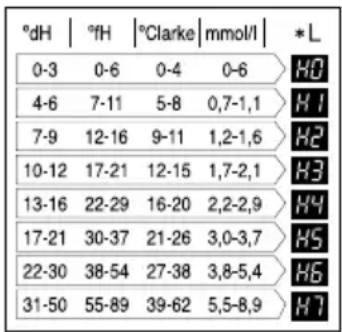
< Water hardness level >
other
| pH | °fH | °Clarke | mmol/l | *L | |---|---|---|---|---| | 0-3 | 0-6 | 0-4 | 0-6 | H0 | | 4-6 | 7-11 | 5-8 | 0,7-1,1 | H1 | | 7-9 | 12-16 | 9-11 | 1,2-1,6 | H2 | | 10-12 | 17-21 | 12-15 | 1,7-2,1 | H3 | | 13-16 | 22-29 | 16-20 | 2,2-2,9 | H4 | | 17-21 | 30-37 | 21-26 | 3,0-3,7 | H5 | | 22-30 | 38-54 | 27-38 | 3,8-5,4 | H6 | | 31-50 | 55-89 | 39-62 | 5,5-8,9 | H7 |(* L : Softening system level)
iEMethod 2
1) Check your water hardness by using test strip. (☐)
2) Test Procedure
Immerse all reaction zones of the test strip for approx.1sec (not in running water!).
^※ Shake off excess liquid from the strip and wait for 1min.
Then, the green color of the reaction zone will change to the red-violet.
∅Count the number of red-violet from the strip.
< Water hardness level >
| Hardness range | Water quality | Softening system level | |||||
| number of the areas(red-violet) | °d | °e | °f | mmol/l(Ca+Mg) | mg/lCa | ||
| 1 | <7 | <9 | <12,5 | <1,3 | <50 | soft | H0, H1 |
| 2 | 7 - 14 | 9 - 17,5 | 12,5 - 25 | 1,3 - 2,5 | 50 - 100 | moderately hard | H2, H3 |
| 3 | 14 - 21 | 17,5 - 26 | 25 - 37 | 2,5 - 3,8 | 100 - 150 | hard | H4, H5 |
| 4 | >21 | >26 | >37 | >3,8 | >150 | very hard | H6, H7 |
$$ 1 ^ {\circ} \mathrm{e} = 1 4. 2 5 \mathrm{mg/lCaCO} _ {3} $$
$$ 1 ^ {\circ} \mathrm{f} = 1 0 \mathrm{mg/lCaCO} _ {3} $$
$$ 1 ^ {\circ} \mathrm{d} = 1 0 \mathrm{mg/lCaO} (= 1, 7 8 ^ {\circ} \mathrm{f}) (= 1, 2 5 ^ {\circ} \mathrm{e}) $$
3) Set the softening system level of your dishwasher according to the water hardness level. Refer to the Step 2.
Step 2. Setting up the softening system level of your dishwasher
Adjust the water softener to the setting to the corresponding hardness of the water in your area.
The water softener has 8 adjustment levels.
The dishwasher is programmed at the factory for a water hardness level of “H4”.
This can be checked and altered by using the buttons on the control panel.
- First, ensure the dishwasher is switched off.
- Press UV(Cool Dry) and Power button simultaneously and keep them pressed.
-
To change the setting:
Simply press the UV(Cool Dry) button, then the gure will change one by one.
The display will change between “H0” and “H7”. -
Once the hardness setting is correctly adjusted, press the Spray button.
The hardness setting is then saved.
Step 3. Salt Filling
This model has a water softener to soften hard water. Please read these notes carefully for correct operation.
In order to provide satisfactory rinsing results, the dishwasher requires soft water, i.e., containing little or no lime, otherwise water stains will be left behind on the dishes and interior containers. If the tap water exceeds a certain level of hardness, it must be softened, I.e., decalci ed. This id achieved by adding a special salt to the water softener inside the dishwasher. The required amount of salt is set up according to how hard your tap water is.
§ Filling with Salt
- Remove lower rack and unscrew the cap of salt container.
- Before using your dishwasher for the first time, fill with salt. The container has a capacity of 1.9kg salt.
Use a funnel for ease and clean lling, ensuring that coarse salt or regenerating salt intended for dishwashers is used.
• After filling, wipe off any spilled salt to seal the cap properly. - Screw the cap tightly to prevent any suds from penetrating into the container.

natural_image
Line drawing of a hand pouring granular material into a funnel with a small star-shaped object nearby (no text or symbols)Step 4. Adding Rinse Aid
§ For filling
To ll the Rinse Aid chamber, rotate the round cap counter clockwise and remove. Fill the container to the maximum level with a good quality Rinse Aid, then replace and lock the cap. The Rinse Aid is automatically dispensed during the nal rinse cycle.
The dosage is factory set to suit most installations. If, after washing, you notice cloudy spots, streaks or water marks on your glassware, it may be necessary to increase the setting. To do this, remove the cap and rotate the indicator arrow to a higher setting then replace the cap. If the glasses are smeared or foam is present on the bottom of the glass or the bottom of the machine, select a lower setting.

natural_image
Close-up of a hand pressing a button on a kitchen appliance (no visible text or symbols)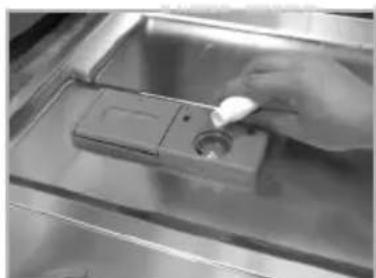
natural_image
Close-up of a hand using a tool to clean or store electronic components on a metal shelf (no visible text or symbols)
natural_image
Hand placing a circular button into a metal tray with a curved arrow indicating rotation (no text or symbols visible)H
OW TO USE AND OPERATE
1. Loading your Dishwasher
For better washing performance, always load the dishwasher according to the instructions.
Before loading items into the dishwasher clean off large particles of food, in particular insoluble items such as bones, pips, etc.
When loading the dishwasher, please act accordingly:
i EPosition crockery such that water will contact all surfaces.
i ADeep based items should be placed at an angle to help water run off and dry properly.
i EItems with burnt on food should be soaked prior to loading in the dishwasher.

natural_image
Illustration of a hand holding a folder with a scroll arrow, no text or symbols present2. Loading the cutlery Rack
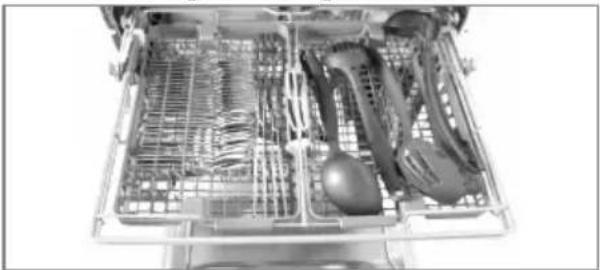
The cutlery rack is best suited for atware and most cooking or serving utensils.
natural_image
Interior view of a modern kitchen drawer with cutlery and utensils (no visible text or labels)The separators on the cutlery racks help keep atware separated to avoid damage and improve cleaning.
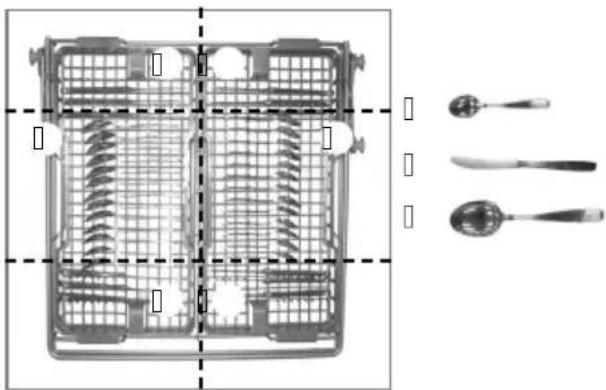
§ Loading examples (Energy test)
natural_image
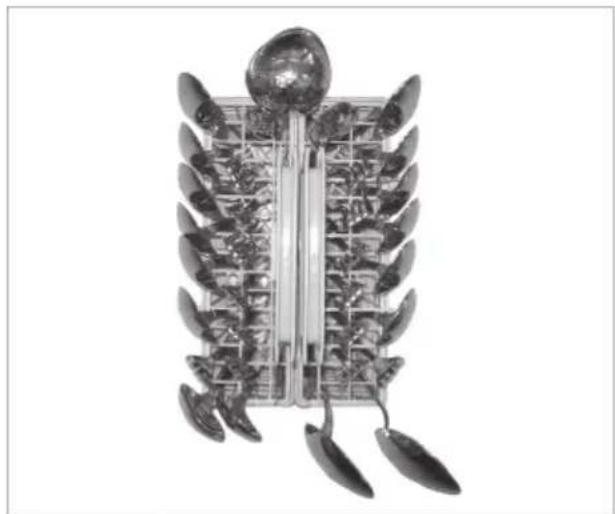
Top-down technical diagram of a multi-chamber appliance with labeled components and three kitchen utensils (no text or symbols present)Knife, fork, and spoon handles should be positioned between the tines.

natural_image
Close-up of a metal grid-patterned object with a small rectangular feature, possibly a device or component (no visible text or symbols)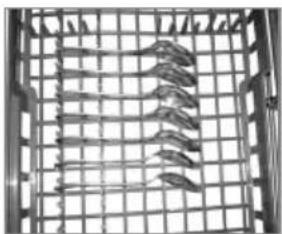
natural_image
Metal grid with multiple elongated objects, possibly tools or materials, arranged in a pattern (no visible text or symbols)If the handles of your flatware are too thick, then reverse the pieces so the handles face the other direction as shown in the bottom gure.
§1 Height Adjustable tray
Each side tray can be adjusted independently to a high or low position to accommodate different sizes of utensils or cutlery.
Each tray is adjusted by lifting it out and rotating it front to back.

natural_image
Close-up of hands installing or adjusting a mechanical component with spring-like fixtures (no visible text or symbols)
natural_image
Interior view of an electric oven rack with cooling fins and ventilation slots (no text or symbols visible)Removable Cutlery Rack
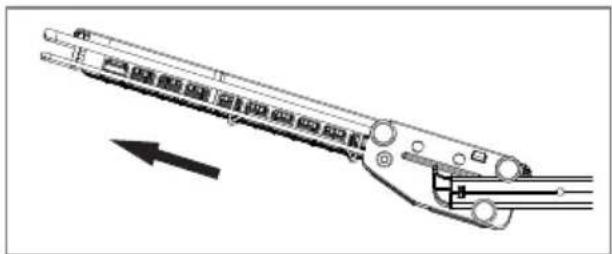
The entire cutlery rack can be removed if more space is needed on the upper rack for larger items.
NOTE :
Always remove cutlery from the rack before removing the rack.
natural_image
Technical line drawing of a mechanical component with an arrow indicating direction (no text or symbols)Pull the rack out to the end of the rails, then lift the front of the rack so the rollers clear the stop on the end of the rail. The rack can now be slid forward and removed from the rails.
WARNING
Be careful when loading and unloading sharp-edged items. Load sharp knives with the blade down in order to reduce the risk of injury.
3. Using the Cutlery Basket
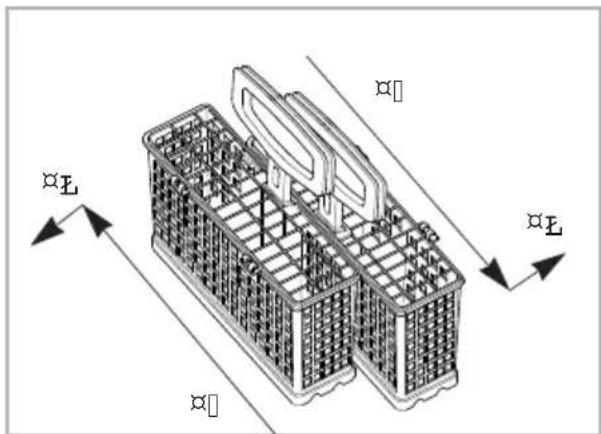
Cutlery should be mixed within each section of the cutlery basket to prevent nesting of similar items. Place the cutlery in the cover with the handles down. The cover can be hinged and clipped away from the basket if you choose not to use them. Place knives in the separate rack for located in the top of the dishwasher.
Take care when loading and unloading sharp items.
§ How to use
natural_image
Isometric technical diagram of a multi-story mechanical or architectural structure with directional arrows indicating orientation (no text or symbols)Slide two baskets in opposite directions, then pull them apart.
§ Loading examples (Energy test)
natural_image
Decorative silver candle holder with leaf-shaped spout and spoon base (no text or symbols)
text_image
1 2 3 4 5 6 7 8 3 1 2 3 3 4 3 3 4 3 3 4 3 3 4 3 3 4 3 3 4 3 3 4 3 3 3 5 B E B EWARNING
Knives and other utensils with sharp points must be loaded in the basket with their points down or placed in a horizontal position.
4. Loading the Lower Rack
The lower basket is best loaded with dinner plates, soup bowls, dishes, pots, pans, lids and even the grill tray.
Plates should be positioned upright and facing the centre of the rack and pots, pans and large dishes must be turned upside down.
§ How to use

natural_image
Diagram showing hand positioning on a wire cage with structural supports, including magnified views of the structure (no text or symbols)Fold-down dividers at the lower and the upper rack can be lowered to improve stacking of pots and pans.
S Loading examples (Energy test)

text_image
c d d e d g d f d f d e| a | Milk | b | Tea | c | Meat |
| d | Egg | e | Oat | f | Spinach |
| g | Margarine |
Take care not to obstruct the rotation of the spray arms and ensure that large items do not prevent the detergent dispenser lid from opening.
5. Loading the Upper Rack
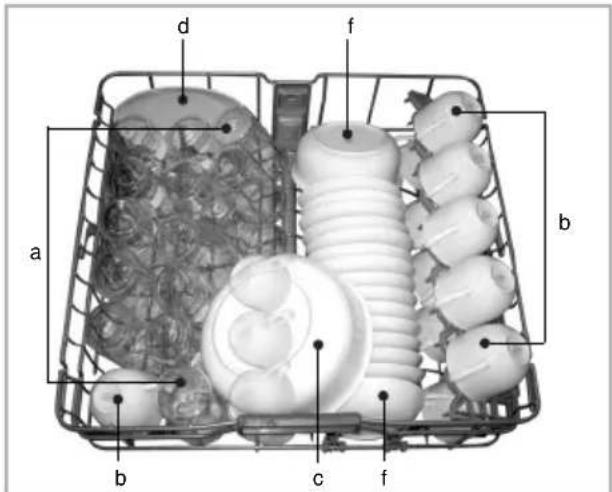
It is best to load this with more delicate items such as, small plates, long cutlery, cups, glasses and dishwasher safe plastic items. Plates should be positioned upwards with the plate bottom facing the front of the rack.
Cups, glasses and bowls must be positioned upside down.
Extra cups or cooking utensils can be laid on the fold down cup racks, which also provides support for long stem glasses.
Take care not to obstruct the rotation of the spray arm under the upper rack.
§ How to use

natural_image
Diagram of a wire cage with an inset showing a magnified view of a mechanical component (no text or symbols present)Fold-down dividers at the upper rack can be lowered to improve stacking of dishes.
§ Loading examples (Energy test)
text_image
a b c d f b f| a | Milk | b | Tea | c | Meat |
| d | Egg | e | Oat | f | Spinach |
| g | Margarine |
Non Dishwasher Safe Items
The combination of high water temperatures and dishwasher detergent may damage particular items, therefore we do not recommend using the dishwasher to wash the following:
■ Copper or anodized aluminum
■ Hand painted silver or gold leaf crockery
■ Wood or bone handled utensils
■ Iron or non rust proof utensils
■ Plastic items that which are not dishwasher safe.

OW TO USE AND OPERATE
6. Adjusting the Upper Rack
Your upper rack can be raised or lowered to cater for different sized crockery. Before adjusting, ensure that the rack is empty.
You can change the position of the upper rack by lifting the rack upward, into the upper position, or by pulling on the two levers on either side of the rack to move it down to its lower position.
We recommend that where possible the upper rack remains level.
And when you pull the rack upward, hold the middle location of the upper rack ( marked position)
After adjusting the rack levels, check that the spray arm is free to rotate.

natural_image
Close-up of a kitchen appliance with hand operating the rack, showing internal components and three close-up views (no text or symbols visible)WARNING
Before adjusting, ensure the rack is empty of all crockery. Otherwise crockery may be damaged or you may be injured.
7. Adding Detergent
- Detergent must be put into the detergent chamber before starting every program except the Pre Wash.
- Please follow the manufacturer's instructions within the manual, when determining the correct amount of detergent to use.
- If your dishes are moderately dirty, you may use slightly less detergent than recommended.
• Chambers hold 15g and 25g. - The amount of detergent required depends on the program. Please refer to the guide table.
| PROGRAM | AMOUNT OF DETERGENT |
| Dual Wash 25g | |
| Auto 20g | |
| Eco 15g | |
| Gentle 15g | |
| Quick 10g | |
| Pre Wash No | detergent |
• After the detergent is supplied, the chamber lid should be closed.
- The detergent is dispensed automatically during the operation.
- The chamber lid remains open after operation.
Detergent Information
Use only the detergent intended for household dishwashers. (Ordinary hand-washing detergent should not be used, because the foam can interfere with proper operation.)

text_image
Push latch to open Place proper detergent into this compartmentWARNING
The detergent used is a special Dishwasher detergent and like all household chemicals it should be treated as harmful and kept out of reach of children. After completion of the wash program, the detergent compartment should be checked and any remaining detergent removed.
ATTENTION
Using combined detergent products (ex.3 in 1)
Some products integrated rinse aid work best specific programs only.
Yow will obtain optimum rinsing and drying results by using conventional and separate salt and rinse aid.
Products that replace regeneration salt can only be used within a specific water hardness range.
Please contact the detergent manufacturer if the drying performance is very poor or you find the white film, when you use the combined detergent products.
We do not warrant the complaints that are directly related to the use of these products.
8. Refilling
§ For refilling Rinse Aid
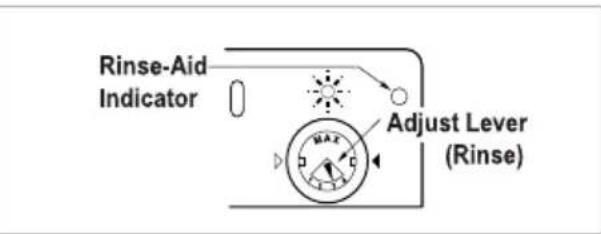
Depending on the dosage setting and the number of washes, the chamber may need to be topped up, approximately once a month. The rinse aid level can be checked by two methods.
- By the indicator window on the dispenser when the dishwasher door is fully open.
● Black indicates suf cient Rinse Aid o Clear indicates Rinse Aid required
text_image
Rinse-Aid Indicator Adjust Lever (Rinse)- By the light on the control panel, being lit, when the dishwasher is working on.
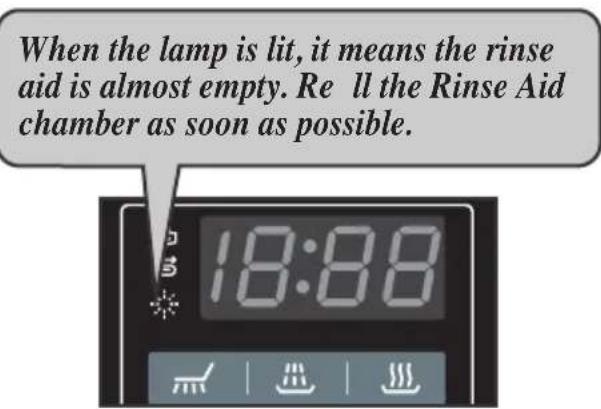
text_image
When the lamp is lit, it means the rinse aid is almost empty. Re ll the Rinse Aid chamber as soon as possible. 18:88Rinse Aid Information
Rinse Aid is necessary to remove spots and streaks from dishes as well as improved drying. Using the correct amount will improve wash performance. However, using too much can produce excess foam leading to possible water leaks.
H
OW TO USE AND OPERATE
iE For refilling Salt
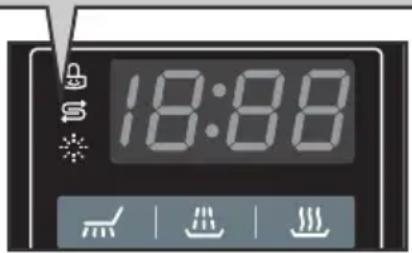
When the salt container is empty, the salt rell lamp will automatically turn on during operation. The salt should be rellled after the cycle has nished. We recommended the salt refill should always be carried out, as mentioned previous page, prior to starting the next operation. This will immediately thin and drain away any excess salt solution.
When the lamp is lit, this means that the salt aid is almost empty. Re ll the Salt Aid chamber as soon as possible.
text_image
18:88Note
- After lling with salt, it may take a little while before the indicator light turns off.
- When the control is set to “H0”, it is not necessary to ll up with salt as no salt is consumed while the dishwasher is operating. If the control is set between “H1” and “H7”, then salt must be added to the dispenser.
WARNING
Do not pour detergent into the salt container. This will destroy the water softener.
9. Drying
■ To assist drying, we recommend that the door be fully opened after the cycle.
10. Energy Test(EN50242)
■ Appliance loaded in accordance with standard speci cations.
• Example of loaded dishwasher : p.15\~17
- Capacity : 14 place settings
• Comparability course : Eco
- Rinse Aid setting : 4
- Reference cleaner : 8g of detergent onto the inside surface of the door and ll 27g into the detergent dispenser.
- Height-adjustable Rack-U must be inserted into the uppermost position.

PERATING SEQUENCE
Press the "Power" button
Check there is rinse aid and salt
The corresponding indicator lights will illuminate if refilling is required.
Open the door and check the filters
Ensure they are clean and properly positioned (See “User Maintenance Instructions”).
Load the dishes
Remove any excess food.
Pull the lower rack out and arrange the dishes and cutlery.
Pull the upper rack out and arrange the cups, glasses, etc.
CAUTION
Do not load the items in upper rack with the lower rack is pulled out and loaded.
Ensure the spray arms can freely rotate
Measure out detergent
Add the required amount of detergent into the dispenser and close the lid.
Setting and starting the program
Press the program button to select the desired program.
After 5 seconds, the machine will start. If necessary, select the option function corresponding to the desired program. The indicator lights of the program and all the phases of the program will come on. Before starting, the display window shows the running time of the selected program. After starting, the display window shows the remaining time.
The time in the display window will start to decrease minute by minute.
If the door is opened during the program a safety device ensures that the machine stops.
Once the door is re-closed the program will start from where it was interrupted.
At the end of the washing program
“End” is displayed on the digital display and a buzzer sounds.
And the dishwasher automatically switches off for safety and energy saving later.
If you select “UV” function, the dishwasher automatically switches off after sterilizing action.
If you selected “Cool Dry” function, the display then shows “Cd” to indicate that the dishwasher is in “Cool Dry” mode.
And then the dishwasher automatically switches off later.
CAUTION
Empty the lower rack first and then the upper one; this will avoid water dripping from the upper rack onto the dishes below.
WARNING
In general it is not advisable to open the door while the machine is working.
If the door is opened, a safety device ensures that the machine stops.
Care must be taken if the door is opened during the hot phase or immediately after a program has finished, as steam may escape.
CAUTION
That the door should not be left in the open position since this could present a tripping hazard.
¢ "Running time may vary according to the water temperature, water pressure and voltage.
¢ "Running time doesn't include "Cool Dry - 30min".
| Program | WASH | RINSE | DRY | COOL DRY | ||||
| Pre Wash | Main1Rinse | 2 Rinse 3 | Heating Rinse | |||||
| Dual Wash | 40 i□ | 60 i□ | 70 i□ | |||||
| Auto | The program sequence is optimized and adapted in accordance with how dirty the dishes are. | |||||||
| Eco | 43 i□ | 60 i□ | ||||||
| Gentle | 45 i□ | 70 i□ | ||||||
| Quick | 50 i□ | 50i□ | 65 i□ | |||||
| Pre Wash | ||||||||

Dual Wash
This program is ideal for very dirty crockery, in particular pots, pans and casserole dishes.
This program will be able to control the water jet level of each spray arm differently.

Auto
During the Auto program, the degree of soiling in the dishes is determined by the amount of clouding of the water.
According the degree of soiling, the program automatically adjust the washing time, temperature. As a result, the energy and water consumption is kept as low as possible. The "F" on display means that the sensor is sensing the status of the dishwasher.

Eco
This program offers the most efficient energy
and water consumption for a good washing performance. It is recommended that it will be used every time.

Gentle
This program is for washing delicate items like glasses.

Quick
Can use for lightly soiled recently used dishes and cutlery.
When you select "Quick" program, After nishing, "Cool Dry" function is automatically performed for the better drying result.

Pre Wash
Can use this program for only removing soil before washing dishes by hand.
iE Auto Restart
If the dishwasher is turned off by a power failure, it will restart from the position it stopped at adjusting accordingly when you press the Power button again.

SER MAINTENANCE INSTRUCTIONS
To prevent trouble and poor operating, it is important to check filters and spray arms at regular intervals.

Filters
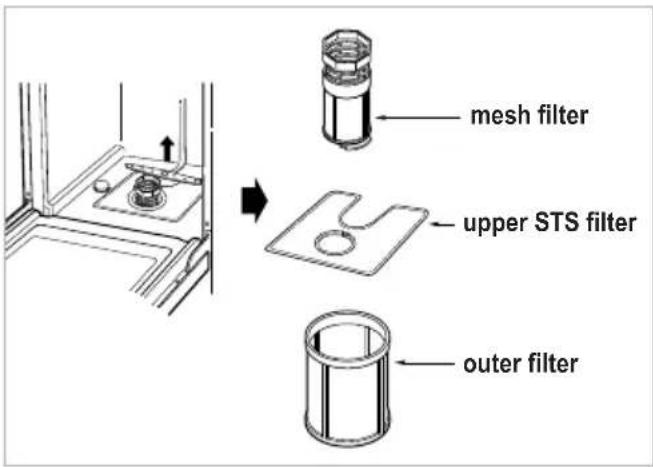
- Remove the lower rack first.
- Turn the mesh filter counterclockwise.
• Take out the mesh lter, upper STS lter and outer filter. - Clean them if necessary.
- Replace them in the reverse order.
text_image
mesh filter upper STS filter outer filteriE After each cycle, clean the filter for the better washing result.
iE Before starting, check that the filter is assembled well. If the filter is not assembled correctly, you might have a poor cleaning result.

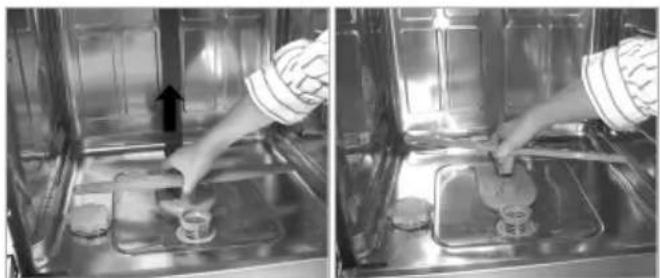
Lower Spray Arm
- Check that the water jet holes are not blocked.
- If cleaning is required, remove the arm by pulling up.
- Clean the spray arm and replace it pulling down.
natural_image
Two-panel black-and-white photo showing a hand pouring liquid into a container with an arrow indicating flow direction (no text or symbols visible)
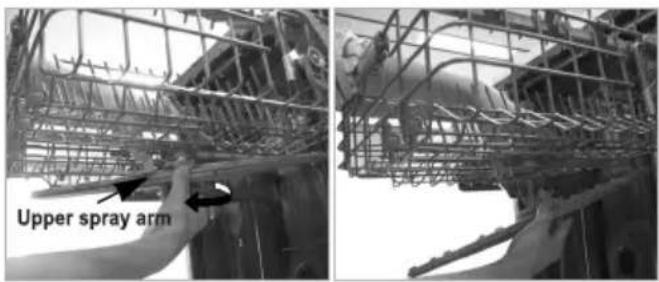
Upper Spray Arm
- Pull the upper rack forwards.
- Check that the water jet holes are not blocked.
- If cleaning is required, remove the arm by unscrewing the nut.
- Clean the spray arm and replace it in the reverse order.
text_image
Upper spray armT
ROUBLE SHOOTING GUIDE
■ If a problem occurs check below to see whether this can be solved.
In the unlikely event that the problem cannot be rectified, please contact a service engineer.
| Problem | SolutionPossib | |
| No lights come on when the power is turned on. | Plug is not properly inserted into the socket.Fuses blown or circuit breaker tripped.The electricity of the house was cut off. | Check the plug.Check the electricity.Call for service. |
| The machine does not start. | Door is not fully closed.The start button is not pressed. | Close the door.Press the start button. |
| The spray arms do not rotate smoothly. | The mounting of the spray arms is blocked by food particles. | Clean the holes of the spray arm. |
| White deposits are left on the dishwasher after washing. | The amount of detergent or rinse-aid set incorrectly.The salt container is empty.The salt container cap is not securely screwed on. | Check the detergent or rinse-aid.Check the salt container or cap. |
| Streaks are left on glassware. | Too little Rinse-Aid dispensed. | Fill the rinse-aid.Adjust the level of rinse-aid container. |
| Dry results are not satisfactory. | Too little Rinse-Aid dispensed. | |
| Washing results are not satisfactory. | Incorrect amount of detergentUtensils incorrectly arranged or overloaded.Filters are clogged.Water jet holes of spray arms blocked.Spray arm's rotation obstructed by utensils.Unsuitable program selected. |
le Cau
T
ROUBLE SHOOTING GUIDE
| Problem | SolutionPossib | |
| The display shows "OE" code. (Water is not pumped away.) | · The drain hose is kinked.· The filter is clogged.· Motor trouble.(Washing motor or Drain motor) | · Straighten hose(s).· Clean the filter.· If you can not solve the problem, call for service. |
| The display shows "IE" code. | · Water is not supplied.· Water tap is not opened.· Water sensor has a trouble. | · Check the water tap.· If you can not solve the problem, call for service. |
| The display shows "EI" code.(Automatically Drain pump operated.) | · Water is leaking from the hose connections.· Damage to the unit has been caused by a water leak. | · Close the water tap and unplug the power plug.· Call for service. |
| The display shows "FE" code. (Automatically Drain pump operated.) | · Excessive water is supplied than the normal water level.· There is a problem with the inlet valve. | |
| The display shows "HE" code. | · The water heater circuit is damaged. | |
| The display shows "tE" code. | · Thermistor trouble or very high inlet water temperature. | |
| The display shows "LE" code. | · Motor trouble. | |
| The display shows "CE" code. | · Motor trouble. |
D1420W(L,M,T,B,C,D,A)F D1421W(L,M,T,B,C,D,A)F
D1420W(L,M,T,B,C,D,A)B
D1421W(L,M,T,B,C,D,A)B

text_image
600mm 600mm 850mm
text_image
598mm 567mm 819mmD1420W(L,M,T,B,C,D,A)U D1421W(L,M,T,B,C,D,A)U

text_image
598mm 567mm 819mm| Capacity | 14 Place settings |
| Weight | See rating label |
| Power Supply | See rating label |
| Power Consumption | See rating label |
| Water Feed Pressure | 50 ~ 800 kPa |
غسالة الصين
دليل الملك
D1420W(L,M,T,B,C,D,A) F(B,U) :Maloudil
D1421W(L,M,T,B,C,D,A) F(B,U)
natural_image
Simple line drawing of a trash bin with crossed lines indicating no waste or discharge (no text or symbols)
خذیر
text_image
Diagram of a front-loading washing machine with numbered parts for identification
text_image
Labeled diagram of an open refrigerator interior showing internal components and numbered partsnatural_image
Simple line drawing of a funnel with a handle and side port (no text or symbols)الأجمع
الملحقات
text_image
الberries Dual Wash Pre Wash Quick Auto Eco Gentle① الإيرنامج
(1). youth men describe the same purpose of using a smart device.
natural_image
Line drawing of a hand pouring granular material into a funnel with a small star-shaped object nearby (no text or symbols)ملء الملك
natural_image
Hand placing a circular arrow on a device component (no text or symbols visible)
natural_image
Close-up of a hand using a tool to adjust or install a small electronic device on a metal tray (no visible text or symbols)
natural_image
Hand placing a button into a kitchen appliance with a curved arrow indicating rotation (no text or symbols visible)natural_image
Grid-patterned metal frame with diagonal lines, no visible text or symbols
natural_image
Close-up of a metal grid-patterned container or tray (no visible text or symbols)natural_image
Close-up of hands installing a mechanical component with spring-like fixtures (no visible text or symbols)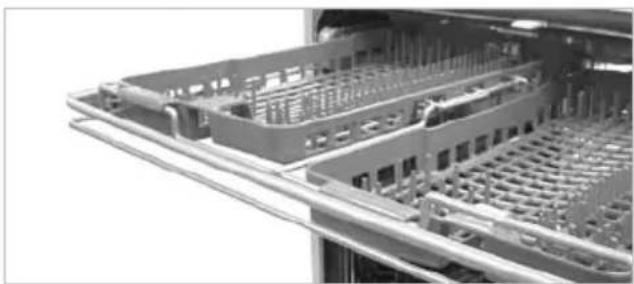
natural_image
Close-up of a server rack with multiple slots and ventilation grilles (no visible text or labels)natural_image
Illustration of a hand inserting a paper into a drawer with an arrow indicating rotation (no text or symbols)- وضع رف السكاكين
natural_image
Interior view of a stainless steel kitchen drawer with cutlery and utensils (no text or symbols visible)natural_image
Three types of kitchen utensils: a spoon, a fork, and a ladle, arranged vertically with numbered labels (1, 2, 3) for scale.
natural_image
Technical diagram of a mechanical or electrical component with grid lines and labeled components (no readable text or symbols)natural_image
Close-up of an ornate silver decorative object with leaf-like patterns and a central handle, no visible text or symbols.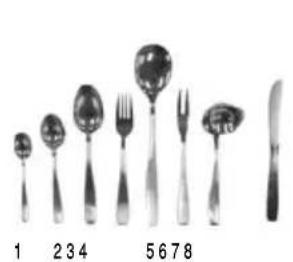
natural_image
Black-and-white photo of a set of kitchen utensils including platters, fork, and knife, arranged in rows (no text or symbols visible)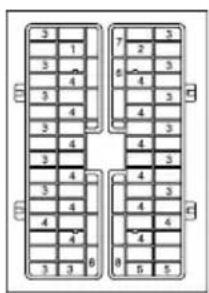
text_image
3 1 3 4 3 4 3 4 3 4 3 4 3 4 3 4 3 4 3 8 6 5
natural_image
Technical line drawing of a mechanical component with no visible text or symbolstext_image
Technical diagram of a multi-story battery pack with labeled components and directional arrows indicating flow or force.natural_image
Technical illustration of a wire mesh structure with hand and magnified inset showing internal components (no text or symbols)natural_image
Diagram of a mechanical clamp or lever mechanism with directional arrows indicating motion (no text or symbols present)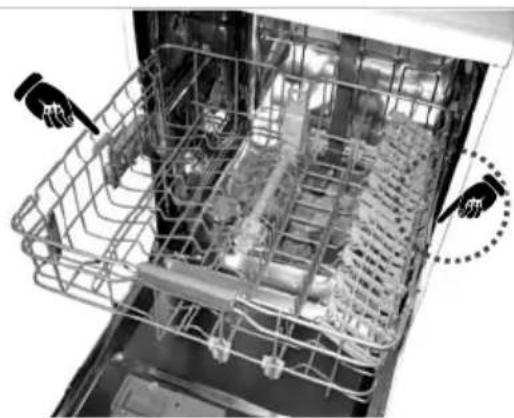
natural_image
Interior view of a kitchen appliance with hand gestures and a wire rack (no visible text or symbols)
natural_image
Close-up of a hand holding a small object over a grid-patterned structure, with an arrow pointing to it (no visible text or symbols)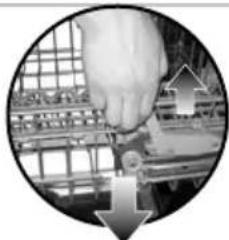
natural_image
Close-up of a hand pressing down on a metal cage with arrows indicating downward pressure (no text or symbols visible)