F-2054SQ - Washing machine LG - Free user manual and instructions
Find the device manual for free F-2054SQ LG in PDF.


User questions about F-2054SQ LG
0 question about this device. Answer the ones you know or ask your own.
Ask a new question about this device
Download the instructions for your Washing machine in PDF format for free! Find your manual F-2054SQ - LG and take your electronic device back in hand. On this page are published all the documents necessary for the use of your device. F-2054SQ by LG.
USER MANUAL F-2054SQ LG
Please read this User's Guide carefully before operating and keep it handy for reference at all times.
Table of Contents
Introduction
Important Safety Instruction 4
Disposal of the old appliance & packing of new appliance 6
Identification of Parts 7
Installation
Location 8
Electrical Connection 9
Operation
Starting 9
Suggestion on food storage
Storing Food 10
Making Ice 10
Care and maintenance
Defrosting 11
Cleaning 12
General Information 13
Tips for Saving Energy 14
Trouble shooting
Trouble Shooting 15
To Reverse the Doors
How to reverse the Door ____17
Door handle (Option) 18
Precaution
Don't use an extension cord
The appliance is suitable for storing the frozen goods.
It is restricted for household use. If it is used for industrial or commercial purpose, observe the related regulations firmly. If using other purpose or misuse, the manufacturer is not responsible for the damages of occasion.
Ignoring the recommendations for environmental use will make your appliance consume higher energy.
Important Safety Instruction
This fridge-freezer must be properly installed and located in accordance with the Installation Instruction before it is used.
Never unplug your fridge-freezer by pulling on the power cord. Always grip plug firmly and pull straight out from the outlet.
When moving your appliance away from the wall, be careful not to roll over or damage the power cord.
After your fridge-freezer is in operation, do not touch the cold surfaces in the freezer compartment, particularly when hands are damp or wet. Skin may adhere to these extremely cold surfaces.
Pull out the power plug prior to cleaning the fridge-freezer.
Never damage, severely bend, pull out, or twist the power cord because power cord damage may cause a fire or electronic shock. Never place glass products in the freezer because they may be broken when their inner contents are frozen.
If possible, connect the fridge-freezer to its own individual electrical outlet to prevent it and other appliances or household lights from causing an overload.
Important Safety Instruction
Accessibility of Supply Plug
Supply Cord Replacement
Danger
The supply plug of the refrigerator-freezer should be placed in easy accessible position for quick disconnection in emergency.
If the supply cord is damaged, it must be replaced by the manufacturer or its service agent or a similarly qualified person in order to avoid a hazard.
Risk of child entrapment.
Before you throw away your old refrigerator or freezer:
Take off the doors.
Leave the shelves in place so that children may not easily climb inside.
Grounding (Earthing)
In the event of an electric short circuit, grounding (earthing) reduces the risk of electric shock by providing an escape wire for the electric current. In order to prevent possible electric shock, this appliance must be grounded. Improper use of the grounding plug can result in an electric shock.
Consult a qualified electrician or service person if the grounding instructions are not completely understood, or if you have doubts on whether the appliance is properly grounded.
CAUTION
This appliance is not intended for use by persons (including children) with reduced physical, sensory or mental capabilities, or lack of experience and knowledge, unless they have been given supervision or instruction concerning use of the appliance by a person responsible for their safety.
Children should be supervised to ensure that they do not play with the appliance.
Disposal of the old appliance
Disposal of packing of new appliance
Take back offer
Disposal of the old appliance & packing of new appliance
The old appliance whose life has expired should be destroyed in order to make it safe prior to disposal. Take out power plugs, separate connection wires and remove or destroy all springs, latches or bolting, to prevent children from being trapped during play.
For environmental protection, old refrigerators should be disposed off by a professional disposition agency. If you have any question, please consult with the local sale agency or local authority.
All packing materials used for this appliance are environment-friendly.
Matters concerning material are as follows:
PE : Polyethylene – Foil or pocket for packing
PS : Formed objects made of foamed CFC-FREE polystyrene
PP : Strapping tape made of polypropylene
This appliance contains fluid (refrigerant, lubricant) and is made of parts and materials which are reusable and/or recyclable.
All the important materials should be sent to the collection center of waste material and can be reused after rework (recycling). For take back, please contact with the local agency.
Identification of Parts

text_image
Freezer Drawer Leveling Screws Magnetic gasketNOTE
This is a basic model. The shape of refrigerator is subject to change.
Location
This appliance is suitable for using at ambient temperature between +16°C and +38°C. If the ambient temperature drops below +16°C, it is possible that the freezing foods in the freezer compartment are thawed because the temperature of the freezer gets warm.
We recommend that the refrigerator be installed at a dry and well ventilated place. Make sure that the appliance is not exposed to direct sunlight or placed in vicinity of a heat source such as stove, heaters, radiator.
If it is impossible, To ensure proper air circulation around the fridge-freezer, please maintain sufficient space on both the sides as well as top and maintain at least 2 inches (5 cm) from the rear wall.
NOTE
Place on a flat and firm flooring. If the floor is not even, adjust the feet by using the leveling screw at the front edge of the cabinet.
If the front is slightly higher than the rear, the door can close more easily.
Electrical connection
This appliance should be connected to the mains AC 220V, 50 Hz. You must connect this appliance only to the power socket with grounding complying with the related regulations and only an approved expert should install this appliance.
Operation
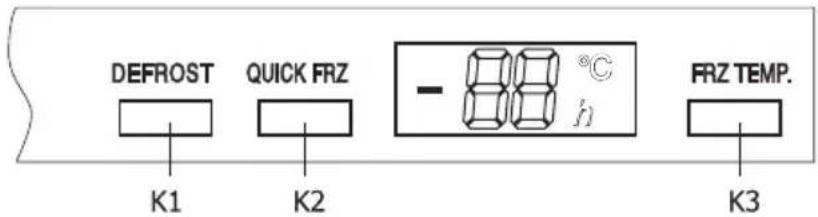
Function of electronic control
Starting
Before switching it on, leave the appliance standing for at least 2 hours, so that the circulation of the refrigerant stabilizes and no operating problems occur.
text_image
DEFROST QUICK FRZ - 8.8 °C FRZ TEMP. K1 K2 K3When the appliance powers on, the initial state displayed on LED is "-18°C".
- Button K1 (Defrost):
PressbuttonK1forthree seconds the first time, indicator"-", "C", "h" shut off, compressor stop running and the value displayed on LED is"OF". Press button K1 for three seconds the second time, indicator "-", "C", "h" display normally, compressor running normally and LED displays the initial state.
- Button K2 (Quick freezing):
Press butoon K2 for the first time, indicator "-" , "°C" shut off, indicator "h" light on and initial freezing time displayed is "3h". Press button K2 for the second time the freezing time displayed is "2h". Press button K2 for the third time the freezing time displayed is "1h". The compressor will ren from 1hour to 3 hours according to the freezing time displayed on LED. Press button K2 for the fourth time, the indicators will recover the state before quick freeze.
- Button K3 (Temperature regulation):
Press button K3 continuously, the provided temperature displayed will be from -14°C to -24°C circularly.
NOTE
Storing food
Opening the door often or keeping the door opened a long time, increases the inside temperature. This causes the storage life and flavor of the foods to reduce, and increases the energy consumption.
Do not touch deep-frozen foods with wet hands. You could get chilblains on your hands.
Make sure foods that are not frozen do not touch the frozen foods. The frozen foods may melt.
The packing materials suitable for refrigerating the foods are - Polyethylene bags, Plastic foil, freezing containers.
The suitable wrapping materials are
- Rubber band, Plastic clips, attaching tape, string. Before sealing, get rid of air from packing bags and foil. The remained air makes the storing foods dry.
You can freeze foods quickly when packing is level. Do not store bottles in freezer compartment. They may break when frozen.
Making Ice
To make ice cubes, fill ice tray 3/4 full with water and place it on the bottom of the freezer compartment.

natural_image
Illustration of hands using a handheld device to interact with a grid of buttons (no text or symbols visible)To remove ice cubes, hold the ice tray at its ends and twist gently.
Tips
To remove ice cubes easily, run water on the tray before twisting.
Defrosting
Defrosting the fridge compartment
When the freezer is working, frost is formed at the rear wall of the fridge compartment and melts automatically when the compressor stops.
Defrosting the freezer compartment
Humidity forms frost or ice in the freezer compartment while the appliance is working or when the freezer door is opened. The thick ice and frost decrease cool air and increase the energy consumption.
Defrost Ice Layer
If the freezer compartment is heavily iced, defrost as follows.
- Remove the frozen food, wrap in newspaper and store in a cool place.
- Leave the door open, and wipe out water with a sponge.
- Dry the freezer compartment thoroughly, turn on the appliance, and replace frozen foods.
Tips
It is helpful to place a saucepan with hot water inside of the freezing room in order to assist defrost.
NOTE
Never place electrical devices in the refrigerator for defrost. Take care when using defrosting sprays for assisting defrosting. These sprays include substances containing explosive gas, or harmful for synthesis or human health.
WARNING
Cleaning
Always remove plugs or Switch off supply before cleaning.
Do not use sharp objects (such as knife, screwdriver) which could break refrigerant circuit resulting in environmental and health risks.
Never use steam cleaner or steam pressure cleaner since hot steam may damage refrigerator surface and electrical devices. Never use sand, abrasive detergent, acid or chemical solvent.
- The freezer compartment should be cleaned at least once a month.
- The most appropriate time for cleaning of the freezer compartment is a time after defrosting.
- Clean refrigerator including inside devices with clothes or lukewarm water. You may use commercial detergent for tableware.
- Frequently clean the water drain inlet on the inside rear side of refrigerator. Clean the drain inlet using objects like a toothpick so that the drain inlet is not clogged. Care should be taken so that cleaning water does not overflows in the drain tub.
Regularly clean the heat exchanger on the rear side of refrigerator using a smooth brush so that accumulations of dusts and residues. Do not disrupt expansion from the inside and cause increased energy consumption.
Any damage to the heat exchanger or other events leading to the exposure of the refrigerant to the environment, should be avoided because of potential environment and health risks.
General information
Going away
When you plan to be away for an extended period, remove all food, disconnect the power cord, clean the interior thoroughly, and leave the door OPEN to prevent odor formation.
Power failure
Most power failures are corrected in an hour or two and will not affect your refrigerator temperatures. However, you should minimize the number of door openings while the power is OFF. During power failures of longer duration, place a block of dry ice on top of your frozen packages.
If you move
Remove all items inside the refrigerator or securely fasten all loose items. To avoid damaging the leveling screw, turn them all the way into the base.
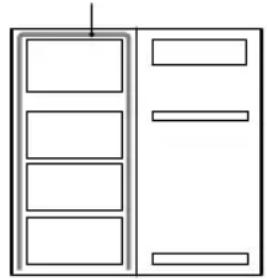
Anti-condensation pipe
- The Anti-condensation pipe is installed around the front side of fridge-freezer to prevent dewing.
- Especially after installation or when ambient temperature is high, the fridge-freezer may feel hot, which is quite normal.
Anti-Condensation Pipe
natural_image
Simple line drawing of a cabinet or storage unit with four vertical compartments (no text or symbols)Tips for saving Energy
- After moving the appliance, allow 2 hours to turn on again.
- Do not place the appliance near radiator, stove, and heat sources. If ambient temperature is high, the compressor will run longer.
- Place the appliance on a cool and well ventilated room. Do not expose to direct sunlight.
- Do not keep the door opened too long.
- Do not place warm food and beverages in appliance. Please cool down first otherwise the steam from hot foodstuffs would contribute to the icing up of the evaporator unit; and the cooling period should be as short as possible, for health and hygiene reasons.
- Do not set the temperature of appliance lower than needed.
- Place the deep-frozen foods for thawing into the fridge.
They can be used for cooling the fridge. - Replace magnetic door gasket of the door if it is not properly functioning.
Before calling for service, check this list.
It may save you both time and expense.
This list includes common occurrences that are not the result of defective workmanship or materials in this appliance.
Problem Possible Causes
Fridge-Freezer does not operate
Vibration or Rattling or Abnormal Noise
Temperature of foods inside refrigerator is not cold enough
The temperature inside the refrigerator is too cold
Fridge has odor
Moisture forms on cabinet surface
- Power plug may be unplugged from the electric outlet. Plug it in securely.
• House fuse has blown or circuit breaker has tripped. Check and/or replace fuse and reset circuit breaker.
• Power cut. Check house lights.
- The floor on which the fridge-freezer is installed may be uneven or the fridge-freezer may be unstable. Make it even by rotating the leveling screw.
- Unnecessary objects placed in the back side of the fridge-freezer.
- Too frequent or too long door openings. There is a heat source near Fridge-Freezer. A large quantity of food was placed inside the fridge compartment.
- The electronic controller is setting to extremely low figure.
- Foods with strong odors should be tightly covered or wrapped
- Check for spoiled food
• Interior needs cleaning
• Refer to "Cleaning Section"
• This phenomenon is likely to occur in a wet space. Wipe it with a dry towel
Precaution
How to Reverse the Door
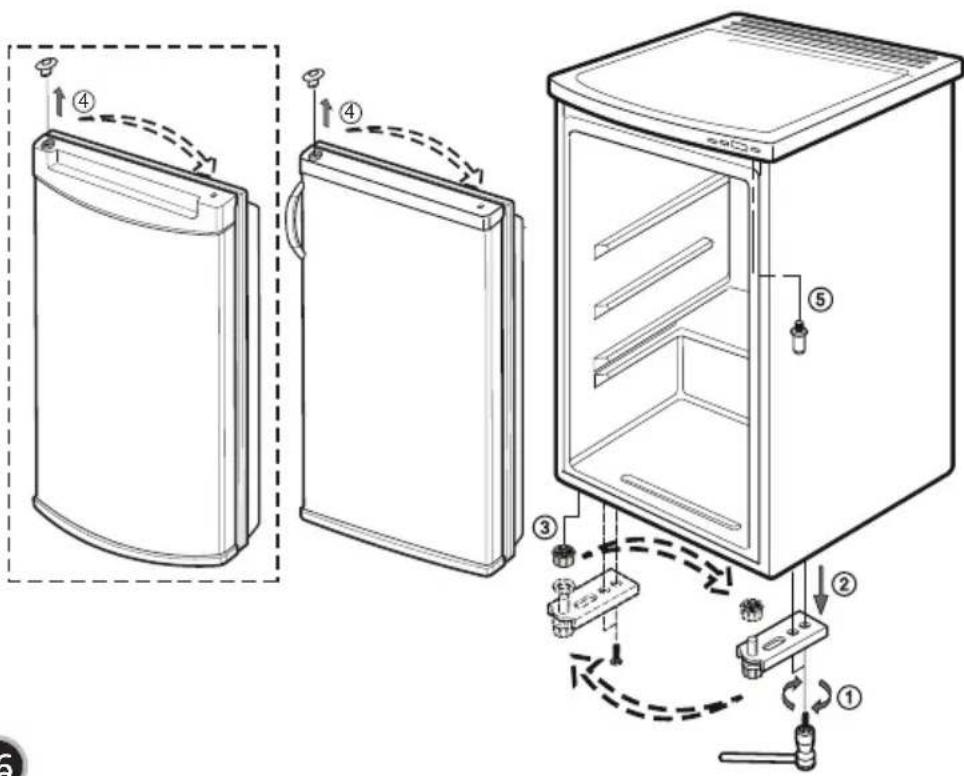
Your refrigerator is designed with a reversible door, so you may open from either left or right. It is best to reposition the door hinge as necessary at the outset since it is inconvenient to do so later.
To change the door hinge please refer to the diagram below and proceed as follows.
- First unplug the appliance.
- Remove foods and accessories like shelves or trays which are not fixed in the refrigerator.
- Carefully lay the appliance on a cushion like packing material to avoid the damage of refrigeration circuit.
-
Use '+' driver or spanner to fix or remove the bolts.
-
Unscrew the 2xBOLTS ①, then remove the hinge (L) ②.
- Remove the LEG ③.
- Gently pull the door downwards to remove it.
- Before refitting the door, swap the Hinge Cap ④ by pulling it out from its current location and repositioning it on the other side of the door. Care should be taken not to damage the adjacent surfaces when removing the Hinge Cap.
- Unscrew the Upper Hinge pin (U) ⑤ and screw it into the opposite side hole.
text_image
Diagram showing the internal components of a refrigerator with numbered parts and directional arrows indicating assembly or cleaning steps.How to Reverse the Door
- After refitting the door, fix the Lower Hinge(L) in the opposite side by using 2xBOLTS.
- Fix the Leg.
- Carefully place the appliance in an upright position. Adjust the Leveling screw to make sure the appliance is steady and check that the door opens and closes properly.
NOTE
In case of applying Reversible door, when you close the door with excessive force, there could be the case that the door doesn't close because of Reaction force. Please ascertain if the door closes properly.
NOTE
Reversing the doors is not covered by the warranty.
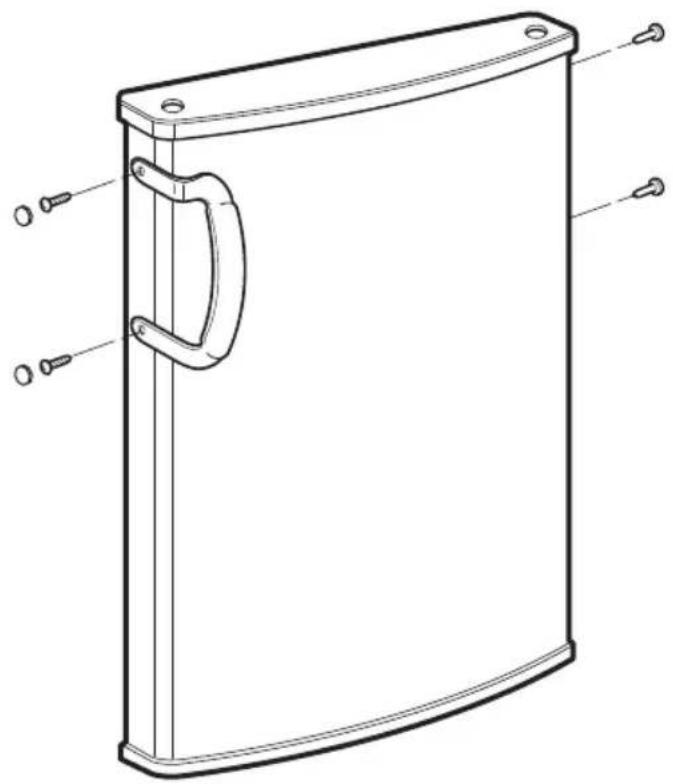
Door handle(option)