
Ruby Freestanding - Heating EUREKA - Free user manual and instructions
Find the device manual for free Ruby Freestanding EUREKA in PDF.


| Type | Freestanding wood heater |
| Brand | Eureka |
| Model | Ruby Freestanding |
| Dimensions (Package) | 980 mm H x 795 mm W x 685 mm D |
| Weight | 220 kg |
| Warranty (Firebox) | 10 years |
| Warranty (Paint finish) | 12 months |
| Warranty (Other components) | 12 months (excluding glass, fire brick lining, baffle) |
| Flue System | 6" active flue with perforated or solid outer casing; includes 180° x 900 mm heatshield |
| Minimum Flue Height | 4.6 m above floor protector |
| Clearance to Combustibles (Rear) | 50 mm |
| Clearance to Combustibles (Side) | 325 mm (parallel installation) |
| Clearance to Combustibles (Corner) | 50 mm from each wall at 45° |
| Floor Protector Requirements | Minimum 9 mm non-combustible material; extend 300 mm front; min width 1000 mm, depth 815 mm |
| Fuel Type | Dry hardwood (moisture < 20%) |
| Firebox Material | Steel with cast iron liners |
| Baffle Plate | Steel, removable for cleaning |
| Door | Glass with rope seal, adjustable hinge and latch |
| Fan | Twin barrel, 3-speed with thermostat/override |
| Air Control | Slide mechanism, adjustable |
| Paint Finish | Stove Bright Metallic Black (code 6309) |
| Country of Origin | Australia (AF Gason Pty. Ltd.) |
| Included Accessories | Operation & installation instructions, spare parts diagram, warranty card |
Frequently Asked Questions - Ruby Freestanding EUREKA
User questions about Ruby Freestanding EUREKA
0 question about this device. Answer the ones you know or ask your own.
Ask a new question about this device
Download the instructions for your Heating in PDF format for free! Find your manual Ruby Freestanding - EUREKA and take your electronic device back in hand. On this page are published all the documents necessary for the use of your device. Ruby Freestanding by EUREKA.
USER MANUAL Ruby Freestanding EUREKA
Ruby Freestanding 16
WARRANTY
- Subject to clauses 2 & 3 of this warranty, A.F. Gason Pty Ltd. ACN 004 667 556 warrants the following components of its heater's against defects in workmanship and/or materials for the following periods from the date of purchase:
at the firebox for ten years
by the point finish for a period of 12 months if the purchaser has followed the instructions provided by Gason In the operation and installation instructions must and
(1) all other components for 12 months, except the glass, fire brick lining at bottle plate F, in the opinion of Gason, there items have been damaged by impact.
- This extended warranty does not apply:
a) If the heater is purchased from a person who has not been authorised by Gaoan to sell its products;
in it, in the opinion of Gason, the heater or any other component has been subject to abuse misuse alteration, modification or has not been installed, operated or maintained in
accordance with the instruction provided by Sason, or
to owners other than the original purchaser.
-
Face below that the heater was purchased to make a man in his hand to get and you wish to make a claim under this warranty, please consider an authorized given order
-
You have a much better way to see
-
It also describes the vapor fraction date prices that the heater contains a manufacturing bulk (gas may be discontinued).
-
1.10c W2.3196
3.10.2024年1月1日
by theer of nple to sp
(1) presence of a network.
-
Parts replaced under warranty are warranted for the balance of other original warranty period.
-
T. at the discretion of Gason, the heater or any part needs to be replaced, serviced or repaired at an authorised Gason service centre, then the person claiming under this
warranty must pay all costs associated with
a) returning the heater, and
to the delivery of collection of any new or restored heater.
Our goods come with guarantees that cannot be excluded under the Australian Consumer Law. You are entitled to a replacement or refund for a major failure and for
compensation for any other community foreseeable loss or damage. You are also entitled to have the needs required or replaced if the cause fail to be of acceptable quality
and the future class and amount in a result of space.
Any benefits you receive under these warranties are in addition to other rights and remedies that you may have as a consumer under law in relation to the better in which
The following text
These warranties are given by:
AF Gason Pt
Blake Stucces
amort V5 32
Please contact us if you have any queries on
电话:010-83522151
or pool in your "Carter U" action of our website: www.nose.com.cn
AF Gason Pty. Ltd. reserves the right to modify or alter specifications, material, etc. in the interest of product improvement.

natural_image
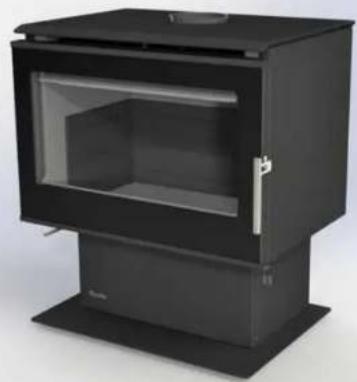
Exterior view of a black industrial stove or oven unit with glass doors and top panel (no visible text or symbols)Ruby Freestanding
Operation & Installation Instructions
Please keep these instructions for future reference.Rev|C 232343
Ruby Freestanding 2

WARNING
Read and follow these instructions carefully before installing and using this appliance
To aid heater installation, remove door, top plate, baffle system and cast iron liners to reduce overall heater weight. SEE PAGE 15 FOR PALLET REMOVAL.

WARNING
Safety Warnings
- A flue fire with resulting damage may occur if the appliance is not installed, operated and maintained as per this booklet.
- Never place combustible materials such as wood, paper or furniture near the appliance.
- This appliance is designed to burn dry wood. Do not burn rubbish, driftwood, flammable liquids or any substance containing salts or corrosives.
- This appliance must not be installed and operated in an area where kerosene, petrol, paint thinner or other flammable liquid is used or stored.
- The flue system must be inspected and cleaned annually or sooner if required. Failure to do so could result in an excessive buildup of creosote which may result in a flue fire which may damage the flue or cause damage to your home.
- The surface of the appliance becomes hot during operation. Do not touch the surface of this appliance. Keep children away from this appliance during operation. Do not allow anyone to operate this appliance who is not familiar with this instruction booklet.

WARNING
Paint Curing and Care
Your heater is coated with the best available heat resistant paint. Even though the paint has been baked after application, it may require further temperature curing. It may, if you overfire the heater on its first fire, discolour. For your first two or three firings, never exceed medium air setting and always have the fan on when above low burn. Do not wipe the heater while the paint is curing. After the paint has cured the only maintenance required to maintain the heater's finish is to wipe it with a soft cloth. Do not use any commercial cleaners or solvents on the paint finish.
We are proud of the presentation of our products. If at any time you need to freshen up the paint, your local dealer has touchup paint available for purchase. This heater is painted in Stove Bright Metallic Black - code 6309.
If you have any enquiries, please contact the dealer from whom you purchased your heater:
PLEASE COMPLETE:
Dealer Name
Dealer Address
Phone:
Please attach your original purchase dockets to this booklet for future reference.
Ruby Freestanding 15
Removing heater from pallet:
- Remove x2 Tek Screws from rear of pedestal base.
- Remove x4 Phillips Head screws holding the pedestal filler panel to the pedestal, and removed panel to gain access to a
third tek Screw which holds to pedestal base to the pallet - Remove third Tek Screw and re-attach pedestal filler panel and x4 Phillips Head screws.
O/All weight: 220kg
Package dimensions: 980Hx795Wx685D
To aid heater installation, remove door, top plate, baffle system and cast iron liners to reduce overall heater weight.


Ruby Freestanding 14
Firewood
Getting the most out of your firewood
Firewood is a sustainable source of energy and when used correctly can provide a cost effective form of heating in your home. Too often poor heating results and operational issues are attributed to using unseasoned wood which leads to excess smoking, causing creosote buildup and dirty glass. Wood should be stored in a dry place where good ventilation is available. Freshly cut wood should be stored for between 12-24 months before burning.
Use only hardwood with your Eureka Ruby.
Thermal efficiency
A wood's efficiency does not depend only on its type, but also on its moisture content as well as the temperature of the combustion chamber. To achieve a greater efficiency and longer burn cycle out of your Eureka Ruby, without the emissions of hazardous particulates, your wood must be well seasoned.
Ideally, wood should not be burnt when its moisture content is above 20%. A moisture meter to measure moisture content is a handy addition.
An example of available thermal efficiency for a piece of wood as a fuel source at varying moisture levels.
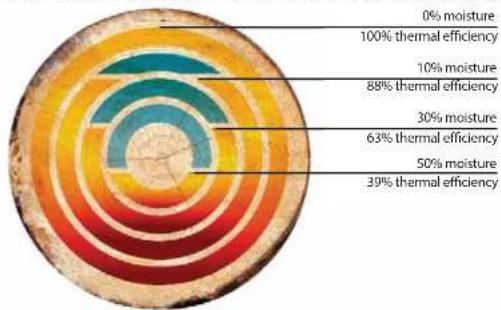
Figure 14
The combustion process of burning wood
When wood is heated up to approximately 100 degrees celsius, moisture begins to evaporate from the fuel. There is no heating value from the wood at this point. As moisture releases from the wood, it reduces the efficiency of the combustion process robbing heat energy from the wood. This demonstrates the importance of dry and well seasoned wood. As firebox temperatures reach 250-300 degrees celsius, wood solids begin to break down and release volatile gases which ignite and produce heat.
From 300+ degrees celsius, the main energy available from wood is released when fuel vapors containing up to 60% of the wood's potential heat is released.
Understanding combustion principles and learning how to manipulate various conditions surrounding the operation of your Eureka Ruby enables you to achieve maximum comfort and efficiency from your Australian made wood heater.
Ruby Freestanding 3
Installation

Installation
THE INSTALLATION OF THIS APPLIANCE MUST BE CARRIED OUT AS PER THIS MANUAL AND THE FLUE MANUFACTURER'S SPECIFICATIONS.
WE RECOMMEND THAT YOU USE A QUALIFIED INSTALLER TO CARRY OUT THE INSTALLATION.
If you have any other enquiries, please contact the dealer from whom you purchased your heater.
THIS APPLIANCE WEIGHS IN EXCESS OF 220 KILOGRAMS. EXTREME CARE SHOULD BE TAKEN WHEN HANDLING THE APPLIANCE.
AF Gason Pty. Ltd. accepts no liability whatsoever for any interpretation of AS/NZS 2918:2001.
It is important you understand these installation instructions and minimum clearances to combustible materials before selecting a position for your Eureka Ruby to ensure safe and correct installation is achieved.
Installation permit
Depending on your local authority requirements, a permit may be required for the installation of your heater. It is your responsibility to arrange the same.
Flue requirements
As per the dimensions in Figure 1 & 2 the Eureka Ruby can be installed with a Perforated 6" Default Flue Kit including a 180 degree x 900mm flue shield, or Figure 3 & 4 a Solid 6" Default Flue Kit including a 180 degree x 900mm flue shield. The flue system installed with the Eureka Ruby must comply with Australian and New Zealand installation standards A5/NZS 2918:2001, and be installed to the flue manufacturer's instructions.
The performance of your Eureka Ruby is highly reliable on an effective flue system. In many cases poor start-up, dirty glass, down draft which causes smoking when the door is open, and a reduction in heat output can all be related to the flue system being too short, or incorrect installation. Too tall a flue can result in excess draft and short burn times along with excessive heat output.
Clearance to combustibles
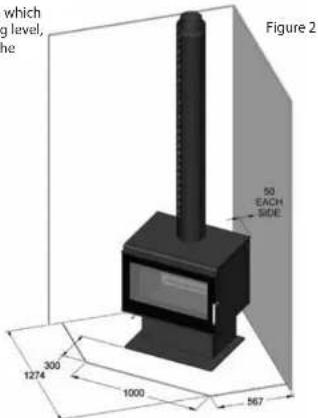
The Eureka Ruby freestanding heater conforms to A5/NZS 2918:2001 when positioned in relation to combustible surfaces as shown in Figure 1 & 2 on the following page. All dimensions used in this document are in millimetres and are minimum unless otherwise stated.
These dimensions in Figure 1 & 2 state the minimum distance the Eureka Ruby can be placed in relation to any combustible materials - plaster, wallpaper, timber, MDF, etc.
In the instance your Eureka Ruby is surrounded by non-combustible materials - brick, stone, concrete, cement sheet, villaboard or similar, wall clearances can be reduced to 50mm. A 50mm clearance is required to ensure room air can circulate around the wood heater during operation.
For additional clearance details, or to access the Eureka Ruby Freestanding Conformance Certificate, please contact the Eureka Dealer from whom you purchased your heater.
Hearth & floor requirements
If the Eureka Ruby will be installed onto a non-combustible floor such as a brick, stone or concrete slab with tiles, etc. which is at least 9mm thick, and extends at least 300mm in front of the appliance base, a hearth or floor protector may not be required.
If the Eureka Ruby is to be installed onto a combustible floor, a minimum 9mm Bellis Board, or similar non-combustible hearth or floor protector must be placed in between the appliance and the combustible floor. At a minimum, the floor protector must extend 300mm in front of the appliance base. The protector must be at least 1000mm wide and 815mm deep. If desirable, the floor protector can extend 895mm deep for perforated flue installations, also 895mm for solid flue Installations or larger to meet skirting boards or walls at the rear of the appliance when installed as per the rear wall clearances.
Ruby Freestanding 4
Installation (Continued)
Parallel Installation - Perforated Outer Flue Kit
- 6" Active Flue with an 8" Perforated painted outer flue casing, which extends from the top of the heater to the drop box at the ceiling level, and an additional 180 degree x 900mm heatshield in between the active flue and outer casing (supplied with heater).
- 50mm from the rear wall to the edge of the appliance rear panel.
- 325mm from the side wall to the edge of the appliance side panel.
• Floor protector should extend 300mm in front of appliance base.
Corner Installation - Perforated Outer Flue Kit
- 6" Active Flue with an 8" Perforated painted outer flue casing, which extends from the top of the heater to the drop box at the ceiling level, and an additional 180 degree x 900mm heatshield in between the active flue and outer casing (supplied with heater).
- 50mm from walls when measured from the closest points of the appliance (45deg to both walls).
• Floor protector should extend 300mm in front of appliance base.

Ruby Freestanding 13
Troubleshooting
- Noisy Fan
Turn the power off and remove the three pin plug from the power point.
Remove the four screws that hold the front of the pedestal and fan access panel. Remove the panel.
Disconnect the wiring loom via the plastic joiner. Unscrew the wing nuts which hold the fan in position and remove the fan. Clean any dust with a dry paint brush and vacuum the fan blades. Clean around the motor. After completion place two or three drops of sewing machine oil on the shafts at the bearings. Replace the fan in reverse to the removal.
- Fan not working
Check the power connection with another appliance. If the power point is O.K. shift focus to the fan or the switches. Move thermostat switch into the 'Overide' position, and select one of the three fan speeds. If the fan fails to function, isolate power as above, remove pedestal filler panel to gain access to loom. Check that the terminals on the loom and both switches are firmly connected. If the fan still fails to function, remove the fan and switches by firstly removing the knob off the rotary switch by pulling it away from the heater. Undo the holding nut and pull the switch out.
Squeeze locator tabs together on the rear of the thermostat switch and push through outside of pedestal. Disconnect the wiring from the power lead and remove the fan. Convey the same to the authorised Eureka Dealer from whom you purchased your unit for service. Replace in the reverse order.
• Air control jamming
Access to the airside is available when the door is opened.
There are three screws holding the air slide in place. Undo them and remove the air slide. Wipe any ash or dust that may have accumulated on the back of the air slide or on the face of the heater. If any buns have developed on the back of the air slide or on the face of the heater, rub them off with fine wet and dry sand paper till you have a smooth surface and edges. Replace the air slide and make sure the washers, springs and spacers are re-fitted when you screw the bolts back into the face of the heater. Do not apply any type of lubricant to the air slide whatsoever as this will attract dust and make the slide stick.
- No overnight burn
Remove the air slide as per air control jamming and check that the air slide is hard against the face of the heater. If it is loose, tighten up the bolts holding the air slide to the face of the heater. Do not overtighten.
Check that the door rope has an even indentation from its contact with the face of the firebox. If it is uneven and it appears as though air could leak through the seal, the door hinge and latch can be adjusted or the door rope may need to be replaced. Refer door adjustments and rope replacement instructions.
• Excessive ash build up
Some woods will give large amounts of ash despite how you run the heater. Others will give you very little. Use the wood which is most convenient for you, as long as it is dry. After a period of time you will get to know when to empty your unit. Bark will give you excessive ash. Try not to burn it. If you are burning wood that gives you charcoal, you may find that after running the heater say for 8 hours at maximum burn rate, the charcoal builds up excessively. An overnight burn will reduce this charcoal back to a fine ash. If you are not ready to shut down for an overnight burn when you next fuel the stove, load the stove with only one piece of wood and lay it across the firebox on top of the charcoal. Open the air control wide open and you will find the charcoal will burn down with the one piece of wood. Repeat the process until the ash level is significantly reduced.
- Excessive smoking - smoke entering the room maybe caused by:
- Insufficient length of flue (flue to be 4500mm minimum underneath the base of heater to underside of cowl) increase height of flue
- Flue downdraught - Consult dealer or increase height of flue.
- Creosote build up in flue - Remove cowl and clean flue as per cleaning instructions. Check moisture content of wood.
Overfiring
NEVER OPERATE THE HEATER WITH THE DOOR LOOSE, OR SUCH THAT THE FIREBOX IS NOT AIR TIGHT. OVERFIRING COULD RESULT IN DETRIMENTAL WEAR AND TEAR ON THE FIREBOX AND FLUE SYSTEM.
Ruby Freestanding
12
Basic Spare Parts
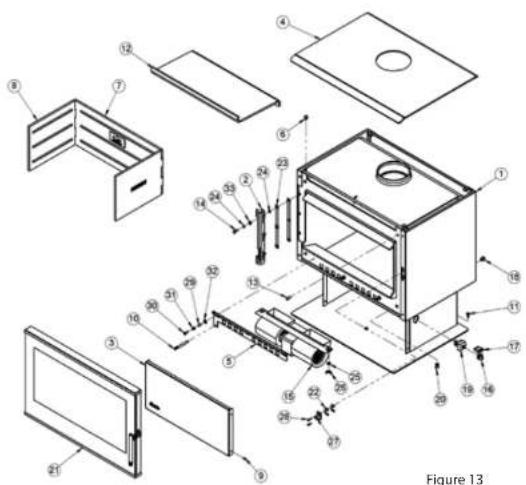
Figure 13
| Ref. | GPN | Description | Ref. | GPN | Description |
| 1 | 231905 | F/Box Assy | 18 | 203651 | Grommet Cord Grip |
| 2 | 230980 | Door Hinge | 19 | 213049 | Switch - 3 Position |
| 3 | 231901-10 | Pedestal Front Panel | 20 | 214289 | Thermostat Switch |
| 4 | 232526 | Top Panel | 21 | 231907 | Door Assembly |
| 5 | 232527 | Air Slide Panel | 22 | 234016 | Latch Shim |
| 6 | 231821 | Rubber Bumper | 23 | 234101 | Hinge Shim Plate |
| 7 | 231031 | Cast Iron Liner - Rear | 24 | 910106 | Washer Star M8 |
| 8 | 231032 | Cast Iron Liner - LH & RH | 25 | 906201 | Washer Flat 1/4 x 3/4 |
| 9 | 924607 | Screw S/Tap 1/2"x10G | 26 | 213146 | Wing Nut M6 |
| 10 | 231804 | Air Slide Rod | 27 | 234342 | Door Catch Assembly |
| 11 | 203914 | Tek Screw 14-20 x 22 | 28 | 917119 | Screw Set M5 x 20 C/S |
| 12 | 231909 | Steel Baffle Plate | 29 | 213098 | Air Slide Spacer |
| 13 | 922313 | Screw Cap M8 x 20 | 30 | 917209 | Screw Set M6 x 20 |
| 14 | 917308 | Screw Set M8 x 20 | 31 | 212974 | Air Slide Spring |
| 15 | 203903 | Twin Barrel Fan | 32 | 907400 | Washer Flat 10 x 18 |
| 16 | 227074 | Switch Knob | 33 | 907412 | Washer Flat 8 x 17 |
| 17 | 232037 | Switch - 2 Position |
[17] 232057 | SWITCH-2 POSITION
Ruby Freestanding 5
Installation (Continued)
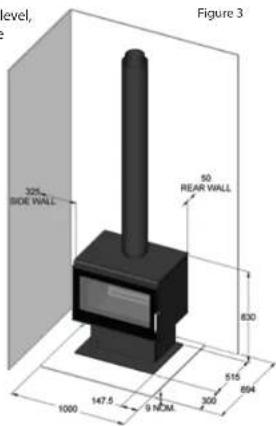
Parallel Installation - Solid Outer Flue Kit
-6" Active Flue with an 8" Solid painted outer flue casing, which extends from the top of the heater to the drop box at the ceiling level, and an additional 180 degree x 900mm heatshield in between the active flue and outer casing (supplied with heater).
- 50mm from the rear wall to the edge of the appliance rear panel.
- 325mm from the side wall to the edge of the appliance side panel.
• Floor protector should extend 300mm in front of appliance base.
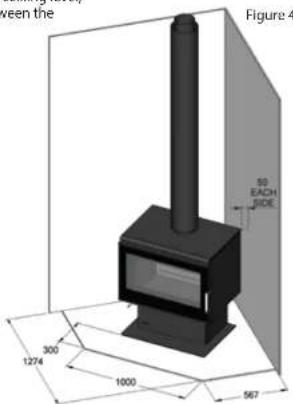
Corner Installation - Solid Outer Flue Kit
-6" Active Flue with an 8" Solid painted outer flue casing, which extends from the top of the heater to the drop box at the ceiling level, and an additional 180 degree x 900mm heatshield in between the active flue and outer casing (supplied with heater).
- 50mm from walls when measured from the closest points of the appliance (45deg to both walls).
• Floor protector should extend 300mm in front of appliance base.
Ruby Freestanding 6
Installation (Continued)
Baffle System

If the baffle plate is damaged, burnt out, discarded or not installed as per these instructions, high flue temperatures, losses in combustion efficiency and excess smoking can occur. To operate this appliance as it is intended, and to ensure product longevity is achieved, ensure the baffle is installed as per these instructions.
If firebox, flue failure or excess damage to the appliance or its surroundings is reported due to incorrect installation or operation of the baffle plate, AF Gason Pty. Ltd. reserve the right to disallow any warranty or claims in relation to the abovementioned.
When removing the baffle to clean the flue, the baffle must be inspected and replaced with the folded lip pointing up at the front of the firebox, as shown in figure 5. If the baffle is burnt through, cracked or deteriorated to such a point that it will cease to function properly, it must be replaced.
Fitting the Steel Baffle
- Feed the baffle plate through the door opening with front edge fold facing up. Feed plate all the way to the rear of the firebox.
- Lift front of baffle over Pin A and slide towards the front of heater.
- Lift the rear so that the baffle is horizontal and move it towards the rear of the firebox.
- Lower over Pin B.
- Ensure baffle is sitting on Pins A and B.
Placement of Cast Iron Liners into firebox
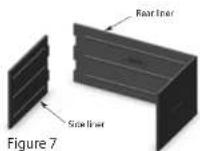
The rear cast iron liner is to be positioned to the rear with rib and logos facing into the firebox. Side cast liners are to be positioned on each side and interlock into the rear cast liner. Refer Figure 7 for orientation.
Final inspection prior to use
- Ensure the steel baffle is firmly located and in the correct orientation.
- Ensure cast iron liners - side and back - are positioned correctly.
- Check fan cord has not been damaged during transit.
- Plug in fan cord and ensure cord does not touch heater surface.
- Switch thermostat switch to 'Override' and select one of three speeds to ensure fan is operational.
- Check door seals are in place.
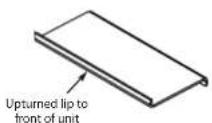
Figure 5

Ruby Freestanding 11
Maintaining & Servicing your Eureka (Continued)
Ensure all maintenance is carried out when appliance is cool.
Figure 12
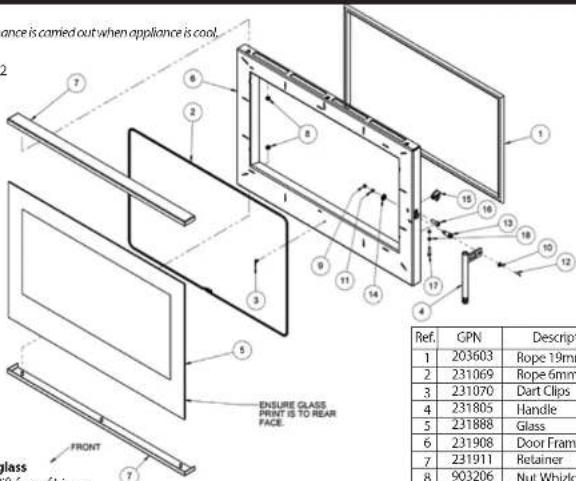
Replacing your glass
- Open door and lift free of hinge.
- Place door face down on a soft flat surface to protect paintwork and glass.
- Remove glass retainers by removing x6 M6 whizlock nuts.
- Lift door frame away from glass. Note how the 6mm OD glass sealing rope is placed around the door frame - dispose of old glass safely.
- Fit new 6mm OD glass sealing rope onto the door frame with new x6 dart clips. Ensure clips are positioned with pointed extrusion facing towards the edge of the door frame.
- Place the glass back onto the door frame with the 6mm OD door sealing rope in position
- Fit glass retainers back to top and bottom of the door, and attach to door frame with the x6 M6 whizlock nuts. Tighten nuts evenly until the retainer holds the glass. Do not over tighten the retainers as this could break the glass.
- Mount door back onto hinge, close and ensure fitment is safe and correct.
Fitting a new door seal
- Open door and lift free of hinge.
- Place the door face down on a soft flat surface to protect the paintwork and glass.
- Remove old rope and scrape old glue from rope retaining groove.
- Clean the rope retaining groove with a clean, dry cloth to remove any old dust and debris.
- Apply a generous bead of roof and gutter silicon around the rope retaining groove.
- Press the new 19mm OD door rope into the rope retainer groove, placing the start-stop joint to the bottom corner of the hinge side of the door.
- Refit door and close to apply pressure to the new rope.
Note: Hinge and door catch may need to be adjusted to allow the door to close completely, if previously adjusted to accommodate an ageing rope. - Leave door closed for at least 12 hours before lighting the heater, and initially run at a low temperature to allow adhesive to fully bond to the door.
| Ref. | GPN | Description |
| 1 | 203603 | Rope 19mm OD |
| 2 | 231069 | Rope 6mm OD |
| 3 | 231070 | Dart Clips |
| 4 | 231805 | Handle |
| 5 | 231888 | Glass |
| 6 | 231908 | Door Frame |
| 7 | 231911 | Retainer |
| 8 | 903206 | Nut. Whizlock M6 |
| 9 | 904300 | Nut. Conelock M5 |
| 10 | 907204 | Washer M6 x 12.5 |
| 11 | 907406 | Washer 5.5 x 10 |
| 12 | 932202 | Screw M6 |
| 13 | 231816 | Shaft Main |
| 14 | 234344 | Upper Latch Gear |
| 15 | 234345 | Lower Latch Gear |
| 16 | 922311 | Screw M8 x 20 |
| 17 | 917110 | Screw M5 x 25 |
| 18 | 902005 | M5 Nut |
Grange Freestanding 10
Maintaining & Servicing your Jindara (Continued)
Cleaning the glass
Generally the only time you will possibly need to clean your glass is after a long overnight burn. If you find that you have a wet sticky black film on your glass (creosote), it is better to burn the heater as normal for one load of wood. When the wood has burnt down to a hot bed of embers, open the door and leave it wide open until the glass cools sufficiently to be wiped with a damp cloth. This should clean all the white smoky film off the glass. Creosote on the glass is normally a sign that you have tried to get too long an overnight burn or you have burnt excessively wet or green wood. If the film on the glass won't come off with a wet cloth, you can use wet ash from the ash bed as a cleaner or commercial products such as Crystal Clear, Johnson Foam Clean or Windex.
To maintain an efficient and safe use of your Jindara Grange, you may need to adjust the door hinge and catch to ensure the door closes safely and correctly over the duration of its life.
Adjusting door catch
- Open door to gain access to catch.
• Using a 3mm Allen key, remove the two catch retaining screws and set aside.
• To tighten the latch, remove one shim. To loosen the latch, fit an additional shim.
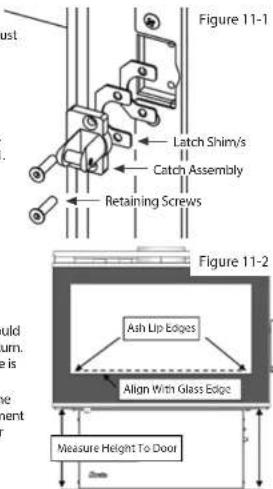
• Additional shims are provided in the user manual packaging. Refer to figure 11-1.
• Once the desired setting has been achieved, re-fit the catch assembly using th
two retaining screws.
- Note that if an adequate seal cannot be achieved through the removal of one shim, a replacement door rope may be required.
The door hinge defines the door alignment to the heater and the door catch, as well as determining the amount of pressure applied to the main door rope at the hinge side of the door.
To align door:
- Slightly loosen 3 x M8 Bolts securing the hinge to the heater. The upper bolts should be loosened 1-1+1/2 turns, while the lower bolt should only be loosened 1/2 a turn. - Align door horizontally by pivoting the door about the lower bolt. Note that there is no provision for lateral adjustment of the door hinge position.
- Check the alignment of the door by measuring vertically from the underside of the door at each outer edge, to the base of the unit, as per figure 11-2. This measurement should be taken with the hinge bolts tightened and with the door hanging under its own weight.
To adjust hinge shims:
- Open door and lift free of hinge, and place on a soft flat surface while servicing the hinge.
- Remove the door hinge and fasteners as shown in figure 13.
- Remove x1 hinge shim plate in order to tighten the seal of the door rope.
The maximum number of shims permitted behind the hinge is 2, fitted as standard.
- Fit door and re-align door to catch and firebox before fully tightening M8 bolts.
Adjusting door handle
- The door handle position can be adjusted to align the handle with the door glass, when the handle is in the closed position.
- Adjustment is carried out by winding the adjuster screw in or out, in order to change the rest stop position of the handle. This should be done with the door open and the handle resting in the closed position.
• To adjust the position of the screw, first release the lock nuts, then use a Phillip's head screw driver to turn the adjuster screw either in or out depending on the adjustment ro
- Once the desired adjustment position has been achieved, the lock nut should be re-tightened against the retaining plate. Refer to figure 11.3.

Grange Freestanding 7
Installation (Continued)
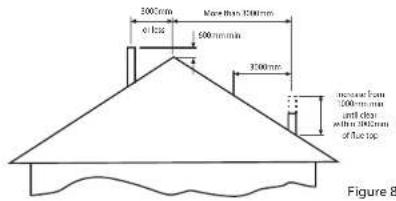
Flue and chimney requirements
The flue pipe shall extend not less than 4.6m above the top of the floor protector. Note: Installation must be carried out by a licensed installer in accordance with AS/NZS 2918:2001.
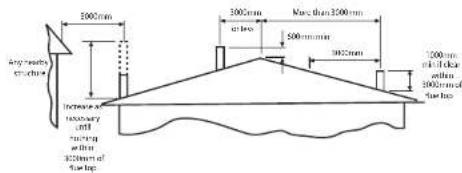
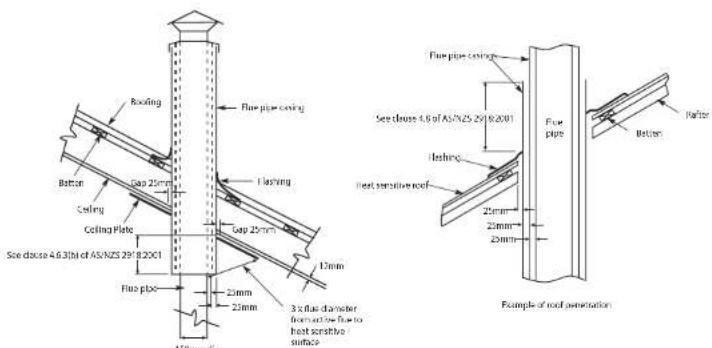
Example of shaped ceiling penetration
Figure 9
Ruby Freestanding
8
Operating your Eureka

Read these instructions
DO NOT ATTEMPT TO OPERATE THIS APPLIANCE WITHOUT READING AND UNDERSTANDING THESE OPERATING INSTRUCTIONS THOROUGHLY, FAILURE TO OPERATE THIS APPLIANCE PROPERLY MAY CAUSE UNDUE DAMAGE TO THE APPLIANCE OR RESULT IN A FLUE FIRE.
Starting your fire
Place a firelighter or paper in the bottom of the firebox and place a large amount of small kindling on top. Ignite the paper or the firelighter. Set the air control to high and leave the main door open approximately 25mm. When the kindling is burning, place about four pieces of small wood on top of the burning kindling. Once the wood is alight, close the main door. After approximately 20 minutes, turn the air control down to medium. For fan operation refer page 9.
On the initial fire up you may detect smoke coming from the paint finish and from any oils that may be on the steel on the outside of the firebox. This is normal. It is suggested to well ventilate your home on the initial fire up. Please refer to our section 'Paint Curing and Care' on page 2.
The glass door
Always operate your heater with the door closed and locked. The only time you can leave the door open is on initial lighting, or when reloading the heater
Care of your glass
If you are burning good, dry wood, you will have very little discolouration of your glass in a normal burning cycle. If you aim for an eight to ten hour overnight burn, you should not get much discolouration. You can control this by adjusting the air control, moving from the left and slowly creeping the control to the right. After a number of days you will find the right position to suit your requirements and the fuel that you are using.
Daily operations
When you get up in the morning, open up the air control of the heater to high position to start the embers glowing. Place three or four pieces of wood on tap of the embers and leave the door open 25mm. Once the fuel starts to flame close the door. Depending on your daily heating requirements, operate the fan as per fan operation instructions on page 9. For best results it is best to burn 410mm long wood and load your wood straight into the firebox front to rear. This will give optimum efficiency and recoverable heat, and minimise creosote formation and smoke emissions.
Overnight burn
Approximately 30 minutes before turning the heater down for the overnight burn it is recommended to load the heater with fuel. Leave the air control in the medium to high position. Let the heater run for about 30 minutes.
This will reduce the moisture content in the fuel before shut down. (This will help reduce the creosote formation in the firebox and flue) Set the air control to the setting you have found best for your requirements. Turn the fan off and retire. The aim when overnight burning is to have only a few hot embers left in the bottom of the firebox in the morning, not huge lumps of wood.
Fan operation
Your Eureka Ruby is equipped with a temperature-sensitive thermostat switch located within the heaters pedestal beneath the firebox, which when selected will turn the fan on and off depending on the temperature of the firebox. To use the thermostat, select the thermostat 'On' position via the thermostat switch, and select the desired fan speed you wish to use (low, medium or high).
If the fan is not coming on at the desired time, flip the switch into the Override position and operate the 3 speed fan as described on page 9, with reference to figure 10.
Ruby Freestanding 9
Operating your Eureka (Continued)
• Initial Startup (cold)
Leave fan off until the heater is hot and has established a coal bed - approximately 20 minutes after fuel is lit.
+Medium or High Burn Setting
If the heater is running above medium fire for extended periods of time, fan speeds medium and high are recommended. High is recommended for short bursts where a quick temperature rise is desired in conjunction with a high fire setting.
• Low Burn Setting
The fan cools off the firebox, robbing the combustion process of efficiency. If you wish the fan can be left off only when the heater is burning a low fire. Note: Improper use of fan can result in firebox failure.
The fan should be cleaned on a regular basis. (Refer Troubleshooting for fan removal and cleaning.)
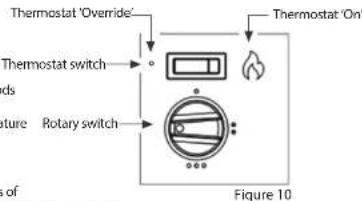

Operation of the Fan
If firebox failure is reported and it is found that the firebox has been abused through improper use of the fan, AF Gason Pty. Ltd. reserve the right to disallow any warranty claims in relation to firebox failure.

The Door
Leaving Door Open
As stated previously, leaving door open 25mm encourages the fire to pick up at a faster rate. Your heater has been tested to ensure that no structural damage can take place if the door is inadvertently left open. However your paint finish can be damaged if the door is left open for a long period with a full firebox of fuel with the fan off. Closely supervise your heater while the door is left open.
Closing the Door
Always ensure that before you close your door there is no wood protruding beyond the front of the firebox opening. Do not use the door glass as a 'battering ram' to push the wood back into the firebox. Damage to the glass by such impact is not covered by your warranty.
Maintaining & Servicing your Eureka
Cleaning your flue
Firstly and carefully remove cast iron plates and baffle system and put to one side. Close the heater door. Obtain a 150mm flue brush from your local Eureka Dealer and proceed up onto the roof. Remove the cowl. Slowly push the brush down the chimney until it stops. Pull the brush back out and repeat the process.
Each time you do this you will notice that the brush will go further down the chimney until it reaches the bottom. The soot and creosote will fall down the chimney and into the firebox. Clean residue from firebox. Replace the baffle plate first followed by the cast iron liners.
Make sure you do the job well. The cleaner the flue the less chance there will be of the creosote sticking again.
After you replace the cowl, inspect the roof flashing for any damage that may have incurred whilst you were cleaning the flue. Reseal the seal on the roof with roof and gutter silicon if required.


- WARRANTY
- Ruby Freestanding
- Operation & Installation Instructions
- Ruby Freestanding 2
- WARNING
- Read and follow these instructions carefully before installing and using this appliance
- PLEASE COMPLETE:
- Ruby Freestanding 15
- Removing heater from pallet:
- O/All weight: 220kg
- Firewood
- Getting the most out of your firewood
- Thermal efficiency
- The combustion process of burning wood
- Installation
- Installation permit
- Flue requirements
- Clearance to combustibles
- Hearth & floor requirements
- Installation (Continued)
- Troubleshooting
- Basic Spare Parts
- Parallel Installation - Solid Outer Flue Kit
- Corner Installation - Solid Outer Flue Kit
- Baffle System
- Fitting the Steel Baffle
- Placement of Cast Iron Liners into firebox
- Final inspection prior to use
- Maintaining & Servicing your Eureka (Continued)
- Replacing your glass
- Fitting a new door seal
- Grange Freestanding 10
- Maintaining & Servicing your Jindara (Continued)
- Cleaning the glass
- Adjusting door catch
- Grange Freestanding 7
- Flue and chimney requirements
- Operating your Eureka
- Starting your fire
- The glass door
- Care of your glass
- Daily operations
- Overnight burn
- Fan operation
- Operating your Eureka (Continued)
- Leaving Door Open
- Closing the Door
- Maintaining & Servicing your Eureka
- Cleaning your flue
Brand : EUREKA
Model : Ruby Freestanding
Category : Heating