BLM4ISE - Cooker DIMPLEX - Free user manual and instructions
Find the device manual for free BLM4ISE DIMPLEX in PDF.


User questions about BLM4ISE DIMPLEX
0 question about this device. Answer the ones you know or ask your own.
Ask a new question about this device
Download the instructions for your Cooker in PDF format for free! Find your manual BLM4ISE - DIMPLEX and take your electronic device back in hand. On this page are published all the documents necessary for the use of your device. BLM4ISE by DIMPLEX.
USER MANUAL BLM4ISE DIMPLEX
natural_image
Exterior view of a black industrial stove with visible flames and internal wood (no text or symbols)Bellingham 4.7kW Multifuel Inset Stove
For Standard 16" Fireplace Opening
Please hand these instructions to the stove user when installation is complete. Leave the system ready for operation and instruct the user in the correct use of the appliance and operation of controls.
Installation should only be carried out by a suitably qualified installer. Dimplex recommend using an installer who is registered with HETAS (UK) or with INFO (Republic of Ireland). Installation must comply with all current Building Regulations.

text_image
HETAS APPROVED PRODUCT • HETAS

08/52386/0 - Issue 5 03 Nov 2015
1
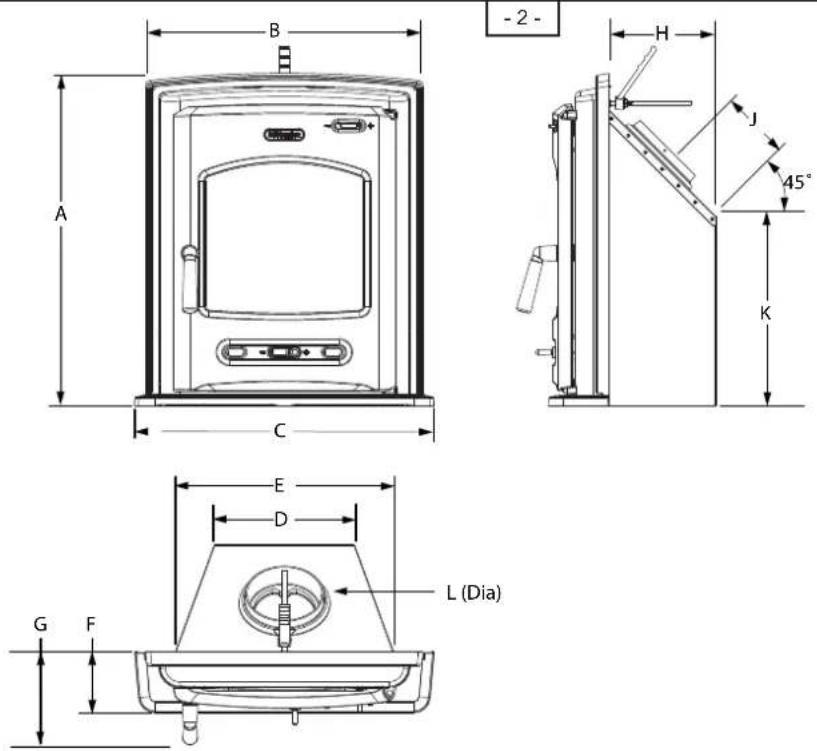
| Table 1 - Dimensions A | B C D E | F G H J K L | ||||||||
| Bellingham Inset 4.7kw | 600 | 500 | 540 | 250 | 393 | 111 | 167 | 192 | 150 | 340 |
Note: All Dimensions in mm. Dimensions stated may be subject to a slight ± variation. (25.4mm = 1")
| Table 2 - Technical Specification | Bellingham Inset BLM4iSE | ||
| Wood Solid Fuel | |||
| Nominal heat output kW 4.7 4.7 | |||
| Efficiency | % | 81.8 | 72.8 |
| CO Emission (@13% O_2 ) | % | 0.24 | 0.24 |
| Flue Gas Temp | °C | 233 | 258 |
| Flue Gas Mass Flow | g/s | 3.9 4.4 | |
| Refuel Period | hr | 1 | |
| Safe Distance to Combustible Materials | mm | Top 350mmSides 150mm | |
| Flue Outlet Size | mm/inch | 152 / 6 | |
| Product Weight | kg | 70 | |
2

natural_image
Diagram of a mechanical press or clamping device with red arrows indicating force directions (no text or symbols present)3
text_image
Diagram showing a hand using a wrench to measure a curved gauge or indicator, with red arrows indicating direction.4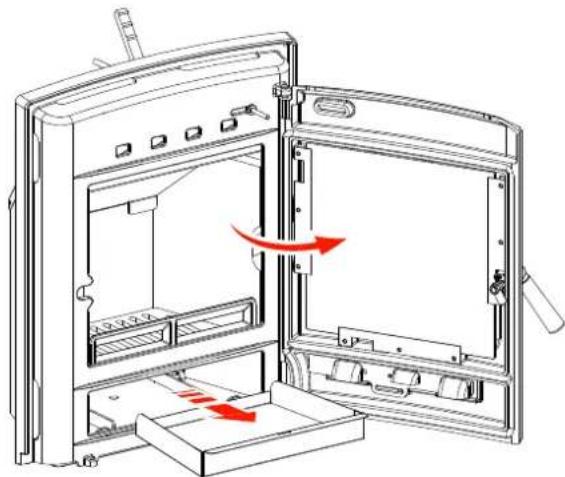 | 5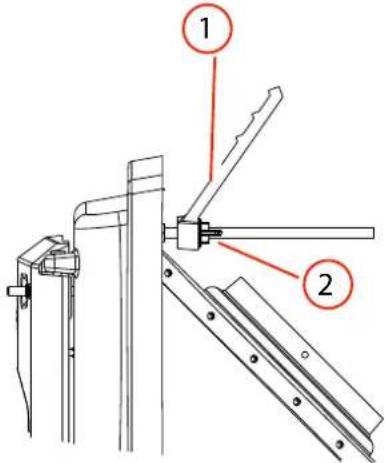 |
6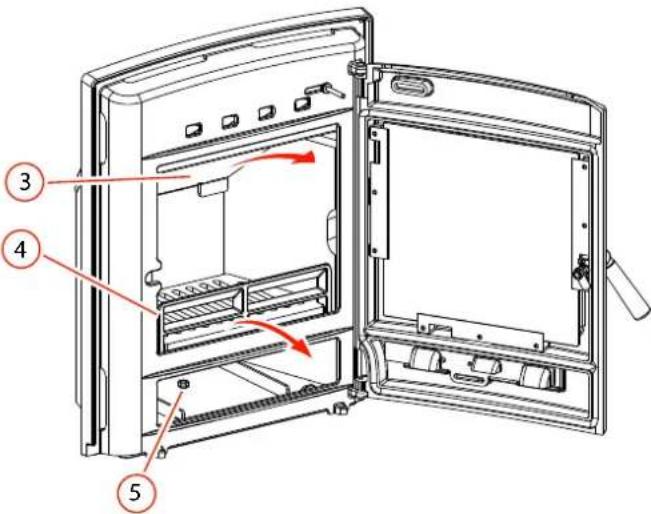 | 7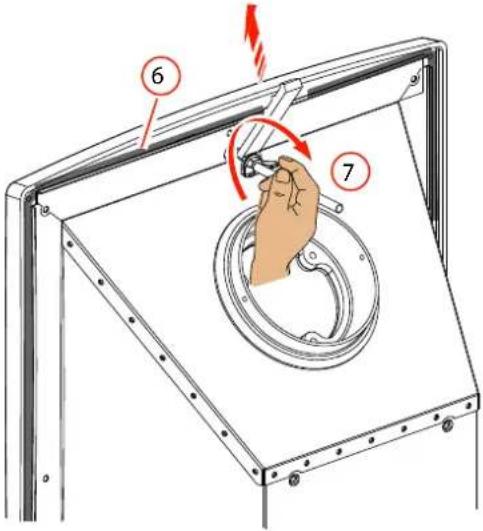 |
8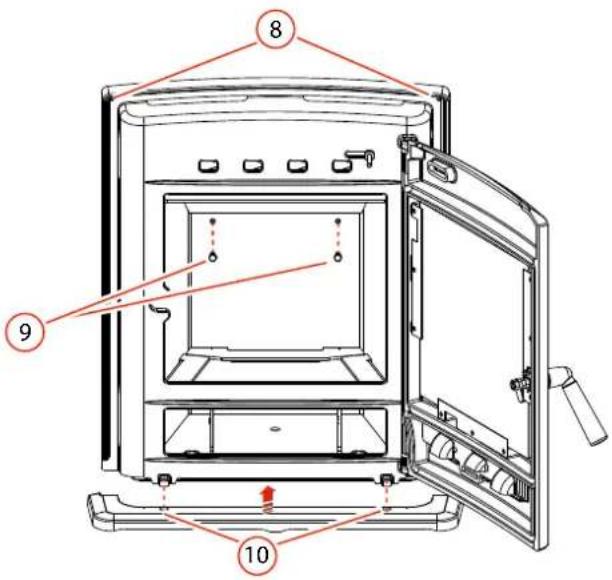 | -4-9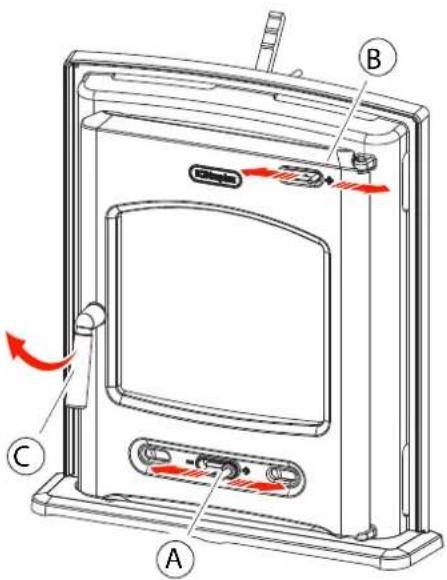 |
  | 11Typical installation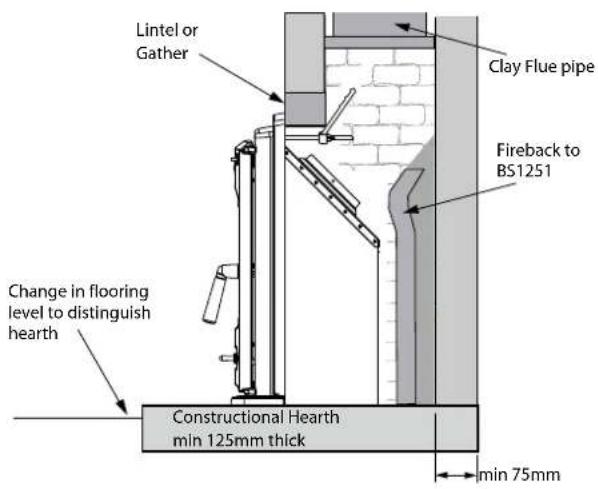 |
IMPORTANT: THESE INSTRUCTIONS SHOULD BE READ CAREFULLY AND RETAINED FOR FUTURE REFERENCE
Important Safety Advice
Please read these instructions carefully before installing or using this appliance. Failure to do so may result in damage to persons and property.
Installation of this appliance must be carried out by a suitably qualified competent person in accordance with BS8308, Code of practice for installing domestic heating and cooking appliances burning solid mineral fuel. Installation must also comply with all Building Regulations, including those referring to Local Authority Bye-Laws, National and European Standards and Codes of Practice.
Do not install this appliance on a shared flue.
Do not fit an extractor fan in the same room as this appliance.
Ensure that there is adequate ventilation in the room in accordance with building standards. Do not obstruct any of the air inlets or outlets on the appliance.
A flue damper should not be fitted when burning solid fuels other than wood.
This appliance operates at very high temperatures and retains its heat for a period after use. Do not touch any surfaces while in use. All persons including children and the infirm should be warned of this and not allowed to touch any surfaces while in use. Please use a suitable fireguard manufactured to BS 8423:2002 suitable for use with solid fuel appliances, to prevent contact when in use.
Do not place any photographs, paintings, TV's or other combustible items near the appliance as exposure to hot surfaces will cause damage. Maintain safe distances from combustible materials in accordance with these instructions.
The operator must use the tools provided. The glove provided is a tool.
This appliance is for domestic heating use only in accordance with these operating instructions. Do not make any unauthorised changes to the appliance.
Do not burn petroleum coke fuels, bituminous (smokey) coal, household waste or plastic in this appliance.
Burn only fuels with a low moisture content, such as smokeless fuel or properly seasoned wood. Burning soft or wet fuels such as unseasoned timber or peat will only result in a build up of tar in the stove and the chimney and will cause staining of the glass.
Do not use flammable liquids to ignite the fire.
Avoid the use of aerosols in the vicinity of the stove when it is in operation.
Clean your chimney at least twice a year and check the baffle plate monthly to ensure there are no blockages. Do not allow a build up of ash to occur in the ash pan as this will cause the grate to burn out prematurely.
Regular maintenance should be carried out by a suitably qualified engineer.
Health and Safety Precautions
Handling: This product is heavy and should be handled with care to avoid the possibility of personal injury when moving or servicing. Adequate facilities must be available for the unloading and handling of this appliance. Use protective clothing.
Fire Cement/Glue: Some types of fire cement/glue are caustic and should not be allowed to come into contact with the skin. Use suitable protective gloves when handling. In case of contact, wash immediately with plenty of water.
Asbestos: This appliance contains no asbestos. If there is a possibility of disturbing asbestos as a result of installation then specialist guidance must be sought prior to installing.
Please Note: Any white deposits on the stove joints are caused by humidity reacting with the joint sealant. These deposits are not cause for alarm and may be brushed off using a soft cloth. If required the joints may be blackened again with a proprietary stove polish.
Installation Instructions
General
These instructions give a guide for the installation of the stove but in no way absolves the installer from responsibilities to conform to all relevant standards relating to the installation of solid fuel appliances.
This stove is designed to be recessed in a standard 16" sized fireplace opening. The stove is only suitable for use on a fireplace and chimney that has been fitted for use with solid fuel. The fireplace backpanel and hearth must have the necessary expansion joints and the backfilling suitable for solid fuel use.
We recommend that for UK installations a HETAS registered installer should be used, who will be able to give a Certificate of Compliance that installation complies with Building Regulations. In Ireland a registered installer from the Irish Nationwide Fireplace Organisation should be used.
Please note that to the best of our abilities these instructions are correct at time of printing, however we cannot be held responsible for any differences in legislation which may occur in the future.
Assembly of the stove
- Unscrew the wooden crate and lift off the upper box (Fig 2).
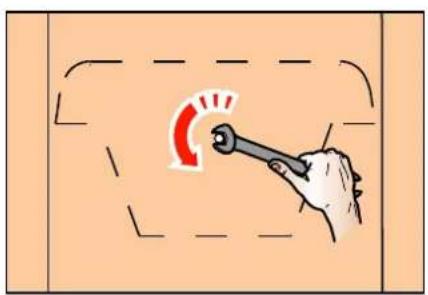
- The stove is bolted to the crate through the base of the stove to prevent damage during transportation. Unscrew the fixing bolt (Fig 3) to release the crate before installing the stove. Unscrew the fascia plinth and set aside for fixing later.
- Remove the plastic bag, To make the product easier for handling on installation, open the stove door and remove the liner bricks, baffle plate, grate bars and ashpan (Fig 4). Place these in a secure place to avoid damage. These must be refitted after installation.
- Unscrew the wingnut to loosen the clamp on the fixing bar. (1 & 2, Fig 5).
- Place the inset stove into position in the fireplace and mark the intended position of the fixing screw through the hole in the bottom of the appliance (5, Fig 6). Remove the stove and drill a hole then insert a M8 expanding wall rawl bolt to secure base in position. Re-position the stove and screw into place. The fixing hole should then be sealed with fire cement to avoid air leakage.
- Create a seal with the fascia of the fireplace making sure the rope seal (6, Fig 7) on the back of the stove comes into
contact with the fascia. Place hand through the stove collar and tighten the wingnut on the clamping bar (7, Fig 7). The clamp creates pressure when it contacts the chimney/lintel. The stove should be tightly sealed to the fireplace fascia.
- If required the stove may be secured directly to the fascia using the fixing screw holes (8, Fig 9). Alternatively as a last resort fixing option, the stove may be screwed through the appliance and directly into the fireback. To do this remove the wrap fixing bolts (9, Fig 9) and bolt directly into the fireback using stainless steel M5 expanding wall bolts. In all cases, only high temperature metal wall fixings may be used and all fixings through the appliance must be made air tight so there is no smoke leakage.
- Position the fascia plinth in front of the appliance lining up the screw holes with the fixing bosses and screw in position using the 2 x M6 countersunk screws provided (10, Fig 8).
Chimney & Flue Connections
Before installing, check that the chimney is in good condition; dry and free from cracks and obstructions. The diameter of the chimney flue or any joiner sections should not be less than 150mm and not more than 230mm. If these requirements are not met, the chimney should be relined by a suitable method by a qualified person.
The chimney height and the position of the chimney terminal should conform to Building Regulations BS EN 15287-1:2007 design, installation and commissioning of chimneys. If you have any doubts about the suitability of your chimney, consult your local dealer or stockist.
The chimney must be swept thoroughly before connection to the stove and swept every six months thereafter.
If there is no existing chimney then a prefabricated block chimney or a twin walled insulated stainless steel flue to BS4543 can be used. These must be fitted in accordance with the manufacturers instructions and in compliance with Building Regulations.
If using a joiner flue, connect the flue pipe to the stove making sure that it fits snugly into the base of the flue collar. Seal the collar and flue connection with fire cement or with other suitable high temperature sealant. Add flue sections as required; note that all flue sockets must face upwards. Ensure that the flue pipe end is no closer than 76mm to the side or rear of the chimney walls. It is essential that all connections between the stove and the chimney flue are sealed and made airtight.
This product must not be installed on a shared flue.
Flue Deposits
If the chimney was previously used as an open fire, it is possible that the higher flue gas temperatures generated by the stove may loosen deposits that were previously adhered to the inner surface of the flue pipe which could cause a blockage. We recommend that in this situation a second sweeping of the chimney should be carried out within one month of initial stove use after installation.
CO Alarm
Building regulations require that whenever a new or replacement fixed solid fuel or wood/biomass appliance is installed in a dwelling, a carbon monoxide alarm must be fitted in the same room as the appliance. Further guidance on the installation of the carbon monoxide alarm is available in BS EN 50292:2002 and from the alarm manufacturer's instructions.
Provision of an alarm must not be considered a substitute for either installing the appliance correctly or ensuring regular servicing and maintenance of the appliance and the chimney system.
Floor Protection & Installation Clearances
In all instances the stove must be positioned on a non-combustible hearth that conforms to Building Regulations and is firm, secure and capable of supporting the stove. Care should be taken to ensure the stove is level.
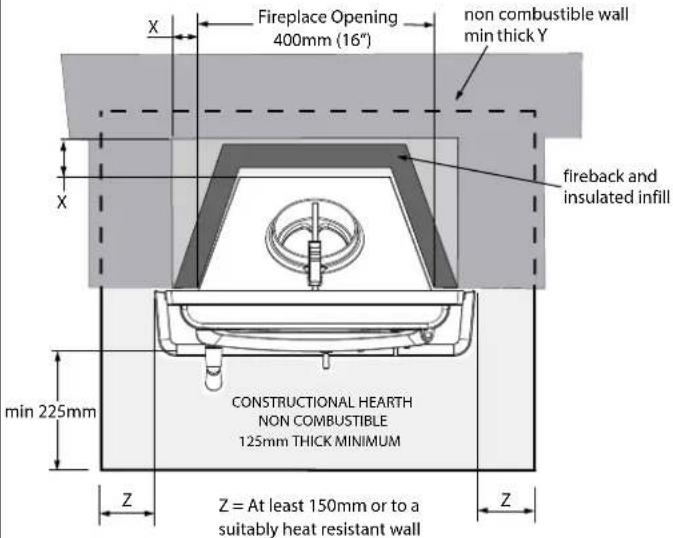
Building Regulations require that a solid constructional hearth of minimum 125mm must be used, including the thickness of the floor and any decorative top surface (e.g. tiling). The Constructional hearth must extend minimum 225mm in front of the appliance and at least 150mm from either side and the rear of the appliance. (Fig 10).
All walls adjacent to the hearth should be made from solid non combustible material with minimum thickness as per table 3:
| Table 3 | ||
| Stove distance X from wall | Min Wall Thickness Y | Min solid wall height 300mm above the appliance and 1.2m above the hearth |
| less than 50mm 20 | 0mm | |
| 50mm and over 75 | mm | |
Table 4 shows the minimum safe distances to combustable materials which must be observed in all installations. Any surrounding combustible material should not exceed 80^ C.
| Table 4 Top Sides | ||
| Bellingham Inset 4.7kW 350mm | 150mm |
Room Ventilation
For safe operation this stove must be provided with permanently open combustion air supply in addition to normal room ventilation, in accordance with Building Regulations. Minimum ventilation requirements vary by country and whether the dwelling is considered to be of standard construction or of airtight construction, or if a flue draught stabiliser has been fitted. The required open air vent sizes are as follows:
| Table 5 - Additional Room Ventilation Required | |||
| Construction | Flue | UK | Ireland |
| Standard build{air permeability >5.0m3 /(h.m2)} | No Flue Stabiliser | None | 65 cm2 |
| With Flue Stabiliser | 14 cm2 | 65 cm2 | |
| Airtight build{air permeability ≤5.0m3 /(h.m2)} | No Flue Stabiliser | 26 cm2 | 65 cm2 |
| With Flue Stabiliser | 40 cm2 | 79 cm2 | |
Note: It is unlikely that dwellings built prior to 2008 would have an air permeability of less than 5m3/(hr.m2), at 50 Pa unless extensive airtightness measures have been carried out. If in doubt assume value ≤5.0m³ /(h.m²) or seek specialist advise.
Flue Draught
The chimney should be checked before the stove is installed to ensure that there is adequate flue pull. The draught can be checked initially by using a smoke match close to the flue opening. If the chimney doesn't pull the smoke it may suggest that the chimney needs further attention. Any remedial work to the chimney flue should be carried out by a suitably qualified engineer.
A flue draught of minimum 12 Pascal to maximum 25 Pascal is required for satisfactory appliance performance. The flue draught should be checked under fire at high output and if it exceeds the recommended maximum a flue draught stabiliser (or flue damper as it is also known) must be fitted so the rate of burning can be controlled and prevent overfiring.
An extractor fan must not be used in the same room as this appliance.
Flue Damper (Not Supplied)
When burning wood, a flue damper may be fitted to reduce the draught through the stove if the draught is too high. When the damper is set in the open position the chimney draws at full draught, increasing the volume of air flow through the stove and flue. Shutting the damper restricts the flow, slowing the rate of burning.
The damper should be fitted to the stove flue and should be the same size as the flue pipe. As a rule it should be fitted no closer than 700mm from the flue outlet of the appliance.
A flue damper should not be fitted when burning solid fuels other than wood.
Commissioning
Upon completion of installation, the stove and flue system should be tested by a suitably qualified person to make sure it is safe for normal use. A smoke draw test should be completed to check for soundness of joints and seals and also that all smoke and fumes are taken from the appliance up the chimney and emitted safely.
First warm the flue with a blowlamp or similar for about 10 minutes. Place a lit smoke pellet on the centre of the grate with the air controls open. Close the door – the smoke should be drawn up the flue and be seen to exit from the flue terminal. Complete the test with all windows and doors shut in the room where the appliance is fitted.
If a ceiling fan is present it must be operated on max for the duration of the test. If there are any extraction fans in adjacent rooms these too must be operated on maximum setting during the test with the interconnecting doors open. If any spillage occurs, recheck the suitability of the flue system making sure there is adequate air supply to the room (as per Building Regulations).
Light the appliance and slowly increase the temperature to operating levels. Open the main fire door when the appliance reaches normal operating condition and carry out a spillage test using a smoke match or pellet around the door opening. If any spillage occurs, open all windows, allow the fire to go out and recheck the flue system and ventilation.
Operating Instructions
Please read fully these operating instructions and advise any other users of the correct operating procedures for this stove.
Warning: This appliance and its operating handles become hot when the stove is in use and the stove will remain hot for some time afterwards. For your safety use the glove provided.
CO Alarm
Your installer should have fitted a CO alarm in the same room as this appliance. If the alarm sounds unexpectedly, immediately vacate all persons from the room and open windows/doors to allow ventilation into the room. Allow the fire to go out and do not reuse it until it has been checked by a chimney specialist for blockages or ventilation problems. Should you or any other person display any symptoms of exposure to carbon monoxide poisoning (e.g. headache, nausea, drowsiness, vomiting, etc) seek medical help immediately.
Your CO alarm should be checked weekly to ensure that it is still operational or if batteries need to be replaced.
Initial Firing of Stove
We recommend that you have 3-4 small fires before you operate your stove to maximum heat output. This is to allow the paint to cure and the castings to relax and consolidate location. We recommend this 'running in' procedure after long idle periods to preserve the life of the stove. During this you may notice an unpleasant smell as paint and fire cement cures. It is not toxic but for your own sake we would suggest that during this period you leave all doors and windows open.
Air Controls
Primary air is controlled via the sliding vent (Fig 9 A) in the bottom of the door; this provides a conventional air draught to the bed of the fire. Moving the slider to the right increases the air intake, to the left reduces the air intake.
Secondary air is controlled via the sliding vent (Fig 9 B) above the door. It is this ‘Airwash’ that keeps a clean and uninterrupted view of the fire, also aiding in good secondary combustion of fuel and reducing emissions into the chimney and environment.
Lighting the Stove
Place fire lighters or paper and 5-6 pieces of dry kindling on the grate. Light the fire at base and allow the kindling to light fully across the grate. Build the fire up gradually using small refills of fuel until there is a good fire bed and the fire is well established.
When refuelling with wood, leave both air controls in the fully open position to the right for 1-2 minutes until the new fuel is burning brightly. Once the fuel is fully alight and flames are well established, the primary air (undergrate air) should be closed fully and the airwash reduced to adjust the stove to the desired heat output.
If refuelling with solid fuel then the airwash should be closed and the primary air slide should be fully open until the fuel is well alight. Once the fuel is well alight the primary air may be adjusted to control the fire to the desired heat setting.
Do not operate the stove with both air supplies open for extended periods, as this will result in overfiring, causing excessive running temperatures and premature burnout of components.
Running the Stove
When your fuel is well alight you can start to restrict the air intake to the desired setting. Your stove is burning with maximum efficiency when a bright fire is achieved using minimum air inlet.
Never leave the stove unattended until the fuel is burning well and the air supply has been adjusted down to desired level.
Note that refuelling onto a low firebed causes excessive smoke to occur. Refuelling must be carried out onto a sufficient quantity of glowing embers to ignite fuel in a reasonable period. If there are too few embers add kindling first to get fire going again before refuelling. The stove is not suitable for overnight burning.
For optimum performance the stove should not be overfilled with fuel above the height of the rear brick. To do so can cause poor operation, excessive smoke to occur and possible damage to baffle plate. The stove must not be operated with the door left open.
This stove is capable of intermittent operation.
Notes on Wood Burning
Burn only dry, well seasoned wood (< 20% moisture), which should have been cut, split and stacked for a minimum of 12 months (24 months is better) with free air movement around all sides of the stack to enable it to dry out. Burning wet or unseasoned wood will create tar deposits in the stove and chimney and will not produce a satisfactory heat output. When loading wood, make sure that the end grain of the wood in the stove is pointing away from the glass otherwise the moisture and gases coming from the end grain of the wood will dirty the glass.
Table 6 - Maximum log lengths
| Bellingham Inset 4.7kW 230mm (9") |
Notes on Solid Fuel burning (Other than Wood)
Always de-ash the stove before burning solid fuel and do not let the ash build up to the underside of the grate bars. Solid fuel produces ash, which if allowed to build up it will stifle the air flow through the grate and will eventually cause the fire to die. Air passing through
the firebed cools the grate. Distortion or burning out of the grate bars is nearly always caused by ash being allowed to build up on the underside of the grate. With some solid fuels a residue of burnt fuel or clinker will accumulate on the grate. It is important to empty the ash pan and remove clinker after each firing of the stove.
We recommend the use of HETAS approved manufactured smokeless fuels. Note that different types of fuel will give different performances. Using the stove as an incinerator for household waste invalidates the warranty is not recommended as fumes from plastic, etc will cause pollution to the atmosphere and will cause damage to the stove.
Petroleum coke fuels, bituminous (smokey) coal or household waste should not be burned in this appliance.
Shutting Down
To shut down the stove, close the primary air controls and then the secondary air controls by moving both sliders to the left. If the controls are left in this position the fire will be starved of air and will go out. To revive the fire if it has not already extinguished, open the primary air controls first, then the secondary air.
De-Ashing
This insert stove is fitted with a removable log bar and grate. It is important to de-ash the stove regularly to prevent ash build up which may impede the primary air input.
Where possible, it is best to wait until the stove and ash has cooled fully before removing the ash pan. To remove, open the stove door by turning the handle anti-clockwise (Fig 9 C) then using the hand tool provided lift the ash pan out of the fire (Fig 4). For efficient burning, make sure the grate is clear of unburnt debris; e.g. nails, etc. Dispose of the ash into a non combustible container until the ash has cooled down completely to room temperature.
If shutting down the stove for long periods (e.g. for summer months) make sure that all ash is removed from the stove and that the chimney flue ways and baffle plate are brushed clean. When the stove is cold a vacuum cleaner may be used to remove any residual ash or soot. Close the door and leave all air inlets open fully. This action will ensure air circulation through the appliance and will help to avoid corrosion and condensation within the appliance during this shut down period.
Safety Notes for Your Guidance
Always use a fire guard in the presence of children, the elderly or the infirm. Inform all persons the dangers of high temperatures during operation of the appliance including the stove pipe. Use operating tools provided.
DO NOT OVER FIRE.
It is possible to fire the stove beyond its design capacity. This could damage the stove, so watch for signs of over firing. If any part of the stove starts to glow red, the stove is in an over fire situation and the controls should be adjusted accordingly to reduce air intake. Never leave the stove unattended for long periods without adjusting the controls to a safe setting. Careful air supply control should be exercised at all times.
Warning - Fume Emissions
Properly installed and operated, this appliance will not emit fumes. Occasional fumes from de-ashing and refuelling may occur. Persistent fume emission must not be tolerated. If fume emission does persist, then the following immediate action must be taken:
-
Open doors and windows to ventilate the room.
-
Let the fire out, or eject and safely dispose of fuel from
appliance.
- When the stove has cooled, check for chimney flue blockage and clean if required.
- Do not attempt to relight the fire until the cause has been identified. If necessary seek professional advice.
General Maintenance
Baffle Plate: This should be removed at least once a month to prevent any build up of soot or ash, which could lead to blocked flue ways and dangerous fume emission. This must be done when the stove is cold. To remove, lift plate up and rotate to clear fixings. Make sure the plate is returned to correct position when placed back in the stove.
Stove Body: The stove is finished with a heat resistant paint and this can be cleaned with a soft brush. Do not clean while the stove is hot, wait until it has cooled down. The finish can be renovated with a suitable brand of stove paint.
Glass Panels: Clean the glass panels when cool with a proprietary glass cleaner or some damp newspaper. Do not use abrasive materials as these can scratch the glass and make subsequent cleaning more difficult. Wet logs on heated glass, a badly aimed poker or heavy slamming of the doors could crack the glass panel. The glass should not fracture from heat.
Chimney: Check your chimney each year before starting to use your stove for the winter. Birds may have nested in the chimney or masonry may have cracked. Both chimney and flue pipe must be swept at least once a year by a Qualified Chimney Sweep.
Troubleshooting
1. Poor heat output
a. Stove too small for room: Seek advice from a Qualified Heating Engineer as to (kW) output required for the room size. As a guideline the volume of the room in cubic feet divided by 500; e.g. room 15'x15'x8' would require 3.6kW approx.
b. Chimney and/or flue pipe restricted, room ventilation restricted: On installation these should have been checked but regular maintenance is necessary as conditions can change; e.g. soot build up, birds nesting, masonry fall, dust build up or furniture blocking vents.
c. Poor quality fuel: Only burn dry seasoned timber, soft woods have a lower heat output than hard woods per hour. Solid fuels vary in heat value; check with your coal merchant as to suitability.
2. Dirty Glass Panel
a. Generally caused by poor fuel quality, damp fuel or burning wood that has not been properly seasoned.
b. Airslide not in correct position for the fuel type, e.g. on solid fuel setting when burning wood.
c. Fire burning too low, open air vents on stove to create hot fire; this may 'burn' glass clean.
d. If glass requires cleaning use glass cleaner recommended by your supplier; only use glass cleaner on cold glass. DO NOT USE any abrasives or scrapers as these will scratch glass and increase future tar build up making it harder to clean.
3. Unburnt Fuel in Firebox
Insufficient air reaching fuel causing it to go out. Open the air slide, this will supply combustion air to burn fuel fully (unless it has insufficient heat to ignite or has already extinguished). Check of the ash pan is full and empty if required. De-ash to make sure
the grate is not blocked and check for jammed clinker or nails when the fire is out and the stove has cooled. A small amount of unburnt clinker is normal after the fire has extinguished and the amount left is dependent on fuel type.
4. Smoke and Fumes Entering Room
These are very dangerous and must NOT be tolerated. Open window and allow fire to burn out. Seek expert advice immediately. DO NOT USE stove until the problem is solved.
5. Chimney Fire
Identified by loud roaring sounds, dense smoke and sparks emitting from chimney. Shut down the air supply by closing air vents, close stove door fully and call fire brigade immediately.
Chimneys must be swept at least once annually, more frequently if smokey fuels are used. Regular chimney maintenance will prevent chimney fires. Seek advice from a Qualified Chimney Sweep.
6. Door Pins Rising
The door is held on using 2 long hinge pins that push into the corresponding hinge on the stove body. This allows the door to be quickly lifted off for service and installation. Periodically the pins may rise through action of opening and closing the door. Should this happen simply tap the pins back down into home position to ensure that the door does not come away from the stove body.
The Clean Air Act 1993 and Smoke Control Areas
Under the Clean Air Act local authorities may declare the whole or part of the district of the authority to be a smoke control area. It is an offence to emit smoke from a chimney of a building, from a furnace or from any fixed boiler if located in a designated smoke control area. It is also an offence to acquire an “unauthorised fuel” for use within a smoke control area unless it is used in an “exempt” appliance (“exempted” from the controls which generally apply in the smoke control area).
The Secretary of State for Environment, Food and Rural Affairs has powers under the Act to authorise smokeless fuels or exempt appliances for use in smoke control areas in England. In Scotland and Wales this power rests with Ministers in the devolved administrations for those countries. Separate legislation, the Clean Air (Northern Ireland) Order 1981, applies in Northern Ireland. Therefore it is a requirement that fuels burnt or obtained for use in smoke control areas have been “authorised” in Regulations and that appliances used to burn solid fuel in those areas (other than “authorised” fuels) have been exempted by an Order made and signed by the Secretary of State or Minister in the devolved administrations.
The Bellingham Inset 4.7kW stove has been recommended as suitable for use in smoke control areas when burning wood and manufactured smoke less fuels. The air control has been set to ensure a minimum burn rate for clean burning during operation.
Further information on the requirements of the Clean Air Act can be found here: http://smokecontrol.defra.gov.uk/
Your local authority is responsible for implementing the Clean Air Act 1993 including designation and supervision of smoke control areas and you can contact them for details of Clean Air Act requirements.
After Sales Service
As a sign of our commitment to quality, all new Dimplex solid fuel stoves are guaranteed against casting faults and other manufacturing defects for 10 years in the case of non-boiler stoves and 5 years in the case of boiler models, subject to certain conditions and exclusions. The guarantee covers the main body of the stove and external cast parts under normal domestic use
s- it does not cover use in commercial premises. The guarantee period begins on the date of purchase. The guarantee covers replacement of the parts found to be defective but does not cover labour charges.
Conditions and Exclusions:
The guarantee does not cover the following items which are deemed to be consumable items under normal use: glass, rope seals, grate, ashpan, cast iron liners, riddling lever, baffle plate, fire bricks and log retainer.
It is a condition of the guarantee that the installation complies with relevant Building Regulations and is carried out by a suitably qualified individual (HETAS registered in England and Wales, or equivalent in other countries) with certificate of installation and appropriate commissioning retained by the end-user along with proof of purchase.
Whilst the guarantee does not cover any aspect of the flue arrangements for the installation, or the installation work itself, as these are beyond the control of Dimplex as the manufacturer of the stove, it is a condition of the guarantee that the flue be swept by a suitably qualified individual as appropriate but at a minimum interval of once per year. It is expected that the stove would be inspected for developing faults at the time of sweeping to allow any necessary maintenance to be carried out.
Damage or defects caused by the following are excluded: over-firing, use of inappropriate fuels such as petroleum coke or household rubbish, flue draft problems, ventilation issues, accident, misuse, fair wear and tear, unauthorised modifications or repairs made using incorrect spares.
In normal usage the paint finish of the stove may change colour slightly or lighten in shade over time. This is considered normal and is not covered by the guarantee. Damage caused by over-firing is excluded from the guarantee.
It is a condition of the guarantee that only genuine Dimplex spare parts are used. Parts that may need occasional replacement are fire bricks, ashpan, grate and log retainer. NB: sealing rope and rope adhesive are generic stove spares that can be purchased from most stove retailers. Provided the rope seals are replaced like for like and fixed with appropriate stove rope adhesive, this will not invalidate the guarantee.
Genuine Dimplex spare parts are available in the UK direct from the manufacturer and can be ordered via www.dimplex.co.uk or by telephone on 0844 879 3588. For Republic of Ireland orders see www.dimpco.ie or Tel: 01 842 8222
Dimplex reserves the right to provide either replacement parts or a replacement stove, at their sole discretion, in order to satisfy claims made under this guarantee.
Replacement parts or stoves are covered only for the remainder of the original guarantee period.
Dimplex will not be held responsible for any consequential or incidental loss, damage or injury, howsoever caused.
The Dimplex stove guarantee does not affect, and is in addition to, your statutory rights.
Should you require after sales service or should you need to purchase any spares, please contact the retailer from whom the appliance was purchased. Please do not return a faulty product to us in the first instance as this may result in loss or damage and delay in providing you with a satisfactory service. Please retain your receipt as proof of purchase.
Bellingham 4.7kW Inset (BLM4iSE)

text_image
Exploded view diagram of a refrigerator with numbered parts for identificationBELLINGHAM 4.7KW INSET STOVE (BLM4iSE) - SPARE PARTS
| Item | Description Part Number Item Description Part Number | |||||
| 1 HAND TOOL 1/70186/0 13 GRATE | 1/70645/0 | |||||
| 2 | FASCIA | 1/70628/0 | 14 | REAR BRICK | 1/70646/0 | |
| 3 | FASCIA BASE | 1/70629/0 | 15 | SIDE BRICK | 1/70647/0 | |
| 4 | AIRWASH | 1/70630/0 | 16 | BAFFLE PLATE | 1/70648/0 | |
| 5 AIR WASH SLIDE | 1/70631/0 17 FLUE | COLLAR | 1/70649/0 | |||
| 6 AIR WASH HANDLE | 1/70632/0 18 ASHPAN | 1/70651/0 | ||||
| 7 DOOR | 1/70633/0 19 CLAMP | 1/70653/0 | ||||
| 8 | GLASS | 1/70634/0 | 20 | PRIMARY SLIDE HANDLE | 1/70818/0 | |
| 9 | GLASS FIXING BRACKET | 1/70635/0 | 21 | LOG BAR | 1/70819/0 | |
| 10 | DOOR PIN | 1/70636/0 | 22 | PROTECTIVE GLOVE | 1/71118/0 | |
| 11 | PRIMARY AIR SLIDE | 1/70637/0 | 23 | OUTER WRAP ASSEMBLY | 2/61996/0 | |
| 12 | HANDLE CATCH | 1/70639/0 | 24 | HANDLE ASSEMBLY | 4/19204/0 | |
Great Britain:
GDC Group Ltd
Millbrook House
Grange Drive
Hedge End
Southampton
SO30 2DF
t +44 (0)844 879 3588
f +44 (0)1489 773050
e aftersales@dimplex.co.uk
w www.dimplex.co.uk
Northern Ireland:
Glen Dimplex Northern Ireland
5 Charlestown Avenue
Charlestown Industrial Estate
Craigavon
Co. Armagh
BT63 5ZF
t +44 (0) 2838 337 317
f +44 (0) 2838 350 208
e info@glendimplexni.co.uk
w www.glendimplexni.co.uk
Republic of Ireland:
Dimpco Ltd
Old Airport Road
Cloghran
Co Dublin
Ireland
t +353 (0) 1842 8222
f +353 (0) 1842 4943
e sales@dimpco.ie
w www.dimpco.ie