
AEP90BL - Range hood AMICA - Free user manual and instructions
Find the device manual for free AEP90BL AMICA in PDF.


| Brand | Amica |
| Model | AEP90BL |
| Product Type | Range Hood |
| Width | 90 cm |
| Mounting Height (min) | 550 mm above Amica hob, 760 mm above other gas hobs |
| Voltage / Frequency | 230 V AC / 50 Hz |
| Max Airflow | 350 m³/h |
| Noise Level | 64 dBA |
| Energy Consumption | 45.2 kWh/year |
| Energy Efficiency Index | 68.0 (Class B) |
| Fluid Dynamic Efficiency | 19.0 |
| Grease Filter Efficiency | 37% (Class G) |
| Lamp Efficiency | 112% (Class A) |
| Lighting | LED, 4 W, 450 lux |
| Controls | Touch buttons: Light (A), Speed levels (B1-B3), Power off (C) |
| Number of Speeds | 3 |
| Filter Type | Metal grease filter (washable) + Charcoal filter (optional, replaceable) |
| Ducting Diameter | 125 mm recommended (100 mm possible, reduces performance) |
| Modes | Ducting (extraction) or Recirculating (with charcoal filter) |
| Operation | Switch on 15 min before cooking, leave on 15 min after |
| Safety Features | Motor protection against overheating, fuse protection |
| Cleaning | Use mild detergent and soft cloth; do not use abrasive cleaners or steam cleaners |
| Grease Filter Cleaning | Monthly in hot soapy water or dishwasher (upright position) |
| Charcoal Filter Replacement | Every 4–6 months (depending on use) |
| LED Replacement | Replaceable by professional only |
| Certifications | CE, UKCA, WEEE compliant |
Frequently Asked Questions - AEP90BL AMICA
User questions about AEP90BL AMICA
0 question about this device. Answer the ones you know or ask your own.
Ask a new question about this device
Download the instructions for your Range hood in PDF format for free! Find your manual AEP90BL - AMICA and take your electronic device back in hand. On this page are published all the documents necessary for the use of your device. AEP90BL by AMICA.
USER MANUAL AEP90BL AMICA
Before starting the appliance, please read this operating manual carefully.
CONTENTS
Important information....3
Important notes....4
Ducting....5
Using your extractor....7
Care and maintenance....9
Changing the charcoal filter....10
LED lighting....11
Electrical information....12
Troubleshooting....14
Mounting your extractor....15
Installation....16
Installation diagrams....17
Installation diagrams....18
Energy efficiency information....19
Amica International cannot be held responsible for injuries or losses caused by incorrect use or installation of this product. Please note that Amica reserve the right to invalidate the guarantee supplied with this product following incorrect installation or misuse of the appliance or use in a commercial environment.
This appliance is not designed to be used by people (including children) with reduced physical, sensorial or mental capacity, or who lack experience or knowledge about it, unless they have had supervision or instructions on how to use the appliance by someone who is responsible for their safety.
Under no circumstances should any external covers be removed for servicing or maintenance except by suitably qualified personnel.
Appliance information:
Please enter the details on the appliance rating plate below for reference, to assist Amica Customer Care in the event of a fault with your appliance and to register your appliance for guarantee purposes.
Appliance Model
Serial Number
Declarations of Conformity:
This appliance has been manufactured to comply with all EU & UK statutory requirements and complies with all applicable legislation and the following European Directives:
• The Low Voltage Directive 2014/35/EU
• Electromagnetic Compatibility Directive 2014/30/EU
The product has been marked with the UKCA and CE symbols.
CE UK CA
This appliance is marked according to the European directive 2004/104/EC on Waste Electrical and Electronic equipment (WEEE).
IMPORTANT INFORMATION FOR CORRECT DISPOSAL OF THE PRODUCT IN ACCORDANCE WITH EU DIRECTIVE 2012/19/EU.
At the end of its working life, the product must be taken to a special local authority waste collection centre or to a dealer providing appliance recycling services.
Disposing of a household appliance separately avoids possible negative consequences for the environment and health. It also enables the constituent materials to be recovered, saving both energy and resources. As a reminder of the need to dispose of household appliances separately, the product is marked with a crossed-out wheeled dustbin.
Please note:
- Under no circumstances should the extractor be connected to any gas ventilation system, flue system or hot air ducting system.
- Do not vent the extractor into an attic or loft space.
- Only house the extractor in rooms with adequate ventilation. Remember that the extractor is powerful and whatever air is extracted needs to be replaced.
-
Do not tile the extractor in. It should be removable for service or maintenance.
-
Do not use silicone sealant to secure the hood to the wall.
- You must be able to isolate the extractor from the mains electrical supply after installation.
- This appliance has been designed to be used in a room with a volume of less than 36m3 .
- Steam cleaners must not be used when cleaning this appliance.
- The performance of your extractor will vary depending on a number of factors. These include: type of extraction, length of ducting, room volume, ventilation available and cleanliness of the filters.
Ducting
For best performance and lowest noise output, we recommend the use of 125mm ducting. Lesser diameter ducting may be used but this will reduce performance and increase the noise of the extractor. Wherever possible use the rigid circular pipe which has a smooth interior, rather than the expanding concertina type ducting. The lengths of the ducting without performance being affected are as follows:
• 4 metres with 1 x 90° bend.
• 3 metres with 2 x 90° bends.
- 2 metres with 3 × 90° bends.
Note:
We recommend that you seek the help of another individual when installing this product.
DUCTING
We recommend that you wear PPE when handling this extractor. The fixings supplied are suitable for most installations. It is the responsibility of the installer to ensure that the fixings are suitable for the ceiling type in the property.
Cover any hob, or surface below the area in which the extractor is to be installed, so that no damage befalls it.
For best performance, you should switch on the extractor 15 minutes before starting to cook and leave it to run for approximately 15 minutes after the end of cooking.
Control Panel
A - Light button
B - Speed level buttons
C - Power off button
![graph TD B["B"] --> A[" "] --> B2[" "] --> B3[" "] --> C[" "] style B fill:#fff,stroke:#000 style C fill:#fff,stroke:#000 style A fill:#fff,stroke:#000 style B2 fill:#fff,stroke:#000 style C fill:#fff,stroke:#000](/content/2026/06/1210918/images/5a5020853f3ed82c02748643588f1d7ada03b884e6e24d57ab59fbb5921645d2.jpg)

Fig. 1
To switch the extractor light on or off:
- Press button "A".
To switch on the extractor or to change the speed at any time when the extractor is running:
- Press the relevant “B” button for the first, second or third speed level as required.
To switch the extractor off:
- Press button "C".
IMPORTANT : DO NOT PERFORM MAINTENANCE OR CLEANING OF THE EXTRACTOR WITHOUT FIRST SWITCHING OFF THE ELECTRICITY SUPPLY. NEVER USE STEAM CLEANERS TO CLEAN THE APPLIANCE.
Cleaning
You should use a non-abrasive cleaner. Any abrasive cleaner (including Cif) will scratch the surface and could erase the control panel markings.
You can clean your extractor effectively by simply using a dilute solution of water and mild detergent and drying to a shine with a clean cloth, for example a micro-fibre cloth.
Cleaning the grease filter
The grease filter should be kept clean to minimise the risk of fire.
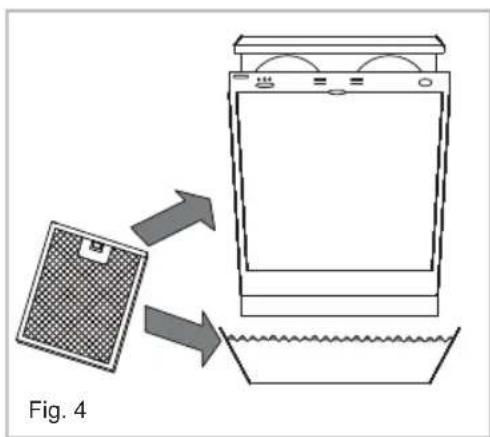
At least once a month you should remove and clean the grease filter



CHANGING THE CHARCOAL FILTER
with hot soapy water. You can also wash the grease filter in a dishwasher, ensuring that you place it in an upright position to prevent damage from other items in the dishwasher.
To remove the grease filter, push in the button on the handle and then pull down on the filter at the front as shown in figure 3. When you have released it at the top, then you can pull the filter out completely.
After rinsing and drying, reassemble the grease filter to the hood by reversing the removal process.
Please note:
Cleaning the grease filter in the dishwasher may lead to discolouration. This is normal and does not constitute a fault with the appliance.
Changing the charcoal filter (re-circulating mode only)
To ensure best performance of your extractor, you should replace the charcoal filter every four to six months, depending on use.
To attach the charcoal filter:
- Remove the grease filter as described on the previous page.
- Following the grooves on the extractor motor and on the filter, place the charcoal filter over the motor and turn it clockwise (right). Do not over-turn the filter.
• Finally, replace the grease filters.
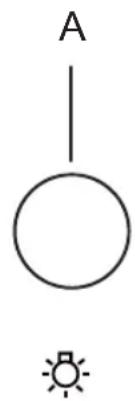
In case of malfunction of the illumination system contact the technical service.
![graph TD A["LEDLED"] --> B["Device Icon"] B --> C["Sun"]](/content/2026/06/1210918/images/8810a5b5cc4bb0072de56db68ce8f7285163520a4acbb44f9000491089919956.jpg)
Replaceable (LED only) light source by a professional
Contact details are on page 13.
Warning! This appliance must be earthed.
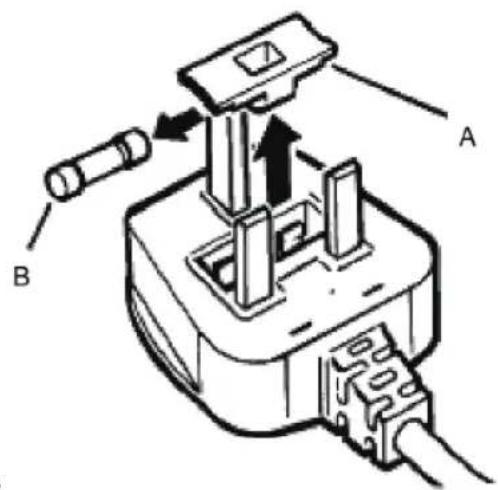
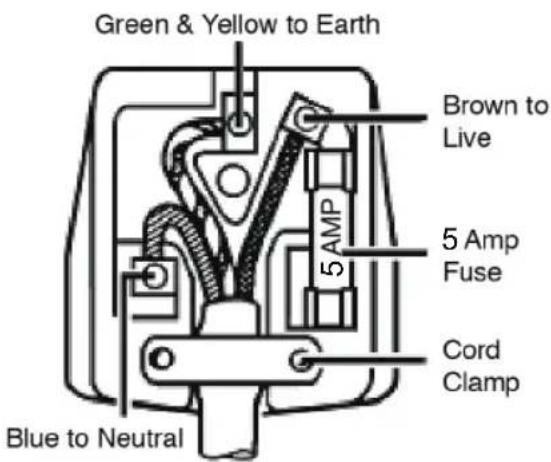
Fig. 5
The mains lead of this appliance has been fitted with a BS 1363A 5 amp fused plug. To change a fuse in this type of plug, follow the steps below:
- Remove the fuse cover and fuse.
- Fit replacement 5A fuse, ASTA approved to BS 1362 type, into the fuse cover.
- Replace fuse cover.
Important: Do not use the appliance without the fuse cover in position.
As the colours of the wires in the mains lead of this appliance may not correspond with the coloured markings identifying the terminals in your plug, proceed as follows:-
- The wire which is coloured GREEN and YELLOW must be connected to the terminal which is marked with letter (E) or by the Earth symbol or coloured GREEN and YELLOW.
- The wire which is coloured BLUE must be connected to the terminal which is marked with the letter (N), or coloured BLACK.
- The wire which is coloured BROWN must be connected to the terminal which is marked with the letter (L) or coloured RED.
If in doubt regarding the electrical connection of this appliance, consult a qualified electrician. Do not shorten the supply cable, the appliance may require removing for servicing.
N.B. Ensure that the plug socket is situated in an easily accessible place.
If the power supply cord is damaged, it must replaced by an Amica authorised agent.
TROUBLESHOOTING
Please note:
Your extractor is equipped with a motor protection device that will switch off the motor to prevent damage from overheating. This may happen during cooking when most or all of the zones/burners are being used simultaneously, or if your extractor is installed incorrectly, lower than the recommended height.
This is normal, and the extractor will work again once the motor has cooled sufficiently.
If your extractor is not working:
- Check that the mains supply has not been switched off.
- Check that the fuse in the plug has not blown.
- Check that the control panel is clean and free from grease.
Contact Amica Customer Care
A:Amica
The CDA Group Building,
Harby Road,
Langar,
Nottinghamshire,
NG13 9HY
T: (UK) 01949 862 012
T: (Ireland) 1-800-535556
F: 01949 862 003
E: customer.care@cda.eu
W: www.amica-international.co.uk
When the extractor is to be installed above an Amica hob, the minimum distance between the hob and extractor must exceed 550mm.
If the instructions provided with another brand of gas hob state that the required distance between the hob and extractor must be greater than 550mm, then that is the distance that should be observed; this is a legal requirement and may lead to your hob being disconnected from the gas supply and the installation being reported under RIDDOR.
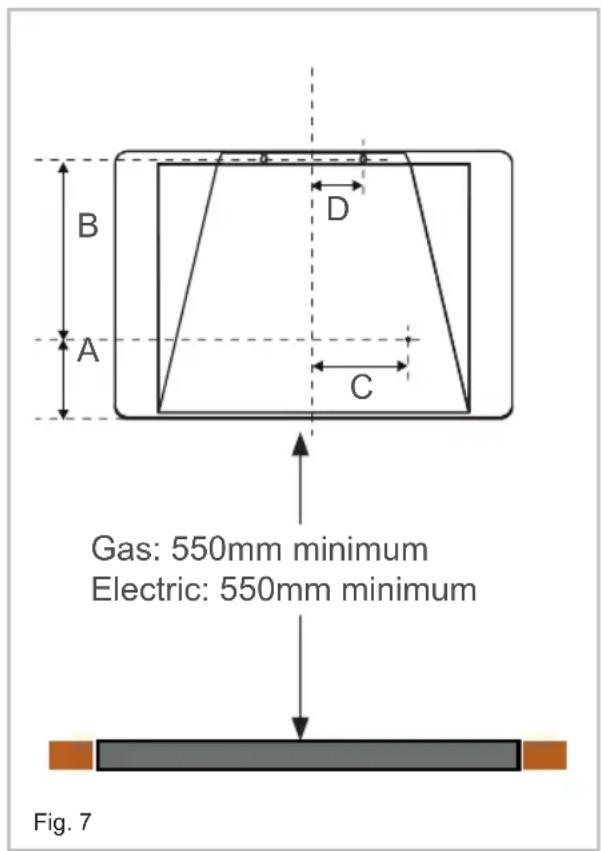
| AEP60BL / AEP90BL | |
| A | 128mm |
| B | 218mm |
| C | 119mm |
| D | 75mm |
Note: The height should be measured from the top of the burners.
IN THE ABSENCE OF ANY INSTRUCTIONS SUPPLIED WITH THE GAS HOB, THE MINIMUM DISTANCE BETWEEN THE HOB AND EXTRACTOR MUST BE AT LEAST 760mm.
The width of any hob must not be greater than the width of the extractor installed above it.
INSTALLATION
The metal casing of this appliance has been coated with a preservative to protect it during transport and storage. This should be removed during installation by using a non-abrasive stainless steel cleaner. Always follow the instructions given with the cleaner being used. Please ensure that there is no power being supplied to the appliance whilst you do this.
When correctly installed, your product meets all safety requirements laid down for this type of product. However, special care should be taken around the rear of the appliance as these areas are not designed nor intended to be touched and may contain sharp or rough edges that could cause injury. Always wear adequate Personal Protective Equipment (PPE).
Ducting and ventilation
For best performance and lowest noise output, we recommend the use of 125mm ducting. 100mm ducting may be used but this will reduce performance and increase the noise of the extractor.
Note:
• We recommend that you seek the help of another individual when installing this product.
- The fixings supplied are suitable for most installations. It is the responsibility of the installer to ensure that the fixings are suitable for the ceiling type in the property.
- Please cover any hob, or surface below the area in which the extractor is to be installed, so that no damage befalls it.
Tools required
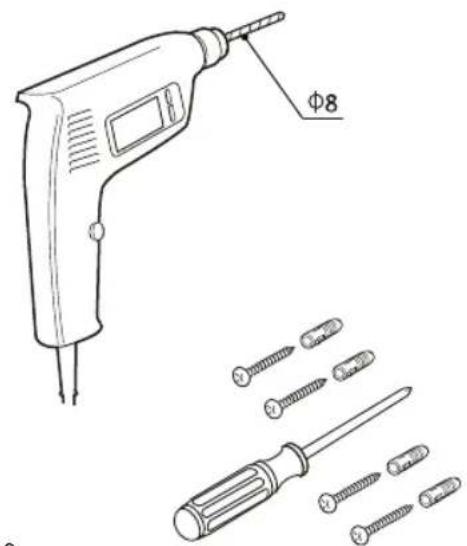
Fig. 8
Mark out wall as required, see Fig 7.
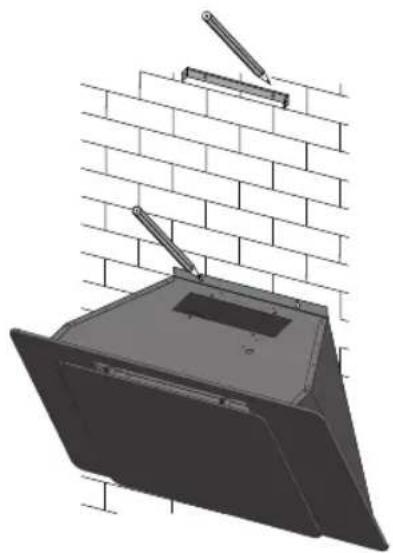
Fig. 9
Drill five mounting holes

Fig. 10 Fig. 11
Fit wall fixings and top screws. Ensure that any fixings you use are appropriate for the wall type.

IMPORTANT SAFETY WARNING: ONLY USE THE SCREWS PROVIDED WITH THE EXTRACTOR TO MOUNT THE DUCTING ADAPTOR. THE USE OF LONGER SCREWS MAY CAUSE DAMAGE TO THE INTERNAL WIRING WHICH WILL NOT BE COVERED BY THE WARRANTY.
INSTALLATION DIAGRAMS
Fit the ducting adaptor.
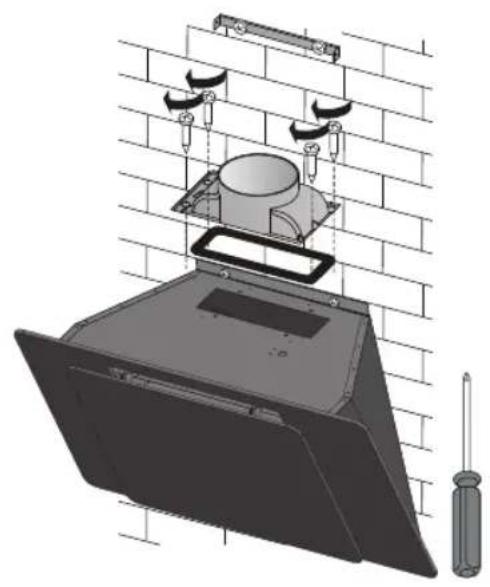
Fig. 12 Fig. 13
Fix ducting and seal joints.

Mount the chimney. Adjust and secure the chimney.
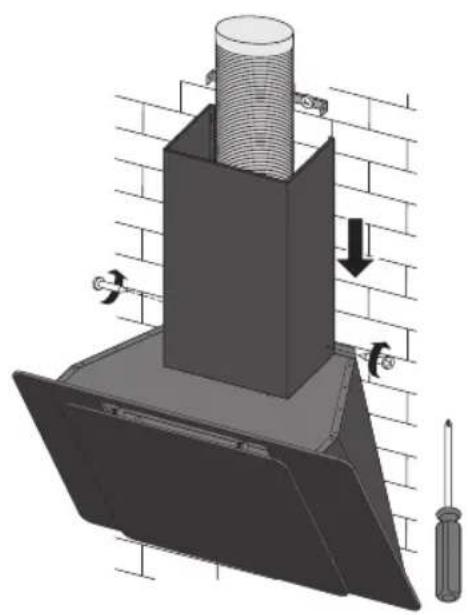
Fig. 14
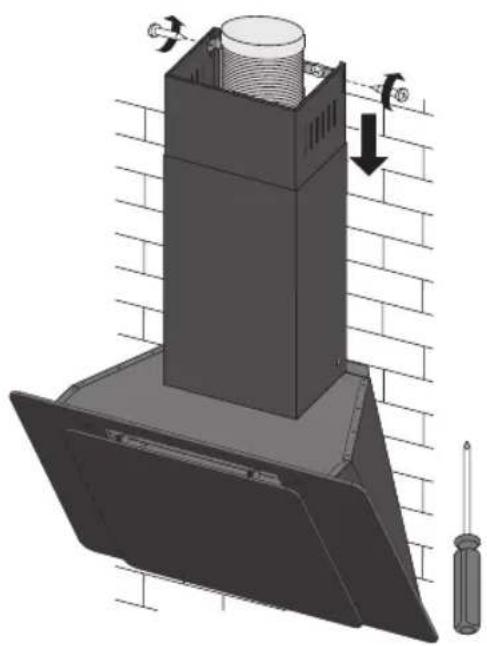
Fig. 15
| Energy Efficiency Information | ||
| Attribute Symbol Value | ||
| Annual Energy Consumption 45.2 kWh | AECHood | |
| Time increase factor 1.3 | f | |
| Fluid Dynamic Efficiency 19.0 | FDEHood | |
| Energy Efficiency Index 68.0 (B) | EEIHood | |
| Measured airflow at Best Efficiency Point 186.5m3/h | QBEP | |
| Measured Pressure at Best Efficiency Point 326Pa | PBEP | |
| Maximum airflow 350m3/h | QMAX | |
| Measured electric power at Best Efficiency Point 89.0W | WBEP | |
| Normal lighting power 4W | WL | |
| Average illumination of lighting system in the cooking surface 450Lux | EMiddle | |
| Measure power consumption in standby -- | Ps | |
| Measure power consumption off mode 0 | Po | |
| Sound power level 64dBA | LWA | |
| Grease Filter Efficiency 37% (G) | GFEHood | |
| Lamp Efficiency 112% (A) | LEHood | |
E & O E. All instructions, dimensions and illustrations are provided for guidance only. Amica reserve the right to change specifications without prior notice.
Amica
For service or queries please contact:
The Customer Care Department
For the UK: please call 01949 862 012
For Ireland: please call 1-800-535556
Email: customer.care@cda.eu
Amica UK,
The CDA Group Building,
Harby Road,
Langar,
Nottinghamshire,
NG13 9HY

- CONTENTS
- APPLIANCE INFORMATION
- DECLARATIONS OF CONFORMITY
- CE UK CA
- IMPORTANT INFORMATION FOR CORRECT DISPOSAL OF THE PRODUCT IN ACCORDANCE WITH EU DIRECTIVE 2012/19/EU
- PLEASE NOTE
- DUCTING
- NOTE
- CONTROL PANEL
- TO SWITCH THE EXTRACTOR LIGHT ON OR OFF
- TO SWITCH ON THE EXTRACTOR OR TO CHANGE THE SPEED AT ANY TIME WHEN THE EXTRACTOR IS RUNNING
- TO SWITCH THE EXTRACTOR OFF
- CLEANING
- CLEANING THE GREASE FILTER
- CHANGING THE CHARCOAL FILTER
- CHANGING THE CHARCOAL FILTER (RE-CIRCULATING MODE ONLY)
- TO ATTACH THE CHARCOAL FILTER
- IMPORTANT: DO NOT USE THE APPLIANCE WITHOUT THE FUSE COVER IN POSITION
- N.B. ENSURE THAT THE PLUG SOCKET IS SITUATED IN AN EASILY ACCESSIBLE PLACE
- TROUBLESHOOTING
- IF YOUR EXTRACTOR IS NOT WORKING
- CONTACT AMICA CUSTOMER CARE
- A:AMICA
- INSTALLATION
- DUCTING AND VENTILATION
- INSTALLATION DIAGRAMS
- AMICA
Brand : AMICA
Model : AEP90BL
Category : Range hood