WA80J5730SS1 - Washing machine SAMSUNG - Free user manual and instructions
Find the device manual for free WA80J5730SS1 SAMSUNG in PDF.


User questions about WA80J5730SS1 SAMSUNG
0 question about this device. Answer the ones you know or ask your own.
Ask a new question about this device
Download the instructions for your Washing machine in PDF format for free! Find your manual WA80J5730SS1 - SAMSUNG and take your electronic device back in hand. On this page are published all the documents necessary for the use of your device. WA80J5730SS1 by SAMSUNG.
USER MANUAL WA80J5730SS1 SAMSUNG
Automatic Electric Washing Machine
User manual
WA11J573****/WA10J573****/WA80J573****

text_image
DC68-03516E-06 SAMSUNGContents
Safety information 3
What you need to know about the safety instructions 3
Important safety symbols 3
Important safety precautions 4
Installation 10
What's included 10
Installation requirements 12
Step-by-step installation 13
Before you start 20
The basics 20
Smart Check 22
Laundry guidelines 23
Operations 27
Control panel 27
Simple steps to start 29
Auto cycles 30
Manual cycles 31
Maintenance 32
Cleaning 32
Troubleshooting 36
Checkpoints 36
Information codes 40
Specifications 42
Specification sheet 42
Packing & unpacking 44
Packing 44
Unpacking 44
2 English
Safety information
Congratulations on your new Samsung washing machine. This manual contains important information on the installation, use and care of your appliance. Please take some time to read this manual to take full advantage of your washing machine's many benefits and features.
What you need to know about the safety instructions
Please read this manual thoroughly to ensure that you know how to safely and efficiently operate the extensive features and functions of your new appliance. Please store the manual in a safe location close to the appliance for future reference. Use this appliance only for its intended purpose as described in this instruction manual.
Warnings and Important Safety Instructions in this manual do not cover all possible conditions and situations that may occur. It is your responsibility to use common sense, caution and care when installing, maintaining and operating your washing machine.
Because the following operating instructions cover various models, the characteristics of your washing machine may differ slightly from those described in this manual and not all warning signs may be applicable. If you have any questions or concerns, contact your nearest service centre or find help and information online at www.samsung.com.
Important safety symbols
What the icons and signs in this user manual mean:

WARNING
Hazards or unsafe practices that may result in severe personal injury, death and/or property damage.

CAUTION
Hazards or unsafe practices that may result in personal injury and/or property damage.

NOTE
Indicates that a risk of personal injury or material damage exists.
English 3
Safety information
These warning signs are here to prevent injury to yourself and others.
Please follow them explicitly.
After reading this manual, store it in a safe place for future reference.
Read all instructions before using the appliance.
As with any equipment that uses electricity and moving parts, potential hazards exist. To safely operate this appliance, familiarize yourself with its operation and exercise care when using it.
Important safety precautions

WARNING
To reduce the risk of fire, electric shock, or injury to persons when using your appliance, follow basic precautions, including the following:
- This appliance is not intended for use by persons (including children) with reduced physical, sensory or mental capabilities, or lack of experience and knowledge, unless they have been given supervision or instruction concerning use of the appliance by a person responsible for their safety.
- For use in Europe: This appliance can be used by children aged from 8 years and above and persons with reduced physical, sensory or mental capabilities or lack of experience and knowledge if they have been given supervision or instruction concerning use of the appliance in a safe way and understand the hazards involved. Children shall not play with the appliance. Cleaning and user maintenance shall not be made by children without supervision.
- Children should be supervised to ensure that they do not play with the appliance.
-
If the supply cord is damaged, it must be replaced by the manufacturer, its service agent or similarly qualified persons in order to avoid a hazard.
-
The new hose-sets supplied with the appliance are to be used and that old hose-sets should not be reused.
- For washing machines having ventilation openings in the base, the installation instructions shall state that the openings must not be obstructed by a carpet.
- For use in Europe: Children of less than 3 years should be kept away unless continuously supervised.
- CAUTION: In order to avoid a hazard due to inadvertent resetting of the thermal cut-out, this appliance must not be supplied through an external switching device, such as a timer, or connected to a circuit that is regularly switched on and off by the utility.
-
This appliance is intended to be used in household only and it is not intended to be used such as:
-
staff kitchen areas in shops, offices and other working environments;
- farm houses;
- by clients in hotels, motels and other residential type environments;
- bed and breakfast type environments;
- areas for communal use in blocks of flats or in launderettes.
Safety information
Critical installation warnings

WARNING
The installation of this appliance must be performed by a qualified technician or service company.
- Failure to do so may result in electric shock, fire, an explosion, problems with the product, or injury.
Plug the power cord into a wall socket that meets local electrical specifications. Use the socket for this appliance only, and do not use an extension cord.
- Sharing a wall socket with other appliances using a power strip or extending the power cord may result in electric shock or fire.
- Ensure that the power voltage, frequency, and current are the same as those of the product specifications. Failure to do so may result in electric shock or fire. Plug the power plug into the wall socket firmly.
Remove all foreign substances such as dust or water from the power plug terminals and contact points using a dry cloth on a regular basis.
- Unplug the power plug and clean it with a dry cloth.
- Failure to do so may result in electric shock or fire.
- Plug the power plug into the wall socket so that the cord is running towards the floor. If you plug the power plug into the socket in the opposite direction, the electric wires within the cable may be damaged and this may result in electric shock or fire.
This appliance must be properly grounded.
Do not ground the appliance to a gas pipe, plastic water pipe, or telephone line.
- This may result in electric shock, fire, an explosion, or problems with the product.
- Never plug the power cord into a socket that is not grounded correctly and make sure that it is in accordance with local and national regulations.
Do not install this appliance near a heater or any inflammable material.
Do not install this appliance in a humid, oily or dusty location, or in a location exposed to direct sunlight or water (rain drops).
Do not install this appliance in a location exposed to low temperatures.
- Frost may cause the tubes to burst.
Do not use an electric transformer.
• This may result in electric shock or fire.
Do not use a damaged power plug, damaged power cord, or loose wall socket.
• This may result in electric shock or fire.
Do not pull or excessively bend the power cord.
Do not twist or tie the power cord.
Do not hook the power cord over a metal object, place a heavy object on the power cord, insert the power cord between objects, or push the power cord into the space behind the appliance.
• This may result in electric shock or fire.
This appliance should be positioned so that the power plug, the water supply taps, and the drain pipes are accessible.
Installation cautions

CAUTION
This appliance should be positioned in such a way that the power plug is easily accessible.
- Failure to do so may result in electric shock or fire due to electric leakage.
Critical usage warnings

WARNING
If the appliance is flooded, turn off the water & power supplies immediately and contact your nearest service centre.
- Do not touch the power plug with wet hands.
- Failure to do so may result in electric shock.
If the appliance generates a strange noise, a burning smell, or smoke, unplug the power plug immediately and contact your nearest Samsung Customer Service.
- Failure to do so may result in electric shock or fire.
In the event of a gas leak (such as propane gas, LP gas, etc.), ventilate immediately without touching the power plug. Do not touch the appliance or power cord.
- Do not use a ventilating fan.
- A spark may result in an explosion or fire.
Do not let children play in or on the washing machine. In addition, when disposing of the appliance, remove the lid.
- If trapped inside the product, children may suffocate to death.
English 7
Safety information
Do not wash items contaminated with gasoline, kerosene, benzene, paint thinner, alcohol or other inflammable or explosive substances.
- This may result in electric shock, fire, or an explosion.
Do not touch the power plug with wet hands.
• This may result in electric shock.
Do not insert your hand or a metal object under the washing machine while an operation is in progress.
• This may result in injury.
Do not attempt to repair, disassemble, or modify the appliance yourself.
- Do not use a fuse (such as copper, steel wire, etc.) other than a standard fuse.
- When the appliance needs to be repaired or reinstalled, contact your nearest service centre.
- Failure to do so may result in electric shock, fire, problems with the product, or injury.
- In this case, the product will not be covered by the standard warranty provided by Samsung and no responsibility can be attributed to Samsung for malfunctions or damages resulting from doing it.
Unplug the power plug when the appliance is not being used for long periods of time or during a thunder or lightning storm.
- Failure to do so may result in electric shock or fire.
Do not put your hand into the spinning tub during the spin cycle.
- This may result in injury. If the tub does not stop spinning within 15 seconds after you open the lid, contact your nearest Samsung Customer Service.
Do not let children (or pets) play in or on your washing machine.
The washing machine door does not open easily from the inside and children may be seriously injured if trapped inside.
Do not use the water to exceed 50 °C when using the hot water in your washing machine.
Plastic parts may be deformed or damaged, and this may result in electric shock or fire.
Usage cautions

CAUTION
When the washing machine is contaminated by a foreign substance such as detergent, dirt, food waste, etc., unplug the power plug and clean the washing machine using a damp, soft cloth.
- Failure to do so may result in discolouration, deformation, damage, or rust.
The product you have purchased is designed for domestic use only.
Using the product for business purposes qualifies as a product misuse. In this case, the product will not be covered by the standard warranty provided by Samsung and no responsibility can be attributed to Samsung for malfunctions or damages resulting from such misuse.
Do not stand on the appliance or place objects (such as laundry, lighted candles, lighted cigarettes, dishes, chemicals, metal objects, etc.) on the appliance.
- This may result in electric shock, re, problems with the product, or injury.
Do not press the buttons using sharp objects such as pins, knives, ngernails, etc.
• This may result in electric shock or injury.
Critical cleaning warnings

WARNING
Do not clean the appliance by spraying water directly onto it.
Do not use the strong acidic cleaning agent.
Before cleaning or performing maintenance, unplug the appliance from the wall socket.
- Failure to do so may result in electric shock or re.
Installation
Follow these instructions carefully to ensure proper installation of the washing machine and to prevent accidents when doing laundry.
What's included
Make sure all the parts are included in the product package. If you have a problem with the washing machine or the parts, contact a local Samsung customer centre or the retailer.
text_image
Diagram of a car interior with numbered parts for identification and assembly reference.10 English
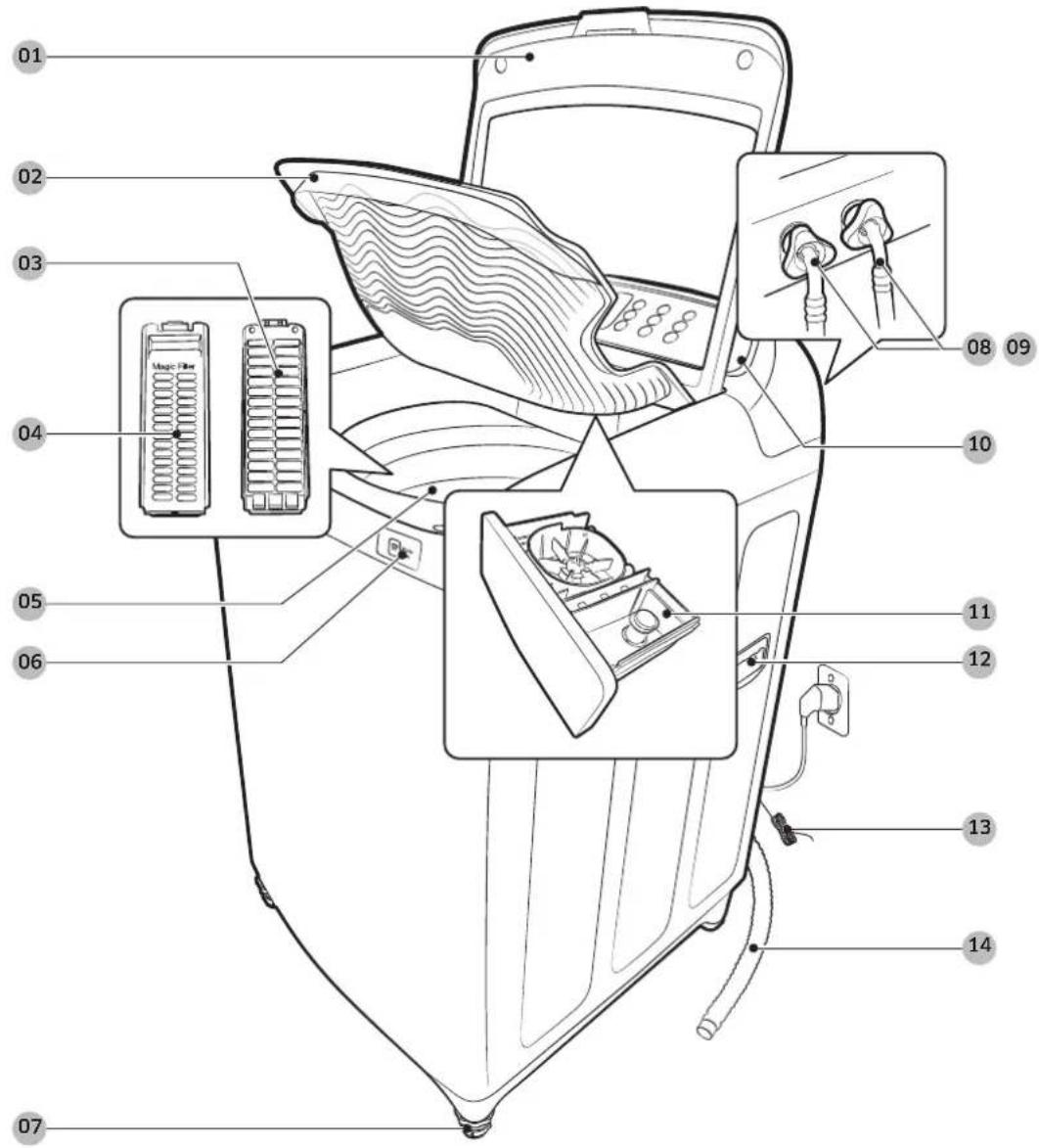
01 Door
02 Built-in sink
03 Lint filter (Rear)
04 Lint filter (Front)
05 Tub
06 Water Jet
07 Levelling feet
08 Water hose (Cold)
09 Water hose (Hot) *
10 Control panel
11 Detergent drawer
12 Side handle *
13 Grounding lead * 14 Drain hose

NOTE
- Availability of parts with an asterisk (*) depends on the model.
- Door: Make sure to keep the door closed while the washing machine is operating.
- Lint filter: This collects lint that builds up from the laundry being washed.
- Grounding lead: Cover this lead if wired to a metal part for earth-grounding.
- Levelling feet: Adjust the feet to level the washing machine on a flat floor.
Installation
Installation requirements
Electrical supply and grounding

WARNING
- AC 230 V / 60 Hz fuse or circuit breaker is required.
- Use an individual branch circuit specific to the washing machine.
- Do NOT use an extension cord.
- Use only the power cord that comes with the washing machine.
- Do NOT connect the ground wire to plastic plumbing, gas lines, or hot water pipes.
Levelling
- To prevent tumbling or noise, install the washing machine on a solid, flat floor without a platform or bricks.
- Keep the washing machine at 10 cm from each adjacent wall.
Water supply
- Make sure water taps are easily accessible.
- Turn off the taps when the washing machine is not in use.
- Check for any leaks at the water hose fittings on a regular basis.
Drain
• Make sure the drain hose is not clogged.
- We recommend a standpipe in height of 90-100 cm. The drain hose must be connected through the hose clip to the standpipe, and the standpipe must fully cover the drain hose.
The standpipe specifications mentioned here are only applicable to pump-type models.
Step-by-step installation
STEP 1 Select a location
Location requirements:
• Solid, level surface without carpeting or flooring that may obstruct ventilation
- Away from direct sunlight
- Adequate room for ventilation and wiring
- The ambient temperature is always higher than the freezing point (0 °C)
• Away from a heat source
Anti-rat panel

natural_image
Illustration of a hand pressing down on a mechanical component with a black arrow indicating motion (no text or symbols)The washing machine comes with the Anti-rat panel that protects small animals such as rats from entering the machine. Insert the panel into the bottom of the machine. To facilitate the work, slightly lift up the bottom front.

NOTE
- Some models feature the Anti-rat panel that must be inserted from the rear bottom of the model. For this model, insert the Anti-rat panel before levelling the machine. To facilitate the work, slightly lift up the bottom rear.
• Availability of the Anti-rat panel depends on the model.
Installation
STEP 2 Adjust the levelling feet

natural_image
Mechanical assembly diagram showing a spring-loaded component with a labeled section A (no text or symbols beyond label)Unpack the product package.
- Gently slide the washing machine into position. Excessive force may damage the levelling feet (A).
- Level the washing machine by manually adjusting the levelling feet.

natural_image
Diagram showing two mechanical components with directional arrows indicating motion, no text or symbols present- When levelling is complete, tighten the nuts (B) if provided (some models may not have the nuts).

WARNING
Packaging materials can be dangerous to children. Dispose all packaging material (plastic bags, polystyrene, etc.) out of children's reach.
STEP 3 Connect the water hose

text_image
Technical diagram showing mechanical assembly with labeled parts A and B, including directional arrows indicating movement or force.Connect the water hose to the water tap.
- Remove the adaptor (A) from the water hose (B).
natural_image
Illustration of a hand using a screwdriver to adjust a mechanical component (no text or symbols present)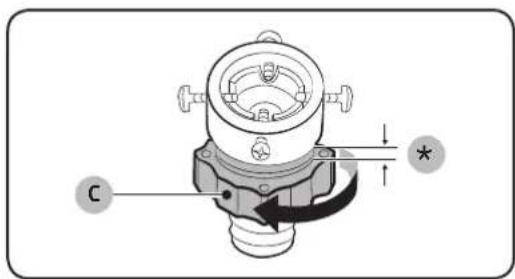
text_image
Technical diagram of a mechanical component with labeled parts and directional arrows
natural_image
Illustration of a hand using a tool to adjust a pipe fitting with a valve (no text or symbols present)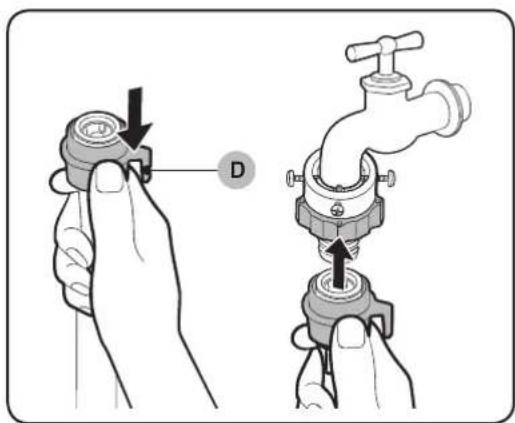
text_image
Diagram showing two hands holding a valve with a labeled component 'D', illustrating the process of adjusting or adjusting the valve.-
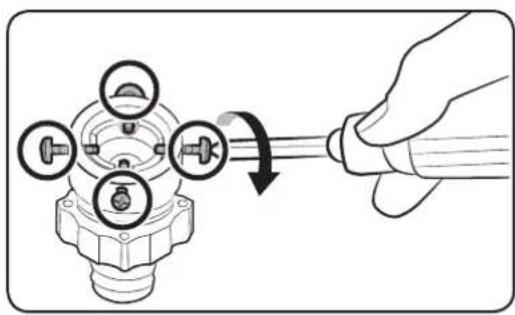
Use a Philips screwdriver to loosen four screws on the adaptor.
-
Hold the adaptor and turn part (C) in the arrow direction to loosen it by 5 mm (*).
-
Insert the adaptor into the water tap, and tighten the screws while lifting up the adaptor.
-
Turn part (C) in the arrow direction to tighten it.
-
While holding down part (D), connect the water hose to the adaptor. Then, release part (D). The hose fits into the adaptor with a clicking sound.
Installation
natural_image
Diagram of a pipe fitting with a rotating arrow indicating clockwise motion (no text or symbols)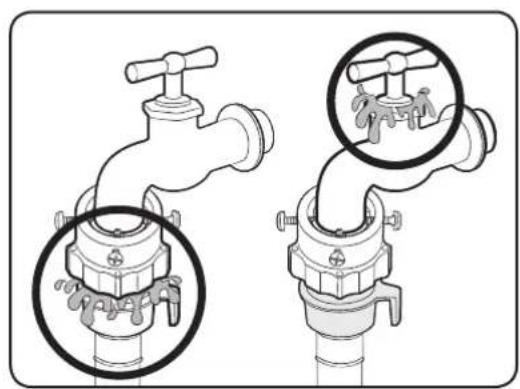
natural_image
Illustration of two faucet components with magnified insets showing internal structure (no text or symbols)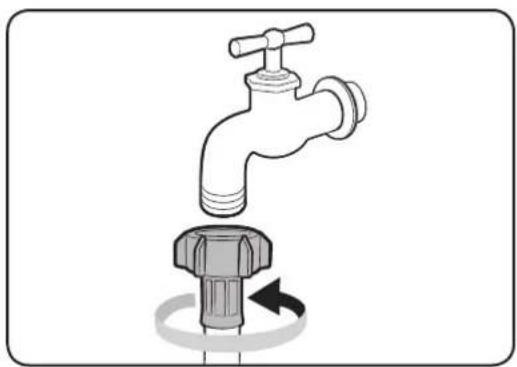
natural_image
Illustration of a faucet with a valve and a valve inserted into a base, showing rotational motion (no text or symbols)-
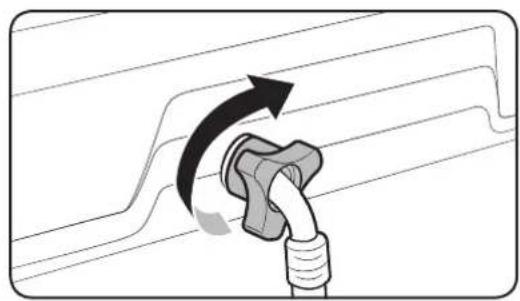
Connect the other end of the water hose to the inlet valve on the back of the washing machine. Turn the hose clockwise to tighten.
-
Open the water tap and check if there are any leaks around the connection areas.
- If there are water leaks, repeat the steps above.
- If using a screw type of water tap, connect the water hose to the water tap as shown.

WARNING
Stop using the washing machine if there is a water leak, and contact a local Samsung service centre. Otherwise, this may cause electric shock.

CAUTION
Do not stretch the water hose by force. If the hose is too short, replace the hose with a longer, high-pressure hose.

NOTE
- After connecting the water hose to the adaptor, check if it is connected properly by pulling the water hose downwards.
- Use a standard type of water tap. If the tap is square-shaped or too big, remove the spacer ring before inserting the tap into the adaptor.
STEP 4 Position the drain hose
natural_image
Illustration of hands holding a coiled pipe fitting (no text or symbols)General type
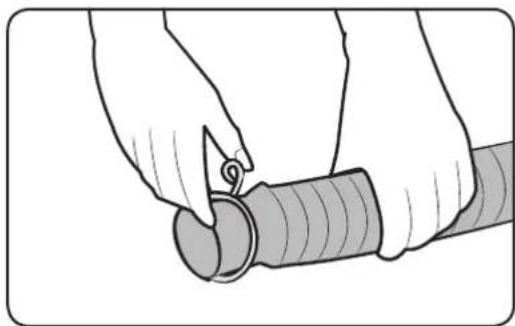
- Press and hold down the joint ring, and insert it into the drain hose.

natural_image
Illustration of a hand holding a cylindrical object with a ring, against a plain background (no text or symbols)- Insert the drain hose into the drain outlet. Make sure to connect them firmly using the joint ring. The drain hose is extensible. Adjust the length of the drain hose as needed.
Installation

text_image
Diagram showing hand operating a device with labeled component 'A' and directional arrows indicating action steps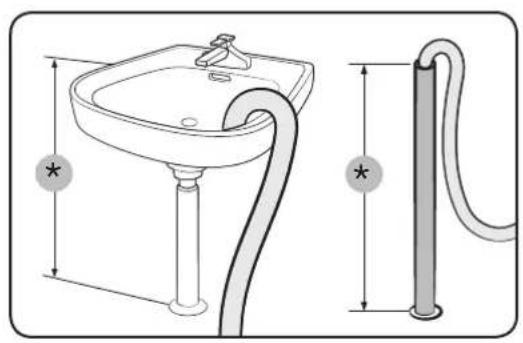
text_image
Technical diagram showing a sink and pipe with dimension annotationsPump type
- Open the hose cap (A), and insert the drain hose. Tighten the drain hose using the joint ring.
NOTE
-
The position (side or rear) of the drain outlet depends on the model.
• Availability of the hose cap depends on the model. -
Connect the other end of the drain hose to a standpipe or basin that is positioned 90-100 cm (*) from the floor.
WARNING
Make sure the end of the drain hose is not submerged by water. Otherwise, the washing machine may suffer serious damage.

CAUTION
text_image
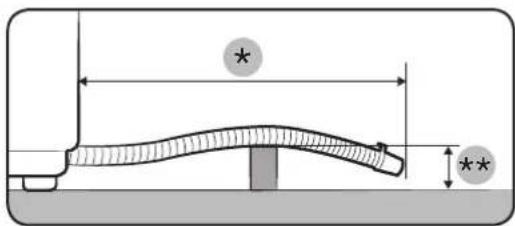
Technical diagram showing a curved structural component with dimension annotations marked by asterisks.- Do not exceed 3 m (*) for the total length of extended hoses.
- Do not let the drain hose run over doorsills that protrude 5 cm (**) or more from the floor.
- Do not run the drain hose under the bottom of the machine.

natural_image
Diagram showing two mechanical components with a cross mark and a circle, no text or symbols presentSTEP 5 Power on
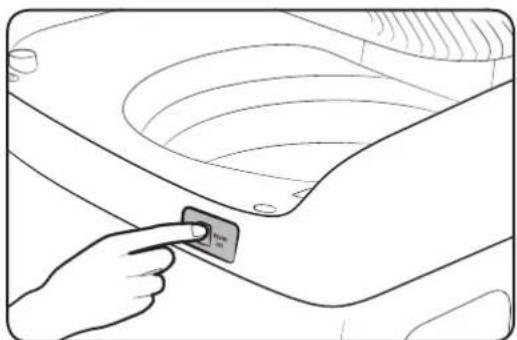
Plug the power cord into a wall socket featuring an AC 230 V / 60 Hz approved electrical outlet protected by a fuse or circuit breaker. Then, press Power to turn on the washing machine.
Before you start
The basics
Prewash (Water Jet & Built-in sink)

CAUTION
- Do not abuse Water Jet. Excessive use of Water Jet increases water consumption.
- When running water to the tub, do that gently. Otherwise, water may overflow the tub.
natural_image
Line drawing of a hand pressing a small labeled component on a car interior (no text or symbols)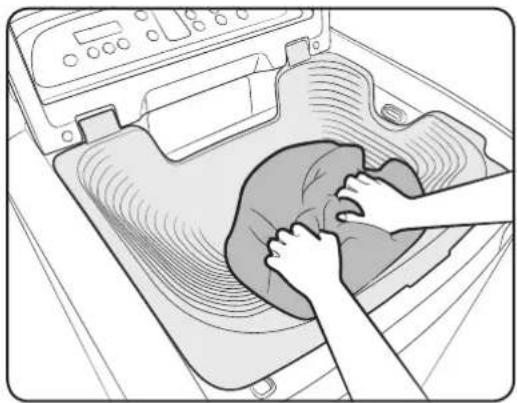
natural_image
Illustration of hands washing a cloth inside a washing machine (no text or symbols visible)Water Jet and Built-in sink help you hand-wash before the washing machine starts operation. Water Jet is available only when the door is open with the water level set to less than High. For prewashing, use the Built-in sink that is designed to facilitate the hand-wash.
- With the door open, lower the Built-in sink, and put clothes to prewash on it.
- Press Water Jet to supply water to the Built-in sink, and hand-wash.
- When done, you can either reuse the water in the main cycle or simply drain.
• To reuse the water, run the water down to the tub manually.
• To drain the water, press Drain.

NOTE
- If you want to hand-wash while the machine is operating, press Start/Pause to stop operation, and then follow steps 1-3 above.
- If you open both the door and the Built-in sink, lower the Built-in sink manually for prewashing.
- For the first-time use, Water Jet supplies water to the detergent drawer for 1 second to extract air from the water hose. After the first use, Water Jet stops automatically after 5 minutes of water supply.
- Do not use for other than prewashing, such as washing shoes or animals.
Detergent drawer

natural_image
Illustration of a hand using a tool to adjust or remove a component, with a downward arrow indicating rotation (no text or symbols present)To add a laundry-specific detergent, follow these steps:
- Open the door then the Built-in sink to reveal the tub.
- Locate the detergent drawer, and slide it open.
- Apply powder detergent as recommended by the manufacturer. Do not exceed the max line that is marked on the wing distributor.
- If necessary, apply fabric softener as appropriate. Do not exceed the max line that is marked on the rinse cap.
CAUTION
Make sure to use detergent as appropriate. An excessive amount of detergent may not dissolve well.
Child Lock
Child Lock is designed to prevent accidents by children or infants, such as drowning.
- Press Power.
- To activate the Child Lock, hold down Rinse and Power Spin simultaneously for 3 seconds. The indicator blinks.
- To deactivate the Child Lock, hold down Rinse and Power Spin simultaneously for 3 seconds. The indicator turns off. If the tub has contained water, simply restart the machine and hold down two buttons simultaneously for 3 seconds to deactivate the Child Lock.
With the Child Lock enabled
- You can still manipulate on the control panel while the door is closed. If you open the door, an information code (CL, dC) appears with an alarm. Then, the machine starts forced draining after 30 seconds in order to prevent infant or child accidents such as drowning.
- Only when water supply is complete, the Child Lock becomes active.
- If the door leaves open for 30 seconds with the tub containing water, the machine drains the water with the "CL" code, which you cannot stop.
- To add detergent or more laundry in the tub, or to change the cycle settings, you must first deactivate the Child Lock.
English 21
Before you start

WARNING
If you open the door with the Child Lock enabled, the machine starts forced draining to prevent accidents such as drowning.

NOTE
The Child Lock remains active after you power off the machine. You cannot deactivate the Child Lock as long as the "CL" code appears on the display. But, you can deactivate when the dC code appears by holding down two buttons simultaneously.
Smart Check
To enable this function, you must first download the Samsung Smart Washer app at the Play Store or the Apple Store, and install it on a mobile device featuring a camera function.
The Smart Check function has been optimized for Galaxy & iPhone series (applicable models only).
- Press and hold Wash and Rinse simultaneously for 3 seconds to enter the Smart Check mode.
- The washing machine starts the self-diagnosis procedure and displays an information code if a problem is detected.
- Run the Samsung Smart Washer app on your mobile device, and tap Smart Check.
- Put the mobile device close to the washing machine's display so that the mobile device and the washing machine face each other. Then, the information code will be recognized automatically by the app.
- When the information code is recognized correctly, the app provides detailed information about the problem with applicable solutions.

NOTE
- The function name, Smart Check, may differ depending on the language.
- If there is strong reflected light on the washing machine display, the app may fail to recognize the information code.
- If the app fails to recognize the Smart Check code consecutively, enter the information code manually onto the app screen.
Laundry guidelines
Checkpoints
- Check for stains or dirt. Apply a little detergent to a white towel. Rub the white towel and the dirty clothes together to transfer the dirt or colour to the white towel.
- Before washing, pre-treat the sleeves, collars, dress hems, and pockets by brushing with detergent.
- Wrinkle-processed clothes made of wool must be specially treated by tightening them with threads before washing. Remove the threads after washing and drying is complete.

CAUTION
- Do not place or keep blankets in the tub.
- Do not put candles or a heat source in or on the washing machine.
-
Do not wash these clothes:
-
Neckties, brassieres, jackets, suits, and coats can be easily deformed by shrinking or discolouring on the surface. These clothes are mostly made of rayon, polynosic, cuff, and/or blended fabric.
- Wrinkle-processed, embossed, or resin processed clothes easily deform merely by soaking in water.
- Clothes that are easily discoloured made from cotton, wool, wrinkled silk, leather wear and accessories, and leather ornamented clothes and accessories.
- Waterproof sheets, mattresses, or wool quilts, rain covers, fishing jackets and trousers, skiwear, sleeping bags, diaper covers, sweat suits, vehicle covers for automobiles, bicycles, and motorcycles, bath rugs, and other waterproof items.
Before you start
STEP 1 Sort
Sort the laundry according to these criteria:
• Care Label: Sort the laundry into cottons, mixed fibres, synthetics, silks, wools, and rayon.
• Colour: Separate whites from colours.
- Size: Mixing different-sized items together in the tub improves the washing performance.
- Sensitivity: Follow the cloth-specific instructions on the care label of delicate items such as pure, new woollen items, curtains, and silk items.

NOTE
Make sure to check the care label on the clothing, and sort them accordingly before starting the wash.
STEP 2 Empty pockets
Empty all the pockets of your laundry items, and remove dirt and/or soils from them.
- Metal objects such as coins, pins, and buckles on clothing may damage other laundry items as well as the tub.
- Turn clothing with buttons and embroideries inside out.
- If pants or jacket zippers are open while washing, the tub may be damaged.
- Zippers should be closed and fixed with a string.
- Clothing with long strings may become entangled with other clothes. Make sure to tie the strings before washing.
STEP 3 Use a laundry net or wash certain items separately
- Brassieres (water washable) must be placed in a laundry net. Metal parts of the brassieres may break through and tear other laundry items.
- Cashmilon, large volume garments, and lightweight clothes (lace-decorated clothes, lingerie, nylon stocking, and synthetic fabrics) may float on water during washing and cause problems to the machine. Use the laundry net or wash them separately.
- Do not wash the laundry net by itself without other laundry. This may cause abnormal vibrations that could move the washing machine and result in injury.

CAUTION
Make sure to soak inflatable items (such as blankets, and cotton-filled or microfibre quillets) in water before you run a cycle.
- Inflatable items may cause damage to the laundry or the machine during the wash or drying process.
- Regardless of the size, blankets or quilts are safer and cleaner to wash one item at a time. Two different-sized blankets in the same load may compromise the drying performance due to unbalanced loads.
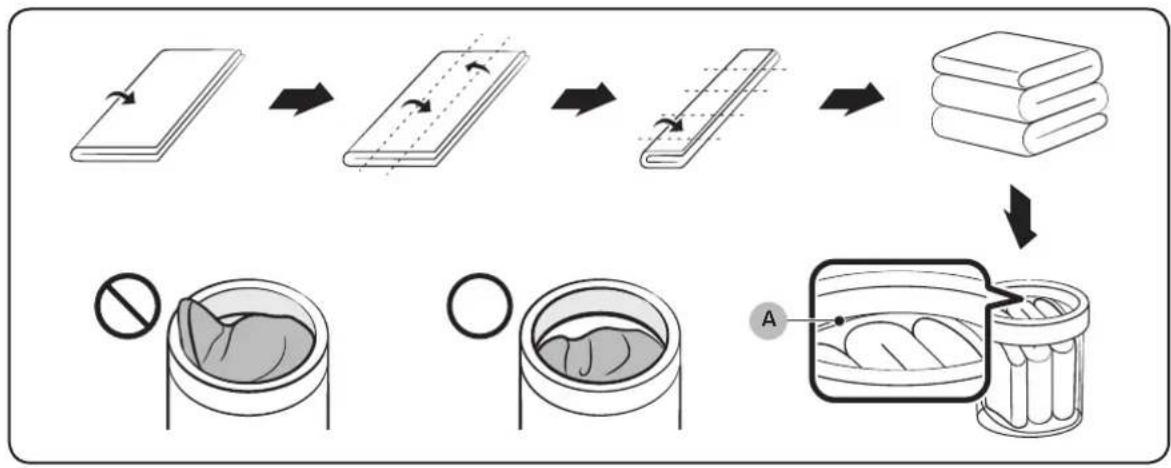
To input a blanket
Fold the blanket as shown, and then put it on the plastic area (A) of the tub before inserting into the tub.
flowchart
graph TD
    A["Raw Material"] --> B["Preparation"]
    B --> C["Storage Section"]
    C --> D["Stacked Food"]
    D --> E["Final Storage Section"]
    style A fill:#f9f,stroke:#333
    style B fill:#ccf,stroke:#333
    style C fill:#cfc,stroke:#333
    style D fill:#fcc,stroke:#333
    style E fill:#ffc,stroke:#333
STEP 4 Prewash (if necessary)
- To remove stains and dirt on collars, sleeves, hems, and pockets, apply detergent lightly and brush off.
- Use powder or liquid detergents. Do not use soap, as this may remain on the tub after washing.
- Prewash white socks, sleeves, and collars with a little detergent and a brush.

CAUTION
Make sure the laundry is inserted completely.
- Any exposed part of the laundry may cause damage to the machine or the laundry itself, or a water leak.
• Make sure the laundry does not exceed the plastic area (A) in the above figure.
English 25
Before you start
STEP 5 Determine the load capacity
Make sure the laundry does not exceed the plastic area (A) in the figure on page 25.
Otherwise, it may cause the washing machine to not wash properly or cause damage to the machine or the laundry itself, or a water leak.

NOTE
When washing bedding or bedding covers, the wash time may be lengthened or the spin efficiency may be reduced. For bedding or bedding covers, the recommended load capacity is 3.5kg or less.

CAUTION
If the laundry is unbalanced and the "Ub" information code is displayed, redistribute the load. Unbalanced laundry may reduce the spinning performance and cause damage to the machine or the laundry itself.
STEP 6 Apply a proper detergent type
The type of detergent depends on the type of fabric (cotton, synthetic, delicate items, wool), colour, wash temperature, and degree of soiling. Always use “low suds” laundry detergent, which is designed for automatic washing machines.

CAUTION
- Use an appropriate amount of detergent. Excess amounts of detergent do not produce much improvement in washing results but cause damage to the laundry due to deteriorated rinsing performance.
- Bleach is strong alkali in nature, causing damage to or discolouration of the laundry.
- Use a longer or added rinse cycle when using powder detergent that is very likely to remain on the laundry and cause bad odours after washing is complete.
- If an excessive amount of detergent is used especially in cold water, the detergent doesn't dissolve well, ending up with contaminated laundry, hoses, and/or tub.
- In case of timed washing, do not apply detergent directly to laundry or the tub. The laundry may be discoloured. Use the detergent drawer.
- When washing wool using the Wool cycle, use only a neutral detergent to avoid discolouring the laundry.

NOTE
- Follow the detergent manufacturer's recommendations based on the weight of the laundry, the degree of soiling, and the hardness of the water in your local area. If you are not sure about the water hardness, contact a local water authority.
- Do not use detergent that tends to be hardened or solidified. This detergent may remain after the rinse process, blocking the drain outlet.
Operations
Control panel
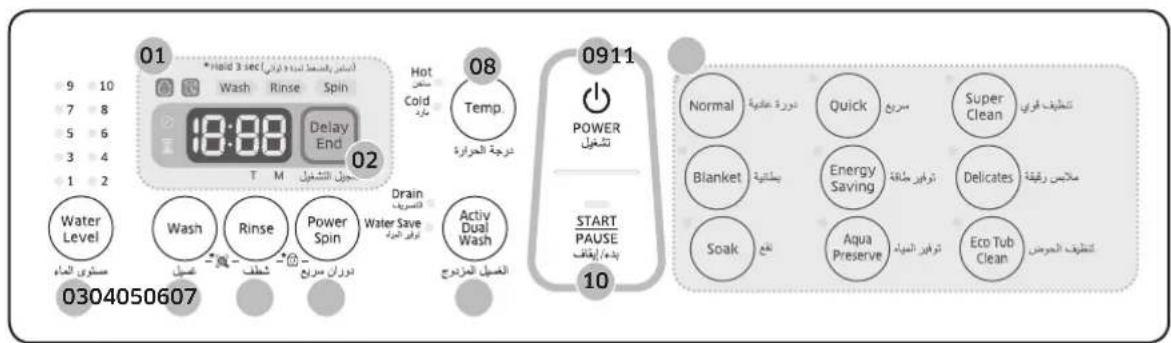
| 01 Display | Displays the remaining time of a cycle, or the information code when a problem occurs. Child LockChild Lock is used to prevent children from accidents such as drowning in the tub, and remains active after the machine restarts. To cancel the Child Lock, deactivate it. Eco Tub CleanUse to keep the tub clean. This indicator lights up automatically on a regular basis. When the indicator turns on, run the Eco Tub Clean cycle. Delay EndYou can set to finish a cycle at a specific time. This indicator turns on when pressing Delay End and turns off when the set cycle starts. StatusAfter selecting a cycle, press Delay End or Start/Pause. This indicator turns on and displays the remaining time of the current cycle. |
| 02 Delay End | Press this button to finish the wash at a specified time.To cancel the Delay End settings, simply turn off the washing machine.You can set the Delay End time up to 19 hours. |
| 03 Water Level | The water level is adjusted according to the cycle. However, you can change the level manually. |
| 04 Wash | Press to start washing, or adjust the wash time between 6 and 30 minutes. |
English 27
Operations
| 05 Rinse | Press to run the rinse cycle, or change the rinse count up to 5. |
| 06 Power Spin | Press to run the spin cycle, or change the spinning time in this sequence: 1-9 min (increase by 1 minute) > 15 min > 30 min. |
| 07 Activ Dual Wash | This button provides two options, and is available only when the washing machine is stopped or in Standby state.Water Save (default): Select to reuse water in the tub that remains after using Water Jet. The water will be used for the main cycle.Drain: Select to drain water that remains after using Water Jet. When draining is complete, the washing machine switches to Water Save mode automatically. Then, you can choose a cycle. |
| 08 Temperature | Press to select a temperature level from 3 choices: Cold > Cold/Hot > Hot. |
| 09 Power | Press once to turn the machine on, or twice to turn it off. |
| 10 Start/Pause | Press to stop or resume operation. To change the cycle sequence, press once to stop operation, and then change the sequence. To resume operation, press again. |
| 11 Cycle Panel Choose one that best suits your needs. | |
Simple steps to start

flowchart
graph TD
    A["Hold 3 set (أشر يلويت ابنا د تراي) 10"] --> B["Hot"]
    B --> C["Cold"]
    C --> D["Temp."]
    D --> E["Power"]
    E --> F["START PAUSE"]
    F --> G["Normal"]
    G --> H["Quick"]
    H --> I["Super Clean"]
    I --> J["Delicates"]
    J --> K["Eco Tub Clean"]
    K --> L["Control buttons"]
    L --> M["Balance"]
    M --> N["Energy Saving"]
    N --> O["Tuqueir طاقة"]
    O --> P["Qua Preserve"]
    P --> Q["Tuqueir المهانه"]
    Q --> R["Eco Tub Clean"]
    R --> S["Control buttons"]
    S --> T["Balance"]
    T --> U["Energy Saving"]
    U --> V["Tuqueir طاقة"]
    V --> W["Eco Tub Clean"]
    W --> X["Control buttons"]
    X --> Y["Balance"]
    Y --> Z["Energy Saving"]
    Z --> AA["Tuqueir طاقة"]
    AA --> AB["Eco Tub Clean"]
- Press Power to turn on the washing machine.
- Select a cycle in the cycle panel.
- Change the cycle settings (wash time, rinse count, and/or spinning time) as necessary.
- Optionally, you can enable Activ Dual Wash or change the option of Temp..
- Press Start/Pause.
To change the cycle during operation
- Press Start/Pause to stop operation.
- Select a different cycle, and repeat steps 2-3 above if necessary.
- Press Start/Pause again to start the new cycle.
Operations
Auto cycles
| Cycle Description | |
| Normal | Select this for most fabrics including cottons, liners, and normally soiled garments. |
| Quick • Select this for less soiled clothes in reduced time. | |
| Super Clean | Select this if you want to produce powerful cleaning performance. |
| Blanket | Suitable for a large-sized laundry such as blankets and bed cover sheets. |
| Energy Saving • Use this course to save energy. | |
| Delicates | Select this for delicate items such as sweaters, cardigans, or wool clothes. |
| Soak | With this selected, the washing machine adds a soaking process in advance of the main cycle. |
| Aqua Preserve | Use this if you want to save the water to use. The water used in the rinse process will be reused for the next process. |
| Eco Tub Clean | Select this to clean the tub. The powerful spinning force will remove impurities and bad odours from inside the tub.If you see the indicator blinking, this indicates that it is recommended to clean the tub using Eco Tub Clean. For details, see the Cleaning section in this manual. |
Manual cycles
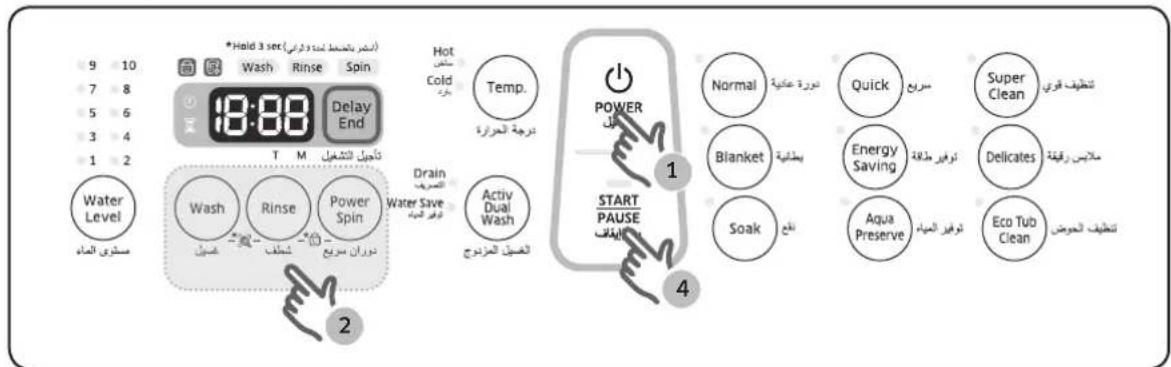
You might want to use a single cycle to wash less soiled clothes. For example, you can run the wash cycle once for nightwear.
flowchart
graph TD
    A["Hold 3 ser (###) in the water level"] --> B["Wash"]
    B --> C["Rinse"]
    C --> D["Spin"]
    D --> E["Delay End"]
    E --> F["T M"]
    F --> G["Wash"]
    G --> H["Rinse"]
    H --> I["Power Spin"]
    I --> J["Water Save"]
    J --> K["Drain"]
    K --> L["Activ Dual Wash"]
    L --> M["Start Pause"]
    M --> N["Power"]
    N --> O["Normal"]
    O --> P["Bianket"]
    P --> Q["Soak"]
    Q --> R["Eng"]
    R --> S["Energy Saving"]
    S --> T["Aqua Preserve"]
    T --> U["Delicates"]
    U --> V["Eco Tub Clean"]
    V --> W["Stop it"]
- Press Power to turn on the washing machine.
- Press Wash/Rinse/Power Spin to run the individual cycle to your needs. The duration or count of each cycle can be adjusted by pressing the applicable button as many times as needed.
| Wash time Rinse count Power Spin time | |
| 6-30 minutes 1-5 times 1-9, 15, 30 minutes |
- If you want to run a combination of cycles, press applicable cycle buttons as below:
| Wash + Rinse Rinse + | Spin Wash + Rinse + Power Spin | |
| Rinsing after washing Spinning after rinsing | Washing, rinsing, and then spinning in sequence | |
- Press Start/Pause.
Maintenance
Cleaning
Keep the washing machine clean to prevent deteriorated performance and to preserve its life cycle.
Eco Tub Clean reminder
- The indicator reminds you of cleaning the tub when necessary. If you happen to see the indicator blinking after washing is complete, remove the laundry and run the Eco Tub Clean cycle.
- You can ignore this reminder and continue to run cycles normally because this is not a system failure. However, the reminder remains active for 6 consecutive cycles immediately after each cycle is complete.
- The reminder is activated once every 1-3 months, depending on the cycle count.
• To keep the tub clean, it is recommended to run Eco Tub Clean on a regular basis.
Built-in sink
- Open the door, and use a cloth or sponge to clean the Built-in sink.
- Press Water Jet to supply water to the board. Use this water to rinse the board.
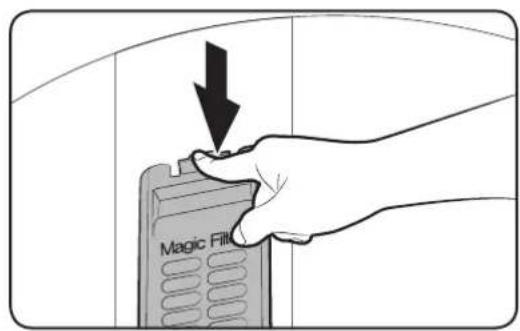
Lint filter
text_image
Magic Fill- Press down the upper area of the filter case to remove.
- Unlock the cover, and clean the filter with running water and a brush.

text_image
Magic Filter- When cleaning is complete, close the cover and reinsert the filter case to the original position. You will hear a clicking sound when the filter case fits in.
32 English
Pump filter (applicable models only)
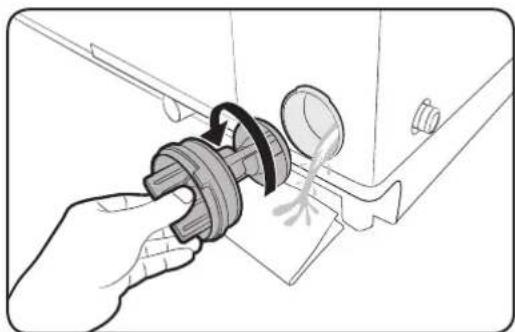
natural_image
Illustration of a hand using a mechanical switch to adjust a component (no text or symbols visible)- Put a floor-cloth or towel under the Pump filter. Turn the filter knob anticlockwise to remove.

natural_image
Line drawing of hands installing or adjusting a small component inside a basin (no text or symbols)- Clean the filter with running water and a soft brush.

natural_image
Hand holding a mechanical knob with a curved arrow indicating rotation (no text or symbols)- Reinsert the filter, and turn clockwise until it locks into position.
Maintenance
Mesh filter
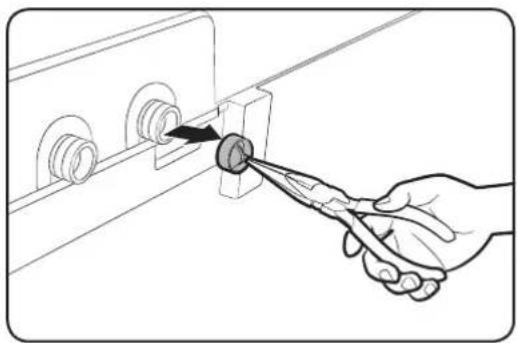
natural_image
Hand holding a tool interacting with a mechanical component (no text or symbols visible)- Use pliers to pull out the mesh filter from inside the water inlet as shown.
- Use a soft brush to clean the filter with running water.
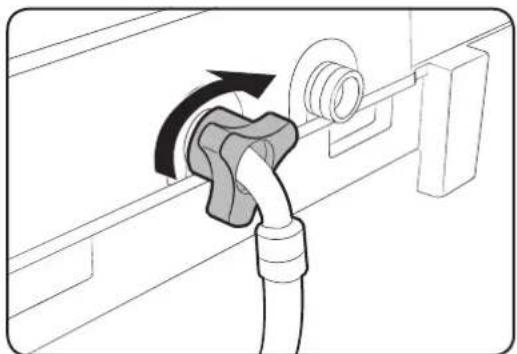
natural_image
Diagram of a pipe connection with a valve and bulb, showing directional flow (no text or symbols)- Reinsert the filter. Make sure it is tightened against water leaks.

natural_image
Line drawing of a pipe fitting attached to a wall-mounted component (no text or symbols)Detergent drawer
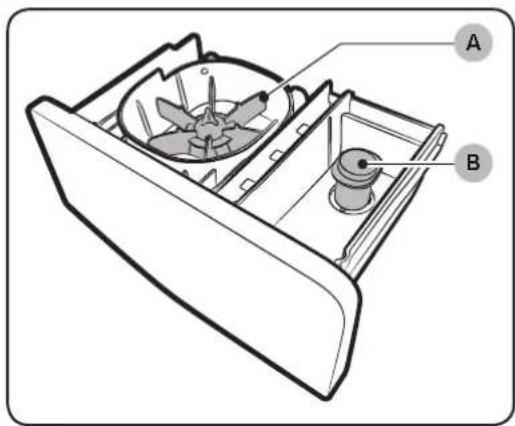
text_image
Technical diagram of a mechanical device with labeled parts A and B, showing internal components and directional arrows.- Open the door and then the Built-in sink to reveal the detergent drawer.
- Slightly lift up the front edge of the drawer, and then slide it open.
- Remove the wing distributor (A) and rinse cap (B) from the drawer.

natural_image
Illustration of hands washing a sink with a faucet above, showing water displacement (no text or symbols)- Clean the drawer as well as the distributor and rinse cap with running water and a soft brush.

natural_image
Illustration of a hand holding a fan inside a computer case with an arrow indicating rotation (no text or symbols)- When complete, close the rinse cap and reinsert the distributor. Then, reinsert the detergent drawer.
Troubleshooting
Checkpoints
If you encounter a problem with the washing machine, first check the table below and try the suggestions.
| Problem Action | |
| Does not turn on. | Make sure you use rated power for the product.Make sure the power cord is completely plugged in.Check the fuse or reset the circuit breaker. |
| Does not start. | Make sure the door is closed.Make sure the water taps are open.Make sure to press or tap Start/Pause to start the washing machine.Make sure Child Lock is not activated.Before the washing machine starts to fill, it will make a series of clicking noises to check the door open and does a quick drain.Was the door opened during the spinning cycle? Close the door, and press or tap Start/Pause to resume.The machine enters Standby or is in a soaking cycle. Please wait.Check the fuse or reset the circuit breaker. |
| Water is not supplied. | Make sure you press or tap Start/Pause after selecting the water supply.Make sure the water taps are open.Is the filter net at the water supply hose connector clogged? Clean the filter net by brushing with a toothbrush.Is the water supply cut off? If the water supply is cut off, close the tap and power off.Straighten the water supply hoses.Open and close the door, then press or tap Start/Pause.If the water pressure is low, it takes longer to start washing.If the water level is not as high as necessary or lower than expected, use the level selector to adjust the water level. |
| After a cycle, detergent remains in the automatic dispenser. | Make sure the washing machine is running with sufficient water pressure.Make sure the detergent drawer is properly inserted.Remove and clean the detergent drawer, and then try again. |
| Vibrates excessively or makes noise. | Make sure the washing machine is set on a level floor. If the floor is not level, use the levelling feet to adjust the washing machine.Make sure the washing machine is not contacting any other object.Make sure the laundry load is balanced.Make sure the laundry is spread evenly in the washing machine. Spread out the laundry evenly and start again.Make sure the space around the washing machine is free of objects.Humming is produced normally during operation.Objects such as coins can cause noise. Remove these objects from the washing machine after washing is complete. |
| Stops. | Plug the power cord into a live electrical outlet.Check the fuse or reset the circuit breaker.Close the door, and press or tap Start/Pause to start the washing machine. For your safety, the washing machine will not spin unless the door is closed.Before the washing machine starts to fill, it will make a series of clicking noises to check the door open and does a quick drain.There may be a pause or soak period in the cycle. Wait briefly and the washing machine may start.Make sure the inlet hose screens at the taps are not clogged. Periodically clean the screens.This problem occurs temporarily due to low voltages, and will be solved when power recovers. |
| The Eco Tub Clean alarm does not turn off. | When the machine is diagnosed to be cleaned, the indicator blinks for an hour. This recurs 6 consecutive times until you run the Eco Tub Clean cycle. This is normal, and not a system failure. To keep the tub clean, it is recommended to run the cycle once every 1-3 months. |
Troubleshooting
| Problem Action | |
| Fills with the wrong temperature water. | Fully open both water taps.Make sure the temperature selection is correct.Make sure the hoses are connected to the correct water taps.Flush water lines.Disconnect the hoses and clean the screens. The hose filter screens may be clogged.While the washing machine fills, the water temperature may change as the automatic temperature control feature checks incoming water temperature. This is normal.While the washing machine fills, you may notice just hot and/or just cold water going through the dispenser when cold or warm temperatures are selected.This is a normal function of the automatic temperature control feature as the washing machine determines the water temperature. |
| Does not drain and/or spin. | Check the fuse or reset the circuit breaker.Make sure the electrical voltage is normal.Make sure the washing machine is plugged in.Make sure the drain hose is pointed downward. (Natural drain models only)Make sure the drain hose is not clogged.Make sure the drain hose is not kinked.Straighten the drain hose. If there is a drain restriction, call for service.Close the door, and press or tap Start/Pause. For your safety, the washing machine will not spin unless the door is closed. |
| Load is wet at the end of the cycle. | Use the High or Extra High spin speed. (Applicable model only)Use high efficiency (HE) detergent to reduce oversuding.Load is too small. Small loads (one or two items) may become unbalanced and not spin completely. |
| Leaks water. | Make sure all hose connections are tight.Make sure the water supply hose's rubber packing is in the correct position. Screw tightly again.Make sure the end of the drain hose is correctly inserted and secured to the drain system.Avoid overloading.Use high efficiency (HE) detergent to prevent oversudsing.Make sure the water supply hose is not kinked.If the water supply is too strong, water may leak. Close the water tap a little.Make sure water is not leaking from the water tap. If so, repair the water tap. |
| Excessive suds. | Use high efficiency (HE) detergent to prevent oversudsing.Reduce the detergent amount for soft water, small loads, or lightly soiled loads.Non-HE detergent is not recommended. |
| The spin basket or drain/supply hose is frozen. | Use warm water to disconnect the water supply hose and drain hose. Soak them in warm water.Fill the spin basket with warm water, and then wait for about 10 minutes.Put a hot towel on the drain hose connector.Reconnect the water supply hose and drain hose, and check if water is supplied properly. |
| Water drains out immediately. | Make sure the drain hose is not clogged, and is hung over the drain hose hook. Fill the spin basket halfway with water, and try spinning again.Lift the end of the drain hose to prevent water from draining. Fill the spin basket halfway with water, and then run spinning after releasing the drain hose.Make sure the drain hose is installed correctly. See the installation section of this user manual and adjust the position of the drain hose as instructed. |
| Stains on clothes.• Clean the magic filter. | |
| Has odours. | Excessive suds collect in recesses and can cause foul odours.Run cleansing cycles to sanitize periodically.Dry the washing machine interior after a cycle has finished. |
If a problem persists, contact a local Samsung service centre.
Troubleshooting
Information codes
If the washing machine fails to operate, you may see an information code on the display. Check the table below and try the suggestions.
| Code Action | |
| 1C | The WaterLevel sensor is not working properly.· Check WaterLevel Sensor wire harness.· If the information code remains, contact a customer service centre. |
| 3C | Motor problem· Try restarting the cycle.· If the problem continues, call for service. |
| 4C | Water is not supplied.· Make sure the water taps are open.· Make sure the water hoses are not clogged.· Make sure the water taps are not frozen.· Make sure the washing machine is operating with sufficient water pressure.· Make sure that the cold water tap and the hot water tap are properly connected.· Clean the mesh filter as it may be clogged. |
| 4C2 | · Make sure the cold water supply hose is firmly connected to the cold water tap.· If it is connected to the hot water tap, the laundry may be deformed with some cycles. |
| 5C | Water is not draining.· Make sure the drain hose is not frozen or clogged.· Make sure the drain hose is positioned correctly, depending on the connection type.· Clean the debris filter as it may be clogged.· Make sure the drain hose is straightened all the way to the drain system.· If the information code remains, contact a customer service centre. |
| 9C1 | Electronic Control Problem (Over Voltage Error)· Check the PCB and wire harness.· Check if power is supplied properly.· If the information code remains, contact a customer service centre. |
| 9C2 | Low voltage detectedCheck if the power cord is plugged in.If the information code remains, contact a customer service centre. |
| AC6 | Inverter Communication problemCheck the Inverter PCB and wire harness.If the information code remains, contact a customer service centre. |
| dC | Operating the washer with the door open.Make sure the door is properly closed.Make sure laundry is not caught in the door. |
| HC | Water temperature control problem (Heater control)If the information code remains, contact a customer service centre. |
| LC | Check the drain hose.Make sure the end of the drain hose is placed on the floor.Make sure the drain hose is not clogged.If the information code remains, contact a customer service centre. |
| OC | Water is overflowed.Restart after spinning.If the information code remains on the display, contact a local Samsung service centre. |
| PC | When position of the clutch can't be detected.If the information code remains, contact a customer service centre. |
| PC1 | After position of the clutch is detected, if the signal of the clutch hall goes wrong.If the information code remains, contact a customer service centre. |
| Ub | Spinning does not work.Make sure laundry is spread out evenly.Make sure the washing machine is on a flat, stable surface.Redistribute the load. If only one item of clothing needs washing, such as a bathrobe or pair of jeans, the final spin result might be unsatisfactory, and an "Ub" check message will be shown in the display. |
If any information code keeps appearing on the screen, contact a local Samsung service centre.
Specifications
Specification sheet
| The manufacturer's name and/or his trademark | SAMSUNG | ||||
| The type number | WA11J573**** WA10J573**** WA80J573**** | ||||
| Kind of washing machine | Automatic electric washing machine | ||||
| Washing system | Washing machine with vortex system | ||||
| Rated voltage (volts) | 230 V ~ | ||||
| Rated frequency (Hz) | 60 Hz | ||||
| Rated power input(watt or kW) | Rated power input | 700 W 700 W 700 W | |||
| Main motor | 280 W 280 W 280 W | ||||
| Pump motor | 30 W 30 W 30 W | ||||
| Washing capacity Water level | H | 11 10 8 | |||
| M | 5.5 5 4 | ||||
| L | 3.3 3 2.4 | ||||
| Quantity of water Water level | H | 94 92 78 | |||
| M | 58 57 55 | ||||
| L | 48 47 35 | ||||
| Washing machine class | Class 1 | ||||
| IP number | IPX4 | ||||
| The maximum permissible inlet water pressure | 780 kPa | ||||
| The minimum permissible inlet water pressure | 50 kPa | ||||
| Standard quantity of used water | 154 litres 154 | litres 146 litres | |||
| Dimensions | W610 X L675 X H1075 | W610 X L675 X H1075 | W610 X L675 X H1050 | ||
| Net Weight | 44.0 kg 44.0 | kg 43.0 kg | |||
| Spin revolutions | 700 rpm | ||||
| Rated washing capacity | 11.0 kg 10.0 | kg 8.0 kg | |||
| Annual energy consumption | 478 kWh 438 | kWh 358 kWh | |||
| Annual water consumption | 24420 liters 22 | 000 liters 18480 | iters | ||
| Country of origin | Made in Thailand | ||||
| Manufacturer | Samsung Electronics Co.,ltd. | ||||
42 English

NOTE
- The washing machine shall not be installed at a humid place.
- The wringer must be switched off when not in use.
- The washing machine must not be operated by children.
- The appearance and specifications of the product are subject to change without prior notice for purposes of product enhancement.
- The hands shall not be inserted into running waterextracting tub.
- The washing machine whose lid can be opened during water extraction, that if it takes 15 s or more for complete stop of water-extracting chamber tub such a case should be understood as a trouble.

NOTE
The energy Label specifications have been determined by using the following program according to SASO 2885.
WA11J5730***, WA10J5730***, WA80J5730***
- Cotton 60 °C at full load: Energy Saving, Hot, Water Level 10
- Cotton 60 °C at partial load: Energy Saving, Hot, Water Level 6
- Cotton 40 °C at partial load: Energy Saving, Hot+Cold, Water Level 6
Packing & unpacking
Packing
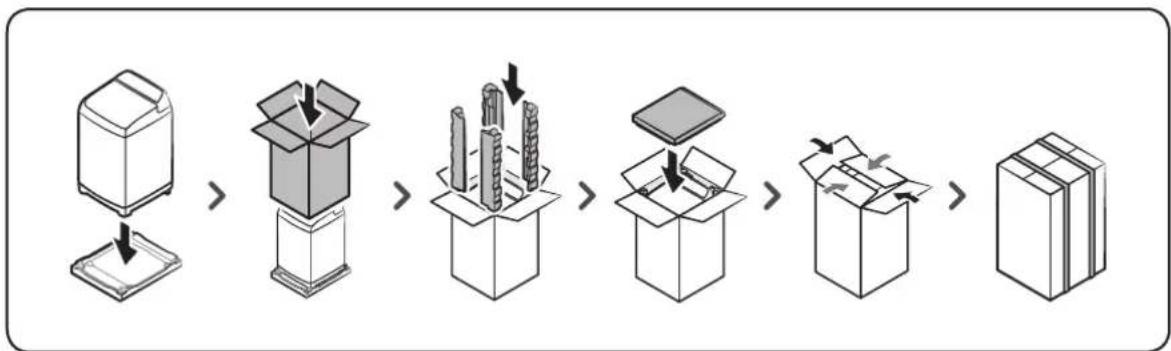
flowchart
graph LR
    A["Printer"] --> B["Box Box"]
    B --> C["Package Box"]
    C --> D["Box Box"]
    D --> E["Package Box"]
    E --> F["Box Box"]
- Put the washing machine on the bottom cushion.
- Put the packing box over the machine.
- Insert the 4 side cushions in the packing box, one for each corner.
- Insert the top cushion on the top of the machine.
- Close the top cover of the box.
- Wrap up the box with straps.
Unpacking
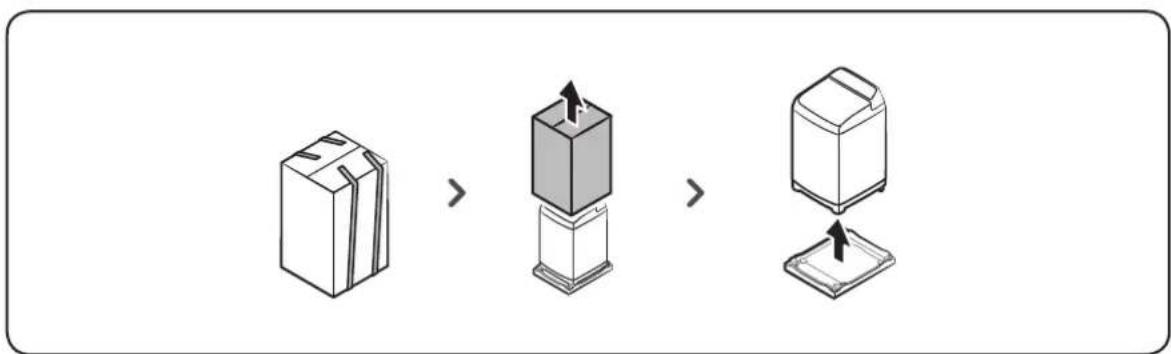
flowchart
graph LR
    A["Box"] --> B["Box with Arrow"]
    B --> C["Tray"]
- Cut the straps to untie.
- Hold the packing box with both hands, and raise the box to remove.
- Remove the washing machine from the bottom cushion.

NOTE
The number of cushions and straps may vary depending on the model.
Memo
Memo


Memo
SAMSUNG

0018
Note : An appliance exceeding 10 kg of loading capacity is not included in scope of GCC regulation.
QUESTIONS OR COMMENTS?
| COUNTRY CALL | OR VISIT US ONLINE AT | |
| SAUDI ARABIA | (+966) 8002474357(800 24/7 HELP) | www.samsung.com/sa_en/support (English)www.samsung.com/sa/support (Arabic) |

natural_image
Blurred grayscale image with indistinct shapes and no visible text or symbolstext_image
Diagram of car interior components with numbered labels pointing to various parts like battery, charging plug, and air conditioner.natural_image
Diagram showing two mechanical components with directional arrows indicating motion, no text or symbols present
text_image
Technical diagram showing mechanical component assembly with labeled parts and directional arrows indicating movement or force.text_image
Technical diagram of a mechanical component with labeled parts and directional arrowsnatural_image
Illustration of hands using a tool to adjust or install a pipe fitting (no text or symbols present)text_image
Diagram showing hand positioning of a faucet with arrows indicating movement, labeled '###' in top-left corner.text_image
ت Winning و Increasing the minimum value of the minimum value (Jaginian's Name) on the minimum value (Jaginian's Name) on the minimum value (Jaginian's Name) on the minimum value (Jaginian's Name) ب Winning ت Winning م Thresholds (Jaginian's Name) على ال الرفي Utilities (Jaginian's Name) على ال الرفي Utilities (Jaginian's Name) على ال الرفي Utilities (Jaginian's Name) على ال الرفي Utilities (Jaginian's Name) على الnatural_image
Hand holding a button next to a door handle, with an arrow indicating left motion (no text or symbols)F
text_image
Technical diagram showing a sink and pipe with dimension annotations, likely for plumbing or plumbing installation instructions.
text_image
E E
عن الأرض.

flowchart
graph TD
    A["Initial fabric"] --> B["Step 1: Fabric deformation"]
    B --> C["Step 2: Stabilization"]
    C --> D["Step 3: Storage with no protection"]
    D --> E["Section A: Storage with open lid and closed lid"]
    E --> F["End"]
natural_image
Line drawing of a mechanical component with a handle and circular ports (no text or symbols)العربية ٣٣

درج مسحوق الغسيل
flowchart
graph LR
    A["Box with lid"] --> B["Open Box"]
    B --> C["Stacked Box"]
    C --> D["Stacked Box with Cartons"]
    D --> E["Box with Box"]
    E --> F["Box with Box"]
    F --> G["Box with Box"]